OCTOBER 2026
WWW.BUSINESSMEDIAMAGS.CO.ZA
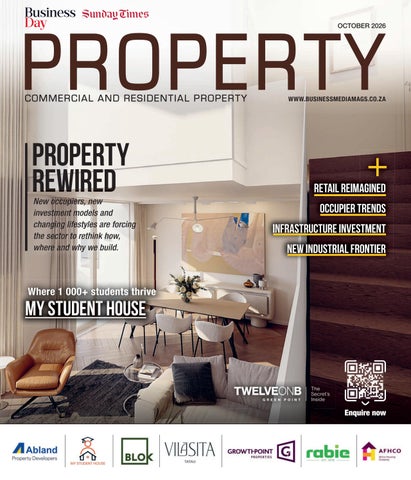
PROPERTY REWIRED
New occupiers, new investment models and changing lifestyles are forcing the sector to rethink how, where and why we build.
+
RETAIL REIMAGINED
OCCUPIER TRENDS INFRASTRUCTURE INVESTMENT NEW INDUSTRIAL FRONTIER
Where 1 000+ students thrive
MY STUDENT HOUSE
Enquire now
PROPERTY_Cover v5.indd 1
2026/10/12 14:48
ToCheck_dps.indd 2
2026/10/08 16:32
ToCheck_dps.indd 3
2026/10/08 16:32
ToCheck_fcp.indd 2
2026/10/08 16:33
IN PARTNERSHIP WITH VILASITA AT ZIMBALI LAKES
KWAZULU-NATAL’S NORTH COAST ATTRACTS PROPERTY BUYERS As KwaZulu-Natal’s North Coast is proving to be a sought-after area for residential property, a new development, VILASITA AT ZIMBALI LAKES, is set to add 146 villa-style residences to the Tatali precinct
K
waZulu-Natal’s North Coast continues to strengthen its position as one of South Africa’s most compelling residential property markets, attracting buyers seeking long-term investment potential, secure coastal living and access to an increasingly established lifestyle destination. Against this backdrop, Vilasita at Zimbali Lakes will officially launch online at 9am on 7 November 2026, introducing 146 villa-style residences within the estate’s Tatali precinct. For buyers from Johannesburg, Pretoria and Cape Town, property decisions are increasingly influenced by more than the home itself. Security, accessibility, lifestyle infrastructure and the long-term growth prospects of the surrounding area have become important considerations. The North Coast’s momentum is reflected in recent residential building completions, with the region recording a 53.6 per cent year-on-year increase in value.
Images: Supplied
Images: Supplied
A DISTINCTIVE RESIDENTIAL OFFERING Backed by internationally established developer IFA Hotels & Resorts, Vilasita introduces a collection of lakefront villas, garden villas and penthouses, positioned to capture views across the lake and Indian Ocean.
The development moves beyond conventional apartment living, offering the convenience of drive-up access alongside contemporary architecture, generous balconies and expansive living and entertainment areas. At the upper end of the offering, penthouses extend to 725m2, incorporating private rooftop entertainment spaces. With prices ranging from R2.95-million for a one-bedroom residence to R55-million for a four-bedroom penthouse, Vilasita appeals to a broad spectrum of purchasers, from investors and professionals seeking secure lock-up-and-go accommodation to buyers looking for a signature coastal residence.
INVESTMENT VALUE BEYOND THE RESIDENCE An important part of Vilasita’s appeal lies in the wider Zimbali Lakes masterplan. Tatali is being developed as a mixed-use precinct, incorporating a planned 20 000m2 shopping centre that will introduce additional retail and dining opportunities. Vilasita is centred on a 10-hectare lake designated for nonmotorised water sports, contributing to the estate’s distinctive setting. Residents will also benefit from beach access, landscaped promenades, the Zimbali Lakes Clubhouse and the Ernie Els Signature Course.
Security infrastructure, including biometric access and monitored CCTV, further supports the estate’s lock-up-and-go appeal. “Vilasita responds to the way buyers are increasingly assessing property, where the quality of the home is only one part of the decision,” says Neil Cocker, vice president of operations at Zimbali Lakes.
A GROWING DESTINATION WITH VISIBLE PROGRESS Development activity across Zimbali Lakes provides further context for prospective purchasers. The estate’s first two residential phases have sold out, approximately 45 homes are under construction, and bulk earthworks are progressing across Tatali – targeted for completion and occupation by mid-2028. Its proximity to King Shaka International Airport, the M4 and Ballito’s established retail and lifestyle amenities strengthens its appeal to both local and out-of-province buyers. As the North Coast continues to mature, Vilasita presents an opportunity to secure a residence within a growing coastal destination supported by international development expertise. Vilasita launches online at 9am on Saturday 7 November 2026. Prospective purchasers can register their interest and explore the offering at vilasita.co.za.
P RO P E RT Y
Zimbali_FCP Advertorial.indd 3
3
2026/10/12 14:39
ToCheck_fcp.indd 2
2026/10/07 15:23
CON T EN T S
PUBLISHED BY
CONTENTS
Picasso Headline, A proud division of Arena Holdings (Pty) Ltd, Hill on Empire, 16 Empire Road (cnr Hillside Road), Parktown, Johannesburg, 2193 PO Box 12500, Mill Street, Cape Town, 8010 www.businessmediamags.co.za EDITORIAL Content Manager: Raina Julies rainaj@picasso.co.za Contributors: Trevor Crighton, Vukani Magubane, Itumeleng Mogaki, Busani Moyo, Brendon Petersen, Lisa Witepski Copy Editor: Brenda Bryden Content Co-ordinator: Natasha Maneveldt DESIGN Head of Design: Jayne Macé-Ferguson Senior Design: Mfundo Archie Ndzo Cover Image: Courtesy of Blok SALES Project Manager: Merryl Klein merrylk@picasso.co.za | +27 82 895 7260 Sales: Anton Klein DIGITAL Online Editor: Stacey Visser vissers@businessmediamags.co.za PRODUCTION Production Editor: Shamiela Brenner Advertising Co-ordinator: Fatima Dramat Subscriptions and Distribution: Fatima Dramat fatimad@picasso.co.za Printer: CTP Printers, Cape Town MANAGEMENT Management Accountant: Deidre Musha Business Manager: Lodewyk van der Walt General Manager, Magazines: Jocelyne Bayer
COPYRIGHT: Picasso Headline. No portion of this magazine may be reproduced in any form without written consent of the publisher. The publisher is not responsible for unsolicited material. Property is published by Picasso Headline. The opinions expressed are not necessarily those of Picasso Headline. All advertisements/advertorials have been paid for and therefore do not carry any endorsement by the publisher.
05_property ed's contents_1.indd 5
26 20 INFRASTRUCTURE INVESTMENT 6 RETAIL REIMAGINED As e-commerce reshapes shopping habits, malls are evolving into lifestyle destinations built around experience, convenience and reasons to stay.
8 ADAPTIVE REUSE Finding a new purpose for ageing office blocks, underused industrial sites or outdated malls isn’t just sustainable. It makes commercial sense, too.
11 PROPERTY FINANCE Capital is flowing, but unevenly. Across development, buyers, alternative lenders and emerging credit models, the finance landscape is shifting – widening access for some and tightening it for others.
15 OCCUPIER TRENDS Commercial property is being reshaped by changing occupier needs, investment priorities and economic pressures.
19 HOSPITALITY INVESTMENT Tourism is reshaping South Africa’s property landscape, opening new destinations and driving innovative hospitality-led investment models.
32
Roads, rail and public transport are changing where South African property development happens, but access alone doesn’t determine what succeeds.
21 TECHNOLOGY Property technology is becoming less about visible gadgets and more about better data, earlier warnings and decisions made while there’s still time to change course.
26 STUDENT HOUSING South Africa’s student accommodation shortage is creating opportunities in both established and emerging markets, as investors respond to changing student needs and demand for affordable, purpose-built housing.
32 FUTURE-FIT NEIGHBOURHOODS The world’s best neighbourhoods integrate homes, work, transport and amenities – offering lessons for more connected, inclusive South African communities.
30 INDUSTRIAL AND LOGISTICS E-commerce, manufacturing, cold storage, data centres and demand for specialised industrial uses are driving a new kind of demand in the industrial and logistics space.
2026/10/12 17:05
WHY SHOPPING CENTRES ARE BECOMING DESTINATIONS As e-commerce reshapes shopping habits, retail destinations are evolving into lifestyle spaces built around experience, convenience and reasons to stay, writes LISA WITEPSKI
“AT SUBURBAN AND REGIONAL MALL LEVEL, TENANT MIX IS SHIFTING FROM A THIRD OR FOURTH FASHION ANCHOR TOWARD GYMS, CINEMAS AND CO-WORKING.” – SIMON WILKINS
Menlyn Park Shopping Centre
I
f groceries and even fashion can be delivered to your door with the tap of an app, what’s drawing you to your local mall? This is the question property developers are increasingly asking themselves – and they’re turning to entertainment for answers. Simon Wilkins, managing director for Galletti Corporate Real Estate, says: “What draws consumers now are the offerings e-commerce can’t replicate: food and beverage as a genuine draw, entertainment and events, and an environment worth spending time in rather than just passing through.” This shift shows in a move away from pure retail space in favour of food, entertainment, wellness and, increasingly, residential and hospitality: “At suburban and regional mall level, tenant mix is shifting from a third or fourth fashion anchor toward gyms, cinemas and co-working,” Wilkins observes. This has implications for business models: apart from bringing in nonretail tenants, such as
residential or co-working spaces, landlords are curating for dwell time and repeat visits, rather than maximising rent per square metre on paper. This translates to shorter, more flexible leases for pop-up and experiential concepts alongside traditional anchor leases, says Wilkins.
ACCENT ON ENTERTAINMENT … The recent reinvention of established malls proves retail’s metamorphosis. In August, Rosebank Mall unveiled its Urban Playground, described on Bizcommunity.com as “a new, multipurpose lifestyle destination designed to bring together sport, gaming, entertainment and content creation in one space”. Key features include an esports gaming arena, street soccer, a podcasting studio, a dance studio and a skate park. Menlyn Park Shopping Centre is following suit. The mall may have been built 40 years ago, but it has become almost unrecognisable from its earliest iteration.
Nisha Kemraj, the centre’s general manager, says: “As the second largest mall in the southern hemisphere, we have a responsibility to ensure we’re on point in terms of trends.” This has necessitated ongoing reviews of the mall’s offering to ensure it meets the demands of consumers “who are increasingly selective about where they spend their time” – hence the development of a new R17-million immersive play zone, which will come online later this year. Kemraj explains that the zone comprises an outdoor area, where children can enjoy theme park rides and “a high-energy, adventure-based” component with an accent on gaming. Padel, tenpin bowling and a trampoline park will also form part of the offering, placing a significant accent on the experiential. The launch of the play park continues Menlyn’s mission to become a full lifestyle destination. Development commenced in October last year when work on a R1-billion apartment development began. Located on land adjacent to, and owned by, the mall, the residential element cements Menlyn Park Shopping Centre’s status as a precinct,
Nisha Kemraj
6
PROPERTY
06-07_RETAIL.indd 6
2026/10/12 12:30
RETAIL REIMAGINED
attracting young families who will enjoy the proximity and accessibility of the mall. “It’s an example of how we keep reinventing to stay relevant,” Kemraj comments.
… AND THE IMPORTANCE OF THE EXPERIENTIAL Taking the accent on experiences one step further is Nine Yards, which launched in a phased approach from December 2025. Precinct developer Cadastral has extensive experience across all types of retail, from mixed-use to roadside and traditional malls, and applied the knowledge gleaned to create something that, according to the founder and CEO, Timothy Sammons, speaks directly to current trends, while also making optimal use of the unique site. “We wanted to develop a space Joburgers would feel proud of,” Sammons says – which is why the precinct is tenanted exclusively by makers with a Johannesburg background. The next priority was driving foot traffic on weekdays as well as weekends. “To do this, we considered the departments usually included in the offering of a traditional anchor tenant, such as a bakery or grocery. We deconstructed these departments into separate stores, so that people have as much of a reason to visit Nine Yards on a Tuesday afternoon, when they’re stopping to get ingredients for dinner, as on a Sunday morning, when they’re coming for brunch.”
Nine Yards lifestyle and retail precinct in Johannesburg.
“ACCESSIBILITY IS NO LONGER JUST ABOUT DISTANCE. TRANSPORT COSTS, TRAVEL TIME AND EVEN MOBILE DATA COSTS ALL INFLUENCE WHETHER CUSTOMERS WILL VISIT A BRANCH.” – SAMUEL THEU
IMAGES: SUPPLIED
RETHINKING THE NECESSITIES Sammons’ view is that in an age of Takealot and Checkers Sixty60, retail “splits into things that are functional – like milk and bread, which you might stop to buy quickly on your way home from a strip mall – and experiential.” In the latter’s case, consumers are seeking a pleasant, conducive environment, meaning they no longer wish to put up with harsh fluorescent lights and crowded parking lots. Consequently, developers are giving thought to areas they may have overlooked previously, such as bathrooms. Veronica Vivier, co-founder of hygiene equipment supplier Nuwkem and Ticra™, a commercial hygiene range, cites research by the Bradley Corporation, which states that three-quarters of respondents say they will think twice about returning to a mall after a poor bathroom experience.
“The implication for property developers is direct. A shopper who spends ninety minutes in a destination mall will, statistically, use the bathroom. What they find there contributes to their overall experience, and therefore should be considered as part of footfall and revenue data,” Vivier says. Samuel Theu, national property manager at Atlas Finance, points to Veronica Vivier other factors that landlords should consider in greater depth: “Accessibility is no longer
just about distance. Transport costs, travel time and even mobile data costs all influence whether customers will visit a branch,” he says, reiterating that the next phase of retail property growth may not come from traditional shopping centres. “Smaller-format Dr Patience Nyoni branches, satellite locations and modular buildings are opening opportunities in communities where conventional retail space is limited or simply does not exist.”
“ONE-STOP” SHOP It’s unlikely that retail’s evolution will end there. Dr Patience Nyoni of Regenesys (incorporating a School of Retail) maintains that, going forward, there will be ever greater emphasis on offerings that help consumers save time. “Shoppers want a complete one-stop solution – if you can do everything you need in one place, such as get your groceries after you’ve done a workout, so much the better.”
Follow: Simon Wilkins www.linkedin.com/in/simonwilkins-galetti Nisha Kemraj www.linkedin.com/in/nisha-kemraj-3b3022100 Timothy Sammons www.linkedin.com/in/timothy-sammons-51782827 Veronica Vivier www.linkedin.com/in/veronica-vivier-0ba896288 Samuel Theu www.linkedin.com/in/samuel-theu-494487b4 Dr Patience Nyoni www.linkedin.com/in/patience-nyoni-788629374
PROPERTY
06-07_RETAIL.indd 7
7
2026/10/12 12:30
ADAPTIVE REUSE
WHAT HAPPENS WHEN A BUILDING NO LONGER “WORKS”?
F
irst launched in the 1970s, Golden Acre fast became one of the most iconic buildings in Cape Town’s CBD. That’s why the decision to redevelop the complex’s office tower into residential apartment units (a R1.2-billion project) has been warmly welcomed. The refurbishment of Jewel City will see the six-block precinct reimagined as a mixed-use development, complete with a retail element, restaurants and a residential component – another example of successful redevelopment, says Simon Wilkins, managing director for Galetti Corporate Real Estate.
WHEN REDEVELOPMENT MAKES SENSE In these cases, redevelopment hasn’t just made sense from a commercial point of view. Regeneration has had significant implications for the inner cities where they are located, but, warns Jayson-Lee Collins, director of sales at Broll Jayson-Lee Collins Auctions and Sales, refurbishment is not always the best route. “For property owners and investors, the decision to refurbish and reposition rather than demolish and rebuild ultimately comes down to capital allocation and risk. The cheapest option is not necessarily the best one. Developers should look at the option that offers the strongest risk-adjusted return on investment, taking acquisition costs into account,” he says. Factors to be considered include the building’s structural integrity. If the changes required for redevelopment go beyond the cosmetic, refurbishment may not be feasible. On the other hand, demolition costs must also be considered. “The main reason developers favour refurbishment and repositioning is that it delivers a higher risk-adjusted return on the capital deployed. Where an existing structure can be adapted for a different market, such
8
as converting office space to residential in high-density nodes, the risk-adjusted return on that capital outlay improves further. Repurposing buildings to meet a different market while reducing capital risk is increasingly the approach developers are taking,” Collins notes.
GETTING IT RIGHT The success of a conversion relies largely on four factors, Collins continues: the right building, in the right location, with a viable new use, and a realistic cost-to-value equation. The reimagined building should be able to meet the demands of existing services, transport, structure and adaptability, all of which should align with planning and zoning approvals. If they don’t, the ramifications are significant. Take an issue like rezoning, for example: Collins points out that this can take anything from 12 to 24 months, during which time holding, leakage and maintenance costs accrue. That’s why he recommends that one of the first steps developers should take is to gain approval from local municipalities. A project’s feasibility may be impacted further by the building’s condition: outdated
THE ENVIRONMENTAL ADVANTAGE If these hurdles can be overcome, rewards may be rich – especially from a sustainability point of view. As Wilkins says: “Adaptive reuse is one of the rare instances where the environmental case and the financial case point the same way.” This is especially true if the developers use the existing structural elements, Collins says. This not only removes the need for new construction materials; it also reduces demolition waste and lowers the carbon footprint. “The strongest case for adaptive reuse is where developers preserve the bones of a building while substantially improving its performance and functionality through greener technologies such as boreholes, backup water systems and solar,” he says. “A well-executed refurbishment can add decades to a building’s useful life,” Wilkins says. “The numbers do stack up – but only if the retrofit is done properly. A cheap or poorly designed upgrade can erode a lot of that advantage over time.”
Artist render of Cape Town’s Golden Acre redevelopment.
Follow: Simon Wilkins Jayson-Lee Collins
www.linkedin.com/in/simonwilkins-galetti www.linkedin.com/in/jaysonleecollins
IMAGES: UNDEFINED UNDEFINED.ISTOCKPHOTO.COM, SUPPLIED
Finding a new purpose for ageing office blocks, underused industrial sites or outdated malls isn’t just sustainable. It makes commercial sense, too, writes LISA WITEPSKI
services and structural repairs add to hidden costs, for instance. Meanwhile, infrastructure limitations, such as the capacity of water, electricity and sewage, may also prove obstacles to adaptive reuse.
PROPERTY
08_ADAPTIVE REUSE.indd 8
2026/10/12 12:34
ToCheck_fcp.indd 2
2026/08/26 16:29
ToCheck_fcp.indd 2
2026/10/09 14:54
PROPERTY FINANCE
WHO GETS FUNDED, AND WHO GETS LEFT BEHIND? Capital is flowing, but unevenly. Across development, buyers, alternative lenders and emerging credit models, the finance landscape is shifting – widening access for some and tightening it for others, writes VUKANI MAGUBANE Development capital Property development capital is increasingly favouring projects where demand, location and delivery are relatively certain, while developments with higher execution risk can struggle to secure funding. Peter de Villiers, CFO of JSE-listed property group Attacq, says its recent development activity has been weighted towards industrial, hotel and residential projects in Waterfall City. More broadly, industrial remains a “ perennial performer”, while office development is recovering from a low base and residential is doing well in selected nodes such as Waterfall and Cape Town, he says. For developers seeking capital, however, the quality and risk profile of a project remain critical. “Well-located, tenant-backed schemes with timeline certainty generally don’t struggle,” says de Villiers. “Large
BUYER INSIGHTS For prospective homeowners, the challenge is not simply getting a bank to approve a bond. Increasingly, it is being able to afford enough of a loan to buy a home while also finding the cash needed to get into the market. “Affordability remains the key constraint to home ownership,” says Nondumiso Ncapai, managing executive: Absa Home Loans and Private Banking South Africa. “Rising property prices and interest rates have reduced the amount of home finance buyers can access relative to their income, while higher household costs and existing debt continue to squeeze disposable income,” she adds. The pressure was evident after the 25-basis-point interest-rate increase in May. Absa says home-loan application volumes
Follow: Nondumiso Ncapai
greenfield projects with uncertain timelines are finding it hard to attract capital at present.” De Villiers says investors consider tenant covenant strength, location, the quality of the broader node, competition and how specialised a building is. “The more bespoke it is, the narrower the potential market for it,” he says. From the perspective of institutional investment, Shaila Desai, head of the Residential Impact Fund at Old Mutual Alternative Investments, says the strongest opportunities are in well-located, professionally managed rental housing serving
Follow: Shaila Desai
www.linkedin.com/in/shaila-desai-6a0215157
fell by about 6.5 per cent, while registered bonds grew by only 1.5 per cent. Its Q2 2026 Homeowner Sentiment Index also recorded the largest quarterly decline in buying sentiment since Q4 2022. First-time buyers are particularly exposed. Absa puts their current average purchase price at R1.3-million, compared with R2-million for investors and R2.3-million for repeat buyers. Yet the barrier is not necessarily the monthly bond repayment alone. “Many first-time home buyers can afford the repayments, but lack the accumulated savings required to cover deposits and upfront transaction costs,” says Ncapai. Absa says its lending and affordability requirements have
not become more stringent, suggesting that the constraint is less about banks simply tightening the door and more about what household incomes can support. There are measures to ease the upfront hurdle: Ncapai says Absa offers qualifying first-time buyers finance of up to 110 per cent, including up to 10 per cent towards transfer and bond-registration costs. Looking ahead, Ncapai says better use of alternative data and more sophisticated credit decisioning could help lenders assess people with limited credit histories. For now, the buyerend funding gap remains as much about affordability and upfront capital as access to credit itself.
www.linkedin.com/in/nondumiso-ncapai-92b0622
Nondumiso Ncapai
11-12_Funding.indd 11
middle- and affordable-income markets, as well as purpose-built student accommodation. These sectors combine structural housing need with the potential for recurring rental income. However, housing need alone does not make a project investable. “Demand alone is not enough. A project also needs to translate that demand into an investable proposition,” says Desai. Location, scale, pricing, occupancy potential and professional management all matter. The biggest challenge, she says, is where housing need collides with development economics: achievable rentals may not cover land, construction, infrastructure and financing costs. Municipal approvals, rezoning and infrastructure constraints can further undermine viability. The message is that capital is available, but increasingly Shaila Desai selective – flowing towards projects where demand can be demonstrated, risks managed and returns supported by sound development economics.
PROPERTY
11
2026/10/12 12:36
The changing funding landscape
not fit traditional mortgage criteria. Its MD, Renier Kriek, says the opportunity is to look For buyers who fall outside the beyond conventional occupational profiles. conventional mortgage mould, the problem “The greatest immediate opportunity is not always that they cannot is to finance actual affordability afford a home. Sometimes it rather than occupational is how their affordability stereotypes,” he says. is measured. The shift is not only South Africa’s banks about alternative lenders. are well-positioned to Technology and alternative finance conventional data are also changing salaried applicants, how affordability and risk but entrepreneurs, can be assessed. Mettus/ self-employed XDS, which works with professionals, lenders on credit analytics, freelancers, commission says bank statements, rental earners, people with Renier Kriek records, municipal accounts, and foreign income and property other payment data can provide a investors can struggle to fit fuller picture of consumers who have little or standard lending models. no conventional credit history. That gap is creating space for specialist lenders, such as Sentinel Homes, which was founded to address customers who Follow: Renier Kriek www.linkedin.com/in/renierkriek may be able to afford a property, but do
“Broadening access is not lowering the bar. It’s seeing more of the person,” says Siva Dhever, Mettus/XDS’s head of credit analytics. For example, someone who has consistently paid R10 000 in rent may have demonstrated an ability to meet a similar or lower monthly home-loan commitment, evidence that may not be captured by a traditional credit profile, he explains. These approaches could help address funding gaps affecting first-time buyers with thin credit files, affordable-housing borrowers and smaller developers operating outside established markets, Dhever says. However, alternative finance is not about removing the risk test. Affordability and repayment ability remain central, while deposits or other safeguards may still be required.
Follow the opportunity
particularly for borrowers and businesses whose financial performance is not captured by conventional models. This could bring more affordable-housing borrowers, thin-file consumers and smaller developers into the formal finance net. The opportunity ahead, therefore, is not simply more capital – it is expanding the pool of people and projects that qualify for it. “The whole idea is that we should create a view not Siva Dhever just from the traditional blinkers we had,” says Dhever. “As we move forward, alternative data is going to play a huge part in how we lend across the country.”
Over the next three to five years, property-finance opportunities are likely to be shaped by the resilience of assets and the ability to identify a wider pool of viable borrowers and businesses. Peter de Villiers, CFO of Attacq, expects infrastructure resilience to become increasingly important to property investors. “Nodes that can insulate themselves from infrastructure and service-delivery pressure will outperform,” he says. Precincts with resilient power and water infrastructure, as well as newer, well-maintained infrastructure, will be more attractive, he adds. In a constrained service-delivery environment, resilience is becoming a proxy for value – and a determinant of where capital flows. Residential is another significant opportunity. Shaila Desai, head of the Residential Impact Fund at Old Mutual Alternative Investments, sees potential in multifamily rental, affordable rental
and student accommodation. “The opportunity is therefore not simply to build more housing. It is to build investable residential platforms at scale,” she says. Better sector data and longer operating track records could help residential move further into the institutional mainstream, giving investors greater confidence to commit capital at scale. A stronger pipeline of institutional-grade projects and experienced specialist operators will also be important. Technology and alternative data could also widen access to finance. Siva Dhever, head of credit analytics at Mettus/XDS, says a broader range of information could help lenders assess affordability and risk,
Follow: Siva Dhever
www.linkedin.com/in/siva-dhever-b464153b
IMAGES: SUPPLIED
PROPERTY FINANCE
12 PROPERTY
11-12_Funding.indd 12
2026/10/12 12:37
ToCheck_fcp.indd 2
2026/09/08 16:41
IN PARTNERSHIP WITH GROWTHPOINT
PROPERTY THAT POWERS YOUR ESG STRATEGY
T
he building that a business chooses shapes more than its day-to-day operations. As South African companies strengthen their sustainability commitments, the energy powering their spaces has become an important part of how they reduce emissions, report on progress and respond to investor and stakeholder expectations. This is also changing the role of property owners. Renewable energy cannot be considered solely at building level, particularly where rooftop solar cannot meet demand. A broader strategy is needed to generate, procure and deliver renewable electricity across a portfolio, while giving businesses verified benefits they can account for in sustainability reporting.
Growthpoint’s renewable energy strategy was developed with this broader picture in mind. Its rooftop solar footprint is complemented by off-site hydroelectricity, creating a more balanced and dependable renewable energy supply. Central to this approach is the 5MW Boston Hydroelectric Facility on the Ash River in the Free State, which generates renewable electricity around the clock. Through energy wheeling, this electricity is supplied to the national grid and allocated to Growthpoint tenants participating in its e-CO2 initiative, including those at properties with limited on-site generation. The verified environmental attributes linked to their consumption provide evidence of renewable energy use, supporting Scope 2 emissions
reductions, environmental, social and governance (ESG) reporting and Green Building certification. This allows the energy associated with a business’s space to contribute directly to its sustainability commitments. It also reflects the growing role of property owners as active partners in their clients’ decarbonisation journeys, creating more resilient portfolios and sustainable places where businesses can thrive.
For more information: www. growthpoint.co.za
IN PARTNERSHIP WITH OOBA GROUP
IS A HOME LOAN PREQUALIFICATION NECESSARY IN TODAY’S MARKET? affordability. “A QBC gives you elevated status as a ‘qualified buyer’, providing greater credibility and bargaining power,” he explains. Prequalification can also help when securing finance. From January to August 2026, ooba Home Loans data shows that approval rates averaged 91.2 per cent for prequalified buyers, compared with 80.4 per cent for those who were not prequalified. In August, the respective approval rates sat at 91.7 and 81.2 per cent. “While a QBC closely mirrors the affordability and credit assessments undertaken by the banks, final approval remains subject to factors, including the property’s valuation and suitability as
security, as well as any changes in the buyer’s financial circumstances before the formal home loan application.” “Being prepared can make all the difference between finding your dream home and missing out on an opportunity,” concludes Dyer.
For more information: www.ooba.co.za
IMAGES: SUPPLIED
F
or prospective homebuyers, being prepared can give you the edge. And, contrary to popular belief, getting prequalified for a home loan comes at no charge. Before starting the search for a home, Rhys Dyer, CEO of the ooba Group, strongly suggests buyers receive a pre-approval for a home loan amount so they know what they can realistically afford. “ooba’s Bond Indicator allows you to check your credit score, estimate affordability and obtain a pre-approval certificate within minutes.” The next step is a Qualified Buyers Certificate (QBC), which involves a more detailed assessment of supporting documents, credit history, income and
14 PROPERTY
14_GROWTHPOINT.indd 14
2026/10/12 12:37
OCCUPIER TRENDS
RETHINKING THE SPACE WE WORK IN Commercial property is being reshaped by changing occupier needs, investment priorities and economic pressures, writes TREVOR CRIGHTON
efficiency. “The need for modern, efficient logistics facilities is particularly strong around major transport corridors – including ports – and with this, there is demand in the likes of Cape Town and KwaZulu-Natal,” he says. “Flexible leasing is great for tenants in a volatile climate, and there is a demand for that. However, for landlords there are major risks, additional costs and a few other pitfalls to consider. For landlords, I would say it’s about weighing up the pros and cons, and what works best for your financial situation.”
LOOKING FOR AN UPSIDE
Bydgoszcz Logistics Park
Fortress Logistics Park
T
he traditional office may not be dead, but the way businesses are adapting employees’ environments to new ways of working is shifting the commercial office space market. The continued rise of logistics and mixed-use developments is also shifting the traditional definition of commercial property – and developers who aren’t moving with tenants’ needs face an expensive challenge in the future. “While most companies have returned to the office officially and there is little talk of the impact of COVID-19 six years later, we continue to see the evolution of the office environment and a shift in how landlords and tenants view the office,” says David Arton-Powell, head of broking for Galetti in Cape Town. “Today, the office is less about fixed workstations and more about promoting collaboration, flexibility and creating an experience. Landlords need to offer efficient, well-located, amenity-rich spaces that can adapt to changing occupier requirements, rather than simply providing more traditional office space.”
IMAGES: SUPPLIED
FLEXIBILITY AND ADAPTABILITY Industrial and logistics property remains a key growth area because demand for modern, well-located warehousing continues to be supported by e-commerce, third-party logistics providers, manufacturing and
the need for leaner distribution networks, according to Sibusiso Ndlovu, business development manager at Fortress Real Estate Investments Limited. “Tenants are increasingly focused on access, operating costs, energy reliability and the ability of a logistics park to accommodate future expansion,” she says. Ndlovu says demand for more flexible and adaptable commercial space is increasing as occupiers look for properties that can adjust to changing business requirements. “In logistics, this is particularly evident where tenants need space that can support expansion, consolidation or changes in distribution strategy over time. Larger logistics parks with available land and scalable infrastructure are therefore well-positioned, as they allow occupiers to grow without having to relocate out of a familiar operating environment.” Arton-Powell says industrial and logistics Sibusiso Ndlovu properties benefitting from structural demand from e-commerce, retail distribution, manufacturing, cold storage and supply chain is nothing new, as more and more consumers purchasing online drives the demand for
Arton-Powell says, in the short term, investors are focused on assets that represent an opportunity to add value quickly – especially where they expect to dispose of the property in under five years. “Think correcting an inefficiency or under-market pricing; something that offers an upside in a property that is underpinned by strong fundamentals,” he says. “In the long term, investors want predictable growth and stable income, backed either by solid tenants or a strong demand from the market for the asset class.” Ndlovu concurs that, in the short term, investors are looking for income resilience, low vacancies, market-related rentals and assets that can continue to perform despite economic pressure, while in the long term, they are looking for quality assets that are difficult to replicate, located in strong nodes and supported by structural demand. “This is why prime logistics assets remain attractive. Modern buildings in strong nodes, with access to transport infrastructure, reliable energy solutions and room for tenants to grow, continue to attract tenants. Fortress’s low vacancies, sustained leasing activity, disciplined development pipeline and weighted average lease expiry of 4.4 years support this investment case,” she says. “For logistics property, low vacancy levels continue to support market-related rentals, positive rental reversions and attractive development yields.”
Follow: David Arton-Powell www.linkedin.com/in/david-arton-powell-a517a6123 Sibusiso Ndlovu www.linkedin.com/in/sibusiso-ndlovu-ca-sa-cert-dir-66818b86
PROPERTY
15_COMM PROPERTY.indd 15
15
2026/10/12 12:39
30 YEARS OF CREATING OPPORTUNITIES TO LIVE BETTER From affordable housing to homeownership, education and thriving communities, AFHCO AFRICA HOUSING COMPANY marks three decades of opening doors and transforming lives
contributing to affordable accommodation and community development. Its offering has evolved to include residential rentals, student accommodation, retail spaces and property sales, creating a comprehensive property ecosystem that responds to changing lifestyles, aspirations and financial circumstances. For AFHCO, affordable living has never been about providing a roof over someone’s head alone. It is about creating environments where residents feel a sense of belonging, enjoy greater convenience and access opportunities that support their personal development. Whether a young person moving into their first apartment, a student pursuing a qualification, a family seeking a comfortable home or an aspiring homeowner taking their first step onto the property ladder, AFHCO aims to offer something for every life stage.
INVESTING IN THE NEXT GENERATION: CITYKIDZ PRE & PRIMARY SCHOOL
16
company’s growth, but also the thousands of personal stories that have unfolded within its properties. At the heart of this journey remains one simple belief: everyone deserves the opportunity to live better.
AFHCO’S EVOLUTION HAS BEEN CHARACTERISED BY STRATEGIC EXPANSION AND A COMMITMENT TO RESPONDING TO THE CHANGING NEEDS OF THE PROPERTY MARKET. BUILDING MORE THAN HOMES Over the past three decades, AFHCO has established itself as a significant player in Johannesburg’s residential property landscape,
OPENING DOORS THROUGH EDUCATION AFHCO’s commitment to education extends beyond childhood learning. Through bursary opportunities for qualifying tenants wanting to further their academic careers, the company continues to support personal advancement and professional development.
Images: Supplied
I
n a city where opportunity and ambition meet, a home is more than just a place to live. It is where families grow, dreams take shape, children discover their potential and individuals build their futures. For 30 years, the Africa Housing Company (AFHCO) has been a part of these journeys, creating spaces where South Africans can live better and aspire to more. This October, AFHCO celebrates its 30th anniversary, marking three decades of providing affordable housing solutions, investing in communities and creating opportunities that extend far beyond the walls of its properties. What began in 1996 as a vision to make quality housing more accessible has evolved into a diversified property business, providing homes and spaces that support people through different stages of their lives. Today, AFHCO provides accommodation to approximately 60 000 people across its portfolio, a milestone that reflects not only the
One of AFHCO’s most meaningful milestones came in 2008 with the establishment of CityKidz, an educational initiative demonstrating the company’s commitment to investing in people as well as property. Recognising that education plays a fundamental role in breaking cycles of disadvantage and creating opportunities for future generations, CityKidz remains an important part of AFHCO’s broader social impact journey. The initiative reflects the belief that meaningful community development must extend beyond housing to include opportunities that can change the trajectory of a child’s life. For AFHCO, CityKidz represents an investment in Johannesburg’s future and the potential of its young people, reinforcing the importance of supporting the wellbeing, growth and aspirations of the communities it serves.
P RO P E RT Y
AFHCO_DPS Advertorial.indd 16
2026/10/12 17:10
IN PARTNERSHIP WITH AFHCO AFRICA HOUSING COMPANY
BY OFFERING BOTH RENTAL AND SALES SOLUTIONS, AFHCO POSITIONS ITSELF AS A PROPERTY PARTNER THAT SUPPORTS CUSTOMERS AS THEIR CIRCUMSTANCES AND ASPIRATIONS EVOLVE. For many individuals, access to further education can be the difference between remaining where they are and unlocking new possibilities. By helping tenants pursue additional qualifications, AFHCO recognises that the journey towards a better life is shaped not only by where people live, but also by the opportunities available to help them move forward. A home provides stability, while education provides the tools to build a different future. Together, they create a powerful foundation for personal and generational progress.
A NEW CHAPTER OF GROWTH AFHCO’s evolution has been characterised by strategic expansion and a commitment to responding to the changing needs of the property market. The acquisition of Indluplace Properties in July 2023 marked a significant milestone, strengthening the company’s property portfolio and expanding its capacity to serve a broader residential market. More than an increase in property holdings, the acquisition reflected AFHCO’s ambition to expand its reach and make quality accommodation accessible to more people. As the company grew, so did its understanding of what modern residents expect from their living environments. While affordability remains essential, convenience, lifestyle, community and access to amenities have become increasingly important to tenants seeking homes that complement their ambitions. AFHCO has continued to evolve alongside its customers, recognising that better living means different things at different stages of life.
Images: Supplied
ELEVATING EVERYDAY LIVING: THE PARKS LIFESTYLE ESTATE The addition of The Parks Lifestyle Estate to AFHCO’s portfolio in December 2025 marked another exciting chapter in the company’s journey, demonstrating its commitment to broadening its offering while remaining true to its founding purpose. Situated in the growing Riversands area, The Parks Lifestyle Apartments offers a
lifestyle-focused approach to residential living, catering to individuals and families seeking modern homes designed around convenience and community. The development reflects AFHCO’s understanding that customers’ needs evolve as they progress through life. Someone beginning their journey in an affordable inner-city apartment may seek a different environment as their career develops, their family grows, or their lifestyle priorities change. Through properties such as The Parks, AFHCO creates opportunities for residents to embrace the next chapter of their lives with a property brand that understands their journey. This evolution demonstrates how affordable housing and aspirational living can form part of the same broader vision.
CREATING PATHWAYS TO HOMEOWNERSHIP For many South Africans, owning a home remains one of life’s most significant ambitions. Recognising this milestone, AFHCO has expanded its offering beyond rentals to include apartment sales and pathways to homeownership, helping individuals and families transition from renting to owning. Through its property sales offering, AFHCO creates opportunities for customers to build long-term financial security and invest in their futures. Homeownership represents more than acquiring property. It symbolises independence, stability and the potential to build generational wealth. By offering both rental and sales solutions, AFHCO positions itself as a property partner that supports customers as their circumstances and aspirations evolve. From a first rental apartment to a family home and ultimately the possibility of ownership, AFHCO remains committed to helping people progress through every life stage.
approximately 60 000 people who call its properties home. Yet perhaps its greatest achievement cannot be measured solely in buildings, apartments or numbers. It lies in the lives touched, the educational opportunities created, the families supported and the aspirations made possible over three decades. As Johannesburg has evolved, AFHCO has continued to invest in its communities. The redevelopment of Davies Street in Johannesburg’s inner city reflects this commitment, contributing to a safer, cleaner and more welcoming urban environment. The company’s dedication to excellence has also earned industry recognition, securing Gold awards in two categories at the 2026 Reside Awards: Residential Property Management Company and Student Accommodation Residential Project for Living @ Mpumelelo. These prestigious accolades reinforce AFHCO’s commitment to delivering quality living environments while continually raising standards within the property sector. Looking ahead, the company remains focused on strengthening communities, expanding opportunities and providing property solutions that reflect the aspirations of a changing South Africa. Thirty years of experience have shaped AFHCO’s journey, but its purpose remains as relevant today as it was in 1996 because at AFHCO, providing a home is only the beginning. Creating opportunities for people to move up in life is what makes the journey meaningful. AFHCO – 30 years of helping South Africans live better.
VISIT WEBSITE SCAN THIS QR CODE TO GO TO AFHCO AFRICA HOUSING COMPANY WEBSITE
30 YEARS LATER, THE PURPOSE REMAINS THE SAME As AFHCO celebrates its 30th anniversary, its achievements are reflected in its diversified portfolio, growing communities and the
For more information: https://afhco.co.za/
P RO P E RT Y
AFHCO_DPS Advertorial.indd 17
17
2026/10/12 17:10
ToCheck_fcp.indd 2
2026/10/12 16:53
HOSPITALITY INVESTMENT
DESTINATION HOTSPOTS
Tourism growth is unlocking new property opportunities across South Africa, writes ITUMELENG MOGAKI
H
otel demand, says Alan Campbell, talent & commercial director at ANEW Hotels & Resorts, can provide an early indication of where property opportunities are emerging. “Hotel demand is the early warning system for property investment. When rooms fill faster than new ones get built, the next opportunity is already showing itself,” he says. Cape Town remains an established leader, but Campbell says investment is increasingly extending into the Northern suburbs, Somerset West and the Helderberg. “In the Winelands, the shift towards longer stays is supporting demand for boutique hotels, guesthouses and mixed-use developments, while the Garden Route is benefitting from longer stays, domestic drive tourism and semigration,” says Campbell.
He adds that Kruger’s gateway towns, including Hazyview and White River, “are also attracting attention, while the KwaZulu-Natal (KZN) coast offers opportunities where affordability and tourism demand intersect”. The KZN South Coast is already showing signs of this potential. Umdoni, Pennington, Kelso and Scottburgh recorded more than 230 property transfers worth over R300-million in 2025, according to the South Coast Property Outlook (2026–2030), published by Umdoni Point Coastal Forest Estate in partnership with RE/MAX Coast & Country. Pat Symcox, owner of RE/MAX Coast & Country, says lifestyle migration, affordability and demand for secure estate living are
BEYOND THE HOTEL
XXXXXXXX IMAGES: PETERSEN/ISTOCKPHOTO.COM, SUPPLIED
T
Follow: Alan Campbell www.linkedin.com/in/alancdfpcampbell Pat Symcox www.linkedin.com/in/pat-symcox-34014918
WHEN FOOD BECOMES PART OF THE PROPERTY
or investment units; they are buying into a lifestyle,” he says. Gallagher believes restaurants can become destination drivers, influencing where people stay, work and even choose to live. This creates potential for what he describes as “F&B-to-property” models, where established restaurant or hospitality brands extend into serviced apartments, boutique hotels, branded residences and mixed-use developments. A strong F&B offering, he says, can create a social hub, generate footfall and give a development a distinctive identity. However, he cautions against treating branding as a shortcut to value. “The brand has to be operationally credible. The food, service, design, experience and hospitality culture all have to deliver on the promise,” says Gallagher.
Conrad Gallagher, chef, restaurant owner and CEO of Food Concepts 360, says the evolution goes further, with food and beverage (F&B) increasingly becoming part of the property’s identity and value proposition. “People are no longer simply buying square metres, bedrooms
Follow: Joy Lehasa www.linkedin.com/in/thato-joy-lehasa-459544b8 Conrad Gallagher www.linkedin.com/in/conradgallagher
As hospitality and residential property converge, serviced apartments, aparthotels, boutique properties and branded residences are reshaping how people stay, invest and live, writes ITUMELENG MOGAKI
oday’s traveller, says Joy Lehasa, founder of Elite Hospitality, is “increasingly looking for accommodation that combines the service and consistency of a hotel with the privacy, flexibility and sense of space associated with a residential property. “This is particularly relevant to corporate travellers, professionals, families and longer-stay guests, who may want more space and flexibility than a conventional hotel room provides,” says Lehasa. She adds that the distinction between a hotel and a home is therefore becoming less important. “Professional management, service, cleanliness, design and convenience can all influence how people experience and value a property. “The future lies less in choosing between a hotel and a home, and more in combining the
driving momentum. “The report forecasts annual growth of five to seven per cent in property transactions between 2026 and 2030, with capital growth of fifteen to twenty-five per cent anticipated in leading lifestyle estates,” he says. Campbell notes that the “lesson is to ‘follow the guest, not the hype’ by looking for destinations where demand is strong, access is improving and supply remains limited.”
best elements of both,” says Lehasa. For investors, this creates opportunities to develop properties around specific customer needs rather than relying solely on traditional hotel or residential models. “Branded residences, for example, can offer hotel-style services and amenities while allowing buyers to own a residential unit. Aparthotels can appeal to guests seeking the flexibility of an apartment with professional hospitality services,” says Lehasa.
PROPERTY
19_HOSPITALITY_1.indd 19
19
2026/10/12 12:39
INFRASTRUCTURE INVESTMENT
HOW INFRASTRUCTURE IS OPENING NEW PROPERTY FRONTIERS Roads, rail and public transport are changing where South African property development happens, but access alone doesn’t determine what succeeds, writes BRENDON PETERSEN
WATCH
Virtual tour of Wynland Industrial Park
ACCESS CAN OPEN THE DOOR
investment. Its position gives developers relatively direct access to major transport There’s also the question routes, while the surrounding northern of whether people can suburbs continue to absorb residential afford to buy in the areas and commercial growth. In 2025, the city where investment is taking approved the sale of a 9.23-hectare industrial place. Stephan Potgieter, site at Wynland Industrial Park, describing the CEO of BetterHome Group area as a high-demand logistics corridor. Mortgage Origination Cape Town’s CBD already has much and BetterBond, says the of the transport infrastructure that new company’s home-loan developments elsewhere are waiting for. application data Golden Acre, which has stood next to tracks purchase prices, Cape Town Station for decades, is now deposits and income trends Property values close to Gautrain stations grow between across regions and age undergoing a large mixed-use redevelopment. one and three per cent faster than those in surrounding areas. Former office space is being converted groups. Those figures allow into 302 long-term and 115 short-term it to see changes in demand apartments, alongside new hospitality, as property prices, interest rates and roperty development often follows retail and workspace. affordability change. infrastructure. A new station can make The development sits next to A new transport connection an area easier to reach, while better Cape Town Station and close might give buyers more roads can make land more attractive to the bus terminal, minibus choice about where for housing, offices, warehouses or taxi interchange and they live, but Potgieter retail. South Africa has several examples of this MyCiTi services. Gracht says deposits and happening, although the results haven’t been Asset Managers director affordability remain the same everywhere. Lesego Majatladi says significant barriers to Gauteng has had more than a decade to Golden Acre “can only home ownership. Better see the effect of the Gautrain. The provincial thrive within a context that access to information and government now wants to revive plans to Lesego Majatladi works”. The redevelopment new ways of assessing extend the network to Soweto, Mamelodi, includes improved pedestrian borrowers can improve the Springs, Atteridgeville, Fourways, parts routes and better connections home-loan process, but they of the West Rand and Sedibeng. A KPMG between Golden Acre, the Grand don’t change what a household assessment commissioned by the Gautrain Parade and the Castle. can afford each month. Management Agency found that residential For buyers, developers and investors, property values close to Gautrain stations infrastructure can widen the map of places grew between one and three per cent faster WHERE CONNECTIVITY MEETS DEMAND that make sense. It can shorten commutes, than those in surrounding areas. It also found Cape Town is seeing considerable improve access and make previously that about R10-billion in retail development had development further north. The City’s marginal land more useful. However, the taken place near stations. Municipal Spatial Development Framework examples in Gauteng and the Western Research from the University of Pretoria and Northern District Plan provide for more Cape also show how quickly those looked at Pretoria, Midrand and Rosebank residential, mixed-use and commercial gains run into the same constraints: and found that the Gautrain had influenced development around Durbanville, Tyger Valley, affordability, municipal capacity and developers’ investment decisions. The Cape Gate and Kraaifontein. whether there’s enough demand to researchers also found significant differences Kraaifontein is close to both the N1 and support what gets built. between the three areas. Rosebank R300 and has attracted industrial and logistics already had an established mix of offices, shops and residential property, while Midrand and Pretoria had very different Follow: Lesego Majatladi www.linkedin.com/in/lesegomajatladi Stephan Potgieter www.linkedin.com/in/stephan-potgieter-ceo-betterhome-group-mortgage-origination development patterns.
IMAGES: DENIS KABANOV/ISTOCKPHOTO.COM, SUPPLIED
P
20 PROPERTY
20_INFRA.indd 20
2026/10/12 12:50
TECHNOLOGY
FROM SMARTER BUILDINGS TO SMARTER PROPERTY DECISIONS Property technology is becoming less about visible gadgets and more about better data, earlier warnings and decisions made while there’s still time to change course, writes BRENDON PETERSEN
IMAGES: UNDEFINED UNDEFINED.ISTOCKPHOTO.COM, SUPPLIED
S
ome of the most useful technology in property is fairly ordinary. It’s a meter that shows something is wrong before the bill arrives, a project dashboard that flags a cost over-run early or a digital site record that settles an argument months later. At Redefine Properties, much of the focus is on connecting building systems, data and analytics so property teams can see how their buildings are performing. Obey Makhuvele, head of information and communication technology at Redefine Properties, says smart metering and near real-time utilities Obey Makhuvele tracking mean unusual consumption can be picked up earlier. Tenants get a clearer view of what they’re using, while Redefine can identify inefficiencies and decide where investment is needed. Leon Mayo, executive director at LL Projects, says one of the biggest changes in construction has been better cost and programme tracking. For years, that information often sat in spreadsheets that were already out of date by the time they were discussed. Live data means a problem can be seen while it’s still relatively cheap to fix. Mayo says spotting a variance in week 2 rather than week 12 can be the difference between a conversation and a claim. Digital site diaries have become useful for much the same reason. A time-stamped photographic record gives project teams a clearer account of what happened on site and when. Once a building is operating, Redefine uses data in similar ways. Makhuvele says utilities analytics can identify abnormal consumption linked to leaks, equipment faults or inefficient systems, while performance data can help determine whether an asset should be
THE CHANGING IDEA OF A SMART BUILDING
Artificial intelligence (AI) is starting to sit on top of some of those systems, but neither Makhuvele nor Mayo sees it as a substitute for the people making decisions. Makhuvele sees useful applications in predictive maintenance, asset intelligence, tenant sentiment analysis and reporting, but says any AI system is only as dependable as the data and processes feeding it.
Even the idea of a smart building is changing. Mayo says clients are less interested in obvious gadgetry and more interested in what a building will cost to run and whether it’ll still perform well in a decade. They also want systems that are easier to maintain when something eventually fails. Load shedding helped make building performance a financial issue rather than a nice extra. Makhuvele says Redefine starts with the problem that needs to be solved, then asks whether the technology can improve operations, tenant experience, sustainability or long-term asset performance. There’s still plenty of room for judgement. A system can flag unusual energy use, but someone has to decide whether it points to a
Mayo says AI can pick up patterns that might be easy to miss in a spreadsheet, such as a cost category starting to drift or an invoicing pattern that has previously preceded a dispute. What it can’t do is stand inside a half-finished building, understand how several trades are interacting and see why the sequence of work is about to create a delay. He sees it as an early-warning system, not a decision-maker.
fault, a change in how the building is being used or something less urgent. A project dashboard can show that costs are drifting, but it can’t resolve what happens next between a client, contractor and subcontractor. For now, the technology is giving those people better information earlier.
maintained, replaced or upgraded. Automation is also taking over routine work, including lease approvals and operational workflows.
AI AS AN EARLY-WARNING SYSTEM
Follow: Obey Makhuvele www.linkedin.com/in/obey-makhuvele Leon Mayo www.linkedin.com/in/leon-mayo-16795929 Leon Mayo
PROPERTY
21_Tech.indd 21
21
2026/10/13 09:12
ToCheck_dps.indd 2
2026/10/08 10:17
ToCheck_dps.indd 3
2026/10/08 10:15
ToCheck_dps.indd 2
2026/10/08 15:16
ToCheck_dps.indd 3
2026/10/08 15:17
STUDENT HOUSING STELLENBOSCH’S STUDENT HOUSING SQUEEZE Stellenbosch University provides accommodation for about 7 500 students, compared with a student population of more than 30 000. Flyt Property Investment’s Ryan Flowers says this structural gap continues to drive strong demand for quality private accommodation, particularly properties close to campus and transport routes. “The question is no longer whether Stellenbosch needs additional student accommodation. The question is how quickly new supply can be delivered to keep pace with demand,” says Flowers.
BUILDING FOR THE NEXT GENERATION South Africa’s student accommodation shortage is creating opportunities in both established and emerging markets, as investors respond to changing student needs and demand for affordable, purpose-built housing, writes ITUMELENG MOGAKI
S
outh Africa’s student accommodation shortage is creating opportunities beyond the traditional university markets, but affordability, location and what students expect from their accommodation will determine where investors look next. For Amogelang Mocumi, fund manager of Growthpoint Student Accommodation, some of the biggest gaps are in Cape Town and Stellenbosch, where high land values, competition from other property uses and restrictive planning regulations make affordable accommodation difficult to deliver at scale. While Johannesburg and Pretoria have attracted significant investment over the past decade, Mocumi says: “The strongest investment opportunities are emerging in nonmetropolitan university towns, where student demand remains strong, but private-sector investment has historically been limited.” However, these markets can face weaker municipal capacity, infrastructure challenges
and lower NSFAS accommodation allowances, which can affect project viability. Mocumi says students are also looking beyond the basics of a room and a bed. Reliable high-speed Wi-Fi, security, dedicated study spaces and convenient access to campus have become essential, while wellness and social facilities are increasingly valued.
THE OPPORTUNITY BEYOND UNIVERSITIES Velda Derrocks, client coverage executive at Tuhf Capital, sees another largely untapped opportunity in accommodation for students at technical and vocational education and training (TVET) colleges. “Eventually this market will become saturated, and there is very little focus on providing decent accommodation for students at TVET colleges,” she says. Derrocks says student accommodation is under pressure nationwide, with a significant shortage of decent, affordable housing near higher education institutions.
Follow: Amogelang Mocumi www.linkedin.com/in/amogelang-mocumi Velda Derrocks www.linkedin.com/in/velda-derrocks-75730512 Jason Raad www.linkedin.com/in/jason-raad-59b73020b Ryan Flowers www.linkedin.com/in/ryan-flowers-47b33b56
26 PROPERTY
26_STUDENT HOUSING .indd 26
Affordability, however, should not mean compromising quality. She points to energy- and water-efficient technologies, including heat pumps, low-flow fittings and motion-sensing lighting, as ways landlords can reduce operating costs and keep rentals affordable. Derrocks also believes government and universities have a role to play in reducing investment risk, particularly around NSFAS payments and the administration of student housing.
WHAT STUDENTS ARE WILLING TO PAY FOR From a commercial property perspective, Jason Raad, commercial property broker at Broll Property Group, says investors need to focus on what students actually want rather than simply targeting prominent university locations. “Students are not necessarily looking for luxury, but they do expect the basics to be right,” says Raad, also highlighting reliable Wi-Fi, private bedrooms, ideally en suite bathrooms and convenient access to amenities, entertainment and transport. Raad says smaller colleges can also present opportunities that are easily overlooked, while direct engagement with educational institutions’ data can help investors understand where accommodation shortages are greatest. “The next phase of student housing is therefore unlikely to be defined by a single market or model. For investors, the opportunity lies in identifying underserved locations and delivering accommodation that combines affordability, convenience, security and quality,” says Raad.
IMAGES: SUPPLIED
Growthpoint Properties Crescent Studios communal area.
Velda Derrocks
2026/10/12 12:52
IN PARTNERSHIP WITH BLOK
THE SECRET’S INSIDE TWELVEONB is our 23rd development, and our fourth in Green Point – a neighbourhood we know well and one we’re excited to add to once again. By Blok
S
ome buildings explain themselves. TWELVEONB reveals itself. Set on a heritage estate at 12 Braemer Road, the development brings a new identity to a site with history already built in, its warm, textured brick facade giving nothing away until you’re through the door.
Images: Supplied
Images: Supplied
THE SECRET COMES TO LIGHT Located at 12 Braemer Road, Blok’s new six-storey building comprises 50 new homes, made up of: • 29 compact one-bedroom apartments. • 1 compact one-bedroom garden apartment. • 1 one-bedroom apartment. • 13 two-bedroom apartments. • 1 two-bedroom garden apartment. • 2 two-bedroom duplex apartments. • 1 three-bedroom garden apartment. • 2 three-bedroom duplex apartments. It’s the latest addition to Blok’s growing footprint, which now counts 23 developments and more than a decade of building across Green Point, Sea Point and the City Bowl. Green Point continues to draw more than investors. Its tree-lined streets, green spaces and genuinely walkable high street put schools, grocers, cafes and the coastline within easy reach, the kind of everyday convenience that increasingly appeals to permanent residents, not only holiday-home buyers.
A NEIGHBOURHOOD BUILT FOR DISCOVERY Framed by the Atlantic seaboard on one side and Signal Hill on the other, Green Point continues to hold its own as one of Cape Town’s most walkable neighbourhoods. The promenade, the V&A Waterfront, DHL Stadium and a strong cafe and restaurant strip are all close by, alongside everyday essentials: grocers, gyms, green spaces that keep drawing permanent residents into the area, not just investors and holidaymakers. TWELVEONB is estimated for completion in April 2029. Apartments start from R3 495 000.
DESIGNED TO BE DISCOVERED, NOT EXPLAINED TWELVEONB’s design leans on contrast and simplicity: brick against light, closed against open, private against shared. The building was shaped to sit comfortably alongside its neighbours rather than dominate the street. That same brick carries the exterior’s language of privacy and filtration through to street level, where a public pocket park offers a place to pause before a minimalist lobby draws you in. Higher up, each apartment steps back from the street edge, carving out sheltered outdoor pockets that catch the sun without exposing residents to it. Inside, the finishes stay honest: exposed concrete, visible services, nothing hidden behind an extra layer. It’s a considered kind of simplicity, where light and space do the work decoration usually would. Beyond the apartment, TWELVEONB features: • A rooftop pool. • Concierge and building management via Fluent, Blok’s short-term letting partner. • 24-hour on-site security. • Private entrance homes. • Pet-friendly apartments. • Parking included with select apartments. • Walking distance to DHL Stadium. Completion is targeted for April 2029.
ABOUT BLOK Blok is a Cape Town residential property developer, building award-winning and industry-leading, intuitively designed urban apartments along the Atlantic Seaboard and in Cape Town’s city centre. With over a decade of experience and 23 successful developments to its name, Blok has built a reputation for design-led apartments and thoughtfully integrated spaces intended to enhance city life, creating not just a home, but a place to belong, connect and thrive.
Scan to discover more For more information, visit TWELVEONB: 066 186 1658 sales@blok.co.za
P RO P E RT Y
BLOK_FCP Advertorial.indd 27
27
2026/10/12 15:27
ToCheck_fcp.indd 2
2026/09/18 16:54
ToCheck_fcp.indd 3
2026/09/18 16:55
THE NEW INDUSTRIAL FRONTIER
MEETING DEMAND
E-commerce, manufacturing, cold storage, data centres and demand for specialised industrial uses are driving a new kind of demand in the industrial and logistics space, writes TREVOR CRIGHTON
Tecoma Park
S
outh Africa’s economic success relies heavily on the logistics sector – something both business and government recognise, and which is actively driving better logistics infrastructure and efficiency to enable trade and attract private investment. This shift is introducing unique opportunities to the market. However, there is still a long way to go in removing infrastructure constraints – the biggest challenge for industry, logistics and the economy. Jason Reeves, Growthpoint Properties’ head of asset management: logistics and industrial, breaks down the different category requirements. “E-commerce, which requires significantly more space than traditional warehousing, is a significant driver of structural demand in modern, prime logistics nodes, and because supply in these areas is already limited, this is driving up rentals. Manufacturing occupiers increasingly require
logistics-integrated facilities. As a result, older manufacturing parks are becoming functionally obsolete,” he says. “Cold-chain logistics supporting food, pharmaceuticals and healthcare is growing rapidly. However, cold-storage facilities require significant capital investment – typically roughly sixty per cent more than conventional storage facilities. Data centres are increasingly competing for industrial-zoned land, and the demand for specialised industrial uses currently driving market demand includes renewable energy Jason Reeves suppliers, advanced manufacturing, high-tech motor assembly, urban logistics hubs and specialised distribution.”
“E-COMMERCE, WHICH REQUIRES SIGNIFICANTLY MORE SPACE THAN TRADITIONAL WAREHOUSING, IS A SIGNIFICANT DRIVER OF STRUCTURAL DEMAND IN MODERN, PRIME LOGISTICS NODES.” – JASON REEVES
Sibusiso Ndlovu, business development manager at Fortress Real Estate Investments Limited, says the usage shift is creating demand for logistics space that can support faster distribution, improved operating efficiencies, energy reliability and more specialised building requirements. “Fortress is well-placed to respond to this demand because its development activity is concentrated in nodes where it already holds land, has established tenant relationships and can deliver facilities that match occupier requirements,” she says. “For data centres in particular, the biggest constraint is the significant power requirement. Where a logistics park or development site is unable to secure the necessary power upgrade, this can materially affect the viability of accommodating data centre users.” David Arton-Powell, head of broking for Galetti in Cape Town, says Amazon’s establishment of a footprint in South Africa in 2024 accelerated demand for these kinds of industrial and logistics properties. “Since then, we have seen an increase in demand, particularly in the Western Cape where space comes at a premium and is very hard to find. The reality is that attracting and retaining talent in this region is far easier, too,” he says. “Other companies in these industries that have invested in space in South Africa include Chery, Vantage Data Centres, which invested sixteen billion rand in Waterfall, Tetra Pak opened a new building in KwaZuluNatal, and Maersk made a one billion-plus rand investment in cold storage in the Western Cape. These sectors require increasingly specialised facilities, from high-spec logistics and temperaturecontrolled environments to power-intensive and highly secure buildings.”
GEARING FOR GROWTH Reeves says that, across the country, ports and logistics corridors continue to attract substantial interest for industrial and logistics properties. “In Gauteng, growth areas include the R21 Corridor, where Growthpoint is currently developing the first building within the Noka Park secure industrial estate in the Riverfields logistics hub, which will be ready
30 PROPERTY
30_31_INDUSTRIAL.indd 30
2026/10/12 12:54
INDUSTRIAL AND LOGISTICS
Reeves says sustainability and energy efficiency have shifted from desirable features to business essentials. “This is driving demand for solar generation, backup power, water-saving technologies and green buildings,” he says. “Existing facilities are being retrofitted to meet these requirements, while new developments are being designed with flexibility and adaptability in mind to accommodate future operational changes.”
FUTURE-FIT
ADAPTING FOR AUTOMATION
Looking to the future, Growthpoint sees opportunities and value in integrated logistics hubs, secure logistics parks, resilient industrial estates and both well-connected and secondary logistics nodes as well as sustainable, future-ready developments. Ndlovu says the next opportunities are closely linked to South Africa’s economic growth. “As gross domestic product improves, demand for industrial and logistics space is expected to increase, driven by business expansion and the entry of new operators Clairwood Logistics Park across various sectors. However, future growth will not be evenly spread across the market. The strongest opportunities are likely to emerge in nodes where land, infrastructure, security and Ndlovu says tenants are looking for facilities tenant demand come together to support viable that help reduce operating costs, improve developments,” she says. reliability and support efficient day-to-day It’s Arton-Powell’s belief that the next operations. “Energy-efficient buildings help opportunities will be shaped by reduce operating costs. Fortress has specialisation rather than just continued to invest in this area, location. “Data centres are with one hundred and three a clear one – the scale of operational solar plants across investment from companies its properties as at the end of like Vantage signals more December 2025.” large-scale facilities Developers are having coming. That demand to consider higher power is tied to reliable, often requirements, larger clear self-generated power, heights, stronger floor so land near strong grid specifications, sophisticated capacity becomes valuable,” security, connectivity, energy David Arton-Powell he says. “We’re also watching efficiency and alternative last-mile, smaller-format logistics power solutions from the outset, closer to metro centres, as retailers notes Arton-Powell. “The flip side shorten delivery times and need infill of this means that the cost to develop and space. Self-storage is quietly becoming one the eventual leased rate per square metre of the more interesting plays, benefitting from have increased dramatically in the past few urban densification and smaller living spaces years. This has meant that both the developer in the major metros. The winners will be assets and end user have to be very creative when that solve a specific operational problem for the putting together all the moving parts required occupier, while not breaking the bank.” to make it work,” he says.
Increased adoption of automation, technology and requirements around energy efficiency and security are changing the way commercial buildings are conceptualised, built and retrofitted.
Follow: Sibusiso Ndlovu www.linkedin.com/in/sibusiso-ndlovu-ca-sa-cert-dir-66818b86 David Arton-Powell www.linkedin.com/in/david-arton-powell-a517a6123 Jason Reeves www.linkedin.com/in/jason-reeves-a24b4035
IMAGES: SUPPLIED
for occupation in October 2026, as well as Samrand, Gosforth Park and Midrand/Waterfall.” Ndlovu says Fortress’ three main secure logistics parks are strong examples of where growth opportunities are being captured. “Clairwood benefits from its proximity to the Durban port and key freight routes. Eastport is strategically positioned along the R21 logistics corridor, with highway frontage and access to Gauteng’s established industrial nodes. Longlake, located in Linbro Park, continues to benefit from its position in an established logistics precinct with access to major transport routes and a deep labour pool,” she says. Arton-Powell says there has been an increase in demand for localised retail logistics in certain rural areas. “Think Boxer and U-Save going into these smaller towns that service the surrounding agricultural areas. Areas like Coega in the Eastern Cape also show potential for growth in the traditionally smaller regions,” he says.
PROPERTY
30_31_INDUSTRIAL.indd 31
31
2026/10/12 12:55
Newinbosch
BUILDING
NEIGHBOURHOODS, NOT ENCLAVES? The world’s leading residential precincts bring housing, work, transport and essential services within easier reach. South Africa can embrace the same principles, but its neighbourhoods must respond to local inequalities rather than reproduce exclusive enclaves, writes BUSANI MOYO
T
he appeal of a home increasingly extends beyond the property boundary. Buyers and tenants also consider whether the surrounding neighbourhood provides convenient access to work, schools, healthcare, shops, recreation and public space – and whether its infrastructure supports a secure, resilient lifestyle. For Grant Smee, CEO of Only Realty Property Group, the defining test is whether a development makes everyday life easier. Georgina Smit, CEO of the Green Building Council South Africa (GBCSA), believes sustainability must be addressed across the entire precinct. Velda Derrocks, client coverage executive at Tuhf Capital, a specialist commercial property finance and growth partner, places inclusive, well-located affordable housing at the centre of the discussion, while Guy Briggs, principal at dhk Architects, argues that developments must reconnect people with the wider city.
RETURNING CITIES TO PEOPLE Briggs says mixed-use, walkable environments are not new. Before industrialisation and widespread car ownership, people lived closer together and moved predominantly on foot. Over the past 70 years, however, planning increasingly favoured car-dependent suburban living, separating homes from workplaces, schools, shops and services. “This became the dominant planning and zoning mode in South African cities, even though most people relied on mass transport like trains and buses. This was exacerbated by apartheid-era segregation, when racial classification added an extra layer to this separation,” he says. The internationally influential 15-minute-city concept seeks to reverse this pattern by bringing everyday needs within a short walk or bicycle journey. Smee considers its central principle relevant, but argues for a flexible South African interpretation.
“The question is not whether every resident can walk everywhere, but whether the neighbourhood gives them meaningful choices about how they move and spend their time,” he says, describing the more appropriate local ambition as a “15-minute lifestyle”. Singapore offers useful lessons through its integration of housing, transport, retail, education and community infrastructure. Brisbane’s West Village combines homes with public space, childcare, sustainable transport, renewable energy and biodiversity. Their value lies in the principles they demonstrate, not in providing blueprints for South Africa.
THE PRECINCT AS A SYSTEM “A sustainable precinct is not simply a collection of buildings with green features; it is a system in which buildings, mobility, public space, water, energy, biodiversity and community infrastructure work together,” Smit says. This approach treats transport, education, healthcare, retail and public space as contributors to neighbourhood performance rather than optional selling points. Newinbosch Neighbourhood Estate in Stellenbosch illustrates this Georgina Smit
32 PROPERTY
32_33_RESIDENTIAL_subbed.indd 32
2026/10/12 12:57
FUTURE-FIT NEIGHBOURHOODS
READ
More about the Newinbosch Neighbourhood
READ
For more on Conradie Park Cederberg Water Way – Conradie Park
DEVELOPMENTS NEED A SPECTRUM OF HOUSING OPTIONS, INCLUDING SMALLER APARTMENTS, SECTIONAL-TITLE UNITS, RENTALS AND MIXED-INCOME OPTIONS. thinking. The mixed-use development became the first African neighbourhood to achieve a 6-Star Green Star Sustainable Precincts rating. Homes are connected to pedestrian and micromobility routes, retail, offices and community facilities. “Newinbosch demonstrates that sustainability can be embedded into the planning and design of a large residential neighbourhood rather than added as a collection of features later,” Smit says. Certification provides investors with evidence that sustainability claims meet defined benchmarks, supporting due diligence, environmental, social and governance reporting, and property valuation.
IMAGES: SUPPLIED
CONNECTED FOR WHOM? South Africa’s challenge is ensuring that convenience and resilience do not become benefits available only within premium estates. Derrocks says genuinely connected neighbourhoods should bring people together. Densifying and refurbishing existing urban areas can deliver affordable rental housing closer to employment, infrastructure and social amenities while limiting urban sprawl. “Proximity to transport hubs, social spaces, services like healthcare and education and convenient retail spaces is, in my opinion, non-negotiable for effective residential planning,” she says. Conradie Park in Cape Town offers one example. The precinct combines social housing and open-market units, with schools, retail and commercial facilities planned within the development. Briggs describes its connection to the surrounding city as “urban stitching”: designing around existing streets, movement patterns, heritage, economic
activity and land uses so a development strengthens rather than isolates itself from its surroundings. The economic case is compelling. Briggs notes that many low-income households spend around 40 per cent of their income travelling to work. Informal communities, despite their structural shortcomings, can reveal how people respond when formal planning fails to meet their needs. Their mix of homes, trade, services and pedestrian activity highlights the value of proximity. International approaches must therefore be adjusted Guy Briggs to South Africa’s affordability constraints, unreliable public transport, infrastructure pressures, safety concerns and unequal geography. Developments need a spectrum of housing options, including smaller apartments, sectional-title units, rentals and mixed-income options. Smee says affordability is already reshaping the path to ownership, with younger people adopting strategies such as rentvesting – renting where they want to live while purchasing property elsewhere.
BUILDING RESILIENCE Over the next decade, resilience is likely to become as important to property decisions as location. Reliable power and water, efficient
buildings, adaptable infrastructure and digital connectivity will increasingly influence where people live. Derrocks expects sustainable building technologies and innovative finance to gain ground. Tuhf Capital’s arrangement with the International Finance Corporation enables qualifying clients to receive up to R18 000 per EDGE-certified unit, reducing their outstanding loan balances and making green technology more financially viable. Smee expects smaller, well-located homes, sectional-title properties and well-connected secondary cities and regional nodes to benefit. However, he cautions that lifestyle, security and resilient infrastructure come at a price, making it essential for buyers to weigh what they receive against what they spend. Good design alone cannot repair South African cities. “Successful neighbourhoods need access to reliable public transport, well-maintained infrastructure, functioning public services and effective governance to build resilience against climate change and economic shocks,” Briggs says. The lesson is not that South Africa should imitate Singapore, Australia or Europe. It is that housing, mobility, public services, public space and economic opportunity must be planned together. The neighbourhood of the future will succeed not merely because everything is close, but because more people can reach what they need to build secure, connected and fulfilling lives.
Follow: Georgina Smit www.linkedin.com/in/georgina-smit-0b097916 Guy Briggs www.linkedin.com/in/guybriggsuspd Grant Smee www.linkedin.com/in/grant-smee-68a56411 Velda Derrocks www.linkedin.com/in/velda-derrocks-75730512
PROPERTY
32_33_RESIDENTIAL_subbed.indd 33
33
2026/10/12 12:59
MIXED-USE LIVING IS WINNING IN CAPE TOWN Mixed-use developments are becoming increasingly popular as they make everyday life easier, more connected and more enjoyable, writes RABIE PROPERTY DEVELOPERS
ACROSS THE MARKET, CONVENIENCE, SECURITY, ACCESSIBILITY AND QUALITY OF LIFE ARE INCREASINGLY INFLUENCING WHERE PEOPLE CHOOSE TO BE.
Park Place, Century City.
Ratanga Park, Century City.
C
ape Town’s continued growth is reshaping the property market, as more people and businesses choose the city, and expectations around how and where we live, work and spend our time continue to evolve. Buyers are looking beyond the four walls of a home. Businesses are reconsidering what an office needs to offer in a hybrid working world. Retirees are seeking independence and community rather than traditional retirement models. Across the market, convenience, security, accessibility and quality of life are increasingly influencing where people choose to be. That is placing greater value on precincts that bring these needs together. For Rabie Property Developers, this is not a new idea. Founded in 1978, Rabie has spent almost five decades looking beyond individual
34
buildings to the environments around them. From early residential developments to Atlantic Beach, Big Bay, Burgundy Estate and, most significantly, Century City, the company’s approach has increasingly centred on how people experience a place over time. The market response to Rabie’s developments over the years has, in many ways, been a consequence of that thinking rather than the starting point.
PROVING THE PRECINCT MODEL Few places demonstrate the value of long-term precinct planning as clearly as Century City. Over time, it has evolved into a neighbourhood where residential communities, offices, hotels, retail, schools, public transport, restaurants, recreation and extensive green spaces reinforce one another. Its success lies partly in that accumulation.
Residents create activity beyond office hours. Businesses support restaurants and retail. Parks and waterways make higher-density living more attractive. Transport infrastructure connects the precinct to the wider city. Lifestyle amenities give people reasons to remain in Century City once the working day is over. The evolution of the former Ratanga Junction site is perhaps the clearest example of Rabie’s willingness to adapt as the market changes. When the theme park closed, the opportunity was not simply to replace one land use with another. The site was reconsidered around what Century City would need next. Ratanga Park emerged as the centrepiece, transforming the former entertainment destination into a substantial green and water-based public realm. Residential development followed around it, with Nine Palms, On Park, Park Place and The Bridges each responding to evolving market demand and changing buyer expectations as the precinct took shape.
P RO P E RT Y
Rabie_3Pg Advertorial.indd 34
2026/10/12 16:07
IN PARTNERSHIP WITH RABIE PROPERTY DEVELOPERS
Park Place is now complete with handovers concluded and its first residents settling into the development. Nearby The Bridges has been a sell-out success, with only a limited number of units remaining. The significance goes beyond the individual projects. Ratanga Junction made sense for one era of Century City. Ratanga Park and the neighbourhood surrounding it reflect what the market values today: access to nature, walkability, security, recreation and an integrated lifestyle. It is a reminder that successful precincts cannot remain static. That is the thinking that will shape one important piece of the Century City story still to come. Rabie is progressing plans for the last undeveloped pocket of land in the precinct, with the intention of bringing residential, commercial and lifestyle uses together in what will ultimately complete a development journey spanning more than 30 years.
THE OFFICE NOW HAS TO EARN THE COMMUTE The same shift in expectations is playing out in commercial property. COVID-19 fundamentally changed the relationship between employees and the office. Remote and hybrid working demonstrated that many people could work effectively from almost anywhere. As a result, the workplace now has to offer something that working from home cannot.
Continuity House, Century City.
The Bridges (Artist Impression).
For businesses, that means an office that supports collaboration, culture and connection. For employees, it increasingly means considering the entire working day, not simply the desk they occupy. This has strengthened the case for well-designed offices within amenity-rich environments. Century City’s commercial proposition extends beyond the buildings themselves. Its public transport infrastructure connects employees through bus, rail and taxi networks, while pedestrian routes link offices to restaurants, shops, gyms, green spaces and everyday services. It is a practical expression of the 15-minute city concept. Employees can exercise before work, walk through landscaped spaces during the day, meet a client over lunch, pick up groceries on the way home or access public transport without needing to get back into a car. In a city where commuting remains a significant daily pressure, that convenience has become increasingly valuable. Continuity House is the latest expression of this approach and is now fully let, with tenants already taking occupation. It follows Junxion Park, which was fully committed months before construction was complete.
RATANGA PARK AND THE NEIGHBOURHOOD SURROUNDING IT REFLECT WHAT THE MARKET VALUES TODAY: ACCESS TO NATURE, WALKABILITY, SECURITY, RECREATION AND AN INTEGRATED LIFESTYLE.
The significance is not simply that businesses are taking office space. It is what they are choosing. In the post-COVID-19 market, quality office space is increasingly defined by what surrounds it and how effectively the wider environment supports the people who use it.
BURGUNDY ESTATE: WHEN A DEVELOPMENT BECOMES A NEIGHBOURHOOD If Century City demonstrates mixed-use urbanism at scale, Burgundy Estate tells a different version of the same story. First introduced to the market in 2006, the precinct entered a new phase in 2015 when Rabie took over its development. The aim was not simply to add more housing. It was to create a true multigenerational neighbourhood. That meant thinking carefully about the mix required for a community to function over time: schools, shopping, restaurants, recreation, green spaces, security and everyday services alongside apartments, houses and retirement living. More than a decade after Rabie became involved, the value of that approach is visible in the maturity of the neighbourhood itself. Families, young professionals, first-time buyers and retirees now live within the same broader precinct, supported by infrastructure and amenities that have grown alongside them. The final stages of residential development are now taking shape. Finwood released its final phase in September after its first two phases sold out, with only a limited number of apartments remaining. Ashmere has achieved strong sales in Phase 1, with phase 2 set to be released early 2027.
P RO P E RT Y
Rabie_3Pg Advertorial.indd 35
35
2026/10/12 16:07
IN PARTNERSHIP WITH RABIE PROPERTY DEVELOPERS
Ashmere, Burgundy Estate
APPLYING THE SAME THINKING TO RETIREMENT The same question of how people want to live applies just as much to life’s later chapters. For a growing generation of retirees, independence, activity, security, and community have become central to where they choose to live. Oasis Life became Rabie’s response to that shift, bringing the same principles of thoughtful planning and community building to retirement living. Instead of approaching retirement as an isolated housing product, the model combines well-designed homes with lifestyle amenities, healthcare, security and opportunities for connection. Oasis Life Clara Anna Fontein, the first estate in the
portfolio, is, today, a mature and established community. Constantia subsequently demonstrated the depth of demand for the concept, selling out and developing into a thriving residential environment. Oasis Life Burgundy Estate has followed with similar success, and is nearly sold out, while Oasis Life Sunningdale is already home to more than 112 residents, with the community continuing to take shape after the official release of phase 3 in September. The portfolio is continuing to evolve, with Rabie already considering where the next Oasis Life community will emerge.
TAKING THE MODEL BEYOND ESTABLISHED PRECINCTS Rabie’s expansion into other Western Cape markets suggests the same development principles can travel. In Paarl, Le Boutonne brought the company into the Winelands with a secure residential development centred on thoughtful planning, lifestyle and long-term value. Construction is now well advanced, and only a handful of homes remaining after the final release. Stonepine Crescent in Kuils River continues to take shape as a growing residential community, with the last release of homes entering the market, as Rabie steadily builds out the development over time. The locations and buyers may differ, but the underlying question remains the same: what does this community need around the home for the development to endure?
Le Boutonne, Paarl (Artist Impression).
VISIT WEBSITE SCAN THIS QR CODE TO GO TO RABIE PROPERTY DEVELOPERS WEBSITE
THE LONG VIEW Oasis Life, Sunningdale
36
Property markets move in cycles. Cities change. Work patterns evolve, and buyer priorities shift.
For more information: www.rabie.co.za
Images: Supplied
These final developments are coming to market within a neighbourhood whose value has already been built around them. Rather than representing the beginning of Burgundy Estate’s story, these final homes mark the closing chapter of a neighbourhood that has been carefully shaped over many years.
Rabie’s track record has been built around responding to those changes without losing sight of the longer term. Its advantage is not simply that it has produced a succession of sell-out developments. Those outcomes point to something more fundamental: an understanding that people rarely make property decisions based on a building in isolation. They buy into the life around it. That principle has shaped Century City, guided the evolution of Burgundy Estate and informed the growth of Oasis Life. It is also evident in the company’s newer developments beyond its established precincts. As Cape Town continues to grow, the challenge will be to use increasingly constrained land more intelligently while creating places that make everyday life easier, more connected and more enjoyable. For Rabie, the final pieces of some of its best-known developments are now falling into place, while the foundations of the next chapters are being prepared. After almost five decades, the story remains less about individual buildings and more about what happens between them, and the communities that ultimately bring those places to life.
P RO P E RT Y
Rabie_3Pg Advertorial.indd 36
2026/10/12 16:07
ToCheck_fcp.indd 9
2026/09/22 11:39
ToCheck_fcp.indd 2
2026/08/05 12:29