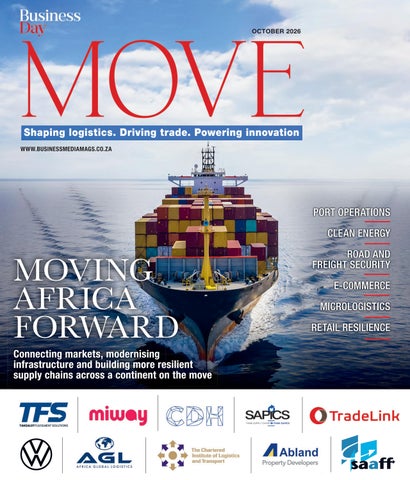
PORT OPERATIONS CLEAN ENERGY ROAD AND FREIGHT SECURITY E-C0MMERCE MICROLOGISTICS RETAIL RESILIENCE
Move_Cover4.indd 1
2026/10/20 10:22
ToCheck_DPS.indd 2
2026/09/09 17:46
ToCheck_DPS.indd 3
2026/09/09 17:46
placed.indd 2
2026/10/14 10:30
placed.indd 3
2026/10/14 10:30
FROM THE EDITOR
THE ROAD AHEAD
PUBLISHED BY
Speaking of infrastructure, long-distance freight movers continue to face significant operational challenges and risk (page 25), particularly along critical arterial routes (page 21). Many of these movers are turning to electric vehicles (page 42), while micrologistics operators are being well served by smaller vehicles (page 34). On the retail front, technological developments are powering South Africa’s e-commerce growth (page 26), and integrated logistics platforms, vendor management and streamlined distribution networks are helping build resilience across channels (page 8). Meanwhile, skills providers are aiming to grow resilience through greater industry collaboration (page 30). Finally, although load shedding has receded, energy resilience, sustainability and cost remain top of mind for supply chain professionals (page 16). Hopefully, these developments can help South Africa ride the wave of growth sweeping across Africa. Happy reading.
EDITORIAL Editor: Anthony Sharpe Content Manager: Raina Julies rainaj@picasso.co.za Contributors: Trevor Crighton, James Francis, Busani Moyo, Nishola Rajcomar-Naidoo, Rodney Weidemann Copy Editor: Brenda Bryden Content Co-ordinator: Natasha Maneveldt DESIGN Head of Design: Jayne Macé-Ferguson Senior Design: Mfundo Archie Ndzo Cover image: istock.com/Grant Duncan-Smith SALES Project Manager: Tarin-Lee Watts wattst@arena.africa | +27 87 379 7119 +27 79 504 7729 DIGITAL Online Editor: Stacey Visser vissers@businessmediamags.co.za PRODUCTION Production Editor: Shamiela Brenner Advertising Co-ordinator: Johan Labuschagne Subscriptions and Distribution: Fatima Dramat, fatimad@picasso.co.za Printer: CTP Printers, Cape Town
Anthony Sharpe Editor
13
MANAGEMENT Management Accountant: Deidre Musha Business Manager: Lodewyk van der Walt General Manager, Magazines: Jocelyne Bayer
Copyright: No portion of this magazine may be reproduced in any form without written consent of the publisher. The publisher is not responsible for unsolicited material. MOVE is published by Picasso Headline. The opinions expressed are not necessarily those of Picasso Headline. All advertisements/advertorials have been paid for and therefore do not carry any endorsement by the publisher.
17 4
A proud division of Arena Holdings (Pty) Ltd Hill on Empire, 16 Empire Road (cnr Hillside Road), Parktown, Johannesburg, 2193 PO Box 12500, Mill Street, Cape Town, 8010 www.businessmediamags.co.za
IMAGES: XXXXXXXX
A
cross the African continent, the transport and logistics sector is booming. Just ask the Brookings Institution, which reports that African logistics start-ups have raised more than R29-billion in the past five years, maritime trade is expected to grow from 58 million tonnes to 132 million by 2030, and the African Continental Free Trade Area is expected to boost intra-African freight demand by 28 per cent. So how does South Africa look in this picture? Well, the 2025 budget included R402-billion for improving transport and logistics, which can only be good news. Government is also pushing ahead with public-private partnerships in the hope of leveraging expertise and capital to improve operations and infrastructure. The freight rail network will soon have 11 private firms operating trains on it and, last year, Durban Port entered into a 25-year partnership with International Container Terminal Services to upgrade and expand Durban Container Terminal Pier 2, and a request for proposal has been issued for a private-sector operator to finance, upgrade, operate and maintain a multipurpose terminal at Port of Cape Town. Check out our feature on page 13 to learn about the implications for port operations, risk management and infrastructure investment.
Shaping logistics. Driving trade. Powering innovation
MOVE
ED'S NOTE_subbed.indd 4
2026/10/20 10:25
ToCheck_fcp hv.indd 2
2026/09/03 10:21
SAFEGUARDING SOUTH AFRICA’S ROAD FREIGHT NETWORK RISHAI NEERACHAND, executive head of business insurance at Miway Insurance Limited, writes that freight companies face several risks when transporting goods, and many underestimate their risk exposure, which is why goods in transit and vehicle fleet insurance are essential
I
n 2025, close to one billion tonnes of freight were transported by road in South Africa, as revealed in Ceidata’s South Africa Freight Transportation: Land: Ton: Road data. Yet despite this significant volume of goods travelling across the country every day, many businesses remain unprotected from the full range of escalating risks on the road. From hijackings and cargo theft to accidents and driver fidelity, a single incident can cost your business thousands in lost revenue and client trust. All businesses that transport goods by road, especially local small and medium enterprises (SMEs), must have the appropriate goods in transit (GIT) and vehicle fleet insurance cover. GIT insurance is becoming increasingly critical for SMEs and growing logistics operators because the risks associated with transporting goods continue to rise and most businesses often don’t have the financial safety net to absorb such losses.
6
PROTECTION FOR GOODS IN TRANSIT GIT cover protects businesses against the most common incidents that can occur while goods are being transported by road, while marine insurance extends to goods transported by rail, air or sea. The risks typically covered by GIT include fire, acts of nature, theft and accidents. However, many businesses often underestimate their risk exposure, especially regarding carry limits. Load values, or annual carry limits, as well as the products under the business’ custody and control at the time of the incident or the existence of contingency coverage, are subjects of frequent misconception.
DON’T UNDERESTIMATE THE FINANCIAL IMPACT Without the correct cover in place, even a single uninsured loss can have serious financial consequences, particularly for smaller businesses. SMEs will experience an immediate drain of cash flow to cover the loss or damage of the uninsured goods, while the expected revenue from those goods can no longer be realised. The financial impact can be even greater if the goods were required to fulfil a contractual obligation. In cases where goods were intended for a contract, the business may have to pay high last-minute expedited shipping costs to replenish stock.
FLEET INSURANCE AND RISK MANAGEMENT Alongside GIT cover, businesses that operate multiple vehicles should also consider fleet insurance rather than insuring each vehicle individually.
GIT INSURANCE IS BECOMING INCREASINGLY CRITICAL FOR SMEs AND GROWING LOGISTICS OPERATORS BECAUSE THE RISKS ASSOCIATED WITH TRANSPORTING GOODS CONTINUE TO RISE.
MOVE
MiWay_DPS Advertorial_1.indd 6
2026/10/14 09:36
IN PARTNERSHIP WITH MIWAY
Fleet insurance allows multiple vehicles to be covered under a single policy and can be tailored to match the specific needs of the business. Standard vehicle insurance, on the other hand, insures each vehicle separately with individual risk ratings. For companies managing a large number of vehicles, fleet cover is often more costeffective and operationally efficient. Businesses also need to consider how their vehicles are used and who is driving them. Where a small, fixed group of employees operates the vehicles, companies may opt for named-driver policies. However, businesses with more dynamic staffing structures may require broader flexibility. Pool driver options are often better suited to businesses with high staff rotation or unpredictable driver schedules. This allows any authorised driver with the company’s permission to operate the vehicle, providing greater flexibility. When it comes to determining the correct cover limits, businesses should evaluate their average and maximum load values, as well as the average number of trips made by drivers on a daily, monthly and annual basis. These policy limits must then be reviewed and updated as the business expands, based on higher carriage limits.
Scaling businesses may also need to shift from standard insurance to insurance tailored solutions with additional optional covers. For example, if a business expands delivery routes to enter cross-border trade, policies should be reviewed to ensure cover extends beyond national borders.
TECHNOLOGICAL ADVANCES CHANGe THE GAME From an industry perspective, vehicle tracking and telematics are changing the game. These technological advancements are shifting the insurance industry from a demographic-based risk assessment to a behavioural-data basis with precise tracking ability. This provides real-time data on how, when and where a vehicle is driven, allowing insurers to re-rate a personalised risk profile and calculate usage-based premiums, renewals and claims experience. At the same time, businesses can use technology to strengthen risk protection. Installing cameras, telematics, tracking devices and a robust fleet management system can reduce risk and even lower insurance costs. Equally important is appointing, training and retaining high-quality, qualified drivers. By combining the right insurance cover with effective risk management measures, businesses can truly protect both their assets and their cash flow.
Rishai Neerachand, Executive Head, Business Insurance at Miway
FLEET INSURANCE ALLOWS MULTIPLE VEHICLES TO BE COVERED UNDER A SINGLE POLICY AND CAN BE TAILORED TO MATCH THE SPECIFIC NEEDS OF THE BUSINESS.
VISIT WEBSITE
Images: Supplied
SCAN TO GO TO THE MIWAY WEBSITE
For more information: www.miway.co.za www.linkedin.com/in/rishai-neerachand-7aba0149
M OV E
MiWay_DPS Advertorial_1.indd 7
7
2026/10/14 15:20
HOW TECHNOLOGY COMPLETES THE RETAIL LOGISTICS CHAIN Retailers are recognising how technology ensures the right people have access to the right information when they need it, writes RODNEY WEIDEMANN
I
n the retail space, digital demand is growing quickly, even though total consumer demand is not. This means the margin for error has narrowed, pushing these players to ensure they know where their stock is, understand what it truly costs to serve the customer and keep their promise when conditions depart from plan. The answer lies in omnichannel agility. One of the biggest challenges for retailers is balancing availability with efficiency. Customers expect the products they want to be available when they need them. Retailers need to manage inventory, waste, working capital and logistics costs carefully to ensure customer expectations are met, explains Mpudi Maubane, Spar’s group head for PR, communications and sponsorships. “This becomes more complex across a network such as Spar’s, which supports a large and diverse group of independent retailers. Each retailer operates within its own community and can experience different purchasing patterns, meaning that demand is not necessarily uniform across the network.” Maubane says retailers must also contend with factors such as changing customer spending, promotional activity, weather, supplier capacity and transport disruptions.
8
THE ABILITY TO IDENTIFY CHANGES IN DEMAND EARLY AND ADJUST THE SUPPLY CHAIN ACCORDINGLY IS CRITICAL.” – MPUDI MAUBANE
“The ability to identify changes in demand early and adjust the supply chain accordingly is critical. For Spar, the strength of the distribution model lies in combining the scale and efficiency of a national network, with the local market knowledge of independent retailers.”
VISIBILITY AND AUTOMATION Gavin Kelly, CEO of the Road Freight Association, adds that technology is the bridge turning traditional, rigid supply chains into agile, responsive networks. After all, in a volatile demand environment, static planning schedules are no longer viable. “Modern logistics technology provides end-to-end visibility, predictive modelling and automation. Meanwhile, advanced telematics, internet of things sensors and dynamic route-optimisation software enable retailers and logistics operators to adapt to real-time events on the road, such as route blockages, weather disruptions or sudden delivery cancellations. “Digital systems replace manual paper-based processes such as physical proof of delivery with real-time digital confirmations, dramatically reducing administrative friction, speeding up cash-flow cycles and ensuring stock is tracked accurately at every handover point.” Jonathan McDonald, co-founder and vice chairman of the South African Freight & Logistics Association, points out that an integrated platform connects the commercial and operational systems most retailers still run separately: e-commerce, point of sale, enterprise resource planning, order management, warehouse and transport management, supplier systems and last-mile delivery. “This provides a common view of what was ordered, what is available, where it sits, what capacity exists and when the goods can realistically reach the customer. Distributed order management then routes each order, based on availability, distance, capacity, delivery promise, cost and margin, and triggers substitutions, transfers or revised customer communication when the original plan stops working.” It is crucial, however, to remember that a platform cannot manufacture stock that does not exist, create warehouse capacity or remove a physical transport constraint, says McDonald. “Essentially, visibility without the authority and capacity to act simply lets you watch the failure arrive earlier.”
MOVE
RETAIL_subbed.indd 8
2026/10/14 10:37
RETAIL
GREATER COLLABORATION THROUGH VISIBILITY Real value comes through shifting from fragmented information towards a shared view of operations, writes RODNEY WEIDEMANN
A
IMAGES: DRAGOS CONDREA/ISTOCK.COM, SUPPLIED
retailer may have procurement looking at supplier information, distribution teams managing warehouse data, finance tracking costs and stores monitoring sales and availability, but if those systems and datasets do not connect effectively, it becomes difficult to see the full picture. This is the view of Spar’s Mpudi Maubane.
“OBJECTIVE DATA ELIMINATES SUBJECTIVE DISPUTES BETWEEN RETAILERS AND SUPPLIERS, ALLOWING BOTH PARTIES TO IDENTIFY EXACT OPERATIONAL BOTTLENECKS AND ESTABLISH CONTINUOUS IMPROVEMENT PROTOCOLS.” – GAVIN KELLY
“Bringing this information together enables teams to understand the knock-on effects of their decisions, identify where an issue has originated and foster greater collaboration between functions,” says Maubane. “The objective is to ensure the right people have access to the right information when they need it.” The Road Freight Association’s Gavin Kelly agrees that technology transforms vendor management from an administrative exercise into an automated, performance-driven partnership. Digital portals streamline compliance verification, such as roadworthiness, dangerous goods certifications and black economic empowerment credentials, ensuring that only fully compliant hauliers and suppliers enter the network. “Things like cloud-based dock appointment scheduling ensure suppliers book specific delivery slots, preventing congestion at retail distribution centres, while systems automatically track on-time in-full metrics, turnaround and offloading times, pallet conformance and transit loss rates. “This objective data eliminates subjective disputes between retailers and suppliers, allowing both parties to identify exact operational bottlenecks and establish continuous improvement protocols,” adds Kelly.
GETTING THE BALANCE RIGHT Jonathan McDonald of the South African Freight & Logistics Association states that there are multiple advantages to using technology to streamline distribution networks, such as better inventory pooling, smarter order allocation, shorter and more
Follow: Gavin Kelly www.linkedin.com/in/gavin-kelly-88839b54 Jonathan McDonald www.linkedin.com/in/jonathan-mcdonald-6b7ba718 Mpudi Maubane www.linkedin.com/in/realpudi/?isSelfProfile=false
Did you know?
Given the high risk of cargo theft and transit hijacking in South Africa, advanced route geofencing, satellite tracking, panic alerts and remote immobilisation features provide critical risk mitigation for high-value goods. Source: Road Freight Association predictable lead times, improved vehicle and warehouse utilisation, fewer emergency transfers and lower cost-to-serve. “Technology also supports load consolidation, route optimisation, cross-docking, delivery windows, the selective use of stores as fulfilment nodes and the integration of returns into the same network. It also improves resilience as orders can be redirected when a supplier, warehouse, carrier or corridor is disrupted.” It is worth noting, however, that there is no network design that optimises every outcome at once, adds McDonald. “Retailers should therefore segment by velocity, value, variability, perishability, size, margin and customer promise. Not every order needs the fastest service, and a network engineered purely for efficiency in stable conditions tends to be brittle when conditions are not stable.” Maubane believes the key is to recognise that every part of the process, from supplier relationships and production to distribution, transport and the store, contributes to the final customer experience. “Retailers therefore need to focus on good data, connected processes and strong relationships. Good data provides the insight needed to understand demand and identify issues. Connected processes ensure information and decisions flow effectively across the organisation. Strong relationships with suppliers, logistics partners and retailers ensure everyone is working towards the same outcome.” The future of retail will therefore depend on getting the balance right between technology and the human connection that remains at the heart of retail, adds Maubane. “Data can tell a retailer what is happening, but it is the combination of technology, people and local market understanding that enables the business to act on it.”
MOVE
RETAIL_subbed.indd 9
9
2026/10/14 10:35
ToCheck_DPS.indd 2
2026/09/07 15:08
ToCheck_DPS.indd 3
2026/09/07 15:09
IN PARTNERSHIP WITH
TRADE LINK
THE TREND RESHAPING SOUTH AFRICAN RETAIL AHMED LAHER, Trade Link CEO, discusses the self-service and varied checkout models shoppers are experiencing in-store
NOT A UNIVERSAL SOLUTION No single self-service format is a one-size-fits-all rollout. Adoption varies significantly by demographic, store format and even time of day. A younger, smartphone-equipped, low-cash shopper engages with a self-checkout lane very differently to an older customer base; a quick-service lunchtime rush behaves differently to a quieter evening trading period, and the same is true of who reaches for a self-service kiosk instead of queuing for a staffed counter. Getting the deployment model right means understanding all these variables before a single unit goes onto the floor.
A WIDENING SET OF FORMATS Self-checkout sits alongside, rather than replaces, other emerging self-service formats. Mobile point-of-sale units (POS) do queue-busting duty at busy outdoor events and pop-up trading points, letting staff take payment wherever the queue forms, rather than at a fixed till. New self-service devices, whether in-store scanners or a consumer’s own device used for in-store shopping, enable retailers to engage shoppers in real-time while they browse. That could mean gamification, like a “spin to win” prompt, recipe suggestions and
12
complementary product recommendations based on what’s already in the basket, or active promotion of in-store specials through the device. This is an exciting development – this type of proactive approach is not only designed to sell products, but more to help shoppers get the best value of their time in-store. Self-service kiosks are taking on lower-friction tasks, such as returns, account top-ups and loyalty enrolment, freeing staffed counters for transactions that genuinely need human support. Each format carries its own back-end tracking, so retailers can measure precisely how shoppers are adopting new technology: every card swipe, loyalty scan and trolley transaction feeds into a picture of who is using what, where and how often.
THE SHRINKAGE QUESTION Growth in self-service and varied checkout models has brought an inevitable companion question: how to manage loss and shrinkage without reintroducing the friction these formats are meant to remove. This is an active area of exploration across the retail technology sector. Computer-vision systems that watch the self-checkout scan zone for missed scans or barcode mismatches and prompt a shopper to rescan before calling staff are among the approaches piloted by various vendors in this space.
THE UNGLAMOROUS FOUNDATION None of this works without the infrastructure most shoppers never see. As stores add more self-checkout lanes, mobile POS devices and kiosks, each one a connected device on the same store network, that network comes under growing strain, and the physical backbone behind it all, from cabling and connectivity through to backup power, has to be upgraded to match. It’s unglamorous work, and vulnerable to unglamorous problems and risks, but it’s the foundation every self-service roll-out depends on. Trade Link treats store systems security, the in-store network and power resilience as a first-order priority because a self-checkout
screen or a kiosk that freezes mid-transaction does more reputational damage to a store than having no self-service option at all.
A SOUTH AFRICAN TREND, ON SOUTH AFRICAN TERMS Self-service’s rise in South Africa is following the same broader direction seen in other markets, checkout and store-floor formats, diversifying rather than consolidating around a single winner, but the pace and specifics differ locally. Trade Link’s approach is built for the operating conditions that define South African retail: power constraints, network limitations and a wide spread of store formats and shopper demographics, rather than assuming a market where those pressures don’t exist. It is the link between systems and outcomes. Between technology and people. Between intention and transaction.
VISIT WEBSITE
SCAN TO GO TO THE TRADE LINK WEBSITE
For more information: 011 553 8000 | 021 910 5000 marketing@trade-link.co.za www.trade-link.co.za
Images: supplied
T
he increase in varied checkout models in South African retail is the most visible symbol of a much bigger shift, but it is only one part of it. The till point is diversifying into a wider set of self-service formats such as self-checkout lanes, mobile point-of-sale for queue-busting, self-scanning with a store-provided or personal mobile device and self-service kiosks handling everything from returns to loyalty sign-ups. Shoppers now have more control over how they move through a store, at more points along that journey, than ever before. For Trade Link, a South African point-of-sale technology and payment infrastructure provider, this is not an abstract trend observed from a distance. It is a live deployment decision the company makes with retail partners, store by store, more and more often.
MOVE
Trade Link_ fcp TL.indd 12
2026/10/14 16:02
PORTS
PRIVATISATION AND PORTS
operate and maintain a multi-purpose terminal at berths B–D at the Port of Cape Town under a 25-year concession.
Can private-sector involvement boost the performance of our flailing ports? ANTHONY SHARPE investigates
U
nderperformance at South African ports is hardly fresh news, but seeing where we stand in relation to other countries is always sobering – particularly considering South Africa’s (somewhat vulnerable) position as the trade gateway to Southern Africa. The World Bank’s The Container Port Performance Index 2025 (latest data) ranked Cape Town 400th out of 400, making it officially the worst-performing port in the world, with Durban coming in close at 398th and Ngqura at 380th – making Port Elizabeth’s ranking of 314th seem positively praiseworthy. Nevertheless, in May this year, the South African Association of Freight Forwarders (SAAFF) noted signs of improvement in Transnet’s operational performance at ports, with an increase in vessel arrivals of 5.2–9.1 per cent for the 2024/2025 financial year. SAAFF head of research and development Dr Jacob van Rensburg said that while the increase was welcome, this was not necessarily the key indicator of improved performance, citing growth in volumes, reliable movement of cargo, berth
THERE HAVE LONG BEEN CALLS FOR PRIVATE-SECTOR PARTICIPATION IN PORT INFRASTRUCTURE AND OPERATIONS – AND IT APPEARS THOSE CALLS HAVE FINALLY BEEN ANSWERED. and landside productivity, reduction in dwell times and anchorage delays, and structural competitiveness as more important metrics. There have long been calls for private-sector participation in port infrastructure and operations – and it appears those calls have finally been answered. Last year, Transnet secured a landmark 25-year partnership with International Container Terminal Services (ICTSI) to upgrade and expand Durban Container Terminal Pier 2 (DCT2), and in July this year, the state-owned enterprise issued a request for proposal to appoint a private-sector operator to finance, upgrade,
ROLES AND RISKS
These deals are structured quite differently: Transnet Ports Authority (TNPA) and ICTSI have formed a special purpose vehicle (SPV) joint venture to operate Durban Port, while the Cape Town model is intended as a concession. “A 25-year concession model works on the basis that the concessionaire will pay a concession fee to the authority and will then take on all of the risk of profit and loss for its own account,” says Andrew Pike, senior project finance consultant and head of ports, rail and logistics at Bowmans law firm. “On the other hand, the SPV model such as DCT2 presents the position where both the authority and the private-sector participant will share in the risk of profit and loss, in proportion to the shares they hold in the SPV. However, in both instances, the private participant operates the facility with the concessioning authority largely taking a passive role.” In terms of the National Ports Act, says Pike, TNPA would, on any basis, have authority over how the facility is operated and, in that context, will impose its own key performance indicators and other performance measures. “In the SPV model, TNPA originally licensed Transnet Port Terminals (TPT) to operate the container terminal. TPT have in turn sub-licensed the SPV, so TNPA’s authority over the SPV is indirect. However, it has been set up in a way where TPT is merely an intermediary and, in any event, there are some aspects where there is a direct relationship between TNPA and the SPV.” In the concession model, however, the relationship between the port authority and the concessionaire is direct. “The key legal trade-off is the allocation of risk in the sense that under the concession, the concessionaire accepts all of the risk, whereas under the SPV model, Transnet will share in some of the risk,” says Pike. Follow: Andrew Pike www.linkedin.com/in/andrewpikeportslogisticsshippinglawyer
MOVE
PORTS_1.indd 13
13
2026/10/14 10:17
PORTS
URGENT INTERVENTIONS
NEGOTIATING PUBLIC-PRIVATE PARTNERSHIPS The considerable risk associated with delays, coupled with the critical nature of infrastructure such as ports, means that public-private partnerships need to be structured carefully and transparently, writes ANTHONY SHARPE
T
he foundation of any successful public-private partnership is a clear alignment between the public sector’s strategic objectives and the private operator’s commercial responsibilities, says Avish Sinath, general manager of Africa Global Logistics Terminals. “The concession agreement must establish transparent performance standards, investment obligations and dispute resolution mechanisms from the outset. These are key factors that must be considered by each of the parties before entering into a long-term agreement generally known as the terminal operator agreement.” Operational success depends on clearly defined roles and responsibilities. “The port authority should continue to regulate, plan and provide the core/basic infrastructure to the port ecosystem, while the private operator focuses on terminal performance, customer service, equipment investment, operational
efficiency and superstructure to meet the expectations of clients,” explains Sinath. “Predictability, transparency and accountability from both parties are essential to achieving long-term success.”
MANAGING PERFORMANCE It’s crucial for concessions to strike a balance between commercial sustainability and national social and economic objectives. “A well-structured concession should include terminal operators’ performance standards (TOPS), which are required to be met by the terminal operator, minimum superstructure investment commitments and regular review mechanisms to ensure continuous improvement,” says Sinath. TOPS are reviewed on a quarterly basis, and consistent failure to meet them could result in a cancellation of the terminal operator licence. Andrew Pike of Bowmans notes that the private operator must also remain
“THE CONCESSION AGREEMENT MUST ESTABLISH TRANSPARENT PERFORMANCE STANDARDS, INVESTMENT OBLIGATIONS AND DISPUTE RESOLUTION MECHANISMS FROM THE OUTSET.” – AVISH SINATH 14
PORTS_1.indd 14
Regardless of the deal structure, these agreements are intended to improve port operations – and they need to do so quickly. Africa Global Logistics’ Avish Sinath says the quickest operational improvements often come from investing in critical cargo-handling equipment and improving equipment reliability. “Ship-to-shore cranes, mobile harbour cranes, rubber-tyred gantry cranes, reach stackers, terminal tractors and supporting maintenance infrastructure can have an immediate impact on productivity when deployed effectively.” Equally important, he says, are preventative maintenance, spare parts availability and workforce training. “In many cases, improving the availability and reliability of existing assets can deliver meaningful performance gains faster than large-scale infrastructure projects.”
fundamentally the same as that which was awarded the concession in the first place. “If, for instance, the facility does not perform, the private operator cannot simply hand it over to someone on whom government has not done due diligence.” Moreover, if a private operator terminates prematurely, there must be some penalty, says Pike. “There is always a termination regime that determines how much the private operator is paid back in the event of termination. Where government terminates prematurely, the private operator must be paid back all debt and capital expenditure. However, if the operator terminates prematurely, then there would be a discount against what government has to reimburse the operator for its investment.” Pike expects the concession authority to have step-in rights to operate the facility if the private operator does not meet its targets consistently over time. “Government must also build in a structure by which the facility is handed back at the end of the concession period in as good or better order as it was handed over in the first place.”
Follow: Avish Sinath www.linkedin.com/in/avish-sinath-00635733
MOVE
2026/10/14 10:17
placed.indd 4
2026/10/14 14:17
POWERING SOUTH AFRICA’S LOGISTICS FUTURE
Load shedding may have eased, but electricity remains a critical concern for South Africa’s logistics sector, writes BUSANI MOYO
T
he return of more stable electricity has brought welcome relief to South African businesses, but for an industry that rarely sleeps, keeping the lights on is only part of the logistics challenge. Warehouses, cold-storage facilities and distribution centres consume electricity around the clock, making the cost, reliability and source of electricity increasingly important to logistics competitiveness. “Load shedding was the acute problem; the bill is the chronic one,” says James Beatty, co-founder and CEO of Enpower Trading. In cold stores and automated warehouses, refrigeration, cooling and handling equipment operate around the clock, making electricity one of the highest operating costs businesses can influence.
“OUR LOGISTICS OPERATIONS IN SOUTH AFRICA RUN 24/7, SO POWER RELIABILITY REMAINS A CRITICAL FACTOR FOR US.” – MARK RYLANCE
16
Mark Rylance, logistics head for Southern Africa at DP World, says reliability is equally critical. “Our logistics operations in South Africa run 24/7, so power reliability remains a critical factor for us.” Without a stable network, he says, reduced operating hours could significantly disrupt national supply chains. Mpho Modise, head of renewable energy trading at Investec, says the reduction in load shedding should not obscure persistent vulnerabilities. Cable and transformer theft, inadequate grid maintenance and unplanned outages can still increase operating costs or threaten inventory, particularly in cold storage.
TAKING CONTROL OF THE ENERGY BILL Cost remains another challenge. Beatty points to Eskom’s approved tariff increases under the sixth Multi-Year Price Determination, the regulatory framework that determines Eskom’s allowable revenue and tariff increases. Direct customers face increases of 12.74 per cent for 2025/26, 8.76 per cent for 2026/27 and 8.83 per cent for 2027/28. For logistics operators with large, predictable loads, sustained increases can put significant pressure on margins. “All three come back to the same thing: stop being a price-taker,” Beatty says. Private electricity trading offers businesses an alternative to sourcing all their energy from a single utility. A licensed trader can procure
electricity from various generation sources and structure the supply to match a customer’s consumption. Wheeling enables electricity generated elsewhere to be injected into the existing grid and accounted for against consumption at the customer’s premises. The customer retains its grid connection and pays the applicable network charges, while a portion of its electricity can be procured at a contracted price with agreed-upon escalation. Modise says this creates a more diversified market in which logistics businesses can source electricity from different providers. Combining on-site generation and wheeling can also reduce exposure to double-digit tariff increases while providing greater cost predictability. Wheeling, however, should not be confused with protection against outages. “Wheeled power will not keep the fridges running when your connection goes down – batteries or backup generation do that,” Beatty says. Its role, instead, is to diversify the sources, pricing, and renewable composition of a company’s electricity supply.
Follow: James Beatty www.linkedin.com/in/james-beatty-44833429 Mark Rylance www.linkedin.com/in/mark-rylance-50a22673
MOVE
ENERGY_subbed .indd 16
2026/10/14 10:15
ENERGY
CLEANER POWER, MORE COMPETITIVE LOGISTICS Wheeling and renewable power could offer operators greater control over costs while helping them decarbonise, writes BUSANI MOYO
IMAGES: JACOB WACKERHAUSEN /ISTOCK.COM, SUPPLIED
W
ith supply chain emissions increasingly scrutinised, businesses are under pressure to decarbonise across the spectrum. “Investing in renewable electricity sources is essential to achieving long-term resilience and cost efficiencies, while also contributing to lower carbon emissions,” says Mark Rylance, logistics head for Southern Africa at DP World. Approximately 20 per cent of the power used across DP World’s South African operations already comes from solar energy, while it is also electrifying warehouse forklifts to reduce diesel consumption. The company has a global ambition to achieve net-zero emissions by 2050. Rylance says customers are also focused on reducing supply-chain emissions, prompting collaboration on energy efficiency, alternative fuels and equipment electrification. Mpho Modise, head of renewable energy trading at Investec, says cleaner electricity is increasingly an issue of international competitiveness too. With South Africa’s electricity system still heavily reliant on coal, carbon-related trade measures can increase pressure on
exporters to reduce the emissions associated with their operations and supply chains. “Clean and affordable energy is not a nice-to-have; it is fundamental to sustainability, competitiveness, job creation and economic growth.” Wheeling can also overcome some of the limitations of on-site solar. James Beatty, co-founder and CEO of Enpower Trading, notes that a large cold-storage facility may consume substantial amounts of electricity overnight, when rooftop solar generates no electricity. Remotely generated solar and wind, along with stored energy, can instead be combined to better match round-the-clock demand.
ENERGY BECOMES A PROPERTY ADVANTAGE Energy is also beginning to affect the competitiveness of the properties where logistics businesses operate. Dr Werner van Antwerpen, Growthpoint Properties’ head of corporate advisory, says electricity remains a material operating expense for occupiers with large warehousing, cold-chain, manufacturing and distribution requirements. Wheeling allows landlords to access renewable electricity generated elsewhere. However, Dr van Antwerpen says its availability remains constrained because landlords can currently wheel only to selected municipalities and certain Eskom medium-voltage-connected buildings. Wider adoption will require more municipalities to develop the necessary frameworks and administrative capacity.
Mpho Modise
Did you know?
Electricity wheeling enables privately generated power – including renewable energy – to be supplied to customers without the generator and customer having to be located at the same site. Source: Eskom
Growthpoint’s e-CO2 initiative provides an indication of how energy could increasingly become part of a property’s offering. Participating tenants can access renewable electricity and associated Renewable Energy Certificates, while a portion of savings achieved through renewable procurement can be passed on through a green credit on monthly rental invoices. The initiative is currently offered to a selected portfolio of office buildings. Dr van Antwerpen expects the broader proposition to become increasingly relevant to logistics and industrial property. “Occupiers are placing greater emphasis on sustainability, resilience, and operating efficiency when making location decisions,” he says. “Properties that can provide access to renewable energy solutions and support tenants’ decarbonisation strategies are likely to enjoy a competitive advantage in attracting and retaining high-quality occupiers.” For logistics, energy is therefore moving beyond the crisis-management era of load shedding. The challenge now is securing electricity that supports margins, strengthens resilience and meets growing carbon requirements.
Follow: Mphe Modise www.linkedin.com/in/mpho-modise-ca-sa-45aab229 Dr Werner van Antwerpen www.linkedin.com/in/werner-van-antwerpen
MOVE
ENERGY_subbed .indd 17
17
2026/10/14 10:15
ToCheck_DPS.indd 2
2026/10/01 08:53
ToCheck_DPS.indd 3
2026/10/01 08:54
IN PARTNERSHIP WITH
TAKEALOT FULFILMENT SOLUTIONS (TFS)
FREIGHT FORWARDING IN AN AGE OF UNCERTAINTY Disruption cannot always be avoided. However, with the right expertise, visibility and planning, importers can identify risk earlier, make better decisions and keep goods moving, writes KIMERIN NAIDOO, Head of TFS Freight
20
promotional commitments, customer service and working capital. Freight decisions therefore depend on understanding the wider commercial impact.
VISIBILITY IS VALUABLE ONLY WHEN IT ENABLES ACTION Businesses need visibility across the freight forwarding journey, from the international supplier and point of origin through to customs clearance and final delivery. More importantly, they need expertise that turns that information into action. The earlier a risk is identified, the sooner plans can be made to minimise disruption. This requires active milestone management and proactive exception management. When a sailing changes, a port becomes constrained or a regulatory issue emerges, the customer should understand what has happened, what it means for the shipment and that practical alternatives are available. Technology strengthens this process by making information available across the journey’s various stages. However, it does not replace experienced judgement. Data identifies what is happening; freight forwarding expertise determines the most appropriate response.
FROM SERVICE PROVIDER TO STRATEGIC PARTNER
THE MOST EFFECTIVE DECISIONS ARE OFTEN MADE BEFORE CARGO MOVES
Freight forwarding has traditionally been viewed as the co-ordination of cargo from one point to another. That definition is now too narrow. The real value lies in orchestrating the full international movement: managing suppliers, planning routes, navigating documentation and customs requirements, monitoring milestones and responding when conditions change. A capable freight forwarding partner should recognise emerging risk, assess the available options and help the customer make an informed decision before the disruption becomes a business problem. For importers, this matters because a shipment does not exist in isolation. A late container can affect stock availability,
Good freight forwarding begins well before goods are loaded. International vendor management, accurate documentation, route and mode selection, customs planning and advice on applicable trade agreements can prevent avoidable delays and costs later in the journey. This is particularly important for businesses importing into South Africa, where an error at origin can become an expensive problem at the border or port. Early involvement provides an opportunity to challenge assumptions, identify gaps and build a more resilient movement plan from the outset. Once cargo is in transit, the same discipline must continue. Monitoring performance,
anticipating exceptions and evaluating alternative routes or ports can help protect delivery commitments when circumstances change.
ONE PARTNER ACROSS THE END-TO-END JOURNEY The freight journey does not end when cargo reaches South Africa. Customs clearance, inland transport, warehousing, inventory management, distribution and final delivery all influence when stock becomes available to the business or its customers. TFS can manage the movement from international vendor co-ordination and origin planning through to freight forwarding, customs clearance, inland transport, warehousing, distribution and final delivery. This means one logistics partner manages the connected process, provides visibility across the relevant stages and remains accountable for co-ordination and communication.
THE NEW MEASURE OF FREIGHT FORWARDING The future of freight forwarding will be defined by how well a partner manages when things don’t go according to plan; that requires people who understand international freight, anticipate risk and know how to keep cargo moving through a complex, changing environment.
Scan this code to visit www.tfsfulfilment.com
IMAGES: SUPPLIED
F
or South African importers, disruption is a regular challenge. Port congestion, capacity constraints, geopolitical instability, volatile fuel and currency costs, changing regulations and pressure on domestic transport infrastructure are part of the operating environment. Businesses cannot control every variable affecting international freight. What they can control is how early they identify a risk, how quickly they understand its potential impact and how effectively they respond. This is where the freight forwarder’s role is changing. South Africa’s freight and logistics market, currently estimated Kimerin Naidoo at US$15.55 billion, is projected to reach US$20.59-billion by 2031, according to Mordor Intelligence’s 2026–2031 forecast. Growth creates opportunity, but also increases the need for freight forwarding partners that can manage greater complexity with discipline and foresight.
MOVE
TFS_FCP_Thought_Leadership_subbed.indd 20
2026/10/14 09:44
FREIGHT SECURITY
CREATING A SAFER, MORE RESPONSIVE FREIGHT NETWORK The challenges facing freight transport businesses – from driver wellness to security – can be mitigated by leveraging the right technologies, writes RODNEY WEIDEMANN
L
ong-distance freight transport in South Africa is a highly complex operating environment. Operators are managing a combination of rising input costs, infrastructure constraints, congestion and variable loading and offloading efficiencies – all while maintaining the highest possible standards of safety, reliability and service delivery. Kgomotso Mogale, director at Freight Logistics South Africa, says the major challenges are interconnected. “These include deteriorating road infrastructure, congestion and border delays, rising fuel and operating costs, vehicle breakdowns, cargo theft and hijacking, driver fatigue and unpredictable weather. These pressures reduce asset utilisation, increase transit times and insurance exposure, and ultimately raise the cost of moving goods.” Technology, however, offers opportunities to overcome these challenges, notes Duhan du Plessis, group marketing manager at Reinhardt Transport Group. “Telemetry transforms a vehicle from a simple asset on the road into a continuous source of operational information. The real benefit, however, is not the data itself, but what you do with it. For example, using real-time information to improve decision-making. allows you to move away from relying primarily on historical information or manual communication, towards proactive management based on what is happening in the operation right now.”
IMAGES: SUPPLIED
Fast Fact
REAL-TIME INTERVENTIONS Data makes real-time interventions possible, explains Mogale, which is crucial for effective fleet management. “These include route deviation alerts, excessive speeding or harsh-braking alerts, unauthorised vehicle movement, unexpected stops, excessive idling, fuel anomalies, engine or temperature warnings, maintenance alerts and rapid escalation when a vehicle enters a known high-risk area.” Of course, a technologically advanced fleet means little if the driver operating that vehicle is fatigued, inadequately trained or not properly supported, says du Plessis. “We therefore view driver development and wellness as an integral part of our safety strategy, rather than a separate initiative.” Du Plessis adds that technology and telemetry can complement this by providing greater visibility of driving behaviour and operational patterns, helping identify areas where additional coaching or intervention may be required. “Ultimately, our objective is to create a culture where drivers understand that safety is not simply a compliance requirement. It is a professional responsibility.”
ROUTE OPTIMISATION AND SECURITY Mogale points out that route-planning technology is also vital, because fuel, time, vehicle wear and security risks are all affected by route choice. “Route optimisation allows you to compare distance, travel time, congestion, road restrictions, tolls, gradients, vehicle characteristics and known risk zones. Dynamic
Driver wellness is fundamental to road safety, productivity and cargo security. Fatigue impairs reaction time, judgement and situational awareness. Operators should combine legally compliant work and rest schedules with fatigue-risk management, appropriate shift planning, adequate rest facilities, driver training, wellness programmes and monitoring of driving patterns. Source: Freight Logistics South Africa
“EFFECTIVE SECURITY REQUIRES A COMBINATION OF TECHNOLOGY, ROUTE PLANNING, OPERATIONAL PROCEDURES, DRIVER AWARENESS AND REAL-TIME HUMAN INTERVENTION.” – DUHAN DU PLESSIS
routing can help dispatchers respond to incidents and congestion, or identify inefficient routes. “However, technology must be informed by local operational intelligence: the fastest theoretical route is not always the safest or most reliable freight route.” Du Plessis agrees that security has become an essential component of responsible fleet management, saying technology offers protection through real-time vehicle visibility, geofencing, route monitoring, deviation alerts and the ability to identify unusual activity. “However, technology on its own cannot eliminate the risk. Effective security requires a combination of technology, route planning, operational procedures, driver awareness and real-time human intervention. The key is for security to be proactive: the earlier an unusual situation is identified, the faster you can intervene to protect the driver, cargo and vehicle.” Mogale believes fleet security and resilience must be approached as a whole-of-ecosystem issue. A secure truck is not enough if the road, depot, border, parking facility or destination remains vulnerable. “Ultimately, the goal is not simply to track trucks, but to create a safer, more visible and more responsive freight network that protects drivers, cargo and assets while improving efficiency and competitiveness.”
Follow: Duhan du Plessis www.linkedin.com/in/duhan-du-plessis-a58726b0 Kgomotso Mogale www.linkedin.com/in/kgomotso-mogale-216268180
MOVE
21
ToCheck_DPS.indd 2
2026/09/01 12:03
ToCheck_DPS.indd 3
2026/09/01 12:03
IN PARTNERSHIP WITH
AFRICA GLOBAL LOGISTICS
THE SYSTEMS BEHIND SOUTH AFRICA’S GROWTH
missing at a border post. Layered on top: geolocation and automated tracking – GPS-enabled fleet monitoring, geofenced alerts when a truck deviates from route or dwells too long at a border, and real-time dashboards showing clients exactly where their cargo sits on that Copperbelt corridor run. Automated exception reporting flags delays as they happen, not when a client calls to ask. The operators winning market share aren’t the ones with the newest equipment; they’re the ones who can tell a client, in real-time, where their cargo is and prove it with data, not promises.
POLICY ENABLES LONG-TERM PLANNING
FERGUS FITCH, Africa Global Logistics South Africa managing director, explains why integration, not infrastructure, is the investment story
24
client – and it’s at those handovers that most delays, and most cost, are created. This is where the private sector’s role in South Africa’s transport story deserves more credit than it usually gets. Operators that invest in and modernise terminals, who run 24-hour agency operations for shipping lines, who manage container yard planning and warehouse co-ordination – these are the decisions that determine whether an exporter’s cargo reaches its destination on time or sits waiting for space. Take the corridor linking the Democratic Republic of Congo, Zambia, Botswana and Zimbabwe: a copper concentrate shipment leaving the Copperbelt clears multiple borders, switches between road and rail, and passes through several customs regimes before reaching a South African port. Every handover is a point where a well-run system saves days, and a poorly run one loses them.
VISIT WEBSITE SCAN THIS QR CODE TO GO TO THE AGLGROUP WEBSITE
HOW TECHNOLOGY HELPS This is where technology becomes the backbone of reliability. At AGL, operations increasingly run on CLID, cloud-based software – cargo and load identification systems that assign every consignment a digital fingerprint the moment it enters our network so it can be tracked and reconciled at every handover without relying on paperwork that can go
For more information: www.aglgroup.com/en
IMAGES: SUPPLIED
S
outh Africa doesn’t have a logistics problem. It has an integration problem. Every October, Transport Month gives us reason to step back and look at the bigger picture – not just the trucks on the N3 or the ships queuing off Durban, but the systems that connect them – road, rail, air and maritime networks, smart infrastructure and sustainable mobility. It’s easy to treat these as separate conversations. They aren’t; they’re one conversation, and it’s the same one the freight and logistics sector has been having for years: How do we move goods, people and investment through this continent more reliably than we did last year? As managing director for Africa Global Logistics South Africa (AGL), I spend most of my time in the detail most people never see – the handover points. If there’s one lesson that holds true across every port, rail concession and multimodal operation we run, it’s this: infrastructure investment only pays off when it’s designed as a system, not a series of unconnected assets. A modernised terminal is only as good as the rail line feeding it. A rail corridor is only as useful as the regulatory environment that lets cargo cross a border without three days of paperwork. Trade doesn’t move in straight lines. It moves through handovers – port to rail, rail to road, customs to
None of this happens without policy that keeps pace. Regulatory certainty, cross-border co-ordination and continued public-private collaboration on infrastructure allow logistics operators to plan five and ten years ahead, rather than reacting quarter to quarter. That long-term view, paired with the digital systems now underpinning it, is what separates infrastructure that merely exists from infrastructure that actually moves an economy forward. Transport Month is a good time to recognise the sector’s role in South Africa’s growth story. However, the real measure isn’t the headlines it generates in October; it’s whether the systems we build this year move next year’s cargo faster, cheaper and more predictably than before. That’s the standard our industry should be judged against, and it’s the one AGL works to every day.
MOVE
FCP Thought Leadership Advertorial AGL FP_subbed.indd 24
2026/10/14 16:01
ROAD SECURITY
MANAGING RISK ON THE ROAD
Changing weather, driver fatigue and vehicle condition can heighten fleet risk, making proactive planning, monitoring and maintenance essential for safer operations, writes RISHAI NEERCHAND, executive head for Business Insurance at Miway Insurance
S
IMAGES: POCO_BW/ISTOCK.COM
outh Africa records roughly one fatal truck-related crash every day, with the Road Traffic Management Corporation’s 2023 report warning that changing weather conditions, reduced visibility and wet or slippery roads can significantly heighten these risk levels, particularly for large vehicles with longer stopping distances. As seasonal conditions shift across the country, fleet operators should remain vigilant and ensure vehicles, drivers and routes are prepared for varying road conditions. Seasonal changes introduce a different layer of complexity to fleet risk management. Truck accidents remain a significant risk for businesses globally, with commercial vehicle operators facing a range of operational and road-related risks.
BY IDENTIFYING RISKY BEHAVIOUR EARLY – WHETHER HARSH BRAKING, SPEEDING OR SIGNS OF DRIVER FATIGUE – FLEET MANAGERS CAN INTERVENE BEFORE AN INCIDENT OCCURS.
In South Africa, where freight movement is largely road-based, there is a compounding risk for businesses reliant on fleet operations. Unlike passenger vehicles, trucks require longer stopping distances and can be more difficult to control, particularly on wet or slippery roads. With increased road activity and changing driving conditions, time pressure and driver fatigue can further compound these risks, making careful planning and responsible driving essential. Driver fatigue, according to the National Institute for Occupational Safety and Health in the United States, remains a critical issue in commercial transport, with research indicating that this can contribute to up to one in five fatal crashes and significantly impair reaction times and decision-making. During periods of increased operational demand, demanding delivery schedules can lead to longer driving periods and driver fatigue, which remains one of the most underestimated risks in fleet management. The fundamentals – disciplined driver oversight, consistent vehicle maintenance and clear operational protocols – are the first line of defence. Regular inspections of tyres, brakes and lights are essential, with vehicle performance directly linked to safety outcomes. Businesses also need to ensure drivers are properly briefed on how to adjust their behaviour in poor weather, including reducing speed and increasing following distances.
Tools such as telematics and real-time tracking provide visibility into driver behaviour, route patterns and potential risks on the road. These technologies allow businesses to shift from reactive to proactive risk management. By identifying risky behaviour early – whether harsh braking, speeding or signs of driver fatigue – fleet managers can intervene before an incident occurs. Clear and consistent post-incident reporting is equally important in improving outcomes when accidents do happen. Accurate documentation, supported by telematics data where available, can significantly streamline the claims process. It improves transparency, reduces disputes and ultimately enables faster resolution, which is critical for businesses that depend on keeping vehicles on the road. When structured and handled correctly, fleet cover is more than just financial protection. It becomes a partnership focused on reducing risk and supporting business continuity. With the right insurance partner, companies can navigate South African weather conditions and keep their drivers and their bottom line protected.
SAFER FREIGHT ON SOUTH AFRICAN ROADS The Road Traffic Management Corporation (RTMC) highlights several road-safety measures particularly relevant to commercial and freight operators: • Manage driver fatigue: long-distance drivers should take regular breaks, with the RTMC recommending a break at least every two hours or after 200km. • Maintain safe following distances: heavy vehicles need sufficient space to stop safely, particularly in adverse road conditions. • Keep vehicles roadworthy: tyres, brakes and steering systems should be regularly checked and maintained. • Plan the journey: drivers should consider weather and road conditions when planning routes. • Never drive impaired: alcohol and other forms of impairment increase the risk of crashes. • Stay alert: fatigue can affect concentration, vigilance, reaction time and judgement.
MOVE
FLEET SAFETY_subbed.indd 25
25
2026/10/14 10:16
E-commerce is growing rapidly across South Africa, but last-mile challenges in township areas require clever solutions, writes ANTHONY SHARPE
BEYOND THE URBAN CENTRE
C
lick, browse, click, compare, click, order, click, pay, rinse, repeat. E-commerce is now intrinsic to the South African retail landscape. Despite a nominal decline in the proportion of adults shopping online from 2024–2025, total online retail spend is projected to climb by more than 22 per cent in 2026 – five times faster than the sector as a whole – having hit 10 per cent of all retail spending in the middle of the year, according to the Online Retail in SA 2026 report by World Wide Worx. Logistics is a major part of that growth, says World Wide Worx CEO Arthur Goldstuck. “Faster delivery, better picking, denser delivery areas and the use of stores as fulfilment points all make online shopping easier and cheaper to serve. The strongest proof is in grocery, where these systems are now operating at huge scale and becoming part of the normal economics of the business.” Goldstuck says the greatest gains are coming from getting stock closer to the customer and making better use of existing store networks. “Shoprite is a strong example, claiming to operate within 5km of about 85 per cent of South African households, which gives Sixty60 a major advantage on delivery distance. Sixty60 is now doing R25.5-billion a year in sales, while Shoprite is absorbing delivery expenses within the supermarket business.” Subscriptions are also changing delivery economics, adds Goldstuck. “Amazon Prime, TakealotMORE and Xtra Savings Plus encourage people to order more often, which makes the delivery network work harder and more
26
efficiently. Store collection is another powerful model. More than fifty-five per cent of Mr Price’s online orders are collected in store, removing the home-delivery leg altogether.”
“FASTER DELIVERY, BETTER PICKING, DENSER DELIVERY AREAS AND THE USE OF STORES AS FULFILMENT POINTS ALL MAKE ONLINE SHOPPING EASIER AND CHEAPER TO SERVE.” – ARTHUR GOLDSTUCK
COME AND GET IT Store collection is proving crucial to expanding e-commerce across townships and rural communities, where the lack of formal addresses can prove a major challenge. Pargo bypasses this challenge entirely by anchoring deliveries to verified, well-known neighbourhood stores, says CEO Lars Veul. “By partnering with established spaza shops, hardware stores, national retail chains and petrol station forecourts, we convert an unpredictable address-search process into a reliable pickup point drop. The delivery destination shifts from an unmapped residential
address to a secure, recognisable landmark that consumers already visit daily.” It sounds simple, but Veul says onboarding a pickup point in an informal or high-density settlement requires a rigorous, multistep qualification process: • “Location precision: every store is onboarded using exact GPS latitude and longitude co-ordinates rather than ambiguous street names or broad postal codes. • Community landmark mapping: our operations team audits each site to ensure it is easily identifiable. • Operational vetting: potential partners are evaluated on physical security, storage capacity, operating hours and stable mobile connectivity. • Digital handshake: store staff use Pargo’s proprietary application to process parcels. We have internal processes to enforce scan-ins occurring precisely within the physical boundaries of the validated counter.” Veul says consolidating deliveries fundamentally transforms last-mile unit economics, improving first-attempt success to near 100 per cent and optimising line-haul routing with minimal engine idling, which leads to a 30–50 per cent reduction in last-mile transport costs. This is big news, as township e-commerce is already much bigger than many people assume, says Goldstuck. “Our Ask Africa TGI data shows that 30.2 per cent of adults in townships shop online, while greater Soweto is at 40 per cent – very close to the mainstream urban market.”
MOVE
E-COMMERCE_subbed.indd 26
2026/10/14 10:14
E-COMMERCE
STOCKING UP
Inventory management and delivery routing are being transformed by sophisticated technology, writes ANTHONY SHARPE
T
IMAGES: JACOB WACKERHAUSEN /ISTOCK.COM, LIUBOMYR VORONA/ISTOCK.COM, SUPPLIED
he best distribution network in the world isn’t worth much if you don’t have stock. Takealot Fulfilment Solutions (TFS), which provides the logistics infrastructure, technology and operational expertise proven at Takealot Group to third-party businesses, manages this by combining demand signals with inventory and operational data so that stock availability and capacity are managed together, says CEO Francois Retief. “Demand signals include actual orders and promotional sales, but also more subtle indicators such as customer page views, which may signal purchase intent. These factors are combined and weighted using a machine learning model and refined using artificial intelligence.” Retief says TFS’s current technology provides precise real-time inventory control across storage zones. “This offers a 3D visualisation layer with first-in, first-out tracking, automatic expiry management and serialisation. Real-time inventory visibility is particularly important because it allows teams and customers to understand what stock is available and how it is moving through the network. That creates the foundation for better replenishment and capacity decisions rather than waiting for a
stockout or capacity constraint to occur. “The outcome we are driving is balance: enough inventory in the right place to protect availability and service levels, without creating unnecessary storage cost or tying up capacity with slow-moving stock.”
Managing drivers With delivery drivers increasingly criss-crossing the nation, sourcing the right one for an optimised delivery remains hugely complicated. To address this, Retief says TFS has partnered with delivery management and logistics optimisation platform Loop to combine intelligent delivery technology with its national driver network and operational capability to provide businesses with a scalable, on-demand delivery solution. “Once an order is submitted, Loop’s technology uses algorithm-based delivery matching to assign a closest-fit driver, while supporting routing, real-time tracking and operational visibility across orders, routes, drivers and exceptions,” explains Retief. “We combine this technology with the scale and flexibility of our driver network, enabling us to align delivery capacity with changing demand and maintain consistent service levels.”
“REAL-TIME INVENTORY VISIBILITY IS PARTICULARLY IMPORTANT BECAUSE IT ALLOWS TEAMS AND CUSTOMERS TO UNDERSTAND WHAT STOCK IS AVAILABLE AND HOW IT IS MOVING THROUGH THE NETWORK.” – FRANCOIS RETIEF
PAYMENT PROBLEMS Friction in payments is costing retailers sales, says World Wide Worx’s Arthur Goldstuck. He says the company’s consumer survey found 30.1 per cent of online shoppers had experienced a payment decline in the previous year despite having enough funds or credit. “Of those, 56.6 per cent either abandoned the purchase or bought from another retailer.” As a result, alternative payment methods are becoming increasingly important. “Instant EFT or automated bank transfer is now the most popular payment option in our consumer survey, ahead of debit cards, while Capitec Pay has also become a meaningful part of the mix,” says Goldstuck. “For underserved markets, online shopping cannot depend on credit cards. The easier it becomes to pay directly from a bank account, or through a payment method people already know and trust, the more likely shoppers are to complete the purchase.”
Follow: Arthur Goldstuck www.linkedin.com/in/arthurgoldstuck Francois Retief www.linkedin.com/in/francois-retief-a3952715 Lars Veul www.linkedin.com/in/lars-veul
MOVE
E-COMMERCE_subbed.indd 27
27
2026/10/14 10:14
DRIVING THE NEXT INFRASTRUCTURE ECONOMY JUANITA MAREE (PhD), CEO of the Southern African Association of Freight Forwarders, explores how shaping logistics can strengthen trade and South Africa’s global position
S
outh Africa’s logistics debate has been dominated by deterioration: declining rail volumes, constrained ports, disrupted supply chains and the rising cost of moving goods. These failures have imposed a material penalty on economic growth and demanded urgent intervention. However, a strategy concerned only with restoring what has been lost will not be sufficient for the economy South Africa must now build. The more consequential question is how we use the present reform moment to create a fundamentally more intelligent, integrated and investment-ready trade system. Recovery seeks to restore capacity. Transformation asks whether that capacity is configured for a changing economy. Recovery repairs individual assets. Transformation connects infrastructure, information, regulation, technology and institutional capability around the movement of trade. Recovery addresses the immediate constraint. Transformation builds the foresight and resilience to prevent the next one. South Africa now has the opportunity to make that transition. Logistics is the operating system of the productive economy. It connects mines, farms and factories to markets, determines whether investment can be converted into output and directly influences the competitiveness of every business dependent on the movement of goods, securing South Africa’s position in African and global trade.
fROM AN INFRASTRUCTURE PROGRAMME TO A TRADE STRATEGY The opening of rail networks, the introduction of private-sector participation in ports, the modernisation of border posts and the greater use of digital trade systems represent
28
important progress. These reforms can unlock capital, operating capability and innovation at a scale that the public sector cannot provide alone. Their combined value, however, will depend on whether they form part of a coherent national trade strategy. This requires a shift from an asset-centred approach to a corridor and network perspective. South Africa does not compete internationally through a port, railway, border post or road in isolation. It competes through the complete trade journey. Infrastructure planning must therefore connect production centres, logistics hubs, ports, border crossings and regional markets as a single system. A modern trade corridor must combine infrastructure with trusted information, interoperable technology, regulatory alignment, responsive institutions and predictable commercial access.
DATA MUST BECOME PRODUCTIVE CAPITAL
Juanita Maree
OUR ROLE IS TO BRING INDUSTRY INTELLIGENCE, CONVERT DATA INTO FORESIGHT, TURN COLLECTIVE EXPERTISE INTO PRACTICAL INTERVENTIONS AND ENSURE REFORM IS ULTIMATELY MEASURED BY ITS EFFECT ON TRADE, COMPETITIVENESS AND ECONOMIC GROWTH.
For too long, logistics data has been treated principally as a reporting instrument: something used to describe performance after an event has occurred. Its greater value lies in shaping decisions before constraints become crises. Reliable and appropriately shared data can identify pressure across corridors, guide infrastructure investment, improve capacity allocation, support predictive planning and allow both government and industry to test whether reform is producing the intended economic return – on the fly, so to speak. Data must therefore be recognised as productive capital within the logistics system. South Africa requires more sophisticated capability for converting operational information into strategic foresight. That means moving beyond fragmented institutional datasets towards a common understanding of how cargo, capacity, cost and time interact across the trade network. This calls for a more integrated measurement framework that connects infrastructure performance to end-to-end transit time, reliability, total landed cost, corridor capacity and ultimately the value of trade enabled by the system. It also requires analytical independence. Data must be interrogated scientifically, compared over
MOVE
SAAFF Shaping Logistics - Powering Trade - Driving the Next Infrastructure Economy_subbed.indd 28
2026/10/14 15:39
IN PARTNERSHIP WITH THE SOUTHERN AFRICAN ASSOCIATION OF FREIGHT FORWARDERS
time and tested against conditions experienced by the users of the logistics network. Evidence should provide a common basis from which government and industry can confront difficult realities and design better solutions. This is an area where the Southern African Association of Freight Forwarders (SAAFF) has developed an advanced institutional capability. SAAFF’s research and analytics division reflects a strategic decision that credible industry leadership must be grounded in evidence. Its work connects quantitative analysis with the direct operational intelligence generated across the freight forwarding, customs and logistics sectors. The SAAFF BUSA Cargo Movement Report is one expression of this maturity. Its significance lies in the continuity, integrity and breadth of the intelligence it brings together. It provides a longitudinal view of cargo movement and allows emerging risks to be assessed within their wider economic and international context. That capability informs policy engagement, tests assumptions, supports intervention design and enables results to be measured against credible baselines. Research, in this context, is not a supporting function. It is part of the machinery through which better logistics decisions are made.
INDUSTRY REPRESENTATION AS ECONOMIC AGENCY A mature industry representative body’s real value lies in its agency: the capacity to anticipate change, aggregate intelligence, convene specialist expertise and translate the collective experience of an industry into viable economic solutions. This is particularly important in a system as interconnected as logistics. Government, infrastructure operators and individual businesses each hold only part of the picture. Freight forwarders occupy the intersection between cargo owners, transport modes, terminals, borders, regulators and international markets. Collectively, they provide an unusually broad view of how trade policy and infrastructure perform in practice. SAAFF’s distinctive capability lies in consolidating this widely dispersed expertise and operational knowledge, testing it against data and research, and translating it into authoritative industry intelligence – intelligence that can inform decisions, shape reform, advance practical solutions and distil early warnings in risk mitigation – on factors that impact fluidity in the logistics network.
Its working groups, priority projects, national coverage service structures enshrined in the working groups, escalation mechanisms and the National Trade Facilitation Programme provide the architecture. They allow operational experience to be examined against research, specialist knowledge and regulatory requirements before being advanced as an industry position towards reform. Representation provides the mandate, legitimacy and collective voice of the industry. Strategic agency builds on that foundation, equipping the representative body with the intelligence, institutional capability and influence required to convert that voice into solutions and measurable outcomes. It also changes the relationship between industry and the state. The most productive form of public-private collaboration is when evidence, capability and responsibility are brought together early enough to improve the design of policy, infrastructure and implementation. Consultation then becomes a source of innovation and a mechanism for reducing execution risk.
INNOVATION MUST EXTEND BEYOND TECHNOLOGY The logistics sector’s next advance will undoubtedly be digital. Artificial intelligence, predictive analytics, automation, smart-border systems and integrated data platforms will reshape how cargo is planned, cleared and moved. However, technology is only one form of innovation. South Africa also needs institutional innovation: new models of collaboration, more responsive regulatory processes, flexible infrastructure partnerships, shared performance frameworks and faster mechanisms for converting evidence into decisions. A sophisticated digital platform operating within a fragmented institutional environment will have limited effect. Genuine transformation occurs when technology, policy, infrastructure and human capability are redesigned as parts of the same system. New systems should be developed with their users, tested against actual trade flows and assessed for unintended consequences across the complete supply chain. Innovation should make legitimate trade easier, compliance more effective and participation more inclusive, particularly for smaller businesses that cannot absorb additional layers of complexity or cost.
DESIGNING THE LOGISTICS SYSTEM WE NEED South Africa’s logistics constraints have also forced a long-overdue reconsideration of how the system is structured, governed and measured. The country should resist the temptation to define success as a return to former performer levels. The real opportunity is to build a logistics system capable of supporting future industrial growth, African trade integration and a rapidly changing global economy. That will require investment and insight. It will require new infrastructure and greater institutional capacity. It will require technology and the disciplined use of evidence to determine where innovation can create the greatest economic value. SAAFF has positioned itself for this environment as both the representative voice of freight forwarding and a research-led, solutions-driven partner in the shaping of South Africa’s trade future. Our role is to bring industry intelligence, convert data into foresight, turn collective expertise into practical interventions and ensure reform is ultimately measured by its effect on trade, competitiveness and economic growth. The future will not be secured by managing logistics as a series of separate operational problems. It will be secured by designing it as an integrated national capability. That is how we shape logistics. That is how we power trade and how infrastructure and innovation become engines of growth.
VISIT WEBSITE SCAN THIS QR CODE TO GO TO THE SAAFF WEBSITE
For more information: +27 0 11 455 1726 www.saaff.org.za
MOVE
SAAFF Shaping Logistics - Powering Trade - Driving the Next Infrastructure Economy_subbed.indd 29
29
2026/10/14 15:39
NEW SKILLS FOR A NEW AGE South African logistics needs more than just people; it needs people with the right skills, writes TREVOR CRIGHTON
T
he increased use of automated warehouse systems, transport management software and big data analytics for real-time optimisation in the freight, logistics and supply chain industry has shifted traditional skills requirements, with elements like analytical thinking and technological literacy now becoming important aspects for employees and graduates to master. The skills shortage in supply chain and logistics technology in South Africa is more a shortage of the right capabilities than simply one of people, says Dr Alicia Weber, senior lecturer in the Department of Applied Management at Unisa. “South Africa has many graduates and job seekers, yet employers struggle to find people who combine sound digital supply chain knowledge with practical experience. The need for this combination has grown as companies introduce technologies such as analytics, artificial intelligence (AI), automation and integrated planning systems.” Thomas Hawkins, Association for Supply Chain Management business development manager for Europe, Middle East and Africa, believes this skills shortage isn’t a new phenomenon dressed up in new language, but a genuine deepening of an old problem. “What’s changed is the layer of technology now sitting on top of the traditional shortage. It’s no longer just: ‘We can’t find enough qualified planners’, but ‘We can’t find planners who can also work in a TMS, interrogate a WMS dashboard, or make sense of a demand-sensing algorithm’.”
BRINGING IT TOGETHER Samantha Dorrington, MD of training services provider Metro Minds, says South Africa has good graduates and people looking to enter the sector, but they are often found wanting when it comes to assuming operational, planning, supervisory and managerial roles. “We hear that what the industry is missing is people who understand how
30
every element of the supply chain system works together, and how all the data the modern industry produces can be understood and used to solve challenges. The gap isn’t necessarily only technical knowledge; it’s a combination of experience, technical literacy, analytical ability, critical and systems thinking.”
“WE HEAR THAT WHAT THE INDUSTRY IS MISSING IS PEOPLE WHO UNDERSTAND HOW EVERY ELEMENT OF THE SUPPLY CHAIN SYSTEM WORKS TOGETHER, AND HOW ALL THE DATA THE MODERN INDUSTRY PRODUCES CAN BE UNDERSTOOD AND USED TO SOLVE CHALLENGES.” – SAMANTHA DORRINGTON
Dorrington says qualifications can establish competency: knowledge, theory and practical skills. “Then, professional bodies such as the Institute of Customs and Freight Forwarding have a big role to play in providing that next layer through professional designations, ethics and continual professional development.”
ANALYTICS LEADS Hawkins says data and analytics capability sits right at the top of current skills requirements. “Not flashy AI in the abstract, but the practical ability to use data for demand forecasting, inventory optimisation and real-time performance monitoring, which is now a baseline expectation rather than a differentiator in South African job postings. Close behind that is enterprise resource planning and systems proficiency: SAP, Oracle and Microsoft Dynamics fluency have become close to non-negotiable across medium and large operations, and it’s frequently cited as one of the most consistently requested skills in local recruitment data.” Transport and port-side digitisation represent another urgent pressure point, says Hawkins. “Warehouse automation and robotics skills are rising quickly too, driven by e-commerce fulfilment growth. And increasingly, as ports and supply chains become more connected digitally, cybersecurity and operational-technology literacy are emerging as real and under-resourced needs. A modernised, connected port is a bigger attack surface, and very few supply chain professionals here have been trained to think about that risk.” Dr Weber believes that a major gap is systems integration. “Many companies are introducing new technologies while still relying on older legacy systems. They need people who understand both well enough to connect them without disrupting operations. “AI-enabled systems are still developing and can make mistakes. This makes human judgment extremely important. If I had to identify the most urgent skill, it would not be proficiency in one software package. It would be the ability to connect data across systems and supply chain functions, understand what the data means and translate it into a commercially sound supply chain decision.”
MOVE
SKILLS_subbed.indd 30
2026/10/14 10:38
SKILLS
CHANGE FOR THE BETTER
O
ne systemic change that could address the supply chain skills shortage in South Africa is making the skills development funding system more responsive to industry needs and workplace outcomes, says Samantha Dorrington of Metro Minds. “South Africa collects significant funding through the skills development levy, so the issue is not whether the money is available, but rather that it needs to be directed quickly and effectively towards the correct role players and skills that industry genuinely requires.”
“LOCAL DEGREES NEED TO BE MORE INDUSTRY-RELEVANT AND EVER-CHANGING. PRACTICAL SKILLS NEED TO BE IMPLEMENTED INTO THESE COURSES, AND INDUSTRY NEEDS TO BE MORE INVOLVED IN THE LEARNING JOURNEY.”
IMAGES: RONNACHAIPARK/ISTOCK.COM, SUPPLIED
– THOMAS HAWKINS
Thomas Hawkins of the Association for Supply Chain Management advocates for mandating and properly funding structured, paid work-integrated learning as a compulsory, quality-assured component of every supply chain and logistics qualification in the country. “Once you match three main pillars of a learner’s development (up-to-date theoretical courses/degrees, on-the-job informal learning and mentorship through experienced supply chain professionals), you have a recipe for a valuable employee. Local degrees need to be more industry-relevant and ever-changing. Practical skills need to be implemented into these courses, and industry needs to be more involved in the learning journey, where they can provide more structured internship opportunities which will count towards completing a degree.”
FORUM FOR CHANGE Given the chance to make one systemic change, Dr Alicia Weber of Unisa’s Department of Applied Management says she would establish a national industry-academic collaboration forum for
Greater interplay between industry and education is required to boost supply chain skills, writes TREVOR CRIGHTON
SOUTH AFRICA VERSUS OTHER DEVELOPING MARKETS supply chain management. “I would not want it to become another committee that meets once a year. It would need to identify the skills gaps continuously and co-ordinate practical action,” she says. “Industry, universities, technical and vocational education and training colleges, professional bodies and sector education and training authorities (SETAs) could agree on what graduates and professionals should be able to do at different career stages. The forum could then help drive mentorship and workplace experience programmes at national level. Employers would contribute information, mentors and placements; institutions would use the findings to inform their curricula; and SETAs and the government could help fund the identified gaps.”
Fast Fact
The World Economic Forum reports that 63 per cent of South African employers see skills gaps as a barrier to business transformation. Source: World Economic Forum The Future of Jobs Report 2025
South Africa’s shortage of specialised skills appears to be consistent with challenges in other developing markets, says Metro Minds’ Samantha Dorrington, but intensified by the high unemployment rate and uneven educational access and outcomes. Thomas Hawkins of the Association for Supply Chain Management says South Africa should look to what is happening in the Gulf. “The Middle East is essentially running a live experiment in what happens when a government treats the supply chain skills gap as a funded, national-level priority rather than leaving it to individual employers and institutions to sort out,” he says. “Saudi Arabia’s Vision 2030 has logistics as an explicit economic pillar through its National Industrial Development and Logistics Program, with the kingdom targeting fifty-nine logistics centres by 2030 and openly building out smart warehousing, automated freight and digital customs clearance as part of that plan, but critically, Vision 2030 doesn’t just fund infrastructure; it funds the people meant to run it.”
Follow: Dr Alicia Weber www.linkedin.com/in/alicia-weber-phd-52236a48 www.linkedin.com/in/samantha-dorrington-90855450 Samantha Dorrington www.linkedin.com/in/thomas-hawkins-aa7245230 Thomas Hawkins
MOVE
SKILLS_subbed.indd 31
31
2026/10/14 10:38
ToCheck_DPS.indd 2
2026/09/07 15:01
ToCheck_DPS.indd 3
2026/09/07 15:02
MICROLOGISTICS
RIGHT-SIZING THE LAST MILE As South Africa’s small, medium and micro enterprises make more deliveries across increasingly congested urban environments, compact commercial vehicles could offer a useful middle ground between passenger cars and larger vans or bakkies, writes BUSANI MOYO
F
SIZE THE VEHICLE TO THE JOB Eugene Herbert, CEO of advanced driver training organisation MasterDrive, says smaller commercial vehicles can offer operational advantages in precisely these environments. “A smaller commercial vehicle promotes the potential of a delivery day. It is easier to park close to a customer’s door, easier to navigate side streets and loading zones, and easier for a driver to manoeuvre in stop-start traffic.” The benefits can extend beyond convenience. Herbert says that sizing a vehicle for its normal load can reduce fuel consumption as well as wear on the brakes, tyres and suspension. Smaller vehicles can also reduce the mental
Did you know?
A vehicle’s stated payload does not necessarily mean you can load goods of that weight into it. Payload includes everything added to the vehicle’s kerb weight, such as the driver, passengers, cargo, and accessories. For small delivery operators, forgetting these extras can unintentionally exceed the vehicle’s permitted weight. Source: Advanced KFS demands placed on drivers manoeuvring larger vehicles through confined urban environments. For a small, medium or micro enterprise, however, choosing the right vehicle requires understanding what it actually transports, not what it might occasionally need to carry. “One of the most common errors is buying for future growth rather than current needs. Avoid choosing a vehicle based on the heaviest load
“ONE OF THE MOST COMMON ERRORS IS BUYING FOR FUTURE GROWTH RATHER THAN CURRENT NEEDS. AVOID CHOOSING A VEHICLE BASED ON THE HEAVIEST LOAD IT MIGHT ONE DAY CARRY, RATHER THAN THE LOAD IT CARRIES MOST DAYS.” – EUGENE HERBERT
34
MOVE
it might one day carry, rather than the load it carries most days,” Herbert advises. That does not make compact commercial vehicles suitable for everyone. Businesses that regularly transport heavy equipment, construction materials, bulky goods or loads requiring towing capacity will generally need the additional capability of a bakkie or larger van.
COST IS ONLY PART OF THE EQUATION Volkswagen argues that fuel efficiency, established service support and lower purchase and running costs compared with larger commercial vehicles strengthen the Xpress’s appeal to small operators. However, keeping costs down also depends on how the vehicle is operated. Herbert warns that inadequate driver training, deferred maintenance, overloading and poorly secured or distributed cargo can undermine both safety and the economics of a delivery operation. For businesses choosing among compact panel vans, bakkies and larger vans, his advice is straightforward: assess typical load weight, volume and delivery frequency first. “Ultimately, the right vehicle is the one that matches the business’s operational pattern, not an aspirational one. Getting that decision right protects margins, protects the vehicle and protects the driver.”
Follow: Eugene Herbert www.linkedin.com/in/eugene-herbert-61b3451
IMAGES: SUPPLIED
or a small business making multiple deliveries every day, bigger is not necessarily better. A vehicle carrying far less than its capacity through congested streets can mean paying for size, fuel and capability the business seldom uses. That is the market Volkswagen South Africa is targeting with the Polo Vivo Xpress, a compact panel van based on the familiar Polo Vivo and offering a 471kg payload. Volkswagen says South African small businesses are increasingly reliant on urban deliveries, e-commerce and mobile services, but have relatively few compact commercial vehicle options. “The Polo Vivo Xpress fills the gap between a passenger car and a larger commercial vehicle,” the company says. Volkswagen identifies courier and e-commerce operators, pharmacies, food delivery businesses, technicians and small retailers among potential users. These are businesses that typically make frequent stops carrying relatively modest loads rather than transporting heavy or bulky goods.
Untitled-1 1
2026/10/16 08:17
DRIVING THE
PROFESSION FORWARD THE CHARTERED INSTITUTE OF LOGISTICS AND TRANSPORT: SOUTH AFRICA unpacks how it is shaping South Africa’s logistics and transport future
A
s South Africa marks another Transport Month, the sector’s contribution to the economy is impossible to overstate. Logistics, freight and supply chain activity underpin nearly every industry in the country, moving goods from mines and factories to ports, warehouses and ultimately the shelves and homes of ordinary South Africans. Behind that movement stands a profession, and behind the profession stands an institute committed to its growth: The Chartered Institute of Logistics and Transport: South Africa (CILTSA). CILTSA is the South African branch of the Chartered Institute of Logistics and Transport (CILT), a leading international body with roots dating back to 1919. Today, CILT operates through branches and territories in more than 30 countries, serving over 30 000 members worldwide. As a recognised industry body for logistics, transport and supply chain practitioners in South Africa, CILTSA carries that global mandate locally: to be the leading source and assurance of excellence for logistics, transport and supply chain professionals and nurture the talent that will carry the industry into its next chapter. Our members work across every corner of the industry, from freight forwarding, warehousing and fleet management to ports, aviation, rail and supply chain planning. What unites them is a shared commitment to professionalism, ethical practice and continuous learning; values CILTSA exists to protect and advance. CILT has two interest groups: • Women in Logistics and Transport (WiLAT): WiLAT is a member group designed to support women in the industry. It is part of the wider CILT international network with branches in 14 countries and over 1 600 members worldwide.
36
• The Next Generation is a global community and forum under CILT, designed to support, connect and develop students and early-career professionals under 35 in the logistics, transport and supply chain industries. Globally, the logistics and transport sector is estimated to account for around 12 per cent of gross domestic product, a figure that underscores just how central this industry is to economic activity, not only in South Africa, but worldwide. Locally, the sector’s fortunes are closely tied to the performance of our ports, rail network, road freight corridors and the broader trade relationships that connect South Africa to the rest of the continent and the world. Strengthening the people who run that system, our members, is central to strengthening the system itself.
A VOICE FOR THE INDUSTRY One of CILTSA’s central roles is advocacy. As South Africa’s transport, logistics and infrastructure landscape shifts under the weight of new technologies, changing trade patterns and evolving regulation, the industry needs a credible, informed voice engaging with policymakers on its behalf. CILTSA fulfils that role by participating in
industry dialogue, engaging with government and regulatory bodies and ensuring that the practical realities faced by logistics, transport and supply chain professionals inform the policies that govern them. This advocacy work extends to championing standards and ethics within the profession, promoting safety and supporting the transformation and inclusion agendas reshaping the sector. By convening industry leaders, regulators and emerging professionals in the same room, whether at roundtables, webinars or our flagship conferences, CILTSA helps ensure policy and practice keep pace with one another. This advocacy role has grown more important as the industry contends with pressing structural challenges: the reliability of freight rail, congestion and efficiency at our ports, ageing road infrastructure and the digital transformation reshaping how goods are tracked, planned and moved. CILTSA does not operate the infrastructure or set the policy, but by giving practitioners a collective, professional voice, we ensure those closest to the operational realities of the sector are part of the conversations that will determine its future.
OUR MEMBERS WORK ACROSS EVERY CORNER OF THE INDUSTRY, FROM FREIGHT FORWARDING, WAREHOUSING AND FLEET MANAGEMENT TO PORTS, AVIATION, RAIL AND SUPPLY CHAIN PLANNING.
MOVE
CILTSA_DPS Advertorial.indd 36
2026/10/14 09:30
IN PARTNERSHIP WITH
THE CHARTERED INSTITUTE OF LOGISTICS AND TRANSPORT: SOUTH AFRICA
BUILDING THE PROFESSION THROUGH EDUCATION AND CONTINUING PROFESSIONAL DEVELOPMENT
CILT REGIONAL CONFERENCE: DRIVING INNOVATION, BRIDGING BORDERS CILTSA’s flagship gathering for 2026 is the CILT Conference at Automechanika, taking place on 28 and 29 October at the Gallagher Convention Centre in Midrand. Held in partnership with CILT Namibia and CILT Zimbabwe under the theme “Driving Innovation: Bridging Borders for an African Future”, the conference brings together industry leaders, policymakers, innovators and professionals from across the logistics, transport, freight and supply chain value chain.
CILTSA’S WORK IS UNITED BY A SINGLE PURPOSE: STRENGTHENING THE PROFESSION THAT KEEPS SOUTH AFRICA’S ECONOMY MOVING. The conference’s location, alongside Automechanika Johannesburg, one of the region’s leading automotive and mobility trade events, is deliberate. It places CILTSA’s conversation about the future of logistics and transport directly alongside the technologies, vehicles and innovations that will shape that future, and reflects our commitment to connecting professional development with the practical, commercial realities of the industry. Delegates can expect thought leadership on the innovation and cross-border collaboration needed to strengthen Africa’s logistics and trade corridors, from infrastructure investment and digitalisation to regional integration and the skills pipeline required to sustain it all. For CILTSA, the conference is more than an event; it is a platform to convene the people who will determine how South Africa and the continent move goods, people and ideas in the decade ahead.
COMMITTED TO THE ROAD AHEAD From advocacy and education to flagship industry gatherings, CILTSA’s work is united by a single purpose: strengthening
the profession that keeps South Africa’s economy moving. As the theme of this publication reminds us, shaping logistics, powering trade and driving infrastructure and innovation are not separate undertakings; they are deeply interconnected, and professionals equipped with the right skills, standards and networks make that connection possible. CILTSA invites logistics, transport and supply chain professionals, along with the organisations that employ them, to partner with us, whether through membership, participation in our CPD programmes or engagement at the CILT Conference at Automechanika. Together, we are stronger.
VISIT WEBSITE
SCAN TO GO TO THE CHARTERED INSTITUTE OF LOGISTICS AND TRANSPORT: SOUTH AFRICA WEBSITE
For more information: Tel: 087 133 0525 / 083 300 0331 info@ciltsa.org.za www.ciltsa.org.za @Chartered Institute of Logistics and Transport (SA) @Chartered Institute of Logistics & Transport South Africa
M OV E
CILTSA_DPS Advertorial.indd 37
Images: Supplied
A profession is only as strong as the people within it, and education sits at the heart of everything CILTSA does. Through our accredited training providers and structured Continuing Professional Development (CPD) framework, members are supported at every stage of their careers, from those entering the industry to seasoned executives steering major logistics operations. Our qualifications and professional designations are internationally recognised, giving South African logistics and transport professionals a passport to credibility both locally and abroad. CPD is not a once-off exercise for our members; it is a continuous commitment, supported through workshops, webinars, mentorship opportunities and skills-focused engagements that keep pace with a fast-changing industry, from the digitalisation of supply chains to the rise of artificial intelligence in planning and fleet management. This focus on lifelong learning also underpins CILTSA’s efforts to grow the next generation of professionals. Through initiatives aimed at students and young professionals, we work to make the industry visible and accessible to those who may not have considered logistics, transport and supply chain as a career path, helping to address the scarce and critical skills the sector urgently needs. Corporate membership forms an important part of this picture, too. By partnering with CILTSA, organisations gain a structured way to invest in the professional development of their logistics and transport teams, access to a network of peers and industry leaders, and a direct line into the standards and thinking shaping the profession. For employers navigating skills shortages in specialist areas of logistics and supply chain, this partnership is increasingly a strategic, not just administrative, decision.
37
2026/10/14 15:14
SECURITY ENSURED GEROTEK TEST FACILITIES combines accredited testing, driver training and specialised facilities to support South Africa’s defence and commercial sectors
WHO WE SERVE Gerotek offers ISO-accredited testing facilities and services for local and international clients to test and evaluate the performance of vehicles and products. Services can be tailored to specific testing requirements.
SERVICES OFFERED • Vehicle and product testing – Gerotek provides ISO 17025-accredited testing in accordance with international standards, supporting test repeatability and accuracy. Services include vehicle characterisation, endurance evaluation and qualification
38
GEROTEK OFFERS ISO-ACCREDITED TESTING FACILLITIES AND SERVICES.
of electronic, electrical and mechanical systems and components, fatigue testing and analysis, electromagnetic compatibility and antenna testing. • Advanced Driver Training – Gerotek provides driver training in a controlled environment under expert supervision, with courses covering defensive, advanced, highperformance, offensive and 4x4 driving. Training includes TETA- and SASETAaccredited courses, as well as other noncredit-bearing programmes. • Facilities hire – Gerotek offers facilities for conferences, product launches, seminars, team-building activities, exhibitions and vehicle testing, including on- and offroad test tracks. The site also includes an accredited shooting range. Gerotek’s facilities are ISO 14001- and ISO 45001-certified.
VISIT WEBSITE
SCAN TO GO TO THE ARMSCOR WEBSITE
For more information:
Images: Supplied
G
erotek Test Facilities (Gerotek), a subsidiary of Armscor SOC under the leadership of Advocate Solomzi Mbada, is an internationally accredited multidisciplinary facility offering a range of ISO 17025-accredited testing services. The facility supports South Africa’s defence and commercial sectors through the testing and evaluation of vehicles and products. Gerotek’s facilities are located 20km west of Pretoria in Gauteng on a 520ha site designed and built to international standards, serving local and international clients.
• Events, recreation and conferencing – Gerotek offers conference and event facilities for corporate functions, with a range of outdoor recreational activities available on site. Services can be tailored to client requirements. • Restaurant and catering – the African-themed Sidibane Restaurant venue offers catering for a range of occasions, from cocktail parties and spit braais to formal events.
+27 (12) 371 2000/2065/2059/2052 +27 (82) 800 5932 info@gerotek.co.za www.armscor.co.za
MOVE
AMRSCOR_Gerotek_DPS Advertorial.indd 38
2026/10/14 15:41
IN PARTNERSHIP WITH ARMSCOR
PURPOSE-DESIGNED FOR SAFETY AND QUALITY HAZMAT PROTECTIVE SYSTEMS delivers accredited respiratory protection solutions for South Africa’s commercial and defence sectors, backed by specialist testing and technical expertise
H
azmat Protective Systems (Hazmat), a subsidiary of Armscor under the leadership of Advocate Solomzi Mbada, is a major manufacturer and supplier of purpose-designed respiratory and filtration products for the commercial and defence industries.
WHY CHOOSE US With a 30-year history, Hazmat is one of only a few companies capable of impregnating activated carbon for use in its range of commercial and military respirator filter canisters and cartridges. As an ISO 9001:2015-certified facility, Hazmat has processes in place to ensure clients consistently receive high-quality, safe products at competitive prices. Hazmat has in-house testing facilities and access to technical support from Protechnik Laboratories, an Armscor subsidiary. All canister and cartridge batches are tested on site for compliance with applicable South African Bureau of Standards respiratory specifications.
OUR CLIENTELE Hazmat supplies products to a range of industries, including mining, pharmaceuticals and healthcare, agriculture, pulp and paper, textiles, beverages, engineering and chemicals. Its products are also used in environments involving petrochemicals, pesticides, organic and inorganic chemicals, explosives, paints, adhesives, sealants and cleaning chemicals.
HAZMAT IS CUSTOMER-CENTRIC WITH PROCESSES IN PLACE TO ENSURE CLIENTS CONSISTENTLY RECEIVE HIGH-QUALITY, SAFE PRODUCTS..
OUR PRODUCTS Hazmat’s product range includes: • Full-face mask respirators • Double- and single-half-mask respirators • Respirator filter canisters • Respirator filter cartridges.
VISIT WEBSITE
SCAN TO GO TO THE ARMSCOR WEBSITE
Images: Supplied
For more information: +27 (12) 665 9451 110 Oak Avenue, Highveld Techno Park, Centurion, South Africa sales@hazmat.co.za www.armscor.co.za
M OV E
AMRSCOR_Gerotek_DPS Advertorial.indd 39
39
2026/10/14 15:42
60 YEARS SERVING AFRICA’S SUPPLY CHAIN LEADERS
“AFRICA’S SUPPLY CHAIN ENVIRONMENT IS AT A CRITICAL JUNCTION MARKED BY EXCITING OPPORTUNITIES AND DAUNTING CHALLENGES.”
This year, supply chain industry body SAPICS is celebrating 60 years of connecting and developing supply chain professionals
PUBLIC-PRIVATE COLLABORATION
S
APICS is marking its 60th anniversary at a time when strong, reliable, resilient supply chains powered by skilled, knowledgeable, suitably qualified people have never been more critical. Global supply chains face extraordinary disruption, and South Africa’s challenges are compounded by infrastructure constraints, water and energy instability and socioeconomic pressures. This milestone is about remembering the past and using the organisation’s legacy to shape the future of supply chain management in Africa, says SAPICS president Thato Moloi. “Africa’s supply chain environment is at a critical junction marked by exciting opportunities and daunting challenges. With strategic investments in infrastructure,
40
technology adoption, sustainable practices and skills development, the continent can be a powerful link in global supply chains. SAPICS is supporting the drive to rewrite Africa’s role in the world economy.” Founded in 1966, SAPICS has evolved with the dynamic, increasingly important supply chain profession into a leading industry body dedicated to education, skills development, collaboration and professional excellence across South Africa and the continent. The annual SAPICS Conference has grown with the profession. The first gathering, held in Johannesburg in 1975, attracted 35 delegates. The 48th SAPICS Conference, held in Cape Town from 19 to 22 July this year, brought together 600 supply chain professionals from Africa and around the world.
– THATO MOLOI
The programme this year reflected the breadth of the profession, with discussions covering public-private collaboration, infrastructure investment, intra-Africa trade under the African Continental Free Trade Area (AfCFTA), talent development, artificial intelligence (AI) adoption, healthcare supply chains, robotics, resilience, warehouse management transformation, quick commerce, inventory optimisation and sustainability. Transnet Group chief executive Michelle Phillips delivered the opening keynote, providing an overview of the organisation’s recovery journey and the progress made across its operating divisions. She highlighted the critical role Transnet plays in enabling the efficient movement of goods across South Africa and beyond its borders. She spoke candidly about Transnet’s successes and challenges, including incidents of corruption
MOVE
Sapics_DPS Advertorial.indd 40
2026/10/14 09:32
IN PARTNERSHIP WITH
DEVELOPING NEW TALENT The future of supply chain management is closely linked to the development of new talent. As South Africa grapples with high youth unemployment, and the supply chain industry faces widening skills shortages, SAPICS believes supply chain management offers young South Africans a career path that is in demand, dynamic and rewarding, with opportunities to make an impact. One of the supply chain profession’s advantages when it comes to employability is its relevance across the economy. Every industry relies on supply chain capability – from agriculture and manufacturing to healthcare, retail, mining and e-commerce. This creates varied career pathways for young professionals. SAPICS’s youth development programme aims to tackle youth unemployment and grow young talent for the country’s supply chain industry by helping young professionals become industry-ready. Through student membership and young professionals membership, students and graduates can participate in the organisation’s formal youth programme. The importance of creating opportunities for the next generation was also evident at the 2026 conference. Moloi says he was encouraged by the diversity and energy of the students, interns and young professionals who attended. “These young people are already shaping the future. Our responsibility is to educate and empower them and create opportunities for them to lead,” he says.
SUPPORT FOR SMALL BUSINESSES SAPICS is also focusing on small businesses operating in the supply chain sector because they face a lack of resources, skills and support in supply chain management.
The organisation’s SME membership and Small Business Hub provide tailored education, training and skills development, while its SMME Support Line offers advice and assistance. SAPICS also acts as a conduit for corporate businesses to support small, medium and micro enterprises (SMMEs) and participate in supplier development. The SAPICS SME Pitch Parade competition was launched in 2025 to grow and support SMMEs. This year, it attracted 21 entries. The finale and awards presentation took place at the 2026 SAPICS Conference. Neshwin Buddan from supply chain management consultancy and technology provider ShyftUp Consulting was named the winner and received first prize, valued at R80 000. As AI becomes increasingly relevant to supply chain operations, its implications for gender diversity are emerging as an important issue. This was explored during the Women in Supply Chain Leadership panel discussion at the 2026 SAPICS Conference.
AI CAN REFLECT AND AMPLIFY GENDER BIASES SAPICS warns that AI can reflect and amplify gender biases contained in the historical data on which systems are trained. There is also evidence that recruitment algorithms favour male candidates. The interim results from the 2026 SAPICS Women in Supply Chain Leadership Survey were also shared in this panel discussion. SAPICS says it is encouraging to see that the proportion of women reporting they had witnessed discrimination has dropped from 62 per cent in 2025 to 44 per cent this year. The proportion experiencing resistance when leading men also declined, from 70 per cent in 2024 to 59 per cent in 2025 and 48 per cent in the latest survey. However, gender parity at the highest levels remains a challenge. The 2026 survey found that 73 per cent of the organisations represented were led by a male executive at the highest tier. The 2026 conference theme, “Legacy to Leadership”, captured SAPICS’s key mission as it enters its seventh decade. The organisation’s 60-year journey has created a strong foundation of knowledge, professionalism, connections and a supply chain community
SAPICS BELIEVES SUPPLY CHAIN MANAGEMENT OFFERS YOUNG SOUTH AFRICANS A CAREER PATH THAT IS IN DEMAND, DYNAMIC AND REWARDING, WITH OPPORTUNITIES TO MAKE AN IMPACT.
across Africa. “Now we must build on that legacy,” Moloi states. “We will educate and empower a new generation of supply chain leaders and ensure they are equipped to lead responsibly – to balance purpose and performance, technology and humanity, efficiency and equity. “SAPICS will be a connecting force, bringing together generations, sectors, countries and ideas. With our legacy to build on, SAPICS is ready to develop the supply chain leaders, partnerships, knowledge and skills that will shape supply chain excellence in Africa for the next 60 years.”
ABOUT SAPICS www.sapics.org Since 1966, SAPICS has worked to elevate, educate and empower the community of supply chain professionals in South Africa and across the continent. This is done via membership, events, the annual conference and education courses and workshops through authorised education providers and others. SAPICS is registered in South Africa as a not-for-profit company. Its mandate is to ensure any profits made are used towards the continual development and overall benefit of individuals and organisations in the supply chain management profession. The annual SAPICS Conference is the leading event in Africa for supply chain professionals and is now in its 49th year.
VISIT WEBSITE
SCAN TO GO TO THE SAPICS WEBSITE
For more information:
Images: Supplied
involving some of its supply chain officials. She reaffirmed the organisation’s commitment to ethical governance, stating that corruption would not be tolerated. The conference’s second keynote speaker, Demitta Gyang, director of customs administration at the AfCFTA Secretariat, discussed the opportunity to build more connected African markets and make trade across the continent easier and more competitive.
SAPICS
info@sapics.org.za www.linkedin.com/company/sapics www.facebook.com/SAPICS01 www.youtube.com/@SAPICS01
M OV E
Sapics_DPS Advertorial.indd 41
41
2026/10/14 15:12
FLEETS
ELECTRIFYING FLEETS Logistics fleets are quietly leading South Africa’s electric vehicle transition, writes JAMES FRANCIS
CATCHING UP TO COMBUSTION Fleet EVs split into three categories. Last-mile vehicles lead adoption because of lower purchase costs and frequent travel on predictable routes. Heavy-load The Clicks Group deployed 24 electric trucks in its initial launch. vehicles follow because they can haul much more, amplifying value. Mid-mile vehicles have the slowest adoption uring 2019, South Africans because of more complex operating models bought407 electric vehicles (such as owner-driver vehicles) and limited (EVs) and hybrids, according vehicle model options. to naamsa. In Q1 2024, sales totalled 3 000, and by July 2026, that many EVs sold per month. While hybrids EVs STILL SELL AT remain the majority, pure EVs are starting to close the gap. A PREMIUM COMPARED Commercial fleet EVs make up a significant TO INTERNAL COMBUSTION part of this acceleration. Takealot Fulfilment ENGINE VEHICLES, BUT Solutions currently has 28 middle-mile trucks, 41 Mellovan trikes and 232 e-bicycles. ARE COMPETITIVE IN Woolworths’ fleet includes 41 electric vans. The PREDICTABLE COSTS Clicks Group launched its EV fleet in 2026 with 24 vehicles, with plans to expand to 68 vehicles AND LIFESPANS. by the end of 2027. Golden Arrow is one of the biggest adopters, with 120 electric buses. Improved fleet conversion is a crucial driver. EVs still sell at a premium compared to internal A GROWING OEM CONTINGENT combustion engine (ICE) vehicles, but are These numbers are still small (Golden Arrow’s competitive in predictable costs and lifespans, EVs represent 10 per cent of its Cape Town reflected in current conversion models from fleet), but commercial operators have an vehicle manufacturers and agencies appetite for EVs, motivated by decarbonisation like GreenCape. (especially for operators linked with European “Many people initially assumed the markets), oil price turmoil and South Africa’s batteries would only last roughly five years, growing renewable energy infrastructure. but they’ve seen that those last much An influx of vehicle original equipment longer,” says GreenCape energy analyst manufacturers (OEMs), such as BYD, JAC, and Bertran Strydom. “Our initial calculations show Volvo, supports the trend. They are investing that however long you were planning on having in local dealerships, charging infrastructure, that ICE vehicle in your fleet, you can assume maintenance crews and parts storage for the same for your EV. Obviously, there are commercial fleets.
D
42
Fast Fact
South Africa’s R159-billion e-commerce market is a major driver of fleet electrification. According to GreenCape, the high vehicle utilisation, limited route variability and charging schedules complement daily fleet cycles, especially for last-mile delivery and road freight fleets. going to be exceptions. However, in general, you will get a similar lifespan.”
BUILDING INFRASTRUCTURE Total cost of ownership value also depends on accessible charging facilities. Public charging sites are growing, but logistics operators tend to gain more when they expand depots with EV and renewable energy systems. While more costly upfront, depot infrastructure supports site energy independence, and software management provides efficient charging schedules, saving some sites an average of 20 per cent in costs, according to Aeversa. Models such as EV-as-a-service and charging-as-a-service also lower investment anxiety, with the former being the most substantial market enabler, according to a GreenCape market intelligence brief. EV fleet growth is robust enough that, in some cases, delays in grid connections for site-to-site transmissions are becoming a bottleneck. Policy direction can address such issues, and while past policy has been a barrier, it’s moving in the right direction, says GreenCape senior energy analyst Rita Naudé. “Planning is forward-looking in terms of promoting EV adoption and making local manufacturing easier and more attractive. They’re possibly a bit slow on cementing the policy, but the policy outlook is very positive.”
Follow: John Ford www.linkedin.com/in/john-henry-ford-615704102 Bertran Strydom www.linkedin.com/in/bertran-strydom Rita Naudé www.linkedin.com/in/rita-naud%C3%A9-b5872441a
IMAGES: JACO CILLIERS PHOTOGRAPHY
This is a big shift, says John Ford, sales manager at fleet-focused EV specialist Aeversa. “Back in the day, we sold trucks because there weren’t OEMs willing to sell trucks. In 2026, the OEMs and dealerships do what they do best – sell and support the vehicles, and we can focus on EV charging and the infrastructure.”
MOVE
ELECTRIFYING FLEETS_subbed.indd 42
2026/10/14 10:14
IN PARTNERSHIP WITH
VOLKSWAGEN
OPEN FOR BUSINESS A VEHICLE DESIGNED NOT JUST AROUND WHAT YOU CARRY, BUT AROUND HOW YOU WORK.
Vivo Xpress
The VOLKSWAGEN Vivo Xpress takes the familiarity and dependability of a passenger car and turns it into a compact commercial workhorse to ensure business keeps moving
F
or some businesses, staying open means staying on the move. A delivery needs to make its deadline. A patrol needs to get across town. A technician needs to arrive with the right tools. Stock needs to get from A to B, without adding unnecessary complications to the working day. That is where the Volkswagen Vivo Xpress comes in. Based on the trusted Vivo, the Xpress takes the familiarity and dependability of a passenger car and turns it into a compact commercial workhorse. It is designed for businesses that need a vehicle to do more than simply get from one destination to another. It needs to carry what matters, protect it along the way and keep the business moving.
IMAGES: SUPPLIED
OPEN FOR EVERY LAST DROP-OFF For couriers and delivery businesses, every trip comes down to efficiency. The Xpress gives you a secure, metal-lined load bay designed around the practical demands of carrying cargo. With a 471kg payload, it is ready for the stock, packages and equipment that need to get where they are going. Its compact dimensions also make it well-suited to the realities of urban driving,
while the 45-litre fuel tank gives it the capacity to keep working between fill-ups.
OPEN FOR RAPID RESPONSE For businesses, where every call can be different, versatility matters. Plumbers, electricians, florists, maintenance teams and service businesses need somewhere to carry the equipment that keeps the job moving. The Xpress provides a practical cargo solution while retaining the familiar proportions of a compact passenger vehicle. And, when the job takes you further afield, the 1.4-litre engine produces 63kW and 132Nm, paired with a 5-speed manual transmission. That means a vehicle designed not just around what you carry, but around how you work.
There is also App-Connect with Android Auto, Bluetooth, USB connectivity and a 9-inch display, helping drivers stay connected while they are out handling the day’s business. Safety and security are equally important when your vehicle is part of your business. The Xpress comes with driver and passenger airbags, electronic stability control, ABS, ASR and hill-start assist, alongside an electronic immobiliser, anti-theft alarm and ultrasonic alarm sensors. Keeping a business moving means keeping downtime to a minimum, so the Xpress comes with a 3-year/120 000 km warranty, a 5-year/150 000 km engine warranty and 15 000 km service intervals. Whether the day’s mission involves making deliveries, answering service calls, carrying tools or getting a team where it needs to be, the Volkswagen Vivo Xpress is built around the realities of getting business done because an open business is one that keeps moving. Volkswagen Vivo Xpress. Open for Business.
VISIT WEBSITE SCAN THIS QR CODE TO GO TO THE VW WEBSITE
OPEN FOR THE WORKING DAY A commercial vehicle spends plenty of time with its driver, so the cabin matters, too. The Vivo Xpress comes equipped with manually controlled air conditioning, power steering, a multifunction steering wheel and a multifunction display.
For more information: www.vw.co.za
M OV E
VW FCP Advertorial_subbed.indd 43
43
2026/10/14 15:57
AFRICA’S INFRASTRUCTURE GAP IS INCREASINGLY AN EXECUTION GAP Cliffe Dekker Hofmeyr’s JACKWELL FERIS – director and sector head: Industrials, writes that developing Africa’s infrastructure requires an execution compact among government, implementing agencies, investors, operators and affected communities
A
frica’s infrastructure debate is often framed as a shortage of capital. Capital is plainly constrained, but the diagnosis is incomplete. Across energy, rail, ports, logistics and digital infrastructure, the harder problem is converting an economically attractive idea into an asset that is prepared, authorised, financed, procured, constructed and capable of sustained operation.
44
DESIGN THE DISPUTE RESOLUTION ARCHITECTURE AS CAREFULLY AS THE RISK ALLOCATION MATRIX, AND DO IT BEFORE CAPITAL IS COMMITTED.
A government may announce a hydrogen hub, railway extension, port upgrade or trade corridor. Yet an announcement does not determine who has the power to procure it, who will own the land, which approvals must precede construction or where project revenue will lawfully accrue. Project preparation is therefore not a preliminary administrative exercise; it is the first stage of infrastructure delivery. The average gap between project identification
MOVE
CDH - 3Page Advertorial - Jackwell Feris, Director Sector Head Industrials_subbed.indd 44
2026/10/14 12:41
IN PARTNERSHIP WITH CLIFFE DEKKER HOFMEYR
and implementation on funded projects is eight to nine years. The investment community does not finance policy intention. It finances a sufficiently defined allocation of cash flows, obligations, rights and risks.
A WHOLE SERVICE SYSTEM Working across African infrastructure projects, a recurring pattern emerges. Governments and investors focus heavily on the commercial and technical merits of a project, and far less on whether the underlying legal architecture, including how disputes will be identified, escalated and resolved, has been properly designed. Projects that endured difficult periods without collapsing were, almost without exception, those where this architecture had been thought through in advance. The question for any board or sponsor is whether that thinking has been done before commitments are made. That legal architecture does not exist in isolation. It must be designed around a system, not a single asset. A railway is not only track and rolling stock. Its usefulness depends on stations, feeder transport, ticketing, security, power, maintenance and connections to employment nodes. A port depends on rail and road access, customs, storage, digital systems and reliable energy. An airport depends on airspace, surface access, cargo handling and surrounding land uses. The economic value of infrastructure is usually created at the interfaces between these elements. The implication is practical: define the whole service system before optimising the flagship asset. A technically superior station that lacks feeder access, an airport without surface connectivity or a hydrogen plant without a bankable offtaker is not a prepared project. And, when that system involves private capital, the stakes rise further.
Jackwell Feris
PPPS ARE REGULATORY RELATIONSHIPS, NOT MERELY COMMERCIAL TRANSACTIONS BOARDS AND SPONSORS SHOULD ASK, BEFORE FINANCIAL CLOSE, WHETHER THE PUBLIC LAW ARCHITECTURE BEHIND THE CONTRACT HAS BEEN TESTED – NOT JUST THE CONTRACT ITSELF.
A public-private partnership (PPP) is, at its core, a regulatory relationship. The private party builds and operates; the public authority retains responsibility for defining outputs, securing statutory approvals, allocating risk and managing the contract over its full life cycle. The public authority cannot contract out of its obligations under public law, and the private party’s rights depend on the legal powers actually vested in the procuring institution. The practical consequence is significant: a concession agreement signed by an entity that lacks the statutory power to commit the fiscal resources it has promised is not a bankable contract. Boards and sponsors should ask, before financial close, whether the public law architecture behind the contract has been tested – not just the contract itself. Financial close is not the destination; the project needs an adequately resourced contract-management capability from the first day of procurement to the final day of the concession. That long horizon is precisely why how disputes are handled matters as much as the way the deal is structured.
DISPUTE RESOLUTION IS A RISK MITIGATION DISCIPLINE, NOT A LEGAL AFTERTHOUGHT Every PPP or concession is a bet that the relationship will hold for 10, 15 or 25 years, despite tariff reviews, currency shocks and operational setbacks. The dispute resolution clause is not a legal formality. It is a risk-mitigation instrument: it determines whether a mid-concession disagreement will be contained and resolved, or escalate into a standoff that harms the public, the investor and every future project the state seeks to procure. The risk is sharpened by the economics of infrastructure investment. The initial bargain typically favours the investor, who brings capital and expertise when the host government needs it most. Once the asset is built, however, bargaining
MOVE
CDH - 3Page Advertorial - Jackwell Feris, Director Sector Head Industrials_subbed.indd 45
45
2026/10/14 12:42
IN PARTNERSHIP WITH CLIFFE DEKKER HOFMEYR
institution is the procuring authority and contract manager, which powers may be delegated and which must remain with the statutory decision-maker. A project can have a sound engineering concept and substantial investor interest, but still fail if the institution negotiating the transaction lacks the power to grant the relevant right or bind the public authority. Public participation deserves particular attention. Route selection, station location, environmental authorisation and land-use change can depend on legally meaningful consultation. Early engagement is not a delay to execution. Properly designed, it is a form of approval-risk reduction. These governance, participation and institutional questions converge at the board level.
INFRASTRUCTURE SUCCEEDS WHEN FIVE ARCHITECTURES ALIGN: PHYSICAL, REGULATORY, LEGAL, INSTITUTIONAL AND OPERATIONAL.
decision-makers, a genuine attempt at mediation through a named institution, continuity of operational performance while the dispute is pending, and a clearly defined final mechanism. Where a foreign investor is involved, the treaty landscape adds complexity – many bilateral investment treaties still in force give investors broad protections without corresponding obligations, and the protection landscape remains fragmented. The contractual and treaty-level mechanisms must be designed together. The message for practitioners and the boards they advise is straightforward: design the dispute resolution architecture as carefully as the risk allocation matrix, and do it before capital is committed. That same discipline applies to institutional governance more broadly. Governance is part of project engineering. On a complex infrastructure project, the governance map should be as precise as the engineering drawings: which sphere of government controls each function, which
46
WHAT BOARDS SHOULD ASK BEFORE DECLARING A PROJECT READY Boards do not need to redesign the technical solution. They should insist on evidence that principal execution interfaces have owners and closure plans: • Does the sponsor have the necessary land, procurement, financing and contracting powers? • Does each proposed revenue or tariff arrangement have a lawful basis in the relevant regulatory framework? • Has the public authority confirmed its statutory power to commit fiscal resources over the concession period? • Is each material risk allocated to the party best able to control or absorb it? Is there a graduated dispute resolution process? • Are intergovernmental contributions documented in enforceable arrangements? • Has the investment protection architecture been assessed, including treaty coverage, stabilisation provisions in the concession agreement and the availability of political risk insurance?
CORRIDORS TURN TRANSPORT INTO TRADE INFRASTRUCTURE These questions become even more complex at corridor scale. The AfCFTA is founded on market integration, industrialisation and infrastructure development. A trade corridor is an operating chain comprising infrastructure, terminals, border processes, ports, customs and market access, each governed by different regulatory regimes across multiple jurisdictions. The AfCFTA’s legal opportunity will translate into actual trade only if regulatory frameworks are aligned, dispute resolution mechanisms are trusted, and investment protection instruments give both states and investors confidence that disagreements will be resolved predictably.
THE EXECUTION COMPACT Africa’s next infrastructure phase requires an execution compact among government, implementing agencies, investors, operators and affected communities. Government must provide policy consistency and credible approvals. Sponsors must prepare the complete system. Boards must govern interfaces and long-term performance. Investors must bring disciplined risk analysis. Operators must be involved early enough to test whether the proposed asset can work in practice. Infrastructure succeeds when five architectures align: physical, regulatory, legal, institutional and operational. Africa’s challenge is not only to mobilise more money. It is to create more projects in which capital can confidently meet authority, preparation and execution. That requires practitioners who understand the full system – not just the asset, but the legal, institutional and commercial architecture that makes it work. The decisive question is whether ambition can be converted into governed, bankable and operating systems, resilient enough to work through disagreement when it arises.
Follow: Jackwell Feris www.linkedin.com/in/jackwell-feris-51782a11 www.cliffedekkerhofmeyr.com
IMAGES: PEOPLEIMAGES/ISTOCK.COM, SUPPLIED
power shifts decisively: the asset is immovable, jurisdiction-specific and captive. That shift creates the conditions under which the original terms may be impaired. Any board approving a long-term infrastructure commitment should ask: Does the dispute clause provide effective recourse at the point in the life cycle when the investor is most exposed? Continental instruments increasingly favour graduated sequences: good-faith consultation, then mediation or conciliation, with adjudication reserved for matters that cannot be resolved amicably. The African Continental Free Trade Area’s (AfCFTA) Investment Protocol reflects this approach. A workable dispute clause should follow the same logic: early escalation to senior
MOVE
CDH - 3Page Advertorial - Jackwell Feris, Director Sector Head Industrials_subbed.indd 46
2026/10/14 12:42
IN PARTNERSHIP WITH CLIFFE DEKKER HOFMEYR
THE FINE PRINT OF AI Why artificial intelligence in logistics fails and how the right contract can change the odds. By TAYYIBAH SULIMAN – director and sector head: Technology & Communications, SADIA RIZVI – senior associate, Technology & Communications, IZABELLA BALKOVIC – associate, Technology & Communications, and TIAGO RODRIGUES – candidate attorney, Corporate & Commercial, at Cliffe Dekker Hofmeyr
G
lobal corporate artificial intelligence (AI) investment was estimated at US$252-billion in 2024, and worldwide AI spending is projected to exceed US$630-billion by 2028, with an estimated one in six people using generative AI tools globally. It is clear that AI use cases are currently being ubiquitously implemented globally, and the transport and logistics industries are no exception. In South Africa, research suggests that AI, predictive routing and automation extend beyond traditional back-office functions and have now become central to modern logistics strategies. Technological development is critical in South Africa, where the logistics sector (forming the foundation of other sectors such as agriculture and retail) contributes just short of 10 per cent of gross domestic product.
Tayyibah Suliman
USE CASES The Port of Durban illustrates some instances of successful AI integration. As one of the busiest ports in Africa, catering for over 60 per cent of container traffic in South Africa, the port plays a critical role in both imports and exports in the wider logistics industry. AI is already reshaping logistics operations across the value chain through: • Demand forecasting – anticipating shifts in product demand. • Supplier risk analysis – flagging delays, financial instability or fraud risk at the supplier level. • Load optimisation – maximising shipment packing and load planning. • End-to-end supply chain visibility – tracking goods and inventory across every supplier and route in real-time. However, the port is not without its struggles. Severe vessel backlogs, container shortages and poor waiting and offloading times left the port ranked as one of the worst in the world. AI integration at the port has assisted in addressing these issues by using: • Predictive maintenance. • Logistics optimisation. • Predicting and preventing equipment failures to decrease downtime. The upshot: AI enables operators to anticipate demand shifts, plan capacity with precision and deploy dynamic pricing models that respond in real-time to fluctuating fuel, labour and maintenance costs. These cost reductions are imperative for addressing the growing economic challenges. There continue to be widespread opportunities to utilise AI for: • Optimised routing. • Lower fuel consumption. • Enhanced fleet management. • Predictive vehicle maintenance. • Improved delivery times.
Sadia Rizvi
AI FAILS: THE POTENTIAL RISKS It is important to note that AI carries intrinsic risks and potential failures. A 2025 study by MIT found that 5 per cent of generative AI pilots produce quantifiable value, while an overwhelming 95 per cent of pilots fail to produce any meaningful impact on profits and losses, despite enterprise investment of approximately US$40-billion. Another study concluded that enterprise AI projects carry a historic failure rate north of 80 per cent – approximately twice the failure rate of conventional IT projects. Predictions suggest that by 2027, close to 40 per cent of agentic AI projects would be abandoned. For the transport and logistics industry, failures in attempted AI adoption may carry consequences extending beyond the purely economic, including operational disruptions, disputes on data ownership and regulatory exposure. These failures are not purely technological and evidently humans are contributing to the complexity by: • Misunderstanding and miscommunication. • Overemphasis on technology instead of solving the problem. • Poor adaptation of AI into existing company processes.
MOVE
CDH - DPS Advertorial - Tayyibah Suliman, Sadia Rizvi, Izabella Balkovic and Tiago Rodrigues_subbed.indd 47
47
2026/10/14 12:45
IN PARTNERSHIP WITH CLIFFE DEKKER HOFMEYR
A COMPANY THAT PROCESSES PERSONAL INFORMATION USING AI AND AUTOMATED DECISION-MAKING MUST ENSURE IT CAN ACCOUNT TO ITS DATA SUBJECTS AND PROVIDE AN EXPLANATION FOR THE UNDERLYING LOGIC OF THE DECISION. THE DATA PROTECTION QUANDARY
The interplay between AI failure and human failure can be addressed through strategic contracting. A contract that is “fit for purpose” should at least include the following: a. AI-specific clauses Agreements concluded should make provision for AI-specific clauses, which include, among others: • Defined performance criteria. • Service levels that address AI model accuracy, performance variability, input dependency, degradation and ethical metrics. • Comprehensive intellectual property clauses that govern, among others, the rights and title in any service provided, and the ownership of pre-existing intellectual property. • Confidentiality clauses that address what is considered confidential information, and the rules surrounding the release of confidential information. • Adequate termination rights and the consequences of termination. When considering the above findings regarding AI failure rates, a milestone-backed payment structure, with sufficient termination rights, is further advised. b. Data ownership In respect of data ownership, a well-drafted agreement should consider, as a minimum: • Data inputs: any data provided by a customer, such as customer information or shipment histories, should be owned by the customer. • Data outputs: ownership of any data outputs that have been generated by the AI technology should be clearly and adequately allocated between the parties to the agreement. • Data obligations: an agreement should also consider how such data is stored, destroyed upon termination of the agreement or used to train future AI models.
Section 71 of the Protection of Personal Information Act No 4 of 2013 (POPIA) is of particular significance to companies integrating AI technologies within their environment. Section 71 governs automated decision-making and states that a data subject (employee) may not be subject to a decision resulting in a legal consequence for them, where such decision is based solely on the automated processing of personal information intended to provide a profile of such person, including: • Work-related performance. • Location. • Health. • Personal preferences. • Conduct. Consequently, a company employing AI technologies must remain compliant with its obligations under POPIA. A company that processes personal information using AI and automated decision-making must ensure it can account to its data subjects and provide an explanation for the underlying logic of the decision. AI systems often display poor judgement-making skills compared to their human counterparts. In China, for example, driver-monitoring systems are used in vehicles to detect when a driver has fallen asleep or is distracted. In one instance, a Chinese vehicle manufacturer’s software mistook the natural shape of an Asian person’s eyes for closed eyes. These systems rely on data processed from cameras within the vehicle to determine whether drivers are awake or not. In another instance, a driver had “smart driving points” (used as a measurement for good driving within autonomous driving technology) deducted due to the system on his vehicle incorrectly believing he was distracted. In France, Amazon, a major logistics company, was fined in excess of €30-million for excessive
Tiago Rodrigues
48
Izabella Balkovic
surveillance of its workers, a finding the French Data Protection Agency (CNIL) determined to be a breach of the General Data Protection Regulation (EU) 2016/679. The logistics company utilised a software system that collected employee data to track, among other things, safety, quality and efficiency of operations. However, the CNIL determined that such a system was ”intrusive”, finding that it had (i) not fully informed its employees of the surveillance, and (ii) failed to sufficiently secure the video surveillance.
THE WAY FORWARD AI already has and will continue to play a major role in shaping the future of transport and logistics industries globally. The integration of AI comes with unique risks and historically alarming failure rates, which sometimes result from the deployment of AI systems without evaluating whether AI is necessary or will result in a marked improvement in profits or business performance. The risk involved with AI deployment can be reduced through innovative contracting, considering AI-specific clauses, data ownership and the implications of POPIA. Companies seeking AI adoption in the transport and logistics industries must strike a balance between reaping the rewards of AI integration and the consequences of poor contract drafting. Follow: Tayyibah Suliman www.linkedin.com/in/tayyibah-suliman Sadia Rizvi www.linkedin.com/in/sadia-rizvi-680625173 Izabella Balkovic www.linkedin.com/in/izabella-balkovic-389925230 Tiago Rodrigues www.linkedin.com/in/tiago-rodrigues-b07882167 www.cliffedekkerhofmeyr.com
IMAGES: SUPPLIED
THE LEGAL WAY OUT
MOVE
CDH - DPS Advertorial - Tayyibah Suliman, Sadia Rizvi, Izabella Balkovic and Tiago Rodrigues_subbed.indd 48
2026/10/14 12:43
IN PARTNERSHIP WITH CLIFFE DEKKER HOFMEYR
SOUTH AFRICA’S FREIGHT LOGISTICS RESET Rail, ports and terminals move from policy to investment
South Africa’s freight logistics is undergoing reform, converting policy into commercial reality. By VIVIEN CHAPLIN – director, Transport & Logistics, and Gaby Wesson – senior associate, Transport & Logistics, at Cliffe Dekker Hofmeyr
MOVE
5Page Advertorial - Vivien Chaplin and Gaby Wesson_subbed.indd 49
49
2026/10/14 12:43
S
outh Africa’s freight logistics reform has entered a decisive new phase. Private train operators are signing rail access agreements, procuring rolling stock and preparing to run freight trains on South Africa’s national network. What has long been discussed as a critical lever for economic growth is now beginning to take shape as a commercial reality. The efficiency of our rail and port system determines how South African goods reach market and, in turn, how effectively the economy can grow through exports. Mines, manufacturers, farmers and exporters depend on reliable rail corridors, ports and terminals to move cargo from inland production centres to customers at scale. When rail capacity is constrained, freight shifts to road, logistics costs rise, export volumes are limited, and South African goods become less competitive. Rail and port reform is therefore not merely a transport issue; it is central to the country’s economic performance.
SOUTH AFRICA IS NO LONGER MERELY DEBATING A PRIVATE FREIGHT RAIL MARKET; IT IS BUILDING ONE. PROGRESS ON TRACK We are at a significant moment in this sector, as several critical pieces are coming together at once: contractual rail access rights, a developing tariff framework, rolling-stock investment, branch-line concession opportunities, port and terminal private sector participation (PSP) projects, and private operators preparing in earnest to enter a sector that has long been difficult to access. Rail access is opening, port and terminal PSPs are moving through procurement, and the first train operating companies (TOCs) are translating allocated paths into practical operating plans, including rolling-stock procurement. For a freight system historically dominated by the state, this is a significant and encouraging shift. The Government-Business Partnership, a structured public-private collaboration launched on 20 August 2026, has identified rail reform as central to its targets of three per cent growth
50
and one million jobs by 2030. Operation Vulindlela, the Presidency and National Treasury initiative established to accelerate structural reform, monitors freight logistics as a priority area and has identified three necessary reforms: • Establishment of a Transport Economic Regulator • Implementation of third-party access policy and concession branch freight lines. • Implementation of the White Paper on National Rail Policy. Operation Vulindlela’s Phase 2 Q1 progress report records that approximately 60 per cent of reforms are on track, with 40 per cent delayed, but subject to ongoing work. The pace may not satisfy every market participant, but the progress is meaningful because the task is unusually complex. South Africa is not simply inviting private operators onto an existing system. It is redesigning a live network industry: separating infrastructure management from train operations, creating transparent access and tariff rules, aligning rail reform with port and terminal PSPs, mobilising rolling-stock finance, refurbishing feeder lines and building regulatory institutions capable of supporting fair, bankable and nondiscriminatory access. Open-access rail markets become competitive only when infrastructure access, economic regulation, rolling-stock finance and terminal connectivity work together. South Africa is beginning to assemble those elements more coherently. The combination of rail access reform, port and terminal PSPs, rolling-stock investment, branch-line concessions and the Luxembourg Rail Protocol places South Africa closer than before to the architecture of mature logistics markets Protocol. The opportunity extends across the regional economy. If implemented successfully, the reforms will materially expand the role of private capital across South Africa’s freight logistics sector, not only in rail operations, but also in the port and terminal infrastructure needed
Vivien Chaplin
to move cargo efficiently through the system. An investment pipeline of approximately R500-billion in PSP transactions is emerging, alongside R48-billion in rail and port investment over 18–36 months and R11-billion in rolling-stock procurement. This article considers the recent developments that matter most, and why they suggest that South Africa’s freight logistics reform is entering a more practical, commercially significant phase.
NETWORK STATEMENT VERSION 4 Network Statement Version 4 was published on 18 September 2026 and incorporates recommendations from the Interim Rail
IF IMPLEMENTED SUCCESSFULLY, THE REFORMS WILL MATERIALLY EXPAND THE ROLE OF PRIVATE CAPITAL ACROSS SOUTH AFRICA’S FREIGHT LOGISTICS SECTOR, NOT ONLY IN RAIL OPERATIONS, BUT ALSO IN THE PORT AND TERMINAL INFRASTRUCTURE NEEDED TO MOVE CARGO EFFICIENTLY THROUGH THE SYSTEM.
MOVE
5Page Advertorial - Vivien Chaplin and Gaby Wesson_subbed.indd 50
2026/10/14 12:43
IN PARTNERSHIP WITH CLIFFE DEKKER HOFMEYR
Economic Regulatory Capacity (IRERC) established under the Economic Regulation of Transport Act 6 of 2024 (ERTA). Importantly, Version 4 tackles bankability by including lender protections that were absent from earlier versions. That is critical if financiers are to underwrite the capital expenditure required by TOCs.
TOC OPERATIONAL READINESS AND FINANCIAL CLOSE Eleven TOCs have now concluded Rail Access Agreements (RAAs) with TRIM: ARC South Africa, The Railway Corporation, TLD Marine, MENAR, Sharp Logistics, Barberry Holdings, Grindrod, Minrail, IRACEMA, Motheo Logistics, and Interlinks. This is a major milestone in opening the network serving coal, manganese, containers, fuel and general freight across five key corridors. However, securing train paths is only the beginning. Operators must still procure rolling stock, put maintenance arrangements in place, obtain Railway Safety Regulator (RSR) approval and ensure their services can interface with Transnet’s infrastructure and neighbouring networks.
cycle. TRIM has received 25 applications, with 12 approved or under consideration. This creates a further route for TOC expansion and an additional source of investment for Transnet.
MAJOR PRIVATE SECTOR PARTICIPATION TRANSACTIONS AND B-NETWORK OPPORTUNITIES Transnet has recently published requests for proposals (RFPs) for three major PSP projects. The Ngqura Manganese Export Corridor involves a bulk terminal at Port Ngqura with integrated rail connectivity. The Rolling Stock Leasing Company (LeaseCo) is a public-private partnership to acquire, manage and lease approximately 500 locomotives and 17 000 wagons to TOCs, centralising fleet procurement and supporting competition. The Cape Town Multipurpose Terminal is a 25-year concession for containerised, dry bulk and break-bulk cargo. The container and manganese transactions are targeted for December 2026, with the Richards Bay Dry Bulk Terminal RFP expected by March 2027. Together, these transactions give private investors entry points across the freight value chain. Their success will depend on rail, port and terminal capacity being
THE GOVERNMENT-BUSINESS PARTNERSHIP PHASE 3 TRANSLATES THE REFORM PROGRAMME INTO SPECIFIC DELIVERY TARGETS AND INVESTMENT MILESTONES, PROVIDING AN OVERARCHING FRAMEWORK FOR CO-ORDINATING PUBLIC AND PRIVATE SECTOR EFFORTS TO REVITALISE FREIGHT LOGISTICS.
On some corridors, the binding constraint has been locomotive and wagon availability rather than infrastructure condition. Transnet Freight Rail’s fleet limitations meant that even where track capacity existed, there were not enough trains to use it. TOCs are now addressing that gap by procuring their own rolling stock with private capital, expected to contribute 24 million tonnes of additional annual capacity initially and 52 million tonnes within five years. In December 2025, TRIM announced an Ad Hoc Slot mechanism, allowing operators to apply for capacity outside the annual allocation
developed as an integrated system: additional trains have limited value if cargo cannot be handled efficiently at the terminals and moved through the ports. Beyond the core network, TRIM is extending PSP opportunities to its B-Network. On 13 August 2026, TRIM published a request for information (RFI) inviting proposals for the refurbishment, financing, operation, maintenance and potential concessioning of feeder lines. Unlike the core network’s slot-based access model, the B-Network contemplates full concessions under
which private operators rehabilitate and operate entire branch lines. These feeders connect mines, farms and factories to the core network, channelling cargo to junction points where TOCs can move it onwards to ports and terminals. Without functioning branch lines, TOC capacity will remain underutilised. Refurbishing the B-Network is therefore central to achieving the government’s target of 250 million tonnes by 2030. Responses were due by 30 September 2026. Private operators may also find opportunities outside Transnet’s core bulk freight mandate, including tourism, heritage rail and small-scale passenger services. Transnet’s strategic mandate as a state-owned bulk freight logistics business did not extend to these niche services. The Western Cape already shows the potential: tourism has been introduced on some branch lines, illustrating how private capital can unlock value where lines are no longer central to Transnet’s freight priorities.
LEGISLATIVE DEVELOPMENTS South Africa’s existing rail legislation was designed for a vertically integrated, state-operated system and did not contemplate multiple private operators competing for access to a shared network, or the regulatory architecture needed to manage that competition. Legislative reform is therefore required across four areas: economic regulation, safety regulation, the framework for private participation, and technical standards for rolling-stock. First, ERTA establishes the Transport Economic Regulator (TER) to regulate network access and set the tariffs, fees and charges payable by TOCs. The objective is transparent, cost-reflective and nondiscriminatory pricing that balances the interests of infrastructure managers, operators and users. Until the TER is operational, the IRERC performs these functions. Second, the Railway Safety Act 30 of 2024 (New RSR Act) has replaced the National Railway Safety Regulator Act 16 of 2002, which originally established South Africa’s rail safety framework. The New RSR Act updates the framework for safety standards, permits, compliance monitoring and incident investigation. TOCs must comply with the updated regime.
MOVE
5Page Advertorial - Vivien Chaplin and Gaby Wesson_subbed.indd 51
51
2026/10/14 12:44
Third, the draft National Rail Bill is being finalised for public comment following Cabinet approval, with publication targeted this year and submission to Parliament by March 2027. It will formalise the open-access regime, establish a concessions framework and clarify the respective roles of the infrastructure manager, regulator and operators. Fourth, the National Rail Master Plan (NRMP), released for comment on 1 April 2026, addresses the absence of rolling-stock standards for private operators. Until now, technical requirements applied primarily to Transnet’s own fleet. The NRMP proposes a Rolling Stock Statement governing equipment life cycle, route compatibility and interface requirements. A new South African Rail Industry Standards Body (SARISB) would administer certification. The NRMP also introduces performance measurement obligations across operational efficiency, capacity utilisation, safety, customer satisfaction, asset management, environmental impact and rolling-stock reliability.
INSTITUTIONAL DEVELOPMENTS Open access also requires new institutions. Under the vertically integrated model, Transnet set its own access terms, and there was no independent tariff oversight for rail of the kind seen in other network sectors. The reform programme seeks to change that by establishing an economic regulator under ERTA to oversee network access and pricing, and by separating the infrastructure manager from Transnet’s train operations. Both processes are underway. The TER will regulate network access and tariffs. As the TER is not yet fully operational, interim arrangements apply. The IRERC has been established within the Department of Transport to exercise regulatory functions until the TER is fully constituted, targeted for April 2027. Charges under existing RAAs are determined by Network Statement Version 3, subject to TER review. An interim CEO has been appointed and an independent board established, marking the transition towards a permanent regulator. TRIM’s institutional separation from Transnet is equally important to the credibility of the open-access model.
TRIM currently operates as a division of Transnet, but its corporatisation is in progress. A TRIM corporatisation task team was to be established in August 2026 to assess restructuring TRIM as a separate corporate entity, independent from Transnet’s operational businesses. The corporatisation plan is targeted for approval by March 2027. Transnet has lodged its Public Finance Management Act prenotification application to establish TRIM as a subsidiary.
THE LEGISLATIVE FRAMEWORK IS STILL DEVELOPING, BUT IT IS MOVING THROUGH THE SYSTEM.
CROSS-BORDER AND REGIONAL INTEGRATION South Africa’s domestic rail reforms are reinforced by a parallel international development: the Protocol adopted in 2007, adopted in 2007 under UNIDROIT and effective since March 2024. The Protocol creates a unified cross-border framework for creating, perfecting and enforcing security interests over rolling stock, allowing creditors to register their interests in a single international registry with consistent priority and enforcement rules across jurisdictions. This reduces the legal uncertainty that has historically complicated rolling-stock finance. The international registry, operated from Luxembourg, allows financiers to register security interests over qualifying railway equipment regardless of where it was built,
its age or its technical specifications. The Protocol’s scope extends beyond conventional freight locomotives and wagons and includes vehicles movable on a fixed railway track or directly on, above or below a guideway, including inter-urban and urban rolling stock, specialist boring and other rail-mounted “yellow” rail equipment, metro and light rail trains and trams, monorail trains and cable cars, people movers and emerging technologies such as hyperloop pods. Registration of sale notices is also permitted, adding protection against fraudulent dispositions. The Unique Rail Vehicle Identification System (URVIS) assigns a globally unique 16-digit identifier to each item of rolling stock, physically affixed under the UN Model Rules on Permanent Identification. In late 2025, the UN adopted a third revision of these rules accommodating digital tracking technology. URVIS provides real-time asset visibility, automated alerts, simplified enforcement, usage-based maintenance planning and potentially lower insurance costs. South Africa is one of six countries, together with Gabon, Luxembourg, Paraguay, Spain and Sweden, to have ratified the Protocol, alongside the European Union. Further momentum is building: the United Kingdom’s accession is before Parliament, and France, Germany, Italy and several African states, including Mozambique, Botswana, the Democratic Republic of Congo, Eswatini and Zimbabwe, are at various stages of consideration. For TOCs and financiers contemplating cross-border operations, broader adoption is critical. The Protocol’s remedies are only available against debtors in contracting states, so each additional
Gaby Wesson
52
MOVE
5Page Advertorial - Vivien Chaplin and Gaby Wesson_subbed.indd 52
2026/10/14 12:44
IMAGES: THITIVONG/ISTOCK.COM, TEPPAKORN TONGBOONTO/ISTOCK.COM, SUPPLIED
IN PARTNERSHIP WITH CLIFFE DEKKER HOFMEYR
ratification strengthens the framework and makes it more useful in supporting financeable rolling-stock transactions across borders. South Africa’s Export Credit Insurance Corporation (ECIC) has introduced a concrete incentive for protocol-compliant financing. It offers a risk premium reduction of up to 20 per cent on rolling-stock transactions where the Protocols applies to the debtor or lessee’s jurisdiction, subject to the ECIC’s local content requirements and standard underwriting criteria. For private operators, this improves project economics. For financiers, it strengthens the case for structuring transactions within the Protocols framework. The ECIC discount therefore creates a tangible link between South Africa’s domestic reform agenda and the international creditor-protection regime established by the Protocols.
THE PUBLIC AND PRIVATE SECTORS ARE BEGINNING TO SHOW WHAT CAN BE ACHIEVED THROUGH COLLABORATION, BUT SUSTAINED WORK WILL BE NEEDED TO BUILD INVESTOR CONFIDENCE, ACCOMMODATE A DEVELOPING MARKET AND RESPOND TO THE PRACTICAL REALITIES OF THE NETWORK ITSELF.
DELIVERY TARGETS AND INVESTMENT MILESTONES The Government-Business Partnership Phase 3 translates the reform programme into specific delivery targets and investment milestones, providing an overarching framework for co-ordinating public and private sector efforts to revitalise freight logistics. Key targets include: • Six private TOCs operational in 2027. • R11-billion in rolling-stock investment. • 80 million tonnes railed by March 2027. • A R500-billion PSP investment pipeline. • R22.8-billion gross domestic product contribution. • 28 000 jobs at scale.
R14.7-billion in Budget Facility for Infrastructure funding has been approved for rail maintenance. Near-term deliverables include the container and manganese transactions by December 2026, Richards Bay RFP by March 2027, LeaseCo operational by December 2027, and the Rail Bill before Parliament by March 2027.
WHAT THIS ALL MEANS Taken together, these developments point to something important: South Africa is no longer merely debating a private freight rail
market; it is building one. TRIM is in place as an infrastructure manager, the Network Statement provides a practical access framework, and 11 TOCs have secured train paths across key corridors. The legislative framework is still developing, but it is moving through the system. The investment pipeline and rolling-stock initiatives also suggest that private capital sees a credible opportunity. Substantial work is still required from all sectors to make this work. No private TOC is currently railing freight at scale, and financial close for most operators will depend on finalising rolling-stock procurement, RSR approvals and bankable Network Statement terms. The B-Network feeder lines needed to maximise volumes remain at RFI stage; TRIM’s corporatisation is not complete; and the TER is still operating in interim form. These are real implementation challenges, but they also show a market moving from policy design into delivery. For the lawyers, financiers, operators, policymakers, regulators and infrastructure owners involved in pulling these parts together, the process is both challenging and energising. Government has invested significant time and resources in turning policy into reality, although much remains to be done. At the same time, the private sector, particularly the first responding TOCs, their financiers and advisers, is pioneering a new phase in this evolving legal and economic framework. The public and private sectors are beginning to show what can be achieved through collaboration, but sustained work will be needed to build investor confidence, accommodate a developing market and respond to the practical realities of the network itself. If the remaining milestones are delivered with urgency and discipline, South Africa can convert reform momentum into lasting logistics capacity, helping mines, manufacturers, farmers and other exporters get goods to market more efficiently.
Follow: Vivien Chaplin www.linkedin.com/in/vivien-chaplin-2656351b0 Gaby Wesson www.linkedin.com/in/gaby-wesson www.cliffedekkerhofmeyr.com
MOVE
5Page Advertorial - Vivien Chaplin and Gaby Wesson_subbed.indd 53
53
2026/10/14 16:05
ToCheck_fcp.indd 2
2026/07/29 10:11