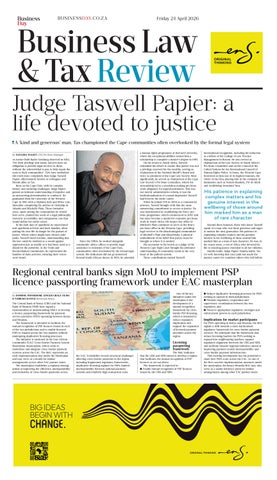
Judge Taswell Papier: a life devoted to justice
A
‘kind and generous’ man, Tas championed the Cape communities often overlooked by the formal legal system
By NATASHA WAGIET ENS Pro Bono Manager
As Justice Ruth Bader Ginsburg observed in 2014, For their privilege and status, lawyers have an obligation to provide legal services to those without the wherewithal to pay, to help repair the tears in their communities . Few have embodied this truth more completely than Judge Taswell Papier, affectionately known to colleagues and friends alike as Tas.
Born on the Cape Flats, with its complex history and enduring challenges, Judge Papier gained an intimate understanding of injustice and an unwavering determination to combat it. He graduated from the University of the Western Cape in 1985 with a Diploma Iuris and BProc Law, thereafter completing his articles of clerkship in Atlantis and Mitchells Plain. These formative years, spent among the communities he would later serve, planted the seeds of a legal philosophy rooted in accessibility and compassion, one that would define his entire career.
In the dark days of apartheid, he represented anti-apartheid activists and their families, often putting his own life in danger for the pursuit of justice. Where others might have chosen safer paths, Taswell stood resolute, understanding that the law could be wielded as a sword against oppression just as readily as it had been used as a shield for the powerful. At the Truth and Reconciliation Commission, he represented the families of slain activists, ensuring their voices were heard.

Since the 1980s, he worked alongside community advice offices to provide legal assistance to residents of the Cape Flats, communities often overlooked by the formal legal system. His dedication did not go unnoticed beyond South African shores: in 1993, he attended
a human rights programme at Harvard University, where his exceptional abilities earned him a scholarship to complete a master s degree in 1995.
On his return to South Africa, Taswell redoubled his efforts to ensure that justice was not a privilege reserved for the wealthy, serving as chairperson of the National Sheriff s Board and twice as president of the Cape Law Society. Most significantly, he served as chairperson of the Cape Law Society s Pro Bono Committee, where his stewardship led to a resolution making pro bono work obligatory for legal practitioners. This was not merely administrative reform; it was the institutionalisation of a moral imperative Taswell had lived by his entire career.
When he joined ENS in 2004 as a commercial attorney, Taswell brought with him the same unwavering commitment to access to justice. He was instrumental in establishing the firm s pro bono programme, which commenced in 2005 and has since become a model for corporate pro bono work in South Africa. His former law office in Mitchell’s Plain continues to serve as the firm’s pro bono office in the Western Cape, providing legal services to the disadvantaged communities of Mitchell s Plain and Khayelitsha, a physical embodiment of his belief that justice must be brought to where it is needed.
His ascension to the bench as a judge of the Western Cape High Court brought his profound understanding of community needs to the very heart of the judicial system.
These contributions earned Taswell
international recognition, including his induction as a fellow of the College of Law Practice Management in Boston. He also served as chairperson of the Law Society of South Africa s Pro Bono Committee and on the Council of the United Nations for the International Council of Human Rights Policy. At home, the Western Cape bestowed on him one of its highest honours, the Order of the Disa, placing him in the company of luminaries such as Nelson Mandela, FW de Klerk and Archbishop Desmond Tutu.
His patience in explaining complex matters and his genuine interest in the wellbeing of those around him marked him as a man of rare character
Beyond these honours, those who knew Taswell speak of a man who was kind, generous and eager to mentor the next generation. His patience in explaining complex matters and his genuine interest in the wellbeing of those around him marked him as a man of rare character. He was, in the truest sense, a son of Africa who devoted his life to ensuring justice extended to all her children. Hamba kahle, Judge Papier. Hamba kahle, Tas. Go well, knowing that your path has made the journey easier for countless others who will follow.
Regional central banks sign MoU to implement PSP licence passporting framework under EAC masterplan
By DOMINIC INDOKHOMI, GINGER GRACE OUMA & NAIRUKO KANTAI Bowmans Kenya
The Central Bank of Kenya (CBK) and the National Bank of Rwanda (NBR) have signed a memorandum of understanding (MoU) to develop a licence passporting framework for payment service providers (PSPs) operating between Kenya and Rwanda.
The framework is intended to facilitate the mutual recognition of PSP licences issued in each of the two jurisdictions and to enable licensed PSPs to expand across the two markets without undergoing duplicative licensing processes. The initiative is anchored in the East African Community (EAC) Cross-Border Payment System Masterplan (masterplan), which seeks to modernise and integrate cross-border payment systems across the EAC. The MoU represents an early implementation step under the Masterplan and may serve as a model for similar arrangements across other EAC partner states.
The masterplan establishes a regional strategy aimed at improving the efficiency, interoperability and inclusivity of cross-border payments across

the EAC. It identifies several structural challenges affecting cross-border payments in the region, including fragmented regulatory frameworks, duplicative licensing regimes for PSPs, limited interoperability between national payment systems and relatively high transaction costs.
One of the key initiatives under the masterplan is the development of a mutual recognition framework for crossborder PSP licensing, which is intended to reduce regulatory duplication and support the expansion of licensed payment providers across the region.
Licensing passporting framework
The MoU indicates
that the CBK and NBR intend to develop a regime that facilitates the mutual recognition of PSP licences as set out above.
The framework is expected to:
● Enable mutual recognition of PSP licences issued by the CBK and NBR;
● Reduce duplicative licensing processes for PSPs seeking to operate in both jurisdictions;
● Promote regulatory cooperation and supervisory coordination between the two regulators; and
● Preserve appropriate regulatory oversight and enforcement powers in each jurisdiction.
Implications for market participants
For PSPs operating in Kenya and Rwanda, the MoU signals a shift towards a more harmonised regulatory framework for cross-border payment services. We anticipate that the framework may reduce licensing barriers for PSPs seeking to expand into neighbouring markets; support regulatory alignment between the CBK and NBR; and facilitate broader regional initiatives aimed at improving payment system interoperability and cross-border payment infrastructure.
This exciting development has the potential to share how PSPs scale across the EAC. As one of the first concrete implementation measures under the masterplan, the Kenya-Rwanda MoU may also serve as a useful reference point for similar arrangements among other EAC partner states.
123RF JOSELIBIN
Lessons from court: a practical guide for private bodies responding to Paia requests
Working
checklist aims to equip those on the receiving end to understand act’s obligations, but also its protections
Adams and Adams
By JEAN-PAUL RUDD
Private bodies such as hospitals, medical practices, banks and everyday employers regularly receive requests for access to information under the Promotion of Access to Information Act 2 of 2000 (Paia).
Many recipients assume they have no choice but to comply with every request placed before them. That assumption is wrong. A recent high court judgment from the KwaZulu-Natal Division dismissed a former employee s application for access to his personnel records on multiple procedural and substantive grounds each of which carries a practical lesson for any institution fielding Paia requests.
This article distils those lessons into a working checklist for private bodies. It is not a substitute for legal advice, but it is intended to equip those on the receiving end of such requests to spot noncompliant requests and to understand when the law permits, and indeed requires, that they push back.
● Lesson 1: Has the requester identified a right? The single most important filter in Paia is section 50(1)(a). A requester must demonstrate that the record sought is required for the exercise or protection of any rights . The threshold, as confirmed in Clutchco (Pty) Ltd v Davis 2005 (3) SA 486 (SCA) and Cape Metropolitan Council v
Every private body should ensure its information officer can identify an outdated or noncompliant form
Metro Inspection Services 2001 (3) SA 1013 (SCA), is whether the information will provide “a substantial advantage or an element of need in exercising or protecting that right. The requester must state what the right is, what information is sought and how it assists. In the judgment, the court found that the requester’s form did not identify any enforceable right, even when read generously alongside the affidavits and that there was no indication the record would be decisive in determining any cause of action.
A request that says, in effect, “I want to see my records because I have a constitutional right to information is circular and insufficient. The requester must explain how the record will help exercise or protect a specific right such as a right to litigate, to fair labour practices or to bodily integrity. If the form does not do this, you have a basis to refuse the request. ● Lesson 2: Has the requester used the correct form?

Compliance with Paia’s prescribed process is a precondition for the validity of any request. The current regulations, published in 2021, require that the request be made on form 2 of annexure A and submitted to the private body s information officer. In the judgment, the request was completed on the old Form C prescribed by the repealed 2002 Regulations. Citing Midi Television (Pty) Ltd t/a E-TV v Director of Public Prosecutions (Western Cape) 2007 (5) SA 540 (SCA), the court held that Paia is subject to compliance with a comprehensive process that contains its own checks and balances” and that noncompliance cannot simply be bypassed the failure was fatal.
Every private body should therefore ensure its information officer can identify an outdated or noncompliant form on sight. A request made on a repealed form is fundamentally deficient, and you are not obliged to treat it as valid.
● Lesson 3: Was the request directed to the right person?
Paia contemplates that requests will be directed to the private body’s designated information officer. In the judgment, the private body had appointed a designated information officer, yet the requester directed his request to the human resources director instead. The court identified this as a further procedural deficiency.
Ensure, then, that your organisation has appointed an information officer and that their details are accessible on your website, in reception areas and in standard correspondence. If a request arrives on the desk of an HR director, a ward manager or a branch manager, redirect it and advise the requester accordingly. A misdirected request is not a compliant request.
● Lesson 4: Has the requester respected the
statutory timeframe?
Section 56(1) of Paia affords a private body 30 days to respond to a request. In the judgment, the requester demanded a response within seven days the court noted this truncated timeframe as a further deficiency.
Do not allow a requester to stampede you into a premature response. If a request imposes a shorter deadline, point the requester firmly to section 56(1). Hospitals consulting clinical records, banks assessing privilege and employers reviewing personnel files should treat the 30-day period as a minimum safeguard, not a bureaucratic inconvenience.
● Lesson 5: Is the requester trying to expand the request after the fact?
A Paia request must be assessed on the terms in which it is made. In the judgment, the requester attempted at the hearing to expand his request to include telephone records and a system inspection neither of which formed part of the original request.
The court held that it was impermissible for him to broaden the ambit of his request retrospectively.
If you subsequently receive informal demands for additional records by email, telephone or through attorneys treat each as requiring a fresh, compliant Paia request. You are not obliged to expand the scope of your response beyond the four corners of the original form.
Where the requester has already been furnished with information that reasonably addresses the underlying question, the threshold of being required under section 50(1)(a) may not be met. In the judgment, the requester had already received a favourable reference, a certificate of employment status and written confirmation from the CEO that he was not precluded from applying for employment. He had also continued to access the company s premises as a subcontractor s employee access that would not have been permitted had he been dismissed.
Before engaging with a Paia request, ask whether you have already given the requester the very information or its practical equivalent that is being sought. For medical practitioners, this arises where clinical records have already been furnished; for employers, where a certificate of service or reference has already been provided.
● Lesson 7: Has the requester exhausted internal remedies?
Section 78(1) of Paia provides that a requester may only apply to a court after exhausting the internal appeal procedure (section 74) or the complaints procedure (section 77A). Although the court noted this was not determinative, it observed that there was no indication the requester had followed the mandated procedure before approaching the court.
If you refuse a request and the requester threatens litigation, ensure they are aware of the internal appeal and complaints procedures set out in your Paia manual. A requester who bypasses these steps and proceeds directly to court does so at their own risk.
When must you comply?
Before engaging with a Paia request, ask whether you have already given the requester the very information being sought
● Lesson 6: Has the requester already received the information?
IN YOUR COURT
The foregoing lessons should not be read as a charter for obstruction. Paia gives effect to the right of access to information in section 32 of the constitution, and where a request is procedurally compliant and identifies a right that the information will meaningfully assist in exercising or protecting, access must be given unless a ground for refusal in Chapter 4 of Part 3 applies. “Required” does not mean strict necessity a substantial advantage or an element of need suffices. Refusing a valid request exposes the private body to a court order compelling access, adverse costs consequences and reputational harm.
The above lessons form a practical checklist any information officer can apply. For hospitals, banks and employers alike, the message is the same: Paia imposes obligations, but it also confers protections and a court will not compel compliance with a request that fails to meet the act s requirements.
Role of environmentallaw in energy decisions
Arecent Supreme Court of Appeal case set out, at some length, a number of important principles dealing with the interpretation of the National Environmental Management Act 107 of 1998 (Nema), in particular, and its closely associated legislation, the Constitution and Promotion of Administrative Justice Act 3 of 2000 (Paja). This article shall be broken up into three parts so as to encompass its length in an appropriate format.
In South Durban Community Environmental Alliance and Another v the Minister of Forestry, Fisheries and the Environment and Others (479/2023) [2025] ZASCA 134, a unanimous judgment was handed down by Dambuza JA.
The case dealt with the issue of an environmental authorisation by the Chief Director: Integrated Environmental Authorisations, Department of Forestry, Fisheries and the Environment for the construction and operation of a combined cycle gas power plant in Richards Bay. South Durban appealed against the authorisation. Their internal appeal was dismissed by the minister of the forestry, fisheries and environment department
South Durban thereafter brought an application before the Gauteng Division of the High Court, Pretoria for a review and setting aside of the environmental authorisation and the dismissal of the internal appeal against the granting of the authorisation. The high court dismissed the review application.
South Durban then, with leave of the SCA, appealed against the decision of the high court.
Material facts
The projected construction of the
power plant involved a number of listed activities as defined in section 1 read with section 24 (2)(a) and (b) of Nema. A listed activity is an identified activity which may not commence without an environmental authorisation from a competent authority.
Generally, in respect of each listed activity, an applicant must submit either a basic assessment report or a scoping and environmental impact assessment report (EIA report) to the competent authority. This is followed by an environmental assessment report on the assessed potential impact of the listed activities. That report then must lie open for public inspection.
In the review application to the high court, Durban South relied on nine different grounds. All of these were considered by the high court and, for various reasons, were dismissed. In the appeal before the SCA, Durban South persisted only with five of the original grounds of appeal. These were: (1) The inadequate assessment of the power plant’s climate change impacts; (2) The need or desirability for the power plant; (3) A consideration of alternatives to the power plant; (4) The cumulative impacts of the power plant; and (5) The inadequate public participation process. The appellants contended that a finding of failure to sufficiently consider any one or more of these grounds must result in a review and setting aside of the environmental authorisation in terms of section 6(2)(e)(iii) of Paja. The appellants also relied on sections 11, 24 and 27 of the constitution, and Nema.
A number of important rulings were in consequence made by the court. These are set out for the convenience of the readerunder the headings below.

The SCA held that Nema establishes a comprehensive environmental management framework
The polycentric argument
The respondents argued that the polycentric nature of the environmental authorisation did not permit of intervention of the courts in that such intervention would undermine the principle of separation of powers. They referred to the purpose of section 85 of the constitution (which defines the executive authority of the Republic), the National Energy Act 34 of 2008 and the 2010 Integrated Resource Plan (and its later versions) facilitated by a Determination in terms of section 34 of the Electricity Regulation Act 4 of 2006. In short, the argument of the respondents was that the very nature of the application, namely its manifest complexities combined with the strategic importance of the project, lifted it out of the constraints defined by both Nema and Paja: consideration, the respondents argued, should be given primarily to specialised legislation (National Energy Act,
Electricity Regulation Act, 2010 Integrated Resource Plan (IRP), in particular) which deals more specifically with the procurement, availability and sustainability, at affordable prices, of energy required to support economic growth and poverty alleviation in the Republic.
The importance of Nema
After consideration of the polycentric argument, the court held that Nema establishes a comprehensive environmental management framework through which all laws which may significantly affect the environment must be interpreted. Accordingly: [Nema] guides the implementation of all environmental laws and policies, including the National Energy Act, the Electricity Regulation Act and the IRP.
It is the overarching legislation by reference to which all other environmental legislation, policy formation and administrative decisionmaking that effects the environment should be informed this is made plain in section 2 of Nema …”
In consequence, the court held that macro-level planning cannot determine the environmental impacts of a particular power plant because:
“the purpose of the environmental management regime mandated in Nema is to ensure that social, economic and environmental factors are integrated into all government environmental decision making consequently, the ‘separation of powers argument is not sustainable in this instance
Internal appeals to the minister
Section 43 of Nema defines the right of appeal to the minister against an environmental authorisation issued by the Chief Director. The parameters of
such power exercised on internal appeal by the minister, are set out in section 24 of Nema. Specifically: section [24O] emphasises that all of these office bearers must comply with the provisions of Nema”
The court referred specifically to section 43(6) of Nema which gives the minister wide remedial powers to exercise on appeal. It held that:
“This indicated that the scope of the appeal is to determine whether the authorisation was correct, and if not whether any authorisation should be permitted, and then under what conditions but this appellant power is framed by the obligatory scheme that Nema sets out. The decision as to whether to grant an authorisation under Nema is not to be likened to an open-ended form of polycentric executive policy formation”
Notwithstanding the wide remedial powers as defined by section 43(6), the court emphasised that section 43(6) is constrained by section 24O and the specific requirements as set out by section 24O, inter alia, that the competent authorities (which includes the minister) MUST comply with Nema, and take into account all relevant factors which may include any pollution, environmental impacts or environmental degradation likely to be caused if the application under consideration is approved or refused.
-Peter Blanckenberg is a Director at Blanckenberg & Associates Inc.
● Look out for Part B of this article next month.
Matter of Fact: Please note this is the first complete article in a three-part series on this topic and includes important factual information that was erroneously omitted from the article published last month. Business Day apologises for the omission.
PETER BLANCKENBERG
COLUMNIST
123RF JOHNKWAN

Enforcement overreach: what recent Fica judgment means for sanctions
Judgment is not a retreat from compliance. It’sa reminder that action must remain legally grounded
By ANGELA ITZIKOWITZ, ERA GUNNING, AMELIA WARREN & DYLAN MARTHEZE ENS
A recent Gauteng high court judgment has reaffirmed that regulatory enforcement and fair process must go hand in hand.
The court upheld an appeal by Len Dekker Attorneys Incorporated against administrative sanctions imposed under the Financial Intelligence Centre Act (Fica), after finding that the Financial Intelligence Centre (FIC) had overreached in the way it had calculated the penalty.
At the centre of the case was a simple but significant question: could the FIC calculate sanctions by counting years of alleged noncompliance from before December 19 2022, when it only became the supervisory authority for legal practitioners from that date? The court’s answer was no.
According to a Moneyweb report of April 7 2026, the law firm had been sanctioned in an amount of close to R235,000 for noncompliance with certain Fica provisions. The FIC’s approach was to include alleged noncompliance dating back to 2017. The high court found that this had had a material effect on the severity of the sanction and ordered that any recalculation of the administrative penalty be limited to the period from December 19 2022 onwards. As noted in the judgment quoted by Moneyweb, the duration of the period relied on by the FIC had a severe impact on the computation of the penalty.
These findings matter. It does not suggest that accountable institutions, including attorneys, can take a relaxed approach to anti-money laundering compliance. On the contrary, the court expressly recognised the need for strict adherence to Fica in order to prevent or identify money laundering and terrorist financing. But it also made it clear that enforcement must remain proportionate and tied to the regulator’s actual powers during the relevant period. The judgment is not a retreat from compliance. It is a reminder that enforcement action must remain legally grounded.
The court recognised the need for strict adherence to Fica to prevent or identify money laundering and terrorist financing
The second aspect of the case is equally significant. Moneyweb reported that the high court also found reviewable error in the FIC Appeal Board s refusal to consider evidence of remedial steps taken by the firm after the finding of noncompliance, including its agreement with compliance service provider DocFox, now renamed nCino KYC. The court held that relevant remedial information had to be admitted and considered in any recalculation of the sanction. That, too, is important. It suggests that while remediation may not erase a breach, it remains relevant to the question of an appropriate and proportionate penalty.
The wider context helps explain why this case has drawn attention. In November 2024, the FIC announced that its Appeal Board had upheld a R7.7m sanction against Kunene Ramapala Incorporated for failing to comply with Fica requirements, including the duty to document, maintain and implement a risk management and compliance programme (RMCP) and to scrutinise clients against the targeted financial sanctions list. At that stage, the FIC presented the outcome as a clear warning that noncompliance could have serious consequences. The Len Dekker matter does not undo that message. What it does do is place an important limit on how those consequences may be calculated and justified. For legal practitioners and other accountable institutions, the judgment carries a sober lesson. Compliance with Fica remains nonnegotiable. The statutory duties around risk management, sanctions screening and broader anti-money laundering (AML) controls are real, and regulators are plainly willing to enforce them. But the judgment also shows enforcement powers are not
unlimited. Sanctions must be imposed within the bounds of lawful authority, with proper regard to timing, relevance and proportionality.
In a regulatory environment shaped by South Africa s greylisting experience and continuing pressure to demonstrate AML effectiveness, that balance is crucial. A strong compliance culture still matters. So does principled enforcement.
The Len Dekker judgment is therefore not best understood as a setback for financial crime regulation, but as a reminder that credible enforcement depends not only on toughness, but on fairness and legal discipline.
CONSUMER BILLS
Generative AI: we need to keep it brief
Generative AI has a way with words which is both good and bad. AI tools are capable of summarising large bodies of text. But the same tools are equally capable of creating large bodies of text. This is having a positive and a negative effect on access to justice.
At the end of March, the head of the National Financial Ombud Scheme reported that the organisation is receiving consumer complaints that run to 150 to 200 pages, some almost entirely AI generated and substantially inaccurate.
In many jurisdictions, including South Africa, litigants-in-person are pursuing claims aided by AI. The UK senior judge who serves as the head of civil justice reports that where the first port of call by an individual used to be a lawyer, if one was available and affordable, now the first port of call is ChatGPT or CoPilot, which can be used by nonlawyers to create an arguable case. But they frequently create hallucinatory references to nonexistent case law.
There are tools available that will tell you how much of a document is AI generated. That is of little use, however, because they do not tell you whether the information is right or wrong. The Australian Fair Work Commission (similar to our own employment commission) attributes the increase in cases from 30,000 in 2023 to 55,000 in 2025-26 to the use of AI tools by employees with grievances.
The AI revolution will create many more civil, family and tribunal claims which the justice system will have to cope with. Recent reports that there are more than 300 judgments in South Africa that litigants have been awaiting for more than six months shows that the burden on courts is already too great.
So how do we promote access to justice without overburdening the system to the extent that access to justice is denied by the resulting

PATRICK BRACHER COLUM
delays? First, on the set-a-thief-to-catch-a-thief principle, AI tools need to be developed to find the hallucinations. More important is to insist on brevity.
There are many examples in the legal system where documents cannot be filed at the court exceeding a specified length, such as a lawyer s written arguments in an appeal or tribunal case. Written submissions on the law to a
any more than we are already doing so in the age of information overload, we have to have rules. In the not distant future, the problem will be solved by having cases adjudicated by superintelligent and focused agentic AI tools. -Patrick Bracher (@PBracher1) is a director at










123RF RUMMESS
From Speculoos to Biscoff: a re-branding masterclass
Compelling example of how trademark strategy can transform a brand’s legal position
By FAE HASSAN ENS
As a trademark attorney, few case studies illustrate the intersection of branding and protection strategy quite as neatly as the transformation of Lotus Bakeries flagship product from Speculoos to Biscoff . The rebrand raises a number of points that are worth exploring, particularly for brand owners seeking to futureproof their trademark portfolios.
Perhaps the most compelling lesson from the Biscoff story is the risk of trademark genericisation, which occurs when a trademark becomes so widely used as a common product name that it ceases to perform the function of a trademark as an indicator of commercial origin.
History offers cautionary tales: terms such as escalator aspirin and thermos were all once protected trademarks that fell victim to their own success. This is one of the great paradoxes of trademark law: the more successful a brand becomes, the greater the risk that its name enters common parlance and ceases to function as a trademark, if not properly monitored. The Speculoos-to-Biscoff transition is, in many ways, a textbook response to this risk. By moving away from a term that had already become generic in many markets, Lotus Bakeries effectively sidestepped the problem entirely. The new name, Biscoff, is inherently distinctive and its consistent use across all territories strengthened the trademark’s capacity to distinguish the company’s goods from its competitors.
The colour mark challenge
It is worth noting that not every aspect of Biscoff’s protection strategy succeeded. They attempted to register its red-with-white-border colour trademark, which the Court of Justice of the European Union ultimately refused on the ground the combination lacked distinctiveness, observing that red and white are commonplace in the food sector. This serves as a useful reminder that colour marks remain notoriously difficult to register, and brand owners should manage their expectations accordingly, while also exploring alternative routes to protection, such as passing off or unfair competition claims where available.
The role of social media
No discussion of modern branding would be complete without acknowledging the role of social media. Biscoff has built a considerable following on social media, where user-generated content featuring the product has proliferated. From a trademark perspective, this kind of organic brand engagement is double-edged: it builds enormous brand recognition, but it also increases the risk of the brands being used loosely or descriptively by consumers.
Brand owners should monitor social media usage closely and take steps to ensure their marks are being used correctly, even in informal contexts.
Key takeaways for brand owners
● Choose your brand name carefully. A distinctive, coined term will always be easier to

protect than a descriptive or generic one. Before investing in a name, take legal advice on whether that name is capable of functioning as a trademark. A name that merely describes the product or has become the common word for it will not serve as a reliable brand asset. If your current brand name is at risk of becoming generic, consider whether a strategic rebrand might be appropriate.
● Build a layered portfolio. Do not rely solely on a single word mark. Consider 3D marks, figurative marks and other nontraditional marks to create overlapping layers of protection. If one layer of protection is challenged or falls away, others remain in place. Think globally from the outset. File trademark applications in all territories where you sell or plan to sell. Filing strategies can also be driven by defensive considerations, such as in markets where commercial activity may be limited, but you may face a counterfeiting risk.
● Issue and enforce brand guidelines. Clear use guidelines for licensees, distributors and business partners are essential to maintaining the distinctiveness of your marks. Mandate the use of the ® symbol and prohibit unauthorised modifications of your brands and logos.
● Monitor for genericisation. Actively monitor and police how trademarks are used, not only by competitors, but in the media, by consumers and on social media platforms. If your trademark is
being used as a common noun or verb, take swift corrective action before it is too late.
● Engage with social media proactively. Embrace the brand awareness that social media generates but monitor platforms for misuse of your marks and have a strategy for addressing informal or descriptive use by consumers.
● Manage expectations with nontraditional marks. While nontraditional trademarks can be a vital element of brand identity, it should not be relied on as the cornerstone of a trademark strategy without a realistic assessment of the prospects of registration. These trademarks face a high evidential threshold. Be prepared for refusals and have alternative protection strategies in reserve.
● A rebrand is not merely an exercise in aesthetics. If you are considering a rebrand, engage your trademark attorneys early. It is an opportunity to shore up your legal position and to build a portfolio of rights that is defensible.
The journey from Speculoos to Biscoff is a compelling example of how trademark strategy can transform a brand s legal position. It is a reminder that trademark protection is not a once-off filing exercise, but an ongoing strategic endeavour that demands careful planning, consistent execution and vigilant enforcement which ultimately shapes the commercial destiny of a business.
What’s in a name: the Lotus Bakeries story
Lotus Bakeries is a Belgian company with roots stretching back to 1932. Its core product is the caramelised biscuit known in Belgium and much of Europe as Speculoos . Critically, however, the term “Speculoos” is widely regarded as generic in those markets as it describes a type of Belgian spiced biscuit rather than identifying a single commercial origin. From a trademark perspective, this presents a fundamental problem: a generic term cannot function as a badge of origin, and competitors are free to use it.
The strategic pivot to Biscoff In 2020, Lotus Bakeries decided to rebrand globally under the name “Biscoff” (a portmanteau of “biscuit” and “coffee”, nodding to the product s well-known pairing with a hot drink). The rebrand was accompanied by a distinctive visual identity centred on a specific typeface and a red-and-white colour scheme. This was not merely a marketing exercise. It was a deliberate legal and commercial strategy designed to secure trademark protection that the generic Speculoos name could never have afforded.
Building a robust trademark portfolio
One of the most impressive aspects of the Biscoff story is their multilayered approach to protecting their brand. At European Union level, they secured nine trademark registrations including the BISCOFF word mark, supplemented by a range of 3D trademarks covering the shape of the biscuit itself, the spread jar, a cream sandwich product and a cup-and-biscuit combination. This breadth of protection demonstrates an understanding that modern brand protection extends well beyond a single word mark filing. Their strategy places them in a good position to act against competitors not only using the name itself, but also from imitating the labels, packaging and so on. The company also pursued trademark registrations beyond Europe, filing in key territories including the US, China, the UK, Russia, Ukraine, Cuba and North Korea. While some of those jurisdictions may raise eyebrows, the strategy reflects a commercially sensible approach: securing protection in markets where either current sales exist or future expansion (or counterfeiting risk) is anticipated.
Brand usage guidelines
One aspect of the Biscoff strategy I find particularly instructive is their issuance of clear brand usage guidelines that prescribe how the Biscoff name and logo should be used, including the mandatory use of the ® symbol alongside the mark, and a prohibition on modifying the logo or visual elements. As inconsistency breeds vulnerability, this ensures licensees, distributors and business partners understand how the trademark should be presented. Too many brand owners neglect this step, and it can prove costly The ® symbol serves a dual purpose: it puts third parties on notice that the mark is registered, and it acts as a deterrent against potential infringement.
How Coida is redefining workplace responsibility
By JONATHAN GOLDBERG & JOHN BOTHA
Global Business Solutions
For decades, workplace injury legislation in South Africa has largely been understood through a narrow lens: compensation.
An employee is injured. A claim is submitted. Benefits are paid. The Compensation for Occupational Injuries and Diseases Amendment Act (Coida) fundamentally changes that equation. What emerges instead is a far more expansive and demanding framework, one that places rehabilitation, reintegration and psychological wellbeing at the centre of workplace responsibility.
A shift from payment to rehabilitation
One of the most significant developments in the amended Coida framework is the introduction of mandatory rehabilitation.
Employers, together with the Compensation Fund, are now required to provide facilities, services and support aimed at restoring employees to functional capacity and, where possible, returning them to work. This is not discretionary. It is a statutory obligation.
Rehabilitation is no longer limited to physical recovery. The legislation formalises three interdependent pillars: clinical, vocational and social rehabilitation. In practice, this means that recovery is understood not only in medical terms but in terms of a person’s ability to work, participate in society and regain independence. This marks a decisive shift. Employees are no longer treated as claims to be processed, but as individuals whose recovery must be actively supported and coordinated.
PTSD and psychological injury: a legal turning point
Perhaps the most transformative aspect of the amendment is the explicit inclusion of posttraumatic stress disorder (PTSD) within the definition of an occupational disease.
This change acknowledges something many organisations have been slow to confront. Harm at work is not confined to physical injury.
Psychological trauma whether arising from workplace violence, harassment, high-risk environments or prolonged exposure to stress now falls squarely within the scope of Coida.
The implications are significant. For the first time, mental health is fully integrated into the compensation and rehabilitation framework.
Clinical psychologists and psychiatrists are no longer peripheral to workplace injury management; they are central to it.
At a broader level, this reflects an evolving understanding of occupational health into one that aligns more closely with both international standards and the lived reality of modern work.
The rise of the psychologically safe workplace
With the formal recognition of psychological injury comes a corresponding shift in expectation.
Employers are no longer only responsible for preventing physical harm. They must now also consider the psychological conditions under which work is performed.
This includes identifying and managing psychosocial risks, responding appropriately to incidents of trauma and ensuring employees have access to meaningful support where harm occurs.
The concept of the “psychologically safe workplace” is no longer aspirational. It is, increasingly, a legal and operational requirement.
Organisations that fail to take this seriously may find themselves exposed not only to compensation claims but also to broader liability arising from how such cases are managed.
Return-to-work as a structured obligation
The amended Coida framework also places significant emphasis on structured return-to-work processes.
Rehabilitation does not end with medical
treatment. It extends to the employee s reintegration into the workplace, often requiring adjustments such as modified duties, flexible schedules, assistive devices or re-training for alternative roles.
This process is not informal. It is coordinated, monitored and in many cases multidisciplinary. It involves health-care providers, rehabilitation specialists, employers and the Compensation Fund.
Importantly, employers are required to make reasonable accommodation. Dismissal based on incapacity cannot be treated as a default outcome where rehabilitation and reintegration have not been meaningfully pursued.
This creates a critical intersection between Coida and labour law, so reinforcing both procedural and substantive fairness in how injured or ill employees are treated.
For the first time, mental health is fully integrated into the compensation and rehabilitation framework
Extended timeframes, extended accountability
The extension of the claims period from 12 months to 36 months may appear to be a technical amendment but its implications are far-reaching.
For employees, it improves access to compensation, particularly in cases where conditions such as psychological trauma may only manifest or be diagnosed over time.
For employers, it extends the horizon of accountability.
Workplace incidents may now give rise to claims years after they occur. This will require more robust record-keeping, reporting and
risk management practices.
In effect, organisational responsibility is no longer confined to the immediate aftermath of an incident. It is sustained over time.
What this means for employers
The cumulative effect of these changes is clear. Coida compliance is no longer a back-office function. It requires active integration into organisational systems, including HR policies, health and safety frameworks and workplace governance structures.
Employers must ensure that:
● Rehabilitation and return-to-work processes are clearly defined and implemented;
● Appropriate roles and responsibilities are assigned;
● Multidisciplinary support mechanisms are in place; and
● Ongoing monitoring and reporting requirements are met.
This is not simply about avoiding penalties. It is about aligning organisational practice with a fundamentally different understanding of workplace responsibility.
From liability to responsibility
At its core, the Coida amendment reflects a broader shift in how work and the people who perform it are valued. It moves the conversation from liability to accountability, from compensation to care, and from physical safety to holistic wellbeing. For employers, this presents both a challenge and an opportunity.
Those who respond proactively by building workplaces that are not only physically safe, but psychologically supportive and adaptable are likely to see benefits that extend beyond compliance. These include improved employee trust, stronger retention and more resilient organisational cultures.
Those who do not may find that the cost of inaction is no longer limited to financial exposure. It is embedded in the law.
123RF MPFOTO71
Key business implications of King V and what to do next
Increased focus on tangible governance outcomes
By NONHLANHLA SITHOLE PKF Octagon South Africa
King V signifies a major shift in South Africa’s corporate governance scene, strengthening the move from purely compliance-based governance to outcomes-focused, integrated value creation.
While its principles build on Institute of Directors in South Africa frameworks under King IV, King V introduces heightened expectations around transparency, accountability and sustainability-linked performance.
For businesses, the question is no longer whether governance frameworks exist, but whether they are demonstrably effective and measurable.
Expect heightened scrutiny from regulators, investors and stakeholders. There is now increased focus on tangible governance outcomes. Businesses must demonstrate how governance adds value over time.
Integration of ESG into core strategy
Environmental, social and governance (ESG) is no longer peripheral but embedded into:
● Risk management
● Capital allocation
● Executive remuneration
Enhanced accountability of boards
Stronger expectations on:
● Board composition and independence
● Oversight of ethical culture
● Digital governance and data integrity
Assurance and data integrity
Increased focus on:
● Nonfinancial reporting assurance
● Internal controls over sustainability metrics
Key practical implications for
businesses
Businesses must move beyond policy frameworks to embed governance into daily decision-making. They will need to align governance structures with strategy execution.
Reporting will also become more complex and more scrutinised.
Integrated reports must now:
● Link strategy, risk, ESG and performance
● Provide clear evidence of outcomes
Expect closer alignment with:
● IFRS Sustainability Standards (ISSB)
● JSE disclosure expectations (where applicable)
Tax transparency will be under the spotlight
Growing expectation to:
● Align tax strategy with ESG commitments
● Disclose effective tax rates and jurisdictional exposure
● Risk of reputational scrutiny where tax practices contradict stated values
Remuneration must reflect long-term
value
Incentives increasingly linked to:
● ESG metrics
● Sustainability targets
● Stakeholder outcomes
What businesses should be doing now
Conduct a King V readiness assessment.
Gap analysis against:
● Current governance practices
● Reporting frameworks
● Board oversight structures
● Assess governance against the 4 outcomes; Ethical Culture, Good Performance, Effective Control and Legitimacy
Strengthen data and reporting systems

Invest in:
● ESG data collection and validation
● Internal audit capability for nonfinancial metrics
Align tax, legal and governance strategies
Ensure consistency between:
● Tax structuring
● Public disclosures
● ESG commitments
Review board and committee mandates and policies
Update charters to reflect:
● ESG oversight
● Technology and data governance
● Stakeholder engagement
● Proportionality and compensating measures
Reporting timelines: what to watch
While King V is principles-based and not legislatively binding, practical adoption will follow market and regulatory cycles.
Immediate term (0-6 months from release)
Early adoption by:
● Large listed entities
● Governance leaders
Short term (6-12 months)
First reporting cycle where:
● Companies begin referencing King V in integrated reports
Expect:
● Transitional disclosures
● Partial alignment
Medium term (12-24 months)
Full incorporation into:
● Annual integrated reports
● Board reporting frameworks
TAXING MATTERS
Increased scrutiny from:
● Investors
● Proxy advisers
● Regulators
Key reporting periods to monitor
Financial year-ends:
● Feb/March year-ends first movers in adoption
● June year-ends second wave adoption
Integrated reporting cycles:
● Typically 3-6 months post year-end
ESG disclosures:
● Increasing alignment with annual reporting cycles
Risks of inaction
Failure to align with King V may result in:
● Reputational risk from perceived weak governance
● Investor disengagement or voting opposition
● Regulatory scrutiny, particularly where disclosures are inconsistent
● Higher cost of capital linked to governance risk perception
Strategic opportunity: turning governance into advantage
King V should not be viewed as a compliance burden, but as an opportunity to:
● Strengthen investor confidence
● Enhance capital allocation discipline
● Build long-term resilience and trust Firms that move early will differentiate themselves as:
● Transparent
● Well-governed
● Future-ready King V signals a decisive shift in corporate governance, moving from form to substance. The organisations that succeed will be those that can evidence how governance drives real, measurable outcomes, not merely assert that frameworks exist.
When Sars and tax treaties disagree, who wins?
By JANÉL KING AJM
South Africa s tax treaties are meant to protect taxpayers from double taxation. But when domestic law and international agreements conflict, the consequences can be particularly severe for South Africans living abroad drawing on their retirement savings.
For many South Africans living abroad, this is no longer theoretical. It is a high-stakes issue that directly affects their retirement savings. The question behind retirement taxation
Imagine spending 30 years working in South Africa, contributing to a pension fund, later emigrating, and eventually drawing on those funds. You fully expect to be taxed but where, and by whom? This is a real and often misunderstood issue. The question sits at the intersection of two systems: South African domestic tax law
Double taxation agreements (DTAs)
What happens when South Africa s domestic law says one thing and a binding international treaty says another? This tension has a name treaty override.
What DTAs are meant to do South Africa has entered more than 70 DTAs globally. These agreements exist
to prevent the same income from being taxed twice and to create certainty for taxpayers operating across borders.
DTAs allocate taxing rights between countries depending on the type of income. Under the OECD Model, pension income is generally taxed in the country of residence.
For example, under the SA-UK DTA, a South African who becomes UK tax resident would generally be taxed in the UK on pension income.
The Domestic Law Response
South Africa’s Income Tax Act contains provisions that seek to tax individuals at the point of emigration when a person ceases their South African tax residency. They are treated as having disposed of certain assets at market value on the date immediately before the day on which that person ceases to be a resident.
The intention is to tax value built up while the individual was still within South Africa’s tax net. Retirement funds complicate this. Contributions are made from pre-tax income, meaning tax is deferred until withdrawal. If that withdrawal occurs in a treaty country with exclusive taxing rights, South Africa may never collect the tax.
Parliament has responded by tightening domestic rules over time. Emigration procedures have changed, and withdrawal conditions have become more stringent. But here lies
the fundamental tension.
Tightening domestic law does not automatically override a tax treaty.
South Africa is bound by its international commitments, and a treaty is not simply set aside because parliament passes a new law.
What is treaty override and why does it matter?
Treaty override occurs when domestic legislation conflicts with existing treaty obligations.
South Africa’s constitutional framework gives international agreements a respected place in the legal hierarchy. Under principles like pacta sunt servanda (agreements must be honoured), countries cannot simply ignore treaty commitments.
Yet this is precisely the tension that arises in the pension fund context. If a DTA says the residence country taxes the pension, and South Africa then enacts provisions seeking to tax that same income at source, the domestic law and the treaty are in direct conflict. The taxpayer is caught in the middle, potentially facing claims from two tax authorities or finding themselves in a legal grey zone where their rights are genuinely unclear.
The 2021 turning point
It is worth noting that South Africa has not always been passive on this issue.
In 2021, a proposed amendment sought to include retirement fund
interests in the cessation of residency.
Concerns were raised that this could result in treaty override, and the proposal was ultimately withdrawn, with National Treasury indicating that treaty renegotiation would be the more appropriate solution.
The 2024 Taxation Laws Amendment Act further complicates matters by excluding retirement fund interests and deferring taxation until withdrawal, where treaty allocation becomes decisive.
Importantly, South Africa is not currently committing treaty override in the technical sense. Treaty override requires specific domestic legislation that explicitly or effectively overrides a treaty obligation, and no such legislation presently exists in this context. The concern is prospective, as domestic pressure to protect the revenue base intensifies, the temptation to legislate in ways that conflict with existing DTA obligations will grow.
Why this matters for individuals and for SA
For individuals, this creates real uncertainty. Many emigrants structured their finances based on existing treaty frameworks, without fully accounting for how domestic law and treaties interact.
For South Africa, the stakes are equally high but for different reasons. The country has experienced
significant emigration of skilled professionals over the past decade, many of whom retain substantial retirement savings locally.
If those funds are ultimately taxed elsewhere due to treaty allocations, South Africa faces permanent loss of tax revenue.
What needs to happen
Overriding treaties through domestic law would undermine South Africa s creditability as a treaty partner and risk international disputes.
The honest answer is that South Africa s DTA network needs targeted renegotiations to reflect modern realities. The standard OECD approach, allocating pension-taxing rights exclusively to the resident state, does not serve South Africa’s fiscal interests in an era of significant skilled emigration.
Through the African Tax Administration Forum (ATAF), several countries have advocated for treaty models that allow shared taxing rights on pension income between source and residence states.
Seek specialist advice
South Africans with retirement savings in local funds, whether residents or emigrants, should seek specialist advice on how their treaty position interacts with current domestic law. The gap between what the law says and what people assume it says can be costly.