South Africa’s SMMEs face a defining year in 2026: digitise fast, tighten cash flow and navigate rising compliance demands or risk being left behind in a fragile economy.
15 GOVERNANCE FOR GROWTH
Founder-led SMEs often stall as complexity grows. However, as the enterprise grows, what once enabled agility can begin to constrain sustainability.
19 THE SCALING IMPERATIVE
SMMEs must professionalise early, building systems and leadership capacity to scale sustainably and outperform competitors in volatile markets.
20 SUCCESSION
Is there a SMME succession crisis? We explore the potential threat to jobs and the economy and the move towards structured ownership transitions.
22 KEY GROWTH SECTORS
We unpack how SMME growth in 2026 is driven by structural shifts, creating strategic opportunities across technology, energy and logistics.
24 BREAKING BARRIERS
South Africa’s wine industry is evolving, creating new opportunities for black-owned SMMEs to grow through contract bottling, innovation and strategic market access.
27 EMPLOYEE INCENTIVES
South Africa’s constrained economy limits the ability of SMMEs to offer aggressive salary increases or hefty bonuses. Yet, the need to attract and retain high-performing “A-players” has never been more critical.
32 INNOVATIVE FUNDING MODEL
South Africa is beginning to assemble a new financial architecture for SMMEs, one that blends public sector stability with private sector innovation.
33
DIGITAL TOOLS UNLOCK GROWTH
AI and fintech are transforming SMMEs, enabling faster funding, real-time cash flow management and mobile-first digital strategies that level the playing field for entrepreneurs.
36
DIGITAL POWER
Digital banking is revolutionising SMMEs by simplifying finances and boosting cash flow, giving entrepreneurs the unprecedented speed and control needed to grow.
COPYRIGHT: No portion of this magazine may be reproduced in any form without written consent of the publisher. The publisher is not responsible for unsolicited material. Ignite is published by Picasso Headline. The opinions expressed are not necessarily those of Picasso Headline. All advertisements/advertorials have been paid for and therefore do not carry any endorsement by the publisher.
26 ENTERPRISE SUPPLIER DEVELOPMENT
We examine how ESD programmes are driving growth for black-owned SMMEs.
SMME s are South Africa’s growth engine
South Africa’s economists usually emphasise the large enterprises: the mines, the banks and the conglomerates that have shaped our industrial landscape for decades. However, the real test of our economic future lies not in the boardrooms of the few, but in the survival and growth of the many.
Research indicates that small, medium and micro enterprises (SMMEs) contribute an estimated 34–40 per cent of South Africa’s gross domestic product and employ nearly half of the national workforce. This makes them one of the most powerful levers for economic transformation. Their footprint spans formal and informal sectors, from township spaza shops and rural co-operatives to tech start-ups and
Arguably, the most significant contribution of SMMEs is job creation. SMMEs, by their nature, are labour-intensive and capable of creating entry-level opportunities for individuals who may not meet the hiring thresholds of larger firms. This makes them essential to any credible employment strategy. Their ability to scale incrementally also means they can respond more quickly to shifts in demand, creating jobs in real-time rather than waiting for large-scale capital investments.
Beyond employment, SMMEs are catalysts for innovation and competition. Smaller firms tend to be more flexible, more willing to experiment and quicker to adopt new technologies. This is evident in sectors such as fintech, e-commerce, renewable energy and creative industries, where SMMEs are driving new business models and challenging established players. Their presence increases market competition, which benefits consumers through improved service quality and more competitive pricing.
SMMEs are also critical to broad-based black economic empowerment objectives, providing pathways for black entrepreneurs to enter and grow within the formal economy. Corporate supply chains increasingly rely on enterprise and supplier development programmes to integrate SMMEs, strengthening local procurement and supporting inclusive growth.
Access to finance remains the most significant barrier, with many entrepreneurs unable to secure funding due to security requirements and risk-averse lending practices. Yet funding options do exist –fragmented, imperfect, but real.
The consolidation of the Small Enterprise Finance Agency, the Small Enterprise Development Agency and the Co-operative Bank Development Agency into the new
SMMEs OFFER SOMETHING THE ECONOMY URGENTLY NEEDS – AGILITY, INCLUSIVITY AND THE CAPACITY TO ABSORB LABOUR AT SCALE.
Small Enterprise Development and Finance Agency signals a move toward integrated, blended finance, and the National Empowerment Fund plays a complementary role. A growing ecosystem of fintech lenders is beginning to fill the gap with faster, data-driven credit models – albeit at higher cost.
Despite these challenges, the outlook for SMMEs is promising. Digital transformation is lowering barriers to entry, government support agencies are expanding their reach and new opportunities are emerging in export markets.
SMMEs have the potential to become the country’s most powerful engine for inclusive and sustainable growth.
Tersia Booyzen, Editor
Tersia Booyzen
FROM FOUNDERS TO FUTURE:
UNLOCKING INCLUSIVE GROWTH IN SOUTH AFRICA
ASI Financial Services is helping ensure established businesses continue to grow and power the economy. By TISHALAN PILLAY , director of sales and marketing at ASI Financial Services
South Africa stands at a generational crossroads. Many of the founders of our most stable, established businesses are reaching retirement age, yet 76 per cent of these businesses have no formal succession plan. This creates a massive “ownership gap”. ASI Financial Services’ Entrepreneurship Through Acquisition (ETA) provides a real way forward. We solve the retirement crisis by matching legacy businesses with high-calibre, values-aligned successors. By nancing the transition and supporting performance post-deal, we turn a “retirement risk” into a “transformation opportunity”. We aren’t just funding companies; we are ensuring their continuity and inclusive ownership. This is more than just a business transaction; it’s about wealth sharing, community upliftment and ensuring the continuity of the businesses that power our economy.
WHY ETA MATTERS FOR SOUTH AFRICA
The ETA Search Fund directly addresses South Africa’s historical inequalities by opening pathways to business ownership for those previously excluded. This democratisation of ownership fosters a more inclusive economy and accelerates intergenerational wealth transfer. Young, ambitious, quali ed professionals face limited prospects for advancement and ownership, however, ETA bridges this gap by providing structured, supported entry into business leadership.
By normalising formal succession planning, ETA transforms what is often a hidden business risk into a pillar of economic resilience, ensuring that valuable companies and their workforces endure.
Understanding the urgency of South Africa’s succession crisis is only the rst step. ASI bridges the gap between young entrepreneurs (searchers) and business sellers through a structured, Africa-ready search fund model. For searchers, ASI offers vetted opportunities, nancial tools, advisory support and a mentorship network to help aspiring acquirers transition into ownership with con dence. For business owners, ASI facilitates smooth successions by matching sellers with aligned, well-prepared acquirers, ensuring continuity.
THE ETA JOURNEY
Step 1: Connect with ASI. Aspiring entrepreneurs and business owners are invited to follow the Biznet Podcast on YouTube and sign up to be part of our dynamic ETA ecosystem.
Step 2: Identify the right opportunity. Searchers receive support in nding and assessing businesses to acquire. ASI assists with vetting, due diligence and nancial modelling.
Step 3: Secure funding and acquire. With backing from ASI’s capital, the searcher acquires the business, becoming the new owner and CEO.
Step 4: Grow with support. Post-acquisition, ASI provides strategic guidance and mentorship to ensure long-term success, growth and value creation. The business seller can retire with peace of mind, knowing their legacy continues.
BRIDGING THE URBAN-RURAL DIVIDE
Most succession and acquisition activity is concentrated in urban centres, but ETA can unlock value nationwide. By revitalising businesses in rural and peri-urban areas, ETA supports balanced regional development, slows economic decline outside major metros and brings new opportunities to underserved communities.
For two decades, small, medium and micro enterprises have absorbed shocks – from policy uncertainty to power constraints – yet
TOGETHER, WE CAN CREATE A FUTURE WHERE OWNERSHIP IS INCLUSIVE, LEGACIES ARE SAFEGUARDED, AND SOUTH AFRICAN BUSINESSES THRIVE FOR GENERATIONS TO COME.
remained the backbone of gross domestic product and employment. Now, a structural risk threatens that stability: succession failure. When founders exit without a plan, institutional memory dissipates, key client relationships are lost and supplier ecosystems unravel. The cost shows up as business closures, job losses and regional economic scarring.
ETA is a national competitiveness strategy for a country with strong businesses and ready leaders. With the right structure and partners, South Africa can convert a looming succession crossroad into a once-in-a-generation transfer of opportunity, ownership and optimism. Together, we can create a future where ownership is inclusive, legacies are safeguarded, and South African businesses thrive for generations to come.
Now is the moment for bold, practical action. ETA isn’t just a tool for business continuity; it’s a catalyst for transformation, skills transfer and real economic empowerment. By embracing ETA, South Africa’s most valuable businesses are not only preserved but handed over to the next generation of diverse, values-driven leaders.
For more information: www.asi.co.za/eta-searchfund
Tishalan Pillay
CREATING GOOD OPPORTUNITIES FOR TODAY AND THE FUTURE
and costing, so that “staying busy” nally begins to feel like “staying pro table.” We take those who are ready for the next level through our Funding Readiness and Customer Acquisition Programmes, teaching them to speak the language banks and investors trust and how to build customer relationships that last beyond a single transaction.
The Johannesburg Business School’s Centre for Entrepreneurship is closing the gap between street-side trading and fully fl edged business operations. By CAROL KESHY, acting director of the centre
Irecently undertook my annual ritual: taking public transport to work. It is a practice that grounds me in gratitude, but, more importantly, lets me witness the sheer grit of South Africa’s enterprising citizens. A few weeks ago, at the MTN taxi rank, I met Thabo, a sharp, alert, and persuasive individual selling phone chargers from a cardboard box. He convinced three commuters that their batteries would die before they reached home. They bought from him, some out of need, others out of admiration for his hustle.
“This is not the dream,” he told me. He wanted a proper electronics repair shop. He could already x phones. What he did not know yet was how to move from pavement trading to a business that could outlive his own energy. Nor did he have the language to see that his skill could be part of a bigger solution, including addressing the growing problem of electronic waste management.
Thabo is no exception. Across the country, young people are trading, xing, baking, coding, braiding and designing. They are working hard, yet many struggle to move beyond improvisation. Not because they lack ideas, but because they lack bridges. Some underprice because they do not understand their real costs. Others have good products but no reliable way to nd and retain customers.
Many hear that funding exists, but cannot translate their dreams into something a funder can trust. These are not stories of lack of ambition.
TURNING DREAMS INTO REALITY
They are stories of gaps. For too long, universities watched these realities from a distance, producing research about unemployment while the taxi-rank trader and the home caterer navigated the storm alone. At the Johannesburg Business School’s Centre for Entrepreneurship (JBSCE), that distance is closing. We have stepped off the page and into the lives of those who may never sit in a traditional lecture hall. We meet people where their businesses are most vulnerable. For someone like Thabo, who has a raw spark but lacks a clear direction, the JBSCE Entrepreneurial Development Programme and the Raymond Ackerman Academy provide that initial map, transforming a street-side concept into business literacy and practical skills. I have met countless women running businesses from home. I think of Lihle, a music graduate, whose clothing studio struggled because her “numbers didn’t make sense.” No one had shown her how to calculate real costs or project cash ow. That is why the JBSCE focuses so heavily on nancial management
As a business matures, the challenges change. The Small Business Enrichment Programme is there for when an entrepreneur moves from managing a stall to managing a team and an operation. For those driven by social change, our social innovation courses provide the tools to ensure their impact is as sustainable as their income.
This ecosystem enables everyone to choose where to begin. A street trader, a township manufacturer and a tech graduate can all enter at different doors, depending on what they need most. JBSCE pairs this knowledge with mentors who have walked the path and networks that open doors to real markets.
We know that entrepreneurship offers no guarantees, and not every business will become a conglomerate. However, when an entrepreneur understands their numbers, knows their customer and can access the right support at the right moment, the odds of survival shift. When higher education turns its knowledge outward, like this, it becomes less about distant theory and more about shared possibility. Somewhere between the pavement stall and the rst rented shop, between the home kitchen and the rst registered company, new South African futures are beginning to take shape.
VISIT WEBSITE
SCAN THIS QR CODE TO GO TO THE JOHANNESBURG BUSINESS SCHOOL’S CENTRE FOR ENTREPRENEURSHIP WEBSITE
For more information: +27 11 559 1780 www.uj.ac.za/jbs/centres/centre-for-entrepreneurship
TRENDS AND CHALLENGES RESHAPING SMMES
South Africa’s small, medium and micro enterprises face a defining year in 2026: digitise fast, tighten cash flow and navigate rising compliance demands or risk being left behind in a fragile economy. By
BUSANI MOYO
South Africa’s small, medium and micro enterprises (SMMEs) enter 2026 balancing digital opportunity against economic strain. Digital tools are becoming cheaper and more powerful, yet demand remains fragile, costs are elevated and infrastructure constraints continue to disrupt operations.
Naledzani Mosomane, head of enterprise and supplier development in business and commercial banking at Standard Bank South Africa, says; “South African SMMEs are operating in a landscape shaped by accelerating digital transformation, where the ability to transact, market and manage operations digitally has become essential for competitiveness and growth.”
Thomas McKinnon, country lead for South Africa at payments solution provider Paystack, sees the same reality through a cash-flow lens. “In 2026, most SMMEs are playing for survival and predictable cash flow, not growth,” he says, pointing to soft demand, high input costs and unreliable energy and logistics as daily constraints.
CASH FLOW
For many owners, the near-term goal is stability. McKinnon says execution separates the winners from the rest: “The businesses that succeed are those that operate leanly and get paid quickly.” That means tightening the order-to-cash loop: quoting faster, invoicing immediately, following up consistently and reconciling payments without hours of manual effort.
Mosomane links this to the broader economy. When confidence rises, consumer
spending tends to lift SMMEs. When it falls, smaller firms feel the hit first, and rising unemployment can increase “survivalist” entrepreneurship, intensifying competition and price pressure for everyone trying to scale.
DIGITAL PAYMENTS, COMPLIANCE AND AI
A defining trend for 2026 and beyond is the modernisation of payments. New rails (faster digital payment infrastructure replacing traditional bank transfers and paper checks) and better digital banking are reducing the friction of getting paid and unlocking liquidity. McKinnon notes: “The upside is that new rails like PayShap and improved business banking offerings are making digital payments cheaper and faster.”
However, he cautions, the same visibility that helps cash flow also raises expectations. “It is becoming easier to start and bank a business, but harder to ignore tax, labour, POPIA (The Protection of Personal Information Act) and KYC (Know Your Customer) requirements,” he says. In practice, that pushes SMMEs towards cleaner books, clearer audit trails and more consistent business administration.
Both experts see “practical digitisation” accelerating, often through small upgrades rather than big systems projects. Mosomane says SMMEs are adopting mobile payment solutions, cloud-based accounting and HR systems, e-commerce and social commerce, and “AI-enabled tools for marketing and administrative efficiency”. Larger or more established firms are also exploring AI-driven analysis and process-improvement technologies.
McKinnon describes the same shift: “The average small business is quietly becoming more digital at the edges: using AI tools to write copy or respond to customers, moving to cloud accounting instead of shoeboxes.” He adds that many businesses now want payment options that let them send “an invoice, a link or a QR code and reconcile it automatically”.
Thomas McKinnon www.linkedin.com/in/thomas-mckinnon-91164539
“THE BUSINESSES THAT SUCCEED ARE THOSE THAT OPERATE LEANLY AND GET PAID QUICKLY.”
– THOMAS MCKINNON
Barriers remain significant, though. Mosomane points to the high cost of devices, data and software, limited budgets, skills gaps and structural constraints such as load shedding and unreliable connectivity. Cash also remains prevalent in parts of the township’s economy, slowing the move to digital records and their benefits.
FUNDING, MARKETS AND SKILLS
Mosomane says access to sustainable market opportunities remains limited, while access to finance is often hindered by the absence of formal contracts, inconsistent revenue streams and damaged credit records. She notes that black
Thomas McKinnon
Naledzani Mosomane
A NEW ERA FOR SMES
MIGUEL DA SILVA , Group Executive: GoTyme for Business, explains why fi xed-fee funding signals a new era for small and medium enterprises
Small and medium enterprises (SMEs) sit at the centre of South Africa’s economy, ranging across sectors from hospitality and retail to healthcare, manufacturing and services.
SMEs generate employment, drive innovation and support local communities, yet one challenge remains constant: access to practical, reliable business funding.
For many entrepreneurs, growth is not limited by ambition or opportunity. It is limited by access to working capital at the right moment. Businesses must pay suppliers, purchase stock, invest in equipment and manage payroll while revenue ows in cycles that are rarely predictable. Traditional lending models were not designed for this reality.
Historically, business nance has relied heavily on collateral and lengthy credit assessment processes. While this structure works well for large corporates or asset-heavy businesses, many SMEs operate differently. A restaurant, salon, retailer or digital service business may generate strong revenue while owning relatively few physical assets. For these businesses, access to capital has often been slower and more restrictive than the pace at which they operate. This disconnect has created a growing gap between how businesses trade and how funding is structured.
THE WORKING CAPITAL GAP
Working capital is the nancial oxygen of a business. It allows entrepreneurs to bridge the timing gap between expenses and incoming revenue.
A retailer may need to pay its suppliers before stock is sold. A manufacturer may purchase raw materials before nal payment from a client. A service business may deliver work long before invoices are settled.
Without suf cient working capital, even pro table businesses can struggle to maintain momentum. Across South Africa’s SME sector, the demand for more exible and transparent funding solutions continues to grow. Business owners are increasingly looking for funding structures that re ect how they actually operate, rather than models built solely around collateral or rigid loan terms.
A SHIFT IN SME FINANCING
Globally, the SME nancing landscape is evolving. Digital banking platforms and data-driven lending models are introducing new ways to evaluate business performance and deliver capital more ef ciently.
These models focus less on static nancial snapshots and more on real trading activity. Revenue performance, transaction ows and operational history can now provide meaningful insight into how a business operates and its ability to manage funding responsibly.
For entrepreneurs, this shift represents an important step forward.
Funding is gradually becoming more aligned with business performance rather than simply asset ownership.
GOTYME BANK’S APPROACH
We believe funding should work the way businesses actually work.
Through GoTyme for Business, we are building an ecosystem designed to support SMEs with practical working capital solutions and accessible nancial tools.
At the centre of this ecosystem is the GoTyme Business Advance, a funding solution designed around transparency and simplicity.
Instead of interest that compounds over time, the model uses a xed fee agreed upfront. This means business owners know the total cost of funding from the start, creating clarity when making growth decisions.
Funding is also structured around business performance, with eligibility assessed through indicators such as turnover and trading activity rather than requiring traditional asset security, allowing us to support a broad range of SMEs.
BROADENING THE LANDSCAPE
We aim to become the SME lender of choice in South Africa by broadening both the businesses we serve and the funding needs we support.
While we have built a strong foundation in sectors like hospitality, health and beauty and general retail, the opportunities for SME growth extend far beyond these industries.
Manufacturing businesses require capital to scale production. Healthcare providers invest continuously in specialised equipment. Technology companies expand rapidly as demand grows.
A modern SME lender must recognise this diversity.
THE FUTURE OF SME FINANCING
South Africa’s entrepreneurial sector continues to evolve. Businesses are becoming more dynamic, digital and connected to global markets. And, access to capital remains a critical driver of growth.
By combining digital banking infrastructure, transparent funding structures and a broader SME ecosystem, GoTyme Bank aims to support entrepreneurs with solutions that re ect the realities of modern business.
Business growth made beautiful. #ItsGoTyme.
Miguel da Silva
VISIT WEBSITE
SCAN TO GO TO THE GOTYME BANK WEBSITE
GOVERNANCE FOR GROWTH
Why governance is the next competitive advantage
Founder-led small and medium enterprises often stall as complexity grows. Evolving governance builds resilience, credibility and sustainable growth beyond the founder, writes Professor PARMI NATESAN, CEO of the Institute of Directors in South Africa
South African small and medium enterprises (SMEs) are frequently built on the energy and commitment of a single founder. In the early stages, this concentration of responsibility is both practical and necessary. However, as the enterprise grows, what once enabled agility can begin to constrain sustainability.
Many SMEs do not stall because opportunities are absent. They stall because governance structures do not evolve as the organisation increases in size and complexity.
Governance is the framework through which ethical and effective leadership is exercised to achieve sustainable performance, appropriate control and organisational legitimacy. For a growing SME, these are the foundations of resilience, credibility and long-term growth beyond the founder’s direct involvement.
THE MOMENT GROWTH STARTS DEMANDING STRUCTURE
Most founders do not set out to implement governance as a deliberate milestone. Governance is often introduced reactively, in response to external pressure.
Timing is therefore better assessed not by turnover, but by complexity and risk. When the founder can no longer be meaningfully involved in every operational decision, the enterprise has already entered a new stage of development. This is typically when governance structures should begin to evolve.
It is also the stage at which credibility becomes a growth lever. Access to nance, partnerships, larger contracts and supply chain opportunities increasingly depends on whether the organisation can demonstrate that it is well-governed, not only pro table.
FOUNDER FATIGUE IS A GOVERNANCE RISK
Founder fatigue is one of the most prevalent, yet least acknowledged, risks in SMEs. It typically manifests in persistent re ghting,
GOVERNANCE DISCUSSIONS SHOULD FOCUS ON STRATEGY, PERFORMANCE TRENDS, RISKS, CONTROLS AND
THE SUSTAINABILITY OF THE BUSINESS MODEL, NOT OPERATIONAL DETAIL.
decision overload and an inability to step away without the business losing momentum.
This is not merely a workload issue. It is a governance issue. Where the founder simultaneously ful ls the roles of owner, director and manager, authority and decision-making become overly concentrated. Delegation is often informal, inconsistent and dependent on the founder’s direct involvement. While this may be workable in the early stages, it is not sustainable as the enterprise grows.
GOVERNANCE WITHOUT CORPORATE BLOAT
One of the biggest barriers to governance in SMEs is the belief that it must look like a large corporate: formal committees,
complex policies and layers of reporting. This misconception causes many founders to delay governance until it becomes urgent.
In reality, good governance for SMEs should be applied proportionally. It should grow with the business.
For many SMEs, the rst step is separating “governance time” from “management time”. Even if the same individuals are involved, the mindset and agenda should differ. Governance discussions should focus on strategy, performance trends, risks, controls and the sustainability of the business model, not operational detail.
The second step is documenting the basics. A board charter does not need to be a lengthy corporate document. It can be a short, written statement clarifying what the board is responsible for, how decisions are made and what authority is delegated. Similarly, a basic risk register can be created and reviewed quarterly.
Third, SMEs should take con icts of interest seriously, especially in family businesses or enterprises where directors are also shareholders, managers or suppliers. A simple disclosure process and con ict-of-interest policy can prevent disputes later and protect decision-making integrity.
THE VALUE OF INDEPENDENT VOICES
Not every SME is ready for an independent director. However, most SMEs reach a point where they need independent thinking.
A practical interim solution is a small advisory council. This can include an experienced businessperson, a nance professional, an industry expert or someone with governance experience. The value is not only technical advice, but challenging assumptions, identifying blind spots and strengthening strategic discipline.
Even one independent voice can shift the quality of decision-making. It reduces the risk of emotive decisions, helps professionalise the business and prepares the founder to work with formal governance structures later.
FROM SURVIVAL TO SUSTAINABLE GROWTH
Implementing governance as the SME grows is really about building a business that can outgrow the founder, withstand shocks, earn stakeholder trust and scale sustainably.
Follow: Professor Parmi Natesan www.linkedin.com/in/parmi-natesan-064a2154
Professor Parmi Natesan
THE QUESTIONS SOUTH AFRICAN SMME S KEEP ASKING –ANSWERED BY A FUNDER
The questions business owners ask about funding are practical and urgent. JEDD HARRIS , chief strategy officer at Sourcefin, provides answers to the most common questions
If you are a small, medium and micro enterprise (SMME) owner in South Africa, you have probably had a moment where funding felt less like “ nance” and more like a judgement call on your business. You can be trading, selling, delivering, growing and still hear “no”.
After working with thousands of entrepreneurs and helping deploy billions of rands in funding to South African SMMEs, one thing becomes clear: the questions business owners ask are practical, urgent and usually come from personal experience.
Most funding rejections are not about whether a business is good or bad; they are about whether a funder can understand and manage the risk signals they see.
What are funders actually looking for?
Here are some of the most common questions entrepreneurs ask with straight answers from the perspective of someone who works in funding daily.
q: WHY WAS MY FUNDING REJECTED WHEN I’M TRADING AND DELIVERING?
When a funder declines an application, the response is often heard as, “Your business is not good enough.” More often, it means, “We cannot get comfortable with the risk signals we can see.”
There is a big difference.
Signals show up in patterns: cash ow volatility, heavy reliance on one customer, high debit orders, persistent overdraft use, thin margins or repayment capacity. That is why bank statements are asked for so often. They show behaviour, not just a spreadsheet story.
q:
WHAT MATTERS MORE: TURNOVER, PROFIT OR CASH FLOW?
Turnover shows demand. Pro t shows pricing discipline. Cash ow shows whether you can survive the payment terms. If you supply a corporate that pays in 60 days, your business can be pro table yet still run out of cash in week three – because salaries, supplier payments and rent are due long before that invoice is paid. When you apply for funding, most funders are not really “buying” your turnover or your pro t. They are assessing your ability to stay liquid and repay, even when customers pay late. So yes, turnover and pro t matter, but cash ow is the crux. It tells a funder whether your business can keep operating under real South African trading conditions, not ideal ones.
invoices are legitimate and that you’ll make good on your promises; you only need a foot in the door.
q: IS ALTERNATIVE FUNDING MORE EXPENSIVE?
That depends on who you ask. Pricing and timing are two components of this answer, but so is the funding provider you approach.
Good alternative funders tackle the “expensive” perception with transparency – clear fees and timeframes. Great alternative funders tackle this perception by carrying the risk for you, providing funding that is based on the opportunity and only getting paid when you do.
The real question is not whether alternative funding is more expensive. It’s whether the opportunity you unlock with that funding is worth more than the cost of capital.
What funders are really looking for
q: HOW MUCH DOES MY PERSONAL CREDIT SCORE AFFECT BUSINESS FUNDING?
In South Africa, this question is everywhere because SMME owners and businesses are often nancially intertwined. “My business is my baby” is a well-worn cliché for a reason.
When it comes to funding, personal credit can be one factor, but it should not be the whole story. A business with strong contracts, consistent trading and clear affordability should not be treated the same as a business with no track record and the same score.
This is where open-minded, future-focused funding comes into play. Whether supported by your own wallet or by an investor, opportunities should be evaluated on just that: the opportunity. You need to show funders that your purchase order, suppliers and/or
WHEN YOU APPLY FOR FUNDING, MOST FUNDERS ARE NOT REALLY “BUYING” YOUR TURNOVER
First, proof you can deliver. Second, proof you can survive delays. Third, proof that you understand your numbers.
When these signals are clear, funding conversations become much easier.
Tune into The Great Enabler podcast, where we unpack more of these questions and the realities SMMEs in South Africa face every day.
Jedd Harris
PROFESSIONALISE OR PLATEAU
Founder-led SMMEs must professionalise early, building systems and leadership capacity to scale sustainably and outperform competitors in volatile markets, writes ROB
MAILICH , global CEO of REDi Holbourne Recruitment Group
The greatest threat to a growing small, medium and micro enterprise (SMME) is rarely the competition; it is usually the founder’s inability to evolve. In the start-up phase, success relies on agility and the founder’s sheer force of will. However, as you scale, the variables change. The “owner-does-everything” model, once a necessity for survival, becomes a bottleneck for efficiency. The data is clear: companies that transition from personality-led to process-led structures early don’t just survive; they lap their peers.
Many founders resist this shift because they fear “corporatising” will kill their agility or culture. However, structure doesn’t destroy agility; it enables it at scale. As market volatility increases and competition tightens, professionalisation is becoming a survival requirement, not a luxury. It is the only way to insulate the business from the limits of your own capacity. To make this transition, we need to view professionalisation not as a vague concept, but as a series of specific structural shifts.
THE UNCOMFORTABLE SHIFT
Of course, the shift from founder-led to function-led leadership is uncomfortable.
You move from being indispensable to building a structure where you’re not in every decision. That requires maturity and trust. Functional leadership changes a business’s trajectory. When you appoint capable heads of finance, operations or commercial strategy, you create accountability, clarity and scale.
One of the most pivotal decisions an entrepreneur makes is hiring their first chief financial officer or chief operating officer. The right time? Usually earlier than you think. If cash flow, compliance, reporting or operational complexity keep you awake at night, you’re already late. A strong financial and operational backbone frees you to focus on growth, relationships and strategy. It’s not about losing control; it’s about building capacity.
Professionalisation also means choosing systems over personalities. Charismatic, high-performing individuals can drive early momentum, but systems create repeatability and resilience. Processes protect the business when individuals move on. Artificial intelligence and digital tools now play a powerful role here, streamlining reporting, enhancing quality control and improving decision-making. However, technology should elevate the human touch, not replace it. The businesses that win are those that integrate smart systems without diluting culture.
LESSONS FROM A GLOBAL CRISIS
Scaling is a mindset. Revenue gives you options, but sustainable growth demands calculated risk. I learned this in 2008. Launching a talent acquisition business during a global economic crisis wasn’t textbook timing, but it provided a masterclass in positioning. While the general market was retreating, the crisis revealed a clear reality: general hiring had stopped, but critical, scarce-skill roles were still essential. By pivoting to those non-negotiable hires, the focus shifted from volume to trust.
Follow: Rob Mailich www.linkedin.com/in/robmailich
DOWNLOAD
How to pipeline talent and understand the market for better and future planning
The lesson here isn’t about timing the market; it’s about recognising that adversity can be an accelerator. Counterintuitively, the pressure of a downturn forces the kind of disciplined positioning that creates a reputation for delivery, a foundation that serves you long after the crisis ends.
IT’S PERSONAL
Professionalisation isn’t only structural; it’s personal. There’s a mindset shift in the current generation that I respect: work to live, not live to work. It’s not entirely wrong. Ambition today includes balance and purpose. But one truth remains: you have to earn your stripes. Discipline, consistency and resilience still matter.
As businesses scale, perspective is critical. Revenue and profitability are essential, but people, culture and the value of your service offering must remain central. Hire the best you can afford. Invest in them. Choose to mould expansion around people, not force people to mould themselves around flawed structures.
about sustainability. It’s the move from personality-driven momentum to principle-driven performance. It’s building something that can grow beyond you.
professionalisation is the difference between a fragile start-up and a resilient enterprise. The companies that make this shift early outperform their peers not because of luck, but because of structure. They are not just built to grow; they are built to last.
Rob Mailich
SECURING SOUTH AFRICA’S SMALL BUSINESS FUTURE
ITUMELENG MOGAKI explores South Africa’s small, medium and enterprises succession crisis, its threat to jobs and the economy and the move towards structured ownership transitions
South Africa’s (SA) small, medium and micro enterprises (SMMEs) are the backbone of the economy, employing over 11 million people. Yet a silent crisis looms, most founder-led businesses lack formal succession plans, leaving jobs, skills and community ecosystems at risk when owners retire.
THE HIDDEN SUCCESSION CRISIS
Responding to research showing that 70–80 per cent of small businesses could close within five years of a founder leaving, Tishalan Pillay, director: sales and marketing at ASI Financial Services, explains: “These statistics highlight a critical challenge for SA. When founders retire without preparing for the future, it’s not just ownership that disappears; it’s institutional memory, client trust, supplier
Did you know?
“Most founder-led businesses operate without documented procedures or strategies. Without a thoughtful handover, all institutional knowledge is lost, and sometimes unique skills disappear entirely,” says De Wet de Villiers, business continuity advisor.
JOBS, SKILLS AND ECONOMIC STABILITY AT RISK
DOWNLOAD
The
governance support. It ensures continuity of legacy, jobs and community impact. This isn’t just about transactions; it’s about stewardship, preserving what works and broadening ownership opportunities for younger entrepreneurs who may not have access otherwise.”
The consequences extend far beyond business closure. Nkosinathi Mahlangu, portfolio head of youth employment at Momentum Group, says in businesses where founders are the sole decision-makers, the business becomes destabilised when they leave. “In township or rural economies, this ripple effect can disrupt trade and linked economic activity. The real risk is that the economy never gets the full value of the businesses it creates.”
business continuity advisor, says: “Most disappears and sometimes unique skills, such as the clay craftsmanship we can be lost entirely.”
Mahlangu adds that many SMMEs function as “one-person shows” with minimal skills development. “Profits are often drawn for household survival rather than reinvested. Hiring is opportunistic and informal, and employees are rarely groomed for leadership. Jobs are tied to individuals, not institutions. When founders exit, the impact spreads across employees, supply chains and communities.”
ENTREPRENEURSHIP THROUGH ACQUISITION
Pillay describes Entrepreneurship Through Acquisition (ETA) as a structured pathway for succession. “ETA is a disciplined, values-driven approach. It matches retiring owners with skilled, aligned successors, providing financial backing, mentorship and
Pillay further explains that ETA can help attract youth talent into business ownership. “Younger entrepreneurs are ambitious, digitally fluent and eager to contribute, but they often lack access to opportunities or funding. Structured pathways like ETA bridge that gap. They allow new owners to learn from retiring founders, sustain client relationships and grow the business responsibly. This creates a new generation of owners who can strengthen communities, preserve jobs and ensure skills are passed on.”
Mahlangu reinforces this perspective: “When there’s a clear, supported transfer pathway, we not only save jobs, but also give youth a stake in the economy, fostering inclusive growth and long-term sustainability.”
Pillay says policymakers and industry can reinforce these transitions by providing incentives, accessible funding, coaching and structured support. “Succession isn’t just a business risk; it’s a national challenge. Addressing it thoughtfully protects jobs, skills and communities while creating opportunities for the next generation of leaders.”
Small Business Institute’s assessment of the South African SME landscape
Tishalan Pillay
De Wet de Villiers
Nkosinathi Mahlangu
KEY GROWTH SECTORS
South Africa’s small, medium and micro enterprises growth in 2026 is driven by structural shifts, creating strategic opportunities across technology, energy and logistics, writes VUKANI MAGUBANE
South Africa’s small, medium and micro enterprises (SMMEs) growth story in 2026 is not being driven by consumer booms or sudden demand spikes. Instead, it is being shaped by structural shifts in the economy – rising digital risk, tightening regulation and evolving market access models. Across sectors as diverse as cybersecurity, renewable energy and wine production, smaller enterprises are nding opportunity in responding strategically to change.
CYBERSECURITY: OPPORTUNITY IN A GROWING THREAT LANDSCAPE
as the big guys now – cloud tools, online payments, remote teams, customer data sitting across dozens of platforms,” he adds.
While large enterprises still account for the bulk of cybersecurity spending, momentum is shifting. SMEs are among the fastest-growing buyer segments, with investment projected to rise by more than 20 per cent annually through 2031, according to Mordor Intelligence’s South Africa Cybersecurity Market Report. South Africa’s cybersecurity market is forecast to grow from approximately US$0.29-billion in 2025 to US$0.33-billion in 2026, increasing to US$0.59-billion by 2031.
This urgency is fuelling a knock-on effect: the rapid growth of cybersecurity-focused SMEs themselves, stepping in to provide tailored, affordable protection for smaller enterprises.
Doreen Mokoena , founder and CEO of Cybersec Clinique and former director of Internet Governance for South Africa, highlights the ecosystem effect. “Even the smallest enterprise sits within a larger data and supply-chain ecosystem. They see themselves as small. Attackers see data, and data is the currency.”
South Africa remains one of the most targeted countries for cybercrime on the continent, with attacks costing the economy billions of rand annually. Increasingly, smaller enterprises are in the crosshairs – not because they are large, but because they are connected.
“The truth is that attackers don’t lter by company size,” Lackey explains. “They’re looking for easy. The tools they use are automated and global – no human is deciding your business is too small to bother with. The script just runs.”
The consequences are immediate and existential. “When you can’t send invoices for three days, or your customer data is locked and someone is asking for payment to get it back – that’s not a risk on a slide deck. That’s your business bleeding out in real-time,” he says.
The rise of AI is further intensifying the landscape. Automated phishing campaigns, deepfake-enabled fraud and adaptive malware are increasing the scale and sophistication of attacks. For cybersecurity SMEs, this race between automation and protection is accelerating demand for ongoing monitoring rather than once-off interventions.
“Compliance and AI risk guidance have become a bigger part of what we do,” Lackey says. “Managed security, ransomware defence planning and awareness training are where we’re seeing the most consistent demand. The human element is still where most breaches start.”
Regulation has reinforced urgency. The Protection of Personal Information Act (POPIA) has shifted data protection from best practice to legal obligation.
Businesses that collect and store personal information must demonstrate compliance or face nancial penalties and reputational damage.
ACROSS SECTORS AS DIVERSE AS CYBERSECURITY, RENEWABLE AND WINE PRODUCTION, SMALLER ENTERPRISES ARE FINDING OPPORTUNITY IN RESPONDING STRATEGICALLY TO CHANGE.
Lawrence Lackey
Doreen Mokoena
WASTE MANAGEMENT AND THE CIRCULAR ECONOMY
South Africa is gradually transitioning towards a circular economy, creating opportunities in e-waste collection, recycling and material repurposing.
According to the Mapping South Africa’s Waste Electrical and Electronic Equipment Technical Report, the country generates an estimated 340 000–380 000 tonnes of e-waste annually, but only about 11 per cent reaches formal recycling operators, with the remaining 80per cent stockpiled or processed through informal channels. This represents a rapidly growing waste stream and a signi cant gap in formal recycling services, creating clear opportunities for businesses that can safely and pro tably manage electronic and packaging waste.
The report also highlights that e-waste is growing faster than other solid waste streams, emphasising the need for scalable collection and processing solutions. For SMMEs, challenges include establishing consistent supply streams and complying with regulations, but successful operators are developing scalable business models through business-to-business recycling contracts, partnerships with producer responsibility organisations, municipal programmes and community-level collection initiatives that integrate informal collectors into formal value chains.
STRUCTURAL GROWTH: THE COMMON THREAD
Across all sectors, the common driver of SMME growth is structural change. In cybersecurity, it is digital risk and regulation, in renewable energy, it is energy security and cost pressures, and in e-commerce, it is changing consumer behaviour.
For SMMEs, these shifts present not only random opportunities, but also windows created by evolving economic conditions. Entrepreneurs who understand the dynamics and position themselves strategically will thrive.
RENEWABLE ENERGY AND GREEN TECH
Renewable energy is another area where structural shifts are creating opportunities. South Africa’s power supply remains under strain, and rising energy costs are prompting businesses and households to invest in solar installations, battery storage and energy-ef ciency retro ts.
The South African Photovoltaic Industry Association Annual Report 2024–2025 reveals that South Africa’s total installed solar photovoltaic capacity reached 8.97GW in 2024, an 11.9 per cent year-on-year increase. This total comprised roughly 2.8GW from public procurement programmes and 6.1GW from private-sector projects, highlighting strong contributions from decentralised and commercial solar deployments. The report also notes a healthy project pipeline, including utility-scale and distributed generation systems, pointing to continued capacity expansion and investment potential for SMMEs in installation, maintenance, energy services and component supply.
For SMMEs, the opportunity lies in services: installation, maintenance, monitoring systems and retro tting existing structures. This sector also bene ts from government incentive programmes, such as the Renewable Energy Independent Power Producer Procurement Programme, which provides preferential procurement channels and support for small and medium players.
Follow: Lawrence Lackey www.linkedin.com/in/lawrencelackey
Doreen Mokoena www.linkedin.com/in/doreenmokoena
ADDITIONAL KEY GROWTH AREAS FOR SMMEs
While cybersecurity and energy dominate headlines, several other sectors are ripe for small business growth in South Africa, supported by credible market research and industry forecasts.
1. Agri-processing
Agri-processing and value addition to local crops continues to be a strategic growth area. The South Africa Agri Business Sector Report 2025, shows that trends in the agriculture sector include diversification and expansion into agro-processing, export growth of high-value crops and the adoption of climate-smart farming methods – all of which create space for small, medium and micro enterprises (SMMEs) to add value and capture market share in processing, packaging and niche food products.
2. Health and wellness services
The South Africa Health and Wellness Market Share, Size, Trends and Forecast 2025–2033 report states that the South African health and wellness market reached an estimated US$26.64-billion in 2024 and is projected to expand to US$42.01-billion by 2033 at a 4.66per cent compound annual growth rate (CAGR), thanks to increasing health awareness, digital health platforms and demand for wellness services, natural products and preventative care. This growth supports opportunities for nutrition services, fitness offerings, mental wellbeing platforms and telehealth solutions targeting consumers and corporate wellness programmes.
3. Specialist logistics Research by Ken Research and the Monitoring Market Outlook that logistics – especially cold-chain, last-mile delivery and urban distribution – remains underserved and ripe for innovation. The South African cold chain and logistics market is estimated at US$1.2-billion, driven by e-commerce growth and demand for temperature-controlled transport for food, pharmaceuticals and perishable goods. Cold chain monitoring technologies are projected to grow at 11.5 per cent CAGR through 2031, reflecting rising demand for quality-preserving logistics solutions.
BREAKING BARRIERS Opening wine markets for black-owned
SMMEs
South Africa’s wine industry is evolving, creating new opportunities for black-owned small, medium and micro enterprises to grow through contract bottling, innovation and strategic market access. By RYLAND FISHER
South Africa’s wine sector is opening space for specialist small, medium and micro enterprises (SMMEs) in bottling, contract production and private-label services.
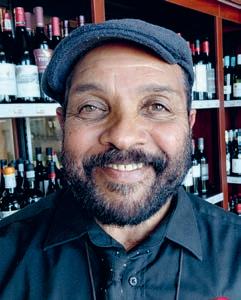
La RicMal Wines, a family-owned wine producer, was started in 2007 by Malcolm Green and his son Ricardo. “We started from humble beginnings – we went from delivering an order of one box of wine to a customer eight hours away to now delivering our wines by pallets in super link trucks,” says Green, who is passionate about mentoring and guiding black entrants into the sector.
Before La RicMal Wines, Green owned one of the largest black-owned bottling and
recycling companies in South Africa, which provided bottling services to the wine industry. “Contract bottling is the entryway and gateway for small wine entrepreneurs to enter the industry because of cost and funding barriers. You can bottle at a fraction of the cost if you use contract bottling. You can bottle your own products when you reach the volumes,” he explains.
South Africa’s small and medium enterprises (SMEs) face steep hurdles. Market access remains a constant battle, with shelf space and export channels dominated by established brands.
“CONTRACT BOTTLING IS THE ENTRYWAY AND GATEWAY FOR SMALL WINE ENTREPRENEURS TO ENTER THE INDUSTRY BECAUSE OF COST AND FUNDING BARRIERS.” – MALCOLM GREEN
Did you know?
South Africa Wine, the national body for the industry, allocates statutory levy funding specifically to enterprise development, with a focus on black-owned wine brands and producers, as well as targeted support for women-owned and youth-owned small and medium enterprises operating within the wine and spirits value chain.
On the macro level, tariffs, energy, packaging and logistics costs make scaling dif cult and squeeze margins. South Africa’s wine industry ranks eighth globally, contributing R56.5-billion annually to the economy, and supports job creation and tourism.
Green believes government collaboration is key: “There are close to eighty to ninety black-owned wineries registered with SA Wines, of which approximately ten to fteen are signi cant players. Discussions need to happen with the Department of Trade, Industry and Competition (dtic), Industrial Development Corporation (IDC) and the Department of Agriculture to grow SME participation in the sector.”
BRAND MARKETING AS GROWTH STRATEGY
Malcolm Green
Green’s advice for smaller businesses is to focus on marketing and promoting brands, working with retail buyers and having a presence in the marketplace. “The bulk of the funding government provides for transformation in the industry should go to marketing and promoting brands,” he says. The larger players come with big budgets to support their brands, which smaller players can’t afford. It requires signi cant resources to build relationships and spend time in the market, and a sizeable monetary investment to activate brand listing.” He praises the dtic for opening export opportunities
DRINK RESPONSIBLY. NOT FOR PERSONS UNDER THE AGE OF 18
SOUTH AFRICA’S SMALL AND MEDIUM ENTERPRISES (SMES) FACE STEEP HURDLES. MARKET ACCESS REMAINS A CONSTANT BATTLE, WITH SHELF SPACE AND EXPORT CHANNELS DOMINATED BY ESTABLISHED BRANDS.
through trade missions and expos, which help with brand exposure and access to international markets. “The dtic is trying its best, and La RicMal Wines has bene tted. The BRICS Business Council could also open up additional opportunities,” he adds.
Across sectors, Green notes, growth is being shaped by structural shifts in the economy – digital risk, regulatory changes and new access models. For SMMEs, these opportunities are not random, but a sign of the times.
INNOVATION AND MARKET DIFFERENTIATION
The Green’s journey spans almost 50 years in business, beginning in Durban when Malcolm realised there was a market for clean empty wine bottles. He ran this business in various provinces for over 30 years. Ricardo, now 47, convinced him almost 20 years ago to start a wine label. “Ricardo and I started our La RicMal brand –it contains parts of both our names. We have our own wines now for about eighteen years. We also have the Lerato brand.”
The brands are bottled at Darling Cellars, which supplies wine and has partnered with them for over 14 years. La RicMal’s rst breakthrough came when they convinced Shoprite to list them. “Our rst order from Shoprite was for a box of six bottles. Today, we supply seven hundred Shoprite stores, including their stores in twelve African countries such as Ghana, Namibia, Cameroon, Nigeria, Congo and Mozambique. We are now also in about forty- ve Spar
Did you know?
stores in South Africa. We make sure the wine quality is good and consistent. Our price is right, but our quality is very high.”
The Greens closed their bottle recycling business in 2014 to focus on creating new markets for their wine brands.
During COVID-19, they developed a wine kit: four La RicMal Supreme Range wines (Shiraz, Cab Sav, Merlot, Sauvignon Blanc), two sweet and classic wines, four tasting glasses, and multilingual guides (Afrikaans, English, Xhosa, Zulu). The kit targeted taverns and smaller retail outlets, including training managers or assistants on wines. “No one in South Africa had developed a similar kit. We launched it in Parliament and then took it to SALTA (South African Liquor Traders Association) and The Taverners Association in Johannesburg. Government loved the concept. We said, ‘You can use this concept to create more jobs by growing the wine industry’.”
In 2022, they adapted the concept for Spar, producing a private brand called Occasions, now sold in liquor stores. In 2024, they opened a wine boutique at Cape Town International Airport, carrying 300 wines, complementing their Waterfront emporium with 100 wines.
FAMILY ROLES AND DISCIPLINE IN BUSINESS
“Discipline is very important. You must be committed and willing to sacri ce to be strong. You have to be different as a business and constantly look at ways to sell your wines,” says Green.
The family works as a team: Ricardo handles accounting, logistics and quality
According to South African Wine’s official funding support information, the industry allocates a minimum of 20 per cent of all statutory levy income toward transformation focus areas, with a significant share dedicated to enterprise development programmes for black-owned winegrape producers and black-owned brand owners, alongside people development and socioeconomic support.
Did you know?
The South Africa Wine Annual Report 2024 shows:
•107 black-owned wine brands supported.
•81 black-owned farms assisted in grape production, logistics and related wine activities.
control, while Green and his wife focus on marketing and sales.
He emphasises that the industry relies heavily on word of mouth, which determines whether doors open for new entrants. “To build your brand, you need to realise that you are the brand. How great or worthy your brand is will determine whether doors open for you. The La RicMal brand has lasted because the Green family has been around. The wine industry is a fraternity, built on families and tradition. It’s very ethical and protective.”
CHALLENGES AND VISION
The biggest challenge remains market access. “We might be in two retailers, but the big retailers in South Africa need to support smaller businesses seriously. As a
FROM SURVIVAL TO SCALE
ITUMELENG MOGAKI examines how enterprise and supplier development programmes are driving growth for black-owned small, medium and micro enterprises in South Africa, highlighting government initiatives, township-focused support and the role of targeted funding
As the country moves into 2026, the government is intensifying enterprise and supplier development (ESD) support, aiming to expand local supply chains, promote black industrialist development and shift from compliance-driven broad-based black economic empowerment (B-BBEE) measures to impact-driven, 100 per cent black-owned enterprise support.
A key initiative is the proposed R20-billion Transformation Fund (TTF), designed to provide nancial and non nancial support to small and township-based enterprises over ve years.
LEARNING FROM PAST PROGRAMMES
“Government has implemented numerous initiatives through sector education and training authorities and other entities to support small, medium and micro enterprises (SMMEs), but the overall effectiveness has been under-reported,” says Carol Keshy, acting director of the JBS Centre for Entrepreneurship and Programme Lead for the UJ AI Hub.
“Many programmes lack integrated monitoring, making it dif cult to track long-term growth or job creation. Structural barriers, such as limited awareness, complex funding processes, skills gaps and digital access challenges, especially in townships and rural areas, remain persistent.”
Despite these challenges, Keshy says, public-sector support has enabled meaningful impact: “During 2024/25, our programmes assisted over 400 SMMEs and created more than 800 jobs. It shows what is possible when support is accessible and practical.”
2025/2026: A NEW ERA FOR ESD
In the recent State of the Nation Address, President Cyril Ramaphosa outlined interventions aimed at reducing regulatory red tape, supporting youth and women-owned enterprises, expanding innovation funding and investing in energy reliability. These measures are intended to stimulate economic
participation and position SMMEs as central contributors to employment and productivity.
TTF will target historically disadvantaged enterprises, prioritising women, youth and black entrepreneurs. Funding is expected to cover franchise nancing, procurement-linked support, enterprise expansion and industrialisation initiatives.
Hiten Keshave, CEO of Unconventional CA, says capital alone is not enough: “The fund has potential, but its success depends on transparent allocation, clear eligibility criteria and robust impact measurement. Money without follow-through risks becoming another compliance exercise rather than a vehicle for SMME growth.”
resilience, inclusion and broader national growth,” says Keshy.
Keshave agrees that practical, hands-on support is crucial: “Training alone isn’t enough. SMMEs need help with book-keeping, pricing, inventory control, cash ow and customer retention. If the government links nancial support to actual business development and market access, we can see tangible growth in township enterprises and black industrialists.”
He adds: “Programmes must also account for structural constraints like late payments, infrastructure challenges and limited market access. Entrepreneurs shouldn’t be blamed when the environment is hostile. Effective ESD treats business support as economic architecture, not a compliance tick-box.”
UNLOCKING SUSTAINABLE GROWTH
Keshave adds that governance and execution are equally important: “A centralised fund will struggle to serve the diversity of South African enterprises. Hundreds of thousands of SMMEs are at different stages of growth, from start-ups to mature businesses. Without tailored support, mentorship and procurement linkage, many may fall through the cracks.”
TOWNSHIP ECONOMIES AT THE HEART
Township enterprises, spaza shops, bakeries and mechanics play a critical role in local economies. “These businesses retain income within communities, create jobs and stimulate micro-enterprise ecosystems. Strengthening and formalising them promotes economic
Keshy says SMMEs can fully bene t from these initiatives through proactive engagement. “Businesses should enhance their visibility, develop skills and tap into support networks and markets. Meanwhile, institutions must embed learning and accountability into every programme to ensure interventions are effective and responsive to entrepreneurs’ real needs.”
Keshave concludes: “The most successful SMME support blends capital, mentorship and market access. When done right, ESD not only creates jobs and strengthens local economies, but also fosters long-term sustainability and inclusive growth. This is how South Africa can move from compliance-driven support to true economic empowerment.”
Follow: Carol Keshy www.linkedin.com/in/carol-keshy-a33b4773 Hiten Keshave www.linkedin.com/in/hitenkeshave
Carol Keshy
Hiten Keshave
THE RETENTION REVOLUTION
South Africa’s constrained economy limits small, medium and micro enterprises’ abilities to offer aggressive salary increases or hefty bonuses. Yet, the need to attract and retain high-performing “A-players” has never been more critical. By
VANESSA ROGERS
Burnadene van der Meulen, senior structuring consultant at Bravura, says this environment has sparked what can best be described as one that shifts the focus beyond salary towards alignment, ownership, exibility and long-term value creation.
FROM PAYCHEQUES TO PARTICIPATION
Traditional remuneration models centred on xed pay and annual bonuses may work in large-scale business environments, but for many small, medium and micro enterprises (SMMEs), they create short-term thinking and immediate cash- ow pressure.
“Forward-thinking businesses are asking a different question,” says van der Meulen. “How do we create incentives that align employees with the long-term success of the business?”
The answer lies in participation.
Carefully structured equity participation, growth-share classes, pro t-sharing arrangements and phantom equity plans are being introduced to mirror enterprise value creation.
“When employees participate in value creation, behaviour changes,” van der Meulen explains. “Decision-making becomes more strategic. Retention improves. Performance becomes linked to sustainability rather than short-term targets.”
However, she cautions that structuring is critical.
“We have seen cases where employees received shares on vesting and were faced with a tax liability – despite not having realised any cash,” she says.
For SMMEs, thoughtful design aligned with growth stage, capital structure and tax implications is essential. “The difference between an effective incentive and a problematic one often lies in structuring. It is not something that should be improvised,” she adds.
FLEXIBILITY AS STRATEGIC LEVER
Beyond ownership, SMMEs often hold a powerful advantage over large corporates: agility. Flexible working arrangements, hybrid models and output-based performance measurement have become deliberate retention tools.
Tamryn Geldenhuys, reputation strategist and business owner at Lemon Sorbet Marketing, has built exibility into her agency’s DNA.
“One thing we give our staff is the one thing we all want – more time with our families,” says Geldenhuys. Her agency operates fully remotely, with team members across Johannesburg, Cape Town, Durban and smaller towns nationwide.
“We close our laptops at one o’clock on Fridays,” says Geldenhuys. “As long as the work is done and your clients are happy. Our people are adults, and we treat them that way.”
Employees also receive their birthdays off as additional paid leave, as well as their children’s birthdays (up to two children).
Follow: Burnadene van der Meulen www.linkedin.com/in/burnadene-van-der-meulen-chartered-taxadviser-cta-a5a87789
De Wet de Villiers www.linkedin.com/in/de-wet-de-villiers-0593b543
Geldenhuys believes development is the next frontier. “If money were no issue, I would love to pay for additional education and courses – both personal and business development – and even contribute towards things like medical aid or retirement annuities,” she says.
WORK-LIFE INTEGRATION AND EMPOWERMENT
For De Wet de Villiers, partner at AJM, retention is fundamentally about empowerment. “While our brand may bring clients through the door, it is our employees who ensure they stay.”
De Villiers believes the conversation should shift from “work-life balance” to “work-life integration”.
At AJM, this philosophy translates into practical policies: exible leave, work-from-home arrangements, personal coaching, structured strategy sessions and open communication. “Human nature tells us we are more satis ed when we are the captains of our own ships,” says de Villiers. “The real secret to retention lies in giving employees back their autonomy and trusting them to
Tamryn Geldenhuys
Burnadene van der Meulen
FROM SURVIVAL TO SCALE
Unlocking South Africa’s SMME growth opportunity.
By VUKANI MNGXATI , CEO of Microsoft South Africa
South Africa has never been short of entrepreneurial energy. Across townships, villages and cities, small business owners display resilience, creativity and determination. What too often limits them is not their ambition, but the absence of predictable pathways to grow. When the environment is dif cult to navigate, many promising enterprises become stuck in survival mode rather than moving into a cycle of steady expansion.
Today, however, several critical elements are aligning. For the rst time in many years, South Africa has a credible opportunity to shift thousands of small, medium and micro enterprises (SMMEs) from survival to scale –provided we act decisively and in partnership.
This year’s State of the Nation Address made it clear that small businesses sit at the heart of South Africa’s economic renewal. Government’s commitment to invest more than R1-trillion in infrastructure over the next three years represents far more than a stimulus package; it’s a pipeline of potential work for contractors, suppliers and service providers countrywide. Just as important are commitments to reduce licensing delays, remove operational barriers and ensure faster payment cycles.
These are not abstract policy points; rather they directly determine whether an entrepreneur can take on new work, expand a team or open a second location. To support scale, implementation must be consistent because small businesses cannot grow in conditions de ned by uncertainty.
ENABLING LONG-TERM GROWTH
Budget 2026 reinforced this intent with practical reforms that directly support SMME growth. Raising the compulsory VAT registration threshold from R1-million
to R2.3-million gives emerging rms space to mature before taking on heavy administrative obligations. Adjustments to capital gains provisions for retiring founders create a more favourable environment for business continuity, succession planning and reinvestment. Each change may seem technical, but together they form a more enabling platform for long term growth.
Policy progress alone, however, is not enough. The biggest opportunity lies in ensuring that SMMEs can fully participate in an economy that is changing rapidly. Microsoft’s global AI Diffusion Report highlights that countries investing in digital skills and readiness tend to unlock broader, more inclusive growth. It also warns that without deliberate action, the gap between those with access to digital tools and those without will continue to widen.
This is where strong partnerships matter. Our work with the SABC is one example of how we can expand access to digital skills learning at a national scale. By integrating learning pathways into SABC Plus, millions of South Africans can build capabilities that improve productivity and open new economic opportunities. Importantly, the training is delivered through platforms people already use, making it accessible, practical and aligned with real world needs.
For entrepreneurs, these capabilities are no longer optional. Whether running a logistics company, a retail outlet or a construction rm, the ability to use digital tools con dently in uences margins, operational ef ciency and competitiveness. These are the levers that help a business transition from surviving to scaling sustainably.
At Microsoft, our commitment is to help accelerate that shift. Through our Equity Equivalent Investment Programme with the
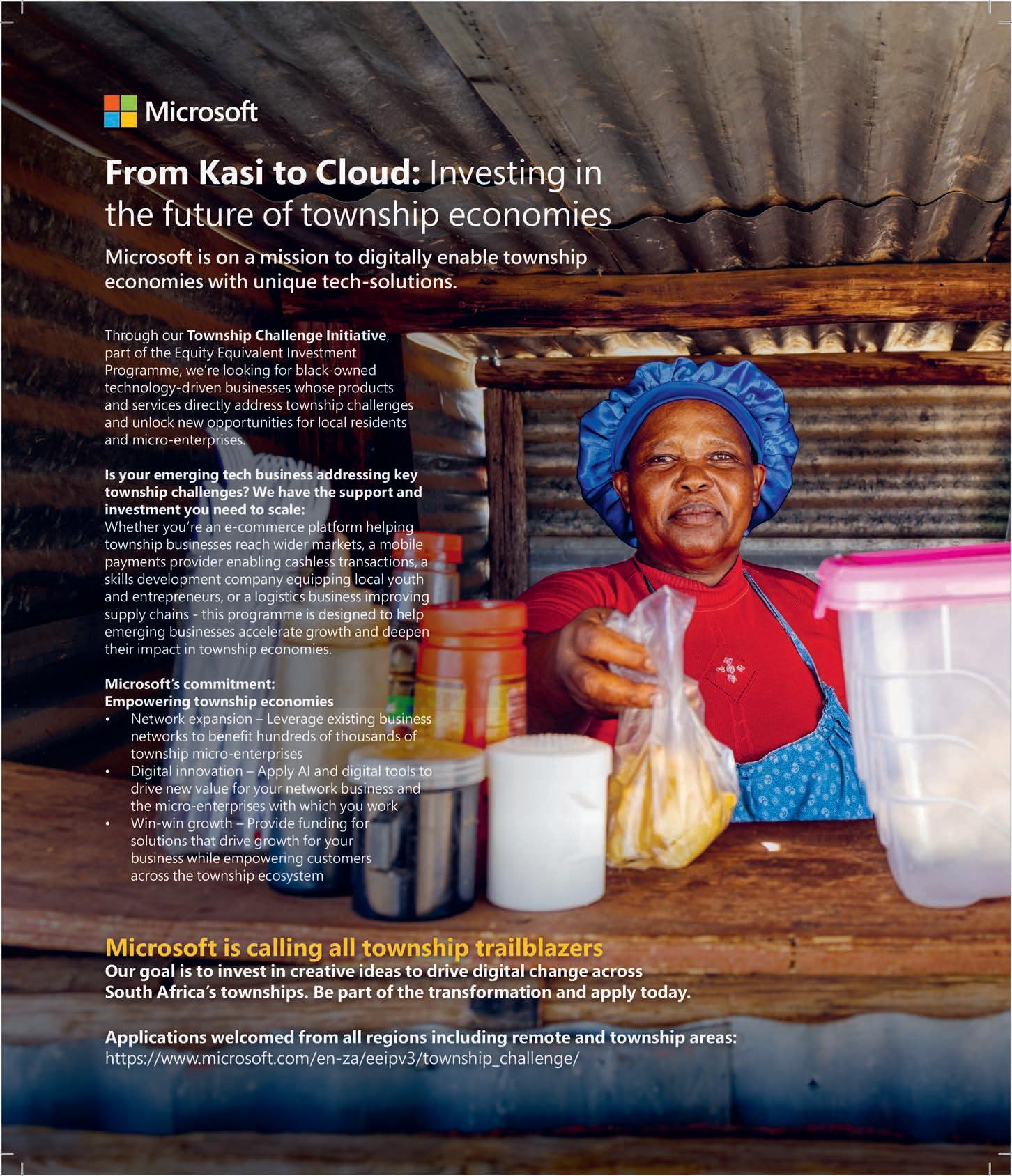
Department of Trade, Industry and Competition, we are investing R1.32-billion over the next 10 years to strengthen black-owned SMMEs and expand digital skills for young people. Our Emerging Partner Programme provides ICT-focused businesses with a clear pathway to build capability, earn industry-recognised certi cations and participate in commercial opportunities that help them grow.
South Africa now has a window where policy momentum, partnership efforts and entrepreneurial determination are pulling in the same direction. If we maintain this alignment, we can unlock meaningful growth for SMMEs and create opportunities that extend into communities countrywide. The opportunity to shift small businesses from survival to scale is real, and with deliberate action, we can turn that momentum into lasting impact.
Vukani Mngxati
VISIT WEBSITE
INNOVATIVE FINANCING MODELS
TERSIA BOOYZEN finds that South Africa is beginning to assemble a new financial architecture for small, medium and micro enterprises, one that blends public sector stability with private sector innovation
South Africa’s policymakers love to remind us that small, medium and micro enterprises (SMMEs) are the backbone of the economy. Yet for years, we’ve expected these businesses to grow using financial tools designed for a different era. Collateral-heavy bank loans, slow approvals and rigid credit scoring remain the dominant gatekeepers in a country where most entrepreneurs operate without the assets or formal credit histories that banks demand.
The result is predictable: potential is throttled long before it becomes performance. However, a shift is underway – quiet, uneven, but unmistakable. South Africa is beginning to assemble a new financial architecture for SMMEs, one that blends public sector stability with private sector innovation. If we take this moment seriously, we could unlock the kind of growth the country has been chasing for a decade.
The Department of Trade, Industry and Competiton’s (dtic) incentives quietly act as nondilutive capital for machinery, expansion and export development. Together, these incentives turn ambitious projects into bankable ones.
FINTECH AND CORPORATES ARE REDRAWING THE EDGEs
Joshua Kadish, CEO and co-founder of Sourcefin, says the shift we are seeing in SMME finance is structural, not incremental. “Fintech has fundamentally changed how risk is understood and priced. By leveraging real-time transaction data, behavioural insights and supply chain visibility, we can fund performance rather than balance sheets.”
For many growing businesses, particularly asset-light or black-owned enterprises, this removes the single biggest barrier to scale, which is the requirement for hard collateral.
“IF FUNDING CAN BE DEPLOYED WITHIN DAYS, THAT BUSINESS CAN DELIVER, BUILD A TRACK RECORD AND REINVEST IN CAPABILITY. IF IT TAKES MONTHS, THE OPPORTUNITY IS LOST.”
– JOSHUA KADISH
Small Enterprise Development and Finance
housekeeping. It signals a move toward
“We’ve seen this with innovative new models such as asset-backed finance, merchant cash advance and purchase order or invoice finance.
“At Sourcefin, we have seen first-hand how purchase order funding and invoice discounting unlock growth. When an entrepreneur secures a large corporate contract, the constraint is rarely demand. It is working capital. If funding can be deployed within days, that business can deliver, build a track record and reinvest in capability. If it takes months, the opportunity is lost,” Kadish explains.
Speed and certainty of capital are often the difference between scaling and stagnation. Using a forward-looking and collateral-free view, the SMME is enabled to scale.
THE CONVERGENCE BETWEEN FINTECH AND CORPORATE SUPPLY CHAINS
What is particularly powerful in the current environment is the convergence between fintech and corporate supply chains. As corporates move beyond compliance-driven
supplier development towards true integration of SMMEs into core procurement pipelines, fintech platforms can provide the liquidity layer that makes those relationships sustainable.
Kadish continues: “Early payment programmes, structured purchase order funding and data sharing between corporates and funders create a virtuous cycle of performance and access to capital. This has been seen by platforms such as Addendum, which connects the ecosystem of supplier, funder and retailer, and allows early payouts to keep cash flow moving for the SMME.
“True transformation happens when market access and capital move in tandem. Funding without contracts leads to idle balance sheets and contracts without funding lead to failed delivery. Fintech sits at that intersection, using technology to reduce friction, compress timelines and broaden inclusion. If we are serious about building globally competitive SMMEs, then scalable, data-driven financing models must form part of the national growth architecture.”
Artificial intelligence and fintech are enabling faster funding, real-time cash flow management and mobile-first digital strategies that level the playing field for small, medium and micro enterprises.
By VANESSA ROGERS
Learning how banks assess risk and allocate capital was how Andrew Maren spent his early career at two large South African nancial institutions. When he launched his own venture, Pro tShare Partners, nearly 20 years ago, that knowledge helped him secure home loans and business nance – provided the fundamentals were sound.
However, he soon noticed a recurring problem: many small, medium and micro enterprises (SMMEs) were excluded from funding because traditional lenders relied on rigid, decades-old credit scoring models. “Banks typically require three years of nancial history, strong liquidity ratios and a proven track record –criteria designed for large corporations. Yet many promising South African SMMEs win contracts with blue-chip companies, only to be declined funding to ful l those orders,” he says.
Maren realised the issue was less about opportunity and more about risk management. By using technology to monitor transactions in real-time – paying suppliers directly, tracking delivery milestones and managing risk throughout the deal – his model allows funders to support viable transactions without relying solely on historical nancials.
The result: SMMEs can access the capital they need to operate, grow and ultimately graduate into sustainable businesses.
TRADITIONAL SYSTEMS MUST EVOLVE
Velly Bosega, CEO of SME South Africa, says the funding gap also partly stems from readiness challenges. “Many SMMEs don’t meet the basic requirements for traditional funding,” he says. “Documentation may be incomplete, nancial reporting inaccurate, or turnover too low to justify a loan.”
However, he argues that the system itself is poorly suited to small businesses. “Small business owners are expected to jump through hoops that were never designed for them – it’s like asking a Grade 1 learner to write a matric exam and then acting surprised when they fail.”
MOBILE-FIRST BUSINESS MODELS
Marcio Quintal, SEO and e-commerce specialist at SME South Africa and creative director at Adclick Africa, says the country’s high smartphone penetration is transforming commerce. “With smartphone penetration exceeding 90 per cent, South Africa is rmly a mobile- rst market,” he says. “Yet many SMMEs still rely on social media while underestimating the strategic value of owning a website.”
While entrepreneurs must become funding-ready, Maren believes lenders must also rethink how they assess risk. “Banks, development institutions and funders need more appropriate ways of scoring and granting credit. That’s exactly what we set out to do at Pro tShare Partners.”
AI: THE GREAT EQUALISER
“AI is no longer optional,” says Maren. “For a small business, AI can provide the capability of a team of 100 – without the overhead.”
Many entrepreneurs are already using tools such as ChatGPT subscriptions, which cost about US$20 per month. “You can test ideas, explore nancial strategies, research case studies and access market insights previously available only to large companies,” he says. Digital tools are also improving nancial management. Bosega notes that cash ow management platforms help SMMEs track income and expenses more accurately. “Many entry-level tools integrate with business bank accounts, so transactions are automatically recorded. Over time, this builds a reliable cash ow history that can support funding applications.” Having organised nancial records also boosts credibility with lenders, so “when a funder asks for nancials, you can provide them immediately,” says Maren. “That signals professionalism, even for early-stage businesses.”
Businesses should prioritise mobile- rst web experiences supported by social commerce platforms. Models such as drop shipping allow products to be manufactured locally or overseas, stored in warehouses and shipped directly to customers once orders are placed. “This removes the need for physical stores, staff and many traditional overheads.”
DIGITAL VISIBILITY FUELS ENTREPRENEURSHIP
Success now depends heavily on digital visibility – through social media, in uencers, online ads and e-commerce platforms, alongside a company’s own website. While larger marketing budgets still help, digital commerce has signi cantly levelled the playing eld. Many apps now manage payments, logistics and administration through simple, affordable subscriptions, expanding entrepreneurial opportunities across South Africa.“You can run a retail business from almost anywhere with internet access,” says Maren. “Even young entrepreneurs in smaller towns can build successful businesses.
“Pro tShare Partners builds smarter funding solutions. Our technology manages internal processes so SMMEs can deliver on large contracts,” he says.
Analysts step in when businesses encounter challenges, helping entrepreneurs learn through the process. “When SMMEs leave us, those systems and skills remain. It becomes part of how they run their businesses,” concludes Maren.
Follow: Andrew Maren www.linkedin.com/in/andrewmaren
Digital banking is revolutionising SMMEs by simplifying finances and boosting cash flow, giving entrepreneurs the unprecedented speed and control needed to grow, writes BUSANI MOYO
For small, medium and micro enterprises (SMMEs), cash ow is the lifeblood that dictates their survival and growth. Historically, managing day-to-day nances has been a manual, time-consuming process, and traditional banking has often been too rigid for agile, high-growth businesses. Today, a digital revolution is reshaping this landscape. The ntech boom is driving a wave of alternative nancing and digital tools, empowering entrepreneurs to simplify their nances, boost liquidity and make smarter decisions.
SPEED, VISIBILITY AND CONTROL
At its core, the shift to digital banking is about giving business owners unprecedented control. Norman Nyawo, head of merchant solutions at Standard Bank South Africa, explains that this transformation is built on
BRIDGING THE ADOPTION GAP
Despite these clear advantages, the path to adoption is not always smooth. A signi cant hurdle is the perception that these tools are overly complex or expensive. “One of the biggest hurdles for SMMEs is awareness and understanding,” says Nyawo. “Many still believe digital nance tools are built for big corporates, are too expensive or complicated to use.”
This fear is compounded by digital literacy gaps and a reluctance to disrupt established operations. Financial service providers are responding by focusing on simplicity, affordability and clear communication, ensuring the bene ts are immediately obvious to time-poor entrepreneurs.
The scale of this digital adoption is staggering, signalling that these hurdles are being overcome. In a recent interview with Gary Alfonso on Business Day TV, Mark Elliott, division president for Africa at Mastercard, highlighted that the continent is experiencing a massive wave of digitisation. With the digital payments economy projected to reach US$1.5-trillion by 2030, Elliott pointed to incredible progress on the ground, telling Alfonso, “in South Africa speci cally, ninety per cent of SMEs have adopted digital payments”.
Strategic collaborations fuel this growth. Elliott emphasised that success in Africa requires locally aware solutions rather than a one-size- ts-all approach. “We don’t believe that just bringing global solutions ... is necessarily going to solve Africa’s problem statements”, he told Alfonso, highlighting the need to co-create tailored tools with local ntechs. Initiatives like Mastercard’s “SME in a box” in Nigeria, which has already enabled 1.4 million businesses, demonstrate the power of this collaborative model.
Norman Nyawo www.linkedin.com/in/norman-nyawo-45817a24 www.linkedin.com/in/mark-elliott-bbb63826 www.linkedin.com/in/gary-alfonso-b503554
“DIGITAL BANKING HAS INTRODUCED SPEED, VISIBILITY AND CONTROL INTO WHAT WERE HISTORICALLY MANUAL AND TIME-CONSUMING FINANCIAL PROCESSES.” – NORMAN NYAWO
THE FUTURE OF FINANCIAL AGILITY
Looking ahead, the integration of digital nance into the fabric of SMME operations is set to deepen. The future is not just about faster transactions, but smarter, more predictive nancial management. Nyawo envisions a world where data provides a holistic view of a business’s health. “Credit decisions won’t just rely on nancial statements, but also on insights like stock movement from point-of-sale (POS) systems, sales trends and even digital presence,” he predicts. This will enable more exible and responsive funding.
Ultimately, automation and intelligent recommendations will free entrepreneurs to focus on what they do best: running their business. From automatically reordering stock before a busy period to accessing an instant cash advance during a tight spell, digital platforms are evolving from simple tools into strategic partners, fuelling the growth and resilience of SMMEs across the continent.