Building climate resilience through oceans, wind and innovation
SOUTH AFRICA’S OFFSHORE ENERGY POTENTIAL
THE MULTIMILLION-RAND POTENTIAL OF KELP FORESTS
TURNING MINE DUMPS INTO ECOSYSTEMS
COASTAL CLEAN-UPS DRIVING DATA ACTION
TURNING THE TIDE
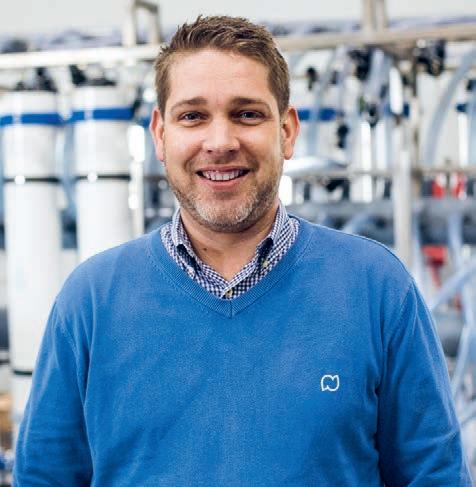
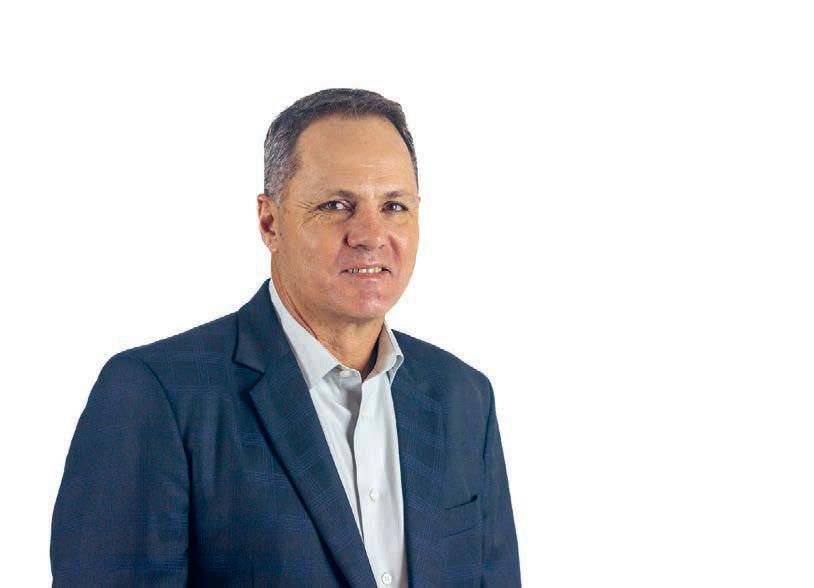
BILLY JAMES, managing executive, NuWater, explains why South Africa’s real green revolution will be written in water
South Africa loves to frame its green future in the language of wind turbines and solar panels, gleaming symbols of progress that photograph well and trend even better. However, while we chase sunshine, the real crisis is unfolding somewhere far less glamorous: in our pipes, our dams, our quietly failing water systems.
YOU CAN’T DRINK A SOLAR PANEL
Here’s the truth: you can’t drink a solar panel. We are a water-scarce country pretending, on good days, that we are merely water inconvenienced. Erratic rainfall, ageing infrastructure and the lingering threat of “Day Zero” have turned water into a frontline economic risk. Gross domestic product, food production, mining output, all of it depends on a resource we still treat as if it were in nite. It isn’t.
WE ARE FLUSHING AWAY THE SOLUTION
Our current model, extract, use, discard, belongs to a more naive era. In a country like ours, it’s not just outdated; it’s reckless. What we need instead is a circular water economy, one that treats wastewater not as waste, but as a resource with a second life.
This shift isn’t philosophical, it’s practical. Start with industry, the thirstiest player in the room. Mining, manufacturing and heavy processing are sectors that consume vast volumes of water, much of which can be
treated and reused. Technologies like reverse osmosis and membrane ltration make closed-loop systems entirely feasible. The result is simple: less dependence on municipal supply, greater resilience in the face of water cuts and operations that can withstand drought instead of folding under it. However, adoption hinges on incentives. Sustainability rarely wins on goodwill alone, so policy must step in. Tax rebates, green nancing and targeted support for water recapture systems can turn conservation into a nancial advantage. Push companies towards reduced discharge or full reuse, and the payoff is immediate, millions of litres freed up for broader use.
At the municipal level, a more radical rethink is needed. Wastewater treatment plants should
not be seen as endpoints, but as production facilities. Through public-private partnerships, failing infrastructure can be upgraded to treat wastewater for agricultural and industrial reuse. This creates a secondary water market, one that not only relieves pressure on potable supply, but also generates revenue to sustain itself. None of this is particularly glamorous. There are no ribbon-cutting ceremonies for ltration systems, no viral photos of reclaimed water. Just infrastructure doing its job, that’s the point.
South Africa’s green economy won’t be secured by spectacle. It will be built, quietly and pragmatically, through water security. Water recapture isn’t a side issue; it’s the foundation.
In the end, resilience isn’t about how much energy we produce. It’s about whether, when the taps run dry, we’ve been smart enough to make sure they don’t.
Billy James
GREEN
PUBLISHED BY
Picasso Headline,
A proud division of Arena Holdings (Pty) Ltd, Hill on Empire, 16 Empire Road (cnr Hillside Road), Parktown, Johannesburg, 2193 PO Box 12500, Mill Street, Cape Town, 8010 www.businessmediamags.co.za
Contributors: Keith Bain, Carl Brown, Trevor Crighton, Laura du Toit, Alison McKie, Busani Moyo, Leon Muller, Nomfundo Ndlovu, Niël Pretorius, Nadia Scheffer, Ulrich Terblanche, Akhona Tyhali, Lisa Witepski
Subscriptions and Distribution: Fatima Dramat fatimad@picasso.co.za
Printer: CTP Printers, Cape Town
MANAGEMENT
Management Accountant: Deidre Musha Business Manager: Lodewyk van der Walt General Manager, Magazines: Jocelyne Bayer
WET YOUR WHISTLE (WHILE YOU CAN)
Did you know that in South Africa, between 30 and 60 per cent (depending on who you ask and how far along the sanitation chain you look) of all treated, potable water supplied to urban households is used solely for ushing toilets? That’s assuming everything works properly – a leaking toilet can waste tens of thousands of litres of water a year. In a water-scarce country like ours, this is obviously not sustainable. That’s why researchers and organisations are working on alternatives, whether through the use of greywater or seawater for ushing, or waterless, non-sewered toilets that break down waste in other ways, in some instances even generating power. Journey down the toilet hole with us on page 34
Water is on everyone’s minds these days – on page 6 we examine how to ensure our
nascent offshore wind sector bene ts coastal communities, on page 8 we learn why sustainable kelp farming is key to ocean ecology and the survival of this multimillion-rand industry, on page 24 we look at the data behind coastal clean-ups, on page 31 we nd out why water resilience in the hospitality is not a crisis strategy, and on page 38 we dip into responsible, regenerative and reciprocal coastal foraging. We also cover eco-friendly products, youth climate reporting, mine dump rehabilitation, sustainable fashion and the continuing ght against the poaching of endangered species. That should be more than enough to wet your whistle. Just remember: if you want to keep it wet, be mindful of our precious water resources.
Anthony Sharpe EDITOR
CONTENTS
6 GREEN ENERGY
South Africa’s vast offshore wind energy potential requires a just framework.
8 KELP ECONOMY
Our coastal kelp forests represent a sustainable, multimillion-rand industry.
13 ECO-FRIENDLY
Locally made, sustainably minded goodies.
17 CONSERVATION
Western Cape nature conservationists are leading the ght against the poaching of indigenous species.
18 INVESTMENT
Unpacking the green investment opportunities in the Western Cape.
23 NATURE REHABILITATION
Mine dumps are being processed and rehabilitated, creating value and restoring ecosystems.
24 COASTLINES
How Trash Bash is turning beach clean-ups into data and action.
26 YOUTH
Young South Africans are learning critical thinking skills by reporting on the environment.
31 HOSPITALITY
Why water resilience needs to become a year-round strategy.
34 SANITATION
Implementing eco-friendly toilet solutions can conserve water and recycle waste.
37 SUSTAINABILITY
Why extending the right to repair to the electronic repair industry is crucial.
38 FOOD
Untamed ingredients, sustainably foraged from the wild and transformed into nutritious meals.
40 COOKING
Cooking up indigenous ingredients with a side of traditional knowledge and sustainability.
44 FASHION
Can the fashion industry ever become truly sustainable?
BLOWING IN FROM THE SEA
South Africa's offshore wind potential is vast, but without a just framework, green energy risks becoming the ocean's newest extractive industry.
By
BUSANI MOYO
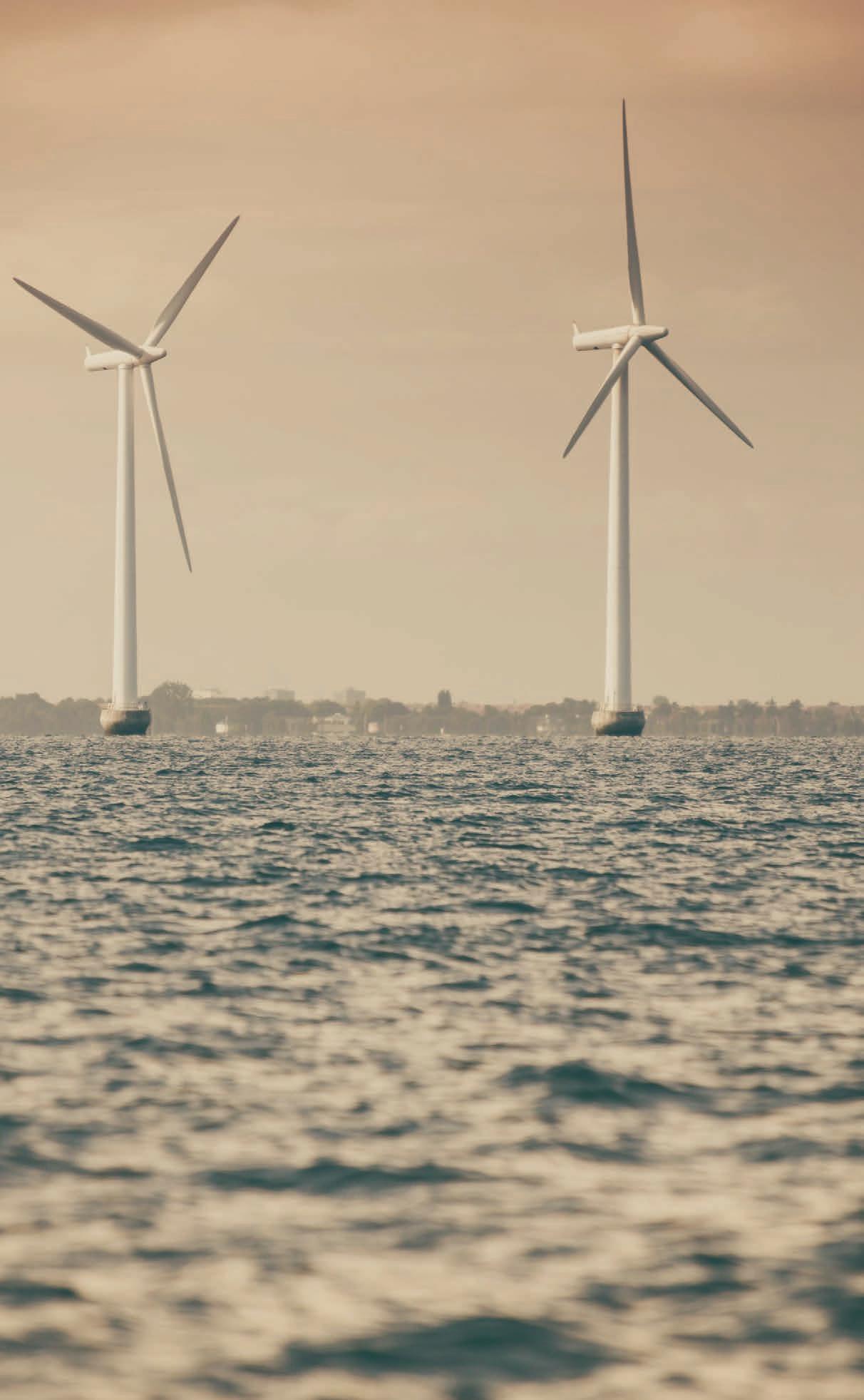
Just beyond South Africa's shoreline, a new energy frontier is taking shape. The promise is extraordinary: clean, abundant energy and a cornerstone for a thriving blue economy. However, as developers eye coastlines in the Eastern Cape, Western Cape and KwaZulu-Natal for wind energy, a question is forming beneath the surface. Will this green revolution genuinely uplift the communities that have lived by the ocean for generations, or will it become another industry that extracts value and leaves little for the locals?
Two leading voices in South Africa's environmental space have the answers. James Reeler, senior technical specialist at WWF South Africa, and Cynthia Moyo, climate and energy campaigner at Greenpeace Africa, arrive from different organisational perspectives, but share a common concern: that without the right framework, offshore wind risks repeating the mistakes of the industries that came before it.
"THE CHOICES MADE NOW WILL DETERMINE WHETHER OFFSHORE WIND BECOMES A GENUINE BLUE ECONOMY ANCHOR OR ANOTHER EXTRACTIVE INDUSTRY DRESSED IN GREEN."
– CYNTHIA MOYO
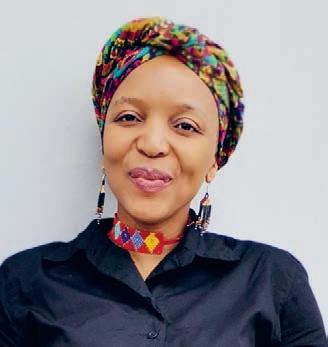
Cynthia Moyo
REGULATION REQUIRED
Both experts agree that the framework is dangerously absent. “There is no offshore wind framework in existence yet,” Reeler says plainly. “The governing legislation is a mix of marine spatial planning and coastal development.”
The projects currently in planning near Richards Bay and Mossel Bay are privately promoted, placing them outside the Renewable Energy Independent Power Producer Procurement Programme and its socioeconomic development requirements. For Moyo, this absence is “both the honest answer and the urgent problem. Ambition without accountability,” she adds, “is a plan, not a commitment.”
For South Africa's small-scale shers, this ambiguity carries the weight of lived experience. Equating offshore wind energy generation with extraction, Moyo refers to 2021, when the British multinational oil and gas company Shell commenced seismic blasting off the Wild Coast without properly engaging the Mpondo communities whose livelihoods and cultural identity are bound to that stretch of ocean. The Makhanda High Court later ruled that the right of exploration was unlawfully granted, a decision upheld by the Supreme Court of Appeal in June 2024. “The courts are the most powerful corrective mechanism available,” Moyo says, “but that tells you something important: the system is not designed for justice; it must be litigated into it.”
Reeler is more cautious: “We can only hope that this nascent industry does not follow the same playbook.”
COMMUNITY INVOLVEMENT
On jobs, it pays to be realistic. “The majority of jobs are likely to be relatively highly skilled, such as in engineering, manufacturing and maintenance, and therefore not sourced from the general labour pool,” says Reeler. “We can anticipate that the majority of jobs relating to offshore renewable development will not come from adjacent coastal communities.”
Moyo believes that, without deliberate, front-loaded skills investment in coastal communities, offshore wind jobs will ow disproportionately to urban specialists and
"THERE IS NO OFFSHORE WIND FRAMEWORK IN EXISTENCE YET. THE GOVERNING LEGISLATION IS A MIX OF MARINE SPATIAL PLANNING AND COASTAL DEVELOPMENT."
– JAMES REELER
international contractors. “The transition is only just if the people who live closest to these turbines actually bene t from them.”
Global models show that a different path is possible, argues Moyo. Denmark legally requires developers to offer residents at least 20 per cent ownership. She refers to the Middelgrunden wind farm near Copenhagen, which is 40 per cent owned by a co-operative with over 8 500 members who receive direct dividends. “This is not corporate social responsibility; it is structural redistribution through ownership.” She also refers to Scotland, which has similarly embedded binding community bene t principles into its offshore renewable energy policy. “The choices made now will determine whether offshore wind becomes a genuine blue economy anchor or another extractive industry dressed in green.”
Reeler sees grounds for cautious optimism. “On balance, the evidence appears to be that offshore renewables are a net positive; and those impacts can be increased with proper local consultation, planning to avoid biodiversity hotspots and undertaking mitigation measures.”
Moyo, however, insists that optimism must be tempered with honesty. “Offshore wind is still a contested space for sherfolk. The green economy can reproduce the extractive logic of the fossil economy if justice is not built in from the start.”
THE BLUE ECONOMY EXPLAINED IN THE SOUTH AFRICAN CONTEXT
The World Bank defines the blue economy as “the sustainable use of ocean resources for economic growth, improved livelihoods and jobs, while preserving the health of ocean ecosystems”. It is a definition that sounds straightforward until you hold it up against South Africa's coastline.
Here, the blue economy is not an abstract concept. It is the small-scale fisher working the Wild Coast at dawn. It is the Mpondo community whose cultural and spiritual identity is inseparable from the sea. And, increasingly, it is the question of who benefits when offshore wind turbines rise from those same waters.
For Cynthia Moyo of Greenpeace Africa, the blue economy becomes meaningful only when it corrects historical inequities rather than deepening them. She points to Denmark's co-operative ownership model as proof that structural redistribution is achievable, but insists it requires deliberate legislation, not developer goodwill.
James Reeler of WWF South Africa adds that, unlike oil and gas, offshore wind carries fewer risks of catastrophic, lasting environmental harm, offering a more hopeful foundation.
Both experts converge on one point, however: a blue economy that bypasses the communities living closest to the ocean is not a blue economy at all. It is extraction rebranded.
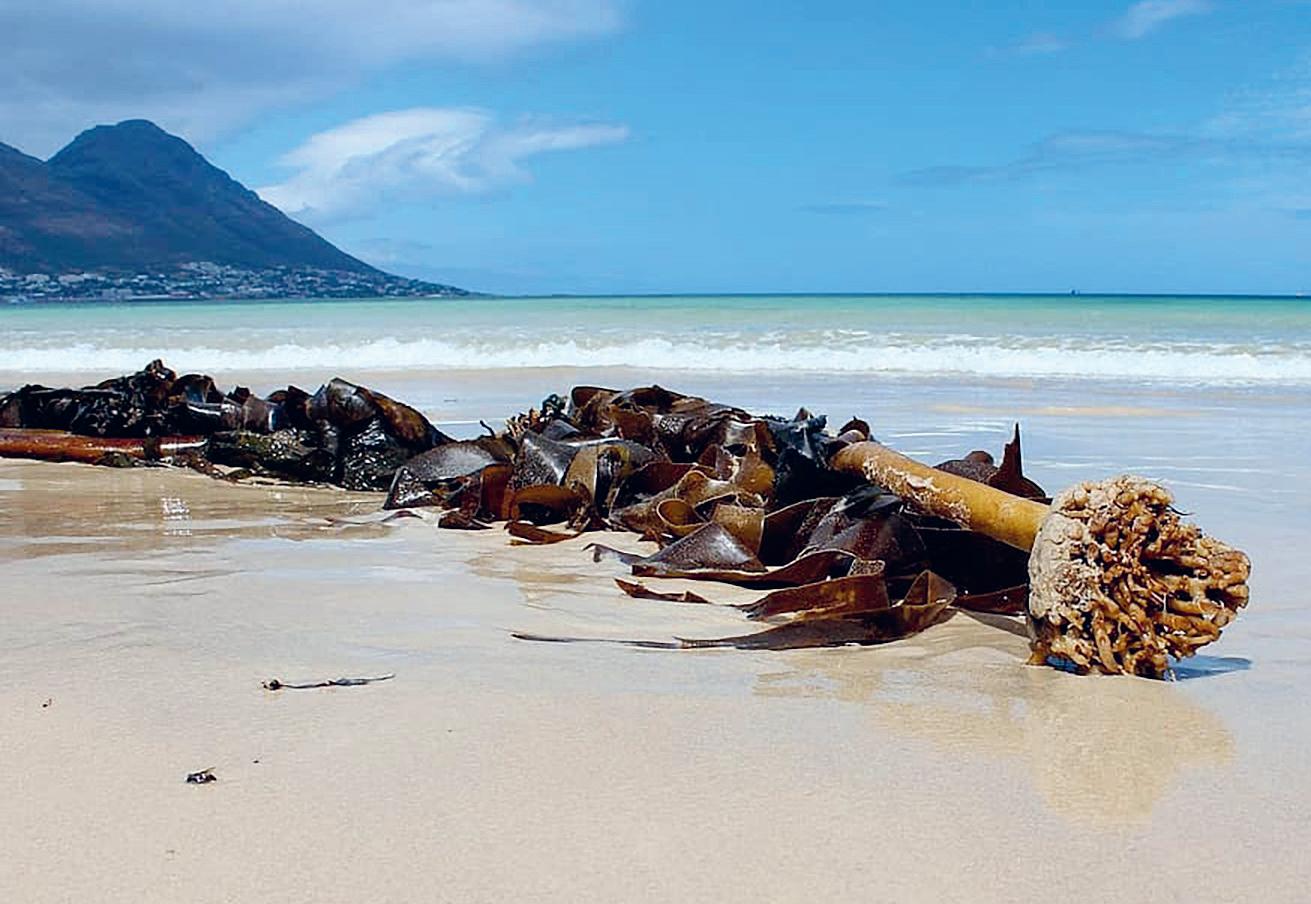
To the average Cape Town beachgoer, the tangled heaps of kelp rotting on the sand are little more than a pungent eyesore to be avoided. Look closer, however, and you’ll find a multimillion-rand industry hidden in the salty stench. By
NADIA SCHEFFER , innovation director at Seaweed South Africa
Seaweed, a broad term for various macroalgae, is one of the fastestgrowing plants on the planet. While some global giant kelp species can grow up to half a metre a day, our local Ecklonia maxima (sea bamboo) is a consistent powerhouse, contributing to an ecosystem that replaces its own weight several times a year. It is one of the most sustainable resources on earth.
South Africa’s kelp economy currently rests on two major pillars: the production of biostimulants, dominated by Kelpak and Afrikelp, which have been operating in the space since the 1970s, and a high-volume export industry. Collected kelp is dried, chipped and exported mostly to China for processing.
ONE PLANT, A THOUSAND USES
Kelp harvesting is a massive undertaking that remains largely invisible to the public. Each year, an estimated 10 000 tonnes of kelp are processed from our coastline, accounting for roughly three per cent of the global wild harvest. This haul serves a dual purpose: some is re ned locally into world-class agricultural
biostimulants, while the rest is dried and shipped abroad to satisfy a hungry global demand for raw material. Supplying this robust industry requires two distinct methods.
Freshly harvested kelp is cut directly from the ocean’s kelp forests to ensure high nutrient levels for biostimulants. To protect the delicate coastal ecosystem, harvesting is governed by stringent permit conditions, and collectors must follow speci c cutting rules. This ensures the primary plant remains intact to regrow, enabling South Africa’s underwater forests to continue thriving while fuelling the demand.
Beach-cast collection, on the other hand, focuses on the older, weathered plants washed ashore, ideal for high-volume drying and export trade. The logistics for this process are staggering. As kelp is roughly 80 per cent water, it takes ve tonnes of raw harvest to produce just a single tonne of export-ready product. A versatile extract, alginate, is processed in China. It is the invisible glue in our modern world
– found in everything from life-saving pharmaceuticals and high-end cosmetics to industrial printing inks and the food industry. The economic disparity is stark: South Africa currently exports raw, dried kelp for roughly R14/kg, only to turn around and import re ned alginate at prices ranging from R150/kg (industrial grade) to over R1 300/kg (specialised laboratory).
EXPANDING THE VALUE CHAIN
Beyond biostimulants, other promising frontiers for the industry are bioplastics and bio bres – sectors South Africa is well-positioned to explore – while the food sector is also gaining traction. Another local genus, Ulva (sea lettuce) shows great potential. Unlike deep-water kelp forests, it can be cultivated in land-based tanks and is already successfully integrated into local abalone farming.
Globally, the seaweed sector is considered early stage, and the most striking aspect of it is how universal its hurdles are. Whether a start-up is launching in California, Ireland or the Western Cape, the “bottlenecks” remain identical: navigating complex legislation, securing consistent funding and aligning with evolving environmental regulations.
Another hurdle is biomass security: access to a consistent, large-scale supply of raw material for industrial processing. While our kelp is undeniably a high-value resource, we are ghting the same battles as the rest of the world to turn it into a viable commercial titan.
What does the industry need to unlock its next phase? Investors with an appetite for high-risk, high-reward frontiers – those who recognise that while the initial hurdles are steep, the long-term payoff of a mature blue economy will be transformative.
FRESHLY HARVESTED KELP IS CUT DIRECTLY FROM THE OCEAN’S KELP FORESTS TO ENSURE HIGH NUTRIENT LEVELS FOR BIOSTIMULANTS. TO PROTECT THE DELICATE COASTAL ECOSYSTEM, HARVESTING IS GOVERNED BY STRINGENT PERMIT CONDITIONS, AND COLLECTORS MUST FOLLOW SPECIFIC CUTTING RULES.
Enterprise Entity and founder of SustainableDNA, discusses designing regenerative enterprise systems for a new era of intelligence
STHE SHIFT
ustainableDNA™ focuses on regenerating enterprise systems into investible, living systems and architectures.
Sustainability has entered enterprise systems in fragmented forms, shaped by partial interpretations and incomplete understanding. Frameworks, policies and initiatives have been introduced with strong intent, yet without a coherent grasp of how systems truly operate.
What exists today is not a uni ed model, but a dispersed collection of efforts attempting to describe a whole.
The issue is not effort or intent; the issue is structure.
Sustainability is not a constraint, nor a limitation on growth, capability or progress. It is not a mechanism designed to restrict systems into doing less. It is, in its true form, a system of intelligence.
Yet most systems have not been designed to operate this way.
HOW SYSTEMS ACTUALLY OPERATE
Every system extracts. This is fundamental. Energy, resources, time and human capability are drawn into use to enable creation, development and movement. Extraction is not the problem. It is the starting point of all activity.
The problem emerges in what follows. When extraction occurs without an intelligent and structured process, systems fall into imbalance. This imbalance manifests visibly. It appears as instability, inef ciency, inequality and fragmentation. It is re ected in depleted environments, strained economies and in human behaviour that shifts towards survival rather than coherence.
Sustainability, in its true form, corrects this condition.
THE SYSTEM ARCHITECTURE
Sustainability operates through a precise and ordered progression.
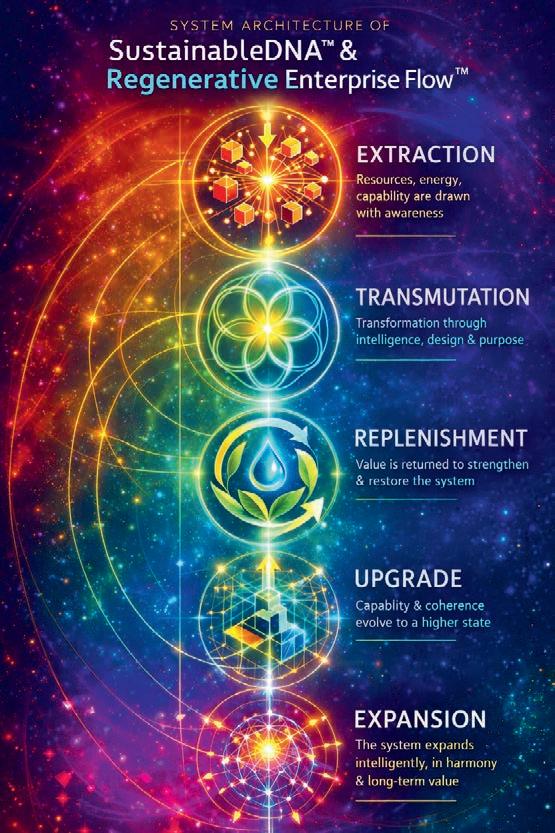
Extraction must be followed by transmutation, replenishment, upgrade and expansion.
Transmutation is the pivotal movement within the system. What is extracted must be transformed through intelligence, design and capability into a higher-value state.
From transmutation comes replenishment. Replenishment restores equilibrium by returning value in a form that strengthens the system. When replenishment is achieved, the system stabilises. Stability is not the goal. It is the point at which the system becomes capable of upgrade.
Upgrade enables a higher order of operation. Systems become more coherent, more ef cient and more capable.
From upgrade emerges expansion. Expansion is not forced. It is the natural expression of a system operating in coherence.
HUMAN AND ENTERPRISE SYSTEMS
These principles apply equally to human systems.
When individuals are continuously extracted from without replenishment, they become depleted. When replenished, they stabilise. When development continues, they upgrade and expand their contribution to the system.
No part of the system can be left behind. Underdeveloped components create drag and limit expansion.
Leadership determines whether the system operates in coherence or dissonance. A system operates like an orchestra. Leadership is the conductor. The tone from the top de nes system performance.
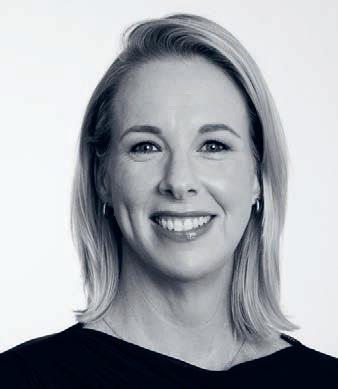
Belinda-Jane Carreira
System architecture of sustainable and regenerative enterprise flow.
Coherent human systems enabling enterprise performance.
THE EMERGENCE OF REGENERATIVE ENTERPRISE SYSTEMS™
As systems stabilise, awareness increases. Greater awareness enables better decisions, stronger alignment and higher performance. This is where sustainability transitions into something more advanced.
The Regenerative Enterprise SystemTM emerges as a structured architecture that enables systems to:
• Operate in coherence.
• Restore and strengthen internal and external environments.
• Upgrade capability continuously.
• Expand intelligently.
This is not an overlay. It is a redesign of how enterprise systems operate.
FROM COMPLIANCE TO INVESTABILITY
Enterprises are no longer being asked to simply report.
They are being required to demonstrate:
• Resilience.
• Capability.
• Alignment.
• Long-term value creation.
Fragmented sustainability efforts cannot achieve this. Only systems designed with intelligence can.
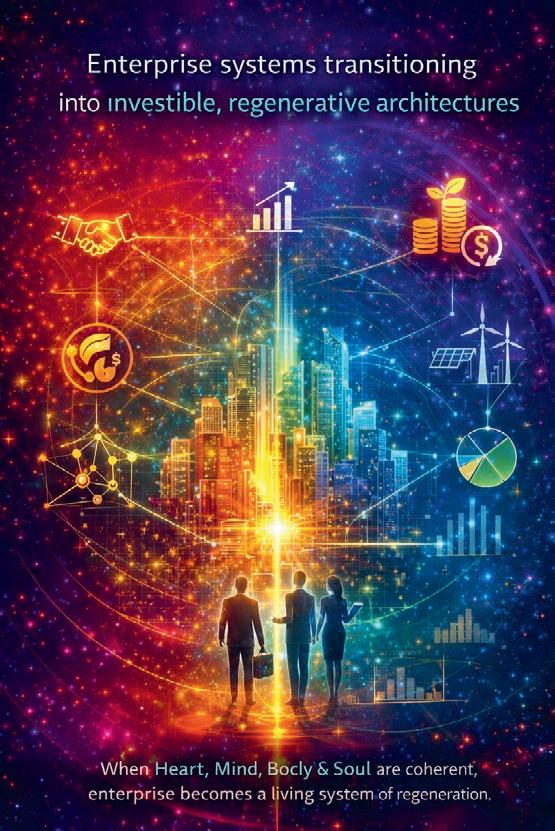
Enterprise systems transitioning into investible, regenerative architectures.
AS SYSTEMS STABILISE, AWARENESS INCREASES. GREATER AWARENESS ENABLES BETTER DECISIONS, STRONGER ALIGNMENT AND HIGHER PERFORMANCE.
When systems operate through structured extraction, transmutation, replenishment and upgrade, they become:
• Stable.
• Scalable.
• Investible.
This is the shift from sustainability as compliance to sustainability as system intelligence.
IN CLOSING
Sustainability is not about doing less. It is about operating with greater intelligence, awareness and alignment. It is about designing systems that sustain, upgrade and expand.
SustainableDNATM, de nes this architecture as a system of operation. The future of enterprise will not be built through fragmented effort.It will be designed through coherent systems.
Regenerative systems enabling expansion and long term value creation.
1 UpcycleCreative
UpcycleCreative is the retail arm of Upcycle, a movement working to shift mindsets around waste management, breed sustainable entrepreneurship and protect the environment through creative upcycling of cardboard, e-waste, fabrics, glass, metal, paper, plastic, wood and vinyl. Think planter bags and hats crafted from billboard banners, decanter chandeliers, shweshwe pencil cases and yoga mats made from upcycled bres. The Upcycle website is also lled with crafting recipes for making all sorts of cool stuff – perfect for a rainy crafting day at home. www.upcycle.co.za
GREEN GEAR
4 Cape Union Mart
A showcase of locally crafted, sustainably minded products.
By ANTHONY SHARPE
3 GreenWorx
2 Myrtle
Myrtle produces a range of eco- and skin-friendly solid shampoo bars. Unlike liquid shampoos that are up to 80 per cent water and packaged in single-use plastic, these concentrated bars use ingredients like green kaolin clay, yucca extract, activated charcoal and pomegranate seed oil to nourish the scalp naturally. It takes your scalp a week or two to get used to the gentler wash that a solid bar yields, but it’s worth it for healthier, less greasy and eco-friendly hair. www.myrtleproducts.co.za
That’s right: your friendly neighbourhood outdoor goods store is committed to producing (relatively) eco-friendly, high-quality accessories and clothing to help you not die in the wild. Their K-Way factor employs a strict reduce, reuse and recycle policy, collecting offcuts for smaller items or donating them to local charities like The Clothing Bank. Launched in 2022, the company’s Green Thread Studio is part of its efforts to rejuvenate Cape Town’s once-great clothing manufacturing industry, with a goal to produce 65 per cent of its products locally by 2030. www.capeunionmart.co.za
4
GreenWorx makes greenwashing a good thing. Instead of harsh surfactants, its cleaners utilise natural bacteria and enzymes that digest organic matter (fats, oils and proteins) long after the initial wipe-down. This biological approach is SABS-tested and Eco GreenTag-certi ed, ensuring it is safe for greywater systems and septic tanks. That means household and industrial-strength cleaning products that are effective against bio lms (blankets that bacteria hide beneath) and won’t pollute our water systems, which are more precious than ever. www.greenworx.eco
5 Green Home
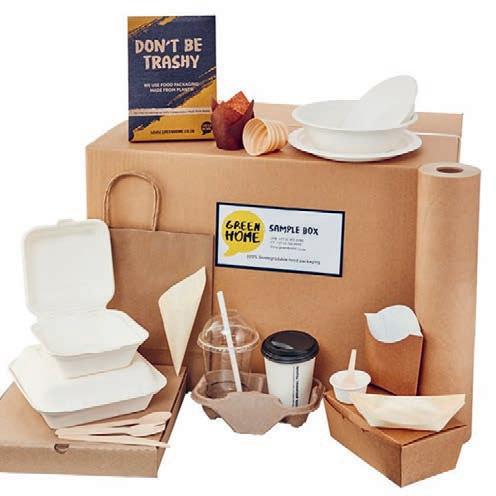
Takeaway food is great. Picnics are great. Taking a sandwich to work/school instead of buying some overpriced panini at the local deli is a great way to save money. What’s not great is disposable food packaging. That’s why Green Home is great. A founding member of the Organics Recycling Association of South Africa, Green Home’s wares run the full gamut of stuff to put your food and drinks into, including coffee cups, straws, sugarcane takeaway boxes, baking paper, wooden cutlery, compostable bioplastic bags and more. Great for events, picnics, corporate stuff and people too lazy to wash their dishes (I’m joking – wash your dishes … with an eco-friendly product). www.greenhome.co.za
PROTECTING THE CAPE’S RARE SPECIES
Western Cape nature conservationists are leading the fight against the poaching of indigenous species. By CARL BROWN and LEON MULLER of CapeNature
The poaching of indigenous species in the Western Cape has placed several plants and reptiles at risk of extinction.
Since 2020, species such as Conophytums and Clivia mirabilis have come under intense pressure from illegal collectors, while reptile species have also been targeted recently.
Before 2020, foreign nationals typically travelled to South Africa to collect plants or reptiles themselves. However, COVID-19 travel restrictions and tougher penalties imposed by South African courts prompted international collectors to change tactics. Many began recruiting locals via social media to collect succulent plants for illegal export, using established traf cking networks to ship them overseas. As a result, local poachers have largely replaced foreign collectors in targeting South Africa’s indigenous species.
Evidence suggests that Asia, particularly China, is the primary market for these poached succulents. Rapid economic growth and rising disposable incomes have fuelled demand among collectors.
Although most of these succulents are available from South African nurseries and can be cultivated relatively easily, collectors prize plants shaped by natural conditions such as drought and heat. These specimens appear more weathered and distinctive than nursery-grown plants. Demand for such wild-collected specimens has led to thousands of plants being removed from the wild, including species found in only a single locality.
Stolen succulents
In 2021, the Conophytum genus was reassessed for the Red List of South African Plants. Of its 184 species, 77 were classi ed as critically endangered and 59 as endangered, largely due to poaching.
Poaching peaked in 2022, when more than 240 000 plants were seized in the Western Cape alone. Between 2019 and 2024, Conophytums accounted for 83 per cent of all plants con scated in the province. Other species under increasing pressure include the miracle clivia (Clivia mirabilis) and the elephant’s foot (Pachypodium namaquanum).
SCALY ACTIVITIES
three entire colonies. The rocky crevice habitats where they live are often destroyed in the process, as rocks are broken open to access the animals.
WORKING TOGETHER
The species targeted by poachers occur across the Northern, Western and Eastern Cape, resulting in the three provincial conservation authorities forming an inter-provincial task team. The initiative brings together the National Prosecuting Authority and the South African Police Service’s Stock Theft and Endangered Species Units to co-ordinate investigations and prosecutions related to the poaching and traf cking of indigenous species.
At a national level, the Department of Forestry, Fisheries and the Environment, with support from partners, including the South African National Biodiversity Institute (SANBI) and WWF, launched a national response strategy in March 2022 to combat the illegal trade in succulent ora. The strategy focuses on protecting vulnerable populations, strengthening enforcement capacity and raising public awareness.
In 2025, CapeNature began recording more cases involving the illegal collection of indigenous reptiles. Spanish national David Navarro Roman was ned R500 000 after being caught poaching 22 armadillo girdled lizards (Ouroborus cataphractus) and one speckled padloper tortoise (Homopus signatus).
In another case, a South African man was arrested in October 2025 while travelling to Cape Town with 167 armadillo girdled lizards in his possession. As these reptiles live in communal groups of up to 60 individuals, the removal of this number could wipe out at least
Farmers can also assist by working with agencies such as SANBI to identify and monitor vulnerable species on their land. While landowners may be cautious about allowing outsiders onto their properties, SANBI treats all ndings as strictly con dential. Farmers are also encouraged to report suspicious activities to their local Stock Theft Units.
For more information, contact your nearest Nature Conservation office and report any suspicious activity related to the illegal trade of indigenous plants and animals to the nearest police station or conservation authority by contacting the CRIME STOP TIP-OFF-LINE on 086 00 10111.
DEMAND FOR WILD-COLLECTED SPECIMENS HAS LED TO THOUSANDS OF PLANTS BEING REMOVED FROM THE WILD, INCLUDING SPECIES FOUND IN ONLY A SINGLE LOCALITY.
Carl Brown
Leon Muller
SHOW ME THE GREEN
There’s R62-billion worth of green investment opportunities to unlock in the Western Cape, write AKHONA
TYHALI and ULRICH TERBLANCHE of GreenCape
The Western Cape has solidi ed its position as the green economy hub for sub-Saharan Africa.
Serving as a strategic gateway to the continent and beyond, the province offers businesses high-growth prospects through preferential market access. The Western Cape is already home to a signi cant cluster of local and international investors, and national regulatory reforms, along with robust climate policies, are driving an increase in investment across renewable energy, e-mobility, circular economy initiatives, green hydrogen and sustainable agriculture.
RENEWABLE ENERGY: A R37-BILLION HORIZON
The Western Cape’s clean energy ecosystem is expanding rapidly, with leading rms moving into electric vehicle charging, lithium-ion battery storage and circular materials. Cape Town currently hosts 70 per cent of South Africa’s utility-scale renewable energy developers, and by 2030, the total investable opportunity in this sector is estimated at R37.4-billion, representing approximately 2.35GW of new capacity.
Following regulatory shifts in 2025 and nalised transmission timelines, 2026 presents a critical investment window. Key opportunities include:
• Large-scale wind and solar photovoltaic, facilitated by the growing wheeling market.
• Behind-the-meter solar and battery storage solutions for commercial entities.
Central to this is the Western Cape Energy Resilience Programme. Launched in the 2023/24 nancial year as part of the Growth for Jobs strategy, the programme aims to mitigate energy disasters while fostering a secure, decarbonised and nancially
sustainable energy landscape. By helping businesses, households and municipalities adopt clean energy, the province is not only reducing carbon footprints, but also helping exporters maintain market share in global supply chains. Decarbonisation further unlocks access to climate and transition-related funding to derisk essential infrastructure.
WATER: RESILIENCE THROUGH PRIVATE PARTICIPATION
South Africa is committed to signi cant water infrastructure upgrades, increasingly opening the door for private sector involvement. In the Western Cape alone, there is a R25-billion investable opportunity over the next three years.As government grants decline and the need for improved service delivery grows, private participation is becoming essential in two primary areas:
1. Water and wastewater infrastructure projects. 2. Water-ef cient sanitation solutions. The Water Resilience Strategy provides a roadmap for long-term water security. This comprehensive approach includes water conservation, supply augmentation, infrastructure development and improved governance. The ultimate objective is to secure 341 million cubic metres of water annually by 2035, ensuring a reliable supply for all residents.Detailed insights into these green economy opportunities are available through GreenCape’s market intelligence reports, published in partnership with the Western Cape Government Department of Environmental Affairs and Development Planning.
FURTHER AFIELD
South Africa is entering a transformative investment phase, underpinned by the 2026 National Budget’s R1.07-trillion infrastructure commitment. A cornerstone of this shift is the Electric Vehicle Tax Incentive, effective 1 March 2026. This policy offers a 150 per cent investment allowance to manufacturers of battery-electric and hydrogen vehicles, aiming to safeguard the automotive sector’s global export competitiveness. In the Northern Cape, the Prieska Power Reserve is scheduled to commence green hydrogen and ammonia production this year, marking the first operational milestone of the country’s green hydrogen corridor. Simultaneously, water security is being restructured: the National Water Resource Infrastructure Agency, launching in April 2026, is designed to mobilise private capital to bridge a R600-billion infrastructure funding gap. Nationally, sustainable finance has reached a mature scale, with South Africa’s leading banks now managing a combined green portfolio of nearly R700-billion, guided by the formalised 2026 Green Finance Taxonomy.
Sources: National Treasury, International Trade Administration, ISS Corporate
NATIONAL REGULATORY REFORMS, ALONG WITH ROBUST CLIMATE POLICIES, ARE DRIVING AN INCREASE IN INVESTMENT ACROSS
Akhona Tyhali
Ulrich Terblanche
FROM STRAW TO SUSTAINABILITY
SAPPI’S 90-YEAR JOURNEY
Through ingenuity, innovation, strong resilience and a firm commitment to sustainability and corporate social responsibility, SAPPI has grown over the past 90 years into a world-class business
Ninety years ago, in December 1936, the South African Pulp and Paper Industries Limited was registered as a company, later becoming known simply as Sappi. Soon after, construction began on a pulp and paper mill near Springs, Johannesburg. The mill was named Enstra, short for “Enterprise Straw”, a tribute to its rst raw material.
vision, opening possibilities that reached far beyond paper. From creating products suited to the times, Sappi grew into a business that continually pushed boundaries, evolving from a local supplier to a global leader in sustainable wood bre solutions.
From those humble beginnings, Sappi embraced a simple yet transformative idea: turning straw into paper. At a time when South Africa relied heavily on imports, this innovation provided access to affordable, homegrown paper. As the turbulence of war engulfed the world, local production became even more vital. What began as a modest effort to meet domestic demand became a symbol of resilience and imagination, proof that everyday materials could be reimagined into something of lasting value.
As the decades unfolded, straw was followed by wood bre, and with it came new knowledge, honed skills and expanding opportunities. Each step forward broadened the company’s
That early spirit of ingenuity shown by its founders has carried Sappi through decades of transformation. What began with straw has evolved into a vast array of products, from dissolving wood pulp to sustainable packaging and biomaterials. And, at Sappi, responsibility has become embedded in its innovation, and the journey from straw to sustainability re ects not only its own transformation, but also the wider evolution of papermaking itself, serving immediate needs while safeguarding the long-term wellbeing of communities andthe planet.
THE RISE OF SUSTAINABILITY
By the late 20th century, sustainability had shifted from the margins to the mainstream. The Brundtland Report 1987 gave the world a clear de nition of sustainable development, “meeting the needs of the present without compromising the ability of future generations to meet their own needs”, while in South Africa, the publication of the
rst King Commission report in 1994 embedded governance, accountability and transparency into corporate life.
For Sappi, sustainability is a non-negotiable truth. Without foresight and agility, it believes there is no future. The business depends on healthy forests, clean water and thriving communities. Ensuring these remain productive
Giovanni Sale
Citizen scientist
and resilient is as critical as Sappi’s nancial success. Its approach is guided by the four Ps: Prosperity, People and Planet – anchored in Principles of inclusivity, integrity, transparency and accountability.
In 2008, Sappi adopted the Global Reporting Initiative (GRI), a framework endorsed by the United Nations (UN). This gave it an international benchmark for non nancial reporting and aligned it with world-class standards. By 2011, Sappi began publishing a focused regional report for its South African operations, maintaining transparency globally while allowing deeper regional focus.
SDGS IN ACTION: TAKING A FOCUSED APPROACH
As a global company, Sappi identi ed seven UN Sustainable Development Goals (SDGs) where it could make the greatest impact. To recognise and respond to the speci c developmental challenges in South Africa, it focuses on two additional SDGs in this region – SDG 1 (No Poverty) and SDG 4 (Quality Education). Sappi’s operations depend on energy and water. As such, SDG 6 (Clean Water and Sanitation) and SDG 7 (Affordable and Clean Energy) are central. The company’s partnership with WWF-South Africa in the uMkhomazi catchment is restoring ecosystems and empowering communities, with citizen scientists now monitoring river health and building a culture of shared responsibility. At Saiccor Mill, the commissioning of steam turbine TG8 in 2025 unlocked renewable steam from black liquor recovery. The result: 90.68GWh saved annually – enough clean energy to power up to 21 600 South African households for a year.
As a responsible company, SDG 8 (Decent Work and Economic Growth) remains a cornerstone of Sappi’s business, re ected in its commitment to safe, fair and inclusive employment. SDG 15 (Life on Land) is pivotal as a company relying on natural resources: Sappi’s Important Conservation Area programme delivered a 25.3 per cent improvement in habitat condition across 38 320 hectares – more than double its original target. Linked to this is SDG 13 (Climate Action), where the company’s research partnerships, such as the Wits Chair in Climate Change and Plantation Sustainability, are advancing modelling of forest resilience and nurturing future scientists.
SDG 12 (Responsible Consumption and Production) is another hallmark of the company’s approach. By using every part of the tree, harvested responsibly and replanted for continuity, it minimises waste and innovates new uses for byproducts. This circular
approach substitutes fossil-based products with renewable alternatives. In South Africa, Sappi also recognises the urgency of SDG 1 (No Poverty) and SDG 4 (Quality Education). Its enterprise supplier development programme, spearheaded by Sappi Khulisa, has supported more than 4 000 small growers and procured over R4-billion since 1995. The company invests in education, from early childhood development through to bursaries and skills training.
FORESTS AND FORESIGHT
Forestry is an industry of long cycles. Trees take years to mature, and the company’s research must anticipate conditions decades ahead, whether macro changes, such as soil morphology or frost belts, or speci c events, such as drought, re, oods, pests or disease. It is, in many ways, like turning a large tanker at sea: progress is steady but requires foresight, patience and resilience.
That resilience has been part of Sappi’s story from the very beginning. Just as local paper production proved vital during the upheaval of the Second World War, today the company prepares for the uncertainties of climate change, shifting markets and social pressures. The ability to adapt in times of turbulence has always de ned Sappi’s journey, and it continues to guide how it balances long-term forestry cycles with the immediate demands of consumers and communities.
At the same time, markets demand agility. Consumers seek new products and solutions now. Balancing these realities against South Africa’s socioeconomic backdrop – where volatility, inequality and infrastructure failures persist – requires Sappi to think beyond its own operations.
NAVIGATING THE NEXT 90 YEARS
As Giovanni Sale, head of sustainability at Sappi SA, re ects: “Sustainability is not about certainty. It is about courage, foresight and the collective will to navigate complexity. With our people, innovative approach and focus on sustainable forestry, Sappi Southern Africa is delivering solutions that matter for customers, communities and the planet.”
As Sappi marks its 90th year, its Corporate Citizenship Report: Navigating the Future highlights milestones achieved during 2025, challenges faced and opportunities embraced. Readers are invited to explore the details behind the company’s commitments and see how Sappi Southern Africa is navigating the future with responsibility and resolve.
VISIT WEBSITE
SAPPI Chair Renewal launch
SCAN THIS QR CODE TO GO TO THE SAPPI WEBSITE
FROM MINE DUMPS TO MEADOWS
Mine dumps are being processed and rehabilitated, creating value and restoring ecosystems. By
NIËL PRETORIUS, CEO of DRDGOLD
For more than a century, gold mining shaped Johannesburg’s skyline. It also left behind mine dumps that remain a visible legacy of South Africa’s mining history. The question facing the industry today is not how to erase that legacy, but how to manage it responsibly and reduce its long-term impact on people, land and infrastructure.
One response has been surface retreatment. At DRDGOLD’s Ergo and Far West Gold Recoveries operations, historic tailings are reprocessed to recover residual gold. In the process, the land they occupy is reshaped, stabilised and progressively rehabilitated. What was once regarded purely as waste is reintroduced to the productive economy.
In this model, value creation and environmental rehabilitation are not separate objectives; they are the direct result of the same activity. The premise is simple: reclaim and retreat what already exists, restore land and ecosystems and return value to stakeholders. Every tonne of tailings processed generates revenue while reducing environmental risk. Material previously exposed and prone to wind erosion is consolidated into modern, engineered storage facilities. Dust is suppressed, slopes are stabilised and vegetation is re-established as part of normal operations. Rehabilitation is not deferred to the end of a mine’s life, but happens concurrently with production.
URBAN WILDERNESS
Over the six months up to December 2025, 56 hectares of rehabilitated land were of cially declared safe for use by the National NuclearRegulator. In an urban context, this matters.
THE PREMISE IS SIMPLE: RECLAIM AND RETREAT WHAT ALREADY EXISTS, RESTORE LAND AND ECOSYSTEMS AND RETURN
VALUE TO STAKEHOLDERS.
Land that once posed environmental and health concerns can be returned to safer, alternative use.
As vegetation returns, biodiversity follows. Birds, small mammals and other species return as habitats stabilise and air quality improves. This is a natural outcome of rehabilitation, rather than a dedicated conservation programme.
In this sense, retreatment is a circular economy model. Material once regarded as waste becomes a resource. Historic liabilities are re-entered into the productive economy and used to fund their own remediation. Operations move closer to waste-neutrality by reprocessing existing material rather than creating new primary mining waste, while reducing the overall footprint of scattered dumps across the landscape.
Operational sustainability is inseparable from environmental rehabilitation. Surface retreatment is energy- and water-intensive, and long-term viability depends on
At Ergo, a 60MW solar plant supported by battery energy storage now supplies roughly half of the operation’s electricity
requirements from renewable sources. During the six months to December 2025, electricity costs declined by 23 per cent, consumption from the national grid fell by 28 per cent, and 38 401MWh of surplus renewable energy was exported back to the grid. Greater energy independence reduces vulnerability to grid instability and above-in ation cost increases, helping to protect jobs and production continuity while lowering the carbon intensity of operations.
Water ef ciency follows a similar closed-loop logic. More than 95 per cent of process water across the group is sourced from reused, nonpotable sources. Dust exceedances have been reduced to 0.6 per cent, demonstrating measurable progress in mitigating one of the most immediate community concerns associated with historic dumps.
REHABILITATION RELATIONSHIPS
These outcomes illustrate the growing overlap between nancial, natural and social capital. Recovering gold funds rehabilitation. Rehabilitation reduces risk for communities and infrastructure. Reduced risk strengthens long-term operational sustainability. This relationship is not theoretical. It is embedded in day-to-day operations.
South Africa’s mining history cannot be rewritten. Mine dumps remain visible reminders of the past, but they also represent an opportunity to address historic impacts in a way that is practical, economically viable and scalable. Retreatment will not solve every legacy challenge. What it offers is a credible pathway to reduce risk, restore land progressively and generate value in the process.
In a country grappling with both environmental rehabilitation and economic constraint, the convergence is not incidental. It is essential.
Interrupting the cycle of pollution: how Trash Bash is turning beach clean-ups into data and action. By
LAURA DU TOIT, communications officer at
the Two Oceans Aquarium
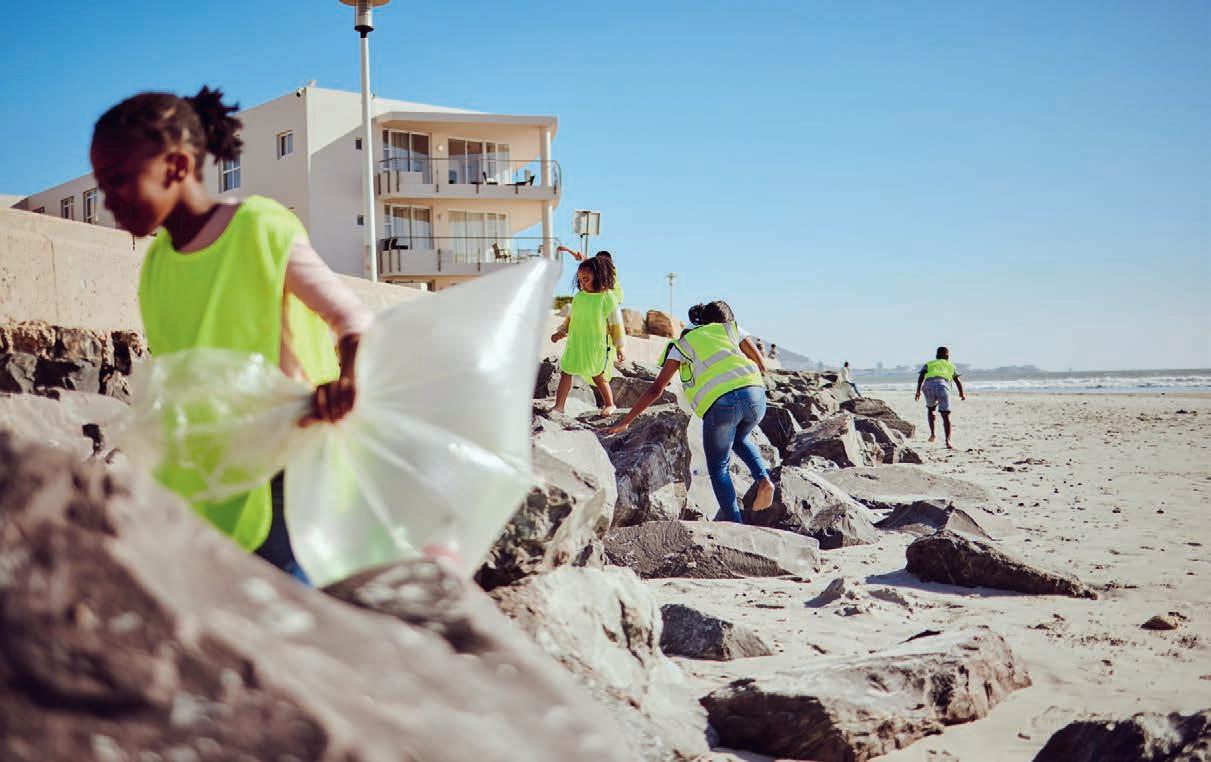
The natural beauty of South Africa’s coastal ecosystems is increasingly threatened by plastic pollution. Even on seemingly pristine beaches, microplastics lurk between grains of sand, and ghost shing nets wash ashore with the tide. In Cape Town, however, a growing community of volunteers is pushing back. Through the Two Oceans Aquarium’s Trash Bash beach clean-up series, thousands of kilograms o itter have been removed from local shorelines while valuable data about marinepollution is collected.
Since 2018, Trash Bash has been a cornerstone of the aquarium’s mission to build an environmentally aware and engaged community. Held at beaches around the city, the family-friendly events invite participants to act for ocean health while connecting with fellow ocean advocates.
The need for this initiative is clear. Pollution is more than an unsightly addition to your beach day; it poses a death sentence for marine life. Common pollutants on our beaches – plastic bags, straws and sweet wrappers – have been found in the stomachs of rescued turtles at the Two Oceans Aquarium. More than 75 per cent of turtles rehabilitated at the aquarium have ingested plastic, while Cape fur seals are regularly rescued from entanglement in plastic debris.
Globally, the problem continues to escalate. Without intervention, the annual ow of plastic entering the ocean could triple by 2040 to around 29 million tonnes per year
– roughly 50kg of plastic for every metre of coastline worldwide.
DATA IN THE DETRITUS
Understanding what waste reaches our beaches and where it comes from is key to addressing the problem. While removing litter from beaches provides immediate relief for coastal ecosystems, the clean-ups also serve another important purpose: generating data that helps researchers understand the sources and scale of marine pollution.
Every piece of litter removed is one less threat to marine wildlife. Beach clean-ups are also powerful tools for awareness and data collection, contributing to scienti c research on marine pollution.
During Trash Bash events, volunteers collect and sort waste along the shoreline, recording types and quantities of litter. Items commonly documented include plastic cutlery, polystyrene containers, cigarette lters, shing rope and nurdles – tiny plastic pellets that are used in manufacturing. Tracking these items over time helps researchers identify pollution
trends and pinpoint sources of waste entering coastal environments.
This information can help guide both policy and behaviour change. Data gathered from beach clean-ups contributes to broader marine debris monitoring efforts and can support initiatives aimed at reducing single-use plastics and improving waste management.
DARE TO CARE
In addition to tracking litter itself, the aquarium’s research team has explored the human side of these clean-ups. In 2025, they conducted a study examining community participation during six Trash Bash events at Sunset, Lagoon and Sunrise beaches. Using voluntary surveys completed during the clean-ups, the study gathered insights from 67 participants about their motivations and perceptions of the events.
The ndings revealed that environmental concern was the most powerful driver for participation. Many respondents said their chief motivation was protecting marine life and preserving beaches, while others valued the opportunity to spend time outdoors with family and like-minded community.
Encouragingly, the research suggests that taking part in a clean-up can inspire longer-term behavioural change. Many participants committed to reducing single-use plastics, recycling more frequently and encouraging others to care for the environment after seeing the scale of the problem rst-hand.
BUILDING COMMUNITY
Trash Bash is about more than collecting litter. It helps build a community of ocean stewards and demonstrates how collective action can make a tangible difference.
For those who want to contribute beyond a single clean-up, the message is simple: small changes can make a real difference. Reducing single-use plastics, supporting conservation initiatives and joining community environmental efforts can all help interrupt the cycle of pollution – one piece of litter at a time.
Laura du Toit
SUSTAINABILITY STORYTELLERS
Young Reporters for the Environment (YRE) is a global youth-led environmental journalism and education for sustainable development (ESD) programme. It is internationally associated with the Foundation for Environmental Education (FEE), and is designed to help young people investigate real environmental issues, propose solutions and communicate them through media formats, such as articles, photography, video and podcasts.
YRE was of cially launched by FEE in 1994. It began with young people wanting to understand and report on ozone depletion in real-time, an early signal of what has become one of YRE’s de ning characteristics: turning complex environmental challenges into youth-led public communication and action. Over time, YRE has positioned itself not only as a competition pathway, but also as a broader learning and leadership framework. Internationally, YRE’s approach is framed around a long-running track record of enabling youth to become environmental storytellers and change-makers,
including large-scale annual participation and output through national competitions.
THE LOCAL CONNECTION
Our role at the Wildlife and Environment Society of South Africa (WESSA) is to act as South Africa’s implementing national operator for YRE, meaning we localise the programme, build partnerships, support educators and youth groups, run learning journeys and competitions, and connect South African youth voices to a global network and international platform.
South Africa’s YRE programme is rooted in WESSA’s broader schools and youth
YRE HAS POSITIONED ITSELF NOT ONLY AS A COMPETITION PATHWAY, BUT ALSO AS A BROADER LEARNING AND LEADERSHIP FRAMEWORK.
mandate, using environmental education and skills-building to support young people to take meaningful action and advocate for a more socially and environmentally just future.
This framing is explicit in WESSA’s own description of YRE as a space for South African youth to “reimagine and craft a social and environmentally just future”, guided by investigation, research, stakeholder engagement and reporting.
SCHOOL INTEGRATION
In practice, we integrate YRE through the WESSA Schools Programme and partner networks, enabling schools to register for YRE (alongside Eco-Schools), appoint a teacher/co-ordinator, and then implement projects that culminate in evidence of learning and action (including potential recognition through WESSA’s school awards pathways).
WESSA’s school registration framework explicitly frames YRE as part of a wider ecosystem of structured school support, including implementation guidance, access to the school’s team, and a clear connection to FEE’s international umbrella across many countries.
Integration is not limited to traditional classroom delivery. The international YRE
Young South Africans are learning critical thinking skills by reporting on the environment. By NOMFUNDO NDLOVU, senior programme manager, Schools and Youth Unit at the Wildlife and Environment Society of South Africa
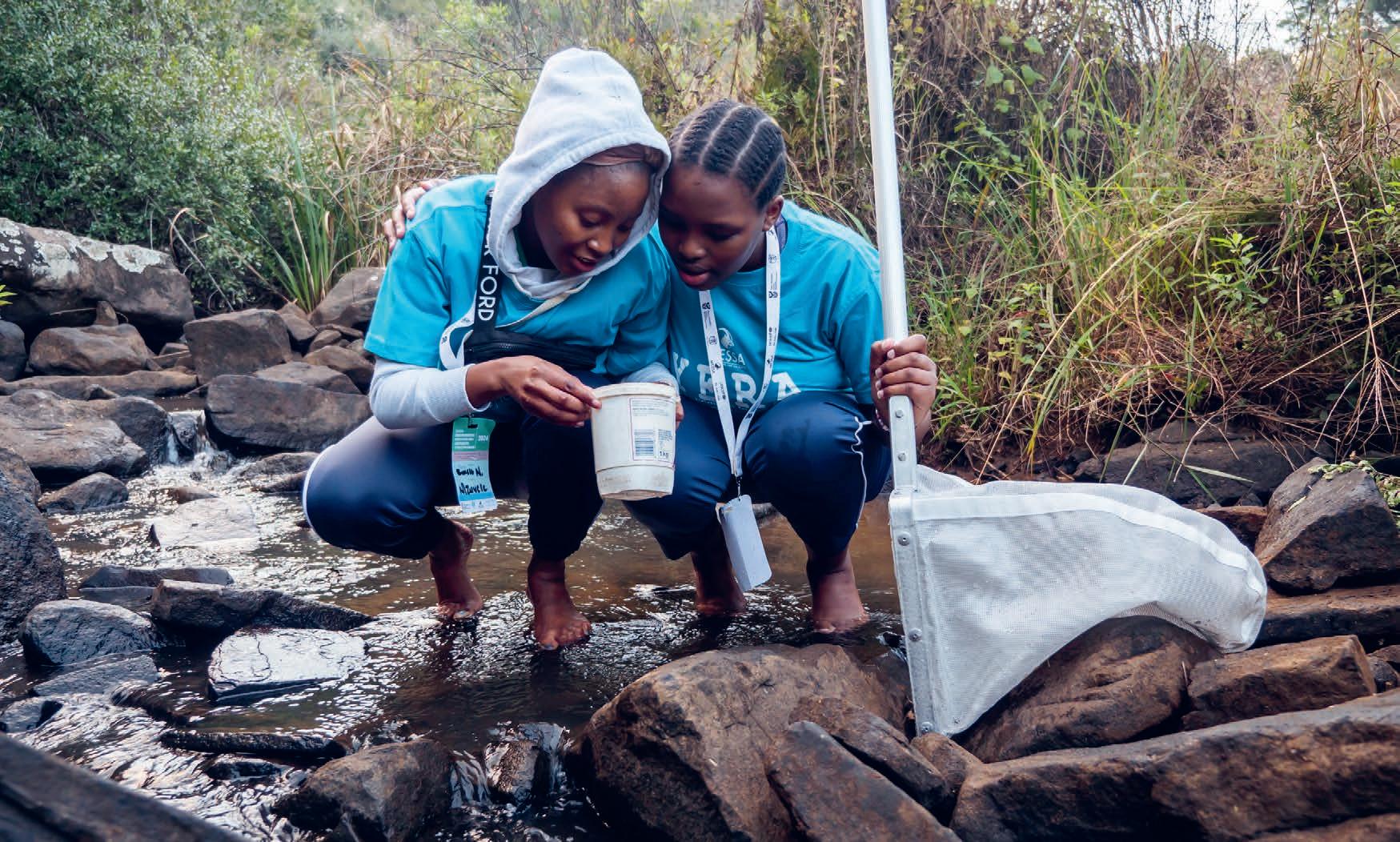
Young reporters engaged in citizen science river monitoring.
Nomfundo Ndlovu
competition framework recognises participation via schools, universities, youth groups, scout groups and networks, such as UNESCO ASPnet, with national operators playing an enabling role.
A concrete South African example of integration through partnership is a partnership with the City of Cape Town, which supported 60 vibrant young reporters from ve high schools to participate in a climate advocacy and diplomacy workshop and the development of action-centred projects.
WESSA has signi cantly scaled the YRE approach through a strategic collaboration with UNICEF South Africa and the Department of Basic Education under the Youth Environmental Reporters and Advocates (YERA) programme. This expanded model has enabled 400 young reporters across multiple provinces, equipping them with practical skills in environmental journalism, investigative reporting, advocacy and citizen science.
Through hands-on training in water quality monitoring, eld investigations, data interpretation and solution-driven storytelling, YERA moves beyond awareness building to empower young people as credible voices for environmental accountability and climate justice. The programme not only strengthens media and research competencies, but also nurtures leadership, systems thinking and active citizenship, positioning youth as informed change-makers within their schools and communities.
A PRACTICAL METHODOLOGY
YRE’s methodology is intentionally practical- and production-oriented, grounded in a project-based learning logic. Young people do not just learn about environmental issues; they identify a problem, investigate it, explore solutions and then produce and disseminate credible media content. YRE’s four-step framework is articulated as:
• Investigate: using credible sources and interviews, learning to evaluate bias and reliability.
• Research and propose solutions: engaging organisations, community leaders
and academics, assessing feasibility and implications.
•Report: producing an objective, audience-aware story in a chosen medium.
•Disseminate: sharing strategically, engaging decision-makers and communities and building momentum for action.
From WESSA’s standpoint, this maps cleanly onto skills for life as well as environmental education outcomes. WESSA’s YRE page frames the learning journey as skills development across critical thinking, data analysis, leadership, writing/editing, photography and videography, supported through mentorship.
The way YRE treats practical skills is also visible in the assessment and entry requirements that shape how youth work is produced:
• In videography, youth are expected to combine research, interviews, eld footage and narration, and engage in eldwork and interviews outside school grounds.
• In articles, youth are expected to support claims with credible sources, incorporate interviews, re ect multiple perspectives and conduct eldwork/interviews beyond the classroom context.
• In podcasts, credible sourcing, real interviews, independent editing and research/ eldwork beyond the classroom are encouraged practices.
This means the methodology isn’t “theory rst, practice later”. It is designed so that practice is the learning, and research and communication skills are gained through producing real journalistic outputs, not simulations.
LOCAL TRACTION
YRE in South Africa has been positioned as both a youth empowerment programme and a structured pipeline for youth environmental communication. Early coverage of the 2018 launch describes hands-on training workshops delivered by journalism and media practitioners, plus a pathway towards representing
Follow: Nomfundo Ndlovu
South Africa in the annual international YRE competition.
WESSA’s own framing emphasises that the programme guides youth through identifying local problems, engaging stakeholders and producing outputs that can be shared via multiple platforms, including radio, newspapers, lm/exhibitions and digital media, demonstrating a deliberate effort to help youth work travel beyond the classroom into public discourse.
Milestones and markers of traction include:
• A growing national competition structure.
• The national winning piece represents South Africa in the international YRE competition.
• Publicly announced winners in multiple recent cycles, including rst prize for Alexandra de Roo from Pinelands High School.
• Demonstrated programme-integration partnerships, including the City of Cape Town partnership and the broader YERA scale-up across 40 schools and 400 young reporters across four provinces.
SUPPORTING SUSTAINABILITY
At its heart, YRE links local realities to global frameworks, then trains youths to communicate for change. Internationally, YRE helps young people connect local issues with global challenges, linking directly to the Sustainable Development Goals (SDGs). YRE uses the SDGs as international annual themes for young reporters to adopt and explore, and competition entries are required to explain how the submission relates to one or more of the goals. WESSA guides youth on identifying local problems, engaging communities and stakeholders, nding solutions and reporting
ndings directly, aligning with sustainability practices: understanding systems, identifying leverage points, proposing feasible interventions and mobilising public awareness.
www.linkedin.com/in/nomfundo-ndlovu-8935b975
REIMAGINING YOUTH EMPLOYMENT IN TOURISM
The YOUTH EMPLOYMENT SERVICE (YES) offers more than just business support; it’s creating sustainable pathways for youth-owned businesses
When COVID-19 devastated South Africa’s tourism industry, it didn’t just take the sector’s revenue; it also decimated its workforce as thousands of experienced workers ed to other sectors.
Today, as the industry slowly recovers, a talent crisis threatens to stall growth. On the one hand, tourism companies are wary of large payrolls after the trauma of pandemic retrenchments; on the other, they desperately need skilled workers so they can capitalise on recovery opportunities.
What’s been an important part of the solution? Youth Employment Service (YES). Yes is transforming how the sector thinks about youth employment through innovative co-funding models that turn traditional incentives into job multipliers.
YES has already created over 216 000 youth work experiences across South Africa’s economy since its inception. Of the 43 000-plus youth jobs it facilitates annually with more than 1 952 corporate partners, about 6 000 are strategically curated into sector development initiatives. The YES-Sanlam Youth4Tourism initiative, delivered in partnership with the Tourism Business Council of South Africa, exempli es this targeted approach.
A CO-FUNDING MODEL
However, YES isn’t simply placing young people in jobs. It’s pioneering a co-funding model that ips the employment equation: when one company sponsors a youth position, YES leverages that commitment to secure additional sponsorships from other partners,
INSTEAD OF
MULTIPLE
generating two to three permanent positions from every youth job sponsored.
The 2024 Youth4Tourism initiative garnered R75-million in corporate funding to equip young people with gig-economy skills, while supporting small businesses in the tourism sector. This model gave youth viable capabilities to compete globally while addressing the industry’s immediate capacity needs.
Tsholo Mogotsi, YES’s chief partnerships of cer, argues that the solution lies in “creating an employment multiplier effect through leveraging and consolidating existing resources and youth programmes across the industry”. Instead of multiple fragmented youth placement programmes operating without co-ordination, YES offers a single, well-funded model that simultaneously addresses talent development, security concerns and employment expansion.
The numbers tell a stark story. International visitor spend remains 23 per cent below pre-COVID-19 levels – or 45 per cent when accounting for in ation. Only the Western Cape and Kruger National Park have seen full recovery since the pandemic. While domestic tourism has shown more resilience, with 2024 spend nally matching pre-COVID-19 levels, pro tability remains squeezed by cost in ation.
The industry already employs 1.7 million people, and consensus suggests this could grow signi cantly, given South Africa’s natural endowments. The constraint isn’t demand potential – it’s the nancial risk tourism companies perceive in signi cantly expanding their workforce.
YES’s model addresses this directly.
FRAGMENTED YOUTH PLACEMENT PROGRAMMES OPERATING
WITHOUT CO-ORDINATION, YES OFFERS A SINGLE, WELL-FUNDED
MODEL
THAT SIMULTANEOUSLY ADDRESSES TALENT DEVELOPMENT, SECURITY
CONCERNS
AND EMPLOYMENT
EXPANSION.
By consolidating resources, leveraging corporate partnerships and creating multiple permanent positions from each sponsored youth role, it makes expansion nancially viable for cautious operators.
Ravi Naidoo, CEO of YES, frames this as “more than just business support; it’s about creating sustainable pathways for youth-owned businesses to become active participants in South Africa’s formal economy.”
The tourism industry’s post-COVID-19 recovery demands exactly this kind of innovative thinking. Traditional approaches to youth employment aren’t scaling fast enough. Co-funding models that leverage youth employment to drive broader skills development and job creation offer a pathway that bene ts youth, businesses and the broader tourism economy.
For an industry that prides itself on hospitality and human connection, embracing models that simultaneously develop youth, support existing workers and manage business risk isn’t just sound economics; it’s essential for sustainable recovery.
For more information: www.yes4youth.co.za
WATER RESILIENCE IS NOT A CRISIS STRATEGY
The Cape Town hospitality sector learned a lot from its near collision with Day Zero, but those lessons need to be put into practice at a structural level, year-round. By ALISON
M C KIE
, general manager of The Vineyard Hotel
After another dry summer in the Western Cape, dam levels have once again declined under seasonal pressure. While Cape Town is not in crisis, the pattern is familiar. Water in this region is cyclical. So too, unfortunately, is our attention.
For the hospitality industry, water resilience cannot be a reactive response to dam levels. It must be a permanent operating principle.
South Africa receives signi cantly less rainfall than the global average, and the Western Cape water supply system is highly climate-sensitive. For hotels, this is not only an environmental issue; it is operational risk management.
FOR THE HOSPITALITY INDUSTRY, WATER RESILIENCE CANNOT BE A REACTIVE RESPONSE TO DAM LEVELS. IT MUST BE A PERMANENT OPERATING PRINCIPLE.
WAKE-UP CALL
supplement municipal supply with borehole water and run a wholefood kitchen that reduces embedded water waste. Yet the 2015–2018 drought reshaped our understanding of resilience. Visible guest-facing measures, such as removing bath plugs, installing shower timers and launching conservation campaigns, proved effective in reducing consumption. Staff engagement programmes extended awareness beyond our property.
Crisis conditions also exposed deeper structural gaps. Infrastructure inef ciencies, irrigation systems and supply chain water impact came under closer scrutiny. Ingredients with high embedded water usage forced us to reconsider procurement decisions. We realised that true resilience extended beyond our property boundaries.
Today, our focus has shifted from visible conservation to structural resilience. This includes ongoing infrastructure upgrades and water reuse strategies, continued development of a circular kitchen model and greater collaboration with suppliers to understand upstream water impact. We have invested in reducing single-use plastics through on-site water bottling systems, and we are exploring regenerative food production methods that reduce both carbon and water footprints. Importantly, resilience must operate irrespective of seasonal dam levels. It cannot intensify only when restrictions loom.
STRUCTURAL, NOT SEASONAL
Crises can drive co-operation and innovation, but they are not reliable long-term strategies. Urgency creates alignment, but resilience requires discipline long after urgency fades.
At The Vineyard Hotel, water resilience has long formed part of our environmental strategy. We maintain predominantly indigenous gardens, operate greywater recycling systems, Follow: Alison McKie www.linkedin.com/in/alison-mckie
For hospitality operators, this means embedding water awareness in infrastructure decisions, procurement models, guest communication and staff culture. It means viewing water not as a utility cost, but as a nite shared resource within a climate-volatile region.
The industry demonstrated in the run-up to Day Zero that rapid behavioural change is possible. The challenge now is sustaining that mindset without crisis as a catalyst.
Water resilience is not achieved through isolated campaigns or symbolic gestures. It is built through steady, less visible decisions, investment in systems, collaboration across supply chains and a willingness to interrogate long-standing operational habits.
The Western Cape’s climate variability will not disappear, nor will population growth or tourism demand. The question is not whether pressure will return, but whether or not we have built the structures to absorb it.
Resilience, ultimately, is not seasonal. It is structural. For hospitality businesses operating in water-sensitive regions, it is inseparable from long-term viability.
Alison McKie
ADVANCING METAL PACKAGING RECYCLING THROUGH INDUSTRY COLLABORATION
As a producer responsibility organisation, MetPac-SA guides the metal packaging industry towards a more circular and sustainable future. By
DR KISHAN SINGH, CEO of MetPac-SA
As South Africa’s Extended Producer Responsibility (EPR) framework continues to reshape the packaging landscape, industry bodies play a critical role in helping businesses navigate compliance while driving real environmental outcomes. MetPacSA, the Metal Packaging Association of South Africa, has emerged as a key catalyst in this space, guiding the metal packaging industry towards a more circular and sustainable future.
MetPac-SA is a registered nonpro t company, formally registered with the Department of Forestry, Fisheries and the Environment (DFFE) as a Producer Responsibility Organisation (PRO). Under EPR Registration Number 19/7/5/P/PRO/20210720/005, MetPac-SA is responsible for implementing South Africa’s metal packaging EPR strategy in alignment with section 18 of the National Environmental Management: Waste Act (NEMWA).
As the recognised PRO for metal packaging, MetPac-SA represents producers, brand owners, importers and converters of aluminium and tinplate (ferrous) packaging in South Africa, excluding 210-litre drums. From January 2024, its scope was expanded to include aluminium and steel aerosol packaging.
MetPac-SA’s mission is to establish the metal packaging industry as a meaningful contributor to sustainable development by investing in post-consumer metal packaging recovery and reutilisation. Through collaboration across the value chain, the organisation works to improve collection, recycling and data integrity, while supporting South Africa’s transition to a circular economy.
EPR is not just about meeting regulatory requirements. It’s about industry taking collective responsibility for the full life cycle of its products and investing in systems that deliver environmental, social and economic value.
DELIVERING VALUE THROUGH MEMBERSHIP
Membership of MetPac-SA provides businesses with a compliant, transparent and credible route to meeting their EPR obligations, while unlocking shared value that would be dif cult to achieve individually. Members bene t from centralised EPR reporting to the DFFE, audited nancial governance, industry representation and targeted investment in collection, recycling and awareness initiatives.
These bene ts were reinforced by the results of MetPac-SA’s rst-ever Member Satisfaction Survey, conducted at the end of 2025. Results and feedback from members showed strong con dence in the organisation’s performance across all key areas.
Members rated regulatory compliance particularly highly, with the majority agreeing that MetPac-SA is meeting the DFFE’s EPR targets across major material streams. Waste collection and recycling initiatives also scored strongly, re ecting the organisation’s partnerships with buy-back centres, recyclers, remelters and municipalities.
Support for waste-picker integration, including personal protective equipment, training and service-fee payments, was also recognised, alongside high levels of trust in MetPac-SA’s nancial transparency and governance.
DRIVING CIRCULAR OUTCOMES
Beyond compliance, MetPac-SA’s work focuses on building long-term recovery and recycling systems for metal packaging, supported by education, innovation and data-driven decision-making.
MetPac-SA is open to membership applications from all role players in the metal packaging value chain that place more than 10 tonnes of metal packaging on the market annually, in line with the EPR regulations. Only declared member tonnages are reported to the DFFE for Section 18 EPR purposes.
As EPR continues to mature in South Africa, MetPac-SA demonstrates how organised industry collaboration can deliver compliance, credibility and measurable environmental impact.
Metal packaging is in nitely recyclable without loss of quality. Metpac-SA’s role is to ensure that the systems are in place to keep that material in circulation and out of land ll.
For more information, visit www.metpacsa.org.za
VISIT WEBSITE
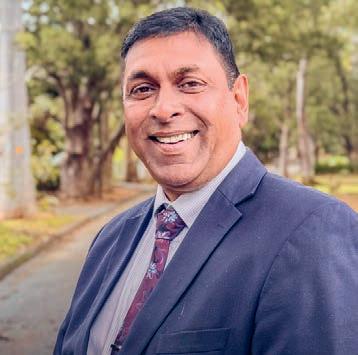
Dr Kishan Singh
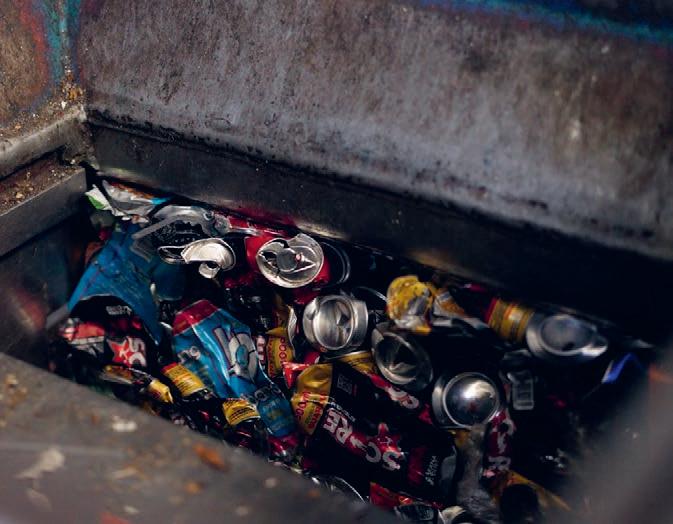
Aluminium cans collected for reycling.
FLUSHED AWAY
Implementing eco-friendly toilet solutions can conserve precious water and turn our waste into a resource, writes ANTHONY SHARPE
How often do you ush your toilet? If it’s brown, you gotta ush it down, but if it’s yellow, do you let it mellow?
How many litres of water does it take to ush a toilet anyway? Where does it all come from? Where does it go?
These are questions those those South Africans privileged enough to live in homes with proper toilets and plumbing will likely never have contemplated. However, with water becoming a frighteningly valuable commodity across the country, all of us should be thinking carefully about the environmental (and, increasingly, nancial) cost of sanitation.
PRESSURE POINT
The modern world’s most vulnerable asset is sanitation. That’s
the assertion of Jay Bhagwan, senior research manager for water quality and health at the Water Research Commission. “People keep talking about water restrictions, but they don’t talk about constipation, which is much worse,” says Bhagwan. “When you don’t have water, where do you defecate? You can buy a bottle of water to quench a thirst, you can hold off on having a bath by wiping yourself down, but when you don’t have water to ush the toilet, that’s a serious problem.”
South Africa lacks climate-resilient sanitation solutions. Bhagwan points to Cape Town, where one incidence of drought exposes the whole system, or Durban, where oods damaged sanitation infrastructure that could take years to repair, meaning ef uent is now running untreated into the sea.
That vulnerability is underpinned by the staggering scale of water used by sanitation. While some estimates put the proportion of treated, potable water delivered to urban households that is
“YOU CAN DRY THE SLUDGE, WHICH KILLS PATHOGENS BY REMOVING THE HUMIDITY, LEAVING YOU WITH AN ORGANIC MATERIAL THAT YOU CAN BURN OR USE AS COMPOST.” –
DR SANTIAGO SEPTIEN STRINGEL
used to ush toilets at 30 per cent, Bhagwan believes the gure lies between 40 and 60 per cent. With a growing population, ageing infrastructure and climate change to contend with, that is water we can ill afford to waste.
OFF THE GRID
Bhagwan and colleagues started using the term “water-ef cient sanitation” about a year ago, re ecting the direction their research was taking. This includes solutions that are completely “off the grid”, as it were – not connected to a sewer or wastewater treatment plant. “All the waste is treated on-site with the intention of reusing for potable or nonpotable purposes.”
The idea is to move us away from what Dyllon Randall, professor of water quality engineering at the University of Cape Town’s Department of Civil Engineering and Future Water Institute, calls a “ ush-and-forget” model that relies on high-quality drinking water to transport waste through ageing pipes. Decentralised, eco-friendly toilets decouple sanitation from the water grid, turning a liability into an asset. “By treating waste where it is produced, we reduce the burden on failing municipal infrastructure and save millions of litres of drinking water that would otherwise be used to simply move waste.”
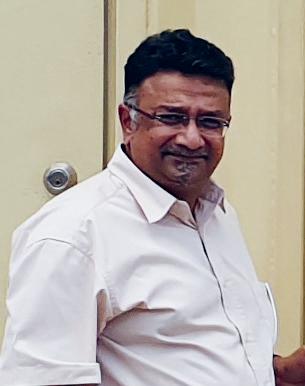
Jay Bhagwan
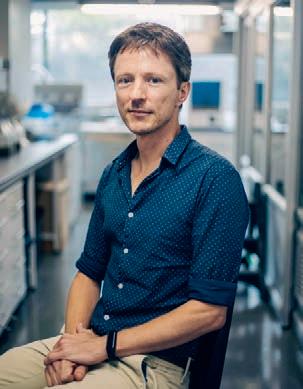
Professor Dyllon Randall
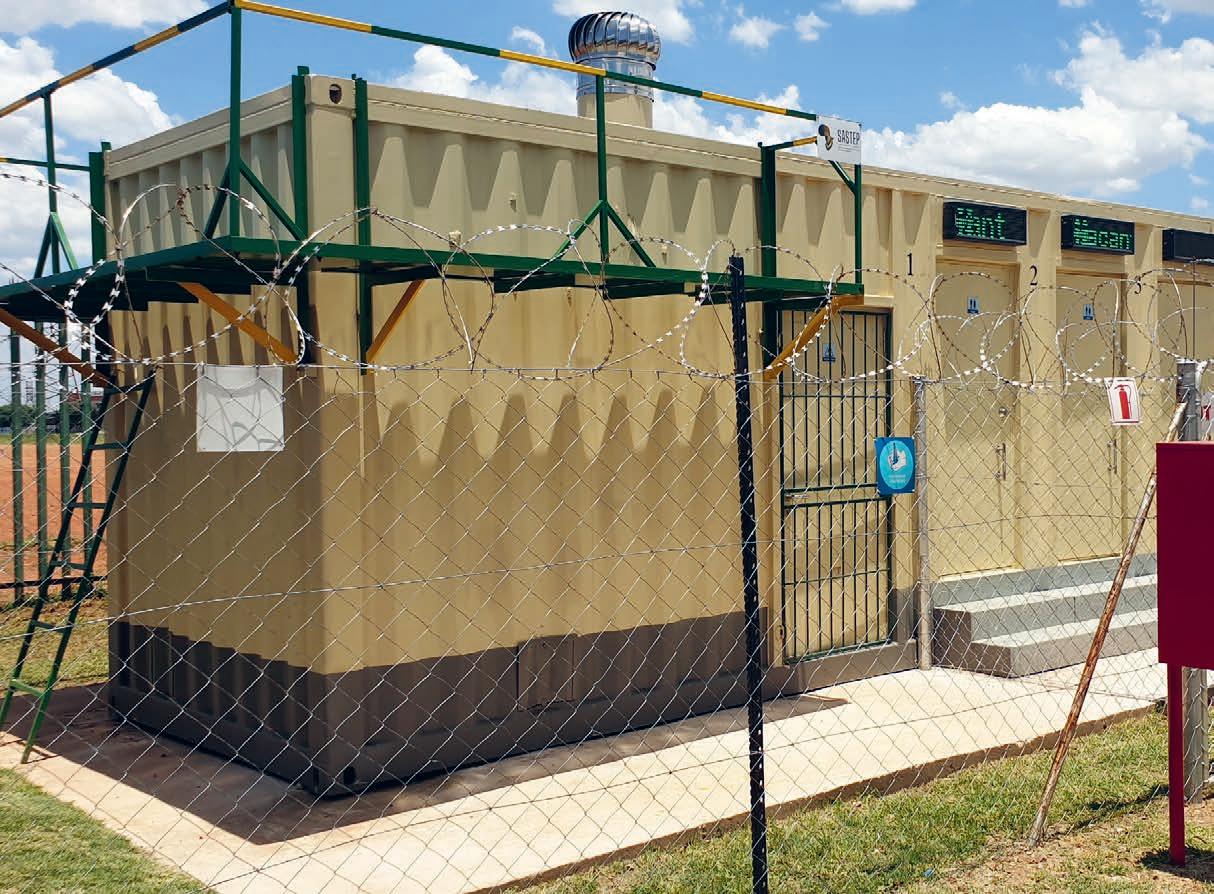
Containerised closed-loop sanitation facility.
Treating waste where it is produced typically involves a reactor – essentially a miniaturised, self-contained wastewater treatment plant. Unlike a septic tank, which simply stores and partially settles waste, a reactor actively processes it into safe, reusable or disposable components. These exist in different forms, from the anaerobic baf ed reactors that forces wastewater through a sludge blanket full of bacteria that eat organic pollutants to the membrane bioreactor that combines this activated sludge process with membrane ltration and electrochlorination to produce clean water. This water can be fed back into the toilet, taking it almost completely off-grid, or you can drink it if you like.
“The current technology produces quality that complies with drinking water standards,” says Bhagwan. “You don’t want to put it straight into that tap because you need a regulatory system to manage that. We’re not there globally – there are very few places in the world that provide direct, potable reuse. Windhoek is one and, locally, Beaufort West provides drinking water from treated ef uent, but this goes through multibarrier processes and is well managed.”
One man’s waste …
Obtaining potable water is one key advantage of treating sewage effectively, but our human “waste” is actually a treasure trove of useful nutrients.
“Separating liquid (urine) from sewage is the golden standard of circular sanitation systems because it prevents the dilution of valuable nutrients,” explains Professor Randall. “Urine contains the bulk of the nutrients, such as nitrogen, phosphorus and potassium found in sewage, but it only makes up about one per cent of the total volume of wastewater coming from our homes. These nutrients are key ingredients for any fertiliser. By keeping the urine separate at the source, we can recover these nutrients far more ef ciently and without the heavy energy requirements of extracting them from a mixed sewage stream.”
That’s important because, according to the Agricultural Business Chamber of South Africa, we import about 80 per cent of our annual fertiliser requirements, with spikes in prices having a signi cant knock-on effect on food in ation.
Professor Randall says the global estimates based on literature suggest a potential for human urine to buffer our agricultural needs. “Globally, recycling all nutrients excreted in human urine could cover approximately nineteen per cent of the current worldwide demand for inorganic nitrogen, for example. For phosphorus, it is estimated that urine could realistically meet about eleven per cent of the global demand.”
Separating each waste stream at the source enables targeted interventions, adds Professor Randall. “Because each stream, whether it is urine, faeces or greywater, is chemically unique, source separation allows us to focus on the speci c chemistry of each to optimise resource recovery and ensure we produce safe, high-quality products.
“Urine, for instance, contains most of the nitrogen and potassium in a very small volume, while being relatively low in trace compounds. By isolating it before it mixes with industrial chemicals or pathogens in a centralised sewer, we can recover those nutrients far more ef ciently. This approach stops the nutrient loading that typically causes the degradation of our natural river systems and coastlines, treating the root cause of water quality issues rather than just the symptoms.”
BURN IT UP
Dr Santiago Septien Stringel, honorary researcher at the University of KwaZulu-Natal’s Water, Sanitation and Hygiene Research and Development Centre, specialises in the thermal treatment of faecal sludge, which represents a suitable solution for high-density urban areas where composting is not necessarily
FAST FACT
According to the 2024 General Household Survey by Statistics South Africa, access to improved sanitation reached 83.1 per cent, up from 61.7 per cent in 2002. However, significant gaps remain: approximately 19.9 per cent of households still share sanitation facilities, and nearly 160 000 households continue to rely on bucket toilets for their daily needs.
viable because it requires space and time. There are several ways to do this. “You can dry the sludge, which kills pathogens by removing the humidity, leaving you with an organic material that you can burn or use as compost,” says Dr Septien Stringel. “It can be processed through incineration as a heat source or converted into charcoal that can be used as a domestic fuel for cooking or as a soil conditioner to improve soil quality.”
He is involved in a project in South Sudan that is recovering sludge from septic tanks, treating it in a waste stabilisation pond, drying it in the sun then carbonising it into charcoal for local communities. “It’s a model that could work here, but there are regulatory limits.”
Faecal sludge can also be fed into biodigesters –whether large-scale commercial ones or smaller domestic models – to create gas for cooking or heating. “Ethikweni municipality has a biodigester that is developing biogas, with the potential to use it as a fuel source,” says Dr Septien Stringel. Ultimately, the goal is to move away from large-scale sewerage systems to truly closedloop systems, says Professor Randall. “By treating our buildings as nutrient and water recovery hubs, we create a resilient, circular economy where nature’s logic is applied to the built environment: nothing is wasted, and everything is reused.”
Follow: Jay Bhagwan www.linkedin.com/in/jay-bhagwan-11555215
Professor Dyllon Randall www.linkedin.com/in/dyllon-randall-00aa8719
Dr Santiago Septien Stringel www.linkedin.com/in/santiago-septien-stringel-80604841
Dr Santiago Septien Stringel
IT’S RIGHT (AND OUR RIGHT) TO REPAIR
Automotive Right to Repair legislation in South Africa has broadened customer options and boosted independent repairers, but there’s no sign of similar relief for the independent electronic repair industry, writes TREVOR CRIGHTON
Automotive Right to Repair legislation, effective 1 July 2021, and driven by Competition Commission guidelines, loosened restrictive practices, giving vehicle owners and independent shops broader choice for servicing and repairs while maintaining manufacturer warranties. There’s a huge informal sector for electronic equipment repair in South Africa, but it has yet to gain the same legislative recognition as the automotive sector.
LEGISLATIVE GRIDLOCK
Patricia Schröder, CEO at producer responsibility organisation Circular Energy, says as of early 2026, there has been no substantive legislative movement introducing a statutory right to repair for consumer electronic devices in South Africa. “Discussions around right to repair continue in public and policy spaces, but no draft bills, regulations or amendments have been tabled that speci cally address consumer electronics,” she says.
Schröder adds that while there has been incremental progress in advocacy and awareness, there are several constraints to moving the process forward. “Policy is fragmented since right to repair sits across consumer protection, competition law, environmental regulation and intellectual property, and no single government department has taken ownership of the issue. Electronics manufacturers are resistant to giving third parties access to proprietary software, rmware locks and diagnostic tools, and there is regulatory caution around cybersecurity, safety and IP protections, which has slowed any attempt to mirror EU-style legislation.”
There’s potential for opening up right to repair for medical devices in South Africa, too, although industry regulator, the South African Health Products Regulatory Authority
(SAHPRA), says it has no skin in the game around improving access or identifying challenges. The 2017 Regulations relating to Medical Devices and In Vitro Diagnostic (IVD) Medical Devices in South Africa, under the Medicines and Related Substances Act, established mandatory licensing for manufacturers, importers and distributors.
When asked whether SAHPRA would be open to seeing those regulations changed to re ect a more sustainable approach to licensing for manufacturing and repair, and to what extent, Khanyisile Nkuku, medical device and IVD registration of cer at SAHPRA, responded: “Regulatory changes are typically driven by public and bene ciary needs, and this issue does not appear to be widespread.
“SAHPRA is currently focused on registering medical devices to align with international standards. Licensing depends on the reliance pathway of recognised national regulatory authorities, many of which face similar challenges regarding the ‘right to repair’.”
RESTRICTIONS AND MISINFORMATION
Schröder says the practical barriers to opening up consumer electronics right to repair have become clearer over the last few years. “Software and rmware restrictions have increased, especially in smartphones and laptops, access to original spare parts, even for common failure components, remains restricted, it is often cheaper to replace a device rather than repair, due to pricing structures, and there are skills constraints and muchconsumer misinformation, with warranties still commonly (and incorrectly) presented as void if third-party repairs are undertaken.”
FAST FACT
Global e-waste amounted to 54 million tonnes in 2019 and 61.3 million tonnes in 2023. It is estimated that this might double by 2045. In South Africa, 360 000 tonnes of e-waste are generated annually, roughly 6.2 kg per person per year. Of this, only 12 per cent is formally recycled.
Source: Informal repairers and refurbishers of electrical and electronic products in the South African township economy
AVOIDING OVER-REGULATION
Schröder says that it is possible to professionalise third-party repair services without harming informal repairers or over-regulating the industry. “Effective professionalisation should focus on voluntary accreditation or recognition schemes, modular, lowcost training, focused on speci c device categories, and minimum standards around consumer transparency, safety and data protection, without imposing costly compliance requirements,” she says. “Informal repairers remain essential to device longevity, particularly in lower-income communities, and policy should strengthen, rather than displace them.”
In the medical equipment repair space, neither SAHPRA nor any other relevant body operates or supports any kind of training institution that upskills people to repair medical equipment.
Untamed ingredients, sustainably foraged from the wild and transformed into nutritious meals, are the fuel for Roushanna Gray’s quest to live in harmony with nature and foster a deeper human connection with the environment. By
carborough beach in the Western Cape is wide, uncrowded and frequently wind-blown. It blew a bit that morning in November as we gathered at the edge of the parking lot to hear Roushanna Gray spell out the purpose of our foray onto the rocks, and to lay out the dos and don’ts of wild harvesting.
Gray, the vivacious, freckly-faced founder of Veld and Sea, a foraging-focused tour company based at Cape Point, has dedicated herself to deepening her relationship with the natural environment by learning what the world around her tastes like.
IMMERSION
On one of her immersive quests to discover the ins and outs of intertidal foraging, we were about to delve into the rock pools to get a glimpse of seaweeds and molluscs that your average beach-goers might glance at with curiosity but seldom regard as a source of nutrition.
KEITH BAIN
“Delicious, but quite small, so not commercially viable.” Rather, it’s something to be savoured very infrequently.
More sustainable are Mediterranean mussels, which are aliens. “They’re among the world’s one hundred most invasive species; they grow and reproduce really fast,” said Gray. They outcompete indigenous black and ribbed mussels, so are an excellent resource for foragers. “Shell sh are generally a very sustainable food source. But eating alien invaders? Well, that ticks all the boxes.”
Roushanna Gray
She says being out of the city affords her “the luxury of slowing down enough to learn about the edible landscape and coastline”. Having rst set out to learn which locally available plants and mushrooms can be put to culinary use, she’s delved ever deeper – researching, experimenting and teaching others what she’s discovered, on land and sea.
Down on the rocks, Gray provided an account of the manifold foodstuffs hiding in plain sight. Just about every seaweed is edible, she explained, and soon we were nibbling on bits and pieces of green, slimy ocean vegetation, then tasting shell-dwelling creatures few people would dare touch, let alone crack open to extract avoursome globules of esh dense with nutrients.
Tastiest among these was a morsel of Cape sea urchin, which we had raw, fresh off the rocks. “It’s a great delicacy,” said Gray.
THERE ARE AROUND 900 SEAWEED VARIETIES AROUND OUR COASTLINE, AND OF THOSE, ONLY ONE IS INEDIBLE.
Gray says there are around 900 seaweed varieties around our coastline, and of those, only one is inedible. “The rest are all packed full of vitamins, minerals and micronutrients, all in a delicious, bioavailable form.”
The RRRules
Before setting us loose to forage in the pools, Gray laid out a few rules for what she calls “responsible, regenerative and reciprocal” foraging. Seaweed is cut above the holdfast, rather than yanked from the rock in its entirety. We were told to leave seaweed that’s oating in the water, since there’s no telling how old it is, and to avoid sun-bleached and unhealthy-looking plants. Like picking veggies at the market, it’s largely a case of choosing with the eye.
Also important is to spread one’s foraging load over a large area. In other words, leave enough for the next hungry creature. “We don’t know who came here before us, we don’t know who’s coming here after us, and there are many marine creatures that rely on all of these ingredients.”
You wouldn’t do this just anywhere along the coast, Gray warned: stay away from urban areas where raw sewerage is pumped directly into the ocean. However, in places like Scarborough, where the water’s clean and constantly circulating, there are tremendous bounties to be found.
RECONNECTING
Gray says South Africa was, once upon a time, at the global forefront of the foraging movement. However, we’ve slipped behind a bit since Palaeolithic times, lost our connection with the environment, forgotten once-familiar ingredients. For most people, the instinct to survive off the land has been usurped by our dependence on supermarkets and industrial farming. A key goal for Veld and Sea is to reintroduce modern humans to the possibilities that foraging brings to the dining table.
Gray says she’s fortunate in that, growing up, her family would collect forest mushrooms. That familiarity with searching for food in wild spaces, tapping into nature’s abundance, stuck with her.
She started working with seaweed about 14 years ago. “I was already using land plants, but there was a dormant season because foraging on land in summer isn’t sustainable.” Fate
intervened when a world-travelling Japanese cyclist came to visit. “Most days, he’d cycle to Scarborough and gather seaweeds that he cooked,” Gray says. When she heard him referring to seaweed as “sea vegetables”, it catalysed a paradigm shift within her, and she began looking at the coastline as a source of nutrition. “I spent hours in the rock pools paired with many hours in the kitchen guring out how best to cook them because every seaweed behaves differently.”
FROM BEACH TO BISTRO
Veld and Sea’s ethos is based on Gray’s understanding that people assimilate knowledge better when they get into the eld – or the ocean – and experience what she’s talking about. This is why our morning had begun on the beach, physically gathering ingredients.
The real switch, though, happens when those gathered ingredients come together in the kitchen and are consumed. Food, she believes, is a great medium for fostering a link between ourselves and our environment. “If we understand nature in terms of ingredients, we gain deeper awareness of the ecosystems in which those ingredients exist.”
It’ a food philosophy we sampled rst-hand once we’d returned from the beach, our foraging bags plump with seaweed. At Veld and Sea’s headquarters, we rinsed and sorted the various ocean vegetables before tucking into a rather fancy meal comprising sea-foraged goodies alongside other sustainably harvested ingredients. There was freshly caught sh, encased in sea bamboo and grilled over the re, and kelp transformed into a highly nutritious, low-carb and gluten-free pasta that is naturally packed with a mucilaginous substance called alginate, which is incredibly good for gut health.
Nothing we ate had travelled more than a few kilometres to reach our plates, and even the DIY cocktail “bar” featured tinctures and cordials prepared from wild plants.
Based out of a glasshouse at a Cape Point nursery, Roushanna Gray’s foraging workshops are designed around the seasons. In autumn, it’s mushroom hunting with a mycologist, in winter, there are land foraging expeditions, and in springtime, it’s edible flowers. Coastal foraging happens in summer when you go to the intertidal zone
LEARNING RESPECT
Gray says she’s been in the foraging game long enough now that she’s rarely surprised by what’s edible. Still, she’s extremely cautious, takes new species “very seriously,” cross-references intensively, and lives up to one of foraging’s golden rules: “be 110 per cent positive of species identi cation before picking and eating”. She intones wisdom drawn from her youth – that for every edible mushroom, there’s one that can end you.
Ultimately, foraging for Gray comes down to nutrition and sustainability. “Aim for a colourful, biodiverse plate,” she says. “Try to eat seasonally and remember that food will taste better and be healthier for you the shorter the distance it travels from source to plate.”
Gray believes, too, that if people spend more time in nature, they’ll be more likely to want to take action to preserve what we have. “Foraging is really about reconnecting to nature. The more you learn about our natural environment, the more you’re willing to understand and respect it, and the greater your desire to preserve and protect it.”
during a spring tide and look for seaweeds and shellfish. Emphasis is on foraging in a sustainable, responsible and legal way. All workshops culminate in an edible feast. Also offered are curated nature-inspired experiences centred around art, craft and sustainability, along with pop-up dinners. www.veldandsea.com
A lip-smacking collaboration is cooking up indigenous ingredients with a side of traditional knowledge and sustainability, writes ANTHONY SHARPE
When last did you cook up a sizzling pan of mashonza (mopani worms) or a hearty isibindi senkomo (ox liver)? If you’re a city-dwelling soutie like me, probably not very recently. You might not know your izindlubu from your ditloo – or why so many of these dishes are important from a nutritional, cultural and climate resilience perspective.
That’s a big part of the motivation behind local initiative and cookbook Roots & Recipes: Indigenous Foods for a Sustainable Future, a partnership between the United Nations (UN) in South Africa, the Food and Agriculture Organization of the United Nations, and the South African Chefs Association. The book features a smorgasbord of nutritious recipes incorporating indigenous, drought-resilient ingredients and traditional techniques.
“We are facing rising food prices, climate volatility, water stress and persistent malnutrition,” says Nelson Muffuh, UN resident co-ordinator for South Africa. “At the same time, we have a wealth of indigenous crops and culinary knowledge that are delicious, nutritious, climate-adapted, highly marketable and culturally signi cant – yet underutilised.”
Muffuh says the book brought together farmers, indigenous knowledge holders, scientists, communicators, advocates and chefs around a shared question: “How do we make our traditional food systems central to our development future?”
“WE HAVE A WEALTH OF INDIGENOUS CROPS AND CULINARY KNOWLEDGE THAT ARE DELICIOUS, NUTRITIOUS, CLIMATE-ADAPTED, HIGHLY MARKETABLE AND CULTURALLY SIGNIFICANT – YET UNDERUTILISED.”
– NELSON MUFFUH
TRADITION MEETS NUTRITION
The initiative is grounded in mutual respect between knowledge systems. “Indigenous knowledge holders, including grandmothers, community cooks and local leaders, shaped the heart of the book through their preparation methods, food pairings, preservation techniques and the cultural meaning behind these crops,” explains Muffuh. “Scienti c and academic partners complemented this by validating nutritional value, documenting climate-resilience characteristics and ensuring accuracy in communicating the bene ts. The strength of this book lies in the integration of both.”
Each recipe is complemented by a short note explaining its cultural signi cance. Muffuh
says this is important because food is about identity as much as nutrition. “If this had been a purely technical publication, it would not change behaviour. Stories connect generations. They restore pride. They honour those who have preserved these traditions through adversity. Preserving stories alongside recipes ensures this is not simply about crops; it is about people, heritage and continuity.”
CHEF’S KISS
Bridging the gap between these knowledge systems and budding gastronomes like me is the South African Chefs Association. To gain a better understanding of the foods, the association consulted local farmers specialising in indigenous crops.
Chefs prepare the dish according to the original recipe and, while they might conduct multiple trials, adjusting elements like seasoning, cooking time and techniques based on feedback from tasters, the idea is not to reinvent tradition, says Muffuh. “We want to make it desirable and practical, particularly for young people who may not have grown up cooking these foods. Changing perception is key. If young consumers embrace these dishes, demand increases. When demand increases, smallholder farmers bene t.”
Muffuh adds that the launch was just the beginning. “Now that the book is digitally available, the next phase focuses on making this mainstream. This includes integrating selected recipes into school feeding programmes where feasible, embedding indigenous ingredients into hospitality and culinary curricula, partnering with retailers and food producers to strengthen supply chains, promoting food preservation and waste reduction techniques highlighted in the book, and supporting smallholder farmer co-operatives with market access initiatives. The objective is systems change, shifting from pilot interest to sustained demand and embedding these approaches in policy frameworks.”
Follow: Nelson Muffuh www.linkedin.com/in/nelson-muffuh-08800119 South African Chefs Association www.linkedin.com/in/the-south-african-chefs-association-b64a8940
Nelson Muffuh
A STITCH IN TIME
Fast fashion is one of the most environmentally damaging industries, but is sustainable fashion, well, sustainable? LISA WITEPSKI investigates
There is good news and bad news when it comes to demand for fashion, says Ilse Menck of Menck Clothing, a label manufacturer using natural bres by women from the Cape Flats. “While there is certainly a ‘less is more’ trend, driven by people who want to know that the goods they purchase feel good on their skin, are well-designed and ethically manufactured, the ‘more is more’ trend is, sadly, also growing. Faster fashion with bigger mass production at lower pro t margins per item leads to the inevitable exploitation of our planetary resources, as well as the workers and designers behind them. The addiction of online consumerism feeds into this trend.”
“FOR ME, SUSTAINABILITY IS NOT ONLY ABOUT THE FABRIC; IT’S ABOUT REDUCING WASTE THROUGHOUT THE ENTIRE LIFE CYCLE OF CLOTHING.”
– CRAIG JACOBS
SHIFTING MINDSETS
Craig Jacobs, whose label, Fundudzi, was one of the rst in South Africa to adhere to the principles of sustainability, has also noticed a
dichotomy in the way consumers approach fashion. Demand hasn’t necessarily increased, he says, but the nature of interest has shifted. “Previously, sustainable fashion tended to attract quite a niche audience: tree huggers and yoga moms, people deeply invested in environmental living and ethical consumption. What is inspiring is that today the conversation is being driven more by a younger generation who are far more conscious about the impact of what they buy and wear.”
The importance of thrifting culture, which young people are embracing, also shouldn’t be overlooked, says Jacobs, as this gives discarded clothes a new lease of life and values the meaning and history infused in clothing. That said, he is concerned about a tendency among larger retailers, many notorious for producing fast fashion, to edge in on the green conversation by leveraging sustainability messaging to soften the realities of mass production and environmental damage that fast fashion can cause.
PRODUCTION AND DESTINATION
Jacobs’ own approach to sustainability has evolved since rst launching the label: “We produce in smaller quantities to avoid overproduction and the need to discount unsold stock heavily at the end of the season. For me, sustainability is not only about the fabric; it’s about reducing waste throughout the entire life cycle of clothing.”
FROM THE KAROO TO THE WORLD
South Africa’s mohair industry naturally lends itself to sustainability: the Angora goats whose hair is woven into mohair thrive in semi-arid areas, where there is no need for additional feed or irrigation. The goats also play a role in maintaining natural ecosystems by feeding on invasive plant species. The industry has amplified its standing as an icon of sustainability through initiatives like the Responsible Mohair Standard, which emphasises animal welfare.
These impressive credentials ensure that demand for South African mohair is high around the world: the country produces more than half of the world’s mohair, a figure set to increase with the recent investment in a cutting-edge R21-million carding machine to boost the Eastern Cape’s processing capacity.
Source: Eastern Cape Development Corporation
This also means lessening the focus on exports. “Twenty years ago, when there were far fewer sustainable brands globally, it was actually much easier to resonate internationally,” says Jacobs. “Being one of the few designers working in this space meant that there was a natural curiosity from global audiences and I was actually overwhelmed with opportunities. Today, the landscape has changed signi cantly, and my own thinking about sustainability has evolved. Exporting garments internationally inevitably carries an environmental cost, so I’ve become more conscious about how and where we distribute our work.”
Ilse Menck
Grow Your Own – Easily.
Food prices are rising, and incomes are not! Is your family also feeling this pinch?
“Growing your own food is like printing your own money.”
Many people feel that they do not have space to grow crops, or that growing crops is not easy — often due to the challenges of watering plants with the right amount of water at the right time. SFG Tec manufactures a “smart” grow cup, which partially sits in a deep reservoir. The smart grow cup is lled with organic grow medium, which allows you to grow organically. You can also add nutrients to the water in the reservoir for enhanced growth. The plant “self-waters” — the grow cup roots reach the water in the reservoir below. The reservoirs are large and only need to be re lled periodically. Self-watering ensures that crops get the right amount of water at the right time. Super easy!
Three Systems. Any Space.
HydroGrow™ Micro
3 grow cups
Fits a windowsill, kitchen counter or of ce desk. Fresh herbs with almost zero maintenance.
Grow Your Own Seedlings. Save a Fortune.
HydroGrow™ Box
32 grow cups
Perfect for a corner, balcony or classroom. Passive wicking — no pumps, no electricity.
HydroGrow™ Pro
Up to 15 grow cups per unit
Wall-mountable, A-frame or bench-top. Units can be plumbed together or run independently.
You can grow up to 15 seedlings in one seedling “snail” placed in a Smart grow cup. The economics of this seedling growing solution is very compelling… and the beauty is that, apart from a rst watering when planting the seeds, no further manual watering is needed. Self-watering takes place.
Learn as you grow
SFG Tec has developed a free educational app, which teaches people how to replicate the smart grow cup by making use of recycled two litre soda bottles. You can check out the app here: www. zero-hunger-quest-wip.netlify.app