How Crypto is entering the mainstream






VALR is a global crypto exchange, founded in 2018 and headquartered in Johannesburg. Backed by prominent investors, including Pantera Capital, Coinbase Ventures and Fidelity’s F-Prime Capital, VALR has established itself as a large African crypto platform by trade volume, serving over 1.8 million registered users and 2 000 corporate and institutional clients across the globe.
Licensed by South Africa’s Financial Sector Conduct Authority (FSCA) and with regulatory approval in Europe, VALR provides a secure, comprehensive suite of products for diverse needs. These encompass simple swap, spot and margin trading, perpetual futures, staking, lending, OTC services, a world-class application programming interface for advanced strategies, including autonomous AI agents, VALR Pay and crypto bundles, with access to over 100 crypto assets, as well as tokenised US stocks, gold and private credit. With the world’s deepest ZAR-denominated markets and support for USD, EUR, GBP, and more than 150 local currencies, including Mobile Money, VALR facilitates borderless, inclusive finance.
Rooted in the principle of “Crypto for Everyone,” VALR is committed to fostering a just financial ecosystem that upholds human dignity and the oneness of humanity, bridging traditional and digital assets to drive economic empowerment.
For more information, visit www.valr.com

Absa Group Limited is one of Africa’s largest diversified financial services providers, listed on the Johannesburg Stock Exchange and serving millions of customers across 16 countries. With over a century of experience on the continent, Absa draws on deep local insight and global reach across its retail, business, wealth management, corporate and investment banking franchises to deliver a full spectrum of financial solutions that support individuals, businesses and institutions at every stage of their journey. We are among Africa’s largest funders of renewable energy and a leading financier of agriculture in South Africa, with a proven record of banking innovation that has earned us multiple industry awards. Guided by our philosophy – Empowering Africa’s tomorrow, together… one story at a time – we are building a purpose-led, customer-focused institution that drives sustainable growth across the continent.
www.absa.co.za

Forvis Mazars is a globally integrated professional services network operating across more than 100 countries and territories, delivering audit, tax and advisory services with a strong focus on quality, consistency and long-term value. In South Africa, the firm supports a broad range of clients – from private businesses to large corporates and public organisations – helping them navigate increasingly complex and evolving environments.
With deep expertise in blockchain-based digital assets and the broader digital economy, Forvis Mazars is positioned at the forefront of the transformation reshaping financial systems. The firm supports clients across audit and assurance, regulatory compliance, risk advisory, tax and accounting, and transaction-related services within the digital assets sector. Its work spans cryptocurrencies, tokenised assets, stablecoins and emerging blockchain use cases.
As digital assets increasingly converge with traditional finance, Forvis Mazars acts as a trusted bridge, bringing credibility, assurance and technical rigour to a rapidly developing industry. By combining global scale with local insight, the firm delivers practical, tailored solutions that enable clients to grow responsibly while confidently participating in the digital economy. www.forvismazars.com/za/en

Binance is a leading global blockchain ecosystem behind the world’s largest cryptocurrency exchange by trading volume and registered users. Binance is trusted by more than 310 million people in 100-plus countries, for its industry-leading security, transparency, trading engine speed, protections for investors, and unmatched portfolio of digital asset products and offerings from trading and finance to education, research, social good, payments, institutional services, and Web3 features.
Binance is devoted to building an inclusive crypto ecosystem to increase the freedom of money and financial access for people around the world with crypto as the fundamental means.
For more information, visit: www.binance.com
Africa Bitcoin Corporation Limited (ABC) is an African publicly listed Bitcoin treasury company and a Bitcoin-backed small and medium enterprise (SME) growth accelerator. ABC combines a cash-generative private credit platform serving African SMEs with a long-term Bitcoin treasury reserve held as pristine collateral.
Through the Africa Credit Opportunities Fund, a CTSE-listed R5-billion domestic medium term note programme, ABC has deployed R394.8-million across 50 secured loans to 44 SMEs in 21 industries, supporting 2 084 jobs with bad debts of 0.09 per cent. Audited 2026 financial year results show R317.8-million in total assets and R20.4-million in profit before tax.
Africa Bitcoin Strategies, the group’s treasury subsidiary, originates Bitcoin-backed lending and yield products for African Bitcoin holders. ABC is led by founder and CEO Warren Wheatley CA(SA) CFP, and director of Bitcoin strategy Stafford Masie, with Dr Saifedean Ammous as Bitcoin strategy advisor.
Pan-African expansion extends to Botswana, Zimbabwe, Uganda, Nigeria and Eswatini, alongside a London Aquis listing. Products span equity, SME credit, Bitcoin-backed lending, Bitcoin yield, advisory, investment and retirement solutions.


SCAN THIS QR CODE TO GO TO THE AFRICA BITCOIN WEBSITE



MidSquare Capital is a Cape Town-based investment manager focused exclusively on digital assets. The firm is licensed by the Financial Sector Conduct Authority as a Category II and IIA discretionary investment manager and authorised Crypto Asset Service Provider.
MidSquare was founded in 2023 by three former members of the senior leadership team at Sanlam Investments. Between them, the founders have over 60 years of experience managing equity, fixed income, multi-asset and hedge fund portfolios.
The firm manages two strategies for qualified investors. The Stable Return Fund targets consistent USD yield through secured lending, staking and conservative liquidity strategies, with a focus on capital preservation. The Digital Frontiers Fund provides growth exposure to established, large-cap digital assets, complemented by an active yield-generating liquidity provision strategy.
Both funds use Fireblocks custody, independent fund administration and outsourced compliance. A strategic minority stake held by Fairtree Capital provides additional oversight and operational support.

It’s always been easy to have an opinion about cryptocurrency. For a long time, that opinion depended almost entirely on when you got into it. Enter the market at the right moment, and you’re a visionary. Come in at the wrong one, and you become a cautionary tale. What’s changed, slowly and then all at once, is that the market has grown too large and too embedded in real financial infrastructure for either of those positions to hold.
Brendon Petersen

This is the first edition of Crypto, and we didn’t want to launch it by resolving the debate between believers and sceptics. That argument has become less interesting than the one now taking place inside the market itself: between utility and speculation, access and risk, between a technology that promises to reshape finance and the very human tendency to misunderstand what we own until it costs us.
The South African context gives these questions a particular texture. Regulation arrived. Banks are making decisions. Millions of people are transacting in crypto, many of them for the first time, through platforms designed to feel as familiar as a banking app. Pick n Pay accepts Bitcoin. SAA accepts crypto payments. These are data points in a shift that’s already underway.
What we’ve tried to do across these pages is to treat that shift seriously. We spoke to regulators, exchange operators, asset managers, economists and investors. The questions asked weren’t whether crypto matters, but how it works, who it serves, where it fails, and what comes next.
Those are harder questions than the ones crypto media usually asks. We think they’re the right ones.
Brendon Petersen Editor
“THE QUESTIONS ASKED WEREN’T WHETHER CRYPTO MATTERS, BUT HOW IT WORKS, WHO IT SERVES, WHERE IT FAILS, AND WHAT COMES NEXT.”
CRYPTO TRENDs
The speculation era is over. What remains is more functional, more regulated and considerably harder to dismiss.
PREMIUM
A shifting regulatory framework, foreign exchange controls and supply and demand, all impact the price differences between local and global crypto exchanges.
15 CRYPTO COMMERCE
Bitcoin is gaining ground at the till, but can it translate into meaningful, everyday economic use?
16 REGULATION
Crypto regulation has been formalised in South Africa. What does this mean for innovation, investment and cross-border transactions?
Experts unpack the risks in crypto markets and how investors can better manage exposure in a volatile environment. 20
MANAGEMENT
As the crypto market matures, there is a distinct move away from speculative self-directed trading to a more institutionalised approach. 23 DECENTRALISED FINANCE
As decentralised finance matures, South African investors are weighing genuine utility against a loss record the sector has yet to reckon with fully.
24 BLOCKCHAIN
Blockchain technology has potential, but use cases rarely move beyond the pilot phase in South Africa.
25
Crypto has shifted from decentralised currency experiment to speculative asset class, with growing utility through stablecoins, tokenisation and blockchain innovation.
South Africa’s crypto market evolves from speculative trading towards regulated institutional liquidity, trust, compliance and integration.
As crypto markets expand beyond traditional boundaries, African platforms and global players are unlocking new financial opportunities for the continent.
36
South Africa’s crypto market shifts from speculation to disciplined investing, and institutional integration growth continues.
37
Crypto is either the future of finance or an elaborate speculative experiment, depending on who you ask. Thando Pato speaks to VALR and the Financial Sector Conduct Authority to find out.
45
While Bitcoin grabs the attention, stablecoins are quietly becoming the infrastructure that moves money across Africa.
50
Blockchain’s most practical application isn’t currency; it’s access, and tokenisation is beginning to prove it.
51
Banks and crypto platforms move from avoidance to collaboration, reshaping access, regulation and the future of finance. PUBLISHED


A proud division of Arena Holdings (Pty) Ltd Hill on Empire, 16 Empire Road (cnr Hillside Road), Parktown, Johannesburg, 2193 PO Box 12500, Mill Street, Cape Town, 8010 www.businessmediamags.co.za
EDITORIAL
Editor: Brendon Petersen
Content Manager: Raina Julies rainaj@picasso.co.za
Contributors: Tiana Cline, Trevor Crighton, Trevor Kana, Itumeleng Mogaki, Thando Pato, Anthony Sharpe, Lisa Witepski
Copy Editor: Brenda Bryden
Content Co-ordinator: Natasha Maneveldt
DIGITAL
Online Editor: Stacey Visser, vissers@businessmediamags.co.za
DESIGN
Head of Design: Jayne Macé-Ferguson
Senior Design: Mfundo Archie Ndzo
Project Designer: Anja Hagenbuch
Cover image: jirkaejc/123rf.com
SALES
Project Manager: Tarin-Lee Watts wattst@arena.africa
+27 87 379 7119 | +27 79 504 7729
PRODUCTION
Production Editor: Shamiela Brenner
Advertising Co-ordinator: Shamiela Brenner
Subscriptions and Distribution: Fatima Dramat, fatimad@picasso.co.za
Printer: CTP Printers, Cape Town
MANAGEMENT
Management Accountant: Deidre Musha
Business Manager: Lodewyk van der Walt
General Manager, Magazines: Jocelyne Bayer
Copyright: No portion of this magazine may be reproduced in any form without written consent of the publisher. The publisher is not responsible for unsolicited material. Crypto is published by Picasso Headline. The opinions expressed are not necessarily those of Picasso Headline. All advertisements/advertorials have been paid for and therefore do not carry any endorsement by the publisher.
BLAKE PLAYER , chief commercial officer at VALR, explains the popular appeal and benefits of these digital assets
Stablecoins are digital assets designed to hold a steady value relative to a peg. Most are tethered to a familiar fiat currency such as the US dollar (USD). They may not be as exciting as Bitcoin, with its dramatic price swings, but stablecoins regularly make headlines as they continue to power a fundamental shift in how money moves around the world. There is now close to $300-billion in issued stablecoins. There are three main types.
1. Fiat-backed stablecoins, such as USDT and USDC, are the most widely used. They are backed by reserves of cash and short-term government securities.
2. Crypto-collateralised stablecoins are over-collateralised by other digital assets and managed through smart contracts on blockchains.
3. Algorithmic stablecoins attempt to maintain their peg using code and supply adjustments alone. These have struggled to gain lasting traction, with TerraUSD standing as the most prominent cautionary tale.
Stablecoins run around the clock, outside normal banking hours. They let anyone transfer value in a way that is transparent, low-cost and near-instant on public blockchains. These practical advantages have fuelled their rapid growth.
According to data compiled by Artemis Analytics, stablecoin transaction volumes reached $33-trillion in 2025, a 72 per cent increase from the prior year and more than the combined annual throughput of Visa and Mastercard. The numbers reflect a clear shift from pure speculation toward everyday financial utility.
Stablecoins solve real problems in daily finance. Their primary use has long been holding and transferring dollars on-chain in nonvolatile form between wallets, exchanges and trading partners. This around-the-clock access
eliminates the price gaps that once formed between venues during off-hours and now powers real-time arbitrage across hundreds of platforms globally.
Beyond trading, stablecoins enable fast, low-cost cross-border payments and remittances, particularly valuable in markets where traditional correspondent banking is slow or expensive. They serve as the dominant quote currency in crypto markets, while corporates use them for treasury management, currency hedging and rapid fund rebalancing. Payment providers and digital banks rely on USDC and USDT for continuous settlements and instant dollar liquidity.
Stablecoins also support everyday business operations such as supplier payments and programmable payroll. As every transaction is recorded openly on the blockchain, stablecoins deliver a level of auditability that legacy systems struggle to match.
Processing over $15-billion in stablecoin volumes annually, VALR is one of South Africa’s largest providers of stablecoin services and consistently ranks among the top 10 minters of USDC globally. The exchange serves more than 2 000 corporate and institutional clients, ranging from small businesses to companies listed on the JSE and Nasdaq. VALR also operates an OTC desk, handling large-volume trades in fiat and crypto assets, with competitive rates and deep liquidity.
VALR is licensed by the Financial Sector Conduct Authority in South Africa and holds regulatory approval in Europe. The platform offers institutional-grade infrastructure, including application programming interface (API) integration for automated trading and payments, multi-account management, governance controls and secure collaboration tools. VALR also provides the crypto and financial technology backbone powering many other institutions’ crypto and payment offerings through its “crypto-as-a-service” API infrastructure. Despite fluctuating market conditions, stablecoins have been on a relentless rise, reshaping global finance in meaningful ways. For businesses and institutions in South Africa and beyond, they form a reliable bridge between traditional money and the digital economy. VALR provides the secure, compliant infrastructure that makes this transition practical.

stablecoins@valr.com www.valr.com www.linkedin.com/company/valr/ www.facebook.com/VALRdotcom/
The speculation era is over. What remains is more functional, more regulated and considerably harder to dismiss. By
BRENDON PETERSEN
South Africa’s crypto conversation used to be dominated by price predictions and overnight millionaires. That phase has largely passed. What has replaced it is less dramatic and considerably more useful: a market where digital assets are being used to buy groceries, pay for fuel and settle cross-border invoices while regulators scramble to build a framework capable of keeping pace.
The shift in who uses crypto, and how, is significant. According to Hannes Wessels, general manager, South Africa at Binance, the average South African crypto user has moved away from retail speculation towards more practical participation. In 2026 so far, South Africans have spent more than $1.8-million on services, groceries, flights and other everyday purchases through Binance Pay. That figure sits alongside the platform’s integration with local payment networks, which has enabled crypto spending across more than 650 000 merchants nationwide.

$1.8-MILLION SPENT ON EVERYDAY PURCHASES THROUGH BINANCE PAY IN 2026.
“The past year marked a clear turning point, with adoption moving from retail-led speculation to institutional participation and everyday utilities,” Wessels says.
That utility is most visible at the payments layer. Carel van Wyk, CEO and co-founder of MoneyBadger, a Bitcoin and crypto payments network, points to merchant adoption as the clearest indicator that the market has matured beyond hype. MoneyBadger has processed Bitcoin and crypto receipts for more than 2 100 business clients, ranging from major national retailers to small independent merchants. Pick n Pay was an early mover in 2023 and remains the largest recipient of retail Bitcoin and crypto payments in South Africa by volume.
“We continue to see steady quarter-on-quarter growth in Bitcoin and crypto spending, suggesting that this is no longer driven by hype, but by users actively looking for places to spend,” van Wyk says.
The categories showing the strongest recurring activity include fuel, airline tickets, coffee chains and e-commerce, with Bitcoin accounting for 44 per cent of MoneyBadger
transactions in the first quarter of 2026. Stablecoins have grown quickly to make up around 33 per cent of transactions, up from under 10 per cent historically.
That stablecoin growth reflects something broader. Stablecoins are increasingly functioning as practical financial tools for payments, value preservation and cross-border transfers, particularly in a country where currency volatility creates ongoing pressure on household finances. Wessels notes their role is expanding “beyond trading” towards near-instant, 24/7 settlement, especially for cross-border use cases.
However, stablecoins also concentrate risks that rarely get sufficient attention. Attorneys at Cliffe Dekker Hofmeyr’s (CDH) technology and communications sector (Tayyibah Suliman, Sadia Rizvi and Izabella Balkovic), who advise on crypto regulation, point to data from the South African Reserve Bank’s 2025 Financial Stability Review, which found that
South Africa’s regulatory framework for crypto asset service providers still has significant gaps, according to Cliffe Dekker Hofmeyr’s technology and communications sector. The FAIS Ombud can investigate complaints against licensed providers, but most crypto-related harm in South Africa still involves unlicensed operators, offshore entities, phishing and SIM swaps, leaving victims largely reliant on civil claims or criminal processes.
Bitcoin Ekasi, located near Mossel Bay, is South Africa’s largest Bitcoin circular economy.
According to Carel van Wyk, CEO and co-founder of MoneyBadger, the Pick n Pay (PnP) in Langeberg Mall processes more Bitcoin payments monthly than any other PnP in the country.
Tourists pay in Bitcoin for surfing lessons from local instructors, who earn and spend Bitcoin directly within their community. Van Wyk describes it as the most direct demonstration of how Bitcoin enables financial inclusion at a grassroots level, where digital currency functions as genuine everyday cash rather than a speculative asset.
US dollar-pegged stablecoin trading volumes on South African platforms grew from less than R4-billion in 2022 to almost R80-billion in the year to October 2025. “Stablecoins feel safer because they look less volatile than Bitcoin,” the CDH team notes. “However, they concentrate a different set of risks: reserve risk, issuer risk, sanctions exposure, wallet and custody risk, and legal uncertainty about what happens when things go wrong.”
That legal uncertainty has a specific flashpoint. A May 2025 High Court ruling in Standard Bank of South Africa v South African Reserve Bank and Others found that cryptocurrency did not fall within the definition of “capital” under the current exchange control regulations. The judgement was suspended pending appeal, and, in September 2025, leave to appeal to the Supreme Court of Appeal was granted. Government has not waited for the outcome.
The 2026 Budget Speech signalled that National Treasury will amend the Exchange Control Regulations to
include crypto assets in the capital flows management framework, with draft regulations published in April 2026.
For everyday users, the CDH team says that likely means cross-border crypto transactions becoming reportable or subject to clearer conditions, tighter onboarding and source-of-funds checks by local platforms, and less room to use offshore wallets or stablecoins to move wealth outside South Africa. Wessels, for his part, welcomes the direction: “Clearer rules create a more stable environment for both users and institutions to participate.”
The Financial Sector Conduct Authority’s (FSCA) licensing regime for crypto asset service providers (CASPs) has already had a measurable effect on how the market operates. As of 31 March 2026, the FSCA had received 533 CASP licence applications, with 310 approved, 17 declined, and 124 withdrawn. Van Wyk says that formal licensing changed very little in operational terms for MoneyBadger, whose systems were already built to the required standard, but it significantly changed how institutions perceive the risk of engaging with the sector. “It gives their risk and compliance teams comfort that there is a clear framework in place,” he says.
The CDH team offers a useful comparative context: South Africa moved relatively quickly to bring crypto intermediaries under licensing and Anti-Money Laundering/ Counter-Terrorism Financing (AML/CFT) supervision, but remains behind the EU’s MiCAR (Markets in Crypto-Assets Regulation) regime in terms of comprehensive, bespoke legislation. Cross-border rules, stablecoins and customer asset protection remain areas where the framework is still catching up to the market it governs.
Volatility has not disappeared, and neither has the trust problem. Wessels argues that




+R80-BILLION US DOLLAR-PEGGED STABLECOIN TRADING VOLUMES ON SOUTH AFRICAN PLATFORMS IN 2025.
the most effective response is treating risk management as a practical skill rather than a disclaimer, combining education with access to the right tools. Van Wyk notes that on the merchant side, trust typically builds quickly once operators see that transactions settle predictably and integrate cleanly into existing systems. The CDH team is more circumspect: consumer recourse remains limited when complaints involve unlicensed operators, offshore entities or fraud, which still account for a significant share of crypto-related harm in South Africa.
What has endured in South Africa’s crypto market is not the speculation or the narratives that surrounded it. What has endured is the infrastructure: the payment rails, the licensed platforms, the regulatory scaffolding now being reinforced, and a growing base of users who are spending digital assets on things they were already buying. The market that remains is quieter, more functional, and considerably harder to dismiss.
Follow: Hannes Wessels www.linkedin.com/in/hannes-wessels-5b597813
Carel van Wyk www.linkedin.com/in/carelvwyk www.linkedin.com/company/cliffe-dekker-hofmeyr www.instagram.com/binance MoneyBadger www.linkedin.com/company/moneybadger

BINANCE expands its derivatives offering in South Africa with the introduction of TradFi Perpetual Contracts and updates to its Know Your Customer (KYC) onboarding process aimed at simplifying user verification
Rather than introducing a stand-alone new product category, these developments extend Binance’s existing derivatives framework, broadening the range of instruments available to users while improving access, efficiency and market continuity across asset classes.
This evolution comes as traditionally complex markets such as commodities, including natural gas, become accessible through crypto-native infrastructure. It enables users to gain exposure to global assets without the operational constraints, capital intensity or limited trading hours associated with conventional commodity trading.
TradFi Perpetual Contracts (TradFi Perps) build on Binance’s established perpetual futures infrastructure by extending it to traditional financial assets such as commodities, including gold and silver. These contracts are USDT-settled and designed to allow users exposure to traditional markets through a crypto-native derivatives structure. The result is a unified trading environment where users can access both digital assets and traditional instruments without switching platforms or navigating separate market systems.
For South African traders, this represents an evolution of existing capabilities within Binance’s derivatives ecosystem. The core objective is not to redefine how users trade, but
to expand the range of instruments available within a system they are already familiar with, while preserving the flexibility, liquidity and execution efficiency that define crypto derivatives markets.
The introduction of TradFi Perps comes at a time when traders increasingly operate across multiple asset classes and global markets simultaneously. Traditional financial markets and cryptocurrency markets, however, operate on fundamentally different structures. Crypto markets function continuously, 24/7 while traditional markets follow structured trading calendars, typically operating on a 24/5 basis with distinct sessions, including pre-market, regular trading hours, after-hours and overnight trading. These markets are also subject to scheduled closures, such as weekends and public holidays, as well as occasional unscheduled interruptions.
This difference in market structure creates friction for traders seeking uninterrupted exposure across both asset classes. TradFi Perps are designed to reduce that friction by bringing perpetual-style trading mechanics commonly associated with crypto derivatives into traditional asset exposure. In doing so, users are able to maintain positions, adjust exposure and manage risk continuously, even during periods when underlying traditional markets are closed.
To support this continuous trading model on assets that do not trade continuously, Binance has implemented a sophisticated pricing framework built around two core components: the Price Index and the Mark Price. These mechanisms are designed to ensure fair, stable, and consistent pricing across all market conditions, including periods of low liquidity or market closure.
MAINTAINING

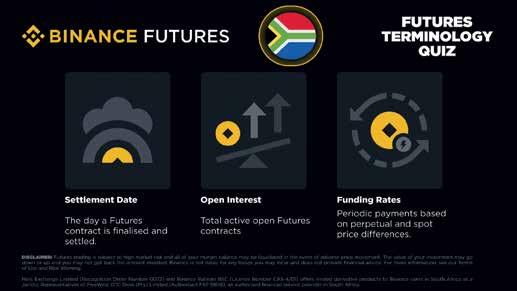
During regular trading hours, the Price Index is constructed using data from multiple third-party providers, ensuring that contract pricing reflects real-time underlying market conditions. This multisource approach reduces reliance on any single data feed and enhances pricing robustness during normal market activity.
However, during nontrading periods, such as weekends, holidays or daily maintenance windows (when underlying markets may not be actively pricing), Binance maintains stability by anchoring the Price Index to its most recently calculated value. This prevents unnecessary volatility or artificial price movement when no fresh market data is available.
To further refine pricing behaviour across different market environments, the Price Index operates under multiple calculation modes depending on trading conditions:
• In Standard Mode, used during regular trading hours, the index is updated every second as a weighted average of all available constituent data sources. This ensures responsiveness during active market conditions.
• During extended trading periods, such as pre-market and after-hours sessions, a Fast-Decay Exponentially Weighted Moving Average (EWMA) model is applied. This approach smooths price fluctuations while still allowing the index to respond to changing market dynamics, reflecting the lower liquidity
and higher volatility typically seen outside core trading hours.
• During overnight sessions, when liquidity is further reduced, a Slow-Decay EWMA model is used to ensure more gradual price movement and enhanced stability. This helps prevent excessive sensitivity to isolated trades or temporary pricing distortions.
• Finally, during fully inactive periods, such as weekends, holidays or system maintenance windows, the Price Index remains fixed at the last available value, ensuring continuity and preventing dislocation in pricing when no underlying market data is available. Together, these modes form a dynamic pricing system that adapts to real-world liquidity conditions while maintaining consistency and predictability for traders across all market environments.
Complementing the Price Index is the Mark Price, which plays a critical role in margin calculation, risk management and liquidation logic within Binance’s derivatives framework. During regular trading hours, the Mark Price is calculated every second using a median-based methodology that incorporates multiple price inputs, including contract price and index-based references. This helps ensure resilience against anomalies, outliers or short-term price distortions.
During nontrading periods, the Mark Price transitions into a smoothing-based model using EWMA, allowing it to evolve gradually in line with observed transaction activity. This provides a stable reference price even when underlying markets are closed or experiencing limited liquidity. To ensure smooth transitions between different calculation modes, Binance applies a weighted blending mechanism that gradually shifts the Mark Price from one model to another over a defined time window. This prevents abrupt jumps in pricing and ensures continuity across market state changes.
A key objective of these mechanisms is to maintain close alignment between the Mark Price and the underlying Price Index. To achieve this, Binance enforces deviation constraints that limit how far the Mark Price can diverge from the Index under different market conditions. These constraints help reduce the risk of artificial volatility, funding rate distortions, and unnecessary liquidations.
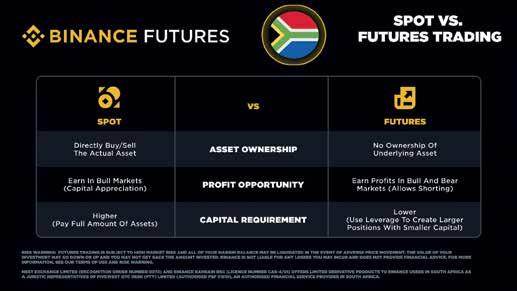
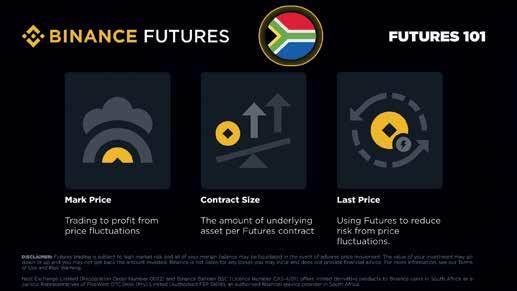
Deviation thresholds vary depending on asset class and market conditions:
• For equity-linked TradFi Perps, tighter limits are applied during overnight and weekend sessions, while broader thresholds apply during active trading hours.
• Commodity-linked contracts, such as those based on gold, are subject to consistent deviation limits across all trading periods. These controls are designed to preserve pricing integrity while accounting for the natural differences in liquidity between asset classes and trading sessions.
Beyond pricing and risk controls, TradFi Perps also incorporate established mechanisms for
handling corporate events such as stock splits, reverse splits, mergers and spinoffs. In such cases, Binance issues market notices and applies necessary adjustments to ensure contract specifications remain aligned with underlying asset structures. This ensures that users are not exposed to unintended pricing distortions resulting from corporate actions.
At a broader level, the combined design of the Price Index and Mark Price systems reflects Binance’s focus on risk mitigation across both active and inactive market conditions. By integrating multisource data
feeds, statistical smoothing techniques and structured deviation controls, the system is designed to reduce exposure to abnormal price movements, liquidity shocks and data gaps. These safeguards help ensure that pricing remains reflective of fair market value while maintaining margin and funding stability across all trading environments.
TradFi Perps are margined and settled in USDT, consistent with Binance’s USD s -Margined Futures framework. While they share underlying infrastructure with existing perpetual futures products, they are adapted to reflect the structural differences of traditional markets, particularly their noncontinuous trading schedules. This allows Binance to extend its derivatives framework into new asset classes without compromising execution quality, liquidity depth or risk management standards.
This approach is also reflected in newer commodity-linked contracts such as natural gas (NATGASUSDT), which track real-world benchmarks like Henry Hub while remaining fully cash-settled in USDT. Rather than requiring physical delivery or complex logistics, these contracts allow users to trade price movements directly through a digital instrument. With features such as smaller contract sizes, round-the-clock availability and the ability to take both long and short positions, crypto-native commodity trading lowers traditional barriers to entry. At the same time, it maintains alignment with underlying market dynamics through mechanisms such as funding rates.
EFFICIENCY, BINANCE CONTINUES TO EVOLVE ITS OFFERING IN SOUTH AFRICA.
Within this broader derivatives ecosystem, South African users continue to have access to a comprehensive suite of products, including USD-Margined Futures, Coin-Margined Futures, Options, and now TradFi-linked perpetual
contracts. This integrated structure allows users to implement a wide range of strategies, from hedging and portfolio protection to arbitrage and directional trading, all within a single trading environment supported by deep liquidity and advanced order functionality.
Alongside these enhancements to its derivatives infrastructure, Binance has also improved its know your customer (KYC) process for South African users. The streamlined onboarding experience reduces friction in account verification while maintaining strict compliance and security standards. This enables faster access to the full suite of derivatives products, supporting both retail and institutional users in accessing markets more efficiently.
Binance’s derivatives offering in South Africa operates within a structured regulatory framework designed to ensure compliance with local requirements while maintaining global standards of oversight. Nest Exchange Ltd (Recognition Order Number 0072), together with its affiliates licensed under the Abu Dhabi Global Market (ADGM), provides derivative products to South African users as Juristic Representatives of FiveWest OTC Desk (Pty) Ltd (FSP Number 51619), an authorised financial services provider in South Africa. This structure ensures Binance’s operations remain aligned with domestic regulatory expectations while benefitting from the governance and supervisory standards of one of the world’s leading international financial centres.
The ADGM Financial Services Regulatory Authority imposes rigorous requirements across governance, risk management and operational integrity, reinforcing Binance’s commitment to maintaining high standards of transparency and user protection across its global derivatives infrastructure.
Hannes Wessels, director of Binance South Africa, says: “Our focus has been on strengthening and expanding the capabilities already available to South African users within our derivatives ecosystem. The introduction of TradFi Perpetual Contracts extends this framework by offering additional
“THE INTRODUCTION OF TRADFI PERPETUAL CONTRACTS EXTENDS THIS FRAMEWORK BY OFFERING ADDITIONAL EXPOSURE TO TRADITIONAL ASSETS WITHIN THE SAME FLEXIBLE AND EFFICIENT TRADING ENVIRONMENT.”
– HANNES WESSELS
exposure to traditional assets within the same flexible and efficient trading environment. Combined with improvements to our KYC process, we are reducing friction in how users access these markets while maintaining strong compliance standards. This evolution reflects our continued commitment to building a more connected, efficient and accessible trading experience across asset classes.”
Binance’s continued investment in South Africa builds on its existing derivatives infrastructure, including the relaunch of futures trading in 2023, and the expansion of fiat on-ramps through strategic partnerships such as Stitch. These developments reflect a broader effort to support the integration of traditional and digital asset markets, enabling users to participate more seamlessly in a global financial system that is increasingly interconnected.
By extending its derivatives capabilities into traditional assets while reinforcing pricing integrity, regulatory alignment and onboarding efficiency, Binance continues to evolve its offering in South Africa as part of a wider global infrastructure strategy focused on accessibility, liquidity and market resilience.

VISIT WEBSITE
SCAN THIS QR CODE TO GO TO THE BINANCE WEBSITE

About Binance

Binance is a leading global blockchain ecosystem behind the world’s largest cryptocurrency exchange by trading volume and registered users. Binance is trusted by more than 310 million people in 100-plus countries for its industry-leading security, transparency and portfolio of digital asset products. For more information, visit: www.binance.com Nest Exchange Limited (Recognition Order Number 0072) and Binance Bahrain BSC (Licence Number CAS-4/01) offers limited derivative products to Binance users in South Africa as a Juristic Representatives of FiveWest OTC Desk (Pty) Limited (Authorised FSP 51619), an authorised financial service provider in South Africa


Capital controls, liquidity gaps and regulatory fragmentation ensure price differences between local and global crypto exchanges are structural, not accidental, writes BRENDON PETERSEN
At its core, crypto arbitrage is a pricing gap trade: buy an asset where it is cheaper, sell it where it costs more, and pocket the difference. If the same asset trades at different prices on different platforms simultaneously, theory says traders will swiftly close the gap. In South Africa, structural barriers have ensured that gap remains open.
The price discrepancy between crypto in South Africa and abroad is largely attributed to growing demand and limited supply, according to FiveWest’s guide to crypto arbitrage. Globally, demand for crypto trading in US dollar means more supply is available to those holding dollars. With a lower supply of crypto priced in rand, prices in the local market are pushed higher.
Due to exchange controls, crypto assets such as Bitcoin and USD Coin (USDC) typically sell for higher prices in South Africa relative to overseas exchanges. The mechanism is straightforward: convert rand to dollars, purchase crypto on an offshore exchange, transfer it locally, and sell at a premium. If South Africa did not have a restricted currency, this arbitrage would not exist. The premium once sat around 20 per cent. Today it typically ranges from 1.5 to 1.8 per cent, though it can spike to 4 per cent or drop to zero depending on market conditions.
The gross spread before costs has widened to 2 to 3 per cent in recent months, from 1 to 2 per cent, partly because some overseas providers ceased accepting deposits from South Africa following the country’s greylisting by the Financial Action Task Force, reducing trade volumes and making remaining trades more profitable, according to Future Forex.
For South African investors, the opportunity operates within fixed regulatory boundaries. The FiveWest guide states that each South African is granted a Foreign Investment

Allowance of R11-million per annum, comprising a Single Discretionary Allowance of R1-million and an Approved International Transfer of R10-million.
Profits obtained through crypto arbitrage are classified as income tax and must be disclosed in annual returns.
Future Forex CEO Harry Scherzer says the model’s appeal lies in its risk profile. “We’ve never had a losing trade, and profits are known at the onset of any trade,” he explains. The company has concluded more than R14.5-billion in trades since inception, with all trades fully hedged to eliminate exposure to currency rate changes and price movements during execution.
That regulatory environment is about to shift materially. In February 2026, Finance Minister
Enoch Godongwana announced draft regulations under the Currency and Exchanges Act to bring crypto assets into South Africa’s capital flow management framework. The announcement followed a High Court ruling in Standard Bank of South Africa v South African Reserve Bank and Others (2025), which found that crypto did not constitute “capital” under existing exchange control regulations and therefore did not require SARB approval for cross-border transfer.
Global law firm Baker McKenzie has noted that bringing crypto assets into the same regulatory perimeter as other forms of capital could be material for businesses and individuals moving meaningful amounts across borders, translating into additional compliance steps and the imposition of punitive sanctions where exchange control approval is not acquired.
According to a Werksmans Attorneys analysis published in April 2026, the direction is unambiguous: crypto asset service providers should prepare their systems and review compliance frameworks before draft amendments are published, and crypto holders who have previously transferred crypto abroad without exchange control approval should seek legal advice before the new framework takes effect.
Under the proposed framework, South African residents wishing to transfer crypto assets to nonresidents, including to foreign exchanges, may need to do so within their exchange control allowances, with transfers exceeding applicable limits requiring specific SARB approval. For traders who have built strategies around the premium, the compliance architecture taking shape will directly reshape the economics of the trade.
Bitcoin is gaining ground at the till, but can it translate into meaningful, everyday economic use? By
TIANA CLINE
Bitcoin acceptance among South African merchants has grown significantly since the Financial Sector Conduct Authority (FSCA) classified crypto assets as financial products in 2022, but availability and adoption are not the same thing. Pick n Pay was the first major African retailer to accept Bitcoin at the till, via CryptoConvert’s CryptoQR platform on the Lightning Network, and the rollout now covers all stores nationally. By early 2024, it was processing R1-million a month in Bitcoin payments, up from R25 000 at launch. Half of all transactions are under R500, which means customers are using it for groceries, airtime, electricity and municipal bills, not just pricier purchases. South African skincare brand SKOON accepts it online, and so does Geewiz, the Sandton-based e-commerce retailer that first introduced Bitcoin payments in 2017, dropped them in 2020 when its payment processor shut down, and reintroduced them in August 2024 through MoneyBadger.
“Unlike the earlier version, the MoneyBadger integration has seen consistent
gear, high-end PC components, virtual reality headsets and 3D printers. At Geewiz, crypto payment usage spiked in November and December 2024 and has remained steady going into 2026. “We initially introduced Bitcoin as a payment method to stay aligned with emerging payment technologies and to offer customers additional flexibility at checkout,” adds Freeman. “While crypto payments still represent a small portion of total transactions, it has been a valuable addition to our payment mix.”
“The biggest gap is perception,” explains Josh Raphael, CEO of Parket and crypto enthusiast. “Crypto is still seen as volatile speculative tech instead of reliable hard money. Volatility exists largely because Bitcoin is a relatively small asset class. Large inflows and outflows move the price sharply. As adoption and market cap grow, that volatility should moderate.” In South Africa, where rand volatility, expensive cross-border remittances and exchange controls compound those pressures, the case for hard-capped currency is more pointed than in most markets, and the gap between what Bitcoin offers and how it is used becomes
“HARD-CAPPED, DECENTRALISED MONEY LIKE BITCOIN WILL ULTIMATELY BENEFIT SOCIETY. IN SOUTH AFRICA’S CONTEXT, IT OFFERS A PRACTICAL TOOL AGAINST CURRENCY INSTABILITY.”
– JOSH RAPHAEL
cases is not in retail. In Mossel Bay, Bitcoin Ekasi has built a functioning circular economy inside the JCC Camp township, paying all staff at The Surfer Kids nonprofit organisation their full salaries in Bitcoin while onboarding 11 local merchants, including spaza shops, barbers and a car wash, to accept it via the Lightning Network. Many township residents cannot open a bank account because they lack the identity documents the formal financial system requires, making Bitcoin an entry point.



will close as real utility regulation matures benefits first-hand,”
Ultimately, regulatory certainty is the remaining variable. The FSCA has been licensing crypto asset service providers since 2023, but the 2026 draft capital flow management regulations could set it back. “Heavy declaration requirements and potential forced sales could push activity underground rather than bring it into the mainstream,” explains Raphael. “Balanced rules that protect consumers without stifling innovation will be key. Hard-capped, decentralised money like Bitcoin will ultimately benefit society. In South Africa’s context, it offers a practical tool against currency instability.” The infrastructure is in place, and the early data is encouraging, but closing the gap between availability and adoption will require regulation that supports the momentum rather than disrupting it.
Follow: Tuvia Freeman www.linkedin.com/in/tuvia-freeman-259116292
Josh Raphael www.linkedin.com/in/joshua-raphael
Crypto regulation has been formalised in South Africa. What does this mean for innovation, investment and cross-border transactions? ANTHONY SHARPE finds out

In April this year, South Africa’s regulatory landscape around cryptocurrency shifted from a wait-and-see approach to a comprehensive framework focusing on licensing, tax transparency and capital flow management. The Financial Sector Conduct Authority (FSCA) now actively regulates crypto asset service providers (CASPs) under the Financial Advisory and Intermediary Services (FAIS) Act, with more than 300 CASP licences having been approved to date.
The FSCA says its decision to declare crypto assets as a financial product under the FAIS Act was driven by mounting risks in the domestic crypto asset environment. “This
comprehensive and dedicated regulatory framework through broader reforms, including the Conduct of Financial Institutions Bill.”
The 2026 Budget Speech marked a big shift in regulatory treatment of crypto assets, with draft regulations expected to bring crypto assets formally within the exchange control framework. However, from a technical perspective, it will be difficult for the South African Reserve Bank (SARB) to enforce prior approval for cross-border transfers without effectively whitelisting every individual wallet, says Carel de Jager, founder and CEO of Sixpence and CTO of Bitmach.

investment purposes and a marked rise
opportunities. In this context, the declaration was regarded as a necessary interim regulatory service providers, development

“SARB can enforce rules very effectively at the interface layer: banks, CASPs, custodians, brokers, payment processors and fiat on-ramps. That is where identity, know your customer, reporting and transaction controls exist,” says de Jager.
However, a public blockchain does not know whether a user is South African, whether a transfer is cross-border or whether SARB approval exists, he continues. “If a user controls their own private keys, the network will process a valid transaction regardless of domestic approval. If the objective is true prior approval for every self-custody transfer, the system drifts toward wallet whitelisting or preapproved address books. That is burdensome, privacy-invasive and easy to route around.”
A better model, says de Jager, is risk-based: “Thresholds, reporting, analytics, post-transaction surveillance, suspicious activity escalation and prior approval only for high-value or high-risk flows.”
“COMPLIANCE COMES AT A COST, OF COURSE. THE BALANCE IS TO ENSURE THAT COMPLIANCE IS PROPORTIONATE AND APPROPRIATE, ALLOWING THE INDUSTRY TO FLOURISH WHILE PROTECTING THE PUBLIC INTEREST.”
– FARZAM EHSANI

THE FSCA SAYS ITS DECISION TO DECLARE CRYPTO ASSETS AS A FINANCIAL PRODUCT UNDER THE FAIS ACT WAS DRIVEN BY MOUNTING RISKS IN THE DOMESTIC CRYPTO ASSET ENVIRONMENT.
Compliance comes at a cost, of course, notes VALR co-founder and CEO Farzam Ehsani
“The balance is to ensure that compliance is proportionate and appropriate, allowing the industry to flourish while protecting the public interest. While VALR’s compliance costs have certainly increased since receiving one of the first CASP licenses in South Africa in 2024, I would say the regulatory cost burden has been acceptable compared to other jurisdictions. The goal for any regulatory environment is to ensure a stable and safe market while keeping the ‘price of entry’ low enough to let innovation and competition thrive.”
De Jager says that regulation has undoubtedly changed the shape of the market. “The cost of participation has gone up. Smaller teams, experimental products and early-stage entrants now need legal, compliance, reporting, anti-money laundering and governance capacity before they can even properly test the market. That inevitably favours well-capitalised incumbents.”
Controls around money laundering and terrorist financing are crucial in the context of South Africa’s exit from the Financial Action Task Force (FATF) greylist in late 2025, as CASPs are considered at high risk of abuse for these activities, says the FSCA. “CASPs are required to comply with the Financial Intelligence Centre Act, which includes, inter alia, customer due diligence and the reporting of suspicious transactions to the Financial Intelligence Centre.”
De Jager cautions that this should not lead to overcorrection. “The FATF itself emphasises risk-based controls and warns against derisking entire classes of customers. The danger is writing rules that look comprehensive on paper, but are technically unenforceable in practice, creating friction for legitimate businesses while sophisticated bad actors move to less visible channels. The better approach is to regulate where identity exists: CASPs, banks, stablecoin issuers, custodians and payment providers.”
While the Financial Sector Conduct Authority (FSCA) has issued licences to hundreds of crypto asset service providers, it has also denied dozens.
The FSCA cites the following as the most common technical deficits found in the business plans of South African crypto start-ups:
• Lack of proper clarity and granularity around how ongoing regulatory compliance is going to be ensured and no clear thought on supporting processes and frameworks;
• No or very little detail on operational policies (including operational risk and anti-money laundering or counter-terrorism finance risks);
• Lack of detailed operational processes and supporting frameworks; and
• Unclear or lack of governance structures.
Follow: Carel de Jager www.careldejager.com Farzam Ehsani www.linkedin.com/in/farzam-ehsani
One area of local regulation that hasn’t caught up with trends is pensions, which are still prohibited from investing in crypto assets, says VALR co-founder and CEO Farzam Ehsani. “The explicit prohibition on South African pension funds investing in crypto assets took effect on 3 January 2023.
Since then, the price of bitcoin, for example, has increased three hundred and fifty per cent. We need to change this regulation to allow South African pension funds to access and participate in an asset class that is being adopted rapidly by institutions around the globe. Of course, it is still a volatile asset class, but this volatility is an advantage in a well-diversified portfolio.”
Some are worried that the new exchange control requirements could create a double compliance burden for CASPs. The FSCA says it’s important, however, to note the complementary mandates, scope and regulatory requirements of the FSCA and SARB`s Financial Surveillance (FinSurv). “CASPs looking to render financial services in crypto assets require a licence under the FAIS Act, and are subject to its market conduct rules and requirements. In the event that such services entail the facilitation of cross-border fund transfers or payments and remittances using crypto assets, those CASPs will, in addition, require FinSurv’s authorisation to conduct and will have to comply with the applicable rules and requirements.”
The FSCA adds that given the complementary nature and overlap of activities, there is ongoing engagement between the two authorities to eliminate and minimise regulatory burden while ensuring that both bodies’ rules and requirements are adhered to.

I’ve spent most of my career in asset allocation rooms. Conservative rooms, where the answer to anything unfamiliar was “not yet.” I was one of those people. So, when I tell you digital assets now belong in the portfolio construction conversation, I’m not saying it as a convert who saw the light. I’m saying it as someone who needed to see the institutional infrastructure built before I was willing to commit. That infrastructure now exists.
For the better part of a decade, the investment community has treated digital assets as a spectator sport. Interesting to watch. Easy to dismiss. And, let’s be honest, largely incompatible with the governance frameworks that professional allocators operate within. That position was understandable. It is no longer tenable.
The shift isn’t primarily about price. Bitcoin’s trajectory, while remarkable, is not by itself an argument for investment allocation. What has changed, mostly outside the attention of traditional asset managers, is the infrastructure. Regulated custody solutions now meet institutional security standards. Independent fund administration for on-chain portfolios is operational. Yield-generating strategies built on decentralised finance protocols produce returns uncorrelated with equities, bonds and property. They do so from genuine economic activity, not speculative momentum.
In South Africa specifically, the FSCA has established a regulatory framework for crypto asset service providers that places digital asset management within the same compliance architecture as traditional discretionary fund management. This is not a sandbox; it’s a functioning regulatory regime demanding the same know your customer, anti-money laundering, compliance monitoring and
Digital assets are now a portfolio construction question, not a speculation question,
writes NERSAN NAIDOO , CEO, MidSquare Capital
fiduciary standards that govern every other licensed asset manager in the country.
The consequence for portfolio allocators is straightforward: the barriers that previously justified sitting this out have largely fallen away. The question is no longer whether digital assets can be managed to rigorous investment standards. It’s whether allocators can justify excluding an entire asset class from their portfolio construction process.
Think about what the digital asset ecosystem now offers that traditional markets cannot replicate. Secured lending against over-collateralised positions, with automated liquidation mechanisms, generating high single-digit USD yields at minimal volatility and near-zero correlation to traditional asset classes. Liquidity provision strategies that earn transaction fee income from growing decentralised exchange volumes. Staking mechanisms that produce predictable yield from blockchain protocol infrastructure. None of these returns are dependent on Bitcoin’s price rising. This reframes the allocation question. The choice is not between “crypto exposure” and “no crypto exposure.” It is between accessing a genuinely different source of return, one that improves portfolio efficiency, and leaving that return on the table
because of associations with an earlier, less mature version of the asset class.
The objection I hear most frequently from allocators is not about returns, regulation or even volatility. It’s about governance. “Who is managing the money, and can I trust them?” This is the right question. The digital asset management industry globally has historically been populated predominantly by technologists and enthusiasts. Very few participants bring the operational discipline and fiduciary accountability that decades of traditional asset management have built. That gap is both the primary risk in the space and the primary opportunity.
At MidSquare, we didn’t set out to reinvent asset management for the digital age. We set out to apply the disciplines of traditional asset management, the ones we spent our careers developing, to an asset class that has, until recently, lacked them. Independent oversight. Secure custody. Transparent reporting. Aligned incentives. Disciplined risk management. We bring more than 60 years of combined experience across equity, fixed income, multi-asset and hedge fund management to a space still in its early innings. Let’s be candid about where we are. The industry is young. Not every protocol will survive.
The regulatory environment will continue to evolve. However, the allocators who will benefit most from this transition are the ones who arrive with clear governance criteria, ask the right due diligence questions, and partner with managers who can answer them.
Digital assets are no longer exotic. They are a portfolio construction input. The infrastructure is there. The regulation is getting there. The strategies are there. The only remaining question is whether allocators will engage on their own terms or wait until they have no choice. Follow: Nersan Naidoo
Crypto markets remain volatile, complex and often misunderstood, particularly by retail investors. While interest continues to grow, the risks embedded in the ecosystem, from price swings to scams and behavioural pitfalls, remain a defining feature of participation.
Dr Wiehann Olivier, partner and global co-head of digital assets at Forvis Mazars, says that much of crypto’s appeal lies in its structure.
“Investors continue to be drawn to crypto largely because of its underlying economic characteristics, such as scarcity, programmability and decentralisation, as well as the transformative technology that supports it,” says Dr Olivier. “In some cases, growing dissatisfaction with traditional financial systems or fiat currencies also encourages investors to explore alternative asset classes.”
However, this interest often outpaces understanding. “Retail investors are particularly exposed to sudden price drops due to crypto’s inherent volatility,” says Dr Olivier, adding that many investors underestimate how quickly markets can shift. “Losses are frequently driven by behaviour rather than fundamentals. Investor losses in volatile markets are often driven by reactive behaviour, particularly attempting to time the market based on headlines or short-term price movements.”
This reactive mindset becomes even more pronounced during recoveries. “During market recoveries, retail investors often underestimate risk because rising prices create a sense that the worst is over, even though volatility and downside risks remain,” he says. This can lead to overconfidence, increased exposure and weakened risk controls.
ITUMELENG MOGAKI speaks to experts to find out the risks in crypto markets and how investors can better manage exposure in a volatile environment
“YOU CAN’T ELIMINATE RISK IN INVESTMENT OF ANY ASSET CLASS, CRYPTO ASSETS INCLUDED. WHAT HELPS INVESTORS MAKE BETTER DECISIONS IS EDUCATION AND ACCESS TO RELIABLE INFORMATION.”
– CHRISTO DE WIT
“Beyond market dynamics, less visible risks continue to shape outcomes. One of the most underestimated risks in crypto is security. Blockchain-based digital assets can be transferred as quickly as information moves across the internet, meaning compromised accounts can be drained in minutes,” says Dr Olivier, adding that scams, including fraudulent tokens and market manipulation, remain a persistent threat.
“While these risks are structural, managing them comes down to how investors respond in practice. This is where access to tools, information and disciplined strategies becomes critical,” says Dr Olivier.
Christo de Wit, Luno country manager for South Africa, says while risk cannot be removed, it can be managed through better decision-making frameworks.
“You can’t eliminate risk in investment of any asset class, crypto assets included.
What helps investors make better decisions is education and access to reliable information,” says de Wit.
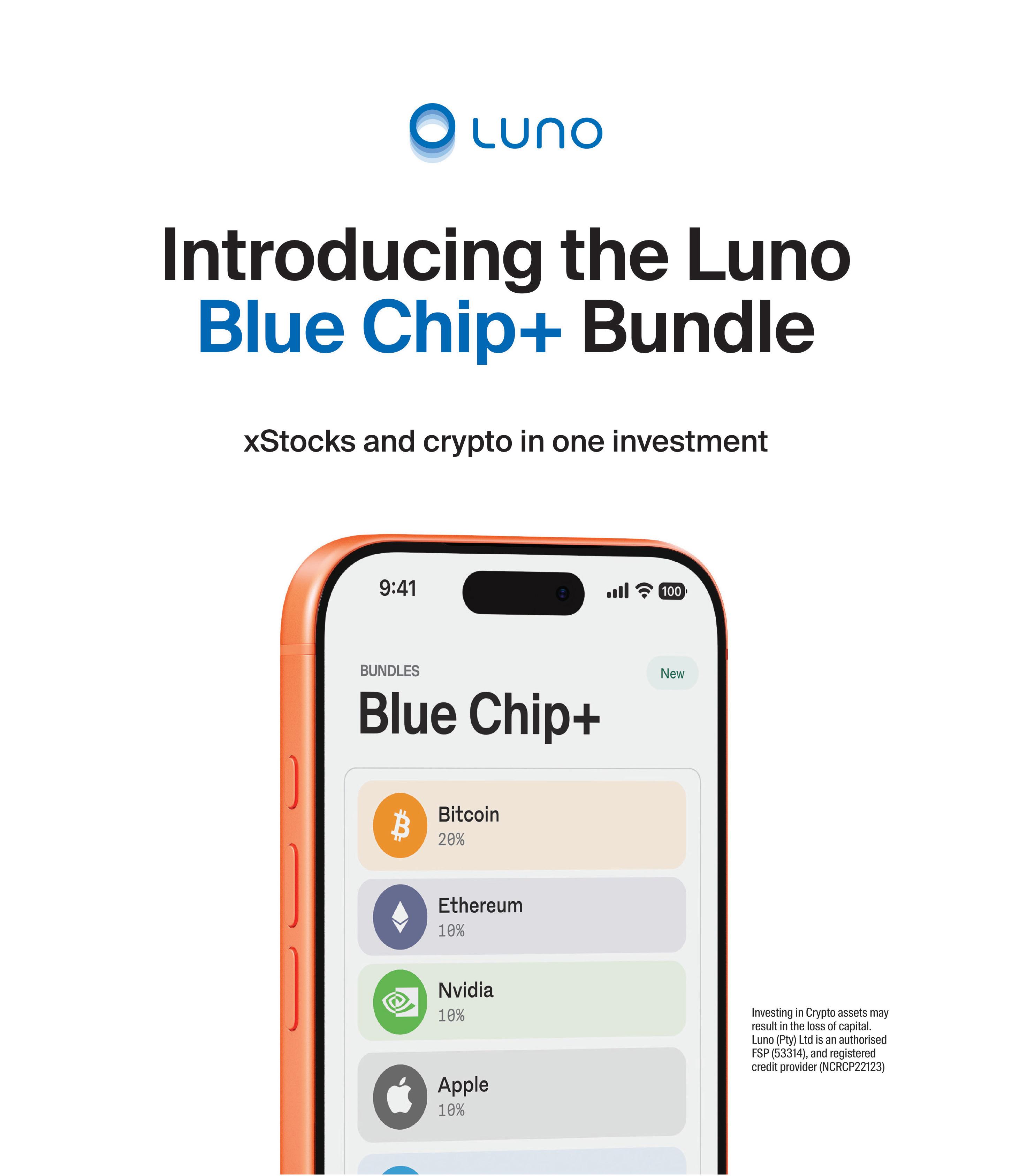
He also points to practical solutions that can help investors navigate volatility more effectively. “Exposure to volatility will always be a consideration; however, managing this exposure depends entirely on individual investors’ approach. Tools like diversified bundles allow investors to spread risk across a basket of crypto assets and tokenised stocks, rather than relying on a single asset.”
De Wit adds that reducing emotional decision-making is another key focus. “The most damaging behaviours are panic buying and panic selling. Removing emotion and investing for the long term can minimise losses.”
He explains how technology can play a role in reinforcing discipline. “Features like price alerts help investors stay informed without constantly monitoring the market. At the same time, regular portfolio rebalancing ensures investments remain diversified and not overly concentrated in assets that have surged.”
Importantly, de Wit stresses the role of independent thinking. “Luno urges investors to do their own research before investing and to seek independent financial advice rather than relying on market sentiment.”
Ultimately, while crypto continues to offer opportunities, its risks are part of how the market functions. As Dr Olivier points out, better long-term results depend less on short-term price moves and more on disciplined decisions, built on understanding the technology, avoiding putting too much money into one asset and keeping a clear long-term view despite market volatility.
Follow: Dr Wiehann Olivier www.linkedin.com/in/dr-wiehann-olivier-ca-sa-ra-7088b8143
Christo de Wit www.linkedin.com/in/christodigital
In the years immediately following the launch of crypto, would-be investors had little choice but to follow a self-directed approach. This was the default, due to the fragmented and experimental nature of the market.
That’s changed, says Hannes Wessels, general manager, South Africa at Binance. “Investors are no longer approaching digital assets purely from a speculative standpoint. Instead, they are looking to incorporate crypto into broader portfolio strategies, where diversification, risk management and long-term positioning become more important.”
The shifting dynamic has, at the same time, been accompanied by a greater focus on regulation and infrastructure in the market, notes Gillian Darko of Yellow Card. “South Africa’s regulator, the Financial Sector Conduct Authority, has been bringing crypto into a more formal regime. This demonstrates that the market is becoming more licensed, supervised and integrated into formal financial services.”
The net result? People are starting to realise that being able to buy crypto is not the same as being equipped to invest in it well, Midsquare’s Selwyn Pillay informs.
Many are also realising that self-investment comes with several potential pitfalls.
“Many individual investors do not have a disciplined framework for portfolio construction, position sizing, risk management or decision-making under pressure,” Pillay says. “In crypto, that often leads to concentrated
As the crypto market matures, there is a distinct move away from speculative self-directed trading to a more institutionalised approach.
LISA WITEPSKI
investigates
bets, emotional reactions, overtrading and poor downside control.”
Although educational resources, such as the Binance Academy, are increasingly available, many individuals lack the skills that would make the difference. Darko points out that while crypto is transparent in one sense (because the blockchain is public), interpreting what is actually happening is very different from just seeing the data.
Then there are issues around costs. While it might appear reasonable to assume that self-directed trading would be a more cost-effective option, Pillay observes that on-ramp, off-ramp and trade activity can be surprisingly expensive; add to this spreads, fees, slippage, currency conversions and the cost of moving assets across platforms.
In contrast, a managed approach allows for portfolio construction that takes into clear objective,


an understood risk budget and a coherent investment process. Diversification is part of this, Pillay says. “It is not about owning many tokens for the sake of it. It is about understanding different sources of return, different risk profiles and how exposures behave together in changing market conditions,” he explains.
Data-driven decision-making is part of this. “Investment decisions are based on measurable signals, such as market trends, volatility and momentum, rather than sentiment or short-term noise. This helps improve both risk management and long-term performance,” says Wessels.
For Jarryd Jensen of Sumsub, one of the chief advantages of a managed environment is the ability to reduce fraud by embedding identity verification, transaction monitoring and risk controls directly into the platform. This limits exposure to scams and bad actors compared to fragmented DIY setups.
The shifting approach to investment has significant long-term implications, comments Christo de Wit of Luno: “When established financial institutions and regulated asset managers enter crypto, it signals confidence, and that filters back to retail, which is why, despite the changing dynamics, retail will never disappear. In South Africa, where regulatory progress has been meaningful, professional participation is helping to normalise crypto within mainstream portfolios. There is a growing trend among financial advisors to suggest that a five per cent allocation of a total portfolio should be dedicated to crypto assets,” he concludes.
Follow: Selwyn Pillay www.linkedin.com/in/selwyn-pillay Hannes Wessels www.linkedin.com/in/hannes-wessels-5b597813
Jarryd Jensen www.linkedin.com/in/jarrydjensen
Christo de Wit www.linkedin.com/in/christodigital
Gillian Darko www.linkedin.com/in/gillian-darko-6654b719
South Africa is entering a defining phase in the evolution of its cryptocurrency ecosystem, providing it with an opportunity to move beyond early adoption toward a more mature, responsible and trusted digital asset market. By LARRY COOKE , Africa head of legal at Binance
For several years, South Africa has stood out as one of Africa’s most active cryptocurrency markets. Retail investors, entrepreneurs and institutions have explored digital assets for everything from portfolio diversification to cross-border payments. However, rapid growth has also brought increased risks, including scams, misinformation and uncertainty around accountability.
This is why understanding evolving crypto regulation in South Africa is so important now. Regulation signals a transition from an emerging environment to one built on stronger safeguards, transparency and accountability. As these frameworks continue to develop, they introduce clearer compliance expectations, including areas such as know your customer (KYC) processes and anti-money laundering (AML) controls, which are central to strengthening the integrity of the market.
Regulation should not be viewed as a constraint on innovation. It provides the foundation for sustainable growth. Clear expectations help protect consumers, encourage responsible participation, and give businesses the certainty they need to invest for the long term.
South Africa’s approach reflects this balance. As regulators continue to define expectations for crypto asset service providers, they are introducing guardrails designed to protect users while still allowing innovation to thrive. This
marks an important step in building a more resilient and accountable crypto market.
Across the industry, there is a growing recognition that long-term success depends on strong compliance foundations. Many platforms are increasingly investing in compliance capabilities by strengthening customer due diligence processes, enhancing transaction monitoring and building more robust risk management and governance frameworks. This reflects a broader shift toward aligning with evolving regulatory expectations while applying global best practices.
For users, this evolution brings meaningful benefits. Stronger compliance standards can improve how platforms onboard customers, manage risk and communicate transparently, helping reduce exposure to fraudulent or unregulated actors and support more informed decision-making.
For businesses, regulatory clarity also comes with increased responsibility. Aligning with evolving requirements requires ongoing investment in systems, expertise and operational processes. These are not simply regulatory considerations; they are essential components of building sustainable and trusted businesses in

South Africa’s leadership in shaping crypto regulation also carries regional significance. As one of the continent’s most established financial markets, developments locally often influence broader African trends. A well-regulated crypto environment could serve as a blueprint for responsible adoption across the region.
However, regulation alone is not enough. Building responsible crypto markets requires collaboration between regulators, industry participants and users. Constructive dialogue helps ensure frameworks remain practical and adaptable as technology evolves, while enabling stakeholders to address emerging risks.
Like any developing regulatory environment, implementation will take time, as both regulators and industry participants continue to adapt. Maintaining a balance between robust compliance standards and practical, proportionate implementation will be key to ensuring innovation is not constrained.
Education will also play a key role. As regulatory frameworks evolve, users must understand what these changes mean in practice. Clear communication can reduce confusion, build trust and encourage responsible participation.
This is an opportunity to reshape the broader narrative around cryptocurrency. Moving beyond short-term speculation and focusing on long-term value creation will be essential. Digital assets have the potential to improve financial access, streamline payments and support new digital economies, but these benefits are most effective when built on trust and responsible governance.
South Africa’s regulatory moment is therefore not just about compliance. It is about strengthening confidence, protecting users and creating an environment where innovation can flourish responsibly.
For industry participants, this moment calls for more than alignment; it requires continued investment in compliance, transparency and responsible innovation. Those taking a long-term, responsible approach help define the next phase of crypto in South Africa.
The digital asset custody market is experiencing significant growth, and sub-Saharan Africa is emerging as a frontier for digital asset innovation. The region accounts for 2.7 per cent of global cryptocurrency transaction volumes, exceeding its 2.4 per cent share of global gross domestic product, according to Chainalysis. That’s a sign of disproportionate engagement relative to economic size.
Against this backdrop, Absa is developing bank-grade digital asset custody services for our corporate and investment banking clients. This will enable our clients in South Africa (and subsequently regionally) to manage their private keys safely and securely, facilitating their participation in the digital asset ecosystem.
Given the rapid adoption of blockchain technologies and the wide-ranging impact they’re having on the financial ecosystem, digital asset custody is a natural evolution for banks that want to innovate and continue serving their clients. At Absa, we feel it is imperative that we enter this space.
Digital asset custody is a perfect fit for a bank like ours, which draws on more than a century’s worth of experience and institutional knowledge. Our clients trust us with their traditional assets, so why would they not trust us with their digital assets – or with the assets in digital form?
Absa will operate in the custodial wallets space, holding our clients’ keys and managing their digital assets on their behalf within a secure, compliant and institution-ready environment.
In many respects, a wallet that exists on the blockchain
Absa is developing bank-grade digital asset custody for Africa by combining trusted governance with secure, institution-ready key management. By ROBYN LAWSON , head of digital product: custody, and ROB DOWNES , head of digital assets, at Absa Corporate and Investment Banking

is like a bank account. For institutions, losing access to the keys to their digital assets represents far more than a financial loss; it poses operational, reputational and regulatory risks to their business and clients. As digital assets move from the retail space into the institutional arena, the conversation has shifted from “who holds the keys?” to “how are they governed?”. Institutions demand bank-grade, auditable, policy-driven control frameworks that align with corporate governance and regulatory expectations and Absa now provides just that, enabling a one-stop shop that allows clients to have their traditional assets and their digital assets protected in the same space, in the same way, by the bank they trust.
Trust is a vital element of this. When asked who they trust most to meet their digital asset needs, 60 per cent of South
African respondents in Absa’s 2025 Digital Assets Insights report said traditional banks. Twenty per cent said fintech companies, while ten per cent said cryptocurrency exchanges. The benefits of digital assets are already clear. In that same report, 80 per cent of respondents agreed that digital assets could increase efficiency in cross-border payments, while 69 per cent agreed that blockchain technology could drive business innovation and growth.
However, digital assets still carry a reputation for risk. Respondents to the report cited scams (33 per cent), volatility (25 per cent) and unclear regulation (25 per cent) ahead of technical barriers (17 per cent) as their biggest concerns about using the technology.
Absa’s message is that our clients need not fear digital assets. Our digital asset custody solution will not just be about holding assets securely, but also about embedding trust into every layer of the process, from technology and governance to recoverability and control.
Absa’s solution is designed around resilience. Keys and authorisations are protected within secure hardware environments, and recoverability is engineered into the model.
This speaks to one of our clients’ greatest needs: security – and in an unlikely event, recoverability of their digital assets, backed by the financial strength of a regulated bank that stands behind its obligations.
As decentralised finance matures, South African investors are weighing genuine utility against a loss record that the sector has yet to reckon with fully, writes BRENDON PETERSEN
Drift Protocol lost $285-million to an exploit. Kelp DAO lost $292-million. Volo Protocol shed another $3.5-million. Each event followed the same pattern: funds gone, no recourse, users absorbing losses that a regulated institution would have been legally obligated to address. The sector’s advocates tend to treat these episodes as growing pains. Its critics treat them as evidence.
Sean Sanders, founder and CEO of South African decentralised finance (DeFI) platform Altify, uses them as the starting point for every conversation with investors.
“TOKENISATION SOLVES THE OPERATIONAL LAYER. DEFI PROVIDES THE COMPOSABILITY THAT MAKES THE UNDERLYING ASSET GENUINELY USEFUL.” – SEAN SANDERS
“DeFI is a frontier sector with real technology risk stacked on top of the usual market risk,” he says. “Bridge exploits, oracle manipulation, social engineering of dev teams – those are the failure modes, and they’re not going away any time soon.”
That assessment sits against a broader industry backdrop that is still working through the tension between growth and risk management. Sumsub’s Crypto Industry 2026 data from 300 crypto companies, finds the sector has entered what it describes as a regulated maturity era, shaped by regulatory scrutiny, sophisticated fraud pressure and competition to deliver compliant onboarding at scale. Africa recorded
the sharpest structural improvement in verification pass rates over three years, rising from 81 per cent in 2023 to 91 per cent in 2025, reflecting investment in mobile-first user journeys and clearer onboarding processes. Regional fraud rates dropped from 3.6 per cent in 2024 to 2.6 per cent in 2025, suggesting earlier investment in stronger KYC (know your customer) controls is producing measurable results.
The compliance infrastructure is developing even as the underlying technology continues to produce loss events. For Sanders, the two are connected. Regulated platforms sitting on top of DeFi infrastructure absorb the operational complexity that retail investors are neither equipped nor required to manage. Custody, compliance, tax reporting, key management: the layers that make the underlying economics accessible without exposing users to the most vulnerable points in the system. When Kelp DAO was drained, Altify clients had no direct exposure to the bridge infrastructure that failed.
For South African investors, Sanders draws practical distinctions. Stablecoins

offer immediate dollar exposure without the friction of cross-border banking. Tokenised dollar money market funds and US treasury instruments add yield on top of the currency hedge. DeFi tokens are a separate proposition, volatile assets suited to investors who want sector exposure rather than rand protection.
The longer-term opportunity lies in tokenisation. Bringing real-world assets onto blockchain rails and using DeFi lending protocols to unlock liquidity against them changes the practical terms on which private markets operate. A tokenised property holding posted as collateral for an on-chain loan, at market rates, without a credit application or forced sale, is a financial arrangement that traditional infrastructure cannot replicate. “These are assets that have driven institutional wealth for decades and were walled off from ordinary investors largely for operational reasons,” Sanders says. “Tokenisation solves the operational layer. DeFi provides the composability that makes the underlying asset genuinely useful.”

Three things need to happen for this to reach scale in South Africa. The Financial Sector Conduct Authority’s crypto licensing work has been credible, but a tokenisation framework still needs to follow. The South African Reserve Bank’s exchange control reporting has not kept pace with how DeFi moves capital across borders. And, the industry needs to moderate its claims. Retail trust is not recovered quickly after a $292-million loss event, and at present, the sector is generating those events faster than it is generating the confidence to offset them.
Blockchain technology has potential, but use cases rarely move beyond the pilot phase in South Africa, writes TREVOR CRIGHTON
The use of blockchain technology in South Africa is most prevalent in the cryptocurrency space, but the technology offers so much more opportunity in other areas. Yet challenges remain in applying it to real financial infrastructure and real-world assets, not just speculative crypto narratives.
“The real-use cases are becoming clear in three areas: tokenisation, acquiring high-value assets using crypto, and the trading and redemption of physically backed commodities. These solve problems around ownership, settlement and liquidity in markets that have traditionally been slow and inefficient,” says Mic Mann, co-founder of Singularity South Africa.
South African
blockchain wins are small because many factors are preventing it from being used at a meaningful commercial scale.
“Blockchain payments work marginally because they solve for the clear pain point of the expense of transfers, the simple use case of moving value from A to B, and because there are no complex integrations,” he explains. “On the other hand, areas like supply chain, identity and property registries are still in pilot purgatory after more than five years.”
Mann concurs, to an extent: “The academic work coming out of South Africa keeps pointing to the same barriers: lack of interoperability, fragmented supplier platforms, implementation complexity, cost and organisational readiness. In other words, the business case may be conceptually compelling, but the operational friction is still too high.”
Berger says blockchain return on investment (ROI) might work in high-trust-deficit environments or industries where audit trails matter more than speed, such as pharmaceuticals or provenance.

“However, even there, consortium databases may often be considered more appealing and cheaper. Audit-critical environments, where immutable records justify the cost premium, such as pharmaceutical supply chains preventing counterfeit drugs, in multiparty processes with no natural co-ordinator like trade finance between banks that don’t trust each other, and in the tokenisation of traditionally illiquid assets, such as fractional real estate ownership, although this is still experimental. The common thread is high-value, low-volume transactions where trust costs exceed blockchain’s technical overhead.”
“A strong local example is SchindlersX.io, which is bringing real-world assets onto blockchain rails in a compliant way –enabling fractional ownership of property, crypto-enabled acquisition and tokenised commodities that can be traded and redeemed against physical reserves,” he says. “In simple terms, South Africa is winning where blockchain answers four questions: what is it, where did it come from, who owns it and can I trust it?”
Wayne Berger, joint chief executive at iShack Ventures, says
Berger says that blockchain in South Africa is hard to scale – and therefore currently fails in enterprise implementations because integration costs exceed gains, governance is complex and there’s no compelling business case.
“In the first instance, retrofitting blockchain into legacy systems costs more than the efficiency benefits, then in terms of governance, enterprises need accountability, not necessarily decentralisation, and in the
Berger’s takeaway is that blockchain succeeded with Bitcoin as a store of value, while everything else has been more than 10 years of inventing use cases to justify the technology.
“What actually drives digital transformation is artificial intelligence, cloud infrastructure, application programming interface-first architectures and modern databases. Blockchain is a footnote,” he says. “As digital transformation and innovation specialists, we evaluate technology based on ROI, not hype. Blockchain has narrow use cases – mostly trustless value transfer. For enterprise operations and most business problems, traditional cloud infrastructure delivers better outcomes at lower cost. The question isn’t ‘why isn’t South Africa adopting blockchain?’; it’s ‘why would we?’.”

www.linkedin.com/in/mic-mann www.linkedin.com/in/wayneberger
Crypto has shifted from decentralised currency experiment to speculative asset class, with growing utility through stablecoins, tokenisation and blockchain innovation, writes ANTHONY SHARPE
The cryptocurrency space has evolved considerably since Bitcoin was launched in January 2009 by the mysterious Satoshi Nakamoto. What began as an exercise in decentralisation has evolved into a highly speculative, highly volatile investment vehicle.
“Cryptocurrencies like Bitcoin were originally created to enable peer-to-peer payments without intermediaries, offering an alternative to centralised monetary systems,” says Dr Wiehann Olivier, partner and global co-head of digital assets at Forvis Mazars. “Over time, volatility and speculation have come to dominate market behaviour, which has limited their widespread use as everyday currency. That evolution, however, is not unusual – gold itself began as a form of money, and today is largely treated as a speculative asset, store of value and safe-haven investment.”
Dr Olivier believes that Bitcoin may follow a similar trajectory, particularly as adoption grows and market maturity reduces volatility over time. “Importantly, speculation alone does not make an asset inherently bad;
Venerable cryptocurrency and development platform Ethereum underwent upgrades last year that significantly improved the efficiency of staking (locking up crypto to earn rewards or interest). “Many are moving beyond treating Ethereum as simply a speculative asset and actively participating in staking, attracted by both the yield and a deeper understanding of its role in securing the network,” says Christo de Wit of Luno. “Store-of-value behaviour remains dominant among most retail users, many of whom hold Ethereum alongside Bitcoin.”
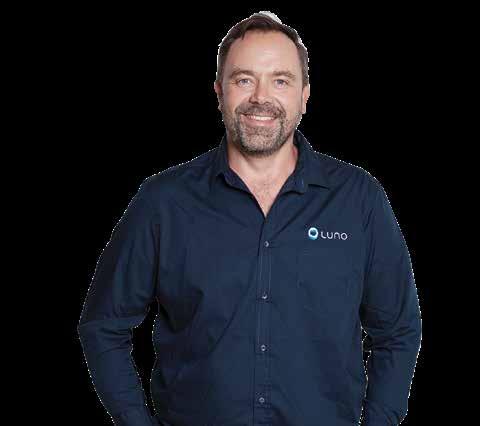
Stablecoins are cryptocurrencies pegged at 1:1 to fiat currencies that offer a haven of stability compared to volatile assets like Bitcoin. Dr Olivier says these serve multiple use cases rather than fitting neatly into a single category. “In jurisdictions experiencing meaningful fiat currency devaluation, they are increasingly used as a store-of-value and capital-preservation tool, particularly across parts of Africa. They also play an important role as a liquidity bridge, enabling seamless movement between volatile crypto assets and traditional financial systems. Looking ahead, as traditional finance becomes digitised and assets move onto interoperable blockchains,
stablecoins are likely to function as the connective tissue of the digital economy, combining the efficiencies of blockchain technology with price stability absent in most cryptocurrencies.”
Luno has been a key collaborator in the launch of the ZARU stablecoin (1:1 to the rand). Christo de Wit, Luno country manager for South Africa, says ZARU is designed to modernise South Africa’s payment and financial infrastructure by bringing the rand onto blockchain rails. “The immediate focus is institutional, enabling businesses and financial institutions to settle transactions instantly, at any time, without the lag of traditional banking channels. Each ZARU coin is fully backed by high-quality, rand-denominated assets, including cash, bank deposits and South African government bonds, and its reserves are audited monthly by Moore Johannesburg. This institutional-grade credibility makes ZARU viable as financial infrastructure.”
A similarly pragmatic development is tokenisation, which is basically a digital representation of a real-world asset, such as a bond, stock or property. It simplifies trading, provides immutable digital proof of ownership and facilitates fractional investment.
Meanwhile, de Wit says 40 000 South African customers have made an instant buy of tokenised stock on Luno. “Interestingly, this was the first Luno transaction for nearly ten per cent of these customers, showing that Luno is attracting a new segment: investors who see tokenised stocks as a simpler on-ramp to global equity exposure.”
Follow: Dr Wiehann Olivier www.linkedin.com/in/dr-wiehann-olivier-ca-sa-ra-7088b8143 Christo de Wit www.linkedin.com/in/christodigital
As digital assets mature globally, South African investors seek a regulated gateway meeting strict fiduciary investment standards locally. By MIDSQUARE CAPITAL
The global conversation about digital assets has shifted decisively. What was once dismissed as speculative enthusiasm has become a serious allocation question, driven by regulated products, maturing market infrastructure and an expanding universe of yield-generating strategies that exist nowhere in traditional finance.
Yet for South African wealth managers, family offices and qualified individuals, a practical problem persists. International platforms lack local regulatory licences, while local crypto exchanges often offer market access, but not the professional portfolio management required by substantial capital. Until recently, the governance, custody and compliance architecture that professional allocators demand has been absent from the local landscape.
MidSquare Capital was founded to close that gap. Established in 2023 in Cape Town, MidSquare is an owner-managed investment boutique holding Financial Sector Conduct Authority (FSCA) Category II and IIA licences as well as authorisation as a Crypto Asset Service Provider. It also combines full FSCA discretionary investment management licences with institutional-grade custody and independent fund administration.
The firm’s value proposition is rooted in the veteran judgement of its founders: Nersan Naidoo, Reece Briesies and Selwyn Pillay. As former management colleagues at Sanlam Investments, they collectively bring more than six decades of experience managing equity, fixed interest and private market portfolios globally. They say: “We did not leave traditional asset management because we lost faith in its principles. We left because we believed those
“WE DID NOT LEAVE TRADITIONAL ASSET MANAGEMENT BECAUSE WE LOST FAITH IN ITS PRINCIPLES. WE LEFT BECAUSE WE BELIEVED THOSE VETERAN PRINCIPLES WERE EXACTLY WHAT THE DIGITAL ASSET CLASS NEEDED.”
– MIDSQUARE CAPITAL FOUNDERS
veteran principles were exactly what the digital asset class needed.” Their transition to the digital asset space was driven by a conviction that this asset class would become a permanent feature of diversified portfolios (provided it was accessed through the same governance frameworks investors already trust).
In late 2024, this vision was endorsed when Fairtree Capital, one of South Africa’s most respected asset management firms, acquired a strategic minority stake in MidSquare. This partnership brings additional oversight and a level of professional validation that few early-stage managers can claim.
Today, MidSquare manages two distinct strategies, the Stable Return strategy and the Digital Frontiers strategy. Each is designed for a specific investor need, and both are managed through a single platform with shared, high-tier governance. Do not navigate the digital shift alone: leverage a team that has spent decades mastering the principles of capital growth.

INTERNATIONAL PLATFORMS LACK LOCAL REGULATORY LICENCES, WHILE LOCAL CRYPTO EXCHANGES OFTEN OFFER MARKET ACCESS, BUT NOT THE PROFESSIONAL PORTFOLIO MANAGEMENT REQUIRED BY SUBSTANTIAL CAPITAL.
For many investors, digital assets are still viewed through a binary lens: either you are fully exposed to extreme volatility, or you avoid the asset class altogether. MidSquare challenges this limitation with a structured approach that separates risk profiles into two distinct, purpose-built funds.
1. The Stable Return Strategy: designed for investors seeking steady, USD-denominated returns with reduced volatility. Domiciled in the British Virgin Islands, it targets high single-digit yields through over-collateralised lending and conservative stablecoin liquidity pools. Importantly, it avoids speculative exposure to crypto price movements and does not hold volatile tokens for directional gain. Instead, it focuses on earning yield from blockchain-based financial infrastructure while prioritising capital preservation. For allocators, the strategy behaves similarly to a short-duration secured credit fund, offering uncorrelated returns and monthly liquidity.
2. The Digital Frontiers Strategy: structured for qualified investors with a longer-term growth mandate. It provides exposure to established, large-cap digital assets, focusing only on tokens with market capitalisations above USD 500-million. This disciplined
• Stable Return Strategy: family offices with a capital preservation mandate, corporate treasuries looking for USD deposit alternatives, or wealth managers seeking a conservative entry into digital assets.

universe reduces speculative risk while maintaining participation in the sector’s structural growth. The strategy is further enhanced through active liquidity management, generating additional yield from core holdings.
Both strategies operate under a unified investment committee and are supported by Fireblocks’ institutional-grade custody infrastructure. This integrated framework ensures consistent governance, operational efficiency, and professional oversight across both risk profiles, giving investors a clear, structured way to access digital assets without unnecessary complexity.

• Digital Frontiers Strategy: investors with a medium-to-long-term conviction in digital growth and looking for a more robust risk profile who lack the time or infrastructure to manage it directly.
MidSquare’s founders have spent their careers building professional investment businesses, and they have constructed this firm to withstand the most rigorous due diligence.
All assets are held through Fireblocks, the gold standard for digital asset safekeeping. No single person at MidSquare holds a complete private key: every transaction requires multi-approver authorisation through preset, auditable workflows. This
architecture eliminates the single points of failure that have historically caused losses in the sector.
MidSquare engages independent administrators for net asset value calculation, investor record-keeping and fund accounting. These administrators independently verify holdings on-chain and calculate values using independent pricing sources. Segregating the valuation function from investment management is a cornerstone of the professional standards MidSquare maintains.
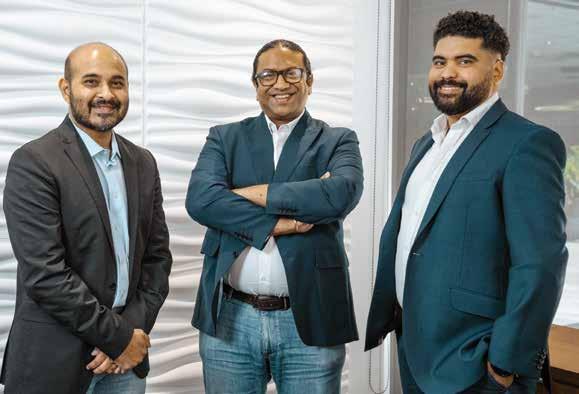
In traditional finance, “institutional-grade” is a precise standard of independent oversight, asset segregation and transparent reporting.
MIDSQUARE CAPITAL applies these exact standards to digital assets because the asset class is new, but the principles are not
MidSquare’s Financial Sector Conduct Authority licences are central to its operation. The firm undergoes annual compliance audits and embeds anti-money laundering and “Treating Customers Fairly” principles across the business. With a 25-year track record in financial services, the principals offer a level of fiduciary experience rarely found in this space.
“THE DIGITAL ASSET CLASS DOES NOT NEED MORE ENTHUSIASM. IT NEEDS THE SKILL AND JUDGEMENT OF EXPERIENCED FIDUCIARIES. THAT IS EXACTLY WHERE WE COME IN.”
– MIDSQUARE CAPITAL FOUNDERS
The founders have made significant personal co-investments in the funds they manage. Their financial incentives are aligned through equity ownership and performance fees structured with high watermarks. There are no hidden fees or side arrangements: just a commitment to delivering value to the investor.
“The digital asset class does not need more enthusiasm. It needs the skill and judgement of experienced fiduciaries. That is exactly where we come in,” say the founders.



MIDSQUARE CAPITAL was built for the investor who recognises the strategic importance of digital assets, but refuses to compromise on the governance and professionalism they expect from every other allocation in their portfolio
The decision to allocate to digital assets is increasingly a question of how, not if. The structural tailwinds (from growing regulatory clarity to expanding use cases for blockchain) are no longer speculative: they are observable market developments.
What has been missing in the local market is a manager that treats digital assets with the same seriousness and accountability as any other asset class. A manager where the people making decisions have decades of fiduciary experience, and where every process is documented, repeatable and subject to professional oversight.
MidSquare was built to be that manager. Whether your starting point is the Stable Return Strategy, seeking uncorrelated USD yield, or the Digital Frontiers Strategy, seeking growth exposure managed with rigour, MidSquare offers a professionally governed path forward.
The team welcomes conversations with wealth managers, family offices and qualified
investors who believe that digital assets deserve the same veteran treatment as any other component of a well-constructed portfolio. Stop navigating the complexity alone and start investing with a team that has the experience to guide you.


For more information:
MidSquare Capital (Pty) Ltd | FSCA FSP No: 53511 Category II & IIA | Crypto Asset Service Provider
Nersan Naidoo, CEO: nersan@midsquare.io
Reece Briesies, managing director reece@midsquare.io
Selwyn Pillay, chief information officer selwyn@midsquare.io www.midsquare.io Tomorrow’s assets. Today.
MidSquare Capital (Pty) Ltd is a licensed Financial Services Provider (FSP 53511) authorised by the Financial Sector Conduct Authority. This material is intended for qualified investors and does not constitute investment advice. Past performance is not indicative of future results. Digital assets carry inherent risks, including but not limited to price volatility, smart contract risk and regulatory change. Investors should consult their own financial, legal and tax advisors before making any investment decision.
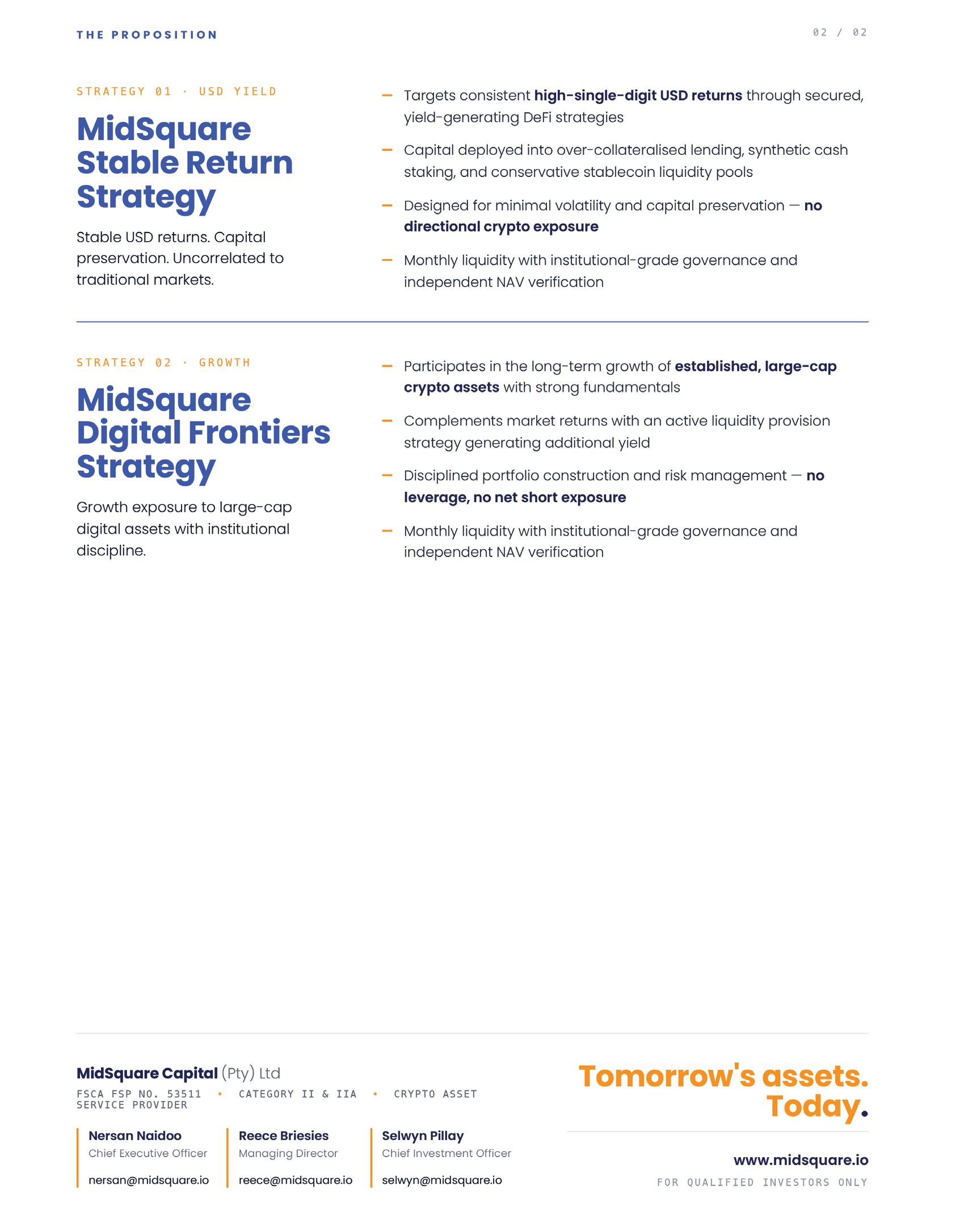
South Africa’s crypto market evolves from speculative trading towards regulated institutional liquidity, trust, compliance and integration. By
TREVOR KANA
South Africa’s crypto market is at an inflexion point. What was once a fragmented ecosystem driven largely by retail speculation is evolving into a structured market, underpinned by stronger infrastructure, regulatory oversight and growing institutional interest. At the centre of this evolution are local exchanges, which are playing a critical role in building trust, enabling liquidity and embedding compliance into the system.
Liquidity remains one of the most important foundations of any financial market. Without it, participation is limited, and pricing becomes inefficient. Callan Richardson, head of growth at Bitget Africa, explains that local markets are increasingly benefitting from global integration. “Bitget operates as a global universal exchange with strong daily trading volumes and deep liquidity,” he says. “Bitget South Africa benefits directly from this global infrastructure, allowing us to provide consistent liquidity and execution quality in the local market.”
However, the challenge is not demand. It is access. Richardson notes that the real constraint lies in reducing friction between local financial systems and global crypto markets. “The broader structural challenge is ensuring seamless integration between local fiat rails and global crypto liquidity,” he explains. As these access points improve, liquidity conditions are expected to strengthen further. Partnerships play a critical role in this process. Exchanges are increasingly working with banks and
payment providers to integrate digital asset infrastructure into existing financial ecosystems. “These partnerships improve accessibility and help deepen liquidity by bringing in more structured, institutional participation,” Richardson adds.
While liquidity enables participation, trust determines whether users are willing to engage in the first place.
Beatrix van der Spuy, consultant attorney at Thomson Wilks Attorneys, points out that trust remains one of the most misunderstood aspects of crypto. “The technology was built to remove the need for trust, yet most people engage with crypto through exchanges,” she says.
For van der Spuy, building trust requires more than branding. It requires transparency that users can verify. “Proof of reserves should be standard, not a differentiator,” she explains, emphasising the importance of ensuring client assets are held one-to-one. She also highlights the need for clear separation of client funds, visible security practices and fair dispute-resolution mechanisms.
“Trust in this space will not come from marketing,” she says. “It will come from systems that people can interrogate and verify for themselves.”
This is where compliance becomes a strategic advantage rather than a regulatory burden.

As South Africa’s regulatory framework continues to evolve, crypto organisations are being forced to rethink their compliance approach. Van der Spuy believes the most resilient players will be those who embed compliance into their design from the outset.
“The smarter approach is to treat compliance as part of the product,” she says. This includes proactively aligning with anti-money laundering standards, engaging regulators early and leveraging blockchain’s inherent transparency to monitor transactions.
Institutional players are reinforcing this shift. Rob Downes, head of digital assets at Absa Corporate and Investment Banking, highlights the importance of infrastructure in building trust at scale. “Bank-grade custody infrastructure is the cornerstone of safely and securely looking after digital assets,” he explains. By combining traditional banking expertise with crypto-native technology through partnerships such as Ripple, Absa is creating a more secure environment for participation.
Importantly, banks are not replacing exchanges. They are complementing them. “Local exchanges have built impressive businesses that meet the needs of consumers today,” Downes notes. As banks enter the market, they are expected to deepen liquidity and broaden access by integrating digital assets into familiar financial products and services.
Looking ahead, the convergence between traditional finance and crypto is expected to accelerate. Opportunities in tokenisation and cross-border payments are already emerging, with blockchain technology offering faster and more cost-effective alternatives to traditional systems.
Follow: Callan Richardson www.linkedin.com/in/callanrichardson Beatrix van der Spuy www.linkedin.com/in/beatrixvds Rob Downes www.linkedin.com/in/rob-downes-a970931


As crypto markets expand beyond traditional boundaries, African platforms and global players are unlocking new financial opportunities for the continent.
THANDO PATO explores the risks that lie behind regulation and fragmentation
The reality of borderless finance is nuanced. Crypto platforms operating across the continent are navigating a complex web of local regulations, compliance requirements and banking relationships, while trying to deliver global financial access to individuals and businesses.
For South African users, Luno has become one of the most accessible gateways to global crypto markets. “South Africans can access direct ownership of crypto assets –Bitcoin, Ethereum and others – held in their own wallet, not a fund or derivative. They also can send value across borders in minutes, at any time, without bank approval or SWIFT delays,” Christo de Wit, Luno’s country manager for South Africa.
Luno also offers fractional access to tokenised global equities from as little as R20, as well as crypto staking, where users lock up assets to earn a consistent yield. These are products that have historically been expensive, slow or entirely unavailable through local financial institutions.

Operating across multiple African markets means dealing with multiple, often conflicting, regulatory environments, an operational challenge for both entities.
“Across Africa, you are dealing with different regulatory approaches, data requirements, banking environments and different levels of market maturity. So, your compliance framework must be strong enough to operate across all of those simultaneously,” says Darko.
Gillian Darko, vice president of strategy at Yellow Card Financial, says their platform now focuses primarily on business-to-business infrastructure, providing stablecoin rails, liquidity access, cross-border settlement and treasury management solutions to banks, fintechs and enterprises operating across Africa.
“If you are a corporate institution, a bank, a fintech or an enterprise operating across multiple markets, what you need is treasury management solutions, access to liquidity, faster settlement and efficient cross-border payments. That is where stablecoin infrastructure comes in,” she explains.
It is important to distinguish between crypto as a technology and crypto as a regulated business, say de Wit and Darko. “Crypto at the protocol level is borderless. However, the businesses that make it accessible to everyone operate in specific jurisdictions with specific rules,” explains de Wit.
Darko says technologically, crypto is borderless, but operationally and legally, it is not. “Crypto is only as borderless as the compliance, regulatory alignment and banking relationships that sit around it.”
This is an important caveat for users to understand, says de Wit, who explains that trades on Luno are not operating in an unregulated space. “Luno is a licensed Financial Services Provider under South Africa’s Financial Services Conduct Authority (FSCA), so when a South African uses our platform, they are dealing with a regulated entity accountable to a local regulator. “
South Africa’s move to formally license crypto platforms through the FSCA has been widely welcomed, and De Wit says licensing has given Luno a clearer operating mandate, opened doors to institutional partnerships and built consumer trust.
Darko agrees, noting that South Africa’s formal framework is driving the market towards more institutional and disciplined behaviour.
Despite the complexity, Africa’s fragmented financial landscape is not just a challenge, but also an opportunity, says Darko.
“Sub-Saharan Africa remains the most expensive region in the world to send money to, with an average cost of 8.78 per cent in Q1 2025, according to World Bank data. That is exactly the kind of inefficiency that creates room for new rails,” notes Darko.
While borders may not have disappeared, they are being renegotiated, one jurisdiction at a time.

Follow: Christo de Wit www.linkedin.com/in/christodigital
Gillian Darko www.linkedin.com/in/ gillian-darko-6654b719
South Africa’s crypto market shifts from speculation to disciplined investing, and institutional integration growth continues, writes TREVOR KANA
With every boom and bust, the same question arises: has the cryptocurrency market finally outgrown its adolescent volatility and reached financial adulthood?
That question carries particular weight in a country where a weakening rand makes dollar-denominated assets attractive, and where a young, mobile-first population has both the appetite and the apps to start investing early. Such circumstances shape the crypto market in South Africa, and the people in it today are not the same ones who were there previously.
After Bitcoin hit an all-time high above $126 000 in late 2025 before plunging roughly 50 per cent from that peak in early 2026, the familiar pattern was repeated. Some investors exited. However, a closer look at who left, who stayed, and who quietly walked in, tells a more nuanced story about how South Africa’s crypto market is being rebuilt from a different type of participant altogether.
Those who left were always going to leave. Speculative retail investors who entered during the 2021 and 2022 peak, chasing short-term gains, found the prolonged volatility and tightening local tax transparency environment too uncomfortable to hold. Even some institutional players pulled back. According to Glacier Insights, digital asset treasury companies, which globally deployed nearly $50-billion into crypto during 2025, sharply slowed their buying after the fourth-quarter market contraction, redirecting capital toward share buybacks instead.
Yet the market did not evaporate, and in South Africa, this is especially evident in transaction data. Discovery and Visa’s SpendTrend26 report found that credit card-based crypto purchases among consumers shifted decisively away from large, irregular trades towards a pattern of
smaller, more frequent transactions, reaching around 2.5 transactions per active card user by 2025. This is not the behaviour of people chasing a rally. It is the behaviour of those who have made a decision and are executing it consistently, the same discipline a person might apply to a monthly debit order into a unit trust.
SOUTH AFRICANS WITH LONGER TIME HORIZONS AND HIGHER CONVICTION BEGAN TREATING DIGITAL ASSETS AS ONE LAYER WITHIN A BROADER PORTFOLIO
RATHER THAN AN ALTERNATIVE TO ONE.
That shift in behaviour reflects who stayed. Middle-income South Africans with longer time horizons and higher conviction began treating digital assets as one layer within a broader portfolio rather than an alternative to one. Sygnia’s analysis of Gen Z investment behaviour found that young South Africans, particularly men aged 18–29, are approaching crypto not as a gamble, but as a cornerstone of a broader wealth-building strategy, anchored by retirement products and supplemented by higher-risk digital positions. For many in this cohort, crypto was simply the most accessible entry point into investing.
That accessibility matters enormously. By mid-2025, 7.8 million South Africans, around 13 per cent of the population, were actively using major crypto platforms, according to the SpendTrend26 report. Mobile-first platforms with low minimum
investment thresholds meant that someone in Soweto or Brakpan could begin building an investment portfolio for less than the cost of a data bundle.
Institutions are also part of the new mix. The integration of crypto by traditional banks has brought it directly into the mainstream banking app ecosystem. Pick n Pay has introduced crypto payments at points of sale. These are not the moves of a fringe market. They are the moves of a market that has absorbed enough participants and enough pressure to start looking like part of the furniture.
A single narrative no longer defines the local crypto market. It is a blend of cautious adopters, long-term holders, new entrants and institutional players, all interacting in different ways. However, the market feels different; less noisy, more deliberate and increasingly integrated into how South Africans save, spend and invest.
That shift in behaviour may be the clearest sign yet that crypto is growing up, even if it still has a few mood swings left.


Since its introduction, crypto supporters have made bold claims about its future impact on international banking and economic systems. In South Africa, crypto was thrust into the limelight earlier this year when the National Treasury and the Financial Sector Conduct Authority (FSCA) announced it would be formally integrated into the country’s financial sector infrastructure.
The news was a signal that crypto is becoming mainstream, but what would be lost if crypto disappeared tomorrow? Is it an alternative to the traditional financial system?
“Asking what if crypto disappeared tomorrow is like asking what if the internet disappeared tomorrow. Once such technologies are discovered, the course of humanity changes forever,” says Farzam Ehsani, co-founder and CEO of VALR, one of South Africa’s largest crypto exchanges.
VALR, he says, currently processes billions of dollars annually, serves over 2 000 corporate and institutional clients, including banks, asset managers and insurers, and has become South Africa’s largest stablecoin platform by transaction volume. “Crypto assets are not yet as mainstream as they will be in the future. Over the last five years, we’ve seen customers start to think of and use crypto assets much more than just a speculative instrument,” he says.
However, Ehsani concedes that the market is still highly speculative, but only because it’s in its infancy. “There is a lot of experimentation, and much of that experimentation will come to nought, just as many early internet start-ups are nowhere
to be found today. But it’s difficult for me to imagine a future where crypto assets don’t play a pivotal role,” he explains.
He says that as crypto matures, it will rival traditional financial systems. “For the first time, digital value can be held by people and institutions without needing a financial intermediary. Most people don’t realise that this isn’t possible in the traditional financial system.”
According to the FSCA , when South Africa brought crypto asset service providers under the Financial Advisory and Intermediary Services Act (FAIS) in 2023, the priority was establishing a baseline of accountability. “Licensing ensures that entities with legitimate business models obtain the necessary authorisation to conduct their business and render financial services to clients in accordance with legislation,” says the FSCA.
The framework, it says, is aimed at enhancing fair outcomes and reducing harm to customers, and enforcement against those operating without authorisation. However, the framework in its current format has limits because unlicensed activity remains a persistent problem, and certain parts of the crypto ecosystem, nonfungible tokens, crypto mining and node operating, have been deliberately deprioritised and deferred for later regulatory consideration.
Currently, the FSCA does not distinguish between speculative and functional crypto activity when determining who needs a licence. “If an activity meets the definition of financial services under the FAIS Act, a licence is required, regardless of whether it serves a practical economic purpose or
Crypto is either the future of finance or an elaborate speculative experiment, depending on who you ask.
THANDO PATO speaks to VALR and the Financial Sector Conduct Authority to find out
exists purely to facilitate trading. Regulation follows form rather than function.”
As for the future of crypto, and what would happen if it disappeared. There was no direct comment from the regulator, which can be seen in a positive light as it means they take it seriously as an entity.
What is clear from the commentary is that the crypto ecosystem is still in transition –among regulators, exchanges and businesses –and that only time will show the endurance and true value of crypto.
Farzam Ehsani
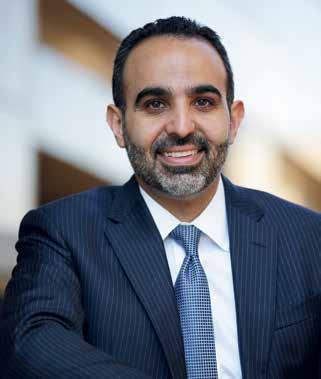
Follow: Farzam Ehsani www.linkedin.com/in/farzam-ehsani FSCA www.linkedin.com/company/fscasouthafrica
AFRICA BITCOIN CORPORATION uses Bitcoin-backed capital to fund underserved African SMEs while delivering scalable financial products and services
In the United States (US), a Bitcoin treasury company is, almost without exception, a financialised proxy for the price of Bitcoin. Investors hold the stock for upside on the coin. There is no operating engine underneath.
Africa Bitcoin Corporation (ABC), listed on the JSE under the ticker BAC, is the inverse of that model. Underneath the Bitcoin treasury sits a profitable, audited, cash-generative private credit business serving small and medium enterprises (SMEs) across Southern and Eastern Africa. The Bitcoin is not the product. The credit book is the product. Bitcoin is the mechanism that makes the credit book cheaper to fund, more competitive against banks, and accessible to international capital that would otherwise never lend into Africa.
This is what we call a Bitcoin-backed SME growth accelerator.
ABC is dual-listed and tradable on the JSE (BAC), the Namibian Stock Exchange (BAN), the OTCQB Venture Market in the United States (AFBCF), and on the Frankfurt Stock Exchange and other European venues (4BC). A secondary listing on the Aquis Exchange in London is in progress, with planned future listings in Botswana, Zimbabwe, Uganda, Nigeria and Eswatini. The multivenue strategy is deliberate: it gives investors in each market local-currency access to a single underlying asset, and it broadens the universe of capital available to fund the group’s African growth ambitions.
The group operates through two integrated engines. The first is the Africa Credit Opportunities Fund (ACOF), a CTSE-listed permanent capital vehicle issuing debt notes under a R5-billion DMTN (domestic
BALANCE SHEETS, DENOMINATED IN VOLATILE LOCAL CURRENCIES, ARE NOT ACCEPTED AS COLLATERAL BY GLOBAL LENDERS. WITHOUT GLOBALLY RECOGNISED COLLATERAL, AFRICAN ENTERPRISES PAY AN AFRICA PREMIUM ON EVERY RAND, NAIRA AND SHILLING THEY BORROW.
medium term note) programme. ACOF lends to vetted, secured SMEs across Africa at average yields of approximately 18 per cent. Loans are typically backed by two times cover in security, supplemented by personal guarantees and rigorous credit underwriting. In the financial year to 28 February 2026, ACOF had deployed R394.8-million across 50 loans to 44 businesses operating in 21 industries, supporting 2 084 jobs at an average cost of R189 449 per job.
Bad debts written off across the entire history of the platform stand at 0.09 per cent of book value. The comparable benchmark for US private credit funds in 2025, according to Reuters, was 9.20 per cent.
The second engine is Africa Bitcoin Strategies, ABC’s regulated Bitcoin treasury subsidiary. This entity holds the group’s Bitcoin reserves, originates the group’s Bitcoin-backed lending and yield products, and acts as the designated execution counterparty for international funding facilities.
Around these two engines, the group has built a wider suite of investment, advisory, retirement and insurance products that follow African entrepreneurs and their employees through every stage of the business life cycle.
Read the full investor materials at africabitcoincorporation.com
The structural problem facing African SMEs is well-documented. The International Finance Corporation estimates Africa’s SME funding gap at $320-billion. Banks across the continent prefer to lend to corporates and governments at risk-free yields of 10 to 12 per cent, leaving small businesses without bank credit. Nonbank lenders fill the gap at punitive rates: 28 per cent in South Africa, 34 per cent in Kenya, 49 per cent in Ghana, and as high as 84 per cent in Zimbabwe.
The result is a continent full of viable businesses that cannot raise growth capital at terms that allow them to survive, let alone scale.
The constraint is not credit risk; it is collateral. African balance sheets, denominated in volatile local currencies, are not accepted as collateral by global lenders. Without globally recognised collateral, African enterprises pay an Africa premium on every rand, naira and shilling they borrow.
Bitcoin solves this problem.
Bitcoin offers a mathematically fixed supply, no sovereign issuer, instant global settlement and verifiable proof of reserves. As collateral, it is liquid 24 hours a day, divisible, portable and easily held in multisignature cold storage with cryptographic proof. Institutional lenders in Switzerland,
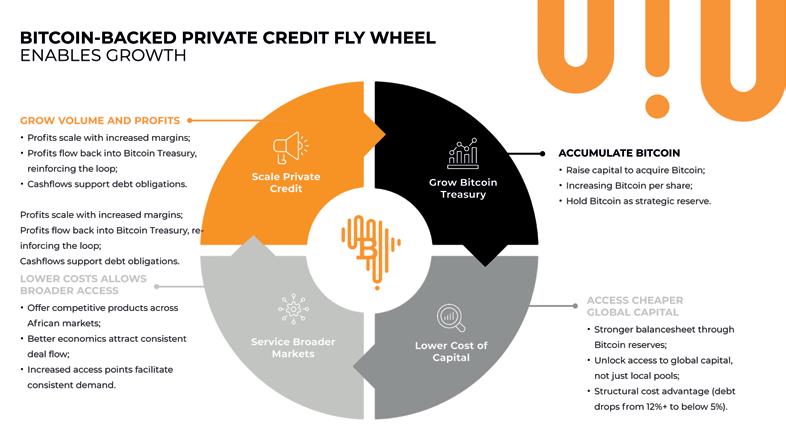
Japan and the United States are willing to extend loans against Bitcoin at loan-to-value ratios of up to 82 per cent and interest rates as low as 3 per cent. These terms are simply not available against any African collateral.
ABC’s approach to Bitcoin-backed borrowing is conservative. Loan-to-value is capped between 30 and 50 per cent, well below the 82 per cent liquidation threshold of the group’s most aggressive lender. Bitcoin would need to fall by 51 per cent from current acquisition levels before any collateral top-up becomes necessary. Even in that scenario,
the underlying SME loan book continues to generate predictable cash flow that is wholly independent of the Bitcoin price.
The economic effect is significant. Replacing 12 per cent rand-denominated debt with 5 per cent US dollar debt collateralised by Bitcoin reduces ABC’s weighted average cost of capital from approximately 15 per cent to 10 per cent. The cost of equity falls from 26 to 4 per cent. At the ACOF level, gross lending returns rise from 36 to 57 per cent before operating expenses, even while ABC offers SME borrowers more competitively priced facilities than its nonbank competitors. The borrower wins. ABC wins. The Bitcoin treasury grows.
The mechanics of the model are straightforward: ABC raises equity, acquires Bitcoin (BTC), raises cheap debt against that Bitcoin, deploys the proceeds as equity into ACOF, supports fund-level leverage at a 4:1 ratio, lends to SMEs at double-digit yields, distributes profits back to ABC, services the debt, and accumulates more Bitcoin. The cycle repeats. Each turn of the wheel grows both the credit book and Bitcoin per share.
Bitcoin changes the funding terms. It does not change the lending discipline.
ABC’s audited results for the year ended 28 February 2026 reflect the early operation of the model. The audit was completed without qualification by Forvis Mazars South Africa Incorporated, the group’s auditors.
Bitcoin treasury position
As at the most recent reporting date, ABC held 5.0246 BTC at an average acquisition price of $100 574, equivalent to 44 satoshis per share. The group’s market-to-net-asset-value
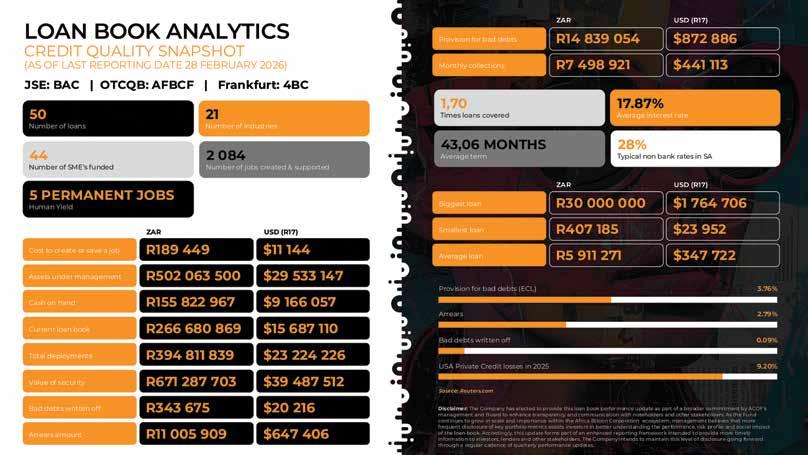
multiple stood at 40.89 times, and the trailing BTC Yield was 206.8 per cent. These statistics are reported live, with full transparency on holdings and acquisition history, on the ABC Treasury Dashboard accessible through the corporate website.
Loan book performance (audited, 28 February 2026)
Human Yield: the impact metric that matters ABC’s measurement of impact is captured in what the group calls Human Yield: the number of permanent jobs created per Bitcoin acquired. The current ratio is approximately five permanent jobs per Bitcoin. At a treasury size of 10 000 Bitcoin, the leveraged ACOF structure is capable of supporting in excess of 70 000 jobs. This is the long-term vision: African economic dignity, financed by the hardest money ever created.
Two new Bitcoin-linked retail products, administered through Africa Bitcoin Strategies, extend the platform to the rapidly growing universe of African Bitcoin holders. The Bitcoin
ABC’S MEASUREMENT OF IMPACT IS CAPTURED IN WHAT
THE GROUP CALLS
HUMAN YIELD: THE NUMBER OF PERMANENT JOBS CREATED PER BITCOIN ACQUIRED. THE CURRENT RATIO IS APPROXIMATELY FIVE PERMANENT JOBS PER BITCOIN.
Yield Generator allows long-term holders to earn a contractually agreed annual yield of up to five per cent, paid monthly, over a three- to five-year term, with the full pledged Bitcoin returned at the end of the term. The applicable rate depends on the number of Bitcoin pledged, the chosen term and prevailing market rates. Bitcoin is held with independent institutional
custodians, including Valr and Coinbase, with corporate support undertakings provided by ABC under formal governing documentation. ABC Bitcoin-Backed Lending allows clients to access rand and other fiat liquidity without selling their Bitcoin. Loans start at R500 000 with no upper limit, run for up to 4 years, and carry a fixed interest rate of between 8 and 10 per cent. Maximum initial loan-to-value is 50 per cent, with a 2 per cent once-off structuring fee and zero early repayment fee. Critically for South African clients, ABC issues a formal written confirmation that the Bitcoin was pledged as collateral and not sold, supporting clean SARS records and professional review. Apply for either product at africabitcoincorporation.com/bitcoin-products
More than capital: the full product suite ABC is not only a lender. The group has built a regulated suite of products that follows African entrepreneurs through every stage of their business and personal life cycle, and extends to their shareholders, their employees, and now to the broader population of African Bitcoin holders.
For SMEs, ACOF provides secured growth capital between R500 000 and R50-million at competitive yields. For early-stage businesses, Altvest Seed Capital and Altvest Venture Capital Opportunities provide higher-risk equity solutions.
For the founders and shareholders of those businesses, ABC offers investment products, retirement annuities and tax-efficient personal wealth structures. For their employees, the group is rolling out group insurance and employee benefit programmes, allowing growing businesses to compete with corporate employers for talent without having to build their own benefits infrastructure. For African Bitcoin holders, the Bitcoin Yield Generator and Bitcoin-backed lending facilities described earlier complete the product set. The principle is straightforward: one regulated, listed financial services group, meeting African SMEs, their owners, their employees, and their Bitcoin holders wherever they are on the growth curve.
Pan-African expansion through listings ABC’s growth strategy follows a clear sequence: list first, then operate. Each new market is entered through a secondary listing on the local exchange, which secures regulatory recognition, local-currency investor access, and the institutional credibility required to build a
sustainable local credit book. The South African operating model, secured SME lending with conservative loan-to-value and rigorous credit underwriting, is then localised in each market.
The pipeline currently in progress includes the Aquis Exchange in London, the Botswana Stock Exchange, the Victoria Falls Stock Exchange in Zimbabwe, the Uganda Securities Exchange, the Nigerian Exchange, and the Eswatini Stock Exchange. Across these six initial target markets, the combined SME credit gap is approximately $37-billion against more than $50-billion of investable institutional capital that is required by regulation or convention to remain onshore. Local pension and insurance portfolios are dominated by fixed-income instruments, leaving substantial room for listed private credit vehicles that meet domestic-asset quotas while delivering uplifted yields. This is precisely the structural gap that ACOF’s listed DMTN programme is designed to fill.
Leadership and the current raise
Warren Wheatley CA(SA) CFP, founder and CEO, is a chartered accountant with over 15 years in institutional investments and chairman of the Telkom Retirement Fund Investment Committee. Stafford Masie, director of Bitcoin strategy, is the former country manager of Google South Africa and a board
THE GROUP HAS BUILT A REGULATED SUITE OF PRODUCTS THAT FOLLOWS AFRICAN ENTREPRENEURS THROUGH EVERY STAGE OF THEIR BUSINESS AND PERSONAL LIFE CYCLE.
member of Discovery Bank and ADvTECH. Dr Saifedean Ammous, internationally bestselling author of The Bitcoin Standard, serves as Bitcoin strategy advisor. The board is chaired by Norma Sephuma, with Robin Coode CA(SA) chairing the Audit and Risk Committee. Forvis Mazars are the group auditors. Questco is the JSE-designated advisor.
ABC is in market with a R20-million capital raise (2 million shares at R10.00), alongside a recently announced $100-million Bitcoin-backed lending facility with Galaxy Digital. Proceeds will fund the acquisition of approximately 100 Bitcoin, the pan-African listings programme, and the rollout of ABC’s Bitcoin-linked retail products.

SCAN THIS QR CODE TO GO TO THE AFRICA BITCOIN WEBSITE

For more information:
Website: africabitcoincorporation.com
Investor relations: warren@africabitcoincorporation.com
General enquiries: info@africabitcoincorporation.com
Treasury dashboard: africabitcoincorporation.com/treasury
IMPORTANT NOTICE: This is a paid advertorial and does not constitute investment advice or an offer of securities. Past performance is not indicative of future results. Africa Bitcoin Corporation Limited (reg. 2021/540736/06) is listed on the JSE AltX, A2X, OTCQB, Frankfurt, and NSX. ACOF debt notes are listed on the CTSE (NCRCP18241). Africa Bitcoin Strategies (Pty) Ltd is a registered credit provider and Juristic Representative of CAEP Asset Managers (FSP 33933). Advice is rendered by Altvest Wealth (Pty) Ltd (FSP 45810). The Bitcoin Yield Generator is a structured lending arrangement, not a bank deposit, and is not protected by deposit insurance. Bitcoin is volatile. Obtain independent advice before transacting.
The borrower posts Bitcoin (BTC) as collateral and receives fiat or stablecoin liquidity, typically at 30 to 60 per cent loan-to-value. The BTC remains the borrower’s economic property, and upside exposure is retained. Interest charges range from 6 to 12 per cent, depending on the lender, term and loan-to-value (LTV). The borrower is then free to deploy the capital to other income-generating opportunities.
The decisive variable is whether the lender rehypothecates the collateral.
In a nonrehypothecated structure, the BTC sits in segregated custody, usually with a qualified custodian, and the borrower can verify the addresses on-chain. The lender earns the spread between funding cost and loan coupon. This is the institutional standard and the model we operate at Africa Bitcoin Corporation.
In a rehypothecated structure, the lender pledges the same BTC into onward financing. Coupons are lower because the lender earns secondary yield. Borrowers in 2022 discovered the cost. When Celsius, BlockFi and Genesis failed, collateral that customers believed was theirs became unsecured claims in bankruptcy. Lower rates do not compensate for unrecoverable principal.
Strategy’s STRC and similar instruments package a variable dollar coupon onto an issuer whose underlying balance sheet is Bitcoin. These yields, at 11.5 to 13 per cent, are materially higher than other fixed income products available in developed markets.
The principal is fixed in dollars. The holder accepts inflation erosion of capital in exchange for a current coupon. Over a multiyear horizon, with the dollar losing purchasing power against Bitcoin at historical rates, the par-value trap could be severe if
Bitcoin holders face a question gold holders never had to answer: how to make a nonyielding asset productive without compromising the properties that give it value? The market has produced several answers. Writes WARREN
or pool, and earns rewards paid in the protocol’s native token. Three layered risks apply. Bridge risk, where wrapped BTC depends on a custodian or multisignature set that can fail or be exploited. Smart contract risk, where the staking logic itself can be drained. Token risk, where rewards are denominated in assets that frequently lose value faster than the yield accrues.
WHEATLEY founder and CEO of
Africa Bitcoin Corporation
there is no reinvestment cadence. The instrument suits short-duration cash management or retirees looking to enhance their monthly cash flows. Not suitable as a growth asset, but has a place in any balanced portfolio.
Bitcoin’s base layer is proof-of-work and offers no native staking. The Layer 2 yield landscape, however, splits into two materially different categories that the market routinely conflates.
The first is Lightning Network routing. Lightning is Bitcoin’s native payment channel network. A node operator commits BTC into bidirectional channels and earns routing fees on payments that flow through those channels. The BTC never leaves the holder’s control. Private keys remain with the operator, and unilateral exit to an on-chain address is guaranteed by the protocol itself rather than by counterparty co-operation. Yields are typically modest, and the discipline is operational rather than financial, but the structure is the closest thing to genuine Bitcoin-native yield available today. The second category is the wrapped-asset protocols. The holder wraps BTC into a bridged asset, locks it into a validator

This category includes our Bitcoin Yield Generator at Africa Bitcoin Strategies, alongside offerings from Galaxy Digital, FalconX, Cantor Fitzgerald, and various institutional desks. The strategies typically combine covered calls, cash-secured puts and structured collars over BTC positions. A zero-cost collar removes downside below a defined floor in exchange for capping upside above a defined ceiling.
The economics are transparent when the strategy is run on segregated client BTC under an operational deployment mandate. The principal risks are operational and counterparty, not market.
Every yield structure on Bitcoin trades one of three things: control of the asset, exposure to the upside or counterparty solvency. A holder who understands which trade they are making, and at what price, can earn yield rationally. A holder who does not will discover the cost in the next cycle.
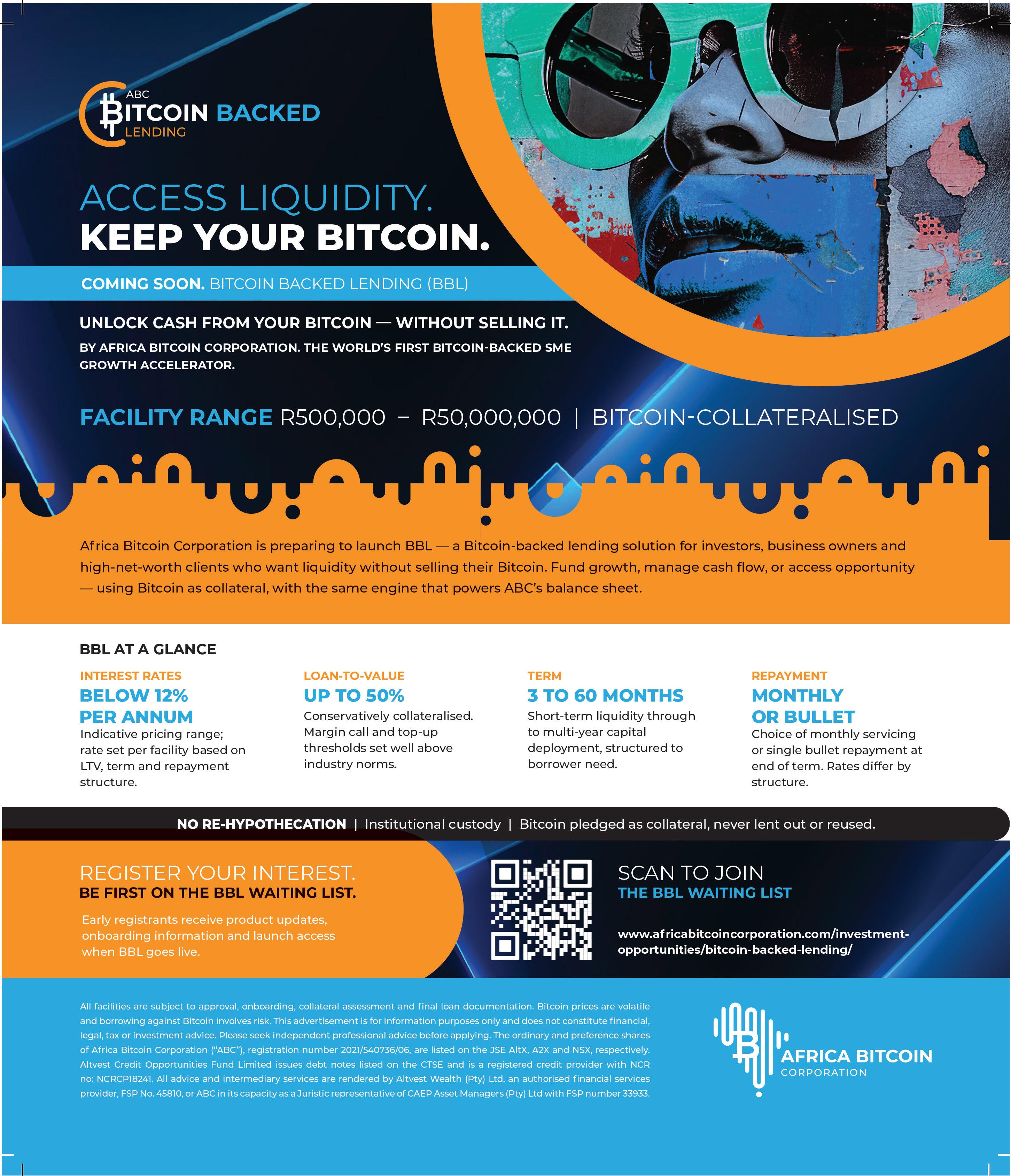

Stablecoins are being integrated into global financial systems, presenting opportunities, but also risk if not handled correctly.
Dr WIEHANN OLIVIER , partner and global co-head of digital assets at Forvis Mazars, unpacks South Africa’s readiness
For years, stablecoins were treated as a side story in the cryptocurrency conversation – useful for traders, interesting to technologists, but largely irrelevant to mainstream finance. That perception has changed, quietly but decisively. Stablecoins are no longer sitting on the periphery of digital assets. They are increasingly becoming part of the underlying plumbing of the global financial system.
Today, stablecoins are embedded in payment flows, treasury operations, liquidity management and cross‑border settlements. They are being integrated into asset managers’ operating models and banks’ infrastructure stacks. In many cases, users do not even realise they are interacting with blockchain technology – often the clearest sign that a technology has matured.
At their core, stablecoins are a simple concept. For every unit of fiat currency received by an issuer, a corresponding digital representation is issued on a blockchain. The innovation is not the money itself, but the rails on which it moves. Blockchain technology allows money to move globally, near‑instantly, around the clock, with programmability layered on top, but without the price volatility associated with traditional cryptocurrencies.
This is why stablecoins are increasingly seen not as speculative crypto products, but as financial infrastructure.
It is also why the conversation has shifted away from start ups and into boardrooms. Globally, banks, asset managers and regulated financial institutions are no longer asking whether stablecoins are relevant. They are asking how they fit within existing operating, risk and regulatory frameworks.
At Forvis Mazars, we have been working with virtual asset service providers and blockchain‑based digital assets for several years – well before stablecoins became part of the mainstream regulatory conversation. Through our assurance, advisory and consulting teams, we have developed deep, hands‑on experience across custody structures, reserve frameworks, governance models, disclosures and independent attestations. That experience spans both crypto‑native firms and traditional financial institutions navigating this transition.
What has become particularly clear over the past year is how quickly stablecoins are converging with traditional finance. Asset managers are exploring tokenised instruments that settle using stablecoins. Banks are piloting blockchain‑based payment rails. Stablecoins are increasingly used as a bridge between legacy systems and new digital infrastructure, blurring the line between “crypto” and traditional finance.
This convergence creates opportunity — but it also creates risk if not handled correctly.
In South Africa, the technology and use cases are already present. We have sophisticated banks, deep capital markets and well‑established financial infrastructure. Stablecoins address real challenges in cross‑border payments, settlement inefficiencies and access to global markets. From an operational perspective, South Africa is more ready than many appreciate.

WHAT HAS BECOME PARTICULARLY CLEAR OVER THE PAST YEAR IS HOW QUICKLY STABLECOINS ARE CONVERGING WITH TRADITIONAL FINANCE.
Where uncertainty remains is regulation. The absence of a clear stablecoin regulatory framework creates hesitation among serious market participants. Regulation is often framed as a constraint, but in reality, it provides protection, certainty and confidence. It enables banks and asset managers to participate responsibly and separates credible projects from higher‑risk experimentation.
Importantly, South Africa does not need to start from scratch. The Intergovernmental Fintech Working Group has already identified the key risks: reserve transparency, segregation of client funds, governance conflicts, redemption rights and prudential oversight. These are the same issues regulators in Europe and the United States addressed through frameworks such as MiCA and the GENIUS Act. The blueprint already exists.
At Forvis Mazars, much of our recent work has focused on bridging this gap: helping traditional financial services players engage with stablecoin‑based models in a way that aligns with emerging global standards. By applying established assurance methodologies, governance frameworks and risk disciplines to blockchain‑based assets, we provide institutional stakeholders with the level of comfort they expect in traditional finance.
Stablecoins are no longer an experiment. They are becoming part of how the financial system operates. The plumbing is being laid, often out of sight, but with long‑term consequences. The key question for South Africa is whether we engage early, shape responsibly, and integrate confidently, or wait and adapt after the system has already been built elsewhere.
While Bitcoin grabs the attention, stablecoins are quietly becoming the infrastructure that moves money across Africa, writes TIANA CLINE
While speculative crypto assets draw attention from investors and regulators, stablecoins –digital assets designed to hold a fixed value against a reference currency – are being adopted as a practical answer to payment problems the traditional banking system has not solved. “Stablecoins have kept the advantages of blockchain, the decentralisation and the embedded programmability, but they got rid of the big problem with crypto – volatility,” says Dare Okoudjo, founder and CEO of Onafriq, one of Africa’s largest digital payments networks. Where mobile money gave people a way to transact digitally within their own borders, stablecoins take that same reach global and back it with the dollar. “If stablecoins had started with a currency like the Malawian kwacha, few people would have noticed,” Okoudjo says. “Tying them to the US dollar (USD) combines the power of mobile money with a currency that’s globally tradable.”
“THE VALUE PROPOSITION OF A STABLECOIN IS HEDGING AGAINST THE VOLATILITY IN THE MARKET.”
– GILLIAN DARKO
One of stablecoin’s most important use cases is invisible to the end user. Money transfer companies have traditionally settled remittances in batches, through the banking system, bound by cut-off times. Stablecoins make settlement continuous, which cuts the working capital providers need to hold and reduces costs for the sender. “Operating a business in Africa comes
with its unique challenges,” says Gillian Darko, group vice president of strategy at Yellow Card, a licensed stablecoin infrastructure provider. “You need a technology, a new payment rail, to have an answer and solution for those unique challenges that are very different from any other part of the world.”
Currency volatility is the other major driver of stablecoin uptake. In markets where devaluation is the norm, people aren’t chasing yield or speed so much as a way out of a weakening currency. “At the end of the day, the value proposition of a stablecoin is hedging against the volatility in the market,” says Darko. Stablecoins give them a simple, app -based route into dollars without moving money offshore. “Some are willing to pay a premium to get into USD Coin or Tether (USDT),” Okoudjo adds, “because they trust the dollar more than they trust the local currency.”
Stablecoins carry risk on two fronts. Issuer transparency and collateralisation is one because even a ‘stable’ coin is only as sound as the reserves and institutions behind it. The deeper worry is whether dollar-pegged dominance, at scale, quietly hollows out domestic monetary sovereignty and local banking resilience. “If the only option to benefit from stablecoin is a USD-based one,

then there is a risk that the savings of the country effectively move into dollars,” Okoudjo says. It is one reason regulators across the continent are exploring domestic stablecoin frameworks pegged to local currencies. Botswana enacted virtual assets legislation in 2022, South Africa’s Financial Sector Conduct Authority had approved 310 of 533 licence applications early in 2026, and Kenya and Ghana are moving in the same direction. “Innovation starts before regulation,” Darko says. “What you are seeing now is the market formalising itself.”
In South Africa, several regulated providers already give businesses access to stablecoin rails, and local banks are developing stablecoin strategies for intra-Africa transfers and treasury management. However, for Okoudjo, the most significant shift will come when those rails disappear from view entirely, something he jokingly calls a ‘crypto mullet’ – a normal banking interface at the front, stablecoin settlement running silently at the back. “It’s the same way that today you don’t need to understand how SWIFT works,” he explains. “We’re getting to a point where the technology is hidden, and what you want is just to move or receive money.” Beyond speed and cost, one of the most exciting aspects of stablecoin is that it sits on programmable infrastructure. On a blockchain, smart contracts can restrict how money is spent, who receives it and when. “Once money is programmable, you’re not just moving it faster and cheaper, you’re changing what money can actually do,” says Okoudjo. At that point, stablecoins stop looking like a trade and start looking like the settlement layer beneath how money is held and moved.

While humanity has become increasingly connected through travel and communication technologies, our existing financial system often works to perpetuate divisions. VALR aims to change this

VALR’s vision is to build a global financial ecosystem that champions justice and embodies the unity of humankind. By harnessing the power of innovative financial technologies, such as crypto and blockchain technology, it is working to create pathways to prosperity that transcend borders and barriers.
At the heart of this aspiration lies VALR’s slogan: “Crypto For Everyone,” which acts as a call to democratise access to financial products and services. Imagine a world where a smallholder farmer in rural South Africa can seamlessly participate in global markets, where entrepreneurs can secure funding without the constraints of traditional banking, and where institutional investors navigate crypto assets with the same confidence they apply to conventional portfolios. VALR is committed to realising this reality, helping seasoned financial leaders as well as those taking their first steps into crypto.
For leaders at financial institutions, VALR’s vision offers a strategic imperative. Crypto
assets represent the next frontier in financial innovation, promising enhanced efficiency, reduced costs and unprecedented transparency. VALR’s platform integrates cutting-edge blockchain solutions with robust security protocols, enabling institutions to diversify their offerings and utilise VALR’s infrastructure to provide
new crypto offerings to their customers. To this end, three of the largest banks in South Africa, as well as leading financial institutions and asset managers, have already chosen VALR as a partner. The company also collaborates with regulators and industry bodies to ensure compliance while pushing the barriers of what is possible, fostering an environment where traditional finance and crypto assets converge.
Yet, its aspiration extends far beyond institutional corridors. For newcomers to crypto, VALR provides an intuitive gateway, demystifying complex concepts through educational resources, user-friendly interfaces and personalised support. Crypto enthusiasts, meanwhile, will find in VALR a vibrant ecosystem enabling both simple and advanced trading strategies.
Ultimately, VALR’s vision is about advancing the economic life of humanity through an inclusive and empowering financial system. VALR invites leaders, novices and enthusiasts alike to join it in this journey. Together, we can redefine economics, ensuring that finance truly serves everyone, everywhere.

VALR’S PLATFORM INTEGRATES CUTTING-EDGE BLOCKCHAIN SOLUTIONS WITH ROBUST SECURITY PROTOCOLS, ENABLING INSTITUTIONS TO DIVERSIFY THEIR OFFERINGS AND UTILISE VALR’S INFRASTRUCTURE TO PROVIDE NEW CRYPTO OFFERINGS TO THEIR CUSTOMERS.
• 1.8M users, 100-plus crypto assets, 1 world.
• Crypto assets, including Bitcoin, Solana and XRP.
• Real-world assets, including tokenised US stocks, gold and private credit.
• Crypto bundles, including VALR10 and BitGold, for instant diversified exposure.
• 1 of the top 10 largest minters of USDC globally.
• Deepest markets for USD stablecoins in South Africa.
• Largest ZAR-denominated crypto markets in the world.
• Support for USD, EUR, GBP and 150-plus local currencies, including Mobile Money.
VALR was founded in 2018 and is headquartered in Johannesburg, South Africa. It is licensed and regulated by the Financial Sector Conduct Authority (FSCA).
• Simple buy and sell: buy and sell crypto and fiat easily using our swap terminal.
• Spot trading: access deeply liquid spot markets for a wide range of crypto assets, ensuring best price execution with advanced order types and real-time tools.
• Spot margin trading: amplify your exposure with up to 10 times leverage on spot markets, allowing traders to maximise potential returns while managing risk.
• Futures trading: trade perpetual futures contracts with up to 60 times leverage, providing advanced strategies for hedging and speculation in volatile markets.
• API trading: integrate with VALR for a world-class trading experience, featuring institutional-grade application programming interfaces (APIs) with real-time data, high rate limits and seamless automation.

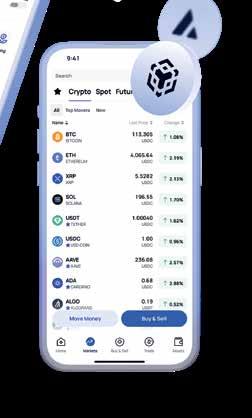
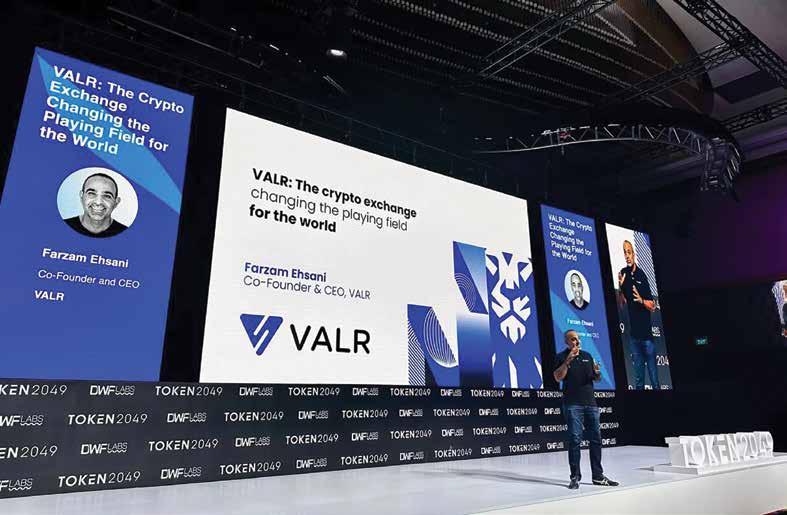
• OTC desk: trade in bulk across fiat and crypto assets, benefitting from competitive rates, personalised service and efficient large-volume executions.
• Staking: earn yield with VALR’s easy-to-use liquid staking solutions, simplifying the process while maintaining liquidity and security for your assets.
• Lending: generate yield through the on-platform and on-chain lending solutions, offering flexible options to lend crypto and earn competitive returns.
• Shared accounts: Collaborate securely with team members by granting customisable access levels, including view-only, trade, withdrawals and API key creation, supported by audit trails and multiparty approvals.
• Unlimited subaccounts: create unlimited subaccounts to organise and manage multiple portfolios or strategies independently, each with separate balances and transaction histories.
• VALR Pay: pay with VALR at over 700 000 locations across South Africa, and send or receive money globally without fees, facilitating instant, borderless transactions.
VALR offers flexible solutions designed for businesses and institutions, empowering corporate clients to navigate the digital asset landscape with confidence and efficiency. Licensed by the FSCA and with regulatory approval in Europe, VALR serves over
2 000 corporate and institutional clients worldwide, alongside 1.8 million registered users. VALR’s platform combines cutting-edge technology, robust security and dedicated support to meet the demands of sophisticated investors, treasuries and financial entities.
• OTC desk: execute large-volume trades across fiat and crypto assets with competitive rates, personalised service and minimal market impact. Ideal for institutions seeking discreet, efficient transactions.
“IN A TIME OF GLOBAL CONFLICT AND ECONOMIC UNCERTAINTY, WE SEE BLOCKCHAIN TECHNOLOGY AND CRYPTO ASSETS NOT AS A RIVAL TO TRADITIONAL FINANCE, BUT AS A BRIDGE TO A MORE EFFICIENT AND EQUITABLE SYSTEM FOR ALL.” – FARZAM EHSANI


API First platform: leverage VALR’s institutional-grade API for seamless integration into the exchange, custody and payments products, featuring real-time and historical market data, high rate limits and advanced automation. This enables algorithmic trading, portfolio management and custom strategies at scale.
• Institutional governance controls: facilitate secure collaboration with customisable permissions for multiple account users, including view-only, trade, withdrawal and API key access. Supported by audit trails and multiparty approvals, this ensures security, good governance and compliance for large teams.
• Unlimited subaccounts: Organise clients, multiple portfolios or strategies independently under a master account, each with distinct balances, deposit addresses and transaction histories, streamlining operations for complex institutional needs. Whether you are building your own crypto products for your clients, optimising treasury management, hedging currency risks or integrating stablecoins into your business, VALR provides a secure, compliant and borderless ecosystem that aligns with your strategic goals.
Join leading institutions in shaping the new digital asset era.


For more information: business@valr.com www.valr.com/business
Disclaimer
Trading or investing in crypto assets is risky and may result in the loss of capital as the value may fluctuate.
VALR (Pty) Ltd is a licensed financial services provider (#FSP 53308). Futures trading is provided by VALR DAM Pty Ltd as a Juristic Representative of CAEP Asset Managers Pty Ltd (FSP number: 33933), an authorised financial services provider.
Dear Readers,
When we founded VALR in 2018 in Johannesburg, our vision was simple: to help build the future of finance with new technology and the recognition that the world deserves a financial system that reflects the oneness of humanity. It was apparent from my background in traditional finance that our prevailing financial system remained (and still remains) fragmented, slow and expensive. Over 95 per cent of the world’s money is digital, and there is no reason that moving money shouldn’t be as simple and fast as sending an email. We set out to harness blockchain technology and crypto assets as a tool for unity and progress.
Little did we imagine that, within a few years, VALR would become South Africa’s (and Africa’s) largest crypto exchange by trade volume, with over 1.8 million sign-ups and serving more than 2 000 corporates and institutions globally. Milestones like crossing one million downloads on the app store to raising a $50-million funding round in 2022, backed by giants such as Pantera Capital, Fidelity’s F-Prime and Coinbase Ventures, to our dual CASP licence from the FSCA have all confirmed the path we’re on.
Today, the world stands at a pivotal juncture. Tectonic shifts are reshaping how we operate, govern and connect. The internet has already dissolved many barriers, yet our financial infrastructure lags behind, perpetuating divisions that don’t serve humanity. The world at large, and finance in particular, is inexorably moving toward a system that is borderless and inclusive. However, there is much work to be done.
At VALR, we prioritise building our platform based on a foundation of transparency and trust, enabling financial institutions, corporates and individuals to seamlessly enter this future of finance: from fast and cheap payments, access to new asset classes and digital asset custody to white-glove service on our OTC desk. Our success stems from our commitment to values and from collaboration. In a time of global conflict and economic uncertainty, we see blockchain technology and crypto assets not as a rival to traditional finance, but as a bridge to a more efficient and equitable system for all. Looking ahead, I am optimistic. While we see the disintegration of many traditional institutions and systems in every domain of human endeavour, we are also seeing the forces of integration build better and brighter institutions and systems for humanity.
The rise of AI and its convergence with the movement of internet-native digital assets will unveil a world that is unimaginable to many of us now. The world deserves a universal and uniform system of currency, and the future reserve currency may well be cryptographic, enabling instant, low-cost transfers that benefit all.
VALR is committed to this transformation, merging innovation with integrity to advance human civilisation. We cannot do it alone. We invite everyone, from institutions and businesses to individuals to join us. Whether you are a seasoned leader in finance or a newcomer exploring crypto, get in touch and partner with us. We’d love to serve you.
Warm regards,
Farzam Ehsani CEO and co-founder, VALR

Farzam Ehsani
Blockchain’s most practical application isn’t currency; it’s access, and tokenisation is beginning to prove it. By
TIANA CLINE
Tokenisation has been more concept than capability. What is changing now is that the infrastructure to make it work is being built, and in South Africa, the use cases are moving from pilot to practice. When Luno launched tokenised stocks in 2025, nearly 50 000 customers made a purchase in the months that followed, and close to 10 per cent of them were transacting on the platform for the first time. The infrastructure underneath that access is anything but simple. Legal structures, custody arrangements, smart contract logic and cross-jurisdictional compliance all have to work together before a token can be trusted.
“The genius lies behind the complex infrastructure that makes it work,” says Christo de Wit, Luno South Africa country manager. In other words, the token a user sees is the surface.
and predictability improves, we can then progressively explore more advanced models like tokenising future harvests … but only once the underlying risk is better managed.”

Liquidity is the structural problem tokenisation has not yet solved, and unlike Bitcoin and Ethereum, tokenised real-world assets have no deep market to fall back on. “Access alone is not enough if liquidity disappears outside core trading hours or if price discovery becomes inconsistent across venues,” explains Gracy Chen, Bitget CEO. “Without that, tokenisation becomes a digital wrapper rather than a functional market.”
Pretty Kubyane is the tech lead and co-founder of eFama, a South African agritech marketplace using blockchain to bring smallholder farmers into formal supply chains. “From our perspective, the most practical and immediate opportunity is tokenising contracts and invoices, not the crops,” she says. Our approach is to first introduce farmers to consistent markets and formal trading structures, as that stability enables them to start investing in better infrastructure over time. As that happens
For Kubyane, tokenisation could also open the door to fractional participation in agriculture. “Even agritech start-ups often face difficulty securing funding,” she says. “Tokenisation introduces the possibility of democratising access to this asset class, allowing smaller investors to participate in a way that was previously not practical.” At the same time, she says tokenisation should be approached carefully because farming is not a purely financial instrument. “Our focus is firstly to build a foundation of structured trade, verified performance and consistent market access,” Kubyane explains. “As that foundation strengthens, tokenisation could evolve into a way for individuals, including professionals transitioning later in their careers, to gradually participate in agriculture with better visibility and lower entry barriers.”
Beyond agriculture, property and commodities are the obvious next frontier. Direct property ownership is out of reach for most South Africans, and fractional tokenised property could open the country’s primary wealth-building asset class to people priced out of it. “Despite producing the majority of the world’s platinum group metals, South Africa has limited mechanisms for local retail investors to participate,” de Wit adds. Tokenisation could change that.
South Africa is better positioned than many markets. The Financial Sector Conduct Authority has been deliberate in its approach to crypto regulation, and the licensing framework has provided meaningful certainty, but there’s one piece of legislation holding the market back. Board Notice 90 effectively prevents unit trusts and institutional funds from holding digital assets. “If the big pension funds and asset managers can’t legally hold tokenised assets,” de Wit says, “the market will never have the liquidity it needs to be mainstream.”
For exchanges operating across multiple markets, inconsistent regulation adds another layer of complexity. “Regulatory fragmentation means global exchanges cannot operate with one identical model everywhere,” Chen adds. “Product access, onboarding standards, custody arrangements, disclosures and entity structures often need to be adjusted market by market.”

In Africa, stablecoins, cross-border transfers and mobile-first access to digital markets have already shown that utility drives uptake faster than product sophistication. “In markets like Africa, adoption accelerates when tokenisation solves real frictions – not when it simply mirrors traditional assets on a blockchain,” says Chen. “Utility is the driver, and infrastructure is what makes that utility possible.”
Follow: Pretty Kubyane www.linkedin.com/in/prettykubyane Christo de Wit www.linkedin.com/in/christodigital www.linkedin.com/in/gracychen
Banks and crypto platforms move from avoidance to collaboration, reshaping access, regulation and the future of finance, writes TREVOR KANA
Not long ago, the relationship between traditional banks and crypto platforms in South Africa was defined by caution, and in many cases, outright avoidance. Concerns around regulation, compliance and risk led many financial institutions to distance themselves from the sector.
Today, banks are inviting crypto firms over for a braai.
As regulatory clarity improves, banks and crypto platforms are beginning to find common ground, moving from uncertainty to selective integration. This shift is reshaping how digital assets are accessed and managed, and also redefining the future of financial services in South Africa.
For crypto platforms, the change has been tangible. Christo de Wit, Luno country manager for South Africa, says: “There has been a noticeable improvement in account access across major banks compared to only a few years ago when the majority of banks completely derisked from the sector.” While progress has been made, he cautions that access remains uneven. “There is still a long way to go before unrestricted access is granted for the entire industry,” he says, highlighting that some banks still require crypto-related transactions to be “whitelisted”.
A key driver of this shift has been the formal recognition of crypto assets within the country’s regulatory framework. The introduction of licensing requirements for crypto asset service providers by the Financial Sector Conduct Authority has provided a foundation for engagement and collaboration between banks and crypto platforms.
Hylton Kallner, chief executive officer of Discovery Bank, says: “Regulatory clarity has been the single greatest catalyst for our entry into this space.” He points to the period between 2019 and 2020, when many banks withdrew from crypto due to a lack of legal certainty. “With that foundation in place, we moved decisively into the space,” he explains, referencing the bank’s partnership with Luno, which enables Discovery Bank clients to invest in digital assets directly through the app.
Despite this progress, compliance remains central to the relationship between banks and crypto platforms. De Wit emphasises that Luno has long operated with strict controls, noting that the company “has always operated as if fully regulated”, even before formal licensing.
From a banking perspective, these controls are non-negotiable. Kallner explains: “Discovery Bank applies the same rigorous AML (anti-money laundering) and KYC (know your customer) protocols to our crypto integration that we apply to traditional finance,
monitoring tools, including real-time behavioural analysis to detect unusual or potentially fraudulent transactions.
Risk, however, has not disappeared. It has evolved.
“Initially, the challenge was regulatory opacity; now the risk becomes operational and compliance-driven,” Kallner says. Rather than taking on direct custodial risk, the bank has adopted a partnership model, connecting clients to a regulated crypto platform while maintaining oversight of the transaction environment.
This model reflects a broader shift in how banks view their role in the digital asset ecosystem. Rather than acting solely as gatekeepers, they are increasingly positioning themselves as enablers of access, providing secure entry points into crypto markets.
The question remains whether crypto will develop as a parallel financial system or become embedded within traditional structures.
Both de Wit and Kallner point towards convergence. “Crypto platforms are complementary to banks,” says de Wit, noting that users continue to rely on traditional banking while engaging with digital assets. He highlights the growing role of stablecoins, which offer faster, lower-cost cross-border payments than traditional systems.

Kallner shares a similar view: “We see a convergence, not a parallel system.” He argues that integration is already underway in the investment space, with digital assets increasingly sitting alongside savings and investment products.
As regulation matures and trust deepens, the relationship between banks and crypto platforms is moving beyond caution toward collaboration. In doing so, it is laying the foundation for a more inclusive, innovative and interconnected financial ecosystem.
www.linkedin.com/in/christodigital