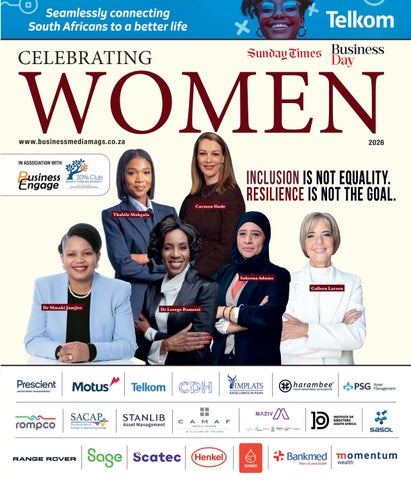
www.businessmediamags.co.za
2026
IN ASSOCIATION WITH
CELEBR ATING WOMEN – 2026
Carmen Slade Thabile Makgala
Sakeena Adams Colleen Larsen
Dr Mmaki Jantjies
Covers_CW_v5.indd 1
INCLUSION IS NOT EQUALITY. RESILIENCE IS NOT THE GOAL.
Dr Lesego Rametsi
2026/07/28 09:21
ToCheck_DPS.indd 2
2026/07/08 10:17
ToCheck_DPS.indd 3
2026/07/08 10:18
Placed_Bio pages.indd 2
2026/07/24 15:00
Placed_Bio pages.indd 3
2026/07/24 15:01
Placed_Bio pages.indd 4
2026/07/24 15:02
Placed_Bio pages.indd 5
2026/07/24 16:54
ToCheck_DPS.indd 2
2026/07/22 10:37
ToCheck_DPS.indd 3
2026/07/22 10:37
IN PARTNERSHIP WITH WEBBER WENTZEL
BEYOND REPRESENTATION
The leadership behind empowered nations
W
omen’s Month is an opportunity to celebrate progress, but also to ask a more fundamental question: How do we leverage women to empower countries to reach their full potential? This year’s theme, “Empowered women, Empowered Nations”, invites conversations about leadership, development, investment, infrastructure and economic growth – critical ingredients of prosperity. For a nation to be fully empowered, its entire population should provide the groundswell for that empowerment, especially women in an African context. “People are our greatest asset” is an often-repeated phrase in business. Most organisations genuinely believe it. Yet when markets tighten, technology accelerates, or uncertainty grows, people often become the first variable we try to “optimise”. We redesign structures, compress roles and pursue greater efficiency while expecting individuals to navigate increasing complexity with fewer resources and unequal access to those resources. At the precise moment we need all our people, especially women, to think differently, lean in, solve problems and build confidence in others, we can unintentionally make it harder for them to do exactly that. The leaders who shaped my career were those who saw potential before it was obvious, trusted others with meaningful opportunities and understood that developing people is not separate from delivering results. It is how lasting results are achieved. Economies across Africa are navigating economic uncertainty, geopolitical shifts and rapid technological change. In an environment where almost everything is evolving, one source of competitive advantage remains
consistent: the quality of its people, all of its people, and the environments created for them to succeed.
CULTURE’S INFLUENTIAL ROLE This is where culture plays such an influential role in the life of nations. Culture reveals itself in everyday decisions. It is reflected in who is trusted with responsibility, whose perspectives are genuinely considered, how feedback is delivered and whether leaders create space for people to contribute. Are we letting everyone into the room who is capable of moving us forward? What does it mean to be truly empowered? Collectively, these moments determine whether talented people feel empowered to grow, innovate and take ownership in situations that determine the agency of empowerment a person has at their disposal. They also determine whether organisations retain the people they cannot afford to lose and conversely, whether people, women especially, feel trusted and supported to drive meaningful change in their spheres of influence. Leadership therefore requires more than technical excellence. Today’s leaders are increasingly called upon to create the conditions in which others can perform at their best. That demands judgement, curiosity, humility and a willingness to listen before deciding. Listening remains one of the most underestimated leadership disciplines. Ironically, it is also a gendered trait,
Follow: Safiyya Patel www.linkedin.com/in/safiyya-patel-70753741 Webber Wentzel www.linkedin.com/company/webber-wentzel
a quality associated with women speaking to and empowering one another through being heard. It uncovers risks that data cannot always reveal, surfaces ideas that might otherwise remain unheard and builds trust when certainty is impossible. In uncertain times, trust is not a soft quality; it is a strategic advantage.
TRANSFORMATION AND REPRESENTATION MATTER The same principle applies to transformation. Too often, transformation is reduced to targets or compliance obligations. Those measures are important, but they are outcomes rather than the purpose itself. The real objective is to build a national economy empowered by stronger organisations that benefit from a broader range of experiences, perspectives and ideas, and harness their human capital. Leadership is about creating opportunities for others. When done correctly, it can create a national ripple effect. Women continue to encounter barriers that deserve deliberate attention and action. If a nation’s women are not empowered, that nation cannot fully empower itself. However, representation should never be the finish line. The more important question is whether talented people are consistently trusted with meaningful work, challenged to develop new capabilities and supported by leaders who advocate for them. Organisations that do this well strengthen their ability to adapt, innovate and compete. Empowered women and nations are about the decisions leaders make daily to invest in people, create opportunity and build workplaces where individuals can do their best work.
IMAGES: SUPPLIED
As Africa’s economies navigate economic uncertainty and rapid technological change, empowering leaders – particularly women – has never been more important, writes SAFIYYA PATEL, managing partner at Webber Wentzel
Safiyya Patel
CELEBR ATING WOMEN
Webber Wentzel_TL Advertorial.indd 140
2026/08/06 15:50
E DI TOR I A L C OM M E N TA RY Published by:
INCLUSION IS NOT EQUALITY, AND RESILIENCE IS NOT THE GOAL
S
outh Africa is not short of policies, pledges or promises about gender equity. What it is still grappling with is practice. This edition of Celebrating Women is anchored in a simple yet uncomfortable truth: inclusion without power is performance. Across business, health, leadership, entrepreneurship and society at large, women are still expected to excel within systems that were not designed for their realities – and often without the structural support to sustain that excellence. The result is a quiet contradiction. Women are breaking barriers, but also burning out. They are leading organisations, but still carrying disproportionate invisible labour. They are shaping economies, but still navigating bias that is subtle, systemic and stubbornly normalised. In South Africa today, gender inequality is no longer always loud or obvious; it is embedded. In the assumptions we make about leadership. In the pace we expect women to maintain. In the “exceptional woman” narrative that suggests success is rare rather than deserved. Yet what stands out in these pages is not just the scale of the challenge, but the refusal to accept it as fixed. However, transformation cannot rest on resilience alone. It demands accountability from institutions, honesty from leadership and a willingness to redesign systems rather than simply celebrate those who manage to survive them. Equality is not achieved when women succeed despite the system, but when the system no longer stands in their way. Raina Julies Editor and content manager
8
Picasso Headline, a proud division of Arena Holdings (Pty) Ltd Hill on Empire, 16 Empire Road (cnr Hillside Road), Parktown, Johannesburg, 2193 PO Box 12500, Mill Street, Cape Town, 8010 www.businessmediamags.co.za
SALES Project Manager: Tarrin-Lee Watts wattst@arena.africa | +27 87 379 7119 +27 79 504 7729 PRODUCTION Production Editor: Shamiela Brenner Subscriptions and Distribution: Fatima Dramat, fatimad@picasso.co.za Online Editor: Stacey Visser vissers@businessmediamags.co.za Printing: CTP Printers, Cape Town MANAGEMENT
Management Accountant:
EDITORIAL Deidre Musha Content Manager: Raina Julies Business Manager: rainaj@picasso.co.za Contributors: Trevor Crighton, Lodewyk van der Walt Ryland Fisher, Marilize Jacobs, General Manager, Magazines: Dr Juanri Jonck, Phinah Kodisang, Jocelyne Bayer Vukani Magubane, Zydah Manuel, Professor Thenjiwe Meyiwa, Itumeleng Mogaki, Busani Moyo, Glenda Nevill, Thando Pato, Dawn Rowlands, Anthony Sharpe, Lindiwe Shibambo, Elriza Theron, Rodney Weidemann, Lisa Witepski, Taryn Woodbridge Copy Editor: Brenda Bryden Content Co-ordinator: Natasha Maneveldt Online Editor: Stacey Visser, COPYRIGHT: Picasso Headline. vissers@businessmediamags.co.za No portion of this magazine may be DESIGN Head of Design: Jayne Macé-Ferguson Senior Designer: Mfundo Archie Ndzo Cover Images: Supplied
reproduced in any form without written consent of the publisher. The publisher is not responsible for unsolicited material. Celebrating Women is published by Picasso Headline. The opinions expressed are not necessarily those of Picasso Headline. All advertisements/advertorials have been paid for and therefore do not carry any endorsement by the publisher.
C E L E B R AT I N G WO M E N
CW CONTENTSED'S_SUBBED.indd 8
2026/07/24 15:14
C ON T E N T S
CONTENTS 16
65
BOARD DIVERSITY
20
LEADERSHIP ACCESS
69
Intentional sponsorship builds pipelines for next-gen African leaders, turning potential into senior leadership success.
25
GLOBAL CITIZENS
30
86
YOUTH AGENCY EDUCATION
FINTECH
ENERGY
MANUFACTURING Balancing risk, governance and innovation to create lasting value for people and industry.
96
ENGINEERING Six women engineers share how technical expertise, leadership and purpose are shaping infrastructure across water, energy, transport and the built environment.
Purpose-driven leaders are balancing profit, ethics and sustainability to build resilient organisations.
CLIMATE ACTIVISM
AGRICULTURE Innovation, resilience and fresh thinking are transforming agriculture.
132 CW CONTENTSED'S_SUBBED.indd 9
Governance is lived daily through leadership behaviour, accountability, proximity to context and trust.
107 WORK-LIFE BALANCE Women are moving away from the pursuit of work–life balance, focusing instead on integrating professional and family responsibilities.
108 WORKPLACE INSIGHT We explore how organisations misread women’s range.
113 GENDER-BASED VIOLENCE
101 LEADERSHIP INSIGHT
The fight for a liveable future is already underway, led by women turning climate ambition into action where it matters most.
60
91
TOWNSHIP ECONOMY
Women are key to building future-ready learning for South Africa’s youth.
57
WORK FORMALISATION
For the energy transition to be truly just, we must increase the number of women in the sector.
CSI
Redefining youth agency by unlocking opportunity, confidence and real change.
53
80
FINANCIAL ACCESS
We look at women-led township enterprises that are transforming local economies through innovation and resilience.
48
79
Female founders and executives are influencing the future of inclusive, technology-led finance.
Women leaders a long-term impact that transforms communities and institutions.
42
TECHNOLOGY Building the infrastructure that underpins the country’s connected economy.
INVESTMENT LANDSCAPE
Exploring how insurers design, communicate and deliver protection products.
38
LOGISTICS
Transforming domestic work into a respected profession.
Reshaping value, risk and allocation in South Africa’s investment system.
35
103 ACCOUNTABILITY
A new perspective on how we move with future-forward, inclusive transport infrastructure.
75
South African women abroad reflect on identity, resilience and success while building global careers and staying rooted in home.
URBAN FUTURES Designing smarter cities by putting people, inclusion and everyday lived experience at the heart of urban innovation.
The number of women on boards in South Africa has more than doubled in the past decade, but more still needs to be done.
South Africa cannot separate women’s economic empowerment and leadership from safety and bodily autonomy.
118 MENTAL WELLBEING Building psychologically safe workplaces is essential for resilient leadership and lasting organisational success.
123 HEALTH AND WELLNESS Preventative health gives women the clarity, strength and resilience to operate at their full potential.
132 MEDIA AND MARKETING Shaping narratives and building brands in a time of unprecedented industry transformation.
134 SILVER ECONOMY Experienced women are proving that leadership, wisdom and mentorship remain invaluable assets.
136 FUTURE-PROOFING Helping brands adapt and remain relevant for the next generation.
137 FINANCIAL INCLUSION
38
Championing smarter funding for growing SMEs.
138 MOTHERHOOD PENALTY We explore how organisations can create workplaces where women thrive and advance.
C E L E B R AT I N G WO M E N
9
2026/07/23 14:49
LEADING THE DIGITAL TRANSFORMATION AGENDA Meet the women driving TELKOM’S digital evolution, shaping innovation, connectivity and inclusion across South Africa’s economy
DR NOXOLO KUBHEKA-DLAMINI: SPEARHEADING DIGITAL GROWTH For Dr Noxolo Kubheka-Dlamini, chief digital and information officer, Telkom consumer and small business, digital leadership is built on expertise, adaptability and the confidence to lead in complex environments. With a PhD in Information Systems focused on business intelligence and the convergence of IT and data analytics, she has built a multidisciplinary career across mining, energy, banking and now telecommunications. As Telkom continues its modernisation journey, Dr Kubheka-Dlamini is focused on helping the organisation leapfrog into its next phase of digital growth while remaining rooted in its legacy of connecting South Africans.
Q: What has shaped your leadership journey? A: My career has been defined by movement across disciplines, sectors and moments of
Follow: Dr Noxolo Kubheka-Dlamini
10
Q: What does leadership mean to you today? A: For me, leadership is about confidence, mastery and visibility. Immersing yourself in your field and becoming a subject matter expert yields more than just competence; it gives you the authority to enter boardrooms knowing you belong there. I’d also like to think that my journey of change mirrors Telkom’s own transformation from a fixed-line operator into a modern digital and mobile-led business. As the group continues its modernisation journey and looks to leapfrog into digital growth, it is also our responsibility as senior women leaders to help younger women navigate boardroom dynamics earlier and with greater confidence. Each time I walk into that boardroom, I belong there. That philosophy underpins my leadership – and the example I hope young women will see and repeat.
– DR NOXOLO KUBHEKA-DLAMINI
A: I think the next era of digital leadership is already here, and it is being increasingly defined by the ability to connect technology, people and purpose. While it is great to digitise processes and introduce new platforms with agility, as leaders, we need to deeply understand how data, artificial intelligence, connectivity and customer experience come together to solve real problems, create access and unlock growth.
Q: Digital transformation is a national imperative. Where do you see the future of South Africa’s digital leadership heading, and how will Telkom help drive that change?
www.linkedin.com/in/dr-noxolo-kubheka-dlamini-5aa61a5a
CELEBR ATING WOMEN
TELKOM_6Pg Advertorial_1.indd 10
change. I’d built my career across mining, energy and banking before entering the state-owned company environment to help establish big data analytics capability. That breadth of experience paved the way for my role in telecoms today, an industry that is equal parts fast-paced, nuanced and exciting.
IMAGES: SUPPLIED
T
elkom’s Dr Noxolo Kubheka-Dlamini, Makgosi Mabaso, Judy Vilakazi, Dr Mmaki Jantjies, and Verushca Hunter are the women building networks, shaping digital strategy, opening access to education and creating ecosystems where innovation can thrive. Their journeys show how Telkom continues to advance meaningful transformation by supporting women to lead, influence and contribute to South Africa’s economic and digital growth.
IT IS ALSO OUR RESPONSIBILITY AS SENIOR WOMEN LEADERS TO HELP YOUNGER WOMEN NAVIGATE BOARDROOM DYNAMICS EARLIER AND WITH GREATER CONFIDENCE.
Dr Noxolo Kubheka-Dlamini
2026/07/24 13:43
IN PARTNERSHIP WITH TELKOM
At Telkom, we have a strong legacy of connecting South Africans, but we are also evolving into a business that is increasingly digital and innovation-led, with a stronger focus on accelerating the speed for our solutions. Our role is to help shape a future where connectivity is not just about access to a network, but also access to opportunity – for small businesses, communities, young people and the broader economy.
Q: What excites you most about the telecoms industry right now? A: What excites me most is the pace of possibility and its impact on inclusivity. When I see more rural schools and communities becoming connected to digital resources, when small and medium enterprises can improve their services because of the strength of our network service – that demonstrates the power of possibility. I am also excited by the role women are playing in this shift. The industry is complex, competitive and fast-moving, but it is also full of opportunity for leaders who are willing to learn, adapt and lead with confidence
MAKGOSI MABASO: LEADING COMMERCIAL STRATEGY TO CREATE MEANINGFUL VALUE
IMAGES: SUPPLIED
Chief commercial officer, Openserve, and Telkom Foundation board trustee Makgosi Mabaso’s leadership sits at the point where infrastructure becomes opportunity. As Openserve’s chief commercial officer, she leads commercial strategy across product, pricing, customer solutions, revenue portfolios and national go-to-market execution. With extensive industry experience spanning nearly 20 years, her role is focused on ensuring Openserve’s extensive fibre network translates into meaningful value for homes, businesses, service providers and communities across South Africa.
Q: What is Openserve’s most defining role in the telecoms market? A: Openserve is the backbone of South Africa’s digital economy. With a network of about 190 000km of fibre, we do not simply deploy infrastructure; we set the pace for how the nation connects. By the end of March 2026, our network had passed 1.54 million homes, with 817 540 connected – a connectivity rate of 53.1 per cent, among the strongest in the market. Those numbers matter commercially: homes passed are investment, homes connected are value realised. Our defining role is converting national infrastructure into national participation – for every service provider, every enterprise and every community, on identical terms. When we get that right at scale, we do not just grow Openserve; we expand the economy’s capacity to grow. Q: How does commercial leadership contribute to transformation? A: Commercial leadership is where transformation becomes measurable. A strategy document does not connect a household – a product that is priced right, provisioned quickly and supported properly does. My job is to make sure world-class infrastructure translates into offerings the whole market can access, from entry-level fibre to enterprise-grade solutions, because inclusion without commercial sustainability is a promise you cannot keep, and commercial success without inclusion is a
COMMERCIAL TRANSFORMATION IS ABOUT ENSURING THAT WORLD-CLASS INFRASTRUCTURE TRANSLATES INTO MEANINGFUL ACCESS FOR HOUSEHOLDS, ENTERPRISES AND COMMUNITIES. WE WANT OUR CUSTOMERS TO HAVE COMPLETE PEACE OF MIND WHEN IT COMES TO THEIR CONNECTIVITY AND PRODUCTS. – MAKGOSI MABASO
market you have not finished serving. When we get both right, transformation funds itself. That is what gives our customers complete peace of mind: reliable connectivity and products that suit their needs, backed by a network built to last.
Q: Openserve is often described as Telkom’s competitive advantage in the market. What would you say gives your value proposition a leading edge, and how do you rally teams behind it? A: Openserve’s edge is a combination of national scale, proven reliability and genuine openness. For our partners, that combination is a commercial proposition in itself – the widest footprint means the largest addressable market, and open access means they compete on service and innovation, not on access to infrastructure. The same products, on identical terms, for every partner. That neutrality is not a constraint on our ambition; it is the moat around it. For me, rallying teams behind that starts with purpose. Connectivity is never abstract; it is how a learner accesses education, how a small business reaches its customers, how a family stays connected, and how an enterprise competes globally. Every person in this business needs to see their work in those terms.
Makgosi Mabaso
Follow: Makgosi Mabaso
www.linkedin.com/in/makgosimabaso
CELEBR ATING WOMEN
TELKOM_6Pg Advertorial_1.indd 11
11
2026/07/24 13:24
However, purpose without performance does not keep a network running, so we hold ourselves to both: service excellence, speed and innovation on one side, disciplined commercial delivery on the other. When teams can see the human impact and the commercial result of their work at the same time, you do not have to push them – they pull the business forward. They stop selling a product and start building South Africa’s digital future – and that is something we all rally behind.
Q: How does technology help shape
Q: What excites you most about the future of connectivity for the country? A: What excites me most is that we are moving from the build era to the value era. The first chapter of fibre was about reach – kilometres deployed and homes passed. The next chapter is about conversion: turning homes passed into homes connected, connections into usage, and usage into opportunity. Commercially, that is where the real prize sits – every point of penetration we add makes the assets we have already built work harder, and demand is compounding as cloud, artificial intelligence, remote work and digital public services all run on the infrastructure we operate. South Africa’s digital future is not waiting to be invented; it is waiting to be connected. Our job is to make sure no home, business or community is left off that network – not as a slogan, but as a business plan.
Q: Why is it important not to lose sight
For Judy Vilakazi, transformation begins with access. As head of the Telkom Foundation, she leads work that is deeply connected to education, youth development and social inclusion. The foundation’s strategy is centred on education and built around four key pillars, reflecting a belief that learning remains one of the most powerful tools for changing lives. With nearly 20 years of experience in corporate social investment and transformation across Southern Africa, Vilakazi has designed and managed initiatives that respond to real community needs. Her work combines strategy, stakeholder engagement and a deep commitment to inclusive development.
Follow: Judy Vilakazi
12
of social impact while pursuing commercial goals? A: Commercial growth and social impact should not be seen as competing priorities, but rather as working in tandem. In a country like ours, where inequality remains a lived reality for many communities, business has a responsibility to think beyond financial performance and consider the broader value it creates. For me, social impact is about ensuring that progress is meaningful and inclusive. As we pursue innovation, growth and digital transformation, we must keep asking who benefits, who is included and who still needs access. The true measure of progress is not only how fast we grow, but how widely that growth is shared.
– JUDY VILAKAZI
are growing up in a complex environment, but they continue to show an incredible ability to adapt, innovate and imagine a different future for themselves. Through the work of the Telkom Foundation, I have seen young people respond powerfully when given access to the right tools, support and learning environments. When technology and education come together, young people not only gain skills; they gain confidence, agency and a sense of possibility.
Q: What role should the corporate sector play in ensuring no one is left behind in the digital economy? A: The private sector is pivotal in creating pathways to access, opportunity and participation. The digital economy cannot reach its full potential if large parts of society remain excluded from education, connectivity, skills development and meaningful opportunity. For Telkom, this responsibility is especially important because technology is such a powerful enabler. Through the Telkom Foundation, we focus on education and programmes that help young people, communities and vulnerable groups build the confidence and capabilities they need to participate in a changing world. Q: What makes you optimistic about the country’s young people and their future in the digital economy? A: Their resilience, creativity and hunger for opportunity. South Africa’s young people
www.linkedin.com/in/judy-xoliswa-vilakazi
IMAGES: SUPPLIED
JUDY VILAKAZI: FOCUSED ON YOUTH EDUCATION AND INCLUSIVE DEVELOPMENT
opportunity in today’s increasingly digital era? A: I always say that technology is the great equaliser, particularly when combined with education. In a sector defined by rapid digital advancement, access to learning and technology can open pathways for young people, people living with disabilities and communities that have historically been excluded. That is what makes this work not only fulfilling, but also pivotal.
I HAVE SEEN YOUNG PEOPLE RESPOND POWERFULLY WHEN GIVEN ACCESS TO THE RIGHT TOOLS, SUPPORT AND LEARNING ENVIRONMENTS. WHEN TECHNOLOGY AND EDUCATION COME TOGETHER, YOUNG PEOPLE NOT ONLY GAIN SKILLS; THEY GAIN CONFIDENCE, AGENCY AND A SENSE OF POSSIBILITY.
Judy Vilakazi
CELEBR ATING WOMEN
TELKOM_6Pg Advertorial_1.indd 12
2026/07/24 13:27
IN PARTNERSHIP WITH TELKOM
As a lifelong learner myself, I know that education does not end with a qualification. It is a commitment to continuous growth. My own learning journey, including completing an MBA at Wits Business School, has reinforced my belief that learning builds confidence and expands perspective. That is why the foundation’s work resonates so deeply with me. When we create opportunities for young people to access quality education and digital tools, we set the right wheels in motion.
DR MMAKI JANTJIES: A LEADING VOICE IN INNOVATION AND TRANSFORMATION Dr Mmaki Jantjies is driven by a belief that technology should improve society. A computer scientist with a PhD in Computer Science from the University of Warwick, she is recognised as one of South Africa’s leading voices in innovation and digital transformation. At Telkom, she serves as group executive: innovation and transformation, where she established the group innovation office. Her work focuses on building an open innovation ecosystem that supports new products, services and partnerships, while scaling corporate venturing initiatives that invest in and collaborate with start-ups and small, medium and micro enterprises (SMMEs).
technology value chain. That includes women-led businesses, youth-owned businesses and black-owned SMMEs that are building solutions for the future economy. Prioritising women does not mean excluding others. It means recognising that the playing field has not always been equal, and that transformation requires us to address those gaps with intention. When women-led businesses are supported to grow, they create jobs, strengthen communities and bring new perspectives into the digital economy.
Q: How do partnerships between industry, academia and entrepreneurs help turn innovation into real impact? A: Partnerships are essential because no single player can solve complex social and economic challenges alone. Industry brings scale, infrastructure, market insight and the ability to implement solutions in real operating environments. Academia brings research depth, evidence, technical expertise and the development of future skills. Entrepreneurs bring agility, fresh thinking and a closeness to the problems that communities and businesses experience every day. When these three forces come together, innovation is far more likely to move beyond an idea or prototype into something that can be tested, refined, funded and scaled.
SHAPING THE NEXT GENERATION OF WOMEN IN ICT STARTS WITH VISIBILITY, ACCESS AND INTENTIONAL SUPPORT. YOUNG WOMEN NEED TO SEE THAT THERE IS A PLACE FOR THEM IN TECHNOLOGY – NOT ONLY AS USERS OF DIGITAL TOOLS, BUT AS BUILDERS, INNOVATORS, RESEARCHERS, ENTREPRENEURS AND LEADERS. – DR MMAKI JANTJIES
Q: What is the most pressing issue that innovation in tech is solving for today?
Q: How are you helping shape the
A: For me, it is not whether we can innovate;
next generation of women entering the ICT industry? A: For me, shaping the next generation of women in ICT starts with visibility, access and intentional support. Young women need to see that there is a place for them in technology – not only as users of digital tools, but as builders, innovators, researchers, entrepreneurs and leaders. My own journey has shown me how powerful education, mentorship and exposure Dr Mmaki Jantjies can be. When young women are introduced to science, technology, engineering and mathematics (STEM) skills early, and when they are supported with the right networks and opportunities, their confidence grows.
it is whether we can turn innovation into inclusive, scalable impact. It is whether we can take our innovations beyond ideas and prototypes and create tangible solutions that benefit us all. This is especially important in the age of artificial intelligence, where access to infrastructure, skills, funding and markets will determine who benefits from the next wave of growth.
Q: Does your work prioritise women in innovation and enterprise development?
IMAGES: SUPPLIED
A: I believe inclusive innovation must be deliberate and clearly designated. Women do not lack ideas, ambition or capability, however, too often, they lack access to the networks, funding and support systems that allow those ideas to scale. Through Telkom’s innovation and enterprise development work, including FutureMakers – and most recently, our TrailBlazeHer accelerator initiative – we are focused on widening access for entrepreneurs who have historically been under-represented in the
Follow: Dr Mmaki Jantjies
www.linkedin.com/in/mmaki-jantjies-phd-2b389b116
CELEBR ATING WOMEN
TELKOM_6Pg Advertorial_1.indd 13
13
2026/07/24 13:27
They begin to see technology as a space where they can solve problems and create businesses that shape the future. At Telkom, this work comes through our broader innovation and transformation agenda, including partnerships with universities, SMMEs, start-ups and programmes that support emerging entrepreneurs. Through platforms such as FutureMakers, we are helping create pathways for more women-led and youth-led businesses to access mentorship, funding, markets and business development support.
VERUSHCA HUNTER: CONNECTING TECHNOLOGY, BUSINESS AND HUMAN IMPACT
Hunter leads the organisation’s technology strategy, helping shape how BCX uses technology to drive transformation, improve performance and unlock future growth.
Q: What has shaped your leadership journey in technology?
A: My journey has not been linear, and that has been one of my greatest strengths. I started out wanting to study medicine because I wanted to help people and make a meaningful impact on their lives. When I left medical school, it felt like a major failure
For Verushca Hunter, chief technology officer (CTO), BCX, and an executive committee member, technology leadership is about more than systems, platforms and delivery. It is about creating long-term business value through innovation that is practical, scalable and aligned with the needs of customers and the organisation. Her career began with an unexpected turn: leaving medical school, a moment she once saw as a failure, only to discover a new calling in coding, programming and digital transformation. The desire to heal and improve lives did not disappear; it evolved into a career built around using technology to solve problems and create meaningful value.
Verushca Hunter
Follow: Verushca Hunter
14
at the time. But that disruption opened the door to technology, and I found a different way to solve problems and create impact. I started learning coding and programming, and from there, I built my career intentionally. I began as a programmer and moved through different technical and strategic roles over the past two decades, always asking myself how each step would help me build better products, services and solutions. Over time, I realised that technology has the greatest impact when it is connected to business strategy. It is not enough to build systems; we must understand why we are building them, who they serve and how they create long-term value. That is what has shaped me most as a leader: the ability to connect technology, business, and human impact.
EMPOWERMENT IS NOT ABOUT POSITIONING WOMEN AS NEEDING TO BE RESCUED OR GIVEN PERMISSION TO LEAD. IT IS ABOUT CREATING ENVIRONMENTS WHERE WOMEN’S STRENGTHS ARE RECOGNISED, WHERE THEIR VOICES CARRY WEIGHT AND WHERE THEY CAN CONTRIBUTE FULLY AND CONFIDENTLY. – VERUSHCA HUNTER
www.linkedin.com/in/verushca-hunter-2aa5b934
CELEBR ATING WOMEN
TELKOM_6Pg Advertorial_2.indd 14
2026/07/27 13:27
IN PARTNERSHIP WITH TELKOM
THROUGH PLATFORMS SUCH AS FUTUREMAKERS, WE ARE HELPING CREATE PATHWAYS FOR MORE WOMEN-LED AND YOUTH-LED BUSINESSES TO ACCESS MENTORSHIP, FUNDING, MARKETS AND BUSINESS DEVELOPMENT SUPPORT. – DR MMAKI JANTJIES
Q: What does technology leadership mean to you today? A: As CTO at BCX, my role is to lead technology strategy in a way that supports innovation, business growth and long-term value creation. That means looking at the full picture: application engineering, data platforms, analytics, enterprise transformation and the emerging technologies that are reshaping how organisations operate. However, I have always believed that it is not about technology for technology’s sake. The real question is how technology enables the business strategy. Additionally, how does it improve customer experience, create efficiencies, unlock new opportunities or solve problems that matter?
Q: How do you view the role of women in technology leadership?
A: Women bring an incredibly important dimension to technology leadership.
The industry has often focused heavily on technical expertise, which is important, but leadership also requires emotional intelligence, strategic thinking, resilience, collaboration and the ability to see the broader picture. Women should not enter technology feeling as though they are lacking something or that they need to perform in the same way as their male counterparts. There is nothing wrong with us. Our approach may be different, but that difference is valuable. Technology needs holistic, well-rounded leaders who can combine technical understanding with empathy, communication and business insight. For me, empowerment is not about positioning women as needing to be rescued or given permission to lead. It is about creating environments where women’s strengths are recognised, where their voices carry weight and where they can contribute fully and confidently.
IMAGES: SUPPLIED
SEAMLESSLY CONNECTING SOUTH AFRICANS TO A BETTER LIFE Telkom is a leading information and communications technology services provider in South Africa. Our mission is to seamlessly connect people to a better life. We carry this through in all our brands, whether at the consumer, business or wholesale level. Our Telkom Foundation actively works to bridge the digital divide with projects, including the Connected Schools programme, while Telkom FutureMakers, our enterprise and supplier development initiative, empowers digital entrepreneurs to realise their vision. Telkom continues to innovate and consistently provides products and services that advance South Africans. Being recognised as a top employer – for a fourth consecutive year in January 2026 – is testament to our dedication to achieving a harmonious balance between investing in our workforce, refining operational processes, enhancing the physical work environment and embracing cutting-edge technology. These efforts reinforce Telkom’s commitment to connecting South Africans to a better future through relevant and innovative products and services that create lasting value for customers and the country. https://group.telkom.co.za/
Q: What’s your advice for women wanting to break into the technology sector today? A: My message to women in technology is to keep learning, understand the business, trust your perspective and be intentional about your career. You do not have to lead like anyone else. You can bring your full self into the room and still be powerful, strategic and deeply effective.
OUR ROLE IS TO HELP SHAPE A FUTURE WHERE CONNECTIVITY IS NOT JUST ABOUT ACCESS TO A NETWORK, BUT ALSO ACCESS TO OPPORTUNITY – FOR SMALL BUSINESSES, COMMUNITIES, YOUNG PEOPLE AND THE BROADER ECONOMY. – DR NOXOLO KUBHEKA-DLAMINI
VISIT WEBSITE SCAN THIS QR CODE TO GO TO THE TELKOM WEBSITE
For more information:
www.group.telkom.co.za
CELEBR ATING WOMEN
TELKOM_6Pg Advertorial_1.indd 15
15
2026/07/24 13:28
THE NUMBERS INCREASE, BUT SIMPLY NOT FAST ENOUGH Progress is happening, but more needs to be done to ensure greater representation of women on boards and more so, women who really have influence and effect change. By RYLAND FISHER
O
ver the past decade, there has been a significant increase in women directors in South African companies, particularly among listed companies, with recent studies suggesting that women now hold just over a third of board seats on leading JSE-listed companies. However, there is still a lot to be done for the role of women on boards to be appreciated properly, say four women who have been monitoring the changes. Parmi Natesan, CEO of the Institute of Directors in South Africa (IoDSA), says the increase in women board members is significant because it shows that the conversation has moved beyond whether women
Parmi Natesan
16
CELEBR ATING WOMEN
belong in boardrooms. “That should no longer be in question. However, the pace of change remains too slow, and the more important question is whether women are moving into positions of real influence, such as board chair, committee chair, CEO, CFO and other key executive roles. Representation matters, but influence matters even more.”
INCREASED REPRESENTATION LEADS TO IMPROVED GOVERNANCE Dr Barbara van Heerden, academic, executive coach and someone who has served on and established boards across Africa, feels that the increase in women board members will lead to improved corporate governance. “Results show that gender diversity has a more rigorous oversight of management, stronger attention to ethics, increased financial reporting and better company reputation. Diversity also reduces group thinking and leads to better decision-making due to the different life experiences and perspectives. This broader collective experience is producing a higher return on equity, profitability, long-term shareholder value creation and resilience during an economic
Dr Barbara van Heerden
GENDER DIVERSITY HAS A MORE RIGOROUS OVERSIGHT OF MANAGEMENT, STRONGER ATTENTION TO ETHICS, INCREASED FINANCIAL REPORTING AND BETTER COMPANY REPUTATION. DIVERSITY ALSO REDUCES GROUP THINKING AND LEADS TO BETTER DECISION-MAKING. – DR BARBARA VAN HEERDEN
BOARD DIVERSITY
downturn. The wider talent pool is a greater representation of the market and society. It is also a better reflection of the company’s customer base and workforce, and signals progress towards gender equity in leadership.” Dr Shirley Zinn, who also serves on many boards, including the JSE, in the private and public sector and nonprofit organisations, agrees that the increase in women on boards has led to improved financial performance and better corporate governance in companies. “This is why gender-balanced boardrooms remain a critical challenge. It’s still very hard for women on their journey from executive roles to boards because there are still boardrooms dominated by men. Sometimes you can be the only woman on the board, and you have to really navigate a huge amount of complexity and barriers to be heard, seen, valued and included. “Even though we have made steady progress towards gender equity over the past decade, it’s still not good enough. There is still not enough critical mass in the boardroom. “There are dynamics that can still prevent your voice from being heard even though you might have a seat at the table. And, many subtle nuances and undercurrents often prevent you from placing your thoughts on the table. The improvement has been lumpy in some way because, even though we submit targets to the JSE in terms of our policies on gender diversity at board level every year, it’s not moving as efficiently as it should.”
INCLUSIVE LEADERSHIP – A SIGN OF PROGRESS AND HOPE Lilly Moabi, deputy president of the Black Management Forum (BMF), says the steady increase in women board members is “more than just a positive statistic; it is a reflection of a gradual shift in corporate culture and leadership. For many years, we have witnessed boardrooms being dominated by men, limiting the diversity of perspectives required when making major business decisions. “The growing number of women in boardrooms shows that companies are increasingly recognising the value of inclusive leadership and are committed to greater gender representation in corporate leadership. “However, although we are slowly making progress, we must also be aware that the women are under-represented in executive leadership positions such as CEO and CFO. More needs to be done to develop female leadership within executive management. “For many years, we have witnessed boardrooms being dominated by men, limiting the diversity of perspectives required when making major business decisions. “Every woman who takes a seat at the boardroom table represents barriers that have been broken and doors that have been opened for future generations. We therefore need to recognise that an increase in women directors is more than a corporate success story; it’sa symbol of progress, opportunity and hope.”
WHAT COMPANIES NEED TO DO Natesan says companies should “ensure board appointments are transparent, skillsbased and intentionally diverse. They should expand their view of board readiness and look beyond familiar networks. “Once women are appointed, boards should ensure they have equal access to information, mentorship, committee leadership opportunities and meaningful participation in strategic discussions. Board chairs play a particularly important role in setting the tone and ensuring all voices are heard.
WE MUST MOVE FROM EXPECTING WOMEN TO ADAPT TO EXISTING CULTURES, AND WE MUST START ADAPTING THOSE CULTURES TO REFLECT MORE INCLUSIVE AND ACCOUNTABLE LEADERSHIP. – LILLY MOABI
Lilly Moabi
Dr Shirley Zinn
CELEBR ATING WOMEN
17
BOARD DIVERSITY
WOMEN ON BOARD PROGRAMMES
“Companies should also strengthen the pipeline by developing women in executive and senior management roles. Sustainable board diversity depends on a strong leadership pipeline.” Dr van Heerden says companies need development programmes for directors, and they should ensure they have champions at all levels who walk the talk. “It’s no use having development programmes or a pipeline of talent if their organisational culture doesn’t encompass what it is that they want to achieve. “Organisational culture is what actually drives the economic performance, which, in turn, drives your quality management performance and social responsibility management performance. Organisational culture also comes down to accountability. “One of the significant strengths of the increase of women on boards is being able to challenge traditional governance, leading to more accountability and responsibility.” Dr Zinn says what companies need to do to create a more enabling environment for women is to make sure that boards are made up of at least 50 per cent women, who are not just tokens, but have the power and influence to impact outcomes. “Women should sponsor other women to become board members, they should nominate them to become the chair of the board, they should advocate for them to be promoted. That would go a long way to ensure we have more women in board seats. “Companies should invest in the development of board members, but they should also foster a culture where all opinions are welcomed and not just the opinion of some, who happen to be men,” she says. “We’re still on a journey to genuine inclusion here. It has been interesting for me to navigate from an executive role into board roles, coming from where I come, having been born during
CREATING CULTURES WHERE WOMEN LEAD
THABILE MAKGALA, executive vice president of People, SHE, Risk and Corporate Affairs at Sasol explores how organisations must move beyond representation to create truly inclusive leadership cultures While increasing women’s representation remains important, organisations are also being challenged to examine how leadership and governance are practised. Representation may open the door, but organisational culture ultimately determines whether women are able to lead and influence decision-making. Women contribute to stronger leadership by broadening strategic discussions, raising overlooked risks, asking difficult questions and bringing ethical and stakeholder perspectives into decision-making. Their contribution is not simply about thinking differently, but about encouraging more complete and considered discussions. The barriers extend beyond appointment. Limited access to influential networks, sponsorship and persistent bias continue to affect women’s progression into leadership, while those who reach senior positions often face heightened scrutiny and the pressure to continually prove their credibility. For organisations, the focus is shifting from simply increasing representation to creating cultures where leadership is genuinely inclusive. This includes redefining traditional ideas of leadership, embedding inclusion into decision-making processes, investing Thabile Makgala in sponsorship rather than mentorship alone, establishing transparent pathways for advancement and holding leaders accountable for inclusion outcomes. Follow: Thabile Makgala
apartheid on the Cape Flats and having to struggle to get an education. I never thought I would receive a doctorate and occupy these board positions. However, I have also always believed in taking others along with me. Women must take other women under their wings and open the doors to others so that we end up in a much better position.”
PLACE GREATER FOCUS ON HOW BOARDS FUNCTION The BMF’s Moabi says companies should not only focus on appointing women to boards,
Follow: Parmi Natesan www.linkedin.com/in/parmi-natesan-064a2154 www.linkedin.com/in/shirley-zinn Dr Shirley Zinn www.linkedin.com/in/dr-barbara-van-heerden-phd-commerce-55595712 Dr Barbara van Heerden www.linkedin.com/in/lilly-moabi-924baa13b Lilly Moabi www.linkedin.com/company/black-management-forum The BMF
18
CELEBRATING WOMEN
www.linkedin.com/in/thabile-makgala/
but also focus equally on changing how boards function. “Real inclusion is not just about who is in the room, but about how influence is distributed in the room. Boardrooms still reward hierarchy, speed of agreement and informal networks of influence. This can silence or weaken the impact of diverse voices. “I also think that mentorship must be an essential governance tool, not just optional support. Without mentors and sponsors, women may be in the room, but still be excluded from real strategic influence. “Ultimately, we must move from expecting women to adapt to existing cultures, and we must start adapting those cultures to reflect more inclusive and accountable leadership.”
IMAGES: SUPPLIED
REGISTER FOR
IN PARTNERSHIP WITH THE INSTITUTE OF DIRECTORS IN SOUTH AFRICA
THE NEXT FRONTIER IS PROFESSIONALISING DIRECTORSHIP While the push for women to be represented at board level has shown results, the focus now needs to shift to these women being recognised as professionals with the skills and power to influence and make decisions, writes PARMI NATESAN, CEO of the Institute of Directors in South Africa
F
or many years, the conversation around women on boards has focused on representation. The objective was clear: increase the number of women occupying board seats and create greater diversity within leadership structures. This focus was necessary. For too long, women were under-represented in boardrooms despite possessing the skills, experience and leadership capabilities required to contribute effectively at the highest levels of decision-making. Progress has been made, and many organisations today recognise the value that diverse boards bring. However, today, the focus should be on ensuring that women are equipped to thrive in the boardroom and recognised as professional directors capable of making meaningful contributions. Good governance depends on directors being willing and able to challenge assumptions, ask difficult questions and consider issues from multiple viewpoints. Diversity helps reduce the risk of groupthink and enables boards to make more informed decisions. Yet diversity only becomes a governance advantage when board members can contribute meaningfully. A board with women directors is not automatically an inclusive board, nor is it necessarily an effective one. The real measure of success lies in whether women are participating fully in board deliberations, influencing decisions and helping shape organisational strategy and oversight.
IMAGES: SUPPLIED
IMAGES: SUPPLIED
WHY PROFESSIONALISATION OF DIRECTORSHIP IS VITAL This is where the professionalisation of directorship becomes critically important. Historically, many directors were appointed based primarily on their executive positions or industry standing. While executive experience remains valuable, governance requires a distinct set of competencies. Directorship is a profession in its own right. Effective directors require specialised
knowledge and skills, including governance expertise, strategic oversight, ethical leadership, stakeholder balancing, risk governance, and the ability to exercise independent judgement. These competencies must be developed, assessed and continuously refined throughout a director’s career. The professionalisation of directorship creates a particularly important opportunity for women. When boards recruit based on demonstrated governance competence rather than informal networks, the playing field becomes more equitable. Professionalisation shifts the conversation away from who individuals know and towards what they know and how effectively they can fulfil their governance responsibilities. It provides aspiring directors with a clear pathway to develop their expertise, build credibility and demonstrate their readiness to serve on boards. This is especially valuable for women who may not always have access to the same traditional networks through which board appointments have historically been made. In South Africa, the growing recognition of directorship as a profession is reflected in the SAQA-registered professional director designations. The Institute of Directors in South Africa’s Certified Director and Chartered Director South Africa designations provide independent recognition of director competence, experience and commitment to professional standards.
For women seeking to build governance careers, such professional recognition can be transformative. It enables them to demonstrate their governance capabilities through objective assessment and recognised credentials. It also provides boards with greater confidence that appointments are being made based on demonstrated competence and readiness rather than assumptions or familiarity. The future of governance requires boards that are both diverse and competent. Diversity without competence will not improve governance outcomes. Equally, competence without diversity risks limiting the range of perspectives Parmi Natesan needed to navigate an increasingly complex world. High-performing boards require both. Women bring valuable expertise and perspectives that can strengthen boardroom discussions and improve organisational decision-making. The challenge now is to ensure that governance systems recognise and harness this talent effectively.
CREATING A SUSTAINABLE PATHWAY FOR PROFESSIONALISM The next frontier for women on boards is therefore not simply increasing representation, important as that remains. It is creating a sustainable pathway for women to build professional directorship careers, develop recognised director competencies and contribute meaningfully to high-performing boards. Representation opens the boardroom door. Professionalisation ensures that women are equipped to lead once they enter it.
Follow: Parmi Natesan www.linkedin.com/in/parmi-natesan-064a2154 www.linkedin.com/company/institute-of-directors-in-south-africa
CELEBR ATING WOMEN
IoDSA_TL Advertorial.indd 19
19
2026/07/24 08:19
INVESTING IN THE NEXT GENERATION OF AFRICAN WOMEN LEADERS Women’s career development needs to be deliberate and action-oriented. Three business leaders share why sponsorship and mentorship are important in creating a pipeline for the next generation of women leaders. By THANDO PATO
A
THE VISIBILITY GAP STARTS IN MIDDLE MANAGEMENT Jocelyne Muhutu-Remy, managing director of Spotify, sub-Saharan Africa, says organisations need to be fiercely intentional about supporting women when they hit the middle of their careers. “What happens way too often is that corporate pipelines start out looking fantastic and diverse at the entry level, but then they just fall off a cliff once you get to middle management. The stats show that the hardest part for a woman is just getting that very first promotion into management. Once you miss that first step, the gap widens and snowballs over time.” Companies, she says, need to look closely at this exact drop-off point and take targeted action. “If we want to fix the top, we absolutely must fix the middle,” she says.
Muhutu-Remy believes in the power of 2025 report, Closing the Sponsorship mentorship and sponsorship, but she doesn’t Gap: How Purposeful Advocacy believe either must be a programme or a Accelerates Women’s Careers, by scheduled commitment. Women of Influence+ “For me, active surveyed over 400 sponsorship is grounded in professionals across North the power of yes. You reach America, exploring how out on LinkedIn asking for sponsorship – distinct from a 30-minute chat? Yes. mentorship – remains one You pull me aside at an of the most effective tools of event for specific advice? career development. Yes. We worked together Eighty-five per cent of years ago, and you need women surveyed said they a recommendation letter? understand what sponsorship Yes. I see a job opening is, yet only 45 per cent that you’d be perfect for. I have ever had a sponsor. slide into your DMs. To me, One of the key inputs from Jocelyne Muhutu-Remy sponsorship isn’t always a respondents was the request formal corporate programme: for training to differentiate gives an impressive presentation. It’s fighting it’s about microactions, accessibility and between mentorship and sponsorship, and to behind closed doors to get a headcount actively pulling people up when the opportunity approach both with equity in mind. created for a promising talent, or jumping on presents itself.” In South Africa, visibility and access remain a call for some pre-job interview practice,” As a mother to young women, Muhutu-Remy challenges for women seeking leadership she explains. says supporting women isn’t confined only to development. Three business leaders share Muhutu-Remy’s approach works; in 2022, a the workplace; it’s a daily mission she practises their views on mentorship and sponsorship young West African intern based in New York through small gestures whenever she’s around and how they use these to develop the next boldly tracked her down, and the two had a women. However, at work, she says she generation of women leaders. long conversation about her prospects, hopes practises sponsorship and mentorship by: and dreams. “Fast forward four years later, she “Offering a subtle backup to a female colleague became the ambassador for her country to the SMALL GESTURES, VISIBLE IMPACT in front of senior executives and then sending a United States, one of the youngest diplomats in Jocelyne Muhutu-Remy, managing director complimentary note to her manager when she Washington,” says Muhutu-Remy. of Spotify, sub-Saharan Africa, says her career journey was made up of a series of small, unexpected connections that became career-defining moments. “I’ve seen how the most random, brief connections can lead IF I LOOK AT THE SHAPE OF BOARDROOMS TODAY, IT’S STILL MAJORITY to life-changing opportunities, so I approach sponsorship the same way. I don’t overlook the MALE, AND BLACK WOMEN LEADERS REMAIN IN THE MINORITY. IT IS NOT ‘small’ interactions. Impact doesn’t always need ENOUGH TO HAVE REPRESENTATION AT THE BOTTOM. TRANSFORMATION to be about heavy-handed approaches. The right small gesture can have the most profound MUST BE VISIBLE AND FELT AT THE TOP. – KOKO KHUMALO impact,” she explains.
20
CELEBR ATING WOMEN
LEADERSHIP ACCESS
MENTORSHIP VS SPONSORSHIP
MEN: HOW MANY WOMEN ARE YOU SPONSORING? Koko Khumalo CA(SA), RA, is the founder and CEO of Motlanalo Chartered Accountants and Auditors Incorporated, a black-women-owned firm that is deliberate in its transformation agenda. Established in 2017, Motlanalo has grown to a staff complement of over 100, of whom 80 per cent are women and 74 per cent are under 35. One of Khumalo’s goals is to create an environment where women and black professionals have access to meaningful work experience. She understands the value of exposure, the confidence it builds and the doors it opens. She is herself a recipient of sponsorship – thanks to male sponsors throughout her career. She is outspoken about the structural and cultural challenges that women, particularly black women, still face in Koko Khumalo corporate South Africa, from traditional expectations of women to corporate requirements. “If I look at the shape of boardrooms today, it’s still majority male, and black women leaders remain in the minority. It is not enough to have representation at the bottom. Transformation must be visible and felt at the top.”
IMAGES: SUPPLIED
WHAT EFFECTIVE SPONSORSHIP LOOKS LIKE Executive sponsors’ behaviours look like: • A sponsor advocating for you in closed rooms, naming you in talent and promotion discussions without waiting to be asked. • Securing high-visibility assignments for you. • Providing candid, honest feedback. • Protecting you while ensuring you get exposure. Sources: McKinsey Women in the Workplace 2025 Report; Catalyst, 2025; Gender, Work and Organisation, 2025, Groschl et al
Research consistently shows that women are over-mentored and under-sponsored. According to Harvard Business Review, women with sponsors are 20 per cent more likely to be promoted than those without. So, what’s the difference between a mentor and a sponsor? “A mentor advises you. A sponsor puts your name forward when you are not in the room. A mentor helps you think through your path. A sponsor uses their influence to create access, opportunity and visibility. Sponsorship is about recognising potential and creating the conditions for it to grow,” says Koko Khumalo, CA(SA), founding partner and CEO of Motlanalo Chartered Accountants and Auditors Inc.
While she advocates for sponsorship, she is acutely aware of the challenges black female leaders face. “Is it fair or right of us to expect black women to sponsor other women while they’ve got limited access to resources, to influence and to decision making? They still have to navigate through what support looks like in an environment where they are, at times, unheard and unseen.” Her message to those in positions of influence who have not yet made sponsorship a priority is grounded in a simple truth, attributed to Albert Pike: “What we have done for ourselves alone dies with us; what we have done for others and the world remains and is immortal.”
MENTORSHIP: SEEKING GUIDANCE AND WISDOM Dr Sindi Mabaso-Koyana CA(SA), chairperson of MTN (SA) and founder of the African Women Chartered Accountants (AWCA) and patron of the AWCA Mentorship Circle, has had several sponsors and mentors throughout her career. Philip Hourquebie, former CEO of Ernst & Young, is a sponsor she remembers fondly. “He spoke life into me and believed in me. He opened doors I never imagined. He’d say, ‘You need to be visible there, and I think you can do that.’ Even when I did not think I had the energy.” Sponsorship, she says, is an important tool in women’s development because it
shapes careers, moving women from potential to opportunity. A sponsor, she says, “will speak for you in a room that you are not in because they believe in you.” While sponsorship is important, Dr Mabaso-Koyana says mentorship is equally valuable, which is why she launched the AWCA Mentorship Programme while still employed at Ernst & Young in 2008, with the support of Hourquebie. The mentorship programme was relaunched as the Mentorship Circle three years ago. “We call it a circle because mentees circle among different mentors. If I’m only allocated to you as a mentor, I only gain your wisdom. Whereas if it’s a circle, you move around, between different leaders and get exposure to different mindsets.” Mentorship, she says, accelerates personal and professional development, fosters knowledge exchange and strengthens leadership skills. “It also provides guidance, enhances skill sets and opens networking opportunities.” The AWCA Mentorship Circle is a structured annual programme sponsored by AWCA Investment Holdings, Duke Corporate Education and Cisco. Dr Mabaso-Koyana says it involves biannual events that host between 30 and 50 participants at a time, in addition to the one-on-one mentorship, and is focused on holistic mentorship – personal, physical, spiritual and professional. She says the demand for mentorship is high, as women seek guidance from experienced leaders on navigating personal and professional challenges. “Mentorship is about seeking guidance and wisdom from people who may have walked this journey before,” she says.
Follow: Dr Sindi Mabaso-Koyana www.linkedin.com/in/sindi-mabaso-koyana-4514bba3 www.linkedin.com/in/koko-glory-khumalo Koko Khumalo www.linkedin.com/in/jocelyne-muhutu-remy-9231134 Jocelyne Muhutu-Remy
CELEBR ATING WOMEN
21
THE HUMAN SIDE OF INNOVATION Leadership, trust and innovation go hand in hand. NATASHA NAIDOO, director of adhesives at Henkel South Africa, explores the human connections that drive business progress
22
chains. It is an exciting place to be because innovation today extends far beyond the products we manufacture. It is about helping customers become more efficient, more competitive and more sustainable. For me, innovation starts with listening. The best commercial partnerships are built by understanding what keeps customers awake at night. Every industry has different challenges, and our role is not simply to provide adhesive technologies; it is to become a trusted partner that helps solve complex business challenges. That philosophy also shapes how I lead my own teams.
DIVERSITY AND REPRESENTATION IS ESSENTIAL Leadership is about creating an environment where people feel confident to contribute, challenge ideas and continuously learn. Some of my most valuable lessons have come from colleagues with different experiences and perspectives. Diverse teams consistently produce stronger solutions because innovation thrives when different ways of thinking come together. I have been fortunate to work alongside remarkable mentors and colleagues who challenged me to grow. Their belief in my potential taught me an equally important
VISIT WEBSITE
SCAN THIS QR CODE TO GO TO THE HENKEL SOUTH AFRICA WEBSITE
Natasha Naidoo
IMAGES: SUPPLIED
W
hen people think about industrial adhesives, they often think about products. I think about people. Behind every manufacturing line, vehicle, consumer product and piece of infrastructure is a team trying to solve a problem. My role has never been about just delivering solutions to customers; it has been about understanding their challenges, building trusted partnerships and helping businesses innovate in ways that create lasting value. My career has never followed a conventional path, but every chapter has taught me something about leadership. My academic journey began in the sciences, earning a Bachelor of Science and Honours degree in Human Biology, then an MBA. Science taught me to question, analyse and remain curious, while business taught me that even the best ideas only succeed when people believe in them and work together to bring them to life. Those lessons continue to shape how I lead today. Before joining Henkel South Africa, I worked across healthcare, pharmaceuticals and business leadership – an environment where innovation could directly improve lives and success depended on balancing commercial outcomes with genuine human impact. Leading businesses through periods of transformation, including one of the most challenging healthcare crises in recent history, reinforced something I have carried with me throughout my career: leadership is tested most when circumstances are uncertain. That experience fundamentally shaped my approach. People do not expect leaders to have every answer. They expect honesty, decisiveness, empathy and the ability to bring others together around a shared purpose. When I joined Henkel South Africa, I entered an industry transforming at an extraordinary pace. Manufacturers are navigating evolving customer expectations, increasing sustainability requirements, digitalisation and new technologies that are reshaping value
lesson: one of the greatest responsibilities of leadership is creating opportunities for others. I have seen meaningful progress over the years. More women are stepping into technical, engineering and executive leadership roles than ever before, and organisations increasingly recognise that diversity is not just a social imperative; it is a business advantage. Diverse leadership teams bring broader perspectives, better decision-making and stronger organisational performance. However, the work is not yet complete. There is still a responsibility to ensure young women entering science, engineering, manufacturing and business can see leaders who reflect their own ambitions. Representation expands what people believe is possible. One of the things I value most about Henkel is that its purpose extends beyond commercial success. To be “Pioneers at heart for the good of generations” reflects a mindset that resonates with me. Innovation must create value not only for today’s customers, but also for future generations. Whether through advancing more sustainable manufacturing, supporting industrial transformation or investing in people, business has an important role to play in building a more resilient future. Companies endure because they continue to evolve, but they only thrive because of their people. Leadership is, and always will be, about people. Success is rarely measured by the products we sell or the targets we achieve. It is measured by the trust we build, the teams we develop, the partnerships we nurture and the positive impact we leave behind. This is the legacy every leader should aspire to create.
For more information: www.henkel.co.za
CELEBR ATING WOMEN
Henkel_dps Advertorial.indd 22
2026/07/27 14:15
IN PARTNERSHIP WITH
HENKEL SOUTH AFRICA
LEADING THE FACTORY OF THE FUTURE HENKEL SOUTH AFRICA shares how plant manager Thelma Mamatlepa is redefining manufacturing leadership
E
very day, large quantities of products get dispatched to customers across the country at the Alrode manufacturing facility. Behind every production run, however, lies something far more important than machinery or manufacturing processes. It is people. For Thelma Mamatlepa, plant manager, manufacturing has never simply been about producing quality products. It is about creating an environment where people are empowered to grow, innovation is encouraged, and every improvement contributes to building a more sustainable future. “My role isn’t simply to manage a factory,” she says. “It’s about creating the conditions where people can perform at their best while ensuring we continue evolving as a business.” Although she now leads one of Henkel South Africa’s key manufacturing operations, engineering was not always part of her plan. Growing up, Mamatlepa dreamed of becoming a medical doctor. When circumstances led her to pursue chemical engineering instead, she embraced the opportunity with curiosity and determination. Looking back today, she believes that unexpected decision shaped the career she was meant to have. Engineering offered something she quickly discovered she loved: solving problems.
IMAGES: SUPPLIED
LEARNING, LEADING AND DRIVING SUSTAINABILITY Across more than 17 years in manufacturing and engineering, Mamatlepa has built a reputation for combining technical excellence with a people-centred approach to leadership. She has continued investing in her own development, completing a master’s degree in engineering
management, earning Six Sigma Black Belt certification and pursuing further business leadership studies because she believes great leaders should never stop learning. “Leadership requires curiosity,” she explains. “The world is changing too quickly for any of us to believe we already know everything.” Today’s factories look very different from those of even a decade ago. Digital technologies, automation, energy efficiency and sustainability have fundamentally changed how organisations operate. Success is no longer measured purely by production volumes, but by how responsibly businesses manufacture, how efficiently they use resources and how effectively they develop their people. At Henkel South Africa’s Alrode facility, these priorities have become central to daily operations. The plant has embarked on a journey to reduce its environmental footprint through energy optimisation, renewable energy and continuous operational improvements, building a manufacturing environment that is more efficient, resilient and better prepared for the future. For Mamatlepa, sustainability is not a separate project. “It becomes meaningful when it becomes part of everyday decision-making,” she says. “Whether we’re improving energy efficiency, reducing waste or finding smarter ways of operating, every small improvement contributes to something much bigger.” Some of Mamatlepa’s greatest satisfaction comes from seeing individuals develop beyond what they believed was possible. She believes every leader has a responsibility to create opportunities for others, empowering people with the confidence, skills and support needed to succeed.
“My success is never about what I achieve alone,” she says. “It is about seeing someone in my team grow into a leader themselves.” Her leadership style is built on openness, accountability and trust. While manufacturing often demands quick decisions and high standards, she believes these can coexist with empathy and collaboration. As a woman leading in an industry traditionally associated with men, Mamatlepa has witnessed meaningful progress throughout her career. More women are entering engineering, operations and manufacturing leadership than ever before, bringing diverse perspectives that strengthen businesses and drive innovation. Henkel’s commitment to diversity, inclusion and equal opportunity has provided an environment where leadership is measured by capability, contribution and potential. As Henkel South Africa celebrates 75 years of local operations, Mamatlepa sees an opportunity to reflect not only on the company’s manufacturing legacy, but also on its responsibility to shape the future. The next generation of manufacturing will depend on new technologies, smarter production systems and more sustainable ways of working. Most importantly, it will depend on people who are willing to embrace change, continue learning and inspire others to do the same. For Mamatlepa, that is where true leadership begins. “The factory of the future isn’t built by machines alone,” she says. “It’s built by people who care about continuous improvement, who are willing to challenge themselves every day and who understand that lasting success comes from growing together.”
VISIT WEBSITE
SCAN THIS QR CODE TO GO TO THE HENKEL SOUTH AFRICA WEBSITE
For more information: www.henkel.co.za
Thelma Mamatlepa
CELEBR ATING WOMEN
Henkel_dps Advertorial.indd 23
23
2026/07/27 14:15
ToCheck_fcp.indd 2
2026/07/13 12:02
PROUDLY SOUTH AFRICAN
GLOBAL CITIZEN, SOUTH AFRICAN AT HEART TREVOR CRIGHTON speaks to two South African women abroad, who reflect on identity, resilience and success while building global careers and staying rooted in home
news and later worked as a reporter there. Going freelance once more during the lead-up to the 2010 FIFA World Cup gave me the opportunity to work in international news. That experience positioned me for covering international stories at BBC World Service, where I worked on my return to the UK.” She says that South Africa has always been “home”: “Like in any relationship, distance and the weight of expectation left its own imprint. I feel that I have come to a point where I feel rooted in the country that made me, while able to find a belonging wherever I find myself in the world.” Speaking of her journalistic legacy, she says she’d like it to be “that I cared about people – their lives, and the things that shape them.”
LEBO DISEKO Soweto-born, London-based BBC News correspondent Lebo Diseko describes the pain of exile in her book, The House at 6001. “A central theme … [is] exile – I explore the lasting impact of being forced to leave South Africa as a baby when my mother fled with me to join my father in … the university town of Oxford, where my parents studied,” she says. “The longing for South Africa was something my parents carried with them like a wound that never fully healed. In myself, there was a sense of dislocation and longing for the home that was so present in both its absence and in our house so far away.” Diseko received her postgraduate diploma in broadcast journalism in 2000, but it took her a few years to find her way into the industry. “I worked on several different programmes and outlets … and by 2005, I landed a permanent job as a producer on the BBC’s regional TV
Lebo Diseko
TALITA FERREIRA After eight years in the South African corporate world, Talita Ferreira set off on her dream path to chief financial officer (CFO) at BMW Group Financial Services in Munich as a department head. After twenty-four months, she stepped into her goal role as CFO at BMW Group Financial Services UK & Ireland for eight years, before shifting to BMW UK and BMW Automotive Ireland in the same role for three-and-a-half years. In 2016, she set off on a portfolio career that continues to this day, sitting on various boards and founding Authentic Change Solutions, where she works as a consultant with individuals and boards. She says an appreciation for different perspectives gained during her formative years in South Africa has stood her in good
Follow: Lebo Diseko www.linkedin.com/in/lebo-diseko-029a05103
stead throughout her career. “South Africa’s multicultural nature means that you learn a lot about remaining agile and being personally resilient,” says Ferreira. “South Africans are also not afraid of the unknown because of that natural level of resilience – our country has gone through a lot of changes, and we’ve changed with it – so I think embracing the unknown is second nature to us. “I think I feel a bit like a multicultural citizen because I never just worked in one country and the training work I do with the Institute of Directors takes me all over,” she explains. “In my heart and soul, there’s a very big part rooted in South Africa. I work a lot with The Boardroom Africa, and it always feels like a special thing, with unique African hospitality and warmth – like I’ve been home.”
Ferreira thinks that her career path has been driven by the passion for the work she does. “Passion is so important, as is honing and developing my own leadership skills. Igniting curiosity is important – sometimes when we don’t know something, we shy away from it, but I’ve learned that getting out of your comfort zone is where the biggest growth happens.”
Follow: Talita Ferreira www.linkedin.com/in/talitaferreiraacs
IMAGES: SUPPLIED
IMAGES: SUPPLIED
Talita Ferreira
SOUTH AFRICA’S MULTICULTURAL NATURE MEANS THAT YOU LEARN A LOT ABOUT REMAINING AGILE AND BEING PERSONALLY RESILIENT. – TALITA FERREIRA
CELEBR ATING WOMEN
PROUDLY SA_subbed.indd 25
Zinzi Gcaleka
25
2026/07/23 15:05
YOUR JOURNEY
FROM INVESTING TO TRUE WEALTH Now is the perfect time to talk about taking control of your financial future – here’s what MOMENTUM WEALTH leaders say about investing for retirement
Hymne Landman (CEO, Wealth Management): It’s Women’s Month, and for me, it’s a timely reminder that we as women often put others first while overlooking our own financial security. Investing for retirement may not feel urgent, but the reality is the sooner you start, the more freedom you’ll have later in life. Marisa Meyer (COO): I agree, Hymne. There’s this notion that retirement planning is something you deal with “one day”. The truth? Every rand you invest now works for your future self. A solid long-term plan can make a meaningful difference, and that plan should reflect your personal goals. Financial advisers are excellent at helping you create a roadmap that suits your life stage, commitments and dreams. Hymne: Exactly. Financial advice isn’t one-size-fits-all. An adviser helps you see the bigger picture, whether it’s balancing school fees and a bond today or building wealth for retirement. It also keeps you on track when life throws curveballs. Often, investors panic during market volatility, but research shows sticking to your plan is usually the best approach. Marisa: That brings us to diversification. It’s one of the most powerful tools in investing. Diversification means spreading your money across different investments instead of relying on just one. Think of it as not putting all your eggs in one basket. If one investment performs poorly, others may do better, helping to protect your savings and keep you on track.
Hymne Landman
26
IMAGES: SUPPLIED
INVESTING FOR RETIREMENT MAY NOT FEEL URGENT, BUT THE REALITY IS THE SOONER YOU START, THE MORE FREEDOM YOU’LL HAVE LATER IN LIFE. – HYMNE LANDMAN
CELEBR ATING WOMEN
Momentum_DPS 1 TL.indd 26
2026/07/23 15:58
IN PARTNERSHIP WITH MOMENTUM WEALTH
IMAGES: SUPPLIED
By spreading your investments across asset classes, industries, and even regions, you reduce your risk and improve your chances of consistent growth over time. Hymne: And the good news? You don’t need millions to start. Options like a retirement annuity (RA) and a tax-free investment make it easier to build wealth in a disciplined way. An RA not only gives you the opportunity to grow your retirement savings, but also offers tax benefits on the money you invest, which means more of your money is working for you. A tax-free investment (also known as a tax-free savings account or TFSA), on the other hand, shields your returns from tax – a great complement to your overall plan. Marisa: Another point is the confidence that comes from ownership. Our campaign, She Owns Her Success, is all about empowering women to take charge of their financial journey. Financial independence isn’t just a nice-to-have. It’s peace of mind, freedom of choice and creating the life you want – on your own terms. Hymne: Yes, and financial planning is key to making that happen. Start by setting clear, personal goals. Do you want to retire by 60? Travel often? Support causes you care about? Do you want to leave a financial inheritance? Once you know your destination, you and your adviser can plot a realistic route to get there and regularly review whether you remain on track.
TAKING CONTROL OF YOUR FINANCES IS ONE OF THE MOST EMPOWERING THINGS YOU CAN DO. – MARISA MEYER
Marisa: And here’s some reassurance: you don’t have to know everything. That’s why expert advice matters. Life changes – careers, family, markets – and your plan should change with you. Advisers help you make informed decisions, avoid costly mistakes and stay motivated along the way. Hymne: If there’s one thing we’d love readers to take away, it’s this: your financial wellbeing deserves as much care as every other part of your life. Start early if you can, lean on trusted advice, diversify and make the most of smart tools like RAs and taxfree investments. Marisa: And, believe in yourself. Taking control of your finances is one of the most empowering things you can do. In Women’s Month and beyond, let’s celebrate that ownership – because your future is worth investing in.
Marisa Meyer
Whether you want to create and grow your wealth, protect it or earn an income from it, Momentum Wealth has a personal investment solution for you. For more information about singular personalisation on your journey to success, speak to a Momentum accredited financial adviser.
Follow: Hymne Landman www.linkedin.com/in/hymne-landman-423947a Momentum Wealth www.linkedin.com/company/momentumwealthco/?viewAsMember=true
CELEBR ATING WOMEN
Momentum_DPS 1 TL.indd 27
27
2026/07/23 15:58
IN PARTNERSHIP WITH MOMENTUM WEALTH
Fareeya: A living annuity offers something different. It keeps your money invested and gives you flexibility over how much income you draw each year, within the legal limits. That flexibility can be very valuable, especially if your needs change over time, allowing you to respond to changing needs and market conditions. But greater flexibility comes with more responsibility. Drawing too much, or taking the wrong investment approach, can place long-term income sustainability at risk – your money might run out. That being said, a living annuity can work well for those who can manage that responsibility with the help of a financial adviser. Krishna: That is why the decision is rarely about choosing one product because it is simply “better”. It is about choosing the solution or combination of solutions that best fits your life. For some retirees, a blended approach can make a lot of sense: using a life annuity to cover essential monthly expenses, while keeping some assets in a living annuity to provide flexibility, growth potential and access for discretionary goals. Fareeya: That’s such a good point. Your plan should reflect your reality – your health, your marital status, whether you want to leave a legacy for children or
IMAGES: SUPPLIED
Krishna Kanjee
THE DAY YOU RETIRE DOESN’T MEAN YOUR FINANCIAL JOURNEY STOPS. IT’S THE BEGINNING OF A NEW PHASE, AND THE DECISIONS YOU MAKE NOW WILL DETERMINE HOW SECURE AND COMFORTABLE YOUR RETIREMENT WILL BE. – KRISHNA KANJEE
even your family history. Retirement planning is deeply personal, which is why good financial advice is so important. There’s no one-size-fits-all solution. What works for your best friend or your neighbour might not work for you. Krishna: And, let’s not forget – retirement is about enjoying life. You’ve earned it. The right decisions now mean you can focus on travel plans, hobbies or simply spending time with loved ones without worrying about running out of money. These decisions can feel complex because it’s not just about numbers; it’s about your health, your spending needs, your family and your appetite for risk. A financial adviser helps you weigh those factors and pick the option that aligns with your goals. Fareeya: My biggest tip for anyone at this stage? Don’t rush. Sit with your financial adviser and explore the options carefully. This is your future, and those choices should give you both financial security and confidence. Retirement should be about living well and a chapter of confidence, not uncertainty. You have choices – and with expert guidance, those choices can help you with a plan that gives you confidence, clarity and peace of mind in this phase of life. Income certainty is not a luxury; it’s a necessity. For personalised certainty, speak to a Momentum accredited financial adviser.
Follow: Fareeya Adam www.linkedin.com/in/fareeya-adam-776b69183/ Krishna Kanjee www.linkedin.com/in/krishna-kanjee-73726b35
CELEBR ATING WOMEN
Momentum_DPS 2 TL.indd 29
29
2026/07/23 16:01
WHO CONTROLS CAPITAL? How are women reshaping value, risk and capital allocation in South Africa’s investment system? THANDO PATO speaks to three investment leaders to find out
A
2025 report by McKinsey & Company, The New Face of Wealth, reveals that women controlled an estimated R903-trillion in assets globally in 2023, and between 2018 and 2023, wealth controlled by women grew faster than overall global financial wealth, yet the wealth management and investment industry is still male-dominated. Do women influence who controls capital? “I think there has been a significant shift in women’s influence on capital, both locally and internationally. Within the financial services sector, many women now hold positions such as CEOs, MDs and CIOs. And, within the asset management industry, the number of women in senior roles has increased significantly, with many more young women wanting to enter the industry. We are part of the Momentum Group, and as a group, we have made huge progress. Jeanette Marais, as the Group CEO, is an excellent role model for many other women in our industry,” says Florbela Yates, CFP, managing director of Equilibrium Investment, the discretionary fund management arm of the Momentum Group. At Prescient, women represent approximately 50 per cent of the workforce and around 50 per cent of the investment team, says Cheree Dyers CA(SA), CFA, and CEO of Prescient Investment Management South Africa. “This is up from just over twenty per cent a few years ago. This tells me the interest in investment management as a career remains strong among women,” she says. Does this progress mean the industry is meaningfully less male-dominated?
30
CELEBR ATING WOMEN
“What is encouraging is that the commitment and drive to improve are increasingly visible across the industry. The drop-off of women at the mid-career level still appears to be a challenge. I have seen exceptionally talented women choose to step away from the industry or slow their careers to prioritise family responsibilities. These are deeply personal decisions and should be respected. But it does mean the industry sometimes loses experienced professionals at a stage where they have developed significant expertise and leadership potential,” says Dyers.
DIVERSITY SHOULD NOT BE A COMPLIANCE EXERCISE In investment management, the main task is to make the best possible decisions on behalf of clients – and diverse teams help challenge assumptions more effectively, identify risks that others may miss and bring a richer set of insights to the table, says Dyers. However, she is clear that diversity alone is not enough. “Ticking a box is exhausting. It does not change behaviour, and it does not create belonging. When diversity is supported by trust, accountability and a genuine commitment to building a stronger business, it improves the quality of decision-making and leads to better outcomes for clients.” Florbela Yates
Whether women in investment are inherently more long-term or impact-oriented in their thinking is, she argues, an oversimplification. “Research suggests that, on average, women may trade less frequently and exhibit lower levels of overconfidence. Those findings are interesting and deserve consideration. What I do believe is that teams benefit from a diversity of perspectives. Different life experiences lead people to ask different questions, challenge assumptions in different ways and identify risks and opportunities that others may overlook. That is where I see the Cheree Dyers greatest value.”
THE REPRESENTATION GAP •
• •
•
•
Women constitute 12 per cent of South Africa’s 550 portfolio managers, around 66 individuals. Only six per cent are managed exclusively by women. For every job on offer in the “decision-maker” category, the ratio of women applicants to men hovers around two to seven. There is a decrease in the number of women applying for the Chartered Financial Analysts (CFA) three-year programme, one of the essential qualifying standards for portfolio managers and asset management specialists. In 2016, South Africa’s CFA women membership was 16.8 per cent, lower than Nigeria’s 20.9 per cent, but on par with Australia’s 16.8 per cent.
Source: Citywire’s Alpha Female Report 2025, GIBS’ Diversity in Asset Management: A qualitative study of the experience of female professionals, 2023
INVESTMENT LANDSCAPE
IMAGES: SUPPLIED
CAPITAL ALLOCATION AND THE WOMEN WHO FIGHT FOR IT If Yates and Dyers illustrate the challenge from within established institutions, Dr Sindi Mabaso-Koyana, CA(SA), managing partner of AIH Capital, the fund management arm of African Women Chartered Accountants (AWCA) Investment Holdings, describes it from the frontier. AWCA Investment Holdings is a 100 per cent black-owned and -managed investment company. AIH is founded and funded by black women chartered accountants, who own a majority stake in the fund. They aim to drive financial inclusion for black women. For Dr Mabaso-Koyana, the impact case is built into AIH Capital’s DNA. Ten per cent of all distributions from AWCA Investment Holdings flow back to the AWCA, a structural commitment to funding the pipeline of future women investment professionals. “Our investment focus is in industries that are at the core of the economy, like financial services, manufacturing and technology,” she says. The fund’s most recent investment is a collision avoidance systems company serving the mining sector – a regulated, necessity-driven business underpinned by new mine safety legislation. To close the deal, AIH Capital co-invested with Ditiro Capital, a women-led firm and Kleoss Capital, a black-owned firm, collectively acquiring approximately 70 per cent of the business, with management holding the balance. “Women are given smaller allocations to start with, and we go through a much more gruelling fundraising process. You need to demonstrate a pipeline of deals before someone will give you a pot of money. Male fund managers are not rated as high risk as women fund managers, including the heightened rigour that women-led funds are exposed to. We are seen as risky. And yet research says women are less risky – funding given to women gets paid back, and women are very meticulous and are more risk-averse in doing due diligence.” Dr Sindi Mabaso-Koyana
CAPITAL ALLOCATION INEQUALITY — WHO GETS FUNDED? •
•
Two per cent of all venture capital funding in Africa went to womenled start-ups in 2024 versus over R33-billion to male-led teams. In South Africa, women-only founding teams received less than one per cent of total start-up funding in 2024.
Sources: TechCabal Africa’s Gender Funding Gap, 2025 TechCabal: Africa leads on private capital diversity (2026) Ventures Platform: Rethinking Investment Strategies ImpactAlpha: Women-led funds in South Africa
DIVERSITY IMPROVES INVESTMENT OUTCOMES •
•
•
• Dr Mabaso-Koyana says that to succeed, one of the things women need to do is: “We need to learn the art of negotiating and going through a process of getting flexible mandates that allow diversity and value add without exposing the funders to unnecessary risks. Women stay in their boxes. We need to break some of these barriers. In addition, given the small allocations given to several women, to make meaningful investments, as women-led fund managers, we have decided to collaborate and pool our funds for more significant investments.”
HOW TO CHANGE THE LANDSCAPE FOR WOMEN Yates says to encourage further gender diversity, employers need to deliberately challenge hiring and remuneration practices, and women need to stop pre-emptively disqualifying themselves. “Many South African women have grown up thinking that they’re not worthy. We need to realise that if we don’t put up our hands for leadership positions, we will never get them handed to us.” As an entrepreneur, Dr Mabaso-Koyana situates the South African challenge within a broader cultural pattern around risk and failure, especially as it pertains to women entrepreneurs and investing in women. “Capital in South Africa has always wanted safe spaces. We are quick to say, ‘Don’t touch that person’ if they’ve failed in a venture
•
90 per cent of gender-lens investors met or outperformed their financial expectations. Gender diverse teams are 39 per cent more likely to outperform their peers, according to research conducted on 35 857 companies between 1999 and 2021, which found that gender diverse boards significantly improved investment efficiency. Research by the International Finance Corporation found that gender-diverse fund management teams deliver an incremental 10–20 per cent in net internal rate of returns compared to nondiverse teams. Women funders are also two times more likely to invest in start-ups with at least one female founder. Female-led portfolio companies in Africa grew their revenue by 32 per cent between 2023 and 2024, compared to 14 per cent for male-led peers.
Sources: GIIN 2024 Gender-Lens Investing University of Illinois / The Accounting Review (2024) IQ-EQ: Gender Diversity in African Private Markets TechCabal: Africa leads on private capital diversity (2026)
in the past. Whereas in other markets like the USA, they back entrepreneurs who’ve started something and failed. We are very unkind and very impatient with people who start things and fail at them. This culture is what has delayed the growth of the venture capital market in our country.” Yates offers the following advice for the next generation of women currently working their way up in the sector. “Women tend to be intuitive by nature, and if your gut is telling you that something isn’t right, listen to that inner voice. And, most importantly, stand by other women – support them, grow them and allow them to flourish, because together we are stronger.”
Follow: Dr Sindi Mabaso-Koyana www.linkedin.com/in/sindi-mabaso-koyana-4514bba3 www.linkedin.com/in/florbela-yates Cheree Dyers www.linkedin.com/in/cheree-dyers-cfa-ca-sa-b9507015 Florbela Yates
CELEBR ATING WOMEN
31
ToCheck_DPS.indd 2
2026/07/14 09:06
ToCheck_DPS.indd 3
2026/07/14 09:07
ToCheck_fcp.indd 2
2026/07/22 10:06
FINANCIAL ACCESS
DRIVING AN INCLUSIVE INSURANCE DESIGN SHIFT As South Africa faces rising financial pressure, women’s lived experience of household risk is reshaping how insurers design, communicate and deliver protection products, writes ITUMELENG MOGAKI
IMAGES: SUPPLIED
A
cross many communities, women are often the primary caregivers, household managers and financial decision-makers. As a result, they have a unique understanding of the financial risks families face and the practical barriers that prevent many households from accessing insurance and other forms of financial protection. Sis’ Mantoa Selepe, founder and director of AbafaziPhambili, says discussions about financial protection must start with understanding the realities women face, particularly those operating in low-income and informal communities. “Many women are not excluded because they lack responsibility or Sis’ Mantoa Selepe financial discipline; rather, they are excluded due to structural inequalities like unemployment.” Selepe explains that many women earn irregular incomes through informal work and are therefore often viewed as high-risk customers by financial institutions. In these circumstances, immediate needs such as food, transport and childcare naturally take precedence over insurance products. “The main barrier is affordability. Many women are operating within tight household budgets and may view financial protection as something reserved for wealthier households,” says Selepe. She adds that accessibility remains another major challenge. “Many products are designed for formally employed consumers and fail to reflect the realities of informal workers. Complex financial terminology further discourages participation and creates uncertainty rather than confidence.” While affordability challenges affect all consumers, women are often at the centre of these pressures.
are also increasingly becoming financial planners, advisors and household decision-makers, influencing how families approach savings, insurance and long-term financial security.” For Selepe, however, true inclusion requires more than WOMEN’S PERSPECTIVES simply involving women in ARE ESSENTIAL product design. Jabulile Sigasa, customer She believes insurers experience head at should invest more heavily FNB Insurance, says the in financial literacy changing structure of South programmes, use simpler African households makes language, and create affordable women’s perspectives micro-insurance products increasingly important. that align with the realities of “More than 42 per cent of low-income households. households are headed by Jabulile Sigasa “Community organisations women, and nearly half of all also have a critical role to play children live only with their in building trust and helping people understand mothers,” says Sigasa, citing Stats SA’s latest financial products. Inclusion begins when we general household survey. stop asking people to fit into systems and As more women become primary instead design systems that fit people’s daily breadwinners, household income is frequently realities,” Selepe says. stretched across multiple dependants and All three commentators agree that women are responsibilities. Sigasa says this makes it not merely another customer segment. They are difficult to prioritise insurance, despite its role in often the people managing household finances, protecting families from financial shocks such caring for dependants, navigating financial as death, disability, illness or loss of income. uncertainty and making long-term decisions on “This is precisely why women should be behalf of families. central to the design of financial protection As South Africa seeks to build more solutions. Women are increasingly shaping financially resilient communities, placing insurance products, customer engagement women’s experiences and insights at the centre strategies and advisory services. Their of financial protection strategies may be one understanding of caregiving responsibilities, of the most effective ways to make insurance household finances and different life stages more affordable, accessible, and meaningful for helps insurers develop more relevant and the households that need it most. inclusive offerings,” says Sigasa. At Absa, similar trends are emerging. Zinzile Gcaleka, executive strategy and customer at Absa Short-Term Insurance, says women are actively influencing the development of tailored financial solutions that better reflect diverse customer needs. Aligning with the views of Selepe and Sigasa, Gcaleka explains that women bring strong DISCOVER customer empathy and help organisations WHAT ABAFAZI PHAMBILI OFFERS simplify products and create value propositions that address real customer challenges. “Women
Follow: Zinzi Gcaleka www.linkedin.com/in/zinzi-gcaleka-a2a1451a7 www.linkedin.com/in/jabulile-sigasa-a7b250150 Jabulile Sigasa www.linkedin.com/in/mantoa-selepe-81913088 Sis’ Mantoa Selepe
Zinzi Gcaleka
CELEBR ATING WOMEN
35
HOW TO BUILD YOUR FINANCIAL WELLNESS MUSCLE In this Q&A, financial leaders, head of PSG securities WENDY MYERS and LINDA KLEYNSCHELDT, head of actuarial and product at PSG Wealth, share practical advice on how South African women can take control of their money and invest with purpose
What is financial wellness? Wendy: Financial wellness refers to a state of financial health where an individual can comfortably meet their current and future financial obligations, manage their money effectively and feel secure about their financial future. It encompasses both the practical aspects of managing money (like budgeting and saving) and the emotional aspects of feeling confident and in control of one’s finances. Financial wellness can contribute significantly to improved mental health as financial stability reduces stress and anxiety. Linda: Financial wellness is, for me, not only a function of quantity, but rather quality. Am I able to provide my loved ones with all the basics, now, and with a large level of certainty in the future? Can I break this down into small, actionable steps that can be repeated over a long period of time? It starts with simple matters like understanding a budget, debt and finally taxes.
Wendy Myers
36
WOMEN WHO SHY AWAY FROM INVESTING IN SHARES ARE NEGATIVELY IMPACTING THEIR LONG-TERM FINANCIAL GOALS, AS SHARES ARE THE SINGLE ASSET CLASS TO BEAT INFLATION OVER THE LONG TERM. – WENDY MYERS
CELEBR ATING WOMEN
PSG_DPS Advertorial_2nd Option.indd 36
2026/07/24 08:13
IMAGES: SUPPLIED
What do you believe is the most important step South African women can take today to build or protect their long-term financial wellbeing? Wendy: Women need to take control of their finances today. Don’t put it off for tomorrow. As Warren Buffett is famously known for saying, “the best time to start investing was yesterday, and the next best time is today”. Statistically, women are better investors than men as they leave their investments alone
IN PARTNERSHIP WITH PSG FINANCIAL SERVICES
A CERTIFIED FINANCIAL PLANNER IS TRAINED TO ASSIST YOU IN CRAFTING AN INVESTMENT OR SAVINGS PLAN TO REACH YOUR GOALS. – LINDA KLEYNSCHELDT
Linda: What has helped me right from my first pay cheque is always to look at my salary or income net of taxes and retirement savings before I even start to consider what I have to spend. It gives me a big sense of security to know that saving for the future is covered. I also like to set myself specific joy goals for which to save. For example, I love to travel, and saving up with a goal and deadline in mind has given me lifelong memories and experiences, without the burden of debt afterwards.
Linda Kleynscheldt
IMAGES: SUPPLIED
whereas men tend to trade more actively, negatively impacting their portfolio returns. Women by nature tend to be more disciplined investors, so I encourage all women to leverage their natural skills and start investing today so they can benefit in the long term – even if the investment amount is initially small. Linda: The first step is to realise that you can and should take ownership – there is so much information, guidance and advice out there, you don’t need to do it all on your own, but the decision to take action is yours. Start with what you understand and what makes sense in the context of what is most important to you. A certified financial planner is trained to assist you in taking this information and crafting an investment or savings plan to reach your goals. What common challenge do you see women experiencing when it comes to finances, and how would you advise them to address it? Wendy: Women are less likely to invest in shares than men. This could be due to risk aversion or just not knowing how to get started. Investing in shares requires a bit of
work – reading financial news on company results or understanding corporate action events. Women who shy away from investing in shares are impacting their long-term financial goals negatively, as shares are the single asset class to beat inflation over the long term. Linda: While women often are more conservative when investing, it is also easy to fall prey to marketing spin and promises that sound too good to be true. Be critical of the information received and, especially, be critical of the costs involved versus the benefit received. It pays to compare and to read the fine print. What habit has helped you manage your own finances most effectively? Wendy: I am a naturally disciplined person, and I love the world of investing, so actively contributing towards my financial goals was something I have done from an early age. There is nothing more satisfying to me than watching my investments perform over the long term. I have learned that the more invested I am, both in researching shares and disciplined investing, the more rewards I will continue to reap.
PSG is a leading financial services group, listed on the Johannesburg (JSE), Namibian (NSX) and Mauritius (SEM) stock exchanges, with adviser offices in South Africa and Namibia. Listed on the JSE as PSG Financial Services, the company has been operating since 1998, and offers a value-orientated approach to clients’ financial needs, from asset and wealth management to insurance. PSG Wealth provides a comprehensive wealth management offering, designed to meet the needs of individuals, families and businesses. From retirement and investment planning to estate and personal cover, our services are built to secure every stage of your life.
VISIT WEBSITE
SCAN THIS QR CODE TO GO TO THE PSG WEBSITE
For more information: +27 21 9187800 info@psg.co.za www.psg.co.za
CELEBR ATING WOMEN
PSG_DPS Advertorial_2nd Option.indd 37
37
2026/07/24 08:14
REDEFINING IMPACT Women leaders are reshaping corporate social investment through systems thinking, collaboration and long-term impact that transforms communities and institutions, writes VUKANI MAGUBANE
F
or Andronica Mabuya, head of corporate social investment (CSI) at Discovery, corporate social investment has never been about charity. It has always been about changing the systems that shape people’s lives. It’s a perspective Mabuya says is also rooted in personal experience. Born in the 1970s, Mabuya’s childhood was influenced by the 1976 uprising. She participated in sociopolitical community structures growing up, which has shaped how she saw herself then and how she still sees herself today: a social activist. I am “a social activist at heart” – a mindset that shapes her approach to CSI. “The history of CSI started with philanthropy,” she says, “but today there is a new frontier emerging where CSI is becoming embedded into who we are as a business – not sitting on the periphery, but integrated into how we show up in society as a force for good.”
Andronica Mabuya
“WE ARE VERY INTENTIONAL ABOUT SUPPORTING WOMEN, AND WE KNOW HOW IMPORTANT IT IS TO ENGAGE THEM AT THE RIGHT POINT IN THEIR CAREERS SO THEY CAN IMPROVE THEIR CAREER TRAJECTORY.” – ANDRONICA MABUYA
FROM PHILANTHROPY TO SYSTEMS CHANGE For Mabuya, the work is not simply about funding projects. It is about strengthening the social systems that create opportunity, challenge inequality and enable people to better shape their own futures. “It is very important for leaders in this space to shift the status quo – but also to bring those external lessons internally because then we apply a different lens to what it is we do as a business,” she says.
That alignment between personal belief and organisational purpose is one of the reasons she believes Discovery’s approach has been able to evolve beyond traditional philanthropy. Discovery’s CSI strategy, Mabuya notes, is about leveraging the company’s own intellectual property and expertise – using its healthcare knowledge and systems to strengthen public institutions while opening pathways for women leaders. “I am quite
38
CELEBR ATING WOMEN
fortunate to work for an organisation that has a very strong, compelling purpose, and there is that alignment – we want to be a force for good and create shared value. My commitment as a proud South African integrates quite nicely with where we want to shape this business.” One example is Discovery’s work to strengthen South Africa’s public healthcare system. “We have trained 600 medical specialists in the public sector,” Mabuya explains, “and we support underserved health facilities with fellowships that encourage doctors to move from general practice into specialisation. It’s about strengthening healthcare delivery and creating pathways for women who want to advance as leaders and experts in their fields.” For many young women doctors, that opportunity can fundamentally alter the trajectory of a career. “We are very intentional about supporting women, and we know how important it is to engage them at the right point in their careers so they can improve their career trajectory,” she says. “This is how we are increasing women’s representation in healthcare.” If Mabuya represents the activist’s perspective on social investment, Leanne Emery-Hunter, CEO of Tshikululu Social Investments, emphasises strategy and structure.
Leanne Emery-Hunter
CORPORATE SOCIAL INVESTMENT
“THE MOST EFFECTIVE SOCIAL INVESTMENT STRATEGIES ARE THOSE DESIGNED WITH COMMUNITIES RATHER THAN FOR COMMUNITIES.” – LEANNE EMERY-HUNTER
SHIFTING FROM PROJECTS TO PARTNERSHIPS
IMAGES: SUPPLIED
IMAGES: 123RF.COM/RMARMION
Emery-Hunter leads one of South Africa’s foremost social investment advisory and fund management organisations. Established in 1998, Tshikululu manages billions of rand in CSI and socioeconomic development funding for major corporates, helping businesses design programmes intended to create sustainable, measurable impact. For Emery-Hunter, one of the biggest changes she has witnessed is a growing focus on systems rather than stand-alone interventions. “We have seen a growing focus on systemic change and measurable outcomes. It means investing in systems, partnerships, governance, learning and sustainability rather than viewing social investment as a collection of stand-alone projects.” Equally significant has been the recognition that meaningful impact cannot happen in isolation. “The recognition that collaboration is not just beneficial – it is essential – has become much stronger. We’re seeing greater emphasis on bringing together business, government, civil society and communities around shared goals,” she says.
The questions clients ask have evolved too. “More and more clients are asking not only how funds are being spent, but what is changing as a result of that investment,” she says. As expectations around accountability and impact deepen, the nature of these conversations is also shifting. For Emery-Hunter, women leaders often bring an instinctive awareness of inequality and exclusion into those conversations. “Many of us are acutely aware of how inequality shows up in everyday life and how easily certain voices can be excluded from decision-making. The most effective social investment strategies are those designed with communities rather than for communities,” she explains. Her perspective reflects a broader evolution in CSI itself: success is increasingly measured not by money distributed, but by the strength of partnerships built, systems improved and lives genuinely changed.
IMPACT AT COMMUNITY LEVEL At Clover Mama Afrika, those changes are often visible at the most personal level. “At its heart, Clover Mama Afrika is about investing in women who are already making a difference,” says Rika Haasbroek, manager: corporate affairs and Clover Mama Afrika. The programme is built around a simple philosophy: “I Learn, I Earn, I Teach.” “We do not simply provide aid; we invest in people,” she says. Whether through sewing, baking, gardening, entrepreneurship or food production, the objective extends beyond teaching practical skills. It is about creating independence and enabling women to become catalysts for change in their own communities. “When you empower one Mama, the benefits reach hundreds more,” Haasbroek says. She has seen women transform modest community initiatives into thriving centres that provide food security, early childhood support, skills development and care for vulnerable people. “It is not about a handout; it is about creating independence, confidence and opportunity,” she says. However, for her, the real measure of success goes beyond outputs and statistics.
“The real question is what happens next. Are people earning an income? Are families better supported? Are skills being passed on to others?” she asks. In many ways, that question echoes throughout the stories of all three women. Although their work operates at different scales – from national healthcare systems to corporate strategy and grassroots community initiatives – they share a common belief that meaningful impact is measured not by what is given away, but by what people are empowered to build for themselves. Their leadership also reflects a broader shift in corporate social investment itself: away from once-off acts of generosity and towards long-term partnerships, structural change and sustainable opportunity. In doing so, they are helping redefine not only what effective CSI looks like, but what leadership itself can look like – collaborative rather than transactional, inclusive rather than prescriptive, and focused as much on listening as on leading. As Haasbroek puts it: “True empowerment is not measured by what a woman receives, but by what she can create, sustain and share with others. The greatest success is when she becomes a source of opportunity, hope and support for those around her.”
WATCH CELEBRATING 20 YEARS OF HLOKOMELA’S LIFE-CHANGING WORK
WATCH INTRODUCING CLOVER MAMA AFRICA
Follow: Leanne Emery-Hunter www.linkedin.com/in/leanne-emery-hunter-b7365511 Andronica Mabuya www.linkedin.com/in/andronica-mabuya-a5aa0929 Rika Haasbroek www.linkedin.com/in/rika-haasbroek-a84b9243 Rika Haasbroek
CELEBR ATING WOMEN
39
IN PARTNERSHIP WITH PRESCIENT INVESTMENT MANAGEMENT
technically skilled, quantitatively trained and contextually aware individuals, many of whom understand the South African market deeply. The real issue is their absence from the decision-making spaces for AI strategy, model assumption testing, and questioning whether systems truly serve their intended populations. This isn’t a pipeline issue. It reflects a structural decision about who is trusted with the important decisions. The consequences go beyond fairness: a financial model that works solely for those already included isn’t innovative in the South African context. It remains incomplete. A product assuming stable income, formal employment, and English proficiency isn’t a universal solution; it’s designed for a specific segment. Critical questions include who is excluded from this data, who might be disadvantaged by this model, and which barriers are being treated as risk factors. These questions are central to determining whether AI can provide real commercial value in this market. In the era of AI, the quality of questions posed can be as important as the quality of the code produced.
GOVERNANCE IN AN AI WORLD IS A CROSS-DISCIPLINARY FUNCTION At Prescient Investment Management, we treat AI governance as a shared responsibility across multiple disciplines, not merely a technical task. Ownership is assigned to teams across investment, operations, compliance, and HR, ensuring diverse viewpoints are integrated into AI decisions from the outset, rather than after the strategy is finalised. The standing question is simple: Who is involved in these discussions, and is there anyone who should be involved but isn’t? That structure reflects a broader principle. Diversity of thought has to be built into governance by design. It cannot rely on individuals having the courage to raise dissenting views in the wrong room.
IMAGES: SUPPLIED
SOUTH AFRICA’S STRUCTURAL ADVANTAGE IN AI DEVELOPMENT South Africa’s unique situation enables it to offer a distinct contribution to global AI progress. Instead of merely consuming solutions developed elsewhere, it has the potential to pioneer governance models and institutional strategies tailored for complex environments.
TRANSFORMATION IS NOT JUST A COST OF DOING BUSINESS IN SOUTH AFRICA; IT IS THE ESSENTIAL INTELLIGENCE NEEDED TO SUCCEED. Operating within a market shaped by the divide between formal systems and informal economic practices, the fragility of institutional trust and the rich diversity of its people, South African financial institutions have gained contextual insights that directly inform the toughest challenges in AI deployment. Financial access extends beyond mere product availability; it encompasses language, culture, affordability and dignity. Designing with this reality in mind leads to more resilient systems, rather than more limited ones. Trust, not data, platforms or sophisticated algorithms, will become the most important currency of the next era of financial services. Clients might not always appreciate the sophistication of the underlying model that drives an investment suggestion or an onboarding process. However, they will recognise whether they are treated with respect, whether there is real recourse when issues arise, and whether technology has made them feel more included or more invisible.
THE QUESTION THE SECTOR MUST ANSWER The sector’s key challenge is not just to adopt AI, as market forces will drive that outcome on their own. The more challenging mandate is to implement AI in a way that shows the sector has learned from its past. This involves creating models that avoid repeating historical exclusions, assembling teams that represent the country’s diversity, establishing governance capable of slowing deployment when needed and developing products that can distinguish between risk and exclusion. Transformation is not just a cost of doing business in South Africa; it is the essential
intelligence needed to succeed. It involves market, social and contextual understanding that ensures products and services work effectively within the actual economy, not just the assumed one. AI can recognise patterns, but transformation assesses whether those patterns reflect the people served. While AI can improve systems, transformation considers whether those systems are valuable enough to optimise. AI can speed up processes, but transformation questions who benefits from that acceleration and who might be left behind. The future leaders of South African financial services won’t be those with the most advanced algorithms. Instead, they’ll be institutions with a clear purpose, strong ethics and a single guiding question: Who benefits most from this progress?
Disclaimer: Prescient Investment Management (Pty) Ltd is an authorised Financial Services Provider (FSP 612) in terms of the Financial Advisory and Intermediary Services Act, 2002 (FAIS). The information in this document is provided for general information purposes only and is not intended to constitute financial advice (as defined in FAIS), investment advice, a recommendation, or an invitation/offer to issue, sell, subscribe for, or purchase any financial product. Any views or opinions expressed are those of the author (unless otherwise stated) and may change without notice. Past performance (if referenced) is not necessarily indicative of future performance, and no guarantee is given as to future returns. While reasonable care has been taken in preparing this document, no representation or warranty (express or implied) is made as to the accuracy, completeness, or fairness of the information, and Prescient Investment Management (Pty) Ltd and its affiliates disclaim liability for any loss, damage, cost, or expense (whether direct, indirect, or consequential) arising from reliance on this information. This document may contain proprietary material and is protected by copyright law. For more information visit www.prescient.co.za
Follow: Nasreen Hisham www.linkedin.com/in/nasreen-hisham-75968822 Prescient Financial Services www.linkedin.com/company/prescientfinancialservices, www.facebook.com/people/Prescient_SA/100067572486828
CELEBR ATING WOMEN
Prescient_DPS TL.indd 41
41
2026/07/24 14:31
TOWNSHIP ECONOMY
Rhulani Chauke and Zethu Nyali are growing businesses that create employment, unlock market opportunities and demonstrate the transformative power of women-led entrepreneurship, writes BUSANI MOYO
A
cross South Africa, women entrepreneurs are building businesses that create jobs, open access to markets and strengthen local economies. The stories of Rhulani Chauke, founder of Conzas Biscuits Soweto, and Zethu Nyali, founder and CEO of ZeeOrganics Haircare and Skincare Clinic, show how innovation, resilience and community-rooted enterprise can create opportunities far beyond the businesses themselves.
RHULANI CHAUKE: BUILDING MANUFACTURING SUCCESS FROM SOWETO Conzas Biscuits was founded in Soweto in 2004 by Rhulani Chauke’s mother to provide for her family. What began as a home-based operation has grown into an award-winning manufacturing business supplying retailers, fuel forecourts and corporate clients. Today, Chauke believes the company is helping redefine perceptions of township enterprises. “We are proving that township businesses can compete at a national level while remaining deeply rooted in the communities that helped build them,” she says. Investments in manufacturing standards, packaging and product development have enabled the business to access larger markets, while resilience has helped it navigate funding constraints and operational challenges. Strategic partnerships have also played an important role in the company’s growth.
Chauke says building strong relationships with customers and stakeholders has helped create opportunities beyond traditional township markets, allowing the business to compete for larger contracts Zethu Nyali while maintaining its commitment to quality and consistency. Beyond producing biscuits, the company creates jobs, develops skills and supports local families. Chauke hopes its success will inspire others to see townships as places where competitive manufacturing businesses can thrive and create lasting economic opportunity.
ZETHU NYALI: SCIENCE, BEAUTY AND COMMUNITY DEVELOPMENT Zethu Nyali founded ZeeOrganics after seeing her sister struggle with hair loss and skin complications during chemotherapy. Drawing on her background in microbiology and biochemistry, she developed products designed specifically for African consumers. Since launching the business in 2021, Nyali has expanded ZeeOrganics into a manufacturing facility, a skincare and hair clinic, a salon, a retail store and an agricultural operation. “Innovation has been at the heart of our growth journey,” she says. “We continuously invest in research and development to create solutions that address the unique needs of our customers.”
Investments in farming and raw material development have strengthened the company’s supply chain and sustainability efforts, while digital platforms and entrepreneurship programmes have helped expand its market reach. Nyali’s entrepreneurial journey has attracted both local and international recognition. She was selected to represent South Africa in an international exchange programme in China, where she gained exposure to global approaches to manufacturing, trade and enterprise development. The experience reinforced her ambition to build African brands capable of competing on the world stage. The business creates opportunities for young people, particularly women, across manufacturing, retail, agriculture and beauty services. Nyali’s ambition is to build a globally recognised African beauty brand while ensuring the benefits of growth are shared through employment, skills development and local economic participation.
A SHARED VISION FOR GROWTH The journeys of Chauke and Nyali illustratethat economic transformation is often built from the ground up. Although their businesses operate in different sectors, they share a commitment to creating opportunities that extend beyond their own enterprises. Through manufacturing and beauty innovation, they are creating jobs, developing skills and expanding access to markets, demonstrating how women-led businesses can become powerful drivers of inclusive growth within South Africa’s communities.
NYALI’S AMBITION IS TO BUILD A GLOBALLY RECOGNISED AFRICAN BEAUTY BRAND WHILE ENSURING THE BENEFITS OF GROWTH ARE SHARED THROUGH EMPLOYMENT, SKILLS DEVELOPMENT AND LOCAL ECONOMIC PARTICIPATION. Follow: Rhulani Chauke
42
www.linkedin.com/in/rhulani-chauke Zethu Nyali
CELEBRATING WOMEN
www.linkedin.com/in/zethu-nyali-8aa766261
DISCOVER
READ
ZEEORGANICS
MORE ABOUT CONZAS BISCUITS
IMAGES: SUPPLIED
WHEN PURPOSE MEETS ENTERPRISE
IN PARTNERSHIP WITH SAGE
LEADING WITH INSIGHT IN A DIGITAL WORLD For women leaders, technology is becoming a powerful enabler of progress, writes SAKEENA ADAMS, Regional People Director, Sage Africa & Middle East
IMAGES: SUPPLIED
A
cross South Africa and the broader region, leaders are navigating an increasingly complex business environment shaped by economic uncertainty, rapid technological change and evolving workforce expectations. In this environment, success depends not only on resilience, but on having the right tools, insights and people to make confident decisions and drive sustainable growth. For women leaders, technology is becoming a powerful enabler of progress. From financial visibility and workforce insights to artificial intelligence (AI)-powered tools and digital business platforms, technology is helping leaders make faster, more informed decisions while creating greater capacity to focus on what matters most: people, innovation and growth. At Sage, we believe technology should empower people, not replace them. The organisations best positioned for long-term success are those that combine digital innovation with human potential, enabling leaders to focus less on administration and more on strategic impact. One of the greatest advantages technology provides is visibility. Access to accurate, real-time financial and operational insights allows leaders to respond more effectively to change, identify opportunities sooner and make decisions with greater confidence. Whether managing growth, planning for future workforce needs or navigating an increasingly competitive market – visibility has become a critical leadership capability that helps business flow seamlessly. Across Africa and the Middle East, businesses are embracing digital solutions that connect financial, people and operational data. For example, our Sage 300 People solution now supports nearly 3 000 customers and processes more than two million payslips every month, reflecting the growing demand for
Follow: Sakeena Adams
connected workforce and payroll solutions that help organisations operate more effectively. Technology is also transforming the role of HR and people leaders. Historically viewed as support operations, HR and payroll have evolved into strategic contributors to business performance, workforce planning and employee experience. Sage’s latest HR and Payroll Leaders’ research found that 77 per cent of HR and payroll leaders say technology is already helping streamline routine tasks and creating more time for strategic work. This shift is important because organisations increasingly recognise that people are their greatest asset. When routine tasks are automated and processes simplified, leaders can spend more time developing talent, strengthening culture and building high-performing teams. In this way, technology is not replacing the human element of leadership; it is enabling it. AI is accelerating this transformation. While AI is often associated with automation, its greatest value lies in supporting better decision-making. Sage research shows that 80 per cent of HR and payroll leaders believe AI and technology skills are now essential to the future of the profession. As businesses prepare for the future, leaders are increasingly expected to combine human judgement with digital insights. Technology can help surface information faster, reduce complexity and improve productivity, but it is leadership that turns information into action. The most effective leaders are those who use technology to create space for innovation, collaboration and people development. Building future-ready organisations also requires a deliberate
www.linkedin.com/in/sakeena-adams-0356bbbb/
THE FUTURE BELONGS TO ORGANISATIONS THAT INVEST IN BOTH TECHNOLOGY AND PEOPLE. BY COMBINING DIGITAL INNOVATION WITH INCLUSIVE LEADERSHIP, WE CAN BUILD STRONGER, RESILIENT WORKFORCES.
focus on developing talent. Meaningful progress is achieved when leaders create opportunities for their staff to learn, grow and lead. This is particularly important when advancing women in leadership and ensuring businesses benefit from diverse perspectives, experiences and ways of thinking. The future belongs to organisations that invest in both technology and people. By combining digital innovation with inclusive leadership, we can build stronger, resilient workforces. The Sage women featured in this publication represent the diverse experiences, perspectives and expertise that shape successful careers. Their stories highlight how leadership is about more than individual achievement; it is also about enabling others, driving innovation, influencing positive change and contributing to cultures where people and businesses can thrive. At Sage, we create the confidence that businesses are built on. We believe that when leaders have access to the right technology, the right insights and the right opportunities, they are better equipped to make decisions that drive growth, strengthen organisations and create lasting impact.
Sakeena Adams
CELEBR ATING WOMEN
Sage_FCP TL.indd 43
43
2026/07/24 07:39
DRIVING INCLUSION, CAPABILITY, DEVELOPMENT AND SUCCESS BEYOND THE SEAT: WHY TRUE INCLUSION IS ABOUT DECISION-MAKING POWER
For Ramusetheli, empowering women and youth is about more than advancement; it is about creating environments where they can grow, lead and thrive. Her advice is simple: invest in your development. When organisations remove barriers and support well-being alongside career growth, women are better positioned to realise their potential and make a lasting impact.
Meaningful inclusion goes beyond representation. For Faith Ramusetheli, transformation, DEI and well-being director for Sage Africa and Middle East, it is about creating environments where people have equitable opportunities to Faith Ramusetheli develop, progress and influence decisions that shape the future of business. That belief is reflected in the work she THE POWER OF SHARED SUCCESS: DISMANTLING leads across Sage. From supporting people TOXIC DYNAMICS IN THE WORKPLACE living with disabilities through the Sage Thriving workplaces don’t happen by accident. Pathways Programme to investing in the They are built through intentional investment growth of women at different stages of in people, development and belonging. As their careers, Ramusetheli is committed senior people business partner UKIA at to ensuring opportunity is not determined Sage, Lusanda Modise is passionate about by circumstance. Through Pathways, addressing the daily realities women face, participants gain workplace experience, including the challenging “pull-me-down mentorship, skills development and syndrome” that can stifle progress. professional networks that help break down “Empowering women is vital, but we must barriers to meaningful employment. Since be intentional in working to eliminate these 2021, the programme has welcomed more daily hurdles,” Modise explains. “True success than 30 interns into Sage South Africa’s requires a culture of meaningful customer service and finance teams. inclusion where women Recognising that inclusion must extend actively support, empower beyond entry-level opportunities, Ramusetheli and uplift one another at has championed initiatives such as the every stage.” Developing Women Leaders Programme With over 16 years and the Global Sponsorship Programme, of human resources helping women build confidence, expand experience, Lusanda professional networks and strengthen their aligns workforce leadership capabilities. strategies with Her impact extends beyond Sage’s walls business growth. through enterprise development initiatives that support black-owned small businesses with access to mentoring, funding and business growth opportunities. Lusanda Modise
44
She recognises that today’s employees expect organisations to invest heavily in their overall well-being, development and career progression. While technology plays a vital role by automating routine tasks and freeing colleagues for impactful, strategic work, she maintains that tools alone are not enough. People also need access to continuous learning opportunities, meaningful development and environments where they feel respected, heard and empowered to contribute. By strategically investing in continuous learning and visible sponsorship, businesses can successfully dismantle systemic barriers. “When women collectively strengthen capabilities and support one another, we build a diverse, resilient and thriving workforce capable of driving long-term commercial success.”
THE AI-ASSISTED PROFESSIONAL: REDEFINING CAPABILITY IN THE DIGITAL ERA While global discussions often frame the rise of artificial intelligence (AI) as a threat to human careers, Nthabiseng Marepula sees an extraordinary opportunity for collaboration. As learning and development business partner at Sage Africa and Middle East, she is helping build the future-ready skills, capabilities and learning culture needed for a changing world of work. “The future is not about people competing with technology, but about learning how to work effectively alongside it,” Marepula explains.
IMAGES: SUPPLIED
Women leaders at SAGE are helping shape the workplace of the future and building a talent pipeline by ensuring inclusion, eliminating toxicity, building digital capability, creating opportunities and empowering people
Nthabiseng Marepula
CELEBR ATING WOMEN
Sage_TL DPS 1.indd 44
2026/07/24 07:52
IN PARTNERSHIP WITH
“We encourage our colleagues to become AI-assisted professionals who use technology to unlock higher productivity while continuing to apply uniquely human strengths like empathy and creativity.” Marepula believes future-ready development must move beyond traditional classroom courses, embedding continuous learning directly into daily workflows. For Marepula, helping people thrive in a technology-driven workplace starts with creating psychological safety, trust and a sense of belonging. “Meaningful inclusion is when people do not have to spend energy wondering whether they belong,” she notes. “They simply focus on bringing their authentic value.” To support women in this fast-moving landscape, she advocates for active, visible sponsorship. “Many talented women do not lack capability; they lack visibility. By intentionally creating opportunities for women to build confidence, visibility and leadership capability, organisations strengthen succession pipelines, broaden perspectives and build stronger, more resilient teams.”
IMAGES: SUPPLIED
THE AMPLIFIER EFFECT: WHY HUMAN BEHAVIOUR DRIVES DIGITAL TRANSFORMATION As organisations navigate rapid technological change, Ronel Oosthuizen, digital services director at Sage, believes building a future-ready organisation is not a technology story, but a human one. “Technology does not transform organisations. People do,” explains Oosthuizen, who is currently pursuing doctoral studies in human resource management and data. “Technology simply amplifies human behaviour.” This philosophy shapes her work at Sage Africa and Middle East, where she focuses on using technology to simplify the employee experience while creating environments built on trust, transparency and inclusion. She recognises that today’s employees seek far more than competitive pay; they expect workplaces that offer deep psychological safety. For Oosthuizen, this human-centric approach is the ultimate key to empowering women. Rather than relying solely on corporate policies, she advocates for a proactive, collaborative ecosystem of year-round sponsorship, mentorship and unbiased talent processes.
Follow: Sage
www.linkedin.com/company/sage-software/
the future of business belongs to adaptable, empathetic leaders who measure success by how effectively they help others grow. Maduma views continuous education and early mentorship as vital tools for financial empowerment. Her advice to young women entering the workforce is to abandon hesitation: “Do not wait until you feel completely ready before pursuing opportunities. Sign up, participate, put yourself forward and trust that your capacity to lead will expand the moment you step into the room.”
HOW AUTHENTICITY BECAME HER LEADERSHIP SUPERPOWER
Ronel Oosthuizen
By leveraging data-driven insights to eliminate systemic barriers, she believes businesses can create genuine pathways for women to lead. “When we combine digital innovation with inclusive leadership, we do not just improve productivity; we build a supportive workplace community where women are empowered at every stage to confidently shape the future of work,” she concludes.
IF YOU CAN SEE HER, YOU CAN BE HER For Nokuthula Maduma, pursuing leadership is not merely a professional milestone; it is an intentional act of representation. “What inspires me is the desire to take up space and be a visible representation for young African women,” she shares. Maduma, a financial accountant at Sage Africa and Middle East, is determined to broaden perceptions of who can lead in technology. Her journey of self-advocacy was supercharged through Sage’s Women in Leadership Programme and its Pilot Sponsorship initiative. These programmes provided critical career conversations that gave her the confidence to expand her career horizon. “Leadership potential thrives when women are given support, mentorship and real opportunities,” Maduma notes. She believes
Becoming a leader was never part of Trudie Rudman’s original career plan. Early in her career, she focused on learning, delivering results and understanding the bigger picture of the business. Over time, Rudman’s leadership emerged organically through a daily commitment to actively listening and helping her peers solve complex problems. As a collections manager for Sage Africa and Middle East, she has come to see leadership Trudie Rudman as an opportunity to empower others and create meaningful impact. As a participant in Sage’s Women in Leadership Programme, Rudman was encouraged to reflect on her unique path and recognise the value of her own experiences and leadership style. “The programme taught me that there is no single leadership style,” she reflects. “Authentic leadership and a willingness to grow are what truly make a difference.” She balances commercial deliverables with deep empathy, demonstrating that trust and human support remain at the heart of effective leadership. As technology evolves, Rudman believes trust, adaptability and people-focused leadership will matter more than ever. Her advice to young women is a direct call to reclaim their power: “Believe in your abilities and do not underestimate your voice. Step outside your comfort zone, because that is where real growth happens. Above all, stay true to who you are.”
Nokuthula Maduma
CELEBR ATING WOMEN
Sage_TL DPS 1.indd 45
SAGE
45
2026/07/24 07:52
LESSONS IN MODERN LEADERSHIP THE POWER OF VISIBILITY: YOU CAN’T IMPROVE WHAT YOU CAN’T SEE Over nearly two decades in the technology industry, Dora Mbuyi, senior growth manager for Sage Africa and Middle East, has learned a simple truth: you cannot improve what you cannot see. Whether driving customer growth, commercial performance or business transformation, she believes better decisions begin with better visibility. As a commercial leader who has worked across Africa, the Middle East and the United Kingdom for Microsoft and Sage, she has built her career on helping organisations harness data, technology and customer insight to drive sustainable growth. “You cannot improve what you cannot see, and you cannot measure what you do not capture,” Mbuyi explains. “When organisations combine reliable data with a clear understanding of customer behaviour and industry trends, they gain the operational agility required to navigate change proactively.” This focus on clarity and measurement is particularly vital as South Africa celebrates Women’s Month under the theme of building resilient economies for all. True organisational resilience, Mbuyi believes, cannot be built on guesswork. It requires leaders to have clear visibility into business performance, customer behaviour, market dynamics and growth opportunities so they can make informed decisions and respond proactively to change. Throughout her career, she has watched advanced analytics, automation and artificial intelligence (AI) transform decision-making from retrospective hindsight into real-time foresight. Yet, she maintains that data is only a tool. True leadership lies in the human ability to translate that information into meaningful strategic action. “Commercial success and people development are mutually reinforcing,” Mbuyi notes. “The strongest business
46
Dora Mbuyi
INVEST CONTINUOUSLY IN YOUR SKILLS, BUILD STRONG NETWORKS, AND NEVER UNDERESTIMATE THE VALUE OF YOUR UNIQUE PERSPECTIVE. – DORA MBUYI
results are achieved when people and performance grow together. When we invest in our teams, we build long-term success.” To aspiring women leaders navigating a changing world, Mbuyi advises building confidence through action and curiosity. “Believe in your potential before anyone else does,” she says. “Invest continuously in your skills, build strong networks, and never underestimate the value of your unique perspective.”
WHO’S AT YOUR TABLE MATTERS For many business strategists, resilience is defined purely by balance sheets and risk models. However, for Joy Malete, Sage’s regional financial director for Africa and Middle East and Asia-Pacific, business resilience starts with people. Drawing on Michelle Obama’s concept of a kitchen table – a trusted network of mentors, sponsors and peers who challenge and support one another – Malete believes strong teams and organisations are built on trusted relationships, collaboration and a commitment to helping others succeed. As a qualified CA(SA) with an MPhil in Corporate Strategy, a 2025 CFO Awards nominee, and one of SAICA’s 2020 Top 35-under-35, Malete operates at the intersection of financial complexity and servant leadership. “A team is only as strong as its least supported member,” she reflects. To her, people development is not a soft initiative; it is a business imperative. In a fast-changing business landscape, empowering people with the confidence, skills and support they need enables them to contribute meaningfully to organisational success and long-term growth. This philosophy shapes how she views technology. Malete rejects the notion that data is just transactional noise. Instead, she asserts that “clean data is the new currency.” By utilising AI and advanced automation tools to streamline financial operations, businesses, especially small and medium businesses, can achieve real-time visibility. This visibility frees up human
IMAGES: SUPPLIED
At SAGE, women are driving sustainable growth, resilience, visibility and impact. Their successes and experiences provide valuable insight for up-and-coming leaders
Joy Malete
CELEBR ATING WOMEN
Sage_TL DPS 2.indd 46
2026/07/24 07:56
IN PARTNERSHIP WITH
potential to focus on strategic thinking, unlocking new avenues for innovation. By combining trusted leadership with technologyenabled insights, Malete believes businesses can unlock opportunity, foster innovation and create more inclusive, sustainable growth. To aspiring women leaders, Malete advises actively managing imposter syndrome and stepping outside comfort zones. “Always bring your authentic self to the table,” she says. By building their own kitchen tables of support, women can confidently lead businesses through challenges, navigating change with absolute clarity and helping build robust, inclusive organisations for future generations.
Kirsty Bateman
IMAGES: SUPPLIED
LEADING WITH INSIGHT, POWERED BY PEOPLE In an era dominated by conversion rates and algorithms, Kirsty Bateman, regional marketing director at Sage, spent years perfecting the rigorous mechanics of commercial growth. Yet, her most profound career realisation is one that a digital dashboard could never capture: the ultimate differentiator in any strategy is not the plan itself, but the human spark behind it. “Success is achieved through people, not just strategy,” she explains. When people are supported, they consistently exceed expectations. With over 20 years of marketing experience, Bateman has witnessed a complete technological shift. What once relied heavily on Excel spreadsheets and manual budgeting is now powered by real-time predictive analytics and artificial intelligence. For Bateman, digital tools are not merely efficiency drivers; they are growth enablers. Within her teams at Sage, AI is used to synthesise insights and accelerate content creation, liberating marketers to focus on bold, creative innovation. Bateman believes sustainable growth comes from combining technology, data and people in the right way. She believes diverse leadership styles and authentic voices are what make modern organisations stronger, more innovative and better positioned to adapt to change. Technology gives businesses incredible visibility, but the real power comes from combining clean data with human insight to understand customers, identify opportunities and deliver genuine, long-term commercial value. Her core advice to aspiring women leaders is to bypass the trap of waiting for perfect
Follow: Sage
www.linkedin.com/company/sage-software/
STEP OUTSIDE YOUR COMFORT ZONE, LEAD WITH YOUR AUTHENTIC PERSPECTIVE, AND LET YOUR CAPABILITY GROW THROUGH THE OPPORTUNITIES YOU DARE TO TAKE. – KIRSTY BATEMAN
preparation: “Do not wait until all the stars align before taking on something new. Step outside your comfort zone, lead with your authentic perspective, and let your capability grow through the opportunities you dare to take.” By embracing their unique strengths, staying curious and continuously investing in professional development, women can confidently drive commercial growth, create meaningful impact and lead with confidence.
Operating at the critical crossroads of contracts, data privacy (POPIA), and BBBEE compliance, Abrahams is a passionate champion of legal AI. In her view, digital tools transform the profession by automating routine contract reviews, freeing corporate lawyers to focus on strategy and ethical oversight. “Data can inform a decision, but it cannot provide context, ethics or human judgement,” Abrahams notes. The best leaders use technology to surface what matters most, while applying the judgement, ethics and context that good decision-making requires. This balance is reflected in her own transition from a self-reliant problem-solver to an empowering leader. “Clarity of direction paired with genuine trust will always outperform control,” she reflects. In-house legal visibility over contractual obligations enables organisations to move faster, adapt to regulatory change and navigate economic pressures with agility and absolute confidence. She urges aspiring women to step forward before they feel fully ready, reminding them that capability is built through action. “Stay true to yourself, build a strong network of sponsors and remember that authenticity, empathy and sound judgement are strengths, not compromises,” she says. By combining technology with sound judgement, investing in their growth and staying true to themselves, women can create meaningful impact and lead with confidence.
BEYOND THE FINE PRINT: THE CASE FOR HUMAN JUDGEMENT The legal profession has long been perceived as a risk-averse system of strict guardrails, long contracts and cautious delays. Amrika Abrahams is actively dismantling this stereotype. As legal director for Sage Africa and Middle East, Abrahams views the law not as a defensive shield, but as an active catalyst for business acceleration. By streamlining complexities and advocating for cutting-edge legal technology, she is turning compliance into a growth enabler.
Amrika Abrahams
CELEBR ATING WOMEN
Sage_TL DPS 2.indd 47
SAGE
47
2026/07/24 08:00
HOPE, DIGNITY AND YOUTH LEADERSHIP
Y
outh empowerment is often framed in policies, programmes and graduation rates, yet these measures rarely capture the leadership potential, resilience and dignity shaping young people’s realities. Three women – Tsakani Mkhari, Candice Chirwa and Chantyl Mulder – working on the ground in communities, show how empowerment becomes tangible: seeing possibility where others see disadvantage, recognising resilience before vulnerability, and creating dignity and voice. They see young people beyond their circumstances, not defined by them. They know that with the right mentors, opportunities, skills and the right foundation, youth are not bound by what surrounds them, but can imagine futures larger than the limits of their Tsakani Mkhari own communities.
TSAKANI MKHARI: turning small acts into lasting hope That understanding crystallised more than a decade ago for Tsakani Mkhari, founder of the Hope Givers Foundation, during a visit to a school in Venda. As she spoke to learners, her attention drifted under a desk. There she noticed a child wearing mismatched socks – one green, one red – quietly sitting among the top performers.
Three women leaders show how youth empowerment moves beyond policy into dignity, mentorship, education and lived experience, unlocking confidence, agency and real opportunity. By VUKANI MAGUBANE
“It spoke volumes to me,” she recalls. “That learner decided to go to school regardless of whether other students were going to laugh. They were one of the best-performing learners.” Mkhari recognised something of herself in that learner – arriving at school carrying hardship nobody else could see and still choosing to show up. That moment became a turning point. She bought shoes and socks for five children from her own pocket. When the principal later called to say there were many more in need, friends and family stepped in. What began as a small act grew into the Hope Givers Foundation 13 years ago. “The purpose was to give a child hope today so they can face tomorrow,” she says. “If I can give hope to one person a day, for me that is enough.” Today, the foundation provides tutoring, after-school programmes, social support and skills development. Its initiative, Raising Legends, a gender-based violence intervention programme, began by asking an uncomfortable question: What if boys were part of the solution from the start?
Candice Chirwa
48
CELEBR ATING WOMEN
“We know there are good men out there,” says Mkhari. “We are tired of the negative messaging around the boy child.” The programme creates spaces where boys speak openly about pressures, identity and responsibility, supported by mentors and role models through annual seminars and the Raising Legends Awards, which celebrate men contributing positively across numerous categories, including business, sport, the arts and community life. “Our logo is a bow tie. When you see someone with a white shirt and bow tie, it lights up the boys’ faces,” she says. “If you look good, you feel good, and you will excel.” Alongside this sits another initiative, Girls with a Purpose, which builds confidence and leadership in young women through mentorship, safe spaces and practical support.
CANDICE CHIRWA: DIGNITY, VOICE AND MENSTRUAL JUSTICE Candice Chirwa, founder of Qrate and widely known as South Africa’s “Minister of Menstruation”, believes empowerment begins with something even more fundamental: dignity. “We have spent so long measuring young people by what they know rather than by what they are becoming,” she says. “A girl who cannot access a sanitary pad, who sits through class consumed by anxiety or who stays home for days every month is not facing an academic problem. She is facing a dignity problem.” Menstruation, she argues, is often where shame is first learned, long before confidence is built.
YOUTH AGENCY
Chirwa’s work focuses on rewriting that lesson through safe spaces, honest conversations and young people finally allowed to speak from their own reality without silence or stigma. “What I have witnessed through Qrate is that the moment young people feel truly seen in their bodies, their experiences and their worth, everything else opens up,” she says. Leadership, she argues, is not always immediately visible. “When a girl stands up and speaks openly about period poverty or the state of the toilets in her school, she is not just making a point. She is doing something deeply brave.” Boys must be part of that shift, she adds. “When young men start asking real questions, having honest conversations and standing alongside their peers, they are not just becoming better allies. They are freeing themselves from a version of masculinity that was never serving them either.” She stresses that if you redefine leadership, lived experience is expertise. “Young advocates know which toilet in their school has no bin. They know exactly what a pack of pads costs and whether that means choosing between pads and lunch that day. That knowledge is not anecdotal. It is precision.” When young people are trusted with that reality, something shifts, she says. “They stop waiting for adults to fix things. They start fixing things themselves.”
IMAGES: SUPPLIED
CHANTYL MULDER: BUILDING SKILLS FOR ECONOMIC INCLUSION At Marketplace Academy, CEO Chantyl Mulder approaches empowerment through education that prepares young people not only to pass exams, but to participate meaningfully in the economy. Working with the Department of Basic Education, the academy supports schools of specialisation Chantyl Mulder in Gauteng through a pilot across nine schools, with plans for broader scale. Its work aligns with the introduction of a three-stream curriculum
WE HAVE FAILED THE YOUNGSTERS OF THIS COUNTRY. WE CELEBRATE MEDIOCRITY WITH MATRIC, WHERE WE ONLY MEASURE ONE THING – PASS PERCENTAGES. WHEN KIDS GET BACK TO REALITY, THEY CAN’T FIND WORK. – CHANTYL MULDER
and multicertification pathways that combine academic, technical and occupational learning. Schools are also selected based on readiness to strengthen pure mathematics and phase out maths literacy, which the programme sees as critical for future skills. “We don’t parachute in,” says Mulder. “We work with the educators, we work with the principals, and we work with the learners.” At the centre of the model is mathematics, alongside coding, robotics, entrepreneurship and technical skills aligned with industry needs. “If you want to truly build a pipeline of learners equipped for the future, you have to start building entrepreneurship in schools. Everything we do is underpinned by mathematics,” she explains. Mulder is direct about the scale of the challenge. “We have failed the youngsters of this country. We celebrate mediocrity with matric, where we only measure one thing – pass percentages. When kids get back to reality, they can’t find work.” The issue is not only education outcomes, but also relevance, she says. “You cannot do artisanal training or agricultural training without mathematics. We have to do maths for meaning.” The results of a more applied approach are already visible. Learners are developing products from recycled materials, building vegetable tunnels, processing crops for sale, and
training in trades from plumbing and welding to hospitality and food services while still at school. Confidence in mathematics is also improving. Mulder’s determination is shaped by her earlier success at SAICA, where she drove initiatives to increase the number of black chartered accountants. She applies the same principle to entrepreneurship and artisanal training because it prepares young people to thrive and participate in the mainstream economy. For her, legacy is not about personal recognition. “What I want is artisans and entrepreneurs walking around properly skilled with proper jobs, not sitting on the fringes of communities but in the mainstream economy,” Mulder says.
WATCH CANDICE CHIRWA LEADS A KNOW YOUR FLOW WORKSHOP TO BREAK PERIOD STIGMA AND FIGHT PERIOD POVERTY
WATCH
READ
MARKETPLACE ACADEMY: SECONDARY SCHOOLS OF SPECIALISATION
FIND OUT MORE ABOUT THE HOPE GIVERS FOUNDATION.
Follow: Candice Chirwa www.linkedin.com/in/candice-chirwa-7057509a www.linkedin.com/in/chantyl-mulder-a26972266 Chantyl Mulder www.hopegiversfoundation.co.za/ Hope Givers Foundation
CELEBR ATING WOMEN
49
ToCheck_DPS.indd 2
2026/07/22 09:34
ToCheck_DPS.indd 3
2026/07/22 09:34
IN PARTNERSHIP WITH HARAMBEE YOUTH EMPLOYMENT ACCELERATOR
WOMEN ARE NOT WAITING FOR ECONOMIC GROWTH. THEY ARE POWERING IT
W
omen’s Day offers the opportunity to honour the extraordinary courage and leadership of the women of 1956 and the generations who have carried that legacy forward. However, commemoration alone is not enough. It should also compel us to confront a fundamental question about the economics of freedom: What would it take for South Africa to place young women’s economic participation at the centre of our country’s growth and prosperity? This is not a symbolic question, but an economic imperative. South Africa cannot unlock inclusive growth while continuing to treat women’s economic contribution as peripheral. Young women are already powering our economy – through care work, informal enterprise, community service and participation in sectors with real employment potential. Yet too often, our systems fail to recognise the economic value women are already creating. The economic value of young women is most visible in sectors where expansion and inclusion are intentionally designed to reinforce one another. Tourism is one such example. Contributing 8.8 per cent to South Africa’s gross domestic product in 2024 and supporting nearly 1.7 million jobs, women already account for 70 per cent of its workforce, according to insights from Harambee’s Breaking Barriers 2025 report. The same report illustrates the scale of opportunity that emerges when care work undertaken by women is recognised not simply as social support, but as essential economic infrastructure: it contributes an estimated 15.9 per cent of total employment and has the potential to generate 3.7 million jobs in early childhood development and long-term care by 2030. These are strategic sectors for South Africa’s future economy. Young women are not on the margins of that future; they are among the architects shaping and driving it.
52
Kasthuri Soni
ADVANCING PATHWAYS FOR YOUNG WOMEN The opportunity before us is to unite and galvanise business, government and social partners behind a shared national ambition: advancing pathways to earning for young women. Through the Presidential Youth Employment Intervention, South Africa has a nationally co-ordinated strategy to address youth unemployment and accelerate young people’s transition into earning. Since 2020, this broader employment response has created over two million earning opportunities for young people. Building on this momentum, there is an emerging programme of action to expand economic opportunity for young
South Africans, at greater scale and impact. Anchored by a strengthened collaboration between business and government, this programme focuses collective national effort on the levers with the greatest potential to shift the trajectory of youth unemployment: increasing hiring of youth in the formal economy; unlocking new jobs in growth sectors; enabling youth in self-employment and enterprise; optimising and sustaining public employment programmes; and expanding demand-led skilling that responds to labour market needs. Underpinning these levers is the SA Youth technology-enabled platform, which connects young job seekers to economic opportunity and gives employers access to an untapped talent pool countrywide. The platform was intentionally designed to meet young people where they are, remove the friction they face when searching for work, and be accessible to them at no cost. Inclusive architecture in practice does produce more transformative outcomes: of the over five million young people registered on SA Youth, around two-thirds are women, and women account for 69 per cent of the earning opportunities reported, as noted in Harambee’s Breaking Barriers. The challenge now is not whether we know what works. It is whether we can mobilise the partnerships, investment and sustained commitment required to deliver economic opportunities at the scale and pace the country’s young women deserve. The brave women of 1956 demanded more than recognition; they demanded a country built on dignity and equality. Today it is our responsibility to continue placing young women’s economic participation at the heart of our growth agenda – not because it is the right thing to do, but because it is essential to the country’s future prosperity. When young women thrive, South Africa grows.
Follow: Kasthuri Soni www.linkedin.com/in/kasthuri-soni-46567260 Harambee Youth Employment Accelerator www.linkedin.com/company/harambee-youth-employment-accelerator www.instagram.com/harambeeyouthemployment www.facebook.com/harambee.youthemployment www.youtube.com/@HarambeeWorkForWork SA Youth
www.linkedin.com/showcase/sa-youth
www.sayouth.co.za
IMAGES: SUPPLIED
KASTHURI SONI, CEO, Harambee Youth Employment Accelerator, writes that young women are shaping and driving South Africa’s economic future
CELEBR ATING WOMEN
Harambee_TL Advertorial.indd 52
2026/07/23 16:45
EDUCATION
ARCHITECTS OF TOMORROW’S MINDS
What kind of education system are we creating for the youth of today, asks University of Mpumalanga vice chancellor, Professor THENJIWE MEYIWA
I
write this having just honoured the golden half-century mark of the commemoration of June 16. It reminded me that we must do more than remember the courage of the young people who stood against an unjust education system in 1976. We must ask ourselves a more urgent question: What kind of education system are we creating for the youth of today and, in turn, a sustainable workforce? The struggle of the 1976 generation was not simply for access to classrooms; it was for an education that affirmed dignity, expanded opportunity and prepared young people to participate meaningfully in society. Fifty years later, South Africa faces a different but equally pressing challenge. Too many young people leave our institutions without the skills required by a rapidly changing economy. Too many graduates struggle to find employment, while employers struggle to find the skills they need. This disconnect demands bold leadership and decisive reform.
PREPARING FOR TOMORROW Hence, my resolve that the month of June and specifically June 16 should therefore serve as a national call to action. We need an education system that is excellent in quality, precise in its responsiveness to societal
WOMEN MUST NOT MERELY PARTICIPATE IN EDUCATION REFORM; THEY MUST LEAD IT.
needs, relevant to the realities of the fourth industrial revolution and the African continent, productive in generating solutions and impactful in transforming lives. We need stronger partnerships between schools, universities, communities, government and industry. We need curricula that prepare young people not only for jobs that exist today, but also for opportunities that will emerge tomorrow, especially in the age of creative artificial intelligence. Most importantly, we need women to take their rightful place at the forefront of this transformation. The Nguni language’s phrase ukuncela ebeleni, literally “to suck at the breast”, means foundational knowledge is crucial and factually refers to women and explains why women are best placed to shape the future of learning.
CENTRAL ROLE OF WOMEN Across homes, communities, schools and institutions, women have long demonstrated the capacity to nurture talent, manage complexity, build peace, solve problems and create opportunities under the most difficult circumstances. These are precisely the qualities required to reimagine education and skills development for the 21st century. As a mother, I have witnessed first-hand how learning begins long before a child enters a
classroom. The values of discipline, curiosity, resilience and responsibility are cultivated through everyday interactions, guidance and example. As a feminist scholar, my research has continually affirmed the central role of women in shaping human development and social progress. As a former vice principal responsible for research, postgraduate studies, innovation and commercialisation, and now as vice chancellor of the University of Mpumalanga, I have seen how education can transform individual lives, families, communities and nations. I have also seen the cost when education fails to keep pace with societal needs. This is why I believe that women must not merely participate in education reform; they must lead it. The future of a better Africa and a better South Africa lies in collective effort for young people. It depends on our collective ability to continuously build and recreate an education system that is innovative, inclusive and responsive. Let June 16 and the month of June remind us that every generation has a responsibility to advance the struggle it inherits. Our generation’s task is clear: to ensure that every young person acquires the knowledge, skills and capabilities needed to thrive and contribute meaningfully to society. The time for incremental change has passed. The future is calling. Creating it is NOW. Women must answer, not only as mothers and caregivers, but as scholars, innovators, policymakers, leaders and nation-builders. Our children, and the generations that follow, deserve nothing less.
IMAGES: SUPPLIED
IMAGES: SUPPLIED
Follow: Professor Thenjiwe Meyiwa www.linkedin.com/in/thenjiwe-meyiwa-b76993b9
Professor Thenjiwe Meyiwa
CELEBR ATING WOMEN
EDUCATION_subbed.indd 53
53
2026/07/24 15:38
IN PARTNERSHIP WITH THE CAPE LEOPARD TRUST
THE BUSINESS OF CONSERVATION A reflection through the lens of conservationist HELEN TURNBULL, CEO of the Cape Leopard Trust
H
istorically, women in senior conservation roles have been the exceptions, and we celebrate the growing number of women in our ranks driving successful wildlife and biodiversity protection agencies. It is my privilege to lead the Cape Leopard Trust, a small conservation nongovernmental organisation (NGO) and nonprofit in the Western Cape, founded in 2004. We are guided by three key pillars: research, conservation and education. Each pillar overlaps holistically with the others. Working in conservation is often seen as a coveted and sought-after career, fuelled by the desire to see the environment protected and messaging around caring for our home – Earth. It’s also a constantly shifting landscape. NGO compliance and legislation is complex, rightly so, to ensure the funds that we strive to secure are used as intended. It requires grit, integrity, accountability and strong management. However, contrary to the traditional business sector, working in the charity world means you are not promoting and selling a tangible product. You are mobilising and implementing a project to address an environmental challenge that will create a positive impact for nature. For both, you need investment funding. A traditional business requires a robust management team, which companies and boards invest in and nurture as the catalyst for generating trading results. In the case of nonprofit structure, this is almost the opposite, and the holy grail is finding investors who understand this model.
IMAGES: SUPPLIED
IMAGES: SUPPLIED
THE CONSTANT BATTLE FOR FUNDING A recent article featured in Forbes, written by Dr Erica N Johnson of the Center for Nonprofit Advancement in Washington, poses the question: Why is the efficacy of a nonprofit often measured by how little it spends on overheads? Organisations are expected to deliver complex, high-quality activities and attain outstanding results, while running organisation overheads on a shoestring.
Helen Turnbull
LEADING WITH EMPATHY AND GRACE IS KEY IN A CONSTRAINED AND PRESSURED ENVIRONMENT. NGO TEAMS ARE OVERSTRETCHED, MANAGING PROJECTS WITH LIMITED RESOURCES, YET STILL MEET AND DELIVER ON PLANNED OUTCOMES WITH PRIDE. Few donors are willing to fund this “engine room”, yet without funding for management capacity, NGOs are less likely to scale or have the resources they need to achieve their overarching goals, undermining the true potential of the organisation to make the difference donors seek and nature needs. It’s a catch-22. This is where strategic collaboration and innovative NGO partnerships are changing the conservation landscape. Combining funding resources and expertise enables
Follow: Helen Turnbull Cape Leopard Trust
conservation NGOs to do more with less, and investors see bigger results. The media and the public at large are buoyed and inspired by the NGOs that share incredible stories of their achievements. We are also fortunate to have excellent conservation NGOs willing to come together to create large-scale change. These exciting partnerships are shaping bigger impact projects to support landscape-level protection to benefit both nature and society. Despite its challenges, we learn to work smart with the resources we have, and it’s an incredibly rewarding, dynamic workspace. It’s also highly investable, and I invite more businesses to explore NGO partnership opportunities to expand their own footprint and realise that their wellbeing depends on protecting the environment. Conservation has many diverse nuances, and there is much work to be done to safeguard the life-giving ecosystem services nature provides for us. Leading with empathy and grace is key in a constrained and pressured environment. NGO teams are overstretched, managing projects with limited resources, yet still meet and deliver on planned outcomes with pride. While passion provides the purpose, personal wellbeing must be monitored to prevent stress and burnout. We all do our absolute best. Supermodel Linda Evangelista famously stated that she and her fellow models did not get up for less than $10 000 a day. Charity leaders bravely face each day after a sleepless night to secure the $10 000 in a constant battle to keep their organisations running and make ends meet. Women’s Day is an opportunity to recognise the dedication and skill of our female NGO leaders. Juggling many priorities to make the impossible possible, through innovation and dedication, always with a sense of hope.
www.linkedin.com/in/helen-turnbull-554b1213 www.facebook.com/capeleopardtrust
CELEBR ATING WOMEN
Cape Leopard_TL Advertorial.indd 55
55
2026/07/27 15:29
IN PARTNERSHIP WITH THE WILDLIFE AND ENVIRONMENT SOCIETY OF SOUTH AFRICA
LEADING THE CHARGE
F
or much of the last century, conservation was seen as the work of scientists, park rangers and policymakers, protecting wilderness from people. Today, we understand something fundamentally different. Conservation depends on people. It depends on communities managing their water resources, farmers restoring degraded landscapes, young people advocating for climate action, businesses embracing sustainability and citizens recognising that the health of our environment is inseparable from the health of our society. Perhaps, most importantly, it depends on leadership. As WESSA celebrates its centenary this year, we reflect on a century of environmental change in South Africa. We’ve witnessed the establishment of our national parks, the rise of environmental education, growing public awareness of climate change and an increasing recognition that conservation cannot succeed unless it includes people.
WOMEN MOVING FROM THE FRINGES TO THE FRONT Over that same century, we’ve witnessed another transformation – one that deserves recognition. Women are moving from the margins of the environmental movement to its forefront. Not because they were invited to fill positions, but because they consistently demonstrated that solving environmental challenges requires collaboration, empathy, scientific excellence, resilience and long-term thinking. These qualities are essential to conservation leadership. South Africa’s environmental challenges are increasingly complex. Climate change is altering rainfall patterns. Water security is a defining issue for communities and ecosystems alike. Biodiversity loss continues to accelerate while social and economic pressures place growing demands on natural resources. These problems cannot be solved by any one organisation, sector or discipline.
They require leaders who can bring people together across sectors and who understand that environmental protection and social justice are not competing priorities, but mutually reinforcing ones. Increasingly, women are showing what that leadership looks like. At South African National Parks, CEO Hapiloe Sello became the organisation’s first female CEO in almost a century. Her appointment represents more than a historical milestone. It reflects the evolution of conservation itself, where protecting biodiversity must also strengthen communities, partnerships and inclusive development. Environmental law is another arena where women are reshaping the future. Through the Biodiversity Law Centre, Kate Handley and her team demonstrate that the law is a powerful tool for protecting ecosystems while advancing accountability and environmental justice. Marine Servonnat’s leadership of the Ingwe Research Program reminds us that conservation succeeds when citizens participate actively. Her citizen science network is transforming leopard conservation, showing that biodiversity protection depends as much on public participation as scientific research. Amy Kropman’s leadership at Boschendal shows how environmental stewardship is becoming integral to business. Regenerative agriculture, sustainable tourism and responsible land management are increasingly defining successful enterprises in a changing climate. These women work in different sectors and lead in different ways. Yet they share something important. Each recognises that lasting environmental change begins with relationships. Relationships between people and nature. Between science and
society. Between economic opportunity and environmental responsibility. This shift is particularly encouraging; I see it happening at every level of South African society. Nationwide, WESSA works with women who may never feature in headlines, but whose leadership transforms communities daily. Through schools, volunteer groups and outreach initiatives, they demonstrate that environmental leadership is not defined by title or position, but by action. As South Africa navigates the interconnected challenges of climate change, biodiversity loss and inequality, we need every capable leader we can find. We also need leadership that reflects the diversity of the communities most affected by environmental change. This is not about representation; it’s about recognising that the complexity of today’s environmental challenges demands broader perspectives, deeper collaboration and more inclusive decision-making than ever before. A century after WESSA was founded, our mission remains rooted in a simple belief: people caring for the Earth. That belief has never been more relevant. As we celebrate our centenary, I’m optimistic about the future, not because environmental challenges have become easier, but because the people leading the response are stronger, more diverse and more connected. If the next century of conservation is to succeed, it won’t be because women finally found their place in the environmental movement. It will be because they helped redefine what environmental leadership should be.
VISIT WEBSITE
SCAN THIS QR CODE TO GO TO THE WESSA WEBSITE
For more information: Follow: Cindy-Lee Cloete www.linkedin.com/in/cindyleecloete Follow: WESSA www.facebook.com/WildlifeandEnvironmentSocietyofSA
www.wessa.org.za
IMAGES: SUPPLIED
How women are redefining environmental leadership. By CINDY-LEE CLOETE, CEO, Wildlife and Environment Society of South Africa
Cindy-Lee Cloete
56
CELEBR ATING WOMEN
WESSA_FCP Advertorial.indd 56
2026/07/27 14:23
CLIMATE ACTIVISM
WOMEN ON THE FRONTLINES OF CLIMATE JUSTICE We meet three women working at the intersection of climate justice, community rights and environmental protection. Their experiences reveal both the challenges and possibilities of creating a more just and sustainable future. By GLENDA NEVILL
S
outh Africa’s climate policies look impressive on paper. South Africa has the Climate Change Act, the Just Energy Transition Implementation Plan, renewable energy programmes, the National Climate Change Adaptation Strategy and the Presidential Climate Commission, all intended to ensure the shift away from fossil fuels is both fair and inclusive. Yet on the ground, a different reality often unfolds. Massive gaps remain between policy and implementation. Communities, environmentalists and activists frequently find themselves at odds with government departments and mining interests. Critics point to weak governance, poor co-ordination between national and local government and a failure to translate ambitious plans into meaningful change. Meanwhile, climate change is already reshaping lives. Informal settlements face increasingly frequent floods, fires and extreme weather events. Communities living near abandoned mines contend with polluted water, toxic dust, unstable land and dangerous open pits. Elsewhere, rural residents are resisting
THE CHALLENGE IS CREATING THE INSTITUTIONAL CAPACITY, CO-ORDINATION AND FINANCING NEEDED TO DELIVER SUSTAINED ACTION OVER TIME. – NADIA SHAH NAIDOO
attempts by mining companies to gain access to land they have depended on for generations. It is this disconnect between policy ambition and lived experience that many experts believe South Africa must now confront.
THE GAP BETWEEN ASPIRATION AND IMPLEMENTATION Nadia Shah Naidoo sees climate change as far more than an environmental issue. What first struck the senior associate at the World Resources Institute was that the communities facing the greatest climate risks were often the same communities already struggling with poverty, inequality, inadequate housing and limited access to services.
Nadia Shah Naidoo
“That realisation fundamentally changed how I viewed climate change,” she says. “I came to see it not simply as an environmental issue, but as a development issue, a governance issue and ultimately a human issue.” Shah Naidoo holds an MSc in Animal, Plant and Environmental Sciences from the University of the Witwatersrand. Her research explored leadership and climate governance in South African cities and sparked a question that continues to drive her work today: Why do we so often know what needs to be done, yet struggle to make it happen? “We have plans, policies and commitments, but translating them into meaningful outcomes for people remains incredibly difficult. Understanding how collaboration across multiple actors and institutions can help close that implementation gap has become a major focus of my work,” she says. She believes that there is now broad recognition that climate change is not a separate environmental issue, but one that is deeply connected to our economic development, social wellbeing and long-term prosperity. There have been notable successes. South African cities were among the first in the Global South to develop ambitious climate action plans, while the country has helped shape global thinking around a just transition and innovative approaches to climate finance. Still, significant obstacles remain. The first challenge is inequality. Climate impacts are not experienced equally. Poor communities, informal settlement residents, women, children and those with insecure livelihoods are often the most exposed and least protected.
C E L E B R AT I N G WO M E N
CLIMATE ACTIVISM_subbed2.indd 57
57
2026/07/23 14:52
The second challenge is ageing infrastructure. Many climate-related disasters become catastrophic because housing, drainage, transport, water, energy and waste systems are already under strain. The third is implementation. Shah Naidoo says: “South Africa has no shortage of strategies, plans and policies. In many cases, we know what needs to happen. The challenge is creating the institutional capacity, co-ordination and financing needed to deliver sustained action over time.” The real priority, she says, is ensuring climate investments and commitments translate into action where it matters most. Her current work focuses on embedding inclusive climate action and community-led resilience into urban planning across African cities. “The language of climate resilience, inclusion and equity is now far more visible in policy and planning than it was even ten years ago, which is a small win worth celebrating,” she says. “The real test, however, is whether those principles influence actual decisions about budgets, infrastructure, housing, transport and public services. Inclusivity cannot simply mean consulting communities. It means ensuring the needs, experiences and knowledge of those most affected by climate risks shape the decisions being made.” She is particularly passionate about recognising the expertise that exists within informal settlements. “Informal settlement residents are often treated as vulnerable only, but they also have deep knowledge of risk, adaptation and survival. If we ignore their realities, we design solutions that are technically viable but socially ineffective.” For Shah Naidoo, climate resilience is inseparable from dignity and social justice. “Taking informal settlements seriously means recognising people’s dignity, reducing avoidable loss and damage and making sure climate action improves lives rather than reinforcing existing inequality.” Despite the scale of the challenge, she remains optimistic. “I feel incredibly privileged to spend my time working on one of the world’s most important challenges. Not everyone has the opportunity to do work that aligns so closely with their values and sense of purpose.” Her young daughter also provides perspective. “Children find joy in things that many of us have stopped noticing. It’s a powerful and beautiful reminder that we are
58
Nonhle Mbuthuma
DEVELOPMENT SHOULD COME FROM THE PEOPLE AND NOT BE IMPOSED FROM ABOVE. – NONHLE MBUTHUMA
born with an innate sense of curiosity, wonder and connection to each other and the natural world.” Ultimately, Shah Naidoo believes South Africa has an opportunity to show the world how climate resilience, economic development and social justice can advance together.
DEFENDING LAND, DEFENDING IDENTITY For nearly three decades, the people of Xolobeni on the Eastern Cape’s Wild Coast have been fighting to protect their land. At the centre of that struggle stands Nonhle Mbuthuma, spokesperson for the Amadiba Crisis Committee. The struggle dates back to 1996 when a foreign mining company identified titanium deposits beneath the area’s pristine coastline. In response, community members organised to defend their land rights, livelihoods and environment. Since its formation in 2007, the Amadiba Crisis Committee has become one of South Africa’s most prominent grassroots movements. The community has won two landmark legal victories, strengthening the principle that rural communities must have a meaningful say in decisions affecting their land and future. For Mbuthuma, the struggle is deeply personal.
“What inspired me was the history of the Pondo Revolt in the late 1950s and the beginning of the '60s. My grandfather was part of the revolt. Historians even say that it started in his village, Xolobeni, here in Amadiba.” Like those earlier battles, today’s struggle centres on land and self-determination. “This was a struggle about our land, just as the struggle against the Australian mining company that started in the 2000s.” Mbuthuma argues that mining companies leave deep social divisions in their wake. “They cause division by giving money to some. It breaks up the social fabric and, very often, customary community governance by buying off traditional leaders. In many cases, mining projects destroy the land and water for ages. Agriculture is being destroyed, as is the livelihood of the majority in a community.” Critics have frequently labelled the movement anti-development. Mbuthuma rejects that characterisation. She argues that accusations of being “anti-development” ignore the livelihoods communities have built over generations. “The anti-development propaganda is directed against the economy and land that people are using to crush it, to take the land to open space for development that is alien to what we have.” For her, development should emerge from communities themselves. “Development should come from the people and not be imposed from above.” The risks associated with resistance are real. Activists across South Africa continue to face intimidation, threats and, in some cases, violence. “This is what many community leaders and activists face in South Africa and many countries,” she says. “The only way is to organise more and more and go public to feel the support of the community and of the family.” When asked about the biggest obstacles, her answer is immediate. “Their bribes, their lies and the threats against people who resist and speak out.” She is equally critical of government’s role. “It has become an agent of the mining companies and extractivist companies like Shell Petroleum.” Public participation processes, she argues, often amount to little more than a formality. “When so-called public participation or consultation is taking place, everything has already been decided.” As spokesperson for the Amadiba Crisis Committee, she sees access to information as one of the movement’s most powerful tools.
CELEBRATING WOMEN
CLIMATE ACTIVISM_subbed2.indd 58
2026/07/23 14:53
CLIMATE ACTIVISM
“The enemy hates to meet a whole community who knows the truth, what they are fighting for and what they are fighting against.” That is why education remains central to their campaign. “The enemy wants to keep people as uninformed as possible. That is why spreading information and knowledge is so important in our battle.” The struggle continues, but Mbuthuma draws strength from collective action. “It is worrying to confront such powerful forces that refuse to listen. Fights like these are not only against bad ideas for development. It is a fight for our homes and our identity. Luckily, I am not alone in this fight. We are many.”
Nelly Nkosi
IMAGES: SUPPLIED
REHABILITATE, RESTORE AND REGENERATE In Mpumalanga’s coalfields, Nelly Nkosi has spent years witnessing the environmental and social costs of mining. As a full-time volunteer with the Khuthala Environmental Care Group and co-founder of the Khuthala Women’s Movement near Ermelo, she sees environmental justice as something that affects people’s daily lives. “I decided to join Khuthala to aid and add a helping hand in building a clean and healthy community and environment,” she says. The organisation was established by young people in 2000 to improve environmental, social and economic conditions in local communities. Today, communities around the Wesselton mining area continue to face severe environmental and health challenges. Residents face air pollution, degraded soil, unsafe water, flooding and the dangers posed by abandoned and unrehabilitated mines.
WATER CONTAMINATION AND POLLUTION OF NATURAL STREAMS AND GROUNDWATER HAVE SERIOUSLY JEOPARDISED THE LIVES AND HEALTH OF FENCE-LINE COMMUNITIES.” – NELLY NKOSI
Women often carry the greatest burden. They walk long distances to collect water, care for sick relatives and struggle to maintain food gardens in increasingly difficult conditions. Nkosi says pollution has contributed to widespread respiratory illnesses and declining community health. “Water contamination and pollution of natural streams and groundwater have seriously jeopardised the lives and health of fence-line communities, including the drowning of innocent children in open pits filled with contaminants such as acid mine drainage.” Dust from mine dumps creates additional health risks, while unstable ground threatens homes and residents. “Cracks, subsidence and land collapse are exposing communities to danger through falling, especially during the night.” Khuthala has worked tirelessly to hold mining companies and authorities accountable. Through social audits, the organisation documented the impacts of mining and tracked the owners of the Imbabala mine. Environmental violations were reported to local authorities before being escalated to district and national government departments. Khuthala also submitted a Section 28 Duty of Care letter to environmental and mining authorities, resulting in stakeholder meetings and site inspections. Subsequent investigations classified the site as high risk. The organisation eventually escalated concerns to the Presidential Climate Commission, ensuring the issues reached national attention. Alongside this advocacy, Nkosi established the Khuthala Women’s Movement to ensure women played a leading role in community development. “We wanted to ensure women lead their own development and are considered equal partners who can lead the change they seek.”
The initiative focuses on sustainable livelihoods, skills development and support for vulnerable families. “We mentor, teach, train and support child-headed vulnerable families and single parents. We train their children on how to plant and maintain food gardens while teaching permaculture and self-esteem,” she says. One of its most successful initiatives is Operation Catch Them Young, which supports vulnerable children from disadvantaged households. Nkosi believes mine rehabilitation offers a significant opportunity for job creation. “The rehabilitation of coal mines can create equal sustainable work opportunities through the rehabilitate, restore and regenerate approach to create post-mining economies.” She also sees formalising the informal economy as part of the solution. “Formalisation and integration of the informal sector can potentially resolve the triple challenges of unemployment, inequality and poverty.” The transformation of Khuthala Park demonstrates what that vision looks like in practice. The site was once an illegal dumping ground. In 2007, the organisation adopted it through the Adopt-a-Spot programme and began transforming it into a community asset. Today it provides access to spring water when municipal supplies fail, supports food production through community gardens and creates opportunities for vulnerable households to grow their own food. Although their work takes them to different corners of South Africa – from urban policy and planning to the Wild Coast and the coalfields of Mpumalanga – Shah Naidoo, Mbuthuma and Nkosi share a common belief: that climate justice is ultimately about people. Whether shaping policy, defending ancestral land or restoring damaged environments, they are helping redefine what a just transition should look like for South Africa.
C E L E B R AT I N G WO M E N
CLIMATE ACTIVISM_subbed2.indd 59
59
2026/07/23 14:53
SHAPING OUR AGRICULTURAL REVOLUTION
F
or generations, agriculture has been viewed through a familiar lens, but across South Africa, a new generation of young black women is challenging those perceptions and reshaping what modern agriculture looks like. They are livestock farmers, hydroponic and aquaponic innovators, beekeepers, mentors and entrepreneurs who are combining science, technology, sustainability and community development to create businesses that not only produce food, but also generate jobs, build resilience and strengthen local economies. Their stories reveal that the future of agriculture will not be defined solely by what is grown, but by how it is grown, who is growing it and the impact it creates.
STRENGTHENING AGRICULTURAL SUPPLY CHAINS For Nomonde Ncongwane, founder of Mvila Meat, agriculture was rooted in childhood memories. Growing up watching her grandfather run a farm and feed mill, she witnessed first-hand how agriculture could serve communities and create economic opportunity. Yet her path into farming was
Nomonde Ncongwane
60
CELEBR ATING WOMEN
Six pioneering women are transforming South African agriculture through innovation, sustainability and entrepreneurship, proving that the future of farming is inclusive, resilient and purpose-driven. By ELRIZA THERON
really about using data and biology more effectively.” Her operation monitors far from traditional. After water quality daily, working in logistics, she using data-driven realised there was a decision-making to greater opportunity in improve production producing livestock than while conserving simply transporting it. resources. Through “I believe our business aquaponics, she is helping redefine demonstrates that agriculture by creating agriculture can be opportunities for upcoming Gugulethu Mahlangu both technologically farmers through training advanced and and mentorship programmes,” environmentally sustainable. she explains. For Ncongwane, For Mahlangu, innovation is not innovation is about building the next reserved for large-scale corporations. generation of farmers. By sharing practical Sometimes it begins with a simple sensor, a knowledge and creating pathways into the willingness to learn and a commitment to doing sector, she is strengthening agricultural supply things differently. chains while proving that agriculture can be a space where collaboration, not competition, drives growth. BUILDING EXPERTISE THROUGH TRAINING Andile Matukane, founder of Farmers Choice, is equally passionate about changing perceptions. A PASSION FOR CLIMATE-SMART AGRICULTURE With qualifications in crop production and A similar desire to transform the sector inspired plant pathology, she Gugulethu Mahlangu, chief executive officer has spent more than of House Harvest. Unlike many farmers, she a decade building did not come from a commercial farming expertise while background. Instead, her journey began encouraging greater with a concern about food security and the participation by sustainability of communities increasingly women in agriculture. dependent on fragile systems. Through agricultural What started as conventional farming training programmes evolved into a passion for aquaponics and and innovative climate-smart agriculture. Today, her concepts such as business uses technology, data and biological rooftop farming, systems to optimise production. “People think Matukane is helping climate-smart agriculture has to be completely Andile Matukane young people see advanced technologies,” she says. “But it’s
THEY ARE BUILDING ECOSYSTEMS THAT UPLIFT OTHERS, TRAINING EMERGING FARMERS, CREATING JOBS, SUPPORTING COMMUNITIES AND OPENING DOORS FOR FUTURE GENERATIONS.
AGRICULTURE
ACROSS SOUTH AFRICA, A NEW GENERATION OF YOUNG BLACK WOMEN IS CHALLENGING THOSE PERCEPTIONS AND RESHAPING WHAT MODERN AGRICULTURE LOOKS LIKE. agriculture differently. Her work highlights the diversity of opportunities available within the sector, from production and technology to education and entrepreneurship. “Agriculture is not only for men, nor is it limited to traditional farming methods. It is an evolving industry with space for innovation, creativity and leadership,” she says.
REDEFINING AGRICULTURE
IMAGES: AMORIE PEARSON, SUPPLIED
For Sophy Litshani Musabeni, founder of VHEGIES, redefining agriculture means moving beyond primary Sophy Litshani production and embracing value addition. Her business began with a backyard vegetable garden after a career in nursing. Today, it has grown into a commercial farming and agro-processing enterprise, supplying major retailers and exporting to neighbouring countries. “In my view, VHEGIES is redefining agriculture by demonstrating that farming is more than just producing crops,” she says. “It is about creating sustainable businesses that add value, create jobs and strengthen local economies.” By transforming raw produce into value-added products, Musabeni is extending the reach and profitability of agricultural production while reducing waste. Her approach illustrates how modern agriculture increasingly intersects with manufacturing, supply chain management and entrepreneurship. She is also helping change perceptions about who belongs in agriculture, encouraging more women and young people to see the sector as a viable and rewarding career path.
INNOVATION LEADING TO REGENERATIVE AGRICULTURE
journey began unexpectedly, but it evolved into a business model that combines ecological restoration, community development and economic inclusion. “At Local Village Africa, we are redefining agriculture by seeing it as regenerative rather than simply a commercial engine,” she explains. For Morudi, agriculture is a vehicle for restoring ecosystems while creating sustainable livelihoods. Her initiatives connect rural communities, people living with disabilities, regenerative farming projects and market opportunities into an inclusive value chain. The result is an agricultural model that measures success not only through profit, but also through environmental stewardship, community ownership and social impact. Her work demonstrates a growing shift within agriculture and the recognition that long-term economic prosperity depends on healthy ecosystems and empowered communities.
A CIRCULAR FARMING SYSTEM At MPT Farming, founder Zinhle Skhosana is also challenging long-held stereotypes. Starting with only 25 broiler chicks and a small vegetable plot while still studying, she has steadily built a business that combines climate-smart farming, mentorship and enterprise development. “At MPT Farming, we are not just growing chickens and vegetables,” she says. “We are
changing what farming looks like, who does it and why it matters.” Her operation incorporates rainwater harvesting, crop rotation, natural pest management and the use of chicken manure as fertiliser, creating a circular farming system that minimises waste. Just as importantly, Skhosana is helping shift Zinhle Skhosana perceptions about the industry itself. Through training and mentorship, she is showing young people that farming is not a fallback career, but a professional, innovative and entrepreneurial pursuit. While their businesses differ significantly, a common thread runs through all six stories. Each woman entered agriculture with a desire to solve a problem, whether it was food security, environmental sustainability, economic inclusion, market access or community development. Each of them faced barriers, from limited access to finance and land to gender stereotypes and market constraints. However, rather than accepting those obstacles, they transformed them into opportunities for innovation. Their stories are also redefining leadership in agriculture. Rather than focusing solely on production, they are building ecosystems that uplift others, training emerging farmers, creating jobs, supporting communities and opening doors for future generations. As South Africa seeks solutions to unemployment, climate change and economic growth, these women represent a powerful vision of what the future could look like. A future where agriculture is innovative, inclusive, sustainable and deeply connected to community. Most importantly, they are proving that young black women are not simply participating in agriculture’s future; they are leading it.
Mmabatho Morudi
Perhaps one of the most unique examples of agricultural innovation comes from Mmabatho Morudi, founder of The Village Market SA and Local Village Africa. Her beekeeping
Follow: Mvila Meats www.facebook.com/MvilaMeats www.linkedin.com/in/gugulethumahlangu123 Gugulethu Mahlangu www.facebook.com/andile.matukane Andile Matukane www.facebook.com/sophylitshani.musabeni Sophy Litshani Musabeni www.instagram.com/p/C8oPzDNiYeB Zinhle Skhosana www.facebook.com/mmabathoportia.motsuenyane Mmabatho Morudi
CELEBR ATING WOMEN
61
Untitled-1 1
2026/07/20 09:36
URBAN FUTURES
DESIGNING CITIES FOR CITIZENS Discussions of smart cities often focus on technological innovation, but the real goal is urban environments that meet the everyday needs of residents, writes ANTHONY SHARPE
W
hile notions of what constitutes a smart city vary, this excerpt from the definition formulated by the Smart Cities Strategic Advisory Group of the International Standards Organization resonates in the South African context: “A ‘smart city’ is one that increases the pace at which it improves social, economic and environmental sustainability outcomes.” With women frequently bearing the brunt of issues related to these outcomes, it’s encouraging that women are no longer just participating in conversations around them; they are shaping these conversations, says Omeshnee Naidoo, director and CIO programme leader Omeshnee Naidoo for Africa at Deloitte. “Women leaders bring the lens of lived experience into the room: we are often the most frequent users of public transport, healthcare facilities and community services, and we understand first-hand what it means when these systems work or don’t. “When that perspective is part of the planning conversation from the start, the blueprint changes. Resilience stops being only about infrastructure and starts being about people. Safety, accessibility and economic participation become design priorities, not afterthoughts.”
IMAGES: SUPPLIED
FROM TECHNOLOGY TO TRANSFORMATION This lived experience positions women ideally for the evolution of the smart city framework from a tech-first to a citizen-first approach. “Technology is the enabler, but the citizen is the reason,” says Naidoo. “The most successful programmes start with the resident’s needs and work backwards to the technology.” Naidoo says the same principle keeps proving itself: “The strategy-to-implementation
value chain has to be anchored in who you are creating value for. For cities, that means community engagement and co-design right at inception – bringing residents into governance structures and testing solutions with the people who will use them. It takes more investment upfront, but it pays off many times over because you build solutions that communities trust, adopt and champion. That’s what turns a technology project into a transformation.”
REPRESENTATION BEYOND THE NUMBERS While a greater share of women’s voices in local and national government is commendable, it’s important to look beyond mere representation to achieve real transformation, notes Lusanda Madikizela, director of implementation for the Africa region at C40, a global network of cities working to tackle climate change. “I want to say that stronger representation in both technical and political leadership is the key, but experience teaches us that it is not simply a numbers game. Entrenched practices that continue to enable the exclusion of women’s views and voices need to be challenged, even when women are at the helm. The institutional culture must truly value and incorporate diverse inputs and meaningful public participation.”
DIVERSITY IN THE DECISION-MAKING SPACE ENRICHES THE PLANNING PROCESS AND PRODUCES MORE BALANCED AND SUSTAINABLE OUTCOMES. – LUSANDA MADIKIZELA
OWNING INFRASTRUCTURE Co-designing infrastructure projects with local communities can sometimes be viewed by traditional project developers as an administrative bottleneck, but embedding collaborative, citizen-centred planning at inception can help change that. Lusanda Madikizela of C40 says that in her experience, the more successful and sustainable infrastructure projects are those that local communities see as their own. “Inclusive planning, from inception, is not an administrative or financial burden. It is instead a governance tool that improves long-term outcomes for public sector-led infrastructure investments. The local government framework that is enshrined in our constitution is people-centred and developmental for this reason.”
Madikizela says we need leaders who embody the aspirations of the communities they serve. “As with the broader state, cities require institutional capability, collaborative leadership and inclusion, not just physical infrastructure. Cities will always Lusanda Madikizela perform best when they reflect the experiences of all who live in them.” Nevertheless, Madikizela believes that women leaders often bring a broader, more inclusive approach to development, measuring outcomes on social equity and long-term resilience alongside financial and technical performance. “Individual leadership styles are shaped by a multitude of experiences, not only gender. Diversity in the decision-making space enriches the planning process and produces more balanced and sustainable outcomes.”
Follow: Omeshnee Naidoo www.linkedin.com/in/omeshnee-naidoo-9027b7b6 www.linkedin.com/in/lusanda-madikizela-6b5bbb15 Lusanda Madikizela
C E L E B R AT I N G WO M E N
65
ToCheck_DPS.indd 2
2026/07/15 12:38
ToCheck_DPS.indd 3
2026/07/15 12:38
LOGISTICS
WOMEN AT THE WHEEL OF TRANSPORT INNOVATION Women are redefining transport and logistics by designing safer, smarter and more inclusive mobility systems that reflect how Africa actually moves, writes ANTHONY SHARPE
M
uch has been said about the issues facing logistics and transport across South Africa. Poorly maintained roads and rail, lack of adequate public transport, high costs of moving goods, and dangerous interfaces between pedestrians and vehicles remain stubborn challenges that constrain socioeconomic development. Thankfully, a host of smart people – many of them women – are working to reshape how we move with future-forward, inclusive transport infrastructure. That’s important because women are the majority users of public transport across African cities, yet transport planning has historically relied on aggregated data that misses their real experience. This, says Catherine Larkin, executive director of the Chartered Institute of Logistics and Transport: South Africa, is something smart technology doesn’t fix automatically. “If the people designing the systems aren’t asking what the journey looks like for a woman travelling alone at 5am with kids in tow, we just digitise the same exclusion faster.” Nishani Chetty, commercial and brand MD at MasterDrive, emphasises that inclusion has to be designed in from the outset, not retrofitted. “In the mobility space we are seeing tremendous excitement around smart infrastructure – AI-powered traffic management, app-based logistics, electric vehicle ecosystems – but if the people building these systems don’t represent the full spectrum of citizens who depend on them, we will simply digitise existing inequalities at scale.” The starting point, says Chetty, is safety by design. “A transport system that doesn’t feel safe – whether that’s a poorly lit taxi rank, a ride-share app that
EYES WIDE OPEN
Catherine Larkin
“RESKILL THE WOMEN ALREADY IN THE SECTOR. THERE’S A DEEP POOL OF TALENT IN ADMINISTRATIVE AND CO-ORDINATION ROLES WHO UNDERSTAND HOW THESE SYSTEMS ACTUALLY WORK.”– CATHERINE LARKIN
exposes your home address, or a long-haul route with no rest facilities – will never achieve economic inclusion because people cannot participate in an economy they cannot safely access.” Beyond physical safety, she adds, economic design matters. “Ownership models, informal sector integration and financial access need to be built into mobility policy from the outset, not added as an afterthought once the infrastructure is already in place.”
The lived experience of transport infrastructure plays a huge role in the sorts of considerations made in the boardroom, too. Rirhandzu Mashava, COO of the Railway Safety Regulator, says placing women in executive decision-making, operational leadership or ownership roles doesn’t just change how an enterprise operates; it changes what gets noticed in the first place. “When I moved into operational leadership at the Railway Safety Regulator, and now into building the Transport Economic Regulator from the ground up, I watched certain questions enter the room that simply hadn’t been asked before, not because the men I worked with didn’t care, but because lived experience shapes what you think to ask. “When women hold real decision-making power, not just a seat in the room but actual authority over budgets, infrastructure priorities and operational design, those considerations stop being a footnote in a risk register and start being a line item with funding behind it.” Women also bring a different lens to operational excellence, which BBOpEx Solutions founder and MD Glenda Maitin sees as the intersection of people, process and performance – an intersection where many women leaders are most at home. “In practice, this shows up as a stronger instinct for systemic risk: the ability to see not just what could go wrong in a process, but who it affects and why.”
Rirhandzu Mashava
Glenda Maitin
Nishani Chetty
CELEBR ATING WOMEN
69
LOGISTICS
– GLENDA MAITIN
Maitin adds: “Women leaders I have worked with tend to identify people-related vulnerabilities early as well as gaps in capability, communication breakdowns and shifts in team morale before they surface as operational failures.” In supply chains, she adds, where a single disruption can cascade across an entire network, that kind of earlywarning awareness is invaluable. Maitin says women tend to place a marked emphasis on building capability, not just capacity. “Sustainable operational excellence requires people who understand the system, not only those who can operate within it. When leaders invest in developing the people around them, they create organisations that are more agile, more resilient and genuinely better equipped to manage uncertainty. In my experience, this investment in people is where women leaders consistently differentiate themselves.” Larkin believes women, specifically, add value by bringing a long-term orientation to operational decisions. “Sustainability, community impact, workforce wellbeing – these aren’t ‘soft’ considerations; they’re material risk factors. Women leaders in logistics and transport have been championing these as business-critical issues long before they became mainstream environmental, social and governance priorities.”
BUILDING THE FUTURE Of course, in an industry traditionally dominated by men, greater gender representation isn’t necessarily going to happen organically. Ignatia Sekonyela, founder of Bathudi Technical Training Academy, says that despite ongoing efforts to increase female participation, women continue to encounter systemic barriers, including entrenched gender stereotypes, unequal access to training and a scarcity of female role models.
70
CELEBR ATING WOMEN
THE DIFFERENCE BETWEEN MENTORSHIP AND SPONSORSHIP Ndia Magadagela CA(SA) is the co-founder and CEO of electric vehicle fleet leasing company Everlectric. She says that through her journey of starting a business, she has learned how entrepreneurship allows women to move beyond simply navigating existing systems and instead helps redesign them. “Many women still face barriers to funding, networks and mentorship, which can slow advancement in traditional corporate environments. Building Everlectric has allowed us to create a culture where inclusion is intentional from the start. “The electric mobility sector is still developing, which gives us a unique opportunity to shape a more diverse and representative industry before old patterns become entrenched. Ownership changes not just your seat at the table; it changes who designs the table itself.”
“Women’s development and advancement appear to succeed where senior management is both ready and willing to provide meaningful support,” says Sekonyela. “Power dynamics also play a significant role, particularly through the level of backing a female candidate receives within the organisation. The stronger the mentor’s influence, the more likely the mentee is to be accepted within the organisation. Once mentor approval is secured, female candidates are better positioned to strengthen their technical competencies, build professional confidence and stay in the industry over the long term.” Larkin says the first step towards moving women from lower-tier administrative roles into high-impact positions is to fix the pipeline by funding STEM bursaries and technical pathways for young women, who make
Her advice to other prospective mobility entrepreneurs is not to limit themselves based on what an industry has traditionally looked like. “Curiosity, resilience and a willingness to keep learning can open remarkable opportunities. At the same time, we need more women not only Ndia Magadagela participating in these industries, but also owning businesses, shaping strategy and creating the next generation of solutions. The future of logistics, mobility and clean technology needs diverse voices at the table. “I would also encourage women to build strong networks and seek out mentors, while at the same time becoming mentors themselves. Progress accelerates when women intentionally support and create opportunities for other women coming behind them.”
up less than 30 per cent of engineering graduates across much of sub-Saharan Africa. “Second, reskill the women already in the sector. There’s a deep pool of talent in administrative and co-ordination roles who understand how these systems actually work. Give them structured, sponsored pathways into technical careers, not just open applications.” Entry criteria also need to be redesigned, continues Larkin. “Don’t gatekeep technical roles on formal qualifications alone. If someone has the operational knowledge, get them qualified while they’re already contributing. Finally, close the digital skills gap specifically. Fleet telematics, route optimisation and data analytics are now core technical skills, and companies need to fund that upskilling as deliberately as they fund safety training.”
Follow: Catherine Larkin www.linkedin.com/in/catherine-larkin-apr-cmilt-pr-comms-and-marketing-expert-2bb5b010/ www.linkedin.com/in/rirhandzu-m-91364360 Rirhandzu Mashava www.linkedin.com/in/ignatia-sekonyela-60147340/ Ignatia Sekonyela www.linkedin.com/in/glendam/ Glenda Maitin www.linkedin.com/in/ndia-magadagela-ca-sa-a9501614/ Ndia Magadagela
IMAGES: SUPPLIED
WHEN LEADERS INVEST IN DEVELOPING THE PEOPLE AROUND THEM, THEY CREATE ORGANISATIONS THAT ARE MORE AGILE, MORE RESILIENT AND GENUINELY BETTER EQUIPPED TO MANAGE UNCERTAINTY.
IN PARTNERSHIP WITH HENKEL SOUTH AFRICA
CULTURE AS A COMPETITIVE ADVANTAGE Culture is no longer a soft differentiator; it is a strategic driver of engagement, performance, resilience and growth. By CHARLENE KOTZE, HR manager, Henkel South Africa
I
n today’s evolving business landscape, organisational culture is no longer a soft differentiator; it is a defining factor of long-term performance. As industries navigate shifting workforce expectations, economic pressure and heightened competition for talent, the companies that stand apart are those that treat culture not as a concept, but as a discipline. At Henkel South Africa, culture is anchored in our global purpose: “Pioneers at heart for the good of generations.” More than a statement, it guides how we think, act and collaborate, shaping a culture of innovation, responsibility and long-term impact. Complementing this, our leadership commitments form an essential foundation, with leaders role-modelling trust, inclusivity and accountability, empowering teams and embedding purpose into everyday decisions, ensuring a consistent, values-driven employee experience across the organisation. Henkel’s global reputation as an employer of choice is also underpinned by a consistent commitment to employee development, diversity, equity and inclusion, and holistic wellbeing. Through initiatives, such as flexible working, continuous learning opportunities and market-leading policies, including gender-neutral parental leave, the company reinforces a culture built on trust, belonging and equal opportunity. These principles create an environment in which employees feel supported both professionally and personally while ensuring Henkel’s values are experienced consistently across regions.
IMAGES: SUPPLIED
DEFINING AND MODELLING CULTURE Culture is not defined by words alone. Its true strength is measured in how it is experienced locally. Within the South African context, a strong culture is brought to life through a balance of high performance and human
connection. It is reflected in workplaces where accountability and trust coexist, where employees feel psychologically safe to contribute, and where leadership is expected to deliver results without compromising care. This is what transforms values from corporate language into daily behaviour. Strong culture is neither entirely engineered nor entirely organic. It is built intentionally, through clearly defined values, leadership expectations and systems, but also evolves through the everyday interactions of people across the organisation. The most resilient cultures emerge where there is clear direction, paired with the flexibility for teams to interpret and live those values authentically within their own environments. Leadership, in this equation, is non-negotiable. Employees do not follow statements; they follow behaviour. Leaders set the tone for what is accepted, rewarded and repeated. Consistency in leadership, grounded in integrity, empathy, fairness and clear communication, reinforces trust and drives engagement. In contrast, misalignment between stated values and leadership actions quickly erodes credibility. For global organisations like Henkel, the challenge lies in ensuring values resonate across diverse markets. At Henkel, this is achieved by translating global principles into locally relevant action. In South Africa, this includes aligning culture with community realities, investing in skills development and empowering local leadership to embed values in ways that are meaningful on the ground.
Follow: Henkel www.facebook.com/henkel www.linkedin.com/company/henkel
THE MOST RESILIENT CULTURES EMERGE WHERE THERE IS CLEAR DIRECTION, PAIRED WITH THE FLEXIBILITY FOR TEAMS TO INTERPRET AND LIVE THOSE VALUES AUTHENTICALLY WITHIN THEIR OWN ENVIRONMENTS. This ensures culture is not imposed from the top down, but lived from within. Sustaining culture over time requires intent. It demands more than periodic initiatives; it calls for integration into the organisation’s core systems. Transparent people practices, consistent communication, recognition and performance frameworks aligned with values all play a role in maintaining cultural integrity. When these elements work together, culture becomes self-reinforcing rather than dependent on individual leaders. Perhaps, most critically, culture is tested in moments of pressure. Periods of uncertainty reveal whether values are truly embedded or merely aspirational. Organisations that remain anchored in purpose while adapting how they operate are better equipped to navigate disruption. Resilience, in this sense, is not about rigidity, but about staying true to core principles while evolving in response to change. In an increasingly competitive talent market, this consistency becomes a powerful differentiator. Professionals are no longer drawn solely by opportunity, but by environments where they feel valued, trusted and can grow. Organisations successfully balancing performance expectations with genuine investment in people will attract and retain top talent. Ultimately, building a strong employee culture comes down to one principle: consistency. When leadership behaviour, organisational systems and daily actions align with stated values, not just in ideal conditions, but under pressure, culture becomes credible. And, when culture is credible, it becomes a lasting competitive advantage.
Charlene Kotze
CELEBR ATING WOMEN
Henkel_FCP TL .indd 71
71
2026/07/23 15:50
ToCheck_DPS.indd 2
2026/07/17 15:44
ToCheck_DPS.indd 3
2026/07/17 15:45
TECHNOLOGY AND INFRASTRUCTURE
BUILDING THE NETWORKS OF TOMORROW As South Africa accelerates its digital transformation, women are playing an increasingly influential role in building the infrastructure that underpins the country’s connected economy. By ITUMELENG MOKAGI
IMAGES: SUPPLIED
T
he infrastructure powering South Africa’s digital economy has changed. From fibre networks and cloud computing to cybersecurity and satellite communications, the sector has expanded beyond its traditional foundations, creating new opportunities for women to enter fields that were once largely male-dominated. Yet while progress is evident, women leaders working in the industry say the journey towards equal representation is far from complete. For Dr Noxolo Kubheka, chief digital and information officer at Telkom consumer and small business, the sector’s evolution has created new pathways for women, but not all have benefitted equally. “Over the past decade, the Dr Noxolo technology and telecoms Kubheka sectors have expanded beyond traditional network and engineering roles into areas such as fibre, cloud, cybersecurity, artificial intelligence, data analytics, digital platforms and technology entrepreneurship,” she says. “This has created more opportunities for women to enter the sector in technical, commercial, leadership and business owner roles,” Dr Kubheka adds. However, she says many women remain under-represented in highly technical positions, executive leadership and technology business ownership. “The barriers that limit women’s participation in technical and leadership roles often begin early, with unequal access to quality science, technology, engineering and mathematics (STEM) education and digital skills development. In addition, gender stereotypes continue to discourage girls from pursuing careers in technology, while the lack of visible
Follow: Dr Noxolo Kubheka Kathleen Morgan-Morris
role models can make these professions appear unattainable,” Dr Kubheka says. While Dr Kubheka focuses on the industry’s structural challenges, Kathleen Morgan-Morris, satellite product manager at Vox Telecom, speaks from personal experience in one of the sector’s most specialised fields. “When I entered the satellite industry, it was uncommon to find women in technical, commercial or product-focused roles. People saw me as the personal assistant and not the product manager,” says Morgan-Morris. Although representation has improved, she says satellite communications remain an area where women are still significantly under-represented. Says Morgan-Morris: “In many meetings, conferences and industry discussions, I am often one of the few women present, and in satellite communications sometimes the only one.” For her, this lack of representation matters because young women need to see examples of success before they can imagine themselves following similar career paths.
STRENGTHENING THE WOMEN TALENT PIPELINE Dr Kubheka believes changing the gender balance in technology requires action long before women enter the workplace. “Building a stronger pipeline starts with improving access to STEM education, digital skills development and opportunities that allow young women to see technology as a viable career path. “Creating a sustainable talent pipeline means empowering women
www.linkedin.com/in/dr-noxolo-kubheka-dlamini-5aa61a5a www.linkedin.com/in/kathleen-morgan-morris-4117279b
READ WOMEN AND GIRLS LOOKING TO VENTURE INTO THE WORLD OF TECHNOLOGY at every stage of their journey, from education and skills development to entrepreneurship and executive leadership,” she says. Dr Kubheka adds that supporting women entrepreneurs is also important, as many women-owned technology businesses continue to face challenges around access to funding, markets and growth opportunities. For Morgan-Morris, building a stronger pipeline of women in technology requires more than access to education; it requires visibility, practical experience and opportunities to build confidence. “In technology, experience is important, but exposure is equally valuable. Giving people opportunities to work on real projects, engage with customers and understand emerging technologies such as satellite connectivity can help develop the next generation of industry leaders,” says Morgan-Morris.
ENSURING WOMEN ARE SEEN AND HEARD Looking ahead, both leaders envision a future where women are visible throughout SA’s digital infrastructure ecosystem. Morgan-Morris says success will come when representation becomes so common that gender is no longer a talking point. “I would like to see more women entering technical, engineering, product and leadership roles within telecommunications and satellite communications.” “It would also mean creating a stronger network of female professionals who can support, mentor and inspire the next generation,” adds Morgan-Morris. Kubheka shares a similar vision. “Success is not only about increasing participation, but also about ensuring women have equal opportunities to gain experience, lead, innovate and shape the future of the industry. “Success would also mean a significant number of young girls pursuing STEM education, more women entering technical careers and, importantly, more women advancing into senior leadership and decision-making roles,” says Kubheka. Kathleen Morgan-Morris
C E L E B R AT I N G WO M E N
75
CONNECTING SOUTH AFRICANS – ANYWHERE, EVERYWHERE
I
n the South African telecommunications infrastructure landscape, few forces have been as transformative as the Maziv Group. The group has become a leading architect of the country’s digital future. Bringing together industry leaders, including DFA, Vumatel, Herotel, Rise Telecoms, SADV, VumaCam, BritelinkMCT, and Axio, has made the Maziv Group exceptional in its scale and social impact.
76
The group’s purpose is to positively impact South African lives and shape a better future for all through connectivity. This mission is manifested through an expansive infrastructure footprint of metro and long-haul fibre. By collectively reaching over three million homes and supporting connectivity in communities across South Africa, Maziv is actively democratising access to digital connectivity. Its operations bridge the gap between affluent
THE GROUP’S PURPOSE IS TO POSITIVELY IMPACT SOUTH AFRICAN LIVES AND SHAPE A BETTER FUTURE FOR ALL THROUGH CONNECTIVITY.
urban centres and previously underserved communities, fostering a more equitable and knowledge-driven economy.
IMAGES: SUPPLIED
By ensuring communities countrywide have digital access, the MAZIV GROUP is helping build an equitable and better future for South Africans
AN INTEGRATED ECOSYSTEM OF CONNECTIVITY The power of the Maziv Group lies in the synergy of its constituent parts, each
CELEBR ATING WOMEN
Maziv Group_DPS Advertorial.indd 76
2026/07/24 08:34
IN PARTNERSHIP WITH MAZIV GROUP
BY COLLECTIVELY REACHING OVER THREE MILLION HOMES AND SUPPORTING CONNECTIVITY IN COMMUNITIES ACROSS SOUTH AFRICA, MAZIV IS ACTIVELY DEMOCRATISING ACCESS TO DIGITAL CONNECTIVITY. A STRATEGIC PARTNER TO THE NATION
POWERING INCLUSION AND THE ECONOMY
The group serves as a partner for the National Development Plan (NDP 2030) and the Department of Communications and Digital Technologies Strategic Plan 2025–2030. By aligning its business objectives with the national targets for broadband coverage and job creation, Maziv translates high-level policy into tangible community impact. As the nation moves toward the 2030 goal of universal broadband, the Maziv Group stands as a critical enabler of this vision. The group understands that fixed broadband is the primary engine of socioeconomic development; it is the tool that allows a student in a rural village to access global libraries, a small business in a previously underserved community to reach international markets, and the government to deliver digital services efficiently to all citizens. The future of South Africa depends on its ability to compete in a globalised, digital-first economy. The Maziv Group is strategically positioned to lead this transition, offering a scalable and future-ready infrastructure that can adapt to the burgeoning demands of 5G, the internet of things and artificial intelligence. Its inclusive business models ensure the benefits of this technological leap are shared across all demographics, promoting social cohesion and economic resilience.
In a period defined by rapid change, Maziv remains a steadfast pillar of the South African economy. Through its commitment to neutral, open-access infrastructure and its deep-rooted local reach, the group is not just deploying cables; it is building the foundation for a more connected, competitive and equitable South Africa. As connectivity becomes the lifeblood of the nation, the Maziv Group will continue to be at the forefront, powering the inclusion and innovation that will define the next decade of South African growth.
THE FUTURE OF SOUTH AFRICA DEPENDS ON ITS ABILITY TO COMPETE IN A GLOBALISED, DIGITAL-FIRST ECONOMY.
VISIT WEBSITE
SCAN THIS QR CODE TO GO TO THE MAZIV GROUP WEBSITE
For more information: www.maziv.com
IMAGES: SUPPLIED
addressing a critical link in the connectivity value chain. DFA provides the robust national backbone that sustains enterprises, mobile networks, government institutions and cloud platforms that power modern commerce. Complementing this high-level infrastructure is Vumatel, which revolutionised the South African market by pioneering last-mile Fibre-to-the-Home. Vumatel’s innovative prepaid models have become a benchmark for democratising data access in emerging markets. This commitment to reaching most of the country is further extended by Herotel, which focuses on delivering affordable fibre and fixed wireless broadband to secondary towns and rural areas that have historically been left behind by the digital revolution. Within the densifying urban landscape, Rise Telecoms and Axio specialise in the nuanced requirements of high-density environments, providing tailored connectivity solutions for student housing, apartment complexes and the hospitality sector, among others. Behind the scenes, the physical realisation of this network is driven by the operational precision of BritelinkMCT, which handles the massive logistical undertaking of large-scale deployment, installations and rigorous infrastructure maintenance. Meanwhile, VumaCam adds a layer of sophisticated urban intelligence, using the fibre network to support smart city ecosystems and public safety initiatives, while SADV, its consumer connectivity brand, focuses on putting people at the centre of connectivity, providing reliable, high-quality fibre connections into the homes of South Africans. Together, these businesses ensure that South African businesses and consumers benefit from a diverse and vibrant digital marketplace.
CELEBR ATING WOMEN
Maziv Group_DPS Advertorial.indd 77
77
2026/07/24 08:35
IN PARTNERSHIP WITH MAZIV GROUP
BRIDGING THE OPPORTUNITY DIVIDE Why connectivity is the ultimate equaliser for South African women. By NDIVHU NEPFUMBADA, group chief human resources officer at Maziv
A CLASSROOM WITHOUT WALLS The opportunity divide is most visible in education. For a young woman in a rural community, the cost of higher education isn’t
78
FOR A SOUTH AFRICAN WOMAN, DIGITAL INCLUSION IS NOT A LUXURY OR A CONVENIENCE; IT IS THE GREATEST EQUALISER OF OUR TIME. just tuition; it’s the cost of transport, the cost of relocation and the loss of her support network. Connectivity solves this. High-speed internet provides access to a classroom without walls. It allows a daughter to access the world’s best educational resources, from coding boot camps to university degrees, from home. At Maziv, we see connectivity as a tool for intergenerational mobility. When one woman learns a digital skill, she doesn’t just change her own trajectory; she changes the economic baseline for her entire family. We cannot advocate for equality without mirroring it within our own organisation. Internal transformation is the heartbeat of our culture. We are intentional about ensuring women are not just present in our workforce, but leading it. I am proud to share that our commitment to gender parity is reflected from the board to the next generation of leaders: Leadership: From our female-led board, women are represented at all levels across the Maziv group and our operating companies. These strategic minds are shaping the future of South African connectivity, bringing a deep, lived understanding of the communities we serve. The next generation: Our staff complement is represented by a vibrant and energetic pipeline of talented young people, including young women, that we are actively mentoring to take over the reins of the ICT sector.
Ndivhu Nepfumbada
AN EXPERIENCED HR LEADER Ndivhu Nepfumbada joined Maziv from TransUnion Africa, where she served as chief human resources officer: Africa for seven years, leading HR strategy and operations across eight African countries, including South Africa. She brings extensive experience from senior HR leadership roles within leading South African and multinational organisations, including Shell South Africa and Shell International, PPC Cement, Nedbank, and Cummins South Africa. Nepfumbada holds a Bachelor of Social Science in Psychology from the University of KwaZulu-Natal and a postgraduate diploma from the University of the Witwatersrand’s Business School.
True connectivity is about more than being online. It is about being seen, heard and valued in a digital economy. As we celebrate women this month, let us remember that every kilometre of fibre we lay is a promise kept to a woman with a dream.
Follow: Ndivhu Nepfumbada www.linkedin.com/in/ndivhu-nepfumbada-8a52079 Maziv Group www.linkedin.com/company/maziv
IMAGES: SUPPLIED
I
n the telecommunications industry, we often speak in technicalities, kilometres of fibre laid, gigabytes per second and network latency. We measure progress by the homes passed and connected, but in our business, the impact of these connections is equally important. As the group chief human resource officer at Maziv, I view our success through the people lens. My perspective is shaped not by the hardware in the ground, but by the software of human potential. Just as our engineers lay fibre to bridge the digital divide, my role and the role of modern HR is to bridge the opportunity divide. I believe that connecting people is a social imperative, not just a technical one. For a South African woman, digital inclusion is not a luxury or a convenience; it is the greatest equaliser of our time. When Maziv brings fibre to an underserved community, we are not merely installing cables; we are building a bridge between a woman’s untapped potential and the global marketplace. Consider the female entrepreneur in a township. Without connectivity, her market is limited to her street or her immediate neighbourhood. She is bound by the physical foot traffic of her community. However, the moment that fibre line is activated, the walls fall. She is suddenly handed a global storefront. High-speed internet transforms a kitchen-table craft into a digital e-commerce brand. It provides her with the tools to market via social media, manage inventory through cloud-based apps and receive payments from customers she will never meet in person. By removing the physical and geographic barriers to entry, we are effectively dismantling the gatekeeping that has kept some women on the margins of economic growth.
CELEBR ATING WOMEN
Maziv Group_TL Advertorial.indd 78
2026/07/24 08:21
DOMESTIC SERVICES REPOSITIONED
FORMALISING WORK, EMPOWERING LIVES
T
he realities of domestic work are deeply personal because I lived them. As a young woman from a disadvantaged background, my first job was as a domestic worker, introducing me to a world that felt unfamiliar. The homes where I worked were filled with appliances I had never seen before, yet I was expected to operate and maintain them without training or guidance. There was no employment contract, no clear job description and no structured work schedule. The assumption seemed to be that because I was a woman, I would simply know what to do. That experience exposed a significant gap in the domestic services sector. Workers were placed in homes without training, support or clear expectations, while employers often lacked systems and processes. There was very little structure, accountability or professionalism. Years later, while working in banking, I noticed many colleagues struggling with household staffing challenges. They spoke about difficulties in finding reliable domestic workers, nannies and caregivers. Concerns around skills, trust and compatibility were common. Their frustrations echoed many of the challenges I had experienced first-hand. That was the inspiration behind Maid4U.
IMAGES: SUPPLIED
IMAGES: SUPPLIED
THE VISION My vision was to formalise a largely informal sector while creating dignified employment opportunities for workers and peace of mind for families. From the beginning, Maid4U focused on introducing professionalism into household employment. We developed rigorous screening and vetting processes, created training programmes and introduced structured recruitment systems designed to match the right candidate with the right family. We also recognised that many households have little understanding of the legal and compliance requirements associated with employing domestic workers, carers or gardeners. As a result, we provide support ranging from employment contracts and payroll administration to UIF and COIDA compliance. By supporting both employers and employees, we help build healthier and more sustainable working relationships.
From domestic worker to franchise founder, Maid4U’s LINDIWE SHIBAMBO explains how training, formal employment and franchising are transforming domestic work into a respected profession Most importantly, we have worked to restore dignity to domestic work by recognising it as a professional service Lindiwe Shibambo deserving of training, standards and career development.
NAVIGATING UNCERTAINTY Building the business was not easy. Like many entrepreneurs, my biggest challenges were access to funding and access to markets. There was very little precedent for what I was trying to achieve, which meant there was no blueprint to follow. Every lesson was learned through persistence, resilience and a willingness to navigate uncertainty. I registered the business in 2008 and became fully operational after the 2010 FIFA World Cup. Within six months, we had serviced more than 100 households. As our reputation grew in Gauteng, our future extended beyond a single operation. Families across South Africa faced similar challenges, while workers everywhere needed access to training, employment opportunities and professional support. Franchising offered the opportunity to replicate a proven model while maintaining consistent standards and expanding our impact. The business was well-positioned for franchising because it had already demonstrated success. We had built documented systems, operating procedures, training programmes and quality controls that could be replicated across multiple locations. We had also established a recognised brand with a strong reputation for quality and reliability. Training remains at the heart of everything we do. Our programmes are designed specifically for the domestic services sector and focus on equipping workers with practical,
verifiable skills that improve employability and career prospects. We are also working to expand nationally recognised qualifications within the sector, helping participants gain access to broader training and employment opportunities. Skills development is one of the most powerful drivers of sustainable employment. It also contributes to economic growth by building a more capable and productive workforce.
SCALING THE IMPACT Franchising has allowed us to scale that impact. By establishing branches closer to the communities we serve, we can reach more households, train more workers and create more employment opportunities. As the business has grown, leadership has become increasingly important. The skills I value most are self-discipline, people management and personal mastery. Every successful branch reflects the quality of leadership behind it. One of the hardest leadership lessons has been recognising when someone is no longer the right fit for the organisation. Some of my toughest decisions have involved parting ways with employees or franchisees whom I genuinely liked personally but whose values or performance no longer aligned with the business. What started as my own experience of informality and uncertainty has evolved into a model for professional household services.
Follow: Lindiwe Shibambo www.linkedin.com/in/lindiwe-shibambo-a3a7a0181
CELEBR ATING WOMEN
MAID4U PROFILE_subbed.indd 79
79
2026/07/23 15:03
INNOVATING FOR INCLUSION Female founders and executives are driving accessible financial solutions, expanding underserved markets and influencing the future of inclusive, technology-led finance. By ANTHONY SHARPE
S
outh Africa’s fintech sector continues to grow from strength to strength, with both incumbents and new players leveraging a range of innovative technologies and business models to revolutionise the way we pay, save and manage money. This is not innovation merely for its own sake, however. One of the fundamental tenets of the Reserve Bank’s Payments Ecosystem Modernisation programme is financial inclusion – unsurprising in a country where so many people are employed in the informal economy and nearly a third of the population remains underbanked. This is particularly pertinent for South African women, who, despite some progress, continue to lag their male counterparts in financial inclusion, access to business support and economic independence. Failure to achieve this independence only further entrenches the cycle, highlighting the urgent need for innovative intervention.
LEADING FROM THE TOP Thankfully, more and more women are making their presence felt and playing a crucial role in the evolution of the local finance industry – and not just from a representation perspective, says Ashleigh Naidoo, director of sales for Africa at ACI Worldwide.
IF THE TEAMS BUILDING AFRICA’S DIGITAL FINANCIAL PRODUCTS DO NOT REFLECT THE DIVERSITY OF THE PEOPLE USING THEM, BLIND SPOTS BECOME EMBEDDED IN PRODUCT DESIGN, DATA ASSUMPTIONS, USER JOURNEYS AND RISK LOGIC. – JACO VAN DER WALT
“This is influencing how we think about building systems, with a greater focus on collaboration, flexibility and ensuring that systems work in real-world contexts. You are starting to see a move away from very rigid, isolated systems towards more connected ecosystems that can adapt to different markets and users.” That said, Naidoo feels that progress remains uneven and there is more to do regarding opportunity and representation.
BEYOND EFFICIENCY These considerations are becoming more and more important. Increased efficiency remains a cornerstone of the digital transformation push, but the conversation is moving beyond merely that.
Ashleigh Naidoo
80
CELEBRATING WOMEN
“Directionally, however, the industry is becoming more user-focused and more adaptable, and Ithink women are playing an important role in that shift.” FNB head of business development Jaco van der Walt says the bank has increasingly positioned its support for women around access, equity, platforms and real pathways to financial independence, not only product sales. “FNB Women in Business is about building systems and tools that enable women not just to participate, but to lead, grow and thrive, while the broader FNB structure under Lytania Johnson’s leadership is being simplified to make the bank more agile and more responsive to entrepreneurs, small businesses and households.” Van der Walt says women in executive leadership can broaden the strategic conversation from pure efficiency and growth metrics to include product empathy, inclusion, household realities, informal market design and longer-term socioeconomic outcomes. “That matters in banking because digital transformation is not only about channel migration; it is about who gets to participate in the economy, on what terms and with what level of dignity.”
80
FINTECH
“It is not only about how fast the rails are, but who they actually work for,” explains Naidoo. “There is definitely more focus now on how these systems are used in everyday life, whether in small businesses, informal trade, or moving money across borders.” This, says Naidoo, is where the real opportunity lies: not just making payments faster, but ensuring that everyone can actually participate in the economy. “However, that can only happen if the people designing these systems, regardless of gender, are thoughtful about these use cases from the start, rather than treating financial inclusion as an afterthought once the corporate efficiency use case has been established.” This foundational approach to financial inclusion is crucial because legacy systems are built on biases. For this reason, van der Walt says that digitising historical systems without interrogating the underlying data and design logic simply automates legacy Jaco van der Walt exclusion at scale. “Fairness in lending outcomes must be clearly defined before building the model. It is essential to test for proxy variables that may reproduce gender bias, even when gender is not explicitly used. Ongoing monitoring should track approvals and declines in underbanked segments, as well as pricing, limits and drop-off rates by gender and segment over time.”
Did you know?
While systemic funding gaps persist – with only 4.9 per cent of female informal business owners securing formal start-up financing compared to 12.7 per cent of men – South African women are leading the digital charge. Mobile and internet banking usage among female entrepreneurs has surged to 11.8 per cent, outpacing male adoption rates at 10.1 per cent. Source: Statistics South Africa
A REPRESENTATIVE PIPELINE Of course, it also matters who is actually building these models. To ensure finance evolves into something inherently inclusive, we need a pipeline of female software developers and fintech innovators. “This is not optional; it is strategic infrastructure for the future of finance,” says van der Walt. “If the teams building Africa’s digital financial products do not reflect the diversity of the people using them, blind spots become embedded in product design, data assumptions, user journeys and risk logic. Building a pipeline of female software developers, data scientists, product managers and fintech founders addresses this at the source. It strengthens inclusion within the design and development process itself, rather than relying on outreach efforts after the fact.”
IMAGES: SUPPLIED
FROM DATA TO DESIGN DIRECTIONALLY, HOWEVER, THE INDUSTRY IS BECOMING MORE USER-FOCUSED AND MORE ADAPTABLE, AND I THINK WOMEN ARE PLAYING AN IMPORTANT ROLE IN THAT SHIFT. – ASHLEIGH NAIDOO
The digital age has brought data collection, governance and usage to the fore. While most institutions are still using transaction data primarily for fraud and compliance, which is obviously important, Naidoo says there’s a greater opportunity here. “Transaction data really gives you a view into how people manage money day to day – how they earn, how they spend and how they move funds over time – and that becomes powerful when
you are trying to design solutions that reflect real behaviour rather than assumptions. In a market like South Africa, where financial behaviour can vary so much across different segments, that insight is critical. So, the shift for me is really about using data not just to protect the system, but also to make it more relevant and more inclusive.”
UNDERSTANDING AND TRUST In an industry full of fine print, fees and Ts&Cs, how information is communicated to customers is also a crucial part of this conversation. Van der Walt says that humanising fintech is critical because adoption at grassroots level is not only a technology issue; it is also an issue of trust, comprehension and relevance. “Interactive and multimedia education works because it translates abstract financial concepts into lived experience. Instead of expecting customers to readjargon-heavy product disclosures, banks can use short videos, voice-led explainers in local languages, simulations, scenario-based learning, nudges and visual cash-flow tools that help people understand. “That is especially powerful in low-income and first-time digital user segments, where confidence is often built through repetition, relatability and immediacy, rather than formal classroom-style learning.”
Follow: Ashleigh Naidoo www.linkedin.com/in/ashleigh-naidoo-b596751a1 Jaco van der Walt www.linkedin.com/in/jaco-van-der-walt-16262b28/
C E L E B R AT I N G WO M E N
81
ToCheck_DPS.indd 2
2026/07/17 15:48
ToCheck_DPS.indd 3
2026/07/17 15:48
ToCheck_DPS.indd 2
2026/07/17 15:50
ToCheck_DPS.indd 3
2026/07/17 15:51
TOWARDS A MORE GENDER-BALANCED ENERGY TRANSITION The energy sector remains behind the curve in terms of the number of women in mid- and senior-level positions. For the energy transition to be truly just, this must change, writes RODNEY WEIDEMANN
W
omen have a critical role to play in reshaping the energy transition, as they drive crucial innovation, enhance environmental and financial performance and bring vital diversity to systemic challenges across the energy sector. Canninah Dladla, cluster president for sub-Saharan Africa at Schneider Electric, explains that women have a critical role to play in reshaping the energy transition because it is not only a technological challenge, but also an economic and social transformation. “As the future energy landscape is increasingly shaped by electrification, digitalisation and sustainability, women bring Feroza Cassim perspectives that help ensure energy systems are designed to serve entire communities, rather than narrow stakeholder groups,” she says. Justine Wyngaardt, head of project development, JUWI Renewable Energies South Africa, adds that she has seen women play important roles across every stage of the renewable energy value chain, from environmental management and project development to business development, engineering and executive leadership.
“Representation matters because it creates visibility for the next generation, while also bringing different perspectives to the table. The energy transition is complex and affects everyone. The more diverse the people shaping it, the stronger the outcomes are likely to be.”
CAPITAL ALLOCATION AND INFRASTRUCTURE DEVELOPMENT According to Feroza Cassim, South African managing director, Wärtsilä, a global player in energy storage and grid balancing, decisions on capital allocation and infrastructure development have historically been concentrated within a narrow group. Increasingly, however, women leaders are helping to shift this towards more inclusive and transparent decision-making. “This is reflected in a stronger focus on long-term system sustainability, community impact and accessibility, as well as broader participation across the energy value chain – aligned with the principles of a just energy transition (JET),” she states. Ferine Opperman, ROMPCO manager for financial accounting, notes that long-term success and sustainability can only be achieved when decisions are
WOMEN IN ENERGY LEADERSHIP Schneider Electric’s Canninah Dladla suggests that women leaders are increasingly demonstrating that infrastructure and energy investment decisions benefit from broader participation and more diverse viewpoints. “They are challenging historical barriers by occupying leadership positions across utilities, technology companies, project developers, and financial institutions. However, representation alone is not enough. Women are also shifting the conversation from short-term project delivery towards long-term resilience, sustainability and inclusive growth. “They are advocating for investment models that consider not only financial returns, but also economic participation, skills development and community impact. In doing so they are helping ensure that infrastructure investments create lasting value for businesses, communities and future generations,” she notes.
drawn from diverse perspectives. “Limiting or excluding input based on gender not only narrows how decisions are made, but also leads to missed opportunities. As women, we have a critical role to play even in ‘male-dominated’ industries or careers,” she says. “Women bring valuable insights, and their inclusion helps ensure that energy systems are more innovative, balanced and sustainable. Empowering
Canninah Dladla Ferine Opperman
86
Justine Wyngaardt
CELEBR ATING WOMEN
IMAGES: SUPPLIED
ENERGY
women in the energy transition is ultimately not just about representation; it is about shaping solutions that are holistic, sustainable and grounded in lived experiences.” Nonetheless, the reality is that the sector remains male-dominated, particularly in engineering, construction, operations and some areas of project finance, notes Wyngaardt. “This is despite that, according to the Department of Higher Education and Training (2025), a higher percentage of women than men hold degrees. This matters because the people designing, financing and developing projects are often the people shaping the future of the energy system.” Viwe Mbotho, operations and maintenance manager at Scatec’s Grootfontein large-scale solar power plant, explains that energy systems – how they are sited, how they are financed, who owns them, and what communities they serve – have largely been shaped by a relatively narrow group of people. “When engineering and technical leadership are predominantly male, the questions that get asked, and the questions that do not get asked, reflect that. While community engagement, gendered impacts of energy access and local economic inclusion are not absent as considerations, they are less likely to be centred when the teams making decisions are not themselves diverse,” she says.
for a more inclusive and sustainable energy transition,” she notes. Mbotho agrees, pointing to how tackling gender imbalances in renewable energy requires action much earlier than at the graduate level. “Exposure to science, technology, engineering and mathematics (STEM) careers – and to renewable energy as a viable, exciting field – must begin in schools, particularly in communities near infrastructure projects. “Early awareness builds aspiration, and aspiration fuels participation,” she explains. “Within organisations, mentorship is not optional; it is indispensable. Equally important is ensuring that women can grow once inside the organisation. Leadership development programmes and targeted succession planning strengthen female representation at mid- and senior-management levels,” she states. “However, representation Viwe Mbotho without inclusion is hollow. Women must be in environments where their perspectives are genuinely valued, where they are not expected to conform to existing cultures, and where leadership pathways are transparent and equitable. That requires ongoing commitment, rather than just at the point of hiring.”
INCREASING PARTICIPATION
IMPORTANCE OF GENDER BALANCE
Opperman suggests that one of the most powerful ways to increase women’s participation is through education and breaking stereotypes early. “We need to make our girl children aware of opportunities in the energy sector and challenge the perception that ‘technical’ careers are only for men. Through education, mentorship and exposure, we can build a stronger network of women entering into engineering, finance and leadership roles – something that is essential
“Energy access transforms lives and is expected to create millions of jobs,” continues Opperman. A more gender-balanced energy sector in South Africa will deliver significant value through diversity by unlocking hidden talent or potential. “By bringing more women into the energy sector, we create a platform for new ideas, new perspectives, greater creativity and more problem-solving, and for fostering stronger collaboration. Diversity, equity and inclusion are
Follow: Canninah Dladla www.linkedin.com/in/canninah-dladla-413a1888 Viwe Mbotho www.linkedin.com/in/viwe-mbotho-gcc-diploma-electrical-engineering-682a0a101 Justine Wyngaardt www.linkedin.com/in/justine-wyngaardt-b1756149 Feroza Cassim www.linkedin.com/in/feroza-cassim-a3662573
CELEBR ATING WOMEN
87
WHAT THE JET MEANS FOR WOMEN Wärtsilä’s Feroza Cassim suggests that what the JET is about is more than solutions that work for the grid; it is critical that they also work for communities. “Women are often closer to the realities of energy access and affordability, particularly in underserved areas. Their participation helps ensure solutions are grounded and impactful at community level, strengthening long-term sustainability. “The JET must mean equal access to opportunities, meaningful participation in decision-making, and improved access to reliable and affordable energy. Ultimately, it ensures women are both contributors to, and beneficiaries of, the energy transition,” she says.
the building blocks for long-term sustainability and success. Gender inclusivity is critical for the JET,” she says. Dladla agrees that a more gender-balanced energy sector is likely to be more innovative, resilient and responsive to the complex challenges facing the industry. “South Africa’s energy future will depend on attracting the broadest possible pool of talent, skills and leadership capability. Women bring diverse experiences, collaborative leadership approaches and a strong focus on long-term value creation. “In an environment where energy systems are becoming increasingly interconnected through digitalisation, data and sustainability requirements, diverse thinking becomes a competitive advantage. Greater gender balance strengthens decision-making, encourages innovation and ultimately helps build energy systems that are better equipped to meet the needs of society,” she concludes.
ToCheck_DPS.indd 2
2026/07/23 11:10
ToCheck_DPS.indd 3
2026/07/23 11:10
IN PARTNERSHIP WITH RANGE ROVER
RANGE ROVER SV ULTRA: THE PINNACLE OF LUXURY
A
s the most luxurious and technologically advanced model in the Range Rover line-up, SV Ultra introduces a suite of immersive sensory features designed to enhance comfort and wellbeing.
ELEGANT DESIGN The exterior is offered in multiple colours, including exclusive Titan Silver. Titan Silver uses real, fine aluminium flake and advanced pigment technology to create a lustrous, highly reflective surface, resulting in a distinctive finish, complemented by Satin Platinum Atlas and Silver Chrome accent, with Satin Platinum inserts on the 23-inch alloy wheels. The result is a finish that feels both distinctive and meticulously crafted.
90
Inside, the SV Ultra reveals a new, Orchid White and Cinder Grey UltrafabricsTM interior, featuring advanced material innovation for a design-led sanctuary. The seating features an intricate new laser-crafted mosaic pattern applied across the sculpted upper sections, inserts and backrest, creating a unified, detailed surface.
CONCERT HALL SOUND Range Rover SV Ultra brings concert hall sound quality to the best seats in the house. The new SV Electrostatic Sound system (available as an option exclusively on SV models) ensures excellent sound detail. The 21 lightweight thin-film transducers and 21 electrostatic panels are integrated into
redesigned winged headrests, seatbacks and existing speaker locations, delivering a consistent flow of clarity of sound.
FULL-BODY AUDIO EXPERIENCE SV Electrostatic Sound works in harmony with Range Rover’s Body and Soul Seat (BASS) and Sensory Floor technologies to deliver a multidimensional audio experience. BASS technology generates in-seat pulsations for a deeply immersive listening experience, and Sensory Floor adds haptic feedback via four tranducers in the floormats, fully enveloping passengers in sound and feel.
VISIT WEBSITE
Scan this QR code to visit www.rangerover.com
IMAGES: SUPPLIED
The new Range Rover SV Ultra represents the ultimate expression of craftsmanship and innovation, combining elevated materials and sophisticated finishes with groundbreaking audio technology to create an unparalleled in-cabin experience
CELEBR ATING WOMEN
Jaquar Land Rover_FCP Advertorial.indd 90
2026/07/24 11:09
MANUFACTURING
LEADING MANUFACTURING BEYOND THE BALANCE SHEET As manufacturing undergoes rapid transformation, financial thinking helps leaders balance risk, governance and innovation while building resilient businesses that create lasting value for people and industry, writes TARYN WOODBRIDGE, CEO of Mercedes-Benz South Africa
IMAGES: SUPPLIED
IMAGES: SUPPLIED
O
ne of the biggest misconceptions about finance is that it is primarily about numbers. Over the course of my career, I have come to see it differently. At its core, finance is about decisions: how organisations allocate resources, navigate uncertainty and balance priorities in pursuit of long-term value. It teaches you to look beyond the immediate outcomes and consider the consequences that will unfold over time. Those lessons have shaped my approach to leadership, particularly in an industry where change is accelerating, and the cost of standing still is often greater than the risk of moving forward. Finance is not, as many would assume, the science of saying no. It is the discipline of understanding trade-offs. Every balance sheet is really a story about choices – what an organisation decided to invest in, what it chose to protect, what it was willing to sacrifice.
BOLD RISKS
SEEING AROUND CORNERS
EARNING TRUST
If you spend enough years reading those stories, you develop something invaluable. You learn to see around corners. You understand that today’s decision is tomorrow’s constraint or tomorrow’s opportunity. The manufacturing sector stands at an inflexion point. The rules of the game are being rewritten simultaneously across technology, regulation, consumer behaviour and geopolitics. Leaders who arrive at this moment clutching rigid five-year plans may find themselves holding a map to a country that no longer exists. What is needed instead is what I think of as “disciplined agility”. The ability to move fast without losing your footing and to innovate without weakening the fundamentals that make a business durable. At its core, this is also a test of governance and how responsibly decisions are made, how transparently they are communicated and how deliberately performance is balanced with impact.
I can boldly say that the most important balance sheet a manufacturing leader manages is not the financial one. It is the one that accounts for trust earned through consistent decisions, strong governance and a clear sense of responsibility to people beyond the business itself. That balance sheet does not appear in any annual report. However, it determines, more than any other factor, whether your strategy lands. I did not come to this view from a textbook. I came to it from years of watching what happens when organisations treat numbers as the whole story and what happens when they don’t. The companies that endure are the ones that understand finance as a language for making better human decisions, not a substitute for making them. Manufacturing’s future will be built by leaders who can hold both truths at once: the rigour of the numbers and the wisdom of the people. That is the balance sheet that matters most.
This is where financial thinking becomes a genuine leadership advantage. Agility without financial understanding is simply risk dressed up as progress. But true transformation, the kind that lasts, requires knowing where to take bold risks and where to hold steadily. It calls for the courage to act despite uncertainty and to stand behind those decisions. Finance does not replace that judgement, but it strengthens the foundation for it. There is another dimension to reimagining manufacturing that does not get enough attention in the boardroom: the human one. Production lines are not simply assets on a balance sheet. They are ecosystems of skills, livelihoods and community identity. When we talk about the future of manufacturing, we are really talking about the future of entire towns, generations of workers and their ways of life.
Taryn Woodbridge
AGILITY WITHOUT FINANCIAL UNDERSTANDING IS SIMPLY RISK DRESSED UP AS PROGRESS. BUT TRUE TRANSFORMATION, THE KIND THAT LASTS, REQUIRES KNOWING WHERE TO TAKE BOLD RISKS AND WHERE TO HOLD STEADILY. Follow: Taryn Woodbridge www.linkedin.com/in/taryn-woodbridge-692a9799
CELEBR ATING WOMEN
MANUFACTURING_subbed.indd 91
91
2026/07/23 15:04
IN PARTNERSHIP WITH RANGE ROVER
IMAGES: SUPPLIED
MONALISA SIBANDA: SEEING THE STORY BEHIND THE NUMBERS What started as a love for mathematics grew into a pursuit of business discovery. While Sibanda initially favoured numbers for their logic and certainty, her professional journey revealed their purpose. In her own words and world view, numbers are far from static data; they are living narratives that illustrate organisational choices and predict future growth. “I stopped seeing financial statements and market trends as mere numbers on a page and started viewing them as the story of a business. “My curiosity began with a love for mathematics. To me, numbers never lied; the formulas were constant, reliable and proven pathways to a solution.” This mindset carried her far past the boundaries of traditional accounting. She leant into dynamic fields – including energy leadership, data science and financial planning – redefining her technical expertise and transforming her approach to corporate strategy. “Data has been my anchor. It allows me to drill down into the fine details, cut through operational noise and find the truth to drive precise, calculated decisions,” she says. Whether analysing vehicle model portfolios or supporting executive decision-making, Sibanda believes finance is at its most valuable when it provides clarity and enables better decisions rather than simply reporting historical results. Expanding into systems thinking, predictive analytics and machine learning was a natural extension of that philosophy. While remaining rooted in accounting was important, it was vital to develop the skills needed to navigate an increasingly connected and data-driven business environment. “My roots were deeply established in the fertile soil of core accounting and numbers, giving me a strong, stable foundation. However, to truly grow and weather a changing corporate landscape, a tree must branch out towards new sources of light.” Building those new branches meant becoming comfortable with uncertainty and accepting that growth sometimes requires starting again.
Monalisa Sibanda
I STOPPED SEEING FINANCIAL STATEMENTS AND MARKET TRENDS AS MERE NUMBERS ON A PAGE AND STARTED VIEWING THEM AS THE STORY OF A BUSINESS. – MONALISA SIBANDA
“True resilience goes beyond enduring a heavy workload; it is about having the courage to be a beginner again to master the future of industries and how they connect.” Looking more deeply at the numbers revealed something else. Financial results became more than performance indicators; they became evidence of the behaviours, decisions and habits that shaped an organisation. “If you look at numbers only as a record of the past, you miss the human behaviour, operational habits and risk tolerances that created them.”
Understanding these patterns allows organisations to anticipate challenges, uncover opportunities and drive better decision-making. The same mindset guides her interactions with colleagues and stakeholders. As every business discussion is shaped by different priorities and motivations, she believes true understanding is always as important as technical analysis. “Human behaviour is always driven by specific underlying motives, and behind every conflicting viewpoint is someone trying to protect an outcome, a budget or a department.” By recognising those perspectives, she believes data becomes a bridge that helps people find common ground rather than simply proving a point. Curiosity has remained the constant throughout her career, encouraging her to keep learning and exploring disciplines beyond finance. “Curiosity is the root system of leadership. In today’s volatile business environment, if you stop learning, your roots dry up, and your entire personal brand becomes fragile,” Sibanda says. It is a philosophy that continues to shape both her leadership and her outlook on the future. Advances in artificial intelligence and predictive analytics are developments she finds exciting, particularly for the way they help organisations understand the people they serve. “What excites me most about the future is the tailored experiences through advanced systems that consider emotions. Being specific to individuals will remove guesswork and can yield a better financial performance.” Ultimately, the legacy she aims to leave is one defined by a willingness to grow, question convention and unite disciplines often viewed in isolation. While she wants to be remembered as a crucial bridge-builder – “a partner who successfully bridges the gap between departments, translating the critical information they often struggle to communicate to one another” – her vision breaks the mould entirely. “I hope they remember me as proof,” she says, “that you do not have to stay locked inside a traditional, linear box to reach peak professional success.”
CELEBR ATING WOMEN
Jaquar Land Rover_4Pg profiles.indd 93
93
2026/07/24 11:12
For Nomathamsanqa “Thami” Mofokeng, growth has never been about titles. It has been about having the courage to start again. Graduating from the University of Cape Town with a degree in political science, public policy and administration, she imagined a future in government where she could help change society through public service. While she valued that experience, she realised she wanted to make an impact in a different way and at a different pace. When an opportunity arose in the automotive industry through a university friend, she researched the organisation, connected with its values, and made one of the defining decisions of her career. Returning to an administrative role meant starting over, despite already having established herself professionally. Rather than seeing it as a step backwards, she embraced the opportunity to learn, develop new skills and build a different future. “I became brave and started at the bottom, carving a new path, but changing lives in a different way than I had imagined as a young adult. The lesson I learnt when starting afresh is to be vulnerable. Express when you don’t know something or are uncertain. Be inquisitive and find out how things are constructed so you build your foundational knowledge.” Over the next decade, Mofokeng built experience across aftersales marketing, fleet sales, regional sales and customer services, broadening her understanding of the business and preparing her for her current role leading customer service strategy across South Africa and sub-Saharan Africa. Looking back, she credits her progress to a willingness to learn and the people who invested in her development. “Having a strong work ethic, a teachable spirit, a desire to grow and, more importantly, having mentors who have advocated for my progress has shaped my leadership journey.” Working across different parts of the business has broadened her perspective and reinforced the importance of collaboration. “It has given me a holistic view of the business and how each function at a high level is connected to achieve the desired outcomes for the organisation.” Customer service, she believes, is fundamental to building lasting relationships with clients. “Aftersales is the engine that
94
promotes brand loyalty. That is why we need to do more work in keeping the clients excited about the brand and services they receive.” Leading customer service across South Africa and sub-Saharan Africa has reinforced the importance of understanding each market’s unique context. “Each country has its dynamics and nuances, and you learn and navigate the people and their contexts. Understanding that every market wants to be successful, you negotiate the how, given their specific context.” Supporting retailers through that process, she believes, strengthens both business performance and exceptional customer experience. Supporting retailers also means preparing for an industry that continues to evolve through digitalisation, electrification and changing client expectations.
THE LESSON I LEARNT WHEN STARTING AFRESH IS TO BE VULNERABLE. EXPRESS WHEN YOU DON’T KNOW SOMETHING OR WHEN YOU ARE UNCERTAIN. BE INQUISITIVE AND FIND OUT HOW THINGS ARE CONSTRUCTED SO THAT YOU BUILD YOUR FOUNDATIONAL KNOWLEDGE. – NOMATHAMSANQA MOFOKENG
“It is such an exciting time because we have to reimagine what the future looks like and how we provide products and services to our clients.” She believes clients increasingly expect brands to deliver experiences that fit seamlessly into every aspect of their lives. The same mindset has shaped the way Mofokeng measures success. “Growth is what motivates me as a person. I view success as having been able to learn and push myself in new areas,” she says. She also recognises the sacrifices that created those opportunities. “My parents did not have the opportunities I have been privileged to have, and one day my son will
Nomathamsanqa Mofokeng
be inspired to go even further because of where I left off. It makes the sacrifices from every generation more fruitful.” The same philosophy shapes the way she leads. She believes creating an environment where people feel heard encourages resilience, collaboration and trust. Ultimately, she hopes to be remembered for helping others see possibility where they might otherwise see obstacles. “I would like to be remembered as someone who inspired others to look beyond challenges. Whether facing a tough business environment or a challenging client experience, there is always an opportunity to turn things around and find a solution. I hope to be one of the people who helps others get there.”
IMAGES: SUPPLIED
NOMATHAMSANQA MOFOKENG: CHOOSING GROWTH AT EVERY TURN
CELEBR ATING WOMEN
Jaquar Land Rover_4Pg profiles.indd 94
2026/07/24 11:12
IN PARTNERSHIP WITH RANGE ROVER
IMAGES: SUPPLIED
TINA PIENAAR-SMIT: CREATING EXPERIENCES THAT ENDURE Although Tina Pienaar-Smit’s professional journey has taken her from hospitality and restaurants to wine estates, experiential marketing and, for almost 18 years, Jaguar Land Rover South Africa and sub-Saharan Africa, one thing has remained constant: the client has always been at the centre of everything she does. Working across sponsorship, public relations, experiential marketing and client experience has given Pienaar-Smit a unique perspective on how every touchpoint contributes to the overall client journey. “If I were to identify a common thread running through every role, it would undoubtedly be the importance of building and nurturing meaningful relationships with key stakeholders, partners and clients.” She recalls being involved in the Springboks’ Rugby World Cup Trophy Tour following the team’s victory in Japan – a moment that united South Africans through pride and celebration. Equally significant was working alongside Kingsley and Ross Holgate through the Kingsley Holgate Foundation, where supporting the Mashozi’s Rite to Sight initiative in remote communities across KwaZulu-Natal demonstrated how a simple pair of reading glasses could transform someone’s quality of life. “Throughout my career, my approach has always been guided by a simple question: What does the client expect, want or need, and how can I bring that to life in a way that delivers value for both the client and the brand?” “While the vehicles themselves are extraordinary, it is the human stories behind these initiatives that stay with you,” she says. Those experiences reinforced what she believes JLR does exceptionally well – creating opportunities to make a meaningful difference while connecting purpose with action. Client expectations continue to evolve, but Pienaar-Smit believes one principle remains constant: understanding what matters most to the individual. “When you have meaningful insights into who your clients are and what matters most to them, you are far better positioned to support them by giving back the one thing that money cannot buy: time.” Whether hosting a Range Rover, Defender, Discovery or Jaguar driving experience, her focus is always on creating journeys that are effortless, intuitive and memorable.
Tina Pienaar-Smit
THROUGHOUT MY CAREER, MY APPROACH HAS ALWAYS BEEN GUIDED BY A SIMPLE QUESTION: WHAT DOES THE CLIENT EXPECT, WANT OR NEED, AND HOW CAN I BRING THAT TO LIFE IN A WAY THAT DELIVERS VALUE FOR BOTH THE CLIENT AND THE BRAND? – TINA PIENAAR-SMIT
Over the years, Pienaar-Smit has also discovered that simplicity is often the most powerful ingredient in creating memorable experiences. “Less is truly more. Remove the unnecessary complexity, eliminate the fluff and focus on authenticity.” Clients may not remember every detail of an event, but they will remember how the experience made them feel. That emotional connection, she believes, is what transforms a well-executed experience into a lasting memory. Behind every successful client experience is a team of people who bring it to life.
Pienaar-Smit speaks with pride about JLR’s drive instructor teams, long-standing agency partners and retailer network, recognising the expertise, commitment and relationships that enable each brand experience to reflect the distinct character of Range Rover, Defender, Discovery and Jaguar. Having watched many colleagues and retail partners grow into leadership roles during her time with the business has been one of the most rewarding aspects of her journey. Her approach to leadership is equally straightforward. “Always remain authentically yourself. While expertise and experience are important, genuine authenticity is what builds trust and strengthens relationships.” Pienaar-Smit believes leaders should speak with intention, but listen with even greater purpose because “some of the most valuable insights come not from what we say, but from what we hear”. Challenges, she believes, are inevitable. Rather than focusing on what went wrong, Pienaar-Smit approaches difficult situations by asking a simple question: “What can we do to turn this situation around and create a positive outcome?” Remaining calm, adaptable and open to learning has helped her navigate change throughout her career and continues to shape the way she leads today. Looking ahead, she is excited by the opportunities still to come, from welcoming clients from around the world to experience South Africa through the capabilities of the Defender OCTA to introducing innovations such as the Range Rover Electric. “When people speak of legacy, it often feels like a conversation reserved for the end of a career. For me, that conversation can wait. I am not finished yet. There is still much to learn, create and contribute. “Our vehicles may be the catalyst, but it is the moments, connections and memories they enable that truly matter.”
VISIT WEBSITE
Scan this QR code to go to the Range Rover website
CELEBR ATING WOMEN
Jaquar Land Rover_4Pg profiles.indd 95
95
2026/07/24 11:12
DESIGNING AFRICA’S FUTURE Engineering talent is reshaping Africa’s infrastructure landscape through innovation, leadership and purpose-driven solutions across key sectors. Text compiled by RAINA JULIES
E
ngineering has always been about solving problems, improving lives and building a better future. Across Africa and beyond, it sits at the centre of transformation, addressing infrastructure challenges, expanding access to essential services and supporting sustainable development. Six women engineers share how technical expertise, leadership and purpose are shaping infrastructure across water, energy, transport and the built environment, and redefining Africa’s engineering future.
MEGAN GREYVENSTEYN
Designing with purpose
Megan Greyvensteyn was drawn to engineering by a desire to make a significant contribution to society. For her, engineering was a natural Megan fit. “My love for maths and Greyvensteyn physics meant engineering was a good fit and I wanted to have a career that had an impact on society, making a difference where it matters,” she says. Today, that sense of purpose continues to guide her work, with exposure to international projects further afield. Greyvensteyn is currently supporting a major airport project in Portugal. She began her career as a designer within a civil and municipal engineering team before moving into project management after obtaining professional registration. “Being able to interface with clients, colleagues and other built environment professionals on several multidisciplinary projects is what shaped my future in project management today,” Greyvensteyn says. She credits AECOM’s structured development opportunities for shaping her leadership journey, including the company’s Manager Monday series, Women Who Lead sessions and leadership development courses. For Greyvensteyn, adaptability is essential in a rapidly changing profession. “With the rise of artificial intelligence (AI), as we have already seen within AECOM, life as we know it is probably going to look quite different in only a couple of years.”
96
CELEBR ATING WOMEN
She believes engineering in Africa is one of the most exciting spaces. “We still have a lot of work to do in bringing everyday services to millions of people.”
Follow: Megan Greyvensteyn www.linkedin.com/in/megan-greyvensteyn-3480baa6
NQOBILE MSIZA
Bridging communities
Bridge engineer Nqobile Msiza also shares a passion for mathematics and science, combined with a desire to Nqobile create infrastructure Msiza that serves communities. “The opportunity to contribute to infrastructure that people rely on every day, such as bridges, was especially appealing given the impact such structures have on the communities I grew up in,” she says. She is currently contributing to AECOM bridge projects in the United States, focusing on infrastructure that improves connectivity and everyday life. Her growth has been shaped by hands-on site experience, which helped her develop resilience, adaptability and a deeper understanding of how engineering designs become reality. She describes her career as one of continuous growth, strengthened by opportunities to work on increasingly complex projects.
Working in male-dominated environments has shaped her approach. “I have learned to trust my voice, contribute confidently and embrace challenges as opportunities to prove my capabilities,” she says. Mentorship and a collaborative culture have been central to her development. She highlights communication, teamwork, creativity and sustainability awareness as essential skills for the future of engineering. For Msiza, infrastructure development across Africa presents a powerful opportunity to improve connectivity and quality of life through thoughtful engineering solutions.
Follow:Nqobile Msiza www.linkedin.com/in/nqobile-msiza-87b636202
PRYASKA SUKDEO
Powering future water security
Dams and hydropower engineer Pryaska Sukdeo’s journey began unexpectedly Pryaska during high school when Sukdeo she participated in the Eskom Science Expo. Winning the Engineering Award proved to be a defining moment. “I have always wanted to make a positive impact in my community, which led me to pursue civil engineering. Over time, my career path naturally developed towards the water sector, and particularly into dams, where I feel I can contribute to projects that support communities and improve access to essential resources,” she says.
WORKING TOGETHER AS A DIVERSE TEAM LEADS TO MORE ROBUST AND CONSIDERED SOLUTIONS. – PRYASKA SUKDEO
ENGINEERING
Today, she is helping deliver local, critical water infrastructure through AECOM’s Smithfield Dam project. Her early experience in project management gave her insight into delivery and stakeholder management. Since then, she has worked on what she describes as “a once-in-a-lifetime project”, strengthening both her confidence and engineering judgement. She values structured development, particularly the company’s Candidacy Development Programme that supports technical and professional growth. Mentorship has also played a central role in her journey. She emphasises communication as a critical engineering skill. “You can never overcommunicate or overclarify something,” she says. She also believes diverse teams lead to stronger outcomes. “Working together as a diverse team leads to more robust and considered solutions,” she says. For her, engineering’s future lies in sustainable water and energy infrastructure that can make a meaningful difference across African communities.
Follow: Pryaska Sukdeo www.linkedin.com/in/pryaska-sukdeo-a82b7518a
ANDRIËTTE COMBRINCK
IMAGES: SUPPLIED
Shaping water systems
For Andriëtte Combrinck, technical specialist: Water Africa at Zutari, engineering offers the ideal combination of creativity, collaboration and purpose. “Civil Andriëtte Combrinck engineering, in particular, appealed to me because it transforms ideas into practical solutions that make a tangible difference in people’s lives,” she explains. With two decades of experience in water resource management, planning, modelling and design, she has worked across major river systems in South Africa and on projects throughout the African continent. Her career began as a bursary student and was shaped by strong mentorship and exposure to diverse projects. She sees mentorship as central to developing future engineering talent.
ONE OF THE KEY CHALLENGES AS A WOMAN IN ENGINEERING IS SOMETIMES NEEDING TO WORK HARDER TO PROVE TECHNICAL CAPABILITY AND LEADERSHIP PRESENCE. – SAMAR IZMENQA
“I have experienced first-hand the impact of strong mentorship throughout my own career,” she says. “I see every opportunity to mentor as a chance to make a meaningful impact on someone’s career development.”
Follow: Andriëtte Combrinck www.linkedin.com/in/andri%C3%ABtte-combrinck-5a599717
LAWRENTA ISIKHUEMEN Energising infrastructure
Lawrenta Isikhuemen, senior electrical engineer: Energy Africa at Zutari, works across Lawrenta mediumand low-voltage Isikhuemen design solutions, power system studies and infrastructure projects across the built environment, data centres and industrial sectors. Growing up in a humble community in Nigeria, education became her pathway to opportunity and impact. “I was drawn to a career where I could physically see solutions to real-world problems,” she explains. “The ability to contribute to reliable and sustainable systems that support communities and development ultimately motivated me to pursue engineering as a career.” She highlights mentorship and organisational support as key to navigating a male-dominated industry, and stresses that diversity and representation are essential to innovation and problem-solving. “At its core, engineering is about delivering solutions that improve lives, and diverse teams are better equipped to achieve this purpose,” she says. “Representation and diversity encourage individuals from different backgrounds to pursue engineering with
confidence, knowing they are seen, included and able to contribute meaningfully.”
Follow: Lawrenta Isikhuemen www.linkedin.com/in/lawrenta-isikhuemen-901a1815a
SAMAR IZMENQA
Leading built futures
For Samar Izmenqa, principal project manager: Built Environment MENA at Zutari, engineering Samar combines technical Izmenqa thinking, leadership and real-world impact. Based in the Middle East, she leads multidisciplinary design and engineering projects across the UAE and wider region, co-ordinating complex developments from concept through to delivery. “Seeing how infrastructure and design shape the way people live and experience spaces motivated me to build a career where I could contribute to meaningful projects,” she explains. Her progression into senior leadership required navigating high-pressure environments while balancing technical, commercial and client expectations. Along the way, resilience and confidence became essential tools. “One of the key challenges as a woman in engineering is sometimes needing to work harder to prove technical capability and leadership presence,” she says. “I focused on building credibility through performance, knowledge and professionalism while staying authentic to my leadership style.”
Follow: Samar Izmenqa www.linkedin.com/in/samar-izmeqna-29126355
CELEBR ATING WOMEN
97
ToCheck_DPS.indd 2
2026/07/24 14:56
ToCheck_DPS.indd 3
2026/07/24 14:57
IN PARTNERSHIP WITH IMPALA PLATINUM HOLDINGS
INTENTIONAL CHANGE IS RESHAPING MINING WORKPLACES LEE-ANN SAMUEL, Group Executive: People, Impala Platinum Holdings Limited (Implats), writes that women are increasingly being included in the group’s operations, policies and culture
T
here’s a moment that stays with me. I was on a site visit to one of our mining operations, walking a section with a team that looked very different to what you would have seen even 10 years ago. Women in technical roles, leading crews, challenging decisions, calling out risks. Just as part of the team. It struck me then that progress doesn’t always arrive with fanfare. Sometimes it’s quieter, but it’s real. As we mark Women’s Month, I find myself less interested in celebrating headlines and more focused on the substance of change. Because, in mining especially, real inclusion shows up in design, in policy, in behaviour and in the small, practical details that make or break someone’s day at work. This industry wasn’t built with women in mind. For years, even the basics told that story. Personal protective equipment (PPE) designed for men. Facilities that didn’t consider women. Operating environments that assumed a very narrow definition of who belonged. At Implats, we had to confront that directly. Once we started making changes – redesigning PPE, upgrading infrastructure, adapting workflows – we saw something interesting. Safety improved. People spoke up more. Teams communicated better. Inclusion stopped being a “nice to have” and became a lever for performance. That link between inclusion and outcomes is something I feel strongly about. When women are respected and given equal opportunity, it doesn’t just benefit them. It changes how organisations function. Diverse teams, in our experience, are better at identifying risk, more willing to challenge assumptions, and generally more resilient when things get tough.
MOVING BEYOND GENDER POLICIES However, getting there takes intention. From a people perspective, we’ve had to move beyond gender policies. Targets and reporting matter, but they only go so far. The real work sits in the pipeline – who we bring into the organisation, how we support them and whether they stay. We invest heavily in bursaries, particularly for young women in engineering and technical
100
disciplines. That’s a long game. The person you support today might only join your workforce five or six years down the line. However, it’s one of the most important investments you can make. We’ve also put structured development programmes in place – mentorship, leadership pathways and sponsorship – to get women into roles and to help them succeed once they’re there. Then there are the everyday realities. Flexible working where possible. Proper parental support. Pay equity reviews that actually lead to adjustments. These things send a clear signal about what an organisation values. One area where we’ve been particularly deliberate is around psychological safety. It’s one thing to have a zero-tolerance policy on harassment or gender-based violence.
It’s another thing entirely for people to trust that, if they speak up, something will happen. That’s why we’ve invested in confidential reporting mechanisms and consistent follow-through. When employees see action, trust builds. And, when trust builds, people bring more of themselves to work, which ultimately benefits everyone. I also think we sometimes underestimate the broader impact of this work. When women have access to stable, meaningful work, the ripple effects are significant – for families, for the communities where they reside, and for the local economies around our operations. We’ve seen this through our skills programmes and enterprise development initiatives, particularly where women-owned businesses enter and grow within our supply chain. Over time, that changes the economic fabric of entire communities. Of course, we’re not where we want to be yet. Representation is improving, but unevenly. Leadership pipelines still need strengthening. And, culture – real culture, not what’s written on a poster – takes time to shift. However, the conversation has changed. We are no longer debating whether women belong in mining. We’re focused on how to make the industry work better for them and, in doing so, for everyone. For me, celebrating women is about acknowledging the role women are playing in reshaping our workplaces, making them more inclusive and more sustainable – that’s something worth building on.
Follow: Lee-Ann Samuel www.linkedin.com/in/lee-ann-samuel IMPLATS www.linkedin.com/company/impala-platinum
IMAGES: SUPPLIED
WHEN WOMEN HAVE ACCESS TO STABLE, MEANINGFUL WORK, THE RIPPLE EFFECTS ARE SIGNIFICANT – FOR FAMILIES, FOR THE COMMUNITIES WHERE THEY RESIDE, AND FOR THE LOCAL ECONOMIES AROUND OUR OPERATIONS.
CELEBR ATING WOMEN
IMPLATS_TL Advertorial.indd 100
2026/07/24 08:17
LEADERSHIP INSIGHT
LEADING WITH PURPOSE
Purpose-driven leaders are balancing profit, ethics and sustainability to build resilient organisations while creating lasting value for people and society. By LISA WITEPSKI
PUTTING PURPOSE INTO PRACTICE
raise critical questions about ethics, trust, bias, transparency and the future of work. “Leaders are required to make difficult decisions while maintaining trust, inclusion and engagement. Balancing short-term business realities with long-term human impact is becoming one of the defining leadership challenges of our time,” Larsen says.
BALANCING SHORT-TERM GOALS AGAINST LONG-TERM PRIORITIES
Colleen Larsen
IMAGES: PEOPLEIMAGES/ISTOCK.COM
IMAGES: SUPPLIED
P
urpose-driven leadership is no longer a trend; it is becoming a business imperative as organisations navigate changing employee expectations, sustainability demands and increasing social responsibility. “Leaders are increasingly recognising that leadership is not simply about what we achieve during our careers, but about the impact we leave behind through the people we influence, the opportunities we create and the organisations we help shape,” says Colleen Larsen, CE of Business Engage Association NPC. For Larsen, this shift is hardly surprising. The increasing complexity of the world, the rapid pace of artificial intelligence (AI)-driven change and escalating geopolitical tensions have created an environment of uncertainty for organisations and communities alike. In this context, purpose serves as an anchor, helping leaders navigate difficult decisions, balance competing priorities and maintain perspective when there is no obvious roadmap.
A DOUBLE-EDGED SWORD While purpose-driven leadership is certainly an asset, it is not without challenges. Larsen points out that many of the factors adding complexity to the work environment like AI, combined with the need to deliver financial performance, can
Her own approach to the tug-of-war between profit, sustainability, ethics and social impact hinges on a refusal to view these as competing priorities. “The most successful organisations I encounter do not see purpose and profit as opposing objectives. They understand that long-term profitability depends on trust, strong cultures, responsible leadership and sustainable business practices. Purpose without commercial viability cannot be sustained, while profit without purpose is becoming increasingly difficult to justify in a world where employees, customers and investors are paying closer attention to how organisations create value.” Rather than treating sustainability, ethics and social impact as separate initiatives, organisations should strive to embed these priorities in their core strategy and decision-making, with a clear understanding of who benefits and whether that value can be sustained over time, Larsen concludes.
BALANCING SHORT-TERM BUSINESS REALITIES WITH LONG-TERM HUMAN IMPACT IS BECOMING ONE OF THE DEFINING LEADERSHIP CHALLENGES OF OUR TIME. – COLLEEN LARSEN
Follow: Colleen Larsen www.linkedin.com/in/colleenlarsen www.businessengage.africa
CELEBR ATING WOMEN
LEADERSHIP_subbed1.indd 101
Larsen suggests the following practical steps for leaders who wish to place purpose at the centre of their strategy: • Purpose should not sit in a separate sustainability report. It should inform business decisions, investment choices, talent strategies and customer engagement. When purpose is integrated into strategy, balancing competing priorities becomes easier. • The most successful organisations understand that long-term profitability depends on trust, strong cultures, responsible leadership and sustainable business practices. Purpose and profit are strongest when they work together. • Many sustainability and inclusion initiatives take years to deliver measurable outcomes. Leaders need the courage to balance short-term pressures with long-term value creation. • The most effective decisions are rarely made in isolation. Diverse perspectives help leaders identify risks, opportunities and unintended consequences before they become problems. • Strong leaders consider the impact of decisions on employees, customers, communities, investors and partners. Sustainable growth comes from creating value across the ecosystem. • Focus on the areas where you can genuinely make a measurable contribution rather than trying to be everything to everyone. • Leaders who are clear about their values make better decisions when faced with difficult trade-offs. • Every decision contributes to the culture you create, the opportunities you provide and the impact you leave behind. Leadership is not only about performance today, but about the legacy you are building for tomorrow.
101
2026/07/27 14:51
LEADERSHIP LENS
GOVERNANCE IS LIVED, NOT DOCUMENTED DAWN ROWLANDS, CEO of DENTSU Africa, explores how leadership, accountability and proximity shape real governance across complex, diverse markets
F
or many years, governance has been viewed mainly in terms of structures, committees, frameworks and oversight. While these remain important, governance should be about much more than preventing failure. At its best, it helps organisations make better decisions consistently, even when the pressure is on. Working 11 markets and in more than 28 affiliate businesses on the African continent has shown me that the real value of governance is reflected in the way leaders lead every day. One of the most important shifts I’ve had to drive, within our own business and across the industry, is moving governance out of documents and into daily behaviour. Accountability is not housed solely in policies; it must also live in how decisions are made: • Who is in the room? • Whose voices are heard? • How openly is challenge encouraged? • Do actions consistently match intent? This is where leadership is either credible or not. Leaders are not just participating in governance; they should be actively redefining it. And, women leaders have the added responsibility to bring commitment to inclusion as a source of strength, not just a requirement. They must be willing to communicate with clarity, even when it is uncomfortable, and challenge systems that are no longer fit for purpose.
PROXIMITY CREATES BETTER GOVERNANCE
TRUST IS THE REAL MEASURE
You cannot lead Africa from a distance. Across our markets – from South Africa to Nigeria, Kenya to Mozambique – the realities shaping people’s lives and decisions are fundamentally different. Governance that ignores that complexity will always fall short. Effective governance requires proximity to context, to people and to real behaviours. Not as a principle, but as a leadership discipline. This is where inclusive governance really matters. Not because it looks good on paper, but because it helps leaders stay connected to the people and communities they serve.
Governance should not be defined by how robust it looks on paper, but rather by the trust it creates. • Do people believe decisions are fair? • Do clients see accountability in action? • Do teams feel heard and represented? These are not soft measures. They are commercial imperatives that directly determine: • The strength of partnerships. • The resilience of organisations. • The ability to navigate change. Without trust, governance is performative. With it, it becomes a competitive advantage.
A MORE HUMAN STANDARD OF LEADERSHIP
IMAGES: SUPPLIED
IMAGES: SUPPLIED
Dawn Rowlands
EFFECTIVE GOVERNANCE REQUIRES PROXIMITY TO CONTEXT, TO PEOPLE AND TO REAL BEHAVIOURS. NOT AS A PRINCIPLE, BUT AS A LEADERSHIP DISCIPLINE.
When leadership is too far removed from those realities, decisions can become disconnected from what’s actually happening on the ground. And while ideas are important, it’s thoughtful, informed decisions that build trust.
The good news is that this is already starting to change. Across our business, and increasingly across the wider industry, leadership is evolving. More women are helping to shape not only how organisations are governed, but also what good governance looks like in practice. We’re seeing a shift from simply focusing on control to creating greater accountability, from following processes for the sake of compliance to encouraging the right behaviours, and from leadership that feels distant to leadership that is more connected and engaged. This doesn’t mean abandoning structure. It means making sure those structures work in ways that are practical, relevant and meaningful. At its core, governance isn’t just a framework or a set of policies. It’s reflected in the choices leaders make every day, whether those decisions are big or small. If we want to build organisations that people trust, that can adapt and that are built to last, we need to recognise where governance really happens. It’s not confined to policies or board papers. It’s shaped every day through the way people lead and the decisions they make.
CELEBR ATING WOMEN
ACCOUNTABILITY_subbed.indd 103
103
2026/07/23 14:50
CELEBRATING THE WOMEN DRIVING MOTUS FORWARD Meet the exceptional executive women of Motus whose leadership, expertise and vision continue to drive innovation, sustainable growth and meaningful impact across the MOTUS GROUP BRENDA BAIJNATH: LEADING WITH DISCIPLINE, PURPOSE AND HEART
Brenda Baijnath
RESILIENCE IS STRONGEST WHEN ROOTED IN COMPASSION AND SHARED PURPOSE. – BRENDA BAIJNATH
Michelle Raw leads through culture, clarity and action Michelle Raw grew up in a middle-class family near Durban, where work ethic was part of life. Her parents set the example, and she carried that discipline into a career that began in finance and found its long-term home in the automotive aftermarket sector. Today, as the CEO of aftermarket parts South Africa at Motus Holdings, she leads a complex, relationship-driven business. After completing her articles, she deliberately sought a role in manufacturing, drawn to its complexity and constant
Follow: Brenda Baijnath www.linkedin.com/in/brenda-baijnath-64154167 Michelle Raw www.linkedin.com/in/michelleraw
104
IMAGES: SUPPLIED
Brenda Baijnath learned early that meaningful progress is rarely instant. It is built steadily, one disciplined step at a time. Today, as Group Chief Financial Officer at Motus Holdings, she brings that same quiet determination to a business shaped by the belief that “Mobility for Good” embodies helping people progress in life. Long before she became a senior finance leader , Baijnath realised perseverance and strength is required to achieve a goal, even when the road is demanding. Much of her career was in the energy sector, which highlighted that security of supply enables stability, progress and the possibility of a better tomorrow. When she moved into the automotive industry, Baijnath found a business deeply connected to the idea of mobility as an enabler of socioeconomic growth. For her, this is the difference between waiting for public transport and owning your first vehicle. Her transition into automotive reinforced that one does not need to arrive with technical expertise, but that curiosity, resilience and the ability to understand people and strategy matter just as deeply. Baijnath’s leadership style is grounded in both empathy and evidence, which is highlighted in her comment, “resilience is strongest when rooted in compassion and shared purpose”. In an industry that has traditionally been male-dominated, she believes women should bring their strengths to the fore with confidence, deliver with integrity, collaborate with purpose, and remain firmly rooted in who they are. Baijnath’s advice to young women is simple yet powerful. Do not allow the perception of barriers to define your path. Prepare well. Lead with your strengths. Be honest about the areas you need to grow. And, above all, believe that you belong in the rooms where decisions are made.
challenges. When an opportunity opened for a financial director role in an automotive aftermarket manufacturing business, Raw took it. Nearly two decades later, the pace, complexity and constant learning have kept her in the sector. Her move from Chief Financial Officer (CFO) of a privately owned business into CFO of a listed environment brought a significant shift in governance responsibilities and reporting requirements. Becoming CEO of a large business meant building relationships with customers, suppliers and staff across the organisation. Raw believes culture starts with the example a leader sets. It is shaped by the behaviours you encourage and the behaviours you do not accept. Her focus on values has helped her build the executive team she sees as central to success. One early leader also left a lasting mark on Raw. A plaque in his office read, “Lead, follow or get out of the way”. That lesson shaped Raw’s belief in responsible, quick decision-making. If a decision is not irreversible, she believes it can be made, tested, and corrected if needed. Her advice to young women is that they do not have to know how a car works to build a career in the automotive industry. For Raw, leadership is about understanding the business, building the right culture and having the courage to make decisions.
Michelle Raw
CELEBR ATING WOMEN
MOTUS_DPS Advertorial.indd 104
2026/07/24 08:45
IN PARTNERSHIP WITH
Suraiya Naidoo
IMAGES: SUPPLIED
SURAIYA NAIDOO LEADS WITH ADAPTABILTY AND RESILIENCE For Suraiya Naidoo, growth has never been about following a predictable career path. It has come from saying yes to opportunity, embracing change and continual learning. Her journey into the automotive industry began with an undergraduate bursary from an original equipment manufacturer (OEM), which introduced her to an industry far broader than she had imagined. Early supply chain and sales planning roles exposed her to OEM manufacturing, dealerships, executive leadership and the interconnected nature of the automotive value chain. That mindset was forged long before her corporate career began. Naturally shy at school, Naidoo was encouraged to become more confident in expressing herself. Rather than seeing it as a limitation, she took speech and drama lessons, joined debating teams and gradually found the voice that would one day characterise her leadership style. A defining moment came when she was appointed head of Mitsubishi Motors South Africa. As a young Indian woman leading a predominantly bakkie-focused brand in a male-dominated environment, the role
carried both significance and responsibility. It reinforced her belief that leadership is earned through consistent performance, sound judgement and the ability to adapt as circumstances evolve. Since joining Motus in 2017, Naidoo has gained experience across sales, aftersales, retail franchise leadership, application development, and, today, she is Executive: Innovation & Digital Marketing at Motus Holdings. Each role has strengthened her understanding that the best leaders know how to create innovative business solutions through high-performing teams. Her advice to young women entering the industry is refreshingly practical. Know your strengths, stay true to your values, seek mentors who challenge your thinking, and don’t wait until you feel completely ready before taking on new challenges. “Resilience is a gift,” she says. “It gives you the strength to navigate uncertainty, learn from failure and find opportunity in unexpected places.”
BERENICE FRANCIS LEADS WITH PURPOSE AND CARE Berenice Francis describes her beginnings as humble but blessed. Her mother often reminded her of how fortunate they were, a lesson that shaped the way she understands responsibility. Her parents taught her that everyone can make a difference within their own sphere of control, and that talents should be used meaningfully. Today, as Head of Risk, Sustainability and People at Motus Holdings, Francis brings that sense of responsibility into work that touches people, governance, sustainability and long-term impact across the group. When she first joined Motus, she was given access to leaders across the broader business, and much of her work involved structural and process changes. She soon saw that when colleagues understood what could be achieved through even small changes, they took ownership and found
Follow: Suraiya Naidoo www.linkedin.com/in/suraiya-naidoo-474a61102 Berenice Francis www.linkedin.com/in/berenice-francis-52224241b
MOTUS HOLDINGS
SOMEONE OPENED THE DOOR FOR YOU. MAKE SURE YOU KEEP IT OPEN FOR OTHERS TO FOLLOW. – BERENICE FRANCIS
their own ways to deliver. That experience reinforced one of her strongest leadership beliefs. People respond to change when they understand its purpose. They need clarity, trust and space to contribute. Francis has learned that you do not need to be the loudest voice in the room to have influence. What matters is consistency, reliability, doing your part every day and keeping the bigger picture in mind. Her view of leadership was shaped early in life by her grandfather, who raised 11 children and instilled in her a strong sense of responsibility. Through him, she learnt the importance of forging your own path and recognising that people have different strengths. Her advice to young women wanting to lead in automotive is to be clear on your values, priorities and non-negotiables. She cautions that comparing yourself to others too often distracts you from the work of showing up and doing your best. “Someone opened the door for you,” she says. “Make sure you keep it open for others to follow.” Berenice Francis
VISIT WEBSITE
SCAN THIS QR CODE TO GO TO THE MOTUS HOLDINGS WEBSITE
For more information: +27 (0) 010 493 4400 information@motus.co.za www.motus.co.za
CELEBR ATING WOMEN
MOTUS_DPS Advertorial.indd 105
105
2026/07/24 08:44
IN PARTNERSHIP WITH MOTUS HOLDINGS
AUTOMOTIVE NEEDS TALENT, NOT OUTDATED ASSUMPTIONS Traditionally male-dominated, the automotive industry needs to reflect greater diversity if it is to become stronger and sustainable, writes BERENICE FRANCIS, Head: Risk, Sustainability and People at Motus
OLD ASSUMPTIONS NARROW THE TALENT POOL At the Motus Group, we believe diversity of thinking makes organisations stronger and more sustainable. It helps us see customers, colleagues and business challenges from multiple perspectives. That is important in a society where women make up about half the population and are also buyers, decision-makers, business owners, employees and leaders. A business that does not reflect the society it serves risks missing what drives and influences customer needs and what diverse talented individuals can offer. Inclusion is connected to competitiveness, relevance and long-term performance. The automotive sector has historically attracted more men into certain technical and sales roles. That changes when companies deliberately widen the pipeline and challenge old assumptions about who belongs where. At Motus, this means looking at roles where people are trained from the start, where zero prior experience is required. For example, in our sales cadet programmes, we guide divisions towards at least 50 per cent female representation.
Some of our technical training programmes aim to increase female representation to help address under-representation in areas traditionally seen as male. These interventions are not about tokenism or lowering standards. They create access, training and visibility where women may not have seen a clear path. Once people are in the business, performance still matters. The automotive industry is tangible yet human centric, and visible results give people confidence.
SUPPORT CANNOT STOP AT THE ENTRY LEVEL We also need to understand what happens as women move through their careers. In education and early employment, women often enter with the qualifications, talent and ambition to succeed. Yet as careers progress, something changes. Many women reach a point where they need visible support and a stronger network. That is why Motus has introduced a Women in Leadership programme. It is designed to support emerging and potential women leaders earlier in their careers, help identify barriers and create a community where women do not feel they are navigating leadership alone. We also have broader leadership development programmes open to men and women across the business, as inclusion must be embedded in the wider leadership culture. Women cannot be expected to carry the burden of inclusion on their own. Men also have an important role to play in shaping the environment, supporting colleagues, challenging assumptions and building teams where all people can contribute fully.
DO NOT CLOSE THE DOOR TOO EARLY Careers are fluid, and closing a door too early can limit a person’s future. Young women should not assume automotive
Follow: Berenice Francis www.linkedin.com/in/berenice-francis-52224241b Motus Holdings www.linkedin.com/company/motus-sa
106
Berenice Francis
A BUSINESS THAT DOES NOT REFLECT THE SOCIETY IT SERVES RISKS MISSING WHAT DRIVES AND INFLUENCES CUSTOMER NEEDS AND WHAT TALENT CAN OFFER. is closed to them because they are not engineers, traditional petrolheads, technicians, or salespeople. There is space in this industry for people who can solve problems, learn quickly, work with others, understand customers, manage complexity and build trust. There is also space to define success in different ways. Not everyone has to or even wants to become a CEO. People have the opportunity to build strong careers across the motor value chain, be that in sales, finance, customer service, operations, technology, parts, rental, dealerships or support functions. What matters is that people can find their place, earn a great living, grow their skills, make an impact and build a future for themselves. For me, inclusion in automotive starts with a simple principle. Do not decide too early who belongs. Give people access, hold them to real standards, support them as they grow and let talent prove itself. If we do that well, the industry will be stronger, more inclusive, and better equipped to attract the talent it needs.
IMAGES: SUPPLIED
F
or too long, the automotive industry has been seen through a narrow lens. Many people still picture workshops, sales floors, technical roles and long retail hours, and assume the industry is mainly designed for men. That perception closes doors before people have had the chance to see what is on the other side. Automotive is not limited to the hard skills people traditionally associate with cars. It needs technology, data, finance, customer experience, logistics, operations, problem-solving and strong business leadership. Those skills are not gender-dependent. Neither are resilience, ambition, creativity, commercial judgement or the ability to lead.
CELEBR ATING WOMEN
MOTUS_TL Advertorial.indd 106
2026/07/24 08:38
WORK-LIFE BALANCE
THE END OF BALANCE Like many women leaders, Colleen Larsen, CE of Business Engage Association NPC, has moved away from the pursuit of work–life balance, focusing instead on integrating professional and family responsibilities, writes LISA WITEPSKI
F
or years, women have been told that work-life balance is achievable if they simply become more organised, more disciplined or more efficient. Yet many have discovered that the reality is far more complex. Colleen Larsen admits that she falls into this category. “Over the years, while building a business, raising a family, travelling extensively and working with organisations across Africa, I have come to realise that balance is not something I have ever fully achieved and I am not sure it actually exists,” she says. This is despite organisations’ growing recognition that employees are not one-dimensional, and that far from detracting from performance, making allowances or recognising the impact of their personal lives results in greater productivity. Flexible working arrangements, hybrid environments and striving to promote wellbeing have all created positive change, as has changing societal attitudes. For instance, Larsen notes that a larger number of men are actively involved in parenting and caregiving than in previous generations.
THE ALWAYS CONNECTED CULTURE
IMAGES: SUPPLIED
IMAGES: SUPPLIED
On the flipside, technological advances – while aiming to make life easier – have increased the load by making people more accessible. “When I started my career, leaving the office generally meant leaving work behind. Today, our phones travel everywhere with us. Emails arrive long after working hours. WhatsApps demand immediate attention. Teams messages appear throughout the evening. Work no longer sits neatly in an office. It sits in our pockets. While flexibility has increased, so has expectation. We are connected all the time, and that can make it very difficult to switch off.”
Colleen Larsen
In this context, it’s clear that any attempt to create a neat separation between work and life is doomed to failure. There are times when work places greater demands on you, times when family must come first, and times when your personal wellbeing must be your primary priority. That’s why Larsen has become an advocate for work-life integration or, as she puts it, “navigating the constant tension between competing priorities”.
PRIORITISATION OVER PERFECTION Striving to give everything equal attention all the time is exhausting, which is why the first step in achieving integration is being able to identify the tasks that are urgent and require immediate response and the tasks that are important. “Not every opportunity needs to be pursued. Not every problem belongs to me to solve,” Larsen says. Being
able to discern which ones do helps focus your energy where it makes the greatest impact. Creating time to think is also important. Many women feel guilty when they take time out for a workout, but the reality is that self-care sessions are far more than exercise or a frivolous pamper. Larsen says that she does her best thinking and often finds clarity in the pool or Pilates studio. She acknowledges that, despite this, the initial guilt experienced by women when they do something that’s not related to home or work often lingers – especially for working mothers. “Guilt is almost impossible to avoid. When you are at work, you wonder whether you should be spending more time with your children. When you are with your children, you think about the work waiting for you. It can feel as though you are constantly being pulled in two directions,” she says. However, far from a sign that we are failing, guilt is an indication of how deeply we care. Larsen says that guilt diminishes when we accept that the expectations we place on ourselves are impossible: we cannot be exceptional leaders, mothers, partners and friends all at the same time. “The older I get, the more I realise that the goal is not perfection,” Larsen concludes. “The goal is to build a life that reflects what matters most to you. There will always be competing priorities and moments of tension. The challenge is not eliminating that tension. The challenge is learning to navigate it with clarity, intention and a little more kindness towards ourselves as we learn to hold both.”
MANY WOMEN FEEL GUILTY WHEN THEY TAKE TIME OUT FOR A WORKOUT, BUT THE REALITY IS THAT SELF-CARE SESSIONS ARE FAR MORE THAN EXERCISE OR A FRIVOLOUS PAMPER. Follow: Colleen Larsen
www.linkedin.com/in/colleenlarsen
www.businessengage.africa
CELEBR ATING WOMEN
END OF BALANCE_subbed.indd 107
107
2026/07/24 16:00
CAPABILITY IS RISING, SYSTEMS ARE NOT MARILIZE JACOBS, reputation strategist and interior design entrepreneur, explores how curiosity, motherhood and multidimensional careers reveal overlooked leadership capability, exposing how organisations misread women’s range
I
run two businesses, have little patience for conventional career advice, and I have direct exposure to what sustained complexity builds in people over time. As it turns out, I also have the data to back it up. Two significant 2026 research reports released within weeks of each other land at the same uncomfortable intersection. One examines what women gain through lived experience, particularly motherhood. The other explores what happens to those same women inside organisations. Read together, they point to a deeper issue that has less to do with capability and more to do with recognition. Before getting into the data, a more fundamental question sits underneath the argument: Why is it still considered ideal to be only one thing? For decades, the advice has barely changed. Pick a lane. Stay focused. Specialise. Increasingly, though, people are moving away from that model, not as an act of rebellion, but because reality no longer fits it. Curiosity has not scattered them. It has expanded what they can hold and do.
Marilize Jacobs
ORGANISATIONS CONTINUE TO EVALUATE CAPABILITY THROUGH STRUCTURES DESIGNED FOR PREDICTABILITY: FIXED ROLES, LINEAR PROGRESSION AND PRESENCE-BASED PERFORMANCE SIGNALS. THE PROBLEM WITH NEAT CATEGORIES Career paths were originally designed around linear progression: one role leading neatly into the next, one trajectory that builds in a straight line, and one professional identity expected to remain consistent over time. The reality of working life has become far less orderly than that model allows for, particularly as responsibilities, opportunities and personal circumstances increasingly overlap.
108
CELEBR ATING WOMEN
I started a PR consultancy in 2005, then paused it when I had my children. During that period, I studied interior decorating and later, in 2008, launched a design business before eventually reviving the PR practice. Today, both run alongside each other, shaped by different client needs, rhythms and demands, but operating within the same professional ecosystem. It is rarely experienced as a balancing act in how it is often described from the outside. It functions more as a structure where different strands of work inform and support one another rather than compete for attention. From a distance, this can be mistaken for inconsistency or lack of focus. In practice, it reflects adaptation to changing contexts and shifting priorities over time. Across industries, more women are working in this way and building what are increasingly described as portfolio careers. These are not fixed paths, but layered and overlapping ways of working, shaped by lives that rarely conform to a single, predictable mould.
WHAT THE DATA IS SHOWING RecruitMyMom’s The 2026 Working Women in South Africa Report surveyed 3 509 skilled women across industries and roles. The findings are consistent, if uncomfortable, particularly when viewed against how work is currently structured. • 1 per cent prefer hybrid or remote work. • 86 per cent experience burnout to some degree. • 45 per cent are sole household income earners. • 80.4 per cent support dependants. • Business owners report the lowest regular burnout rate at 29.2 per cent, compared to executives at 40 per cent.
WORKPLACE INSIGHT
Taken together, the pattern is not primarily about effort or resilience. It points more directly to structure, and how work is designed around presence, autonomy and control. A second dataset, The 2026 Global Workplace Happiness Report, covering 80 000 employees across 115 countries, reinforces this same direction of travel. • Inspiration and belonging rank higher than workload in driving workplace happiness. • Meaning consistently outweighs operational pressure in long-term retention. • Recognition and growth remain underdeveloped levers in most organisations. Alongside this sits another layer of evidence, often framed more socially than structurally: motherhood. MotheredMedia’s The 2026 Maternal Strengths Report surveyed 354 working mothers and found that every measured capability increased after motherhood. Not selectively. Not in isolated areas. Universally. The strongest gains were operational and leadership-aligned: • +123 per cent time management. • +100 per cent strategic energy allocation. • +83 per cent negotiation. • +60 per cent communication under pressure. • +56 per cent prioritisation. These are not peripheral or “soft” competencies. They sit at the centre of how leadership is defined in most organisational frameworks.
THE MISREAD CAPABILITY
IMAGES: SUPPLIED
Placed side by side, the datasets reveal a gap. Capability is increasing, but recognition is not. Women are developing advanced operational, strategic and relational skills through lived experience, including motherhood, while simultaneously navigating systems that often undervalue those capabilities. The result is predictable. Burnout, stalled progression and underutilised leadership potential. Not because the capability is absent but because the system is calibrated to look for it in narrower places.
RANGE, NOT EXCEPTION History is not short of people who worked across disciplines rather than within them. Coco Chanel moved between identities before reshaping an entire industry. Maya
Angelou worked across art forms, languages and professions. Toni Morrison wrote her first novel later in life while raising children and working full-time. Nobel laureates are significantly more likely than average scientists to maintain serious artistic practices. The pattern is not specialisation. It is range. What has changed is not human capability. It is how rarely systems are designed to recognise it.
WHAT MOTHERHOOD ACTUALLY BUILDS One of the more persistent misunderstandings in workplaces is that motherhood represents interruption. However, the data suggests otherwise. The Mothered Media report identifies measurable increases in core leadership capabilities developed through motherhood, particularly under conditions of constraint, competing priorities and constant reprioritisation. These are the same conditions modern leadership frameworks claim to value: agility, resilience and decision-making under pressure. Yet they are often not credited in formal progression systems. This is where the disconnect begins.
WHEN SYSTEMS LAG BEHIND REALITY Organisations continue to evaluate capability through structures designed for predictability: fixed roles, linear progression and presence-based performance signals. Meanwhile, the actual workforce is operating in complexity: hybrid work, caregiving responsibilities, portfolio careers and constant context-switching. The mismatch is not subtle. It is structural, and the RecruitMyMom data shows, for example, that more than 40 per cent of women whose on-site attendance increased recently are actively seeking new roles. Not because of ambition alone, but because of misalignment between how work is structured and how life is lived. Flexibility is still often treated as accommodation rather than architecture.
THE CROSS-POLLINATION ADVANTAGE There is another dimension that rarely shows up in organisational reporting, yet has become increasingly visible in how work actually functions: transferability. Skills developed in one context do not stay confined to it, but tend to strengthen performance across entirely different domains over time. Crisis communication, for example, often sharpens negotiation because it demands
CELEBR ATING WOMEN
109
clarity under pressure and an ability to prioritise what matters in real time. Design thinking, when applied beyond creative work, tends to improve client strategy by forcing a stronger focus on user experience and practical outcomes. Multistakeholder management similarly strengthens operational clarity, particularly where competing priorities need to be aligned without losing momentum. This is not multitasking or parallel effort for its own sake. It is cross-pollination, where capability is built through overlap rather than separation. The result is a form of competence that is becoming increasingly relevant in a working environment where routine tasks are steadily being automated, and where synthesis across ideas, contexts and disciplines is becoming more valuable than repetition within one. The debate is often framed as a choice between depth or breadth, focus or range. However, the data suggests a different framing entirely: it is less about whether people can do multiple things and more about whether systems are capable of recognising when multiple things are actually the same skill set expressed in different contexts. Chances are that the latter is true.
DOWNLOAD THE 2026 WORKING WOMEN IN SOUTH AFRICA REPORT
DOWNLOAD THE 2026 MATERNAL STRENGTHS REPORT
DOWNLOAD THE 2026 GLOBAL WORKPLACE HAPPINESS REPORT
ToCheck_DPS.indd 2
2026/07/10 11:55
ToCheck_DPS.indd 3
2026/07/10 11:56
IN PARTNERSHIP WITH BANKMED
DR DALEN ALEXANDER, senior manager: wellness and innovation at Bankmed, writes that the next frontier is not new medicine, but helping patients take the medicine they already have
S
outh Africa’s burden of chronic disease continues to grow. Hypertension, diabetes, asthma, high cholesterol and mental health conditions are becoming increasingly prevalent, requiring millions of people to rely on long-term medication to maintain their health and quality of life. Yet one of the greatest challenges facing healthcare today is not the availability of treatment; it’s ensuring patients consistently take the medication already prescribed to them. Medicine adherence is an often-overlooked driver of health outcomes. Delaying collecting medication, missing doses or discontinuing treatment contributes to avoidable complications, increased hospital admissions and rising healthcare costs across the system.
MOVING TOWARDS BETTER HEALTH OUTCOMES For years, the conversation around medical schemes has centred on benefits, claims and reimbursement. While these remain important, the future of healthcare lies in supporting members throughout their entire health and wellness journey. This requires a shift from paying for illness to actively enabling better health outcomes. For individuals living with chronic conditions, successful treatment depends on far more than receiving a prescription. It requires continuous education, regular monitoring, affordable access to medication, co-ordinated care between healthcare professionals and systems that remove unnecessary barriers. Healthcare is no longer measured only by the care delivered inside a consulting room. Increasingly, success depends on what happens after the patient leaves it.
CONVENIENCE HAS BECOME A CLINICAL INTERVENTION In today’s digital economy, patients can order groceries, banking services and household goods from their mobile phones. Healthcare should be no different. Digital Follow: Dalen Alexander
pharmacy solutions represent a significant opportunity to improve medicine adherence by reducing friction in the patient journey. Online prescription uploads, home delivery, automated repeat prescriptions and digital reminders are not convenience features; they are clinical interventions that support better long-term health. When collecting medication becomes easier, adherence improves. When adherence improves, health outcomes improve. Technology should therefore be viewed as an important enabler of preventative healthcare.
PARTNERSHIPS THAT DELIVER GREATER VALUE Healthcare is increasingly becoming an ecosystem rather than a collection of individual providers. Medical schemes, pharmacists, general practitioners, specialists and technology partners each play a role in ensuring patients receive affordable, co-ordinated care. Negotiated pharmacy networks, for example, can help reduce unnecessary out-of-pocket expenses while maintaining quality standards. Encouraging patients to discuss clinically appropriate generic alternatives with their pharmacists can further improve affordability without compromising treatment effectiveness. These partnerships demonstrate that healthcare innovation is not always about developing something new. Often, it is about connecting existing services in smarter ways to improve the patient experience.
EDUCATION REMAINS ONE OF HEALTHCARE’S STRONGEST MEDICINES Even the most advanced healthcare systems cannot succeed without informed and engaged patients. Many individuals discontinue medication
because they feel better, misunderstand their treatment plan, fear side effects or underestimate the importance of ongoing management of chronic conditions. This highlights the need for continuous patient education – not only at diagnosis but throughout the treatment journey. Disease management programmes, proactive engagement, case management and personalised communication all play an essential role in helping patients understand why adherence matters and how it directly influences their long-term health. Healthcare providers have a responsibility to make clinical information accessible, equitable, simplistic, understandable and relevant to the people they serve.
DESIGNING HEALTHCARE AROUND PEOPLE Perhaps the most important shift occurring across healthcare is a move towards human-centred design. Patients increasingly expect healthcare experiences that are simple, personalised and responsive to their everyday lives. Removing unnecessary administrative complexity, improving digital access and reducing barriers to care are becoming fundamental expectations. Healthcare systems that place the patient experience at the centre of service design are likely to see improvements not only in member satisfaction, but also in clinical outcomes and long-term sustainability.
THE FUTURE IS PREVENTATIVE The greatest opportunity in South African healthcare lies in preventing complications before they occur – through earlier intervention, stronger partnerships, improved education, system-driven solutions and better use of digital technologies that continuously support and empower patient wellbeing, not only when they become ill. The future of healthcare will belong to organisations that recognise a simple yet powerful truth: improving access to medicine is important, but improving people’s ability to consistently use that medicine may have an even greater impact on the nation’s health.
www.linkedin.com/in/dr-dalen-alexander-mba-91a85375/
IMAGES: SUPPLIED
THE NEXT FRONTIER IN HEALTHCARE
Dalen Alexander
112
CELEBR ATING WOMEN
Bankmed_FCP TL .indd 112
2026/07/24 08:03
GENDER-BASED VIOLENCE
GBV IS OUR GREATEST BARRIER TO FREEDOM South Africa cannot separate women’s economic empowerment and leadership from safety and bodily autonomy, writes PHINAH KODISANG, CEO of the Soul City Institute for Social Justice
T
here is a version of South Africa I believe in. A country where women can lead in business and politics without first surviving violence at home, where girls can complete school free from the threat of abuse, and where women’s economic participation is not determined by their safety. That vision is reflected in our Constitution, policies and international commitments. However, for millions of South African women, it remains unrealised. The gap between promise and reality has a name: gender-based violence. I became CEO of the Soul City Institute for Social Justice because I believe in social and behaviour change – the slow but essential work of transforming the norms, attitudes and systems that make violence against women not only possible, but predictable. Every day, I confront data that should be impossible to absorb calmly.
UNTIL SOUTH AFRICA CONFRONTS AND ELIMINATES GENDER-BASED VIOLENCE, TRUE FREEDOM, EQUALITY AND SOCIAL PROGRESS WILL REMAIN A DREAM FOR MANY WOMEN AND CHILDREN.
IMAGES: SUPPLIED
IMAGES: SUPPLIED
TRUE COST South Africa has one of the highest femicide rates in the world. More than 50 000 sexual offences are reported each year, yet we know these cases represent only a fraction of the true scale. A woman is killed by her intimate partner every three hours. As shocking as the numbers are, they do not fully show the true cost of gender-based violence. It can end a young woman’s education when an abusive partner
only because it is widespread, but because of what it does. Violence and the threat of violence are tools of control. They restrict women’s movement, silence their voices and limit their potential.
PROGRESS REMAINS A DREAM
Phinah Kodisang
controls her movements and relationships. It can derail a survivor’s career when trauma makes steady work difficult. It also harms the wider economy: the World Bank estimates that violence against women costs countries between 1.2 per cent and 3.7 per cent of gross domestic product each year. In South Africa, where unemployment, inequality and poverty are already severe, gender-based violence is not a peripheral issue; it is a national one. Gender-based violence is South Africa’s greatest barrier to women’s freedom, not
A woman who cannot move safely through public spaces loses access to opportunity. A woman coping with the trauma of abuse has less capacity to build her career. And, a woman whose body has been violated carries harm that our workplaces, institutions and communities are still not fully equipped to support. Leadership is deeply affected. The much-discussed pipeline of women into executive, political and other influential roles breaks down at every point where gender-based violence touches a woman’s life. We lose potential leaders before they have the chance to lead, and voices before they have the chance to be heard. This is why I do not separate women’s economic empowerment and leadership from safety and bodily autonomy. They are not separate issues, but part of the same struggle. At Soul City Institute, we work with communities, young people, men and boys, government and civil society because no single intervention can change culture. Laws matter, but so do the attitudes of neighbours who choose not to act. Economic opportunity matters too, but so does who controls money in the household. Until South Africa confronts and eliminates gender-based violence, true freedom, equality and social progress will remain a dream for many women and children. It will always remain a threat to the wellbeing of women and children, undermining human dignity and weakening families and communities. Every South African has a role to play in removing the barriers. All of us have a duty to create safer homes, schools, workplaces and communities.
Follow: Phinah Kodisang www.linkedin.com/in/phinah-kodisang-710a6354
CELEBR ATING WOMEN
GBV_subbed.indd 113
113
2026/07/23 14:57
IN PARTNERSHIP WITH BANKMED
As organisations increasingly recognise the link between wellbeing and performance, healthcare is becoming an important part of creating sustainable workplaces. “We have started to see employees as individuals, not just transactions,” Butler-Emmett says.
HEALTHSPAN, NOT JUST LIFESPAN One of the most compelling ideas in Butler-Emmett’s thinking is the distinction between lifespan and healthspan. The first measures how long people live. The second focuses on how long they remain healthy, active and able to enjoy a good quality of life. “What everybody is working towards at the moment is healthspan, not just lifespan,” she says. The concept reflects a growing recognition that longevity alone is not enough. Living longer has limited value if those additional years are characterised by poor health, reduced mobility or diminished independence. For Butler-Emmett, the conversation about wellbeing extends beyond hospitals and doctors’ rooms. It includes the everyday decisions people make about exercise, nutrition, social engagement and preventative care. She speaks enthusiastically about examples from around the world, including Singapore, a country she recently visited, where communities have deliberately designed environments that encourage healthier lifestyles. The lesson, she says, is that wellbeing is rarely accidental. It is often the result of intentional choices made by individuals, organisations and societies.
IMAGES: SUPPLIED
LEARNING FROM STRONG INFLUENCES Although Butler-Emmett’s work has focused on healthcare and wellbeing, many of the values that guide her today were formed much earlier. She speaks warmly about the influence of her family, particularly her mother and grandmother. Her grandmother emigrated from Scotland to South Africa and built a life under circumstances that demanded resilience and determination. Her mother spent her career as a teacher and found fulfilment in watching young people discover their potential and grow into successful adults.
Follow: Fiona Butler-Emmett
WHETHER HELPING PEOPLE UNDERSTAND HEALTHCARE CHOICES OR CREATING OPPORTUNITIES FOR GROWTH, THE OBJECTIVE REMAINS REMARKABLY CONSISTENT: ENABLING PEOPLE TO REACH THEIR POTENTIAL. “She loved seeing what people became,” Butler-Emmett says. Her father, meanwhile, expected excellence without drawing distinctions between what sons and daughters could achieve. “It was never a question,” she recalls. “You are going to university. You are going to do this.” Looking back, she recognises how fortunate she was to grow up in an environment where opportunity was assumed rather than debated. Those influences helped shape a leadership philosophy centred on empowerment. Whether helping people understand healthcare choices or creating opportunities for growth, the objective remains remarkably consistent: enabling people to reach their potential.
PROGRESS AND PARTICIPATION As a woman serving in a senior governance role, Butler-Emmett has witnessed meaningful change in the representation of women in leadership. She recalls attending meetings earlier in her career where female voices were noticeably scarce. Today, she sees more women occupying influential positions and contributing meaningfully to strategic decision-making. “I think we are making progress,” she says. However, she is careful not to present progress as the end of the story. “You still need to push.” The challenge, she argues, is ensuring girls and young women continue to gain access to education, opportunities and career development pathways that ultimately lead to leadership roles.
Butler-Emmett’s answer is refreshingly practical. “Pick your area of expertise and ensure you become the best at it,” she says. Rather than trying to master everything, she encourages young professionals to develop deep knowledge in a field they genuinely care about. Expertise creates credibility, but expertise alone is not enough: “Show up consistently.” Consistency, she believes, is what transforms knowledge into trust. Over time, people begin to associate an individual with reliability, competence and sound judgement. Opportunities often emerge not because someone actively pursues them, but because others recognise the value they bring. She also encourages women to embrace discomfort. Some of the most significant periods of growth in her own career came when she accepted responsibilities that felt unfamiliar or intimidating. Leadership required her to move beyond the comfort of technical expertise and learn how to influence, support and develop others. “I have grown quite a lot in uncomfortable situations,” she says. Growth, she has learned, rarely arrives wrapped in certainty.
LOOKING AHEAD As Bankmed looks to the future, Butler-Emmett sees significant opportunities in growth, innovation and technology. The scheme’s expansion into the broader financial services industry has opened new avenues for development while advances in digital tools and artificial intelligence offer new ways to understand members’ needs and improve service delivery. Technology may transform healthcare delivery, but Butler-Emmett believes the fundamental challenge remains unchanged: helping people understand the decisions that shape their wellbeing. For her, that is where leadership begins.
VISIT WEBSITE
SCAN THIS QR CODE TO GO TO THE BANKMED WEBSITE
BECOMING THE PERSON PEOPLE TRUST Asked what advice she would offer young women aspiring to leadership positions,
www.linkedin.com/in/fionabutler-emmett
For more information: 0800 BANKMED (0800 226 5633) (International): +27 11 529 6616 enquiries@bankmed.co.za www.bankmed.co.za
CELEBR ATING WOMEN
Bankmed_TL dps 1.indd 115
115
2026/07/24 08:06
IN PARTNERSHIP WITH BANKMED
She believes South Africa faces a leadership challenge across sectors, and that organisations need leaders willing to exercise moral courage. “We need good leaders to rise and take the moral authority required to lead,” she says. That conviction informs both her corporate work and her role as chairperson of Bankmed.
IMAGES: SUPPLIED
WHY HEALTH MATTERS TO PERFORMANCE At Bankmed, Dr Rametsi sees healthcare as far more than paying claims when members become ill. The scheme’s role, she argues, is to be member-centric at its core and partner with employers by helping employees stay healthy, productive and engaged. “We pride ourselves on being a strategic partner to employer groups in the financial services industry and a wellness companion to our members through their various life stages,” she says. “Healthy individuals build healthy families and ultimately, healthy communities and workplaces. This leads to higher productivity, sustainable performance and higher engagement.” Bankmed’s approach focuses heavily on wellness and prevention. The rise of noncommunicable diseases, cancer and mental health conditions makes this increasingly important. “Prevention is by far the best intervention. This is not only about avoiding disease, but also empowering people to make healthier choices that improve their quality of life and ensure everyone lives well,” says Dr Rametsi. She points to programmes such as Bankmed’s Balance wellness offering, which incentivises healthy lifestyle choices and encourages members to participate in screenings and preventative care from insured benefits. “If we can prevent somebody from developing diabetes or high blood pressure, or delay its onset, that creates better outcomes for the individual and their community. “We talk about healthspan as well. It is about helping people live longer and also helping them remain healthy for longer.” That philosophy benefits employees and employers alike. Better health outcomes translate into lower absenteeism, improved productivity and a positive impact on the bottom line.
Follow: Dr Lesego Rametsi
LEADERSHIP IS ABOUT LEAVING PLACES AND PEOPLE BETTER THAN YOU FOUND THEM. INTEGRAL TO THAT IS CREATING THE CONDITIONS, ENVIRONMENT AND SYSTEMS FOR PEOPLE TO FLOURISH AND THRIVE. – DR LESEGO RAMETSI
BUILDING WORKPLACES WHERE PEOPLE THRIVE Dr Rametsi is particularly passionate about the relationship between wellbeing and workplace culture. She believes employee engagement cannot be separated from how organisations care for people. While remuneration matters, she argues that culture often determines whether employees remain committed to an organisation. “People may leave for more money, but talented people rarely stay if the culture is unhealthy.” Access to quality healthcare forms part of that broader employee value proposition. Employees who feel supported, listened to and cared for are more likely to perform at their best and unlock discretionary effort. This is why Bankmed continues to invest in innovation, personalised healthcare and digital transformation to enhance member engagement. The aim is to create seamless experiences that meet members where they are. “The world of work is changing,” she says. “We must ensure we remain relevant to future generations entering the workplace.”
LESSONS FOR FUTURE WOMEN LEADERS Dr Rametsi offers advice for younger women aspiring to leadership positions. “Do well in your existing role,” she says. “People notice you because of how you perform in your current role, not the one you want next.” She emphasises three principles: integrity, humility and authenticity. “What you say, what you do and what you think should be in total alignment.” She also encourages women to volunteer for opportunities that feel uncomfortable. “Raise your hand for things that scare you. That is where growth comes from.” Mentorship and sponsorship are equally important. “We must be intentional,” she says. “Being the first and the higher standard
www.linkedin.com/in/dr-lesego-rametsi-dikoma
that comes with it should never mean being the last.” She is the first woman of colour to chair the Bankmed board. While progress has been made, she believes significant structural barriers continue to limit women’s advancement. “If we are seeing more women graduating from universities than men, but workplaces are not reflecting that, we must understand what is preventing progression.”
LOOKING AHEAD Dr Rametsi describes herself as a courageous and optimistic leader who believes solutions can always be found. Professionally, she intends to continue contributing in areas where leadership, wellbeing and human potential intersect. “Making a positive and lasting impact where opportunities present is important to me.” Ultimately, her story is not one of individual success alone. It is a story about stewardship, about using positions of influence to create opportunities for others and about leaving institutions stronger and better than they were found. Perhaps it begins with the lesson her father taught years ago as he applauded a daughter who believed she could sing. Confidence, when nurtured early and grounded in values, can carry a person further than they ever imagined.
VISIT WEBSITE
SCAN THIS QR CODE TO GO TO THE BANKMED WEBSITE
For more information: 0800 BANKMED (0800 226 5633) (International): +27 11 529 6616 enquiries@bankmed.co.za www.bankmed.co.za
CELEBR ATING WOMEN
Bankmed_TL dps 2.indd 117
117
2026/07/24 08:07
MENTAL WELLBEING
LEADING WITHOUT CARRYING EVERY BURDEN Leaders often shoulder invisible pressures that undermine wellbeing. Building psychologically safe workplaces and healthier habits is essential for resilient leadership and lasting organisational success, writes LISA WITEPSKI to balance professional responsibilities, family life and team leadership, often without recognition in organisational metrics. “It all makes for a difficult balancing act,” Packery adds. Organisational systems also have a role to play in reducing unnecessary cognitive load. Streamlining workflows and removing repetitive administrative tasks can free leaders to focus on more meaningful, strategic work. However, Packery cautions that technology must be human-centred. While it can reduce pressure, it can also intensify it – particularly in environments where constant connectivity blurs the boundaries between work and rest.
Schoub notes that even when women recognise the need for change, many remain trapped in entrenched patterns of behaviour. “If you are a workaholic, you will probably continue to work long hours even when you know it’s impacting negatively, unless you can interrupt your own belief system and accept that there is another way of doing things,” she says. “The irony is that the ceaseless drive for productivity makes it impossible to achieve what needs to be done. We can only deliver from a place of regulated calm.”
NEW SOLUTIONS
According to Packery, the first step is addressing cultural barriers. “Organisations need to understand the stigma attached to emotion, which often leads women leaders to suppress their CHANGING MINDSETS feelings. They fear vulnerability and judgement.” While organisational structures play a key role in Psychological safety is central to this, enabling shaping wellbeing, internal habits and thought people to ask questions, admit mistakes and patterns also influence whether leaders can contribute without fear of censure. She notes access support. Samamtha Schoub, owner that informal spaces often feel safer than formal of MAMI Mammography Clinic and founder of platforms and can encourage openness. Wellness Within – a platform that encourages Sustainable leadership is not defined by the people to explore different avenues to wellness ability to withstand constant pressure, but by – says one reason women leaders find it difficult the capacity to lead with clarity, boundaries to access mental health support is that habits and support. Packery and Schoub become ingrained. point to a shared truth: wellbeing Schoub’s interest in wellness enables performance. journeys was sparked by her For women leaders, the own experiences, specifically challenge is not resilience, but when she reached a point the cumulative weight of unseen where the stress she carried expectations. When normalised, manifested in physical this load becomes harder to symptoms like chronic address or prioritise without guilt. reflux, gut issues and weight Healthier leadership requires problems. She found a solution more than policies or wellness in mindfulness, then explored programmes. It demands a host of other modalities, cultures where psychological ultimately creating “a toolbox” safety is active, support is with multiple disciplines she accessible, and boundaries can call upon as needed. Samantha Schoub are treated as professionalism, not weakness. In the end, the question is not whether women can carry the load, but whether Follow: Jogni Packery www.linkedin.com/in/jogini-packery-7465515b Samantha Schoub www.linkedin.com/in/samantha-nafte-schoub-52947a204 organisations are willing to redesign leadership so they do not have to.
118
CELEBR ATING WOMEN
IMAGES: SUPPLIED
L
eadership brings challenges for everyone, regardless of gender, but women leaders often shoulder additional burdens that extend well beyond the workplace. From navigating systemic inequalities to driving organisational transformation while managing family responsibilities, the demands are immense – and much of that labour remains invisible, notes Jogini Packery, head of campus: Johannesburg at SACAP. The problem is that this level of load is not sustainable. Packery points out that chronic stress has a severe impact on cognitive function, affecting decision-making, creativity and emotional regulation. This makes mental health support not simply an act of self-care, Jogini Packery but a critical enabler of effective leadership that benefits teams, organisations and wider communities. While many organisations have introduced support structures, Packery notes that women leaders often struggle to make full use of them. “We need to be able to take the support that is given when it is needed,” she says, “and yet it seems that self-care is one of the first things women sacrifice when they’re under pressure.” This is compounded by societal conditioning that encourages women to prioritise others before themselves. For women leaders, this is further intensified by expectations
HEALTHCARE BENEFITS FOR ACCOUNTING PROFESSIONALS
Established more than 70 years ago, the Chartered Accountants (SA) Medical Aid Fund (CAMAF) is a self-administered, restricted membership medical scheme that provides tailored healthcare benefits to qualifying members of the accounting profession. CAMAF is known for its personalised service and deep understanding of the unique healthcare needs of accounting professionals. The scheme primarily covers employees of participating member firms, while eligible individual members may also join, subject to specific qualification and membership criteria. Governed by a board of trustees committed to ethical leadership, sound risk management and good corporate governance, CAMAF continues to build strong relationships with member firms while delivering exceptional value and sustainable healthcare solutions. Linky Olivier CA(SA) is the Chief Executive Officer of CAMAF, where she leads the Fund in delivering quality healthcare solutions to approximately 48,000 beneficiaries. A strategic leader with extensive experience in healthcare administration, she has played a key role in driving innovation and organisational growth, including the successful insourcing of CAMAF’s administration. Before joining CAMAF, Linky held senior leadership positions in the healthcare industry and completed her training contract with KPMG, where she also gained audit management experience. She holds a BCom (Hons) in Accounting from the University of Johannesburg and is a Chartered Accountant (SA). Passionate about developing people and building strong, trusted relationships, Linky is an active member of SAICA and COMENSA. Outside of work, she enjoys photography and spending time with family and friends.
For more information: SCAN QR CODE TO GO TO THE CAMAF WEBSITE
CAMAF House, Building 6, Hampton Office Park, 20 Georgian Crescent, Bryanston, 2152
CAMAF_fcp.indd 2
2026/07/22 12:20
ToCheck_DPS.indd 2
2026/07/21 15:18
ToCheck_DPS.indd 3
2026/07/21 15:18
IN PARTNERSHIP WITH THE SOUTH AFRICAN COLLEGE OF APPLIED PSYCHOLOGY
THE FUTURE OF LEADERSHIP IS HUMAN
W
hen I think about leadership, I don’t first think about boardrooms only. I think about the woman selling mopani worms she caught, cleaned and prepped before sunrise, building a life of financial independence after leaving an abusive relationship. I think about the teacher carrying the emotional weight of 30 children’s futures while grieving her own losses. I think about the young graduate – the first in her family to earn a qualification – who sends money home monthly. I think about the volunteer helping others in her community because formal employment is not available. These women may never call themselves leaders. Yet they lead in their lives every single day. As an industrial psychologist, I’ve worked alongside women from many walks of life: executives, students, community workers, entrepreneurs, mothers, women rebuilding after trauma, women searching for meaningful work, women holding families together while wondering who is holding them. One lesson has remained constant: women do not lack potential or resilience. What they often lack are the conditions that allow them to be well enough to work while thriving in life. For generations, we have admired women for being mbokodos (rocks). We celebrate how much they carry, endure and sacrifice. These qualities deserve recognition, but I wonder whether our admiration for resilience has unintentionally normalised suffering. Our ambition shouldn’t be to produce stronger women who can tolerate increasingly difficult conditions. It should be to build healthier societies where women no longer have to survive before they can thrive. Across Africa, millions of women continue to navigate gender-based violence and femicide, unequal pay, unpaid caregiving, workplace discrimination and economic exclusion. The World Economic Forum’s Global Gender Gap Report 2025 estimates it could take roughly 135 years to close the global economic gender gap at the current pace. That number represents generations of unrealised ideas,
122
policies and flexibility. It requires leaders who understand trauma, belonging and human dignity, and organisations that treat employee wellbeing as a strategic investment, not a wellness initiative. This isn’t businesses never started, careers interrupted just good ethics; it’s good business. and communities deprived of women’s Research confirms that full contribution. psychologically healthy Imagine what Africa could workplaces drive higher become if women weren’t engagement, innovation spending so much and sustainable emotional, physical performance. Skills and financial energy once dismissed as recovering from “soft” or feminine, preventable harm, if that such as empathy, energy could instead emotional intelligence, build businesses, lead self-awareness and organisations, mentor compassion, are now youth, create jobs and among an organisation’s strengthen communities. Mpho Ashley Motene most valuable assets. Women’s wellbeing isn’t only This Women’s Month, the real a social justice issue; it’s an question is: Are we building a society economic imperative. where ordinary women get extraordinary opportunities to become who they were CREATING SAFE AND HEALTHY ENVIRONMENTS always capable of being? When women THAT BENEFIT EVERYONE work with dignity, lead with support and Applied psychology reminds us that participate fully, everyone benefits – families, human potential never develops in isolation. communities, organisations and economies. People flourish when their environments That is the future leadership is asking allow it. African psychology has always for: wellbeing-supporting conditions for understood this. Ubuntu teaches us that thriving. That is applied psychology’s our humanity is realised through one another. promise, Africa’s opportunity and Ubuntu’s My wellbeing is bound to yours; your enduring wisdom. flourishing strengthens mine. If women aren’t psychologically safe, economically included or socially supported, telling them to “lean in” asks individuals to compensate for systems that remain unchanged. VISIT WEBSITE SCAN THIS QR CODE TO GO TO THE This isn’t about women succeeding at SOUTH AFRICAN COLLEGE OF APPLIED men’s expense, nor about placing the burden PSYCHOLOGY WEBSITE of change on women alone. It’s an invitation for men and women to become partners in building workplaces, families and communities where dignity, fairness and wellbeing are shared responsibilities. When women flourish, so do men, children, organisations, communities and economies. This is where leadership must evolve. The organisations that thrive in the future For more information: will be those that understand and support 0860 77 11 11 people best. Leadership today requires www.sacap.edu.za psychologically safe workplaces, equitable
IMAGES: SUPPLIED
Women’s wellbeing is Africa’s greatest untapped resource, writes MPHO ASHLEY MOTENE, industrial psychologist and senior academic programme developer at The South African College of Applied Psychology
CELEBR ATING WOMEN
SACAP_FCP TL.indd 122
2026/07/24 08:31
HEALTH
A PROACTIVE APPROACH TO LIVING WELL
Dr JUANRI JONCK, co-founder of LifeLAB, explores how preventative health and lifestyle medicine empower women to understand their bodies, optimise wellbeing and live with greater energy, clarity and long-term vitality
W
IMAGES: SUPPLIED
IMAGES: SUPPLIED
omen today are living longer than ever before. However, longevity alone is no longer enough. The real question is how well we live during those extra years. Modern women want more than survival. They want energy, strength, mental clarity, independence and the ability to remain active contributors to their families, careers and communities for as long as possible. Preventative health is becoming one of the most powerful tools in achieving this. For decades, healthcare has largely focused on treating disease once it appears. Yet many chronic conditions develop silently over the years before symptoms become obvious. Fatigue, weight gain, poor sleep, anxiety, brain fog, loss of muscle mass and low motivation are often dismissed as normal signs of ageing, particularly in women. In reality, they can be early indicators of deeper metabolic, hormonal or inflammatory imbalances. This is where body awareness becomes so important. Knowing your body is power. Women who understand their own physiology are often better equipped to recognise subtle changes early and seek support before dysfunction becomes disease.
Dr Juanri Jonck
Yet self-awareness is frequently drowned out by the demands of daily life. We monitor our businesses, finances, children, schedules and relationships because we understand their importance to our future. Yet many women move through life without truly knowing what is happening inside their own bodies.
OPTIMAL HEALTH Women are often responsible for the wellbeing of entire generations. We raise children, support partners, care for ageing parents and manage households while balancing careers and leadership roles. Our health therefore affects far more than just ourselves. One of the biggest misconceptions is that self-care means beauty treatments, nail appointments or a blowout. While those things may feel good, true self-care runs much deeper. It means prioritising quality sleep, nourishing the body properly, exercising consistently, building muscle, managing stress and supporting mental resilience. One of the most significant shifts in modern medicine is the move away from simply checking whether blood results fall within a normal range. Normal does not always mean optimal. Laboratory reference ranges are based on broad population averages, which may include people who are already unhealthy, inflamed, sleep-deprived or metabolically compromised.
MANY WOMEN MOVE THROUGH LIFE WITHOUT TRULY KNOWING WHAT IS HAPPENING INSIDE THEIR OWN BODIES.
Optimal health looks beyond whether someone is merely “not sick”. It asks whether the body is functioning at its best. Prevention-focused healthcare identifies patterns earlier and optimises health before more serious decline occurs. Preventative health is also not one-size-fits-all. We do not metabolise nutrients, hormones, stress or exercise in exactly the same way. Genetics, lifestyle, sleep quality and environmental exposures all influence health outcomes. Gut health, muscle mass and stress resilience shape how we respond to nutrition, movement and ageing. Understanding your own body therefore becomes essential.
POWERFUL MEDICINE Lifestyle remains one of the most powerful forms of medicine available. There are no quick fixes. Nutrition, resistance training, cardiovascular fitness and quality sleep form the foundation. Combined with effective stress management and meaningful social connection, they can profoundly influence inflammation, insulin sensitivity, cardiovascular risk, cognitive function and healthy ageing. The conversation around women’s health is finally expanding beyond treating disease. It is becoming about preserving vitality, capability and quality of life. That shift is a remarkable breakthrough. Perhaps one of the most important questions modern women can ask is this: What keeps us healthy in the first place? Often, the answers are remarkably simple. Real food. Consistent movement. Optimal hormonal functioning. Restorative sleep. Meaningful connection. Purpose. And, early intervention when the body begins to show signs of imbalance. These remain the foundations of long-term wellbeing.
CELEBR ATING WOMEN
HEALTH - JUANRI_subbed.indd 123
123
2026/07/23 14:58
IN PARTNERSHIP WITH THE SOUTH AFRICAN NATIONAL BLOOD SERVICE
AUTHENTICITY CREATES STRONGER ORGANISATIONS THAN AUTHORITY EVER CAN. TEAMS THRIVE WHEN THEY FEEL HEARD, RESPECTED AND EMPOWERED TO CONTRIBUTE THEIR BEST. a safe and sustainable blood supply requires scientific excellence, operational discipline and strategic foresight. However, it also demands empathy, collaboration and the ability to unite diverse stakeholders around a common mission. Throughout my career, I have learned that authenticity creates stronger organisations than authority ever can. Teams thrive when they feel heard, respected and empowered to contribute their best. Innovation flourishes when people are trusted to challenge convention while remaining anchored in shared values. Women leaders often bring a leadership style that naturally embraces these principles. We understand that strength and compassion are not opposing qualities; they are complementary. Leading with empathy does not weaken accountability. It strengthens relationships, builds resilient teams and enables better decision-making during times of uncertainty. This approach has become increasingly important as organisations navigate a rapidly changing world. Whether responding to public health challenges, technological advancement or evolving workforce expectations, organisations require leaders who can balance operational excellence with genuine human connection.
IMAGES: SUPPLIED
THE POWER OF PURPOSE AND POSSIBILITIES At SANBS, our success over the past quarter-century has been made possible by thousands of committed employees, dedicated blood donors, healthcare professionals and partners who believe in the power of collective action. Leadership in this context is less about directing others and more about creating an environment where everyone understands the significance of their contribution. Purpose also has the power to inspire future generations. As we encourage more women to pursue leadership roles across healthcare, science and public service, we must continue creating opportunities where talent can flourish irrespective of gender. Representation matters because it expands
possibilities for those who will one day shape our country’s future. Women’s Month offers an opportunity to reflect not only on how far we have come, but on the responsibility we carry to build organisations that are inclusive, values-driven and committed to serving society. Looking back on 30 years in healthcare, I have learned that leadership has never been about individual achievement. It is about stewardship. It is about leaving institutions stronger than we found them, nurturing people to realise their potential and ensuring our work creates lasting value for communities. As SANBS marks 25 years of serving South Africa, we remain guided by a simple yet powerful belief: when we lead with heart, we create impact that extends far beyond ourselves. We build trust, inspire action and create legacies measured not only by organisational milestones, but also by the countless lives touched along the way. In the end, leadership is not remembered for titles held or offices occupied. It is remembered for the difference we make in people’s lives. That is the legacy worth striving for.
AS WE ENCOURAGE MORE WOMEN TO PURSUE LEADERSHIP ROLES ACROSS HEALTHCARE, SCIENCE AND PUBLIC SERVICE, WE MUST CONTINUE CREATING OPPORTUNITIES WHERE TALENT CAN FLOURISH IRRESPECTIVE OF GENDER.
THIRTY YEARS OF MAKING A DIFFERENCE Siemi Prithvi Raj, executive: transfusion donor services and marketing, South African National Blood Service (SANBS), is a seasoned blood transfusion management professional at SANBS with 30 years’ experience in the sector. She began her career in 1995 as a trainee blood bank technologist at the then South African Blood Transfusion Service, where she performed compatibility testing for patients requiring blood transfusions and related investigations. After completing a national diploma in medical technology, she joined the quality department, where she was responsible for in-process and final product testing for the in-house fractionation facility, ensuring compliance with Medicines Control Council requirements. Her experience as an analyst sparked a deeper interest in people dynamics, leading her to pursue a degree in human resources management and later take up an opportunity in industrial relations. In 2002, she was appointed regional manager responsible for blood processing in the SANBS Inland Region. She also completed the Principles of Production and Inventory Management Programme, strengthening her ability to manage a complex production environment while maintaining compliance with accreditation standards. Following her appointment as Egoli Zone technical manager, she completed a Master of Business Leadership through the UNISA School of Business Leadership, supporting her progression into the role of senior manager: donor services. In November 2021, she was appointed executive: donor services and marketing, with responsibility for leadership and strategy execution across donor services, donor relations and marketing at SANBS. She describes this as a dynamic and deeply meaningful environment, driven by initiatives that help sustain the national blood supply and, most importantly, make a life-changing difference to people every day.
Follow: Siemi Prithvi Raj www.linkedin.com/in/siemi-prithvi-raj-02b17329 SANBS www.linkedin.com/company/southafrican-national-blood-service
www.facebook.com/SANBS
CELEBR ATING WOMEN
SANBS_DPS TL.indd 125
125
2026/07/24 10:40
Untitled-1 1
2026/07/20 09:33
IN PARTNERSHIP WITH
SASOL
STOP COUNTING WOMEN, START INVESTING IN THEM You cannot count your way to equality, and you cannot wish women into rooms you have never invested in helping them reach, writes THABILE MAKGALA, Executive Vice President: People, Risk, SHE and Corporate Affairs at Sasol WHEN A WOMAN OWNS A very August, South Africa honours the THRIVING BUSINESS, SHE 20 000 women who marched to the Union Buildings in 1956, demanding to IS NOT WAITING TO BE be heard. Nearly seven decades later, COUNTED BY ANYONE. SHE IS the march continues. CREATING JOBS, BANKING HER However, somewhere between then and now, our national conversation about women DECISIONS AND REWRITING quietly changed shape. We have become a THE ECONOMICS OF HER nation of counters. We count women on boards, in executive committees, in graduate intakes HOUSEHOLD AND COMMUNITY.
E
and on shortlists. We publish the percentages in annual reports and celebrate the ones that tick upward. However, when the numbers disappoint, we wish more women would join us. The women of 1956 did not march so future generations could be tallied. They marched so future generations could be enabled. There is a profound difference between the two, and our failure to grasp it is why so much well-intentioned transformation stalls at the level of the spreadsheet. When a pipeline runs dry, the question is never “where are the women?” The question is “what did we build and for whom?” If a girl is failing mathematics in Grade 9 because her school has no laboratory and no qualified teacher, she will not appear on an engineering shortlist 15 years later. If a talented young manager is mentored but never sponsored, her promotion may take longer. If a woman-owned business cannot access a contract, finance or a market, it does not matter how loudly we champion entrepreneurship. The shortfall we lament at the top is almost always a disinvestment we tolerated at the bottom.
SHIFTING FROM COUNTING TO BUILDING
IMAGES: SUPPLIED
IMAGES: SUPPLIED
At Sasol, we have tried to shift our thinking from counting to building; it’s a work in progress that has taught us where the real levers lie.
Through the Sasol Foundation, we invest in education at the root, strengthening mathematics and science teaching, supporting under-resourced schools, and backing the teachers and the learners who will one day make our talk of pipelines real. Our LEAP programme has intentional targets for female intake because a pipeline that is not deliberately filled will default to the path that has historically not favoured women. Intake is the easy part; the harder, more decisive work is in succession planning: naming women in line for critical roles, tracking their readiness and holding leaders accountable for developing them. This is where we have learned to distinguish between two words that are too often used interchangeably. Mentoring and sponsorship are not the same thing. A mentor speaks to you; a sponsor speaks about you in the rooms where decisions are made, and you are absent. Mentoring builds confidence. Sponsorship builds careers. Many organisations are generous with the first and silent on the second. They then wonder why their pipeline leaks at the senior levels. At Sasol, sponsorship is an explicit expectation of our leaders, not an act of personal goodwill.
Follow: Thabile Makgala www.linkedin.com/in/thabile-makgala www.facebook.com/SasolLTD/photos/thabile-makgala-our-executive-vice-president-peoplesherisk-and-corporate-affai/1230540502513136
While career opportunities for women are strengthened through these initiatives, long-term success ultimately depends on individual agency, deliberate career choices and a willingness to step outside one’s comfort zone. Empowerment, though, cannot stop at the company’s boundary. Economic power is the most durable form of independence for a woman. That power is built in businesses, not only in employment. Through the Siyakha Fund, we invest directly in women-owned enterprises, opening access to capital, supply chains and opportunities that sustain small operations. When a woman owns a thriving business, she is not waiting to be counted by anyone. She is creating jobs, banking her decisions and rewriting the economics of her household and community. This is not charity. It is an investment, reflecting a simple conviction that representation is an outcome, never a strategy. If we want more women in our boardrooms and control rooms, we must stop treating their absence as a mystery and start treating it as the predictable result of where we have or have not put our resources. The women of 1956 understood that being heard was only the beginning. The generations that followed deserve more than to be heard; they deserve to be invested in. Let’s put down the calculator and stop counting women. Let’s start building and investing in the conditions that enable them to rise.
Thabile Makgala
CELEBR ATING WOMEN
Sasol_TL Advertorial.indd 127
127
2026/07/27 14:18
ToCheck_DPS.indd 2
2026/07/21 14:47
ToCheck_DPS.indd 3
2026/07/21 14:48
THE WOMEN REDEFINING TRANSFORMATION
From left to right: Mary Mahuma, Ntokozo Sithole, Annette van Niekerk (standing), Buena Barnes, Palesa Moloi (standing) and Buhle Binta
A
t Philip Morris South Africa (PMSA), the journey towards a smoke-free future is being shaped by a remarkable group of women whose expertise spans leadership, law, science, technology, manufacturing and people. Together, they represent a new generation of leaders proving that diversity isn’t simply good for business; it’s essential to driving meaningful change. At the helm is Buena Barnes, whose leadership has fostered an environment where innovation is driven by collaboration, diverse thinking and a shared sense of purpose. The first South African woman to lead the organisation locally, Barnes views her role as a responsibility to make opportunity more visible and accessible for all. She champions a culture where women are empowered to lead across every function of the organisation. “Being part of a leadership team comprising so many talented women in an industry traditionally dominated by men is inspiring and
130
empowering. Together, we’re reimagining what responsible innovation looks like by bringing diverse perspectives and inclusive leadership to the decisions we make daily.” For Barnes, that philosophy is reflected in the women leading some of the company’s most critical functions.
BREAKING BARRIERS When Ntokozo Sithole, director of manufacturing, first walked into a lecture hall to study mechanical engineering in pulp and paper technology, she was the only woman in her class. She was regularly asked why she hadn’t chosen what many considered a more “appropriate” career for women. Today, as director of manufacturing for the manufacturing affiliate in South Africa, Sithole leads one of the company’s most critical operational functions, bringing decades of experience in engineering, operations and continuous improvement.
Sithole has led complex manufacturing transformations across engineering, research and development, quality, production and continuous improvement. Her willingness to embrace new challenges and continuously expand her expertise is one of the defining characteristics of her leadership. Joining the Philip Morris South Africa group when the business was undergoing one of the most significant transformations in its history felt like a natural next step. “I’ve often been described as a change agent, and I think that’s because I’ve never been comfortable leaving things exactly as I found them. Throughout my career, I’ve been driven by continuous improvement, whether that’s transforming factories, developing people or challenging the status quo.” Looking back on her journey, Sithole believes the biggest driver of her success has been learning to believe in herself. “When I started studying mechanical engineering and pulp and paper technology, being an African woman in the field was almost unheard of. But every test I passed, every practical I completed and every challenge I overcame reinforced one thing: capability has nothing to do with gender. My advice to young women is simple: believe in yourself before anyone else does. Stay curious, keep learning, welcome feedback and never stop challenging yourself to grow. Purpose and self-belief will take you much further than fear ever will.”
SCIENCE WITH PURPOSE At the heart of Philip Morris International’s transformation to smoke-free products is science. As head of scientific engagement, Buhle Binta helps bridge complex scientific research with meaningful stakeholder engagement, ensuring evidence remains central to conversations about innovation and the company’s smoke-free vision. For Binta, science isn’t simply about research; it’s about improving lives through evidence, curiosity and continuous learning. “Science has the power to change lives, but only if we continue asking questions, challenging assumptions and making room for diverse perspectives. My own journey has shown me that women in science,
IMAGES: SUPPLIED
From science and manufacturing to technology and people, women leaders are driving innovation, inclusion and change, writes PHILIP MORRIS SOUTH AFRICA
CELEBR ATING WOMEN
PHILIP MORRIS SA_DPS Advertorial.indd 130
2026/07/24 07:38
IN PARTNERSHIP WITH
technology, engineering and mathematics still face obstacles, particularly in access to opportunity and mentorship. We must open more doors, invest in the next generation and create workplaces where women don’t just participate; they lead,” says Binta. Her influence extends beyond science into public policy, with ongoing deliberations of the Tobacco Products and Electronic Delivery Systems Bill. Binta has presented key arguments before Parliament’s Portfolio Committee on Health, helping ensure that scientific evidence forms part of the national conversation around tobacco and nicotine regulation. Binta also chairs the Diversity Equity and Inclusion committee, where she champions transformation as a strategic priority that strengthens decision-making, broadens perspectives and creates meaningful growth opportunities, reflecting the organisation’s commitment to empowering women and driving visible, sustainable leadership change.
IMAGES: SUPPLIED
DRIVING DIGITAL TRANSFORMATION Technology is one of the most powerful enablers of Philip Morris International’s transformation towards a smoke-free future. As chief information officer for sub-Saharan Africa, Mary Mahuma is helping build the digital foundation for faster decision-making and smarter operations. Mahuma’s role is to ensure the technology underpinning the business is strong and scalable enough to support faster, smarter decision-making and accelerate smoke-free product growth across the cluster. “This is not an abstract corporate goal; it is a tangible outcome I help build towards daily through the digital infrastructure that gets better products to market faster, and puts better information in the hands of the people leading that transition.” Mahuma also represents a growing generation of female leaders demonstrating that innovation thrives when diverse perspectives are allowed to lead. “Early in my career, I learned to lead with competence first, clear, well-reasoned technical judgement, because that was the fastest way to earn a seat at the table. That has shaped a leadership philosophy of serving with vision: setting a clear direction for my teams while taking responsibility to clear the path, build their capability and put them in a position to execute that vision with confidence. It also made me deliberate about creating space for other up-and-coming women, so they don’t have to fight the same battle for credibility that I did.”
LEADERSHIP ISN’T ABOUT HAVING ALL THE ANSWERS; IT’S ABOUT BRINGING TOGETHER TALENTED PEOPLE WITH DIFFERENT EXPERIENCES, IDEAS AND STRENGTHS, AND CREATING AN ENVIRONMENT WHERE THEY CAN DO THEIR VERY BEST WORK. – BUENA BARNES
LEADING WITH PEOPLE AT THE CENTRE Transformation ultimately succeeds because of people. As director of people and culture, Palesa Moloi is responsible for creating an environment where employees feel empowered to contribute, innovate and grow. For Moloi, inclusion extends beyond policies. It is reflected in everyday behaviours, opportunities and leadership. “What stands out to me at PMSA is the authenticity of the leadership and the genuine belief that people are at the centre of transformation. It is one thing to speak about culture, but another to live it consistently through the way we lead, listen and create space for others to contribute. Lasting transformation becomes possible when we cultivate an environment where people not only feel seen, heard and empowered, but also inspired to extend that same sense of belonging, confidence and possibility to others. This ignites my passion for people and culture and continues to motivate me daily,” says Moloi.
TRUST AND INTEGRITY Transformation on this scale also requires strong governance. As senior in-house counsel for Southern Africa, Annette van Niekerk provides strategic legal leadership that helps enable innovation while ensuring the business continues to operate responsibly and ethically. “Transformation requires both courage and accountability. My role is to help the business move forward confidently while ensuring innovation is grounded in integrity, sound governance and responsible decision-making. Diverse voices strengthen that process, which is why creating space for more women to influence strategic decisions is so important,” says van Niekerk.
PHILIP MORRIS SOUTH AFRICA
MORE THAN A LEADERSHIP TEAM Their careers may have begun in different places, but today these women are united by a common purpose. Together, they are helping shape an ambitious business transformation, driven by Philip Morris International’s aim to replace cigarettes with scientifically substantiated smoke-free alternatives. Their work demonstrates that delivering a smoke-free future requires more than scientific breakthroughs or technological innovation. It demands inclusive leadership, diverse perspectives and the confidence to challenge convention. Perhaps, most importantly, their stories remind the next generation that there is no single blueprint for leadership. As Barnes reflects: “Leadership isn’t about having all the answers; it’s about bringing together talented people with different experiences, ideas and strengths, and creating an environment where they can do their very best work. “True inclusion goes further: creating opportunity, building capability and ensuring people feel they belong. When we empower people to lead with purpose and authenticity, real transformation happens. I hope the next generation of women sees that there is a place for them at every table, in every industry, and that they can shape the future in ways they may never have imagined.” In shaping the future of their business, these women are also helping shape the future of leadership, proving that when women lead with purpose, they don’t simply change organisations; they inspire generations.
VISIT WEBSITE
SCAN THIS QR CODE TO GO TO THE PHILIP MORRIS SOUTH AFRICA WEBSITE
For more information: 0800 225460 www.pmi.com
Follow: PMI
www.linkedin.com/company/insidepmi
CELEBR ATING WOMEN
PHILIP MORRIS SA_DPS Advertorial.indd 131
131
2026/07/24 10:32
WOMEN WHO ARE CHANGING THE NARRATIVE
O
ne is the award-winning Africa-based communications director of a global nonprofit organisation, another founded a successful independent news business, and two have launched a no-holds-barred digital talk show exploring the vital conversations women have with one another.
TRUST IS THE STRATEGY Palesa Mokomele is the communications director of DKMS Africa, a nonprofit organisation that matches stem cell donors with people fighting blood cancer and blood disorders. DKMS Africa has transformed donor recruitment in South Africa, growing its registry from fewer than 19 000 to more than 173 000 donors in just four years. In May, the organisation was recognised at the SMARTIES Awards, winning two golds and a silver for its purpose-led campaigns. “The biggest innovation wasn’t a campaign; it was our approach,” says Mokomele. “Before we communicated anything, we invested time in understanding exactly who we wanted to reach and what would motivate them to act. That became the foundation of everything we did.” Once her team shared a clear strategic vision, she says, communications became far more intentional. “We weren’t creating campaigns for the sake of visibility, but designing interventions that resonated with specific communities, addressed real barriers and ultimately inspired people to register as stem cell donors.” Mokomele also wanted to build a communications team that reflected South Africa itself. “That diversity strengthens our creativity because it allows us to tell stories that genuinely resonate across communities.”
Trust, she believes, is built through consistency. At a time when audiences are increasingly sceptical of marketing messages, honest storytelling is essential. “We never overpromise, exaggerate or tell stories that aren’t ours to tell.” Her own upbringing continues to shape that philosophy. “I grew up in a very close-knit community in Nyanga where everyone genuinely cared about each other’s joys and struggles. That continues to shape my approach to extending the same generosity to others.” For Mokomele, strategy has always balanced digital innovation with meaningful community engagement. “When you’re asking someone to become a potential lifesaver, creativity can’t exist for its own sake. Every campaign has to move someone closer to action. We constantly ask ourselves: Does this build understanding? Does it create trust? Will it encourage someone to register? If not, we rethink it.” People aged 17 to 25 make up the majority of new donors. “They want transparency, honesty and stories they can relate to. Our volunteer programme, with close to two hundred young people nationwide, is instrumental in making the brand visible, youth-friendly and tangible,” she says. Despite the importance of digital platforms, she believes they should never replace face-to-face engagement.
Four influential women in media and marketing reveal how they are shaping narratives and building brands while redefining leadership in a time of unprecedented industry transformation. By GLENDA NEVILL “Our audience lives online, but they also need to experience us in real life. People still need to touch, feel and experience an organisation before they believe in its mission, especially when that mission involves something as personal as stem cell donation.” For Mokomele, genuine purpose is never driven by publicity; it is driven by people.
INNOVATION THROUGH EXPLANATION Her career has spanned legacy media, digital journalism, broadcasting and now entrepreneurship. Verashni Pillay, founder of Explain.co.za, understands that innovation is constantly evolving.
RUNNING MY OWN ENTERPRISE IS INCREDIBLY CHALLENGING, BUT IT GIVES ME THE FREEDOM TO KEEP GROWING. – VERASHNI PILLAY
Palesa Mokomele
Verashni Pillay Follow: Verashni Pillay www.linkedin.com/in/verashni Palesa Mokomele www.linkedin.com/in/palesa-mokomele-ma-05a60619 Angelique Gerber www.linkedin.com/in/angelique-gerber-8b94a924 Jacqueline Ferns www.linkedin.com/in/jacqueline-ferns-39a95b22b
132
CELEBR ATING WOMEN
WOMEN IN MEDIA
IMAGES: AMORIE PEARSON, SUPPLIED
OUR AUDIENCE LIVES ONLINE, BUT THEY ALSO NEED TO EXPERIENCE US IN REAL LIFE. PEOPLE STILL NEED TO TOUCH, FEEL AND EXPERIENCE AN ORGANISATION BEFORE THEY BELIEVE IN ITS MISSION. – PALESA MOKOMELE “As a young journalist, I thought innovation meant telling stories in different ways to engage audiences better. Instead of a 1 200-word story, I loved experimenting with interactive timelines and other digital formats,” she says. The digital medium, she adds, has been transformative, but it has also disrupted journalism’s business model. “That’s why I find myself running my own news publication and exploring different ways to fund quality journalism. Innovation now means asking: Where are the audiences? How do we serve them? How do we build a loyal community that supports our work?” Explain.co.za was built around making complex news accessible and understandable. “Once upon a time, journalism was a one-way conversation. Today, we have detailed data that helps us understand what people actually want and need from us as news providers. For news organisations to remain relevant, they must put their audience at the centre of everything they do.” Building trust has become equally critical in an era of misinformation, disinformation and artificial intelligence (AI). Pillay says every story undergoes three layers of checks before publication, while staff receive ongoing fact-checking training. “For us, making news understandable is important, but the primary function of journalism is to provide accurate and reliable information. We deliberately prioritise context over breaking news because it gives us more time to verify information and avoid errors.” Financial sustainability, she says, has been one of her biggest lessons as an entrepreneur. Alongside Explain News, Pillay also runs Explain Agency, a communications and marketing consultancy that helps fund the newsroom. “The latest Reuters News report shows audiences are increasingly turning to generative AI to understand the news better. That points to the information gap we’re trying to fill. “The traditional inverted triangle assumes audiences are closely following a story and only want the latest update. In today’s world of information overload, that’s no longer true. We need to explain why a story matters and what it means for people’s lives while placing it within a broader narrative.”
Pillay is equally candid about the personal resilience required to build a business. “It’s been a very interesting and intense ten years. Following a public scandal in 2016, it took me a long time to rebuild emotionally, psychologically and professionally. But I kept coming back to two questions: What am I passionate about? And what does the world need? As much as journalism is in crisis, and as badly as I’ve been burnt by it, I knew it was where I belonged.” She says the biggest lesson has been finding a way to practice journalism on her own terms. “In most jobs, I could only grow to the limits of the position or the company’s vision. Running my own enterprise is incredibly challenging, but it gives me the freedom to keep growing.” Building a successful business from scratch, she concludes, has changed her perspective. “It no longer matters what people think of you because you’ve already proven to yourself just how much you’re capable of.”
YOUR NETWORK IS YOUR NET WORTH Angelique Gerber and Jacqueline Ferns recently launched Unscripted with Angie and Jacs, a YouTube series founded on the “shared belief that modern women need more honesty, less performance and fewer sugar-coated conversations”. Gerber is an actress and presenter whose credits include 7de Laan, Boer Soek ’n Vrou, Family Secrets, and Diepe Waters, while Ferns is a former Mrs South Africa and entrepreneur. “As women, we have countless conversations with friends, moms, sisters and in our mom groups. We share our struggles, ask questions and voice our concerns, but too often the conversation ends there.” “That’s why we created Unscripted. We take those conversations further by asking the hard questions, seeking real answers and bringing in trusted professionals to share insights on the topics that matter most to women.” For Gerber and Ferns, the biggest risk in launching a YouTube-first platform has been choosing vulnerability over perfection. “We openly share our own struggles, wear our hearts on our sleeves and invite the public into our lives. Along with the personal and
Jacqueline Ferns and Angelique Gerber
financial leap of faith, we hoped our stories would resonate with other women and remind them they’re not alone.” They believe vulnerability is one of the greatest strengths a leader can possess. “It’s easy to let life’s struggles make you guarded and unapproachable, but true strength is choosing to remain open. Vulnerability is having the courage to be honest about who you are, what you’ve been through and how you feel.” They believe women bring authenticity, empathy, resilience and emotional intelligence to the media industry. “We aren’t afraid to have the difficult conversations or tell stories that truly matter. Female leaders understand the power of connection and community, and we’re creating spaces where people feel seen, heard and understood. Rather than simply producing content, we’re building conversations that inspire, educate and create lasting impact. That’s the kind of media that changes lives.” They also subscribe to the belief that “your network is your net worth”. “We’ve built strong, meaningful relationships across a variety of industries. No one succeeds alone, and no great vision is built in isolation. That’s why we’ve partnered with industry experts, leaders and professionals to help shape Unscripted. Together, we’re building something bigger than a podcast: a trusted platform that informs, inspires and empowers women.”
CELEBR ATING WOMEN
133
THE LEADERSHIP ADVANTAGE EARNED THROUGH EXPERIENCE As South Africa’s silver economy grows, experienced women are proving that leadership, wisdom and mentorship remain invaluable assets for business, governance and the next generation of leaders, writes RYLAND FISHER
O
lder women – 60 years and over – are not prepared to disappear from the public eye. They believe they can still make a valuable contribution to our country and our economy. Older women are showing that there is no substitute for experience and want to plough back into the next generation of leaders.
LIVING WITH PURPOSE Zyda Rylands, 62, retired as CEO of Woolworths Food Division in 2024 and, apart from some nonexecutive director roles, including at Discovery bank, has started a nongovernmental organisation that aims to provide a million meals a year to the vulnerable. “I had many offers after I retired. I am very selective in what I say yes to. I am blessed to have choices. In my career, I knew that my
blood would always be black. Even post-retirement, it still is, as Woollies has been my life for nearly thirty years. But I wanted to create something meaningful, so I started a charity called GIFFT (Giving Feeding Foundation Team) nearly six years ago. I am a speaker on leadership, I consult, coach, mentor, travel and make more time for family.” She also runs the Zyda Rylands Scholarship Foundation, which was a retirement gift from Woolworths. “It is a blessing to help support and nurture black African female talent.” Rylands says it is important for women, especially those over 60, to redefine and reinvent themselves. “It is very important to have a vision, more so a purpose, to give back what you can and to make a difference. My view is to start this before you retire. Retirement helps give you more time
to invest in it. Be clear and nurture what you love. This feeds the soul.” She says the major attribute older women can bring to business is wisdom. “They bring experience that can help executives avoid pitfalls. They also provide eldership, coaching and safe spaces.” She believes there is no substitute for experience. “It is in the scars that you have that tell the stories that help with learning. My leadership speaker engagement shows me this over and over. Leadership must be anchored in purpose and principle. Great real examples land this message exponentially better.” Asked if there is anything she would do differently now from when she was younger, she says: “Work-life balance is important. I learned that in my late forties, but I was not good at it. Family time is also important because kids grow up so fast. Finally, I have learned not to take myself so seriously.”
LEADERSHIP MUST BE ANCHORED IN PURPOSE AND PRINCIPLE. – ZYDA RYLANDS
REINVENTION AND EVOLVEMENT
Zyda Rylands
134
CELEBR ATING WOMEN
Executive coach Rosieda Shabodien, who is turning 60 next year, says she finds herself “standing on the threshold of my own next chapter of life”. “Like so many of the women I coach, I have begun asking different questions. Not because I feel my best years are behind me, but because I find myself taking stock and asking whether this next life frontier calls for a different expression of who I am. “For me, this is not a question about slowing down. It is a question about becoming more intentional. Where can I make my greatest contribution? What work is truly mine to do? What strengths do I want to deepen? What expectations can I finally release? What legacy do I want to leave?”
THE SILVER ECONOMY
IMAGES: SUPPLIED
Rosieda Shabodien
Shabodien says that, as an executive coach, she works with “women across the lifespan – from emerging leaders to seasoned leaders, thought leaders, entrepreneurs, academics, writers, social entrepreneurs and business owners who are navigating important transitions in their lives and careers”. “When women turn sixty, it marks one of the most significant transitions in their lives. Not because it signals an ending, but because it offers a profound stock-taking moment. It invites women to pause and ask: How do I want to choose to spend the next chapter of my life? “The women I coach in their sixties and beyond are not winding down. I invite them to reimagine their lives. The choices are many: continue building your career, whether with your current employer or elsewhere; continue growing your business; mentor the next generation; serve on boards; write; create social enterprises; or reimagine how you want to contribute.” Shabodien is the founder and director of The Actualize & Success Lab, “an executive coaching and leadership development consultancy dedicated to coaching and mentoring individuals to step into their full brilliance, maximise their unique strengths and make a positive impact in the world”. She is also the founder and director of the Women’s Museum and Centre, “an initiative dedicated to preserving and memorialising the role women played in South Africa’s liberation struggle”. She says reinvention is “one of the most important capabilities women can develop –
not only after sixty, but at every significant transition in our lives”. “The mistake we often make is to think of reinvention as starting over. I see it very differently. Reinvention is not about rejecting who we have been or becoming someone else; it is about having the wisdom to evolve while remaining deeply rooted in who you already are.” Shabodien believes “one of the greatest paradoxes in organisational life is this: just as many women reach the height of their experience, discernment and leadership capacity, society can begin to question their relevance”. “Older women do not have an experience problem; they have a recognition and visibility problem. As women grow older, many encounter gendered ageism – when the biases of sexism and ageism collide. What a pity, since precisely at the juncture when women have accumulated their deepest expertise and broadest perspective, they can find themselves overlooked for leadership opportunities, excluded from strategic conversations or treated as though their best years are behind them. This is not only unfair; it is a strategic mistake.” She believes there is no substitute for experience. “Experience is knowledge that has been tested by life.
REINVENTION IS ONE OF THE MOST IMPORTANT CAPABILITIES WOMEN CAN DEVELOP. – ROSIEDA SHABODIEN
“Qualifications can be earned. Technical skills can be taught. Artificial intelligence can process extraordinary amounts of information. “But none of these can replace the judgement that develops when knowledge has been refined through success, failure, uncertainty and lived experience.”
Ndude has been involved in many businesses, some as CEO or board chair, and says she only gets involved when she is asked by businesspeople who want to tap into her experience. Her most recent formal position was as founder of the Black Business Women’s Association, which fought for the rights of black women in business “because they have always been ignored”. Ndude says that companies are looking for younger board members and, in the process, are missing out on a wealth of experience offered by older board members. She says she has never reinvented herself. “In me, what you see is what you get. I know my story and my position, so you can take it or leave it. It is as simple as that. “Most companies do not want strong personalities on boards. They are merely looking to get the numbers right.” She says older women make better board members because of their experience. “Older women have nothing to lose. They’ve done it all, and they have experience. The younger ones still want to please people in the companies they represent, hoping to be appointed to the next board. “There is no substitute for experience. Younger women must be prepared to listen to those who are older. There are many older women whom I still look up to today. One of the problems we have today is that there are too many people who want to be the only one on top and shining, whereas we should lift others as we rise.” Ndude says that, as you get older, you become better at analysing business trends. “You need to be able to identify the low-hanging fruit before you attempt to go for bigger contracts. You can’t start at the top; you have to start at the bottom.”
NOTHING TO LOSE Retired businesswoman Hilda Ndude, who turned 71 in July, says that, even though she is officially retired, she feels she still has a lot to share.
Follow: Zyda Rylands Rosieda Shabodien
Hilda Ndude
www.linkedin.com/in/zyda-rylands-51a71710 www.linkedin.com/in/rosieda-leadership-coach-52163026
CELEBR ATING WOMEN
135
FUTURE-PROOFING
SHAPING THE FUTURE OF LEGACY BRANDS Two women leaders share how they are helping respected brands adapt, grow and remain relevant for the next generation. By ITUMELENG MOGAKI
DRIVING CHANGE WITH PURPOSE Having spent almost two decades with Jaguar, Palesa Mabuza has seen the brand evolve through several chapters. As regional performance manager, she works closely with retail partners to improve operations and strengthen the customer experience while ensuring every interaction reflects the brand’s values. She says Jaguar’s heritage remains one of its greatest strengths, but standing still is never an option. “The challenge is to respect the past while preparing retailers for changing customer expectations and the brand’s future direction,” says Mabuza. Leading through change also means bringing people along on the journey, she adds. Mabuza believes uncertainty becomes easier to manage when leaders communicate openly, explain why change matters and help teams see the opportunities ahead. “People are far more likely to embrace change when they feel included rather than simply instructed,” she says. She also says that leadership style has grown over time. “While results remain important, people perform at their best when they feel supported, trusted and connected to a shared purpose.” The automotive industry has made encouraging progress in creating opportunities for women, Mabuza says, Palesa Mabuza and she credits mentors throughout her career for
136
CELEBRATING WOMEN
helping shape her confidence and approach while staying true to her own values. “It’s inspiring to see more female leaders helping shape the future of well-established global brands. However, there is still work to be done, particularly in encouraging more young women to pursue careers in engineering, technology and other automotive-related disciplines,” Mabuza says.
BUILDING TRUST WHILE EMBRACING CHANGE Thuli Kumalo, deputy head, fixed income private markets at STANLIB asset management, plays a key role in preserving a brand built on decades of disciplined investing and trusted client relationships. She says maintaining that Thuli Kumalo legacy requires balancing trusted investment principles with fresh thinking that supports clients and the business over the long term. Working in a position of influence has taught Kumalo that leadership is about much more than delivering results. “Managing high expectations starts with focusing on what I can control through consistent performance, disciplined execution and strong professional relationships.” Kumalo says her leadership style has evolved from being a dependable pace-setter who led by example to a greater emphasis on developing others. “Today, I focus on developing others by building skills, creating growth opportunities and empowering my team to take on
greater responsibility. This creates the capacity for more innovative thinking and supports long-term success,” says Kumalo. Kumalo believes established organisations are more open to change than they are often given credit for. “Meaningful progress comes from building support for well-considered ideas and bringing people along on the journey, rather than expecting change to happen overnight.” She also believes women are helping reshape legacy brands by bringing diverse perspectives, encouraging collaboration and influencing strategic thinking. “By combining fresh ideas with a deep respect for an organisation’s values, women are helping established brands evolve while preserving what has made them successful.”
FUTURISTIC VIEW Looking ahead, Mabuza hopes her legacy will be measured not only by business performance, but also by the opportunities she creates for others. “I want young women, especially those from smaller communities, to know that education, resilience and continuous learning can open doors in industries where women have traditionally been under-represented.” For Kumalo, success will be measured by the opportunities she creates for others, particularly women entering the investment industry. “I believe organisations have a responsibility to develop future talent. I encourage aspiring leaders to build strong technical skills, seek mentors and sponsors, and take ownership of their careers from the start.”
Follow: Palesa Mabuza www.linkedin.com/in/palesa-mabuza-2937a685 www.linkedin.com/in/thuli-kumalo-ca-sa-248379164 Thuli Kumalo
IMAGES: SUPPLIED
L
egacy brands are built over decades, but their future depends on leaders who are willing to guide change while protecting what made those organisations successful in the first place. For Jaguar and STANLIB, that balance rests with the women helping shape culture, performance and long-term success from within.
FINANCIAL INCLUSION
CHAMPIONING SMARTER FUNDING FOR GROWING SMES ZYDAH MANUEL, head of SME banking at Access Bank South Africa, is helping reshape how lenders recognise, understand and finance South Africa’s entrepreneurs
IMAGES: SUPPLIED
M
any small and medium enterprises (SMEs) are bankable. The market just cannot always see it. Working with South Africa’s SMEs daily, one reality stands out: funding conversations often begin at a moment of movement. A customer order is larger than usual, a new contract changes the cash-flow cycle, or stock has to be bought before revenue comes in. The business is trying to move, and capital is often the bridge between momentum and actual growth. This is where many SME applications become difficult. The owner may understand the market, customers and pressure points better than anyone outside the business. Yet the application can still fall short because the risk is not clear enough to fund. Many SMEs are not unfunded because they are inherently unbankable. They are unfunded because the evidence of their bankability is incomplete, informal or difficult for lenders to interpret. The OECD’s Financing SMEs and Entrepreneurs 2026 report shows that SME outstanding loan stock in South Africa grew by 9.6 per cent in 2024, behind the 12.8 per cent growth in total outstanding business loans. A newly established, informal business dependent on one customer is very different from one with recurring revenue, reliable trading history, stable suppliers and a clear growth plan. Yet viable SMEs still struggle when the signals that help lenders understand them are weak or absent. We often see businesses that are stronger than their paperwork suggests. The owner knows who pays late, which supplier is reliable, when demand rises and where margins are being squeezed. However, that knowledge often sits in the owner’s head, not in the management accounts, cash-flow forecast, tax record, debtor book or business plan.
FINANCIAL VISIBILITY AND UNDERSTANDING A SME’S BUSINESS IS ESSENTIAL This is why bankability should not be confused with perfection. A bankable SME does not need to look like a large corporate in miniature. It does, however, need enough financial visibility to show how the business works. That includes separating personal and business finances, keeping records up to date, understanding margins, documenting contracts where possible, managing tax affairs, tracking debtors and knowing the difference between turnover and cash available to repay the funding. None of this is glamorous, but it is where many funding decisions are won or lost.
EVERY BUSINESS HAS A DIFFERENT TRADING MODEL, CASH-FLOW CYCLE AND GROWTH TRAJECTORY, AND RISK SHOULD BE ASSESSED ACCORDINGLY.
enterprises (MSMEs) data. While policy can improve the funding environment, individual businesses still need to prepare themselves to access finance successfully. For SMEs, preparation should start before the business is under pressure. An SME that understands its financials, keeps proper records, explains its cash cycle and can show how funding will create revenue or protect capacity is already changing the conversation. For banks, the work is to look beyond a narrow view of SME risk. The strongest credit decisions are not built on optimism. They are built on evidence, context and a clear view of how the business makes money. At Access Bank South Africa, we see this as part of SME banking. Our role is to understand the business behind the application and help clients have earlier, more realistic conversations about funding. If South Africa wants more small businesses to grow, create jobs and participate meaningfully in the economy, it cannot afford to treat every unfunded SME as unbankable. However, many sit in the middle: viable, active and ambitious, yet not visible enough to the funding system. Making businesses visible is just as important as making funding available. SMEs need to make their businesses easier to understand, while funders need to sharpen how they read risk. That is how more bankable businesses become funded businesses.
Follow: Zydah Manuel www.linkedin.com/in/zydah-manuel-83779518
The responsibility does not sit only with SMEs. Funders also have to read small businesses in context. Every business has a different trading model, cash-flow cycle and growth trajectory, and risk should be assessed accordingly. South Africa’s MSMEs and Co-operatives Funding Policy, published in 2025, recognises the need for a more co-ordinated and practical funding environment for small enterprises. It points to challenges in access to finance, fragmentation, financial education and the need for better micro, small and medium Zydah Manuel
C E L E B R AT I N G WO M E N
137
CAREER EQUITY
A
complex and wide-reaching issue, the “motherhood penalty” has several manifestations, from the opportunity to participate in the workforce to salary and even future promotions. Carmen Murray, founder of Conscious LeadHERS, quotes a Stats SA report from Q2 2025, which notes that of the 2.4 million South Africans who cite “homemaker” as their reason for not being in the labour force, 88 per cent were women. Beyond this, Helene Vermaak of The Human Edge notes that according to the Institute for Women’s Policy Research “the motherhood penalty is responsible for nearly 80 per cent of the gender pay gap, and each child under five is projected to reduce a typical mother’s earnings by 15 per cent”. More evidence comes from McKinsey and Leanin.org, says Vermaak, which found that although women are as dedicated to their careers as men, they receive less career support. Career progression is also affected. “Assumptions, whether conscious or not, about future availability, caregiving responsibilities or
Joanne Perry
long-term commitment can influence how potential is assessed and which opportunities are offered,” observes Joanne Perry of RS South Africa. Nor is the issue restricted to women in the corporate world. Entrepreneurs are also impacted, with the Global Entrepreneurship Monitor’s 2024/2025 Women’s Entrepreneurship Report revealing that women were 47 per cent more likely than men to close a business for family or personal reasons. The implications affect even women who have not yet had children: Vermaak says that a woman of childbearing age may be overlooked because leaders assume she is planning to start a family soon and will be less available.
FROM POLICY TO PRACTICE Addressing the motherhood penalty requires action at several levels of the organisation, starting with policy – and leave policy, in particular. Jackie Kennedy of LeadMe Academy says one of the most significant moves an organisation can make is to provide paid leave to both parents, with a portion specifically for the father or nonbirthing parent, so that care is not viewed primarily as a mother’s role. She further suggests that organisations review repayment conditions attached to enhanced paid parental leave to ensure it remains proportionate and humane, while still serving its purpose of protecting the organisation’s continuity. Both Kennedy and Vermaak insist there is value in providing structured return-to-work Jackie Kennedy
Follow: Carmen Murray
Carmen Murray
138
Helene Vermaak
CELEBRATING WOMEN
support, which may take the form of re-entry conversations, phased returns, mentoring and conversations about workload, flexibility and career goals. Kim Vermaak, author of Taming the Monster of Post-Partum Depression, adds that it is also helpful to offer integrated mental health support, as returning mothers may still be feeling the effects of post-partum depression and overwhelm. Perry agrees: “Organisations should provide access to peer support networks and equip managers to lead these transitions with empathy and clarity. Creating space for open conversations about workload, prioritisation and capacity helps normalise the adjustment period, rather than leaving women to navigate it in isolation. Collectively, these actions signal that returning mothers are not only supported, but also set up to succeed.” As part of this, Murray argues for the creation of a formal return-to-work pathway that includes workload calibration, role clarity, manager check-ins, breastfeeding or expressing support, flexible work options and a career conversation within the first three months. Manager training is also critical, as it should not be assumed that a woman “has too much on her plate” to take on more responsibility. “This might seem like kindness, but it removes women from opportunity,” Murray points out. Jobs should be flexible by design, with hybrid work, compressed hours, school-run flexibility and flexible hours offered as a productivity and retention strategy for all employees rather than viewed as a “mommy track” for less ambitious workers, says Murray. Finally, mothers will also be able to focus on work if practical childcare support is offered, such as childcare subsidies or partnerships with childcare providers, Kennedy points out.
www.linkedin.com/in/carmen-murray-pgdip-she-her-787b2323
www.linkedin.com/in/helenevermaak Helene Vermaak www.linkedin.com/in/joanneperry Joanne Perry www.linkedin.com/in/jackie-kennedy-leadme Jackie Kennedy www.linkedin.com/in/kimvermaak Kim Vermaak Kim Vermaak
IMAGES: SUPPLIED
BREAKING THE MOTHERHOOD CAREER PENALTY
Motherhood should never limit career potential. Experts explore why the motherhood penalty persists and how organisations can create workplaces where women thrive and advance. By LISA WITEPSKI
ToCheck_fcp.indd 2
2026/07/13 16:16
BEYOND REPRESENTATION
Leading with resilience, purpose and faith. By PHETHENI NKUNA, chief operating officer and director – Employment Law, Cliffe Dekker Hofmeyr
I
HOW I PERCEIVE LEADERSHIP
Phetheni Nkuna
140
For me, leadership has never been only about occupying the proverbial seat at the table. It is about asking whether the table itself is designed to allow others to succeed. Much of the conversation around women in leadership has historically focused on breaking barriers. While that remains important, I believe the next chapter is about redesigning systems, creating environments where women do not have to overcome the same entrenched barriers that have constrained many generations before them, but can thrive because the institutions, cultures and frameworks around them are intentionally designed and built to both enable and sustain their success.
My journey has also taught me that leadership is far more complex than it often appears from the outside. It is rarely linear, but rather a constant negotiation between authenticity and expectation, between who you are and what others expect you to be. I have come to understand that authentic leadership is not about becoming someone else or fitting into a perceived mould, although refinement is a necessary component of it. It is about leading with conviction, clarity and purpose while remaining deeply grounded in one’s own values and sense of self. And, having the humility to remain open, human and adaptable. I have also come to understand that leadership carries invisible burdens that are not always acknowledged. Generally, women are expected to do more than deliver results. This is
CELEBR ATING WOMEN
1_CDH_Phetheni Nakuna.indd 140
2026/07/24 11:16
IMAGES: SUPPLIED
t is an incredibly exciting time to be part of Africa’s legal landscape. Over the past decade, the profession has shifted in ways few could have fully predicted, shaped by transformation, technology, digital innovation, a need for a different approach to legal education and talent development, and new ways of delivering legal services. For a sector historically steeped in tradition and cautious in its embrace of change, this demands leadership capable of navigating increasing legal, commercial and operational complexity. I am both humbled and proud to stand at the intersection of change and opportunity as chief operating officer COO of Cliffe Dekker Hofmeyr (CDH), witnessing the legal profession’s transformation in real-time while helping shape its future. One of the greatest privileges of leadership is to see change unfolding around you and know that, in some meaningful way, you have contributed to it.
IN PARTNERSHIP WITH CLIFFE DEKKER HOFMEYR
IMAGES: SUPPLIED
even more accentuated for those in leadership. We are expected to mentor others, drive inclusion, manage competing expectations and create space for others to grow, often without formal recognition for this emotional and relational labour. While deeply meaningful, this comes with an emotional tax that requires resilience and intentional self-care. For many women, including myself, our responsibilities do not end when we close our office door at night, but continue into the realities of motherhood and family life. The school runs, doctors’ appointments, swimming lessons, late-night planning and the mental load of ensuring everything and everyone is cared for. Balancing professional ambition with parenting is not seamless, and there are moments of exhaustion and guilt. Yet it is also where some of the most important lessons of leadership are learned. Motherhood has taught me patience, perspective, empathy and the importance of leading with humanity. The most effective leaders are not necessarily those with all the answers. They are the ones who create environments where people can contribute their best thinking, challenge assumptions and drive innovation. Diverse leadership teams bring broader perspectives to decision-making, resulting in more balanced and sustainable outcomes. In my experience, inclusive leadership is not only the right thing to do, but also a business advantage and what a sustainable business needs. The same diversity of perspective also shapes how decisions are made. Women often bring a more holistic lens to leadership conversations, balancing commercial imperatives with people, culture and long-term sustainability. This is not about gendered assumptions of capability, but about the value of different lived experiences in shaping stronger outcomes. The quality of decisions improves when more voices are meaningfully included in the process.
REAL TRANSFORMATION REQUIRES INTENTIONAL MENTORSHIP, SPONSORSHIP, STRUCTURED DEVELOPMENT AND A LONG-TERM COMMITMENT TO SUCCESSION PLANNING.
Meeting these changing demands requires a conscious effort to maintain balance. For me, that balance is rooted in faith, discipline and a deep sense of grounding in where I come from.
DRIVING TRANSFORMATION AND PEOPLE DEVELOPMENT, BUILDING A TALENT PIPELINE As COO, I am focused on driving operational excellence across the business while supporting both our fee-earning and business services teams. One of my key priorities is ensuring our people have the structures, skills and resources they need to consistently deliver exceptional outcomes for clients across multiple jurisdictions.
THE JOURNEY AHEAD As I look ahead, I remain committed to thinking strategically, leading decisively and driving meaningful progress across our operations. As COO, I am committed to building a future-focused pan-African business that is operationally agile, innovation-driven and equipped to meet the evolving needs of clients across the continent. And, just as importantly, to develop people to become the best versions of themselves. CDH is one of the most respected law firms in Africa. To hold a leadership role within the firm represents years of sacrifice, discipline and faith. I carry that
LEADERSHIP IS FAR MORE COMPLEX THAN IT OFTEN APPEARS FROM THE OUTSIDE. IT IS RARELY LINEAR, BUT RATHER A CONSTANT NEGOTIATION BETWEEN AUTHENTICITY AND EXPECTATION, BETWEEN WHO YOU ARE AND WHAT OTHERS EXPECT YOU TO BE.
Alongside my operational responsibilities, I remain deeply committed to people development and transformation. Supporting and advancing women in the workplace is important to me, but I believe our ambition must extend beyond representation. True progress is not measured by how many women occupy leadership positions, but by whether we are building sustainable leadership pipelines that allow others to follow and thrive. Real transformation requires intentional mentorship, sponsorship, structured development and a long-term commitment to succession planning. It means creating environments where women are not exceptions, but part of a continuous, supported pipeline of leadership. To young women aspiring to build meaningful careers, my advice is simple: be prepared to put in the hours, embrace work that may not always seem “glamorous”, and surround yourself with people who believe in you and your vision. After all, a seed does not grow on the surface. It grows deep in the ground, where it is often unseen but nourished. Building a strong network is important. You need people who will support your growth. Resilience is equally critical. For me, developing the next generation of legal professionals is both a business priority and a broader responsibility to the profession itself. CDH occupies a privileged position within the legal ecosystem, and with that privilege comes significant responsibility.
responsibility with deep gratitude and a strong commitment not only to opening doors for those who follow, but also ensuring those doors remain open. I am grateful to be part of a generation that is helping shape the future of our profession. The journey continues, and I remain guided by the values that have brought me this far: leadership, resilience, determination, and above all, faith.
VISIT WEBSITE SCAN TO GO TO THE CLIFFE DEKKER HOFMEYR WEBSITE
For more information: Follow: Phetheni Nkuna www.linkedin.com/in/ phetheni-nkuna-1539643b www.cliffedekkerhofmeyr.com
CELEBR ATING WOMEN
1_CDH_Phetheni Nakuna.indd 141
141
2026/07/24 11:16
WHEN WOMEN SPEAK UP Strengthening whistleblowing systems to build safer, more accountable workplaces in Africa. By ANNEMARI KRUGEL, director, and LEBOGANG MAKWELA, director – Corporate and White Collar Investigations and Dispute Resolution, Cliffe Dekker Hofmeyr
A
cross the African continent, a quiet but powerful shift is underway in the fields of forensic investigation, corporate governance, and ethical leadership. Women are stepping into roles that have historically been dominated by men – not merely as participants, but as architects of the systems
142
that hold organisations accountable. From boardrooms in Johannesburg to regulatory bodies in Nairobi and Lagos, women in forensic and investigative roles are helping to reshape how misconduct is detected, how whistleblowers are protected, and how integrity is woven into the fabric of organisational culture. Their contributions are not incidental to the fight against corruption
Annemari Krugel
CELEBR ATING WOMEN
2_CDH_Annemari-Lebogang.indd 142
2026/07/24 11:31
IN PARTNERSHIP WITH CLIFFE DEKKER HOFMEYR
future wrongdoing. Women are not merely and white-collar crime; they are central included in leadership and investigative filling seats at the table; they are changing to it. functions, the scope of accountability the nature of the conversation. This article examines the intersection of broadens. They ask different questions, gender, whistleblowing and governance notice different patterns, and often engage in the African context. It argues that with whistleblowers and witnesses in ways WHISTLEBLOWING AS A GENDER AND strengthening whistleblowing systems that foster trust and disclosure. POWER ISSUE requires more than legal reform or In the African context, where many Whistleblowing is often framed as an technological innovation; it demands a economies are grappling with the corrosive act of individual courage – a lone voice fundamental rethinking of who is heard, effects of corruption on public institutions speaking out against wrongdoing in the who is protected, and who is empowered and private enterprise alike, the inclusion face of personal risk. While this narrative to speak truth to power. Women, by virtue of women in forensic investigation is not captures something important, it obscures of both their lived the structural dimensions of experiences and their whistleblowing, particularly growing leadership in as they relate to gender WOMEN FORENSIC PROFESSIONALS, forensic disciplines, are and power. In many African uniquely positioned to workplaces, the decision to WHETHER AS AUDITORS, FRAUD drive this transformation. blow the whistle is shaped By exploring the themes not only by the severity of the EXAMINERS, COMPLIANCE OFFICERS, OR of accountability, misconduct observed, but INVESTIGATORS, ARE PLAYING A DECISIVE ROLE IN psychological safety, also by the whistleblower’s investigative frameworks, position within organisational DETECTING AND PREVENTING WHITE-COLLAR CRIME and integrity-driven hierarchies, their access governance, this to protective mechanisms, ACROSS AFRICAN ORGANISATIONS. article makes the and their perception of case that the future whether they will be believed of ethical leadership simply a matter of equity; it is a strategic and supported. in Africa is inseparable from the imperative. Organisations that invest in For women, these dynamics are often advancement of women in forensic and gender-diverse investigative teams are compounded by gender-based barriers. investigative practice. better positioned to detect fraud early, to Women in junior or mid-level positions respond to misconduct decisively, and to may be acutely aware of misconduct – build cultures of accountability that deter particularly in areas such as procurement WOMEN AS ENABLERS OF ACCOUNTABILITY fraud, financial misstatement or abuses The role of women in forensic investigation of authority – yet they may face greater has expanded significantly in recent risks in reporting it. The fear of retaliation, decades, yet their contributions remain professional marginalisation or social under-recognised in much of the stigma can be intensified for women, literature on corporate governance and especially in organisational cultures anti-corruption. In practice, however, where power is concentrated among male women forensic professionals, whether leadership and where informal networks of as auditors, fraud examiners, compliance influence determine career advancement. officers, or investigators, are playing a In such environments, speaking up is not decisive role in detecting and preventing simply a matter of moral conviction; it is a white-collar crime across African calculation of survival. organisations. Their presence in these The evidence suggests that women roles brings not only technical expertise are, in many contexts, more likely to but also a diversity of perspectives that report unethical behaviour when they strengthen the quality of investigations and feel safe and supported in doing so. Yet the credibility of findings. the systems designed to receive and act Research consistently demonstrates on whistleblower reports are frequently that diverse leadership teams are more inadequate. Anonymous hotlines may be effective at identifying risks and responding poorly administered, investigation processes to ethical breaches. Women in forensic may lack independence, and protections roles often bring heightened sensitivity to against retaliation may exist on paper relational dynamics, organisational culture but not in practice. When these systems and the subtle indicators of misconduct fail, it is often the most vulnerable voices, that may be overlooked in more hierarchical including those of women, that are silenced or homogeneous investigative teams. first. Strengthening whistleblowing systems This is not to essentialise gender, but to Lebogang Makwela therefore requires explicit attention to acknowledge that when women are
CELEBR ATING WOMEN
2_CDH_Annemari-Lebogang.indd 143
143
2026/07/24 11:30
the gendered dimensions of reporting: who has access to reporting channels, who is protected when using them, and whose disclosures are taken seriously.
BUILDING SAFE REPORTING CULTURES
enforcement may be inconsistent. Civil society organisations, professional associations and women-led advocacy groups have played an important role in pressing for stronger protections and in providing support to those who come forward. Their work underscores a critical point: psychological safety is not solely an internal organisational matter. It is shaped by the legal, social, and cultural ecosystems in which organisations operate.
The effectiveness of any whistleblowing system ultimately depends on the culture in which it operates. A well-designed hotline or reporting mechanism is of limited value if employees do not trust that their concerns will be heard, investigated impartially, and acted upon without retribution. This is FROM DETECTION TO PREVENTION where the concept of psychological safety The traditional focus of forensic becomes essential – not as a fashionable investigation has been on detection – management buzzword, but as a uncovering fraud, quantifying losses and foundational condition for ethical leadership supporting disciplinary or legal proceedings and organisational integrity. after misconduct has occurred. While Psychological safety, in the context of detection remains a core function, there is a whistleblowing, refers to the extent to growing recognition that the most effective which individuals within an organisation feel forensic and investigative frameworks confident that they can raise concerns about are those that move beyond reactive misconduct without fear of punishment, investigation to proactive prevention. humiliation, or career harm. It is the This shift from detection to prevention organisational climate that determines represents a maturation of the discipline whether employees choose to speak up and an opportunity for women leaders to or remain silent in the face of wrongdoing. shape its future direction. Research in organisational behaviour has Preventive forensic frameworks shown that psychological safety is closely encompass a range of activities, including linked to leadership behaviour. When leaders risk assessments, compliance monitoring, model openness, respond constructively data analytics, fraud awareness training, and procedures, they are helping redefine what to bad news and demonstrate a genuine the design of internal controls. When these it means to be a forensic professional. Their commitment to ethical standards, employees activities are integrated into an organisation’s influence extends beyond the investigation are far more likely to report concerns. governance structures, they reduce the itself to the design of the systems and Women leaders in forensic investigation likelihood of misconduct occurring in the first cultures that either enable or prevent and governance roles are particularly wellplace and ensure that, when it does occur, it misconduct. In doing so, they are moving the placed to champion this culture of safety. is identified and addressed swiftly. The result profession from a posture of enforcement Many have navigated the very barriers is not only a reduction in financial losses, but to one of stewardship – guarding not only that deter whistleblowing – hierarchical also a strengthening of organisational trust against financial loss, but also against the resistance, informal power dynamics and among employees, investors, regulators and erosion of institutional integrity. institutional inertia – and bring a first-hand the public. For African organisations, this preventive understanding of what it takes to create Women in forensic leadership roles orientation is especially important. Many environments where truth-telling is valued are contributing to this preventive agenda institutions on the continent are still rather than punished. By advocating for building their governance infrastructure, in meaningful ways. By championing robust protections, transparent investigation and the choices made now about the data-driven approaches to risk identification, processes and inclusive leadership design of compliance and investigative advocating for continuous monitoring rather practices, women in these roles are helping functions will have lasting consequences. than periodic audits and embedding ethical to build the organisational infrastructure that Women who are leading this work have an standards into organisational policies and safe reporting requires. opportunity to embed In the African context, principles of inclusivity, building safe reporting cultures transparency, and THE MOVE FROM ENFORCEMENT-ORIENTED also requires attention to accountability into the broader social and legal the DNA of emerging GOVERNANCE TO INTEGRITY-DRIVEN GOVERNANCE environment. Whistleblower organisational systems, protection legislation varies creating models that REPRESENTS A PARADIGM SHIFT – ONE IN WHICH significantly across the other institutions, WOMEN ARE PLAYING A LEADING ROLE. continent, and even where both within Africa and legal frameworks exist, beyond, can learn from.
144
CELEBR ATING WOMEN
2_CDH_Annemari-Lebogang.indd 144
2026/07/24 11:31
IN PARTNERSHIP WITH CLIFFE DEKKER HOFMEYR
WHEN WOMEN SPEAK UP AND WHEN ORGANISATIONS LISTEN, THE RESULT IS NOT ONLY SAFER, MORE ACCOUNTABLE WORKPLACES, BUT STRONGER, MORE RESILIENT INSTITUTIONS CAPABLE OF SERVING THE PUBLIC GOOD.
IMAGES: SUPPLIED
WOMEN SHAPING GOVERNANCE SYSTEMS Perhaps the most significant contribution of women in forensic investigation and ethical leadership is their role in shaping governance systems themselves. Governance is not merely a set of rules or structures; it is the expression of an organisation’s values, priorities and commitments. When women are involved in the design and oversight of governance systems, those systems are more likely to reflect a broader range of perspectives, anticipate a wider set of risks, and prioritise the protection of all stakeholders, not just those at the top of the hierarchy. Across Africa, women are increasingly occupying positions of influence in governance as board members, chief compliance officers, heads of internal audit, and leaders of regulatory bodies. In these roles, they are not simply enforcing existing rules; they are reimagining what governance can look like when grounded in principles of equity, inclusion and ethical purpose. This reimagining is particularly evident in whistleblowing, where women leaders have been instrumental in advocating for systems that are accessible,
responsive and protective of those who use them. The move from enforcement-oriented governance to integrity-driven governance represents a paradigm shift – one in which women are playing a leading role. Enforcement, by its nature, is retrospective – it responds to violations after they have occurred. Integrity-driven governance, by contrast, seeks to create the conditions in which ethical behaviour is the norm rather than the exception. It asks not only “Did we catch the wrongdoer?” but “Did we build an organisation in which wrongdoing is less likely to occur?” Women in forensic and governance roles are helping to answer this second question by designing policies, training programmes, reporting mechanisms and leadership development initiatives that embed ethical conduct into everyday organisational practice.
CONCLUSION The story of women in forensic investigation, governance and ethical leadership in Africa is ultimately a story about voice: who has it, who is denied it, and what happens when organisations choose to listen. Whistleblowing systems are the mechanisms through which voice is channelled into accountability, and their effectiveness depends on the willingness of organisations to protect and empower those who speak up. Women, both as whistleblowers and as the professionals who design and manage the systems that receive their reports, are at the heart of this process. Strengthening whistleblowing systems in Africa requires a multifaceted approach: legal reforms that provide meaningful protection, organisational cultures that value psychological safety, investigative frameworks that prioritise both detection and prevention, and governance systems that are designed with inclusivity and integrity at their core. Women in forensic and investigative roles are already leading much of this work, often in the face of
significant structural and cultural barriers. Their leadership deserves not only recognition, but also sustained institutional support through investment in professional development, equitable representation in decision-making bodies, and the creation of networks and communities of practice that amplify their influence. The challenge ahead is significant, but so is the opportunity. As African organisations continue to evolve their governance frameworks and confront the realities of corruption, fraud and institutional misconduct, the voices of women in forensic investigation and ethical leadership will be indispensable. When women speak up and when organisations listen, the result is not only safer, more accountable workplaces, but stronger, more resilient institutions capable of serving the public good. The question is no longer whether women belong at the centre of this work. The question is whether Africa’s organisations are ready to build the systems that let them lead.
VISIT WEBSITE SCAN TO GO TO THE CLIFFE DEKKER HOFMEYR WEBSITE
For more information: Follow: Annemari Krugel www.linkedin.com/in/annemarikrugel-cfe-fp-sa-iiasa-iod-acfe-icfp-cisa-2315811b6 Follow: Lebogang Makwela www.linkedin.com/in/ lebogang-makwela-matjeke-ca-sa-cfe-3b1a1370 www.cliffedekkerhofmeyr.com
CELEBR ATING WOMEN
2_CDH_Annemari-Lebogang.indd 145
145
2026/07/24 11:32
WOMEN IN HEALTH, SAFETY AND SUSTAINABILITY From compliance to culture: why health and safety is central to inclusive future-ready leadership across Africa. By FIONA LEPPAN, director – Employment Law, Cliffe Dekker Hofmeyr
T
he field of Occupational Health and Safety (OHS) has historically under-represented women. The gender gap in OHS persists even though women are at the very least equal to men in respect of qualifications and skills needed to work in OHS. By way of example, a 2023 study conducted in the USA by the National Safety Council revealed that women make up only 20 per cent of all OHS executives – an indication that women’s leadership in the OHS discipline remains low. Although women enhance OHS in many respects, they also face challenges, which, if left unaddressed, would likely result in a widening of the gender gap compared to their male counterparts.
ADVANTAGES AND ENHANCEMENTS PROVIDED BY WOMEN IN HEALTH AND SAFETY Women can provide a plethora of enhancements and advantages to the health and safety industry. Their inclusivity can result in greater performance, improved employee wellbeing and strengthening of gender equality. Moreover, their “lived experiences” allow for diverse and new perspectives that can open doors to solving complex health and safety issues and create an enhanced OHS culture. Women’s participation in health and safety would further promote a diverse, equitable and representative workforce in all industries and at all levels of employment. Moreover, women represent a substantial proportion of the labour force, which requires innovation and improvements in health and safety to protect all employees. Embracing gender diversity in the workplace further enhances this objective. If gender differences are acknowledged, the
gender gap can be made more visible and disparities in treatment can be addressed.
THE CHALLENGES WOMEN FACE IN OHS In addition to the fact that women are frequently faced with the task of proving their value to a greater extent than men, they face different challenges that require targeted intervention, such as under-representation, under-recognition, gender bias and a risk of the prevalent scourge of gender-based violence, and unfair discrimination. Besides psychological challenges such as imposter syndrome, isolation or harassment, women also face challenges in the physical environment. A prevalent issue in health and safety is personal protective equipment, which does not readily accommodate their needs, and they are often provided with inadequate hygiene facilities. It is interesting that in a recent Swedish study, it was found that men and women are frequently offered different rehabilitation measures for similar work-related health issues. It was also noted that, on average, 12 per cent of women’s claims for rehabilitation benefits were approved against 35 per cent for men. This has particular relevance to how South Africa’s recent amendments to its statutory compensation regime for workplace accidents, illnesses or contracting of diseases, arising out of and in the course and scope of employment (Compensation for Occupational Injuries and Diseases Act 130 of 1993, as amended), will address the fair and equitable application of measures provided for in the new Rehabilitation, Re-intergration and Return to Work Regulations. This is food for thought.
THE GENDERED DIMENSIONS OF WORKPLACE SAFETY There is a real risk that, although the number of women in the workforce has increased, health and safety policies in the workplace still disproportionately overlook
MANY TRADITIONAL WORKFORCE STRUCTURES, WORKPLACE ARRANGEMENTS AND OHS POLICIES INADVERTENTLY DISCRIMINATE AGAINST WOMEN.
female workers. Effective health and safety policies should be amended to be substantially effective for all genders. Many traditional workforce structures, workplace arrangements and OHS policies inadvertently discriminate against women. Each workplace should be viewed as a unique environment that requires tailor-made policies and plans accordingly. The concept of gendered dimensions of workplace safety serves to highlight how biological sex and societal gender roles may shape occupational risk.
COMPLIANCE, LEADERSHIP AND “REASONABLY PRACTICABLE” To advance more inclusive health and safety frameworks, organisational cultures should aim to go beyond mere compliance. Health and safety in the workplace should be more than a box-ticking exercise; it must become an active commitment to protect workers. The term “reasonably practicable”, as defined in the Occupational Health and Safety Act 85 of 1993, as amended, is an example of legislation ensuring organisations actively engage with health and safety risks rather than just basic compliance. “Reasonably practicable” obligates employers to have regard to the severity and scope of risks identified, the means of removing or mitigating the risk, and the costs compared against the benefits of removing the risk. Although this requires employers to look beyond compliance, an argument may
Fiona Leppan
146
3_CDH_Fiona Leppan.indd 146
CELEBR ATING WOMEN
2026/07/24 11:33
IN PARTNERSHIP WITH CLIFFE DEKKER HOFMEYR
workers. As an international best practice, psychological safety cannot remain in the background; it should be viewed as central to the achievement of workplace health and safety. From a South African perspective, the South African National Standard 45001 (SANS 45001) emphasises mental health in risk management and workplace safety, as published in a Cliffe Dekker Hofmeyr Employment Law Alert on mental health and workplace safety: evolving employer responsibilities. Besides the concern of workers, the underlying problem is that poor mental health may adversely impact workplace productivity. The review of SANS 45001 is currently underway with the aim of transitioning the framework to its next phase, tentatively expected for publication in 2027. Applying the above standards would increase workplace wellbeing, while simultaneously improving productivity and legislative compliance. Moreover, the above standards reflect a clear trend towards prioritising psychological wellbeing in the work environment. By repositioning health and safety from purely a compliance function to a strategic leadership driver, focusing on women’s inclusivity in industry, prioritising psychological safety in the workplace, and aligning with both national and international standards, organisations can cultivate a workplace culture that is safer, healthier and more effective for all its employees.
IMAGES: SUPPLIED
WOMEN CAN PROVIDE A PLETHORA OF ENHANCEMENTS AND ADVANTAGES TO THE HEALTH AND SAFETY INDUSTRY. THEIR INCLUSIVITY CAN RESULT IN GREATER PERFORMANCE, IMPROVED EMPLOYEE WELLBEING AND A STRENGTHENING OF GENDER EQUALITY.
be made that legislation alone cannot alter culture in organisations – leadership is the central driver for protecting health and safety for different genders in the workplace.
PSYCHOLOGICAL SAFETY: AN OVERLOOKED ELEMENT OF WORKPLACE WELLBEING ISO 45003 is a global standard for assessing
psychological wellbeing within OHS systems. The standard provides for the identification and addressing of psychological risks that affect wellbeing and, consequently, work performance. ISO 45003 identifies burnout, depression, anxiety and stress as health and safety risks that should be prevented to improve the wellbeing of
VISIT WEBSITE SCAN TO GO TO THE CLIFFE DEKKER HOFMEYR WEBSITE
For more information: Follow: Fiona Leppan www.linkedin.com/in/ fiona-leppan-3b457550 www.cliffedekkerhofmeyr.com
CELEBR ATING WOMEN
3_CDH_Fiona Leppan.indd 147
147
2026/07/24 11:33
CROSSING THE AISLE Allies in the struggle for gender justice and beyond
Nadeem Mahomed
A
s a lawyer, I was trained to view the law as a powerful mechanism to shape and structure society; an instrument to right wrongs, resolve uncertainty and impose order. In many contexts, this is partially true: the law can provide stability and predictability, particularly where the rule of law is firmly upheld. Yet even in such contexts, the stability law brings is often layered upon histories of exclusion and violence. More often than not, the legal system upholds the prevailing social order even when that order is unjust. Even where laws are progressive, the assumption that they automatically yield justice is misguided. The transformation of moral aspirations into legal principles does not guarantee the realisation of justice in lived experience. The association between law and justice is persistent, but dangerously simplistic. Take apartheid South Africa as a
TRUE ALLYSHIP DEMANDS MORE THAN SYMBOLIC GESTURES; IT REQUIRES SUSTAINED, TANGIBLE, AND PURPOSEFUL ACTION.
148
Allyship, particularly by those in positions of privilege, is a moral obligation. Being an ally to all women is a duty, requiring humility, reflection and the willingness to be uncomfortable, writes NADEEM MAHOMED, director – Employment Law, Cliffe Dekker Hofmeyr stark example: legality and systemic injustice were often synonymous. Racial segregation, economic disenfranchisement and the violent subjugation of black people were legal norms, sanctioned by the judiciary and entrenched through statute. The same system upheld deeply patriarchal structures. In the Cape Colony, sanctions for sexual crimes against women were not applied equally. Race, especially that of the victim, determined how or whether justice was pursued. Women of colour were denied the dignity and protection afforded to white women, who themselves were not adequately protected from patriarchal violence within marriage. In these systems, the law did not correct inequality, it reinforced it.
conformity to a dominant mould. In the corporate world, discrimination often masquerades as a lack of “fit.” However, “fit” is frequently code for assimilation into pre-existing, male- (or race-based) dominated norms (how one works,
MISOGYNY, PREJUDICE AND EXCLUSION Fast-forward to contemporary South Africa where gender-based violence remains a crisis. While the Constitution and statutory framework offer protection for all human bodies, the reality is dissonant. The gap between legal ideals and lived realities is often vast. It is from this place, of both legal training and life experience, that I write: not necessarily as a lawyer, but as someone acutely aware of the many ways exclusion is perpetuated, legally and otherwise. Misogyny, like racism, is not always overt or intentional. It can manifest subtly: in assumptions, in cultural norms and in systems where power is measured by
CELEBR ATING WOMEN
4_CDH_Nadeem Mahomed.indd 148
2026/07/24 14:22
IN PARTNERSHIP WITH CLIFFE DEKKER HOFMEYR
demonstrates ability, speaks, thinks or socialises). Women and people of colour, among others, are often required to dilute or surrender parts of themselves to be accepted. They are judged against unspoken criteria that exclude difference. Toni Morrison captures this painful yearning for acceptance in The Bluest Eye, where a young black girl believes that if her eyes were blue, if she could embody whiteness, then she would be beautiful, she would be worthy. This internalisation of inferiority is not only in fiction. It is the legacy of societies structured around narrow and harmful ideals of worth, legitimacy and exclusion.
IMAGES: SUPPLIED
THE HALLMARKS OF GENUINE ALLYSHIP In this context, allyship, particularly by those who occupy positions of privilege, which is always relative and shaped by circumstance, is not a mark of distinction, but a moral obligation. With respect to gender and gender identity, being an ally to women, including transgender women and transgender men, is not an act deserving of praise or celebration; it is a duty. It entails recognising human dignity and actively making room for others and being willing to
REAL TRANSFORMATION REQUIRES ACKNOWLEDGING THAT SYSTEMIC VIOLENCE AND EXCLUSION ARE OFTEN EXECUTED TACITLY, THROUGH STRUCTURES, SYSTEMS OR TRADITIONS AND SILENCES.
relinquish power when justice so requires. True allyship demands more than symbolic gestures; it requires sustained, tangible, and purposeful action. Genuine allyship is a process. It requires humility, reflection and the willingness to be uncomfortable. Declaring oneself “anti-sexist” or “anti-racist” is easy. However, real transformation requires acknowledging that systemic violence and exclusion are often executed tacitly, through structures, systems or traditions and silences. Often, those who perpetuate
it do so unconsciously, as passive custodians of an unjust order. To not be sexist (or racist, or homophobic, or xenophobic, or Islamophobic, or antisemitic) is not a fixed state. It is a continuous ethical journey. It demands that we scrutinise our beliefs, our assumptions and the reasons behind our actions. It demands that we ask difficult questions about the ideologies that shape our politics, economics, worldviews and everyday interactions. The ever so eloquent writer, James Baldwin once wrote, in respect of the American context: “Whatever white people do not know about African Americans reveals, precisely and inexorably, what they do not know about themselves.” The same holds true for men in respect of women, or heterosexuals in respect of queer people, for example. Our prejudices, even when buried under years of moral labour, never fully disappear. They linger as the residues of the societies and communities that shaped us. They remind us of the persistent gaps in our ethical selves, gaps that require constant vigilance, care and correction. Allyship, then, is not only about speaking on behalf of others, it is also about listening. It is about stepping back, stepping aside and sometimes stepping down. It is about confronting the hollow spaces within ourselves where prejudice and indifference thrive and refusing to let them define who we are, or what kind of society we build.
VISIT WEBSITE SCAN TO GO TO THE CLIFFE DEKKER HOFMEYR WEBSITE
For more information: Follow: Nadeem Mahomed www.linkedin.com/in/ nadeemmahomed www.cliffedekkerhofmeyr.com
CELEBR ATING WOMEN
4_CDH_Nadeem Mahomed.indd 149
149
2026/07/24 14:23
WHY EQUITY REQUIRES MORE THAN JUST ACCESS Women must support, guide and mentor other women to help them progress to positions of leadership. By NJERI WAGACHA, partner – Corporate and Commercial, Cliffe Dekker Hofmeyr Kenya
I
150
STAND YOUR GROUND, MAKE YOUR POINT As a female corporate and commercial law practitioner in Kenya, it is not unusual to be the only woman at the negotiation table, dealing with older lawyers who sometimes have not yet caught up with “new age thinking”; that a woman can argue and disagree on a commercial point and have the right not to be treated condescendingly. On too frequent occasions, clients and junior lawyers alike have noticed the tone that has been used when others are speaking to me. While it does not bother me, from a negotiation standpoint, it reminds me to be an example to the junior female lawyers – stand your ground, know the law and make your point.
MENTORSHIP AND NETWORKS MATTER Njeri Wagacha
This reality strengthens the reasoning that, beyond advocacy and sponsorship, there
IMAGES: SUPPLIED
t never crossed my mind that law school was not an option for me – later, when speaking with my mum, I realised it had been a dream for her and one that she sees reflected in me. Access matters, and according to the Women in justice in Africa report published by the United Nations Development Programme and the United Nations Entity for Gender Equality and the Empowerment of Women in 2023, Africa has the world’s largest number of women heading constitutional courts and acting as chief justices. This factor is likely to influence the gender equity discussions in the legal profession. Progress is a good thing. At the same time, it matters that women see one another in all areas of legal practice. A huge gender parity gap in certain practice areas remains, including in the corporate and commercial space.
CELEBR ATING WOMEN
5_CDH_Njeri Wagacha.indd 150
2026/07/24 11:35
IN PARTNERSHIP WITH CLIFFE DEKKER HOFMEYR
ACCESS BUT NOT EQUITY BECAUSE THE REALITIES OF THE WORLD STILL MEAN THAT MOTHERS TAKE ON THE LION’S SHARE OF FAMILY RESPONSIBILITY.
is a need for mentorship to ensure women take up more leadership roles so they can realise their full potential and occupy the spaces they equally deserve. This must be done through institutional programmes and informal networks for greater impact for various reasons: 1. Many institutional programmes focus on women who have overcome entry-point barriers and are looking for progression to take on more responsibility and assume leadership positions. They are therefore looking for capacity building and upskilling through structured courses and leadership programmes. 2. There are women downstream who need to be freed from cultural shackles and the belief that they should take a back seat in leadership and governance at whatever level. Informal networks can reach women in similar fi rms must take the lead in transactions circumstances, enabling them to see that concerning them. it is possible to overcome perceived or • While there is much commercial and real limitations. technical understanding to be gained This is a global issue. When I started my from cross-border interactions, career in London, my fi rst seat was in real the real learning lies in understanding the estate, and it is not a coincidence that it cultural nuances that make us who we was a majority women-led team who could are. This is especially key for lawyers – leave earlier than the corporate lawyers people work with people they like. It was and have some semblance of a family life. mostly senior women who taught me this. Access but not equity because the realities of the world still mean that mothers take on OPEN THE DOOOR FOR OTHERS the lion’s share of family responsibility. It is often said that it takes a village to It is there that I noticed that most raise a child. By the same breath, we African transactions were led from our owe it to each other to keep the door offi ce, not from open for the next Tanzania or Nigeria, generation of where the subject women whenever BE AN EXAMPLE TO matter or target we find our business resided. pathways. This THE JUNIOR FEMALE The collaboration requires each of LAWYERS – STAND YOUR and working us in our various relationship with spaces to offer GROUND, KNOW THE LAW local counsel taught guidance and AND MAKE YOUR POINT. me so much: mentorship to those • African law coming after us.
VISIT WEBSITE SCAN TO GO TO THE CLIFFE DEKKER HOFMEYR WEBSITE
For more information: Follow: Njeri Wagacha www.linkedin.com/in/ njeriwanguiwagacha www.cliffedekkerhofmeyr.com
CELEBR ATING WOMEN
5_CDH_Njeri Wagacha.indd 151
151
2026/07/24 11:35
IN PARTNERSHIP WITH CLIFFE DEKKER HOFMEYR
IT’S UP TO EACH OF US, INDIVIDUALLY, NOT TO ALLOW OUR OWN UNDERSTANDING AND SKILLS TO BE SUBVERTED BY THE EASY ACCESS THESE GENAI TOOLS PROVIDE.
Skill, insight, ability and hard work have no gender, race or age. Self-belief, however, might. This is once again showing up in how AI is being adopted in practice. Some of my colleagues recently published an alert about employment equity considerations when deploying GenAI. Around the same time, the KM team was developing data-driven reports on GenAI’s usage and impact in our firm. Out of curiosity (not expecting to see any gender- or race-based skew in the numbers), I asked the team to include demographic details alongside the other data. Perhaps it shouldn’t have surprised me, but I was genuinely taken aback to see that our user numbers didn’t match our demographic distribution.
ENCOURAGING EQUITABLE AI ADOPTION This was an exceptionally useful exercise, and we’re now taking active steps to encourage adoption and effective usage across all relevant groups within the firm. However, it held up a mirror to our team (the vast majority
MIND THE GAP AI adoption, equity and thinking skills at stake. By RETHA BEERMAN, director and head – Knowledge Management, Cliffe Dekker Hofmeyr of whom are female, with significant diverse representation): why was this happening, and what other unintended behaviours should we be watching for? Our approach has been to make the data visible and open the discussion within the firm. By asking our colleagues why there is a discrepancy in user demographics, and why they are personally choosing to engage or not engage with the technology, we are holding that same mirror up to them, encouraging self-reflection on what might be holding some of us back. This allows our colleagues to acknowledge a self-belief issue, should that be at play, and for us to initiate steps to support them in engaging with the discomfort of change. Over time, we will focus on creating spaces where people can experiment without pressure to be proficient. We are also actively modelling female expertise in this area, and celebrating progress, not just mastery. We don’t believe there are systemic barriers to equitable adoption of the tools, but it bears thinking whether implicit or indirect barriers to use are at play. Beyond keeping an eye on equitable access to tools promising massive efficiency gains for lawyers, another side of GenAI implementation keeps me awake at night: how do we guard against cognitive decline in experienced users while encouraging the development of critical thinking skills in everyone, especially those just entering the profession? These tools are addictive. It’s all too easy to let our bias towards the results they produce lull us into a misguided trust in the outcomes. We hear the same fairly obvious statements repeated constantly: verify all content, use your own critical thinking skills, don’t rely on the tools for critical evaluation, and remain responsible for everything you generate. All perfectly true, and perfectly meaningless, at the same time. The reality is that it’s virtually impossible to enforce responsible AI use while safeguarding your own cognitive development. Ultimately, it’s up to each of us, individually, not
to allow our own understanding and skills to be subverted by the easy access these GenAI tools provide. Both my daughters are squarely within the generation that has grown up with instant and constant access to smart devices. Their thumb-typing skills are extraordinary – faster than I can manage with all ten digits. They’re used to engaging with their peers through an electronic lens. Even so, my eldest recently mentioned it has become increasingly common for her friends to ask their preferred GenAI model for appropriate responses to even the most mundane interpersonal conversations. Why? Why do we think platitudes from a large language model are more impressive or safer than our own words in everyday conversations? Won’t the consequence be that we’ll increasingly lose the ability to conceive and articulate ideas, from the mundane and everyday to the complex and advanced? For those of us responsible for training and developing the next generation, this is the biggest challenge (and greatest opportunity) of our lifetimes. I wish Socrates was still around to help us conceive the perfect way to teach in an AI world. Or maybe he already has … pregnant pause.
VISIT WEBSITE SCAN TO GO TO THE CLIFFE DEKKER HOFMEYR WEBSITE
For more information: Follow: Retha Beerman www.linkedin.com/in/ retha-beerman www.cliffedekkerhofmeyr.com
IMAGES: SUPPLIED
W
hen I describe myself as an artificial intelligence (AI) expert in the legal technology space, I flinch. It’s not that I doubt my abilities, or worry that my team and I aren’t delivering an excellent end-to-end service: from sourcing and developing GenAI tools and piloting and implementing them to transforming knowledge management (KM) into a highimpact, revenue-generating function and championing the adoption of new technologies and ways of working. We are doing that, and more. So, why am I uncomfortable calling myself an expert? Why am I seeing a troubling skew in the take-up and use of AI tools across race and gender lines?
Retha Beerman
152
CELEBR ATING WOMEN
6_CDH_Retha Beerman.indd 152
2026/07/24 11:35
Untitled-2 1
2026/07/27 16:23