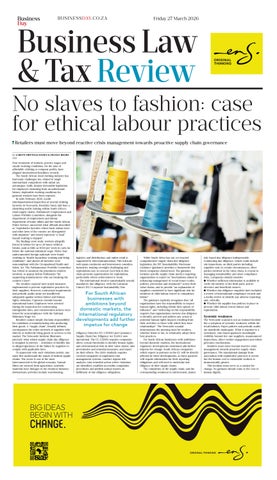
No slaves to fashion: case for ethical labour practices
Retailers
must move beyond reactive crisis management towards proactive supply chain governance
By CARLYN FRITTELLI DAVIES & FRANCE RICHIA ENS
Poor treatment of workers, poverty wages and unsafe working conditions, for the sake of affordable clothing or company profits, have plagued international headlines recently.
The South African retail clothing industry has had many challenges too, related to tough international competitors with unfair tax advantages. Sadly, despite favourable legislation for employees stemming from an unfortunate history, deplorable working conditions for garment workers have been exposed.
In early February 2026, a joint interdepartmental inspection of several clothing factories in Newcastle, KwaZulu-Natal, laid bare a disturbing reality lurking within South Africa’s retail supply chains. Parliament’s Employment and Labour Portfolio Committee, alongside the department of employment and labour, department of home affairs and the South African Police Service, uncovered what officials described as “exploitative factories where basic labour laws and other laws of the country are disregarded with impunity and which represent a fatal hazard waiting to happen
The findings were stark: workers allegedly forced to labour for up to 24 hours without breaks, paid as little as R350 per week in cash, far below the national minimum wage. Thirty-four undocumented foreign nationals were found working in health-hazardous working and living conditions”, and almost all factories were noncompliant with the Occupational Health and Safety Act. The Parliamentary Portfolio Committee has vowed to summon the prominent retailers involved, to appear before Parliament for supporting manufacturers who are breaking the country’s laws”
The retailers exposed have noted measures implemented to prevent exploitative practices by their suppliers. However, contractual requirements and periodic audits alone are insufficient safeguards against serious labour and human rights violations. Exposure extends beyond reputational harm. Employers were arrested during the inspection for contravening immigration laws, and contravention notices were issued for noncompliance with the National Minimum Wage Act.
Retailers cannot simply disclaim responsibility for conditions at manufacturing sites producing their goods. A supply chain , broadly defined, encompasses the entire network of suppliers who directly or indirectly bring goods or services to the market. The Newcastle incident illustrates precisely what robust supply chain due diligence is designed to prevent avoidance of liability due to alleged ignorance of the failure by suppliers to comply with applicable laws.
To appreciate why such violations persist, one must first understand the nature of fashion supply chains. The sector is one of the most interconnected in the global economy. Natural fibres are sourced from agriculture; synthetic materials have linkages to the chemical industry; downstream activities include warehousing,

logistics and distribution; and online retail is supported by telecommunications. This intricate web spans continents and interweaves countless industries, making oversight challenging and exploitation easy to conceal. Each link in this chain presents opportunities for exploitation, particularly where enforcement is weak. The international trend is unmistakably toward mandatory due diligence, with the European Union s (EU) Corporate Sustainability Due
For South African businesses with ambitions beyond domestic markets, the international regulatory developments add further impetus for change
Diligence Directive (EU CSDDD) and Germany’s Supply Chain Due Diligence Act (LkSG) now operational. The EU CSDDD requires companies above certain thresholds to identify human rights and environmental risks in their value chains, take preventative and remedial measures, and report on their efforts. The LkSG similarly requires covered companies to implement risk management systems, conduct regular risk analyses, take remedial action where violations are identified, establish accessible complaints procedures and publish annual reports on fulfilment of due diligence obligations.
While South Africa has not yet enacted comprehensive supply chain due diligence legislation, the JSE Sustainability Disclosure Guidance (guidance) provides a framework that listed companies should heed. The guidance includes specific supply chain metrics requiring organisations to report on “mechanisms aimed at enhancing management of social issues (codes, policies, prevention and treatment)” across their value chains, and to provide an explanation of suppliers considered to have significant risk for incidents of child labour, forced or compulsory labour”
The guidance explicitly recognises that “all organisations have the responsibility to respect human rights, including within their sphere of influence and delivering on this responsibility requires that organisations exercise due diligence to identify, prevent and address any actual or potential human rights impacts resulting from their activities or those with which they have relationships . The Newcastle scandal demonstrates the pressing need for retailers, whether listed or not, to voluntarily adopt these best practices.
For South African businesses with ambitions beyond domestic markets, the international regulatory developments mentioned add further impetus for change. South African companies which export to partners in the EU will be directly affected by these developments, as these partners will require information for their reporting obligations and will need to undertake due diligence of their supply chains.
The complexity of the supply chain, and the corresponding weakness in enforcement, makes
risk-based due diligence indispensable. Conducting due diligence, which could include site inspections, on third parties including suppliers and, in certain circumstances, other parties involved in the value chain, is crucial in managing sustainability and other compliance risks. Companies should consider:
● Whether sufficient information is available to verify the identity of the third party and its directors and beneficial owners;
● Whether due diligence enquiries have included a review of international compliance records and a media review to identify any adverse reporting; and, critically,
● Whether the supplier has policies in place to prevent child labour, forced labour and exploitation.
Systemic weakness
The Newcastle scandal is not an isolated incident but a symptom of systemic weakness within the retail industry. Paper policies and periodic audits are manifestly inadequate. What is required is a systematic, risk-based approach: meaningful visibility beyond tier-one suppliers, unannounced inspections, direct worker engagement and robust grievance mechanisms.
Retailers must move beyond reactive crisis management towards proactive supply chain governance. The reputational damage from association with exploitative practices is severe, but the human cost to vulnerable workers is immeasurably greater.
This incident must serve as a catalyst for change. No garment should come at the cost of human dignity.
123RF KADMY
Municipality ordered to keep the lights on
By PETER BLANCKENBERG Blanckenberg & Associates Inc
In Mafikila & Others v Elundini Local Municipality & Another [2025] ZASCA 142, a unanimous bench found in favour of tenants residing in a property in respect of which the local municipality, without notice to the tenants, discontinued the supply of electricity.
In this matter the owner of the property requested the municipality to discontinue the supply of electricity to the property. This request was duly carried out by the municipality. In consequence the tenants brought an urgent application to the high court where they were unsuccessful.
Priority to basic needs
On appeal to the Supreme Court of Appeal the following was held:
● In terms of the constitution, the objects of a local government include the provision of services to communities in a sustainable manner (Section 152(1)(b)) and a municipality must structure and manage its administration to give priority to the basic needs of the community (Section 153(a)).
● In terms of the Local Government Municipal Systems Act 32 of 2000, municipal councils are required to give members of the local community equitable access to the municipal services to which they are entitled (Section 4(2)(f)).
Sections 73(1)(c) and 73(2)(a) further provide that a municipality must ensure that all members of the local community have access to at least the minimum level of basic service and that such services must be equitable and accessible.
● The Constitutional Court in Mkontwana v Nelson Mandela Metropolitan Municipality [2004] ZACC 9 held that electricity is a component of basic services. It concluded that municipalities are constitutionally and statutorily obliged to provide their residents with electricity.
● In Joseph & Others v City of Johannesburg & Others [2009] ZACC 30, the constitutional court held that tenants of a property were entitled to notice of disconnection of electricity supply. The court held this included an adequate notice of at least 14 days before disconnection. Further, by-laws dispensing with the obligation to adequately inform those receiving electricity of a proposed termination, were unconstitutional.
● The fact that the municipality in the matter before the Supreme Court of Appeal had a contractual relationship with the owner did, not supercede the constitutional and Systems Act obligations imposed on the municipality.
● The decision by the municipality to cut off the supply of electricity to the tenants was an administrative action and fell under the auspices of the Promotion of Administrative Justice Act 3 of 2000 (Paja).
Electricity reinstatement
The court found that therefore the decision by the municipality was procedurally unfair and that the supply of electricity must immediately be reinstated pending action brought by the tenants in terms of Paja.

Impact of Africa’s new era of competition enforcement
Competitive and inclusive African markets are critical for growth and job creation
By HEATHER IRVINE Bowmans
In 2025, several new African competition law regimes opened their doors and a number of African regulators increased the scale and scope of their enforcement.
This holds great promise for consumers but presents compliance challenges for companies operating in Africa.
African consumers even in counties with no national competition regulator will benefit from active competition law enforcement in regional blocs such as the Common Market for Eastern and Southern Africa (Comesa), Economic Community of West African States (Ecowas), Central African Economic and Monetary Community (Cemac) and East African Community (EAC).
These new regional authorities have the power to review notifiable proposed mergers to ensure they don t create greater levels of concentration in African markets or combine suppliers and customers that can exclude rivals. They are well positioned to penalise cartels operating across African borders and tackle dominant suppliers charging excessive prices, or acting strategically to eliminate competitors.
This is good news for African customers, many of whom are poor and vulnerable to price increases. Competitive and inclusive African markets are critical for growth and job creation.
However, newer competition regimes also pose compliance challenges. Companies attempting global mergers must now gather sales and asset values in a bewildering array of African countries to assess where to file. Many countries apply a merger review test based on turnover, which may mean that even foreign mergers involving companies without a significant African presence can trigger a filing.
African merger filing fees are above the global norm in Cemac this is capped at an eye-
watering 1-billion CFA Francs (about $1.7m). The regional blocs should act as one-stop shops for merger reviews, but some national authorities continue to assert their jurisdiction even if their government signed the treaty establishing the regional regulator. This results in companies having to prepare multiple merger filings (and pay multiple hefty filing fees).
For example, Nigeria s Federal Competition and Consumer Protection Commission still requires parties to mergers with effects in Nigeria to file with them, despite acceding to the Ecowas treaty. Filing fees are substantial and calculated
Some newer merger regimes are still developing appropriate rules or clarifying existing ones to avoid ambiguity or overreach
incrementally, at 0.45% of the first NGN 500million, 0.40% at the next NGN 500-million and 0.35% on any sum thereafter. This challenge has intensified since the EAC Competition Authority came online in 2025, since its member states include most of the Comesa member states.
Some newer merger regimes are still developing appropriate rules or clarifying existing ones to avoid ambiguity or overreach. For example, Ecowas rules don’t explicitly state that there is no need to file if the target company has no turnover or presence in the region.
Despite being in operation for more than a decade, eSwatini has not published monetary thresholds for notifications. Any global deal in which the target sells a few units into eSwatini
IN YOUR COURT
therefore technically triggers a filing, despite not raising competition concerns.
Public interest impacts of mergers are increasingly being investigated by African authorities and can potentially trigger costly merger conditions. In the recent merger in which Canal+ acquired MultiChoice, for example, conditions to protect employment and local audiovisual content producers were imposed in Comesa, Cemac and SA.
While it is important that African authorities thoroughly investigate the potential for mergers to result in substantial negative public interest effects on the continent, we also need to make sure the merger review process does not become overly extractive. Any public interest conditions which are imposed should be proportional to the specific merger-related effects which are reasonably expected to result from a proposed merger.
If investors regard African merger reviews as a form of taxation, they will rationally apply the usual methods of minimising them, such as avoiding or minimising investments into the continent, or structuring global transactions to cut out African businesses. This may reduce foreign direct investment, orphan African businesses and deprive our markets of efficiencies gained by global deals.
If African regulators focus too intensively on public interest factors at the expense of thorough competition investigations, they may miss opportunities to address mergers that raise serious competition concerns.
Efforts to attract more African investment will be bolstered when South Africa hosts the World Economic Forum’s Africa Davos meeting in 2027. However, African governments must act to drive home the message that Africa is open for business. This includes ensuring all merger review regimes adopt international best practice and facilitate swift and efficient merger reviews.
Role of environmentallaw in energy decisions
Arecent Supreme Court of Appeal case set out, at some length, several important principles dealing with the interpretation of National Environmental Management Act 107 of 1998 (Nema), in particular, and its closely associated legislation, namely the Constitution and Promotion of Administrative Justice Act 3 of 2000 (Paja). In South Durban Community Environmental Alliance and Another v the Minister of Forestry, Fisheries and the Environment and Others (479/2023) [2025] ZASCA 134, an unanimous judgment was handed down by Dambuza JA.
The case dealt with the issue by the Chief Director: Integrated Environmental Authorisations, Department of Forestry, Fisheries and the Environment, of an environmental authorisation for the construction and operation of a combined cycle gas power plant in Richards Bay. South Durban appealed against the authorisation, which internal appeal was dismissed by the minister of forestry, fisheries and the environment.
South Durban brought an application before the Gauteng Division of the High Court, Pretoria for a review and setting aside of the environmental authorisation and the dismissal of the internal appeal against the granting of the authorisation. The high court dismissed the review application.
South Durban then, with leave of
the SCA, appealed against the decision of the high court.
The projected construction of the power plant involved a number of listed activities as defined in section 1 read with section 24 (2)(a) and (b) of the Nema. A listed activity is an identified activity which may not commence without an environmental authorisation from a competent authority.
Generally, in respect of each listed activity, an applicant must submit to the competent authority either a basic assessment report or a scoping and environmental impact assessment report (EIA report). This is followed by an environmental assessment report on the assessed potential impact of the listed activities. That report then must lie open for public inspection.
The polycentric argument
The respondents argued that the polycentric nature of the environmental authorisation did not permit intervention of the courts in that such intervention would undermine the principle of separation of powers. They referred to the purpose of section 85 of the constitution (which defines the executive authority of the Republic), the National Energy Act 34 of 2008 and the 2010 Integrated Resource Plan (and its later versions) facilitated by a determination in terms of section 34 of the Electricity Regulation Act 4 of 2006.
In short, the argument of the respondents was that the very nature of the application, namely its manifest complexities combined with the

The SCA held that Nema establishes a comprehensive environmental management framework
strategic importance of the project, lifted it out of the constraints defined by both Nema and Paja: consideration, the respondents argued, should be given primarily to specialised legislation (National Energy Act, Electricity Regulation Act, 2010 Integrated Resource Plan (IRP) in particular) which deals more specifically with the procurement, availability and sustainability, at affordable prices, of energy required to support economic growth and poverty alleviation in the Republic.
After consideration of the polycentric argument, the SCA held that Nema establishes a comprehensive environmental management framework through which all laws which may
significantly affect the environment must be interpreted. Accordingly: “[Nema] guides the implementation of all environmental laws and policies, including the National Energy Act, the Electricity Regulation Act and the IRP.
It is the overarching legislation by reference to which all other environmental legislation, policy formation and administrative decisionmaking that effects the environment should be informed this is made plain in section 2 of Nema
In consequence, the court held that macro-level planning cannot determine the environmental impacts of a particular power plant because the purpose of the environmental management regime mandated in Nema is to ensure that social, economic and environmental factors are integrated into all government environmental decision making consequently, the separation of powers’ argument is not sustainable in this instance”
Section 43 of Nema defines the right of appeal to the minister against an environmental authorisation issued by the Chief Director. However, the parameters of the power exercised by the Chief Director, and on internal appeal by the minister, are set out in section 24 of Nema. Specifically: Section [24O] emphasises that all of these office bearers must comply with the provisions of Nema” (my emphasis).
The court then referred to section 43(6) of Nema which gives the minister wide remedial powers to exercise on
appeal. It held that: This indicated that the scope of the appeal is to determine whether the authorisation was correct, and if not whether any authorisation should be permitted, and then under what conditions but this appellant power is framed by the obligatory scheme that Nema sets out. The decision as to whether to grant an authorisation under Nema is not to be likened to an open-ended form of polycentric executive policy formation
Notwithstanding the wide remedial powers as defined by section 43(6), the court emphasised that section 43(6) is constrained by section 24O and the specific requirements as set out by section 24O, inter alia, that the competent authorities (which includes the minister) must comply with Nema, and take into account all relevant factors which may include any pollution, environmental impacts or environmental degradation likely to be caused if the application under consideration is approved or refused.
The court went on to hold that those factors described in 24O, which may be included for consideration by the competent authorities, were simply indicative of the nature of such factors and the fact that the word may appeared in the legislation did not relieve such authorities from the requirement that they comply with Nema as a whole.
● Look out for Part B of this article next month.
-Peter Blanckenberg is a Director at Blanckenberg & Associates Inc.
PETER BLANCKENBERG COLUMNIST
123RF KITCH
IN YOUR COURT
Constitution, Paja and the law: how they fit
In an important judgment from the Constitutional Court of South Africa, namely Bato Star Fishing (Pty) Ltd v The Minister of Environmental Affairs and Tourism & Others CCT27/03, O’Regan J was required to deal with, inter alia, the question of the relationship between the common law grounds of review and the constitution.
In coming to his decision in this regard, O’Regan J referred to Pharmaceutical Manufacturers Association of SA & Another: in re ex parte President of the Republic of South Africa & Others 2000 (2) SA 674 (CC), in which case a unanimous court made the following findings.
First, under our new constitutional order the control of public power is always a constitutional matter.
Second, there are not two systems of law regulating administrative action the common law and the constitution but only one system of law grounded in the constitution.
Third, the court’s power to review administrative action no longer flows directly from the common law but from the Promotion of Administrative Justice Act, No 3 of 2000 (Paja) and the constitution itself.
Fourth, the grundnorm (basic norm) of administrative law is now to be found, in the first place, not in the doctrine of ultra vires (beyond the law), nor in the doctrine of parliamentary sovereignty, nor in the common law itself, but in the principles of the constitution.
Finally, the common law informs the provisions of Paja and the constitution, and derives its force from the latter.
Having set out the above points, O Regan J then summarised the situation regarding the use of the common law when dealing with reviews of administrative actions. He states that:
The extent to which the common law remains relevant to administrative review will have to be developed on a case-by-case basis as the courts interpret and apply the provisions of Paja and the constitution” (my underlining).
O Regan J then proceeded to set out the relevant provisions of the constitution and Paja, as follows:
Section 33 of the constitution provides that:
(1) Everyone has the right to administrative action that is lawful, reasonable and procedurally fair.
(2) Everyone whose rights have been adversely affected by administrative action has the right to be given written reasons.
(3) National legislation must be enacted to give effect to these rights, and must
(a) Provide for the review of administrative action by a court or, where appropriate, an independent and impartial tribunal;
(b) Impose a duty on the state to give effect to the rights in subsections (1) and (2);
and
(c) Promote an efficient administration.
Before quoting Section 6 of Paja, O Regan J highlighted the significance of the long title of Paja, namely:
“To give effect to the right of administrative action that is lawful, reasonable and procedurally fair and to the right to written reasons for administrative action as contemplated in Section 33 of the constitution …” (my underlining).
The judge then proceeded to quote Section 6 of Paja, the relevant portions thereof for the purposes of this article being as set out hereafter:
(1) Any person may institute proceedings in a court or a tribunal for the judicial review of an administrative action.
(2) A court or tribunal has the power to judicially review an administrative action if (a) the administrator who took it
(i) Was not authorised to do so by the empowering provision;
(ii) Acted under a delegation of power which was not authorised by the empowering provision; or
(iii) Was biased or reasonably suspected of bias;
(b) A mandatory and material procedure or condition prescribed by an empowering provision was not complied with;
(c) The action was procedurally unfair;
(d) The action was materially influenced by an error of law;
(e) The action was taken
(i) For a reason not authorised by the empowering provision;
(ii) For an ulterior purpose or motive;
(iii) Because irrelevant considerations were taken into account or relevant considerations were not considered;
(iv) Because of the unauthorised or unwarranted dictates of another person or body;
(v) In bad faith; or
(vi) Arbitrarily or capriciously;
(f) the action itself
(i) Contravenes a law or is not authorised by the empowering provision; or
(ii) Is not rationally connected to
(aa) The purpose for which it was taken;
(bb) The purpose of the empowering provision;
(cc) The information before the administrator; or
(dd) The reasons given for it by the administrator;
(g) The action concerned consists of a failure to take a decision;
(h) The exercise of the power or the performance of the function authorised by the empowering provision, in pursuance of which the administrative action was purportedly taken, is so unreasonable that no reasonable person could have so exercised the power or performed the
PETER BLANCKENBERG COLUMNIST
function; or
(i) The action is otherwise unconstitutional or unlawful.
These provisions, O’Regan J held, divulged a clear purpose to codify the grounds of judicial review of administrative action as defined in Paja. In short, the court held that the cause of action for a judicial review of administrative action now arises from Paja, and not from the common law, and that the authority of Paja to ground such causes of action rest squarely on the constitution.
The judge concluded that as Paja gives effect to Section 33 of the constitution, matters relating to the interpretation and application of Paja will necessarily be constitutional matters.
The judgments issued in both Pharmaceutical Manufacturers Association of SA and Bato Star Fishing (Pty) Ltd have brought clarity to our law regarding the hierarchy of application of the three sources of law in respect of those matters requiring administrative review.
Section 33 of the constitution is obviously supreme; Paja follows in direct support of and in extension of Section 33; and, finally, the common law brings up the rear, providing a means of interpretation of both the constitution and Paja, extending into the future. This clarity is to be welcomed.
-Peter Blanckenberg is a Director at Blanckenberg & Associates Inc.
SA implements 13th edition of Nice Classification
By MARCELLE SAMONS & ALICIA VAN DER WALT
Adams & Adams
South Africa has officially adopted the 13th Edition of the Nice Classification (NCL 13-26) with effect from January 1 2026, following its implementation by the World Intellectual Property Office on the same date.
The Companies and Intellectual Property Commission gave notice to this effect through Practice Note 3 of 2025, published on December 9 2025, which provides that the updated classification applies to all trademark specifications from January 1 2026.
The 13th Edition introduces changes across numerous classes, including additions, deletions and refinements in wording, generally to better reflect the intended purpose of the goods or services.
One of the most notable changes concerns essential oils, which no longer fall squarely within class 03. Instead, the classification thereof now depends on their purpose. Essential oils for cosmetic use remain in class 03, while oils for medical or pharmaceutical purposes fall within class 05 and the phrase “other than essential oils” has now been removed from class 05 indications. Essential oils used as ingredients in the manufacture of cosmetics or pharmaceuticals fall under class 01. The phrase “other than essential oils” has now been removed from classes 30 and 34, and flavouring used as food or beverage (whether oils or not) are classified in class 30, and those intended for tobacco flavouring (whether oils or not) are part of class 34.
Other changes include the deletion of eyewear from class 09 and the movement of optical products such as eyeglasses, contact lenses, sunglasses and eyeglass cases from class 09 to class 10, which covers medical apparatus and articles. This narrows the scope of the notoriously broad class 09 and aligns the classification of these goods with their functional purpose. Interestingly, also concerning the optician field, spectacle and eyeglass repair and maintenance have been added to class 37.
Other articles were also transferred from class 09 to other classes, further limiting the ambit of class 09. Nose clips for swimmers have similarly moved from class 09 to class 10, as its purpose and nature arguably align more closely to medical apparatus and articles than with the scientific, technological or safety-related articles typically falling in class 09. Fire engines and trucks are no longer part of class 09 as well, and are now classified in class 12, which is sensible as class 12 covers vehicles.
Electrically heated clothing now falls within the broader clothing category and has shifted from class 11 to class 25. Umbrella and parasol ribs are no longer recorded as such in class 18 but are now described as umbrellas and parasols being small portable goods for protection against weather conditions ribs for hand-held umbrellas or parasols” and “handheld parasols”. Accordingly,
Adoption ensures SA remains harmonised with international standards
patio umbrellas, which are neither small nor intended to be handheld, have been added to class 22, including nets, tents and tarpaulins and awnings, among other things.
In the services classes, a timely addition pertains to smash rooms and rage rooms, which falls under class 41 for entertainment purposes. Another forward-looking addition pertains to artificial intelligence as a service (AIaaS) in class 42. The adoption of the 13th Edition of the Nice Classification (NCL 13-26) ensures that South Africa remains harmonised with international standards, providing clarity for brand owners and trademark prosecution teams, specifically those with multinational interests. On the other hand, these changes may require reclassification, trademark portfolio audits and broader suites of classes for search purposes. Overall, these changes, however, seem to reflect a more purpose-driven approach to classification.































AI caricatures: you could be giving away more than just your details
Cartoon portrayals give rise to significant privacy concerns because they rely on highly sensitive personal information
By RAKHEE DULLABH, CRAIG SHAPIRO & ALEXANDER POWELL ENS
If you have accessed any social media platform recently, you will have likely been met with a wave of caricatures generated by artificial intelligence (AI) tools. These caricatures often provide surprisingly accurate, cartoon-like portrayals of our personalities and lifestyles. The question arises: what is happening behind the scenes with my data?
How do these AI tools generate caricatures?
A common question is how do these AI tools generate realistic caricatures? AI tools, such as ChatGPT/Dall-E, produce AI caricatures by interpreting the photo and data you provide in a prompt and analyse them using AI models trained on vast collections of facial features and artistic styles. These AI tools then identify key characteristics in your picture, such as facial expressions, proportions and distinctive traits and then creatively exaggerate or stylise them to generate a playful cartoonish representation of you. The caricature is further customised based on the information you provide in your prompt, such as your work and hobbies.
However, while generating and sharing AI caricatures is humorous and is the latest trend on social media platforms, it is important to remember that your use of AI tools remains subject to the terms and conditions of the AI tool provider, such as OpenAI (in the case of ChatGPT/ Dall-E). Below, we explore the main legal risks that arise from using AI tools in this way.
Privacy concerns AI-generated caricatures give rise to significant privacy concerns because they rely on highly sensitive personal information, most notably your facial imagery/biometric data and the contextual information you provide in your prompt (which often includes information about your personal life, family and other personal information).
When users upload high-resolution photographs of themselves, these images often become part of large and opaque data pools that may be stored, shared or even used to train future AI models without clear transparency regarding long-term use of your image and personal information. Depending on the AI tool provider, your biometric data, such as facial geometry and other identifying features, may be retained and further used to train AI models.
From a data protection perspective, it is important to remember that facial imagery and biometric data constitute special personal information under the Protection of Personal Information Act, 2013 (Popia). The processing of such data requires additional measures, including ensuring that there is general or special authorisation to process such data. Users should therefore be aware that by uploading their photographs to AI tools, they may be consenting to the processing of their special personal information, often without full transparency as to how that data will be used.
Furthermore, given that many AI tool providers are based outside of South Africa, the transfer of

personal information to these foreign jurisdictions raises additional concerns regarding the adequacy of data protection standards and whether appropriate safeguards are in place for international data transfers.
While data privacy laws, such as Popia, require that organisations that process personal information take steps to protect the security and integrity of personal information, there is always the risk that in the event of a breach sensitive personal information could be exposed or misused.
Intellectual property concerns
The Copyright Act, 1978 recognises computergenerated works and provides that ownership of copyright in such works vests in the person “by whom the arrangements necessary for the creation of the work were undertaken . This provision directly addresses works created by computer systems rather than human authors and in principle concretises that copyright does, in fact, come into existence. In the context of AIgenerated caricatures, the question becomes: who made the arrangements necessary for the creation of the work ? There are a few possibilities:
● The user who inputs the prompt and photograph into the AI tool and initiates the generation of the caricature;
● The AI tool provider (such as OpenAI or
Google) who developed, trained and operates the AI model; or
● The developers and trainers of the AI model who created the underlying system.
A persuasive argument exists that the user who provides the input photograph, crafts the specific prompt and initiates the generation process is the person who makes the arrangements necessary for the creation of that particular caricature. However, this interpretation has not been formally tested.
Ownership of copyright in a photograph is much clearer. It vests in the person who is responsible for the composition of the photograph (usually the photographer). There is, however, an important exception to this rule. If you commission the taking of a photograph and agree to pay for it, you will own the copyright.
However, copyright issues arise both at: (i) the input stage (training/using third-party works); and (ii) the output stage (the caricature image). In respect of the input stage, where you upload a photograph in which you do not own copyright to generate an AI caricature you may be infringing the copyright owner’s exclusive rights. With regard to the output stage, where an AI-generated caricature substantially reproduces elements of a copyrighted work (whether from the training data or from the input photograph itself), the output may constitute an infringing copy. This risk is particularly true where the resulting caricature is shared on social media.
It should also be noted there is also a general risk related to the training data used to develop AI models. AI tools capable of generating caricatures are typically trained on vast datasets of images, which may include copyrighted artistic works. The use of the AI tool could give rise to an infringement claim if the training data was used without the copyright owner’s consent.
An interesting question arises where someone else creates an AI caricature of you, without your knowledge or consent. In such circumstances, you may have recourse under several overlapping legal frameworks, including copyright infringement (if you are the owner of the copyright in the photograph), data privacy (Popia) and personality rights.
TAXING MATTERS
South African courts have recognised every person has a right to control the use of their own image and to prevent others from appropriating their likeness without consent. Furthermore, personality rights are recognised under South African law, which includes the right to identity, dignity and privacy. These rights protect your interest in your own likeness, name and other aspects of identity.
AI tool provider terms and conditions
The level of protection afforded to end users over their images and personal information they upload into AI tools is ultimately dictated by the specific AI tool provider s terms and conditions. These terms determine what data/personal information is collected, how it is processed, whether it is retained and the extent to which it may be used to train or improve the platform’s underlying AI models.
A key concern is that many AI tool providers reserve broad rights to use user-submitted data, including photographs, prompts and other contextual information, to provide, maintain, develop and improve their AI models and services. For example, OpenAI s opt out clause in its Terms of Use expressly allows OpenAI to use user content for such purposes unless the user opts out. It is critical to note that this setting is turned on by default on a free ChatGPT account, enabling your content (which could include your images and personal information) to be further used to train OpenAI s AI models.
Similarly, Google Gemini s API Additional Terms of Service state that “when you use unpaid services, including Google AI Studio and the unpaid quota on Gemini API, Google uses the content you submit to the services and any generated responses to provide, improve and develop Google products and services” Therefore, the data which you input could be further used to improve and develop Google’s AI products and services.
Ultimately, the degree of protection afforded to end users over their images and data inputted into AI tools is dependent on the third-party provider’s terms and conditions. Given the sensitive nature of biometric data and the increasing integration of AI into everyday tools, users and organisations must exercise diligence by reviewing these terms and conditions before inputting any personal information into an AI tool.
The main concern around uploading your picture via a prompt to generate an AI caricature is that it may result in loss of your ability to control how your image may be used in the future, for example AI tool providers could potentially use your image to further train or develop new AI models. It is for this reason that it is critical to always consider the applicable AI tool provider s terms and conditions before uploading personal information (such as your image) into an AI tool. As regulatory frameworks continue to develop in response to the rapid advancement of AI technologies, it is anticipated that greater clarity will emerge regarding the legal obligations of AI tool providers and the rights of individuals whose data is used to train and operate these systems. In the meantime, a cautious and informed approach remains the best protection.
All litigants are equal; some more than others
By JACKY LABUSCHAIGNE AJM
An essential feature of litigation is the equilibrium among the parties, particularly when the state is one of them. This is evident in criminal litigation, where the accused citizen is presumed innocent, and the state bears the burden of proving their guilt beyond a reasonable doubt.
The rationale behind this lies in the inherent imbalance between the state and the citizen: the state has far greater resources and investigative powers, whereas the citizen may lack the means to prove their innocence. The system is designed this way to level the playing field and protect citizens from unjust convictions, going a step beyond the enshrined equality before the law principle and striving instead for “equity before the law”, so to speak.
Does the equity principle apply in tax litigation?
Off the cuff, there is a basis for arguing that the equity principle should apply in tax litigation, where the citizen, for example the taxpayer, is again pitted against the state, for example the South African Revenue Service (Sars) picture, for the moment, a natural person against an institutional Sars in a David-vs-Goliath scenario.
Tax litigation is, however, sui generis, with the taxpayer in a rather unique litigious position.
On the one hand, tax litigation is considered akin to civil litigation between two equal citizens, as seen in the Virgin Mobile judgment below. On the other hand, however, one of the parties (hint: the taxpayer) often bears a repute akin to that of an accused in criminal litigation. Perhaps the earliest (and, with hindsight, humorous) illustration of this is Conradie JA’s referral in a tax case to the taxpayer as the accused in a somewhat Freudian slip. Although now amusingly referred to, the irony is that an accused in criminal litigation is arguably a better off litigant. Not only does the taxpayer not benefit from a presumption of innocence, but instead suffers a presumption of guilt to some degree, with SARS being entitled to make an additional assessment based solely on its satisfaction that the taxpayer’s return (read: version ) is incorrect. Therefore, the equity principle does not appear to feature in tax litigation, which may explain the pro-fiscus trend in tax judgments in recent years.
The Virgin Mobile judgment
The recent Virgin Mobile judgment illustrates the above. There, the Supreme Court of Appeal held that Sars need not apply for condonation for the late filing of its first pleading in appeal proceedings before the tax court, where the taxpayer calls out the lateness (in what is referred to as a Rule 56(1)-notice), and Sars then files the pleading within the prescribed
period in response.
The court reasoned that a Rule 56notice is akin to a notice of bar in civil litigation, in that it: “assists an innocent party to advance the appeal, either by ensuring compliance or by securing a default judgment
The court further noted that the majority of the high court in the court a quo found it irrational that “a party” (hold that thought) could ignore the Tax Court Rules and simply wait for a Rule 56(1) notice to comply with and so avoid applying for condonation. It
Where Sars is late in filing, it would be better off playing possum and waiting for a Rule 56(1) notice to avoid having to apply for condonation
then, however, followed through by simply stating: [this] is how the rules were designed. They allow a party to play possum even beyond noncompliance with a Rule 56(1) notice but before default judgment is granted And then, somewhat confusingly, it concluded by stating: In an adversarial
system such as ours it is important for the innocent party to timeously invoke a rule that is aimed at ensuring compliance with the rules. The innocent party must be vigilant.”
Tax litigation is different from civil litigation
As observed by my colleague Dr Albertus Marais in his “Letter to the Editor” featured in The Taxpayer (Vol 75 Nos 1&2 Jan-Feb 2026), the problem with this approach is that it fails to appreciate the distinction between civil and tax litigation. As outlined above, Sars is entitled to make an additional assessment unilaterally. Once it has done so, that assessment stands and has immediate effect. The taxpayer becomes liable for the tax debt reflected in that additional assessment, even though they likely believe (or, worse, know) it to be incorrect.
The practical imbalance
Furthermore, the notion that “a party” (implying the taxpayer or Sars, equally) is at liberty to play possum under the rules is, with respect, a stretch. In reality, that liberty belongs to Sars alone. To illustrate: if a taxpayer is late in filing their first pleading, Sars, as the innocent party in that instance, has no obligation nor incentive to advance the appeal. After all, the additional assessment is already in place.
The effect of the current approach, as a result of the Virgin Mobile
judgment, is therefore the following:
Where Sars is late in filing, it would be better off playing possum and waiting for a Rule 56(1) notice (a somewhat novus actus interveniens, if you will) to avoid applying for condonation.
Where a taxpayer is late in filing, for whatever reason, they are hard-pressed to not only file as quickly as possible to overturn the status quo of Sars’ additional assessment, but must also always apply for condonation because Sars has no obligation nor incentive to file a Rule 56(1) notice to disturb the condonation requirement.
The practical consequence is that the procedural latitude described by the court operates almost exclusively in Sars’ favour.
Equality before the law?
One cannot unsee the paradox in the court s suggestion that the obligation falls on the innocent party (which we now know will ironically always be the taxpayer) to call out Sars’ lateness timeously.
Surely equality before the law dictates that the emphasis rather be placed on each party’s obligation to observe the rules to begin with?
It is unfortunate the matter has been denied an audience with the Constitutional Court, and the scale will remain tipped in Sars favour for some time. In the meantime, taxpayers have been primed to have their Rule 56(1) notices ready and waiting.
123RF ALEXANDARILICH
What crypto asset service providers need to know for 2026
Time for businesses to review cross-border structures, exchange control processes and governance frameworks
By ANGELA ITZIKOWITZ, ARNAAZ CAMAY, ERA GUNNING, AMELIA WARREN & DYLAN
MARTHEZE ENS
South Africa s 2026 budget marks a significant step forward in the regulation of crypto assets, particularly regarding cross-border capital flows.
In his budget speech on February 25, finance minister Enoch Godongwana announced that draft regulations will soon be issued under the Currency and Exchanges Act 9 of 1933 to bring crypto assets into South Africa’s capital flow management regime and that crypto assets will be governed within the cross-border movement of capital framework. This was framed as complementary to existing anti-money laundering and anti-fraud measures already applicable to crypto-related activity.
This is an important policy development, particularly in light of the high court s decision in Standard Bank of South Africa Ltd v South African Reserve Bank and others, where the court found that cryptocurrency fell outside the ambit of the exchange control regime on any construction (including on a restrictive interpretation) and that the relevant bitcoin transactions therefore did not contravene the regulations.
The budget speech announcement signals a clear shift from that position by indicating the government intends expressly to bring crypto assets within the capital flow management regime through draft regulations under the Currency and Exchanges Act.
Market participants should expect explicit rules on the reporting, administration and supervision of cross-border crypto transactions once the draft regulations are published, which is likely to affect crypto asset service providers (Casps), fintech businesses, treasury functions and any business using crypto rails for offshore settlement or transfers. The direction of travel is clear even if the details are yet to come.
The budget commentary on stablecoins points in the same direction: regulated accommodation, but with caution. According to the budget review comments, National Treasury acknowledges that many G20 jurisdictions advanced stablecoin regulation in 2025, and confirms that South Africa s Intergovernmental Fintech Working Group (IFWG) is continuing work on an appropriate framework for stablecoins, including a 2026 focus on whether existing frameworks apply to rand-pegged stablecoin arrangements and on the policy implications of foreign currency-pegged stablecoins.
For businesses, the message is not that

stablecoins are being endorsed as unrestricted payment instruments. Rather, regulators appear to be building a structured framework that distinguishes between innovation and risk, while paying close attention to cross-border implications, consumer exposure, AML/CTF controls and broader financial stability concerns.
From a compliance perspective, businesses operating in or around digital assets should start preparing now. Internal mapping of crypto-related cross-border flows, transaction reporting processes, customer disclosures and governance frameworks will become increasingly important, particularly where business models span payments, remittances, custody, trading or tokenbased settlement mechanisms.
The regulatory architecture is becoming more layered, and the cost of being reactive (both operationally and in terms of market confidence) is likely to rise. Businesses with exposure to digital assets should use this window to review cross-border structures, exchange control processes and governance frameworks before the draft regulations reshape the compliance landscape.
South Africa is also formally implementing the OECD s Crypto-Asset Reporting Framework (Carf) as part of its broader automatic exchange of information agenda. The South African Revenue Service (Sars) has published an External Business Requirement Specification (BRS) setting out how
reporting crypto asset service providers (RCasps) must collect, structure and submit crypto asset data to Sars.
Sars has adopted the OECD Carf XML schema in full and is using it for both international exchange with other tax authorities and domestic reporting by RCasps to Sars.
The schema includes a South African “wrapper” (Carf_Sars), enabling Sars to collect additional domestic third-party data while
Regulators appear to be building a structured framework that distinguishes between innovation and risk
remaining compatible with the OECD standard. This approach minimises the risk of mismatches when data is exchanged cross-border and should reduce adjustment costs for businesses operating in multiple jurisdictions.
Based on the BRS, RCasps and affected entities should take the following steps:
● Assess their data readiness by confirming that onboarding/KYC, transaction processing and wallet management systems capture all required user identity and residence data, TINs and
LEGAL SCOOP
alternative identifiers, as well as detailed transaction classifications (by type, token, counterparty status, retail payments and unhosted wallets).
● Upgrade technology and integration by implementing or adapting systems to generate Carf-compliant XML, including the Carf_Sars wrapper. Enforce identifier formats (MessageRefID/DocRefID) and uniqueness, and integrate with Sars eFiling, Connect Direct or Secure Web channels.
● Design governance and internal controls for periodic Carf data extraction and validation, approval and sign-off of submissions, and management of corrections and status message follow-up.
● Plan to meet the timeline by working backwards from the first mandatory reporting period (commencing March 1 2026) and the endMay 2027 deadline to ensure adequate time for development, testing and parallel runs. Engage with Sars through existing industry platforms for clarifications and to stay abreast of evolving requirements. The key timing milestones are:
● First reporting period: March 1 2026 to February 28 2027 ● First submission deadline: end of May 2027 (for the 2026/27 period)
● Ongoing annual cycle: March 1 to end February each year, with submissions due by end May ● International exchanges between tax authorities: September 2027 onwards
● Monitor for updates as Sars has indicated that it will expand domestic third-party data requirements over time via additional fields in the Carf XML schema wrapper. These will be aligned with South African tax legislation and developed through existing engagement platforms with industry. Businesses should therefore expect progressive enhancement of required data fields and develop flexible, scalable data architecture capable of adapting to new fields without major rework.
Looking ahead For crypto asset service providers and related businesses, Carf is not merely a technical reporting change; it embeds crypto assets into the global tax transparency infrastructure. Early planning, robust data architecture and strong governance will be critical to manage compliance risk and to operate seamlessly in a regime where tax authorities, both domestic and foreign, will have significantly greater visibility into crypto asset activity.
Turning point for mining rights in liquidation
By CHARLES ANCER & CHARDONNAY ARENDS Fluxmans Attorneys
Section 56(d) of the Mineral and Petroleum Resources Development Act, No 28 of 2002 (MPRDA) states that any rights granted in terms of the MPRDA (for example, a mining right) automatically lapse when the holder of the right is either liquidated or sequestrated, unless the exceptions referred to in section 11(3) apply. The automatic lapsing of mining rights poses a significant challenge in insolvency proceedings, in that many strategies are adopted and/or attempted to prevent liquidating or sequestrating the holder of the rights. These strategies are often aimed more at preserving the existence of the mining right, and its intrinsic value, rather than restoring the overall financial health of the holder thereof.
Under the current legislative framework, when the holder of a mining right is liquidated or sequestrated, that right ceases to exist. It cannot be preserved, sold or transferred to benefit the insolvent estate. As a result, creditors are unable to recover any value from what may very well be the holder s most valuable asset. However, the proposed amendment to section 56 introduces a significant shift from the prevailing framework.
In May 2025, the mineral resources and energy department published a draft bill to amend the MPRDA. One of the mooted amendments is the proposed insertion of a section 56(2) which reads that in the event the holder of a mining right is liquidated and finally deregistered or sequestrated, the right, permit, permission or licence must fall within the holder’s insolvent estate and may be sold and transferred to a third party.

success will depend on the efficiency and transparency of the ministerial consent process
However, the proposed amendment is not without limitation as it is subject to the prior written consent of the mineral
and petroleum resources minister in terms of section 11(1).
This amendment represents a move towards aligning the MPRDA with general insolvency law principles, where assets of an insolvent estate are realised for the benefit of creditors. By allowing mining rights to fall within the insolvent estate rather than lapse upon the liquidation or sequestration of the holder, the proposed amendment empowers liquidators to preserve and potentially realise value by selling these rights. This could unlock considerable value for creditors and allow for a more equitable and commercially viable winding-up process. While the amendment is aimed at promoting higher returns to creditors of insolvent estates, in practice its success will be highly dependent on the efficiency and transparency of the ministerial consent process. Delays in obtaining the requisite section 11(1)
consent to dispose of the mining right could discourage potential purchasers, frustrate creditors and complicate the winding-up process. Additionally, in the event the minister does not consent to the disposal of the mining right, the realisable value of the insolvent estate would be reduced and, in turn, adversely affect the very creditors the amendment seeks to protect. In conclusion, the proposed amendment to section 56 represents a welcome change, moving away from value destruction by the automatic lapsing of mining rights and towards value preservation to the benefit of creditors. However, the continued need for ministerial consent under section 11, while recognised to be an important principle to ensure alignment with the objects of the MPRDA, may significantly limit its intended effect unless accompanied by administrative reform to ensure timely and fair decision-making.
123RF SINENKIY