
Country to usher in new era of electric motoring
•
lectro-mobility
current power supply crisis, says Govender. And BMW Group South Africa continues to work with the government and industry stakeholders to help find solutions that take pressure off the grid and support affected customers. These measures include recommending EV owners charge their vehicle whenever it is not in use, and charging overnight during off-peak periods.
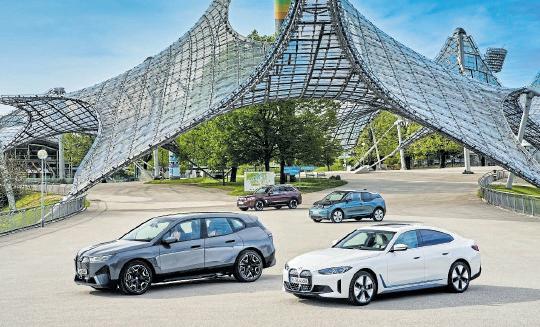
introduction into SA, such as the BMW iX, BMW i4 and the BMW iX3. These vehicles promise a range of up to 630km.
Fully-electric versions of the BMW 5 and 7 Series, the BMW X1 and the successor to the MINI Countryman and other models will follow
This will go a long way to tackling range anxiety in a country like SA where drivers typically cover long distances.
EVs help to drive a sustainable future
SA recently adopted more ambitious emission targets at COP26, where the country committed to reduce 350-420 megatons of carbon dioxide (CO2) equivalent by 2030.
According to the department of forestry, fisheries & the environment, mitigation strategies in the energy and transport sectors, together with other measures, will enable SA to achieve these targets. And the transition to electro-mobility (e-mobility) will play an increasingly important role

Between 2021 and 2025, the BMW Group plans to increase sales of fully-electric models by an average of more than 50% per year, with about 10-million fully-electric vehicles on the roads in the next decade.
The BMW Group expects fully-electric vehicles to account for at least 50% of its global sales in 2030.
Comparatively, SAs EV penetration rate lags the global average, with roughly 1,000
registered vehicles on the road, according to CleanTechnica data. However, industry stakeholders are working with the government to advance e-mobility in SA. These roleplayers are working on standards, charging infrastructure, industrial policy and the economics of the transition to electric vehicles. While no government incentives currently exist to encourage customers to purchase EVs, the Auto Green Paper published earlier this year by the department of trade, industry & competition points to a wide-reaching shift in policy, explains Govender. A major factor includes addressing Eskom s electricity generation constraints EVs have not been shown to have a significant drain on the power supply and we remain optimistic SA can resolve the
Many of our customers within the premium segment also have access to solar and off-grid solutions at their homes and workplaces to meet their charging requirements. Fortunately, SA has a head start on charging infrastructure to support the transition. It ranked fifth globally in the ratio of public EV chargers to EVs in 2020, according to the IEA Global EV Outlook 2021 report. Nationally, there are about 260 charging stations and all chargers are compatible with BMW vehicles. We will also continue to invest in our retailer network and public charging stations as EV sales increase, says Govender. Furthermore, BMW Group South Africa will soon launch many new models that offer significantly increased range. We are now in the fifth generation of our BMW eDrive drivetrain, which is available in models primed for imminent
We are confident we will jointly solve all challenges facing e-mobility adoption, and it is imperative we do. The transition to EVs is a global trend and SA must prepare to embrace it. BMW also believes that physically spending time driving an EV is one of the best ways for potential customers to understand the shift from internal combustion engines.
“An EV offers anew driving sensation thanks to the torque available from standstill, which delivers spontaneous acceleration. Yet the almost silent electric drive delivers a relaxed driving experience.
The BMW Group will continue introducing EVs across all brands and models, including Rolls-Royce and the BMW M series range.
We are pleased with the strides made with the BMW i brand in SA. We will continue driving the expansion of emobility as the shift to EVs is unavoidable, says Govender.
Promoting higher electric vehicle (EV) adoption will have a direct benefit on the environment as these vehicles generate about 50% fewer greenhouse gas emissions over their life span compared to internal combustion engines, according to information from UC Berkeley School of Law s Center for Law, Energy and the Environment.
To help reduce CO2 emissions from the use phase of vehicles, the BMW Group aims to at least halve CO2 emissions per vehicle and kilometre driven from 2019 by
Deena Govender momentum