Business Day
BU S I N E S S DAY.CO. Z A
Friday 25 September 2026
Business Law & Tax Review
Africa’s data centre boom calls for new financing structures For lenders, the opportunities are significant but not without complexity
Renewal error does not lock insurer into unintended cover
By ALEX CULLINAN ENS
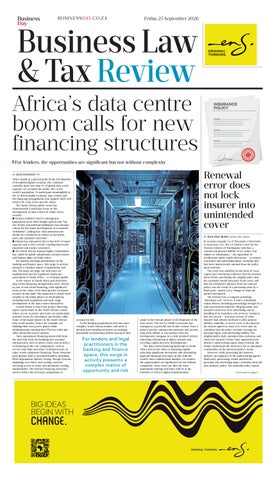
Africa stands at a pivotal point in the development of the global digital economy. The continent currently hosts less than 1% of global data centre capacity, yet accounts for nearly 20% of the world’s population. To participate meaningfully in the AI-driven global economy, data centres and the financing arrangements that support them will need to be a key focus area for Africa. The South African public sector has demonstrated a particular focus on the development of data centres in South Africa recently: ● Finance minister Enoch Godongwana announced in his 2026 budget speech that “the use of data and artificial intelligence has become critical for the future development of economies worldwide”, adding that “data infrastructure should be considered as critical as electricity, ports and transport networks”. ● Eskom has announced that it has 6GW of spare capacity and is now actively courting hyperscale operators and anchor customers. ● The South African Human Rights Commission has called for public submissions on data centres and human rights in South Africa. For lenders and legal practitioners in the banking and finance space, this surge in activity presents a complex matrix of opportunity and risk. The deals are large, the structures are sophisticated and the regulatory landscape — particularly in South Africa — is evolving rapidly. At the outset, in South Africa and elsewhere, data centre financing arrangements were viewed as part of real estate financing, with significant focus on the value of the land and the structures located on that land. This approach is clearly most suitable to the initial phases of development, including land acquisition and early-stage development of the data centres themselves. Closely linked to this is the project financing aspect, particularly in the South African context where access to power and water are particularly sensitive issues for developers and funders alike. Some of the major players in the South African data centre market, Teraco for example, are building their own power plants while simultaneously entering into PPAs for wind and other alternative power options. Once operational, financing needs shift from the shell (the land, the building and essential infrastructure such as power, water and security), to financing of the core components, such as servers and chips and other AI infrastructure, in other words equipment financing. These elements pose distinct risks to potential funders, including BESS degradation (Battery Energy Storage Systems degrading over time), and cooling concerns (securing access to water and alternative cooling mechanisms). The relevant financing structures need to reflect the necessary adaptations to
By JEAN-PAUL RUDD Adams and Adams
123RF — CREATIVESTOCKS
account for this. As the funding requirements become more complex, South African lenders will need to develop their funding structures accordingly, potentially incorporating hybrid structures that
For lenders and legal practitioners in the banking and finance space, this surge in activity presents a complex matrix of opportunity and risk
adapt to the relevant phase of development of the data centre. The DevCo/YieldCo structure has emerged as a powerful tool in this context. Once a project reaches commercial operation and secures long-term offtake, it can transfer from the development company to a yield-oriented vehicle, unlocking refinancing at tighter spreads and recycling capital into new developments. The data centre financing landscape in South Africa and across Africa is maturing rapidly, attracting significant investment and demanding legal and financial structures in line with the world's most sophisticated markets. For lenders, the opportunities are significant but not without complexity. Those who can offer the most appropriate funding structures will be at the forefront of Africa’s digital transformation.
In General Casualty Co of Wisconsin v Reed Hein & Associates, LLC, the US District Court for the Western District of Washington held that a commercial general liability (CGL) policy was subject to reformation — the equivalent of rectification under South African law — to restore a personal and advertising injury exclusion that had been inadvertently omitted from the policy upon renewal. The court was satisfied, on the basis of clear, cogent and convincing evidence, that the insured knew before purchasing the original policy that the exclusion would form part of the cover, and that the exclusion’s absence from the renewal policy was the result of a processing error by a third-party vendor, not a change in what the parties had agreed. The insured was a company providing “timeshare exit” services. It had a substantial claims history, including proceedings brought by a state government authority alleging unfair and deceptive practices in its advertising and its handling of its timeshare exit services. Owing to this loss record — and after at least 27 other insurers had already declined to offer general liability, umbrella or excess cover to the insured — the insurer agreed to issue CGL cover only on condition that the policy exclude coverage for personal injury and advertising liability. The original policy duly contained that exclusion, and when the insured’s broker later approached the insurer’s underwriting agent about renewal, the broker understood the renewal to be an automatic continuation of the previous policy’s terms. However, while generating the renewal policies, an employee of the underwriting agent’s third-party processing vendor deleted the personal and advertising injury exclusion from the new primary policy. The umbrella policy issued Continued on page 5
2
BusinessLaw&Tax
Friday 25 September 2026
Platform work moves up South Africa’s labour law reform agenda Labour department weighs wider protections for gig economy
single model. The degree of control exercised by platforms, the manner in which work is allocated and remunerated, and the extent to which individuals are genuinely able to operate independently can differ substantially.
Where regulation may be heading
By HENRY ROSSOUW & LARA KEIL ENS
The employment & labour department briefed Parliament’s Portfolio Committee on Employment and Labour on August 26 2026, focusing on changing employment conditions, labour protections and regulatory gaps within South Africa’s growing digital platform economy. The briefing comes at an interesting point in South Africa’s broader labour law reform process. Earlier this year, the draft Labour Law Amendment Bill, 2025 and Labour Relations Amendment Bill, 2025 were published for public comment following the labour law review undertaken through Nedlac. While the department has since indicated that the broader amendments are targeted for promulgation only in 2028, the latest briefing suggests that platform work may attract more specific regulatory attention in the meantime.
A developing landscape Digital platform work including e-hailing, food and grocery delivery, courier services and other forms of work facilitated through digital platforms has seen a significant rise in South Africa. While these models have created new opportunities for work and income generation, their growth has also raised questions about the extent to which South Africa’s existing labour laws adequately accommodate newer and less conventional forms
123RF — INKDROP
of work. During the briefing, issues raised included worker classification, fair remuneration, social protection, occupational health and safety, algorithmic decision-making and access to labour rights. Worker classification remains an important part of the debate. Many platform models operate on the basis that individuals providing services are independent contractors rather than employees. This distinction has consequences under South African employment law, where access to many statutory protections remains dependent on the existence of an employment relationship. Platform work does not, however, represent a
The latest briefing also indicates that the department’s consideration of platform work extends beyond worker classification. Regulatory interventions under consideration include clearer guidelines on worker classification, a possible sector-specific minimum earnings standard, greater transparency around algorithmic decisionmaking, improved recruitment and compliance verification, and the possible extension of occupational health and safety, Unemployment Insurance Fund (UIF) and Compensation Fund protections for occupational injuries and diseases to platform workers. If pursued, some of these interventions could broaden the regulatory framework applicable to platform work beyond the traditional question of whether a worker is an employee or an independent contractor. In particular, they raise the possibility that certain labour and social protections may be extended to platform workers regardless of how the underlying contractual relationship is classified. This is relevant given the department’s stated intention that the broader package of proposed labour law amendments is targeted for promulgation in 2028. There is no indication that this timetable has changed. The identification of platform-specific regulatory interventions does, however, suggest that developments in this area may emerge while the broader legislative reform
process is still under way. The domestic discussion also takes place against international developments. In June 2026, the International Labour Conference adopted the ILO’s Decent Work in the Platform Economy Convention, 2026 (No 193), the first international labour standard specifically directed at platform work. The convention addresses, among other matters, classification, remuneration, occupational health and safety, social security and automated decision-making.
What happens next? The parliamentary briefing does not itself alter the legal position applicable to platform workers, nor does it establish that persons currently engaged as independent contractors will necessarily be regarded as employees. Rather, it indicates the scope of the regulatory issues now under consideration. The discussion has now extended beyond classification of workers as employees or otherwise and moved on to consider issues of remuneration, social protection, occupational health and safety and the role of algorithmic management in the working relationship. The next development to watch will therefore be whether these areas translate into concrete regulatory proposals and, more importantly, what form those measures take. This will be particularly relevant to businesses operating through platformbased and other nonstandard workforce models. For now, the August briefing provides an early indication that the regulation of platform work may develop alongside, rather than only as part of, the broader labour law amendments currently anticipated for 2028.
VC returns: why tax planning should start on day one By BENJAMIN MBANA & PHUTI KGOMO Bowmans
A venture capital (VC) investment may take five years to exit, but the tax consequences of that exit can begin with decisions made on day one. For example, if a fund invests R20m in a promising South African technology business that is eventually sold five years later for R100m that is a five times return on paper. However, say the investment is held by a South African company and the resulting R80m gain is subject to capital gains tax of about R17.3m, the R100m exit value would be about R82.7m before considering any further tax at fund or investment level — a 4.1 times return rather than five times. The tax result can further be affected by aspects such as the nature of the fund, investor residence, nature of the gain, available losses, treaties and a multitude of other factors. What the fund and its investors ultimately receive depends on more than the headline exit value. The gap between the headline return and the return ultimately delivered is where tax becomes relevant; and it is a conversation that is often
started too late. When a VC investment is being evaluated, the focus is understandably on the founders, market, technology, valuation and growth potential. Tax often enters the conversation later, once the structure has been agreed or an exit is already on the horizon. Yet the tax outcome can be influenced by decisions made years before there is a buyer at the door: how the investment is structured, where it is held, how additional funding is provided, how ownership evolves and, ultimately, how the investment is realised. An investor cannot predict exactly what the exit will look like. It could be a trade sale, another financial investor, a secondary transaction, a listing or a restructuring along the way. That uncertainty makes it more important to consider whether the structure being put in place today preserves sufficient flexibility for tomorrow. The same thinking applies to management and employee equity, which is often fundamental to creating alignment in a growing business. A founder or key employee may receive equity intended to give them a meaningful share in the
value they help create, but the after-tax outcome may not be what was expected. South Africa’s section 8C rules can result in gains on certain equity instruments being included in an employee’s income when they vest, subject to tax at the marginal tax rate as opposed to the CGT rate. For example, if the executive team holds 10% of a company that is sold for R100m, their share would be R10m. If that gain falls within section 8C, it may be taxed at their marginal rate rather than the effective CGT rate. In a simplified illustration, tax at 45% would leave them with R5.5m, compared with R8.2m if the same gain were taxed at 18% — a difference of R2.7m. The example is deliberately simplified and does not take into account how section 8C taxation may arise through vesting over the life of the investment.
Could changes in funding, ownership or geography create unintended consequences?
If the tax outcome significantly reduces the value of the incentive to management, the arrangement may not deliver the alignment the fund intended. A structure can therefore make perfect sense from an ownership and dilution perspective while producing a different economic outcome for the person it was designed to incentivise. None of this means tax should dictate an investment strategy. It means it should be considered alongside it. The useful questions are relatively simple: what structure is an investor participating through, and why? Could changes in funding, ownership or geography create unintended consequences? Where should key assets such as IP sit as the business scales internationally? And when an investor eventually exits, what will the return look like after the relevant tax consequences have been considered? The best time to ask those questions is when there are still choices available. The exit may be five years away, but the tax decisions that influence it may already be sitting in front of you.
South Africa faces new labour law challenge from platform economy By JONATHAN GOLDBERG & JOHN BOTHA Global Business Solutions
The International Labour Organisation (ILO) defines “decent work” as productive work that delivers a fair income, security in the workplace, social protection for families and freedom for people to organise and have a voice in decisions that affect them. It is a good definition. It is also a definition built almost entirely around a 20th century employment relationship: one employer, one workplace, one contract, one set of statutory protections that attach automatically once you cross the threshold from “independent contractor” into “employee”. That threshold is exactly where the platform economy lives and where it refuses to sit still. Uber drivers, Bolt drivers, delivery riders for Mr D and similar platforms, freelance workers routed through digital marketplaces. These workers perform labour that looks, sounds and feels like employment. They follow app-dictated routes, accept algorithmically set fares, are rated and effectively disciplined by star systems, and can be deactivated. This is the platform-economy euphemism for dismissed and can be let go without a hearing, an appeal or recourse to the CCMA. Yet under the traditional test for employment, many are classified as independent contractors, placing them entirely outside the Labour Relations Act’s unfair dismissal protections, outside the Basic Conditions of Employment Act’s working-hour and leave provisions, and outside UIF as well as compensation fund coverage. This is not a uniquely South African problem. It is, in fact, the single issue that has occupied the ILO’s standard-setting machinery for the past three years.
The ILO finally acted — and the world is still arguing about it
In June 2026, at its 114th International Labour Conference, the ILO adopted Convention No 193 — the Decent Work in the Platform Economy Convention — which is the first binding global treaty built specifically for gig work. It followed a multiyear, double-discussion drafting process that began in 2023, ran through preliminary talks in 2025 and concluded with a vote of 406 in favour to eight against, with 36 abstentions. The convention addresses the gaps traditional labour law has failed to close: fair and transparent pay, access to social security, occupational health and safety obligations extended to platform work, protection against workplace violence and — most contentiously — a right for workers to understand
You cannot redistribute your way out of a jobs crisis in an economy that isn’t creating jobs fast enough to redistribute and contest the algorithmic systems that manage, discipline and pay them. It also tackles the practice of misclassification: platforms labelling workers as self-employed specifically to avoid the cost of employment protections. Predictably, the vote split along familiar lines. Worker delegates and most governments backed it. Employer delegates, along with government delegates from the US and New Zealand, voted against while the UK and India abstained. The disagreement is not about whether gig workers face real vulnerabilities — and even employer bodies mostly concede that they do. It is about who should pay for fixing it and whether binding international standards will simply push platforms to reduce the flexibility, work volume and market access that is the entire commercial rationale for the platform model in the first place.
That tension — protection versus access — is the same one South African employers and unions will be shouting past each other about on October 7.
Growth, elasticity and an uncomfortable truth nobody wants at the microphone Even if South Africa solved the platform-work classification question tomorrow, it would not solve unemployment. The deeper structural problem is employment elasticity of growth — the extent to which each percentage point of GDP growth translates into new jobs. South African data on this is uncomfortable reading for anyone hoping for a quick fix. Studies going back over the past two decades put South Africa’s overall employment elasticity somewhere close to GDP growth in aggregate, but with enormous sectoral variance: services sectors such as finance, community and social services show elasticities near or slightly above one-for-one, while manufacturing has, on some estimates, shown negative employment elasticity with output rising while jobs fall, as capital- and skill-intensive production replaces labour-intensive processes. Economists have long argued that South Africa needs sustained GDP growth of 3% to 4% simply to make a meaningful dent in unemployment; actual growth has spent most of the past decade well below that threshold, frequently near or below 1%. You cannot redistribute your way out of a jobs crisis in an economy that isn’t creating jobs fast enough to redistribute. Job security legislation, minimum wage increases and anti-retrenchment campaigns are legitimate protections for the workers who already have jobs but they do very little for the roughly 11-million-plus South Africans who don’t, unless they are matched by growthoriented reform that lifts the employment elasticity itself: infrastructure investment, energy security, reduced red tape for labour-intensive sectors and — uncomfortably for some — genuine
flexibility in how new entrants are brought into the labour market.
Enter AI — the disruptor nobody invited to the negotiating table Layer AI onto this picture and the tension sharpens further. It is not a future risk for South African employment relations; it is already present. The disruption cuts two ways, and both deserve equal airtime. On one hand, AI-driven productivity gains could, in principle, expand the very economic growth that South Africa’s employment elasticity problem requires — new sectors, new categories of work and potentially the kind of inclusive productivity strategy that deliberately designs women and historically excluded groups into the AI economy rather than around it. For a labour market already carrying an unemployment rate above 33%, this is not an abstract policy debate. It is the central design question for the next decade of employment equity, skills development and workplace governance in South Africa.
The real fight worth having The deeper argument South Africa actually needs — between organised labour, platforms, employers and government — is not “protection versus profit”. It is whether the country’s labour relations architecture, built for a single-employer, singlecontract world, can be redesigned quickly enough to cover the platform workers the ILO has just recognised, absorb the productivity shock of AI, and do all of this inside an economy whose growth rate still isn’t generating enough jobs to matter. Decent work is the right goal. The question South Africa has not yet answered is decent work for whom, created by what growth and protected by which rules — traditional, platform or something that doesn’t exist in the LRA yet.
BusinessLaw&Tax
Friday 25 September 2026
3
LEGACY AND ESTATES PLANNING
No will, no say: the costly consequences of leaving your estate to the law Are you comfortable leaving the law to decide what happens to what you leave behind? By EVAN PICKWORTH Editor, Business Day Law & Tax Review
123RF — GOLIBTOLIBOV
South Africa’s will problem isn’t just motivation — it’s access By KAVIR RAMJEE
Every Wills Week we ask why so few South Africans have a valid will. Part of the reason is motivation. People don’t like thinking about death, and creating a will rarely feels urgent until something forces it. Changing that takes education and a shift in cultural beliefs. Not something a single product or campaign will solve instantly. But motivation was never the whole story. Alongside it lives a problem that is far more fixable: accessibility. There are a few dimensions to this. The first is emotional and practical at once: setting down your wishes in a legal document, for a time when you are no longer here, is experienced by many as overwhelming, often because they don’t know where to start. The second is structural. Until recently, one of the more acceptable ways to create a will meant sitting down with a professional, taking time off work and paying for it. A third is language itself: a will is a document you are meant to read, check and be certain of, yet often this is created in a language that is the second or third language of many. For an average South African, these placed the category somewhat out of reach. A will became something other people did — people with lawyers, time and estates they thought big enough to warrant the effort. The encouraging part is that access, unlike motivation, has a more tangible solution. When the process moves online, it can be done at any time and from anywhere, without a day away from work or family. When guidance is built in, not knowing where to start stops being an unsurmountable barrier. When drafting and storage carry no cost, price stops being a filter. And when a will can be read and checked in a person’s own language, that barrier falls away too. Old Mutual Will, for instance, allows users to download the will in five South African languages, spoken among them by about 70% of the population, according to Census 2022. Improving accessibility also means serving people the way they prefer. Some will work through it themselves; others would rather sit with someone they trust and be talked through it. A category serious about improving accessibility must allow for both, because the moment a will is treated as a purely digital transaction or primarily face-to-face discussion, people will be left out. A will is also the foundation of an estate plan, not the whole of it. It only makes a difference if it is signed and witnessed correctly and then kept somewhere it can be found, which is why secure storage matters as much as the drafting. For parents, it is where guardians for minor children are named, often the most consequential decision in the document. Considering this, a will should also be revisited as life changes — a marriage, a new child, a property, a divorce — because an outof-date will can create the very disputes it was meant to prevent. The part most often overlooked sits beyond the signature, in the cost of settling what you leave behind, and it is here that generational wealth is often eroded. A valuable estate is not always a liquid one. Before anyone inherits, the costs of winding up an estate must be settled: the executor’s fee, estate duty, taxes, transfer and administration costs. Where there isn’t enough cash to meet them, assets may have to be sold, sometimes for less than they are worth. Seeing those costs in advance is what makes it possible to plan for them, which is why a sound process surfaces an estimate up front, as the Old Mutual Will journey does at its final step. Shifting motivation is a longer-term project, and an important one. But making the category accessible was a problem that could be solved and getting it right changes not just how many South Africans have a will, but how much of what they built actually reaches the people they leave it to. -Ramjee is Managing Executive: Personal Finance Product at Old Mutual
Only 28% of South Africans have a completed will, according to Sanlam’s 2026 Survey on South Africans and Wills. Perhaps even more revealing is why so many do not: 44% of the more than 1,000 people surveyed felt they did not have enough assets to need one. That is a dangerous misconception. A will is not merely a wealth-planning instrument for those with substantial estates. It is the legal mechanism by which a person determines what should happen to their estate after death. Without a valid will, that choice is surrendered to the rules of intestacy. The result may look very different from what the deceased assumed or intended, particularly where family structures are complex, there are minor children, unmarried partners, previous marriages or assets that a person wanted to leave to particular people. Having a will is only the first step. It must also be valid. Another striking finding from the Sanlam survey highlights the practical difficulty of estate administration: of the 47% of respondents who had helped to wind up a loved one’s estate, only 22% described the process as smooth. That should hardly be surprising. Deceasedestate administration is highly procedural, and technical traps can arise at almost every stage. Even apparently mundane requirements can cause delays. Banks, the Master, the South African Revenue Service, insurers and investment houses have their own documentary and administrative requirements. Something as simple as whether an institution requires an original document rather
than a certified copy can hold up a process on which surviving family members may depend to access funds. Problems become considerably more serious when the will itself is defective. South African law prescribes formalities for executing a valid will. However, section 2(3) of the Wills Act provides an important safety net. It empowers a court, where satisfied that a document drafted or executed by someone who has since died was intended to be that person’s will, to order the Master to accept it despite noncompliance with the prescribed formalities. This can potentially rescue an unsigned, improperly witnessed or otherwise defective document. But there is a significant catch: it may require an application to the high court. The existence of a legal remedy therefore does not remove the potential cost, uncertainty and delay caused by getting the will wrong in the first place. Technology has introduced another complication. While an ever-growing share of our commercial and personal lives is conducted electronically, wills are specifically excluded from the Electronic
Communications and Transactions Act’s provisions on electronic transactions and signatures. The estate of former Constitutional Court Justice Yvonne Mokgoro brought the tension between modern technology and traditional testamentary formalities into sharp focus. The dispute involved an older will that complied with conventional formalities and a later document signed electronically by Mokgoro and witnesses. The matter ultimately required court intervention to determine which document should govern her estate. The court accepted the later electronically signed document, highlighting the potentially important role of section 2(3). But it equally demonstrates why relying on a court to rescue a defective will is a poor substitute for executing one correctly in the first place. There are therefore two distinct problems that South Africa needs to confront. The first is to get far more people to make wills. The second is to ensure the wills they make actually work when they are needed. Initiatives such as National Wills Week are important in encouraging people to start the process. But changing the perception wills are only for the wealthy may be even more important. The real question is not whether you believe you have enough wealth to justify having a will. It is whether you are comfortable leaving the law, rather than yourself, to determine what happens to what you leave behind.
4
BusinessLaw&Tax
Friday 25 September 2026
gal New bill seeks to close gaps in Le framework country’s whistleblower law regulating From broader protection and criminal sanctions to financial rewards, whistleblower law gets an overhaul By SUAD JACOBS ENS
Whistleblowers play a critical role in strengthening accountability. As former Chief Justice Raymond Zondo observed, they are “the final defence against corruption and state capture”. The Association of Certified Fraud Examiners, a global professional organisation of fraud examiners, in a study considered cases of fraud in 133 countries and found that 42% of fraudulent activities were detected by tips/whistleblowing reports. This is nearly three times as many as the next most common fraud detection method, internal audits. The assassinations of whistle-blowers such as Babita Deokaran, Mpho Mafole and Pamela Mabini underscore the urgent need for enhanced whistleblower protections in South Africa. At the time of our last article, almost 12 months ago, the primary legal protection for whistleblowers in South Africa is the Protected Disclosures Act No 26 of 2000 (PDA). However, there is broad consensus that the current legislation fails to adequately destigmatise whistleblowing or protect whistleblowers, discouraging individuals from coming forward. Beyond threats to life, whistleblowers face loss of employment, disciplinary action, financial difficulties and psychosocial struggles.
relationships; ● Implementing measures to safeguard confidentiality and allow anonymous reporting where appropriate; ● Establishing a support fund and legal immunity framework for good-faith whistleblowers; and ● Appointing a retired judge as “whistleblower protector” to lead an institution responsible for certifying whistleblower status, conducting risk assessments, assisting with interdicts against retaliation, instructing protective actions, providing financial assistance and making policy recommendations. This final recommendation stems from the National Anti-Corruption Advisory Council (Nacac) in their August 2025 report.
Current PDA protections
Recent developments
The current PDA protects employees from occupational detriment — including disciplinary action, dismissal, transfer, denial of promotion, or other adverse employment effects — resulting from making a protected disclosure. Key proposed amendments to the PDA include: ● Expanding protections to contractors and volunteers beyond traditional employment
Progress has been made in revamping our whistleblower legislation through the proposed Protected Disclosures Bill, 2026, which aims to provide tougher legal, security and financial safeguards for whistleblowers. The new bill addresses major gaps in the current legislation incorporating recommendations from the Zondo Commission. The bill closed for public comment
123RF — MAURICE98
on May 14 2026. Some of the key changes proposed are: ● Broadened scope of protection: the bill replaces the term “employee” with the broader concept of “discloser”, which now covers any person in the public or private sector including employees, investigators, volunteers and trainees who makes a disclosure. ● Expanded definition of occupational detriment: disclosers are protected against occupational detriment, which now expressly includes emotional and psychological trauma, in addition to dismissal, suspension, harassment and intimidation. ● Removal of the good faith requirement: the bill removes the open-ended “good faith” requirement and instead sets out specific statutory exclusions — such as knowingly false disclosures, disclosures made to cause harm or disclosures made for pecuniary gain. ● Detailed internal procedure requirements: employers must establish internal whistleblowing procedures addressing designated officers, timeframes, anonymous reporting, confidentiality, referral processes and mechanisms for informing disclosers of investigation outcomes. ● New complaints mechanism: a retired judge designated by the President will oversee complaints from disclosers or related persons who believe they have suffered, or are likely to suffer, detrimental action or whose identity is about to be unlawfully disclosed. ● Criminal sanctions: subjecting a discloser or related person to occupational detriment or detrimental action is now a criminal offence, punishable by up to 15 years’ imprisonment; unlawfully disclosing a discloser’s identity carries up to 10 years’ imprisonment. ● Financial awards for whistleblowers: where a court convicts an employer of improper conduct and imposes a monetary sanction, up to onequarter of that sanction may be awarded to the discloser(s) whose evidence led to the conviction. While the bill does address some key gaps in the current legislative framework, the public consultation process will be critical in determining the shape and scope of the protections that ultimately emerge.
AI chatbots and corporate liability risks By ERWYN DURMAN, MANNO MANAVHELA & PRECIOUS MAPHUPHA Webber Wentzel
With the growing use of artificial intelligence (AI) and its integration into corporate systems, a key question arises: can a company be held responsible for misleading statements made by its AI chatbot to a customer? This issue was addressed in Moffatt v Air Canada, a case concerning a refund for a bereavement fare. Although decided by a Canadian small-claims tribunal in 2024 and not binding in South Africa, Moffatt is instructive. As AI-driven customer service tools become commonplace, its reasoning on when a company must answer for its chatbot’s words offers useful lessons for the South African landscape.
Moffatt v Air Canada Following the death of his grandmother in November 2022, Mr Moffatt used Air Canada’s website chatbot to research bereavement fares for an urgent flight. The chatbot advised a reduced bereavement rate could be claimed retroactively, within 90 days of the ticket being issued, by submitting a refund application. Relying on this information, Mr Moffatt booked one-way flights between Vancouver and Toronto at standard rates and subsequently applied for partial refunds. Air Canada rejected the refund request, pointing to a different webpage on its site that stated that bereavement fares could not be applied retroactively. The tribunal found Air Canada liable for negligent misrepresentation and, applying the principle that Mr Moffatt should be placed in the
position in which he would have been had the misrepresentation not occurred, awarded C$650.88 in damages — less than the claimed amount of C$880.36.
breached the applicable standard by failing to take reasonable steps to ensure the representations made on its website and by the chatbot were accurate.
Lessons from the judgment
South Africa’s law of delict already recognises negligent misrepresentation as a basis for liability and the Consumer Protection Act 68 of 2008 prohibits misleading representations to consumers. No reported South African case has yet tested these principles in the context of an AI chatbot. Even so, the reasoning in Moffatt is one that could plausibly find favour in South African courts: a company cannot treat its chatbot as an autonomous actor detached from its business. If a chatbot misleads a client about the terms, procedures or exclusions of a product or service, liability will likely rest squarely with the company that deployed it. This matters as chatbots become standard features of client-facing services in South Africa. The efficiency gains are real but so is the exposure. A single misrepresentation can trigger financial, reputational and regulatory consequences and that risk may extend to AI systems used by third-party service providers. South African courts may well adopt reasoning similar to that of the Canadian tribunal: consumers cannot reasonably be expected to distinguish between “official” and “automated” sources of information when both are presented on a company’s platform. South African companies should implement governance frameworks, compliance checks and human oversight of AI outputs now rather than wait for the first local test case.
South African perspective
The key issue was whether Air Canada could be held liable for inaccurate information generated by a chatbot on its website. The tribunal defined negligent misrepresentation as occurring “when a seller does not exercise reasonable care to ensure its representations are accurate and not misleading”. Air Canada admitted that the chatbot had used “misleading words” but argued that it could not be
A company cannot treat its chatbot as an autonomous actor detached from its business liable for the chatbot’s statements, suggesting that the chatbot was effectively a separate legal entity responsible for its own statements. The tribunal rejected this, describing the submission as “remarkable”, and found that the chatbot was simply part of Air Canada’s website. It held that a consumer could not reasonably be expected to know which section of the airline’s website was accurate when contradictory information existed. As a service provider, Air Canada owed Mr Moffatt a duty of care and had
NPCs in SA By TIRELO MOILOA Blanckenberg & Associates Incorporated
Nonprofit companies (NPCs) are companies established to pursue public benefit, social, cultural, communal or other nonprofit objectives. The Companies Act 71 of 2008 provides the legal framework regulating the establishment, operation and dissolution of NPCs. An NPC must have at least one object set out in its Memorandum of Incorporation (MOI) which must relate to a public benefit, cultural or social activity, or communal or group interest. The income and assets of an NPC must be applied towards advancing its stated objects. Although an NPC may conduct business or trade, such activities must be consistent with its stated objects. An NPC is prohibited from distributing its income or assets to its incorporators, members or directors. This prohibition does not preclude legitimate payments, including reasonable remuneration for goods or services rendered, reimbursement of expenses incurred in advancing the NPC’s objects, or payments made pursuant to bona fide agreements or legal obligations.
Liquidation, winding-up or dissolution of an NPC Upon the winding-up or dissolution of an NPC, its members and directors are not entitled to any portion of the company’s remaining net assets. After the company’s liabilities and obligations have been satisfied, the remaining net assets must be distributed to one or more qualifying nonprofit organisations, voluntary associations or nonprofit trusts with similar objectives. This provision ensures that assets accumulated for a nonprofit purpose continue to be applied towards a similar purpose and are not distributed for the private benefit of members or directors.
Incorporators of nonprofit company The incorporators of an NPC are its first directors and, where applicable, its first members. The MOI must provide for the appointment or election of directors. Directors are subject to restrictions regarding the provision of financial assistance to themselves and certain related persons, subject to limited exceptions. An NPC is not required to have members. Where an NPC has members, its MOI must set out the requirements for membership, voting rights, membership fees and the circumstances in which membership may be suspended or terminated.
Conversion of NPC and disposal of an NPC’s assets An NPC may not convert into, merge with or amalgamate with a profit company. Where an NPC has voting members, certain fundamental transactions, including the disposal of all or the greater part of its assets or undertaking, require the approval of its voting members. The disposal of any part of an NPC’s assets to a profit company must be for fair value, unless the disposal occurs in the ordinary course of the NPC’s activities. These restrictions serve to protect the NPC’s assets and preserve its nonprofit character.
Tax considerations for NPCs Registration as an NPC does not automatically confer tax-exempt status. An NPC must separately satisfy the requirements of the applicable tax legislation to qualify for tax exemption.
Conclusion The central principle governing NPCs is that their income and assets must be applied towards advancing their stated nonprofit objectives and not for the private financial benefit of their members, directors or founders. Organisations intending to establish an NPC should ensure its MOI is appropriately drafted and governance structures, financial arrangements and activities comply with the Companies Act. Where tax-exempt status is sought, appropriate tax advice should be obtained to ensure compliance with the applicable tax legislation.
CONSUMER BILLS
The hidden cost of app-based loyalty
L
oyalty programmes, by which the supplier of goods or services gives consumers real benefits, have been around since long before the 2011 Consumer Protection Act provided some specific requirements. However, the need to sign up for an app when you want to do any transaction takes on a new dimension in the age of unlimited intrusion and risks created by artificial intelligence. To whose advantage is it where I have to download an app, subject to pages of terms and conditions, in order to get the best price on goods purchased? I recently went to a technology store to buy a moderately priced item and was told on the way to the till that if I downloaded their app, I could get a R500 discount. Nothing to do with loyalty. Just to get me on their system. I
was not likely to be back in that store for a long time (even before I was asked to surrender my privacy for a sum of money). I never reached the till and found a similar item cheaper elsewhere. How is it that I can get a discount voucher for my book purchases by simply giving my cellphone number but, to get a discount on a food store I visit weekly, I need to download their app and give away yet more private information. If I don’t go into the app and neutralise their marketing efforts, I am going to get a lot of messages I don’t need or want. To get efficient banking services, it is now necessary to download the banking app. And then I read a recent headline about “Alarm bells for anyone with banking apps on their phones”. When you access services on an app you have no idea who is part of, and who is getting a cut of, the transaction.
PATRICK BRACHER COLUMNIST
When you access services on an app you have no idea who is part of, and who is getting a cut of, the transaction Online gambling has become a financial and public health issue and
problematic gambling is a worldwide phenomenon. When you are encouraged to buy gambling services online, you can be sure that the app provider is taking a percentage in return for helping to promote the service. It is said that the provider of the intermediary service gets up to 15% of the transaction without declaring their role in encouraging gambling. There is an age-old principle of law that anyone who acts as your agent has to declare to you any profits they derive from doing so. That legal principle no longer means much in the cryptic world of online transactions. The gambling apps themselves enable users to lose money at the speed of summer lightning. Apps are essential and useful for everything we do in a day including shopping, reading, playing, travel, music and everything else. That is why
the statistics regarding apps reflect hundreds of billions of downloads and transactions and most of this is a matter of choice. The problem comes when the only way of accessing better value is to sign up for a multitude of apps at every major store we go into. We are not only being rewarded for loyalty, we are sacrificing our privacy in order to be induced to show loyalty. Apps are an essential part of the modern world. The problem is when services that could be provided and loyalty that could be rewarded easily without downloading an app with the same benefits are not available. We run many more risks in accepting loyalty credits as a consideration for surrendering privacy when all it needs is a cellphone number or identity number. -Patrick Bracher (@PBracher1) is a director at Deneys
BusinessLaw&Tax
Friday 25 September 2026
5
Business rescue: the six warning signs boards should not ignore Early action gives distressed companies more room to manoeuvre
restructuring options that can preserve value if implemented early enough. Depending on the circumstances, these may include operational restructuring, debt restructuring or refinancing, working capital optimisation, cost transformation initiatives, business model redesign, asset rationalisation, strategic partnerships or mergers and tax restructuring where appropriate. Independent business reviews can also identify practical interventions that management may overlook due to operational pressures or organisational bias. Not every company requires formal business rescue. Some need better financial visibility, stronger governance oversight and a willingness to make difficult strategic decisions before options narrow.
By RETIEF SMITH PKF South Africa
Business rescue has become an increasingly familiar feature of South Africa’s corporate landscape. Yet by the time a company enters formal proceedings, management and directors have often exhausted many of the options that could have preserved value, protected stakeholder relationships and avoided the need to seek postcommencement finance (PCF). While business rescue remains an important mechanism for viable companies facing financial distress, it is not intended as the first resort. Nor should directors view it as a substitute for timely decision-making. In many cases, the challenge is not a lack of turnaround options, but a delay in implementing them. This is particularly relevant given the practical realities of PCF. Although PCF enjoys a degree of statutory protection under the Companies Act, raising fresh capital for a distressed business is rarely straightforward. Potential funders remain focused on commercial risk, recovery prospects and the credibility of the turnaround strategy. As a result, many companies enter business rescue expecting funding to materialise, only to find access to capital is limited, expensive or unavailable. The better question for boards is therefore not how to secure post-commencement finance, but how to avoid needing it in the first place.
Early intervention Section 129 of the Companies Act requires directors to consider business rescue where a company is financially distressed and there appears to be a reasonable prospect of rescue. Equally important, directors continue to owe fiduciary duties to act in the company’s best interests and to exercise reasonable care, skill and diligence. Those obligations do not commence when the business rescue practitioner is appointed. They arise when warning signs first appear. Good governance requires boards to identify deteriorating financial conditions early, evaluate available alternatives and demonstrate that appropriate action was taken before distress becomes irreversible. Independent turnaround specialists frequently observe that businesses entering formal rescue have often experienced months, and sometimes
The value of acting before the crisis
123RF — MITAY20
years, of declining performance before decisive action is taken.
Six warning signs that demand attention
● 1. Cash flow pressure is becoming structural rather than temporary. Many businesses can absorb short-term cash flow fluctuations. The concern arises when working capital pressures become persistent, supplier payments are repeatedly delayed, tax obligations begin to slip or management relies on overdrafts merely to fund ordinary operations. These are often among the earliest signs that deeper structural issues require attention. ● 2. Debt servicing is becoming increasingly difficult. When covenant breaches, repeated refinancing requests or growing dependence on lender forbearance become the norm, the underlying business model may require intervention rather than further borrowing. Adding more debt rarely resolves an operational problem. ● 3. Margins continue to deteriorate despite stable revenue. Businesses sometimes focus heavily on turnover while overlooking falling profitability. Rising input costs, pricing pressure, operational inefficiencies or changing customer behaviour can steadily erode margins long before liquidity reaches crisis point. ● 4. Management decisions become increasingly reactive. Emergency cost-cutting,
deferred maintenance, delayed investment decisions and frequent operational “firefighting” often indicate that management is responding to symptoms rather than addressing the underlying causes. Boards should be cautious when short-term survival begins to supplant long-term strategy. ● 5. Stakeholder confidence begins to weaken. Distress is rarely confined to financial statements alone. Suppliers tighten credit terms. Key employees leave. Customers grow uncertain. Lenders request additional security. Auditors raise concerns. Collectively, these developments can accelerate financial decline. Rebuilding confidence becomes significantly harder once these relationships have deteriorated. ● 6. Directors are relying on optimism rather than objective evidence. Perhaps the most significant warning sign is governance inertia. Boards sometimes delay difficult decisions because they believe trading conditions will improve, a major contract will materialise or the economy will recover. Hope, however, is not a turnaround strategy. Independent financial reviews can provide objective analysis before problems become entrenched.
A broader turnaround toolkit One of the misconceptions about financial distress is that companies move directly from normal trading into business rescue. In practice, there is a broad spectrum of
There is often a perception that seeking turnaround advice signals failure, yet in practice the opposite is true. Boards that commission independent reviews while the business remains solvent generally retain greater control over outcomes, preserve negotiating leverage with creditors and financiers, protect enterprise value and improve the likelihood of attracting future investment should additional capital ultimately be required. By contrast, companies that delay intervention often find that formal business rescue becomes a necessity rather than a strategic choice.
Prevention remains the best restructuring strategy Business rescue continues to play an important role in South Africa’s insolvency framework, and many companies have successfully restructured through it. However, the most effective turnaround often occurs before formal proceedings become necessary. For directors, the lesson is clear. Governance is measured not by how effectively a board manages a crisis after it has arrived, but by how quickly it recognises warning signs and acts while meaningful alternatives still exist. The earlier those conversations begin, the wider the range of restructuring options available and the less likely a business is to rely on the uncertain prospect of post-commencement finance to secure its future. Independent assessment, practical restructuring guidance and clear, evidence-based recommendations before options narrow are crucial for boards and management. Early engagement can help businesses objectively assess their position, preserve value and determine the most appropriate path forward.
Renewal error does not lock insurer into unintended cover Continued from page 1
for the same renewal period continued to include the exclusion the parties had negotiated. During the renewed policy period, customers filed a class action against the insured alleging that it had engaged in deceptive advertising that induced them to pay for timeshare exit services the insured could not provide, and that it had misappropriated client funds by treating preservice payments as earned income rather than placing them in trust or escrow. The insured tendered the class action for coverage under its CGL policy. The class action later settled, with the insured assigning its rights against its insurers to the plaintiff. The insurer then brought proceedings seeking reformation of the renewal policy to restore the personal and advertising injury exclusion, together with declaratory relief that it had no duty to defend the insured in the underlying action.
The court’s analysis The court granted reformation, applying the established principle that reformation is an equitable remedy used to bring a writing that is materially at variance with the parties’ actual agreement into conformity with that agreement — the goal being not to alter the parties’ bargain, but
to ensure the written contract reflects their mutual understanding at the time it was made. Reformation requires a showing of fraud or mutual mistake, and where mutual mistake is relied upon, it must be established by clear, cogent and convincing evidence; a mistake made by only one party is not sufficient. On the facts, the court found this standard amply satisfied. The record established that the exclusion had been specifically negotiated as a condition of coverage; that the insured was aware it could not obtain CGL insurance without accepting the exclusion; and that the renewal was intended to be an automatic continuation of the original policy’s terms. The court held that the fact the omission arose from a processing error by a third-party vendor did not make it a unilateral mistake on the insurer’s part — rather, the mutual mistake lay in the parties proceeding with a written renewal that did not reflect what they had
The record established that the exclusion had been specifically negotiated as a condition of coverage
actually agreed. The continued presence of the exclusion in the umbrella policy for the same period further reinforced the conclusion that neither party had intended to alter the scope of cover upon renewal. The insured’s representatives (assignees of its rights following the settlement) argued that reformation should be refused because the insurer had acted in bad faith in handling the claim, and pointed to an email exchange shortly before renewal in which an employee of the insured questioned whether certain matters were covered or excluded. The court rejected both points. It found nothing in the email exchange to suggest the parties were even discussing the personal and advertising injury exclusion, let alone that cover had changed. More fundamentally, the court reasoned that evidence of bad faith in the claims-handling process does not bear on the parties’ intention at the time the contract was formed, which is the focus of the reformation enquiry. The relevant question is what the parties agreed when the renewal was concluded, not how the insurer later responded to a claim made under it. Having reformed the policy to include the exclusion, the court held the insurer had no duty to defend the insured in the underlying class action, since none of the theories of liability
advanced fell within the scope of cover as reformed. Notably, the court also rejected an argument that the insured’s alleged mishandling of customer funds triggered the policy’s property damage coverage, reasoning that financial assets lacking physical form do not constitute “tangible property” for that purpose — a separate and independent basis, apart from the reformed exclusion, for finding no duty to defend on that theory.
Takeaway This decision confirms that a policy document can be corrected after the fact where clear evidence establishes that it does not reflect what the parties actually agreed. From the insurer’s perspective, the case is a useful illustration that an administrative or documentation error — including one made by a third-party vendor during the renewal process — need not lock the insurer into unintended coverage, provided the true agreement can be clearly demonstrated. Particularly significant is the court’s reliance on consistent terms in a related policy (the umbrella policy for the same period) as evidence reinforcing the parties’ shared intention, and the court’s emphasis that the focus of the enquiry is on what the parties intended at the time the contract was concluded rather than on the insurer’s subsequent claims-handling conduct.