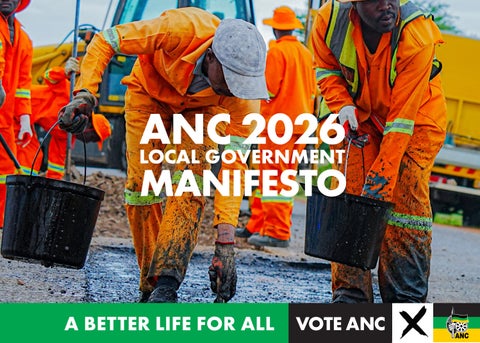
ANC 2026 LOCAL GOVERNMENT
MANIFESTO
A BETTER LIFE FOR ALL
LET US CONTINUE
BUILDING
BETTER COMMUNITIES, TOGETHER
2
Message from the President of the ANC 30 years of Democratic Local Government Our Vision for the Next 5 years The first 100 Days A Plan for each Municipality and Ward Six Action areas and targets: 2026 to 2031 1. Reliable, Quality and Affordable basic services and infrastructure
TABLE OF CONTENTS
2. Economic development and Jobs 3. Safe, healthy and resilient communities 4. Sustainable municipal finances 5. Capable developmental local government. Zero tolerance for corruption. 6. Community participation and communications Climate smart and resilient municipalities Better communities for youth, the elderly and persons with disabilities The life of a community Strengthen municipal capacity for Implementation Monitoring commitments. The guarantee The ANCs Pledge to the People
3
MESSAGE FROM
THE PRESIDENT OF THE ANC
4
Fellow South Africans, This Manifesto is our programme to make local government work better for all South Africans. Local government is where people experience democracy in their daily lives. It is where families get water, sanitation and electricity, where roads are maintained, where refuse is collected, where businesses are built. It is in municipalities where local economies grow and where communities work together with government to improve their quality of life. It is where we mourn, worship and celebrate together. It is where get to know and care about our neighbours. Where we stand in solidarity with each other. It is through local government that the African National Congress has, over the course of three decades, steadily improved the lives of millions of South Africans. Yet, despite the progress we made together, many municipalities do not work as they should. Citizens know this from the tap that runs out of water too often, from the streetlight on the corner that goes dark too often, from the bill that arrives with a number that nobody can explain. South Africans have been clear. Citizens expect government to work. They expect services to be reliable and affordable, leaders to be accountable and ethical, and municipalities to deliver. People expect all government bodies, social partners and stakeholders to work together to build vibrant and cohesive towns, cities and rural communities. The ANC has listened and we have heard. In the first three decades of our democracy, we had to build what did not exist for all citizens. The task of the next five years is different. Now all of us, working together, have to make what we built work better – every day, in every ward, for every household. This manifesto outlines the actions we will take, working with all South Africans, to continue building better communities. Through these actions, we will ensure: Water, lights and services that work for all. More work and investment where people live. Safer streets and cleaner neighbourhoods. Municipal finances that deliver what people need. Municipalities that are run well and honestly. Municipalities that account to and listen to residents. Each action in our manifesto has measurable targets. And every one of our councillors will report regularly to residents on these actions. They will be available, responsive and accountable. This manifesto is a call to everyone. Let us build. Masakhe. Building municipalities that work is a shared responsibility. Government, communities, business, labour, traditional and Khoi-San leaders, faithbased organisations, youth, women and professionals all have a role in building municipalities that are responsive, accountable and focused on improving the quality of life of every South African. Let us continue building better communities together. Vote ANC | 4 November 2026 President of the African National Congress Cyril Matamela Ramaphosa 5
THIRTY YEARS OF DEVELOPMENTAL LOCAL GOVERNMENT
6
THE CHANGE THAT STARTED In 1994, South Africa inherited a fragmented, racist, patriarchal and unequal system of local government, built to serve some and exclude the majority. Together, we replaced it with a system of one municipal government that covers every square kilometre of this country and everyone in it. • Access to electricity has risen from 57.6% of households to more than 90%. Piped water reaches 87.4% of households. Improved sanitation reaches 84%. Some 451 000 housing opportunities were delivered in the last five years alone. • Since the dawn of democracy, over a million households received title deeds to their homes. Internet access increased from 28% in 2010 to 85.6% of households in 2025. • Load shedding that crippled every household and business in the country has been brought to an end. • Every community is part of a democratic system of local government, with elected representatives and established mechanisms for public participation and accountability. These gains matter. They restore the dignity of millions of South Africans who were second class citizens in their country of birth. But access to basic services alone is not enough. THE JOURNEY IS NOT YET OVER The progress of the past thirty years exists alongside serious weaknesses in the functioning of local government. Communities continue to experience unreliable services, deteriorating infrastructure, slow implementation, financial distress and, in some municipalities, corruption and weak leadership. These challenges do not erase the progress made. They tell us that the task of developmental local government must enter a new stage: we must not only extend access, but make what has been built work better, last longer and deliver more reliably to improve people’s lives.
7
THE LAST FIVE YEARS In our 2021 Local Government Elections Manifesto, as we emerged from the shadow of the global COVID19 pandemic, the ANC committed to doing and being better: delivering services more reliably, building safer and healthier communities, stimulating local economies, strengthening accountability, rooting out corruption and remaining accessible to our people. Five years later, we account for that commitment. The 2021 election marked a shift in the ANC’s electoral position. Our national municipal vote declined from 53.9% in 2016 to 45.59% in 2021, and the number of hung councils rose from 27 to 66. In the metros, we retained outright majorities only in Buffalo City and Mangaung, with the remaining six governed under opposition, coalition or minority arrangements. The ANC remained the largest party overall, retaining outright majorities in 161 of the 213 directly contested metro and local municipalities. But the message from our voters was clear: South Africans wanted better government from the ANC and were no longer prepared to give us an automatic mandate. We take that message seriously. Over the past five years, we continued work to improve and ensure more households receive basic services and infrastructure, housing, local economic development, food security, community safety, financial management, municipal capacity and the fight against corruption. Through the Local Government Action Plan, we placed greater emphasis on implementation, monitoring, measurable outcomes and accountability. While the term of local government drawing to an end demonstrates some progress, it also exposed regression and unfinished work. These five years have shown that political stability matters, capable and ethical leadership matters, professional administration matters, financial discipline matters, and above all, implementation matters. They have also shown us that we must remain willing to listen, to account and to change where change is required. Over the past two years, with inputs from citizens and different sectors, we reviewed the system of local government, by examining its foundations, the 1998 White Paper on Local Government. The is to prepare for the next phase of local government, improved and modern municipalities that respond to the challenges of today, chart an inclusive and prosperous future and better respond to the needs of citizens.
8
Local government reform can no longer be postponed or approached piecemeal: • Access to basic services must be matched by quality, affordability and reliability. While access to municipal services expanded, the quality, reliability and affordability of services deteriorated in many municipalities.• The funding model must be reformed. Too many municipalities operate with unfunded budgets and insufficient capital investment. The local government sphere receives less than 10% of the national budget. Many municipalities are unable to generate sufficient revenue to fulfil their constitutional duties. • Capable leadership and professional administration matter. Municipalities require capable and ethical political leadership, competent administrations, sound financial management, regular infrastructure maintenance and meaningful community participation. • Implementation and accountability must improve. Effective local government requires clear plans, disciplined implementation and continuity, consequence management and effective cooperation between the local, provincial and national spheres. • Municipalities must become engines of local development. They must create conditions for investment, business growth, job creation, and opportunities for formal and informal businesses, alongside reliable services and integrated spatial planning. • Financial sustainability cannot be separated from service delivery. Only 15% of municipalities achieved clean audits in 2024/25, representing 8% of total municipal expenditure, and no metropolitan municipality achieved a clean audit. Municipalities continue to carry substantial debt to Eskom and water boards, while non-revenue water remains high and infrastructure maintenance spending remains below the Treasury norm. • All spheres of government must work together to ensure that the unfinished business of a Better Life for All is achieved. The ANC introduced the district development model (DDM) – where local, provincial and national government plan, problem solve and work together – because all national and provincial plans must, in the end, find expression at the local level. These lessons provide the foundation for this Manifesto. The next stage is not to begin again. It is to build on thirty years of democratic local government, fix what has not worked, maintain what has been built and make municipalities more capable of driving development, working together with all community stakeholders to improve the daily lives of communities. 9
OUR VISION FOR 2026–2031 LET US CONTINUE TO BUILD BETTER COMMUNITIES TOGETHER
10
Based on the vision of the Freedom Charter and the Constitution, the African National Congress envisions municipalities that work for the people, deliver affordable and reliable services, create opportunities, foster community cohesion and participation, and improve the quality of life in every community. We envisage stable, capable and accountable municipalities, with zero tolerance on corruption, where the democratic will of communities translates into effective government, decisive leadership and consistent implementation. Local government does not operate in isolation. In the 2024 ANC Manifesto we committed to an inclusive economy and creating jobs, reducing the cost of living, and war on poverty, and building a capable, ethical and developmental state. This Manifesto translates those commitments into practical action at the municipal level. Our vision is informed by the lessons of the past 30 years of democratic local government and by the lived experience of the communities we serve. The next stage must build on the foundations established: maintaining what was built; improving the quality, affordability and reliability of services; strengthening local economies and job creation; creating safer and more liveable communities; and making municipalities engines of local development. The ANC commits to ensuring decisive action for positive change. Together, we must build municipalities that work, communities that thrive and a local government system that contributes to a united and prosperous South Africa. We therefore seek a strong mandate from the people to govern with the stability required to plan, implement and deliver on the priorities of our Manifesto.
11
THE FIRST
100 DAYS
12
The ANC has been working to fix local challenges. When ANC mayors and councillors take office, the work continues immediately. The first 100 days will set the pace for the five-year term: 1. GET THE BASICS WORKING / LAUNCH THE MASAKHE Within a hundred days, in every ward: repair streetlights, fix potholes, stop water leaks and sewer spills, clear illegal dumping sites, unblock stormwater drains, cut overgrown vegetation, clean public spaces, and repair road markings and signage, with residents, business, labour and community structures working alongside the municipality. 2. ANC MAYORS LEAD FROM THE FRONT AND COUNCILLORS WITHIN REACH Every ANC Mayor will hold an opening Community Imbizo, engage key sectors and community formations, and publish the municipality’s 100-Day Programme. A closing Imbizo before Day 100 will account for progress. Every ANC councillor will hold a first ward meeting within 30 days, where they will introduce themselves, publish their contact details, establish agreed-upon communication channels and develop a Ward Programme of Action with residents, including rotational visits to every voting district (VD) in the ward. 3. TELL THE TRUTH ABOUT THE MUNICIPALITY Within sixty days, publish a State of the Municipality Report - the governance, financial and service position, what is working and what isn’t - and present it at a public mayoral imbizo together with a costed Financial Recovery and Delivery Plan with clear actions and timeframes. 4. GET LOCAL ECONOMIES MOVING Every municipality will ramp up its LED to become a one-stop-desk to identify its catalytic projects, priority sectors, business and investment opportunities and barriers to business, with immediate actions to unlock jobs, investment and local enterprise, linked to national and provincial investment projects. Pay every compliant and legitimate supplier within thirty days, so that the small businesses that employ our people are not made to carry the municipality’s cash flow. Blacklist those who don’t deliver on their mandate. 5. COMPACT WITH TRADITIONAL AND KHOI AND SAN LEADERS Where the ANC is elected with an outright majority and the municipality has traditional and Khoi and San authorities in its area, the Mayor will convene a Mayor and Traditional Authority Forum, discuss and agree on the Compact envisaged in the review of the White Paper on Local Government. The Forum must sit quarterly, and convene as an Extended Imbizo twice a year with communities, including women.
13
5
6. NEXT 5-YEAR PLAN FOR THE MUNICIPALITY Every municipality will review their 2026-2031 Integrated Development Plan (IDP), including work on its service delivery, infrastructure, and financial and governance baselines. Municipalities in distress should start developing a Financial Recovery and Delivery Plan with clear actions and timeframes. 7. SWITCH ON THE INDIGENT REGISTER Every household receiving an old age, disability, child support, care dependency or war veteran’s grant, every child-headed household, and every household which has someone in the register for the Social Relief of Distress grant is automatically deemed indigent and enrolled for free basic water, electricity, sanitation and refuse removal, keeping the Indigent Register updated, working with the South African Social Security Agency. Work with Health and Education departments and civil society to check on food security and child malnutrition. 8. CONVENE THE COMMUNITY SAFETY FORUM Within a hundred days, chaired by the mayor, with station commanders of the South African Police Service, Community Policing Forums, traditional leaders, faith-based organisations, women’s formations and business at the table — and a monitored camera and lighting plan for every identified crime hotspot. 9. PUBLISH UMHLABA WETHU — THE PEOPLE’S PROPERTY REGISTER Within a hundred days, every ANC-led municipality publishes a complete list of the land and buildings it owns, ward by ward, marking what public amenities are in use and their functionality, stands empty, what is leased, what is derelict and what is available. The community then decides, through the Integrated Development Plan, what each property is for. Our land. Our buildings. Our say. Ours to protect, Together. 10. ACCOUNT FROM DAY ONE Every ANC councillor will sign a Public Performance Agreement and Pledge of Ethical Conduct. Ward committees and service-delivery and anti-corruption reporting channels will be operational, and every ANC-led municipality will publish a 100-Day Delivery Scorecard. The first 100 days will set the pace. The programme will continue throughout the term, measured against the six action areas and targets in the 2026 Manifesto.
14
A PLAN FOR EACH MUNICIPALITY
15
The ANC will localise the Plan and Commitments in this Manifesto for every municipality, so that it speaks to the specific strengths and challenges of each locality. This will form the basis of the Performance Agreement with ANC deployees in Mayoral Committees and the 100-Day Plan for each local council that we govern. It is the guarantee that will enable us to transparently report on commitments, and account for the challenges and opportunities. The ANC Manifesto commits every municipality not only to what it will do with its own budget, but what it will bring to the ward from the rest of the state. Every ANC-led municipality will publish, in its first 100 days, a Ward Delivery Schedule: with all national and provincial public services and projects already funded and planned inside its boundary, with the responsible department and by project name and plan. These projects, as we have committed in our 2024 National Manifesto, include: • The bulk water and sanitation programme, including the Water Services Infrastructure Grant and the Regional Bulk Infrastructure Grant, and the national intervention programme in distressed water services; • The National Integrated Electrification Programme, settlement by settlement; • The Informal settlement upgrading and human settlements programme, by settlement name; • The Informal settlement upgrading and human settlements programme, by settlement name; • The Special Economic Zone, the industrial park programme, the various industry Master Plans of the Department of Trade, Industry and the small business and cooperative support programmes by the Department of Small Business Development. • The SA Connect and national broadband programme to connect clinics, libraries and facilities. • The national roads and public transport programmes falling inside and /or linking the municipality. • The Strategic Integrated Projects and the blended-infrastructure pipeline. • The public employment programme, by number of opportunities. The Ward Service Delivery Schedule will also include funded and planned programmes by provincial governments in the municipality. A promise you can hold us to is a promise with a project name and a timeline attached. That schedule is the ANC’s commitment, and no other party in this election can produce one.
16
SIX ACTION AREAS FOR DECISIVE ACTION FOR 2026–2031
Chapter 7 of the Constitution tasks local government with governing local affairs, providing sustainable basic services, promoting social and economic development, a safe and healthy environment, and encouraging community participation within a system of cooperative governance. Municipalities do not operate in isolation. The ANC 2024 Manifesto, translated into the 7th administration’s Medium Term Development Plan (2024-2029), commits to building an inclusive economy and creating jobs, reducing the cost of living and war on poverty, building a capable, ethical and developmental state and strengthening support for local government to deliver reliable services. The six Action areas of the ANC’s programme for local government are expressed here as six action areas. It sets out what we will do to improve basic services, create jobs, build safer communities, strengthen municipalities and put people at the centre of local government. ACTION ONE: QUALITY SERVICES AND INFRASTRUCTURE THAT WORK FOR ALL
ACTION TWO: DRIVING INVESTMENT, JOB CREATION AND LOCAL ECONOMIC DEVELOPMENT
Reliable, quality and affordable water, sanitation, electricity, roads, refuse removal and well-maintained infrastructure as the foundation of dignity and development.
To bring industry to cities, towns, townships and rural areas, create the conditions for investment, enterprise growth, job creation and inclusive local economic development.
ACTION THREE: SAFE, CLEAN, HEALTHY AND RESILIENT COMMUNITIES
ACTION FOUR: SUSTAINABLE AND PEOPLE-CENTRED MUNICIPAL FINANCES
Safer neighbourhoods, clean public spaces, healthy environments, food security and resilient communities, in the context of the war on poverty.
A sustainable national funding model and sound and clean financial management to support reliable municipal service delivery.
ACTION FIVE: CAPABLE, STABLE, ETHICAL AND ACCOUNTABLE LOCAL GOVERNMENT
ACTION SIX: COMMUNITY PARTICIPATION AND EFFECTIVE COMMUNICATION
Professional leadership, implementation and technical capabilities, accountable governance, clean administration and zero tolerance for corruption.
Municipalities that listen, communicate openly and regularly, and remain accountable to the communities they serve. 18
ACTION ONE RELIABLE, QUALITY AND AFFORDABLE BASIC SERVICES AND INFRASTRUCTURE
19
WHAT HAS WORKED AND WHAT HAS NOT WORKED Every community deserves reliable, quality and affordable municipal services. Clean water, reliable electricity, dignified sanitation and well-maintained roads are the foundation of dignity, public health, economic opportunity and a better quality of life. The following progress has been made in these areas of basic services over the last five years: • Water, sanitation, refuse and roads: Advanced 11 major strategic bulk water infrastructure projects, including Lesotho Highlands Phase II, uMkhomazi, uMzimvubu, Ngqamakhwe, Ndlambe, Mandlakazi and Giyani. Bulk projects included expanded reticulation. Strengthened municipal technical capacity through the appointment of engineers, scientists and technical trainees. • Electricity and energy security: Achieved more than 400 consecutive days without national load shedding and improved Eskom’s Energy Availability Factor (EAF) from 54.56% in 2023/24 to 65.07% in 2025/26. Renewable energy procurement has expanded, and legislative reform enabled municipalities to procure power directly. Eliminated load reduction in six provinces, with significant progress in Gauteng and KwaZulu-Natal and load reduction due to end in March 2027. Continued providing Free Basic Electricity (FBE) to qualifying households through municipalities. • Housing and human settlements: Delivered approximately 451,000 housing opportunities between 2021 and 2026. Expanded home ownership through the First Home Finance Programme, with 28,484 subsidies approved against a target of 20,000, and accelerated the transfer of title deeds. Digitised the National Housing Needs Register (NHNR), released public land and designated Priority Human Settlements and Housing Development Areas (PHSHDAs). Increased the proportion of households living in state-subsidised housing to 12.9%. Exceeded target of investing in 94 Priority Human Settlements Development Areas by declaring 136 Priority Development Areas for human settlements development. Government delivered 231,032 serviced sites. Many communities, however, continue to experience disruptions to basic services, including dry taps, burst pipes, sewer spillages, potholes, unreliable electricity, uncollected refuse and ageing infrastructure. In informal settlements and rural communities, the challenge is also to extend reliable basic services to households that remain without them. These challenges are real, and the ANC must confront them directly while building on progress made.
20
Three decades of democratic local government taught us that the different spheres of government must work together to improve people’s lives. The progress made nationally in restoring energy security, bringing an effective end to load-shedding and working towards the total eradication of load reduction must be matched by improvements in our municipalities. The same approach is being applied to water and other essential services. The Water Crisis Committee and Water Action Plan are driving a coordinated response to the country’s water challenges, while the Municipal Infrastructure Grant supports investment in essential infrastructure. In our metros, the Metro Trading Services Reform is improving the performance and financial sustainability of water, sanitation, electricity and solid waste services. TOGETHER, WE WILL CONTINUE TO IMPROVE SERVICES AND ENSURE THEY ARE AFFORDABLE The task towards the 7th term of local government is to turn national action, policy and reform into implementation at community level, working together with all sectors, civil society, traditional and Khoi and San leaders, business, trade unions and civics. Services must not only reach people, but must be reliable, affordable, climate-resilient and accessible. Progress must be felt in everyday life: when a household turns on the tap, there is water; when the light is switched on, there is electricity; sanitation is dignified; refuse is collected; roads are safe and maintained; and people with disabilities can access public facilities. Over the next term of local government from 2026 to 2031, the ANC will act decisively to sustain, restore and expand reliable municipal services, maintain and renew infrastructure, strengthen municipal capacity and responsiveness, keep essential services affordable, and ensure that every community experiences a municipality that works for all. WORKING TOGETHER, WE WILL: • Restore and maintain municipal infrastructure by investing at least 8% of the value of municipal assets in maintenance and renewal of water, sanitation, electricity, roads, stormwater systems and other essential infrastructure. We will rebuild municipal engineering, technical and yellow-fleet capacity,
21
reduce reliance on outsourcing core municipal functions, and strengthen municipalities’ ability to plan, prepare and implement infrastructure projects. Through MISA, DBSA, Water Boards and IFISA, national government will provide technical and project support where municipalities need it. With nationally raised funds accounting for approximately 56% of municipal capital investment, national government will use its role in financing municipalities to direct greater investment towards maintenance, renewal and essential infrastructure. • Provide reliable water and dignified sanitation by repairing and upgrading ageing infrastructure, reducing water losses and leaks, eliminating sewer spillages, improving water demand management and wastewater treatment, and expanding access to safe drinking water and dignified sanitation. Municipalities will develop alternative water sources, including groundwater, water reuse, desalination and rainwater harvesting, and strengthen water quality through the Blue Drop and Green Drop programmes. E. coli and sewage contamination of rivers and other water sources will be treated as urgent public health risks requiring immediate action. • Deliver reliable, affordable and resilient electricity by upgrading and maintaining municipal electricity distribution networks, expanding network capacity and smart metering, reducing outages and improving fault response times, and progressively increasing the capacity of municipalities to perform core technical functions. We will strengthen coordination with Eskom, protect electricity infrastructure from theft, vandalism and illegal connections, expand electrification using appropriate technologies and reduce technical and non-technical losses. We will increase monthly Free Basic Electricity for qualifying households in line with changing consumption needs, strengthen municipal capacity for electricity self-generation, and introduce a transparent, unbundled municipal electricity bill so that residents can clearly see what they are paying for. • Fix and maintain municipal roads and stormwater systems: Municipalities own and are responsible for some 323,000 kilometres of proclaimed road, of which about 89,000 kilometres are paved. This is longer than the national and provincial road network combined. We must fix the roads we own, repairing potholes and maintaining roads, bridges, drainage and stormwater infrastructure. Municipalities will address flooding and waterlogging and ensure infrastructure planning responds to drought, floods, extreme heat and other climate risks. • Build sustainable and integrated human settlements through successful implementation (on time and within budget) of existing projects to upgrade informal settlements, expand serviced sites, strengthen land-use planning and building control, providing municipal services to new developments, facilitating title deed transfers and supporting affordable and social housing in partnership
22
with national and provincial government. We will advance spatial transformation by directing housing, infrastructure and services towards reversing apartheid spatial patterns, reducing the distance and cost between homes, work, education and services, and responding to population growth, climate change and migration. • Reduce the cost of living through affordable and efficient municipal services by keeping tariffs fair, transparent and affordable, improving billing accuracy and reducing water and electricity losses, waste and other inefficiencies that drive up costs. We will protect and expand access to Free Basic Services for qualifying households, strengthen indigent registration and access to rebates, and provide fair and manageable payment arrangements for residents experiencing financial difficulty. Municipalities must clearly account to residents on what they are paying for. People should pay a fair price for the services they use, not carry the cost of municipal waste, inefficiency and failure. • Plan transport properly, linked to the Integrated Development Plan: service the taxi industry, upgrade and maintain taxi ranks with shelter, ablutions, lighting, cameras and trading spaces. Conclude formal engagements with the industry as part of the Integrated Transport Plan. • Build climate-resilient infrastructure and services by incorporating climate risk into municipal planning, infrastructure design, maintenance and investment. Municipalities will strengthen stormwater systems, water security, roads, electricity and sanitation infrastructure; protect critical infrastructure from floods, droughts and extreme weather; and invest in measures that reduce service disruptions and protect communities. Working with other spheres of government, we will strengthen disaster management and response. • Make basic services accessible and dignified for all by ensuring that water, sanitation, electricity, roads and other essential services take account of the needs of persons with disabilities, older persons, women and children. Municipalities will ensure that communal sanitation facilities are clean, safe, well-lit, accessible and properly maintained. • Expand access to reliable internet by extending connectivity and providing free public Wi-Fi at municipal offices, libraries and community facilities, so that residents can access municipal services, information, education and economic opportunities. • Use technology and innovation to advance resilient communities and quality of life: partner with education and innovation institutions in the country, including universities and TVETs, research institutions and think tanks, as well as the programmes by the Technology Innovation Agency, the South African National Energy Development Institute, the Water Research Commission, the Living Labs programme, the district Village and Vulnerable Innovation Service Delivery Programmes, and the Science Centres, to respond to changing and expanding public service needs.
23
OUR FIVE-YEAR TARGET
• At least 8% of the value of every municipality’s assets invested annually in infrastructure maintenance and renewal. • Non-revenue water reduced to below 30% in every metropolitan municipality. • Improved Blue Drop and Green Drop compliance scores in every municipality, with E. coli contamination in water sources eliminated and universal access to dignified sanitation in every public school and clinic. • Municipal Infrastructure Maintenance Plans published and implemented in every municipality. • Indigent and tariff policies reviewed annually against affordability, with unjustified above-inflation increases eliminated.
24
ACTION 2 DRIVING INVESTMENT, JOB CREATION AND LOCAL ECONOMIC DEVELOPMENT
25
WHAT HAS WORKED AND WHAT HAS NOT WORKED Economic opportunities must be created where people live. Our cities, towns and villages must be places where people can find work, workers can earn a decent income, businesses can grow and invest, and entrepreneurs can build enterprises. Municipalities create the conditions for this by providing reliable infrastructure and services, making land and economic spaces available, reducing red tape, improving planning and approvals, and directing public resources towards local economic activity, working with provincial and national spheres of government. Challenges faced with this critical mission to drive inclusive and growing local economies include shortage of resources, lack of capacity, limited experience, inadequate intergovernmental cooperation, lack of funding for local economic development, political interference, poor strategic leadership, lack of efficient bureaucracy, corruption and infrastructure availability. Based on our 2021 Manifesto, the following was done to promote Local economic development, jobs and youth opportunities: • Secured over 50 billion in investment through Sector Master Plans and Presidential Investment Summits, with the ten largest national infrastructure investment projects in areas such as energy (gas, nuclear, hydrogen), water, roads and rail infrastructure. Provinces also held various investment drives to expand economic activity and decent jobs. • Created more than 2.5 million work and livelihood opportunities through the Presidential Employment Stimulus (PES). • Reduced administrative barriers for small businesses and improved payment timelines through regulatory reform. • Supported and funded spaza shops in rural and township areas in a focused manner. • Revitalised industrial parks, including Orlando and Pennyville in Gauteng, and advanced the Musina-Makhado Special Economic Zone (SEZ) in Limpopo. • Strengthened Inclusive Local Economic Development (ILED) through the Local Government Action Plan and the 2026 National LED Summit.
26
pic
• Introduced new integrated public transport, and restored 35 out of 40 commuter rail routes. The number of passenger trips per year was expected to increase from 77 million in 2024/25 to an estimated 116 million in 2025/26. We ended the e-toll system in Gauteng. All these measures contributed to reducing the cost of living. In our 2024 Manifesto, the ANC committed to a national jobs plan for creating jobs, supporting small businesses, entrepreneurs and cooperatives, expanding township and rural economies, reducing red tape and strengthening local industrialisation, including 2.5 million work opportunities, one million through small enterprises, entrepreneurs and cooperatives. The task now is to make sure these commitments are felt in the cities, towns, townships and villages where people live, trade, innovate and work. An enabling municipality makes it easier for people to participate in the economy. It makes land and trading spaces available, provides the infrastructure businesses need, processes licences and approvals without unnecessary delays, supports informal traders and small businesses, uses procurement to create opportunities for local enterprises, and prepares projects that can attract investment. This means bringing life back to our CBDs and town centres, strengthening township and rural economies, and using public investment deliberately to develop economic areas and draw in further investment. This includes grants and financing already available to municipalities, through development financing institutions and the private sector. TOGETHER, WE WILL CONTINUE TO IMPROVE ACCESS TO ECONOMIC OPPORTUNITIES • Create investment-ready municipalities by supporting implementation of the Business Licensing Bill, digitising municipal business services, reducing backlogs and publishing clear turnaround times for planning approvals, building plans, rezoning and licensing, and linking these to national and provincial investment projects. Municipalities will establish investment facilitation functions with a single point of contact for investors and entrepreneurs, strengthen project preparation, identify and release suitable land, and align planning and land use with investment opportunities. We will create conditions that encourage existing businesses to remain, expand and reinvest, and develop appropriate incentives and partnerships, within the law, that support job creation, skills development and local supplier and enterprise development. 27
• Unlock the economic potential of every municipality by identifying priority industries, local value chains and areas of economic potential, and investing in township and rural economic infrastructure across manufacturing, agro-processing, agriculture, tourism, fisheries, the creative economy, and digital and green industries. Instruments such as Neighbourhood Development Partnership Grant, Urban Development Financing Grant, Municipal Infrastructure Grant and development finance, the special economic zones (13) and industrial parks, as well as partnerships with the private and non-profit sectors, will be used to prepare and implement projects that attract further investment and create jobs. Every municipality will set clear local economic priorities and measurable annual targets through its Local Economic Development Plan. • Revitalise CBDs, town centres and township business districts by improving infrastructure, safety, lighting, cleanliness, public transport and public spaces, and supporting City Improvement Districts, precinct renewal and public-private partnerships. Municipalities will bring underused buildings, facilities and land into productive use, support extended trading where safe and viable, and use available grants and financing to turn economic precincts into places where people can work, trade, innovate and invest. • Make it easier for people to start, operate and grow enterprises by establishing accessible one-stop municipal business services, reducing licensing backlogs and setting clear service standards. Municipalities will expand access to affordable trading spaces, markets, plug-and-play premises and Local Enterprise and Innovation Hubs for SMMEs, cooperatives, informal traders, home-based businesses, the creative sector and gig workers, providing workspace, internet, shared business services, digital skills and connections to finance and markets. Municipalities will link enterprises to existing government development and finance programmes and create practical pathways for informal businesses to formalise where appropriate. • Build a fair and properly regulated local economy by enforcing trading, licensing and by-laws, tackling fronting and corruption, and working with national departments to ensure compliance with labour and immigration laws. Municipalities will protect workers and job seekers from exploitation and illegal employment, and ensure that opportunities created through municipal programmes, procurement and trading spaces prioritise South African workers, entrepreneurs and businesses.
28
• Use municipal procurement, land and assets to grow local businesses by transparently releasing and/or acquiring suitable underutilised land and property for enterprise, production, affordable housing, public amenities and mixed-use development. Municipalities will advertise procurement opportunities transparently, strengthen local supplier development, increase procurement from local businesses, and pay every compliant supplier within 30 days. By 2031, municipalities will work towards procurement targets of 40% for women-owned enterprises, 20% for youth-owned enterprises and 3% for enterprises owned by persons with disabilities, and will require evidence that workers on municipal contracts are paid on time. • Create pathways from unemployment into work by expanding the Expanded Public Works Programme (EPWP) and Community Work Programme (CWP) in partnership with national and provincial government, aligning public employment with infrastructure maintenance and service delivery, and giving graduates and young people workplace experience in scarce municipal skills, contributing to one million work, training and enterprise opportunities. All public employment programmes will comply with the National Minimum Wage Act adjustments that respond to the rising cost of living and other labour laws, provide genuine skills development and pathways to permanent employment, and will not be used as cheap labour, labour broking or a means to undermine workers’ rights. • Advance the economic participation of women, young people and persons with disabilities by expanding access to procurement, enterprise development, skills, finance, markets and employment. Municipalities will establish and support Women’s Enterprise Hubs, women’s trading spaces, township and rural women’s enterprises and cooperatives, youth enterprise and digital skills programmes, and disability-inclusive enterprise and supplier development. Facilities, trading spaces, hubs and procurement opportunities will be accessible so persons with disabilities can participate as owners, workers, entrepreneurs, professionals and suppliers. Municipalities will publicly report on participation and outcomes. • Grow tourism, the creative economy and local cultural industries by improving tourism infrastructure and signage and maintaining and promoting heritage sites, museums and places of cultural and historical significance in partnership with communities and traditional and Khoi and San leadership. Tourism and the creative economy will be promoted to create jobs, support local producers and creatives, and strengthen local pride in history, heritage and identity. • Promote digital inclusion and economy: provide free public Wi-Fi at municipal libraries, clinics, community hall, municipal customer care services and negotiate with mobile network operators to zero-rate the municipal service portal, so that reporting a burst pipe need not cost a resident data. Bring digital skills to the municipality and wards through the Local Enterprise and Innovation Hubs, so that digitising the municipality also digitises the community.
29
ACTION 3 SAFE, CLEAN, HEALTHY AND RESILIENT COMMUNITIES
30
WHAT HAS WORKED AND WHAT HAS NOT Every person has the right to feel safe at home, on their street, and in the public spaces they use every day. Yet crime and violence, gender-based violence and femicide, extortion, gangsterism, drug abuse, illegal mining, hate crimes against LGBTQI+ and infrastructure theft continue to threaten lives, livelihoods and local economies. Poorly lit streets, neglected public spaces and weak emergency services deepen this exposure. Safety should not be a luxury reserved for those who can afford private security. It is a basic condition of a decent life and a responsibility of government. Communities cannot thrive when people are afraid to use their streets, transport, facilities and economic spaces. The ANC prioritised community safety, social cohesion and the fight against gender-based violence and femicide (GBVF), and together we made progress on the following: • Recorded declines in the national murder rate across three consecutive reporting periods. • Enacted all three Gender-Based Violence Acts committed to in the 2021 Manifesto, ratified International Labour Organization (ILO) Convention 190, established the National Council on Gender-Based Violence and Femicide (NCGBVF) and passed the law against hate crimes and speech. • Expanded Thuthuzela Care Centres (TCCs) and survivor support services. • Deployed the South African National Defence Force (SANDF) to support the South African Police Service (SAPS) against gang violence, drugs, illegal mining and high murder rates in the Western Cape, Gauteng, Eastern Cape, North West and Free State, including through Operation Vala Umgodi. On Food security and the war on poverty, the ANC, based on its 2021 Manifesto: • Expanded the National School Nutrition Programme (NSNP) to approximately 9.7 million learners each day. • Supported food relief initiatives that recovered more than 20,000 tonnes of surplus food, providing more than 50 million meals. • Funded indigent households through the national equitable share, with municipalities having to register indigent households and ensure that they receive the household services allowances – Free Basic Services.
31
• Maintained the Social Relief of Distress (SRD) Grant introduced during COVID, reaching 9 million persons who are unemployed, about 57.8% of whom were youth under the age of 35 years in 2025. TOGETHER WE WILL CONTINUE TO BUILD SAFER COMMUNITIES Safe and resilient communities are able to meet their basic needs, are safe in their streets, homes and public spaces, and are healthy. Poverty is one of the indicators, according to the National Planning Commission and Stats SA, that have been moving in the wrong direction. Local government, along with all spheres of government, must therefore intensify the war on poverty. Levels of violent crime and GBVF remain unacceptably high. While progress has been recorded, more needs to be done to make everyone feel safe. In our 2024 Manifesto, the ANC committed to intensify the fight against crime, gender-based violence and femicide, organised crime, drugs, infrastructure theft and extortion. Since then, government has strengthened the legal and institutional response to gender-based violence and femicide and expanded support for survivors. Action against construction-site extortion has demonstrated that government, law enforcement, business and communities can act together against organised crime. The task now is to make safety visible in every community. Policing remains primarily the responsibility of SAPS, but local government has a real role to play: maintaining street lighting and public spaces, enforcing by-laws and traffic regulations, protecting public infrastructure, strengthening fire and disaster services, addressing environmental health risks, and working with SAPS, Community Policing Forums, businesses, private security and communities on local safety. This means planning, resourcing and monitoring safety with the same seriousness as any other service, tracking crime hotspots, infrastructure risk, and emergency response rather than reacting once conditions have already deteriorated. Working with national and provincial governments, municipalities will ensure that public safety is expanded to hitherto unserviced areas, and working with traditional and Khoi and San leadership and with farmers and farmworkers, that rural safety programmes are strengthened. Over the next term, the ANC will make safer communities a visible and measurable priority of local government. People must be able to live, work, travel, trade, raise their families and use public spaces without fear. 32
Working together we will: • Build safer, cleaner and more liveable communities by maintaining street lighting, parks, taxi ranks, cemeteries, sports facilities and community halls; addressing illegal dumping, neglected spaces and abandoned properties; identifying local safety hotspots, and by working with communities to combat vandalism and illegal dumping. • Strengthen Community Safety Forums (CSFs) as municipal coordinating structures that bring together SAPS, Community Policing Forums, neighbourhood watches, schools, businesses, faith-based organisations, traditional and Khoi and San leaders and community organisations to coordinate local safety plans, including rural and farm safety, prevention and enforcement efforts, and action against crime and local safety challenges. • Strengthen municipal law enforcement, improving by-law and traffic enforcement, visibility and coordination with SAPS. Where municipal police services exist, they will be strengthened to prevent crime, enforce the law and maintain public order within their mandate. Work with national and provincial governments to ensure the completion of new police stations already in the pipeline. • Protect communities, infrastructure and local economic activity from organised crime by strengthening municipal security, preventing vandalism and infrastructure theft, protecting municipal and construction projects from extortion, using surveillance where appropriate, and working with law enforcement to disrupt criminal networks. • Act against illegal mining and the criminal use of municipal land, securing vulnerable municipal property, enforcing by-laws, addressing environmental and public health risks, and working with law enforcement, mining companies and affected communities to restore safety and protect lawful economic activity. • Maintain, develop and make roads, public transport and pedestrian routes safer through better-maintained roads, fixing potholes, improving road signs, traffic signals, crossings and street lighting; stronger traffic enforcement; improved safety around schools, taxi ranks and transport facilities; and coordination with operators, communities and law enforcement. Work with national and provincial governments to ensure integrated, well-maintained road and other transport networks.
33
• Strengthen the local response to gender-based violence, femicide and violence against children, supporting implementation of the National Strategic Plan on GBVF, strengthening referral pathways to Thuthuzela Care Centres, shelters and victim-support services, improving safety around schools and transport, enforcing by-laws against unlawful liquor outlets, and supporting prevention and youth programmes. • Tackle substance abuse and drug-related harm by enforcing by-laws against unlawful liquor outlets and public nuisances, strengthening referrals to treatment and social services, and working with schools, health services, SAPS and communities to address drug-related crime. • Protect older persons, persons with disabilities, LGBTQI+ and other vulnerable residents by ensuring municipal facilities, public spaces and pedestrian routes are safe and accessible, strengthening referral pathways for abuse, hate crimes and neglect, and ensuring timely responses when vulnerable residents are at risk. • Strengthen Indigent Policy implementation by making sure indigent registers are updated, Free Basic Services budgeted for and implemented, and monitoring food security in the municipality, especially amongst vulnerable groups. The increase in free basic services will support poor households against the rising cost of some services. • Support homeless residents with dignity while maintaining safe public spaces, expanding access to shelters, social services and reintegration programmes with provincial government and civil society. Enforcement must come with referral and support, not simply moving people from one public space to another, while still addressing unlawful occupation and criminal exploitation. • Reclaim hijacked buildings and unlawfully occupied properties, working with law enforcement and the courts to investigate and lawfully reclaim properties, disrupt slumlords and criminal syndicates, and restore buildings to safe use for affordable housing, student accommodation and community facilities. • Strengthen fire, disaster and emergency preparedness, improving municipal fire and rescue services, disaster risk reduction and early-warning systems, maintaining emergency equipment, and ensuring rapid response to fires, floods, storms and hazardous incidents.
34
• Protect public health and keep communities clean, strengthening environmental health services, food safety inspections, refuse collection and waste management, and addressing illegal dumping, sewer spills and public health nuisances. • Towards an HIV-free generation: Support community awareness of, and access to, new HIV prevention options by working with the Department of Health to make them available through primary health care clinics, and promoting uptake through ward-based outreach, youth-friendly health services and community health platforms that direct residents to their nearest clinic. • Build a cleaner, circular municipal waste system, expanding recycling drop-off points and buy-back centres, integrating waste reclaimers into municipal systems with fair compensation, expanding separation-at-source programmes, and investing in viable waste-to-value initiatives to reduce reliance on landfill. • Enforce Immigration laws: Strengthen compliance to protect communities, workers and legitimate businesses by working with the departments of Home Affairs and Employment and Labour and law enforcement to address unlawful employment, trading without permits, unsafe accommodation and fraudulent documentation. Government-subsidised housing will be allocated to qualifying South Africans in accordance with the law, while trading spaces and permits are properly regulated. The ANC will protect South African workers, job seekers and businesses from exploitation and unlawful employment practices, while ensuring that population growth and migration pressures on housing, transport, infrastructure and basic services are properly planned for and managed.
35
OUR FIVE YEAR TARGET
• Community Safety Forums fully functional in every municipality, and every municipality implementing an integrated community safety, disaster management and social cohesion dialogue programme. • Infrastructure theft, extortion and vandalism affecting municipal infrastructure and projects measurably reduced • Municipal by-law, traffic and law enforcement response strengthened in every municipality, with enforcement activity, complaints and resolution rates publicly reported. • Every municipality with cleaner and safer public spaces, including reliable refuse collection, maintained street lighting and action against illegal dumping and other public health hazards. • Fire, rescue and disaster response capacity strengthened in every municipality, with functional early-warning systems and emergency response performance publicly reported. • An updated indigent register to ensure that no one in the community is left behind, working with civil society to identify vulnerable households and connect them to relief services provided by government.
36
ACTION 4 SUSTAINABLE AND PEOPLE-CENTRED MUNICIPAL FINANCES
37
WHAT HAS WORKED AND WHAT HAS NOT Financially sustainable municipalities are essential for affordable and reliable service delivery. Municipalities cannot maintain infrastructure, deliver quality services, support local economies or invest in communities without sound financial management. Every rand collected from residents and every rand transferred to a municipality must be managed responsibly, protected from waste and corruption, and used to deliver services and improve communities. And yet, there are still municipalities that passed unfunded budgets, do not invest adequately in maintenance, see projects incomplete due to corruption, and do not achieve clean and unqualified audits. During the 2021 term of democratic local government, municipalities: • Achieved a 98% municipal Annual Financial Statement (AFS) submission rate and reduced the number of municipalities with disclaimer audit opinions from 29 in 2020/21 to 8 in 2024/25. • Implemented the Metro Trading Services Programme and the Eskom Municipal Debt Relief Programme. • Enforced financial accountability through National Treasury, including withholding equitable share allocations from municipalities repeatedly non-compliant with the Municipal Finance Management Act (MFMA). In our 2024 Manifesto, the ANC committed to building a capable, ethical and developmental state that uses public resources responsibly and strengthens municipalities to fulfil their constitutional responsibilities. Since then, we launched the comprehensive review of the local government funding model, initiated the review of the White Paper on Local Government to build a modern and sustainable local government system, strengthened support for municipalities in financial distress, and taken action through National Treasury to enforce financial discipline in municipalities that repeatedly fail to comply with the Municipal Finance Management Act (MFMA). TOGETHER, WE WILL CONTINUE TO IMPROVE THE SYSTEM OF LOCAL GOVERNMENT
38
Building on these commitments, the next phase is to complete the review of the local government funding model, restore the financial health of municipalities and ensure that financial accountability translates into better services. Municipalities must prevent waste and corruption, collect revenue fairly and efficiently, improve billing, manage debt, control expenditure, strengthen procurement and contract management, protect municipal assets and ensure that budgets are directed towards the priorities of communities. The following concrete actions will be at the top of the agenda: Working together we will, • Build financially sustainable municipalities that can deliver by pursuing a fairer and more sustainable local government funding model, securing an appropriate share of nationally raised revenue, strengthening conditional grants and ensuring that funding keeps pace with municipal responsibilities, population growth and service-delivery needs. • Radical Overhaul of the Municipal Fiscal Framework: As part of the White Paper review, complete the review of the division of revenue model and its financial assumptions. Diversify municipal own-revenue instruments beyond traditional electricity surpluses to achieve a true ‘finance follows function’ model. Modify the conditional grant system to reward routine infrastructure delivery and long-term asset maintenance rather than only capital expansion. • Restore financial discipline and rebuild public confidence by eliminating unfunded budgets within the first two years of the new term, strengthening financial planning, expenditure management, procurement and asset management, ensuring compliance with the Municipal Finance Management Act (MFMA), reducing irregular, unauthorised, fruitless and wasteful expenditure, and improving audit outcomes across municipalities. • Protect municipal workers and strengthen collective bargaining by ensuring workers are paid on time, including pension, medical aid and statutory deductions, and clearing outstanding arrears. Municipalities will respect the South African Local Government Bargaining Council and other recognised structures, engage organised labour and resolve disputes through collective bargaining. Contractors must also pay their workers on time and meet their statutory obligations. • Build capable municipal administrations and reduce dependence on consultants by strengthening in-house financial, engineering, technical, legal, procurement and project-management capacity, transferring skills to municipal officials and insourcing functions where this improves capacity, accountability and value for money. 39
• Modernise municipal revenue collection and billing by introducing accurate and transparent billing systems, expanding smart water and electricity metering, recovering outstanding municipal debt, including money owed by government departments, state-owned entities and businesses, and resolving billing disputes promptly. Every municipality will audit its billing and revenue systems within the first year to identify revenue losses and strengthen collection. Municipalities will collect what is legitimately owed while protecting households that genuinely cannot afford to pay, helping expand and protect Free Basic Water and Free Basic Electricity for qualifying indigent households. • Protect municipal revenue and reduce cost-of-living pressure on households by reinvesting revenue from municipal trading services in maintaining and expanding the infrastructure that generates that revenue, reducing water and electricity losses, improving operational efficiency, maintaining equitable cross-subsidisation for poor and vulnerable households, diversifying revenue sources and unlocking suitable municipal land and other assets. Municipalities will reduce reliance on above-inflation tariff increases to balance their finances. • Make municipal budgets work for women and girls through gender-responsive budgeting, directing resources towards women’s economic empowerment and ensuring that procurement, infrastructure and service delivery respond to their needs. • Mobilise greater investment in municipal infrastructure by strengthening project preparation and using available infrastructure grants, the Development Bank of Southern Africa (DBSA), Infrastructure Finance and Implementation Support Agency (IFISA), other development finance institutions and appropriate private-sector and capital-market financing. Municipalities will use public-private partnerships where appropriate to accelerate infrastructure delivery while protecting the public interest. • Strengthen municipal financial resilience by improving operational efficiency, reducing water and electricity losses, supporting municipal participation in renewable energy initiatives, unlocking the value of municipal assets and improving long-term infrastructure planning. Financial sustainability must protect essential services, reduce pressure on households and give municipalities the capacity to maintain infrastructure and invest for the future.
40
OUR 2031 TARGET
• A reformed and sustainable local government funding model in place, aligned with the responsibilities and needs of municipalities. • Municipal debt owed to Eskom and Water Boards, and debt owed to municipalities, reduced by at least 30%. • At least 50% of municipalities achieving clean/unqualified audit outcomes. • Municipal workers and compliant suppliers paid on time, every time, in every municipality. • Reduced reliance on external consultants for core financial and revenue functions, with strong in-house municipal capacity in place.
41
ACTION 5 CAPABLE, STABLE, ETHICAL AND ACCOUNTABLE LOCAL GOVERNMENT. ZERO TOLERANCE FOR CORRUPTION AND WASTAGE
42
WHAT HAS WORKED AND WHAT HAS NOT Capable, stable, ethical and accountable leadership that works with all stakeholders in communities is the foundation of municipalities that work. Communities expect leaders who serve with integrity, make sound decisions, protect public resources and account for their performance. Public office is a responsibility to the people. It must never be used for personal enrichment, political protection or access to public resources. Based on our 2021 Manifesto, the following progress was made to advance good governance, fight corruption and strengthen institutions: • Implemented the ANC’s Step Aside Rule, strengthened consequence management and expanded the mandate of the Public Service Commission (PSC) to cover local government. • Put in place the 2022 professionalisation framework, minimum competency rules, statutory responsibilities for municipal managers and senior managers, professional bodies, training institutions and emerging digital reforms. • Supported approximately 160 municipalities through the Municipal Infrastructure Support Agent (MISA), alongside water boards, the Development Bank of South Africa (DBSA) and the South African National Roads Agency Limited (SANRAL), and established the Infrastructure Finance and Implementation Support Agency (IFISA). • Recorded 39 municipalities achieving clean and unqualified audits, while the Auditor-General identified 516 material irregularities in 2024/25, with R1.69 billion in financial losses recovered, prevented or in the process of being recovered. • Established the Madlanga Commission to strengthen action against criminality, political interference and corruption, with a dedicated SAPS Task Team investigating referrals, and advanced implementation of the Zondo Commission recommendations. More than R16 billion in linked assets have been recovered through the Special Investigating Unit (SIU), Asset Forfeiture Unit (AFU) and South African Revenue Service (SARS), while South Africa secured its removal from the Financial Action Task Force (FATF) Grey List. • Strengthened public participation in the selection of ANC councillor and mayoral candidates for the 2026 Local Government Elections, giving communities a greater voice in choosing those who represent them.
43
District Development Model (DDM) • Established the DDM as the framework for integrated planning across district and metropolitan municipalities. • Advanced District One Plans to improve coordination across the three spheres of government, and strengthened coordinated support to municipalities through national and provincial interventions. At the same time, municipal finances, governance, technical capacity and service delivery remain under severe strain. The review of the White Paper on Local Government addresses the systemic underlying causes of continued dysfunctionality of many municipalities, with concrete recommendations in the immediate and medium term to tackle these. Frameworks towards professionalisation and strengthened inter-government cooperation have been unevenly implemented. In too many municipalities, politicised appointments, blurred political-administrative boundaries, high turnover and prolonged acting appointments in senior posts, weak protection for lawful professional judgement, fragmented capability building, consultant dependency, weak records, disconnected systems and poor data make the municipal administration unstable and vulnerable to corruption, weak performance and service failure. These failures reinforce one another. TOGETHER WE WILL CONTINUE TO IMPROVE MUNICIPAL LEADERSHIP AND ADMINISTRATION In our 2024 Manifesto, the ANC committed to build a capable, ethical and developmental state, confronting corruption and strengthening accountability in response to the damage caused by State Capture, unbridled outsourcing and the weakening of public institutions. Since then, government has continued this work. The recommendations of the State Capture Commission have driven reforms across the state and the Special Investigating Unit (SIU) continues to investigate corruption and maladministration and recover public resources. The Madlanga Commission, was established to examine allegations of criminality, corruption and political interference within the criminal justice system. South Africa’s exit from the Financial Action Task Force (FATF) grey list also reflects reforms
44
When serious problems are identified, government must act. This means preventing corruption, investigating wrongdoing, recovering public resources and ensuring that those responsible face consequences. The same standard must apply in municipalities, where communities continue to experience tender manipulation, fraud, bribery, nepotism, conflicts of interest, political interference, abuse of municipal assets and collusion between political leaders and officials. These standards form part of the selection and vetting of candidates for the 2026-2031 term of local government, and we will not lower them when choosing people to hold public office. The ANC’s Integrity Commission provides a formal mechanism for dealing with unethical conduct, while the Step Aside Rule requires members facing serious criminal charges to step aside from positions of responsibility while their legal processes run their course. These standards form part of the selection and vetting of candidates for the next term of local government. These standards must extend into every municipality. Political leaders must provide direction and account for municipal performance, while officials must administer professionally and lawfully. Neither political leaders nor officials will be permitted to shield the other from accountability. Municipal appointments must be based on competence, qualifications, experience and integrity, with stronger oversight, procurement controls and consequence management. The people should see the difference in who we appoint, how public money is managed, how municipalities perform and what happens when standards are broken. Working together we will: • Build capable, stable and professional municipal administrations by ensuring that critical Municipal Manager (MM), Chief Financial Officer (CFO) and senior management posts are filled within 120 days, implementing the National Professionalisation Framework and making appointments based on merit, qualifications, competence, experience and integrity. Municipal officials must be protected from inappropriate political interference, while councillors must respect the lawful responsibilities of professional administrations. The officials will in turn be closely monitored to meet agreed performance agreements and held to account for failures. • Lead with integrity and zero tolerance for corruption by consistently applying the ANC Step Aside Rule, preventing conflicts of interest, strengthening supply chain governance and conducting lifestyle audits for mayors, MMCs and senior managers in the municipalities. We will drive transparency in procurement, eliminate the trend of incomplete projects without consequences, and speed up black-listing of corrupt and non-performing contractors. 45
pic
Members of the Mayoral Committee (MMCs), Municipal Managers and senior officials. Senior municipal officials must not hold political party leadership positions. • Strengthen political accountability and representative leadership by ensuring every ANC public representative in local government signs a Public Performance Agreement and Code of Ethical Conduct, reports to communities and upholds the Constitution. The ANC will maintain its 50/50 gender representation principle, strengthen women’s representation in municipal leadership and ensure that the participation and accessibility needs of persons with disabilities and youth are reflected in municipal plans, budgets and performance agreements. Persistent failure to meet agreed responsibilities will trigger consequence management, including a recall of councillors. All ANC councillors will undergo regular performance assessments. • Strengthen councillor capacity and performance through structured training in municipal legislation, finance, ethics, oversight, service delivery and governance, with continuous leadership development linked to performance assessments. Councillors must understand their constitutional responsibilities and exercise effective oversight. All elected ANC councillors are required to complete the compulsory three year ANC Local Government Leadership Certificate programme and commit to self-development so as to carry out their responsibilities with excellence. • Make consequence management timely, fair and effective by investigating credible allegations of corruption and maladministration without undue delay, taking disciplinary action through due process, referring suspected criminal conduct to law enforcement, recovering public funds lost through corruption or negligence and reporting publicly on case outcomes. Persistent poor performance will trigger corrective action and, where there is no improvement, further action through due process. • Protect whistleblowers and those who report wrongdoing through confidential reporting channels, protection from victimisation or dismissal, and prompt action against threats, intimidation or retaliation. • Strengthen oversight and public accountability by empowering Municipal Public Accounts Committees (MPACs), requiring municipalities to act on Auditor-General findings within 12 months, recovering public funds lost through maladministration and corruption, and requiring mayors to account publicly for audit outcomes, corrective action and progress in implementing audit recommendations. • Make municipal governance transparent to communities by publishing budgets, procurement information, council decisions, audit outcomes, performance information and corrective action in accessible formats. Every ANC-led municipality will publish its governance, financial, audit and service-delivery status within the first 100 days, together with a clear improvement plan and regular progress reports. 46
• Identify and intervene early in failing municipalities through an early-warning system tracking financial health, governance, service delivery, audit findings and leadership performance. Municipalities showing persistent deterioration will be required to implement time-bound improvement plans, with appropriate political, administrative and provincial intervention before failures become entrenched. • Apply the same standards to municipal entities by requiring boards, executives and senior leadership to meet standards of competence, integrity and financial accountability, supported by transparent appointments, performance agreements, conflict-of-interest controls and regular reporting to municipal councils. • Protect the boundary between political leadership and the administration by preventing councillors and political office bearers from directing officials to bypass procurement, financial, employment or administrative rules. Officials must act lawfully and professionally and account for the functions entrusted to them. • Promote stable and functional local government by supporting reforms to strengthen stability in hung councils, including the Local Government: Municipal Structures Amendment Bill, and requiring every ANC coalition agreement to be written and publicly available. Coalition arrangements must protect the budget process, professional administration and service delivery from political deadlock. The ANC will not enter or sustain arrangements that place narrow political interests above those of residents. • Modernise municipal administration for the digital era by providing online access to core municipal services, including account queries, service requests and permit applications; publishing standardised municipal performance data; strengthening cybersecurity and data protection; and maintaining accessible in-person services for residents who cannot access digital platforms. • Ensure that any coalition councils are stable, by passing laws that regulate Coalition governments, so that they reflect the will of the electorate, are stable, transparent and accountable and protect service continuity. • Strengthen accountability within ANC structures by requiring ANC councillors and public representatives who repeatedly fail their responsibilities, breach the Code of Ethical Conduct or undermine municipal governance to face appropriate organisational consequences, alongside any statutory or disciplinary processes required by law.
47
OUR 2031 TARGET
• Every municipality led by capable, stable, ethical and accountable leadership, with critical senior management posts filled within 120 days of a vacancy. • The ANC’s Step Aside Rule, integrity requirements, lifestyle audits and consequence management fully implemented for ANC public representatives in local government, with outcomes publicly reported. • Every municipality publishing its budget, procurement information, audit outcomes, performance and corrective actions. • Every municipality providing accessible digital and in-person channels for residents to report faults, request services and track responses. • Every municipality publishing an annual public performance report showing what was promised, what was delivered, what was not delivered and what action is being taken.
48
ACTION 6 COMMUNITY PARTICIPATION AND EFFECTIVE COMMUNICATION
WHAT HAS WORKED AND WHAT HAS NOT Local government belongs to the people. Communities must have a real voice in decisions that affect their lives, and citizens must be able to hold public representatives accountable. Participation must therefore be continuous, giving communities a meaningful role in municipal priorities, plans, budgets and decisions. The ANC believes development must be built with communities. Ward committees and other community structures must function as effective channels through which people identify priorities, raise concerns, make proposals and monitor delivery. In our 2024 Manifesto, the ANC committed to capable, ethical and accountable public representatives who serve communities with integrity. We are putting this principle into practice in the 2026 Local Government Elections, where the ANC opened its candidate selection process to community participation, enabling communities to have a say in identifying councillor and mayoral candidates who will represent and lead municipalities. Participation does not end on election day. Communities must remain involved throughout the term, while citizens must also take responsibility for their communities by paying for services, complying with by-laws, protecting public infrastructure, reporting crime and vandalism and contributing to clean and safe neighbourhoods. We did not make it easy for people to participate and for government to respond. Many municipalities do not have accessible and responsive channels for residents to report faults, make proposals, track progress and receive responses within defined timeframes. Municipal plans, budgets, procurement, council decisions and performance information must be publicly accessible and proactively communicated, allowing communities to see what was promised, delivered and remains outstanding. Organs of community participation have become overly bureaucratised and politicised, weakening their effectiveness. The ANC will strengthen the Local Government Action Plan to link commitments to measurable delivery, monitor progress and ensure that public representatives account for what they have promised.
50
TOGETHER WE WILL CONTINUE TO • Put communities at the centre of municipal planning and decision-making by strengthening ward committees and other community structures as active partners in identifying priorities, shaping Integrated Development Plans (IDPs) and budgets, monitoring service delivery and reviewing municipal performance. Municipalities will introduce participatory budgeting and provide feedback on what was funded and why. • Make councillors accessible and accountable between elections by requiring ANC councillors to maintain constituency programmes and accessible contact platforms, hold monthly ward meetings, report quarterly on municipal performance and community concerns, and remain visible and responsive throughout their term. Mayoral Community Izimbizo will be held at least twice a year. • Make it easy to report problems and track responses through a single municipal customer-care and case-management system accessible through WhatsApp, digital platforms, telephone, SMS and in-person service points. Every report will receive a reference number, acknowledgement within two working days and a means to track it through to resolution. • Make local government open, transparent and accessible by publishing municipal budgets, procurement information, council decisions, infrastructure projects, planned maintenance, service interruptions and performance information in clear, accessible and multilingual formats. Public participation processes, service notices and other key municipal information must be communicated in the official and other commonly spoken languages of the municipality. • Build active citizens and communities that care for their neighbourhoods by promoting payment for municipal services where households can afford to do so, compliance with by-laws and protection of public infrastructure. Municipalities will support local clean-up, stewardship and volunteer initiatives and make it easy to report illegal dumping, vandalism and service faults. • Give all communities a meaningful voice by creating structured opportunities for women, young people, students, workers, children and families, older persons and persons with disabilities to participate in municipal planning, budgeting and monitoring. Municipalities will engage traditional and Khoi and San leaders, civic organisations, faith-based organisations, organised labour, business and other community formations in identifying priorities and resolving local problems.
51
• Supports Local Compacts with Traditional and Khoi and San leaders and Municipalities, as set out in the White Paper Review. Traditional and Khoi and San leaders have an important role to play in community cohesion and economic development, especially in rural areas, and these compacts must set out roles and responsibilities, so that we work together to build vibrant and economically thriving rural communities. Align these agreements with the Spatial Planning and Land Use Management Act (SPLUMA) to streamline land allocations, development applications, and dispute parameters, while ensuring that traditional structures hold no veto over statutory municipal powers. o Ensure meaningful participation of persons with disabilities by involving persons with disabilities and their representative organisations directly in municipal planning, budgeting and monitoring, and requiring an annual Status of Persons with Disabilities Report to be researched, published and tabled before Council. o Strengthen partnerships with business and investors through regular platforms where local businesses, investors and organised business can raise concerns about infrastructure, planning, licensing and municipal services, track responses and participate in local development priorities. Partnerships will support local jobs, enterprise development, skills and community investment. o Strengthen accountability from the ward to the national level by expanding ANC Service Delivery War Rooms and strengthening the ANC Service Delivery Line to track issues raised by communities, identifying recurring failures, coordinating interventions and ensuring that commitments made to communities are followed through. • Transitioning to Differentiated Public Participation: Acknowledge that uniform electoral wards distort and weaken public participation. Move from a one-size-fits-all ward committee system to a differentiated participation model that incorporates sub-councils, village forums, traditional councils, and resident associations. Define national minimum standards for notice frequency, administrative support, referral tracking, and explicit feedback loops, supported by standardized digital customer-care lines. • Mainstreaming Continuous Civic Education: Establish civic education as a permanent local governance and democracy-building function overseen by CoGTA and the Electoral Commission. Ensure non-partisan, constitutionally grounded, and multilingual education parameters that teach residents their rights alongside civic responsibilities (e.g., utility payments).
52
OUR 2031 TARGET
• A functioning ward committee and monthly public ward meetings in every ward, without exception. • Every ANC public representative visible, accessible and accountable through regular reporting and constituency work. • Every complaint to the ANC Service Delivery Hotline recorded, tracked to resolution, and reported back to the resident who raised it. • Municipal Delivery Scorecards published quarterly, with performance information publicly accessible in every municipality. • Active and responsible citizenship strengthened through expanded participation in ward committees, budget processes, community reporting on municipal performance and through community dialogues.
53
CLIMATE-SMART AND RESILIENT MUNICIPALITIES Climate change affect communities across South Africa. In recent years, communities in KwaZulu Natal, Limpopo, Eastern Cape, Western Cape and other parts of the country have experienced severe floods and other extreme weather events. The dramatic surge in extreme weather events, impact on families, businesses and communities, with loss of lives, displacements, damage to homes, infrastructure and significant cost to municipalities and households. More than two thirds of disaster damage is uninsured, disaster response grants take an average of five months to reach a municipality, and only close to a third of municipalities claim from insurance at all. The Climate Change Act became law in 2024. When section 17 comes into force, every municipality will be required to conduct a climate change needs and response assessment, publish a climate change response implementation plan and make that plan part of its IDP. Section 9 is already in force: every district intergovernmental forum already serves as a Municipal Forum on Climate change.
weather pic
WORKING TOGETHER WE WILL: • Prepare for climate risks facing our communities: every ANC-led municipality will complete its climate needs and response assessment and public a climate change response plan as part of its IDP, mapping the vulnerable areas and communities by name. • Convene the Municipal Forum on Climate Change in every district, using the powers already in force and report annually to council and the public. • Enforce the flood lines: Every ANC municipality will update its flood line mapping, ensure it is reflected in the Spatial Development Framework and the land use scheme, maintain its storm-water systems on a published schedule and prevent development of areas at risk of flooding. • Be ready before the disaster: Every municipality must have a funded municipal disaster plan and functional disaster management capacity, establish a community early warning system in every ward and review its municipal insurance cover annually. • Green the municipality: Every ward and village must plant trees and maintain public open green spaces. We must also invest in wetland and river rehabilitation, waste diversion and recycling, with support for reclaimers. Municipal fleet and building efficiency. The cheapest adaptation is a functioning natural drainage system. • Generate and enable clean power: ANC municipalities will consider small scale embedded generation, and adopt a NERSA-approved wheeling tariff, to enable businesses to buy clean power through the municipal network. They will also consider a small scale embedded generation feed-in tariff for households and businesses with rooftop solar, and support municipal participation in renewable energy as a source of revenue as well as resilience. 54
BETTER COMMUNITIES FOR THE YOUTH, ELDERS, AND PEOPLE WITH DISABILITY
old person
One of our elders many years ago said that “a people, a nation who does not value its youth, does not deserve its future.” (OR Tambo). Young people not only represent the future, but their energy, innovation and fearlessness make them a force for progress and change in the present. And yet, over sixty percent of young South Africans who are looking for work cannot find it, and nearly half of everyone between 15 and 35 are not in employment, education or training. This is the largest single task in from of the country. Young men and women are engaged, in various aspects of life. They have opinions about the direction of the country, and what matters. Over the voter registration weekends of 2026, youth made up the overwhelming majority of new additions to the voters roll. Young South Africans have not given up on the country. In millions of households, the oldest person carries the youngest. The old age grant that arrives on the third of the month is the rent, electricity, the school shoes and the food for a house that may hold three generations. Pavements with no ramps, a municipal office up three steps, a notice of a water shutdown on radio or printed in six-point type are locked doors. None of those doors were locked deliberately. They were locked by people who did not think about it. That is why they can be opened. The ANC‘s position is simple. A municipality that cannot be used by all its residents is not finished. Accessibility is not a favour extended to a minority, it is the ordinary standard to which all public buildings must adhere to. It must serve the person with a wheelchair
55
OUR FIVE YEAR TARGETS
• 10 000 apprenticeships, learnerships and graduate internship commenced across ANC-led municipalities, and youth as primary beneficiaries of the one million work, training and enterprise opportunities. • A Local Enterprise and Innovation Hub operating in every ANC-led metropolitan municipality and district, and achieve youth (20%) women (40%) and people with disability (3%) enterprise share of municipal procurement and employment. • Every municipal sports facility, community hall and library in an ANC led-municipality opened, lit, accessible, programmed and connected. A programme for older person on the annual calendar of every community hall. • Every older persons and disability grant recipient automatically entered on the Indigent register, receiving full rebate, with numbers published annually.
56
THE LIFE OF A COMMUNITY
sports pic
South Africans are among the most sociable people on earth. On measurers of social support, this country ranks third in Africa and seventh for positive emotion. What we are often lacking are the spaces and facilities where people can come together, participate and enjoy community life. Municipalities have an important role to play in creating and maintaining public spaces. This includes parks and public open spaces, community halls, libraries, sports fields, swimming pools, cemeteries, streets and public squares. These are places where communities meet, children play, for cultural and sporting activities, choirs practice and where families mark important occasions. Too often, municipalities build these facilities and fail to maintain and manage them properly. we build them and leave them to stand empty. Multipurpose centers become white elephants and vandalised without regular programmes and maintenance. programming. The answer is not more concrete. It is a calendar and a caretaker. Here is a question that is not usually asked in a manifesto: what is a municipality for, once the tap runs? Municipalities must deliver basic services, and work with communities to create conditions for people to live active, dignified and fulfilling lives. They must provide spaces for choirs to practice, boys and girls teams to practice sports, for older people to sit, exercise and socialise, for artists to create and communities to gather. Our cemeteries must allow families to bury and remember their loved ones with dignity. These are not secondary municipality responsibilities. They are part of building resilient and cohesive communities
57
OUR FIVE YEAR TARGET
• Place well-maintained and vibrant community facilities and public spaces at the centre of building liveable, safe and active communities
58
STRENGTHEN MUNICIPAL CAPACITY FOR IMPLEMENTATION For thirty years the direction of travel has been outward, (through the tender system?) — cleaning, security, waste collection, meter reading, water tankering, plant hire, call centres. The movement’s assessment is that this went too far, and that the municipality gave away the very functions it needed to keep in order to remain competent. The commitments in this Manifesto will only matter if municipalities have the capacity to implement them. The ANC will therefore strengthen the leadership, planning, institutional, technical and financial capacity required to turn the six Action Areas into funded programmes, implemented projects, reliable services and measurable results. Implementation will be driven from the municipality, supported by the full capacity of government. The ANC commits: • We will rebuild municipalities that can plan, manage, implement and deliver(re-municipalisation). This means strengthening engineering, planning, financial and project management capacity; filling critical vacancies with appropriately qualified people; improving project preparation and contract management; and strengthening systems for monitoring implementation and correcting problems early. • A section 78 review of every outsourced core service in every ANC-led municipality within the first two years of the term, beginning with cleaning, security, waste collection, meter reading, water tankering and grounds maintenance. The Municipal Systems Act requires it. The review assesses cost, capacity, the extent of reorganisation, the impact on job creation and employment patterns, and the views of the local community and of organised labour. • Strengthening municipal technical capacity through the appointment of engineers, scientists and technical trainees, and through the Municipal Infrastructure Support Agent, the Development Bank of Southern Africa, the Water Boards, ESKOM, CSIR, SANRAL and the Infrastructure Finance and Implementation Support Agency. • Rebuilding the municipal artisan. Every ANC-led metropolitan and secondary-city municipality runs an artisan apprenticeship in plumbing, electrical work, welding, fitting and turning and heavy plant operation, with a guaranteed intake each year and a permanent post for those who qualify.
59
• Rebuilding the municipal artisan. Every ANC-led metropolitan and secondary-city municipality runs an artisan apprenticeship in plumbing, electrical work, welding, fitting and turning and heavy plant operation, with a guaranteed intake each year and a permanent post for those who qualify. • The District Development Model will be used to coordinate implementation across government, bringing national, provincial and municipal plans, budgets and projects together around agreed local priorities. District and metropolitan plans will identify what needs to be delivered, who is responsible, what resources are required and how progress will be tracked. • Provincial and national government will be required to support implementation where municipalities need additional capacity. This includes technical assistance, infrastructure support, financial management support, project preparation, funding coordination and intervention to unblock projects and services that are stalled. • Partnerships can add capacity, but they cannot replace it. The ANC will work with business, civil society and the private sector where investment, technology, skills or specialised expertise can help deliver infrastructure and other priorities. Such partnerships will have clear public objectives, performance requirements, transparency and oversight. Government must retain the capacity and responsibility to plan, manage and deliver essential municipal services. • Creating pathways into sustainable employment. Expand the Expanded Public Works Programme and the Community Works Programme in partnership with national and provincial government; align public employment with municipal infrastructure maintenance and service delivery; give graduates and young people workplace and project experience in scarce municipal skills; support participants into permanent employment, entrepreneurship and cooperatives. One million work, training and enterprise opportunities. • Implementation will be monitored from the start. Municipal programmes will have clear targets, responsible officials, timeframes and measurable outputs. Municipal Delivery Scorecards and Service Delivery War Rooms will track progress, identify blockages and trigger corrective action. Communities will be able to see what has been promised, what has been delivered and where work remains outstanding. This is how the ANC will move from commitments to implementation: capable municipalities, aligned government, funded plans, clear responsibility, continuous monitoring and accountability for results.
60
MONITORING OUR COMMITMENTS. THE GUARANTEE The African National Congress believes that accountability to the people is a fundamental principle of democratic government. We therefore commit to regular public reporting on the implementation of this Manifesto, so that communities can monitor progress and hold us accountable for the commitments we have made.
61
WHEN Every month Monthly, from first month Within 60 days
MONITORING OUR COMMITMENTS. THE GUARANTEE HOWThe WEAfrican WILL National ACCOUNT Congress believes that accountability to the people is a fundamental principle of democratic government. We therefore commit to regular public reporting on the implementation of this Public ward meetings where councillors report on local service delivery and progress against the Ward Programme of Action. The repair clock published monthly by ward — water, sewerage, electricity, streetlights, potholes, refuse and met in at least eighty- five per cent of cases A published State of the Municipality Report, and a costed recovery plan presented at a public imbizo
100 days
Indigent enrolment for every grant-receiving household, First hundred days and free basic services delivered to every household entitled to them. Indigent register thereafter updated quarterly.
100 days
A Ward Delivery Schedule naming every national and provincial project inside the municipality, with its value, its department and its year.
100 days
A Community Safety Forum convened by the mayor, meeting monthly, with a lighting, policing and camera plan for every hotspot.
120 days
A senior management team appointed on merit, with every critical post filled and lifestyle audits published annually.
Quarterly
Municipal Delivery Scorecards reporting on progress against the Manifesto and key municipal performance indicators.
Whenever updated
A tariff schedule any resident can read and compute, published within 14 days from adoption, with an online calculator
Annually
Annual Manifesto Implementation Report accounting for progress, challenges and corrective action.
Mid-term, 2028
Independent review of progress against the six Action Areas and the commitments made in this Manifesto.
End of term, 2031
Manifesto Delivery Report accounting for what was committed, what was delivered, what remains outstanding and why. 62
THE ANC’S PLEDGE
TO THE PEOPLE
This Manifesto is the African National Congress’ commitment to the people of South Africa. It sets out our programme to fix local government, restore public confidence, improve service delivery, grow local economies and build resilient and thriving communities. At its core is the determination by the African National Congress to work together for positive change in communities. We make these commitments knowing that trust is earned through concrete action. We therefore invite every South African to hold us accountable for the commitments we make, the progress we achieve, the results we deliver, and any mistakes we make. We pledge to: • Deliver on the actions and targets contained in this Manifesto with urgency, integrity and accountability. • Account regularly to communities on progress and challenges and be transparent about the results achieved. • Listen to communities, respond to their concerns and work together in partnership to solve local challenges. • Build municipalities that are capable, ethical, financially sustainable and focused on improving the
64
LET’S CONTINUE
TO BUILD
BETTER
COMMUNITIES TOGETHER VOTE ANC 4 NOVEMBER 2026
A BETTER LIFE FOR ALL