• Proposed penalties for school disruptions criticised
“This definition ofschool disruptionsis toobroad,unconstitutional and
criminaliseteachers andeducation workersfor exercisingtheir constitutionaland legalrightsto picket, protestand strike, Cosatu said in its submission. Such a banwon t pass constitutional muster andwill be challenged in the Constitutional Courtif notremoved byparliament from the bill. The SA Democratic Teachers Union (Sadtu),which represents 26,400 of SAs400,000 teachers, said peoplewho disrupted schoolingshould bepenalised,
but the bill went too far. The bill should specificallyexclude educators or unionmembers who had embarked ona protected strike, it said. Thereare sufficientexisting laws pertainingto criminalconduct and violentprotests, and (this) should not be the legislative tool where suchactivities are dealt with, it said in its presentation to the committee.
Cosatu’s parliamentarycoordinator Matthew Parks said the organisationwas opposed to the bill s provisionsallowing schools to sellalcohol on their premises as partof their fundraising activities,as itsent the wrongmessage toteenagers
andhadthe potentialtofuelviolence and trauma.Many school governing bodies supported alcohol sales on the premises, as they raised fundsby renting out school propertiesfor functions such as weddings, he said. Whilst there is a place for the responsible consumptionof liquorinsociety, schoolisnot that place, he said. Young people are particularly susceptible toalcoholand bingedrinking.If we areserious abouttackling alcoholabuse, thenparliament must remove the provisions allowing alcoholsales at schools he said.
Parkssaid thebill s provisions extendingcompulsory schooling from grade 1 to grade Rshouldbe takenastepfurther, andextended fromgrade 9to grade12. Alarge numberof learners dropped outof school after grade9, withoutthe skills required by the labour market, and are condemnedto lowpaying jobs withfew prospects, he said.
Thegrowing poolofworkers with limited education was hampering economic growth, he said.Learners shouldbe requiredtostay inschooluntil grade 12, orpursue courses at technicaland vocationaleducation training colleges. kahnt@businesslivecoza
SOE EMPLOYEES
Gungubele or Kodwa must report to Scopa on SSA vetting, say parliament’s lawyers
Linda Ensor
Parliamentary Writer
Minister inthe presidencyin charge of theState Security Agency (SSA)Mondli Gungubele, or deputy Zizi Kodwa, must abide by the request of parliament s standingcommittee on public accounts (Scopa) to report onSSAvetting ofemployeesof state-owned enterprises(SOEs), or besummonsed to doso if they refuse.
This is the legal advice given toScopa byparliament s chief legal adviser, Zuraya Adhikarie Scopa decided on Wednesday on the basis of the legal opinion that it will write to Gungubeletoask himandtheSSA toappearon November30,failing which he and the SSA will be issued with a subpoena.
Scopa wantedGungubele or Kodwa to report on the vetting of Eskom employees,particularly thoseinvolved insupplychain managementafter itemerged that fewhad beenvetted. But Gungubelerefused, sayingthat he wasby lawonly obligedto report toparliament s joint standing committee on intelligence (JSCI), whichholds closed meetings.
But Adhikariecountered this, saying thatto arguethat such update is partof accountability tothe JSCI asthe ministeris doing, and therefore that only the JSCImay holdthe SSAto account, is anarrow interpretation of the Intelligence Services Oversight Act40 of1994, that could leadto a situationthat is inconsistentwith theconstitution and the requirement to maintainoversight ofallorgans of state. The Intelligence Services
OversightAct providesthatcertainmattersmust gototheJSCI, but does not preclude other committees from looking at such reports,for examplethe audited financialstatements of the SSA. Should the minister refuse to report to Scopa, Scopa may initiate theprocess tosummon the minister to provide the saidinformation. Weadvise accordingly.
Adhikariesaid Scopawas empowered bylaw torequest the update on the vetting of employees of SOEs. This was
not a matter in the exclusive domain ofthe JSCI.Scopa also had thelegal rightto consider the financialstatements and related matters of the SSA to fulfil its oversight mandate. Shesaid ifit wasreasonable and justifiable, the public and the mediacould beexcludedfrom the Scopa meetingwhere the vettinginformation wasprovided. Closure wouldonly benecessary inas far as theSSA can demonstrate thatthe disclosure of informationcould reasonably beexpected toprejudicethe defence, security or interna-
tional relations of the republic.” Scopachair Mkhuleko Hlengwa has noted that there isprecedent forstatesecurity ministers to appear before Scopa. Ata Scopameeting inOctober,MPs wereinformedonly five of 21senior Eskom executives hadbeen grantedsecurity clearance.The vettingstatusof the other executives was still in progress , including that of the group CEOand theacting GM for procurement. It was at this meeting thatScopa suggesteda meetingwiththe SSAtofollow
up onthe statusand progressof the vetting process.
Hlengwa wrote to Gungubele in October, requestinga report by the presidency on “the vetting ofallofficials thatwerevetted andnot vetted,and theirpositions, particularly in Eskom. The exerciseshould includethe executive
Therequest wasbased ona 2014 cabinetdirective thatall organs ofstate bescreened, especiallyin supply-chainmanagement departments. An internalreport bythe committee s secretariatnoted that it was imperative that adequateprocesses concerningthe screening and security vetting of employees beput inplace. Most officials occupyingpositions involving hugeresponsibilities withintheorgans ofthestate havenot beenvetted. Thereare no regulations thatattach sanctionsto individualsandheads of institutionswho failto cooperate or avail themselves for the vetting process Acabinetdirective tohaveall senior managementand officials in supply-chainmanagement units in government departments and entities vetted had notbeen fullyimplemented,the report said.
Scopahas previouslyraised concerns about the slow progress inscreening public officialsin governmentdepartmentsand state-ownedentities (SOEs). There wasa lackof enforcement of the cabinet approval of thenational vetting strategy. Somesenior officialsof theSOEssimply refusedtobe vetted and there were no consequences taken against them, the report noted. ensorl@businesslivecoza
INSIGHTS: ALCHEMY LAW
Merger: springboard for strategic growth
in the new normal
The current market has seen a dramatic upsurge in the appetite for bespoke legal services that can help clients mitigate the uncertainties of the local and global climate. For us, the merger was an intuitive progression and an opportunity to enhance our collective expertise in serving these emerging needs, says Roodt. The operational philosophy of Alchemy Law stems from the concept of alchemy. Partner Wildu du Plessis explains that the concept represents the ability to combine advisory
solutions to produce expert, business-like solutions. We refer to this as the art of law Going forward, we will continue to lean on the strengths that lie in the diversity of our individual and collective experiences and energies.” The newly formed Alchemy Law specialises in complex cross-border, African-focused legal matters, which calls on its team members to draw on their local and international expertise. As lead counsel, the firm will operate across several jurisdictions
Johan Roodt bespoke services. Morné van der Merwe legacy. Wildu du Plessis diversity.
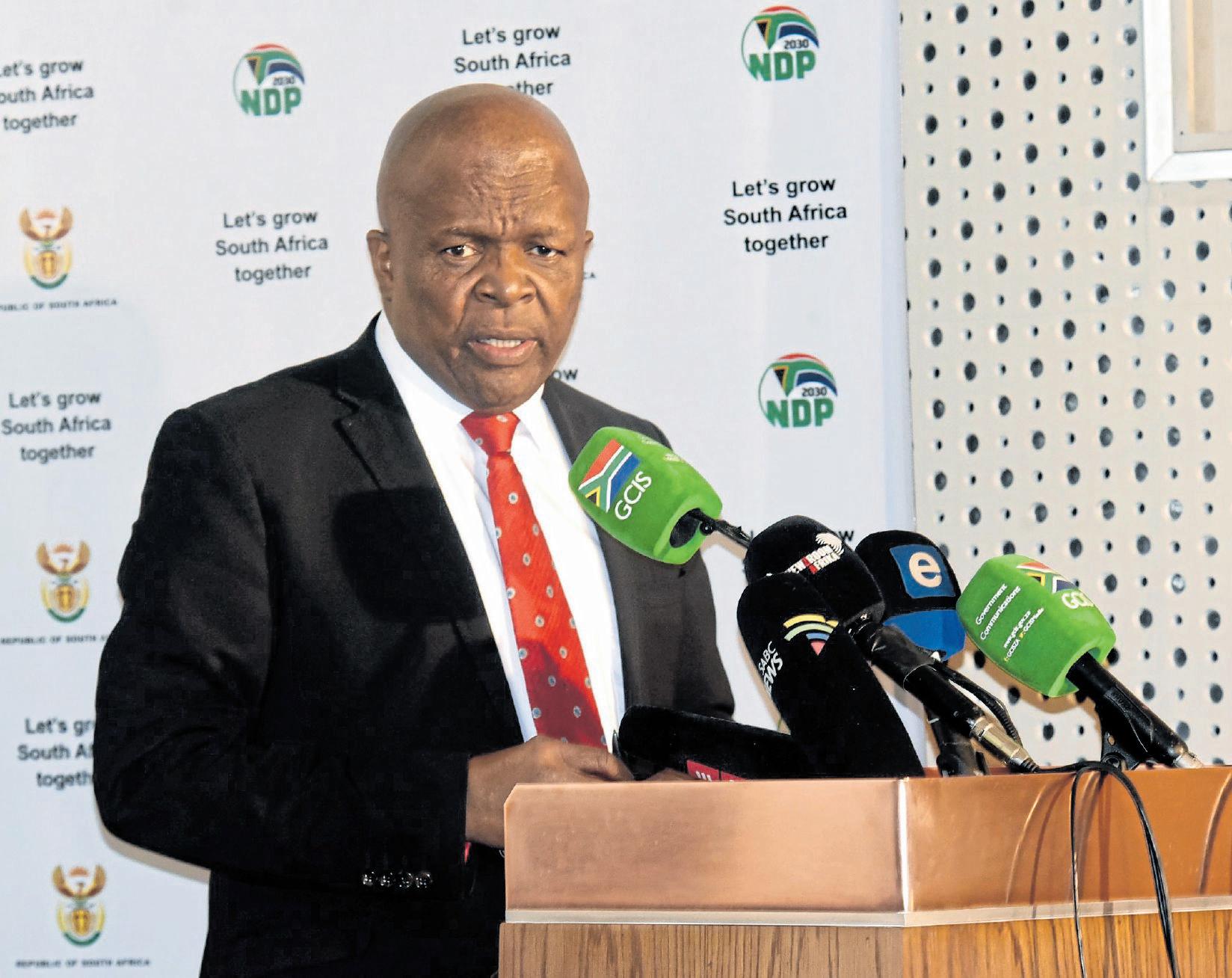
Taking a stand: Minister in the presidency Mondli Gungubele previously refused to report to Scopa on the vetting of Eskom employees and insisted he was obliged to report only to the JSCI. /Freddy Mavunda/
Matthew Parks
Slow progress in implementing ANC’s 2017 conference resolutions
• Former leaders accuse the governing party of inaction
Aland without compensation; illicit financial flows; and closing the wage gap between workers and the executive. Though ANC president Cyril Ramaphosa has reaffirmed his commitment to implementing the resolutions, his detractors have accused him of lacking the political will to do so for fear of upsetting the delicate power balance in the party, because he cannot fully assert his authority as he won the ANC presidency
by a small margin. Others have accused him of obsessing over the step-aside rule to target his political opponents. Ramaphosa himself has said he will step down if charged over the Phala Phala scandal. Cosatu first deputy president Mike Shingange told Business Day: The ANC has so far failed to implement these policies because of a lack of political commitment and also due to the balance of forces domestically and internationally. The state bank has been researched by Treasury for four years with no action.
The Reserve Bank governor has made it very clear that he is opposed to both the expansion of the Reserve Bank mandate and the idea of a state bank.
The Postbank and African Bank are already under state control, but they are not oriented towards pushing a developmental agenda.
Shingange said Cosatu was seeing progress on corruption with some high-profile arrests. But we need more to be done. Austerity budgets are being used to undermine institutions like [the National Prosecuting Authority and Special Investigating Unit]. Police numbers have moved from 200,000 to 172,000 in the last 20 years and are dwindling because of budget cuts. So, there is nothing radical about the ANC and yet its
manifesto called for a radical posture to move away from the business-as-usual approach.
The upcoming conference, at which Ramaphosa is expected to seek a second term as party leader, is crucial. Whoever is elected will be responsible for leading the party s campaign for the national elections in 2024, when the party s support is expected to dip below 50%.
This has sparked fears among some that the ANC government could cling to power with destructive, populist macroeconomic policies and by raising the prospect of coalition politics.
The party suffered its worst electoral performance in the 2021 municipal elections when its support fell below 50% for the first time since 1994, resulting in the ANC losing the Gauteng metros of Johannesburg, Ekurhuleni and Tshwane to DA-led multiparty coalitions
At its national congress in 2017, which elected Ramaphosa as party leader, the ANC resolved to accelerate economic growth and create jobs; strengthen state-owned enterprises that have been hollowed out by years of corruption linked to state capture; pursue land expropriation without compensation; speed up service delivery; and root out corruption in the public and
TIn SA, the top 10 practice areas by size are corporate law, litigation, mergers and acquisitions law, labour and employment law, IP law, banking and finance law, real estate law, competition and antitrust law, construction law and insurance law.
Anthony Norton from law firm Norton Inc has been recognised by Best Lawyers 2023 in regulatory practice and competition/antitrust law. He is the 2023 Lawyer of the Year for Johannesburg in regulatory practice.
A successful law firm, he says, is a combination of a number of factors. Arguably the most important of these is the level of experience and quality of lawyers. A large firm which is thin on experience and expertise is unlikely to be very successful given that there is no substitute for either of these attributes. Law, he adds, is a little like medicine: it s the quality of the doctor that counts, not the size of the hospital.
consumption, says Kristen Greer, senior research manager at Best Lawyers. The next largest growth was in corporate law, which is also to be expected given that post the pandemic, business activity is stronger than expected, says Greer. I was surprised by the lack of increase around administrative and public law as well as oil and gas as public sector wages, social security and the emphasis on climate risks become more frequent and urgent discussions.
When selecting a lawyer, Norton recommends being guided by the quality of the individual concerned. Choose a lawyer based on whether they have the necessary experience and expertise. Consider their track record and the outcomes in the matters in which they have been involved. Similarly, a good firm will have a number of lawyers with experience and expertise in a variety of practice fields.
Norton Inc, a small boutique law firm offering high levels of expertise, has been involved in a number of the largest and most interesting merger deals that have taken place locally, including Impala Platinum s proposed acquisition of Royal Bafokeng Platinum; Moody’s acquisition of the largest ratings agency in Africa, Global Credit
RESOLUTIONS TABLED
IN
Implementing
Expanding
Land
Strengthening
Fighting
any offence over the Phala Phala farm allegations. These were brought forward by former spy boss Arthur Fraser Ramaphosa has denied them and are the subject of investigation by law enforcement agencies and security organs.
private sectors. However, some ANC leaders have accused the party of failing to implement some of these decisions. In July, former president Thabo Mbeki publicly berated Ramaphosa for failing to keep his promises to tackle unemployment, inequality and poverty, which Mbeki said had increased the risk of social unrest in SA. Other former heads of state, Kgalema Motlanthe and Jacob Zuma, have also criticised Ramaphosa s leadership.
STEP-ASIDE RULE
The step-aside rule was adopted in 2017 and it calls for those facing criminal charges to step aside from their positions or be suspended. Those affected by the rule include corruptionaccused suspended ANC secretary-general Ace Magashule and eThekwini chair Zandile Gumede. Ramaphosa, who was elected ANC president on an anti-corruption ticket, could himself be a victim of the stepaside rule if he is charged for
STATE BANK The 2017 conference resolved to establish a state bank. Business Day reported last week that the government has shot down calls by the DA for a feasibility study to be conducted before establishing Postbank as a fully fledged bank. Through the Postbank Limited Amendment Bill, the government could finally realise plans to set up a state-owned bank. The party called for the Bank s mandate to be expanded to take account of other objectives such as employment and economic growth. However, there has been little movement in implementing this resolution. Reserve Bank governor Lesetja Kganyago, delivering a public lecture at the Wits School of Governance about two weeks ago, said: When policy becomes overloaded with too many and contradictory objectives, then negative outcomes are more likely. As inflation rises and growth
INSIGHTS: BEST LAWYERS 2023 Awards honour excellence
• Local lawyers and practices named in annual list of those at the top of their game, writes Lynette Dicey
Rating; TFG s acquisition of Tapestry; and Sanlam s acquisition of various businesses
In addition the firm acted for eTV when it challenged government’s analogue switch off. It also does a significant amount of work in the white
collar crime space and acts on behalf of listed companies with an extensive regulatory practice. Our regulatory practice is very strong in relation to competition law antidumping and white collar crime, says Norton. Smiedt & Associates Attorneys Michelle Kucera has been recognised by Best Lawyers in real estate law. Being solutions-based and approachable helps with the firm’s success, says Kucera. We build relationships with our clients and adapt according to their needs and specific requirements. She says there has been a shift as clients