




PUBLISHED BY
Picasso Headline,
A proud division of Arena Holdings (Pty) Ltd, Hill on Empire, 16 Empire Road (cnr Hillside Road), Parktown, Johannesburg, 2193 PO Box 12500, Mill Street, Cape Town, 8010 www.businessmediamags.co.za
EDITORIAL
Editor: Elriza Theron
Content Manager: Raina Julies rainaj@picasso.co.za
Contributors: Jennifer Booth, Magda du Toit, Jeanne van der Merwe
Copy Editor: Brenda Bryden
Content Co-ordinator: Natasha Maneveldt
Online Editor: Stacey Visser vissers@businessmediamags.co.za
DESIGN
Head of Design: Jayne Macé-Ferguson
Senior Designer: Mfundo Archie Ndzo
Project Designer: Annie Fraser Cover Image: [olgaddemina]/123RF.com
SALES
Project Manager: Jacqueline Bezuidenhout jacquelineb@picasso.co.za | +27 078 172 7776 +27 072 430 9392
PRODUCTION
Production Editor: Shamiela Brenner
Advertising Co-ordinator: Shamiela Brenner
Subscriptions and Distribution: Fatima Dramat fatimad@picasso.co.za
Printer: CTP Printers, Cape Town
MANAGEMENT
Management Accountant: Deidre Musha
Business Manager: Lodewyk van der Walt General Manager, Magazines: Jocelyne Bayer
The world is a strange, ever-changing place these days, but one thing that remains constant is the need for food. Not just access to food, but access to safe food that nourishes our families. Agriculture has always been the backbone of civilisation, feeding nations and fuelling economies, and while South Africa remains food secure as a country, the numerous policy discussions on a global level need to nd practical solutions to address food security challenges at the household level. In this issue of Agriculture, we catch a glimpse of some of the people who are advocating for these policies on global forums – not only in terms of food security, but also in ensuring farmers have access to the latest agricultural technologies that can support this. In an era marked by erratic climate events, population growth and economic uncertainty, this is no easy task.
Technology and research must continue to drive ef ciency, while ethical practices should ensure that agriculture remains a force for good. Later in this issue, we learn from various experts about how these agricultural technologies can work in harmony with nature to minimise agriculture’s impact on the environment, and we explore the measures in place to ensure the food that ultimately reaches our plates is safe to eat.
Agriculture doesn’t work in silos; it is an intricate and complex network of various role players working together for our sustenance – from smallholder farmers looking after their families and communities to large commercial entities providing job opportunities and livelihoods to many thousands – each producer with their own contribution and story to tell. We learn about one such story: a woman who made her way from a small subsistence farming operation to matching the production output of a commercial pig farm through passion and perseverance.
Food production is multidimensional, intricate and exceptionally rewarding, and the path toward a future where no one goes hungry lies in our collective commitment to sustainability. We should embrace this responsibility with the necessary passion and perseverance because the future of agriculture is the future of humanity itself.
Elriza Theron
COPYRIGHT: Picasso Headline.
No portion of this magazine may be reproduced in any form without written consent of the publisher. The publisher is not responsible for unsolicited material. AGRICULTURE is published by Picasso Headline. The opinions expressed are not necessarily those of Picasso Headline. All advertisements/advertorials have been paid for and therefore do not carry any endorsement by the publisher.
We unpack key insights from the B20 sustainable food systems and agriculture task force around promoting sustainable agricultural practices, improving food security, and driving economic growth in Africa.
8
We navigate South Africa's complex food safety landscape.
10
We unpack how new developments in agricultural technology today are paradoxically enabling farmers to better harness nature and the environment to improve yields and sustainability.
12
Betty Nyambi dreamed of becoming a nurse, but instead ended up with a successful piggery.

ELRIZA THERON unpacks insights from the B20 sustainable food systems and agriculture task force, highlighting key strategies for promoting sustainable agricultural practices, improving food security and driving economic growth in Africa
With South Africa holding the Presidency of the Group of Twenty (G20) this year, the much-anticipated policy discussions are slowly starting to take shape. The theme “Solidarity, Equality, Sustainability” is supported by a few considerations that structure the G20’s approach to the various working groups formed within two tracks, namely the Sherpa and Finance Tracks.
The considerations include taking action to strengthen disaster resilience and response, taking action to ensure debt sustainability for low-income countries, mobilising nance for a just energy transition and working together to harness critical minerals for inclusive growth and sustainable development. These also inform the Presidency’s high-level deliverables, which are divided into three time-bound task forces, and guide the priorities of the working groups that support the task forces. Task force one focuses on inclusive economic growth, industrialisation, employment and reduced inequality. Task force two focuses on food security and task force three on arti cial intelligence, data governance and innovation for sustainable development. There are 15 working groups within the Sherpa Track – supported by various engagement groups, such as the Business20 (B20), Civil20 (C20), Labour20 (L20) and Science20 (S20), that, through independent
dialogue processes, are ultimately responsible for de ning their positions on the G20’s agenda. As can be expected, the consultation processes and dialogues between these groups are extensive, and rightfully so as work conducted by the engagement groups will lead to the recommendations that will be presented at the Leaders’ Summit in November 2025.
The B20 is the engagement group that connects the G20 with the business community to ensure their perspectives on various economic and trade issues are heard. The B20 is also divided into task forces, one of which is the sustainable food systems and agriculture task force, which focuses on promoting sustainable agricultural practices, improving supply chain resilience and ensuring equitable access to nutritious food.
feed into the G20 agriculture working group, which was established in 2011 to help reduce food price volatility. Since then, it has developed into an important forum for matters relating to agriculture, with the four key priorities of the working group this year being:
• The promotion of policies and investments that drive inclusive market participation towards improved food and nutrition security.
• Empowering youth and women in agrifood systems.
• Fostering innovation and technology transfer in agriculture and agro-processing.
• Building climate resilience for sustainable agricultural production.
Commenting on her role as chair of the sustainable food systems and agriculture task force, Mallowah notes that, together with their head of public affairs, Mildred Nadah Pita, who is also deputy chair, as well as their knowledge partner McKinsey, they are committed to tackling agriculture’s critical challenges.
“The B20 is vital for Africa as it provides a unique platform for addressing the continent’s speci c developmental needs and challenges. We recognise that the B20 is one of the most important engagement groups at the summit. Hosting business leaders from G20 countries, and beyond, in Africa for the rst time, will enable us to focus on sustainable practices that enhance food security, promote economic growth and empower local communities on the continent,” she says, adding that their task force will drive innovative solutions to accomplish this. “We believe collaboration is vital for creating meaningful change and we look forward to engaging with leaders worldwide to share insights and develop actionable recommendations.”
The task force will also focus on food security and trade, as well as looking for implementable solutions that ensure policies are taken to pavement. These solutions include looking beyond the norm and leveraging the uniqueness of Africa’s agricultural realities.
This year the task force is chaired by Debra Mallowah, head for Bayer CropScience Africa. The task force’s recommendations Debra Mallowah

Follow: Debra Mallowah www.linkedin.com/in/debra-mallowah-37632a7
“Up to 70 per cent of the food produced in African countries is grown by smallholder farmers. If we want to solve the hunger crisis in Africa, this is where the focus must lie,” Mallowah concludes.





As food systems become more complex, ensuring safety and authenticity demands a combination of strong regulatory enforcement, industry-led best practices and cutting-edge scientific testing solutions, writes
At the heart of South Africa’s food regulations lies the Codex Alimentarius, a globally recognised collection of standards, guidelines and codes of practice established by the Codex Alimentarius Commission (CAC) with the Department of Health as the contact point. The CAC was created in 1963 by the Food and Agriculture Organization and the World Health Organization.
“The agricultural sector is committed to long-term sustainability and providing safe and nutritious food to the population and for export. The Agricultural Business Chamber (Agbiz) believes we have a comprehensive regulatory framework in South Africa that ensures food safety. All stakeholders, including government, the whole value chain and consumers, have a responsibility to ensure this framework is applied consistently,” says Annelize Crosby, head legal intelligence at Agbiz.
Crosby points out that in South Africa, food safety and quality lies primarily in the hands of three government departments, each overseeing certain legislation pertaining to food safety, quality and composition, labelling and nutrition.
MAGDA DU TOIT
“Some of the measures are proactive, meaning that government approval must be obtained for the release of a product on the market. Assessments of the data and information submitted by the applicant to determine risk are required. These assessments are conducted by a group of independent experts or government of cials trained to do so. Other parts of legislation work on a reactive basis,” Crosby explains.
1. The National Department of Health plays a crucial role in food regulation in terms of various acts:
• The Foodstuffs, Cosmetics and Disinfectant Act, 1972 (Act No. 54 of 1972) addresses the manufacturing, labelling, selling and importation of food.
• The South African Food Hygiene Regulation 638, section 10(1), outlines the training requirements for food businesses and stipulates that the person in charge of a food business must undergo accredited training in food safety or possess a quali cation that includes instruction on food safety. All individuals working on the premises of a food business must also receive regular training in basic food safety and hygiene.
• The National Health Act, 2003 (Act No. 61 of 2003), addresses the hygiene of foodstuffs.
• The International Health Regulations Act, 1974, (Act No. 28 of 1974) focuses on
hygiene requirements at ports and airports, including vessels and aircraft.
2. Legislation administered by the Department of Agriculture as it relates to food safety include:
• Agricultural Product Standards Act, 1990 (Act No. 119 of 1990)
• Animal Diseases Act, 1984 (Act No. 35 of 1984)
• Animal Identi cation Act, 2002 (Act No. 6 of 2002)
• Animal Improvement Act, 1998 (Act. No. 62 of 1998)
• Animals Protection Act, 1962 (Act No. 71 of 1962)
• Fertilisers, Farm Feeds, Agricultural Remedies and Stock Remedies Act, 1947 (Act No. 36 of 1947)
• Meat Safety Act, 2000 (Act No. 40 of 2000)
• Performing Animals Protection Act, 1935 (Act No. 24 of 1935)
• Veterinary and Para-Veterinary Professions Act, 1982 (Act No. 19 of 1982)
• The Liquor Products Act, 1989 (Act No. 60 of 1989)
• The Genetically Modi ed Organisms Act, 1997 (Act No. 15 of 1997).
3. The Department of Trade, Industry and Competition is responsible for commercial policy and consumer protection and in uences food industry activities. The South African Bureau of Standards (SABS) falls under the jurisdiction of this department and controls canned meat and frozen and canned shery products through the Standards Act, 1993 (Act No. 29 of 1993).
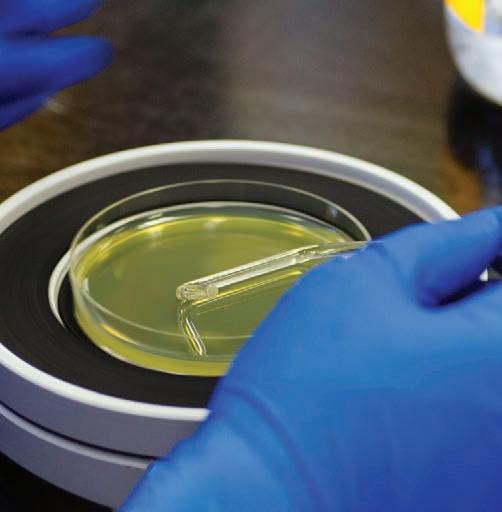
SciCorp Laboratories in Pretoria provides testing services to the industry, testing for GMO presence, microbiological contaminants, chemical residues and food authenticity as well as for the detection of foodborne pathogens, allergens and mycotoxins.
Crosby points out that in addition to government regulations, businesses also navigate private food safety standards, particularly when engaging in international trade. “Standards such as FSSC 22000 and BRC Global Standards set stringent requirements often exceeding governmental mandates. Meeting these standards not only ensures compliance with customer requirements, but also enhances the reputation and competitiveness of South African food products in the global market.”
The FSSC 22000 is a certi cation scheme for food safety management systems, aligned with the ISO management system approach and the ISO harmonised structure. The scheme provides a certi cation model that can be used in the food manufacturing industry and the related supply chain to ensure food safety standards and processes. The BRC Global Standards, on the other hand, is a leading global brand and consumer protection organisation that sets standards for food safety, packaging, storage, traceability and distribution.
Dr Gerhard Verdoorn, stewardship manager at CropLife South Africa, says product stewardship and food safetyis a priority for the crop protection industry. “All substances and nished products undergo extensive evaluation and testing in the interest of product and food safety. CropLife SA has also created several resources to help educate and inform various stakeholders about some key issues affecting the industry as well as food safety.”
Dr Verdoorn stresses that all crop protection remedies are rigorously tested and reviewed by third-party scientists and all possible health, environmental and food safety risks along the entire value chain are considered. “This means that products put in the market by our members satisfy the highest quality standards and are safe for people, animals and the environment when used according to label directions.”
Dr Tertia Erasmus, managing director of SciCorp Laboratories, says ensuring food safety is not only a regulatory requirement, but also a fundamental aspect of consumer trust, economic sustainability and international trade competitiveness. She explains that the practical implementation of the above-mentioned regulations requires advanced, reliable testing methodologies to verify compliance at all stages of the food value chain.
“SciCorp Laboratories is a South African National Accreditation System (SANAS) ISO 17025-accredited laboratory. We provide scienti cally validated testing services for GMOs, microbiological contaminants, chemical residues and food authenticity.” ISO refers to the global standards for trusted goods and services, and ISO 17025 speci cally is a standard that provides the general requirements for the competence of testing and calibration in laboratories.
The standard is audited by accreditation bodies such as the South African National Accreditation System. “These tests help businesses meet both local regulations and stringent global standards such as FSSC 22000 and BRC Global Standards,” she adds.
Dr Erasmus points out that a key challenge in food safety is the rapid identi cation of contaminants before products reach consumers. “SciCorp addresses this through innovative molecular-based rapid testing solutions, enabling faster and more accurate detection of foodborne pathogens, allergens and mycotoxins. Our ‘farm-to-fork’ approach ensures food producers, processors and retailers can access real-time, actionable data to prevent food safety breaches.
“While government oversight is essential, industry collaboration and proactive risk management play an equally signi cant role. Our aim is to support food businesses in navigating both mandatory regulations and voluntary certi cation programmes to enhance food safety culture and consumer con dence,” concludes Dr Erasmus.

Above and right: Before deploying any integrated pest management system, farmers must understand the population dynamics of the insects affecting the crop. Pheromone insect traps are strategically placed throughout the orchard. By trapping insects, farmers can estimate population numbers and use that to employ effective corrective measures in an integrated pest management programme. Apart from causing losses, insects can contribute towards disease contamination of produce, making them unsuitable for sales.


Modern crop sprayers can apply crop protection products at variable rates, depending on the requirement. All spatial data on particular requirements are stored in the cloud and machinery can orient itself according to an on-farm GPS mast.
a different function. Sorghum, for instance, can draw the potassium located deep down in the soil closer to the surface where your cash crops can utilise it. If you want to x large quantities of nitrogen in the soil, you plant a legume, which also enables you to save on nitrogen fertiliser. Every cover crop is a spanner in your toolbox.”
Bester also relies on an on-farm weather station to warn him when climate conditions increase the risk of pests, enabling him to apply pesticides preventatively, and only on vulnerable elds.
“Whereas before we may have had to apply pesticides on one hundred per cent of a farm or a eld, we can now get away with thirty to forty per cent application, which reduces our input costs and the resulting pesticide residues.”
The driving force behind most new developments in agricultural technology today is paradoxically to enable farmers to better harness nature and the environment to improve yields and sustainability, writes
JEANNE VAN DER MERWE
Agriculture service providers compete ercely to build the best digital tools to gather a host of production data and interpret it in a way that helps farmers farm more ef ciently.
In this data-intensive approach, on-farm weather stations can provide customised, accurate, hyperlocal weather forecasts and irrigation can be scheduled remotely via a cellphone app, based on data from networked soil moisture probes. Modern-day farming machinery can interface with purpose-built data hubs that steer tractors, crop sprayers and combine harvesters on predetermined GPS-plotted routes across farms, recording and uploading production data as they go to distinguish between fertile and less fertile elds. Even on nonirrigated farms spanning thousands of hectares, soil health, soil moisture and plant health can be established with machinery-mounted cameras, specialised drones and satellite imaging.
“One of the biggest bene ts of this type of technology is that we can apply fertilisers at variable rates,” says grain and cattle farmer Danie Bester from Balfour, Mpumalanga, who
has been using these precision farming tools for over 22 years. “The aim is never to apply too much nitrogen or phosphate fertilisers, which can cause needless acidi cation of soil or harm groundwater quality.”
Bester is also one of the best-known local practitioners of conservation agriculture, which aims to mimic natural processes to improve yields while reducing the need for chemical inputs. “For me, the two almost went hand in hand, but I adopted precision farming technology rst and then saw that the technology made it much easier for me to apply conservation agriculture, so the two are very much related.”
While farmers like Bester rely strongly on technology, part of their success lies in recognising that nature does some things best. “When you walk into a forest, you will never see only one type of plant or one type of tree, but rather a variety of species all growing together. You can mimic that effect on your elds with multispecies cover crops, each with
Modern on-farm weather stations can be linked to weather forecasting platforms that use data from multiple stations, satellites and arti cial intelligence models to generate hyperlocal weather forecasts, corrected by a continuous feed from a speci c station’s actual data and therefore adjusted for the speci c location of the weather station.
“All farming activities occurring at farm level are in uenced by the weather. Having a model that can accurately forecast the climatic conditions for the coming week allows for better planning,” says Emile Jordaan, general manager of Metos SA, a provider of weather stations and other climate smart technologies. These systems are particularly important for deciding when to apply fungicides, insecticides and herbicides – applying them in conditions that are too wet, hot, humid or windy can drastically reduce their ef cacy.
“The Metos app, using the hyperlocalised weather forecast, generates an hourly segmented, seven-day spray window, which shows you the safe spray window for the next week.” What makes the hyperlocalised weather forecast more accurate than other more generic online service providers is that it is updated constantly by a localised weather station. These forecasts are particularly useful on farms where topography or the aspect of a slope may lead to speci c micro-climate weather conditions.
Metos has entered into a successful partnership with Raisins SA to establish a network of 14 weather stations along the Orange River and Olifants River Valley, where some 88 per cent of the country’s raisins are produced. The weather station data forms the basis of early warning systems that alert farmers to the risk of frost or disease in their immediate vicinity.

Raisins SA senior agronomist Stefan Jordaan says the system enables producers to spray preventatively against fungal diseases or strategically place fans in their vineyards to prevent frost damage on the vines. By analysing historical climate and weather data, they can also predict when their harvesting season starts and plan logistics accordingly.
For Arno Abeln, managing director of Agrimark Operations, a leading agriculture input and technology supplier, crop production under netting has been one of the biggest game-changers in irrigation farming over the past decade or two as it reduces evaporation from orchards and also the overall water requirement. These precision farming installations typically incorporate networked soil moisture probes that help ensure crops remain optimally watered. These are often integrated with on-farm weather stations, which can be monitored remotely in real-time, and remotely operated irrigation systems.
Especially in water-scarce areas like South Africa, Abeln says, farmers have to count every drop. “They usually have a precise plan for how to use their water allocation for every single part of their farm. One production block may be irrigated from 10 to 11pm, but another block that gets more sun during the day will be irrigated from 4 to 5pm to compensate for greater water losses during the day. Water use is determined strictly according to what is necessary and is timed and managed accordingly.”
On high-value permanent crops, such as vines and fruit trees, there has been a movement away from purely chemical pest and disease control to integrated pest management (IPM), which combines a variety of natural, chemical and physical strategies to optimise productivity and pro tability. “With IPM, data is king. The more data you have, the better informed the decision you can make,” says Lourens Steytler, portfolio lead at Villa Crop Protection.
“Instead of spraying indiscriminately, IPM requires you to determine the threshold
at which you must take action to avoid unacceptable crop losses. IPM practitioners use pheromone traps and sticky pads to trap insects in orchards to determine the population density and age and the associated risk of damage. “Then you count the number of pests on a leaf or on your traps and determine how much risk these numbers pose. Two juvenile insects on a leaf may not be a problem, but ten might.”
Other strategies that form part of IPM include using biostimulants to improve a plant’s ability to resist stress or disease and biocontrol, such as using “green” chemicals, macros or a combination of these, to control pests and diseases.
Ultimately, says Tallie Giessing, parts manager for machinery supplier ARGO, ef ciency in agriculture goes hand in hand with environmental stewardship. “Precision technology contributes to agriculture without waste. Ef cient farming is the rst step towards conservation.”
Follow: Danie Bester @ Danetidf @ besterdanie @ Danie Bester Metos SA www.linkedin.com/company/metos-sa Stefan Jordaan www.linkedin.com/in/stefan-jordaan-81028b99 Villa Crop Protection www.linkedin.com/company/villa-crop/posts Lourens Steytler www.linkedin.com/in/lourens-steytler-3a2a30143
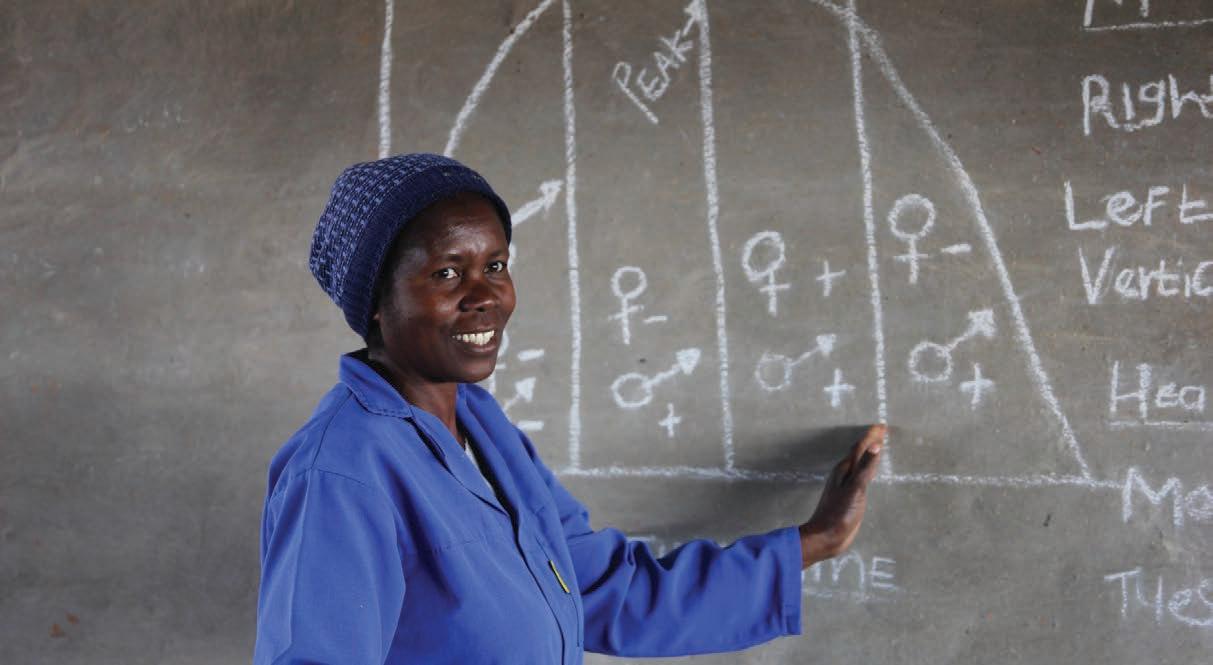
Born to farmworker parents in Komatipoort, Mpumalanga, Betty Nyambi initially envisioned a career in nursing. However, fate led her to agriculture. JENNIFER BOOTH chats to the farmer about learning the trade and mentoring young agricultural students
Piggery is a growing agricultural industry in South Africa with new entrant farmers playing an important role. One such farmer making strides in piggery is Betty Nyambi, the owner of Sincobile Trading. Born in Komatipoort, Mpumalanga to farmworker parents, Betty imagined she would study nursing but, as fate would have it, she ful lled her passion for caregiving in a surprisingly exciting journey in agriculture.
She never pursued nursing but was persuaded to get training as an agricultural extension of cer. After graduation, Betty started her farming career as an intern at the Gauteng Department of Agriculture and Rural Development (GDARD) and expanded her knowledge as a farmworker at a citrus and crop farm, respectively, located in Gauteng.
“Inspired by working close to nature and driven to become a successful farmer, I started applying for land through the Department of Rural Development and Land Reform,” Nyambi explains. In 2014, she received a 173-hectare farm near Bronkhorstspruit, Gauteng, through provincial government support.
“With my mind set on farming vegetables, I was surprised on my rst farm visit to nd piggery production units and infrastructure on the land. It was old but still standing. I knew
nothing about pig farming but refused to let that stop me,” she says.
Having received six gestating sows from the government and determined to succeed, Nyambi attended the Agricultural Research Council’s pig management and arti cial insemination programme with on-farm supervision. The results were soon apparent. In 2016, she was a runner-up in GDARD’s Gauteng Female Entrepreneur of the Year competition and received 23 sows and a boar from the department.
Nyambi was left with ve sows after a strained business partnership was terminated. Her passion for pig farming and the drive to succeed saw her start from scratch. With assistance from the South African Pork Producers’ Organisation (SAPPO), Evonik and the Gauteng Department of Agriculture, Rural Development and Environment, she could restock and commence production. By the end of 2024, she scaled up to 130 sows and three boars and continues growing sow numbers using arti cial insemination.
Sincobile Trading produces about 1 200 weaner pigs annually from proli c genetic material sourced from reputable breeding companies. Due to the piggery’s space limitations, Sincobile cannot grow all produced pigs to full slaughter weight, resulting in a signi cant number of these weaners being sold at four to eight weeks of age to out-grower contractors.
Nyambi is a dedicated, hands-on farmer who shows incredible kindness towards her animals, the environment and people. She knows all her pigs and quickly spots deviations from their usual behaviour. “I know each one. I love each one. If one gets sick, I fret the way one would over a child.
“One of my favourite farming tasks is farrowing. Then I become the nurse of my childhood dreams,” she says. “I always make sure I’m there to assist the sows, especially those that experience dif cult farrowing.”
Kgadi Senyatsi, head of business development at SAPPO, says Nyambi’s excellent record-keeping and trend analysis skills allow her to identify and address any issues before they escalate. A state veterinarian, Dr Lizelle Redelinghuys, says what truly struck her about Nyambi, is her enthusiasm and pride. “Despite the ageing infrastructure, she is determined to match the production output of commercial pig farms through meticulous management.”
Besides managing her piggery with precision, Nyambi shares her knowledge and skills with students from Mpumalanga University and the Majuba College of Agriculture. The on-farm practical training includes feeding, vaccination, farrowing systems, mating, weaning and arti cial insemination. The students submit weekly reports to measure their progress towards the learning objectives.
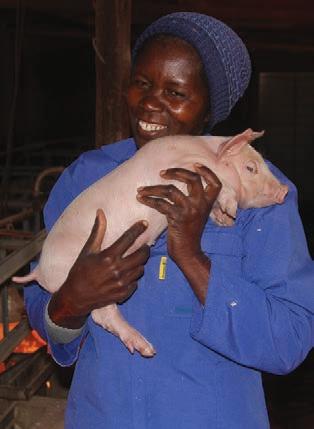
Nyambi encourages young women to enter the eld of agriculture and help address the gender biases in the sector.
Estimates from agricultural economist Wandile Sihlobo suggest that only 20 per cent of South African farms are owned or operated by women.
Follow SAPPO www.linkedin.com/company/sappo-za/posts



