UNDERSTANDING SA’S SOCIAL CONSTRUCT CONUNDRUM AN ANALYSIS OF THE EMERGENCY ENERGY PLAN FOR A SOCIETY
IN TRANSITION
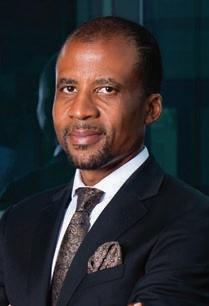
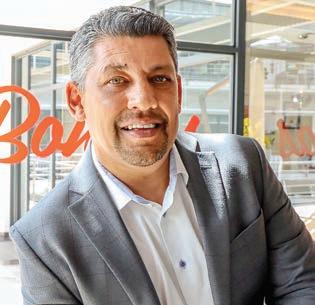
Business leaders are no strangers to crises, given the devastation wrought by COVID-19. I firmly believe, however, that turbulence in business is an opportunity disguised as a crisis – it is not a time for panic or anxiety, but rather for decisiveness and growth.
ere are three main perspectives from which to view a crisis: looking outward at the macro environment; looking internally within your organisation; and nally, from your personal vantage point as a leader.
LOOK FOR AND EMBRACE THE OPPORTUNITIES
Looking outwards, many in business would see around them only the dangers and pitfalls. I believe this is exactly the time to actively seek opportunities. Scan what may seem to be a gloomy situation and nd the next frontier for nancial growth. If one area of business is in trouble, look for an alternate sector
LEADERSHIP IN TIMES OF CRISIS
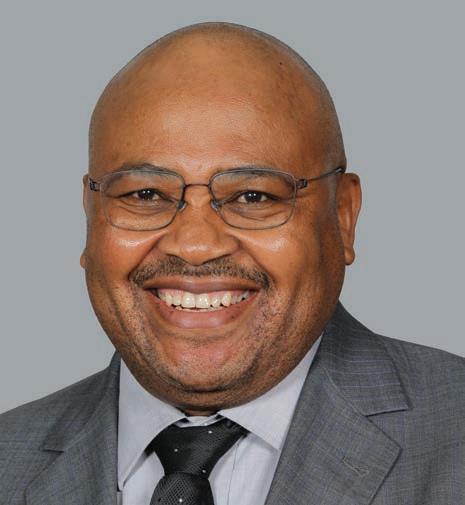
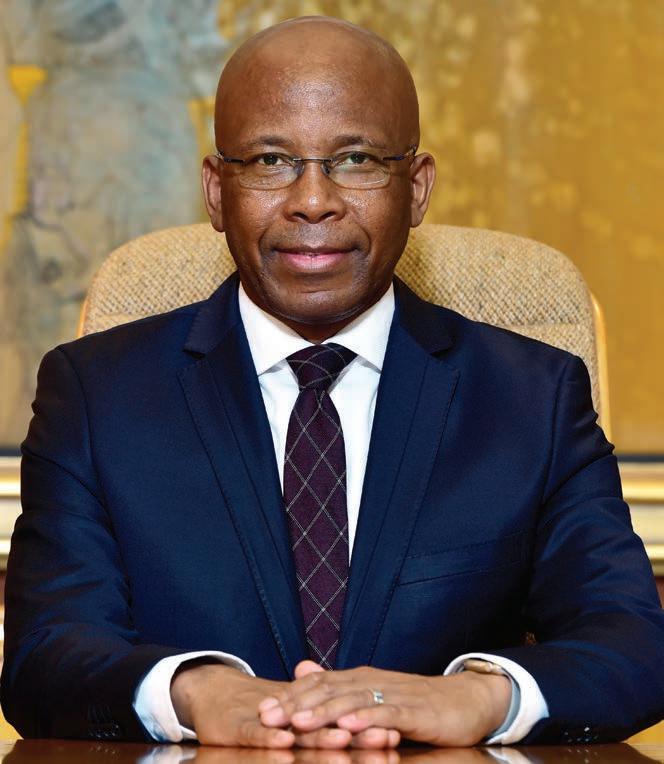
When facing a business crisis don’t give in and crumble under the devastating blows, rather nd and exploit the opportunities, advises Maurice Radebe
for growth. When a business is in panic mode or distress, it is easy to miss opportunities, but it is precisely in those challenging times that opportunities lie hidden. It is up to us as leaders to look out for them.
From an internal organisational point of view – it is critical to ensure you have the capability and capacity to embrace opportunities that may emerge as a result of a crisis. Organisations that are versatile and exible are the ones able to see and seize opportunities amid challenges.
RISE LIKE AN EAGLE AND KEEP FLYING
Finally, from the leadership perspective, it may feel natural to become inert and paralysed in crisis; what we really need is to maintain momentum.
As leaders, we need to y like eagles in the face of a storm, not run for cover like chickens. An eagle faces the storm and uses its force to propel it upwards. As the storm hits, the eagle ies higher and higher until it cruises above the storm.
ere, it can y for ages e ortlessly. As leaders, we have the potential to use turbulence to propel our organisations to their greatest heights.
But it is critical to ensure that we sustain that forward momentum, which is why, as leaders, we need to keep leading and making decisions, even if they are the wrong ones. If we freeze in indecision, it becomes
As leaders, we have the potential to use turbulence to propel our organisations to their greatest heights.
difficult to galvanise the organisation once again. I know of too many organisations i n deep trouble because their leadership didn’t make decisions fast enough in times of ambiguity.
LEAD WITH INTEGRITY AND CONFIDENCE
One also needs to be very wary of those peddlers of “doom and gloom” in toxic times, those who thrive in toxic environments. Leaders need to deal with such people quickly before they undermine progress and create a culture of fear.
Situations change fast in uncertain environments, so leaders need to communicate frequently and directly to their entire team, not rely on anyone else. And, as leaders, we need to be con dent enough to admit mistakes. It is easy to make a decision we thought was right, but two days later, it becomes evident it was wrong. e only way to deal with this is to apologise and move on to the next decision. e sta will respect a leader far more for that than indecision and freezing in tough times.
Anxiety from the top will spread through the team like wild re, but con dent leadership during tough times will ensure that your organisation weathers the storm and emerges stronger than ever.
Maurice Radebe
We are in the grip of an
crisis that could result in economic and unemployment fallout.
We need meaningful change and servant leadership to deal with the challenges we face and secure the future of our country.
9 MD’S NOTE
The BMF remains committed to the socioeconomic advancement that will shape a better future for all South Africans.
11 ACTING PRESIDENT’S NOTE
We need a change in leadership culture to one that is inclusive, participative, values-based, and accountable.
AFRICAN LEADER
14 EVENTS
The BMF and Bidvest’s Empowerment sessions; the 9th Lot Ndlovu lecture.
20 IN CONVERSATION WITH
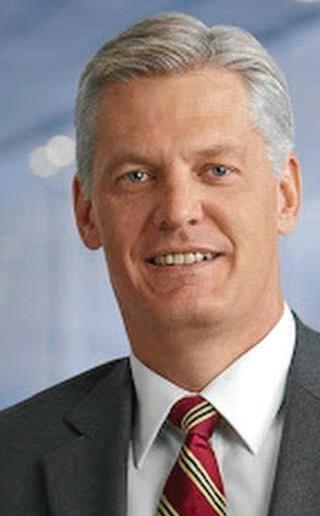
Mteto Nyati shares his views on being an African in leadership.
23 THE ENERGY CHALLENGE
Fixing Eskom is the only way to end load shedding in the short term.
31 EMPLOYMENT EQUITY
Why is it taking so long to transform the workplace?
35 BLACK INDUSTRIALISTS
Will the Black Industrialists Programme revive South Africa’s collapsing manufacturing sector?
38
SOUTH AFRICA’S SOCIAL CONSTRUCT CONUNDRUM
Where is South Africa’s economic development plan and social compact?
40 POLITICAL LEADERSHIP
What is the outlook for the ANC ahead of its national conference and the 2024 election?
42
THE ROLE OF BLACK PROFESSIONAL LEADERS
Black professionals need to play an active role in driving economic, social and political recovery.
44 B-BBEE
The five elements of B-BBEE need deeper reflection and clearer resolutions
IN THE GRIP OF AN ENERGY CRISIS
At the time of writing (19 September), President Cyril Ramaphosa had announced that he would cut short a trip to the United States and the United Kingdom and return home a er the funeral of Queen Elizabeth II to address the Eskom crisis.
At 4:16am on 18 September during a warm spring weekend, Eskom announced that there would be stage 6 load shedding. e energy availability factor (EAF) had plunged to 56.07 per cent during the month until 17 September. erefore, 43.93 per cent of capacity – almost 21 000 megawatts (MW) – was down due to unplanned breakdowns and planned maintenance.
Ramaphosa had two options. First, to listen to the growing calls of millions of South Africans for the Eskom board and CEO to be red. Second, he could make another pointless announcement about accelerating the implementation of his energy plan that was announced on 25 July and the Renewable Energy Independent Power Producer Procurement Programme.
HEADING TOWARDS AN ECONOMIC WASTELAND
On this trajectory – a forecast average GDP growth rate of 1.8 per cent a year between 2020 and 2030, according to the Indlulamithi scenarios – the country will have a second lost decade. e number of unemployed people will increase to 17 million. Cycles of political and social instability will create an economic wasteland by 2030.
With an unemployment rate of 44.1 per cent and 12.3 million people without work during the second quarter of 2022, the country cannot a ord another day, week, or month of load shedding. e country needs a short-term solution to the energy crisis. However, as the special feature in this magazine shows, Ramaphosa’s energy plan and independent power producers will not solve the energy crisis in the short term. e only way to solve the energy crisis in the short term is to x Eskom power plants and increase the EAF back to 75 per cent, where it was in 2018.
is will provide an additional capacity of about 7 000MW.
South Africa had a “lost decade” from 2009 to 2019 during which gross domestic product (GDP) per capita did not grow. A er a technical rebound in 2021 from the deepest recession in almost a century, the economy has returned to its pre-pandemic trend of low GDP growth.
As former Eskom CEO Jacob Maroga, an engineer, says: “If you want to end load shedding you must focus on making sure that there is consistent performance of the current eet. at does not need to take 24 months.” Ramaphosa appointed a new board. It must not waste any time and replace CEO Andre de Ruyter with an interim appointment –Maroga – with a mandate to stabilise the eet within 12 months.
Duma Gqubule Editor
Acting president: Esethu Mancotywa
BMF editorial committee
Chairperson: Cuma Dube
Members: Minty Makapela, Thulani Dube
Acting managing director: Philippe Bakahoukoutela Head of communications, marketing and events: Khulukazi Mtebele
Head of Thought Leadership, Research & Programmes: Xolile Kunene
Address: The Eric Mafuna House, 12 Summer Street, Rivonia, Sandton, Gauteng, 2196 www.bmfonline.co.za letters@africanleader.co.za
PUBLISHED BY
Picasso Headline, a proud division of Arena Holdings (Pty) Ltd Hill on Empire, 16 Empire Road (cnr Hillside Road), Parktown, Johannesburg, 2193 Postal Address: PO Box 12500, Mill Street, Cape Town, 8010 Tel: +27 21 469 2400 | Fax: +27 86 682 2926 www.businessmediamags.co.za
Digital Editor: Stacey Visser vissers@businessmediamags.co.za
DESIGN
Head of Design: Jayne Macé-Ferguson Advert Designer: Bulelwa Sotashe Cover Image: Supplied
SALES
Project Manager: Jerome van der Merwe jeromem@picasso.co.za Tel: +27 21 469 2484 | 082 668 1496
Sales: Frank Simons
PRODUCTION
Production Editor: Shamiela Brenner
Advertising Co-ordinator: Shamiela Brenner
Subscriptions and Distribution: Fatima Dramat | fatimad@picasso.co.za
Printer: CTP Printers, Cape Town
MANAGEMENT
Management Accountant: Deidre Musha
Business Manager: Lodewyk van der Walt General Manager, Magazines: Jocelyne Bayer
Copyright: Picasso Headline. No portion of this magazine may be reproduced in any form without written consent of the publisher. The publisher is not responsible for unsolicited material. African Leader is published by Picasso Headline. The opinions expressed are not necessarily those of Picasso Headline. All advertisements/advertorials have been paid for and therefore do not carry any endorsement by the publisher.
FINDING MEANINGFUL CHANGE
We seem increasingly incapable of dealing with complexity. Many, if not all, of the issues debated in this issue are complicated. ey can’t t in the ideological packages we have designed. e greatest obstacle with ideological packages is that you must accept them wholesale. You can’t just choose the most useful parts and discard the rest. It isn’t clear that a single ideological perspective can produce the sustainable solutions we need to the many challenges we face.
In South Africa, these perspectives range from populist revolutionism, bordering on the delusional, to the extreme “wokeness”, bordering on the ridiculous. Both ends of our political spectrum have simply gone too far. Many of the ideas on the table are tied too tightly to a single ideological perspective, where the answer may lie somewhere in the middle. Somewhere reasonable, where the data matters, and where the leadership is both responsible and capable.
Considering the themes we explore in this issue of African Leader, for instance, we can’t a ord the debate around energy policy to simply be a choice between privatising Eskom or keeping it all under state control. e just transition isn’t quite as simple as a choice between mining jobs or no jobs at all. e debate around the political leadership needed to address all the above can’t be reduced to a choice between the ANC and a DA-led coalition. It’s more complicated than that.
We do our best to present the less heard side of the debate on the issues we face around our energy security, how we can manage an economy in transition and the political leadership we need to usher in a brighter future for all South Africans. We do so, appreciative of the fact that it may be di cult to debate these issues in our country without them being overpoliticised. At the root of these challenges was a deliberate political agenda to deprive the many and bene t the few. We still live with that in our everyday lives. We still carry the trauma of our past and an innate distrust for any solutions that do not promise rapid and sweeping changes in the lives of the black majority.
It will take courageous leadership to make the difficult choices we need to make to secure our future.
e success or failure of whatever path we choose to deal with our challenges will come down to the leadership challenge. It will take courageous leadership to make the di cult choices we need to make to secure our future. e leadership culture in our country is not what we intended it to be at the dawn of our democracy. It poses the single biggest threat to our sustainable development. Leaders are o en in positions of great in uence and power, which can be used for good and evil. We have great leaders, but
in too many instances, our leaders have exercised their power and in uence in ways that have had negative consequences for all of us.
If we are to have any hope of dealing sustainably with load shedding and the economic infrastructure we need to grow our economy and create jobs, we will need outcomes-based leadership rooted in African servant leadership. Leadership obsessed with making meaningful change in the lives of the majority. It can only be this type of leadership that can hope to make the best possible policy and economic choices as we navigate an economy in transition. Courageous enough leaders to help us escape the ideological packages that have imprisoned us for so long and nd the reasonable and sustainable middle.
We hope that this issue, under the stewardship of the Black Management Forum editorial committee, may begin to help us nd that middle. It is somewhere in the middle where we can nd meaningful change and the tools to manage that change properly for it to be sustainable. It may take us longer than expected to nd the middle, but it begins by learning to listen to those who may hold opposing views to your own.
With this issue of African Leader, we would also love to hear from our readers on what they believe are the choices we need to make to overcome our many challenges. Write to us and weigh in on the ideas presented in this issue or present ideas of your own. You can reach us via email at letters@africanleader.co.za.
Cuma Dube, MBA Chairperson: Editorial Committee
Leaders are often in positions of great influence and power, which can be used for good and evil.
Cuma Dube
WATER SCARCITY AND WOMEN’S ROLE IN PROTECTING AND PURIFYING IT
Rand Water believes the answers to dealing with water scarcity and ageing infrastructure are digital transformation and more women joining the sector, writes Rodney Weidemann
While water is important for life and thus a fundamental human need, it is a scarce natural resource that is frequently taken for granted. South Africa is a water-scarce country that has been negatively impacted by climate change in recent years. Yet, private residents and commercial users expect water to be accessible at the turn of a tap.
As water is a nite resource, those in charge of our water supply security must be su ciently organised to face the numerous challenges associated with abstracting, purifying, and transporting this life-sustaining liquid to consumers with minimal loss.
Nthabiseng Mosupye is the chief information o cer (CIO) at Rand Water. She notes that overcoming these challenges is a high priority for the organisation as it aims to meet its mandate of ensuring that bulk potable water can be provided to the people through municipalities at the turn of a tap.
“One of the key issues we face is ageing infrastructure, such as old pipelines and control systems. Due to
the age of these pipes, they are also more prone to leaking, so the best-of-breed technology solution is utilised to rapidly locate leaks and increase the repair turnaround time,” she explains.
Municipalities are experiencing
negatively undermines Rand Water’s
“Changing weather patterns as a result of global warming have increased our water scarcity problem; in fact, it has intensi ed the challenges of water security and supply. Adding to this challenge are the cash ow di culties caused by municipal payment defaults. Municipalities are experiencing substantial cash ow issues and a constant downward spiral, which negatively undermines Rand Water’s e orts to enhance its operating e ciency and infrastructure.”
data, analytics and arti cial intelligence (AI). Essentially, it entails employing robots to utilise the datasets from our automated processes and AI to parse the information, which enables us to calculate the age of certain infrastructure and when it requires replacement, enabling us to be proactive about maintenance.”
“Digital twinning is another technology that can really bene t us. is is a process similar to virtualisation, where
As a CIO, she is adamant that key many challenges, noting that such solutions are processes and e ectively identifying
As a CIO, she is adamant that implementing digital technologies is the key to helping resolve these many challenges, noting that such solutions are ideal for automating previously manual processes and e ectively identifying failures or problems within the system.
DIGITAL DRIVE
“At Rand Water, we are looking at implementing what we refer to as ‘databotics’ – a combination of big
“Changing weather patterns as a result of global warming have increased our water scarcity problem; in fact, it has intensified the challenges of water security and supply.” – Nthabiseng Mosupye
Nthabiseng Mosupye
the operational environment of a plant is simulated virtually. is allows operators and engineers to be trained in its functionality and maintenance in a completely safe environment, without impacting the day-to-day operations.”
e internet of things (IoT), according to Mosupye, is an additional digital solution being implemented at Rand Water. Smart water meters are equipped with sensors that transmit real-time data that aids in understanding customer water consumption; this information is crucial for invoicing and makes the process less cumbersome.
IoT sensors are also useful for monitoring infrastructure, and are installed in new pipes, enabling leak monitoring and detection of other infrastructure failures. While this is done with new infrastructure, it is cost-prohibitive to implement this technology in older infrastructure and would at the very least demand a proper cost/bene t analysis,” she says.
“In addition, there are citizen-centric applications that allow users to notify Rand Water of identified leaks by taking a geotagged snapshot of the situation, which enables us to pinpoint the exact location and time the image was captured. Then, with good integration between ourselves and the
relevant municipality, we can swiftly ensure the situation is addressed by the appropriate personnel.”
Mosupye suggests that a key aspect of Rand Water’s digitisation is the move to a hybrid cloud environment. is, she adds, is the foundation of its digital transformation strategy and is essential if the organisation is to be future-proof in a technologically advancing world.
“From an organisational point of view, the bene ts of digitisation will accrue in the form of management optimisation and enhanced e ciency, along with access to more relevant data for decision-making, which will be improved through such access. e more big data we gather from our customers, the more e ective and e cient our capabilities will become.”
GENDER DEVELOPMENT
Gender disparity in the technology space is cause for concern; to put it mildly, women are way behind. One of many reasons is that girls are not encouraged to pursue careers in science, technology, engineering and mathematics (STEM) elds, hence the gender disparity in the technology space. Social partners (government, business and labour) should make a concerted e ort to overcome this STEM divide for women
to catch up with their male counterparts in the technological space.
Since time immemorial women have always understood the vital role water plays in the general wellbeing of a society, for example, hygiene, gastronomy and sustenance farming. Levelling the STEM playing eld will inevitably empower women to play more pertinent roles in the water technology space.
“Not only do women bring diversity to an organisation, but they also bring unique qualities that strengthen its fabric,” says Mosupye. “In a nutshell, we can consistently deliver synergy to an organisation. We strive to ensure that the whole is greater than the sum of its parts.
“We take pride in recruiting young female engineers and water practitioners. Furthermore, we invest substantially in the youth in myriad ways, be it at the schooling level (primary and secondary), tertiary level, and those who have just entered the job market. e message we drive home at school level, is to encourage pupils to take interest in STEM subjects, which are the bedrock for the future development of our country. Most importantly, it will provide our organisation with much-needed human capital and vital digital technology,” explains Mosupye.
“Women make up 42 per cent of the total population, and Rand Water’s objective is to increase the number of women who actively participate in the digital technology sphere so that we can jointly leave an indelible imprint on future generations,” concludes Mosupye.
➔ Scan this QR code to go directly to the Rand Water website.
For more information: 0860 10 10 60 customerservice@randwater.co.za www.randwater.co.za
The release of the Zondo Commission Report Volumes 1–3, which highlighted serious governance and leadership de ciencies particularly in South Africa’s state-owned enterprises as represented in various testimonies made under oath, re ects some of the critical challenges we as the country face and must navigate within organisations as leaders and citizens. It is within this very charged context that the board of directors converged to cra and re ne a strategy that seeks to shape the immediate future of the organisation in its quest to contribute towards improving the socioeconomic status of the country.
As we do so, we are mindful of the immense task before us as the advancement of socioeconomic transformation is marred by antitransformation sentiments from established business on the one hand and government’s blurring of direction and policy on the other. For this board, it is imperative that we reimagine South Africa in the Black Management Forum’s (BMF) image, re ective of a decisively transformed landscape with the next phase in championing socioeconomic and sustainable transformation as the primary focus to contribute to the improvement of the quality of lives of the black majority, in particular, and all South Africans, in general.
While our recent strategy has and continues to make signi cant progress in the pursuit of our mandate, more must be done to strengthen its focus and capabilities to carry out the aspirations of black professionals in South Africa in the main. Addressing the developmental needs of our members where it matters the most and championing issues that must profoundly impact the BMF and the country at large is what the board is prioritising further.
e new strategy presents a BMF charged with creating inclusive societies
SHAPING OUR FUTURE
Philippe Bakahoukoutela, acting managing director of the Black Management Forum, shares that the BMF is still committed to socioeconomic advancement
underpinned by the principles of good governance and meaningful transformation as they relate to the values that have been foundational to the BMF. As we strive to rede ne South Africa in our own image, one is reminded of Richard M. Kovacevich’s quote: “A vision and strategy aren’t enough. e long-term key to success is execution. Each day. Every day”.
A signi cant part of the strategy focuses on repurposing the Basotho Hat model introduced nearly three decades ago by the BMF before the dawn of the democratic dispensation we now enjoy. It champions good corporate governance and seeks to ensure that the much spoken of critical
mass of black managers and professionals is realised through training and active lobbying for the advancement of these managers into key positions both in the public and private sectors. e Basotho Hat Model was developed to unlock managerial structures and prepare the environment for new talent in the system. e hat’s triangular shape was used to set a rmative action targets at each level of employment, using the Paterson grading system. is may also be used to set developmental targets for our managers as they grow in their careers and within the programmes we o er as an organisation. e model is intrinsically a tool that can be used to monitor human capital development and upward mobility in business and can be adopted by corporate South Africa as a tool to drive transformation in business.
As we champion signi cant growth of the country’s economy enabled by various key players, another important aspect of this plan is to be deliberate in ensuring our nancial sustainability as the organisation, which is core to our continued existence, relevance, reach and longer-term impact.
We seek to achieve this by growing our membership base by providing high-value development programmes and being responsive to the needs of our members from a public policy perspective. We seek to deepen our relationships with our stakeholders and enter into meaningful partnerships for socioeconomic transformation and the development of knowledge on how we can grow our economy more inclusively.
e execution of this plan will require the involvement of all relevant structures of the organisation, our corporate sponsors, and broader stakeholders at large. is will happen through the collective e orts that must be made to promote, co-ordinate, and execute the strategic objectives outlined in the plan.
Philippe Bakahoukoutela
LEADERSHIP FOR A SOCIETY IN TRANSITION
Esethu Mancotywa CA(SA), acting president of the Black Management Forum, shares that we can change leaders, or the organisation trusted to lead our nation, but very little will change if the leadership culture in South Africa is not transformed
Acommitment to transformation of the prevailing leadership culture in our society is needed to deal with the many challenges we face. is should be at the heart of the gender agenda and the political leadership debate.
My prayer is that a debate on the leadership we need for a society in transition on so many fronts revolves around developing more inclusive theories of management practice and leader behaviour. eories that are inclusive of women, to be more speci c. e inclusion of women may be the catalyst we need to transform African leadership to be more responsive to the complex issues we must contend with to be successful.
According to Dr Isaac Wanasika et al., so much of how we have tried to understand the type of leadership we need has been based on western theories and commentaries on political leadership, pre- and post-colonial leadership dynamics and current leaders. e answers we seek may lie closer to home. How we go about solving our issues and rede ning the future may lie in theories that do not ignore cultural di erences based on the assumption that people are always individualistic, looking only to bene t themselves, and transaction-oriented.
For all its faults, and particularly its treatment of women in some instances, African culture places a higher premium for social wealth to be realised in a way that does not limit individual motivation to pursue your dreams.
CHANGE IN LEADERSHIP CULTURE REQUIRED
Our current leadership culture in South Africa has become a breeding ground for corruption, poverty, tribalism, and violence. Violence against the poor in the way their needs are unmet, and violence against women in their continued exclusion and exploitation.
It can be argued that our leadership culture is sel sh, lacks accountability, is short-sighted, shaped by insecure cliques, and has a general disdain for competence and new ideas. It is a culture that is suspicious of emerging talent with new ways of doing things; and it comes across as unsupportive of women.
Before we can de ne the leadership needed, we need our transitioning society to work hard to ensure that any leaders we choose do not perpetuate all that is unproductive about our leadership culture as a nation. For many, these comments may not be fair. We are a nation that has produced some of the most inspirational leaders over more than a single generation, both in the public and private sectors. But these are not comments on the characteristics of a single leader, or maybe even a few, but rather a comment on what “leadership” in general has become in South Africa.
As the Black Management Forum, our objective of creating managerial leadership through the many programmes we o er is our attempt to create leaders who are action-oriented and decisive in implementing programmes for change and economic development. Leaders who can transform the leadership culture and be champions of a leadership culture that is inclusive, participative, values-based, accountable, responsible, and that places the long-term interests of the organisations they serve over their own short-term interests. e foundational competencies of this type of leader, best placed to thrive in a new leadership culture, will be our contribution to the debate. All our e orts to achieve that leadership to overcome many of the challenges are presented in this issue of African Leader.
It can be argued that our leadership culture is selfish, lacks accountability, is short-sighted, shaped by insecure cliques, and has a general disdain for competence and new ideas.
Esethu Mancotywa
ACCELERATING SKILLS DEVELOPMENT
A new partnership is driving skills development in dynamic automotive value chains.
By Taryn Marcus Group HR Executive at Metair Investments Limited
The arrival of the fourth industrial revolution (4IR) has accelerated technological trends and changed the way automotive components and vehicles are manufactured and assembled.
Capitalising on these trends and the opportunities they will unlock for productivity gains, streamlining processes, enhanced customer service, unearthing new market opportunities, and managing climate change, requires the right set of skills within the workforce. ese skills are necessary to support the growth and development of the automotive components manufacturing sector and to safeguard its sustainability for decades to come.
Impactfully upskilling graduates, job seekers and the youth in key skill sets relevant to supporting the incorporation of 4IR production methodologies and shi ing the needle to enhance technological advancement and competitiveness on a global stage requires more attention, investment and e ort from all industry participants.
PARTNERING TO EFFECT GREATER SECTOR-WIDE SKILLS DEVELOPMENT FOR FUTURE-READINESS
Metair Investments Limited (Metair), the National Association of Automotive Component and Allied Manufacturers (NAACAM), and Manufacturing, Engineering and Related Services SETA (merSETA) recognised this need and have collectively initiated a bursary and
skills advancement programme that aims to create a new industry standard in developing manufacturing skills to support the automotive component sector’s growth and sustainability.
Metair is a leading international portfolio of companies that manufacture, distribute and retail automotive component and energy storage products and solutions for South Africa as well as for export to approximately 46 countries. NAACAM is recognised as the voice of the South African automotive component industry and is a member-driven organisation at the forefront of industry leadership, representation and stakeholder engagement for automotive component manufacturers. merSETA is a Sector Education and Training Authority tasked with increasing access to high-quality and relevant skills development and training opportunities within manufacturing, engineering and related services to reduce
inequalities and unemployment while promoting employability and participation in the economy.
Over the next four years, 145 bursaries, 65 skills development programmes and 22 apprenticeships will be awarded to successful candidates to lay a foundation of skills development for the current and future requirements of the sector. ese programmes will give preference to youth, people with disabilities, and female applicants, particularly African females, who are greatly under-represented across this historically male-dominated industry. is public-private partnership represents the ideal type of collaboration between key industry stakeholders who come together to nd precise solutions to realise speci c targets. e programme directly addresses a number of the objectives of South Africa’s Automotive Master Plan to 2035, including a doubling of employment and increasing local content to 60 per cent by 2035.
REVVING UP TECHNICAL SKILLS
High Gear – a collaborative public-private partnership – is positioning the South African automotive component manufacturing industry as a leader in strengthening the country’s technical skills development ecosystem. By Khalil Patel International Youth Foundation (IYF) Programme Manager, South Africa
High Gear – a partnership of educational institutions, associations, and government departments led by global nongovernmental organisatiom International Youth Foundation (IYF) –was conceptualised and implemented as a skills development initiative to bring about the actualisation of the South African Automotive Masterplan: Vision 2035. e master plan aims to increase local vehicle assembly from 540 000 cars in 2019 to 1.4 million cars (one per cent of global vehicle production) by 2035 while increasing local content in South African assembled vehicles from 40 to 60 per cent, e High Gear programme partners with the country’s public technical, vocational education and training (TVET) colleges to develop an industry-aligned skills pipeline to bridge the gap between TVET colleges, industry players, employers, and government and to ensure students receive marketrelevant and work-ready training.
IYF, in partnership with the National Association of Automotive Component and Allied Manufacturers (NAACAM), the Department of Higher Education and Training (DHET), the Quality Council for Trades and Occupations (QCTO), and international funders, established High Gear, through which it acts as a convenor to provide a blueprint for greater industry involvement in TVET course design and delivery. It aims to yield positive returns for young people and employers.
CURRICULA ALIGNMENT
Aligning South Africa’s public TVET college system to better meet the needs of employers has historically been hampered by limited industry involvement in curriculum design and delivery. However, with NAACAM as an anchor partner, High Gear draws on the knowledge and expertise of the association’s membership base – more than 130 automotive component manufacturers – and translates that into actionable partnerships with the TVET system.
Ongoing curricula alignment and lecturing capacity strengthening activities, including lecturer training and industry exposure opportunities, both of which are built into the High Gear model, position TVET quali cations as exible frameworks for regular and dynamic updates as industry needs evolve.
A strong TVET system is key to supporting economic development
and addressing youth employment challenges. High Gear creates a skills innovation culture within the industry that will yield long-term bene ts for South Africa. High Gear is designed to be a sustainable, scalable initiative owned and led by industry and government partners to ensure that demand-led course delivery consistently rejuvenates TVET quali cations, strengthens a skills ecosystem, and supports the growth of public TVET colleges into recognised centres of learning excellence.
As a critical component of High Gear’s development of sustainable employment opportunities, NAACAM and IYF have launched a digital career experience platform (www.yakhifuture. org.za). e platform provides TVET students and other young people with the opportunities to explore career pathways in automotive component manufacturing, develop industry-relevant skills through interactive mini games and online engineering study aids, and search for entry-level jobs through linkages to the O ce of the Presidency’s SAYouth. mobi platform.
Introducing Yakh’iFuture, an online career experience platform for TVET college students. Scan the QR code to get going
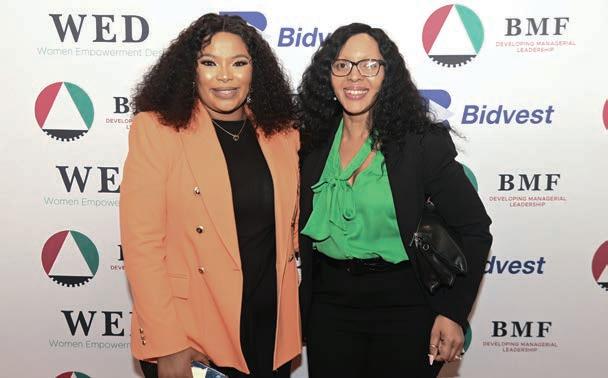
BIDVEST AND BMF HOST EMPOWERMENT SESSIONS
The BMF Women
Empowerment Desk has partnered with Bidvest to build a community of informed and empowered women leaders who will act as change agents in support of the BMF Women Empowerment Desk’s mandate to make a meaningful di erence in transforming corporate South Africa. True to this objective, the partnership was inaugurated through several key initiatives.
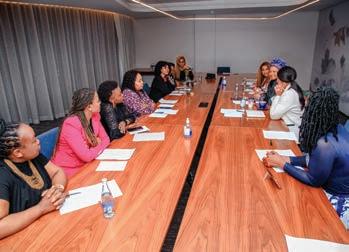
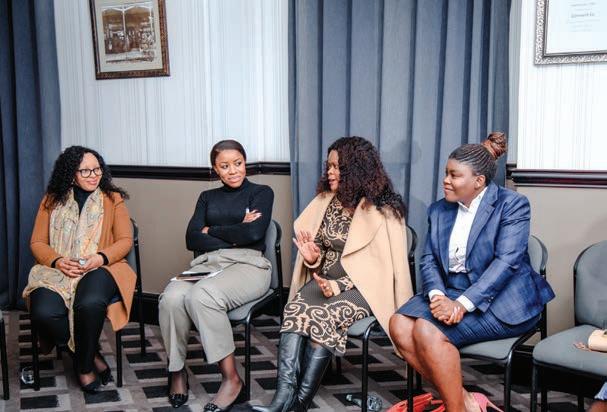
60-MINUTE CONVERSATION WITH WOMEN IN LEADERSHIP
e 60-minute conversations were launched to create safe spaces for female leaders to meet with like-minded individuals and discuss issues they face in their arduous leadership journeys without the inhibitions
of being judged. e conversations host a limited number of women in each session who draw from the experiences, insights, and learnings of female executives, professionals, and CEOs to help guide and support them as they move up into leadership positions.
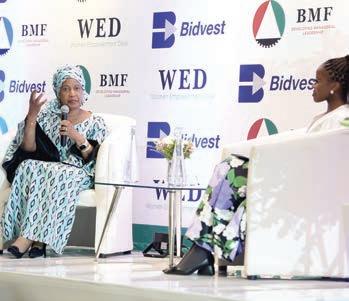
FIRESIDE CHAT WITH DR PHUMZILE MLAMBO-NGCUKA
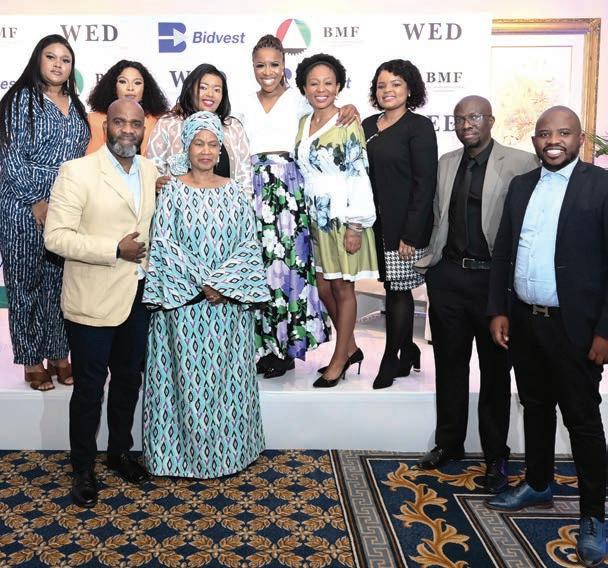
e Women as Agents of Change event was a reside chat hosting Dr Phumzile Mlambo-Ngcuka in conversation with BMF deputy president Esethu Mancotywa. is women’s month celebration aimed to highlight the empowerment of women as key to socioeconomic transformation. e critical highlights below summarise the main discussions for the evening.
Legal reforms and constitutions relating to women
Several laws and constitutions have been changed to ensure gender equality and the inclusion of women. Dr MlamboNgcuka unpacked how just changing the laws is not su cient; societal norms also need to change. Countries such as South Africa have problems where patriarchy, traditional leaders and cultural customs undermine constitutions and laws enacted to empower women.
And in as much as there are regressive and stubborn societal norms against women, it is possible, although di cult, to bring about the necessary change with enough time and the correct change agents within these societies/ communities. Dr Mlambo-Ngcuka added that biological di erences
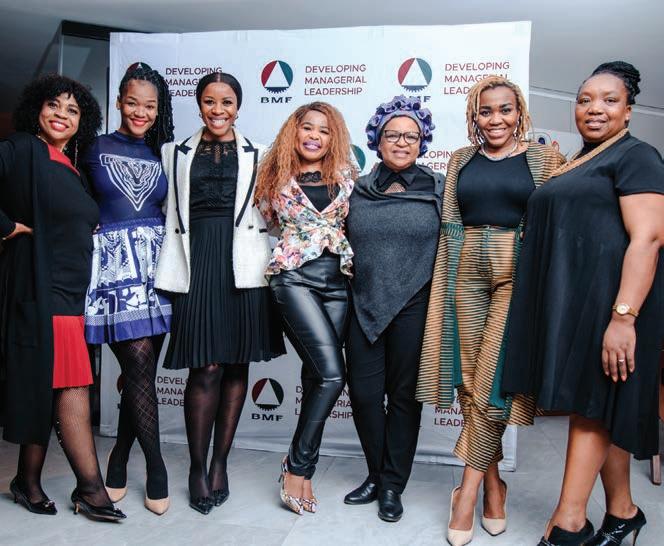
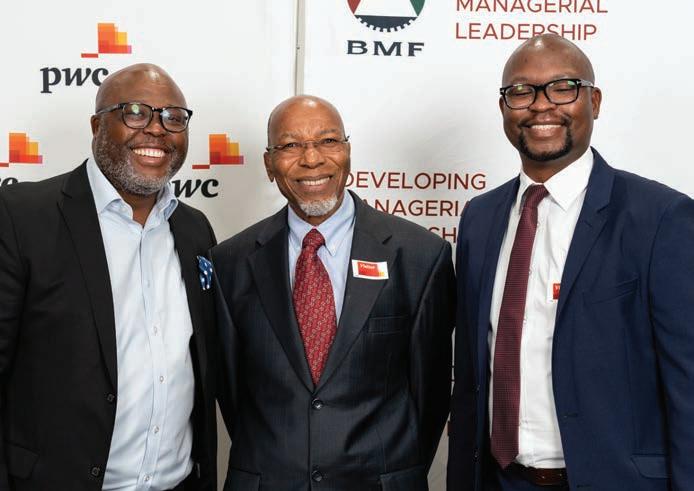
From left: Tsakane Maqayiya, Gugu Dube, Esethu Mancotywa, Nozizwe Somngesi, Busi Mabuza (IDC CEO), Shumani Khwashaba, and Thulisile Simelane.
From left: Phumzile Mlambo-Ngcuka and Esethu Mancotywa.
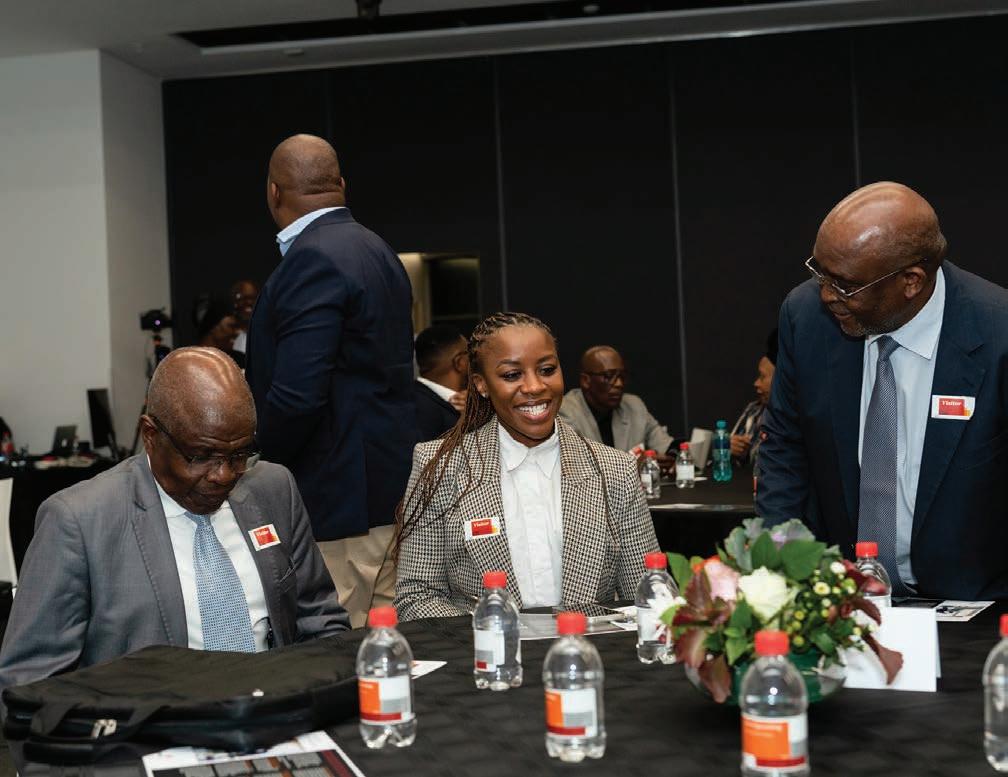
The attendees of the 60 minutes with Busi Mabuza..
between men and women do not de ne gender, but determine sex and physiological di erences. Gender, on the other hand, is learned. It is a societal shaping of you as a human being and can be changed at any time in one’s life.
Building alliances in the women’s emancipation agenda
Building a solid support base for the women’s agenda cannot only be up to the government and civil society. Dr Mlambo-Ngcuka explained that gender inequality is not a “women’s problem” as men foster it and, as such, they must take on the responsibility of bringing about the needed change. And once they have come on board and done the work, we need to ensure that we do not put them on a pedestal because – “you cannot praise a sh for swimming”. To achieve a signi cant step change, women must have strategic alliances with men and continuously expand the number of people ghting for gender equality.
Balancing empowering self and empowering society
Women place much focus on self-empowerment, and rightfully so because it is with that power that they gain the necessary in uence and authority to empower other women. However, the opportunity cost at times becomes the lack of focus on the more signi cant societal challenges. Dr Mlambo-Ngcuka emphasised that a true feminist is not focused just on herself and women, but on all the minorities and the people whose rights are not respected in society. “You cannot be a true feminist and be homophobic, ageist or a climate denialist,” she said. e bene t of thinking about women is the ability to bring into the fold all the issues that impact the society one lives in and works for. To ensure that as you ght for gender equality, you ght to address all the other issues and their collective contribution to the oppression of women. “ ose who focus solely on empowering women tend not to understand that we are not building a women’s colony, but a healthy society in which both men and women can thrive,” Dr Mlambo-Ngcuka said.
BMF Western Cape Executive Committee
From left: Khulukazi Mtebele and Jackie Khumalo
From left: Jackie Khumalo, Esethu Mancotywa, Buhle Hanise, and Lusanda Ncoliwe.
THE 9TH LOT NDLOVU LECTURE
Mosibudi Mangena delivered the 9th Annual Lot Ndlovu Lecture in Midrand on 25 August. He gave a challenging lecture, aimed directly at the petite bourgeoisie who, he argues, are fully in charge of the state. He stood before all as a towering father gure, unearthing the trappings of wrong foundational education principles that have created a gap in the black mind. He said: “Education is the greatest leveller of them all. Look no further than Lot Ndlovu. With his education, this son of farm workers became indistinguishable from the sons and daughters of teachers,
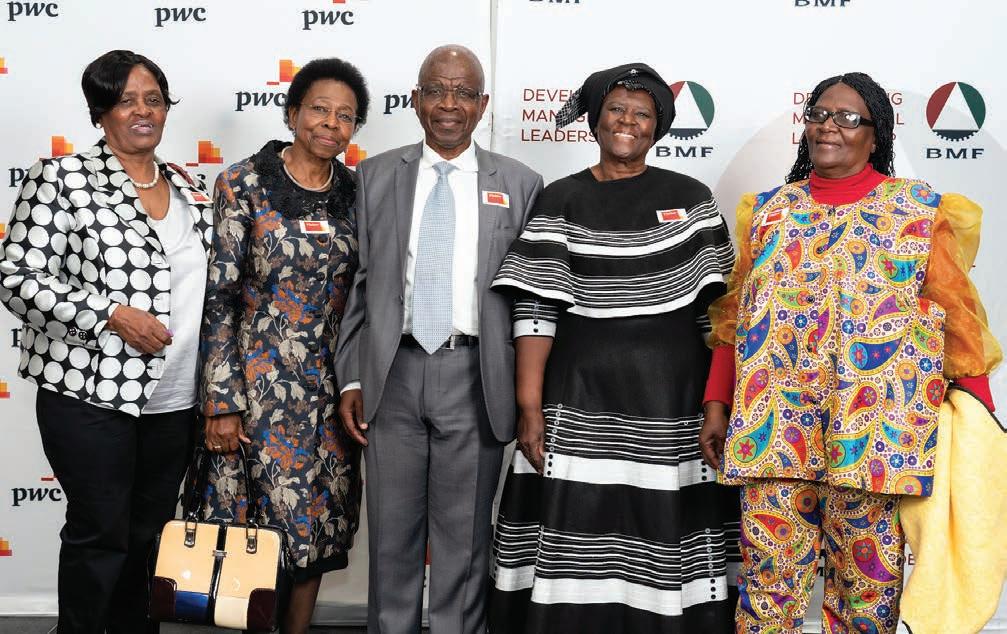
Terry Hlatshwayo, Nondima Nkuhlu, Prof Nkuhlu, Zanele Ndlovu, and Connie Kent.
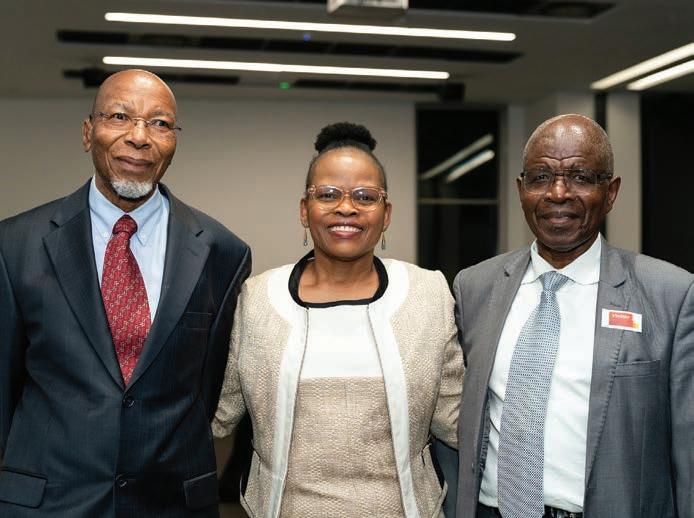
Mosibudi Mangena, Shirley Machaba, and Prof Wiseman Nkuhlu.
lawyers, priests, doctors and business people. Lot Ndlovu is a study in perseverance, grit and determination. rough sheer doggedness combined with brilliance, he rose from dust to a decent life.”
Mangena further challenged black people to emulate Lot Ndlovu and work towards transforming our country. e challenges we face are a result of the petite bourgeoisie, and this class of leaders must change the status quo. He stressed that we must advance the economic, educational and social upli ment of the black community.
Prof Wiseman Nkuhlu, Esethu Mancotywa, and Mzolisi Diliza.
Mncane Mthunzi, Mosibudi Mangena, and Monde Ndlovu.
RETHINKING LEADERSHIP IN AN ESG WORLD
e pace of change taking place in the world is exponentially greater than at any time in human history.
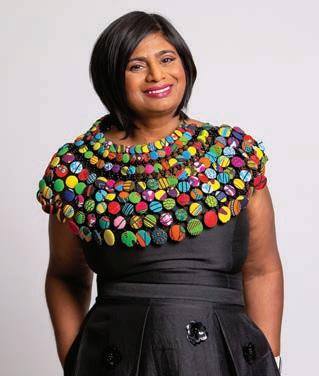
By Sharmla Chetty, CEO Duke Corporate Education
The highly respected neuroscientist, Vivienne Ming, once said “the world has never been this fast and will never be this slow again”.
As we re ect on the challenges ahead, it is clear that all aspects of leadership will be put to the test if we are to e ect change. Make no mistake, the rise of ESG (environment, social and governance) is here to stay.
e skills and mindsets of yesterday will require a dramatic shi at scale and speed if organisations are to survive and thrive.
In South Africa, achieving a “just energy transition” will be essential in ensuring that the lives and communities that are tied to high-emitting energy industries are not le behind in the shi towards a low-emissions economy.
We must explore how this can be a driver of new jobs, social justice, and poverty eradication.
NEW IDEAS, NEW SOLUTIONS, NEW LEADERSHIP
Only new forms of leadership can deliver the ideas and solutions to save a troubled world. at was the clear outtake of Duke Corporate Education’s (CE) recent global virtual summit, attended by over 1 600 delegates from more than 70 countries.
According to the Edelman Trust Barometer, trust in business rose sharply during the COVID pandemic. However, this gain may be squandered unless
companies are authentic in their actions, warned Dean Bill Boulding of Duke University’s Fuqua School of Business. e answer? Build purpose into the very core of your business.
Chief People, Policy and Purpose officer Fran Katsoudas cautioned against “false choices”, telling Duke CE delegates that there is “a belief that you can be good for business, or you can be good for the world; but you just can’t do both. And here’s the thing – you can”.
is was echoed by Anglo American’s Seara Mkhabela, executive head of Corporate A airs, who told guests at a separate Duke CE event that their commitment to purpose over the past decade has yielded positive results for both society and their bottom line.
“It starts with the leadership at the top, but it must cascade throughout the organisation to the men and women who go underground,” she told our guests.
CEO of Fortune Media and author of Tomorrow’s Capitalist Alan Murray revealed three key shi s in business today.
1. Generational change: employees and customers are forcing businesses to adapt.
2. Value creation: over the past 50 years, the value on the balance sheets of Fortune 500 companies shi ed from being 80 per cent physical stu to 85 per cent intangibles, such as intellectual property, brand connection and customer loyalty.
The skills and mindsets of yesterday will require a dramatic shift at scale and speed if organisations are to survive and thrive.
3. Leadership change: the C-suite command-and-control model of leadership is obsolete, requiring leaders to empower employees and inspire action. “It’s much less about telling people what to do and far more about setting the North Star, setting the purpose,” said Murray.
DUKE CE’S ESG LEADERSHIP ACADEMY
In light of these increasing leadership challenges, Duke CE established the ESG Leadership Academy, headed by Andrés Saint-Jean. “The academy helps leaders shift mindsets and deliver impact at scale through our learning journeys,” he says. “However, research has shown that to facilitate change, leaders must shift the behaviours of at least 30 per cent of the organisation.” is initiative aligns with Duke CE’s purpose of empowering leaders to change organisations that change the world. We dare not delay. e world is getting faster by the second.
Sharmla Chetty
AN AFRICAN LEADERSHIP STORY
Mteto Nyati, executive chairperson, Wazo Investments, shares what it means to be an African in leadership. By
The transformation from the Organisation of African Unity to the African Union in 2002 represented a shi from Pan-Africanism to a strong emphasis on economic growth and social development in which regional communities would be the foundation for continental integration. is called for an African corporate leader who could create value for all stakeholders and inspire and drive societal transformation. Mteto Nyathi is one of those leaders.
Nyati’s corporate leadership story has inspired many. He has made an invaluable contribution to what can be called Africa’s leadership culture. A uniquely African leadership paradigm that places people and community at the centre of how leadership is exercised.
Nyati advises that leadership in Africa should be built by leveraging our strengths and learning from those who practise leadership di erently to nd what will work best for overcoming our leadership challenges in pursuing our long-term vision for the continent.
He says: “We seem to be effective at mobilising people and getting them to do things. That is a good quality. In some areas though, like holding others accountable, we are not the best. So it is a mixture – you need to take the best out of all these qualities and see what works in your environment.”
NYATI’S LEADERSHIP STYLE
At the centre of Nyati’s leadership philosophy is the principle of Ubuntu. “You are there because of other people. ey are there because of you … you can see the interconnectedness of people,” he says.
While reluctant to generalise, he believes this foundation is what sets us apart and
Cuma Dube, chairperson
of the BMF editorial committee
what could be the source of our competitive advantage. Our interconnectedness is an aspect that has not been explored fully in African leadership. “ For me, its critical to be an African in leadership.”
Nyati has demonstrated this philosophy in his own leadership story. His time at Microso South Africa (SA), MTN-SA, and ALTRON, to mention a few, reveal a self-aware leader who embraces who he is and is driven by his core values of family, fairness, excellence, and integrity. He says: “If I don’t bring
aspects of my African identity into leadership, I won’t be able to di erentiate myself. So, I have always tried to bring my full self and my blackness into any job. Coming from the rural areas of the Eastern Cape makes me di erent. Bringing that di erence means people experience me in di erent ways.”
His leadership style has led to his recognition as a master strategist and a reputation as a turnaround specialist and ethical leader. In an interview with Forbes Africa, Nyati puts this down to
Mteto Nyati
simply surrounding yourself with the best people and learning how to build a capable team of people.
Consistent with his leadership philosophy, Nyati’s focus on people, teams, and community is central to his leadership story. He speaks passionately about the lessons learned from his mother and about respect for the people with whom you work. He explains how that inspires teams to go the extra mile, “to give you the discretionary e ort” to achieve the bigger picture because they feel heard and their ideas are implemented. is is a simple aspect of leadership we may not be tapping into enough in the African context, he says. “You need to see people; maybe many of us don’t quite see them, we don’t recognise them. We don’t even know where they come from. You need to just trust people – of course, some will disappoint you, but generally, people will go all the way in executing and doing exceptional work. So, the people side of the equation has been the thing that sets me apart, I think.”
Nyati’s focus on people extends to how he thinks about customers. He credits his leadership successes in his various roles to understanding what customers really need, not just selling them what you have produced.
THE CULTURAL INFLUENCE
While African culture and, particularly, the principle of Ubuntu can be a source of competitive advantage for the African corporate leader, Nyati warns that some aspects of our culture could arguably be at the root of some of our leadership failures and challenges. “Generally, our culture does not hold people or leaders accountable. If you go to our chiefs, there are no platforms where we say, ‘Hey Chief, come and account to us’.”
But these challenges presents opportunities for growth. “We need African leaders who are capable of turning our challenges into opportunities for economic growth and social transformation. The African leader we need is one that can build a
“We need leaders who care enough to give us the tools to do things, not do them on our behalf. We are a proud people. We need to be woken up to our potential.” – Mteto Nyati
business around helping our people. There is economic opportunity in solving black problems.”
ere is social transformation in empowering our people to exploit these opportunities themselves.
“What is required today is leadership that is not just about feeding people and giving and making them dependent. It is leadership that wakes people up and makes them independent, makes people go and solve the problems around them. We need people who care enough to tell us the truth. We need leaders who care enough to give us the tools to do things, not do them on our behalf. We are a proud people. We need to be woken up to our potential, that is what is required right now.”
IN SERVICE OF PEOPLE AND THE COUNTRY
Nyati’s leadership is about people and in service of people. His views on the many challenges we face are punctuated by his values and what is in the best interests of people and society at large. His leadership journey teaches us that a leader must be self-aware. While we may nd the leaders to empower us to do things for ourselves and better serve our communities, we must do so knowing what we are and aren’t good at.
is is also his approach to whether black professionals should get more involved in public service. While he can serve as a director in a troubled stateowned company, where his skills as a master strategist and turnaround genius may be perfect for the job, it isn’t for everyone, he says. In his view, how the black middle class can serve is not limited to working in government or getting involved in politics.
Our most pressing issues are poverty, unemployment, and inequality. And, Nyati adds that the solutions to these problems
may not lie exclusively in the political space or state-owned companies. “Jobs are created by enterprises, by entrepreneurs... We must be introspective and ask ourselves where our individual gi s lie and where they are best placed to serve and help ght for these pressing issues.”
It is this type of introspecton that saw Nyati accept the invitation to take up a board seat at the embattled Eskom. He feels he now has the experience and the skills to contribute. “I’ve always been driven by looking for challenges. Where there is a mess, that’s where I will go. When people are running away, I’m going there. at’s me. is ts the pro le of the kind of thing that I can do. I have got the time to dedicate myself to supporting the leadership of Eskom to get us out of this challenge.”
On the issues facing Eskom and the debate around just transition, his approach is both practical and reasonable.
“We’ve made signi cant investments in coal and coal-powered generation in Medupi and Kusile. We cannot a ord to write those investments o . Ninety per cent of our generation capacity depends on coal. However, we have also made commitments as a country that the new investments we make must consider sustainability and green energy. We need to make responsible decisions based on what we have, how we can best overcome the environmental challenges and be prepared to invest in green energy for new generation capacity. is green energy will create new industries we have not even thought of; that’s where we’ll see a lot of employment.”
While Nyati speaks for himself here and not in any way for the entire Eskom board, what is encouraging is his clarity and commitment to nding reasonable solutions to our challenges that will bene t society at large and open us up to new opportunities.
FUNDING FOR A MORE EQUITABLE FUTURE
e Mpumalanga Economic Growth Agency is aware of the funding required to address the developmental challenges in Mpumalanga province. How it approaches these tasks is informed by the global and national contexts. By Isaac Mahlangu chief executive o cer, Mpumalanga Economic Growth
The global economy is in a deep recession exacerbated by the COVID-19 pandemic, which not only a ected dayto-day life, but slowed down the economy and disrupted world trade and movements.
When 2022 began there was hope that widespread vaccination roll-out would assist in addressing challenges posed by this pandemic. However, evidence suggests this is not the case. e con ict in Ukraine, surging in ation, and rising interest rates have led to the World Bank and other global institutions revising their outlook for global economic growth for the year.
Unfortunately, South Africa’s economy remains weak with structural challenges such as the crippling energy crisis, transport and logistic inefficiencies and the impact of natural disasters such as the floods that rocked South Africa’s third-largest regional economy, KwaZulu-Natal.
On a positive note, the rst quarter of 2022 witnessed economic growth that surpassed the pre-COVID-19 levels of 2019. Nevertheless, COVID-19 intensi ed the country’s intractable socioeconomic challenges, and, by extension, those confronting Mpumalanga province.
Unemployment in the province remains stubbornly high and income inequality levels are also high as a result of the pandemic – the losses in labour and business income exacerbated poverty and economic and social inequality.
MEGA TO HELP ECONOMIC RECOVERY
It is within this context that the Mpumalanga Economic Growth Agency (MEGA) is enjoined to be at the centre of provincial post-COVID-19 economic reconstruction and recovery e orts focused on boosting demand, providing replacement income, and facilitating new investments.
In providing funding mainly for formerly disadvantaged individuals, MEGA is ful lling its mandate to provide funding in respect of property development, approved enterprise and agricultural development.
Providing funding for an equitable future is one of MEGA’s obligations, made more necessary by the glaring inequalities in the province in terms of access to opportunities and nance for budding entrepreneurs. rough its adopted programmes and strategies for youth, women and the most vulnerable, MEGA seeks to “democratise” entrepreneurship by overcoming the barriers to business creation that entrepreneurs from under-represented backgrounds typically face.
However, MEGA is unable to meet all its funding needs or attain its desired targets considering the pandemic and the country’s weak scal outlook.
A NEW FUNDING PARADIGM
Funding for a more equitable future calls for thinking outside the box and leveraging to attract nancially strong institutions and organisations that also attach value to a prosperous, inclusive and environmentally resilient province.
Going forward, MEGA will prioritise a “funding and nancing” rather than a “funding” paradigm. is will be to support the structuring of di erent nancial ows to achieve a common result.
Supporting entrepreneurship development in the province to promote a more equitable future calls for collaboration with the nancial sector in the province. MEGA will strengthen ties with commercial banks and development nancial institutions.
Commercial nance can and should play a large part in funding a more equitable future. Research has shown that the country’s small, medium, macro and micro enterprises provide a compelling, largely untapped market opportunity for innovative funders who are able to develop new lending models and risk assessment tools tailored to address the challenges of this complex and burgeoning market.
New innovative funding solutions include sustainable investing, such as environmental, social, and government bonds. MEGA is ideally placed to ensure these are harnessed to maximise impact in our province.
Scan this QR code to go directly to the Mega website.
For more information: www.mega.gov.za
Isaac Mahlangu
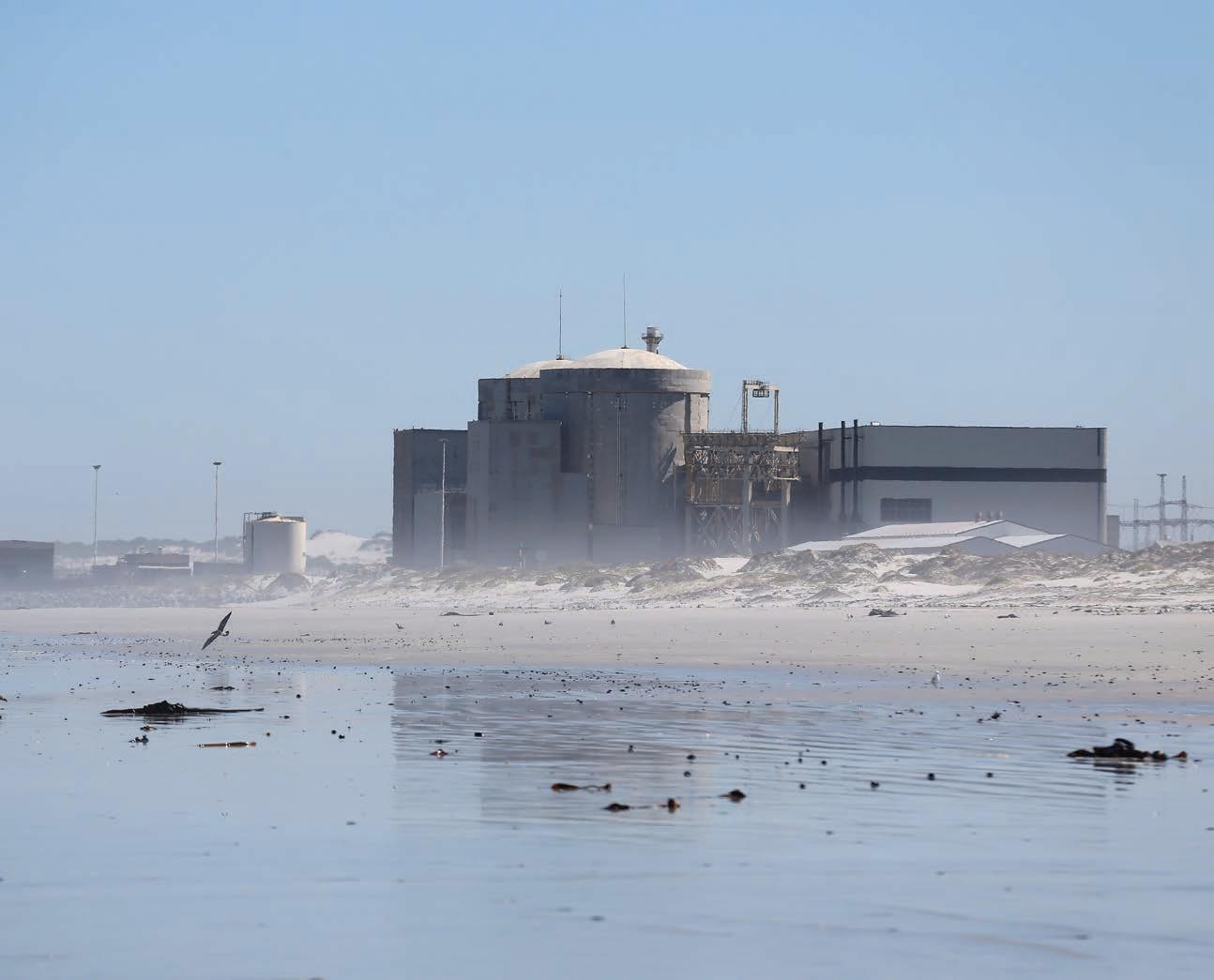
AN ANALYSIS OF THE EMERGENCY ENERGY PLAN
Duma Gqubule argues that government must consider implementing a power engineering (or technical) version of business rescue for the energy sector
In 1998, the government published an energy white paper, which said: “Although growth in electricity demand is only projected to exceed generation capacity by 2007, long capacity expansion lead times require strategies to be in place in the mid-term, in order to meet the needs of the growing economy.”
But the government decided that Eskom should not build new capacity because it wanted to invite independent power producers (IPPs). The IPPs did not materialise because the cost of electricity was too low for companies to make a profit. As predicted, the power blackouts started in 2007.
Almost a quarter of a century after making this disastrous decision, the government is repeating the same mistake and has gone back to the 1998 playbook. At the end of July, President Cyril Ramaphosa responded to a month of severe power blackouts, announcing an emergency plan that again pinned its hopes on IPPs and an improbable surge in private sector investment to generate new capacity.
This was within the context of a deep economic crisis. Gross domestic product per capita has not grown for 15 years. Eskom is South Africa’s most important macroeconomic policy issue. National Union of Metal Workers of South Africa general secretary Irvin Jim says: “From 2018 to 2022, the cost of load shedding to the economy has not been less than R500-billion. Eskom’s rolling blackouts constitute the most dangerous threat to existing jobs in the manufacturing sector – and across all other sectors of the economy.”
FINANCIAL MESS
There are three reasons why Eskom is in such a financial and operational mess. First, Eskom had an inadequately capitalised balance sheet to finance its capital expenditure programme, which cost R661-billion from 2007 to 2021. In December 2005, Eskom’s board decided to build the Medupi power station and construction started in May 2007. Construction at Kusile power station began in April 2008.
In the 2009 annual report, former Eskom chairperson Bobby Godsell wrote: “It is not possible to fund the first major expansion of our electricity grid for several decades from revenues generated from tariffs alone. The growth of a business is usually funded by a sensible balance between the
“From 2018 to 2022, the cost of load shedding to the economy has not been less than R500-billion. Eskom’s rolling blackouts constitute the most dangerous threat to existing jobs in the manufacturing sector – and across all other sectors of the economy.” – Irvin Jim
owner’s equity, accumulated reserves, and debt. We need to mobilise greater equity resources to fund the build programme.” Eskom had no reserves to fund the huge investments to increase capacity.
The lack of a plan on how to finance Eskom’s capital expenditure programme – not the hijacked contract given to the Gupta family in 2015 – and soaring primary energy (coal and renewable energy) costs are what bust the company’s balance sheet. The Gupta contract was two per cent of revenues in 2016. By February 2018, eight Gupta companies had filed for business rescue.
During the 2006–2007 financial year that ended in March, Eskom reported a profit of R6.5-billion on revenues of R40.1-billion. Its total costs were 87.4 per cent of revenues. From 2007 to 2021, the average selling price of electricity increased by 514.8 per cent to 111.04c per kilowatt hour. Revenues increased by 409.9 per cent to R204.3-billion. Primary energy costs soared by 788.9 per cent to R115.9-billion (56.7 per cent of revenues) from R13-billion (32.5 per cent of revenues).
From 2007 to 2021, Eskom spent 34.5 per cent of its revenue on its capital expenditure programme. In 2009, the gure was a staggering 82.4 per cent and was above 50 per cent every year between 2008 and 2012. As a result, Eskom’s debt increased by 892.3 per cent to R401.8-billion from R40.5-billion. e net nance cost increased by 1677.6 per cent to R27.5-billion (15.3 per cent of revenues) from R1.5-billion (3.9 per cent of revenues).
In 2021, Eskom’s total costs were 115.6 per cent of revenues. The company made a loss of R18.9-billion. Eskom says it can only carry a debt of R200-billion. Finance Minister Enoch Godongwana will announce measures to reduce at least 50 per cent of its debt when he delivers his medium-term budget policy statement at the end of October. Eskom probably needs 75 per cent of its debt taken off its balance sheet so that it can invest in
Irvin Jim
new capacity. The Public Investment Corporation can write off Eskom debt of about R80-billion or convert it into shares. The rest can be lifted to the national balance sheet.
INSUFFICIENT PLANNING AND CAPACITY
Second, Eskom started a massive project of building two of the largest power stations in the world at the same time in a rush and without going through the required planning processes. Energy expert Mike Roussouw told eNCA: “Eskom was under pressure to bring these projects into operation as soon as possible. But such projects require five to seven years of upfront work before putting contracts in place. As a result, there was insufficient design work done before construction started. This created an ongoing problem with contracts that were not sufficiently specified.”
Former Eskom CEO Jacob Maroga says it had been many years since the company built anything. “The internal capacity to manage complex engineering projects was no longer available.”
MAINTENANCE AND MANAGEMENT WOES
Third, there has been a dramatic decline in plant performance since Ramaphosa appointed a new board in 2018, especially after Andre de Ruyter became CEO in January 2020. The energy availability factor (EAF) has collapsed from 78 per cent during the 2018 financial year to 57 per cent in April 2022. This year, Eskom has regularly had 20 000MW down and between 15 000MW and 18 000MW of unplanned breakdowns.
According to the Council for Scientific and Industrial Research (CSIR) statistics, South Africa shed 10 319GWh of energy from 2007 to June 2022. The energy shed since 2018, when the new board was appointed, accounted for 78.8 per cent of all energy shed since 2007. The period since
Eskom probably needs 75 per cent of its debt taken off its balance sheet so that it can invest in new capacity.
de Ruyter became CEO accounts for 63.9 per cent of all energy shed since 2007. There have been increasing calls from black business organisations and trade unions for the board and the CEO to step down.
At the end of March 2021, Eskom had nominal capacity of 46 366MW. Eskom says there is a shortfall of between 4 000 and 6 000MW. It appears to have given up on fixing the current fleet of power stations and repeatedly says the only option is to connect new capacity from IPPs to the grid. However, the company itself has created this capacity shortfall. There would be no shortfall if it fixed the existing plants and increased the EAF to about 75 per cent.
Eskom’s excuses make no sense. It says the power stations are old. But the average calendar age of its 14 coal power stations is 28 years –and 32 years if one excludes Medupi
and Kusile. Coal power stations are designed to operate for 50–60 years.
A 2019 report by Primaresearch said: “While the ageing of Eskom’s fleet of power stations may seem worrying, the situation is not uncommon. In the United States, 51 per cent of the country’s electricity generating capacity was built before 1980. Multinational energy company Enel discloses its useful life for depreciating coal plants is up to 62 years. Globally, the average age of retired coal power stations is 54 years.”
Eskom says the company’s previous leadership neglected maintenance, and ran the plants too hard. But Primaresearch disagrees: “Maintenance spend as a percentage of revenues has mostly been stable at eight per cent. We do not think Eskom has underspent or neglected maintenance by this measure.” In 2021, Eskom spent R16.6-billion on maintenance, which was equivalent to 8.1 per cent of revenues. The National Society of Black Engineers (NSBE) notes that Eskom set targets of 80 per cent (EAF), 10 per cent (planned capacity loss factor or PCLF) and 10 per cent (unplanned capacity loss factor or UCLF) in 2009.
The NSBE’s analysis of technical performance indicators in previous annual reports shows no evidence to support the Eskom view. From 2012 to 2021, there was an average PCLF, a measure of planned maintenance, of 10.5. From 2016 to 2018, when the previous leadership was in charge, the average PCLF was 11.8. The Energy Utilisation Factor (EUF), a measure of how hard plants are run, declined dramatically from 82.7 per cent – above an 80 per cent ideal benchmark – to 71.6 per cent during the same period. The plants were run at above 80 per cent from 2013 to 2016. But the NSBE says there is nothing wrong with running the plants harder if the PCLF threshold of 10 per cent is met. This happened in 2013 when the PCLF was 0.9 percentage points below the threshold. From 2014 to 2016, the
Andre de Ruyter
PCLF threshold was met. “ e fact that in 2021 the PCLF was 12.3 per cent without translation to improved performance is concerning. It probably means that the quality of maintenance was not up to standard,” the organisation says.
THE PLAN AND ALL ITS FLAWS
In his speech on 25 July, Ramaphosa repeated the urban legend that “Eskom deferred essential maintenance to keep the lights on, which is causing breakdowns and failures now” and rejected calls to re the board and CEO. “A er years of state capture and mismanagement, a capable and e ective management team is working hard to turn the utility around and reverse years of decay”. However, the worst decay in Eskom’s plant performance has happened since he became president in 2018.
The Black Business Council (BBC) said: “The BBC notes with disappointment that the president has not addressed the big elephant in the room, the leadership and governance of Eskom. We have, on numerous occasions raised, very sharply, the capability of the Eskom executives and the board to lead and manage such a critical national institution. The board members do not have the requisite industry stature, qualifications and experience to provide proper oversight on the management of Eskom and have been virtually absent as this crisis is unfolding.”
Ramaphosa said the plan was to improve the performance of the existing fleet and increase the maintenance budget. The government would cut the red tape that made it difficult for Eskom to purchase spares required for maintenance. Eskom was also recruiting
skilled people to reinstate world-class operating and maintenance procedures.
In a later briefing, Minister of Public Enterprises Pravin Gordhan provided more details and said Eskom had identified the top six most troublesome power stations – Tutuka, Kendall, Duvha, Majuba, Kusile and Matla – that would receive more attention.
OTHER PROPOSALS AND THEIR PROS AND CONS
The rest of the emergency power plan resembled a paper written in June by Meridian Economics, a research company that lobbies for the renewable energy industry, and Eskom proposals. It involved short-and medium-term measures to add new generation capacity to the grid. In terms of immediate power, Gordhan said purchases from the Southern African Power Pool would add between 100MW and 200MW. Eskom would buy power from existing IPPs that have surplus capacity of 1 000MW.
In the medium term, the government would relax localisation requirements for the fifth bid window of the Renewable Energy Independent Power Producer Procurement Programme and double procurement for the sixth bid window to 5 200MW. However, the fifth bid window appears to have collapsed after bidders submitted low prices far below what was required for them to break even. There have also been dramatic changes in the global economy, including rising inflation and interest rates and a depreciating rand on the back of a strong dollar. The bids are deeply under the water. Adjustments to localisation requirements are unlikely to make them viable.
“If you want to end load shedding you must focus on making sure that there is consistent performance of the current fleet. That does not need to take 24 months.” – Jacob Maroga
Ramaphosa also eliminated the licensing threshold for embedded generation projects. Since the government increased the threshold to 100MW in June 2021, the National Energy Regulator of South Africa has registered 626 generation facilities that have a capacity of 714MW. Industry experts do not expect many further investments in this segment of the market. There are very few companies that can afford to pay US$1-million per MW to invest in solar projects. The same applies to measures to incentivise businesses and households to invest in rooftop solar. The two measures will only increase energy inequality. A few large businesses and rich households that have access bonds will have 24/7 power, while the majority of South Africans will continue to depend on Eskom.
BEST POSSIBLE SCENARIO FOR NOW?
South Africa is in its worst post-apartheid economic crisis with an expanded unemployment rate of 44.1 per cent and 12.3 million unemployed people, according to StatsSA’s Quarterly Labour Force Survey for the second quarter of 2022. The economy cannot afford another day, week, or month of power blackouts. At best, the sixth bid window will deliver capacity in 2025. Considering the capacity factors of intermittent sources of renewable energy, this will be too little too late.
IPPs will not address the immediate crisis. As Maroga has pointed out: “If you want to end load shedding you must focus on making sure that there is consistent performance of the current eet. at does not need to take 24 months.”
e country needs a short-term solution to its never-ending power crisis. e government must consider implementing a power engineering (or technical) version of business rescue and appoint engineers (local and international) to stabilise the existing eet as soon as possible.
Protect your online identity and renew your domain name annually!
Protect your domain name from being deleted or made available for new registration. Speak to your Internet service provider today about renewing your .za domain name.
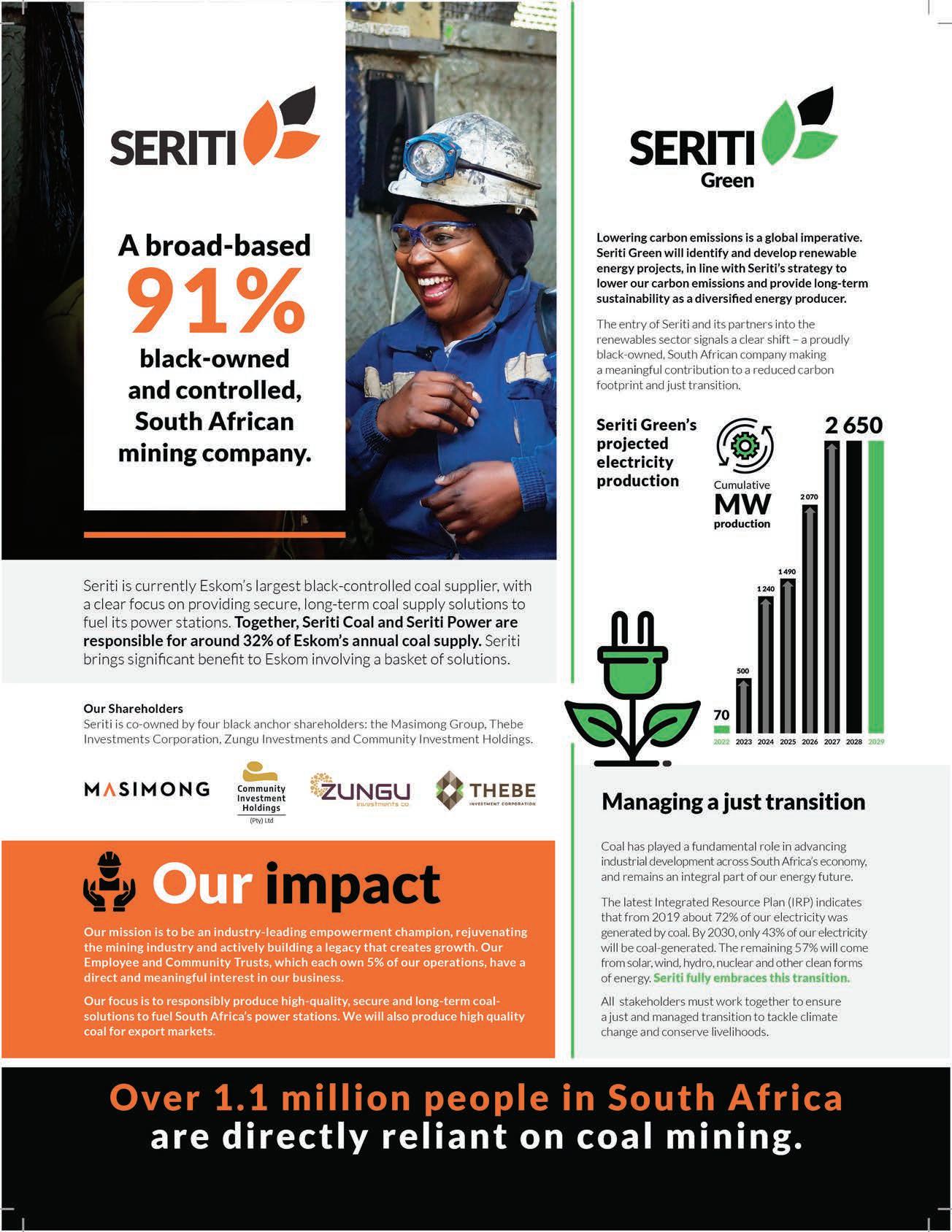
MOVING TOWARDS A JUST TRANSITION
By
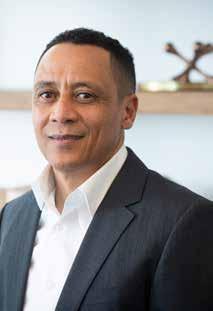
Mike Teke, CEO Seriti Resources
Mike Teke
FOR THE FP&M SETA, EVERY DAY IS AN AUDIT DAY
e Fibre Processing and Manufacturing SETA has recorded its sixth clean audit in eight years, reports Dr Felleng Yende, CEO
Why are public service executives lled with dread, trepidation and panic when they receive a report from the Auditor-General of South Africa? ese reports contain opinion on whether their organisation’s strategy, performance, nancial statements, and governance processes have complied with statutory requirements for public organisations? Audits o er big-picture insights and o en reveal opportunities for increasing e ciencies and improving organisational operations. Also, the ght against fraud, an attitude of zero tolerance towards corruption, a focus on compliance, excellent service, and professional business conduct all call for constant vigilance.
It is with pride and honour to report that for the sixth time in eight years, the Fibre Processing and Manufacturing (FP&M) SETA has obtained a clean audit opinion from the AGSA for the 2021/22 nancial year. is is the fourth consecutive clean audit opinion.
FP&M SETA AUDIT SUCCESS
A clean audit opinion is a remarkable accomplishment. It principally indicates that our governance and nancial records did not contain any signi cant material misstatements and that those who relied on them to make decisions were con dent that they had been reasonably accurate.
Noteworthy audit success areas identified by the AGSA for this nancial year include:
• Overall presentation of the performance information in the annual performance report is comparable and understandable;
• No material ndings were identi ed;
• No instances of material noncompliance with selected speci c requirements of applicable legislation;
• e accounting authority has maintained e ective, e cient nancial and risk management systems, transparent nancial and risk management systems and internal control; and
• No fraud factors were identi ed during the current year’s audit.
HIGH LEVEL AND STRATEGIC BUSINESS MODEL
For me, achieving a clean audit opinion is not an event, but a process to ensure full compliance with generally recognised accounting practice standards.
An organisational strategy determines the deliverables by identifying the what, where, when and why of an organisation’s existence.
When I was appointed chief executive o cer of the FP&M SETA, at the top of my rst to-do list was designing a high-level and strategic business model detailing
and streamlining the organisation’s business processes to ensure quicker turnaround, customer-oriented practices and a high level of compliance to set performance standards. We strive for an organisation with an e ective institutional capacity delivering on innovation, e ciencies, improved productivity, and ameliorated nancial management with an eye for cost reduction, an e cient business model and credible processes.
WORKPLACE CULTURE MATTERS
At the FP&M SETA, we have proved that an organisation cannot lose the ability to achieve a clean audit if it has certain measures in place. ese include a clear and implementable strategy that addresses critical and scarce skills and consistently develops e ective nancial management, strong nancial management controls, e cient supply chain management systems, good corporate governance infrastructure with embedded performance information controls, and clinical project protocols. Additionally, workplace culture matters. We continuously look for ways to cultivate the perfect culture because a toxic workplace culture and unethical rules can negate all the investment into attaining a clean audit.
As the late President Nelson Mandela once said: “A winner is a dreamer who never gives up”. Never give up striving to one day achieve a clean audit.
• Reported performance information for learning programmes and projects was found to be useful and reliable, and in accordance with the applicable criteria as developed from the performance management and reporting framework;
➔ Scan this QR code to go directly to the FP & M SETA website.
For more information: 011 403 1700 www.fpmseta.org.za
Yende
TRANSFORMATION EMPLOYMENT EQUITY
Analysing the 22nd CEE annual report, Dineo Faku questions why it is taking so long to transform the workplace
Little has changed in South Africa’s private sector workplaces in the 24 years since the enactment of the Employment Equity Act of 1998 to promote equal opportunity and fair treatment in the workplace. is is according to the latest report by the Commission of Employment Equity (CEE) released in June. e 22nd CEE annual report for 2021/22 found a lack of transformation in private sector workplaces with few having succession plans to promote particularly black people, women and people with disabilities.
e report said that at top management level, white and Indian population groups were over-represented between 2019 and 2021 when compared to their coloured and African counterparts. At top management level, the white population group accounted for 63.2 per cent, from 64.7 per cent in 2020 and 65.6 per cent in 2019. e Indian population accounted for 10.9 per cent in 2021, from 10.6 per cent in 2020 and 10.3 per cent in 2019. e African population group made up 17 per cent of top management in 2021, from 15.8 per cent (2020) and 15.2 per cent (2019), while the coloured population had a 5.9 per cent representation at top management level in 2021, from 5.7 per cent in 2020 and 5.6 per cent in 2019.
However, there was slight progress in gender representation at the top management level, driven by appointments in the public sector, resulting in an increase from 24.9 per cent in 2020 to 25.8 per cent in 2021. At top management level, female representation in the public service stood at 41.4 per cent. e private sector has a long way to go, the report stated, with only
24.6 per cent representation. Commission chair Tabea Kabinde says it was the rst time that the commission had conducted a comparison of female representation in the private and public service. “In terms of transformation, the public sector has done very well regarding race. We challenged them to start looking at gender, and I think they have embraced that challenge,” Kabinde says.
DISABILITY TARGETS MOSTLY UNMET
When it comes to people living with disabilities, very few companies in the private and public sectors have met the targets. People with disabilities remained poorly represented in top management at 1.6 per cent in both 2021 and 2020, from 1.5 per cent in 2019, the report stated. Kabinde says this is because disabilities are not well understood in the workplace –
employers seem to only de ne disability in terms of physical disability, and are not creating awareness among their employees of the true de nition according to the Employment Equity Act.
“Some people with disabilities are not declaring their disabilities because they are not aware it is a disability.” Invisible physical disabilities include autism, diabetes, and long-term depression requiring medication.
Kabinde says employers must have awareness campaigns about the true meaning of disabilities and assure their disabled employees that they will not be discriminated against because of their disability.
FOCUS NEEDED ON SUCCESSION PLANNING
For Kabinde, it was disappointing that more than 20 per cent of employers were without clear succession and experience plans, and over 25 per cent of employers were not focused on training and development.
She says succession planning is not taken seriously by the private sector to ensure black people, black women and people with disabilities are trained and developed to occupy higher posts.
FAST FACT
The public service employs more females (41.4 per cent) than the private sector (24.6 per cent) at top management level, according to the 22nd CEE annual report for 2021/22.
“In terms of transformation, the public sector has done very well regarding race.” – Tabea Kabinde
Tabea Kabinde
“If we are serious about transformation, we should not be begging now. The time has come to get hard on noncompliance.” – Thulas Nxesi
“When it comes to race and gender, more white males and females are prioritised for training. So, when we talk about succession planning, they would be the rst people in line because they are already being developed within the organisation,” she says.
e report analysed six occupational levels of the workforce pro le and movements according to population group, gender and disability. Reacting to the report, Employment and Labour Minister ulas Nxesi described it as re ecting a sorry state of a airs. “If we are serious about transformation, we should not be begging now. e time has come to get hard on noncompliance,” Nxesi said.
FEAR OF LOSING CONTROL
Kabinde says the lack of buy-in by employers and fear of losing power was a big stumbling block.
“One article about a rmative action says ‘one cannot expect turkeys to vote for Christmas’; I think many businesses hold that perception of a rmative action. ey see it as something that will take their power away, giving power of their businesses to black people, black women and people with disabilities. e fear is that if there are more black people at a particular level, the entry of other black people is likely to be easier. e other fear is that if women, black people and people with disabilities are given decisionmaking roles, then the future of our children is at stake because their opportunities
of entering the labour force and having decision-making powers are limited.”
Kabinde says the law and the proposed Employment Equity Amendment Bill currently before Parliament aim to, among other things, ensure that transformed organisations stand better chances of sustaining their businesses by doing business with the government.
“If I were in their position, I would move quickly to ensure business equity in my organisation. at way, I can ensure my organisation’s sustainability and the ability to bring in the next generation of white people, for example, as targets will be met.”
Under the amendment bill, businesses that do business with the state will have to meet sector targets, Kabinde says. Failure to meet those targets means they cannot do business with the government.
In terms of the amendment bill, she says Minister ulas Nxesi needs to set a veyear time frame for sector targets to be met.
Terry Oakley-Smith, founder and CEO at Diversi-T, who has been studying employment equity for the last 30 years, called for the removal of white women from the designated group referring to historically disadvantaged people, including black people, women, or people with disabilities.
“I do not believe that employment equity suggests that there is no place for recognising potential and performance. When these white people afraid of losing control earn their place at the table, they will get it. If you are performing, there is nothing that can hold you down. e fear may be irrational, but based on our history, the fear does exist.’’
DEMOGRAPHICS AND REPRESENTATION
Black Management Forum (BMF) acting president Esethu Mancotywa says the BMF would like the representation of African professionals in executive and senior management positions to mirror the demographics of the population.
“We need to reach the percentage levels as a bare minimum. Our main agenda is that our economy must be re ective of the demographics of our society.”
Mancotywa says that failure to comply with employment equity targets should be criminalised. “We don’t accept nes anymore. Companies, boards and executives that are responsible must be prosecuted for breaking the law.”
“I think white women should be dropped from the designated group. If you look at the numbers, you can see that white women have bene tted far more from the Employment Equity Act than even black people for whom the act was intended. By removing white women, I think there will be a signi cant di erence. Black women must stay, but removing white women from the designated group is important because there is no reason for them to be there.”
Oakley-Smith also says there needs to be far better monitoring in the private sector. Unless businesses are monitored and evaluated, and suitable sanctions enforced, companies in the private sector will continue to lag.
“Not only are there not enough monitors and evaluators, but many of them are not su ciently trained and knowledgeable about the act. ey should be looking not just at the numbers of top, senior or middle management, but also at things like, does the company have a succession plan and how will the succession plan impact the targets in the coming years?”
Terry Oakley-Smith
Thulas Nxesi
THE IMPORTANCE OF THE FINANCIAL SECTOR’S TRANSFORMATION TOWARDS THE BETTERMENT OF THE BROADER ECONOMY
Given the signi cant role the nancial services sector plays in the wealth of the country, transformation is no longer a matter to be con ned to the boardroom, but a necessity for radical economic progress.
e push for structural change is an increasingly vital feature for the economy to address the social injustice of inequality and the current unemployment rate of 33.9 per cent, as reported by Stats SA in its Quarterly Labour Force Survey for the second quarter of 2022, which gives rise to persistent poverty and the social exclusion of black people in the mainstream economy.
For this reason, it is prudent to level the playing eld for economic participants to achieve the envisaged objectives of transformation, including the intended goals of the Financial Sector Code.
TRANSFORMATION CAN REDRESS PAST INEQUALITIES
To transition into an economically liberated country, empowerment legislations have undergone voluminous phases of development over the past decades, enacting policies intended to redress inequality, of which the Broad-Based Black Economic Empowerment (B-BBEE) Scorecard serves as a framework to gauge the pace and impact of transformation imperatives. e transition can correct the inequalities of the past and improve our economic position by redistributing the country’s wealth across its population spectrum to stimulate the participation of those previously disadvantaged through:
• Improving black peoples’ economic interests and voting rights;
• Addressing decision-making in managerial positions for black people;
• Providing avenues to bridge the skills gap;
Pumla Ncapayi, CEO
of the Financial Sector Transformation Council, discusses economic development
• Promoting support of large and small black suppliers, black women-owned suppliers and designated groups across all value chains;
• Advancing monetary and non-monetary contributions for social and economic development initiatives;
• Availing nancial and investment support towards funding black-owned enterprises; and
• Empowering the reach of nancial access. Although there appears to be notable shi s in the sector that continue to reshape the nancial landscape of the country, glaring challenges remain.
Realising the democratic principles of human dignity, equality, and freedom while interactively addressing the goals of the amended Financial Sector Code in achieving the B-BBEE Scorecard, requires intensi ed execution of strategic policy. is will help to realise economic transformation as a continuous and long-term process that requires market participants to demonstrate their commitment and compliance with the B-BBEE Act.
Against this, there remains a need to fast-track the architecture of inclusivity
for the broader society, more so under the circumstances of economic recovery, improvement, and development, as the sector’s involvement is important in playing a prominent role in promoting sustainable economic development.
Hence, it is essential to determine the right balance between nancial sector liberation and the opportunities B-BBEE carries to address South Africa’s socioeconomic challenges. Furthermore, it is fundamental to acknowledge transformation as intertwined with several factors requiring engagement at all levels as a cornerstone to dispose of the resistance associated with the legacy of apartheid and give ight to the broader mandate of bettering the economy of South Africa.
DIRECTION IS NEEDED
ere is a clarion call for a clear sense of direction from both private and public sectors to self-re ect on the vision and goals of the 1994 democratic elections and take the crucial strides to place citizens at the centre of transformation to in uence the social and economic spheres of the country.
As the future of this country is depended on and engraved by-andthrough our present-day actions, it is only then that the country will be able to overcome history and reimagine brighter prospects that enable the various industry leaders to seize transitional opportunities to achieve economic inclusivity, diversity, and equality.
➔ Scan this QR code to go directly to the FSTC website.
Pumla Ncapayi
THE BLACK INDUSTRIALIST PROGRAMME
Kick-starting the industrial sector is key to absorbing low-skilled labour and black industrialists, and can make a valuable contribution to job creation, writes Dineo Faku
When President Cyril Ramaphosa told delegates of the Black Industrialists and Exporters conference in Johannesburg in July of the need for frank conversations about barriers to the expansion of black business, the deindustrialisation of the economy should have topped the list of constraints.
In the last 30 years as the economy deindustrialised (where South Africa allowed companies to migrate processing to other parts of the world), resulting in margins and pro ts being squeezed in the downstream market, industries were mothballed. Mining is a case in point.
allow strategic assets to die, you are le with no choice but to sell your concentrate to other people.’’
However, he says, all is not lost. “ ankfully, countries such as South Africa, that once boasted sizeable vertically integrated minerals mining and processing can still leverage that processing infrastructure with signi cant capital investments.”
THE COST OF DEINDUSTRIALISATION
Fortune Mojapelo, co-founder and CEO of Bushveld Minerals, a vertically integrated mining and processing vanadium company says mines went from mining and processing their steel, chrome and vanadium to mainly mining and shipping ore for processing in Chinese mills where the cost of electricity and labour was cheaper. But today, says Mojapelo, the gap in energy costs and labour costs with China has signi cantly shrunk. e deindustrialisation resulted in the unbundling of Iscor into ArcelorMittal, Anglo American selling out of Highveld Steel and Vanadium, and the country’s foundries decimated. Mojapelo says deindustrialisation threatens strategic assets that are very expensive to build. “If you
Despite the deindustrialisation of the economy, South Africa was not at the “point of no return”, Mojapelo says, and he believes the trend can be reversed. “For me, this is a generational opportunity to revive all this primary processing capacity, develop downstream beneficiation capacity that is targeted at the energy transition and set up South Africa as a global champion in this space.”
BLACK INDUSTRIALIST DEVELOPMENT
Nedbank economist Isaac Matshego says South Africa needs programmes that will help revive the industrial sector. He is adamant the Black Industrialists Programme plays a signi cant role and is aligned with the Industrial Policy Action Plan, “so will go a long way in helping to boost the industrial sector and the overall economy, particularly in terms of job creation”.
According to the Department
of Trade Industry and Competition (the dtic), around R55-billion has gone towards helping black industrialists over the past 12 years, resulting in the creation of 55 000 jobs and more than R160-billion added to the gross domestic product (GDP).
Gwen Mahuma-Madida, a director at Remkor Manufacturing in Johannesburg, is one of the success stories of the programme. Remkor has been in the steel industry since 2015 and employs 123 people with an annual turnover of over R140-million.
Mahuma-Madida says the programme has opened opportunities for previously disadvantaged people to become part of industries that were traditionally white and male. “It has gone further in assisting local businesses to produce goods, which previously had to be imported from various countries, here in South Africa, helping to create much-needed local jobs”.
Finance Minister Enoch Godongwana last year agged that, as a result of the deindustrialisation of the economy, manufacturing’s contribution to GDP had fallen to around 12 per cent from around 22 per cent in the late 1980s to the early 1990s. He highlighted the dive in the manufacturing sector’s capital base to the current R545.9-billion from
With the country’s high unemployment rates, kick-starting the industrial sector and absorbing low-skilled labour and black industrialists will contribute to the creation of much-needed jobs.
Gwen Mahuma-Madida
Fortune Mojapelo
The average increase from Bonitas for 2023 would have been 5.9 per cent – well below the current in ation rate of 7.6 per cent. However, we’ve frozen contribution increases for the rst quarter of 2023, which e ectively means an increase of 4.8 per cent over the 12 months. We have also shared what members can expect to pay from 1 April 2023.
It’s a balancing act between keeping increases as low as possible while maintaining sustainability. By applying low contribution increases since December 2020, the Scheme has e ectively passed R1.4-billion in savings to members.
e Scheme is nancially stable with over R7.4-billion in reserves and has signed up over 190 000 new members in the last 36 months.
e future of healthcare is around primary and preventative care. ere is a rise in non-communicable or lifestyle diseases, such as diabetes, high blood pressure and cancer, 80 per cent of which are caused by lifestyle risk factors. We o er a range of managed care programmes to help members understand and manage their conditions.
CANCER CARE
Last year, we announced our partnership with the South African Oncology Consortium to enhance our cancer programme, including screening for early detection, treatment and palliative care. For 2023, we have restructured bene ts to be unlimited for Prescribed Minimum Bene t (PMB) cancers.
DIABETES
Data from the South African Health Quality Assessment shows that Bonitas
BONITAS 2022 CONTRIBUTIONS
CONTINUED FOR 2023
Bonitas Medical Fund has announced its 2023 product line-up and a prize freeze on contributions for the rst quarter of 2023, writes Lee Callakoppen, principal o cer of Bonitas.
has an e ective disease management programme and better outcomes than the industry standard for diabetic members. In 2023, we introduce an annual family bene t of R51 000 for an insulin pump or continuous glucose monitor for type 1 diabetics under 18 years of age.
MENTAL HEALTH
E ective October 2022, our Panda digital solution will support members in managing their mental wellness. e free app o ers everything from audio sessions with peers and mental health experts to one-on-one virtual consultations with professionals. Members are encouraged to complete an online mental health questionnaire to assess their mental health status.
BENEFIT BOOSTER
Launched last year, the Bene t Booster aims to support our preventative care strategy. It unlocked R446-million in additional bene ts for members to extend their dayto-day bene ts. For 2023, we are adjusting the bene t limits in line with utilisation with enhancements seen on several plans.
DESIGNATED SERVICE PROVIDERS
We implement networks to negotiate favourable tari s for our members, so they can avoid out-of-pocket expenses and get more value. is includes:
• A GP network of over 4 400 practices.
• A pharmacy network, with around 2 500 practices to dispense chronic, acute and over-the-counter medicine, through Scriptpharm.
• DENIS, our dental network, provides access to around 3 000 practices.
• An optical network of over 2 300 practices, through PPN.
MEDICINE FORMULARY
Our medicines formulary is aligned to the WHO’s Essential Medicines List to promote a ordability and accessibility to clinically approved medicines.
HOSPITAL-AT-HOME
is service brings all the essential elements of in-hospital care to a patient’s home. In 2023, we include a programme for re-admissions, screening and disease prevention, an alternative to stepdown facilities and kidney dialysis at home.
SAVINGS
We’ve amended our rules to allow members to use their savings as they deem t for the new year and have increased savings by up to 9.4 per cent, depending on the plan selected.
EXCLUSIVE OFFERS AND DISCOUNTS
For 2023, we’ve partnered with top providers for exclusive o ers across several categories, including lifestyle, wellness, gap cover, short-term insurance, life insurance, and credit solutions.
We remain committed to providing quality healthcare at a ordable prices while ensuring the sustainability of the Scheme. ▪
For more information: 0860 002 108 www.bonitas.co.za @BonitasMedical
Lee Callakoppen
SA’S SOCIAL CONSTRUCT CONUNDRUM
Caiphus Kgosana nds out just what’s happening with South Africa’s much-touted social compact
Former president abo Mbeki pulled no punches at the memorial of late ANC deputy secretary-general Jessie Duarte when he criticised the lack of action on a mooted social compact.
“President Cyril Ramaphosa when he delivered the State of the Nation address said in a hundred days there must be an agreed social compact to address these matters. Nothing has happened, nothing,” Mbeki scolded the administration.
Ramaphosa, stung by the criticism, red o a Monday newsletter four days later under the heading: “Work to develop social compact framework underway”.
He wrote that a team led by the ministers of employment and labour; trade, industry and competition; and the minister of nance had been meeting social partners to map out priorities that must be re ected in a new social compact.
“A framework for a social compact has been developed. It identi es priority actions to achieve higher levels of investment and growth, increase employment, unleash the dynamism of the private sector, protect the rights of workers, expand support for the unemployed and tackle extreme poverty,” wrote the president.
e proposed social compact, Ramaphosa continued, builds on the key tenets of the Economic Reconstruction and Recovery Plan (ERRP), such as accelerating structural reforms to the economy, job creation, expanding mass public employment, social protection and driving economic inclusion through entrepreneurial activity.
While the state is responsible for improving the climate for private sector investment and must implement social support measures to protect the vulnerable; there must be complementary actions by business and labour.
“ ere must be a willingness from both organised business and labour to discuss the trade-o s needed to implement growth-enhancing measures in such a constrained economic environment. ere needs to be greater alignment between government and civil society organisations in our communities on poverty alleviation programmes,” he continued.
IT MUST BE A JOINT EFFORT
But why is there no social compact yet, and when one does nally emerge out of the consultative process, what is likely to stay?
Matthew Parks, Cosatu parliamentary co-ordinator and the federation’s representative at Nedlac, says they have always supported a social compact because government doesn’t have enough resources to manage our social challenges, but business doesn’t have the levers government has.
“We’ve been doing what we can as labour. We pushed for the compact on Eskom to help end load shedding and reduce its debt. ere’s a huge need for all social partners to play their roles. When the economy bleeds, it’s the workers who lose their jobs. When companies close down, it’s the workers that ultimately su er.”
For labour, the ideal social compact is one based on progressive principles, where workers’ rights are protected, state-owned entities are rebuilt, and there’s a reduction in poverty and creation of jobs.
But drawing up a social compact is just the rst step. Once it has been agreed to and signed by all parties, the document must guide the actions of its signatory parties going forward.
“There’s a huge need for all social partners to play their roles. When the economy bleeds, it’s the workers who lose their jobs. When companies close down, it’s the workers that ultimately suffer.” – Matthew Parks
Matthew Parks
So, who will ultimately be responsible for enforcing it?
Parks acknowledges that the document will not be worth the paper it is printed on if the social partners do not abide by it. He cites the Presidential Jobs Summit of 2018, where a framework agreement was adopted outlining the best routes to unlocking new jobs and securing agreement on protecting existing ones. Business agreed with the other social partners at the summit that everything would be done to avoid retrenchments at struggling companies.
ose commitments fell at, Parks noted, because the framework agreement was not adhered to.
CLEAR TARGETS AND TIMELINES
is time round, the agreed social compact needs to have clear identi able targets that can be measured.
“We want commitments with clear timeframes so we can have access to information as to who has not honoured those commitments.”
Parks says Cosatu and the rest of labour want to see much faster movement towards an agreed compact, but the social partners must also be wary not to cut corners in the haste to complete one.
Martin Kingston, who represents Business4SA at Nedlac, says a concrete social compact must underpin those areas business has identi ed as a priority for intervention, which can improve the investment environment and create a platform for sustainable inclusive growth.
“We must have clearly de ned objectives with appropriate accountability where existing processes are reinforced rather than duplicated. e social compact can play a role in setting out those responsibilities clearly.”
“We must have clearly defined objectives with appropriate accountability where existing processes are reinforced rather than duplicated. The social compact can play a role in setting out those responsibilities clearly.” – Martin Kingston
their constituencies must pursue those areas within their competency that help advance the compact’s objectives. Nedlac can play a convening role where appropriate.
“ ere must be full transparency and regular communication on the work being performed and how we can move forward,” he adds.
IS A SOCIAL COMPACT A CURE-ALL?
Political commentator Ralph Mathekga is not convinced a social compact can nurse to health an ailing economy.
“I’m always careful not to be excited by things that have no meaning. We are talking about a social compact because business has lost con dence. It would be investing a lot if it had con dence. We need a more practical approach to the challenges of the economy. Look at trade policy, real tangible instruments.”
Once a social compact is adopted, whose responsibility is it to ensure that all parties abide by it and stick to the commitments they signed for?
Kingston says each of the social partners and
But Mathekga is still adamant that when dealing with a crisis of credibility brought about by government failure at policy implementation and weaknesses in economic management, a social compact will not get you far.
“Anyone who wakes up in the morning and says our problem is the lack of a social compact … they have a bigger problem coming.”
Nedlac executive director Lisa Se el agrees that the sooner an agreement is reached the better it is for the country, but she says the work cannot be rushed. “ ere is speed but not haste.”
He argues that for a compact to work, all parties must be willing to make signi cant compromises. Mathekga points to the strike over wages at Eskom when the National Union of Mineworkers and the National Union of Metalworkers of SA embarked on an illegal strike that shut down power stations, precipitating crippling stage six load shedding.
If labour is serious about compromising, it should in future call out its members when they opt for industrial action that is counterproductive to economic growth and job creation, he says. “Look at labour, they went on a strike at Eskom. Are we saying these are people that are moving towards a social compact? No, they are going in the opposite direction.”
Ramaphosa was adamant in his newsletter of 25 July that the implementation of the ERRP was continuing despite there being no social compact in place.
“ e work to grow the economy and create jobs is going ahead with the support of all economic stakeholders. ere has been signi cant progress since SONA in implementing economic reforms, expanding public and social employment programmes in an unprecedented manner, working to bring new electricity generation capacity online and mobilising new investment.
“ ere is agreement among social partners that the social compact cannot be a vague set of commitments, but a clear pathway to achieve higher levels of equality, jobs and common prosperity. What we now need is to work together with greater urgency and purpose, to complete that work, rather than to point ngers at one another,” the president concluded.
Martin Kingston
Ralph Mathekga
THE FUTURE OF THE ANC
Caiphus Kgosana weighs in on what the future holds for President Cyril Ramaphosa and the ANC after the 2022 national conference in December and the elections in 2024
Can the ANC and President Cyril Ramaphosa continue to get the public’s vote in the wake of the Phala Phala scandal, the party’s 2022 provincial and policy conferences, the energy crises, the collapsing economy and the deteriorating national security situation?
At the ANC policy conference in July, former North West strongman Supra Mahumapelo was reminded embarrassingly just how tightly the faction that supports Ramaphosa still controls the ANC. Just a er the president had concluded his 39-page opening address, Mahumapelo tried to reach out for the microphone, presumably to address his faction.
National chairman Gwede Mantashe – a staunch Ramaphosa backer – quickly called him to order, forcing him o stage before the delegates retired to lunch. A policy conference is di erent from an elective one in that that no voting takes place, so you cannot use it as a barometer to measure victors or losers. But even the most sceptical of political observers would have to agree that Ramaphosa le the Nasrec conference centre rmly in control of the ANC. e question, however, is whether he can carry this momentum through to the crucial elective conference in December. Should he get re-elected, can the waning tide of Ramaphoria still prop the ANC beyond the 50 per cent majority hurdle? ings
have changed since he swept a spent Jacob Zuma aside in 2018 to take the helm of a government party hurtling towards a cli .
BRAND RAMAPHOSA SLIGHTLY TARNISHED
For the past four years, Ramaphosa has been trying to tame the beast that is the ANC from in icting further self-harm, but that is easier when you are a scandalfree leader. His personal brand has been damaged by allegations he was involved in covering up the the of millions of dollars at his Phala Phala game farm, the proceeds of the sale of exotic animals.
e president has not covered himself in glory when it comes to accounting for this the . Despite acknowledging that a
Ramaphosa has been trying to tame the beast that is the ANC from inflicting further self-harm, but that is easier when you are a scandal-free leader.
the did take place, and disputing that up to US$4-million was stolen, he has refused to answer direct questions posed by the media, members of parliament and others. His standard answer is that law enforcement agencies are investigating the matter.
Many have dubbed Phala Phala his Nkandla moment. But how much damage has it in icted on brand Ramaphosa? Will he be able to shrug it o and bag party re-election in December? If he does get a second bite at ANC leadership, can he help convince over 50 per cent of the electorate to give his party another chance in 2024? He swept to power on the reformist ticket, promising to clean up a party rotten to the core. In a letter dra ed to ANC members in August 2020, Ramaphosa told them that the ANC was corruption accused number one.
“How did we get here? For more than 26 years, the ANC has been in government at a national level and in most provinces and municipalities. is has meant that leadership positions in the ANC have been seen by some as the most direct route to, in the rst
Cyril Ramaphosa
“It’s one thing to be approved for a second term, the most important thing is under what conditions? Are you having your agenda betrayed? Do people support you or are they just positioning themselves for key positions in the party beyond your leadership?” – Ralph Mathekga
instance, employment and, in the second instance, in uence in the award of tenders and the distribution of other government resources.
“ e people see how organisational principles and processes are corrupted for personal gain. ey see how this deviant behaviour goes unchecked and allows unscrupulous and sometimes criminal elements to ourish. We cannot then blame the people if they stay away from our branches, programmes and initiatives,” he wrote.
He has championed the step aside rule that has claimed some big scalps, top of its casualties being the secretary-general of the party. But Ramaphosa will not be able to reform the ANC; it’s too far gone. He has faced open hostility from the radical economic transformation group from the moment he was hoisted up on stage in Nasrec in December 2017 to this day.
As president of the Republic, he inherited a weak economy crippled by rolling blackouts; high unemployment; a weak investment climate; and a soaring crime rate. e government he leads has drawn up an economic and recovery plan with ambitious goals of ending load shedding by liberalising the markets, targeting network industries for growth, and rolling out the largest infrastructure spend. But running an ine ective bloated bureaucracy means implementation will remain the Achilles heel of successive ANC administrations.
For Ramaphosa, though, the only thing standing between himself and re-election to the ANC is himself. ree provincial executive committees have pronounced in his favour, including the signi cant Eastern Cape. More are expected to follow. KwaZulu-Natal could nd itself the odd one out if its provincial executive
council does not endorse him for another term. Branches are generally known to take marching orders from their provinces. is seemingly unstoppable procession to victory could be interrupted by the Phala Phala question. Public Protector Busisiwe Mkhwebane might have followed Ace Magashule into the dog box, but before her suspension, she set Ramaphosa a set of speci c questions requiring a response. She wants to know whether there was US$4-million in cash stashed at his game farm in Limpopo; the source of the cash, the purpose, the receipts, how long the cash was there and not in a bank, who he was trading with, the purpose of the trade, and if he pays tax for trading in wild animals. e president has thus far refused to answer these questions publicly, insisting he will only account to investigative authorities on his game farm activities.
Political commentator Ralph Mathekga says the Phala Phala scandal has diverted the president’s attention from the job of running the country.
“ e most basic thing is that it’s an opportunity cost. While you are busy responding to the Public Protector you are not applying your mind to the electricity crisis, to the economic crisis. It has taken the president’s attention during a time when the country needs him to focus on
Social discontent is increasing globally, pushed by inflationary pressures, and the country has not been spared. An unhappy population equals an unhappy electorate.
substantive issues. It has no substantive return for South Africans. It has thrown government into a serious crisis of con dence,” he says.
Mathekga notes Ramaphosa tends to make things di cult for himself, starting with the confusion at the beginning of his presidency around the R1-billion his campaign for ANC presidency was said to have collected and now the Phala Phala saga.
He says while some provinces have thrown their weight behind him, they have in their own leadership a mix-bag of dodgy leaders who might want protection in return for support. Some of those supporting his second-term ambitions are already looking beyond him.
“It’s one thing to be approved for a second term, the most important thing is under what conditions? Are you having your agenda betrayed? Do people support you or are they just positioning themselves for key positions in the party beyond your leadership? e biggest problem is will he have a legacy, or will it be reversed immediately?”
SOCIAL DISCONTENT A HUGE FACTOR
Even if Ramaphosa were to extricate himself from the Phala Phala mess and secure ANC re-election, his presence at the helm no longer guarantees the party a majority in 2024. Social discontent is increasing globally, pushed by in ationary pressures, and the country has not been spared. An unhappy population equals an unhappy electorate.
“Many democracies are struggling, there is no way ANC can pull up better under this. e extent he (Ramaphosa) can arrest the decline is itself on the decline,” Mathekga says.
e next three months will see intensive lobbying and jockeying for plum posts in the governing party. Depending on how he navigates the burning questions on Phala Phala, Ramaphosa is already a shoo-in. However, his charm has waned, and the ANC is no longer guaranteed the country. It must work for it.
THE ROLE OF BLACK PROFESSIONALS
What is the role of black professionals in de ning the characteristics of the political leadership required to deliver and make the most of an energy-secure, growing and sustainable economy in transition? Asks ulani Dube, member of the BMF editorial committee
With the need to reimagine the political and economic state in the country and subsequently in the region, the black professional will need to play an active role in driving the vehicle of economic, social and political recovery.
South Africa prides itself on having several reputable and e ective organisations, such as the Black Management Forum, and the resources to rebuild and further develop the nation are available within its borders.
e country’s political terrain has been marred by scandal and corruption, painting a picture of a zero accountability zone. Patronage and cadre deployment are seemingly at the centre of this, with issues of mismatched job and skill scenarios. It is without a doubt that cadre deployment is and will always be a natural occurrence in the eld of politics. Black professionals will need to occupy this space by being not only the moral compass on issues of accountability, but also by providing the right skills to the right portfolios in political leadership and government spheres. By occupying these spaces, black professionals can drive political and economic development that will impact and transform areas that need revitalisation, such as the energy space, which is currently undergoing challenging times with dire impacts on the population and business alike.
BLACK PROFESSIONALS HAVE GREAT VALUE
Professional bodies that house black professionals are in a prime position to create spaces where black professionals can aid in the strategic and implementation processes on various levels in the country. It may be argued that of greater value is the need for young black professionals to occupy these spaces as they bring new ideas and tend to adapt more easily to the changes in the workspace. e pandemic revealed that agility in the workspace is no longer a theoretical concept, but a glaring reality. With young black professionals operating as the tip of the spear, it becomes important for the older generation to operate as support and mentorship to help plug the gaps that may be unseen at the time. ere is a Zulu proverb Indlela ibuzwa kwabaphambili, which translates to “one must ask about the road ahead from those who have travelled it”.
By using this simple system, black professionals can create an intricate and e ective ecosystem from which talent, knowledge and resources can be pulled to support these professionals in o ering quality services in various economic and political circles.
ere are many black professionals who are celebrated for excellence in various sectors. Great value can be gained by drawing from them and their contributions to the spaces they occupy. is excellence can be used to drive the agenda of being
uncompromising when it comes to political high standards, as well as excellence in both social and economic zones. South Africa can draw from those hailed for black excellence to challenge political placements that are not based on personality, but are performance-based. A leadership based on excellence when it comes to performance. A leadership based on competence. rough such political and economic leadership, sustainable improvement may be realised at socioeconomic levels. is excellence in leadership is crucial, especially in political spaces that eventually drive the sectors where state-owned entities are meant to deliver services that impact all walks of life and which everyone sees as problem areas, taking into consideration the Gini coe cient of the country.
Challenges in the energy sector impact vulnerable societies in ways that have not been fully documented. For instance, the correlation between a power outage and muggings in the early hours of the morning in informal townships is a regular occurrence. However, the severity and need to attend to this seems not to be a priority as many of these cases go unreported, further compounding the social ills of the country.
Considering the Gini Coe cient in South Africa, it goes without saying that apartheid had a major role to play in the inequality state, but we cannot discount the role that the government has played through its governance style.
Black professionals can create an intricate and effective ecosystem from which talent, knowledge and resources can be pulled.
Thulani Dube
REALISING A B-BBEE EMPOWERMENT FUTURE
Monde Ndlovu, consultant, African Leadership Development, discusses the B-BBEE
policy
The Black Management Forum (BMF) has entered a phase where it needs to harness its thinking and recalibrate in this post-COVID-19 and current corruption era. e annual conference presents the opportunity to sharpen policy positions and lobby for them within the corridors of power. In 2021 at the BMF Corporate Update Dinner, President Ramaphosa tasked the BMF to look at two issues speci cally: the Broad-based Black Economic Empowerment (B-BBEE) framework and how it can be improved, and how the country can break the back of oligopolists in the system.
e BMF’s thought leadership department embarked on a series of engagements with key leaders and institutions, including the B-BBEE Commission. It quickly became obvious that B-BBEE faces serious challenges and continued resistance. e true champions of transformation have not kept their ngers on the dial, instead, the transformation trajectory has been le to chance and luck.
ISSUES RAISED
In the engagements, the following issues came up:
• Lack of understanding of the B-BBEE Act in business;
• No proper co-ordination between the B-BBEE Commission and key stakeholders;
• No proper implementation, especially in government, which has a much lower compliance gure in comparison to the JSE;
• Lack of integrity in the veri cation space, which is predominantly white.
is undermines our collective e orts to create black businesses;
• Lack of consequences for noncompliance with the act outside of the criminal procedures when fronting occurs; and
• No clear governance on B-BBEE issues. ere are no administrative tools to demand information and no specialised B-BBEE court in the country. e question of economic empowerment remains a highly contested matter in South Africa. Business has not fully embraced transformation as a system on its own. If it did, everything would be viewed from the prism of transformation and the B-BBEE framework.
As it stands, B-BBEE compliance remains voluntary for business unless they seek to do business with the state. Outside of this voluntary space, business sees no need to drive B-BBEE and does not regard transformation as a key lever for economic growth and sustainability. e detractors of B-BBEE highlight the elitist argument and the high cost of this process. e lack of clear understanding of B-BBEE ows from the worldview of the principal shareholder and the CEO. e strategic direction on transformation of companies is in uenced by the thought process of its top leadership and shareholders.
WHAT IS THE SOLUTION?
e ve elements of B-BBEE need deeper re ection and clearer resolutions. e ownership element has question marks around the principles underpinning it. e government introduced “equity equivalents” and the “ ow-through” principle, as some of the issues needing attention. Direct ownership needs to be the focus, and businesses cannot be
allowed to nd loopholes in accounting for direct black ownership.
Empowerment nance needs a fresh look, along with the development nance institutions that haven’t delivered fundamental results in this regard.
Management control must be about executive power in the hands of black professionals, not just a few blacks in top leadership. e new Employment Equity Amendments seek to give the minister more powers to set sector targets for employment equity, which will ensure business continues to open its ranks to black people.
Skills development in the country should follow the key economic drivers and not invest in skills that do not drive the economy. Enterprise and supplier development has not taken o , mainly because businesses tend to keep their preferred suppliers and build long-term relationships. Enterprise development is dismal because businesses invest capital in spaces that have little impact on the economy. Finance, engineering, and ICT sectors and their downstream industries should be the focus of both skills development and enterprise development. And lastly, socioeconomic development should include the question of land reform. As yet, this last element has no fundamental impact on turning black communities around.
e BMF Conference needs to take these elements, discuss them, and come up with resolutions to strengthen the framework, as tasked by President Ramaphosa. In the words of Lot Ndlovu, “through BEE implementation, it is possible to enhance capacity, competence, competition and a new business culture, which leads to belonging and social cohesion”.