Contents A.
FOREWORD BY PRESIDENT AND COMMANDER IN CHIEF ................... 2
B.
INTRODUCTION ........................................................................................... 5
C.
THE STATE OF LOCAL GOVERNMENT IN SOUTH AFRICA TODAY ...... 8
D.
TEN YEARS OF THE EFF IN LOCAL GOVERNMENT ............................. 10
E.
EFF COMMITMENTS ................................................................................. 14
F.
BUDGETING AND FINANCING EFF PEOPLE’S MUNICIPALITIES ......... 69
G.
CONCLUSION ............................................................................................ 72
H.
ANNEXURE A: EFF COUNCILLOR DECLARATION ................................ 75
Foreword BY PRESIDENT AND COMMANDER IN CHIEF
JULIUS MALEMA
1
A.
FOREWORD BY PRESIDENT AND COMMANDER IN CHIEF
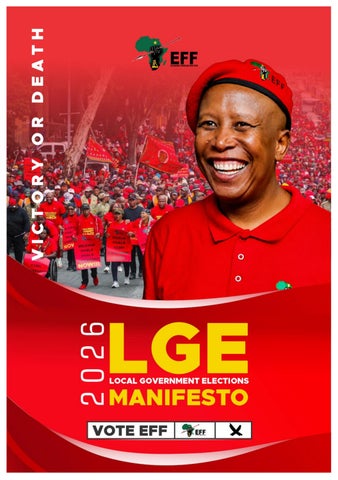
The 2026 local government elections stand as one of the most decisive moments in the history of our democracy. Our people face a growing crisis of governance, service delivery failures, unemployment, corruption, collapsing infrastructure, and municipalities that have abandoned their constitutional obligations. These elections are, therefore, a referendum on whether communities will continue to endure decay and neglect or rise to reclaim their municipalities and restore dignity to local government. For this reason, we approach these elections under the theme, Victory or Death! This statement emphasises the urgency and acknowledges that our people cannot continue to endure conditions caused by years of corruption, incompetence, patronage, economic decline, and the capture of local governments by tenderpreneurs and politically connected elites. For millions of South Africans, the failure of municipalities is not just an abstract policy issue but a daily reality that affects access to water, safety on the streets, refuse collection, road maintenance, and the dignity of communities. The Economic Freedom Fighters (“EFF”) introduces this manifesto as a strategic plan to rescue local government. It offers a practical and actionable programme focused on rebuilding municipalities that work for the people rather than for contractors and a select few. The manifesto emphasises that the future of South Africa depends on restoring the capacity, integrity, and developmental character of local government to re-industrialise South Africa. The core principle guiding these policies is that municipalities must serve communities, not private interests. Municipal resources must be directed towards delivering quality services, maintaining infrastructure, creating jobs, and fostering sustainable local economies.
2
Municipalities must become centres of planning, service delivery, and development, utilising internal capacity rather than serving as conduits for corruption and waste. Our confidence in presenting this manifesto does not stem from theory alone. It is grounded in practical experience and proven governance. Wherever the EFF has been entrusted with responsibility in local government, we have demonstrated that an alternative model of governance is achievable, one rooted in accountability, service delivery, financial discipline, and commitment to the people. With the growing shift towards coalition politics, the EFF has occupied a unique position in local government. Without necessarily controlling municipalities outright, we have exercised influence to ensure that governance serves the people. In various municipalities across South Africa, the EFF has consistently used its presence in councils to expose corruption, prevent wasteful spending, demand accountability from municipal administrators, and champion the interests of ordinary residents. The 2026 elections are an important moment that will shape the future of our local governments for years to come. They will help decide if communities will keep facing challenges under collapsing municipalities or whether a new path can be found. These elections will also determine whether public resources continue to enrich consultants and tenderpreneurs, or if they are finally redirected towards meeting the needs of the people. History has repeatedly shown us that meaningful change is only possible when ordinary people, young and old, come together and use their democratic power. This manifesto is, therefore, more than a policy document. It is a heartfelt call to action and an open invitation for communities to join in rebuilding local government. Victory or Death!
3
Introduction
4
B.
INTRODUCTION
The EFF enters the 2026 Local Government Elections as a mature and experienced revolutionary movement that has participated in local government for more than a decade. This is the third time the EFF will contest the Local Government Elections since its formation, following 2016 and 2021 Local Government Elections. Building on the strong foundation and experience of the 13 years with the EFF in National Parliament, Legislatures and Councils, this Manifesto is not simply a statement of new commitments. It builds on the foundation of the EFF’s previous local government election manifestos, the founding manifesto, and the resolutions from the 2024 National People’s Assembly (NPA). This Manifesto is an update and renewal of the EFF’s long-standing commitments. It is based on the party's political principles and the practical experience it has gained over the years. EFF members have served as councillors, members of mayoral committees in some of South Africa's largest metropolitan municipalities, chairpersons of municipal council committees, oversight representatives, and community activists across the country. The manifesto reflects the lessons the EFF has learnt, the successes achieved, and the challenges that still need to be addressed to rebuild local government. The People’s Municipalities under the EFF government will adopt a Programme of Action that truly reflects their unique local conditions and service delivery priorities. This Manifesto provides the national framework that will guide the work of People’s Municipalities and EFF councillors. It outlines our assessment of local government today and sets out our commitments to build capable, developmental, and people's municipalities.
5
The 2026 Local Government Elections Manifesto focuses on the following key areas: A. B. C. D. E. F.
The State of Local Government in South Africa Today Ten Years of the EFF in Local Government EFF Commitments for Local Government Budgeting and Financing People’s Municipalities Conclusion EFF Councillor Declaration
6
The State of Local Government in South Africa Today
7
C.
THE STATE OF LOCAL GOVERNMENT IN SOUTH AFRICA TODAY
Local government in South Africa is in a deep and worsening crisis. More than thirty years into democracy, millions of people continue to live without reliable access to safe drinkable water, sanitation, affordable electricity, consistent refuse removal, and other basic municipal services. Communities experience regular water shortages, electricity interruptions, sewage spills, collapsing roads, and deteriorating public infrastructure. The local government receives R110 billion allocated by parliament every year, but due to mismanagement of funds and corruption, municipalities have failed to deliver basic services and create sustainable jobs. Municipalities are now operating as debt collectors, demanding payments for water, electricity, waste collection, and other services from unemployed individuals, the poor, and households of teachers, nurses, police, soldiers, security guards, and municipal workers facing financial difficulties. According to the Auditor-General, municipalities under the ANC, DA, and IFP have wasted R45.6 billion during the 2024/25 financial year. These municipalities are failing to pay small businesses, municipal workers, Eskom, water boards, and other creditors within legally prescribed timeframes. Municipalities no longer hire workers directly instead they rely on labour brokers and the middleman companies linked to politicians for technical, engineering, financial, and administrative skills. As a result, potholes remain unfixed, sewer spillages go unattended, sports facilities are not maintained, houses are not being built, water infrastructure is damaged, and there are many illegal dumping sites.
8
Ten Years of The EFF in Local Government
9
D.
TEN YEARS OF THE EFF IN LOCAL GOVERNMENT
The EFF entered local government in 2016 as a newly formed political party determined to use municipal councils to improve the lives of ordinary people. From the beginning, EFF councillors distinguished themselves as fearless fighters against corruption, defenders of the poor, and champions of service delivery. The EFF has 1 075 councillors representing most of South Africa’s 257 municipalities. These councillors have exposed corruption, fought for service delivery, and pushed for permanent employment in municipalities. They have also fought for free water and electricity for the poor. The EFF Councillors have fearlessly fought against corruption and incompetence against mayors and municipal managers in many municipalities across the country. As a result, a number of mayors were successfully removed from their positions for corruption, including an ANC mayor in Ditsobotla Municipality, North West, a DA mayor in Nelson Mandela Municipality, Eastern Cape, an ANC mayor in Dr. JS Moroka Municipality, Mpumalanga, an IFP mayor in Nongoma Municipality, KwaZulu-Natal and an ANC mayor in Steve Tshwete Municipality, Mpumalanga. The tireless work of the EFF Councillors over the past 10 years has led to many service delivery achievements, including but not limited to the following: 1.
2.
The EFF in the City of Ekurhuleni, Gauteng, tabled and supported motions calling for the municipality to provide direct permanent employment to more than 150 security guards and cleaners. In the City of Ekurhuleni, Gauteng, the EFF has increased the number of indigent beneficiaries by 1 819, who now receive free basic water, electricity, and sanitation services.
10
3.
4.
5.
6.
7.
8.
9.
10.
11.
The EFF MMC for Water and Sanitation in the City of Ekurhuleni, Gauteng, commissioned the 2-megalitre Illiliba Water Tower in Tembisa and the 5.5-megalitre Northmead Water Tower; which is the second-largest water tower in the Southern Hemisphere. The EFF in the City of Ekurhuleni, Gauteng, provided electricity to 2 016 new households through the completion of substations and transformers in Clayville, Mayfield, Tokyo Phase 3, Tsakane, Kwa-Thema and Thokoza. The EFF Councillors in the City of Tshwane, Gauteng, fought for the reinstatement of 81 unlawfully dismissed municipal workers. The EFF Councillors in the City of Tshwane, Gauteng, fought for the relocation of 500 flood victims from Mamelodi to Leeuwfontein in December 2023. The EFF in the City of Tshwane, Gauteng, exposed DA corruption involving plans to sell the Pretoria West and Rooiwal Power Stations and Wonderboom Airport. The EFF MMC for Environment and Waste in the City of Tshwane, Gauteng, removed illegal dumping at Mamelodi Hostel, Soshanguve Station, and Mabopane, next to Ngaka Maseko High School. The EFF in the City of Tshwane, Gauteng, cancelled a debt of R4.3 billion for water and electricity for more than 85 000 poor households. The EFF MMC for Health in the City of Johannesburg, Gauteng, has built 24-hour clinics in the Westbury and Florida townships and renovated clinics in Zandspruit, Protea Glen, and Naledi. The EFF in the City of Johannesburg, Gauteng, converted the Poortjie Centre into a treatment centre for substance abuse victims. The EFF MMC for Public Safety in the City of Johannesburg, Gauteng, established the JMPD Tactical Reaction Unit to fight crime in the CBD.
11
12.
13.
14.
15. 16.
17.
18.
19.
20.
21.
22.
The EFF Councillors in Tswaing Municipality, Taung Municipality (Ward 4), and Madibeng Municipality (Wards 4 and 27) in the North West, donated boreholes and Jojo tanks. The EFF Councillors in Madibeng Municipality, North West operate a daily soup kitchen in Ward 27 that provides food to poor households. The EFF Councillors in Ditsobotla Municipality, North West submitted a motion of no confidence, resulting in the removal of a corrupt ANC mayor. The EFF Councillors in Taung Municipality, North West fought for the formalisation of Lykso Informal Settlement. The EFF in the Buffalo City Municipality, Eastern Cape, stopped the illegal demolition of homes by the ANC government in the eBhongweni area. The EFF Councillors in Buffalo City Municipality, Eastern Cape, fought for the people of Ward 50 and surrounding areas to get electricity. The EFF MMC for Electricity and Energy in Nelson Mandela Bay Municipality, Eastern Cape, upgraded the Motherwell Main Substation. The EFF MMC for Budget and Treasury in Nelson Mandela Municipality, Eastern Cape wrote off the R3.4 million municipal debt of Ekuphumleni Old Age Home after a visit and a commitment by the EFF President. The EFF MMC for Budget and Treasury in Nelson Mandela Municipality, Eastern Cape wrote off debt for struggling households in Central, KwaMagxaki, Kwadwesi, Motherwell, and Blue Water Bay. The EFF Councillors in Big Five Hlabisa Municipality, KwaZulu-Natal, provided the people of Ward 6 with water through a borehole. The EFF Councillors in the City of Cape Town Municipality, Western Cape, fought for the completion of the water pipeline and road infrastructure project next to the Gugulethu Housing Project.
12
23.
24.
25.
26.
27. 28. 29.
The EFF Councillors in the City of Cape Town Municipality, Western Cape, fought for the reopening of the Emthonjeni Swimming Pool in Gugulethu . The EFF Councillors in Ehlanzeni District Municipality, Mpumalanga, facilitated the change of Elijah Mango College into Ehlanzeni TVET College. The EFF Councillors in Thaba Chweu Municipality, Mpumalanga, stopped the unlawful eviction of farm dwellers in Wards 4 and 5 by the ANC. The EFF Councillors in Dihlabeng Municipality, Free State, helped the people of Ward 17 to access free municipal water and electricity for poor households. The EFF Councillors in Mafube Municipality, Free State, facilitated the municipal allocation of stands. The EFF Councillors in Dihlabeng Municipality, Free State, exposed municipal corruption. The EFF in the Emthanjeni Municipality, Northern Cape advocated for the acceleration of title deed issuance and interventions to address long-standing title deed backlogs.
The EFF, through these achievements over the past ten years, gained valuable experience in both oversight and governance. It is on this basis that the EFF presents commitments for the People’s Municipalities.
13
E.
EFF COMMITMENTS
EFF Commitments
14
Land and the Agrarian Economy
15
a) EFF Municipalities on Land and the Agrarian Economy The EFF acknowledges the ongoing historical desire for land among the people and the repeated failures of the ANC government to address it. In the immediate to short-term, the goal of all EFF municipalities is to actively acquire land for residential, religious, commercial and agricultural purposes. Additionally, all EFF municipalities will stop the sale of municipal-owned land and instead allocate this land for redistribution to black communities. The EFF municipalities will: 1.
2.
3.
4.
5.
6. 7.
Use its expropriation powers to expropriate abandoned land and buildings in order to make these available for use by young people for agriculture and other business activities. Reserve between 5% and 10% of redistributed land specifically for persons living with disabilities, prioritising accessible agricultural support and equipment. Develop a clear, localised land reform plan that incorporates an integrated sustainable rural development strategy. This plan should focus on reducing rural poverty by creatively utilising available resources in the targeted areas. Make land closer to urban centres available for human settlements, thereby addressing the most pressing need for urban land reform. Enter into Memorandums of Understanding with traditional leaders for the development of land in areas where these traditional leaders have authority, with the intention of using land in rural areas to catalyse youth-led development. Collaborate with nearby agricultural colleges to strengthen extension services for rural farmers. Establish municipal-owned market clearing houses where all emerging farmers can bring their products to a central marketplace.
16
8. 9.
10. 11.
12.
13.
14.
Build a central municipal-owned abattoir, primarily aimed at assisting emerging farmers to sell their livestock. Assist in granting water rights to emerging farmers and provide them with essential equipment to promote agricultural development in regions like Midvaal, Rand West City, Merafong in Gauteng, and Dr Pixley Ka Isaka Seme and Nkomazi in Mpumalanga. Subdivide land to permit smaller-scale intensive agriculture, supporting as many young people as possible. Tighten the enforcement of zoning by-laws to ensure that no agricultural land is converted into residential or other forms of land use. Engage with different State departments that own land in these municipalities to grant the municipality the right of first refusal when selling or transferring State land. This ensures the municipality can access land needed for land reform initiatives at the local level. Identify and collaborate with Communal Property Associations in these municipalities to offer training and post-settlement support. Identify and promote micro-irrigation projects on available land to enhance climate-resilient smallholder farming and aim to create at least 500 youth jobs per municipality within the first term.
17
Poor households and free basic services
18
b) EFF Municipalities on Poor Households and Free Basic Services EFF municipalities will: 1.
2.
3.
4.
5.
6.
7. 8.
9.
Build municipalities that guarantee universal, reliable, and affordable access to basic services as a foundation for human dignity and economic participation. Ensure that all qualifying poor households receive free basic services as a constitutional and developmental obligation. Automatically register all qualifying SASSA grant recipients and other indigent households within 90 days of taking office by using integrated municipal indigent systems, while removing administrative barriers that prevent eligible households from accessing support. Provide free basic water, electricity, sanitation, and refuse removal to all indigent households, including those in informal settlements, backyard dwellings, and rural communities. Write off all historical debt owed by indigent households, introduce debt rehabilitation programmes to prevent the accumulation of new debt, and end punitive service disconnections for qualifying households. Deploy municipal mobile units and social workers directly to the homes of bedridden, elderly, and severely disabled persons to register them on the indigent database, without requiring them to travel to municipal offices. Station trained South African Sign Language (SASL) interpreters at all municipal customer care centres. Increase the allocation of free basic water and electricity to levels that support cooking, heating, health, dignity, and small-scale economic activity. Introduce progressive tariff structures that protect poor households while ensuring the long-term sustainability of municipal finances.
19
10.
11.
Establish ward-based People’s Budget Assemblies to ensure communities directly participate in oversight of free basic services, indigent support, and tariff structures. Ensure that basic services are reliable, safe, and of high quality, and treat service delivery as a developmental priority rather than a commercial activity.
20
c)
Cost of Living Relief for Working and Middle-Income Households 21
EFF Municipalities on Cost-of-Living Relief for Working and Middle-Income Households The EFF recognises that the rising cost of living is affecting not only poor households, but also working and middle-income households. Teachers, nurses, police officers, artisans, professionals, and many other working people increasingly struggle to keep up with the rising cost of municipal services. To support these households, EFF municipalities will: 1.
2.
3.
4.
5.
Introduce targeted support measures for working and middle-income households experiencing financial difficulties. Provide temporary relief through adjusted tariffs, subsidies, affordable payment arrangements, and municipal debt relief programmes . Introduce early warning systems using billing and payment data to identify households at risk of financial difficulties and intervene before debt becomes unmanageable. Prevent the accumulation of unsustainable household debt through early intervention, financial support, and realistic repayment arrangements. Ensure that access to municipal support measures is simple, dignified, and free from unnecessary paper work.
22
Internal Capacity And Insourcing
23
d) EFF Municipalities on Internal Capacity and Insourcing EFF Municipalities will: 1.
2.
3.
4.
5.
6.
7.
8.
9.
10.
In the next 24 months, employ municipal workers directly to reduce dependence on labour brokers and tenders for key municipal functions. Build capable, professional, and ethical municipal administrations staffed by qualified engineers, planners, artisans, financial managers, administrators, and other skilled professionals. Professionalise municipal administrations through merit-based appointments grounded in qualifications, competence, experience, and ethical leadership. Establish permanent internal municipal capacity to deliver maintenance, waste management, security, infrastructure development, and other essential services. Strengthen planning and project management capacity to ensure that municipal budgets, infrastructure projects, and economic development programmes are properly coordinated and implemented. Improve financial management, revenue collection, and budgeting systems to ensure that municipal resources are used efficiently and directed towards service delivery. Recover all monies owed to municipalities by government departments, businesses, and other large debtors, while protecting poor households . Reform procurement systems to eliminate corruption, manipulation, and waste through transparent, fair, and accountable processes. Publish all tenders, awards, and contracts, enforce strict consequences for corruption, and blacklist companies and individuals found guilty of wrongdoing. Use municipal procurement to support local economic development, job creation, cooperatives, SMMEs, and
24
11.
12.
13.
14.
township enterprises . Ensure that all outsourced specialised services include skills transfer and capacity-building programmes to strengthen municipal capability. Modernise municipal administration through full digital transformation of billing, customer care, complaints management, permits, licences, service connections, and internal workflow systems. Root governance in community-based structures through regular ward accountability meetings, service delivery feedback mechanisms, participatory planning forums, and accessible one-stop municipal service centres. Introduce clear performance targets, monitoring systems, and accountability measures for municipal officials, senior management, and municipal leadership.
25
Jobs and SMMEs
26
e) EFF Municipalities on Jobs and SMMEs The EFF recognises that municipalities possess significant potential to absorb labour, create employment, and promote local economic development while building internal capacity to deliver services efficiently. EFF municipalities will use this potential to create jobs, reduce unemployment, strengthen municipal capacity, and promote inclusive local economic growth. EFF municipalities will: 1. 2.
3.
4.
5. 6.
7.
8.
Insource security, cleaning, waste collection, maintenance, and other core municipal services to create permanent jobs Establish municipal artisan units for plumbing, electrical work, road maintenance, construction, and infrastructure repairs, with a focus on employing women, youth, and local residents. Implement municipal apprenticeship, internship, and skills development programmes linked to service delivery, infrastructure, and maintenance projects to create new jobs. Build strong local economies by supporting SMMEs, cooperatives, township enterprises, and informal traders through procurement opportunities, business support, and access to markets in areas such as uMzumbe Ward 19 in KwaZulu-Natal, Musina, Lepelle-Nkumpi, Phalaborwa, and Ephraim Mogale in Limpopo. Upgrade and expand the Tshakhuma Market into a modern trading and agro-processing centre. Allocate a minimum of 80% of municipal procurement to local SMMEs, cooperatives, and township enterprises involved in manufacturing related economic activities. Formalise and support informal trading through the provision of trading spaces, storage facilities, water, sanitation, electricity, and supportive by-laws. Establish municipal support centres to provide business registration, compliance support, mentorship, financing support, and market access for emerging enterprises.
27
9.
10.
11.
12.
Establish municipal markets, storage facilities, cold-chain infrastructure, and logistics hubs to connect small producers, traders, cooperatives, and informal enterprises to sustainable markets. Develop township and rural industrial hubs to support manufacturing, agro-processing, services, and local production. Integrate waste pickers and other community-based enterprises into formal municipal systems through fair compensation, support programmes, and sustainable economic opportunities. Establish youth innovation and entrepreneurship hubs that provide digital skills, business support, equipment, and opportunities for youth-owned enterprises.
28
Sports, Arts And Culture
29
f) EFF Municipalities on Sports, Arts and Culture EFF municipalities will: 1.
2.
3.
4.
5.
6.
7.
8.
9.
Remove apartheid-era statues, rename streets, towns, and public landmarks that celebrate colonialism and apartheid, and replace them with names and symbols that reflect the history, heroes, and aspirations of the people of South Africa. Preserve and promote African history, culture, and heritage through museums, memorials, public art, and the commissioning of monuments honouring African and anti-colonial leaders. Build, maintain, and upgrade sports facilities, libraries, parks, recreational centres, stadiums, and other community facilities, with a particular focus on townships, informal settlements, and rural communities. Ensure that all municipal stadiums, community halls, public pools, and arts centres are fitted with functional ramps, wheelchair-accessible seating, and adaptive changing rooms. Partner with local disability organisations to ensure that the sporting, artistic, and cultural interests of disabled residents in each ward are identified and prioritised Ensure that every ward has access to safe recreational facilities, outdoor gyms, sporting infrastructure, and community spaces for social, cultural, and recreational activities. Work with schools, sporting bodies, and community organisations to expand participation in sport, recreation, arts, and culture, particularly amongst young people, women, and persons with disabilities. Host regular sporting, cultural, and heritage events to promote social cohesion, local talent, and community participation. Establish municipal arts, culture, and heritage funds to support artists, musicians, filmmakers, writers,
30
10.
11.
12.
13.
14.
15.
16.
performers, and other creative workers. Support local artists and creative enterprises through access to facilities, equipment, training opportunities, public exhibitions, municipal events, festivals, and procurement opportunities. Support community radio stations, local newspapers, and community media platforms as instruments of local development, information sharing, and cultural expression. Establish arts and culture centres, multipurpose community facilities, and creative hubs to support cultural production, training, and enterprise development. Promote the growth of the cultural and creative industries as contributors to employment, economic development, social wellbeing, and crime prevention. Support local manufacturing and black-owned enterprises in the procurement of sporting, cultural, and recreational equipment. Ensure that sports, arts, culture, and heritage programmes are fully inclusive and accessible to women, young people, and persons with disabilities. Use sports, arts, culture, and heritage as instruments to build healthy, united, and vibrant communities while advancing economic freedom and social development.
31
Gender Equality, Safety and Social Development 32
g) EFF Municipalities on Gender Equality, Safety and Social Development EFF municipalities will: 1.
2.
3.
4.
5.
6.
7.
8.
9.
Enforce a minimum 50% representation of women in municipal leadership, management, employment, procurement opportunities, and economic development programmes. Establish Gender Equality Units and monitoring mechanisms to ensure compliance with gender equality targets and coordinate programmes aimed at the empowerment of women and girls. Introduce gender-responsive budgeting to ensure that municipal resources directly contribute to the advancement of women. Implement programmes that combat patriarchy, gender discrimination, and violence against women through education, awareness, community mobilisation, and active involvement of men in the fight against gender-based violence and femicide. Work with traditional leaders, faith-based organisations, community organisations, civil society, and law enforcement agencies to promote gender equality and eliminate harmful practices that undermine the rights of women and girls. Prioritise women, particularly female-headed households, in municipal economic empowerment, indigent support, housing, and social development programmes. Create employment, skills development, entrepreneurship, and procurement opportunities targeted at women across all sectors of the local economy. Establish safe and accessible reporting mechanisms for gender-based violence, sexual harassment, exploitation, and abuse, supported by properly trained municipal law enforcement and community safety structures. Support survivors of gender-based violence through shelters, places of safety, counselling services, and ward-
33
based support programmes. 10. Work with the South African Police Service and community safety structures to combat extortion, violence, and criminal networks targeting informal traders, township businesses, construction sites, transport routes, and vulnerable communities. 11. Fit all municipal police stations and emergency shelter facilities with wheelchair-accessible entrances, ramps, and private counselling rooms. 12. Prohibit individuals and businesses linked to gender-based violence, rape, child abuse, exploitation, extortion, or organised criminal activity from benefiting from municipal procurement opportunities. 13. Strengthen maternal, reproductive, and primary healthcare services through better-resourced municipal clinics, additional healthcare workers, and community-based support programmes. 14. Ensure that municipal infrastructure, including water, sanitation, public lighting, roads, and public spaces, is designed and maintained in a manner that improves the safety, dignity, and mobility of women. 15. Protect the rights and dignity of vulnerable groups, including children, senior citizens, LGBTQIA+ persons, and sex workers, through inclusive municipal services and programmes. 16. Support women-led cooperatives, agricultural projects, township enterprises, and other community-based economic initiatives through targeted municipal assistance. 17. Establish programmes and campaigns to combat drugs, teenage pregnancy, gender-based violence, and social decay, while promoting family support, social cohesion, and moral regeneration. 18. Introduce unisex and gender-neutral toilets in all municipal offices, libraries, transport hubs, and community halls. 19. Implement education and awareness campaigns in schools and communities on rape prevention, gender-based violence, and reporting mechanisms available to survivors.
34
Health
35
h) EFF Municipalities on Health EFF municipalities will: 1.
Expand access to comprehensive primary healthcare services, including sexual and reproductive healthcare, maternal healthcare, HIV care, mental health services, and psychosocial support. 2. Deploy mobile health units and community health workers to provide healthcare services, screenings, referrals, and follow-up care in rural, peri-urban, and under-serviced communities. 3. Station trained South African Sign Language (SASL) interpreters at all major healthcare facilities. 4. Train clinic receptionists, administrative staff, nurses, and community health workers on disability rights, respectful communication, and safe physical transfer techniques. 5. Eliminate long queues for vulnerable patients by implementing mandatory priority lines at clinics and providing specialised supportive seating. 6. Extend clinic operating hours and progressively develop 12-hour and 24-hour clinics in municipalities where demand and resources permit. 7. Renovate Tshisaulu Clinic, Makwarela Clinic and Tshidimbini Clinic and build new health facilities to expand access to healthcare and reduce overcrowding. 8. Introduce digital patient management and appointment systems to reduce waiting times, improve efficiency, and protect patient privacy. 9. Strengthen patient care by enforcing professional standards, medical ethics, and patient rights through continuous training and accountability measures. 10. Recruit, train, and retain healthcare workers, including community health workers, nurses, and other frontline personnel, to improve access to quality healthcare. 11. Ensure that all municipal health facilities have reliable access to electricity, water, backup power, and essential
36
12.
13.
14.
15. 16.
17.
18.
19.
20.
21.
22.
services to prevent disruptions to healthcare delivery. Upgrade roads, transport routes, and supporting infrastructure leading to clinics and healthcare facilities to improve access for patients, ambulances, and emergency services. Establish ward-based victim support units and centres for survivors of gender-based violence, with access to medical, legal, forensic, psychological, and social support services. Improve maternal, child, and reproductive healthcare through specialised training, improved facilities, postnatal care, and support programmes for mothers, children, and healthcare workers. Ensure the continuous supply of free sanitary towels in local clinics and public health facilities. Provide specialised services, including speech therapy and developmental support for children with special needs. Provide targeted support for vulnerable groups, including persons with disabilities, LGBTQIA+ persons, migrants, people living in poverty, and survivors of gender-based violence. Enforce ambulance response time targets of a maximum of 20 minutes in urban areas and 30 minutes in rural areas. Integrate certified traditional health practitioners into local healthcare systems and provide dignified infrastructure for access to traditional and indigenous medicine alongside conventional care. Establish community-run vegetable gardens linked to clinics to support nutrition programmes and food security for vulnerable families. Absorb community health workers as municipal employees to conduct household health, nutrition, and child development outreach programmes. Build municipal rehabilitation centres and implement community-based programmes to combat drug and
37
substance abuse, particularly amongst young people, in identified hotspots across rural communities, townships, and metros. 23. Work with schools, healthcare institutions, civil society, and community organisations to run awareness and educational programmes on the harmful effects of drugs, alcohol, and smoking, while promoting healthy lifestyles.
38
Energy and Electricity
39
i)
EFF Municipalities on Energy and Electricity EFF municipalities will: 1. 2.
3. 4.
5.
6.
7.
8.
9.
10.
Treat electricity as a developmental public good and not as a profit-making function. Stop extra charges on prepaid meters, install prepaid meters for free, and remove unnecessary profit markups by third-party electricity vendors. Restore full municipal control over electricity billing, distribution, and revenue management. Strengthen revenue collection through improved billing systems, smart metering, and fair enforcement against non-payment by high-consumption users. Roll out modern, tamper-proof metering systems and regularise electricity connections in informal settlements to improve safety and revenue collection. Expand access to renewable energy equipment, including solar panels, solar geysers, and battery storage systems, to household that are still waiting for electricity. Employ directly teams of engineers, electricians, technicians, and artisans to maintain municipal electricity infrastructure. Upgrade, expand, and maintain substations, transformers, and electricity distribution networks to improve reliability and reduce outages in under-serviced communities across South Africa. Prioritise electrification of informal settlements, rural communities, and other under-serviced areas, while expanding public lighting and high-mast lighting to improve community safety. Establish specialised and dedicated rapid-response technical teams tasked with addressing electricity faults, outages, transformer failures, and infrastructure breakdowns, with emergency response times of no more than one hour.
40
11.
12.
13.
14.
15.
Digitise all municipal electricity infrastructure, including substations, transformers, feeder lines, meter points, and service connections, through integrated smart monitoring systems to detect faults, monitor vandalism, identify tampering, and improve infrastructure maintenance and planning. Provide targeted support, debt rehabilitation programmes, and affordable payment arrangements for households experiencing financial difficulties . Prevent unnecessary electricity disconnections for households participating in approved debt relief and rehabilitation programmes. Develop municipal electricity generation capacity, including community-based renewable energy projects, in partnership with Eskom and other public institutions. Leverage municipal energy generation to reduce electricity costs, strengthen energy security, and support local economic development and industrialisation.
41
Economy And Re-Industrialisation
42
j)
EFF Municipalities Industrialisation
on
the
Economy
and
Re-
EFF municipalities will: 1.
2.
3.
4.
5.
6.
7.
8.
9.
Drive localised industrialisation to transform municipalities from centres of consumption into centres of production, employment and economic activity. Demand that financial institutions supply prescribed assets and ensure at least 80% of municipal procurement materials are locally sourced. Advocate for prescribed assets and developmental financing mechanisms to direct investment into municipal infrastructure, industrialisation and productive local economies. Restructure Municipal Development Agencies to ensure they support industrialisation, local economic development and job creation. Establish township and rural industrial parks focused on manufacturing, agro-processing, construction materials, repair services and other productive sectors. Ensure that all municipal Special Economic Zones (SEZs) and industrial parks are connected to accessible public transport networks. Develop municipal-owned production facilities, shared workspaces and industrial infrastructure to support SMMEs, cooperatives and emerging enterprises. Support agro-processing and local value chains that connect farmers, producers, processors and markets in the citrus industry of Greater Giyani, Greater Tzaneen and Elias Motsoaledi. Expand opportunities for black people, women and youth to participate in production, ownership and economic activity.
43
Human Settlement
44
k) EFF Municipalities on Human Settlements EFF municipalities will: 1.
Implement time-bound plans that aim to clear housing backlogs, with clear annual targets, transparent housing waiting lists, and easily trackable delivery plans in partnership with both provincial and national government. 2. Develop and allocate serviced sites to qualifying households as a quick response to the housing crisis, while ongoing efforts for long-term housing solutions are in progress. 3. Implement a specialised housing disability registry to capture and track the needs of applicants living with disabilities, ensuring appropriate housing matching. 4. Rezone, formalise, and upgrade informal settlements while ensuring access to basic services, roads, stormwater infrastructure, and secure tenure. 5. Prioritise serviced sites and integrated human settlements in areas where immediate housing construction is delayed. 6. Establish and strengthen public social housing institutions to develop, own, and manage affordable rental housing for working-class households, middleincome earners, and students. 7. Regulate and support affordable housing programmes for households that do not qualify for free housing but cannot access private housing finance. 8. Conduct comprehensive land and housing audits to identify unused land, abandoned projects, hijacked buildings, and development opportunities. 9. Complete all stalled and abandoned housing projects through direct state intervention, stronger project management, and strict accountability measures. 10. Establish transparent and centralised housing allocation systems, accelerate the issuing of title deeds, and
45
11.
12. 13.
14.
15.
eliminate corruption in housing delivery. Prevent unlawful evictions and ensure that alternative accommodation is provided where relocation is necessary. Convert unused and hijacked buildings into safe, regulated, and affordable housing where appropriate. Prioritise mixed-income housing developments in welllocated urban areas to reverse apartheid spatial patterns and reduce inequality. Build internal municipal construction capacity, reduce dependence on contractors, and enforce strict consequences for poor workmanship, corruption, and project abandonment. Allocate houses to all persons living with disabilities in the first 12 months .
46
Fisheries
47
l)
EFF Municipalities on Fisheries EFF municipalities will: 1.
2. 3.
4.
5.
6.
7.
Develop marine economy development frameworks for coastal regions, aimed at utilising marine resources to maximise economic benefit for local communities in areas such as Knysna and Mossel Bay in the Western Cape, iNgquza Hill in the Eastern Cape, and Port Nolloth in the Northern Cape. Construct accessible fish markets with local fish-trading stalls designed for use by persons living with disabilities. Launch at least one community-owned aquaculture project within two years to create sustainable employment opportunities, particularly for young people. Establish dedicated Municipal Fisheries Development Funds to assist indigenous and traditional fishers with boats, fishing equipment, cold storage, processing facilities, and packaging infrastructure. Work with the national government to ensure that local fishers in areas such as iNgquza Hill, including Msikaba, Mbotyi, Grosvenor, Mkambathi and Ndlambe in the Eastern Cape; Knysna in the Western Cape; and Port Nolloth in the Northern Cape, are meaningfully integrated into the fishing economy. Develop inland aquaculture and freshwater fishing industries in strategic inland water systems, including Gariep Dam, Vaal Dam, and Bloemhof Dam in the Free State; and Nandoni Dam, Flag Boshielo Dam, and Tzaneen Dam in Limpopo, to expand food production, create jobs, and support local economic development. Assist small-scale fisheries and aquaculture enterprises in registering, complying with regulatory requirements, and accessing markets, financing, and technical support.
48
Water, Environment and Climate Change 49
m) EFF Municipalities on Water, Environment and Climate Change EFF municipalities will: 1.
Integrate climate change adaptation and environmental sustainability into all municipal planning and development projects. 2. Ensure that municipal policies and decisions strengthen climate resilience and reduce vulnerability to environmental, economic, and climate-related risks. 3. Provide rebates and incentives on rates to households and businesses that invest in renewable energy and environmentally sustainable technologies. 4. Establish municipal nurseries to cultivate indigenous plant species and strengthen biodiversity protection. 5. Establish dedicated ecological infrastructure teams to protect wetlands, rivers, green belts, and environmentally sensitive areas, including areas vulnerable to soil erosion. 6. Build and maintain parks, green spaces, and environmental education centres to promote environmental awareness and community wellbeing. 7. Fix water leaks within a day of being reported and establish dedicated municipal plumbing teams in highleakage areas. 8. Write off water debt accumulated due to incorrect billing and provide targeted debt relief for vulnerable households, including pensioners and persons with disabilities. 9. Ensure that every household has access to clean, safe, and reliable running water. 10. Construct public toilets and sanitation units with wide entryways, smooth access ramps, and sufficient turning space for wheelchair users. 11. Strengthen municipal control over water distribution infrastructure and improve water governance,
50
maintenance, and service delivery. 12. Insource water tanker services and limit their use to emergency interventions only. 13. Ensure that during water shedding or droughts, emergency water tankers deliver directly to the doorsteps of disabled persons, bypassing public distribution queues.
51
Sanitation
52
n) EFF Municipalities Management
on
Sanitation
and
Wastewater
EFF municipalities will: 1.
Eradicate all bucket toilets and unsafe pit toilets and ensure universal access to dignified sanitation services. 2. Connect households to functional sewer systems and provide alternative sanitation technologies where standard sewer connections are not immediately possible. 3. Ensure that all schools, clinics, and public facilities have safe, hygienic, and reliable sanitation services. 4. Provide secure, well-lit, and properly maintained communal sanitation facilities in informal settlements as an interim measure while permanent services are developed. 5. Establish rapid-response maintenance teams to address sewer blockages, leaks, spillages, and sanitation failures. 6. Upgrade, rehabilitate, and expand wastewater treatment infrastructure to prevent sewage pollution and protect public health. 7. Build and maintain clean, safe, and accessible public toilet facilities in transport hubs, markets, parks, recreational facilities, and other public spaces. 8. Strengthen compliance with national water quality and wastewater management standards. 9. Invest in research, innovation, skills development, and modern technologies to improve sanitation and wastewater systems. 10. Build clean, healthy, and dignified municipalities where sanitation services protect public health, the environment, and community wellbeing.
53
Waste Collection, Waste Management and Environmental Cleanliness 54
o) EFF Municipalities on Waste Collection, Management and Environmental Cleanliness
Waste
EFF municipalities will: 1.
Ensure reliable waste collection services in all communities and provide adequate waste disposal infrastructure in public spaces, townships, informal settlements, and high-density areas. 2. Eliminate illegal dumping through stricter enforcement, regular clean-up programmes, and improved waste management infrastructure. 3. Adopt and implement the Andries Tatane Campaign as a dedicated programme to identify, clean, and rehabilitate illegal dumping sites while promoting community participation. 4. Assess, rehabilitate, and expand landfill and waste transfer facilities to ensure compliance with environmental and safety standards. 5. Insource waste collection and waste management functions to strengthen municipal capacity and reduce dependence on contractors. 6. Incorporate waste pickers, cooperatives, and recycling businesses into official municipal waste management systems by providing fair pay and sustainable economic prospects. 7. Invest in recycling, waste beneficiation, and circular economy programmes to reduce landfill dependence and create sustainable employment. 8. Invest in research, innovation, skills development, and modern technologies to improve waste collection and waste management systems. 9. Use waste management and environmental programmes to create sustainable employment opportunities for local communities. 10. Build clean, healthy, and dignified municipalities where waste management systems protect public health, the environment, and the well-being of all residents.
55
Crime, Corruption and Municipal Public Safety
56
p) EFF Municipalities on Crime, Corruption and Municipal Public Safety EFF municipalities will: 1.
2.
3.
4.
5.
6.
7.
Upgrade all local police stations, municipal security hubs, and municipal courts with smooth entrance ramps, automated doors, low-height reception counters, and accessible holding facilities. Strengthen municipal law enforcement capabilities by improving staffing, training, and resources. Also, assist municipalities in adopting suitable enforcement models, such as dedicated departments, shared services, or fortified by-law enforcement units, where needed. Work with the South African Police Service and other stakeholders to develop integrated crime prevention strategies based on identified crime hotspots. Implement a targeted Gender-Based Violence and Femicide Response Programme in Thohoyandou Police Station which recorded the highest number of rape cases. Implement a Safer Municipality Programme focused on crime prevention, by-law enforcement and safer public spaces. Strengthen and expand local crime prevention forums. They will improve cooperation between municipalities, communities, community policing structures, and law enforcement agencies to make neighbourhoods safer. This work will be prioritised in areas such as Umzumbe (Ward 19), Umlazi (Wards 76 and 78), Maphumulo (Ward 4), uMshwathi, Mandeni, eThekwini Outer West (Wards 2, 4, 5, 8 and 91), eThekwini Far North (Wards 59, 102 and 112), and eThekwini Central in KwaZulu-Natal; Breede Valley, Mitchells Plain, Philippi in the City of Cape Town, Western Cape; and the City of Johannesburg in Gauteng. Support community-led crime prevention initiatives through access to municipal facilities, partnerships and 57
other appropriate forms of assistance. 8. Establish municipal courts to improve the enforcement of municipal by-laws and reduce delays in the administration of justice. 9. Deploy modern crime-fighting technologies, including CCTV cameras, drones, gunshot detection systems and real-time monitoring centres to improve public safety in all municipalities. 10. Establish dedicated rural safety programmes to combat stock theft, infrastructure vandalism and other crimes affecting rural communities, in areas such as Matatiele, Ntabankulu, Mbhashe and Winnie Madikizela-Mandela Municipality in the Eastern Cape, Umzimkhulu, Jozini and uMhlabuyalingana in KwaZulu-Natal, Ngwathe, Mafube and Kopanong in the Free State, Ramotshere Moiloa and Ditsobotla in the North West, Musina and Makhuduthamaga in Limpopo, and Joe Morolong and Ga-Segonyana in the Northern Cape. 11. Conduct lifestyle audits of municipal officials and enforce strict consequences against corruption and wrongdoing within municipal administrations. 12. Build safe, secure and well-managed municipalities that protect residents, businesses and public infrastructure.
58
Youth Development and Empowerment
59
q) EFF Municipalities Empowerment
on
Youth
Development
and
EFF municipalities will: 1.
2.
3.
4.
5.
6.
7.
8.
9.
Maintain verified records of unemployed youth to guarantee fair and transparent access to municipal jobs, training opportunities, bursaries, and business support programmes. Ensure that at least 40% of municipal employment opportunities are allocated to young people between the ages of 18 and 35, particularly in infrastructure, technical services, waste management, energy, water, and community services. Allocate at least 50% of municipal procurement opportunities to youth-owned businesses and cooperatives through targeted support, unbundling of contracts, and prompt payment systems. Train and professionalise young people as artisans, technicians, and other skilled workers through municipal apprenticeship, internship, and skills development programmes. Provide free driver’s licence training and one driver’s licence test opportunity for unemployed young people and matriculants. Establish Youth Opportunity Centres and ward-based support services to provide career guidance, business support, employment assistance, digital access, and support for job applications, training, and entrepreneurship. Restructure municipal youth employment schemes, such as the Expanded Public Works Programme (EPWP), to include roles suited to youth with physical disabilities. Deploy trained South African Sign Language (SASL) interpreters at all municipal-hosted career expos, youth workshops, and entrepreneurial workshops. Strengthen youth substance abuse prevention
60
10.
11.
12.
13.
programmes and support community-based rehabilitation initiatives through municipal facilities and support for community organisations. Provide young entrepreneurs, informal traders, and cooperatives with access to trading spaces, municipal facilities, infrastructure, and business support services. Prioritise municipal bursaries for scarce and technical skills and ensure that graduates contribute to building municipal capacity. Use municipal incentives, approvals, and economic development programmes to encourage greater youth employment in local economies. Publish regular reports on youth employment, procurement, training, bursaries, and enterprise development to ensure transparency and accountability.
61
Transport
62
r) EFF Municipalities on Transport EFF municipalities will: 1.
Maintain all municipal roads in a safe and usable condition and progressively surface gravel roads to ensure reliable access in all weather conditions, in areas such as Mogale City, Rand West in Gauteng, and KhaiMa in the Northern Cape. 2. Secure the urgent regravelling of the R524 from Louis Trichardt/Makhado through Thohoyandou to the Punda Maria Gate of the Kruger National Park. 3. Prioritise the maintenance and upgrading of roads leading to schools, clinics, cemeteries, economic centres and other public facilities. 4. Ensure that taxi ranks, bus and train stations, and other public transport facilities are clean, safe, with proper lighting access to water, sanitation, and waste removal services. 5. Fit all municipal public transport fleets with voice announcements and visible digital displays to clearly announce upcoming stops and routes. 6. Formalise partnerships with taxi associations to comanage taxi ranks, public facilities and commuter infrastructure in a manner that supports safe and efficient public transport. 7. Organise taxi ranks and transport facilities as structured trading areas that support informal traders and local economic activity. 8. Introduce transparent and efficient systems for issuing taxi permits and other municipal transport-related approvals. 9. Install modern safety infrastructure, including lighting, surveillance systems, and security measures, at taxi ranks, bus and train stations 10. Expand reliable and affordable public transport services, including municipal and contracted bus services,
63
11.
12.
13.
14.
15.
16. 17.
18.
particularly in under-serviced townships and rural communities. Ensure that there will be no unnecessary and unlawful impoundment of taxis by municipal law enforcement officers Provide cleaning and maintenance subsidies to taxi associations, cooperatives, and community enterprises responsible for managing taxi ranks, public toilets, and commuter facilities. Provide safe and reliable subsidized transport support for pensioners, people living with disabilities and unemployed persons. Provide safe and reliable transport for the elderly SASSA beneficiaries on days when they collect their pensions and social grants. Conduct regular audits of municipal transport infrastructure and related contracts to ensure that public resources support service delivery, economic development, and the needs of communities. Revive and maintain municipal airports and develop small-scale aviation infrastructure where possible. Hold mayors, MMCs, and municipal officials accountable for the condition of roads, transport infrastructure, and public transport facilities. Enforce municipal by-laws to ensure all transport operators act legally and responsibly, safeguarding commuters, businesses, and communities.
64
Municipal Infrastructure
65
s) EFF Municipalities on Municipal Infrastructure EFF municipalities will: 1.
2.
3.
4.
5.
6.
7.
8.
9.
Rebuild internal municipal capacity by employing engineers, town planners, architects, artisans, plumbers, technicians and other skilled professionals required to plan, build and maintain infrastructure. Terminate outsourcing of essential infrastructure services and create permanent municipal teams in charge of roads, water, sanitation, stormwater, and public facilities. Launch a mass infrastructure rebuilding programme to address backlogs in roads, water, sanitation, stormwater systems, and public facilities. Use infrastructure development and maintenance as a major driver of employment, with a focus on local labour, women, persons living with disabilities and young people. Maintain and upgrade municipal roads, bridges, traffic lights, street lighting, road signage, and stormwater systems to ensure safe and reliable movement of people and goods. Repair, expand and maintain water infrastructure, including pipes, reservoirs, and treatment plants, to ensure reliable water supply and eliminate water losses caused by leaks and poor maintenance. Upgrade and maintain sanitation infrastructure, including sewer systems and wastewater treatment plants, to eliminate sewer spillages and ensure dignified sanitation services for all communities. Prioritise infrastructure development in informal settlements, townships, rural communities, and other historically under-serviced areas. Maintain and enhance infrastructure across residential, commercial, and industrial zones to support households, businesses, professionals, and boost local economic growth. 66
10. Ensure that municipal infrastructure supports industrialisation, investment, economic growth, and the expansion of local enterprises. 14. Ensure that infrastructure investment is aligned with spatial planning, integrated human settlements, and long-term municipal development objectives.
67
Budgeting and Financing EFF People’s Municipalities 68
F.
BUDGETING AND MUNICIPALITIES
FINANCING
EFF
PEOPLE’S
Local government faces a crisis due to mismanagement and financial waste in municipalities led by the ANC, DA, and IFP, undermining proper service delivery. There is a need for a new approach to budgeting and financing, strengthening administrative capacity, and ensuring leaders prioritise communities. Municipalities currently receive about 9% of the funds allocated by parliament to the national, provincial and local governments. The EFF will continue to advocate in Parliament for the increase of this allocation to at least 15%, which would free up more resources for essential services like roads, water, electricity, and housing. EFF People’s Municipalities will establish Infrastructure Grant Technical Oversight Units. These units will have dedicated engineers, architects, town planners, artisans, and financial analysts working full-time to ensure that infrastructure grant funds, often lost due to poor coordination and corruption, are used correctly. EFF People’s Municipalities will also partner with businesses to help build roads, water systems, electricity, housing and digital infrastructure, while keeping these assets in the hands and ownership of the people. EFF People’s Municipalities will establish agreements with local businesses to support infrastructure maintenance, including repairing pavements and potholes, placing refuse bins on their premises, and cleaning public spaces. They will also allocate funds to taxi associations for cleaning and maintaining taxi ranks, transport corridors, and public toilets. Additionally, EFF People’s Municipalities will collect monies owed to them by large businesses and government departments.
69
Billions of Rands are lost annually through water and electricity wastage caused by poorly maintained infrastructure. The EFF People’s Municipalities plan to repair infrastructure and install smart meters to safeguard municipal revenue. According to the Auditor-General of South Africa, municipalities spent more than R1.6 billion on consultants during the 2024/25 financial year. The EFF People's Municipalities will prioritise building internal capacity by employing suitably qualified professionals instead of relying on consultants, ensuring that public funds are used more efficiently. Many business people struggle to build factories because they don’t have access to land. The EFF People’s Municipalities will provide free land to business owners for building factories and creating jobs, aiming to boost municipal revenue.
70
Conclusion
71
G.
CONCLUSION
Today, South Africa is confronted with a choice that can no longer be postponed. It is a choice between Victory or Death. The collapse of our municipalities and the failure of local government in South Africa is not just about broken pipes, potholes, refuse collection, water, and electricity supply. It is about the daily lives and lived experiences of our people. It is about a mother in Giyani who cannot wash and cook for her children because there is no water. It is about young people in Soweto and Mamelodi who cannot get jobs in the municipality because they are not politically connected. It is about a young girl in Mthatha who is forced to sleep with a local councillor or Mayor to get employment. It is about young people in Khayelitsha and Mitchells Plain who have surrendered to drugs and alcohol due to unemployment. It is about workers and pensioners in Rustenburg who pay for services they never receive. It is about children in Mangaung who walk past overflowing sewage and potholed roads to get to school. Our people have heard enough promises in Umlazi and KwaMashu. Our people have listened to enough speeches in Nkomazi and Mbombela. Our people have read enough manifestos. What South Africa demands now is real commitment. The commitments contained in this manifesto are not just empty promises. The EFF knows that our people are tired of promises. These are commitments, which the EFF will pursue with discipline, integrity, and determination. This manifesto is a declaration that local government can work. This manifesto is a declaration that municipalities can become centres of excellence and service delivery for our people, free of corruption. Every commitment contained in this manifesto is practical, and measurable.
72
These are commitments to ensure that no child grows up in Emfuleni thinking that sewage in the streets is normal, no family in Lusikisiki accepts darkness as a permanent condition, and no communities of Polokwane and Phokwane are forced to survive without basic services and dignity. The reality is that there can be no real freedom without functioning municipalities. There can be no dignity where water does not flow, where electricity is unreliable, where roads are unsafe, and where clinics cannot serve the sick. Every commitment contained in this manifesto carries weight. It is a commitment to restore accountability where it has been eroded, and to ensure that the presence of local government is felt not in speeches or slogans, but in the daily lived experiences of ordinary people. The task ahead will not be easy. It will face resistance from those who benefit from the collapse of our municipalities. It will face resistance from those who benefit from the pain and suffering of our people. It will face resistance from those who benefit from the status quo. People of Ekurhuleni, Johannesburg, Tshwane, Mangaung, Nelson Mandela Bay. Workers of Cape Town, eThekwini, Buffalo City. People of South Africa. We are tabling the 2026 Local Government Election Manifesto as a five-year commitment to building People’s Municipalities that will deliver Economic Freedom. Victory or Death, vote EFF!
73
Annexure A: Declaration
74
H.
ANNEXURE A: EFF COUNCILLOR DECLARATION
I, ________________________________________, hereby voluntarily accept deployment by the Economic Freedom Fighters as a Councillor in local government. • • • • • • • • • • • •
I solemnly undertake to serve the people of South Africa with discipline, honesty, integrity, and revolutionary commitment. I understand that deployment is not a right or employment, but a responsibility and organisational mandate. I solemnly swear to be a loyal Councillor to my community and the people of South Africa. I avail myself to serve my community 24-hours a day. I will reside in my ward for the duration of my term and not relocate. I will not be involved in corruption and stealing. I will not be involved in the corruption of the housing lists. I will not be involved in the corruption of employment processes. I will not do business with the municipality and will not participate in tenders. I will not commit Gender-Based Violence and similar conduct which violates the dignity and basic human rights of women and children. I will not engage in intoxicating substances or be seen intoxicated in public I will pay my party levies in full and on time, every month, and will not default on this obligation.
I accept that should I violate these commitments, the EFF Constitution, the Founding Manifesto, the Code of Conduct or organisational directives, the Economic Freedom Fighters must recall and remove me from deployment as a Councillor.
75
SIGNED at ________________on this __day of __________2026. COUNCILLOR Signature
: ____________________________
FOR THE ECONOMIC FREEDOM FIGHTERS Authorised Signatory
: ____________________________
Signature
: ____________________________
WITNESS 1 Name
: ____________________________
Signature
: ____________________________
WITNESS 2 Name
: ____________________________
Signature
: ____________________________
76
77