Environmental Stewardship
As the developer of Summerlin®, a master planned community spanning 22,500 acres in Southern Nevada, Howard Hughes Communities has long recognized and honored its obligation as a steward of the land. Even before the first family moved into the community more than 35 years ago, Howard Hughes demonstrated environmental responsibility in significant ways that charted the course for future and current development. Today, Summerlin continues its leadership role as the Las Vegas valley’s premier community committed to smart, sustainable and environmentally responsible growth and development.
Red Rock Canyon
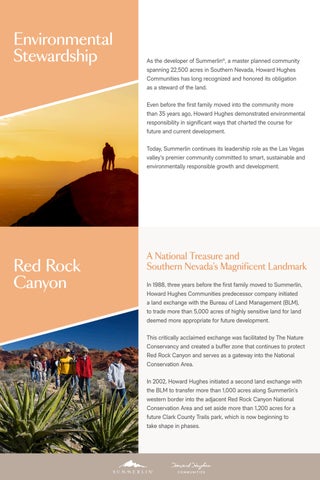
A National Treasure and Southern Nevada’s Magnificent Landmark In 1988, three years before the first family moved to Summerlin, Howard Hughes Communities predecessor company initiated a land exchange with the Bureau of Land Management (BLM), to trade more than 5,000 acres of highly sensitive land for land deemed more appropriate for future development. This critically acclaimed exchange was facilitated by The Nature Conservancy and created a buffer zone that continues to protect Red Rock Canyon and serves as a gateway into the National Conservation Area. In 2002, Howard Hughes initiated a second land exchange with the BLM to transfer more than 1,000 acres along Summerlin’s western border into the adjacent Red Rock Canyon National Conservation Area and set aside more than 1,200 acres for a future Clark County Trails park, which is now beginning to take shape in phases.
A Model of Conservation
Summerlin was one of the Las Vegas valley’s earliest adopters of desert landscaping, helping to improve public perception of low water-use landscapes as beautiful, lush and desirable. In 2003, the community, in partnership with Southern Nevada Water Authority, became the region’s first community to implement strict Water Smart conservation guidelines on a community-wide basis. Today, Summerlin continues to remove older existing grass landscapes that are deemed non-functional, replacing them with desert-friendly plant materials that save millions of gallons of water each year.
Water Conservation
As part of a community-wide water conservation initiative, Summerlin has implemented advanced irrigation systems and drought-resistant landscaping, removed non-functional turf and replaced it with desertfriendly landscaping, and partnered with the Las Vegas Valley Water District on wetland restoration efforts. By the end of 2024, Summerlin had removed 21 acres (or more than 920,00 square feet) of decorative grass, saving around 50 million gallons of water annually. Of note is the fact that Summerlin earned the Southern Nevada Water Authority’s first WaterSmart designation for a community. Howard Hughes Communities’ commitment to sustainability in Summerlin extends well beyond residential areas to commercial and mixed-use developments, and the removal program extends to all facets of Summerlin.
Preserving Land, Wildlife and History
Natural landscapes and topography are integrated into the community wherever possible, including natural drainage areas and arroyos that serve dual use for parks and trails. For example, in the village of Stonebridge, native vegetation was left intact within an expansive drainage wash that handles a high volume of water from adjacent Red Rock Canyon National Conservation Area during a storm event. Native plants within the wash slow and filter stormwater as it travels downstream, preserving the area’s natural aesthetic by avoiding use of more traditional concrete-lined channels. The wash is fortified with large boulders designed to mitigate erosion and hold in place the integrity of the channel. A hard-packed earthen walking trail planted with native vegetation and drought tolerant landscape runs along one side of the wash, while periodic pedestrian bridges connect both sides of the wash. The community’s design intent is to minimize the development footprint and create a seamless transition between built and natural environments. Howard Hughes Communities has long worked with federal and state governments, tribal leaders and the archaeological community to protect historic American Indian rock art etched into the Little Red Rocks in the far western region of Summerlin. In 1998, Howard Hughes Communities predecessor company played a leadership role to establish a development fee to fund a Desert Tortoise habitat in Southern Nevada—a widely acclaimed multi-species habitat program.
Trails for Health and Connectivity
Summerlin boasts more than 200 miles of trails that connect neighborhoods to schools, parks and the Clark County regional trail system. Summerlin trails provide safe passageway to schools for children while encouraging a healthy, active, outdoor lifestyle In 2008, Howard Hughes Communities received the American Trails Developer Award from American Trails, a nonprofit organization dedicated to trail interests. This was the first time the award was given to a private developer.
Leed Silver Certificate
• In 2024, Summerlin became the first master-planned community in Nevada to achieve LEED Precertification from U.S. Green Building Council • In 2016, Downtown Summerlin’s retail area, as well as One Summerlin office building, and Two Summerlin (2018) earned Silver certification status from the U.S. Green Building Council (USGBC) in its Leadership in Energy and Environmental Design (LEED) program. • Downtown Summerlin North Retail | 2016 LEED Silver-certified • Downtown Summerlin South Retail | 2016 LEED Silver-certified • One Summerlin office building | 2016 LEED Silver-certified • Two Summerlin office building | 2018 LEED Silver-certified • 1700 Pavilion office building | 2023 LEED Silver-certified • Tanager Echo | 2024 LEED Silver-certified • Meridian office building | 2025 LEED Silver-certified
Smart Growth New Urbanism
Today, Summerlin is creating higher density urban areas in and around Downtown Summerlin, as well as in the area west of the 215 Beltway and north of Charleston. Plans in Downtown Summerlin call for more than 4,000 additional multifamily residences, including apartments, townhomes, and condominiums. The goal is to provide a true pedestrian-friendly, urban-style living experience. In the still developing west area of Summerlin, homes with smaller footprints are proving equally popular with Millennials and empty-nesters—all seeking a more experiential lifestyle with less maintenance and offering a more sustainable existence.