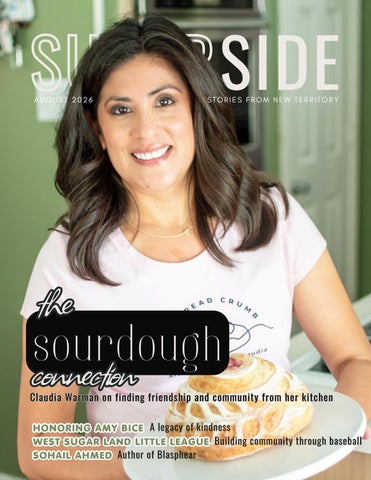
SUGAR SIDE AUGUST 2026
STORIES FROM NEW TERRITORY
the sourdough connection
Claudia Warman on finding friendship and community from her kitchen HONORING AMY BICE A legacy of kindness WEST SUGAR LAND LITTLE LEAGUE Building community through baseball SOHAIL AHMED Author of Blasphear
from the
I
EDITOR have always been afraid of needles.
impact continues.
The only injections I've willingly signed up for have been the ones that were absolutely necessary. If you had told me years ago that I would one day become a blood donor, I would have laughed. Then, in 2015, while living back in Seychelles, I came across a Facebook post asking for blood donations for a 10-year-old boy with leukemia. Two things caught my attention. We shared the same rare blood type. And when I looked at his photograph, I saw my own youngest son. Theo was only two at the time, but somehow I could picture him ten years later in that little boy's face.
Connection appears in different forms throughout this issue. Claudia Warman's sourdough journey grew from a shared starter during the pandemic into friendships, loyal customers and a business built on generosity. Artist Spotlight introduces Sohail Ahmed, whose debut novel reflects years of persistence and determination. And at West Sugar Land Little League, volunteers, parents and coaches are creating far more than baseball memories. They are building confidence, friendships and traditions that last long after the final inning.
It kept me awake that night. The next morning, I drove to the blood drive. I remember humming, as I always do during medical procedures, and before I knew it, it was over. One donation became another.
As I finished this month's issue, I realized that every story asks the same question: How do we make this world a little better than we found it?
This month, I'll be donating blood for the first time since moving to the United States, in memory of Amy Bice.
The answer might be through a blood donation, baking an extra loaf of bread, coaching a child, writing a story or simply showing up for the people around us.
Over the past several weeks, I have come to know Amy through the memories shared by her family and friends. Again and again, I was reminded that while a life may end, the stories we tell ensure its
Those small acts are what turn neighborhoods into communities. I hope you enjoy this month's issue.
— Marie-France Watson Editor & Publisher
SUGAR SIDE MAGAZINE
SUGARSIDE
1
In this issue
Artist spotlight - Sohail Ahmed
14 Meet Penny!
72
4
Cover Story Inside Claudia Warman's kitchen
5 Pet adoption stories
56
20
The families of West Sugar Land Little League
66
Blood donation made simple
34
A legacy of kindness: Amy Bice
on the cover Claudia Warman. photo taken by Danielle West Photography
the team
Marie-France WATSON (Editor)
Sandy COOMBS (Ask the Educator)
SugarSide is published by Equator Line Media |
Follow us on
SUGARSIDE
and
Danielle WEST (Photographer)
sugarsidemagazine@gmail.com
@sugarsidemagazine
3
cover story Photo: Danielle West Photography
the sourdough connection SUGARSIDE
4
W
hen the world shut down in 2020, everyone found their own way of coping. Some threw themselves into new hobbies. Others rediscovered old passions. For Claudia Warman, it came in the form of flour, water and patience. Like millions around the world, Claudia found herself watching the news more than ever. Although she never contracted COVID-19 during the pandemic, she remembers how mentally exhausting those months became. The constant stream of alarming headlines left little room for hope, and she longed for something that would pull her attention away from the television. One afternoon, she watched a Houston news story about a woman in The Heights who had started a sourdough baking community. Neighbors picked up sourdough starter from her front porch and learned to bake while remaining safely apart. Claudia was captivated. She recalls turning to her mother and announcing that she was going to give it a try. Her mother wasn't convinced, telling her it looked too hard, but to Claudia, that sounded more like a challenge than a warning. She joined the Facebook group featured in the story and immersed herself in learning everything she could. She watched YouTube tutorials, read articles and spent hours trying to understand the world of wild yeast, fermentation and sourdough starter. Like many beginners, she quickly discovered that sourdough had a way of testing both patience and persistence. While asking questions in the Facebook group, Claudia met another baker named Rebecca An. At first, Rebecca encouraged her to keep working with the starter she had already begun. But as the two women continued chatting, they discovered they lived just a few miles apart in Sugar Land. Eventually, Rebecca agreed to leave a small portion of her mature starter outside her home for Claudia to collect. "I mixed it with mine," Claudia recalled with a laugh. The starter eventually came to life, but something else had taken root as well. To this day, Rebecca and Claudia still exchange recipes, baking ideas and photos of their latest creations. Some time later, when Rebecca needed to begin again after losing her own starter, it was Claudia who returned the favor by sharing some of hers.
Long before sourdough entered her life, Claudia had already discovered another passion: cooking. Growing up in the Huasteca Potosina region of central Mexico, an area known for its waterfalls and centuries-old churches, Claudia began helping in the kitchen when she was just seven years old. Under the guidance of her nanny, she discovered that cooking was about more than preparing a meal. It was a way of caring for others, a lesson that would stay with her for life.
5
cover story "I think cooking is my way of saying, 'I love you,'" she said. That simple philosophy continues to shape her family life. On birthdays, Father's Day and other special occasions, Claudia loves preparing favorite meals for her husband, Adam, and their 10-year-old daughter, Emma. For her, food has never simply been about feeding people. It has always been about caring for them. Perhaps that is why what happened next felt so natural. As her sourdough improved, fresh loaves began piling up faster than her family could eat them. Seeing the growing collection on the kitchen counter, her husband offered a simple suggestion: "Why don't you give some away?" Claudia did. Neighbors began finding freshly baked bread on their front porches. Claudia would place the loaf outside, step back and wave from a safe distance. "Maybe it was my way of saying, 'I'm still here. We still care about each other,'" she said. One of the first neighbors to receive those gifts was Barbara Kirkpatrick, who
Photo: Danielle West Photography
4
quickly became Claudia's favorite taste tester, even when the experiments went wrong. One memorable batch of cinnamon rolls accidentally went into the oven without any sugar. Claudia laughed as she remembered how terrible they tasted. Barbara accepted them anyway. "She ate all my experiments," Claudia said. Editor’s note – all bakers need a neighbor like Barbara
As life slowly returned to normal, something else began to happen. People started talking about Claudia's bread. One friend in particular, local cake maker Monica Medrano, refused to accept another loaf for free. "You should sell this," she kept telling her. Claudia wasn't interested. She hadn't set out to build a business; baking had become a source of peace, not a business plan. But Monica persisted, and eventually Claudia agreed to sell her a loaf. It was the first loaf she ever sold. From there, orders gradually began to grow, first through friends and neighbors, then by word of mouth. Another turning point came when Gelato Picks owner Dietmar Neidhardt tasted Claudia's bread. Having traveled extensively through Europe, he said it reminded him of the rustic loaves he had enjoyed there. He often ordered a loaf for himself, then shared pieces with people who visited his shop. Before long, one of them had become a regular customer of Claudia's. Today, many customers reserve their loaves days in advance, messaging Claudia directly (via instagram) in the hope that there might be just one extra loaf available. More often than not, every loaf has already been spoken for. "I can only bake so many loaves," she said. Even after upgrading to a larger oven, Claudia remains a one-woman bakery. Every loaf is mixed, folded, shaped and baked by hand. Her bread has traveled farther than she ever imagined.
7
cover story
Photo: Danielle West Photography Every loaf begins with Claudia's sourdough starter, first inspired by a friendship that began during the pandemic. 8
One customer packed six loaves to take to family in Alaska. Teachers at Emma's school look forward to the loaves she surprises them with throughout the year, and many people in the neighborhood now know exactly who to contact when they want authentic sourdough. Claudia has never advertised. Her business has grown almost entirely through word of mouth. Ask Claudia what makes sourdough different, and her eyes light up. To her, a sourdough starter is almost like another member of the family. It is alive, constantly changing and needing care. Every starter develops differently depending on its environment, and no two are ever quite the same. Making a single loaf is a process measured not in hours, but in days. Customers place their orders on Thursday. The starter is fed and carefully prepared before the dough is mixed, stretched and folded. After a slow overnight fermentation, the bread is finally ready for the oven. "It's a work of love," she said. Her favorite part isn't pulling the finished loaf from the oven but working with the dough itself, stretching it, folding it and feeling it change beneath her hands. "I think they all have little faces," she laughed. "Every one is different."
9
cover story Photo: Danielle West Photography
Claudia and Emma with fresh sourdough loaves. This summer marked Emma's first time baking sourdough alongside her mom.
cover story
That lesson extends far beyond bread. A serious accident several years ago left Claudia living with daily pain, but she has never allowed it to define her. She works out several times a week, not because it is easy, but because she believes discipline matters more than motivation. "When the excitement is gone, all that's left is discipline," she said. It is a philosophy she hopes Emma will carry into adulthood. This summer, mother and daughter baked Emma's very first sourdough loaf together. Watching her daughter shape the dough reminded Claudia of another kitchen many years ago, where her nanny first taught a little girl in Mexico how to cook. Some traditions are worth passing on. Today, many people around New Territory know Claudia simply as "the bread lady," a nickname that always makes her smile but has very little to do with bread.
cover story It represents the friendships that began with a Facebook message, the neighbor who faithfully sampled every baking experiment, the friend who believed in her before she believed in herself, the teachers she thanks with fresh loaves, and the customers who have become friends. What started as a way to quiet the anxiety of a global pandemic became something far more meaningful. A loaf of bread cannot solve the world's problems. But it can open a conversation. It can brighten someone's day. It can remind a neighbor they haven't been forgotten. For Claudia, five years later, the flour, water and patience remain. So do the neighbors who still look forward to a loaf from her oven.
Looking for a loaf of Claudia's sourdough? Follow @the_bread_crumb_by_claudia on Instagram to see what she's baking next.
The Warman family. Adam and Emma have been among Claudia's biggest supporters throughout her sourdough journey.
SUGARSIDE
14
the craft of
writing B
y day, Richmond resident Sohail Ahmed works as an application engineer, helping customers understand complex engineering software. Before moving to Texas from Pakistan in 2019, he served as an aeronautical engineer with the Pakistan Air Force and built a career rooted in mathematics, signal processing and technology. But away from engineering, another passion has quietly shaped his life for decades. Writing has been part of his life since childhood, nurtured by a father who introduced him to English and Urdu literature. That passion eventually led to Blasphear, his debut novel, published by Penguin India after an eight-year journey from first idea to finished book. SugarSide sat down with Sohail to talk about the craft of writing, bringing believable characters to life, and why some stories must be told.
SUGARSIDE
15
SugarSide: How does an engineer become a novelist? Where did your love of writing begin? Sohail: My father was very much into literature. He read both English and Urdu literature, so I grew up surrounded by books. I started writing short stories in my late teens and would show them to him. He would critique my stories, not to discourage me, but to help me become a better writer. Growing up in Pakistan, though, I also had this idea that literature wasn't going to pay your bills. Engineering became my profession, but literature has always been my passion. Then life happened. I focused on my career, completed my master's degree and Ph.D., and raised a family. When life became a little more settled, I came back to writing. I think I've been fortunate that I've been able to keep both. SugarSide: Was there a book that first made you fall in love with storytelling?
"You have to get inside each character and understand their fears, hopes and how they see the world. You actually start living their lives." SUGARSIDE
Sohail: There were the usual classics like Charles Dickens and Treasure Island. But one book, Three Fat Men by a Russian writer, really stayed with me. It tells the story of a revolution against three rulers. I was probably 11 or 12, and I remember imagining everything that was happening in that story. It left a lasting impression. SugarSide: Your debut novel, Blasphear, has a rather unusual title. Where did the name come from, and what is it about? Sohail: It's a word I coined from blasphemy and fear. Those two ideas are closely connected in the story, and the meaning becomes clearer as the novel unfolds. At its heart, Blasphear is a crime novel about a police inspector investigating what appears to be the suicide of a young boy. As he digs deeper, he uncovers a much deeper story that explores justice, fear and the consequences of religious extremism. SugarSide: Writing a first novel is no small undertaking. Blasphear took six years to complete. What was that journey like? Sohail: It was a labor of love. I enjoyed the process, and that's the important thing. When you write something that expresses something deep inside you, you enjoy creating it. Then you enjoy editing it. You enjoy hearing other people's feedback because it helps make the story better. My first draft was about 25,000 words. With each round of feedback, it grew. First to 40,000 words, then 55,000, until it eventually reached about 80,000. Along the way, I realized there was still a lot to learn. I took a novel-writing course that introduced me to ideas like character arcs and stronger storytelling, and I joined a writers' group where we exchanged our work and offered each other honest critiques. The guidance I received was invaluable. Every conversation and every piece of feedback
16
Blasphear is available on Amazon in paperback and Kindle editions. (https://a.co/d/050Kjh9b )
helped make the novel stronger. If you enjoy the journey of writing, you keep going. SugarSide: Blasphear is much more than a crime thriller. It explores religion, justice and fear through the lens of a police investigation. Why did you choose that approach, and what did you hope readers would be thinking about after they finished the book? Sohail: I wanted readers to stay engaged in the mystery while also thinking about the larger issues underneath. I knew that to achieve this the story had to move, and a crime investigation naturally creates that momentum. Underneath the mystery, though, I wanted to explore bigger questions. Religion should be a source of spiritual guidance. It should make people better human beings, not become something that can be exploited or manipulated. If readers finish the book thinking more deeply about justice, fear and the questions beneath the mystery, then I think I've achieved what I hoped to do. SugarSide: Your characters feel incredibly authentic, right down to their quirks and fears. How do you bring them to life, and how much of yourself ends up in them? Sohail: When I first wrote the novel, it was mostly plot, just events happening one after another. An editor encouraged me to make the characters come alive by giving them their own fears, habits and personalities. That was a huge learning experience. You have to get inside each character and understand their fears, hopes and how they see the world. You actually start living their lives. I also borrow from people I know because it makes the characters feel more authentic. One character's fear of lizards came from me. I was scared of lizards as a child. Another character is partly modelled on my sister, who was a real tomboy growing up. Waqas, the main character,
SUGARSIDE
also has pieces of me. He reflects on himself a lot, he loves poetry, and I see some of my own personality in him. SugarSide: What surprised you most about writing a novel? Sohail: What surprised me most was that writing wasn't actually the hardest part. Publishing was. I loved writing the book. Finding someone willing to publish a first-time author was the real challenge. Having a story set in Pakistan was a hard sell for publishers in the United States. Eventually, I found a publisher in India. Penguin India believed in the novel, and that made all the difference. SugarSide: What was it like holding the finished book for the first time? Sohail: It was a wonderful moment. I can't describe the feeling. It represented eight years of work. I was writing on weekends, after work, whenever I could find an hour or two. The only sad part was that my father and mother weren’t there to see it. I know they would have been very, very happy.
Although Blasphear is Sohail Ahmed's debut novel, it certainly won't be his last. A second novel is already complete, and he has recently begun work on a third. "Writing is something that's inside me. If you enjoy creating stories, you'll keep doing it," he said. For anyone hoping to write a book of their own, his advice is refreshingly simple: "Don't worry about the destination. Enjoy the journey of writing." Blasphear is available on Amazon in paperback and Kindle editions. (https://a.co/d/050Kjh9b )
18
learning about the world O N E M O NT H AT A T I M E
F R O M E T SY blue/green edition pink/purple edition
Taskmaster Planner introduces kids (7-10 years) to meaningful days each month what they are, why they matter, and how they can take part
Along the way, they learn to plan their own time. – Simple monthly layout – 5 observance days, clearly explained – Designed for kids to use independently
SUGARSIDE
Print it. Hand it over. Let them lead.
5
The of West Sugar Land Little League
F
or more than three decades, West Sugar Land Little League has been introducing local children to baseball while quietly building something much bigger than a sports program. Founded in 1993, the chartered nonprofit league is run entirely by volunteers who share a common goal: giving every child the opportunity to play. Today, around 250 players from New Territory, Riverpark, Telfair, Aliana and surrounding communities take to the league's six neighborhood fields each season. Some are picking up a glove for the very first time. Others are developing skills that will carry them into high school baseball and beyond. League president John Trenery says accessibility has always been at the heart of the organization's mission. "We want every kid to have the opportunity to play," he said. Registration is intentionally kept affordable and there are no tryouts, ensuring every child has the opportunity to step onto the field. But ask John what the league is really about and his answer has little to do with wins and losses. "Baseball is secondary," he said. "Our mission is to teach teamwork, respect and perseverance. We want kids to develop, enjoy the game and leave with great memories." Long before the first pitch is thrown, volunteers are preparing the league's six fields, coaching teams, organizing schedules, maintaining equipment and coordinating the countless details that keep the season running smoothly. They do it not for recognition, but because they believe in what the league gives back to children and their families. Those memories are created not only by the children on the field, but by the parents, coaches and volunteers who make each season possible. For many families, what begins as a Saturday morning baseball game soon becomes something much bigger: a place where friendships are formed, confidence grows and community takes root. Registration for Fall Ball 2026 is open until August 21 st . Register here: https://www.wslll.com/
Photos : L-R: Top: The Mom’s Tournament | Families cheering on Bottom: Happy game faces | Putting in the work to get the field ready
John & Elizabeth Trenery
When his eldest son, Andrew, pulled on a West Sugar Land Little League jersey as a 5-year-old in 2015, it marked the beginning of the family's journey with the league. One season became another. Coaching led to volunteering, volunteering led to serving as vice president and, in 2024, John became president of the league. Like many parents, John's journey began because of his children. Today, while 16-year-old Andrew has aged out of Little League and now helps out alongside his father, his younger son, Adam, 11, is still enjoying the experience as a player. John still remembers Andrew's first game. As one of the youngest players on the field, his parents watched anxiously from the sidelines, unsure of what to expect. Seeing him become more confident with each season reminded John that every child starts somewhere. Seeing both his boys develop through the game has reinforced John's belief in the value of Little League. He credits many of the qualities he sees in them today, particularly their calmness under pressure, to the lessons learned on the field.
Adam in action
Over the years, the league has become a true family affair. John's wife, Elizabeth, regularly lends a hand behind the scenes, his father volunteers on Friday nights and game days, and both sets of grandparents are often at the ballpark. One of John's favorite sights is watching his mother and mother-in-law strike up friendships with other league families. John and Elizabeth have also helped create opportunities for families to connect beyond the game itself. The annual Moms Tournament, which they introduced as a fundraiser for the league, has become one of its most popular traditions, bringing mothers from every division together for a day of friendly competition, laughter and community. As the league continues to grow, John hopes more children will have the opportunity to experience everything West Sugar Land Little League has to offer. "The friendships and the community," he said. "That's what people remember."
John with Andrew, his eldest son
Melissa & Jason Jones For Melissa and Jason Jones, West Sugar Land Little League has become much more than a place where their two sons, Benjamin and Zachary, play baseball. It has become a family tradition, with three generations sharing a love of the game through coaching, volunteering and cheering from the sidelines. Melissa's father first volunteered as a coach when her nephew joined the league. Years later, when Benjamin was old enough to play, Jason stepped in as a coach. Melissa started as an assistant coach before taking on a coaching role herself. During Benjamin's first season of coach pitch, she and her father coached together, making it a true family effort. Today, Melissa serves as the league's secretary, giving her a new appreciation for everything that happens behind the scenes. "I didn't realize how much goes into keeping the league running," she says. "There are so many hours put in behind the scenes." From monthly board meetings and organizing volunteers to preparing the fields and hosting Friday Night Under the Lights, Melissa says the league depends entirely on families willing to give their time. Serving on the board has given her a deeper appreciation for the volunteers whose efforts often go unseen but make every practice, game and community event possible.
As a homeschooling family, the Joneses have found far more than baseball at West Sugar Land Little League. Melissa says the league has given Benjamin and Zachary a place to build friendships, learn to work as part of a team, respect coaches and umpires, and develop resilience both on and off the field.
Benjamin delivers a pitch
She believes one of the league's greatest strengths is its ability to balance competition with enjoyment. Players are encouraged to challenge themselves and grow, but never at the expense of remembering why they came in the first place. "You want kids to be competitive because that's how they grow," she says. "But you never want competition to come at the expense of losing the love of the game." For Melissa, that balance is what keeps families coming back season after season. That love is evident in Benjamin and Zachary. Asked what they enjoy most about baseball, both boys give the same simple answer: spending time with their friends.
Zachary is ready to catch behind the plate 25
Francis & Kathleen Zavalla West Sugar Land Little League brought Francis Zavalla back to a familiar place. It was here that he played Little League after moving to New Territory in the late 1990s. Years later, when his son Theo asked to play after watching a few Astros games, the family returned to the same league. Before long, younger sister Penelope had caught the baseball bug too, learning the game by playing in the backyard with her older brother before joining the league herself. Today, baseball is very much a family affair. Francis is one of the league's volunteer announcers, introducing players as they take the field, while Kathleen is among the parents who help curate the music that keeps the atmosphere lively. Together with many other volunteers, they help create the welcoming environment that makes West Sugar Land Little League feel like more than just a place to play baseball. And yes, when Montell Jordan's This Is How We Do It comes over the speakers, chances are Kathleen had something to do with it. Their contributions are especially evident during the league's popular Friday Night Under the Lights, one of the
season's signature traditions that brings the community together. The family has also embraced another West Sugar Land Little League tradition: the annual Moms Tournament. Kathleen laughs that what started as a fundraiser quickly became one of the highlights of the season, giving mothers from every division the chance to build friendships while discovering just how challenging the game really is. Off the field, the Zavallas say the league has given them something even more valuable than baseball: a sense of belonging. "It's our social life," Francis says. "We have a community." The friendships extend well beyond the ballpark. Through the league, Francis reconnected with a high school friend he hadn't seen in nearly 20 years. Since then, the family has built lasting relationships with parents, coaches and volunteers who have become an important part of their lives. Asked what they enjoy most about baseball, Theo and Penelope give remarkably similar answers: making friends and having fun. For the Zavallas, those simple words capture exactly what has kept their family coming back year after year.
Photo: Theo and Penelope celebrate another season together at West Sugar Land Little League
One moment stands out in particular. Joe remembers watching Ben step onto the mound to pitch for the first time. It was a role that demanded resilience as much as skill, requiring him to shake off mistakes and throw the next pitch with confidence. Watching him develop that mindset, Joe says, has been one of the most rewarding parts of the journey.
Joe Parappilly
Now serving as the league's treasurer, Joe has also gained a new appreciation for the volunteers who quietly keep the league running, each contributing in their own way to make every season possible. Like so many families at West Sugar Land Little League, Joe believes the friendships and sense of community are what make the experience truly special. "It's a very welcoming league," he says. "The families grow up together."
When Joe Parappilly and his family moved to Sugar Land from The Woodlands in 2021, they hoped to find more than a baseball league for their son, Ben. They were looking for a community. West Sugar Land Little League quickly became that place. Ben had already discovered a love for baseball before the family moved, but it was here that Joe watched his son grow in ways that had little to do with the game itself. As Ben prepares for his final Little League season before high school, Joe says the greatest change has been his confidence. "I think confidence is the biggest thing," Joe says.
Photo: Ben waits for the pitch
As Ben looks ahead to high school baseball, Joe hopes he carries with him the confidence he found at West Sugar Land Little League. The friendships, the sportsmanship and the memories matter too, but knowing he can step onto a field, face a challenge and keep going may be the lesson that lasts the longest.
Chuck & Diana Stanley
For Chuck and Diana Stanley, West Sugar Land Little League is about raising children, building character and teaching the importance of giving back. Chuck grew up in a small town in Iowa, where baseball was always his favorite sport and, as he puts it, "my first love." His father introduced him to the game, and years later, baseball continued to connect the family in unexpected ways.
When Chuck returned to the Midwest to help care for his father during his illness, the two would watch Chuck's sons play through the GameChanger app. Although his father never had the chance to watch his grandsons play in person, he was still able to share a few precious moments in their baseball journey. Although a shoulder injury ended Chuck's dream of playing beyond high school, his love for the game found new purpose when Charles, Connor and Pierce picked up a bat for the first time. What began as bringing his oldest son to practice soon evolved into coaching, volunteering and eventually serving on the league's board as vice president. "I realized this is a volunteer organization," Chuck says. "Without parents getting involved, this doesn't happen." That lesson is one he is determined to pass on to his sons. When the fields need maintenance, Chuck brings the boys along with shovels in hand. "I want them to take pride in the fields they get to play on," he said. "They get a sense of responsibility by helping take care of what we have here." While Chuck helps guide the league as vice president, Diana has embraced every part of league life alongside him, from fundraising to helping create the atmosphere at Friday Night Under the Lights with music between innings. For Diana, the most important lessons have little to do with baseball itself. "The essence of youth sports is learning to win well, but also to lose well," she said. "It's building the character of the men they will become." Asked what they enjoy most about baseball, the Stanley boys didn't talk about championships or trophies. They talked about home runs, friends, hot dogs and simply having fun. For their parents, those answers are a reminder that while children may come for baseball, they leave with something far more enduring.
Photos L-R: Charles during an All Star game | Charles & Connor, winners of Derby | Pierce in action
Larry Garza
Around West Sugar Land Little League, almost everyone knows Larry Garza simply as "Uncle Larry." After more than two decades as a coach and umpire, Larry has become one of the familiar faces generations of players have come to know. As his sons, Christopher and James, grew older, he stepped away from coaching full time but continued umpiring, remaining a familiar presence around the league. When his great-nephew Romeo joined the league, and later made the All-Star team, Larry found himself drawn back to the dugout once again. Years ago, what began with coaching his oldest son grew into a family tradition. James developed a lifelong love of baseball, while Christopher followed in his father's footsteps and now coaches young players himself. "I enjoy seeing a kid that can't catch the ball or hit the ball and then watching them progress," Larry says. "For some of these kids, it's life-changing." For Larry, coaching and umpiring go hand in hand. "The umpiring makes me a better coach," he says. Larry has always had a soft spot for first-time players. He enjoys helping children who have never picked up a glove before discover they are capable of more than they imagined. Whether it's a first clean catch, a solid hit or simply finding the confidence to keep trying after making a mistake, he celebrates every milestone. When he looks across the fields today, Larry doesn't just see baseball diamonds. "I see memories," he says. Those memories stretch across more than 20 years, countless young players and friendships that have lasted long after the final inning. For Uncle Larry, West Sugar Land Little League has never simply been about baseball. It's about helping children discover what they're capable of, one game at a time.
Larry "Uncle Larry" Garza umpires a West Sugar Land Little League game.
Amy Bice
A legacy of kindness
S
pend enough time talking to the people who knew Amy Bice and a pattern begins to emerge.
Over the past several weeks, SugarSide spoke with her mother, daughter, lifelong friend, neighbors, volunteers and the women who served alongside her in organizations across Fort Bend County. They knew Amy through different chapters of her life. Some had known her for more than 50 years. Others for only a few. Yet they all described the same woman. She welcomed newcomers without hesitation. She remembered birthdays and celebrated milestones. She encouraged others to step forward, defended those who needed an advocate and somehow found time to teach, volunteer, create, travel and lead. More than anything, she made people feel valued. It didn't matter whether someone knew Amy as a teacher, neighbor, hiking companion, artist, volunteer or friend. Each person came away with the same impression: Amy had made them feel like they mattered. Perhaps that's why so many different communities have been mourning the same woman. Born in Syracuse, New York, Amy spent her childhood near Rochester in a close-knit neighborhood where children played freely, neighbors looked out for one another and curiosity was encouraged. She was reading before she started school, discovered a gift for art at an early age and developed a lifelong love of animals, nature and learning. At 17, Amy met Michael. They fell in love, married four years later and spent the next 33 years building a life together. Side by side, they embraced every stage of life, from raising their daughters, Jessica and Anna, to traveling the world and pursuing new adventures. It was a partnership marked by love, curiosity and shared experiences that was tragically cut short far too soon. In 2001, they made New Territory home. It was here, in Sugar Land, that many residents came to know Amy as a neighbor, volunteer and friend. Through organizations across Fort Bend County and countless everyday interactions, she built the kind of connections that strengthened a community.
Her childhood passions followed her into adulthood, evolving into a life of service. Teaching became one of Amy's greatest joys. Whether in a first-grade classroom, tutoring a struggling reader or volunteering her time, helping children learn remained one of the roles she valued most. Amy herself reflected on this in a journal entry about the moments she believed she was at her best. She wrote: "A time I was at my best was when I was teaching 1st grade and/or teaching children to read (tutoring, volunteer work)." Beyond education, she embraced art and scrapbooking, traveled widely, climbed Mount Kilimanjaro, supported therapeutic horsemanship, led community organizations and donated blood regularly. But it wasn't the list of accomplishments people remembered most. Again and again, they returned to the same qualities: her kindness, her quiet encouragement and her remarkable ability to make people feel seen. The stories that follow offer just a few glimpses into the life of a woman whose legacy continues in the people she encouraged, the friendships she nurtured and the community she helped build.
Amy and Michael shared a love of travel, adventure and discovering new places together. Grand Canyon National Park, 2019.
Amy's parents each nurtured different parts of who she would become. Linda, a former vocal music teacher who later taught piano lessons from home, filled the house with music, sewing projects and handmade crafts. Her father, Allen, a biologist and avid outdoorsman, filled the family's half-acre property with fruits, vegetables and berries. Between them, they created a home where curiosity was encouraged, creativity was celebrated and kindness was quietly lived. Amy's curiosity revealed itself early. She was reading independently by the age of 3 and, after testing, started kindergarten at just 4 years old.
W h e r e it Where it began began Long before Amy Bice became a teacher, volunteer, community leader and friend to so many, she was a curious little girl growing up near Rochester, New York. Her mother, Linda Marsters, remembers a childhood that Amy shared with her older brother, Paul, one shaped by books, music, creativity and a close-knit neighborhood where children spent their days outdoors while neighbors looked after one another. "It was a wonderful place to grow up," Linda said. "Everybody knew everybody."
She loved asking questions, discovering how things worked and learning something new. That curiosity extended from the garden to technology. Amy's grandfather believed the family should embrace new ideas rather than shy away from them, and they became one of the first households in the neighborhood to own an Apple IIe computer. Linda bought it largely for Amy, whose perfectionism often saw her retyping entire school assignments after making a single mistake. Amy eagerly embraced the new technology, a curiosity that decades later would help make her the person others turned to as technology transformed the classroom. Creativity flourished, too. At 9 years old, one of Amy's drawings won a local art competition, revealing a talent that continued to grow. She spent summers at art camp, painted murals while attending college and, throughout her life, found joy in creating, whether through art, scrapbooking or handmade gifts for family and friends. But alongside her curiosity and creativity was something else that would come to define her life. Kindness. When a younger girl in the neighborhood admired Amy's dolls, Amy quietly made clothes for them so they could play together. She adored animals, from 37
Goldie, the rooster she proudly raised after hatching an egg at school, to the family's dog, Sammi, and cat, Bootsy. She never needed reminding to write thank-you notes and preferred making thoughtful gifts by hand rather than buying them. Even as a child, kindness came naturally. Looking back, Linda doesn't see separate chapters of her daughter's life. She sees the beginnings of the same qualities that others would recognize decades later. The little girl who loved learning became an educator who found purpose in helping children discover the joy of reading. Teaching wasn't simply her profession. It became one of the ways she expressed her patience, generosity and belief in others. The artist never stopped creating. And the child who instinctively welcomed others grew into the woman who made people feel they belonged. That thoughtfulness never faded. In 2024, Amy quietly worked with family and friends to surprise Linda for her 80th birthday. Having only just returned home from another trip, she secretly packed another suitcase, flew to New York and hid nearby until the celebration. When Linda walked into the room and saw her daughter, she was overwhelmed with happiness. Today, it remains one of her most treasured memories. Amy's curiosity never faded either. Travel wasn't simply about seeing new places; it was about understanding them. During a trip to Peru, she learned how Brazil nuts are harvested and insisted on trying to crack one open herself with a machete. It took several determined attempts before she finally split the tough shell, but that was part of the adventure. On another journey through the Amazon rainforest, she learned that local people regularly ate termites straight from the trees. Naturally, Amy tried one herself. She simply wanted to know what it tasted like. Whether she was learning about coffee production in Africa or exploring local traditions elsewhere,
Amy approached every destination with the same enthusiasm for learning that had defined her since childhood. Whether she was learning about coffee production in Africa or exploring local traditions elsewhere, Amy approached every destination with the same enthusiasm for learning that had defined her since childhood. When friends, colleagues and neighbors gathered in New York to celebrate Amy's life, Linda listened as people from many chapters of her daughter's life shared their memories. They came with different stories. Yet they all described the same woman. For Linda, it came as no surprise. She had known that little girl all along.
Amy proudly holds Goldie, the rooster she raised after hatching an egg at school.
Photos L-R: Amy with her Dad, brother and grandparents | Sammi and Bootsy | Illustration Amy recreated by hand at age 9 Photo below: Amy with her mom, Linda
S im ply Sim p l y Mom Mom
When Jessica Bice thinks about her mother, three words come to mind. Loyal. Kind. Determined. To many people, Amy was the teacher, volunteer or community leader who naturally brought people together. At home, she was simply Mom. "She chose kindness," Jessica said. "It was always her first response. But when someone needed defending, especially her children or someone being treated unfairly, she never hesitated to step forward." The Bice household was rarely still. Even after long days in the classroom, Amy could usually be found preparing dinner, grading papers or immersed in a creative project. There was often a scrapbook on the go, paint drying somewhere or another creative project waiting to be finished. Jessica still wonders where her mother's energy came from. "She only slept six or seven hours and was completely rested," she said. "If she had any free time, she was listening to a podcast, reading a book, making something or planning the next thing." To Jessica, the classroom was simply another place where her mother expressed the qualities that defined
her life. Whether she was teaching first grade, tutoring struggling readers or volunteering her time, she approached every child with patience, encouragement and the belief that they could succeed. Teaching, volunteering and countless commitments filled Amy's days, but she was intentional about making time for her family. Together, Amy and her husband, Michael, built a home where family remained at the heart of everyday life. Despite busy schedules, evenings were protected for dinner together, reading books aloud, family game nights and sports. Amy attended soccer games, played tennis with her daughters, went running with them and celebrated every achievement, no matter how big or small. She also believed in giving her children room to become their own people. Rather than hovering, Amy encouraged Jessica and her younger sister, Anna, to think for themselves, make their own decisions and come to her when they needed guidance. She listened without judgment and celebrated who they were, rather than who she expected them to be. That unconditional love was perhaps most evident when Anna came out as transgender in 2016. Jessica says her mother didn't pretend to have all the answers. She asked questions, educated herself, joined parent support groups and stood firmly beside her daughter, never wavering in her support. Amy found countless ways to show her love, and holidays were among her favorites. Christmas meant homemade cookies and her famous rum balls. Easter brought bunnyshaped cakes. Birthdays came with elaborate creations. Throughout Jessica's six years at college, care packages arrived for every major holiday, filled with themed decorations, thoughtful gifts and often something handmade to remind her that home was never far away.
As children, Jessica admits, many of those gestures felt ordinary. "The clean house, the healthy meals, all the little things she did every day," she said. "You don't really appreciate it until you're older." One birthday, however, became unforgettable. During the isolation of the COVID-19 pandemic, Jessica was living alone in Denver while completing graduate school and working as a trauma therapist. Expecting a quiet birthday with just her mother and one friend over Zoom, she was instead greeted by a screen filled with family and friends Amy had secretly brought together. "I was no longer alone," Jessica said. It was exactly the kind of thing Amy did, noticing what someone needed before they had even asked. That instinct reached far beyond her own family. When new families arrived in Sugar Land, Amy was often one of the first people to welcome them. She introduced them to others, helped them find friendships and connected them with opportunities to become part of the community. Jessica believes Amy understood just how important it was to feel supported. Whatever shaped that understanding, she seemed to have an instinct for noticing the person standing quietly on the edge of the room and helping them feel they belonged. Looking back, Jessica says the greatest lessons her mother left behind were never delivered as lectures. "They were just how she lived," she said. In the same journal entry in which Amy reflected on the times she was at her best, she was also asked to describe the best time in her life. Her answer was simple: "Raising my children." Jessica wasn't surprised. "She taught me that there is good in everyone if you just take the time to look closely. As a therapist, empathy comes easily to me because it came easily to my mom.” Her mother also taught her something equally enduring. "She taught me that almost anything can be accomplished with grit and determination."
The Bice family in 2018
T he T h e fir f ir st s t ff rr iend ie nd
When Amy Bice arrived in a second-grade classroom in Rochester and took a seat at Patti Davis's table, neither of them could have imagined they were beginning a friendship that would last more than half a century. "We instantly clicked," Patti said. From that day forward, life carried them through different classrooms, college, careers, marriage and motherhood. They would sometimes go weeks or even months without speaking, yet every conversation began exactly where the last one had ended. "It never seemed like time had passed," Patti said. "We always picked right up where we left off."
That constancy became one of the greatest gifts Amy gave her friend. There was never judgment. Patti could call Amy with life's biggest worries, mistakes or uncertainties, knowing she would be met with kindness, thoughtful advice and complete confidence. "I could talk to her about everything," Patti said. "She was always there." Their childhood was filled with the ordinary moments that somehow become extraordinary memories. They rode their bicycles to soccer tryouts, laughing that they were just like the Olson girls from Little House on the Prairie. They danced together in high school musicals, spent summers playing tennis and found reasons to laugh almost everywhere they went. One afternoon in class, Patti noticed Amy's new shoes. While the teacher stepped out of the room, the two girls ducked beneath a desk to admire Amy's new shoes. They were still whispering and giggling when the teacher returned. Patti pauses before lowering her voice into the stern tone she still remembers decades later. "'Girls!'" she said, mimicking the teacher's sharp reprimand. Startled, the pair burst into even louder laughter, bumping their heads on the underside of the desk as they scrambled back into their seats. Decades later, Patti still laughs telling the story. In fact, it is evident that laughter became the language of their friendship. "We would laugh so hard we had tears," Patti said. "Sometimes we couldn't even remember what we were laughing about, and then we'd laugh even harder." Along the way, time changed many things,
but never the friendship. Whenever Amy returned to New York, Patti rearranged her schedule so they could spend time together. Gatherings at Linda's house became treasured moments, filled with games, conversation and the kind of laughter that made everyone else laugh too. Even during the COVID-19 pandemic, it was Amy who figured out how to get everyone online so they could play card games together from their own homes. If Patti had to choose one phrase that captured her friend, it would be simple. "She always showed up." She showed up for birthdays, never forgetting Patti's daughter, Alliya. She supported friends' small businesses, often buying their products as thoughtful gifts for someone else. She checked in, made time for visits and somehow found room in an already full life to let people know they mattered. And every visit began the same way. The moment Patti walked through the door, Amy would rise from her chair, walk over with her arms already open and wrap her in a hug. "It didn't matter if we'd seen each other yesterday or months before," Patti said. "She greeted you like she'd been waiting just for you." To Patti, that was what made Amy so special. She had an extraordinary ability to make every person feel like they mattered. "If someone read about Amy and had never met her," Patti concluded, "I think they'd want to search her out and be her friend." Patti was one of the lucky ones. She got to spend more than fifty years calling Amy her friend.
Photo: Amy with Patti and Alliya celebrating Thanksgiving in 2025
45
It was an ambitious goal. Amy had climbed the mountain before, so she and her husband, Michael, joined Karen, her husband and their two sons to help make it happen. The group trained together, spending months walking trails across Texas before making the eight-mile round-trip hike to the 8,751-foot summit. Throughout it all, Amy encouraged Karen every step of the way. "She was very encouraging," Karen said. "That was Amy. She was always helping others achieve their goals."
T he T h e encourager encourager For nearly twenty years, Karen Hale watched a friendship grow one shared interest at a time. It began on the sidelines of youth soccer, where their children played together. Then came book club, camping trips, concerts and countless miles of hiking trails. There was no single moment when Amy Bice became one of Karen's closest friends. "It was just a gradual weaving of our lives together," Karen said. If Patti remembers laughter, Karen remembers encouragement. She describes Amy as one of the most encouraging people she has ever known. That encouragement reached its peak when Karen decided that, for her 60th birthday, she wanted to climb Guadalupe Peak, the highest point in Texas.
That generosity wasn't limited to mountain trails. Karen says Amy had a remarkable ability to notice people, welcome them into groups and help them find a place to belong. Whether it was inviting someone to join a book club, introducing them to a hiking group or simply making room for one more person, Amy built community wherever she went. "She befriended everyone," Karen said. "She was warm, encouraging and friendly to everybody." Looking back, Karen realizes that many of her happiest memories with Amy happened outdoors. They hiked the Lone Star Trail, explored Cullinan Park, camped together and shared countless conversations while walking through nature. "I really associate her with walking and being together in nature," Karen said. When Karen thinks of Amy today, that is still the picture that comes to mind. Not the summit they reached together, but the friend who walked beside her.
Evv eryone E eryone belonged b elonged
Amy Bice was there from the beginning.
Amy never saw people through the lens of their disabilities. She simply saw people who deserved to feel valued, included and celebrated. "She wasn't judgmental," Peggy said. "She just loved people the way they were."
From the earliest days of the organization, Amy gave whatever was needed. She volunteered during lessons, helped prepare horses, recruited auction donations, attended fundraisers, made The two women had met through a scrapbooking group soon financial contributions and introduced countless people to the organization's mission. after Amy moved to Sugar Land and quickly became close friends. More than anything, Peggy remembers Amy as an "She was always so supportive," Peggy said. "Everybody was advocate. "Everybody who knew Amy knew about important. Everybody had a purpose." us," she said with a smile. "You couldn't meet Amy without hearing about Reining Strength." It wasn't just friendship that drew Amy to the organization. Peggy believes the mission reflected exactly who she was. For a young nonprofit trying to establish itself, that mattered. Reining Strength provides equine-assisted services for children and adults with physical, cognitive, social and "She helped people find us that needed us and emotional disabilities. helped us get the resources we needed," Heather Hernandez Sedillo, Reining Strength's executive director and Peggy’s daughter, said. "Her passion was contagious." When Peggy Hernandez and her family began building Reining Strength Therapeutic Horsemanship, Amy was one of the first people to stand beside them.
Peggy believes that passion came from something much deeper than volunteering. "She always thought they were important," she said of the clients. "She wanted to improve their lives and make them better." One moment has stayed with her over the years. Not long after their new barn was completed, a client walked inside for the first time. Looking around in amazement, she asked, "You built this for us?" "Yes," Peggy replied. "This is a place for you to come and be who you are, to be loved and to be celebrated." Then she reflects on her friend. "That's what Amy did," Peggy said. "She brought the love and the celebration." Photo: Amy at the Kentucky Derby party in May 2023
B r inging Br in g in g people p e o p l e together together
When Amy Bice joined the American Association of University Women about eight years ago, it didn't take long for Mona Fogt to notice something. "I could tell from the beginning that she definitely had leadership ability," Mona said. After serving as the chapter's program chair, Amy went on to lead the organization as president. She found engaging speakers, introduced new ideas and wasn't afraid to tackle the strategic planning and governance work that keeps volunteer organizations moving forward. One initiative was a partnership with the Girls Who Code club at Kempner High School. Amy helped organize an AAUW meeting at the school, giving student leaders the opportunity to share their ideas, future plans and the support they needed to grow the program. According to club sponsor Ian Macintyre, the experience gave students a platform to shape opportunities for nearly 100 members, including educational trips to technology companies, STEM resources and projects designed by the students themselves. "Amy had a profound impact on our ability to design experiences for the club," he said. "The club is very grateful for Amy's passion and ideas." Projects like Girls Who Code demonstrated Amy's commitment to creating opportunities for others. But for Mona, they also reflected the qualities that made Amy such a remarkable leader. Board meetings often took place over dinner. Before anyone else arrived, Amy would already have appetizers on the table for everyone to share. "It just gave a joyful feeling to the meeting," Mona said. "She had such a wonderful way of being with people." Amy also had a knack for helping organizations grow. She enthusiastically introduced neighbors and friends to AAUW, encouraging them to become involved because she genuinely believed in its mission of advancing education and opportunities for women and girls. "I think it was her enthusiasm," Mona said. "She was sharing something she profoundly believed in." That enthusiasm was contagious. Members joined because Amy invited them. Speakers returned because she remembered them. Ideas were shared because she made people feel welcome enough to contribute. Looking back, Mona believes Amy's leadership was rooted in the kind of person she was: "a beautiful, vibrant, welcoming soul."
S e e in g the Seeing t h e best b es t in in other other s s Linda Russell believes one of Amy’s greatest gifts was seeing strengths in other people that they often didn't see in themselves. When the two served together in the Lambda Sigma chapter of Delta Kappa Gamma, Linda watched Amy encourage others, celebrate their talents and help them step into new opportunities. At first, Amy seemed quiet and observant. But beneath that calm exterior was a woman full of energy and enthusiasm. Whether it was a garden luncheon complete with a fascinator in her hair or a Halloween celebration, Amy embraced every event wholeheartedly. "If she was going to do something," Linda recalled, "she went all in." That same enthusiasm shaped the way she led. Amy went on to serve in several leadership roles within the chapter. Shortly before her passing, members had elected her as the chapter's next president, a reflection of the confidence and trust they placed in her. Linda believes that trust came from something remarkably simple. "She had a way of finding out what someone's talent was," she said. Amy watched, listened and took the time to understand people before asking anything of them. She recognized their strengths, encouraged them to use them and made them feel valued for what they could contribute. "She always saw the good in others," Linda said. Leadership, for Amy, wasn't about directing people, but rather it was about helping them discover where they belonged.
Photo: Holiday joy with her Delta Kappa Gamma team
Linda also remembers Amy's remarkable commitment. She never missed chapter meetings, even when it meant driving for hours to visit other Delta Kappa Gamma chapters. Before every meeting, she had done her homework. She knew the people she wanted to meet, understood the issues being discussed and arrived prepared to contribute. She never expected others to invest more than she was willing to invest herself. Education, Linda points out, remained at the heart of everything she did. Amy loved visiting schools, talking with teachers and learning what they needed. She believed Delta Kappa Gamma could make a meaningful difference, whether through scholarships, community service or simply supporting fellow educators. Looking ahead, Linda believed Amy would help shape the chapter's future. "She was the future," she said. Amy's confidence with technology, her fresh ideas and her ability to connect with people would have helped take the chapter in new directions. Instead, Linda believes Amy's greatest legacy is the example she left behind. She gave her whole heart to everything she did, carefully making time for her family, her friends and the organizations she believed in. And in doing so, she helped others see the best in themselves.
Photos: Amy helped create a welcoming community through the New Territory W
Quie t l y present Quietly p r es e n t
Susan Garczynski first met Amy Bice through the New Territory Women's Association more than two decades ago. Their friendship grew gradually over the years, becoming especially close through game nights, dinner groups and community projects in more recent years. Looking back, Susan describes Amy as the kind of person whose presence you felt more than you heard. She showed up quietly, listened generously and found ways to support the people around her without expecting anything in return. "She was quietly steady, deeply compassionate and genuinely humble," Susan said. "She showed up for others without any fanfare." As president of the New Territory Women's Association, Susan saw firsthand how naturally Amy drew people into the community. Whenever Amy met someone who was new to the area or simply looking for connection, she invited them along. She introduced them to the women's group, made them feel welcome and helped them find friendships of their own. After Amy's passing, the women Amy had encouraged to join continued showing up. To Susan, their presence reflected the lasting impact Amy had on the organization and the friendships she had nurtured. "They were there because of Amy," she said. To Susan, that may be her greatest legacy. Not simply the organizations she served or the events she helped organize, but the countless friendships she quietly set in motion. Even now, those connections continue to grow. Susan herself became close to Amy's daughter, Jessica, a friendship that began only after Amy was gone. "I feel like her mother has pulled us together," she said.
Women's Association.
For Susan, Amy's impact is measured by the people she brought together, the kindness she shared and the lives she quietly changed.
Photos: Amy embraced every adventure with enthusiasm, including the Muddy Princess obstacle race
He r w Her w or or k k continues c o n t in u es
Kelley Sweet Jensen still remembers the day she and Amy Bice spotted signs for a community blood drive while driving through New Territory. Neither had planned to stop. "We were like, 'Hey, let's go do that,'" Kelley recalled. Amy had donated blood before, but from that day on, the two friends became familiar faces at neighborhood blood drives, donating side by side every two months whenever Amy was in town. It became their thing. They joked about the perfect Sunday schedule: enjoy lunch after church, donate blood at two 2 p.m., then carry on with the rest of the afternoon. To Amy, it was a simple way to help someone she would probably never meet. She knew that one day, someone else's donation might save someone she loved. Kelley doesn't believe Amy would have wanted the blood drive to become simply a memorial. She would have wanted it to become a beginning. "I know that she would be thrilled if people who have maybe been putting it off, or always wanted to but didn't, or were afraid, would just do it," Kelley said. "Just come do it once." Amy understood that taking the first step was often the hardest part. She hoped that once people donated, they would discover it wasn't nearly as daunting as they had imagined - and perhaps make it a lifelong habit. Asked what she hopes people remember about Amy, Kelley doesn't mention the organizations she served, the hours she volunteered or the countless people whose lives she touched. Instead, she offers something much simpler. "The small kindnesses you do for others make a huge impact." She pauses before adding another thought. "Amy never donated a million dollars. She never saved a child from a burning building. But she made you comfortable. She made you feel seen, wanted." Perhaps that's why a blood drive feels like such a fitting tribute. Every donation is anonymous. Most donors will never know whose life they have changed. They simply show up, quietly, and give something of themselves for someone else. It is exactly the kind of kindness Amy understood. 53
Editor's note On Sunday, Aug. 9, our community will have the opportunity to honor Amy in the way she would have appreciated most: with a simple act of kindness. A memorial blood drive will be held at the New Territory Clubhouse, continuing a cause that Amy supported faithfully for many years. If you've donated blood before, consider donating again. If you've always meant to but never quite found the courage, perhaps this is the moment. Because, as so many people shared while helping tell Amy's story, the smallest acts of kindness often have the greatest impact.
learning about the world O N E M O NT H AT A T I M E
F R O M E T SY blue/green edition pink/purple edition
Taskmaster Planner introduces kids (7-10 years) to meaningful days each month what they are, why they matter, and how they can take part Along the way, they learn to plan their own time. – Simple monthly layout – 5 observance days, clearly explained – Designed for kids to use independently
Print it. Hand it over. Let them lead.
COULD YOU SAVE A LIFE? Blood donation made simple
G
iving blood is one of the simplest ways to help save a life, yet many people still have questions before making their first appointment. Who can donate? How long does it take? What should you do to prepare? And what happens once you arrive? To help answer these and other common questions, SugarSide reached out to Carmen Watkins, chief executive officer of the Texas Gulf Coast Region of the American Red Cross, who shares practical advice on the donation process, eligibility, preparation and the ongoing need for blood donors in our community.
56
Why is blood donation so important, and how is donated blood used? The American Red Cross must collect enough blood every day to meet the needs of patients in this community and across the country. They could be accident and burn victims, heart surgery, and organ transplant patients, and those receiving treatment for cancer or sickle cell disease. Are there any statistics that help illustrate the ongoing need for blood donors, nationally or in the Houston area? The need for blood is constant. Every two seconds, someone in the U.S. needs blood. Only 3% of age-eligible people in the U.S. donate blood annually. The American Red Cross has declared an emergency blood shortage as the blood supply fell 25% in June. Red Cross inventories of the most-needed blood types — including type O — are days away from crisis levels. Donors are urgently needed to ensure hospitals have the blood they need for patients whose lives depend on transfusions. There is also an emergency platelet shortage. Who is eligible to donate blood? In most states, individuals who are 17 years of age (16 with parental consent; where allowed by state law), weigh at least 110 pounds and are in good health may be eligible to donate blood. High school students and other donors 18 years of age and younger must also meet certain height and weight requirements.
57
What are some of the most common reasons a person may need to wait before donating or may not be eligible? Cold, Flu or other types of illnesses deferrals: If you do not feel well on the day of your donation, please call to cancel. We will be happy to see you 24 hours after your symptoms pass. Medication Deferrals: Most medications will not disqualify you from being able to donate blood but may require a waiting period after your final dose. Low Iron: If you were unable to donate due to low iron, you may still be able to donate in the future. The Red Cross recommends taking steps to help increase your iron level. Traveling Outside the US: You may not be allowed to donate blood or platelets if you have lived in or traveled to a malaria-risk country in the past three years. How often can someone donate blood? Blood can be safely donated every 56 days, up to six times a year, and Power Reds can be donated every 112 days. Platelets can be donated every seven days, up to twenty-four (24) times a year. What should a donor do to prepare before their appointment? Donors can also save up to 15 minutes by completing a RapidPass. With RapidPass, donors complete the pre-donation reading and health history questionnaire online on the day of donation from a mobile device or computer. To complete a RapidPass, follow the instructions at RedCrossBlood.org/RapidPass or use the Red Cross Blood Donor app.
What should first-time donors expect during and after the donation process? Donating blood is a simple thing to do that can make a substantial difference in the lives of others. The donation process from the time you arrive until the time you leave takes about an hour. The donation itself is only about 8 to 10 minutes on average. The first step is registration upon arrival at the blood drive or donation center where individuals provide their name, address, phone number, and ID. The second step is a private and confidential interview, potential donors will be asked about their personal health history and places traveled. It will also include a miniphysical to check temperature, hemoglobin, blood pressure, and pulse. The third step is collecting the donation. Staff will clean the donor’s arm, and following a quick pinch, the bag will start filling — only lasting about 8 to 10 minutes. When about a pint of blood has been collected from the donor, the donation is complete and a staff member will place a bandage on the arm. The fourth and last step is the refreshment area where donors can enjoy cookies and water or juice for about 10 to 15 minutes before leaving.
To ensure a smooth and successful donation experience, it is also highly recommended that you take the following steps before you arrive: Hydrate: Continue to drink fluids but strictly avoid alcohol and caffeinated beverages for 24 hours prior to your donation. Avoid strenuous activity: Do not work out or do heavy lifting for at least 24 hours before your appointment. 58
DANIELLE WEST PHOTOGRAPHY
FOR THE MOMENTS THAT MATTER.
YUP. ALL OF THEM.
DANIELLEWESTHOUSTON PHOTOGRAPHY.COM
APPOINTMENTS PREFERRED walk-ins welcome
SCAN TO SCHEDULE YOUR APPOINTMENT
BLOOD DRIVE in honor of
AMY BICE
(Information from Lily Martinez) Training Specialist - Donor Recruitment Gulf Coast Blood
QR code issues?
EVENT DETAILS Sunday Aug. 9th
1:00pm - 5:00pm
QUESTIONS? The Club Walker School Rd *left of the front desk
Yard signs will guide donors
Call our Customer Experience Department
713-791-6373
COULD YOU BE ONE OF 15? The goal is simple. 15 neighbors williong to give one hour of their time. Every donoy helps ensure that blood is available when patients need it most.
WHAT TO KNOW BEFORE YOU GO BRING A PHOTO ID driver’s license, school ID, etc.
DRESS COMFORTABLY rolled up sleeves work best
EAT WELL iron-rich foods are recommended
PLAN AHEAD process takes about an hour
HYDRATE drink plenty of fluids
FEELING UNWELL reschedule for another day
AM I ELIGIBLE? check eligibility here giveblood.org/donate/check-eligibility/
17+
>110 LBS
FEEL WELL
WHY IT MATTERS ONE DONATION CAN HELP SAVE UP TO THREE LIVES Donated blood will help patients in need at the 170 hospitals and healthcare facilities served by our organization. These donations support neighbors throughout the Greater Houston area, East Texas, and the Brazos Valley, providing lifesaving care to local patients. Type O blood is generally in the highest demand because it is the most commonly transfused blood type and is often used in emergency situations. However, donors of all blood types are needed to help maintain a safe blood supply for patients in need. 61
ASK THE EDUCATOR
The smart parent's back-toschool checklist How to set your child up for a successful school year before the first bell rings
A
ugust is here, and back-to-school season is just around the corner. Whether your child is starting elementary school or heading into high school, the shift from summer freedom to school routines can feel overwhelming. As a certified educator with more than 20 years of classroom experience and the founder of a tutoring company serving students across the United States, I have seen what separates students who start the year strong from those who spend the first month playing catch-up. The difference is rarely intelligence. It is preparation. The good news? There is still time. Here are eight simple ways to help your child start the school year with confidence. .
Reset the Sleep Schedule Now, Not on the First Day
Summer has a funny way of turning bedtime into "whenever." Then the first day of school suddenly appears, and everyone wonders why getting out of bed feels impossible. The American Academy of Pediatrics recommends 9 to 12 hours of sleep for children ages 6 to 12 and 8 to 10 hours for teenagers. Sleep directly affects concentration, memory, mood and learning. What to do: Start adjusting bedtime two to three weeks before school. Move it earlier by 15 minutes every two or three days until bedtime and wake-up time match the school schedule. If your child resists, try calming routines like reading together, dimming the lights, or playing quiet music.
SUGARSIDE
Feed Their Brain Before You Feed Their Backpack Parents spend hours shopping for backpacks, pencils and notebooks, but sometimes we forget the most important school supply: breakfast. Research consistently shows that students who eat a balanced breakfast concentrate better and perform better academically than those who skip it. What to do: Start practicing your school-year breakfast routine now. Focus on protein, whole grains and fruit, such as eggs with whole wheat toast, oatmeal with fruit or Greek yogurt with berries. Budget-friendly options like peanut butter on whole wheat bread, bananas or oatmeal work just as well. A nutritious breakfast doesn't have to be expensive or complicated.
AVOID THE SUMMER SLIDE Every September I hear the same thing from parents. "They were doing fine in May. What happened?" The skills didn't disappear. They simply faded from lack of use. Research shows students can lose ground in both reading and math over the summer, which is why I encourage families not to wait until school starts to get back into learning mode. What to do: Read for at least 20 minutes each day, practice math facts and work through a few gradelevel activities before school begins. If your child
63
struggled in a subject last year, August is the perfect time to strengthen those skills before new material starts piling on.
Create a Homework Space That Actually Works A child doing homework on the couch with the television on and a phone buzzing is not studying. They're multitasking. And despite what many kids believe, multitasking is not a superpower. What to do: Create a consistent homework space with good lighting and basic supplies. It doesn't have to be a fancy home office. A quiet corner of the kitchen table can work just as well. Keep phones and tablets away unless they are needed for the assignment. The goal is consistency. When your child sits there, their brain knows it is time to focus.
Don't Forget the Emotional Check-In Back-to-school anxiety is not always about academics. For many students, it is about friendships, a new teacher or simply wondering where they will fit in. As parents, we often spend so much time buying supplies and organizing schedules that we forget to ask how our children are feeling. What to do: Ask open-ended questions such as, "What are you most excited about this year?" or "Is anything worrying you?" Then listen. Sometimes children don't need us to solve the problem. They just need to know someone understands. SUGARSIDE
Set Goals Together, Not for Them
There is a big difference between telling a child, "You need to get your math grade up," and hearing them say, "I want to get better at math this year." One creates pressure. The other creates ownership. What to do: Before school starts, set two or three realistic goals together. Instead of "Do better in school," try "Read one book each month" or "Turn in every homework assignment during the first grading period." Celebrate progress, not perfection.
Practice the Morning Routine Before Day One The first morning of school should not be the first time your family practices the routine. Trust me — no one enjoys searching for a missing shoe or lunchbox five minutes before it's time to leave. What to do: A few days before school starts, do a full dress rehearsal. Wake up at school time, eat breakfast, get dressed, pack the backpack and head out the door as if it were a regular school day. A little practice makes the first morning much less stressful for everyone.
64
Know When to Ask for Help Asking for help is not failure. It is wisdom. If your child struggled last year, has a learning difference such as dyslexia or ADHD, or is preparing for standardized tests, August is the time to seek support —not after the first disappointing report card. Talk with your child's teacher or school counselor, or consider tutoring from qualified, certified educators. The families who see the best results don't wait for problems to grow. They address them early, when small adjustments can make the biggest difference. The first day of school is not the starting line. August is. We can't take the tests or do the homework for our children. But we can prepare them. A little preparation now can shape the months ahead and give them the confidence to walk into that classroom ready to succeed. Every student can learn. Sometimes they simply need the right guidance to help them get there.
About the Author Mrs. Coombs is the Founder & Lead Instructor of Coombs Test Prep & Tutoring Hub, LLC, a fully online, certified educator-led academic preparation firm ser ving students in grades 3 through 12 nationwide. A University of Houston honors graduate, Phi Theta Kappa Honor Society member (Zeta Xi Chapter), and Campus Teacher of the Year, Mrs. Coombs holds Texas certifications in Generalist Education, Special Education, & English Language Arts. With more than 20 years of classroom experience & a passion for helping ever y student succeed, she specializes in ISEE, Digital SAT, PSAT, and STA AR test preparation, as well as personalized academic tutoring in reading, writing, math, & science. She is a TEFAapproved education ser vice provider and holds a 5.0 Google rating with 18 five-star reviews from families across the countr y. Contact: 832.465.7877 | tutorcoombs@gmail.com | coombstutoring.com
SUGARSIDE
65
five five Sugar Land Adoption stories
Every pet that leaves Sugar Land Animal Services begins a new chapter, and so does the person who welcomes them home. Through adoption, fostering or the Sleepover Program, these Sugar Land residents discovered that one decision can change two lives forever. Their stories are proof that sometimes the perfect match is simply waiting to be found.
Charlotte & Charlotte & Pixie Pixie “At 83, I knew exactly what I was looking for, a small senior dog to share my days. I visited the shelter every week for three to four months, waiting for the right match. Then Pixie arrived, and the staff knew we belonged together. After losing my Chihuahua of 11 years, I wasn’t sure I wanted another dog. But the afternoons grew long, and I missed having a companion. Now my life is full of joy again. The moment I ask if she wants to go for a walk, her tail starts wagging and she runs right over. It’s like she’s smiling. I even let her sleep in my bed!” -Charlotte
JC & JC & Lennon Lennon
“Three years ago, I volunteered to foster Lennon, a German Shepherd experiencing kennel stress after being found as a stray. Within days, she chose to trust me, and we formed an unforgettable, life-changing bond. Looking back now, her journey from shelter dog to beloved family member completely redefined what a second chance means. If my story inspires just one person, I hope they know you don’t need a puppy to experience that kind of connection. When you find the right dog, you simply fit. Lennon still surprises me. From discovering her love of swimming on hot summer days to following my nieces everywhere as if she’s part of the “girl team.” Even after fostering more than 70 dogs, one special bond changed my life forever. My sister said it best: “Look at Lennon’s smile. She got what she wanted, to be back home with you.” -JC 68
Julia & Julia & Sunny Sunny “In December 2024, a Sugar Land resident found a husky wandering the streets of Sugar Land. She was extremely thin, had clearly been a mom at some point and looked absolutely terrified. We named her Misty, and I immediately fell in love. My own dog had passed away four months earlier, so I wasn’t sure I was ready for another one. Misty went on several sleepovers but always came back. Eventually, I realized she kept coming back because she was meant for me. I renamed her Sunny, and we’ve been exactly what each other needed ever since. Adopting a shelter pet gives them a second chance and it just might give you one, too.” -Julia
52
Beau & Beau & Wednesday Wednesday
“There are always great dogs coming into the shelter, and when I saw Virginia (now Wednesday), I thought she had the funniest personality. I really enjoyed walking her, and that's when we bonded. My other dog has always been anti-social, but the two of them now play together spectacularly. It's not always easy bringing home a new animal. There will be moments of frustration, but they're offset by all the good feelings. I was nervous with two small kids at home, but Wednesday has been gentle and playful with them. Sometimes all it takes is one positive interaction to bring them home.” -Beau
52
Monika & Monika & Wendy Wendy
“I reached out to Sugar Land Animal Services looking to foster and was matched with Wendy, a kitten recovering from a leg amputation after being hit by a car. I was a little nervous about caring for her during recovery, but she was so sweet and resilient. Knowing I was helping her heal in a calm, quiet home was incredibly rewarding. This little fighter hasn’t let her injury slow her down one bit. It didn’t take long before I knew I wanted her to become a permanent member of my family. Every morning she patiently waits for pets and every evening she greets me with cuddles and zoomies. Every day I’m reminded that her difficult beginning became a wonderful new life.” - Monika
Every adoption begins with a single visit. Every foster placement creates space for another animal in need. Every sleepover gives a pet the chance to shine outside the shelter. And every volunteer or doner helps make more happy endings possible. Whether you’re ready to welcome a pet into your home for a weekend or a lifetime, there’s a place for you to make a difference. Visit www.sugarlandtx.gov/AnimalServices to learn more about adopting, fostering, volunteering, donating or participating in the Sleepover Program.
71
Paw-sonality
PEnnY 7 years old Penny, a Chihuahua and Rat Terrier mix, has been part of her family's life since they found each other at the SPCA after a long search. The wait proved worthwhile, and seven years later, Penny is still happiest by her mom's side, whether she's working in the home office, relaxing on the couch, or reading in bed. An only pet, Penny may be shy around the world, but at home she's the family's much-loved little girl, and the self-appointed sheriff of the neighborhood squirrel patrol.
If I had a job in New Territory, I would be… The Chief Sheriff of the Squirrel Patrol. Every squirrel knows who’s in charge around here. My favorite thing to do is… Stay right next to my mom wherever she is— keeping her company while she works in her home office, watches TV on the couch, or reads a book in bed. Wherever Mom goes, I go. My biggest “oops” moment was… The first time I saw deer, I took off after them without thinking! I even jumped over a little bayou. Then I suddenly realized what I’d done, got scared, and completely forgot why I was chasing them in the first place. The deer were long gone! Luckily, my human brother jumped across, rescued me, and helped me get safely back. My favorite snack is… Chewy dog sticks. The more, the better! My humans say I am… The prettiest, sweetest little bun in the whole world—and their most loved little girl. My personality in three words: Shy. Timid. Loving. My ideal day looks like… Mom serves me a delicious breakfast, then we take a slow morning walk while I check all the neighborhood “doggie messages.” After that, we spend the rest of the day cuddled up on the couch while Mom rubs my tummy and surprises me with yummy treats. Something my humans don’t understand about me… Honestly… they understand me perfectly. If I had a catchphrase, it would be: “Feed me… one more time!” 73
SugarSide is a new monthly digital magazine sharing stories from our community, families, local businesses, and the people who make New Territory what it is.
FREE subscription delivered into your email inbox every month starting in May 2026
scan sugarside.beehiiv.com
*check your email to confirm your subscription
@sugarsidemagazine SugarSide magazine is published by Equator Line Media