Cane Matters Spring 2026 6
Promising canegrub trial results
10 SRA investigates crop failure cause 12 Precision planting using AI 14 SRA9A – High producer earning its place
sugarresearch.com.au
NEW GROWER RESOURCES: CLICK BELOW THE LINK OR SCAN CODE TO VIEW/DOWNLOAD
Variety Fact Sheets & Guides https://sugarresearch.com.au/varieties
Weed Fact Sheets
Milkweed, Wild Sorghum, Sicklepod & more https://sugarresearch.com.au/weeds
Guidelines - Without Paraquat August 2026 https://sugarresearch.com.au/guidelines-without-paraquat/
ISSN 2653-4843 (Online) ISSN 2653-4835 (Print) © Copyright 2026 by Sugar Research Australia Limited. All rights reserved. No part of Cane Matters™ (this publication), may be reproduced, stored in a retrieval system, or transmitted in any form or by any means, electronic, mechanical, photocopying, recording, or otherwise, without the prior permission of Sugar Research Australia Limited. Sugar Research Australia Limited acknowledges and thanks its funding providers, including levy payers (sugarcane growers and millers), the Commonwealth Government, and the Queensland Government (Department of Primary Industries). Disclaimer: In this disclaimer a reference to ‘SRA’, ‘we’, ‘us’ or ‘our’ means Sugar Research Australia Limited and our directors, officers, agents and employees. Although we do our very best to present information that is correct and accurate, we make no warranties, guarantees or representations about the suitability, reliability, currency or accuracy of the information we present in this publication, for any purposes. Subject to any terms implied by law and which cannot be excluded, we accept no responsibility for any loss, damage, cost or expense incurred by you as a result of the use of, or reliance on, any materials and information appearing in this publication. You, the user, accept sole responsibility and risk associated with the use and results of the information appearing in this publication, and you agree that we will not be liable for any loss or damage whatsoever (including through negligence) arising out of, or in connection with the use of this publication. We recommend that you contact our staff before acting on any information provided in this publication. Warning: Our tests, inspections and recommendations should not be relied on without further, independent inquiries. They may not be accurate, complete or applicable for your particular needs for many reasons, including (for example) SRA being unaware of other matters relevant to individual crops, the analysis of unrepresentative samples or the influence of environmental, managerial or other factors on production.
CONTENTS 4 A message from SRA Interim CEO 5
SRA’s AGM
6 Positive early results in search for alternative canegrub control options 8 Finding new weed-control options as paraquat access changes 10 New project targets possible fungal threat behind cane establishment failures 12 From tonnes to targets: using AI to sharpen sugarcane planting 14 SRA9A – High producer earning its place in Central District 15 Herbert growers gain SRA9A as a new high tonnage option 16 SRA49 and SRA50 show strong promise for the Far North 18
New faces on the plant breeding team
20 Rethinking silicon uptake in sugarcane 22 Tableland Mill implements the BinSites system for 2026 season
25 Handheld scans deliver real returns for Mulgrave grower 26 In-field maturity checks help growers with ripener and harvesting decisions 27 Micro-NIR helping unlock early CCS potential in FAT trials 28 Stronger agronomy support for Southern District growers 29 Reducing dirt in cane supply – low cost harvester modification project 30 Putting soil health at the centre of Herbert productivity 32 Getting to the root of poor-performing cane blocks 34 Sunn hemp shows promise in fight against nematodes 35 New simulator puts cane train safety on track 36 Waste not, grow more: Transforming mill mud for farms and gardens 37 New biocontrol hope for canegrubs and soldier flies 38
Research project investments
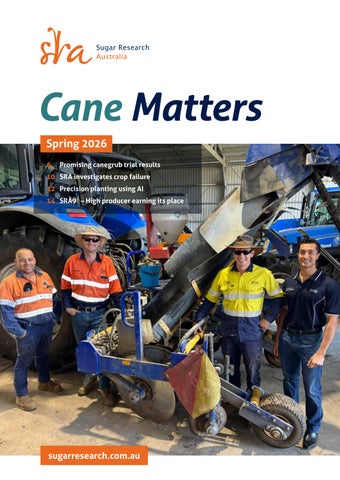
(Cover page) Pictured (L-R) - Central cane grower Tony Camilleri, SRA District Manager Central, Dylan Wedel, Department of Primary Industries (DPI), Development Extension Officer, Agri-Science Queensland (Crop & Food Science), Cameron Turnbull, and DPI Graduate Agricultural Economist, Rural Economic Development, Ben Hall. All are working on the DPI-funded project, ‘Using AI to optimise sugarcane planting practices.’ Editor: Sonia Campbell. Contributors: Christine Walker, Alisa Cork and Mike Ebner.
Acknowledgements: SRA acknowledges and thanks its investors, including levy payers (sugarcane growers and millers), the Commonwealth Government and the Queensland Government.
A MESSAGE
from Interim CEO, Haydn Slattery With Sugar Research Australia’s 2026–2031 Strategic Plan now finalised, approved and rolled out, our focus has firmly shifted from consultation and planning to delivery. This is an important moment for SRA and for the broader Australian sugarcane industry. The plan sets a clear five-year direction and provides the stability, focus and confidence needed to guide our investment, partnerships and practical research, development and adoption activities. At the heart of the plan is a shared commitment to lifting industry productivity and delivering value where it matters most. The priorities are clear developing better varieties, reducing losses from disease, pests and weeds, accelerating adoption, strengthening district delivery and partnerships, and ensuring SRA has the organisational capability to support these outcomes. Just as importantly, the plan has been shaped with industry, for industry. It reflects the input of growers, millers, productivity services, researchers and government. It provides us with a unified direction around the areas where SRA can make the greatest difference. The work ahead is now about working together on practical execution of this year’s actions, ensuring accountability and transparent reporting. We are working to ensure we are aligned in our investment and core activities with the plan’s priorities. Collaboration will be central to the success of this plan. SRA cannot deliver meaningful impact alone; it will take strong partnerships across all regions and across the whole value chain to turn proven science and innovation into real gains on farm and across the industry.
Those visits have reinforced the importance of staying connected and being responsive to localised issues. They have also highlighted the dedication and expertise within SRA . I have welcomed the opportunity to meet with staff across the organisation, reinforce our direction and acknowledge their contributions. Several important milestones worth recognising this quarter are Senior Variety Development Manager, George Piperidis, and Laboratory Coordinator, Peimaneh Lee-Steere, both marking 30 years of service, and Richard Cervellin who has dedicated 25 years with SRA and BSES. This kind of commitment reflects the depth of knowledge and history that continues to support our organisation and the industry. We are also conscious that the current season is presenting significant challenges across all districts, including crop performance tracking below estimates in most regions. At the same time, global uncertainty, including conflict in the Middle East, has the potential to place further pressure on key inputs. These conditions underline the importance of our industry working together on applied research, adoption support and practical solutions that help growers and millers manage risk, improve resilience and make informed decisions. As we move forward, there is real momentum behind SRA’s new strategic direction. The plan is now in implementation, our priorities are clear, and our commitment to industry remains strong.
Haydn Slattery Interim CEO Sugar Research Australia
Since stepping into the Interim CEO role, I have made it a priority to be present in the regions and to listen directly to the people and businesses we support. I have visited all growing regions, meeting with growers, millers, researchers, productivity services and local SRA teams. I have also toured each of the SRA research stations, farms and sites to better understand local priorities, opportunities and challenges, and to see first-hand the outstanding work being delivered by our people.
4
Cane Matters Spring 2026
Interim CEO Haydn Slattery during a visit to SRA’s Woodford Station in August.
SRA’S AGM SRA’s 2026 Annual General Meeting (AGM) will be held on Wednesday, 18 November 2026. The AGM is an opportunity for members to participate, ask questions and vote on new Board of Directors’ positions. This year’s AGM will see the appointment of three non-executive directors. When:
A foundation for the future 2026-2031 Strategic Plan
10:30am (AEST) 18 November 2026
Where: The AGM will again be held as a ‘hybrid’ meeting, which means members will be able to attend in person at University of Queensland, 308 Queen St in Brisbane, or virtually through an online platform.
VOTING BEFORE THE AGM If you are an SRA member or member representative, you will receive voting forms prior to the AGM. All SRA members are eligible and encouraged to vote. Please note, your completed voting form must be received at least 48 hours prior to the AGM. Any voting form received after that time will be invalid. You can lodge your completed voting form by either email, post or in person at the following addresses: Email:
members@sugarresearch.com.au
Mail: Sugar Research Australia Limited Attention: Membership GPO Box 133, Brisbane QLD 4001 Or in person: Sugar Research Australia Limited Level 10, 300 Queen Street Brisbane QLD 4000
FIVE-YEAR BLUEPRINT FOR A STRONGER SUGAR INDUSTRY: STRATEGIC PLAN 2026-2031 SRA recently launched its Strategic Plan for 2026-2031; a five-year strategy developed with industry, for industry, to help lift productivity across Australia’s sugar industry. The plan focuses SRA’s investment where it can make the greatest difference, with three key priorities: 1. Developing higher-performing varieties 2. D elivering practical crop protection solutions 3. Ensuring proven research reaches growers faster to accelerate adoption.
RELEASE OF SRA’S ANNUAL REPORT SRA’s 2025-26 Annual Report highlights the research investments designed to deliver tangible outcomes for industry. The Annual Report will be released in October and available for download from the SRA website. Reporting on the final year of the 2021-2026 Strategic Plan, the Annual Report includes an analysis of SRA’s key programs including variety development, adoption, agronomy and farming systems, crop protection, and milling and processing. The report provides an easy-to-read reference guide that captures the essence of our expertise and outlines the outcomes achieved under the previous Strategic Plan.
It also recognises the importance of strong partnerships, practical communications, digital tools, workforce capability, transparent reporting and long-term financial sustainability in achieving lasting productivity gains. The plan can be downloaded from the SRA website here. SRA Chair Mike Barry also outlines the plan’s clear goal - to support the industry to lift productivity by 10% by 2031- in this short video About the SRA Strategic Plan 2026 - 2031
sugarresearch.com.au
5
POSITIVE EARLY RESULTS IN SEARCH FOR ALTERNATIVE CANEGRUB CONTROL OPTIONS
Research investigating new options for controlling canegrubs in sugarcane is showing encouraging early results, with some products demonstrating potential as effective alternatives to the industry’s existing imidacloprid-based treatments. Sugar Research Australia’s Beyond Imidacloprid project is providing encouraging signs that new canegrub control options could be within reach. The project is investigating effective and sustainable alternatives to imidacloprid, for future canegrub management. It is a high-priority area of research for industry and SRA, as canegrubs remain one of the most damaging pests in Australian sugarcane. The first year of the project has included 12 field trials, established across eight cane-growing regions, testing a range of products against imidacloprid-based treatments. Treatments were applied to plant and ratoon crops late last year, following research partnerships established by SRA with the chemical companies and growers involved.
Beyond Imidacloprid PROJECT UPDATE SNAPSHOT
2 field trials conducted to assess 1 potential alternatives to imidacloprid rial sites were on farms at the Atherton T Tablelands, Gordonvale, Tully, Ingham, Burdekin, Mackay, Hervey Bay and Maryborough romising early results at some sites, P with some products showing good potential rub counts completed and harvesting of G selected trials has begun trongest-performing products, as well S as new novel products, will progress to a second season of field testing
Since then, SRA’s entomology team has assessed grub populations and crop growth to determine how effectively the different treatments had performed, with some products producing promising results under moderate to high grub pressure.
Some of the products in some of the trials look to be performing extremely well, at a level comparable to imidacloprid,” SRA Entomology Leader, Dr Kevin Powell, confirmed. “Where we’ve had medium to high grub pressure, we’ve seen some products significantly reduce grub numbers, which is very encouraging. “I’m happy we’ve got good data because it’s becoming clearer which products seem to be working, and which are less effective.”
6
Cane Matters Spring 2026
Harvesting of a Beyond Imidacloprid trial site at Ingham in August. All project trial sites, where grub numbers are high enough to show a treatment effect, are harvested to gain yield data.
Measuring crop performance Harvesting of the field trials has now begun, marking another important stage in the project. This will allow researchers to assess crop performance. “We’ve just started harvesting the field trials, so we’ll then be looking at yield data,” Dr Powell said. “This data is important in understanding the impact each treatment has had on the crop and productivity outcomes.”
SRA Entomology technician Bianca Mennilli (pictured left) with SRA Entomologist, Dr Emtia Chandrima, conducting a grub dig at a trial site at Ingham.
Greyback canegrubs collected from one of the trial sites.
Strongest treatments move into second season The next phase of the Beyond Imidacloprid project will repeat testing on products that looked promising in the first season and some novel products which haven’t yet been field tested. Chemical applications are expected to begin again in September, starting in the Burdekin, with trial sites being marked out across a mixture of cane stages, i.e. plant cane and ratoon crops. The second season is critical because robust field data is needed to support any future registration pathway. If grub numbers are adequate in the next round of trials, some of the products tested across both seasons may generate enough data to provide to agrochemical companies for consideration as part of a registration process.
New novel chemicals added to the trials Dr Powell said the next round of field trials would include several promising novel products, identified in additional laboratory testing, conducted in 2026. “We did extra laboratory trials this year and we saw some of those novel products perform extremely well,” he said. “They look highly promising, but we now need to see how they behave in the field because there are so many variables when you move from laboratory testing into commercial growing conditions.”
More tools in the toolbox A key aim of the Beyond Imidacloprid project is to identify more than one effective chemical option for canegrub control, giving growers a broader choice of products and reducing the industry’s reliance on a single chemical active. “I’ve deliberately chosen products with different modes of action so that, if we can get more than one product working, we can rotate products,” Dr Powell said. “Then there’s less likelihood of resistance to a product building up.”
SRA Entomology Research Scientist, Dr Samuel Bawa (left), with SRA District Manager Burdekin, Terry Granshaw, preparing for a chemical application on a trial site in the Burdekin.
“Having more than one effective product would also reduce the vulnerability that comes from relying too heavily on a single active ingredient.”
Positive signs despite seasonal challenges Despite the challenges associated with variable grub populations and seasonal conditions, Dr Powell said the message from this initial phase of the project is one of cautious optimism. The research is not finished, and no new product is available yet, but the data so far shows there are candidate treatments worth pursuing.
FIELD CONDITIONS AND GRUB NUMBERS HIGHLIGHT THE NEED FOR MULTIPLE TRIALS As is often the case with field-based research, not every trial site produced usable grub-pressure data. Rainfall affected some sites, including two in the Mackay region, making it difficult to demonstrate statistically significant differences between treatments. However, Dr Powell said this variability was expected and demonstrated why insecticide products need to be tested across multiple locations and seasons. “All of the sites were selected based on historical grub damage, but if weather conditions affect grub populations, there’s nothing you can do about that,” Dr Powell said. “We still assessed every site and analysed the data to see what information we could get from it. But soil type, environmental conditions, beetle flights and grub pressure can all influence how a product performs in the field. That’s why we have to do a lot of trials, in different locations, to build up enough reliable data.”
Sugar Research Australia (SRA) would like to acknowledge that the current SRA-funded Project 2025-001- ‘Beyond Imidacloprid – Ensuring effective and sustainable canegrub control for the future’, is an extension of a previous 4-year Imidacloprid research project funded by the Department of Primary Industries and SRA.
sugarresearch.com.au
7
FINDING NEW WEED-CONTROL OPTIONS AS PARAQUAT ACCESS CHANGES SUGARCANE GROWERS ARE BEING URGED TO PLAN AHEAD, AS THE INDUSTRY WORKS THROUGH REDUCING THE RELIANCE ON PARAQUAT FOR KNOCKDOWN CONTROL
Sugar Research Australia (SRA) is continuing to help sugarcane growers prepare for a future with limited or no access to paraquat. SRA is actively collaborating with chemical companies to identify, develop and progress alternative herbicide knockdown strategies.
To date, nine greenhouse pot trials have screened 11 registered herbicides and mixtures and five new (unregistered) active ingredients, supplied by chemical companies, to assess their knockdown efficacy and safety on sugarcane crops.
Promising options will be considered for potential registration by the Australian Pesticides and Veterinary Medicines Authority (APVMA), helping broaden the range of tools available to growers and support effective weed management into the future.
Initial results have indicated that four of the five unregistered compounds have “very good” control on some of the tested grasses. Similarly, some of the existing registered actives have also shown very good efficacies, on some of the tested grasses.
Early trial work conducted by Weed Science Leader, Emilie Fillols, is showing that alternative strategies to paraquat will not be a simple product substitution. Instead, it will require growers to learn how to safely incorporate the alternatives into a new weed management program to optimise weed control and minimise the impact on the crop.
“All treatments will now be screened in field trials, to assess their impact on cane yield,” Ms Fillols said. “Results will be shared with manufacturers to assist with potential future product registration, and to support the integration of any new active into a revised weed management program, that will be developed for industry.”
Ms Fillols is leading the SRA-funded project Paraquat alternatives – Re-develop Integrated Weed Management in Australian Sugarcane without Paraquat, to identify effective, affordable and crop-safe strategies for knockdown grass control.
Until new recommendations are available, growers are advised to use only registered products as directed, and seek advice from their local productivity service, agronomist or reseller before changing programs.
“This work is focused on early post-emergent control of key grass weeds such as itch grass, Guinea grass, crowsfoot, summer grass, wild sorghum and Johnson grass, which are currently managed with paraquat,” Ms Fillols said.
While chemical manufacturers, SRA and industry partners are busy developing alternative strategies to paraquat, and exploring potential pathways to seek limited use permits of paraquat in sugarcane in the future, growers can find current weed management alternatives without paraquat here.
Project 2025/002 – Paraquat alternatives Re-develop Integrated Weed Management in Australian Sugarcane without Paraquat is wholly funded by Sugar Research Australia (SRA).
8
Cane Matters Spring 2026
Industry will continue to be updated on the results from Ms Fillols’ trials, via SRA’s various communication channels. Once effective and affordable alternative control methods are identified, workshops will be held across all major sugarcane growing regions to communicate the new integrated weed management guidelines, including spray application rates and timings.
2026 -27 AC TIVITIE S
A crop safety pot trial on new actives that will be transplanted in the field.
An efficacy pot trial on crowsfoot, screening new and already registered actives as part of the paraquat alternatives project.
CROP SAFETY PLANT CANE TRIALS
CROP SAFETY RATOON TRIALS
EFFICACY TRIALS
MEETING / WORKSHOPS
3 FIELD TRIALS • 10 varieties • 14 treatments directed spray - 4 new activities - Glufosinate - Balance + Tressal - Paraquat
4 FIELD TRIALS • 1 variety •5 treatments directed spray - Glufosinate 3 rates - Balance + Tressal - Paraquat
7 POTS TRIALS • 7 key grass species • 14 treatments - 4 new actives - Registered herbicides Efficacy data from crop safety field trials
•P resent research findings •U pdate and present guidelines without paraquat
Emergency use permit sought While alternative strategies to paraquat are being explored, SRA continues to provide technical advice and support to industry partners seeking an emergency use permit that would allow growers to retain some access to paraquat in sugarcane, with appropriate safeguards in place. The APVMA’s recent ruling on paraquat use removed sugarcane from revised paraquat labels because the allowable application rates were well below those required for effective use in cane.
An efficacy pot trial on Guinea grass, screening new and already registered actives.
Products with labels approved before the APVMA decision can continue to be used until 22 June 2028. However, growers are limited to the finite supply of old-label stock available.
sugarresearch.com.au
9
Irregular crop growth in a cane paddock in Mackay associated with Fusarium fungus.
NEW PROJECT TARGETS POSSIBLE FUNGAL THREAT BEHIND CANE ESTABLISHMENT FAILURES A new SRA project will investigate whether the fungal disease, Fusarium wilt, is contributing to widespread production losses across industry. Germination failure and stool mortality have become an increasing concern for Australian sugarcane growers, with reports of uneven crop establishment, high replanting rates and lower-than-expected yields across several regions. Recent evidence collected by SRA researchers suggests that Fusarium wilt may be responsible. Although the economic cost of Fusarium wilt is poorly understood, its annual losses could reach several million dollars in the Central and Herbert regions. New South Wales growers have also recorded losses consistent with Fusarium wilt caused by Fusarium sacchari. SRA Manager, Biosecurity & Disease Screening, Dr Shamsul Bhuiyan, will lead the new project, titled Investigating fungal-induced germination failure and plant mortality in sugarcane: Causes and Management Strategies. “The first phase of the project will build a clearer picture of where the problem is occurring, how widespread it is, and what the economic cost is to the Australian industry,” Dr Bhuiyan said. “It will also assess which varieties are most vulnerable, and what short-term options could help reduce losses. As this work progresses, we will seek to develop a sustainable, long-term strategy for integrated management of the disease,” he said.
10
Cane Matters Spring 2026
Grower surveys and field sampling The first phase will include a national survey across all sugarcane growing regions to identify affected areas and collect plant and soil samples for lab testing. The survey will help determine the scale of the problem, the regions and farming systems most affected, and which varieties are more susceptible or resistant. “For growers, the findings from this survey will show where and how severely the disease is affecting crops, and which varieties are at greatest risk,” Dr Bhuiyan said. “This information will help identify practical options to manage risk across all mill supply areas.” Better diagnostics for better decisions The project will continue identifying Fusarium isolates and any other pathogenic fungi from industry samples and use DNA-based testing to confirm the species involved. A key goal is to develop a molecular qPCR test to detect and measure fungal inoculum levels in soil. “If soil inoculum levels can be measured reliably, the industry can move towards more informed risk assessment and disease prediction,” Dr Bhuiyan said. “Over time, this could help growers and advisers make better decisions about variety selection, fallow management, planting material and paddock risk.”
A cane crop in NSW affected by Fusarium wilt.
PROJECT UPDATE SNAPSHOT apping the scale and cost of M Fusarium wilt to the Australian sugarcane industry eveloping better tools to diagnose D paddock risk.
SRA Manager, Biosecurity & Disease Screening, Dr Shamsul Bhuiyan will lead the new Fusarium wilt research project.
I dentifying more resistant sugarcane varieties to Fusarium wilt. I nvestigating potential fungicide treatments. eveloping practical strategies to D reduce crop losses
Finding which varieties are more resilient Major commercial varieties will be screened at the Woodford Pathology Station to identify differences in resistance or susceptibility to Fusarium sacchari or other species that infect sugarcane. (Growers should note that Fusarium infecting sugarcane is a different species to that which causes Panama Disease Tropical Race 4 in bananas.) In a future phase, resistant/tolerant varieties may progress to field trials in commercial paddocks known to be infested. This work could improve future Variety Guides and help growers choose varieties for blocks with high fungal disease pressure. Testing possible fungicide options The project will screen fungicides with different modes of action to assess their ability to reduce fungal growth and spore germination. Promising products will be tested under controlled conditions to see whether they improve sett germination, plant establishment and seed-cane survival. Any fungicide option would need field testing before being recommended to growers. Discussions with chemical manufacturers and the Australian Pesticides and Veterinary Medicines Authority (APVMA) would also be required before any label extension or registration pathway could proceed.
What the project could mean for growers For growers, the project aims to turn paddock observations – poor strike, weak plants, uneven stools and underperforming ratoons – into evidence-based management options. It is expected to deliver clearer information on affected areas, improved diagnostic tools, better understanding of varietal tolerance, evidence on fungicide options and a stronger base for future integrated disease management. Building confidence in future varieties Developing a new sugarcane variety is a major industry investment. When high-yielding varieties perform poorly in affected paddocks, growers lose confidence and the industry risks missing productivity gains. By investigating why some recently-released varieties may not perform as expected, the project aims to strengthen future recommendations, field trials and gains from the SRA breeding program. Next steps The first phase will produce an industry fact sheet with key first-year findings, preliminary recommendations and diagnostic insights, shared through SRA communication channels as practical information becomes available. Growers experiencing poor germination, unexplained stool loss or early crop failure should contact their local productivity service or SRA District Manager as survey and sampling activities are rolled out.
sugarresearch.com.au
11
FROM TONNES TO TARGETS: USING AI TO SHARPEN SUGARCANE PLANTING
A new project involving precision AI technology is aiming to shift sugarcane planting from a system based on estimates to one guided by agronomy, accuracy and real-time data. The project, Using AI to optimise sugarcane planting practices, is funded by the Department of Primary Industries (DPI) and brings together Hodge Industries, DMD Ag Solutions, SRA, DPI, Griffith University and SCAN Consulting, with support from the Camilleri farming family, who run one of the largest planting contractor businesses in the Central district. At its centre is a prototype artificial intelligence (AI) camera system that has been installed on the Camilleri’s two commercial planters in Mackay. The technology is being developed to count sugarcane nodes as billets move through the planter, with node counts used to estimate the number of buds, or eyes, and give growers a more accurate measure of planting material than the industry’s current tonnes per hectare standard. SRA District Manager Central, Dylan Wedel, who is leading SRA’s involvement in the project, said rather than relying on estimated bin weights and visual assessments of billet flow, the project is investigating whether realtime monitoring – similar in principle to a grain seed monitor – could help growers understand how many nodes are being planted per metre of row. “Seed cane is a valuable input, and growers need confidence that every billet going into the ground is contributing to the crop establishment,” Mr Wedel said. “Currently, operators use higher rates of planting material to prevent gaps due to billet quality and fluctuating billet flow from the planter. “This new AI technology has the potential to help the industry plant smarter, reduce inputs and improve the efficiency of every hectare planted without the risk of gaps.”
12
Cane Matters Spring 2026
Department of Primary Industries Development Extension Officer, Agri-Science Queensland, Cameron Turnbull, works to attach a prototype AI camera system to a commercial planter.
The problem with tonnes per hectare For generations, sugarcane growers have used tonnes per hectare (t/ha) as the standard planting measure, with many aiming for about 8 to 12 t/ha. But weight does not show how many viable eyes are being placed in each metre of row. To manage the risk of under-planting, growers can end up over-planting, using seed cane that might otherwise have gone to the mill. Across the Australian sugar industry, seed cane waste from over-planting has been estimated to cost almost $30 million each year. A better measure: nodes per metre The project is focused on a more agronomic measure: nodes per metre. The target for a successful strike is four to six eyes per linear metre, with the aim of establishing at least three primary shoots per metre, so tillers contribute to the final stalk population at harvest. Measuring nodes gives growers a closer indication of establishment potential than tonnes per hectare because it focuses on the number of growing points being planted. Using AI for improved harvesting of billets for planting The Mackay prototype uses high-speed cameras and AI algorithms to identify nodes as billets move through the planter. A similar AI camera system has also been installed on a harvester owned by the Camilleri family to test realtime quality control when harvesting for seed cane, supporting faster decisions about billet quality. “Billet quality is best managed at the harvester, where opportunities to adjust harvesting parameters or the plant source is possible,” Mr Wedel said. “With planters it’s garbage in-garbage out, so we need the best quality seed material being tipped into the planter.”
Central cane grower and planting contractor Tony Camilleri (left) with SRA District Manager Central, Dylan Wedel.
SRA District Delivery Officer Assistant Central, Hayley Keats, assists SRA District Manager Central, Dylan Wedel to test prototype AI technology installed on a commercial planter as part of a new DPIfunded project to improve sugarcane planting practices.
Partnership driving innovation Griffith University Research Fellow Rudi Bartels is leading the project’s technical development with SCAN Consulting contributing specialist capability, while SRA and DPI’s Coastal Farming Systems Team are supporting project delivery and industry connection. The Camilleri family’s involvement means the technology is being tested in a commercial environment under real planting conditions. Brothers Tony and Justin Camilleri, together with Justin’s son Jade, and their families, farm 200 hectares of cane at Palmyra and Racecourse, near Mackay, while also operating the contracting planting business.
Tony Camilleri (pictured left) with his nephew Jade are assisting with the AI project, allowing the technology to be evaluated under commercial farming conditions.
Tony said he was happy to be involved in the AI project because it had the potential to improve the quality and consistency of planting for growers. “It’s about getting better billet quality. If this technology can help us produce a better billet and a better product, it will cost the farmer less in the long run,” Mr Camilleri said. “The industry has to keep moving forward, and the more we can do that, the more growers will benefit.” While the technology is still at prototype stage, the system is also helping researchers investigate how billets move through different planter configurations and how evenly planting material is distributed, including across multi-row planters. Future work will investigate closed-loop billet-feed control, where real-time information could be used to help automatically adjust billet flow, as well as providing manufacturers with quantitative feedback to improve planter design. “If we can better understand what is going into the ground, we can help growers make more informed decisions and get more value from their seed cane,” Mr Wedel said.
WHAT THE PROJECT MEANS FOR GROWERS For cane growers, this project could provide a practical way to reduce guesswork and seed cane used at planting. More accurate information about planted eyes per metre may help growers •
reduce wasted seed cane
•
improve crop establishment
•
minimise gaps in the paddock
•
lift confidence in planting decisions.
Ultimately, the project is about helping every metre of cane row perform closer to its potential, while improving profitability across the industry.
SRA would like to thank and acknowledge the Camilleri family for their involvement in this project and their willingness to host the research, enabling the work to be evaluated under commercial farming conditions.
This project is funded by the Department of Primary Industries.
sugarresearch.com.au
13
SRA9A – HIGH PRODUCER EARNING ITS PLACE IN CENTRAL DISTRICT
Mackay cane growers Colin and Georgina Vassallo with a crop of SRA9A on their Septimus farm, west of Mackay.
Central region cane grower, Colin Vassallo, was the earliest adopter of SRA9A , becoming the first to plant it commercially 20 years ago while it was still an unreleased seedling progressing through BSES breeding trials. Mr Vassallo, who farms cane with his wife Georgina, and son Colin Jnr at Septimus, west of Mackay, saw enough promise in SRA trial results, that he asked for some planting material, to test it under his own conditions. “We first got it (SRA9A) in 2005, we got five sticks from BSES,” Mr Vassallo recounted. “At the time we were doing a row-spacing trial with SRDC (Sugar Research and Development Corporation), and I asked BSES if we could have some other varieties to trial and they allowed me to walk through their plot of promising varieties. “I chose about four varieties and SRA9A was one of them. The others (turned out to be) simply no good. But this one stood out a mile.” From five sticks to a farm mainstay Over time, the high-yielding clone, proved why it had stood out in the trial plots. “Those first five sticks that we got, stretched out to about 10 metres or so, and when we cut it - I cut it by hand - there was just so much more cane in it, we ended up calling it HP, for ‘high producer’, and that’s how we identified it,” Mr Vassallo said. “We found it to have probably 10 to 20 percent more cane in it than other canes. Eventually we planted a couple of hectares of it, and we found it to be extremely good. It was cutting between 120 to 150 tonnes to the hectare.”
14
Cane Matters Spring 2026
After initially trialling five sticks of SRA9A 20 years ago, the variety now accounts for almost 40 per cent of the Vassallo’s annual harvest.
A variety built on reliability Two decades on, SRA9A is now one of the mainstays of the Vassallo’s farming business, making up 40 per cent of their cane production. Mr Vassallo says its greatest strength is not just peak yield, but its ratoonability.
Where we first put that couple of hectares in, I now have tenth ratoon, and it’ll do somewhere between 90 to 100 tonnes to the hectare, which is not too bad,” Mr Vassallo said. “Plant cane, we’ve always found it to be excellent. It’s a very, very reliable striker. It grows properly; it doesn’t do anything silly. “If there is a high smut population in the area, you’ll see a few sticks with smut. But it hasn’t affected the crop.” Where SRA9A fits best Mr Vassallo believes SRA9A is well suited to lighter soils, where it has proven particularly dependable on his Septimus farms. “It will grow in a heavy soil, but the heavier soils tend to get a little bit wet for it at early stages. It doesn’t like being wet too early. But in the lighter soils, it’s very dependable.” That observation has also shaped how the Vassallos manage the variety after harvest. They avoid overwatering SRA9A immediately after cutting, preferring a light irrigation if conditions are dry.
HERBERT GROWERS GAIN SRA9A AS A NEW HIGH TONNAGE OPTION
“I’ve found over the years, after it’s harvested, I don’t irrigate it too much - just a light watering,” he said. “It doesn’t like being cut and getting real wet. But it will recover from it, if it does rain a lot, it’ll recover; it’ll just take longer.” In Mr Vassallo’s view, SRA9A is not “a flashy” earlyseason variety. Instead, he says it grows steadily and holds on. That growth habit can make the crop look unremarkable early in the year, only to reveal its bulk later as it ripens, making it a mid-to-late harvest variety. “It’s not terribly fast growing. It’s just a constant growth. It tends to grow through the winter, and come May, you think, ‘geez there’s not all that much there’, but then you see all the tops ripen up and it was there alright. So, it’s (harvested) from August on,” he said.
Originally a Central region variety, SRA9A was approved for release in the Herbert Region at the district’s Regional Variety Committee (RVC) meeting in April.
One challenge with SRA9A , that Mr Vassallo notes, is that the very high-yielding crops can lodge, creating extra work at harvest.
The promising clone demonstrated exceptional results in SRA field trials conducted in the Far North, outperforming Q208 by 14% in terms of sugar yield. The yield advantage provided by SRA9A has been consistent across crop classes.
“If it’s a really big crop, it can lay down both ways and it can be a bit of a problem for the harvesters,” he says. “But (in saying that) it’s always been able to be harvested. So, it’s better to have a big crop there, than no crop there.” Mr Vassallo acknowledged that SRA9A can carry slightly lower CCS than some other varieties, but said the result depended strongly on the crop and the season. “It does tend to be half a unit lower,” he said. “However, if it’s a crop that’s straight and dry - it’ll test more than other varieties.”
SRA9PFACTS
“Despite having a lower sugar content than some other varieties, SRA9A is a profitable choice due to its vigorous growth and high tonnage at harvest,” SRA General Manager Variety Development, Dr Garry Rosewarne, said. “It is also a good choice for growers who have to deal with higher Pachymetra spore counts. However, where smut pressure is high, growers should seek more resistant alternatives.” For more information about SRA9A read the Northern Coastal and Tableland variety summary factsheet.
SRA9A was released in the Central region in 2017, the North in 2022 and Herbert in 2026 A rapid and reliable germinator and ratooner Despite its lower CCS, SRA9A is a profitable choice due to its vigorous growth and high tonnage at harvest A sparse arrowing variety, with moderate trashing and does not sucker easily
Well suited to lighter soils, can grow in heavier soils but doesn’t like being wet early
Constant growth through season, more growth later in season, suits mid to late harvest Maturity testing should be a priority if considering the use of growth regulators Intermediate resistance to smut so growers should seek another variety if smut pressure is high Resistant to leaf scald, orange rust, mosaic, and Pachymetra, making it a good option for rotations into soils with high Pachymetra spore counts sugarresearch.com.au
15
SRA49 AND SRA50 SHOW STRONG PROMISE FOR THE FAR NORTH Two new varieties – SRA49 and SRA50 – were approved for release by the Northern Regional Variety Committee (RVC) in April. Trial results for both showed their performance was higher than commercial standards and competitive with SRA26 A . SRA49 is resistant to Pachymetra and has very sparse arrowing, indicating a growth potential throughout the season. The clone has a tendency to lodge, has shown a low percentage of fibre, similar to Q250, and in germination has a habit to prostrate similar to SRA26 A . Trial data for SRA50 indicates a high early CCS potential. It is rated as having intermediate resistance to Pachymetra, heavy arrowing similar to Q208, and suckering similar to Q240 A and SRA28 A .
Trial data from 2022, 2023 and 2024 showed similar responses with both clones, where they consistently outperformed the average of the standards in numerous trials. Depending on the year, both clones had consistent and significantly higher cane per hectare than Q208 and were typically on par or slightly higher-yielding than SRA 26 A . Both clones gave between 0.3 and 0.9 more units of CCS than Q208, on par with that observed in SRA26 A . SRA49 usually gave slightly higher sugar than SRA50. Both clones performed best in trials grown on welldrained alluvial soils in the Tully and Mulgrave mill areas, where they clearly outperformed both SRA26 A and Q208.
Northern growers interested in the two new clones should contact their local cane productivity service.
Side view of SRA49
16
Cane Matters Spring 2026
SRA49 FACTS
Resistant to Leaf Scald and Pachymetra with intermediate resistance to Smut
Between 0.3 and 0.9 more units of CCS than Q208, on par with CCS observed in SRA26A
Maturity testing over three consecutive seasons indicates that SRA49 has good CCS potential – particularly during the mid-to-late harvest period Performs higher than commercial standards and competitive with SRA26A
Has shown an 8% sugar yield increase over commercial standards
Performed best in trials in the Tully and Mulgrave milling areas, and clearly outperformed both SRA26A and Q208
View the SRA49 Variety Fact Sheet here.
Has shown an 8% sugar yield increase over commercial standards
Heavier crops can be prone to lodging, resulting in average harvester presentation
Suckering similar to Q240A and SRA28A
Heavy arrowing similar to Q208
Performs best in well-drained alluvial soils A good germinator
SRA50 FACTS
Moderate to heavy trashing
Intermediate to Pachymetra, growers should not plant in soils with high spore counts Resistant to Leaf Scald with intermediate resistance to Smut
Higher tonnes per hectare than SRA26 with similar CCS
High early CCS potential – particularly during the mid-to-late harvest period - between 0.3 and 0.9 more units than Q208, on par with CCS observed in SRA26A Heavy arrowing similar to Q208
A reliable germinator, similar to Q253A
Performed best in trials in the Tully and Mulgrave milling areas, and clearly outperformed both SRA26A and Q208 View the SRA50 Variety Fact Sheet here.
The yield advantage is consistent across crop classes and trial locations, performing particularly well in well-drained alluvial soils Exhibits an open growth habit similar to Q208, however SRA50 does not lodge readily
It has a canopy which is prone to expressing yellow spot in most seasons
Suckering similar to Q240A and SRA28A Variety has a moderate stalk population with good stalk diameter and produces moderate trashing
sugarresearch.com.au
17
NEW FACES ON THE PLANT BREEDING TEAM
SRA’s Variety Development team has welcomed new expertise with the goal of creating the world’s most scientifically advanced sugarcane breeding program. The program combines advanced statistics, genomic selection, tissue culture and international germplasm exchange, supported by about 60 full-time staff and casual teams across nine sites. Recent appointments are strengthening the program with advanced skills in plant breeding, data science, disease resistance, grower engagement and new technologies, all focused on developing improved sugarcane varieties in a shorter period for growers and industry.
Dr Eder Dias dos Santos manages SRA’s variety development program across North Queensland, working with teams in plant breeding, agronomy, statistics, experimentation and plant pathology. Since joining SRA in March, he has focused on connecting science, data and industry needs to accelerate the development and adoption of improved sugarcane varieties. Eder began working in sugarcane breeding in Brazil in 2002/2003 and has contributed to some of the country’s largest breeding programs. After broadening his experience in animal breeding, grain production and global hybrid development, he brings a strong focus on making variety development more agile, precise and responsive to growers’ expectations for faster gains. Dr Ankush Wankhade, a Plant Breeder at Mackay from India, describes sugarcane breeding as a truly multidisciplinary role drawing on genetics, agronomy, pathology, entomology, statistics and processing. With qualifications in agricultural science and plant breeding, Ankush is especially interested in sugarcane’s genetic complexity, including its highly polyploid nature and long breeding cycle. Before joining SRA, Ankush worked as a peanut breeder in Kingaroy, using genetic marker-assisted selection to improve disease resistance. He now aims to combine traditional breeding with genomics, data analysis and statistical tools to develop sugarcane varieties with better productivity, disease resistance and adaptability.
Dr Alison Jensen has returned to SRA as a Plant Breeder in Bundaberg after beginning her sugarcane career with BSES and later SRA . She is passionate about disease resistance, industry collaboration, improved data capture and analysis, and applying new technologies to breeding. Alison says plant breeding is exciting because it brings together genetics, plant pathology, data analytics, agronomy, technology, research and extension. She is motivated by the impact of releasing high-quality varieties after years of work and values the sugarcane industry’s collaborative culture across growers, millers, researchers and SRA staff.
18
Cane Matters Spring 2026
David Hughes joined SRA in January as a Research Scientist, bringing expertise in statistics to support better decision-making and optimisation in the Variety Development program. He holds a Bachelor of Medical Mathematics (Hons) and is completing a PhD in Statistics at the University of Wollongong. David will work remotely from Wollongong until February 2027 when he will relocate to Meringa.
Dr Yichen Kang is the new early generation plant breeder and is based in Meringa. Her role will be to oversee crossing and early generation trials and will be fundamental in implementing a computation breeding strategy afforded by the SRA investment in genomics and genotyping. Yichen completed her PhD at QAAFI, University of Queensland, where she researched genetic improvement of durum wheat root systems using introgression, phenotyping and quantitative genetics. She sees sugarcane as a promising food and bioenergy crop and believes breeding can support diversification, sustainability and commercially valuable products apart from raw sugar.
Together, the new team members bring vast experience and fresh perspectives to SRA’s sugarcane breeding effort. Their combined focus on data-driven decisions, disease resistance, genomics, grower needs and industry collaboration will help strengthen the pipeline of improved varieties for the Australian sugarcane industry.
sugarresearch.com.au
19
RETHINKING SILICON UPTAKE IN SUGARCANE
SRA Agronomists Dr Danielle Skocaj (left) and Erin Headon assessing the presence of siliconlike deficiency symptoms and leaf diseases at an intensively monitored site.
Two years into the project, Dr Skocaj reports that field observations are revealing a consistent pattern: Si content of third leaf tissue samples are lower than expected, despite soil assays indicating adequate plant available Si. “This pattern has emerged across multiple districts within the Wet Tropics, consecutive seasons, and spans a wide range of soil types, varieties and crop classes,” Dr Skocaj said. “In 2025, we surveyed 102 commercial cane blocks in the Tully and Innisfail districts, collecting third leaf tissue and soil samples. Approximately 85% of third leaf samples were below the industry target value of 0.55 Si (% dry matter). Yet, soil tests indicated very few sites had low soil Si values. The disconnect between soil and plant datasets is central to our research.”
20
Cane Matters Spring 2026
8
1.20
1.10
1.15
0.95
1.05
0.90
0.85
0.75
0.80
0.70
0.65
0.55
0.60
0.50
0.45
0.35
0.40
0.30
0.20
0.25
0.10
0 0.15
The project, Are trends in silicon uptake a reason for concern?, has been jointly led by SRA Principal Agronomist Dr Danielle Skocaj and University of Southern Queensland Professor Bernard Schroeder in partnership with CANEGROWERS Innisfail since 2024. It was awarded under SRA’s 10th Anniversary Research Funding Call following earlier work by SRA agronomists that identified widespread low Si uptake in commercial sugarcane crops.
16
0.05
Low silicon in the crop - soil tests and crop results aren’t aligning
Percentage of samples
A current SRA-funded project is investigating how Si availability and uptake are determined in sugarcane systems.
24
0.00
Silicon (Si) is recognised as a beneficial nutrient for successful sugarcane growth, improving crop tolerance to various stresses, and contributing to improved yields.
Third leaf Si (%DM)
Figure 1. The percentage of samples from the 2025 survey plotted against third leaf Si (%DM) values
Understanding the disconnect Traditionally, growers and advisors have relied on soil tests to assess Si requirements and analysis of third leaf tissue samples to check on the adequacy of crop uptake. Two laboratory soil assays are used to determine plant available Si (calcium chloride extraction) and reserve Si that is less available (sulphuric acid extraction). While both soil tests provide useful information, Dr Skocaj said they are most effective in estimating when cane yield responses are possible especially in lighter textured soils. The project has found that: • Some soils contain high amounts of Si but this is not always accessible to sugarcane crops. • Associated third leaf values are low despite adequate soil Si supply • Crops with low third leaf values don’t always express Si deficiency symptoms or have lower yields.
CANEGROWERS Innisfail District Extension Officer, Ilanah Baston extracting xylem sap to assess the presence of Ratoon Stunting Disease (RSD) in tagged stools at an intensively monitored site. The presence of RSD may affect the transport of silicon within the plant.
“This highlights an important point. High soil silicon does not always translate to high plant uptake,” Dr Skocaj said. The findings are also raising questions about third leaf Si concentrations. The current industry benchmark is 0.55% Si. However, many sites tested in the project fell below this value without showing typical symptoms. There was also a range of leaf Si values despite similar soil Si test results. Has something changed? The third leaf test results contrast with a 2010 Tully district survey, where only 25% of third leaf values were below the Si target.
At each site, researchers are tagging individual stools and sampling them repeatedly. Third leaf samples are collected monthly. Soil conditions and disease pressures are monitored prior to sampling the crops to determine biomass and total nutrient uptake. What factors may be affecting Si supply and uptake? Importantly, the project is looking beyond soil Si supply. Researchers are assessing whether soil chemical properties are affecting Si availability. They are also assessing whether Si uptake and translocation within the plant is affected by diseases such as Pachymetra root rot and Ratoon Stunting Disease (RSD). Why is this research of interest to growers?
“Unfortunately, there are no corresponding soil Si data to enable full interpretation of that third leaf dataset,” Dr Skocaj said.
Ensuring Si nutrition remains adequate is important for maintaining the resilience of sugarcane crops to pest and disease pressures in the Wet Tropics.
Taking a new approach in 2026 - Tracking Si over time
The project is focussed on better understanding factors affecting Si nutrition rather than simply applying more Si when third leaf values are below the target.
To better understand factors contributing to low Si uptake, the project team has now shifted from a targeted crop survey to intensively monitored sites. This will allow changes in Si uptake to be assessed throughout the growing cycle. In 2026, 20 sites in both the Tully and Innisfail districts were selected to represent the major soil types, standard commercial varieties and a range of soil Si values.
A turning point for silicon management The emerging evidence suggests the industry may need to rethink how it approaches Si nutrition. As the research progresses, it will provide valuable insights to support improved decision-making for individual crops. Outcomes of the project will improve industry understanding of Si management.
sugarresearch.com.au
21
Photos supplied by TEFCO Trailers
TABLELAND MILL IMPLEMENTS THE BINSITES SYSTEM FOR 2026 SEASON MSF Sugar’s Tableland Mill took a significant step towards increased efficiency of its cane supply operations with the implementation of the BinSites electronic cane bin tracking system for the 2026 crushing season. Developed by the Queensland University of Technology (QUT) and software and information technology partner iScape, BinSites provides realtime tracking of locomotive cane bin deliveries and is designed to improve efficiency and visibility across the cane transport network. The project is funded by the Department of Primary Industries (DPI) and managed by SRA, with in-kind contributions from several mills. The system benefits both mills and growers by using electronic consignments and bin readers to accurately assign cane bins to growers, track the location and status of bins across the network, share scheduling information in real time, and record consignment details including the harvest block and time of harvest. The system will help address common challenges associated with paper-based consignment systems, including paperwork errors, lost records and limited visibility of cane movements, giving growers greater confidence that cane is correctly attributed and providing earlier information to support harvest planning and logistics.
22
Cane Matters Spring 2026
For Tableland Mill, the key challenge was ensuring the system was fully operational for a road-transport delivery operation, in time for the start of the 2026 season in early May.
The decision to adopt BinSites arose from the need to modernise the mill’s existing system,” Cane Supply Operations Manager Duane Roberts said. “Dennis Wright, MSF Cane Supply Operations Manager for Mulgrave and South Johnstone mills, first raised the concept of electronic consignments with QUT several years ago and subsequently played the principal advisor role in the development and rollout of BinSites. “The challenge was to integrate MSF Sugar’s existing systems with BinSites so as not to lose any critical information held in MSF’s systems. “We also had to adapt the core BinSites system from a rail-based model to one that supported a complete road-transport delivery operation. “We had operated other systems, but BinSites’ key difference was that it had been developed specifically for the sugar industry with a development team that understood the industry and its operational requirements.”
Read more on the Cane Bin Tracking and Electronic Consignment of Cane Project 2024/509 here.
Mr Roberts said adapting the BinSites platform from rail-based cane transportation to road-transport operation was a significant challenge because of the different requirements associated with truck movements.
“Credit must be given to the BinSites development team and MSF Sugar staff who invested significant time and effort to ensure the system delivered what it was designed to achieve.
“MSF Sugar’s operational needs required adapting BinSites to manage one bin per consignment,” he said.
“The introduction of satellite internet was definitely a game changer. It significantly improved connectivity and system reliability.”
“However, this developmental requirement ultimately resulted in enhancements to the BinSites platform.
The BinSites system continues to be developed, upgraded and refined at the mill.
“We enjoyed working with the development team who demonstrated a positive and flexible ‘can-do’ attitude. Despite ours being the first installation of its kind, the new system is a genuine improvement and supports a more effective just-in-time delivery model.
“There is a strong commitment from everyone involved to see the project come off successfully,” Mr Roberts said.
“Working through the process was a positive experience, which helped establish a close and collaborative relationship between all parties.” Introducing road transport to the system did bring some initial teething issues, Mr Roberts said. “As with any new system, everyone had to understand and adapt to a completely new operational dimension. The support and coaching provided to users – both initially and ongoing – has been essential to the successful adoption of BinSites,” he said.
“When an issue arises it is addressed, tested, implemented and reviewed. As the tonnage delivered to the mill increases and the system is used more extensively, its benefits are expected to translate into greater operational output. “BinSites represents a whole-of-system change with benefits extending across every part of the sugarcane supply system. “I am confident all mills and growers using BinSites will benefit from the shared experience and ongoing improvements as the system continues to be developed and implemented.”
This project is funded by the Department of Primary Industries and managed by SRA. sugarresearch.com.au
23
More growers across Queensland’s cane-growing regions are working with SRA staff to use handheld microNIR technology in the paddock, gaining faster insights into crop maturity, CCS development and harvest readiness. From Final Assessment Trials in the Central District to commercial paddocks in the North and Far North, the portable (NIR) scanners are being used to rapidly assess cane stalk maturity, provide insights into variety performance and help guide decisions on growth regulator use and harvest scheduling. Fast in-field readings give growers practical information when it matters, without waiting for traditional destructive sampling and laboratory analysis. Those insights support better-timed decisions that can improve productivity and profitability, while each new dataset helps keep the tool’s calibrations consistent and accurate.
Current MicroNIR work with growers builds on years of previous SRA trial work to measure crop maturity and support more informed crop-management decisions. Trials conducted through the Mulgrave CCS Improvement Project in 2022 found that sugarcane growth regulators containing trinexapacethyl (such as Moddus and AC Grappa 250) are more likely to provide a profitable response when crop moisture content is between 71-75% at application, under suitable crop and seasonal conditions. This moisture range was found to broadly correspond with a brix reading of between 16.0 and 19.5 per cent. Applying growth regulators within this range, six to 10 weeks before harvest, showed the greatest likelihood of improving profitability.
24
Cane Matters Spring 2026
Far North District Delivery Officer Gracie White (left) with Mulgrave cane grower Greg Nucifora, using microNIR technology to measure crop maturity in one of his cane blocks.
HANDHELD SCANS DELIVER REAL RETURNS FOR MULGRAVE GROWER Mulgrave cane grower Greg Nucifora has experienced tangible economic benefits from using handheld MicroNIR testing to guide his crop-management decisions this season. “We’ve seen better sugar results definitely,” Mr Nucifora said. The result highlights the economic value of having fast, block-specific maturity data before committing to growth regulator applications or deciding when a crop should be harvested. Mr Nucifora first trialled handheld MicroNIR maturity testing on his Edmonton blocks in mid-2026. For the third-generation grower, the technology’s value lies in adding objective evidence to decisions often made under tight seasonal pressures. “We farm from Edmonton to Gordonvale, so having that extra information in the paddock has been useful,” Mr Nucifora said. MicroNIR uses near-infrared scanning to rapidly assess cane stalk maturity, with calibration work linking measurements including Brix, fibre and moisture to help identify when sucrose is approaching its optimum level and crops are nearing their optimal harvest window. In the Far North, SRA District Manager Paul Calcino and District Delivery Officer Gracie White have been working with growers across the South Johnstone,
Mulgrave and Tableland mill areas. The work continues to explore how rapid, in-field maturity assessments can support block-level decisions. Mr Calcino said the technology was designed to complement grower experience by adding objective information when timing - and the potential return on investment - mattered most. “The MicroNIR provides a rapid assessment of crop maturity, which gives growers another piece of information to support decisions about when individual blocks are approaching their optimal harvest window,” Mr Calcino said. “That information can help growers decide which blocks should be prioritised for harvest, particularly where blocks are at different stages of maturity or seasonal conditions have made crop progress less predictable.” For growers, the results may support a decision to apply a growth regulator with greater confidence, delay an application or avoid the expense where the likely return does not justify it. “Growth regulator applications come at an additional cost,” Mr Calcino said. “By replacing some of the uncertainty around crop maturity with objective, field-based information, we can support targeted and financially sound decisions.”
sugarresearch.com.au
25
SRA District Manager, Jessica Portch, has been assisting a dozen growers in the North with measuring crop maturity for more informed crop management decisions.
IN-FIELD MATURITY CHECKS HELP GROWERS WITH RIPENER AND HARVESTING DECISIONS In the North, SRA District Manager, Jessica Portch has been working with 12 sugarcane growers, using handheld MicroNIR technology to support more confident decisions around crop maturity and growth regulator applications. The work is focused on a practical question many growers face each season: Is this paddock likely to benefit from an application of a growth regulator, or has the crop already started to mature naturally? By taking quick readings in the paddock before a spray decision is made, the MicroNIR is giving growers and advisers another source of timely information to support paddock selection. Ms Portch said the technology had been particularly useful this season because many crops had matured without intervention. “The MicroNIR has been invaluable when it has come to paddock selection for growth regulator applications, because much of the crop this year has naturally matured,” Ms Portch said.
26
Cane Matters Spring 2026
So, in many cases it hasn’t been suitable to apply a growth regulator, and the MicroNIR has been the tool used to make that decision.” “In low sugar price conditions and with high input costs, growers are looking to make sound economic decisions. It’s about using timely information to make the right decision for each paddock. “If the crop is already maturing and suckering is low, the best decision might be not to apply (a growth regulator). Having a tool that helps us check that in the paddock gives growers greater confidence in the recommendation.”
Northern District growers interested in working with the MicroNIR units can contact Ms Portch on 0456 109 085 or email jportch@sugarresearch.com.au
District Delivery Officer Assistant Hayley Keats using a handheld MicroNIR at one of four SRA Final Assessment Trial sites in Central to collect CCS data, to identify promising clones showing early CCS potential.
MICRO-NIR HELPING UNLOCK EARLY CCS POTENTIAL IN FAT TRIALS Over the past four months, the Central Delivery Team has been collecting early CCS data throughout SRA’s Final Assessment Trials (FATs), using the handheld MicroNIR. The work stemmed from local industry interest in gaining access to more sugarcane varieties with early CCS potential. District Manager Central, Dylan Wedel, and District Delivery Officer Assistant, Hayley Keats, worked closely with SRA Plant Breeder, Ankush Wankhade, to identify promising clones for data collection. This data will also be cross-referenced with Spectracane data at harvest to further improve the CCS model for the MicroNIR. Access to the MicroNIR allows CCS data to be collected from sugarcane within FAT trials without having to crush the cane, while also reducing the labour and time required for data collection and analysis. Across the region, data has been collected from four FAT sites. Each trial site includes a combination of crop stages from first ratoon through to third ratoon, with the same clones monitored across all three ratoon stages. In April, the District Delivery Team visited each FAT trial across the region and flagged six representative stalks within the 10m plots of each selected promising clone.
The same six stalks were monitored each week to ensure sampling consistency and reduce variability between observations. At each site, a standardised scanning process was used, with measurements taken from the third internode from the top, and third internode from the bottom of each stalk. Scanning was conducted every three weeks to monitor CCS progression and produce a CCS curve, allowing each clone’s early CCS potential to be compared to well-known standard varieties such as Q240 A , KQ228 A , Q208, SRA9A , Q183, at each site. The District Delivery Team is currently reviewing the data collected across all sites and comparing these results with measurements obtained from the SpectraCane at harvest. This comparison aims to evaluate the correlation between the two methods and provide the SRA Breeding Team with additional insights into early CCS potential. The findings from this work will provide additional data to support variety release decisions by the Regional Variety Committee (RVC), and ultimately, provide local growers with more information to support on-farm decision-making.
sugarresearch.com.au
27
Newly-appointed Lead Agronomist, Hector Fleury, in the field
STRONGER AGRONOMY SUPPORT FOR SOUTHERN DISTRICT GROWERS Growers across the Bundaberg, Isis and Maryborough districts now have a dedicated local contact for practical SRA agronomy support, with the appointment of Hector Fleury as Lead Agronomist for the southern cane-growing region. The new role is part of a stronger local service model that pairs on-ground agronomy support with input from a newly established advisory group, helping ensure SRA’s work tackles the issues growers are seeing in the paddock. Mr Fleury started in the role in late July, after spending the past two years working on an externally funded practice-change project in the Maryborough and Isis areas. That work placed him in paddocks with growers, investigating what was holding crops back from reaching their potential, particularly in relation to nutrient management and soil health. “Being out in the field and walking these blocks with growers is where the real story starts to emerge,” Mr Fleury said in a recent SRA case study. The new service is designed to make it easier for growers in the district to access SRA expertise close to home. Mr Fleury will be the first port of call for growers seeking paddock-level agronomy advice and, where needed, will connect growers and advisers with the right SRA researcher or specialist.
28
Cane Matters Spring 2026
Another key focus will be developing a District Work Plan with local industry. A recent workshop identified practical priorities for the region, including irrigation and water-use efficiency, variety management, canegrubs and soldier fly. The plan will be refined over coming months and focus on work that can make a practical difference on farm. Mr Fleury will also help facilitate the development of a Regional Variety Management Group. This brings together growers, productivity services, advisers, mill representatives and SRA staff to strengthen decisions about which varieties fit different local conditions and how to get the best from them. A newly-established local Technical Advisory Group will help guide this work and keep it grounded in district priorities. The group brings together agronomists and productivity service staff, alongside strong links with local CANEGROWERS’ organisations, to support collaboration and deliver practical outcomes for growers. The aim is simple: make SRA easier to access for southern district growers, bring more technical expertise into the region, and turn research into practical outcomes on farms. Hector Fleury can be contacted via email: hfleury@sugarresearch.com.au or by mobile: 0418 847 194.
FLOATING WALLS
BASE CUTTERS
Figure 1. Front end of the harvester showing the base cutters and floating walls.
Figure 2. Rotating fingers mechanism installed on a commercial harvester.
REDUCING DIRT IN CANE SUPPLY – LOW COST HARVESTER MODIFICATION PROJECT A small-scale, proof-of-concept project is investigating whether a simple harvester modification can help reduce dirt entering cane supply during harvest. Dirt in the cane supply adds costs for growers, harvester operators and millers. Much of this soil enters the crop stream at the base cutters (Figure 1), where base cutter height has a direct impact on dirt levels in the cane. Floating walls, also known as floating shoes, can also contribute to dirt intake. While they help push cane from the sides of the stool into the base cutters, they can also direct soil into the cutters, increasing the dirt load in the cane passing through the harvester. At a cost of $20,000, the SRA project, led by SRA Project Officer Central Matt Schembri, is investigating whether replacing the floating walls with rotating mechanisms can help push cane into the base cutters while allowing dirt to fall away, rather than being funnelled into the cutters. The concept selected for trial was a horizontally orientated set of rotating fingers. Its design was informed by a literature review, measurements of stool shapes and inter‑row geometry, and input from a local Mackay fabrication contractor.
During the design process, the project team became aware through social media of a similar concept fitted to harvesters in Louisiana (USA) called “kickers”. The team proceeded with its own design, testing the concept of an active system replacing the passive floating walls. The prototype was fabricated and installed on a commercial harvester, as shown in Figure 2. The concept has been tested. Given that the project could only fund one set of rotating fingers and therefore replace one of the two floating walls in the harvester, measurements of dirt in the cane in the bin would not be useful. Therefore, qualitative measurements were collected of the rotating fingers. Field observations showed that the rotating fingers were effective at pushing cane from the inter‑row space toward the base cutters while simultaneously allowing dirt to fall away, rather than being funnelled into the base cutters as occurs with standard floating walls. More importantly the trials have provided lessons and information to improve the design of the rotating system. If future funding becomes available, the project will move from a proof-of-concept stage, to a prototype tested in commercial growing conditions.
This project was funded by SRA’s Research Award scheme. The Research Award is an SRA initiative to support researchers to develop research skills and/or to explore new and innovative ideas. The funding in a Research Award is capped at $20,000. Whilst a Research Award project is relatively small, it is very useful as it allows a concept to be trialled and studied for future considerations. Two Research Awards are offered per year.
sugarresearch.com.au
29
Pictured (L-R) Herbert Cane Productivity Services Ltd Extension Agronomist, Bethany Donker, SRA Senior Agronomist, Nancy Rincon, with project participant, Ingham cane grower Daryl Morellini.
PUTTING SOIL HEALTH AT THE CENTRE OF HERBERT PRODUCTIVITY A practical, SRA-led project in the Lower Herbert has shown how better data, balanced nutrition and a close look at soil health can help cane businesses protect margins and lift long-term productivity.
Nancy Rincon, SRA Senior Agronomist based in Tully, said the project had been a rewarding opportunity to work alongside HCPSL, and establish relationships with growers in a new landscape.
Targeting balanced nutrition and productivity constraints in the Herbert - funded by the Queensland Government - was delivered by Sugar Research Australia (SRA) in partnership with Herbert Cane Productivity Services Ltd (HCPSL).
“Projects like this provide an opportunity to work oneon-one with growers, to check what is constraining their yield,” Ms Rincon said.
The two-year project involved 19 cane growers across approximately 5,500 hectares of cane land, with SRA and HCPSL offering tailored one-on-one extension support on-farm, identifying factors holding back crops and then setting out to address them. Bethany Donker, Extension Agronomist with HCPSL said the project took a broad, whole-of-farm approach to understanding what was happening in each grower’s paddock. “This project set out to enhance productivity by addressing productivity constraints,” Ms Donker said. “We conducted surveys and took samples to identify what the challenges were, the actual cause of those challenges, and then set out to address them.”
30
Cane Matters Spring 2026
“Common problems included low pH, calcium and magnesium, as well as high aluminium availability. We addressed these with ameliorants, like lime.” At the same time, the project focused on balanced nutrition. Growers used soil tests, leaf tests and nutrient management plans to check whether their crops were getting what they needed, and whether fertiliser rates could be refined without compromising productivity. Ms Donker said the goal was not to rewrite the way growers farmed, but to give them better information to support decision-making. “We’re definitely trying to make sure that, based on SIX EASY STEPS® and based on their soil test, growers have all the information at their disposal to make really informed decisions,” she said.
As part of the project, participating growers took part in workshops, presented by SRA Manager, Translation Research, Dr Barry Salter and Principal Agronomist Dr Danielle Skocaj, supported by Senior Agronomist Nancy Rincon and Agronomist Erin Headon.
Plant health was also a central theme. In the Herbert’s rain-fed environment, growers cannot control every factor, but Ms Donker said good agronomy could help crops better handle tough seasons. “If we can make sure that we’ve got our pH right, our balance right, good planting material, and we’ve managed for things like Pachymetra with variety choice, then we’re doing the best we can to enable the crop to take up whatever it’s being fed,” she said. For third-generation Ingham grower, Daryl Morellini, the project was a chance to sharpen practices that were already evolving on farm. Mr Morellini farms in the Lower Herbert District at Braemeadows and near the Macknade mill, on land his grandparents began farming around 1922. One of Daryl’s key areas of interest is the use of legumes in the fallow. He has been planting legumes for a number of years and has used their nitrogen contribution to help reduce fertiliser applications in the following plant crop. “The advantage of the legumes is that it makes the nodules which fixes the nitrogen,” Mr Morellini said. “The legumes not only supply the nitrogen, but it’s also about overall soil health, with all the microbes and everything else that does good for the soil.”
Ms Rincon said it was important to give growers confidence that legumes supply nitrogen to plant cane crops. This confidence was built in stages, by first assessing the legume crop biomass and N content, then monitoring changes in soil mineral-N prior to topdressing. Ms Donker said this kind of testing added another layer of evidence to what growers were already observing. “It provides a basis for decision-making around the amount of reduction Daryl can make after legumes, and doing that safely to manage yield for the following plant crop,” she said. Ultimately, Mr Morellini’s focus was on improved productivity and profitability.
I would be hoping to improve yield on average. That’s my aim. That’s the most important thing. With today’s cost of production and everything that goes into growing cane, we need to make sure we’ve got that margin,” Mr Morellini said. An audio version of this story is available for listening as a Cane Matters podcast episode. Listen at: www.sugarresearch.com.au/podcast
Targeting balanced nutrition and productivity constraints in the Herbert was delivered by Sugar Research Australia in collaboration with Herbert Cane Productivity Services Limited as part of the $4.38 million Sugarcane Practice Change Program funded through the Queensland Government’s Queensland Reef Water Quality Program.
sugarresearch.com.au
31
GETTING TO THE ROOT OF POOR-PERFORMING CANE BLOCKS When a cane block underperforms year after year, the cause is not always what it first seems. Through the Burnett Mary Agricultural Project (BMAP), SRA has developed a practical, evidence-based approach to constraint analysis in sugarcane farming. Designed for extension staff, productivity services and growers, the resource supports more focused paddock conversations, stronger use of evidence and greater confidence that recommendations address the real constraint rather than the most visible symptom. Two BMAP growers worked with SRA and local productivity staff to investigate long-standing productivity issues in their paddocks. “When a block has been struggling for years, most growers can usually point to what they believe is the culprit,” SRA Agronomist Hector Fleury said. “But the real constraint is not always the first one suspected.” Through BMAP, which wound up in August, SRA and participating growers took a closer look at underperforming paddocks using paddock observations, grower knowledge, diagnostic testing and environmental history.
Being out in the field and walking these blocks with growers is where the real story starts to emerge. What looks like a nutrient issue can be something quite different once paddock history, the season and test results are considered together.” Hector Fleury, SRA Agronomist
32
Cane Matters Spring 2026
Kepler Atkinson: when salinity is part of a bigger story In Kepler Atkinson’s case, concern centred on a paddock where cane production had faltered for years, with some areas producing little to no yield. Salinity was suspected, and the visible symptoms appeared to support that view. Further investigation showed salinity was part of a broader constraint. Soil testing, historical results and Turpin soil pointed to a combined drainage, salinity and sodicity problem. Improved drainage was recommended, consistent with a similar BMAP case in the Isis region on the same soil type. By combining block history, soil tests, input records, seasonal conditions and NDVI imagery, the investigation pointed to poor drainage and rising water tables as the driver of salt build-up in the root zone. Grower records showed the area had been less problematic in drier years. “Once wetter seasons set in, affected pockets became increasingly obvious as waterlogging and shallow saline water tables constrained root development and crop growth,” Mr Fleury said. “Subsurface drainage was implemented as the preferred response. Early results showed improved crop evenness and performance, supporting the conclusion that drainage was the key step to reduce the salinity constraint.”
Robin Wade: looking beyond the obvious For Robin Wade, the issue was a block already known to have productivity problems. Early discussion pointed to possible calcium or silicon deficiency, with poor drainage also considered. Trial strips were established using gypsum in some areas and gypsum plus calcium silicate in others. Both treatments improved crop evenness, showing that lifting calcium levels was beneficial. However, calcium silicate provided no clear extra benefit over gypsum alone. Field observations, NDVI imagery and monitoring showed the main drainage line continued to limit performance, with wetter, waterlogged sections still standing out. “The work helped rule out the idea that the problem was simply calcium or silicon,” Hector said. “Improving calcium status can help, but where drainage remains the main constraint, nutrient amendments alone will not solve the problem.”
The guideline encourages staff and growers to bring together four sources of information: paddock observations, grower knowledge, diagnostic testing and seasonal or environmental history. Used together, these sources help identify the real productivity constraint, improve confidence in recommendations and support better decisions about where to invest time and money.
Read the full guideline online The Guidelines for Constraint Analysis in Sugarcane outlines a practical four-part approach using paddock observations, grower input, diagnostic testing and environmental analysis. Visit the SRA website to access the full guidelines and supporting BMAP examples.
The shared lesson In both cases, symptoms alone did not tell the full story. A more disciplined process helped avoid assumptions and gave growers greater confidence in selecting the right management response. That experience has informed SRA’s new Guidelines for Constraint Analysis in Sugarcane, developed for the Southern District through BMAP to support a consistent, evidence-based way of working through poor-performing cane blocks.
Project 2022/802: The Burnett Mary Agronomy Project (BMAP), delivered by Sugar Research Australia (SRA), is part of the $4.38 million Sugarcane Practice Change Program funded through the Queensland Government’s Queensland Reef Water Quality Program. Although the project finished at the end of August, key learnings will continue to support SRA Agronomist Hector Fleury’s work with growers in the Southern Region.
sugarresearch.com.au
33
SUNN HEMP SHOWS PROMISE IN FIGHT AGAINST NEMATODES
Plant parasitic nematodes are a major problem in sugarcane and cost the Australian industry more than $80 million each year. Options to manage these pests are so far limited. However, research in several other crops has shown the legume cover crop, sunn hemp, can suppress nematodes by releasing natural compounds and improving soil health. A study was undertaken by SRA’s Pathology Research Station at Woodford, testing two sunn hemp varieties, Crescent Sunn and Freyr, under glasshouse conditions. Soil that had grown sunn hemp, with and without added plant residues, was compared with untreated soil. Sugarcane plants were grown in pots and infected with either root lesion or root knot nematodes. Strong potential for Freyr Sunn hemp shows strong potential as a cover crop to help manage nematodes in sugarcane farming. Both Crescent Sunn and Freyr were effective in glasshouse trials, with Freyr performing slightly better. More research is needed to: • Confirm results under field conditions • Understand impacts on beneficial soil nematodes • Measure how long the nematode suppressing effect lasts in the soil • Incorporate sunn hemp into an integrated development strategy for effective nematode management in sugarcane systems. Read more here.
34
Cane Matters Spring 2026
KEY RESULTS
U ntreated soil had very high nematode levels. All sunn hemp treatments greatly reduced nematodes in both trials. N ematode numbers dropped to very low levels when sunn hemp was used. S ugarcane plants grown in sunn hemp soil had better shoot growth than plants grown in untreated soil. The Freyr variety generally gave stronger nematode suppression than Crescent Sunn.
NEW SIMULATOR PUTS CANE TRAIN SAFETY ON TRACK A new cane train simulator developed for the Australian sugar industry is set to strengthen driver training and improve safety across cane rail operations. Supported by SRA, the project brought together industry expertise to create a practical training tool that exposes cane locomotive drivers to realistic operating conditions before they encounter them in the field. A reference group including representatives from the Sugar Research Institute, Wilmar Sugar, SRA and QUT helped guide development, with input from milling regions and footage from challenging cane rail sections supplied by Wilmar Sugar, Mackay Sugar, MSF Sugar and Tully Sugar Limited. The simulator recreates a broad range of cane rail environments, including complex track sections, mill yards, shunting arrangements, different train configurations and changing speed limits. It also models multiple locomotive types and cane bin
designs to reflect the variety of conditions drivers face across the industry during a crushing season. To build safety capability, trainers can introduce faults and hazards during sessions, such as brake and engine issues, whistle faults, hot bearings, wet track, low friction, fog, sun glare, cloud and rain. This allows drivers to practise recognising risks, responding under pressure and making safe decisions in a controlled environment, helping reduce the likelihood of incidents on the rail network. A small group has completed two programs of testing over a total of five days, reviewing the simulator system, its operating model and how the track appeared in use. Feedback from the testing phase was used to address defects before the software was finalised. The first simulator is expected to be introduced in the Herbert district next year, giving the industry a new way to support consistent, high-quality training for cane train drivers.
sugarresearch.com.au
35
WASTE NOT, GROW MORE: TRANSFORMING MILL MUD FOR FARMS AND GARDENS
Australian sugar mills produce more than two million tonnes of mill mud every year. Sugarcane growers use it as an important soil conditioner; however, disposal of the remaining mill mud is a problem as it can smell, take a long time to break down, and lose nutrients such as phosphorus into waterways. A new project led by Chief Investigator, Professor Stephen Xu at Charles Darwin University, has found a machine that removes odours, kills pathogens, and turns mill mud into a cleaner, safer product for use in fertilisers, potting mixes, planting bags, or soil blends. The thermo digester, a small machine that uses heat and microbes to break down mill mud in about 24 hours, has proven to be highly valuable for both growers and the gardening sector. How it works (in simple terms) • Mill mud is mixed 50:50 with bagasse • The mix is heated to 60–80 °C using steam or hot water from the mill • Special microbes speed up the breakdown overnight • The finished product is cooled and emptied from the digester the next day. • The system is fully enclosed, automated, and designed to fit into normal mill routines. What the trials showed • The process ran reliably overnight • Moisture dropped from about 75% to 50–60% • No strong smells developed during or after processing • Harmful microbes were almost completely eliminated • The final product had a good structure and was easy to handle.
This trial thermo digester was developed for producing a soil conditioner from mill mud by Dr Stephen Xu of Charles Darwin University.
Different microbial products used in the trials gave slightly different nutrient results, meaning mills can adjust the “recipe” depending on what product growers, gardeners or other buyers want. A curing process of 1-2 weeks, achieved during the packaging, transport and storage stages, completes the thorough decomposition of the mill mud/bagasse mixture, resulting in a mature product. What the final product is like • • • • • • •
Light, crumbly, and odour free Easier to spread or blend than raw mill mud Suitable for: Potting mixes Planting bags Soil conditioners Custom organic fertilisers.
(Note: phosphorus is not removed, so blending may still be needed) • Less odour and fewer complaints • Better control of nutrients • Turns mill mud into valuable products – for growers and for the gardening sector • Potential to supply growing media locally • Supports recycling and circular economy goals. What’s next? The next step is scaling up: running the system regularly during the crushing season, producing more product for paddock trials, and testing it at multiple mills.
Funding & Management – Sugar Research Australia Industry partners – Isis Central Sugar Mill personnel Research support – Southern Cross University – Environmental Analysis laboratory for chemical and biological analyses Macquarie University – Australian Proteome Analysis Facility for carbohydrate analysis Technical support – Jabiru Agribusiness – for digester design expertise, microbial product selection and thermophilic digestion guidance – and ISAS Controls – for controller design programming and technical integration.
36
Cane Matters Spring 2026
NEW BIOCONTROL HOPE FOR CANEGRUBS AND SOLDIER FLIES
Pesticide-free control strategies for soldier flies and canegrubs are being explored in a project funded by the Department of Primary Industries and SRA. Led by Dr Kayvan Etebari from the University of Queensland’s School of Agriculture and Food Sustainability, the project aims to identify naturally occurring insect-specific viruses that can be used to control the pests. “In the first stage, the project is identifying and testing naturally occurring insect-specific viruses that infect soldier flies and canegrubs. Promising virus candidates will then be assessed for their ability to reduce pest survival, development, or population fitness,” Dr Etebari said. “The project aims to deliver practical virus-based biocontrol options for managing these devastating pests, helping to improve sugarcane yields and reduce environmental risks,” he said. “As the project progresses, promising viruses or their derivatives could be developed into field-delivered biocontrol products, such as soil formulations, or delivery systems that help spread infection through pest populations. The final format will depend on virus efficacy, host specificity, and production feasibility.” The project will also improve science’s overall knowledge of insect-specific viruses of root-feeding pests of sugarcane and better understand the potential interactions between these viruses and their hosts, which could lead to identifying new biological control agents.
This project is funded by the Department of Primary Industries and SRA.
“If the project is successful, growers will benefit from an alternative option for controlling canegrubs in the event of imidacloprid being restricted in the future,” Dr Etebari said. “They will also benefit from a new approach to managing soldier fly, a pernicious pest which cannot currently be controlled using insecticides or by deploying resistant sugarcane varieties. “In the long-term, this could reduce economic losses due to these pests and decrease reliance on and the need to invest in expensive chemical insecticides.”
The project will:
se studies of the structure and function U of the genetic material from targeted microorganisms (metagenomics) to find new viruses that kill insects in major sugarcane root pests (soldier flies and canegrubs).
T est how well newly-found and imported insect-killing viruses work against the greyback canegrub, the main sugarcane pest.
ind out how common these natural F viruses are in greyback canegrubs, where they occur, and how well they infect and kill the pest.
heck whether these viruses could be C turned into a safe, effective product that farmers can use as a commercial biocontrol.
sugarresearch.com.au
37
RESEARCH PROJECT INVESTMENTS PROJECT IDENTIFIER
PROJECT TITLE
CONTACT
END DATE
VARIETIES – PROJECT MANAGER: Muyiwa Olayemi X024019
Sugarcane Genotyping Reimagined: A Path to Affordable Genomic Selection
Elizabeth Ross
1/7/2027
2025006
Sugarcane QTL Atlas
Karen Aitken
1/11/2027
X024508
Translating gene networks for physiological traits from sorghum to improve breeding efficiency in sugarcane1
Emma Mace
30/9/2028
2024017
Sugarcane Sucrose Estimation with Hyperspectral Imaging and Artificial Intelligence
Sijesh Natarajan
1/9/2027
2024513
Advanced Genomics and Spatial RNA-seq to identify resistance genes in sugarcane against soil-borne pathogens1
Nathalie Piperidis
1/7/2028
2025003
Optimisation of a genomicised variety development breeding program
Garry Rosewarne
30/6/2029
X024510
Genetic analysis of lignocellulosic composition and biomass in sugarcane to maximise biofuel production1
Karen Aitken
1/6/2028
2024513
Advanced genomics and spatial RNA-seq to identify resistance genes in sugarcane against soil-borne pathogens1
Nathalie Piperidis
1/7/2028
2024301
Combining drone-captured phenotypes and genomic prediction to optimise clonal selection in sugarcane (PD1)2
Sijesh Natarajan
11/8/2029
2024302
Applying genomics tools for novel nematode resistance in sugarcane (HDR9)2
George Piperidis (SRA); Eric Dinglasan Project Leader
31/12/2028
2024303
Genomic prediction of specific combining ability in sugarcane (HDR20)2
Seema Yadav Project Leader
31/12/2028
CROP PROTECTION – PROJECT MANAGER: Stephen Mudge 2025415
Investigating Fungal-Induced Germination Failure and Plant Mortality in Sugarcane - Causes and Management Strategies
Shamsul Bhuiyan
1/4/2028
2024507
Weed management guidelines for mill mud users1
Emilie Fillols
28/2/2028
2025001
Beyond imidacloprid - Ensuring effective and sustainable management of canegrubs into the future
Kevin Powell
30/5/2028
2024015
Characterising the vector of sugarcane streak mosaic virus: a major biosecurity threat for Australian sugarcane
Kevin Powell
1/12/2027
X022002
Sugarcane Biosecurity Plan Review 2022
Stuart Kearns
1/7/2027
2025002
Paraquat alternatives – Re-develop integrated weed management in Australian sugarcane without paraquat
Emilie Fillols
30/12/2029
X022016
Viruses to aid biological control of major root-feeding pests of sugarcane
Kayvan Etebari
1/8/2027
2022007
Delivery of a pest and disease diagnostic step-change for the sugarcane industry
Seona Casonato
1/4/2028
2024407
BiosecurityTrakka - near real-time diagnosis and monitoring of plant biosecurity threats
Daniel Bogema
30/6/2030
X025403
Unlocking nature's signals: Discovering the semiochemicals for effective management of Australian sugarcane soldier flies1
Marlize Bekker
1/4/2027
38
Cane Matters Spring 2026
AGRONOMY AND FARMING SYSTEMS – PROJECT MANAGER: Cathy Mylrea X024102
Carbon dioxide removal through the enhanced weathering of basalt in acidic soils under sugarcane
Fred Holden
1/2/2028
X024505
Enhancing Australian sugarcane nitrogen use efficiency: quantifying loss pathways and evaluating novel dual inhibitor effectiveness1
Deli Chen
30/6/2029
2024014
Crop response to nutrient application following mill by-product application to optimise nutrient inputs and manage impacts on CCS
Julian Connellan
1/3/2028
2024018
Are trends in silicon uptake a reason for concern?
Danielle Skocaj
18/11/2028
X023101
Development of an automated system to perform localised in-crop replanting of sugarcane gaps
Bruen Smith
31/12/2026
X024512
Sugarcane subsoil management for improvement of carbon and nitrogen use efficiency1
Mehran Rezaei Rashti
1/9/2028
2024010
Long-term soil health trials to assess farming system opportunities and impacts
Barry Salter
1/1/2029
2024504
Revisiting the role of soil organic matter in delivering the essential nutrients within the sugarcane cultivation regions in Australia – A landscape perspective1
Ben Macdonald
1/9/2028
X024514
Using AI to optimise sugarcane planting practices1
Rudi Bartels
30/4/2028
2024511
Rapid field-based sugarcane tissue measurement using an integrated smartphone and lab-on-a-chip system1
Lian Wang
31/3/2027
MILLING AND PROCESSING – PROJECT MANAGER: Muyiwa Olayemi X025201
Reducing factory exposure to lead fumes and dust and welding and cutting fumes
Geoff Kent
30/6/2026
X022012
Use of machine learning to determine the extraneous matter and billet length in cane consignments
Ross Broadfoot
1/2/2027
X025202
Developing a cathodic protection technique to mitigate corrosion in Australian vacuum pans
Ian Rose
30/6/2026
X024509
Cane bin tracking and electronic consignment of cane1
Geoff Kent
31/10/2027
X024101
Enhanced sugarcane juice clarification for higher sugar quality and yield
Cumhur Bakir
31/10/2028
For more details on specific projects, email sraresearchinvestments@sugarresearch.com.au
1 Funded by the Queensland Department of Primary Industries 2 SRA is a partner in the ARC Training Centre in Predictive Breeding for Agricultural Futures (hosted by the University of Queensland)
sugarresearch.com.au
39
For more information, connect with us:
SRA STATIONS & FACILITIES Brisbane CBD (07) 3331 3333 Acacia Ridge (07) 3331 3333 Broadwater (02) 6620 8200 Bundaberg Lead Agronomist: 0418 847 194
Burdekin (07) 4783 8600 District Manager: 0457 650 181 Tully (07) 4056 4500 Ingham (07) 4776 8200 District Manager: 0456 109 085
Mackay (07) 4963 6800 District Manager: 0490 029 387 Meringa (07) 4056 4500 District Manager: 0476 807 355 Woodford (07) 3331 3333 Email: SRA@sugarresearch.com.au
sugarresearch.com.au