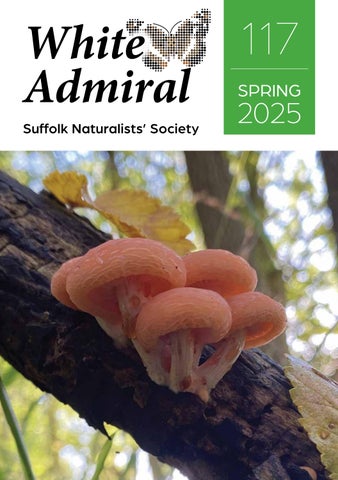
SPRING 2025
FROM THE EDITOR
Welcome to the spring issue, where you will find details of the AGM, information about forthcoming members events and some dates for your diary. A new item in this issue is the list of recorders with their contact details, which appears on p. 4.
Last year many of you took part in our member survey. The results have now been processed and can be found on p. 30.

One of the questions in the survey covered grants for studies or training. If that is something you’d like to know more about take a look at the inside back cover, or on the Grants page on the SNS website.
For those of you that use social media you can find us on Bluesky: Suffolk-nats1929, and Facebook: Suffolk Naturalists Society - Members Group
Emma Aldous
WhiteAdmiralNewsletter@gmail.com or editors@sns.org.uk
The opinions expressed in White Admiral are not necessarily those of the editor or of the Suffolk Naturalists’ Society.
SNS COUNCILLORS
Chairman: Joan Hardingham
Hon Secretary: Vacant
Rivis Vice Presidents
Colin Hawes
Howard Mendel
David Walker
Joan Hardingham
Martin Sanford
SNS can be contacted on: enquiries@sns. org.uk
• Treasurer: Martin Sanford
• Administration Secretary: Anne Shaw
Council members
Darren Tansley
Dorothy Casey
Emma Aldous
Gavin Deans
Hawk Honey
Howard Mottram
Juliet Hawkins
Nick Mason
Peter Vincent
Simon Jackson
Publication Editors
Suffolk Natural History
Martin Sanford transactions@sns.org.uk
White Admiral
Emma Aldous editors@sns.org.uk
Suffolk Bird Report
Nick Mason suffolkbirds@sns.org.uk
SNS RECORDERS
BIRDS – NORTH EAST
Richard Walden bird-ne@sns.org.uk
AMPHIBIANS & REPTILES
John Baker amphibian@sns.org.uk
BLACK POPLAR
Sue Hooton blackpoplar@sns.org.uk
COLEOPTERA
Ross Piper coleoptera@sns.org.uk
FERNS & FLOWERING PLANTS
Martin Sanford botany@sns.org.uk
GALLS
Jerry Bowdrey gall@sns.org.uk
MAMMALS
Alison Looser mammal@sns.org.uk
MOLLUSCS
Ian Killeen mollusc@sns.org.uk
SPIDERS, ARACHNIDS, ISOPODA & MYRIAPODA
Paul Lee spider@sns.org.uk
BIRDS – SOUTH EAST
Steve Fryett bird-se@sns.org.uk
ACULEATE
HYMENOPTERA
Adrian Knowles hymenoptera@sns.org.uk
BRYOPHYTES
Richard Fisk bryophyte@sns.org.uk
DIPTERA
Peter Vincent diptera@sns.org.uk
FRESHWATER FISH
Phil Strachan
2 Bakers Way, Tuddenham, Bury St Edmunds IP28 6SA
HEMIPTERA
Adrian Knowles bugs@sns.org.uk
BATS (SUFFOLK BAT GROUP)
Alan Miller bats@sns.org.uk
MOTHS
Neil Sherman moth@sns.org.uk
BIRDS – WEST
Chris Gregory bird-w@sns.org.uk
AQUATIC INVERTEBRATES
Adrian Chalkley aquatics@sns.org.uk
BUTTERFLIES
James Corton suffolkbutterflies@sns.org.uk
DRAGONFLIES
Adrian Parr dragonfly@sns.org.uk
FUNGI & SLIME MOULDS
Neil Mahler mycology@sns.org.uk
LICHENS
Chris Hitch lichen@sns.org.uk
MARINE LIFE
Gen Broad marine@sns.org.uk
ORTHOPTERA
Stuart Ling orthoptera@sns.org.uk
SUFFOLK NATURALISTS’ SOCIETY
NOTICE OF
96TH ANNUAL GENERAL MEETING AND SPRING MEMBERS’ EVENING
Wednesday, 30th April 2025, 6 – 10 pm
The Athenaeum, Angel Hill, Bury St Edmunds IP33 1LU
Grid reference: TL855641. W3W: ///redeeming.inhabited.personal
Free parking on Angel Hill, to the front of The Athenaeum, after 6pm.
Please telephone Joan Hardingham on 07848007807 if lost!
6:00 – 6:30 pm Displays by The One Stop Nature Shop (www.onestopnature.co.uk), Anglian Microscopy, natural history items of interest, books and equipment for sale or offered.
6:30 – 7:00 pm ‘Introduction to Microscopy for Naturalists’ by Gordon Brown (Anglian Microscopy).
7:00 – 7:30 pm break for refreshments.
7:30 – 8:00 pm Annual General Meeting, start of business.
8:00 – 8:30 pm short presentations by members (tbc).
8:30 – 9:00 pm break for refreshments.
9:00 – 10:00 pm short presentations by members (tbc) and an ‘Ask a Naturalist’ session, if time allows. Please send questions in beforehand to enquiries@ sns.org.uk.
1. Apologies for absence.
AGM AGENDA
2. Minutes of the 95th Annual General Meeting 2024 (see Suffolk Natural History Vol.60, p.169)
3. Hon. Chair’s brief report – Joan Hardingham
4. Hon. Treasurer’s brief report – Martin Sanford (Full reports from Chair & Treasurer will be on the SNS website & in the next Suffolk Natural History)
5. Current Council Members:
• Hawk Honey (Social media secretary)
• Nick Mason (Bird Report Editor)
• Emma Aldous (Website manager & White Admiral editor)
• Colin Hawes
• Howard Mottram
• Juliet Hawkins
• Peter Vincent
• Dr. Simon Jackson
• Darren Tansley
• Dorothy Casey
• Gavin Deans
• Student Representative, Sarah Pynn to remain for 1 year (not a Trustee role)
6. Council received the following resignations:
• Dorothy Casey
• Juliet Hawkins (end of term)
7. Council received the following nominations:
• Anne Wright (co-opted, now nominated for a 4 year term, SBG Liaison)
• Anthony Speca (Co-opted to review the role of County Recorder)
• Adrian Knowles (nominated for a 4 year term, County Hemiptera recorder)
8. Any Other Business – only for questions submitted in writing in advance, except at the discretion of the Chair.
DATES FOR YOUR DIARY
30 April – AGM & members evening, Bury St. Edmunds, 6:00 – 10:00 pm (p. 5).
10 May – 2025 Raydon Wood, 10:30 am – all day (p. 7).
17 May – Lichen meeting, Crowfield, 10 am – all day (p. 9).
28 June – Return to Westleton Common, 10:30 am – all day.
19 July – Stanny House Farm, Iken (Jack Cooke), 10:30 am – all day.
6 November – Members’ Evening Meeting (details tbc).
©Frances Browne
WALK AND RECORDING EVENT
Saturday, 10 May, from 10:30 am
Raydon Wood, nr Hadleigh, by kind permission of James Buckle
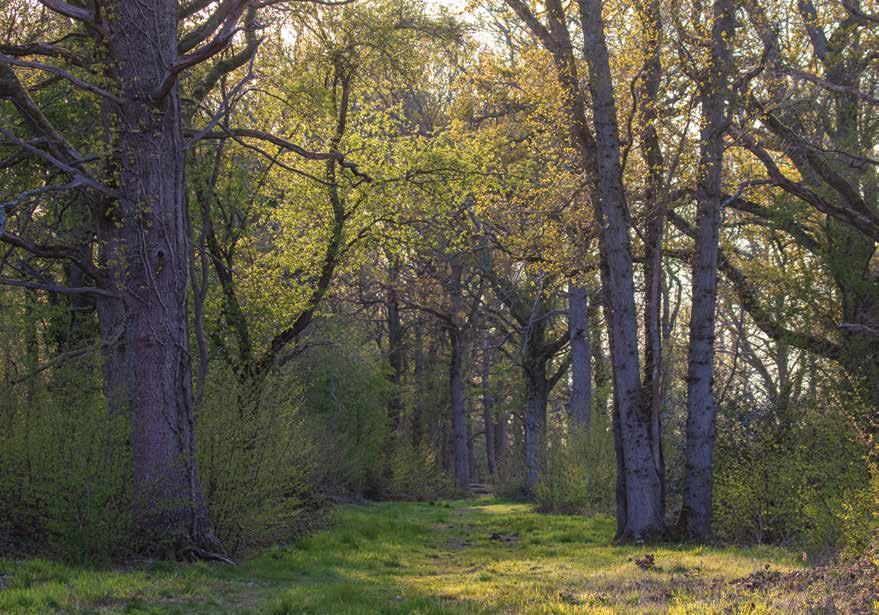
Raydon Wood is a 217 acre ancient woodland straddling both sides of the Hadleigh Railway Walk. It was acquired by James Buckle in 1999 when much of the wood was planted with conifers and non-native trees. Since then, this private nature reserve has been restored to a broadleaved working wood without planting a single tree, rides have been reinstated and 20 of the 30+ ponds have been restored.
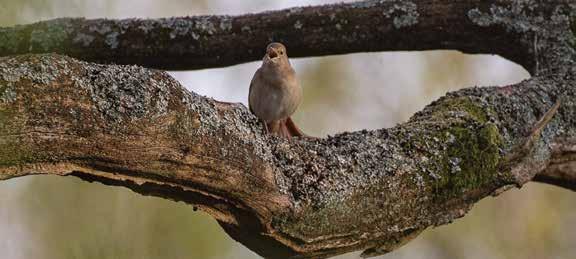
Various surveys have been undertaken indicating that it is possibly the best wood in Suffolk for moths, has a large number of rare pond beetles, hosts an amazing list of ancient woodland plants, reptiles, bats and butterflies and, in spring, the joyful sound of breeding nightingales and the call of the cuckoo.
James is keen for naturalists to enjoy the wood and receive records from all taxonomic groups, so do come along, enjoy the nightingale, and record, potter, or picnic after the walk. Several county recorders will be present, so feel free to join a small recording group of your choosing.
10.15 for 10.30 am: Meet and park in Raydon Wood (directions below)
10.30 am: Intro talk from Graham Sayell, woodland manager, and Juliet Hawkins, conservation adviser since 1999
10.50 am: Walk with short talks at sites around the wood
11.45 am: Please feel free to record, potter or picnic – and find your way back to your car when you are ready.
4.00 pm: Meet up at cars for anyone who wishes to discuss findings
Directions: The route into Raydon Wood is via a gated concrete track from Woodland Road at TM 05786 39913 or What3 Words magic.paradise.greyhound which will be signed
Indoor/WC facilities: None!
Poor weather: If rain stops recording, we will still go ahead with the talk and walk
What to bring: Coffee flasks, a picnic, and allergy medication. Bring your own recording kit; SNS will bring some hand lenses for guests to borrow.
Potential hazards and accessibility: As with all outdoor events, we warn you that there will be stinging insects and uneven/wet ground. However, there are also plenty of very accessible old airfield concrete tracks around the southern part of the wood. Please bring your own allergy medication, personal first aid kit (we will be separated into small groups), and mobile phone, especially if you intend to walk alone.
Emergency services – car park area within wood: TM 05343 40264 or What3Words showrooms.dries.reviews
We will set up a moth trap the night before the meeting – Friday, 9 May, 8 pm. Members are welcome to come along and participate. Places are limited, so please call Joan Hardingham on 07848 007807 as early as possible to reserve your spot.
©Frances Browne
We hope this has piqued your interest –it really is the most glorious woodland!
LICHENS UNDER THE MICROSCOPE
Saturday, 17 May,
10 am – 3 pm
Crowfield Village Hall
Free workshop sponsored by the Anglian Microscopy Group and the Suffolk Naturalists’ Society
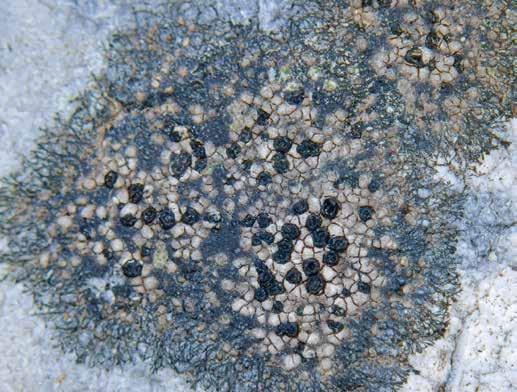
Rhizocarpon reductum, England, VC25 East Suffolk, TM4468, September 2024, On flint pebble © Anthony Speca
Lichens are neglected biodiversity. Despite their ecological significance, dazzling variety and strange beauty, they’re easily overlooked. But these tiny creatures contain secrets! And microscopes can help to reveal them.
Anyone can learn how to appreciate lichens using microscopes. Seeing a lichen under a stereomicroscope for the first time is like descending to the surface of a new planet. And examining lichen sections at high magnification puts the lichen symbiosis on show: a partnership between completely different organisms that’s unique on Earth.
This one-day workshop will introduce participants to lichens and lichen microscopy. After an overview of these compelling life-forms, we’ll go outside to collect samples, which we’ll then prepare for examination. No familiarity with lichens is presumed. Experience with microscopes will be helpful, but the Anglian Microscopy Group warmly welcomes beginners!
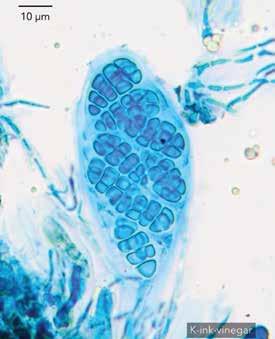
Participants should bring hand-lenses, as well as stereomicroscopes and compound microscopes if possible. Some microscopes will be available to borrow, and other materials and equipment will be provided.
Join us for a close-up look at the fascinating world of lichens. You’ll never see them in the same way again!
10:00 – 11:00 Introduction to lichens
11:00 – 12:00 Collecting lichens (please also feel free to bring any lichens you’d like to examine)
12:00 – 12:45 Lunch (please bring a packed lunch)
12:45 – 13:00 Equipment set-up
13:00 – 15:00 Lichen microscopy
About the tutor
Dr Anthony Speca is a field lichenologist and educator based in northeast Suffolk. Through Aspen Ecology, he offers lichen surveying, consultancy, training and education. He’s also an active lichen recorder and lichen tutor with the British Lichen Society and the Field Studies Council, as well as a member of the Suffolk Naturalists’ Society. Anthony was first inspired by lichens when he inadvertently focused his macro-lens on a gravestone alive with them, instead of on the nearby wildflower he’d meant to photograph!
Register your interest
Places are limited, so please contact the Suffolk Naturalists’ Society at enquiries@sns.org.uk or Antony Speca 07789 645685 as early as possible to reserve your place.
2025 SUBSCRIPTIONS
The 2025 subscription rates have increased for SNS and joint members with Suffolk Bird Group (SBG)– see p. 44 for details of what you will receive – this is the first increase in 20 years. Please note, overdue membership subscriptions for 2025 can still be paid by one of the following methods:
• Go to the website sns.org.uk and select ‘join’ in the header then select ‘renew’.
• BACs payments to: SNS, Sort code: 30 94 55, Account number: 01022831.
• Cheques to: Memberships, c/o SNS, The Hold, 131 Fore Street, Ipswich, Suffolk, IP4 1LR.
NB. SNS & Joint subscriptions have increased for 2025
Individual
Family/Household
Student
Corporate
SNS only SBG only Joint SNS and SBG
£20
£23
£13
£23
£17
£20
£10
If you have any questions, please contact enquiries@sns.org.uk
£35
£41
£21
DESTROYER OF DREAMS
Hawk Honey
We all know bees are in trouble, but do we realise which bees are struggling? Many of you who know me will know I like, no, love my bees and wasps. And many a time when people find this out, I’m asked “How many hives I have?”. And here lies the problem. Not many people realise there are more species of bee than honeybees and bumblebees. In fact, many people truly believe that honeybees are in trouble. I’ve had so many people say to me that they plan to learn beekeeping just so they can help insects and stop the insect decline. This is where I then become the destroyer of dreams. This is the moment they learn the harsh truth that becoming a beekeeper is going to do for insects what becoming a chicken keeper does for birds, absolutely nothing. In fact, it will be detrimental for insects.
For hundreds of years, we have been led to believe that honeybees are the bee (sorry) all and end all, that they are great for pollination and the environment and they are endangered. Yet, nothing could be further from the truth. In the last few years more and more scientific evidence is coming out that proves how bad they are, not just for insects but the environment as well, and with around 8 million hives around the world, they are one of the commonest insects on Earth.
The average beehive contains up to 60,000 bees, all going out to collect nectar and pollen to store withing the hive, feed themselves with and even give us a nice, sweet syrup to put on our breakfast. In the process, they help with pollination services, pollinating our crops and orchards so we have food to eat as well and beautiful flowers to look at. Firstly, let’s look at that figure of 60,000 bees, even if we say it’s a small hive, say 30,000 bees, that’s still 30,000 bees hitting every single flower they can find to take away the pollen and nectar for their hive. Honeybees are known to fly a long way from the hive, up to 5 miles but on average just over a mile. This then puts all the wild bees, of which there are over 270 species of, under extreme competition for food.
Now bees and wasps have this amazing ability to be able to choose the sex of the eggs they lay and when there is strong competition for food, it forces wild bees to start laying male eggs instead of female eggs because males are usually smaller than females and therefore easier to provision for. This ends up skewing their populations as the female population reduces and the next season less eggs are laid. Since the 1930’s, the UK has lost a whopping 97% of its wildflower meadows. A lot of this is down to the change in modern farming methods, we no longer use horses to plough for example and don’t need as much hay to feed the horses, and fields
are much bigger now meaning we have lost a lot of important hedgerows that was a habitat for so much wildlife. This huge reduction in available food source means competition is harsh and more bees are visiting the same flowers more regularly meaning that the transmission of pathogens is much higher.
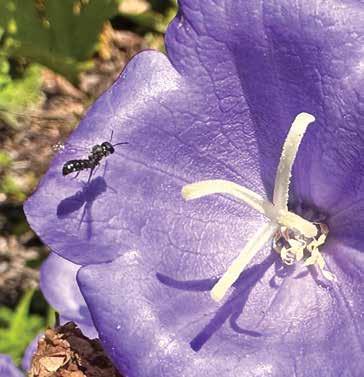
Among those wild bees, there are specialist bees such as Chelostoma campanularum, a small (around 4mm in length) bee, which only collects pollen from Campanulas (Harebells), a trait known as oligolectic, feeding on one family of plant. However, polylectic honeybees could find this small bee’s patch of harebells and take the food for themselves, pushing out the smaller niche feeding bee, and thus making it locally extinct.
But what about the vital pollination services they provide for our agriculture? Yes, bees pollinate, but are they as good as we think they are? Anytime you see a busy honeybee doing its thing, you cannot help but notice the large pollen sacks on its hind legs. These are not actually sacks, they just give the appearance of a sack. The pollen is actually stuck to a wide part of the hind tibia known as the corbicula. Using nectar, the pollen gets stuck to this shiny part of the hind legs as the bee goes about its business. Yet, because the pollen is stuck, or literally glued to the bee’s legs, very little of it falls off when it visits other flowers, which is something that is required for pollination to happen.
Most of our wild bees are hairy, covered with fine plumose hairs, hairs that are branched along their length, which helps to trap pollen in amongst those branches. Thus, when solitary bees land on the flowers, a small static electric charge causes pollen to attract to the bee getting caught among those fine branches of hair. The bee uses her middle legs to move the pollen down the body towards the scopa, a compact area of hair where the pollen is stored. This is
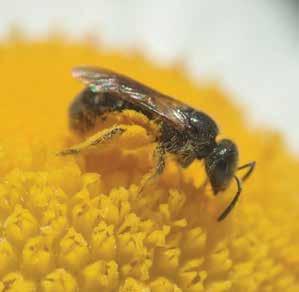
A small furrow bee, Lasioglossum sp, covered in loose pollen.
The Small Scissor Bee, Chelostoma campanularum, visiting a Harebell, Campanula sp
sometimes found on the underneath of the abdomen or on the hind legs. As this pollen is held loosely and not glued, pollination is more likely to happen when she visits the next flower as some of the pollen will detach and fall off on to the flower. Some of you will have a bee hotel placed in your garden and if it is placed in the right location, some of the holes will be covered with mud. These are usually the completed cells of the Red Mason Bee Osmia bicornis. This is a solitary bee who must provision her cells all by herself, she doesn’t have thousands of sisters looking after the nest like honeybees do. Whilst she is out collecting pollen and nectar, her nest is open to parasitism, usurpation and theft from other insects. She must be quick to collect her provisions to prevent this happening and because of this, Red Mason Bees have been found to be between 120 – 200x more efficient at pollinating than a honeybee.
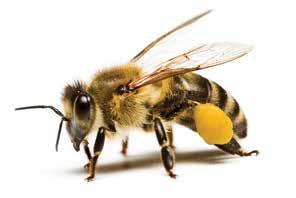
Honeybee Apis mellifera with “pollen sacks” stuck to the hind leg.
It has even been found out that if you have an orchard with hives in them to help with pollination, your fruit yield will be a lot less than an orchard that doesn’t have hives. This is because the honeybees are depressing all other pollinators within that 1-5 mile area around the hive. And it’s not just other bees they are pushing out, they are affecting other vital pollinators too such as flies, butterflies, wasps, etc.
Honeybees are responsible for only one third of the crop pollination in the UK and a very small proportion of the wild plant pollination. Wild bees, hoverflies, butterflies, and other pollinators are much more important than honeybees, and collectively they are responsible for this pollination, not just managed honeybees.
So, if you want to help insects, please do not consider beekeeping. Instead make sure you can plant as much differing varieties of flowers that you can, wherever you can, to help ALL our bees and other pollinators.
References:
Experimental evidence that honeybees depress wild insect densities in a flowering crop
Sandra A. M. Lindström , Lina Herbertsson , Maj Rundlöf , Riccardo Bommarco and Henrik G. Smith https://royalsocietypublishing.org/doi/full/10.1098/rspb.2016.1641
Save the bees! (but which ones?)
https://www.buglife.org.uk/blog/save-the-bees-but-which-ones/#:~:text=We%20must%20be%20clear%20 that,doing%20more%20harm%20than%20good.
Pollination services in the UK: How important are honeybees? Breeze et al. 2011 https://www.sciencedirect.com/science/article/abs/pii/S0167880911001046
GLACIAL ERRATIC FOSSILS FROM MENDLESHAM
Bob and Caroline Markham, GeoSuffolk
A visit to Mendlesham in February gave GeoSuffolk the opportunity to view the collection of the late Roy Colchester. Amongst the items were fossils collected from the Chalky Boulder Clay on the fields around Mendlesham. This deposit, covering much of ‘high’ Suffolk, is formed from material brought from further north and west by the Anglian ice sheet about 450,000 years ago at the height of the Ice Age. It is a finely ground rock flour, a mixture of Jurassic clays and Chalk – called by geologists a diamicton or till. It also contains pieces of rock and fossils of Jurassic and Cretaceous age – often called erratics (or wandering stones).
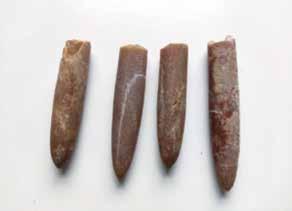
Amongst the fossils were belemnites, gastropods, bivalves, echinoids, ichthyosaur vertebrae and a piece of Jurassic wood. In particular, there were some fine belemnites from the Chalk (Cretaceous).
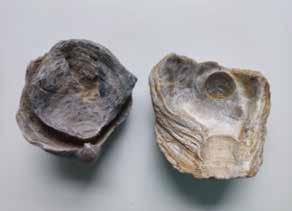
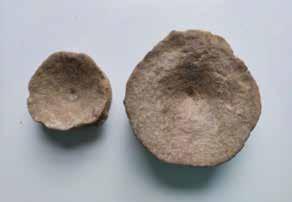
Photo 1 shows Gonioteuthis on the left and three Belemnitella on the right. There were also several large (9-10 cm) Jurassic Gryphaea. In photo 2 the left hand specimen has both valves preserved, and the other specimen shows the single adductor muscle scar characteristic of oysters. Other important specimens were the two Jurassic Ichthyosaur vertebrae in photo 3. The larger one is about 11cm across – so quite an impressive reptile. The similar state of preservation of the two suggest they could be from the same animal. They were found when the A140-Mid-Suffolk Light Railway cutting was dug, which locates them well.
When collecting fossils it is important to record their locality and this is particularly so with erratics as their distribution is seemingly random. These beautiful scientific specimens have been made more valuable by their recorded location within a few square kilometres of Mendlesham. They give clues to their original home and the movement of the ice sheet.
THE WRINKLED PEACH –ON
ASH AND HORSE CHESTNUT
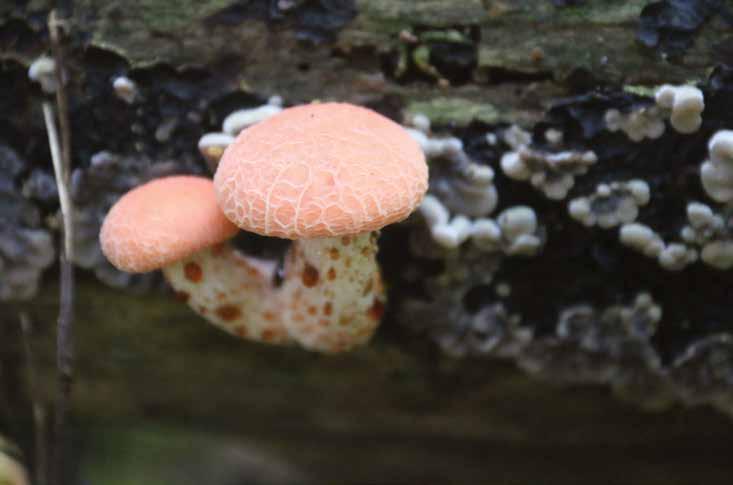
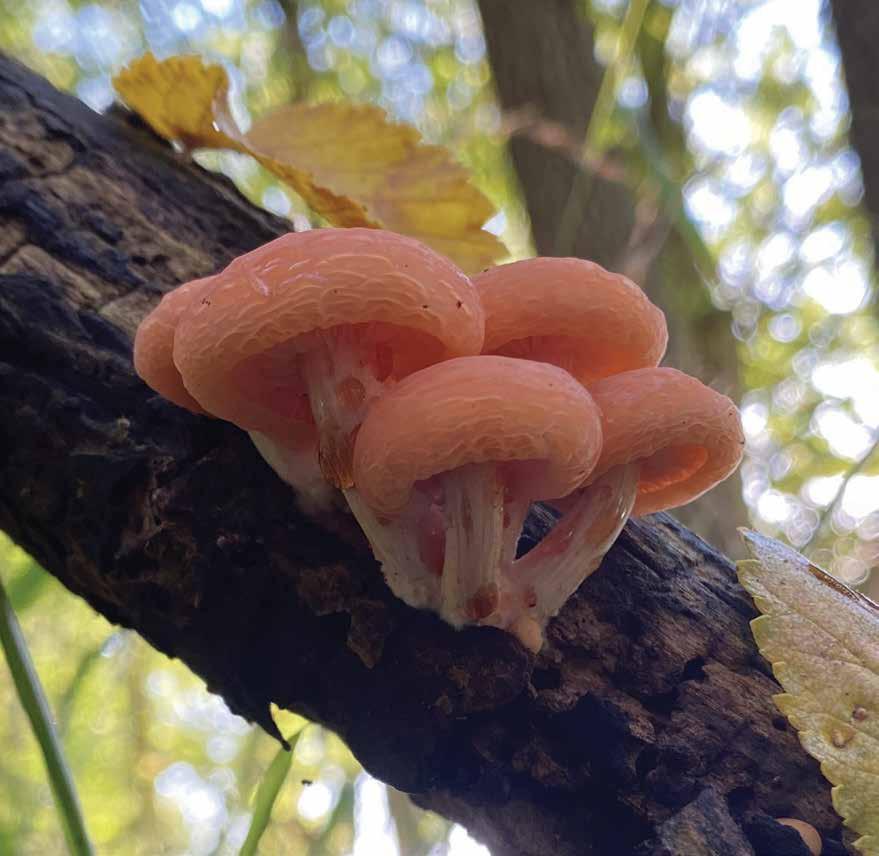
Seeing the very beautiful Wrinkled Peach fungus (Rhodotus palmatus) really lifts your day. Its British common name, the Wrinkled Peach, and American names, the Rosy Veincap or Netted Rhodotus, reflect the pinkish-orange, ridged and veined, rubbery mushroom cap – and the oozing, bleeding orange or red droplets that drip down its stipe (stem).
As a saprobic species, living on rotting hardwood, the Wrinkled Peach appears to mainly be associated with large branches and trunks of fairly recently fallen dead elm (Ulmus sp) in the UK. The Wrinkled Peach had its heyday after Dutch Elm Disease ravaged our elm trees in the 1960s and elms lay rotting in the countryside around the UK. However, with the demise of elms, the freshly fallen rotting elm substrate opportunities have diminished too and the species is listed as critically endangered, endangered or near threatened in many European Red lists.
In the last 20 years, I have seen a few specimens every year – always on Elm. In 2024 I recorded it for the first time growing on both Ash (Fraxinus excelsior) and Horse Chestnut (Aesculus hippocastanum) in Suffolk. I’d be interested to know – have other people found it growing on trees other than Elm?
Apparently in Europe, it grows on various tree species - mainly on Elm, HorseChestnut (Aesculus) and Ash, but occasionally on other deciduous trees. In the United States, it has been recorded on tulip trees (Liriodendron), maples (Acer), limes (Tilia) and elms. It prefers closed canopy broadleaved woodlands on moist soil.
Juliet Hawkins
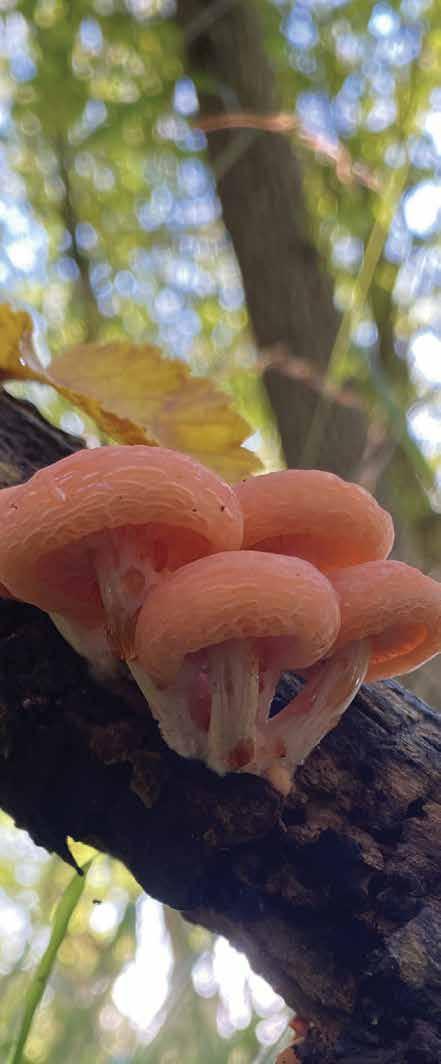
In 2019 the Wrinkled Peach was assessed for The IUCN Red List of Threatened Species as Near Threatened but the European part of the population is considered to be Vulnerable due to a decline in host trees by up to 20-40% caused by fungal pathogens killing its primary hosts, Elm and Ash. The population decline in other parts of its distribution (ie North America and temperate Asia) has not been quantified, but it is in decline. Source: https://www.iucnredlist.org/species/70 402359/70402387#geographic-range Presumably, with the increase in recently fallen dead Ash trees with the effects of Ash Dieback Disease, we may see an increase again in this beautiful fungus if it is happy to grow on Ash trees! So, when managing large gardens, private nature reserves, parkland and woodland, a plea (it’s not a new one) is to always leave some large bits of dead wood – trunks and large branches – in the shade for the Wrinkled Peach and the many other saprotrophic species that are equally fussy about their dead host trees. And, whilst ‘deadwood habitat piles’ may look satisfyingly creative and provide good overwintering cover heaps for amphibians, reptiles, hedgehogs and other creatures, the more scattered large bits of dead wood that come into contact with damp ground, the better for so much fungi and small creatures.
Photos: Wrinkled Peach (Rhodotus palmatus) growing on dead elm. Have you found it growing on other host trees in Suffolk? © Juliet Hawkins
THE SPREADING SPIRALS OF GREATER DODDER
Rasik Bhadresa
In mid-July last summer, I had an email from Harry Elliott (of Essex Wildlife Trust) about an exciting find along the Suffolk side of the northern arm of River Stour at Flatford. He was enthusing about the parasitic Greater Dodder (Cuscuta europaea), a plant very close to my heart (a biology textbook comes to mind!). And its locale, extremely close to where I walk in the mornings. Not far from the Longhurst Hide, he wrote, and growing along the river bank (TM 080 329) near some teasel and next to the poplar tree.
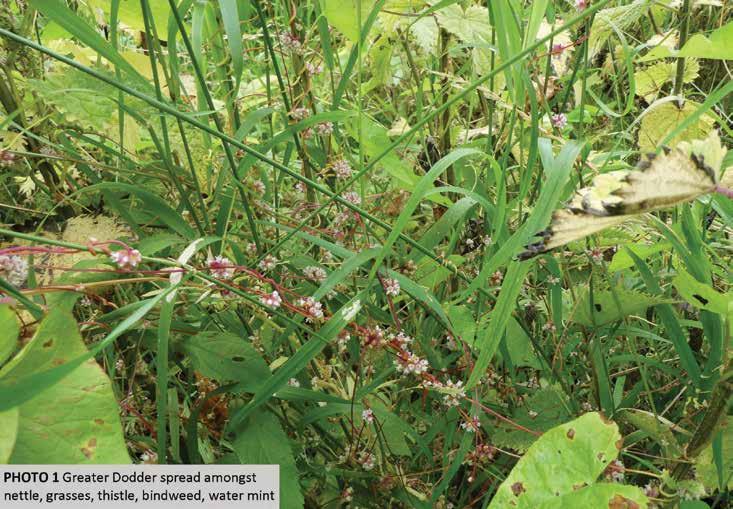
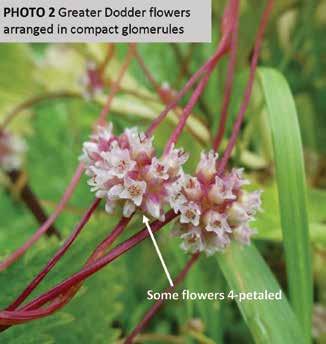
The following morning I saw this very rare (recorded in only just over a dozen tetrads in Suffolk along the rivers Brett and Stour) in its full glory (see Photo 1). Already well established, it was twining all over the place. This leafless annual, having started life with a few seeds germinating at the site of host shoots, had by mid-July already extended its way on to many plants. In front of me was quite a large area (1.5 to 2.0 metres across) of a fine, fairly densely tangled web of slender stems. The long thin stems mostly pinkish-red, some greenish yellow, were either twining on plants - nettles, thistles, grasses and water-mints, or stretching in straight lines between plants. The flowers, mostly in various shades of pink, were
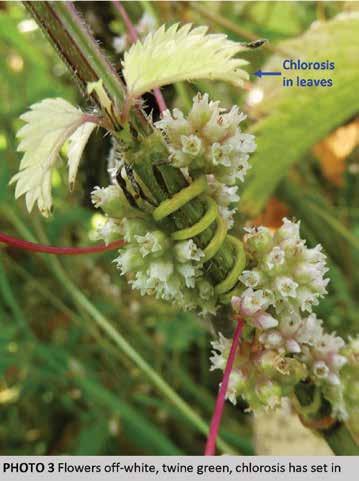
neatly arranged in beautiful compact glomerules of up to 15 per cluster (see photo 2) along the stems. There were also some creamy-white flowers associated with yellowy stems (as in photo 3). On a closer examination of flowers, I noticed there were possibly up to 10% 4-petalled corollas amongst the commoner 5-petalled ones, a useful identification feature of the Greater Dodder.
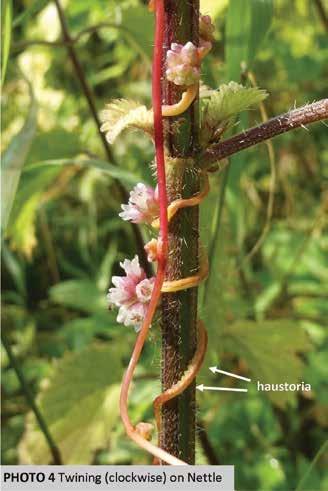
On closer examination of the stems coiling round the host stems, came to light rows of ‘haustoria’ (Photo 4), regularly spaced, bulging root-like structures. They appeared to be firmly stuck to the host stem, at the point of contact no doubt having made cellular inroads into the host tissue to obtain water and nutriments to sustain themselves and spiral further to locate secondary host plants. The mechanism of how indeed they break down the host tissue to penetrate and then to grow towards the vascular tissue
is an intriguing detail. The whole interaction is simply an evolutionary miracle! A histological study, some transverse sections, would prove very fruitful – next year perhaps? For someone deeply interested in natural history, one excellent thing about plants (although Dodder is quite a ‘mover’!) is that they are relatively stationary, which means that one can visit and see them progressing and changing over time. So I was able to witness the changes first-hand over several visits and well into September.
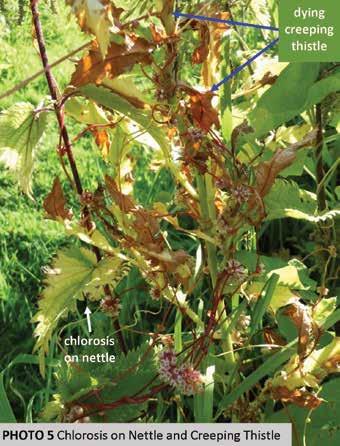
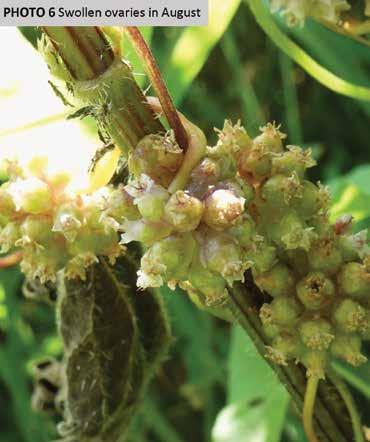
While, at first, everything appeared benign, needless to say, Dodder’s quite ingenious method of siphoning off water from the xylem vessels and food from the phloem had its consequences on its host plants. As time went by, a number of both the primary hosts (Nettle), as well as secondary hosts (eg Creeping Thistle) ‘overrun’ with Dodder showed death-dealing chlorosis (see photo 5). Dodder’s main interest, clearly, is in fattening up the gynoecia (see photo 6) to produce as many seeds as possible!
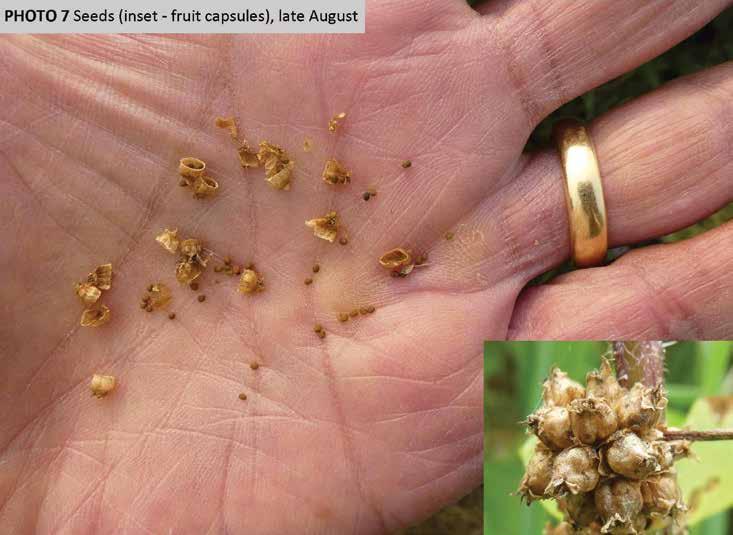
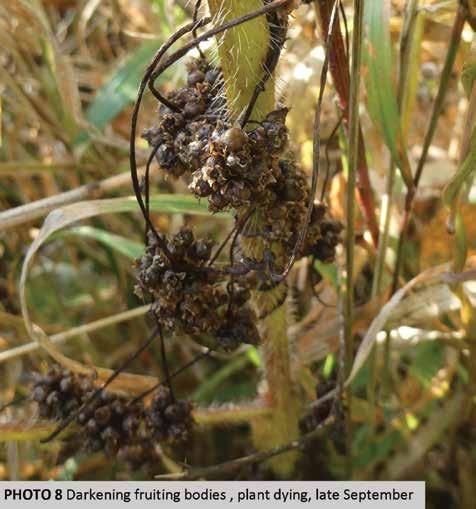
From late August into September, the 3-mm wide fruiting bodies started to dryup into rounded scaly seed capsules. To examine the seeds, I took a few off and crushed them between my fingers. On average, each capsule had 4 seeds, medium brown and elliptical, c 1 mm long (see photo 7). By the end of September Greater Dodder’s life cycle was over, stems and seed capsules a withering dark brown (photo 8). I wondered, how many of those seeds (which could last for years in the
soil) germinate and find their preferred nitrophilous host plant, Urtica dioica, in the future. The widespread distribution of Nettle and its creeping habit might be the very reason why Dodder prefers it. My beady eyes will be in search for those delicate filamentous stems of our rare Greater Dodder come summer this year! At least I know where to look. So it is au revoir, not good-bye!
MOTH TRAPS – MORE THAN JUST MOTHS!
Nigel Odin, Landguard Bird Observatory
I plead guilty to having ignored many of the other bugs and beasties that have entered our moth traps over the years. This has mainly been down to time constraints, lack of easily available literature and a reluctance of many experts and county recorders to accept records from complete novices, like me, in identifying species groups outside my comfort zone which they specialize in.
So what’s changed? Well for one the internet has been a revelation this century, secondly “smart phones” in one’s pocket allows on to look up information whilst still having one’s head buried in traps, and thirdly, artificial intelligence apps like Obsidentify can either identify species with 100% accuracy or, at the very least point one in the right direction. In several genera it comes up with the family and “Sp.” so that is a hint to retire while the going’s good before spending too much time on a group that the AI has not got its head around yet.
So can one trust all this “Smart” technology? Information given on the internet has got more accurate over time, particularly from professional naturalists, although labelled photographs by tyros who publish pictures can make one smile as the internet is naïve enough to believe that the identification is correct. Obsidentify (other Apps are available) is Dutch run so struggles, or misidentifies, some species that are Suffolk regulars but do not exist across the North Sea. On the plus side it can confidently identify some species that natural history recorders require genitalia dissection to be acceptable in the UK.
Amongst several additions to the Landguard list in 2024, courtesy of the moth traps, were these three beauties who had their portraits snapped and were instantly identified for a novice like me courtesy of Obsidentify.
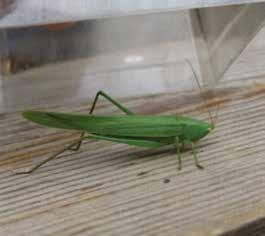
◀ Large conehead Ruspolia nitidula. One found in the moth trap on August 3rd. Haven’t a clue how many Suffolk records of this exist as that wonderful World Wide Web ain’t a lot of help in this department. It does let us know it’s a recent colonist in the UK over the last 20 years. [Editor’s note: Martin Sanford confirms this is the first record for Suffolk and that there are 54 UK records on iRecord, mainly Sussex and the South coast].
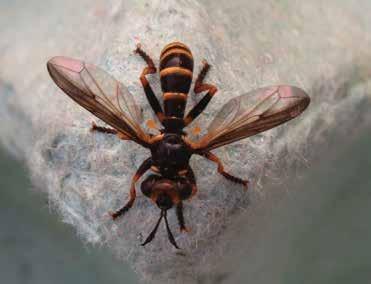
◀ Leopoldius calceatus. One found in the moth trap on September 6th. First UK record in Suffolk in 2018 & probably colonising. Great Suffolk information readily available as SNS publish online which an internet search finds saving one time looking through journals:
https://issuu.com/ suffolknaturalistssociety/docs/tsns55b
▶ Stauropoctonus bombycivorus. One found in the moth trap on August 22nd. A parasitoid of Lobster Moth Stauropus fagi which is a species never recorded at Landguard. Another species where the internet is about as much use as a chocolate teapot when it comes to finding Suffolk sightings (or elsewhere in the UK come to think of it). [Editor’s note: SBIS has two records, Kessingland 2021 and Bawdsey 2023].
NATURE NOTES: THRIPS
Peter Vincent
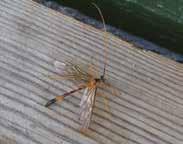
The hot humid thundery weather of August brings into the air the tiny but irritating insects, thrips; known in Suffolk as thunder flies,. but other common names include thunderbugs, storm flies, thunderblights, storm bugs, corn flies and corn lice. They are noted for getting in our hair, in our eyes and up our noses and can be maddeningly itchy when they try to nibble our sweaty skin. They are also very adept at squeezing through the smallest of cracks and are notorious for getting stuck behind picture glass.
The generic and English name thrips is a direct transliteration of the ancient Greek ips, meaning: woodworm and refers to species living under the bark of deadwood. Like some other animal names (such as sheep, fish or deer), the word thrips is both the singular and plural form. So there may be many thrips or just a single thrips.
There are some 185 species of thrips found in the British Isles; these are tiny insects, just 1 to 2mm long, but in the tropical parts of the world they can reach 15mm in length. They are often black in colour, but some species are cream, yellow or brown.
Despite their small body size they can be distinguished from other small insects by their long narrow body and worm-like crawling movement. Thrips have two pairs of strap-like wings, which are fringed with hairs, and these are folded back over the abdomen when at rest. The wings of thrips are useless for powered flight but are effectively used as sails, allowing them to be carried aloft and dispersed over long distances by the wind. These airborne insects become an important part of the diet of swifts, swallows and house martins, the birds scooping them up as they fly low over cereal fields on humid summer afternoons.
Thrips feed on a large variety of sources, both plant and animal, by puncturing them and sucking up the contents. Flower feeding thrips can pollinate while feeding, although some species are regarded as pests when they feed on plants, of commercial value. Here they scrape away at the surface of the plant to get at the sap and ruin the fine appearance of the plant by dulling and discolouring leaves. They are also able to transmit plant viruses. However, many species feed only on wild plants and a few species attack mites and other pest species and also on fungal spores.
During mass flights the occurrence of some thrips species becomes spectacular when myriads of individuals rise into the air, resembling dark clouds. These phenomena are initiated by hot weather conditions and occur mostly on warm and dry midsummer days with a high probability for thunderstorms. Triggering factors for the sudden increase of flight activity are consistent weather, temperatures of at least 20°C and a dew point between 5°C and 15°C. Under these conditions particularly cereal thrips are known for swarming in enormous numbers, which then can become an irritation to humans. They sometimes attempt to suck our sap, although their tiny mouthparts are unable to penetrate skin, they can cause an allergic rash to some people. Thrips are attracted to bright colours, in the presumption of finding flowers, so anyone wearing a white or yellow shirt will often find themselves covered in thousands of these tiny black insects.
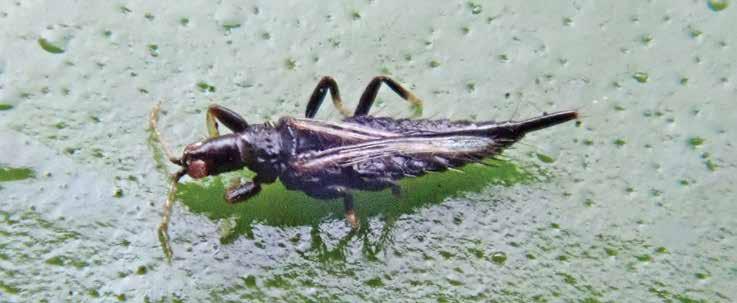
© Ian Jacobs, Flickr
With a circumference of 25000 miles
And 93 million miles away from the sun
Spinning on its own axis every 24 hours
And orbiting the sun every 365 days
ONLY THE ONE EARTH
In the enormous vastness of the universe
Our earth is singular, distinct and unique
Some four and a half billion years ago
It was formed as gas and dust clouds united
Then a crust formed and volcanoes erupted
Subsequently the oceans materialised
And some 4 billion years ago life evolved
Giving rise to the biodiversity we see today
However the atmosphere is just skin-deep
Weather layer troposphere averaging 7 miles
And the edge of space, the Karman Line
Where airplanes can’t stay aloft 60 miles up
And as we all know but don’t want to face
Things are far from alright on our planet
As we burn fossil fuels and reduce tree cover
Greenhouse gases are accumulating in the air
Carbon dioxide, methane, nitrous oxide etc
Trapping the heat that is reflecting back
Warming the earth, changing the climate
Raising oceans, increasing floods, fires, pests

So let us remember there is only the one earth
That this miraculous planet is the only place
Where we can live the life we truly deserve
And to deliver us a healthier and happy outlook
The one question we all need to ask ourselves
Am I the solution, or am I the problem?
Rasik Bhadresa
ELIZABETH COBBOLD BLUE PLAQUE
Caroline Markham, GeoSuffolk
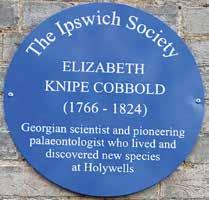
On the Stable Block at Holywells Park in Ipswich is a blue plaque which reads: Elizabeth Knipe Cobbold (1766 –1824), Georgian scientist and pioneering palaeontologist who lived and discovered new species at Holywells. It was erected by the Ipswich Society, at the request of GeoSuffolk, in November 2024 – on the 200th anniversary of her death (October 17th 1824).
Elizabeth Cobbold collected and identified fossil molluscs from Suffolk Crag deposits (for the most part from what is now known as Red Crag), mostly from the land belonging to the Cobbold family in Ipswich – in what are now Holywells and Landseer Parks. Her specimens were first published by James Sowerby of London in his Mineral Conchology from 1813. Her story has been recorded in Suffolk Natural History volume 56 (2020), Elizabeth Knipe Cobbold – Georgian Geologist by C and R Markham.
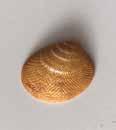
Such early scientific endeavour deserves to be recorded and celebrated. Indeed, Sowerby named a fossil bivalve Nucula cobboldiae after her, “Being desirous of commemorating Mrs Cobbold, whose copious collection obtained with great industry…… I have named this rare, and withal elegant shell after her”(right).
The updated SBIS website contains a wealth of information in the Knowledge Hub. There is a comprehensive library area with back issues of Suffolk Natural History, Suffolk Birds, White Admiral, The Harrier, and Suffolk Argus. Plus Species of the Month, detailed maps and information on landscape features, the Suffolk Bird Atlas, Suffolk Bat Atlas and more! www.suffolkbis.org.uk
NOTES ON THE DISCOVERY OF BOTANOPHILA CUSPIDATA, GONIGLOSSUM
WIEDEMANNI, SCOTTIANELLA DALEI, BOHEMIELLINA
FLAVIPENNIS, AND MYMAR PULCHELLUM: NEW RECORDS FOR SUFFOLK
Johnnie Johnson
In 2024, a biodiversity audit was undertaken at Benton End House in Hadleigh, Suffolk, the former home of artist and gardener Cedric Morris. The garden is currently managed by James Horner, head gardener from the Garden Museum. During the survey, ecologist Johnnie Johnson made a noteworthy discovery: the presence of five previously unidentified insect species to Suffolk, two species of fly, Botanophila cuspidata and Goniglossum wiedemanni (a notable species), a species of leaf hopper, Scottianella dalei, a parasitoid, Mymar pulchellum and a beetle Bohemiellina flavipennis. The discovery was subsequently verified by entomologist Dr James McGill and the county recorders of the Suffolk Naturalists Society.
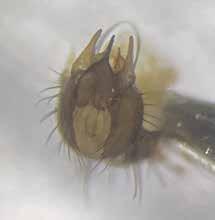
Botanophila cuspidata
Botanophila cuspidata is a species of fly within the family Anthomyiidae. This species has been identified in Europe, including Poland, where it was found associated with the fungus Epichloe typhina which infects the grass Puccinella distans. Left: Male genitalia of Botanophila cuspidata. Cercal plate showing a small hook at the tip.
Goniglossum wiedemanni (N)
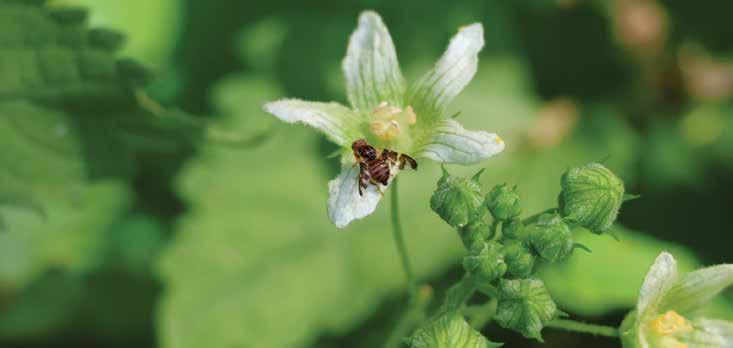
Goniglossum wiedemanni was recorded on a patch on White Bryony within the main garden. It is associated with White Bryony which can be viewed in the picture below. Goniglossum wiedemanni, is a species of fly in the family Tephritidae. This species is host-specific to white bryony Bryonia dioica, with larvae developing within the berries of this plant. Adult G. wiedemanni are small, measuring approximately 3–4 mm in length. They exhibit a distinctive appearance with a yellow to brown abdomen, lacking black bands. The tergites (segments) 2–4 in males and 2–5 in females are covered with golden-yellow microtrichia, giving them a characteristic sheen.
Scottianella dalei
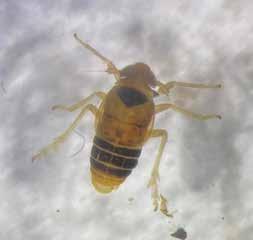
Scottianella dalei is a small and distinctive planthopper. Adult males are characterised by their yellowish to pale golden-brown coloration on the frons, vertex, pronotum, and forewings, contrasted by a distinctive black scutellum. Their abdomen is mostly black, with pale areas at the base and along the midline near the apex. Females are uniformly light yellow-brown. Both sexes are usually brachypterous (short-winged), although macropterous (long-winged) individuals are occasionally observed. In the UK, S. dalei is relatively rare, primarily inhabiting open grasslands in the southern counties of England. Adults, measuring 1.7 to 2.5 mm in length, are typically seen from March to August.
Bohemiellina flavipennis
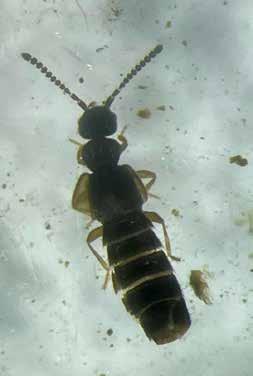
Bohemiellina flavipennis is a species of rove beetle measuring approximately 1.3 to 1.5 mm in length. The first record of this species was recorded in 1955. With limited records from this time period, an individual was recorded on a sludge drying bed
Scottianella dalei
Bohemiellina flavipennis
G. wiedemanni on its host plant the White Bryony at Benton End.
in Birmingham in 1968. A single individual was collected by Roger Booth in 2006 in Buckinghamshire, whilst sieving through hay and manure. A further record was made in 2007 by Peter M. Hammond during a survey on wood chippings and stable manure in a Windsor Allotment. No other known records of the species have been made since this period (Hammond, P.M.2007). This specimen was collected from a mature compost heap in the garden.
Acknowledgements
Mymar pulchellum
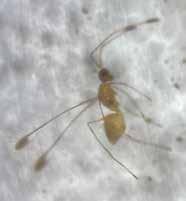
Mymar pulchellum is a parasitic wasp in the family Mymaridae, known for parasitizing the eggs of small insect pests like aphids and leafhoppers. The female lays eggs inside the host’s egg, where the larvae develop and consume the host. The specimen was collected by sweep netting within the meadow area of the garden. The specimen is roughly 0.5 mm in size.
I would like to express my sincere gratitude to the following individuals for their invaluable contributions: James McGill, Peter Vincent, Ross Piper, Adrian Knowles, Martin Sanford and the Natural History Museum.
References
Hammond, P.M. (2007). Bohemiellina flavipennis (Cameron) (Staphylinidae) - an adventive species established but infrequently found in Britain . The Coleopterist, 16(3), p.121.
NOTES AND OBSERVATIONS
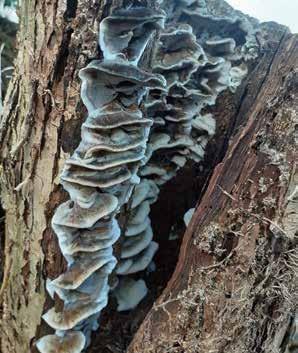
Smoky Bracket, Bjerkandera adjuster ▶
Castle Hills, Bungay, 5th February 2025
(Identification awaiting confirmation)
Bill Davis, SNS Members Group, Facebook
Mymar pulchellum
LETTERS TO THE EDITOR
Fifteen Days in December
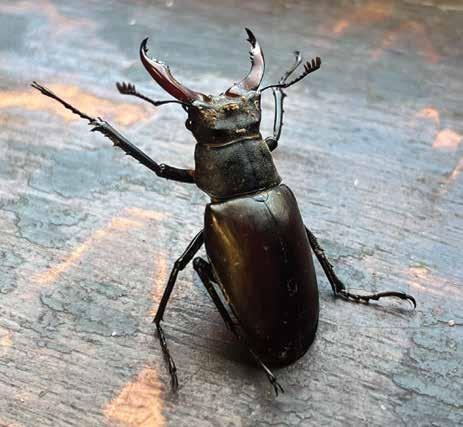
◀ Stag Beetle
A male Stag beetle found in February 2025, when he should have been hibernating.
Gemma Louise, SNS Members Group, Facebook
Although the winter of 2024 has, up to the middle of December, been relatively mild we did not expect three ‘earliest ever’ observations during just fifteen days. The first was a garden Violet, the first usually not being seen until late January or early February. The second came from our continued fox-watches from the landing of our house in Westerfield Road. In the detailed study published in Suffolk Natural History 2021, pages 10-18, we recorded 22nd January as the first date for seeing two foxes close together during their mating season. In 2024 the first sighting was on 12th December, when two foxes, close to each other, crossed Westerfield Road. This seemed a very strong indication of courtship and/or breeding as they are usually solitary for the rest of the year, unless being with cubs. The final earliest ever sighting was in Christchurch Park on 15th December, when drumming was heard from a tall oak and we eventually located two Great-spotted Woodpeckers. We didn’t have any binoculars but at least one was a male as only the male makes this reverberating drumming, as a part of courtship and establishing territory. This was the first time we had heard drumming so late in the year as usually it would be heard in January.
Richard Stewart
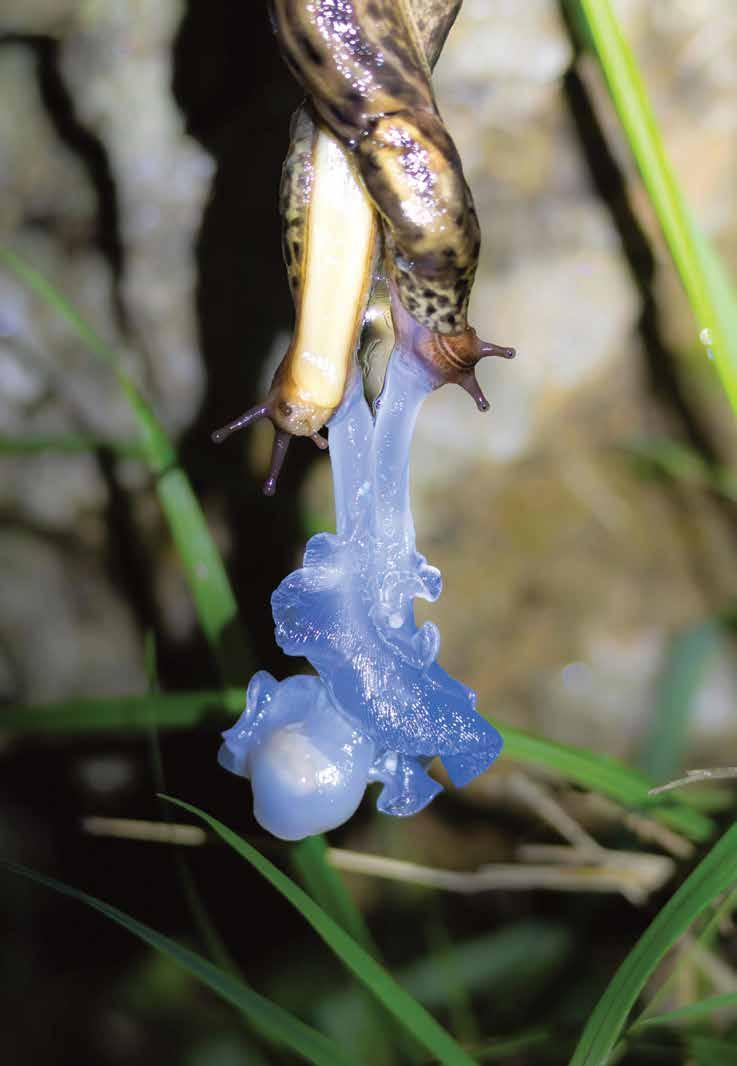
@diegogdopico_photography
THE LEOPARD SLUG – LIMAX MAXIMUS
Emma Aldous, Suffolk Biodiversity Information Service
Whether gliding gracefully or dangling mid-air in a unique mating ritual, the Leopard Slug proves that the most unexpected creatures can be fascinating.
5
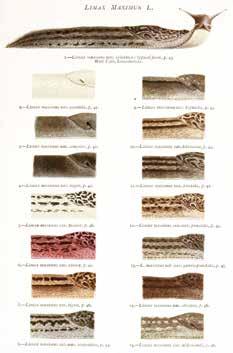
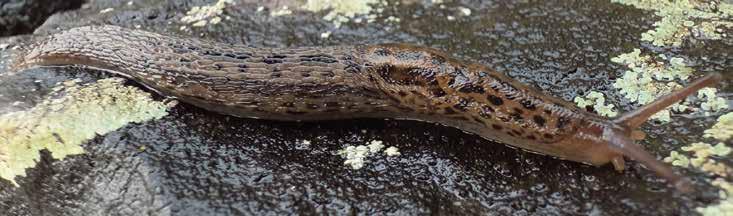
Leopard Slugs can reach 12 to 20 cm long, making them the largest species of slug found in the UK. Each Leopard Slug has it’s own unique pattern, and they vary from pale grey to brown.
1: Mantle Behind their head, Leopard Slugs have an oblong mantle that measures about a third of their length. It is usually a similar colour to the body, with more prominent markings. The mantle protects the slug’s vital organs. Under the mantle is the slug’s shell—yes, they have one. Like their skin pattern, each slug’s shell is unique.
2: Foot They move by gliding at low speed, typically 1 mm/s; however, when hunting, they can reach speeds of 2.54 mm/s. The slime their foot produces lubricates their path, guides them to and from safe feeding and sleeping areas, helps to find a mate and more.
3: Pneumostome The pneumostome, on the mantle’s right-hand side, opens into a single lung. Slugs can also absorb oxygen directly through their skin, so can close their pneumostome if required, for example: to reduce water loss if there is a risk of dehydration or to prevent drowning.
4: Tentacles These upper pair of tentacles are sensitive to smell and light. They have eyes at the tips and olfactory neurones in the skin. Just under the upper right tentacle is their reproductive pore. Although their eyes look like simple black spots at the tip of the tentacles, they are much more intricate than they appear. Their eyeball has a jelly lens and a protective cornea. The rear wall of the eye has a retina with two types of light-sensing cells, meaning they see in black and white. The tentacles are hollow and invert like the finger of a glove when the eyes are pulled down inside.
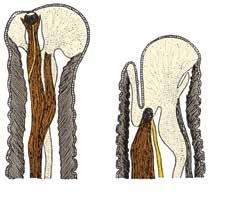
Fom Die Weinbergschnecke Helix pomatia L. 1912. by Johannes Meisenheimer (18731933). page 38. Public domain.
© Chia aka Cory Chiappone, iNaturalist
The lower pair of tentacles stretch out in front of slugs as they move and are used to examine their surroundings by touch. They also have olfactory neurons at their tips which they use to follow their own and neighbouring slugs slime trails.
5: Mouth Their mouth contains a ribbon-like structure with rows of minute chitin teeth called a radula. It scrapes and cuts food before it passes through the oesophagus to continue the digestion process.
Diet
Leopard slugs are omnivores who prefer decomposing plant material, usually avoiding leaves containing chlorophyll, hence the nickname the Gardener’s friend. They are also known to eat other species of slugs.
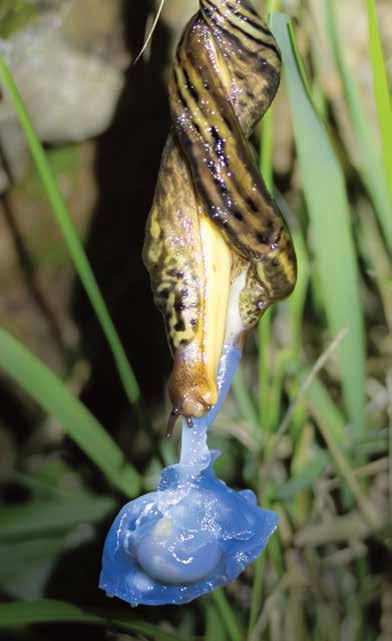
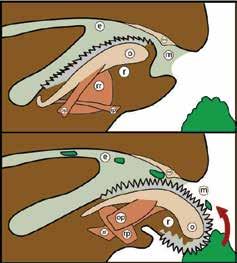
Diagram showing the radula and how it is used. The surface of the radula ribbon, with numerous teeth, is shown as a zig-zag line.
© Debivort, Wikimedia
Lifecycle
They lay 20-100 small, transparent eggs, either in damp soil or under debris, which hatch about a month later. As they grow, young slugs moult several times, increasing in size and developing their distinctive markings. It takes around two years for them to reach sexual maturity. Leopard slugs are hermaphrodites with a protracted courtship ritual. Once a Leopard Slug is ready to mate, it produces a pheromone in its slime to attract a partner. When a willing partner crosses the slime trail, it follows, frequently tasting the leading slug’s slime, until it catches up. They circle each other for a while before the leading slug heads upwards to start mating. Climbing into a tree or other high area, entwined together, they lower themselves on a thick string of slime. Their blue-white translucent
Penises during stages of mating
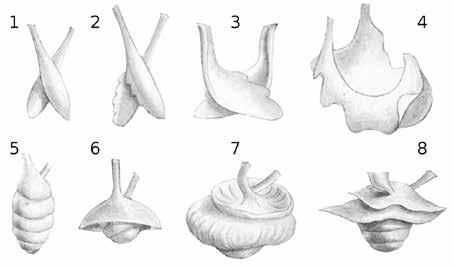
1. Penises after protrusion. 2. The frill begins to appear. 3. The frill is partially unrolled. 4. The frill completely expanded before twisting together. 5. Penises tightly coiled, forming a whorled knot. 6. The umbrella form. 7. Umbrella form with horizontal margins reversed. 8. Umbrella form with double margins.
Taylor J. W. 1902. Monograph of the land and freshwater Mollusca of the British Isles Testacellidae. Limacidae. Arionidae
Taylor Brothers, Leeds. page 38, figures 58-65. Public domain
penises emerge from their gonopores and entwine and exchange spermatophores (packets of sperm). After mating both slugs are fertilised and lay eggs.
Amazing slime
Slime serves multiple roles and has a complex composition. A watery fluid (90–99.7% water) containing glycoproteins, enzymes, proteoglycans, hyaluronic acid, glycosaminoglycans, antimicrobial peptides, copper peptides, and metal ions. Slime allows them to move over many different surfaces, from smooth glass to rough bark, at any angle. It has non-Newtonian properties (both a liquid and a solid) and acts as an adhesive and a lubricant. At rest, the slime is a solid glue, but under pressure it becomes liquid, when pressure is released, it quickly re-hardens. This allows them to stick one part of their foot to a surface while other parts move forward.
Spotting them
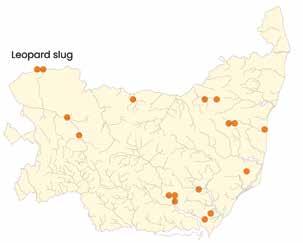
When to see them: March to November
Where to see them: the map shows where we currently hold records.
Help us to fill in the gaps by recording your sightings, www.suffolkbis. org.uk/record/node/7107
Field guides
Slugs and Snails: Book 133, Collins New Naturalist Library, Robert Cameron, ISBN: 9780007113002, William Collins, 2016. Out of print, but second-hand copies are still available.
Slugs of Britain and Ireland: Identification, understanding and control, Rowson, Turner, Anderson & Symondson, ISBN: 9781908819130, Field Studies Council, 2014
MEMBERS’ SURVEY 2024 RESPONSES
Anne Shaw
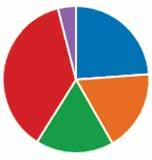
There are 566 members of either SNS or SNS/SBG. We have email addresses for 464 members and they were sent a link to the online survey. 151 members responded (including 47 we didn’t previously have email addresses for who included their email address). The remaining 102 members were sent paper surveys to complete.
Length of membership
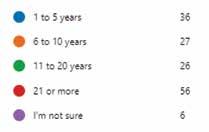
Membership distribution
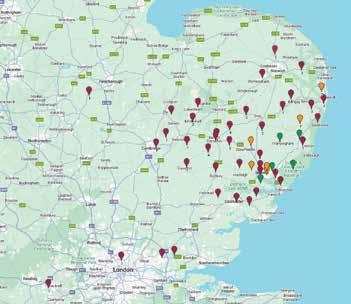
RED: 1-4 responders per postal area
AMBER: 5-9 responders per postal area
GREEN: 10+ responders per postal area
How did you discover SNS and why did you join?
Reasons for joining include a childhood love of nature, a vocation, and an interest in, or living in, Suffolk. Many found SNS by accident and others searched for somewhere to learn more about Suffolk wildlife. Very few members joined for the Bird Report.
Preferred communication methods


Member satisfaction with benefits
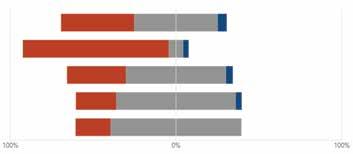
If you are dissatisfied, how could we do better? What would you like to see us do more of?
119 members replied, 84 were satisfied, 20 considered themselves inactive members. The rest implied they were satisfied with their membership but made the following comments.
Meetings: 10 found meetings were too far away, 5 suggested varying meeting times and days so they could attend.
Publications: there was a high response showing satisfaction with publications. One responder thought they should become available online only, and another said they might cancel their subscription because White Admiral is online anyway. [Editor’s note: White Admiral is published online a year after the paper publication.]
Learning from others: there were 33 comments relating to meetings and conferences, all wanting more indoor and outdoor field meets, some wanting more learning from others and local smaller groups.
Sharing knowledge with others: 3 showed an interest in mentoring or being mentored.
Grants: 6 responded. One said there used to be lists of available courses on the website, another said they didn’t know about grants, and the rest either thought they would like to apply for one or had applied and found it very useful for recording.
One suggestion was for funding to study living things, not just record them. Another suggested working with local colleges. Finally, one responder has not been to any meetings because as a beginner they feel daunted by the presence of so many knowledgeable experts.
Areas of interest and skill levels
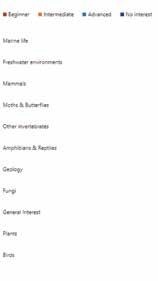
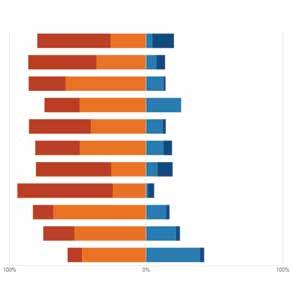
103 members responded in more depth about their interests. 17 are considered advanced in one or more subject areas, 2 are considered as intermediate, 4 replied that they were beginners.
Interest in targeted wildlife identification training courses for recording specific taxonomic groups
Of the 126 responses 58 members were not interested. 68 members were interested in training from beginner to intermediate level, with a few members expressing an interest for advanced training in specific taxonomies.
Awareness of SNS grants to study and improve recording skills
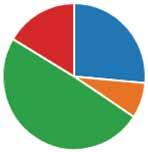
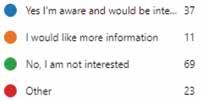
Are Apps helpful when recording specimens? Tell us which Apps you have used and your experiences of using them.
The most popular apps mentioned were: iRecord, Obsidentify, Merlin Bird ID, iNaturalist. Many members check the result from apps against field guides, keys and other trusted sources. Some members chose not to use apps as they prefer to learn identifying features, use field guides and keys.
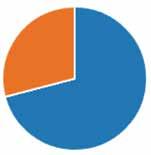
Members that would consider leading or assisting at a workshop, field meeting or public awareness event

Further comments from members for the SNS council to consider
There were 80 comments received, those with ideas to improve the society, or criticisms that can be addressed are being discussed by the council in order to improve what we do.
Paper Survey Results
Of the 102 paper surveys that were sent only 8 were returned.
• All had been members for 21 years or more, and had IP postcodes, except one.
• They had joined by recommendation, or through membership of a local group.
• Paper-based communication was preferred by the majority.
• Benefits of membership were mainly the publications.
• Ways to improve were mostly blank, but one would like more field meets and another would like phone contact with Recorders.
• Two respondents were interested in further training.
• One expressed interest in a grant to assist recording.
• No-one used Apps to assist with recording.
• No-one could lead or assist with workshops and/or events.
• 2 further comments were received:
• ‘I remain impressed how, despite the evidence of the last forty years or more, you all continue to find some optimism. (You have my admiration!)
• ‘I have all your publications and wish you well, you do a good job in a changing world.
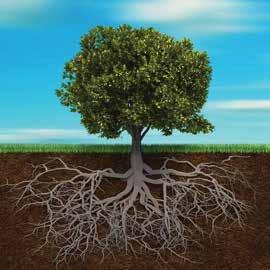
Song of the Soil with Helen Bynum
Thursday, 27 March
Doors open: 7 pm
Talk begins: 7.30 pm
At Hadleigh Guild Hall
Admission Free
Refreshments provided

Helen Bynum is a studying for a Masters in Ecology at the University of East Anglia. Working at Martlesham Wilds Nature Reserve, Helen is researching the possibilities of below-ground ecoacoustics to monitor the health of biological communities in the soil.
Helen’s early career began in academic lecturing in medical history after reading human sciences and the history of medicine (MSc and PHD)
Now she is a writer, speaker and editor living amongst the fields of Suffolk. She is a voluntary Tree Warden.


Mariia Shalabaieva, Unsplash
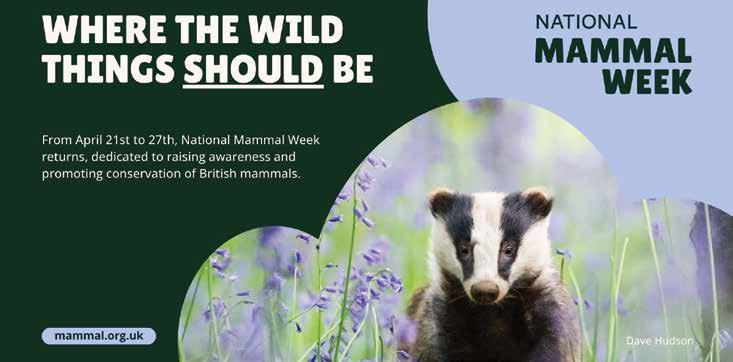
NATIONAL MAMMAL WEEK 2025
21 - 27 April
National Mammal Week is dedicated to raising awareness and promoting conservation of British mammals.
About National Mammal Week
National Mammal Week, brought to you by the Mammal Society, is a celebration of Britain’s mammals and an opportunity to raise awareness of the challenges they face.
One in four UK mammals are threatened with extinction, with many others in decline. The British Isles are home to many species of mammal, from the tiny pygmy shrew to the giant fin whale. And yet, mammals are some of the most under-recorded species in Britain.
From April 21st to 27th, the conservation sector, volunteers and nature-lovers come together to celebrate these remarkable creatures and raise awareness about their conservation.
Through a series of engaging events, educational activities, and community initiatives, National Mammal Week offers a unique opportunity to learn about the importance of mammalian biodiversity and the urgent need to protect it. Whether you're exploring local habitats, attending informative workshops, or participating in citizen science projects, there's something for everyone to enjoy during this week-long celebration.
Find out more and search for local events by scanning the QR code or visiting: mammal. org.uk/nationalmammal-week
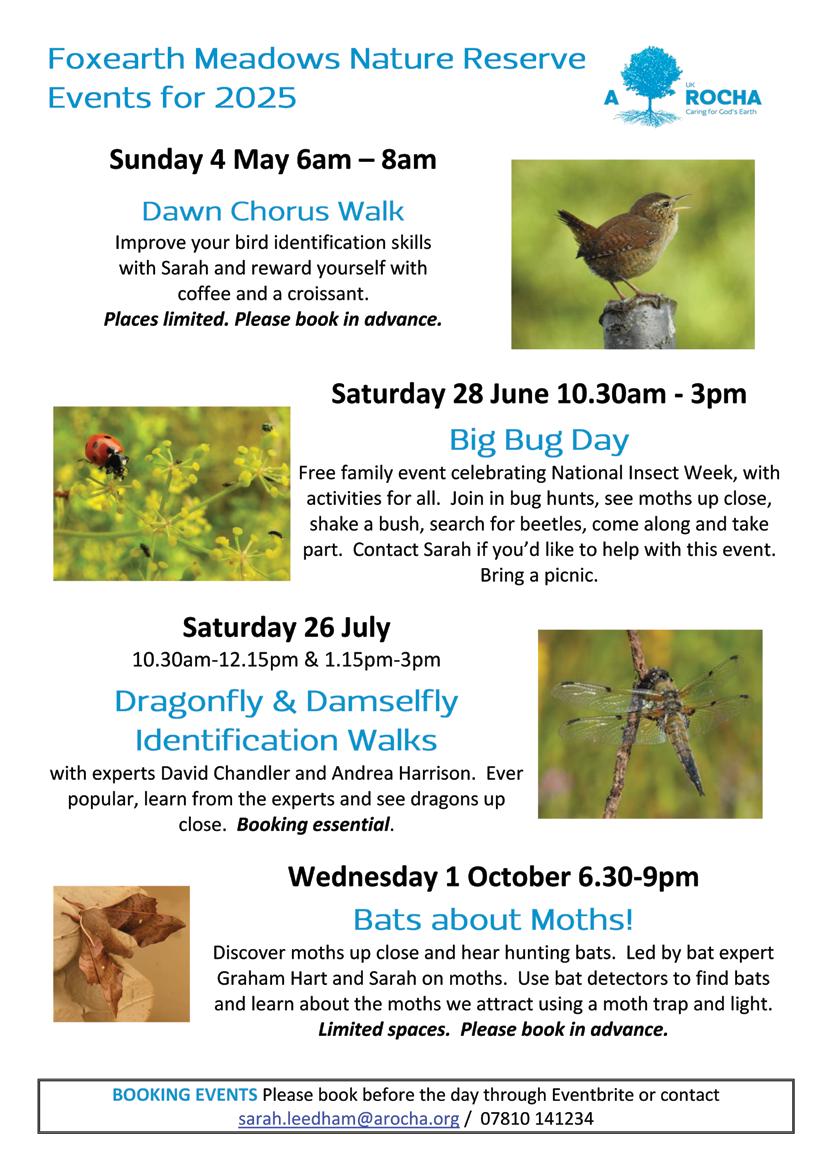
SUFFOLK WILDLIFE TRUST: EVENTS
• Talk: Adders at Minsmere • 18 Mar • Broadway House, Felixstowe
• Wildlife Live Webinar - Turtle Doves • 20 Mar • online
• Talk: Adders • 20 Mar • Woodbridge Community Hall
• Talk: The Brecks, Knettishall Heath • 25 Mar • The Lophams Village Hall
• Talk: Thirty Years of Garden Birdwatch • 26 Mar • Museum Street Methodist Church, Ipswich
• Talk: Chalk streams • 9 Apr • East Town Park Centre, Haverhill
• Blyth Valley Wildlife Group AGM • 10 Apr • Southwold Arts Centre, Southwold
• Wild Cocktails - Seasonal Wild Sips • 12 Apr • Holywells Park, Ipswich
• Marshland Histories film première • 13 Apr • Carlton Marshes
• Talk: Galapagos Islands • 15 Apr• Broadway House, Felixstowe
• Talk: North East Suffolk Reserves Round Up • 17 April • Woodbridge Community Hall
• Talk: Butterflies in Suffolk Wildlife Reserves • 23 Apr • Museum Street Methodist Church, Ipswich
• Talk: Wilder Rivers in Suffolk • 29 Apr • The Lophams Village Hall,
• Wild Skills: Wildlife Photography • 11 May • Chantry Park, Ipswich
• Community Webinar - Getting your message across • 3 Jun • online
• Talk: Understanding your community’s river • 7 Jun • St Mary’s Church Hall, Ufford
• Spring Afternoon Photography Course • 7 Jun • Carlton Marshes
• Summer Wild Cocktails • 7 Jun • Holywells Park, Ipswich
• Understanding and Appreciating Lichens workshop • 8 Jun • Carlton Marshes
• Exploring wild drinks • 28 Jun • Bradfield Woods
• Talk: Wildlife in your community • 9 Jul • Hadleigh Cricket Pavilion, Hadleigh
• Photographing Summer in the woods • 12 Jul • Bradfield Woods
• Wild Skills: Wildlife Photography in Christchurch Park • 13 Jul • Reg Driver Centre, Ipswich
Full details, booking and more events: www.suffolkwildlifetrust.org/events

FIELD STUDIES COUNCIL: COURSES
• Discovering Garden Birds: Identification and Ecology – Online
4 weeks • Tue 18, Mar – Tue 29, Apr • £20.00
• Discovering Spiders – Online • 3 weeks • Wed 26, Mar – Wed 30, Apr • £20.00
• Discovering Beetles – Online • 3 weeks • Thu 10, Apr – Thu 15, May • £20.00
• Discovering Bees – Online • 4 weeks • Mon 14, Apr – Mon 26, May • £20.00
• Discovering Botany – Online • 4 weeks • Wed 16, Apr – Wed 28, May • £60.00
• Spider Identification – Online • 4 weeks • Mon 28, Apr – Mon 09, Jun • £60.00
• Discovering Badgers – Online • 3 weeks • Tue 06, May – Tue 10, Jun • £45.00
• Wildflower Families – Online • 2 weeks • Wed 07, May – Wed 04, Jun • £30.00
• Field Identification of Bumblebees – Online
4 weeks • Mon 12, May – Mon 23, Jun • £40.00
• Discovering Trees – Online • 4 weeks • Thu 15, May – Thu 26, Jun • £20.00
• Discovering Reptiles – Online • 3 weeks • Wed 21, May – Wed 25, Jun • £20.00
• Native Tree identification at Flatford Mill
3 days • Fri 23, May – Sun 25, May • £225 – £310
• Birdwatching: Spring Arrivals at Flatford Mill
3 days • Fri 23, May – Sun 25, May 2025 • £225 – £310
• Botanical Anatomy – Online • 3 weeks • Mon 26, May – Mon 30, Jun • £60
• Coastal Lichens – Online Webinar • 1 hr • Tue 27, May 11:30–12:30 • £10.00
• Bird Survey Techniques at Flatford Mill
2 days • Tue 27, May – Wed 28, May • £220 – £340
• Lichens for Beginners at Flatford Mill • 2 days • Sat 21 – Sun 22 Jun • £220 - £440
Natural History Courses:
Covering all aspects of the natural world.
www.field-studies-council.org/fsc-natural-history-courses
Professional Development for Ecologists and Conservationists: An extensive range of courses that cater for all career levels.
www.field-studies-council.org/biodiversity/ professional-development
BIOLOGICAL RECORDING COMPANY: EVENTS
• Earthworm Watch: Insights Into Urban Earthworm Communities
Mon 24 Mar, 19:00 • Free
• Thriving on the Edge: Grey Seal Abundance and Survival on the Calf of Man
Tue 25 Mar, 19:00 • Free
• Red Squirrels
Thu 27 Mar, 18:30 • Free
• Pollinators
Tue 1 Apr, 12:30 • Free
• Using Wildlife Observation Apps
Tue 15 Apr, 18:30 • From £10.00
• Dragonflies of the UK Part 3
Wed 16 Apr, 18:30 • From £10.00
• Improving Bee Hotel Design: The Big Bee Hotel Experiment
Tue 22 Apr, 13:00 • Free
• Insect Welfare: What Benefits Bugs?
Tue 20 May, 19:00 • Free
• Insects That Live In The Sea: Why Are There Are So Few?
Tue 10 Jun, 19:00 • Free
• Social Wasps of the UK
Thu 12 Jun, 18:30 • From £10.00
• Beetle Research and Conservation Virtual Symposium
Thu 26 Jun, 10:00 • From £25.00
• Ferns of the UK: Spleenworts
Tue 14 Oct, 18:30 • From £10.00
Full details, booking and more events: www.eventbrite.co.uk/o/the-biologicalrecording-company-35982868173


SUFFOLK NATURALISTS’ SOCIETY GRANTS
Suffolk Naturalists’ Society has received generous donations in the past and uses these to fund studies by members on the flora, fauna and geology of the county. Amateur naturalists have always been in the forefront in increasing knowledge and recording the natural history of Suffolk. We aim to help those who feel that the costs of a study are a barrier, either experts or beginners, encouraging exploration of understudied areas of the natural world and explaining the importance of this knowledge to the general public.
Applications are welcomed for small or large sums, £1,000 or more for substantial, longer running, projects.
Grants can be used for:
Scientific equipment, books, software or other relevant items. Reasonable travel and subsistence for field work. Attending training courses, conferences, specialist meetings and visits to scientific institutions. Running workshops or field meetings that encourage people to get involved with wildlife studies and recording. Payment for expert guidance and acquiring necessary licences.
Criteria:
1. Projects should include a large element of original work and further the knowledge of Suffolk’s flora, fauna or geology.
2. A written account of the project is required within 12 months, unless it is a longer term study. This should be suitable for publication in one of the Society’s journals: Suffolk Natural History, Suffolk Birds or White Admiral.
3. Suffolk Naturalists’ Society should be acknowledged in all publicity associated with the project and in any publications emanating from the project.
Applications may be made at any time. Please visit our website for full details and criteria: www.sns.org.uk/pages/bursary.shtml
WWW.SNS.ORG.UK
The Suffolk Naturalists’ Society, founded in 1929 by Claude Morley (1874 -1951), pioneered the study and recording of the County’s flora, fauna and geology. It is the seed bed from which have grown other important wildlife organisations in Suffolk, such as Suffolk Wildlife Trust (SWT) and Suffolk Bird Group (SBG).
Recording the natural history of Suffolk is still the Society’s primary objective. Members’ observations go to specialist recorders and then on to the Suffolk Biodiversity Service at The Hold to provide a basis for detailed distribution maps and subsequent analysis with benefits to environmental protection.
Funds held by the Society allow it to offer substantial grants for wildlife studies.
Annually, SNS publishes its transactions Suffolk Natural History, containing studies on the county’s wildlife, plus the county bird report, Suffolk Birds (compiled by SBG). The newsletter White Admiral, with comment and observations, appears three times a year. SNS organises two members’ evenings a year and a conference every two years.
Subscriptions to SNS:
Individual membership £20; Family/Household membership £23; Student membership £13. Members receive the three publications above.
Joint subscriptions to SNS and SBG:
Individual membership £35; Family/Household membership £41; Student membership £21. Joint members additionally receive the SBG newsletter The Harrier.
As defined by the Constitution of this Society its objectives shall be:
2.1 To study and record the fauna, flora and geology of the County
2.2 To publish a Transactions and Proceedings and a Bird Report. These shall be free to members except those whose annual subscriptions are in arrears.
2.3 To liaise with other natural history societies and conservation bodies in the County
2.4 To promote interest in natural history and the activities of the Society.
For more details about the Suffolk Naturalists’ Society contact: Suffolk Naturalists’ Society, The Hold, 131 Fore St, Ipswich IP4 1LR. enquiry@sns.org.uk