White Admiral
Suffolk Naturalists’ Society

Suffolk Naturalists’ Society
Welcome to White Admiral, where you will find a bumper crop of reports on our recent meetings, news about forthcoming events, articles and poetry.
Would you like to know more about obtaining a grant to fund a study or project? Then take a look at the inside back cover, or the Grants page on the SNS website to discover the criteria and how you can apply.
For those of you that use social media you can find us on Bluesky: Suffolk-nats1929, and Facebook: Suffolk Naturalists Society - Members Group
Emma Aldous
editors@sns.org.uk
The opinions expressed in White Admiral are not necessarily those of the editor or of the Suffolk Naturalists’ Society. Unless otherwise stated all images are © the article author.
Chairman: Joan Hardingham
Hon Secretary: Vacant
Rivis Vice Presidents
Colin Hawes
Howard Mendel
David Walker
Joan Hardingham
Martin Sanford
Council members
Emma Aldous (Website, Social Media)
Gavin Deans
Hawk Honey (Field Meetings)
• Treasurer: Martin Sanford
• Administration Secretary: Anne Shaw
Tim Holt-Wilson
Simon Jackson
Adrian Knowles
Nick Mason
Howard Mottram
Darren Tansley
Peter Vincent
Anne Wright (SBG liaison)
Anthony Speca*
Sarah Pynn* (Student Rep)
* Not a trustee position
Publication Editors
Suffolk Natural History
Martin Sanford transactions@sns.org.uk
White Admiral
Emma Aldous editors@sns.org.uk
Suffolk Bird Report
Nick Mason suffolkbirds@sns.org.uk
www.SNS.org.uk Suffolk Naturalists Society - Members Group Suffolk-nats1929
BIRDS – NORTH EAST
Richard Walden bird-ne@sns.org.uk
AMPHIBIANS & REPTILES
John Baker amphibian@sns.org.uk
BLACK POPLAR
Sue Hooton blackpoplar@sns.org.uk
COLEOPTERA
Ross Piper coleoptera@sns.org.uk
FERNS & FLOWERING PLANTS
Martin Sanford botany@sns.org.uk
GALLS
Jerry Bowdrey gall@sns.org.uk
MAMMALS
Alison Looser mammal@sns.org.uk
MOLLUSCS
Ian Killeen mollusc@sns.org.uk
SPIDERS, ARACHNIDS, ISOPODA & MYRIAPODA
Paul Lee spider@sns.org.uk
BIRDS – SOUTH EAST
Steve Fryett bird-se@sns.org.uk
ACULEATE
HYMENOPTERA
Adrian Knowles hymenoptera@sns.org.uk
BRYOPHYTES
Richard Fisk bryophyte@sns.org.uk
DIPTERA
Peter Vincent diptera@sns.org.uk
FRESHWATER FISH
Position vacant
HEMIPTERA
Adrian Knowles bugs@sns.org.uk
BATS (SUFFOLK BAT GROUP)
Alan Miller bats@sns.org.uk
MOTHS
Neil Sherman moth@sns.org.uk
BIRDS – WEST
Chris Gregory bird-w@sns.org.uk
AQUATIC INVERTEBRATES
Adrian Chalkley aquatics@sns.org.uk
BUTTERFLIES
James Corton suffolkbutterflies@sns.org.uk
DRAGONFLIES
Adrian Parr dragonfly@sns.org.uk
FUNGI & SLIME MOULDS
Neil Mahler mycology@sns.org.uk
LICHENS
Chris Hitch lichen@sns.org.uk
MARINE LIFE
Gen Broad marine@sns.org.uk
ORTHOPTERA
Stuart Ling orthoptera@sns.org.uk
Joan Hardingham, SNS Chair
Hawk Honey (Hymenopterist and SNS Council Member) has very kindly offered to co-ordinate SNS field meetings and would be very happy if you offered to get involved. Hawk can be reached at fieldmeetings@sns.org.uk
We started field meetings up again after a long break and the ones we have had so far have been well supported and great fun. Including the most recent, a re-visit to Westleton Common.
Our next visit is to Stanny Farm at Iken on July 19th. We have bought some field studies equipment to use at meetings. However, if you had a particular project in mind that needs anything else we would be able to provide it through a grant. See the grants section on the website for details.
Hawk has stepped down from his role as Social Media secretary; we thank him for getting SNS up to speed on social media. Emma Aldous our website Guru has taken over, so many thanks to her. We have a private Facebook group (Suffolk Naturalists Society - Members Group ) so contact Emma if you want to join.
So please post your latest exciting finds on Facebook or on Bluesky (contact on SNS Website). Or send them to Emma: website@sns.org.uk for going in White Admiral or on the website.
We have ditched X (xTwitter) in favour of Bluesky because we didn’t like Elon Musk ... but maybe we do now!
Emma is helping us redesign the SNS website and this will include up-to-date info about events etc and might include a gallery for your pictures. If you run any social media for your area of expertise and would like a link do contact Emma on the email address above.
There is also a budding new SNS Flora group which stays in contact via Whatsapp, email flora@sns.org.uk for more information.

© Hal Gatewood, Unsplash.com
Emma Aldous
We are excited to announce that the Suffolk Naturalists’ Society website will be undergoing a complete redesign over the coming months. The aim is to create a more user-friendly, engaging, and informative online hub for our members and for anyone interested in the wonderful wildlife of our county. Before we get started, we want to hear from you, our valued members. Please take a fresh look at our current website, www.sns.org.uk, and let us know what you think. What features do you find most useful? Which sections do you visit regularly? Equally, what do you find frustrating or difficult to navigate?
This redesign is a fantastic opportunity to build a website that truly serves the needs of our community, and your ideas are crucial to this process. We would love to hear your thoughts on what you would like to see in the new site. Are there any features you’ve seen on other websites that you think would be a great addition? Perhaps you have ideas for new content, a more interactive events calendar, or improved ways to access our records and publications? Please send all your feedback and suggestions to website@sns.org.uk by 31st August 2025. We look forward to hearing your thoughts and creating a brilliant new online home for the Society.
Saturday 19th July, from 10.15am – Stanny Farm, Iken.
Stanny Farm is a 750 acre site on the rivers Alde and Ore, occupying a peninsula in the village of Iken. It was acquired by Paul Cooke in 1987, a passionate ornithologist and former advisory trustee to the RSPB.
Paul, alongside his wife Louise, set about restoring the land. The marshes were under commercial cropping but were reverted to grassland and a series of freshwater scrapes and lagoons. Now managed by the Suffolk Wildlife Trust, this portion of the farm is currently home to booming bitterns, great, little and cattle egrets, and has been a recent stopover for rare species, including pairs of wryneck and common cranes.
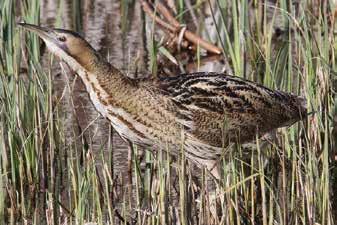
On the upland, the farm’s two coralline crag pits were previously used as dumps and filled with rubbish, but have since hosted barn owls, little owls and sand martins, as well as rare flora, including one of the only recorded sites in East Suffolk of tall broomrape (Orobanche elatior). The geology is unique to the Suffolk coast and a SSSI.
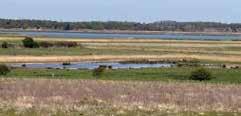
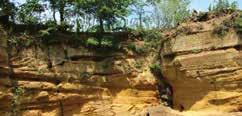
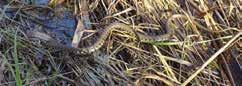
Grazed meadows on the farm have been rich in orchids (southern marsh, bee, pyramidal and one record of green-winged), fungi and dragonfly species, but much of the upland remains in commercial cropping. Paul’s son, Jack, is in the early stages of a program of natural regeneration, beginning with a thirty-acre field taken out of cropping in 2023. This and several other sites will be the focus of the day’s recording.
Jack is delighted to have naturalists on the farm and will set some moth traps to begin the day, giving a short introduction to Stanny’s conservation history.
See https://sns.org.uk/sns-meetings-and-events/ for more information.
To reserve your place contact us at enquiries@sns.org.uk .
Gavin Deans
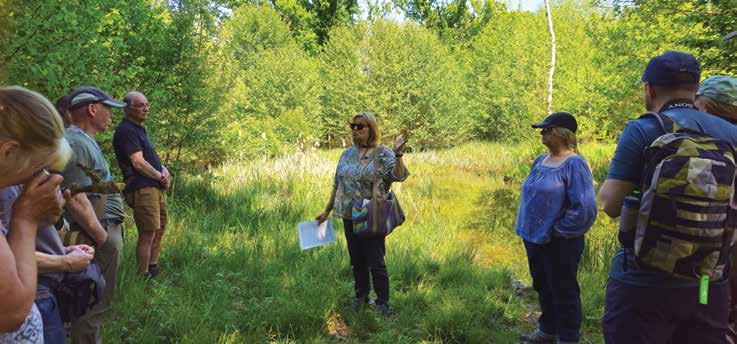
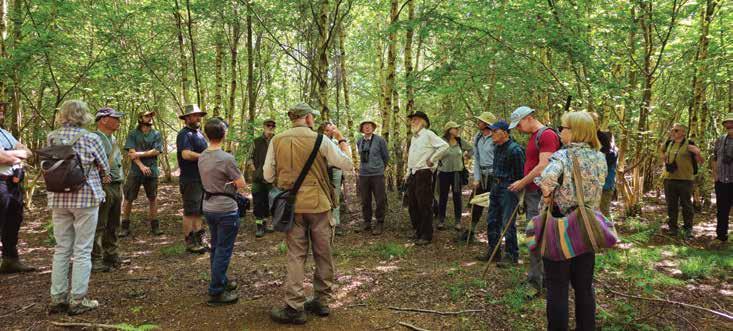
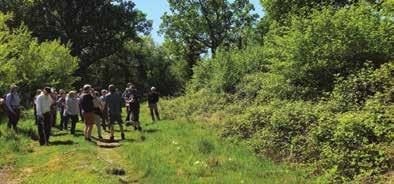
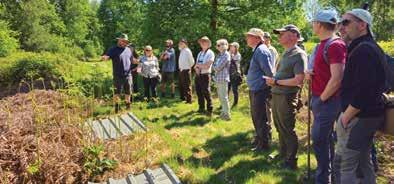
On Saturday, May 10th 2025, SNS held its first outdoor field trip of the year to Raydon Great Wood, a private reserve near Hadleigh. The weather was perfect for a naturalists’ woodland meeting (dry with sunshine and very little wind!). Around 40 members attended.
Raydon Great Wood is a privately owned 200-acre ancient woodland that has been restored over the last 25 years by its owner, James Buckle, and woodland managers Graham and Steve.
The night before our visit, Raymond Watson set up three moth traps and then returned at dawn to examine and label the catch, ready for our arrival at 10 am. Thank you, Raymond.
Steve and Graham gave us a tour of the woodland in the morning and explained the management that has resulted in the wonderful wildlife haven they have
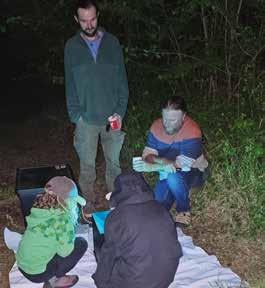
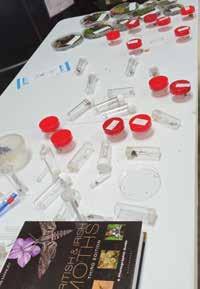
Left: Moth trapping with new SNS Skinner trap. Unlike bright mercury vapour lamps this one allows observation of what is flying in. Right: Raymond Watson’s haul from his moth traps
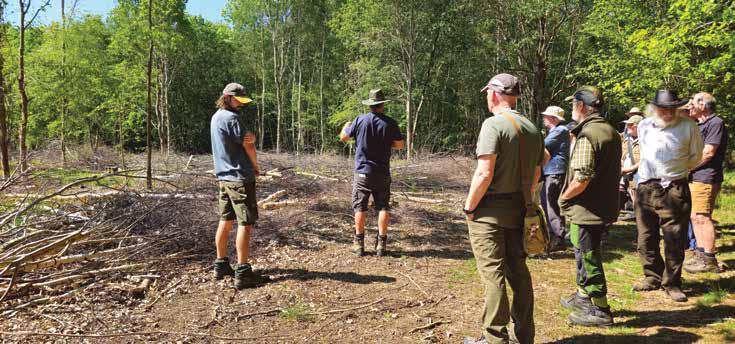
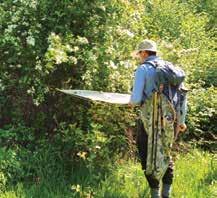
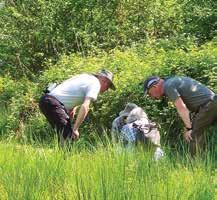
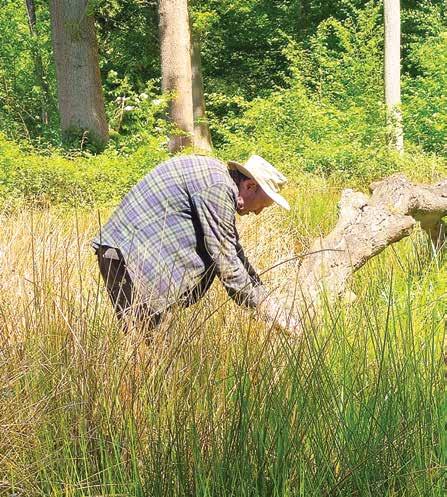
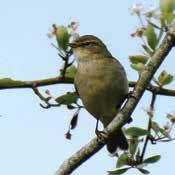
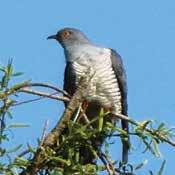
created. When the woodland came into the ownership of James Buckle, it had been clear-felled and restocked with conifers, hybrid poplars, red oak, and sycamore by its previous owners, resulting in a low-value wildlife habitat. Over the years, most of these unsuitable trees have been removed, and natural regeneration has been allowed to occur, resulting in the reappearance of species you would expect to find in an ancient woodland. On our morning tour, we were treated to the sounds of nightingale and cuckoo. There are around 80 ponds, around half of them successfully restored, some of which were examined in more detail by a few of us in the afternoon under the guidance of Juliet Hawkins.
After lunch, we split into smaller groups to explore the area in more detail and to add species records to the Raydon Wood list.
Members were treated to a fantastic day at this location, and we would like to thank Juliet Hawkins, who has been advising James on the ecological management of the wood, for facilitating this visit.
We would also like to thank James Buckle for allowing us access to this magnificent wood, as well as Steve and Graham, who were brilliant hosts and made us feel very welcome. It would be a great place to revisit, as there is so much to see and record.
Gordon Brown
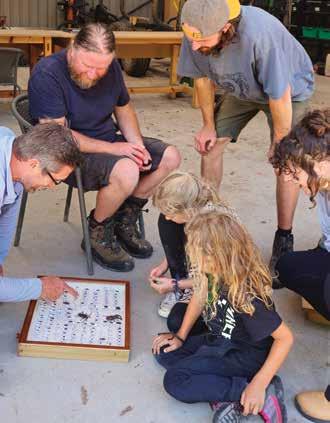
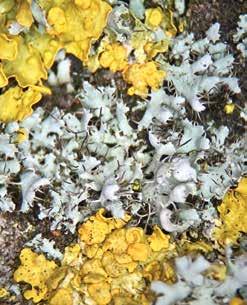
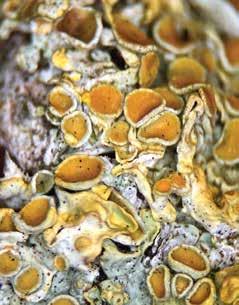
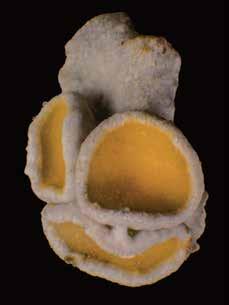
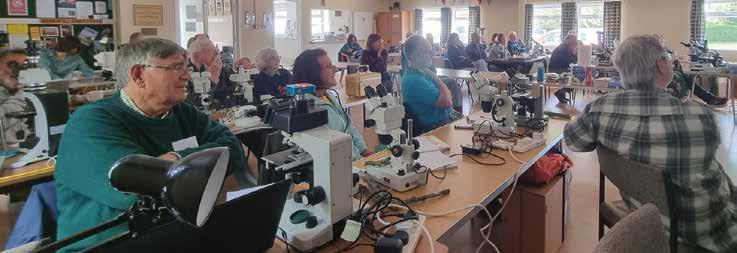
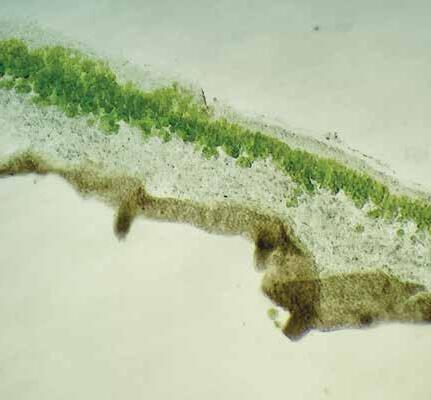
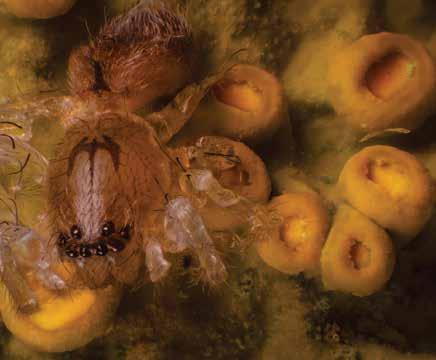
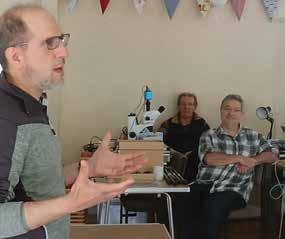
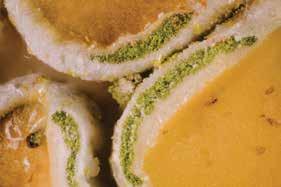
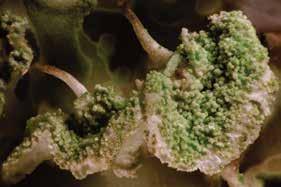
On Saturday, May 17 the Suffolk Naturalists Society and the Anglian Microscopy Group held the first of hopefully many joint meetings when a total of 36 enthusiastic participants were treated to an excellent workshop on lichens, led by Dr Anthony Speca. Following an introductory talk on the biology and importance of lichens in the environment we collected specimens from the local area and returned with them to the village hall for examination, identification and photography.
Most of the members had a go at making slides, either of squashes of the specimens or mounting thin sections. Some of the sections were cut by hand and I also demonstrated a method of cutting very consistent sections using a sliding microtome with the fresh lichen sandwiched between two layers of rigid insulation foam. This technique is used at the Anglian Microscopy Group with great success for cutting sections of plant stems and wood.
anglian.microscopy@gmail.com www.anglianmc.org.uk www.facebook.com/ groups/3830952063797577
This was a extremely successful meeting and we are very grateful for the SNS sponsoring the event by engaging the speaker and the Anglian Microscopy Group providing the hall, equipment and materials. As both organisations have a huge cross over of interests and much to learn from each other we are very grateful to Joan Hardingham and other members of the SNS for making the event possible. Watch this space for more joint events at Crowfield but bear in mind that all events at the Anglian Microscopy Group are free of charge, there’s no membership fee, we usually provide materials either free or at cost, there’s a cupboard full of club equipment to use on the day, lots of help available and no need to book. Just turn up, we’d love to see more SNS members at the meetings!
Anne
Shaw
I attended my first Anglian Microscopy Group (AMG) meeting on Saturday 21st June at Crowfield Village Hall. Having not used a microscope since I was in the 6th Form, I was amazed by the progress in technology!
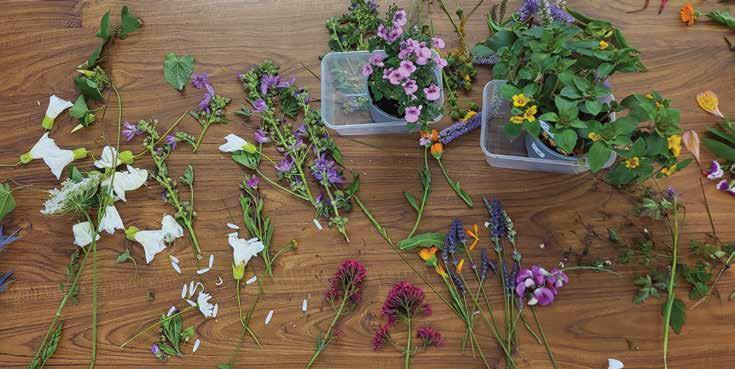
AMG is run by Gordon Brown and Robert Ratford, and the topic ‘Fun with Flowers’ was presented by Robert. The group were given handouts starting with a diagram of the key flower parts, a description of the pollination process and instructions about preparing a slide to watch pollen tubes grow in real time. The process was then demonstrated by Robert and included the various medium to use with a variety of different flowers. Everyone present was able to grow pollen tubes and they were able to see photomicrographs and videomicrographs of the process.
There followed a demonstration of making petal prints using UV resin, and the process of making hand and microtome sections of flower parts.
Gordon, Robert and all the members were very welcoming. I felt comfortable enough to ask ‘learner’ questions, and the day was very productive. I had such a great time I have decided to get a microscope of my own! Special thanks to Debbie Pavier and Paula Irvine for showing me the ropes and to Gordon and Robert for an excellent day.
If you would like more information about the AMG please see their website www.anglianmc.org.uk/
Heads
Hawk Honey
The weather decided to be a scorcher as we returned for another day at Westleton Common. The day kicked off with some late-night moth trapping from the previous evening by member Raymond Watson. He and his assistant Hannah were back early doors to go through the trap with over 200 moths captured there was some
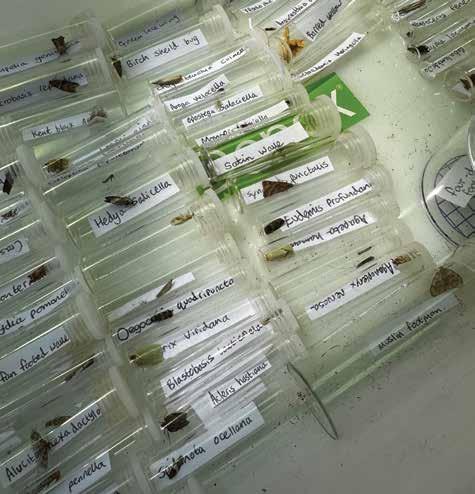
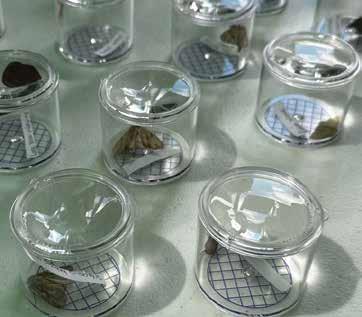
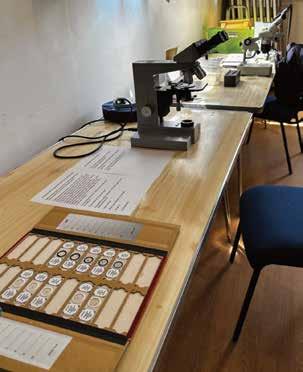
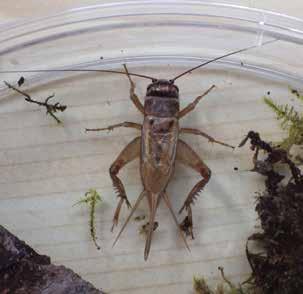
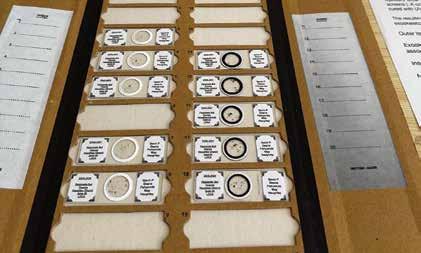
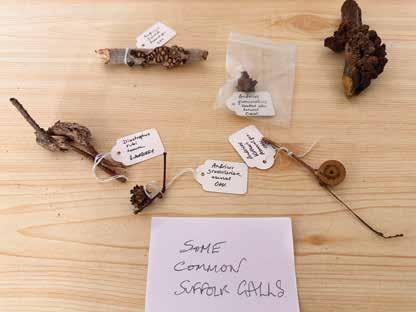
Gavin Deans and Tim Holt-Wilson came along with their microscopes and some specimens, which included bat poo and some soil samples. Our Chair also brought along a hitchhiker from her recent travels to France in the shape of a domestic Cricket Acheta domesticus, as well as some moss samples. Jerry Bowdrey also brought along a sample of common Suffolk galls.
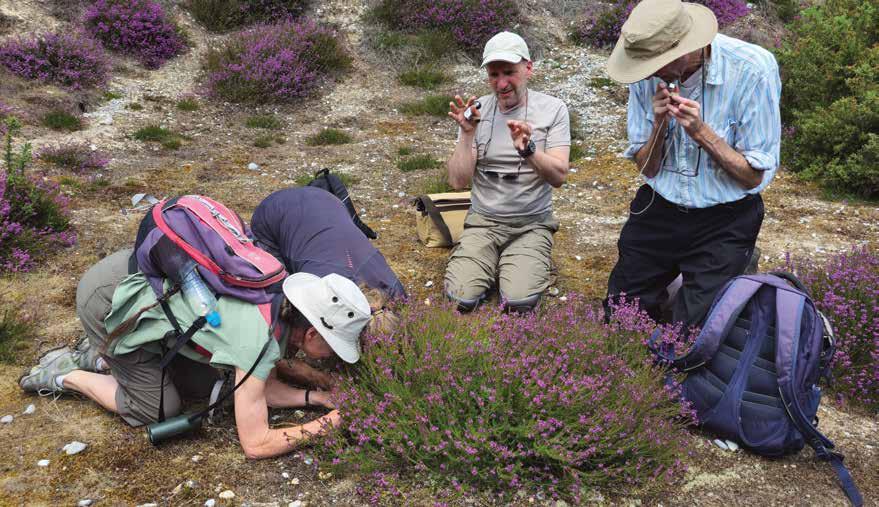
After a few technical hitches in the hall and some help from those in attendance we got underway with a short talk on the history of the common from Westleton Common Advisory Committee Secretary and Parish Councillor Ian Webber. Howard Mottram then took to the stage to talk about the geology of the site and its uniqueness. The heat was becoming stifling indoors, so we all headed out to look around the common in the hope of seeing some Silver-studded Blues Plebejus argus and what else was about as well as to see some of the wonderful geology that Howard had spoken of.
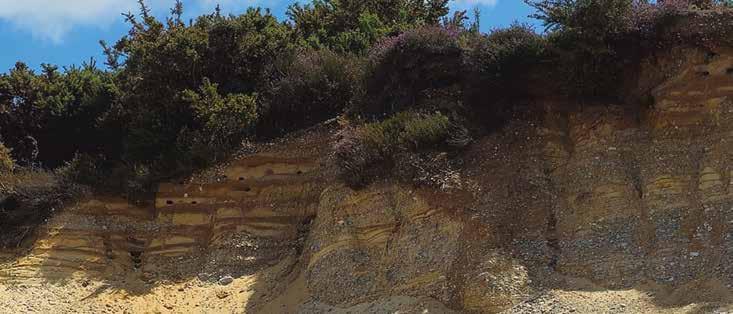
The Silver-studded Blues did not disappoint and small flurries could be seen around as males chased females across the common and Peter Vincent gave us a small insight into their very unusual lives. Sand Martins Riparia riparia were nesting in the cliff face so we could not get too close to observe the geology, but it was nice to see the birds darting in and out of the holes they had made.
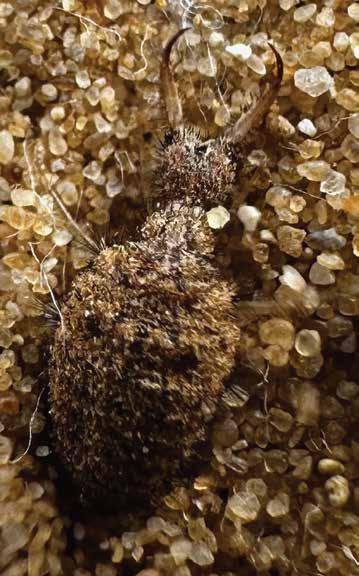
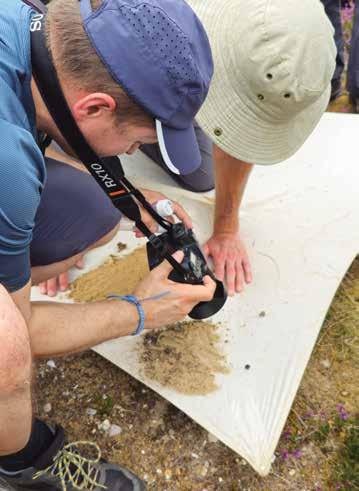
Ross Piper took some people out to look at the amazing Ant lions Euroleon nostras that live here and soon members were crouched down looking at specimens in various stages of development.
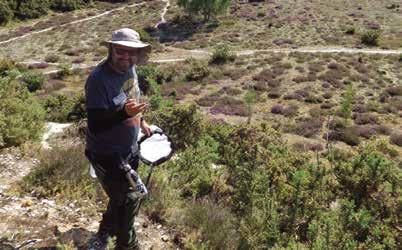
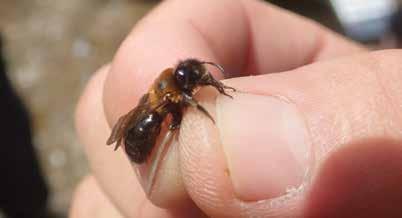
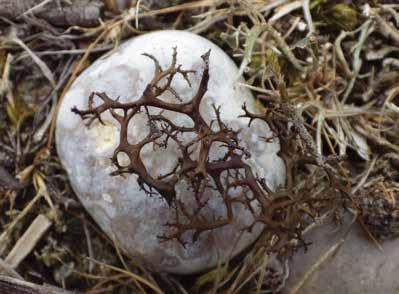
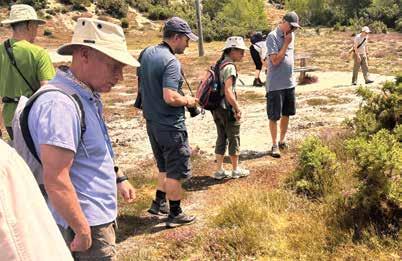
I went on the hunt for bees and wasps and was not disappointed by the many nesting aggregations of noisy Green-eyed Flower Bees Anthophora bimaculata with their indicative whine as they hover on their approach to land. Many other heathland specialists were also found with Beewolves Philanthus triangulum flying into their burrows carrying paralysed honeybees and many of both species of Sand Wasps Ammophila sabulosa and pubescens as well as Podalonia sp could be seen hunting for caterpillars.
There is much more to report from the day, but as the newsletter is about to go to print, and species records from the day are still to be collated, we will keep this report short. However, it was a productive day and a detailed report of species will follow in the next issue.
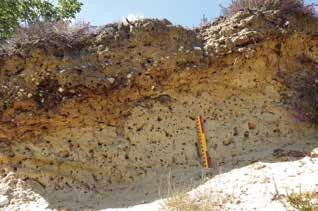
Above: Bee city © Tim Holt-Wilson

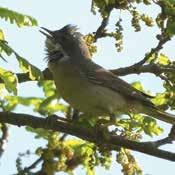
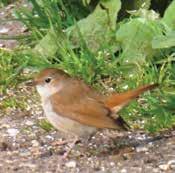
It is late April and there is warmth in the air
And as I make my way down to Flatford
I hear that familiar call of springs gone by Cou-coo, cou-coo and my heart leaps with joy
From Central Africa some 4000 miles away These magical visitors have arrived
To be here in this welcoming land of ours
Covered in the bright green hues of spring
On its heels have also come other distant flyers
Insect-hunting Martins, Swallows and Swifts
Warblers Garden, Grasshopper, Reed and Willow
Sedge and Cetti’s, Chiffchaff and Whitethroat
And the glorious songbird the ‘shy’ Nightingale
Identified by a loud whistling crescendo
And a delightful serenade of musical greetings
All here to take advantage of our bounty
But I am also struck by the green of our lanes
Carpets of Cranesbill, Spring Beauty and Stitchwort
Interrupted by Garlic Mustard, Cuckoo pint and Queen Anne’s lace showing off its white crowns
And in the wood Bluebells, Violets and Wood Sage
Also flowering copiously are the shrubs and trees
Maple, Elm, Hazel, Oak, Dogwood lining the paths
Rich almondy scent wafting out from May blossom
If this isn’t the lovely Garden of Eden, what is?
Lost in reverie, I was brought back to the moment
By ‘cou-coo’ reverberating across the Dedham Vale
Rasik Bhadresa

Tim Holt-Wilson
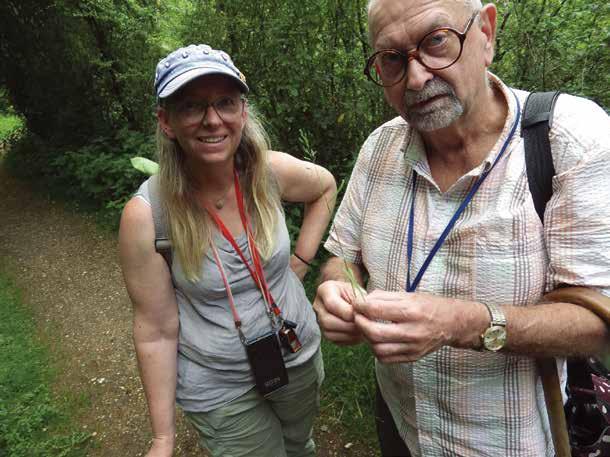
Grasses can be a bit of a struggle for botanists unless one has grasped their distinctive structures and finer details – sometimes a mere hair-breadth in scale! Three Suffolk Flora Group members met at SWT Lackford Lakes Reserve on 30th May, namely Meg Miller, Tim Holt-Wilson and tutor Stephen Clarkson. The day was blessed with patterns of sunlight and passing clouds. Stephen introduced us to some good reference books and the elements of gramineous anatomy before we swung into practical action looking at species round the car park. It was easy to get distracted, however: we spent a good 20 minutes examining the minutiae of a small, starved specimen of some kind of Galium, inspecting its prickles and trying to decide which direction(s) they faced, in case we had found something unusual. Eventually the consensus was bog-standard Cleavers. Thus, one learns.
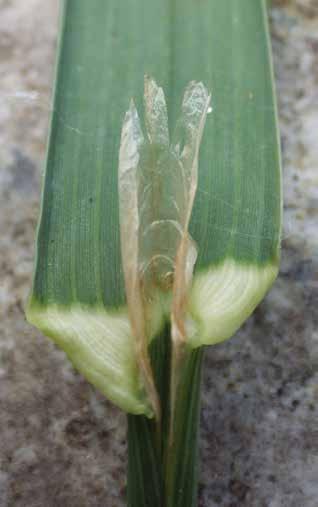
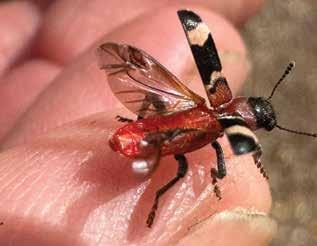
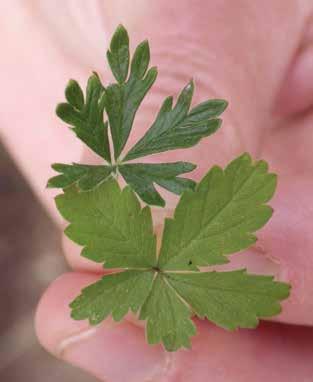
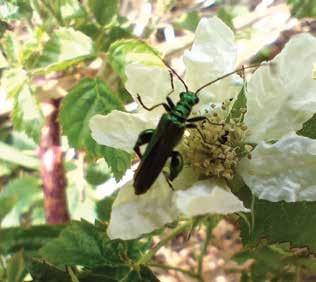
Picnic lunch was followed by a more farreaching investigative walk-about in the Reserve. (Figure 1). By the end of the day we had worked in depth on eight species of the commonest grasses (Figure 2) and turned up several other biological points of interest including an attractive clerid beetle Thanasimus formicarius (Figure 3) which predates on bark beetles. Meg drew our attention to the presence of Hoary Cinquefoil and Creeping Cinquefoil growing side-by-side, the one with strongly divided leaves and white undersides. (Figure 4). Stephen opened a new doorway of understanding in the hawthorn world by pointing out the distinctive character of Crataegus heterophylla, with its varied leaf shapes and stipules (flaps) at the base of its leaf petioles (stalks). We found a distinctive bramble bush which begged closer analysis and naming but this thorny matter had to be left for more specialist attention, e.g. Alex Prendergast, although we could name an iridescent beetle on it, the Thick-legged Flower Beetle Oedemera nobilis.(Figure 5) The day wore on and feet grew sorer, but a mysterious grass species was found and a sample taken away for further analysis. Stephen now says it is an unusual variant of Festuca rubra, having its panicle ‘blown sideways’ rather than pointing upwards (my words), and that Hubbard cites 12 subspecies. We started the day with Poa trivialis and ended with an obscure Festuca rubra. Many thanks to Stephen for his able tuition. As Summer unfolds, I think there is scope for another grasses Day School.
Rasik Bhadresa
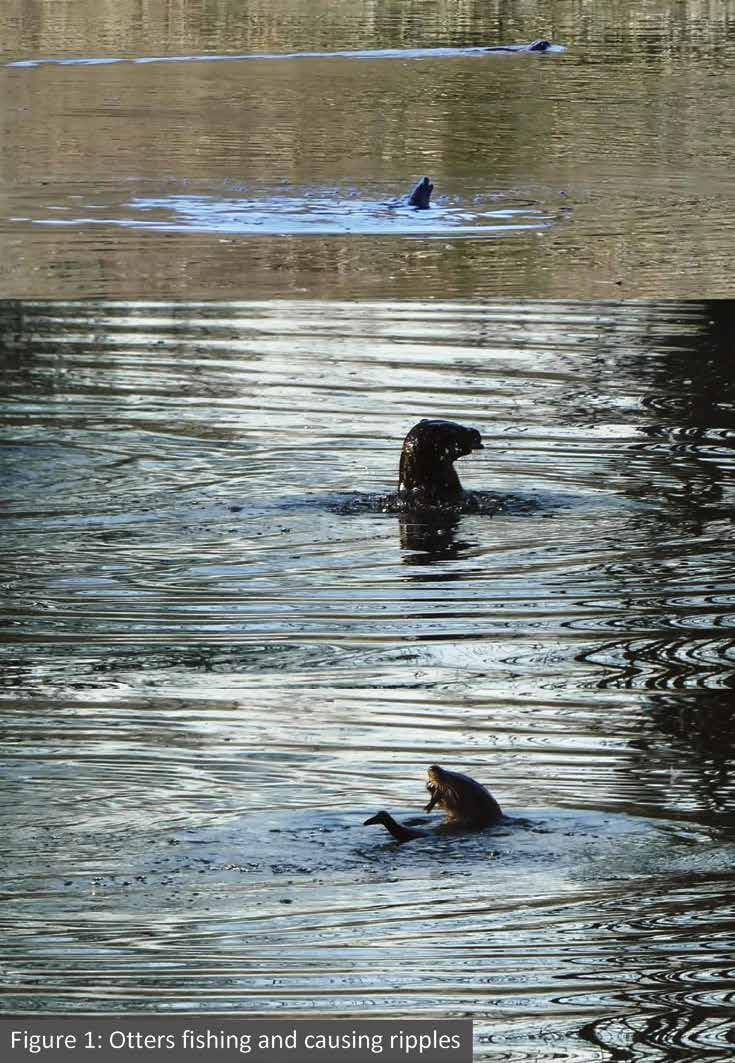
It was on Wednesday 26 March around 7.30 in the morning that I saw an otter (Lutra lutra) surfacing and then diving, on the left side of River Stour (TM075933) next to the National Trust Tearoom at Flatford. I was on the bridge looking towards the mill. I saw the familiar surface air bubbles (caused by water pressure forcing out the air trapped in their fur) and also a V-shaped wake it had left behind. I continued to look and saw the otter surface again in front of Flatford Lock and, having to avoid it, made its way along the left side of the ‘island’ and disappeared towards the mill. Needless to say, I was elated. For me, the otter has a label of ‘fascination’ attached to it. What was even more exciting was that I had not seen otters in these parts for over two years!* So this sighting represented a significant ‘return’.
Then on Saturday morning, three days later, I saw surface bubbles again near the bridge. My eyes started to warm up as I continued with my walk along to Flatford Mill where, in the ‘Haywain Pool’, there were two large patches of surface bubbles. Otter activity (?), I wondered. But if so, they would have come via the culvert (a convenient shortcut) under the mill building from the other side. I proceeded towards the Enfield Bird Hide overlooking the north end (TM079331) of Gibbonsgate Lake. This is generally quite a quiet corner. But this morning, it was ‘alive’ with splashing and ripples and bubbles, and some hissing too. And the commotion-causers: three otters, yes three! I was gobsmacked. I took some photos while they were in the water (see Figure 1) but suddenly one appeared at the bottom
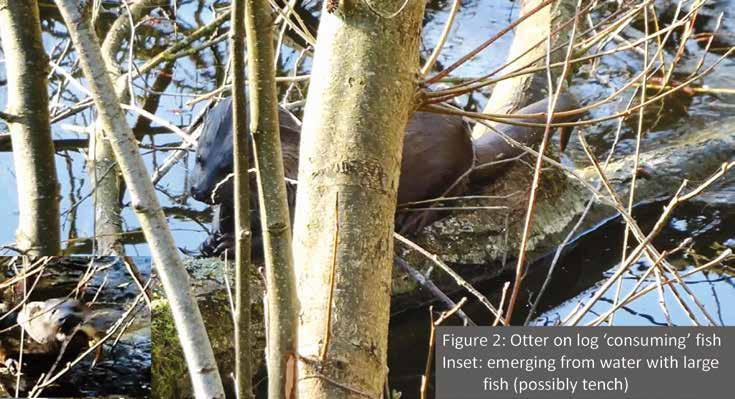
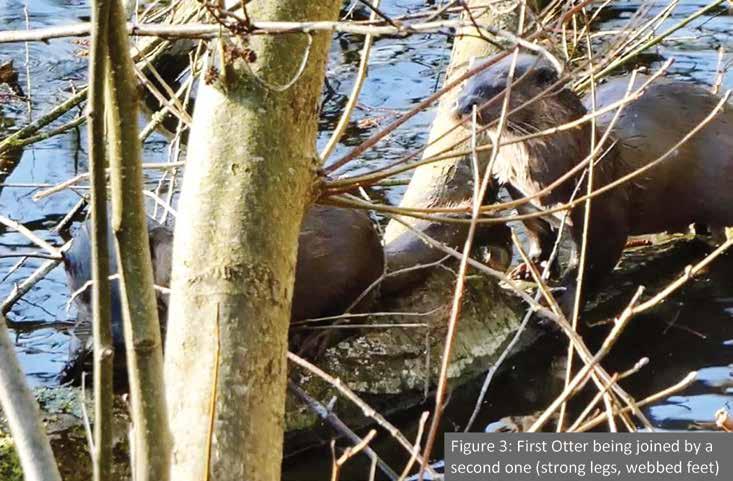
of a log that was straddling the shore barely 10 yards away, with a large ‘orangecoloured’ fish (possibly tench) in its mouth and clambered up for a safe position where it could tackle the fish (see Figure 2). After some 30 seconds, another one climbed out, showing off its light-coloured throat, behind the first one (see Figure 3). It sniffed the first one from behind, stayed for no more than a few seconds, and slid back into the water. The first one was there for all of 1 minute and 20 seconds making short work of the large fish! And a lovely sight to behold, webbed feet and canines visible every so often. Having fully downed the fish, it slipped back into the water to join the other two. They continued to fish, most dives resulting in a reward. Their flexible sinuous bodies with strong muscular tails weaved in and out of the water while they slowly made their way further to the right towards the bank, disappearing five minutes later. ‘Wow!’.
On the following Friday, 4 April, I ventured over to part of the river just south of the lake and east of the weir at Judas Gap. The banks here are quite reedy and to see them rippling and then heads of otters bobbing up was beyond my expectations. They (I saw two!) slowly and purposefully moved through the emergent vegetation on the opposite side (TM079329) and towards Judas Gap. For more than 10 minutes I watched captivated by them fishing until they disappeared round a meander. From behavioural observations, I was fairly sure they were two of the trio I had seen the week before.
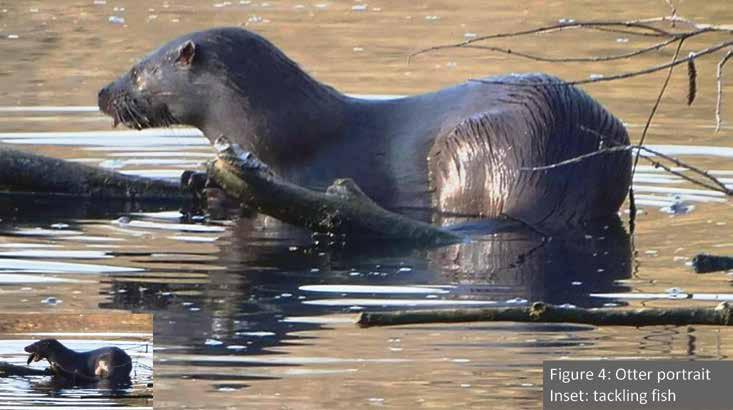
And if this wasn’t enough, on Tuesday 8 April, there they were on the lake again but that morning near the Longhurst Hide at the southern end (TM 079329). But only for a short while. Skirting the eastern bank of the lake they began to swim north. On a hunch, I decided to follow them on the path running parallel to this side of the lake. It was a good 10 minutes before they appeared where I had seen them before at the northern end of the lake. This time I managed to descend onto the shore for a better view. And I was not disappointed. Continuously they were diving, bringing out fish and chewing/gulping them down. Then one decided to come out and onto a little branch of a fallen tree (see Figure 4) with a big fish in its mouth. Perhaps for big fry they need to be above water to deal effectively with their finds. Conservationists take heed, it is important to leave sizeable tree branches from fallen and felled trees along banks. They serve as important feeding platforms for otters. I felt extremely lucky to have witnessed such a beautiful spectacle.
However, just when I had thought that was it for now, 5 weeks later on 13 May, on my morning walk along the river from Fen Bridge to Flatford, what should I see but ‘our’ otters again, on the river. I managed to follow them moving and fishing along the shadows on the opposite bank for at least 50 metres before they disappeared into an overgrown bank under a tree, perhaps to one of their temporary holts. Mesmerizing is the word I would use for all my encounters. Over a period of almost two months, I had seen them in various venues over a mile apart. I was just happy that they were part of our world. This time I felt a degree of assurance that the natives were truly back. I didn’t doubt that I would see them again!
*See Bhadresa, R (2023) The Water-dogs of Flatford, The White Admiral, 112, pp3-5
Roger Horton
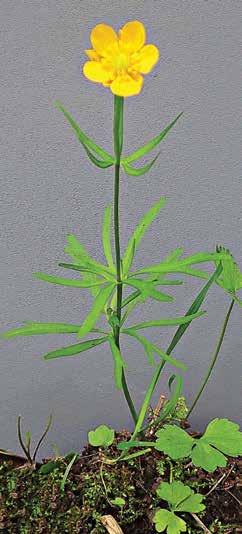
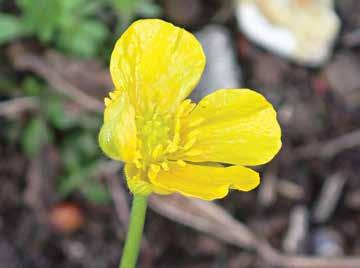
Goldilocks Buttercup, Ranunculus auricomus, is small, early flowering member of the Ranunculaceae. A perennial herb of deciduous woodland on chalk, limestone and other basic, often clay soils (such as the boulder clay of Suffolk), but also grows in scrub, on roadsides and in churchyards, and more rarely in old meadows.
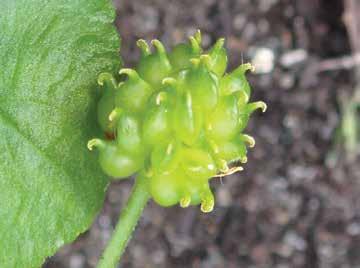
When complete, the flowers have five petals and the sepals are not reflexed so are often visible, emerging behind them. Flowers are born on a stem which bears stalk-less leaves. In contrast the basal leaves are stalked and spring directly from the rootstock (1). In many cases, however, petal development can be variable so flowers may look scruffy (2). As petals fall the seed head becomes noticeable as a cluster achenes with hooked or curved beaks (3).
2 3 4 5 6
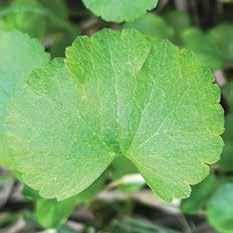
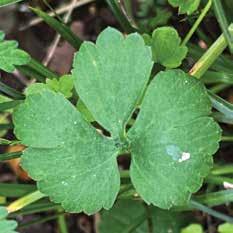
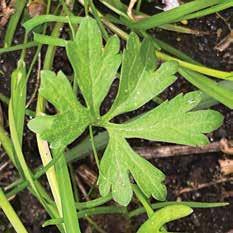
The basal leaves are basically kidney-shaped but more or less 3-lobed, sometimes with further division of the lobes. Those produced by a single plant are variable in form and can exhibit a sequence of outlines from early to late emergence (4, 5, 6). The stalk-less stem (cauline) leaves are deeply divided into mostly linear to narrowly elliptical lobes, often from three nodes up the stem. In Spring the tangled mass of these stem leaves behind the small flowers together with surrounding vegetation may obscure the basal leaves almost completely (7).
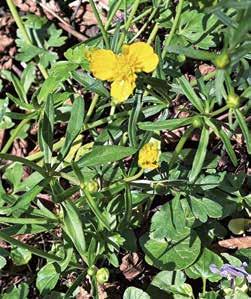
The species is apomictic, so pollination is not necessary for formation of viable seed. It is thus possible for colonies to arise with their own distinctive characteristics, which can be considered microspecies. Although a number of microspecies have been described from locations in Suffolk and particularly Cambridgeshire there is no detailed key to enable identification in the field so recording of plants as Ranunculus auricomus is quite sufficient.
The flowering season is short, from April to May, with plants in leaf a month either side of that range. Early leaves are difficult to spot until flowers begin to open. By the time seeds have formed, surrounding vegetation may have swamped the entire plant.
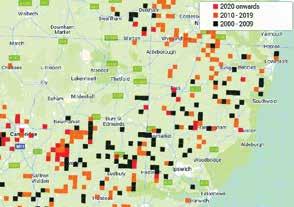
The spread of records across the county broadly covers the boulder clay regions but not the Brecks in north-west nor the coastal margins in the east.
The BSBI distribution map of Goldilocks shows this spread (8). My limited observations when visiting Suffolk have been at previously known locations in the churchyards of Creeting St Peter, Kedington, Stradishall, Bradfield St Clare, and Lawshall.
The map of the decades of this century so far with tetrads 2000-2009 in black, 20102019 in orange, and 2020 in red, suggests that there has been a decline in records in Suffolk. This could be due to factors including habitat loss or to lack of recording effort. The road verge population at Stradishall seems recently to have succumbed to aggressive mowing when I visited. Perhaps if all SNS members were to make an effort to record the species, however, we might be able to turn black and orange squares red in 2026. So happy hunting, and recording.
For the interactive version of the BSBI map scan this QR code.
Emma Aldous, Suffolk Biodiversity Information Service
Ever wondered how we keep tabs on what’s happening with our amazing wildlife? That’s where biological recording comes in! It functions as a detailed record of the organisms in our environment, documenting their location, population size, and any changes in these populations over time.
Why is this so important? Because it helps us see the bigger picture: how things like new buildings, farming, or even climate change are affecting our plants and animals. This vital information directly helps to protect endangered species, determine the best ways to conserve habitats, and guide decisions about our green spaces and environmental policies. So, every record received builds a clearer picture of our natural world, ensuring we can protect it for the future!
Your Data’s Journey
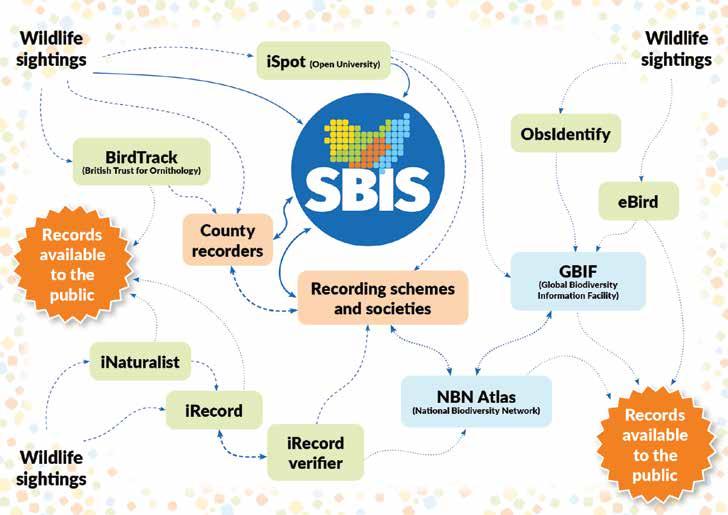
Ever wanted to contribute to real scientific research and help protect the our incredible wildlife? You don’t need a science degree to make a difference! Citizen science allows anyone, regardless of their background, to participate in collecting crucial data. It’s a powerful way to connect with nature, learn new skills, and contribute to a healthier planet.
Submitted records are verified via iRecord or by County Recorders before being added to our database. Verification can take time so there are delays in records appearing in our database.
Visit our recording page at: https://www.suffolkbis.org.uk/record to see all the ways you can send records to us, our open surveys and a list of Local and National recording opportunities. We are still adding details to our local list, so if you would like a group added please let me know (emma.aldous@suffolk.gov.uk).
These accessible digital tools are fantastic for casual wildlife recording and are often used by larger projects:
• iRecord: Our preferred platform. An online system that lets you submit species records. These are then checked by experts and used for research and decisionmaking. Available from the App store and Google play.
• iNaturalist: One of the world’s most popular nature apps, it helps you identify plants and animals around you while connecting you with a global community of naturalists and scientists.
• iSpot Nature: Developed by the Open University, iSpot allows you to upload photos of wildlife, get help with identification from a friendly community, and discuss your observations.
• Nature Recording Hub (Natural History Museum): A "one-stop shop" for monitoring urban green spaces, providing resources and links to various recording schemes.
And don’t forget that you can send your records directly to a County Recorder by email (see p. 4 for contact details).
Patrick Armstrong
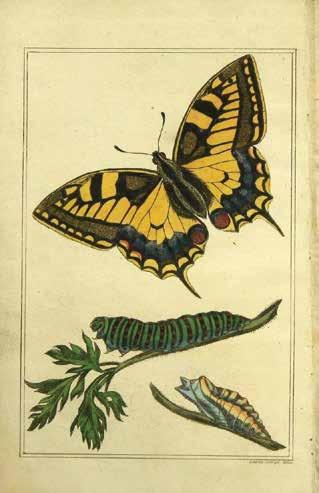
In the times of Jane Austen and Queen Victoria, and indeed into times not too far before the present, the learned professions were either barred to women or else enormous impediments were placed in their way. However, certain parts of natural history, especially botany and entomology, particularly the collection and study of butterflies, were considered sufficiently genteel and ladylike to be allowed to the wives and daughters of the houses of the gentry. It is therefore quite surprising that in Michael Salmon’s encyclopaedic The Aurelian Legacy: British Butterflies and their Collectors (2000), out of 101 ‘aurelians’ born between 1553 and 1922, only three are female. Indeed the chapter containing the biographies of the 101 worthies opens with the unattributed aphorism – ‘A company of serious thoughtful men’.
Laetitia Jermyn was one of this small feminine company. She was a Suffolk lass, having been born in Ipswich, where her father George Jermyn ran a printing shop and bookshop in the Butter Market. There is some evidence that the family may have originally come from or had links with London. Her
father died in 1799, and a Mr John Raw took over both his business and his wife, thus becoming Laetitia’s step-father. The link with the book trade allowed Laetitia to cultivate ‘wide literary tastes’.
We know very little of her life, and there is apparently no portrait of her: she liked to describe herself as ‘the fair aurelian’, and her interests in plants an insects were fostered by the Rev William Kirby (1759-1850) Rector of Barham and Coddenham, just over 5 miles (8km) north of Ipswich. Kirby was both an enthusiastic botanist and has been referred to as ‘The Father of Entomology’. He became an FRS and also Fellow of the Linnaean Society, and his contribution to Suffolk natural history was enormous (Armstrong, 2024). She was fortunate to have such a distinguished mentor, and dedicated what seems to have been her only publication to him.
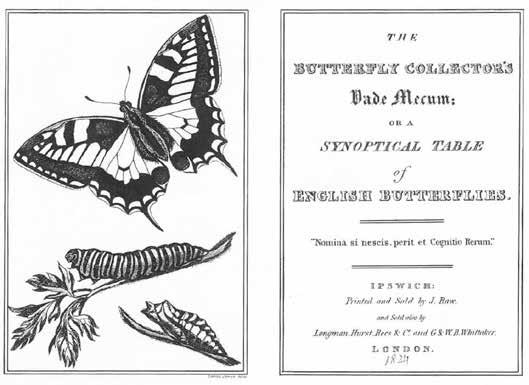
The book was printed and published by her step-father. Perhaps to conceal her femininity, Laetitia’s name does not appear on the title page of the first edition of Vade Mecum although the initials ‘L.J’ appear after the preface. Later editions (1837 and 1834) appeared under her own name, the last under her married name. She also seems to have been an accomplished artist, her name appears in tiny lettering underneath a frontispiece showing the adult form, larva and chrysalis of the swallowtail butterfly (Papilio machaon). The species’ breeding area is now confined to the Norfolk Broads, but formerly extended to the wetland areas of the adjacent counties of Cambridgeshire, Suffolk, and Essex: Laetitia was probably reasonably familiar with it in the 1820s. In the book she gives a lively defence of butterfly collecting against those who described ‘the study of natural history as a trifling and worthless pursuit’ and of no account. In some ways the little book was quite scientific and modern. Her ‘synoptical table’ was systematic, and gave useful information on the food-plants, localities and times of appearance of a number of species that occurred in Suffolk and Essex. She gives detailed illustrations of the vein pattern in the wings of a number of butterfly species. The Latin motto: Nomina si nescis, perit cognitio rerum, prominent on the title page, can be translated ‘If you don’t know the names, the knowledge of things perishes’, implying that she understood the vital importance of nomenclature and taxonomy in natural history.
Laetitia married relatively late, at the mature age of forty, on 19 November 1830. Her husband was the Vicar of Navestock, Essex, the Rev. Dr James Ford (1779-1850), a Trinity College, Oxford, man. He is described as a rather
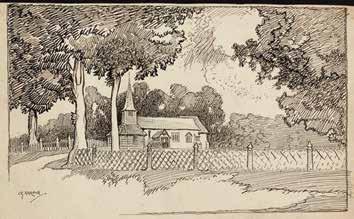
The church of St Thomas the Apostle, Navestock, Essex. Image: Historic England Archive.
studious antiquary, a bibliophile, punctilious, but rather intolerant and pompous. His theological views seem to have been entirely orthodox. There is a tale that Laetitia was, on one occasion, late for morning service, so preoccupied was she with her butterflies. James was in full flow, and in the middle of his sermon he leant over the side of the pulpit and asked: ‘I wonder where you will be, Madam, when the last trump sounds?’ The couple had no children.
Not a great deal is known of her life, but she seems to have been a careful and shrewd observer, and to have had a lively and cheerful personality.
Laetitia Jermyn died at the Vicarage in 1848 and was buried (on 22 July 1848, under her maiden name) in the churchyard of St Thomas the Apostle the, Navestock. She is commemorated within the church itself with a memorial tablet, naming her as ‘Mistress Ford’.
References
Armstrong, P H, 2024. William Kirby (1759 - 1850), Rector of Barham, Suffolk: a Naturalist of ‘the old school’. The White Admiral, 116, pp. 32-35. Salmon, M A, 2000. The Aurelian Legacy: British Butterflies and their Collectors, Harley Books, Colchester.
The butterfly collector’s vade mecum; with a synoptical table of British butterflies can be read online: https://archive.org/details/CUbiodiversity1126598
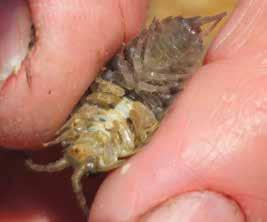
Felixstowe in the breakwater ▶
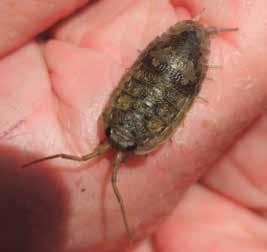
Female Sea Slater Ligia oceanica with marsupium on thorax containing youngsters. Found in daylight and at 26° which is supposed to be unusual as they are reportedly nocturnal. Several smaller males also seen.
Please submit any further records while enjoying time at the beach!
Joan Hardingham
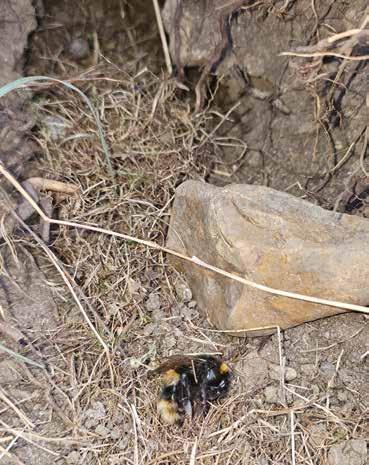
Alongside a footpath in Creeting St. Mary, this Buff(?)-tailed queen’s efforts have been thwarted. After successfully hibernating overwinter and finding a nice hole to set up a new colony, all was destroyed in a moment for a badger snack.
Joan Hardingham
I was particularly interested to read ‘Destroyer of Dreams’ pp 11-13 by Hawk Honey who raises interest for me on two points.
The first concerns the popularity of honeybees that has arisen over the years and which he considers is to the detriment of other species.
I arrived at the same conclusions when I questioned whether the barn owl Tyto alba was really the guardian of the countryside
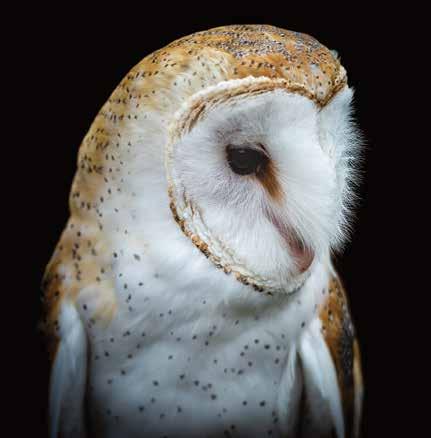
(Martin 2017) and that the countryside is often managed for the mistaken belief that these interesting, and attractive, birds are solely dependent on voles for their survival. They are not. It’s a bit like feeding children on ‘junk food’. If they are fed it for long periods they become dependent on it. Worldwide, species of the genus Tyto feed on a wide variety of food stuffs including fish and reptiles.
I note that Hawk points out that bees and wasps have the ‘amazing ability’ to be able to choose the sex of the eggs they lay, in times of food shortage. Tawny owls also have this ability to be able to decide the sex of their young in times of food shortage by laying more male eggs. (Martin 2022). I am of the view that one of the reasons why tawny females do this is so that the more males there are, the territorial males can defend a good feeding ground, hence one of the reasons for an abundance of hooting males in autumn. That, however, is only a theory.
One final point: from my research it would appear that the females of a great many species have the ability to determine the sex of their off-spring, including Homo sapiens.
Martin, Jeff. R. 2017. The Barn Owl: Guardian of the Countryside. Whittet Books Ltd. Stansted, Essex. Martin, Jeff. R. 2022. The Tawny Owl. T & A D Poyser (Bloomsbury Publishing Plc.) London & Dublin, Ireland.
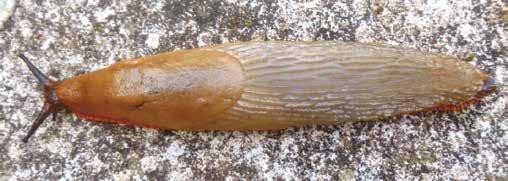
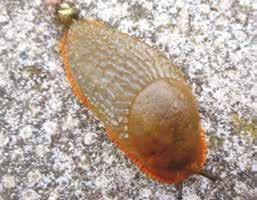
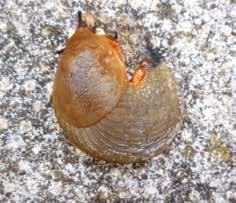
As a follow-up to the article about slugs in the Spring 2025 edition we can, during the growing season, often collect over a hundred slugs and snails using a torch after rain. Most of the slugs are small, grey and torpedo shaped but sometimes we find much larger ones. The colour plate in Michael Chinery’s ‘The Natural History of the Garden’ suggests this is the Large Black Slug Arion ater, which also has a red form. Sometimes these larger slugs end up attached to vegetation in our brown bin. A few days later, when I go to use it again, they are nowhere to be seen. I have wondered if their muscles are strong enough to lift the lift sufficiently to escape. I did have the opportunity to see something which at the time was very impressive. I dislodged one of these larger slugs from inside a water butt and it sank to the bottom, which was too deep for me to reach in and rescue it. It turned out that there was no need. It immediately used its slime to start crawling up the side of the water butt, no doubt helped by the pneumostome, which prevents drowning, that our editor mentioned in her earlier article. It took a few minutes to get clear of the water and after such a prodigious effort I released it. This slug also has an effective defence strategy, as shown by the three enclosed photos: the first fully extended, the second contracted and the third a much smaller rounded shape.
A press release recently revealed that the RHS (Royal Horticultural Society) had received more slug related requests for advice in 2024 than any other year since records began, as a consequence of mild and wet weather. It added optimistically that 2025 should have fewer problems. Richard Stewart. Slug fully extended, contracted and curled up in defensive posture.
Curious about the natural world on your doorstep? The SBIS Knowledge Hub is a treasure trove of information about Suffolk’s wonderful wildlife. Our digital library shelves are stocked with back issues of cherished journals, including Suffolk Natural History, Suffolk Birds, White Admiral, The Harrier, and the Suffolk Argus. You can also discover our fascinating Species of the Month, get lost in detailed maps of local landscapes, and explore the brilliant Suffolk Bird Atlas. We are also thrilled to announce the release of the brand new Suffolk Bat Atlas.
Uncover all this and more at www.suffolkbis.org.uk.
Emma Aldous
Our former beetle recorder, Howard Mendel, is being celebrated in the esteemed journal British Wildlife (Vol 36, no. 5). His latest book, Click Beetles of Great Britain and Ireland: An Atlas and Natural History, has received a glowing review, a testament to his decades of dedicated work in the field of coleoptera.
For many of us, Howard is a familiar and respected name. As a county recorder, he meticulously curated the county’s beetle records, and his expertise has been invaluable to countless members. Many will remember his contributions to the Society, including his co-authorship of The Butterflies of Suffolk: An Atlas and History. It is wonderful to see his passion and knowledge now encapsulated in this significant new publication.
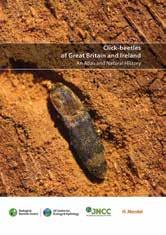
In the British Wildlife review, Clive Washington applauds the book as an essential text for anyone interested in this fascinating group of beetles. While not intended as an identification guide, it is praised for its comprehensive exploration of the natural history and distribution of click beetles, offering valuable insights for distinguishing between similar species. The review highlights the book as a significant update to the earlier Provisional Atlas of the Click Beetles of Britain and Ireland, reflecting a lifetime of study.
We are immensely proud to see Howard’s work recognised on a national stage. His dedication to the study and conservation of beetles has created a lasting legacy, both here in Suffolk and across the wider natural history community. We extend our warmest congratulations to him on this fantastic achievement.
WOULD YOU LIKE INFORMATION ABOUT SNS MEETINGS AND EVENTS SENT STRAIGHT TO YOUR INBOX?

A lot can happen between issues of White Admiral, and we would like to keep you updated. If you don’t currently receive emails from us, and would like to, please email enquiries@sns.org.uk with ‘Email Update’ in the subject line, and your name or first line of your address in the text.
• Beneath the surface: wildlife discovery day • 12 Jul • Lackford Lakes
• Walk: Butterflies in Bonny Wood. • 12 Jul • Barking Tye Village Hall
• Nature walk at Westleton Heath • 20 Jul • Westleton Heath
• Trimley Marshes Bird Ringing Demo • 20 Jul • Trimley Marshes
• Guided monthly walk: Summer reptiles • 27 Jul • Foxburrow
• Twilight Safari • 15 Aug • Lackford Lakes
• Wild Forage Cocktails • 16 Aug • Holywells Park, Ipswich
• Identifying trees in Summer • 23 Aug • Bradfield Woods
• Guided monthly walk: Antlions and more • 24 Aug • Foxburrow
• Martlesham Wilds Bat Walk • 4 Sep • Martlesham Wilds
• Moth Trap at Fen Meadow, Woodbridge. • 6 Sep • Fen Meadow
• Evening bat walk • 12 Sep • Foxburrow
• Workshop: Summer photography at the Lakes • 13 Sep • Lackford Lakes
• Talk: Big cats around the globe. • 18 Sep • Southwold Arts Centre
• Nighttime at Lackford: Biofluorescence walk • 19 Sep • Lackford Lakes
• Talk: Red deer at Minsmere by Steve Everett • 24 Sep • Stowmarket
• Bat Detectives Evening • 25 Sep • Carlton Marshes
• Autumn on the Marshes Photography Course • 4 Oct • Carlton Marshes
• Wildlife Live Webinar – Historical Ecology • 1 Oct • Online
• Talk; Butterflies of the Cambridgeshire chalk • 8 Oct • Haverhill
• Discovering the secret world of lichens • 11 Oct • Carlton Marshes
• Wildlife Live Webinar – On the Verge • 14 Oct • Online
• Introduction to fungi ID • 23 Oct • Bradfield Woods National
• Guided monthly walk: Finding fungi • 26 Oct • Foxburrow
• Wildlife Live Webinar – Symbiosis • 28 Oct • Online
• Talk: Forestry England and conservation in Thetford Forest • 12 Nov • East Town Park Centre, Haverhill
• Wildlife Live Webinar – Lichens • 13 Nov • Online
Full details, booking and more events: www.suffolkwildlifetrust.org/events

• Discovering Garden Birds • Online • 22 Jul – 02 Sep • £20.00
• Everyday fungi: How it shapes our world • Webinar • 22 Jul • £10.00
• Further Your Suffolk Wildflower Skills • Flatford Mill • 31 Jul – 03 Aug • £320 –£490
• Birdwatching • Flatford Mill • 1 – 3 Aug • £225 – £310
• Seal Field Skills • Online • 1 Aug – 12 Sep • £60.00
• Ecology, Surveying and Conservation of Dormice • Flatford Mill • 9 –10 Aug • £250 – £470
• Discovering Trees • Online • 13 Aug – 24 Sep • £20.00
• Discovering Ferns • Online • 21 Aug – 25 Sep • £20.00
• Discovering UK Otters • Online • 26 Aug – 30 Sep • £45.00
• Botanical Anatomy • Online • 1 Sep – 6 Oct • £60.00
• Introduction to Mustelids • Online • 4 Sep – 9 Oct • £20.00
• Discovering UK Seals • Online • 12 Sep – 24 Oct • £20.00
• Discovering Marine Ecology • Online • 17 Sep – 29 Oct • £40.00
• Discovering Tracks and Signs • Online • 18 Sep – 16 Oct • £30.00
• Discovering Reptiles • Online • 24 Sep – 29 Oct • £20.00
• Autumn Fungi • Flatford Mill • 27 – 28 Sep • £130 – £350
• Bee Conservation • Online • 29 Sep – 10 Nov • £12.50
• Discovering Bryophytes • Online • 6 Oct – 17 Nov • £40.00
• Managing Citizen Science Networks • Webinar • 7 Oct • £10.00
• Fungi Field Skills • Online • 7 Oct – 4 Nov • £30.00
• Birdwatching • Flatford Mill • 10 – 12 Oct • £225 – £310
Natural History Courses: Covering all aspects of the natural world.
www.field-studies-council.org/fsc-natural-history-courses
Professional Development for Ecologists and Conservationists: An extensive range of courses that cater for all career levels.
www.field-studies-council.org/biodiversity/ professional-development
• Flower Chafers of the UK • 7 Jul • £12.50
• AI-powered Bioacoustics with BirdNET • 8 Jul • Free
• Camera Trapping Mammals Virtual Symposium • 9 Jul • £30.00
• British Springtails: How Many Species Really Are There? • 15 Jul • Free
• Mesophotic Coral Ecosystems: Reefs From the Twilight Zone • 5 Aug • Free
• Identifying Ferns & Allies • 12 Aug • £12.50
• Networking Nutrients: Nutrients as a Driver of Invertebrate Interactions • 19 Aug • Free
• Smarter Surveying: Digital Solutions for UKHab and BNG Surveys • 4 Sept
• Free
• The Bizarre Biology of Bdelloid Rotifers • 23 Sept • Free
• Surveying For Dragonflies • 23 Sept • £12.50
• Seagrass Conservation: Growing #GenerationRestoration in Europe • 30 Sept • Free
• Surveying For Pollinators • 2 Oct • £12.50
• Ferns of the UK: Spleenworts • 14 Oct • £12.50
• More Moths Please! Breeding and Reintroducing the Dark Bordered Beauty • 4 Nov • Free
• Crayfish 3: Conservation and Management • 11 Nov • £12.50
Full details, booking and more events: www.eventbrite.co.uk/o/the-biologicalrecording-company-35982868173


Suffolk Naturalists’ Society has received generous donations in the past and uses these to fund studies by members on the flora, fauna and geology of the county. Amateur naturalists have always been in the forefront in increasing knowledge and recording the natural history of Suffolk. We aim to help those who feel that the costs of a study are a barrier, either experts or beginners, encouraging exploration of understudied areas of the natural world and explaining the importance of this knowledge to the general public.
Applications are welcomed for small or large sums, £1,000 or more for substantial, longer running, projects.
Grants can be used for:
Scientific equipment, books, software or other relevant items. Reasonable travel and subsistence for field work. Attending training courses, conferences, specialist meetings and visits to scientific institutions. Running workshops or field meetings that encourage people to get involved with wildlife studies and recording. Payment for expert guidance and acquiring necessary licences.
Criteria:
1. Projects should include a large element of original work and further the knowledge of Suffolk’s flora, fauna or geology.
2. A written account of the project is required within 12 months, unless it is a longer term study. This should be suitable for publication in one of the Society’s journals: Suffolk Natural History, Suffolk Birds or White Admiral.
3. Suffolk Naturalists’ Society should be acknowledged in all publicity associated with the project and in any publications emanating from the project.
Applications may be made at any time. Please visit our website for full details and criteria: www.sns.org.uk/pages/bursary.shtml
The Suffolk Naturalists’ Society, founded in 1929 by Claude Morley (1874 -1951), with help from Canon A.P. Waller. It pioneered the study and recording of the County’s flora, fauna and geology. It is the seed bed from which have grown other important wildlife organisations in Suffolk, such as Suffolk Wildlife Trust (SWT) and Suffolk Bird Group (SBG).
Recording the natural history of Suffolk is still the Society’s primary objective. Members’ observations go to specialist recorders and then on to the Suffolk Biodiversity Information Service at The Hold to provide a basis for detailed distribution maps and subsequent analysis with benefits to environmental protection.
Funds held by the Society allow it to offer substantial grants for wildlife studies.
Annually, SNS publishes its transactions Suffolk Natural History, containing studies on the county’s wildlife, plus the county bird report, Suffolk Birds (compiled by SBG). The newsletter White Admiral, with comment and observations, appears three times a year. SNS organises two members’ evenings a year and a conference every two years.
Subscriptions to SNS:
Individual membership £20; Family/Household membership £23; Student membership £13. Members receive the three publications above.
Joint subscriptions to SNS and SBG:
Individual membership £35; Family/Household membership £41; Student membership £21. Joint members additionally receive the SBG newsletter The Harrier.
As defined by the Constitution of this Society its objectives shall be:
2.1 To study and record the fauna, flora and geology of the County
2.2 To publish a Transactions and Proceedings and a Bird Report. These shall be free to members except those whose annual subscriptions are in arrears.
2.3 To liaise with other natural history societies and conservation bodies in the County
2.4 To promote interest in natural history and the activities of the Society.
For more details about the Suffolk Naturalists’ Society contact: Suffolk Naturalists’ Society, The Hold, 131 Fore St, Ipswich IP4 1LR. www.sns.org.uk • enquiry@sns.org.uk