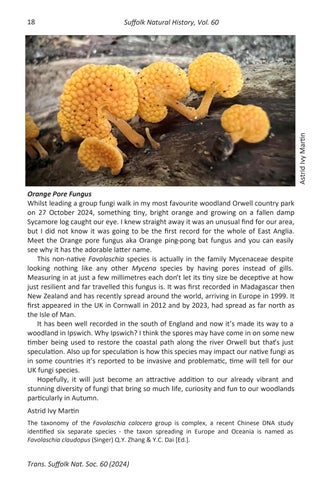
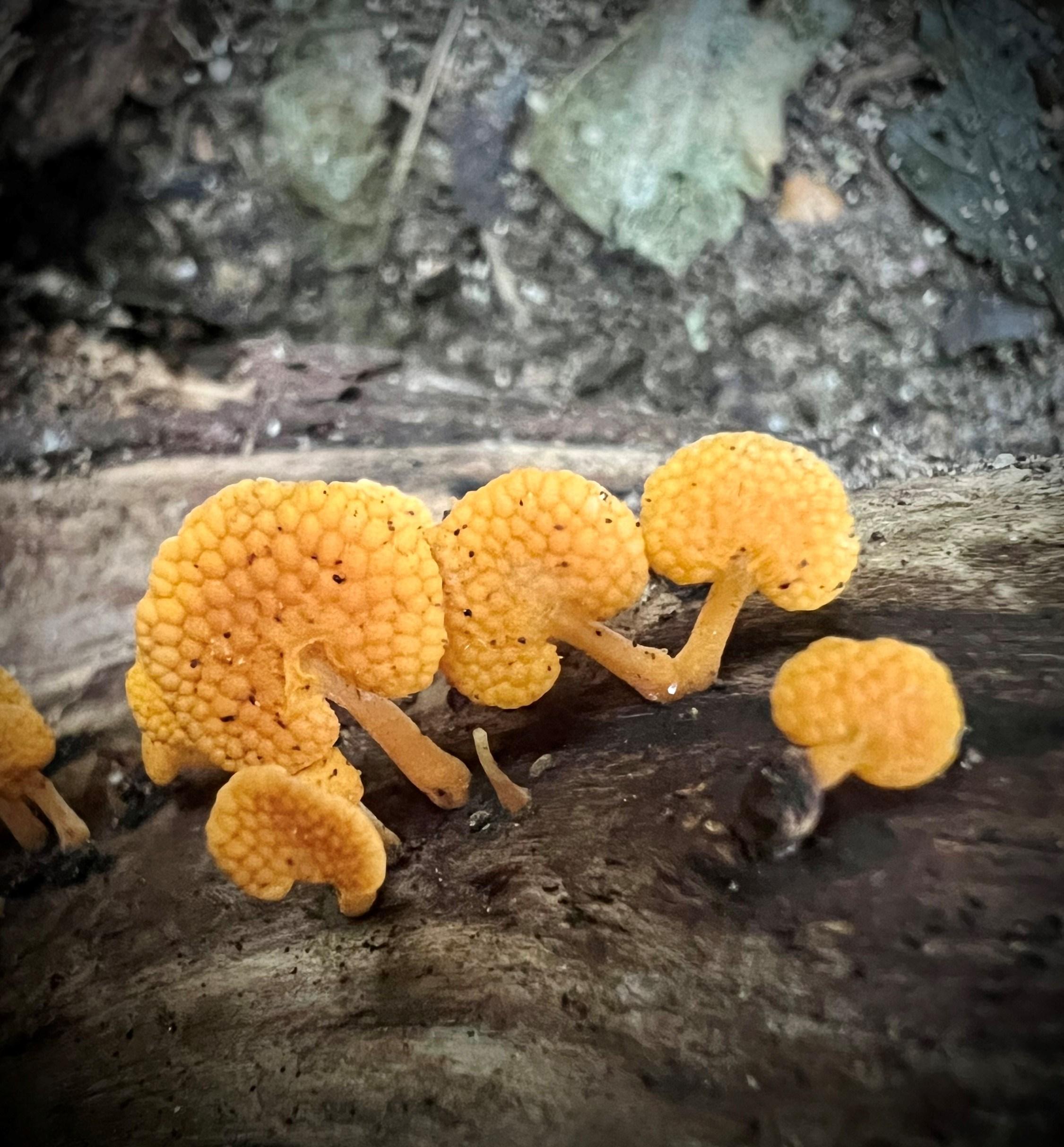
Whilst leading a group fungi walk in my most favourite woodland Orwell country park on 27 October 2024, something tiny, bright orange and growing on a fallen damp Sycamore log caught our eye. I knew straight away it was an unusual find for our area, but I did not know it was going to be the first record for the whole of East Anglia. Meet the Orange pore fungus aka Orange ping-pong bat fungus and you can easily see why it has the adorable latter name.
This non-native Favolaschia species is actually in the family Mycenaceae despite looking nothing like any other Mycena species by having pores instead of gills. Measuring in at just a few millimetres each don’t let its tiny size be deceptive at how just resilient and far travelled this fungus is. It was first recorded in Madagascar then New Zealand and has recently spread around the world, arriving in Europe in 1999. It first appeared in the UK in Cornwall in 2012 and by 2023, had spread as far north as the Isle of Man.
It has been well recorded in the south of England and now it’s made its way to a woodland in Ipswich. Why Ipswich? I think the spores may have come in on some new timber being used to restore the coastal path along the river Orwell but that’s just speculation. Also up for speculation is how this species may impact our native fungi as in some countries it’s reported to be invasive and problematic, time will tell for our UK fungi species.
Hopefully, it will just become an attractive addition to our already vibrant and stunning diversity of fungi that bring so much life, curiosity and fun to our woodlands particularly in Autumn.
Astrid Ivy Martin
The taxonomy of the Favolaschia calocera group is complex, a recent Chinese DNA study identified six separate species - the taxon spreading in Europe and Oceania is named as Favolaschia claudopus (Singer) Q.Y. Zhang & Y.C. Dai [Ed.].