JOHN RAY AT FRISTON HALL, SUFFOLK, 1662–1663
PATRICK ARMSTRONG
In these pages1 I recently described some of the earliest botanical records from a part of Suffolk (then in Cambridgeshire) in a brief note on John Ray’s Catalogus Plantarum circa Cantabrigiam neascention (1660). His remarks were based on his walks and rides around Newmarket in the period 1651–1660. Ray’s observations are of interest as this work has claims to be the first county flora and was the first publication of one who has come to be known as ‘the Father of English natural history’.
Here I focus on John Ray’s residence in Suffolk at a slightly later period. Following the turmoil of the period following the Restoration of Charles II (itself coming after decades of civil war and the uncertainties of Oliver Cromwell’s Commonwealth), many of those who held positions in the universities forfeited them if they were not prepared to subscribe to an oath incorporated in the Act of Uniformity, 1662. The main import of this statute was that persons holding church or university positions had to take an oath declaring an earlier oath - pledging loyalty to the former Puritan and Parliamentarian regimes in church and state - was null and void. Ray (1627–1705) had not taken this earlier oath but, besides having a dislike of oaths in general, did not feel that if one had taken an oath, it could be readily set aside. He thus lost his fellowship at Trinity College, Cambridge on 24 August 1662.
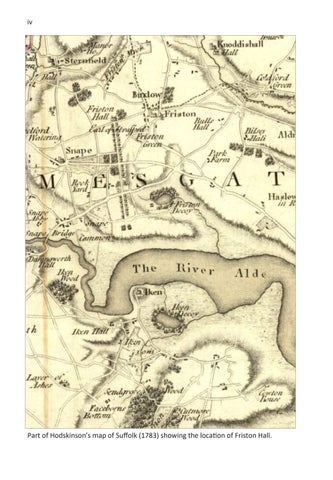
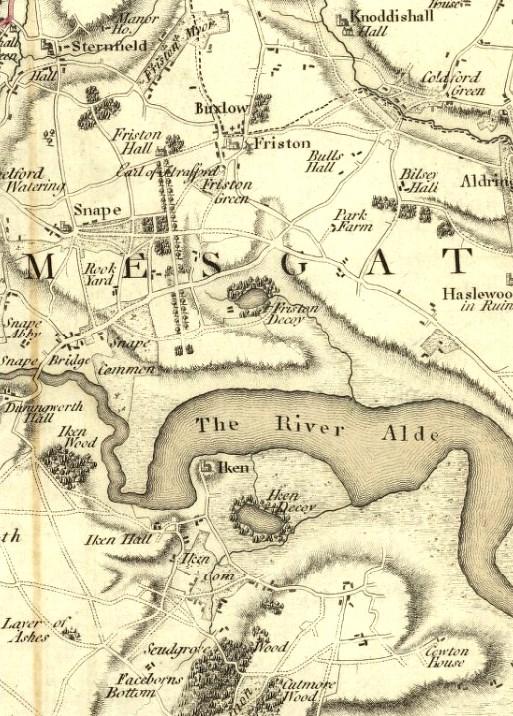
A few weeks after leaving Cambridge following the loss of his fellowship, John Ray took up a short-term position as a tutor at Friston Hall, Suffolk. The small village of Friston lies approximately equidistant from Saxmundham and Leiston – about 3km to the south-east and south-west respectively. The Hall (much modified since the seventeenth century) lies a few hundred metres to the west of the main settlement, just north of the village of Snape. The figure below gives an indication of the possible appearance of Friston Hall not very long after Ray’s stay.
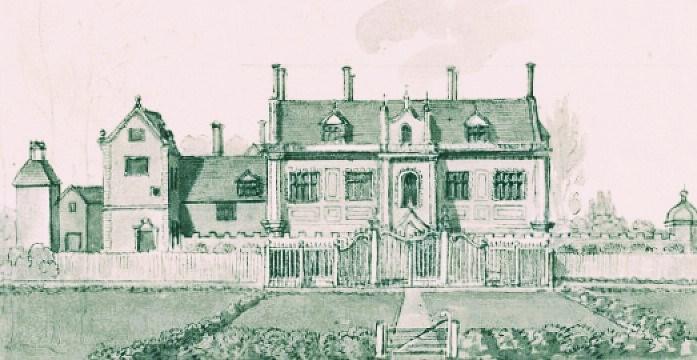
When the offer of a temporary position was first made, he wrote:‘I shall balke [limit] it … because I have the design of travelling hot in my head.’ On arrival at Friston, probably on about 18 October 1662, to take up his position with Thomas Bacon and his family he declaimed:
Ihavenot,norwillIengagemyselfanylongerthantillAnnunciationnext [25th March 1663],thatImaythenbefreetowaituponMrWillughby. 2
Francis Willughby, a former student of Ray’s, had plans for the two of them, and others, to make an extensive natural history tour on the continent. However, Ray, never one to waste time, made good use of his time in Suffolk: in early November he wrote:
I busy myself in enquiring out and describing such birds as frequent the channelnearus,Ihavegottensomeandcasedthem,amongtherestabittern,a curlewandayarwhelp;thefourthwasaduckwithabillhookedatthetop,for whichwehadnoname. 3
The ‘channel’ was presumably the estuary of the River Alde, or one of the creeks leading into it, about 3.5km (approx. 2 miles) south of the hall. The bittern and curlew are no surprise near a Suffolk estuary. The ‘Yarwhelp’ was apparently the bar-tailed godwit, the onomatopoeic name from the note it utters on taking wing. The duck ‘with a bill hooked at the top’ is puzzling, but the description might fit the common scoter, which has a ‘knob’ on its upper bill, and which does occur in autumn and winter on the Suffolk coast, sometimes in numbers. All are still familiar to East Suffolk birdwatchers.
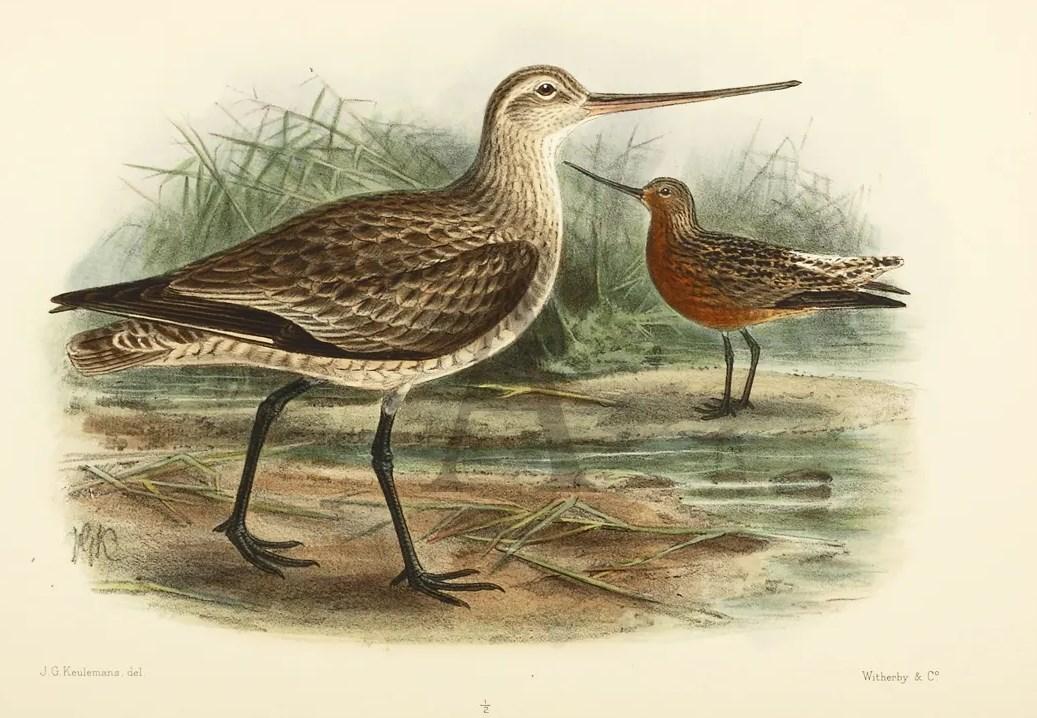
The wording of John Ray’s letter suggests that there were more bird species collected than these, perhaps many more. In other publications Ray and Willughby4, mention lapwing and avocet as occurring in Suffolk, and as Friston Hall is relatively close to the avocet’s present breeding site on Havergate Island, it is tempting to make the association.
Although it is interesting to note Ray taking an interest in birds (he implies that his knowledge may have been imperfect), all his earlier work was on plants:
On Saturday last [probably 1st November 1662] I rode to Aldburgh, to see those famous Sea Pease, noted by our historians and herbalists to grow between Orford and Alburgh, upon the shingle or beach of stones by the seaside. Some I found, not far from Aldburgh, growing by batches upon the stones:butaboutsixmilestothesouthward,attheextremityofthatlongbank of stones which runs from Aldburgh towards Orford, at leastsevenmiles into thesea,nearthehaven’smouth,isthisfamousandremarkedplace,where(as all the people hereabout affirme, and I believe) where they cover the whole shingleforhalfamiletogether.SothatIcannotguessetheyearlycropofpease to be lesse than 100 combs or half-quarters. For a full and particular description I referre you to Parkinson where you also have a figure of them; onlyIdonotfindinthemnowripethatbitternessehementions;indeed,tome and others they seem not so bitter as our common vetches, though they are smaller, which is, I conceive the reason why they are altogether neglected by the country people hereabout. When they are ripe they are of a dark olive colour,notround,butshrunkeorcrumpledlikeourordinarygraypease.Some of the stalkes and leaves still continue green, but the most were seare and withered, abundance of pease still hanging on them. I wonder though men neglectthem,thatpigeonsandotherwildfowlshouldnotdevourthem. 5
The personal letter above has been quoted at some length as it illustrates very well Ray’s truly scientific approach. We may note:
• The mass of detailed personal observations;
• The careful separation of his own observations from those of others;
• Ray’s reference to established authorities, but his not uncritical use thereof;
• His comparative approach;
• The attempt to use quantitative measures where possible;
• The appreciation of the need for exact localities;
• Ray’s brief attempt at a description of the habitat of the plant, in this case with a detailed reference to Orford Ness.
The species is still to be found along the shingle beaches of East Suffolk. Ray’s techniques had been honed during the preparation of the Cambridge Catalogus (1660) and by the time of his stay in Suffolk two years later he knew what he was doing. Perhaps it was on the same excursion that he encountered, at Aldeburgh, the Roman nettle, Urtica pilulifera, a non-native species, which until into the nineteenth was quite widespread in Suffolk, but which now apparently is extinct in Britain6. Often Ray gives information on the former distribution of a plant or animal that has now disappeared from its former range.
Medicago polymorpha (hispida), toothed medick or bur medick, he found at Orford, possibly on an exploration a little later. Always having an eye for detail, he described it as having ‘a small fruit, somewhat like the nave [hub] of a cartwheel’7. (See below.)
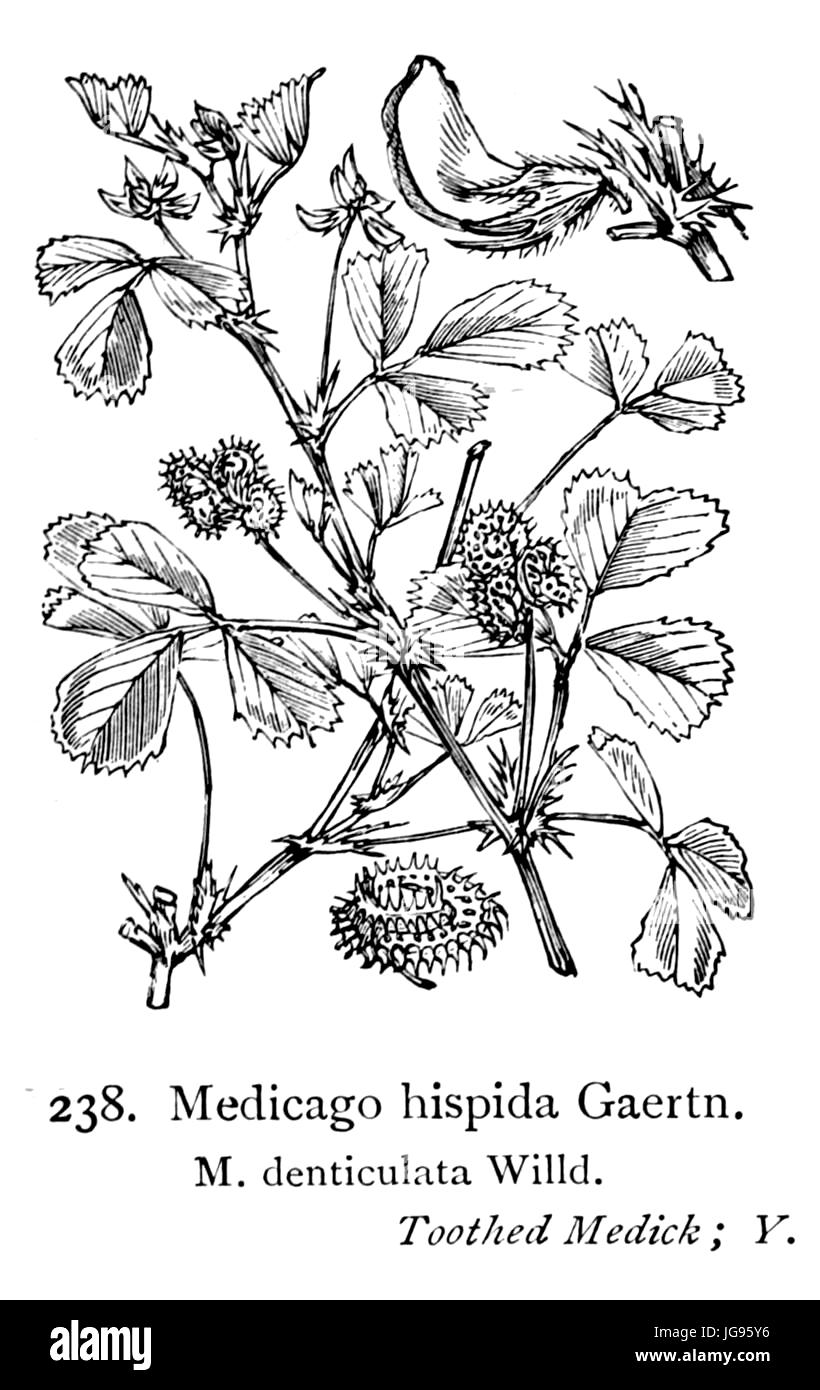
Figure 3. Medicago hispida (polymorpha) Illustrations of the British Flora W. H. Fitch, L Reeve and Co (1924). Wikimedia Commons
Saxmundham, a short walk or ride from Friston Hall, provided Thlaspi arvense, field pennycress, a common enough invader of waste and disturbed ground, especially around farms; however, Ray s collecting seems to provide the first record for Suffolk8 . It is clear that his tutoring, bird hunting and botanising provided a fairly full programme while he was in Suffolk, but it must be remembered that John Ray was an ordained Anglican priest – like many parson-naturalists before and since he saw his work as a naturalist as intimately linked to role as a priest. Despite the strictures imposed on him by the Act of Uniformity he still asserted ‘Divinity is my profession’. He reported in a letter written part-way through his time in Suffolk: IhaveconsentedtobestowuponthefamilyashortdiscourseinDivinityevery Sunday.Somereasontheyhavetodesireitofme,theirpastorbeingaweakold man…andhissermonsarejejune.Helikewiserepeatsexactlythesamewords intheafternoon,withoutadditionoralterationdaily. 9
And what about his tutee? Perhaps he might detain us a little longer. Later in the same letter Ray describes him:
The young gentleman with whom I am charged hath very good parts, and a quick wit. He hath broken into some extravagancies at Cambridge, which caused his father to take him home: he is impatient of labour, and indeed his temper will not admit long study. I must needs with gratitude acknowledge and commend his kindness, civility, and respectful carriage towards me, with whomhestudies,asmuchashecan,topleasegratifyandoblige
Nathaniel Bacon (1647–1676) attended Saint Catherine’s Hall, Cambridge, Ray’s college for his first two years as an undergraduate, and with which he no doubt had continuing links after his move to Trinity. Nathaniel was admitted in 1661 (apparently at an age about 15 or 16 years – young but not exceptionally so). As indicated above his father withdrew him within two years. Whether the ‘extravagancies’ were financial or in his conduct is not revealed. Perhaps both: he does not seem to have been a good student.
Ray seemed able to give his young charge the benefit of the doubt. It is possible that the objective in Thomas Bacon in employing Ray to tutor his son was to get him up to a sufficient academic standard gain admission to legal training: Nathaniel was admitted to Gray’s Inn on 22 November 1664, a year and a half after Ray left Friston Hall.
Nathaniel Bacon was included in part of the journey John Ray had planned with Francis Willughby travelling, mainly in order to collect natural history specimens in France, Germany, Switzerland and the Netherlands in the years 1663–1664.10
But young Nathaniel does not seem to have prospered at the English bar any more than at Cambridge. Following a number of difficulties concerning his marriage to a lady in direct contravention to his father’s wishes, and other legal disputes, he emigrated to Virginia in the summer 1674, acquired land (Curles Neck Plantation, Henrico County), and rose quickly in colonial politics - perhaps the legal training and the ‘extravagancies’ in his character combined to assist him here, and he became a member of Governor Sir William Berkeley’s council. He was distantly related to Sir William, and the Bacon family also had some involvement with the initial establishment of the colony. This network of relationships was probably at least instrumental in the decision to depart for Virginia, and his apparent rapid rise there. However, in 1676, Bacon became disillusioned with Governor Berkeley’s policies, in particular his handling of Native American (‘First Nation’) attacks on frontier settlements. Nathaniel Bacon defied Berkeley’s orders and led a militia against the local tribes, gaining popularity among colonists who had felt neglected by the colonial authorities. This act of defiance sparked ‘Bacon’s Rebellion’, oftimes described as a pivotal event in early American history. The rebellion briefly achieved success, burning down Jamestown, the colonial capital. However, Bacon’s death from dysentery led to the rebellion’s collapse (26 October 1676), and Governor Berkeley ruthlessly suppressed the remaining rebels (Encyclopedia Virginia website, entry for Nathaniel Bacon).
Some historians view Bacon’s Rebellion as a precursor to the American Revolution and see Nathaniel Bacon as the ‘morning star’ of the War of Independence. He could be considered as one who challenged the authority of a governor - the Crown’s representative - who was perceived as being tyrannical. Some thus emphasise Nathaniel Bacon’s role as one who championed the rights of colonists. It should perhaps be remembered that Charles I, following defeat in the English Civil War had been tried for being a tyrant, and executed on 30 January 1649, within young Nathaniel’s own lifetime. But another interpretation would be that his actions were self-serving, and a manifestation of a difficult personality, signs of which had already appeared in his youth.11
In Suffolk in the autumn and winter of 1662–’63 we have a brief image of John Ray, soon after his eviction from Cambridge, and no doubt uncertain of his future. Although his publication record at the time was relatively meagre, he was already at close to the height of his powers as an observer, recorder and collector in the field of natural history: his observations provide some of the earliest records for of a number of species still found in the area. His Christian mission was not far below the surface, and in every way we see him determined to ‘make the best of things’. It is of note that his temporary, stop-gap position brought him into contact with one who, just a few years later, was associated with a violent insurrection in a distant continent.
References
1 Armstrong, P. H. (2023). The botany of Newmarket in 1660, Trans. Suffolk Nat. Soc., 59: 44-47.
2 Letter: John Ray to Peter Courthope, Friston Hall, 3 November 1662, Gunther, W. T. ed. (1928). Further Correspondence of John Ray (1627-1705), John Ray Society, London, p.33.
3 Ibid, p.32.
4 Ray, J. (1678). The Ornithology of Francis Willughby of Middleton in the County of Warwick, The Royal Society, London.
5 Letter: Ray to Peter Courthorpe, Friston Hall, 3rd November 1662, Gunther, 1928, p.32. The date was ascertained using Samuel Pepys diary: some online sites gave an incorrect result, as they do not allow for the calendar correction of 1752. A comb or coomb was a former unit of volume or capacity used in East Anglia, apparently equal to 4 bushels or 0.14 cubic metres; there was some local variation. John Parkinson (1567-1650) was an apothecary and herbalist. His massive and influential major work, Theatrum Botanicum, was published in 1640. The reference to the ‘long bank of stones’ – the Orford Ness shingle spit - being about seven miles in length is of interest. It appears to have been shorter in the seventeenth century than today: shingle has subsequently accumulated, and it has grown to about 10 miles (16km). The present scientific name for this plant is Lathyrus japonicus var maritimus, and some sources do claim that the pods are edible, although bitter. Ray’s name was Pisum maritimum.
6 Stace, C. A. (2019). New Flora of the British Isles (4th ed.), C & M Floristics, Middlewood Green, Suffolk p. 305.
7 Raven, C. E. (1942, 1986). John Ray: Naturalist. Cambridge University Press.
8 Simpson, F. W. (1982). Simpson’s Flora of Suffolk. Suffolk Naturalists’ Society, Ipswich.
9 John Ray to Peter Courthope, about December 1662, Gunther, 1928, vol, 1, p.34.
10 C E Raven in John Ray: Naturalist, Cambridge 1942 (1986), maintains the Nathaniel Bacon who travelled with Ray was not the same person that Ray tutored at Friston Hall. Other evidence suggests that they two were one and same person.
11 The entry for Nathaniel Bacon on Wikitree (see https://www.wikitree.com/wiki/ Bacon-2862) has details of both of Nahaniel’s family relationships, and of the various controversies in which he was involved.
Patrick Armstrong, a long-time student of the Suffolk landscape and natural history, lives in Jolimont, Western Australia, following a career of teaching geography and ecology in colleges and universities in England and Australia. He is at present writing a book on John Ray. He thanks Shannon Rogers and Alan Cadwallader, respectively, for advice on American History and English Ecclesiology. He also expresses his grateful thanks to Martin Sanford, Editor, for helpful advice on an earlier version of the paper and for drawing his attention to sources of which the author was previously unaware.
Patrick Armstrong Villa 4, St Ives Centro, 6 Tighe St Jolimont, 6014 Western Australia