
Records of the Black Mining Bee, Andrena pilipes, in my Felixstowe garden
On the 15 April 2023, while searching my garden for Bees, I came across a large Andrena settled on leaves of Old Man’s Beard (Clematis vitalba) which I knew I had not seen before. After a search through my reference books as well as online I came to the conclusion that it was a male Black Mining Bee, Andrena pilipes. On the 18 April, I found it again. I took a number of photographs on both dates which I hoped would aid identification (Fig. 1).
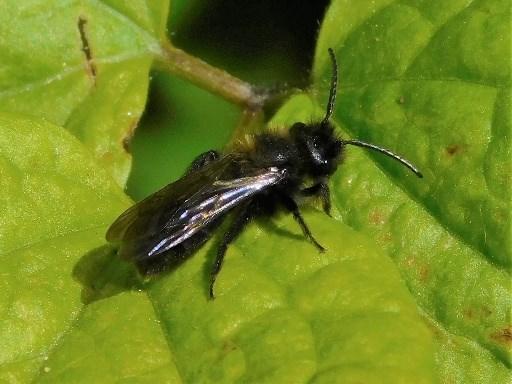

Identification of this species is complicated due to the very similar Scarce Black Mining Bee, Andrena nigrospina which has a very restricted distribution within the British Isles. Fortunately, there are a few diagnostic features which help separate the species. Male A. pilipes are readily distinguished from A. nigrospina in having the top of the thorax, back of the head and tergites 1-2 black or brown haired while in male A. nigrospina these features are grey haired. Also, the antennal segment 4 is shorter in A. nigrospina than in A. pilipes which has antennal segments 3 and 4 of roughly the same length.
Other, somewhat circumstantial, evidence for identification (given the state of play concerning global warning) is the flight periods for both species with A. pilipes first generation recorded from April to May and the second generation mainly in July and August (bivoltine). A. nigrospina’s flight period is somewhat later with some males emerging as early as late April and most records of both sexes from late May through to mid-July (univoltine). Distribution also gives a clue with recent records in Suffolk of A. pilipes and, in the rest of this species range in southern England, being coastal apart from within the Thames Gateway area whereas records of A. nigrospina are now concentrated in and around the Thames Gateway and the Worcestershire/Staffordshire border (Fig. 2). (Feb 2023) for Andrena pilipes.


In Suffolk, there are further recent records of A. pilipes from Bawdsey and Hollesley with another seen this year at Boyton recorded by John Pilgrim on the 18 April 2023 (Fig. 3). In the past, many A. pilipes and A. nigrospina records have not been assigned to either species but it thought that the range of at least the latter species has considerably decreased. It is now thought A. pilipes distribution is almost entirely coastal making inland records, both at the present time and historically probably somewhat erroneous.
Acknowledgements
My thanks to Martin Sanford from the Suffolk Biodiversity Information Service for supplying the map of the distribution in Suffolk of Andrena pilipes
References
Else, G. & Edwards, M. (2018). The Handbook of the Bees of the British Isles. Vol 2. Ray Society.
Falk, S. & Lewington, R. (2018). Field Guide to the Bees of Great Britain and Ireland. Bloomsbury Wildlife Guides
Knowles, A. P. (2017). A Review of the Solitary Bees (Hymenoptera) of Suffolk. Trans. Suffolk. Nat. Soc 53: 1–31.
Paul Oldfield
43 Dovedale
Felixstowe
Suffolk IP11 2PL