
SUFFOLK BRYOPHYTES, AN UPDATE RICHARD FISK
After the publication of A Flora of Suffolk (Sanford & Fisk 2010) recording was concentrated on unrecorded tetrads but it soon became apparent that this was adding little to the overall knowledge of the county’s bryoflora and I decided to concentrate on sites that had not been visited for ten years of more. It was hoped that this would show some of the changes in abundance that are taking place. It is not possible to make a direct comparison because at the same time I changed my recording programme from Aditsite to Mapmate and began recording by monad instead of by tetrad. The maps in the species accounts sections are of records made since publication of the Flora. In the Flora I had noted some changes that were already taking place and since then some species have occurred much more frequently.
1980-2005 2010-2020
Cryphaea heteromalla
Pulvigera lyellii [Orthotrichum lyellii]
The above figures are the number of tetrads, but the actual number of records is higher, for example currently Frullania dilatata has been recorded 527 times from 294 tetrads and Metzgeria furcata 560 times from 406 tetrads making it the most frequently recorded (commonest?) liverwort. (Brachythecium rutabulum remains the most frequently recorded moss). The tiny liverwort Myriocoleopsis minutissima [Cololejeunea minutissima] had one record in the Flora (surely overlooked) but has now been found at 92 sites (75 tetrads). It is not only epiphytes that have become more abundant; the introduced liverwort Lophocolea semiteres recorded from 47 tetrads in the Flora has now been found at 162 sites (80 tetrads). While my interest has been concentrated on epiphytic species I have paid less attention to some other groups, such as arable species and by just looking at numbers one might think these had declined. Bryum klinggraeffii was recorded from 376 tetrads in the Flora but from only 276 sites since then. For Dicranella staphylina the figures are 401 and 258. It is obvious that recording methods have an influence on species distribution statistics so it is not safe to jump to conclusions from numbers alone. There have been relatively few sphagnum records in this period, Barnby Broad has not been visited although most other sites have, if rather infrequently. The Fen Covert area at Blythburgh has become degraded and the area of sphagnum reduced, however in Scotland Fens, Capel St Andrew the area of sphagnum has been found to be more extensive.
In the species section, all species recorded in the county have been listed, so it acts as a checklist but comments have only been appended to those where there is some new or noteworthy information.
Apart from the sort of changes noted above there have been a number of species added to the county as a whole and also a number of new vice county records, some of these are due to revisions in nomenclature. There has been one deletion due to a misidentification. Full details are in the species accounts.
Nomenclature in the species accounts follows Blockeel et. al. 2021. In some cases, the names given in Hill et. al. (2008) have been superseded and to avoid confusion have been largely ignored, otherwise where names differ from the Flora those used there are given in square brackets.
New county records:-
Hornworts:-
Anthoceros agrestis Stoke-by-Nayland TL9835, 9 February 2011.
Mosses:-
Streblotrichum convolutum var. commutatum [Barbula convoluta var. sardoa] (B. convoluta var. commutata but not recorded in the Flora) Brandeston TM2469, 5 March 1991, D. Strauss.
Ephemerum crassinervium ssp. sessile Hadleigh TM0544, 9 October 2018.
Fontinalis antipyretica var. cymbifolia ** Carlton TM4994, 30 April 2009.
Microbryum davallianum var. commutatum ** Kessingland TM535871, 10 January 2000
Neckera crispa
West Stow TL8170, 7 March 2016.
Orthotrichum speciosum Tunstall TM3754, 31 March 2016, D Strauss.
Orthotrichum patens
Capel St. Andrew TM3448, 30 April 2017. (Also new to Britain).
Orthotrichum pumilum * Elveden TL7979, 12 February 2015.
Plagiothecium curvifolium Stanstead TL8549, 16 April 2012.
Pylaisia polyantha
Knettishall Heath TL9481, 11 April 2014.
Syntrichia ruralis var. epilosa Aldringham TM4560, 23 November 2016.
Tortula schimperi
Ulota coarctata
Ulota crispula
Ulota intermedia
Liverworts:-
Microlejeunea ulicina
Vice County records:-
VC25 Mosses:-
Homersfield TM2884, January 1991.
Purdis Farm, Ipswich, TM2142 6 January 2011.
Knettishall Heath, TM9480, 2 August 2018.
Knettishall Heath, TM9480, 2 August 2018.
Purdis Farm, Ipswich, TM2142 6 January 2011.
Bryum archangelicum Westleton Common TM4468, 23 July 2010.
Sanionia uncinata
VC25 Liverworts:-
Frullania tamarisci
Riccia cavernosa
Aldringham, TM4549, 19 April 2013.
Orfordness TM4046, 15 May 2012.
Redgrave Fen, TM0478, 19 July 2017.
*O. pumilum is recorded in the flora, but that record has been transferred to O. schimperi. ** See comments in species section.
VC26 Mosses:-
Antitrichia curtipendula Clare Country Park TL7745, 17 October 2013.
Cinclidotus fontinaloides Long Melford TL8743, 14 October 2013.
Didymodon nicholsonii Chelsworth TL9847, 4 April 2016.
Tortula schimperi
VC26 Liverworts:-
Coney Weston TL9678, 1 January 2012.
Cephalozia lunulifolia Santon Downham TL8286, 1 January 2018.
Metzgeria consanguinea Groton TL9742, 10 January 2013.
Ricciocarpos natans Lakenheath RSPB NR TL7186, 14 March 2011, J. Shanklin.
Deletion:-
Schistidium apocarpum Brent Eleigh TL9448, was actually S. crassipilum.
A few non-native species have been found on tree ferns in garden centres (see Fisk 2009), mosses are Achrophyllum dentatum, Leptotheca gaudichaudii, Racopilum convolutaceum and Wijkia extenuata and Liverworts Chiloscyphus coalitus, Heteroscyphus triacanthus, Lejeunea primordialis, Lophocolea muricata and Telaranea longii. In addition, Achrophyllum dentatum, Leptotheca gaudichaudii and Lophocolea muricata were found on tree ferns in the garden of The Place for Plants in East Bergholt in 2008, but they appear not to have survived, I did not see the tree ferns there on a visit in 2021.
In 2014, Suffolk Wildlife commissioned a survey of bryophytes on Knettishall Heath and the results included unconfirmed records of Brachythecium salebrosum, Ctenidium molluscum and Thuidium delicatulum
In March 2018, Chris Preston and I were given permission to examine the bryophyte specimens in the herbarium of Sir Charles Bunbury held in the herbarium of Cambridge University. These were either collected by him or by F. K. Eagle whose herbarium he acquired in 1856. Some packets were in bundles tied with pink tape (Eagle was a lawyer) so had probably not been looked at since Bunbury acquired them. Most of them date from the first half of the 19th C so represent the first localised record from West Suffolk if not the county as a whole. One particularly interesting thing about these specimens was how many of them, even Rhytidiadelphus squarrosus, had abundant sporophytes. Sir Charles Bunbury lived at Barton so most of his specimens are from there or near-by locations (his herbarium also contains specimens from other places including South America and India). A full list of all specimens are in a paper prepared by Chris Preston. The date 1825 on Eagle’s specimens is the date he gave them to Charles Lyell so they would have been collected at an earlier date and perhaps should be labelled pre-1825. Other undated specimens are obviously pre-1856 (when Bunbury acquired them) and are listed separately. In general, the names are as on the packets, with current ones in brackets where they differ.
Bartramia (Philonotis) fontana c.fr. Near Lackford Bridge June. 1826 (Bunbury).
Climacium dendroides
Cryphaea heteromalla
Barton 1827 (Bunbury).
Barton Apr. 1825 (Bunbury).
Dicranum (Dicranella) cerviculatum Wangford Suffolk Mr Eagle 1825.
Dicranum scoparium
Barton, (on bank on S side of arboretum) Jul. 1881 (Bunbury).
Dicranum palustre (D. bonjeanii) Lackford Mr Eagle 1842.
Encalypta vulgaris
Fontinalis antipyretica
Homalothecium sericeum
Hypnum (Eurhynchium) striatum
Barton Jan. 1825 (a note says this was the first specimen collected by CB when he was 16 years old.).
Barton Nov. 1825 (Bunbury).
Barton Jan. 1825.
Barton Dec. 1826.
Hypnum (Cirriphyllum) piliferum Shinham Lane, Barton 1877.
Hypnum (Saniona) uncinata Wangford, Suffolk Mr Eagle 1825.
Hypnum (Rhytidium) rugosum Mildenhall Warren 1827 (Bunbury)
Hypnum (Cratoneuron) filicinum var ? Church Path, Barton, Aug. 1874 CB (annotated yes by H. Boswell).
Hypnum (Ctenidium) molluscum Barton 1825.
Hypnum (Rhytidiadelphus) triquetrus Barton Nov. 1825 (with capsules).
Hypnum (Hylocomiadelphus) squarrosus Mildenhall, in the round plantation Feb. 1856 CB (with capsules).
Hypnum fluitans (Warnstorfia fluitans) Mildenhall 1827 Bunbury. (not critically examined but Warnstorfia fluitans is not known from Suffolk).
Hypnum kneiffii (Drepanocladus aduncus) Barton Mere Jan. 1864? (From Mr Skepper May ’64).
Isothecium myurum Barton 1825.
Mnium ligulatum (undulatum) c.fr. Barton March 1857 (Bunbury).
Leptodictyium riparium Barton 1825.
Leucodon sciuroides Barton 1827 (Bunbury).
Neckera complanata c.fr. Barton Nov. 1825 (Bunbury).
Orthotrichum affine c.fr. (Lewinskya affinis) Barton Marsh ’75 (Bunbury).
Orthotrichum striatum c.fr. (Lewinskya striata) On ash tree Curl’s Plantation Mildenhall Mar. 30, 1859, CJB.
Orthotrichum diaphanum c.fr. Barton Mar. ’75 (Bunbury).
Phascum (Tortula) bryoides
Barton gravel pits Nov. 1827 (Bunbury).
Phascum crispum (Weissia longifolia) Barton March 1827 (Bunbury).
Phascum (Microbryum) curvicollum Barton March 1827 (Bunbury).
Phascum cuspidatum
Phascum (Acaulon) muticum
Barton 1827 (Bunbury).
Barton Nov. 1825 (Bunbury).
Phascum serratum (Ephemerum serratum) Shrub Wood, Barton Aug. 1825 (Bunbury).
Phascum subulatum (Pleuridium acuminatum) Shrub Wood, Barton Apr. 1825 CJB.
Platyhypnidium riparoides (Rhynchostegium riparoides) near Fornham, Suffolk 1827.
Polytrichum commune Mildenhall Dec. 1854 (Bunbury).
Polytrichum juniperinum c.fr. Barton 1825 Bunbury.
Polytrichum (Pogonatum) urnigerum On sandy banks near Lackford Aug. 1825 (Bunbury).
Polytrichum (Pogonatum) nanum c.fr. Barton Dec. 1829 (Bunbury).
Polytrichum (Atrichum) undulatum c.fr. Barton Dec. 1825 (Bunbury.
Rhynchostegium confertum
Barton Dec. 1843 (sandy hedge bank on road to Livermere).
Sphagnum obtusifolium (palustre) near Lackford Bridge 182? CB.
Sphagnum squarrosum near Yarmouth (Belton Bog?) 1825 CB.
Sphagnum acutifolium (rubellum) Wangford Suffolk 1807 FKE.
Tortula (Aloina) aloides
Tortula (Aloina) rigida
Barton Dec. 1831 (Bunbury).
Barton Dec. 1831 (Bunbury).
Tortula (Barbula) unguiculata Barton 1825 (Bunbury).
Tortula (Pseudocrossidium) revoluta c.fr. Barton Mar. 1832 (Bunbury).
Tortula subulata Barton Apr. 1870 (Bunbury).
Weissia (Dicranoweisia) cirrata c.fr. Hengrave, park pales, March 1827 (Bunbury).
Undated specimens of species not included above from Eagle’s herbarium (pre-1856) unless otherwise stated.
Antitrichia curtipendula
In a grove at Framlingham beyond the Countess Well.
Bartramia pomiformis c.fr. Henham.
Gymnostomum microstomum (Weissia brachycarpa v. microstoma) Newmarket Heath.
Orthotrichum anomalum St James Church, Bury. And Stowlangtoft Church.
Orthotrichum crispum (Ulota crispa agg.) Framlingham.
Orthotrichum tenellum c.fr. Bury, by the M??? pits, the tree upon which it was growing has since been cut down.
Orthotrichum affine (Lewinskya affinis) Euston (would pre-date the record above).
Orthotrichum lyelli (Pulvigera lyellii) Framlingham.
Orthotrichum striatum c.fr. (Lewinskya striata) Framlingham (would pre-date the record above).
Phascum (Physcomitrium) patens Wangford.
Phascum alternifolium (Pleuridium subulatum) Bury, Mr Skepper.
Racomitrium canescens c.fr. Thetford and Brandon.
Racomitrium canescens var. ericoides Suffolk.
Tortula (Didymodon) fallax Lowestoft, Newmarket and Bury.
Tortula (Pseudocrossidium) revoluta Mildenhall and Bury.
Tortula convoluta (Streblotrichum convolutum) Wangford and Rougham.
Tortula muralis Lakenheath, Thetford, Bury and Woodbridge. (the last as var. aestiva).
Tortula (Syntrichia) ruralis
Tortula (Syntrichia) latifolia
Tortula (Syntrichia) papillosa
Bury, Wangford and Mildenhall.
Groton, c.fr., Halesworth, and Mendham, c.fr.
Groton, Halesworth and Mendham.
Didymodon flexicaulis ? Thetford Warren.
Didymodon tophaceus Wangford and Eriswell.
Didymodon rigidulus Suffolk.
Weissia curvirostra (Bryoerythrophyllum recurvirostrum) Wangford (on the walls), Rushbrooke (on tree?) Hall on the ground, Also one by Bunbury undated Hedgebank between Rougham and Bury.
Weissia controversa Suffolk and one by Bunbury undated from Barton.
Dicranum scoparium Mendham. (This pre-dates the record above).
Dicranum (Dicranella) heteromallum Snipe pit, Mildenhall CJB (but undated).
References
Blockeel, T. L. (2017). The Ulota crispa group in Britain and Ireland, with notes on other species of the genus. Field Bryology 117: 8-19.
Blockeel, T. L. & Fisk, R. J. (2018). Orthotrichum patens Bruch & Brid. In Suffolk and Derbyshire, another epiphytic moss new to Britain. Journal of Bryology 40: 56-61.
Blockeel T. L. & Kucera J. (2019). Notes from the BBS Workshop on Didymodon, 2018. Field Bryology 121: 23-30.
Blockeel, T. L. (2019). Orthotrichum pumilum and O. schimperi in Britain. Field Bryology 121: 38-43.
Blockeel T. L., Hodgetts N. G., Pilkington, S. L. & Pescott, O. L. (2021). A Census Catalogue of British and Irish Bryophytes 2021.
Fisk, R. J. (2009). Tree Fern Aliens. White Admiral 72
Gallego, M. T., Hugonnot, V. & Cano, M. J. (2018). Taxonomic resurrection of an awnless variety of Syntrichia ruralis and comparison with other European muticous taxa in this genus. Journal of Bryology 40: 244-250.
Hill, M. O., Blackstock, T. H., Long, D. G. & Rothero, G. P. (2008). A Checklist and Census Catalogue of British and Irish Bryophytes.
O’Leary, S. V. & Fisk, R. J. (2019). Syntrichia ruralis var. epilosa new to the British Isles. Field Bryology 121: 35-37.
Pilkington S. (2022). Microbryum davallianum (Sm.) R.H. Zander in Britain and Ireland. Field Bryology 127: 2-7.
Sanford, M. N. & Fisk, R. J. (2010). A Flora of Suffolk. D.K. & M.N. Sanford.
Smith, A. J. E. (1978). The Moss Flora of Britain and Ireland. Cambridge University Press, Cambridge.
Smith, A. J. E. (2004). The Moss Flora of Britain and Ireland, ed. 2. Cambridge University Press. Cambridge.
Smith, A. J. E. (2008). Tortula schimperi in England. Field Bryology 94: 21-22.
Whitehouse, H. L. K. (1964). Bryophyta in Perring, F.H., Sell, P.D., & Walters, S.M. (1964). A Flora of Cambridgeshire. CUP, Cambridge.
(2023)
ANTHOCEROTOPHYTA (HORNWORTS)
ANTHOCEROTOPSIDA
ANTHOCEROTACEAE
Anthoceros punctatus L.
The site in Woodbridge, an ornamental water feature at Notcutts Nursery, has been redeveloped, so this will no longer be present.
Anthoceros agrestis Paton
A single rosette in a stubble field at Stoke by Nayland, TL9835, in February 2011 is the first and so far, only record from the county. It could be in other fields in the south of the county, but is likely to be very rare.
MARCHANTIOPHYTA (LIVERWORTS)
MARCHANTIOPSIDA
BLASIACEAE
Blasia pusilla L.
SPHAEROCARPACEAE
Sphaerocarpos michelii Bellardi

The site at Nottcutts in Woodbridge where this and the next sp. were particularly abundant has been lost to re-development but it is still fairly frequent in arable fields in the south of the county.
Sphaerocarpos europaeus Lorb. [S. texanus]

Generally a similar distribution to the last sp. except in the NE where it is the more frequent of the two.
LUNULARIACEAE
Lunularia cruciata (L.) Dumort.ex Lindb.

Immature archegonia have been noted a number of times, often at sites close together suggesting the plants may be clones. Male plants have not been found in Suffolk.
MARCHANTIACEAE
Marchantia polymorpha L. subsp. polymorpha subsp. ruderalis


Widespread across the county, it has been found in arable fields more frequently recently than in previous years.
Marchantia quadrata Scop. [Preissia quadrata (Scop.) Nees]
AYTONIACEAE
Reboulia hemisphaerica (L.) Raddi

Still present at both sites in Stoke-byNayland. It has increased at the one in TL9738 where it had spread along the roadside in 2020.
TARGIONIACEAE
Targionia hypophylla L.
CONOCEPHALACEAE
Conocephalum conicum (L.) Dumort.

All specimens that have been critically examined have been this sp. C. salebrosum, a plant of calcareous habitats, particularly limestone, is unlikely to occur in the county.
RICCIACEAE
Riccia cavernosa Hoffm.

Recent records are from Red Lodge TL6970 in 2010, Euston TL9379 and Redgrave Fen TM0478 both in 2017. The latter was during a Lowestoft Field Club meeting and was the first from VC25. The site at Knettishall Heath has become overgrown and the Riccia can no longer be found there.
Riccia fluitans L.
Found at Walberswick TM4873 in 2011, a new site, during a Lowestoft Field Club meeting. Still present in Docwra’s Ditch TM4767 and Wolves Wood, Hadleigh TM0544.
Riccia sorocarpa Bisch.

Riccia glauca L.


Riccia beyrichiana Hampe ex Lehm.
Ricciocarpos natans (L.) Corda
Found at RSPB Lakenheath Fen TL7186 in 2011 by Jonathan Shanklin, the first record from VC26 for about one hundred years. No recent records from VC25. The earliest record is probably that in The British Flora by Stephen Robson 1777 which refers to it being near Henley which is in TM1551.
JUNGERMANNIOPSIDA
PELLIACEAE
Pellia epiphylla (L.) Corda
Pellia neesiana (Gottsche) Limpr.
The only site where it has been seen recently is at Capel St Andrew TM3647 in 2017.
Pellia endiviifolia (Dicks.) Dumort.

FOSSOMBRONIACEAE
Fossombronia foveolata Lindb.
Fossombronia pusilla (L.) Nees
Only two recent records, Tunstall Forest TM4052 in 2010 and Stanstead Great Wood TL8549 in 2012.
Fossombronia wondraczekii (Corda) Dumort. ex Lindb.
A single recent record from Bonny Wood TM0752 in 2018.
Fossombronia incurva Lindb.
The site where this was found in Tunstall forest has become overgrown with Juncus and other vegetation it can no longer be found there.
MOERCKIACEAE
Moerckia flotoviana (Nees) Schiffn. [M. hibernica]
PALLAVICINIACEAE
Pallavicinia lyellii (Hook.) Gray
A search at Staverton Thicks in 2013 failed to re-find it.
METZGERIACEAE
Metzgeria violacea (Ach.) Dumort. [M. fruticulosa]


Has become quite common. It is well known that herbarium specimens turn blue after some time, but I have never heard of it happening to living material. After the hot dry summer of 2018 I found plants at Bentley TM1240 on which the tips of the thalli had become blue, presumably caused by the dry atmosphere for the plants were not exposed to direct sun.
Metzgeria consanguinea Schiffn. [M. temperata] Still very rare, but has turned up five times. The record from an ash in Groton Wd TL9742 in January 2013 was the first from VC26.
Metzgeria furcata (L.) Corda

This is now the most frequently recorded (commonest?) liverwort in the county with 560 recent records.
ANEURACEAE
Aneura pinguis (L.) Dumort.

There are two distinct forms in Suffolk, the typical one, as in the above photograph, found in sand dunes and bare soil etc. and another, which resembles A. maxima, in wet woodland. This has been seen recently at Bixley Heath, Ipswich TM1942 and Capel St Andrew TM3546. The plant in the photograph was on the denes at Kessingland but it has not been seen there since the tidal surge of 2013 when the site became flooded.
Aneura mirabilis (Malamb.) Wickett & Goffinet
[Crypyothallus mirabilis] The site in Fen Covert, Blythburgh where this was found in 2003 has become permanently flooded and the area of sphagnum under which it grew has been lost.
Riccardia multifida (L.) Gray
Riccardia chamedryfolia (With.) Grolle
RADULACEAE
Radula complanata (L.) Dumort.

FRULLANIACEAE
Frullania tamarisci (L.) Dumort.

Found amongst shingle on Orfordness TM4046 in May 2012 which was the first record from VC25 and first from anywhere in Suffolk for about 50 years. A second record was found on an oak tree in Dunwich Forest TM4671 in 2017. There have been no other records from the county.

Became well established on the denes at Kessingland with Aneura pinguis but like that sp. it has not been seen since the tidal surge of 2013. It is occasional elsewhere with just a dozen recent records.
Riccardia incurvata Lindb.
Riccardia latifrons (Lindb.) Lindb.
PORELLACEAE
Porella platyphylla (L.) Pfieff.
Frullania dilatata (L.) Dumort.

Like many epiphytes, it has increased significantly and is now the second most frequently recoded liverwort in the county with 527 recent records.
LEJEUNEACEAE
Myriocoleopsis minutissima (Sm.) R.L.
Zhu, Y.Yu & Pocs [Cololejeunea minutissima (Sm.) Steph.]

Regarded as rare in the Flora, but it has become quite frequent on a variety of trees.
Lejeunea cavifolia (Ehrh.) Lindb.
Microlejeunea ulicina (Taylor) Steph. First record from the county was on the branch of an oak tree at Purdis Heath, Ipswich TM2142 on January 1 2011. A second record was on the trunk of a silver birch in the forest at Capel St Andrew TM3449 April 2017.
PTILIDIACEAE
Ptilidium ciliare (L.) Hampe. At Wortham Ling it has spread to an area some distance from the original site but is still the only site in VC25.
Ptilidium pulcherrimum (Weber) Vain
No recent records; it has declined nationally, in contrast to other epiphytes.
LEPIDOZIACEAE
Kurzia pauciflora (Dicks.) Grolle Lepidozia reptans (L.) Dumort.

Continues to be a rare species in the county with just 12 recent records from the same areas as shown in the flora.
TRICHOCOLEACEAE
Trichocolea tomentella (Ehrh.) Dumort.
LOPHOCOLEACEAE
Lophocolea bidentata (L.) Dumort.

Lophocolea heterophylla (Schrad.) Dumort. Lophocolea semiteres (Lehm.) Mitt.

Present in the same areas as shown in the Flora but has become much more abundant, often forming extensive colonies. On Orfordness it was found inside the mouth of rabbit burrows. One of the sites where it was found on shingle between Bawdsey and Shingle Street was been lost to coastal erosion and I have not been able to re-find the other site.
Chiloscyphus polyanthos (L.) Dumort. The habitat of this sp. is on stones in streams or other running water and is unlikely to be found in Suffolk. Whitehouse (1964) assumed Cambridge records for this sp. were in fact C. pallescens and I think the same applies to Suffolk and that records from the county are probably erroneous. It has been reported by various recorders, including members of the BBS during the Spring meetings in 1981 and 2003. There are no confirmed records from Norfolk.
Chiloscyphus pallescens (Ehrh. Ex Hoffm.) Dumort.
PLAGIOCHILACEAE
Plagiochila asplenioides (L.) Dumort. Still rare, but found at two new sites in the NE of the county, at Stoven TM4482 in 2013 and Mutford Wood TM4889 and TM4989 in 2017.
CALYPOGEIACEAE
Calypogeia fissa (L.) Raddi


Not seen so frequently in recent years but may be overlooked.
Calypogeia muelleriana (Schiffn.) Mull. Frib.
Only three recent records, Ashby TG4900 in 2011 and 2019, Minsmere TM4667 in 2014 and Capel St Andrew TM3647 in 2019.
Calypogeia sphagnicola (Arnell & J. Perss.) Warnst. & Loeske
Calypogeia arguta Nees & Mont.
Three recent records, Hintlesham Wood TM0742 in 2010, Corton Wood TM5496 in 2017 and Bonny Wood TM0751 in 2018.
MESOPTYCHIACEAE
Mesoptychia badensis (Gottsche ex. Rabenh.) L. Soderstr. & Vana
[Leiocolea badensis (Gottische) Jorg]
Mesoptychia turbinata (Raddi)
L. Soderstr. & Vana
[Leiocolea turbinata (Raddi) H. Buch]
Seen at three sites recently, all disused
chalk pits. At Brandon TL7986 and TL8096 in 2011 it was particularly abundant covering a large area of the floor of the pit. Still present at Little Blakenham TM1049 and found on the edge of a disused pit at Stowlangtoft TL9468 in 2019. The pit at Needham Market where it had been found has been redeveloped for housing.
JUNGERMANNIACEAE
Solenostoma gracillimum (Sm.)
R.M. Schust.
[Jungermannia gracillima] Nardia scalaris Gray
CEPHALOZIACEAE
Cephalozia bicuspidata (L.) Dumort.

Cephalozia lunulifolia (Dumort.) Dumort. Only one recent record, on a rotting pine log in the forest near Santon Downham TL8286 in January 2018 which was a new record for VC26.
Cephalozia connivens (Dicks.) Lindb. Cephalozia curvifolia (Dicks.) Dumort. [Nowellia curvifolia (Dicks.) Mitt.]

The records from the Brandon - Santon Downham area are all from decaying pine logs and it appears to be increasing in that area although a determined effort was made to find it in 2018. Frequently found with sporophytes. In the east of the county it has
declined with the original site lost but was found nearby, in Fen Covert TM4672 in 2020. Not seen in Tunstall Forest TM3753 since 2011. Only other recent record is from Minsmere TM4667 in 2014.
Odontoschisma franscisci (Hook.)
L. Soderstr. & Vana
[Cladopodiella francisci (Hook.) H.Buch ex Jorg.]
Odontoschisma sphagni (Dicks.) Dumort.
Odongtoschisma denudatum (Mart.) Dumort.
The logs in Scotts Hall Covert, Minsmere where this was found have become overgrown with mosses (mostly Dicranum sp.) and it has not been seen since 2003.
Gymnocolea inflata (Huds.) Dumort.
Barbilophozia hatcheri (A.Evans) Loeske
Barbilophozia barbata (Schmidel ex Schreb.) Loeske
Isopaches bicrenatus (Schmidel ex Hoffm.) H.Buch
[Lophozia bicrenata (Schmidel ex Hoffm.) Dumort.]
Still present on Dunwich Heath TM4668. The site on Knettishall Heath was lost when the pit in which it was found in 2001 was filled in by the Suffolk Wildlife Trust when they took over management of the Heath. It was last seen there in 2011.
CEPHALOZIELLACEAE
Cephaloziella rubella (Nees) Schiffn.
Cephaloziella hampeana (Nees) Schiffn. Ex Loeske
The only new record is from a rotting stump in Brandon Park TL7885. Found by David Strauss in 1996, but not identified until 2010.
Cephaloziella divaricata (Sm.) Schiffn.

More or less restricted to heaths and forest tracks, once found inside a rabbit burrow on Snape Warren.
SCAPANIACEAE
Lophozia ventricosa (Dicks.) Dumort. Still present with Tritomaria exsectiformis at Knettishall Heath in 2021.
Lophozia excisa (Dicks.) Dumort. The site in Dunwich Forest has been lost, it was damaged by the wheels of vehicles carrying out forestry work and then covered with stone chippings. A new site on Cavenham Heath TL7572 was found in 2017. Still present in the pit on Dunwich Heath TM4768, but has not seen on Maidscross Hill Lakenheath recently.
Tritomaria exsectiformis (Breidl.) Loeske

Still present in a small pit on Knettishall Heath TL9580 in May 2021.
Schistochilopsis incisa (Schrad.) Konstant [Lophozia incisa (Schrad.) Dumort.]
Diplophyllum albicans (L.) Dumort.
Scapania compacta (A. Roth) Dumort.
Scapania nemorea (L.) Grolle
Scapania irrigua (Nees) Nees
MYLIACEAE
Mylia anomala (Hook.) Gray
BRYOPHYTA (Mosses)
SPHAGNOPSIDA
SPHAGNACEAE
Sphagnum compactum DC.
Sphagnum papillosum Lindb.
Sphagnum palustre L.

Sphagnum squarrosum Crome
Sphagnum teres (Schimp.) Angstr. ex Hartm.
Sphagnum fimbriatum Wilson
Sphagnum russowii Warnst.
Sphagnum rubellum Wilson
[S. capillifolium subsp. rubellum (Wilson) M.O. Hill]
Sphagnum subnitens Russow & Warnst. var. subnitens
Sphagnum molle Sull.
Sphagnum inundatum Russow
Sphagnum auriculatum Schimp
[S. denticulatum Brid.]
Recorded from Ashby TG 4800 & TG4900 by the N&SBG, 29 March 2011, Waveney Forest TG4500 by Mary Ghullam, 26 January 2019 and from Walberswick TM4875, 20 September 2013.
Sphagnum cuspidatum Ehrh. ex Hoffm.
Sphagnum fallax (H. Klinggr.) H. Klinggr.
Sphagnum flexuosum Dozy & Molk.
Sphagnum angustifolium (Russow)
C.E.O. Jensen
TETRAPHIDOPSIDA
TETRAPHIDACEAE
Tetraphis pellucida Hedw.

POLYTRICHOPSIDA
POLYTRICACEAE
Atrichum undulatum (Hedw.) P. Beauv. var. undulatum
Pogonatum nanum (Hedw.) P. Beauv. Found at Red Lodge by C.C. Townsend on 17 April 1959, the most recent record in the county. Per C. D. Preston.
Pogonatum aloides (Hedw.) P. Beauv.

Still a rare plant, but new sites are Bungay Common TM3290 2012, Tattingstone TM1538 2012, Wenhaston TM4375 2016 and Cockfield TL9053 in 2016.
Pogonatum urnigerum (Hedw.) P. Beauv
Polytrichum longisetum Sw. ex Brid.
Poltyrichum formosum Hedw.
Polytrichum commune Hedw. var. commune
Polytrichum piliferum Hedw.
Polytrichum juniperinum Hedw.
Polytrichum strictum Menzies ex Brid.
BRYOPSIDA
ENCALYPTACEAE
Encalypta streptocarpa Hedw. Only three records, at Mossy Bottom, Eriswell TL7779 2014, on a WW2 pill box at Elveden TL7877 2015 and a tree stump by the Chalk Road, North Stow TL8775 in 2018. Encalypta vulgaris Hedw.

Wordwell
The only records are from the Breckland area: Berner’s Heath TL8076, 2014; Deadman’s Grave, Icklingham TL7743, 2014; on a path in West Stow Churchyard TL8170, 2016; and chalk pits at Elveden TL8276, 2012; Wordwell TL8372, 2016 and Santon Downham TL8187 in 2017.
FUNARIACEAE
Funaria hygrometrica Hedw.
Entosthodon fascicularis (Hedw.) Mull. Hal.
Found on an ex arable field at Ashby TM4899 and TG4800 during the N&S Bryology Group meeting in March 2020. First record in the county for over 30 years.
Physcomitrium pyriforme (Hedw.) Bruch & Schimp.
Physcomitrium patens (Hedw.) Mitt. [Aphanorrhegma patens (Hedw.) Lindb.]

Occasional, mostly on mud in dried up ponds.
FLEXITRICHACEAE
Flexitrichum flexicaule (Schwaegr.) Ignatov & Fedosov [Ditrichum flexicaule (Schwaegr.) Hampe]
Flexitrichum gracile (Mitt.) Ignsatov & Fedosov
[Ditrichum gracile (Mitt.) Kuntze]

Confined to Breckland Heaths. Cavenham Heath TL7572 is the only new site, 16 February 2018.
LEUCOBRYACEAE
Campylopus fragilis (Brid.) Bruch & Schimp.
Campylopus pyriformis (Scultz) Brid.
Campylopus flexuosus (Hedw.) Brid.
Campylopus introflexus (Hedw.) Brid.
Campylopus brevipilus Bruch & Schimp.
Leucobryum glaucum (Hedw.) Angstr.
Leucobryum juniperoideum (Brid.) Mull. Hal.
DICRANELLACEAE
Dicranella schreberiana (Hedw.) Hilf. ex H.A. Crum & L.E. Anderson {Dicranella crispa (Hedw.) Schimp.}
Dicranella varia (Hedw.) Schimp.
Dicranella staphylina H. Whitehouse
Dicranella rufescens (Dicks.) Schimp.
Dicranella cerviculata (Hedw.) Schimp.
Dicranella heteromalla (Hedw.) Schimp.

Physcomitrium patens
FISSIDENTACEAE
Fissidens viridulus (Sw. ex Turner) Wahlenb.

Fissidens pusillus (Wilson) Milde
Fissidens gracilifolius Brugg.-Nann & Nyholm
Rare and has only been seen in the west of the county. Six recent records with four of them from churchyards. Bradfield Combust TL8957, Pakenham TL9267, Higham TM0335 and Moulton TL6964. In a small chalk pit at Santon Downham TL8187, 6 November 2017 and stonework of a ruined building at Nowton Park, Bury St Edmunds TL8661 18 February 2020.
Fissidens incurvus Starke ex Rohl.
Fissidens bryoides Hedw. var. bryoides
Fissidens crassipes Wilson ex Bruch & Schimp.
Fissidens exilis Hedw.

A tiny plant that is only likely to be noticed when sporophytes are present so is probably under-recorded.
Fissidens exilis

Fissidens taxifolius Hedw.
Frequently found on silt-covered tree roots in the intertidal zone on the bank of the River Waveney downstream from Beccles. An unusual habitat.
Fissidens dubius P. Beauv.
Fissidens adianthoides Hedw.
DICRANACEAE
Dicranum polysetum Sw. ex Turner
Dicranum bonjeanii De Not.
Dicranum scoparium Hedw.
Dicranum majus Turner
Only one recent record from Dunwich TM4667, 25 November 2010.
Dicranum fuscescens Sm.
Fairly widespread in Bentley Old Hall Wood TM1139, TM1239 & TM1240 in 2013 & 2018 and also at Staverton Thicks TM3550, & TM3560 in 2013 & 2018.
Dicranum tauricum Sapjegin
There have been eight recent records but it remains a rare plant in the county.
Dicranum montanum Hedw.
With just seven recent records a rare and infrequently seen species.
RHABDOWEISIACEAE
Dicranoweisia cirrata (Hedw.) Lindb. ex Milde
DITRICHACEAE
Pleuridium acuminatum Lindb.
Pleuridium subulatum (Hedw.) Rabenh.
Pseudephemerum nitidum (Hedw.) Loeske
Trichodon cylindricus (Hedw.) Schimp. [Ditrichum cylindricum]
Ceratodon purpureus (Hedw.) Brid.
POTTIACEAE
Eucladium verticillatum (With.) Bruch & Schimp.
The only recent records are from mortar on a brick bridge at Ickworth TL86B 2012 and in a small chalk pit at Santon Downhan TL88D 2017.
Weissia controversa Hedw. var. controversa
Weissia brachycarpa (Nees & Hornsch.)
Jur.
var. obliqua
Weissia longifolia Mitt.
var. longifolia

Found on nine occasions between 2010 and 2014 then not seen again until 2019. Easily overlooked.
Weissia angustifolia (Baumgartner)
D.A. Callaghan [Weissia longifolia var. angustifolia]
Trichostomum brachydontium Bruch
Trichostomum crispulum Bruch
Tortella flavovirens (Bruch) Brid.

Common along the R. Alde estuary but rare further north, the most northerly is at Kessingland TM58H where first seen in 2012 and had spread slightly by 2020.
Tortella flavovirens

Tortella squarrosa (Brid.) Limpr. [Pleurochaete squarrosa (Brid) Lindb.]
Two recent records, Icklingham TL77S 2012 and Cavenham Heath TL77L 2018.
Tortella tortuosa (Hedw.) Limpr.
Gyroweisia tenuis (Hedw.) Schimp.

Found on brickwork of a railway bridge at Halesworth TM37Y by Mark Smith in 2021 otherwise all recent records have been from churchyards.
Leptobarbula berica (De Not.) Schimp.
Ephemerum recurvifolium (Dicks.) Boulay
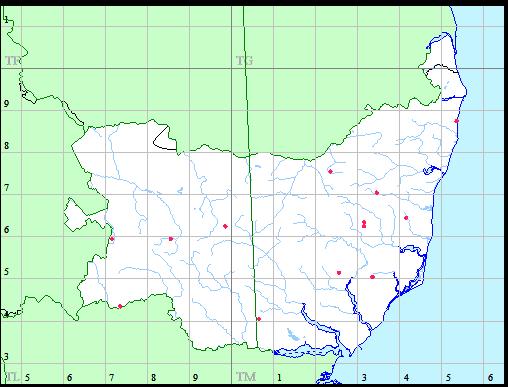
Somewhat irregular in appearance, most recent records have been from stubble fields. The roadside banks where it was seen previously have become overgrown.
Ephemerum crassinervium subsp. sessile (Bruch.) Holyoak.
Found on trodden paths in Wolves Wood RSPB NR TM04M in 2018 when it was new to the county.
Ephemerum serratum (Hedw.) Hampe [E. serratum var minutissimum]
Dialytrichia mucronata (Brid.) Broth.
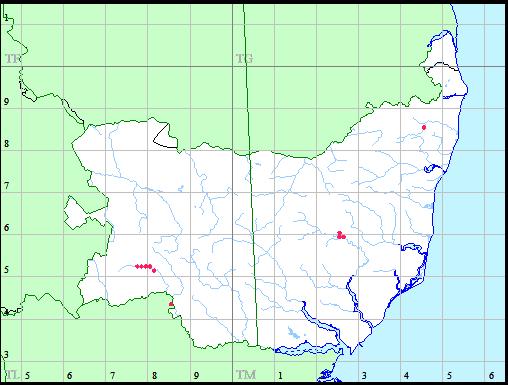
Still present at previously known locations but at Stansfield it was found in some abundance along a 6km stretch of the River Glem in 2013.
Pseudocrossidium hornschuchianum (Schultz) R.H. Zander
Pseudocrossidium revolutum (Brid.) R.H. Zander
It was abundant on the face of a crag pit at Iken TM4554 in 2014.
Bryoerthrophyllum recurvirostrum (Hedw.) P.C. Chen
Leptodontium flexifolium (Dicks.)
Hampe
Leptodontium gemmascens (Mitt.)
Braithw.
Still present at Barnhamcross Common TL88Q but can no longer be found at Wortham Ling or Dunwich.
Streblotrichum convolutum (Hedw.)
P. Beauv. var. convolutum [Barbula convoluta var. convoluta] var commutatum [Barbula convoluta var. sardoa]
Once known as Barbula convoluta var. commutata then B. sardoa. It occurs on base rich substrates such as mortar in walls and is widespread, though only plants with very undulate leaves are recorded.
Streblotrichum convolutum var. commutatum

Barbula unguiculata Hedw.
Didymodon sinuosus (Mitt.) Delonge
Didymodon fallax (Hedw.) R.H. Zander
Didymodon luridus Hornsch.
Didymodon tophaceus (Brid) Lisa
Didymodon nicholsonii Culm.

Under-recorded in the Flora but now appears to be quite widespread, mostly on tarmac paths and driveways. First found in VC26 at Chelsworth in 2016.
Didymodon vinealis (Brid.) R.H. Zander
Didymodon insulanus (De Not) M.O. Hill
Didymodon umbrosus (Mull. Hal.)
R.H. Zander
Appears to be rare but is a tiny plant and may be overlooked. Mostly on damp stonework in churchyards and on bridges. Five recent records, Felsham TL95N in 2010, Rushmere St. Andrew TM14Y in 2010, Kentford TL76I in 2012, Hadleigh TM04B in 2013 and Pakenham TL96I in 2014.
Didymodon rigidulus Hedw.
Didymodon icmadophilus (Schimp. ex Mull. Hal.) K. Saito
[D. acutus]
Pterygoneurum ovatum (Hedw.) Dixon
Was still present in the chalk pit at Little Blakenham when last visited in 2013.
Aloina rigida (Hedw.) Limpr. Aloina aloides (Koch ex Scultz) Kindb.

Aloina ambigua (Bruch & Schimp.)
Limpr.
Still present at Landguard TM2831 in 2019, the only site in VC25.
Tortula subulata Hedw.
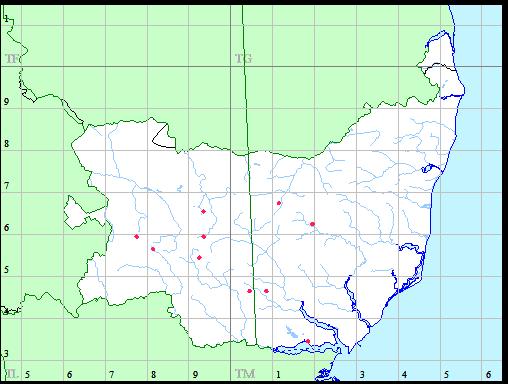

Whepstead
When revising the distribution of T. subulata Smith (2008) named the record from Shottisham (T. subulata var. angustata in the Flora) as this sp. Now that the distinction between this sp. and the next are clear, it is apparent that T. subulata is uncommon in the county.
Tortula schimperi M.J. Cano, O. Werner & J. Guerra [T. subulata var angustata]

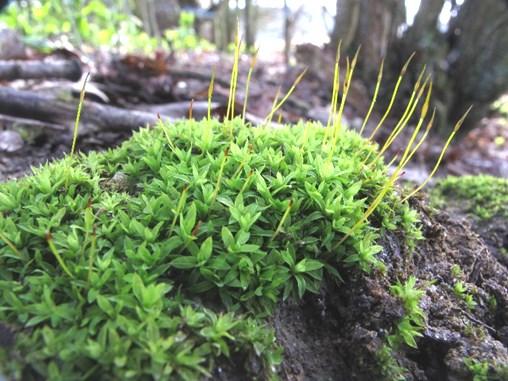
Mendlesham
Appears to be more frequent in Suffolk than elsewhere in the country. It occurs on banks in woodland margins, as in above photo, but also on spoil heaps in churchyards and elsewhere. The first record in VC25 was 1991 and VC26 in 2012.
Tortula marginata (Bruch & Schimp.)
Spruce

Tunstall
Remains very rare, still present in the disused chalk pit at Little Blakenham where seen in 2013, the only new site was on clay in a small disused pit at Tunstall TM35M in 2012.
Tortula muralis Hedw.
Tortula lindbergii Broth.
[T. lanceola R.H. Zander]
Tortula viridifolia (Mitt.) Blockeel & A.J.E. Sm.
Tortula caucasica Lindb. ex Broth.
[T. modica R.H. Zander]
Tortula truncata (Hedw.) Mitt.
Tortula protobryoides R.H. Zander
Tortula acaulon (With.) R.H. Zander
var. acaulon
var. pilifera

On earth banks near the coast particularly the estuaries of the R. Alde and R. Blyth.
[var. schreberianum is not recognised in latest check list]
var. papillosa
Microbryum davallianum (Sm.)
R.H. Zander
var. davallianum
var. conicum (Schleich. ex Schwaegr.)
R.H. Zander
These varieties have been reinstated; var. davallianum recorded from VC26 and var. conicum from both VCs.
var. commutatum (Limpr.)
R.H. Zander
Following the publication of Sharon Pilkington’s paper in FB127, I looked in my herbarium and found a specimen of this taxon collected at Kessingland TM535871 in January 2000. So far, this is the only record from East Anglia.
Microbryum rectum (With.) R.H. Zander
Only seen on three occasions recently, the only new site was on a roadside bank at Coddenham TM1054 in 2014.
Microbryum curvicollum (Hedw.)
R.H. Zander
The only recent records are from a disused chalk pit in the forest at Culford TL87L in 2011 and beside the Chalk Road at North Stow TL87C in 2018.
Microbryum floerkeanum (F. Weber & D. Mohr) Schimp.
Has been seen less frequently in recent years and all records from the SW part of the county, probably a result of less attention being paid to arable fields.
Hennediella stanfordensis (Steere)
Blockeel
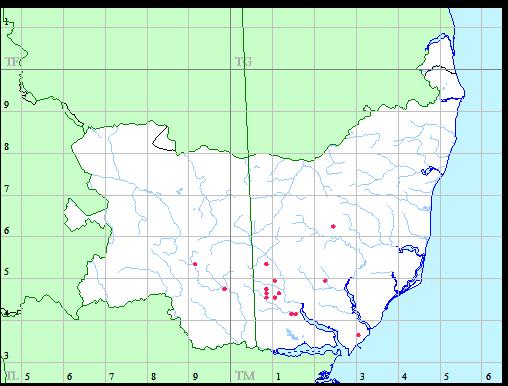

Little Blakenham
Most records are from paths in woodland but also river banks and a roadside verge. Leaf margins on plants at Bramford TM14C & TM14D very variable. On some plants the leaves were edentate with narrow marginal cells, others were dentate but marginal cells almost absent.
Hennediella macrophylla (R.Br. bis) Paris


Newbourne Springs
In more open habitats than the last sp., at side of tracks and on river banks as at Sproughton TM14H in 2018 which was first record from VC25. Sporophytes found on plants on a bank at the side of a path at Chelsworth TL94Y in 2016 and Newbourne Springs TM24R in 2020.
Hennediella heimii (Hedw.) R.H. Zander

Distribution much the same as in the Flora. As noted in the Flora, it was recorded from Wattisfield by F. K. Eagle, but no specimen was found when his herbarium was examined in 2018.
Acaulon muticum (Hedw.) Mull. Hal.

Bradfield Woods
Four recent records, Harkstead TM13X in 2011 and three from VC26, Mildenhall TL67I in 2012, Bradfield St George TL95I in 2013 and Elveden TL78D in 2019.
Syntrichia ruralis (Hedw.) F. Weber & D. Mohr
var. ruralis
var. ruraliformis [S. ruraliformis] var. epilosa

On soil on grave in a small cemetery by the chapel, Aldringham Common TM45706091 23 November 2016. The second record for Britain, see O’Leary & Fisk (2019).
Syntrichia ruraliformis (Besch.) Mans.
Syntrichia montana Nees
Syntrichia virescens (De Not.) Ochyra
Syntrichia laevipila Brid.
Probably under-recorded, often found with capsules. The form with tiny leaflets in the apex of the stem appears to have become rare having been seen only once recently.
Syntrichia papillosa (Wilson ex Spruce) Spruce

Has become much more frequent and has been found on a variety of substrates including gravestones and tarmac.
Syntrichia latifolia (Bruch ex Hartm.)
Huebener

Distribution much the same as in the Flora but has been found on tarmac and other substrates away from any water course a number of times including stone steps leading to the Roman Catholic Church in Beccles.
Cinclidotus fontinaloides (Hedw.)
P. Beauv.

Still abundant along tidal stretches of the River Waveney, also found on a large stone
in a stream at Denham TM17X in 2010. At Great Bradley it was on the concrete sides of a number of weirs along the run off channel from Kirtling reservoir. This feeds into the River Stour and is probably the source of the records from Long Melford TL84L in 2013, Great Wratting in 2017 and Sudbury in 2018.
SELIGERIACEAE
Seligeria calycina Mitt. ex Lindb. On hard chalk in a small quarry at Santon Downham TL8187 in November 2017, only the second record from the county.
Seligeria calcarea (Hedw.) Bruch & Schimp.

On chalk rubble at Kenny Hill TL6679 October 2010, in a disused chalk pit at Brandon TL7986 & TL8086 February 2011 and on chalk rubble at site of old flint mine workings Brandon TL7883 January 2016. Still present at Little Blakenham TM1049.
GRIMMIACEAE
{Schistidium apocarpum (Hedw.) Bruch & Schimp.}
The record from Brent Eleigh was due to an incorrect identification and has been deleted.
Schistidium crassipilum H.H. Blom

Twice found as an epiphyte on ash, at Woodbridge TM2648 2013 and Kelsale TM3866 2014.
Grimmia pulvinata (Hedw.) Sm.
Grimmia trichophylla Grev.

Very uncommon, usually on brick capping of the walls of churchyards. The first record for VC25 given in the Flora has been found to be based on a specimen of G. pulvinata. It is replaced by churchyard wall Pettistree TM2954 1997 RJF.
Grimmia dissimulata E. Maier


Walsham-Le-Willows
Occasional on calcareous stonework in churchyards mostly to the south and west of the county, can cover quite large areas.
Grimmia decipiens (Schultz) Lindb.
Racomitrium aciculare (Hedw.) Brid.
Racomitrium fasciculare (Hedw.) Brid. The only recent record is from tiles on the roof of an outhouse at Bartonmere House, Great Barton TL9166 in June 2010.
Racomitrium heterostichum (Hedw.)
Brid. sensu Hill et. al. (2008)
One recent record, from lid of a box tomb in the churchyard at Westerfield TM1747 in October 2010.
Racomitrium elongatum Ehrh. ex Frisvoll
Racomitrium canescens (Hedw.) Brid. Still doing well at Thetford Warren and on Maidscross Hill, Lakenheath. Found inside RAF Lakenheath Air Base by Oliver Glenister in 2021.
SPLACHNACEAE
Splachnum ampullaceum Hedw. Chris Preston found a specimen in BM collected at Market Weston Fen by R.A. Boniface on 17.6.1956.
MEESIACEAE
Amblyodon dealbatus (Hedw.) P. Beauv. Leptobryum pyriforme (Hedw.) Wilson
BARTRAMIACEAE
Bartramia pomiformis Hedw.
Sterile plants were found on a roadside bank at Lound TG04A in 2011. It was still present in Chediston churchyard TM3677 in 2014.
Bartramia ithyphylla Brid.
Philonotis fontana (Hedw.) Brid. Philonotis calcarea (Bruch & Schimp.) Schimp.
BRYACEAE
Bryum argenteum Hedw.
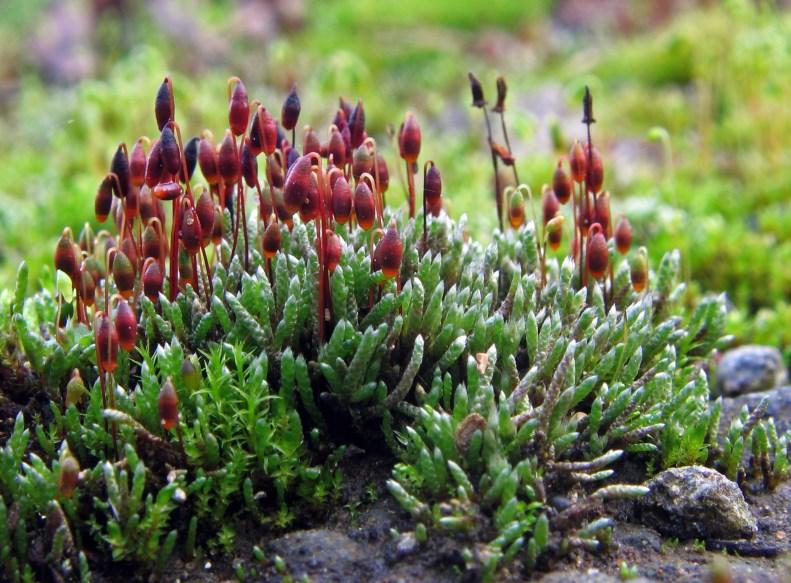
Bryum gemmiferum R. Wilczek & Demaret
Bryum gemmilucens R. Wilczek & Demaret
Bryum dichotomum Hedw.
Bryum radiculosum Brid.

Fairly frequent on mortar on walls particularly of churches, under-recorded in the past.
Bryum ruderale Crundw. & Nyholm
Bryum violaceum Crundw. & Nyholm
Bryum klinggraeffii Schimp.
Bryum tenuisetum Limpr.
Bryum subapiculatum Hampe
Bryum pallens Sw. ex Turner
A few plants beside a stream at Ashfield cum Thorpe TH16W in 2012.
Bryum algovicum Sendth. ex Mull. Hal. var. rutheanum (Warnst.) Crundw.


Abundant on the dunes just north of Kessingland and frequent at Sizewell, otherwise scarce at other coastal sites where the dunes have become well vegetated.
Inland sites are Westleton Common TM46P, a sand pit at Holton TM47D, Snape Warren TM45E and amongst detritus at side of a concrete road at Chedburgh TL75X.
Bryum knowltonii Barnes
Bryum archangelicum Bruch & Schimp. [B. imbricatum] Found at Westleton Common TM46P in 2010 (Conf. D. Holyoak). Also at Kessingland TM58H and Orfordness TM45K. Rare but possibly under-recorded as it can only be identified with capsules that ripen in Summer.
Bryum intermedium (Brid.) Turton
Bryum donianum Grev.

Under-recorded, a species of dry sandy banks and records dependant on visiting suitable habitats.
Bryum capillare Hedw.

[B. subelegans]
Bryum pallescens Schleich. ex Schwagr.


Bryum caespiticium Hedw.

Livermere
Often frequent where affected by heavy metal, under electricity pylons, under the eaves of thatched church roofs covered with wire netting (as in photo) and wooden boardwalks covered with wire netting. Bryum pseudotriquetrum (Hedw.)
P. Gaertn., B. Mey. & Schreb.
Usually just recorded as B. pseudotriquetrum but one record of var. pseudotriqetrum from Brundish TM26U by David Strauss in 2012. var. pseudotriquetrum var. bimum (Schreb.) Lilj.

Probably over-recorded in the Flora as few records recently.
Bryum bornholmense Wink. & Ruthe Only four recent records, West Stow TL77W 2010, Capel St Andrew TM34N 2014. Westleton TM46P 2019 and Dunwich TM47Q 2020.
Bryum rubens Mitt. Rhodobryum roseum (Hedw.) Limpr.

Last seen at Knettishall Heath TL98K in 2011 but can no longer be found there. In two places on Weather Heath, Elveden TL77Y & TL77Z in 2015 now the only known site in the county.
MIELICHHOFERIACEAE
Pohlia nutans (Hedw.) Lindb.

Fairly frequent on tracks in Tunstall and Rendlesham Forests. Occasional elsewhere on thatched roofs, particularly of churches.
Pohlia annotina (Hedw.) Lindb.

Frequent on damp tracks in Tunstall and Rendlesham Forests but scarce in Dunwich Forest. Still in Bentley Old Hall Wood in 2018. Pohlia lutescens (Limpr.) H. Lindb.
Pohlia melanodon (Brid.) A.J. Shaw
Pohlia wahlenbergii (F. Weber D. Mohr) A.L. Andrews var. wahlenbergii

Occasional on tracks in woodland, can be abundant as at Coddenham TM1153 in 2018. var. calcarea
MNIACEAE
Mnium hornum Hedw.
Mnium marginatum (Dicks.) P. Beauv. var. marginatum
CINCLIDIACEAE
Cinclidium stygium Sw.
Rhizomnium punctatum (Hedw.) T. Kop.
Rhizomnium pseudopunctatum (Bruch & Schimp.) T.J. Kop.
PLAGIOMNIACEAE
Plagiomnium cuspidatum (Hedw.)
T.J. Kop.
Only one recent record, from tree roots at Long Melford TL84L in 2013.
Plagiomnium affine (Blandow ex Funck.)
T.J. Kop.
Plagiomnium elatum (Bruch & Schimp.)
T.J. Kop.
Plagiomnium ellipticum (Brid.) T.J. Kop.
Plagiomnium undulatum (Hedw.)
T.J. Kop.

The only record of sporophytes is Mellfield Wood, Bradfield St George TL95J in 2019.
Plagiomnium rostratum (Schrad.)
T.J. Kop.

Most records are from paths and bare ground, sporophytes have not yet been seen.
ORTHOTRICHACEAE
Zygodon viridissimus (Dicks.) Brid. var. viridissimus
Zygodon stirtonii Schimp. ex Stirt. [Zygodon viridissimus var. stirtonii]
Zygodon rupestris Schimp. ex Lorentz
Three recent records Stansfield TL75V 2011, Great Livermere TL87Q 2016 and Burgate TM07S 2017.
Zygodon conoideus (Dicks.) Hook. & Tayl.
var. conoideus


Seen more frequently in recent years, particularly in the west of the county. Sporophytes have been found on three occasions at Newbourne Springs TM24R in 2013, Sudbourne TM45G in 2013 and West Stow TL87A in 2016.
Orthotrichum anomalum Hedw.
Orthotrichum cupulatum Hoffm. ex Brid. Orthotrichum pulchellum Brunt.

Like many epiphytes, has become quite common in recent years.
Orthotrichum pulchellum

Orthotrichum diaphanum Brid.
Orthotrichum pumilum Sw. Turner
On the branch of an oak tree on Lakenheath Warren, Elveden TL77Z in 2015. The first record from the county, the record in the Flora has been renamed O. schimperi. See below.
Orthotrichum schimperi Hammar [O. pumilum]
The details of this record given in Blockeel (2019) are: on trees by the duck ponds, Palmers Heath, Brandon. TL78 (approx. TL7484) W.H. Burrell, July 1911 (BBSUK C2001.019.19647) det. F. Lara.
Orthotrichum tenellum Bruch ex Brid.

Still uncommon but, like all epiphytes, has increased in recent years.
Orthotrichum stramineum Hornsch. ex Brid.

Orthotrichum stramineum

Like O. striatum, has become more common in recent years but is spreading more slowly with only half the number of records of that sp.
Orthotrichum patens Bruch ex Brid.

On branch of a sweet chestnut at side of a forest ride in the Tangham part of Rendlesham Forest, Capel St Andrew, TM34703834 was new to Britain (conf TLB) See Blockeel & Fisk (2018).
Lewinskya striata (Hedw.) F. Lara, Garilleti & Goffinet
[Orthotrichum striatum Hedw.]

Like many epiphytes has spread rapidly and become quite frequent particularly in last few years.
Lewinskya speciosa (Nees) F. Lara, Garilleti & Goffinet [Orthotrichum speciosum Nees]
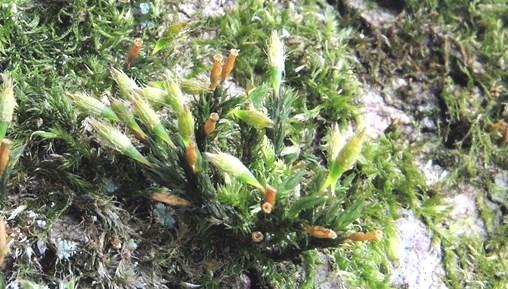
Metfield
First record from Tunstall Forest TM35S by David Strauss, 2016. Found in 2017 at Metfield TM28V and Newbourne TM24L.
Lewinskya affinis (Schrad. ex Brid.)
F. Lara, Garilleti & Goffinet
[Orthotrichum affine Schrad. ex Brid.] As with other Orthotrichum sp. has increased and is now often abundant and densely covering the branches on which it occurs. Also now found on stone, more often than before, particularly in churchyards. Plenogemma phyllantha (Breid.) Sawaki, Plasek & Ochyra [Ulota phyllantha Brid.]
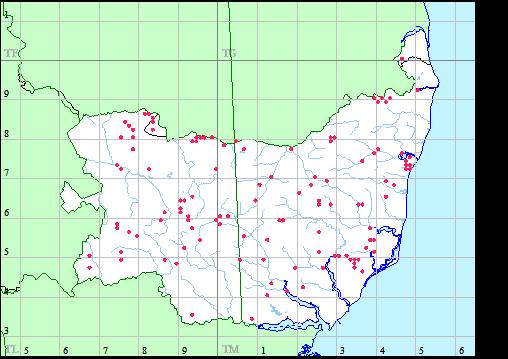
Pulvigera lyelli (Hook.) & Taylor) Sawaki, Plasek & Ochyra [Orthotrichum lyellii Hook. & Tayl.]


Following the revision of the U. crispa complex care is required when recording Ulota sp. U. bruchii may have been overrecorded; however, the map does represent its distribution.
Ulota crispula Bruch
See note under U. crispa below. Recorded from Knettishall Heath TL98K in 2018 and Rendlesham Forest TM34K in 2020. Likely to be widespread but not common.
Ulota intermedia Schimp.
See note under U. crispa below. Recorded from Knettishall Heath TL98K in 2018 and Tunstall Forest TM35X in 2020, distribution likely to be as in above sp.
Ulota crispa (Hedw.) Brid.
Following the revision of the U. crispa complex all records need to be revised, ripe capsules collected in the autumn are needed for accurate determination. U. crispa s. str. has been recorded four times, Hadleigh TM04F, Thelnetham TM07E, Dunwich TM47Q and Tunstall Forest TM35S.
ORTHODONTIACEAE
Orthodontium lineare Schwagr.
AULACOMNIACEAE
Aulacomnium palustre (Hedw.) Schwagr.
Aulacomnium androgynum (Hedw.) Schwagr.
HOOKERIACEAE
Hookeria lucens (Hedw.) Sm.
FONTINALACEAE
Fontinalis antipyretica Hedw. var. antipyretica
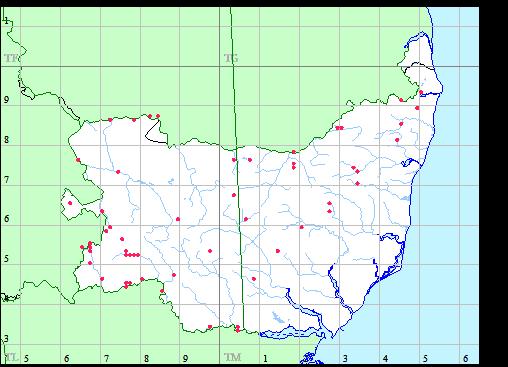
antipyretica var. cymbifolia

Var. cymbifolia is not recognised as a variety in the latest checklist, but is very distinctive with rounded very concave leaves that are not keeled. In Beccles Harbour it forms large clumps on wooden staging.
Plagiothecium latebricola Schimp.
Plagiothecium denticulatum (Hedw.) Schimp. var. denticulatum
Plagiothecium laetum Schimp.
Plagiothecium curvifolium Schlieph. ex Limpr.
Plagiothecium cavifolium (Brid.) Z. Iwats.
Found at two places in Stanstead Great Wood TL8548 and TL8549 in 2012.
Plagiothecium succulentum (Wilson) Lindb.
Plagiothecium nemorale (Mitt.) A. Jaegr.
Plagiothecium undulatum (Hedw.) Schimp.
Pseudotaxiyphyllum elegans (Brid.) Z. Iwats.
Herzogiella seligeri (Brid.) Z. Iwats.
PTERIGYNANDRACEAE
Pterigynandrum filiforme (Hedw.)

Found on the trunk of a fallen Beech tree in the forest near Brandon TL78W in 2016 when it was still present at its original location in West Stow.
CLIMACIACEAE
Climacium dendroides (Hedw.) F. Weber & D. Mohr

Fairly frequent in the Breckland area, recent new sites in the East are at North Cove TM49Q, Minsmere TM46T and Hasketon TM25K.
AMBLYSTEGIACEAE
Kandaea elodes (Lindb.) Jan Kucera & Hedanas
[Campyliadelphus elodes (Lindb.) Kanda]
Cratoneuron filicinum (Hedw.) Spruce
Palustriella commutata (Hedw.) Ochyra var. commutata var. falcata
Campylium stellatum (Hedw.) Lange & C.E.O. Jensen
Campylium protensum (Brid.) Kindb. [C. stellatum var. protensum]
Campylium chrysophyllum (Bred.) Lange [Campyliadelphus chrysophyllus (Brid.) R.S. Chopra
Amblystegium serpens (Hedw.) Schimp. var. serpens
Hygroamblystegium tenax (Hedw.)
Jenn.
The site at Chilton Street TL74N was destroyed when the adjacent bridge was rebuilt so it is no longer to be found there.
Hygroamblystegium varium (Hedw.)
Monk.
Hygroamblystegium humile (P. Beauv.)
Vanderp. Goffinet & Hedanas
Leptodictyum riparium (Hedw.) Warnst.
Drepanocladus polygamus (Schimp.)
Hedanas
Drepanocladus aduncus (Hedw.)

Drepanocladus sendtneri (Schimp. ex H. Mull.) Warnst.
Tomentypnum nitens (Hedw.) Loeske
Hygrohypnum luridum (Hedw.) Jenn.
Campylophyllopsis calcarea (Crund. & Nyholm) Ochyra
[Campylophyllum calcareum]
Sarmentypnum exannulatum (Schimp.)
Hedanas [Warnstorfia exannulata]
CALLIERGONACEAE
Straminergon stramineum (Dicks. ex Brid.) Hedenas
Calliergon cordifolium (Hedw.) Kindb.

Calliergon giganteum (Schimp.) Kindb.
Sanionia uncinata (Hedw.) Loeske
Found on branch of sallow at Aldringham TM45P in 2013, sporophytes were present.
Scorpidium cossonii (Schimp.) Hedenas [Drepanocladus cossonii]
Scorpidium scorpioides (Hedw.) Brid.
LESKEACEAE
Leskea polycarpa Hedw.
THUIDIACEAE
Abietinella abietina (Hedw.) Fleisch.
var. abietina
[Thuidium abietinum var. abietinum]
Fifteen recent records all from Breckland area, found at three locations inside RAF Lakenheath by Oliver Glenister in 2021.
var. hystricosa (Mitt.) Sakurai.
[Thuidium abietinum var hystricosum]
Thuidium tamariscinum (Hedw.) Schimp.
Thuidium delicatulum (Hedw.) Schimp.
Thuidium assimile (Mitt.) A. Jaeger [T. philbertii]
BRACHYTHECIACEAE
Pseudoscleropodium purum M. Fleisch. ex Broth.
[Scleropodium purum]
Eurhynchium striatum (Hedw.) Schimp.
Rhynchostegium riparoides (Hedw.)
Cardot
Rhynchostegium murale (Hedw.) Schimp.
Rhynchostegium confertum (Dicks.) Schimp.
Rhynchostegium megapolitanum (Blandow ex F. Weber & D. Mohr) Schimp.
Rhynchostegiella tenella (Dicks.) Limpr.
Rhynchostegiella curviseta (Brid.) Limpr. Found at one new site, on wooden piling at the side of a stream near Framlingham TM2763 in 2009.
Cirriphyllum piliferum (Hedw.) Grout
Cirriphyllum crassinervium (Taylor) Loeske & M. Fleisch [Eurhynchium crassinervium]
Microeurhynchium pumilum (Wilson) Ignatov & Vanderp. [Eurhynchium pumilum]
Oxyrrhynchium hians (Hedw.) Loeske [Eurhynchium hians]
Oxyrrhynchium speciosum (Brid.) Warnst.
[Eurhynchium speciosum]
Kindbergia praelonga (Hedw.) Ochyra
[Eurhynchium praelongum]
Sciuro-hypnum populeum (Hedw.)
Ignatov & Huyyunen
[Brachythecium populeum]
Brachythecium albicans (Hedw.) Schimp.
Brachythecium glareosum (Bruch ex Spruce) Schimp.
Brachythecium salebrosum (Hoffm. ex F. Weber & D. Mohr) Schimp.
Brachythecium mildeanum (Schimp.) Schimp.
Brachythecium rutabulum (Hedw.) Schimp.
Brachythecium rivulare Schimp.
Scleropodium cespitans (Wilson ex Mull. Hal.) L.F. Koch

Scleropodium touretii (Brid.) L.F. Koch
Eurhynchiastrum diversifolium (Schimp.) J. Guerra [Eurhynchium pulchellum var. diversifolium]
Brachytheciastrum velutinum (Hedw.)
Ignatov & Huttunen [Brachythecium velutinum]
Homalothecium sericeum (Hedw.) Schimp.
Homalothecium lutescens (Hedw.) H. Rob.
HYPNACEAE
Hypnum cupressiforme Hedw. var. cupressiforme var. lacunosum [H. lacunosum var. lacunosum] var. resupinatum [H. resupinatum]
Hypnum andoi A.J.E. Sm.
Hypnum jutlandicum Holmen & E. Warncke
Platygyrium repens (Brid.) Schimp. Found five times between 2010 and 2013 and then not again until 2019.
Calliergonella cuspidata (Hedw.) Loeske
Pylaisia polyantha (Hedw.) Schimp.
On a branch of a Prunus sp. at Knettishall Heath TL9841 in 2014.
Ptilium crista-castrensis (Hedw.) De Not.
HYLOCOMIACEAE
Pleurozium schreberi (Wild. ex Brib.) Mitt.
Rhytidiadelphus squarrosus (Hedw.) Warnst.
Rhytidiadelphus loreus (Hedw.) Warnst.
Hylocomiadelphus triquetrus (Hedw.)
Ochyra & Stebel [Rhytidiadelphus triquetrus]
Hylocomium splendens (Hedw.) Schimp.
Rhytidium rugosum (Hedw.) Kindb.
CRYPHAEACEAE
Cryphaea heteromalla (Hedw.) Brid.

Cryphaea heteromalla

Has become quite common and often forms large tufts on branches of a wide variety of trees. Once found on a gravestone in Beccles cemetery.
Nogopterium gracile (Hedw.) Crosby & W.R. Buck
[Pterogonium gracile]
LEUCODONTACEAE
Leucodon sciuroides (Hedw.) Schwaegr.

Still uncommon although found at a number of new sites. At Chelsworth TL94Y it was on the trunk of willow trees on the bank of the River Brett.
Antitrichia curtipendula (Hedw.) Brid.

On a branch of a sycamore at Clare in 2013 was first record in Suffolk for over 100 years.
NECKERACEAE

On a branch of a Lilac tree in the churchyard at West Stow TL8170, 2016. Neckera pumila Hedw.
Neckera complanata (Hedw.) Huebener
Found with capsules at Walsham le Willows in 2012, the only recent record of capsules in Suffolk.
Homalia trichomanoides (Hedw.) Brid. Thamnobryum alopecurum (Hedw.) Gangulee
R. J. Fisk
35 Fair Close Beccles
Suffolk NR34 9QR bryophyte@sns.org.uk
LEMBOPHYLLACEAE
Isothecium myosuroides Brid. var. myosuroides
Isothecium alopecuroides (Lam. ex Dubois) Isov.
Ctenidium molluscum (Hedw.) Mitt. var. molluscum
ANOMODONTACEAE
Anomodon viticulosus (Hedw.) Hook. & Taylor

