
GALL RECORDER’S REPORT FOR 2023, INCLUDING SYNERGUS CLANDESTINUS EADY, 1952 AND ANDRICUS LEGITIMUS WIEBES-RIJKS, 1980 (HYMENOPTERA: CYNIPIDAE), NEW TO SUFFOLK JERRY BOWDREY
Introduction
This year has seen the publication by the Field Studies Council of the third edition of the invaluable British Plant Galls (Redfern et al. 2023). This fully revised identification guide contains many new species as well as host information and updated keys.
Some of the more notable Suffolk finds for 2023 are detailed below.
Diptera: Cecidomyiidae
At Darsham Marshes nature reserve (TM420689) on 26.vi.2023 my attention was drawn to an unusual looking catkin on a willow, later identified as Salix triandra L. (Almond Willow) growing beside a path. This proved to be induced by the gall midge (Loew) a species previously only recorded in Suffolk from


The female catkin is distorted by a downy swelling (Fig. 1) situated either at its base or apex, the stamens and scales thickened (Redfern et al. 2023).
Several orange larvae (Fig. 2) are found inside. Occurring only on S. triandra, an alternate generation appears later in the year galling buds of the same host.
Cynipidae : Aylacini (herb gall wasps)
Aylax papaveris (Perris)is a gall inducer in the capsules of Papaver spp., most noticeable on P. dubium L. (Long-headed poppy).
Morley (1935) included an uncertain record of the gall from his garden at Monks Soham (as Aulax papaveris), but the presence of the species in Suffolk was confirmed by Ellis (1933) from Belton. On 4.vii.2010 Laurie Forsyth found the gall between Tunstall and Wantisden (TM368536) and these remained the only confirmed records for Suffolk.
On 24.vi.2023 I collected some ripe capsules of P. dubium alongside the sandy track south of Sizewell Hall (TM4761) and on returning home, noticed that one was clearly distorted (Fig. 3), a longitudinal section of the capsule revealed young larvae of A. papaveris amongst extensive gall tissue. This species seems genuinely to be rare in the County, unlike A. minor Hartig, which is frequent on P. rhoeas (Common Field Poppy) and may sometimes even be confused with the present species.

Aulacidea hieracii (L.) induces galls in Hieracium species, producing irregular, elongate swellings in the main stem. There are only two or three native Hieracium found at all frequently in the County and rather than being identified to species, recorders often simply assign them to one of the major sections: Sabauda, Hieracoides and Vulgata (Sanford & Fisk, 2010). The difficulty of identifying the host species by the non-specialist, means that the host range of A. hieracii in Britain is not well understood.
The appearance of the gall also seems to vary according to its stage of development as well as the species of Hieracium galled, some galls being smooth whilst others are densely hairy (pers. obs.).
This species is apparently scarce in Suffolk. it was noted by Morley (1935) from Gorleston (in Norfolk), bred by Wiltshire in 1930, but the first county record appears to be of a gall found at Frostenden on 29.ix.1946 (as Aulax hieracia) (Morley, 1947), the host was confirmed as Hieracium umbellatum by Francis Simpson and the specimen exhibited at an exhibition at Bury St. Edmunds on 29.iii.1947.
There appear to have been no further records until two from the present century, Ipswich, Holywells Park on Hieracium sp. in 2003 and Belton Common on Hieracium umbellatum in 2006 (NBN accessed 6.x.23), both these sites being inland.
In 2009, Linda Owen showed me a gall she had found at Gunton near Lowestoft and on visiting the site on 11.x.2009 I was able to find an old gall of A. hieracii at TM5495. On 9. viii.2023 I revisited Gunton Warren nature reserve and at Gunton Cliff (TM544962), I found galls of A. hieracii to be frequent on narrow-leaved hawkweeds (c.f. Hieracium section umbellata) (Figs. 4 & 5) growing on the cliff slopes and dunes.
Subsequently, in August and September 2023, I walked the sections of coast between Pakefield and Kessingland and again from Thorpeness to Sizewell. On both stretches, what appeared to be the same Hieracium species was frequent and more abundant than I recall from previous years, but despite a prolonged search no further galls were found.
There seems to be no obvious reason why A. hieracii is not found along apparently suitable coastal habitats to the south of Lowestoft and it will be interesting to see if it colonises these areas in future years.


Cynipidae: Cynipini (oak gall wasps)
Synergus clandestinus was formerly described as a primary gall inducer, but it is now known that it is an inquiline species that modifies the acorn galls of another gall wasp, Andricus legitimus (Wiebes-Rijks, 1980).
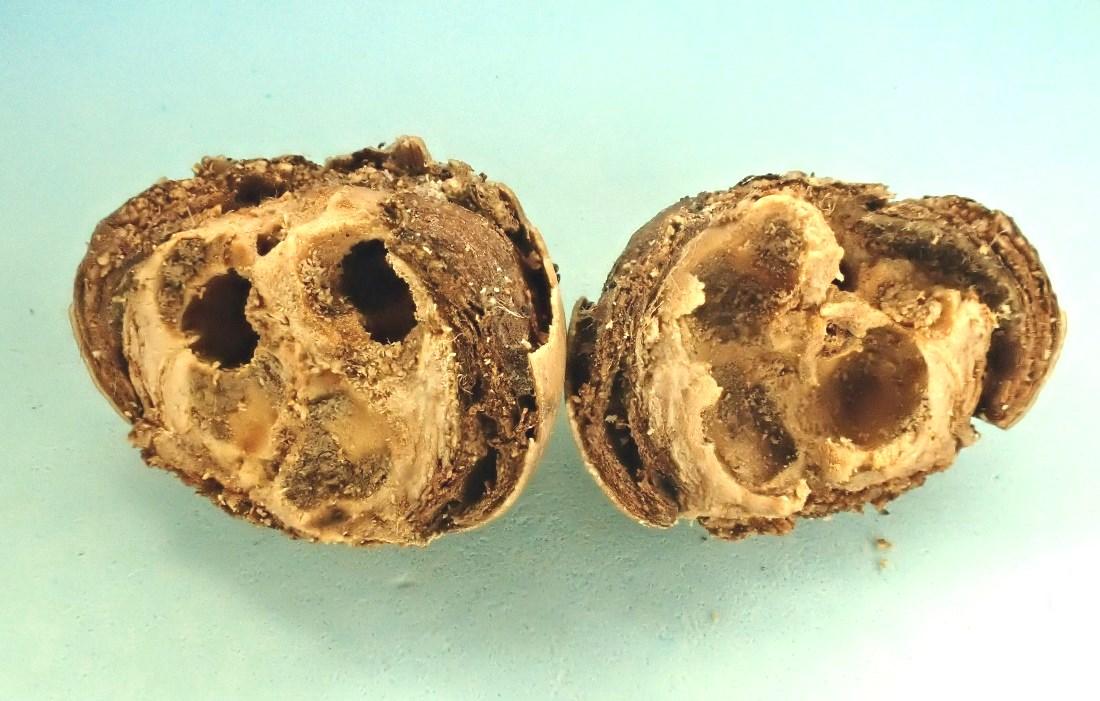
The stunted oaks growing north of the WWII concrete blocks on the Minsmere / Sizewell boundary (TM4764) are a rich hunting ground for oak galls with 24 different species recorded so far. On 6.ix.2023 I noticed a stunted acorn on an oak (Fig. 6), still attached to the peduncle. Closer examination showed a group of vacated cells within the acorn (Fig. 7) which keyed to S. clandestinus in Eady & Quinlan (1963) and Redfern & Shirley (2023).
By implication, the original acorn gall was induced by A. legitimus and later modified by the parasitoid This is the only host for S. clandestinus known from Britain, although on the Continent it has been recorded from acorn galls of Callirhytis spp. (Melika, 2006). Both S. clandestinus and A. legitimus would appear to be new to Suffolk.

Redfern et al. (2023) state that, in Britain A. legitimus has been found only on Q. petraea (Sessile Oak). The presence of a well-developed peduncle suggests that the host tree in this case was either Quercus robur L. or possibly its hybrid with Q. petraea (Mattuschka,) Liebl. = Q. x rosacea Bechst.
I am always pleased to receive gall records and/or specimens from Suffolk. A comprehensive list of oak galls recorded in the west of the County, by Adrian Parr, was especially welcome, as my efforts nowadays are mainly concentrated in the east of the County.
Acknowledgement
I thank Martin Sanford of SBIS for further details of the two A. hieracii NBN records, assistance with a literature reference and useful discussion on hybrids between native Quercus spp.
References
Eady, R. D. & Quinlan, J. (1963). Hymenoptera: Cynipoidea. London, Royal Entomological Society. Handbooks for the identification of British insects VIII (1a).
Ellis, E. A. (1933). Some local plant-galls. Trans. Suffolk Nat. Soc. 2(2): 162–164.
Melika, G. (2006). Gall wasps of Ukraine. Cynipidae. 2 vols. Kyiv, Vestnik Zoologii. Morley, C. (1935). The Hymenoptera of Suffolk. Part 1. Trans. Suffolk Nat. Soc. 3: 1-36. Morley, C. (1947). Proceedings 1947. Hieracium umbellatum L., galled by the Cynipid wasp Aulax hieracia, Beché (Trans. iii 30) from Frostenden last Sept. Trans. Suffolk Nat. Soc. 6(2): l.
Redfern, M., Shirley, P. & Bloxham, M. (2023). British plant galls. 3rd edition. Preston Montford, Field Studies Council.
Sanford, M. & Fisk, R. (2010). A Flora of Suffolk. Ipswich, D. K. & M. N. Sanford. Vincent, P. (2019). The Diptera of Suffolk. Part 2: Biblionidae, Bolitophilidae, Diadocidiidae, Ditomyiidae, Keratoplatidae, Mycetophilidae, Sciaridae, Cecidomyiidae. Trans. Suffolk Nat. Soc., 55: 1–27.
Jerry Bowdrey 10, Dennys Lane, Kelsale, Saxmundham, Suffolk IP17 2PD jeremybowdrey@btinternet.com
(2023)