
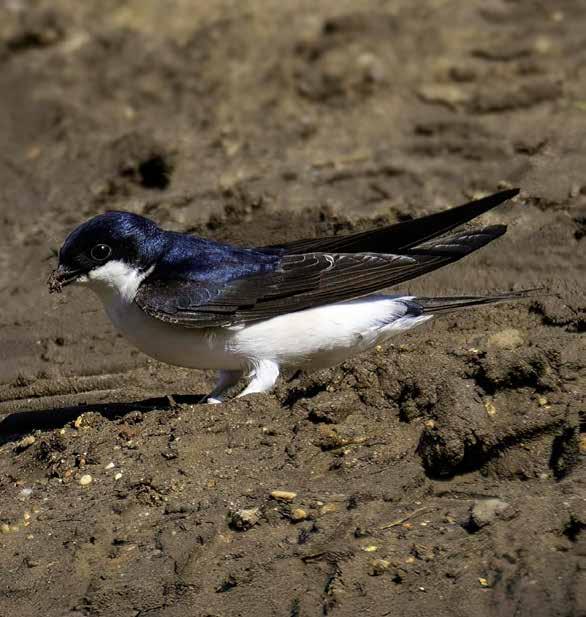

John Kornjaca
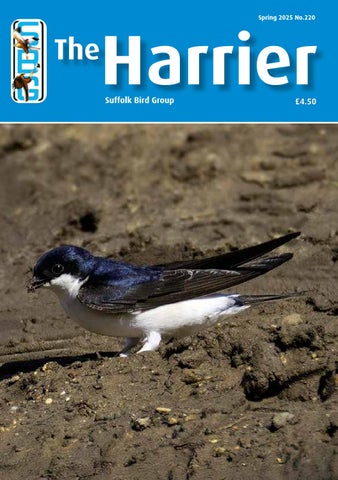
John Kornjaca
Welcome to the Spring 2025 edition of THE HARRIER – my first ‘in the saddle’ - I hope that I am able to continue with the good work and high standards produced by my predecessors.
The SBG have hit the ground running in 2025 with our first outdoor event taking place on Sunday 5 January – an excursion led by Dave Pearsons along the River Orwell between Levington Marina and Trimley in persistent drizzle. In contrast, spectacular sunshine and cloudless skies greeted a large group to Thorpeness Meare on Saturday 25 January with a planned walk around RSPB North Warren and the surrounding area led by David Walsh.
As the month of January ended, over sixty members and friends attended the first indoor event of the year (perhaps thinking of banishing the winter blues?), to focus on the birds of Costa Rica in a presentation by Howard Vaughan. What an amazing variety of birds!
February (22nd) allowed a cross-border excursion to Tollesbury Wick, Essex with leader Ashley Gooding and the AGM has also taken place (as we go to press) on Thursday 27 February.
As usual, the reports of our excursions are included.
There are three ongoing projects that shall benefit from your continued assistance and both are reaching significant periods:
- as we watch for the return of our House Martins in the coming days, HMSS is providing free artificial nest cups to suitable sites in an effort to encourage breeding.
- BOSS is looking to support the breeding efforts of our Suffolk Barn Owls.
- we continue to work alongside the Suffolk Wildlife Trust in our joint quest to restore the population of Swifts to previous levels with the SOSSwifts initiative.
Further details of our projects and other news items may be found on our website.
A short reminder that Mick Wright and the BTO are seeking volunteers for the Heathlands Bird Survey for 2025 – surveying Nightjar, Woodlark and Dartford Warbler (see: The Harrier 219/p14).
The month of March is upon us and as usual it is a month of great change with many of our winter visitors moving on and, the first of our spring migrants arriving. Among the earlier arrivals shall be our House Martins and, in support of our HMSS initiative, this iconic species has made the front cover.
As a group, we are studying ideas in regard to how we may attract younger birdwatchers. To this end, by way of a short survey, we have included a series of questions for parents, members and any young birders that read this magazine. How may we better cater for Suffolk ‘young birders’? Please respond to The Harrier as per the email address included.
As the year advances, there are many more indoor and outdoor events for you to enjoy –I do hope that you are able to support some of them. The walks are steadily paced and most informative, the talks are varied and
interesting. Our handy Programme Card (also available on the website) provides further dates and details.
Best wishes for a bountiful spring of birding!
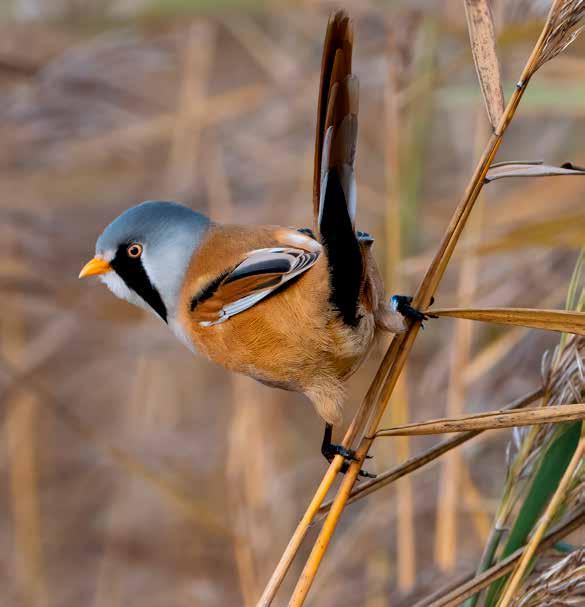
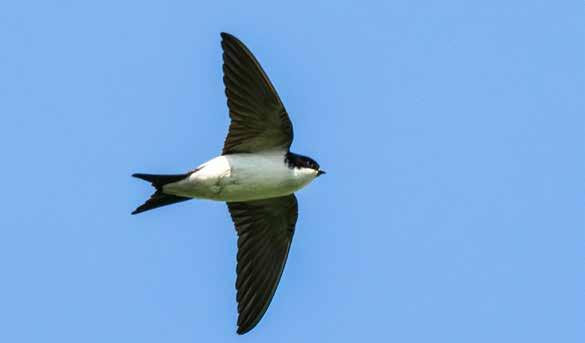
In the spring of 2024, the Suffolk Bird Group launched its House Martin Support Suffolk (HMSS) project which is designed to support the breeding of the species in Suffolk. The project team of HMSS began to collect records of House Martin nest sites from across the county in an effort to accurately assess the size of the breeding population. Thank you to everyone that has contributed thus far.
The House Martin has, since 2020, appeared on the UK Red List for birds. That is, the list of bird species that are most at risk of extinction or population decline in the UK. The list is part of the Birds of Conservation Concern (BoCC) process and is updated every six years. Sadly, reports from across the country indicate that the species continues to decline in numbers and so the work that we have recently commenced here in Suffolk continues to be of importance.

Our survey results have provided an early indication of some interesting changes in House Martin distribution on a local scale. For instance, we have noted that some of the colonies of birds that have traditionally nested within some rural locations and villages failed to return in 2024. However, new house building projects, particularly those on the outskirts of some of those rural locations, have occasionally attracted new House Martin colonies, particularly while the house building is still in progress. This is usually because there is often a readily available supply of wet mud present on the building site for the birds to access throughout the summer. Wet mud is, of course, key to successful nest building for the species.
So what happens when house building is completed and the surrounding land dries out? Well, we have learned that the nesting birds require the wet muddy puddles to be
located within a few hundred metres of their nest sites and, that temporary rain puddles are insufficient. House Martins rarely build their nests when it is raining, as the mud carried to their nest site will not dry.
For the summer of 2025 we should like more volunteers to take part in the recording process. This shall enable us to build a far more detailed and more accurate picture of the House Martin population in Suffolk. The many nest sites that were visited last year (2024), should again be visited in 2025. The birds shall start to return to the UK in mid-March and so mid-June, and onwards, is a good time to visit known nest sites with most breeding House Martins likely to be busy feeding youngsters at this time, thus making occupied nests fairly easy to see.
When you send in your House Martin nest site records please note the following: - whether artificial nests are available on the site and if they are being used by the birds
- the location of the nest(s) by address (including post code), or, use what3words, or a 6-figure OS map grid reference - the number of active nests that are present
Please send your records in an email to: housemartins@suffolkbirdgroup.org
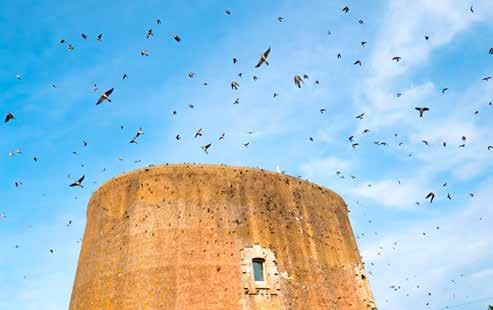
The House Martin colony located on my house in the Waveney Valley started 40 years ago with natural nests. Last season (2024) there were 34 successful pairs with over half using artificial nests. Mud is made available in my neighbour’s stable yard. The adjacent stables provide homes for at least 6 pairs of Barn Swallows with both species making use of the muddy puddle provided.
Sally Nelson
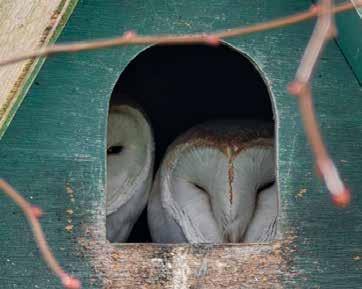
The Suffolk Bird Group and the Suffolk Wildlife Trust (Farm Advisory Team) have come together to support Barn Owls in the Waveney Valley catchment area and across the county of Suffolk.
Funding through Suffolk Wildlife Trust will pay for the provision and installation of up to 20 new Barn Owl nest boxes in 2025, alongside free wildlife advisory visits for eligible farms/landowners – from the relevant SWT team.
In order to be eligible to receive a free Barn Owl nest box, interested farms/landowners must satisfy the following criteria:
a) the farm/landowner shall not have previously received a SWT farm advisory visit and would agree to hosting such a visit if successful.
b) Farms have to be over 5 hectares in size. If the above simple criteria are met, a new Barn Owl nest box shall be provided (this may be to replace an existing unsuitable nest box).
Arrangements shall be made to have any provided and installed nest box to be monitored.
The SWT farm advisory visit will consist of advice and guidance on wildlife friendly farming practices tailored to the individual farm, a scoping map and provision of a brief report that shall highlight areas on the land that may benefit wildlife by creation, restoration or improved management of


habitat. Additionally, guidance and advice on applications to land management schemes and other sources of funding may be provided if required by the landowner.
We should appreciate any help in promoting this scheme - sharing the eligibility criteria to farmers you think that may be interested and those farmers and landowners that you know that may like to do a little more to help wildlife and nature.
This offer is to be split between the Suffolk Waveney catchment area and the remainder of Suffolk and is made on a ‘first come, first served’ basis.
For clarity on the above eligibility criteria or, for further information on how to apply for a Barn Owl nest box within this scheme please contact the BOSS team at: barnowls@suffolkbirdgroup.org
David Tomlinson
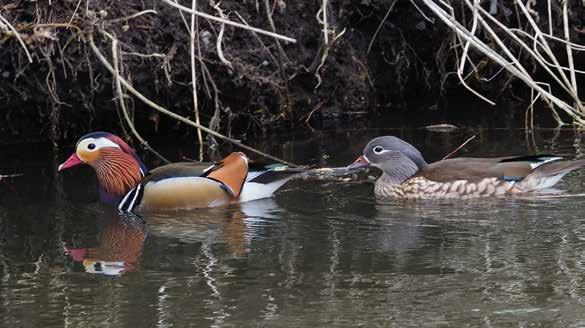
In the first edition of ‘The Collins Bird Guide’ (L. Svensson - 1999), the Mandarin Duck features along with all the other wildfowl species in the front of the guide. In the second edition you will find that it has been banished to the rear of the book, to the category of ‘Introduced breeding species and species recorded only as escapees’, where it remains. You may believe that this is where such an introduced exotic species should be listed but, as a Mandarin fan, I think it a shame. Here, in Suffolk, we are more likely to see a Mandarin Duck than an Eider (let alone a King Eider or a Steller’s Eider, both of which feature prominently in Collins – with multiple illustrations). The history of the Mandarin in Suffolk is a long one. C. B. Ticehurst, in his ‘A History of the Birds of Suffolk’, noted just the one record of a bird ‘taken in Fritton Decoy in October 1898’
W. H. Payne ‘The Birds of Suffolk’ (second edition - 1978) wrote ‘the mandarin has not, so far, been known to breed in the county. But, it may well have done so or probably will before long since a number have been reported’. His prediction was correct, although Steve Piotrowski in his ‘Birds of Suffolk’ (2003) could only find four breeding records - the first was in Foxhall in 1986.
A long popular specimen in wildfowl collections, Britain’s Mandarin Duck population is descended from just six pairs of this Chinese species that were gifted by the French ornithologist Jean Delacour to Alfred Ezra in 1928. Ezra then released them in the grounds of his home at Foxwarren Park, near Cobham in Surrey. They bred successfully the following year and a thriving feral population was soon established around Windsor Great Park and
Virginia Water, Surrey. It is believed that the reason they thrived was the suitability of the habitat, a mixture of ponds and lakes surrounded by rich and mature woodland, an environment that seemed to be ignored by our native species of wildfowl.
My own interest in the Mandarin goes back to the 1960’s, when, as a teenager, I kept a small collection of wildfowl on a pond in the garden at the home of my parents. The first ducks that I acquired were a pair of Carolina Duck (Wood Duck) and a pair of Mandarin Duck. The former, I recall, cost me £6.00 while the Mandarins were twice as expensive at £12.00. They were a good buy and the most delightful of birds. I never failed to delight in watching the drake display to his mate whereupon he would raise his wonderful crest and his extraordinary orange sails (elongated tertial feathers).
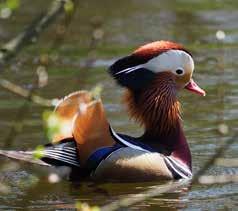
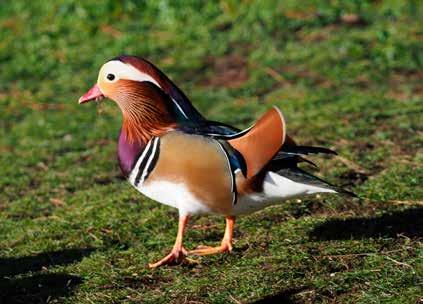
A drake displays on the Little Ouse (Santon Downham) – April 2023
My first job in the early 1970’s was in Maidenhead, and so it was not far for me to drive to Virginia Water to watch and photograph the wild Mandarin Duck population present.
In those distant days, the population of Britain’s Mandarin Duck was still centred in this area of Surrey and Berkshire as
confirmed by ‘The Atlas of Breeding Birds in Britain and Ireland (J.T.R. Sharrock - 1976)’. At that time, it was believed that there were as many as 300-400 breeding pairs while they had been recorded in 41 x 10km squares amounting to just 1% of the land area of the British Isles. However, ‘The Bird Atlas’ (D. Balmer - 2007-11) stated that this ‘generally shy and secretive species’, had expanded its range enormously with a 1,156% gain in its distribution (since 1976).
The growing population of the species had now established strongholds in south east England, the Severn Vale and around the Peak District. Records from East Anglia were relatively few, likely because of the lack of suitable habitats in the region. However, Mandarins are proving themselves to be remarkably adaptable and today there is a small but growing population in Suffolk.
I know these ducks best from the west of the County. I recall my surprise and great pleasure when walking along the Little Ouse at Santon Downham one spring and finding a pair prospecting for a nest site in the old poplars that line the river bank. Mandarins are hole-nesters and will readily nest several feet above the ground. They have occasionally been known to utilise Barn Owl nest boxes.
Santon Downham remains one of the best places to see Mandarins in Suffolk. In the east of the county the hot spots for this species are Christchurch Park, Ipswich and Purdis Farm (Ipswich Golf Club) although they have very poor breeding success rates (Suffolk Bird Report 2023). Elsewhere in the County there were records of single birds, pairs and occasionally small flocks at various locations including Fritton Lake and Brandon Country Park.
On one spring evening in 2023 I observed a pair fly into Hopton Fen (my local patch), sadly, although I have visited the fen almost daily, I have yet to see them again.
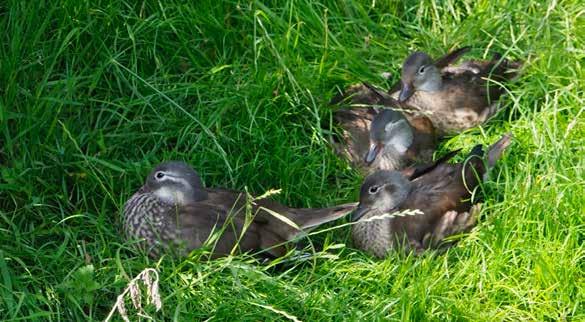
There was a time when it was thought that Britain’s Mandarin Duck population was of global significance because of the worldwide decline in the population – particularly in its native China. However, the IUCN Red List shows that the Mandarin Duck is a species of Least Concern.
Although an alien species to these shores, I believe that the Mandarin is, arguably, one of the prettiest of all ducks and a delightful addition to our avifauna. Unusually for a non-native species, it does not pose a threat to any of our native birds or wild life.
In my opinion, the exotic Mandarin Duck is a bird to be enjoyed.
Editor note:
1. The BTO website states that the UK population of Mandarin Duck is c.4,400 pairs with a 604% growth in numbers experienced between 1995 to 2022.
2. Mandarin Duck has most recently been assessed for The IUCN Red List of Threatened Species in 2018 as a species of Least Concern.
The SOSSwifts teams have been very busy over the winter preparing for this coming season.
All of the 130 Swift nest boxes donated to the project by global business BUNZL have now been distributed and John Turner has been busy making more to keep up with demand. We have targeted existing Swift colonies, to provide additional nesting space, and then we have added call systems, making up further Community Sets for the prominent elevations of public buildings. Schools in Kesgrave, Eye, Saxmundham and Leiston, and, churches in Old Newton, Halesworth, Ipswich and Felixstowe with Felixstowe Library and Lackford Golf Club receiving Sets. Other colonies in Hollesley, Gt Cornard and Hemley are receiving extra nest boxes to install adjacent to existing nest sites.
As we seek to spread the word of our good work, inviting others to participate, there are now a series of talks arranged in Bury St Edmunds, Haverhill, Boxford and Gt Cornard. These presentations shall raise awareness to the plight of our Swifts and, hopefully, result in more natural nest sites being protected with additional Swift boxes being installed.
Positive news:
335 Swift nest boxes used in 2024
We consider a nest box ‘used’ if a Swift is seen entering the box, or, there is evidence of Swift activity after September. We know from reports of May and June that there were many nest boxes being used for the first time and, encouragingly, many of these sites hosted multiple nest boxes providing additional space for new colonies to expand. Most of these locations had previously played Swift calls for a season or two, prior to the birds finding a nest box of their own.

As such, Swift conservation can take time to see positive results.
According to our observers the following have been counted
2022 - 231 nest boxes in use.
2023 - 263 nest boxes in use.
2024 - 335 nest boxes in use.
The SwiftMapper.org.uk app has 1,380 nest boxes registered with 226 logged as used –16.8% occupancy. However, we know there are now over 3,000 nest spaces provided for Swifts around the county.
We are aware of the continual loss of natural nest sites under the rolled tiles of older roofs during renovation works. Outside of the breeding season this is legal and there is no requirement to mitigate by adding nest boxes or Swift bricks and so colonies are just lost. SOSSwifts are always happy to help and offer nest boxes but it is always disappointing when help is refused.
We are very much hoping that the take up of nest boxes will continue. The importance of playing Swift calls to help the younger non-breeding birds find a future nest site is now well established and this and all the additional nest boxes installed can only help their plight.
We still have Swift Community Sets available for public buildings, and, we are happy to provide free help and advice to those needing it. Please do get in contact if you know of potential new and existing locations swifts@suffolkbirdgroup.org
Eddie Bathgate
The Suffolk Bird Group are very keen to help all of our rarer Suffolk breeding species that may take to nest boxes. While Tawny Owl and Little Owl, Spotted Flycatcher and Grey Wagtail are the target species, Treecreeper and Nuthatch may benefit from the provision of suitable nest boxes.
SBG have now provided a second bursary for volunteer John Turner to purchase materials to be used in the construction of nest boxes. John kindly donates his time to make them for us so that we may distribute. In covering the material costs, we can roll funds over again and again, thus providing additional nesting sites around the county of Suffolk.
John has been very busy! We have recently distributed both Owl and Spotted Flycatcher nest boxes to owners of a private woodland
near Framlingham. A wide variety of nest boxes are to be installed in the substantial grounds of a residential home on the River Deben. In all cases the boxes will be installed/erected by the recipients since SBG cannot offer this service.
SBG should be keen to hear from people with such a project in mind, either targeting a specific species in suitable habitat over a wider area, or, perhaps a community group with a local project.
Together and with your support we have the opportunity to make a difference across the county.
If you have an idea for a community nest box project, or, should you wish to have some nest boxes made, please do get in touch at email: info@suffolkbirdgroup.org
Philip Murphy
Birders who pursue their interest in the Stour Valley between Flatford and Brantham may wish to know of the Vice-County Recording Boundary (hence bird recording boundary) at the site.
Research has shown that the ViceCounty Recording Boundary follows the Administrative Boundary at this site. This is along the old course of the River Stour as it flows initially north-easterly and then easterly from Judas Gap to a point at approximately (grid ref) TM098332, thereafter, south-easterly to meet the new course of the River Stour at White Bridge.
This means that the RSPB Stour Estuary reserve and the new and (initially) much wider course of the River Stour between White Bridge and Judas Gap Weir lie within the county of Essex.
Records of birds that are seen in Essex may be submitted to Tim Hayward (email address: ebwsrecords@gmail.com )
Many thanks to Martin Sanford of the Suffolk Biodiversity Information Service for his research and contribution to this short article.
John Kornjaca
Can you spare 10 minutes to help us?
Within the Suffolk Bird Group, we have younger members, many of them are included as part of a family membership. The Council of the SBG are very keen to grow our young birder community and we should like to know your thoughts on how this may be achieved.
Here are a few questions that we should appreciate you answering.
It is hoped that your responses shall provide important information that may allow SBG to shape our activities as we attempt to attract and retain the interest of more young birders.
Please respond with your comments via email to: harrier@suffolkbirdgroup.org
For the purposes of this short survey, please consider that young birders may be:
a) Aged between 8 and 12 years (children)
b) Aged between 13 and 17 years (teenagers)
c) Aged between 18 and 23 years (students/young adults)
1. Do you have children/teenagers that are under the age of 18 years, interested in birds and that regularly read The Harrier? If so, what do they think of the content? Should we include items in The Harrier that may be more suited to young children and, if so, what would you like to see included?
2. The SBG has an extensive programme of indoor meetings and outdoor walks/ activities.
If SBG were to host events that were more suited to children and teenagers (under the age of 18 years) when in the week would be the most suitable time to host such an event? What might we consider for inclusion for such an event?
[NB: All under 18 years of age will need to be escorted by a parent/carer].
3. Do you have young adults in the family that are aged between 18-23 years that are interested in birds? Are they aware of our events programme? Do they attend any of our events? If not, why not?
4. Would you be interested in helping SBG organise activities and events to cater specifically for children and teenagers under the age of 18 years?
5. Any other useful comments/ideas shall be appreciated.
Thank you for your responses
Wright
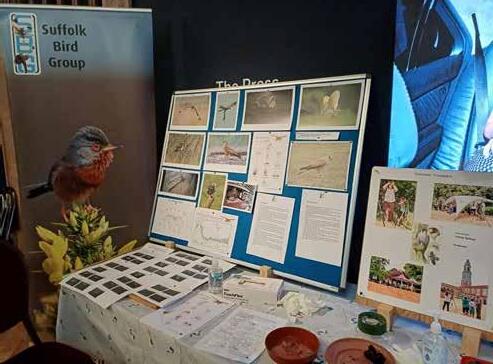
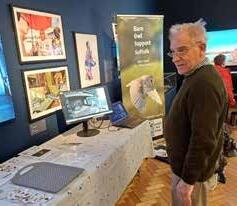
SBG Council members Anne Wright and the evergreen Peter Merchant took time out of their busy schedules to represent the SBG at the ‘LOVE MAMMALS DISCOVERY DAY’ organised by Colchester and Ipswich Museums during the recent schools spring half-term break.
The free to attend event was held at Christchurch Mansion on Wednesday 19 February 2025 between the hours of 10.00am and 3.00pm and was designed to allow families and young children the opportunity to learn about some of the wonderful mammals that we have around us in Suffolk and further afield.
Joining the SBG at the event were the Suffolk Naturalists Society, GeoSuffolk, the
Ipswich Wildlife Group and the Anglian Microscopy Group.
Children (and parents) were enthralled to learn about some of the mammal objects that are going back into the museum’s new galleries and were able to hear how they have been conserved by the museums specialist team.
The youngsters were also able to learn and discover more, via the ‘drop-in’ minimammals zone, which offered them the opportunity to play, undertake arts & crafts and experience other activities throughout the day.
Anne and Peter helped children to learn about some of Suffolk’s birds and in particular how some depend on mammals
for their diets. Dissecting owl pellets proved especially interesting and exciting. While examining the various bones – mainly Voles - found within the disgorged feathers and fur, one ‘lucky’ participant was surprised to discover a live insect larva (a maggot) in their pellet. The larva was examined closely under a microscope but, at some point in the afternoon, it escaped! No doubt – even more excitement followed.
A rewarding session and one that proved to be extremely informative. Thank you Peter and Anne.
Patrick Armstrong
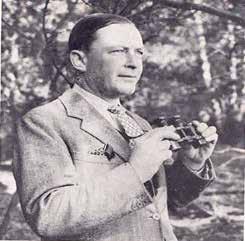
In previous issues of The Harrier I have described birdwatching and some of the birdwatchers in the Suffolk of seventy or more years ago. ‘Alex’ Robertson was a particular friend of my ornithologist father – the Reverend E. A. Armstrong – who liked
to think of himself as ‘the last of the English parson-naturalists’, although he was not quite that, and, he was an Irish-man. The two watched birds together in several parts of East Anglia, with me, in my early teens, tagging along in the early 1950’s.
Born in Marlow in Essex, there is nevertheless something of a Boys Own Paper feel to an account of Alex’s naval career. In 1926, at the age of eighteen he entered the Royal Navy from Harrow School. He served in Chinese waters, the Mediterranean and in Australia (where he held important diplomatic posts). He also served in the Channel Convoys. For a while he served as a House Officer at the Royal Naval College, Dartmouth and later, he was First Lieutenant at HMS Ganges, Shotley. A highlight of his career was when, during the critical late war and immediate post-war period (1945-1947) he was Comptroller to HRH the Duke of Gloucester while Governor General of Australia. During this period, he assisted in the entertaining of the
Mountbatten’s when they visited Australia.
I recall a distinguished-looking man, always jovial when sitting across the table. He was always most encouraging to the young birdwatcher.
He wrote several books on ornithology, including Bird Warbling Days (1938), Birds Wild and Free (1950) and Bird Pageant (1954). The books were extremely well written including many detailed and perceptive observations and were illustrated by many of his own superb photographs. Alex had been keen on bird photography since his schooldays and, he was also a meticulous note-taker – perhaps a product of his naval training
A keen conservationist he served on the Council of the RSPB and was particularly associated, in 1947, with the documenting and photographing of the first nesting Avocets at Minsmere – the first in Suffolk for over a hundred years.
He lyrically describes his first sighting:
[T]he waves fretted at the shingly beach, and terns were flying gracefully along the tideline… the ringed plover were piping and yellow wagtails ran so swiftly and lightly that they scarcely seemed to touch the ground… The lovely wild calls of redshank and peewit greeted us continually… reed-warblers chattered and sang… and not far beyond, a bird stood knee-deep in the water, preening its striking black and white plumage with the ais of its curiously upturned bill… A pair was standing about on the far bank, and as we turned … on to another piece of water, there were two or three others wading in the shallows. As we drew nearer we counted nine as they flew for a hundred yards to resettle. (Birds Wild and Free, p.126)
The 1947 influx of Avocets was the largest noted in Britain for well over a century, and seven pairs nested at two different Suffolk sites – the other being Havergate Island –and sixteen youngsters reached free-flying stage that year. Commander Robertson’s photos of the successful breeding appeared in a paper in British Birds (vol xli, pp. 14-17).
Interestingly, the RSPB had signed a management agreement for the Minsmere site just a few days before on 24th April 1947 - a date that may be considered a turning point both for the RSPB and for bird conservation in Suffolk.
Alex Robertson was discharged from the Navy on health grounds in 1949, and devoted the rest of his days to ornithology and conservation although he was also interested in cricket and music. Aside of the East Suffolk coast, he was also extremely interested in the Breckland. At the time of his death he was working on a monograph of the Crossbill on which he was a recognised authority.
A final book, that went to Press in the year that he died, was published by Esmond Lynn-Allen and was entitled A Partridge Year (1956). In it Robertson emphasised the connections between the behaviour of a species and its habitat and ecology. The book is a plea, prescient for its time, for the conservation of a mosaic-like varied countryside to provide adequate nesting cover and food sources at different times of the year.
Further reading:
https://britishbirds.co.uk/journal/article/ obituary-w-p-robertson-1908-1956
https://trove.nla.gov.au/newspaper/ article/279430608
https://britishbirds.co.uk/sites/default/ files/pdf-store/V41_N01_P014_017_A004. pdf
Saturday/Sunday 2-3 November 2024
Leader: Gi Grieco
Orfordness always has the feel of a wild place and it is always an exciting place to visit –feeling as though we are miles from anywhere. After a successful trip last year, it was decided on a repeat visit in November. We were not as big a group as in previous years with some members dropping out, among them the other trip leader, who had booked a holiday having not checked their calendar properly!
Those of us staying over on the Saturday night met at the Orford Quay to meet the Orfordness wardens and to be transported across.
Upon arrival, the first species seen were Black-tailed Godwit, Redshank and Avocet on the shoreline of Orfordness. Our overnight bags were dropped off in the warden’s truck to be taken to the accommodation while we started to head along the track noting
Lapwing and Teal. In the distance our first Marsh Harrier drifted across, flushing some wildfowl up in the distance. While last year, there were a number of Snipe around the marshy edges, this year we saw only a couple but we did have several Skylark fly up – numbers kept increasing as we walked on and we counted over 35 birds. In the distance a flock of over 100 Golden Plover circled around before heading towards Havergate Island. Other species noted were Kestrel, Meadow Pipit and Stonechat.
Once we reached the accommodation we took our kit into the rooms, each selecting one for the night and then decided to head up to the coast for a bit of seawatching. In years past this was always by the lighthouse but the area has no access now and so we were set up near Black Beacon. This was a good idea as we had a number of good birds offshore, the initial highlight was a Black-throated Diver heading north – a bird that was seen later passing Minsmere. Other good birds offshore were Sooty Shearwater, Arctic Skua and a Pale-bellied Brent Goose amongst a flock of Darkbellied Brent Geese heading south. We picked up a flock of around 20 Common Scoter and also had two Eider, Little Gull, Kittiwake, several Red-throated Diver and Gannet moving offshore. During the scanning we picked up some small numbers of passerines heading in off and we picked up a single Chaffinch heading towards us. As we watched it getting closer to shore it turns out something else had an eye on the bird. Adam Faiers was looking along the shore to the south and noted a Merlin heading low above the shingle toward us. It zoomed past us and then a cloud of feathers erupts in front of us – it had made a beeline for the Chaffinch making a successful kill. Quite an incredible sight to witness. We walked back to the accommodation and our sightings continued with two Woodcock hiding amongst vegetation. We
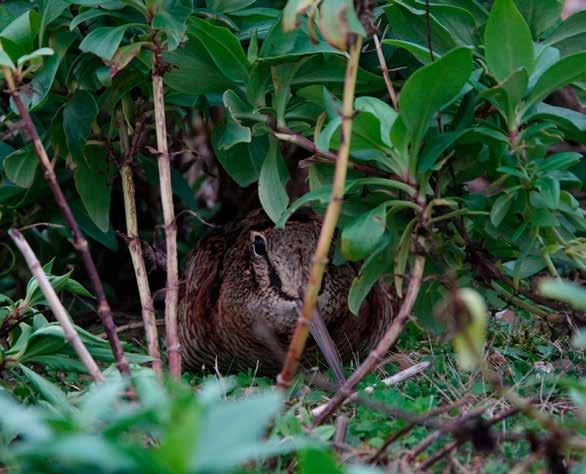
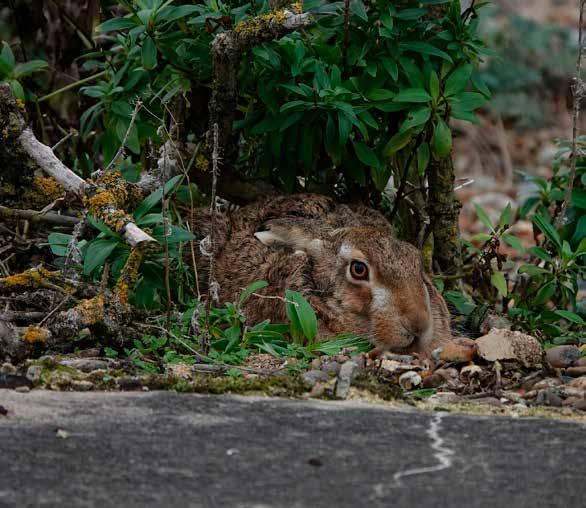
had taken thermal imaging equipment and were scanning around when we picked up one bird. As it sat, motionless, we were able to set up our spotting scopes and view this smart cryptic species. Nearby, we found a second bird and also saw a couple of Brown Hare close up. We crossed the Bailey Bridge and saw a Barn Owl in the distance and later a Short-eared Owl that flew towards the Airfield marshes. After sorting out an evening meal we headed out for a short walk, using the thermal imagers again to scan the fields. We picked up a few mammals, Wood Mice, a Rat and some Rabbits. We also heard some Redwing overhead. I set up my ‘nocmig’ kit to do some sound recording overnight. As it was quite windy I put the kit on the lee side of the building although this picked up more that I planned for along with bird species like Wigeon, Grey Plover and Redshank, I also recorded the not so sonorous snoring tones of a SBG member who had fallen asleep in the room – you know who you are! One of the first birds of the following morning was a Barn Owl
We headed down to the quay to meet the rest of the group who were attending on the Sunday. We retraced our steps past the Airfield site seeing similar species as on the previous day, including the large numbers of Skylark. Raptor sightings included Kestrel, Marsh Harrier and Buzzard. We managed to find a Greenshank that we had seen the previous day and a Great Egret among the usual Little Egret and Grey Heron. Up near the buildings we heard, then eventually saw, a Green Sandpiper. Along the channel areas we counted three Rock Pipit. Small birds were few in number, as last year, due to the date chosen for visiting but among the several Blue Tit we did find two Goldcrest, Meadow Pipit and Stonechat and, we did hear one Cetti’s Warbler. We walked to the coast for a seawatch but,
unfortunately, it was quieter than on the previous day. A number of Red-throated Diver and several Dark-bellied Brent Geese moving south and good numbers of Great Black-backed Gull were observed loafing offshore. Since it was so quiet we retraced our footsteps, stopping off at the Bomb Ballistic Building. It was very breezy up on top and was therefore difficult to use our ‘scopes but we did see several Golden Plover on the marshes, a Peregrine in the distance on the old BBC building and, close
by, a Merlin landed briefly on some blocks before heading off.
We continued with the day, trying hard to relocate the owls that had already been seen but with no luck. And so, it was time to depart and we packed up and headed down to the boat to be transported back to the Orford Quay.
Another great trip to that wilderness known as Orfordness, with some great sightings and good company.
David Walsh
Saturday 16 November 2024
Leader: David Walsh
There were twenty-five Suffolk Bird Group members gathered in the beach car park at Dunwich at 0830 on Saturday 16 November - definitely the largest group I had ever guided, but, I was told that it was not a record for SBG!
I outlined our planned walk for the morning, an anti-clockwise loop up the beach, inland to the reedbed then back via the Dingle Hills and the woodland. A key task was to keep to the planned schedule so as to return for a 1pm lunch - easy with a small group but would we manage it today?
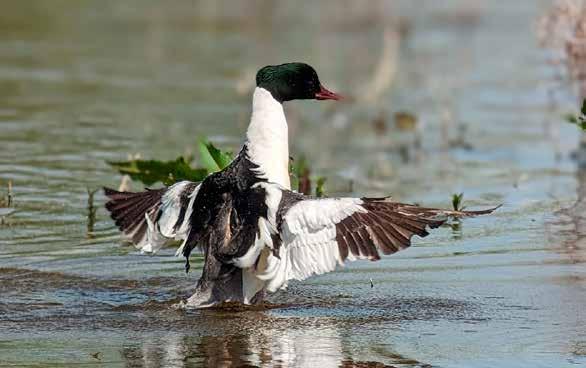
The grassy area to the north of the car park held a small party of Linnet and a few Skylark; I was hoping for a surprise passerine but in fact the unexpected bird was a duck, a redhead Red-breasted Merganser on the first shore pool. We had prolonged views and discussed how to distinguish this species from Goosander.
Walking the shingle was, as usual, something of a slog, but we had a few birds to keep us going, the highlight being a single Whooper Swan heading north along the coast; those who first picked up the bird had fine views. A Grey Seal, rafts of Great Black-backed Gull and a fly-by Spotted Redshank and Rock Pipit were also noted. My plan was to get to Corporation Marshes and take a break there rather than make several short stops en route, and this worked well. We had a full half an hour ‘rest’, which enabled some to seawatch, others to refuel, and, a few headed out a little further north to another shore pool. The latter held at least four Spotted Redshank and a larger number of Dunlin. Out at sea there were Brent Geese, Gannet and
Guillemot, most at a considerable distance. We were all able to enjoy marvellous views of a Red-throated Diver as it drifted south on the water quite close to the shore. At 10.45am we regrouped and headed inland. Little Grebe, Little Egret, a fine male Marsh Harrier and the first of several Stonechat entertained us but, the hoped-for Bearded Tit remained ‘heard-only.’
Those at the front of the group heard a couple of Dartford Warbler as we reached Great Dingle and we talked about the less well known call of a Cetti’s Warbler (as opposed to its explosive song). In the sheltered trees we encountered the first of several Long-tailed Tit flocks and had cracking views of Goldcrest, but were unable to pick out any rarity.
We headed up the hill before pausing at Sandymount pool, admiring a showy Great Egret and enjoying the panoramic views across Westwood Marshes. Three Barn Swallow over the pool were noteworthy. Those of a certain age reminisced about the legendary raptor roosts of the 1970s!
Along the path south through the forest we heard Treecreeper and more ‘crests and titmice but there was little to actually see until we reached the village where we found more Barn Swallow, perhaps as many as six or seven.
We arrived back at the car park around 1pm, as planned, after a productive and enjoyable morning. I had tallied 64 species. This fivemile circuit is one of my favourite Suffolk walks, the habitat is wonderfully varied and the woodland stretch always allows walkers to have a good catch up too!
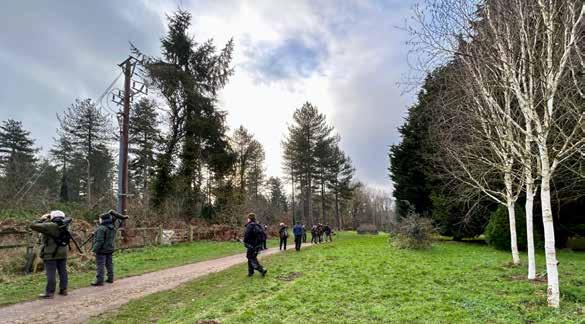
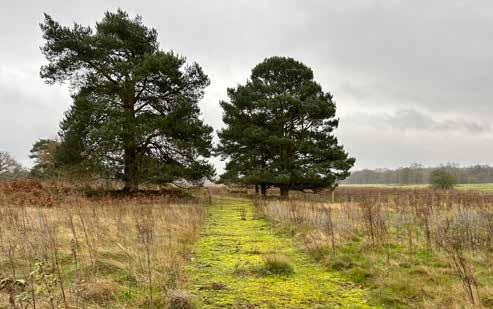
Around 25 people congregated in the Lynford Arboretum car park on another overcast, misty morning. Expectation was high as this was an area well known for finding Hawfinch. Resisting the temptation to stop at the Shepard's Baa’ outdoor cafe, we walked 100 yards on and paused by the infamous wooden gate seeing a mixture of Chiffchaff, Blackbird and Woodpigeon flying between the shrubs and hanging bird feeders. The path gave way to tall pines and an open grassy field with 4-5 Redwing and a small flock of Goldfinch. A Kestrel hovered by the stone bridge with amazing precision and we admired the river and a Heron in the nearby marsh. Walking up to a large field with a row of trees in the middle, our expectations were high for seeing the elusive Hawfinch here,
as seen two years previously when a group of five had been spotted nestling in the tree tops. Today, however, we were unlucky with none found.
In the nearby dense woodland, a Nuthatch perched in a dead tree and a Great-spotted Woodpecker was seen in a tree top. Our attention was drawn to 2 Cormorant flying low overhead as we made our way toward the river path opposite the grand Lynford Hall Manor House. A persistent Robin followed us along the path and the small lake offered a pleasant view of a pair of Mute Swan, 10-15 Mallard and 3 Little Grebe. The circular route brought us back to the stone bridge and it was delightful to see 20 Siskin feeding in the tree.
It was pouring with rain when we arrived at the East Wretham Heath car park around midday and, it seemed an opportune moment to have lunch sheltering from the elements in our cars. After 40 minutes or so, the rain stopped and we started our walk along the open heath path picking out Meadow Pipit and Egyptian Goose that were gathering in the adjacent field. The lake came into full view and the heathland gave way to a path alongside large pine trees that were teaming with Rook. The group managed to squeeze into Langmere Hide and the beautiful view of the mere lay before us. A large mixed flock of Gulls covered the lake interspersed with Coot, Moorhen, Pochard, Gadwall and Tufted Duck. Leaving the hide, we continued the circular walk through the woodland and back through the heathland.
Great Livermere Lake
Our last stop was at Great Livermere Lake and we arrived with great anticipation following a recent report of a Hen Harrier sighting in
the area and, a Red Kite roost thought to number 80 birds. Approaching the crumbled stone bridge, a Kingfisher darted away to the left lake and we were surprised to see just 20 Mallard instead of the usual large numbers. In the distance a partially submerged tree hosted 2 Cormorant. We moved on from the lake, large fields opened up revealing a large flock of 80-100 Greylag Goose with a single white goose among them. Further along the path we stopped to gaze over open fields and small clusters of woodland trees. A Red Kite was circling overhead and 2 Buzzard flew low over farmland. Our eyes remained on the lookout for Hen Harrier but, surprisingly, a Goshawk flew through at great speed, disappearing into nearby trees. Dusk was almost upon us as up to 8 Red Kite were circling over the woods near Ampton Manor. As the light faded the number increased to 11.
As we made our way back to our cars, we agreed that despite the rain it had been an interesting day of sightings at different geographical sites.
Anne Wright
Sunday 15 December 2024
Despite the middle of December being a hectic time of year for most, 22 SBG members met up at 9.00am in front of the Bristol Arms at Shotley Gate. The meeting location was changed as a result of Shotley Marina introducing parking charges – only £3.50 for the whole day but, enough to deter certain members. Sadly, one SBG member got the date wrong and turned up on Saturday and so had something of a lonely walk ..….they shall remain nameless of course.
As we waited for the group to assemble, the rising tide meant we had our first, of many, close views of several Brent Geese plus a couple of Redshank and a Grey Heron. We then set off for a riverside meander up the River Orwell - recent sightings had indicated that this should be more productive than the River Stour.
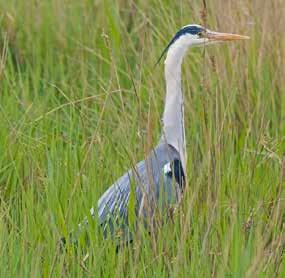
As we headed up the road towards the Marina, a Great Crested Grebe was fishing nearby – and then a Kingfisher gave us an obligingly close fly-by so everyone managed to see it well – a superb start to the walk!
Having traversed the lock gate without hold-up or incident, we had a scan of the rocky area by the beach at the far end of the Marina where we found several Oystercatcher and Turnstone pottering around. As we headed off along the river wall, two Red-breasted Merganser flew down river, while both Greylag and Canada Goose grazed on the landward side pasture. A Skylark flew over and gave us a quick burst of song.
One of the day’s target birds was then spotted, a Red-throated Diver that had been reported on the river in recent days. It was inevitable that with 20+ attendees we had become strung out along the narrow path but, the Diver was extremely obliging and swam downstream at a leisurely pace so all could enjoy really good views.
Next up was a very distant sighting of yet another target bird - Velvet Scoter – spotted by the most eagle-eyed among us. The sighting was closely followed by groans and a few expletives (mostly from me, as usual) as three jet-skis roared along at speed on the Trimley side of the river towards Levington.
As it turned out, they had done us a slight favour, because the Velvet Scoter took to the air and after circling, it landed on the river virtually in front of us, and then drifted down-river passing everyone again – our luck was really in!
As the tide rose a couple of Grey Plover showed well on one of the few remaining areas of muddy marsh, and the occasional Meadow Pipit flew over us as we enjoyed the intermittent glimpses of the sun. A number of Skylark flew up from the saltmarsh - we counted into double-figures.
As we could only see Wigeon and a distant Marsh Harrier up ahead, the warming facilities at the ‘Shipwreck’ were beckoning and so it was decided that we should head back for our festive lunchtime snack.
The fun was not quite over though as a Cattle Egret was spotted distantly, moving between the fields near to the road – a site where they had been seen earlier in the month among the grazing cattle. A half dozen or so of our more energetic members decided to trot up the public footpath that runs from the river wall and over the meadow to the farm track leading to the road, then traversing the field where the bird had been sighted. They found not just one but six flighty Cattle Egret. Those of us who remained on the river wall managed distant tantalising glimpses of the birds as they passed by gaps in the hedgerow of the field. However, from the same vantage point we were treated to excellent views of three Red Kite that were seen soaring over the nearest meadow.
The final stretch of the walk back provided us with a close-up of a hovering Kestrel, two Red-throated Divers that were now close to the shore, plus a Little Grebe in the Marina basin. We were all now ready for our lunch.
The Shipwreck public house had kindly reserved for us a half dozen tables allowing us to sit (more or less) together and it was not long before we had hot food and drinks in front of us. For some, a very welcome mulled wine, for others a pint of their best beer! Janie, the landlady, followed up with some tasty home-made mince pies. So thank you to the landlord Alex, Janie and
team for a lovely end to an unexpectedly productive morning.
At this point, half of the group had decided to call it a day and head home, but the remainder thought of what else there was to be seen while the light lasted. The only new bird to be seen in a quick recce of the River Stour path was a beautiful Curlew. We decided to head to Stutton Church and walk onward down to the river in the hope of finding some different birds further upstream. A few among us spotted a Common Buzzard very close to the roadside in a field – it seemed to be devouring something that looked somewhat larger than an earthworm!
Reconvening outside of the church, we then walked down to the river. A Mistle Thrush was calling, and we later managed good views of the bird as we looked back from the river bank. A small flock of Linnet moved around in the reeds behind the wall and, on the water Northern Pintail and Goldeneye were spotted albeit fairly distant in the gloom. There was a nice selection of waders along the shoreline but apart from more Red-breasted Merganser and Goldeneye we could not find anything else on the river. Two birds that were standing by the muddy outcrops near the water’s edge had everyone puzzled for a few minutes but, when they eventually turned for clearer views, it was concluded that they were Skylark that were behaving somewhat uncharacteristically!
As dusk approached we headed back to our cars to be greeted, as we approached the Church, by a short burst of calls from a Little Owl, followed by a splendid rendition from a couple of Tawny Owl. An unseasonably late Pipistrelle hunted above our heads rounding off the day very nicely indeed.
Thank you to all who attended and made it such a special social occasion – and especially for finding all those great birds for me!
Dave Pearsons
Sunday 5th January 2025
Leader: Dave Pearsons
The first SBG field trip of the year is one that I always look forward to. However, when I looked out of the bedroom window and saw an inch of snow on my lawn my enthusiasm waned. Still it can only get better - surely!
I did not expect a big turn out and so it was most pleasing to see fourteen members assemble next to the Levington Marina entrance.
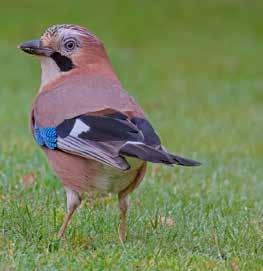
The early snow had turned to rain as we set off through the wooded footpath by the Marina and is usually good for mixed tit flocks in the winter. We found a large flock containing Great Tit, Blue Tit and Longtailed Tits. Try as we did, we could not see any other species in the flock. A Jay and a Song Thrush were later added to the list. Apart from the occasional Blackbird, Robin and Wren nothing else was seen.
Loompit Lake was our next stop where Mute Swan was the most prominent bird along with limited numbers of Pochard, Tufted Duck, Coot, Little Grebe and Shelduck - a very quiet lake compared with previous years. A nearby Rock Pipit gave some pleasing views.
Looking out over the river we saw good numbers of Red-breasted Merganser, Shelduck a single Pintail and a few Brent Geese. Dunlin, Curlew, Grey Plover, Turnstone and Redshank were feeding on the water’s edge - again in lower numbers compared to previous years.
It was then onto Trimley Retreat for the day’s target bird. Several members who were equipped with their thermal imaging equipment went on to the salt marsh
searching for the secretive Jack Snipe. Soon the group were focussed on just one spot and achieved good, close up views of a bird, as did those other members of the group standing on the nearby footpath.
A second Rock Pipit was enjoyed by all as we turned and started back to our cars. At this point, we were all carrying an extra 14lbs of water with our clothing drenched by the incessant rain.
Normally, following this excursion, we would stop for lunch and then head out to the other side of the Marina. Fortunately, with no ‘takers’, it was time for home for the ‘big dry out’!
My thanks to all that stayed to the bitter ( and wet) end, the company was excellent with the usual much-needed good humoured conversation.
David Walsh
Leader: David Walsh
Thirty-one members and friends of the Suffolk Bird Group gathered at Thorpeness Meare at 0900h on Saturday 25 January - more than attended the Dunwich walk in November 2024. Perhaps it should not have been a surprise, given the bright sunshine, the wide range of habitats in this area and the desire among the regulars to catch up with friends. It was great to see several debutants within our party too.
As always I outlined the plan for the walk, an anti-clockwise loop along the edge of the golf course, a stroll down the old railway line with a diversion to see the heathland, across the marsh to sluice cottage and then back up the beach. The aim was to be back at base by 1pm.
Before setting off we scanned the Meare itself. Seven Goosander showed at much closer range than usual, with a number of pristine drakes. A Great White Egret posed high in a tree at the far end. The usual supporting cast including resplendent Shoveler, smart Gadwall, Mallard, Coot, Moorhen and the ever-present pair of Egyptian Geese.
We strolled up the private road, wondering about the value of the properties, before yomping along the footpath which runs parallel to the golf course. It was not too long before we reached the sanctuary of the wet woodland where we found the first of several Siskin, some of which were in song.
We passed the railway cottages then regrouped at the reedbed, where a Marsh
Harrier gave a fly-past. We would have great views of this species during the walk, with a male calling high in the sky above us while performing something of a semi-display. I pointed out to those new to the site that a return visit to this spot in May or June might produce sightings of Hobby.
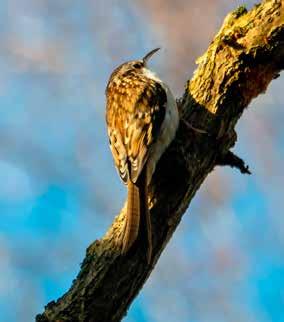
The open deciduous woodland was remarkably birdy, the highlight for many was a confiding Treecreeper. We also enjoyed watching several inquisitive Goldcrest Great-Spotted Woodpecker, a solitary Redwing and a mixed group of Great Tit, Blue Tit, Coal Tit and Long-tailed Tit passed us by as they moved through the wet woodland.
Continuing along the path we soon came to an area of heathland. A Woodlark was glimpsed while those at the rear of the party found Dartford Warbler and, although it took a while, most of the group eventually struck lucky with more than passable views of this iconic heathland species. The group could well have spent much longer here, but time was marching on and so I was relieved when a warden appeared and opened a gate allowing us back onto the main path. We retraced our steps as far as the old railway line before turning south. This section was surprisingly quiet with a few Woodpigeon and a handful of Curlew seen feeding on a hillside field and so we kept going. We arrived at the first viewing platform that allowed us to look into RSPB North Warren from where the advance party were able to scan the north marsh.
Our main quarry on the grassland was ‘Russian’ Greater White-fronted Goose at what is the premier Suffolk site for this species. Earlier reports had been received indicating a large group of 179 birds tallied. We made no attempt to count them but, over the next hour or so, had fabulous views with birds feeding in perfect light, others flying over in formation giving their distinctive call
and, some at rest on one of the pools. Magic!
We split our large group into two, allowing everyone access to the viewing screen which overlooks an area of the south marsh. As always the Northern Pintail were especially photogenic and we had second chances of many other ducks and geese.
Our final plan was to look out to sea with the sun behind us. From the sluice we scrutinised a large raft of Common Scoter, diving regularly ‘as one’. On the sea there were remarkably high numbers of Red-throated Diver, several of which were relatively close in. This species was my personal ‘bird of the day’.
‘Declaring’, we rambled back up the beach, arriving a little later than scheduled but delighted with what had been seen. Some of the group had ticked off over 50 species during our five mile walk. We had been amazingly fortunate with the weather (dry and bright sunshine throughout) and there was much to reflect on as we enjoyed our well-earned lunches prior to dispersal.
John Kornjaca
The quarterly review section gives a snapshot of birds seen within the county during the period, predominantly from data received by Suffolk BINS. All scarce and rare birds are subject to submission and acceptance by either SORC or BBRC. Updated lists of Accepted and Outstanding Records for previous years can be found on the SBG websitehttp://www.suffolkbirdgroup.org/bird-recording
October saw settled conditions due to high-pressure systems as well as wet and windy weather from a succession of lowpressure systems. The month started with wet weather across the Midlands and East Anglia, followed by a brief interlude of settled weather as high-pressure dominated. A major Atlantic low-pressure system arrived on the 6th and brought rain, especially in southern England. A return to clear and settled weather on the 10th and 11th, before slow-moving weather fronts moved in and brought widespread rain to England and Wales. On the 20th, Storm Ashley arrived bringing heavy rain and strong winds to Northern Ireland, Scotland, and northern parts of England and Wales. Further frontal systems brought heavy rain to Scotland and Cumbria on the 27th, before high pressure returned to close out the month.
An average month for October weather although slightly wetter and slightly warmer. Wetter than average at the start of the month and strong winds were a feature toward the end of the month.
Pink-footed Goose – A flock of 250+ flew inland over Orford (22nd) and there were 2 at RSPB Hollesley Marshes (27th).
Whooper Swan – A single bird on Benacre Broad (15th) was joined by a family group of 6 (2 adults and 4 immature birds).
The group of 7 remained on site until the month end (31st). Others were seen at the Aldringham Walks (2 on 4th) and a single bird at East Lane, Bawdsey (13th).
Mandarin Duck – A single bird was seen on the South Scrape, RSPB Minsmere (12th).
Red-crested Pochard – There were four (2m & 2f) on Benacre Broad (20th).
Slavonian Grebe – A bird was seen at SWT Lackford Lakes (13th – 18th).
Little Stint – One was found on the East Scrape at RSPB Minsmere (1st). The bird may have stayed for a couple of weeks having been seen several times. The final recorded sighting was the 12th. A juvenile was recorded on the scrape at RSPB Hollesley Marshes (27th & 28th).
Purple Sandpiper – There were 4 birds near the pier at Southwold (4th). Singles were spotted at RSPB Minsmere (12th) and on the air raid shelter at Benacre beach (25th).
Little Gull – There were 8 at Sizewell (6th) with 3 at the same spot (9th & 13th).
Caspian Gull – A handful of birds recorded in the county with 2 at RSPB Minsmere (29th) the highlight.
Arctic Tern – Seen only at Sizewell in the month, there were 3 (9th) with singles seen (6th & 13th).
Pomarine Skua – Just the one record relating to a single bird seen off RSPB Minsmere (2nd).
Long-tailed Skua – A single bird was seen from RSPB Minsmere (2nd).
Black-throated Diver – One was seen on the sea from Slaughden (1st) and others were seen on the River Alde (11th and again 17th), and one flew over the observatory at Landguard toward the River Stour (22nd).
Great Northern Diver – A single was seen offshore from Lowestoft (1st).
Sooty Shearwater – Several offshore sightings throughout the month. There were approximately twenty on the sea off RSPB Minsmere (2nd).
Manx Shearwater – A single bird seen from Southwold beach (20th).
Glossy Ibis – A single record of a bird at Beach Farm, Benacre seen in flight toward Kessingland (31st).
Eurasian Spoonbill – Two birds were seen on the Suffolk shore of the River Stour (22nd).
Western Cattle Egret – A single bird was found at SWT Trimley Marshes (5th) while there were thirteen in fields near Chillesford Lodge estate (20th). A pair were at Southwold town marshes (27th).
Western Osprey – There were 2 at Thorpeness Meare, seen regularly over the first half of the month – with just one remaining (until 18th). Others were seen at RSPB North Warren (7th) and Benacre Broad (22nd).
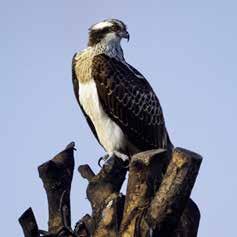
Hen Harrier – A single sighting of a ringtail flying south across the river at Aldeburgh Town Marshes (6th).
Short-eared Owl – Regularly seen along our coastal marshes in the month. The first record for the month was that of a bird seen inland at Great Finborough (6th).
Eurasian Wryneck – A single bird was flushed in the Santon Downham area (6th).
Merlin – Regularly seen through the month along coastal fringes. There were 2 at Landguard (17th).
Northern Raven – A pair were seen at Witnesham (17th) and another pair were found at Chelmondiston (22nd).
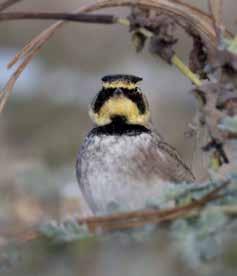
Horned (Shore) Lark – A single bird on Kessingland beach (6th) was joined by 3 others (13th) with as many as 6 reported (16th) although 4 remained (21st). There were 2 at Dunwich (7th) and 2 at Sizewell beach (26th).
Yellow-browed Warbler – Many sightings (52 records) at coastal sites – usually of single birds. There were 3 at Southwold church gardens (4th) with 2 remaining for much of the month. In the west, a bird was found in Hopton (13th) and another
was in bushes by the visitor centre at RSPB Lakenheath Fen (7th to 11th). The final record of the month was a bird caught and ringed at Kessingland (26th).
Eastern Lesser Whitethroat – A sighting of a ‘possible’ specimen, was recorded at Gunton (3rd).
Common Firecrest – A pair of birds at Bawdsey Quay were observed several times (13th – 16th). Others were seen in woods at Pin Mill (8th), Holywells Park, Ipswich (11th), 2 at Thorpeness (16th), Orford (16th), RSPB Minsmere (15th & 16th) with 2 at Shingle Street (16th). The Southwold church gardens site continued to reveal specimens (4th & 15th).
Ring Ouzel – Several birds were seen with 2 at Orford (15th) and 2 at Benacre (17th) the highlights.
Red-breasted Flycatcher – A ‘probable’ seen briefly in the top of a reedbed at RSPB Hollesley Marshes (10th).
European Pied Flycatcher – As passage of this species concluded, there was a single bird seen at Southwold churchyard (3rd & 4th).
Black Redstart – A handful of records in the month with the highlight being 3 birds at Landguard Common (17th). A private garden in Orford held a single bird (17th) but was joined by 2 more (19th).
Whinchat – A few stragglers passed through the county with 5 at Orfordness (6th) the highlight. The final record was of a single bird opposite the café at RSPB Hollesley Marshes (22nd).
Water Pipit – A bird was found at Benacre Broad (23rd). There were 2 on the shore pools at Dunwich beach (29th) and another was on West Scrape, RSPB Minsmere (29th).
Brambling – A single record of a bird on Aldringham Walks (4th).
Hawfinch – Single birds were seen at Corton (27th), Lowestoft (28th) and Needham Market (28th).
Snow Bunting – A single bird was found
on the beach at Thorpeness (3rd). Another on the beach at Southwold (19th) and there were 3 on Kessingland beach (23rd – 26th).
Corn Bunting – A group of four were seen on wires in Chelmondiston (22nd).
Scarce sightings
Black Brant – A single sighting of a bird in flight from Slaughden (25th).
Green-winged Teal – A drake was found on East Scrape, RSPB Minsmere (11th).
Common Quail – A bird was trapped and ringed at Landguard Bird Observatory (31st).
American Golden Plover – A moulting adult was seen at Breydon South Flats (15th & 16th).
Rough-legged Buzzard – A single bird seen at Falkenham Marshes (20th).
Red-rumped Swallow – A possible sighting of a bird at Dingle Marsh (29th).
Blyth’s Reed Warbler – A single record of a bird in a blackthorn bush near the camp site at Southwold (6th).
Pallas’s Warbler – A scarce late-Autumn visitor, a first of the month was found in Southwold church gardens (3rd & 4th) with another at Aldeburgh cemetery (4th). Yet another was discovered in Kessingland (18th).
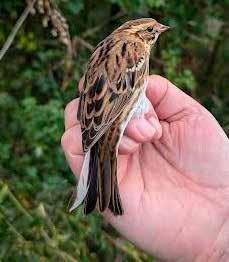
Eastern Yellow Wagtail – A ‘possible’ was found in fields at Walberswick (16th).
Olive-backed Pipit – A single bird was discovered at the old sewage works in Corton (4th) - the only record.
European Serin – A bird was photographed on RSPB Minsmere (8th).
Ortolan Bunting – A single bird flew south along the beach at Dunwich (12th).
Little Bunting – Trapped and ringed on the SWT Trimley Marshes reserve (5th).
Rustic Bunting – Trapped and ringed on the SWT Trimley Marshes reserve (5th).
The first half of the month was mild for all, with the UK recording a provisional average mean temperature of 8.8°C, which is +2.3°C above the long-term meteorological average. None of the countries of the UK experienced more than 10% of their average rainfall in a particularly dry start to the month. Sunshine was also in short supply with much of the first two weeks, grey and gloomy over large parts of the UK. The second half of the month was cooler, wetter and windier as an Arctic air mass moved in and some counties experienced snow. Storm Bert arrived on 22nd and extremely wet and windy conditions prevailed for the next three days with some areas of UK experiencing their wettest daily rainfall totals and localised flooding.
Average temperatures throughout the month and drier in parts of the region with some central and eastern areas experiencing just 50% of monthly rainfall averages. The gloomy, overcast conditions were a feature for the region with some areas getting just 70% of average hours of sunshine.
Notable November sightings:
Pink-footed Goose – A group of 4 flew over SWT Trimley Marshes (8th), possibly
seen at RSPB North Warren the following day (9th). An immature bird (1W) was at RSPB Minsmere (22nd).
Greater White-fronted Goose – A group of fifteen were on the scrape at RSPB Hollesley Marshes (4th) with seventeen birds present (11th). A group of twenty-five were on the Alde Estuary (13th). Other small groups appeared at coastal sites through the month.
Tundra (Bewick’s) Swan – A single bird was found at Holbrook Bay on the River Stour (13th). Three birds flew in from the sea at East Lane, Bawdsey (14th). There were 2 on Island Mere, RSPB Minsmere (20th) and possibly the same 2 birds were in fields near Sizewell village (26th).
Whooper Swan – A group of 7 were on the estuary at Blythburgh (3rd) with others –mainly singles and pairs - found along the coastal marshes throughout the month.
There were 6 on Benacre Broad (29th).
Velvet Scoter – Occasionally found in the month along the coast and estuaries. There were 4 seen offshore at RSPB Minsmere flying south (3rd) and 3 were seen from Thorpeness (30th).
Goosander – A drake was on the scrape at RSPB Minsmere (2nd). A group of 3 flew south observed from Southwold (4th) and there were 6 (3m & 3f) on Thorpeness Meare (25th).
Slavonian Grebe – A bird was found on the River Stour as seen from Shotley (8th). Another was seen on the sea from RSPB Minsmere (9th & 15th).
Black-necked Grebe – There were three sightings with a bird found on the Island Mere, RSPB Minsmere (10th) the first record. A second bird was located at Holbrook Bay on the River Stour (13th). Another was on the sea at RSPB Minsmere (14th).
Curlew Sandpiper – The only record was of a very late passage migrant found on West Scrape, RSPB Minsmere (11th).
Purple Sandpiper – Frequently seen along
the coast. There were groups of 6 recorded at Southwold (14th), north of Ness Point, Lowestoft and at East Lane, Bawdsey (both 26th).
Little Stint – The final bird of the autumn passage was found at SWT Trimley Marshes (5th).
Eurasian Woodcock – One was found at Shingle Street (20th) and a second was at Kessingland (21st).
Jack Snipe – Rarely found, the highlights were of 2 at RSPB Minsmere (4th) and 2 more were seen on a grassy, shingle ridge at SWT Simpson’s Saltings during a particularly high tide (18th).
Grey Phalarope – A single bird was seen on the sea off RSPB Minsmere (8th & 9th).
Little Gull – The only record was that of 7 birds seen heading north from Southwold (12th).
Glaucous Gull – A bird was seen flying south along the coast from Thorpeness and later Sizewell (22nd).
Caspian Gull – There were two reports of birds at RSPB Hollesley Marshes, an immature (1W) bird (3rd) and 2 immature (3W and 1W) birds (30th). Another was on East Scrape, RSPB Minsmere (4th).
Yellow-legged Gull – A single report of a bird found in the gull flock at RSPB Hollesley Marshes (3rd).
Arctic Tern – A single report of a solitary bird found at RSPB Minsmere (3rd).
Pomarine Skua – There were several sightings of birds through the first fortnight of the month along coastal sites. The highlight being 2 birds that were seen from Landguard Point (2nd).
Arctic Skua – There were two records of single birds. The first was off Landguard Point (2nd) and the second – a juvenile –was seen from Ness Point, Lowestoft (4th).
Little Auk – Several birds were observed heading north along the coast in the second half of the month. Additionally, a single bird was seen flying up the River Orwell from
Levington (21st).
Black-throated Diver – A bird tracked along the coast was seen at Orford Ness and again at RSPB Minsmere (2nd). Others were seen from RSPB Minsmere (3rd), Shotley Marina (8th), Gorleston (19th), Landguard Point (24th) and Shotley Marina (28th).
Great Northern Diver – There were just two sightings for the month, both at Thorpeness (15th & 22nd).
Leach’s Petrel – A single sighting from the beach at RSPB Minsmere (2nd).
Sooty Shearwater – Rarely seen from coastal viewpoints, 5 were seen from Southwold (2nd), and these birds may have also been sighted from RSPB Minsmere and Sizewell on the same day. Singles were observed from Southwold (3rd & 12th).
Glossy Ibis – A pair were found at Breydon South Wall (28th).
Eurasian Spoonbill – A handful of sightings through the month, the first was of an immature bird found at Lackford (3rd). Others were seen at RSPB Dingle Marshes (4th), the Alde Estuary had 2 birds (15th), SWT Lackford Lakes (15th) and a single bird was seen flying toward RSPB Havergate Island from RSPB Hollesley Marshes (25th).
Western Cattle Egret – There were 3 seen north of Shotley Marina (4th), thirteen on Gedgrave Marshes (5th) with 8 at SWT Trimley Marshes (6th). There were 3 at SWT Trimley Marshes and 6 at Shotley Marshes (10th).
Western Osprey – A bird was tracked flying south from Kessingland – Benacre - Shingle Street (21st).
Hen Harrier – A ringtail flew south along the River Alde toward Shingle Street (4th).
Two ringtails were seen hunting north of Ampton (17th). Another ringtail was seen hunting between RSPB Dingle Marshes and Walberswick NNR (26th – 30th).
Short-eared Owl – Occasionally seen along our coastal fringes, there were 2 at RSPB Minsmere (2nd) with others seen at Dunwich
(3rd), RSPB Hollesley Marshes (3rd) and Kessingland (17th-21st).
Merlin – There were four sightings in the month with the first at Orford Ness (2nd). Others were seen at RSPB Boyton Marshes (9th), Landguard Common (13th) and Slaughden (28th).
Great Grey Shrike – A single report with a bird viewed on a trail camera at SWT Carlton Marshes (2nd).
Northern Raven – Two were seen in flight in the Stoke Park Drive area of Ipswich (7th). Another pair were seen on the Alde Estuary (15th) and a single bird was at Bawdsey Manor (26th).
Bohemian Waxwing – A party of 7 birds flew over the River Deben at Melton towards Woodbridge (28th) and there were 3 seen flying inland over Orford (30th).
Horned (Shore) Lark - There were 3 seen on the shingle ridge of Orford Ness from RSPB Hollesley Marshes (2nd). A single bird at Kessingland beach (21st-25th) was joined by a second bird (26th).
Yellow-browed Warbler – There were two sightings in the month with single birds found at RSPB Dingle Marshes (6th) and another at Easton Bavents (7th).
Common Firecrest – Rarely seen in the month, there were up to 6 found at sites in the Bawdsey area (26th). Earlier, a pair were at the Bawdsey picnic site (3rd) and 2 more were in the rhododendron tunnel at RSPB Minsmere (4th).
Ring Ouzel – A first winter bird was seen at RSPB Minsmere (1st) with others seen on Westleton Heath (4th) and near Sizewell Hall (17th).
Black Redstart – Frequently seen through the month along the coastal margins, there were 3 at SWT Trimley Marshes (6th) with 2 birds at East Lane, Bawdsey (3rd), Orford (5th) and 2 more at Walberswick (13th).
Water Pipit – Regularly present at RSPB Minsmere through the month, there were at least 5 (10th) and 4 present (14th). Others
were seen at SWT Trimley Marshes (5th), SWT Simpson’s Saltings (18th) and another was seen at Levington Creek (27th).
Brambling – A bird was located at Bawdsey Manor (26th).
Hawfinch – An influx of birds with frequent sightings during the month. There were 2 at SWT Carlton Marshes (2nd), 5 flew over RSPB Boyton (3rd) with another group of 6 over SWT Trimley Marshes (5th) being the highlights. Various sites reported singles and pairs during the month with 2 seen at the Sotterley Church site at the end of the month (21st-30th).
Snow Bunting – Larger groups were formed as more and more birds arrived through the month. There were several flocks of 30+ recorded along coastal sites. Kessingland beach hosted a flock throughout the month peaking at 35+ (18th). There was a large group of 45+ birds seen on the beach at RSPB Minsmere (25th).
Corn Bunting – There were 7 birds at Falkenham (30th).
Green-winged Teal – A drake was seen on East Scrape, RSPB Minsmere (21st).
Surf Scoter – A single sighting recorded with a bird observed flying south from Southwold (2nd).
American Golden Plover – A single bird was seen and heard calling at Breydon South Wall (15th).
Sabine’s Gull – A single bird was seen at sea from Southwold (12th).
Rough-legged Buzzard – A bird flew over SWT Trimley Marshes toward Shotley (10th).
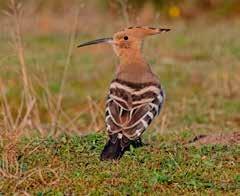
Eurasian Hoopoe – One flew over Bungay (7th). Another mobile bird stayed in the Sizewell, RSPB Minsmere, Thorpeness area for several days (16th – 21st).
Hooded Crow – A bird was found in Botany Marsh near a pig field (19th – 26th).
Red-rumped Swallow – A bird was seen to be hanging around the compound of Landguard Observatory (18th).
Siberian Chiffchaff – There was a sighting of a bird in scrub at RSPB Hollesley Marshes (16th). Another was at SWT Carlton Marshes (28th & 30th).
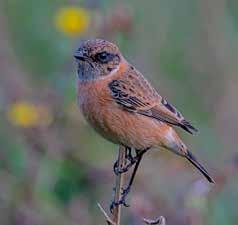
Amur (Stejneger’s) Stonechat – Very rarely seen in the UK a single bird, a male, was found at SWT Trimley Marshes – the second ever record for Suffolk. The bird remained on the site for over a week (3rd11th).
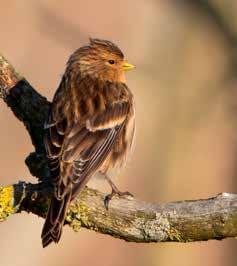
Twite – Just a single bird found near the reserve entrance at SWT Hazlewood Marshes and stayed on site for several days (25th – 30th).
European Serin – A female was found at Corton (5th & 6th), another female was near Beach Farm, Benacre (6th).
December started with a mix of rain and wintry showers, particularly affecting northern and western regions. Storm Darragh brought significant disruption from the 6th to the 8th, with heavy rain and severe gales, especially in coastal areas of Wales and southwest England. Following the storm, high pressure briefly settled over the UK, bringing calmer and colder conditions, particularly in Scotland where frost and freezing fog occurred. Changeable weather returned bringing showers across parts of the UK as well as fog and wind and some wintry showers on high ground in the north, which persisted through to the 22nd. Temperatures turned milder as a tropical maritime airmass from the southwest dominated, with fog and drizzle across the UK and some rain in Scotland. The final few days of December saw wet and unsettled weather set in, with heavy rain in northern England, Wales and Scotland. December was milder than average, with the UK experiencing a provisional mean temperature of 6.2°C, which was +2.0°C above the long-term average.
Rainfall was above average for the UK, provisionally 110% of the long-term average.
As for the UK, the East Anglian region experienced a milder December with average temperatures around +1.5-2.0°C warmer than recorded long term averages. The gloomy conditions experienced in November remained for much of the month with some areas experiencing 60% of the recorded average hours of sunshine. There were several days where localised freezing temperatures were experienced. Rainfall was heavier at the start of the month with conditions improving toward the end of the month.
Pink-footed Goose – A pair were at RSPB Boyton Marshes among a flock of Greater White-fronted Geese (26th).
Greater White-fronted Goose – The small party seen at RSPB Hollesley Marshes and RSPB Boyton Marshes of up to thirty-five birds was again present although mobile. There were forty plus birds at Long Melford and a larger group of up to seventy-five birds seen at Aldeburgh Town Marshes (26th).
Tundra (Bewick’s) Swan – There were 2 at RSPB Minsmere (1st – 9th) and a single bird was found (14th).
Whooper Swan – A group of 7 were at Benacre Broad for much of the month and a pair remained at RSPB Minsmere. A group of 6 were at Covehithe (9th & 10th).
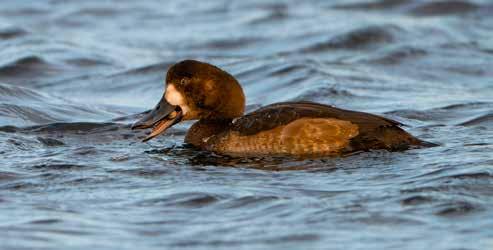
Greater Scaup – A bird (1W female) was found on Covehithe Broad (5th- 16th) which was then joined by a second bird (17th) – the two remained until the year end. Another (1W female) was discovered on a shore pool south of Shingle Street adjacent to Martello Tower ‘Z’ (13th) and was seen repeatedly through the remainder of the month.
Velvet Scoter – A single bird was present on the River Orwell near Shotley for the first week of the month and was seen occasionally thereafter. Others were regularly seen from Thorpeness with 7 birds present in a Scoter flock (20th). There were occasional sightings at Gorleston.
Long-tailed Duck – A single report of a bird on the sea off Aldeburgh (26th).
Goosander – There were several reports of birds on Thorpeness Meare with a maximum of 12 (16th). There were 10 on the scrape at RSPB Minsmere (22nd).
Common Crane – There were 5 at RSPB Minsmere for much of the month. A mobile group of 3 birds were seen at SWT Hazlewood Marshes (21st), RSPB North Warren (24th), Thorpeness Meare (24th).
Slavonian Grebe – A single bird was found on the Blyth Estuary (4th) and there were 5 in Holbrook Bay on the River Stour seen from Lower Holbrook (9th).
Black-necked Grebe – A pair were seen on the River Orwell from SWT Trimley Marshes (20th) with a single bird reported in the same area from Chelmondiston (25th).
Curlew Sandpiper – A solitary bird was found on the River Deben at Melton (27th –29th).
Purple Sandpiper – There were several reports of birds seen along the coast. There were 7 at East Lane, Bawdsey (12th, 20th & 26th), 7 on North Beach, Lowestoft (30th). One was frequently seen at RSPB Minsmere and another was found in Holbrook Creek (20th).
Jack Snipe – There were three submitted records. The first was of 3 birds on SWT Trimley Marshes (5th). Another was at Shingle Street (12th) and yet another was on the Butley River (15th).
Glaucous Gull – A single bird was sighted flying south along the coast (9th).
Caspian Gull – There were several reports of birds found at coastal sites. There
were 8 at RSPB Minsmere (14th) and 5 at RSPB North Warren (15th). Others were occasionally seen at RSPB Hollesley Marshes.
Yellow-legged Gull – There were 2 at RSPB Minsmere in the gull flock on East Scrape (15th).
Little Auk – Seen occasionally moving along the coast during the first half of the month, there were 6 seen from Thorpeness (13th).
Black-throated Diver – A bird was spotted on the River Orwell from Shotley Gate (13th) and subsequently found up-river between the Orwell Bridge and Freston where it remained until the end of the month.
Great Northern Diver – One was seen on the sea from Kessingland Beach (14th). Another was seen flying north from RSPB Minsmere (17th). A bird was seen on the River Orwell at Levington Creek (17th) and further east on the river (20th).
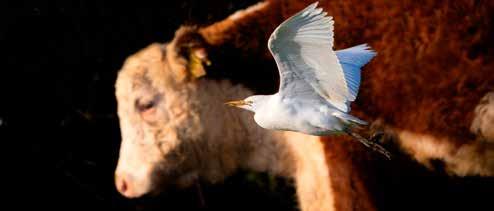
Western Cattle Egret – A pair were found in a field containing a Hereford bull, adjacent to Banters Barn, Boyton (2nd) with as many as 5 seen in the adjacent RSPB Boyton Marshes. There were up to 8 in fields on Shotley Marshes for much of the month and as many as 9 in fields near Brockdish (15th). A group of 5 arrived at the entrance to the Henham Quarry, Wangford (31st).
Hen Harrier – There were two ringtails reported in the county. One at Shotley (3rd) and another hunting near beach huts in Walberswick (13th).
Short-eared Owl – A quiet month with just a handful of sightings between Kingsfleet, Shingle Street and RSPB Hollesley Marsh.
Merlin – There were two reports for the month with a single at Shingle Street (23rd) and another in fields near Hinton Crossroads (24th).
Northern Raven – A pair were at Shotley (3rd). A pair in Waveney Forest and another pair over Playford Road, Rushmere St Andrew (14th). Singles were also seen around Shottisham, Witnesham and Aldeburgh Town Marshes.
Horned (Shore) Lark – A single bird remained on the beach at Kessingland for the whole month.
Water Pipit – There was a single at RSPB Minsmere (4th) and one on the saltings at Holbrook Bay (9th). There were 5 on North Marsh, RSPB North Warren (15th).
Common Firecrest – There were two recorded sightings with a single bird found at Walberswick along the track to Dunwich
(3rd), and another single was found in the grounds of Seckford Hall (23rd).
Hawfinch – There were 2 in trees at Alton Water (3rd). A group of 8 were in Sotterley (17th) and singles were reported at Giffords Hall, Shelley (14th) and Westleton (17th).
Snow Bunting – Flocks of up to forty-five birds were occasionally seen along the coast at Walberswick (2nd), and Orford Ness - viewed from RSPB Hollesley Marshes (15th) – both flocks (varying numbers) remained until the month end. Other smaller parties were seen at Kessingland and Benacre.
Corn Bunting – There were 2 birds on Lings Lane, Chelmondiston (24th).
Scarce sightings:
Ring-necked Duck – A drake was found on Thorpeness Meare (15th) and remained on the site until the month end.
White-rumped Sandpiper – A long-staying bird was found on the scrape at RSPB Minsmere (6th – 29th).
Hooded Crow – The single bird found in November remained at Botany Marsh and was seen infrequently throughout the month.
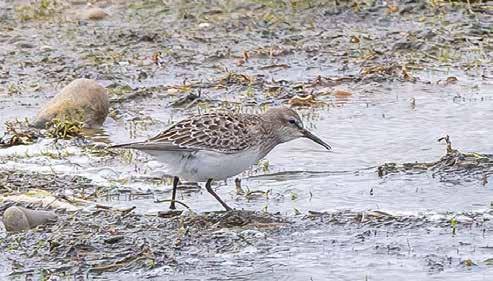
Council for 2025
Officers
Chair: Eddie Bathgate
Vice-chair: Chris Keeling
President: Ed Keeble
Secretary: Katya Bathgate
Treasurer: Alex Rafinski
Communications Officer: Adam Faiers
Projects Officer: Chris Keeling
Editor of Suffolk Bird Report: Nick Mason
Editor of The Harrier: John Kornjaca
Outdoor Events Coordinator: Anne Wright
Indoor Events Coordinator: Adam Gretton
Link to Suffolk Wildlife Trust: Jenny Rawson
Link to Suffolk Naturalists Society: Anne Wright
Link to Suffolk Ornithological Records Committee: Gi Grieco
House Martin Support Suffolk (Lead) - Jenny Rawson
Barn Owl Support Suffolk (Lead): Sally Nelson
Save Our Suffolk Swifts (Lead): Eddie Bathgate
Nest Box Support Suffolk (Lead): Eddie Bathgate
Members
Sarah Glyde
John Kornjaca
Peter Merchant
Sally Nelson
Jenny Rawson
Alex Rafinski
Honorary Vice-Presidents
Andrew Green
Adam Gretton
Robin Hopper
Colin Jakes
Mike Jeanes
Mike Marsh
Roy Marsh
Philip Murphy
Reg Snook
Bird Recorders
North-east Area Recorder: Richard Walden Email: bird-ne@sns.org.uk
South-east Area Recorders: Gi Grieco Tel: 07951 482547 and Steve Fryett Tel: 07593 382082
4, The Street, Melton, Woodbridge, IP12 1PW. Email: bird-se@sns.org.uk
West Area Recorder: Chris Gregory Email: bird-w@sns.org.uk Memberships
c/o SNS, The Hold, 131 Fore Street, Ipswich, Suffolk, IP4 1LR
Founded in 1973 by a group of Suffolk birdwatchers
Associated with the Suffolk Naturalists’ Society
SBG remains an independent birding group and is a registered charity
A voice for Suffolk birdwatchers
With established links to many naturalist and conservation organisations
Media
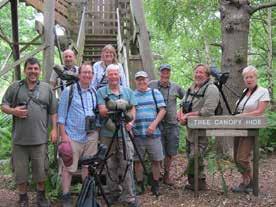
Actively lobbies to protect key Suffolk habitats
Provides a county-wide field force of bird surveyors
Promotes BTO bird surveys and organises special SBG surveys

Strong web presence - www.suffolkbirdgroup.org
Active Twitter feed - @SuffolkBirdGrp
Quarterly magazine - The Harrier
Annual review - Suffolk Birds report
Annually (20+) field trips - ideal for novices or experts and young or old alike
Opportunities to visit hot spots and receive practical ID tips in the field
Programme of talks and presentations - variety of topics (county, national, or international) with quality speakers
Assists with conservation projects to improve breeding success
- Swifts
- Barn Owls
- House Martins
- Peregrines
- Waders
Partners with Suffolk Wildlife Trust and other bird groups
Assists with funding for bird hides and other birding amenities
Contributes to community events, including dawn chorus walks
Provides bursaries for special projects