CHILLESFORD
CLAY – MUDDYING AND UNMUDDYING THE WATERS HOWARD B MOTTRAM
Introduction
The Chillesford Clay, which is about two million years old, is a well known Member of the Norwich Crag Formation in Suffolk. The Chillesford Clay is usually a silty clay of dark grey colouration, but it can be light grey or brown. It is only up to about 5m thick and was not always deposited and, even when it was deposited, it didn’t always survive. Where it survived in eastern and southern Suffolk, it marks the top of the preserved Norwich Crag Formation. In north-eastern Suffolk the Chillesford Clay is overlain by the Westleton Beds Member of the Norwich Crag Formation and in this area of Suffolk the Chillesford Clay can be a useful marker horizon for separating the underlying Chillesford Sands from the overlying sands of the Westleton Beds.
There have been several interpretations and reinterpretations on the recognition and mode of occurrence of the Chillesford Clay. In this article these are discussed with a view to clarifying the situation.
The areal extent of the Chillesford Clay
Eastern Suffolk (the area around Sudbourne)
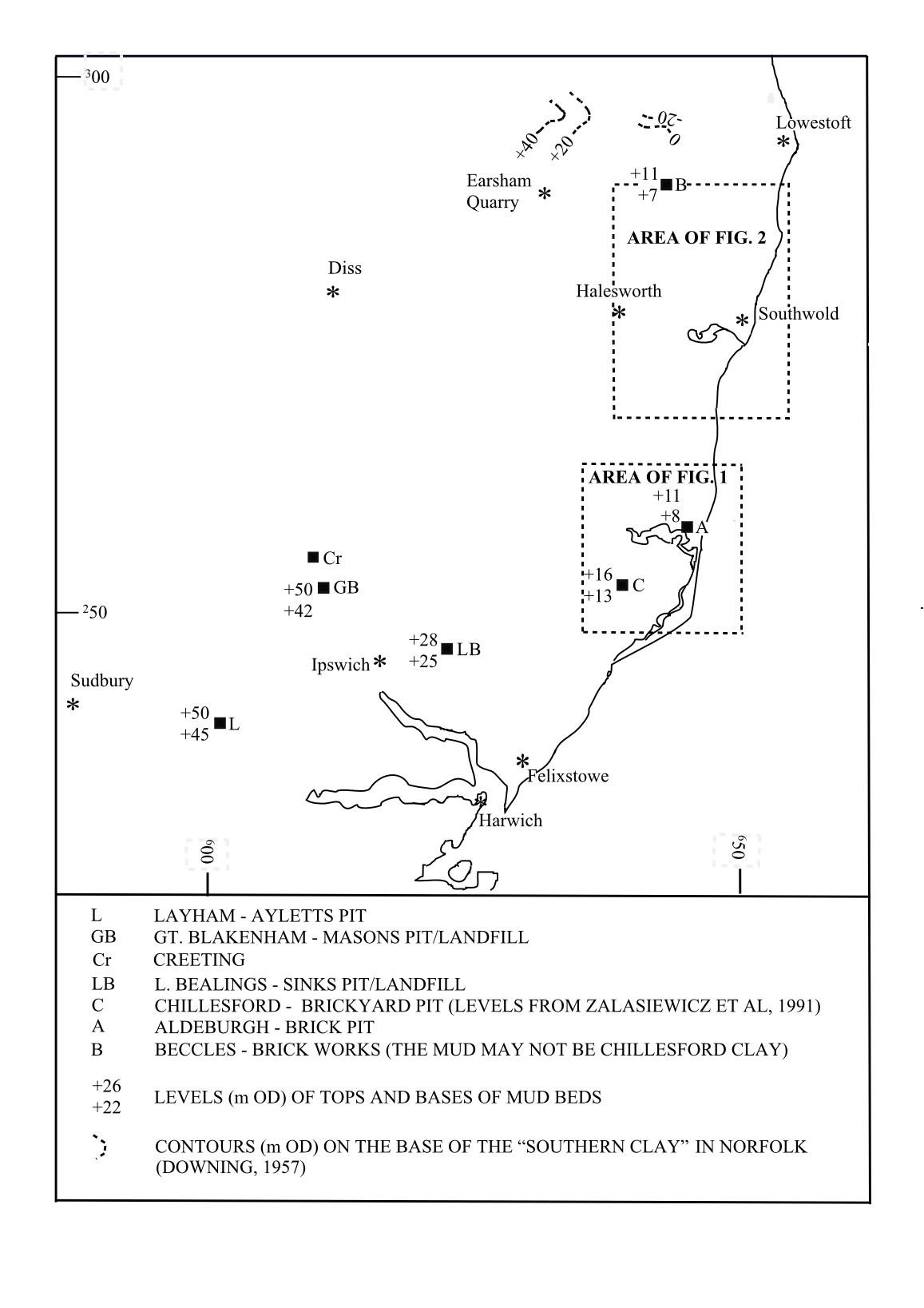
In 1849, Joseph Prestwich described sand overlain by mud that persisted in eastern Suffolk in the vicinity of Chillesford. He subsequently named the sand as the Chillesford Sand and the overlying mud as the Chillesford Clay (Prestwich, 1871). The Geological Survey of Great Britain identified the Chillesford Clay more widely in eastern Suffolk and showed this on geological maps of the area that it published between 1882 and 1884. Re-surveying carried out by the BGS (British Geological Survey) between 1982 and 1999 interpreted the outcrop slightly differently. This revised interpretation of the outcrop is used in Fig. 1.
North-eastern Suffolk
The original mapping by the Geological Survey identified Chillesford Clay between Westleton and Kessingland, see Fig. 2. Almost a century later, analyses of the mud in the cliffs of Easton Bavents and Covehithe revealed that the mud there had a heavy mineral content with a high proportion attributable to Scandinavia. This suggested a glacial supply (Funnell & West, 1962) and in the follow-up research, it was concluded that the pollen, molluscs and foraminifera reflected a cold environment (West et al., 1980). It was submitted that this mud was therefore of a different provenance and possibly of a different age to the mud around Chillesford. In consequence, the mud at Easton Bavents and Covehithe became referred to as the Baventian Clay (West et al., 1980) and then as the Easton Bavents Clay (Gibbard & Zalasiewicz, 1988). However, it was subsequently demonstrated that the flora and fauna of the Chillesford Clay in the Chillesford area also reflected a cold climate and that the heavy mineral contents of the Chillesford Clay and the Easton Bavents Clay were not dissimilar (Zalasiewicz et al., 1991). On the basis of these findings, it was proposed that the two muds were not totally different strata but fully or partly lateral equivalents of each other.
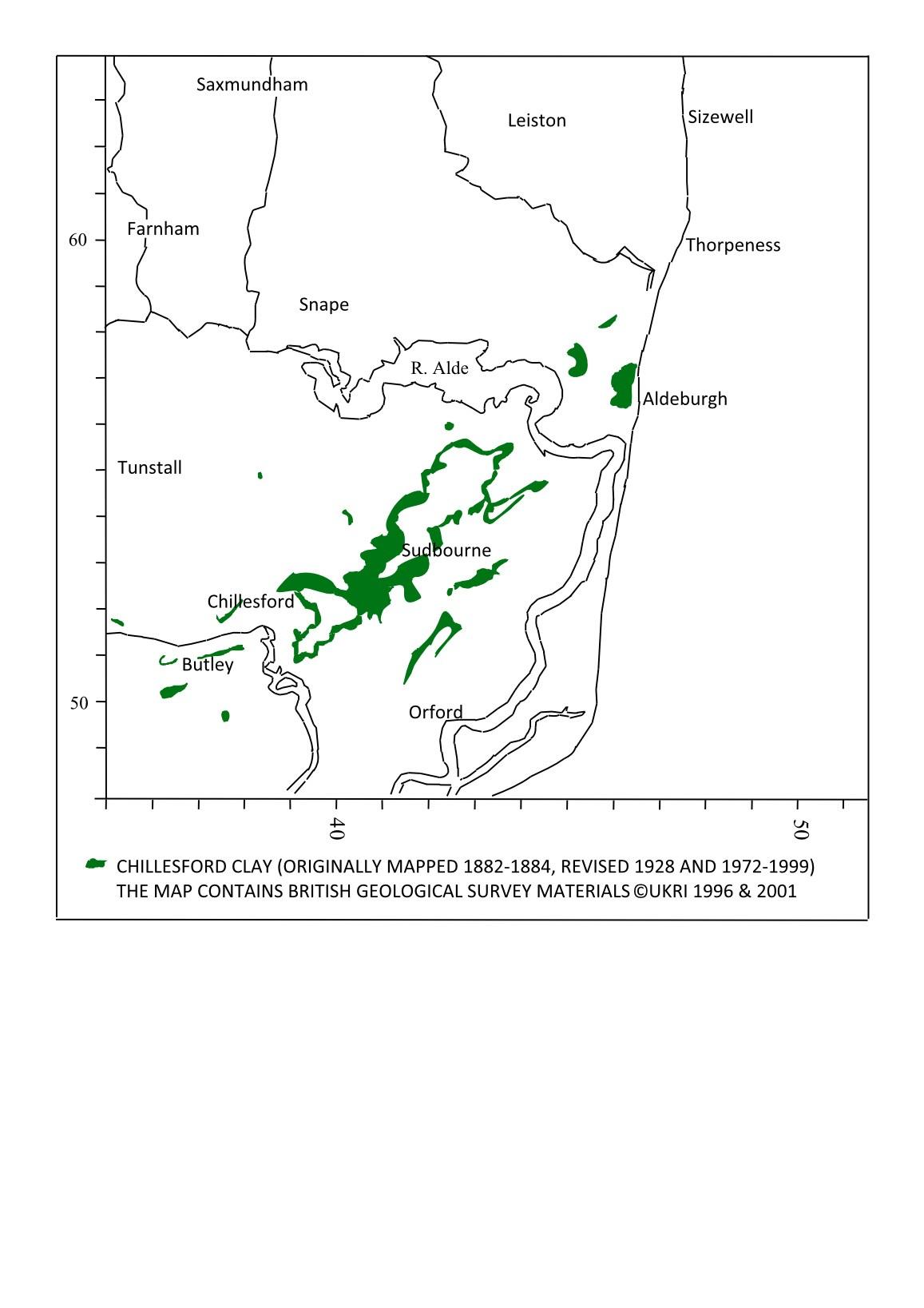
Figure 1 The Chillesford Clay in eastern Suffolk (around Sudbourne)
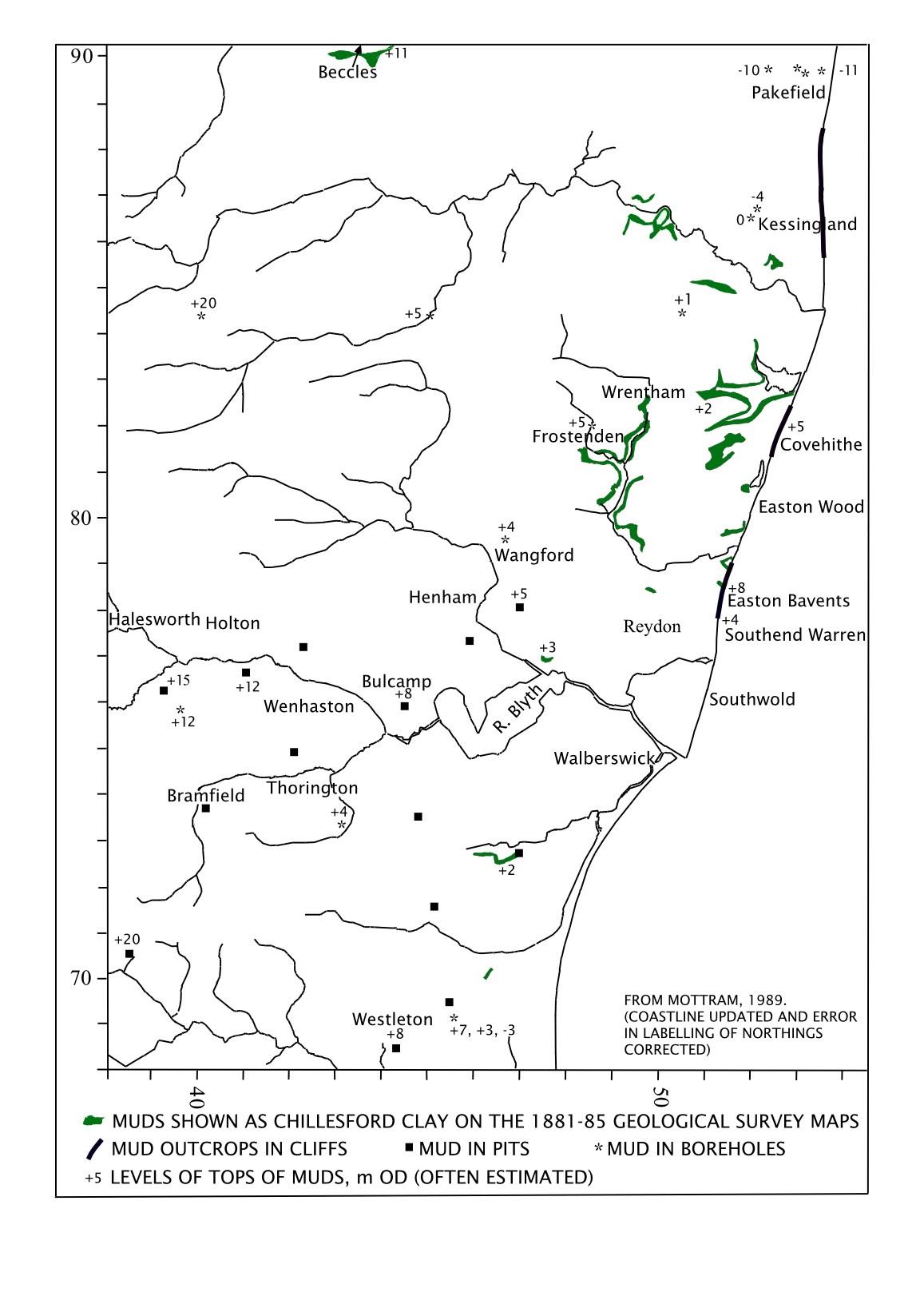
proposed that this mud correlated with that at Easton Bavents (Spencer (1967, p292; 1972, p.341). At Great Blakenham, in Masons Pit (around NGR TM 1080 5023), the mud was given the local name of College Farm Silty Clay (Allen, 1984), but soon afterwards the mud hereabouts was correlated with the Chillesford Clay on the grounds of the resemblance of its basic lithological characteristics to those of the muds at Chillesford (Mathers & Zalasiewicz, 1988). This lithostratigraphic correlation was reinforced by (a) what was stated to be the reasonable geographical closeness (27km) of the outcrops at Great Blakenham and Chillesford and (b) that they contained similar Palaeozoic and Mesozoic palynomorphs which suggested that they had a common provenance (Moorlock et al., 2002). Some researchers disputed the foregoing and continued to maintain that the mud in the Creeting area was not equivalent to the Chillesford Clay, reiterating that the College Farm Silty Clay (aka College Farm Member) must have been a temperate freshwater deposit due to the types of plant remains and pollen that it contained (Catt et al., 2006). These latter researchers also proposed that the mud in Masons Pit was possibly of a slightly older age to the mud of the Chillesford pits. However, as the deposition of the Chillesford Clay progressively followed the eastward shrinking away of the North Sea, the Chillesford Clay was diachronous and so it is possible that the earliest/oldest (western) outcrops coincided with a time when the climate was deteriorating but had not yet become cold (Moorlock et al., 2002).
The Waveney valley and into Norfolk
In Figs. 2 and 3 it can be seen that the level at which the Chillesford Clay occurs dips down approximately eastwards, towards the axis of the North Sea basin, but that any mud recorded north of Kessingland and into Norfolk also demonstrates a northward and more variable component to its dip. It should also be noted that since the original geological maps were published in the 1880s, remapping by the BGS in the 1990s reinterpreted the stratigraphy in the northern-most parts of Suffolk. As a consequence of this remapping, the mud on the southern side of Beccles, which was originally attributed to the Chillesford Clay, became assigned to the Anglian glacial deposits. Subsequent to this, a new addition to the stratigraphic column, the Wroxham Crag Formation, was inserted immediately above the Norwich Crag on the basis of lithological content. There are currently no details of how this may apply directly to the stratigraphy at Beccles, but the results of investigations at Earsham Quarry (Holmes et al., 2018), which is only 11km further west (around NGR TM 3155 8902), raise the question as to whether what had been identified to be within the upper beds of the Norwich Crag at Beccles could be reassigned to the Wroxham Crag. There are therefore uncertainties regarding the identification of the Chillesford Clay in northern-most Suffolk and into Norfolk but, nonetheless, there is still much merit in continuing to use the admirable 1880s geological mapping as a guide to the distribution of the Chillesford Clay.
The palaeogeography
The depositional environment of the Chillesford Clay
Frequently, the Chillesford Clay abruptly succeeded the Chillesford Sands but at some
3
Trans. Suffolk Nat. Soc. 60 (2024)
Figure
The Chillesford Clay and possible correlatives
locations the junction was “blurred” where the two lithologies alternated for up to 1.5m. The Chillesford Clay often expressed itself simply as horizontally laminated muds but, significantly, at a few sites the features clearly demonstrated an inter to high tidal origin;-
• Sinks Pit, Little Bealings, around NGR TM 2230 4653: mud was poorly represented in most of the site, occurring as laminations within the sands, but mud had accumulated as the horizontal infill of a channel that was symmetrical in the exposure and approximately 3m deep x 30m wide.
• Hill Farm Pits, Wangford, at NGR TM 4685 7805: mud lined a creek approximately 3m deep x 3m wide that had meandered over 130m: meander lag and root traces (cordgrass?) were observed (Mottram, 1988).
• The Covehithe-Benacre cliffs, between NGR TM 5250 8131 and 5323 8320: hightidal mud was seen exhibiting drainage rills that were spaced 2 to 3m apart and which contained collapse features: desiccation cracks also occurred (Mottram, 1989; 2006).
Earlier, it was mentioned that during the deposition of the Chillesford Clay, the climate in the region was generally cold but not glacial. Glacial conditions would have existed further north, perhaps in Scotland but certainly in Scandinavia. As the ice-caps expanded, the North Sea would have shrunk away (regressed) so that the East Anglian coastline moved eastwards. We know that the underlying Chillesford Sands were the product of a shallow marine environment. From the descriptions of the sedimentary structures in the sands, e.g. Allen, 1984; Mathers & Zalasiewicz, 1988, it is likely that tidal processes were dominant over wave processes and that tidal processes continued to dominate when the Chillesford Clay was deposited. In other words, if fine sediment was available when the water became even shallower and quieter, the Chillesford Clay accumulated in tidal mud flats. The BGS Regional Guide (see Mathers & Hamblin, 2015) suggests that the muds may have accumulated within estuaries. Strictly speaking, this could not have been so as estuaries occur when a sea is drowning the river mouths and the land (i.e. a marine transgression) rather than when the sea is shrinking away (a marine regression).
The source of the muddy sediment
It is understood that the muds in southern and eastern Suffolk were supplied with fine sediment by a major river, an early proto-Thames, and it has been argued that the equivalent muds in north-eastern Suffolk were fed by a separate major river, an early Ingham/Bytham river (e.g., Rose et al., 2001). As these two major rivers would have drained catchments with different upland geologies, it might be expected that their muds would have slightly different compositions. However, when Zalasiewicz et al., 1991, compared samples from eastern Suffolk with samples from north-eastern Suffolk, they found that the overall heavy mineral contents of the samples were not only similar to each other but also to Red Crag sands and they concluded that all three deposits had a common provenance. Even if the heavy mineral data is grouped into the initial source regions, for example as per Holmes et al., 2018, the data still does
not show clear differences between the purported river supplies. Additional analytical work, which largely focused on stable varieties of the heavy minerals, was carried out on various strata in north-eastern Suffolk and it was concluded that the Norwich Crag was either (a) derived from the same source that had supplied the Paleogene sediments or (b) that Paleogene sediments had been reworked into the Norwich Crag (Hallsworth, 1994).1
When Riding et al., 1997, studied the derived palynomorphs in the Chillesford Clay between Chillesford in eastern Suffolk and Covehithe in north-eastern Suffolk, they only found a small proportion of Silurian palynomorphs in 1 borehole near Chillesford. It was thought that these palynomorphs were obtained from Silurian rocks in the Welsh Borderlands and that they were delivered to eastern Suffolk by the protoThames. Now, as mentioned above, the Chillesford Clay at Great Blakenham in southern Suffolk is also believed to have been supplied via the proto-Thames. However, when Moorlock et al., 2002, studied the Chillesford Clay from Great Blakenham, they didn’t find any Silurian palynomorphs among the derived palynomorphs. This indicated that investigation based on Silurian palynomorphs is not a reliable method of distinguishing sediment delivered by the proto-Thames from sediment delivered by other rivers.
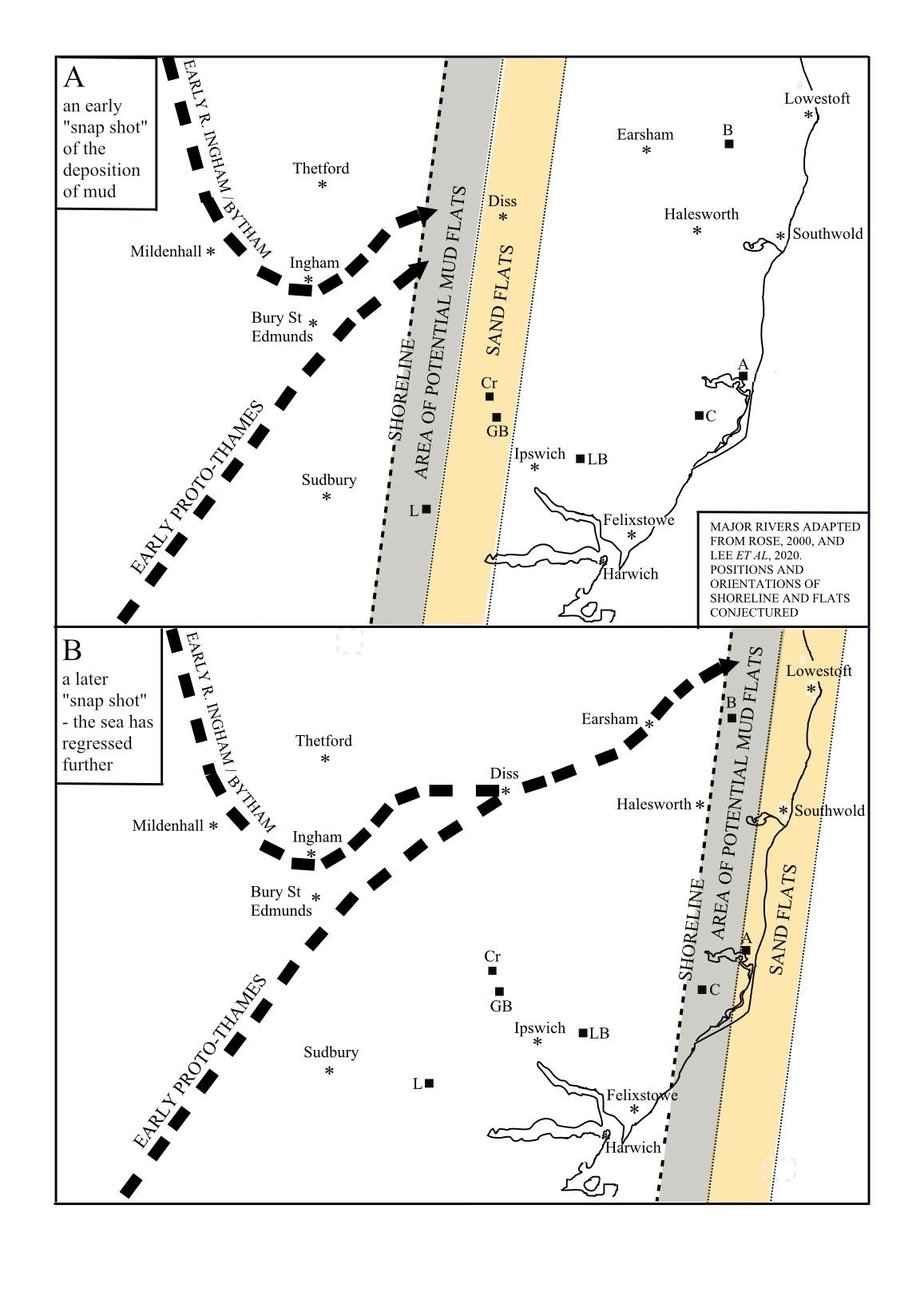
In the last 40 years, there has been a lot of work to trace the two major Pleistocene river systems in Suffolk. From this work it seems that the proto-Thames and the early Ingham/Bytham rivers came close to one another near Bury St Edmunds. When the shoreline was between Bury St Edmunds and Diss, and the two major rivers were feeding separately into the North Sea, their discharges would have been so close to each other that their sediment loads would have soon mixed in the sea, see Fig. 4A.
More recently, Lee et al., 2020, have proposed that when the shoreline was east of Diss, the two major rivers converged. Therefore, their sediment loads would undoubtedly have mixed before being discharged into the North Sea, see Fig. 4 B. On this basis, it is unlikely that the muds of north-eastern Suffolk would have had a significantly different composition to those of eastern Suffolk.
Discussion
The Chillesford Clay was deposited in the intertidal to high tidal zone of the North Sea as the sea regressed. It is possible that the shallow marine environment of southern Suffolk may have been influenced by only a single major river, the proto-Thames. Nonetheless, the mud here was a forerunner of the mud of eastern and north-eastern Suffolk and without a reasonable method of differentiating it in the field or laboratory, it is pragmatic to avoid resurrecting the use of the term College Farm Silty Clay, but to continue to refer to the mud of southern Suffolk as Chillesford Clay.
1 Sample T5 was the only Norwich Crag mud that was analysed, and it was probably from the Westleton Beds rather than the Chillesford Clay.
In the eastern and north-eastern areas of Suffolk, the shallow marine environment was probably influenced by the combined proto-Thames river with the Ingham/ Bytham river. Therefore, under modern stratigraphical procedures, it is correct to discard the use of the name Easton Bavents Clay in favour of Chillesford Clay.2
Conclusions
It is humbling to note that, in many ways, the pioneering work of Prestwich and of the Geological Survey of Britain stands up well some 150 years later. Their Chillesford Clay still reigns. Long live Chillesford Clay !!
References
Allen, P. (1984). 4. Creeting Formation. In Allen, P. (ed) Field guide to the Gipping and Waveney valleys, Suffolk, May, 1982. 10-13. Quaternary Research Association. Catt, J. A., Gibbard, P. L., Lowe. J. J., McCarroll, D., Scourse, J. D., Walker, M. J. C. & Wymer, J. J. (2006). Quaternary: ice sheets and their legacy. in Brenchley, P. J. & Rawson, P. F. (eds), The geology of England and Wales. 429-467. The Geological Society of London. Downing, R. A. (1959). A note on the Crag in Norfolk. Geology Magazine, 96: 81-86. Funnell, B. M. & West, R. G. (1962). The early Pleistocene of Easton Bavents, Suffolk. Quarterly Journal of the Geological Society, 118: 125-141. Gibbard, P. L. & Zalasiewicz, J. A. (eds) (1988). The Pliocene to early Middle Pleistocene of East Anglia: an overview. in Gibbard, P. L. & Zalasiewicz, J. A. (eds) Pliocene-Middle Pleistocene of East Anglia. Field guide. 1-17. Quaternary Research Association.
Hallsworth, C. R. (1994). Variations in the heavy minerals of Plio-Pleistocene sediments in East Anglia: the implications for provenance. British Geological Survey Technical Report WH/94/6/2. British Geological Survey, Keyworth.
Hamblin, R. J. O., Moorlock, B. S. P., Booth, S. J., Jeffrey, D. H. & Morigi, A. N. (1997). The Red and Norwich Crags of eastern Suffolk. Proceedings of the Geologists’ Association, 108: 11-23.
Holmes, P., Rose, J., Lee, J., Barendgret, R., Candy, I. Riding, J. B. & Lewis, M. (2018). The Middle Pleistocene terraces of the central Waveney valley, Earsham, south Norfolk, UK.
Proceedings of the Geologists’ Association, 129: 70-88.
Lee, J. R., Haslam, R., Woods, M. A., Rose, J., Ford, J., Schofield, D., Kearsey, T. & Williams, C. (2020). Plio‐Pleistocene fault reactivation within the Crag Basin, eastern UK: implications for structural controls of landscape development within an intraplate setting. Boreas, 49: 685- 708.
Mathers S. J. & Hamblin, R. J. O. (2015). Late Pliocene and Pleistocene marine deposits. In Lee, J. R., Woods, M. A. & Moorlock, B. S. P. (eds) British Regional Geology: East Anglia (5th edition). 110-129. British Geological Survey, Nottingham.
2 The BGS Lexicon of Named Rock Units is confusing. The entry for the Easton Bavents Clay Member indicates that the BGS no longer recognises the Easton Bavents Clay as a separate Member of the Norwich Crag Formation yet the entry for the Norwich Crag Formation still lists the Easton Bavents Clay and the Chillesford Clay as separate Members.
Mathers S. J. & Zalasiewcz, J. A. (1988). The Red Crag and Norwich Crag Formation of southern East Anglia. Proceedings of the Geologists’ Association, 99: 261-278.
Moorlock, B. S. P., Hamblin, R. J. O., Booth, S. J. & Morigi, A. N. (2000). Geology of the country around Lowestoft and Saxmundham. Memoir of the British Geological Survey, Sheets 176 and 191 (England and Wales). British Geological survey, Keyworth. Moorlock, B. S. P., Riding, J. B., Hamblin, R. J. O., Allen, P. & Rose, J. (2002). The Pleistocene College Farm Silty Clay at Great Blakenham, Suffolk, Englandadditional information on the course of the early River Thames. Netherlands Journal of Geosciences, 81: 9-17.
Mottram, H. B. (1988). Norwich Crag at Hill farm Pits, Wangford. Trans. Suffolk Nat. Soc. 24: 88-94.
Mottram, H. B. (1989). The Upper Caenozoic sequence around The Long Row, Covehithe. Trans. Suffolk Nat. Soc. 25: 86.
Mottram, H. B. (2006). Mud, mud, glorious mud - in the Norwich Crag of Suffolk and in Somerset today. Magazine of the Geologists’ Association, 5 part 1: 17.
Prestwich, J. (1849). On some fossiliferous beds overlying the Red Crag at Chillesford, near Orford, Suffolk. Quarterly Journal of the Geological Society, 5: 345-353.
Prestwich, J. (1871). On the structure of the Crag beds of Suffolk and Norfolk, with some observations on their organic remains. Part III, The Norwich Crag and Westleton Beds. Quarterly Journal of the Geological Society, 27: 452- 496.
Riding, J., Moorlock, B. S. P., Jeffery, D. H. & Hamblin, R. J. O. (1997). Reworked and indigenous palynomorphs from the Norwich Crag (Pleistocene) of eastern Suffolk: implications for provenance, palaeogeography and climate. Proceedings of the Geologists’ Association, 108: 25-38.
Rose, J. (2000). Pre-glacial quaternary processes and events in Norfolk: a review sketch. In Dixon, R. (ed.) 50th Anniversary Jubilee Volume, 66-75. The Geological Society of Norfolk.
Rose, J., Moorlock, B. S. P. & Hamblin, R. J. O. (2001). Pre-Anglian fluvial and coastal deposits in eastern England: lithostratigraphy and palaeoenvironments. Quaternary International, 79: 5-22.
Spencer, H. E. P. (1967). A contribution to the geology of Suffolk – Part 2. Trans. Suffolk Nat. Soc. 13: 290-313.
Spencer, H. E. P. (1972). A contribution to the geology of Suffolk – Part 5. Trans. Suffolk Nat. Soc. 15: 279-356.
West, R. G., Funnell, B. M. & Norton, P. E. P. (1980). An early Pleistocene cold marine episode in the North Sea: pollen and faunal assemblages at Covehithe, Suffolk, England. Boreas. 9: 1-10.
Zalasiewicz, J. A., Mathers, S. J., Gibbard, P. L., Peglar, S. M., Funnell, B. M., Catt, J. A., Harland, R., Long, P. E. & Austin, T. J. F. (1991). Age and relationships of the Chillesford Clay (early Pleistocene: Suffolk, England). Philosophical Transactions of the Royal Society, Series B, 333: 81-100.
Howard Mottram
The Warren, Duckamere, Bramford, Ipswich, IP8 4AH. e-mail: salhow@talktalk.net
GALL RECORDER’S REPORT FOR 2024 INCLUDING A FIRST SUFFOLK RECORD OF CONTARINIA ANTHOBIA (LÖW) (DIPTERA: CECIDOMYIIDAE)
JERRY BOWDREY
The consensus amongst various invertebrate specialists seems to be that 2024 has been a poor year for many species. In Suffolk, this is definitely the case for those that induce galls. As a consequence, one of the wettest winters on record has meant that only one new species was added to the Suffolk list of gall inducers.
Diptera: Cecidomyiidae (gall midges)
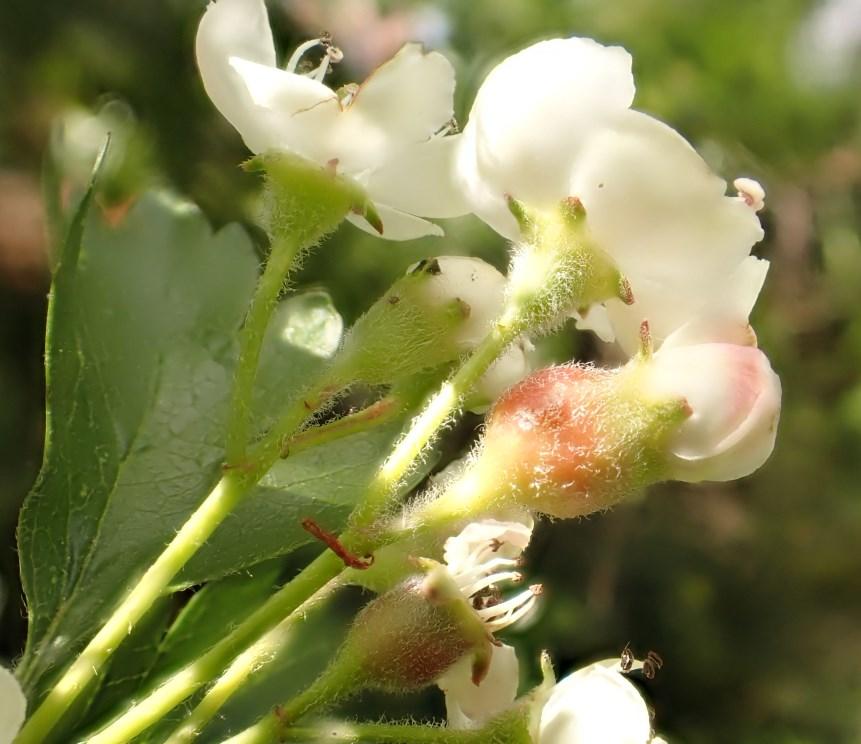
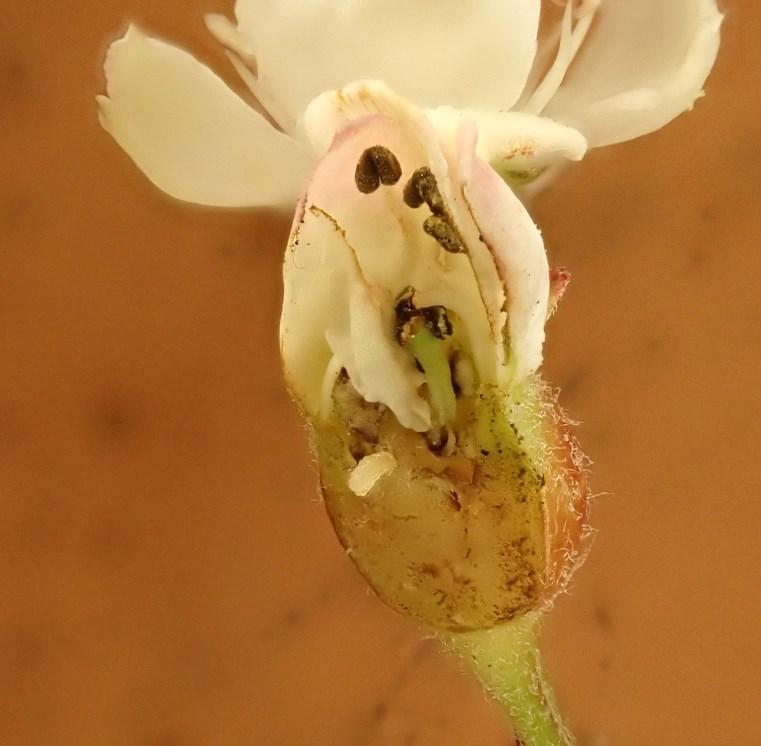
Galls of Contarinia anthobia (Löw) were recorded from a young Crataegus monogyna (Common Hawthorn) in my Kelsale garden (TM387650). The flower buds are swollen, remaining unopened (Fig. 1) and contain several ivory white, jumping larvae (Fig. 2). This appears to be the first record of the species from Suffolk (Vincent, 2019).
Amongst the other cecids, larvae of Kiefferia pericarpiicola (Bremi) enlarge the fruits of Daucus carota (Wild Carrot), sometimes turning them a maroon colour. In Suffolk, the species is most frequent in coastal areas. Galls were found for the first time in a small wildflower meadow established in my Kelsale garden on 23.viii.2024, the midges having taken nearly ten years to colonise the carrot plants despite their occurrence on a roadside verge within a quarter of a mile of the garden.
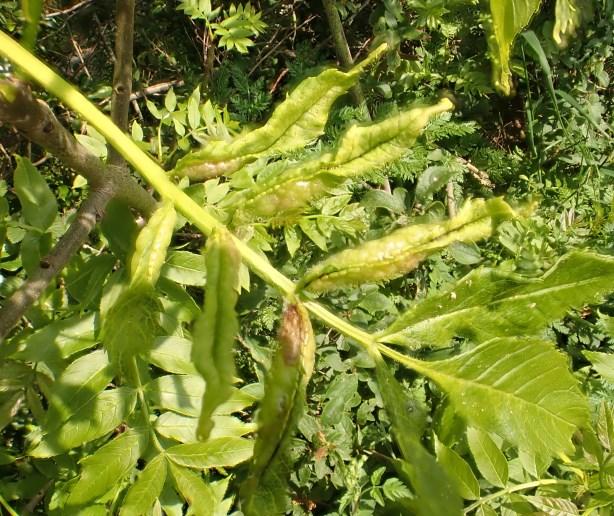
Dasineura acrophila (Winnertz) is one of the scarcer gall inducing midges on Fraxinus excelsior (Ash) and was an unexpected find at Tiggins Lane RNR in Kelsale (TM391659) on 13.v.2024 (Fig. 3).
Along with other Fraxinus dependent invertebrates, the gall inducers on ash face a threat from ash dieback disease caused by the fungus Hymenoscyphus fraxineus.
Figure 1 Contarinia anthobia gall on Hawthorn bud.
Figure 2 Contarinia anthobia gall crosssection showing larva
Figure 3 Dasineura acrophila
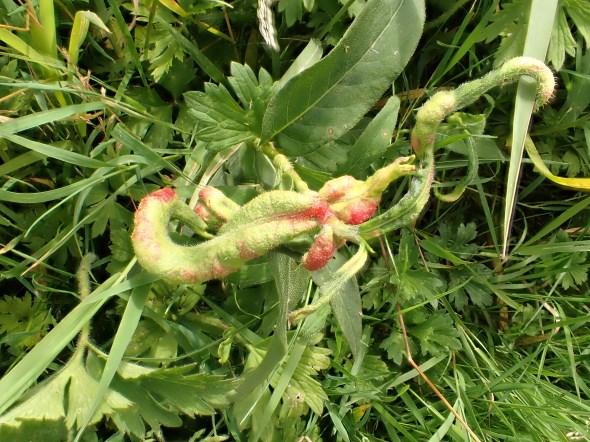
The Bioblitz at Halesworth Millenium Green (TM3877) on 20.vii.2024 produced some fine galls of Wachtliella persicariae (L.) (Fig. 4) on a Polygonum sp. growing in marshy ground. Also found was Rhopalomyia tanaceticola (Karsch) galling flowers of Tanacetum vulgare (Tansy).
Hymenoptera: Cynipidae (gall wasps)
As noted above, the wet winter had a severe effect on gall abundance, especially noticeable was the shortage of galls of the spring sexual generations of oak cynipids, with the exception of Biorhiza pallida (Olivier) (oak apple) which was again frequent. By late summer this decline had been reversed with asexual generations of the commoner spangle galls (Neuroterus spp.) being especially numerous.
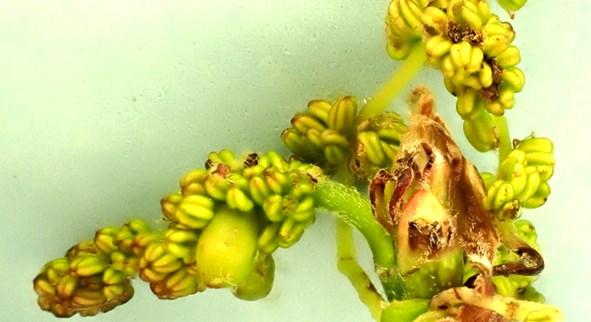
The cryptic sexual generation gall of Andricus quadrilineatus Hartig is much more difficult to locate than that of its asexual generation, both occurring on the catkins of Quercus robur (Pedunculate Oak). In addition, galls of the asexual generation may also occasionally be found on leaf veins. The two generations often overlap, with galls of both generations being found together at the same time. On 28.iv.2024 both galls were found together at Kelsale (TM386654) (Fig. 5).
5. Andricus quadrilineatus sexual and asexual galls on oak.
Galls induced by cynipids of the genus Cynips have been very scarce in the eastern counties for the past ten or so years. This is probably a normal fluctuation in numbers, also noted by early workers such as Niblett (1940) (as Diplolepis) and may be the result of high levels of parasitism.
It is pleasing to record that galls of the asexual generation of Cynips quercusfolii (L.) are showing signs of a comeback in Suffolk with good numbers of cherry galls of the asexual generation being recorded at coastal sites. Adrian Parr also had several records from the west of Suffolk. Other Cynips species remain elusive, although C. longiventris Hartig is showing a slight increase.
As always, I am pleased to receive records of Suffolk galls, or specimens for identification.
Acknowledgements
Once again, I am indebted to Adrian Parr for his comprehensive list of Suffolk cynipid galls recorded in 2023. Thanks also, to Nicky Rowbottom for organising the invertebrate bioblitz at Halesworth.
References
Niblett, M. (1940). Some notes on the cynipid GenusDiplolepis. Entomologist 73: 145-149. Vincent, P. (2019). The Diptera of Suffolk. Part 2. Trans. Suffolk Nat. Soc. 55: 1-27.
Jerry Bowdrey
10, Dennys Lane, Kelsale, Suffolk IP17 2PD jeremybowdrey@btinternet.com
Figure 4. Wachtliella persicariae
Figure
Introduction
THE ICHTHYOFAUNA OF SUFFOLK: THE CURIOUS CASE OF THE EELPOUT ZOARCES VIVIPARUS
JIM R. ELLIS AND GARY J. BURT
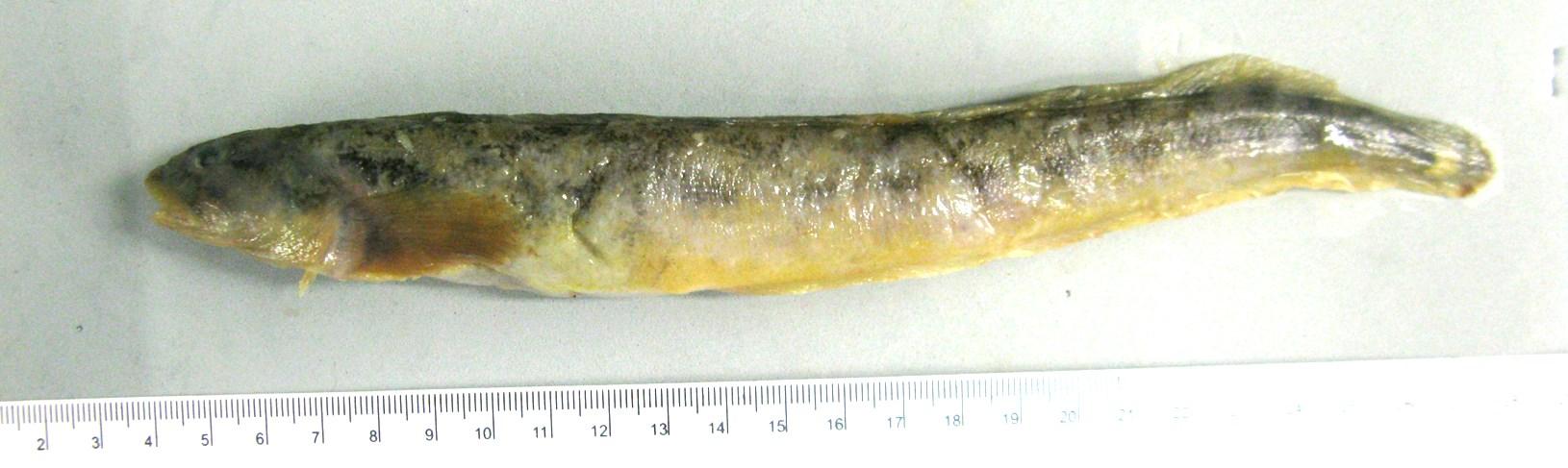
Eelpout, or viviparous blenny, Zoarces viviparus (L., 1758) (Order Perciformes; Family Zoarcidae; Fig. 1) is an inshore fish that is often reported from estuaries, harbours, shorelines and shallow seas to depths of about 40 m (Poll, 1947; Andriashev, 1986). It usually attains a maximum length of about 35 cm total length (LT), but it has been suggested that it can grow to 52 cm LT (Andriashev, 1986). The biogeographical range of eelpout extends from the English Channel through the North Sea to the Barents Sea and White Sea, including the Baltic Sea (Andriashev, 1986), but it appears to be more frequent along the coasts of continental Europe than the British Isles (Heessen, 2015).
Figure 1: Specimen of Eelpout Zoarces viviparous. Photograph: J. Ellis (CEFAS).
Along the south-eastern coasts of the United Kingdom, eelpout was purportedly common off the Hampshire coast, and also common off the coasts of Norfolk and Yorkshire (Yarrell, 1859). Along the intervening section of coastline, it has been reported from the Thames area, ranging from the Medway and Swale (Kent) to Leighon-Sea, Southend, and the entrances to the Rivers Blackwater and Crouch in Essex (Murie, 1903; Wheeler, 1979). Along the coasts of Suffolk and eastern Norfolk, it has been reported from Lowestoft beach (including Claremont Pier), with young specimens in the inner harbour (Lowe, 1874; Patterson, 1910), as well as Martlesham Creek, Orford, Aldeburgh, River Blyth, River Waveney (to St Olaves), and Breydon water (Patterson, 1910; Collings, 1933).
The historical abundance of eelpout in some of these areas is unclear, although Murie (1903) noted that “at certain spots in the winter season it simply swarms”, and Patterson (1910) considered it to be common off eastern Suffolk. Whilst Laver (1898) considered that it was not rare in the waters of Essex, Wheeler (1979) later reported that it was not common in the entrance to the Thames. Inshore surveys along the south-eastern coast of the UK (1981–1997) indicated that eelpout was observed most commonly off the Lowestoft and Great Yarmouth areas, as well as in various estuarine ecosystems, such as the Swale (Kent), Southend (Essex), The Wash, Humber, and Bridlington Bay (Rogers et al., 1998). Eelpout was also observed to more prevalent in The Wash and, across the wider survey area, was generally found in waters 3–14 m deep (Rogers et al., 1998).
Eelpout is ovoviviparous, and gives birth to live young. Females are ready for fertilization in the summer (July-August), embryos appear during September, and the young are born in the period December to February, after a developmental period of ca. 4 to 5 months (Götting, 1976; Hedman et al., 2011). The adult females give birth to young that are about 3.5–5.0 cm long, with the early free-living stages (fry) approximately 4.0–6.7 cm long (Svedäng et al., 1997; Mendez, 2014). Fecundity increases with age and length, usually ranging from 24 to 300 young, but up to 405 young have been reported in a female of 38 cm LT (Stuhlmann, 1887; Götting, 1976; Pörtner et al., 2001).
Early studies analysing meristic information (e.g. the numbers of fin rays and vertebrae) indicated that eelpout displayed strong regional variation in such features (Schmidt, 1917, 1918), and so it has long been supposed that this species forms localised populations. This would be related to the life-history of the species, as its reproductive strategy means that there is no longer-distance dispersal of early egg and larval stages in the plankton.
Given the sedentary nature of eelpout, their inshore and estuarine habitat, and their reproductive mode, this species has been used as a biological indicator, especially in the Baltic Sea and Kattegat (Voigt, 2007; Hedman et al., 2011), but also for North Sea coasts (Essink, 1985; Stentiford et al., 2003; Lyons et al., 2004). For example, pollution and reduced water quality may be associated with an increased proportion of females with malformed larvae (Strand et al., 2004; Gercken et al., 2006; Napierska & Podolska, 2006), an increased prevalence of intersexual fish (where the gonads contain both male and female tissues; Matthiessen & Law, 2002; Lyons et al., 2004), an increase in the numbers of females that are not pregnant (Simonsen & Syrand, 2010), and endocrine disruptors are thought to affect the sex ratio in broods of larvae, including a smaller proportion of females (Larsson et al., 2000).
In addition to water quality, eelpout may be susceptible to increasing water temperatures. It is a boreal (northern) species, and it has been suggested that the optimum water temperature for growth of eelpout is 12–14°C, with water temperatures of 18°C leading to avoidance behaviours and some mortality, and 22–23°C being the upper lethal temperature limit (Zakhartsev et al., 2003; Hedman et al., 2011).
Given that the southern British Isles is the southern distributional limit of eelpout, its population status in the south-western North Sea may also be affected by increasing water temperature. Furthermore, noting that several studies have suggested that pollutants may impair the reproductive success of eelpout (Hedman et al., 2011), poor water quality may impact further on the reproductive output and population dynamics of local stocks. Consequently, eelpout may be a useful sentinel species for understanding the ecological status of coastal and estuarine waters along North Sea coasts.
The aim of the present paper was to summarise available data for eelpout from trawl surveys conducted in the North Sea, in order to gauge the recent temporal
trends in their occurrence and relative abundance. These data are discussed in relation to those factors that may affect eelpout populations, with particular emphasis on the southern coasts of the North Sea, including East Anglia.
Methods
A range of trawl surveys are undertaken across the North Sea, with these data providing information on the distribution and relative abundance of many fish species. These surveys are often used in the stock assessments for the main commercial fish species, and of the wider fish assemblage. The data analysed here were from the (a) CEFAS Young Fish Survey (YFS, 1981–2010) in the western North Sea, (b) inshore Demersal Young Fish Survey (DYFS) of the eastern North Sea, (c) North Sea International Bottom Trawl Survey (NS-IBTS), and (d) Beam Trawl Survey (BTS; North Sea data only). The three latter surveys are all international surveys that are coordinated under the auspices of the International Council for the Exploration of the Sea (ICES). Data for the YFS were downloaded from CEFAS’ Fishing Survey System (FSS) on 29 July 2024, the NS-IBTS and BTS data were downloaded from ICES’ Database of Trawl Surveys (DATRAS) on 17 September 2024 (with analyses for both these surveys limited to the years 2000–2024), and DYFS data were downloaded from DATRAS on 3 October 2024. For the DYFS, BTS and the NS-IBTS, unaggregated trawl data were downloaded for eelpout (Aphia ID 127123). Given that some trawl catches may be subsampled, the number of eelpout for some hauls may be raised, and thus given as decimal numbers.
Young Fish Survey: Data from the YFS were collected by 2 m beam trawl (1981–2010) and 1.5 m push net (1981–1999). The methods and survey area for this survey were described by Rogers et al. (1998). Specimens of eelpout were usually measured to the 0.5 cm below, but only the number of individuals was reported in some hauls at the start of the time-series. Analyses of length-frequency data and the distribution by depth used haul-based data that were not standardised to a consistent sampling effort over time.
Table 1: Summary of data from the internationally-coordinated demersal young fish survey (DYFS; valid hauls only). Data accessed from DATRAS on 03/10/2024.
Given that the current paper has a greater regional focus on the south-western North Sea, data from the YFS were analysed in greater detail. Catches were standardised to the numbers caught per 10 minutes tow duration for 2 m beam trawl stations, and the mean catch rates and frequency of occurrence were calculated for the two sampling areas where eelpout was most common (the Winterton to Orford area, and The Wash). This analysis was limited to include only those trawl stations where the water depth at the time of trawl deployment was <20 m. The number of stations included in this analysis ranged from 31–34 per year in The Wash, and 27–49 per year in the Winterton to Orford area.
Demersal Young Fish Survey: Data from the DYFS were from three nations (Belgium, Netherlands, and Germany), with samples collected with either 3 m or 6 m beam trawl (Table 1). The Belgian survey operates along the coast of Belgium, the Dutch 3 m beam trawl survey is undertaken primarily in the Scheldt Estuary (southern Netherlands) and Dutch Wadden Sea, and the German survey operates inside and outside the East and North Frisian Islands (including the Lower Saxon Wadden Sea, Elbe Estuary, and the Schleswig-Holstein Wadden Sea). The Dutch 6 m beam trawl survey has a broader spatial coverage that extends from the southern parts of the Netherlands to Denmark.
These data (raised to the haul level) were not standardised to a consistent haul duration or survey effort (which can change annually), and are shown here as the total numbers reported. These data were used for analyses of length-frequency, the distribution by depth, and for the total numbers of eelpout caught annually. Given the amount of data that were available for the DYFS, the frequency of occurrence at valid trawl station was also examined, although potential impacts of temporal changes in survey effort and coverage were not considered in these initial analyses.
North Sea International Bottom Trawl Survey: Analyses of length-frequency data and the distribution by depth for the NS-IBTS used haul-based data that were not standardised to a consistent sampling effort over the time-series. Given the lower incidence of eelpout in this survey, only the total numbers per year were considered, with no consideration of survey effort. Three nominal records of eelpout in the NSIBTS dataset were excluded, as these were from depths of 72–174 m, and so likely to have been misidentified.
Beam Trawl Survey: Data analyses for the BTS were as described for the NS-IBTS. Two nominal records of eelpout in the wider BTS dataset were also excluded, as these were from the western seaboard of the United Kingdom, and may also have been misidentified.
Results
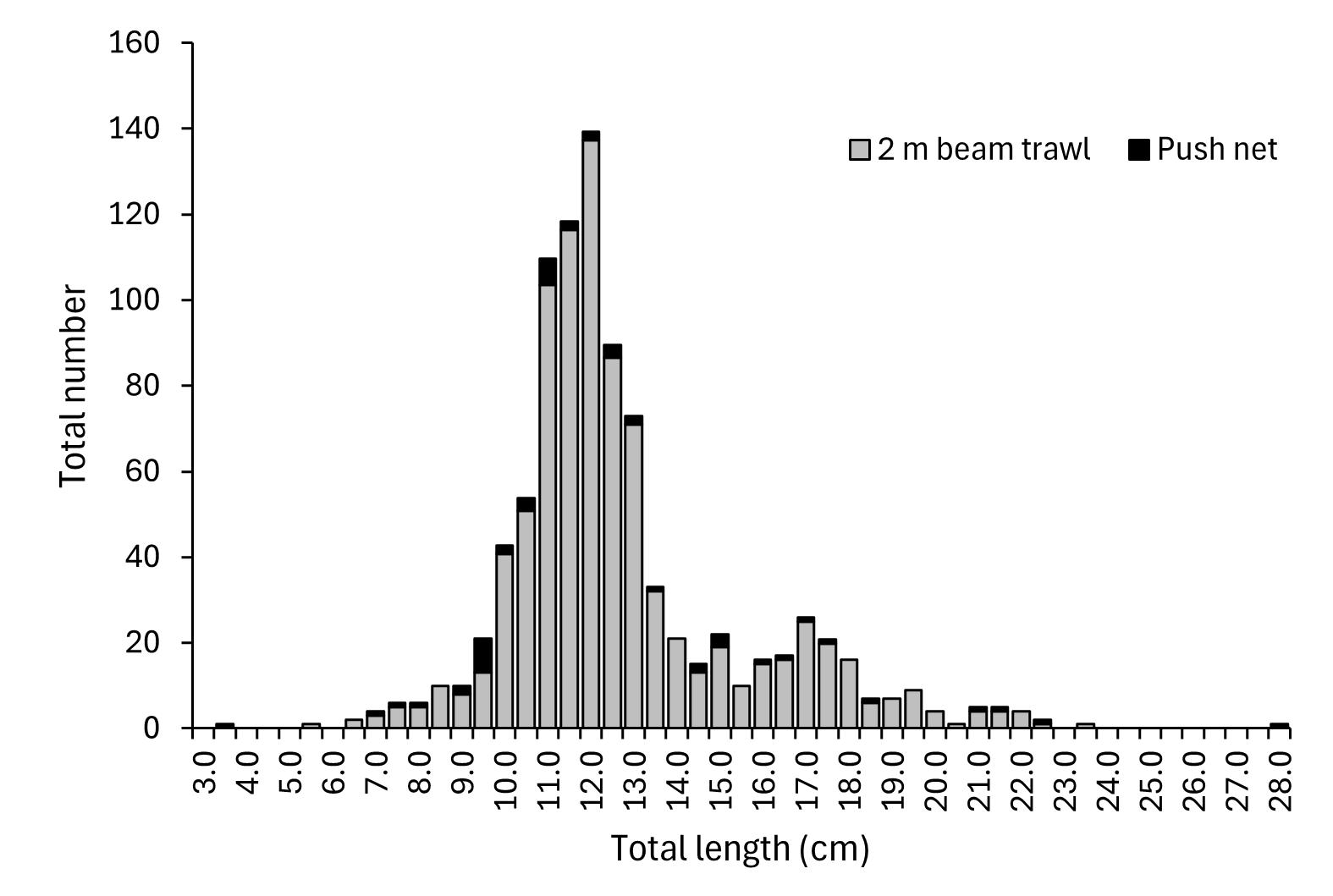
Young Fish Survey: In total, 991.1 specimens of eelpout were recorded in the YFS, of which 930.1 were measured (n = 881.1 and n = 49 for 2 m beam trawl and push net, respectively) and 61 were counted (n = 50 and n = 11 for 2 m beam trawl and push net, respectively). The overall length range was 3.5–28.0 cm LT (Fig. 2; n = 930.1), with the main peak in the length-frequency distribution being 10.0–13.5 cm LT (70.9% of
Figure 2: Length-frequency distribution of eelpout (measured to the 0.5 cm below) sampled in the Young Fish Survey (YFS; 1981–2010) in the western North Sea. Haul-based data (not raised to standardised sampling time by gear) from 2 m beam trawl (n = 881.1) and push net (n = 49).
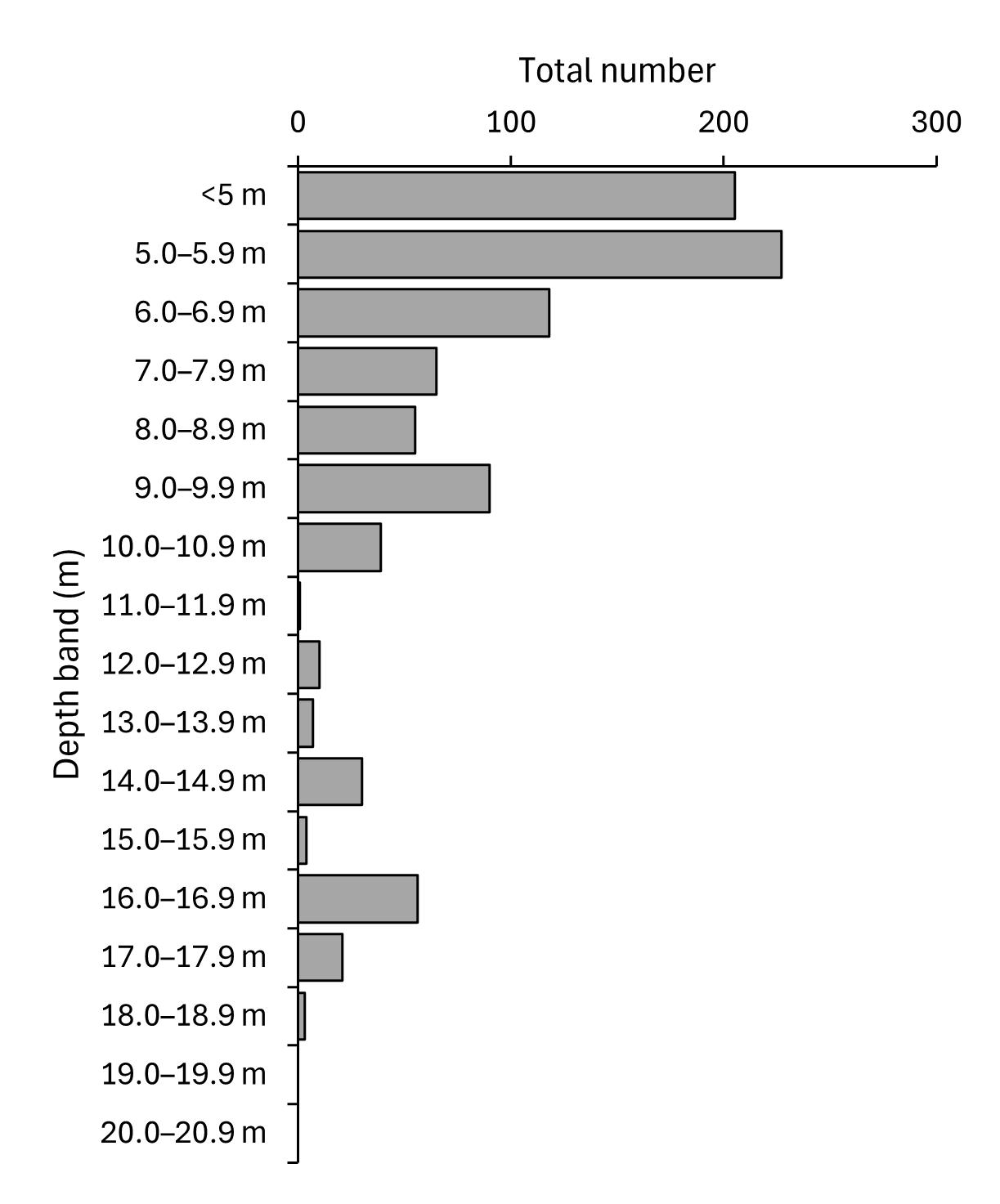
specimens). For those specimens caught by 2 m beam trawl (n = 931.1), the observed depth range extended to depths of 18.2 m, with 91.0% of specimens caught at depths of <15 m (Fig. 3).
Eelpout was caught by 2 m beam trawl over much of the wider survey area along the North Sea coastline, but the main sectors (see Rogers et al., 1998) where it was encountered were the Winterton to Orford area (n = 562.1; 60.4% of all specimens recorded), The Wash (n = 285; 30.6%) and Lincolnshire coast (n = 46; 4.9%). Eelpout was found in lower numbers elsewhere: Flamborough Head to mid-Humber (n = 2; 0.2%), Humber (n = 12; 1.3%), Winterton to The Wash (n = 4; 0.4%), northern Thames (n = 8; 0.9%), River Thames (n = 10; 1.1%) and southern Thames (n = 2; 0.2%).
Catches of eelpout in The Wash area (1981–2010) declined over the time-series (Fig. 4), with eelpout also observed in a lower proportion of hauls. Eelpout was found in >20% of hauls for several years at the start of the time-series (based on those hauls <20 m deep), but declined to 0–3% of hauls at the end of the time-series. Data for the Winterton to Orford area were restricted to the years 1981–1999, and showed variable trends (Fig. 4). Eelpout declined over the first part of the time-series, being absent in the years 1993–1995, before increasing in the years 1996–1999.
Figure 3: Occurrence of eelpout by depth as observed in the YFS (1981–2010; 2 m beam trawl only) in the western North Sea. Haul-based data not raised to standardised time (n = 931.1).
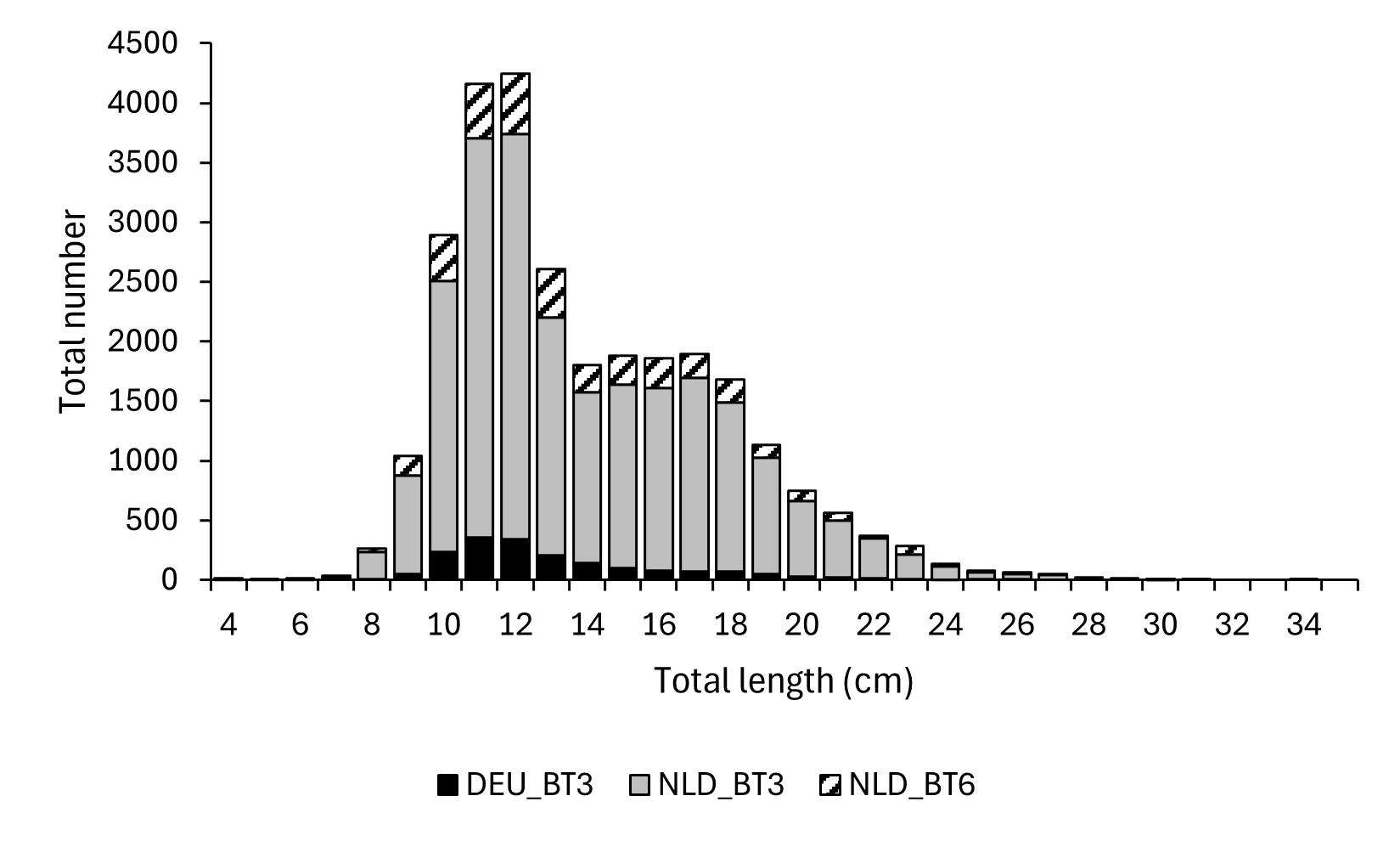
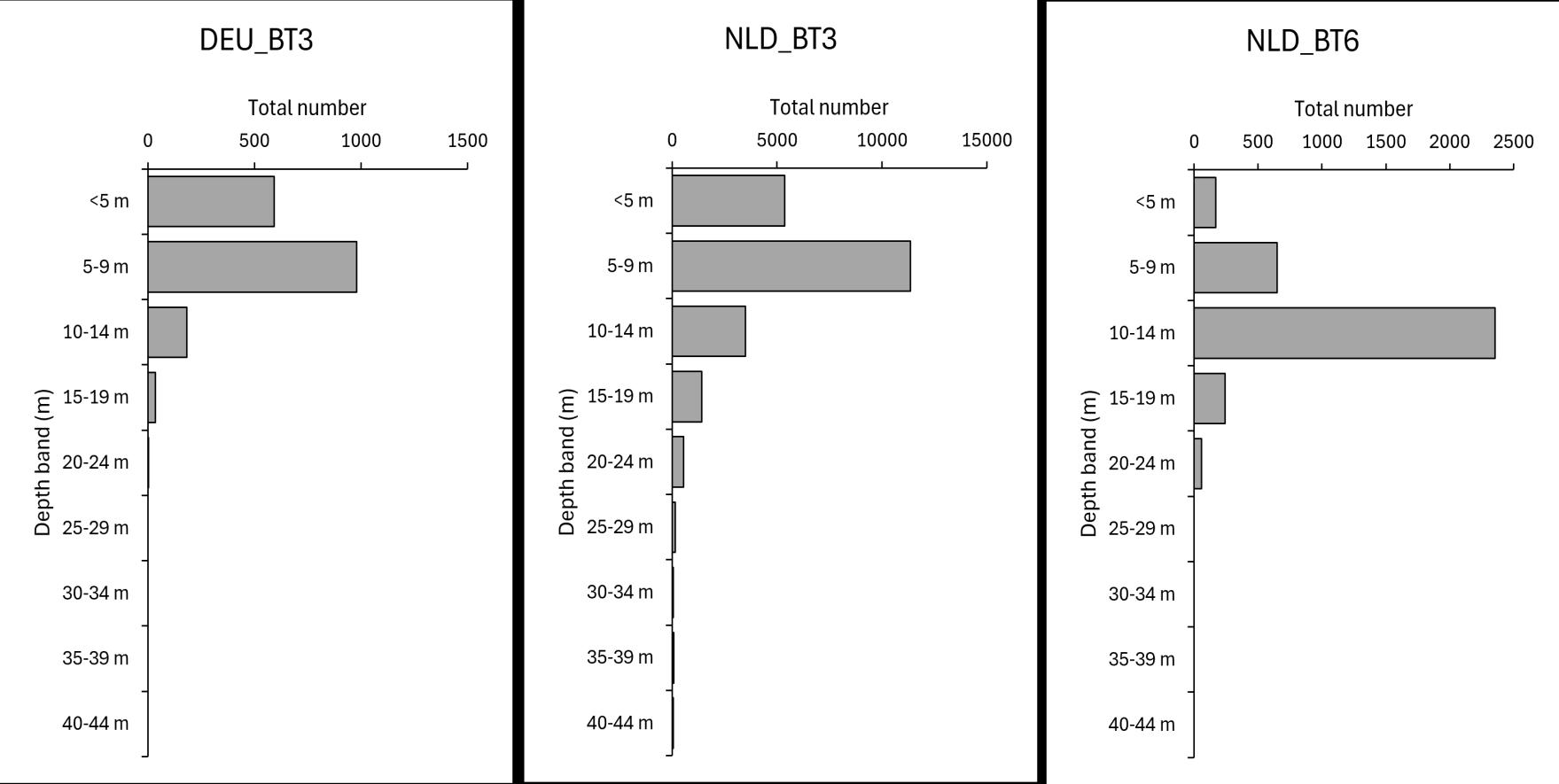
Demersal Young Fish Survey: Three nations undertake surveys in the inshore waters of the eastern North Sea, although the Belgian survey did not report any records of eelpout (Table 1). The length range of eelpout caught in the Dutch and German DYFS was 4–34 cm LT (although there was a single record of a 1 cm specimen, which is less than the size at hatching), with >95% of specimens being 9–21 cm LT (Fig. 5). Eelpout were observed in waters of 2–42 m during the DYFS, but the majority of specimens were from sites <15 m deep (Fig. 5).
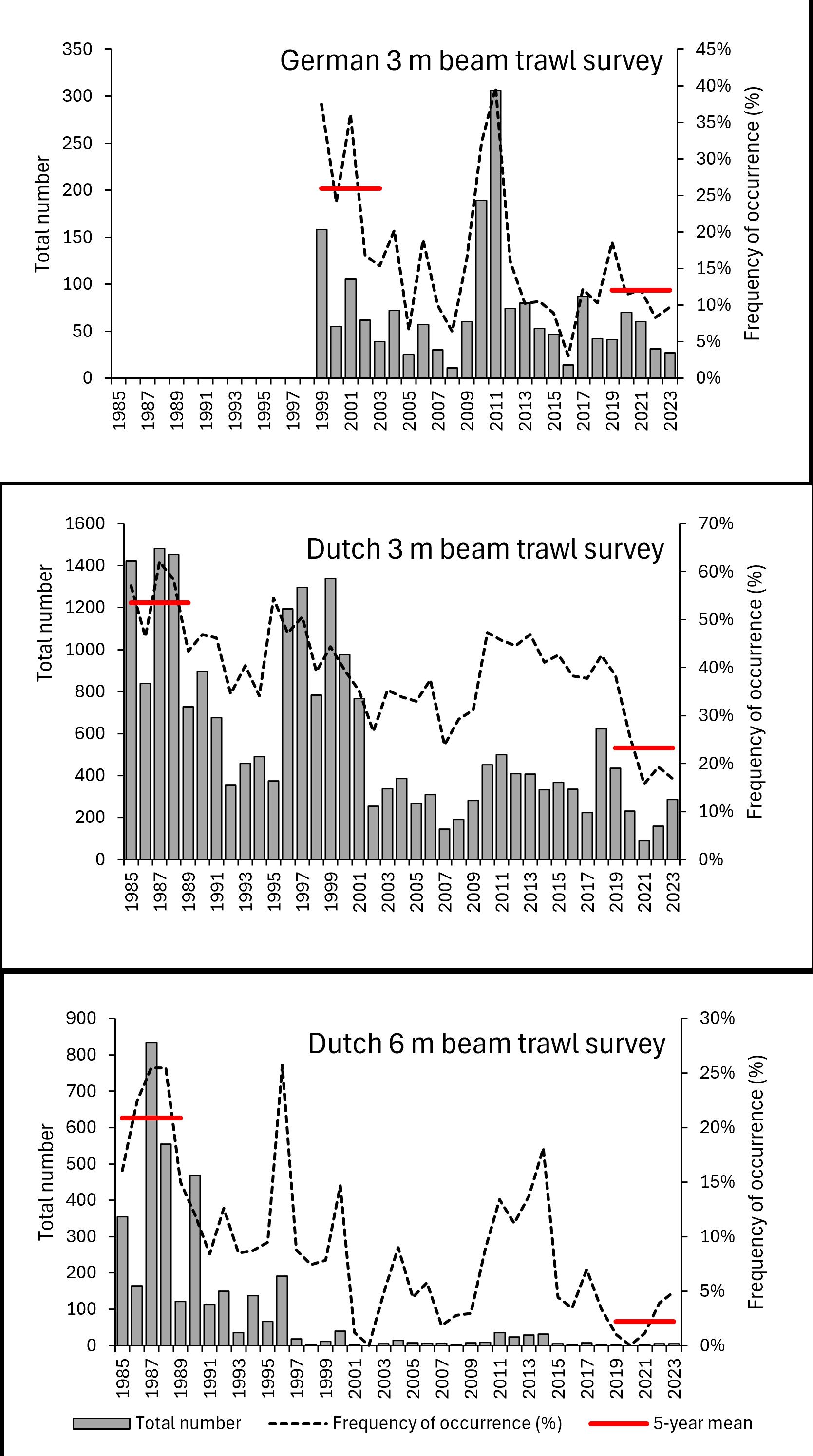
Whilst the frequency of occurrence of eelpout at trawl stations showed high interannual variability, all surveys showed a marked decline in the frequency of occurrence over the longer-term (Fig. 6). Comparisons of the frequency of occurrence for the most recent 5-year period (2019–2023) to the first 5-year period in the time-series indicated declines in all three surveys. The frequency of occurrence in the Dutch 3 m beam trawl survey declined from an average of 53.5% (range =43.5–62.0%; 1985–1989) to an average of 23.2% (15.8.5–38.3%). Similarly, the frequency of occurrence in the Dutch 6 m beam trawl survey declined from an average of 20.9% (range = 15.0–25.5%; 1985–1989) to an average of 2.2% (0.0–4.9%). The German survey had a shorter time-series, but still showed a decline from an average of 26.0% (range = 15.4 –37.5%) for the years 1999–2003 to an average of 12.0% (8.3–18.6%) for the years 2019–2023 (Fig. 6).
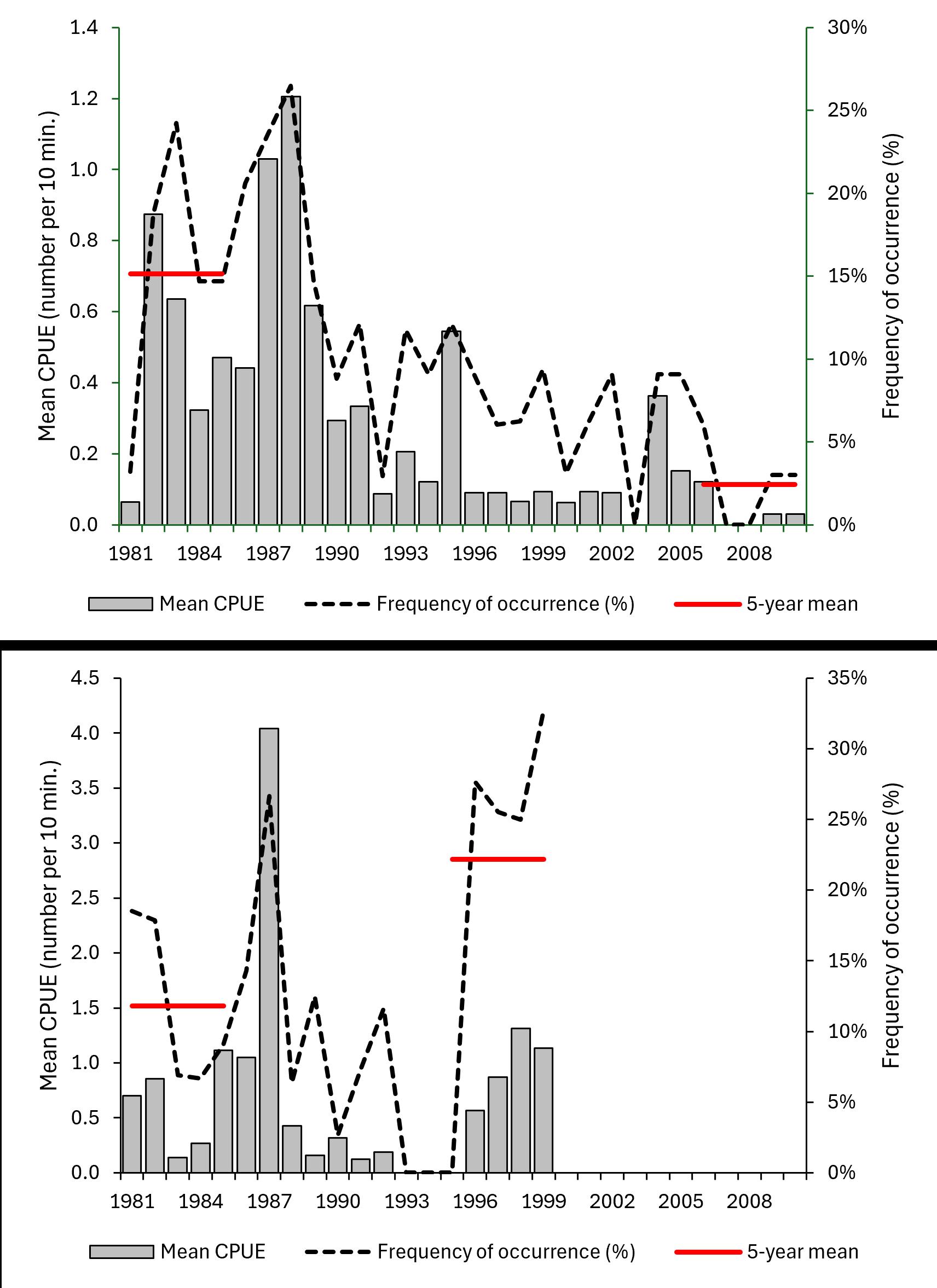
Figure 4: Mean catch per unit effort (CPUE) of eelpout (columns) and the frequency of occurrence in survey hauls (dashed line) for sampling areas in The Wash (1981–2010; top) and Winterton to Orford (1981–1999; bottom) as recorded in the YFS. Only data from 2 m beam trawl sampling in waters <20 m were included. The red horizontal lines indicate the average frequency of occurrence for the first and last 5-years of each time-series.
Figure 5: Summary data from the Demersal Young Fish Survey (DYFS), showing the length-frequency distribution (top) of eelpout caught in the German 3 m beam trawl survey (DEU_BT3; n = 1 796), Dutch 3 m beam trawl survey (NLD_BT3; n = 22 556), and Dutch 6 m beam trawl survey (NLD_BT6; n = 3 475), and the observed bathymetric distributions (bottom) of eelpout in DEU_BT3 (n = 1 794), NLD_BT3 (n = 22 479) and NLD_BT6 (n = 3 471).
differences in survey effort across the time series), and the percentage of valid trawl stations at which eelpout was recorded for the German and Dutch beam trawl surveys using 3 m or 6 m beam trawl. The red horizontal lines indicate the average frequency of occurrence for the first and last 5-years of each time-series.
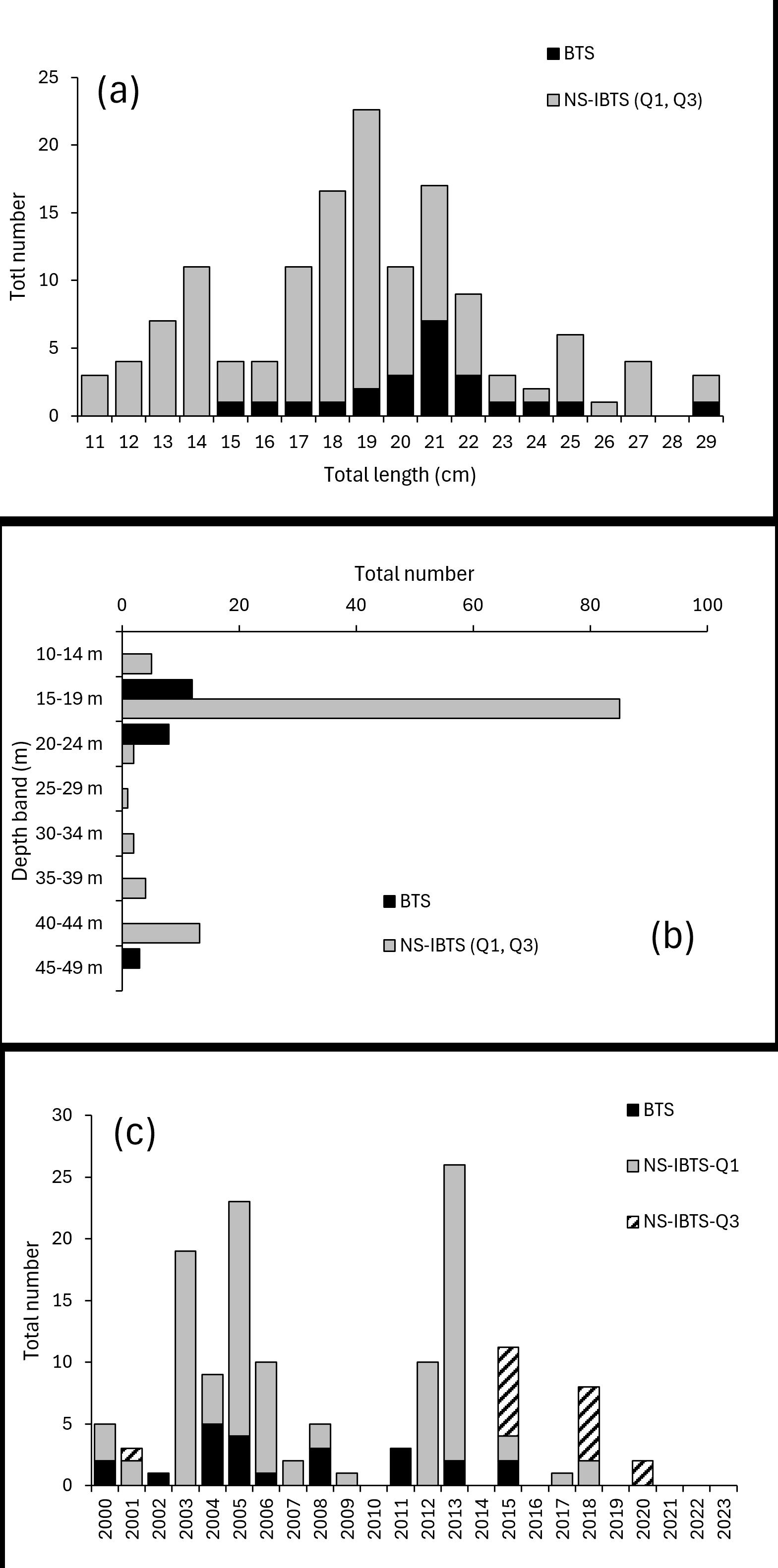
Figure 7: Summarised data for eelpout caught in the BTS and NS-IBTS (2000–2023) showing the (a) length-frequency distribution, (b) bathymetric distribution, and (c) total numbers caught (numbers raised to haul level, but total numbers each year were not standardised for any differences in survey effort across the time-series). Data for the NS-IBTS shown by Q1 and Q3 separately. Eelpout was also absent in the NS-IBTS-Q1 in 2024.
North Sea International Bottom Trawl Survey: In the years 2000–2024 (Q1) and 2000–2023 (Q3), the NS-IBTS reported 116.2 specimens of eelpout (11–29 cm LT; Fig. 7) which were caught at depths of 14–43 m (noting that three questionable records from deeper water were excluded). These specimens were captured across 25 individual trawl stations. Overall, 100 individuals were captured in Q1 and 16.2 in Q3. During Q1, the majority of specimens (n = 96) were from the western seaboard of Germany and Denmark, and the remaining specimens (n = 4), from the northern Kattegat. During Q3, the majority of specimens (n = 15.2; 93.8%) were from the northern Kattegat, with a single specimen from the western coast of Denmark. During the time-series analysed, there were no records of eelpout from either the southern or western North Sea.
Eelpout was observed sporadically in the Q3 survey (which has a similar spatial coverage of the North Sea to the Q1 survey), being recorded in only four years in the time-series. In contrast, eelpout was observed in 14 different years in the time-series analysed for Q1, although it was not reported during the last six years of the timeseries analysed (2019–2024; Fig. 7).
Beam Trawl Survey: In the years 2000–2023, the BTS reported 23 specimens of eelpout (15–29 cm LT) in the North Sea, which were caught at depths of 17–48 m (Fig. 7). These specimens were captured across 11 individual trawl stations, with all records from the German Bight and western Denmark. Eelpout was observed in nine different years in the time-series, but was not reported during the last part of the time-series analysed (2016–2023; Fig. 7).
Discussion
The YFS data analysed here ranged from 1981 to either 1999 or 2010 (depending on area), and so provided a longer time-series than that analysed previously by Rogers et al. (1998). Contemporary survey data for shallow coastal waters of the UK are limited, and much of the available data for the North Sea are now from internationallycoordinated surveys. The inshore surveys along the seaboard of continental Europe have also shown a decline in both Dutch and German waters. Both the BTS and NSIBTS, which are undertaken on larger research vessels that are not able to sample shallower areas, also saw a decline in eelpout.
The primary rationale for the surveys analysed here was to provide fisheryindependent data on the distribution and relative abundance of commercial fish stocks, including indices of recruitment. The YFS and DYFS were designed to inform on recruitment of key flatfish species, such as European plaice Pleuronectes platessa and common sole Solea solea. As such, it should be recognised that the surveys were not designed to sample eelpout, and so any inter-annual changes in survey coverage may affect the preliminary results shown here. Nevertheless, some consistent patterns were also observed. For example, the YFS showed peak catch rates in The Wash in 1987–1988, with a comparable peak also apparent in that part of the YFS undertaken in the Winterton to Orford area (1987; Fig. 4), and such a peak was also observed in both the Dutch 3 m and 6 m beam trawl surveys in 1987–1988 (Fig. 6). This peak then declined with lower catch rates and frequency of occurrence in the early 1990s.
Similarly, both the German and Dutch 3 m beam trawl surveys saw a small peak in eelpout in 1999, and also the proportion of hauls containing eelpout also increased in 2011, following a period of below average catches in the 2007/2008 period (Fig.6).
Overall, the data presented here showed a decline in eelpout in The Wash, as observed in the YFS, a decline in the DYFS, and apparent absence from both the NSIBTS and BTS in recent years. It should be highlighted that the latter surveys do not sample the main inshore areas that would be inhabited by eelpout, but may indicate that the population no longer extends as far from shore. Whilst accurate data on the current population trends of eelpout for UK waters are lacking, available information is suggestive that the populations around the North Sea may have declined, and such a decline would be in accordance with a range of other studies.
For example, Turnpenny et al. (1988) reported small numbers of eelpout from the intake screens of Sizewell ‘A’ power station (Suffolk) during October and November, with just three specimens recorded during 41 sampling events across the year 1981/1982. Henderson (2017) also noted that eelpout was observed occasionally on the intake screens at Sizewell, based on samples collected from the intake screens (2009–2012). Whilst the numbers were not given in the latter study, it was flagged that the numbers taken were in contrast to the abundance reported by Collings (1933). Indeed, eelpout were reportedly caught in large numbers in the River Blyth (Collings, 1933), a site ca. 12 km away from Sizewell, although occasional surveys (2022–2023) of the intertidal and shallow sublittoral zones at Walberswick, adjacent to the River Blyth, have not reported eelpout to date (Ellis, 2023).
Further north, eelpout has been reported as an occasional catch on the intake screens at Longannet Power Station (Forth Estuary, Scotland), where 31 specimens were caught over the period 1999–2000, and it occurred in 15.7% of samples processed (Greenwood, 2008). In contrast, Greenwood et al. (2002) reported that eelpout was the second most common fish species taken in Agassiz trawl sampling in the Forth Estuary (aggregated data for 1982–2001). The latter study, however, also observed a decline across the time-series, which correlated with increasing water temperature. Greenwood & Maitland (2009) provided further evidence of the decline in eelpout in the Forth Estuary, based on data collected from the intake screens of the power stations at Kincardine (1961–1962 and 1979) and Longannet in (1979) compared to subsequent data from Longannet (1994, 1999, 2000).
A decline in eelpout has also been reported in the Wadden Sea (Netherlands), with peak catches during the 1960s, followed by a sharp decline, a period of low abundance and, in more recent years, either low abundance in, or absence from, the survey (Mendez, 2014; van der Veer et al., 2015). The decline of eelpout in the Wadden Sea was also evident in another dataset from inshore beam trawl surveys (Tulp et al., 2008), although comparable data showed a slight increase in the Westerschelde.
Eelpout was noted as a common species in Belgian coastal waters by Poll (1947), although it was not reported in the Belgian DYFS, and so further studies to gauge its current status in that area could usefully be undertaken. Olsen et al. (2002), comparing data from 1969–1977 and 1998 also indicated a decline in eelpout in the
Table 2: Reported length range (LT) of eelpout in various studies (see Table 1 for additional data). Approximate values given in square brackets.
Area
North Sea
Hafrsfjord (Norway)
55’N Harpoon gun 21.0–31.8 Lajus et al. (2003)
Forth estuary (UK) 58° 02’N 2 m Agassiz trawl 8.5–28.2 Mathieson et al. (1996)
Wadden Sea (Netherlands) [54° 44’N] Trawl 14.1–27.0 Lajus et al (2003)
Wadden Sea (Netherlands)
06’N Various 6.5–31.5 Mendez (2014)
Wadden Sea (Netherlands) [53° 15’N] Unspecified [11–30 ] Essink (1985)
Western North Sea
–28.0 YFS (present study) Eastern North Sea
6–30 DYFS (Netherlands) Eastern North Sea
N 3 m
trawl 4–34 [2] DYFS (Netherlands)
Eastern North Sea 53° 40.4’–v 55° 1.3’N 3 m beam trawl 4–30 DYFS (Germany)
North Sea 54° 4.8’ –57° 40.8’N GOV trawl [3] 11–29 NS-IBTS (present study)
North Sea
Other areas
White Sea (Russia)
Holmöarna (Sweden)
Gävlebukten (Sweden)
Gulf of Finland (Finland)
Fjällbacka (Sweden)
Kvädöfjärden (Sweden)
Marsö (Sweden)
Kladdenabb (Sweden)
Torhamn (Sweden)
Gulf of Gdansk (Poland)
26.4’ –
° 35.4’N Beam trawl 15–29 BTS (present study)
66° 28’N Trap 17.4–33.7 Lajus et al (2003)
63° 43’N Fyke nets 14.0–29.1
60° 43’N Fyke nets 18.0–30.8
Vetemaa et al (2006)
Vetemaa et al. (2006)
60° 10’N Hook and line 13.5–21.7 Lajus et al. (2003)
58° 36’N Fyke nets 19.0–34.2
58° 3’N Fyke nets 15.9–32.2
57° 39’N Fyke nets 15.2–32.0
55° 59’N Fyke nets 17.0–30.4
56° 5’N Fyke nets 16.2–28.2
Vetemaa et al. (2006)
Vetemaa et al (2006)
Vetemaa et al (2006)
Vetemaa et al. (2006)
Vetemaa et al. (2006)
54° 35’N Trawl 21.6–34.8 Lajus et al. (2003)
Notes: [1] values in square brackets are approximate values; [2] Excluding one specimen reported at 1 cm, which is smaller than the length at birth. [3] chalut à Grande Ouverture Verticale, a high headline bottom trawl.
Mariager Fjord (north-eastern Denmark). It should be noted, however, that Tiews (1990) observed an increase in bycaught eelpout in a shrimp trawl fishery in German coastal waters over the period 1954 and 1988. This increase, however, may need to be viewed in context of the elevated catches of eelpout observed elsewhere in the southern North Sea in the late 1980s.
A range of factors may affect the abundance and distribution of eelpout. Tulp et al. (2008) considered various abiotic parameters (water temperature, salinity, river runoff, and concentrations of phosphate and nitrate), biotic parameters (density of piscivorous fish, numbers of cormorants and seals, and density of the shrimp Crangon) and metrics of fishing pressure (fishing effort for the beam trawl and shrimp trawl fleets). Interestingly, the decline of eelpout in the Wadden Sea showed a significant correlation with the numbers of seals (Tulp et al., 2008), although this does not indicate whether there was a causal relationship. Indeed, although eelpout has been found to be a relatively frequent prey item of seals in the Baltic Sea (ScharffOsen et al., 2019), it has been reported as being only an occasional prey species for seals in UK waters (Pierce et al., 1989; Hall et al., 1998). In terms of potential avian predators, eelpout has been shown to be an important prey species for cormorant Phalacrocorax carbo along the east coast of Sweden (Boström et al., 2012), but of minor importance elsewhere (Leopold et al., 1998), although this may also reflect spatial differences in the abundance of eelpout.
Overall, eelpout populations may be impacted by a range of factors, including increasing water temperature, habitat degradation and pollution, as well as multispecies interactions. Eelpouts are thought to form local populations, and so may be susceptible to localised depletions. Eelpout usually reach 35 cm LT, but studies on British shores have generally indicated that they are slightly smaller, typically <30 cm LT (Table 2), which might be related to spatial variations in growth and demographic parameters.
The inshore nature of eelpout means that they may be impacted less by commercial fisheries. In early accounts, eelpout was reported as being captured in a range of estuarine and inshore fisheries, such as those targeting European sprat Sprattus sprattus, European eel Anguilla anguilla, and European smelt Osmerus eperlanus (Laver, 1898; Collings, 1933). Eelpout would be expected to be discarded if caught nowadays, although, historically, it was landed for bait or food in some areas along the eastern coast of the UK (Yarrell, 1859; Murie, 1903).
The current status of eelpout in the waters of Suffolk is uncertain, and so further studies could usefully be considered to determine their current distribution, including analyses of other potential datasets and contemporary sampling of suitable habitats. In terms of field sampling, eelpout can be caught in a variety of sampling gears, including Agassiz trawl, small beam trawl, push net, hook and line, eel traps, and fyke nets (Rogers et al., 1998; Greenwood & Hill, 2003; Lajus et al., 2003; van der Veer et al., 2015). It should also be noted that there can also be seasonal differences in the distribution and behaviour of eelpout, with Greenwood & Hill (2003) finding them to be more abundant in the Forth Estuary during the summer.
Given the potential for localised declines of eelpout in some areas, the appropriateness of using eelpout as a biological indicator could usefully be considered with due caution for some regions, depending on local population status. Nevertheless, given that eelpout is known to be influenced by water temperature and water quality, surveys of former and potential habitat (including non-lethal sampling of eelpout) may provide information on this species in relation to wider ecosystem health.
Acknowledgements
Many thanks to Stuart Reeves and Gen Broad for commenting on the manuscript. This study used data held on the ICES Database on Trawl Surveys (DATRAS), and those institutes and their sea-going scientists who contribute to this database are gratefully acknowledged.
References
Andriashev, A. P. (1986). Zoarcidae. In Fishes of the North-eastern Atlantic and the Mediterranean (Whitehead, P. J. P., Bauchot, M.-L., Hureau, J.-C., Nielsen, J. and Tortonese, E., Eds.). Volume III. Paris: UNESCO; 1130–1150.
Boström, M. K., Östman, Ö., Bergenius, M. A. & Lunneryd, S. G. (2012). Cormorant diet in relation to temporal changes in fish communities. ICES Journal of Marine Science, 69: 175–183.
Collings, D. W. (1933). The fishes of Suffolk. Trans. Suffolk Nat. Soc., 2: 104–133. Ellis, J. R. (2023). Intertidal and shallow sublittoral fish at Walberswick, Suffolk. Trans. Suffolk Nat. Soc., 59: 69–79.
Essink, K. (1985). Monitoring of mercury pollution in Dutch coastal waters by means of the teleostean fish Zoarces viviparus. Netherlands Journal of Sea Research, 19: 177–182.
Gercken, J., Förlin, L. & Andersson, J. (2006). Developmental disorders in larvae of eelpout (Zoarces viviparus) from German and Swedish Baltic coastal waters. Marine Pollution Bulletin, 53: 497–507.
Götting, K. J. (1976). Fortpflanzung und Oocyten-Entwicklung bei der Aalmutter (Zoarces viviparus) (Pisces, Osteichthyses). Helgoländer Meeresuntersuchungen, 28: 71–89.
Greenwood, M. F. D. (2008). Fish mortality by impingement on the cooling-water intake screens of Britain’s largest direct-cooled power station. Marine Pollution Bulletin, 56: 723–739.
Greenwood, M. F. D. & Hill, A. S. (2003). Temporal, spatial and tidal influences on benthic and demersal fish abundance in the Forth estuary. Estuarine, Coastal and Shelf Science, 58: 211–225.
Greenwood, M. F. D. & Maitland, P. S. (2009). Long-term changes in fish-assemblage composition from cooling-water intake screens in the Forth Estuary, Scotland, UK. Marine Biodiversity Records, 2, p.e8.
Greenwood, M. F. D., Hill, A. S. & McLusky, D. S. (2002). Trends in abundance of benthic and demersal fish populations of the lower Forth Estuary, East Scotland, from 1982–2001. Journal of Fish Biology, 61: 90–104.
Hall, A. J., Watkins, J. & Hammond, P. S. (1998). Seasonal variation in the diet of harbour seals in the south-western North Sea. Marine Ecology Progress Series, 170: 269–281.
Hedman, J. E., Rüdel, H., Gercken, J., Bergek, S., Strand, J., Quack, M., Appelberg, M., Förlin, L., Tuvikene, A. & Bignert, A. (2011). Eelpout (Zoarces viviparus) in marine environmental monitoring. Marine Pollution Bulletin, 62: 2015–2029.
Heessen, H. J. L. (2015). Eelpouts (Zoarcidae). In ‘Fish atlas of the Celtic Sea, North Sea, and Baltic Sea’ (Heessen, H. J. L., Daan, N. and Ellis, J. R., Eds.). Wageningen Academic Publishers / KNNV Publishing, 358–419.
Henderson, P. A. (2017). Long-term temporal and spatial changes in the richness and relative abundance of the inshore fish community of the British North Sea Coast. Journal of Sea Research, 127: 212–226.
Lajus, D., Knust, R. & Brix, O. (2003). Fluctuating asymmetry and other parameters of morphological variation of eelpout Zoarces viviparus (Zoarcidae, Teleostei) from different parts of its distributional range. Sarsia, 88: 247–260.
Larsson, D. G. J., Hällman, H. & Förlin, L. (2000). Skewed embryonic sex ratios in a viviparous fish: a result of endocrine disruption? Marine Environmental Research, 50: 191–192.
Laver, H. (1898). The mammals, reptiles and fishes of Essex. Essex Field Club Special Memoirs, 3: 138 pp.
Leopold, M. F., van Damme, C. J. & van der Veer, H. W. (1998). Diet of cormorants and the impact of cormorant predation on juvenile flatfish in the Dutch Wadden Sea. Journal of Sea Research, 40: 93–107.
Lowe, J. (1874). Fauna and flora of Norfolk. Part IV: Fishes. Transactions of the Norfolk and Norwich Naturalists’ Society, 1(5):21–56.
Lyons, B. P., Bignell, J., Stentiford, G. D. & Feist, S. W. (2004). The viviparous blenny (Zoarces viviparus) as a bioindicator of contaminant exposure: application of biomarkers of apoptosis and DNA damage. Marine Environmental Research, 58: 757–761.
Mathieson, S., George, S. G. & McLusky, D. S. (1996). Temporal variation of total mercury concentrations and burdens in the liver of eelpout Zoarces viviparus from the Forth Estuary, Scotland: Implications for mercury biomonitoring. Marine Ecology Progress Series, 138: 41–49.
Matthiessen, P. & Law, R. J. (2002). Contaminants and their effects on estuarine and coastal organisms in the United Kingdom in the late twentieth century. Environmental Pollution, 120: 739–757.
Mendez, N. (2014). Dynamics and growth of the eelpout Zoarces viviparus in the western Dutch Wadden Sea. NIOZ, Royal Netherlands Institute for Sea Research. Murie, J. (1903). Report on the sea fisheries and fishing industries on the Thames Estuary. Kent and Essex Sea Fisheries Committee. London: Waterlow Bros. & Layton, 250 pp.
Napierska, D. & Podolska, M. (2006). Field studies of eelpout (Zoarces viviparus L.) from Polish coastal waters (southern Baltic Sea). Science of the Total Environment, 371: 144–155.
Olsen, R. B., Richardson, K. & Simonsen, V. (2002). Population differentiation of eelpout Zoarces viviparus in a Danish fjord. Marine Ecology Progress Series, 227: 97–107.
Patterson, A. H. (1910). Rough notes on the fish and fisheries of East Suffolk. Great Yarmouth: John Buckle; 55 pp.
Pierce, G. J., Diack, J. S. W. & Boyle, P. R. (1989). Digestive tract contents of seals in the Moray Firth area of Scotland. Journal of Fish Biology, 35 (Suppl. A): 341–343.
Poll, M. (1947). Faune de Belgique. Poissons Marins. Musée royal d'histoire naturelle de Belgique; 452 pp.
Pörtner, H. O., Berdal, B., Blust, R., Brix, O., Colosimo, A., De Wachter, B., Giuliani, A., Johansen, T., Fischer, T., Knust, R. & Lannig, G. (2001). Climate induced temperature effects on growth performance, fecundity and recruitment in marine fish: developing a hypothesis for cause and effect relationships in Atlantic cod (Gadus morhua) and common eelpout (Zoarces viviparus). Continental Shelf Research, 21: 1975–1997.
Rogers, S. I., Millner, R. S. & Mead, T. A. (1998). The distribution and abundance of young fish on the east and south coast of England (1981 to 1997). Science Series Technical Report (CEFAS), 108: 130 pp.
Scharff-Olsen, C. H., Galatius, A., Teilmann, J., Dietz, R., Andersen, S. M., Jarnit, S., Kroner, A. M., Botnen, A. B., Lundström, K., Møller, P. R. & Olsen, M. T. (2019). Diet of seals in the Baltic Sea region: a synthesis of published and new data from 1968 to 2013. ICES Journal of Marine Science, 76: 284–297.
Schmidt, J. (1917). Zoarces viviparus L. and local races of the same. Comptes Rendus des travaux de Laboratoire de Carlsberg, 13: 277–397.
Schmidt, J. (1918). Racial studies in fishes: I. Statistical investigations with Zoarces viviparus L. Journal of Genetics, 7: 105–118.
Simonsen, V. & Strand, J. (2010). Genetic variation of Zoarces viviparus: six populations revisited after about 35 years. Hereditas, 147: 250–255.
Stentiford, G. D., Longshaw, M., Lyons, B. P., Jones, G., Green, M. & Feist, S. W. (2003). Histopathological biomarkers in estuarine fish species for the assessment of biological effects of contaminants. Marine Environmental Research, 55: 137–159.
Strand, J., Andersen, L., Dahllöf, I. & Korsgaard, B. (2004). Impaired larval development in broods of eelpout (Zoarces viviparus) in Danish coastal waters. Fish Physiology and Biochemistry, 30: 37–46.
Stuhlmann, F. (1887). Zur Kenntnis des Ovariums der Aalmutter (Zoarces viviparus Cuv.). Abhandlungen aus dem Gebiete der Naturwissenschaften (Hamburg), 10: 1–48.
Svedäng, H., Ojaveer, H. & Urtans, E. (1997). Interpretation of the otolith structures in viviparous blenny Zoarces viviparus. Journal of Applied Ichthyology, 13: 137–142.
Tiews, K. (1990). 35-Jahres-Trend (1954–88) der Haufigkeit von 25 Fisch-und. Krebstierbestanden an der deutschen Nord-seekuste. Archiv für Fischereiwissenschaft, 40: 39–48.
Tulp, I., Bolle, L. J. & Rijnsdorp, A. D. (2008). Signals from the shallows: in search of common patterns in long-term trends in Dutch estuarine and coastal fish. Journal of Sea Research, 60: 54–73.
Turnpenny, A. W. H., Utting, N. J., Millner, R. S. & Riley, J. D. (1988). The effect of fish impingement at Sizewell 'A' power station, Suffolk, on North Sea fish stocks. (No. CEGB-). Central Electricity Research Laboratories Report No. TPRD/L 3270/R88; iii + 27 pp. + Figures and Tables.
van der Veer, H. W., Dapper, R., Henderson, P. A., Jung, A. S., Philippart, C. J., Witte, J. I. & Zuur, A. F. (2015). Changes over 50 years in fish fauna of a temperate coastal sea: Degradation of trophic structure and nursery function. Estuarine, Coastal and Shelf Science, 155: 156–166.
Vetemaa, M., Neuman, E., Thoresson, G. & Pihlak, M. (2006). Trade-off between number and intraovarian growth rate of offspring in Zoarces viviparus. Annales
Zoologici Fennici, 43: 303–309.
Voigt, H. (2007). Heavy metal (Hg, Cd, Zn) concentrations and condition of eelpout (Zoarces viviparus L.), around Baltic Sea. Polish Journal of Environmental Studies, 16: 909–917.
Wheeler, A. (1979). The tidal Thames: the history of a river and its fishes. London: Routledge & Kegan Paul Books, 228 pp.
Yarrell, W. (1859). A history of British fishes. Third edition. Two volumes. London: John Van Voorst, 675 + 670 pp.
Zakhartsev, M. V., De Wachter, B., Sartoris, F. J., Pörtner, H. O. & Blust, R. (2003). Thermal physiology of the common eelpout (Zoarces viviparus). Journal of Comparative Physiology B, 173: 365–378.
J.R. Ellis
CEFAS, Pakefield Road, Lowestoft, Suffolk, NR33 0HT
RECENT, NOTEWORTHY COLEOPTERA FROM SUFFOLK ROSS PIPER
Introduction
Much of my work has taken me out of the county this season, so I didn’t do very much beetling in Suffolk this year. It has also been a very strange year in terms of the weather with the early Summer being inclement to say the least.
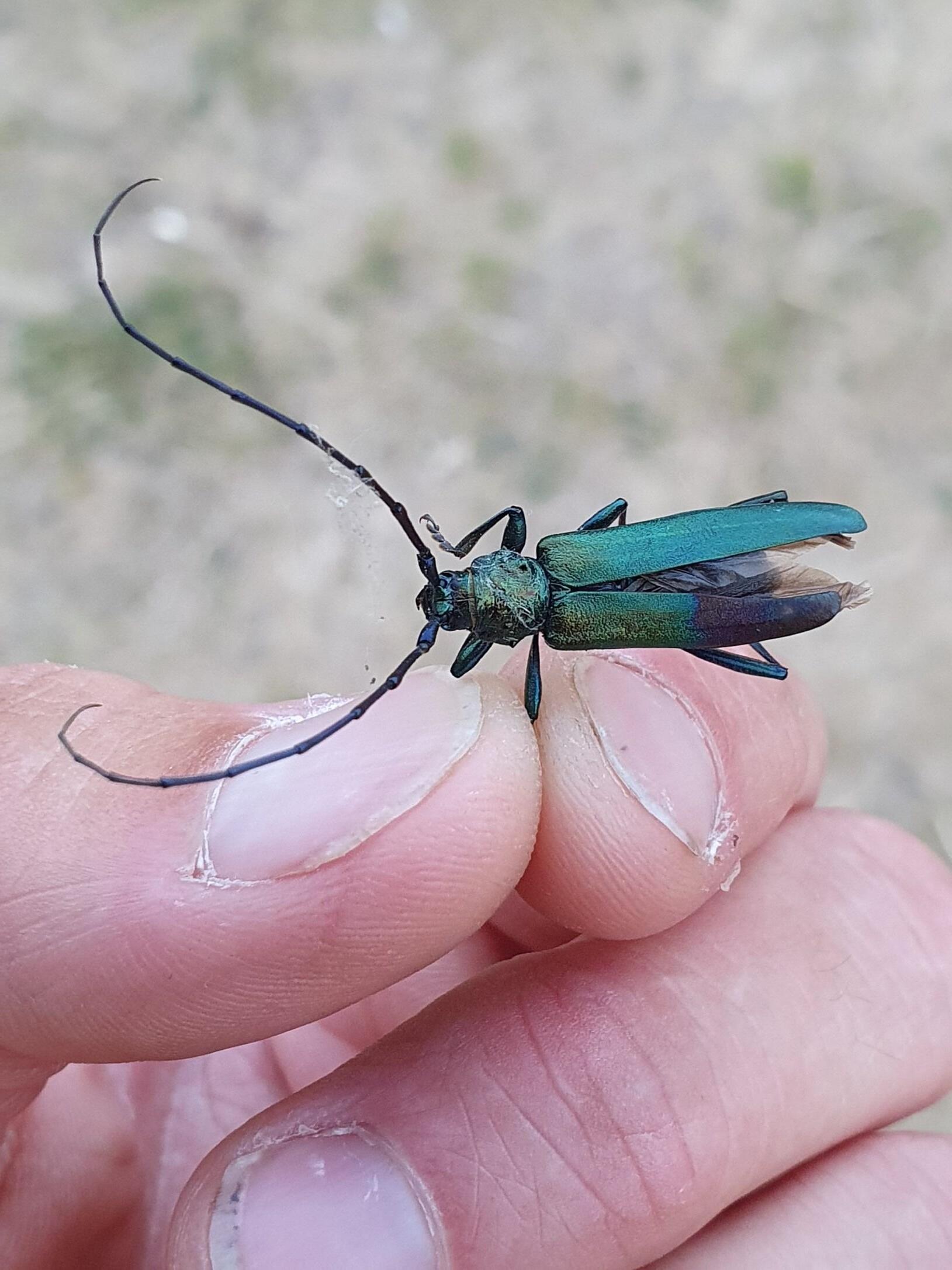
Beetles were not hit as hard by this as some groups, e.g. bees and butterflies, and some of them appeared to have positively thrived. One of these was the Musk Beetle Aromia moschata, one of our largest and most stunning beetles. Large females can be up to 4 cm long. In life it has a distinctive, musky odour, hence the common name and when threatened it emits a rasping sound by rubbing the sections of its thorax together. The larvae feed on the wood of large riparian willows, taking as long as 3 years to grow, aided in the digestion of this tough material by symbiotic micro-
It seems to have been a bumper year for Musk Beetles Aromia moschata, which have a stronghold along the River Gipping in and around Stowmarket. This is a dead specimen I found on the courts at Stowmarket Tennis Club.
Ross Piper
I’m also pleased to report that the Black Oil Beetle Meloe proscarabaeus colony on Forestry Commission land near Wordwell is clinging on with a number of individuals spotted this year. Nearly all of the oil beetle species we have in the UK have declined enormously over the post war period, especially in East Anglia. The main factor in this decline is probably agricultural intensification. As larvae, they are parasites in the nests of solitary bees and so they are intricately linked to the fortunes of their hosts. The adults of this species are only active for a rather short period of time in the early part of the season, usually from March. These too are very large beetles, with the females measuring as much as 3 cm long. Later in the year, in May and June, keep your eyes peeled for their larvae, tiny active creatures called triungulins that hang around in flowers, waiting for a bee to clamber onto. There are few other known sites for oil beetles in East Anglia, so keep a look out for them between March and May.
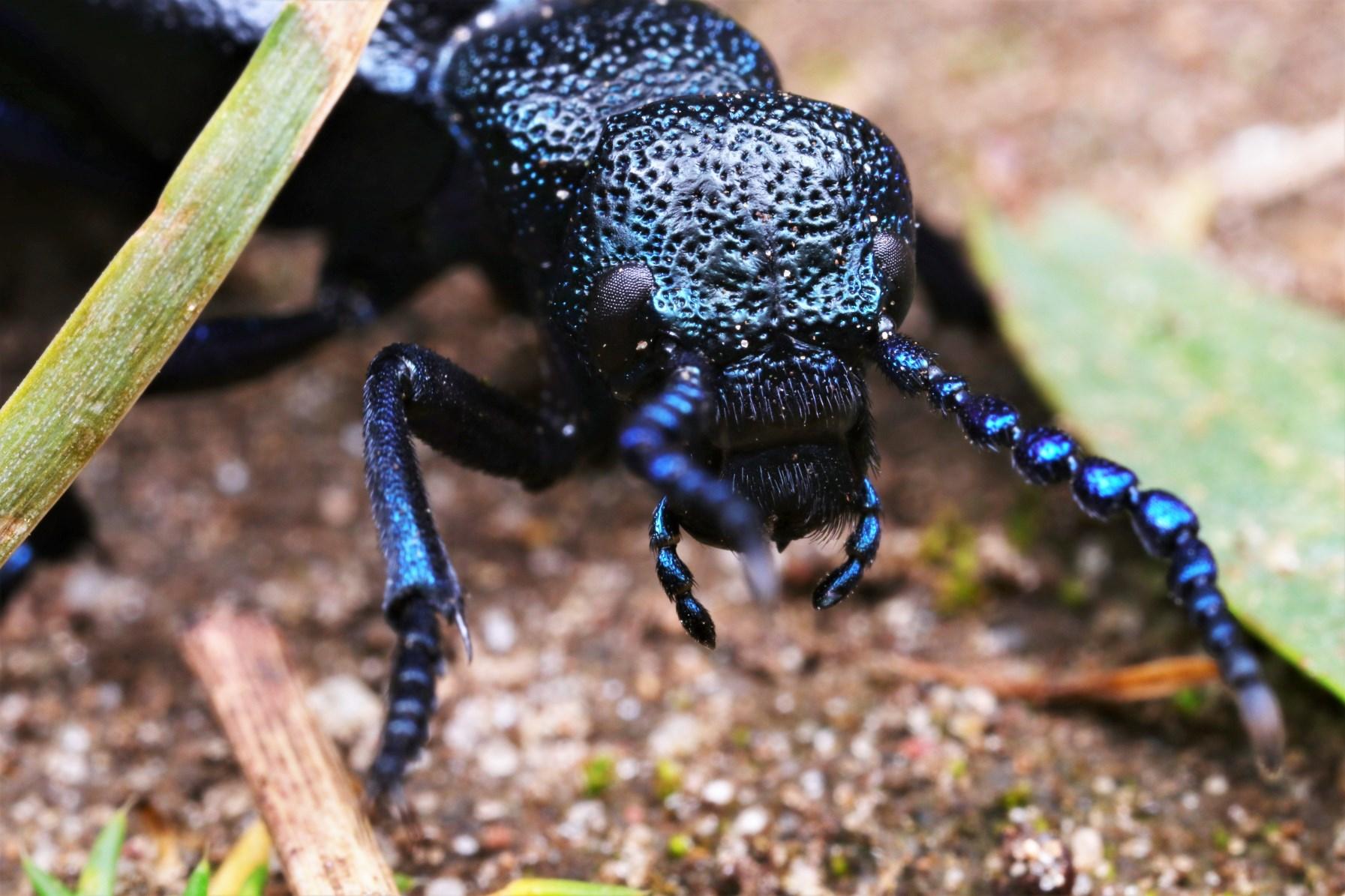
The charity Buglife has put together a good guide on these beetles, which is free to download on their website (https://cdn.buglife.org.uk/2019/08/Oil-Beetle-nationalsurvey-leaflet-for-web_5-species.pdf).
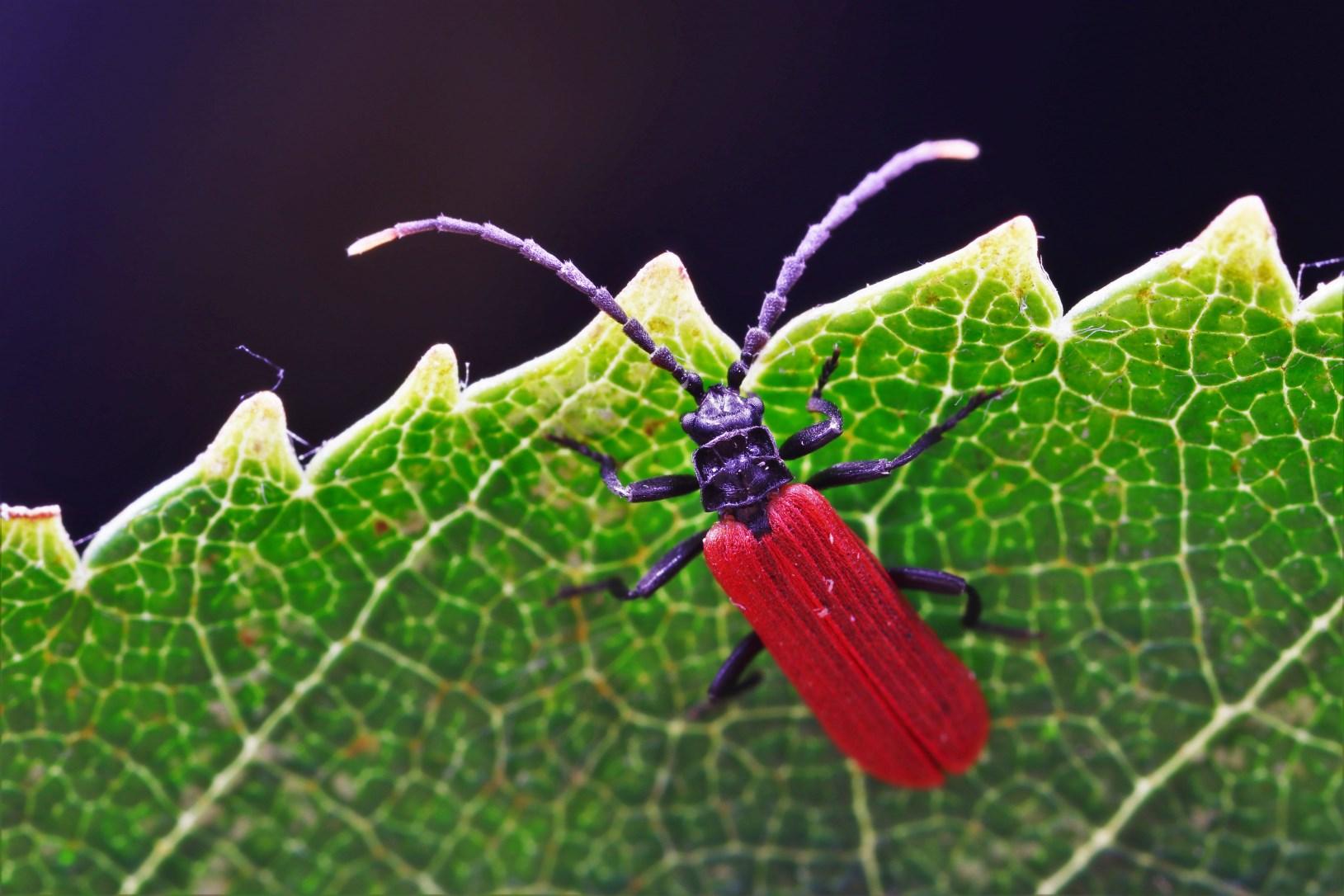
Other species of note from my limited Suffolk forays this year was the net-winged beetle Platycis minutus from Priestly Wood in Barking. The larvae of this species also depend on wood and the adults are to be found later in the season.
Black Oil Beetles Meloe proscarabaeus continue to cling on near Wordwell with a small number of individuals seen at the start of the season. Oil Beetles are generally very scarce in East Anglia.
Ross Piper
The net-winged beetle Platycis minutus is an easily overlooked late summer species, predominantly of ancient woodland. This specimen was seen in September in Priestley Wood near Barking.
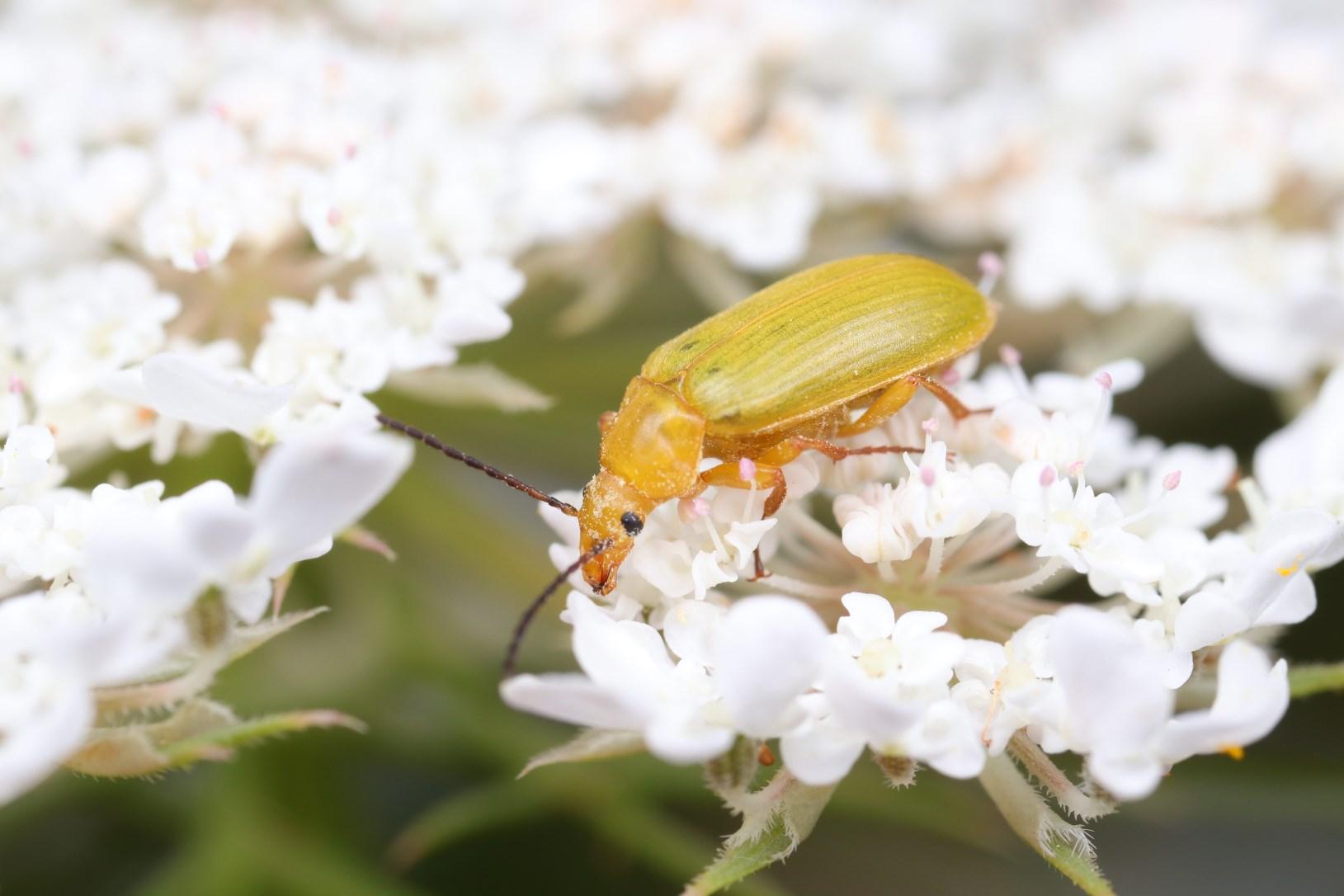
During the hot spells in the summer, the meadow I’ve created in the back garden,
The Sulphur beetle is specialist of dry habitats, especially coastal sites and the Brecks. This specimen was found in a meadow created in my back garden in Barking.
Ross Piper
Ross Piper
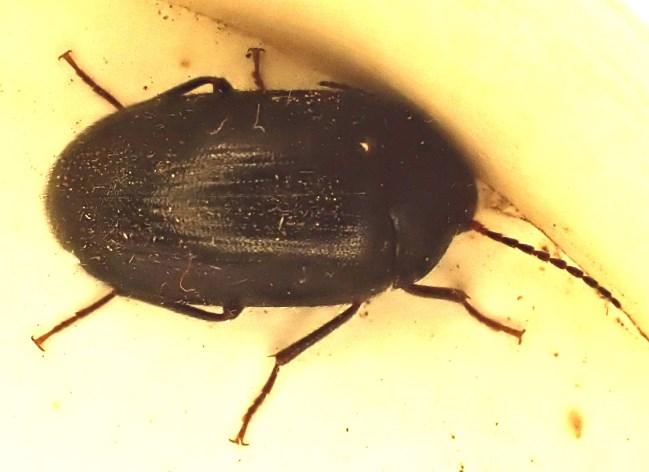
Another darkling beetle, albeit a much scarcer one was found by Jerry Bowdrey in his moth trap on 10 July in Kelsale. Prionychus melanarius is a very scarce species with few recent records, although it has been found previously in Suffolk. It is associated with dead and decaying trees –the larvae consuming organic matter that accumulates in the hollows within old trees. Like many other beetles, the adults are nocturnal and will come to moth traps, etc.
Two seed beetles, probably new to Suffolk, were recorded by Howard Mendel. Bruchidius siliquastri was found on Judas tree in Woodbridge. Bruchidius varius was found on Trifolium incarnatum in Blaxhall in May.
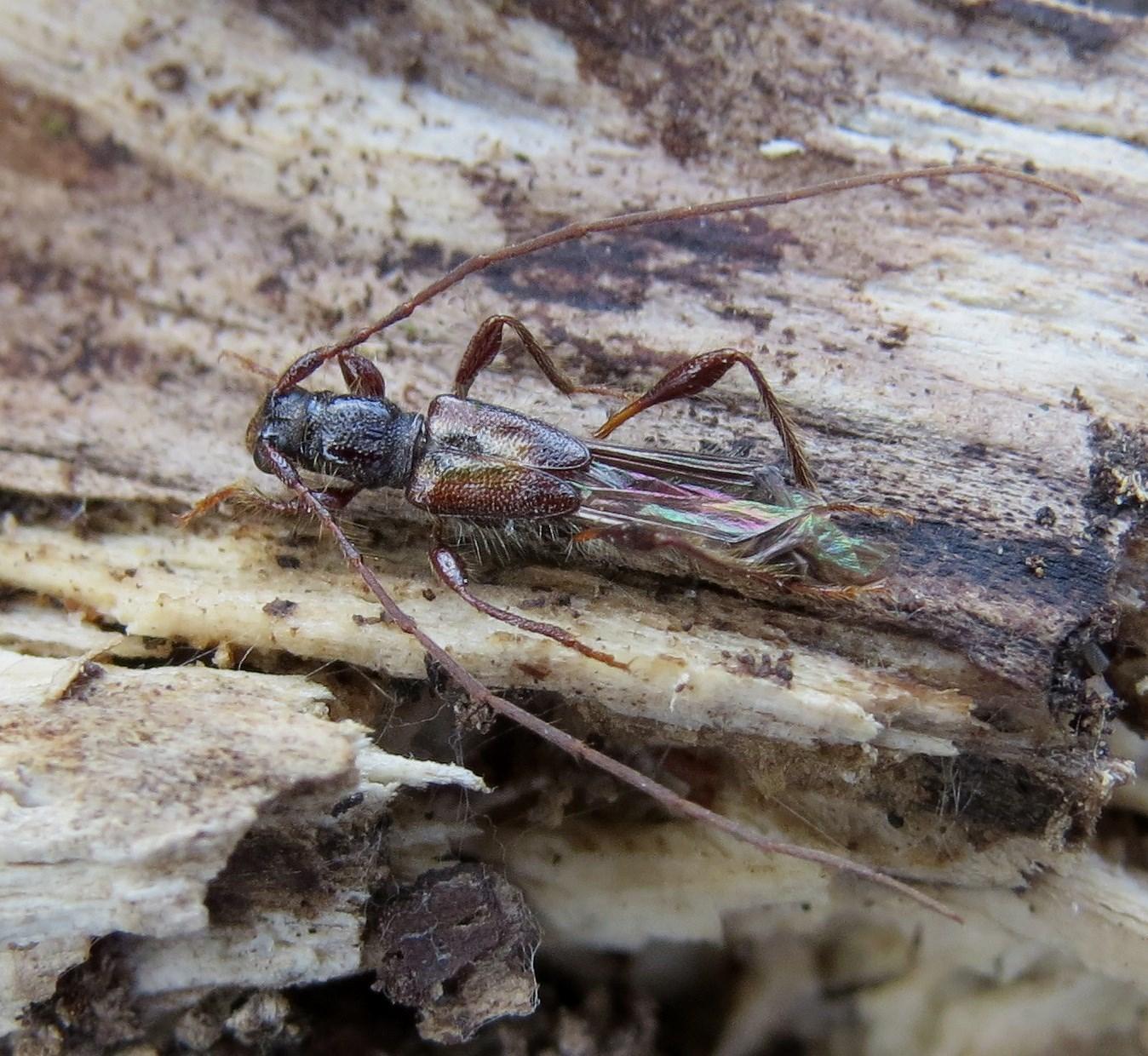
Martin Rejzek visited Fakenham Wood on 22 June and recorded a number of beetle species, most interesting was which was the small, but distinctive longhorn
Ross Piper
Ashburnham Farm, Needham Road
Barking, Suffolk, IP6 8HJ coleoptera@sns.org.uk
Jerry Bowdrey
Prionychus melanarius
Steven Falk
Introduction
THE DIPTERA OF SUFFOLK PETER VINCENT
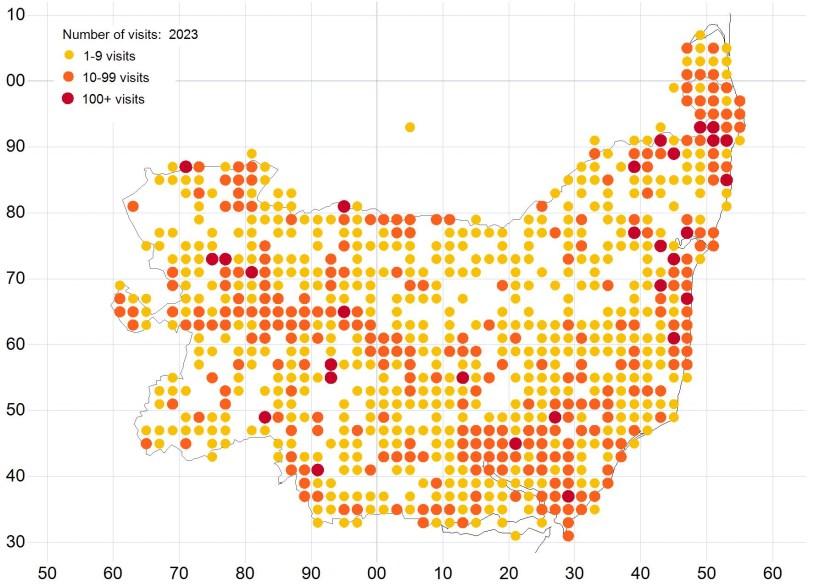
The records that form this checklist are from the Watsonian vice-counties of East (v.c. 25) and West (v.c. 26) Suffolk which are of greater extent than the modern administrative county boundaries of Suffolk. Diptera are not well recorded in Suffolk, with few records of even quite common species. Therefore, records are in the main collected at monad (O.S.1km square) or greater accuracy, although, in order to assess the relative abundance and distribution of a diptera species the hectad (O.S.10km square) is used as the base recording unit. Suffolk comprises of 54 hectads or part hectads.
In this checklist of Suffolk Diptera, the arrangement of families follows as set out in Chandler (1998) and updates (Dipterists Forum, 2024). The classification of British diptera starts with the Lower Diptera (Nemotercera) followed by the Brachycera. Within families, all taxa are listed alphabetically. Altogether there are at present 107 families of diptera recognised within the British fauna, and the British Isles list of diptera currently (October 2024) runs to some 7270 species, of which 39 are recorded from Ireland only (Chandler, 2024).
The layout of the checklist is that for each family the first division is by genus followed by species in alphabetical order. Subfamilies and tribes are also recognised for most families: and the genus can also be divided at subgenus level. For every individual species the species name (in bold type) is followed by the authority, then details of the first record of that species from Suffolk including - place, date (with as much accuracy as possible) and recorder (where known). To give an indication of the distribution and the abundance of each species this is followed by a list of all the hectads each species has occurred in and the number of known records (in square brackets).
Part Seven: Syrphididae, Pipunculidae.
The first three parts of the checklist list all the known Suffolk species of the twentyfive families of the Lower Diptera suborder. Part Four started the second suborder of Diptera, the Brachycera. The Brachycera contains the remaining six infraorders of the British diptera, a total of eighty-one families. The first four infraorders, Xylophagomorpha, Tabanomorpha, Stratiomyomorpha and Asilomorpha, were covered in Part Four. The fifth infraorder, the Eremoneura, comprises of the Empidoidea and the Cyclorrhapha. The Empidoidea was catalogued in Part Five of the checklist. The Cyclorrhapha contains the remaining three superfamilies: Platypezoidea, Lonchopteroidea and Syrphoidea (known collectively as the Lower Cyclorrhapha), and the section Schizophora. Part Six of the checklist dealt with the first two of these superfamilies: the Platypezoidea and Lonchopteroidea. Part Seven deals with the superfamily Syrphoidea. The Syrphoidea contains two families, the Syrphididae and Pipunculidae.
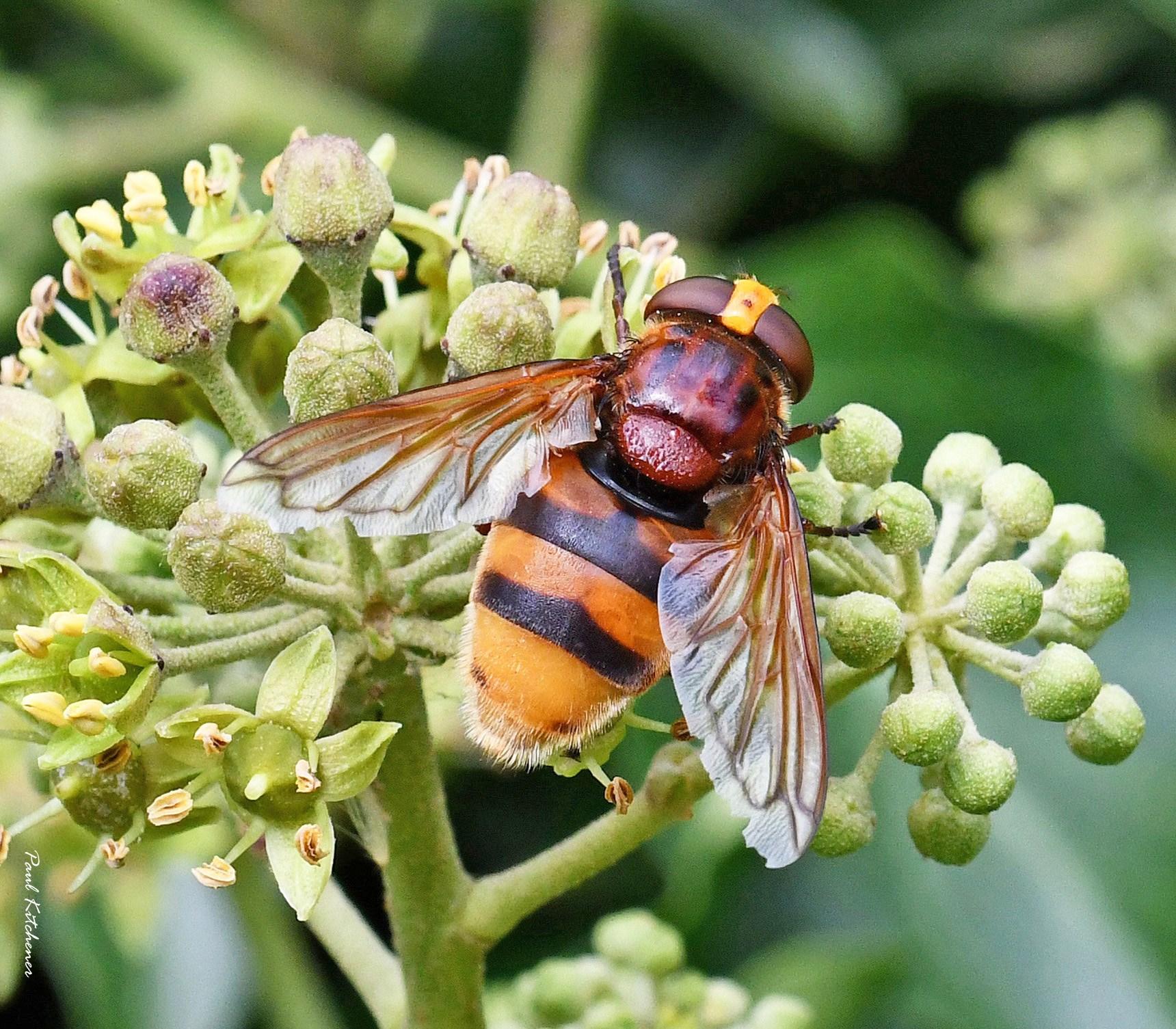
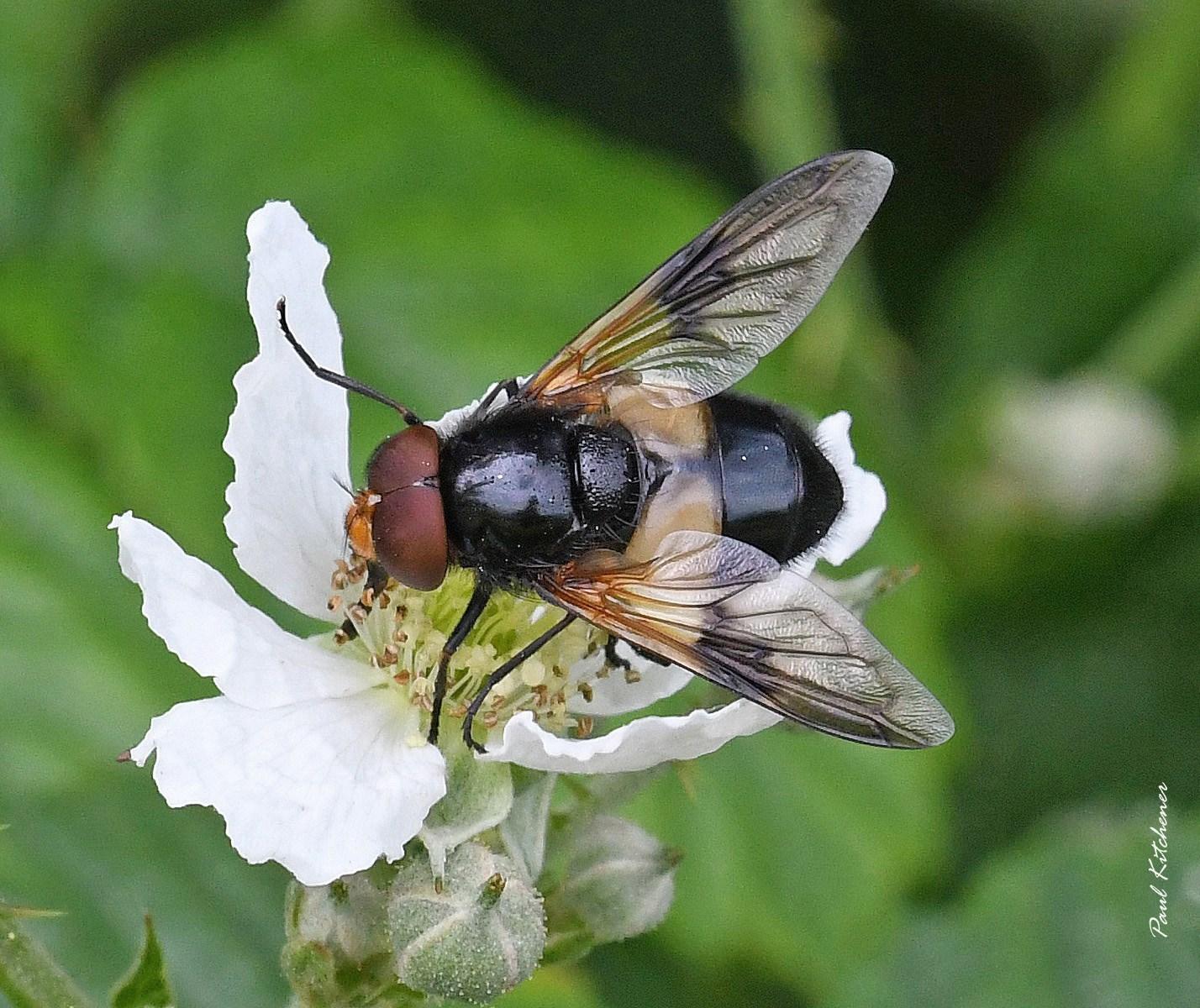
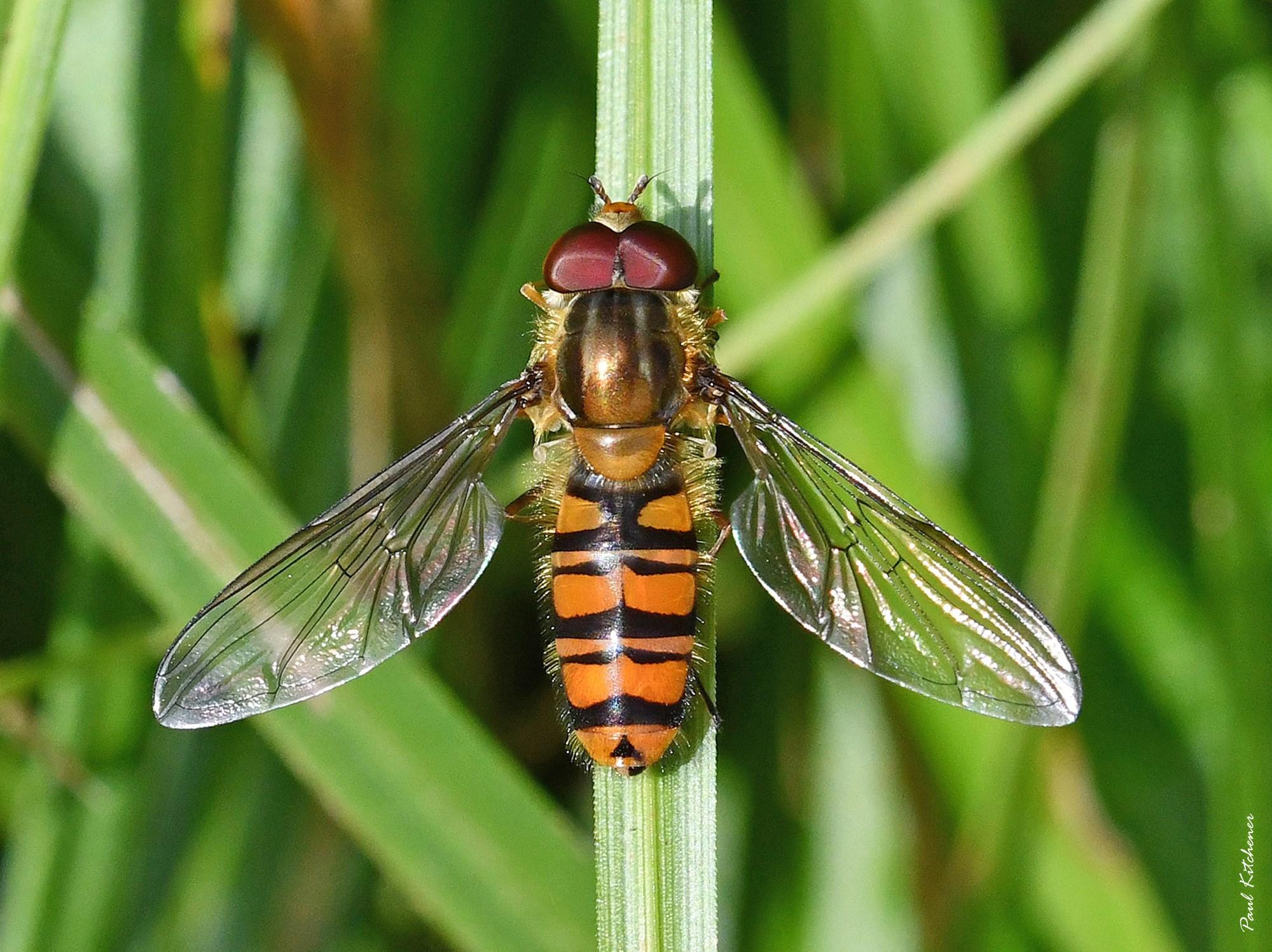
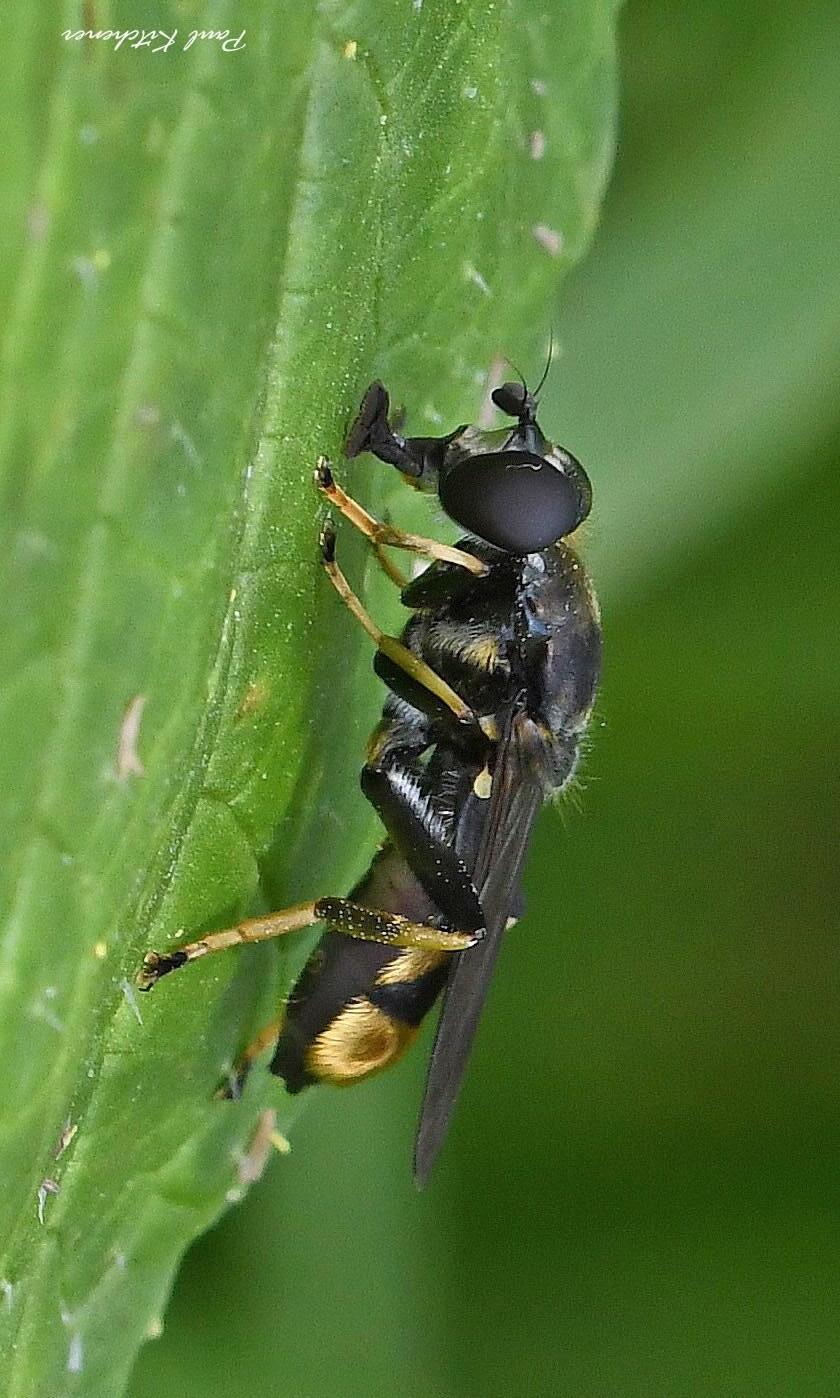
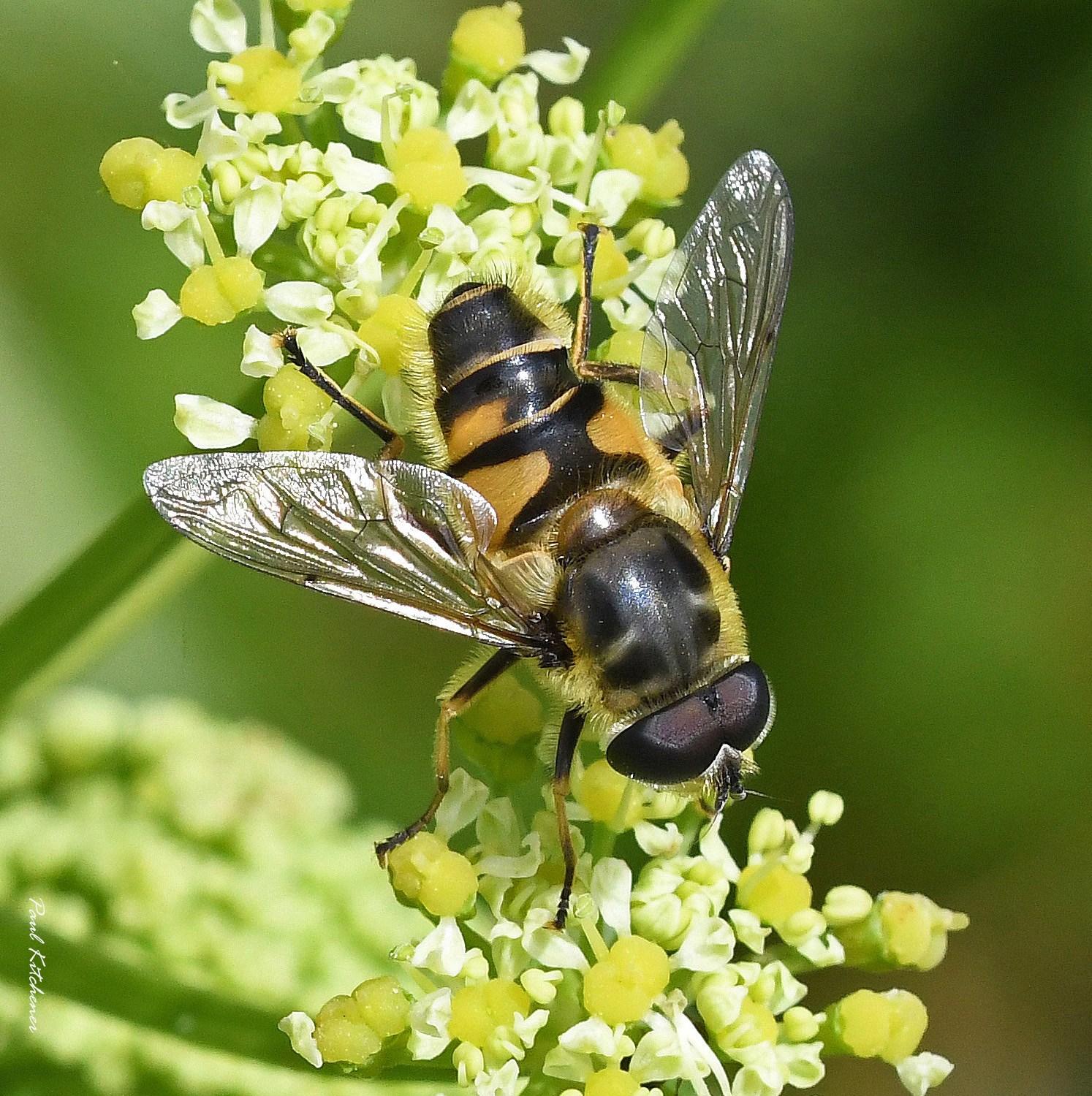
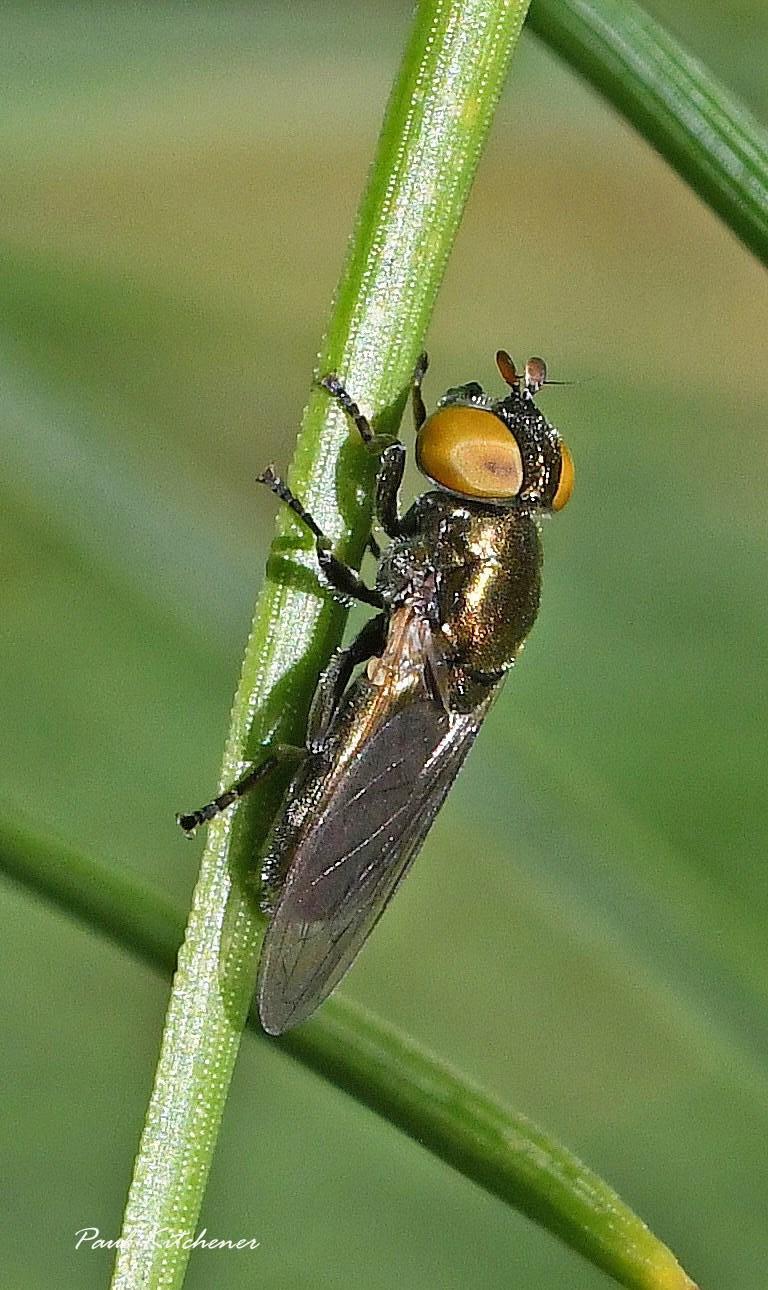
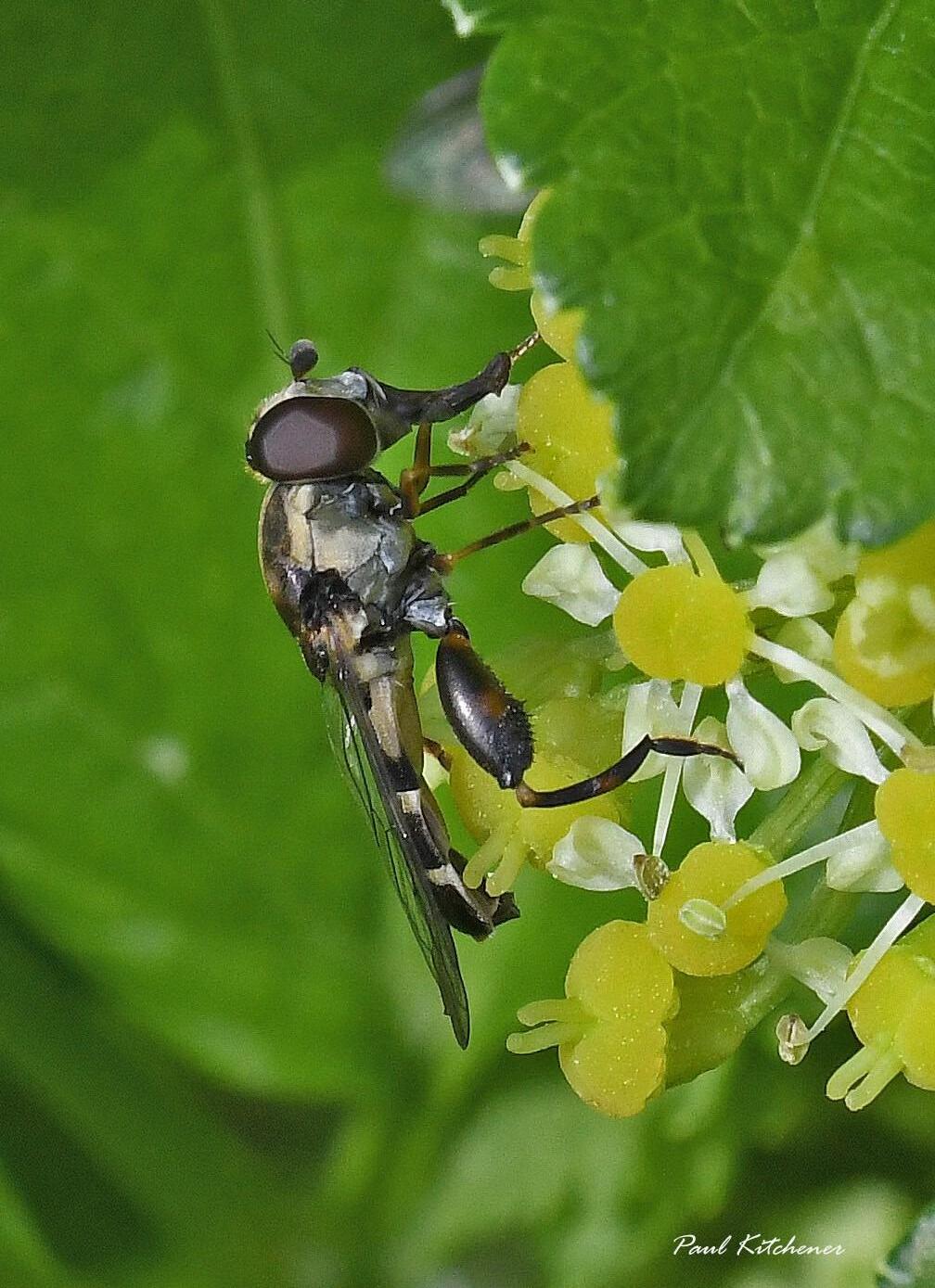
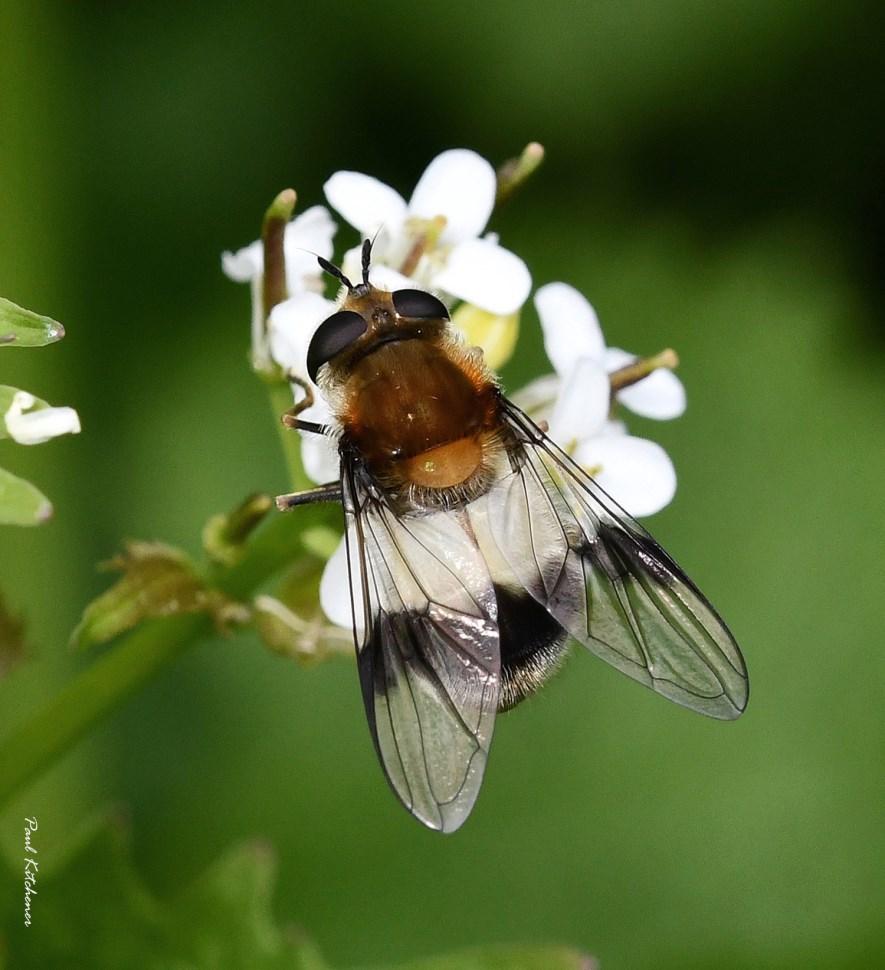
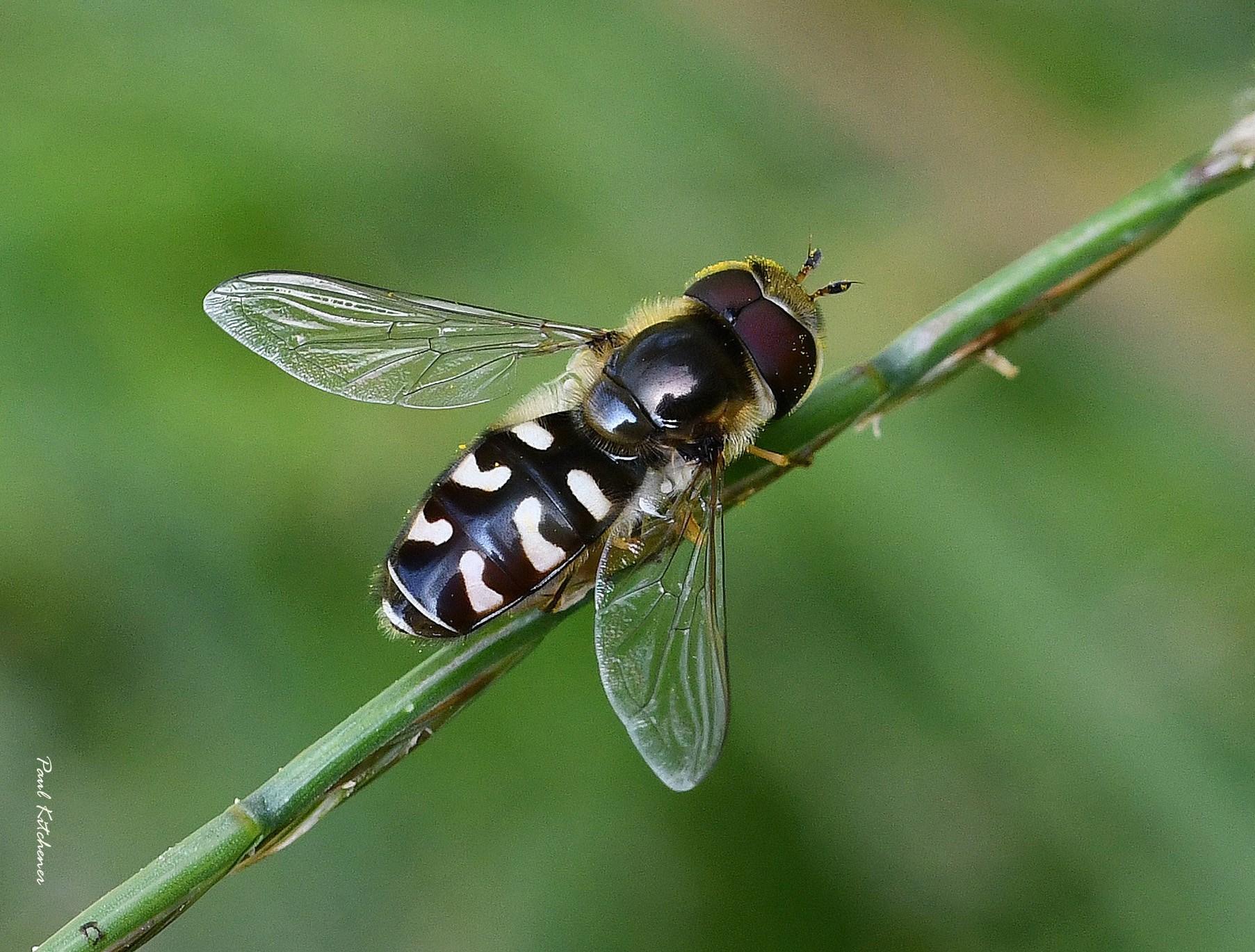
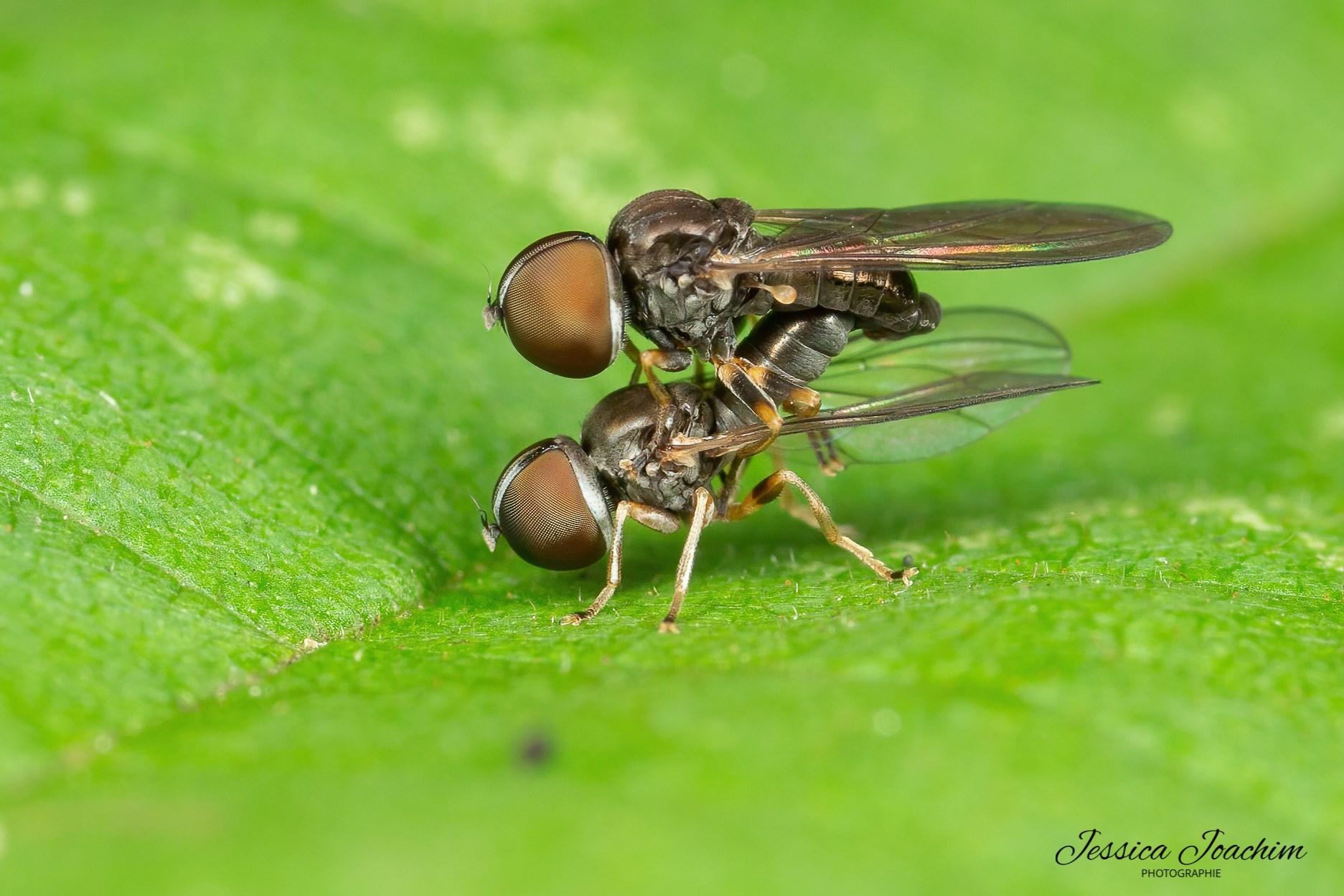
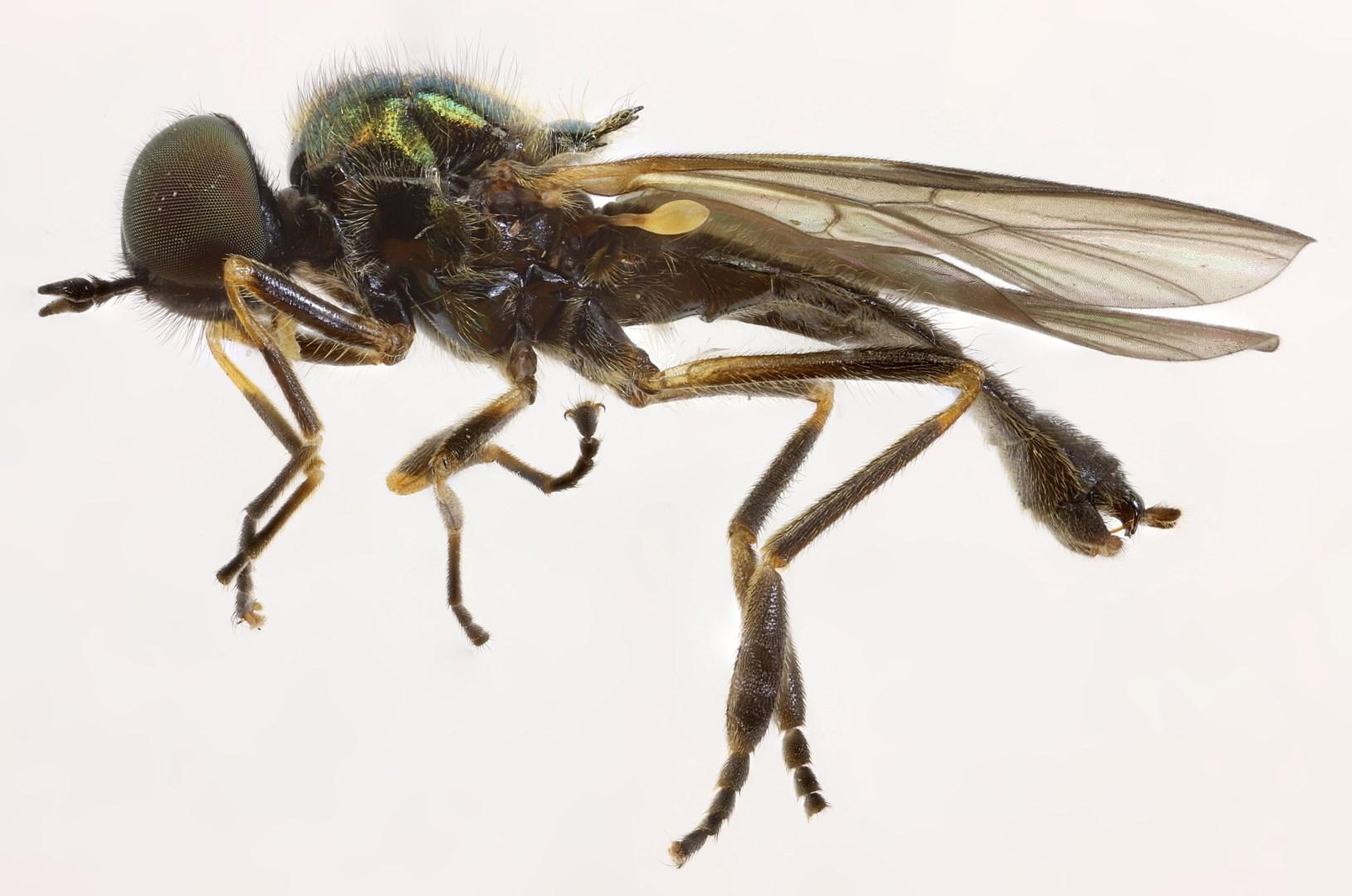
The Syrphidae are commonly known as hoverflies, perhaps the most familiar family of flies and by far the most recorded. Though variable in size, shape and colour it is fairly easy to recognise hoverflies. Hoverflies are separated from bees and wasps by their short antennae and from other flies such as the housefly by the lack of bristles on the body. Behaviour is also important, and the ability to hover is an obvious characteristic. Hoverflies possess a modification to the wing, a false vein (vena spuria) that permits the wing to flex in the middle, thereby allowing the fly to hover using simple up and down wingbeats. A number of familiar Syrphid species have yellow and black markings covering the abdomen and/or thorax in order to mimic bees and wasps to ward off predators, although many species are less well marked, and some entirely black. Adult flies vary in size from the smallest Neoascia at about 4mm in length to the impressive Volucella zonaria (Poda,1761) at 20mm. The adults of many species feed chiefly on nectar and pollen, and are important pollinators of flowering plants and crops, while the larvae eat a wide range of foods. In some species, the larvae are saprotrophs, eating decaying plant and animal matter in the soil or in ponds and streams. In other species, the larvae are insectivores, preying on aphids, thrips, and other plant-sucking insects. A number of species of hoverfly are migrants. The very common and distinctive Episyrphus balteatus (De Geer, 1776) - the marmalade fly, migrates to Britain each summer, this is occasionally in vast numbers; this is thought to be an adaptation to exploit explosions in aphid populations. This is the commonest hoverfly recorded and the most recorded species of fly recorded from Suffolk. It has been seen in every month of the year and is likely to occur in every monad in the county.
Hornet mimic hoverfly Volucella zonaria
Paul Kitchener
Marmalade Hoverfly Episyrphus balteatus
Paul Kitchener
Volucella pellucens
Paul Kitchener
Syritta pipiens
Riponnensia splendens
Myathropa florea
Paul Kitchener
Paul Kitchener
Paul Kitchener
Paul
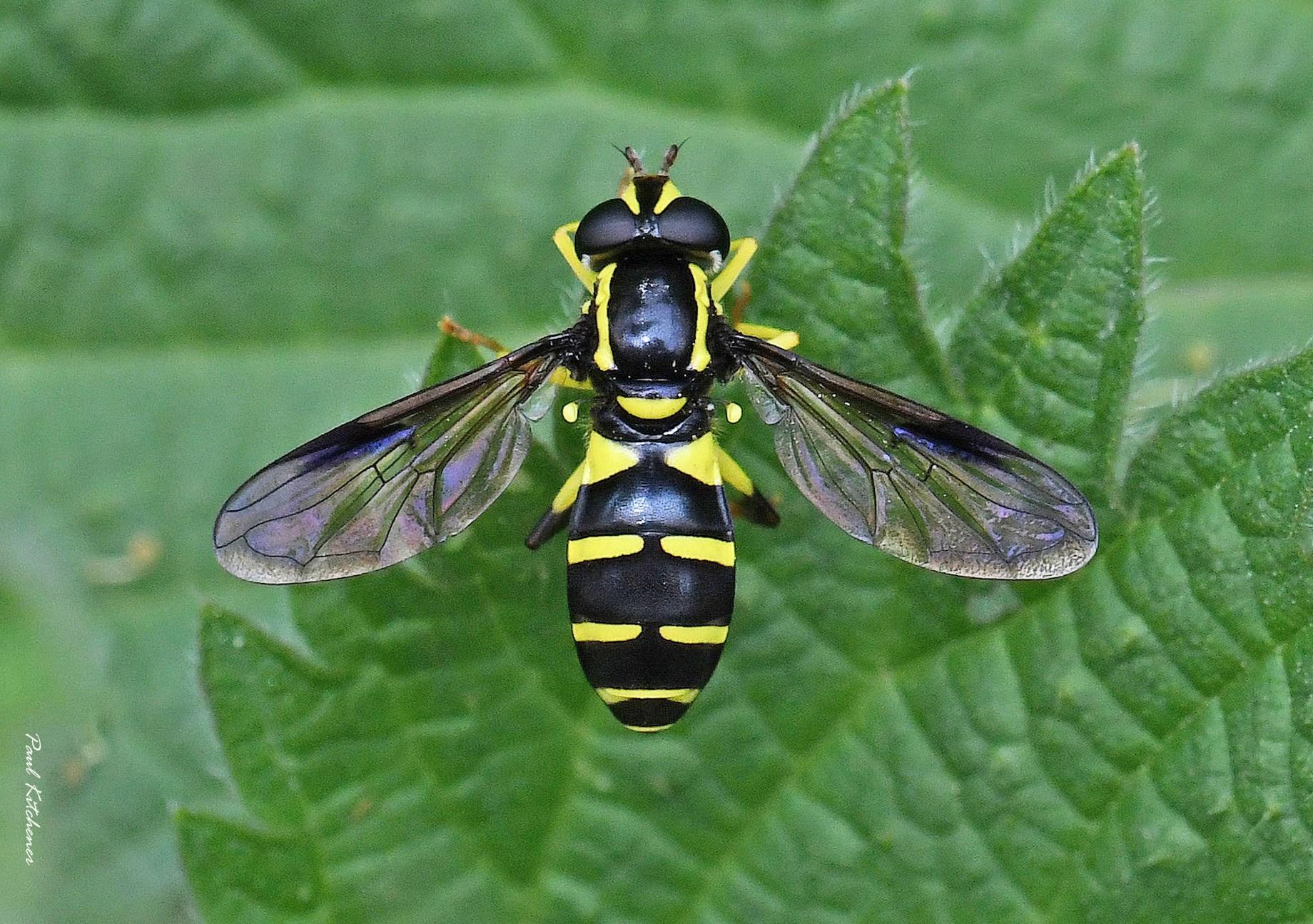
compared to other dipteran families. It is therefore possible to get an accurate assessment of the conservation status of British hoverflies, critiqued by Ball & Morris (2014). For the species that have been recorded from Suffolk, Paragus albifrons (Fallén, 1817) is considered Critically Endangered. This however is an historical record, having not been recorded from the county since 1895. Callicera spinolae Rondani, 1844 is classified as Vulnerable. In Britain this species has only been found in East Anglia with most records coming from Suffolk. Lejops vittatus (Meigen, 1822), Melangyna barbifrons (Fallén, 1817), Microdon devius (Linnaeus, 1761) and Sphaerophoria loewi Zetterstedt, 1843 are considered Near Threatened. Brachyopa bicolor (Fallén, 1817), C. aurata (Rossi, 1790), C. rufa Schummel, 1842, Cheilosia barbata Loew, 1857, C. cynocephala Loew, 1840, C. mutabilis (Fallén, 1817), C. nebulosa Verrall, 1871, C. velutina Loew, 1840, Chrysotoxum elegans Loew, 1841, Didea intermedia Loew, 1854, Epistrophe melanostoma (Zetterstedt, 1843), Eupeodes nielseni (Dušek & Láska, 1976), E. nitens (Zetterstedt, 1843), Mallota cimbiciformis (Fallén, 1817), Meligramma euchromum (Kowarz, 1885), M. guttatum (Fallén, 1817), Myolepta dubia (Fabricius, 1805), Neoascia interrupta (Meigen, 1822), Neocnemodon brevidens (Egger, 1865), N. latitarsis (Egger, 1865), N. pubescens (Delucchi & PschornWalcher, 1955), Parasyrphus nigritarsis (Zetterstedt, 1843), Parhelophilus consimilis (Malm, 1863), Pipiza lugubris (Fabricius, 1755), Pipizella masculinise (Meigen, 1822), Platycheirus discimanus Loew, 1871, P. immarginatus (Zetterstedt, 1849), P. sticticus (Meigen, 1822), Triglyphus primus Loew, 1840, Xylota abiens Meigen, 1822, X. tarda Meigen, 1822 and X. xanthocnema Collin, 1939 are all classified as Nationally Scarce (species occurring in 16-100 hectads). C. psilophthalma Becker, 1874 is a recent addition to the British list consequently it was difficult to make any judgement of its
Xanthogramma pedissequum
Paul Kitchener
true distribution and was therefore considered Data Deficient. Another recent addition to the British list is Chalcosyrphus piger (Fabricius, 1794). It was first recorded by Alan Thornhill at West Stow Country Park in July 2021. (Thornhill, Pennards & Morris, 2022; and see photo in Vincent, 2022).
A number of modern taxonomic reviews and revisions of some families, described in Ball, Morris, Rotheray & Watt (2011) have resulted in older records of some species being excluded from the checklist. C. albitarsis (Meigen, 1822) was separated from C. ranunculi Doczkal, 2000 in 2000 therefore prior records have not been included. Anasimyia contracta Claussen & Torp, 1980 was confused with A. transfuga (Linnaeus, 1758) and A. interpuncta (Harris, 1776) with A. lunulata (Meigen,1822), therefore older records of these species are considered suspect and have not been included. Before the revision of the Paragus genus in 1978, the only species were P. tibalis (Fallén, 1817) and P. albifrons, but earlier specimens of P. tibalis checked were found to be mostly P. haemorrhous Meigen 1922. Therefore, all pre-1978 records of P. tibalis must be considered doubtful and have not been included. Xanthogramma stackelbergi Violovitsch, 1975 was added to the British list in 2012, meaning that all old records of X. pedissequum (Harris, [1776]) without accompanying voucher material or a good supporting photo can no longer be assigned to species level. There are 289 British species of which 208 have been recorded from Suffolk. Pipunculidae, or big-headed flies, can be readily identified at family level by their large compound eyes that cover almost their entire head. Due to the small to medium sized adults (2-9 mm in length), their uniform dark appearance and their rather cryptic lifestyle, they are hard to detect in the field and are often caught rather serendipitously. Pipunculids can be found in a variety of habitats where they are
Paul Kitchener
Paul Kitchener
Leucozona lucorum
Scaeva pyrastri
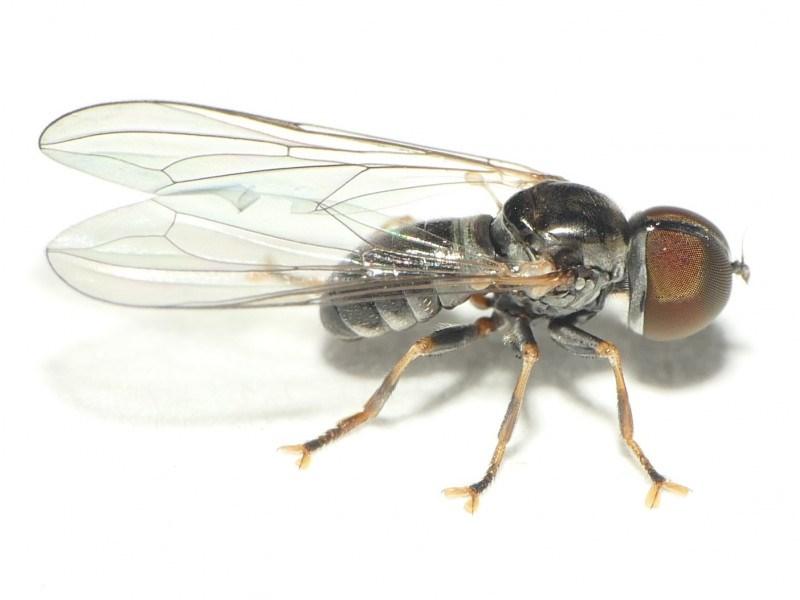
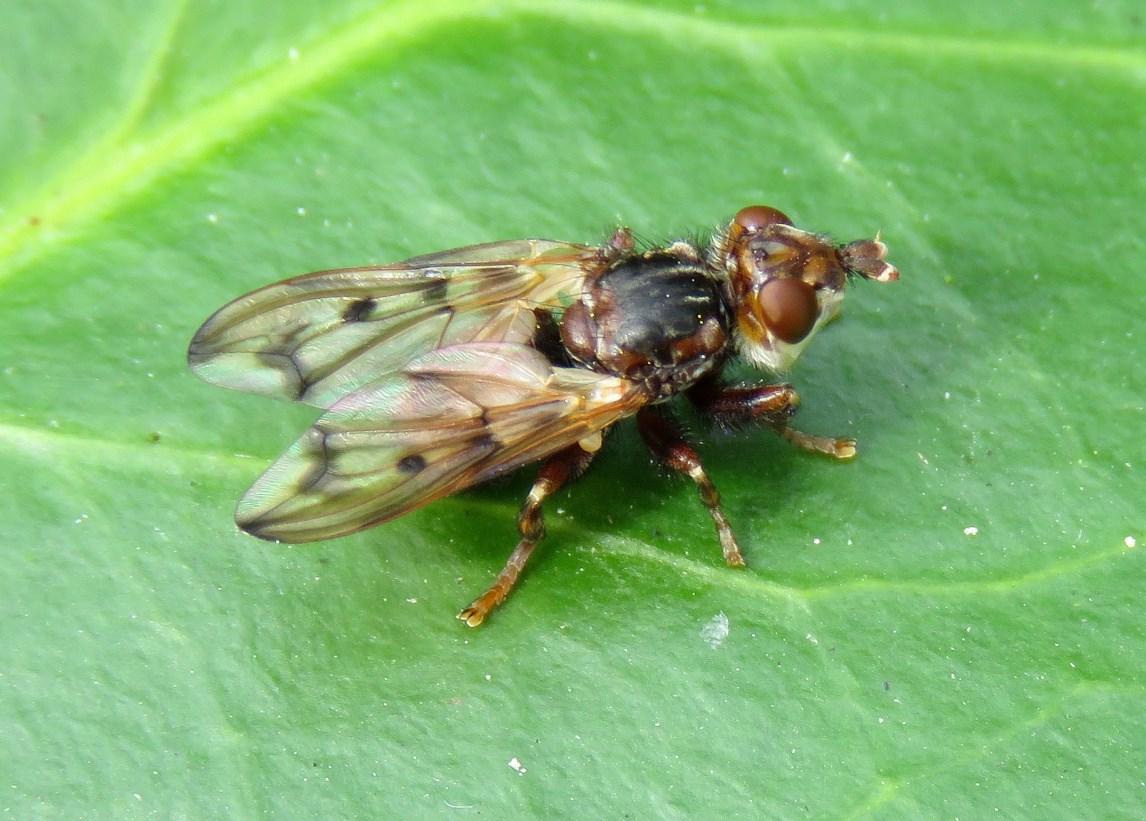
hovering in between herbal vegetation or among leaves of bushes and trees, searching for food sources (mainly honeydew), mating partners or for suitable larval hosts. Their larvae are important endoparasitoids of nymphal and adult Auchenorrhyncha (Chalarinae and Pipunculinae) and adult Tipulidae (Nephrocerinae). This highly specialized lifestyle is unique to this family of Diptera. In the past there has been much confusion over Pipunculidae taxonomy, and many older records are now considered unreliable. Even the standard British work (Coe, 1966), although remarkable for its time, has many limitations. There has been a significant advance in the knowledge of this family and more recent works, primarily by Christian Kehlmaier e.g. (Kehlmaier, 2005), have clarified and revised the European Pipunculidae taxonomy. Therefore, I have decided not to use the earlier paper in the Transactions (Aston, 1959), which describes many of Morley’s and earlier records. Undoubtedly many of these records would still be valid, but I have chosen to use more recent records, unless supported by additional collaborating references.
The species review by Falk & Chandler (2005), although in need of revision, classified the Suffolk species Dorylomorpha clavifemora Coe, 1966 as Vulnerable, Cephalops perspicuus (de Meijere, 1907), Dorylomorpha rufipes (Meigen, 1824), Eudorylas arcanus Coe, 1966, E. kowarzi (Becker, 1898), Tomosvaryella minima (Becker, 1898) as Near Threatened C. straminipes (Becker, 1900), C. pannonicus (Aczél, 1939), Cephalosphaera germanica Aczél, 1940, Claraeola halterata (Meigen, 1838), C. melanostola (Becker, 1898), Dasydorylas horridus (Becker, 1898), E. terminalis (Thomson, 1869), E. zermattensis (Becker, 1898), Pipunculus elegans Egger, 1860 as Nationally Scarce and E. fusculus (Zetterstedt, 1844), Microcephalops opacus (Fallén, 1816) as Data Deficient. Of the 99 British species 51 have been recorded from Suffolk.
Dick Belgers
Records for this section of the checklist come mainly from Suffolk Biodiversity Information Service (SBIS), the Dipterists Forum Hoverfly Recording Scheme and the National Biodiversity Network (NBN), with historical records from the Transactions of the Norfolk & Norwich Naturalists’ Society (Morley & Atmore, 1915) and the Transactions of the Suffolk Naturalists’ Society (George & Aston, 1960, George & Aston, 1961). Other records were obtained from Falk & Chandler (2005), Kehlmaier (2005) and Kehlmaier & Assmann (2008).
A few records have been italicised and these records whether for, rarity, location, habitat or date should be considered doubtful. These records have been retained in the checklist until further checks can be done on any possible voucher specimens to support the record. These records have not been included in the species totals.
References
Ashton, A. E. (1959). The Diptera of Suffolk (continued). Family xxviii: Pipunculidae (Dorilaidae) Trans. Suffolk Nat. Soc., 11 (1): 54-58.
Ball, S. G., Morris, R. K. A., Rotheray, G. E. & Watt, K. R. (2011). Atlas of the Hoverflies of Great Britain (Diptera, Syrphidae). Wallingford, Biological Records Centre.
Ball, S. G. & Morris, R. K. A. (2014). A review of the scarce and threatened flies of Great Britain. Part 6: Syrphidae. Species Status 9: 1-130 Joint Nature Conservation Committee, Peterborough. Chandler, P. J. (ed.) (1998). Checklists of Insects of the British Isles (New Series). Part 1; Diptera. Handbooks for the Identification of British Insects 12 (1): 1-234.
Chandler, P. J. (2024). Corrections and Changes to the Diptera Checklist (52) - Editor Dipterists Digest (Second Series) 31 (2): 208-211.
Coe, R. (1966). Diptera Pipunculidae. Handbooks for the Identification of British Insects 10 (2c): 1-83.
Dipterists Forum. (2024). An Update of the 1998 Checklist of Diptera of the British Isles (updated 5 July 2022) Dipterists Forum [online] http://www. dipterists.org.uk/checklist/ [Accessed 25 October 2024].
Falk, S. J. & Chandler, P. J. (2005). A review of the scarce and threatened flies of Great Britain. Part 2: Nematocera and Aschiza not dealt with by Falk (1991). Species Status 2: 1-189. Joint Nature Conservation Committee, Peterborough. George, W. S. & Aston, A. E. (1960). The Diptera of Suffolk. Family xxix: Syrphidae - Hover Flies. Trans. Suffolk Nat. Soc., 11 (4): 314-320.
George, W. S. & Aston, A. E. (1961). The Diptera of Suffolk. Family xxix: Syrphidae - Part Two. Trans. Suffolk Nat. Soc., 11 (5): 403-411.
Kehlmaier, C. (2005). Taxonomic revision of European Eudorylini (Diptera, Pipunculidae). Verhandlungen des Naturwissenshaftlichen Vereins in Hamburg (NF), 41, 45-353.
Kehlmaier, C. & Assmann, T. (2008). The European Species Of Chalarus Walker, 1834 Revisited (Diptera: Pipunculidae) Zootaxa 1936: 1-39.
Morley, C. & Atmore, E. A. (1915). The Diptera of Norfolk and Suffolk. Transactions of the Norfolk & Norwich Naturalists’ Society 10: 1-180.
Thornhill, A., Pennards, G. W. A. & Morris, R. K. A. (2022). Chalcosyrphus piger (Fabricius) (Diptera, Syrphidae) new to Britain. Dipterists Digest (Second Series) 29(1): 84-86.
Vincent, P. (2022). Diptera Report 2022. Trans. Suffolk Nat. Soc., 58: 67-70.
Suffolk Diptera Checklist (Part Seven)
SYRPHIDAE
ANASIMYIA Schiner, 1864
contracta Claussen & Torp, 1980 - Barham, 21 June 1988, A. Hubbard TG 50
TL 67,77,78,84,86,94 TM 03,06,07,13,14,15,16,17,24,25,34,35,37,44,46,47,48,49, 59 [65]
interpuncta (Harris, 1776) - Holton, 18 June 1963, W.A. George TL 68,78,83,84
TM 37 [9]
lineata (Fabricius, 1787) - Thorpeness, 15 June 1962, W.A. George TL 68,78,87,97
TM 07,24,25,28,35,37,46,47,48.49,59 [80]
transfuga (Linnaeus, 1758) - Holton, 26 July 1965, W.A. George TL 68
TM 24,26,35,37,46,47,48,49 [25]
BACCHA Fabricius, 1805
elongata (Fabricius, 1775) - Bentley Woods, 27 May 1900, C. Morley TG 50
TL 68,74,76,77,78,83,84,86,87,88,93,94,95,97
TM 04,05,07,13,14,15,17,23,24,25,26,34,35,36,37,44,45,46,47,48,49,57 [135]
BRACHYOPA Meigen, 1822
bicolor (Fallén, 1817) - Timworth, 12 June 1909, C.G. Nurse TL 77,78,86
TM 14,34,45 [9]
insensilis Collin, 1939 - Ixworth, 17 May 1992, C. Plant TL 76,77,87,97 [4]
scutellaris Robineau-Desvoidy, 1843 - Sotterley Park, 13 May 1989, I. Perry
TL 65,78,83,84,86,95,98 TM 04,25,34,46,47,48,49 [31]
BRACHYPALPOIDES Hippa, 1978
lentus (Meigen, 1822) - Copdock, 1901, J.H. Hocking TL 83,87,93,95
TM 04,13,14,24,25,34 [24]
BRACHYPALPUS Macquart, 1834
laphriformis (Fallén, 1816) - Staverton Thicks, Wantisden 1 June 1952, L. Parmenter TL 77,86 87 TM 24,34,35,45 [10]
CALLICERA Panzer, 1809
aurata (Rossi, 1790) - Cavenham Heath, 12 March 1995, I. Perry TL 77 [2]
rufa Schummel, 1842 - Boyton, 30 July 2019, J. Pilgrim TM 34 [1]
spinolae Rondani, 1844 - Thorndon, 26 September 1924, H.A. Harris
TM 14,16,17,26,45,57 [9]
CHALCOSYRPHUS Curran, 1925
Subgenus XYLOTINA Hippa, 1978
nemorum (Fabricius, 1805) - Barham, 27 May 1899, C. Morley TL 68,77,78,86,97
TM 03,04,05,15,24,34,45,46,47,48,49,59 [66]
Subgenus XYLOTOMIMA Shannon, 1926
piger (Fabricius, 1794) - West Stow, 3 July 2021, A. Thornhill TL 77 [1]
CHEILOSIA Meigen, 1822
albipila Meigen, 1838 - Bentley Woods, 1903, C. Morley TL 77,95
TM 13,15,25,34,37,39,46,47 [16]
albitarsis (Meigen, 1822) - Thorpeness, 3 June 1962, W.A. George
TL 68,78,85,94,95,96
TM 03,04,05,06,07,14,16,24,25,27,28,34,35,36,37,38,39,44,45,46,47,48,49,57 [96]
antiqua (Meigen, 1822) - Bonny Wood, Barking Tye, 24 May 1992, A. Stubbs TM 05 [1]
barbata Loew, 1857- Assington, 11 May 1920, B.S. Harwood TL 78,87,88,93,98
TM 07,37,45,47 [19]
bergenstammi Becker, 1894 - Redgrave Fen, 11 May 1966, W.A. George
TL 67,68,77,78,87,88,95,97,98 TM 03,07,15,24,25,34,35,37,44,45,46,47,48,49 [57]
caerulescens (Meigen, 1822) - Ipswich, 29 July 2020, A. King TG 50 TL 77,88
TM 03,14,23 [20]
cynocephala Loew, 1840 - Newmarket, May 1881, G.H. Verrall, TL 66,87,97 TM 39 [6]
fraterna (Meigen, 1830) - Barnby Broad, May 1905, C. Morley TL 68,78,93,95,97
TM 04,05,07,24,25,34,35,37,45,46,47,48,49 [65]
griseiventris Loew, 1857 - Thornham Magna, 20 September 1998, I. Perry
TM 13,17,25,35,37,44,45,46,48,49,59 [15]
grossa (Fallén, 1817) - Aldeburgh, 22 April 1962, W.A. George
TL 68,77,78,87,88,94,95 TM 07.14,15,24,25,34,37,45,46,57 [38]
illustrata (Harris, 1780) - Corton, 6, July 1936, E. Ellis TG 50
TL 64,65,66,68,75,76,77,78,84,85,86,87,88,94,95,97
TM 03,04,05,06,07,13,14,15,16,17,23,24,25,26,33,34,35,36,37,38,45,46,47,59 [243]
impressa Loew, 1840 - Dunwich, 28 May 1952, L. Parmenter TG 50
TL 67,68,77,78,83,86,87,88,93,94,95,96,97,98
TM 03,04,05,07,13,14,17,24,25,28,34,35,36,45,46,47,49 [182]
lasiopa Kowarz, 1885 - Cosford Hall, Aldham, 8 May 1994, A. Hubbard
TL 76,77,78,86,87,88,9398 TM 04,07,37,45,47 [34]
latifrons (Zetterstedt, 1843) - Redgrave and Lopham Fen, 1978-1985, P. Withers
TL 67 TM 07,44 [3]
longula (Zetterstedt, 1838) - Ampton, 15 June 1913, C.G. Nurse TL 87 TM 47 [2] mutabilis (Fallén, 1817) - Holton, 7 May 1962, W.A. George TL 98 TM 37,46 [4]
nebulosa Verrall, 1871 - Bradfield Woods, 3 May 2006, I. Perry TL 95 TM 46 [3] pagana (Meigen, 1822) - Aldeburgh, 19 August 1962, W.A. George
TL 68,74,75,76,77,78,83,84,85,87,88,93,94,95,96,97,98
TM 03,04,05,06,07,13,14,15,16,17,24,25,26,27,28,33,34,35,36,37,38,44,45,46,47, 48,49,58,59 [291]
proxima (Zetterstedt, 1843) - Monks Park Wood, Bradfield St George, May-June 1935, C. Morley TL 67,68,75,77,78,86,87,88,95,96,98
TM 05,07,15,16,24,25,26,27,35,46,47,48,49,58 [67]
psilophthalma Becker, 1894 - Elvedon, 30 April 2005, I. Perry TL 87,88 [3]
ranunculi Doczkal, 2000 - Sizewell, 29 May 1989, C. Plant TL 78 TM 46 [3] scutellata (Fallén, 1817) - Redgrave and Lopham Fen, 4 July 1966, W. George
TL 77,98 TM 07,24,47 [12]
soror (Zetterstedt, 1843) - Ipswich, 1908, R. Bennett TL 76,78,84,86,87,88,95,96,97
TM 07,14,15,24,25,27,46 [56]
urbana (Meigen, 1822) - West Stow, April 1911, J.E. Collin TL 67,77,78,87,88,97
TM 07,25,37 [27]
variabilis (Panzer, 1798) - Uggeshall, 12 June 1936, E. Ellis
TL 68,75,76,77,78,83,86,87,93,94,96.95,97
TM 03,04,05,06,07,13,14,15,24,25,26,34,35,36,37,37,46,47,48,49,59 [116]
velutina Loew, 1840 - Orford, 1908, J.J.F.X. King TL 67,77,78,87,97 TM 44,49,59 [9] vernalis (Fallén, 1817) - Copdock, 1901, J.H. Hocking TL 66,67,77,78,87,88,95,97
TM 03,04,05,07,13,14,15,25,26,27,35,36,37,45,46,47,48,49,59 [74]
vulpina (Meigen, 1822) - Felixstowe, September 1898, C. Morley
TL 68,77,78,83,87,88,93,94,95,96,97 TM 15,24,33,34,45,46,47 [47]
CHRYSOGASTER Meigen, 1803
cemiteriorum (Linnaeus, 1758) - Ipswich, 1893, C. Morley TL 77,86,87,94
TM 07,14,15,24,25,34,35,37,45,46,47,48,49 [42]
solstitialis (Fallén, 1817) - Barnby, 10 August 1936, E. Ellis TG 50
TL 68,76,77,78,84,85,86,87,93,94,95,97,98
TM 03,04,05,06,07,13,14,17,23,24,25,26,33,34,35,36,46,47,48,49,57,58,59 [285] virescens Loew, 1854 - Felixstowe, August 1896, A. Piffard TM 33,37,47 [11]
CHRYSOTOXUM Meigen, 1803
bicinctum (Linnaeus, 1758) - Bentley Woods, 26 July 1897, C. Morley
TL 75,76,77,78,83,84,85,86,87,88,93,94,95,96,98
TM 03,04,05,06,07,13,14,15,16,17,23,24,25,27,33,34,35,36,37,38,44,45,46,47,48, 57,58,59 [251]
cautum (Harris, 1776) - Bentley Woods, 13 May 1903, C. Morley TG 50
TL 67,76,77,78,84,86,87,88,94,95,96,97
TM 03,06,07,13,14,15,16,17,24,25,27,34,35,36,37,44,45,46,47,48,57,58,59 [211]
elegans Loew, 1841 - Barton Mills, April 1933, J.E. Collin
TL 76,77,86,87,88,96,97,98 [19] festivum (Linnaeus, 1758) -Wherstead, June 1902, R. Bennett, TG 50
TL 75,76,77,78,84,85,86,87,88,95,96,97
TM 03,04,13,14,24,25,26,34,35,37,45,46,47,48,57,58,59 [149]
verralli Collin, 1940 - Tostock, June 1896, W.H. Tuck TG 40,50
TL 74,75,76,77,84,85,86,87,94,95
TM 03,04,05,06,07,13,14,15,23,24,25,27,35,37,38,45,46,47,48,59 [56]
CRIORHINA Meigen, 1822
asilica (Fallén, 1816) - Bentley Woods, 12 June 1904, C. Morley TL 88,95 TM 13,47 [13] berberina (Fabricius, 1805) - Bungay, 15 July 1899, W.H. Tuck
TL 77,78,84,86,87,94,95,96,97 TM 03,04,13,24,25,34,38,46,47,48,49 [60]
floccosa (Meigen, 1822) - Bury St Edmunds, June 1897, W.H. Tuck
TL 76,77,85,86,87,88,95,96 TM 07,24,26,33,34,37,45,46,47,48,49,57,59 [59] ranunculi (Panzer, 1804 - Bures St Mary, 20 June 1981, E. Milne-Redhead
TL 77,84,86,87,88,93,95,97 TM 24,25,45,47 [17]
DASYSYRPHUS Enderlein, 1938
albostriatus (Fallén, 1817) - Aldeburgh, 9 September 1962, W.A. George
TL 67,76,77,78,84,85,86,87,88,93,94,95,96,97,98
TM 04,05,06,13,14,15,16,17,23,24,25,27,33,34,35,36,37,38,45,46,47,48,49,57,58, 59 [190]
pinastri (De Geer, 1776) - Wordwell, 5 June 2012, J. McGill TL 87 TM 35,37,47 [10] tricinctus (Fallén, 1817) - Blythburgh, 7 May 1959, W.A. George TG 50
TL 68,77,78,87,88,98 TM 13,14,15,23,24,25,27,35,34,35,37,45,46,47,48,49,58 [77] venustus (Meigen, 1822) - Sudbury, 19 June 1941, B.S. Harwood
TL 74,76,77,78,84,86,87,88,94,95
TM 03,04,05,06,07,13,15,16,24,25,26,35,36,37,45,46,47,48,49,59 [72]
DIDEA Macquart, 1834
fasciata Macquart, 1834 - Barnham, 25 July 1911, C.G. Nurse TL 77,78,87,93,94,98
TM 04,14,24,34,35,36,45,46,47,48,59 [35]
intermedia Loew, 1854 -Wangford Warren, 1982, I. Perry TL 78,87 [3]
EPISTROPHE Walker, 1852
diaphana (Zetterstedt, 1843) - Cavenham, 24 June 2006, R.K.A. Morris
TL 76,78,87,94,95 TM 17,25,36,45,46 [19]
eligans (Harris, 1780) - Bentley Woods, 17 May 1898, C. Morley TG 50
TL 64,65,66,67,74,75,76,77,78,84,85,86,87,88,93,94,95,96,97,98
TM 03,04,05,06,07,13,14,15,16,17,23,24,25,26,27,33,34,35,36,37,38,44,45,46,47, 48,49,57,59 [553]
grossulariae (Meigen, 1822) - Brandon, 24 July 1937, C. Morley
TL 67,75,76,77,78,84,86,87,88,95,96,97
TM 03,04,07,14,15,23,24,25,26,35,36,38,45,46,47,58,59 [99]
melanostoma (Zetterstedt, 1843) -Beyton, 14 April 2020, S. Robinson
TL 77,78,83,96 TM 14,34,38 [16] nitidicollis (Meigen, 1822) - Icklingham, 6 May 1989, I. Perry TG 50
TL 76,77,78,83,87 TM 04,15,24,26,35,46 [25]
EPISYRPHUS Matsumura & Adachi, 1917 balteatus (De Geer, 1776) - Ipswich, 29 August 1895, C. Morley TG 40,50
TL 64,65,66,67,68,74,75,76,77,78,83,84,85,86,87,88,93,94,95,97,98
TM 03,04,05,06,07,13,14,15,16,17,23,24,25,26,27,28,33,34,35,36,37,38,44,45,46, 47,48,57,58,59 [3065]
ERIOZONA Schiner, 1860 syrphoides (Fallén, 1817) - Brandon, 8 August 2017, D. Basham TG 50 TL 78 [2]
ERISTALINUS Rondani, 1845
Subgenus ERISTALINUS sensu stricto sepulchralis (Linnaeus, 1758) - Blundeston, 12 August 1936, E. Ellis TG 40
TL 68,76,77,78,83,84,85,86,87,88,94,97
TM 03,04,05,07,13,14,15,17,23,24,25,26,28,33,34,35,37,38,45,44,45,46,47,48,49, 57,58,59 [294]
(2024)
Subgenus LATHYROPHTHALMUS Mik, 1897
aeneus (Scopoli, 1763) - Southwold, September,1911, C. Morley TG 50
TM 03,14,23,24,25,33,34,35,44,45,46,47,57,58 [130]
ERISTALIS Latreille, 1804
abusiva Collin, 1931 - Aldeburgh, 13 April 1969, W.A. George TG 40
TM 34,35,39,44,45,46,47 [24]
arbustorum (Linnaeus, 1758) - Orford, 3 July 1908, J.J.F.X. King TG 40,50
TL 64,67,68,74,75,76,77,78,83,84,85,86,87,88,93,94,95,97,98
TM 03,04,05,06,07,13,14,15,16,17,23,24,25,26,27,28,33,34,35,36,37,38,44,45,46, 47,48,57,58,59 [711]
horticola (De Geer, 1776) - Tostock, August 1897, W.H. Tuck TG 40
TL 68,77,78,83,84,86,87,94,95,96,97
TM 04,05,07,13,14,15,17,24,25,27,34,35,36,37,38,44,45,46,47,48,57,58,59 [143]
intricaria (Linnaeus, 1758) - Aldeburgh, 26 April 1962, W.A. George TG 50
TL 68,77,78,83,84,85,86,87,88,93,94,95,97
TM 03,04,05,06,07,13,14,15,16,17,23,24,25,26,27,28,33,34,35,36,37,45,46,47,48, 57,58,59 [380]
nemorum (Linnaeus, 1758) - Copdock, 4 June 1900, J.H. Hocking TG 40,50
TL 64,65,68,74,75,76,77,78,83,84,85,86,87,88,93,94,95,97
TM 03,04,05,06,07,13,14,15,16,17,23,24,25,26,27,28,33,34,35,36,37,38,45,46,47, 48,57,58,59 [375]
pertinax (Scopoli, 1763) - Copdock, 9 May 1900, J.H. Hocking TG 40,50
TL 64,66,67,68,74,75,76,77,78,83,84,85,86,87,88,93,94,95,97,98
TM 03,04,05,06,07,13,14,15,16,17,23,24,25,26,27,28,33,34,35,36,37,38,44,45,46, 47,48,57,58,59 [1503]
similis (Fallén, 1817) - Lawshall, 2 July 2021, P. Pope TL 85 [1]
tenax (Linnaeus, 1758) - East Suffolk (TM 57), 31 August 1899, W.H. Andrews
TG 40,50 TL 64,66,67,68,74,75,76,77,78,83,84,85,86,87,88,93,94,95,97,98
TM 03,04,05,06,07,13,14,15,16,17,23,24,25,26,27,28,33,34,35,36,37,38,44,45,46, 47,48,57,58,59 [2253]
EUMERUS Meigen, 1822
funeralis Meigen, 1822 - Leiston, 27 May 1979, N.F. Jones TL 77,94
TM 06.14,16,23,24,35,36,46,47,58 [27]
ornatus Meigen, 1822 - Shrubland Park, Coddenham, 22 June 1995, C. Plant
TL 86 TM 15 [2]
strigatus (Fallén, 1817) - Corton, 3 August 1936, E. Ellis
TL 67,68,76,77,78,85,86,87,94,95,97
TM 03,06,07,13,15,16.24,25,26,27,34,35,37,45,46,47,48,57,58,59 [131]
EUPEODES Osten Sacken, 1877
Subgenus EUPEODES sensu stricto bucculatus (Rondani, 1857) - Mildenhall, May 1999 -November 1999, P. Lee TL 67 [1]
corollae (Fabricius, 1794) - Foxhall, 9 August 1897, C. Morley TG 40,50
TL 66,67,68,74,75,76,77,78,83,84,85,86,87,88,93,94,95,97,98
TM 03,04,05,06,07,13,14,15,16,17,23,24,25,26,27,33,34,35,36,37,38,44,45,46,47, 48,57,58,59 [625]
latifasciatus (Macquart, 1829) - Bramford, 9 August 1897, C. Morley
TL 67,68,77,78,85,87,88,94,95
TM 03,05,07,13,14,24,25,34,35,37,45,46,47,49,57,58,59 [79]
luniger (Meigen, 1822) - Foxhall, 10 August 1897, C. Morley TG 40,50
TL 64,66,67,68,74,75,76,77,78,83,84,85,86,87,88,93,94,95,97,98
TM 03,04,05,06,07,13,14,15,16,17,23,24,25,26,27,28,33,34,35,36,37,38,44,45,46, 47,48,57,58,59 [544]
nielseni (Dušek & Láska, 1976) - Wordwell, 16 July 2003, M. Howe TL 87 TM 46 [3] nitens (Zetterstedt, 1843) - Southwold, 27 July 1926, C. Morley TL 77,78
TM 46,48,57 [5] no recent records
FERDINANDEA Rondani, 1844
cuprea (Scopoli, 1763) - Corton, 3 August 1936, E. Ellis
TL 64,74,76,76,77,78,83,86,93,94,95,96,97
TM 03,04,05,06,07,13,14,15,16,24,25,26,27,33,34,35,36,37,45,46,47,48,49,57, 59 [169]
HELOPHILUS Meigen, 1822
hybridus Loew, 1846 - Claydon, July 1904, C. Morley
TL 67,68,77,78,87,78,86,94,95,96,97
TM 03,04,07,13,14,15,17,23,24,25,27,34,35,37,39,44,45,46,47,48,49,57,59 [193]
pendulus (Linnaeus, 1758) - Corton, 23 June 1936, E. Ellis TG 40,50
TL 64,65,67,68,74,75,76,77,78,84,85,86,87,88,93,94,95,96,97,98
TM 03,04,05,06,07,13,14,15,16,17,23,24,25,26,27,28,33,34,35,37,38,44,45,46,47, 48,49,57,58,59 [1503]
trivittatus (Fabricius, 1805) - Westleton, 5 September 1958, W.A. George
TL 67,77,78,87,93,94,95,96,97
TM 03,04,06,07,13,14,23,24,25,27,28,33,34,35,36,37,45,46,47,48,49,57,58,59 [161]
HERINGIA Rondani, 1856
heringi (Zetterstedt, 1843) - Halesworth, 25 May 1952, W.A. George TG 50
TL 86,87,95 TM 15,25,37 [9]
LAPPOSYRPHUS Dušek & Láska, 1967
lapponicus (Zetterstedt, 1838) - Woodbridge, 30 December 2019, S. Collinson
TM 24 [1]
LEJOGASTER Rondani, 1857
metallina (Fabricius, 1781) -Thorpeness, 20 May 1962, W.A. George TL 78,86,88,97
TM 03,07,14,23,24,25,28,34,37,39,45,46,47,48,49,58,59 [61]
tarsata (Megerle in Meigen, 1822) - Ampton, May 1911, C.G Nurse TL 87,95,97
TM 05,34,37,45,46,47,49 [23]
(2024)
LEJOPS Rondani, 1857
vittatus (Meigen, 1822) - East Suffolk (TM 59), date unknown, unknown TM 59 [1] no recent records
LEUCOZONA Schiner, 1860
Subgenus ISCHYROSYRPHUS Bigot, 1882 laternaria (Müller, 1776) - Redgrave and Lopham Fen, 19 June 1966, W.A. George TL 78,87,95 TM 04,07,25,26,27,46,47,49 [33]
Subgenus LEUCOZONA sensu stricto lucorum (Linnaeus, 1758) - Tostock, May 1889, W.H. Tuck TG 40
TL 65,68,74,75,76,77,78,83,84,85,86,87,88,93,94,95,97,98
TM 03,04,05,06,07,13,14,15,16,17,23,24,25,26,27,28,33,34,35,36,37,38,44,45,46, 47,48,57 [309]
MALLOTA Meigen, 1822
cimbiciformis (Fallén, 1817) - Holton, 17 July 1949, W. A. George TL 76,78
TM 24,37 [4]
MELANGYNA Verrall, 1901
barbifrons (Fallén, 1817) - Walberswick, 1973, S.J. Chambers TM 47 [1] cincta (Fallén, 1817) - Newmarket, July 1883, G.H. Verrall TL 66,77,78,87,95
TM 04,24,35,45,46,59 [23] compositarum (Verrall, 1873) - Ipswich, 1908, R. Bennett TL 75,95 TM 07,14,47 [7] labiatarum (Verrall, 1901) - Barton Mills, August 1883, G.H. Verrall TG 50
TL 68,77,86,87,93,94,96 TM 05,06,07,13,16,24,26,38,46,47,49,59 [34] lasiophthalma (Zetterstedt, 1843) - Tostock, 1897, W.H. Tuck
TL 67,77,78,87,88,94,95,96 TM 06,07,24.34,36,47,58,59 [31]
quadrimaculata (Verrall, 1873) - Ampton, April 1909, C.G. Nurse TL 77,87,88,97 [5] umbellatarum (Fabricius, 1794) - Foxhall, 13 September 1903, C. Morley
TL 67,68,77,86,87,88,95, TM 03,06,13,15,16,26,27,46,47 [23]
MELANOGASTER Rondani, 1857
hirtella (Loew, 1843) - West Suffolk (TL 84), 1919, B.S. Harwood
TL 68,77,78,83,84,88,94,97,98
TM 03,04,05,14,17,23,24,25,26,28,34,35,36,37,45,46,47,48,49,59 [102]
MELANOSTOMA Schiner, 1860
mellinum (Linnaeus, 1758) - Bramford, 2 May 1898, C. Morley TG 50
TL 64,66,67,68,75,76,77,78,83,84,85,86,87,88,93,94,95,97,98
TM 03,04,05,06,07,13,14,15,16,17,23,24,25,26,27,28,33,34,35,36,37,38,44,45,46, 47,48,57,58,59 [516]
scalare (Fabricius, 1794) - Bentley Woods, 9 August 1899, C. Morley TG 40,50
TL 64,67,68,74,75,76,77,78,83,84,85,86,87,88,93,94,95,97,98
TM 03,04,05,06,07,13,14,15,16,17,23,24,25,26,27,28,33,34,35,36,37,38,44,45,46, 47,48,57,58,59 [895]
MELIGRAMMA Frey, 1946
euchromum (Kowarz, 1885) - Raydon Great Wood, 22 April 2021, A. Knowles TL 83
TM 04 [2]
guttatum (Fallén, 1817) - Newmarket, 4 June 1896, G.H. Verrall TL 66,97
TM 07,16,26,47,48 [7]
trianguliferum (Zetterstedt, 1843) - Newmarket, June 1897, G.H. Verrall
TL 66,76,77,83,94 TM 15,16,24,38,47,48 [16]
MELISCAEVA Frey, 1946
auricollis (Meigen, 1822) - Barham, 30 July 1897, C. Morley TG 50
TL 64,67,68,76,77,78,84,85,86,87,88,93,95,97,98
TM 03,04,05,06,07,13,14,15,16,17,23,24,25,26,27,34,35,36,37,38,44,45,46,47,48, 57,59 [377]
cinctella (Zetterstedt, 1843) - Monk Soham, 16 August 1917, C. Morley
TL 74,76,77,78,84,86,87,88,93,95,98 TM 04,06,07,13,24,25,26,28,34,35,46,47 [72]
MERODON Meigen, 1803
equestris (Fabricius, 1794) - Thorpeness, 11 June 1959, W.A. George TG 40,50
TL 66,67,68,74,75,76,77,78,83,84,85,86,87,88,94,95,97
TM 03,04,05,06,07,13,14,15,23,24,25,26,27,33,34,35,37,38,45,46,47,57,58,59 [369]
MICRODON Meigen, 1803
devius (Linnaeus, 1761) - East Suffolk (TM 07) 20 June 1915, N.C. Rothschild TM 07 [4]
MYATHROPA Rondani, 1845
florea (Linnaeus, 1758) - Corton, 6 July 1936, E. Ellis TG 50
TL 66,67,68,74,75,76,77,78,83,84,85,86,87,88,93,94,95,97,98
TM 03,04,05,06,07,13,14,15,16,17,23,24,25,26,27,28,33,34,35,36,37,38,44,45,46, 47,48,57,58,59 [906]
MYOLEPTA Newman, 1838
dubia (Fabricius, 1805) - West Stow, 3 July 1989, I. Perry TL 76,77,85,87,88,95 [11]
NEOASCIA Williston, 1886
Subgenus NEOASCIA sensu stricto
podagrica (Fabricius, 1775) - Thorpeness, 24 June 1962, W.A. George TG 50
TL 74,75,76,77,78,84,86,87,88,93,94,95
TM 03,04,05,06,07,13,14,15,17,24,25,26,27,28,34,35,37,38,45,46,47,48,49,59 [110]
tenur (Harris, 1780) - Halesworth, 14 May 1962, W.A. George TL 68,77,78,83,86,87
TM 05,07,14,24,25,28,34,35,37,45,46,47,48,49,58,59 [271]
Subgenus NEOASCIELLA Stackelberg, 1965
geniculata (Meigen, 1822) - Lakenheath Fen, 8 July 1988, A. Foster TL 68,78
TM 07,46,47,48 [8]
interrupta (Meigen, 1822) - Oulton Marshes, 1983, I. McLean TL 78,88,97
TM 26,46,47,59 [16]
meticulosa (Scopoli, 1763) - Walberswick, 21 May 1974, J.F. Burton & S.J. Chambers TL 77,78,97 TM 07,25,35,45.46,47,49,59 [50]
obliqua Coe, 1940 - Newbourne Springs, 25 May 1992, A. Stubbs TM 27,46,47 [9]
(2024)
NEOCNEMODON Goffe, 1944
brevidens (Egger, 1865) - Red Lodge Warren, 26 May 1989, P.J. Hodge TL 67,78 [2]
latitarsis (Egger, 1865) - West Stow, 29 July 1989, I. Perry TL 77,87,98 [3]
pubescens (Delucchi & Pschorn-Walcher, 1955) - West Stow, 5 May 1990, I. Perry TL 87,95 [3]
vitripennis (Meigen, 1822) - Halesworth, 13 August 1969, W. George TL 78,87,95
TM 07,15,16,34,37 [9]
ORTHONEVRA Macquart, 1829
brevicornis (Loew, 1843) - Aldeburgh, 20 May 1962, W.A. George TL 77,78,87,97
TM 07,37,45,46,47 [13]
geniculata (Meigen, 1830) - Walberswick, 22 April 1973, J.F. Burton & S.J. Chambers TL 97 TM 07,47 [7]
nobilis (Fallén, 1817) - Dunwich, 28 May 1952, L. Parmenter TL 77,78,85
TM 05,07,15,24,25,34,35,37,45,46,47,48,57,59 [51]
PARAGUS Latreille, 1804
Subgenus PANDASYOPTHALMUS Stuckenberg, 1954
haemorrhous Meigen, 1822 - Newmarket, 29 July 1982, B. Ely
TL 66,77,78,86,87,88 TM 05,14,16.23,24,34.35,37,44,45,46,47,58 [89]
Subgenus PARAGUS sensu stricto albifrons (Fallén, 1817) - Sproughton, 18 August 1895, C. Morley TM 14 [1] no recent records
PARASYRPHUS Matsumura, 1917
annulatus (Zetterstedt, 1838) - Lakenheath, 19 May 1984, I. Perry TL 78,87 [3] lineola (Zetterstedt, 1843) - West Stow, 9 April 1989, I. Perry TL 87 [1] nigritarsis (Zetterstedt, 1843) - Lakenheath, 19 May 1984, I. Perry TL 78 [1] punctulatus (Verrall, 1873) - Santon Downham, 17 April 1987, C. Plant TL 77,78,87,88,94,95,97 TM 07,13,23,24,25,34,35,46,47,48,57,59 [69] vittiger (Zetterstedt, 1843) - Walberswick, 12 August 1973, J.F. Burton & S.J. Chambers TM 47 [3]
PARHELOPHILUS Girschner, 1897
consimilis (Malm, 1863) - Minsmere, 1996, M. Edwards TM 46 [2] frutetorum (Fabricius, 1775) - Dunwich, 28 May 1952, L. Parmenter
TL 68,77,78,87,88,94,97 TM 03,05,06,07,14,24,25,26,33,34,35,37,46,47,48,49,59 [103] versicolor (Fabricius, 1794) - Chillesford, 1 June 1952, E.A. Fonseca
TL 65,67,68,78,94 TM 04,05,14,16,17,23,24,34,35,36,44,45,46,47,48,49,59 [56]
PIPIZA Fallén, 1810
austriaca Meigen, 1822 - Redgrave and Lopham Fen, 19 June 1966, W. George
TL 68,76,84,85,86,87,93,94,95 TM 04,05,07 ,15,25,26,35 [35] fasciata Meigen, 1822 - Halesworth, 1 June 1962, W.A. George TM 15,37,46 [3] lugubris (Fabricius, 1775) - Snape, 16 August 2019, P.J. Vincent TL 95 TM 24,35 [3] luteitarsis Zetterstedt, 1843 - Halesworth, 10 June 1960, W.A. George
TL 76,83,87,95,97 TM 06,25,37,45,48 [13]
noctiluca (Linnaeus, 1758) - Aldeburgh, 27 May 1962, W.A. George
TL 76,77,83,84,87,94,95,97 TM 05,06,14,15,24,25,27,33,34,37,45,46,47,48,58 [64]
notata Meigen, 1822 - Walberswick, 12 August 1973, J.F. Burton & S.J. Chambers
TM 07,16,25,35,47,49 [10]
PIPIZELLA Rondani, 1856
maculipennis (Meigen, 1822) - Wordwell, 2 August 1987, I. Perry TL 87 [1]
viduata (Linnaeus, 1758) - Stradbroke, 24 May 1964, W.A. George
TL 64,67,77,78,87,88,94,96,97 TM 03,04,05,06,14,15,24,25,27,35,37,46,47 [72]
virens (Fabricius, 1805) - Halesworth, 22 June 1962, W.A. George TL 78,84,87,94
TM 04,15,25,37,47 [17]
PLATYCHEIRUS Le Peletier & Serville, 1828
Subgenus PACHYSPHYRIA Enderlein, 1938
ambiguus (Fallén, 1817) - Flatford, 26 April 1987, T. Benton TL 78,87,94,97
TM 03,23,24,34,38,45,46,47 [15]
Subgenus PLATYCHEIRUS sensu stricto albimanus (Fabricius, 1781) - Foxhall, 10 April 1897, C. Morley TG 40,50
TL 64,65,66,67,68,74,75,76,77,78,83,84,85,86,87,88,93,94,95,97,98
TM 03,04,05,06,07,13,14,15,16,17,23,24,25,26,27,28,33,34,35,36,37,38,44,45,46, 47,48,57,58,59 [1099]
angustatus (Zetterstedt, 1843) - Bentley Woods, 15 June 1895, C. Morley
TL 78,86,87,97 TM 07,14,23,24,27,34,38,44,45,46,47 [102]
clypeatus (Meigen, 1822) - Southwold, 28 July 1896, C. Morley TG 50
TL,66,67,68,75,77,78,84,86,87,88,93,94,95,97,98
TM 03,04,05,06,07,13,15,17,23,24,25,26,27,28,33,34,35,36,37,38,44,45,46,47,48, 59 [194]
discimanus Loew, 1871 - Santon Downham, 17 April 1987, C. Plant TL 87,88 [5]
europaeus Goeldlin de Tiefenau, Maibach & Speight, 1990 - Ickworth, 6 August 2003, C. Plant TL 87,95 [3]
fulviventris (Macquart, 1829) - Bramford, 11 June 1897, C. Morley
TL 68,77,78,84,97 TM 03,05,07,14,25,26,28,34,35,44,46,47,48,49,57,59 [114]
immarginatus (Zetterstedt, 1849) - Felixstowe, 18 May 1902, R. Bennett
TM 33.44,47 [4]
manicatus (Meigen, 1822) - Assington, 21 May 1899, C. Morley TG 40,50
TL 64,74,75,76,77,78,84,85,86,93,94,95,96,97,98
TM 04,05,06,07,13,14,15,16,23,24,25,26,27,28,33,34,35,36,37,45,46,47,48,57,58, 59 [178]
occultus Goeldlin de Tiefenau, Maibach & Speight, 1990 - Shrubland Park, Coddenham, 22 June 1995, C. Plant TM 07,15,46 [4] peltatus (Meigen, 1822) - Belstead, 23 May 1896, C. Morley TG 50
TL 67,68,75,77,78,84,85,87,93,94,95,96,97
TM 03,05,07,13,14,15,16,17,23,24,25,26,27,34,35,36,37,44,45,46,47,49,59 [112] scambus (Staeger, 1843) - Aldeburgh, July 1894, G.H. Verrall TM 46,47 [2]
(2024)
scutatus (Meigen, 1822) - Bentley Woods, 26 July 1887, C. Morley TG 50
TL 64,67,74,75,76,77,78,83,84,87,88,94,95,96,98
TM 03,04,05,07,14,15,16,17,23,24,25,27,34,35,36,38,44,45,46,47,57,59 [273]
splendidus Rotheray, 1998 - West Suffolk (TL 77), 2020, unknown TL77 [1] sticticus (Meigen, 1822) - Minsmere, 2005, M. Edwards TM 46 [1]
tarsalis (Schummel, 1837) - Saxmundham, 29 May 1972, W. George TL 78,95
TM 04,05,13,27,36 [10]
Subgenus PYROPHAENA Schiner, 1860
granditarsus (Forster, 1771) - Claydon, 12 July 1899, C. Morley TL 68,77,78,86,97
TM 03,04,05,07,13,14,15,23,24,25,26,27,28,34,35,37,45,46,47,48,49,58,59 [123] rosarum (Fabricius, 1787) - Thelnetham Fen, 25 June 1909, C. Morley
TL 76,77,78,83,86,94,95,96,97,98
TM 03,04,05,07,13,14,15,23,24,25,27,33,35,36,37,45,46,47,48,49,59 [122]
PORTEVINIA Goffe, 1944
maculata (Fallén, 1817) - Ipswich, 1908, R. Bennett TL 84,93,95 TM 03,05,13,36 [34]
RHINGIA Scopoli, 1763
campestris Meigen, 1822 - Copdock, 2 June 1900, J.H. Hocking TG 40,50
TL 68,74,76,77,78,83,84,85,86,87,88,93,94,95,96,97,98
TM 03,04,05,06,07,13,14,15,16,17,23,24,25,26,27,28,33,34,35,36,37,38,44,45,46, 47,48,49,57,58,59 [431]
rostrata (Linnaeus, 1758) - Cosford Hall, Hadleigh, 4 August 2012, A.Gretton & J. O’Sullivan TL 76,78,83,86,94,95 TM 04,05,14,24,34 [29]
RIPONNENSIA Maibach, Goeldlin de Tiefenau & Speight, 1994 splendens (Meigen, 1822) - Halesworth, 23 May 1961, W.A. George
TL 76,77,78,85,94,95,97 TM 06,07,13,14,16,24,25,26,34,36,39,45,46,47,48,49,59 [33]
SCAEVA Fabricius, 1805
pyrastri (Linnaeus, 1758) - Southwold, 26, July 1922, C. Morley TG 50
TL 67,68,74,75,76,77,78,83,84,85,86,87,88,93,94,95,96,97,98
TM 03,04,05,06,07,13,14,15,16,17,23,24,25,26,27,28,33,34,35,36,37,38,44,45,46, 47,48,57,58,59 [426]
selenitica (Meigen, 1822) - Ipswich, 1 August 1902, R. Bennett TG 50
TL 77,78,87,88,94 TM 07,24,25,33,34,35,45,46,47,57 [51]
SERICOMYIA Meigen, 1803
silentis (Harris, 1776) - Timworth, 20 August 1912, C.G. Nurse TG 40,50
TM 77,78,86,97,98 TM 03,04,07,13,23,24,25,34,35,37,45,46,47,48,57,59 [239]
SPHAEROPHORIA Le Peletier & Serville, 1828
batava Goeldlin de Tiefenau, 1974 -Wantisden, 31 August 1987, A. Hubbard
TL 77,78,87,88 TM 34,35,45,46,47 [26]
interrupta (Fabricius, 1805) - Brandon, 22 June 1909, C. Morley TG 50 TL 78,87
TM 03,07,14,24,25,26,37,47 [23]
loewi Zetterstedt, 1843 - Minsmere, 7 August 2010, J. Childs TM 46 [1]
philanthus (Meigen, 1822) - Cavenham, 1982, I. Perry TL 77 [2]
Suffolk Natural History, Vol.
rueppellii (Wiedemann, 1830) - Martlesham, 8 August 1923, C. Morley TL 77,78,87
TM 07,13,14,23,24,25,28,33,34,44,45,46,47 [36]
scripta (Linnaeus, 1758) - Blakenham, 13 August 1900, C. Morley TG 40,50
TL 64,66,67,68,74,75,76,77,78,83,84,85,86,87,88,93,94,95,96,97,98
TM 03,04,05,06,07,13,14,15,16,17,23,24,25,26,27,28,33,34,35,36,37,38,44,45,46, 47,48,57,58,59 [1011]
taeniata (Meigen, 1822) - Cavenham, 28 May 1982, J. Cole TL 77,83,87,94,95
TM 04,17,35,46,47,48,49,59 [28]
SPHEGINA Meigen, 1822
Subgenus SPHEGINA sensu stricto
clunipes (Fallén, 1816) - Walberswick, 22 April 1973, J.F. Burton & S.J. Chambers
TL 77,78,87,94,97 TM 04,05,24,26,47 [22]
elegans Schummel, 1843 - Blythburgh, 25 July 1970, W.A. George TL 77,78,87,97
TM 05,24,33,46,47 [25]
SYRITTA Le Peletier & Serville, 1828
pipiens (Linnaeus, 1758) - Landguard, Felixstowe, August 1896, A. Piffard TG 40,50
TL 64,66,67,68,74,75,76,77,78,83,84,85,86,87,88,93,94,95,97,98
TM 03,04,05,06,07,13,14,15,16,17,23,24,25,26,27,28,33,34,35,36,37,38,44,45,46, 47,48,57,58,59 [1105]
SYRPHUS Fabricius, 1775
rectus Osten Sacken, 1875 - Elveden, 2019, S. Falk TL 78 [1]
ribesii (Linnaeus, 1758) - Bentley Woods, 18 June 1893, C. Morley TG 40,50
TL 64,66,67,68,74,75,76,77,78,83,84,85,86,87,88,93,94,95,96,97,98
TM 03,04,05,06,07,13,14,15,16,17,23,24,25,26,27,28,33,34,35,36,37,38,44,45,46, 47,48,57,58,59 [1083]
torvus Osten Sacken, 1875 - Newmarket, 31 August 1882, G.H. Verrall TG 50
TL 76,77,78,84,85,87,88,96
TM 03,04,05,07,14,17,23,24,25,34,35,36,37,38,45,46,47,48,57,58,59 [172]
vitripennis Meigen, 1822 - Bentley Woods, 20 July 1899, C. Morley G 40,50
TL 64,66,67,68,74,75,76,77,78,83,84,85,86,87,88,93,94,95,96,97,98
TM 03,04,05,06,07,13,14,15,16,17,23,24,25,26,27,33,34,35,36,37,38,44,45,46,47, 48,58,59 [376]
TRICHOPSOMYIA Williston, 1888
flavitarsis (Meigen, 1822) - Thorpeness, 13 June 1958, W.A. George
TL 77,78,84,87,96 TM 07,24,33,45,46,49,59 [15]
TRIGLYPHUS Loew, 1840
primus Loew, 1840 - Gromford, 12 June 1969, W.A. George TL 64,67,77,78,83,87
TM 35,46 [14]
TROPIDIA Meigen, 1822
scita (Harris, 1780) - Foxhall, 20 June 1896, C. Morley
TL 68,76,77,78,84,87,88,94,95,96,97,98
TM 03,05,07,17,23,24,25,33,34,35,36,37,44,45,46,47,48,58,59 [393]
(2024)
VOLUCELLA Geoffroy, 1762
bombylans (Linnaeus, 1758) - Blythburgh, 5 July 1956, W.A. George TG 40,50
TL 68,74,75,76,77,78,83,84,85,86,87,88,93,94,95,96,97,98
TM 03,04,05,06,07,13,14,15,17,23,24,25,26,27,33,34,35,36,37,38,44,45,46,47,48, 57,58,59 [491]
inanis (Linnaeus, 1758) - Blythburgh, 16 August 1956, W.A. George TG 50
TL 75,76,77,78,84,85,86,87,88,93,94,95,96,97
TM 03,04,05,06,07,13,14,15,23,24,25,26,27,33,34,35,36,45,46,47,48,57,58,59 [355] inflata (Fabricius, 1794) - Bentley Woods, July 1895, C. Morley
TL 75,76,77,86,87,88,94,95,98
TM 03,04,05,06,13,17,24,25,34,35,36,37,45,46,49,57 [91]
pellucens (Linnaeus, 1758) - Badley, 16 July 1938, E. Ellis TG 40,50
TL 67,68,74,75,76,77,78,83,84,85,86,87,88,93,94,95,96,97
TM 03,04,05,06,07,13,14,15,17,23,24,25,26,27,33,34,35,36,37,38,45,46,47,48,57, 58,59 [716]
zonaria (Poda, 1761) - Felixstowe, 24 July 1998, J. Nicholls & B. Warren TG 40,50
TL 64,66,67,75,76,77,78,83,84,85,86,87,88,94,95,96,97
TM 03,04,05,07,13,14,15,23,24,25,26,27,33,34,35,36,37,38,44,45,46,47,48,57,58, 59 [529]
XANTHANDRUS Verrall, 1901
comtus (Harris, 1780) - Halesworth, 7 September 1968, W.A. George TG 50
TL 77,87,94,95 TM 13,14,24,34,36,37,45,47,49,59 [22]
XANTHOGRAMMA Schiner, 1860
citrofasciatum (De Geer, 1776) - Tostock, June 1898, W.H. Tuck
TL 74,77,78,84,96,97 TM 07,37,46 [15]
pedissequum (Harris, 1776) - Flatford, 6 June 2013, M. Harvey TG 50
TL 75,76,77,78,85,87,88,93,94,95,97
TM 03,04,05,06,13,14,15,17,23,24,25,27,33,34,35,36,38,39,45,46,47,48,57,59 [160]
XYLOTA Meigen, 1822 abiens Meigen, 1822 - Blythburgh, 12 July 1956, W.A. George TL 86,87 TM 47,49 [9] florum (Fabricius, 1805) - Wordwell, 26 July 2005, I. Perry TL 87 TM 24,46 [4] jakutorum Bagatshanova, 1980 - Wordwell, 27 May 1989, I. Perry TL 87 [6] segnis (Linnaeus, 1758) - Foxhall, 25 September 1901, C. Morley TG 40,50
TL 65,68,74,75,76,77,78,83,84,85,86,87,88,93,94,95,96,97,98
TM 03,04,05,06,07,13,14,15,17,23,24,25,26,27,33,34,35,36,37,38,45,46,47,48,59 [609] sylvarum (Linnaeus, 1758) - Tostock, 14 June 1897, W.H. Tuck TG 40
TL 75,76,77,78,84,85,86,87,88,93,94,95,97
TM 03,04,07,13,14,15,17,23,25,26,27,34,38,45,46,47,48 [123]
tarda Meigen, 1822 - Wolves Wood, Hadleigh, 6 June 1998, A. Hubbard TL 04 [1] xanthocnema Collin, 1939 - Blythburgh, 30 June 1969, W.A. George TM 47 [1]
PIPUNCULIDAE
CHALARINAE
CHALARUS Walker, 1834
marki Kehlmaier & Assmann, 2008 - Barton Mills, 18 June 1932, F. Jenkinson TL 77 [1] no recent records spurius (Fallén, 1816) - Redgrave and Lopham Fen, 1978-1985, P. Withers TM 07 [1]
JASSIDOPHAGA Aczél, 1939
fasciata (von Roser, 1840) - West Stow, 1989, I. Perry TL 77,87 [2]
pilosa (Zetterstedt, 1838) - Dunwich Heath, 25 June 2013, I. Perry TM 46 [1] villosa (von Roser, 1840) - Wordwell, 1997, I. Perry TL 87 [1]
VERRALLIA Mik, 1899
aucta (Fallén, 1817) - Bradfield Woods, July 1990 - August 1991, B.R. Laurence TL 95 [1]
NEPHROCERINAE
NEPHROCERUS Zetterstedt, 1838 flavicornis Zetterstedt, 1844 - Bradfield Woods, July 1990 - August 1991, B.R. Laurence TL 95 [1]
PIPUNCULINAE
Cephalopsini
CEPHALOPS Fallén, 1810
Subgenus BECKERIAS Aczél, 1939 pannonicus (Aczél, 1939 - Beckerias) - Barton Mills, 1962, J.E. Collin TL 77,87 TM 46 [3]
Subgenus CEPHALOPS sensu stricto
aeneus Fallén, 1810 - Bradfield Woods, 3 June 2007, I. Perry TL 87,95 [2]
Subgenus PARABECKERIAS De Meyer, 1994
obtusinervis (Zetterstedt, 1844) - West Stow, 1989, I. Perry TL 87 [1]
Subgenus SEMICEPHALOPS De Meyer, 1994
penultimus Ackland, 1993 - Market Weston Fen, 27 July 1996, I. Perry TL 97 TM 45,46 [4]
perspicuus (de Meijere, 1907) - Dingle Marshes, Walberswick, 1986, A. Stubbs TM 45,46,47 [6]
straminipes (Becker, 1900) - Minsmere, 31 July 1998 - 4 August 1998, Natural England TM 46,47 [2]
subultimus Collin, 1956 - Minsmere, 19 July 2003, M and L. Howe TM 46 [1] ultimus (Becker, 1900) - West Stow, 1989, I. Perry TL 67,87 [2]
CEPHALOSPHAERA Enderlein, 1936 germanica Aczél, 1940 - King’s Forest, 1995, I. Perry TL 87 [1]
Eudorylini
CLARAEOLA Aczél, 1940
halterata (Meigen, 1838) - Dingle Marshes, Walberswick, 17 July 2013, C. Kirby-Lambert TM 47 [1]
melanostola (Becker, 1898) - Barton Mills, 1958, J.E. Collin TL 77,87,97 [4]
DASYDORYLAS Skevington & Yeates, 2001
horridus (Becker, 1898) - Wordwell, 1997, I. Perry TL 87 TM 46 [3]
EUDORYLAS Aczél, 1940
arcanus Coe, 1966 - Barton Mills, 23 June 1934, J.E. Collin TL 77,87 [2]
auctus Kehlmaier, 2005 - BartonMills, 2 July 1930, J.E. CollinTL 77 [1] no recent records
fuscipes (Zetterstedt, 1844) - Bradfield Woods, 19 June 2007, I. Perry TL 95 [1] fusculus (Zetterstedt, 1844) - King’s Forest, 6 August 1994, I. Perry TL 87 [3]
inferus Collin, 1956 - Barton Mills, 9 August 1901, G.H. Verrall TL 77,87 [3] kowarzi (Becker, 1898) - Ipswich, 1899, unknown (Falk & Chandler, 2005)
TM 14 [1] no recent records
obliquus Coe, 1966 - West Stow, 1989, I. Perry TL 67,87 [2]
obscurus Coe, 1966 - Market Weston Fen, 27 July 1996, I. Perry TL 86,97 [2]
subterminalis Collin, 1956 - Redgrave and Lopham Fen, 1978-1985, P. Withers
TL 86 TM 07 [2]
terminalis (Thomson, 1870) - West Stow, 1989, I. Perry TL 87 [4] zermattensis (Becker, 1898) - West Stow, 1994, I. Perry TL 87 [1]
zonellus Collin, 1956 - Pashford Poors Fen, 4 July 1995, I. Perry TL 78,95 [2]
Microcephalopsini
MICROCEPHALOPS De Meyer, 1989
opacus (Fallén, 1816) - West Stow, 13 August 1989, I. Perry TL 87 [1]
Pipunculini
PIPUNCULUS Latreille, 1802
campestris Latreille, 1802 - Redgrave and Lopham Fen, 1978-1985, P. Withers
TL 67,95,97,98 TM 07,14,27,46,48 [11]
elegans Egger, 1860 - Redgrave and Lopham Fen, 1978-1985, P. Withers TL 88 TM 07 [3]
lenis Kuznetzov, 1991- Redgrave and Lopham Fen, 1978-1985, P. Withers TM 07 [1]
tenuirostris Kozánek, 1981 - West Stow, 1989, I. Perry TL 87 [1] zugmayeriae Kowarz, 1887 - Ickworth, 18 May 2010, I. Perry TL 86 [1]
Tomosvaryellini
DORYLOMORPHA Aczél, 1939
Subgenus DORYLOMORPHA sensu stricto confusa (Verrall, 1901) - Redgrave and Lopham Fen, 1978-1985, P. Withers TL 97 TM 07,47 [4]
extricata (Collin, 1937) - West Stow, 1989, I. Perry TL 87,95,97 [3]
imparata (Collin, 1937) - West Stow, 1989, I. Perry TL 87 [1]
rufipes (Meigen, 1824) - Foxhall, 1990, unknown (Falk & Chandler, 2005) TM 14 [1] no recent records
Subgenus DORYLOMYZA Albrecht, 1990
clavifemora Coe, 1966 - Market Weston Fen, 27 July 1996, I. Perry TL 97 TM 47 [3] hungarica (Aczél, 1939) - Market Weston Fen, 3 May 1997, I. Perry TL 97 TM 46 [4]
xanthopus (Thomson, 1870) - Redgrave and Lopham Fen, 1978-1985, P. Withers TL 98 TM 07 [3]
Subgenus PIPUNCULINA Albrecht, 1990
maculata (Walker, 1834) - Redgrave and Lopham Fen, 1978-1985, P. Withers
TM 07,47 [2]
TOMOSVARYELLA Aczél
geniculata (Meigen, 1824) - Orford Ness, 5 August 2012, P. Vincent TL 77 TM 44 [2]
kuthyi Aczél, 1944 - Cavenham Heath, 6 September 1998, Dipterists Forum
TL 67,77 [3]
littoralis (Becker, 1898) - Blythburgh, 15 July 2002, Natural England TM 47 [1]
minima (Becker, 1898) - Barton Mills, 16 June 1948, J.E. Collin TL 77,77,78 [6]
palliditarsis (Collin, 1931) - Cavenham Heath, 1998, Natural England TL 77 [1]
sylvatica (Meigen, 1824) - Cavenham Heath, 31 July 1982, B. Ely TL 66,77,78,98
TM 36,44 [7]
Peter Vincent Pennyfields, Rectory Road, Middleton, Suffolk. IP17 3NW Diptera@sns.org.uk
(2024)
Pipunculid, ‘Big-headed’ flies Tomosvaryella palliditarsis
Jessica Joachim
DIPTERA REPORT 2024
PETER VINCENT
During August the movement of sheep and cattle was restricted in Norfolk and Suffolk after several confirmed cases of bluetongue disease. As a result, the Department for Environment, Food and Rural Affairs put in place a restricted zone to mitigate the risk of further cases of disease occurring. Further cases have now been reported and the current (November) restricted zone covers much of eastern England as far north as Yorkshire. Bluetongue is an insect-borne viral disease to which all species of ruminants are susceptible, although sheep are most severely affected. Cattle and deer are less likely to show clinical signs but are thought to be important ‘reservoirs’ of the virus. It does not affect humans. The impact on susceptible animals can vary greatly –some show no clinical signs or effects while for others it can cause productivity issues such as reduced milk yield. It can cause infertility and breathing problems in sheep, cattle and goats. In the most severe cases, it can kill infected animals. This is bad news for livestock farmers, both economically and emotionally as no wants to see their animals suffering, but what of the insects that carry the bluetongue virus? These are flies of the Ceratopogonidae family and, more specifically, flies of the Culicoides genus.
The Ceratopogonidae form a family of small nematocerous flies, usually less than 4mm, dark in colour, with broad wings. They are best known as ‘biting midges’ but are also called ‘sand flies’, ‘biting gnats’ and in America as ‘no-see-ums’. These are familiar and plentiful insects - as anyone who has been to Scotland in summer and encountered the Highland midge Culicoides impunctatus Goetghebuer, 1920 will quickly testify. Biting midges breed in damp organic matter such as soil, leaf litter, compost, and animal dung (different to mosquitos who breed in water such as ponds). Female midges feed on the blood of vertebrates, including humans, to get protein for egg-laying and are responsible for the transmission of arboviruses of livestock such as bluetongue. Biting midges are short-lived, producing multiple generations per year with populations that fluctuate annually between periods of high and low adult abundance. In normal conditions they are only capable of short distance dispersal, usually within 1km of their breeding site, but many species, particularly during periods of high abundance, exhibit long-distance wind aided dispersal. Flights of infected Culicoides on prevailing winds have been inferred to reach several hundred kilometres in a single night over water bodies (Burgin, Gloster, Sanders et al., 2013).
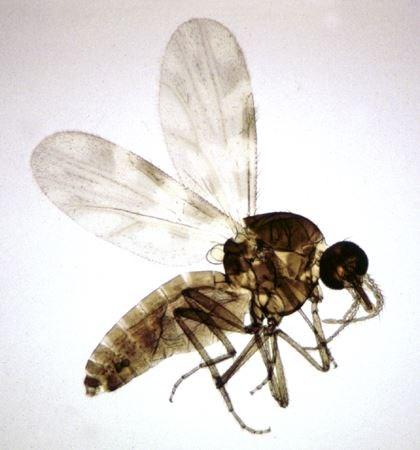
Culicoides obsoletus
Multiple biting midge species in Europe are known, or suspected to be, bluetongue vectors but species in the Obsoletus group (C. chiopterus (Meigen, 1830), C. dewulfi Goetghebuer, 1936, C. obsoletus (Meigen, 1818) and C. scoticus Downes & Kettle, 1952 plus C. pulicaris (Linnaeus 1758) and C. punctatus (Meigen, 1804) of the Pulicaris group are the most likely transmitters (Möhlmann, Keeling, Wennergren et al., 2021). Most of these species are tiny (1-2 mm) and their wings speckled with light and dark patterns; some species, though, have unmarked wings. In general, those involved in disease transmission have distinctive wing patterns which allows relatively easy identification of a very difficult family of flies.
To the general dipterist the Ceratopogonidae are not a well known or recorded family, for instance the NBN has only c6400 records of the important Culicoides genus. Here in Suffolk only 37 species out of the 173 British Ceratopogonidae have been recorded, consisting of just 48 records in total. Myself, I have only collected fewer than ten biting midges in many years of netting. The method of capture may be the key here. In studies to evaluate the abundance and dispersal of Culicoides, light emitting diode suction traps e.g. (Möhlmann, Keeling, Wennergren et al., 2021) or Rothamsted suction traps e.g. (Sanders, Shortall, Gubbins et al., 2011) were the standard methods of capture. Here c50,000 biting midge specimens were collected from a wide range of dispersed sites. Variables in these studies included seasonal factors such as temperature and rainfall but also habitat and land use. It is revealing to note how much land use can influence the catch; a pastoral trapping site with a high density of cattle near Preston in Lancashire collected c33,000 biting midges from a total of c51,500 in the 12 sites of the entire study. This compares with a total catch of just 221 from Brooms Barn, Higham, Suffolk, an arable area with very low density of cattle (Sanders, Shortall, Gubbins et al., 2011). From a Suffolk dipterology perspective the Brooms Barn results, provide records of six species of Ceratopogonidae, three of which have been absent from the Suffolk Diptera checklist, namely, C. dewulfi, C. punctatus and C. scoticus and another C. chiopterus was last recorded in 1916.
As an aside, it should be noted that some tropical biting midges of the Forcipomyia genus are not blood feeders but feed on plant nectar and are the primary pollinators of the cacao (or cocoa) tree. Note, without these midges there would be no chocolate.
Some interesting and uncommon species that have recently been recorded from Suffolk (this includes records obtained from iRecord) are, the Agromyzids, Agromyza alnibetulae Hendel, 1931, A. abiens Zetterstedt, 1848, A. demeijerei Hendel, 1920, A. flaviceps (Fallén, 1823), A. johannae de Meijere, 1924, Amauromyza morionella (Zetterstedt, 1848), Liriomyza eupatorii (Kaltenbach, 1873), L. atipalpis Hendel, 1920, Phytomyza cytisi Brischke, 1881, P. marginella Fallén, 1823 and P. pastinacae Hendel, 1923, the Caliphorids, Stevenia deceptoria (Loew, 1847) and Tricogena rubricosa (Meigen, 1824), the Ceratopogonid, Clinohelea unimaculata (Macquart, 1826), the Chloropids, Cryptonevra consimilis (Collin, 1932), C. flavitarsis (Meigen, 1830) and Lasiochaeta pubescens (Thalhammer, 1898), the Conopids, Myopa hirsuta Stuke & Clements, 2008, M. tessellatipennis Motschulsky, 1859, the Ephydrids, Philygria picta
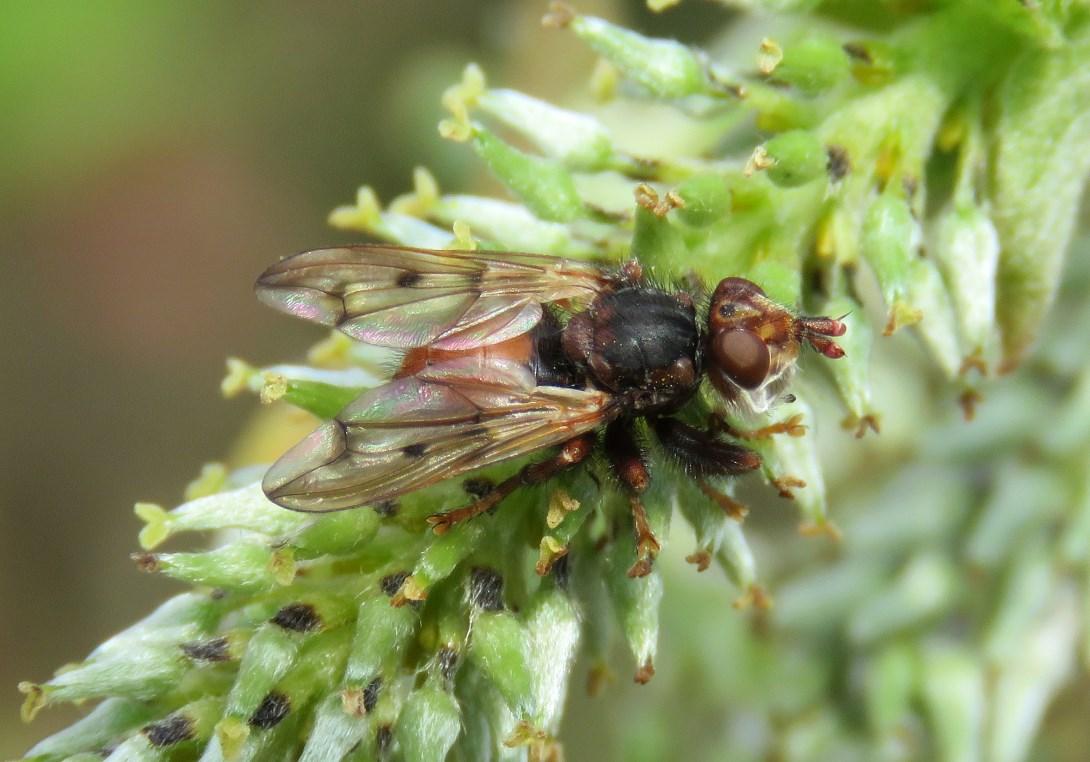
(Fallén, 1813) and Psilopa compta ( Crataerina pallida (Olivier in Latreille, 1812), the Hybotids Platypalpus maculipes (Meigen, 1822) and P. stabilis (Collin, 1961), the Lauxaniid, Homoneura notata (Fallén, 1820), the Limoniids, Erioptera meijerei Edwards, 1921 and E. nielseni de Meijere, 1921, the Muscid, Eudasyphora cyanicolor (Zetterstedt, 1845), the Rhagionid, Spania nigra Meigen, 1830, the Scathophagids, Ceratinostoma ostiorum (Haliday in Curtis, 1832), Cleigastra apicalis (Meigen, 1826) and Scathophaga litorea (Fallén, 1819), the Scatopsids, Anapausis soluta (Loew, 1846) and Reichertella pulicaria (Loew, 1846), the Sciarid, Bradysia fungicola (Winnertz, 1867), the Stratiomyid, Beris fuscipes Meigen, 1820, the Syrphids, Criorhina ranunculi (Panzer, [1804]), Portevinia maculata (Fallén, 1817) and Xylota florum (Fabricius, 1805), the Tachinids, Cinochira atra Zetterstedt, 1845, Platymya fimbriata (Meigen, 1824) and Tachina magnicornis (Zetterstedt, 1844),
Stratiomyid, Beris fuscipes
Janet Graham
Myopa tessellatipennis
Conopids Myopa hirsuta
Steven Falk Steven Falk
Tephritid Rhagoletis alternata
and the Tephritids, Goniglossum wiedemanni (Meigen, 1826), Rhagoletis alternata (Fallén, 1814) and Trypeta zoe Meigen, 1826.
References
Burgin, L. E., Gloster, J., Sanders, C., Mellor, P. S., Gubbins, S., & Carpenter, S. (2013). Investigating incursions of bluetongue virus using a model of long-distance Culicoides biting midge dispersal. Transboundary Emerging Diseases 60(3): 263-272
Möhlmann, T. W. R., Keeling, M. J., Wennergren, U. et al. (2021). Biting midge dynamics and bluetongue transmission: a multiscale model linking catch data with climate and disease outbreaks. Science Report 11, 1892.
Sanders, C. J., Shortall, C. R., Gubbins, S., Burgin, L., Gloster, J., Harrington, R., Reynolds, D. R., Mellor, P. S. & Simon Carpenter, S. (2011). Influence of season and meteorological parameters on flight activity of Culicoides biting midges. Journal of Applied Ecology 48(6): 1355-1364.
Peter Vincent
Pennyfields, Rectory Road, Middleton, Suffolk. IP17 3NW Diptera@sns.org.uk
Martin Cooper
CRYSTAL SEA SLUG ANTIOPELLA CRISTATA (ORDER NUDIBRANCHIA; FAMILY JANOLIDAE) AT WALBERSWICK, SUFFOLK
JIM R. ELLIS
The sea slug Antiopella cristata (Delle Chiaje, 1841), formerly Janolus cristatus and sometimes referred to as the ‘crystal sea slug’ or ‘crested aeolis’, is distributed widely in the shallow sublittoral of the eastern North Atlantic. It has been reported from the southwestern coast of Norway (e.g. at Tananger and Egersund; Evertsen & Bakken, 2005) to Morocco and the northwestern Mediterranean Sea (Thompson & Brown, 1984). It is generally found from the shallow sublittoral down to 40 m water depth (Thompson & Brown, 1984) but has been reported at 70 m water depth in the Mediterranean Sea (Toma et al., 2022).
Whilst it has been recorded widely around the British Isles, most of these records have been from along the southern and western coasts (e.g. Alder & Hancock, 1845–1910; as Antiopa cristata), and records from the eastern seaboard have generally been from the northern North Sea (Seaward, 1990; Thompson & Brown, 1984). Whilst not listed for Norfolk by Hamond (1972), data submitted to the National Biodiversity Network Atlas (https://nbn.org.uk/) indicate a moderate number of records from the north Norfolk coast, but seemingly only seven records from the coasts of Essex and Suffolk (Table 1). It has also been reported from other coasts of the southern North Sea, such as Den Helder in the Netherlands (Engel, 1936).
Table 1. Records of the sea slug Antiopella cristata along the coasts of Suffolk and Essex, ranked chronologically. Previous records from the National Biodiversity Network Atlas (https://nbn.org.uk/)
22/08/2010 -
20/06/2009Wreck of the “Fontenoy
22/08/2010 -
-
19/09/2014 -
20/06/2017 -
https:// nbn.org.uk/
07/08/2024 8 Present study Walberswick (harbour wall) 21/08/2024 1
Antiopella cristata has several characteristic features: it has a slightly translucent body, with larger individuals having a brown hue and white flecks. It has elongated cerata that surround the body (including around the anterior of the body), each having a narrow dark thread (digestive gland) and a blue-white tip. Additionally, there is a caruncle visible between the rhinophores (Picton & Morrow, 2023).
Figure 1: Sea slug Antiopella cristata from Walberswick showing (a) chain of spawn, (b) whole specimen showing the caruncle between the rhinophores, and (c) whole specimen with scale bar.
Given the limited number of records of this sea slug from Suffolk, it is noted here that multiple specimens of A. cristata were observed in 2024. Eight individuals were observed on the seaward side of the harbour wall at Walberswick (ca. 52.3139°N, 1.6728°E) at low water during spring low tides on 7 August 2024, with spawn also present. A further specimen that was actively laying eggs was recorded at the same
site on 21 August. No specimens were observed on comparative low-water sampling during either July or September. The largest specimens observed were approximately 25–35 mm long (Fig. 1). All were found close to the base of the harbour wall in shallow water, with this section of wall covered with hydroids, tube-forming polychaetes, and bryozoans. Among the bryozoans, Bugula is a known prey item of A. cristata (Picton & Morrow, 2023).
Another species of sea slug, Thecacera pennigera, which was reported from Walberswick last year (Ellis, 2023), was again seen in the same location in the summer of 2024 (7 August: two specimens; 21 August: three specimens; 22 August: two specimens; 6 September: four specimens; 18 September: one specimen).
Acknowledgements
Thanks to Peter Barry (CEFAS) for commenting on the manuscript.
References
Alder, J. & Hancock, A. (1845–1910). A monograph of the British nudibranchiate Mollusca. London: Ray Society.
Ellis, J. R. (2023). Occurrence of the sea slug Thecacera pennigera (Order Nudibranchia; Suborder Doridina; Family Polyceridae) at Walberswick, Suffolk. Trans. Suffolk Nat. Soc., 59: 80–82.
Engel, H. (1936). The Netherlands nudibranchiate Mollusca. Zoologische Mededelingen (Leiden), 19(8): 103–116.
Evertsen, J. & Bakken, T. (2005). Nudibranch diversity (Gastropoda, Heterobranchia) along the coast of Norway. Fauna norvegica, 25: 1–37.
Hamond, R. (1972). The marine mollusca of Norfolk. Transactions of the Norfolk and Norwich Naturalists’ Society, 22: 271–306.
Picton, B. & Morrow, C. (2023). Nudibranchs of Britain, Ireland and Northwest Europe. Second Edition. Wild Nature Press / Princeton University Press, 360 pp.
Seaward, D. R. (1990). Distribution of the marine molluscs of north west Europe. Nature Conservancy Council (Peterborough, UK), 114 pp.
Thompson, T. E. & Brown, G. H. (1984). Biology of opisthobranch molluscs. Volume 2. London: Ray Society, 229 pp.
Toma, M., Betti, F., Bavestrello, G., Cattaneo-Vietti, R., Canese, S., Cau, A., Andaloro, F., Greco S. & Bo, M. (2022). Diversity and abundance of heterobranchs (Mollusca, Gastropoda) from the mesophotic and bathyal zone of the Mediterranean Sea. The European Zoological Journal, 89: 167–189.
J.R. Ellis
CEFAS, Pakefield Road, Lowestoft, Suffolk, NR33 0HT
2022 SUFFOLK BUTTERFLY REPORT
JAMES CORTON
Speckled Wood, Spring brood.
Introduction
This is my second report as County Butterfly Recorder (CBR) for Butterfly Conservation and Suffolk Naturalist Society, following on from the 2021 report where, for continuity’s sake, I followed the layout of the previous CBR. Here I wish to bring in some changes to the format to reflect the way other CBRs report and how textbooks and field guides group species into families. I hope that it is reader friendly while still offering enough information for those who wish to study data and trends etc. A full report will follow in the New Year, published by Suffolk Naturalists’ Society and will contain additional data, maps and charts.
An amazing 104,000 individual butterflies were sighted and recorded in over 31,000 recordings by approximately 600 recorders. In truth, there were more sightings because not all could be confirmed and, also, estimates for large numbers tend to underestimate. Additionally, some records are system-rejected for various reasons. Butterflies were spotted from New Year’s Day through to Boxing Day. I would like to give a big thank you to all who took the time to record their sightings. It takes your time and sometimes there are IT related issues, but your perseverance is appreciated and contributes to the long-term conservation of our butterflies. The lifting of COVID-19 restrictions may have helped in reporting so many sightings, particularly with those more remote species which could not be visited many times, if
James Corton
at all, during pandemic lockdowns. Life has not returned to normal in a complete sense, with fewer people venturing as far as they used to. I am not sure of the reasons for this, but it will have had an effect upon butterfly recording.
Now I would like to explain a little about how the verification process works. Records accompanied by photographs can be verified as ‘correct’ or redetermined to the correct species. Records without photographs can be accepted as ‘considered to be correct’ on the basis of location and flight period. In some instances, e.g., similar species, I will request further evidence such as photographs and/or expert witness. This doesn’t mean that I doubt anyone but is intended to be a standardised data check to maintain accuracy regarding species range, population size and flight period. This report and all such reports use data from species level identification for accuracy i.e., doesn’t use generalised identification e.g., Small/Essex Skipper, although these can still be used elsewhere.
Special thanks go to the photographers who supplied pictures for this report; Sarah Chamberlain, Julie Durrant, Allan King and Roy Richardson. Thanks also to Butterfly Conservation (Suffolk Branch) Committee, Trevor Goodfellow (BC Suffolk Argus), Zoe Randle (Senior Survey Officer, Butterfly Conservation) and Suffolk Naturalists’ Society for their support and, of course, to all those who contributed butterfly records. Records are fed through a complicated gateway of systems to a national database which is used to map long-term trends and is important for conservation, lobbying and funding.
Further reading is recommended. Butterfly Conservation has published, ‘The State of Britain’s Butterflies’ and ‘The Red List Of Butterflies in Great Britain’. Both of these can be viewed via the BC website at: https://www.butterfly-conservation.org/butterflies
Weather Patterns and Extreme Events
2022 was a year of records being set. Nationally, it was the hottest year on record, reaching a maximum of 40.3°C in Lincolnshire. It was also the warmest year for average temperatures and the second warmest for average minimum temperature. It was stormier than average (Storm Eunice in February was the worst of many) but also sunnier and drier than average. The mean temperature for the whole year was 10.0° C, the first time an annual mean has reached double figures.
Looking briefly at the seasons individually, I will compare the long-term averages (which cover the years 1991-2020) with each season.
Winter (December, January and February) was a little drier, sunnier and warmer than average. January was the sunniest since 1919 and New Year was unusually warm, producing several butterfly sightings including a Red Admiral in Dunwich Forest on my New Year’s Day walk. Spring (March, April and May) was about 1°C warmer than average with March being especially sunny and May having warmer nights and fewer frosts than usual. Summer (June, July and August) was almost 2°C warmer than average with lots of sunny weather during which the county recorded a new record 38.2°C maximum temperature at Santon Downham. The summer months were all drier than average with as little as half the average rainfall, much of which came
suddenly with thunderstorms. Butterflies are ectothermic (cold-blooded) and it comes as no surprise that climate is an important factor in their life cycles (along with habitat requirements). Weather patterns have at least a short-term effect on butterfly populations. It is estimated that following the drought of 1976 several grassland species of butterflies took two or three years to recover. It is also one of the reasons suggested for the extinction of the Chequered Skipper from England in 1976 and a fear that the re-introduced colony in Fineshade Wood, Northamptonshire may suffer the same fate. Autumn (September, October and November) continued the theme of being warmer than average, in fact it was the third warmest on record. Unlike summer, it was unsettled and despite the warmth it was wetter than average.
Unusual Sightings
One of the most remarkable sightings of the year came in the Spring when an Orangetip bilateral gynandromorph was sighted in Somerleyton (photograph later in this report). A bilateral gynandromorph is a specimen which is male on one side of its body and female on the opposite. Not all animals can produce this type of intersex variation, but butterflies can, and it is estimated to occur in 1 in 5,000 to 20,000 individuals depending on species. Often it is overlooked when species have similarly marked males and females, but the Orange-tip is very sexually dimorphic.
A small population of Marsh Fritillary have been observed at Market Weston Fen (a Suffolk Wildlife Trust reserve) from 2021 and I paid a visit to this site in 2022. Up to half a dozen individuals were seen on visits over a four-week flight period. The foodplant Devil’s-bit Scabious is present in plentiful amounts and larval webs were also reported. It remains to be seen whether this introduced colony is self-supporting or will go the way of most introductions and fade out. Any information regarding this release will be appreciated, anonymous or otherwise.
A fine day in Wall Brown territory at Oulton Marsh.
Julie Durrant
2020. This could well be offspring from that release or, perhaps, a top up.
Another big surprise of the year was an unexpected and undoubtedly released Small Pearl-bordered Fritillary close to the Norfolk border. This was discovered by Roy Richardson and identified by Andrew Easton, both members of the SWT Warden and Volunteer Team at Lound Lakes. A Dingy Skipper in Nowton Park, Bury St Edmunds in mid-June, some 5 or 6 miles from any known colonies was also probably a release.
Allan King
Small Pearl-bordered Fritillary
East coast migrant specialties, Camberwell Beauty and Large Tortoiseshell are eagerly anticipated each year, but no Camberwell Beauty were recorded in 2022. Large Tortoiseshell were reported in both Spring and Summer broods in March and then June, north of Stowmarket and also near Bury St Edmunds in June. Sadly, no pictures are available. There was one final surprise in the year in the form of a Long-tailed Blue reported in October at Felixstowe Ferry. Again, no photographs to show but this is quite a distinctive species and, despite its diminutive size, is capable of long migrations.
Swallowtail (Papilionidae)
Britain only has one endemic species from the Papilionidae family, the Swallowtail, and that is confined solely to the Norfolk Broads but the situation for us is not altogether straightforward. Papilionid butterflies are quite large and capable of flying some distance. European Swallowtail species do sometimes disperse and find their way to Suffolk. Some are noted for their long-distance flights, although the Apollo has not been recorded since 1928, at Thorpe. Invariably, any Papilionid found in Suffolk is the Swallowtail itself (P. machaon) which occurs as two subspecies. Our endemic subspecies britannicus is found nearby in the Norfolk Broads in fenland habitat, but its sedentary nature means it is usually the continental subspecies gorganus which arrives in Suffolk, and most often from the summer brood. On average these are paler, stronger flying and found in drier habitat than britannicus. 2022 was a good year for migrant Swallowtail. It was reported from the south coast and as far north as Yorkshire at Bempton cliffs. Suffolk enjoyed at least two individuals arriving along the coast, including one in a garden at Shottisham in July. Incidentally, our native subspecies is found only on 16 sites in Norfolk and news of a fatal fungal infection affecting its sole foodplant, Milk Parsley, in 2022 led to concerns about its future. Voluntary quarantine conditions seem to have defeated this threat and the butterfly,
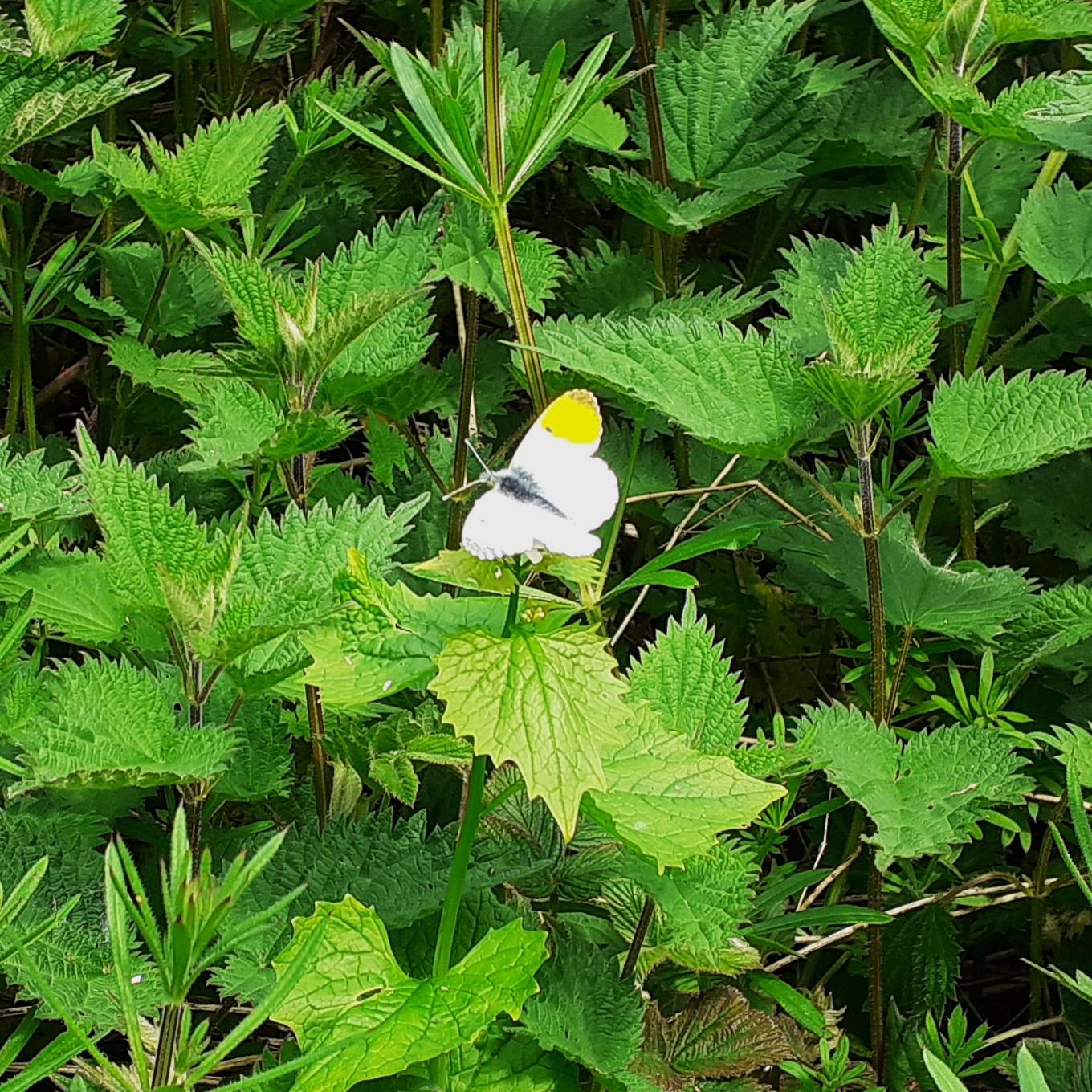
John and Jane Burton
The Brimstone is our only native Yellow and, while single brooded, the adults are so long-lived that they can still be on the wing when their offspring take their maiden flight. This means there is a continuity of sightings throughout the warmer months but with a maximum in the spring months. The benefits of the Buckthorn Project may slowly be materialising, with a few extra sightings in the east of the county. No Pale Clouded Yellow were reported. These would be rarities even in south coast counties and even more so further north and east. The usual number of Clouded Yellow were reported, initially on the coast but the speed at which these individuals sometimes vanished would suggest that their migratory instincts were still strong and that they continued inland. Quite a few sightings came from the west of the county where they found suitable habitat to nectar and breed in. Some stayed on in coastal locations for several days.
Browns, Fritillaries and Aristocrats (Nymphalidae)
If the drought affected many species, then it is the Brown butterflies which were affected most. Many grasslands were devoid of butterflies during the heatwave, as observed by those of us eccentrics who ventured out in it. Some would aestivate during the heat of the day, but others were found in woodland habitats flying and even breeding in shaded glades alongside the regular Speckled Wood. The lack of green grassland was a concern for many Brown butterflies. Larval survival rates could be very low for those species which need to feed before the onset of winter, either in parched grassland or in less suitable habitat. The presence of marshland, wet woodland and riverside habitat in our county did provide some good breeding sites and a base from which to expand from should there be a population decline. One species which appears to have at least survived the drought, if not thrived, is the Wall Brown. This is a Suffolk BAP species and nationally listed as Endangered with a 70% decrease in distribution 2010-2019. It emerged early in 2022 in its strongholds around Somerleyton, Carlton Colville and also Lound and Sudbourne, then went on to produce a very strong second generation. Some of its success may be due to the fact that these low-lying marshland areas did not dry out completely. Additionally, the third generation was very small, and offspring from this generation have been found to have much higher mortality rates than those of the first and second generations, so the short-term future of this species is encouraging. The species is being closely monitored by Robert Quadling, one of our Species Champions (Wall) and he has provided high quality data on a regular basis for this species.
Wall Brown dates and frequency compared (2021 and 2022)
Grayling is another of our BAP species and nationally listed as Endangered. It emerged very early and appeared in good numbers before crashing once the heatwave reached a peak. In reality it was seen moving from exposed heathland and coastal habitat into nearby woodland e.g., at Minsmere. There may well have been an
increased mortality rate as well. A second, smaller, peak built up after the extreme heat had subsided.
Grayling emergence and flight period compared (2021 and 2022)
Marbled White continued their northward and eastward expansion and have crossed the Stour from Essex into Suffolk near Sudbury with several reported around Long Melford. There were sightings from the west of the county too, between Newmarket and Bury St Edmunds, which also appears to be natural colonisation by range expansion. These colonies are small, and the rate of expansion is slow, so I am not expecting the whole of Suffolk to be populated anytime soon. It is one of the species which may have been less affected by the summer drought with larvae hatching out and immediately preparing a hibernaculum to spend the winter in. They will feed during mild spells in winter, by which time the grass is green and nutritious again. The long-established introduced population at Landseer Park, Ipswich, seemed to have a good year and there is some evidence that it has dispersed along the Orwell estuary south-east of Ipswich.
Silver-washed Fritillary had one of their best years with dozens of adults seen flying along transect routes in Minsmere and it was a similar scenario in many of our larger and more mature woods. White Admiral also had a good season and often came down to nectar on bramble and other flowers in glades. During the hottest spells, adults were observed aestivating in hazel and other trees, occasionally joined by Grayling. White Admiral is another species which may suffer from the drought. It hibernates as a third instar larva, but many honeysuckle plants were withered and dead-looking until late summer or even autumn far from perfect for a small caterpillar. This is a Biodiversity Action Plan (BAP) species for Suffolk, and I wait with cautious optimism to see if the 2023 season is a good one (historically it has been cold winter and spring weather which has been linked to low numbers).
Painted Lady were seen in reasonable numbers but it was nowhere near a ‘Painted Lady year’ as 2019 was. A wave of migrants arrived and were seen on 17 May, mainly on the coast but further inland too within a few days. Red Admiral were also seen in reasonable numbers and, like Painted Lady and Clouded Yellow, these warm weather butterflies would have been very much at home in our hot summer. The Small Tortoiseshell displayed some unusual behaviour which may well be climate related. The spring was milder than 2021 and this led to more early overwintered sightings and an earlier first brood. Expectations of a second and possible third brood disappeared along with the adult butterflies. It is quite feasible that many went into early hibernation, much like Peacock butterflies, to avoid the heat and possibly because their foodplants (Common and Small Nettle) were not sufficiently healthy enough to tempt them to breed. There is also growing evidence that the species is moving towards a single brood due to the effects of parasitism on summer broods.
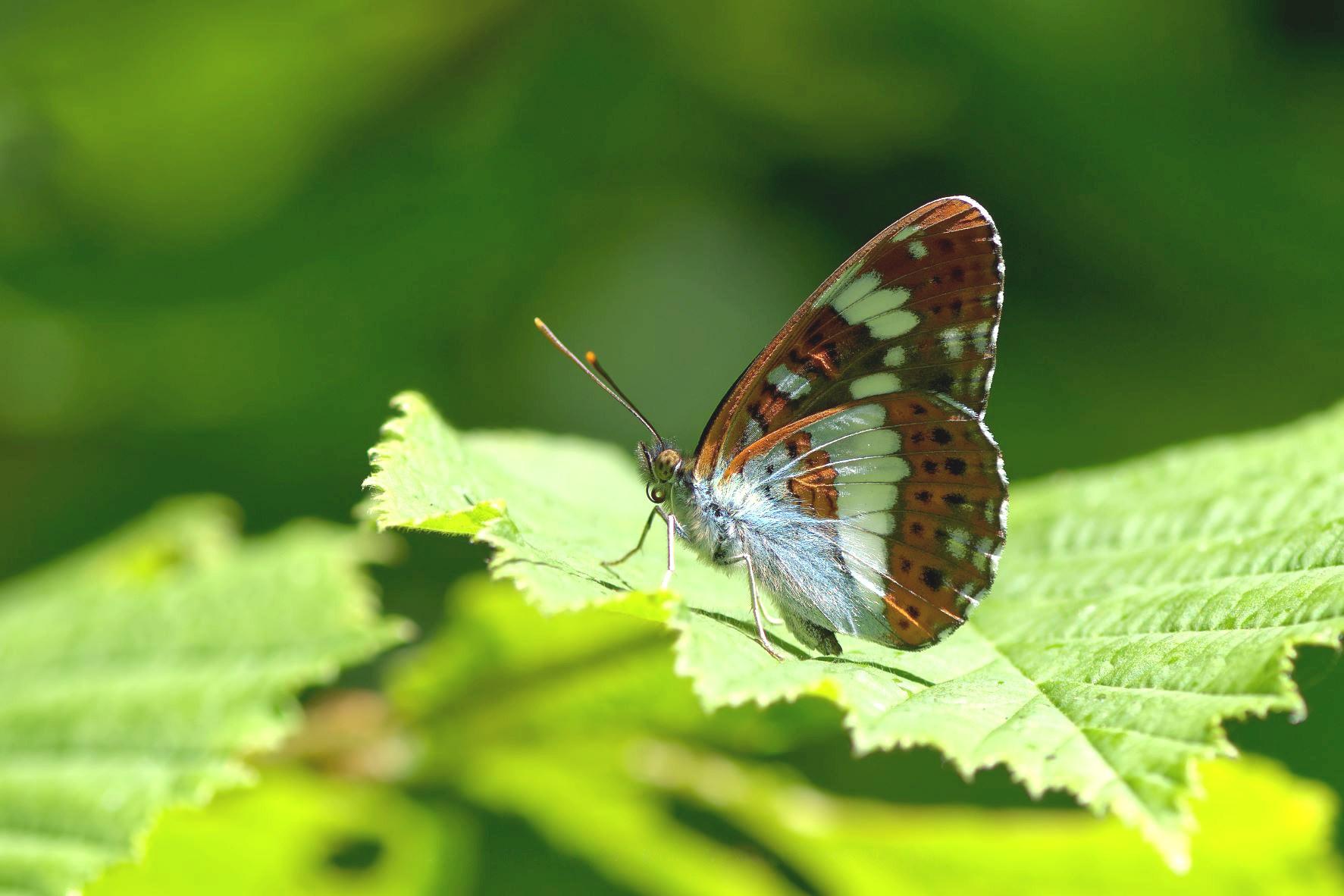
Gossamer-winged Butterflies – Coppers, Hairstreaks and Blues (Lycaenidae)
Many species of this family are multi-brooded, and it was a surprise for many of us to witness a first generation decline on the previous year with nothing to indicate this would happen. The nadir was so dire that in many locations no Blues or Coppers were recorded. Brown Argus, Common Blue and Small Copper were those appearing to be most strongly affected. Thankfully, a partial recovery was heralded by the arrival of the next generation. Single brooded species, such as Hairstreaks did not seem to be as affected, particularly the Spring flying Green Hairstreak. Many Purple Hairstreak were seen at ground level, possibly because their flight period was during the drought and there was little nectar in flowers as they conserved their own moisture with ever greater parsimony. Hairstreaks are also known to obtain nutrients from the ground for successful breeding. Both Purple and White-letter Hairstreak were seen far away from breeding areas, suggesting a heat driven dispersal. The only known Brown Hairstreak sightings came from the introduction site at Piper’s Vale, Ipswich, with a couple of individuals being reported. This may have been due to a lack of observers rather than a shortage of butterflies.
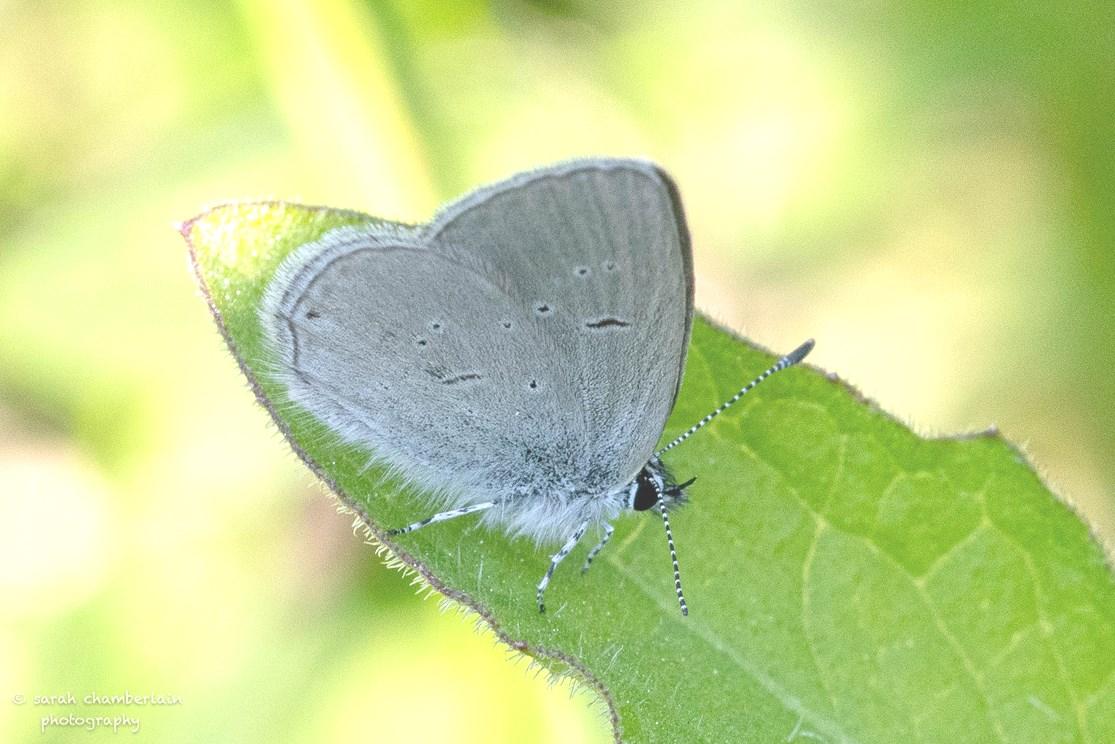
White Admiral
James Corton
Skippers (Hesperiidae)
Suffolk’s four species can be split into grassland Skippers and Woodland/Downland Skippers. The Dingy Skipper is our only representative of this second group and in Suffolk is a woodland specialist. It is a BAP Priority species but appears to be stabilising nationally. Locally, it is at great risk of extinction due to being restricted to only a couple of tetrads in the King’s Forest. The exact locations vary over time due to Forestry England works and cleared areas are often colonised within a year or two. In 2022 a survey was carried out and 71 were counted by Trevor Goodfellow on 14 May. This suggests the species is holding on, but the situation is always precarious due to the shortage of breeding areas.
Our grassland Skippers are undoubtedly under-recorded due to the difficulty in separating Essex and Small Skipper in the field. Both seem to be county-wide and have stable populations. The no-mow theme is beneficial to these species and the Large Skipper as long as some grass is left standing year long. Where grass is cut e.g, with an end of summer cut, Skipper eggs (Essex Skipper) and larvae (Large and Small Skipper) which are higher up the grass stem perish. Skippers are then noticeably less abundant than Brown butterfly species whose larvae will be at the base of grass plants and less at risk of mowing.
Green-veined White, Spring brood.
James Corton
Number of visits: 2022
Coverage
Number of species: 2022
Brimstone: 2022
Brown Argus: 2022
Clouded Yellow: 2022
Chalk Hill Blue: 2022
Comma: 2022
Common Blue: 2022
Dingy Skipper: 2022
Essex Skipper: 2022
Gatekeeper: 2022
Grayling: 2022
Green-veined White: 2022
Green Hairstreak: 2022
Large Skipper: 2022
Holly Blue: 2022
Large White: 2022
Marbled White: 2022
Meadow Brown: 2022
Orange-tip: 2022
Painted Lady: 2022
Peacock: 2022
Purple Hairstreak: 2022
Purple Emperor: 2022
Ringlet: 2022
Red Admiral: 2022
Silver-studded Blue: 2022
Silver-washed Fritillary: 2022
Small Blue: 2022
Small Copper: 2022
Small Heath: 2022
Small Skipper: 2022
Small White: 2022
Small Tortoiseshell: 2022
Speckled Wood: 2022
Wall: 2022
White Admiral: 2022
White-letter Hairstreak: 2022
A REVIEW OF NEW AND INTERESTING MOTHS SEEN IN SUFFOLK DURING 2023
NEIL SHERMAN
This article aims to review the new county records and other selected moth species of interest seen during the 2023 season. Species are listed in checklist order, with notes on the observation as well as the location and recorder(s). Any additional determination of the record will also be given. All records are from light traps unless otherwise mentioned.
The number for each species is the one assigned using the Checklist of the Lepidoptera of the British Isles by Agassiz, D. J. L., Bevan, S. D. and Heckford, R. J., 2016.
In 2023, the second edition of the Field Guide to the Micro-moths of Great Britain and Ireland by Sterling, P., Parsons, M. and illustrated by Lewington, R., was published. In this guide vernacular names for all the micro-moth species have been added, some new, but also many that have always been in use. The subject of English names for micro-moths has been controversial among moth recorders for many years. With the introduction of the names in this new and very popular guide I have decided to list them with the scientific name for each micro-moth covered in this report to make it more user friendly to non-moth people.
Following the record year for moth recording in the county in 2022, 2023 turned out to be a bit more of an average year, but still with some good records noted. 127,117 records of 1419 species were sent in. This is the second-best species count, the highest being in 2022 with 1439 noted. The weather, as always, affected moth numbers and recording effort. It was an awful start to the year, being quite cool and often damp (apart from February which was almost completely dry) right through late winter and into spring. Even when there were slightly milder conditions there seemed to be fewer moths than expected around, perhaps due to the previous years’ drought conditions. However, this all changed in mid-June when there was a good warm spell that resulted in some big catches of moths and some migration waves from the continent. However, this was fairly short-lived and throughout July and August it was fairly unsettled and again catches of moths were not as good as the previous year. Another heatwave in September was welcome as catches of moths increased and even though the rest of the autumn was unsettled and quite wet at times catches of moths were good, mainly because the winds were from the south. This warm weather bringing in immigrant moth waves to the UK in the autumn is becoming much more regular than in the past, probably due to our changing climate. The rest of the year was very wet and despite some mild nights moth numbers were very poor. All the flooding from the named storms may well have an impact on moth numbers in 2024. Many pupae could have drowned in the standing water and the wet, mild conditions promote fungal growth which is a major killer of overwintering stages.
However, the wet weather during the summer in 2023 wasn’t all bad as it enabled many habitats damaged in the 2022 drought to recover and the warm conditions are certainly helping to increase the numbers of newly colonizing species and have even allowed a few more southern British species to spread into the county, as listed in the report below.
SPECIES NEW TO SUFFOLK IN 2023
12.042 Raptor nest moth Monopis fenestratella (Heyden, 1863) - 28/06/2023Easton VC25 (MP, det. RW).
A very rare species in Britain with only a few recent records some of which are from neighbouring Norfolk. The larvae are thought to be associated with bird nests especially those of raptors, where they feed on keratin in discarded feathers. Also noted from Chicken houses. It is a dull greyish-brown moth with a few ochreous patches. The moth was dissected by R. Watson and was confirmed as a female.
15.0201 Echium stilt Dialectica scalariella (Zeller, 1850) VC25 (MD).
A small ‘Caloptilia’ type moth with an upright resting posture. It has a white head, with a white streak down the back with an irregular edge. The rest of the wing is black. Formerly only a very scarce migrant species to the UK, it was discovered to be breeding in Kent in 2022. In 2023, more breeding records were discovered in other south coast counties along with records at light. Following the record of the adult at light at Bawdsey, searches by NS at Shingle Street (VC25) on 05/11/2023 resulted in the discovery of a single vacated mine on the underside of a leaf of Viper’s bugloss Echium vulgare No other mines were found despite checking numerous other plants. Just possible this species has begun colonization of the county, and more records are expected in future years.
35.030 Scarce Zebra moth Helcystogramma lutatella 10/08/2023 - Purdis Farm, Ipswich VC25 (NS).
A very similar species to the very common Helcystogramma rufescens (Common Zebra moth), but brown-ochre in colour rather than reddish. The vernacular name relates to the larvae, which are black and white striped in both the species mentioned. A very rare resident species in the UK, found only in a small area of Dorset. More widespread in Europe. Further records have been noted in 2024 suggesting this moth is now breeding in the county.
35.0531 Anthemis flower moth Isophrictis anthemidella - Westleton VC25 (JC + JS).
This moth, a female, was dissected to confirm the record. A narrow-winged species, greyish brown in colour with silver streaks. It is a very recent arrival to the UK, with the first British record in Kent in 2020.
Mike Prentice
Neil Sherman
Leaf mine on Echium Neil Sherman
This Suffolk record is the second for the UK. Very similar to Isophrictis striatella (Tansy stem borer) which is a scarce resident species in the county. Now both species have been found to occur, dissection is necessary for any record of either. Just possible that anthemidella could be resident on the Suffolk coast and overlooked. The moth arrived during the very warm spell in June so could also be a migrant from Europe. If there are further records in the future this will help to understand its status.
37.019 Scarce thorn case-bearer Coleophora trigeminella (Fuchs, 1881) - 22/06/2023
- Brandon VC26 (GG + ZG).
Also seen on 24/06 and 28/06 at the same site. All records were confirmed by dissection as the Coleophora group of moths are nearly all inseparable on external characteristics. The adults are sandy brown in colour with a pale leading edge to the forewing. As a larva, they live in a silken case and feed by windowing patches in leaves on Hawthorn, Apple, Cherry and Rowan. Probably a rare, overlooked resident as few recorders in Suffolk dissect adult moths to determine identifications.
37.0567 Coleophora coronillae (Zeller, 1849) - 11/06/2023 - Hollesley VC25 (RW, det Leo Vähätalo).
This record was also new to Britain and is definitely a migrant from Europe, arriving in the very warm spell in June with other immigrant species of moth. Feeds as a larva in a case on Crown vetch Securigera varia, a plant which is an introduced species to the UK and very scarce in the county, although it is planted in gardens. The adult moth is one of the larger Coleophora species and is orangey in colour with small white streaks. The Suffolk specimen was dissected and was a male.
52.004 Dusky clearwing Paranthrene tabaniformis
- Barton Mills VC26 (PB).
The most interesting moth find of the year in the county. This species has always been quite elusive in the UK and was thought to be extinct, with the last record in 1924 in Oxfordshire. In 2021, a female was found by chance in Warwickshire, suggesting it may still be present as a breeding species in Britain. There is a specific artificial pheromone lure for the moth so recorders across the UK started searching to see if more sites could be found. In 2023, the moth was discovered not far from the Suffolk border in Cambridgeshire, so PB decided to try some sites in the north-west on 18 June. The first site tried was Barton Mills where there are extensive areas of Poplar trees (Populus sp.) and he had instant success! Dusky clearwing has never been known to occur in Suffolk, so this
Neil Sherman
was a complete surprise. The following weekend, further survey work in that part of Suffolk (PB, NS, MD, JC & JS) found the moth again at another location in the Barton Mills area as well as at Lakenheath Fen RSPB reserve. They come into the lure midlate afternoon and this may be a reason why the moth has been overlooked by pheromone recorders in recent years, as most other clearwings species respond in the middle part of the day. The moth was also noted at another site, Brandon, in early July by GG & ZG. Quite likely more sites will be found in future years, although other sites in south-east Suffolk with the food-plant trees, Poplar and Aspen (Populus tremula) were tried with no success. The Dusky clearwing is quite a large member of the family with a black and yellow striped body and distinctive dusky-coloured forewings, unlike any other member of that group of moths. It looks like a wasp which is its defensive strategy against predators.
52.016 Thrift clearwing Pyropteron muscaeformis (Esper, 1783) - 14/07/2023Lowestoft VC25 (AW).
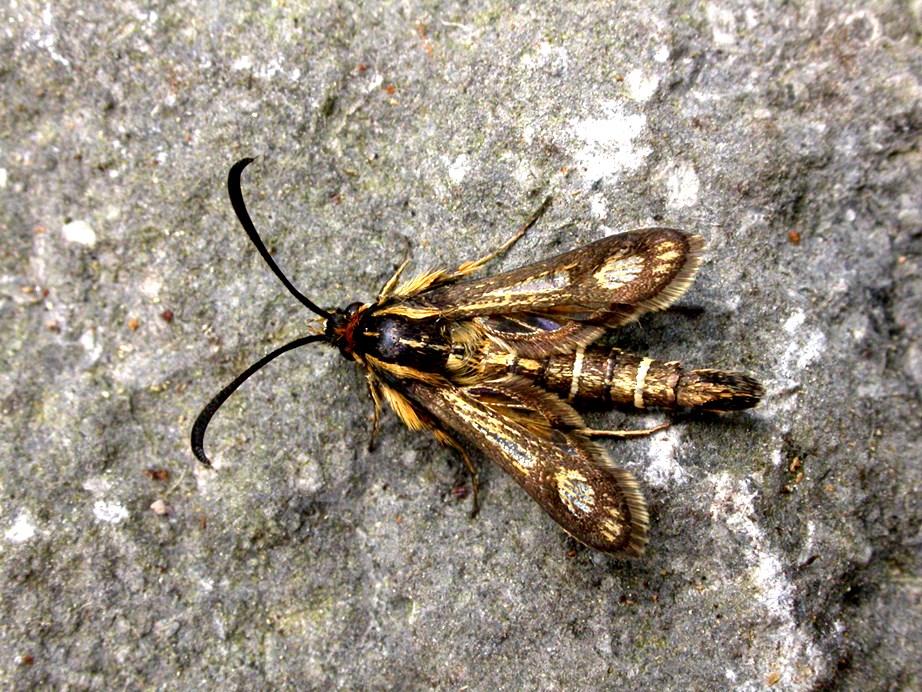
The record of this clearwing was another complete surprise. This species has a primarily western distribution in the UK and can be found using pheromone lures close to patches of the foodplant, Thrift (Armeria maritima growing at rocky coastal sites. The Suffolk record was of a moth found at rest on the recorder’s moth trap in the daytime in his garden in Lowestoft. Where this moth came from is a complete mystery. No more moths were seen despite the recorder trying the pheromone lure at the site. Thrift is known to occur at coastal sites in Suffolk so are undiscovered populations out there? Another possibility could be the moth was imported with nursery stock from elsewhere in the UK. Further survey work may shed light on whether it is an overlooked resident. It is one of the smaller species of clearwing and has a black body with thin yellow bands, a yellow striped thorax and clear wings edged in black.
62.046 Royal knot-horn Eccopisa effractella (Zeller, 1848) - 11/06/2023 - Hollesley VC25 (RW).
First recorded in the UK in 1995. There was a second record of this species in the county on 28/06/2023, at Kessingland (AE). Both seen during the warm spell in June when other immigrant species were arriving. A moth that is increasing in Europe where it can be a pest on fruit trees. Larvae have also been found in the old larval webs of Ermine moths (Yponomeuta species), feeding on the detritus within. It is a dark grey species with yellowish palps, with a very distinctive notch along the upper edge of the hindwing which is unique to this moth.
Neil Sherman Raymond Watson
63.042 Palm tabby Diplopseustis perieresalis (Walker, 1859) - 01/10/2023 - Oulton Broad VC25 (RS).
This species’ native range is the far east and Australia. It arrived in Europe as an adventive, with UK records either migrants from there or new imports. First found in the UK in 2001 on the Isles of Scilly. The Suffolk record arrived at a time when other immigrant species were being recorded so it could possibly be a migrant, although an adventive origin cannot be ruled out totally. Feeds as a larva on Sedges Carex and possibly Palms. It is a small, darkly coloured, triangular moth with a scalloped edge to the forewing quite unlike any other species.
70.017 Portland ribbon wave Idaea degeneraria (Hubner, 1799) 20/08/2023 Sizewell VC25 (DM) + Hollesley VC25 (RW). Noted at both coastal locations on the same night.
A local resident on the south coast which has been increasing and spreading in recent years. Was expected to turn up in the county as it had been found in both Norfolk and Essex before. Found mainly at coastal scrubby sites with a warm microclimate. The foodplant is unknown in the wild. More records are expected in future years as it spreads further north due to climate warming. It is sandy brown in colour, with a dark brown shaded band across the centre of the wing and is very glossy.
70.304 Sussex emerald Thalera fimbrialis (Scopoli, 1763) - 01/08/2023 - Hollesley VC25 (RW).
This moth is protected under the Wildlife and Countryside Act and is a UK BAP species. The small number of UK populations of this species are mainly found on the Kent coast. Seems to prefer very open habitats with stands of the larval foodplant, Wild carrot Daucus carota, suggesting a warm climate is needed. Showing some signs of increasing in recent years in Kent with new populations discovered including an inland site. Has also been noted on the Essex coast recently as well. Currently unknown whether this Suffolk specimen was an immigrant individual or perhaps a wanderer from Kent. Suitable habitat does occur on the Suffolk coast so further searches are planned to see if it may have colonized.
It is a beautiful green moth with two white lines across the wings and a distinctive red and white chequered fringe to all the wings. The hindwings have a very obvious indent in them.
Richard Smith
Raymond Watson
Raymond Watson
73.088 Dark mottled willow Spodoptera cilium Landguard, Felixstowe VC25 (NO).
Not only a first for Suffolk but also the first for the eastern side of the UK. Arrived on a night when there was a warm air flow over the county from north Africa/southern Europe. Previous records have mainly been on the south and south-west coasts. A scarce immigrant species with 37 British records which has been recorded more regularly in recent years. It is mainly found in Africa, where it is continuously brooded. The larvae can be a pest as they feed on short grasses, especially where mown. Currently unable to survive our winters. It is a rather drab brown moth, with darker cross lines and a blackish kidney mark.
OTHER SELECTED SPECIES OF NOTE SEEN IN 2023
04.027 Pear tree dot Stigmella pyri (Glitz, 1865)27/09/2023 - Rushmere heath VC25 (PC).
Recorded as a vacated leaf mine on a Pear tree (Pyrus sp.). Just one previous record, again as a leaf mine at Sudbourne in 1988 (J. Langmaid, M. Emmett, G.C. Pelham-Clinton). There has been an increase in the recording of leaf-mining species of moths in the county in recent years, but no other populations have been found so it must be genuinely rare.
The tiny adult moths are mainly dark golden in colour with the tips of the wings purplish and they have an orange head.
16.005 Willow ermine Yponomeuta rorrella (Hübner, 1796) recorders in both vice counties. This ermine moth is fairly common in Suffolk as a migrant species and a (possibly temporary) resident. Prone to big immigrations, but this year there was an exceptional arrival across the east of the UK with huge numbers noted on the night of 8 July. Many recorders stated ‘too many to count’ but those that did record a number saw hundreds with a few people reporting thousands. Moth traps and the surrounding vegetation were covered in them! The moths quickly moved on with much smaller numbers noted the following night and on subsequent nights through the summer. There were no breeding reports so quite possible the moths just dispersed inland.
Will Brame
Patrick Cook
Neil Sherman
35.034 Angoumois grain moth Sitotroga cerealella (Olivier, 1789) - 28/06/2023Gorleston VC25 (BJ, det. RW).
This moth was dissected to confirm the identity. It is an adventive species to the UK, normally turning up in warehouses where grain is stored. This individual is thought to have originated from bird seed. Only the second county record, the first being way back in 1898 (Pyett). The moth is a rather drab sandy brown colour with no real distinguishing marks.
49.075 Dark-streaked tortrix Acleris umbrana (Hubner, 1799) - 16/03/2023Hollesley VC25 (RW).
The second county record, with the first being noted at the same location in 2018. Once quite a rare species, it seems to be expanding its range in the UK and may just be showing signs it is colonizing the county. It is a very distinctive moth with bands of dark colouration down the wings. The larvae feed on various trees including Blackthorn (Prunus spinosa).
49.093 Gold cloak Phtheochroa schreibersiana (Frölich, 1828) – 28/05/2023 –Lackford (NS et al.).
The second county record of this very attractively marked nationally rare tortrix moth. The first was noted at Icklingham by A. H. Wratislaw in 1870. Has the moth been hiding in this part of the county, undiscovered for all of that time perhaps? Feeds as a larva under the bark of Elm sp. (Ulmus), Poplar (Populus sp.) and Prunus sp. This sighting was of an adult moth found at rest in the daytime on the leaf of a small Elm tree growing in a hedgerow.
49.296 Scarce Rose shoot moth Notocelia incarnatana records noted along the coast (various recorders).
Only two county records up to 2023. In early September, there was an arrival of a number of this moth along the coast. Sites where it was recorded were: Kessingland (AE), Lowestoft (RWr, AW), Oulton Broad (ME) and Landguard (NO). Most records were of singletons but three were recorded on 02/09 at Kessingland. There was also a record at Great Yarmouth in Norfolk at the same time as the Suffolk records. Given the arrival on the coast, these moths were almost certainly migrants. A few did show the characteristic pink flush this species is known to have, but others did not, so careful checking of sightings was required as there are similar species. The larvae feed on Burnet rose (Rosa pimpinellifolia).
Neil Sherman
Rhianna Wren
63.061 Old world webworm Hellula undalis (Fabricius, 1781) - 30/09/2023 - Easton VC25 (MP).
There was a fairly big arrival of this species into the south and south-west of the UK in 2023. Very few were found away from those areas and this Suffolk record was quite a surprise, turning up at an inland location rather than at one of the coastal recording stations. The 3rd county record of this scarce immigrant to the UK, with the previous records in 2006 (Landguard) and in 2018 (Hollesley).
A moth normally found in the tropics, where it feeds on various Brassicas. Has become a more regular migrant to the UK in recent years. It is a slim triangular moth, mottled in brown, buff and white with a dark spot on the wing.
63.072 Pied grey Eudonia delunella (Stainton, 1849) sites in 2023, all in VC25.
Previous to 2023, there had been four records of this species in the county, in 1902, 2019, 2020 and 2022. The warm weather in June in 2023 prompted an arrival of this species, possibly from the continent. First noted on 11 June at Boyton (2, JP), Bawdsey (MD) and Hollesley (RW). There were then regular reports until the last on 6 July, again at Hollesley (RW). In total there were 16 sightings of the species. The furthest inland records were in Ipswich (DP) and Purdis Farm, Ipswich (NS).
Whether this arrival leads to colonization remains to be seen. The moth is mainly a resident in the west of the UK, where the larvae feed on mosses and lichens. The increase in the growth of lichen on trees in this part of the UK has boosted numbers of the footmen moths so this may yet happen with other species like this one. It is a quite distinctive member of the genus, being mainly very pale grey with black markings.
63.085 Scarce grass moth Crambus pratella (Linnaeus, 1758) - 10/06/2023 Hollesley VC25 (RW).
Always a rare member of the grass moth family and not recorded every year in the county. Unknown at present whether it is a very scarce resident or an immigrant species. This record was during the warm spell so could well have been a migrant. It is orangey -brown in colour with a large white streak across the wing and is similar to other species so care is needed to identify it.
63.107 Powdered grass moth Thisanotia chrysoneuchella (Scopoli, 1763)11/06/2023 Boyton VC25 (JP).
Yet another scarce moth recorded during the warm spell in June. This grass moth has long been known as a resident in the Brecks, where it is regularly seen every year.
Mike Prentice
Neil Sherman
Neil Sherman
There has only been one other record in VC25 East Suffolk and that was way back in 1896 in Ipswich (Pyett). Almost certainly an immigrant, arriving with the other rarities at the time. It is a fairly distinctive grass moth, with a creamy white forewing with brown bands running down the veins of the wings and a speckling of black scales.
63.119 Marbled fern Musotima nitidalis (Walker, 1866) vice counties in 2023.
This moth is native to Australia and New Zealand and was probably imported into the UK with tree ferns (Dicksonia spp).
First found in Suffolk in 2019 at Landguard (NO). This species was last covered in my reports in 2021, when there were nine records.
In 2023, the population exploded with many recorders seeing the species for the first time. There were 52 reports of both adults and larvae. Moths were noted from May right through until mid-December. As well as the usual light-trap records, there were observations of moths disturbed in numbers from stands of Bracken (Pteridium aquilinum) growing under pine trees in the daytime, on flowers after dark in gardens and flying at dawn. Searches of areas of Bracken and other ferns showing feeding damage revealed larvae and empty pupal cases showing the moth is now wellestablished as part of our fauna. Hopefully, as this moth feeds mainly on Bracken, it will not be a troublesome pest like the Box-tree moth Cydalima perspectalis.
69.005 Death’s-head Hawk-moth Acherontia atropos (Linnaeus, 1758) - 4 records in 2023.
The first county records since 2020 of this much desired species - the one all moth trappers would love to catch! Of the four records, two were adults which were both in VC25 with the other two being larvae and both were in VC26. The larvae were at Long Melford country park on 20/09 (AH) and Hessett on 24/09 (LC). Both appear to be fully grown in the photographs sent in with the records so were wandering off the foodplant looking for a pupation site. The adult records were one at light at Bawdsey Hall on 24/09 (MD), the second site record and one found during the day on 01/10 in Beccles (MA). This last record was the most interesting as the moth was discovered in the pocket of a pair of shorts out on a washing line. The shorts were moving with a strange squeaking noise emanating from them and when placed on the ground the moth crawled out!
Neil Sherman
Anne Hickley
70.003 Bright wave Idaea ochrata (Prout, 1913) - 28/07/2023 Buckles Wood, Elmsett VC25 (MG).
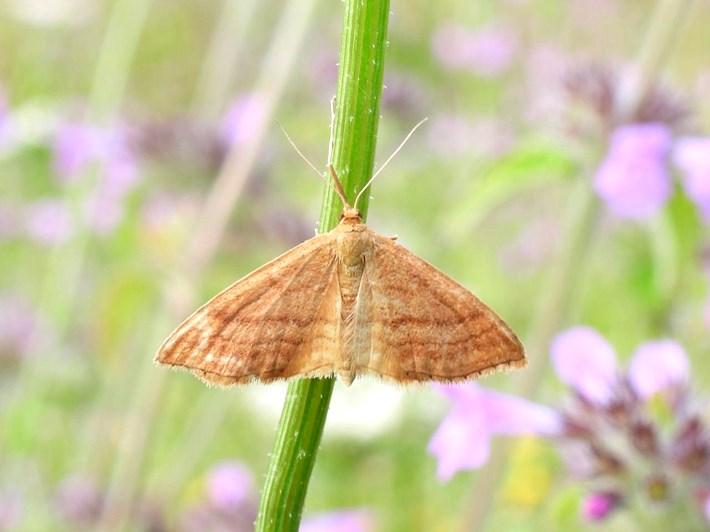
This nationally rare BAP moth was formerly a resident species found locally on the Suffolk coast between Aldeburgh and Thorpeness but was thought to have died out in the mid1980s. All more recent records are thought to be migrants from Europe or wanderers from the populations on the Kent coast. It is a moth normally found in coastal grassland with lots of mixed wildflowers. In 2023, there were three records - two at a typical coastal location, Hollesley on 10 and 27 July (RW), fitting the normal pattern. However, there was an intriguing record on 28 July at Buckles Wood, Elmsett. The moth was photographed so there is no doubt in the identification. Buckles Wood is a relatively recent, planted wood by a local school but it does have a good network of flower-rich rides. Whether this moth was another wanderer or whether there is a local population at the site will require more survey work to resolve. The moth has been expanding in Kent in recent years so it may be that it could return to Suffolk as a breeding species.
70.152 Channel Islands pug Eupithecia ultimaria (Boisduval, 1840) - A number recorded on the coast plus a VC26 record.
As expected after the first county records in 2022, it looks like this moth has established breeding populations on the coast as there were a whole series of records from Landguard (NO) from June through to September. Larval searches on the foodplant, Tamarisk (Tamarix gallica), are planned to confirm this. More unusually, there was a record from VC26, at Wattisfield (CB) on 24/06. This was during the warm spell in June so was possibly a migrant or wandering individual.
70.204 Light Orange underwing Archiearis notha Bonny Wood, Barking Tye VC25 (NS).
A new site for this species was discovered in 2023. Following the observation that there were a number of large Aspen trees ( tremula) present at Bonny wood, a search for the species was undertaken on a sunny day in early April. None were seen flying around the tops of the Aspen, but a search of puddles on a track running close to the wood discovered a single moth coming down for moisture, something this species is known to do. Photographs were taken which confirmed the record. There are three known sites for the moth in the county: Wolves Wood, Raydon Great Wood, and now Bonny Wood. May well be present at other woods where the foodplant trees occur and further searches are planned once suitable sites are identified.
Matt Garnham
70.210 Dorset cream wave Stegania trimaculata (Villers, 1789) - 15/06/2023 Frostenden VC25 (JG).
The second county record of this rare immigrant species to the UK. The first was in 2020, at Gorleston. Both Suffolk records have been of the form cognata which is darker in colour than the typical white form of the moth. This record was identified using the Obsidentify app and recorded on there. As Obsidentify is not linked to any biological recording systems in the UK currently (it is Dutch) this record wasn’t picked up on until another individual was recorded in Britain when discussions online as to how many had been noted in the UK picked up that there was another record from 2023 from Suffolk. The recorder of this moth was contacted, and the record verified. This example shows that moth records need to be sent in through the correct channels to make it into the county database (online recorder on the website, spreadsheets of data sent directly to NS or iRecord) to avoid being lost.
70.232 Large thorn Ennomos autumnaria (Werneburg, 1859) - 16/09/2023 Purdis Farm, Ipswich VC25 (NS).
The largest member of the thorn moth group, orangey-brown in colour and heavily speckled with brown scales. Once fairly regularly recorded both as a resident and an immigrant, it seems to have become much scarcer in recent years, with just single records in 2019, 2020 and 2023. No longer suspected that it is breeding in the county. Currently unknown why this decline has occurred as a number of other species that prefer warmer temperatures are doing well.
72.047 Hoary footman Eilema caniola (Hübner, 1808) - A large number of records in 2023 from both vice counties.
This moth had a very good year in the county. In June and into July, there were numerous records from nine sites along the coast. These were thought to be migrants coming in with the warm weather at that time, as June is fairly early in the season for the resident population to be on the wing. From late July, there were even more records with the moths noted at 26 sites, some of these being new to recorder’s site lists. The last sighting for 2023 was on 10/10, at Framsden (DC). These later season records were probably from the expanding resident population. This moth has quite rapidly become a regularly recorded part of our county fauna and, like other footmen species, is probably benefitting from the increase in growth of lichens following the reduction in air pollution and also from the warming climate. Care is needed to separate it from the very similar Scarce footman, but that species has a yellowish hindwing unlike Hoary footman which has a white hindwing.
Jake Gearty
Neil Sherman
72.082 Light crimson underwing Catocala promissa (Denis & Schiffermüller, 1775)two records in 2023, both in VC25.
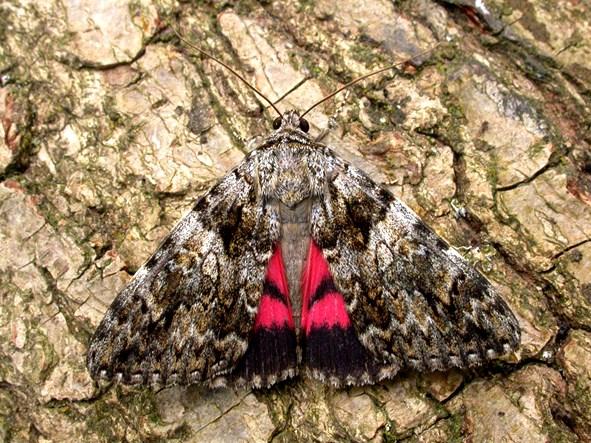
Historically, a former resident species in Suffolk which died out in the 1800s. Mainly known from the New Forest since then, in recent years the moth seems to be arriving as an immigrant from Europe more regularly and also establishing new resident populations, most notably in Kent where it is now seen in numbers at some sites. This could be the source of our recent Suffolk records. In 2023, the moth was noted at Purdis Farm, Ipswich on 21/07 (NS) and Homersfield on 27/07 (MT). Hopefully, this species will become a resident in the county like its congener, Dark crimson underwing has in recent years. The larvae feed on Oak (Quercus sp.) so there is no shortage of foodplant. Quite similar to Dark crimson underwing and care is needed to identify the species. Light crimson underwing has a less wavy dark band on the red hindwing and is smaller and greyer than Dark crimson underwing.
73.135 Blair’s wainscot Sedina buettneri (Hering, 1858)
A good year for this species in the county, with five records from four sites, all not far from suitable breeding habitat suggesting residency. It has been noted at the same Stowmarket site for three years running now (KS). All Suffolk records so far have been of adults at light traps. Can be noted flying rapidly over its sedge bed habitat just after dusk, so perhaps searches of suitable patches of the foodplant near the light trapped records may discover where they are breeding. It is a small member of the group, with a more pointed forewing and a smoky grey hindwing which distinguishes it from other species flying late in the year.
73.164 Reddish light arches Apamea sublustris (Esper, 1788) - Noted at three sites in VC25 in 2023.
This species is recorded in the Brecks every year, where it is resident. Sightings outside that region are thought to be wanderers or immigrants and do not occur every year. The last record in VC25 was in 2014, at Bawdsey (MD). In 2023, there were three observations in VC25 - 10/06 Purdis Farm, Ipswich (NS), 12/06 Bawdsey Hall (MD) and 02/07 Landguard, Felixstowe (NO). Quite similar to the very common Light arches, but differs in being darker in colour with a dark brown bar mark in the centre of the forewing. Light arches is much paler and has a scythe shaped mark in the centre of the wing.
Neil Sherman
Neil Sherman
Neil Sherman
73.214 White-Spotted Pinion Cosmia diffinis (Linnaeus, 1767) - 04/09/2023 Barrow VC26 (MEl).
A much-declined BAP species in the UK, suffering badly with the loss of Elm due to Dutch Elm disease. Perhaps showing signs of recovery with an increase in records in recent years.
Larval searches in 2023 failed to find any. However, there was another record of an adult, at Barrow. This continues to give hope that there are small populations in the west of the county. More survey work will take place in 2024 to try and find a resident population.
73.223 Oak rustic Dryobota labecula (Esper,1788) - Breeding now proven. Now a very regularly recorded moth in the county following the first record back in 2018, although still rare in VC26. Breeding has been suspected for a few years now and was finally proven in 2023 with the discovery of two larvae which were tapped from a flowering Holm oak (Quercus ilex) at Bawdsey Quay on 29/05 (NS). It is a very colourful and distinctive caterpillar, with an orange underside, bold irregular yellow stripe along the side and a reddish-brown upperside.
73.243 Blossom underwing Orthosia miniosa (Denis & Schiffermüller, 1775)Breeding now proven.
Fairly regularly recorded in small numbers every year now in Suffolk, but not known if these were migrant individuals or from local resident colonies. Certainly, most coastal records away from woodland habitat will still be migrants. Breeding in the county was proven in 2023 with the record of a larva tapped from Oak (Quercus robur) at Lackford on 28/05. This may just be a local colony - further survey work will be undertaken to try and find other breeding sites. It is a very colourful caterpillar, being greyish with orange-yellow stripes down the body and is unlike any other larva on that foodplant.
73.295 Delicate Mythimna vitellina (Hübner, 1808) - Recorded widely across the county in 2023.
Formerly a scarce migrant to the county, with records mainly from the coast. In 2023, there was a massive increase in records not only from coastal sites but also inland. Records stretched from 28/05 right through to 22/11. As an example of the increase in records, in 2022 Landguard recorded 20 moths. In 2023, 187 were noted. It is strongly suspected that the moth has established breeding populations in Suffolk as,
Neil Sherman
Martin Elsey
Neil Sherman
even early in the season, good numbers were being seen at inland locations whilst numbers on the coast were low. These early moths were darker in colour with darker lines, often a sign of local breeding as moths from hotter climates tend to be paler. Whether this is a temporary establishment or not, only time will tell.
OTHER SPECIES OF NOTE SEEN IN 2023 NOT IN THE MAIN ACCOUNTS
15.057 Goat willow leaf-miner Phyllonorycter dubitella - 09/11/2023 - Stanstead Great wood VC26 (DU, confirmed NS). Second record for VC26.
62.013 Marjoram knot-horn Uncinus obductella - 03/08/2023 - Boyton VC25 (JP). The 3rd county record following on from the first two in 2022.
63.011 Yellow-underwing pearl Uresiphita gilvata - 24/09/2023 - Wattisfield VC26 (CB), 25/09/2023 - Carlton Colville VC26 (PF), 26/09/2023 - Bawdsey Hall VC25 (MD) and 01/10/2023 - Kessingland VC25 (AE). Another year with a few records of this rare migrant.
63.044 Migrant sable Diasemiopsis ramburialis - 27/09/2023 - Westleton VC25 (SS), 01/10/2023 - Kessingland VC25 (AE), 02/10/2023 + 26/10/2023 - Bawdsey Hall (MD). Further records of this scarce migrant following ones seen last year.
63.051 Toadflax pearl Antigastra catalaunalis - 11/09/2023 - Bawdsey Hall VC25 (MD), 01/10/2023 - Kessingland VC25 (AE), 21/10/2023 - Framsden VC25 (DC). First records of this scarce migrant since 2018.
70.050 Balsam carpet Xanthorhoe biriviata - 07/08/2023 Sudbury VC26 (GC) - new to VC26, probably a migrant individual.
72.062 White-line snout Schrankia taenialis - 08/07/2023 Ipswich VC25 (EP). Recorded at outside light. The 3rd county record following on quickly from the 2nd last year.
73.028 Pale Shoulder Acontia lucida - 10/07/2023 Hollesley VC25 (RW). The 4th county record.
73.031 Four spotted Tyta luctuosa - 23/07/2023 Sudbury VC26 (GC) - possibly a wanderer from populations in Essex or Cambridgeshire.
73.268 Splendid brocade Lacanobia splendens - 19/06/2023 Purdis Farm, Ipswich VC25 (NS). 8th county record and 3rd record for this site.
73.330 Radford’s Flame shoulder Ochropleura leucogaster - 28/09/2023 - Bawdsey Hall VC25 (MD), 23/05/2023 + 09/10/2023, both Landguard, Felixstowe VC25 (NO). The May record is the first of the first brood in Suffolk.
74.005 Scarce black arches Nola aerugula - 08/07/2023 Kessingland VC25 (AE). First record since 2018.
Neil Sherman
Thanks to all the above mentioned recorders for supplying their records for this report: Alan Eaton (AE), Anne Hickley (AH), Antony Wren (AW), Brian Jones (BJ), Chris Bishop (CB), Darren Underwood (DU), Dave Morton (DM), Dave Pearsons (DP), David Crawshaw (DC), Eric Patrick (EP), Graeme Cavey (GC), Graham & Zoe Geen (GG+ZG), Jake Gearty (JG), Jenny Spence (JS), John Chainey (JC), John Pilgrim (JP), Keith Scarff (KS), Louise Chapman (LC), Mark Allen (MA), Mark Ellis (ME), Mark Timms (MT), Martin Elsey (MEl), Matt Granham (MG), Matthew Deans (MD), Mike Prentice (MP), Nigel Odin (NO), Neil Sherman (NS), Patrick Cook (PC), Paul Bryant (PB), Peter Follett (PF), Raymond Watson (RW), Rhianna Wren (RWr), Richard Smith (RS) and Stewart Sexton (SS).
Please send all future moth records in to me at moth@sns.org.uk, or use the online recorder at www.suffolkmoths.co.uk, or iRecord. Note records are not collected from social media sites nor Obsidentify so observers are encouraged to use the above ways to make sure your sightings get into the county database and into reports such as this.
References
Agassiz, D. J. L., Bevan, S. D. & Heckford, R. J. (2016). Checklist of the Lepidoptera of the British Isles.
Morley, C. (1937). Final Catalogue of the Lepidoptera of Suffolk. Ipswich: Suffolk Naturalists’ Society.
Sterling, P., Parsons, M., Lewington, R. (2023). A Field Guide to the Micro-moths of Great Britain and Ireland Second edition. Bloomsbury.
Sherman, N. (2022). A Review of new and interesting moth species seen in Suffolk during 2021. Trans. Suffolk Nat. Soc. 58: 71-86.
Sherman, N. (2023). A Review of new and interesting moth species seen in Suffolk during 2022 plus an addition to the county list from 2009 not yet reported. Trans. Suffolk Nat. Soc 59: 117-135.
Neil Sherman (Suffolk Moth Recorder)
2 Golf Cottages
Bucklesham Road
Ipswich
Suffolk IP3 8UG moth@sns.org.uk
Meadow Brown butterflies copulating, the female is above. One of the ‘June gap’ species to benefit from the sunny days of June 2023.
Suffolk Nat. Soc. 60 (2024)
Kevin Ling
2023 SUFFOLK BUTTERFLY REPORT
JAMES CORTON
Introduction
Since the 2022 report there has been sad news in the passing of Trudi Willis, a member who held an open garden day annually, raising funds for Suffolk Branch and providing a chance for members to meet and socialise. My Norfolk counterpart, Alan Brazil, also passed away. He had encouraged me as I began this County Butterfly Recorder role. Both will be missed.
The first butterfly sighting of 2023 came on 2 January, a Brimstone in Long Melford and the last sighting was of a Peacock on 27 December in Woodbridge. Between these dates, well over 100,000 sightings were reported from over 30,000 recording trips. This is slightly more than in 2022.
The full report contains additional data from spreadsheet and paper-based records, as well as some late data and makes up about 10% of total records. The additional data is not expected to affect distribution maps or flight dates greatly except, perhaps, some of our less recorded species, such as hairstreaks.
Number of species: 2023
Number of visits: 2023
From left to right; Brown Argus, Green Hairstreak and Small Copper
James Corton
This report uses data from species level identification for accuracy i.e., doesn’t incorporate indeterminate species identification such as, Small/Essex Skipper or ‘Pieris’ for unknown white butterflies. Genus and Family level records can still be used elsewhere by Butterfly Conservation Head Office and other organisations, so please continue recording them.
Special thanks go to the photographers who supplied pictures for this report; Mark and Hazel Brewster, Liz Cutting, Jane Ferguson, Kevin Ling and Robert Quadling. Thanks also to Richard Perryman for his sterling work keeping the Suffolk Branch website up-to-date with information and sightings.
I also wish to thank Butterfly Conservation (Suffolk Branch) Committee, Trevor Goodfellow (BC Suffolk Argus Editor) and Suffolk Naturalists’ Society (especially Martin Sanford, Editor) for their support as well as all the many individuals who reported their Suffolk butterfly sightings. Finally, a mention for Robert Quadling and Andrew Hickingbotham of Suffolk Wildlife Trust who have been monitoring the Wall Brown population in the north-east of our county and devising conservation plans for this UK listed Endangered species. Thank you both.
Further information on recording is available at: https://www.suffolkbutterflies.org.uk/recording.html
Further reading is available. Butterfly Conservation has published, ‘The State of Britain’s Butterflies’ and ‘The Red List of Butterflies in Great Britain’. Both of these can be viewed via the BC website at https://www.butterfly-conservation.org/butterflies
Weather Patterns and Extreme Events
Following the record-breaking year of 2022 where 40.3°C was recorded and drought affected much of the nation, 2023 was not as dramatic. The butterfly season was relatively unaffected by cold snaps in January, early March and again in November/December. June was very hot and sunny – over eight hours sunshine per day on average. However, the hottest day of the year was in early September during an Indian Summer when, undoubtedly, many late season butterflies benefitted from the warmth. It was a wet year, too, the sixth wettest on record for England. Storms began early in August and rolled in throughout the autumn and winter, fuelled in part by a strong El Niño event in the Southern Oscillation System in the equatorial Pacific Ocean.
Unusual Sightings
Early April brought a Camberwell Beauty to Little Stonham, the only record of the year for this species. A Large Tortoiseshell was seen and photographed in Wenhaston a few days later, on 9 April and a further two sightings came in, one from Dunwich on 7 May and one from Covehithe on 9 May. On 15 August a Long-tailed Blue was reported from Somersham, Ipswich and a few days later, on 20 August, another was reported from the coastal village of Kessingland. These are all very migratory species; the sighting dates are consistent with genuine wild migrants. The Long-tailed Blue, like the Geranium Bronze, is sometimes brought in on horticultural imports and this is
Large Tortoiseshell at Wenhaston, Spring 2023.
Following 2022’s exotic list of species, many due to releases, I would have preferred to draw attention to naturally occurring rarities in 2023 but, as is the trend these days, much of the unusual butterfly action was about releases.
2022’s single specimens of Glanville Fritillary and Small Pearl-bordered Fritillary proved to be just that, and no further specimens were seen in 2023. A large number of Queen of Spain Fritillary were reported in July from the East Bergholt area with an autumn brood individual being seen some distance away at Sutton Hoo in September. A High Brown Fritillary may also have been sighted but this would invariably be a release/escapee. Neither High Brown Fritillary nor Dark Green Fritillary are Suffolk species (the Dark Green Fritillary may rarely disperse from nearby Cambridgeshire sites, such as the Devil’s Dyke, Newmarket).
A small colony of Marsh Fritillary has been present on a fen in the north of the county since 2021. This is now seen as self-sustaining, with both mating and egglaying being witnessed and increasing numbers of adults being reported. The Marsh Fritillary is one of six UK species to have full protection, including capture and release. The colony is on a Suffolk Wildlife Trust and SSSI nature reserve which confers an element of protection, again. Introductions are seldom successful and the one near
Jane Ferguson
Hopton is an exception to the rule, well thought through and successful but illegal for the above reasons. As Head Office have said, unofficial introductions make butterfly records less reliable e.g. for planning against climate change and habitat loss. We
An early instar Orange-tip larva preparing to moult
Browns, Fritillaries and Aristocrats (Nymphalidae)
Marbled White continued to spread east and north into the county. Naturally occurring colonies are now found five miles within the county border, from Brandon through to Newmarket, Haverhill and Sudbury. The 2008 introduced colony at Ipswich is now only 15 miles from naturally occurring colonies and, although many of these are small, it is likely that the species will continue to expand into suitable habitat further east and north. It prefers long grassland with ample flowering plants for adults and Red Fescue for its larvae – a very common species of grass.
Thankfully, previous summer droughts had relatively little effect on many species. One that seems to have been adversely affected though is the Ringlet. A damp grassland preferring species, numbers were significantly down on previous years. The wet but warm weather in July and August appeared to suit this species very well and it is hoped that it will recover in 2024. Other Brown species were recorded in numbers to be expected for normal years, showing that the 2022 drought had not affected them so greatly as widely feared. This was particularly good news for our Brown BAP species, Small Heath, Grayling and Wall Brown. Grayling had been noted moving into woodland during 2022’s drought, a survival strategy that clearly worked. Small Heath have larvae that are dependent on finer and perhaps less droughtresistant grass species but they, too, proved resilient. Perhaps it is because they are continuously brooded and at least some of their offspring were able to develop in healthy grassland? Wall Brown continued to hold on along our coastal boundary around the River Waveney and Sudbourne Marshes areas. Numbers recorded were
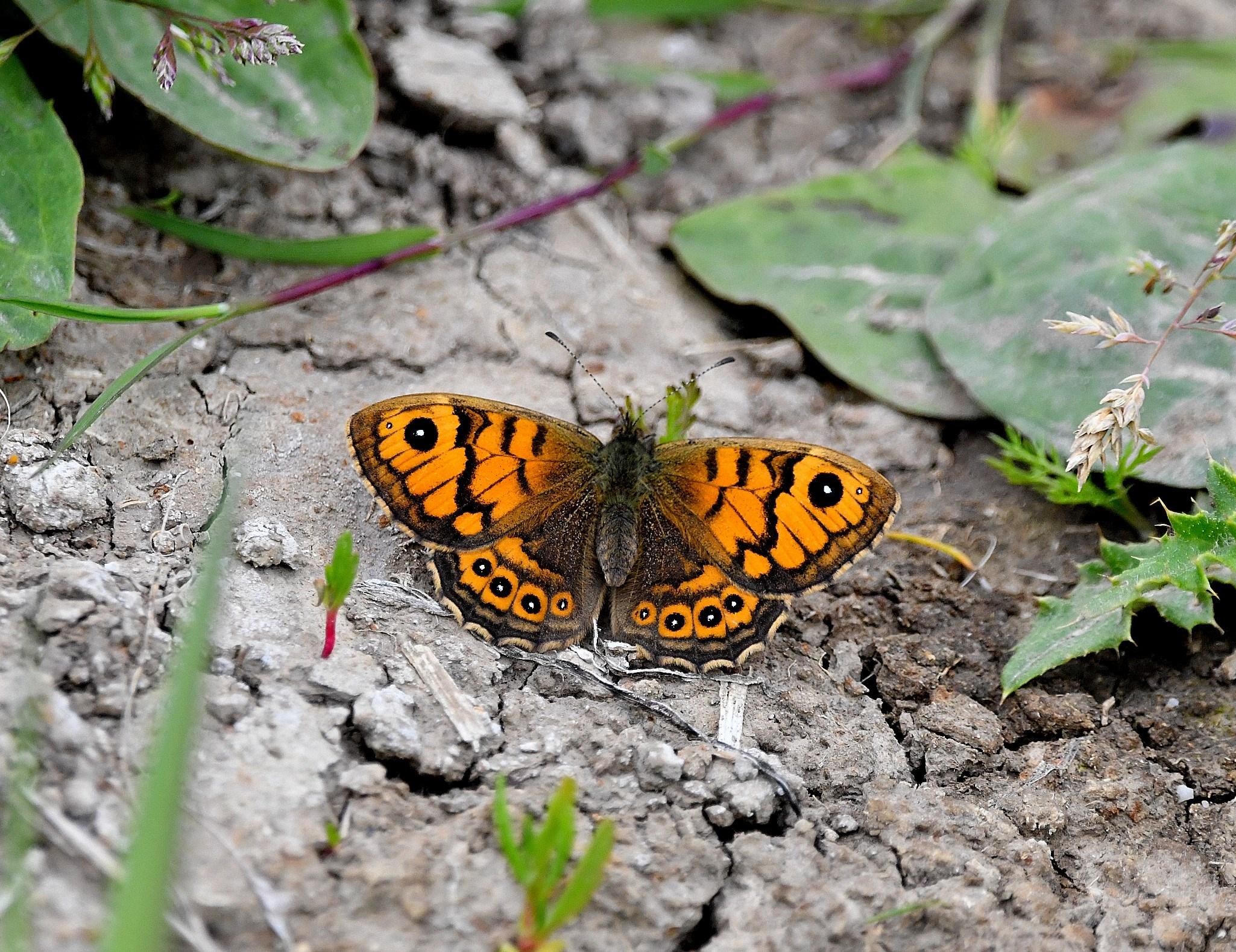
A female Wall Brown.
Robert Quadling
similar to 2022 and it is a relief that such an endangered butterfly survived the drought in this marshland habitat. A small third brood bodes well for 2024 with many caterpillars reaching a size that enables winter survival. This species has fluctuated in the past and its exact requirements are not fully understood.
Thankfully, previous summer droughts had relatively little effect on many species. One that seems to have been adversely affected though is the Ringlet. A damp grassland preferring species, numbers were significantly down on previous years. The wet but warm weather in July and August appeared to suit this species very well and it is hoped that it will recover in 2024. Other Brown species were recorded in numbers to be expected for normal years, showing that the 2022 drought had not affected them so greatly as widely feared. This was particularly good news for our Brown BAP species, Small Heath, Grayling and Wall Brown. Grayling had been noted moving into woodland during 2022’s drought, a survival strategy that clearly worked. Small Heath have larvae that are dependent on finer and perhaps less droughtresistant grass species but they, too, proved resilient. Perhaps it is because they are continuously brooded and at least some of their offspring were able to develop in healthy grassland? Wall Brown continued to hold on along our coastal boundary around the River Waveney and Sudbourne Marshes areas. Numbers recorded were similar to 2022 and it is a relief that such an endangered butterfly survived the drought in this marshland habitat. A small third brood bodes well for 2024 with many caterpillars reaching a size that enables winter survival. This species has fluctuated in the past and its exact requirements are not fully understood.
Silver-washed Fritillary had another good year. It has now colonised every part of the county and existing populations have grown in many cases. There is some evidence of a decline in the past five years which may be due to its preferred mature woodland habitat becoming overly mature and shaded. Apart from this it seems to be benefitting from climate change, at least for now.
Our two most commonly encountered migrant nymphalids had contrasting fortunes. The Red Admiral was widely found in good numbers whereas the Painted Lady was sparsely observed. These species are very dependent on migration and factors such as winter weather conditions in North Africa and European summer conditions play a large role in determining how many turn up in Great Britain each year, probably greater than the presence of a few adults successfully overwintering. Migration had long been suspected to be a two-way movement, north and south. Recent research has proven this to be the case via radar and infra-red tracking. Human observers have often reported local movements that strongly suggest southerly autumn migration. The staff and volunteers at Landguard Bird Observatory were treated to this spectacle with over 3,000 Red Admiral streaming down the coastline in a southerly direction on 8 October.
Peacock had a slightly below average year but nothing out of the usual. Comma did better and was more commonly seen than in normal years. After a little respite in 2022, the Small Tortoiseshell continued its alarming decline with another well below average year. In fact, nationally it recorded its lowest transect levels since records
began in 1976. The reasons have been discussed in a previous report and, unless it can find a way to breed without the tachinid parasite Sturmia bella decimating its broods, the future looks bleak in southern counties. Perhaps a change to univoltine breeding or a hyperparasite of Sturmia bella will avert it becoming a rarity?
White Admiral had another good year and there was a very small partial second brood in some locations. Purple Emperor was recorded in its well-known sites but is undoubtedly present in more woods than the species map suggests. This is one of the species which draws people to congregate at certain ‘Emperor’ sites. It could be fruitful if people could check mature woodland habitat with Goat Willow for this elusive species that is expanding its range.
Gossamer Winged Butterflies - Coppers, Hairstreaks and Blues (Lycaenidae)
Hairstreaks are elusive and under-reported butterflies, so it is hard to make reliable comments about their abundance. Purple Hairstreak showed well in some areas but there was a drop in records for White-letter Hairstreak and Green Hairstreak species. Part of this is due to at least one recorder supplying records manually from the Lowestoft area where several White-letter Hairstreak and Purple Hairstreak colonies are known to exist. These records should be included in the full report. Only one Brown Hairstreak was reported, from Ipswich on 5 September. It is not known yet
A freshly emerged Peacock taking nectar before aestivating in late summer.
Mark Brewster
whether this is due to a reduction in recording or a decline in the introduced population. It is arguably our most elusive species of butterfly.
Small Copper were recorded from across the county in good numbers except for the far south-west. Numbers were significantly higher in second and third broods than in the spring generation, a quite normal phenomena for multi-brooded lycaenid species.
Brown Argus continued the upward trend and, while Common Blue started well, the summer brood did not build as much as hoped for. This is another pair of similar species, at least in the field, and identification issues mean that it is hard to be certain just how good a population exists in any one site. Holly Blue have enjoyed a run of good years and 2023 was another such year. The 10-year trend bears this out at a national level. Some early records for Silver-studded Blue may be Holly Blue or Common Blue – it is worth checking because a faded Common Blue may be a faded Silver-studded Blue. At times, it appears that Holly Blue are also recorded as Small Blue. Given the introductions that have occurred in Suffolk it is plausible but impossible to verify these accurately without photographs due to the similarity between the species and resultant confusion. Our very small population of Chalk Hill Blue in the west of the county held on with similar numbers being reported compared to 2022 (this is distinct from the Devil’s Dyke colony which is just over the border in Cambridgeshire but could stray into Suffolk on rare occasions).
A beautiful Silver-studded Blue: note the tiny silvery-blue ‘studs’ on the edge of the orange.
Liz Cutting
Skippers (Hesperiidae)
The golden skipper species had a good year with the slightly unusual feature of Small Skipper being observed before any Large Skipper had emerged (typically they are a week or two behind). The difficulty separating Essex and Small Skipper in the field makes it hard to produce accurate maps and data for each species. Both should be quite common in areas with long grass that is allowed to stand throughout winter. A survey in north-east Suffolk produced a ratio of two Small Skipper for every one Essex Skipper. This ratio tactic can be useful in recording large numbers from a site with a degree of confidence. The ratio is quite variable across the country so it’s worth
Forest work and adverse weather has led to a decline in their current sites. Our hope is that the species is quite mobile within the forest and capable of finding new breeding habitat. Its status in Suffolk remains critical and all records received are very
Mark Brewster
Appendix 1: Summary of UK Changes for Species at National Level
Our Suffolk species have their own trends, but it is appropriate to show the backdrop against the national trend for our butterflies. It is a complex picture with many factors including development, pesticides and climate change playing a part in the mixed fortunes. Skippers, however, stand out as a family of butterflies with losses all round (10-year trend).
Key: * P < 0.05 (significant), ** P < 0.01 (highly significant), ***P < 0.001 (very highly significant). Red text has been used to highlight those species that had their worst year of the series in 2023, and blue text for those species that had their best year of the series in 2023.
Appendix 2: Distribution Maps for Selected Species (2023)
Brimstone: 2023
Brown Argus: 2023
(2024)
Comma: 2023
Common Blue: 2023
Dingy Skipper: 2023
Essex Skipper: 2023
Gatekeeper: 2023
Grayling: 2023
Green Hairstreak: 2023
Green-veined White: 2023
Large Skipper: 2023
Holly Blue: 2023
Large White: 2023
Marbled White: 2023
Meadow Brown: 2023
Orange-tip: 2023
Painted Lady: 2023
Peacock: 2023
Purple Hairstreak: 2023
Purple Emperor: 2023
Ringlet: 2023
Red Admiral: 2023
Silver-studded Blue: 2023
Silver-washed Fritillary: 2023
Small Copper: 2023
Small Heath: 2023
Small Tortoiseshell: 2023
Small Skipper: 2023
Small White: 2023
Speckled Wood: 2023
White Admiral: 2023
Wall: 2023
White-letter Hairstreak: 2023
Red Admiral basking while grooming its right antennae with her legs.
James Corton
Appendix 3: Flight Charts for Selected Species (2023)
Brimstone: 2023
Brown Argus: 2023
Comma: 2023
Common Blue: 2023
Dingy Skipper: 2023
Essex Skipper: 2023
Gatekeeper: 2023
Grayling: 2023
Green Hairstreak: 2023
Green-veined White: 2023
Holly Blue: 2023
Large Skipper: 2023
Large White: 2023
Marbled White: 2023
Marsh Fritillary: 2023
Meadow Brown: 2023
Orange-tip: 2023
Painted Lady: 2023
Peacock: 2023
Purple Emperor: 2023
Purple Hairstreak: 2023
Red Admiral: 2023
Ringlet: 2023
Silver-studded Blue: 2023
Silver-washed Fritillary: 2023
Small Copper: 2023
Small Heath: 2023
Small Skipper: 2023
Small Tortoiseshell: 2023
Small White: 2023
Speckled Wood: 2023
Wall: 2023
White Admiral: 2023
White-letter Hairstreak: 2023
Whilst leading a group fungi walk in my most favourite woodland Orwell country park on 27 October 2024, something tiny, bright orange and growing on a fallen damp Sycamore log caught our eye. I knew straight away it was an unusual find for our area, but I did not know it was going to be the first record for the whole of East Anglia. Meet the Orange pore fungus aka Orange ping-pong bat fungus and you can easily see why it has the adorable latter name.
This non-native Favolaschia species is actually in the family Mycenaceae despite looking nothing like any other Mycena species by having pores instead of gills. Measuring in at just a few millimetres each don’t let its tiny size be deceptive at how just resilient and far travelled this fungus is. It was first recorded in Madagascar then New Zealand and has recently spread around the world, arriving in Europe in 1999. It first appeared in the UK in Cornwall in 2012 and by 2023, had spread as far north as the Isle of Man.
It has been well recorded in the south of England and now it’s made its way to a woodland in Ipswich. Why Ipswich? I think the spores may have come in on some new timber being used to restore the coastal path along the river Orwell but that’s just speculation. Also up for speculation is how this species may impact our native fungi as in some countries it’s reported to be invasive and problematic, time will tell for our UK fungi species.
Hopefully, it will just become an attractive addition to our already vibrant and stunning diversity of fungi that bring so much life, curiosity and fun to our woodlands particularly in Autumn.
Astrid Ivy Martin
The taxonomy of the Favolaschia calocera group is complex, a recent Chinese DNA study identified six separate species - the taxon spreading in Europe and Oceania is named as Favolaschia claudopus (Singer) Q.Y. Zhang & Y.C. Dai [Ed.].
Astrid Ivy Martin
Sightings of the Drab Wood-soldierfly - Solva marginata (Meigen, 1820) at Stonham, Suffolk in July 2024
The attractive Xylomyid, the Drab Wood-soldierfly - Solva marginata (Meigen, 1820), is reasonably widespread over the southern parts of the UK. Although previously thought of as uncommon, it may actually be slightly more frequent than that but is generally seldom numerous where it does occur.
Just after mid-July 2024, I was contacted by Graham Denny who farms at Stonham in central Suffolk with some pictures of a distinctive-looking fly he had taken on his phone. Graham is an award- winning conservation-minded farmer who has spent 40 years nurturing the habitat necessary for Turtle Doves and other farmland birds to thrive as well as bees, butterflies and all sorts of other insects on his land. Graham has a particularly good eye for noticing wildlife of all sorts and his pictures clearly showed he had a specimen of S. marginata which was of interest straight away. There are eleven post-1882 records for S. marginata in Suffolk (Vincent, 2021). These include several records from the eminent Claude Morley in the first half of the 20th century and then only a couple in the subsequent decades. There are slightly more records into the 21st century including a pair of dead specimens collected for me from a conservatory in Ipswich by Evie Swanton in 2019. The last entry on iRecord is from 2020 by Gary Lowe in Boyton near Woodbridge. Therefore, Graham’s subsequent communication a few days later that there were now six specimens dancing around on a sunny bit of hedge prompted me, at Graham’s invitation, to go and have a look myself on July 20. Sure enough, when we walked along the sunny side of the said
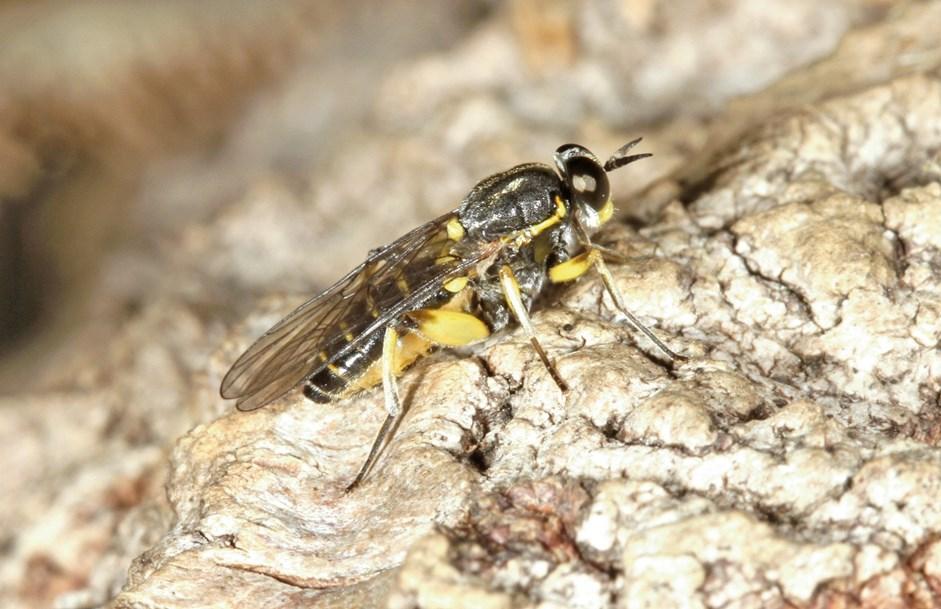
Drab Wood-soldierfly Solva marginata.
Jeremy Early
Solva marginata from Stonham, Suffolk, 20-08-2024.
One of the ‘dancers’ was eventually collected (they can move very quickly) to make 100% sure of the determination and was confirmed under the microscope as a maleS. marginata using the key in British Soldierflies by Alan Stubbs and Martin Drake (Stubbs & Drake, 2014).
The next day, 21 July, one of Graham’s colleagues, Allan (Rab) King, who is a keen photographer went over to Stonham to take some pictures of the flies and other creatures and between them they estimated numbers of Solva marginata to be around 40–50 individuals along approximately 100m of hedge. This then appears to be a significant population within what is currently known of the Suffolk distribution of this fly and may be a significant number nationally. Numbers slowly declined after this with Graham counting around 20 on the 26 July but none then seen after this into August.
The habitat requirements of S. marginata are described by Falk, 2024 as ‘that (it) occurs in association with old and recently fallen trees and also log piles. It clearly favours willows and poplars at many sites and can occur in association with scattered riverside trees as well as woodland and thickets, especially those associated with wetlands. Larvae develop in the rotting cambium layer beneath the bark of trunks, stumps or logs that have been dead for less than 2 years, and it may be able to exploit rot in old living trees too. The larvae are saprophagous.’
Male
David Basham
s farm where a large riverside hedge of mixed species, with plentiful Willow and Poplar, is regularly thinned out and the logs then left in situ to rot down. The river is oriented southwest at this point on the farm meaning there are east facing sides to the hedge which is where most of the conspicuous fly activity was observed. The fly seems to have found an ideal bit of s farm in Stonham
As an interesting final aside this whole small sequence of events illustrates rather well what can be achieved through an engaged and interested landowner with an eye
Many thanks to Graham Denny for recording the species in the first place and then inviting me to have a look and to Rab King and Jeremy Early for their photographs. Thanks also to Peter Vincent for editing this piece.
References
Falk, S. (2024). Flickr album of Solva marginata – Drab Wood-soldierfly [online]. https://www.flickr.com/photos/63075200@N07/albums/72157631392015938/ [Accessed 07-08-2024]
iRecord details of Solva marginata [online]. https://irecord.org.uk/all-records [Accessed 07-08-2024]
Stubbs, A. E., Drake, M. (2014). British Soldierflies and their allies. 2nd Ed. British Entomological and Natural History Society. 183. Vincent, P. (2021). The Diptera of Suffolk. Part Four: Xylophagidae, Athericidae, Rhagionidae, Tabanidae, Xylomyidae, Stratiomyidae, Acroceridae, Bombyliidae, Therevidae, Scenopinidae, Asilidae. Trans. Suffolk Nat. Soc., 57: 23-34.
David Basham, Graham Denny, Allan King, and Peter Vincent
Rab
Trans. Suffolk Nat. Soc. 60 (2024)
Small-flowered Catchfly Silene gallica var. quinquevulnera in a sown patch of wildflowers in the meadow at Holywells Park, Ipswich.
Martin Sanford
A Butterfly Survey of Holywells Park, Ipswich, TM1743
This 2024 study included an exploratory visit to decide on a route and then 16 subsequent visits. The weather conditions were only included if relevant to sightings and although the route was followed on each visit it was not walked as a transect as all butterflies identified were recorded, irrespective of distance.
14.3: The route began at the entrance in Cliff Lane, just around the corner from Holywells Road. The Canal Path was followed with three diversions, first to a meadow and two further right turns leading out to a much larger open space, which was only recorded along its edges. At the end of the Canal Path a right turn was made along a hard surface path then right towards what is marked on an old map as Pond 4. This pond was followed to a bridge separating it from Pond 3 and then on to a flight of steps, a garden, flower beds below the Stable Block and finally the Bluebell Walk leading out to the top of Bishop’s Hill. The route took about an hour to complete.
On this route planning no butterflies were seen but birds included Wren, Dunnock, a drumming Great-spotted Woodpecker, a single Lesser Black-backed Gull, two pairs of Canada geese, a pair of Mandarin ducks and a distant flock of 21 Woodpigeons. Even at this early month there was an abundance of Brambles, Holly, Ivy, Stinging Nettles and water.
6.4: A hazy sun was accompanied by a breeze and along the Canal Path Red Deadnettle, Dandelions and ‘Pussy Willow’ were noted as early nectar sources. In the meadow, marked on the map as ‘Old Orchard’, Ladies’ Smock, a larval food plant for both Orange Tip and Green-veined White butterflies, was recorded and a few Cowslips. Chiffchaff, Magpies and Woodpigeons were present and under one mat a Grass Snake was coiled up then quickly slid away. Muntjac slots were seen on the path and the butterflies recorded here were male Brimstone, Small White and Peacock. A second male Brimstone was seen at the start of the hard surface path and later a Stock Dove was heard calling. Both Dandelions and Red Deadnettles had penetrated the more formal flower beds in the garden.
Total of 4:2 male Brimstone, 1 Small White, 1 peacock.
13.4: Hedge garlic, a larval food plant for both Green-veined White and Orange Tip, was abundant along the Canal Path and Bugle was also flowering. In the meadow two
The Canal Path near the start of the walk. The bridge over the Canal.
Small White, one Green-veined White, one Peacock and one Speckled Wood were seen and a male Orange Tip along the Canal Path. A male Brimstone was again recorded at the start of the hard surface path and at Pond 4 both Carrion Crow and Stock Dove were seen. At the top of the steps Green-veined White and Comma were seen and the final butterfly was a male Orange Tip along the Bluebell Walk.
Total of 10: 1 Brimstone, 2 Small White, 2 Green-veined White, 2 Orange Tip, 1 Peacock, 1 Comma, 1 Speckled Wood.
2.5.24: Hedge Garlic, Stinging Nettles and Ivy dominated the early part of the route, the last mentioned having climbed to the top of several small trees. Another Grass Snake was uncovered under a mat, this one with the identifying yellow neck ring visible. A Bank Vole was under another mat and in the meadow, Germander Speedwell was added to the nectar sources. A male Brimstone, a male Orange Tip and two Holly Blues were present and at least two Moorhen nests were located along the Canal Path plus the welcome sight of a mother and two young children feeding Mallard at pond 6. Yellow Flag Iris and Water Mint were additional nectar sources with a third Holly Blue nearby and a fourth along the hard surface path. Here a Speckled Wood appeared to be drinking moisture from wet grass and opposite someone asleep on a bench a male Brimstone was feeding from a dandelion. At the bridge between ponds 4 and 3 further Holly Blue and male Brimstone appeared and the garden, in sunshine, had flowering ornamental Knapweed, Forget-me-Not and Wallflowers, but no butterflies. On the Bluebell Walk small buddleias on the left and a larger one to the right promised future nectar and a Holly Blue was close to Holly, its earlier larval food plant. Two male Brimstones near the exit gate produced an unlikely conversation between a large ‘punk’ dressed man and his equally large dog. One male Orange Tip flew past and a Muntjac ran off into deep shade. Total of 13: 5 Brimstone, 2 Orange Tip, 5 Holly Blue, 1 Speckled Wood.
20.5: This was memorable for a total of 17 Holly Blues, five in the meadow, seven along the canal path, two by the bridge between the two ponds, one near the Stable Block and two along the Bluebell Walk. A large animal ran off in the meadow, but the long grasses prevented identification. Some areas of grass had been flattened and Ox-
Long grasses across the meadow path.
Brambles, Ox-eye Daisies and Meadow Cranesbill in the first meadow.
eye Daisies were now flowering. Two Buzzards flew over and tall Sowthistles were prominent along the Canal Path. A school group of about forty pupils were walking along the hard surface path and those in front saw a flying Red Admiral. A single male Brimstone and later a Green-veined White flying along the Bluebell Walk were the only addition. In the garden, Erigeron was flowering in several separate beds and below the Stable Block two good nectar sources were seen, namely Scabious and ‘Bowles’ Mauve’ Wallflower.
Total of 20:1 Brimstone, 1 Green-veined White, 17 Holly blue, 1 Red Admiral.
7.6: Just nine butterflies were seen, on a day of cloud, wind and intermittent sunshine. A Speckled Wood was just inside the entrance gate and the rest were Holly Blues, six of which were recorded in the meadow. Much of the bramble was in flower but surprisingly no butterflies were visiting this good nectar source. A Buzzard flew off as I entered the meadow and the other two Holly Blues were along the Canal Path, which had Poplar blossom carpeting some parts of the route. By the bridge between the two ponds several damselflies were seen: four Azure, two Large Red and one Willow Emerald. Several Lavender beds were flowering below the Stable Block.
Total of 9: 8 Holly Blue, 1 Speckled Wood.
24.6: Some time was spent examining tall sunlit Oaks for Purple Hairstreak butterflies but with no success. Oaks are the larval food plant for this species and no result came from examining clumps of Elm, the White-letter Hairstreak’s larval food plant. Red Clover and Marsh Bird’s-foot-Trefoil were added to the meadow’s nectar sources. Single Red Admiral and Comma plus two Holly Blues were in the meadow and along the Canal Path, Himalayan Balsam was flowering. This is not a native plant and though it attracts many insects, it can spread quickly by ‘exploding’ its seeds, which can travel some distance, especially along waterways. Once established, it can shade out native plants. One Holly Blue was seen along the Canal path and many Azure damselflies on Pond 6. A Little Egret was also close by. Good management was noted near the flight of steps by leaving an area of longer grasses and Verbena bonariensis was added to the nearby flower beds plus Ox-eye Daisy. The first two butterflies were recorded in the garden, both Meadow Browns, and as I was taking a photo of Erigeron, a Small Copper landed beside me. Again, not one butterfly was seen nectaring on Bramble flowers.
Tall Ivy in the first meadow.
The Bluebell Walk.
Total of 8: 1 Small Copper, 3 Holly Blue, 1 Red Admiral, 1 Comma, 2 Meadow Brown.
4.7: On a sunny day with a noticeable wind, Hawkweed was prominent along the Canal Path but most of the Bramble flowers were over. A Holly Blue was close to Ivy and in the meadow the Stinging Nettles and long tendrils of Bramble were crossing the path. There was an abundance of Marsh Bird’s-foot Trefoil and Meadow Cranesbill and both Red Clover and Purple Loosestrife offered additional nectar sources. Butterflies seen here were two Holly Blues, again around Ivy which is the earlier larval food plant, four Commas, two male Brimstones, one Meadow Brown and one Small Skipper. A Little Egret was again on pond 6 and along the Canal Path a further male Brimstone, one Meadow Brown and a Red Admiral were seen, the last mentioned on Stinging Nettles, its larval food plant. It was noted that the last pond along the Canal Path was now dried up. The path leading to Pond 4 had tall flowering thistles and Knapweed and again a grey heron was fishing on the far side of Pond 4, presumably by movement, not sight, as the pond was covered with green algae. Both the garden and flower beds below the Stable Block had a wide range of nectar sources with the addition of White Clover but again no butterflies were seen. Some cutting back was noted along the Bluebell Walk but Stinging Nettle beds had been left and Ragwort was flowering, an important summer nectar source.
Total of 14:1 Small Skipper, 3 Brimstone, 3 Holly Blue, 1 Red Admiral, 4 Commas, 2 Meadow Browns.
10.7: This was a cloudy day with gusts of wind and occasional sun. Once again, no Purple Hairstreaks were seen Secateurs had to be used to get through to the meadow where four Commas were seen with three spiralling together. The meadow also produced three ‘firsts for the site in 2024: Essex Skipper, Large White and Ringlet. A Meadow Brown was also recorded here. Also, in the meadow a bed of flowering Marjoram was seen, one of the best summer nectar sources. A Muntjac was barking from the far side of the meadow and a small Grass Snake was on top of one piece of matting in sunlight. A high-flying Hobby went over and three little Egrets were on pond 6. Three Buddleias were now flowering along the canal Path but not in sunshine. White Clover was now flowering along both sides of the hard surface path and two
Mallard on Pond 4.
Grass Snake under one of the mats in the meadow.
Swifts flew over the Bluebell Path where one Meadow Brown was seen.
Total of 9: I Essex Skipper, 1 Large White, 4 Commas, 2 Meadow browns, 1 Ringlet.
19.7: I deliberately went later on this sunny date but again found no Purple Hairstreaks. Ragwort was now flowering in the meadow where I recorded one Large White, four Meadow Browns and one Ringlet. The Canal Path had three further Meadow Browns, two Ringlets, and the first Gatekeeper, with three further along. Three Speckled Woods were spiralling together and a further one was seen along the Bluebell Walk.
This should have been the height of butterfly activity and consequently was very disappointing.
Total of 19: 1 Large White, 4 Speckled Wood, 4 Gatekeeper, 7 Meadow Brown, 3 Ringlet.
29.7: This visit led to the highest butterfly total so far. Against a background of loud hammering noises from the nearby industrial units I found Tufted Vetch in the meadow, where eight butterfly species were recorded: singe Essex Skipper, Greenveined White, Holly Blue, Peacock, Speckled Wood and Gatekeeper plus five Meadow Browns and two Ringlets. A female Common Darter dragonfly was hunting and along the canal path Water Mint and Knapweed were abundant and the largest Buddleia had nectaring Large White and male Brimstone. The rest of this path, plus the two short lanes leading to a larger meadow, produced two Speckled Wood, a Holly Blue ‘mud puddling’, one Small Skipper, one Small White, one Meadow Brown and two Ringlets. The first blackberries and wild raspberries were sampled and my wife AnneMarie wandered off the route to search a large path of hawkweed and found a
A view from part of the garden towards the Orangery.
Pantaloon bee, with another also on Hawkweed below the Stable Block. A Meadow Brown was close to Scabious in this area and the largest Buddleia along the Bluebell Walk had nectaring Large White and Red Admiral. Here also were two Speckled Woods, one Meadow Brown and one Comma.
Total of 30: 1 Small Skipper, 1 Essex Skipper, 1 Brimstone, 2 Large White, 1 Small White, 1 Green-veined White, 2 Holly Blue, 1 Red Admiral, 1 Peacock, 1 Comma, 5 Speckled Wood, 1 Gatekeeper, 8 Meadow Brown, 4 Ringlet.
It was good to see a notice celebrating the park’s twenty-fifth anniversary of Green Flag awards.
8.8: This was a very hot day with scarcely any breeze. The long meadow grasses were flattened in many places and a large limb had been torn off a nearby Ash. Single Large White, Gatekeeper, Comma and Speckled Wood were recorded with three Common Darters overhead. Along the Canal path single Gatekeeper and Meadow Brown were added plus three Speckled Woods. At the edge of the larger meadow a long heap of cut grass had been left as an extra habitat. Two Speckled Woods along the Bluebell Walk completed the sightings.
Total of 11:1 Large White, 1 Comma, 6 Speckled Wood, 2 Gatekeeper, 1 Meadow Brown.
19.8: The meadow still had plenty of Knapweed flowering with a single Green-veined White and Holly Blue plus three Speckled Woods. A further Speckled Wood was seen along the Canal Path and Golden Rod, a good nectar source, was flowering on the path towards Pond 4, where thirteen Mallard were seen. The largest Buddleia on the Bluebell Walk had a single nectaring Green-veined White.
Total of 7: 2 Green-veined White, 1 Holly Blue, 4 Speckled Wood.
29.8: A Holly Blue was seen just inside the entrance gate and a second in the meadow where on its far side the first open Ivy umbels had attracted a Red Admiral. A second was nectaring on a surviving clump of Bramble flowers. Pond 6 produced a fishing Grey Heron and just one Speckled Wood along the rest of the Canal Path. A Large White was nectaring on Verbena bonariensis below the Stable Block and a Holly Blue was close to sunlit Ivy, its later larval food plant. A Large White was feeding on Buddleia along the Blubell Walk plus sighting of single Holly Blue and Speckled Wood.
Total of 10: 2 Large White, 4 Holly Blue, 2 red Admiral, 2 Speckled Wood.
One of the Erigeron beds in the garden. Verbena bonariensis in flower below the Stable Block.
2.9: The weather forecast for sunny spells in the East didn’t materialise until the final part of the walk. The only butterflies seen were distant and unidentified ‘whites’ but by sitting on one of the garden seats and later examining a yellow form of Rudbeckia I managed to count fifteen white butterflies, seven large White and eight Small White. Nectaring was also noted on Plumbago and Verbena bonariensis.
Total of 15: 7 Large White, 8 Small White.
14.9: The pattern for this visit was set just inside the entrance gate with a Red Admiral feeding on Ivy umbels. A Small White was also seen. The meadow had three tall and sunlit trees garlanded with Ivy and six feeding Red Admirals were seen feeding. Also in the meadow were two Large Whites, two Small Whites, two Commas and a single Speckled Wood. Small White and another Red Admiral on Ivy were added along the canal Path. At the end of this path a couple asked what I was looking for and I explained about Red Admirals and Ivy but couldn’t find one. However, they did see two spiralling Speckled Woods. Unfortunately, both the garden and flower beds below the Stable Block were closed for a wedding reception but right at the end of the route a tall sunlit tree was full of feeding insects, including four red Admirals plus a Speckled Wood on the ground.
Total of 24: 2 Large White, 4 Small White, 12 Red Admiral, 2 Comma, 4 Speckled Wood.
3.10: This was an additional visit to compensate for the closed areas last time. Three Magpies and a Jay were close to the entrance gate and a Red Admiral feeding on Ivy. David Dowding and his Wildlife rangers were just finishing after cutting back along the path and one glade plus part of the meadow but leaving enough for wildlife. A Buzzard flew over and, in the meadow, both Comma and Red Admiral were nectaring on Ivy plus a single Large White and three Speckled Woods. Again, good environmental policy was noted with just half of the path towards Pond 4 cut back and tall seeding plants left for the birds. Another Red Admiral and Small White were recorded but once again the garden, now with flowering Golden Rod and Sedum spectabile, was a great disappointment. It was a continuing puzzle throughout the study, being sunlit for much of the day and with the addition of early nectar sources and a few Buddleias would easily be transformed into a Butterfly Garden. To balance this disappointment an Ivy-covered wall close to the Stable Block was in full sunshine and we counted three feeding Red Admirals and a fourth on nearby Verbena bonariensis.
Total of 13: 1 Large White, 1 Small White, 7 Red Admiral, 1 Comma, 3 Speckled Wood. That completed the study, but it is worth adding one unexpected element. Despite the park’s abundance of water not one Rat was seen.
List of species seen in order of total number; 43 Holly Blue, 31 Speckled Wood, 25 Red Admiral, 22 Meadow Brown, 17 Large White, 17 Small White, 15 Comma, 13 Brimstone, 8 Ringlet, 7 Gatekeeper, 6 Green-veined White, 4 Orange Tip, 3 Peacock, 2 Small Skipper, 2 Essex Skipper, 1 Small Copper. This produced a total of 216 butterfly sightings, averaging 13.5 seen per visit.
Comment: This park wasn’t particularly familiar to me and the decision to do the 2024 survey here came after a successful sighting on an Otter on 26 January. The garden area was, as already mentioned, very disappointing, and the last eight species on the above list totalled just thirty-three records. The Ringlet was particularly low, given its preference for damper habitats. I wondered if I had chosen the right route but then consulted my own 2024 records: just one Small Tortoiseshell, Painted Lady at just three sites, and only fourteen garden species despite having well over fifty nectar sources and regularly deadheading several Buddleias of different varieties. There was also the complete absence of that spectacular visitor, the Hummingbird Hawk moth. The only exceptions to the Holywells study were first brood Holly Blue, Speckled Wood and the late appearance of Red Admirals nectaring on Ivy. By consulting others, I found no-one had considered it to be a good, even normal, butterfly year. Official confirmation came from the results of Butterfly Conservation’s ‘Big Butterfly Count, the national survey having only about half its normal number of sightings in 2024 with lowest ever totals for Small Tortoiseshell and Common Blue, neither of which were seen on the survey. The initial reasons given were a cold and wet Spring, followed by the coolest Summer for nine years. No doubt a more detailed analysis will be forthcoming once more data analysis has been carried out.
Richard Stewart ‘Valezina’, 112, Westerfield Road, Ipswich, Suffolk. IP4 2 XW
Lavender beds below the Stable Block.
Pond Life 2024
Our garden pond at Westerfield Road, Ipswich is a fibreglass precast mould roughly oval in shape. Its small size and precast shape mean there are no shelves for aquatic plants or a shallow area. Consequently, just Canadian pondweed covers the surface and a water bowl is nearby for birds to bathe and drink. Sticks have been wedged into gaps between the paving slabs around the pond and these are intended to help emerging dragonflies and damselflies. These sticks are linked by fishing line to deter amorous Mallards and early morning Grey Herons. The pond is visible from our nearby kitchen window. This diary runs from February to October 2024.
24.2: The first Common Newt was seen in the water. They spend the winter out of the pond but we have only once found one in its winter quarters.
7.3: Algae was removed from the pond, with a close search for any water snails, some just 3mm in diameter. These were returned to the pond.
18.3: The first frog was seen in the pond.
27.3: Three frogs were now present, presumably all male as we have had no frogspawn for many years. I know of several places where I could get some but that would risk transferring any infections.
29.3: A large amount of Canadian pondweed was removed and left close to the pond for several days to allow any aquatic life to survive. A close search revealed an unidentified small beetle, water snails and a very welcome six Common Newts.
11.4: The first Large Red damselfly arrived, one of the species breeding in the pond. We only occasionally find exuviae.
The garden pond measuring 160 x 93 cm and 38 cm deep.
26.4 : Now two Large Reds have arrived.
7.5: The first Azure damselfly was seen and this also breeds in the pond. The first Water Skater arrived. The presence of five frogs probably explained why a Grey Heron flew low across our lawn and headed for the pond. Seeing us it flew off.
8.5: Returning from Ipswich we interrupted a Magpie leaning over the pond. This was one of a pair frequenting our garden and soon aware of our absence.
9.5: A second Azure was seen plus a female Broad-bodied Chaser, which also breeds in the pond.
10.5: The female broad-bodied Chaser was using topmost twigs of our plum tree to perch and search for prey.
17.5: New life and death today, with A pair of Large Reds ‘in tandem’ ovipositing but one dead Common Newt close to the pond. This could be the result of predation by Magpie, domestic cat, Grey Heron or Fox. These newts are at their most vulnerable when surfacing for air or ‘sunbathing’, also on the surface. Such activity does allow us to see the male’s resplendent breeding crest along its back.
24.5: The first paired Azures were ovipositing. A young Common newt was discovered in a water-filled garden pot close to the pond. Bronze in colour it remained motionless when returned to the pond but eventually started to move and disappeared below the surface. Recent heavy rain had thankfully removed the pond’s algae, a regular problem despite the use of a proprietary liquid meant to clear it.
2.6: The frog numbers rose to nine, but none made any attempt to catch mating damselflies, despite five pairs of Large Red, one single Large Red and a pair of Azure. This was a beautiful kaleidoscope of colour and movement.
7.6: All the algae has now gone but replaced by Common Duckweed, which is not gelatinous and easier to remove.
14.6: A boisterous wind blew a pair of mating Large Reds right across the pond but thankfully into a nearby lavender bed.
17.6: I used my Papilio binoculars, which focus down to 0.5m, to watch Large Reds ovipositing. They had two methods, the first being laying of oval shaped eggs on water vegetation below the surface and the second just dropping more rounded eggs directly onto the water surface.
Drinking Fox
The bronze-coloured newt rescued from a water-filled pot.
18.6: Damselflies need to feed but a Large Red had no success when pursuing a Mint moth.
20.6: A Woodpigeon was drinking from the pond. Some smaller birds have been seen both preening and drinking by using mats of Canadian pondweed. We have had just one fatality, regrettably a drowned Goldcrest.
21.6: A pair of Azures settled on Pendulous Sedge next to the pond. This plant arrived without our assistance but is too large for our pond and needs to be cut back before seeding.
25.6: The first Common Darter, a female, was seen. Again, this species breeds in the pond. They often perch on a garden ornament in the form of a music stave, giving extra height for sighting prey.
8.7: After heavy rain just one Azure was seen, perched on pondside vegetation.
24.7: Four full watercans were emptied into the pond to raise water levels. We avoid the use of tap water whenever possible.
1.8: Three Common Darters were hunting above our lawn but none were seen ovipositing.
7.8: Three more full cans of water were emptied into the pond.
10.8: A telephone call in my upstairs study was interrupted by a call from my wife Ann -Marie. She had seen a male Banded Demoiselle on green leaves of Sedum spectabile close to the pond. It then moved to an unpruned Fuchsia which I could just see from the study. I went quickly downstairs for closer views as it perched on the top twigs of the Fuchsia and made short darting flights after prey. This must be one of our most beautiful insects, especially when it flashes its wings. It stayed from 12.50 pm to a last sighting at 4pm, much longer than the only other record, of two separate visits, in 2015.This species is usually found by rivers, but we are some distance from the rivers Orwell or Fynn.
18.8: The first Migrant Hawker arrived, a female.
27.8: Male and female Migrant Hawkers were settled on a bare Buddleia twig, just a few inches apart.
6.9: The pond is surrounded by several insect-attracting plants, including Thyme, Marjoram and Lavender. Spiders often construct webs between these plants and today a Large White butterfly had been caught, immobilised and wrapped up before we saw it.
Mating Azure damselflies.
Female Broad-bodied Chaser.
15.9: We were able to see a Southern Hawker at rest just a few inches away, without using binoculars. At such close range the bulbous compound eyes were particularly impressive, giving all-round vision and sensitive to movement up to 10m away.
21.9: Almost every day I have used an old kitchen stainer to remove duckweed. One such sweep included thirty-nine small Water Snails. Today they were accompanied by several small dark Common Newts, known as efts, with vestiges of their three leaf-like gills and proof of breeding this year. The eggs, covered in jelly, are laid singly and carefully wrapped around underwater plants to minimise predation.
7.10: Recent rain has filled the pond and just three frogs were seen today. This is just about the end of the season. Finally, species recorded in previous years but not seen in 2024 were Willow Emerald and Blue-tailed Damselfly plus Brown Hawker and Fourspot Chaser Dragonflies.
All dragonfly records have been sent to the County Dragonfly Recorder.
Richard Stewart
‘Valezina’, 112, Westerfield Road, Ipswich, Suffolk. IP4 2 XW.
Officers of the Society ii Recorders iii
TRANSACTIONS
John Ray at Friston Hall, Suffolk 1662–1663. P. Armstrong 1
The Chillesford Clay – muddying and unmuddying the waters. H. B. Mottram 8
Gall recorder’s report for 2024 including a first Suffolk record of Contarinia anthobia (Löw) (Diptera: Cecidomyiidae). J. P. Bowdrey 19
The ichthyofauna of Suffolk: The curious case of the eelpout Zoarces viviparus. J. R. Ellis and G. J. Burt 21
Recent, noteworthy Coleoptera from Suffolk. R. Piper 39
The Diptera of Suffolk. Part Seven: Syrphididae, Pipunculidae. P. Vincent 43
Diptera Report 2024. P. Vincent 67
Crystal sea slug Antiopella cristata (Order Nudibranchia; Family Janolidae) at Walberswick, Suffolk. J. R. Ellis 74
2022 Butterfly Report. J. Corton 77
A review of new and interesting moths seen in Suffolk during 2023. N. Sherman 105 2023 Butterfly Report. J. Corton 121
NOTES AND OBSERVATIONS
Orange Pore Fungus. A. I. Martin 18
Sightings of the Drab Wood-soldierfly - Solva marginata (Meigen, 1820) at Stonham, Suffolk in July 2024. D. Basham 71 A Butterfly Survey of Holywells Park, Ipswich, TM174. R. Stewart
PROCEEDINGS
Favolaschia claudopus Zhang & Dai, Orange pore fungus, new to Suffolk (p. 18). (Photos: Mick Wright (front) and Astrid Ivy Martin (back))