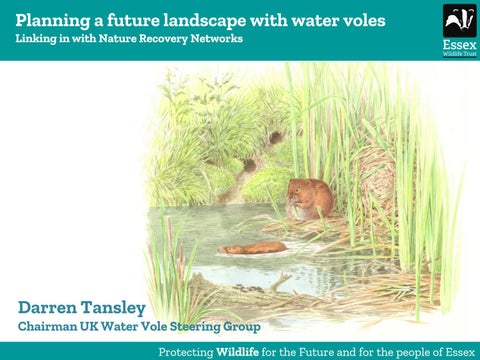
Planning a future landscape with water voles Linking in with Nature Recovery Networks
Darren Tansley Chairman UK Water Vole Steering Group Protecting Wildlife for the Future and for the people of Essex
2
Water vole habitat creation in Essex Many similar projects across the UK
Protecting Wildlife for the Future and for the people of Essex
Water Vole Mitigation Handbook New guidance in 2016 to point developers and planners in the right direction
Protecting Wildlife for the Future and for the people of Essex
The State of Nature report 2016 Species Recovery at a Landscape Scale – approx. 26,000km2
4
Protecting Wildlife for the Future and for the people of Essex
5
Water vole distribution over 10 years A further 30% decline in a period of water vole conservation efforts
5
Protecting Wildlife for the Future and for the people of Essex
2018 Suffolk Wildlife Trust Water Vole Report A resurvey of Suffolk Rivers for water vole and mink including The Stour
Young mink on River Roding – Steve Jellett 6
Protecting Wildlife for the Future and for the people of Essex
Main findings of the report Based on 15 years of mink control Water voles occupying 46% of historic survey sites – a recovery from early 2000s but the same as 1998 During the last 15 years more than 3500 mink have been caught in Suffolk. Despite this 16% of sites still showed mink activity Water vole recovery appears to be due to sustained mink control However mink trapping has decreased in intensity and mink numbers are increasing again
Water vole diving – Russell F Spencer
Protecting Wildlife for the Future and for the people of Essex
A UK Water Vole Recovery Network? A National Strategy in line with Nature Recovery Networks We need a strategy, endorsed by the UK Water Vole Steering Group that operates at a National Scale, supported by the 25 year Environment Plan THREE STRANDS 1. Recognises the need for funded mink eradication – a Mink Free East Anglia pilot will play a pivotal role
Protecting Wildlife for the Future and for the people of Essex
1. Mink Free East Anglia Conservationists are playing a leading role but funding required
Protecting Wildlife for the Future and for the people of Essex
A UK Water Vole Recovery Network? A National Strategy in line with Nature Recovery Networks We need a strategy, endorsed by the UK Water Vole Steering Group that operates at a National Scale, supported by the 25 year Environment Plan THREE STRANDS 1. Recognises the need for funded mink eradication – a Mink Free East Anglia pilot will play a pivotal role 2. To produce a viable plan for water vole habitat protection which works at a landscape scale, reduces fragmentation and puts connectivity at the heart of the planning system
Protecting Wildlife for the Future and for the people of Essex
The twin impacts of habitat fragmentation Water voles that lose their habitat
Protecting Wildlife for the Future and for the people of Essex
The twin impacts of habitat fragmentation Water voles that remain are now separated
Protecting Wildlife for the Future and for the people of Essex
What does fragmentation look like? Advice sought regarding managing ‘wildlife’ pond
Protecting Wildlife for the Future and for the people of Essex
14
Fragmentation Case Study – Barking Reach Problems with site scale water vole translocation
14
Protecting Wildlife for the Future and for the people of Essex
15
When is a buffer zone not a buffer zone? We must separate water courses from bankside development
15
Protecting Wildlife for the Future and for the people of Essex
A UK Water Vole Recovery Network? A National Strategy in line with Nature Recovery Networks We need a strategy, endorsed by the UK Water Vole Steering Group that operates at a National Scale, supported by the 25 year Environment Plan THREE STRANDS 1. Recognises the need for funded mink eradication – a Mink Free East Anglia pilot will play a pivotal role 2. To produce a viable plan for water vole habitat protection which works at a landscape scale, reduces fragmentation and puts connectivity at the heart of the planning system 3. To formulate a strategic approach to water vole reintroduction to recolonise landscapes depleted of water voles (not the often short-term or inappropriate translocation of animals by developers) Protecting Wildlife for the Future and for the people of Essex
A strategic approach to reintroductions A way to repopulate depleted landscapes? [Maps supplied by National Water Vole Database and Mapping Project]
2002-2006
913 occupied 10km grid squares
2011-2015
636 occupied 10km grid squares
Protecting Wildlife for the Future and for the people of Essex
Reintroduction Case Study - River Colne Five years of fully funded mink control
Protecting Wildlife for the Future and for the people of Essex
Reintroduction Case Study - River Colne In 2010 the Essex mink monitoring expanded along the Colne
Protecting Wildlife for the Future and for the people of Essex
Reintroduction Case Study - River Colne Expansion and recolonisation of the water vole population
Protecting Wildlife for the Future and for the people of Essex
Reintroduction Case Study - River Colne Return of mink picked up by River Wardens
5 young mink arrive
21
Protecting Wildlife for the Future and for the people of Essex
Reintroduction Case Study - River Colne Trapping on rafts starts to rise but infrastructure now in place Mink trapping 2009-2017 35 30 25 20
15 10 5 0 2009*
22
2010
2011
2012
2013
2014
2015
2016
2017
Protecting Wildlife for the Future and for the people of Essex
Better collaboration with planners Supporting Nature Recovery Networks for water vole recovery
Protecting Wildlife for the Future and for the people of Essex
eDNA metabarcoding surveys – July and Dec 2019 River Wardens training to survey R. Colne and R. Blackwater
Protecting Wildlife for the Future and for the people of Essex
eDNA metabarcoding research project – July 2019 Water vole DNA found in the habitat created by beavers in their enclosure
Protecting Wildlife for the Future and for the people of Essex
Think bigger - avoid site level decisions The Catchment Based Approach can work for consultants, planners and wildlife
Darren Tansley darrent@essexwt.org.uk Twitter @EssexWT_Darren Protecting Wildlife for the Future and for the people of Essex