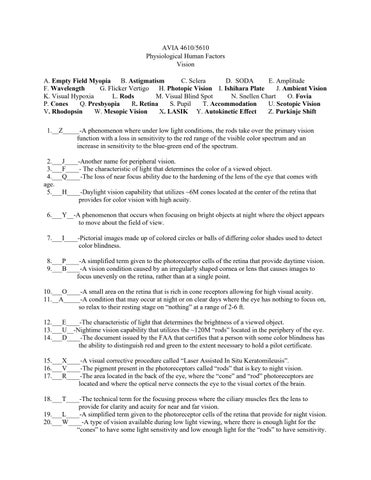
AVIA 4610/5610 Physiological Human Factors Vision A. Empty Field Myopia B. Astigmatism C. Sclera D. SODA E. Amplitude F. Wavelength G. Flicker Vertigo H. Photopic Vision I. Ishihara Plate J. Ambient Vision K. Visual Hypoxia L. Rods M. Visual Blind Spot N. Snellen Chart O. Fovia P. Cones Q. Presbyopia R. Retina S. Pupil T. Accommodation U. Scotopic Vision V. Rhodopsin W. Mesopic Vision X. LASIK Y. Autokinetic Effect Z. Purkinje Shift 1.__Z_____-A phenomenon where under low light conditions, the rods take over the primary vision function with a loss in sensitivity to the red range of the visible color spectrum and an increase in sensitivity to the blue-green end of the spectrum. 2.___J____-Another name for peripheral vision. 3.___F____- The characteristic of light that determines the color of a viewed object. 4.___Q____-The loss of near focus ability due to the hardening of the lens of the eye that comes with age. 5.___H____-Daylight vision capability that utilizes ~6M cones located at the center of the retina that provides for color vision with high acuity. 6.___Y__-A phenomenon that occurs when focusing on bright objects at night where the object appears to move about the field of view. 7.___I____-Pictorial images made up of colored circles or balls of differing color shades used to detect color blindness. 8.___P____-A simplified term given to the photoreceptor cells of the retina that provide daytime vision. 9.___B____-A vision condition caused by an irregularly shaped cornea or lens that causes images to focus unevenly on the retina, rather than at a single point. 10.___O____-A small area on the retina that is rich in cone receptors allowing for high visual acuity. 11.__A_____-A condition that may occur at night or on clear days where the eye has nothing to focus on, so relax to their resting stage on “nothing” at a range of 2-6 ft. 12.___E____-The characteristic of light that determines the brightness of a viewed object. 13.___U__-Nightime vision capability that utilizes the ~120M “rods” located in the periphery of the eye. 14.___D____-The document issued by the FAA that certifies that a person with some color blindness has the ability to distinguish red and green to the extent necessary to hold a pilot certificate. 15.___X____-A visual corrective procedure called “Laser Assisted In Situ Keratomileusis”. 16.___V____-The pigment present in the photoreceptors called “rods” that is key to night vision. 17.___R____-The area located in the back of the eye, where the “cone” and “rod” photoreceptors are located and where the optical nerve connects the eye to the visual cortex of the brain. 18.___T____-The technical term for the focusing process where the ciliary muscles flex the lens to provide for clarity and acuity for near and far vision. 19.___L____-A simplified term given to the photoreceptor cells of the retina that provide for night vision. 20.___W____-A type of vision available during low light viewing, where there is enough light for the “cones” to have some light sensitivity and low enough light for the “rods” to have sensitivity.
Human Factors Matching 4 - University Of Central Missouri - AVIA 4610
Issuu converts static files into: and more. Sign up and create your flipbook.