Maria Lai
Tessere la notte
June 26 — October 24, 2026
Riviera di Chiaia, 215
Via Carlo Poerio, 116
Beginning in the 1960s, Maria Lai incorporated symbolic and material elements drawn from traditional Sardinian culture into her work, transforming the age-old echoes of that civilization into a universal contemporary language.
The artist deconstructed the loom, an ancestral topos of the female condition, and chose weaving as her preferred mode of expression to narrate her visionary world. Her looms became “landscape-objects” and symbols of emancipation. Her thoughts flow through her hands and take shape through the interlacing of threads, giving her works a distinctly tactile quality.
She learned to sew as a child in a home where the sewing machine occupied the most beautiful and brightest room in the house. She never abandoned the pleasure of sewing, which later became her distinctive artistic practice. Using thread and fabrics, whether humble or precious, she created a poetic language that gave rise to her Libri, Lenzuoli, Geografie, Telai, Scialli e Libri di fiabe, which served as a means to reflect on the role of art and the artist in both the ancient and contemporary worlds.
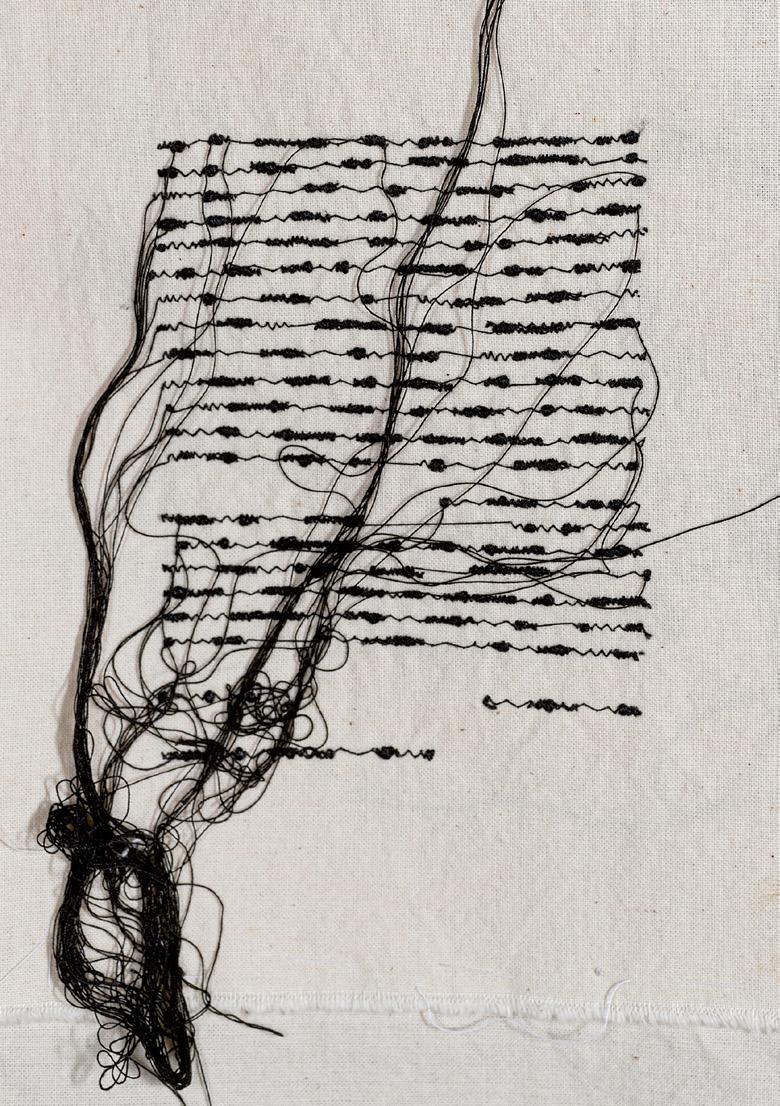
Thread, sewing, and weaving become forms of writing, a poetic language made of signs, threads, and silences, in which meaning emerges through the encounter between the artwork and the viewer. Thread intervenes precisely where verbal language comes to a halt: it stitches, connects, and suggests meanings without explicitly stating them, much like the bonds that link people, stories, and seemingly separate worlds.
The fairy-tale book Tenendo per mano l’ombra (1987) — on view at Via Carlo Poerio 116 — is composed of sewn pages and collages of dyed and embroidered fabrics, threads, and other materials. It tells of the need to confront what one fears, the darker side of reality and of oneself, and learning to accept and live alongside one’s shadow, which is not an enemy to be eliminated but rather a fundamental part of one’s identity.
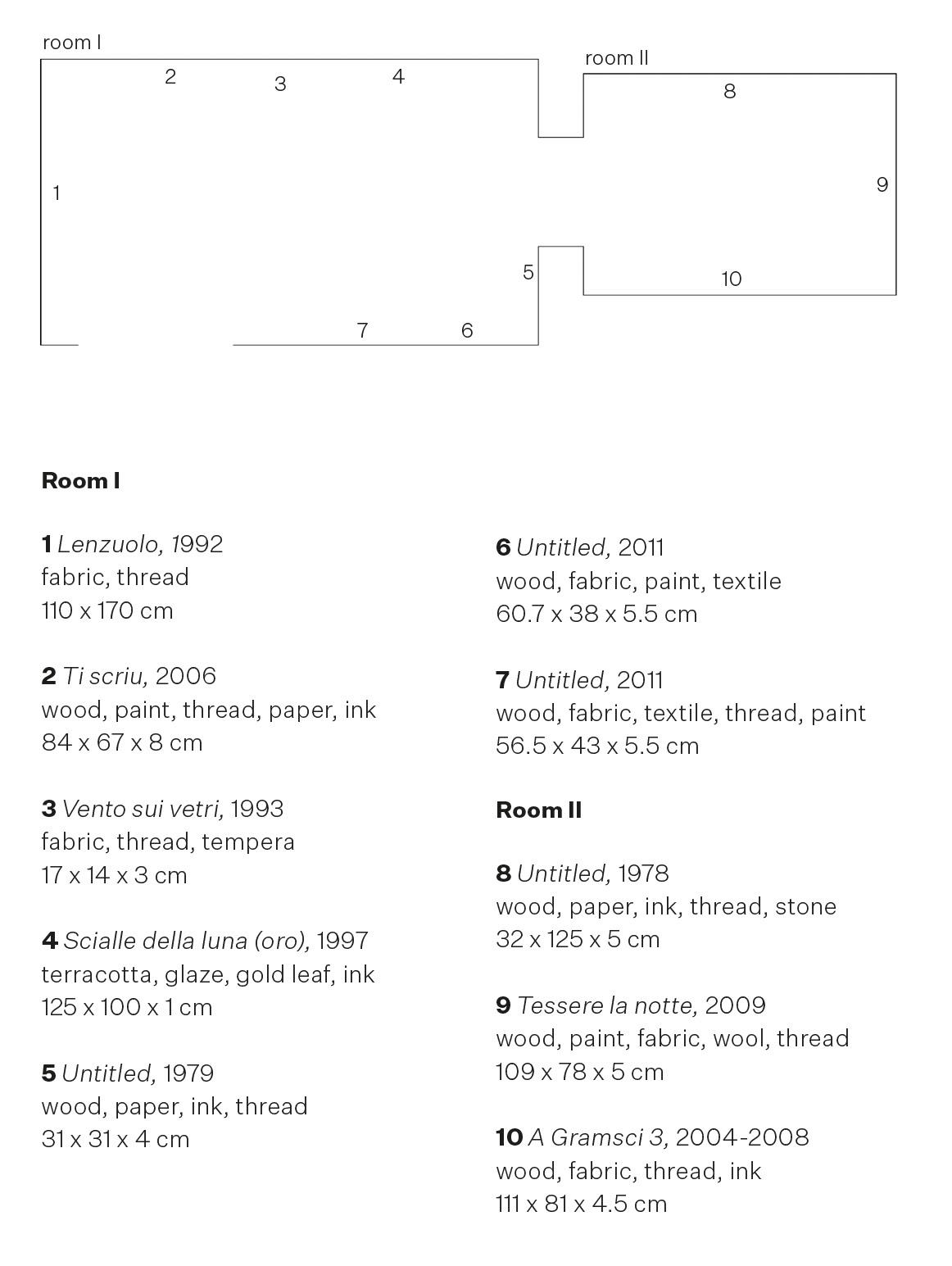
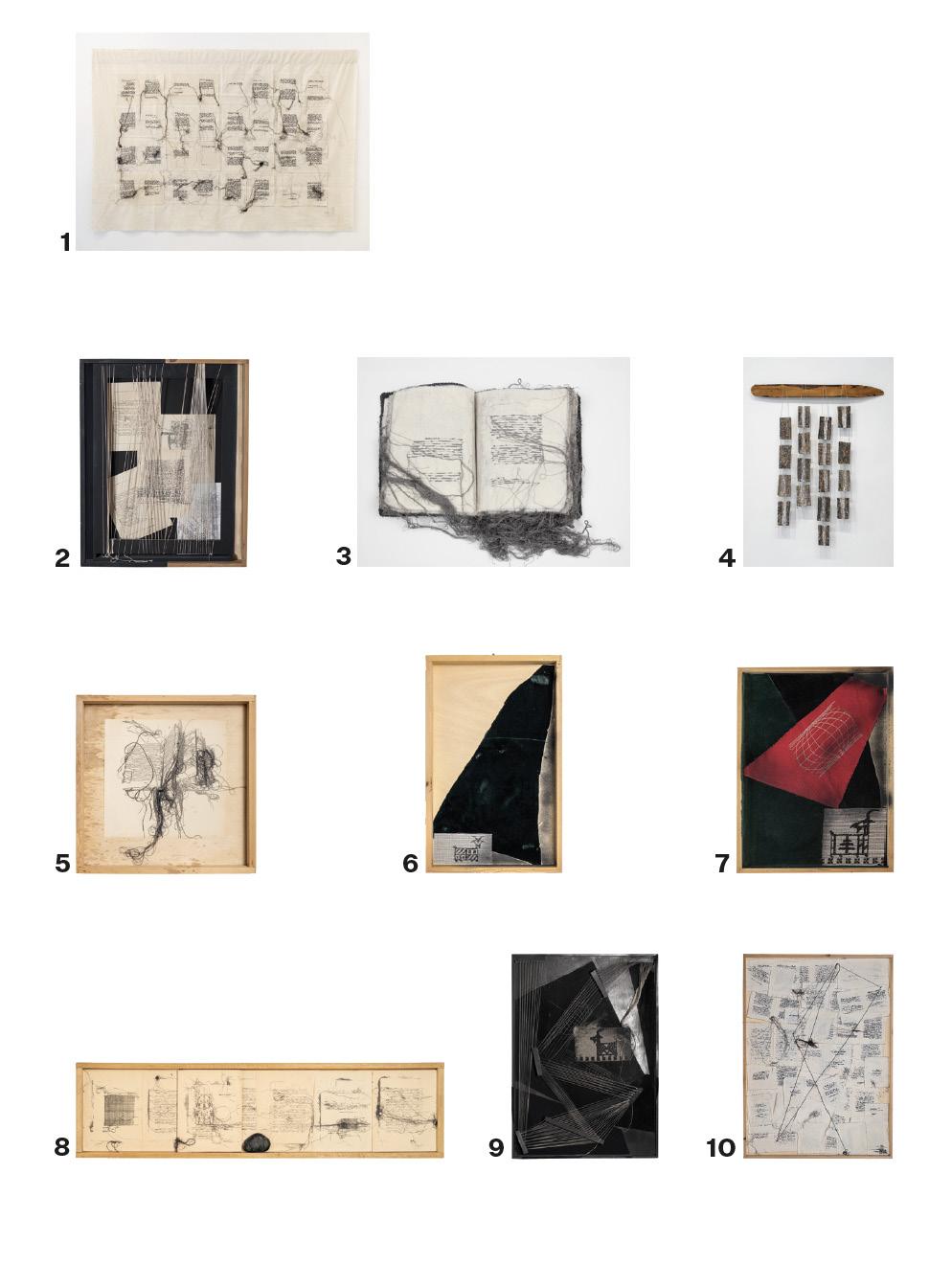
At the Riviera di Chiaia venue, works created between 1978 and 2011 are exhibited, representing the diverse artistic languages she explored, from the loom to the sewn book, from ceramics to the embroidered sheet.
Biography
Maria Lai displayed remarkable artistic talent from an early age. In 1939 she moved to Rome to attend the Art High School. She later enrolled at the Academy of Fine Arts in Venice, where she studied under Arturo Martini. Returning to Sardinia in 1945, she renewed her friendship with the writer Salvatore Cambosu and taught drawing in Cagliari’s secondary schools. In 1956 she moved back to Rome and, the following year, held her first solo exhibition at Galleria L’Obelisco. She became part of a circle of poets and writers, including Giuseppe Dessì. In 1971, at Galleria Schneider in Rome, she exhibited her first Telai, a body of work that would characterize the following decade and bring her closer to the themes of Arte Povera. During the 1980s she devoted herself to her first site-specific and community-based projects, which would become some of the most significant achievements of her career. In 1981, in Ulassai, she created Legarsi alla Montagna, considered the first work of relational art in Italy. This collective action involved the inhabitants of the village linking their houses together with a blue ribbon and then connecting them to the mountain overlooking the town, symbolizing a renewed harmony between humanity, nature, and art. From the 1990s onward, she developed a series of public art interventions that gradually transformed Ulassai, her birthplace, into a veritable open-air museum.
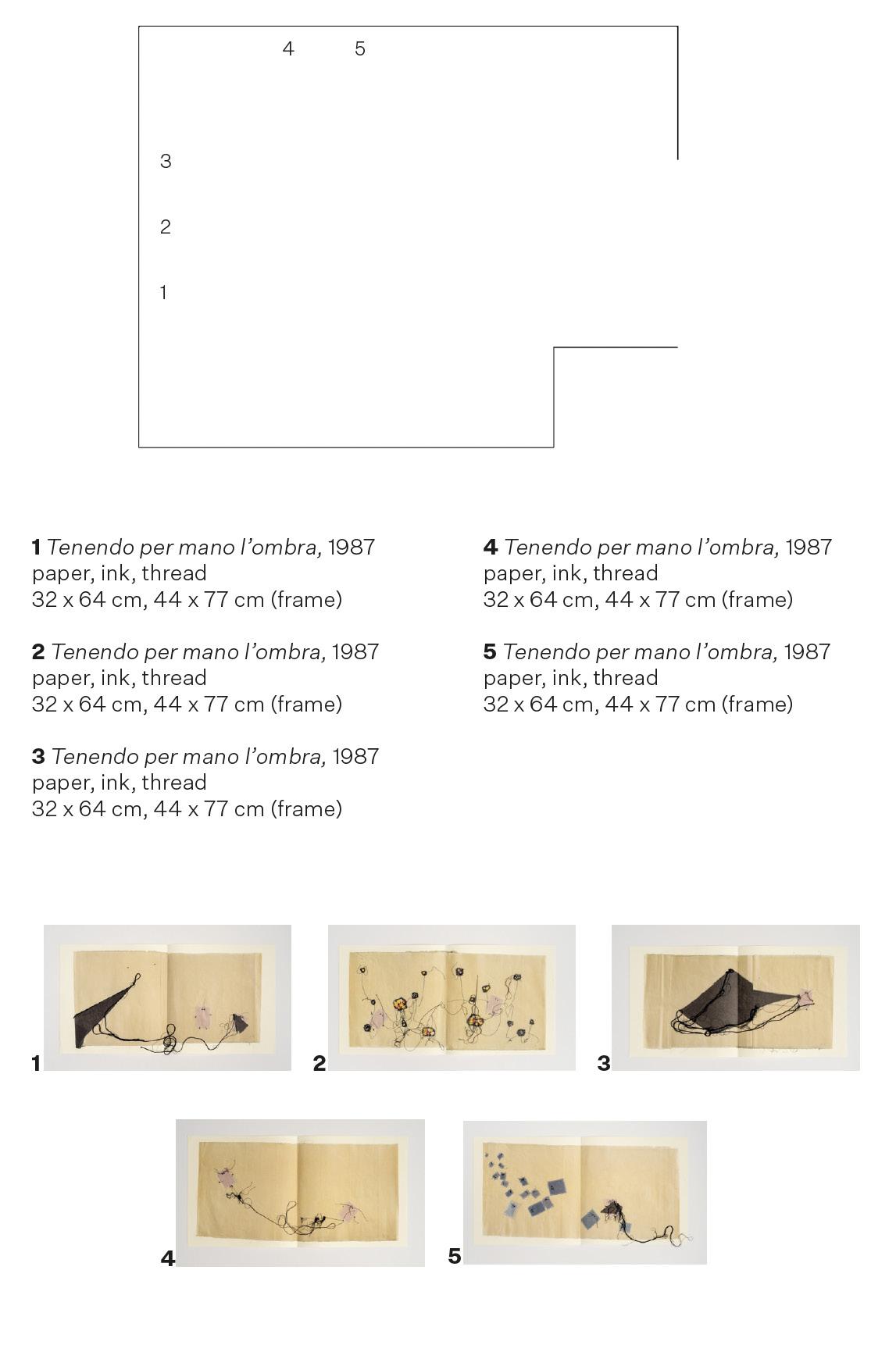
Maria Lai tells . . .
This is the story of a human cub embarking on life’s journey.
It soon discovers its duality: a sibling and stranger to itself.
A sudden yearning rises for faraway games and places.
The earth isn’t enough for the human cub, the sky isn’t enough.
Its games become restless.
Its tiny feet are ensnared in tangles of threads that impede its steps and weave intrusive shadows.
A desperate escape ends in the darkness of fear.
Help comes from the outside.
A celestial being, but its weapon is that of a subterranean god.
The shadows are many: one for every human being.
Most are rejected and driven away.
The God chases the shadows drifting like ghosts.
He spears them.
Imprisons them.
Sending them to feed the darkness of a dragon.
One in conflict with his other self
. . . who is now far away . . .
And has let go of his shadow.
Drifting away, the other meets a festive multitude liberated from their shadows.
He too is dressed in blue.
They all grow pale, until they are almost not there.
The cub, orphaned of its double, passionately holds its shadow to its heart . . .
. . . and flees holding the shadow by the hand as it grows . . .
Until it becomes the very space of journey . . .
A journey of mystery. . .
. . . through a wonder of rainbows and underground sprouts across new gardens opening onto the future.