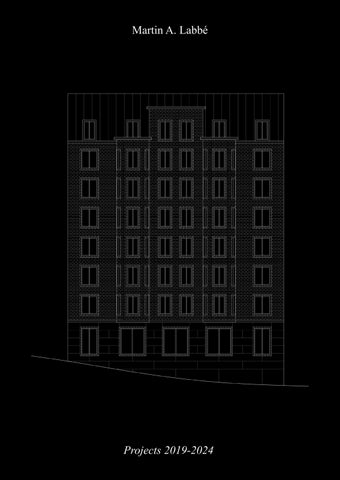
Martin A. Labbé

Projects 2019-2024

My name is Martin, I am 26 years old and recently graduated from my architectural education in KTH in May this year, 2024. I would describe myself as an outgoing and curious individual with a natural willingness to learn. Before I studied architecture, I played tennis semiprofessionally, today I don’t compete as much but I still play regularly at a high level. I am also a bee-keeper and have been doing so for almost six years now, a passion that I enjoy greatly. Furthermore I am extremely passionate about music, I’ve played guitar for almost 15 years and participated in bands in a few of those years. I would describe myself as a food-lover, and the embodiment of that would be my gelato shop that I opened with my brother and my parents three years ago as a passion project. Other things I do in my spare time include screenprinting, aswell as of recent delving in to additive manufacturing since I purchased and built my own 3D printer. Now I am searching for job opportunities as an architect since I am eager to learn the ways of the practice. Thank you for your time and consideration.
Martin Labbé
Älgövägen 331
133 37 Saltsjöbaden
Stockholm
Sweden
info@labbe.studio
Education
2019-2024 Royal Institute of Technology (KTH)
M.Sc in Architecture 2024
B.Sc in Architecture 2022
2018-2019 Stockholm University
Business and economics
2013-2016 Enskilda Gymnasiet - Stockholm
Secondary school diploma 2016
Experience Publications
Freelance graphic design for Bello Personal Training Atala Labbé, M. (2023).
2022
Freelance graphic design for Andrea Labbé
2021- present day
Co-founder and head of graphic design at Gräddnos Gelateria
2019-2022 2023
Cashier and Accountant for the Architecture Chapter at KTH
Languages Skills
Swedish MS Office
Native
Spanish
Native
English
Fluent
French
Intermediate
Italian
Basic
Made in Stockholm : exploring the manufacturing scene in Stockholm. KTH Arkitektur.
Atala Labbé, M. (2023).
Årstadal : writing history. KTH Arkitektur.
Word | Powerpoint Excel
Adobe CC
Illustrator Photoshop | Indesign
CAD & Visualisation
Rhino | Revit | AutoCad | Vray | QGIS
Additive manufacturing
Prusa Mk4 3D printer | Prusa slicer
Misc.
Screenprinter
LEARNING FROM THE BOURGEOISIE CITY | 6
PASSAGE
NORRA DJURGÅRDEN 1:49 | 36
THE BIOTOPE 24


‘Learning from the bourgeoisie city’ is a means to investigate the ubiquitous typology ‘kvartershuset’ (block-house or house within the block) in the city of Stockholm. The project consists of three parts; one that provides an historical background on the planned city of Stockholm, a second part that includes a comprehensive systematic documentation of a block in Stockholm as well as learnings from it, and lastly, an architectural proposal that aims to apply knowledge from the aforementioned research. The project touches upon architectural themes such as the nature of permanence and adaptability, typology, as well as cultural and historical systems that shape the architecture of the city. These topics lead one into the idea and discussion of ‘buildings that transcend time’, that persist, despite the constant evolution of society. Whether or not the answer or blueprint for that notion lies within my research is hard to say, however, it is a valid exercise in a time where we as architects have an even greater responsibility than before to create timeless buildings.


spiral staircase competition

The Biotope was my entry for a spiral staircase competition organised by Weland steel company. The brief for the competition consisted of designing a spiral staircase with an innovative addition. The construction also had to be out of steel, aswell as a maximum height of three meters.
The idea plays on the future of a self-sustaining household, where one could farm all year round, despite the weather or geographical location. So how can one make this happen? The proposed idea is to combine the staircase as a vessel for hydroponic farming. This is done by housing a water pump and sprinkler system inside the loadbearing shaft of the staircase, aswell as a helix-like pattern of perforations where you can place notched pots with seeds or saplings inside. The sprinkler system then irrigates the pots from the inside of the shaft, in specific time intervals, allowing for a vertical hydroponic farm. Light is either provided naturally (location of staircase) or artificially by the use of portable UV-lights, where you can customize the light-allocation for your specific crops needs.


Monument in Stockholm’s first suburb Årstadal

The pedestrian bridge over the ridge where the train passes in Årstadal has long been an important remnant of the of the forgotten era of the area. The bridge was constructed in the early 1900’s when the west-connecting railway was widened to fit two train tracks. Since then, not much has changed on the bridge, besides maintenance work, it has retained it’s old form and foundations.
The intent of the project is to highlight the bridge in order to tell the history of the area of Årstadal. In its inception, late 1800’s Årstadal had limestone factories that processed the lime in order to manufacture cement. The area was heavily polluted due to the lack of regulations - which obviously took a toll on the health of the population.
How can we then, try to remember this time in order to tell a story about the roots of the area?
The intervention plays on the history of limestone processing aswell as the historical resilience the bridge has shown. The foundations tell a story - and it is a classical one, while the “bridge-gables” as of now remain quite anonymous. The idea is to tell two stories - one that relates to the history of the area, and one that relates to the underlying architecture.
The result is an arrangement of massive limestones, shifted against the walking plane of the bridge perpendicularly, in order to create different types of rooms in the bridge. This way we can feel the material by touching it, smelling it or just sitting on it, while also experiencing space.
The limestones have been arranged in a seemingly random way in order to contrast the rationality of the foundations.
Project is part of survey and research that was made on Årstadal which later resulted in a physical publication with Stockholm Mania master studio at KTH.


Canopy was our submission for the Sansusi Sound sculpture competition. The task was to design an outdoor stage for the Sansusi festival in Latvia for musicians to perform on. The competition called for an additional function of interactivity in the form of “a stage capable of generating sound”, therefore encouraging the audience to engage with the music and the musicians rather than just being spectators. Our proposal makes this interaction possible by integrating a harp-like strung frame that sits on top of the stage aswell as cladding the base of the stage with tensioned drum-skins. This play of different musical elements provides a new dimension to what it means to be an audience member but also a performing musician. The stage also had to be easy to assemble and disassemble due to the temporary nature of the event, which we solved by designing the stage with a means of simple timber decking.


A sixteen story building of CLT in KTH campus

N.Djurgården 1:49 is a project situated in the heart of KTH-campus in Stockholm. The program consists of 16 stories of student housing with a building footprint constraint of 20x20 meters. Furthermore, the loadbearing structure of the building has to be composed mainly out of cross laminated timber elements. The project plays on the architectural ambiguity of its surrounding where each existing building has no clear relation to one another. Some buildings are old, while some are very recent in execution, giving the area an interesting mix in aesthetics. The idea was to follow this “theme” of the area while still upholding a sense of relatabilty to the city of Stockholm and its architecture. The result was comprised of a rendered facade in an earthy-orange colour (a colour which is very typical for the “Stockholm-palette” of the buildings in the city), adorned with oversized, protruding window frames, giving the fenestration of the buildning a bold and different aesthetic compared to its surroundings. Lastly, the crown of the edifice features overhanging eaves which encompasses the project with a type of post-modern aura.