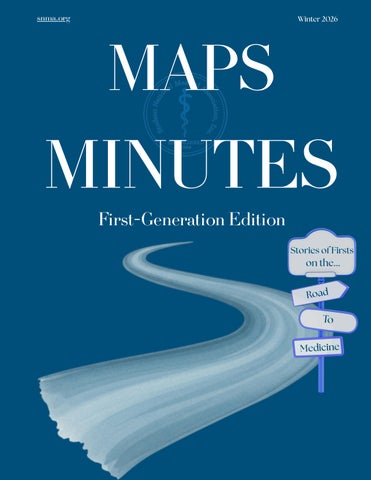
MAPS MINUTES

Editor In-Chief
Jody Adeyemo is a Publications Co-Liaison for the MAPS Committee and has been an active member of the Student National Medical Association since 2023. She is passionate about storytelling as a tool for visibility and communitybuilding for premedical students.

Editor
Christina Twiggs serves as a Publications Co-Liaison for the MAPS Committee and has been an active member of the Student National Medical Association since 2024. She hopes to help bridge the gaps between aspiring physicians and the pathways needed to achieve their goals.
SPECIAL ACKNOWLEDGEMENTS
Thank you to all the premed & medical students who shared their stories with us to make this edition of the MAPS Minutes possible.
FOR MORE MAPS CONTENT, VISIT: snma.org/page/maps
DIVERSIFYING THE FACE OF MEDICINE SINCE 1964

THE STUDENT NATIONAL MEDICAL ASSOCIATION
Sixty-two years of diversifying the face of medicine.
Since its founding in 1964, the Student National Medical Association (SNMA) has remained steadfast in its mission to increase the number of clinically excellent, culturally humble, and socially conscious physicians. Alongside this mission, the Minority Association of Pre-Medical Students (MAPS) has played a vital role in supporting students at the earliest stages of the medical pipeline. Through mentorship, academic guidance, and community-building, MAPS works to expand access and opportunity for underrepresented minority students pursuing careers in medicine and related health professions
MAPS Minutes serves as a platform to share knowledge, amplify student perspectives, and strengthen connections across the premedical community.
MAPS Minutes hopes to advance SNMA’s commitment to representation and excellence in medicine.
#TheRoadToMedicine
MAPS MINUTES
T a b l e o f C o n t e n t s
About this Edition
Stories: Premed Students
Stories: Medical Students Premed Resources
A note to Our Readers
For many first-generation and low-income students, the road to medicine is not clearly marked. The expectations are often unspoken with unclear timelines and rules learned through trial and error rather than structured guidance.
Minority Association of Pre-Medical Students (MAPS) has played a vital role in lifting up first-generation and low-income students by providing mentorship, resources, community, and opportunity along every step of their journey to medicine.
This First-Generation & Low-Income Edition of MAPS Minutes highlights the voices and experiences of students who navigated medicine without the benefit of traditional networks. Their journeys reflect resilience and resourcefulness, as well as the power of community. Through personal narratives and shared reflection, we invite you to explore not just the road to medicine, but the meaning behind it. We hope these stories inspire you and demonstrate that no path to medicine is singular, and no one who pursues it walks alone.
JODY ADEYEMO & CHRISTINA TWIGGS Student
Stories From Premed Students
On the Road to Medicine
STORIES FROM PREMED STUDENTS
GAP YEAR STUDENT
I’ve known since I was a child that I wanted to pursue a career in medicine I’ve always been drawn to science, and I found anatomy and physiology fascinating Luckily, my mom is a nurse, so I also had extensive exposure to physicians and healthcare in general, which helped me determine that it was the right path for me. I decided to take a gap year because I knew I wouldn’t be as competitive if I applied during my junior year
By taking a gap year, I was able to take my MCAT later and dedicate adequate time to study for it, improve my GPA, include my senior research thesis in my application, get stronger letters of recommendation, and even include my gap year job as a Clinical Research Coordinator
During my gap year, I’ve been able to work a full-time job for the first time, learn valuable experiences I can discuss during interviews, and truly be an adult. I’m extremely happy I took a gap year because it allowed my application and me to mature before medical school
I think the hardest thing I struggled with is trying to figure out my summer and winter breaks. I saw many students conducting research and partaking in different programs, and I didn’t know how to get (or afford) many of these opportunities
I felt the need to partake in these programs to bolster my application, but I also needed money I eventually found out I could work at clinics and hospitals over the summer, which enabled me to make money while also gaining experience that would benefit my medical school application.
During my freshman year of college, I don’t think a day went by that I didn’t feel imposter syndrome It was a hard transition for me going from high school, where I was “smart enough” to coast by, to college, where I would study nonstop just to get a passing grade. This feeling was only doubled by being a premed, because it was so easy to compare myself to others who had a better GPA, a better MCAT, or better experiences.
It wasn’t until I found a supportive group of like-minded friends that I stopped comparing myself. While getting into medical school is competitive, I came to realize I’m not competing with anyone but myself While I may feel imposter syndrome from time to time, I’ve gotten as far as I have because of the work put in, so I’m exactly where I need to be.
Continue on Next Page
STORIES FROM PREMED STUDENTS
STORIES FROM PREMED STUDENTS
GAP YEAR STUDENT
To figure out what I should be doing, I spent a lot of time searching on Google. From random premed Reddit pages to application websites, I explored it all.
I remember searching up the best resources to study for the MCAT, and even the best gap year jobs for medical school applications Whenever I had a question, or was unsure about something, I consulted the net. Especially when you don’t have a doctor in your family to give you advice, I implore everyone to use the internet to their advantage
Luckily, I had a college advisor who was very knowledgeable about the medical school application process, so I met with her regularly to go over my timeline for applying and what I needed to get done at certain points.
Having someone to keep me accountable through the application definitely made it easier to stay on top of everything. If you don’t have an advisor, I encourage everyone to have friends or classmates who can support you and keep you accountable. So far I have received 4 acceptances, of which I am extremely grateful
When I got my first acceptance, I was walking to my car, and I remember stopping dead in my tracks with my jaw dropped for what felt like hours. I was overwhelmed with shock, but also incredibly happy
I think every applicant stresses about not getting into any school, so getting that acceptance brought a wave of peace over me, releasing a lot of stress I had been holding since applying.
I could go back and give my premed self one piece of advice, it would be to trust that everything happens the way it’s supposed to I would tell myself to shadow more for exposure, to choose activities that genuinely speak to me, and to stay involved in things outside of medicine. Those experiences matter.
I’d also remind myself, and anyone still on this path, that you can retake the MCAT Some schools have cutoffs, but a score that feels limiting to you might be someone else’s dream score. You’re doing really well, even if it doesn’t always feel like it.
Written By:
Jeremiah Gorman
STORIES FROM PREMED STUDENTS
GAP YEAR STUDENT
I can’t point to a single moment when I decided to pursue medicine It wasn’t a sudden realization, but something that developed over time I was always exposed to healthcare, especially through seeing how nurses worked in clinical settings. Watching the way they interacted with patients and navigated care made healthcare feel familiar to me long before I fully understood what it meant to pursue medicine myself
When I started undergrad, I initially thought I would go straight through to medical school. But as I learned more about the process– especially how much time and preparation the MCAT requires– I realized I didn’t want to rush I didn’t want to fasttrack my way forward without really knowing myself Taking a gap year felt like the right decision, not because I was behind, but because I wanted to take my time and grow before committing to the next step.
During my gap year, I spent time in both San Francisco and Atlanta and worked as an ER technician Being in that role gave me hands-on exposure to patient care and reinforced my interest in medicine. It also helped me realize that taking time to explore and reflect didn’t mean I was falling off track: it meant I was being intentional
As a first-generation student, one of the hardest parts of my premed journey was understanding the timeline of medicine Knowing when to start research, when to seriously prepare for the MCAT, or when to ask for letters of recommendation wasn’t obvious. I remember that it wasn’t until February of my application year that I fully realized how much work went into things like personal statements and recommendation letters A lot of it felt unclear until I was already in it
Imposter syndrome has been something I’ve dealt with consistently. I feel it almost every day. In classes and research especially, I often felt like I was faking it and like I didn’t actually belong in those spaces Being a woman of color adds another layer to that doubt, and it’s easy to question yourself even when you’re doing well. Interestingly, the application process itself didn’t trigger that feeling as much Writing so deeply about myself forced me to recognize my experiences and accomplishments in a way I hadn’t before.
Continue on Next Page
STORIES FROM PREMED STUDENTS
GAP YEAR STUDENT
Without traditional networks, I relied on a mix of institutional resources and peer support to figure out what I should be doing Early on, my advisor gave me a timeline and I held onto it from freshman year onward. Programs like HPAC helped keep me on track, and relationships with upperclassmen, including seniors I met as a sophomore, gave me insight into what was coming next
When it came time to apply to medical school, my family was my main source of emotional support. Even though they didn’t always know the details of the process, they were constantly encouraging me to keep pushing forward. I also had a mentor who helped bridge the admissions process and guided me through navigating the cycle
I’ve received multiple medical school acceptances, but I’ll never forget the first one. It was from Upstate. I cried and immediately called my grandmother I was genuinely excited about my chances there, and that first acceptance brought a sense of calm that carried me through the rest of the application process.
The interview process taught me a lot as well. I found that interviews went better when I really knew my own story Interviews also revealed a lot about each school’s values and how they saw their students
Culture mattered a lot to me when building my school list I was intentional about location and staying relatively close to family I ruled out regions that felt isolating and paid close attention to demographics, affinity groups, and mission fit. Even though I knew I would still be a minority in many spaces, finding schools with visible support systems made a difference Paying for the application process required a lot of planning I used a graduate fund from Cornell, relied on my savings, and applied for fee waivers for secondary applications through AMCAS. Like many firstgeneration students, I had to be strategic about finances every step of the way
If I could go back and give my premed self one piece of advice, it would be to trust that everything happens the way it’s supposed to. I would tell myself to shadow more for exposure, to choose activities that genuinely speak to me, and to stay involved in things outside of medicine Those experiences matter I’d also remind myself, and anyone still on this path, that you can retake the MCAT. Some schools have cutoffs, but a score that feels limiting to you might be someone else’s dream score. You’re doing really well, even if it doesn’t always feel like it
Written By: Jade Palmer-Johnson
STORIES FROM PREMED STUDENTS
GAP YEAR STUDENT
I first decided to pursue dentistry after working as a front desk receptionist at a dental clinic I got this job the summer before starting college, and at the time, I was interested in working in healthcare but was unsure of what career path to pursue. Through conversations with dentists, dental assistants, and hygienists, I realized that dentistry could be a career that I would love It uniquely combined my interests in promoting oral health awareness, working creatively with my hands, and applying science in a practical way.
Initially, I was hesitant to take a gap year because I viewed it as delaying my goals However, I soon realized that taking a gap year was actually very beneficial It allowed me to become a stronger applicant, better prepared me for a career in dentistry, and gave me the foundation I needed to succeed in dental school. I recognized that dental school is rigorous, and being mentally prepared while maximizing my chances of acceptance was important to me After speaking with advisors, I decided that a gap year was the best decision for my personal and professional growth.
One of the most challenging aspects of my journey was finding shadowing opportunities and mentors I think having good mentorship is really important Having people that are willing to guide you and genuinely want to see you succeed makes a significant difference. Shadowing was particularly difficult because I did not have personal connections to dentists, unlike some peers who came from families in the profession Despite this, I utilized available resources by seeking online opportunities, networking, and reaching out to others for help, which ultimately made a big difference.
I did experience imposter syndrome, especially during my freshman year of college. College science courses were very difficult for me at first, and I felt behind when I didn’t understand the concepts as quickly as others. Over time, I learned how to study more effectively, a process that took a semester or two to master That learning curve, however, was crucial to my success in my later undergraduate years.
Continue on Next Page
STORIES FROM PREMED STUDENTS
GAP YEAR STUDENT
I figured out what steps to take through a mixture of online and academic mentors I also had an active mentorship with a dentist whom I relied on for advice and application feedback. She played a critical role in my success during this application cycle.
My advice to others is to create a clear plan and build a strong support system Whether it’s friends, mentors, or professionals you admire, surrounding yourself with people who genuinely want to see you succeed is incredibly important. These individuals not only support you through the application process and professional journey, but also help protect your mental health along the way
This Student Chose to Remain Anonymous
STORIES FROM PREMED STUDENTS
FOURTH YEAR STUDENT
As a first-generation college student, there are many different perspectives that come along with being the first in your family However an added layer is being the first member of your family pursuing a medical degree. I am not only the first of my family to make it through college but also the first to take the MCAT, to apply to medical school, and many other “firsts” in my premedical journey
While some may see it as a disadvantage I have never been more grateful. Being first gen while it can make you feel behind at times or just not aware of certain normalities, it also makes you resilient Without Jesus and my family I would not be where I am today I have had so much support from my parents who have walked with me and learned about the process of becoming a doctor just so that they could help me.
Ever since I was a child I have seen the ways that they have denied their own wants and needs to put myself and my brother first so that we would be able to have a successful future. Because of this I am so grateful to be able to have the opportunity to make them proud.
I’m also so grateful to have a community of mentors and friends who have encouraged me, supported me, and often are also first gen as well Having people to relate to over the past few years has been such a blessing. So, as I grow into who God has called me to be and continue my journey in medicine, I am so excited to celebrate graduating from Cornell University this upcoming May and specifically being the first in my family to do so
Written By: Kyaira Jordan
STORIES FROM PREMED STUDENTS
FOURTH YEAR STUDENT
I don’t think there was ever a single moment when I decided I wanted to pursue medicine. It sort of grew slowly out of my responsibilities. Growing up, I was a caregiver for a close family member living with Multiple Sclerosis. I learned early what it meant to help manage medications and appointments and adapt daily life around others At the time, I didn’t have the language to call that “clinical exposure,” but I knew it mattered. Watching someone you love navigate a chronic illness teaches you empathy and resilience in ways no textbook ever could
I come from an immigrant family with no history in healthcare Medicine always felt respected, but a bit distant like something impressive and intimidating: not something I knew how to access. I didn’t have anyone who could explain the timeline or what I was “supposed” to be doing each year More than anything, I just wanted to make my family proud and show them that the sacrifices they made coming to this country meant something.
What truly solidified my interest in medicine was my relationship with my family member’s primary care physician I was struck not just by their medical knowledge, but by their compassion. They listened. They remembered details about my family.
They treated my family members with dignity, even on hard days During my freshman year of college, I worked up the courage to ask if I could shadow them. I remember rehearsing the question over and over, terrified of being told no. When they said yes, it felt like a door had opened
That experience changed how I saw myself. Shadowing helped me realize that curiosity wasn’t something to hide; it was something to lean into. I became more comfortable asking questions, both in clinical settings and in the classroom Eventually, that confidence carried over into my relationships.
I connected with a professor who encouraged me to explore research, something I had always assumed was reserved for “smarter” students who knew more or started earlier Getting involved in research challenged me intellectually, but it also showed me that I belonged in academic spaces I once found intimidating.
Continue on Next Page
STORIES FROM PREMED STUDENTS
FOURTH YEAR STUDENT
Despite these milestones, imposter syndrome has been a constant companion There were times I felt behind, especially when classmates casually referenced family members who were physicians or mentors they’d known for years. I worried that I was missing something fundamental. What helped was realizing that everyone’s path looks different and that asking for help is not a weakness, but a skill
As I prepare to apply this May, I’m still learning. I’m still asking questions. But I’m no longer afraid of not knowing everything. If I could give my pre-med self one piece of advice it would be to speak up and build your network There are so many people willing to help, but they can’t support you if they don’t know you’re there. You don’t need to have all the answers, you just need the courage to ask the questions.
This Student Chose to Remain Anonymous
For readers who see themselves in these narratives and are wondering where to turn next, the following information highlights programs, organizations, and resources that have supported first-generation and underrepresented students along the road to medicine.
Mentorship & Community
MAPS (Minority Association of Pre-Medical Students)

These
Local and national MAPS chapters provide peer mentorship, MCAT support, application guidance, and community for premed students of color and first-generation backgrounds.
SNMA (Student National Medical Association)
SNMA offers national conferences, leadership opportunities, mentorship, and pipeline programs that support students from premed through residency.
LMSA (Latino Medical Student Association)
A national organization supporting Latino/a/x students pursuing medicine through mentorship and conferences.
First-Gen Medical Student Groups (school-specific)
Many colleges and medical schools host first-generation or pipeline affinity groups: these are often found through student organizations or diversity offices.
Summer Research & Academic Enrichment Programs
NIH Summer Internship Program (SIP)
Paid summer research internships across NIH campuses for undergraduates and recent graduates.
SHPEP (Summer Health Professions Education Program)
A free, intensive summer program for first-year and sophomore students interested in medicine, dentistry, and public health.
AAMC Summer Undergraduate Research Programs Database
A centralized database of summer research opportunities across the country.
Application & Financial Support
AAMC Fee Assistance Program (FAP)
Provides reduced MCAT and medical school application fees for eligible students.
Free & Low-Cost MCAT Resources
Includes free anki decks, documents, videos, and practice questions.
Clinical Experience
These allow students to gain hands-on experience while earning money:
Medical Assistant (MA)
Emergency Medical Technician (EMT)
Patient Care Technician (PCT)
Clinical Research Coordinator (CRC)
Medical Scribe
These resources have been hyperlinked for your convenience.
NAVIGATING THE ROAD TO MEDICINE
Years 2-3
Gain consistent clinical experience
Explore research (if interested)
Build relationships with mentors
Begin learning about the application process
Years 3-4
MCAT preparation (timing varies)
Finalize clinical/research experiences
Request letters of recommendation
Apply when you feel ready
Consider gap years
Years 1-2
Explore interests
Focus on foundational coursework
Join community or mentorship groups
Begin volunteering or clinical exposure
Stories From Medical Students
On the Road to Medicine
STORIES FROM MEDICAL STUDENTS
FIRST YEAR STUDENT
My childhood was framed by protective fictions that softened harsh realities What we called family “sleepovers”, all of us sharing one bedroom, disguised the strain of rent. Dawn bus rides were rebranded as a noble duty for education. Frigid showers were remedied with pots of boiled water These loving falsehoods shielded us, even as my parents fought to keep us warm, fed, and hopeful While my parents mastered the art of reframing our circumstances, I now have the privilege of reframing our future. “I am the first in my family to get accepted to medical school.”
My family has faced many uncertainties in our journey to achieve stability For my parents, it means earning enough to buy a home and a car, settle overwhelming debts, and send their kids to university; a dream they crossed oceans for but could not reach themselves For me, it is achieving those milestones through the vehicle of an education they sacrificed everything to provide
Despite my family’s finances and home life, I rely on my ambitions and support systems to cope with these uncertainties. In college, I found communities like my dance team, where I found my family away from home to help me through the highs and lows of young adult life. It was being persistent in seeking mentorship from upperclassmen and physicians who poured into me while navigating the journey of getting to and through medical school. I want to heal and restore marginalized communities such as my own, and becoming a physician means using my lived experiences to inform and positively impact the lives of my future patients
To anyone beginning this path: your background is not a barrier; it is your unique strength. Let your “why” anchor you. Actively seek your tribe and your mentors. And remember, you are your ancestors’ wildest dreams, and this journey is how you honor that gift
Written By: Jessica Jeremiah
Jessica is a first-year MD/MPH student at UT Southwestern Medical School
STORIES FROM MEDICAL STUDENTS
FIRST YEAR STUDENT
CONTEXT
My decision to pursue medicine did not come from a single “aha” moment, but rather from an experience that fundamentally repurposed how I understood advocacy In 2019, my mother moved due to her immigration status, an event that abruptly destabilized every part of my life. I was a teenager navigating fear and uncertainty largely on my own. My mental health deteriorated quickly– my grades dropped, I struggled with sleep, and I withdrew from people who cared about me because I didn’t know how to articulate what I was feeling
During this time, I went to my pediatrician for what was supposed to be a routine visit. She immediately noticed that something was different– my demeanor, my affect, and my mother’s absence When she asked what was going on, I broke down and shared everything What followed was the first time I saw medicine practiced in a way that felt deeply human. She didn’t rush me or reduce my pain to a checklist. Instead, she listened, validated my experience, connected me to mental health resources, and most impactfully, committed to checking in on me
That relationship changed how I viewed physicians. She showed me that medicine is not only about diagnosing and treating disease, but about recognizing the social, emotional, and psychological forces that shape a patient’s health Her care gave me stability during one of the most chaotic periods of my life, and it planted the seed for my desire to become the kind of physician who sees patients as whole people. From that point forward, as I sought out shadowing experiences and clinical exposure, that original motivation only deepened and
Solidified
I took a nontraditional gap year after graduating from college a year early. I intentionally used what would have been my senior year to focus on applying to medical school while balancing professional, leadership, and family responsibilities As a firstgeneration student, I wanted to approach the application process with structure and intention, rather than attempting to manage it alongside a full undergraduate course load.
Continue on Next Page
STORIES FROM MEDICAL STUDENTS
FIRST YEAR STUDENT
During this year, I studied for and took the MCAT, completed my primary and secondary applications, and attended interviews, all while working as a research assistant in a role closely tied to public health This position allowed me to earn and save money while gaining exposure to population-level health issues and data-driven approaches to care. The experience helped bridge my understanding of medicine beyond the bedside and strengthened my readiness for the clinical environment through systemsbased thinking
In parallel, I sought out diverse clinical exposure to broaden my understanding of medicine. I shadowed physicians in multiple specialties, including cardiology and dermatology, and also spent time observing nurses to better appreciate interdisciplinary care Seeing medicine from different professional perspectives helped me understand how patient care is delivered collaboratively and reinforced my respect for each role within the healthcare system.
Beyond academics and clinical exposure, returning home required me to relearn how to be a big sister to my six younger siblings, balancing family responsibilities with professional growth I also remained deeply involved in leadership, serving my local church, RCCG TKP Impact House, and stepping into regional leadership with SNMA, where I now serve as the Region 3 Pre-Medical Representative. This year was not a pause, but a period of consolidation and growth It required discipline, adaptability, and emotional maturity, and it confirmed my readiness to enter medical school with clarity, resilience, and purpose.
PREMED JOURNEY
As a first-generation student, one of the most difficult aspects of my premed journey was accessing opportunities within a large institution where many pathways felt informal and relationship-based. At a school the size of Texas A&M, it often seemed as though opportunities were not publicly advertised, but instead circulated through word-of-mouth
Continue on Next Page
STORIES FROM MEDICAL STUDENTS
FIRST YEAR STUDENT
There was an unspoken expectation that you already “knew someone” to gain entry into these spaces, a luxury I did not initially have. Time compounded this challenge. Because I graduated early, I was navigating this process within a compressed timeline, which made the lack of clarity even more stressful Cold-emailing faculty, applying broadly to positions, and waiting for responses often felt discouraging. In fact, I applied to over 100 jobs before ultimately securing my research position. That experience taught me how opaque and competitive access can be without guidance or connections
What made a critical difference were the support systems I found along the way. My home MAPS chapter at Texas A&M became an essential source of knowledge and access. Through MAPS, I was able to secure multiple shadowing opportunities, even in a small college town like College Station, because information was intentionally shared and mentorship was normalized. For the first time, expectations felt transparent rather than hidden. Additionally, leveraging the Aggie network helped me secure my research assistant position
While the process was still challenging, having a community that was willing to share leads and open doors made access feel possible. These experiences taught me that while the system may not be designed with first-generation students in mind, community-driven support can dramatically change outcomes They also shaped my commitment to paying that support forward by making opportunities more visible for those coming after me.
Imposter syndrome has been a recurring presence throughout my journey, particularly at moments of transition- starting college, taking on leadership roles, and entering medical school. As a first-generation student from an immigrant background, I often felt like I was occupying spaces that were not designed with people like me in mind Even when I achieved objectively measurable success, I sometimes attributed it to luck rather than capability Imposter syndrome was most prominent when I compared myself to peers who seemed more confident, more informed, or better supported.
Continue on Next Page
STORIES FROM MEDICAL STUDENTS
FIRST YEAR STUDENT
I questioned whether I truly belonged or whether I would eventually be “found out.” Over time, I realized that many of these feelings stemmed from a lack of representation and mentorship early on, not from a lack of competence What helped me push through was reframing imposter syndrome as evidence that I was growing. I also learned to ground myself in facts: my work ethic, my leadership, my acceptance into medical school and to lean on community Serving in my church and SNMA not only gave me purpose, but also reminded me that my presence in medicine is both earned and necessary. That perspective continues to help me navigate self-doubt with confidence and humility.
Coming from a first-generation background, I did not have a clear benchmark for what progress was supposed to look like I compared myself to peers who seemed to have everything mapped out, while I was still trying to understand what steps even mattered. That sense of lag was less about ability and more about access and visibility
This feeling began to shift toward the end of my sophomore year when I was accepted into the Joint Admission Medical Program (JAMP).
Being selected for JAMP was instrumental in reshaping how I viewed my trajectory. For the first time, I felt external validation that I was not behind, but rather on a different path that still led to medical school JAMP provided structured guidance, mentorship, academic support, and a clearer understanding of expectations. This program allowed me to focus on growth rather than constant comparison, and it reframed my journey as intentional rather than delayed
In hindsight, feeling “behind” was a reflection of navigating an unfamiliar system without early guidance, not a true measure of my readiness or capability. JAMP helped me recognize that progress is not linear and that success in medicine does not require a single timeline That perspective has stayed with me through journey into medicine, grounding me in the understanding that belonging is not about speed, but about purpose and perseverance.
Continue on Next Page
STORIES FROM MEDICAL STUDENTS
FIRST YEAR STUDENT
I figured out what I needed to be doing largely through trial/error and community. Early in my premed journey, I joined multiple premedical organizations hoping they would provide clarity While these groups were well-intentioned, many were large and competitive, and information often felt fragmented or inaccessible. It was easy to feel lost in the crowd, unsure of which advice applied to me or how to translate it into action.
Ironically, my introduction to the most impactful resource came through a friend of a friend who wasn’t even involved in MAPS or a minority-focused organization. They casually mentioned hearing about MAPS in their circle and suggested I check it out. After searching through multiple social media platforms and eventually figuring out when meetings were held, I finally attended, and from that point on, everything changed
I finally attended, and from that point on, everything changed. Through SNMA and MAPS, the path to medical school became tangible Information that once felt hidden was openly discussed More importantly, it was contextualized by people who looked like me and had navigated similar barriers.
I found mentors who didn’t just give generic advice, but helped me build a plan that fit my circumstances, finances, and goals. By my second year, I stepped into leadership within MAPS, which further reinforced my understanding of the process Teaching and mentoring others forced me to internalize timelines, expectations, and best practices, and those lessons stayed with me through my own application cycle. To this day, I remain in contact with mentors I met through SNMA. Without traditional networks, I relied on community-driven guidance SNMA didn’t just provide information, it gave me belonging and confidence.
MEDICAL APPLICATION PROCESS
I did not have a single, formal mentor guiding me through the medical school application process from start to finish. Instead, my support came from a network of mentors and peers Ibuilt through community, particularly within SNMA and MAPS This form of mentorship was not centralized, but it was deeply impactful and practical.
Continue on Next Page
STORIES FROM MEDICAL STUDENTS
FIRST YEAR STUDENT
Through MAPS, I had access to older students, medical students, and recent applicants who were willing to share their experiences transparently They reviewed my personal statement, offered feedback on secondaries, helped me think through school lists, and prepared me for interviews by sharing real, unfiltered insight into the process. Because many of them came from similar first-generation or underrepresented backgrounds, their advice was grounded in realism rather than assumption
In addition to peer mentorship, I relied heavily on institutional and self-directed resources. I attended workshops hosted by SNMA, reviewed application timelines and guides from TMDSAS, and learned to critically evaluate advice rather than follow it blindly Online forums and sample application materials also helped fill in gaps when individualized guidance wasn’t available. While the process was overwhelming at times, navigating it without a traditional network taught me independence, discernment, and confidence in my decision-making
Looking back, there is very little I would change about how I navigated my medical school application cycle. While the process was demanding and at times overwhelming, the support systems I had in place were instrumental in helping me approach the cycle with preparation and confidence. If anything, the only minor adjustment I would consider is allowing myself to trust the process earlier and extend myself more grace during high-pressure moments At times, I placed unnecessary pressure on myself to control every outcome, rather than recognizing how wellprepared I already was.
Overall, my application cycle was shaped by intentional planning, strong mentorship, and communitydriven support The combination of JAMP and SNMA equipped me not only to apply successfully, but to enter medical school with confidence in my preparation and belief in my belonging.
Continue on Next Page
STORIES FROM MEDICAL STUDENTS
FIRST YEAR STUDENT
MEDICAL SCHOOL
Adjusting to medical school has been both challenging and rewarding. The transition required me to recalibrate my approach to learning, time management, and self-care while navigating an environment that is fast-paced and highly demanding. Initially, the sheer volume of material and the expectation for self-directed learning were overwhelming. I quickly realized that strategies that worked in undergraduate studies needed to evolve; passive reading was no longer sufficient, and active engagement with content became essential.
Despite the challenges, my experience of balancing academics, leadership, and family responsibilities during my gap year cultivated adaptability and resilience, qualities that have been invaluable in managing medical school workload and stress. Additionally, my prior involvement in SNMA taught me how to seek guidance and collaborate with peers, which has translated into forming meaningful study groups and a support network in medical school
Overall, my adjustment has been a process of growth, refining study strategies, and building a supportive community.
To manage medical school, I have relied on a combination of structured study tools, evidencebased resources, and collaborative learning One of the primary resources I’ve leaned on is Med School Bootcamp These resources provide concise, high-yield overviews that help me consolidate knowledge efficiently, especially when preparing for exams with a heavy volume of content.
Anki has been another cornerstone of my study routine Using spacedrepetition fashcards allows me to actively recall and retain information over time, which has been invaluable for both foundational sciences and clinical concepts. I have also incorporated Open Evidence into my study workflow
Group study has also been a critical support system Collaborating with peers allows me to discuss challenging topics and gain new perspectives on complex concepts. It also provides accountability and a sense of community, which helps mitigate the isolation that can sometimes accompany the heavy workload of medical school
Continue on Next Page
STORIES FROM MEDICAL STUDENTS
FIRST YEAR STUDENT
REFLECTION
If I could go back and give my premed self one piece of advice, it would be this: stop trying to be the “perfect” applicant and start becoming a grounded, reflective future physician. For a long time, I believed success in pre-med meant checking every box–grades, leadership titles, research, service–often at the expense of rest and reflection What I didn’t realize then was that medical training doesn’t reward perfection; it rewards humility and the ability to grow from discomfort.
I would tell myself that it’s okay to struggle academically and to change interests Those moments of doubt end up shaping your clinical judgment and empathy far more than a flawless transcript ever could. Also protect your humanity. Stay connected to the people and communities that remind you why you chose medicine in the first place Medicine is a long journey, and who you become along the way matters more than how impressive you look on paper.
Written By: Keji Aweda
Keji is a first-year medical student at the UT Austin Dell Medical School . She currently serves as the SNMA Region 3 Pre-Medical Represntative.
STORIES FROM MEDICAL STUDENTS
FOURTH YEAR STUDENT
As a first-generation TrinidadianAmerican medical student from Queens, NY, my journey into medicine has been shaped by perseverance, faith, and the values my parents instilled in me. My mother and father, both lifelong city workers, raised my brother and me to believe that hard work and purpose could open doors that circumstances might initially keep closed Their example grounded me and fueled my determination to pursue a path that no one in my family had taken before.
I first learned about the Sophie Davis/CUNY School of Medicine through my high school tutor Sophie Davis is a rigorous, accelerated seven-year BS/MD track with low tuition and no MCAT requirement focused on inner city and first generation students. Applying there felt like both an incredible opportunity and a distant reach Still, I committed myself fully I took the SAT three times, studying relentlessly, because I knew that gaining acceptance could change the trajectory of my life. When I was admitted, I understood immediately that this was not only a personal victory but a responsibility to the communities that raised me
Sophie Davis was designed for students who look like me and come from backgrounds like mine Within that supportive environment, I felt seen and affirmed. But as I stepped outside of that bubble, I quickly learned that most of the medical field is not built to include people with my story Much of the field runs on generational knowledge, inherited networks, and access to information that first-generation students often lack. Without those advantages, I had to create my own pathways by seeking mentors, building connections, and advocating for myself at every step.
Now, as a fourth-year medical student applying for OB/GYN residency, I carry with me the determination of my family and the resilience of my community. I hope to bring that same spirit to the next generation of physicians, assisting young students who feel unseen or excluded by helping them find mentorship and guidance to navigate their dream of becoming a physician
Written By: Alexis Dickerson
Alexis is a 4th-year medical student at CUNY School of Medicine
STORIES FROM MEDICAL STUDENTS
FOURTH YEAR STUDENT
I grew up in a Dominican household and medicine was never discussed as an attainable profession. My parents immigrated to the U.S. for economic opportunity, and from a young age, success meant just surviving and remaining stable in a foreign land
My interest in medicine started when a close family member was hospitalized for complications related to diabetes. Watching physicians formulate a clear treatment plan despite language barriers made me realize how powerful compassionate care could be I began to imagine myself in that role but didn’t know where to start.
As a first-generation college student, navigating the premed path was overwhelming. I didn’t grow up knowing how to find mentors, research opportunities, or clinical experiences I learned by asking questions- often uncomfortable ones- and by reaching out even when I wasn’t sure I belonged in the space. Over time, those conversations led me to friends and academic counselors who helped me see my potential more clearly and encouraged me to pursue opportunities I thought were out of reach like working as a medical assistant and conducting research through an NIH-funded program.
I’m currently a fourth-year medical student hoping to go into Internal Medicine. This year, I’ve reflected often on how far I’ve come and how many people helped me get here: even when I didn’t know how to ask for help yet My journey has taught me that medicine needs the voices of those with lived experience My advice to current premeds is to not wait until you feel ‘ready’ to reach out: advocating for yourself is often the first opportunity you create.
This Student Chose to Remain Anonymous