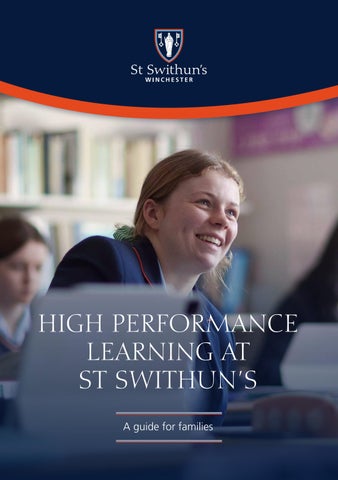
HIGH PERFORMANCE LEARNING AT ST SWITHUN’S A guide for families
St Swithun’s
1
HPL Parent Booklet 2026
INTRODUCTION Life at St Swithun’s is underpinned by the conviction that everyone can be a high performer. From its conception, the school has worked to enable girls to find and follow their own paths in life, so that they achieve success in their chosen field with confidence, independence and kindness. Thanks to modern research, this approach is now strengthened by compelling evidence that intelligence is something that can be developed, not something fixed, and that success is the result of hard work, practice and perseverance. This has obvious implications for classroom attainment, and also allows young people to become increasingly enquiring, collaborative and resilient problem solvers and contributors to society.
2
St Swithun’s
WHAT IS HIGH PERFORMANCE LEARNING? High Performance Learning (HPL) is a philosophy and framework developed from years of research into how young people learn, drawing on findings from cognitive psychology, education and neuroscience. It is now known that the brain is more malleable than was once thought, and that there are certain thinking skills and behaviours that enable us all to build better brains.
Of course, young people have opportunities to develop their thinking skills and behaviours naturally over time. However, HPL explicitly emphasises the central role of deliberate practice and conscious deployment of the approaches that enable high performance in a particular task. Making mistakes and learning from them is an essential part of this process and supports the long-term goal of high performance. Our teaching therefore gives students the tools they need to develop their intelligence across all disciplines and aspects of life. If, for example, some students are struggling with maths, we do not assume that this is because only some people are ‘naturally’ good at it. Instead, we help students take the next steps in their learning by drawing on the skills or behaviours that enable them: perhaps the students need to find ways of thinking more logically, or of achieving greater precision. This means that they can not only get better at maths but also develop a greater awareness of how to overcome other challenges. The time frame and strategies will differ for each learner. Everyone will encounter setbacks along the way, and for some these will be more significant than for others. However, with appropriate motivation, support and self-awareness, everyone can achieve increasingly highly. This includes those with special educational needs and disabilities, or those who speak English as an additional
3
language. We do not believe that we should lower the bar for anyone; instead, we focus on removing the barriers, providing scaffolding and encouragement, so that all students are motivated and believe that they are capable of high performance if they follow appropriate strategies.
HPL Parent Booklet 2026
WHY IS HPL IMPORTANT? In a world where the future is uncertain and unpredictable, HPL equips students with the tools to think effectively and successfully tackle the unfamiliar situations and challenges that are part of life. Developing students’ skills and behaviours empowers them to flourish in the long term, at school or university, in their careers, interests and personal lives. As life-long learners, St Swithun’s students will be able to draw on their skills and behaviours in order to adapt to new circumstances, so that they can stand on their own two feet and pull others up to stand alongside them.
4
St Swithun’s
THE IMPORTANCE OF PARENT/CARER INVOLVEMENT High performance is more likely when the learner has motivation, opportunity and support. Parents, guardians and other family members are perfectly placed to extend what is offered at school and reinforce these elements so that each child is surrounded by a network of people who care about them and are wellinformed about how to support them towards their goals.
5
When the same language is used at school and at home, students can progress faster. It should be integrated naturally by adopting a coaxing approach. Much of the language will already feel accessible: it is not unusual to refer to being creative or open-minded or taking risks. Even when the HPL language might seem unusual, it is important to use shared terms so that students can recognise them. You may well already be using this approach, consciously or subconsciously. By becoming more familiar with HPL, you will be explicitly aware of a set of specific characteristics to consider and encourage.
HPL Parent Booklet 2026
“BEING IN AN HPL SCHOOL ENCOURAGES YOU TO WORK HARDER AND BELIEVE THAT YOU ARE CAPABLE OF ACHIEVING VERY HIGHLY. THERE ISN’T A LIMIT OF WHO CAN BE A ‘HIGH ACHIEVER’.”
Student perspective on confidence 6
St Swithun’s
“ST SWITHUN’S FOSTERS A STRONG SENSE OF COMMUNITY WITH ALL THE TEACHERS AND GIRLS FORMING SUCH A SUPPORTIVE ENVIRONMENT THAT FEELS GENUINELY CARING AND ENCOURAGING.”
Student perspective on perseverance
7
HPL Parent Booklet 2026
HIGH PERFORMANCE LEARNING IN DEPTH HPL is divided into two main elements, each of which is divided into subcategories: Values, Attitudes and Attributes (VAAs)
Advanced Cognitive Performance characteristics (ACPs)
These are the learning behaviours that drive success. We refer to them as HPL behaviours.
These are the ways high performers think. At St Swithun’s, we refer to them as HPL skills.
• Empathetic • Agile • Hardworking
• Meta-thinking • Linking • Analysing
• Creating • Realising
Students and teachers use this shared language to identify effective ways to approach whatever they are doing. For example, when considering a problem in geography, students might need to use the skill of seeing alternative perspectives to consider different points of view before coming to a decision; on the sports field, team members need to use the behaviour of collaboration in order to work towards their goal; in any endeavour, the skill of self-regulation and the behaviour of practice enable progress and success. Importantly, these are not characteristics that people either have or do not have. Each one can be learnt and developed, so that students become better at them. With increased awareness of what proficiency in each skill and behaviour looks like, and appropriate guidance and encouragement, everyone can consciously deploy and strengthen them in order to support their ambitions. The following pages provide a list of the HPL skills and behaviours in each subcategory, along with definitions and suggestions for how you can help your child develop them.
8
St Swithun’s HPL BEHAVIOURS
EMPATHETIC Collaborative Express views, seek feedback, listen, work in teams • Promote teamwork and collaboration at home, encouraging children to share responsibilities. • Comment constructively on what your child is doing; ask her to comment on what you are doing.
Concerned for society Support diversity, equality & inclusion, show citizenship & caritas • Demonstrate care and compassion at home and in your community. • Encourage empathy by discussing social issues.
Confident Trust your knowledge & skills, rise to challenges, believe in yourself • Express confidence in your child, so that she can have confidence in herself. • Help your child make plans that will help her to overcome setbacks and achieve goals.
9
HPL Parent Booklet 2026
HPL BEHAVIOURS
AGILE Enqiuring Be curious, proactive & independent, develop your academic voice • Ask questions like ‘I wonder why...?’ • Encourage your child to look things up to find out about them.
Creative & enterprising Be willing to innovate & invent • Allow your child to tinker with things (within reason) around the home. • Be ingenious as a family – if something goes wrong, try to fix it or find a way around it.
Open-minded Be objective, receptive & respectful, alter your ideas according to evidence • Encourage your child to make a case for something they disagree with. • Watch current affairs programmes to see different points of view debated.
Risk-taking Experiment, speculate, try new things, embrace uncertainty & ask questions • Talk about a risk you took and how you weighed up different factors before deciding to take it. • Play games that encourage taking calculated risks in a safe space.
10
St Swithun’s HPL BEHAVIOURS
HARD WORKING Practice Prepare through purposeful repetition, develop proficiency • Set practice goals that focus on key skills or challenging aspects of a task, rather than just repetition. • Avoid bribing your child to practise, as she needs to learn persistence and determination.
Perseverance Keep going, work diligently & systematically • Encourage a sense of pride in what your child does so that she is motivated to persevere. • Congratulate your child when she moves forward on something that is hard for her.
Resilience Overcome setbacks, stay optimistic, seek support & support others • Encourage your child to keep trying when something is difficult. • Do not do everything for your child, but do guide her on how to respond to challenges.
11
HPL Parent Booklet 2026
12
St Swithun’s HPL SKILLS
META-THINKING Meta-cognition Think about your thinking & learning • Encourage your child to make a conscious decision about how to do something before she starts it. • Ask ‘How could you approach this?’ or ‘How have you approached this sort of thing in the past?’
Self-regulation Monitor, evaluate & self-correct • Ask ‘What do you need to be able to do this?’ or ‘How can you tell whether you’re on track?’ • Ask your child to identify successful features of her work and explain why they are effective.
Strategy planning Choose an appropriate way to approach a challenge • Ask ‘How could you plan this?’ or ‘How do you know this approach is the best one to take?’ • Encourage your child to break a task down into stages.
Intellectual confidence Articulate personal views based on evidence • Ask ‘What do you think?’ and ‘Why do you think that?’ • Discuss news events or any topics on which people have different opinions.
13
HPL Parent Booklet 2026
HPL SKILLS
LINKING Generalisation Use examples to work out what is true in most situations • Ask ‘How is this similar to...?’ or ‘Why do you think that could work this time?’ • Remind your child about past experiences that relate to what they are focussing on.
Connection finding Seek links between facts, topics & ideas • Ask ‘What does this remind you of?’ or ‘Can you think of an example of when this happens?’ • Play games that involve connection finding, like word association or 6 degrees of separation.
Big picture thinking Work with big ideas, consider the whole of something • Ask questions like ‘Why does the wind blow?’ or ‘What would happen if it never got dark?’ • Encourage your child to link what they are learning to the wider world and consider its significance.
Abstraction Move from concrete to abstract • Ask ‘Can you find a formula or pattern for this?’ • Encourage your child to move beyond facts, for example themes in a story or morals of a situation.
14
St Swithun’s HPL SKILLS
ANALYSING Critical or logical thinking Analyse evidence, reason, hypothesise • Think of things that interest your child and ask questions that involve critical thinking. • Ask them to give evidence to support those answers, or to challenge them.
Precision Work effectively, be exact & accurate • Ask sensitively ‘Are you sure that’s right?’ or ‘How are you thinking like a [mathematician]?’ • Encourage your child to check her work carefully.
Complex & multi-step problem solving Break down a task, decide on an approach, then act • Acknowledge that some problems are tricky but encourage your child to tackle them. • Ask ‘Can you create a series of steps to make this easier?’
15
HPL Parent Booklet 2026
HPL SKILLS
CREATING Intellectual playfulness Recognise & bend rules, create new ideas • Ask ‘How could you do it differently?’ or ‘What might happen if…?’ • Challenge your child to come up with new versions of games, stories or dishes.
Fluent thinking Generate multiple ideas easily • Use questions such as ‘How could you…?’ or ‘What other ways can you think of to…?’ • Encourage your child to come up with lots of different ideas rather than settling on her first one.
Flexible thinking Exchange one idea for a more effective one • Ask ‘What might be a better way to do this? Why?’ • If something does not go well, discuss why and what approaches might enable success next time.
Originality Conceive something entirely new • Ask ‘Can you think of a different way to do this? What would make it new?’ • Build your child’s confidence so that she is not worried about being wrong.
Evolutionary & revolutionary thinking Build on or challenge existing ideas • Ask questions like ‘What would happen if you changed…?’ or ‘Can you take this one stage further?’ • Highlight examples of people succeeding by moving beyond old ideas.
16
St Swithun’s HPL SKILLS
REALISING Automaticity Use skills & knowledge without active thinking • Encourage or help your child to practise something until it becomes automatic. • Encourage your child to use learning strategies that involve increasingly independent recall.
Speed & accuracy Work quickly without mistakes • Encourage your child to learn from her mistakes in order to enhance accuracy. • Prioritise accuracy first and then gradually increase speed.
17
HPL Parent Booklet 2026
18
St Swithun’s 04
SUMMARY When students, school staff and families are all aware of the characteristics that enable high performance and how to develop them, those students benefit from maximum support that enables them to find and follow their path in life with confidence. Helping your daughter become a successful thinker and learner can be great fun and tremendously rewarding. Here are some general guidelines for how to encourage HPL skills and behaviours at home:
Believe in your child • Have high expectations and make them clear in the language you use. Avoid throwaway comments like ‘she will never be a scientist.’ • Build confidence: ask for your child’s opinion, encourage her to ask you questions and invite her to make choices about how to do something. • Normalise challenge: allow your child to make mistakes and together discuss what be can learnt from them and what she could do differently next time. • Praise the process, rather than the outcome, for example ‘I like how you refined your plan after feedback’ or ‘You considered a great range of perspectives to come to that conclusion.’
Model learning behaviours • Demonstrate that you too are open‑minded, curious, that you can persevere through challenges, take informed risks and solve problems in daily life. • Explain how you make decisions and why you think that is the best way forward. • Help your child learn how to listen and hear others, for example when turn taking in games. • Link the HPL characteristics to your work and explain the positive impact they have.
19
HPL Parent Booklet 2026
Make time for meaningful conversations • Be on the lookout for conversation opportunities that develop good thinking and learning. • Establish a regular time to talk, e.g. on journeys, at mealtimes or in a weekend phone call. • Show interest in what your child says and ask probing questions. • Refer to the skills and behaviours in conversations. • Encourage your child to form her own opinions and explain her reasoning. • Discuss your child’s ambitions and lifegoals and how she can work towards achieving them. • Invite your daughter to talk about and evaluate what she is learning. • Look for opportunities to connect ideas across life and subjects.
20
St Swithun’s
“INSTEAD OF HOLDING ONTO AN ANSWER JUST BECAUSE IT’S YOURS, YOU LEARN TO ADJUST OR RETHINK YOUR IDEAS WHEN DISCUSSION REVEALS A BETTER APPROACH.”
Student perspective on collaboration 21
HPL Parent Booklet 2026
HOW TO GET INVOLVED We warmly encourage parents, guardians and carers to play an active role in the learning experience offered at St Swithun’s. If you would like to visit the school to see HPL in action, or are interested in becoming a Parent Ambassador for HPL, we would be delighted to hear from you.
Please contact: Georgina Manville (manvilleg@stswithuns.com).
22
St Swithun’s
FURTHER INFORMATION ON HIGH PERFORMANCE LEARNING For more information on High Performance Learning: • Highperformancelearning.co.uk • Eyre, D. and Berliner, W. (2018) Great Minds and how to Grow Them. London: Routledge.
For recommended reading: The following resources offer varied explorations around the subject of teaching and learning, so they will differ from the core HPL philosophy and framework. However, they may provide interesting insight into different skills and behaviours. • Brown, B. (2015) Daring Greatly: How the Courage to be Vulnerable Transforms the Way We Live, Love, Parent, and Lead. London: Penguin Life. • Dweck, C, (2014) The Power of believing that you can improve. • Ericsson, A. and Pool, R. (2016) Peak: secrets from the new science of expertise. London: The Bodley Head • Oakley, B., Sejnowski, T. and McConville, A. (2018) Learning how to Learn. New York: TarcherPerigee. • O’Connor, H. (2025) “I have learnt not to doubt my strengths” – lessons from one school’s Positive Education programme.
23
HPL Parent Booklet 2026
“ST SWITHUN’S FOSTERS A STRONG SENSE OF COMMUNITY WITH ALL THE TEACHERS AND GIRLS FORMING SUCH A SUPPORTIVE ENVIRONMENT THAT FEELS GENUINELY CARING AND ENCOURAGING.”
Student perspective on being concerned for society 24
Stay up to date with the vast number of events and activities around the school, by visiting our news page on the school website or by following us on our social media accounts.
St Swithun’s School, Alresford Road, Winchester, SO21 1HA 01962 835700 | office@stswithuns.com | www.stswithuns.com Registered Charity Number 307335