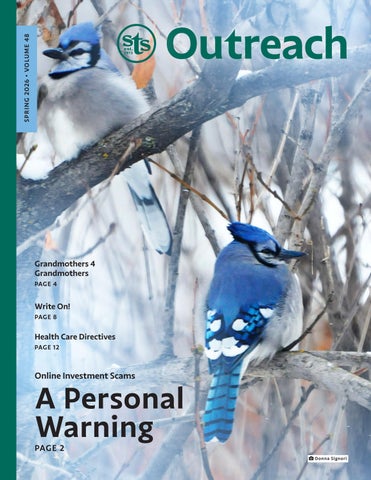
STS Outreach, Spring 2026

Page 1


Donna Signori

Message from the President

WELCOME TO OUR “spring (??)” issue of Outreach! While I understand about dates and deadlines, personally I don’t expect spring until at least April, or even May – but maybe that is just me!

I hope you appreciate, as I do, the connections both within and across our issues of Outreach. I like the way connections are made, especially as topics of importance to our demographics are given additional emphasis in subsequent issues. I hope you, as well, find this beneficial. You may want to check out the featured book in this issue to read about what the happiest retirees know and to see if you are on the right track.

I speak often about the value our membership has to offer in retirement, often in areas of volunteering – Grandmothers 4 Grandmothers is one option that I have been aware of due to a close friend being involved in

Outreach

ISSN 2817-1721 (Print)

ISSN 2817-173X (Digital)

All articles in Outreach represent the information and opinions of the authors and not necessarily those of the STS.

Reminders

STS Group Benefit Plan holders who are eligible for the Saskatchewan Seniors’ Drug Plan may be eligible for a reduced premium by providing the STS Office with a copy of the Seniors’ Drug Plan confirmation letter. For information on the Saskatchewan Seniors’ Drug Plan, please speak with your pharmacist or contact the Seniors’ Drug Plan office at 1-800-667-7581. If you live in Regina please call 306-787-3317.

For any changes to your address and/or Group Benefits coverage, please contact the STS Office directly at 306-373-3879 or email sts@sts.sk.ca

Do you have a story idea, topic or image you would like us to consider? Email us at sts@sts.sk.ca

Content Curator

Kevin Schmidt

Executive Director

Murray Wall

www.sts.sk.ca

Regina’s group. Perhaps the article in this issue will encourage some of you to become involved in supporting this effort.

The role of STS President has many writing requirements and opportunities of which Outreach is one. You will read about a member who loves to write, and she shares her enthusiasm and encourages the rest of us to start writing, if we don’t already. Take her advice and give it a try!

Finally, raising awareness about the challenge of scams is always of importance – I hope that the personal experience described in this issue increases your understanding and ability to identify this approach should it ever impact you.

the articles in this spring issue.

BELOW IS A selection of photos by members of the STS. Do you have a photograph, idea or a topic you would like us to consider? Email us at sts@sts.sk.ca

Please note that if you'd like your photos to be considered for the cover of Outreach, they must meet the following requirements: a minimum resolution of 3000 x 3000 pixels and a file size greater than 10 MB. For all other photos, we recommend they meet at least 1000 x 1000 pixels and be larger than 1 MB in size.

 Kathy Bradshaw
 Murray Wall
 Margaret Symon-Lungal
 Donna Signori

Online Investment Scams – A Personal Warning

In today’s digital world, financial scams have evolved far beyond the crude emails and obvious cons of the past.

MY EXPERIENCE WITH Pro-TW.com and its successor Plustw.com reveals how scammers now deploy sophisticated psychological tactics, leveraging technology and human vulnerability to devastating effect.

My experience started with a deepfake video, featuring trusted Canadian political journalist Rosemary Barton interviewing Prime Minister Mark Carney about investing in cryptocurrency. The video was convincing. It highlighted a company named Pro-tw.com.

Once I signed up with Pro-tw.com and deposited a modest sum, within minutes an “advisor” called, guiding me through my first trade and showing instant profits. This rapid engagement

is designed to create excitement and a sense of momentum, making the experience feel legitimate and rewarding.

The advisor was always prompt, friendly, and knowledgeable. Scheduled meetings reinforced the illusion of professionalism. By always being available and producing realistic results, the scammer built rapport and trust, making it harder for me to question their motives. They also scheduled meetings on Sundays, which should

have been a red flag for me. What financial advisor does Sundays?

When I asked to withdraw earnings, the process was made to seem transparent and secure –converting funds to cryptocurrency, transferring them to a legitimate platform, and finally to my bank account. The ability to access some money made the operation appear genuine to me, masking the underlying fraud.

The manipulation intensified as the scam progressed, even when Pro-tw.com changed abruptly one day. After the original website disappeared, a new advisor called from a different number, explaining the change (Plustw.com) and urging me to log into the new site. The new site was identical to the old and even had the same logo as the old. The seamless transition and plausible story were meant to maintain continuity and prevent panic.

Pressure tactics soon followed. I was urged to invest more – $3,000 CAD this time – with promises of even greater profits. The advisor probed for personal financial details, asking about my savings, home, and pension. When I resisted, the pressure increased, with new advisors appearing and each interaction becoming more insistent.

The psychological tactics used by scammers are powerful, but awareness and education are the best defenses.

Suspicion grew, but the air of legitimacy of the site and the staged withdrawals kept doubt at bay. Even when I insisted on closing my account, I was passed from one advisor to another, each promising resolution but delivering only delay. It was only after attending a cyber security course from the University of Saskatchewan Seniors Continued Learning, led by Natalia Stackhavova,

that I understood the full scope of the scam. She described it as a “pig butchering” scheme: start small, allow limited withdrawals to build trust, then pressure for larger investments. The profits shown on the site, according to her, were entirely fictitious, designed to lure victims deeper.

It was a challenge for the Prince Albert Police to investigate given the size of the force and their workload. I have reported this scam to the Canadian Anti-Fraud Center. While recovery of funds is unlikely, sharing this story is vital. The psychological tactics used by scammers are powerful, but awareness and education are the best defenses.

LESSONS I LEARNED

• Question authority: Even trusted faces can be faked. Always verify endorsements independently.

• Beware of urgency and pressure: Scammers use time pressure and emotional manipulation to cloud judgement.

• Guard personal information: Probing questions about finances and personal assets are red flags.

• Don’t be swayed by staged withdrawals: Limited access to funds is a tactic to build false trust.

• Seek outside advice: Isolation is a tool of scammers; consult with trusted friends or professionals.

Vigilance, skepticism, and education are the strongest protections against scammers. By sharing my experience and learning from it, I hope to help others avoid the same traps. ●

Lynn was born, raised, and continues to live in Prince Albert, Saskatchewan. After completing his Bachelor of Education at the University of Saskatchewan, he taught for the Prince Albert Rural School Division, Saskatchewan Rivers School Division, and Saskatchewan Polytechnic. During his career he acquired an Additional Qualification Certificate in Special Education.

Lynn has spent many years enjoying time at the cottage in Waskesiu with his family and friends. He was an avid hunter, fisherman, and is still active with the Prince Albert Nordic Ski Club as a Nordic Skier.

Grandmothers

4 Grandmothers

JUDY CORMIER IS an enthusiastic volunteer. She works alongside more than sixty accomplished volunteers including fifteen other retired educators who bring many skills as members of Grandmothers 4 Grandmothers Regina (G4G Regina). Judy’s passion for textile art has intersected with her volunteer efforts as she leads G4G members in creating colourful, felted wool dryer balls and felted soap. Interested women gather for afternoons of dryer ball felting and conversation prior to Christmas and spring craft markets. These eco-friendly and energy saving items have become a valuable fundraising opportunity for the organization among several items crafted and offered for sale by other skilled members.

G4G Regina was founded in 2006 to support the Grandmothers Campaign of the Stephen Lewis Foundation. Initially a small group of Regina and area women, it has grown into an

organization of sixty members who are committed to this global initiative and, in many cases, are individuals committed to local causes as well.

'Lake Walk' (2020) fabric, thread painting – Judy Cormier
Judy Cormier

Starting out with a few garage sales, G4G Regina moved on to gala dinners that included a silent auction, guest speaker, and entertainment. Over the years, other fundraisers were added and became community favourites such as Scrabble, Art from the Attic, the Fabric, Yarn & More Sale, Treasures from the Trunk, and the Spring Bling Jewelry Sale. G4G Regina found they could sell their beautiful, hand-crafted merchandise at craft fairs, a great opportunity to promote the organization and raise awareness in the community. The organization has become known and valued for the recycling component of events that divert so much from the landfill.

… grandmothers are courageous advocates for their families and communities.

With hard work over the years, the group has surpassed one million dollars in fundraising for the Grandmothers Campaign of the Stephen Lewis Foundation and is on its way to the second million. Funds raised go to community-led organizations in fourteen eastern and southern African countries to provide support ranging from education, health, grief counselling, and income generation to violence prevention. In the face of discrimination based on gender, age, and HIV status, grandmothers are courageous advocates for their families and communities.

Through sustained funding of their work, African grandmothers have moved from securing the most basic needs for their orphaned grandchildren to taking on leadership roles in their communities, advocating for women’s rights, and starting their own programs for childcare, income generation,

and other support networks. At G4G Regina, our members have rallied in response to the crisis in funding for HIV and AIDS treatment, prevention, education and support needed by grandmothers in Africa. As nations cut back on foreign aid, AIDS could become a pandemic once again.

For more information on Grandmothers 4 Grandmothers Regina or to check out the online store, go to Grandmothers4grandmothers.ca and check out Grandmothers 4 Grandmothers Regina on Facebook. To learn about starting your own group or joining the Regina group, email g4gregina@gmail.com. More information on the Stephen Lewis Foundation can be found at StephenLewisFoundation.org. ●

Dr. Judy Cormier is a busy retired educator, devoted grandmother to her grandsons, textile artist, and a volunteer. As a self-taught artist with deep roots in traditional sewing and quilting, Judy brings visual concepts to life using wool, fabric, and other textile mediums. Throughout her career, Judy dedicated herself to supporting vulnerable students and those with special needs. This work had her travelling throughout the province. Many of her textile creations reflect the Saskatchewan landscapes she encountered as well as her rural roots.

Sheila McKague - G4G Regina Anne Smith - G4G Regina
'Prairie Gold' – Judy Cormier

The following is part 2 of a 2-part series.

Understanding Artificial Intelligence

Reprinted with permission from Bill Brooks and the Saskatoon Council on Aging

IN UNDERSTANDING ARTIFICIAL Intelligence, Part 1, in the last issue of Outreach , we looked at the wide range of positive aspects of AI that are making the world better for older adults, healthcare, convenience and safety. AI is a powerful tool, but despite these benefits, it also has some negative aspects:

• Job Displacement: As AI systems become more capable, they may replace human workers in certain jobs. Combining AI with robotics has already led to unemployment for repetitive taskssuch as assembly line workers, cashiers, data entry, customer service workers and those in basic administrative positions.

• Privacy Issues: AI often requires large amounts of personal data. This data may be collected and used without consent, raising concerns about privacy and data protection. AI also enables advanced surveillance tools like facial recognition, which can be used without people's knowledge.

• Bias and Discrimination: AI systems learn from the data they are trained on. If that data contains human bias, the system may unfairly treat different groups of people. This can result in discrimination in areas like hiring, policing, or healthcare.

• Overdependence on Technology: As we rely more on AI for everyday tasks, there is a risk of becoming overly dependent on technology. This could lead to a loss of certain skills and a decrease in human-to-human interaction, which is important to older adults’ emotional wellbeing.

• Spread of Misinformation: AI tools can now create highly realistic fake images, videos or voices that seem to come from trusted public figures. These deepfakes can be used to spread false or dangerous information and manipulate public opinion on topics like health, safety or politics.

While it offers numerous benefits, it also brings complex legal, ethical and social concerns.

There are many interesting aspects of AI that still need to be thought about, addressed and potentially regulated. Future capabilities of the technology have raised alarm bells in scientific and social communities. Things like:

• Thinking for Themselves: As capabilities climb and new computers are structured more like the human brain, will machines become independent thinkers that rival human beings?

• Evolution of Machines: Will intelligent machines be able to build more sophisticated versions of themselves without input from human engineers and software developers?

• Cohabiting: How will thinking machines and human beings cohabit the world we live in – harmoniously, in conflict or some combination thereof?

• Morals: Will thinking machines develop morals, ethics, and beliefs, and how will those interact with human ones?

The list goes on.

Artificial Intelligence is a powerful technology with the potential to transform many aspects of our lives. While it offers numerous benefits, it also brings complex legal, ethical and social concerns. As AI continues to evolve, it's important that we find the right balance between innovation and responsibility, especially for vulnerable populations like older adults. ●

Dr. Brooks has a science background working in fields requiring innovation and creativity such as aerospace and science education. He is an active volunteer with Leadership Saskatoon, and the Saskatoon Council on Aging, where he is a board member, presenter, writer and radio host. He received the Saskatchewan Volunteer Medal for 2024 from the provincial government for his long-standing commitment to volunteerism.

Write On!

Have you always wanted to write? Well, Jodie Picoult says, “You can’t edit a blank page.” A writer thrives on writing. It is in our soul. Writers were meant to write and so we write … and we write… and we write.

EVERY PERSON HAS a story to tell and needs to tell it in their own way, whether it be through writing, drama, dance, music, art, or their work. My story began in Saskatoon, Saskatchewan, at St. Paul’s Hospital minutes before midnight on May 17, 1957. I was the ninth child and seventh girl born out of ten children to Sophie (Dubyk) and August Mutala. I grew up and went to school in the Hanley/Kenaston area. Our farm was in between both communities, and we lived on the farm in the summer and moved to town for the winter months until I was in grade four. Then we moved permanently to Kenaston. Grades one to three were in Hanley and grades four to twelve in Kenaston. I have lived in Saskatoon for the past fifty years and taught school for thirty years.

In high school, I had a wonderful teacher who added creative writing to our English class. We used to analyze Simon and Garfunkel songs in class, and he encouraged us to write. Luckily, I got a guitar when I was in grade six at twelve years old and started writing songs and I have not stopped writing. I write all the time.

In high school, I had a wonderful teacher who added creative writing to our English class.

I wanted to write as a journalist, but, in 1975, I would have had to go to Winnipeg to study journalism as there was no school of journalism in Saskatchewan. Thus, I have no formal training in writing, unless you call teaching for 30 years and obtaining a Master of Education Degree in Educational Administration training. What I do have is life training and I write about what I know.

I was always curious about the early pioneers and my maternal grandparents who emigrated from Ukraine in 1911 and 1912. My mom had a picture of her parents on the wall at home, and I was always curious about their journey to Canada.

In 2009, I went to Ukraine and visited the two villages, Peresepa and Zupkova, in the Sokal region where my grandparents came from. The illustrations in my books are based on photographs of my family members, and my grandparents’ picture is photoshopped into my

stories. My Babushka books take place in Hafford, Saskatchewan, where my grandparents immigrated to and my mom grew up.

I started this series in 2007 to honour my mother, Sophie, and her beautiful Ukrainian traditions. My publisher, Heather Nickel, with Your Nickels Worth Publishing, said I had enough material for five books when I sent her my manuscript. We decided to put them into a series: Baba’s Babushka: A Magical Ukrainian Christmas, Easter, Wedding, Journey to Kyiv and Kohkum’s Babushka: A Magical Metis /Ukrainian Tale which was published separately by the Gabriel Dumont Institute in Saskatoon. This last book has been made into a play and was performed in Edmonton and Banff in the fall of 2025 with Lianna Makuch as director.

In my first book, I had to figure out how to get Natalia, the little girl in the story, back to Ukraine. When I was growing up, I read Aladdin, and his magic carpet always made me want to fly like a bird. I was trying to figure out how to get Natalia back to Ukraine when suddenly it came to me... a magic babushka is going to fall from the sky and land on her head, sweep her up and take her back. Vivid imagination, I guess. Natalia is playing in the snow, and yes, a blue babushka, a

Ukrainian headscarf, lands on her head and takes her back to Ukraine where she meets her Baba or grandmother as a little girl. Her Baba teaches her all the Ukrainian Christmas Eve, Sviat vechir traditions which are so lovely and historically true.

I write anything, anytime and anywhere

My mom was Ukrainian, so I did not want her traditions to be lost. My books are considered children’s books, but as historical fiction, they are based on my family traditions. The adults love my books as much as the children… just like the Harry Potter series.

In book two, Natalia is playing in the rain, and a green babushka lands on her head and takes her back to Ukraine and now she meets her Baba as a teenager. Baba teaches her the Easter traditions which again are so delightful and authentic. Baba gives Natalia a lovely decorated Easter egg or pysanka to give to someone special.

My first book was released October 2010, and it won the Anna Pidruchney award and was the bestselling children’s book at McNally Robinson in Saskatoon. It is a national bestseller. Not too bad for a prairie gal. Sixteen years and twenty-one books later, I have had a wonderful second career as an author.

If you are a closet writer, I encourage you to write. Find other like-minded writers. Saskatoon has an amazing number of authors. Maybe join the Saskatchewan Writers Guild, a writing group or sign up for writing workshops. I write anything, anytime and anywhere. I used to keep a pen and paper on me and by my bed in case an idea came to me in the middle of the night as I would not sleep until I wrote it down. Now I use my phone and just voice record my ideas and type them up later.

And my recommendation, “If you want to change your life, write a book.”

Peace, Marion Mutala ●

In book three, it is fall. Note all the seasons and colors. Natalia is out playing in the leaves and a rust copper babushka again lands on her head and takes her back to Ukraine. Her Baba is getting married to Dido and teaches her all the Ukrainian wedding traditions. In the story, Natalia’s Baba and Dido immigrate to Canada just like my grandparents did in 1911/1912.

Marion Mutala has a master’s degree in educational administration and taught for 30 years. With a passion for the arts, she loves to write, sing, create visual art, play pickleball and guitar, travel and read. Marion is the author of national bestselling, awardwinning children’s books and has written twenty-one books to date. For more information on Marion’s books, visit her website: www.babasbabushka.ca

What the Happiest Retirees Know

EMPOWERING BOOKS ABOUT retirement swing open doors to change and new possibilities, aiding older adults in making conscious, impactful choices. They also highlight critical issues of “ageism” and “gerontophobia”, challenging age wave boomers to call upon politicians, thought leaders, and industry to support positive images of aging, provide job opportunities, provide safe, comfortable housing, and create products and services that treat older adults with dignity. Whether just embarking upon your retirement journey or revisiting directions taken, you will find helpful tips and retirement strategies that you will find helpful for personal decision-making.

WHAT THE HAPPIEST RETIREES KNOW: 10 HABITS FOR A HEALTHY, SECURE, AND JOYFUL LIFE

Bestselling author of You Can Retire Sooner, Wes Moss, unveils ten life-changing habits for a healthy, financially secure and joyful retirement, revealing the social-emotional traits of the happiest retirees in the world.

Moss offers ten actions and attitudes that can make a profound difference in every aspect of your life. This book is brimming with advice on how to make small changes that have big impact. Through numerous surveys, Moss noticed a pattern of distinctive habits that the happiest retirees have in common, from the simplest lifestyle choices to complex, financially savvy strategies: money habits (think river, not reservoir), curiosity habits (develop 3.6 core pursuits), family habits (get your kids off the payroll), love habits (get married or remarried only once), faith habits (believe, give, and do

good), social habits (connect to thrive), health habits (eat, drink, and have a ball), home habits (live mortgage free), investing habits (be a tomorrow investor), and spending habits (understand the four percent plus rule). These are habits anyone can develop – the quintessential action plan to a healthy, secure, joyful retirement. By implementing these transformational habits, you can cease worrying about money, stay socially connected, and enjoy retirement. ●

Magi McFadden is a member of the Regina Chapter of the STS and has served at the chapter level as social committee co-chair. Magi is also a member of the STF professional growth network LEARN and has served at the provincial level and local council level of LEARN as president, vice president, and editor of their official publication “Query” for more than a decade.

The following is part 3 of a 4-part series.

LPlanning for the Future: Health Care Directives

IFE AFTER RETIREMENT can be an exciting yet challenging time. Regardless of what age you are at retirement, people often take this time as an opportunity to revisit their plans and goals for the future. In our previous two articles, we discussed making a Will and preparing a Power of Attorney. Both of these documents allow you to keep control of your personal belongings, assets, and some personal decisions. They cannot, however, be used for health care related decisions. Preparing a health care directive is one more way to ensure that, regardless of your age or capacity, you continue to keep control over matters that are important to you.

KEEPING CONTROL

A health care directive is a document that allows you to express your wishes about future health care in the event that you become unable to make or communicate these wishes. Your directive must be completed while you are able to understand your medical information, diagnoses, and treatments. You must also be able to communicate these wishes.

A health care directive will only take effect if you cannot directly consent to or refuse medical treatment. Preparing a directive enables you to keep control over your medical care and ensures your wishes are followed in the future. It is important to note that a directive cannot be used to consent to medical assistance in dying (MAID).

WHEN TO PREPARE A DIRECTIVE

You may want to make a directive in a situation where you know you are ill. For example:

• you are facing a terminal illness

• you have an illness where you may have periods when you are incapable of making or communicating health care decisions

You may also choose to make a directive when you are in good health. If something unexpected happens, your directive will allow you to communicate your health care wishes.

REQUIREMENTS

A health care directive must be in writing. It must be signed by you and dated. If you are able to sign on your own, your directive does not need to be witnessed. A lawyer can prepare a health care directive for you for a fee. You may also choose to make a health care directive without the assistance of a lawyer. There is no particular form that you must use. Some agencies offer templates for directives that you can use as a guide. It is important to remember, however, that you should tailor a directive to your own situation.

WHAT TO INCLUDE IN A DIRECTIVE

Your directive can give specific directions regarding certain treatments and situations. A health care directive can cover matters like:

• diagnostic testing

• blood transfusions

• resuscitation

• life support

• feeding tubes

• antibiotics

• surgical procedures

• palliative or comfort measures

For example, a directive may specify that you do not want to be kept alive by a ventilator or feeding tube if you are in a persistent vegetative state. It could also specify that you do not wish to be resuscitated or that you want comfort measures only. You should be as clear and specific as possible. Health care providers do not need to follow directives that are not clear.

A health care directive will only take effect if you cannot directly consent to or refuse medical treatment

NAMING A PROXY

You may not want or be able to plan for every possible situation. In this case, you can name someone to act for you when you cannot do so. This person is called a proxy and can make health care decisions for you as required.

You can choose to have your proxy make all or some health care decisions for you when you cannot. Your proxy will only make decisions for you when your directive does not address the situation.

Your proxy does not need to be a family member. You can choose any person who is at least 18 years old and has the capacity to make health care decisions. If you name your spouse as proxy and later divorce, the appointment will be revoked unless your directive states that the appointment will continue. ●

This article was prepared and written by the Public Legal Education Association of Saskatchewan (PLEA). PLEA is a non-profit, non-government organization providing free legal information across a variety of platforms. They offer programs and services to the general public and school communities across Saskatchewan through dedicated websites, print resources, presentations and more.

To learn more about this area of the law, check out the Planning for the Future section of PLEA’s website at plea.org. The legal information that PLEA provides is intended as general information only and should not form the basis of legal advice of any kind. Individuals seeking specific legal advice should consult a lawyer.

Upcoming Events

Turn static files into dynamic content formats.

Create a flipbook