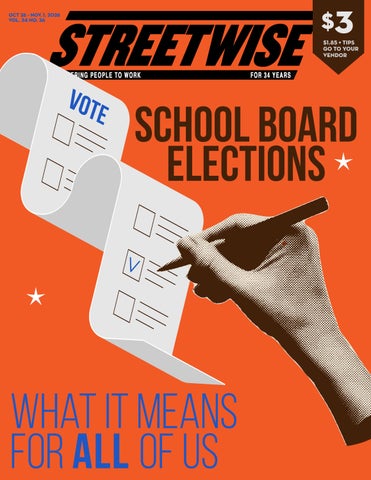
oct 26 - nov. 1, 2026 Vol. 34 No. 36
$3
$1.85 + Tips go to your Vendor
How StreetWise Works StreetWise exists to elevate marginalized voices and provide opportunities for individuals to earn an income and gain employment. Anyone who wants to work has the opportunity to move themselves out of crisis. StreetWise provides “a hand up, not a handout.”
Buy the Magazine, Take the Magazine When you buy the magazine, take the Vendors purchase the magazine, and read magazine for $1.15 and the magazine, you sell it for $3 plus tips. are supporting our The vendor keeps all of microentrepreneurs earning their earnings. an income with dignity. -or-
All vendors go through an orientation focusing on their rights and responsibilities as a StreetWise Magazine Vendor. Authorized vendors have badges with their name, picture and current year.
New vendor orientation is every Tuesday and Thursday at 10 a.m. at 2009 S. State St. Find your nearest vendor at www.streetwise.org
ADVERTISEMENT
4 Arts & Entertainment 6 SportsWise
Event highlights of the week!
The SportsWise Team looks forward to the Chicago Bulls' season.
7 Cover Story: School Board Elections
The November 3 elections include the first -- and only -- time voters in each of 20 subdistricts across the city will choose all representatives to the Chicago Board of Education, which oversees Chicago Public Schools, at the same time. StreetWise Editor Suzanne Hanney sat down with Maureen Kelleher, founder of Board Rule, the weekly newsletter covering the Chicago Board of Education and Chicago Public Schools, to discuss whether this election can bring more accountability to students, parents and neighborhoods and to dissect issues of school funding and closures. We also tell who's backing candidates in competitive races and bring input from the Civic Federation and Kids First Chicago.
13 voice of the streets – op-ed
Dr. Victor G. Devinatz discusses the trade union members running in elections across the U.S., but will it make a difference?
15 The Playground
DISCLAIMER: StreetWise publishes perspectives from vendors and contributors to reflect a range of lived experiences and viewpoints. These opinions do not necessarily reflect the views of StreetWise. We are committed to fostering dialogue grounded in dignity and respect, and we do not endorse language or perspectives that harm or dehumanize others.
Dave Hamilton, Creative Director/Publisher
dhamilton@streetwise.org
StreetWiseChicago @StreetWise_CHI
Suzanne Hanney, Editor-In-Chief
suzannestreetwise@yahoo.com
Julie Youngquist, Executive director
jyoungquist@streetwise.org
LEARN MORE AT streetwise.org
DONATE
Ph: 773-334-6600 Office: 2009 S. State St., Chicago, IL, 60616
To make a donation to StreetWise, visit our website at www.streetwise.org/donate/ or cut out this form and mail it with your donation to StreetWise, Inc., 2009 S. State St., Chicago, IL 60616. We appreciate your support!
My donation is for the amount of $________________________________Billing Information: Check #_________________Credit Card Type:______________________Name:_________________________________________________________________________________ We accept: Visa, Mastercard, Discover or American Express
Address:_______________________________________________________________________________
Account#:_____________________________________________________City:___________________________________State:_________________Zip:_______________________ Expiration Date:________________________________________________Phone #:_________________________________Email:_________________________________________
ARTS & ENTERTAINMENT RECOMMENDATIONS Compiled by Dave Hamilton
Thrills & Chills!
In case you missed it: Halloween Recap Last week, we published a special calendar for Halloween events. We do not have enough room to reprint it this week, but here is a quick recap: Oct 28-Nov 1 Manual Cinema’s Frankenstein: Fine Arts Building, 410 S. Michigan Ave. Oct 30 & 31 ‘Death Toll’ drinking improv game, The Cornservatory, 4210 N. Lincoln Ave.; “Vampire Playlist” Latinx vampire film, El Schomburg, 2538 W. Division St. 7:30 p.m. Oct 31 Upside Down Halloween Parade, Washington Park noon-2 p.m.; Haunted Halsted Halloween Fest and Parade, Halsted St, from Aldine to Addison, 11 a.m.-10 p.m.; Haunted House Party at Shedd Aquarium, 1200 S. Lake Shore Drive 7-11 p.m.; “The Rocky Horror Picture Show” Spookacular 4K restoration screening, The Chicago Theater, 175 N. State St., 7:30 p.m. Through November 1 “Stage Frights!” play, Raven Theatre, 6157 N. Clark St.; ‘House of the Exquisite Corpse VI: Lullabies” puppet haunted house, Steppenwolf, 1646 N. Halsted St.; Lincoln Park Zoo Fest, 2400 N. Cannon Drive.; Jacks Pumpkin Pop Up, 1265 W. Le Moyne.
Piano-driven Trios!
ARTS & ENTERTAINMENT
Piano Trios: Beethoven, Smetana, and Dvořák The piano trio has long offered composers a direct and personal means of expression, and this program brings together three works that reveal the form from different perspectives. Beethoven’s “Piano Trio in E-flat major, Op. 1, No. 1,” shows a young composer already expanding the scope of the piano trio, giving each instrument a distinct role and shaping music that moves beyond convention. Czech composer Bedřich Smetana wrote his “G-minor Piano Trio” during a period of profound personal loss, and its shifting moods give the work a deeply human intensity. Fellow Czech composer Antonín Dvořák’s “Dumky” Trio stands apart in the chamber music repertoire as both his farewell to his homeland before departing for America and a composition of entirely unique design. October 27, 7:30 p.m., at the Harris Theater, 205 E. Randolph St. Tickets start at $40 at harristheaterchicago.org
4
Still a Tearjerker!
‘Jerker’ or ‘The Helping Hand’ Written in 1986, “Jerker” is one of the defining theatrical works to emerge from the AIDS crisis. Frank, provocative, and unexpectedly moving, the play celebrates gay sexuality while revealing the profound human need for intimacy and connection. The play follows J.R. and Bert, two gay men who develop an increasingly intimate relationship entirely through telephone calls. W hat begins with anonymous sexual fantasy slowly becomes affection, friendship and emotional dependence as AIDS reshapes the world around them. ThursdaySaturday at 7:30 p.m., Sundays at 3 p.m. and Monday, November 2 at 7:30 p.m. through November 8 at Open Space Arts, 1411 W. Wilson Ave. Tickets $30 General Admission, $25 students and seniors at openspacearts.org .
Unused Masterpieces!
'Design Graveyard: An Exhibition of Unbuilt Chicago Design' "Design Graveyard" is a free, two-week exhibition of design work that never made it out of the studio. It collects abandoned concepts, rejected pitches, unbuilt proposals, and scrapped projects from Chicago designers working in architecture, graphics, interiors, exhibitions, and more. Each piece is shown on a 17″ × 17″ canvas, alongside a short note on what it was meant to be and why it didn’t happen. Most finished design starts with work like this, and it usually ends up in a drawer or folder. "Design Graveyard" puts it on the wall for a limited run and gives you the canvas after. On view October 27 - November 9, 10 a.m.-5 p.m. daily, at the Field Building (rendering pictured), 135 S. LaSalle St. FREE! More information at designgraveyard.org
Celebrating Changemakers!
3Arts Awards 3Arts, a Chicago-based nonprofit grantmaking organization, presents the recipients of this year’s 3Arts Awards: dance artists Silvita Diaz Brown and Kara Brody (pictured); musicians Marvin Tate and Tahirah Whittington; teaching artists Wisdom Baty and John Chapman; theater artists Tina Fakhrid-Deen and Ana Santos; and visual artists Diana Solís and Sandie (Chunshan) Yi. The organization will honor the new recipients on October 26, at 5:30 p.m., at the Harris Theater for Music and Dance, 205 E. Randolph St. Tickets include a welcome reception, awards program, and a jubilant after-party. Tickets are $50-$300 at 3arts.org. Funds raised during the event will be split between 3Arts and Chicago nonprofit Center for Native Futures.
Fashion Meets Film!
‘Stories We Wear: Fashion as Visual Narrative’ Join Fashion Film Festival Chicago at the Chicago History Museum, 1601 N. Clark St., for an afternoon exploring fashion as a powerful language of visual storytelling. Through a curated selection of contemporary fashion films, "Stories We Wear" invites audiences to consider how clothing, image, movement, sound, and cinematic language can communicate identity, emotion, memory, and culture. Sunday, November 1, noon-4 p.m. Tickets are $15 at FashionFilmFestivalChicago.com.
Search for Peace!
‘Heroes of the Fourth Turning’ Four recent graduates have gathered to celebrate their beloved mentor and professor Gina, newly inducted as president of their tiny Catholic liberal arts college. The reunion spirals into spiritual chaos, clashing generational politics and a vicious fight to be understood. Offering grace and disarming clarity, this haunting play speaks to the torn heart of a country at war with itself. Playing October 29 – December 6 at 1531 N. Wells St. Tickets $55 at aredorchidtheatre.org.
At One with Nature!
‘From Earth to Sky’ The nonprofit Guarneri Hall, 11 E. Adams St., presents “From Earth to Sky,” a musical program exploring the wonders and mysteries of earth, sea, and sky on October 26-27 at 6:30 p.m. The program celebrates three American women composers whose works will be sung by acclaimed soprano Kristina Bachrach (pictured). Adding to the intimacy, each musical evening includes a post-concert reception where audience members and performers can interact over libations and hors d’oeuvres. Tickets are $50 at guarnerihall.org.
Saluting a Legend!
‘Philip Glass at 90: A Celebration’ Nova Linea Musica presents “Philip Glass at 90: A Celebration,” honoring one of the most prolific and influential living American composers ahead of his 90th birthday. The evening will feature a newly commissioned work: the world premiere of “Through Philip and Lou” by Alex Weston, a long-time assistant and protégé of Glass. October 28 at 6:30 p.m. at Guarneri Hall, 11 E. Adams St. Tickets are $50, including a post-show Q&A with the performers and the commissioned composer, and featuring an elegant catered reception. novalineamusica.org.
The Future of Chicago Theatre!
‘Exploring the In Between: A Conversation About Mid-Sized Theatres in Chicago’ Remy Bumppo Theatre Company presents "Exploring The In Between: A Conversation About Mid-Sized Theatres in Chicago," October 26 at 7 p.m. at Theater Wit, 1229 W. Belmont Ave. This one-night-only event, moderated by Chicago theatre historian and author Mark Larson and Associate Director of the Jane Addams Hull-House Museum Matt Randle-Bent bring together Chicago theatre voices from four storied companies: Remy Bumppo Theatre Company, A Red Orchid Theatre, Teatro Vista Productions and About Face Theatre, to discuss how mid-sized theatres have shaped our city’s cultural ecosystem and what role might they play in what is to come. Tickets are $35 at TheaterWit.org.
www.streetwise.org
5
Vendors (left to right) John Hagan, Russell Adams and A. Allen chat about the world of sports.
SPORTSWISE
Chicago Bulls 2026-27 season
6
John: What should we look forward to in the Chicago Bulls 2026-27 season?
I know something good will come out of it, if not this year, in the near future.
Russell: The Bulls were 3151 last year, but they made a complete overhaul: new executive vice president of operations, Bryson Graham and new coach, Tiago Splitter. They drafted Caleb Wilson at No. 4. A good pick. The lineup includes Josh Giddey, Caleb Wilson, Matas Buzelis. The shooting guard we’re not sure of yet: Isaac Okoro or Buddy Hield. The centers will be Nic Claxton and Zach Collins.
John: It’s almost like a Michael Jordan effect. Michael Jordan went to North Carolina and was drafted No. 3 in 1984. What college did Caleb Wilson go to? Same as Michael Jordan: North Carolina, although Jordan was drafted one notch lower. And what team is the home debut against? The same: Washington. That’s déjà vu. Plus, the Bulls added Matas Buzelis and Josh Giddey, both 24 or younger. They also added classy veterans in Norman Powell, who played for the Miami Heat; and Nic Claxton, who was a center for the Brooklyn Nets. The Bulls may not have the same philosophy about three-point shooting as the Golden State Warriors, but they are starting to beef up
Allen: Russell almost said Caleb Williams, the Bears quarterback. Chicago could become a Caleb town, being our superstar like Michael Jordan was. Chicago is building a young team, which gives us a long-term position to win championships.
the roster. There’s been complaints about their defense, but with this nucleus, it will be harder for opposing teams to push the Bulls around. Buzelis averaged 16.3 points per game, 5.8 rebounds, 2.1 assists, and 1.5 blocks, which is among the top 10 in the NBA.
experience and was drafted 14th from UConn in 2023; I am looking forward to seeing how he plays with Caleb Wilson. It’s so hard to keep saying Caleb Wilson because we are so used to saying Caleb Williams. We can be the Chicago Calebs.
Russell: The Bulls are kinda a young team. A couple draft picks, couple trades, they’ll be there. They lost 51 games last year, but a lot of those games, they were in it: 1-point, 2-point losses.
John: The CW Network! I don’t think it will be this year, but maybe three years from now we’ll see whether or not it works out. These guys are young: 23, 24 years old. They’re not going to learn the ropes right away. But if you give them time and they can develop a nucleus and chemistry together, we may be looking at another parade in Grant Park.
Allen: I am just looking forward to this young team. It’s been a while since Michael Jordan pulled a young team together. He was the glue of the team, so maybe Caleb Wilson can do that. You mentioned Josh and Matas, but I am also looking at Jordan Hawkins. He’s only 24 years old, has three years’
Any comments, suggestions or topic ideas for the SportsWise team? Email StreetWise Editor Suzanne Hanney at suzannestreetwise@yahoo.com
The importance of the Chicago school board election by Suzanne Hanney
The November 3 elections will feature races for all 21 seats on the Chicago Board of Education, which governs Chicago Public Schools. It's the first and only time voters in each of 20 subdistricts across the city will elect all representatives at the same time. Since they’re being elected to rotating two- and four-year terms, subsequent elections will encompass only half the board at a time. StreetWise Editor Suzanne Hanney sat down with Maureen Kelleher, who founded Board Rule, the weekly newsletter covering the Chicago Board of Education and Chicago Public Schools, after two decades as an education reporter for Catalyst Chicago, Education Post, The 74 and Education Week. Maureen is also a former Chicago Public School teacher and CPS parent. Suzanne has covered education in two decades as StreetWise editor and served on a CPS Local School Council for more than eight years. Suzanne Hanney: Why should I care about the School Board elections? Is this just another entry-level election for would-be politicos in a highly political city, or can it bring more resources to underserved kids? Maureen Kelleher: The board can support smart policy and choose smart people to implement that policy. Possibly the smartest thing that has happened in CPS in the decades I’ve covered it was the decision to focus on ninth graders and make sure they showed up and got decent grades. So the board was not directly involved in that. The board oversaw the CEOs and superintendents who picked the smart people who led that work. So yes, the board is always at a remove from these kinds of decisions, but a board that understands its role and understands how to focus a system on helping students succeed will do better than a board that is mired in political conflict and personal ambition, and that's the board we've had so far. I'd like to see us get a different board. Suzanne: So we think that this board will be more accountable at the local level, to students and parents, to neighborhoods? Maureen: Even though people are still not happy with their level of engagement with school board members, we can say that school board members have regularly visited schools in their districts, large numbers of them. We can say that the school board has approached questions through a different lens than a corporate, mayorally-appointed style board would do. So we've seen some change. I was never a big fan of the idea that an elected school
board would produce, like, a miracle of more responsive governance. But some people have said to me, “The only cure for bad democracy is more democracy.” So, this is still very early in the experiment. We'll have to see who's right. Suzanne: To me, the problem is that we have kids who are under-resourced. Maureen: Let me just dissect a few things here. Is it really more about families and neighborhoods and communities who are struggling with deep poverty? And school is secondary? I would say they have to work hand in hand, and that there is a very important place for good quality instruction, and smart policy. We have seen the effects of those things in CPS over the last 20 years even though families are still struggling with poverty and the school district still lacks resources. When I first started teaching in Chicago a very long time ago, your chances of graduating were a coin flip. That is not true anymore, and that difference was made by researchers who figured out that schools were missing a very important lever in 9th grade to help children know what they needed to do to succeed. Principals and teachers weren't giving students the keys to figure out how to manage high school. When researchers realized school staff needed to focus more closely on 9th-graders’ initial success in high school, and when someone in CPS decided to make that policy, it made a huge difference in the number of students graduating. Suzanne: So the feeling is that this school board, because it includes people from the neighborhoods, has the potential to actually see the real-world issues in learning? Maureen: That's what we're hoping for. I think there's a both-and here. I think that there's a lot of room to look more closely at contracting and procurement in CPS, as is common in all government agencies, to figure out if we're spending our dollars as effectively as possible. And we have decades of knowing that CPS has been underfunded. Suzanne: Underfunded – they don't get all the money they're supposed to get from taxes? Maureen: What happened in 2017 was that the state of Illinois finally set what it called an “adequacy target.” People across the state sat down and actually calculated a number, that at that level of inflation and pricing, should be enough to get kids a teacher, art classes, special education. And then they looked at how much different school
districts were able to put in their per-pupil funding. And schools that weren't funding as high as the adequacy target were prioritized to get more money from the new state formula that was trying to distribute state money more equitably to students farthest from opportunity. As the tax base grows, and more state taxes go into the pot for schools, the schools that have lower per pupil money for students are prioritized to receive the new funds. As of last June, Chicago was funded at something like 72% or 73% of the adequacy target. We have not met the baseline. Chicago is still missing nearly a quarter of the money the state says it should be getting -- to fund teachers, teacher aides, buses - like, everything. Suzanne: And even the things like arts and extracurriculars that could potentially give kids other things to excite them about school. Maureen: Right. Some of that, yes. Suzanne: Does the ghost of closed schools past – and yet-to-come – still haunt this election? Maureen: 100%. The specter of school closings past and future is all over this election. Suzanne: Why? Maureen: Because there are many people in this city who are still furious at the way the school closings were handled in 2013. There are un-repurposed school buildings in poor South and West Side neighborhoods. The vacant Paderewski School in Little Village sustained a second fire. The city absolutely failed its obligations to the students who were in closed schools. It failed in its obligations to students in schools that welcomed those kids, and it has failed its obligations in getting those buildings repurposed, and people are angry about that. Suzanne: I've had people say to me, “Well, these buildings were underutilized and the School District could sell these buildings.” “It’s not that simple,” I have responded. How many of them have been repurposed? Maureen: Okay, 49 schools were closed. Roughly half of them have been fully repurposed at this point. Some are in the process. CPS is actually in the middle of putting out bids for some of the buildings. In the 20th Ward, Ald. Jeanette Taylor has been holding walkthroughs and community roundtables since last spring to figure out what to do with the former Fiske School. These buildings generally are not in great condition. Many of the ones that were repurposed to housing, some were actually razed and new housing was just built on the land. From what I've seen in the bids, they're going for like $25,000 to $50,000. I mean, the school district is not making a lot of money off these buildings. Suzanne: And what about the ghost of school closings yet-to-come? Maureen: Hilario Dominguez, the CTU's former political
8
director and their endorsed candidate for president, has vowed that he would never close a school under any circumstances. He fully supports extending the current moratorium on school closings that is set to expire in February. There are NO other candidates who share that position. There are many other candidates who are more flexible on the stance. One thing everyone agrees on is that a mass closure handled in the way it was done in the Rahm Emanuel era should not be repeated. But it's worth checking closely to see what people are saying about how they would work with communities to consider closure or consolidation of schools. The way I see it, there are two issues in play. One is figuring out how to get students in schools with very small enrollments the best education and the most opportunities possible. The other is, what do we do with these buildings? The CTU and its allies say there are opportunities to repurpose those buildings with kids still in them. We can look at school-based health centers, we can look at job training and workforce, we can look at early childhood complementing the K-8 or K-12 or whatever is in the building. Hilario Dominguez has talked about, in Atlanta, apparently they have grocery stores and pharmacies inside schools. Another question is to figure out how to close, consolidate, but repurpose the buildings much more quickly and thoughtfully than was done in the previous go-round. One thing that has not been said is that part of the problem was the system could not handle repurposing 50 buildings at once, or figuring out alternatives that really worked for students in 50 different buildings. Suzanne: Most of these were buildings in lowincome neighborhoods. First of all, whether you could repurpose them as a community center or affordable housing is a matter of demand for their geographic area. Then, you probably need somebody else with deep pockets to come in and fund them. Maureen: Right, and of the schools closed in
upper-income areas, Stewart in Uptown is now upscale housing, and there is a school at Ashland and Foster that used to be Trumbull and is now owned by a private school. Private schools can pick up the buildings, but charter schools are prevented from accessing them. Suzanne: And then there's Peabody. Maureen: Exactly. Peabody became housing in West Town. In more affluent neighborhoods, those buildings went really fast. In higher poverty neighborhoods, those buildings sat around, they became eyesores. There's data to suggest that they attracted more crime. So, when you disinvest from an underinvested neighborhood, there's a vicious cycle. Suzanne: Could the school board become the farm team for Illinois politics? Maureen: It's already starting to happen. I've heard that there have been conversations among various political organizations about how they're endorsing some of the candidates who are running for school board. Some folks appear to be looking at this as an opportunity. One candidate who came fresh off a losing campaign for county commissioner went right into the school board race. At the same time, there are people who have a track record of commitment to the schools, whether they're retired teachers, or CPS parents, or other folks who have served on Local School Councils; I would look at their interest and say, okay, they've got a track record of interest behind them that suggests that they take this job seriously and are not necessarily viewing it as their first step on a pathway into higher office. To stay informed about Chicago's first elected school board, subscribe to Board Rule: https://board-rule. ghost.io.
Above: Fiske Elementary is still vacant at 6145 S. Ingleside Ave. (Google Maps). Bellow: The Peabody School at 1444 W. Augusta Blvd. in Noble Square is reborn as luxury apartments.
Why Does the Board matter to you?
Even if you are not a CPS parent, the board’s decisions affect you, notes the Civic Federation, which since 1894 has provided objective research and recommendations on good government and financial planning to community and business leaders and the media. This material was taken from its “Simple Booklet,” with a link below. The Chicago School Board’s choices on school oversight, leadership and labor contracts and the District’s budget shape Chicago’s children and the future of our city. The board also decides each year whether or not to raise property taxes, which is the only revenue the District directly controls. A note on State Aid: While additional state aid would be a boon to the District, the State is facing its own fiscal challenges and budget deficits and cannot be depended upon for more funding. If a Board candidate’s only answer is that they will advocate for State aid, that should be a warning sign that calls for a follow-up question: “But what will you do if the State does not send help?” What are CPS’ Greatest Challenges? 1. Budget Deficits CPS spends more money than it takes in each year but is legally required to balance its budget. This forces the Board and District to make difficult decisions about spending. 2. High Debt CPS carries more than three times the average debt per capita of comparable school districts, largely because it has relied on borrowing to maintain its aging facilities. 3. Maintenance Backlog CPS operates more than 800 buildings older than 85 years old. Years of underinvestment have left the District with over $16 billion in deferred maintenance and repairs – more than its entire annual budget. 4. Declining Enrollment CPS has space for up to 450,000 students, but nearly a third of those available seats were unfilled in 2025. Enrollment continues to decline as more students attend non-public alternative schools and the U.S. birthrate slows. 5. Pension Liabilities Years of inadequate contributions have left CPS on the hook for billions of dollars in unfunded teacher pension liabilities. Mandatory pension spending means that the District cannot spend as much money on maintenance, teacher salaries and day-to-day operations. For more information, you can visit https:// simplebooklet.com/civicfedboardofedvoterguide www.streetwise.org
9
Board Rule: president and board mem Board Rule asked both sets of candidates -- for board president and district member -- the same three questions, focused on how they would go about their job and and how they would communicate with constituents. 1. When the new, fully elected board takes office, what is the most important first step it can take to focus on improving student learning? 2. What issue do you think will be most important for the board to work on across differences? What is one thing you are willing to do to build bridges with board members who disagree with your positions?
Find your district
Plug in your address on the interactive map to find your district for voting www.cps.edu/ about/chicagoboard-of-education/ member-map/
3. How will you stay connected with communities while serving as board president/[board member]? StreetWise excerpted these responses to Question 1: Jessica Biggs – The strategic plan has 50-some goals. The Board needs to agree on a small set, between 3 to 5, that the district will focus on and develop a strategic plan around them. Hilario Dominguez - Address the precursors to education: that students are fed when they come to school, at lunch and that they leave fed; helping students that are unhoused because it is hard to do your homework when you have no place to do your homework. Victor Henderson - Establish a clear set of measurable student learning priorities and make them the lens through which Board evaluates policy, budgeting and performance. Biggs has the endorsement of the Service Employees International Union Illinois State Council, Cook County Board President Toni Preckwinkle and billionaire Democrat Michael Sacks. Dominguez is the former political director of the Chicago Teachers Union and is their endorsed candidate. Henderson loaned his campaign $500,000 in mid-July. Complete responses to all three questions by three remaining presidential candidates and board members in each district are available at: https://board-rule.ghost.io/ board-rules-short-n-sweet-chicago-school-board-voterguide/?ref=board-rule-newsletter
10
At least five North Side races are shaping up to be highly competitive, including three three-way contests. District 1B: Progressive Heavyweight Meets Experienced Educator This Northwest Side district has an open seat because incumbent Jennifer Custer launched a campaign for school board president that ended. In 2024, Custer, then backed by CTU, defeated charter leader Michelle Pierre 52% to 48%. Their district boasted the third-highest turnout of the 10 school board races.
Pierre is back in the field with the support of her key allies from last time and a splashy new endorsement from Common Ground Collective. Her opponent is Claudia Peralta, district director for U.S. Rep. Delia Ramirez, a CPS parent and a former Local School Council member. She is one of a handful of progressive candidates to win endorsements from both CTU and SEIU, former allies, have been at odds since 2024. District 2B: Incumbent CTU Champion Faces 40th Ward Dem In the Andersonville area, Debby Pope, the incumbent mayoral appointee and retired teacher, faces Kyna Lenhof, the treasurer of the 40th Ward Democratic Organization who is also endorsed by Common Ground Collective. CGC and the Illinois Network of Charter Schools both donated in-kind services related to Lenhof's petitions and petition challenges. Independent, self-funded challenger Daniel Basco dropped out on October 11 and endorsed Lenhof. District 3B: Rematch! In 2024, Carlos Rivas beat Jason Dónes with 54% of the vote. The men have a lot in common: both grew up in Humboldt Park, attended selective enrollment high schools (Northside College Prep and Lane Tech, respectively), and both got started in education through Teach for America. But they differ on charter schools and local politics. Rivas, who supports charter schools, is close with Ald. Gilbert Villegas (36th Ward) and has the support of Common Ground Collective and the Urban Center. In addition to CTU's endorsement, Dónes has the backing of U.S. Rep. Delia Ramirez, who has also endorsed Peralta and Norma RiosSierra, the appointed incumbent in district 3A.
mber Candidates' questionnaire District 4A: The Spear, The Shield and the Wild Card What happens when an unstoppable force meets an immovable object? We may be about to find out the answer to the famous spear-and-shield paradox in Uptown/ Wrigleyville, where incumbent Karen Zaccor faces firsttime campaigners Ellen Sherratt and Angel Alvarez. CTUbacked Zaccor is the unstoppable force who, after years of campaigning for an elected school board, now holds an appointed seat (after losing the District 4 race to Ellen Rosenfeld in 2024); Sherratt, the immovable object endorsed by SEIU, says she wants to help refocus the board on student needs. Alvarez, who has the least resources and no major endorsements, is the wild card, but one analysis from Ridge Knapp suggests Alvarez is likely to siphon votes away from Zaccor. In 2024, Zaccor retired from a 28-year career teaching in CPS. Alvarez serves as the president of the CPS Office of Students with Disabilities Family Advisory Board, a group of parents who work closely with the school district to improve services for students with disabilities. Sherratt has had a long career in national education policy, working to increase teacher professionalism and pay. District 6A is another three-way race in a district that runs from Streeterville and the last remaining rowhouses of Cabrini-Green to Bucktown. Incumbent Anusha Thotakura, (who lost in 2024 and was appointed to her seat) and who is now executive director of Citizen Action Illinois, faces Brenda Lee Anderson, an education policy researcher and ALL Chicago fellow, and Isaiah White, a special education classroom assistant in CPS who lost a 2026 Cook County Board primary. Thotakura has CTU and SEIU endorsements, but Anderson has won support from local leftist luminaries like Stephanie Skora, founder of the Girl I Guess voter guide, and former congressional candidate Kat Abugazeleh. White has the support of Common Ground Collective, funded by billionaire Michael Sacks, who frequently supports Democrats and center-left causes. Chicago's South and Southwest Sides encompass nine of the 20 school board districts up for election in November. But four have only one candidate officially on the ballot, and only three races appear to be truly competitive: 6b, 7a, and 10b. District 6B: The Rev. Meets the Esq. This race is unique because it is the only district race in the city where neither the Chicago Teachers Union nor SEIU endorsed either candidate. Meanwhile, two anti-CTU
political groups that usually work in tandem are facing off. Common Ground Collective has endorsed Pastor Michael Neal of Bronzeville's Glorious Light Church, though Neal's campaign committee had yet to report any donations from them (or anyone else) as of September 22, according to the Illinois Sunshine database. The Urban Center is lawyer Brittany Kimble's largest donor, though all the donations were for in-kind services related to getting on the ballot. A side-by-side look at the candidates shows they take very similar positions on the issues. Their biggest differences appear to be in their local backers. Neal's supporters include Bright Start Church's Pastor Chris Harris, Sr., Ald. Pat Dowell (3rd ward), and current 6b Board Member Jessica Biggs, who chose to run for board president rather than campaign to retain her seat. As she told the Hyde Park Herald, Kimble is endorsed by Dr. Byron T. Brazier, the influential pastor of Woodlawn's Apostolic Church of God. District 7A: Pilsen Icon Faces Tenacious Challenger District 7a, which runs from the Near West Side and Little Italy through Pilsen into Little Village, features a contest between appointed incumbent Emma Lozano and second-time challenger Jesus Ayala, Jr., who ran last time but did not make the ballot. This race also highlights the split between two progressive unions deeply rooted in the Chicago Public Schools: CTU backs Lozano; SEIU has endorsed Ayala. District 10B: The Newbie, the Ward Heeler, and the Wild Card Connie Anderson and her husband, Clifton Muhammad, moved to South Chicago after his uncle died in 2015. They came to keep The Record Track, his record store, a vital part of the community. The couple had a track record of school involvement, having served as coaches for Ogden International's robotics team. Anderson says her experience as a CPS parent fighting for her daughters' education inspired her to run. She was appointed to the 10b seat by Mayor Brandon Johnson in late July and has the backing of CTU. Patrick Watson, lead legislative aide to Ald. Anthony Beale (9th ward), has served on the Local School Councils at Keller Regional Gifted Center and Jones College Prep. He is endorsed by Common Ground Collective and The Urban Center. Rosita Chatonda was kicked off the ballot and is running as a write-in candidate, as she did in 2024. www.streetwise.org
11
Op-Ed: Chicago's Next School Board Must Put Governance First By Daniel Anello, Heather Anichini and Arnie Rivera
This November, voters will elect all 21 members of the Chicago Board of Education (CBOE) for the first time. They will govern a district serving more than 300,000 students, employing 45,000 people, and controlling $10 billion in public funds. Chicagoans just saw what is at stake. On July 30, the board approved a $10.11 billion CPS budget that assumed $150 million in state revenue that may never materialize. The assumption arrived as a floor amendment on the day of the meeting, without public notice and over the objections of both the Superintendent/ CEO and the district's finance team. Board members were told the budget was not balanced and that the amendment posed serious risks to schools, staff, and students. A majority voted for it anyway. Public trust is already thin. The Chicago Public Education Fund's recent public opinion poll found that only 40% of Chicago voters trust the current board to act in students' best interests, and nearly three-quarters are not confident CPS is spending its money well. Our organizations work alongside Chicago schools, principals, families, and community leaders every day. We do not always approach public education from the same perspective, but we share this conviction: students do better when the CBOE governs effectively. The principles that should guide the next board are not complicated. Good governance centers every decision on student learning and well-being, particularly for the students the system has most consistently underserved. It demands transparent data and holds district leadership accountable for results. It requires honest, long-term fiscal stewardship rather than short-term fixes that leave difficult decisions to future boards. It grounds policy in research, evidence, and the real experiences of students and families, treats authentic parent and community voice as essential, and respects the autonomy of local school communities to make decisions closest to students. Above all, good governance respects an often-ignored distinction: the board governs, the superintendent manages. When board members cross that line, governance becomes micromanagement and district leadership becomes less effective.
12
Students pay the price when these principles are ignored. According to the Illinois State Board of Education, only about 2 in 5 CPS students read at grade level, and just 1 in 4 are proficient in math. More than 40% were chronically absent last year. Those numbers demand a board whose attention is on students, not on the political pressures that have consumed so much energy over the last two years. That is why more than 20 organizations (*) across Chicago, with more signing on, have formally endorsed these principles. The shift to a fully elected school board was a hardwon reform, driven by communities that wanted a real voice in how their schools are governed. This November, voters have both the opportunity and the responsibility to make that reform deliver on its promise. They can elect leaders who understand that effective governance starts with an unwavering focus on students. Daniel Anello is CEO of Kids First Chicago. Heather Anichini is CEO of The Chicago Public Education Fund. Arnie Rivera is Executive Director of the Chicago Education Alliance. This op-ed was originally published in the Board Rule newsletter and has been graciously given to StreetWise for print. Kids First Chicago (K1C) brings parents to the decision-making table with transparent, digestible information to address the root causes of inequitable education outcomes. Here is its explainer on what the transition to an elected Chicago School Board means: — kidsfirstchicago.org/schoolboard. There are Six Governing Principles from that webpage: kidsfirstchicago.org/governing-principles-for-thechicago-board-of-education. *(Association House of Chicago, Bethel New Life, BUILD Chicago, Chicago Commons, Chicago Education Alliance, Chicago Urban League, Chinese American Service League (CASL), Civic Federation, Education Community Committee, Indo-American Center, Ingenuity, Instituto del Progreso Latino, Kids First Chicago, Latino Leadership Pipeline, Latinos Progresando, Little Village Community Council, National Parents Union, Northwest Center, Pilsen Neighbors Community Council, Project Exploration, Project: Vision, S.T.A.R.R. Community, The Academy Group, The Chicago Public Education Fund, VOCEL)
running trade union members in U.S. elections: Will it make a difference? op-ed by Victor G. Devinatz
A Reuters/Ipsos poll on September 21 indicates that President Donald Trump’s approval rating has hit an all-time career low, with only 32% approving (and 66% disapproving) of his job performance due to the high cost of living coupled with the ongoing unpopular Iran war. Although Trump is not on the ballot for the 2026 midterm elections, dissatisfaction with him will likely lead to decreased political support for Republicans, who now disapprove of Trump’s handling of inflation – 51% to 44%. Such statistics lead Democrats to feel that they have a good chance of retaking the US House of Representatives and an even chance of recapturing the U.S. Senate.
These candidates represent a multiracial demographic, including 25 white males and females, five Black males and females, five Latinx males and females, three Asian American males and females, as well as an Egyptian American male. Fourteen of these candidates were high school teachers, university professors, or graduate assistants affiliated with teacher unions as either members or organizers. There are only five candidates from blue-collar unions and occupations while other white-collar unions are also represented. The candidates’ occupational mix is representative of the U.S. transition from a manufacturing-based economy in the mid-20th century to a service-oriented economy today.
The key to union members being attractive as candidates to the U.S. electorate rests with working-class voters. In identifying such voters, it is crucial to understand demographers’ non-Marxist definition of the U.S. working class, which includes Americans who are aged 25 and older who have not earned a college degree. Although an imperfect proxy, this definition reveals that 62% of Americans can be classified as working class in 2024. Undoubtedly, this undercounts the percentage of working-class Americans because many college degree recipients hold working-class jobs.
VOICE OF THE STREETS
That said, another interesting aspect of this election is that 39 union (and former union/union staff) members are contesting six Senate seats and 33 House of Representatives seats, either as Democrats or Independents. These candidates might ultimately improve the Democrats’ chances of retaking Congress. However, depending on the election results, these pro-labor Democrats might very well impact Democratic Party policies during Trump’s last two years in office.
Exit polls of 2024 voters estimated that 57% were working class, with 43% supporting Kamala Harris and 56% backing Trump. While commentators offered myriad reasons for Harris’ defeat, an overriding concern was the high inflation rate under President Joe Biden caused by federal relief spending, supply chain disruptions, and soaring energy costs during the COVID-19 years. Trump contended that he would lower prices on his first day in office, which resonated with many working-class voters. Despite most working-class voters supporting Trump in 2024, union members backed Harris over Trump by 57% to 41%, although union density in 2024 registered a paltry 9.9%. www.streetwise.org
13
In a December 2024 Electoral Studies article, Jared Abbott and Fred Deveaux discovered that working class voters were 6.4% more likely to vote for candidates having a working-class occupation as opposed to those with higher-class occupations. These voters believe that workingclass candidates can better identify with their problems than other candidates. Moreover, a 2026 Center for Working-Class Politics report indicated that union candidates raised pro-worker issues 159% more than their non-union counterparts.
Preserving Chicago’s Heritage,
There are historical precedents that promoting workingclass interests is a winning strategy. In the 1936 election, President Franklin Delano Roosevelt (FDR) received 76% of the working class vote due to his pro-labor New Deal policies, including supporting the 1935 National Labor Relations Act’s passage. President Lyndon Baines Johnson received 71% of the working class vote in the 1964 election after calling for the implementation of Great Society programs during his campaign, which extended FDR’s New Deal by using the federal government to ameliorate economic inequality and to enhance education and healthcare, while advocating for civil rights. As the Democratic Party abandoned working class interests and adopted neoliberal economic platforms beginning in the 1990s, working class support for the party dramatically plummeted, with President Barack Obama receiving only 51% of the 2008 and 2012 working class vote.
Dr. Victor G. Devinatz is Distinguished Professor of Management, specializing in labor relations, and was the Hobart and Marian Gardner Hinderliter Endowed Professor (20142015) at Illinois State University. He can be contacted at vgdevin@ilstu.edu.
14
PRE
PreservationChicago.org
C
RVATI SE
HI
ON
While this election will determine congressional control for the next two years, it also gets to the heart of the Democratic Party’s future. If the Democratic Party desires to remain competitive nationally, it must take working-class issues and working-class voters very seriously.
Eric Allix Rogers
Although there are some members of Congress, such as Bernie Sanders and Alexandra Ocasio-Cortez, who consistently advocate for working class interests, having more union members elected to Congress as Democrats or Independents might help shift Democratic Party programs back towards the New Deal/Great Society eras. Trump’s election in 2016 was not only ascribable to his right-wing economic populism but also due to working-class voters rejecting the Democratic Party’s neoliberalism. Running as a Democratic Party centrist in 2024 combined with high levels of inflation under Biden enabled Trump to defeat Harris by obtaining a decisive working-class vote majority.
one building at a time.
C AG
Love Your City Fiercely!®
O
Tiffany Mosaic Ceiling (1907) At Marshall Field’s / Macy’s on State Street Over 1.6 million pieces of iridescent favrile glass comprise the 6,000-square-foot barrel-vaulted mosaic ceiling designed by Tiffany Studios. Designated a Chicago Landmark on November 1, 2005 Ward Miller Richard H. Driehaus Executive Director of Preservation Chicago
(312) 443-1000 WMiller@PreservationChicago.org
e the Sudoku puzzle, each row, column and box must contain the s 1 to 9.
e
l
n
e
Streetwise 10/10/16 Crossword
To solve the Sudoku puzzle, each row, column and box must contain the numbers 1 to 9.
Sudoku
©2016 PuzzleJunction.com
54 ___ your business 56 Fishermen 59 Getting closer all the time 60 On the lam 61 Tibet’s capital 62 Finished
8 Catcher’s need 37 Engine part 9 A Gershwin 38 Renaissance 10 Go to a painter restaurant 39 Life of Riley 13 Went boldly 41 Iodine source 14 Claw 42 After ant or 15 Labor leader’s man cry 43 Place for a 17 Gullible sorts comb 20 Roller coaster 44 Zingy taste Down 1 Vespid wasps feature 46 Flea market 2 Teen 23 Evergreen deal affliction ornamental 49 Debauchees 3 Newcomer, shrub 52 Half an island briefly 24 Harder to find in French 4 Clumsy sort 28 Cancels Polynesia? 5 Extreme 29 Russia’s Itar- 53 “What ___ is ___ news dishonor new?” agency 6 Self55 Scrooge’s cry Romanov ruler 57 Oui’s opposite government Copyright 31 ©2016 PuzzleJunction.com 7 Loan shark’s 33 Lingo 58 Pantheon 35 Lyreflower interest rate member
Copyright ©2016 PuzzleJunction.com
©PuzzleJunction.com
answers last week's edition Sudoku Solution Solution
Sudoku Solution
Find your nearest StreetWise Vendor at www.streetwise.org
Crossword Across 1 Speed demon 6 Coffee additive 11 Nicaraguan capital 13 Illegal distribution 15 Eccentric 16 Luxurious 17 Spy’s org. 18 Cook in oil 20 Human beings 21 ___ Christian Andersen 23 Antibacterial 24 Diner’s card 25 Caper 27 Caffeine source 28 African gullies 29 Andrea Bocelli, for one 31 Loser 33 Thai river 35 Resistance unit 36 Driver’s aid 40 Brewer’s need 44 Antique shop item 45 Summer shade 47 French tourist destination 49 Chisholm Trail town 50 Spring bloomer 52 Challenge for a barber 53 Captain’s journal 54 Unwraps 56 Trial lawyer’s advice
StreetWise exists to elevate marginalized voices and provide opportunities for individuals to earn an income and gain employment. Anyone who wants to work has the opportunity to move themselves out of crisis. StreetWise provides “a hand up, not a handout.”
Buy the Magazine, Take the Magazine When you buy the magazine, take the Vendors purchase the magazine, and read magazine for $1.15 and the magazine, you sell it for $3 plus tips. are supporting our The vendor keeps all of microentrepreneurs earning their earnings. an income with dignity. -or-
All vendors go through an orientation focusing on their rights and responsibilities as a StreetWise Magazine Vendor. Authorized vendors have badges with their name, picture and current year.
New vendor orientation is every Tuesday and Thursday at 10 a.m. at 2009 S. State St. Find your nearest vendor at www.streetwise.org
Down 1 Beaming 2 Moderately slow tempo 3 Hack 4 “Holy cow!” 5 Decrees 6 Dried coconut meat 7 Optimistic
8 List abbr. 9 City on San Francisco Bay 10 Animal pigment 11 Coffee shop order 12 Alaskan native 13 Yellowstone roamer 14 Taxonomic group 19 “Not guilty,” e.g. 22 Sermon subject 24 Calendar abbr. 26 Complex unit 28 Fair sex 30 Computer capacity 32 Timid 34 Aborigines
36 Steamroll 37 Japanese paper folding art 38 Assist 39 Far from ruddy 41 Set one’s sights 42 Atom ___ 43 Flimsy 44 V.I.P. 46 Civil rights org. 48 Prophets 50 Old slot machine part 51 “The Nutcracker” lead 54 Angry reaction 55 Urban haze 58 Ford Explorer, e.g. 60 Bake sale org.
THE PLAYGROUND
How StreetWise Works
©2016 PuzzleJunction.com
57 Slippery 59 Itch reliever 61 Discombobulates 62 Greek god who served Poseidon 63 Aire or Aare, e.g. 64 Gums
15