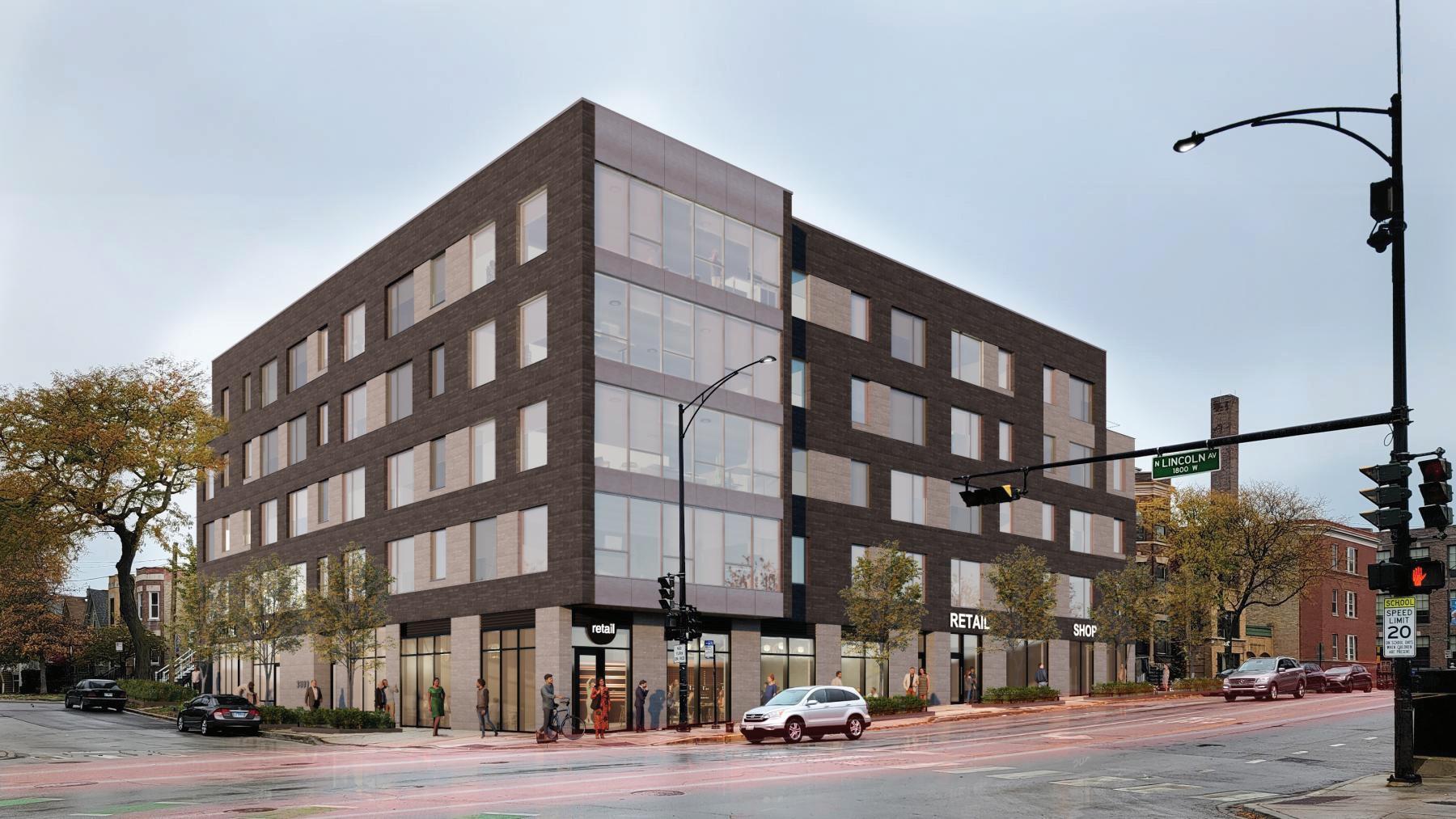
Seven two-bedroom two baths and a one bed one bath below market-rate rental units available at Five Points Lakeview, 3605 N Ravenswood!
Five Points Lakeview is a new construction rental building that features 52 residential units; a rooftop patio, gym, bike storage, and outdoor parking is available. Trader Joes, Loba Cafe, and the CTA Brown Line are within blocks of the property! The property is located within the Hamilton CPS School District
Affordable rents range from $849.00 to $1,659.00 a month. Must be income eligible. Households must earn no more than the maximum income levels below:
Unit 508, One Bedroom One Bath, 80% of Area Median Income: One person - $67,150; 2 persons -$76,750
Units 403 + 407, Two Bedrooms Two Baths, 70% of Area Median Income: 2 persons -$67,200; 3 persons - $75,600; 4 persons - $83,930
Units 303 + 307, Two Bedrooms Two Baths, 60% of Area Median Income: 2 persons -$57,600; 3 persons - $64,800; 4 persons - $71,940
Units 202 + 207, Two Bedrooms Two Baths, 50% of Area Median Income: 2 persons -$48,000; 3 persons - $54000; 4 persons - $59,950
Unit 203, Two Bedrooms Two Baths, 40% of Area Median Income: 2 persons -$38,400; 3 persons - $43,200; 4 persons - $47,960
Please contact the Five Points Lakeview for an application and more information at 773-308-6806 or info@fivepointslakeview.com or https://fivepointslakeview.com/
Applicants with vouchers or other third-party subsidies are welcome to apply. These units are subject to monitoring, compliance, and other restrictions by the City of Chicago’s Department of Housing. For more information visit https://www.chicago.gov/city/en/sites/affordable-requirements-ordinance/home.html
ADVERTISEMENTS
4 6 8 14 15
Arts & Entertainment Event highlights of the week!
SportsWise
The SportsWise team is rooting for the Fighting Illini.
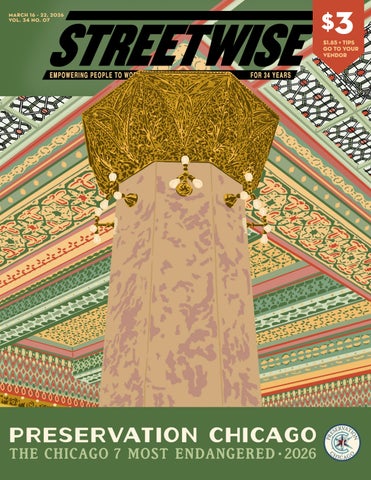
Cover Story: The Chicago 7 most endangered Preservation Chicago is a nonprofit that leverages the power of historic preservation to create healthy, vibrant, diverse and sustainable communities. Its endangered list features buildings unique to Chicago's history and looks at hidden assets that could improve life for all social classes.
From the streets
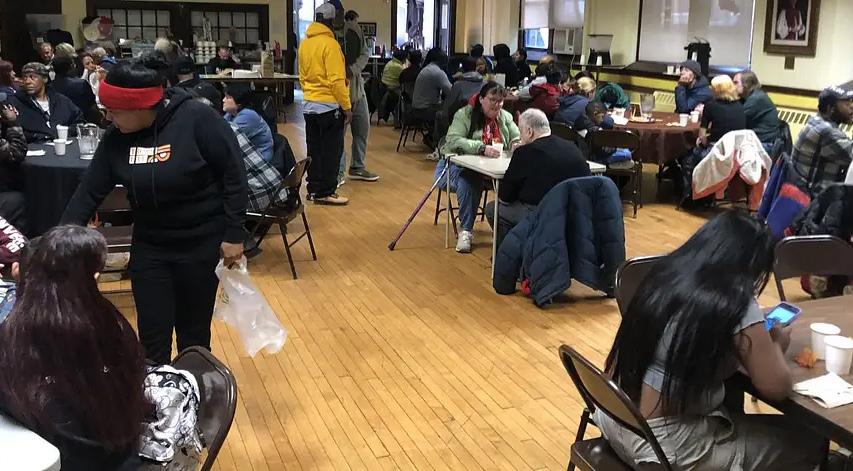
Nonprofit Care For Friends helps to ease the burden of SNAP changes for vulnerable populations in Chicago.
The Playground
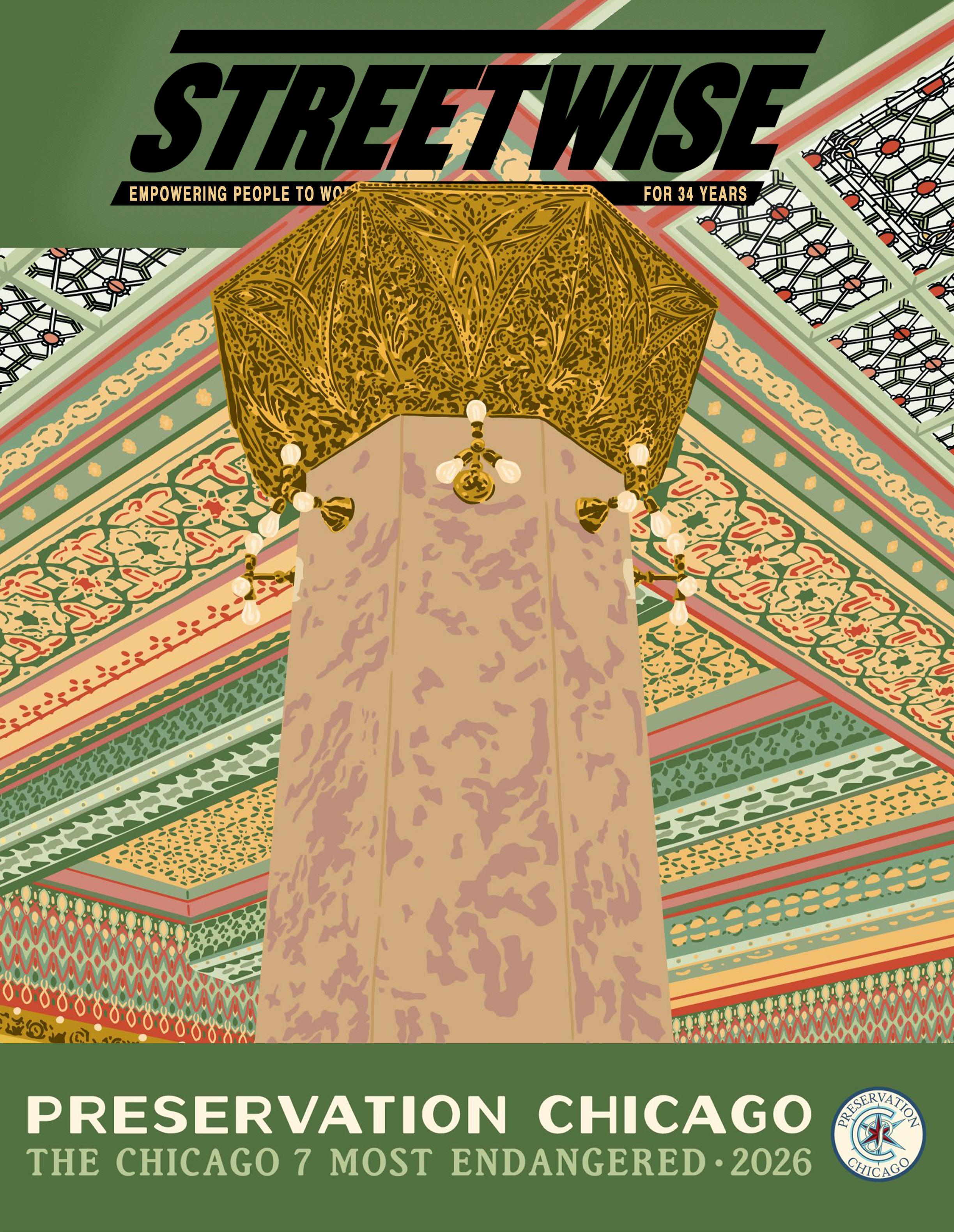
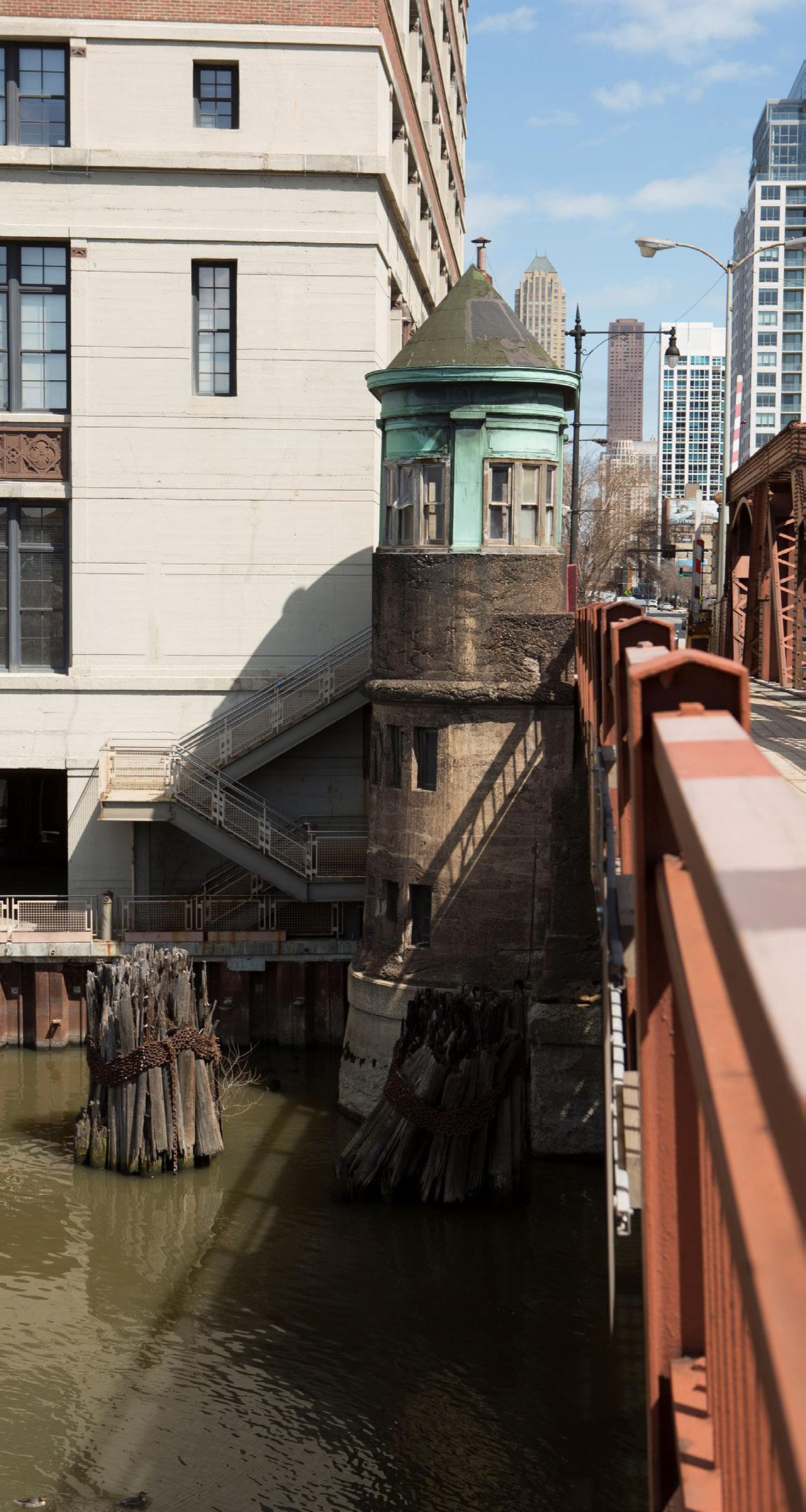
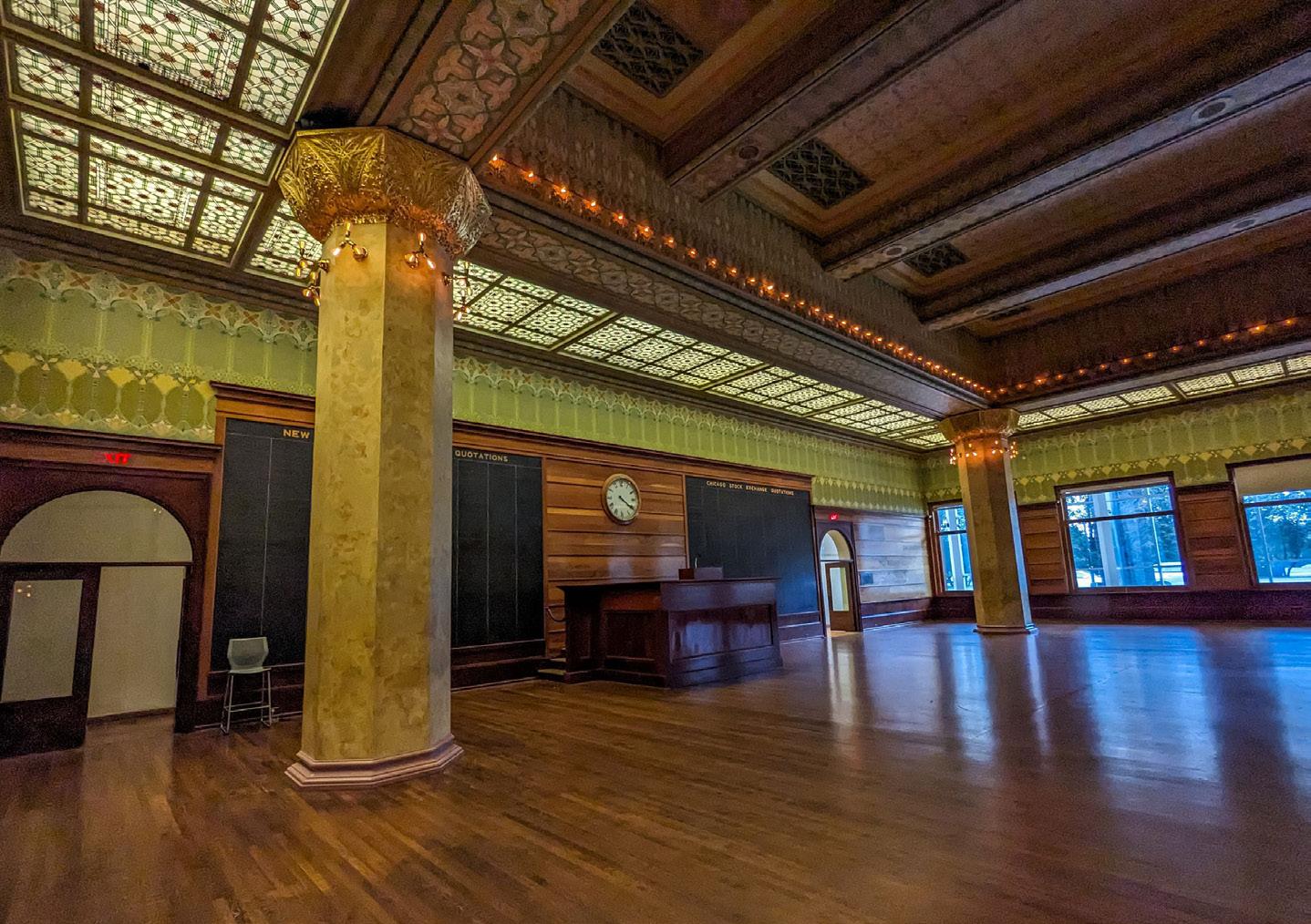
ON THE COVER: The Spark That Reignited the Preservation Movement, The Chicago Stock Exchange Trading Room Poster, a Preservation Chicago 2026 Chicago 7 Most Endangered (Preservation Chicago image). THIS PAGE: Chicago Avenue Bridge prior to demolition (Mejay Gula / Tender House Project photo). DISCLAIMER: The views, opinions, positions or strategies expressed by the authors and those providing comments are theirs alone, and do not necessarily reflect the views, opinions, or positions of StreetWise.
Dave Hamilton, Creative Director/Publisher dhamilton@streetwise.org
Suzanne Hanney, Editor-In-Chief suzannestreetwise@yahoo.com
Julie Youngquist, Executive director jyoungquist@streetwise.org
Ph: 773-334-6600 Office: 2009 S. State St., Chicago, IL, 60616
Fighting Illini to the final 4!
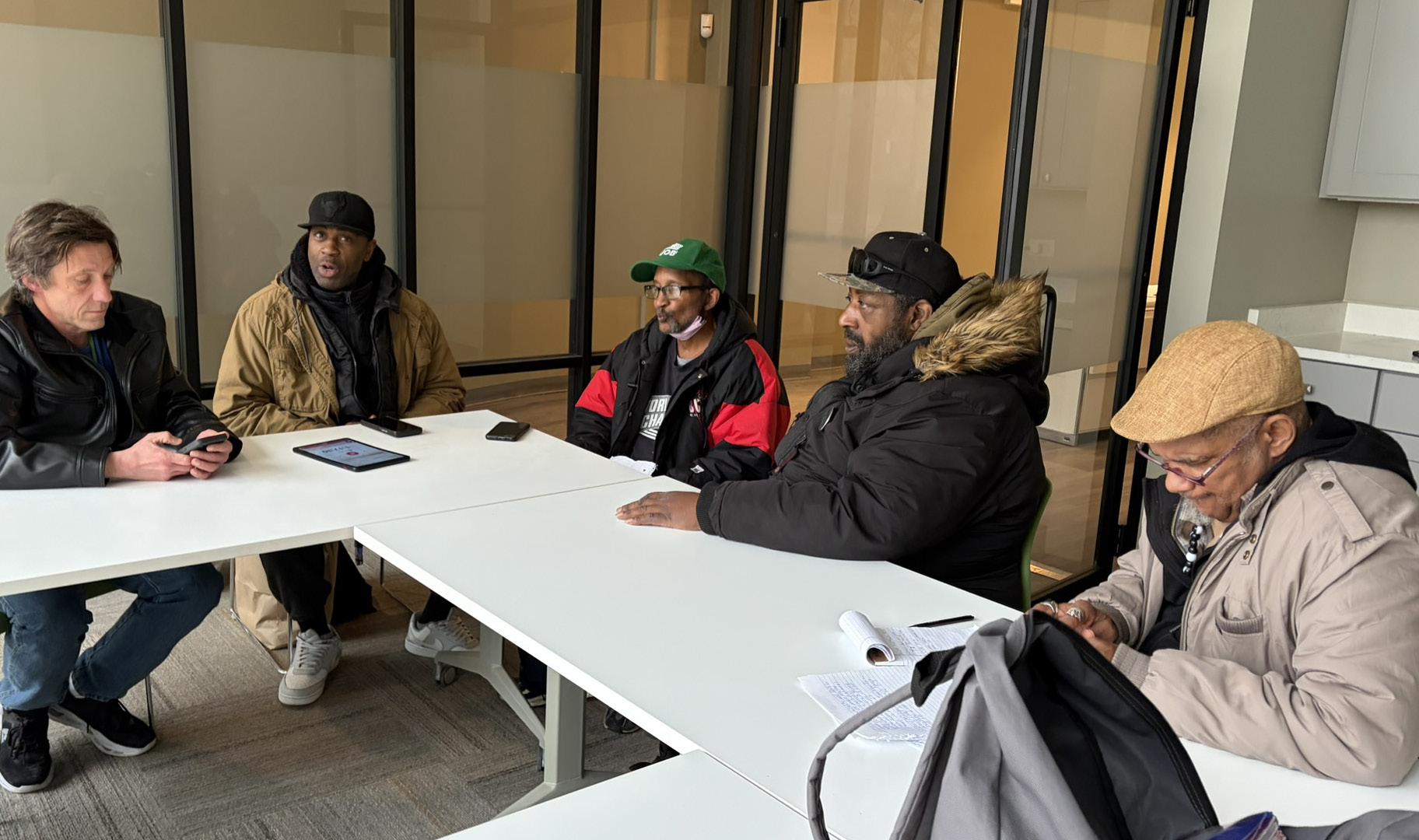
John: This is part two of our discussion on the Fighting Illini: how do they get to the Final Four?
Russell: They can make it, they’re rated No. 10 with a top tier offense. But sometimes they’ve gotten three-point-happy. They have to cut down some of those threes, because it’s not guaranteed you will make them. You gotta go inside, under the rim, and the Illini are the tallest team in college basketball: 6-foot-9 forward Ben Humrichous; forward/center Zvonimir Ivisic, 7-foot-2; his twin brother, center Tomislav, 7-foot-1; forward Jake Davis, 6-foot6; forward David Mirkovic, 6-foot-9; guard Keaton Wagler, 6-foot-6.
Allen: They beat Purdue 8882 on January 24, so they proved themselves worthy.
John: Has the 95-94 loss to UCLA on February 21 changed your perspective?
Allen: It hasn’t changed my perspective. I am looking for Illinois to take it all.
John: What about rebounding?
Allen: Rebounding is no problem. Russell already said they’re the tallest team in college basketball, basically a team of centers.
Clinton: UCLA is just one loss. We gotta go into March
Madness and before that the conference tournament. If they can avoid mistakes and turnovers, they should do pretty well in the NCAA tournament, where it’s win or go home. This is what you prepare all season for.
Percy : I agree with everyone. It’s the consistency. The season prepared you. You have to play hard at all times. You cannot make mistakes. You can’t go three-crazy. You have to alternate the inside game and the outside game.
John: So you agree with Russell?
Percy : Yes, they’ve gotta shift it. All the tall people can get rebounds and move the ball around.
John: According to ESPN, Illinois could draw on No. 15 Merrimack in the round of 64 and probably get by, then either No. 7 NC State
or No. 10 Auburn, although as of late February, neither of them have reached 20 wins. Should they go to the round of 16, they will either face BYU, projected at No. 6, or No. 3 Gonzaga. None of those opponents would be as tough for Illinois as Michigan State or Tennessee, which is always in people’s faces.
The Illini’s Kalyn Boswell also played for Arizona, when it was eliminated before the Elite Eight in 2024, so he wants redemption.
The Illini have Wagler averaging 18.2 points per game, Boswell with 13.9 ppg; Andrej Stojakovic at 13.8; Mirkovic at 12.2 along with 7.7 boards – a little bit of both. Also, “T” Ivisic has 5.74 boards and “Z” Ivisic has 5.
Russell: With the Big Ten Tournament coming up, Illinois should be ready to win it all. They got defense: “Big Z” Ivisic alone has 61 blocked shots for the season. They
can score inside and outside.
Percy : They got all the weapons: a whole lotta height, whole lotta defense, offense. As long as they execute all that height, should nobody be able to bother them.
Clinton: When the NCAA tournament starts, the farther you go, the tougher the teams get. you have to play defense, can’t make mistakes.
Once you get to the Sweet Sixteen, everybody’s looking for that push. The Elite Eight, that’s real business. The Final Four: it’s about who wants it more.
Allen: Let’s take care of the Big Ten first, then we’ll look at it again.
Any comments, suggestions or topic ideas for the SportsWise team? Email StreetWise Editor Suzanne Hanney at suzannestreetwise@yahoo.com
PRESERVATION CHICAGO THE CHICAGO 7 MOST ENDANGERED BUILDINGS
by Suzanne Hanney
Demolition of Louis Sullivan and Dankmar Adler’s Chicago Stock Exchange building ignited the restoration movement in Chicago. Ironically, the Stock Exchange Trading Room replica at the Art Institute of Chicago is now threatened itself –and is one of Preservation Chicago’s “Chicago 7 Most Endangered” landmarks of 2026.
Preservation Chicago is a nonprofit that leverages the power of historic preservation to create healthy, vibrant, diverse and sustainable communities. Released March 4, its endangered list featured buildings unique to Chicago’s history: Pope Leo XIV’s childhood church and school on the far South Side, union hall buildings, Chicago River bridges and tender houses, a midcentury synagogue in the Loop and a midcentury church in Humboldt Park.
The union buildings are not all immediately threatened, but two are being converted to residential use, so “we are apprehensive. This is a city built on unions; the eight-hour day came about due to the Haymarket Riots and the pushes that followed,” said Ward Miller, the Richard H. Driehaus executive director of Preservation Chicago.
Chicago history and how it shaped architectural aesthetics is key. The list also seeks to leverage the energy behind the buildings’ 19th and early 20th century origins, when Chicago was the “city of the century,” growing faster than the world had ever seen.
Most of all, the Chicago 7 looks at hidden assets that could improve life for all social classes.
“Earlier buildings are economically and environmentally better for the Earth,” Miller said. “They do a good job of retaining heat in winter and cooling in summer. And this is a city and country in desperate need of affordable housing.” Older buildings also utilize windows better to provide natural light; new office buildings would require interior atriums to do the same thing.
Architectural significance can give projects added interest, whether downtown or in outlying neighborhoods. The James R. Thompson Center was on the Chicago 7 list for five years. Google’s repurposing it as its Midwest headquarters saved it from demolition: “a great victory that will bring an infusion of technology and people into the Loop.” The building will have a new glass skin, but its
form and 18-story atrium will remain faithful to its Helmut Jahn design.
Neighboring financial district buildings will be turned into housing and hotels in the City’s LaSalle Street Reimagined project. The 20 to 30 percent of their units designed as affordable “will have a nice mix of people living downtown,” Miller said. Ironically, the 30 N. LaSalle building that replaced Adler’s and Sullivan’s Chicago Stock Exchange is now itself landmarked. So are the BMO Harris Bank buildings on Monroe Street. “We’re really proud that the BMO Harris Bank buildings are landmarked and will be revised into hotel and offices, both the 1911 red brick building with the bas relief lions and also the Skidmore building to the east by Walter Netsch.”
On the north side of Monroe Street at LaSalle, Preservation Chicago was very much involved in the restructuring of William LeBaron Jenney’s New York Life building into the Kimpton Gray Hotel.
Another “win” is a church designed by Solon Spencer Beman, architect for the factory town of Pullman. The Elim Lutheran Church was built in 1888 at 11310 S. Forest Ave. for Swedish workers making wooden railroad cars at the Pullman plant. It will now become the womanowned Onyx 360 health and wellness center.
Miller described years of attending court hearings with seven to 10 other community members to protect this building. Now, “it’s amazing that a community that is down on its resources can have this.”
CHICAGO STOCK EXCHANGE/ MCKINLOCK COURT
Louis Sullivan and Dankmar Adler’s masterpiece Chicago Stock Exchange building was demolished in 1971-72. Its Trading Room – with its stencils and art glass lay-lights/skylights by Louis Healy of Healy & Millet -- were salvaged and relocated to the Art Institute of Chicago in 1977. Precious architectural fragments – staircase balustrades, elevator grilles, polychrome stenciled panels – also made their way to top international museums: MOMA, the Met, the Victoria and Albert Museum and Musée d'Orsay, where they remain prominently displayed.
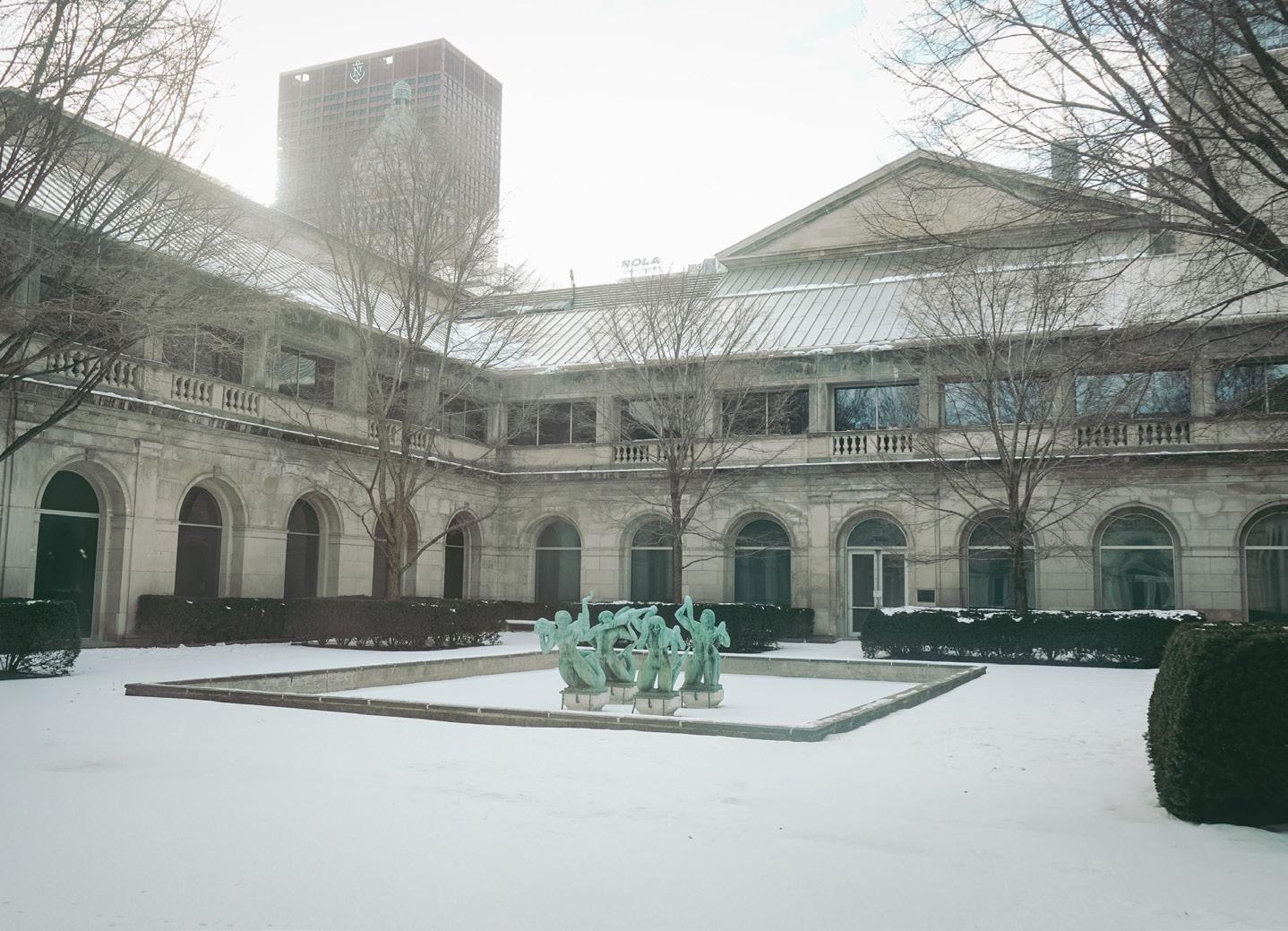
The McKinlock Court Garden, with “The Fountain of the Tritons” bronze sculpture by Swedish sculptor Carl Milles, is one of the museum’s few remaining public gardens, a dining space in warmer weather.
As part of upcoming 150th anniversary expansion plans, the Art Institute is considering demolition of both. Plans were reported in the Chicago Tribune in 2019 and 2024, but details are guarded.
Since the Art Institute is in Grant Park – publicly owned property that belongs to the City of Chicago and is stewarded by the Chicago Park District – Preservation Chicago calls for full transparency. Protect the Trading Room and McKinlock Court as irreplaceable features of the museum, for generations to come.
Chicago Landmark designation could include significant features such as the Michigan Avenue lobby, the Fullerton Hall Auditorium by Healy & Millet with its Tiffany art glass dome, McKinlock Court and the trading room, the terra cotta entry arch outside at Columbus and Monroe, and more.
Miller suggested a new wing could be located within the Metra Electric/ South Shore railroad trench, which splits the museum building in two. The museum accomplished this on a smaller scale with the bridge for Gunsaulus Hall. Millennium Park is another example.
CHICAGO RIVER BRIDGES AND TENDER HOUSES
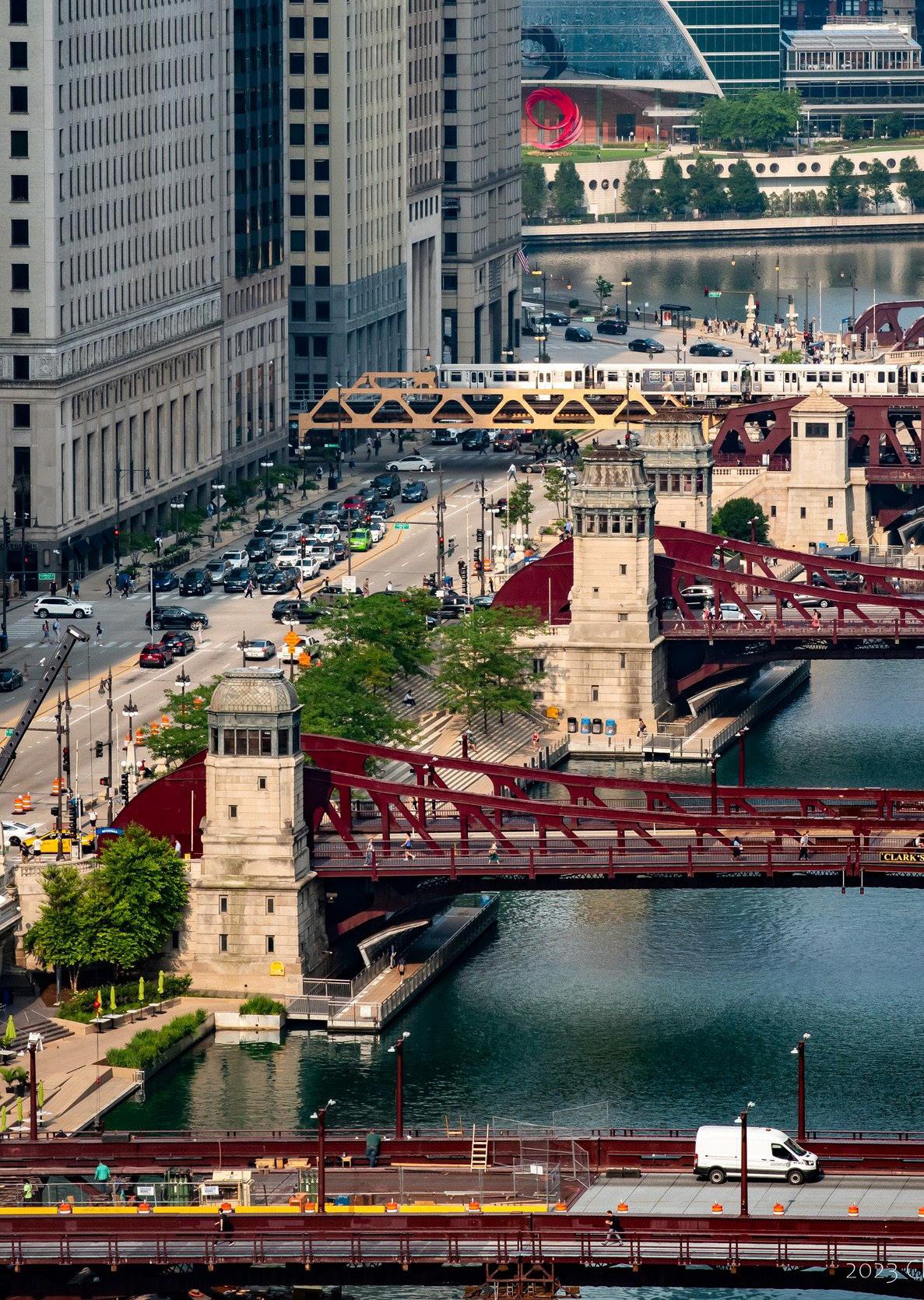
The Chicago River was the economic engine of early Chicago, so the city has the world’s largest collection of movable bascule bridges and is recognized internationally for innovations in bridge engineering.
Paired with them are tender houses for raising and lowering the bridges as needed. By the 1910s, these tender houses changed from simple, utilitarian structures, likely influenced by Burnham and Bennett’s Plan of Chicago and the City Beautiful Movement.
Today, many of these bridges and their tender houses need significant repair and sometimes replacement of the metal span. These are highly visible, characteristic symbols of Chicago. Replacing them with non-descript highway-standard bridges would be a significant loss.
In the past year, Preservation Chicago has submitted a formal “Suggestion for Landmark” document and presentation with the City of Chicago.
LEFT: McKinlock Court Building, 1898, Shepley, Rutan and Coolidge, Coolidge and Hodgdon, with 1977 rooftop addition by Walter Netsch, Skidmore Owings and Merrill with “Fountain of the Tritons” sculpture by Carl Milles, 1931. (Lily Ma / Numi Studio photo). RIGHT: Chicago River Bridges and Bridge Tender Houses (Chris Cullen photo). PAGE 7: The Chicago Stock Exchange Trading Room, 1894 Dankmar Adler and Louis Sullivan, dismantled in 1972 and reconstructed 1977 Vinci-Kenney Architects, 111 S. Michigan Avenue (Eric Allix Rogers photo)
ASHLAND AVE. NORTH BRANCH BRIDGE
Threats: The Chicago Art Deco Society has recommended the bridge, built in 1936, for Chicago Landmark status, but it is further from the Loop, so not as wellknown or as well-visited as iconic bridges there.
LASALLE STREET BRIDGE
Threats: In 2015, the City of Chicago planned a major restoration to address maintenance on the bridge, built in 1928. Repairs are now expected to begin in 2026. Conditions may have continued to worsen. Will the City’s plan comply with contemporary preservation standards?
CHICAGO AVENUE BRIDGE
Built:1914
CLARK STREET BRIDGE
Built:1929
MICHIGAN AVENUE DUSABLE BRIDGE
Built:1920
Ideas for improving Michigan Avenue started with Daniel Burnham’s 1909 Plan of Chicago; widening of the avenue and bridge construction began in 1918, which in turn provided better access to the Loop.
Threats: The bridge’s last significant rehabilitation was in 2009. The limestone is staining and cracking.
WASHINGTON BLVD BRIDGE
Built:1913
The Washington Boulevard bridge is among the oldest of the city’s remaining operable bascule bridges, that is, a drawbridge with two leaves to allow traffic.
WABASH AVENUE IRV KUPCINET BRIDGE
Built:1930
The Wabash Avenue bridge is one of the last bridges constructed under the Plan of Chicago. The American Institute of Steel Construction awarded it the “most beautiful bridge” for its elegant solution to the problem of its span.
ST. MARY OF THE ASSUMPTION ROMAN CATHOLIC CHURCH
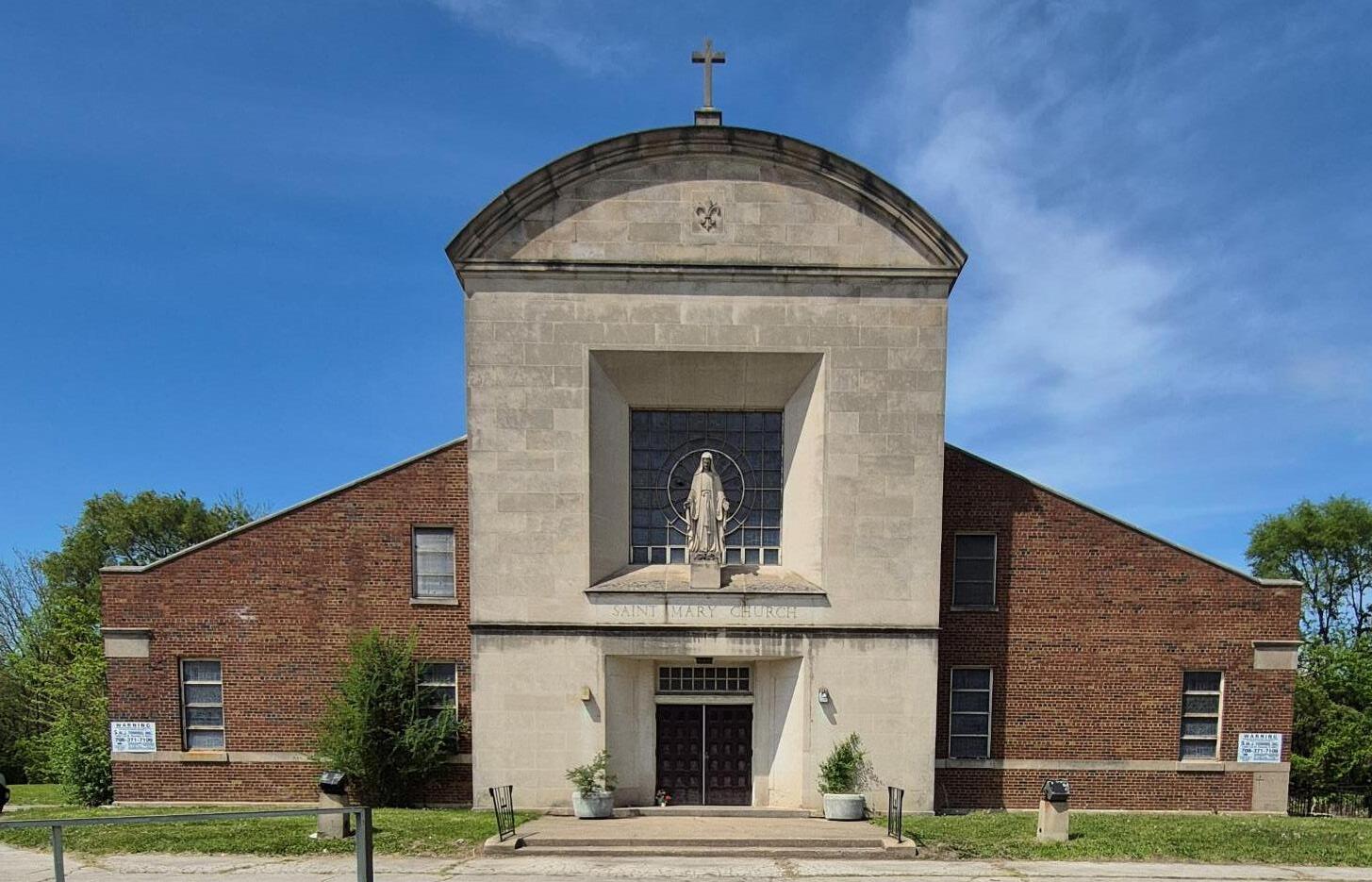
St. Mary of the Assumption Church and School was organized in 1886 to serve 30 German Catholic families, but its campus is significant as the place where Pope Leo XIV – the first American-born pope -- attended school, sang in the choir and served as an altar boy. Located at 138th and Leyden Avenue, it’s in Chicago’s southernmost neighborhood. The parish school building was built in the 1920s and the church structure, designed in a simplified Renaissance style, was completed in 1957 by Chicago architect George S. Smith. The property is currently owned by Joe Hall, founder of JBlendz Enterprises.
Unfortunately, the church has been out of operation since 2011 and the parish merged with others nearby due to declining membership. The vacant church and school buildings deteriorated due to a damaged roof and windows, but efforts are being made to save them. In May 2025, Preservation Chicago formally requested designation of the church as a Chicago Landmark to protect it from demolition and support its restoration.
School architect Hermann J. Gaul apprenticed with Louis Sullivan before establishing his own practice working for German clients throughout Chicago and the Midwest. Likewise, church architect Smith trained at several prominent Chicago architectural firms, including Graham, Anderson, Probst & White, before he established his own.
Pope Leo’s was among the parish’s 1,500 families in 1961, when 863 children were enrolled in the school. By 1978, St. Mary’s was at its peak; the parish included more than 2,000 families. But the neighborhood experienced disinvestment in the half century since then.
Preservation Chicago calls for all stakeholders – including the City of Chicago and State of Illinois – to work together quickly to raise funds for methodical restoration of each building. Pope Leo is the leader of over 1.3 billion Catholics across the globe, so this campus could become a pilgrimage site for visitors from all over the world. It would breathe new hope into the neighborhood, the nonprofit says
"The Pope's Church," St. Mary’s / St. Mary of the Assumption Roman Catholic Church, 1957, George S. Smith, 310 E. 137th Street. (Ward Miller / Preservation Chicago photo).
CHICAGO'S LABOR UNION HALLS
Chicago’s union history originates from the rapid industrialization of the late 19th century, when the city was buzzing with railroads, stockyards, manufacturing, steel production, printing and shipping. Events such as the 1886 Haymarket Affair, the 1894 Pullman Strike and the 1937 Memorial Day Massacre, along with increasing worker demands for better rights, inspired a growing number of labor organizations to be established in Chicago in the early to mid-20th century.
Preservation Chicago has been aware of several union halls that are in need of repairs, have been listed for sale in recent years, or face potential demolition.
A 24-story, 303-unit glass apartment tower has just been proposed for the site of the Amalgamated Meat Cutters
and Butcher Workmen of North America Building, at 2800 N. Sheridan Road. Matching bronze statues at its gateway include twin kneeling circles of two males and two females with grasped arms, representing North America, Asia, Africa and Europe. This building was most recently a medical building associated with nearby St. Joseph Hospital.
The United Electrical Workers Union Building at 37 S. Ashland was recently sold and repurposed as a residential building. Historic murals inside were threatened with loss until organizations came together to remove them for reinstallation elsewhere.
Realizing the need to share Chicago’s Labor union history, perhaps a thematic Chicago Landmark District across the city could be formed such as that for former Schlitz Brewery tied houses, Preservation Chicago suggests.
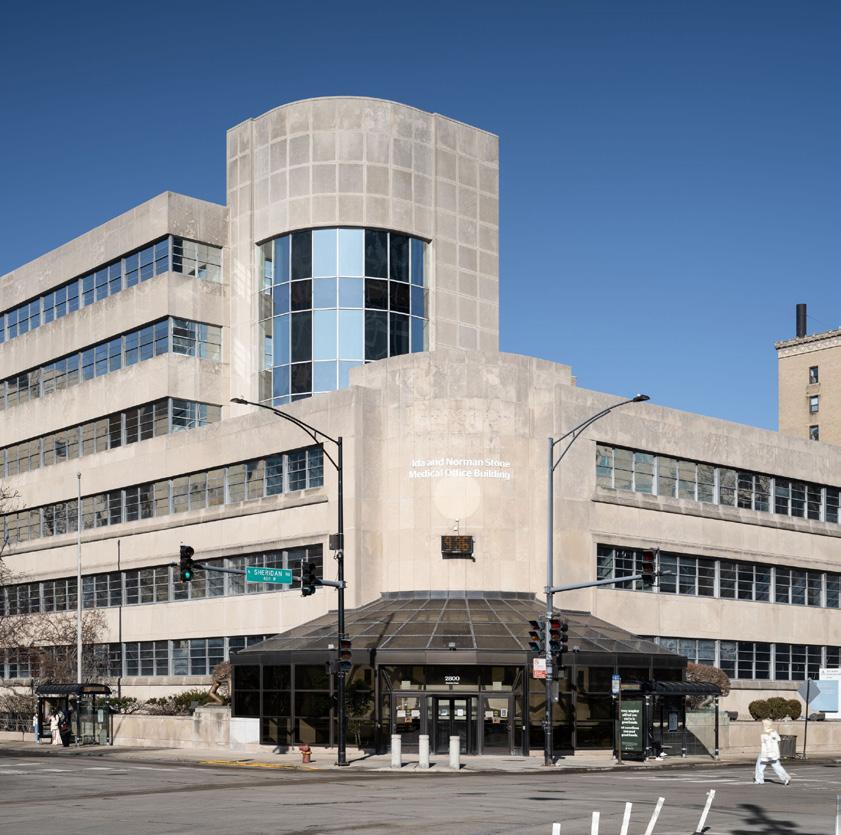
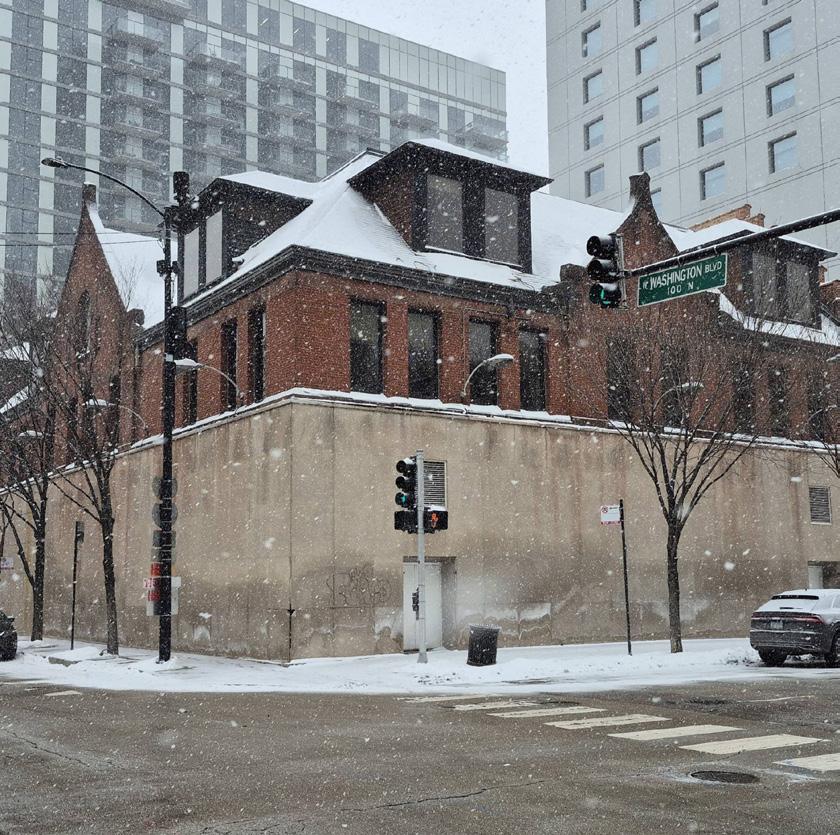
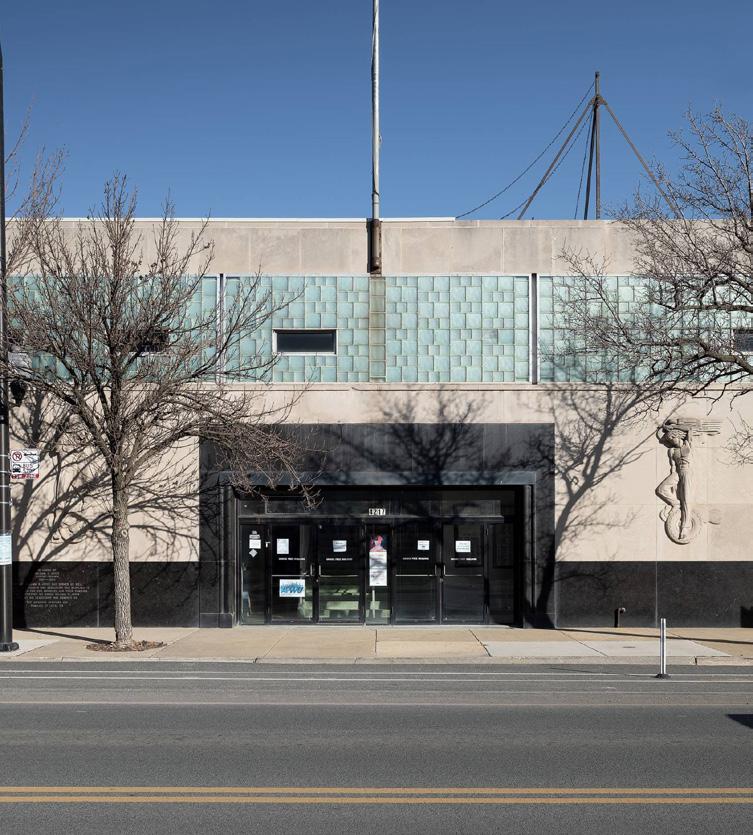
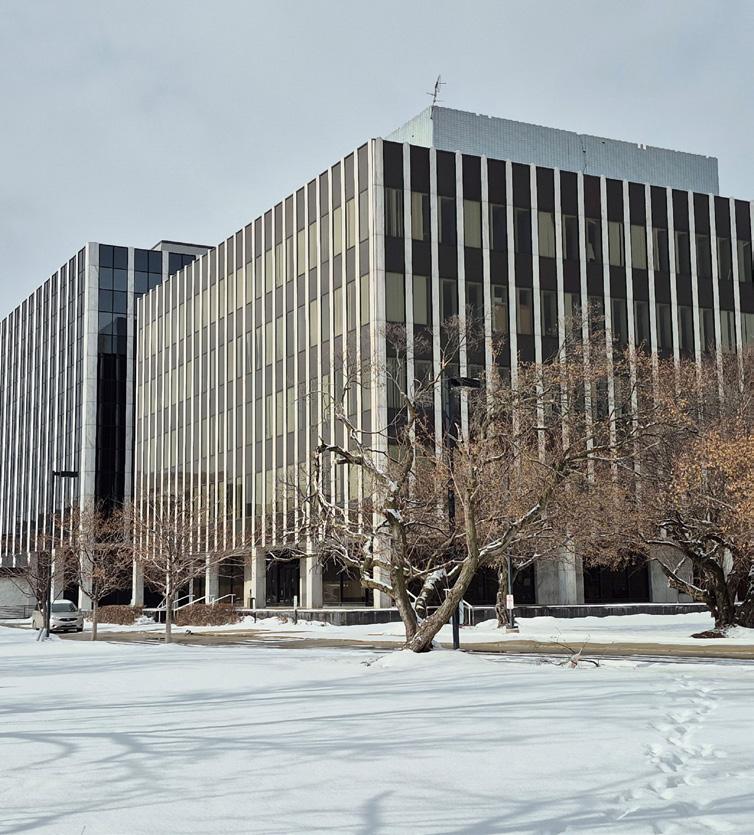
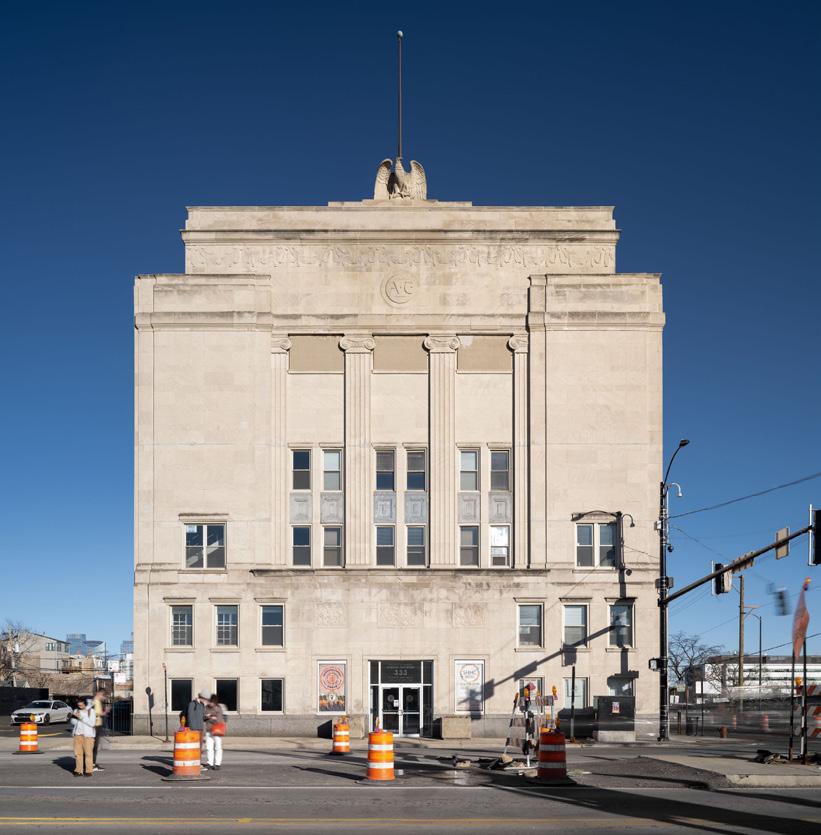
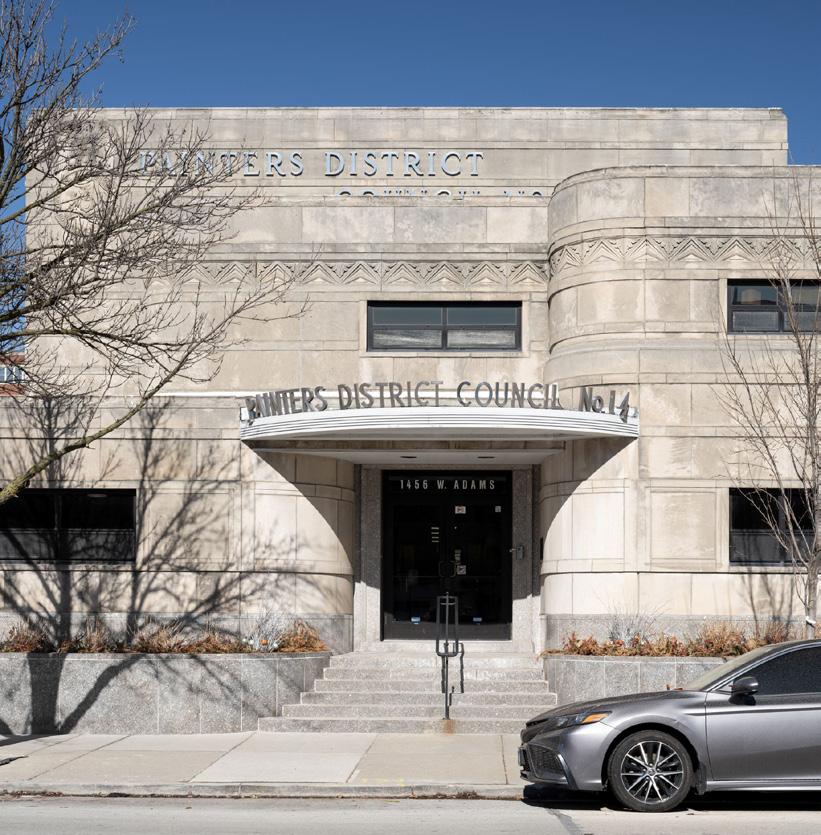
Clockwise from top left: Workers United Hall / formerly Chicago Joint Board, Amalgamated Clothing Workers of America headquarters, 333 S. Ashland Ave. (Chris Cullen photo); Amalgamated Meat Cutters and Butcher Workmen of North America Building, 2800 N. Sheridan Road (Serhii Chrucky photo); Former Teamsters 710 Union Hall, 1956, 4217 S. Halsted St. (Cristen Brown photo); Painters District Council #14, 1456 W. Adams Street, 1956, Vitzthum & Burns. (Debbie Mercer photo); Former Chicago Street Railroad Cable Car Powerhouse, c.1888, 600 W. Washington Boulevard. (Ward Miller / Preservation Chicago photo); Teamster City, 1970, Will Jonson-Swope & Associates, 300 S. Ashland Ave. (Ward Miller / Preservation Chicago photo). Opposite page: Chicago Loop Synagogue, 1957, Loebl, Schlossman & Bennett, 16 S. Clark St (Eric Allix Rogers photo).
PAINTERS DISTRICT
COUNCIL #14
1456 W. Adams Street
Built Year: 1956
WORKERS UNITED HALL
333 S Ashland Avenue
Built Year: 1928
CHICAGO PLUMBERS UNION HALL
1340 W. Washington Boulevard
Built Year: 1925
FRATERNAL ORDER OF POLICE CHICAGO LODGE NO. 7
1412 W. Washington Boulevard
Built Year: 1928
CHICAGO FEDERATION OF LABOR BUILDING
600 W. Washington Boulevard
Built Year: 1888, originally built; 1927-1928, adaptive reuse
TEAMSTERS LOCAL 705 AUDITORIUM
326-336 S. Marshfield Avenue
Built Year: 1925-1926
TEAMSTER CITY
300 S. Ashland Avenue
Built Year: 1970
FORMER TEAMSTERS 710 UNION HALL
4217 S. Halsted Street
Built Year: 1956
AMALGAMATED MEAT CUTTERS AND BUTCHER WORKMEN OF NORTH AMERICA BUILDING
2800 N. Sheridan Road
Built Year: 1951
UNITED ELECTRICAL WORKERS UNION
37 S. Ashland Avenue
Built Year: 1904
PIPEFITTERS LOCAL 597
45 N. Ogden Ave
Built Year: late 1950s-early 1960s (c.1961)
AMERICAN POSTAL WORKERS UNION HALL
Address: 4217 S. Halsted Street
Built Year: 1955
UNITED AUTO WORKERS LOCAL 3212
11731 S. Avenue O
Built Year: 1968-1969
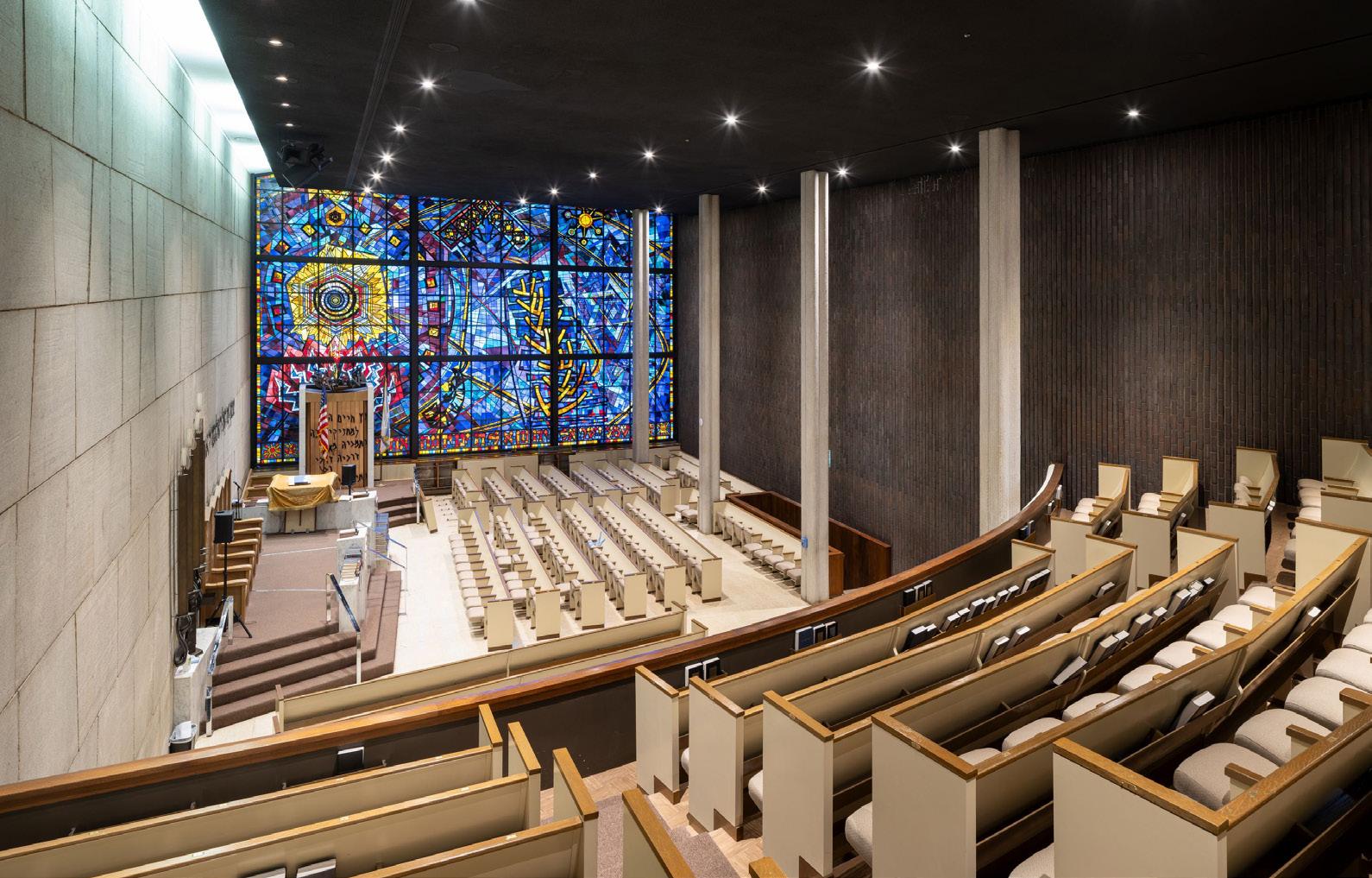
CHICAGO LOOP SYNAGOGUE
The Chicago Loop Synagogue was founded in 1929 as the world’s first businessmen’s synagogue: a place for commuters to pray during the day and to seek kosher food. Today, it remains the only Loop venue for both functions.
Its building at 16 S. Clark St. was designed in 1957 by the leading Chicago Jewish architects of Modernism Loebl, Schlossman & Bennett. Its entrance on Clark Street is crowned by the bronze sculpture “Hands of Peace” (1963), by Nehemia Henri Azaz (1923-2008), an Israeli artist of international reputation. A gift of the family of Chicago philanthropist Henry Crown (1896-1990), the sculpture depicts the outstretched hands of the priestly benediction against a textured background of scripture in both English and Hebrew. Azaz also designed the Ark, which stands toward the lower left of the stained-glass window.
Abraham Rattner (1895-1978) designed the colossal stained-glass window, “Let There Be Light,” on the sanctuary’s east wall. He visited museums, studied the Old Testament and Jewish symbolism, worked at the Atelier Barillet stained glass studio in Paris and supervised its installation before High Holy Days in autumn of 1960.
The congregation had approximately 1,000 members in the 1930s and about 8,000 in the 1950s. Attendance has undergone a dramatic shift in recent years due to retirements and a shift toward remote work. Membership has fallen to under 400.
This winter, severe cold caused the synagogue’s boiler pipes to burst and placed additional strain on its finances.
The synagogue has about 17 stories of unused air rights, which could be sold to fund repairs (although a setback would be required to preserve the original façade and cornice).
Other options would be potential use of the adjacent property at 6-8 S. Clark Clark St., or assembling parcels all the way to the corner, including the 23-story Art Deco office building at 105 W. Madison St. This approach would also allow for the stacking of historic tax credits and other development incentives.
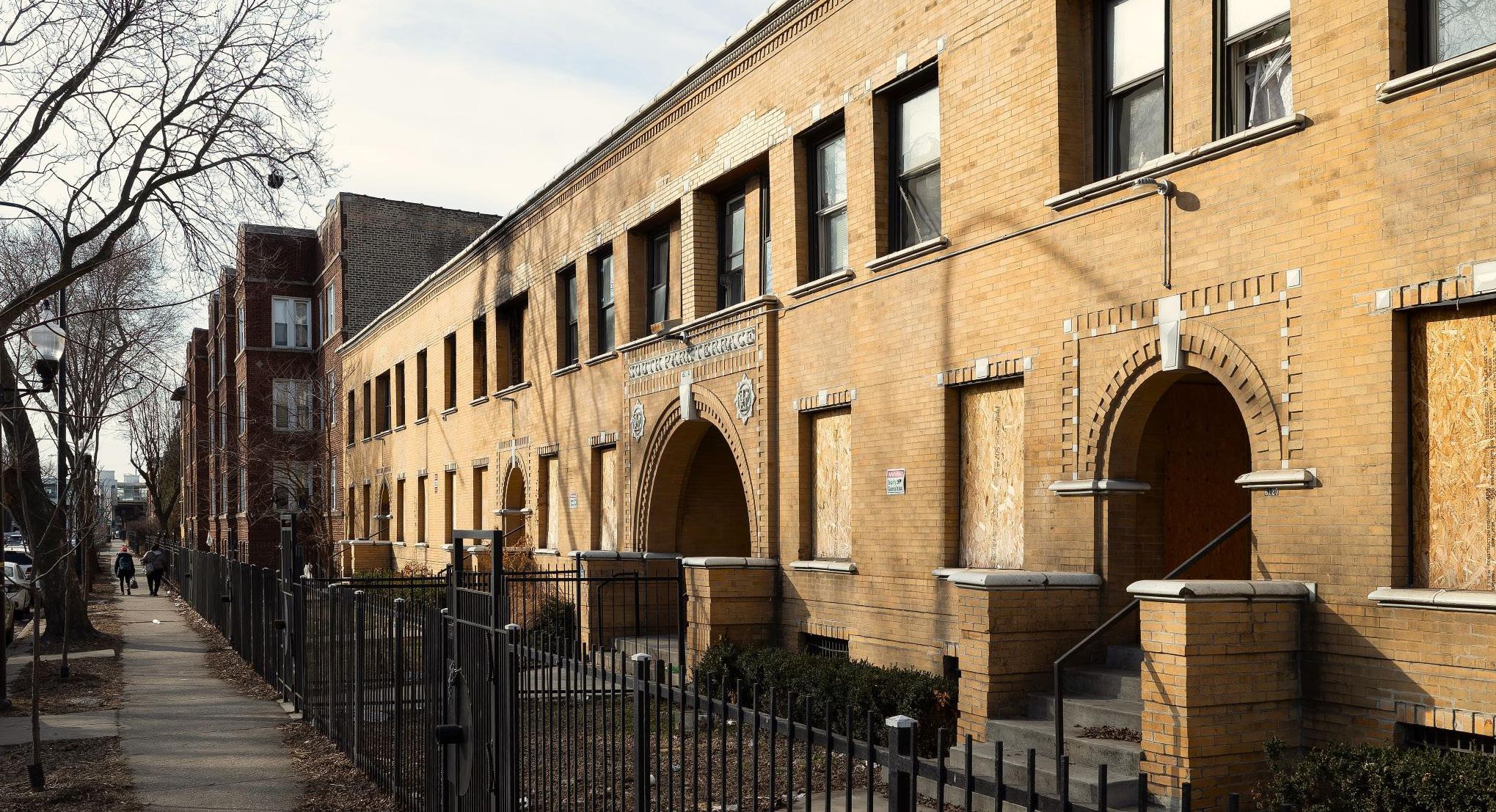
SOUTH PARK TERRACE APARTMENTS
South Park Terrace Apartments was constructed in 1905, providing affordable housing near Washington Park. The Prairie School structure was designed by Harry Hale Waterman, a Frank Lloyd Wright associate.
By the end of the 19th century, Chicago was the nation’s second-largest city with a population of one million. Low-rise brick courtyard buildings emerged as a response to higher population density. These were typically organized around a central court opening onto the street, with separate entryways.
Located on South Park Way (later renamed Martin Luther King Jr. Drive) near 61st street, the building was only a block from Washington Park. Its race track – the "Ascot of the West"– and its Jockey Club house designed by Solon Spencer Beman were the epicenter of Chicago’s Gilded Age society.
Developer Thomas E. Wells was one of the prominent businessmen who made Chicago a leading city. He commissioned a two-story brick courtyard apartment building with 52 apartments targeted at middle-class residents. In the 1920s, it was described as one of the most popular priced modern apartments on the South Side, but later in the decade, the building became dilapidated amid white flight and disinvestment.
By the 1940s, under the management of ADE Realty, it was renovated as housing for working-class black residents and was described as “the pride of the community.”
Today, residents live amid water leaks and rotten floors. In March 2025, a fire left visible burn marks on the blonde facade’s brickwork amid boardedup windows. On June 11, 2025, the city ordered residents to vacate the building’s middle tier with only two days’ notice.
Realizing the significance of the South Park Terrace Apartments, Preservation Chicago requests the City of Chicago to take steps toward preserving it, perhaps through the Chicago Housing Authority, the Cook County Land Bank Authority or a developer to acquire and repair it. Its architectural integrity warrants Chicago landmark status – and Chicago needs more affordable housing.
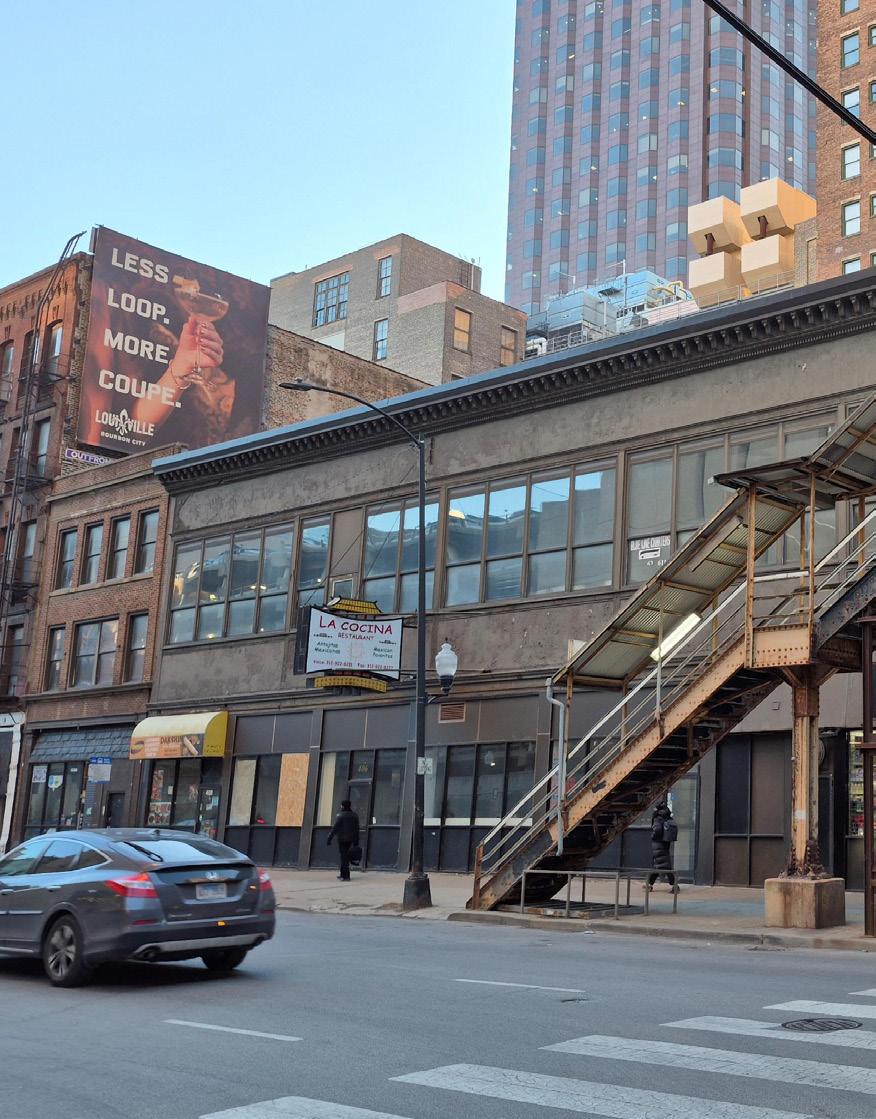
YUKON BUILDING
The two-story Yukon Building, later renamed the Bock Building, was designed by Holabird & Roche. Its iron and glass facades and second-floor bands of ribbon-windows anticipate designs popularized decades in the future. An early “taxpayer building” in central Chicago, it was a modestscale structure that earned enough funds to cover the yearly tax bill and give the owners a small profit.
Originally conceived as an eight-story or a 12-story building at the southwest corner of Clark and Van Buren streets, the more modest development likely reflected the financial panic of the mid-to-late 1890s and construction of the Union Loop Elevated along Van Buren Street in 1897.
The Yukon Building is a survivor of Chicago’s “Old Chinatown,” predating the community’s move to Cermak Road in the 1920s. The area was also a small vice district, “Little Cheyenne,” with connotations of Wild West lawlessness.
Preservation Chicago is concerned now that the building has been listed for sale.
South Park Terrace Apartments, 1905, Harry Hale Waterman, 6116-6134 South Dr. Martin Luther King Jr. Drive Sherii Chrucky photo). Yukon Building / Bock Building, 1898, Holabird & Roche, 400 S. Clark St./ 105-111 W. Van Buren St. (Ward Miller / Preservation Chicago photo).
Several other small historic businesses – Boni Vino Italian restaurant and the Sky Ride Tap -- have also been impacted by fallout from the COVID pandemic and the potential sale of the Yukon Building.
A fine example of a modest, yet beautiful and innovative structure by one of Chicago’s most prolific architectural firms of the late 19th century, this pared-down design is much different from the more formal metal-framed office buildings for which Holabird & Roche is recognized. It’s also remarkable that the structure has survived decades of development in the South Loop and even wholesale land clearances for surface and multi-storied parking lots and large additions to existing nearby structures.
Historic Chinatowns across the nation are being recognized, so Chicago Landmark designation would also encourage a buyer who could be a good steward, Preservation Chicago says.
ST. MARK ROMAN CATHOLIC CHURCH CAMPUS
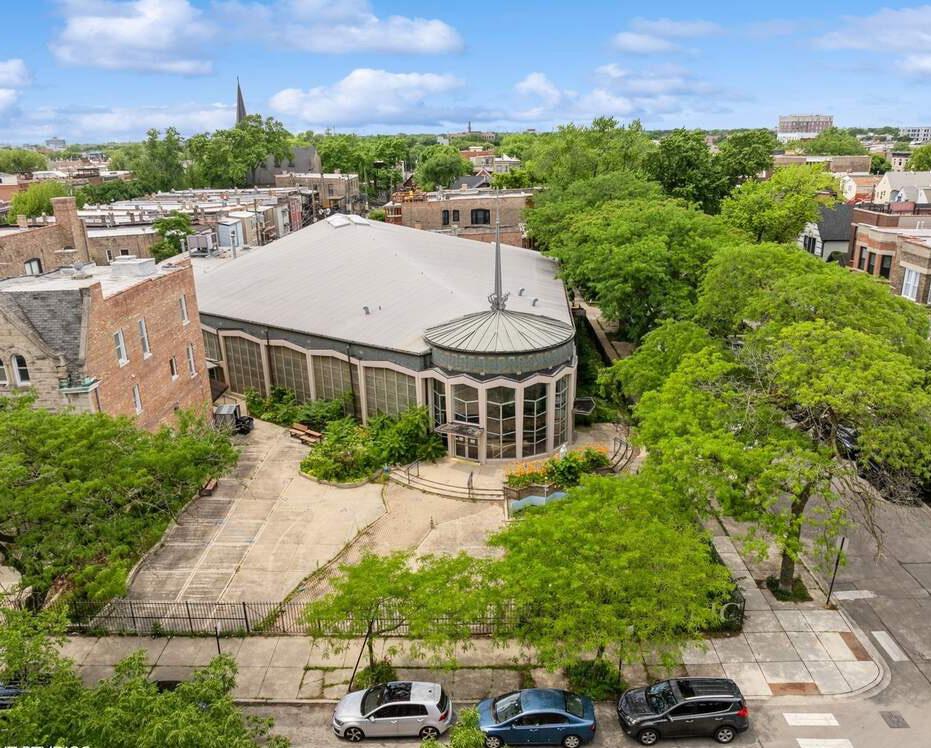
St. Mark Roman Catholic Church campus has been at the heart of the Catholic community in Humboldt Park since the parish was founded in the 1890s. The parish first served an Irish community, then a Polish community, and now a Puerto Rican/Mexican community. The greystone rectory was built in 1896 and the red-brick school in 1906, but the Midcentury modern church was completed in 1963 by Chicago architects Barry & Kay.
Despite a thriving community, the parish was consolidated by the Archdiocese of Chicago, the church was closed and listed for sale. However, Ald. Gilbert Villegas (36th ward) insisted that the school building, home to a charter school, be withdrawn from the sales listing. Preservation Chicago calls the church a “remarkable building” and along with neighbors, supports its creative reuse as a community center or a Chicago Public Library branch.
The church’s large, open hall is supported by a double row of slightly tapering concrete and steel shafts, which also act as side aisles. The stained-glass windows were created by French artist Gabriel Loire, whose work adorns the royal chapel in Monaco. Loire studied painting under the renowned French painter Georges Rouault and was inspired by the windows of Chartres Cathedral, where he apprenticed at a restoration studio.
Neighborhood residents are not interested in any redevelopment of the site other than reuse of the existing structures. The alderman and City officials have heard calls for a Chicago Landmark District.
The rectory could become affordable apartments while the school (originally a church-school combination) should remain a charter school that serves the Humboldt Park Community and families.
St. Mark Roman Catholic Church, 1963, Barry and Kay, 2516 W. Cortez St. (VHT Studio photo).