August 17 - 23, 2026 Vol. 34 No. 27
$3
$1.85 + Tips go to your Vendor
Save the date: September 24, 2026
ADVERTISEMENTS
4 Arts & Entertainment 6 SportsWise
Event highlights of the week!
The SportsWise team ponders where the future home of the Bears will be.
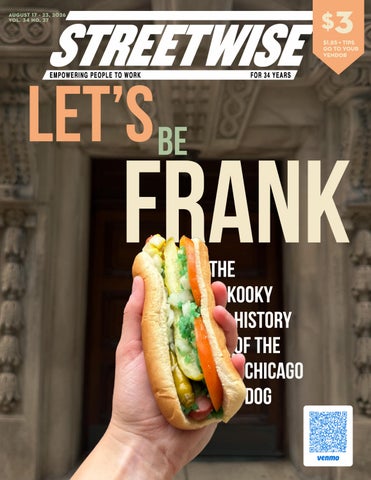
7 Cover Story: Hot Dog Adoration
Explore the history of the Chicago street food staple with expert Bruce Kraig and the Driehaus Museum.
11 From the Streets 15 The Playground
Playwright Denise Jones shares the struggles of her youth on the West Side in revival of "Beyond the Door."
ON THE COVER: Uplifting a hot dog in front of the Driehaus Museum, 50 E. Erie St. (Emma Broun / Driehaus Museum photo). THIS PAGE: At a Cubs home game August 22 (Judi Strauss-Lipkin photo). DISCLAIMER: StreetWise publishes perspectives from vendors and contributors to reflect a range of lived experiences and viewpoints. These opinions do not necessarily reflect the views of StreetWise. We are committed to fostering dialogue grounded in dignity and respect, and we do not endorse language or perspectives that harm or dehumanize others.
Dave Hamilton, Creative Director/Publisher
dhamilton@streetwise.org
StreetWiseChicago @StreetWise_CHI
Suzanne Hanney, Editor-In-Chief
suzannestreetwise@yahoo.com
Julie Youngquist, Executive director
jyoungquist@streetwise.org
LEARN MORE AT streetwise.org
DONATE
Ph: 773-334-6600 Office: 2009 S. State St., Chicago, IL, 60616
To make a donation to StreetWise, visit our website at www.streetwise.org/donate/ or cut out this form and mail it with your donation to StreetWise, Inc., 2009 S. State St., Chicago, IL 60616. We appreciate your support!
My donation is for the amount of $________________________________Billing Information: Check #_________________Credit Card Type:______________________Name:_________________________________________________________________________________ We accept: Visa, Mastercard, Discover or American Express
Address:_______________________________________________________________________________
Account#:_____________________________________________________City:___________________________________State:_________________Zip:_______________________ Expiration Date:________________________________________________Phone #:_________________________________Email:_________________________________________
ARTS & ENTERTAINMENT RECOMMENDATIONS Compiled by Dave Hamilton
Stories to Dye For!
‘The Trouble With My Hair: Coloring, Cutting, and Coming into Who I Am’ “The Trouble With My Hair” is an intimate exploration of gender, sexual identity, and boundary-making through award-winning storyteller Ada Cheng’s evolving relationship with her hairstylist and her hair. Cheng playfully brings her audience on a journey of self-discovery and self-love through her struggles with hair. She uses her changing hairstyles and haircolors as milestones marking her path toward self-definition. Each cut, color, and conversation becomes a metaphor for reclaiming voice and visibility in a world eager to define her. The production will have five performances: The production will have five performances: Friday, August 21, 7:30 p.m. at Scissor & Fork, 3968 N. Elston Ave.; Saturday, August 22, 7:30 p.m. at Visceral Adventure Lounge, 3638 W. Grand Ave.; Sunday, August 23, 7:30 p.m. at REM Salon, 3035 W. Fullerton Ave.; Saturday, August 29, 7:30 p.m. at Haibayo, 1132 W. Argyle St.; Sunday, August 30, 1 p.m. at The Center on Halsted, 3656 N. Halsted St. Tickets are $15-$50 at NothingWithoutaCompany.org.
Dance for Health!
ARTS & ENTERTAINMENT
Dance for Life 35th Anniversary The annual fundraiser for Chicago Dance Health Fund is Saturday, August 22 at 7:30 p.m. at The Auditorium, 50 E. Ida B. Wells Drive, Chicago. A Gala Dinner is at 5 p.m. at Venue SIX10, 610 S. Michigan Ave., Chicago, and the After Party following the performance also is at Venue SIX10. Dance for Life is a one-night-only event showcasing the city’s varied dance traditions and styles by bringing together professional dance companies and dancers from throughout Chicago, who unite to support their peers by generously donating their time, energy, and artistry. Since its debut in 1992, Dance for Life has raised more than $8 million. The performance gives guests an opportunity to experience a range of dance genres, companies of different sizes and histories, and numerous choreographers, artists, and designers in one memorable evening each year. An additional beneficiary of Dance for Life is AIDS Foundation Chicago. Tickets are $750 for the gala dinner, performance, and after party; $350 for performance and after party; $65-$150 for performance only at auditoriumtheatre.org
4
Extra! Extra!
17th Annual The Living Newspaper Festival Jackalope Theatre Company presents the 17th Annual Living Newspaper Festival, August 20 - 24, at the Jackalope Theatre in the Broadway Armory, 5917 N. Broadway. The Living Newspaper Festival is inspired by the 1930s Living Newspapers of the Federal Theatre Project that created stories based on recent events. With a history in the USSR and Germany in the early part of the century, the Living Newspaper was initiated in the United States in 1935 as part of the Federal Theatre Project (FTP). Its founders believed in the value of drama as an instrument of social change and the Living Newspapers became a highly effective new form, boldly producing plays that often brought to light social injustices, challenged ideals and criticized the government. Each night, the Festival includes five one-act plays inspired by recent news headlines. Tickets are $20 - $35 and are available at JackalopeTheatre.org or by calling 773-340-2543.
Warped Perspective!
Chalk Howard Street The nonprofit Rogers Park Business Alliance presents Chicago’s only chalk art festival, Chalk Howard Street, on Saturday, August 22, from 11 a.m. – 7 p.m. The family-friendly festival presenting large-scale optical illusions returns to transform the street surface into a canvas for national, local, and first-time chalk artists along Howard Street between Paulina and Ashland, east of the Howard Red Line “L” stop. This free-admission festival features live music, artisan vendors, kids drawing, food and drinks— while offering striking and immersive street art experiences and street chalk squares available for public purchase. Chalk Howard Street is sponsored by Howard Street/Jarvis Square Special Service Area #19. For more information on the festival, visit chalkhowardstreet.com.
No More Wire Hangers!
‘Joan Crawford Goes to Hell’ Hell in a Handbag Productions presents a revival of the fan favorite “Joan Crawford Goes To Hell,” August 21 – September 27 at The Clutch, 4335 N. Western Ave. Originally produced in 1999, the play is a roller coaster ride that explores the life of the legendary Hollywood star. The premise? Joan Crawford dies, goes to hell and is forced to view her life through the eyes of her daughter, Christina in a tale so big it needs three Joans! Part “Mommie Dearest,” part biography with a dash of Joan’s lifestyle book, “My Way of Life,” it is the perfect summer cocktail for those with a taste for camp. Tickets are $29-$52 at handbagproductions.org
Opera, but Outside!
‘Sunday in the Park with Lyric’ Lyric Opera of Chicago invites the city to its cherished end-of-summer ritual: Sunday in the Park with Lyric. On Sunday, August 23, at 7 p.m., the Jay Pritzker Pavilion in Millennium Park will transform into a vibrant stage where the power of the human voice meets the warmth of a Chicago summer night — and where thousands of Chicagoans will gather to celebrate the new Chicago cultural season. Whether a lifelong opera devotee or seeking the perfect way to cap off a summer weekend in Chicago with family and friends, all are invited to experience the grandeur of Lyric in the open air.
A One-Trans-Woman Show!!
‘Cracks’ Through a hybrid of storytelling, stand-up comedy and theatre, this one-trans-woman dark comedy memoir by Claire Lochmueller details a journey from a childhood in the Catholic Church/JROTC military school to a career as a multi-award-winning trans theatre-maker. CRACKS navigates topics of gender identity, substance abuse and finding joy in a story about how two lives, through laughter and tears, became one trans identity. Playing August 21 & 22, 7:30 p.m., at Steppenwolf, 1650 N. Halsted. Tickets are $15-$30 at steppenwolf.org
A Free Concert!
Bach’s Cello Suites The Driehaus Museum, 50 E. Erie St., presents FREE music in the Murphy Auditorium every third Wednesday of the month, when the Museum is open late. Bach’s Third and Fourth Cello Suites are among the most beloved works ever written for solo cello—music that is both deeply expressive and brilliantly crafted. Performed on baroque cello with gut strings, these suites take on a distinctive warmth, clarity, and immediacy that bring listeners closer to the sound Bach himself would have known. From the joyful energy of the Third Suite to the expansive richness of the Fourth, this program highlights the remarkable range and emotional depth of Bach’s writing in an intimate performance on August 19, 6-7 p.m.
Inner Peace!
Sound Meditation with Jay Taylor The Auditorium, 50 E. Ida B. Wells Drive, presents an evening of rest, reset, and relaxation with a seated Sound Meditation led by popular Chicago meditation facilitator Jay Taylor on Wednesday, August 19 at 6:30 p.m. In addition to the guided meditation, attendees will be treated to a tour of The Auditorium and receive a wellness-themed gift bag. Tickets are $35 for general admission and are on sale now at auditoriumtheatre.org.
A Quarter of a Century!
‘That’s Weird, Grandma’ 25th Birthday “That’s Weird, Grandma” features adaptations of stories written during PlayMaker Laboratory’s creative writing residencies in Chicago elementary schools. Its ensemble of professional actors, comedians and musicians bring the young authors’ stories to life as raucous sketches, songs and movement pieces, performed first for students in their schools and then for the public. These stories – from hilarious dialogues between unlikely characters to poignant pleas for social change, along with classic stories adapted by emeritus members – all resonate with adults while celebrating the imaginations of young people. Playing August 23 - September 6 at Neo-Futurist Theater, 5153 N. Ashland Ave. Tickets are $26.06 at www.playmakerslab.org
www.streetwise.org
5
Vendors (column 1) John Hagan, A.Allen, (column 2) Russell Adams and Clinton Scott chat with Patrick O'Connor, former StreetWise employment specialist (column 3).
Where will the bears end up?
John: Will the Chicago Bears be in Arlington Heights or go to Hammond, IN? Is a Chicago deal dead? Russell: They would still be the Chicago Bears, just like the NY Jets play in New Jersey. If they gotta move, Arlington Heights, not out of state. John: Are you willing to pay new taxes on a stadium in Arlington Heights?
SPORTSWISE
Russell: Noooo taxes. They got money. Allen: I go to Hammond a lot and I think it would develop a relationship with Indiana. I’m like Russell: no taxes. I believe the Chicago deal is dead. They are trying to win some games and have a better stadium. Soldier Field – we have concerts, we have soccer, we can do a lot of things with it, remodel it and keep events in Chicago. Patrick: The Bears want $2.9 billion in public money. They want infrastructure – sewers, roads -- $885 million. They also want property tax relief in Arlington Heights for 30 years – that’s about $500 million. And they want to be
forgiven the debt on the last renovation of Soldier Field – that’s about $600 million. There’s only one place to go to get that money and that’s the taxpayers. I think with all the problems we have with the state and the city and education, that it’s too much to ask the taxpayers. I don’t think the Chicago deal is dead. It’s on life support, because when push comes to shove, the state doesn’t want to lose it. The Bears have also put out a study that says if you give them $2.9 billion, it will create more economic activity. But economists say giving them the money won’t generate anything near the $2.9 billion. I might have given them the infrastructure if they had taken care of the property tax and Soldier Field, but if they want all three, I am a hard “no.”
John: I believe the Chicago deal is dead. You take a look at all the office vacancies downtown, it went from 13% in 2018 to 28.6% now. Some people go in one day a week, some three. ABC7 reported some good news on retail on July 16, however. Retail vacancies on Michigan Avenue went from 26% in 2022 to 17.5% but the new stores are smaller. Loop retail vacancies declined from 29.7% two years ago to 28.5. It’s best for them to go to Indiana because of the taxes there. Indiana’s income tax is a flat 2.95% while Illinois is almost 5%. Soldier Field will be home to concerts. I think it’s 50-50 between Hammond and Arlington Heights because you got two Republicans who want to keep the Bears in Illinois. Rep. Martin McLaughlin from Lake Barrington
near Arlington Heights wants to spend $2.5 billion to build a new stadium and Rep. Dan Ugaste of Geneva would freeze assessments on megaprojects. Clinton: They want the people to pay the tax money, but it should be paid by the organization. As far as Soldier Field, you can have college games there, concerts. The Bears only play eight games a year there. Arlington Heights, the Bears got all that land out there, and they need a shot in the arm. To me, Hammond is Indiana, not Chicago. Any comments, suggestions or topic ideas for the SportsWise team? Email StreetWise Editor Suzanne Hanney at suzannestreetwise@yahoo.com
I love Hot dogs, you love hot dogs chicagoans love our hot dogs! by Judi Strauss-Lipkin
• Chopped onions – raw and crisp. • Tomato wedges – fresh and juicy. • A spear pickle – crunch and briny • Sport peppers – small, spicy, and pickled • Celery salt – the finishing flourish. All this sits atop a steamed poppy-seed bun, usually wrapped around a Vienna Beef all-beef frank. Variations exist – sometimes char-grilled instead of steamed – but the toppings remain sacred.
So, what is a Chicago-style hot dog? It is a symphony of seven specific toppings layered over an all-beef frank. The classic build includes: • Yellow mustard – never ketchup – you wouldn’t be able to taste the hot dog! • Neon-green relish – sweet, bright, and unmistakable
So where did hot dogs come from? Did they originate in Chicago (or as some think, New York?) How did they become a symbol of urban life? The authority who gives us the answers is Bruce Kraig in his book “Hot Dog: A Global History” (Reaktion Books: 2009). Kraig spoke on “Hot Dog: An American Icon” June 30 at the wonderful Driehaus Museum.
COVER STORY
Most of us have had a craving for a Chicago-style hot dog – affectionately known as a dog “dragged through a garden.” Whether we buy one at Wrigley Field (watching the Chicago Cubs) or at Rate Field (cheering for the much-better-this-season White Sox), or from a street vendor near Maxwell Street on the Near West Side or at one of the many hot dog stands/restaurants all over our city, it is a not only real and somewhat cheap food but a true civic identity.
7
Bruce Kraig Kraig tells us that the hot dog as we know it came from two great sausage traditions in the late 1800’s: the German and the Eastern European. Like neighboring Milwaukee, Chicago was substantially a German (and Scandinavian and Irish) town after the Civil War. What we now call hot dogs originally had older sausage names - like frankfurters and wieners or Wienerwurst or Vienna Sausages. Frankfurters contain beef or are all-beef and are heavier, spicier and more coarsely ground than wieners. Vienna sausages are finer, longer, emulsion-made sausages with at least 30 percent veal. In Chicago, there are two major hot dog producers, Oscar Mayer founded in 1883 and acquired in 1981 by General Foods and later part of Kraft Heinz; and Vienna Beef (the name designed to give their all-beef frankfurter the cache of “Vienna,”) now in its fifth generation of family ownership. The long thin sausages reminded people of dachshunds, the long-bodied German dog, and they were jokingly called “dachshund sausages.” But since most people could not pronounce or even spell this way-too-long name, the nickname gradually became just “dogs.” And since vendors sold them in a bun, customers began asking for “hot dogs!” And just to be clear, German immigrants brought frankfurters and wieners to New York City in the 1860’s, with the
8
most famous hot dog stand opening on Coney Island in 1867. Hot dogs arrived in Chicago in the late 1800’s with our German immigrants but our distinctive style was developed during the Great Depression. So, one might say that the hot dog was born in New York, but Chicago gave it its signature style. The key reason for hot dogs’ success in our city is that they were and are a cheap meat – a mass-produced manufactured product. You could buy a hot dog for 5 cents with condiments for 2 cents and a bun for ½ cent. It was and is readily available, handheld, easy to eat and portable. It was easy to sell by street vendors – sold alongside apples, oranges and newspapers starting in the 1890’s. In addition, while the late 19th century was a time of social turmoil in American cities, such social “inventions” as the gramophone, sensational newspapers, baseball and food all became means of social integration and ways for the immigrants to become Americanized. Rich and poor attended the great world’s fairs, where they ate hot dogs, peanuts and Cracker Jack. As baseball became a truly national sport, eating a hot dog with fellow fans became a ritual. The hot dog was fast becoming America’s most democratic food.
In the 1930’s the vendors, often immigrants in Chicago – Greeks, Italians, and Jews – starting on Maxwell Street on the Near West Side, sought to create a marketing edge and added value to attract customers. They began to add “stuff” or toppings, on the once simple and plain or “naked” dog. According to local lore, the Chicago dog became a symbol of abundance during scarcity – a way to offer flavor, freshness, and dignity to anyone who stepped up to a pushcart. The no-ketchup rule began as vendors considered it a cheap cover-up for low-quality meat and their highquality frankfurters did not need it. In other cities from New York to New Orleans, other toppings were added, such as sauerkraut or chili sauce, but the true “Depression” dogs remained those “fully loaded” dogs in our great city. Today hot dogs are considered a complete food experience – both sensory and taste – with a natural hot dog casing and the snap of each bite, too! The true historian and “king” of Chicago hot dog lore is Bruce Kraig, although he did not start out to be a food historian. Growing up in Brooklyn and the Bronx and later in South Jersey, his formal education and training was in both history and archeology, with a B. A. from U.C. Berkeley and a Ph.D. in History and Archeology from the University of Pennsylvania. Currently he is Professor Emeritus in History at Roosevelt University, having taught there for over 30 years: courses in history, prehistory, popular culture, American social and cultural history, the history of food, world
cultures, food, travel, and tourism. He has an international reputation as a food historian with special emphasis on the cultural and social significance of food. He has written for many years for Chicago daily newspapers and was the senior editor of the Oxford Encyclopedia of American Food and Drink. So, you may ask - how did he become the Chicago hot dog king? Kraig said he always had a love for street food. As a child he watched and helped the immigrant staff in the kitchen of his father’s sanitarium and learned a lot about food preparation. Later, in Mexico City as part of his educational pursuits on ancient civilization, he stopped in a small www.streetwise.org
9
restaurant, noticed its wonderful food and especially its butterscotch pies and asked his publisher whether he could create a book about Mexican American Plain Cooking – with recipes. The proposal was accepted and became the start of his new career as a food expert….with the publication date of 1982. Following the success of his first writing adventure about food, Kraig - who was living in Oak Park at this time – stopped into his favorite local bookstore and discovered that the owner was starting a newspaper in the near western Chicago suburbs called The Wednesday Journal. Again, totally by accident, he began a weekly column about food and the history of food that continued for more than 15 years. Since that time, he has taught courses on food history, been the host, writer, and historian for many PBS documentaries about food in such places as China, India, and Turkey. He has hosted his own television program about food in the Chicago area, “Travelling Fare,” and two radio series, “The Mysterious World” and “Chicago’s Food.” And he is the author of “Hot Dog: A Global History.”
10
The beginning of Kraig’s “hot dog” career began a long time ago as well. He was at a conference in Oxford doing a food symposium and offered a presentation called “Food Taboos: Why we don’t eat our pets.” The press
in the UK thought it was a joke but there was an uproar at the conference. Eventually it all calmed down, and he was asked to return to the very same conference the next year-when the theme of the entire conference became “Street Food!” He knew he had always loved hot dogs from his days growing up near Coney Island in New York, so the focus on both street food and the ubiquitous Chicago hot dog became an integral part both of his career and his identity. Today Bruce lives in both southern Illinois and Oak Park and continues his speaking and writing. When asked what he would suggest to a Chicago visitor, Bruce was quick to reply: • They must try one or two or more of our hot dogs. • No, they will not get cancer from hot dogs. • And finally. Hot dogs are one of Chicago’s cultural treasures!! Judi Strauss-Lipkin, PhD is a Chicago writer, poet, and longtime tax professional. She enjoys telling stories about the people, places and traditions that make Chicago home. Page 7: Jack Feldman enjoys a Chicago dog at a Cubs game August 22 (Judi Strauss-Lipkin photo). Page 8: Bruce Kraig contucts a lecture at a history conference (courtesy photo). Page 9: A hot dog hanging out in front of the Driehaus Museum (Emma Broun / Driehaus Muesum photo). Page 10: Superdawg, 6363 N. Milwaukee Ave., is one of the many iconic hot dog stands accross Chicago (Sue L. photo).
Playwright hasn't forgotten the West Side struggles of her youth by Suzanne Hanney
Denise Jones has gotten clean and sober, but that doesn't mean she has forgotten the West Side Chicago of her 1970s and 80s – and the people living there today. “Everything that happened to me happened on Chicago’s West Side and every time I drive the West Side, I see the former me, nodding and getting high.”
Most recently, Jones was a contractor for the Obama Library, and she has a janitorial business, but she has always wanted her story to be accessible to people who are not readers, to show them what someone can overcome, whether dysfunctional family, prostitution, addiction, incarceration or mental illness. “Beyond the Door” won three BroadwayWorld Chicago Awards, including “Best Play,” after sold-out performances at the Beverly Art Center in 2024. "Our goal is to bring hope to people who may feel there is no way out," Jones said in prepared material. "This story reminds audiences that no matter how difficult the journey has been, transformation is possible."
The plays are based on Jones’s 2012 memoir, “Who Said It Couldn’t Be Done?: A Diamond from the Rough.” Director Julisa Marcel adapted the revival based on the suggestion of an artistic professional from Steppenwolf Theatre Company, whom Jones invited to the earlier production. He wanted her to make the relationship with her mother and her four younger siblings longer and stronger. Marcel, meanwhile, is a writer, director, and producer whose work spans stage and screen, including the TIFFpremiering feature “Dinner With Friends,” on which she served as associate producer. It was Jones’ mother who introduced her to sticking a needle into her arm and shooting heroin at age 12.
FROM THE STREETS
The West Side “is where the story was birthed,” and so she is reviving her autobiographical play, “Beyond the Door,” August 21 and 22 at the New Life Covenant Church, 3400 W. Division St., in the heart of the West Side community where the story takes place.
www.streetwise.org
11
Jones said she knows now that her mother was telling her, “Do as I say, not as I do.” However, at the time, the drugs were a release from taking care of her younger brothers and sisters without money to feed and clothe them while her mother was off pimping other women. Along the way, Jones developed survival tactics like memorizing which mailboxes received monthly government checks that she could steal and cash; the retention skill proved useful in her later work. “We really rounded out the story, elaborated more on her relationship with her mother and her mother’s with her mother – the generational ties that trickled into Denise’s life and all the experience they had and the abuse that increased exponentially when it came to Denise,” Marcel said. In the book, Jones describes how her mother became pregnant by the boy next door, a former playmate-turnedneighborhood-roue. At 13 in 1960, her good-girl reputation and hopes of a happy future were ruined, so she climbed into a black hole “where she would dwell many years, lost and in great pain.”
12
Several new scenes show how terrible Jones’ life on the streets became before she turned things around. Along the way, she met her mother again – in church. “To see the transformation: meeting her in person, sitting down in her house, seeing her navigate the world as she does – with joy, with grace, with peace and with a lot of confidence -- is a really powerful testament to what God can do,” Marcel said. “What she has been through, a lot of people can connect. They may feel they can’t change, but Denise is the walking testimony. "It is a privilege to adapt and direct a story this provocative and this true to life. Denise lived every moment of this journey, and my responsibility is to honor that truth with an unflinching eye. Stories like this don't just entertain. They open doors for people who thought theirs were locked forever."
Page 11: Denise Jones. Inset: Jones' mug shot in 1981. (Courtesy photos). Page 12: The cast of "Beyond the Door." Page 13: A table read session with select cast members with artistic consultant, Felicia P. Fields. Page 14: Monitors capture Nikki Douglas, who plays the lead role of DJ. (All photos provided by Denise Jones)
"This story gets in your soul," said Tony-nominated Felicia P. Fields, artistic consultant to the play. "Audiences don't just watch “Beyond the Door.” They see themselves, their families, and their neighborhoods in it, and they leave believing change is possible."
Before she worked on the Obama Center, she had to go through the process of cleaning her life up, “surround myself with a support circle, which helped maintain my sobriety, people who supported me, listened to me, told me this was not a good way to go.”
“Denise has a larger-than-life personality,” said Fields, who met her at the Goodman Theatre when she was in James Baldwin’s “The Amen Corner” during the 2000-01 season. “She came to me because we both related to church. She has a mentality of going for the gold. ‘I am going to make it happen and you are not going to tell me otherwise.’ She’s a hustler, it’s a skill she took with her. When you got some street wisdom, you got what educated fools don’t have.”
StreetWise Vendor Paula Green Holmes saw the play two years ago and found it – and Denise—to be cathartic. “I feel like she should bring [the play] to the West Side. It’s happening out here – people getting molested, women getting raped. She should tell people how she went through things so if it’s happening to them, they can say we all got to be helpful to each other.”
Indeed, Jones said that people losing their jobs or food stamps benefits will become depressed to the point where they could wind up back on the streets. “How are we teaching them to cope? What other survival skills? Are we teaching them to be entrepreneurs? The skills to be a drug addict or prostitute – those are skills! How do we work to modify this behavior to make it productive?”
Paula had a counselor, whom she didn’t feel understood her. Jones’ book and play were better for her because, “I was able to explain it to people my own self. When I started reading her book, I was telling people and we was going to read it together. They had been through it too and didn’t know how to deal with it.” Jones also told Paula in no uncertain terms to pick herself up. “She was a little strong, but If she hadn’t been www.streetwise.org
13
Preserving Chicago’s Heritage, one building at a time.
that strong, I wouldn’t have done it. She said, ‘We black women, we can’t let ourselves go to garbage ways.’ I can’t let you do yourself that way.” In the two years since meeting Jones at the Beverly Arts Center production, Paula has been in her job as a home care provider for older people and is now ready to take on more clients. She has a better apartment, and businesses as a notary public and a DJ.
“Even now I look at the opportunity to share a portion of this production as just another vehicle to help the word get out to the masses. Bring it out to Chicago where drugs and crime are running rampant. It’s a marvelous opportunity to get ears to hear.”
14
PreservationChicago.org
C
RVATI SE
HI
ON
More than a theatrical performance, “Beyond the Door” has been embraced by recovery organizations, faith communities, educators, and individuals impacted by addiction and incarceration. Jones said she is not profiting from the production, but is donating tickets to at least seven schools and organizations. She has also been invited to do a 30-minute segment August 8 at the end of the Bud Billiken Parade in Washington Park.
PRE
Paula agreed that Jones must go forward with a movie on her experience. “A lot of people can’t read so maybe if they watch it on TV or do it on a talk show….”
Eric Allix Rogers
“I couldn’t have done it without going to see the play. Seeing her, she helped me walk through it, get my mind right. I was still in the groove of why did it happen to me, why are people not talking to me, just depressed. I came to grips with it. Now I want to go into helping young people, old people that has situations like I went through.”
C AG
Love Your City Fiercely!®
O
Tiffany Mosaic Ceiling (1907) At Marshall Field’s / Macy’s on State Street Over 1.6 million pieces of iridescent favrile glass comprise the 6,000-square-foot barrel-vaulted mosaic ceiling designed by Tiffany Studios. Designated a Chicago Landmark on November 1, 2005 Ward Miller Richard H. Driehaus Executive Director of Preservation Chicago
(312) 443-1000 WMiller@PreservationChicago.org
e the Sudoku puzzle, each row, column and box must contain the s 1 to 9. Streetwise
m
8/1/16 Crossword
Sudoku
To solve the Sudoku puzzle, each row, column and box must contain the numbers 1 to 9.
r
ge ©2016 PuzzleJunction.com
64 Partially decomposed organic matter 65 Keats, for one 66 Sour fruit 67 Strike out 68 Holds 69 Circus sight
9 Visual 36 Garage 10 Pike’s Peak occupant er locale 38 Oodles 11 Bohemian 40 Nonviolent 12 “Buona 47 Red shade ___” (Italian 49 ___ Paese greeting) cheese 16 Metric unit of 50 Maximum volume 53 Blond shade d Down 21 Outback runner 54 Gulf war 1 Kind of story 25 Lenin missile followers 2 Chowder 55 Proctor’s call 26 Speed word morsel 56 Plaintive cry 27 Lowest deck 3 Countertenor 57 “You said it, a on a ship 4 OTC org brother!” 28 Expertise 5 Down in the 58 Cutting the r 29 Whistler’s mouth mustard whistle 6 Tinker with, in 59 Kind of sign 30 Harmony a way 61 Place for 56 s 32 Purple shade 7 Bloody Across Copyright ©2016 PuzzleJunction.com s 8 Refinable rock 33 Go furtively 63 To this day
Copyright ©2016 PuzzleJunction.com
©PuzzleJunction.com
answers from last week Sudoku Solution
Solution
Sudoku Solution
Find your nearest StreetWise Vendor at www.streetwise.org
Crossword Across 1 Chess ending 5 Plumb crazy 9 “Tarzan” extra 12 Mideast hot spot 13 Unappetizing food 14 Calif. airport 15 Bye word 16 ___-pointe (ballet position) 17 Ancient Andean 19 Right-leaning? 21 Rotated 23 Lance 24 Checkers color 25 Debate position 27 Middle Eastern ©2016 PuzzleJunction.com domain 29 Coastal raptors 55 Mangy mutt 2 Daughter of 31 Jewish King Minos 56 Dollar rival calendar 58 12th President 3 Old Chinese month money of the United 33 Clarified 4 Outfit States butters 5 Hallucinogen 60 Dubai 34 Old World 6 Corrida cries dignitary duck 62 In perfect 7 Force 35 Be sick 8 Poppy product condition 36 Out in front 9 ___ Baba 64 Nobility 37 Firebugs 10 Hypothetical 65 Tokyo, once 40 Get clean continent 66 Insurable item 42 “That’s ___!” 11 Energized 67 Tempo 43 Condo, e.g. 15 Buenos ___ 68 After 47 Questionable expenses 18 Ripens 48 Cantatrice’s 69 Kind of alert 20 Fold offering 70 ___ and 22 Dusk to dawn 49 Kind of lily 26 Hodgepodge sciences 50 Tackle 28 Kind of 52 Antenna monkey Down holder 30 Wrap 1 Student’s 54 Safari sight 32 Of an arm bone worry
StreetWise exists to elevate marginalized voices and provide opportunities for individuals to earn an income and gain employment. Anyone who wants to work has the opportunity to move themselves out of crisis. StreetWise provides “a hand up, not a handout.”
Buy the Magazine, Take the Magazine When you buy the magazine, take the Vendors purchase the magazine, and read magazine for $1.15 and the magazine, you sell it for $3 plus tips. are supporting our The vendor keeps all of microentrepreneurs earning their earnings. an income with dignity. -or-
All vendors go through an orientation focusing on their rights and responsibilities as a StreetWise Magazine Vendor. Authorized vendors have badges with their name, picture and current year.
New vendor orientation is every Tuesday and Thursday at 10 a.m. at 2009 S. State St. Find your nearest vendor at www.streetwise.org
THE PLAYGROUND
How StreetWise Works
36 Not on the level 38 Limerick 39 Pelvic parts 40 Pitch or tar, e.g. 41 On a horse 44 Dereliction 45 Brushes aside 46 Travel options 47 Confront 48 Courtyard open to the sky 51 Cougars 53 Paperlike cloth 57 “I’m ___ your tricks!” 59 Orbital period 61 Go bad 63 Dress, maybe
15