$3
VOLUME 23 ISSUE 19 JULY 29 - AUG. 11, 2026
Real Stories
Real Change
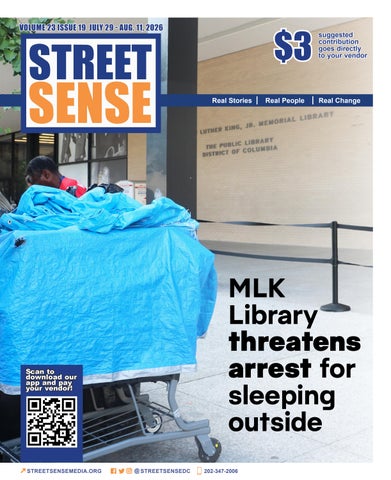
MLK Library threatens arrest for sleeping outside
Scan to download our app and pay your vendor!
STREETSENSEMEDIA.ORG
Real People
suggested contribution goes directly to your vendor
@ STREETSENSEDC
202-347-2006
2 / / S T R E E T S E N S E M ED IA // J U LY 29 - AU G . 11, 2026
OUR STORY VENDOR PROGRAM
W
e provide people experiencing homelessness and poverty in D.C. with a low barrier economic opportunity to earn an income. Each one of our vendors functions as an independent contractor for Street Sense Media, managing their own business to earn an income and increase stability in their lives.
97,856 papers in 2025
You pay
$3
Vendors pay
per paper
Vendors keep all of your contribution! The Cover COVER DESIGN BY ANNABEL FURTON, PHOTO BY CHIH-RONG KUO
THE TEAM VENDORS Abel Putu, Abraham Aly, Aida Peery, Akindele Akerejah, Alia Haug, Amia Walker, Andre Brinson, Andre Baltimore, Andrew Anderson, Angie Whitehurst, Angela Morris, Anthony Carney, Apollos Robinson, Archie Thomas, Beverly Sutton, Brian Holsten, Brianna Butler, Cameé Lee, Carlos Carolina, Carlton Johnson, Charles Armstrong, Chris Boone, Chris Cole,
Chon Gotti, Conrad Cheek, Craig Thompson, Cynthia Herrion, Daniel Ball, Darrel Stone, Darlesha Joyner, David Snyder, Debora Brantley, Degnon Dovonou, Deonte Savoy, Dominique Anthony, Don Gardner, Drake Brensul, El-O-Him, Elizabeth Windsor, Elynora Houston, Eric Glover, Eric Jamison, Eric ThompsonBey, Evelyn Nnam, Faith Winkler, Five Fifty-One, Flegette Rippy, Frankey Barrz, Frederic
John, Frederick Walker, Gerald Anderson, Gloria Prinz, Greta Christian, Henry Johnson, Indashow Birmandie, Invisible Prophet, Ivory Wilson, Jacques Collier Jacqueline Gale, Jacqueline Turner, James Davis, James Hughes, James Lyles III, Jay B. Williams, Jeanette Richardson, Jeffery McNeil, Jemel Fleming, Jenkins Dalton, Jennifer McLaughlin, Jewel Lewis, John Littlejohn, Josie Brown, Julienne Kengnie,
Kenneth Bynum, Kenneth Middleton, Kannon Brown, Katrina Anige, Kendarius Tucker, Kym Parker, L.Q. Peterson, Lawrence Autry, Leo Hughes Jr, Levester Green, Lillie Thomas II, Marc Grier, Marcus McCall, Mars, Maurice Carter, Melody Byrd, Milan Stevenson, Monique Rivers, Nikila Campbell, Patricia Donaldson, Patty Smith, Paul Martin, Phillip Black, Qaadir El-Amin, Queenie Featherstone, Rachelle Ellison, Randall Smith,
Rashawn Bowser, Reginald Black, Reginald Denny, Reneece Brinkley, Ricardo Meriedy, Richard Mooney, Rita Sauls, Robert Reed, Robert Vaughn, Robert Warren, Rochelle Walker, Ron Dudley, Ronnell Wilson, S. Smith, Sasha Williams, Saul Presa, Sharon Brown, Shawn Fenwick, Sheila White, Shuhratjon Ahmadjonov, Starchild BLK, Susan Wilshasen, Sybil Taylor, Tasha Savoy, Tonya Williams, Tony Morris, Vincent
Watts, Warning Label, Warren Stevens, Wayne Hall, Wendell Williams, Wendy Brown, William Hargrove, William Shuford, Willie Futrelle, William Young, Zero BOARD OF DIRECTORS Clare Krupin, Chris Curry, Cole Ingraham, David Grant, Jonquilyn Hill, Mary Casale, Matt Perra, Michael Vaughan Cherubin, Nana-Sentuo Bonsu, Phil Telfeyan
S T RE E T S E NS E ME DI A . ORG
CONFERENCE REFLECTIONS
EVENTS AT SSM
2026 National Alliance to End Homelessness Conference reflections
ANNOUNCEMENTS
ROBERT WARREN Artist/Vendor
T
he 2026 National Alliance to End Homelessness (NAEH) Conference marked my sixteenth year in attendance. While we have come a long way in programs attempting to address the needs of people suffering from what we at People for Fairness Coalition, in our 18-year history, have come to call housing instability, far too many Americans remain unstably housed today. One striking question raised during the conference was put directly to staff: Will we ever end homelessness when so many people work in the business of helping our unhoused neighbors? The poor will always be among us, and there will always be people in the business of helping. But that does not mean we should stop pushing for policies that would make that business unnecessary. The conference was led by the remarkable NAEH CEO Ann Oliva, whose passion for people is evident in everything she does. Also present was Albert Townsend, long-time advocate and one of the founding members of People for Fairness Coalition, serving as NAEH’s director of lived experience and innovation. During our team’s interview with Oliva and staff, I shared my history of attending past conferences, always looking to advocate for policy that will end homelessness as we know it. Oliva acknowledged the focus under the current administration has shifted. The priority now is to maintain services and infrastructure currently under threat from the Trump administration’s Department of Housing and Urban Development. She was candid about our shortcomings in providing essential services, and about how Continuums of Care are failing to meet the moment for many of the communities they serve. Yet she affirmed we will continue to push for innovative approaches while keeping our eyes on the policies that would actually end homelessness with a new Congress that may be more willing to fund low-income housing at scale. Our closing keynote was delivered by the equally remarkable Maya Wiley, president of The Leadership Conference on Civil and Human Rights. Her address left me with a line I have not been able to shake: poverty is being criminalized. As an at-large Poverty Commissioner in D.C., that statement landed with full weight. I thought immediately of the Cicero Institute and the policies it is advancing that do exactly that — criminalize our unhoused neighbors. When I raised this with Oliva, she was direct and clear: If an individual chooses to identify as Santa Claus and poses no harm to themselves or anyone else, that person should not be forced to enter any homeless service center involuntarily. There were differing views among our team members on questions of accountability within services — particularly around low-barrier shelters. My own experience informs my position: There should be no barrier to entering a low-barrier shelter during hypothermia season or a heat emergency. But the services offered inside should be far richer for those willing to engage in self-care and programming that supports people working toward self-resolution of their health, housing, and wellness challenges. Additionally, a significant portion of our team’s discussion centered on returning citizens — individuals leaving incarceration and entering what can feel like another institutional setting, often without a plan, housing, and real support. This cycle too frequently leads back to incarceration as people struggle to survive without a home. There was strong agreement across the group: we need concrete plans that include stable housing before individuals are released. One of the areas where this year’s conference genuinely inspired me was its focused attention on our senior population. An entire section was dedicated to innovative policies and service models for aging unhoused residents. Michele Williams, a board member of the National Coalition for the Homeless, introduced the concept of universalism — offering multiple pathways to housing security that fit individual needs, applicable to seniors, families, and beyond. Christy Respress, CEO of Pathways to Housing, spoke compellingly about how we improve service models under the current funding constraints, including shared housing. A conversation with Kendall Clark, an outstanding advocate from Atlanta, gave me substantial food for thought around the federal senior housing voucher program. His perspective connects directly to our push for a universal voucher system for individuals on fixed incomes over the age of 55. The big questions the conversation raised are: what would it cost to fund a tax-based voucher system for seniors over 55? How do we structure that programming? And how does the emerging conversation around social housing for low-income residents intersect with homeless services and entitlement services (vouchers and subsidies) seniors already qualify for? Perhaps the most important conversation at this year’s conference concerned civic engagement. The right of poor and unhoused residents to vote must not be taken from them; it must be made easier to exercise. This conversation has been driven with exceptional energy by Donald Whitehead of the National Coalition for the Homeless, who is building awareness around the right of unhoused residents to vote and the steps communities can take to support voter engagement among low-income and unstably housed neighbors. That includes access to identification — needed not just for voting but to obtain and maintain the services many residents depend on. For people who have come to believe they do not matter, these engagements carry a message: you do matter. Your vote counts. And if there is one thing you can do for yourself and your community, let it be this. This year, more than ever, that message is urgent. People and communities are under attack. The ability to vote — and simply to live — is being criminalized by this administration. The National Alliance to End Homelessness, the National Law Center, the National Coalition for the Homeless, and advocates across the country must sustain our collective commitment: homelessness must not be criminalized. What we need is housing. Not handcuffs. CHIEF EXECUTIVE
EMPLOYMENT
VOLUNTEERS
EDITORIAL
DESIGN INTERN
(Watercolor), JM
Annabel Furton
Ascienzo (Yoga) EDITORIAL
OFFICER
SPECIALIST
Ann Herzog, Aiden
INTERNS
Brian Carome
Esmat Amin
Eisenschenk, Beverly
Alexandra Lalli,
Brown, David Fucillo,
Catherine Keightley,
ARTISTS-IN-
DIRECTOR OF
VENDOR
Mark Fehling, Roberta
Chih-Rong Kuo,
RESIDENCE
VOLUNTEERS
PROGRAMS
PROGRAM
Haber
Julian Schnittker,
Alexandra Silverthorne
Anne Eigeman,
Darick Brown
ASSOCIATES
Natalie Note, Raina
(Photography),
Chloe DiStaso,
Pawloski
Bonnie Naradzay
David Fucillo, Ehi
Aida Peery,
EDITOR-IN-CHIEF
DIRECTOR
Chon Gotti,
Annemarie Cuccia
OF VENDOR
Nikila Campbell
EMPLOYMENT Thomas Ratliff
VENDOR PROGRAM
(Poetry), David Serota
Ukpokwu, Guilherme
SOCIAL MEDIA
(Illustration), Willie
Oliveira, Josh Moody,
DEPUTY EDITOR
INTERN
Schatz (Writing), Molly
Nora Scully, Sarah
Donte Kirby
Lucy Montalti
Pauker (Watercolor),
Eccleston
Debbie Menke
//
3
□
The July Vendor Meeting is Friday, July 31, at 2:00 p.m. Come for business, community, and pizza!
□
The Vendor Appreciation and Community Celebration Luncheon has a new date! Thursday, Aug. 6 at 12:00 p.m. Join us for food, music, and fellowship! Wish we could, but please no guests.
BIRTHDAYS Jacqueline Turner July 27 ARTIST/VENDOR
James Davis Aug. 1
ARTIST/VENDOR
Akindele Akerejah Aug. 4 ARTIST/VENDOR
Jay B. Williams Aug. 4 ARTIST/VENDOR
VENDOR CODE OF CONDUCT Read this democratically elected code of conduct, by vendors, for vendors! 1.
I will support Street Sense Media’s mission statement and in so doing will work to support the Street Sense Media community and uphold its values of honesty, respect, support, and opportunity.
2.
I will treat all others, including customers, staff, volunteers, and fellow vendors, respectfully at all times. I will refrain from threatening others, pressuring customers into making donations, or engaging in behavior that condones racism, sexism, classism, or other prejudices.
3.
I understand that I am not an employee of Street Sense Media but an independent contractor.
4.
While distributing the Street Sense newspaper, I will not ask for more than $3 per issue or solicit donations by any other means.
5.
I will only purchase the newspaper from Street Sense Media staff and volunteers and will not distribute newspapers to other vendors.
6.
I will not distribute copies of “Street Sense” on metro trains and buses or on private property.
7.
I will abide by the Street Sense Media Vendor Territory Policy at all times and will resolve any related disputes with other vendors in a professional manner.
8.
I will not sell additional goods or products while distributing “Street Sense.”
9.
I will not distribute “Street Sense” under the influence of drugs or alcohol.
10.
I understand that my badge and vest are property of Street Sense Media and will not deface them. I will present my badge when purchasing “Street Sense” and will always display my badge when distributing “Street Sense.”
4 / / S TR E E T S E N S E M ED IA // J U LY 29 - AU G . 11, 2026
CONFERENCE REFLECTIONS
Beyond the sidewalk: The reality of the “underworld” ERICA DOWNING Artist/Vendor
A
s I reflect on my three days at the National Alliance to End Homelessness Conference in the District. I’m reminded how the American homelessness crisis is not a static tragedy; it is a dynamic “underworld,” a geographic and psychological space where survival is a grueling, full-time job. For those of us with lived experience, the reality is often masked by a veneer of functionality. As a barista and bartender, I once worked double shifts not only for the wages, but to minimize the hours I spent in my car. This “underworld” is populated by thousands who, like me, navigate a social safety net that functions more like a sieve than a floor. To dismantle this crisis, we must bifurcate our strategy into two pillars: prevention and deterrence. Prevention involves the interruption of the pipeline into homelessness, stopping the first instance of housing loss before an individual ever touches the street. Deterrence is the clinical interruption of the cycle of recidivism, ensuring those who have escaped the underworld are not dragged back by systemic inertia.
The anatomy of invisibility: Rural realities and “doubledup” populations Strategic intervention is frequently paralyzed by a fundamental misunderstanding of what homelessness looks like outside urban centers. In rural regions like Cleveland, Georgia, or the outskirts of Virginia Beach, homelessness is “hidden” within the private sphere. Jeff from the state of Georgia, who didn’t provide his last name, and Ty Walker from Virginia’s observations reveal a massive “doubled-up” population, individuals living in precarious, “housed but unstable” arrangements. This includes families taking in pregnant teenagers or relatives who have nowhere else to go. Within this hidden population, we see survival strategies that are often misinterpreted. For example, some individuals engage in what is colloquially termed “hobo-sexuality,” entering or remaining in precarious, often unhealthy relationships strictly as a survival strategy to secure a roof. Because these individuals are not on a sidewalk, they are structurally ignored by current resource allocation models. The primary mechanism for federal funding, the Point-in-Time Count, is a flawed instrument that fails to capture the transience of the unhoused: • Temporal distortion: By counting only once a year in the depths of January, the system captures a snapshot of the coldest month when the unhoused are most likely to be “stacked up” in hotels or temporary shelters, missing the year-round reality. • Geographic erasure: In tourist hubs like Virginia Beach, Not In My Backyard policies push the unhoused into rural outskirts to maintain a “clean” image, effectively removing them from the count and the resource pipeline. • Demographic blindness: The count fails to account for the “doubled-up” and those in survival-based relationships, treating homelessness as a binary (sheltered/unsheltered) rather than a spectrum of instability. Without an accurate accounting that recognizes these “gray areas,” we cannot implement the economic stabilizers required to prevent “literal” homelessness.
The financial lynchpin: The “cliff effect” Financial literacy is the strategic lynchpin of stability. However, literacy is useless when the system itself is, as advocates Kaimbrea Vance from Partners In Care in Hawaii and Tashmia Bryant from the Corporation for Supportive Housing describe it, “completely upsidedown.” The most significant institutional barrier is the “cliff effect.” In the Hawaiian context (though it serves as a universal systemic critique), a minor $20 increase in income can trigger a disproportionate $800 loss in food and housing benefits. This creates a perverse incentive where the poor must deny raises to avoid total collapse. Strategically, we must advocate for a shift from “money” to “currency.” While money is often viewed as a static resource for bills, currency is a flow. We must frame social services (the Supplemental Nutrition Assistance Program, Medicaid, and Temporary Assistance for Needy Families) not as “handouts,” but as a diversified financial portfolio of income streams. Stability is achieved when these resources flow in concert with side hustles and traditional employment.
“That mental load kills us on a daily basis... I’m five seconds away from homelessness every month while I’m trying to manage these bills,” Tamiah Coffee of the Kansas Statewide Homeless Coalition said. This mental load is a predictable result of a system designed to manage poverty rather than end it. Transitioning to systemic stability requires moving from individual crisis management to institutional reform.
Reimagining the pipeline: Justice-impacted citizens and discharge planning The discharge process from prisons and jails is the most critical intervention point in the “penal-to-homelessness pipeline.” Currently, housing is often a secondary thought in release planning, leaving individuals to choose between the street or unstable addresses that violate parole. Carlos Carolina, a Street Sense vendor and D.C. resident, argued for a strategic shift from the label “returning citizen” to “productive citizen.” This is not mere semantics; it is a policy framework that shifts the state’s role from “monitoring-based parole” to “investmentbased reentry.” The “90-Day recidivism window” is the period of maximum volatility. If a “productive citizen” is not linked to stable housing and life-skills support upon release, the system has effectively designed their return to a cell. Housing must be integrated into discharge planning with the same urgency as medical care or legal supervision. “Nationwide, 17,500 people on average become homeless for the first time every week in this country,” Ann Oliva, the CEO of National Alliance to End Homelessness, said. These numbers reflect the catastrophic failure of our institutional “warm handoffs.” Whether exiting foster care, hospitals, or prisons, the lack of immediate, stable housing ensures the cycle of the underworld continues unabated.
From barbarism to community: The strategic power of empathy Ending homelessness requires reclaiming the public narrative from “shame” to “collective responsibility.” We must reject the false binary presented by groups like the Cicero Institute, which suggests we must either let people “rot” or force them into what Oliva warns are essentially “detention camps.” Evidence shows voluntary services and community-based care are historically more effective and provide long-term stability. Missouri native and member of Creative Innovative Street Outreach and Community Engagement, Anton Washington, identifies the core of our failure: “How barbaric can you be to allow someone to stay on the streets while you walk past them and not give them what they need? ... That’s barbarism,” Washington said. Policy must reflect the “freshwater” model, understanding you cannot put a freshwater fish in saltwater and expect it to survive. We must fund models that prioritize permanent housing over transitional shelters. This includes the social housing model, where universal governmentowned housing removes the profit motive from human shelter, and the “kauhales” (tiny homes) model in Hawaii. The kauhales are not just shelters; they are permanent communities where tenants serve as security guards or cooks, reducing overhead while restoring dignity.
The year of the harvest The dismantling of homelessness requires a radical rejection of silos. We must advocate for data sharing between the criminal-legal system, the education system, and housing providers to identify those in the “earthquake gaps” before they fall. Washington envisions the coming years as the “year of the harvest,” a time when the veil of systemic invisibility is lifted, and the community reclaims its power. This harvest is the result of seeds planted today: financial literacy, empathetic policy, and the reimagining of our fellow citizens as “productive” rather than “problems.” The national community is responsible for filling the gaps in our social safety net. We must refuse to settle for a system that merely manages the sidewalk; we must build a blueprint that ensures every human being has a foundation upon which to stand.
Editor’s note: Street Sense vendors and journalists were able to attend the National Alliance to End Homelessness conference through a partnership with the organization, which allowed reporters to attend for free and provided small stipends for travel. NAEH worked with reporters to set up interviews during the conference, but did not review any of the articles ahead of publication.
STREETSENSEMEDIA.ORG
//
5
NEWS
What’s the future for Rapid Rehousing in D.C.? ALEXANDRA LALLI Editorial Intern
I
n reviewing this year’s Point-In-Time Count, the annual measurement of homelessness in D.C., one shift becomes immediately clear: more families are living in shelters, a 20% increase from last year. District officials say that’s due largely to a change in one program. Rapid Rehousing provides short-term housing — usually 12 months — for those exiting the shelter system, with the goal of developing a stable income to eventually become independent. Those who enter RRH work with case managers, receiving services and support that enable them to secure housing and employment, like childcare, health care, or education. Families or individuals participating in RRH pay 30% of their income towards rent. In D.C., advocates have argued for years RRH has been failing participants, most of whom don’t exit the program earning enough to cover their housing when the program ends. According to a D.C. auditor’s brief from 2025, between the fiscal years of 2022 and 2024, 79% of families exited RRH without any increase in income, with 15% of families seeing a decline, the opposite of RRH’s stated goals. This has led to calls to revise the program, including from D.C. Council Chair Phil Mendelson, and now the District seems prepared to make changes. The program has seen a budget decrease over the last few years. And Department of Human Services (DHS) Director Rachel Pierre said at an agency budget hearing this May, DHS, which runs the program, recently made adjustments to ensure families entering the system are well-equipped to succeed, sending fewer families into the program. Despite this recent update, advocates question whether the issues with RRH run deeper and require more fundamental changes to ensure accessibility and progress for families.
A cyclical battle for survival Despite RRH’s aim to get families to a stable income level, the program was not initially designed for families with little to no income. A product of the 2008 stock market crash, RRH “was really designed for people who had a stable job, well-paying job, and were able to afford rent until there was the market crash,” explained McKenna Osborn, the senior policy attorney at the Children’s Law Center, a legal service provider in the District working with children and families experiencing housing and economic instability. According to Osborn, the way RRH operates has made it difficult for families — who often have high levels of economic instability — to build up income levels enough to pay rent after the RRH subsidy ends. As a result, landlords have lost trust in the system and no longer see an incentive to maintain their apartments, leaving families in unsafe or unlivable conditions. Rather than families developing stable, long-term employment, Osborn argued the system creates a precarious, survival-based mode, which pushes adults to look for quick money to pay rent. “You’re not incentivized to enter a longer career program or college because you are focused on, ‘I need to be able to pay rent in 12 months.’ You survive,” Osborn said. “So you might take a lower-paying job or not pursue other career development opportunities because you’re so focused on, ‘I need to figure out how to pay rent.’” Despite the services RRH provides, barriers exist that affect anyone seeking employment. One primary source of instability is childcare. While RRH can connect families to providers of childcare and apply for a D.C.-provided subsidy, childcare in D.C. is generally inaccessible and difficult to afford, especially for parents who have an unstable income. For many families, their children are too young to enter school. And even when they are old enough, parents cannot predict when they will need to prioritize their child over work; so often, the decision can come down to taking care of their child or keeping their job. Osborn shared an anecdote of a mother who, despite following the path towards stable employment, was not given the space to juggle both her professional and maternal responsibilities. “We had one client who worked hard to get her dental hygienist certificate – had only been working a few weeks, and her daughter’s daycare flooded, and the daycare just said ‘we can’t take care of the kid.’ Like they were shut for a week,” Osborn said. This client ended up having to take time off work to take care of her child, resulting in her losing the job she worked tirelessly for. “She had to start all over,” Osborn said. Beyond the barrier of childcare, families and individuals entering RRH are not always able to find stable income as quickly as the program expects them to. Andy Wassenich, director of policy at Miriam’s Kitchen, a nonprofit providing services for individuals experiencing chronic homelessness, explained many homeless people in D.C. are nearing retirement age, in their 50s and 60s, which can make employment difficult and untenable. But Wassenich also emphasized the trauma of homelessness that afflicts a person’s body, mind, and well-being. More often than not, employment is a much further step on the path to recovery.
Rapid Rehousing is a homeless services program that helps families move into affordable housing in D.C. Photo courtesy of GarberDC/Flickr
“I don’t think people understand like really how traumatizing — and not just like necessarily because there’s been traumatic events, which there probably have been — but just simply what the compounded traumatic stress of being broke and being homeless, the toll that that takes on a body,” Wassenich said. The impacts of homelessness on physical and mental well-being are clear: people experiencing homelessness have a greater mortality rate, 3.5 times higher than housed populations. Despite the reality that RRH is largely treating people who are in acute conditions, Wassenich explained that the program is often misinterpreted as a less intensive support system: “Because you’re in Rapid Rehousing and not in Permanent Supportive Housing, the notion is that you have less vulnerabilities and you’re more capable, and so therefore, you require less case management intervention. And I don’t know that that’s the case.” Per the 2025 auditor’s brief, most families leave RRH without any progress in their income or employment stability, suggesting the program doesn’t always provide the right support.
Where does RRH go from here? The current changes DHS is implementing for RRH mainly involve restricting support to families with stable incomes or the potential for employment growth. In her budget presentation this spring, D.C. Mayor Muriel Bowser acknowledged the program hadn’t always worked. The budget for the family side of the program has decreased in recent years, down fro more than $111 million in fiscal year 2024 to $36 million in fiscal year 2027. According to Mayor Bowser’s proposed budget, for individuals, the budget will decrease by $3 million in the coming year, effectively pausing entrances to the program. DHS did not respond to a request for comment. Alongside the budget changes, advocates are pushing new reforms to the program to ensure its future productivity. According to Osborn, the Children’s Law Center advocated for a RRH reform bill, titled the Rapid Re-Housing Reform Amendment Act, that would keep people in Rapid Rehousing who are eligible for another voucher in the program until they can be connected. The bill has yet to see any progress since being referred to committees in 2025. One variation of the program currently under consideration is Career MAP, a five-year program structured similarly to RRH, with 30% of a family’s income expected to go towards rent, but with more support and benefits aimed at career development. Based on DHS’s description of the program, one of Career MAP’s primary goals is to help families in overcoming benefit cliffs, described as “a sudden and often unexpected decrease in their public benefits that can occur with a small increase in earnings.” Because the decrease in benefits is often greater than the increase in income, families are disincentivized from higher earnings. Career MAP has been running a pilot since 2022, and is expected to release its final results in 2028. The Lab did run a short, early study on Career MAP’s implementation in 2024, which found that mental health/trauma and childcare were two of the major influential forces that impacted participants and what they needed and/or lacked from Career MAP. The future of these programs and alternatives to RRH may be uncertain; nevertheless, those currently serving families and individuals experiencing homelessness retain hope that the potential of these programs is worth waiting for. “I think it is like certainly in an ideal world, but I think also in the real world, I think it [RRH}’s a vital tool that we should have available,” Wassenich said, “because there is a subsection of folks who become homeless for whom it is a good intervention, and I think we just have to find make sure that we’re putting those people into that intervention and tailoring it in a way that it works.”
6 / / S TR E E T S E N S E M ED IA // JJUANLY. 291 - - JAU ANG. .14, 11,2025 2026
NEWS
‘I’m going to make it work’: Staying employed while experiencing homelessness CATHERINE KEIGHTLEY Editorial Intern 801 East Men’s Shelter has reserved shelter beds for people experiencing homelessness who are employed. Photo by Catherine Keightley
E
very weekday, Ray wakes up before dawn to catch a bus to her job in Maryland. Some mornings, her commute can take up to two and a half hours. She loads trucks, delivers beer, wine, and liquor to restaurants across the region, and returns to a friend’s couch exhausted. Despite working steadily for more than a year, she still does not have a stable place to live. Ray, 37, asked Street Sense to use a pseudonym to protect her privacy and avoid potential repercussions at work while she experiences housing instability. Employment is often viewed as a pathway out of homelessness, but service providers, advocates, and people experiencing housing instability say keeping a job is only part of the challenge. Low wages, transportation barriers, documentation requirements, and a shortage of affordable housing can make it difficult to find a place to live, even with a job. Ray returned to D.C. from Georgia last year after losing her home and job during a divorce and caring for a family member with medical needs. After about a month, she found work as a driver for a family-owned beverage distribution company. She’s spent the past year working while trying to find stable housing. “There’s times where I can’t sleep because I’m stressed out about my situation,” she said. “I may be up until 12, 2 o’clock and have to be at work at 5. But I just got to deal with it because that’s the position that I’m in right now.” Ray said low wages, debt, and losing the car she had been living out of make it difficult to save enough money to rent her own place. To avoid overstaying her welcome, Ray alternates staying with several friends while continuing to search for housing. Other people experiencing homelessness may stay in designated programs like D.C.’s work-beds, designed to help residents keep their jobs and a place in shelter. 801 East Men’s Shelter offers a work-bed program with 96 beds for men over 18 who are employed or participating in approved education or job-training programs for at least 20 hours a week. D.C. Department of Human Services (DHS) officials said the program is designed to help men stay employed while working toward permanent housing. District officials said other shelters, including Mickey Leland and Emery, also offer employment accommodations. DHS plans to open a similar work-bed program for women at the District’s new E Street Bridge Housing facility. The work-bed section at 801 houses fewer residents than the general shelter. Sleeping areas are separated by dividers, giving each participant a bed, desk, and dresser. Residents in the program share access to a kitchen, laundry facilities, and bathrooms. The program also offers flexibility around work schedules. In the shelter’s low-barrier program, residents typically must check in at 5 p.m. to secure a bed for the night. Work-bed participants,
however, can arrange alternate check-in times based on their shifts. Staff hold residents’ beds and save meals for those who return after dinner because of work. Tony Newman, deputy administrator for the District’s single adult services division, said the program is intended to remove barriers that could force residents to choose between keeping a job and keeping a shelter bed. “If you’ve got a job, we are not trying to put you out. We’re going to work with you. Jobs lead to homes,” Newman said. But keeping a job while living in unstable housing involves much more than simply having somewhere to go at night and showing up to work. “It’s really hard to maintain your visual hygiene,” Ray said. “You don’t know if somebody can smell you. You don’t know if somebody can tell you’re wearing the same clothes.” She said the constant pressure to appear put together, combined with chronic stress and too little sleep, can take an emotional toll. “It can put you in a mental state,” she said. “It’s hard for us to come presentable, because mentally, we don’t know if we have it together.” Ray recently discovered the Downtown Day Services Center, where access to showers, laundry services, and help obtaining identification has made it easier to keep working. She said additional resources, including free hair care services for women, could help people experiencing homelessness maintain a professional appearance. Working can also make it harder to access the services needed to secure stable housing, advocates said. Michael Broughton, associate director at Pathways to Housing D.C., said many employment services, housing appointments, and case management meetings are scheduled during traditional business hours, forcing working people to balance keeping their jobs with accessing the services they need. Housing applications also often require internet access, documentation, and appointments that can be difficult to manage while working during the day. Even when those hurdles are overcome, Broughton said, employment alone often isn’t enough to secure permanent housing. With the budget shrinking for Rapid Rehousing and a shortage of affordable housing, many residents working full-time still struggle to find housing, like Ray. For Ray, shelter-based accommodations are not part of the solution. She said she does not feel safe staying in a shelter, citing fears of theft, violence, and losing the few belongings she has. “I will sleep in the street,” she said when asked about how she feels sleeping in a shelter. “I’m not doing it.” Instead, she continues moving between friends’ homes while working toward a longer-term goal: saving enough money to start her own delivery business. She said giving up is not an option. “This isn’t the end. It’s my beginning,” Ray said. “This is my restart.”
S T RE E T S E NS E ME DI A . ORG
//
7
MLK Library is stopping people from sleeping under its loggia with barricades and police CHIH-RONG KUO AND CATHERINE KEIGHTLEY Editorial Interns
G
eorgiann had been sleeping under the loggia of the Martin Luther King Jr. Until then, Georgiann plans to continue sleeping outside the library, though now on the other (MLK) Memorial Library since February. Along with about 60 other people, side of the barrier. Clark said other people who have regularly stayed beneath the loggia will likely she spent each night under the protection of the building’s overhang, seeking move to nearby blocks or other public spaces, making it more difficult for outreach workers to shelter in one of the last outdoor places in downtown D.C. where people find them and maintain their relationships. experiencing homelessness could reliably stay the night. “People don’t just disappear when you evict them from an encampment,” Clark said. But after the D.C. Public Library (DCPL) began enforcement of rules Similarly, a spokesperson from Stop the Sweeps, a local group that opposes the clearing of banning people from sleeping outside the building in July, Georgiann, who unhoused encampments in D.C., questioned whether the library’s policy would make the space introduced herself with just her first name, and dozens of others have been forced to find alternative more welcoming to patrons. They said prior to the pilot, the public library had been “watering” places to rest. Many of them spend the night just feet away on the sidewalk, without the protection the area under the loggia, a strategy to deter unhoused people from sleeping under buildings. of the loggia, staring at the rope barriers, police cars, and officers lining the front of the library. Her experience reflects a wider challenge. Stop the Sweeps emphasized many people do not This new enforcement, which is expected to last for at least 90 days, isn’t the first time the library choose to find shelter under the MLK Library, but simply have nowhere else to go. “The addition has banned people from seeking refuge there. In 2024, the MLK Library restarted enforcement of its of increased police presence throughout the night to deter people from this historic place is policies against sleeping or lying down inside or right outside the library. The library implemented counterproductive,” the spokesperson wrote. a 30-day overnight patrol and posted signage banning sleeping, but many people still gathered Similar concerns have been raised before. In 2025, an MLK Library employee testified the under the loggia each night until this summer. building’s policies against lying down or sleeping in the library harmed homeless populations. Library officials said the new enforcement, which includes rope barricades and a police presence, A few months after the 2024 enforcement of the newly restrictive library policies, the employee is meant to address longstanding complaints about safety and conditions outside the building. witnessed a suicide by an unhoused patron inside the library. Outreach organizations worry it will simply move people elsewhere, making it harder to connect “While we will never know why he did what he did, the policies being enforced here did not them with housing and services while doing little to address homelessness. help,” the employee said. “The focus on targeting marginalized people has nothing to do with safety.” The pilot began on July 6 with a two-week warning period, during which people sleeping Clark said the library serves a much larger role than simply providing a place to sleep overnight. outside the library reported seeing yellow tape along the loggia at night. It was later replaced The library is one of the few public places downtown where people experiencing homelessness with rope barriers. Beginning July 20, library police said they would issue bar notices, written can spend time indoors, escape extreme weather, and access basic resources during the day. Many notices banning people from DCPL property, to people who stay under the loggia overnight after people who slept beneath the loggia also use the library to meet caseworkers and connect with being asked to leave. services, making the location an important point of contact for outreach organizations. Starting Aug. 3, people sleeping beneath the loggia could be arrested for trespassing. The “Where are they supposed to go?” Clark said. “They go to the library. They go there to check enforcement is framed as a 90-day pilot, but library officials said they will use that period to their mail. They read a book. They learn something. They meet their caseworker.” evaluate the policy and determine future enforcement. Several unhoused people sleeping near the Failing to follow the library’s code of conduct, such as sleeping under the loggia, could result MLK Library in mid-July told Street Sense they were unaware they could face arrest. in increasingly restrictive penalties. Failure to comply could lead to a ban of up to five years from “The Library is enforcing rules related to the Loggia because conditions in that area have created any D.C. library and from any other privileges associated with the public library system. This a barrier to participation at the MLK Library. Enforcement removes that barrier,” a D.C. Public could eliminate a vital source of support, according to Clark. Library spokesperson wrote in a statement. “Even with daily cleaning, the area under the loggia “[The library] is the main space that folks go to get out of the elements. And it’s designated has become unwelcoming.” for that purpose,” Clark said. “But now the exact people that absolutely need to be able to have According to the library, patrons complained about conditions under the loggia, such as urination, access to that are going to catch a one-to three-year ban because they’re also trying to sleep outside defecation, violence, and theft. With the new policy, facilities staff need less time and fewer when it’s closed at night.” resources to clean and prepare the space before the library opens. But banning sleeping under the loggia has stripped people of a refuge, according to people who stay outside the library and outreach organizations. After the enforcement began, people sleeping on the sidewalk have had to find limited shelter under the awnings of neighboring buildings or standing under the loggia, if police allow. They cannot lie down or sit under the loggia, including during rainfall and during the day. People sleeping outside MLK who spoke with Street Sense said a few people had snuck under the barricade to sleep beneath the loggia, but were quickly escorted back to the sidewalk by library police. They said they have not seen or heard plans of resistance to the policy so far. The increased police presence initially led to some conflict, but has decreased the visible incidences of crime around the library at night, people who gather near the loggia say. “It’s been quieter, because there’s more security,” Georgiann said. Shannon Clark is the executive director of Remora House, a mutual aid organization that provides food, clothing, and supplies to people experiencing homelessness in D.C. She said she sees the enforcement as part of a broader pattern of increasingly restrictive policies affecting people experiencing homelessness in D.C. Large encampment clearings and the closure of public spaces have displaced people rather than moved them into housing, she argued. Georgiann said she is trying to leave sleeping at the MLK sidewalk behind. She received a housing voucher in May but has not yet been able to find an apartment because of inspection requirements and delays in the process. Her experience reflects a wider challenge. A report by The Lab@DC found between 2023 and 2024, households took an average of five to six months to move into housing Georgiann sits in a folding chair staring back at the Martin Luther King Jr. Memorial Library loggia on July 23. Photo by after being matched with a voucher. Chih-Rong Kuo
8 / / S T R E E T S E N S E M ED IA // J UANLY. 129- -J AN AU.G14, . 11,2025 2026
FEATURE
How a crisis intervention team is changing Metro’s response to homelessness NATALIE NOTE Editorial Intern
T
he sun beat down on the Metro bus bay at New Carrollton as two crisis Barnes said this hesitation is normal amongst the people they interact with, as they often worry intervention specialists checked each bus shelter — the only refuge from the officer approaching them is there to get them in trouble. Even though the officers the team works the sun in the shadeless parking lot – for individuals sleeping or living in with are sworn members of the Metro Transit Police and are armed, they are trained CIT members the structures. too. Barnes tries to let people know the officer is just there to support the team. “We got one,” said Shannon Barnes, one of the specialists. “I would remind them, ‘Hey, you’re not in trouble. He’s not going to arrest you. It’s fine,’” Barnes said. A man lay stretched out on one of the benches, arm slung over his eyes. But it doesn’t always work. As the team approached the train heading into D.C., the man decided Barnes crouched, getting onto his level and introducing herself. She spoke he did not want to board it after all, since Officer Christian Barrera, a sworn officer with CIT, would softly, assuring the man she was not the police and offering to ride with him to a day center where have to go with them. he could shower and find respite from the heat. He refused. Barrera said he tries his best to let the specialists he is working with control the interactions, because “If they want it, great. But if not, okay, have a good one. I give out my card. You know, if you ever he knows seeing someone in uniform can make people in crisis uncomfortable. change your mind, give me a call,” Barnes said later in an interview with Street Sense. “I step back and I fade away, and they can get information for me, so I can help,” Barrera said. Hundreds of thousands of Washingtonians and commuters utilize the Washington Metropolitan “It’s that sense of comfort that they get with [specialists] that they don’t get with us.” Area Transit Authority (WMATA) rail and bus systems every day. Some of those riders are unhoused. Graham, who has been an officer with Metro Transit Police for 16 years, said CIT has given officers Some go through mental health episodes while on transit. Instead of Metro Transit Police responding and employees across the Metro system another option when they encounter someone experiencing to people needing help, potentially sending them to jail, crisis specialists like Barnes and her partner homelessness or a mental health crisis on the job. He said before CIT was created, officers were Matt Hill intervene. used to getting calls and being forced to send riders experiencing homelessness or a mental health WMATA’s Crisis Intervention Team crisis to jail. (CIT) has been active since 2022, CIT specialists and officers according to the WMATA website. Nine are required to complete trained crisis intervention specialists specialized 40-hour crisis ride D.C.’s Metro during the weekdays intervention training tailored to in teams of two, accompanied by an the diverse communities they officer, to offer assistance and services interact with across the DMV, to riders experiencing crises, including according to a brochure about homelessness, addiction, and mental the team. health episodes. Street Sense rode along Graham said all WMATA with a team in early July, observing a employees, including bus typical shift. drivers and train operators, are That day, the man at the bus stop sat aware of the crisis intervention up slowly, squinting as his eyes adjusted specialists and call them when to the bright parking lot. He told Barnes needed. WMATA riders can and Hill, equipped with their CIT t-shirts call Metro Transit Police and and backpacks full of resources, he was request CIT, though dispatchers not in need of help; he was waiting for may decide to send officers first the P31 bus. to make sure the scene is safe. “It’s a lot more nos than yeses,” Hill “In the past, people would said later in an interview with Street Sense. just probably be hesitant to As the man grabbed his shoes from call because they’re like ‘I feel the ground in front of him, honking from sorry for this person, I don’t an approaching bus grabbed the attention want to call the police on of the team. A bus driver flagged them them, but they do need help,’” down, asking Barnes and Hill to speak to Crisis Intervention Specialists Matt Hill and Shannon Barnes enter the McPherson Square Metro station. Photo by Natalie Note Graham said. “And now that a man who had been sleeping on her bus. CIT is here, people know that The team boarded the bus, spoke to the man, and offered to ride with him to D.C.’s Downtown they can call CIT to get the help versus having to just call the police on somebody.” Day Services Center. Stepping off the bus, the man agreed and began walking with the team back The unit has been active for about four years, the specialists have accumulated success stories of toward the New Carrollton Metro stop. people they have met and shared resources with throughout the transit system. Barnes shared the Sergeant John Graham, a sworn crisis intervention officer who goes out with the CIT, said the team story of a woman some specialists helped who is now living in her own apartment and employed. makes between 400 and 500 contacts on average per month, through checking about 700 stations “She had a cat, so one of our specialists actually had the cat for her, held the cat until she got and around 100 buses. herself together,” Barnes said. The CIT approaches and offers resources to every person they see who appears to be experiencing During a typical shift, teams of specialists like Barnes and Hill patrol the system, checking with homelessness, regardless of whether someone refuses services or has declined help from specialists bus drivers, station managers, and riders who might need help. As they walked from one entrance in the past. of the McPherson Square station to the other on the streets of downtown D.C., a few hours into While on shift, Hill carries a small backpack on his chest and offers printouts of area-specific the shift, they stopped to interact with those experiencing homelessness they saw on the sidewalk resources and small hygiene kits to individuals he interacts with. Barnes said she will sometimes outside of WMATA property. use her own money to purchase food for individuals she comes across. “Hey man, are you ok?” Hill asked a man lying outside a Five Guys by the station. When a team of specialists encounters someone who wants to be connected with services, they ride Hill, who previously worked as a campus crisis intervention officer at The George Washington with that person all the way to the day center or shelter they have agreed to go to. Hill said if they University, said he joined CIT because he was interested in helping people and providing services, simply tap someone onto the bus or into the station, they don’t always go to get the services they need. a change from how he dealt with crises as a campus police officer. As the group walked toward the train, Barnes worked to get to know the man, asking if he lived “On the police side, we were mostly issuing bar notices and doing enforcement that aren’t really in the DMV and if he had family in the area. She noticed his body language as he looked around, helpful so this gives me more of an opportunity to me to actually provide help,” Hill said. wary of the uniformed officer who walked with the unit, trying to keep his distance.
S T RE E T S E NS E ME DI A . ORG
//
9
OBITUARY
“Like a family member of the newspaper”: Honoring Leonard “Slim” Morrow JULIAN SCHNITTKER Editorial Intern
L
eonard Pleasant Morrow, known to his Street Sense community of two decades as L. Morrow, Slim, and The Morrow, died on April 3. He was 79 years old. Born to Preston and Alice Thomas Morrow on Sept. 28, 1947, Morrow was raised in a lively household with many family members on L Street in Southwest D.C. Morrow’s family and their history were central to his life. In 2023, he wrote a piece for Street Sense about his grandfather’s long journey from a plantation in Farmville, Virginia, to Washington, D.C., “where all Blacks would find joy.” The home his grandfather and great-uncle purchased in the Southwest neighborhood would become the “family house for all,” including Morrow. Eric Falquero, former Street Sense editor-in-chief, remembered the profound impact Morrow’s mother, Alice, had on him. Falquero described how, at his mother’s funeral, Morrow turned a poem about her into a set of handcrafted bookmarks he distributed to the attendees. Morrow’s family bestowed him with his first moniker, “mumbles,” inspired by the slight stutter he had as a young child, according to his cousin, Elder Twanna Way. Despite what the nickname suggests, Morrow was an exuberant presence wherever he went. At his memorial service, Way described him as “larger than life,” both literally — in height — and in personality. “He just took over the room. If it wasn’t loud, it wasn’t him,” she said. Morrow had a good-humoured and uplifting attitude, as his childhood friend Elois Perry recalled in the remembrance section of Morrow’s obituary, which his family shared with Street Sense, “[Morrow’s] laughter, kindness, and wisdom filled my life with joy.” An avid dancer and roller-skater, Morrow took pride in his appearance and enjoyed dressing “like a model,” as his family joked in his obituary. He regularly appeared on WOOK-TV and Teenarama in the late 1960s as a dancer. Jacqueline Turner, a Street Sense artist and vendor, recalled a date she went on with Morrow in the 1970s. She befriended Morrow when he came to pick her up after work in a green Cadillac. “When he came to pick me up and take me home, all my girlfriends came running down like ‘Look at that guy!’ ‘Look at that guy!’” Turner said. “He bought me nice clothes, and we would dance. He would be excited about it more than I would!” Morrow graduated from Coolidge Senior High School and obtained a bachelor’s degree in business administration with a minor in sociology from Federal City College (now the University of the District of Columbia), according to his obituary. Morrow applied his education towards a variety of causes aiding underserved communities across the country. In D.C., Morrow operated free lunch and after-school outreach programs for the Peoples Involvement Corporation. After his grandmother, Mariah Morrow, died, Morrow left D.C. and would not return for decades. Morrow’s obituary outlined his work in multiple states. In Boston, he worked as a tenant coordinator, organizing developmental programs in the community. In Chicago, he worked at a daycare center for children of low-income families. Morrow experienced the extremes of wealth disparity in his work with others and in his own life. As Morrow told Falquero for his Street Sense vendor profile,“‘I’ve had millions, and I’ve been broke.’” His experiences informed his resolve to advocate for change in D.C. and beyond. Despite his difficulties securing housing upon his return to D.C., Morrow told Falquero he lived by the motto, “Homelessness is a state of mind. I’ve slept in a bus stop before, but I’ve never been homeless.” Morrow first arrived at Street Sense in 2007 and worked as an artist and vendor for 19 years. His bright and outgoing personality helped him to become one of the top-selling vendors across his career, according to his vendor profile. A digital collage of a young Leonard Morrow designed by Morrow’s family for his memorial service. Photo courtesy of Morrow’s family
At his memorial service, Street Sense artist and vendor Queenie Featherstone spoke about Morrow on behalf of the organization. “He was almost like a family member of the newspaper, and a fine man he was,” she said. Featherstone noted that despite not knowing Morrow well, she — like many vendors — was touched by Morrow’s presence. During his high-selling days, anyone who wanted to catch up with Morrow could find him at the intersection of L Street and Connecticut Avenue NW, giving an unexpected sales pitch. He asked passersby not for their money, but for their time; if they couldn’t give that time, he asked simply for a smile, Falquero observed in the vendor profile. Despite his outgoing personality, Morrow’s quieter side showed in the thoughtful written work he authored for Street Sense, often on the topic of economic injustice. His writing was conversational as he implored readers to confront the difficult realities of their neighbors’ lives, exemplified in his poem “Why Me? Why All of Us?” Morrow’s work reflected a deep Leonard Morrow poses for a portrait for his Street Sense care for the well-being of future vendor profile. Street Sense file photo generations, including in the final piece Morrow published in Street Sense in 2023 about preventing violence among youth. A memorial service for Morrow was held at Pennsylvania Avenue Baptist Church on June 12. The service opened and closed with prayer and praise, a fitting ceremony for Morrow, who was outspoken about his faith and often wrote about his relationship with religion “With these hands, in our society, why can’t we do what Jesus did?” Morrow wrote in a 2013 Street Sense article. “Bread, faith, charity, hope and passion. That soul that you walk by every day, every morning, evening, that soul that is cold, hot, sick or even hungry at times.” During the memorial service, Bishop Al Way asked the large number of mourners gathered, “If you knew [Morrow] and he impacted your life in a positive way, shout Hallelujah!” A chorus rose from the crowd. Like Morrow once did at his mother’s service, Morrow’s sister, Sandra Thomas-Swann, wrote and shared a tribute dedicated to Morrow. “Leonard’s smile, good heart, and memory shall never fall,” she wrote. According to the family obituary, Morrow was preceded in death by his parents Alice and Preston Thomas; his daughter Monique Morrow; his grandson Lovel Harrison; his sister Sheila Morrow; his niece Carshia Crawley; and his brother-in-law Jerry L. Swann. Morrow is survived by his daughters LaKema Gray and Myneek Harrison; his grandchildren Saqiyna Gray, Nyasia Gray, and Amir Gerald; his siblings Vincent Morrow, Sandra ThomasSwann, Preston T. Thomas, Michael A. Thomas Sr., and Ronald Thomas; and his nieces, nephews, cousins, and friends. Leonard Morrow is survived by his daughters LaKema Gray and Myneek Harrison; his grandchildren Saqiyna Gray, Nyasia Gray, and Amir Gerald; his siblings Vincent Morrow, Sandra Thomas-Swann, Preston T. Thomas, Michael A. Thomas Sr., and Ronald Thomas; and his nieces, nephews, cousins, and friends.
10 / / S TR T R E E T S E NSE M ED IA // JMUAR LYC29 H 27 - AU - APR G . 11, IL 9, 2026 2024
RANDOM ACTS OF KINDNESS
The postman always rings twice WENDELL WILLIAMS Artist/Vendor
This article mentions suicide.
I
n life, surely we are not always guaranteed second chances. I guess I’m just lucky, or as someone once said, “hard work creates opportunities which some might misread as being lucky.” I remember my grandmother, who was born in 1912, telling me about receiving news, good or bad, by telegram, and the anxiety of thinking you missed the messenger and wondering if he’d come again. If you’ve been following, you know I see my life through 1940’s film noir. Hey, I’m a pre-cable boomer! One of my favorites is the original “The Postman Always Rings Twice” with John Garfield and Lana Turner. Just like the drifter in this screen classic, I was on a serious losing streak. A backpack full of four-leaf clovers would’ve been wasted on me. Without intending to, I was making good situations bad and bad situations worse. It seemed like everything I touched turned to shit. With all that “bad luck,” mixed with not the best of choices, I’m grateful I was not subjected to and judged by the rules of baseball, three strikes, and you’re out! It was a while before someone told about of the other side of Home Run King Babe Ruth’s legend, that he was the All-Time Strikeout King as well. In life, when taking the big risk of going for fences, sometimes you swing and miss. Lord knows I’ve made the same mistakes, not realizing life continuously sends you the same challenges. They present in different forms but are the same set of choices requiring a change of direction, an adjustment in our swing, or maybe a bit of emotional growth or maturity. Making a left instead of a right and failing to quickly correct course leads to negative consequences like multiple bouts of chronic homelessness, relapses into addictive cycles, involvement in the criminal justice system, loss of promising relationships, and inability to capitalize on career opportunities. All that led to a series of evictions over the years, which meant I was perpetually starting over. It not only physically and emotionally wore me out, but did the same to the loving and caring people around me. I caught a lot of voicemails during that period and not many call-backs. The same went for the great professionals at agencies tasked to help end my homelessness. They had so many requests for assistance they had to, over time, reprioritize their time and resources, putting me on a sort of no-fly list for services in several spaces. I was the classic slow learner who couldn’t remember his last mistake. It was like I was watching that old TV game show “Concentration,” where you have to remember where halves of a prize are hidden behind numbered squares. Well, I kept calling out the same numbers. And what do you know, I got the same results. Later in recovery, I learned that was the definition of insanity. The sad hurting part was that in most cases, I had worked my ass off for many months to be on the verge of reaching that elusive goal of those experiencing homelessness, to have my own housing and self-sufficiency, only to have rug pulled out from under me, by the “system,” mystery bureaucrats, or an uncaring political party, all the while failing to accept the villain was none other than me. Alone with my unchecked thinking fueled by my anger, blaming, and lack of responsibility it was the perfect storm for craziness. Everyone else could see it but me. I was a heartbreaker alright, and people were not helping by telling me they saw all this promise, because it went unfulfilled. I knew I had been a disappointment to many who had invested tremendous amounts of emotional energy in my turning the corner. They mostly walked away bewildered. They had to, so they could move on to help that next person. It’s said the average social worker’s career lasts six years before burnout, and I’m sure I’m part of the reason why. I began to feel I deserved to be abandoned. All the good people would see in me, I couldn’t see anymore. After a while, I’d been down so long I felt worthless, undeserving of happiness or peace. Even my longtime friend, sponsor, and godfather to my child said, “Man, I care too much for you to stand by watching you crash and burn again. I love you and your daughter, but can’t sponsor you or actively be in your life any longer; the drama and hurt is just too much.” And that’s the kind of thing I was hearing everywhere I turned. There was no “Bridge over Troubled Waters” for me, and I gave up hope. And hope is the only currency that buys a person with literally nothing another day. On that last day, which actually was my first day of a new life, all I possessed was a donated grade schooler’s backpack, a Ziploc bag with a bar of soap and a washcloth, a twin sheet, and a few snacks from some soup kitchen. I no longer dreamed; I had no belief in tomorrow or self, which used to be my superpower, let alone a belief in anything spiritual. There was nothing left to do but wait those 10 seconds for the tape to self-destruct like in “Mission: Impossible” and get on with the last dance. Lacking the balls to just blow my brains out, I went to the bottom of the bottle and accessorized the drink with dry substances when I could afford to, in hopes of committing suicide on the installment plan. If you’ve seen “Leaving Las Vegas,” you’ve viewed what I thought would be the final moments of my life. Vacillating back and forth between wanting to live, but not if it meant accepting responsibility for the mess I’d made, I continued to wake up in a living hell of my own creation. Then something happened to me, of all people. I had seriously pooh-poohed anyone suggesting I should try a spiritual journey for a solution to the nightmare. “Oh hell no,” I’d say as I would reject idea after idea because I had to do it my way, which was actually the same ole way. I’d bet my life on it, man; I was so far down it would take an Old Testament miracle for me to have another shot at a decent life.
I had quit on myself so many times because of my fear of success, which would mean I’d have to become responsible for my actions, own the damage I’d done, and consciously turn in my gold victim card. It would damn sure take something like God himself coming down to D.C. and parting the Anacostia so I could walk across to the last place I remember living in a state of happiness and feeling secure, Barry Farms as a child. But this morning I awoke to a brightness in the sky I couldn’t remember seeing in a long time. So At the Lamb Center with Director Dave Larabee. Photo courtesy of Wendell Williams beautiful, it was moving. Though I had been drunk and high for who knows how long, suddenly, I had what those lame alcoholics call a moment of clarity. And in a Random Act of Kindness (RAOK), I heard this voice clearly. Yeah, I know how this sounds if you know me, but please don’t call the crazy wagon yet. It’s why I rarely share this part of my story. But the voice was clear, strong, and solid, not unlike Morgan Freeman’s and with the same believable authority: “Walk out this alley.” For the first time in a long time, I followed instructions without thinking or wanting to know why, because the pain I was in was so great I had nothing to lose. I didn’t know, but I had learned to accept defeat and surrender to win. As I got out of the alley, I heard it say, “Walk upright.” And I knew exactly what that meant. There’s no shame or guilt greater than the one I’ve placed on myself for being human and making mistakes. Billy Joel says in “Second Wind” we’re born to make mistakes, but making the same ones over and over digs such a deep hole it leaves you in a situation impossible to get out of by yourself. Which is hard to accept for so many. From that alley I began the ending to my “Odyssey,” and like the hero of Greek mythology, my journey lasted over 10 years and had many trials. I called Fairfax Detox for what was to be the final time. Using my miles, I got an opening (and a warning about them not holding the bed past 2 p.m.) Thus, the long way home began by taking the first of five buses and a Metro ride, spending hours in transit with my fare card long since timed out. I asked drivers for free rides, telling them of my reason for needing help, and to my surprise, every one of those usually no-nonsense drivers and rail station operators showed me favor and got me all the way to Fairfax Circle. I thanked the last driver on behalf of all their kindness that morning. A calm feeling came over me. “Wait a minute,” I thought with deja vu. “I’ve been here before.” I looked around, and way across the circle sat the Lamb Center, lit up like a neon sign on a dark, rainy night, a Christian day shelter run by a great bunch of loving people and one of the best-kept secrets for a person experiencing homelessness who truly wants to change. Right then, it came back to mind that they had a noon 12-step meeting I used to attend in another recovery. I went in and took a seat, just waiting for the meeting to end to ask someone for help to go the final 20 miles or so to a new way of life. I wasn’t sure what it would bring, but it had to be better that painful one I left. As we filed out the door, one guy walked up, and I’ll never forget his face or name. I always thought I’d see him again to thank him for his RAOK, but I haven’t seen him in 14 years of going to Friends of Bill’s gatherings. But I pray he’s well and sober because without his selfless act, I wouldn’t be. He saw me looking dejected and said, “Look, I’m on my lunch break, but I’ll take you.” He put out his hand, saying, “My name is Chip. I’ve got three years.” And because of his RAOK the rest is history. If I’ve done anything worthwhile with my life, it’s because of that guy, and I’m forever grateful. It all happened so fast, from an alley on the border of Trinidad and Ivy City, and because of a series of RAOK, I reached Chantilly by the 2 p.m. deadline. After being strip-searched, debugged and given something to eat, I was deep asleep. I was in a place I was familiar with; I’d been there what seemed like a thousand times. This time, I was told I’d only get the minimum care for seven days and nothing else. The county wouldn’t be willing to fund another treatment. They were giving me the drive-thru dry-out. The advice I got with my one phone call was to just be present, listen, and say nothing, because I knew all the answers except how to stop drinking; basically STFU. My only assignment was to sit and use the days to make sure I was finished debating the pros and cons about a life THAT WAS KILLING ME! In the one meeting I had with staff, I was asked if I was now ready to do exactly what I was told, including assessments from mental health professionals and compliance with the medication prescribed. At this point I’d usually exert my rights, but on this day I was too beat to push back and surrendered, saying yes. I remembered being told my job was to simply do my best, and the Creator would do the rest. But they never said how long it would take to get home. Each day, I called every shelter in the D.C. area. Panic set in on the last night, after there were no openings and detox staff had already told me I was to be discharged in the morning. I put a false face on, saying I’d go back to the streets and stay sober. Right then, in a RAOK, an angel named Georgette walked in the TV room. She heard my conversation and said her boyfriend was in a new recovery house with only two guys, and I should call. They accepted me, and just like that my “Nightmare on Elm Street” was over. Early the next morning, I was discharged and taken to Bellehaven Oxford House in the Alexandria section of Fairfax for a new beginning. I had no job, no money, and no room for failure. To be continued...
S T RE E T S E NS E ME DI A . ORG
//
11
OPINION
Survival guide to border economics
SNAP snafus and Medicare messes
DRAKE BRENSUL
JENNIFER MCLAUGHLIN
T
he design of an economy is based on currency. The process of circulation lifts the rise and looses the weight to form the rifts around the quantity of resources. Realizing its outlines, it traverses the question of resources rather than their acquisition. In the early days of money, metal was used to hold the symbol of the sellers away from transfer and into ownership of the items, leaving for very little circulation and over-the-counter rules. Most of the Roman Empire relied on that process and was slow to change into a more fluid economy due to the cost of heat being predominately wood, causing a restriction to the allotment. The era we are living in is based more upon water instead of earth, and is a cash flow process that weighs on the buyers instead of the sellers, to reach for their resources without an accumulation net. The over-thecounter houses the deception to that process because the buyer has the needs, and the seller reviews it like elemental, separating away from a supply-and-demand model to a cause-and-effect model of purchasing. The prime example is fabrics. The need for cloths is sacrificial, not charity (nonprofit) where the individual can be forfeited from beliefs that companies stand for something and individuals cannot get clothes that represent cohesion with the design support afforded. For centuries, religion has secured the rudimentary supply of fabric to retain alignment of their followers, and large families are not far behind because individuals and most families are restricted to buy off-the-counter supplies. There is no way for a group of 90 to a few hundred individuals to stay connected around town and within a few hundred miles. In the modern entity there are very few walk-in-stores that house fabrics. Including food, which is hard to buy for large families of a few hundred individuals, leaving us in a dangerous economic division. Additionally, we are transitioning into an electronic payment system that works more into a synchronicity of air in circulation than the water element of cash. So just like ground, water, and air when heated, the economy is designed to move in a faster circulation theory for its principle of being liquid. The problem with the divide between cash and electronic payments is the money being used runs into the over-the-counter values in places that left supply-and-demand to function under the guise of individual targeting. Individuals who have lost their ability to make electronic payments have a more difficult time than they did with cash, because the cash economy held better in circulation economics, or acquisitional economics. The electronic payment program sticks with accumulation economics and static resources. And now resources are moved more from store to store, shops to shops, than from individual purchases. A family, being large, could move their resources from store to store, and with wholesale food distribution, restaurants could feed and supply their relatives. However, the economic structure is not designed that way, and it is only buying time. That process could work and does during the interim; however, without being measured, it through a miscalculation to the meridians of economic circulation. Trade and barter offers the individual a way out of confinement from electronic payments, and they are able to follow their families migration of resources that are movable to survive. Getting out of being a targeted consumer is something that leads us to look at the last century where communism and free-enterprise fought for design control. Mostly communism failed because it targeted the consumer in a grand scale, where free-enterprise felt the process to its intent at its source. Electronic payments, failing at the individual, pushes them into a systematic process that purposes without entirety due to it pedestalling unemployment at the consequence of not being able to sustain electronic processing. Stipulating that a person who could not control their money would not be allowed to keep their employment. A cash process still allows a fluid economy with less individual targeting. The system in fallout compounds the targeting to return to its communistic failures due to the targeting process following the individual to the shelter. The adjustment really is not correctional through a socialist solution, which favors its weight on governmental answers. More likely it should form its economic movement through contracts that have left the over-the-counter handshakes and have started to form plural or multifaceted contractual agreements. Meaning the individual owns something closer to a positional movement, and the contracts form an economic distance. An example that is hard to image, and is not far from it, is gaming and even electronic gaming. First, it allows the individual to return to an electronic standing that makes it more difficult to take them out of the structure. Secondly, the payment process should have its payload built for a timing process, so it is not left in deprivation towards or from an opportunity or its basic lack. Third, it houses the invention process where its purpose really is a harmless simulation with the environment. For instance, the calculation of electrical distance in the form of weaponry could be reduced to a room level and made available in out-of-the-game purchases to a still barbarian retail regulation of over-the-counter rules. Then from there, money can reassure its posture of air circulation by contracting and releasing the way resources are acquired, providing a viable way to be able to hold on to something. The government will then be set to adjust the economy through its regulatory standards instead of being confined by the burden to provide a solution. Drake Brensul is an artist/vendor with Street Sense Media.
O
n June 1, the federal government issued a regulation requiring Supplemental Nutritional Assistance Program (SNAP) applicants to work 80 hours monthly/20 hours weekly. The work can be paid, unpaid, volunteer work, or work done in exchange for goods or services. Now the government is looking to do the same thing to Medicaid benefits. The law says beginning next year, adults without disabilities or young children must fulfill the same work requirements to be eligible for Medicaid. (Unlike SNAP, the law has several exceptions for categories of people, e.g., those Congress called “medically frail.”) During the last week of June, the District and 25 states sued in a Massachusetts federal district court to block certain provisions of the law. If this law isn’t stopped, millions of Americans will lose coverage if they don’t work. For people like me with severe health problems, those work requirements will be really harmful and maybe fatal. I can’t take that chance. Actually, I shouldn’t have to. People need guaranteed health insurance to live productive lives. The only way to make that happen is Medicare for all! Jennifer McLaughlin is an artist/vendor with Street Sense Media.
ART
Government shutdown JAMES DAVIS Artist/Vendor
Last October, during the shutdown. My Metro card had no use here. The trains, did they not run? I tried to rent out a scooter, but the brakes were all locked. So hungry, I went into the Old Ebbitt Grill, and the ovens were cold. I seemed to be finding out I was filibustering my day with actions that stood still like time in the Senate chamber.
The true success story MONIQUE RIVERS Artist/Vendor
Because and although apathy and hatred wanna laugh, mock, and curse. It doesn’t matter; I still believe and always will in the certainty of mission and right, of my young, innocent say. And unknowing or unconcerned, I should say, about conspiracy and ignorance, the cud of ignorance that sleeps on the validity of faith and commitment, and especially its joy; peace unimagined until experienced. I know faith and constant wisdom have saved my life when I should have been in so many ways dead! There is no greater joy than knowing you are the saint you’ve always wanted to be, and the only thing greater than this “knowing is being.” The very hope prayed for from birth is no great joy, no greater success story.
1 2 // S T R E E T S E N S E M E D I A // J U LY 29 - AUG. 11, 2026
ART
Movie review: ‘Batman: Bad Blood’ VINCENT WATTS Artist/Vendor
I lost my phone, but guess what? YouTube is still free. Grab the popcorn, and let’s watch “Batman: Bad Blood.” If you’re wondering why this animated film of 72 minutes exists, let me tell you without giving it all away. THE BAT FAMILY. This entry of wings, batarangs, and masks equates to a whole kit and caboodle. BATS! There’s a lot of f’ing bats in this one. LOL, jokes aside, though, this isn’t your typical lineup. DC has used this plot device twice. The family device that is. This lineup is compromised of mostly guys, but it has two lady cape crusaders; I’m actually going to leave it at that. This timeline gives us some insight into the details regarding Bruce Wayne’s (Batman) relationship with the daughter of Ra’s al Ghul: Talia al Ghul (League of Shadows). A relationship that’s kinda funny, but yet a low smoldering fire you get to play with in your head a little bit. You’ll see it through different animated movies: “Son of Batman;” “Batman vs Robin;” and “The Justice League vs. The Teen Titans.” Talia admits to Bruce: “Oh, beloved, you have no idea. I have thought of little else for the last 12 years.” A line that hits BATS pretty deep with how her master plan intersects with the fate of the world and their child. She’s brillant, but turns absolutely cutthroat as the plot thickens! A new mob of criminals are at Talia’s beckoning. These guys hit a lot harder than Falcone’s mob with efforts that almost take out a chunk of the BAT FAMILY. High tech weaponry, mutants, and strategies that mimic the FAM almost actually get the best of the FAM. You’ll see them argue amongst each other, but not for very long because they’re way too intricately woven. I guess when DC does something like this you don’t expect the new set of henchmen to be visceral, let’s just keep them around this time around. This element could really work. You would think you’d want to keep them in rotation because it adds a new coat of paint to the already used baddies we know and still love. Just a thought. This turned out to be a great watch, our animation, the same! Great, for our cowl-wearing crusaders. Timeline interwines with the actual graphic novels, also great for our readers. Still playing for free if you’re on a budget, which is also great. In other news, James Gunn may have the actual gun to his head if he can’t align his political views with his paycheck. I guess that could mean a lot of things considering the whole potential good girl (Power Girl), bad girl (Super Girl) teamup or meetup rumored in his lineup. Our Sydney Sweeney (Power Girl) teamed with the infamous Milly Alcock (Super Girl) could bring some light to the dark, almost Guardians of the Galaxy-esque Super Girl: Woman of Tomorrow title. What does this look like? Who knows? Costume changes all around... I’d say yay. Some better writting... of course. Will James go Democratic-esque with an almost all woman lineup including Zatanna, and a new Wonder Woman or will this be the ‘60s in color of previous cinema!?! Who knows, let’s wait, and see! Last on our DC universe list... can we get a Batman Beyond comic refresher... can we please... with some new villains in that series? Every time they do this, I feel like it’s very good, but never worth the wait. A 100-150 run. That’s all I’m asking! Check this one out, and its animated counterpart too. It’s really underrated. Until next time, movie seekers, stay cool, stay cheap, stay reviewing!
Sights around the MLK Library ELIZABETH WINDSOR Artist/Vendor
Every so often, the library has setups of different things they have every month. I have enjoyed the issue about Emmylou Harris’s “Pieces of the Sky” from 1975. During the late 1960s to 1970s, Harris lived and performed around the D.C. area. She appeared at venues like the Cellar Door, the Childe Harold, Mr. Henry’s, Clyde’s in Georgetown, and the Assembly. She met Gram Parsons, who invited her to join his tour. She has earned 13 Grammys. I love how they have an old jukebox in the main area where you come inside the library. Illustration by Elizabeth Windsor It plays gospel, classical, opera, jazz, disco, go-go, punk rock, and more. The “Chocolate City” is the third album by the funk band Parliament, released in 1975. It was a tribute to Washington, D.C., where the group was particularly popular; another one they have at the library is one about Bad Brains, and the album “Bad Brains” from 1982, with its now-iconic cover art by Donna Lee Parsons showing the Capitol struck by lightning.
People I have known TASHA SAVOY Artist/Vendor
Have you ever met interesting, funny, similar, mad, sad… just different personalities? I have a group of women and a group of men I have known over the years. I mean, I’m talkin’ sandbox time! So, yeah, we know each other pretty well, maybe better than we know ourselves. It was, and still is, never a dull moment. Birthdays. Marriages. Divorces. Kids. Love. All around… life! So many different experiences; there are things to learn and to teach every day. And do we call each other best friends? Of course. Maybe even… BFFs. People whom I cherish, love, and trust for the rest of my life and beyond. Question: If you could gather all your friends and put into words what they mean to you, what would those words be? You may not know, because I just asked. But I would love to share some of my experiences with these best friends: S: Solid — Where you could not move her M: Moment — Loved to live in it V: Valid — Makes sure you are on point T: Truthful — Never tells you anything different K: Kind — Always thoughtful A: Attitude — In the best way possible Those are some of the personalities I have surrounding me.
God of the morning LILLE THOMAS II Artist/Vendor
The game room is my favorite room to gather and take on the challenges of mortal men. This room has hosted Uno, ping pong, video games, board games, and card games. Group activities and movies, meals, and celebrations have been held here. But occasionally, I sense a Divine challenge, a challenge from my God. At breakfast, I chuckle, butterflies fluttering within my chest. The sun rises in the east as the birds chirp. The cows gather on the hills. And the geese swim through the pond. As if my eyes were opening to another world, I perceive the wonders of the gift of a new day. And I sit back into my seat, welcoming my friend, the God of dreams, the God of the morning. After enjoying my meal among the people, I stand as if to accept the challenge of my God. I stand and slightly bow as if to welcome Him into the room. I throw away my trash and slowly walk around the room like a predator, pacing warily, cautiously. Only three or four remain in the room, observing the supernatural activity between me and the invisible One. I can feel You all around me, thickening the air I’m breathing. The Flyleaf song runs through my mind. As the atmosphere clears and the challenge lifts, I leave the room satisfied that I have met my love, the giver of life, the God of the morning.
Momma RON DUDLEY Artist/Vendor
Momma, you’re a miracle The reason why I’m spiritual You took me to church To be a better individual You took me to God To keep me from the devil’s hand You told me to pray Pray to be a better man You gave me the willpower to be strong You told me to fight the demon ‘til the devil gone You gave me the mind and body to be free You gave your hand and told me “Son, just follow me” My momma told me God was realer than the cold You know when it’s God you can feel it in your soul. Momma, you’re the greatest teacher that I had And God is our father, we got the same dad Hey momma, I love everything you do Like Jesus Christ to Mary, you my miracle You told me that this world and life be a blessing The devil was an angel, so our father never left him
S T RE E T S E NS E ME DI A . ORG
//
13
Oh, the goodness of God!
Quickening?
Mother to son
FREDERIC JOHN Artist/Vendor
JAMES LYLES III Artist/Vendor
EVELYN NNAM Artist/Vendor
It’s summer, but seeing the sunset linger past 8 p.m. like a slow-burning acetylene torch is a bit unsettling. Added to that, upon hearing a series of climatic (and seismic) measuring devices are to be unceremoniously yanked from the ocean floor — why? — so the “administration” can make way for extensive resource drilling and garbage dumping — Whee! This should guarantee the extinguishing of all kelp forests (a standby for whales and sushilovers alike), bleaching dry of all iridescent coral reefs, and thwarting the prediction of major climate cataclysms. Good show. But ICE must have that $78 billion. A fantastic way to deny those sniveling parasites — the poor — from being able to obtain a pack of saltines through SNAP card or Social Security income, to keep poorly ventilated but relatively safe senior studio rooms paid for! Meanwhile, the “patriots” should be paid at least half a ‘bil each for trashing the decadent ol’ Capitol and yoking disloyal Hill police who foolishly tried to cossack a few craven congressmembers who tried to legally block an interregnum of just governance. Which leaves us with the WWE “claw” over a laminate red, white, and blue fighting space, where bulging “warriors” may duke it out in bloodsport — to huge profit shares for the “ruling clan.”
My mother was like an angel that came from Heaven, she looked out for me when no one else would.
The goodness of God is beautiful, The goodness of God is wonderful, The goodness of God is able, The goodness of God is warm. The goodness of God is special, The goodness of God is unique, The goodness of God is welcoming, The goodness of God accepts you as you are. The goodness of God hugs you when you’re alone, The goodness of God fills you when you’re empty, The goodness of God feeds you when you’re hungry, The goodness of God lifts you when you’re sad. The goodness of God comforts you when you’re grieving, The goodness of God gives hope when you want to give up, The goodness of God mends the broken-hearted, The goodness of God heals. The goodness of God is loving, The goodness of God is caring, The goodness of God never judges, The goodness of God saves. The goodness of God is a breath of fresh air, The goodness of God makes you whole, The goodness of God never fails you, The goodness of God is a light when darkness seems to be too much. The goodness of God turns wrong into right, The goodness of God is present, The goodness of God brings peace to mind, The goodness of God is always enough. So let every heart find rest in this truth, Let every soul be still and know, The goodness of God will never let go.
Mother and daughter JEANETTE RICHARDSON Artist/Vendor
Once upon a time, there was a case where a family was separated by the government. And now the daughter and mother are working on rekindling their relationship as mother/daughter. And no one else is allowed to interfere or voice their opinion on it at any time because it’s a mighty prayer gone up and down for that to happen for that family. That mother tried to create, but she was a doll, and so many situations came in at one time that she could not understand them all. So she let some go, and now she is rekindling back to her daughter to start a new relationship and share life and good times together with nothing negative from other mouths.
Illustration by Frederic John
Feeling the heat in July WARREN STEVENS Artist/Vendor
Independence Day is a day of rest. Enjoy your holiday, travel, have a picnic in your backyard, or take your grill down to East Potomac Park, park your car, and grill hot dogs and hamburgers or chicken and have a bushel of crabs and pig out. You, your family, and friends can enjoy an outing. Every year, people set up tables and chairs to sell drinks, beers, and wine, play live music at the park, and purchase fireworks to shoot into the sky at night. I was at my apartment with my girlfriend in Silver Spring, watching the fireworks shoot into the sky. The weather is getting hotter in the months of July and August. I will be going to the pool, staying in the water to do some swimming, and relaxing. At evening in the city, I sell the Street Sense papers. Some customers offer gift cards and use their phone to buy or make a donation, which shows love and friendship, and they treat us like family, which is a smart thing. We hope and pray the Democrats take Congress, because the Republicans and MAGA did a lot of damage to the American people. They are not happy with what Trump and his people did to cut Medicare, Social Security, and health care American people work for and earn. I vote and hope and pray the Democrats win this election. That they will fight and keep their promise to make this country safe and lower costs on food, rent, and gas, create jobs for middle-class people, and make schools better and safer so they can grow and learn, and also graduate with honors. Enjoy this heat wave summer, traveling down the beach, and walking the boardwalk wearing sunshades. Stay safe.
My mother was like a protector through the threats and harm that came upon me as a child. My mother cooked and served and bought food like no other mother would. My mother bought airline tickets to go to the West Coast with me to see my uncle, her brother. My mother to me is the best in history and stayed in the Bible not only to help me, her son, but to help her husband and other people whom she associated with.
Sunrise and sunset MARC GRIER Artist/Vendor
The sunrise for me was in the early ‘60s; I woke up in a time when there was a revolution around. Even though the revolution was going on, my life as a young man kept moving through time, where I was learning; I was being educated by my mother and father. I was glad to see the things that were taught to me were lifelong lessons, and I still learn today, but one day the sunset will come.
Stories JENKINS DALTON Artist/Vendor
A European came to New York City and went to eat at McDonald’s. He ordered a Big Mac instead of just a hamburger and fries. After finishing his meal, he asked me, “Can you tell me what to do next?” I ordered him a Big Mac, but I didn’t make it. They asked Tom Cruise on “The Late Show,” “Sir, do you drink?” He paused for a moment and told David Letterman, “Okay.”
14 / / S TR E E T S E N SE M ED IA // J U LY 29 - AU G . 11, 2026
FUN & GAMES
CROSSWORD
D’ya Notice a POTUS?
Puzzle by Patrick “Mac” McIntyre
SOLUTION: Some Washington HERstory ____ Issue
Across 1. They croak until they croak 6. Appear to be 10. QB’s cry 13. Not in the pink 15. America’s F-16 Fighting Falcon or Russia’s Sukhoi SU57 Felon, e.g. (2 wds.) (3,5) (LAWN PEAR anagram) 17. Like deep-fried, high-fat, processed and spicy foods (3 wds.) (3,3,9) (FOREBODING I.T. ADS anagram) 19. Witchy woman 20. “Das Rheingold” goddess (DARE anagram) 21. These may include trade-ins, substantial down payments and 12 to 96 month loan repayment provisions (3 wds.) (3,35) (WARM CENTERS anagram) 27. Family head title in the Godfather films 28. Brainy 29. Nearest the top 31. Sleeveless undergarment, briefly 32. Run-DMC or the Beastie Boys, e.g. (2 wds.) (3,4) (AIRPORT anagram) 36. The time it is immediately following 12:00 p.m., informally (3 wds.) (4,5,4) (JEAN’S OUT FRONT) 40. Significantly discounted (3-4) (TRUE CAT anagram) 41. ____ dunk 43. Nancy who was once second to Kamala in the POTUS line of succession 46. Acutely 28-Across 47. “What Kind of Fool ___” (2,1) 48. A warm sweet and spicy spiked drink often served in mugs with cinnamon sticks and/or citrus wheels (3 wds.) (3,3,5) 53. Maître d’s offering 55. Makeshift school punishment device, once 56. Process carried on by all political parties between and leading up to the quadrennial highest office elections... or an apt description of how you can fill in the circled letter squares (2 wds.) (9,6) (HARD PERSISTENCE anagram) 63. Farming-related 64. Indian turnover 65. French plural possessive for “his,” “hers,” or “its” 66. Mini-whirlpool 67. Blot lightly Down 1. “The ___ Four” (early Beatles sobriquet) 2. Narrow inlet 3. Aged 4. JPEG cousin (abbr./init.) (FIG anagram) 5. Vehicle with caterpillar treads 6. Porcine pen pals? 7. Gung-ho 8. Palindromic “before”, in poetry 9. Army cops or Brit legislators (abbr./init.) 10. Braids, a bob or a bun 11. One, two to Jose or Josefina (3,3) (Sp.) 12. Landlord counterpart 14. Angry puppy’s sound 16. Letters after 4G on a cell phone (abbr./init.) 18. Flyspeck 21. Situation Room grp. of D.C. advisors (abbr./init.)
C O M B O S A B B A I Q S
LAST EDITION’S PUZZLE SOLUTION
1
O R I E N T
13
T E R R O R
S O O T H I O K M E R I A O N N I A R U M E N D E S S L E U A D E W S
S H A L L
W E A S E L I N E D C S S T E A L S E Y V
P A T A
I T E N
C A N D I P A D S S A E S U N B D A M B L A O A M O D A N E S
L I E E S L L S A R A A R G E A R T E C H
A M E F F Y T R E S O N S
A L O T
Y E T I
N E E D L E
D O G E A R
A M A N D A
3
4
6
5 14
7
8
9
15
22
23
24
25
26
29 32
31 36
33
34
44
35
37
38
39
41
42
46
45 48
47
49
54
50
51
52
55 57
58
59
60
61
62
64
63 65
27 30
40
56
12
20
28
43
11
16
19 21
10
18
17
53
22. Four sharp key of Billy Joel’s “Uptown Girl” (2 wds.) (1,3) (incls abbr.) 23. Onetime Seattle-based bank that was the largest S & L in the U.S. until its collapse in 2008, familiarly (abbr./init.) 24. It’s been shortening for over 100 years 25. Arctic diving bird 26. “Wheel of Fortune” choice 30. ___ pork (Chinese restaurant dish) (2 wds) (3,3) 32. 4:1, e.g. 33. Continent of the Sahara and the Victoria Falls (abbr.) 34. School grp. that holds book fairs and bake sales (abbr./initialism) 35. Vietnamese New Year word 37. Backside body part involved in a controversial but still-legal football maneuver 38. Heroine in Pearl Buck’s “The Good Earth” 39. D.E.A. agent, slangily 42. Dash data (abbr./init.) 43. Argentine grassland 44. Arise 45. Ocean ____ (cruise vessels) 46. Proliferate, as a disease or a new slang word 49. Tire pattern 50. Like some noses and egg yolks 51. Final (abbr.) 52. Bungle, with “up” 54. Red-white-and-blue inits. /abbr. 57. Anger 58. Accomplished 59. Doctors’ org. (abbr./initialism) 60. Burgle 61. Civil War letters for the Rebs’ side (abbr./init.) 62. Pillbox or porkpie, e.g.
2
66
67
PIECEs OF THE WEEK
Summer heat PATRICIA DONALDSON Artist/Vendor
Today, I did not go out on the hot day. It was a very smart choice. Extreme heat is dangerous, especially when selling papers. Outside, it was too hot today. I stayed in the house and made the right choice. Washington, D.C. is under an extreme heat alert with real feel temperatures soaring over 100°F, causing serious health problems like heat exhaustion, and heat stroke. I hope I can go back and sell my paper. With the heat advisory, it is safest to stay indoors. If you must go out to sell, try the early morning hours before 9.00 a.m. when temperatures are lower. I will go back out and sell my paper and make money.
I am iron will WILLIAM SHUFORD Artist/Vendor
This crossword puzzle is the original work of Patrick “Mac”McIntyre. It is provided to us courtesy of Real Change News, a street paper based in Seattle, Washington. Learn more about Real Change News and the International Network of Street Papers at realchangenews.org and insp.ngo.
A strong mind to deal with and remove myself from negative environments. One thing about me: I’m not going to let the next person’s bad energy stop me from staying focused. I am determined to reach my goals step-by-step. I’ve had good days around positive people who keep me full of energy and uplift me. When I’ve had people with bad vibes, I even thought I was blind to the fact it was right in my face. I think that’s because of my background and how I was raised. It’s not hard for me to cut people off and let them go if they don’t mean me any good. I’m blessed every morning, every day I wake up, because many of my peers are either deceased or locked up for a long time, with some of them never going to see the free world again. I’ve been there, but I learned from it. Now I go out to work and earn from it. We grow and get wiser, which is why I’m built like iron and steel. I am not going to let any obstacle stand in my way of progressing.
S T RE E T S E NS E ME DI A . ORG
COMMUNITY SERVICES
SHELTER HOTLINE Línea directa de alojamiento
(202) 399-7093
YOUTH HOTLINE Línea de juventud
DOMESTIC VIOLENCE HOTLINE Línea directa de violencia doméstica
(202) 547-7777
1-800-799-7233
Housing/Shelter Vivienda/alojamiento
Education Educación
Health Care Seguro
Clothing Ropa
Legal Assistance Assistencia Legal
Case Management Coordinación de Servicios
Food Comida
Employment Assistance Assitencia con Empleo
Transportation Transportación
Showers Duchas
All services listed are referral-free Academy of Hope Public Charter School 202-269-6623 // 2315 18th Pl. NE 202-373-0246 // 421 Alabama Ave. SE aohdc.org
Bread for the City 1525 7th St., NW // 202-265-2400 1700 Marion Barry Ave., SE // 202-561-8587 breadforthecity.org
Calvary Women’s Services // 202-678-2341 1217 Marion Barry Ave., SE calvaryservices.org
Food and Friends // 202-269-2277 (home delivery for those suffering from HIV, cancer, etc) 219 Riggs Rd., NE foodandfriends.org
Foundry Methodist Church // 202-332-4010 1500 16th St., NW foundryumc.org/idministry Identification services Friendship Place // 202-364-1419 4713 Wisconsin Ave., NW friendshipplace.org
Catholic Charities // 202-772-4300 catholiccharitiesdc.org/gethelp
Georgetown Ministry Center // 202-338-8301 1041 Wisconsin Ave., NW georgetownministrycenter.org
Central Union Mission // 202-745-7118 65 Massachusetts Ave., NW missiondc.org
Jobs Have Priority // 202-544-9096 1526 Pennslyvania Ave., SE jobshavepriority.org
Charlie’s Place // 202-929-0100 1830 Connecticut Ave., NW charliesplacedc.org
Loaves & Fishes // 202-232-0900 1525 Newton St., NW loavesandfishesdc.org
Christ House // 202-328-1100 1717 Columbia Rd., NW christhouse.org
Martha’s Table // 202-328-6608 marthastable.org
Church of the Pilgrims // 202-387-6612 2201 P St., NW (1-1:30 on Sundays only) churchofthepilgrims.org/outreach
Community Family Life Services 202-347-0511 // 4860 Fort Totten Dr, NE cflsdc.org
2375 Elvans Rd, SE 2204 Martin Luther King Ave. SE
Miriam’s Kitchen // 202-452-8926 2401 Virginia Ave., NW miriamskitchen.org
My Sister’s Place // 202-529-5991 (24-hr hotline) mysistersplacedc.org Community of Hope // 202-232-7356 4 Atlantic St., NW communityofhopedc.org
Covenant House Washington 202-610-9600 // 2001 Mississippi Ave., SE covenanthousedc.org
N Street Village // 202-939-2076 1333 N St., NW nstreetvillage.org
New York Avenue Shelter // 202-832-2359 1355-57 New York Ave., NE
D.C. Coalition for the Homeless 202-347-8870 // 1234 Massachusetts Ave., NW dccfh.org
Patricia Handy Place for Women 202-733-5378 // 810 5th St., NW
Father McKenna Center // 202-842-1112 19 North Capitol St., NW fathermckennacenter.org
Samaritan Inns // 202-667-8831 2523 14th St., NW samaritaninns.org
Laundry Lavandería
Samaritan Ministry 202-722-2280 // 1516 Hamilton St., NW 202-889-7702 // 1345 U St., SE samaritanministry.org
//
15
BEHAVIORAL HEALTH HOTLINE Línea de salud del comportamiento
1-888-793-4357
JOB BOARD Store Cashier / Stocker ALDI // Washington, D.C. Part-Time (Onsite)
Sasha Bruce Youthwork // 202-675-9340 741 8th St., SE sashabruce.org
So Others Might Eat (SOME) // 202-797-8806 71 O St., NW some.org
Operate cash registers, stock shelves, maintain store cleanliness, assist customers, and support daily store operations. Requirements: Ability to lift up to 45 lbs., strong customer service skills, teamwork, and flexible availability. Apply: shorturl.at/09PWD
St. Luke’s Mission Center // 202-363-4900 3655 Calvert St., NW stlukesmissioncenter.org
Thrive DC // 202-737-9311 1525 Newton St., NW thrivedc.org
Unity Health Care unityhealthcare.org - Healthcare for the Homeless Health Center: 202-508-0500 - Community Health Centers: 202-469-4699 1500 Galen Street SE, 1251-B Saratoga Ave NE, 1660 Columbia Road NW, 4414 Benning Road NE, 3924 Minnesota Avenue NE, 765 Kenilworth Terrace NE, 850 Delaware Ave., SW, 3240 Stanton Road SE, 3020 14th Street NW, 425 2nd Street NW, 4713 Wisconsin Avenue NW, 2100 New York Avenue NE, 1333 N Street NW, 1355 New York Avenue NE, 1151 Bladensburg Rd., NE, 4515 Edson Pl., NE
Dishwasher The Capital Grille // Washington, D.C. Full-Time (Onsite) Wash and sanitize dishes, cookware, utensils, and kitchen equipment, maintain a clean and organized dish area, and support kitchen staff by following food safety and sanitation standards. Requirements: Ability to work in a fast-paced environment, teamwork, attention to detail, and ability to stand for extended periods. Pay: $17.95–$24.00/hr Apply: shorturl.at/kfyCx Line Cook The Capital Burger // Washington, D.C.
Washington Legal Clinic for the Homeless 1200 U St., NW // 202-328-5500 legalclinic.org
The Welcome Table // 202-347-2635 1317 G St., NW. epiphanydc.org/thewelcometable
Whitman-Walker Health 1525 14th St., NW // 202-745-7000 1201 Sycamore Dr., SE whitman-walker.org
Full-Time (Onsite) Prepare high-quality meals according to recipes, ensure food presentation meets company standards, maintain kitchen cleanliness, and follow all food safety procedures. Requirements: Previous kitchen experience preferred, ability to work in a fast-paced environment, teamwork, and commitment to food safety. Pay: $18.40–$34.00/hr Apply: shorturl.at/YLb74
Woodley House // 202-830-3508 2711 Connecticut Ave., NW
For further information and listings, gs, visit our online service guide at StreetSenseMedia.org/service-guide
Hiring? Send your job postings to esmat@StreetSenseMedia.org
The loud and clear is what you didn’t here
LeRoy, my dad QUEENIE FEATHERSTONE Artist/Vendor
LeRoy, my dad, was a tall, dark, and handsome, bad (good side of bad) dad. My mother raised me without a dad. I always felt in my heart to be the best child and to fully respect my mother and my tall, dark, and handsome dad. I would not ask my mother where my dad was. I took it on myself and searched high and low until I found him (over and over again), my tall, dark, and handsome LeRoy, my dad. My dad had two wives. I know to be respectful to him, to whatever wife there was. My dad would send for me to visit him and his second wife. As a master chef, I would watch him make lunch and dinner while his wife talked about life, work, and family situations. I was just at peace being with LeRoy, my tall, dark, and handsome, bad (good side) dad. My dad is, of course, no longer with me, but what I felt as a child I can still feel as a grown (getting old) adult. I still have respect and am at peace with how I feel about LeRoy, my tall, dark, and handsome dad.
S. SMITH Artist/Vendor
Transparency 002/? Illustration by S. Smith
Illustration by Queenie Featherstone
From sea to shining sea
You heard it, you heard me. The loud and clear is what you didn’t here, is what you didn’t hear. See what I did here? I said what I said, and what I said is what I said, is what I said. that shit is what I said, and I said that shit and I said “that shit.” If what I said isn’t something you get, you won’t get it, because you don’t get it, but it will get you. it will hit too, it slaps, and back claps the back claps, of the clap backs. Should you get it? Could you get it? clap backs, come get it, Clap backs?
come with it, Did I get it? Did it get me? Did it? hit me maybe sometimes missed me, I miss me, confuses me eludes me, until I see behind me, that in front of me, remind me, the words ahead I said... what I said, and what I said is what I said, is what I said, “that shit.” Get it? I said that shit You heard me, you heard it. The loud and clear is what you didn’t hear, is what you didn’t, here. See what I did there?
CHRIS COLE
Artist/Vendor
CRAIG THOMPSON Artist/Vendor
Lord in heaven and Holy Ghost Forgive me when I start to boast For I’m only fighting in your infinite way In every minute of every day I need you more than words can say And thank you, Trinity, for letting us play
STARCHILD BLK
Artist/Vendor
Thank you for reading Street Sense!
I pray for longevity of all beings What is it I’m not seeing? Is your body and blood Mother Earth itself? What should I put on the backburner shelf? How should I spend eternity now As I walk your precious Tao? Allah, Allah, Alelu Please Lord, take my parents too Teachers, friends, neighbors I pray For your whole Earth your glorious way
From your vendor, J U LY 2 9 - A U G . 11 , 2 0 2 6 |
NO CASH? NO PROBLEM. WE HAVE AN APP! SEARCH “STREET SENSE MEDIA” IN THE APP STORE
Lord in Heaven, guide me true In every moment what to do I was just a lonely old Kung Fu Needing my mate and soulmates too I hope this song is not too darn long “CAN’T WE ALL JUST GET ALONG?” Said Rodney King in L.A. days past How can I help the biosphere last? The war machine is the biggest polluter in man’s history All for the excuse of ALL MEN FREE Breaker, breaker, Italy What is exactly WE?
VOLUME 23 ISSUE 19
WWW.INSP.NGO
3.2 million READERS
Illustration by Craig Thompson
5,700 VENDORS
90+
STREET PAPERS
35
COUNTRIES
25
LANGUAGES