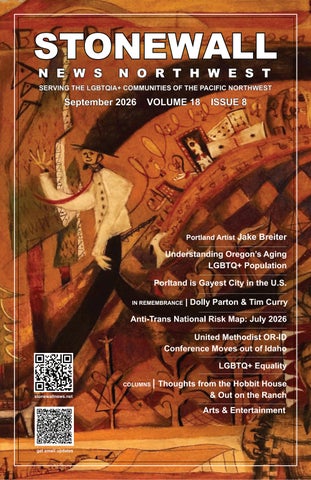
STONEWALL N E W S
N O R T H W E S T
SERVING THE LGBTQIA+ COMMUNITIES OF THE PACIFIC NORTHWEST
September 2026
VOLUME 18
ISSUE 8
Portland Artist Jake Breiter
Understanding Oregon’s Aging LGBTQ+ Population Porltand is Gayest City in the U.S. IN REMEMBRANCE | Dolly Parton & Tim Curry
Anti-Trans National Risk Map: July 2026 United Methodist OR-ID Conference Moves out of Idaho LGBTQ+ Equality COLUMNS stonewallnews.net
| Thoughts from the Hobbit House & Out on the Ranch
Arts & Entertainment
get email updates
www.stonewallnews.net | Stonewall News Northwest | September 2026 |
STONEWALL NEWS NORTHWEST
FRONT COVER
Serving the LGBTQIA+ Communities of the Pacific Northwest Founded 1992 Relaunched 2025
September 2026 Volume 18 Issue 8
www.stonewallnews.net PO Box 871112 Vancouver, WA 98687 PUBLISHER Mike Schultz publisher@stonewallnews.org John Deen 1995-2005 Lawrence Stone 1992-1995 OREGON MANAGING EDITOR Rhonda Brown oregon-editor@stonewallnews.org ADVERTISING advertising@stonewallnews.org
CONTENTS 2 Portland Artist Jake Breiter
Front cover art by Jake Breiter: “NYC Apple Dandy”
3 Oregon’s Aging LGBTQ+ Population
5 ft x 4 ft. — mixed media paint and acrylic — 2024
3 Porland is Gayest City in the U.S.
“My painting class final project was to create a portrait of ourselves. I wanted to showcase the whole of my weird, wild, and beyond inspiring experience of NYC, and how it forever changed me.” --Jake Breiter
4 Dolly Parton & Tim Curry 5 Anti-Trans Map 6 United Methodist OR-ID Conference Moves 2027 Meeting 7 LGBTQ+ Equality
Jake Breiter
8 Jake Shers in Rocky Horror & Cinema Love
Portland artist
9 After Woodstock & Camp Miasma 10 Mutiny & Portrait of a Lady
Where Whimsy Meets the Wild
11 Spiderman & Walla Walla 12 Columnists 13 1/3 of Young Adults LGBTQ+ 19 Log Cabin Rebuplicans Drop “T” in LGBTQ
Artist Jake Brieter
21 Sept 2026 Queer Pride Puzzle
CONTRIBUTORS RYAN OELRICH DAVID CAPOCCI FRANK GAIMARI FABRICE HOUDART RHONDA BROWN PERCY LAIRD MICAH YIP FAVS NEWS LUCILLE STUTESMAN KERRY SHATZER ERIN REED JOEY AMATO All contents © 2026, Stratus Group LLC. No portion of this publication may be reproduced without written consent from the publisher. Neither Stratus Group LLC nor Stonewall News Northwest publication assume responsibility for errors in content, photos, or advertisements. The views expressed herein do not necessarily represent the views of the publisher or advertisers.
F
by Percy Laird or Jake Breiter, an apple is never just an apple.
It might be the snack in a child’s lunchbox, a bright red shape on a classroom worksheet, or the fruit from a favorite children’s book. But it can also represent temptation, sin, and the complications that come with growing older. That tension between childhood innocence and adult complexity runs through much of Breiter’s work. At 26, the multidisciplinary Queer artist (he/they) works across illustration, animation, comics, poetry, and performance, creating a practice that resists easy categorization — “wild to mild” is one way he describes it. After several years in New York City, Breiter recently moved to Portland, where he says he has found something he has been searching for throughout his artistic life: community. “I feel like there is a place for me and other artists,” he said. “I want to use my art to connect with others.”
| September 2026 | Stonewall News Northwest | www.stonewallnews.net
Finding Art in Suburbia Breiter grew up in Thousand Oaks, California, in what he jokingly calls “white wine-mom suburbia.” Although Jake wasn’t surrounded by artists his age, creativity was part of his home life. His older sister, now an art director at an animation studio, was already drawing, and Breiter began drawing himself in middle school. Then came Adventure Time, an animated fantasy TV series[RMI1.1]. Fascinated by the show’s art books, Breiter began creating worlds of his own: characters, stories, and strange little universes that existed beyond the pages in front of him. At 16, he attended the California State Summer School for the Arts at California Institute of the Arts, where spent much of each day immersed in animation. It was his first serious introduction to experimental animation. “It was this deep and profound rabbit hole,” Breiter said.
He began to see animation not simply as storytelling but as a medium that could be strange, personal, abstract, and experimental. Rather than deciding what kind of artist he was supposed to become, Breiter became interested in exploring what he liked and what made his perspective different. That approach would follow him for years.
Learning from Children’s Books During COVID, Breiter spent about a year largely on his own. In that isolation, he developed an unexpected interest in vintage children’s books. He was fascinated by the care authors took with language, knowing their readers might return to the same story dozens or even hundreds of times. Every word had to work, and every image had to hold BREITER - To Page 14
PORTLAND & OREGON
Older and Out: Understanding Oregon’s Aging LGBTQ+ Population It will be critical to further extend the initial work and advocacy of LGBTQ+ organizations to promote partnerships between these communities, aging agencies, and state and local policymakers to develop a comprehensive approach to addressing the aging and health needs of LGBTQ+ older adults. by Rhonda Brown
I
want to let you in on a little secret: I’m getting older. So are all of you. Minute by minute, time marches on, and all we can do is try to keep up to the best of our abilities. Getting old isn’t easy, and we often don’t get to choose how and when circumstances lead us to directly address the hard facts that maybe we’re already there (I can tell when a storm is coming with more accuracy than NOAA in some of my joints these days). One thing we do know: We’re not alone. Large percentages of our population are entering retirement age, needing access to Social Security, Medicare, or Medicaid, and even looking at changing
their living situations. An estimated 3.4% of Oregonians over the age of 55 are LGBTQ, based on a 2021 survey performed by the Goldsen Institute and the Oregon Department of Human Services. The extensive research they did ended up highlighting a number of items of greater concern for many respondents than for our heterosexual counterparts. We have a larger population of people of color. We are more likely to live alone, lack equal economic or housing stability, and concerns about discrimination in health and housing care. In their words, “...it will be critical to further extend the initial work and advocacy of LGBTQ+ organizations to promote partnerships between these communities, aging agencies, and state and local policymakers to develop a
comprehensive approach to addressing [the] aging and health needs of LGBTQ+ older adults.” Brandy Penner, executive director of the Oregon LGBTQ+ Aging Coalition is one such person working to build and promote those partnerships. For over a decade, the organization operated as a volunteer coalition of mostly retired people, promoting education and advocacy. It holds a monthly Zoom forum with a variety of speakers on issues that directly affect this population: from the Oregon Queer History Collective to local initiatives and legal challenges and everything in between. A little over a year ago, a private angel investor was able to provide funding for an operating budget, and while Penner is currently the first paid employee, the coalition is pushing to increase its overall operations so as to sustainably work for our growing population for many years to come. A new public-facing website is
expected soon, where current advocacy projects, information on past progress, and a calendar of events and meeting presentations can all be easily accessed. In the meantime, examples of the coalition’s hard work can be seen are on the Oregon. gov website. SB 99 established a LGBTQIA2S+ subcommittee of the Governor’s Commission on Senior Services, made up of local citizens. One of the items that has grown out of this group is the Respect Program, a targeted campaign to create awareness and empowerment for older people who may be experiencing abuse and may not recognize it or know who to ask for help. If you or someone you know in Oregon is experiencing abuse, you can always call the SAFE Line at 855-503-SAFE (7233). If you would like more information on the Governor’s Commission, or are interested in joining, AGING - To Page 17
New Census Data Shows Portland Is Gayer Than Any Other City in the U.S. “Portland’s been an actively queer city for a really long time. Portland Pride specifically has this reputation for being one of the largest, quote, unquote, small-small town prides.” Debra Porta, Pride Northwest Executive Director
Portland, Oregon
by Lucille Stutesman
C
ensus data shows Portland, OR has the highest share of gay and lesbian couples in the United
States. According to the data from 2024, nearly 3.8% of couples in Portland are in queer relationships. Following closely, 3.7% of couples in Seattle are in same sex relationships. Despite Portland holding the top spot for share of the population, Seattle has more queer couples total at over 14,000 couples, the most in the United States. Portland stands at nearly 11,100 couples. Seattle does have a larger population than Portland. Portland does have more married
couples than Seattle at just under 6,288, compared to the Emerald City’s 6,265. Seattle claimed the top spot in 2023, beating Portland by 0.1%. Queer couples have boomed since then, shooting up by 0.5% in Seattle and 0.7% in Portland. San Francisco has the third largest percent of queer couples in the United States at 3.5%. San Francisco has around 100,000 more people living there than Seattle. While the data doesn’t give a firm explanation as to why Portland and Seattle have the two largest queer populations, Pride Northwest Executive Director Debra Porta guesses it is because of the friendly economy and breathtaking landscapes. “The kinds of things that are going to attract non-Queer folks are also going to attract Queer folks,” Porta said. “It’s been
a growing area, just as a whole, for a long time. There are lots of activities to do here. There’s lots of nature, there’s lots of all of these things.” Although, there may not be one solid answer. “I don’t think there’s a single answer as to why the Pacific Northwest appeals, or the West Coast as a whole, in all honesty,” she said. “I don’t think there’s something clearly specific that brings our people here.” As for why Portland takes the top spot, she speculates it’s because of the friendly, small-town atmosphere. “Portland’s been an actively queer city for a really long time,” she said. “Portland Pride specifically has this reputation for being one of the largest, quote, unquote, small-small town prides.”
though the focus in history lessons tends to focus on Stonewall on the East coast, Porta says there is still plenty of Queer history here on the West Coast. “The West Coast’s Queer movement has been around as long, if not longer, than the East Coast’s Queer movement,” She said. “The history goes really deep there. ” The area hosts back-to-back pride celebrations, with Seattle’s in June and Portland’s in July. Portland just wrapped up its Pride festival in July, bringing thousands to the waterfront. One of the events was a mass marriage event at the newly opened Darcelle’s XV Plaza which opened earlier in the month. The census data for 2025 is expected to come out in May 2027.
www.stonewallnews.net | Stonewall News Northwest | September 2026 |
IN REMEMBRANCE
Dolly Parton: A Legend Who Loved Us
I
by Frank Gaimari
t is with heavy hearts that we remember Dolly Parton, who passed away on August 25, 2026. Her loss leaves a void in the world of music. Dolly could never be confined. With her sparkling smile, extraordinary talent, and open heart, she was more than an entertainer — she was a symbol of love, acceptance, and authenticity for the LGBTQ+ community. From her humble beginnings in
Tennessee to her rise as a global superstar, Dolly will be remembered as a steadfast ally — a fierce advocate who understood that love is love, and that everyone deserves to be celebrated for who they are. Dolly embraced individuality and led with compassion. She showed the world that it is possible to be both a trailblazer and a source of comfort, using her platform to uplift others with dignity and heart. Thank you, Dolly, for your music, your light, and your humanity. Your star will continue to shine in our hearts forever. Dolly Parton
Tim Curry, Star of Rocky Horror and More, Dead at 80 by Frank Gaimari
T
he world of entertainment is mourning. Tim Curry, the legendary actor known for his bold performances and unforgettable characters, passed away on August 25. 2026. Over his long career, Curry brought a unique mix of menace, humor, and heart to every role, from the seductive Dr. Frank-N-Furter in The Rocky Horror Picture Show to the terrifying Pennywise in It. His commanding voice and fearless presence made him a true icon. Born in Cheshire, England, in 1946, Curry’s talent shone early. He gained fame on stage before crossing over to film and TV, where his versatility was unmatched. Whether playing demons, villains, or comedic characters, he had a way of making every role his own. His portrayal
Tim Curry
Spokane, WA | https://1899house.com | September 2026 | Stonewall News Northwest | www.stonewallnews.net
of Pennywise remains one of the most chilling ever, and his stage work earned him Tony nominations, highlighting his love for live performance. Despite health struggles following a stroke in 2012, Curry continued to inspire with his resilience and warmth. Beyond his roles, he became a symbol of gender nonconformity and LGBTQ pride, especially through his iconic role as Frank-N-Furter — a character that celebrated being true to oneself. Tim Curry’s legacy is one of fearless expression and unrelenting passion. His work will continue to entertain and inspire for generations to come. Rest in peace, Tim — you’ll be missed.
NATIONAL
Anti-Trans National Risk Assessment Map: July 2026 The risk for transgender people continues to deteriorate nationwide. The United States carries a “Do Not Travel” rating for transgender people. This article first published by Erin in the Morning | Please consider becoming a subscriber of her important work at https://www.erininthemorning.com/
by Erin Reed
Idaho becomes the latest “Do Not Travel” state for transgender people, raising the number of states transgender people should not travel through to 4. Short summary of updates: The legislative season of 2026 in state legislatures has led to continued degradation of transgender rights across the United States. Meanwhile, nationwide, federal policies continue to lead to enormous legal difficulties for transgender people. In the latest update, Idaho becomes the fourth-ever “Do Not Travel” state for transgender people, and may be the harshest of all such states, where bathroom usage can lead to 5-year prison sentences. Meanwhile, South Carolina expanded its bathroom ban to universities, causing its risk to rise to “Worst Laws Passed.” For youth, the map remains relatively unchanged, with Idaho likewise elevating to “Do Not Travel.”
About The Map I have tracked anti-transgender legislation for 5 years. Every day, I’ve gotten messages from worried people wondering how they are supposed to assess their risk of staying in their home state. The messages range from parents of trans youth wondering if their children will be taken from them to trans teachers wondering if their jobs will be safe in coming years. Sometimes people just want to know if there is a safer state they can move to nearby. I created the legal risk map specifically to help answer that question. Now more than ever, it is a question that needs answering for so many transgender people facing forced medical detransition, arrests for using the bathroom, bans on the use of our names, pronouns, and identification documents, and many other curtailments of our rights to exist in public life. Methodology The methodology used is primarily qualitative, with a scoring-rubric element for the worst bills. Part of the methodology is my own expert assessment of laws, of which I am well equipped to do. I have read thousands bills targeting transgender people in the last few years. I have watched hundreds of hours of hearings on anti-trans legislation and am fully aware of all of the players nationally as well as where they are making their pushes against trans rights. I have followed the vote count and regularly talk to activists on the ground in each state. I am looking at how similar states are moving in their legislative cycles. Lastly, I watch for statements by governors and bill drafts to see if the Republican party in various states seems to be pushing anti-trans legislation heavily - you can see many examples of such legislation in this newsletter. In terms of actual laws, I keep a rubric of the various types of laws that target transgender people. For transgender youth, the most concerning laws are those that prohibit gender-affirming care and mandate medical detransition. Additionally, bathroom bans, laws that rigidly define sex as binary, and restrictions on social transition are other key factors that negatively impact a state’s ranking. For transgender adults, the primary legislative concerns include adult gender affirming care bans, bathroom bans, prohibitions on drag specifically aimed at trans people and pride events, restrictions on changing birth certificates and drivers licenses, and laws that end legal recognition for trans people entirely. These factors play a significant role in how I assess and rank a state’s legislative risk.
The Adult Trans Legal Risk Assessment Map Montana (Worst Laws → High Risk), Arkansas (High Risk → Worst Laws), Indiana (High Risk → Worst Laws), Kansas (Worst Laws → Do Not Travel)
Summary of updates: Idaho has moved into the highest risk level on this map, “Do Not Travel.” This is not a move ever taken lightly. However, with the passage of Idaho’s felony bathroom ban with up to 5 year prison sentences, the state firmly belongs in this category. Though a lawsuit has partially blocked the law, the law remains in effect anywhere a gender neutral or family restroom exists, meaning transgender people must search for a gender-neutral restroom or else they might risk a felony in Idaho. In South Carolina, the bathroom ban there has been expanded to colleges and universities, raising the risk level in the state.
Nationwide Risk: Worst Policies In Effect. The wave of executive orders targeting transgender
Americans has reshaped the national landscape in chilling fashion. These directives have forced nonprofits to scrub the word “transgender” from their websites, stripped transgender history from the Stonewall National Monument, withdrawn federal funding from schools and hospitals that recognize or research transgender people, and imposed new barriers to obtaining passports and legal documents. The result is a sweeping, nationwide rollback of rights and recognition for transgender adults. For international visitors, the risk is even more severe: citing the sharp escalation in legal and bureaucratic targeting, several countries have issued travel advisories. Following suit, I’ve designated the United States a “Do Not Travel” zone for nonessential travel for transgender people without a full understanding of the legal environment, due to the heightened risk of visa revocation, denial of entry, or
detention.
Here are the categories and where each state falls: Do Not Travel (FL, ID, KS, TX): Four states have earned “Do Not Travel” ANTI-TRANS - To Page 18
www.stonewallnews.net | Stonewall News Northwest | September 2026 |
RELIGION
United Methodist Oregon-Idaho Conference Votes to Move 2027 Meeting Out of Idaho Memorial Worship from the Oregon-Idaho Annual Conference at Boise First UMC Cathedral of the Rockies (Contributed).
This article is published through a content partnership with FaVS News, the only digital newsroom in America devoted entirely to local religion reporting.
by Micah Yip and FaVS News
A
fter a close and emotional vote, Bishop Cedrick Bridgeforth says the decision reflects the conference “wrestling in real time” with how to protect vulnerable members — while Idaho clergy warn the move risks abandoning the queer and immigrant United Methodists who live there. Citing dangers to LGBTQ+ and immigrant communities, the OregonIdaho Conference of the United Methodist Church voted last month to move next year’s annual conference out of Idaho. At this year’s annual conference — a meeting where representatives from Oregon and southern Idaho United Methodist churches gather to vote on and make decisions — held at the Cathedral of the Rockies in Boise, Idaho, the Rev. Heather Riggs of Montavilla United Methodist in Portland brought a motion to the floor to change the location of next year’s conference. Dozens of clergy and laity gave public comment, arguing why they believed the event should remain in Idaho or move to Oregon in 2027. The vote was close, but the end result was that the conference would either move to Oregon or be held virtually. Why Idaho’s anti-LGBTQ+ laws drove the vote A previous vote had determined the meeting would be held in Idaho for 2026 and 2027. The Oregon-Idaho Conference merged in 1969, and according to Cathedral of the Rockies pastor, the Rev. Duane Anders, a policy was set that the conference would gather in Idaho about every four years to maintain equity. A conservative state, Idaho has passed and continues to pass legislation targeting marginalized groups, such as queer and trans folks. The ACLU of Idaho reported that in 2026, 11 anti-LGBTQ+ bills were introduced by Idaho lawmakers, half of which specifically targeted trans people. For instance, this year’s House Bill 752 “makes it a crime for transgender people to enter restrooms and changing rooms aligned with their gender in government-owned buildings and all private businesses open to the public across Idaho,” the ACLU said. (HB 752 is not fully in effect yet because a federal judge granted a preliminary injunction.) That climate is what brought the motion to the floor. The catalyst was a specific incident: During public comment, it was reported that a nonbinary clergy member from Oregon experienced a microaggression while accompanying
their wife to a local Boise hospital. Those who wanted the conference to stay in Idaho said they understand the fear LGBTQ+ and immigrant members may feel in conservative Idaho, but they said it’s important to maintain a progressive church presence and safe space in those exact conservative places. Anders is one such member. When the decision was made for his church to host the conference, it was met with immediate hesitation from some, he said. He said some colleagues and local church members questioned whether the conference should be held in Idaho given the state’s recent wave of legislation targeting marginalized groups. “Our response to that was, if anything, we need it here more,” he said. Anders said he understands the fear that those at the conference were feeling. He’s the father of a transgender daughter who now lives in Washington state because she feels unsafe in Idaho. At the same time, there are still LGBTQ+ people and people of color in Idaho who Anders hopes his church’s presence reaches, and it’s why he believes progressive churches should stay engaged rather than step back. “We get that there are risks — there’s always risks in the work of justice. And really, it’s those of us that are privileged that should maybe take the greater risk,” Anders said. “It’s hard to ask our people in the LGBT community to take the risk and say, you should come to Idaho to make us better. I would say that’s a very personal decision. You should only come if you feel safe, and the fact that you don’t feel safe breaks my heart.”
LGBTQ+ and Immigrant Safety Concerns Cited “It’s hard to ask our people in the LGBT community to take the risk and say, you should come to Idaho to make us better. I would say that’s a very personal decision. You should only come if you feel safe, and the fact that you don’t feel safe breaks my heart.” --Rev. Duane Anders
“There’s a lot of really incredible, faithful people outside of just clergy in Idaho who are trying to do the work and continue to hear it’s not worth investing in this place,” Andres said. Bishop Cedrick D. Bridgeforth — who leads the Greater Northwest Episcopal Area, which includes the Oregon-Idaho, Pacific Northwest and Alaska conferences — said the following week that he’s still processing the vote. To him, the close margin isn’t evidence of a divided conference so much as a conference wrestling, in real time, with competing obligations to different vulnerable groups. “It’s not an Idaho versus Oregon thing,” Bridgeforth said. “It’s: how do we protect those that need to be protected?” Still, Bridgeforth said the process itself fell short of the conference’s stated theme for the gathering, “Love Boldly.” Queer and immigrant United Methodists actually living and serving in Idaho weren’t a part of the conversation that decided where their conference would meet. “There was a discussion about, but not with,” Bridgeforth said.
In a letter to the conference posted the night of the vote, Bridgeforth wrote that the close outcome “reflects the complexity, pain, conviction and concern present among us,” adding that the conference does “not want to abandon our witness in Idaho, nor do we want to abandon those who are doing the work of love in places where that work is costly.” What’s next for queer and immigrant united methodists in Idaho Asked what he’d say to queer and nonwhite United Methodists in Idaho who might feel the conference declared their home state too dangerous, Bridgeforth didn’t dismiss the fear. “For some, it’s too dangerous, and that’s the hard truth. But some of us are called to serve in Idaho,” he said. “… Historically, institutions are always a decade to a decade and a half behind where local communities and leaders are. We need those prophetic voices in all those places across Idaho, just like we need them in every other place.”
Some Idaho clergy say they feel abandoned The Rev. Hannah Andres of Whitney United Methodist Church in Boise and the Wesley Foundation at Boise State University said it was heartbreaking to watch the debate. As far as she’s aware, she’s one of only two openly queer clergy currently serving in Idaho from the Oregon-Idaho Conference. She validates those who feel scared, but says it’s hard not to feel abandoned when the general feeling over the years is that nobody wants to come to Idaho. “It’s hard to not feel disregarded or left behind,” Andres said. “There is really important ministry that we are doing as the Methodist church in Idaho and in eastern Oregon that feels constantly disregarded and like it doesn’t matter.” For Andres, it’s one example of a broader pattern she’s felt for years: Idaho’s churches doing important work that goes unrecognized.
| September 2026 | Stonewall News Northwest | www.stonewallnews.net
Worship band from the Oregon-Idaho Annual Conferece at Boise First UMC Cathedral of the Rockies (Contributed).
NATIONAL & INTERNATIONAL
LGBTQ+ Equality Weekly National Headlines
August 26, 2026
by Fabrice Houdart
I
n the United States, the death of Dolly Parton yesterday has eclipsed almost everything else. The mourning is about more than celebrity: it has become a kind of national mirror, exposing the widening distance between the American values she embodied— generosity, decency and a live-and-letlive spirit—and the reality of the country today. The contrast is particularly stark for LGBTQ+ Americans: the Log Cabin Republicans’ announcement last week that they dropped the “T” in LGBTQ+ implies that everything, including values, is negotiable and has a price in 2026. Parton, on the other hand, spent decades standing with our community—openly, consistently, and without ever turning allyship into branding. Even readers who never owned one of her records feel the loss. Check out Ari Shapiro’s obituary and this piece in The Advocate.
Global News Canada: First National LGBTQ+ Monument Unveiled in Ottawa “Thunderhead,” an 11-meter monument commemorating victims of Canada’s LGBT Purge, opened August 21 along the Ottawa River, with Governor General Louise Arbor and Purge survivors in attendance. The design — a thundercloud breaking through a mirrored column — was funded in part by settlement money from the survivors’ class-action lawsuit against the federal government. Read more about the monument and its design here.
Ghana: Anglican Archbishop Breaks With Anti-LGBTQ+ Bill Archbishop Cyril Kobina Ben-Smith publicly opposed pending legislation that would criminalize identifying as LGBTQ+ and mandate reporting of gay and lesbian citizens, telling the BBC “we do not support the criminalization of gay persons.” President John Dramani Mahama has not yet signed the bill — passed by a bare 34-member quorum in May and shaped by foreign influence. Details in PinkNews.
Netherlands: When the Gay Teenager Becomes Prime Minister In this world-exclusive Attitude cover feature, Krishna Omkar sits down with Rob Jetten during WorldPride Amsterdam. Krishna, who has known Jetten since before his political rise, traces the arc from a fearful teenager who worried he’d never find love to a leader now engaged to Olympic hockey player Nicolás
Photo courtesy of Fabrice Houdart This article first published on Fabrice Houdart | A weekly newsletter on LGBTQ+ Equality. Please consider becoming a subscriber of his work at https://fabricehoudart.substack.com
This week: Farewell, Dolly; Canada’s national LGBTQ+ monument; Attitude gets personal with PM Rob Jetten; Ghana’s Anglican Church on antigay bill; the Log Cabin Republicans; Coward; and much more… Keenan and steering his country through a fractured political era. The conversation moves fluidly between the personal and the political — coming out at 17, campaigning in far-right strongholds, the discipline he carries from his days as an elite 400m runner — while confronting the rising threats facing LGBTQ+ people worldwide. See in Attitude and its print edition.
Thailand: Gay Senator On Marriage Equality’s Global Ripple Effect Pornchai Witayalerdpan, Thailand’s first openly gay senator, told the World Pride Human Rights Conference in Amsterdam that the country’s 2025 marriage equality law — a first for Southeast Asia — “totally changed how the world perceived Thailand,” crediting collaboration between civil society and the pride movement. See in Meaws. Brazil: queer candidates surge Brazil’s 2026 election is producing a striking paradox: LGBTQ+ political participation is surging even as the overall candidate pool shrinks. VoteLGBT says it has identified more than 500 LGBTQ+ candidates nationwide, nearly 60% more than in 2022, while the total number of candidates has fallen by almost 30%. Visibility, predictably, comes with a price: the organization’s AI-powered monitoring system, Sentinela, says it has already detected more than 6,000 online attacks against LGBTQ+ candidates this election cycle. VoteLGBT itself has faced legal pressure from the Republicanos party over its election platform and mascot, Votinho; according to the organization, courts have ruled twice in its favor, and an appeal is ongoing. If you’re curious, check out the VoteLGBT website and its election dashboard.
Turkey: Mabel Matiz Faces New “Obscenity” Probe Over Ha Leylim
Turkish prosecutors have opened an “obscenity” investigation into openly gay pop singer Mabel Matiz over Ha Leylim, released on August 11, whose music video shows a groom at a heterosexual wedding exchanging lingering looks with another man—a quiet suggestion of concealed queer desire, not explicit content. The inquiry, launched August 13 after a progovernment and online backlash, carries a potential sentence of six months to three years under Article 226 of Turkey’s penal code; a court has also placed Matiz under judicial control and barred him from leaving the country. The case follows his May 8 acquittal on similar charges related to his 2025 song Perperişan. See here and check out the video below…maybe around 2:25.
US News Log Cabin Republicans Drop Transgender People From Mission The conservative LGBT group announced August 20 that it is refocusing as an “LGB advocacy” organization, removing transgender issues from its official mission a decade after adding them. President Ross Hemminger argued in an op-ed that trans advocacy has “ceased focusing on adults at all,” while HRC’s Delphine Luneau called it “exactly what anti-equality forces want to see happen.” Read more in LGBTQ Nation and check out my equally controversial Sunday article on the topic.
HRC: America Is Queerer Than We Thought New HRC Foundation estimates, based on 2.4 million Census Bureau survey responses, put America’s LGBTQ+ population at a record 12% of adults—or 25.6 million people. Bisexual Americans alone represent more than 7% of all adults, making them by far its largest component, while growing numbers of people describe their gender outside the traditional binary. In other words, the expansion
of LGBTQ+ America is not principally a dramatic increase in the number of people identifying as conventionally gay or lesbian; it reflects younger generations embracing a much broader spectrum of sexuality and gender, with nearly a third of 18-to-24-year-olds now identifying as LGBTQ+.
Is Surrogacy Entering the Culture War In The US? A heartbreaking Texas custody battle, which I mentioned last week, over a critically ill newborn is becoming about much more than one family: after a California couple sought an abortion when their surrogate pregnancy revealed a severe congenital heart defect, the surrogate continued the pregnancy and is now challenging their parental authority, with anti-abortion groups and Republican politicians rallying behind her. The case lands amid a broader global pushback against surrogacy, from countries restricting or banning arrangements for foreign intended parents to feminist, religious and conservative movements questioning whether pregnancy can ever ethically be contractualized. I have warned for a while that this debate will be the next issue in the US.
Ninth Circuit Revives DOJ Investigation Into Trans Telehealth Provider An appeals court reversed a lowercourt block on a Justice Department subpoena targeting QueerDoc, a telehealth provider for transgender patients, one of more than 20 similar demands issued to clinics nationwide. Judge Carlos Bea wrote that “the goal of ending ‘genderaffirming care’ is not in and of itself an ‘improper’ policy objective,” while the district judge who’d blocked it called the conduct “calculated to intimidate rather than investigate.” See Advocate.com. Although the subpoena here was validly based on an investigation of health care law violations, the goal of ending ‘gender-affirming care’ is not in and of itself an ‘improper’ policy objective
Lindsey Graham’s Sister Wins GOP Primary for His Senate Seat Darline Graham, appointed to fill her late brother’s term after his July death, won the Republican runoff with 52.5% of the vote, backed by $827,000 in Trumpaligned super PAC spending. Her first campaign ad had leaned on the line “men don’t belong in women’s sports”. Details in Forbes. LGBTQ - To Page 16
www.stonewallnews.net | Stonewall News Northwest | September 2026 |
ARTS & ENTERTAINMENT
Jake Shears to Star in Broadway’s Rocky Horror Some casting choices require a leap of faith. This one does not. Shears has spent two decades commanding stages with the charisma and fearlessness Frank-NFurter demands. He has the presence and edge to bring Frank-N-Furter to life. The fit isn’t coincidental — it’s the obvious choice. Jake Shears / Photograph courtesy of Facebook
by Frank Gaimari
www.FranksFilmReview.com
T
his September, Grammywinning musician and Scissor Sisters frontman Jake Shears steps into one of theater’s most electrifying roles, taking on Dr. Frank-N-Furter in Broadway’s current revival of The Rocky Horror Show. Jake Shears first rose to global recognition as the frontman of Scissor Sisters, whose glitter-rock, disco-infused sound made him one of the defining queer pop voices of the 2000s. Beyond his musical career, he has established an equally compelling presence across
screen and stage. On Broadway, Shears starred in Kinky Boots and wrote the lyrics for Tammy Faye, a musical scored by Elton John that won Olivier Awards before transferring to Broadway in 2024. In 2023, he received widespread critical acclaim for playing the Emcee in Cabaret at the Kit Kat Club in London’s West End. The Rocky Horror Show first premiered at London’s Royal Court Theatre in 1973. The musical follows Brad and Janet, a straitlaced couple who stumble into a strange mansion on a rainy night and encounter Frank-N-Furter, a gender-nonconforming mad scientist who dismantles everything they thought they knew. Its score — featuring classics like
Cinema Love: Cruising for Sex and Self-Discovery Jiaming Tang, the author himself, is a Queer immigrant who brings a deeply personal voice to this story. This makes the novel not only a compelling read but also an honest reflection of the struggles and courage involved in embracing one’s authentic self. by Frank Gaimari
www.FranksFilmReview.com
C
inema Love is a moving novel that explores the complexities of connection, self-discovery, and hope across different eras and worlds. Through its richly layered storytelling, Jiaming Tang intertwines the lives of characters from post-socialist China to present-day New York City, illustrating how their unspoken secrets and shared feelings forge unexpected bonds. Set against the backdrop of the old, dilapidated Workers’ Cinema in rural Fuzhou, the novel introduces us to a secret sanctuary where men gather to find solace in each other’s company. It is a cruising spot, a place to seek sexual connection in a private space away from societal judgment. The story revolves around a cast of compelling characters, including Old Second, Bao Mei, Yan Hua, and Shun-Er,
each of whom faces their own fears and desires. As the plot unfolds, it becomes clear how deeply interconnected their lives truly are, revealing a tapestry of relationships and emotions that drive the story forward. Jiaming Tang, the author himself, is a Queer immigrant who brings a deeply personal voice to this story. This makes the novel not only a compelling read but also an honest reflection of the struggles and courage involved in embracing one’s authentic self. Highly recommended for anyone who appreciates heartfelt stories that celebrate authenticity and the enduring power of human relationships. Available wherever books are sold, including on Amazon.
| September 2026 | Stonewall News Northwest | www.stonewallnews.net
“Sweet Transvestite,” “The Time Warp,” and “Dammit Janet” — has been sung by fans for over half a century. The 1975 film adaptation starring Tim Curry cemented the property as a cultural institution. Since then, the stage version has been performed in more than 15 languages and seen by over 40 million people worldwide. The current production, directed by Tony Award winner Sam Pinkleton and staged at Studio 54, has garnered nine Tony Award nominations for 2026, including Best Revival of a Musical. Luke Evans originated the role of Frank-N-Furter here and received a Tony nomination, alongside original cast members Stephanie Hsu and Andrew Durand. The revival has also featured memorable performances
from Rachel Dratch as the Narrator and Valentina as Columbia, who made history as the first trans Mexican American in a principal role on Broadway. Lorna Courtney and Kevin McHale join the cast as Janet and Brad in late August, and Shears begins his performances in midSeptember. Some casting choices require a leap of faith. This one does not. Shears has spent two decades commanding stages with the charisma and fearlessness Frank-N-Furter demands. He has the presence and edge to bring Frank-N-Furter to life. The fit isn’t coincidental — it’s the obvious choice. Tickets: https://playbill.com/production/ the-rocky-horror-show-broadway-studio54-2026
ARTS & ENTERTAINMENT
After Woodstock: A Bold, Heartfelt Queer Journey You Won’t Forget After Woodstock is funny, honest, heartbreaking, and unforgettable. Whether you’re a longtime fan of Taking Woodstock or meeting Tiber for the first time, this memoir is well worth your time. Pick up the print version if you love pages, but do yourself a favor: listen to the audio version. Either way, it’s a story that will stay with you long after it ends. by Frank Gaimari
www.FranksFilmReview.com
S
ome books you read. Others you live inside for a while. Elliot Tiber’s After Woodstock: The True Story of a Belgian Movie, an Israeli Wedding, and a Manhattan Breakdown falls into the latter category. If you loved Taking Woodstock, you already know Tiber has a talent for spinning a compelling story, but this follow-up memoir is even bigger, deeper, and far more personal.. The book picks up right where the festival left off. Tiber describes loading a stash of cash into his Cadillac, pointing the car toward the horizon, and driving away from his family’s crumbling El Monaco
motel in upstate New York for good. That one reckless, joyful act sets the tone for everything that follows. Tiber admits he didn’t have it all figured out — he was hungry, a little lost, and completely done waiting for permission to be himself. His honesty immediately draws readers into his world. What follows moves forward with the relentless energy of a man determined not to sit still. Tiber chases his creative ambitions across the country and across the ocean — to Hollywood, Europe… anywhere life takes him. His writing is laced with self-deprecating wit that made me laugh out loud more than once. WOODSTOCK - To Page 17
Teenage Sex and Death at Camp Miasma: A Cleverly Crafted Queer Horror Comedy During my screening, the packed theater buzzed with energy — gasps, laughs, and collective shudders creating a communal experience that heightened every scare and punchline. Watching a queer horror-comedy in such a lively environment made the film’s impact all the more memorable. by Frank Gaimari
www.FranksFilmReview.com
I
n a genre saturated with reboots and remakes, Teenage Sex and Death at Camp Miasma stands out as a brilliantly self-aware love letter to trashy horror franchises — however, it’s crucial to understand that Camp Miasma itself is entirely fictional. There is no real cult classic lurking in some forgotten video store bin. The entire slasher series exists only within this film’s universe, a clever fictional construct that the movie lovingly parodies and deconstructs. Once you grasp this, the film’s layered humor
and scares become more rewarding. This movie isn’t just a parody; it’s a layered metafiction that invites viewers into a fictional universe where a lowbudget series is being resurrected, serving as a canvas for sharp humor, real horror, and simmering queer desire. The story follows Lee Michaels (Hannah Einbinder), a gay filmmaker tasked with reviving the long-dormant Camp Miasma. Einbinder’s performance is both sharp and relatable, capturing the excitement and underlying vulnerability of someone stepping into a chaotic, nostalgic world. She brings a MIASMA - To Page 16
www.stonewallnews.net | Stonewall News Northwest | September 2026 |
ARTS & ENTERTAINMENT
Mutiny: A Must-See Edge-of-Your-Seat Thriller Go see Mutiny. Watch it in a packed theater with a crowd that reacts out loud, because that is how this movie is meant to be experienced. Statham delivers, Wallis shines, and Richet proves once again that he is one of the best in the business. You won’t be prepared for what’s coming — and that’s part of the fun. by Frank Gaimari
www.FranksFilmReview.com
I
walked into the advance screening of Mutiny expecting a strong action film. What I experienced was something entirely different — 95 minutes of raw, breathless, unrelenting cinema that had me white-knuckling my armrest from start to finish. The film hits the ground running and never lets you catch your breath, building into a ferocious, masterfully paced thrill ride. Jason Statham stars as Cole Reed, a former Marine who witnesses his billionaire boss being murdered. Before he can even process the shock, he finds himself framed for the crime. In an instant, he becomes a hunted man. So Cole does what any Statham character would do: he fights back. Boarding a cargo ship on a one-man crusade to avenge his boss’s death, Cole uncovers something far larger
than he ever imagined. An international conspiracy pulls him deeper into danger, and every step forward raises the stakes. I won’t spoil a single twist, because half the fun lies in not knowing what comes next. At the center of it all, Statham remains the iconic action star audiences know and love. He carries the entire film on his shoulders. The way he moves, the way he throws a punch, and the quiet fury behind his eyes all make Cole Reed feel real — a man pushed to the edge who refuses to break. Opposite him, Annabelle Wallis brings a great deal to the screen. She holds her own next to Statham, adding both heart and sharp intensity to every scene. The chemistry between them keeps you invested, even when the bullets aren’t flying. Much of the film’s tension can also be credited to director Jean-François Richet, MUTINY - To Page 17
Portrait of a Lady on Fire: A Masterpiece You Haven’t Seen I saw this film at the Seattle International Film Festival, and it was an unforgettable experience. The theater was packed, and when the credits rolled, the audience erupted into heartfelt applause. It’s been a long time since I’ve seen a film that made me think this deeply. If you’re looking for a movie that lingers in your mind and heart, this one’s for you. by Frank Gaimari
www.FranksFilmReview.com
P
ortrait of a Lady on Fire, directed by Céline Sciamma, is one of those films that stays with you long after you’ve watched it. From the very first scene, it pulls you in so deeply that you forget you’re watching a movie. The visuals are stunning. Cinematographer Claire Mathon has created something that feels more like paintings than film stills. The use of candlelight and natural lighting gives everything a soft, authentic glow. Faces seem to shimmer with quiet beauty, shadows fall just right, and the rugged coast of Brittany feels alive and real.
10 | September 2026 | Stonewall News Northwest | www.stonewallnews.net
The costumes, especially Héloïse’s green dress, are simple but evocative. Nothing feels overdone or artificial — just pure, honest beauty. What struck me most is how restrained the film is. There’s almost no music — no score telling you when to feel. Instead, Sciamma places her trust in us to experience the story on its own terms. That quiet approach makes the movie feel intimate and real, emphasizing the unspoken emotions and the power of observation. It’s heartbreaking to think that Portrait of a Lady on Fire wasn’t France’s official entry for the 2019 Oscars. France had three films on its shortlist but chose Ladj PORTRAIT - To Page 18
ARTS & ENTERTAINMENT
Tom Holland Sticks the Landing in Marvel’s Most Exciting Sequel Yet I saw this film at the Seattle International Film Festival, and it was an unforgettable experience. The theater was packed, and when the credits rolled, the audience erupted into heartfelt applause. It’s been a long time since I’ve seen a film that made me think this deeply. If you’re looking for a movie that lingers in your mind and heart, this one’s for you. by Frank Gaimari
www.FranksFilmReview.com
rab your popcorn and a fan, because Marvel has just delivered a summer blockbuster that hits every note we love: heart, spectacle, and a cast so easy on the eyes it should come with a warning label. Spider-Man: Brand New Day is a triumph — and it might just be the most emotionally resonant entry in the entire Spider-Man series. When we last saw Peter Parker, the entire world had forgotten him. Brand New Day picks up that story, showing Peter (Tom Holland) living alone and
quietly working full-time as your friendly neighborhood Spider-Man. No fanfare. No recognition. Just a young man carrying the weight of the world. As the pressure of being alone begins to break him down, a powerful new enemy emerges to test him like never before. To survive, he must confront his grief and loneliness — and, most surprisingly, learn to rely on unexpected allies. Tom Holland carries this film with effortless charisma, transforming a superhero into someone you truly root SPIDERMAN - To Page 17
TRAVEL
Walla Walla: Wine, Alpacas, and a Little Bit of Heavy Metal Although Walla Walla, WA is a relatively small city, it has earned a reputation for being increasingly inclusive and supportive of LGBTQ+ visitors and residents alike. Throughout downtown, businesses proudly embrace diversity, creating an environment where authenticity is celebrated rather than questioned. by Joey Amato
T
Joey Amato
here’s a particular kind of magic that happens when a small town decides to throw open its doors — not just to visitors, but to everyone. Walla Walla has long been celebrated as one of the Pacific Northwest’s premier LGBTQ-welcoming wine destinations, but beyond its acclaimed vineyards lies a welcoming community that embraces creativity, diversity and authentic hospitality. My second visit centered around the annual Blood of the Gods Festival. I discovered a destination where exceptional food and wine, artistic expression and genuine inclusivity come together to create an unforgettable getaway for LGBTQ+ travelers. Whether you’re planning a romantic weekend, a culinary adventure with friends
or simply searching for a destination that celebrates individuality, Walla Walla offers the perfect blend of sophistication and small-town charm. I came to town for the Blood of the Gods Festival and left with a much fuller picture of a community that takes inclusivity as seriously as it takes its wine. Every good trip starts with the right homebase, and in Walla Walla that space belongs to The GG Mansion & Inn an intimate boutique property that perfectly captures Walla Walla’s relaxed elegance. Located just minutes from downtown, the beautifully restored mansion combines modern comforts with historic character. Each room has its own personality, featuring thoughtful design touches, luxurious bedding and inviting common WALLA WALLA - To Page 20
www.stonewallnews.net | Stonewall News Northwest | September 2026 | 11
COLUMNISTS
Thoughts from the Hobbit House The View From Our Balcony: Watching a Spokane Tragedy Unfold Starting August 1, 2026, a complex of fast-moving wildfires—including the Old Trails, Autumn Lane, and Fairview fires—devastated the edges of Spokane, Washington. The wind-driven blazes scorched over 10,500 acres, destroyed at least 900 homes and structures, and forced roughly 65,000 residents to evacuate in what o cials termed a historic regional disaster.
by Ryan Oelrich
W
e’ve been under a fire evacuation order at least four times in the last few
years. We live within walking distance of downtown Spokane, but our home sits on the edge of a beautiful forest that connects to a state park. We’re perched
on a hill above the city, which gives us a spectacular- and sometimes terrifyingview from our balcony. We’ve watched dozens of fires from that balcony over the past few years. One came within 100 feet and others a block away. Thankfully, that remains the closest they’ve gotten… so far. Fire has become so commonplace that we no longer rush to the balcony when we smell smoke. There is simply too much of
View from Ryan Oelrich’s balcony on August 1, 2026 | Photo by Ryan Oelrich
it and it happens too often. Smoke is no longer our warning sign. Seeing flames is. On Saturday, August 1, I could see flames. We had been issued one of our first “Extreme Fire Danger” warnings the day before. Temperatures were expected to climb into the 90s. Everything was dry, and a high-wind warning had been issued. It was, in every possible way, the perfect recipe for trouble. That morning, I went to our Frontrunners gay running and walking club as usual, although I felt uneasy. I brought my emergency “go bag” with me. Before I left, I spent an extra moment looking at our home, wondering if it might be the last time I would see it. As I led the morning greeting, I remember ending by telling everyone I hoped they would stay safe and be careful
that day. I had no idea how prophetic those words would become. I got home around 11 a.m. My dog and I grabbed another coffee and headed to the balcony. My husband was out of town at a swimming event. I will never forget the next eight hours. I had been on the balcony for only a few minutes when the first notification appeared on my phone: a fire west of us. Minutes later, I could see wisps of smoke. Five minutes after that, those wisps had become enormous quantities of smoke billowing in from the west. About an hour later, flames appeared. They were several miles north of us, but from our balcony they looked enormous even at that distance- glowing HOBBIT HOUSE - To Page 23
Out on the Ranch The Disruption of the Pantry Mouse War
by David Capocci
W
e had prepared for bears, cougars, coyotes, bobcats, storms, power outages, a freezing wellhead, and the occasional tree deciding it had stood long enough. Twenty-plus years of mountain ranch life have taught us to think in terms of the big natural disruptions. But we can never really be prepared for a little mouse in our pantry. We believed ours had always been mouse-proof. We believed wrong. The infiltrator to our heavily secured pantry, our Fort Knox of food storage, was vectored inside by the grifting of our newest security guard. Monster, the former stray and our freshly recruited feline, was fooled into thinking he was
disposing of the enemy after presenting it to the commander. Instead, Monster allowed the saboteur, acting dead, to make sneaky use of his access badge and get inside the pantry. For three days, it wreaked havoc. By the time the enemy was discovered, the damage unfolded layer by layer. Bags had been sampled, and shelves were decorated with the unmistakable evidence of the intruder’s poop and detritus. Exactly what kind of entrenched ramparts were being built with toothpicks and pasta in the back corner was beyond our intelligence scouts. Suddenly, everything had to come out! Every can, every box, every forgotten jar. The pantry vomited itself into the dining room and kitchen. Canned goods
It’s tempting to think resilience means preventing disruption. Instead, permaculture gives us a mindset in which resilience isn’t the absence of disturbance; it is the ability to respond, adapt, and emerge healthier than before. became refugees camped across tabletops. Flour and sugar found temporary asylum wherever there was space. Our sanitizing bombing came first. Scrubbed top to bottom with chemical warfare. With the enemy’s supply line disrupted, they retreated to the connected, unexplored caverns under the stairs. We set out a couple of old-model traps. There was only one bold interloper involved. How difficult could it be? The opponent proved to be a worthy one. After Day Five, we sent in requisitions to the armory for better weapons. The enemy had overcome the older traps with ease. We pulled out our copy of The Art
12 | September 2026 | Stonewall News Northwest | www.stonewallnews.net
of War: “Let your plans be dark and impenetrable as night, and when you move, fall like a thunderbolt.” The older traps were WD-40’d. The dreaded sticky panels were laid. Even the bucket of watery death, with its floaty peanut-butter aluminum-foil boat as a lure, was called up for service. Then came the new-model trap. I was so rabidly sensitive that it startled the soldiers several times, almost causing injury to our own troops, the human’s fingers. Also from The Art of War: “In the OUT ON THE RANCH - To Page 22
NATIONAL
Photo by Andra C Taylor Jr on Unsplash
Nearly 1/3 Of Young Adults Identify As LGBTQ+ According To New Report Collectively, the findings raise an important point. The onslaught of anti-LGBTQ+ panic has not reduced the number of LGBTQ+ people or scared the vast majority of them into hiding their identities. To the contrary, LGBTQ+ people feel more free to come out now than ever before. This article first published by Erin in the Morning | Please consider becoming a subscriber of her important work at https://www.erininthemorning.com/
by Erin Reed On Aug. 20, the Human Rights Campaign Foundation published an analysis of 2.45 million responses to the Census Bureau’s Household Pulse Survey, collected between July 2021 and September 2024, and concluded that 12% of American adults identify as LGBTQ+, the highest figure any major survey has ever produced and three points above Gallup’s most recent estimate of 9%. Importantly, the analysis also found that a larger-than-expected 2.34% of American adults, roughly one in 43, identify as transgender or gender-expansive, more than double the 1.1% Gallup reported earlier this year, and that young people are increasingly free to come out: nearly one in three adults under 25 now identify as LGBTQ+. LGBTQ+ people make up more than 10% of the adult population in 40 states plus the District of Columbia. The findings were published in a landmark report on HRC’s website. The results are remarkable. LGBTQ+ identification has grown across the United States through the first half of the 2020s. Gallup has been one of the primary tracking sources for LGBTQ+ identification, and its polling shows that LGBTQ+ people began identifying themselves as such to pollsters in growing numbers starting in the mid2010s: the share of adults identifying as LGBTQ+ rose from 3.5% in 2012 to a record 9.3% in 2024, and held at 9% in 2025. But Gallup’s figure comes from live telephone interviews, only ten thousand or so of them. HRC’s analysis instead uses a self-administered government survey, run online by the Census Bureau during the years it was still asking about sexual
orientation and gender identity, and found an even higher number. Importantly, there is reason to think the real number is higher still: respondents had to be comfortable disclosing their own sexual orientation and gender identity to a federal survey. The findings also have particular significance for transgender people. Whereas earlier surveys and estimates placed transgender prevalence at somewhere between 0.5% and 1% of U.S. adults, that number has been rising in recent years, raising the possibility that being transgender is far more common than previously thought. HRC’s dataset does not break out transgender people by age, but Gallup’s polling puts trans identification among older generations at 0.2% to 0.3%, against 1.9% of Gen Z adults in its 2022 data. Younger generations are far more open to coming out as transgender or gender-expansive, and with one in 43 U.S. adults now identifying that way, Americans interact with transgender people constantly, knowingly or not, something advocates hope will build acceptance as more people come to understand that transgender people are already part of their communities. The analysis also determined which states have the highest concentrations of LGBTQ+ people today. Some of the states at the top of the list are unsurprising. Among the 50 states, Oregon and Washington (17% and 16% LGBTQ+, respectively) come in at numbers one and two, and both carry a reputation for being incredibly queer-friendly, with strong civil rights protections. Colorado (14%) comes in at number three, a state that many transgender people have chosen when fleeing neighboring red states, and
one with similarly strong protections. Perhaps surprisingly, number four on the list is Alaska (14%), an ostensibly red state with fewer civil rights protections, but also one of the only red states not to be fully subsumed by the anti-trans panic of recent years. California rounds out the top five, with 14% of adults identifying as LGBTQ+. Collectively, the findings raise an important point. The onslaught of antiLGBTQ+ panic has not reduced the number of LGBTQ+ people or scared the vast majority of them into hiding their identities. To the contrary, LGBTQ+ people feel more free to come out now than ever before. It is important to note, however, that 2025 and 2026 numbers could look different, given the extreme anti-LGBTQ+ attacks from the current Trump administration, a possibility hinted at by recent Gallup polling, which found the number holding flat in 2025, the first
year since Gallup began tracking in 2012 that it did not rise. Further research in this area is uncertain, however, as the Trump administration has dismantled federal data collection on LGBTQ+ people since taking office, stripping sexual orientation and gender identity questions from hundreds of federal data collection forms in its first year. “Reliable data are essential for understanding who lives in this country and what our communities need to thrive. Removing sexual orientation and gender identity questions from surveys like the one used for this analysis introduces significant gaps in this understanding. These findings show that LGBTQ+ people are a substantial and growing segment of the population, underscoring the need for our continued inclusion in data collection efforts,” said Tari Hanneman, the HRC Foundation’s senior director of research and education.
www.stonewallnews.net | Stonewall News Northwest | September 2026 | 13
FRONT COVER - Continued BREITER- From Page 2 attention. Maurice Sendak, Shel Silverstein, and Edward Gorey became important influences. Gorey, in particular, fascinated Breiter not only with his Victorian, romantic, and gothic aesthetic but for his willingness to move between disciplines. His work included books, theater, ballet, puppetry, clothing, and set design. To Breiter, Gorey represented the possibility of being a “Creative Generalist beyond just drawing.” That led him towards exploring his practice through writing poetry and short stories. Overall, he found that the wider the variety of experiences he did outside of art, the more complex and thoughtful his work became. “The less art I did, the more creative I became,” he said. The more he learned about the things he loved, the more thoughtfully he could incorporate them into his own work.
Making Community Breiter eventually moved to New York to attend the School of Visual Arts, where he studied comics. But college was only part of the reason he wanted to be there. “Going to New York was the reason to go to college there,” he said, “more than college being the reason to go to New York.” At school, Jake sometimes felt like an outlier, so he began creating opportunities for connection himself. He founded an experimental animation club that organized screenings and workshops, bringing students from different majors together to watch unusual films and experiment with animation. Outside school, Breiter became involved with the Poetry Society of New York and the 8-Ball Zine Archive, an art collective that organized DJ events, art shows, fairs, and a zine library containing more than 10,000 publications. The collective introduced him to artists outside the university and broadened his idea of what an artistic community could be. While working at a New York performance space, Breiter encountered artists who treated an entire room as canvases. One performance involved a dance group: luxury purses were suspended from the ceiling and lubricant dripped onto the floor as performers danced around it. It was bizarre and liberating. Performance art introduced Breiter to another creative language, involving physical space, audiences, bodies, humor and unpredictability. Once again, the boundaries of what counted as art expanded.
The Apple That willingness to move between worlds is visible in Breiter’s recurring use of the apple. The symbol has followed him through different stages of his life. As a child, an apple might mean a snack, a classroom exercise, or an image in a book. As an adult, it can evoke religion, temptation, sin, and desire. The object hasn’t changed — the meaning has. That is exactly what interests Breiter. His work often explores the space between the complexities of adulthood and the uninhibited joy of childhood, the ability to encounter something for the first time and simply enjoy it. “I always want to embody the feeling of things being whimsical and magical,” he said. Breiter also weaves his own queerness into his artistic practice, drawing from Queer and erotic spaces — including kink communities, Gay social venues, and erotic markets — to explore the tensions between innocence, sexuality, and adulthood. He describes one aspect of his creative identity as being a “Flirty art dandy” showcasing the sexual nuances of kindness and sensuality. He describes one aspect of his creative identity as being a “wholesome slut,” a playful phrase that
captures the space where sweetness and sexuality meet. His visual style allows those contradictions to coexist. Queerness becomes not just a subject of his work but part of the way he approaches making art: playful, curious, irreverent, and unafraid to blur boundaries. His work can be risqué without losing its humor, whimsy, or sense of wonder.
York’s poetry and performance scenes, his path has never been particularly linear. Breiter isn’t interested in choosing between animation and illustration, poetry
and comics, innocence and sexuality, childhood and adulthood. Instead, he keeps looking for the place where they overlap.
Jake Breiter’s art can be found online at: Website: https://www.jakebreiter.com/graphicdesign/project-two-llrgk-8ay58 Instagram: https://www.instagram.com/monty_mulberry?igsh=aXBtMWN6OW1 qbHpt&utm_source=qr
Becoming Monty Mulberry
Artbook: https://drive.google.com/file/d/1hMzvu4unFMDhDu9AE6vwjbFjmRY M8SgR/view
That mix of nostalgia, weirdness, and whimsy also appears in Breiter’s artistic identity. He works under the name Monty Mulberry: “Monty” comes from the antique marketplace where he discovered many of the vintage children’s books that inspired his work. “Mulberry” references the street where Dr. Seuss grew up. The name feels fitting for an artist whose work draws from children’s literature, animation, old books, Queer culture, gothic imagery, and the absurd. Breiter’s artistic process is intuitive. He almost always starts with a sketchbook. For the past six years, he has used the same pen: a Pilot 500 he discovered at an art store in Canada. He credits the consistency of the tool with helping him trust his instincts. Eventually, he scans the drawings into his iPad and colors them digitally, but the original line remains important. There is something about the physical mark he doesn’t believe a computer can reproduce. The process reflects his broader philosophy: don’t overthink it, trust yourself and allow the unexpected to become part of the work.
A New Chapter in Portland Now Breiter is beginning another chapter in Portland. He had visited the city several times and became increasingly drawn to its creative culture. When his partner of three years, another artist he met in New York, moved to Portland, Breiter began experiencing the city through his partner’s perspective as well. Since arriving, Breiter has been reaching out to local organizations and artists, volunteering and looking for ways to become part of the community. He recently helped with a weeklong art camp and has spent time cooking for people experiencing homelessness downtown. Breiter likes helping people. He likes creating experiences for people of different ages. And Breiter wants his creative life to extend beyond the studio. “I want people to know I am in the community,” he said. More than that, he wants people to know he can contribute to it. Breiter has spent much of his life moving toward that possibility. From a suburban California childhood to experimental animation at CalArts, from vintage children’s books to New
Jake and his boyfriend Jason who was born and raised in NYC. Jason recently moved to Portland. “We are both artists that use motifs in our art that we now like to combine to show our love. I do apples, and he does 4 leaf clovers. He has an amazing sixth sense for finding them!” -- Jake | Courtesy photo
“Creative Process” Digital Collage 11x17in | | 2025 NYC | “A very spontaneous composition that visualizes the inner workings of my brain as I’m creating new art.”
“Looking Lower Still” Digital Collage | 11x17 | 2025 NYC | “A concept illustration for a story I was writing about a boy searching for something he lost a long time ago.”
14 | September 2026 | Stonewall News Northwest | www.stonewallnews.net
Continued - COLUMNISTS & PRIDE GUIDE
Join the online LGBTQ+ directory, for free.
www.stonewalldirectory.net
Bringing businesses, organizations and community together The Stonewall Directory & Events website, www.stonewalldirectory.net, launched in 2026 as a resource for information about LGBTQ+ and allied member organizations and businesses serving the LGBTQ+ public — from accountants to youth services. The comprehensive listings (which also include ways for users to message or call) are coupled with an integrated events calendar to further promote for-profit and nonprofit members through their happenings of interest to the community and support the critical social pillars of diversity, equity, and inclusion The directory listing options include three membership levels for businesses and organizations: a free Bronze level, a $10/month Silver level, and a $20/month Gold level. Benefits vary by level but include listing in multiple categories and locations, automatic Google mapping, robust filtering, listing analytics, and event posting.
Join for FREE! www.stonewalldirectory.net
www.stonewallnews.net | Stonewall News Northwest | September 2026 | 15
NATIONAL & INTERNATIONAL - Continued LGBTQ - From Page 7
Queering the Boardroom October 26: PRISM Annual Summit in NYC PRISM: The Association of LGBTQ+ Corporate Directors will host its 4th Annual LGBTQ+ Corporate governance gathering in NYC. Info here.
The Gay Business UK: BBC On Pride After the Rainbow-Washing This week, the BBC took a look at the uncertain future of Pride in Britain, where the retreat of corporate sponsors, shrinking public support and increasingly fraught politics around trans inclusion are colliding with an older critique from within our own community: that Pride became too commercial, too expensive and too detached from its protest roots. Corporate Pride mentions among the UK’s ten biggest companies reportedly fell 92% between 2023 and 2025, while councils and public agencies are reconsidering funding, flags and participation. To avoid being too depressing, the article ends up lauding the pride of local small towns. A 2024 YouGov survey of more than 500 LGBT Britons, aged 16 to 24, found that 90% say it is “very” or “fairly” important that Pride month still exists.
Target apologizes — but the DEI vacuum is hard to ignore Target has apologized and pulled a children’s Halloween costume after an online backlash over its offensive racial imagery, acknowledging that it “should never have been part of our assortment” and was particularly hurtful to Black guests, employees, and partners. The episode is also an uncomfortable reminder of what can happen when companies dismantle some of the very infrastructure designed to spot cultural and reputational risks before they reach the shelves. See here.
Semi-Cultural Desk The Lesbian Space Princess Controversy Explained The Australian 2025 animated film Lesbian Space Princess is becoming the common enemy in what social media has christened the “Great Fandom Truce of 2026.” Rival online fandoms are posting memes about temporarily setting aside their differences to attack the film, while Cartoon Brew argues that the backlash— including review-bombing, out-of-context clips and attacks on the filmmakers’ queer identities—looks less like spontaneous criticism than an inorganic pile-on. The irony is that Lesbian Space Princess, about an anxious lesbian from Clitopolis rescuing her ex from the “Straight White Maliens,” was hardly an obscure failure before reaching a much larger streaming audience this summer. Read more here.
Club Kid Jordan Firstman’s Club Kid has gone from Cannes sensation to full-fledged A24
awards contender, with the first trailer now out ahead of its November 6 release. Written, directed by and starring Firstman, the film follows a queer New York party promoter who suddenly discovers he has a 10-year-old son, forcing a reckoning with aging, nightlife and the life he actually wants. After a reported $17 million bidding war at Cannes, the film is being positioned as a major fall release, with Cara Delevingne, Diego Calva, Kirby Howell-Baptiste and Reggie Absalom rounding out the cast. Katherine Ott, the Smithsonian’s de facto LGBTQ+ archivist, was singled out in a White House report for her work on queer history exhibits even as the museum currently has no permanent in-person queer exhibition. “We’re tired,” she said, “but undeterred.” See in LGBTQ Nation.
Ireland’s First Permanent LGBTQ+ Museum Exhibition Opens in Cork “We Were Always Here” opened August 23 at Cork Public Museum, alongside a four-month loan of the original Gilbert Baker rainbow flag — its first display outside the United States. Curator Orla Egan said the goal is to ensure that LGBTQ+ history “cannot be forgotten or ignored.” Details in Irish Times.
Belgium Selects Coward for 2027 Oscars Belgium has selected Lukas Dhont’s Coward as its official submission for Best International Feature Film at the 99th Academy Awards, placing the queer World War I drama in the race for the 2027 Oscars. Set in the Belgian trenches, the film follows Pierre, a young soldier, and Francis, a flamboyant performer who stages gender-bending shows to lift troops’ morale; amid the violence of war, their friendship becomes a romance and a fragile refuge. Coward is Dhont’s third Oscar submission for Belgium, after Girl and the Oscar-nominated Close, and will open in U.S. and Canadian theaters on December 25, with a Mubi release. In a culture supposedly exhausted by hookup apps, perhaps the most subversive gay proposition is now… friendship. Britain’s provocatively named “No Gay Sex Weekend” has gone viral after creating gatherings where gay men meet with one explicit understanding: sex is not the point. Founded by digital creator Chris, the group says it wants to counter the hyper-sexualization of gay spaces and make room for friendships and meaningful connections without everyone immediately sizing one another up as a potential hookup. What began with an event in Oxford has reportedly grown to 1,300 members, with gatherings from Bristol to a recent London picnic— and, predictably, plenty of jokes and debate online about whether removing sex from the equation represents cultural “evolution” or needlessly stigmatizes a hard-won part of gay liberation. Read more in Queerty.
Coming and Going Dolly Parton, Country Icon and Longtime LGBTQ+ Ally, Dies at 80 Parton died August 25 after a sevendecade career defined as much by her consistent, unshowy support for the LGBTQ+ community as by her music. “We’re supposed to accept people,“ she said in 2016, defending transgender dignity amid North Carolina’s bathroom-
bill fight. “That’s God’s business.“ HRC remembered her as “a steadfast ally“ who “stood with our community long before others in entertainment.” Details in Metro Weekly.
Kate Kendell Honored Our Family Coalition, the San Francisco organization supporting LGBTQ+ families, will celebrate its 30th anniversary on October 10 by honoring Gill Foundation CEO Kate Kendell with its Community Legacy Award. Before joining Gill, Kendell spent 22 years leading the National Center for Lesbian Rights, helping to build much of the legal architecture that protects LGBTQ+ people and their families. Horizons Foundation and its leaders Roger Doughty and Francisco O. Buchting.
LGBTQ+ Lawmakers Take Over Major California Legislative Caucuses Assemblymember Corey A. Jackson was elected to chair the California Legislative Black Caucus, Sen. Caroline Menjivar is poised to lead the Legislative Women’s Caucus, and Sen. Sabrina Cervantes and Assemblymember José Luis Solache will become the first Latino leadership team atop the state’s LGBTQ Caucus — all for the 2027–2028 session. Jackson called it “an honor to have been selected as the next chief servant” of the caucus. See in JRL Charts.
The Gay Agenda August 30–Sept. 7: Burning Man Burning Man returns to Nevada’s Black Rock Desert from August 30 to September 7, despite the nearby Hawk Fire northwest of Reno. The main concern is smoke, with shifting winds potentially worsening air quality and complicating travel through northern Nevada. Also, people worry about AI glasses. I’ve never been, and somehow each passing year makes my debut on the playa statistically less likely. Then again, I’m leaving open the possibility of a spectacular second wind in my fifties—dust goggles, questionable decisions and all. Read more.
MIASMA - From Page 9 dry wit and earnestness that ground the film’s more absurd moments, making her journey into this bizarre universe feel authentic and engaging. Gillian Anderson’s portrayal of Billy, the original star of the Camp Miasma franchise, is nothing short of mesmerizing. Anderson exudes a magnetic presence — her looks linger just a beat too long, and her sharp, playful banter with Einbinder is charged with unspoken longing. Anderson masterfully balances sultry charm with a hint of vulnerability, making Billy both a nostalgic icon and a complex, multidimensional character. Her performance elevates the film from a mere parody to a character-driven story about desire, regret, and rekindled passion. The supporting cast, Amanda Fix, Ryan McEwen, Authur Conti, Quintessa Swindell, and so many more, adds charm and eccentricity, striking just the right tone between seriousness and humor, ensuring
16 | September 2026 | Stonewall News Northwest | www.stonewallnews.net
September 17–19: GLMA’s 44th Annual Conference on LGBTQ+ Health professionals gather at the Sheraton Grand Seattle for the country’s largest conference focused on LGBTQ+ health equity, training, and research. See GLMA.
October 3: Marche des Fiertés LGBTQIA+, Paris Paris’s Pride march, postponed from June 27 because of the heatwave, finally takes to the streets this fall, departing Place d’Italie at 2 p.m. for Place de la Bastille, followed by a concert. The last-minute June cancellation left organizers with a roughly €50,000 shortfall, partly filled through crowdfunding and—in the most appropriately gay fundraising solution imaginable—a drag bingo. Details from Inter-LGBT.
October 11: National Coming Out Day The annual observance marking the anniversary of the 1987 March on Washington for Lesbian and Gay Rights returns with nationwide organizing and visibility campaigns. According to National Today.
October 28-29: Koppa’s Annual Forum On October 29–30, KOPPA — the LGBTI+ Economic Power Lab I cofounded — will host the second Global Inclusive Finance Forum at the Deutsche Bank Center in New York. This year, we are organizing the Forum around a simple but ambitious question: what would it take to build LGBTQ+ economies? That’s it for this week—a little late, I admit, as things are picking up around here ahead of UNGA in September and the various Conferences I am involved in this October. Thank you to everyone who reacted to Sunday’s piece on the Log Cabin Republicans. One reader challenged my analogy to collaboration, fairly pointing out that it risked obscuring the argument I was trying to make: my point was that solidarity reveals its meaning precisely when it becomes costly and that the LCR’s timing is highly suspicious.
that no character feels out of place in this playful yet tense landscape. Director Jane Schoenbrun skillfully navigates this tricky terrain, creating a film that lovingly embraces cheesy horror tropes while elevating them through clever storytelling and visual flair. The queer elements are woven seamlessly into the narrative, treated with honesty and depth rather than titillation or tragedy. During my screening, the packed theater buzzed with energy — gasps, laughs, and collective shudders creating a communal experience that heightened every scare and punchline. Watching a queer horror-comedy in such a lively environment made the film’s impact all the more memorable. Teenage Sex and Death at Camp Miasma is a smart, bloody, hilarious, and unapologetically queer celebration of everything trashy horror franchises embody. It’s a love letter to camp, to queerness, and to the power of genre filmmaking — delivering genuine heart along with the thrills.
Continued - OREGON & ARTS & ENTERTAINMENT AGING - From Page 3 you can email lgbtqia2s.commission@ odhs.oregon.gov. In addition to addressing LGBTQ+ concerns, Penner is also trying to create a resource library and connecting point for all of the issues that nobody can escape, such as an end-of-life guide, educational materials on how to be an advocate, and a direct connection to a variety of organizations, like housing coalitions and Elder Pride Services. Penner and all the many volunteers around the state see fighting for social justice — reminding us “we are still here” as we age — as completely worth the struggle. Moreover, the coalition will also continue to survey the population about who we are and what we need, because as we grow, so do our priorities. What with political divides driving some who fear discrimination in other states to move here, the possibility that the original volunteer sample population was underreported, and the greater visibility of the work being done to support older Oregonians, we may see an even larger level of need and a broadening of who is included in the demographics. Discrimination continues to be a great concern. Twenty-five percent of respondents reported not being open with their personal doctor regarding their orientation, and also shared concerns about not being able to be out if they need to move into an assisted or full-care living situation. “Over half of participants had unmet needs for at least one service,” said the 2021 survey. “[RMI1.1]The highest rates of unmet needs include social SPIDERMAN - From Page 11 for. He’s grown into this role beautifully — the boyish grin is still there, but now there’s a new sense of maturity and real depth behind those eyes. And let’s be honest: he wears the suit like it was made for him. Every acrobatic swing and rooftop landing is amazing because he does his own stunts. Then there’s Jon Bernthal as Frank Castle, the Punisher. He brings a smoldering, rugged intensity that practically steams up the screen. Every scene he’s in crackles. If you weren’t already a Bernthal believer, this movie will convert you. The rest of the ensemble is equally stacked. Zendaya returns as MJ, effortlessly cool and grounding the film’s emotional stakes. Mark Ruffalo brings warmth and rumpled charm as Bruce Banner, while Jacob Batalon is a delight once again as Ned. Sadie Sink makes her Marvel debut as Jean Grey and is a flat-out revelation — she has a big future in this universe. Florence Pugh steals scenes as the fierce and funny Yelena Belova, Marisa Tomei returns as the eternally lovely Aunt May, and Liza Colón-Zayas brings sharp, nononsense energy as Detective DeWolff. Behind the camera, director Destin Daniel Cretton strikes a masterful balance
MUTINY - From Page 10 whose fingerprints are evident throughout. Anyone who has seen Plane or the Mesrine films knows Richet understands how to build pressure and release it at exactly the right moment. He controls the pacing like a master, letting quiet moments breathe just long enough to make you comfortable, only to rip the floor out from under you when you least expect it. The cargo ship setting becomes a character in its own right — tight corridors, dark corners, and nowhere to hide. What struck me most, beyond the craft on screen, was the audience’s reaction. As the credits rolled, everyone applauded in
support services, mental health/substance use treatments, information and referral services, adult day programs, medical and health services, and housing services.” The United States Census does not address LGBTQ issues in any of its data collection, but in the overall population, we are seeing similar trends. When data on adults without children was analyzed, the likelihood of living alone was twice as likely as living with parents (whether a family member or other person). The fear of isolation, even in such a broad and supportive community, is one that cannot just be fixed with a rainbow sticker. Data aside, I get a warm and fuzzy feeling from all of this. When my bones creak, when my friends and I pick a matinee instead of hitting the club, and when I get the constant social media ads that somehow know I need more fiber, I can rest assured that I have all those that have come before me once again forging the way forward. Hopefully we can all make that journey less strenuous than ones we’ve endured in the past. Oregon LGBTQ Aging Coalition https://lgbtagingcenter.org/resource/ oregon-sagecollab-partners/ Their website link redirects to LinkedIn right now.
WOODSTOCK - From Page 9 But the true heart of the book is his relationship with André Ernotte, the Belgian playwright and director who became the love of his life. Together, they built art, tackled ambitious projects, and cocreated a novel that became a bestseller in Belgium. Tiber writes about André with tenderness that never slips into sentimentality. He keeps the rough edges intact, making the story feel authentic and real. Not everything in After Woodstock is easy to read, and Tiber doesn’t pretend otherwise. He writes candidly about the AIDS epidemic, conveying raw, firsthand grief that no amount of research could replicate. Friends and loved ones disappear far too soon, and those passages sit heavily on the chest — as they should. But even in the darkest moments, Tiber’s warmth never fully leaves the page. He mourns, then continues to move, create, and love. That resilience transforms a painful chapter of history into something profoundly human. Initially, I started with the print version of the book. However, I switched to the audiobook midway through because of
a vacation — and that turned out to be one of the best decisions. The narration by Edwin Wald is exceptional. His performance brings the story to life with warmth, humor, and nuance that perfectly match Tiber’s honest writing. Wald’s timing, delivery, and subtle asides make the story feel even more personal. When Wald jokes, you can almost hear the grin behind it. During the more emotional parts, the weight in his voice stops you cold. His narration elevates the memoir from a compelling read to an unforgettable listening experience. After Woodstock is funny, honest, heartbreaking, and unforgettable. Whether you’re a longtime fan of Taking Woodstock or meeting Tiber for the first time, this memoir is well worth your time. Pick up the print version if you love pages, but do yourself a favor: listen to the audio version. Either way, it’s a story that will stay with you long after it ends. To learn more about the author and his work, visit the After Woodstock website at https://www.simonandschuster. com/books/After-Woodstock/ElliotTiber/9780757003929
National Sage website to find organizations in other areas is https://lgbtagingcenter.org/ Age+ is the partnering organization that covers issues for all Oregon older population, regardless of orientation. https://ageplus.org/
between spectacle and heart. Writers Chris McKenna and Erik Sommers — longtime architects of Holland’s Spidey — deliver a funny, tender, and moving script. The numbers tell their own story. Brand New Day snagged the biggest domestic opening weekend in history at $360 million, edging out Avengers: Endgame, and opened worldwide to a staggering $932 million — the second-biggest global debut ever, surpassing Avengers: Infinity War. Beneath the CGI and the biceps, this film is about being unseen and rediscovering connection. Peter’s journey through isolation and reinvention — building a chosen family from those who stay — resonates deeply. That’s what makes Brand New Day resonate so powerfully. It’s not just a spectacle; it’s a warm, big-hearted story about facing life’s challenges with support, rather than alone. Spider-Man: Brand New Day is everything we wanted and more — a gorgeous, thrilling, emotionally rich adventure led by a cast as talented as it is stunning. Whether you’re here for the found-family feels, the record-shattering action, or to admire Tom Holland and Jon Bernthal doing the absolute most, this one delivers on every front.
unison — not a polite clap, but a loud, collective burst of appreciation from a room full of strangers who had just shared something intense. Walking out of the theater, I overheard the same sentiment repeated again and again: “Man, that was intense — so good.” Everyone loved it. Every single person. Go see Mutiny. Watch it in a packed theater with a crowd that reacts out loud, because that is how this movie is meant to be experienced. Statham delivers, Wallis shines, and Richet proves once again that he is one of the best in the business. You won’t be prepared for what’s coming — and that’s part of the fun.
www.stonewallnews.net | Stonewall News Northwest | September 2026 | 17
N
NATIONAL & ARTS & ENTERTAINMENT - Continued ANTI-TRANS - From Page 5
forms of such laws.
PORTRAIT - From Page 10
advisories: Idaho, Florida, Kansas, and Texas. Kansas bathroom ban allows for everyday citizens to seek out transgender people in bathrooms and sue them for large sums of money, creating a bounty hunter system in the state. Meanwhile, Idaho’s ban can result in 5-year prison sentences. Florida has a law that allows for the arrest of transgender people for using bathrooms according to their gender identity and another policy targets transgender people’s drivers licenses. Florida has also put into effect a policy that says trans people “misrepresenting” their gender on their drivers license could be guilty of fraud and has begun erasing Pride crosswalks across the state. Local LGBTQ+ orgs as well as HRC have issued travel advisories for the state. This analysis likewise concurs with such a rating. In Texas, the state is not only ignoring court ordered drivers license changes for trans adults, but it is also creating a database of people attempting to make such changes. A new statewide bathroom ban that has already resulted in detainment makes the state the Do Not Travel on this list.
Low-Risk States (AZ, DE, ME, MI, NV, PA, VA, WI, DC): These states have largely refrained from targeting transgender adults, although they haven’t taken extraordinary steps to protect adult transgender rights either. For example, Arizona and Virginia have enacted anti-trans policies affecting youth but, due to state-specific factors, appear unlikely to extend such policies to adults. Conversely, Michigan, and Nevada have enacted fairly robust nondiscrimination policies but fall short in ensuring healthcare equity and providing protections for incarcerated transgender individuals. Maine has increased in risk due to capitulation to Trump over sports bans in the University of Maine system. While these states generally offer a safer environment for transgender adults, they stop short of going the extra mile to make their jurisdictions unequivocally safe places to reside. In the case of the District of Columbia, it may fall under attack from Congress and executive actions, meaning it can no longer be considered “most protective.” This most recently was manifested with the DC House bathroom ban.
Ly’s Les Misérables instead. While that film is good, missing out on Sciamma’s work was a real loss. It was already being hailed as one of the best films in years, yet it never got the chance to compete on the world stage. That’s a reminder of how awards can sometimes overlook true gems. Set in 18th-century Brittany, the story follows Marianne, a young painter hired to do a wedding portrait of Héloïse. But Héloïse refuses to sit still — she doesn’t want to marry, and her resistance is her way of claiming some control. Marianne has to secretly observe her, memorizing every detail of her face, and later paint from memory. What begins as a professional assignment quickly turns into something much deeper. Their connection grows into a love that’s tender, complex, and fleeting. The film explores themes of love, loss, and the inescapable passage of time, all with a delicate touch. The performances are incredible. Noémie Merlant as Marianne is subtle but powerful — her quiet expressions convey so much emotion. Adèle Haenel as Héloïse is equally compelling, her restrained exterior masking a storm of feeling underneath. Their chemistry is magnetic. Luàna Bajrami as Sophie, the young maid, brings warmth and humor,
The Worst States (AL, AR, IA, IN, LA, MS, OH, OK, ND, SC, SD, TN, UT, WV, WY): These states have passed deeply troubling legislation targeting transgender adults in extremely harmful new ways. Utah has a bathroom ban for transgender adults. Alabama has also passed a Don’t Say Gay bill that includes a bathroom ban on college campuses. Many states, including Louisiana, Mississippi, Oklahoma, and Tennessee, and others listed in this category have gone so far as to legislatively erase transgender people, effectively removing any legal rights associated with their gender identities. Other states, such as North Dakota, Oklahoma, and Tennessee, prohibit any changes to birth certificates, forcing trans people to out themselves when showing their documents. These states also could start targeting adult gender affirming care - Florida has already done so, banning 80% of such care. High-Risk States (GA, MO, NE, NH, MT): All of these states have passed antitrans laws, but they haven’t reached the same level of severity as the worst states. Missouri for example, prohibits genderaffirming care for incarcerated adults as well as transgender youth and have seen new laws proposed this cycle going even further. Nebraska’s governor has issued an executive order ending legal recognition of trans people. Additionally, some of these states have laws that permit the refusal of medical care to LGBTQ+ individuals on religious grounds. Although each of these states has laws targeting transgender adults, none have done so to the extent of the worst states. Montana is a special case on this list, in that it has passed laws that would normally place it among the worst states, but those laws have repeatedly been blocked in court. Moderate-Risk States (AK, KY, NC): These states have either passed one or two laws aimed at transgender adults or have enacted multiple laws targeting transgender youth, or are advancing negative laws quickly. For states focusing on trans youth, history shows they are more likely to introduce anti-trans legislation for adults in subsequent years. Most of these states are under Republican control, either through supermajorities in the legislature or Republican governorships. Many have enacted “Don’t Say Gay” provisions, which frequently result in the banning of transgender teachers. Additionally, many have passed religious refusal rights bills. However, most of these states have either not yet ventured into anti-trans adult legislation or have only passed milder
Most Protective States (CA, CO, CT, HI, IL, MA, MD, MN, NJ, NM, NY, OR, RI, VT, WA): These states have gone above and beyond in safeguarding the rights and well-being of transgender individuals, making them highly desirable places to live for those in search of security. States like Colorado, Hawaii, Maryland, and Washington have enacted comprehensive health insurance laws that cover facial hair removal and an expanded range of medical procedures. Each of these states offers refugee protections for individuals fleeing more repressive states with antitrans laws. Care is not only supported but also enjoys legal reinforcement from the state, ensuring accessibility as long as such treatments remain lawful at the national level. These states are the most likely to counteract federal anti-trans regulations.
The Youth Trans Legal Risk Assessment Moves in this update: Idaho (Worst Laws → Do Not Travel) Summary of updates: This map quite closely resembles the last map published with respect to youth. No state in the United States can be considered lowrisk for transgender youth, due to federal policies and mass capitulation to Trump’s threats with respect to sports and healthcare bans. Meanwhile, a recent Title IX SCOTUS decision raises the risk of anti-trans policies in blue states in the coming months. As such, the country remains between Moderate Risk and Do Not Travel depending on the state. Nationwide Risk: Worst Laws Passed. A wave of executive orders has targeted transgender youth in sweeping and extreme ways. Nonprofits have halted services for trans youth, healthcare providers face federal bans via executive orders, and teachers have been warned they could be investigated for “practicing medicine without a license” simply for using a trans student’s chosen name. The cumulative effect is a chilling rollback of basic recognition and care—one that signals even more punitive measures may be on the horizon
18 | September 2026 | Stonewall News Northwest | www.stonewallnews.net
while Valeria Golino as Héloïse’s mother adds a quiet layer of sadness. Sciamma’s direction shines through every scene. Made on a modest budget of around 5 million, the film didn’t exactly set box offices on fire — around $3.76 million in the US and just over $10 million worldwide. But its impact is far greater than its numbers. It gained momentum over time through word of mouth, streaming, and critical praise. On Rotten Tomatoes, it’s sitting at a 97% approval rating. It won major awards at Cannes, including Best Screenplay and the Queer Palm, and Claire Mathon took home the César for Best Cinematography. In 2022, Sight & Sound ranked it as the 30th greatest film ever made — an incredible achievement for a recent release. Portrait of a Lady on Fire isn’t just a film; it’s an experience. It’s about looking, really seeing, and about love that’s fragile and fleeting. It’s gentle but powerful, quiet but emotionally devastating. It has a way of breaking your heart without ever raising its voice. If you haven’t seen it, do yourself a favor and watch it now. And if you have seen it, give it another look — you’ll find something new each time. Some movies fade with time, but this one stays with you, lingering long after the screen goes dark.
Continued - NATIONAL
The Log Cabin Republicans Choose to Break the Family It might not be a great loss for transgender people. But it is a reminder that courage, solidarity, and moral clarity are in increasingly short supply — in ways that echo darker moments in history. This update is provided by Fabrice Houdart, consider supporting his important work at https://fabricehoudart. substack.com/ by Fabrice Houdart
T
he Log Cabin Republicans — the organization representing LGBT conservatives and their allies within the Republican Party — has voted to drop the T from its mission. Ross Hemminger, the group’s President and a former pharmacists’ PR guy, laid out the reasoning two days ago in an op-ed for Townhall, the conservative news and opinion site. His justifications struck me as disingenuous. First, the invocation of a “moral center” and a decision to “move forward with clarity” — when the move so plainly reads as opportunistic and selfserving. Second, the long list of grievances against the transgender movement is offered as the reason to drop transgender people from the project of making the Republican Party more inclusive — when that, too, feels like a pretext rather than the real motive. In fact, the op-ed reads as flippant, almost impulsive. It really reads as: this got complicated for us, so we caved in and built a morality narrative to justify the exit after the fact. The window dressing isn’t pretty. On the underlying moral question, there is no ambiguity. Anyone who has actually spent time with transgender people knows,
intuitively, that a decent society must find ways to support their pursuit of a livable life. The conversation often comes down to something as stark as “it was either I transitioned, or I killed myself.” However you come down on youth trans healthcare, women-only spaces, sports, or self-ID — a movement does not get to respond to that kind of testimony by walking away. There is nothing capricious or pernicious about the movement for the inclusion of transgender people in society. Breaking the family was never an option. In dropping the T, Log Cabin Republicans gave up a founding value of this movement — solidarity — in exchange for their usual crumbs: a gala with Melania. Solidarity across the letters. Solidarity across gender. Solidarity across generations. Solidarity across classes. The announcement felt timely for me because I just watched Rays and Shadows (Les Rayons et les Ombres, 2026) this week, which tells the true story of the journalist Jean Luchaire during the German occupation of France. It traces his slide into collaboration — driven less by ideology than by ambition, vanity, and greed, and cemented by his friendship with the German ambassador, Otto Abetz. Underneath the period drama, it’s really a study of how the professional class becomes complicit in atrocity: not through conviction, but through selfinterest and moral cowardice, one small accommodation at a time. More than eighty years after the war ended, that same test — do the right thing, or do the easy thing — is showing
up again as a daily American dilemma. If the Dialog leak this past June taught us anything, it’s that today too principles are surprisingly negotiable, even for people who should know better. There is a lesson here for each of us: we will not get out of our current predicament unless we are willing to pay a personal price—to risk our job, our money, our friendships, even our own comfort. Unfortunately, Log Cabin Republicans aren’t the only ones weighing whether to leave transgender people behind before the midterms. Some Democrats are also signaling they’re ready to soften or sidestep trans rights, and it’s an open question how that will play out. The work ahead for advocates is to reframe LGBTQ+ interests in terms that resonate across the political spectrum. Sarah McBride’s call for conversations that persuade comes to mind. There’s also a real lesson in the long fight to include transgender people in the Employment Non-Discrimination Act (ENDA), the reminder that movements must have the room to articulate a strategy that meets the moment. Indeed, cowardice isn’t confined to the conservative side today. Our own movement has its share of leaders who can be equally opportunistic — willing to trade away hard-won objectives to appease fringe voices, in exchange for the security of comfortable salaries and the vanity of appearing enlightened. In America today, courage is in short supply.
There’s actually a third argument buried in Hemminger’s oped: “Gay men and women are losing public support across the country.” The implication is that we’re facing a fresh wave of hostility, a tide that has turned. I don’t think that’s quite right. What’s actually happened is that a lot of the country has heard our stories and remained unmoved — and the far right is organizing, deliberately and effectively, to take our rights away. As CNN points out, today’s topic is trans issues, but tomorrow it will be surrogacy and so on. We should always expect to operate in a world where hostility toward us is a permanent feature, not a passing backlash. We are a relatively small, and at times unpopular, minority, and a strategy built on the assumption that public sympathy is trending our way is a strategy built on sand. Luchaire didn’t set out to become a collaborator; he drifted there, one flattering invitation at a time, telling himself a story about pragmatism until the story was all that was left. That’s the danger in front of us now — not a single dramatic betrayal, but a series of small individual decisions, dressed up as clarity, which ultimately break the movement. The real test isn’t whether we can name our values when it costs nothing. It’s whether we hold them when the room gets uncomfortable, and the door out is right there, and it would be so easy to take it. Solidarity is what’s left when everyone in the room has a good reason to leave.
It’s Stonewall in your inbox! Scan the QR code below to stay connected with news and information updates.
www.stonewallnews.net | Stonewall News Northwest | September 2026 | 19
TRAVEL - Continued WALLA WALLA - From Page 11 spaces that encourage guests to unwind after a day of wine tasting. Mornings begin with locally inspired breakfast offerings before guests head out to explore the valley. The GG’s personalized hospitality makes visitors feel less like hotel guests and more like friends staying in an elegant home. It’s an ideal choice for couples seeking a romantic escape or travelers looking for a peaceful retreat close to downtown attractions. The Blood of the Gods Festival is Walla Walla’s annual excuse to let its hair down. This year’s festivities took place at the Marcus Whitman Hotel and were filled with music, edgy fashion, wine, and an infectious sense of community pride. I never would have thought a festival combining heavy metal music and wine existed, but in Walla Walla, anything can happen. I wanted to embrace the music theme of my visit, so I was able to arrange a personal tour of Walla Walla Guitar Company. Even those with limited knowledge of guitar, like me, can appreciate the artistry involved in creating these handcrafted instruments. Skilled craftspeople transform raw wood into beautifully finished guitars providing a fascinating glimpse into the dedication and precision required for each instrument. Every guitar tells its own story, reflecting both craftsmanship and passion. Another unique experience is a visit to East Alder Table for a hands-on cooking class. The kitchen here is warm, communal, and unfussy — instructors walk you through seasonal, ingredientdriven dishes using produce sourced from the surrounding valley, and the whole experience feels less like a lesson and more like cooking with friends who happen to be excellent chefs. Sitting down afterward to eat what we’d just made, glasses of local wine in hand, was the kind of unhurried, connective evening that makes small-town travel so rewarding. Walla Walla’s wine scene is the main event for most visitors, and it’s here that the town’s inclusivity really shines through. Foundry Vineyards is worth the visit as is August Forest, an LGBTQ-owned label. There’s something quietly powerful about sipping a beautifully made wine knowing it was crafted by someone building a life and a business authentically, in a region that has embraced them for it. August Forest’s wines carry the thoughtful, detailoriented character you’d expect from a small producer pouring genuine passion into every bottle, and supporting queerowned wineries like this one is one of the easiest, most delicious ways to travel with intention. For a completely different kind of Walla Walla charm, I carved out an afternoon for Old Homestead Alpacas, a small farm perched on the last ten acres of a homestead first settled back in 1870. The farm raises a herd of suri alpacas, and a
visit here feels like stepping into a gentler pace of life entirely. I had the chance to hand-feed the beautifully curious, fluffy faces while I learned about how to care for them. The farm grows its own natural dye plants which are used to create a genuinely limited-edition collection of hats, scarves, and mittens. It’s a wonderfully grounding stop between wine tastings, and a reminder that Walla Walla’s charm runs deeper than its vineyards. No trip to the valley is complete without a slow afternoon in Waitsburg, the tiny historic town just twenty minutes northeast of Walla Walla. With its brick storefronts, converted grain elevators, and a Main Street that looks plucked from another century. One of the culinary highlights of our visit was dinner at Bar Bacetto. The intimate restaurant has quickly earned a reputation for inventive cuisine inspired by Italian traditions while showcasing Pacific Northwest ingredients. Every dish demonstrated remarkable attention to detail, balancing bold flavors with elegant presentation. On my visit, I tried a variety of incredible dishes, but the standout was the Tagliarini, a homemade pasta served with Italian Black Truffle. Need I say more? The menu encourages sharing, making it easy to sample multiple creations while pairing each course with outstanding local wines. The warm service and inviting atmosphere make Bar Bacetto equally suitable for date nights, celebrations or memorable evenings with friends. Following dinner, we continued the evening at Royal Block, one of downtown’s stylish gathering places. Whether enjoying handcrafted cocktails, local wines or simply relaxing with friends, the venue provides a sophisticated yet approachable setting with a museum quality art collection. Although Walla Walla is a relatively small city, it has earned a reputation for being increasingly inclusive and supportive of LGBTQ+ visitors and residents alike. Throughout downtown, businesses proudly embrace diversity, creating an environment where authenticity is celebrated rather than questioned. Many local wineries, restaurants and boutique businesses foster welcoming spaces for all guests, and the city’s growing arts community further reinforces its progressive spirit. Rather than relying on a designated LGBTQ+ district, Walla Walla’s inclusivity is woven naturally into the fabric of everyday life. That welcoming attitude is one of the reasons the destination continues to gain popularity among LGBTQ+ travelers seeking a relaxed alternative to larger metropolitan wine regions.
The LV Suite at the GG
Visit Pride Journeys here, your source for LGBTQ+ travel: https://www. pridejourneys.com/ Joey at Walla Walla Guitar Company
Get Stonewall in your inbox! 20 | September 2026 | Stonewall News Northwest | www.stonewallnews.net
Scan the QR code to stay connected with news and information updates.
PRIDE PUZZLE & OUR SUPPORTERS
“T
he history of LGBTQ+ people can be hard to find, usually never taught or even mentioned in schools. Even with the increase of queer characters on TV shows and movies in the last decade, our representation isn’t equal to our actual population. Many kids growing up don’t even know of the wide variety and rich history of the LGBTQ+ community. I certainly didn’t while growing up! “We are award-winning actors and actresses, athletes in every sport imaginable, politicians, business leaders, news and media journalists and personalities, musicians and authors of every genre, scientists, astronauts, and more. I decided I wanted to make a puzzle book about them and therefore about all of us. “So when you’re solving these puzzles, feel free to hop on the internet, look up and discover these amazing LGBTQ+ people that you may not have heard of before! Have fun and a sense of humor when going through these pages. And especially have a sense of pride: in yourself along with all the people mentioned in this book..” - Kerry Shatzer, creator of Queer Pride Puzzle
Answer Key on page 22
GALILEAN
LUTHERAN CHURCH
ALL are welcome. Come as you are. 824 Ocean Shores Blvd NW Ocean Shores, WA 98569 360-289-3313 churchofficeglc1419@gmail.com www.galileanlutheranchurch.com
Angela Renecker
Pastor
www.stonewallnews.net | Stonewall News Northwest | September 2026 | 21
COLUMNISTS - Continued OUT ON THE RANCH - From Page 12 midst of chaos, there is opportunity.” Who knew there was such old pickling stuck in the back? The stale cracker packs from several years ago? I digress. All was set on Day Six as the war was waged over an entire weekend. The sight of chaotic dishevelment became the elephant in the room as guests checking in saw the scene behind the reception counter. We sheepishly had to tell the tale too many times. When victory finally arrived, it came with an unexpected realization. The pantry had never been cleaner! We didn’t simply restore the pantry; we gave it an overhaul and restocked it. Permaculture has taught me that nature rarely operates through isolated events. Everything exists in relationship with everything else. We tend to notice the large disruptions, but healthy ecosystems are often governed by the smallest participants. Like our little mouse, those small participants can cause disruption, too. A handful of fungi beneath the soil helps determine the health of our meadow. Earthworms can quietly reshape the garden paddocks. Pollinators, disturbing pollen as they move among flowers, become architects of our peach and plum harvests. Scientists tell us that our own bodies are less individual organisms and more bustling communities. Trillions of microscopic lives live within our microbiome, influencing digestion, immunity, and even our moods. The more we discover about these hidden relationships, the more we realize that the health of the whole often depends upon the smallest things we can barely see, yet can leverage. In permaculture, that translates into a cooperative stacking of functions. A barn stock tank, fed by rain gutters, holding a micro-pond of goldfish and snails, becomes like kombucha for alpacas, serving up good microbes that are preand probiotic when they drink the water. Healthy fish. Healthy bacteria. Healthy rumen. Healthy alpaca. Healthy ecology. The barnyard ecology means paying heed to microbes, insects and bugs, tiny mites and fleas, and, at times, larger rats or field mice.
The mouse in our pantry became our teacher. One tiny creature reorganized an entire household. Not because it was powerful, but because every ecosystem can be nudged off balance by the smallest of activities. It’s tempting to think resilience means preventing disruption. Instead, permaculture gives us a mindset in which resilience isn’t the absence of disturbance; it is the ability to respond, adapt, and emerge healthier than before. Every disruption carries within it an invitation to notice what we have neglected and to restore what has quietly fallen out of balance. Sometimes even a pantry mouse becomes an unlikely partner in that lesson; a reminder that everything in an ecology is connected. Who knew that one mischievous cat, one determined mouse, and one thoroughly dismantled pantry could remind us of all that?
David Capocci is one of the owners of the homestead campground, Paca Pride Guest Ranch, along with his husband, Glenn Budlow, and business partner, Tim Leingang. Having purchased land to build a legacy project in the mountains, they went from city boys to rural ranchers, turning their yurt camping experience into a business plan to reinvent the family farm and bring “glamping” to the public. This column shares their ongoing experience in working and living as out and proud members of their community in their guest ranch setting.
Paca Pride Guest Ranch is nestled on 17 acres in the rural mountains outside Granite Falls, Washington.
David Capocci, Glenn Budlow and Tim Leingang founded Paca Pride Guest Ranch in 2004.
Answer Key for puzzle on page 21
22 | September 2026 | Stonewall News Northwest | www.stonewallnews.net
Continued - COLUMNISTS HOBBIT HOUSE - From Page 12 red and orange arms reaching up through the forest canopy and grasping at the sky. Then another massive plume of smoke erupted on the east side of Spokane. Another fire. I had never seen fire move so quickly. It was as if the first fire had spotted the second and was racing toward it as fast as it could, desperate to make its acquaintance. Then I could see smoke from what appeared to be a third fire even farther north. Three towering mountains of smoke that had erupted in the middle of our beautiful city in no time at all. From where I sat, it seemed as though all three fires were determined to meet, join forces and become something much larger and dangerous. By then, my phone had erupted. Texts came from friends who lived north of us, some desperately trying to join more than 60,000 other neighbors fleeing their homes. Watch Duty notifications tried to tell me where the fire was headed. Friends texted to ask whether we were safe. This time, we were. This time, I was a witness to the horror everyone else was experiencing. My phone repeatedly made that ominous emergency-alert buzz as evacuation zones expanded with astonishing speed. I watched the fires turn the enormous blue Spokane sky into a ceiling of toxic, churning black clouds. Planes and helicopters disappeared into the smoke and emerged again, dropping retardant and water in desperate attempts to slow the stampede of flames. The sirens seemed endless. Across northern Spokane, tiny flashing lights moved through the thick haze as emergency responders raced to help thousands of people evacuating their homes. And I stood on my balcony and watched. My husband eventually made it home that afternoon. The three of us- my husband, our dog and me- sat quietly together on the balcony, watching the fire and hoping it would stop. Hoping our friends were safe. Hoping our city would be okay. Feeling powerless to do anything to help. We knew this was different from any
fire we had experienced before. When we watched the flames leap effortlessly over the Spokane River and race up the hillside along the edge of Riverside State Park, we understood just how little stood between us and the destruction we were watching. I wasn’t simply watching a fire. I was watching a community run for its life. And yet, even from that balcony, surrounded by smoke and fear, I could see something else, too. I could see people helping one another. First responders running toward the danger while everyone else was running away. Neighbors opening their homes. Friends checking on friends. Strangers offering shelter, food, transportation and anything else they could give. The fires reminded us how quickly the things we take for granted can disappear. But they also reminded me of something else: when everything familiar is burning, we become each other’s shelter. This will not be the last time we see flames from our balcony. I wish it were. But I also know that when the next fire comes- and when the sky fills with smoke again- we won’t face it alone. Because somewhere beyond that terrifying view from our balcony will be thousands of people doing what people have always done in moments of crisis: Running toward one another.
Tips For Housing Evacuated Guests Ryan and Robert have opened their home to fire evacuees on multiple occasions over the years. Drawing from those experiences, along with Ryan’s work at the Center for Trauma and Stress Education with communities impacted by natural disasters, they’ve put together the following tips Ryan teaches for those considering opening their homes to people displaced by an emergency. If you have the space and capacity to help, opening your home can be one of the most meaningful ways to support someone during an incredibly difficult time.
Ryan Oelrich is a highly regarded mental health trainer and facilitator, having trained thousands of professionals since 2008. He’s developed mental health curriculum used by Washington State. He is a Robert Wood Johnson Foundation Culture of Health Fellow and has an MBA and an MA in Leadership. Oelrich was awarded the Peirone Prize for service in 2016 and has received congressional recognition for his work on poverty and homelessness issues. Oelrich has founded 3 nonprofits focused on youth issues, and he’s an advocate for increased collaboration and coordination.
When you succeed, we succeed. Partner with us on your finances so you can focus on the rest.
Learn More
Ask us about:
Business checking, loans, lines of credit and more Great 1.00% credit rate on our business analysis checking account
FSBWA.COM www.stonewallnews.net | Stonewall News Northwest | September 2026 | 23
advertise in the
Reach a very sought after demographic and support independent LGBTQ+ journalism. Download the Media Kit at: www.stonewallnews.net, click the Advertising tab
24 | September 2026 | Stonewall News Northwest | www.stonewallnews.net