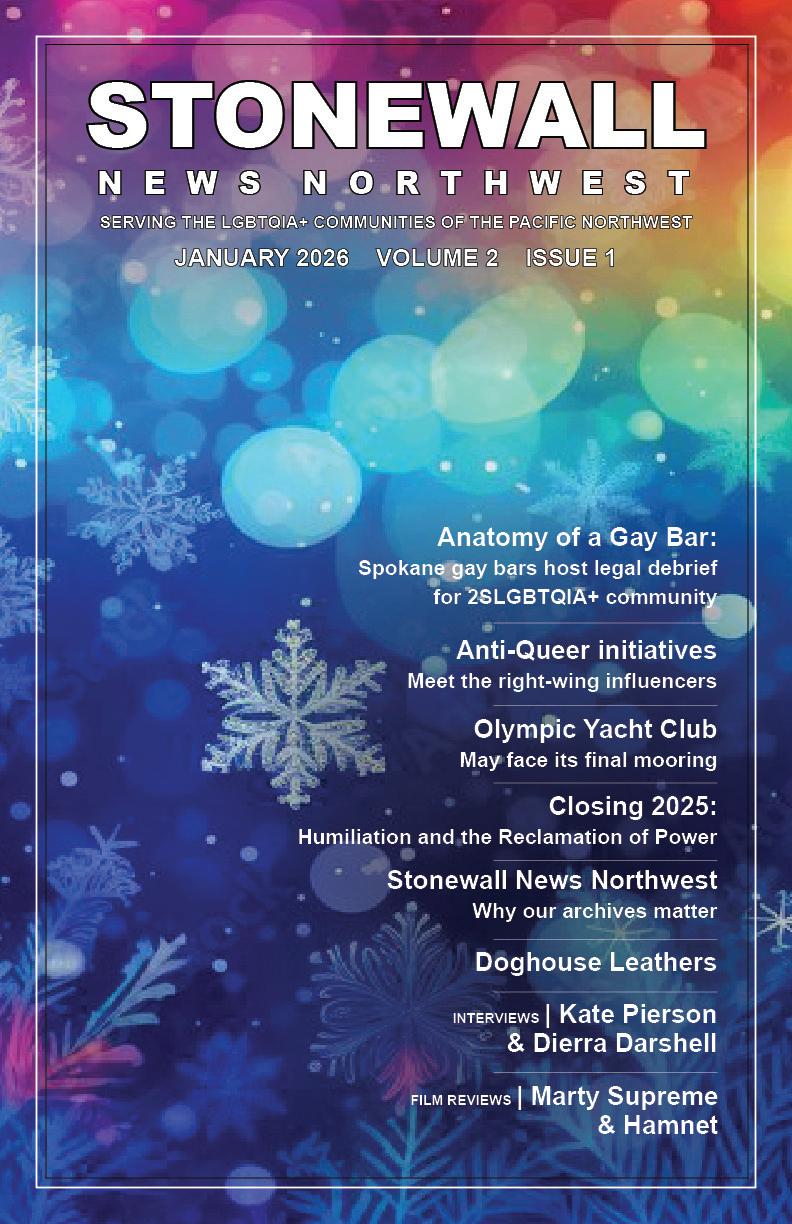
SERVING THE LGBTQIA+ COMMUNITIES OF THE PACIFIC NORTHWEST
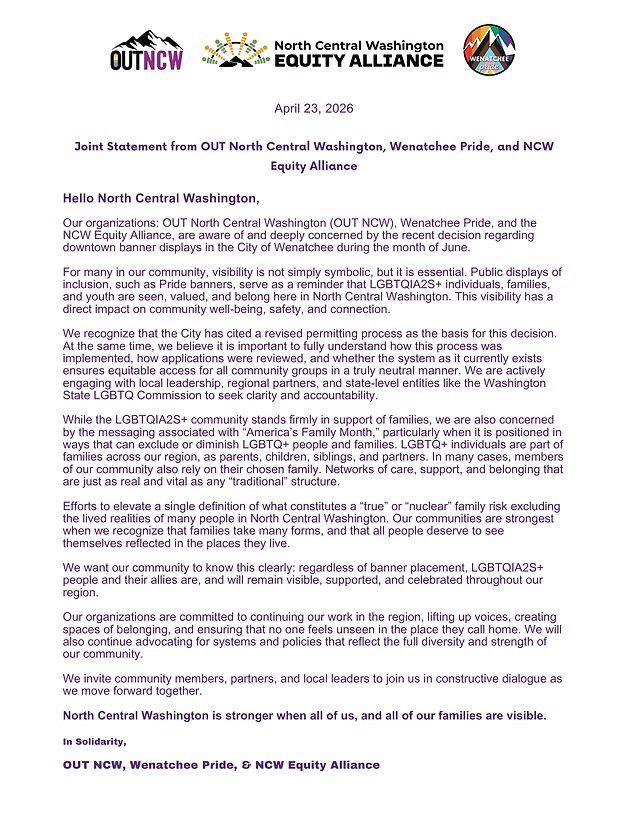
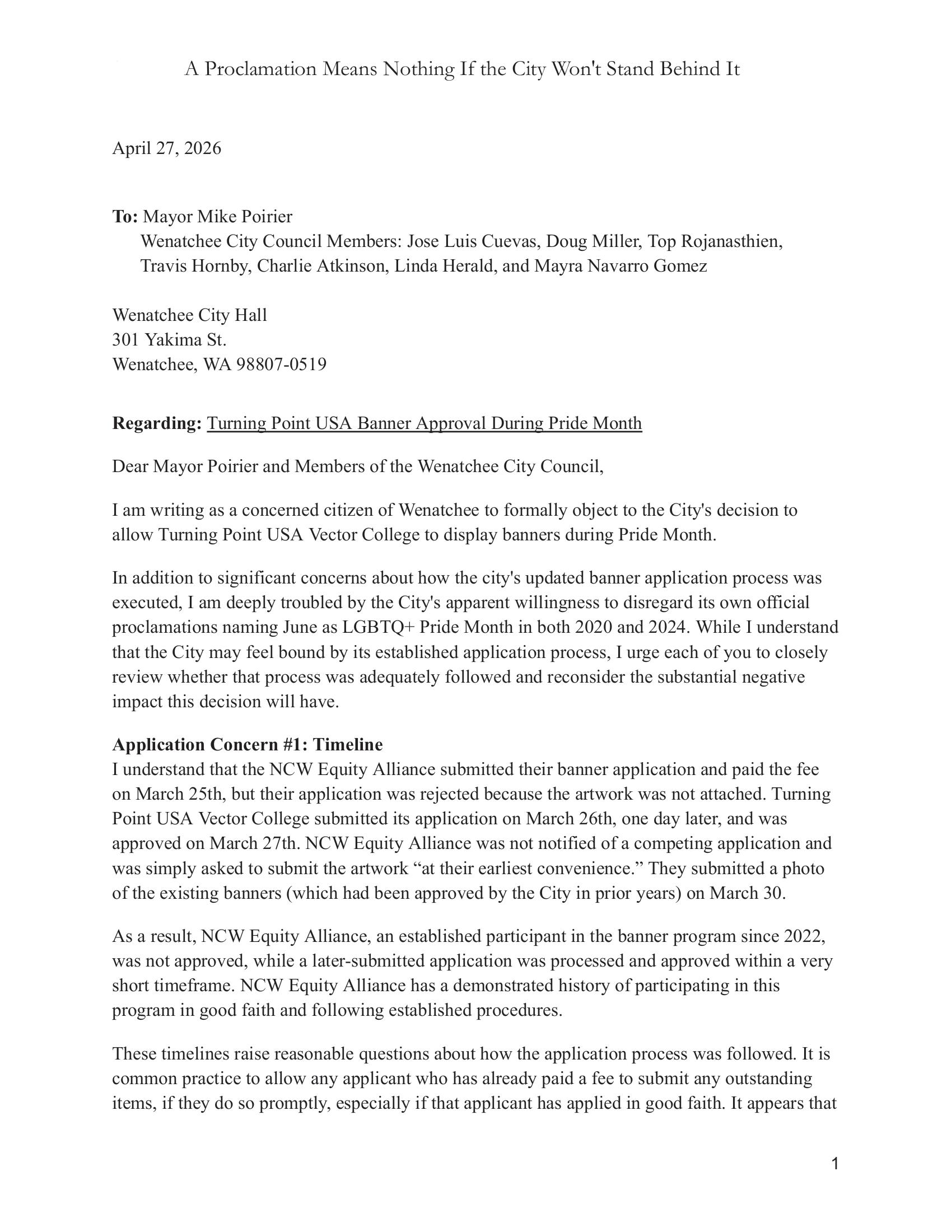
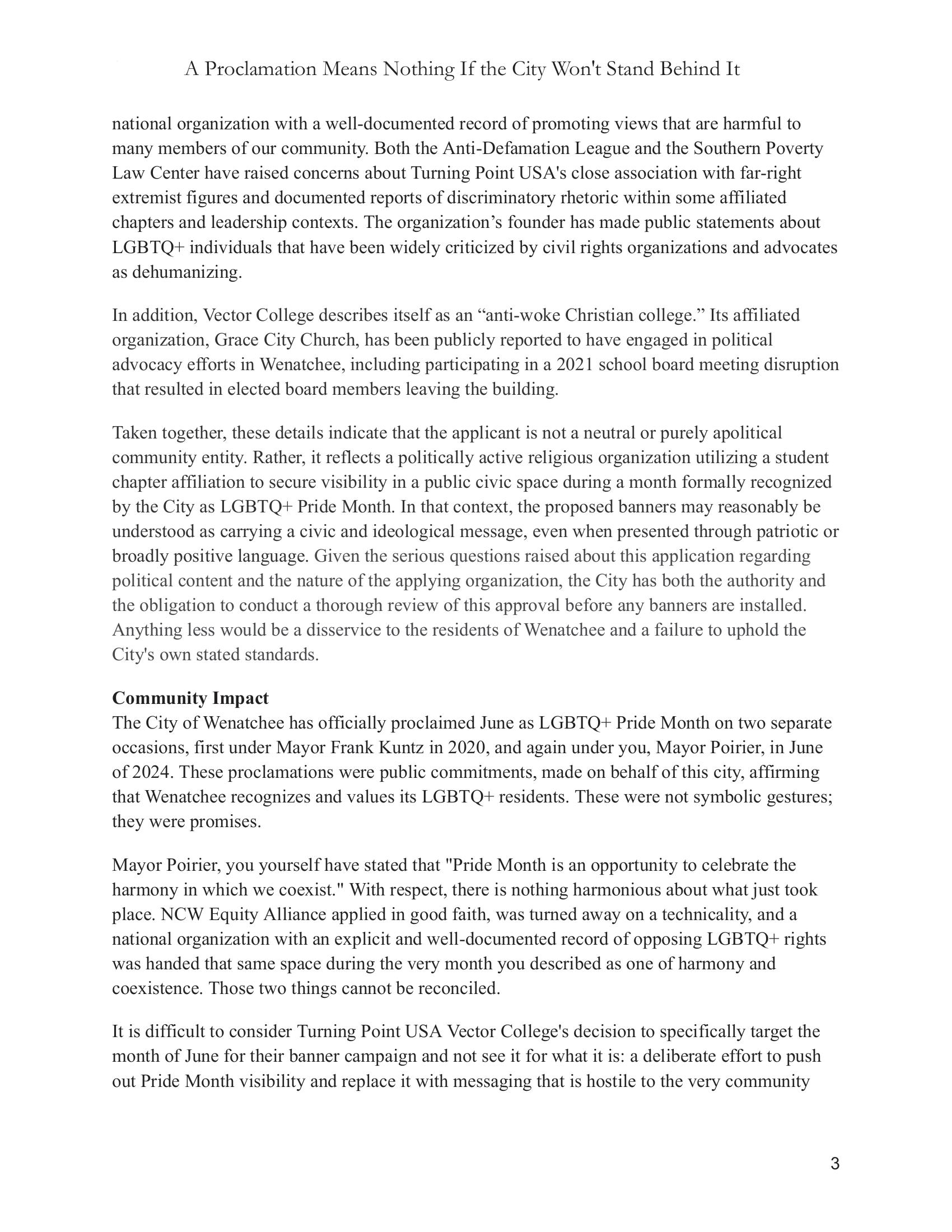
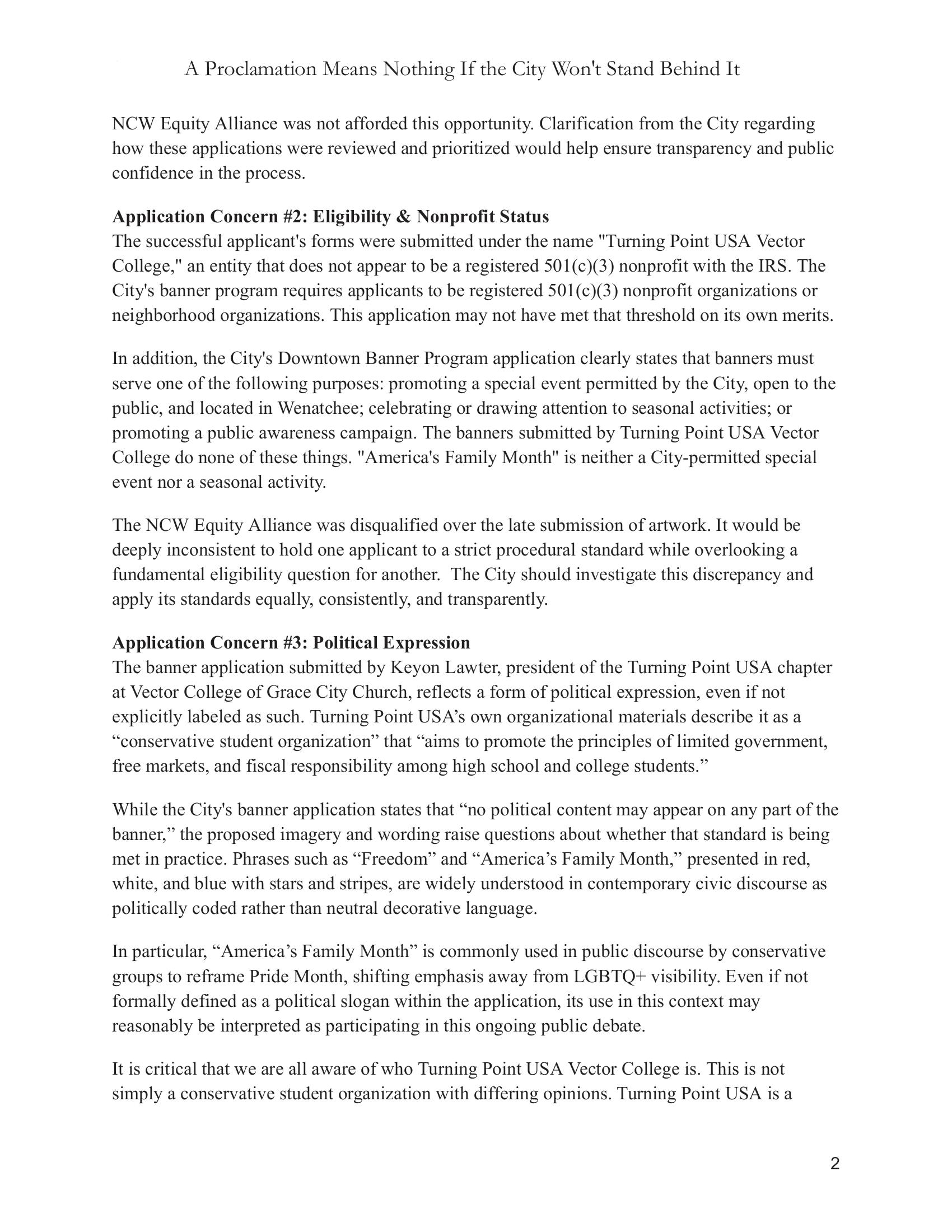
Wenatchee June Pride Banners to be replaced by Family Month Banners
Ty Stober
Running for Clark County Auditor
Christ Lutheran Church
Votes to Welcome LGBTQ+ Communities
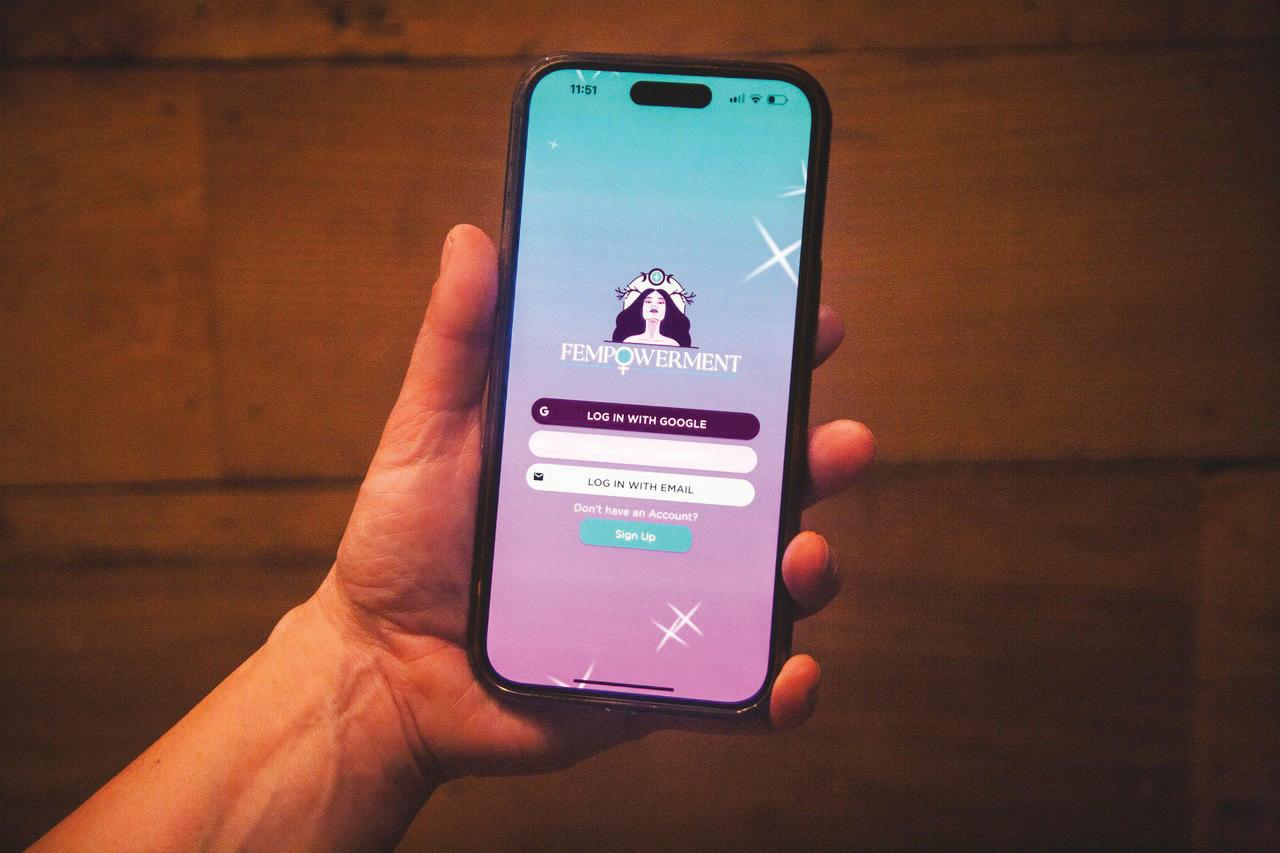
Fempowerment App
Trump Admin Pushed Oregon to End LGBTQ+ Foster Policy
Rick Wallace of Wilsonville
INTERVIEW | Martin Cloutier
FILM REVIEWS | The Birdcage, Mother Mary & The Christophers
PUBLISHER
Mike Schultz publisher@stonewallnews.org
John Deen 1995-2005
Lawrence Stone 1992-1995
OREGON MANAGING EDITOR
Rhonda Brown oregon-editor@stonewallnews.org
ADVERTISING
April Gilbreath advertising@stonewallnews.org
509-541-5615
Pride Banners in Wenatchee to be replaced by Family Month banners
Ty Stober running for Clark County Auditor
Christ Lutheran Church votes to welcome LGBTQ+ communities
MAGA Gay Men
LGBTQ+ Equality Weekly National & International Headlines
Fempowerment App
Rick Wallace of Wilsonville
Boise City Mayor McClean
Trump Admin Pushed Oregon to End LGBTQ+ Foster Policy
MILES
UNCLOSETED
WILL
SHAANTH
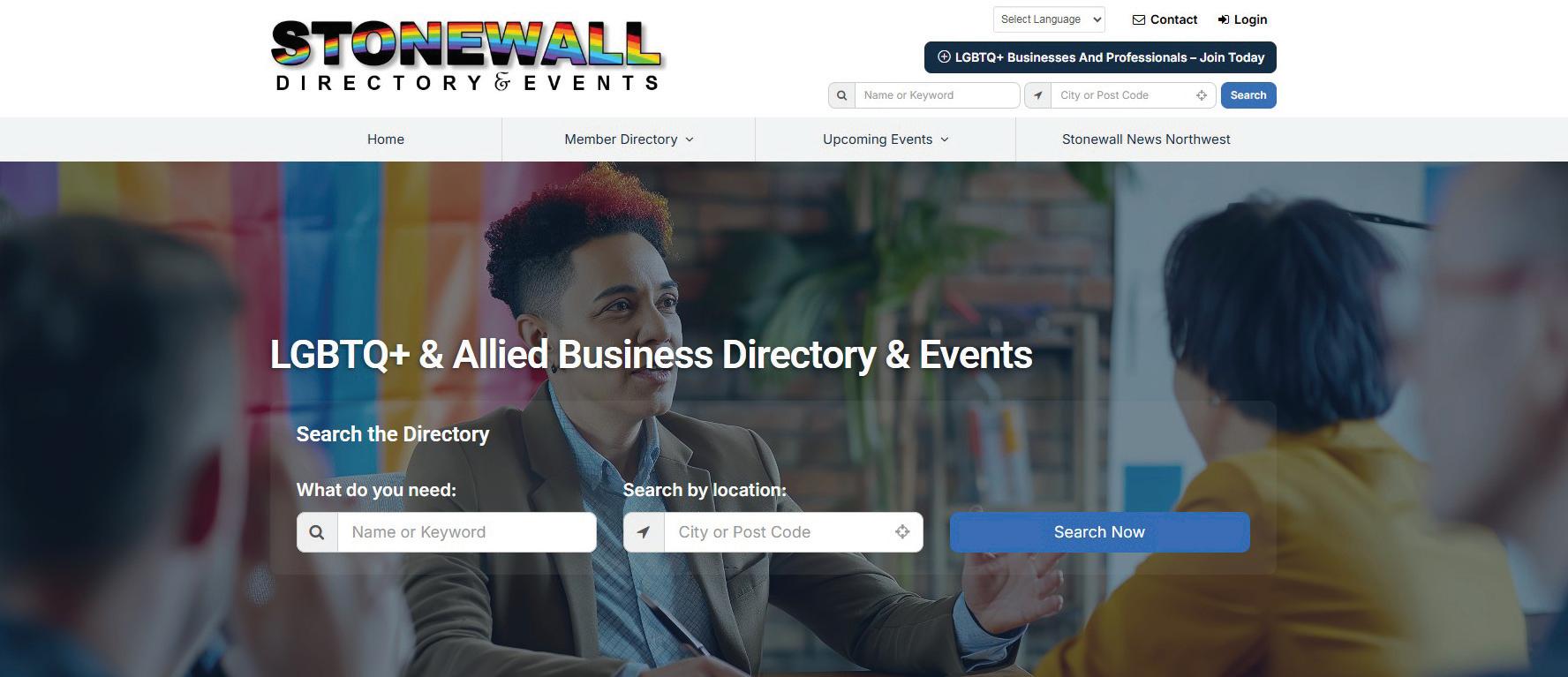
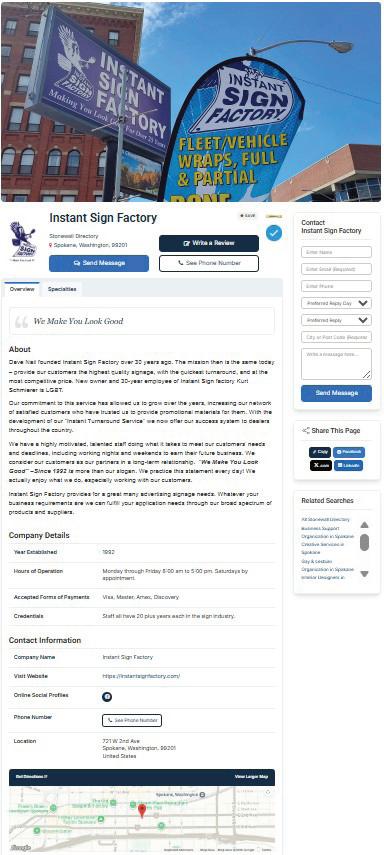
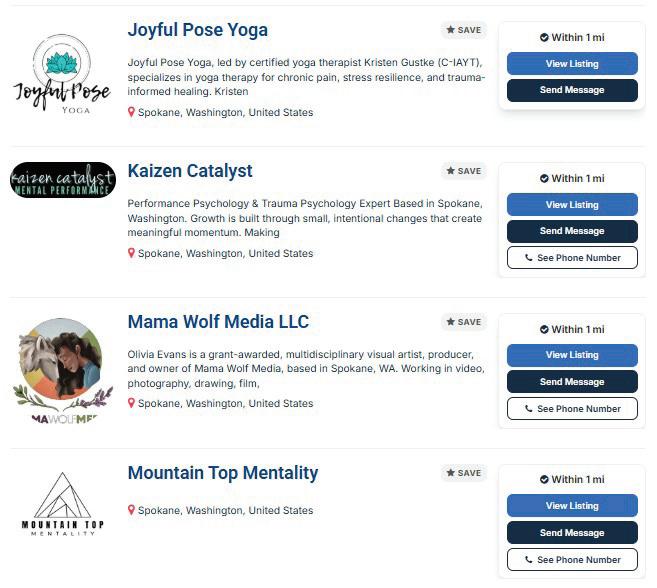
The Stonewall Directory & Events website, www.stonewalldirectory.net, launched in 2026 as a resource for information about LGBTQ+ and allied member organizations and businesses serving the LGBTQ+ public — from accountants to youth services. The comprehensive listings (which also include ways for users to message or call) are coupled with an integrated events calendar to further promote for-profit and nonprofit members through their happenings of interest to the community and support the critical social pillars of diversity, equity, and inclusion
The directory listing options include three membership levels for businesses and organizations: a free Bronze level, a $10/month Silver level, and a $20/ month Gold level. Benefits vary by level but include listing in multiple categories and locations, automatic Google mapping, robust filtering, listing analytics, and event posting.
“Choosing to hang banners that express the narrow bias of one local church over broader, more inclusive pride banners certainly does not represent the values of our diverse community”
-- Suellen Harris, East Wenatchee resident and member of Grace Lutheran Church
June Pride Banners in Wenatchee to be Replaced by Family Month Banners
Using a technicality in the new permitting process, the City of Wenatchee rejected the June Pride banners which had flown for years during the city-proclaimed June Pride Month, and instead handed the permit to Turning Point Vector.
by Lucille Stutesman
Pride banners will not fly in the Apple Capital this year, instead they will be replaced by banners celebrating family month.
North Central Washington Equity Alliance’s annual Pride banners will not fly in downtown Wenatchee due to an incomplete application. Rather, banners celebrating family month pushed by conservative group Turning Point USA’s Vector College chapter will.
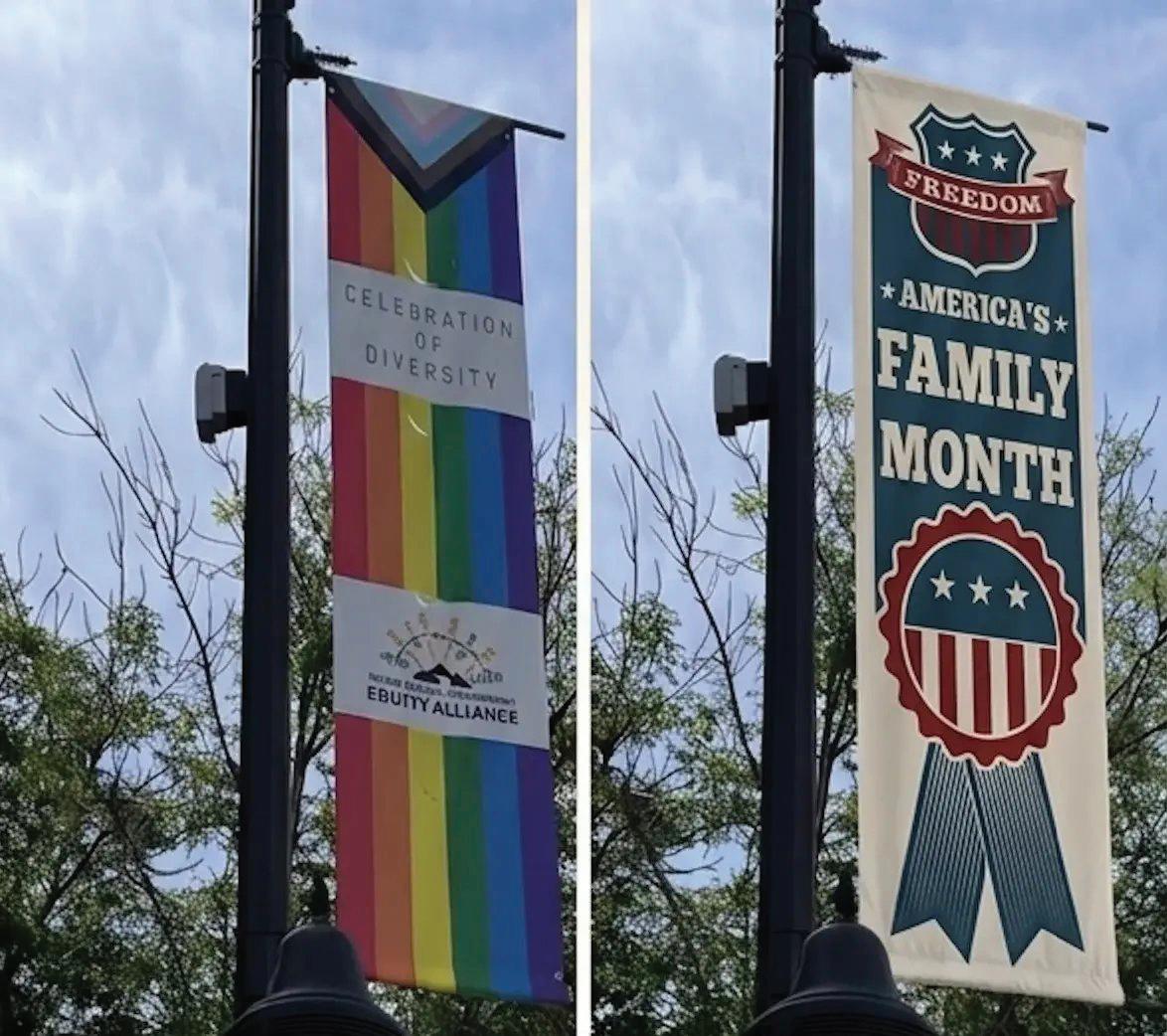
The red, white and blue banners read “freedom” and “America’s
Family Month.”
The banners will be hung from June 1 to June 30, according to the application. Family month runs from Mother’s Day on May 10 to Father’s Day on June 21 this year.
The banners will go on 50 city-owned light poles around Wenatchee.
Confusion in the permitting process
Juan Diaz, executive director of NCW Equity Alliance, had initially applied for a permit to fly
pride banners at the start of March and was told the application was not open yet. Later in the month the city government reached out to him and told him the application was open. He sent in the application, including money for the $250 fee, a few days later on March 25.
Later that day, the city reached out and told him he would need to submit artwork with his application. Diaz did not get back to the city until March 30. He attributes the delay to a vendor who did not immediately respond to him when he asked for the
specific dimensions of the banner.
It was the next day, March 26, that Turning Point Vector applied and was approved to hang its family month banners.
Turning Point is the non-profit founded by late conservative activist Charlie Kirk. Kirk was shot and killed early September 2025. The Vector College chapter was founded in the weeks after he died, according to its social media. The chapter has been operating as a non-profit since January 2026, according to the IRS.
Vector College is an unaccredited school owned and operated by Grace City Church in Wenatchee.
Diaz had assumed another pride organization had applied for that slot but found out later through a Facebook post by the Chelan County GOP it was not.
“This is monumental,” read the
BANNER - To Page 24
America’s Family Month banner on the right will replace the Pride banner on the left during June.
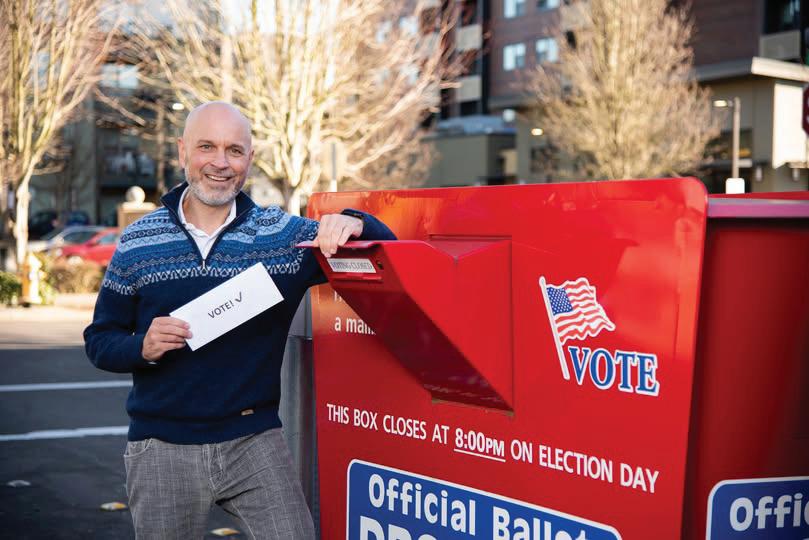
Ty Stober: A Leader with Vision and Heart Running for Clark County Auditor
His campaign for Auditor underscores a dedication to promoting transparency and accountability in local government.
by Frank Gaimari
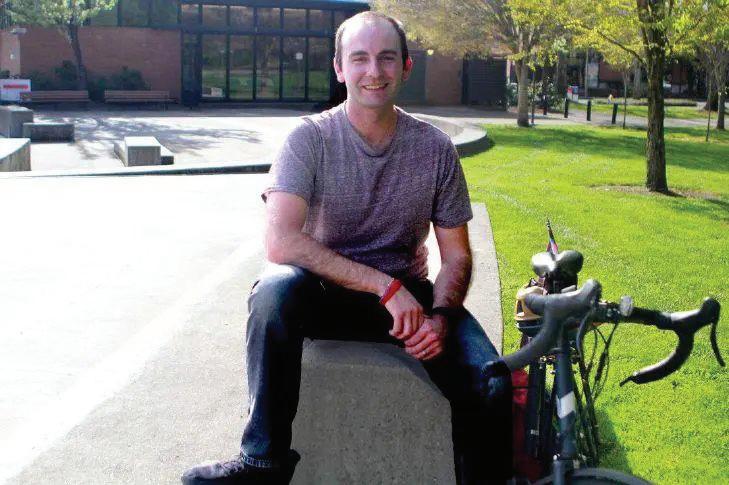
Ty Stober, a respected leader in Vancouver’s public service community, is now seeking to serve as Clark County Auditor. Currently serving as Vancouver City Council member, Position 5, he has earned a reputation as a thoughtful and effective leader, recognized for his commitment to equity, sustainability, and meaningful community engagement. His campaign for Auditor underscores a dedication to promoting transparency and accountability in local government.
Since his first election to the City Council in 2015, Stober has worked tirelessly to address the needs of his community. Whether advocating for economic development, championing inclusivity, or tackling sustainability challenges, his leadership has left a lasting impact. His involvement extends beyond the council chambers — he has served on numerous boards and committees, including the National League of Cities,
where he has held leadership roles advancing racial equity and LGBTQ+ representation in local government.
Before entering public service, Stober spent over two decades in sales, marketing, and operations, gaining valuable experience in both entrepreneurial ventures and established organizations. His professional background includes managing energy efficiency programs that benefited communities across the Northwest. This blend of privatesector expertise and public service experience uniquely positions him to bring innovation and efficiency to the role of Clark County Auditor.
Stober’s campaign is rooted in the belief that the Auditor’s Office should be a model of transparency and fairness. He envisions modernizing systems to improve accessibility and efficiency while fostering trust between the government and the people it serves. For him, the role is about more than managing numbers
“When you spend years hiding something fundamental about who you are, you develop a deep understanding of what it feels like to be unseen. You become acutely aware of what it’s like to navigate systems that weren’t designed with you in mind,
and to wonder whether you’ll be accepted if people really know your story. That feeling never truly leaves you. For me, it’s become the lens through which I approach leadership.”
shared more about his vision and personal journey. The following are questions posed to him, along with his responses.
— it’s about ensuring that every resident feels represented and valued.
Beyond his professional achievements, Stober’s personal story adds depth to his candidacy. A longtime resident of Clark County, he lives in Vancouver with his husband, and together they are active members of the community. His experiences as a member of the LGBTQ+ community have shaped his perspective and strengthened his resolve to create a more inclusive and equitable society. His ability to connect with people on a personal level makes him not just a leader, but a neighbor who truly understands the community he serves.
As he embarks on this campaign, Stober invites voters to join him in envisioning a brighter future for Clark County. His candidacy is a call to action for those who believe in the power of transparency, accountability, and community-driven leadership. In a recent conversation, Stober
Frank Gaimari: What inspired you to leave the private sector and dedicate yourself to public service?
Ty Stober: I have always been dedicated to public service — it’s been a constant throughout my life, even before I found my path to elected office. As an Eagle Scout and through serving in student government as early as sixth grade, I developed a strong instinct for leadership and community involvement. Those values have stayed with me ever since. Early in my career, a mentor advised me to first gain experience in the private sector, saying it would provide a solid foundation for a future in policymaking. I took that advice to heart, and the years I spent building my private-sector career have deeply informed my perspective as a public servant.
Looking back, there was another reason I waited before pursuing elected office: I wasn’t yet comfortable being open about
STOBER - To Next Page 20
Ty Stober | Courtesy of VoteTy.com.
“When that process began to show an 80% approval, the group sensed the tide was turning. They continued to o er classes and conducted forums to encourage honest and open conversation about what they were trying to say.”
-- Peggy Haug, Christ Lutheran Church Social Justice Advocacy Group member
by Annie Charnley Eveland
Membership at Christ Lutheran Church passed a motion early this year to become a Reconciling in Christ congregation, which connects them to a network of RIC churches nationwide.
The church now formally welcomes the lesbian, gay, bisexual, transgender, queer/ questioning, intersex and asexual sexual orientations and gender identities and the Black, Indigenous and People of Color groups, also referred to as LGBTQIA and BIPOC.
Christ Lutheran membership now agrees to be open to interview LGBTQ+ candidates for pastor when there is an opening; perform same sex weddings; and support ReconcilingWorks, a Lutheran organization that since 1974 has advocated for LGBTQ+ inclusion and rights.
Christ Lutheran started the discerning process in spring 2023 under the longtime leadership of then the Rev. Joel Ley.
While the church sought a new pastor, Christ Lutheran Church Social Justice Advocacy Group members Peggy Haug, Linda Lohrmann, Charleen Kaaen, Allison Tabaco Hines and Rita Hoffman met for close to three years to determine how to encourage their congregation to examine how its welcome is conveyed to marginalized groups who have traditionally been excluded, Haug said.
Christ Lutheran Church membership votes to formally welcome LGBTQIA, BIPOC communities
The church now formally welcomes the lesbian, gay, bisexual, transgender, queer/questioning, intersex and asexual sexual orientations and gender identities and the Black, Indigenous and People of Color groups, also referred to as LGBTQIA and BIPOC.
“Even though he soon retired and the congregation had several months of substitute leadership until an interim pastor could serve, the small, but committed group continued meeting and working,” Haug said.
“The group shared their own stories. They created bulletin boards and posters of information and conducted adult education classes,” she said.
They also created a revised welcome statement and sent it out to the entire congregation, seeking opinions and approval.
When that process began to show an 80% approval, the group sensed the tide was turning. They continued to offer classes and conducted forums to encourage honest and open conversation about what they were trying to say, Haug said.
“The groundwork had been laid, and the vote of 90 active members yielded a 76% approval. The motion to become an RIC congregation was approved,” she said.
RIC is a nationwide movement in which churches in various denominations choose to visibly and actively invite the LGBTQIA and BIPOC community members to worship with them.
“In the Evangelical Lutheran Church in America, the movement eventually evolved under the title Reconciling Works. The work has been ongoing since the 1970s and churches that choose to adopt this designation are known as RIC congregations,” Haug said.
The Rev. Lars Hammar came to serve Christ Lutheran in July 2025. Ordained in 1999, he served churches in Illinois and 21 years in Tucson, Arizona,
after graduating from Lutheran Theological Seminary in Gettysburg, Pennsylvania.
“The process to become RIC takes a while, and rightly so, usually 2 to 3 years,” Hammar said. It started before I got here and the Social Justice Advocacy Group at our church did most of the groundwork before I came.”
Being in Walla Walla is “a big change, but a good one. It’s fun to be back in a smaller town and have seasons again. The kids are enjoying the school system,” Hammar said.
The RIC committee continued its work and waited for the congregation to get to know their new pastor. By the end of 2025, many were speaking up, wanting to hold a vote and affirm the desire of their church to be one that welcomes, truly welcomes, everyone, Haug said.
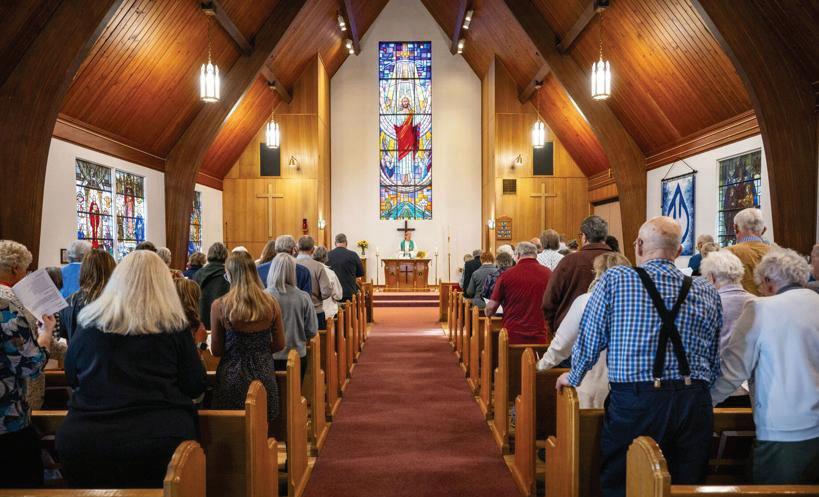
The Rev. Lars Hammar preaches at Christ Lutheran Church where he came to serve in July 2025. | Greg Lehman Photography
Inside the Lonely World of MAGA Gay Men
When Evan decided it was time to tell his boyfriend that he voted for Trump, he couldn’t get the words out. “I was stuttering for 20 minutes straight on the phone,” he told Uncloseted Media and GAY TIMES.
Once he finally worked up the courage, he was met with pushback: “He made fun of me. … He called me a racist and a white supremacist,” says Evan, a 21-year-old math major who lives in Long Island, New York.
That pushback isn’t unusual: According to a 2023 Pew Research Center survey, 83% of queer men typically vote Democrat. One key reason gay men swing left in 2026 is because of the Trump administration and MAGA-aligned politicians’ track record on LGBTQ issues. Since the start of Trump’s second term, his administration has terminated more than $1 billion worth of grants to HIV-related research, removed the Pride flag from the Stonewall National Monument and shut down the LGBTQspecific option on the 988 youth suicide hotline.
Because of this, many of the fewer
than one in five LGBTQ men who cast their ballot for Trump in 2024 face judgment for their political affiliation.
“People think that I hate myself for being gay, and that I’m a gay traitor. … I wish there were more gay conservatives or moderates,” says Evan, who requested to use a pseudonym due to fears over retaliation for his political views.
Navigating Dating and Relationships as a Gay Trumper
Nick Duncan, 43, can relate to Evan’s fears about being an open Trump supporter: “I mostly get hatred. I’ve never lost a conservative friend because I’m gay, but I’ve lost all of my gay friends because I’m conservative,” says Duncan, a hospitality executive who lives in Miami. “I’ve divorced myself from what I refer to as the Alphabet Mafia.”
Duncan says he feels so unwelcome by the LGBTQ community that he’s hesitant to attend certain queer events. “Nowadays, I would never go to a Pride event,” Duncan told Uncloseted Media and GAY TIMES. “I don’t feel that I would be safe.”
Despite these concerns, Duncan doesn’t hide his political views when looking for love. “I’m in a long-term relationship now, and when I have been on the dating market, I’m very open and upfront about [my political views]. So I think it just weeds out most people who would have an issue.”
For Evan, political differences have been a source of tension in his relationship even before he told his boyfriend who he voted for. “When I first met him, he asked me if I liked Trump. … He was kind of scaring me. So I said, ‘I don’t know,’” Evan recalls. “He said, ‘Good answer, because if you said yes, I couldn’t even talk to you.’”
Since revealing his conservative identity, Evan has had multiple arguments with his boyfriend about politics. “This guy, who I’ve been dating for almost a year, he’s way too far left. … The first proof is he thinks there’s more than two genders,” says Evan. “I tried telling him there were only two genders, and he got mad at me.”
Though Evan believes there are only two genders, research suggests that gender is a spectrum allowing for multiple gender
In a time when gay rights are under attack in the U.S., a minority of gay American men are still staunch Trump supporters. Why?
identities.
Proud Gay Trump Supporters
According to a 2025 report from Pew Research Center, 71% of LGBTQ adults view the Republican Party as unfriendly towards LGBTQ Americans. Duncan thinks these critiques are unreasonable: “The Republican Party is not nearly as anti-gay as [leftists] believe,” he says. “The Trump administration has plenty of openly gay people in the administration, and Trump actually supported gay marriage before it was cool.”
Gay members of the Trump administration include Treasury Secretary Scott Bessent, as well as Tony Fabrizio, a pollster and strategist. Additionally, Trump did tell The Advocate in a 2000 interview that though “the institution of marriage should be between a man and a woman,” he thinks amending the Civil Rights Act to grant the same protection to gay people that we give to other Americans is “only fair.”
But since then, Trump has appointed Supreme Court Justices who have denounced marriage equality and Cabinet members with anti-LGBTQ track records, including Pete Hegseth, Marco Rubio and Pam Bondi.
Duncan says part of the reason he isn’t worried about Trump’s anti-LGBTQ track record is
Design by Soph Holland | This story published by Uncloseted Media and written in partnership with Gay Times Magazine.
LGBTQ+ Equality
Weekly National Headlines
by Fabrice Houdart
May and June—bookended by the International Day Against Homophobia, Transphobia, and Biphobia (May 17th) and Pride— are a time to take stock: who stands with us, who doesn’t, and where we hold power—and where we don’t. This year’s themes are compelling. IDAHOBIT 2026 calls for being “At the heart of democracy.” NYC Pride says “For All of Us.” In 2005, half the world lived in a democracy. By 2025, that number had fallen to 26%. Nearly three-quarters of the world, and therefore LGBTQ+ people, now live outside democratic systems. If this is “for all of us,” it raises the question of how to sustain progress under an authoritarian system.
This week: A federal “Don’t Say Gay” push, LGBTQ+ parenting as the next target, Attal is a free man, Grindr and Sniffies business news, Big Mistakes, The Vampire Lestat, and much more…
Global News
Botswana: Sodomy Law
Officially Wiped from the Books
I am starting with some good news. Botswana has formally repealed Section 164 of its Penal Code — the “unnatural offenses” provision that criminalized consensual same-sex relations. The High Court had struck it down in 2019, and an appeal was dismissed in 2021, but the legal text remained on the books until Attorney General Dick Bayford executed the formal deletion this month. A marriage equality case before the High Court is set for July 14-1. Read more in The Washington Blade
Following the March municipal elections, newly elected far-right mayors in two (obscure) French towns moved swiftly to erase LGBTQ+ visibility from public space. In Elne (southern France), Mayor Steve Fortel ordered the
April 29, 2026
rainbow flag removed from the town hall and had a rainbow pedestrian crossing repainted white, citing “neutrality.“ In Faches-Thumesnil near the Belgian border, Mayor Brice Lauret removed the flag and canceled a scheduled Pride event. Read more in Attitude
France (too): Marriage Equality, 13 Years In
More than 84,000 same-sex couples have tied the knot since 2013, with around 6,750 marriages in 2024 alone—roughly 3% of all unions. Same-sex couples tend to marry later, often with larger age gaps, and remain less likely to marry overall, with only 39% choosing marriage compared to 71% of different-sex couples. Read more in Le Monde.
Russia: Court Designates Parni+ “Extremist”
A court in Russia’s Oryol region declared Parni+, an LGBTQ+ publication active for nearly 18 years, an extremist organization — meaning its organizers could face prison and are legally required to cease operations. The outlet’s Telegram channel has more than 30,000 subscribers. Editor-in-Chief Yevgeny Pisemsky, already on Russia’s “foreign agents” list (how do they maintain so many lists? GiveButter?) since 2020, said the ruling amounted to an admission that “the truth about LGBT people is more dangerous to the state than any propaganda.” The ruling follows the designation of queer journalist Vadim Vaganov as an individual “extremist” — the first such designation for queer activism specifically. Read more in Novaya Gazeta Europe
UK: Anti-LGBTQ+ Influencer
Barred from Entry
The UK Home Office barred US-based anti-LGBTQ+ content (along with many other awful posts) creator Valentina Gomez from entering the country ahead of a far-right march, ruling her presence “not conducive to the public good.” Gomez — known for burning LGBTQ+-themed books with a flamethrower during political campaigns — promptly threatened on X to cross by boat, claiming “the White House will get involved.” Read more in Attitude
UK (too): More Pride in London Drama
Allegations of bullying, financial misconduct, and governance failures are casting a long shadow over Pride in London, one of the world’s largest LGBTQ+ events. A BBC investigation details years of ignored warnings under former CEO Christopher Joell-Deshields, who was in court this week. It also highlights questionable spending and a toxic internal culture, raising uncomfortable questions about oversight, accountability, and governance. See it on the BBC
US News
Targeting the Family: LGBTQ+ Parenting in the Crosshairs
In the span of just a few weeks, gay dads have been harassed on the street with accusations of child abuse, viral campaigns have pushed the idea that surrogacy is inherently immoral, and conservative influencers have resurrected long-debunked “studies” to argue that children of same-sex parents are worse off. It aligns with the Heritage Foundation’s 2026 report on the family, which urges the U.S. to
elevate “traditional” families. I think there is a TV series about that.
A Federal “Don’t
Say Trans” Push
The proposed PROTECT Kids Act would require parental consent before schools can recognize a student’s gender identity—covering everything from pronouns to bathroom access—while a companion bill would ban the use of federal funds for anything deemed “gender ideology.” See in the Blade
HUD Proposes New Rule For Shelters
The Trump administration’s Department of Housing and Urban Development has proposed eliminating LGBTQ+ housing protections that have been in place since the Obama era. The new rule would require federally funded shelters to house people based on “biological sex,” override state and local protections, and allow shelters to demand unspecified “evidence” of someone’s sex. Read more in PinkNews
Texas Tech Bans LGBTQ+ Topics Systemwide
Texas Tech University Chancellor Brandon Creighton— the architect of Texas’s DEI ban in higher education — issued a memo on April 9 establishing what it calls an “Alternate Materials Rule”: a strict prohibition on LGBTQ+ topics in core undergraduate courses, and a phaseout of all academic programs centered on sexual orientation and gender identity. I guess my very woke class would have never made it in TX. Details in Instinct Magazine
DeSantis Signs Law That Could Strangle Florida Pride
Florida Governor Ron DeSantis signed SB 1134, banning local LGBTQ - To Page 26
This article first published on Fabrice Houdart | A weekly newsletter on LGBTQ+ Equality. Please consider becoming a subscriber of his work at https://fabricehoudart.substack.com
Photo courtesy of Fabrice Houdart
Fempowerment: Not Just an Ideal, Also an App
by Rhonda Brown
Isolation is something we all come across in our lifetimes and can sometimes be unavoidable. As the world becomes increasingly geared towards networking independently and through online networks, some of those tangible communities that are necessary fall by the wayside. This is seen more heavily in the feminine experience.
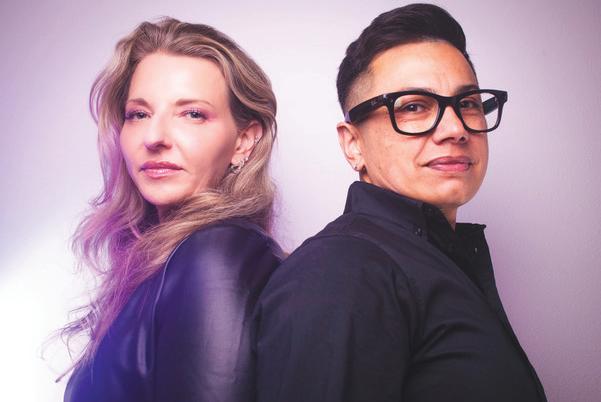
Julie Baldino and Rachel Tramontini began noticing in their own lives, those around them, and stories they came across struggling to find support and community that had previously been a part of communities. It takes a village, but the village had dissipated. Baldino was initially interested in stories of womyn who were deciding to co-purchase homes to afford to own their own place instead of renting. As a real estate professional, this was not only something that informed her professional life but also spoke to her as a newly single woman striking out on her own and recognizing where she and others might need both financial and personal security.
Tramontini was a single parent with a busy work schedule, a young child, and not only financial difficulty but lack of network that might come with a
close-knit group. Systems built on multi-generational, smaller communities, religious or cultural groups might have sustained this. She could not access those systems at the time she became a single parent.
When they both came together on this idea nearly two years ago, they had already connected as business, romantic and life partners, but the knowledge that many others had difficulties finding someone to collaborate with was something they wanted to explore how to improve on.
In their own words: “Before isolation was normalized, womyn lived in circles - not silos. There were aunties, elders, shared homes, shared labor and shared wisdom.”
Together and with a singularly proprietary software program, they are crowdfunding the Fempowerment app. This app is intended to function as an “infrastructure for liberation”, as opposed to a social media or dating style app. They are hoping to set up a connection network for those who are young, old, single, transitioning in some way in life, looking to find assistance, looking for housing, looking for a safe space, or simply looking for positive female connections and socialization. The type of networking and engagement is
entirely up to the user. Cis and trans womyn, straight and queer, and even men looking for a lavender marriage are welcome.
Though it has created a greater financial burden, the proprietary security infrastructure ensuring that every user is safe has been a priority from the outset. Identity verification and security of identification have been at the forefront from inception for Baldino and Tramontini. One of their initial concerns is that domestic violence survivors (and those seeking to remove themselves from DV) find places and people that can provide support and anonymity. They will ensure that both ID verification and anonymity can simultaneously be supported inside the platform
This app is intended to function as an “infrastructure for liberation”, as opposed to a social media or dating style app. “Before isolation was normalized, womyn lived in circles - not silos. There were aunties, elders, shared homes, shared labor and shared wisdom.” and are looking to reach out to private and government victim support networks to allow those in need to access the app at no cost. For the men who are seeking a lavender marriage situation, a separate segment of the platform will be accessible.
The idea of finding ways in our high-tech isolated societies to form in-person safe connections is not altogether new. Priya Parker, author of “The Art of Gathering”, was interviewed on NPR’s Life Kit in January 2026 and she stated that gathering in-person is not only a way to find a way to socialize, but to have a “shared context and a way in.”
If you are able and interested in helping fund this project get off the ground, Fempowerment is currently seeking backers at any financial level. See their additional details on Indiegogo right now at www.indiegogo.com/ en/projects/fempowermentapp/ supportus
“I was secondguessing myself. Like, Am I the only LGBTQ-plus person in Wilsonville? I don’t know. I started a Facebook group to figure it out … and in short order, we had over 250 folks that joined it and shared their (stories) and it was all very positive.”
--Rick Wallace
by Miles Vance / Wilsonville Spokesman
Rick Wallace grew up in Wilsonville, has family nearby, graduated from Wilsonville High School and he lives and works there now.
But every single day, he is working to make the community feel more like home.
Wallace started Wilsonville Pride a year ago to make the city more welcoming to members of the LGBTQ+ community, joined the city’s Diversity, Equity and Inclusion Committee last spring and currently serves as its vice chair.
For all those reasons and more, Wallace has been selected by the Rotary Club of Wilsonville as one of its five First Citizen Award finalists. The other finalists are Jennie Hill, Scott Nichols, Brad Christiansen and John Hillan-Payne. The winner will be announced during the Heart of Gold Gala and Auction at 6 p.m. Saturday, April 11, at Oregon Golf Club. The Review is profiling all five finalists in the lead-up to the event.
Learning to love Wilsonville
Wallace and his family moved to Wilsonville in 1997 when he was 5, and, except for his college years at Oregon State University, he’s lived here ever since.
But Wallace wasn’t always sure he’d stay. Looking back at his teenage years, Wallace said he was
Wallace earned his nomination for Wilsonville
year and serving on the city’s DEI committee. (Miles Vance/The Review) | This article published at wilsonvillespokesman.com/2026/04/04/rick-wallace-works-to-make-wilsonvillefeel-like-home/
Starting Wilsonville Pride: Rick Wallace becomes Rotary Club First Citizen Award finalist
a bit rebellious and wasn’t always the best Wilsonville citizen.
“When I was a kid, I couldn’t wait to get out of Wilsonville. I was so ready to go off to Corvallis and college,” said Wallace, who manages The UPS Store in Wilsonville that his father started in 2000. “But when I got back, I made some new friends here and I realized that this is a special place. … And I felt like I owed something to this town for putting up with me and it’s just a great place to live.”
Pride in his city
Wallace’s volunteerism has taken off recently, with the launch of the nonprofit organization Wilsonville Pride and his appointment to the city’s DEI Committee.
Along the way, he’s learned more about his city, met more of his neighbors and helped many of them feel more comfortable in the community.
“I was second-guessing myself. Like, ‘Am I the only LGBTQplus person in Wilsonville? I don’t know,’” he said. “I started a Facebook group to figure it out … and in short order, we had over 250 folks that joined it and shared their (stories) and it was all very positive.”
Since its inception, Wilsonville Pride has hosted game nights and coffee events, and worked with the city to expand its annual Pride event (adding a DJ and food carts to serve some 400 people last year).
In addition to his work with Wilsonville Pride, Wallace helps lead the city’s DEI Committee, a group that helps coordinate the city’s annual events for Pride, Juneteenth and Las Posadas, as well as coordinating speaker series at the library focused on DEI, Women’s History Month, Black History Month and more.
Beyond that, Wallace’s UPS Store
and Wilsonville Pride have both “adopted” local roads to keep them clean.
Most proud/most impactful
“What I’m most proud of would be Wilsonville Pride,” Wallace said. “We’re still small, so I think our impact has been kind of small so far, but I think the potential there is really significant. … Everyone just wants to live in or raise a family in a community where everyone is included and accepted.”
Why Wilsonville
Through it all, Wallace has learned a lot. And one of the things he’s learned is that he likes the people of Wilsonville. “The short answer is it’s the people,” he said. “All the neighbors and friends and customers at the store. “I just love it here. I don’t think I would want to live anywhere else.”
Rick
First Citizen after launching Wilsonville Pride last
Boise City Mayor McLean: You are the Heartbeat of Progress
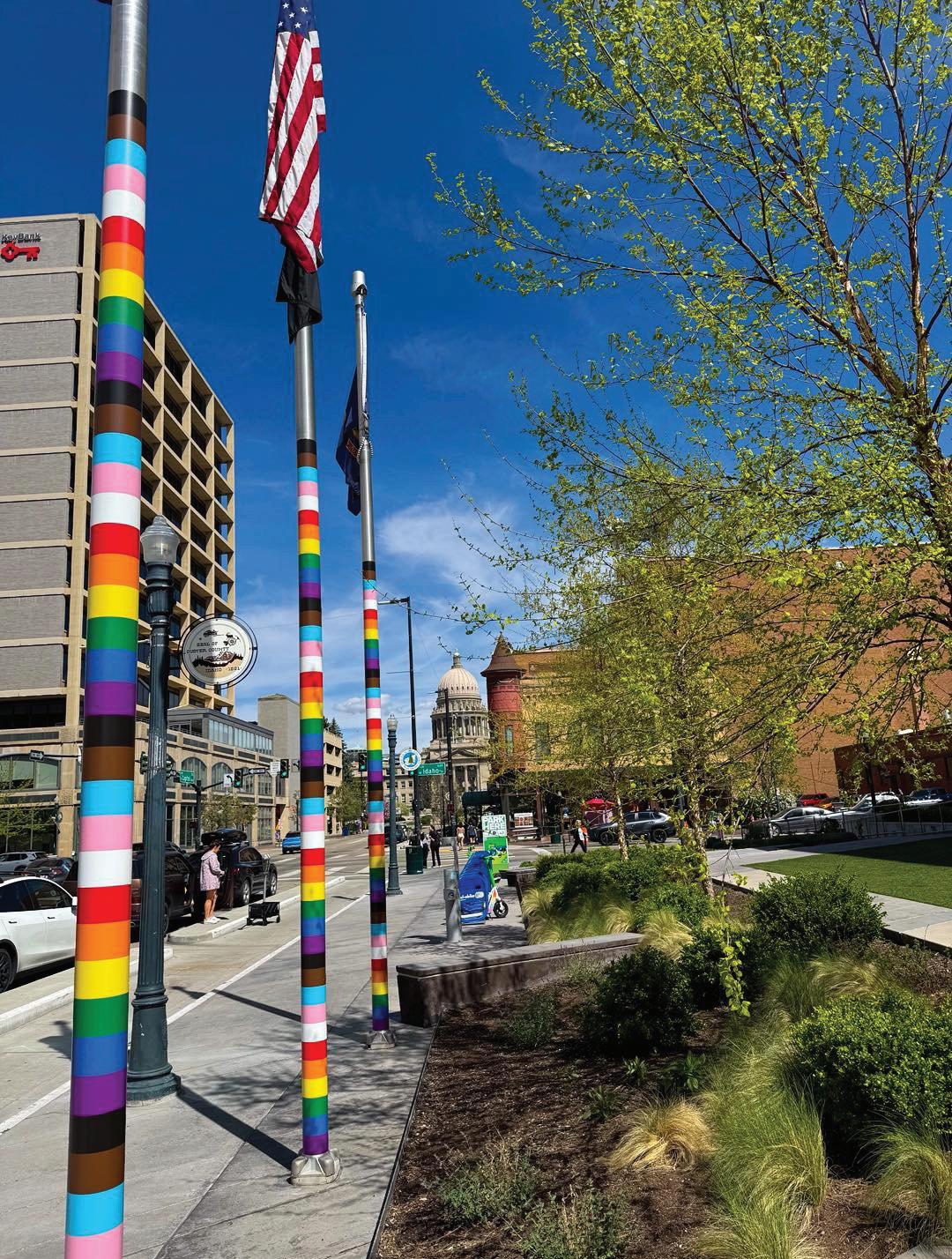
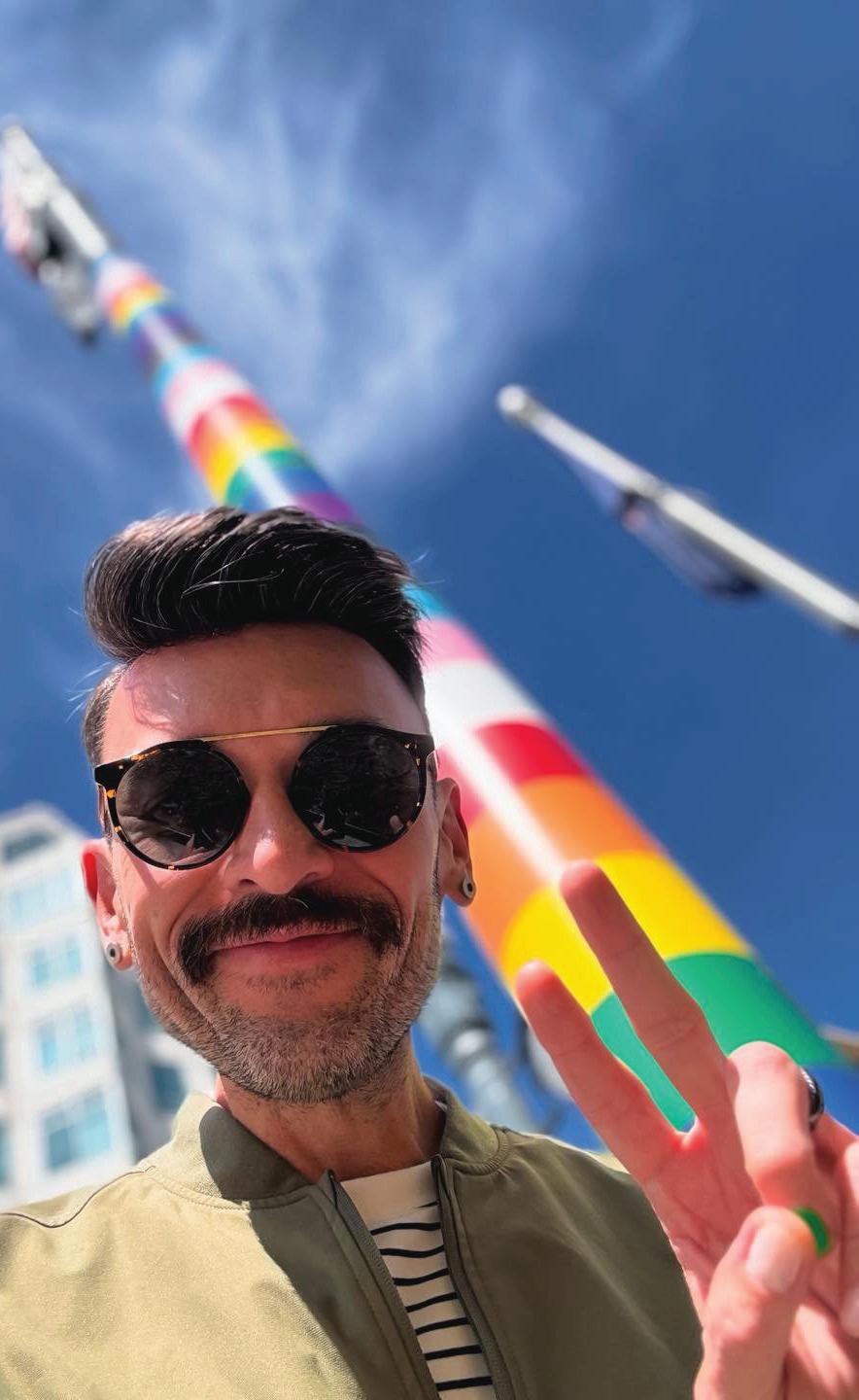
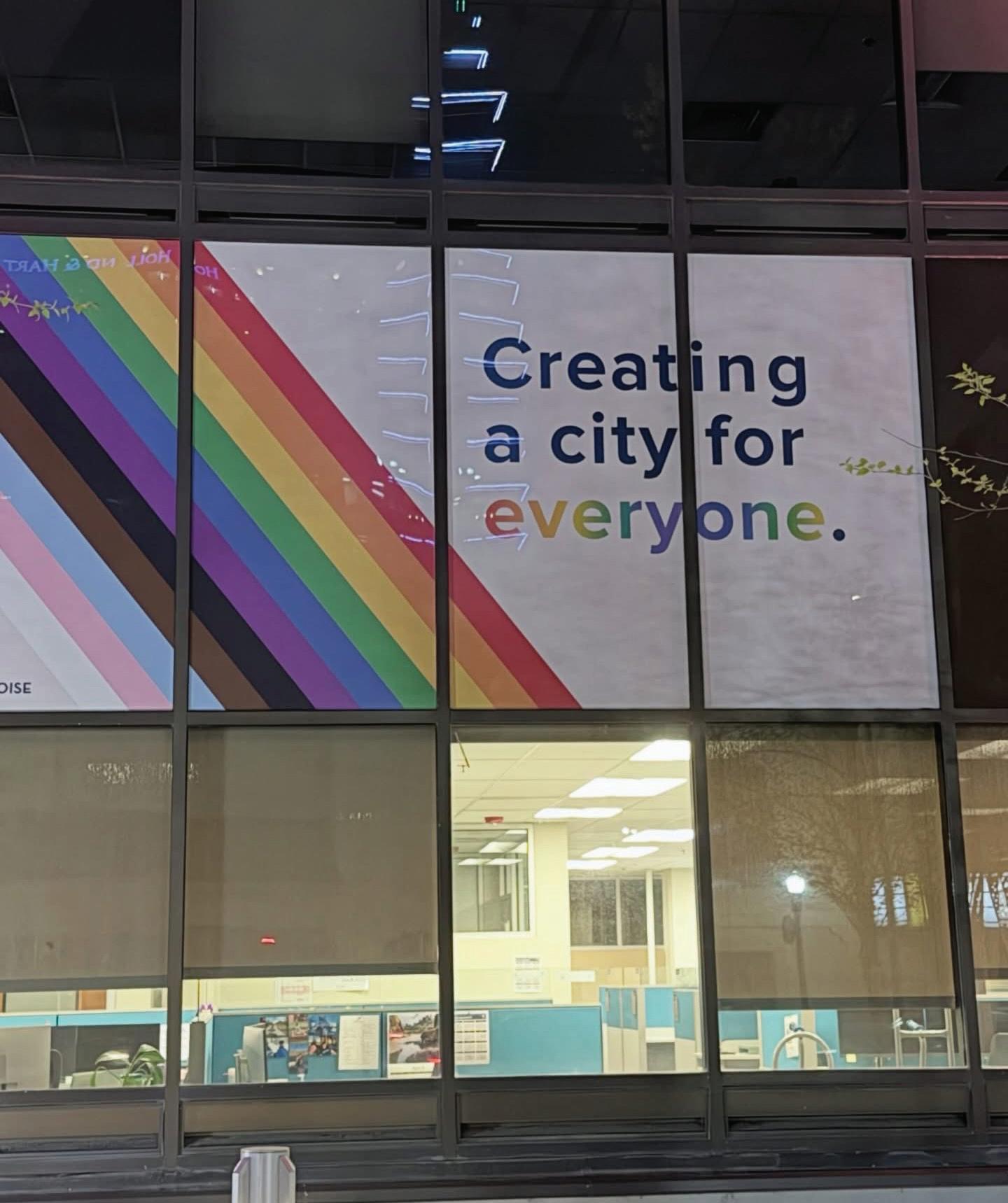
Publisher’s note: in response to the State of Idaho banning non-official flags – intended to include the Pride flag - last year, the City of Boise made the Pride flag an official city flag. Then when the State of Idaho passed a bill fining Idaho cities $2,000 a day for flying unofficial flags established after January 1, 2023 – including the Pride flag – the City of Boise took down the Pride flag and then wrapped its flag poles in Pride rainbow colors and added a sign in the window of Boise City Hall. Below, Idaho resident and business owner Will Heatter took to Facebook to share his passion and gratitude to Boise City Mayor McLean in a message that resonated with many.
“It’s not just about a flag… It’s about equality and existence. In a world that keeps trying to debate that existence, you choose to always show up and show out. Loudly, relentlessly, and without apology you defend us and defend it. As a gay man and business owner in Idaho, I don’t take that lightly. You and your husband don’t just “support” us, you see us, you stand beside us, and you fight for us when it would be easier not to. That kind of courage doesn’t go unnoticed; it changes lives.
To our mayor, Mayor McLean: Thank you for refusing to let our dignity be negotiated. Thank
you for showing up, again and again and again, with conviction and heart and checkmates. You remind us that leadership isn’t about power; it’s about protecting people. Your people. And to every member of this community, every business, every ally who chooses inclusion over indifference, you are the heartbeat of progress. You make it safer to exist, to love, to live openly and fully.
We are still here. We are still worthy. And because of you, we are still rising.”
Will’s Facebook page can be found at: https://www.facebook. com/FlowersAtWill
Newly covered flag poles at Boise City Hall | Courtesy Will Heatter
Courtesy Will Heatter
Sign in Boise City Hall window | Courtesy of Have a Gay Day Facebook page
Supporters say the affirmation model is designed to protect vulnerable youth within a foster care system, especially if they haven’t come out by the time of their initial adoption or placement in a foster home. Advocates for the LGBTQ+ community point to research showing the harm of conversion therapy and living in a non-supportive family.
Ahigh-ranking U.S. Department of Health and Human Services official issued a subtle warning last year when he challenged a longstanding Oregon policy mandating foster and adoptive parents affirm a child’s potential LGBTQ+ identity.
“These developments are deeply troubling, clearly contrary to the purpose of child welfare programs, and in direct violation of First Amendment protections,” wrote Andrew Gradison, thenacting assistant secretary for the Administration for Children and Families, in a September letter to Oregon child welfare officials. “As you know, I have the responsibility of monitoring how federal funds are used and ensuring that federal law is upheld.”
But more than six months later, the federal agency has yet to announce that it is withholding any funding because of Oregon’s policy. Oregon child welfare officials, meanwhile, have not directly responded to the federal government, but are tweaking the policy following a high-profile legal challenge brought by a conservative religious advocacy group.
Supporters say the affirmation model is designed to protect vulnerable youth within a foster
Trump Administration Pushed Oregon to End its LGBTQ+ Foster Policy. The State Ignored It
A federal appeals court ruling also left the state’s 2018 policy requiring prospective foster and adoptive parents to affirm LGBTQ+ children’s identity in limbo.
care system, especially if they haven’t come out by the time of their initial adoption or placement in a foster home. Advocates for the LGBTQ+ community point to research showing the harm of conversion therapy and living in a non-supportive family.
But the requirement has long drawn the ire of conservatives who see the nation’s history of faith-based orphanages as a solution to providing homes for the hundreds of thousands of children in American foster care. The matter gained urgency in the wake of President Donald Trump’s November executive order targeting state and local policies that “inappropriately prohibit participation in federallyfunded child-welfare programs by qualified individuals or organizations based upon their sincerely-held religious beliefs or
moral convictions.”
Gradison’s letter followed a July decision from a panel on the 9th Circuit Court of Appeals striking down the policy’s application on First Amendment grounds for a Christian mother from Malheur County. Jessica Bates, a widowed mother of five from Vale, said she wanted her current children to have more siblings but would not take a child to a Pride parade or to receive hormone injections from a doctor. Her case was sent back to district court for further review, and the appeals court in February declined to revisit the case in front of a broader panel of judges.
State child welfare officials never responded to Gradison’s request to “provide information that can shed light on your current policies,” which did not come with a formal deadline
for producing evidence or documentation. His agency told Capital Chronicle in late January that Oregon had not responded to the agency’s inquiry.
A spokesperson for the federal Administration for Children and Families didn’t elaborate on any investigatory measures or funding changes the agency would take in light of Oregon’s lack of a response, nor did they immediately respond to a followup inquiry on Wednesday. In March, the agency wrote to all 50 states to pressure them against removing children from homes where parents decline to support their gender identity.
Studies have shown that LGBTQ+ youth are overrepresented in the foster care system, making around
OREGON - To Next Page 23
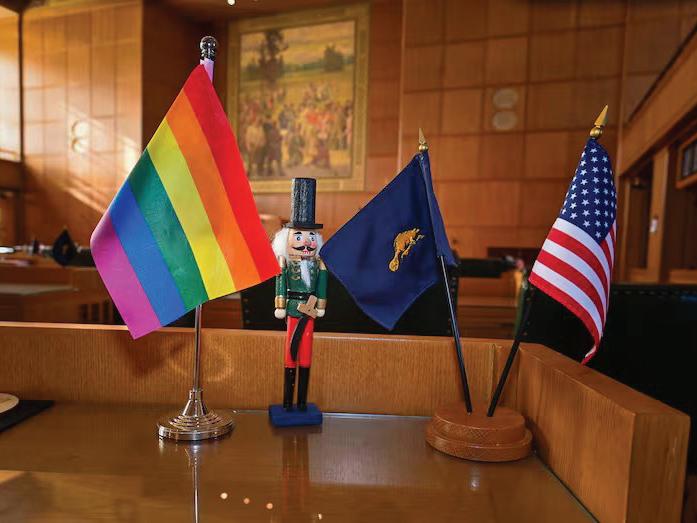
Undated photo of a pride flag, Oregon flag and U.S. flag resting on a desk in the Oregon Capitol. | Ron Cooper/Oregon Capital Chronicle
by Shaanth Nanguneri (Oregon Capital Chronicle) | This article published by OPB. org
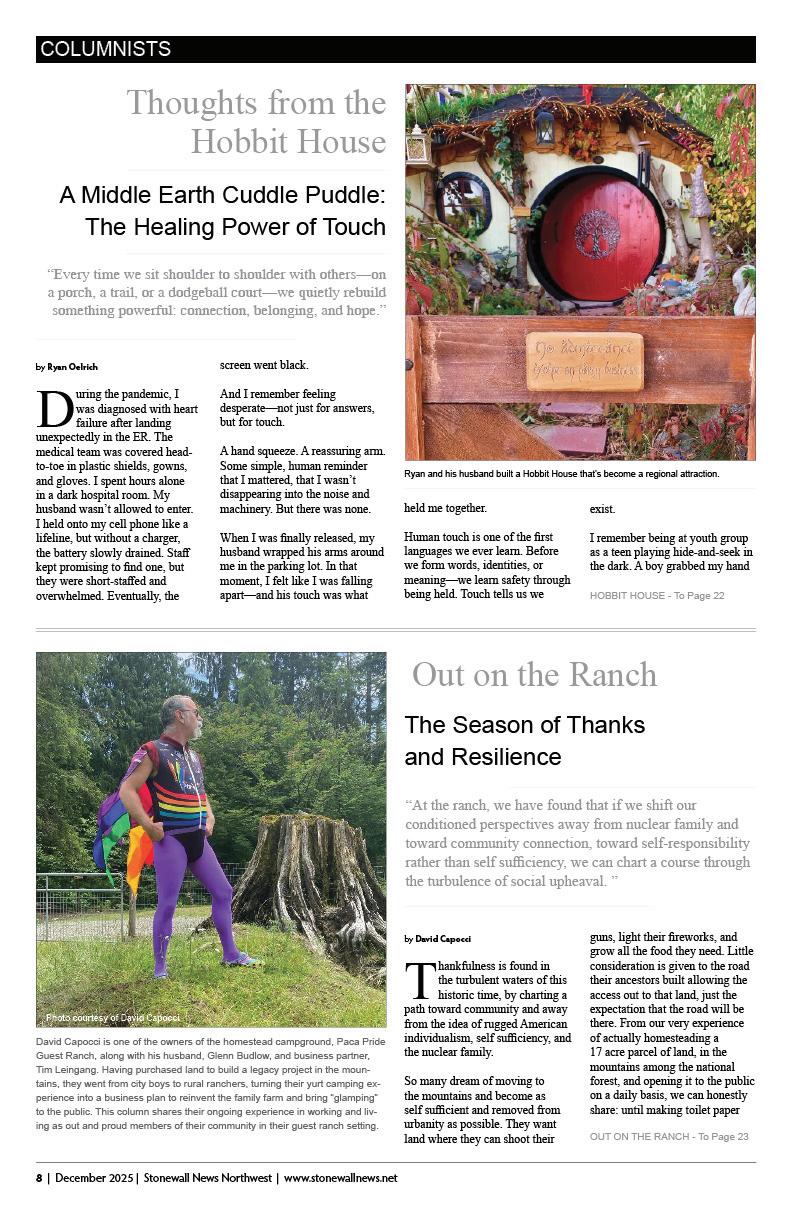
Thoughts from the Hobbit House
I Made Every Gay Dating Mistake So You Don’t Have To
A public service announcement & gay dating guide no one asked for, but many desperately need.
“I looked myself in the mirror. I reflected. I grew. I deleted the apps. I retired the “three buttons mysteriously undone on my shirt” look (universally understood in gay culture as “available and making questionable choices”).
by Ryan Oelrich
Let’s start with a disclaimer.
This is not a guide to straight dating. I am wildly unqualified for that. If you need help navigating heterosexual courtship, I suggest literally anyone else.
This is a guide to gay dating.
If you are a gay man—or have ever considered dating one— congratulations. You are the target audience for this deeply questionable expertise.
Why should you listen to me?
and Ryan
Because I have, with remarkable consistency and commitment, made nearly every mistake in the gay dating handbook. Not just once. Repeatedly. With confidence.
And yet—against all odds—I somehow ended up married to an incredible man who is also my husband (yes, both things can be
Out on the Ranch
How We Know About the Neighbor Who Hates Gay People
“We will never be obtuse or deflective about who we are, what we stand for, and the work we do. Each of the times a visitor has such a reveal here at the ranch, we consider it like striking gold. It’s par for the course when one’s home is open daily to the public that we meet people from all walks of life. The challenge is not compromising one’s integrity to appease another’s insecurity.”
by David Capocci
We knew from the start we’d be putting ourselves on a literal ‘front line’ when we built this ranch in an economically depressed, conservative rural area.
to the public. This column shares their ongoing experience in working and living as out and proud members of their community in their guest ranch setting.
It was the entire premise behind our vision statement: “make manifest the change we wish to see in the world through hospitality”. Being a social change
agent is embedded in the DNA of our business.
Over the past 20 years, we have had some common themes among visitors and tourists to the ranch.
Some occurrences (thankfully few) are such that we can immediately identify the script that will unfold before us.
David Capocci is one of the owners of the homestead campground, Paca Pride Guest Ranch, along with his husband, Glenn Budlow, and business partner, Tim Leingang. Having purchased land to build a legacy project in the mountains, they went from city boys to rural ranchers, turning their yurt camping experience into a business plan to reinvent the family farm and bring “glamping”
Robert
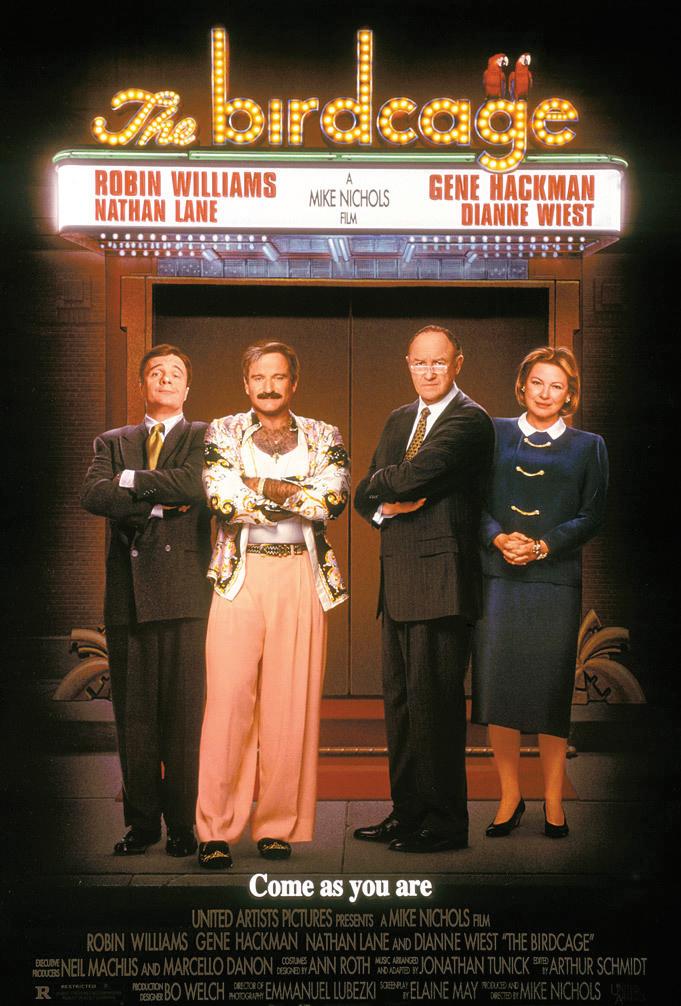
Celebrating 30 Years of The Birdcage
Upon its original release, The Birdcage was a box-office sensation, earning over $185 million worldwide — a remarkable feat for a comedy centered on LGBTQIA+ themes in the mid1990s.
by Frank Gaimari www.FranksFilmReview.com
This June, the iconic comedy The Birdcage is making a triumphant return to theaters to celebrate its 30th anniversary. Originally released in 1996, this beloved film, directed by the legendary Mike Nichols and featuring a screenplay by Elaine May, has remained a cultural touchstone for its humor, heart, and groundbreaking representation. The special rerelease, scheduled for June 7 and June 10, promises to be a cinematic event, complete with exclusive insights from renowned film historian Leonard Maltin.
Set in the lively heart of Miami’s South Beach, The Birdcage follows the story of Armand Goldman (Robin Williams), the owner of a flamboyant drag club, and his partner Albert (Nathan Lane), the club’s star performer. Their pastel-hued tranquility is hilariously disrupted when Armand’s son, Val, announces his engagement to Barbara, the daughter of the ultraconservative Senator Keeley. To win over Barbara’s parents, Armand and Albert are roped into an elaborate charade, hiding their true selves and posing as a traditional “straight” family. Each attempt at deception leads to even greater absurdity, culminating in some of the funniest and most heartfelt scenes of mistaken identity and genuine connection ever put to screen.
At the heart of The Birdcage are its unforgettable performances. Nathan Lane’s portrayal of Albert is a masterclass in physical comedy and emotional depth, while Robin Williams delivers a nuanced performance as the steadying force in their chaotic world. The chemistry between Lane and Williams is electric, capturing the essence of a longterm partnership filled with love, bickering, and mutual support. The supporting cast, including Gene Hackman as the hilariously uptight
Senator Keeley, Dianne Wiest as his perceptive wife, Hank Azaria as the scene-stealing houseboy Agador, Calista Flockhart as Barbara, and Dan Futterman as Val, adds layers of humor and heart, elevating the film to timeless status.
Upon its original release, The Birdcage was a boxoffice sensation, earning over $185 million worldwide — a remarkable feat for a comedy centered on LGBTQIA+ themes in the mid-1990s. Its financial success was matched by critical acclaim, with the film receiving multiple awards and nominations, including winning a Screen Actors Guild Award for Outstanding Performance by a Cast in a Motion Picture. Lane’s unforgettable performance as Albert also earned him a Golden Globe nomination for Best Performance by an Actor in a Motion Picture – Musical or Comedy.
The 30th-anniversary re-release is more than just a trip down memory lane. Fans can look forward to exclusive behind-the-scenes content and commentary from Leonard Maltin, offering fresh perspectives on the film’s creation and its enduring legacy. This special edition is a celebration of the film’s universal themes, which remain as relevant today as they were three decades ago.
The re-release will be shown at major theater chains across the country, including AMC Theatres, Regal Cinemas, Cinépolis USA, and Southeast Cinemas. Tickets are already on sale, and I’d suggest buying early to secure your seat for this special event. Whether you’re revisiting it for the hundredth time or experiencing it for the first, this re-release is a tribute to a film that continues to bring joy to audiences around the world. So, grab your tickets, head to the theater, and experience the laughter, love, and legacy of The Birdcage being on the big screen once again!
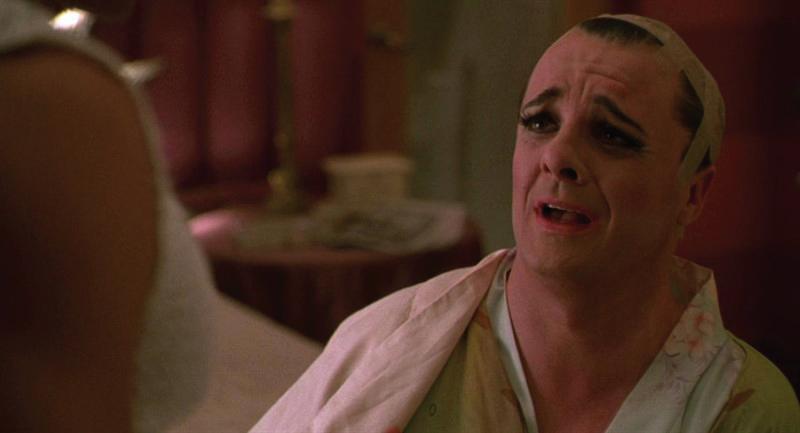
Nathan Lane
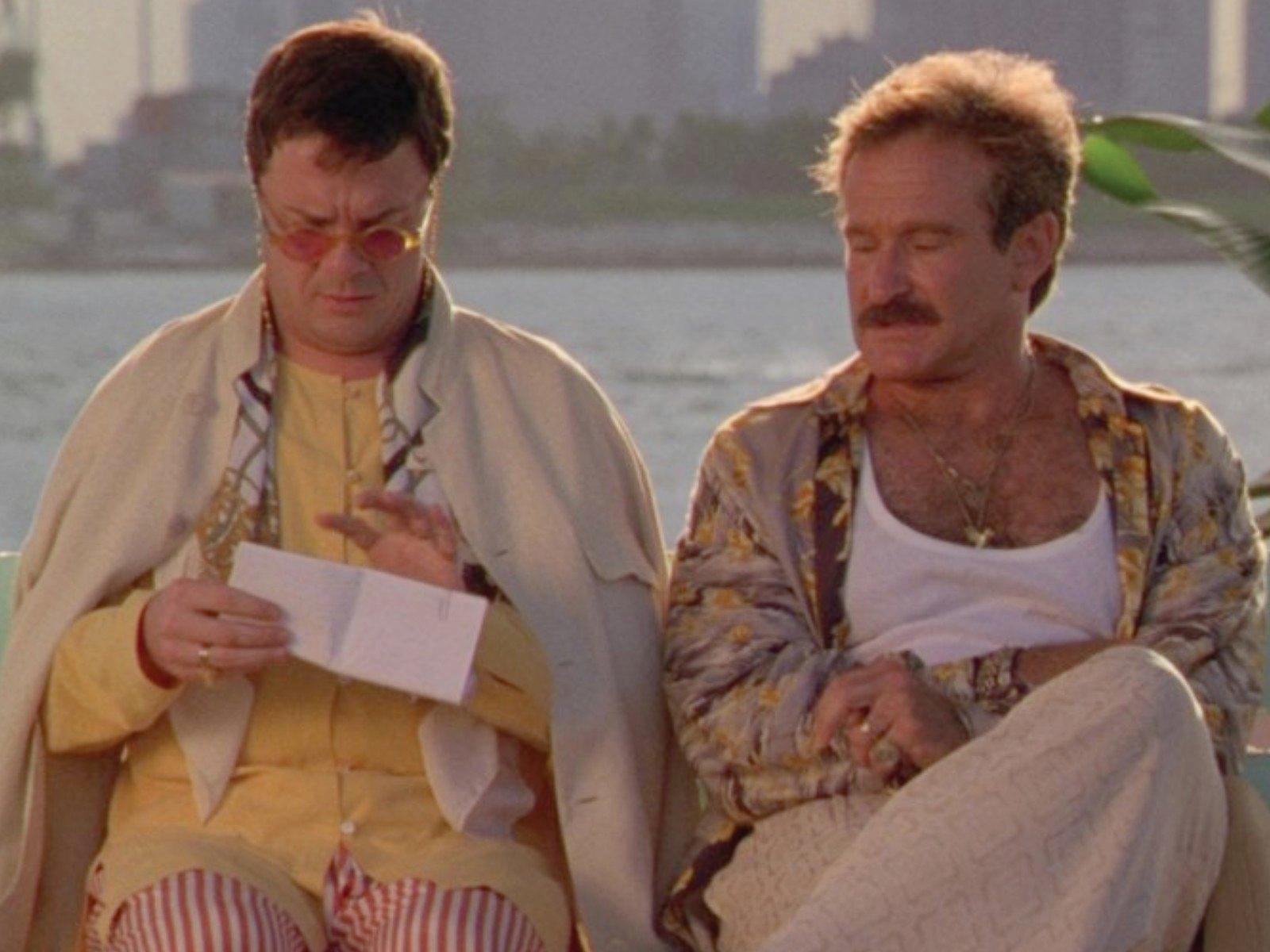
Nathan Lane and Robin Williams
by Frank Gaimari www.FranksFilmReview.com
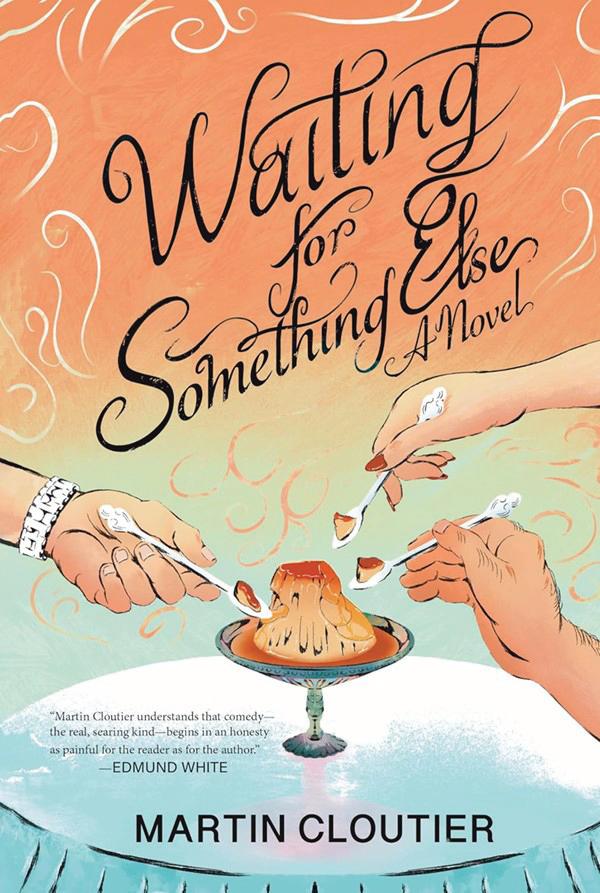
From the moment I opened Waiting for Something Else, I was hooked. Martin Cloutier’s debut novel is equally hilarious, heartfelt, and thoughtprovoking. It’s hard to believe this is his first book, as it reads like the work of a seasoned storyteller. The fact that it is already a finalist for the 2026 Lambda Literary Award for Gay Fiction is a testament to Cloutier’s talent and the novel’s excellence.
The story follows James, a selfdescribed bald, bewildered, and Buddhist restaurant manager trying to find his footing in Brooklyn. Nine months into his job at a gourmet restaurant, James is lonely, dateless, and secretly pining for Sherry, a magnetic but self-absorbed Wiccan. But life takes an unexpected turn when James finds himself drawn to Roger, his Gay coworker and a playwright with a knack
Martin Cloutier Delivers a Debut of Wit and Warmth
What sets this novel apart is its humor. Cloutier doesn’t just sprinkle in jokes — he builds the entire narrative on a foundation of sharp wit and comedic timing. Yet, beneath the laughs lies a deeply introspective story about the fluidity of desire and the human need for connection.
Set against the backdrop of Brooklyn, the novel also explores themes of transformation — both personal and societal. The city’s gentrification mirrors the characters’ journeys as they grapple with shifting identities and desires. Cloutier’s prose is sharp and evocative, painting a vivid picture of a world in flux while keeping the focus squarely on the messy, beautiful humanity of his characters.
This is a novel that doesn’t shy away from the uncomfortable. Cloutier dives headfirst into the awkwardness of relationships, the contradictions of attraction, and the ways we sabotage ourselves in the pursuit of happiness. It’s a story that feels both deeply personal and universally relatable.
exaggerated. For example, Roger spirals after being rejected by James; he goes on an internal rant, musing that the sex was so bad it “should have come with a warning label and protective gloves.” James, thinking lustfully about Sherry, finds his mind returning to the pesky image of Roger’s penis: “He had eaten the forbidden fruit. Drunk the Devil’s nectar. Tasted treif.” That tension, between what characters want to feel and what they actually feel, is where the humor lives and where the introspection sneaks in.
FG: James and Roger’s relationship is complex and unconventional. What do you hope readers take away from their dynamic?
for crafting sharp, sex-fueled comedies. What begins as a drunken confession of unrequited love spirals into a tangled web of attraction, identity, and selfdiscovery. Cloutier masterfully navigates these complexities, creating characters who are flawed, funny, and achingly real.
What sets this novel apart is its humor. Cloutier doesn’t just sprinkle in jokes — he builds the entire narrative on a foundation of sharp wit and comedic timing. Yet, beneath the laughs lies a deeply introspective story about the fluidity of desire and the human need for connection. The characters wrestle with their own expectations and limitations, and Cloutier captures these struggles with a blend of empathy and brutal honesty. James’s awkward sincerity, Roger’s weary charm, and Sherry’s chaotic energy make for a dynamic trio that keeps the story moving in unexpected directions.
Eager to learn more, I reached out to Cloutier to discuss his inspiration and writing process. He generously agreed to an interview, during which he shared insights into the creation of his book.
Frank Gaimari: Humor plays a central role in your storytelling. How do you balance laugh-outloud moments with the deeper, more introspective themes of the novel?
Martin Cloutier: Of course, there must be a balance between the two, but one of my central aims was to write a novel that wasn’t just absurd, mildly amusing, or clever in a David Foster Wallace/ Thomas Pynchon-esque way but to write with a kind of wit that provokes genuine laughter. Humor wasn’t an afterthought but the engine driving the story.
I try to anchor humor in real emotion. I take a character’s anxiety, anger, or desire and push it until it becomes something
MC: Readers will form their own opinions, but I believe relationships are built over time, not magically discovered like some rare Beanie Baby on eBay. There isn’t one “soulmate” who’s going to fit perfectly into your life. Many people could fit, and whether they do depends on how committed both parties are to working on the relationship.
From my own experience with long-term relationships (eight, five, ten, and currently six years), the focus should be on what you have to give rather than what you expect your partner to give you. If what you have to give — emotionally, psychologically, practically — is not what your partner needs, then there’s no basis to sustain the relationship.
With James and Roger: Roger encourages James’s artistic ambitions, giving him practical advice and confidence in his abilities, and by finding him attractive, he also enhances
CLOUTIER - To Page 22
The Unspoken Queer Undertones in Mother Mary
For fans of queer cinema or anyone who craves storytelling that’s as raw as it is visually stunning, this film is an experience worth having. It lingers — not in the background, but right in the heart where it matters most.
by Frank Gaimari www.FranksFilmReview.com
Classified as an art film, Mother Mary, directed by David Lowery, weaves together complex emotions and quiet moments. Like many films in this genre, it relies more on mood, atmosphere, and subtext than on a straightforward plot. Throughout the movie, this approach is especially apparent in how its emotional weight is conveyed through subtle, unspoken queer undertones.
The film follows Mother Mary (Anne Hathaway), a pop icon who’s been out of the spotlight, grappling with a personal and creative crisis. Determined to reclaim her place in the music world, she plans a massive comeback. But as the concert night looms, Mary realizes something is missing. The dress she’s chosen for her debut doesn’t feel right — it doesn’t reflect who she is or the statement she wants to make. This prompts her to reconnect with Sam Anselm (Michaela Coel), her former friend and costume designer.
Their relationship is complicated, to say the least. Years ago, they were inseparable, with Sam shaping Mary’s early image and career. But as Mary’s fame exploded, their bond fractured, leaving behind a mess of unresolved pain and resentment. When Mary shows up at Sam’s secluded countryside home, the reunion is anything but easy. The two are forced to confront their shared history — the betrayals, the misunderstandings, and the love that still lingers beneath them.
What makes this movie so captivating is the undeniable queer energy that runs through it. The film doesn’t tiptoe around the complexities of their relationship — it dives right in. Mary and Sam’s dynamic is messy, passionate, and heartbreakingly
real. It’s a raw portrayal of queer love, with all its beauty and complications laid bare. Their chemistry is electric, and every scene between them feels like it’s crackling with unspoken words and unresolved emotions.
Anne Hathaway is fantastic as Mary, capturing the vulnerability and determination of a woman trying to reclaim her identity. But Michaela Coel is the true standout. I’ve been a fan of hers since The Christophers, and seeing her in this role was such a thrill. Michaela’s performance is magnetic — she’s fierce, emotional, and utterly captivating. Her beauty is jawdropping, and her ability to convey so much with just a glance is remarkable. Together, Hathaway and Coel create a dynamic that’s unforgettable.
Visually, the film is breathtaking. Lowery crafts a world that feels intimate and grand, with the English countryside providing a hauntingly beautiful backdrop. The concert scenes are dazzling, and the cinematography captures every emotional detail, pulling you deeper into the story.
The music is another standout. The original songs feel authentic and emotionally charged, perfectly complementing the film’s themes of love, loss, and reinvention. They add an extra layer of depth to the story, making it feel even more personal and immersive.
Mother Mary isn’t just a film — it’s a bold, emotional journey that challenges you to sit with its complexities. It’s a story that doesn’t give you easy answers but instead invites you to reflect on the messy, beautiful realities of love, identity, and ambition. For fans of queer cinema or anyone who craves storytelling that’s as raw as it is visually stunning, this film is an experience worth having. It lingers — not in the background, but right in the heart where it matters most.
Anne Hathaway / IMDb
Michaela Coel and Anne Hathaway / IMDb
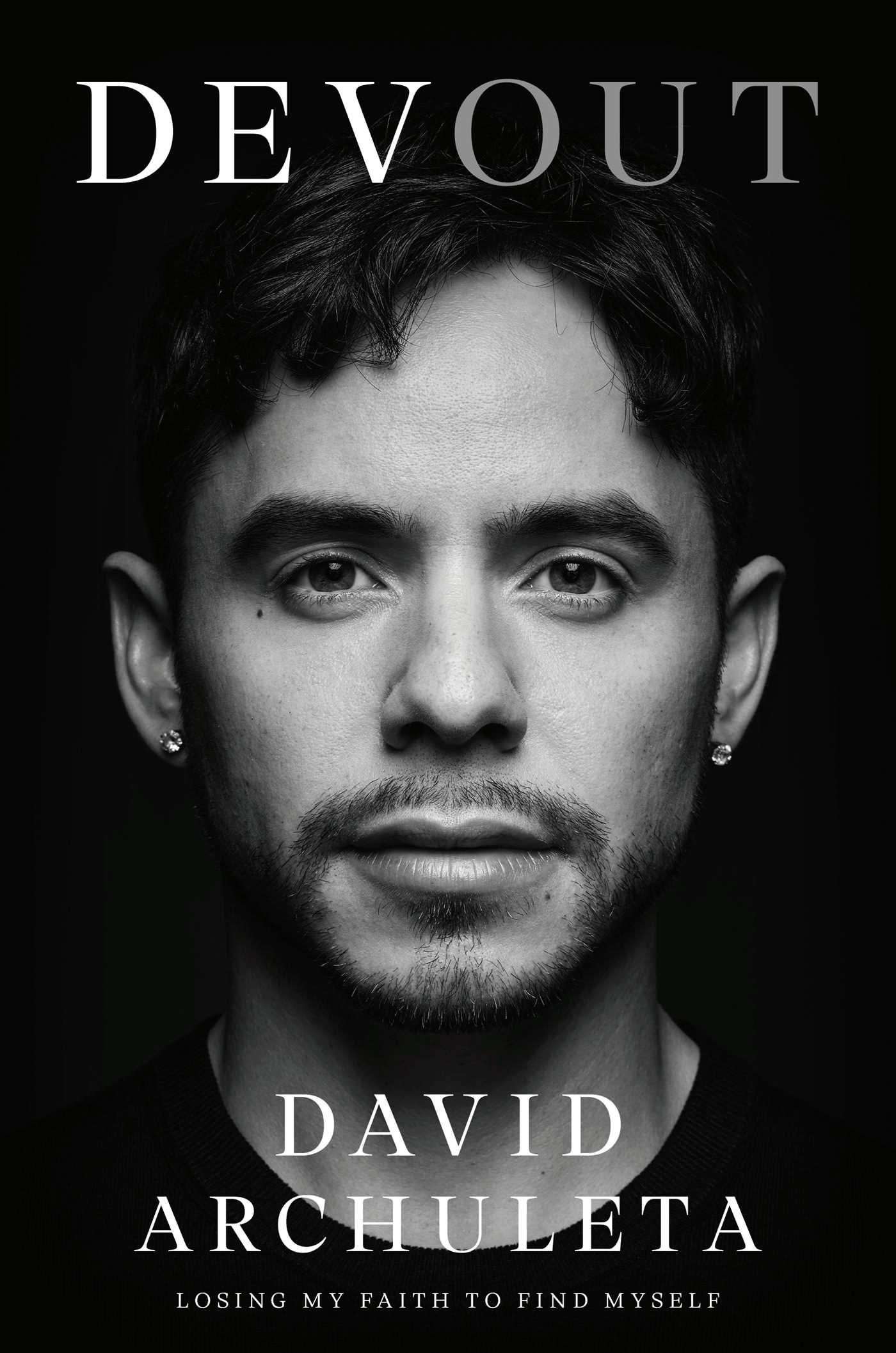
“Devout: Losing My Faith to Find Myself” by
Though it absolutely favors his personal life and dwells on it a bit too much, “Devout” strikes an otherwise nice balance between that, author David Archuleta’s career, his sexuality, and his faith. The latter two are loaded with controversy.
by Terri Schlichenmeyer
So just make up your mind already.
The decision is very much in your control – or, at least that’s how it’s supposed to be. It’ll be your future, your path, and seizing it may not just be necessary, but mandatory. It’s your life, and no one can live it for you. As in the new memoir “Devout” by David Archuleta, that goes for career and for love, too.
Born to parents who both had musical careers before they wed, David Archuleta remembers an early childhood growing up in a Hispanic Mormon community in Florida, where kin was always nearby. He was six when his parents moved the immediate family to Utah; the first thing he remembers about that is the snow, and how it was so cold, it burned.
Because music was in his blood, Archuleta grew up singing and dancing, often with his mother whom he calls “my rock.” It was his father, however, who encouraged him to perform; first, with a gentle push, then a shove toward a career Archuleta didn’t really want.
But he did want to make his father happy, so he went along with the contests, embarrassing meet-and-greets with stars, and uncomfortable introductions. Slowly, though, performing became more fun, and Archuleta made friends.
Meanwhile, back home, everything was breaking apart. A “family friend” whom Archuleta refuses to name accused his father of abuse. He was exonerated, but it affected the family’s closeness and they stopped being affectionate.
That was a painful backdrop to Archuleta’s soaring career, his appearances on Star Search,
friendships with other rising stars, his runner-up spot on American Idol, tours, and recording contracts. His father kept pushing him.
But there was one thing missing.
Since he was a boy, Archuleta had known that he was attracted to men, but his Mormon faith taught him that that was unacceptable. Kissing, his abuelita said, was wrong. He tried hard to date girls, in the most chaste way. Anything past that was against God – and anything at all with a man was unthinkable…
Though it absolutely favors his personal life and dwells on it a bit too much, “Devout” strikes an otherwise nice balance between that, author David Archuleta’s career, his sexuality, and his faith. The latter two are loaded with controversy.
You don’t need to be Mormon to fully understand the faith part; Archuleta offers non-Mormons a brief education, so readers can see the importance of the Church’s teachings in his life and why he felt the need to abandon it as his understanding of his bisexuality grew. It’s emotionally raw and honest, but also so respectful that it almost bears re-reading. Such candor and the heart-on-his-sleeve tone you’ll sense are features in the entire book, alongside Archuleta’s family’s struggles and his learning to strike out alone.
It’s harmonious in more ways than one, and fans will be happy.
So, too, will anyone who wants a unique memoir with a dose of faith, or someone who’s an American Idol watcher. Find “Devout” and be sure to share. You won’t mind.
by David Archuleta | c.2026, Gallery Books | $29.00 | 290 pages
Ian McKellen’s brilliance is on full display in The Christophers
The Christophers is a movie that stays with you. It’s funny, touching, and thought-provoking, with performances that are nothing short of extraordinary.
by Frank Gaimari
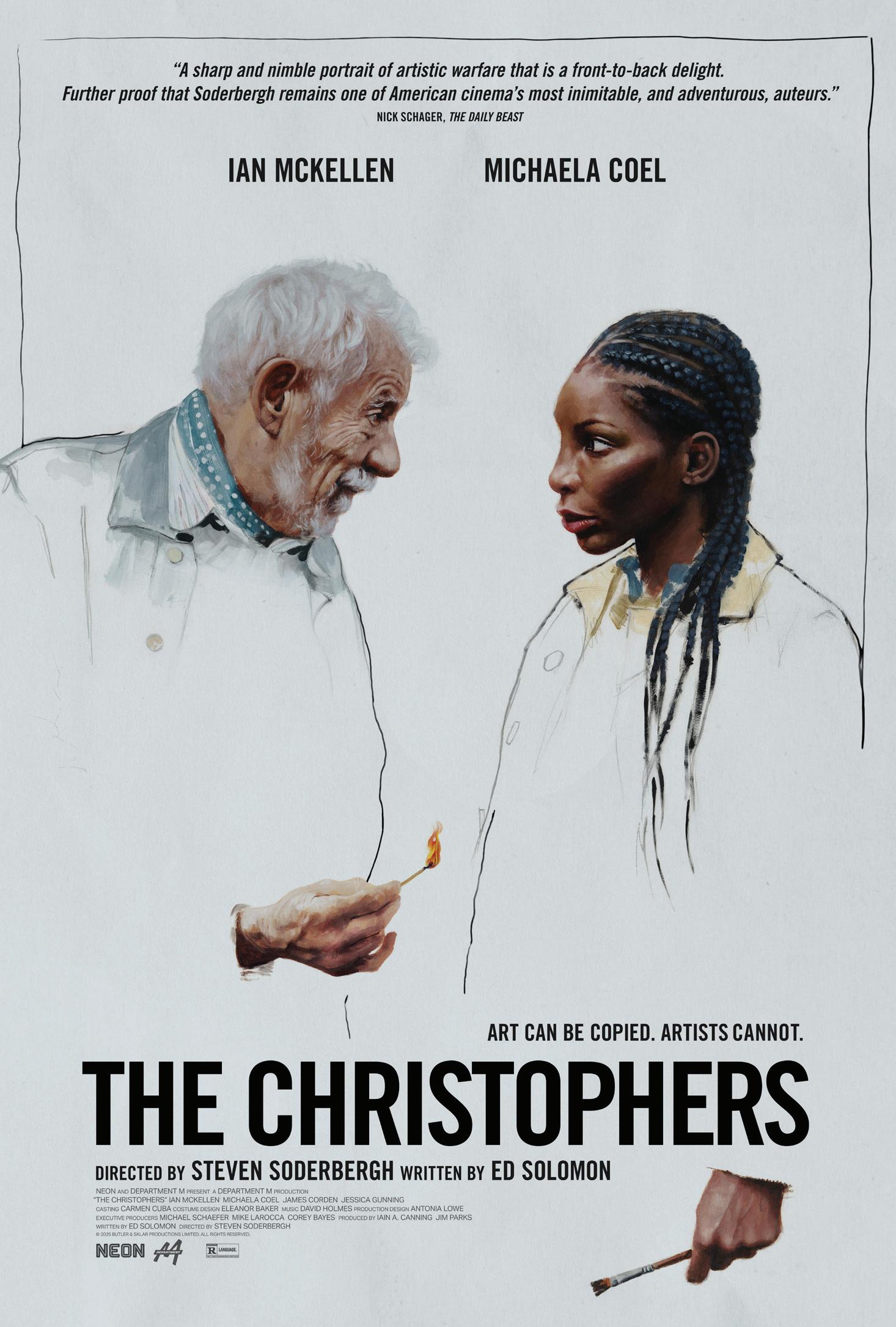
Any film starring Ian McKellen is bound to be good, and The Christophers is no exception. This 2025 comedy-drama, directed by Steven Soderbergh, delivers a perfect blend of humor and heartfelt moments that keep viewers engaged throughout its one-hour-and-40-minute runtime.
The story follows the children of Julian Sklar (McKellen), a once-famous artist whose health is rapidly declining. Desperate to secure an inheritance, they devise a plan to hire a forger to finish their father’s incomplete paintings. However, these aren’t just any unfinished works — they are deeply intimate pieces inspired by Julian’s former male lover, a relationship that profoundly shaped his life and art. What begins as a straightforward scheme soon unravels into a
complex tale of family conflict, buried secrets, and emotional reckonings. While the plot can occasionally feel intricate, its depth and emotional layers keep viewers fully invested in the characters and their journey.
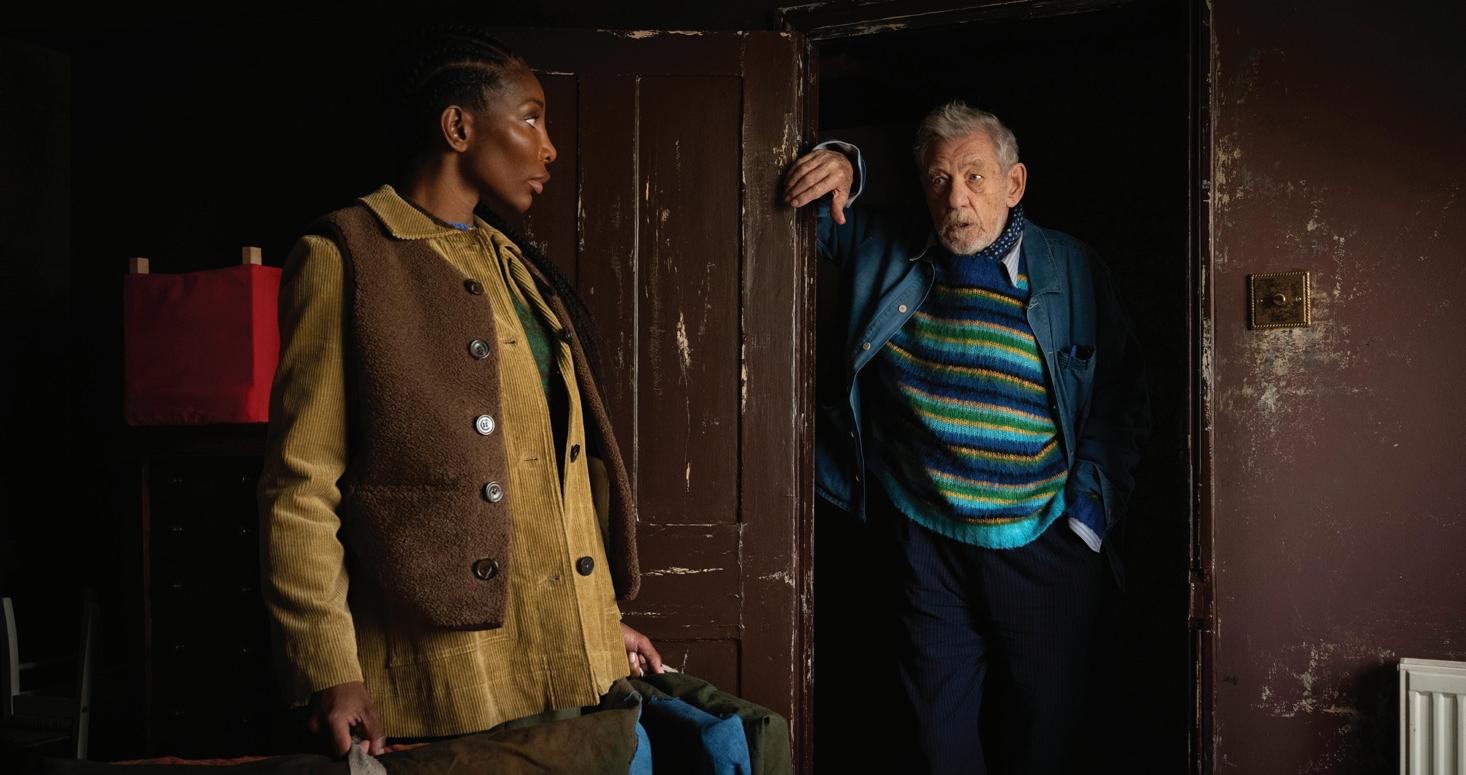
McKellen’s performance is nothing short of brilliant. He brings a mix of strength and vulnerability to the role, capturing the struggles of an aging artist with incredible depth. It’s the kind of performance that deserves an Oscar nomination. Michaela Coel as Lori Butler, an art restorer acting as Julian’s assistant, delivers a strong and compelling performance. She brings a quiet intensity to her role, adding depth and nuance to the story without ever overshadowing it. Her chemistry with McKellen is natural and engaging, and her work here is sure to earn recognition during awards season. The supporting cast, including Jessica Gunning and James
Corden, add just the right amount of humor to balance the story.
Soderbergh’s direction ties everything together seamlessly. His ability to tell a story visually and emotionally shines through in every scene. The film’s sharp and witty script, written by Ed Solomon, complements his style perfectly, creating a story that feels both entertaining and meaningful.
Since its premiere at the Toronto International Film Festival in 2025, The Christophers has been winning over critics and audiences alike. It took home the Stolman
Audience Award for Best Feature at the Sonoma International Film Festival and earned a nomination for the Knight Marimbas Award at the Miami Film Festival. With its standout performances and thoughtful storytelling, it’s no surprise the film is already gaining recognition.
The Christophers is a movie that stays with you. It’s funny, touching, and thought-provoking, with performances that are nothing short of extraordinary. McKellen and Coel shine under Soderbergh’s expert direction, making this film a must-watch. Don’t miss it.
Michaela Coel and Ian McKellen
Join us for Pride, advertise in Stonewall.
Download the Media Kit & Pride Visibility Packages at: stonewallnews.net, click the Advertising tab
Reaching LGBTQ+ communities across the Pacific Northwest NEWS NORTHWEST
OUR AUDIENCE
With over $1.7 trillion in spending power, at both the B2B and B2C levels, LGBTQ Americans cement themselves as the 10th largest economy in the world.* Let’s add some perspective to that statement: this makes the LGBTQ American economy bigger than those of Australia, Canada, and South Korea combined!
Future-forward marketers recognize that is it not only the smart choice to start investing in this large consumer market but one that, with the right positioning, ensures a loyal customer base for their brand for years to come.
The LGBTQ community isn’t the only buying group paying attention to inclusive advertising. Millennials represent $2.45 trillion in spending power and are 60% more likely to engage with brands that discuss social causes.
Let us help you reach this demographic and spending power.
*National LGBT Media Association
WHO WE ARE
Founded in 1992, Stonewall News Northwest was relaunched in 2025 through its website, www.stonewallnews.net. In 2026, Stonewall News Northwest also debuted Stonewall Directory & Events at www. stonewalldirectory.net. This online platform elevates the visibility of queer and allied businesses, organizations, and professionals.
Today, we bring our readers news, information, profiles, and entertainment from in-house writers and collaborative relationships.
We reach LGBTQ+ communities across the Pacific Northwest, from western Montana and Idaho to Washington and Oregon with multiplatform visibility through online content, email subscribers, social media, PDF and print distribution, and our queer and allied business directory.
READERSHIP
•
43,500 monthly
CIRCULATION
16,000 monthly website page views
7,500 email subscribers
5,000 print copies per issue with 2.5x reader passaround (beginning June 2026)
DEMOGRAPHICS
LGBTQ+ and allied communities in the Pacific Northwest from western Montana, and Idaho, through Washington and Oregon.
DISTRIBUTION LOCATIONS
LGBTQ+ and allied businesses and organizations
Public libraries
Community centers
Pride events
EDITORIAL COVERAGE
•
Pacific Northwest local and regional LGBTQ+ news
National and international LGBTQ+ news
Opinion and commentaries
Transgender coverage
•
•
•
Religion and politics
Book and film reviews
Profiles and features
Arts and entertainment
Exclusive columnists
April Gilbreath
Advertising Account Executive
advertising@stonewallnews.org 509-541-5615
Stonewall News Northwest PO Box 871112
Vancouver, WA 98687
www.stonewallnews.net www.stonewalldirectory.net
VANCOUVER, WA - Continued
STOBER - From Page 4
my sexuality. Accepting myself was an essential first step toward building the life and career I had always envisioned.
Once I embraced my authentic self, I moved forward with purpose. In 2005, I attended Victory Institute training, joined the board of Equal Rights Washington, and worked on the Measure 71 domestic partnership campaign. Later, as chair of the organization, I led efforts during the Measure 74 marriage-equality campaign. By the time I ran for Vancouver City Council in 2013, seeking elected office felt like a natural next step — a culmination of the journey I’d been preparing for all along.
FG: Can you share a moment during your time with the Vancouver City Council that you’re particularly proud of?
TS: The moment I’m proudest of in my public service came during the pandemic, when our Council formally adopted equity, safety, and climate action as our core governing principles. While that decision might seem like a small policy detail to some, for me, it was the result of years of dedication and advocacy.
From my very first day on Council, I believed that these three areas should be at the heart of everything we do. For quite some time, however, I struggled to build a majority consensus around that vision. Then, in 2020, the world changed. The George Floyd protests, catastrophic wildfires that left Vancouver with some of the worst air quality in the world, and a spike in dangerous driving all converged at once. Suddenly, these crises underscored the urgency of the issues I had been raising, and my colleagues became open in ways that years of conversation hadn’t achieved.
What makes me just as proud as that initial breakthrough is what came afterward: we’ve remained committed to these principles, even as the national conversation has grown more polarized and hostile toward equity. Standing firm in our values — especially when it isn’t easy — is, in my view, what truly matters in leadership.
FG: How has your personal journey as a member of the
“More
than anything, my personal life has given me a real understanding of what it means to need your government to truly see you — and how powerful it is when that finally happens. That perspective guides my public service every day.”
LGBTQ+ community influenced your leadership style?
TS: When you spend years hiding something fundamental about who you are, you develop a deep understanding of what it feels like to be unseen. You become acutely aware of what it’s like to navigate systems that weren’t designed with you in mind, and to wonder whether you’ll be accepted if people really know your story. That feeling never truly leaves you. For me, it’s become the lens through which I approach leadership.
I think about constituents who walk into a government office, uncertain whether they’ll be treated with dignity. I think about the employee who isn’t sure if their workplace is a safe place to be themselves. I think about the voter who’s made to feel like their participation is an obstacle rather than a right. That attentiveness — the instinct to ask who is not being seen, whose experience isn’t being considered — comes directly from my own journey.
Chairing Equal Rights Washington during the marriage equality campaign deepened this perspective even further. We were asking the public to vote on whether love like mine deserved legal recognition. You gain a particular understanding of what’s at stake when your own life is on the ballot. That experience made me a more careful listener, and I hope, a more thoughtful leader.
FG: What do you see as the most pressing challenge facing the Clark County Auditor’s office, and how would you address it?
TS: The Auditor’s Office is responsible for administering voter registration and elections in Clark County. This is not just an abstract civic duty — it is the foundation of our democracy, the process through which every individual exercises rights that generations have fought, marched, and even sacrificed their lives to secure. Safeguarding that process and ensuring that every
eligible voter can participate with confidence is a responsibility I hold with the utmost seriousness.
In October 2024, one of our county’s ballot drop boxes was targeted for tampering. Thanks to the professionalism and swift action of our election staff, nearly all affected ballots were recovered. That outcome was no accident — it was the result of highly trained, dedicated people doing their job under immense pressure. As Auditor, my role would be to support and strengthen that team, ensure our systems are secure and resilient, and serve as a steady, trustworthy voice for the integrity of our elections — especially at a time when others are working to undermine public confidence.
Who serves in the offices that administer our elections matters. It sends a powerful message about who our democracy is for, and I believe representation in these roles is vital to the health of our community and our democratic process.
FG: What hobbies or activities do you enjoy that help you unwind and stay grounded?
TS: First, my husband and I love to travel whenever we have the chance. Stepping outside of the familiar always broadens my perspective and helps me see things in new ways. I also spend time mentoring others — which some might not consider a way to unwind, but I find it deeply rewarding and grounding. It reminds me of the people who invested in my journey, and I feel a real sense of purpose in supporting someone else’s path.
And honestly, time with close friends is essential for me — the kind of time where you don’t have to be “on” or perform, but can simply be yourself and enjoy each other’s company.
What connects all these activities is that they require me to be present and fully engaged. In that way, they’re not so different
from what good public service demands: showing up, paying attention, and being genuinely invested in the moment.
FG: How do you and your husband stay connected to the community, and what role does your personal life play in shaping your public service?
TS: On June 20th, Lamar and I will celebrate 23 years together and 13 years of marriage. Our relationship has grown alongside the evolving legal recognition of relationships like ours. For the first five years we were together, we had no legal status at all. Then, Washington voters stood up to defend the Domestic Partnership law at the ballot box. Five years later, they defended the right to marry. We’ve now been legally married for thirteen of our twentythree years together — and it was elections that made that possible.
That isn’t an abstract concept for me; it’s my lived experience. It’s a big part of why I care so deeply about protecting the integrity of elections and ensuring every eligible voter has the chance to participate. The Auditor’s Office oversees that process in Clark County, and I take that responsibility very seriously.
Lamar is a private person — he’s not one to knock on doors or give speeches — but he’s always there for the moments that matter most. His steady support is something I depend on, even if I don’t always say it out loud.
More than anything, my personal life has given me a real understanding of what it means to need your government to truly see you — and how powerful it is when that finally happens. That perspective guides my public service every day.
FG: What message would you like to share with voters about why this election matters and what you hope to achieve as Auditor?
STOBER - To Next Page
STOBER - From Previous Page
TS: The Auditor’s Office handles work that most people never think about — and that’s exactly how it should be. When elections run smoothly, county employees are paid accurately and on time, public records are preserved, licenses are issued, and funds are tracked and reconciled; these systems become almost invisible. But when something goes wrong,
MAGA - From Page 6
because he doesn’t view being gay as the most important part of his identity: “The most important part of who I am is as a father.”
Duncan is not alone: A 2020 report from the UCLA Williams Institute School of Law found that Republican lesbian, gay and bisexual people are more likely to feel connected to other parts of their identities than their sexual orientations.
Evan doesn’t identify with the community at large and does not like to be referred to as “LGBTQ” or “queer.”
“I realized I’m normal. I’m not LGBTQ,” he says. “I’m just gay.” Evan’s desire to be seen as “normal” rings of Vice President JD Vance’s 2024 comments on Joe Rogan’s podcast, where he said Trump could win the “normal gay” vote. During this same interview, Vance suggested that parents of genderqueer children use their children’s identities as a rejection of having white privilege. Vance received significant backlash for these comments, with the Human Rights Campaign responding to the vice president’s remarks over X.
Some Gay Republicans See the GOP as More Friendly
For Chris Doane, 56, voting Republican is the only choice that makes sense, as he believes voting for a Democrat goes directly against his interests as a queer man. “Conservatives don’t want to murder gays. They want them saved,” he says. “Muslims vote Democrat, because if the Democrats win, they get to stay [in the U.S.], they get to take power, and they will murder gays brutally with a smile on their face,” says Doane.
Continued - VANCOUVER, WA
people notice immediately.
I’m running because I believe this office deserves a leader with a track record of building and managing the kinds of systems, teams, and financial operations that keep everything running seamlessly behind the scenes. I also believe that representation matters — in every office, at every level, including those that don’t often make the headlines.
For LGBTQ+ voters especially, representation in government is significant. We have fought hard for the right to be counted, and I want to be the person who ensures that counting is done right.
Ty Stober’s campaign is more than just a run for office — it’s a reflection of his deep belief in the impact that effective, ethical governance can have on people’s lives. As election day approaches, voters have a chance to explore
Ty’s vision for Clark County and the core values that guide his leadership. With a strong combination of professional experience, community involvement, and a genuine commitment to public service, Ty Stober is prepared to lead Clark County toward a future defined by transparency, accountability, and trust.
To learn more about Ty and his campaign, visit https://votety.com/
Doane’s comments are unfounded and display racist stereotypes peddled by far-right American media: One study from the Brennan Center for Justice compiled data from 1984 to 2020 and found that racial resentment is more prevalent on the right than on the left.
Doane was raised in a conservative family in Bryan, Texas, and isn’t out to his family because he fears that they won’t accept him. For him, voting Republican is part of his heritage. “I was told, ‘Don’t ever let Democrats in control. They’ll ruin our country,’” he says. “That’s pretty much what they did, and that’s why President Trump is working overtime to straighten it all back out.”
Trans Rights and Gay Republican Men
Though Doane and other gay Republicans hold a range of views, a common thread is a hesitancy around trans rights. So, they align more with the Trump administration, which has railed against the trans community with Trump’s policies and rhetoric.
For example, Doane sees being able to transition as a matter of personal freedom but thinks gender-affirming care for trans kids is a step too far.
“When it comes to transgender, I have nothing against that. I just believe that when you make that transition, it should be at a point where your brain is fully developed … and you’re actually going to enjoy that transition,” he says.
He also holds the view that for a trans person to be accepted as their correct gender, they must fully physically transition.
“If you’re gonna transgender, transgender all the way. If you’ve still got male parts on you, you don’t belong in the women’s dress room.” However, research suggests otherwise, with a 2025 study indicating that policing bathroom access can lead to mental distress in trans youth.
Duncan has his own doubts.
“I disagree with the integration of gender ideology and radical wokeism into the LGBT community. You are free to live under any delusion you so desire. You’re not free to require me to live under your delusion as well,” he says. “But if somebody wants to live as a man or a woman, however it is, I firmly believe they have the right to do that. I would never get in the way of it.”
Duncan also believes that education about LGBTQ people should be limited in schools. He sees adolescence as a fundamentally confusing time, and believes an education about LGBTQ communities would “add on layers of confusion.” This belief seems to be in line with Gov. Ron DeSantis’ 2022 “Don’t Say Gay” bill, which has banned education on gender identity and sexual orientation in Florida’s classrooms from pre-kindergarten until the end of eighth grade, though there are exceptions for health lessons.
“It’s okay to tell kids that some boys like boys, some girls like girls, some people like both. But it just needs to be kept vague and general,” Duncan says. “However you are is okay. We don’t need to expose children to gay media because if you’re gay, you’re going to know.”
Duncan does not believe heteronormative bias in mainstream media is a problem,
though a study published in Equity & Excellence in Education found heteronormative biases in schools may harm queer students. “The vast majority of people are heterosexual, and a functioning society is built on a heteronormative bias,” he says. “It is important to understand that we are the extreme minority and society is not responsible for conforming to us.”
They Approve of Trump and Don’t See Him as a Threat
While LGBTQ Americans see the Republican party as unfriendly towards queer people, Duncan and Doane aren’t worried about being stripped of their rights. Duncan says the 2015 passage of gay marriage solidified his equal rights. “We have marriage as gay men. I have every right that a straight man does,” he says.
Doane also feels that his rights are secure under Trump 2.0 and approves of the president so far. “I voted for that great, big, beautiful wall because we were being overrun by illegals,” he says. Doane also approves of U.S. interventions in Iran and Venezuela, though he criticizes Trump for “leaving [Venezuela] way too soon.”
Similarly, Duncan is generally approving of Trump’s handling of immigration. “I don’t love what we’re doing as far as deportations, but we had to get some control over the illegal population,” says Duncan. “I wish there was another way, but I can’t think of it.”
Duncan and Doane are certainly in the minority as queer men who approve of Trump, but as far as they’re concerned, Trump is delivering on his promises. “Overall, I’m happy,” says Duncan. “I’m getting pretty much exactly what I voted for.”
BOOKS - Continued
CLOUTIER - From Page 14
James’s poor self-image. James gives Roger the stability and devotion he craves while also, by comparison, boosting his creative ego and vanity about his appearance.
FG: You’ve mentioned that your characters are deeply flawed and sometimes unlikable. Why do you think it’s important to portray such raw and honest depictions of humanity?
MC: I find likable characters inherently dishonest. There’s a convention writers use to help readers identify with a protagonist. Most people like to think of themselves as decent, kind, and self-aware. So, a likable protagonist becomes a surreptitious way to flatter the reader: look at this nice character, she’s just like you. It’s a comfort and makes readers feel safe.
But fiction shouldn’t be a mirror that reassures us. It should be a place where we confront what we don’t like in ourselves, where failure, delusion, selfishness, and moral uncertainty can be explored. Some of the greatest literary novels do this using unlikable characters. Wuthering Heights shows how revenge corrodes a life. Madame Bovary exposes the damage of selfishness and delusion. Crime and Punishment dismantles moral certainty. Sabbath’s Theater shows the pitfalls of desire and mortality. These books, and many others, don’t require their protagonists to be likable or even moral to be readable.
Currently, there’s a demand that protagonists be upstanding citizens, or at least be legible as “good” people. The result is a sameness of story, depicting characters as underdogs oppressed by external events — death, trauma, addiction, bigotry, illness — rather than agents of their own bad decisions. When fiction narrows in this way, we lose the full spectrum of human behavior, especially the transgressive imagination. For me, the moment when a character stops being good is usually when they start being interesting.
FG: The title, Waiting for Something Else, seems to encapsulate the characters’ struggles with longing and inaction. How did you settle on this title, and what does it mean
to you?
MC: The characters are waiters, both professionally and psychologically. Like many of us, they’ve come to New York thinking that, once here, good things will just magically transpire. James moves from Michigan, wanting a girlfriend or even a friend who understands his artistic ambitions, but he’s doing nothing to make it happen. Roger, originally from Philadelphia, wants a long-term relationship but continually sleeps with men who seek the opposite. And Sherry comes from Iowa with a half-formed dream of finding a partner and launching a makeup line, but she wastes her energy on narcissists who don’t appreciate her.
I spent fifteen years in restaurants with people like this — I was like this myself — so I know the delusion is real. In New York, you’re always one party, one audition, one meet-cute away from changing your life. And sometimes, that’s just enough to keep you waiting.
FG: The novel delves into the idea of “types” in attraction. Do you believe people can truly break free from their ingrained preferences, as some of your characters attempt to do?
MC: When I started writing the novel, back in the depths of 2006, I believed we all had types that couldn’t be changed. My last two partners were men over 6 feet, 2 inches, and after these giants, I thought I could never be attracted to a guy my height (5 foot, 10 inches) or shorter. I spent my 40s dating in New York, searching for that Holy Grail. But the percentage of tall, Gay men living in my vicinity who were emotionally open, relatively sane, and interested in me was so small that I felt like I was on a quest. Gradually, after years of dating some lofty losers, I found a guy my height who rocked my world. And then I found another … and so on, and so on.
Turns out, types aren’t fixed — they’re habits. And habits can change. Plus, you really do have better sex with shorter guys — there are so many more positions.
FG: What was the most challenging part of writing this novel, and how did you overcome it?
MC: In a word, the most difficult thing was rejection, and I’m not sure I overcame it; I just persevered. I’ve been working on this book for almost 20 years. The first story I ever published was in 2006, and it was about these characters. When I tried to turn it into a novel, I realized I didn’t know how novels worked, so I got an MFA and workshopped it. After graduating, I found an agent who tried her best but couldn’t sell it. In truth, the writing was still unfinished. I put it aside, wrote another novel, and found another agent. She couldn’t sell that novel, and when I gave her Waiting for Something Else, she said, “What’s the point of all the sex?” — a question people still ask to this day.
Years later, a third agent spent nine months revising with me and then insisted I change the title to The Brooklyntagonists or “something with Brooklyn in the title.” When I refused, she dropped me, as though she had a dozen other Brooklyn titles to sell and no time for my nonsense. So, a couple more years elapsed while I finished the 11th draft, and the book finally took its rightful shape. I then queried 335 agents, all of whom passed, and sent it to 20 small presses, who also passed. I finally found Heliotrope Books, which agreed to publish it in 2025.
It was a long journey — first to learn how to structure a novel, and then to find a publisher. And really, the only thing that kept me going was that I didn’t have any other forms of validation: no
high-paying job, no partner, no family, and approximately 1.5 friends. Writing wasn’t so much a dream as a hostage situation. And I understand why people give it up: there are easier ways to find fulfillment. But I had no other options.
FG: If you could spend a day with one of the characters from the novel, who would it be and what would you want to learn from them?
MC: All my characters are part of me, so technically, I spend every day with them. However, the character I’d most enjoy spending time with is Sherry. I know she’s the potential villain of the story, but that’s more a matter of structure than character. We could talk about how to manipulate men or trash our respective boyfriends. I’m sure we’d have a lot of fun. And I’m sure she’d fall in love with me.
Waiting for Something Else is more than just a debut — it’s a statement. It’s a book that will make you laugh out loud, think deeply, and maybe even see the world a little differently. If this is what Martin Cloutier can do with his first novel, I can’t wait to see what he has in store for us next. Do yourself a favor and pick up this book on Amazon — you’ll be glad you did.
To learn more about the author and his work, visit Martin Cloutier’s official website at https://www.martincloutier.net/.
Martin Cloutier
OREGON - From Page 11
one-third of cases. The federal appeals court, however, did not strike down anti-discrimination protections for LGBTQ+ youth or a Biden administration rule establishing LGBTQ-friendly care providers without mandating participation. The court and free speech advocates have suggested Oregon could take a less prescriptive approach to protecting vulnerable foster youth.
Jake Sunderland, a spokesperson for the state human services department, said that Oregon’s affirmation policy will be changing but wasn’t able to provide details by Wednesday afternoon. He said the agency still considers Bates’ case as ongoing litigation and confirmed that Oregon never responded to the letter from Gradison.
“ODHS also is reviewing its rules and policies for resource parents and prospective adoptive parents,
continuing its commitment to ensuring that all children and young people in foster care, including those who are LGBTQIA2S+, have access to a safe and supportive environment provided by loving caregivers that are responsive to their individual needs,” Sunderland told the Capital Chronicle in September.
Few enforcement details as federal effort expands
Oregon in 2018 adopted a rule mandating prospective foster parents to respect, accept and support their child’s sexual orientation, gender identity, gender expression and spiritual beliefs, next to a list of other protected categories. It came amid concern that the child welfare system was not ensuring that foster families respected youths’ identities.
Asked for an update on its inquiry, the federal spokesperson pointed to the state of Massachusetts, which changed its policy from
requiring support and respect for a child’s gender identity or sexual orientation to “individual identity and needs.” One Christian couple at the center of a legal challenge to Massachusetts’ policy, however, continues to maintain that they are subject to unfair barriers to becoming foster parents.
The spokesperson also noted that they had sent similar letters to several other states last year, including California, Washington, Rhode Island, Illinois, Minnesota, Maine and New Mexico. They said the agency has been seeking responses that suggest states will protect religious beliefs and “strongly held convictions” that are voiced “in any circumstance during the foster care licensure and placement process.”
“The letters are intended to have states review their policies from the lens that families of faith could be hypothetically hesitant to become licensed foster parents due to not having their religious beliefs protected,” the spokesperson said.
Mikki Gillette, a major gifts officer with Basic Rights Oregon, the state’s largest LGBTQ+ advocacy group, praised Oregon’s handling of the federal inquiry. She recalled her own experience seeing how a trans teenager at a queer youth center she worked at “blossomed like a flower” when he was taken in by a family who helped him access genderaffirming care.
“There’s the parents’ religious beliefs, but then there’s also the kind of mental and emotional welfare of the kids,” she told the Capital Chronicle. “I think if you’re talking about child welfare, then that would be the one that should be weighed most heavily.”
The Arizona-based Alliance Defending Freedom, a conservative Christian legal advocacy group that represented Bates, did not immediately respond to a request for comment on Wednesday.
Illustration by Ken Min
WENATCHEE, WA - Continued
BANNER - From Page 3
post, which asked community members to sponsor a banner. “Wenatchee will fly a different kind of pride banner this June!”
Diaz tried to appeal the city’s decision but was told it was set in stone. The Turning Point banners would go up in June.
“I was feeling so much frustration because I tried to do my work correctly and on time,” he said.
Diaz said locals throughout Wenatchee have been sympathetic towards him.
“Community members and some organizations have been showing support,” he said. “Many businesses in downtown Wenatchee have been asking me to borrow the actual banners to display them in their businesses.”
Diaz said he would apply again next year but ruled out applying to hang banners in other months.
“The celebration of our Pride is in June, not in any other month,” he said. “Moving forward to apply for another month, for me would be kind of disrespectful for folks. Including myself, because I’m gay and I live here with my husband, I don’t think that is a good idea.”
The pride banners have gone up around the city for the last six years.
Members of the community came to the Wenatchee city council meeting last week to share their grievances with the new banners.
“The city’s decision to replace the rainbow banners in the way that they have is a disgrace,” said Amanda Appel of Wenatchee. “It’s not too late to fix it.”
Suellen Harris, an East Wenatchee resident and member of Grace Lutheran Church said the new banners do not represent Wenatchee as a whole.
“First come, first serve is a poor basis for a decision when it overlooks an application in process,” Harris said. “Choosing to hang banners that express the narrow bias of one local church over broader, more inclusive pride banners certainly does not represent the values of our diverse community”
New city permitting process
In previous years, banner applications had not been regulated so tightly by the city, said Edgar Reinfeld, Wenatchee police chief and interim city administrator.
In October, the city decided to update the application.
“For several years, we didn’t really have any process in place,” said Reinfeld.
Under the new rules, only not-forprofit groups could fly banners, and the banners cannot endorse a company or political candidate. Applications are not considered complete unless they have artwork attached.
“The fairest thing that we could come up with was first come, first serve,” Reinfeld said.
Reinfeld pointed to the annual Apple Blossom festival whose governing organization hangs banners throughout the city. He said the organization initially did not submit artwork with an application, but after prodding from the city, they quickly replied.
“We made them go through the entire process, very much like what we did with everybody else who has applied or is going to apply,” he said.
Diaz said he reached back out to the city and he still has not gotten a response back. He said this makes him think the city does not want to help.
“We are still waiting for these folks to explain to us what happened, but after five days, they haven’t said anything,” Diaz said. “Which reaffirmed my suspicion is not incorrect. They did this on purpose.”
Pride flag removals have emerged across the nation
This marks another controversy related to the removal of pride flags that has swept the nation in recent years.
The city of East Wenatchee banned banners, including pride banners, not on a pre-approved list.
In response, OUT NCW, another Wenatchee-based LGBTQ group, announced a year-round billboard
would be installed in a busy part of the city. The group did not specify where due to fears about vandalism.
Over in Boise, Idaho, the city governments are no longer allowed to fly pride flags after a bill was passed in the state legislature establishing restrictions on non-government flags.
In September, Boston University faculty in the school’s Women’s, Gender, and Sexuality Studies
Program and staff at the University’s Children’s Center were told they could no longer fly pride flags hanging in their offices. The policy was “temporarily pausing” as of early April after faculty and student outcry.
It has hit larger cities such as New York, who just re-installed pride flags at the Stonewall National Monument after the Trump administration had ordered the removal of the flag in February.
Joint Press Release from OUT North Central Washington, Wenatchee Pride, and NCW Equity Alliance:
Letter from Wenatchee resident to Wenatchee City Council and Mayor:
NATIONAL & INTERNATIONAL - Continued
LGBTQ - From Page 7
governments from funding or promoting DEI initiatives. While Pride is not explicitly banned, organizers warn the impact will be felt in permit support, city cosponsorships, and public health partnerships. Equality Florida secured carve-outs protecting the Pulse Memorial and basic permitting rights, but calls the broader message “troubling.” At a press conference, DeSantis said white men were “the disfavored group” harmed by DEI. Read more in PinkNews
FCC Opens Inquiry to Flag LGBTQ+ TV Content
FCC Chairman Brendan Carr announced a public inquiry into whether television ratings should be modified to specifically flag LGBTQ+ content. GLAAD noted that 23% of Americans under 30 identify as LGBTQ+ and that “more than 5 million children have LGBTQ+ parents,” calling the move government overreach designed to “reshape culture, limit storytelling, and undermine free expression.“ See in GLAAD
Colorado Signs Trans Youth Privacy Law
Colorado Governor Jared Polis signed Senate Bill 18, requiring courts to seal name-change records for minors. The law takes effect July 1. The bill’s broader version, which would have required family courts to consider parental acceptance of gender identity in custody disputes, was stripped before passage following pushback. Read more in The Advocate
Queering the Boardroom
Boardroom Battles at Colgate
A shareholder vote at ColgatePalmolive is challenging whether diversity should factor into board appointments—a fight the company itself is pushing back on. It’s a reminder of why having LGBTQ+ voices in the Boardroom (Colgate has a prominent lesbian board member) isn’t just symbolic, but essential.
Calling LGBTQ+ Leaders to the Boardroom Spotlight
The National Association of Corporate Directors (NACD) is accepting nominations for its Directorship 100, while
the International Corporate Governance Network (ICGN) is inviting submissions for its global Achievement Awards. The deadlines are June 30 and June 19, respectively. If we want more LGBTQ+ voices in boardrooms, visibility matters—and so do nominations.
It’s (Still) Membership Renewal Season for LGBTQ+ Directors
PRISM: The Association of LGBTQ+ Corporate Directors fosters connection, representation, and collective influence at the top of business. Consider joining or renewing here, or donating to the Association.
May 13th Webinar with Cooley
On May 13 at 3 p.m. EST, PRISM will host a webinar with Cooley on fiduciary duties and shifting trends in incorporation.
The Gay Business
Grindr’s Washington Gamble
Grindr’s move to host a WHCD party — featuring oysters, truffle ice cream, and an ice sculpture branded with its mask logo — got lots of attention, which I guess was the goal. The company has spent $1.6 million on lobbying since establishing its government affairs operation, framing its DC presence around issues including HIV funding, online safety, and privacy. But the optics of cozying up to an administration drew pointed criticism this week. The Human Rights Campaign ran a geofenced Grindr ad throughout the weekend, targeting WHCD attendees with HIV-prevention messaging. Read the full analysis in HomoCulture and The Advocate.
Sniffies, Sniffing Profits
Match Group’s $100 million bet on Sniffies isn’t just another dating app play—it’s a signal that LGBTQ+ users, long underestimated, are now firmly on the radar as a lucrative market. But as business starts circling— yes, sniffing—around queer spaces, so do concerns about “straightification,” data extraction, and the erosion of platforms built by and for the community. The real question isn’t whether a queer business boom is coming—it is— but whether LGBTQ+ people will shape it, or simply be monetized by it. See in the LA Times
Semi-Cultural Desk
Big Mistakes on Netflix
Netflix’s Big Mistakes gives us Dan Levy as Nicky, a gay pastor whose church will accept his sexuality only as long as it stays mostly theoretical, even as he secretly sleeps with the handyman and runs mob errands with his sister. In Episode 6, there is an LGBTQ+ charity scam, which feels very au courant, as we say in my country. I am on the fence, even though I have always been loved by closeted clergy.
A Gay Founding Father, Funded (Surprisingly) by Washington
The Florida Stonewall LGBTQ+ museum secured federal funding to spotlight Baron von Steuben—a likely gay Revolutionary War hero—reminding us that queer history is American history, whether policymakers like it or not. The $25,000 grant will support an exhibition about the Prussian officer who helped transform Washington’s ragtag army into a fighting force.
Elliot Page’s Documentary on Queerness in the Animal Kingdom
Elliot Page is narrating and coproducing Second Nature, a new documentary directed by Drew Denny that challenges the idea that queerness is “unnatural” by mapping same-sex behavior and gender diversity across species. See in PinkNews
Harvey Fierstein on Recovery, Quilting, and Taking Aim at Trump
The Guardian ran a wide-ranging profile of Harvey Fierstein — a five-time Tony winner, openly gay drag performer, and now fulltime quilter — at 73. Fierstein drew direct parallels between the AIDS era and the current political moment, discussed 29 years of sobriety, his complicated relationship with fame, and why he holds back from attacking Trump at awards ceremonies “out of respect for the evening.” See it in The Guardian.
Tom Daley and King Charles
This little exchange on the benefits of knitting (at the British Embassy, not the WH, thank God, they would probably have gotten gay-bashed) was adorably gay.
Queer Eye Still In The News
Van Ness is now taking the story on the road with their stand-up show Hot & Healed, currently touring the UK. Meanwhile, Karamo Brown launched Kē, an AI-coaching version of himself. I must say I never watched a single episode. See in PinkNews
New York Times vs. GLAAD Is NOT over
At the NYT annual shareholders meeting, a parent of a transgender teenager directly challenged publisher A.G. Sulzberger over coverage that has been cited by Justice Clarence Thomas and multiple state legislatures to justify anti-trans legislation. Sulzberger defended the paper’s work as “rigorously reported.” GLAAD condemned the response, noting the Times failed to quote a trans person in 66% of stories on anti-trans legislation over a one-year period. Reported in PinkNews
Meanwhile, the Times has chosen not to report in-depth on comprehensive independent scientific research that unambiguously shows benefits of health care that affirms and supports transgender youth,
Back to Basics: LGBTQ+ Rights Must Be Framed as Human Rights
In a GayTimes op-ed, All Out’s Matthew Beard argues that the global LGBTQIA+ movement risks losing ground by drifting from the universal human-rights framing that once powered its biggest wins. Drawing on examples from Hungary, Ghana, and the U.S., Beard shows how authoritarian governments weaponize “culture war” narratives to portray LGBTQ+ equality as foreign and divisive— making repression more palatable. The antidote, he believes, lies in refocusing on shared, broadly accepted freedoms—safety, dignity, assembly, and equality before the law—which are harder to undermine and easier to build coalitions around.
Coming and Going
Gabriel Attal: Exhibitionism or Transparency
Gabriel Attal’s new memoir, LGBTQ - To Next Page
en Homme Libre (which I’ll buy next week in Paris), has triggered predictable backlash in France for its discussion of “private life.” Criticized by some as “exhibitionism,” Attal talks about the power of visibility and transparency. His response to the controversy is the real signal: calm, unapologetic, and rooted in the belief that France is more ready than it admits.
John Waters Turns 80 — On His Own Terms
Cult filmmaker John Waters celebrated his 80th birthday surrounded by collaborators, including Debbie Harry, Sean Baker, and Ricki Lake, with a cake topped with an image of a bottle of Rush poppers. Read more in PinkNews
Kezia Dugdale Becomes Chair of Stonewall UK
Kezia Dugdale, the former Scottish Labor leader, appointed as incoming chair of LGBTQ+ charity Stonewall, issued a public apology days after her appointment after expressing “huge respect” for JK Rowling in a Guardian interview. Trans activists were swift in their criticism; Dugdale subsequently clarified that her “feminism is and has always been trans-inclusive.” She takes over from current chair Ayla Holdom — a trans woman — in September. Read more in The Guardian
Luca Lewis: First Openly Trans College President
LGBTQ+ Leaders in Higher Education confirmed that board member Luca E. Lewis has been named President of Ventura College following a period as Interim President — making him, to the organization’s knowledge, the first openly transgender person to serve as president of a college or university in the United States. See in LGBTQ Leaders in Higher Education.
News of John Tanzella, IGLTA CEO
John’s brother reports that there’s a fragile but real sense of progress in John Tanzella’s recovery. For the first time since developing Guillain-Barré Syndrome, he has been able to tolerate “spontaneous mode” on a ventilator—an
important step toward breathing more independently—while also becoming more alert, communicative, and unmistakably himself again. The medical challenges remain serious.
Filippo
Sorcinelli: Coming Out in the Vatican (Still)
Filippo Sorcinelli, the openly gay designer behind the papal wardrobes of Benedict XVI, Francis, and now Leo XIV, is once again in the spotlight— quietly embodying the Church’s contradictions. For over two decades, he has crafted some of the most visible symbols of Catholic authority while remaining unapologetically out, describing his faith and sexuality not as opposing forces but as a “creative tension.”
The Gay Agenda
May 18: See You in London
I will be back in London briefly on May 18th, as LSEG rings its bell in support of LGBTQ+ inclusion for the second year running. You can check out last year’s report here.
June 7: The Vampire Lestat Premieres on AMC+
Do I have a subscription to that? I have a lot of subscriptions; you should become a paid subscriber (subtle). The highly anticipated queer gothic series — following Interview with the Vampire‘s 98% on Rotten Tomatoes — drops its first episode on June 7. Read more in Instinct Magazine
July 17: Heartstopper Forever Arrives on Netflix
The final chapter of Nick and Charlie’s story — dealing with the first real test of long-distance — drops July 17. Trailer via Instinct Magazine.
July 25 – August 8: WorldPride Amsterdam
WorldPride 2026 takes place in Amsterdam, the Netherlands, welcoming LGBTQ+ communities, activists, artists, and allies from around the world for more than two weeks of major events, culminating in a global Pride Parade. The event coincides with EuroPride 2026 and will include a dedicated Human Rights Conference.
COLUMNISTS - Continued
HOBBIT HOUSE - From Page 12
true) and who has tolerated me for the past ten years. Scientists are still studying how.
Also, an ex-boyfriend once told me, “I’m glad I dated you because I learned all the things I don’t want in a relationship. I was then prepared to meet my husband.”
So, to summarize: dating me prepared him to find the love of his life…who was not me.
Which, if you think about it, makes me less of a romantic partner and more of an emotional internship. An internship that led him to getting the job- err husband he always wanted.
So yes, I think we can all agree, I am extremely qualified to author this piece.
My first piece of advice when it comes to gay dating:
Don’t.
For the love of Pete and all that is good and emotionally stable— don’t do it.
However, if you insist (and you will), here’s what to do—and more importantly, what absolutely not to do.
Note: All of the following events occurred before I married my dear husband, who I would like to remind you is still here voluntarily.
Don’t Leave Love to Chance
In my twenties, I once locked eyes with a fellow who was witty, charming, and unfairly attractive while he waited on our table.
At the end of the meal—fueled by courage and carbohydrates—I wrote a note on a napkin:
“I love your smile, and I’d like to see it again. –Ryan” (plus my phone number, because I am nothing if not thorough)
I folded it into a delicate paper flower and left it on the table like a rom-com protagonist who absolutely wasn’t about to ruin his own life.
The next day, I received a text:
“I liked your napkin note flower. I’d like to see your smile too.”
Reader, I levitated.
We arranged to meet for coffee. I arrived early, emotionally prepared, radiating what I can only describe as “medium confidence.”
And there she was.
A lovely, enthusiastic woman in her 50s.
The hostess.
As it turns out, she had cleared the table, found the napkin, and—bless her optimistic heart— assumed it was for her.
And honestly? Respect.
Now, you might be wondering how long it took me to clarify the situation?
Over an hour. We’d made it through two coffees and an appetizer.
Because once you’ve accidentally asked someone out via rogue napkin, there is no graceful exit. There is only commitment. There is only suffering.
Eventually, I gently explained.
I still think about her sometimes. I hope she found someone who writes her intentional napkin notes.
And I hope you learned something important here:
Always. Write. The. Name.
Or better yet—don’t flirt using table linens like you’re in a low-budget Nicholas Sparks adaptation.
Don’t Rely Solely on the Internet
I once met a guy online who lived over ten hours away in Utah.
Ten. Hours.
Which, in gay dating terms, is either a red flag or the beginning of a deeply unnecessary emotional saga.
(Spoiler: it was both.)
We talked for six months.
Six.
Months.
No meeting. Just escalating emotional intimacy and increasingly unhinged future planning:
•
•
• both your sakes.
“What will our retirement look like?”
“Where should we live?”
“What should we name our first dog?”
(We had not yet confirmed if we could tolerate each other chewing.)
Eventually, he drove ten hours all the way to Spokane so we could finally meet and spend a week together.
He arrived with flowers. A handwritten love letter and poem.
He read the letter.
He read the poem.
Then he looked at me and declared:
“I am in love with you. You are the love of my life.”
And that…that was the exact moment I knew.
This was not going to work.
Six months of talking. Ten minutes of reality.
It took me twenty more minutes to say,
“I don’t think we’re compatible…”
He cried. He left. He drove ten hours back.
To this day, I feel awful.
But then—plot twist—he wrote a fantastic article for a national publication about the asshole in Spokane who broke his heart.
The asshole was me.
And honestly?
He wasn’t wrong.
So here’s the lesson:
Don’t rely solely on the internet to connect with someone. For
And also: Don’t be an asshole.
Do: Weaponize Snacks
At this point, you may notice a pattern:
Two “Don’ts,” very little evidence that I know what does work.
That feels correct.
But I do know this:
Food works.
Apparently people need food.
When I was trying to win over the man who would become my husband, I did not rely on charm.
I relied on snacks.
For months, I left small, thoughtful food offerings on his desk.
Nothing overwhelming.
Just enough to say: “Hello. I exist. I am kind. I have access to excellent snacks.”
It was less of a courtship and more of a breadcrumb trail.
Eventually, when he got hungry enough, he followed the snacks back to me.
And the rest is history.
So let this be your takeaway:
Flowers wilt. Texts get ignored. Personalities crumble.
But men need snacks. Even gay men need snacks.
Use delicious foods to land a delicious fellow.
My delicious fellow was partial to Cool Ranch Doritos.
Don’t Rely on Temporary Tattoos…or Whatever This Was
If you are my parents—or any extended family member who somehow got their hands on HOBBIT HOUSE - To Next Page
this—or my colleague or my colleague’s colleague— for the love of Pete (still no idea who Pete is), please stop reading immediately.
Seriously.
This is your exit.
Alright. If you’re still here, that’s on you.
Now, at one point in my life, I told myself I was going to “save myself for marriage.”
That might be a lie.
A bold, unnecessary lie.
What I did tell myself was that I would at least wait until the fourth date. Maybe the third. Ok, at least the second. Long enough to establish that we could, at minimum, tolerate each other in daylight.
The problem?
I am a man… I am a very GAY man.
A very human, very flawed, occasionally and often overly enthusiastic man.
And this turned out to be… challenging.
So, like any rational adult, I developed a system.
Before a date, I would take a permanent marker and write across my abdomen:
“I have an STD!”
(Yes, with an exclamation mark. Why? Science does not know. My therapist has theories.)
This, I reasoned, would ensure that no impulsive decisions were made. A built-in accountability measure. A moral safeguard. A deeply unhinged but effective strategy.
And you know what?
It worked.
Right up until it absolutely did not.
One evening, I went on a date with a man who was charming, attractive, and—dangerously—
very good company with abs to match. The kind of date where you start making highly questionable decisions.
At some point, I suggested we go late-night skinny dipping.
Because clearly, nothing says “good decision-making” like removing both clothing and safeguards near a body of water.
But I had a plan. It was dark.
Surely he wouldn’t see the writing.
And if he did? The water would wash it off.
Reader, the water did not wash it off.
What it did do was smear the ink into something far more confusing.
At one point, he grabbed my arm, squinted at my torso, and tried to decipher the now-blurred message.
After a long pause, he looked at me—deeply concerned—and asked:
“…Are you in the Spokane Police Department?”
Because, apparently, what he read was:
“I’m the SPD!”
And just like that, the evening took a sharp and irreversible turn.
Nothing kills the mood quite like accidental law enforcement impersonation.
Especially enthusiastic law enforcement impersonation.
The date went downhill from there.
So let this be your takeaway:
If you feel the need to write warnings on your own body as a dating strategy…
DON’T. You may need a different strategy.
This one feels obvious. Painfully obvious.
So obvious, in fact, that you might be thinking, “Surely no one needs to be told this.”
And yet…here we are.
According to my now-husband, this particular moment in our early dating life came alarmingly close to ending things.
Which, in hindsight, feels fair.
At one point, I went through a phase where I believed—deeply, passionately—that every window in a home should have a window seat.
Not just some windows.
All windows.
Was this based on architectural training? No. Was it based on logic? Also no. And yet I proceeded with building window seats for every window anyway.
Around this same time, I decided my then-boyfriend’s office could use “a little organization.”
So, being a reasonable person, I offered:
“Would you like me to build you some shelves and a window seat?”
He politely declined. Several times. Because I’m annoyingly persistent.
A normal person would hear this and think, “Great, boundary respected.”
I heard this and thought:
“He doesn’t yet understand how much he needs this and how much he would enjoy a window seat on which to sit upon and gaze out the window.”
So I did what any deeply misguided but enthusiastic partner would do.
I waited until he left.
And then I built it anyway.
Not just a shelf.
Shelves.
A window seat.
An entire wall transformation.
Then, because I am nothing if not thorough, I went through all of his belongings and organized them onto the shelves.
Because I told myself I was helping.
When I finished, I closed the door, tied a metaphorical bow on the situation, and waited.
He came home.
I led him upstairs.
He opened the door.
And I, filled with pride and absolutely no self-awareness, yelled:
“Surprise!”
Which, loosely translated, meant:
“Here is the thing you explicitly said you did not want, but I decided you needed anyway.”
Reader…he did not love it.
In fact, I believe the phrase “What did you do?” was involved.
And possibly several others that are not suitable for print.
The relationship did survive.
Barely.
But let this be your takeaway:
It is not romantic to ignore someone’s clearly stated wishes.
It is not thoughtful to override boundaries with enthusiasm.
Not every window needs a window seat.
And it is definitely not a good idea to reorganize someone’s entire life when they told you not to.
Do not make decisions for them. Make decisions WITH them.
Do: Loudly Announce You’re Done Dating Forever
Don’t Do Something For Them They Explicitly Told You Not To
Not just a tasteful addition.
A full-scale construction project.
HOBBIT HOUSE - To Next Page
At this point, I feel a moral obligation to provide another “Do,” since I’ve already issued several “Don’ts” and at least one public apology.
So here it is:
Do loudly proclaim—to anyone who will listen, and especially to the universe—that you are done with dating and fully committed to being single forever.
I’m serious.
After a truly impressive streak of poor decisions, I reached a point where I thought, “You know what would be good for everyone involved? If I stopped.”
For my well-being.
For the well-being of other gay men in the greater Spokane and Washington (and even one in Tennessee) area.
For public safety.
So I did the work.
I looked myself in the mirror. I reflected. I grew. I deleted the apps. I retired the “three buttons mysteriously undone on my shirt” look (universally understood in gay culture as “available and making questionable choices”).
I stopped bleaching my hair and wearing puka shells (also universally understood in gay culture as “available”).
I committed.
Fully.
To being single.
And then—because subtlety has never been my strength—I essentially announced to the universe:
“I AM DONE. I CHOOSE SOLITUDE. I WILL BE ALONE AND THRIVE.”
The gay dating gods heard this. Paused.
Exchanged knowing glances.
And, with a dramatic flick of the wrist, said:
“Oh…that’s what YOU think.”
Because quicky thereafter they dropped an intelligent, handsome, charming man directly into my workplace.
My workplace.
My carefully constructed, dramafree, personal-growth zone.
I tried to resist. I really did.
But then he smiled.
And three of his buttons were undone and his hair was bleached.
And just like that, all my hardwon commitment to singleness melted faster than ice cream in July.
Reader, I was done for.
Completely smitten.
I started depositing Cool Ranch Doritos on his desk.
So here’s the lesson:
Absolutely work on yourself. Absolutely commit to being single. Absolutely announce it with confidence.
Because that is the exact moment the gay dating gods will notice you, laugh, and send your future husband directly into your line of
sight.
You’re welcome.
Final Thoughts
Gay dating is chaotic, illogical, and occasionally traumatic.
But it’s also hilarious, human, and—somehow—worth it.
Even if, along the way, you accidentally ask out the wrong person, break someone’s heart, impersonate law enforcement, gift something they didn’t want, and lure your future spouse with Cool Ranch Doritos.
So go forth.
Make mistakes.
Learn something. Bring snacks.
And for the love of Pete— write their name on the napkin.
Ryan Oelrich is a highly regarded mental health trainer and facilitator, having trained thousands of professionals since 2008. He’s developed mental health curriculum used by Washington State. He is a Robert Wood Johnson Foundation Culture of Health Fellow and has an MBA and an MA in Leadership. Oelrich was awarded the Peirone Prize for service in 2016 and has received congressional recognition for his work on poverty and homelessness issues. Oelrich has founded 3 nonprofits focused on youth issues, and he’s an advocate for increased collaboration and coordination.
HOBBIT HOUSE -
Ryan and Robert
OUT
ON
THE RANCH
- From Page 12
My favorite “reveals” are the ones where a neighbor hears about us from a supporter who raves about the ranch. They are encouraged to stop by and check us out, ‘get the tour,’ they hear. See what they are doing up there, ‘it’s fantastic!’
So they come check us out. We give them the tour. At some point, a lightbulb goes on in their head that we are gay men here, operating this hospitality business.
One of three things inevitably happens:
- the Avoider: their enthusiasm to learn more about the ranch, their receptiveness to hearing about permaculture principles, or animal operations, suddenly shifts and they go quiet. They are now looking for an early exit. They are done here, they want to leave. We never hear from them again. We find their social media profile, and it is clear why we will never ever see them again. This is how we met several neighbors who live up the road from us. It’s very obvious.
- the Principled Stander: their questioning shifts. Now, instead of asking about chickens, they query about our values or principles. They want to find that one thing they can land their hat upon from which they can comfortably judge us. Again, It’s very obvious.
One time it was an elderly couple stopping in on a Shearing Day. The wife meanders up to the house after watching the work at the barn. She checks out the store, then plainly asks, “where are
your womenfolk?” She could not see how 3 men could keep such a house and homestead without any women around (to cook and clean). The look of shock on her face when realizing she was having a conversation with a gay man was priceless in its reveal.
- the Proselytizer: they turn to religion. Abruptly. One moment we are talking about rotational grazing and the diversity of what we plant in the meadows, and the next moment we are hearing about what Jesus says. Inevitably, the moment comes where the proselytizer insists on praying for and with us. This one never ends cordially for them like the other two scenarios. Not only do they find me quoting their Bible back at them, but they also find out I’m ordained (non-Christian) and perform marriages and memorials here. That really gets under their righteousness.
In all three of these common scenarios, we can count on never seeing them again at the ranch.
We will never be obtuse or deflective about who we are, what we stand for, and the work we do. Each of the times a visitor has such a reveal here at the ranch, we consider it like striking gold. It’s par for the course when one’s home is open daily to the public that we meet people from all walks of life. The challenge is not compromising one’s integrity to appease another’s insecurity.
In any of these scenarios, we receive affirmation: we are doing the right work, at the right time, in the right place where it is needed.
David Capocci, Glenn Budlow and Tim Leingang founded Paca Pride Guest Ranch in 2004.
Paca Pride Guest Ranch is nestled on 17 acres in the rural mountains outside Granite Falls, Washington.