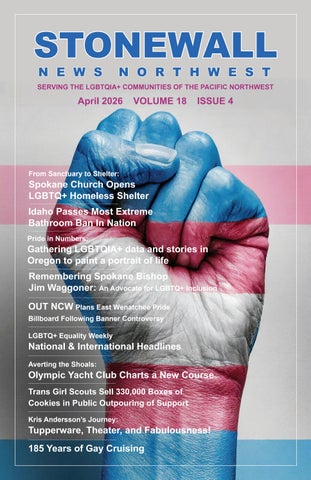
STONEWALL N E W S
N O R T H W E S T
SERVING THE LGBTQIA+ COMMUNITIES OF THE PACIFIC NORTHWEST
April 2026
VOLUME 18
ISSUE 4
From Sanctuary to Shelter:
Spokane Church Opens LGBTQ+ Homeless Shelter Idaho Passes Most Extreme Bathroom Ban In Nation Pride in Numbers:
Gathering LGBTQIA+ data and stories in Oregon to paint a portrait of life Remembering Spokane Bishop Jim Waggoner: An Advocate for LGBTQ+ Inclusion OUT NCW Plans East Wenatchee Pride Billboard Following Banner Controversy LGBTQ+ Equality Weekly
National & International Headlines Averting the Shoals:
Olympic Yacht Club Charts a New Course Trans Girl Scouts Sell 330,000 Boxes of Cookies in Public Outpouring of Support Kris Andersson’s Journey:
Tupperware, Theater, and Fabulousness! 185 Years of Gay Cruising www.stonewallnews.net | Stonewall News Northwest | April 2026 |
STONEWALL NEWS NORTHWEST Serving the LGBTQIA+ Communities of the Pacific Northwest Founded 1992 Relaunched 2025
International Transgender Day of Visibility
April 2026
March 31, 2026
Volume 18 Issue 4
www.stonewallnews.net PO Box 871112 Vancouver, WA 98687 PUBLISHER Mike Schultz publisher@stonewallnews.org John Deen 1995-2005 Lawrence Stone 1992-1995 OREGON MANAGING EDITOR Rhonda Brown oregon-editor@stonewallnews.org ADVERTISING April Gilbreath advertising@stonewallnews.org 509-541-5615
CONTENTS 3 From Sanctuary to Shelter 4 Idaho Passes Most Extreme Bathroom Ban In Nation 5 Pride in Numbers 6 Remembering Bishop Waggoner 7 OUT NCW Plans East Wenatchee Pride Billboard 8 LGBTQ+ Equality Weekly National & International Headlines 9 Olympic Yacht Club Charts New Course 10 From the Hobbit House 10 Out on the Ranch 11 Trans Girl Scouts Sell 330,000 Boxes of Cookies 12 Ryan Gosling Shines in Project Hail Mary
Following is an excerpt from “The Case for Hope: Transgender Rights Going Into 2026” by prominent journalist and transgender rights activist Erin Reed.
“T
here will be hard moments ahead. There will be people who tell you to give up, and there will be days when hope feels distant. My reporting will continue to cover things that are difficult to read, because the truth often is. But it is through understanding the threats we face, maintaining connection with one another, and quietly, relentlessly finding ways around policies meant to erase us that we continue to survive. We carve out space not because it is given to us, but because we insist on it. And when history does bend toward justice—as it always eventually does—it will be because people like us were there, hands on the arc, bending it.” The full post can be found at: https://www.erininthemorning.com/p/the-case-for-hope-transgender-rights
13 Kris Andersson’s Journey 14 The Bride: A Surreral Dream
by PFLAG
15 What Matters Most: An Essay on the Eve of Chemotherapy
he International Transgender Day of Visibility (TDOV) is an annual day of recognition, celebrated around the world on March 31st, which is dedicated to celebrating the accomplishments and victories of transgender and gender-expansive people, while simultaneously raising awareness of the work that is still needed to combat discrimination and violence.
16 185 Years of Gay Cruising
CONTRIBUTORS RYAN OELRICH DAVID CAPOCCI FRANK GAIMARI FABRICE HOUDART NOVA BERGER
T
EMMA MAPLE FAVS NEWS SOURCE ONE NEWS ERIN REED SUE FERGUSON UNCLOSETED MEDIA All contents © 2026, Stratus Group LLC. No portion of this publication may be reproduced without written consent from the publisher. Neither Stratus Group LLC nor Stonewall News Northwest publication assume responsibility for errors in content, photos, or advertisements. The views expressed herein do not necessarily represent the views of the publisher or advertisers.
TDOV was founded in 2009 by USbased transgender activist Rachel Crandall, a licensed psychotherapist and the Executive Director of Transgender Michigan, both in reaction to the lack of LGBTQ+ days of recognition for the successes achieved by trans people, as well
| April 2026 | Stonewall News Northwest | www.stonewallnews.net
as the frustration that the only wellknown transgender-centered day of recognition was the Transgender Day of Remembrance (TDOR). TDOV is a much-needed day of empowerment, celebrating the lives and achievements of our transgender and gender-expansive loved ones. As trans allies, we need always hold space for our trans loved ones, and recognize their many accomplishments. #TDOV is only one day out of 365 that gives allies the chance to uplift and celebrate our trans loved ones. For the full post and resources: https://pflag.org/transgender-day-of-visibility
SPOKANE Groups like PFLAG Spokane and Spokane Pride have emphasized the need for affirming, trauma-informed spaces. Supporters often frame the shelter as a safety measure, not preferential treatment — pointing to documented disparities in homelessness among LGBTQ+ youth and adults.
From Sanctuary to Shelter: Spokane Church Opens LGBTQ+ Homeless Shelter by Nova Berger
T
hroughout history, churches have been places of safety for people all over the world, welcoming spaces that often provide food, safety, and community. But although they may have been beacons of light for many, they have historically not been places of safety for those in the LGBTQ+ and other marginalized communities. In many Christian traditions, especially within institutions such as the Roman Catholic Church and the Eastern Orthodox Church, same-sex relationships were historically condemned based on interpretations of biblical texts, and LGBTQ+ people often faced exclusion or punishment. During periods such as the medieval era and the Reformation, both Catholic and emerging Protestant communities reinforced moral teachings that framed homosexuality as sinful. North Hill Christian Church in Spokane, Washington, is changing that. It is converting what was formerly a Sunday school room into an emergency shelter space
for LGBTQ+ people experiencing homelessness. The church partnered with the local nonprofit Jewels Helping Hand to create what it calls the Aurora Center. “I realized [that] in Spokane, [being] LGBTQ+ is not [accepted]… This is the first [such] center I’ve seen,” said Ronald, a worker at Jewels Helping Hand.
The Aurora Center The shelter provides 15 beds and 24/7 trauma-informed care in a setting designed to feel safe and affirming for self-identifying members of the LGBTQ+ community — something organizers say was previously lacking in the local shelter system. “All beds [were] filled a week after it was opened. Shows how it’s really been needed,” said a pastor at North Christian Church. The organizers of the Aurora Center say they’ve found that Queer people are not treated the same as the general population in homeless shelters, where LGBTQ+ residents often feel unsafe among non-Queer guests.
Setting up beds in the Aurora Center | Photo courtesy of Jewels Helping Hands
The shelter still follows the same rules as local shelters, however. Residents need a referral from the housing navigation center, providers, or case managers. But
once they are there, they can stay for 90 days. After that, they are assessed to see if they’ve reached SHELTER - To Page 20
www.stonewallnews.net | Stonewall News Northwest | April 2026 |
IDAHO / TRANSGENDER
Idaho Capital Building // Wyatt Perry // Wikimedia Commons
Idaho Passes Most Extreme Bathroom Ban In Nation, Creating PathTo Life In Prison This article first published by Erin In The Morning. Please consider supporting her important work at: www.erininthemorning.com by Erin Reed
O
n Friday, the Idaho Senate passed the most extreme anti-transgender bathroom ban in the United States: a law that applies to both public buildings and private businesses and carries severe criminal penalties. A first offense would be a misdemeanor punishable by up to one year in jail; a second offense within five years would be a felony carrying up to five years in state prison. But the penalties do not stop there. Under Idaho’s persistent violator statute, a transgender person convicted of a fourth bathroom offense—their third felony—could face a mandatory minimum of five years and up to life in prison, immediately making Idaho the harshest state in the nation for criminalizing transgender people. Those who find themselves behind bars may then be subjected to additional brutality at the hands of a prison system that has been systematically denying transgender people their medication and placing trans women in male
facilities. The bill passed 287, with one Republican voting against it, and it now heads to the Governor’s desk. The bill, HB 752, states that “any person who knowingly and willfully enters a restroom or changing room in a governmentowned building or a place of public accommodation designated for use by the opposite biological sex of such person shall be guilty of a misdemeanor” punishable by up to one year in prison. A second offense within five years would be a felony carrying up to five years in state prison, and under Idaho’s persistent violator statute, a fourth offense—the third felony—would carry a mandatory minimum of five years and a maximum of life. Notably, these provisions apply to private businesses, and the bill explicitly allows prior convictions under “a similar statute in another state, or any similar local ordinance” to count toward the escalation threshold—meaning a transgender person previously sanctioned under another state’s bathroom ban could face felony charges on their first offense in Idaho.
| April 2026 | Stonewall News Northwest | www.stonewallnews.net
The bill drew sharp criticism from a diverse range of opponents, unifying voices that typically do not share the same stance. ACLU Idaho focused on the extreme privacy violations and excessive penalties the bill would create, as well as the danger to transgender and cisgender people alike from weaponizing law enforcement against anyone who defies gender expectations. The Idaho Fraternal Order of Police also opposed the bill, with President Bryan Lovell warning that “in many circumstances, there is no clear or reasonable way for officers to make that determination without engaging in questioning or investigative actions that could be viewed as invasive and inappropriate.” The Idaho Sheriffs’ Association joined the opposition as well. Despite pleas from police, Bill sponsor Rep. Cornel Rasor refused to add a duty-todepart amendment—a provision that exists in Florida’s criminal bathroom ban and allows a person to avoid charges by leaving when asked—meaning a transgender person in Idaho could be arrested on the spot simply for being present.
If Governor Brad Little signs the bill into law, Idaho would become the fourth state with a major bathroom ban targeting transgender people through arrest or significant criminal or civil penalties. In Florida, where the offense is a misdemeanor carrying up to 60 days in jail, Marcy Rheintgen was arrested in March 2025 for washing her hands in a women’s restroom at the state capitol. In Texas, where the bathroom ban took effect in December, four transgender women were detained at the state capitol and issued criminal trespass warnings banning them from the building for a year. And in Kansas, the state created a bounty hunter system allowing private citizens to sue transgender people encountered in a bathroom for $1,000. Idaho’s bill goes further than all of them—the criminal offense is triggered by merely being present in the restroom, it applies to private businesses, and the penalties dwarf those in states that have already earned “do not travel” warnings on the Erin in the Morning trans legal risk assessment map. Anti-transgender bathroom bans and policies, even informal ones, routinely draw in people they were never meant to target. In Idaho’s own Senate hearing on HB 752, Tara Townsell of Nampa testified that she has been repeatedly removed from women’s restrooms and forced to show ID because of her short hair—and was once denied entry to a maternity ward at a Boise hospital despite being nine months pregnant. In Congress, Reps. Lauren Boebert and Nancy Mace confronted a cisgender woman in a Capitol restroom, mistakenly believing she was a transgender member of Congress. In Arizona, a Black woman with a “masculine” appearance was confronted by police officers inside a Walmart restroom who tried to remove her; she said she has not used a public restroom since. The laws also create impossible situations for transgender men. In Ohio, Noah Ruiz, a 20-year-old trans man, was beaten by three men after using the women’s restroom at a campground—the very bathroom the property owner had told him to use. He was then arrested for disorderly conduct while his attackers initially faced no charges. On the other hand, antitransgender bathroom bans in other states have led to remarkably few IDAHO - To Page 21
OREGON “This project, Pride in Numbers, is by us, for us. The project moves with care. 2SLGBTQIA+ are often historically missing from the data, and certainly historically marginalized groups like Two-Spirit Native folks, BIPOC, and rural people are definitely often missing. Better data leads to real support and change.“ -- Bianca Fox Unitarian Project Guide by Nova Berger
W
hen people think about LGBTQ+ life in Oregon, one place usually comes to mind: Portland. The city’s Pride celebrations and progressive reputation have long helped shape Oregon’s identity as a welcoming place for Queer people. And to a degree, that reputation is deserved. But Oregon is so much more than its biggest city. Along the coastline, across the mountains, in the desert or Indian Country, a different reality emerges — one where Two-Spirit and LGBTQIA+ people exist, thrive and lead in ways that often go unrecognized. “Oregon is widely seen as LGBTQIA+ friendly and affirming, but that doesn’t guarantee equitable outcomes,” said Nimisha Jain, outreach lead on the project team of Pride in Numbers, a community-led, statewide research project by and for Two-Spirit and LGBTQIA+ people across Oregon. “Real gaps remain in healthcare, housing, and safety. Pride in Numbers hopes to understand those realities so our community can build the programs and support people in need.” A new community-led research project hopes to shift that narrative by collecting the stories of TwoSpirit and LGBTQIA+ people across the entire state. Organizers
Pride in Numbers: Gathering LGBTQIA+ data and stories in Oregon to paint a portrait of life are addressing long-standing gaps in data by telling the story of who we are and what we need as a community. Led by many community members, including Jain and project guide Bianca Fox, the project centers the voices that are most often left out of research: rural Queer people, Two-Spirit community members, BIPOC residents, and others whose lives often go misunderstood.
Pride in Numbers is run entirely by Two-Spirit and LGBTQIA+ people in Oregon; it is majority Black, Indigenous, and People of Color; majority Trans and Nonbinary; and majority from rural and nonurban communities. It’s also supported by dozens of partners across Oregon.
“The project moves with care. 2SLGBTQIA+ are often historically missing from the data, and certainly historically marginalized groups like TwoSpirit Native folks, BIPOC, and rural people are definitely often missing. Better data leads to real support and change.”
“This project, Pride in Numbers, is by us, for us,” said Fox.
NUMBERS - To Page 22
www.stonewallnews.net | Stonewall News Northwest | April 2026 |
SPOKANE / IN MEMORY discerning, ‘What does that mean to us?’” Heaton said. “So there was just a lot of turmoil during that time.” Heaton said that Waggoner’s mentality during that time was to “be bold in Christ.” “He wanted to say yes more than to say no,” she said. “To be open to people’s ideas, to people’s points of view.” That mentality helped carry the diocese through the tough conversations that followed Robinson’s consecration, Heaton said. While Waggoner was clear that he was supportive of Robinson and inclusion of LGBTQ+ people, she said “he was also very supportive of people who had a different point of view, and being able to express it and still feel welcome and be part of the church.”
Bishop Jim Waggoner Jr. (Contributed)
Remembering Spokane Bishop Jim Waggoner: An Advocate for LGBTQ+ Inclusion This story is republished through a content partnership with FāVS News. Consider supporting their important work at https://favs. news/
by Emma Maple
congregation. The seventh bishop, Bishop Frank Terry, had died in office while undergoing surgery, according to The Living Church.
T
“He came when the diocese was in many ways grieving the loss of their previous bishop,” Rehberg said. “That’s a pretty difficult thing for a diocese to face.”
Waggoner, the eighth bishop of the Episcopal Diocese of Spokane, died on Feb. 27. He was 77 years old.
Mallory Davis, who works as the grant program director for the diocese and served as an office assistant under Waggoner, said the diocese seemed to need “somebody that had a pastoral nature that could really carry them through their grief and shock.”
hose who knew Bishop Jim Waggoner Jr., who headed the Episcopal Diocese of Spokane for 17 years, said he will be best remembered for the love he had for others.
“He just loved being with people. He was a true pastor, ” Gretchen Rehberg, current bishop of the Episcopal Diocese of Spokane, said. “Sometimes, when you get into the role of bishop, you don’t see that as much. With him, he never doubted it.”
was appointed Bishop Coadjutor of New Hampshire. Robinson was the first openly gay priest to serve as bishop in the The Episcopal Church. His consecration set off “quite a stir,” according to Karen Heaton, Waggoner’s Canon to the Ordinary, essentially a sort of chief of staff or coach for the bishop. “A lot of congregations were
“That’s the kind of leadership he had,” Heaton said. Waggoner also practiced a policy called “radical hospitality,” according to Heaton. For Waggoner and his wife, Gloria, that meant hosting events and always welcoming community participation. Heaton said she also remembered how supportive Waggoner was of his wife, who helped the diocese by raising money, hosting events and protecting the environment — including by turning the diocese’s garden into an organic space. “I can’t tell you how many times I would come over on the weekend to do some work, and Jim BISHOP - To Page 20
“That was Bishop Jim,” she said. “He was that person.” ‘Be bold in Christ’: navigating a church in turmoil
When people recalled Waggoner’s leadership, many spoke of the turmoil that he helped the diocese weather.
During the early days of Waggoner’s leadership, he also helped the diocese handle conversations about the inclusion of LGBTQ+ people.
When Waggoner stepped into office in Spokane in October 2000, he was there to pastor a grieving
In 2003, three years after Waggoner began his service in Spokane, Bishop Gene Robinson
| April 2026 | Stonewall News Northwest | www.stonewallnews.net
Bishop Jim Waggoner Jr. and Gretchen Rehberg (Contributed)
WENATCHEE The campaign comes in direct response to a decision by the East Wenatchee City Council to revise its banner policy earlier this year, a move critics say effectively excluded rainbow-themed diversity banners during Pride Month in June. OUT North Central Washington membership meeting / Courtesy OUT North Central Washington.
This article published by Source One news https://www.yoursourceone.com/
W
OUT NCW Plans East Wenatchee Pride Billboard Following Banner Policy Controversy
enatchee-based LGBTQ+ group says it has fully funded a year-long billboard installation in East Wenatchee, marking a new and highly visible effort to support LGBTQ+ visibility in the region following a contentious city policy change.
a privately funded billboard as an alternative way to maintain visibility.
Members of OUT North Central Washington announced that the billboard has been paid for in full and that a contract has been signed, with installation expected during the week of May 4. While organizers confirmed the billboard will be placed in a prominent, high-traffic location seen by thousands, they are intentionally withholding the exact site for now.
Organizers say the project is part of a broader effort to support marginalized communities across North Central Washington. The group has also partnered with other nonprofit organizations and faith leaders to form a regional coalition focused on increasing visibility, sharing resources, and advancing a unified mission of inclusion.
Group members said the decision to keep the location confidential is aimed at preventing potential vandalism or interference with the billboard company prior to installation.
The final billboard design has not yet been revealed. Instead, organizers plan to release several design options to the public, allowing community members to vote on their preferred version. That poll is expected to launch during the first week of April.
The campaign comes in direct response to a decision by the East Wenatchee City Council to revise its banner policy earlier this year, a move critics say effectively excluded rainbowthemed diversity banners during Pride Month in June. In response, OUT North Central Washington and its partners opted to pursue
campaign’s reach elsewhere in North Central Washington. Organizers are continuing to encourage community members and supporters to contribute to the effort, saying the campaign reflects a broader commitment to standing against hatred, bullying, and discrimination while promoting equity and visibility
throughout the region. Related article: East Wenatchee City Council Adopts New Banner Policy, Diversity Banners Are Out https:// www.stonewallnews.net/articles/eastwenatchee-city-council-adopts-newbanner-policy-diversity-banners-areout/24718/ OUT North Central Washington can be found online here: https://www.outncw.org
According to the group, fundraising efforts have already exceeded the initial goal needed to secure the first billboard. Additional donations collected moving forward will go toward funding a second billboard, potentially expanding the
www.stonewallnews.net | Stonewall News Northwest | April 2026 |
NATIONAL & INTERNATIONAL
LGBTQ+ Equality Weekly National & International Headlines This week: Motjaba’s sexuality, Portugal & trans protections, Gay Panic in Senegal and Ghana, India’s controversial trans amendment, Munich’s new mayor, the Club Cumming documentary, and much more….
by Fabrice Houdart
Global News Iran: The Weaponized Outing of Mojtaba Khamenei The spectacle of US officials laughing at intelligence that Iran’s new Supreme Leader may be gay is a reminder that gayness is both a joke in Washington and a death sentence in Tehran. In a country where consensual same-sex relations can lead to execution by hanging, the alleged homosexuality of a theocrat is framed as “priceless” gossip rather than a serious indictment of the regime’s own hypocrisy. It is a reminder that our lives are usually bargaining chips—useful when they expose hypocrisy, disposable when they complicate strategy. Whether the report is true or not, gay people are called to take control of their destinies. See in the New York Post. Others in the room also found it “hilarious” and joined the president’s reaction, while one senior intelligence official “has not stopped laughing about it for days,” said one person familiar with the briefing. Portugal: Parliament Advances Three Trans Rollback Bills On March 20, Portugal’s parliament voted to advance three proposals that would significantly modify the country’s 2018 gender identity framework. The bills, supported by members of the centre-right governing coalition and far-right parties, would restrict access to gender-affirming care for minors, reintroduce medical requirements for adults seeking legal gender recognition, and limit the discussion of gender
2024 piece Ghana: chronicles of a catastrophe foretold). According to the embassy, the visit had been fully coordinated, with Mahama already in the United States ahead of the March 26 event, making the reversal “surprising and regrettable.” Officials stressed the bill remains under debate and does not reflect any single individual’s position. See on GhanaWeb.
March 25, 2026
Photo courtesy of Fabrice Houdart This article first published on Fabrice Houdart, a weekly newsletter on LGBTQ+ Equality. Please consider becoming a subscriber of his important work at https://fabricehoudart.substack.com
We are told we should be grateful for the war in the Middle East—because, after all, “Iran throws gay people off rooftops” (as I mentioned before, this is more like ISIS’s style). But wars are never LGBTQ+ indifferent in many ways. Bombs may not discriminate, but their consequences always do. Often in armed conflicts, LGBTQ+ people lose on several fronts. War often requires silencing civil society—a key force of progress. It celebrates toxic masculinity, shrinking the space for progress in a region where LGBTQ+ people have very few options. In fact, it is no coincidence that the White House is spreading rumors this week that Motjaba Khamenei is gay (see first item below). And, as I wrote a few weeks ago, wars are too often waged without LGBTQ+ input, yet they shape our future. Finally, wars also mean the world turns a blind eye to our plight in places like Senegal and Ghana (the bigger-fish-to-fry syndrome). At the risk of sounding like a broken record, the new world order demands that queer people organize so we are something more than pawns on a geopolitical chessboard or punchlines in someone else’s war room.
Poland: Supreme Court Orders Same-Sex Marriage Recognition Poland’s Supreme Administrative Court ruled on March 20 that same-sex marriages legally performed in other EU countries must be entered into Poland’s civil registry — a direct consequence of November 2025’s European Court of Justice ruling on freedom of movement. The case involved two Polish men who married in Berlin in 2018 and had been denied recognition at home. The ruling orders the marriage to be entered into the national registry within 30 days. Poland remains one of the few EU countries without domestic recognition of same-sex unions, but this decision marks a significant judicial inflection point. Read more in DW. Greece: Court Upholds SameSex Marriage and Adoption
identity in schools. Advocacy groups, including ILGA-Europe and TGEU, have raised concerns about potential impacts on trans people’s rights and well-being, while demonstrations took place outside parliament. The proposals now move to committee review and could still face a presidential veto. Read more in Pink News
sentences for same-sex relations— building on existing colonial-era laws—accounts of arrests, public hostility, and social exclusion are mounting. Advocacy groups warn that political rhetoric and protests have intensified stigma, while support networks are shrinking, with at least one safe house closing over safety concerns.
Greece’s Council of State ruled last week by an overwhelming majority that legislation permitting same-sex couples to marry and adopt children does not violate the Greek constitution. The court explicitly affirmed that equal adoption rights do not compromise “the constitutional protection of childhood.” Greece remains the first Orthodox Christian-majority nation to have legalized same-sex marriage, and this ruling provides the final legal confirmation of the 2024 reforms, dismissing challenges from two associations and a non-profit. See in Attitude.
Senegal: Consequences of the “Gay Panic”
Ghana: Lincoln University Pulls Mahama’s Honorary Degree
India: Protesters Oppose Trans Amendment
In Dakar, a young man sits in a hotel lobby with his back to the wall, eyes fixed on the entrance, describing a life now shaped by caution and concealment. Rejected by his family and wary of police scrutiny, he is one of many Senegalese navigating what he calls “a lot of fear” portrayed in this Africanews piece. As lawmakers move to double prison
Ghana’s embassy in Washington expressed “profound disappointment” after Lincoln University withdrew an honorary doctorate for President John Dramani Mahama days before a planned ceremony, citing concerns about his perceived stance on Ghana’s Human Sexual Rights and Family Values Bill (see my
Hundreds of LGBTQ+ protesters rallied in Hyderabad on March 22 against India’s proposed Transgender Persons Amendment Bill 2026, which would replace the 2019 Act’s self-identification process with mandatory Medical Board certification.
| April 2026 | Stonewall News Northwest | www.stonewallnews.net
NATIONAL - To Page 18
SEATTLE / PUGET SOUND Our previous December 2025 article, After Decades of Sea, LGBTQ+ Olympic Yacht Club May Face Its Final Mooring, spoke of the possibility that OYC may sail into the sunset. Its future was in unstable waters. by Sue Ferguson
L
ike an old vessel rescued from the scrapyard, what once seemed lost can find new purpose. It requires only fresh eyes to envision possibility where others see ruin. Sets of hands willing to restore it to its former glory. With hope and determination at the helm, such a project can chart a new course. This transformation is precisely what has happened with Olympic Yacht Club. It’s a pleasure to report that our cherished LGBTQ+ maritime community continues to thrive. New Commodore Christopher Canlas revealed exciting plans to revitalize OYC during our recent interview. The leadership aims to boost the club’s presence through enhanced social media engagement, a website update (oycnw.org), and more active Facebook communications. In just two board meetings, leadership has already generated an impressive list of over 20 potential activities. They’ll narrow the list to a manageable amount, with the final calendar featuring diverse options from nautical adventures to bowling nights, casual potlucks, and social happy hours. Strategic rendezvous locations have been identified throughout South Sound, Everett,
Olympic Yacht Club burgee in the foreground, member yacht “Sea Mist” in the background / Courtesy of Olympic Yacht Club
Averting the Shoals: Olympic Yacht Club Charts a New Course THE NEW BOARD
OYC - To Page 21
Christopher Canlas steps into the Commodore role, bringing years of nautical experience and a passion for the Pacific Northwest’s hidden coves and passages. His vision promises to breathe new life into the gatherings and expand horizons for all members.
Anthony Curreri calls the gentle rocking of his vintage 1970 Chris Craft Commander home. The 42-footer has been his address since 2020. Between maintaining brass fixtures and installing a heat pump, he dreams of shore events that might welcome the land-bound into the fold. “There’s nothing like taking friends for a loop around Lake Union,” he often says with a smile.
Richard Brown steps into the role of Yeoman carrying nearly three and a half decades of OYC membership. His sailing credentials were forged in New England waters before taking him across hemispheres, from Mexico coastlines to New Zealand harbors to Alaskan passages. Brown’s OYC historical knowledge will serve the new Board while he looks forward to reenergizing OYC.
As Vice Commodore, Billy Schwitters finds boating one of his favorite past times. He brings the same dedication to OYC that serves him as a Mount Vernon Firefighter Paramedic. His natural talent for building community and coordinating efforts will undoubtedly strengthen the OYC voyage forward
The newly appointed Board welcomes Micah Vacatio, whose hands have gripped countless tillers during Pacific Northwest regattas. When not racing sailboats, she glides through coves in her kayak or paddleboards across waterways. She loves how people connect through water activities in the Pacific Northwest and plans to support OYC in this manner.
Stephen San Jose, the newly appointed Rear Commodore, brings fresh perspective to OYC as a recent convert to boating, though he’s long been passionate about paddleboarding. The club will benefit from his professional eye behind the lens, as his background in photo and video production promises to document this year’s events with style.
Desiree Michael, a twenty-five-year OYC veteran brings her seasoned perspective while Keven Spratt (not pictured) rounds out the leadership team.
www.stonewallnews.net | Stonewall News Northwest | April 2026 |
COLUMNISTS
Thoughts from the Hobbit House 22 Hours on Hold: My Battle for Justice and a Refund “Alex, if that is your name, I want to believe that wherever you are on the other end of this phone, you are a real human being with feelings and a desire to be courageous today. Because that’s what I’m trying to be over here. Can we be courageous together? Help me, Alex. You’re my only hope.” by Ryan Oelrich
W
hat does it take to survive—and even win—in trying times?
Recently, in my search for answers, I found myself locked in battle with a giant and sinister cell phone company. It was not a battle I had planned to fight, but history rarely asks our permission. The experience tested my resolve. It humbled me.
It forced me to confront the limits of human patience. But it also revealed a few truths about perseverance, advocacy, and the strange heroism required to navigate a corporate customer service portal. These truths I’ve found applicable to other aspects of our current times. This is that story. I care about nonprofits. A lot.
Ryan and his husband built a Hobbit House that’s become a regional attraction.
I work with them. I advocate for them. And sometimes… I go to war on their behalf armed only with caffeine, screenshots, and an unreasonable belief in justice. Now to be clear, this story is not merely about a skirmish with a large, ethically questionable telecommunications corporation. (Though it is also very much
about that.) Beneath the surface lies something more universal: the quiet, absurd, often exhausting work of standing up for something that matters. Our saga began with a billing mistake. A nonprofit I care deeply about HOBBIT HOUSE - To Page 24
Out on the Ranch Finding Our Grounding: Dirt, Roots, and the Work of Spring “Resilience is not simply surviving the winter. It’s preparing the ground for what comes next.” by David Capocci
M
David Capocci at Paca Pride Guest Ranch
10 | April 2026 | Stonewall News Northwest | www.stonewallnews.net
arch at the mountain ranch is not a soft awakening. It is an active negotiation. One morning the ground loosens and trees start to bloom. The next morning, it locks itself under snow again in a final act of winter defiance. We refer to March as the season of Sprinter: not quite Spring, not quite Winter. This is the time of year when our mountain weather is chaotic. It is not the Fall
monsoon, it is the Spring thaw. That Spring transition is rarely tidy. As Spring rolls on up the rugged mountain elevations, it is a test of what held. After months of national turbulence, the season of Sprinter reminds me to be less reacting and more rooting. Not digging in with stubbornness, but grounding with intention. RANCH - To Page 25
NATIONAL / TRANSGENDER This article first published by Erin In The Morning. Please consider supporting her important work at: www.erininthemorning.com
by Erin Reed
F
ive years ago, as anti-trans legislation first began spreading across the United States, I kept thinking about the kids caught in the middle of it—transgender children suddenly facing a wave of hostility simply for existing. That year, I started something small in response: a trans Girl Scout cookie list. Only three scouts were on it. The internet responded immediately, helping them sell out their entire quota. Every year since, I’ve made the list again, and every year it has grown larger. Now, in 2026, the list has reached a staggering scale: 220 transgender Girl Scouts participating—and together they have already sold more than 330,000 boxes of cookies, with the number still climbing every minute. One scout hoping to fund a troop trip to Alaska—and assemble backpacks for foster children—has sold 2,500 boxes of cookies, bringing those plane tickets within reach. Another scout, a competitive soccer player, was raising money so her troop could attend scouting camp without worrying about the cost; she has now sold 4,500 boxes, ensuring that trip is covered. One troop made up of transgender Girl Scouts set their sights on learning horseback riding and attending summer camp together—and sold 22,000 boxes to make it happen. And Pim, who simply wanted to go to Niagara Falls and to take her troop camping, has sold more cookies than the website can even track: more than 100,000 boxes. And while we can’t know exactly how many of those sales came directly from our yearly list, we do know that these trans Girl Scouts have taken the internet by storm. Posts about them have racked up millions of impressions on Facebook and gone repeatedly viral on Bluesky. In the process, countless people looking for their next box of cookies discovered a cause worth supporting—and a group of scouts they were excited to cheer on. The news about their staggering success comes during a broader regression around scouting
Trans Girl Scouts Sell 330,000 Boxes Of Cookies In Public Outpouring Of Support At a time when thousands of anti-LGBTQ+ bills are being proposed and passed across the country, the cookie list is proof that people out there care. When every force in the world is acting against them, for once, their identity is not treated as a curse by society, but a blessing. organizations with respect to transgender people. In December, the United Kingdom’s Girlguiding—the British equivalent of the Girl Scouts— banned transgender girls from joining, reversing a policy that had been in place since 2018. In the United States, Defense Secretary Pete Hegseth forced Scouting America to agree to classify members by sex assigned at birth, eliminate diversity initiatives, and effectively out and segregate transgender scouts from their peers. Girl Scouts of the USA, however, has yet to see the same regression—the organization still stands by its transgender inclusion policy. For these kids, that transgender inclusion policy has given them hope. At a time when thousands of anti-LGBTQ+ bills are being proposed and passed across the country, the cookie list is proof that people out there care. When every force in the world is acting
against them, for once, their identity is not treated as a curse by society, but a blessing. Parents have told me that their children have been overwhelmed with joy watching the numbers climb, realizing that strangers across the
country support them. And that’s worth protecting. You can purchase Girl Scout cookies from a trans Girl Scout here: https:// www.erininthemorning.com/p/transgirl-scouts-on-cookie-list
Illustration by Ken Min
www.stonewallnews.net | Stonewall News Northwest | April 2026 | 11
FILM
Ryan Gosling Shines in the Sci-Fi Adventure Project Hail Mary The audience at my screening applauded as the credits rolled, and it’s easy to see why. Project Hail Mary is a crowd-pleaser through and through — a thrilling, heartfelt ride that’s as much about friendship and teamwork as it is about saving the world. by Frank Gaimari www.FranksFilmReview.com
R
yan Gosling wakes up alone on a spaceship, light-years from Earth. His crewmates are dead, his memory is a blur, and he’s surrounded by unfamiliar technology. Slowly, he pieces together the truth: he’s on a mission to save humanity. The Sun is dying, dimmed by a microscopic organism called Astrophage that’s draining its energy. If nothing is done, Earth will freeze over and life as we know it will end.
Ryan Gosling / IMDb
Dr. Ryland Grace, once a molecular biologist turned middle school teacher, wasn’t supposed to be the hero of this story. Through flashbacks, we learn how he was reluctantly pulled into this highstakes mission by Eva Stratt, a determined government official leading the charge to save the planet. The mission, called Project Hail Mary, is a desperate attempt to find answers in the Tau Ceti star system, the only nearby star unaffected by Astrophage. But it’s a one-way trip, and Grace is now the sole survivor tasked with figuring out how to save Earth. Just when things seem hopeless, Grace encounters something unexpected: another spacecraft. Inside is Rocky, an alien from a distant planet facing the same crisis. Rocky is unlike anything Grace has ever seen, but their shared desperation to save their worlds brings them together. Despite their differences, they form an unlikely partnership, working to uncover the secrets of Tau Ceti and find a solution to their shared problem.
Ryan Gosling / Amazon MGM Studios
12 | April 2026 | Stonewall News Northwest | www.stonewallnews.net
The bond between Grace and Rocky is the heart of the movie. Their friendship is funny, touching, and full of moments
that will make you smile. Watching them figure out how to communicate and work together is one of the film’s highlights. It’s a buddy story set in space, but with the stakes cranked up to life-ordeath levels. Ryan Gosling is magnetic as Grace, and let’s be honest — his looks don’t hurt either. Even in the middle of a life-or-death mission, he somehow manages to look effortlessly cool. His charm, vulnerability, and natural charisma make him impossible to look away from. Whether he’s cracking a joke, panicking in zero gravity, or just staring into the void, Gosling holds your attention with ease. Sandra Hüller, as the no-nonsense Stratt, adds a sharp edge to the story, while Rocky steals the show with his unique personality and charm. The visuals are stunning, from the detailed spaceship interiors to the breathtaking shots of space. Rocky, brought to life through puppetry and practical effects, feels completely real, lending the film a tactile authenticity. While the movie delivers on heart and humor, it leaves some questions unanswered. They find a solution to the Astrophage problem, but the film doesn’t go into detail about how it’s implemented. It’s a small letdown, but it doesn’t take away from the overall experience. The audience at my screening applauded as the credits rolled, and it’s easy to see why. Project Hail Mary is a crowd-pleaser through and through — a thrilling, heartfelt ride that’s as much about friendship and teamwork as it is about saving the world. If you’re looking for a space adventure with humor, heart, and a whole lot of Ryan Gosling, this one’s a mustwatch.
PROFILES
Kris Andersson’s Journey: Tupperware, Theater, and Fabulousness! Kris Andersson’s story is one of reinvention, resilience, and the power of laughter. Whether he’s on stage in Dixie’s heels or behind the scenes crafting new projects, Andersson continues to prove that life is what you make of it. And for him, it’s a fabulous, empowering, and hilariously unforgettable journey. by Frank Gaimari www.FranksFilmReview.com
K
ris Andersson is a name that might not immediately ring a bell, but his alter ego, Dixie Longate, has been making waves in theaters worldwide for over two decades. Born on November 29, 1969, in Ohio, Andersson has built a career that is as unique as it is inspiring. With a background in acting and a knack for storytelling, he has transformed a simple idea into a global phenomenon, proving that creativity and resilience can take you anywhere. Before Dixie came to life, Andersson was a film and TV actor in Los Angeles, with roles in major productions like Titanic and Scream 2. But his career took an unexpected turn in 2001 when a roommate hosted a Tupperware party. What started as a humorous observation about the world of food storage quickly evolved into a theatrical masterpiece. Andersson created Dixie Longate, a brash, hilarious, and empowering character who uses humor and charm to sell Tupperware while delivering messages of self-worth and strength. Dixie is more than just a character; she’s a force of nature. Drawing inspiration from Brownie Wise, the trailblazing woman who revolutionized Tupperware sales in the 1950s, her story resonates with audiences from all walks of life. Through her performances, Andersson weaves humor with heartfelt moments, encouraging people to embrace their individuality and find strength in
their own stories. Since its debut at the 2004 New York International Fringe Festival, Dixie’s Tupperware Party has become a beloved staple in theaters across the globe. The show has grossed millions, sold hundreds of thousands of tickets, and earned Andersson a loyal fanbase. But beyond the numbers, it’s the personal connections that make the show special. Dixie’s ability to connect with her audience, both on and off the stage, has created a community of fans who see themselves in her story. Offstage, Andersson is a thoughtful and introspective artist who values authenticity. As an openly Gay performer, he has used his platform to challenge stereotypes and celebrate individuality. His journey from a small-town upbringing to international success is a testament to his creativity, determination, and ability to turn life’s unexpected moments into opportunities.
parties, make some money, and then move on. I had no idea that Dixie would take on a life of her own and completely change my life. From the start, Dixie was this good Southern gal: charming, relatable, and full of personality. Over the years, she’s grown and evolved. She’s a little more polished now, and let’s be honest, a little feistier too. But at her
core, she’s always been about empowerment. I wanted her to be someone who lifts people up, makes them laugh, and leaves them feeling better about themselves. I never wanted her to be mean-spirited or cynical. Dixie is all about joy, positivity, and just the right amount of sass. It’s been an incredible journey ANDERSSON - To Page 23
Frank Gaimari: What inspired you to create Dixie Longate, and how has she evolved over the years? Kris Andersson: I started selling Tupperware 25 years ago, just trying to make a little extra cash between entertainment jobs. Back then, it was all about filling the gaps and staying afloat. Then, one day, a friend dared me to try selling in drag. It was one of those moments where you think, “Why not?” So, I decided to give it a shot. I thought I’d have a few
Dixie Longate
www.stonewallnews.net | Stonewall News Northwest | April 2026 | 13
FILM PROFILES
The Bride: A Surreal Dream by Frank Gaimari www.FranksFilmReview.com
I
t’s uncommon for people to leave a movie early, but at the premiere of The Bride, six audience members did just that. As they walked out, I couldn’t help but feel disappointed that they hadn’t given the film a fair shot. Looking back, maybe they already knew what the rest of us were about to discover — that The Bride is entirely unpredictable.
The Bride is not a film that plays it safe. It is daring, bizarre, and unapologetically experimental. For those seeking a straightforward story, this is not the movie for you. However, if you are in the mood for something audacious and unforgettable, The Bride may deliver exactly that.
Directed by Maggie Gyllenhaal, The Bride represents another ambitious addition to her expanding body of work. Gyllenhaal, who made her directorial debut with the critically praised The Lost Daughter, has already established herself as a filmmaker willing to explore complex themes and deeply flawed characters. With The Bride, she makes an even bolder creative leap by embracing a surreal and experimental style that challenges conventional storytelling. Her boldness is clear, even if the results split opinions. This reimagining of the classic Frankenstein tale shifts the focus to the bride’s perspective. Jessie Buckley, fresh off her Oscar-winning performance in Hamnet, delivers a magnetic and electrifying portrayal of the bride. Created to be the perfect companion — Frankenstein’s “ideal woman” — the bride refuses to accept her fate. Instead, she rebels against her creator and the role forced upon her, embarking on a journey of defiance, self-discovery, and reclaiming autonomy in a world determined to control her. The plot is anything but conventional. Gyllenhaal constructs The Bride like a surreal dream, blending raw emotional moments with bizarre dance sequences. One moment, viewers are immersed in the bride’s quiet anguish. Next, they are thrown into chaotic, visually overwhelming scenes that blur the boundaries between reality and fantasy. This constant oscillation creates a disorienting experience, leaving audiences questioning what is real and what is imagined.
Jessie Buckley / IMDb
14 | April 2026 | Stonewall News Northwest | www.stonewallnews.net
At the heart of the film is Buckley, whose fearless performance brings depth and humanity to The Bride. Whether delivering a poignant monologue about the pain of being “created” or raging against the forces that seek to control her, Buckley imbues the character with strength, vulnerability, and authenticity. Her bride is not a victim. She is a fighter, a survivor, and a symbol of resistance, making her journey both compelling and deeply resonant. Visually, The Bride is a triumph. The cinematography is steeped in gothic elegance, with every frame meticulously crafted to evoke both beauty and unease. The sets are immersive, creating a world that feels fantastical yet hauntingly real. Makeup and character design are equally striking, reflecting the film’s exploration of beauty, monstrosity, and identity. Together, these elements form a visually arresting and unforgettable aesthetic. But here is the question: Did I enjoy the film? Honestly, no, and I say that with respect. While I admire Gyllenhaal’s audacious vision and the themes she explores, the chaotic plot and surreal storytelling often undermine the bride’s character arc. Buckley’s extraordinary performance is frequently overshadowed by the film’s unconventional approach. The comedic and self-referential homages, while bold, feel out of place and detract from the story’s emotional weight. By failing to fully ground its narrative, the film diminishes the impact of the bride’s journey, leaving it feeling less meaningful than it could have been. The Bride is not a film that plays it safe. It is daring, bizarre, and unapologetically experimental. For those seeking a straightforward story, this is not the movie for you. However, if you are in the mood for something audacious and unforgettable, The Bride may deliver exactly that. Just do not be surprised if you leave the theater asking yourself, “What did I just watch?”
COMMENTARY PROFILES
What Matters Most: An Essay on the Eve of Chemotherapy The following is a personal reflection written by a contributor writer to Stonewall News Northwest. It offers a candid glimpse into his journey with illness, shared in the hope of fostering connection, understanding, and resilience. by Frank Gaimari
T
he house is quiet tonight. There’s just one lamp on, trying its best to hold back the darkness, but honestly, it feels like the darkness is winning. Outside, life rolls on — cars pass by, someone walks their dog, and I can even hear a television down the hallway. But here in my condo, the silence feels heavy, like the home is holding its breath right along with me. Two days ago, they put in my PICC line. It’s still sore, taped to my left upper arm, a constant reminder that this is real — that chemo isn’t just a word I’ll face in the future but something that starts now. Tomorrow is chemo. My first treatment. Just writing those words makes my stomach twist. I should probably say this: writing is my therapy. Putting these words down helps me sort through the mess in my head. It’s how I make sense of all these big feelings. Sometimes, writing is the only way I can face what’s really going
on. It lets me breathe. I won’t lie — I’m scared. Really scared. Fear feels cold and heavy, settling in my bones and refusing to leave. It’s been hanging around for weeks, always in the background, but tonight it’s front and center. Every time I close my eyes, fear serves up new images of what might come next. The unknown stretches out in front of me, and here I am at the edge, shaking. Sometimes, my body hardly feels like mine anymore. This thing, hairy cell leukemia, has taken over so much of it. It’s actually an extremely rare kind of leukemia — so rare, it blows my mind that I have it. What a strange name for something that’s flipped my entire world upside down. I’m so tired all the time, like I’m hauling invisible weights. I get out of breath just climbing stairs. My spleen is swollen, a constant, uncomfortable reminder that things aren’t right inside me. Nausea comes in waves, and sometimes it just lingers, making me wish I could feel normal for five minutes. Being sick is my new normal — a running list of what I can’t do or enjoy right now. At first, when I got the diagnosis, it felt like this disease barged into my life and stole everything I was looking forward to: my plans, my
energy, any sense of certainty about the future. It’s been a long stretch of canceled things, of trying to talk but not having the words, of silence when I need answers I can’t find. But strangely, in all the space left by what’s been taken away, something else has started to grow. Maybe it’s clarity. When you stare your own mortality in the face, all the little things suddenly don’t matter. I’m aware — sometimes painfully, sometimes beautifully — of how precious each day is. Just being able to breathe without thinking about it or feeling okay for a couple of hours feels huge. This leukemia has taken a lot, but it’s also forced me to really think about what matters. And you know what? It’s people. It’s the look my husband gives me when our hands touch, the soft sound of our dogs shifting and snoring in the next room. It’s sharing a quiet moment with an old friend and feeling understood. I see love everywhere now, even when it’s mixed in with fear and worry. Before, a conversation was just talk — now, every “I love you,” every hug, every shared story is a lifeline. We talk about things that matter, because suddenly we know we can’t take any of this for granted.
My cancer group therapy has also become a lifeline for me. Knowing there are people out there who really get what I’m feeling has made all the difference. I’d honestly be lost without them and their support. Their understanding lifts me when I feel alone, helping me believe that brighter moments are possible, even in the middle of all this. So here I am tonight, scared about whatever’s waiting for me in that treatment chair tomorrow. But I’m feeling something else too — gratitude. I’m grateful for the doctors and nurses, for the science that’s brought me this far. But most of all, I’m thankful for my people, my family, my friends — everyone who keeps me anchored through the storm. They’re the reason I’ll roll up my sleeve, take a deep breath, and start this fight. I don’t know what comes next. There will be bad days, days when I’m so tired and sick that it feels impossible. But I won’t have to face it alone. If nothing else, this journey has shown me what strength really is, and how powerful love can be. Tonight, on the night before chemo, I’m terrified. But I know exactly what I’m fighting for. And somehow, that makes me believe I can get through anything.
www.stonewallnews.net | Stonewall News Northwest | April 2026 | 15
LGBTQ+ HISTORY
“He met me … at the corner of Broadway and Howard street. … I thought to myself I would see how far he would go. After taking some indecent liberties with me, too indecent to be committed to type, he asked me to walk around the corner on Howard street.” A letter to the editor of The Flash from 1842. Photo by the American Antiquarian Society, 1903. This story was reported by Uncloseted Media, an LGBTQ focused investigative news outlet. Please consider supporting their important work at www. unclosetedmedia.com. This story was produced in partnership with hankycode, an LGBTQ+ history publication.
W
hile it’s widely believed that cruising culture has existed for hundreds of years, the official term emerged in the 1960s as gay slang referring to a discreet method of men seeking out anonymous same-sex encounters in parks, bathrooms, waterfronts, bathhouses and other such places. Here are 23 key moments that shaped cruising culture in the United States.
1842 While a homosexual subculture is growing in New York City, the general public still refers to gay people as “sodomites,” as the word “homosexual” isn’t coined until 1868. Newspapers regularly publish articles calling out and expressing their disgust of suspected sodomites. One reader writes a letter to the New York City sporting male weekly newspaper, The Flash, about how he tried to catch a sodomite in the act of what is now considered cruising:
Photo courtesy of Fire Island Pines Historical Society (left) and LGBT Community Center National History Archive (right).
185 Years of Gay Cruising: A Brief History Twenty-three events that outline the evolution of how gay men would seek out casual sex in bathhouses, parks and eventually online. The first recorded raid of a gay bathhouse in New York City leads to the detainment of 60 men and the arrest of 14. The Russian and Turkish bathhouse, in the basement of the Ariston Hotel, was a free space for gay men to express themselves sexually and to cruise in a safer environment. Police reportedly spied on the bathhouse for weeks leading up to the raid.
1910s Since at least the 1910s, Washington Square Park has been a popular gay cruising spot. It became so well-known that the 1917 song “The Greenwich Village Epic” contains the line, “Fairyland’s not far from Washington Square.” According to the NYC LGBTQ Historic Sites Project, “The west side of the park, along the fence, was the major cruising area and was referred to as ‘the Meat Rack.’”
16 | April 2026 | Stonewall News Northwest | www.stonewallnews.net
1918 The San Francisco Police Department’s Morals Squad, which focuses on prostitution, and the military police begin to survey two residences where men who met cruising in public would go for private sexual encounters. For at least 10 days, any men who entered were locked in rooms for questioning until they provided confessions which included divulging the names of friends who engaged in gay sex as well as surrendering personal address books. The National Parks Service wrote of the event: “Eleven men were initially arrested. A second wave of arrests soon followed. … All in all, over 30 civilians and six soldiers found themselves behind bars.”
1919 The Navy learns that some of their sailors are engaging in homosexual activity in Newport, Rhode Island. Waterfronts have historically been prime cruising
spots because they are often isolated at night. Mid-level Navy official Ervin Arnold has a personal mission to remove homosexuals from the Navy by sending sailors out to seduce and entrap them. This becomes known as the Newport sex scandal. According to The New York Times, “On May 1, 1919, the Foster court of inquiry … declared that sufficient evidence had been gathered to court-martial fifteen of the arrested sailors. They remained behind bars all summer and were tried in the fall, at which time some were released and others sentenced.” CRUISING - To Next Page
“The enormous presence of gay men in the parks prompted a sharp response from the police. They regularly sent plainclothesmen to cruising areas to entrap men; in the grounds around the Central Park zoo in the first half of 1921 alone, they made thirty-three arrests.” The Ramble in the 1950s. Photo courtesy of the LGBT Community Center National History Archive. Mid-20th Century
Continued - LGBTQ+ HISTORY CRUISING - From Previous Page
1920s
Ann Arbor News:
1971
The lawn at the north end of the Ramble in Central Park becomes such a popular cruising spot that it is known as “The Fruited Plain.” According to historian George Chauncey:
“While many arrests have occurred in University buildings our men will also be checking playground areas and public gathering spots where it is felt homosexuals might meet.”
Mid-20th Century
1966
At the request of sexologist and biologist Alfred Kinsey, Samuel Steward documents his hookups in what he titles “Stud File.” The metal file box contains 746 index notecards—each one detailing a different hookup. The cards include partners’ physical details, meeting dates, sexual acts and a collection of donated pubic hair from 54 different men.
New York City Mayor John Lindsay begins to crackdown on “honky tonks, promenading perverts … homosexuals and prostitutes” in Times Square.
For decades, gay men cruise by posting vague personal ads in select newspapers. They intentionally use language that does not out them, but that signifies their intentions to other gay men. For example, mentioning massages or being a masseuse is common. In 1971, The New York Times reports that there are internal divisions at The Village Voice about whether to keep running the ads.
1950s Fire Island Pines and Cherry Grove are established as gay enclaves on New York’s Fire Island. The spaces are connected by a cruising area also known as “the Meat Rack,” which becomes famous as a safe haven for repressed homosexuals to fully express and experience their sexuality. The Brooklyn Heights Promenade becomes one of the most wellknown gay cruising areas in New York City. According to an article in the Brooklyn Heights Press, “It is a well-known tacit fact that after nine o’clock on a mild evening many persons quit the Promenade and leave it to the homosexuals.”
1955 Boise, Idaho, becomes the center of a sex scandal as three men are arrested and accused of performing homosexual acts. The situation spirals into a gay hysteria, exposing an underground homosexual community in Boise that includes sex workers as well as family men in heterosexual marriages. Over 1,000 people are interrogated and 15 are convicted.
1962 Officers target popular cruising spots—including bathrooms, Alumni Halls and the Michigan Union—at the University of Michigan. They arrest 30 men on homosexual or accosting charges. Captain Walter E. Krasny tells The
1968 The Continental Baths opens in the basement of the Ansonia Hotel in New York City. Steve Ostrow, an icon of gay night life, transforms the dilapidated basement into a Roman-themed bathhouse, which eventually would include a disco room and a DJ booth. Continental Baths is one of many bathhouses thriving in the Post-Stonewall, Pre-AIDS years. The bathhouse combines sex, socializing and entertainment. It boasts an impressive list of attendees, including Andy Warhol, Mick Jagger and Alfred Hitchcock. The bathhouse would shut down in 1976.
1970s The handkerchief code, which helps men discretely express their sexual interests, originates during the gold rush era at a time when San Francisco’s male population is growing dramatically. Since the vast majority of the population is male, men have to dance together at social events. Some men wear blue bandanas to signify they will take the male part of the dance, while others wear red to signify they will take the female part. As years pass, the code takes on new life as a way to covertly signify sexual interests. In 1980, Bob Damron’s Address Book includes a section that details how a light blue handkerchief worn on the left means the individual wants a “69’er” and a mustard handkerchief worn on the right signifies “Wants 8″+.” This system helps revolutionize the cruising process by giving men the ability to nonverbally and discreetly communicate their sexual desires.
1978 A gang of men with bats beat up men who they think are gay at the Ramble. Six men are seriously injured. Three men are convicted for the attacks.
Photo from The New York Times.
Photo from Fire Island Pines Historical Society
1993 Gay.net, one of the first online chat systems, launches. The site—which would later merge with Gay.com—adds an online component to cruising and offers men the ability to seek out anonymous sexual encounters without some of the risks of inperson cruising. Users start in the main chat room sending flirty but innocuous messages and then often move into a private chat room.
A Continental Baths advertisement. Photo by Fire Island Pines Historical Society.
1995 Craigslist is founded and eventually becomes a go-to site where people post ads for a variety of things, including hookups. Craigslist would shut down its personal section in 2018, following Congress’ passage of the Fight Online Sex Trafficking Act.
1999
Color Codes from Bob Damron’s Address Book (1980).
Gay dating sites continue to grow. Gaydar is initially a desktoponly site designed to connect gay and bisexual men worldwide for relationships, hookups and friendships. An editor for Buzzfeed, Patrick Strudwick, tells the BBC: “It was the forerunner to Facebook. The idea [that] an individual would have their own page, it was entirely novel.” CRUISING - To Page 20
www.stonewallnews.net | Stonewall News Northwest | April 2026 | 17
NATIONAL & INTERNATIONAL - Continued NATIONAL - From Page 8
Demonstrators marched under the slogan “our body, our choice,“ with advocates calling the amendment “inhumane” and an unconstitutional violation of privacy and self-determination. Introduced by the Union Minister for Social Justice on March 13, the bill has drawn fierce opposition from LGBTQ+ organizations across the country. See in Attitude, The Times of India and France24: The bill before parliament would narrow the legal definition of transgender persons to a limited number of traditional socio-cultural identities such as “hijra” and “aravani”, terms used for hundreds of years for a thirdgender community. World: Autocracy on the March Freedom House’s new Freedom in the World 2026 report lands like a cold shower: global freedom has now declined for 20 straight years, with 54 countries backsliding in 2025 and only 35 improving. The United States is among the “Free” countries with the sharpest recent declines, thanks to democratic dysfunction, attacks on free expression, and a retreat from support for human rights abroad, while 19 “Partly Free” states have slid all the way into outright autocracy. Yet buried in the gloom is a stubborn bright spot: more than 85 percent of countries that were rated Free in 2005 are still Free today, and new democracies keep emerging even under the worst circumstances—a reminder that authoritarians can win rounds, but they have not yet won the fight.
US News Senate Blocks Trans Sports Ban Attached to SAVE Act On March 21, Senate Democrats voted 49–41 to block a Republican amendment that would have barred transgender girls and women from participating in female school sports during debate on the SAVE America Act. The broader bill, which would require proof of citizenship to vote, remains stalled amid a Democratic filibuster. Republicans introduced several related amendments over the weekend, all of which were unsuccessful. See in The Advocate.
Tennessee Librarian Defies Board: “I Will Not Comply” Rutherford County Library Director Luanne James has refused to relocate more than 190 LGBTQ+-themed children’s and teen books to the adult section following a board vote, calling the order “a clear act of viewpoint discrimination” that violates the First Amendment and her professional obligations. “I will not comply,” she wrote in a formal letter to the board. Her defiance has cost her her job security — the board has signalled disciplinary action — but has attracted national backing from PEN America and civil liberties groups. I personally found it reassuring to learn they still have libraries in Tennessee. Read in The Advocate. Idaho: Fining the rainbow in Boise Idaho lawmakers have advanced a bill that would fine cities $2,000 per day for each “unauthorized” flag flown on government property, a measure openly crafted to punish Boise for raising the Pride flag outside City Hall. The same Capitol that blesses “Don’t Tread on Me” and “Choose Life” plates is suddenly allergic to a rainbow. Four States Move Anti-Trans Measures to the 2026 Ballot A coordinated wave of Republican-backed ballot initiatives is placing transgender rights on the November 2026 midterm ballot in at least four states — Missouri, Colorado, Maine, and Washington — in what advocates describe as a deliberate pivot away from legislative battles that have repeatedly stalled. Missouri’s Amendment 3 would simultaneously ban genderaffirming care for minors and roll back 2024’s voter-approved abortion protections, a structural pairing advocates say is designed to expand support for each restriction. Colorado has two separate measures on its ballot. “This harkens back to 2004 and the marriage equality playbook,” said Advocates for Trans Equality’s Alana Jochum. See in The Advocate. Dallas Destroys Rainbow Crosswalks Under Texas Mandate
18 | April 2026 | Stonewall News Northwest | www.stonewallnews.net
City crews in Dallas this week erased LGBTQ+ Pride and Black Lives Matter street symbols painted on city crosswalks, complying with a Texas Department of Transportation mandate. See in The Advocate. Cracks in American Support for LGBTQ+ Protections A new Public Religion Research Institute survey of more than 22,000 respondents finds that 72% of Americans support LGBTQ+ nondiscrimination protections, with support for same-sex marriage now at 65% — up from 53% in 2015. But the findings reveal troubling generational fractures: support among 18- to 29-year-olds has declined over the past decade, particularly among young Republicans. And while 71% agree trans people deserve equal rights, 56% support bathroom laws based on birth sex. Read more in Pink News.
Queering the Boardroom E.l.f. Beauty: Shock Value, Real Change E.l.f. Beauty’s viral “So Many Dicks” campaign started with a problem: how do you make 35,000 points on board diversity impossible to ignore? Partnering with Oberland, the brand surfaced one brutal, memorable statistic inspired by the famous “John study”: there are more men named Dick on corporate boards than there are people from entire underrepresented groups. From there, the work used all that attention into a concrete initiative, “Change the Board Game,” that links who sits in the boardroom to how well companies perform. From Fast Company. Apple CEO Tim Cook: “Not Political” Appearing on Good Morning America to mark Apple’s 50th anniversary, Tim Cook framed himself as “not a political person,” insisting he focuses on “policy, not politics” even as he defended his close working relationship with Donald Trump. That relationship now includes a reported $1 million personal donation to Trump’s second inauguration and a highly publicized White House announcement of Apple’s plan to invest $600 billion in the United
States over four years. For some LGBTQ+ advocates, that posture lands awkwardly: the world’s most powerful out gay CEO has secured exceptional access to a president overseeing an aggressive rollback of LGBTQ+ protections and the elimination of the Global Equality Fund, yet there has been little visible use of that access to push back on behalf of the community, even on evident topics such as decriminalization. From The Advocate. LGBTQ+ movements Dr. Kristen Hege joins the clinical advisory board of OverT Bio, adding to its long track record of queer talent at the cutting edge of oncology and biotech innovation. Glenn Johnson steps in as an advisor to Electra. aero. Dr. Anthony Japour left the Board of Cocrystal Pharma.
The Gay Business DOGE Used ChatGPT to Cancel LGBTQ+-Adjacent Grants Court documents from an ongoing lawsuit reveal that DOGE operatives Justin Fox and Nate Cavanaugh used ChatGPT prompts to determine whether National Endowment for the Humanities grants were DEI-related — resulting in the cancellation of over $100 million in funding, including a $349,000 HVAC replacement grant for a North Carolina museum. ChatGPT flagged the air conditioning project as DEI for “improving access to diverse audiences.” Of 1,163 grants analyzed, 1,057 were flagged and axed. One DOGE staffer later admitted under oath: “Did you reduce the federal deficit?” “No, we didn’t.” Details in Fortune. Planned Parenthood of Illinois Settles EEOC Discrimination Case The EEOC under Trump appointee Andrea Lucas has secured a $500,000 settlement from Planned Parenthood of Illinois over DEI-related employment practices — specifically, racially segregated “affinity caucuses” and diversity training sessions that the EEOC said targeted white employees with derogatory comments. The case is part of a broader TrumpNATIONAL - To Next Page
Continued - NATIONAL & INTERNATIONAL NATIONAL - From Previous Page
Word of the week: stealth
era EEOC campaign against corporate DEI programs, with Nike and a Coca-Cola bottler also under investigation. See in NPR.
This week, I learned the term “stealth,” used in trans communities to describe someone who has transitioned and lives as their affirmed gender without disclosing their transgender history in certain or all contexts. It’s often about safety, privacy, and the very human desire not to have your body become the subject of public debate.
Ari Shapiro on Stakeholder Capitalism Ari Shapiro’s latest Substack argues that the problem with capitalism isn’t just “enshittified” tech platforms; it’s the way success itself quietly warps companies away from their original mission. Drawing on Eric Ries’ forthcoming book Incorruptible, Ari highlights firms such as Patagonia, Costco, Duolingo, and Bombas to show that governance, incentives, and ownership structures can hard‑wire doing good into doing well. For anyone dreaming of queer co‑ops, mutual aid funds, or just a boss who doesn’t treat ethics as a Q2 experiment, it’s a hopeful reminder of the “gay agenda” for business.
ìfé (The Sequel): Nigeria’s Lesbian Cinema Refuses to Stay Silent Filmmaker Pamela Adie premiered the sequel to her 2020 groundbreaking lesbian short Ìfé at BFI Flare London LGBTQIA+ Film Festival on March 23 and 24 — fully aware the Nigerian state will be “very hostile” toward it. The feature-length follow-up reunites the original couple at a Lagos bookstore, now at very different stages of life. Read more in Pink News.
Gay Travel Index 2026: Iceland Tops Rankings
Queer as Folk vs. Heated Rivalry
The 2026 Gay Travel Index highlights Iceland (never been), Malta (never been), and Spain as the top three most LGBTQ+friendly destinations globally, while Poland (never been) jumps 59 positions (from 118th to 59th) thanks to legal changes and growing social acceptance. The U.S. continues to be rated as deeply divided by state, with New York and Rhode Island expanding rights while Idaho and Tennessee tighten them. See in Instinct Magazine.
Queer as Folk creator Russell T. Davies appeared at BFI Flare’s special screening this week, taking gentle issue with younger audiences who call Heated Rivalry “revolutionary” while crediting QaF with “walking so it could run.” Davies pushed back playfully: “We were running from the start.” His remarks underscore how quickly the queer cultural genealogy gets erased — and how necessary it is to remember the 1999 Manchester drama that blew the door open for explicit, unapologetic gay storytelling on television. See in Instinct Magazine.
Texas Uber Incident Sparks National Conversation A viral TikTok posted by a gay Hispanic teenager in Texas — now viewed 3.4 million times — appears to show an Uber driver cancelling a pre-booked ride immediately after hearing the customer speak. The teen claims the driver said, “As soon as I said ‘hello, good morning’ with a little gay in my voice, that’s when he said you’ve got to leave my car.“ Uber responded on TikTok, promising an investigation, but the teen says the platform has since closed his complaint without resolution. It’s scary for me as I combine both a lisp and a French accent. From Pink News.
Semi-Cultural Desk
Heartbreak High Season 3 and Club Cumming Doc Drop This Week Two very different queer TV moments arrive this week: Heartbreak High returns for its third and final season on Netflix on March 25, bringing graduationyear drama to Australia’s most queer-inclusive teen drama; and Alan Cumming’s legendary East Village gay bar gets its own sixpart documentary series, Club Cumming, launching March 30 on WOW Presents Plus. From Instinct Magazine. Dwayne Wade’s Trans Documentary The Dads Expands Scope
NBA Hall of Famer Dwayne Wade’s documentary The Dads (see the trailer here) — following fathers as they navigate supporting transgender and gender-expansive children in the current political climate — has partnered with his daughter, Zaya, to launch the Translatable Project, an online resource for trans youth and their families. Details in Out.
political milestone since the 2007 Supreme Court ruling recognizing the “third gender.” Supporters gathered at the Blue Diamond Society headquarters in Kathmandu to celebrate with flowers, scarves, and a pen to mark her legislative authority. “Our community expects me to raise our issues in parliament,” Shrestha said. See in Pink News.
Young Miko’s lesbian glow‑up to global pop
Leonid Radvinsky, OnlyFans Owner, Dies at 43
Puerto Rican rapper Young Miko is having a full‑blown lesbian superstar moment: after breaking out with Latin trap and reggaeton tracks like “Feid,” hitting Coachella and the Billboard Hot 100, she’s now a Gap campaign star and the tattooed, “gold star lesbian” cover of Cosmopolitan.
Leonid Radvinsky, the billionaire owner of OnlyFans — which has more than 4 million registered creators, a significant portion of them LGBTQ+ — who transformed the platform into a phenomenon, died this week after a long battle with cancer. Radvinsky acquired a major stake in OnlyFans in 2018 and oversaw its explosive growth during the pandemic. He was 43. See in Pink News.
Coming and Going Germany: A Victory Kiss in Munich Munich has elected Dominik Krause, a 35‑year‑old Green Party politician, as its first Green and openly gay mayor, but the image that defined the night wasn’t a victory speech—it was a kiss. On stage, as the runoff results came in, Krause embraced and kissed his fiancé, Sebastian Müller, a moment that ricocheted across German and international media as a symbol of a quieter revolution in political life. Also in Germany: Soccer Coach Comes Out 29-year-old Christian Dobrick, the U19 coach at St Pauli, became the first coach at a men’s Bundesliga club to come out publicly as gay, backed immediately and unequivocally by his team’s leadership. After years of hiding both his sexuality and even cropping his boyfriend out of photos, Dobrick said the “charade” had drained him and that he could no longer ask his players for courage while denying his own truth. Progress in men’s professional soccer still comes one person, one locker room, and one honest conversation at a time. Bhumika Shrestha Takes Her Seat in Nepal’s Parliament Bhumika Shrestha, 37, was formally confirmed as Nepal’s first trans MP in more than a decade — the country’s most significant LGBTQ+
Leo Varadkar Sounds the Alarm on LGBTQ+ Rights in Europe Ireland’s former Taoiseach and first openly gay head of government Leo Varadkar, now a senior fellow at Harvard’s CarrRyan Center for Human Rights, gave a pointed warning last week: LGBTQ+ rights in Europe are caught in a “chill wind” from both east and west, with Russia exporting its conservative agenda while the U.S. has gone “off the pitch” under Trump. “I’m afraid of where things are going,” he said. Read more in The Guardian. ACT UP Marks 39th Anniversary with Palantir DieIn On its 39th anniversary, ACT UP staged a die-in at Palantir’s New York City office this week, calling out the data-analytics company’s federal contracts with the Trump administration while HIV funding is being gutted. Activists connected the dots between the Iran war spending, ICE enforcement technology, and the defunding of life-saving HIV programs.
The Gay Agenda March 28 — “No Kings Day” Nationwide coordinated protests across more than 3,100 events in all 50 states, organized by NATIONAL - To Page 20
www.stonewallnews.net | Stonewall News Northwest | April 2026 | 19
NATIONAL / LGBTQ+ HISTORY / SPOKANE - Continued NATIONAL - From Page 19
Indivisible, 50501, and AFLCIO. Anticipated to be one of the largest protest mobilizations in U.S. history, with LGBTQ+ communities and trans rights squarely embedded in the agenda alongside anti-war and prodemocracy demands. See No Kings Protests. March 28— National Transgender Day of Visibility Rally
D.C., 11 a.m. Organized by the Christopher Street Project, featuring speakers including N.H. State Rep. Alice Wade, Chicago MWRD Commissioner Precious Brady-Davis, Miss Peppermint (who frequents the same New York diner as the twins and me, by the way), and Air Force Master Sgt. Logan Ireland. A three-day programming schedule includes Capitol Hill advocacy days and the Trans Day of Visibility PAC Reception (March 26). See in the Washington Blade.
April 14 - Groundbreaker Awards
funding radical care. If you can, join me there.
The Awards are back on April 14 at Cipriani 25 Broadway, turning one very chic night into housing, healthcare, and justice for more than 15,000 New Yorkers who rely on Housing Works’ lifesaving services each year. This year’s standalone dinner honors fashion designer Christian Siriano, artist-educator Nari Ward, and AE/Aerie’s Jennifer Foyle—plus a room full of people proving that the gay agenda is really just cocktails, a silent art auction, and
April 17 - I am turning 48
Equinox gym faces a lawsuit when a customer at New York City’s Flatiron location says that three men masturbated in front of him in the steam room. The customer reported the incident to the front desk, who allegedly did not take action nor revoke the men’s memberships. The case is still ongoing and the suit now includes 11 people who were allegedly “sexually assaulted, attacked [or subjected to] indecent exposure” in Equinox steam rooms.
Sniffies is founded as a web-based map showing nearby users looking to cruise. The site allows users to chat, view profiles and share explicit photos. In May 2025, Apple removes the app from the App Store. The removal is said to be temporary, but remains in place as of this article’s publication date.
lewdness.” New York State Senator Brad Hoylman-Sigal tells Out that these arrests “harken back to the dark days of trapping gay men and other members of the community in public spaces like restrooms.” These arrests indicate that while traditional cruising is still popular, it’s also still being monitored by law enforcement.
caring person, and served the diocese well as our bishop.”
bishop of the Episcopal Diocese of Nevada.
wife and their two children, Peter and Jimmy, according to Heaton.
“He was friendly, kind and professional in his dealings with other people,” Hawkins remembered.
He served in that role until 2022.
Davis, Waggoner’s former office assistant, said she thinks he will be best remembered “as the smiling, kind bishop.”
National Mall, Washington
CRUISING - From Page 17
2009 Grindr launches as one of the first geosocial apps for gay men. The site also allows users to filter by age, body type and so-called tribes that include twink, bear and jock. Since then, similar apps like SCRUFF and Jack’d have entered the space, but Grindr remains the largest and most popular.
2018
BISHOP - From Page 6
would be out there in his jeans with Gloria, pulling weeds and supporting her in what she wanted to do,” Heaton said. “They were such a team together.” Dallas Hawkins, senior verger at the Cathedral of St. John in Spokane (the mother church of the Episcopal Diocese of Spokane), said Waggoner was “a kind and
Waggoner retired from the Episcopal Diocese of Spokane in 2017, but his retirement didn’t last long. In 2019, he stepped into leadership as the assisting
SHELTER - From Page 3
often frame the shelter as a safety measure, not preferential treatment — pointing to documented disparities in homelessness among LGBTQ+ youth and adults.
their treatment goals, and another 90-day stay becomes possible. Many local LGBTQ+ advocates and service providers have strongly supported the effort, arguing that Queer and especially Transgender people face higher rates of homelessness, as well as harassment in traditional shelters. Groups like PFLAG Spokane and Spokane Pride have emphasized the need for affirming, traumainformed spaces. Supporters
Other efforts According to the National Network for Youth, up to 40% of youth experiencing homelessness in the US identify as LGBTQ+, even though Queer youth make up only about 7–9.5% of the general youth population. This means Queer and Trans young people
20 | April 2026 | Stonewall News Northwest | www.stonewallnews.net
2025 Since the summer of 2025, over 200 people are arrested at a Penn Station bathroom for “public
Prior to coming to Spokane, he also served in the Navy and spent 21 years with the Episcopal Diocese of West Virginia, according to the Episcopal Diocese of Nevada.
I told my children this week that it feels deeply unfair that I’ve finally accumulated all this hard‑earned wisdom at the precise moment in life when there is almost nothing left to apply it to. April 20–26 — Lesbian Visibility Week Annual international observance celebrating and amplifying lesbian visibility and experiences.
Additional reporting by Nico DiAlesandro
“People remember him with kindness and joy,” she said. “He was a very joyful man.”
Waggoner was survived by his
are significantly overrepresented among those without stable housing. Luckily, similar efforts are being made worldwide. In New York, the Ali Forney Center provides housing, supportive services, and protections for LGBTQ+ youth experiencing homelessness. Across the pond in London, The Outside Project launched a new community center and shelter offering year-round housing advocacy, drop-in support, domestic abuse help, and other
services tailored for LGBTQ+ homeless people. Closer to home, in Oregon, the Lavender Network recently opened a dedicated center in Eugene where LGBTQ+ people can drop in for support, connection, and services. Together, these spaces suggest something powerful: community can grow in places where many once thought it impossible.
Continued - IDAHO / TRANSGENDER / SEATTLE IDAHO - From Page 4
actual arrests or reports of crimes, suggesting that the general public has little appetite for policing who uses which restroom. Shannon Minter, vice president of legal for the National Center for LGBTQ Rights, told the Texas Tribune that such laws are “largely as a practical matter, unenforceable” and “almost never enforced,” adding that they are “simply designed to intimidate and scare transgender people.” As a result, many transgender people in those states have vowed to continue using the restroom that matches their identity. “I understand that that is breaking a law, however, I will not bend the knee on that one,” Simon Shepherd, a transgender
OYC - From Page 9
and Seattle, with the inaugural 2026 gathering scheduled for late April. Watch for information on the website. The club recognizes that personal connections drive membership growth. Their approach encourages existing members to introduce fellow boating enthusiasts to the community. The club is also on the hunt for historical photographs. Should you wish to share any treasures
man in North Texas, told the Tribune when the state’s ban took effect. But Idaho’s extreme penalties may change that calculus. When a second offense carries up to five years in prison, it becomes a concrete threat that many may find too difficult to challenge. The bill now heads to Governor Brad Little’s desk. Little, a Republican, has not indicated whether he will sign or veto the measure, though he has signed every major anti-transgender bill to reach his desk during his tenure. The bill contains an emergency clause and would take effect on July 1, 2026. Advocates have signaled privately they anticipate legal challenges should the law take effect.
GALILEAN
LUTHERAN CHURCH
ALL are welcome. Come as you are. 824 Ocean Shores Blvd NW Ocean Shores, WA 98569 360-289-3313 churchofficeglc1419@gmail.com www.galileanlutheranchurch.com
Angela Renecker
Pastor
from your collection, please visit the OYC Facebook page and respond to a pinned post request or email at above email. Being part of this boating community fills one with a distinct sense of belonging. As Olympic Yacht Club sets sail into another year, you’re invited to come aboard. Your membership serves as both ballast and wind in their sails, ensuring their voyage continues for generations to come. Fair winds, fellow mariners.
www.stonewallnews.net | Stonewall News Northwest | April 2026 | 21
OREGON - Continued NUMBERS - From Page 5
Throughout history, Two-Spirit and LGBTQIA+ people have been misrepresented, uncounted, or erased in institutional data. When communities are missing from the data, their needs go unmeasured. Funding, services, and policy are shaped by what the data show. Pride in Numbers is designed to creating a fuller portrait of TwoSpirit and LGBTQIA+ lives by: •
•
•
•
Surfacing communitygenerated data and lived experience needed to support advocacy, organizing, funding, and services close to home Prioritizing rural communities and Black, Indigenous, and People of Color who have historically been underrepresented in LGBTQIA+ data Sharing findings directly with the community, so they can be used locally by advocates and organizations to strengthen, improve, and expand their own programs Providing a counterweight to harmful misinformation about Two-Spirit and LGBTQIA+ lives
Research, but make it community Traditional research often works the same way: researchers arrive, gather data, and leave. This project intentionally does the opposite. “We share the community,” Jain explained. “We build relationships.” “This project didn’t rush into collecting data. It started by listening,” said Fox. “Diverse community leaders, like my rural Native Latine self, were brought in early to help shape the vision and approach.” Instead of simply collecting survey responses, the team works closely with Two-Spirit and LGBTQ+ organizations across the state, especially small nonprofits and Queer resource centers that often operate with limited funding. The project helps connect those organizations to broader networks and potential grant opportunities. One of the aspects that makes Pride in Numbers different is how its findings are shared with Two-Spirit and LGBTQIA+
people across Oregon in formats designed to support advocacy and organizing. “It’s about relationship building, making sure we care about each other and give back,” Jain said. Part of that work also involves amplifying voices from places that are rarely heard in statewide conversations. “It’s about decentering the cities,” Fox said, “and making space for rural voices.”
The power of being seen For many participants, simply being included in the project has been powerful. Jain described the experience in deeply personal terms. “To be loved is to be perceived,” she said. “Not just being seen as a pan woman — it’s about actually being understood. There’s something really beautiful and tender about that.” For Fox, the work represents a moment of pride and visibility. “This is a moment in my life where I can be my whole self,” she said. “I’ve never been more proud to have my leadership valued as an intersectional community member.” Those feelings reflect a broader truth organizers have discovered throughout the project: many LGBTQ+ Oregonians have spent years feeling invisible. Sometimes, participation in the survey itself becomes an act of courage. “Some folks feel cautious,” Fox said. “Their participation is an act of resistance — to feel seen.”
Honoring Two-Spirit history The project also places special emphasis on Indigenous LGBTQIA+ identities. Organizers highlight the importance of understanding the term “TwoSpirit,” which is widely used today across federally recognized tribes. While it’s a modern umbrella term, it reflects long-standing roles that gender-diverse people have historically held in many Indigenous communities.
22 | April 2026 | Stonewall News Northwest | www.stonewallnews.net
“Two-Spirits are healers and medicine people,” Fox explained. “It’s important to acknowledge that Queer people have always been in Oregon because of our tribal communities.” By recognizing this history, the project aims to include Indigenous communities and acknowledges the cultural roots of gender diversity that existed long before modern LGBTQIA+ labels. The work comes at a time when Oregon’s Two-Spirit and LGBTQIA+ population is continuing to grow. Research from the UCLA Williams Institute found that about 5.6% of adults in Oregon identify as LGBTQ+, placing the state among the highest in the country. For organizers, those numbers reinforce the importance of the project. “Oregon has always been regarded as a leader in protecting our rights, but we can do more,” said Fox. “The time is right for 2SLGBTQIA+ folks to show our power in numbers by standing up and representing ourselves, potentially telling legislators what we really need as our rights and leaving a legacy that future generations can be inspired by.”
What happens next So far, the project has collected more than 1,200 survey responses, along with art submissions and creative storytelling from community members. Field research is expected to conclude in late May 2026, with a full report scheduled for release in winter 2026. Until then, organizers are carefully protecting the stories participants have shared. “People trusted us with their experiences, and we are careful to honor their privacy as we carry these stories forward into data that will be useful to our community,” said Jain. The survey requires no names or contact information. Every question beyond basic screening is optional. Data are encrypted and identities are carefully removed before analysis. The organization has worked with privacy and digital security experts to build in strong protections.
“Ultimately, each person decides what feels safe for them, said Jain. “Our job is to give people the clear information they need to make that choice. Some people are understandably cautious. Others see participation as an act of resistance. We honor both.”
The bigger goal Ultimately, the data are meant to do more than sit in a report. Fox hopes it will drive real change across Oregon — from healthcare access to housing support to safer communities. The goal is to give organizations, advocates, and community-based organizations the data and stories they need to advocate for themselves and for families, which will help strengthen policy, funding, and programs close to home. This project is not speaking directly to policymakers per se — it’s about building power within our communities to advocate for what we need and deserve. “We’re all Two-Spirit and LGBTQIA+ people ourselves. We understand what’s at stake, and we’ve built this project to be as safe as possible for all of us,” said Fox.
How to get involved Community members can still participate by: • •
•
Taking the statewide survey at prideinnumbers.org/survey Submitting artwork reflecting Two-Spirit and LGBTQIA+ experiences at prideinnumbers.org/art Sharing the project with others across Oregon
Because if this initiative proves anything, it’s that the story of LGBTQIA+ Oregon is much bigger than one city. And people across the state are helping write it — together.
Continued - PROFILES ANDERSSON - From Page 13
watching her grow and connect with so many people. I’m constantly amazed at how much she’s become a part of my life. What started as a dare turned into something I never could’ve imagined, and I’m so grateful for it. FG: How did your early acting experiences in films shape your approach to theater? KA: I’ve always done theater, so stepping into Dixie wasn’t all that different from approaching any other character I’ve played. But what’s been truly special about Dixie is the time I’ve had with her. Over the years, I’ve been able to build her out in ways I never could with other roles. Every little nuance, every piece of her backstory — It’s all been carefully crafted, and she’s become the most fully realized character I’ve ever had the chance to play. What really sets her apart, though, is the audience participation in my shows. Every performance is a little different, because I’m constantly interacting with new people, creating moments on the spot, and coming up with stories in real time. It’s this ever-changing dynamic that keeps Dixie fresh and exciting, not just for the audience but for me too. She’s grown so much over the years, and I think that’s because she’s not just shaped by me — she’s shaped by every person I’ve had the privilege of performing for. It’s been an incredible journey. FG: What challenges have you faced as an openly Gay artist in the entertainment industry? KA: Honestly, I don’t think being Gay has caused many hurdles for me in the industry. Most of the time, it doesn’t even come up. The bigger challenges come from being seen as someone who only does one thing. Many people in the entertainment world tend to associate me with Dixie, and they stop there. This has definitely limited other opportunities for roles and projects where I would be a good fit. I have loved playing one role for so many years, but I know that at some point, I’ll have to retire Dixie completely and shift gears. Playing Dixie has brought me countless opportunities — I’ve been lucky enough to perform
all over the world and write four different shows for her. For two and a half decades, I’ve truly lived in her world. But now, the challenge is getting people to see past the red wig and recognize what else I can do.
waiting around for someone to give you an opportunity can feel like an endless uphill battle. But when you create your own work, you’re not just waiting for a door to open — you’re building the door yourself.
FG: What’s the most memorable reaction you’ve received from an audience member during a show?
Auditioning can be incredibly frustrating because so much of it is out of your control. You can give the best performance of your life, but there are so many variables — your look, your vibe, the timing — that you just can’t influence. When you’re creating your own work, though, you’re in the driver’s seat. You get to shape the vision, push things forward, and make things happen on your terms. And there’s nothing more rewarding than seeing something you’ve poured your heart into come to life. It’s hard work, but it’s worth it.
KA: After 17 years on the road, I feel like I’ve seen it all. One of the most memorable moments was early in my career when a pregnant woman’s water broke suddenly. Another time, a woman laughed so hard that she peed on the couch she was sitting on! I’ve also had several people faint or pass out during shows. And I can’t forget the three different cities where tornadoes came through while I was performing. That’s a whole other level of chaos! Every show brings something new, and that’s what makes it so exciting. The audience reactions — whether they’re funny, unexpected, or just plain crazy — are what keep me on my toes and make every performance an adventure. FG: If RuPaul called and asked you to appear on Drag Race, would you say yes?
FG: If you could collaborate with any artist, past or present, who would it be and why? KA: With so many incredible options, it’s hard to choose just one. Right now, I’d love to work with Kip Williams, the Australian theater director who created the one-person production of The Picture of Dorian Gray on
Broadway. I’d love to be part of something like that. Michael Arden is another director whose work on Broadway is highly inspiring. He has such a unique vision, and everything he touches feels fresh and innovative. And if I ever had the chance to work on a film project with Emerald Fennell, I think I’d feel like I’d died and gone to heaven. Her storytelling is so sharp, bold, and unapologetic — it’s the kind of work that really excites me. Of course, there are countless actors I’d love to collaborate with, too. Once Dixie officially retires, I believe I’ll have the opportunity to explore many new possibilities and dive into projects that challenge me in fresh ways. Kris Andersson’s story is one of reinvention, resilience, and the power of laughter. Whether he’s on stage in Dixie’s heels or behind the scenes crafting new projects, Andersson continues to prove that life is what you make of it. And for him, it’s a fabulous, empowering, and hilariously unforgettable journey. Kris Andersson’s website: https://www.dixielongate.com/
KA: Honestly, no. I don’t think I’d be a good fit for that show. Those performers are so insanely creative and clever — they’re constantly coming up with these incredible looks and concepts. Dixie, on the other hand, is pretty much one look, and I don’t think I’d do well trying to come up with different hair colors, costumes, and ideas for an entire season to keep people entertained. Plus, I’m a terrible lip-sync performer, so that alone would probably send me packing quickly! It’s such an amazing platform, but I know my strengths, and Drag Race isn’t where I’d shine. FG: What advice would you give to aspiring playwrights and performers looking to break into the industry? KA: Honestly, I’d say the best thing you can do is take initiative — do as much as you can on your own or find a group of like-minded, creative people to collaborate with and develop projects together. This is a tough industry to gain traction in, and
www.stonewallnews.net | Stonewall News Northwest | April 2026 | 23
COLUMNISTS - Continued HOBBIT HOUSE - From Page 10
had been overcharged by several thousand dollars. For a nonprofit, that is not “oops money.” That is we-could-fund-an-actual-programwith-that money. In March of 2024, a customer service representative acknowledged the error and declared confidently: “This was our fault. It’s been taken care of.” Reader, it had not been taken care of. Not even a little. Three additional representatives. Two store visits. An email confirming it was “resolved.” Even the website claimed it had been fixed. It had not been fixed. Instead, the charges had been quietly relocated to what can only be described as a dark, mystical corner of the billing portal—a place where unresolved balances, abandoned hope, and perhaps several missing socks go to die. Two years later the issue resurfaced and came to my attention. Thinking this would be a quick victory—surely a simple correction—I volunteered to resolve it. Thus began a four-week odyssey through the labyrinth of modern customer service. Here is a brief summary of the campaign: 14+ verified hours speaking with representatives 4 additional hours on hold listening to music clearly designed by behavioral scientists to dissolve human willpower 3 separate cell phone stores visited in person each of which told me the other could help me, but who were unable to actually use one of the cell phones they sell to call and confirm this. They could not help me. 23 named representatives, including Eyesha, Brad, Alex, Aramey, Wes, Marcus, Destiny, Rochele, MH, Therese, Abhishek, Sunny, Pearl, Nameera, Dipankar,
Alish, Reyna (twice), Anthony, Noel, three “Live Agents,” one mysterious “Service Rep”, and a series of artificial intelligence bots who may or may not have been sentient 3 hang-ups (after I had been on hold for more than 30 minutes each time) 9 assurances that the issue had been fixed
Yes, I quoted Princess Leia. Desperate times. Later, during a particularly fragile moment, I asked another representative: “Wes, do customers cry when they talk to you? Does this job slowly break people until they sob quietly on the phone? Because I’m close, Wes. I am very close.”
11 promised deadlines that came and went like migratory birds
In hindsight, perhaps theatrical.
At one point the company locked me out of the account entirely for “security reasons.” Apparently, there had been too many calls regarding the issue, which triggered an automated account lockdown.
Eventually I was transferred to Pearl, the supervisor’s supervisor—the most powerful person I had yet waited on hold to reach.
Yes. I had been punished for trying to fix their mistake. I responded in the only reasonable way available to me. I documented everything. Every promise. Every deadline. Every name. Thirty-plus pages of notes accumulated. I began quoting representatives’ own assurances back to them like a nonprofitsupporting courtroom drama. “Don’t worry, this will be resolved in 3–4 business days.” (It was not.) “I will call you Thursday.” (He did not.) “You’ll receive an update within 24 hours.” (I did not.) At one point, after hours on the phone with a representative named Alex, I attempted an appeal to shared humanity: “Alex, if that is your name, I want to believe that wherever you are on the other end of this phone, you are a real human being with feelings and a desire to be courageous today. Because that’s what I’m trying to be over here. Can we be courageous together? Help me, Alex. You’re my only hope.”
24 | April 2026 | Stonewall News Northwest | www.stonewallnews.net
But it had been a long day.
“Pearl,” I said, “you have power. The question is whether you will use it for good or for evil.” Pearl assured me she had chosen good. She had not. But then, three days ago, something miraculous happened. The credit appeared. Several thousand dollars— restored. The correct pricing—fixed. Justice—achieved. In that moment I experienced a level of triumph typically reserved for Olympic athletes and people who successfully assemble IKEA furniture on the first try.
enough to stay on hold for twentytwo cumulative hours. And here is the deeper lesson this absurd journey revealed: Whether you are defending the mission of a nonprofit—or the future of a country you care about—do not simply be loud. Be persistent. Ask questions. Audit systems. Push back when something does not make sense. Document everything. Stay kind if you can. Stay stubborn if you must. Be emotionally dramatic when necessary. Summon the spirit of Princess Leia and every unlikely hero who ever refused to quietly accept injustice. But hold onto your humor. Hold onto your dignity. Because if we can outlast, outdocument, out-question, and occasionally out-theatrical the systems that frustrate us… we can still win. The lessons from this strange customer service battlefield have served me well. My next battle, unfortunately, is with an internet provider. Wish me luck. And hang in there, dear friends.
My poor dog absorbed the brunt of my exhausted celebratory affection. She is not a particularly good kisser, but she rose admirably to the occasion. Victory. Not glamorous. But meaningful. Advocacy is not always a microphone and a stage. Sometimes it is a spreadsheet and stubbornness. Sometimes it is refusing to accept “system error” as a final answer. Sometimes it is loving a mission
Ryan Oelrich is a highly regarded mental health trainer and facilitator, having trained thousands of professionals since 2008. He’s developed mental health curriculum used by Washington State. He is a Robert Wood Johnson Foundation Culture of Health Fellow and has an MBA and an MA in Leadership. Oelrich was awarded the Peirone Prize for service in 2016 and has received congressional recognition for his work on poverty and homelessness issues. Oelrich has founded 3 nonprofits focused on youth issues, and he’s an advocate for increased collaboration and coordination.
Continued - COLUMNISTS RANCH - From Page 10
Years ago, when the ranch became both home and business, my world narrowed geographically and widened ecologically. I joked that I was a monk in a monastery, but what was really happening was an apprenticeship with nature. When you spend most of your days on one piece of land, the land begins to tutor you. Patterns emerge; not mystical ones—observable ones. The angle of light shifting just enough to signal certain plant and insect activity. The subtle change in bird calls and frog song before weather turns. The way certain plants, like dandelion and native plantain, volunteer precisely where soil has been disturbed, quietly doing repair work. The way different insects roll out at different times across Spring and Summer, usually in tune with the lunar cycle. Over time, those observations stopped feeling like studying and started feeling like fluency. The rune Hagal, associated with disruption, is no abstraction when Spring hail flattens the garden starts, or a sudden snow event covers the fruit trees trying to bud. Hagal’s symbolism has been one of the ranch’s most enduring Spring lessons: a meadow ecology is about balance not stasis. It is about nature’s responsiveness to hail and snow events. Spring is when that symbolic disruption turns into work to prepare the ground. Every year about this time we reset our intentional mud-making effort, Muck Alley. For most of the year, the alley accumulated the waste hay tailings from around the barnyard. The herd passed through it daily, adding their own contributions. Worms move in and good microbes develop. Winter freezes and thaws did the patient work of composting weed seeds that vector in with the hay. What begins as waste slowly becomes something else. By early spring, the alley has transformed itself into a living compost: dark, rich material built through the dormancy of winter. It is our tilth bank account waiting to be withdrawn. So when the ground begins to wake up, we muck it out. We harvest the last year’s accumulation and spread it across the meadow pastures, especially
in the bright green spots where moss has tried to take hold. The result is not instant transformation, it’s momentum, a toehold for tilth to build. Organic matter builds soil structure. Worms and microbes move outward. Grasses and clovers find footing where gravel once dominated. What once looked like waste becomes the foundation for another season of life. Resetting Muck Alley each spring is one of those rituals that reminds me of what building a legacy actually looks like. It isn’t a dramatic production, it’s cyclical. You build something up for a year, return it to the land, then you begin again.
Paca Pride Guest Ranch is nestled on 17 acres in the rural mountains outside Granite Falls, Washington.
Legacy building is rarely a monument. More often, it is a process that keeps giving long after the original effort is forgotten. The same principle applies beyond the ranch. In chaotic times, the loudest voices insist everything must change overnight. But anyone who has ever built soil knows better. Real resilience happens incrementally. It’s a quiet work accumulating until suddenly the system is stronger than it was before. The Spring rollout models that patience. Amending the ground becomes a sacred act. Grounding, in that sense, is not a withdrawal from the world. It is the preparation needed to stand within it. Nothing green breaks the surface until the root system is ready. Out here on the mountain plateau, spring doesn’t erase winter. It metabolizes it. The muck becomes soil. There is no applause for that work. Yet without it, visible growth would collapse at the first Sprinter disruption. And maybe that’s the deeper lesson this season offers. Communities grow the same way landscapes do—through care, through repetition, through the willingness to transform what others discard, into something fertile. Queer spaces, chosen families, rural sanctuaries like this ranch—they don’t appear overnight. They are cultivated year after year, often quietly, often outside the spotlight. Sometimes it’s nothing more glamorous than shoveling muck. Resilience is not simply surviving the winter. It’s preparing the ground for what comes next.
David Capocci is one of the owners of the homestead campground, Paca Pride Guest Ranch, along with his husband, Glenn Budlow, and business partner, Tim Leingang. Having purchased land to build a legacy project in the mountains, they went from city boys to rural ranchers, turning their yurt camping experience into a business plan to reinvent the family farm and bring “glamping” to the public. This column shares their ongoing experience in working and living as out and proud members of their community in their guest ranch setting.
David Capocci, Glenn Budlow and Tim Leingang founded Paca Pride Guest Ranch in 2004.
www.stonewallnews.net | Stonewall News Northwest | April 2026 | 25
Join us for Pride, advertise in Stonewall. Download the Media Kit & Pride Visibility Packages at: stonewallnews.net, click the Advertising tab
NEWS NORTHWEST Reaching LGBTQ+ communities across the Pacific Northwest OUR AUDIENCE With over $1.7 trillion in spending power, at both the B2B and B2C levels, LGBTQ Americans cement themselves as the 10th largest economy in the world.* Let’s add some perspective to that statement: this makes the LGBTQ American economy bigger than those of Australia, Canada, and South Korea combined! Future-forward marketers recognize that is it not only the smart choice to start investing in this large consumer market but one that, with the right positioning, ensures a loyal customer base for their brand for years to come. The LGBTQ community isn’t the only buying group paying attention to inclusive advertising. Millennials represent $2.45 trillion in spending power and are 60% more likely to engage with brands that discuss social causes. Let us help you reach this demographic and spending power. *National LGBT Media Association
WHO WE ARE Founded in 1992, Stonewall News Northwest was relaunched in 2025 through its website, www.stonewallnews.net. In 2026, Stonewall News Northwest also debuted Stonewall Directory & Events at www. stonewalldirectory.net. This online platform elevates the visibility of queer and allied businesses, organizations, and professionals. Today, we bring our readers news, information, profiles, and entertainment from in-house writers and collaborative relationships. We reach LGBTQ+ communities across the Pacific Northwest, from western Montana and Idaho to Washington and Oregon with multiplatform visibility through online content, email subscribers, social media, PDF and print distribution, and our queer and allied business directory.
26 | April 2026 | Stonewall News Northwest | www.stonewallnews.net
READERSHIP
• 36,500 monthly
CIRCULATION
• 10,000 monthly website page views • 7,000 email subscribers • 5,000 print copies per issue with 2.5x reader passaround (beginning June 2026)
DEMOGRAPHICS
LGBTQ+ and allied communities in the Pacific Northwest from western Montana, and Idaho, through Washington and Oregon.
DISTRIBUTION LOCATIONS • • • •
LGBTQ+ and allied businesses and organizations Public libraries Community centers Pride events
EDITORIAL COVERAGE • • • • • • • • •
Pacific Northwest local and regional LGBTQ+ news National and international LGBTQ+ news Opinion and commentaries Transgender coverage Religion and politics Book and film reviews Profiles and features Arts and entertainment Exclusive columnists
April Gilbreath
Advertising Account Executive advertising@stonewallnews.org 509-541-5615
Stonewall News Northwest PO Box 871112 Vancouver, WA 98687 www.stonewallnews.net www.stonewalldirectory.net
www.stonewallnews.net | Stonewall News Northwest | April 2026 | 27
GET NOTICED!
VEHICLE GRAPHICS VEHICLE WRAPS BANNERS ALL TYPES OF SIGNS PROMOTIONAL ITEMS INSTANTSIGNFACTORY.COM • SALES@INSTANTSIGNFACTORY.COM 509-456-3333 • 877-778-7446 • 721 W 2nd Ave, Spokane, WA 28 | April 2026 | Stonewall News Northwest | www.stonewallnews.net