
First of a series of “Gayme” Nights to be held as fundraisers for the future GLBT center
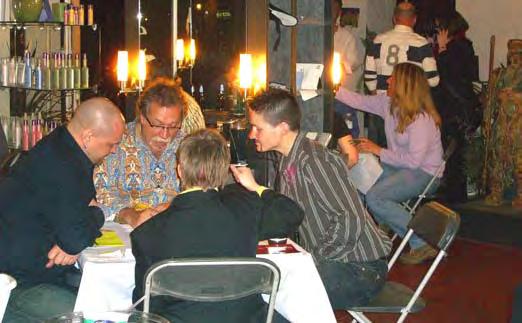
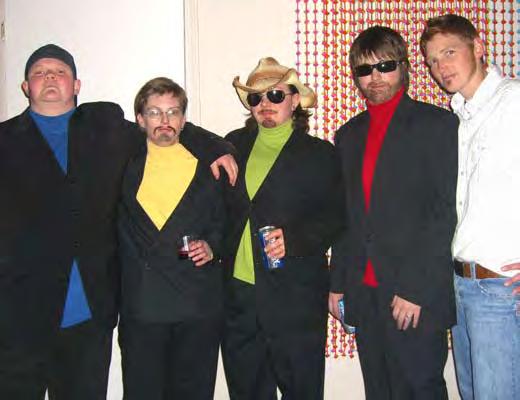
SPOKANE, Wash. - Bunko Night, the first of a series of “Gayme” Nights to be held as fundraisers for the future LGBT center, raised more than $900 in community dollars for the general operating fund on March 10. After expenses, the event netted more than $700. With the current match campaign, the money raised from the event will total more than $1800. More than 40 people attended Bunko Night which included a debut performance by Spokane’s new drag king troupe, “Chix & Dales.”
By Tracy Baim, Windy City Times
One of the most important pioneers of the modern gay and lesbian rights movement died Feb 18. Barbara Gittings, 75, passed away in Wilmington, after a long battle with breast cancer. Her death was announced by her partner of 46 years, Kay Tobin Lahusen, and her friend and fellow activist, Philadelphia Gay News Publisher Mark Segal. Gittings was involved in several critical moments of the GLBT movement. Her first protest effort was in 1965 when she and a few other activists made history
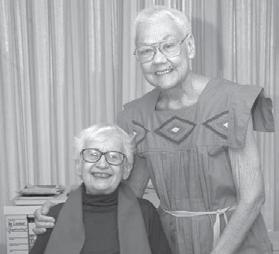
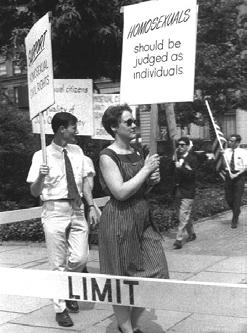
in the first public demonstrations for “homosexual” rights, outside the White House in D.C. and Independence Hall in Philadelphia. She was featured in the documentary Before Stonewall. “There were scarcely 200 of us in the whole United States. It was like a club; we all knew each other,” Gittings said of those early years.
“Things were heating up but had not yet reached their peak” in 1965 in terms of social protest over civil rights and Vietnam, said activist Frank Kameny after Gittings’ passing. “At that point, picketing at the White House was the expression of dissent par excellence.” It
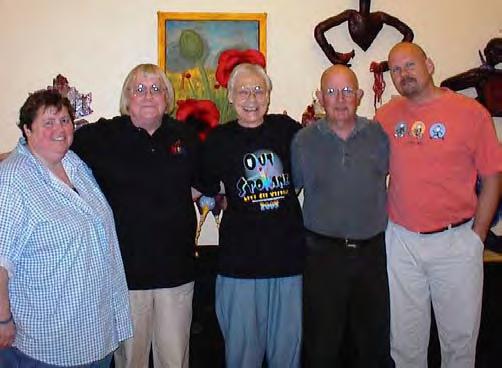
at a Pride Week
Barbara Gittings appeared in Spokane by invitation of the Spokane GLBT Film Festival, sponsor of the Pride Week opening event, a Friday, June 3, 2005 showing of the documentary “Gay Pioneers.” Gittings was featured in the film.
“You have to keep your sense of humor and work with your allies,” Gittings advised. She went on the say that the GLBT community as a whole is made up of individual thinkers who have strong opinions; humor and compromise are necessary to continue to make progress. While in Spokane, Barbara Gittings marveled that 55 years of activism had just flown by. Her continuing gift to the GLBT community is a look into the past to invigorate the present and plan for the future. Whatever you do, Gittings laughed, “Don’t let the bastards grind you down.”
Gittings’ visit
got so congested that police assigned groups particular spots in front of and along the sides of the White House compound.
“Those demonstrations put the issue of gay rights on the table in ways that it hadn’t been done before,” added Ken Sherrill, professor of political science at Hunter College. “They said that this was a fit subject for discussion.”
In the late 1950s Gittings helped organize the New York City chapter of the Daughters of Bilitis ( DOB ) , at the urging of the group’s national founders, Phyllis Lyon and Del Martin. It was there Gittings met Lahusen. She was chapter president for three years and edited the national publication of DOB, The Ladder ( taking over for Lyons and Martin ) , from 1963-1966. She worked with her partner on The Gay Crusaders book in 1973. In her writing and her activism, Gittings challenged earlier gay-rights strategies that were against direct political action, a position which caused her to leave DOB.
Perhaps the most long-lasting impact of Gittings’ decades-long work was in helping to change the American Psychiatric Association ( APA ) categorization of homosexuality as a mental illness, in 1973, and her work campagning for GLBT books in public libraries, as a leader of the Task Force on Gay Liberation of the American

Publisher’s Note: Mark Garrett and David Williams were the Special Honorees at this year’s SAN annual Oscar






I would like to thank the Spokane AIDS Network [SAN], Board of Directors, Director Susan Fabrikant, The Oscar Committee, corporate sponsors, and Cherie Moss for her kind words. I was truly honored by the recognition on this special night, more so with my nephew and his wife, Ronald and Leslie Williams there to support me.
Our community is very fortunate to have SAN and a wide variety of advocates and volunteers at home.
One of the nation’s leading Southern Baptists has called for a policy that would support medical treatment, if it were to become available, to change the sexual orientation of a fetus inside its mother’s womb from homosexual to heterosexual.

Areas of Treatment include: Identity/Relationship Issues
Most Insurances Accepted
¤ Heather Pederson, LMHC
¤ Brenda Roberts, LICSW
¤ Michelle McAlpin, MS
12615 E Mission, Suite 101 (509) 926-9911
Conveniently located across from the Valley Hospital

Thanks also to the wonderful people who attended and supported the auction and coming together to help SAN’s fight to end the threat of HIV/AIDS.
Sincerely, David Williams
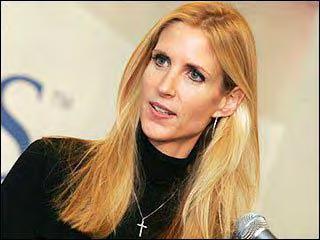
Ann Coulter has once again proven she is the “Queen of Shock”. But where liberals, gays, even Republicans, are calling her latest attempt at “humor” and attack disturbing, I feel differently. I despise Ann Coulter on so many levels, but her using the f-bomb did not make me dislike her even more. Instead it made me angry at the gay community.
What gives us gays and lesbians the right to “patent” words we use to refer to ourselves yet become offended when heterosexuals use the terms? The situation is akin to Whites using the n-word to refer to Blacks, who often use the term to refer to themselves. It is not allowed, hateful, and incites accusations of bigotry, they claim.
Our language and our behavior are for all to see and interpret. If we refer to ourselves as “dykes”, “faggots”, “queens” and “queer” that is exactly how heterosexuals will view us.
Our community is breaking new ground on a daily basis in the area of marriage equality and hate-crime legislation. How do we demand equality and respect on the one hand while calling ourselves derogatory terms, even affectionately, on the
“If a biological basis is found, and if a prenatal test is then developed, and if a successful treatment to reverse the sexual orientation to heterosexual is ever developed, we would support its use as we should unapologetically support the use of any appropriate means to avoid sexual temptation and the inevitable effects of sin.”
-- Rev. R. Albert Mohler, president of the Southern Baptist Theological Seminary in Louisville, KY
I just don’t know where to begin with this one! First the evangelicals say that Homosexuality is a choice now they are moving towards the belief that it is genetic. So they suggest that it is OK to treat a fetus for homosexuality if it will make it a heterosexual. On the other hand if a fetus is determined to have a genetic abnormality of, say, Downs Syndrome treatment is forbidden because this defect is “God’s will”. Is there no end to the hypocrisies?
Jim Jones Spokane, WA
other? This sends a mixed message. If we want respect and equal rights from the majority we must define ourselves as equal, worthy, and deserving. We must be conscious of our language, and our behavior. Right, wrong, or indifferent, they hold the power to help us be free and equal.
Ann Coulter was merely spewing a term, albeit with hurtful intent, that we use to refer to ourselves. We can not blame the Isaiah Washington’s and the Ann Coulter’s for using terms we ourselves utter. The mirror they put in front of us gives us the opportunity for self-reflection and definition. Who are we?
Wendy Payne Spokane, WA



















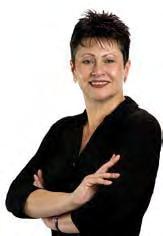
SPOKANE, Wash. - Queer Sounds, Spokane’s GLBT radio show, will begin integrating discussion themes into its weekly live broadcast. The first theme, transgendered issues, will be covered in the show’s next airing, Thurs, March 22, at 6pm.
“We are doing a series of probably three shows on transgender issues,” states Irey, co-host and programmer of Queer Sounds, “this week we will focus on coming out as transgender and what that means and where a transgender person goes from there.” Featured guests for this show will be Kim Stankovich and Tracy Sturchio.
Irey notes future shows will try to
cover other issues like discrimination and legal matters
Queer Sounds, which debuted in the fall of 2003, can be heard every Thursday from 6-8pm on KYRS 89.9 or 92.3 FM. Hosts Irey and Bob can be reached anytime at queersounds@ kyrs.org , or during the show at 7473807. Queer Sounds can also be found at www.myspace.com/queersounds
Further coverage of Queer Sounds can also be found in Queer Sounds on the airwaves, published in the December 11, 2006 issue of Stonewall News Northwest. Stonewall back issues can be downloaded free at www. stonewallnews.net
bunko continued from FRon T PAGE
Dana Mathews and DeVerne Augustus, co-owners of Studio One Hair and Body Salon, hosted the event at their location at 1311 W. Sprague, with food donated by Wild Sage American Bistro. Many other gifts of food, beverages and door prizes contributed by the community-at-large surpassed $500 in in-kind donations.
“This is a great way to spotlight the future LGBT center and allow the community to support us and learn about our mission while having a lot of fun doing it,” says Cat Carrel, chair of the board responsible for the center’s reorganization. “Our goal is to do many events like this throughout the year so everybody can participate in their own
way resulting in huge returns in terms of community building and visibility for the center,” she adds.
The event included the Chix & Dales’ performance of “Walk like a Man”, with a special performance of “Where is the Love?” by Chix & Dales king Busta Rug. A 50/50 drawing raised $176, and the winner of the drawing, Shawn H., donated his winnings back to the LGBT center. Steven Sanford had the highest overall score to win the $50 gift certificate to Wild Sage, and James won the second place prize of a massage from Main Touch Massage & Wellness Center.
“Our many thanks go out to the generosity of the community, especially to Dana and DeVerne, for helping us pull off a fantastic debut event for the LGBT center,” Carrel says, “We’re looking forward to many more!”
SPOKANE, Wash. - Kelly Stevens has joined Odyssey Youth Center’s staff. Stevens will be assuming the role of Volunteer & Facility Coordinator effective Monday, March 19, 2007.
Stevens initially came to Odyssey as a youth in 2003. During her tenure as a young person accessing services, she also gave back to Odyssey, first by completing an internship for Odyssey and Healthcare for All in an effort to educate youth on their options for healthcare. Stevens also organized several youth rallies around gay marriage which ranged from hanging signs on the Maple Street Bridge overpass to demonstrating outside the Spokane Arena.
In 2004, Stevens was an active participant in Odyssey’s first Olympia
Lobby Day trip. Many of her ideas for that first trip continue to be used at Odyssey.
Following her time with Odyssey as a youth, Stevens returned and has served in multiple volunteer capacities.
“Odyssey works hard to do its part to help young LGBTQA people realize their full potential,” states Ramon Alverez, Executive Director of Odyssey, “It is most gratifying when even one of those youth returns to Odyssey and has an opportunity to give back and apply their knowledge, experience and enthusiasm to the Center’s efforts. “ Odyssey Youth Center is located at 1121 S Perry in Spokane and can be reached at (509) 323-2306 and on the web at www.odysseyyouth.org


Paradise Grange 16120 South Keeney Rd. 10 miles South of Spokane, off Hwy 195 watch for funky junk

20 vendors offering antiques along with other vintage, shabby chic, re-purposed & priceless finds not to mention a funky suitcase or two!
Questions? Contact the funky junk girls, Hollie or Jennifer at: funkyjunkshow@yahoo.com
fax 509.267.6309 mail@stonewallnews.net
Stonewall News Northwest is copyrighted under federal law. Any reproduction of its contents is prohibited unless written permission is obtained.
One copy of Stonewall News Northwest is available free of charge for each reader at current distribution locations. Copies of Stonewall News Northwest which have not been picked up for the purpose of reading them are the property of Stonewall Publishing, Inc. Any unauthorized person who takes or moves multiple copies of Stonewall News Northwest to prevent other people from seeing or reading them shall be considered guilty of theft. Violators will be prosecuted.
Multiple copies can be sent to any distribution location free of charge. Please call or e-mail us for information.
SUBSCRIPTIONS
Subscribe by sending $39 (26 issues/year) with your name and address to Stonewall at the address above.
CELEBRATIONS
Share your union ceremony, arrival of a child or other milestone in life with the Stonewall family at no charge! Announcements should be 150-250 words. Include your name and phone number so we may contact you. You may e-mail your announcement with photo attachment or mail to Stonewall at the address above. Please include a SASE for photo returns
OBITUARIES
Obituaries written by spouses, family or friends may be placed in Stonewall News free of charge. They can be sent via e-mail, U.S. Mail or fax. Include your name and phone number so we may contact you. A photo may be included as an e-mail attachment or via traditional mail. Please include a SASE for photo returns
LETTERS POLICY
Stonewall News Northwest welcomes letters and e-mails. All submissions will be considered for publication. They should be typed and 250 words or less. Each submission may be edited for length and/or coherence. Full name, address and phone number must be included; letters will be verified. Names withheld by request only. Submissions will not be returned
DISCLAIMER
© 2006 Stonewall News Northwest. All Rights reserved. Stonewall News Northwest is published by Stonewall Publishing, Inc., a Washington State Corporation founded in March 1992, Michael R. Schultz, President.
Stonewall News Northwest is not responsible for claims made by advertisers. We reserve the right to reject advertising which is unsuitable for our publication. The views expressed herein do not necessarily represent the views of the owner or advertisers.
By Joan Opyr
In February, the gay and lesbian community suffered an immeasurable loss. Barbara Gittings, a leader for more than fifty years in the struggle for gay rights, died of breast cancer at the age of 75. Ms. Gittings was a founding member of the New York Chapter of the Daughters of Bilitis, and she began leading protests in Washington, D. C. in 1965. She and a small number of other gay men and lesbians—dressed in “gender-conforming” suits and dresses—marched in front of the White House with signs demanding equal rights for homosexuals.
It was the year before I was born, and three years before the Stonewall riots in New York. Gays and lesbians were still being arrested, prosecuted and jailed simply for being gay or lesbian. Our bars were being raided, we ourselves were being harassed, and publications like The Ladder, which Barbara Gittings edited, were confiscated and destroyed. The Ladder, a mimeographed precursor to GLBT news magazines like The Advocate, featured poetry, true stories and essays. By today’s standards, The Ladder was quite tame, but because it dealt honestly and openly with lesbian lives, it was considered pornographic, and sending it through the U. S. Mail was a federal crime. Imagine if reading Stonewall News Northwest, this publication, might land you in jail, and you’ll get the picture. It’s hard to believe but important to remember.
I met Barbara Gittings in October 1999 when she was a guest speaker at Washington State University. I loved her. She was energetic, charming, enthusiastic and modest. She spoke of having first suspected that she was a lesbian at summer camp. She realized that she “just loved being around girls.” Sound familiar? It did to me. I told Barbara that I’d realized something was different about me one day while I was standing on third base. I was waiting for Stephanie on first to throw me the ball, but I was concentrating so hard on her red hair and her fetching terrycloth wristbands that I failed to put my mitt up in time and took a softball straight to

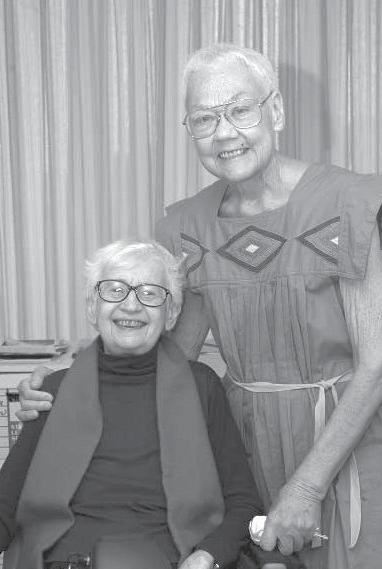
Her death was announced by her partner and her friend and fellow activist, Philadelphia Gay News Publisher Mark Segal.
the face. Did I care? No. Steph admired my stoic toughness as the blood poured copiously from both nostrils, and she helped me change my ice-packs as I sat out the next inning on the bench.
Barbara Gittings was only at WSU for a few days, but I learned so much from her. She had an interesting perspective on the drama that sometimes arises in
the gay community, the silly arguments and the endless in-fighting. On the whole, she said, she thought this was a good thing. She compared the gay community to a waterbed: when pressure was applied to one corner, the water shifted and popped up somewhere else. Our greatest strength, she said, was that there really was no “Gay Agenda.” The Gay Movement comprised millions of individuals all seeking the individual rights guaranteed by the Constitution. It was hard, she felt, to argue against that.
Barbara Gittings was courageous and modest. She gave us hope. Barbara is perhaps best known for spearheading the campaign that led the American Psychiatric Association to declassify homosexuality as a mental illness. Thanks to her work, being gay or lesbian is not crazy, but being Jerry Falwell is. Whenever I see his loathsome face on television, blaming you and me for natural disasters, terrorist attacks and foul weather in the State of Virginia, I think of Barbara Gittings, and I take heart. I remember how far we’ve come, and I know that in the end, we will win. Barbara never seemed to doubt it.
Joan Opyr, AKA Auntie Establishment, is a Moscow area fiction writer, the author of the novel Idaho Code, and the Northern Idaho Editor for New West Magazine. She invites your questions, comments, mint julep and rat recipes at joanopyr@moscow.com.
By The National Center for Transgender Equality (NCTE)
Achieving our goal of transgender equality requires activism at the local, state and national levels. While NCTE focuses on federal policies, we strongly support and encourage the vital work of grass roots activists. Each week during 2007, we will feature an idea for action that you can take at a local level. Some will be challenging, some will be simple; all are effective ideas and we will include links, resources and thoughts to help you get started. Some are things you can do on your own, while others are ideas for local groups to work on. We hope that you will take on projects that spark your interest and that meet a need in our community as we work together for equality for all people.
Week #13 March 25 - 31:
Suypport a Day of Silence
On April 26, students around the country will take part in a Day of Silence, a program sponsored by the Gay and Lesbian Student/Educators Network (GLSEN). The Day of Silence began in 1996 at the University of Virginia with students determined to raise awareness about the ways in which lesbian, gay, bisexual and transgender students were silenced by prejudice based on gender identity and sexual orientation. In the last decade, students at thousands of schools have taken part by remaining silent for a day.
Riley Snorton, a member of NCTE’s Board of Directors is a staff member at GLSEN. He notes, “This is the tenth anniversary of the Day of Silence and it looks like more students than ever will be participating this year. This is already the largest student-led action on LGBT issues that happens in this country and has ever happened in American history.
I think it is so important that we draw attention to the kinds of harassment and silencing that students face regularly in schools because of their gender identity and expression.”
You can find a resource manual, posters and lots of information at the Day of Silence website at www.dayofsilence. org. Start planning now to make a statement with your silence on April 26.
Week #14 April 1 - 7:
Preach or speak at a local community of faith, such as a synagogue, church or mosque
April is a month of many religious festivals—you can commemorate the births of Buddha, Muhammad or Rama and celebrate Passover, Easter, Beltane and Baisakhi. Trans people practice the many religions of our world. Whatever your spiritual practice, if you are involved in a community of faith, consider talking to your community about transgender
issues.
You might want to preach a sermon or give a short testimony about your experience as a transgender person, significant other, or ally. Another idea is to suggest a book, article or reading for a discussion group. You might organize a speaker to come do a trans 101 training for your community. Talk to the leader of your temple, mosque or church to get ideas about what might be appropriate. If you are able to speak to a gathering, your religious leader can also help you as you prepare your remarks.
Justin Tanis, NCTE staff member and author of Transgendered Ministry, Theology and Communities of Faith (Pilgrim Press, 2003), comments, “People need to hear our voices as transgender people. We have learned important things spiritually from our journeys of self-discovery. The fact that we dig deeper than the obvious about our bodies in learning about ourselves helps us to go below the surface spiritually as well. It is a powerful thing to hear our stories from pulpits and spiritual spaces.”
Other excellent spiritual resources to check out are:
• Made in God’s Image: A Resource for Dialogue about the Church and Gender Differences (Reconciling Ministries Network, 2003), by Ann Thompson Cook
• Transgender Journeys (Pilgrim Press, 2003), by Virginia Ramey Mollenkott and Vanessa Sheridan So, bring trans liberation to your community of faith.
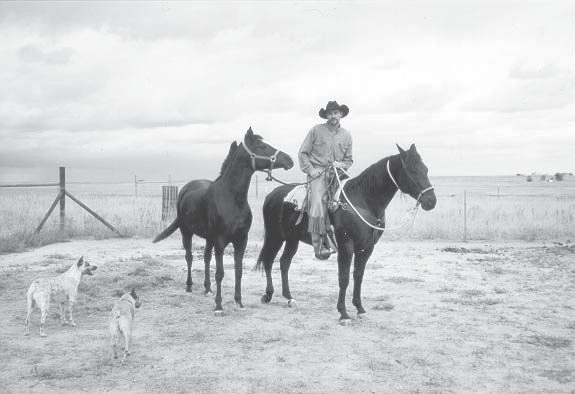
This year marks the 20th anniversary of essays I’ve written for the gay community. During all that time, especially via my former trucking career, I’ve been fortunate to meet many fascinating people. In 1992, I crossed paths with one such remarkable individual, a stir crazy, handsome, closeted cowboy who not only left a deep impression on me but who also became a life long friend. I eventually wrote about this man in a 1998 essay entitled “Cody.”
Cody’s story was not an easy read back then. His history still isn’t neatly bundled in happily-ever-after. Rather, his experience is a study in rough around the edges. Unlike many of the seemingly instant coming out stories I’ve read in various places, Cody’s narrative extends over a decade and is full of raw contradiction, tentative first steps, countered with frantic, if not bold, almost explosive leaps of faith. An isolated, rural man, his is a hit-and-miss life. He dreams of a partnership that might not exist, while worrying at the same time that a “perfect for him” relationship might just come his way. Cody’s story is the story of many rural gays in the Intermountain West. Theirs is a history that is just beginning to be told. This one comes to you in three parts.
Revisiting Cody’s story, nearly a decade after I wrote the first story, seemed especially fitting last month as February 2007 marked the first anniversary of the hyped Oscar run of Brokeback Mountain. The controversial movie, based upon an acclaimed fictional short story by Annie Proulx, won film award after film award. Brokeback Mountain turned the Oscars upside down, leaving audiences unsettled and smelling of homophobic controversy. A year later, the film remains just as earthshaking, as evidenced by its countless interpretations on Youtube. From Eastern Europe, to Australia, to Asia, “that independent arty cowboy movie” still taps something universal and deep inside moviegoers.
Cody saw Brokeback Mountain in Colorado Springs with another cowboy. They entered the theater apart, found one another again once inside the theater. After the credits rolled, the two men also left the theater apart, meeting back up in the parking lot. “It just worked out that way. For some reason, we just naturally split up after looking around the parking lot. We came out of the theater in different directions too. Not that anyone was going to do anything to us, but we just separated. My favorite part of the movie was the shirt part. It’s a good story, and I’ve
By Tim Anderson Part 2 of 3
read and reread it. But once the movie got things stirred up, I got kinda’ tired of hearing about it.”
Yet the movie has also inspired many of Cody’s more recent western art pieces. Several of these works are identifiable scenes from the movie. The story continued to resonate with him long after his first read of Jack and Ennis and long before the picture hit the local theater.
I can still see him, 15 years ago, staring at the edge of change. Looking over a landscape perched on the edge of a front range, interstate highway: terrain that was best described as part high plains, part foothills, but all hard luck country. I’ve often thought either Jack or Ennis could have been him, especially with Cody’s intimate understanding of the point where mountainous Wyoming and Colorado turn to no man’s land and that the same definition could encompass just about any Wyoming bar stool on a Saturday night.
In reading Proulx’s story nearly a decade after meeting Cody, it seemed the author had crossed paths with my friend. Had she encountered Cody during some full moon whoop it up off base in Cheyenne? Or had she seen him standing at the brink of last call in some cowboy bar, perched on the edge of no return, in Rawlins? In interviews, Proulx said the story originated watching an old cowhand hungrily watching young renegades playing pool. Nevertheless, there was a time when “Cody” could have been Jack or Ennis-depending on the day, the hour, or the adult beverage.
Yet through all the years, throughout his wanderings, I’ve witnessed a slow but steady transition,
almost as if Cody was going to take his time before settling into any one skin. That awakening also included a quiet settling of his sexual orientation. “I’d say I used to be bisexual, but I said that because I’d been with more men than women. I’d say now that yeah, I’m gay. But I don’t even like that word. I am not embarrassed by sexuality, or my sexuality. I know who I am, and I am honest with myself. I know my name. But I am not going to be waving any flags. I’m a more private person.
“I finally went to the gay rodeo in Denver. It was better than I thought it would be, but when someone approached me, I told them they didn’t want none of this. There’s a lot of times when I think that being in the closet is easier than dealing with all the scene, the terms. “Eye candy.” “Wolf.” When I start to hear that stuff it turns me off, and I feel out of place. The over compensation, the way everything is overdone. I don’t think it’s necessary, and here I‘ve done all the walk the walk and talk the talk.
“I’m still not that sexually active, and sex is not how I center myself. I think that any body with a creative imagination needs alone time or restoration time. You have to take in. You can’t always be giving or be over stimulated. I’m just out of practice when it comes to dealing with people and I spend a lot of time alone. I don’t get lonely, but in the back of my mind, there is always a longing for being with someone that could get that about me and not fight it. Yet, I‘m used to being by myself. I still like my own company, and I think you just hit that dimension where it’s hard to get back out it. Maybe it’s a
cowboy thing, because I know that everybody is not like that. I might be more of a loner than most people. It’s like sacred ground out here. I rarely have anyone out.”
Cody talks of horse training fiascos and winces, remembering come-to-Jesus moments, post bucking chute, easy on the bravado. His recollections are understated, if not broken and stark. He can just as easily switch toward misplaced truck driving nirvana or speculate about a near miss heart thing gone unclaimed. A smile exchanged with the tall hatted fella standing on the other side of the fuel island in town, or the men from years back who held his gaze a little too long at that Cheyenne two stepping bar. He recoils at the Internet-born love struck stalkers, then talks of maybe setting out to make some new introductions, but then again remembers shutting doors when the face didn’t look like the picture.
There are mentions of the cussed truck repairs gone south in the same paragraph as the people who’ve recently caught his eye. The married men he knows who are hitched but still available. Sometimes those accounts trail off into an examination of something deeper. Relating on love longed for and lost can sidestep into the retelling of a bad horse wreck or his attempt to rescue some concentration camp bound BLM horse. Or what starts out as a literary exercise in horse training 101 might end up reading like a conversation with Gandhi or the Dalai Lama about the human condition. If the moon is right, the comets are near, or the wind is spitting flurries down from the high county, an old soul stands ready on deck, complete with his ride ticket written in the philosophy of horse training and humanity’s expectations of the four legged set and of each other.

By Anushka Asthana, The Observer, UK
U.K. - A pilot scheme introducing books dealing with gay issues to children from the ages of four to 11 has just been launched in England’s schools.
It is being argued that the books, one of which is a fairytale featuring a prince who turns down three princesses before
falling in love and marrying a man, are necessary to make homosexuality seem normal to children. Fourteen schools and one local authority, backed by teaching unions and a governmentfunded organisation, are running the controversial scheme, which has been attacked by Christian groups.
Twenty years ago the publication of
16-year-old anti-discrimination policy not enforced; committee forms to demand its implementation
By John Wright, Dallas Voice
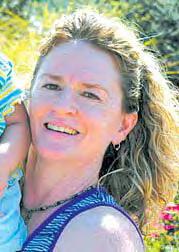
DALLAS, Texas - Kristine Vowels, a DISD administration employee, is pushing the district to enforce its existing anti-discrimination policy. She wants the district to hire a director of LGBT initiatives and to conduct staff training.
A teacher uses class time to talk about how specific LGBT students are going to hell.
A security guard calls an LGBT student a “faggot” within earshot of school administrators, who do nothing about it. The student subsequently drops out.
An LGBT teacher is reprimanded for using his school’s video system to disseminate information about the GayStraight Alliance.
These are just a few examples of a big problem within the Dallas Independent School District, according to LGBT district employees and members of a citizens committee.
Kristine Vowels is a DISD administration employee who started the committee to address the problem last summer. Vowels said the committee is demanding that the
By Stuart Elliott, NY Times
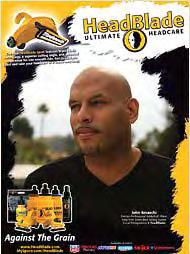
For years, the number of athletes who were openly gay and had endorsement deals could have been counted on the hand of the old-time baseball player Mordecai Brown, known after a farm accident by the nickname Three Finger.
Recently, however, that has started to change, as Americans have reassessed their ideas about homosexuality and as athletes have become more willing to discuss their sexuality. In another sign of the times, a company that sells men’s grooming products, HeadBlade, is to announce today that it is adding to its roster of endorsers John Amaechi, the former professional basketball player who said last month that he is gay.
Mr. Amaechi was a journeyman center for such teams as the Orlando Magic and Utah Jazz. He is the first National Basketball Association player to disclose his homosexuality. He also became the sixth retired male pro athlete
district enforce its 16-year-old policy prohibiting discrimination based on sexual orientation by conducting staff training and hiring a director of LGBT initiatives.
Committee members plan to meet with district officials Tuesday, March 20.
“This [anti-discrimination] policy that the Dallas Independent School District has means nothing without implementation,” said Vowels, who recently completed a doctoral dissertation related to the subject.
The committee is also suggesting that the district adopt a curriculum that’s more LGBT-inclusive; extend benefits to the same-sex partners of employees; and create an environment that’s more sensitive to transgender students when it comes to names, pronouns, bathrooms and locker rooms.
Ivette Cruz Weis, a spokeswoman for the district, said officials will listen to the committee’s concerns and address them as necessary.
“The district does not promote discrimination against anyone regardless of what type of discrimination it is,” Weis said.
District offices were closed for spring break Thursday, March 15, and Weis said no other officials were available for comment.
Another member of the committee, Youth First Texas co-founder Bob Miskinnis, said the issue is critical because dropout and suicide rates for LGBT youth are three times as high as for their straight peers. He also said nowadays, many LGBT youth are coming out in their early teens.
“I think our [the LGBT] community hasn’t made it the issue it needs to be made, and if we don’t, the youth aren’t strong enough to do it,” Miskinnis said. “I think we have to stand up for them.”
Miskinnis said he is “pretty optimistic” that the district will take action.
“I don’t think that in the long run, they can do nothing,” he said.
Lambda Legal Regional Director Dennis Coleman, a member of the committee, said DISD is not legally required to implement the policy.
However, if it does not, it runs the risk of lawsuits from those who are discriminated against, he said. “The school district has been very lucky,” Coleman said.
By Glenn Thrush, Newsday.com
WASHINGTON -- If gays and lesbians were looking for a champion to dispute Gen. Peter Pace’s claim that homosexuality is immoral, they might have expected Hillary Rodham Clinton or Barack Obama to leap forward.
Not quite. While both Clinton and Obama are courting gays and lesbians, and would allow them to serve openly in the military, the Democratic frontrunners have been curiously reticent about challenging the statements of the chairman of the Joints Chiefs of Staff.
The highest-profile pol to say homosexuality is not immoral? It’s former Navy secretary, ex-spouse of Liz Taylor and current Republican senator from Virginia John Warner, who told reporters Tuesday, “I respectfully but strongly disagree with the chairman’s view that homosexuality is immoral.”


MANHATTAN, N.Y. - Gay rights activists demonstrated outside the Times Square Army recruiting center Thursday, March 15th, to denounce recent comments made by a senior U.S. military official. Members of ACT UP New York, an AIDS coalition, and other groups protested remarks made by the Chairman of the Joint Chiefs of Staff Peter Pace.
Speaking to the Chicago Tribune recently, Pace called homosexual acts, “immoral” and said the United States was “not served by a policy that says it is OK to be immoral.”
Protestors, including former New Jersey Governor James McGreevey say Pace’s comments were out of line and called the Military’s “Don’t Ask Don’t Tell” policy unfair and discriminatory.
“He’s chairman of the joint chiefs of staff and ironically, his statement was a blessing in so far as it ripped apart the façade of ‘Don’t Ask Don’t Tell’, ‘Don’t Ask Don’t Tell’ at it’s core says gays are second class citizens. If you’re truthful as to who you are, you’ll be discharged,” said McGreevey.
Demonstrators also say the policy is counter-productive for the military.
By David Crary, AP
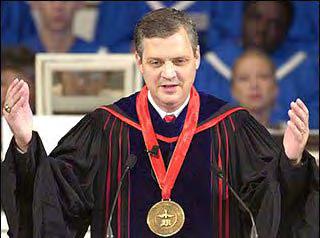
NEW YORK, N.Y. - The president of the leading Southern Baptist seminary has incurred sharp attacks from both the left and right by suggesting that a biological basis for homosexuality may be proven, and that prenatal treatment to reverse gay orientation would be biblically justified.
The Rev. R. Albert Mohler Jr., one of the country’s pre-eminent evangelical leaders, acknowledged that he irked many fellow conservatives with an article earlier this month saying scientific research “points to some level of
biological causation” for homosexuality. Proof of a biological basis would challenge the belief of many conservative Christians that homosexuality - which they view as sinful - is a matter of choice that can be overcome through prayer and counseling.
However, Mohler, president of the Southern Baptist Theological Seminary in Louisville, Ky., was assailed even more harshly by gay-rights supporters. They were upset by his assertion that homosexuality would remain a sin even if it were biologically based, and by his support for possible medical treatment
By Wyatt Buchanan, San Francisco Chronicle
When conservative commentator Ann Coulter called former Vice President Al Gore a “total fag” on national television nearly a year ago, it barely caused a stir.
Coulter’s recent labeling of presidential candidate John Edwards as a “faggot,” however, has triggered a huge response, including a campaign initiated today by a gay rights group and media watchdog to persuade mainstream media outlets to dump her for good.
At least four newspapers have dropped Coulter’s syndicated column, and 40,000 people signed an online petition to Universal Press Syndicate,
which distributes her column, demanding that it release her. Three corporations, including Verizon, stopped advertising on Coulter’s Web site after she made the comment.
This follows recent controversies over the use of the new “f-word” -- as some call it -- by actor Isaiah Washington and an antigay rant by NBA player Tim Hardaway. Washington apologized and announced he would go to “rehab,” and Hardaway lost endorsements and was penalized by the league.
Coulter wondered on the “Hannity & Colmes” show on the Fox News Channel on Monday about the difference between the reactions this year and last.


Left to Right:
Andrew Biviano
Tanya Morton
Sara Nicholls
Susan Creed
Donna Skoog
Melanie Simka
Lauren Waterbury
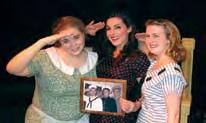
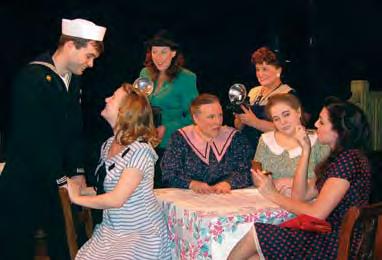
R.T. Robinson’s well crafted play takes place in Sterlington, Louisiana, a place so “humid that sound waves stick together.” The wives of three brothers o to WWII are living with their Aunt Ola and begin to understand that women are easily relegated to second class status, while their men can create and follow their dreams. The story is good, but the dialogue is more like Tennessee Williams-lite.
The Cover of Life is de nitely worth seeing, but don’t expect most of R.T. Robinson’s characters to possess the gravitas and grittiness that really seasoned actors might bring to the stage.
In fact, most of these community theater actors do a pretty good job with the material at hand. The dutiful, devoted dames that are married to absent “slobbering, red-neck sharecroppers” bear a striking resemblance to some of the cousins I grew up with from the South who held these typical all-American ideals.
The overall look and feel of the play is authentic. The sets and lighting produce good results and help magically transport the audience sitting in that small black box of Civic ‘s Firth Theatre to the deep South. The staging is e ective, often showing more than one character
playing o another from di erent locales simultaneously.
What is lacking here is the texture. Possibly it was just the discomfort of opening night, but the back-story of the characters seems to be missing.
There are several very good moments. In particular, the portrayals of the female temptress, Sybil (Waterbury), who believes that she and her man are “modern.” She wields the bitter hand of tragedy in the end. Kate (Sara Nicholls), the slightly less than hard-bitten reporter assigned to the story of the ‘Wives who are left behind’ for Life Magazine, turns in a fairly strong performance. Opening nights are di cult, and I trust that the cast will be stronger and more grounded in their characters each night. Try to catch The Cover of Life before it closes on Mar 31. Call (509) 325-2507 for tickets.
Mar. 20-24, Born Divas at Northern Quest Casino. Tickets are available at the N. Q. box o ce at (509) 340-6700 or TicketsWest at (800) 325-7328.
March 22-24, 29-31& Apr 12-14, Relative Chaos: The Plumb-Nutts Family Reunion at CenterStage Dinner Theater. For tickets call: Call (509) 74-STAGE or TicketsWest at (800) 325-SEAT.
March 24, 25, 31, Apr. 1, 5, 12, 14, Sonnet 23, (written by local playwright Will Gilman) at The Blue Door Theatre. Call TicketsWest at (800) 325-SEAT fro tickets. Mar. 25, “Best of Civic – 60th Anniversary Celebration,” 7:30pm. More information is available at http://www.SpokaneCivicTheatre.com
Mar. 29-Apr.1, AIDA at Spokane Opera House. For more information go to http://www.bestofbroadwayspokane.com or call: (800)-325-SEAT
Mar. 30 & 31 at 7:30 pm, Carousel in Concert at Coeur d’Alene Summer Theater North Idaho College’s Auditorium in Boswell Hall, 1000 W. Garden Avenue, Coeur d’Alene, ID. Call (208) 769-7780 or (800) 423-2849 for tickets.
Mar. 30-April 22, The Nerd at Spokane Civic Theatre. Call (509) 325-2507 for tickets. For information go to http://www.spokanecivictheatre.com
Mar. 31, Interplayers Annual Auction, 5-9:30 p.m. Unitarian Universalist Church, 4340 W. Fort Wright Drive, Spokane. To reserve a space, contact Mary Ann McCurdy at 456-7131. To volunteer or donate items, call 495-2436.

Apr. 6-21, Art’s Humble Boy at the SFCC’s Spartan Theater starring Patty Duke! Call (509) 838-4013 for tickets. For more information go to http://actorsreptheatre.com
Apr. 6-27, Prints from the Tamarind Institute at Spokane Art School’s Huneke Gallery, 920 N. Howard. Free. For information call (509) 328-0900
Apr. 5-21, The Price by Arthur Miller at interPLAYERS. For tickets or more information, call (509) 455-PLAY or visit http://www.interplayers.com
Apr. 11-15, The Crucible by Arthur Miller, 7:30 pm. Russell Theatre, Gonzaga U. E-mail: berry@gonzaga.edu or call: 509-323-3606

Dan Keberle lives, breathes and twitches Jazz at its very best. Under his musical direction, Spokane Jazz Orchestra holds its own with any of the Big Bands – past – or present and their professional camaraderie is a wonder to behold.
The rst half of the evening was packed with ingenious arrangements of classic jazz and featured two local winners of their annual Young Giants of Jazz Competition, pianist Dan Bullard from Lake City High and trombonist Preston Terry from Medical Lake High. It was an honor to hear these two young stars and realize they are on the fast track to very successful futures in the world of music.

The second half of the concert featured the incredible Tierney Sutton Band Tierney is a strikingly beautiful woman of Celtic descent and pipes reminiscent of Ella Fitzgerald and Della Reese with a touch of ‘Satchmo.’ Her bell-like tones and distinctly unusual styling (whether
she is growling or singing lyrical scat) is hypnotic. She and her trio seem to make each song a profound experience. They have been together for 14 years.
That time has brought them some fame (2005 Grammy nomination) and an ease that allows them to weave any of the old great American songs into an entirely new sensibility that transports the audience into a mesmerizing experience.
Her praise for SJO as a “prize that Spokane should treasure” was no understatement. If you missed this performance, pounce on the next opportunity for an incredible evening. Get your tickets now for May 12 with Horace Alexander Young. Call TicketsWest at (800) 325-SEAT.
Born Divas made its World Premiere at Northern Quest Casino on Mar 20 and closes on Sat., Mar. 24.
The show pays tribute to all the Divas: Billy Holiday, Ella Fitzgerald, Aretha Franklin, Diana Ross and the Supremes, Natalie Cole, Gladys Night, Janis Joplin and a special tribute to DreamGirls These women know how to sing and perform like the greats. Add four hot Las Vegas dancers, an eight piece award winning orchestra and costumes inspired by Bob Mackie to a Vegas-style set, and get ready for one of the hottest shows to hit
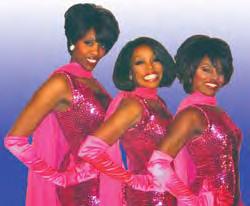
the casino in some time. Tickets are available at TicketsWest. Don’t miss this one!
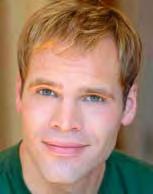
The 40th Anniversary Celebration & Fundraiser Revival of Coeur d’Alene Summer Theatre’s rst musical, CAROUSEL IN CONCERT will feature a lavish 28-piece orchestra, the 60-member North Idaho College Chorale and performances by some favorite CST players.
Notably, David Jon Williams (the strapping young guy on the left) will play Billy Bigelow who sings the hauntingly beautiful “Soliloquy” in which Billy imagines his future child. Director Roger Welch sings the praises of all his performers and hopes that everyone will attend this fundraiser.

Tickets are available for March 30 & 31 at 7:30 pm by calling (208) 769-7780 or (800) 423-2849
Arthur Miller noted about The Price, “Despite my wishes, I could not tamper with something the play and life seemed to be telling me: that we are doomed to perpetuate our illusions because truth [is] too costly to face.”
This may be one of the most engrossing and entertaining plays that Miller has ever written. More amboyant and theatrical than his better known plays, All My Sons or Death of a Salesman, it still has similarity in that the real story has already passed and the telling is more about his characters in re ection about choices made and “what if” visions.
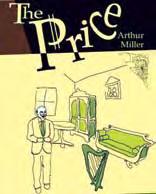
Two brothers meet after a sixteenyear estrangement. The old family fur-
niture is to be disposed of. Miller works up to the showdown scene slowly, where the siblings feel each other out before the basis of their long alienation and bitterness emerges into short, blunt, enraged accusations. A taut, exciting scene reveals the characters, including strengths and weaknesses, to each other. To get your tickets for performances from April 5-21. call (509) 455-PLAY or visit http://www.interplayers.com.
Adored: Diary of a Porn Star
Marco Filiberti
Wolfe Video
The plot is a bit simplistic and the characters never achieve the depth they are trying to achieve, but is nevertheless, touching.
At the heart, this story is about two estranged brothers, one of whom happens to be Riki Kandinsky (Filiberti), one of the hottest porn stars in Italy. Adored is told as a pseudo-documantary that ashes back to one year after the actual events in the lm. Riki and his brother Federico see each other at the funeral of their father, a wealthy businessman. Federico has no idea what Riki (still known to him as Ricardo) does for a living, and everyone is dismayed at Riki’s hair, sculpted eyebrows and mascara. Federico is glad to see Riki after such a long time. Of course Riki is less than transparent about his profession, which leads Federico to believe he is on drugs.
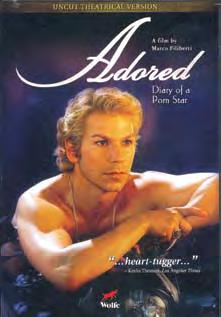
huge shock that eventually turns to acceptance. The time they spend together helps each of them to see what they may have been missing. Federico loses his provincial attitudes about sexuality, and Riki realizes that he longs for some deeper sense of companionship.
When Riki saves the life of a young orphaned boy, he realizes that he wants to adopt the child. During a TV expose of pornography that features our umm... hero, he is spotted by the child’s grandparents. Now that they know his secret, will he be able to adopt?
Italian soap operas such as this are fairly predictable: Tragedy must prevail to make the story emotionally worthwhile.
Watch for Luna, one of Riki’s friends, played by Rosalinda Celetano who played Satan in The Passion of the Christ. Her trademark of oddly strange appearance seems to suit each of her roles even though they are very di erent.
Roy Spinetti, director here! TV Films, 80 minutes
Like many of the presentations by here! TV, this may feel like a B rated TV movie, and although the plot is pretty good, with adequate performances from all the female actors, it is predictable.
Samantha, played by Alexandra Paul (known best for her protrayal of Lt. Stephanie Holden in Baywatch) is an Internet security expert who is struggling to balance work, her relationship with her girlfriend and the raising of her temperamental 16-year old daughter, Gwen. Heading out to a weekend vacation, Samantha and Gwen are kidnapped by the
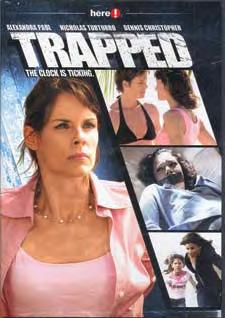
mysterious and creepy Adrien (Dennis Christopher). Adrien forces Samantha to hack her way into an FBI database and locate a woman hidden in the Witness Protection Program by threatening to mutilate her daughter. In a race against time, Samantha must break free of her kidnappers, save her daughter and foil Adrien’s plot to hunt down and kill the witness. Not as ho-hum as it sounds, the video does manage to create intensity and even though Trapped isn’t perfect, the ending is and it is always a pleasant change to see GLBTQ characters as the heroes. Try it, you might like it. Thanks, here! TV.
Federico follows Riki back to the city, where he wants to reconnect with his brother. Eventually, Riki tells Federico what he does, and as expected, it is a
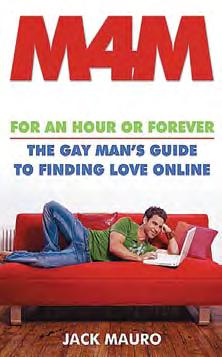
M4M: For an Hour or Forever
The Gay Man’s Guide to Finding Love Online
by Jack Mauro
Simon Spotlight Entertainment, 236 pp
“Millions of gay men are looking for love. The vast majority are searching online. With an estimated 11 million gay users online in North America alone, chances may be good that any gay man could nd what he is looking for... if he only where and how to look,” says author Jack Mauro.
In truth, Mauro seems to approach the subject with the assumption that he is dealing mostly with the lowest common denominator of the human male: sexuality. It would be difcult to make a successful argument against his point of view, because often that baser sexual drive is what links us to our sometimes Neanderthal heterosexual brothers. But leave that club in the closet for now.
I enjoyed it in spite of its shortcomings. See it at Pride and Joy Movie Night on Apr. 5 at CenterStage Theater. FREE!
Doors open at 6:30 p.m. 20% of anything at Ella’s and 50% o well drinks.
as the next new Gay MySpace. It really doesn’t matter where as much as how you go about your self presentation and the dialogue that includes.

So where does that leave those who are really looking for a LTR (Long Term Relationship) or the chance to ne someone else who would be open to monogamous dating? Well, right where we were in the rst place, of course. However, we can now be girded with the knowledge and information we need to search more e ectively for what we may want.
Perhaps, as the author seems to suggest, the key here is to really understand what you are looking for. If you can’t be sure what you want, you may never nd it.
In that case, look inward. Be bold in discovering what you need. No one can do that for you, except you.
That being said, he does present a manual that is inclusive of the necessary vernacular for Internet “dating,” tips on what to put in your pro le, some shallow assessments of various online sites for men looking for men and advice on how to determine what you are looking for.
Although his experience seems to slant heavily toward AOL, chat rooms for hook-ups are so numerous that I doubt anyone can keep up with all the new sites that seem to be going into business
Once that is done, log on and follow your dreams, wet or dry, base or heavenly, physically or emotionally, until you meet the one you want.
Stonewall is looking for GLBTQA community members to tell us what you like in your music and why.
A background in music is helpful, but not essential. If you are interested in being a guest reviewer, contact A&E editor, Christopher Lawrence at a-e@stonewallnews.net.
to hear from you!





continued from PAGE 7
Dan Savage, editor of the Stranger, a Seattle alternative news weekly, and author of several books on his life as a gay man, said the reaction to Coulter could indicate a change in how people view gays.
“I always thought we would be reaching a tipping point with anti-gay hate where it will no longer be acceptable, and maybe we are reaching that tipping point now,” said Savage.
Neil Giuliano, the president of the Gay & Lesbian Alliance Against
Defamation, the rights group starting a campaign to get Coulter’s voice out of mainstream media, said public opinion about anti-gay slurs is changing because gay and lesbian people are more visible than ever.
“As this happens, those in the overall culture who don’t like that are going to raise their voices and become even louder, and that’s why I think a lot of this is going on,” Giuliano said.
Ronald Butters, a Duke University professor who studies the changing meaning of taboo words in American English, said he doesn’t think “faggot” has become more or less offensive.
“Words mean what the public takes

them to mean,” he said. “The very reason that there is a furor is a pretty good indication of how insulting that term was.”
Leaders in the gay community said the Coulter fallout could become the prototype for how the public will respond to the use of the term “faggot.”
“People are actually realizing this word hurts and defames an entire group of people, and having people other than ourselves standing with us is very significant,” said Giuliano, whose organization is known as GLAAD.
GLAAD is issuing a “call to action” today to its 40,000 constituents, asking them to contact the heads of cable news organizations and NBC and “call on them publicly to state that they will no longer feature Ann Coulter as an on-air commentator.”
The Human Rights Campaign, another gay and lesbian civil rights organization, started a campaign earlier this week to pressure the Universal Press Syndicate and newspapers that publish Coulter’s words to drop her. So far, people have sent about 40,000 e-mails through the organization’s Web site.
“It just seems to me the conventional wisdom around Ann Coulter till now has been that the most important thing for anyone to do is ignore her, but I think we have a more serious problem here that we are addressing,” said Joe Solmonese, president of the Human Rights Campaign. “This word ought to be seen as offensive and dangerous as any hate-based word.”
Conservative gay scholar Andrew Sullivan, who heard Coulter’s comments live, said she uttered it with “malice aforethought.” But equating it to other slurs is a difficult comparison, Sullivan said.
“Nothing has the power of the nword,” he said.
Coulter made the offending utterance last Friday at a major gathering of conservatives, where she shared the stage with several Republican candidates for president.
During her speech, a series of jokes about Democrats, Coulter said, “I was going to have a few comments on the other Democratic presidential candidate, John Edwards, but it turns out that you have to go into rehab if you use the word ‘faggot.’ So ... I can’t really talk about Edwards.”
Coulter has defended her use of the term as a “schoolyard taunt.”
“The word I used has nothing to do with sexual preference ... and unless you’re going to announce here on national TV that John Edwards, married father of many children, is gay, it clearly had nothing to do with that,” Coulter said in an interview this week on “Hannity & Colmes.”
The explanation has not satisfied her critics, including three Republican presidential candidates, Rudolph Giuliani of New York, John McCain of Arizona and Mitt Romney of Massachusetts. Edwards and Democratic National Committee Chairman Howard Dean also criticized Coulter.
And the Shreveport (La.) Times on Thursday became at least the fourth newspaper to drop her column out of 35 publications that carried it.
“Today, we move past the rhetoric and unproductive dialogue offered by Ann Coulter,” the newspaper’s executive editor, Alan English, wrote in an announcement on the newspaper’s Web site.
Butters, the Duke professor, called Coulter’s explanation of her use of the word “simply ridiculous and untrue.”
“It is always intended, I think, as a derogatory term of one of the most pernicious sorts,” he said.
Thom Lynch, who leads San Francisco’s Lesbian Gay Bisexual Transgender Community Center, said he does not hear the word used often among gay men.
“It’s not a word people have reclaimed in any sense. If straight people use it in the same way Ann Coulter did, people will get really angry about it,” he said.
Still, some gay people are skeptical of the condemnation of Coulter.
“I don’t have a problem with people using the word ‘faggot.’ I use the word ‘faggot’ all the time,” said Seattle’s Savage. He started a public humiliation campaign against former Pennsylvania Sen. Rick Santorum, a Republican, after Santorum made derogatory statements about gay men. But he does not think there should be a campaign to silence Coulter.
“When we start acting like the thought police, it plays into the rightwing paranoia that we are going to force them all to say only nice things about us in public,” Savage said. “I think we would gain ground faster in the gay and lesbian civil rights movement if we drop the Sally Field act of, ‘You like me! You really like me!’ “
Stonewall News Northwest (this publication) has an exciting sales opportunity available for an Account Executive.
Position:
Account Executive - Display Advertising Sales. Part-Time Contract, Field/Telecommuting Position. Potential for Full-Time Management. Base plus commission. Please e-mail resume with cover letter including wage history and income requirements to: publisher@stonewallnews.net . No phone calls please.
About Stonewall:
Through a network of contributors, Stonewall informs, enlightens, and engages the GLBTQA community of the Pacific Northwest. Stonewall News Northwest is the Pacific Inland Northwest GLBT flagship publication. Begun in 1992 as a monthly newspaper, Stonewall now enjoys over 20,000 monthly readers; goes to press every other week and is distributed free of charge at distribution points in Montana, Idaho, Washington, Oregon and on Stonewall’s website, www.stonewallnews.net
Responsibilities include:
Generate revenue by selling display advertising for Stonewall News Northwest; In concert with the Publisher, assess the market, develop strategy to grow the overall space and develop a plan to work for growing the business; Cultivate relationships with existing clients and prospect for new business; Meet monthly, quarterly and annual goals; Take an aggressive approach to creating own leads to compliment the leads provided by management; Communicate regularly with Publisher, keeping all required sales forecasts updated for all upcoming issues; Coordinate as needed for creation of ads, submission of ads and proof reading page layout; Territory management and building; Professional telephone selling skills; Achieve or exceed assigned sales quotas and productivity targets.
Qualifications:
2+ years of sales experience; Excellent phone/presentation skills and the ability to develop relationships; Excellent written and verbal communication skills; Excellent customer service skills; Solid organizational skills; Proficiency with Excel, Word, and E-mail; Customer Management and Database Systems a plus; The ability to work independently and as a team; Energetic multi-tasker with a strong sense of urgency and accountability; and Ability to mine leads, cold call and build relationships.
Stonewall promotes and enforces a policy of Equal Employment Opportunity (EEO) for all individuals.






http://www.things4u.mychoices.biz
Library Association ( now called the Gay, Lesbian, Bisexual, and Transgendered Round Table ) .
At a 1972 APA conference, Gittings recruited “Dr. H. Anonymous,” a gay psychiatrist who appeared, masked, on a panel to tell his colleagues why he couldn’t be open in his own profession. Gittings had joined the APA project at the urging of Kameny, also a pioneer of direct activism.
In her later years, Gittings continued to help push for GLBT rights, and she was honored by GLAAD, Equality Forum and other groups. In 2003 The American Library Association presented Gittings with its highest honor, a lifetime membership, and in 2006 she received an award from the American Psychiatric Association.
“When GLSEN Chicago premiered the documentary Out of the Past—a film profiling people who made great contributions to LGBT history, and following the rise of the present-day GayStraight Alliance movement—Barbara came as our honored guest speaker,” said Toni Armstrong Jr., a longtime Chicago activist now living in Florida. “She was fond of saying she and her partner Kay were ‘movement junkies,’ and as long as the LGBT movement was still moving, she would be there.”
“Although Barbara was already ill and didn’t even live in Chicago, she continued to be an enthusiastic supporter of GLSEN Chicago’s work with young people. The Barbara Gittings Legacy Award scholarship was given out in her honor and with her blessing, providing youth recipients not only with cash, but also valuable items, LGBT memorabilia, handmade art, documentaries in which

Barbara was featured, and offers of adult mentoring. Those of us who coordinated the Legacy Award, including Barbara, felt it was important not just to give young people money for their ‘today’—the youth needed a sense of how they fit into the larger picture, and a sense that they themselves were making LGBT history in the grand sweeping tradition of Barbara Gittings.
“Barbara Gittings was, to my great fortune, the first lesbian I ever saw,” Armstrong continued. “This was in 1971, when I was still in high school and had never yet heard a good word about gay people. I happened to tune into the David Susskind show, during a segment on ‘Women Who Love Women.’ Barbara made her famous statement: ‘Homosexuals today are taking it for granted that their homosexuality is not at all something dreadful—it’s good, it’s right, it’s natural, it’s moral, and this is the way they are going to be!’ I completely believed her, and she has been my role model and guiding light since I was 17 years old. In later years we became friends, but she continued to be high on a pedestal for me, as an activist. As the editor of HOT WIRE lesbian magazine, I was further inspired by her work with the pioneering lesbian publication The Ladder. All that I wanted to do, she had done decades earlier—when it was so much scarier. I think in later years the two most important lessons she taught me directly were that LGBT activists need to work on many, many issues all at once—that way those who oppose us can’t ever stop us all—and that you can have a lot of FUN the whole time you’re being an activist.
“Whether they know it or not, whether they have heard of her or not, I believe every single gay person on the planet’s life is better because Barbara Gittings was here. Whenever someone
dies, the word ‘beloved’ gets thrown about, but in this case, it truly applies. She was as nice, generous, and upbeat as she was formidable, courageous, and effective. Legacies don’t get much better than that,” Armstrong said.
Gittings was born in 1932 in Vienna, Austria, where her father was serving as a U.S. diplomat, according to Wikipedia. She attended Northwestern University, where she first discovered her sexuality— and first realized how few resources there were on the subject.
Gittings would serve on the founding boards of directors of many organizations, including the National Gay [ and Lesbian ] Task Force ( 1973 ) and the Gay Rights
National Lobby ( 1976 ) , a precursor to the Human Rights Campaign Fund.
“She exuded this incredible warmth and friendliness,” she was the glue that helped keep together often contentious organizations during the early phase of the movement, said Sherrill. He first met Gittings through the founding of the short-lived Gay Academic Union in 1973. “She was a deeply principled highly courageous person, but also warm and focused. If she had any enemies, I never met them.”
Donations can be made in Gittings’ memory to Lambda Legal Defense and Education Fund.
— Also contributing: Bob Roehr


BiNet Spokane
A social support group for bisexual men and women.
Call: (509) 217-1271
Eastern Washington University SAFE
Students’ Alliance for Equality
Weekly meetings for students, faculty and staff.
Call: Kat Olson: (509) 359-4253
Web site: http://iceberg.ewu.edu/safe/safe.htm
EMCC –Emmanuel Metropolitan Community Church
Christian church with outreach to the GLBT community.
Call: (509) 838-0085
Web site: www.emmanuelmcc.com
Friends of SAN Fundraising organization for people living with HIV/AIDS to improve the quality of their lives.
Write: 1212 E. Front Ave. Spokane, WA 99202
Gay/Lesbian Info Line
Call: (509) 489-2266
Immediate Crisis: (509) 838-4428
GLBT Book Group
Discusses selected works at Auntie’s Bookstore at 7 p.m. the first Wednesday each month.
Call: Julie Smith: (509) 838-0206
Gonzaga University
GLBT Resource Center
For information and to contact resource organizations on the GU campus, September-May.
HERO (Helping Educate Regarding Orientation) gay-straight alliance.
SODA (Sexual Orientation Diversity Alliance) law school support group.
Direct line: Bryce: 323-5847
Hospice of Spokane
Physical, emotional and spiritual care for the terminally ill and loved ones; bereavement support and HIV/AIDS counseling services.
Call: (509) 456-0438
ISCS –Imperial Sovereign Court of Spokane
Call: (509) 251-1242.
Web site: www.iscspokane.com
INBA –
Inland Northwest Business Alliance
A Professional GLBTQ/Allied Business Alliance. Monthly luncheon meetings and annual community resource directory.
Write: PO Box 20163, Spokane, WA 99204
Voice mail: 509-455-3699
E-mail info@inbaspokane.org
Web site: www.inbaspokane.org
Inland Northwest Equality
A coalition of local individuals and organizations committed to progressing GLBT equality and justice.
Call: Krista Benson: 838-7870
Web site: www.icehouse.net/pjals/issues/inwe.html
Integrity
Gay and lesbian Episcopalians meet monthly for communion and simple meal.
Call: Chuck: (509) 326-7707 or Ann: (509) 624-6671
Lutheran Communtiy ServicesSafeT Response Center
Call: (509) 747-8224
Crisis line (509) 624-7273
Lilac City Men’s Project
For gay and bisexual men; a frank and open forum about sex, self, safety and socializing.
For more information about upcoming meetings and events:
Web site: www.lilaccitymensproject.org
Northwest Fair Housing Alliance
Private, nonprofit organization provides education, outreach and enforcement assistance for those who have experienced discrimination and the general public.
Call: (509) 325-2665 or (800)-200-3247
Odyssey Youth Center
Discussion/support group and social drop-in center for GLBT and questioning youth.
Call: Ramon or Bonnie: (509) 325-3637
Outreach Center
Condoms, needle exchange, AIDS information.
Open M-F, 3-5 p.m. at 1103 W. First Ave.
Call: (509) 838-6859
OutSpokane
Committee organizes annual Pride march and celebration and other community events.
Web site www.OutSpokane.com
Papillon
Social support group for the transgender community.
Call: (509) 292-8852
PFLAG - Spokane –
Parents, Families & Friends of Lesbians and Gays
Support group for parents, family, friends and members of the GLBT community.
Call: (509): 624-6671
Web site www.pflagspokane.org
PJALS –Peace and Justice Action League of Spokane Independent, membership organization building foundations for a just and nonviolent world.
Call: (509) 838-7870
Planned Parenthood of The Inland Northwest
HIV antibody testing and counseling.
Call: Clinic for Appt.: (800) 788-9128
Administration: (509) 326-6292
Pride Foundation/Inland Northwest
The Pride Foundation connects, inspires and strengthens the Pacific Northwest GLBTQ community in pursuit of equality by awarding grants and scholarships and cultivating leaders.
Call: Spokane office (509) 327-8377 or (888) 575-7717
E-mail: outreach@pridefoundation.org Website: www.pridefoundation.org
Ryan White CARE Consortium
HIV care education and planning group.
Call: Tarena Coleman: (509) 444-8200
E-mail: tcoleman@chas.org
Rainbow Regional Community Center
Support services for GLBTQ community and individuals exploring their sexual orientation and/or gender identity.
Call: (509) 489-1914
Web site www.spokanerainbowcenter.org
SAN –
Spokane AIDS Network
Call (509) 455-8993 or 1-888-353-2130
Web site www.spokaneAIDSnetwork.org
Spokane County Domestic Violence Consortium
A private, nonprofit organization with members from a variety of professions who have come together to end intimate partner violence.
Call: (509) 487-6783
Spokane Falls Community College
- The Alliance
GLBT and allies group to provide a safe space; to educate our community.
Call: (509) 533-4507
Spokane Human Rights Commission
Call: Equity Office: (509) 625-6263
Spokane Regional Health District
Providing health services and referrals for the public. HIV testing.
Call: (509) 324-1542 or 1-800-456-3236
Web site www.spokanecounty.org/health
Stonewall News Northwest
Flagship publication for the gay and lesbian community and the Inland Northwest.
Call: (509) 570-3750
Fax: (509) 267-6309
Web site www.stonewallnews.net
Unitarian Universalist Church
Gay, lesbian resource committee.
Call: (509) 325-6383
Web site www.uuchurchofspokane.org
Vanessa Behan Crisis Nursery
Call 535-3155
Web site www.vanessabehan.org
Westminster Congregational UCC
No matter who you are or where you are on life’s journey, you ARE welcome here! An Open and Affirming Congregation of faith in downtown Spokane. Informal worship at 8:30am, traditional worship at 10:30am. Located at 411 S Washington St. (corner of 4th and Washington) Call: 535-3155
Women and Friends
Women-only activities and events in the Spokane area.
Call: (509) 458-4709
Write: P.O. Box 4795, Spokane, WA 99202 IDAHO
Idaho for Basic Rights
Citizen action group to work for civil and legal equality on basis of sexual orientation.
Call: (208) 343-7402
NIAC –
North Idaho AIDS Coalition
HIV/AIDS prevention, education and assistance for people infected with, affected by HIV.
Call: (208) 665-1448
Web site www.nicon.org/niac
North Idaho College
Gay-Straight Alliance
E-mail: BCHARDISON@icehouse.net
NIGMA -
North Idaho Gay Men’s Association
Creating community by providing real time social activities for gay men in the Moscow/Pullman area, visitors, and allies.
E-mail: NIGMA@yahoogroups.com
Panhandle Health District
STD/HIV testing, condoms, and other methods of birth control, physical exams, shots, cancer screening, resource nurse voucher program, referrals to area resources and education. All services are confidential.
• Kootenai County Call: (208) 667-3481
• Boundary County Call: (208) 267-5558
• Shoshone County Call: (208) 786-7474
• Bonner County Call: (208) 263-5159
• Benewah County Call: (208) 245-4556
Web site www2.stateid.us/phd1
PFLAG - Sandpoint
Support, education and advocacy group for Sandpoint gay people, parents, family and friends.
Call: (208) 263-6699
Planned Parenthood of The Inland Northwest HIV antibody testing and counseling. Call: Clinic for Appt.: (800) 788-9128
Administration: (509) 326-6292
PFLAG - Lewis-Clark
Support, education and advocacy group for Lewis-Clark gay people, parents, family and friends. Meets in Lewiston. Call: (509) 758-6437
Call: Heidi Stanton (509)335-8841
E-mail: hstanton@wsu.edu
Web site www.thecenter.wsu.edu
Washington State University
GLBA Student Group
Fun, fellowship and socializing.
Call: (509) 335-6428
Web site http://cubwsu.edu/GLBAP
Out There
Safer-sex information and supportive programs for young men who have sex with men.
Call Melinda: (509) 335-6428
University of Idaho
Gay-Straight Alliance
Promoting a fabulous, positive and inclusive environment for all people on campus and encouraging individual growth and understanding by developing outreach programs, improving visibility and recognition of queer issues and history.
Call: (208) 885-2691
Benton-Franklin
District Health Department
Confidential and anonymous HIV testing, case management, educational and referral services.
Call: (Pasco) (509) 547-9737, ext. 234
Confidential voice mail also.
River of Life
Metropolitan Community Church
Christian church celebrating diversity and affirming GLBTQ people. Sunday services at 11:30 a.m.
Call: (509) 542-8860
Tri-Cities Chaplaincy/ Tri-Cities CARES
Columbia AIDS relief, education and support. Survivor support group and HIV/PWA support group.
Call: (509) 783-7416
Blue Mountain Heart to Heart AIDS prevention education, support and services.
Call: (509) 529-4744
Toll Free: (888) 875-2233 (pin #4744)
Spanish: (509) 529-2174
PFLAG – Walla Walla
Support, education and advocacy group for parents, family, friends and members of the GLBTQ community. Promoting the health and well-being of GLBTQ individuals, their families and friends.
Call: (509) 529-5320
Write: 527 E. Oak
Walla Walla, WA 99362-1248
E-mail: pflag_walla2wash@hotmail.com
Web site www.wwpflag.0catch.com/
Seventh-day Adventist Kinship
Call: (509) 525-0202
An organization that strives to eliminate all forms of prejudice and discrimination by promoting awareness, education, and selfempowerment through the use of the arts.
Call: (509) 860-7354
E-mail: shine_org.@yahoo.com
PFLAG - Yakima/Yakima Valley
Promotes the health and well-being of GLBT individuals, their families and friends.
Call: (509) 576-9625
Rainbow Cathedral Metropolitan Community Church
An MCC Seattle parish extension. Call: (509) 457-6454
Flathead Valley Alliance
Northwest Montana information and referral services. Call: (406) 758-6707
Web site: www.flatheadvalleyalliance.org/index.html
Lesbian Avengers A direct action group focused on issues vital to lesbian survival and visibility. Call: (406) 523-6608
Our Montana Family Supporting Montana’s GLBT parents and their children. E-mail barbatpride@aol.com
PFLAG Billings
Meets monthly Sept. - May. Call: (406) 255-7609
PRIDE!
Statewide lesbigaytrans civil rights advocacy group. Call: (406) 442-9322 or, in Montana: (800) 610-9322
PRIDE Celebration
Group in charge of annual Montana June PRIDE celebrations. Call: (406) 442-9322
Western
Odyssey Youth Center has both short-term and ongoing volunteer opportunities available. Are you interested in becoming a Facilitator during open youth hours? Are you information technology savvy enough to be one of our regular IT volunteers? Call Bonnie at 509/3253637 for more information.
Spokane AIDS Network Needs Volunteers
Contact Cherie at 509/455-8993
OutSp O k AN e IS lOO k IN g for community-minded people to help with the 2007 pride Call Christopher at 509/624-9639 for details on meeting the 1st & 3rd Thursday of each month.
Beautiful 1913 Craftsman Home for rent on Spokane’s lower South Hill. Please see ad on page 14.
- Help Wanted
Odyssey Youth Center, located in Spokane, WA, seeks a motivated and energetic individual for immediate opening. Successful candidate will have prior experience working with
youth and experience working with lesbian, gay, bisexual and transgender youth a plus. Successful candidate will be over 24 years of age and without significant friendships or relationships with any current Odyssey youth. 30hr/wk at $12.00/hr. Applications due Monday, February 26, 2007. Send to Odyssey@OdysseyYouth.org or Odyssey Youth Center, Attn: Hiring Committee, 1121 South Perry St, Spokane, WA 99202.
44 - Travel Montana
Cowboy Up Montana Roadhouse Dinner & Bed
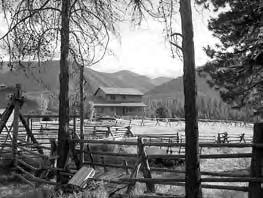
Your special gAY Hideaway in the beautiful mountains of western Montana! Soft beds and gourmet meals! Only 2 hours from Spokane via I-90. Info at www.cowboyupmontana.com

Rates: Classified Ads are $10 for up to 25 words. Each additional word is 25 cents. For a bold face headline, add $1.50.
Payment Method: You may pay for your Classified Ad by check or money order via the US Postal Service or by credit card, debit card, or PayPal by mailing, E-mailing, or telephoning your information.
E-mail Ads: You may submit your Classified Ad at Stonewall’s Web site at www.stonewallnews.net . Click on the Classifieds link to enter your information on the E-mail. Your payment will need to be received by Stonewall at least one week before publication.
Mail-In Ads: Type or legibly print your ad on an 8 1/2 x 11 sheet of paper along with your name, address, and phone number; include your signature. Mail your completed ad along with your payment to: SNN, PO Box 2704, Spokane, WA 99220.
Personals: If your Personal ad uses an address, Stonewall will only use a PO Box or a Stonewall Personal Blind Box (PBB). For a PBB, add $5 to the cost of the ad. Stonewall will assign a code for your PBB and will forward replies weekly for up to two months after your ad runs.
Policy: Stonewall reserves the right to reject or edit any ad which may be considered demeaning or offensive to our readers. Any errors will be compensated with advertising credit.
Deadline: Classified ads must be received by Stonewall by the 8th or the 20th of each month for following 15th or 1st of the month publication.
Mailing Address: SNN, PO Box 2704, Spokane, WA 99220
Website: www.stonewallnews.net E-mail: mail@stonewallnews.net

Covering Spokane, Tri-Cities, Pullman, Moscow, Walla Walla, and Yakima
Spokane, WA
Wednesday, February 21st Stonewall Goes To Press
7:00 pm – 9:00 pm Pride in Sobriety Gay AA Meeting (at Bethany Presbyterian Church) Open AA meeting to support those in our community who have the disease of alcoholism and or addiction.
Phone: 624-1442
Thursday, March 22nd
6:00 pm – 8:00 pm Queer Sounds Radio Show Queer Sounds is an eclectic mix of GLBTQ music and commentary at 92.3 or 89.9 FM, KYRS “Thin Air Radio,” your local community radio station. Hosted by Irey and Bob. Callin number is 747-3807.
Contact: Irey
Email: queersounds@kyrs.org
Phone: 747-3807
Sunday, March 25TH
5:00 pm – 6:00 pm EMCC Worship Service (at Bethany Presbyterian Church) Contact: Wayne Shull
Tuesday, March 27th
4:00 pm – 6:00 pm Ryan White CARE Consortium Meeting (at Spokane
Health
Rm 320/321) The Spokane County Ryan
is
Meeting occurs
schedule is:
31, March 27, May 29, July 31, September 5, November 27. Membership is open to persons living with HIV/AIDS, HIV Providers and affected or interested individuals in the community. Meetings are informal and educational and Dinner is provided All are welcome to attend
Contact: Mark Garrett
Email: markg@san-nw.org
Phone: 509 455-8993
Location Phone: 509 324-1542
Wednesday, March 28th
7:00 pm – 9:00 pm Pride in Sobriety Gay AA Meeting (at Bethany Presbyterian Church) Open AA meeting to support those in our community who have the disease of alcoholism and or addiction.
Phone: 624-1442
Thursday, March 29th
6:00 pm – 8:00 pm Queer Sounds Radio Show Queer Sounds is an eclectic mix of GLBTQ music and commentary at 92.3 or 89.9 FM, KYRS “Thin Air Radio,” your local community radio station. Hosted by Irey and Bob. Callin number is 747-3807.
Contact: Irey
Email: queersounds@kyrs.org
Phone: 747-3807
Saturday, March 31st
10:00 am – 5:00 pm Funky Junk Antique Show (at Paradise Grange) Funky Junk Antique Show Saturday, March 31 from 10-5 and Sunday, April 1 from 10-4 will be held at the Paradise Grange (16120 S. Keeney), north of Spangle and 10 miles south of Spokane, WA off Hwy. 195. (Watch for signs!) Featuring: Summerland, Julie Buttons, Forget Me Not, Yesterday’s Connection, A Charming Place, Joy Harvest, Little Red Hen Pies, CHAPS coffee, music by Heidi Jantz and friends and many suitcase fulls of vintage, repurposed and priceless treasures! Admission is $2. Any questions? Email us at funkyjunkshow@yahoo.com.
Contact: Hollie Eastman
Email: funkyjunkshow@yahoo.com
Location Details Paradise Grange 16120 S. Keeney Spangle WA
6:00 pm – 9:00 pm ISCS White Knight & Debutante Pageant (at Dempseys Brass Rail) White Knight & Debutantes are titles in the ISCS. These titles are open for anyone to run for, however, you must join the ISCS before march 31st. The Open Forum for the titles is March 21st. You must submit your Letter of Intent to run for this title by March 21st. This is a great way to help our community raise money and have fun!
Contact: Emperor Leonard
Email: ISCSEmperor31@aol.com
Phone: 509-953-7803
Location Details Dempsey’s Brass Rail 909 W First Ave Spokane WA 99201 A P R I L Stonewall News Northwest turns 15! Sunday, April 1st
10:00 am – 4:00 pm Funky Junk Antique Show (at Paradise Grange) Funky Junk Antique Show Saturday, March 31 from 10-5 and Sunday, April 1 from 10-4 (Continued from March 31st listing)
11:00 am – 2:00 pm FSAN’s Palm Sunday Brunch (at Dempseys Brass Rail) Annual fundraiser brunch sponsored by Friends of SAN.
12:30 pm – 3:00
Location Phone: 509 328-7090
5:00 pm – 6:00 pm EMCC Worship Service (at Bethany Presbyterian Church) Contact: Wayne Shull
Tuesday, April 3rd
7:15 pm – 9:00 pm OutSpokane Meeting (at RiverPark Square) Meetings are the Kress Gallery on the 3rd floor of RiverPark Square each Thursday from 7:15 to 9 pm. Located next to and behind the food gallery near the theater ticket outlets.
Contact: Christopher Lawrence Email: simba82047@comcast.net
Phone: 509 624-9639
More Info: http://www.outspokane.com
Wednesday, April 4th
Stonewall Goes To Press
7:15 pm – 9:00 pm OutSpokane Meeting (at RiverPark Square) Meetings are the Kress Gallery on the 3rd floor of RiverPark Square each Thursday from 7:15 to 9 pm. Located next to and behind the food gallery near the theater ticket outlets.
Contact: Christopher Lawrence Email: simba82047@comcast.net
Phone: 509 624-9639
More Info: http://www.outspokane.com
5:30 pm – 7:00 pm Vision Committee Meeting (at Northern Exposures Studio) Meetings are informal potlucks at Northern Exposures Studio on the first Wednesday and third Monday of each month. We work on projects to help the visibility of Spokane’s GLBTQA community. Currently working on a local billboard project.
Contact: Bonnie Aspen
Phone: 509.838.3866
7:00 pm – 9:00 pm Pride in Sobriety Gay AA Meeting (at Bethany Presbyterian Church) Open AA meeting to support those in our community who have the disease of alcoholism and or addiction. Phone: 624-1442
Thursday, April 5th
6:00 pm – 8:00 pm Queer Sounds Radio Show
Queer Sounds is an eclectic mix of GLBTQ music and commentary at 92.3 or 89.9 FM, KYRS “Thin Air Radio,” your local community radio station. Hosted by Irey and Bob. Callin number is 747-3807. Contact: Irey Email: queersounds@kyrs.org Phone: 747-3807
7:00 pm – 10:30 pm Pride & Joy Movie Night (at CenterStage) Made Possible by The Pride Foundation Eat. Drink. Mingle. Be Entertained! CenterStage hosts this LGBT activity night to showcase films that directly portray, support, nurture and challenge the LGBT community and allied supporters. Join us as we view feature films, shorts & videos by the hottest national & international filmmakers of our time. *FREE (excludes food & beverage) Join us for Live Music & a Spaghetti Dinner at ella’s before each showing!
Cocktail Service Available Contact: Deb Noah Email: deb@spokanecenterstage.com Phone: (509) 747-8243 ext. 114
More Info: www.SpokaneCenterStage.com
Location Details CenterStage 1017 West First Avenue Spokane WA 99201
Sunday, April 8th
5:00 pm – 6:00 pm EMCC Easter Cantata (at Bethany Presbyterian Church) Contact: Wayne Shull
Wednesday, April 11th
7:00 pm – 9:00 pm Pride in Sobriety Gay AA Meeting (at Bethany Presbyterian Church) Open AA meeting to support those in our community who have the disease of alcoholism and or addiction. Phone: 624-1442
Thursday, April 12th
6:00 pm – 8:00 pm Queer Sounds Radio Show Queer Sounds is an eclectic mix of GLBTQ music and commentary at 92.3 or 89.9 FM, KYRS “Thin Air Radio,” your local community radio station. Hosted by Irey and Bob. Callin number is 747-3807. Contact: Irey Email: queersounds@kyrs.org Phone: 747-3807
Friday, April 13th
4:00 pm – 6:00 pm CHAS HIV Educational Support Group (at Community Health Association of Spokane (CHAS)) Monthly educational/support group developed to help meet the needs of people living with HIV/AIDS and their families and friends in Idaho & Washington. The meetings will cover the topic of the night & provide time for discussion and support between those attending. Contact: Tarena Coleman Email: tcolman@chas.org Phone: 509 434-0313
Saturday, April 14th
9:30 am – 10:30 am PFLAG Moms Group (at Conley’s Restaurant) The MOM’S Group, an informal support group welcomes and supports mothers (and occasionally grandmothers!) of gay, lesbian, bisexual or transgendered children. It meets monthly, on the second Saturdays at 9:30 a.m. for breakfast at Conely’s Restaurant on east Sprague. Call the PFLAG help line 509.624.6671 for more information. Phone: 509-624-6671
Sunday, April 15th
5:00 pm – 6:00 pm EMCC Worship Service (at
6:30 pm – 8:00 pm ISCS Court Meeting
Monday, April 16th
5:30 pm – 7:00 pm Vision Committee Meeting (at Northern Exposures Studio) Meetings are informal potlucks at Northern Exposures Studio on the first Wednesday and third Monday of each month. We work on projects to help the visibility of Spokane’s GLBTQA community. Currently working on a local billboard project.
Contact: Bonnie Aspen
Phone: 509.838.3866
Tuesday, April 17th
7:15 pm – 9:00 pm OutSpokane Meeting (at RiverPark Square) Meetings are the Kress Gallery on the 3rd floor of RiverPark Square each Thursday from 7:15 to 9 pm. Located next to and behind the food gallery near the theater ticket outlets.
Contact: Christopher Lawrence
Email: simba82047@comcast.net
Phone: 509 624-9639
More Info: http://www.outspokane.com
Wednesday, April 18th Stonewall Goes To Press
7:00 pm – 9:00 pm Pride in Sobriety Gay AA Meeting (at Bethany Presbyterian Church) Open AA meeting to support those in our community who have the disease of alcoholism and or addiction.
Phone: 624-1442
Thursday, April 19th
6:00 pm – 8:00 pm Queer Sounds Radio Show Queer Sounds is an eclectic mix of GLBTQ music and commentary at 92.3 or 89.9 FM, KYRS “Thin Air Radio,” your local community radio station. Hosted by Irey and Bob. Callin number is 747-3807.
Contact: Irey
Email: queersounds@kyrs.org
Phone: 747-3807
Thursday, March 22nd
7:00 pm – 9:00 pm [Tri-Cities, WA] PFLAG Monthly Meeting
Check website for meeting location
Email: info@tcpflag.org
More Info: http://www.TCPFLAG.org
Sunday, March 25th
10:30 am – 11:30 am [Kennewick, WA] River of Life MCC (at 2625 Brneau Place Ste A)
Email: info@riveroflifemcc.org
More Info: http://www.riveroflifemcc.org
6:30 pm [Yakima, WA] Rainbow Cathedral MCC (at 225 N 2nd St)
Phone: 509/457-6454
Monday, March 26th
7:30 pm – 8:30 pm [Kennewick, WA] Rainbow Sobriety AA Meetings (at ROLMCC)
Contact: Edna Mae W.
Email: fiddlebanjo@charter.net
Phone: 509-546-2626
Saturday, March 31st
7:30 pm – 8:30 pm [Moscow, ID] The Prom You Never Went To (at The Beach)This is an event sponsored by the U of Idaho GSA and the WSU GLBTA. It is a kick ass dance that everyone should come to even if they do not attend these two schools. It is starring the Bois of Boise, Miss Claudia, Aquasha, and featuring Krikit. This event is intended to be an event that allows and embraces diverse populations. It originated from the thought that many GLBTQ youth were not welcome or comfortable enough to attend their own high schools’ prom. With an inclusive prom event like our Prom You Never Went To, all people are welcome to attend in their formals or other attire, in drag or tow, whichever is desired. Tickets are $7 for singles and $12 for couples during presale. $10 singles and $18 couples at the door.
Contact: Kristin Roberts
Email: wsuglbta@hotmail.com
Phone: 509-432-6613
Location Details
The Beach 302 s main st moscow id 83843
Sunday, April 1st
10:30 am – 11:30 am [Kennewick, WA] River of Life MCC (at 2625 Brneau Place Ste A)
Email: info@riveroflifemcc.org
More Info: http://www.riveroflifemcc.org
6:30 pm [Yakima, WA] Rainbow Cathedral MCC (at 225 N 2nd St)
Phone: 509/457-6454
Monday, April 2nd
7:30 pm – 8:30 pm [Kennewick, WA] Rainbow Sobriety AA Meetings (at ROLMCC)
Contact: Edna Mae W.
Email: fiddlebanjo@charter.net
Phone: 509-546-2626
Friday, April 7th
7:30 pm – 8:30 pm [Yakima, WA] First Fridays (at 1st Street Conference Center)
Saturday, April 21st
10:30 am – 12:30 pm OWLS Brunch (at Old Country BuffetFranklin Park Mall) OWLS Brunches will be held the 3rd Sat. of the month (Sep-May) at 10:30am at The Old Country Buffet in Franklin Park Mall on N. Division. If you are the first to arrive, ask the cashier where we can pull tables together for approx. 20 women. Then ask the cashier to direct arriving OWLS to
Contact: Ginny Email: way2qt_99@yahoo.com
Sunday, April 22nd
5:00 pm – 6:00 pm EMCC Worship Service (at Bethany Presbyterian Church) Contact: Wayne Shull
Wednesday, April 25th
7:00 pm – 9:00 pm Pride in Sobriety Gay AA Meeting (at Bethany Presbyterian Church) Open AA meeting to support those in our community who have the disease of alcoholism and or addiction. Phone: 624-1442
Thursday, April 26th
Sunday,
Sunday, April 8th
10:30 am – 11:30 am [Kennewick, WA] River of Life MCC (at 2625 Brneau Place Ste A) Email: info@riveroflifemcc.org
More Info: http://www.riveroflifemcc.org
6:30 pm [Yakima, WA] Rainbow Cathedral MCC (at 225 N 2nd St) Phone: 509/457-6454
Monday, April 9th
7:00 pm [Walla Walla, WA] PFLAG Monthly Meeting (at First Congregational Church Fellowship Hall) Contact: Carol Email: pflag_walla2wash@hotmail.com Phone: 509-529-5320
More Info: http://wwpflag.0catch.com/
7:30 pm – 8:30 pm [Kennewick, WA] Rainbow Sobriety AA Meetings (at ROLMCC) Contact: Edna Mae W. Email: fiddlebanjo@charter.net Phone: 509-546-2626
Sunday, April 15th
10:30 am – 11:30 am [Kennewick, WA] River of Life MCC (at 2625 Brneau Place Ste A) Email: info@riveroflifemcc.org
More Info: http://www.riveroflifemcc.org
6:30 pm [Yakima, WA] Rainbow Cathedral MCC (at 225 N 2nd St) Phone: 509/457-6454
7:00 pm [Yakima, WA] PFLAG Monthly Meeting (at First Street Conference Center, 223 N 1st St, Yakima WA)
Sunday, April 22nd
10:30 am – 11:30 am [Kennewick, WA] River of Life MCC (at 2625 Brneau Place Ste A) Email: info@riveroflifemcc.org
More Info: http://www.riveroflifemcc.org
6:30 pm [Yakima, WA] Rainbow Cathedral MCC (at 225 N 2nd St) Phone: 509/457-6454
Thursday, April 26th
7:00 pm – 9:00 pm [Tri-Cities, WA] PFLAG Monthly Meeting Check website for meeting location Email: info@tcpflag.org
More Info: http://www.TCPFLAG.org
Sunday, April 29th
10:30 am – 11:30 am [Kennewick, WA] River of Life MCC (at 2625 Brneau Place Ste A) Email: info@riveroflifemcc.org
More Info: http://www.riveroflifemcc.org
6:30 pm [Yakima, WA] Rainbow Cathedral MCC (at 225 N 2nd St) Phone: 509/457-6454
‘The most important thing these books do is reflect reality for young children”
Elizabeth Atkinson, director of the No Outsiders project
Jenny Lives With Eric And Martin for use in schools led to an angry public debate. In response the government passed Section 28, an amendment to the Local Government Act 1988, that prevented local authorities and, by extension, schools from ‘promoting homosexuality’ or its acceptability as a ‘pretended family relationship’. The amendment was repealed in 2003 and this is the first large-scale attempt to put similar books back into the curriculum. Other books on the list of recommended texts for the schools, which have not been named, include a story about a spacegirl with two mothers and a baby penguin with two fathers. If successful, the scheme will be extended nationwide.
‘The most important thing these books do is reflect reality for young children,’ said Elizabeth Atkinson, director of the No Outsiders project that is being run by Sunderland and Exeter universities and the Institute of Education (IoE) in London. ‘My background is in children’s literature and I know how powerful it is in shaping social values and emotional development. What books do not say is as important as what they do.’ Atkinson argued that leaving images of gay relationships out of children’s books was ‘silencing a social message’, and could end up with children being bullied later in their school lives if they were gay or were perceived as gay. Atkinson and codirector Renee DePalma have received nearly £600,000 in funding from the Economic and Social Research Council and backing from the National Union of Teachers and General Teaching Council.
Waterstone’s last week alerted its chain of shops to the titles that include King & King, Asha’s Mums and Spacegirl Pukes and says it will start stocking them if the pilot is successful.
‘Lots of fairy tales are about princes and princesses - why not two princes?’ said Mark Jennett, who is training staff involved in the pilot from 14 schools and one local authority. ‘King & King is nothing to do with sex, it is about falling in love. Cinderella is not about sexthe problem comes not from kids but the nervousness of adults.’ Jennett who wrote Stand Up For Us, a government document on homophobia, said the work was ‘cutting edge’ and teachers were now more likely to challenge children if they used the word ‘gay’ in a negative way.
Critics say that the launch of the scheme shows that there is still a need for Section 28 type legislation. ‘The predictions of those who said the repeal of Section 28 would result in the active promotion of homosexuality in schools are coming true,’ said Simon Calvert, spokesman for the Christian Institute. ‘Let’s arrange a series of meetings around the country where parents of primary school children can look at these books. The majority would be aghast.’
Tahir Alam, education spokesman for the Muslim Council of Britain, agreed: ‘This is not consistent with Islamic teachings and from our point of view many parents would be concerned.’
Other parents felt that children aged four and five were too young for the books. ‘I don’t know of many younger primary school children who would really understand what homosexuality is,’ said Andy Hibberd, co-founder of the support group, the Parent Organisation, who has sons aged seven and nine. ‘I don’t have a problem with what happens between consenting adults, but I don’t believe it needs to be forced on young children.’
to acknowledge it, joining Billy Bean, a baseball player, and Esera Tuaolo, a football player.
Mr. Amaechi “is the perfect storm,” said Todd Greene, chief executive at the HeadBlade Company in Culver City, Calif., which specializes in products for bald men, because “he’s AfricanAmerican, a basketball player and gay, and those are all huge demographics for us.”
“And he uses the product,” Mr. Greene said, adding that he learned Mr. Amaechi was a “HeadBlader,” as Mr. Greene calls his customers, while deciding whether Mr. Amaechi would make an effective spokesman.
“You want to do due diligence on who endorses your stuff,” is how Mr. Greene described the research process. Other HeadBlade endorsers include the singer Chris Daughtry, who appeared on “American Idol”; Toney Freeman, a professional bodybuilder; and Howie Mandel, of NBC’s “Deal or No Deal.”
Mr. Greene declined to discuss how much the two-year deal would be worth to Mr. Amaechi, although he said it would include shares in HeadBlade, a private company with revenue that he estimated at under $10 million.
In a twist, another company that makes men’s grooming products, Bald Guyz, recently fired its first athletic endorser, the former pro basketball player Tim Hardaway, after Mr. Hardaway attacked Mr. Amaechi and homosexuals in sports, declaring on a Florida radio show, “I hate gay people.”
Howard Brauner, chief executive, said in a statement, “Bald Guyz, like baldness, does not discriminate based on lifestyle choice, color, education, financial resources, religion, physical capabilities or any other way.”
In other words, the gay guy landed an endorsement contract after the straight guy lost his. What next, a Snickers commercial in which two men accidentally kiss and are completely cool about it?
Mr. Amaechi’s endorsement deal “seems to indicate a bit of a turning point,” said Michael Wilke, executive director at the Commercial Closet Association in New York, which tracks the representation of gay men and lesbians in marketing and maintains an online archive of advertising imagery (commercialcloset.org).
“Society, and sports fans, are becoming more used to gays,” Mr. Wilke said, “and advertising is growing more comfortable with gays.” Among the initial examples, Mr. Wilke cited a deal in 2000 in which Martina Navratilova began appearing in a general campaign for Subaru of America along with three other female athletes.
The campaign, by the agency now known as TM Advertising, part of the Interpublic Group of Companies, was her first appearance as a pitchwoman in national television ads. For decades, Ms. Navratilova had asserted that her openness about being a lesbian had cost her endorsements.
And in 2003, the Chili’s restaurant chain featured Mr. Tuaolo in a TV commercial by GSD&M, part of the Omnicom Group, which came out a year after he did. The spot was aimed at mainstream audiences and identified him as “Esera, retired athlete.”
The first ads featuring Mr. Amaechi for HeadBlade, being created internally, do not identify him as gay but carry a headline with an intriguing double meaning, “Against the grain.”
The ads will run in two magazines for basketball fans, Hoop and Slam, and appear on the HeadBlade Web site (HeadBlade.com) and MySpace page (myspace.com/headblade). The ads are also planned for other magazines in which HeadBlade regularly advertises.
Mr. Amaechi, who is British, said he might make personal appearances for HeadBlade as the company expands into Europe. He spoke in a telephone interview from Washington, where he was on a book tour for “Man in the Middle,” which he wrote with Chris Bull for ESPN Books.
“It’s quite nice when you can say you use the product you endorse,” Mr. Amaechi said. “I have to shave my head every two days. I would love to tell you it’s a style thing, but I have a bald spot.”
More seriously, Mr. Amaechi said that it was “good for young G.L.B.T. people,” using the abbreviation for gay, lesbian, bisexual and transgendered, “to see us not just in ads for drinks and H.I.V. medications but also in mainstream ads as well, because we are mainstream consumers.”
There may have been “a small amount of karmic justice” in Mr. Hardaway’s losing his endorsement deal, Mr. Amaechi said, “but I don’t feel any joy.”
Mr. Amaechi said he “would like to believe I would be eligible” to endorse bigger brands like Gatorade, McDonald’s and Nike, known for hiring athletes for ads, but “I’m not going to hold my breath.”
Mr. Wilke of Commercial Closet said that “the smaller and/or edgier brands tend to be the ones that step up and do something unusual” like signing openly gay athletes as endorsers. “A large brand may perceive itself as having something to lose if controversy should happen,” he added.
That aptly described what happened to Snickers, sold by the Masterfoods USA division of Mars, after it ran an ad during the Super Bowl. Gay activists complained about the spot, which showed two men who had accidentally kissed reacting by harming themselves. Masterfoods withdrew the commercial, created by the TBWA/Chiat/Day unit of Omnicom.
“The problem is that it was conditioning, modeling behavior,” Mr. Amaechi said, by showing that “real men” were supposed to feel conflicted and horrified when two men kiss.
Asked if he would accept an offer to endorse Snickers, Mr. Amaechi replied: “I could show you how to react to two men kissing. Smile broadly.”
clin T on, ob A m A continued from PAGE 6
On Wednesday, Newsday repeatedly asked Obama if same-sex relationships were immoral.
“I think traditionally the Joint Chiefs of Staff chairman has restricted his public comments to military matters,” said Obama, leaving Capitol Hill. “That’s probably a good tradition to follow.”
He turned the conversation to opposition to the military’s “don’t ask, don’t tell” policy: “I think the question here is whether somebody is willing to sacrifice for their country.”
Later, an Obama spokesman said the senator, in fact, disagrees with Pace.
That sequence was remarkably similar to Clinton’s responses Tuesday. When an ABC reporter asked her about the issue, she replied, “Well, I am going to leave that to others to conclude.”
Later, a Clinton spokesman said the senator, in fact, also disagrees with Pace.
So why the dance? Clinton and Obama supporters, speaking on condition of anonymity, said both might have been trying to avoid offending socially conservative Democrats, particularly churchgoing African-Americans, who share Pace’s views.
Steve Sanders, a gay Democrat who sat on the party’s platform committee in 2000, said Clinton and Obama are engaged in a delicate balancing act. “Hillary and Barack have made very public overtures to religious Americans. They are trying to figure out how progressive Democrats can also make appeals to Americans of faith. It’s a work in progress.”
Mohler said he was aware of the invective being directed at him on gayrights blogs, where some participants have likened him to Josef Mengele, the Nazi doctor notorious for death-camp experimentation.
“I wonder if people actually read what I wrote,” Mohler said in a telephone interview. “But I wrote the article intending to start a conversation, and I think I’ve been successful at that.”
The article, published March 2 on Mohler’s personal Web site, carried a long but intriguing title: “Is Your Baby Gay? What If You Could Know? What If You Could Do Something About It?”
Mohler began by summarizing some recent research into sexual orientation, and advising his Christian readership that they should brace for the possibility that a biological basis for homosexuality may be proven.
Mohler wrote that such proof would not alter the Bible’s condemnation of homosexuality, but said the discovery would be “of great pastoral significance, allowing for a greater understanding of why certain persons struggle with these particular sexual temptations.”
He also referred to a recent article in the pop-culture magazine Radar, which explored the possibility that sexual orientation could be detected in unborn babies and raised the question of whether parents - even liberals who support gay rights - might be open to trying future prenatal techniques that would reverse homosexuality.
Mohler said he would strongly oppose any move to encourage abortion or genetic manipulation of fetuses on grounds of sexual orientation, but he would endorse prenatal hormonal treatment - if such a technology were developed - to reverse homosexuality. He said this would no different, in moral terms, to using technology that would restore vision to a blind fetus.
“I realize this sounds very offensive to homosexuals, but it’s the only way a Christian can look at it,” Mohler said. “We should have no more problem with that than treating any medical problem.”
Mohler’s argument was endorsed by a prominent Roman Catholic thinker, the Rev. Joseph Fessio, provost of Ave Maria University in Naples, Fla., and editor of Ignatius Press, Pope Benedict XVI ‘s U.S. publisher.
“Same-sex activity is considered disordered,” Fessio said. “If there are ways of detecting diseases or disorders of children in the womb, and a way of treating them that respected the dignity of the child and mother, it would be a wonderful advancement of science.”
Such logic dismayed Jennifer Chrisler of Family Pride, a group that supports gay and lesbian families.
“What bothers me is the hypocrisy,” she said. “In one breath, they say the sanctity of an unborn life is unconditional, and in the next breath, it’s OK to perform medical treatments on them because of their own moral convictions, not because there’s anything wrong with the child.”
Paul Myers, a biology professor at the University of Minnesota-Morris, wrote a detailed critique of Mohler’s column, contending that there could be many genes contributing to sexual orientation and that medical attempts to alter it could be risky.
“If there are such genes, they will also contribute to other aspects of social and sexual interactions,” Myers wrote. “Disentangling the nuances of preference from the whole damn problem of loving people might well be impossible.”
Not all reaction to Mohler’s article has been negative.
that could switch an unborn gay baby’s sexual orientation to heterosexual.
“He’s willing to play God,” said Harry Knox, a spokesman on religious issues for the Human Rights Campaign, a national gay-rights group. “He’s more than willing to let homophobia take over and be the determinant of how he responds to this issue, in spite of everything else he believes about not tinkering with the unborn.”
Dr. Jack Drescher, a New York City psychiatrist critical of those who consider homosexuality a disorder, commended Mohler’s openness to the prospect that it is biologically based.
“This represents a major shift,” Drescher said. “This is a man who actually has an open mind, who is struggling to reconcile his religious beliefs with facts that contradict it.”