The Spokane City Council revisited the domestic partner benefits ordinance Sept. 6, meeting before an overflowing gallery of advocates and opponents intent on influencing the status of the controversial measure.
On the agenda was a resolution to put the ordinance, passed April 25, on the Nov. 8 ballot. A petition drive to qualify the matter for a referendum vote fell 121 signatures short of the number needed, Spokane County election officials determined in July.
“I brought the resolution before us tonight because of an overwhelming appeal by the public,” said Councilman Bob Apple after hearing public testimony and before the council voted 5-2 against the proposal. “Personally I believe this is a moral issue.”
He went on to question the right of governments to legislate morality, suggested that domestic partner benefits constitute an inappropriate and illegal redefinition of marriage, and urged voters to use the issue to remind elected leaders of their representative role, ending with the declaration, “They are not dictators.”
Apple’s tone echoed about a dozen of the 39 speakers who favored the resolution, among them conservative stalwart Penny Lancaster.
Dressed in a green shirt and vest that formed an inescapable frame for the bright red Nancy McLaughlin campaign button on his chest, Will Parks said, “This is about standing up for the moral climate of our city and our county and our country.” Referring to sexual orientation as a “preference,” a choice, he characterized the critical issue as “an agenda to completely bring about moral decay.” In the end, he said, “It’s not about money.”
Others nevertheless focused on prospective costs of the ordinance, among them 6th District Rep. John Ahern.
Many simply asked the council to let the people decide.
Defenders of the ordinance were outnumbered by a wide margin in the council chambers and by more than 2-to-1 among speakers.
The seventh public commentator overall, the first of 15 GLBTQ community members and allies to speak against the resolution, was Jim Jones, an information technology professional. He gave a re-
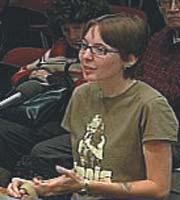
Eastern Washington University student Megan Cuilla, 23, did not plan to speak at the Sept. 6 meeting of the Spokane City Council. Her intent was to support friends and acquaintances there to address the council in opposition to a resolution to put the domestic partner benefits ordinance to a public vote.
An error occurred. Her name was called. And she decided to go ahead and make a short statement. “I don’t think this needs to be put on the ballot,” she said. “You’ve already voted on it.”
She stepped away from the microphone, left the council chambers and was heading up the stairs to exit the building. “That’s when I heard somebody ‘boo’ me,” she reported.
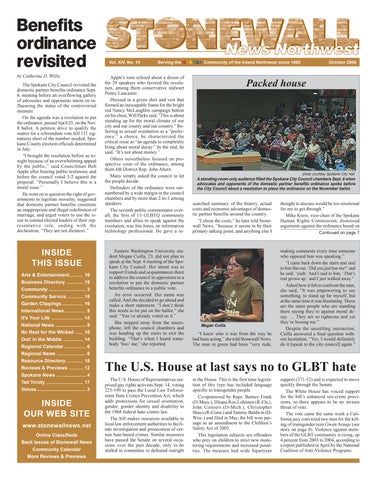
Packed house
about a resolution to place the ordinance on the November ballot.
searched summary of the history, actual costs and economic advantages of domestic partner benefits around the country.
“I chose the costs,” he later told Stonewall News, “because it seems to be their primary talking point, and anything else I
“I knew who it was from the way he had been acting,” she told Stonewall News. The man in green had been “very rude,
thought to discuss would be too emotional for me to get through.”
Mike Kress, vice-chair of the Spokane Human Rights Commission, dismissed arguments against the ordinance based on
Continued on page 7
making comments every time someone who opposed him was speaking.”
“I came back down the stairs and said to him flat-out, ‘Did you just boo me?’ and he said, ‘yeah.’ And I said to him, ‘That’s real grown up,’ and I just walked away.”
Asked how it felt to confront the man, she said, “It was empowering to say something, to stand up for myself, but at the same time it was frustrating. These are the same people who are standing there saying they’re against moral decay. … They are so righteous and yet they’re booing me.”
Despite the unsettling interaction, Cuilla answered a final question without hesitation, “Yes, I would definitely do it [speak to the city council] again.”
The U.S. House at last says no to GLBT hate
The U.S. House of Representatives surprised gay rights activists Sept. 14, voting 223-199 to pass the Local Law Enforcement Hate Crimes Prevention Act, which adds protections for sexual orientation, gender, gender identity and disability to the 1968 federal hate crimes law.
The bill makes resources available to local law enforcement authorities to facilitate investigation and prosecution of certain hate-based crimes. Similar measures have passed the Senate on several occasions over the past decade, only to be stalled in committee or defeated outright
in the House. This is the first time legislation of this type has included language specific to transgender people.
Co-sponsored by Reps. Barney Frank (D-Mass.), Illeana Ros-Lehtinen (R-Fla.), John Conyers (D-Mich.), Christopher Shays (R-Conn.) and Tammy Baldwin (DWisc.) and filed in May, the bill won passage as an amendment to the Children’s Safety Act of 2005.
This legislation subjects sex offenders who prey on children to strict new monitoring requirements and increased penalties. The measure had wide bipartisan
support (371-52) and is expected to move quickly through the Senate.
The White House has voiced support for the bill’s enhanced sex-crime provisions, so there appears to be no serious threat of veto.
The vote came the same week a California jury convicted two men for the killing of transgender teen Gwen Araujo (see story on page 8). Violence against members of the GLBT community is rising, up 4 percent from 2003 to 2004, according to a report published in April by the National Coalition of Anti-Violence Programs.
photo courtesy Spokane City Hall
Astanding-room-onlyaudiencefilledtheSpokaneCityCouncilchambersSept.6when advocates and opponents of the domestic partner benefits ordinance spoke before the City Council
Megan Cuilla
Voices
Get engaged; your vote matters
Nancy McLaughlin’s comfortable victory in the Sept. 20 primary race for Spokane City Council District 3, Position 2, deserves our notice. The candidate is a formidable contender with remarkable resources behind her – finances as well as foot soldiers. She appears to be an appealing candidate, a cookie-baking mom with sweet, old-fashioned, roll-up-your-shirtsleeves-and-get-things-done community values. But that’s the problem: This isn’t 1955 and she isn’t June Cleaver.
She is clever. Wrapped in the American flag, she touts a simplistic, feel-good platform that, like soda pop, tastes good but lacks nutritional substance and cannot quench an abiding thirst. Her “love for this city,” deep and real as it may be, cannot create a single job, eradicate crime or balance the budget.
We think Spokane is a pretty special place, too,
The worst and best of Spokane
I arrived at the Spokane City Council meeting [Sept. 6] with an open mind. As a parade of “concerned citizens” went to the microphone and testified, most without explaining why they were against partner benefits, I began to lose hope. It was disheartening to see all these people lining up to judge their neighbors. I was in a room full of Church Ladies, but this was not comedy; this was serious. And I thought about all the injuries brought upon people by “concerned citizens” in the past.
Michael R. Schultz
publisher@stonewallnews.net
Founder and
Editor Catherine D. Willis editor@stonewallnews.net
Production Editor Mark W. Southwick production@stonewallnews.net
a wonderful home for our children and youth, a recreational treasure trove, a growing center for health care and technology advancements, a city rich in history and culture filled with people unique in their hopes and dreams and even their challenges. We embrace the differences that characterize and strengthen our common humanity. Nancy McLaughlin does not.
Her language belies her espoused concern for children and family. The GLBTQA community isn’t welcome in her home. Our committed relationships don’t count. Our love isn’t the right kind. She made that pretty clear when she spoke before the Spokane City Council on Sept. 6. We urge our readers to choose the other candidate, former City Councilman Steve Corker – and to actively campaign to get him elected.
We know Corker has a record. The meetings of
Letters
I thought about mixed-race couples. The uproar over desegregation. Jim Crow laws. McCarthyism. The Salem Witch Trials. The Indian “problem.” The bad that people do in the name of good. In my opinion, more harm has been done by “concerned citizens” than by any others. We’d all be better off if they tended to their own deficiencies and left others alone.
On the other hand, I was so proud as those in the GLBT community testified in all their glory – some with hesitation and awkwardness, some firmly, clearly and eloquently. All spoke with conviction, and each one spoke for me.
Vol. XIV, No. 10
Contributors
Graham Ames
A. Gilmore Christopher Lawrence Michael Loundagin
Joan Opyr
Susan Rydeen
the City Council during his recent tenure more often modeled chaos and discord than public confidence-enhancing leadership. He was not our favored candidate to face off against McLaughlin, but he is the one the voters chose in a primary election decided by a pitifully low turnout of eligible voters.
Halfway through the primary campaign season, Stonewall sought position statements from all candidates regarding the controversial domestic partner benefits ordinance, passed by the Spokane City Council April 25. Corker said, “I would’ve voted for it. … I support it.”
Dallas Hawkins, who won the right to challenge the appointed incumbent in the Nov. 8 general election for Spokane City Council District 2, Position 2, gave the ordinance unenthusiastic
Continued on page 3
When the council members began speaking, I grew hopeful, and then jubilant. They gave such a variety of carefully considered and painstaking reasons for upholding the city ordinance. Only Bob Apple spoke of being “morally” opposed. After seeing the worst of Spokane, I was so glad to be a witness to the best. I didn’t think Spokane had it in it. Maybe there’s more to this place than meets the eye.
Celebrations
Share your union ceremony, arrival of a child, or milestone in life with Stonewall News free of charge! Announcements should be 150-250 words and can include a photo.
Obituaries
News and Advertising Contact Information
Stonewall News Northwest PO Box 2704 • Spokane, WA 99220 www.stonewallnews.net
Phone: (509) 456-8011 • Fax: (509) 455-7013
General E-mail: mail@stonewallnews.net News & Story Items: news@stonewallnews.net
Advertising Sales: sales@stonewallnews.net Advertising Art Production: production@stonewallnews.net
A.E. McLaughlin Student, Gonzaga University School of Law
When do I – how do I – say that “I am gay”?
by John Brindle
I am gay. I can remember the first time I said these words: Years ago ... my friend Mac and I were sitting in a bar on Ponce de Leon Avenue in midtown Atlanta. It was late, after work. For the past 30 minutes I had been talking, saying nothing, just talking about anything, trying to find a way to say for the first time to anyone, “I am gay.” Mac had been a true friend, sitting patiently there listening to my babbling, just listening. I was sure he knew that I was trying to say something, but he sat patiently, saying yes and no, just listening. That night, I learned a valuable lesson about friendship – a good friend is sometimes just a person who listens ... no opinions, no judgments, the blanket to your Linus. I was there talking about nothing. I really don’t remember what I said, maybe I told him about something that happened at work, or perhaps I talked about baseball. I don’t remember, but for some unexplained reason I finished with and “I am gay.” I don’t think I realized what I had said. It just came out. I stopped talking and looked at Mac, waiting for him to say something, anything. He finished his cigarette, drank the rest of his beer, got up, put money on the bar, looked at me and said, “Good, that’s over. Now can we go to a gay bar?”
YOUR VOTE MATTERS
Continued from page 2 support. A longtime businessman – in the insurance field – he presented solid economic grounds for his hesitation. Under other circumstances, a man of his background and intelligent, articulate demeanor would merit your consideration. Stonewall withholds endorsement of his candidacy not out of any ill regard for Hawkins but because we are so completely convinced that Mary Verner should retain her seat on the council.
Her eloquent, reasoned approach to the domestic partner benefits ordinance, when it was argued in the spring, was a breath of fresh air compared to the confrontational and at times illogical posturing of some of her council colleagues.
We look forward to seeing the fleshedout proposal she alluded to then, a cafeteria-style benefits program that would allow city employees to choose the perks most suited to individual and family needs from a cost-contained, city budget-friendly package.
Councilwoman Verner voted with the majority Sept. 6, refusing to countenance an end-run attempt to put the domestic
Mac knew what I wanted to say. He also knew that I needed to say it in my own way. That night, through his friendship, Mac gave me the safety, the security, to say “I am gay.”
National Coming Out Day is Oct. 11. To recognize this day, the Rainbow Center is hosting a benefit performance of “My Fair Lady” at the Spokane Civic Theatre on Wednesday, Oct. 12. The tickets for adults are $25.00, $12.00 for children 12 and under. Proceeds from this performance will help support the Rainbow Center. Curtain time is 7:30 p.m.
I cannot think of a better day for us to recognize than National Coming Out Day. The Rainbow Center is trying to be a safe and secure place for not just those of us who have been out, but more importantly a place where people who are questioning their sexuality or are needing a place to feel secure in their new sexuality can come. The Rainbow Center is expanding its hours, offering a place to meet, and it is staffed by board members and volunteers just like my friend Mac, who are willing to listen.
The Rainbow Center is open to everyone, straight and gay. I hope someday that it will not be so difficult to say “I am gay,” but until that day comes, and it will, there should be a place like the Rainbow Center. We need your support to keep the Rainbow Center open.
partner benefits ordinance on the November ballot. She acknowledged that opponents can and likely will achieve this goal at a later date through the initiative process, and then called for rational dialog. “It’s time for our community to talk about our common values,” she concluded. “What do we share? I hope we will listen to one another.”
We favor such honest debate, and appreciate the clarion call for same issued by Councilman Al French when he opposed the Sept. 6 resolution, citing the time constraints inherent in a rush to the ballot. “There is a ton of disinformation out there about this ordinance,” he declared.
French seeks re-election to City Council District 1, Position 2. His opponent, a political newcomer, Valentina Howard, seemed strangely uninformed about key issues when contacted by Stonewall. French has served the GLBTQA community well. He has earned our endorsement.
If you think your vote means nothing, think again. Corker defeated his closest primary competitor, community activist Judith Gilmore, by a mere 43 votes.
Community spotlight: someone who has made a difference
by Mike Schultz, Publisher
“There’s someone I want to introduce to you!” mom declared to me not too many years ago. Her enthusiasm peaked as she described this person who worked so selflessly in the community for causes and purposes much greater than himself, touching the lives of so many with his warm and compassionate demeanor. I finally met that person – whose smile of humility and thoughtful discussions compelled me to do more, and be more, for our community. What a privilege it was to meet Russ Hemphill, and an honor it remains to be called his friend.
“I met Russ several years ago through our mutual volunteer work with the Spokane AIDS Network’s Walk For Life. A couple of years later, Russ acceptedtheleadershiproleorganizing and directing SAN’s Oscar Night Gala.
“I was most impressed by Russ’ effective leadership skills. His style is what I would define as unassuming, yet direct. He was always well prepared and organized.Hisapproachwithpeople was inclusive, respectful and warm.Heencouragedparticipation and creative thought from everyone. Through Russ’ leadership,theOscarGalahasbeen elevated to one of the largest and most successful fund-raising events in Spokane – certainly the most unique. More importantly, it has created an additional avenue for dialogue and greater understanding between the GLBTQ community and mainstream Spokane, which serves to lift up our entire community.
“Russ is a good friend whom I greatly admire. He is a kind and lovingmanwhocaresdeeplyfor hiscommunity,hisfamilyandhis partnerKeith.Iwillmisshispresence in Spokane.”
Barrie Ryan President, Board of Directors Spokane AIDS Network
After learning Russ and Keith were leaving Spokane, I asked Russ to share a little about himself for the Stonewall readership.
Where did you grow up? What kind of education did you pursue and why?
I spent my first 18 years of life growing up in rural Montana, in a small community called Columbus. Graduating from a class of 40, I left my small town
three days after graduation to work in the oil exploration industry. I attended Gonzaga University after my first summer away from home and continued to work an additional summer in the oil fields of the Midwest and West. I started at Gonzaga with the intent of getting a Jesuit education and I succeeded. Although I shifted to several programs throughout my time at GU, I ended up with a stronger goal of pursuing work
Russ Hemphill
that would promote social justice and would help fellow humans. Following one last summer holiday with my family after GU, I moved to Portland and worked with severely emotionally disturbed boys in a residential treatment home. These youth came from extremely rough family situations. These young people ended up teaching me more than most of the folk in the academic world. I also began my journey in the world of HIV and AIDS.
Was there a particular incident in your life that pushed you in the direction of your roles in public service?
I spent time with Peter Davis, a Jesuit priest who was dying in Portland Hospice of AIDS. I spent time visiting Peter during his last days. And then I was introduced to Our House of Portland, a hospice program started by one man and his friend, a nun from the Sisters of Providence. This was a unique hospice, for it served the indigent, those infected and living with HIV but were either homeless or close to being homeless, living in the slums of Old Town Portland. I spent almost seven years working with people in the Hospice, providing general care and assistance, and sitting with people who had no one to sit with them during their last days and hours of their lives.
Katrina postpones caravan Spokane
The Campaign to End AIDS caravan from Seattle will arrive in Spokane on Saturday, Oct. 22, four weeks later than originally planned, local organizers announced Sept. 8.
The postponement reflects a vote of the C2EA national steering committee in response to a request from project leaders in Gulf Coast areas devastated by Hurricane Katrina.
“No one understands how government inaction can lead to needless suffering and death like AIDS activists,” wrote the C2EA executive committee in an e-mail outlining the campaign’s revised schedule. “Sadly, as AIDS activists, we are all much too familiar with this systemic inaction –particularly when it comes to poor people, people of color and other marginalized people. It is our duty to make sure that our country’s eyes continue to be opened to this mass inequality.”
Despite the calendar change, C2EA goals remain the same: to raise awareness of HIV/AIDS and related public policy issues. In Spokane, caravan participants and supporters will follow the previously announced program of events, although Saturday’s site has changed to Bethany Presbyterian Church, 301 S. Freya, the corner of Freya and 3rd Ave. (parking available on the south side of the church). The rally will begin at 5 p.m., the spaghetti feed at 6:30 p.m., and the movie marathon at 7:30 p.m. on Oct. 22. The suggested donation for dinner and the movies is $5 per person.
An interfaith vigil is set for 1 p.m. on Sunday, Oct. 23, in the Student Union Building at Spokane Falls Community College.
The caravan will head east to Coeur d’Alene later that day, and then cross the country, joining nine other caravans representing all parts of the United States for four days of action in Washington, D.C.
The Spokane host committee extends a heart-felt thank you to the following for their help in re-organizing and presenting these events: Spokane Macy’s employees, Washington State Employee’s Credit Union, Emmanuel Metropolitan Community Church, PFLAG, SFCC Alliance, Odyssey Youth Center, Planned Parenthood of the Inland Northwest, and Spokane AIDS Network.
Volunteers to staff local venues and to join the caravan are still being sought. Organizers fear increased costs and unpredictable fuel supplies may hinder caravan participation. To contribute to the cause, contact Adam Cogswell at (509) 2176347. For information on C2EA, go to www.c2ea.org.
INBA helps celebrate opening
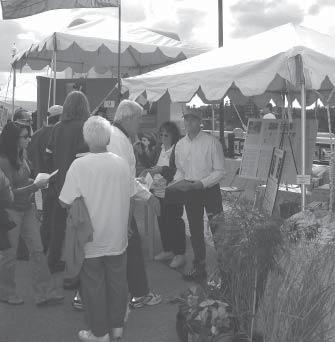
“Let’s get visible,” took on new meaning Sept. 17 as thousands of Spokane residents turnedoutforthedaylong,city-sponsoredstreetfairmarkingthere-openingofthehistoric MonroeStreetBridge.RainbowflagwavingproudlyabovetheInlandNorthwestBusiness Alliancebooth,VisionCommitteemavenBonnieAspenandGLBTQcommunityvolunteer and Stonewall News columnist Paul Gilmore (facing out) stamped the “passports” of visitors eager to learn more about INBA and GLBTQ activities, get a bit of a Spokane history – and earn a chance to win a prize.
Spokane AIDS Network names new MPowerment coordinator
Cat Carrel has joined the Spokane AIDS Network staff as the new HIV Prevention Program Coordinator for the MPowerment Project. A former organizer around GLBTQ issues in Montana, Carrel fills the position vacated in August by Russ Hemphill, who, coincidentally, moved to Montana (see farewell/tribute on page 3).
Building personal empowerment for gay and bisexual men is the whole point of the MPowerment model. The program uses social networks and peer influence to support healthy behaviors. Participants shape their own health-conscious community, develop positive social connections and encourage their friends to have safer sex.
SAN’s MPowerment program will differ from other MPowerment programs around the country, including those that have been implemented in Spokane. Carrel, explains, “Our goal will be to reach gay and bisexual men in their mid-20s to late 30s, guys that may have transitioned out of Odyssey or Quest programs and men who are outside the Odyssey/Quest
guys are running the show. That’s what we’re aiming for. I’m just here to help on the administration end.”
Carrel’s background in nonprofit communications and social justice work will be beneficial to this mission.
For more information about the MPowerment Project, call 455-8993, ext. 231.
Celebrate Coming Out month with ‘Fall into Pride’
Friday, Oct. 7, is the kick-off day for the area’s “Fall into Pride” celebration. First up is a 5-9 p.m. showing of artist Marie Green’s work in the art gallery at the Rainbow Regional Community Center, 508 W. 2nd Ave. The event is part of the Spokane Visual Arts Tour and is costfree.
A few blocks away, advocates and allies will gather for a reception, a prelude to the weekend’s “United We Win” Organizing for Equality Power Summit at the Community Building, 35 W. Main, from 5:30 p.m.-7:30 p.m.
Then it’s Friday night OUT at ella’s Supper Club, 1017 W. 1st Ave., from 67:30 p.m. Visibility is the goal; partygoers are urged to wear their rainbows and pink triangles and/or “Let’s Get Visible” t-shirts and hats.
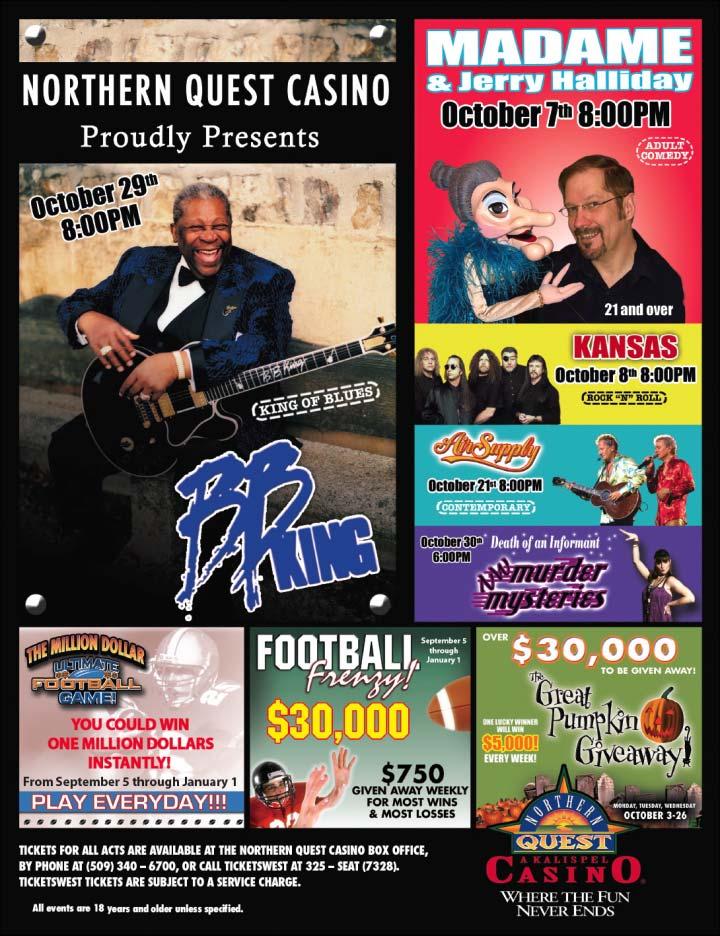
Madame takes the stage at 8 p.m. at Northern Quest Casino, 100 N. Hayford Rd., Airway Heights. Tickets for the show are $25. Call (509) 343-2329 to order.
demographic. We hope to complement these fine programs that are already in place.”
She understands the basic challenge, noting, “A lot of guys in this age group already think they know everything about HIV prevention. But what they know they should do and what they may actually do in a heated moment may be drastically different.” That’s why MPowerment emphasizes frank talk and solid decisionmaking skills.
Getting men involved represents her big first hurdle, Carrel admits. She wants to expand and strengthen the program’s volunteer core, a group of eight to 10 men who will help plan events, design the publicity campaign and, after appropriate training, lead smaller monthly meetings.
She also hopes to procure donated space for the meetings and to form a diverse community advisory board to meet quarterly and discuss program progress.
“Ideally, the men’s community needs to buy in and own this project,” she stresses. “MPowerment works when the
Saturday, Oct. 8, art lovers get a second chance to enjoy the creative talent of Marie Green from 11 a.m.-3 p.m. in the art gallery at the Rainbow Regional Community Center.
The Power Summit runs from 8 a.m.5:30 p.m. at Itron, Inc., 2818 N. Sullivan Rd. in the Spokane Valley. A spaghetti dinner sponsored by Spokane PFLAG and the Odyssey Youth Center follows at the same site at 6:30 p.m.
Sunday, Oct. 9, the Power Summit continues from 8 a.m.-12:30 p.m.
Tuesday, Oct. 11, is National Coming Out Day. Various activities are being planned at local community colleges and universities. Contact the institution of your choice to find out what’s happening near you.
Wednesday, Oct. 12, the Rainbow Regional Community Center hosts a benefit performance of the musical classic, My Fair Lady, at the Spokane Civic Theatre, 1020 N. Howard St., beginning a 7:30 p.m. The evening’s festivities include a silent auction. Tickets are $25 for adults and $15 for students/children. For more information or to purchase tickets, call the Rainbow Center at (509) 489-1914.
photo by Pat Devine
‘Journey’ debuts in Las Vegas, shown locally in November
by Catherine D. Willis
Rain or shine, on icy roads and snowy walkways, Frank Hays does his job. By day, this shy, unassuming gay man is a letter carrier. He’s been one for 21 years. He’s also an up-and-coming documentary filmmaker.
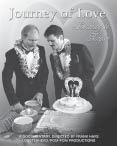
“Journey of Love: Learning to Forgive,” his second professional-level production, debuts Oct. 23 at Neonfest, the GLBT International Film Festival of Las Vegas. The documentary will be screened locally as the matinee offering at the 2005 Spokane Gay/Lesbian Film Festival on Saturday, Nov. 5.
“It’s a very emotional story, a wonderful story,” says Hays, who planned to weave three tales of relationship into a 45-minute documentary. His focus changed, however, when he sat down with one of his pre-selected subjects, Christopher Lawrence, Stonewall’s arts and entertainment reviewer, whom he met when his first film, “The Lyons: a Real Family,” won a slot in the 2004 Spokane Gay/Lesbian Film Festival.
Postal workers, like bartenders, get to know their patrons. A good understanding of the human condition leads to good storytelling. “I love people,” Hays admits. “I have a different angle … I see things. I go deeper.”
But he is quick to credit Lawrence. “Christopher makes this film. He’s so professional, so verbal.”
Hays directed and edited the unscripted film, shot in late spring through midsummer. Local cinematographer Tiffany Patterson did the camera work using a special unit borrowed from Spokane Falls Community College.
A lifelong movie fan, Hays got his start in filmmaking eight years ago when his partner, Chad Hays, gave him a camcorder for Christmas. Now he’s hooked, but is currently finding it necessary to spend as much of his free time fund-raising for his project as he does exploring new creative ideas.
Free screening for depression, mental health offered by St. Joseph Family Center
When most Americans think about health problems, they think heart disease, cancer and diabetes. Serious conditions they are, but the number one health problem in the nation, reports the “Journal of the American Medical Association,” is depression. Researchers consider it the country’s most underdiagnosed and undertreated illness.
Segments of the GLBTQ community have historically endured a higher incidence of this condition. Depression need not be the scourge it once was. Many effective treatment options are available today.
In recognition of National Depression Screening Day, St. Joseph Family Center (SJFC) will offer free, anonymous mental health screenings on Thursday, Oct. 6, from 10 a.m. to 7 p.m.
An educational presentation will be made and then individuals will complete a confidential questionnaire. After this tool has been reviewed, participants will have the opportunity to meet privately with an experienced counselor.
The screening process takes about 30 minutes. No appointments or referrals are
necessary; walk-ins are welcome. Refreshments will be provided.
“We are very happy that we can offer such a vital service to members of our community,” said Sr. Elaine Thaden, executive director of SJFC.º
National Depression Screening Day is a nationwide effort to combat depression through acknowledgement and education. If ignored, the disease can lead to physical problems, anxiety, social difficulties, suicidal thoughts and, in some cases, suicide attempts.
To learn more about this event, depression or other mental health issues, contact the St. Joseph Family Center, 1016 N. Superior Ave., Spokane, call (509) 483-6495 or visit www.stjosephfamilycenter.org.
Internet: www.emmanuelmcc.com
A compelling story of love and loss emerged. “Journey of Love” follows two men, Lawrence and Kevin Anthony, from their first meeting to their realization of love, to and through Anthony’s death from AIDS a decade later. Along the way, there are role changes, surprises and some very hard lessons.
It costs $1,000 to produce and distribute about 300 high-quality DVDs for distribution. The GLBTQ community and allies have helped him collect close to that amount in two months. Potential financial backers are invited to contact him at frankhays512@msn.com.
The film will be sent to a variety of festivals around the country. One has been sent to Wingspan Film Fest 2006, the Tucson, Ariz., festival.
Bureau reaches a wider community
When budget concerns forced the Spokane Regional Health District HIV/AIDS Program to eliminate its long-standing HIV/AIDS speakers’ bureau last December, the Spokane area seemed destined to lose a valuable resource. Managers struggled with the decision and eventually approached veteran members to determine if there was interest in preserving the operation as an independent nonprofit endeavor. There clearly was.
The Spokane Regional HIV/AIDS Speakers’ Bureau was formed in January. The organization has applied for and is awaiting Internal Revenue Service approval of its provisional status as a 501 (c) (3) nonprofit corporation. In the meantime, it has operated as a nonprofit program courtesy of the Odyssey Youth Center.
Jim Breedlove is the bureau’s executive director. He agreed to take on the job because he has firsthand experience with the speakers’ bureau. “I know how important it is to increase awareness and to educate our communities about this preventable disease,” he said.
Because the new agency is not restricted to the service area of the regional health district, speakers can address needs
of a much wider community – beyond Spokane County, even beyond the borders of Washington. Breedlove is especially interested in reaching out to rural areas. Speakers have addressed groups in Tonasket and Moses Lake, Wash., and Lewiston, Idaho. There are six engagements in a typical month.
Audiences have included middle school, high school and college students, health care professionals, pre-release and juvenile detention centers, prisons, drug/ alcohol treatment programs, churches, and businesses and civic organizations.
The bureau’s speakers are a diverse group of individuals whose lives have been touched directly by HIV/AIDS. These passionate and knowledgeable volunteers understand the importance of information and education in counteracting the fear, ignorance, discrimination and hate that surround this terrible illness. A primary goal, said Breedlove, is to “increase the awareness that HIV/AIDS affects us all as a global community, infected or not.”
To become or arrange for a speaker, contact the Spokane Regional HIV/AIDS Speakers’ Bureau, P.O. Box 8758, Spokane, WA 99203 or Jim Breedlove at jbilove@earthlink.net.
Group works to create an oasis on the Palouse
by Susan Rydeen
In May 2004 a group of 25 members of the Moscow-Pullman LGBTQA Community Visioning and Steering Committee got together to brainstorm ideas for what we need and want for the Moscow-Pullman area’s LGBTQA community.
It was decided among a core group volunteers that one of the first priorities is to establish a full-service LQBTQA community center serving the Moscow-Pullman area.
Out of that vision for the future of the LGBTQA community, Inland Oasis was born.
An advisory board and an interim board of directors were formed and they agreed that in the first year they would set up the articles of incorporation, write some bylaws, apply for 501c3 tax exempt status and form an advisory board; in May of 2005 they were also awarded a Pride foundation grant. By August of 2005 all of
Regional Calendar
October events:
▼ Oct. 9 – Pride Foundation’s Out and Proud 5k Run/Walk, Seward Park, Seattle, 10 am. (206) 323-3318.
PFLAG-Sandpoint meets at United Methodist Church, Sandpoint, 2 pm.
▼ Oct. 16 –Legal Marriage Alliance of Washington’s 10-Year Anniversary Celebration, UW HUB Auditorium, Seattle, 3-5 pm. $10 students, $15 in advance, $20 at door; info: www.lmaw.org.
▼ Oct. 22 – Trans Health Fair, LGBT Community Center, Seattle, 11 am - 3 pm. Email: erik@verbenahealth.
▼ Oct. 25 – PFLAG-Tri-Cities meets at Mid-Columbia Library, 1620 S. Union, Kennewick, (509) 628-9721.
▼ special interest ■ general interest
these goals were accomplished and the Inland Oasis Web site came online (www.inlandoasis.org).
“This organization was started because there is a need in the community for, well, community. Our LGBTQA community has been divided into many smaller communities, so we wanted to bring people together. The long-term goal is to have a physical location where we can hold activities and things for all different ranges of populations from youth to older individuals. I think the college students have a pretty good support network at both universities, but we are trying to cover people who are not supported by the universities, as well,” said Lisa Laughter, president of Inland Oasis. “Our LGBTQA community has a wide range of demographics and is spread out over a large geographical area. The goal of Inland Oasis is to pull all of these fragmented groups together into one cohesive community.”
“For right now we are using just the website,” Laughter continued. “Since we don’t yet have a physical space, we have this virtual space that we are working on, so two of the first things we are doing is putting up listings of community events and a resource guide for the community. We also have a newsletter that will be coming out monthly. Another one of our goals for this year is to sponsor some community events, such as a day in the park, for people to come together as a community. We also need to explore what resources are available to us, as an organization.
“We have an advisory board from within the community, and we are actively seeking community members who would like to contribute their time in their areas of expertise, such as lawyers, bookkeepers, people who might like to organize events, that sort of thing. We know there are a lot of people out there with skills and talent that they can bring to the organization. People who would like to volunteer can go to the ‘Get Involved’ section of our Web site to let us know how they can help.”
Businesses that would like to be listed in the resource directory can also use the “Get Involved” link to request a listing in the Resource Guide.
“United We Win” schedule set as site shifts to Spokane Valley
Equal Rights Washington, Inland Northwest Equality and the Pride Foundation will present the “United We Win” Organizing for Equality Power Summit Oct. 8-9 at Itron, Inc., 2818 N. Sullivan Rd. in the Spokane Valley. The day and a half conference will bring together advocates and organizers from around the West to teach, inspire and challenge those who would be players in the continuing struggle for GLBTQ rights.
“Allies are vital to this effort,” said Brooke Powers, the Peace and Justice Action League of Spokane’s coordinator for INWE and the Spokane area powerhouse behind the summit. Fair-minded individuals and members of affiliated groups need to work together for common goals, she insisted, repeating a theme addressed by Fran Dunaway, executive director of ERW, when she was in Spokane in August.
Friends of the GLBTQ community short-circuited a potential last-minute site change by stepping forward to offer a new venue when the original one, Gonzaga University, began to look dicey.
“When I heard that they were having problems, I asked Itron, and then I called Brooke,” said Tim Bartley, a PFLAG volunteer and longtime GLBTQ activist, who is a senior engineer at the technology company.
Powers quickly explored the prospect and accepted use of the fee-free facility for the summit. Kate McAlister, Itron’s community relations program manager, arranged the details.
All summit-related programs except the kickoff reception will be held at Itron. The reception will take place Friday, Oct. 7, at
the Community Building, 35 W. Main Ave., in downtown Spokane.
Panel discussions include “Being ‘Out’ in Rural Communities” and “Marriage Equality & Anti-Discrimination: The Importance of Messaging.”
Workshops will emphasize fund-raising, building support, action planning and volunteer development.
Plenary sessions will look at big-picture issues, understanding and strategizing for change.
Among those scheduled to speak or lead panels or workshops are Amy Herzfeld, Idaho Human Rights Network and Marriage Equality, Boise; Lucilene Lira, Western States Center, Portland, Oregon; David Hopkins, Pride Foundation, Seattle; State Rep. Jim Moeller, Olympia; and Jerry Hebert, Washington State Human Rights Commission.
Food for thought requires fuel for the body. All Saturday meals and Sunday’s breakfast are included in the no-cost weekend program, offered as a community service by a diverse mix of donors and sponsors. Tiina Buckaloo of Spokane PFLAG and Ramon Alvarez of Odyssey Youth Center are overseeing Saturday’s spaghetti dinner and a movie, a showing of “The Education of Shelby Knox.”
Donations toward a matching grant from the Gill Foundation will be kindly received.
“More than anything, I’m hoping that people can come away from it feeling inspired, feeling like they have a better handle on how to face the things that are coming at us, and that we are a more unified front,” said ERW’s Dunaway about her expectations for the summit.
‘Tastefully Done’ to benefit North
Idaho AIDS Coalition
“Tastefully Done Wine Tasting,” a fund-raiser for the North Idaho AIDS Coalition, will take place Sunday, Oct. 16, from 3 to 7 p.m. at the Clark House Bed & Breakfast, E. 4550 South Hayden Lake Road, in Hayden Lake, Idaho.
Besides an exciting array of wines, complimentary hors d’oeuvres and music, there will be door prizes and a silent auction. Special guest Gail Fendley, also known as “Velma, the Queen of Fun,” will entertain attendees. Valet parking is included in the ticket cost.
This annual event typically brings in $10,000 for the nonprofit service group, but organizers are pushing for a bigger net to offset budget cuts precipitated by recent and severe state and federal funding reductions. Event proceeds will support the coalition’s emergency fund, which helps clients pay for prescription drugs, rent, utility bills and similar necessities, and provide one-to-one prevention services.
“In this time of financial shortfalls, we – all nonprofits, but especially those in the HIV/AIDS field – are struggling to maintain the funding that we need to properly serve our clients,” said Dani Mahoney, executive director.
NIAC’s caseload varies from 35 to 45. In the past month alone, the agency has experienced a 10 percent increase in client numbers.
Staffing this year is down to two employees, one full-time and one three-quarter-time, from four full-time employees two years ago. “Client needs remain the same,” Mahoney noted.
NIAC serves Idaho’s five northern counties, a territory that runs from the Canadian border to Moscow.
Tickets are $35, available at The Long Ear, 2405 North 4th St., Coeur d’Alene, and through the NIAC office, 410 Sherman Ave., Suite 215, Coeur d’Alene, Idaho 83814; telephone (208) 665-1448.
Speaking before the Spokane City Council
“Our wonderful city is in a financial crisis. You heard that tonight. You’ve also heard tonight from a very small group of citizens trying to use this crisis as a smokescreen to promote their own agenda. Spokane’s domestic partner ordinance has never been about costing the city more money. This ordinance has always been about steppingforwardanddoingtheright thing. This ordinance has always been about moving into the future. 76 percent of the top Fortune 500 companies provide domestic partner benefits. This ordinance has always been about economic development.
“A city that promotes civil rights for all its citizens attracts businesses that create revenue.
“A city that proves it values families of all kinds attracts new residents that create revenue. A city that has the courage to look past xenophobicsmokescreensattracts courageouscitizensthatcreaterevenue.
“Acitythatdoesn’tallowitselftobe hijacked by small-minded groups preaching hate – that attracts economic development and that creates revenue.
“...Youhavedoneyourwork.That’s government. They had an opportunity to gather signatures. They didn’t gather enough. They now havetheopportunitytogathermore signatures for an initiative. Great. Fine. Bring it on. Let ’em. Please, don’t start moving backwards in government. I really appreciate eachoneofyouandthebigjobthat youhave.It’sbeenveryhardforme tonight as a lesbian who’s been in a committed relationship with the same woman for 26 years, who is a business owner in Spokane, who pays taxes, to listen to a room full of hate and a room full of people who are telling me how awful my life is. Well, I tell you, I am not upsetwiththat.Iamenergized.There is work to be done and you started thatlastApril.Pleasedonotputthis issue on the ballot.”
Bonnie Aspen
ORDINANCE REVISITED
Continued from front page
costs. “If there was really outrage about money,” he observed, noting the city’s recently concluded River Park Square dispute, “this community would be calling for a repeal of decisions made for a settlement and want that on the ballot.”
Councilman Al French later called alleged cost concerns “a red herring.” The city could better control health insurance outlays if it cut maternity care and maternity leave, he said, but “clearly nobody is interested in doing that.”
Marge Ballack spoke to the meat of the ordinance, citing workplace equity, as did Odyssey Youth Center community organizer Ramon Alvarez. Educator Athanasios Bitsas broadened the discussion to civil rights and efficient government.
The democratic process was the mantra of many who opposed the resolution, including teachers Barbara Williamson, Peter Perkins and Brad Read.
Joseph Reilly outlined the traditional duties of legislative bodies in the United States and reviewed the remedial steps –the labor-intensive referendum and initiative processes – available to a disgruntled populace under the law. “If this issue belongs on the ballot, it belongs on the ballot through that process, not through a circumvention as is being proposed tonight,” he said. “It seems very inappropriate for this issue to be on the agenda as the issue shouldn’t have come back to the council except through those signatures.”
Brooke Powers, the Peace and Justice Action League of Spokane’s coordinator for Inland Northwest Equality, summed up the GLBTQA stand in two words, “Done deal.”
In the end, the council agreed. Council President Dennis Hession, Councilwoman Mary Verner, and Councilmen Joe Shogun, Brad Stark and Al French each rejected the resolution, noting the earlier failed signature-gathering process and inviting ordinance opponents to turn to the initiative process.
RUSS HEMPHILL
Continued from page 3
When and why did you move to Spokane? I returned to Spokane in 2000 to work for a family as a nanny. My sister cautioned me that Spokane was not like Portland. I left Portland with a wonderful support system and many gay friends and
“Fewpeoplehavehadthepositive effect on the LGBT community of Spokane as Russ Hemphill. His ability to inspire collaboration and enthuse those around him in creating a better community will be sorely missed.”
Kevan Gardner, Regional Outreach Manager, Pride Foundation
“family.” I had a host of gay professionals in my life while I was in Portland. My best friends were a judge and an up-and-coming school administrator. My doctor was gay, my dentist was gay, my optometrist was gay, my lawyer was gay and my closest professional colleague was gay. I knew that it would be different moving to Spokane. I was greeted by wonderful folk in PFLAG and in the gay community. And then I got involved with Spokane AIDS Network following an Oscar Gala event at Patsy Clark’s. After that I began working with so many wonderful folk as a volunteer at SAN. I also got involved with INPRIDE(OUTSPOKANE), I worked with the board of the Rainbow Center, I spent time with the youth at Odyssey, and I spent time working with Raymond Reyes
and Vince Lemus and the other leaders of the Task Force on Race Relations. What prompted you to leave Spokane?
After working in the world of social service for almost 20 years, and having spent almost 18 years, either volunteering or having paid positions, in the HIV/AIDS arena, I was ready for a change. My partner Keith and I had always talked of returning to Montana and we finally just made the decision and moved. We are living in the Gallatin Valley in the Big Sky resort and will be working in the service industry. We have a wonderful view of Lone Peak, the mountain that towers over the resort.
Whatwouldbeaparticularlygoodmemory of your time in Spokane?
There are many wonderful memories of Spokane, but one that particularly stirs my heart is when I first met Keith. After having three months of dialogue via e-mail, Keith and I met at Auntie’s and talked for two and half hours without interruption. Keith and I have wonderful memories of the folk we hung out with in Spokane. We have wonderful support from our family, my side, his side, and our “chosen family.” Is there anyone that has been an inspiration to you that you would like to mention and why?
There were so many people that helped to inspire me during my time in Spokane: Marvin Reguindin, Dean Lynch, Margie Aylsworth, Lisa St. John, Raymond Reyes, Laurel Kelly, Susan Fabrikant, and the wonderful people I met through my work at SAN.
Joseph Reilly
News in a nutshell
Student expelled over parents’ homosexuality
A 14-year-old Southern California high school freshman was thrown out of the Ontario Christian High School Sept. 21 after her biological mother’s partner of 22 years appeared at a parent-teacher conference representing the family.
School officials justified the action on the grounds that the “family does not meet admissions criteria.” The superintendent’s office released a statement claiming the student, Shay Clark, would not have been allowed to enroll at the school had the nature of her parents’ relationship been disclosed during the application process.
Tina Clark and Mitzi Gray said they have never hidden their lesbian status. In fact, their older daughter Jayme Clark, 19, attended the same school for a time a few years ago.
“My friends and the staff knew,” said Jayme. “It was never an issue.”
The family may file a civil suit in the matter.
Love in Action under fire in Tennessee
Love in Action, Exodus International’s gay-reversing ministry, has been targeted for investigation by various Tennessee state agencies this summer. The Department of Mental Health and Developmental Disabilities determined in August that two residential care facilities the group operates in Memphis must be licensed or shut down.
The Christian organization was given until Sept. 23 to seek the proper applications, but that deadline was then extended until Friday, Sept. 30. At press time, no further action had been reported.
Will wedding bells ring? Maybe yes, maybe no
The air of expectation is heavy as the fall of 2005 unfolds. Court watchers believe the Washington State Supreme Court will announce a decision very soon, possibly this month, in the combined case involving 19 gay and lesbian couples challenging the constitutionality of the state’s Defense of Marriage Act (DOMA), passed in 1998. The court heard oral arguments in the case March 8.
At issue is Article 1, Section 12 in the Washington State Constitution: “No law shall be passed granting any citizen privileges or immunities which upon the same terms shall not equally belong to all citizens.”
Advocates on both sides of the Cascades have rallies planned for the day and days following what will clearly be a momentous ruling – regardless of the actual outcome.
Scenarios run from the overturning of DOMA, which would put the state in the same league as Massachusetts regarding marriage rights, to its upholding, which would maintain the current status, to the most likely course, direction from the court that the Legislature take another swing at the question.
Same-sex marriage will not be fading from the landscape here or elsewhere across the nation in the foreseeable future. The status of laws and public attitudes toward them is very much in flux.
A statewide sampling of registered voters in Arizona taken Sept. 22-25 revealed that 60 percent of those polled would not support a constitutional amendment banning gay marriage, according to Arizona State University’s Walter Cronkite School of Journalism and Mass Communication and KAET-TV in Tempe, Ariz.
In Florida, where gay marriage has been banned by law for more than 30 years, savvy strategists are working to get an amendment on the ballot to reinforce the existing law, a plan that, some say, has more to do with luring hard-line conservatives into voting booths than it is about gay marriage.
Under a new law that took effect Oct. 1, Connecticut recognizes civil unions performed in other states and foreign countries. Marriages from neighboring Massachusetts are not honored, however, because the Connecticut legislature has defined marriage as a bond between a man and a woman. Domestic partnership rights granted by some states but not all are also covered.
At right is a summary of marriage equality legislation in the United States as of September and October 2005.
Two convicted in murder of transgender teen
HAYWARD, Calif. (AP) – Two men who had sex with a transgender teen and then discovered she was biologically male were convicted of her murder Sept. 12, but cleared of hate crime charges.
Amendments set for popular vote: Texas (’05), Alabama, South Carolina, South Dakota, Tennessee (’06)
Amendments pending in legislatures: Delaware, Illinois, New Jersey, North Carolina, Wisconsin
Amendments that have failed in legislatures (’05): Arizona, Colorado, Connecticut, Idaho, Iowa, Maine, Maryland, Minnesota, New Mexico, Oklahoma, Washington
Statute permitting passed legislature: California (vetoed by governor)
Statute permitting pending: New York
Statute permitting failed: Maine, Rhode Island
Statute banning pending: New Jersey, New York
Statutes banning failed: Maryland, New Mexico, Oregon, Rhode Island, Wyoming
Lawsuits: California, Connecticut, Maryland, Nebraska, New Jersey, New York, Washington
Michael Magidson and Jose Merel, both 25, face mandatory sentences of 15 years-to-life in prison for second-degree murder in the killing of Gwen Araujo, who was beaten, tied up and strangled.
The jury was deadlocked in the case of a third man, Jason Cazares, 25, marking the second time a jury was unable to reach a verdict in his case.
Araujo, 17, was born a boy named Edward but grew up to believe her true identity was female. The defendants, who knew her as Lida, met her in the summer of 2002. Magidson and Merel had sexual encounters with her, experiences that fueled suspicions about Araujo’s gender.
The issue boiled over in the early hours of Oct. 4, 2002, in a confrontation at Merel’s house in the San Francisco suburb of Newark.
In the first trial, the three defendants stuck together, with their lawyers attacking the chief prosecution witness, Jaron Nabors, who was also at the house the night Araujo died but was allowed to plead guilty to manslaughter.
But in the second trial, the defendants’ united front cracked.
New chief justice hints at right to privacy
“The right to privacy is protected under the Constitution in various ways,” said Judge John G. Roberts, then-nominee to the post of Chief Justice of the United States, answering a question from Senate Judiciary Committee Chairman Arlen Specter, R-Pa., on Sept. 13. The judge cited the First, Third and Fourth Amendments to the U.S. Constitution when discussing privacy rights, but skirted efforts by several interrogators to get a specific opinion on 2003’s Lawrence vs. Texas, which overturned state sodomy laws criminalizing gay sexual relations.
Leading Senate Democrats expressed concerns about the nominee’s leanings on civil rights, as have many rights activists, but Roberts won Senate confirmation by a vote of 78-22 on Sept. 29.
Offending officer fired
The Atlanta Police Department dismissed Officer Larry Smith Sept. 7 following a months-long probe into allegations of anti-gay behavior lodged by six gay men arrested April 21 at the city’s Piedmont Park. A second, unidentified officer on the scene was not disciplined because he cooperated with investigators and they were unable to sustain charges against him.
Gwen Arujo
National & International
Will California’s governor veto historic same-sex marriage law?
California leads the way once again –if Republican Gov. Arnold Schwarzenegger does not veto the state’s latest landmark law, the nation’s first legislature-passed same-sex marriage bill. He threatened to terminate coast-to-coast progressive cheering within 24 hours of the bill’s Sept. 6 passage, but had not acted when Stonewall News went to press. He must veto by Oct. 9 or the measure will become law with or without his signature.
Schwarzenegger is caught in something of a political bind. He has expressed support for gay civil unions but opposes full marriage rights. His polling numbers show
News in a nutshell
Tom Delay derailed, at least for now
A Te xas grand jury indicted House Majority Leader Tom Delay, R-Texas, Sept. 28 on conspiracy charges related to alleged campaign financing violations. The Republican temporarily relinquished his party’s top congressional role. Denying any wrongdoing, he vowed to return to the post when the criminal matter is resolved. He retains his seat in the House of Representatives.
Gay rights activists reacted swiftly to speculation that Rep. David Dreier, RCalif., a presumably gay congressman with a gay-unfriendly voting record, would be named to replace him. GOP leaders instead chose House Majority Whip Roy Blunt, R-Mo., to fill Delay’s post.
Delay’s departure is viewed with some sanguinity by rights advocates. He was a driving force behind last year’s proposed amendment to the U.S. Constitution to ban same-sex marriage and has been a vocal critic of judicial decisions favorable to GLBTQ interests.
Equal rights equal good business
Nearly all Fortune 500 companies – 460 (92 percent) include sexual orientation in their nondiscrimination policies, the Philadelphia-based Equality Forum, a national GLBT civil rights organization, has reported. This figure is up from 323 (65 percent) in 2003.
Corporate leaders responding to the survey cited the benefits of workplace equity in recruiting and retaining quality employees. In addition, stated Allan Gilmour, former vice chair, Ford Motor Company, “For companies wanting to send an affirming retail message, including sexual orientation protection helps to tap into the over $600 billion annual U.S. gay and lesbian market.”
his popularity on the wane, and yet he declared his intent to seek re-election Sept. 16. A veto could diminish his standing among California’s many socially moderate, independent voters. But a veto would also return the matter to the courts, leaving the definition of legal marriage in the hands of what his Republican base considers “judicial activists.”
The pending law, AB 849, the Religious Freedom and Civil Marriage Protection Act, redefines marriage as “a personal relation arising out of a civil contract between two persons.” The text of the bill exempts religious organizations from performing or recognizing same-sex marriages.
The California Senate passed the measure by a 21-15 vote Sept. 1.
Afterward, one of the bill’s co-sponsors, Sen. Liz Figueroa, D-Fremont, declared, “Equality is equality, period.”
Assemblyman Mark Leno, D-San Francisco, author of the legislation, aggressively lobbied middle-of-the-road colleagues, three of whom abstained in June, when the Assembly rejected the same measure. The historic vote on Sept. 6 went 41-35, with Assemblyman Simon Salinas, D-Salinas, one of the earlier holdouts, casting the deciding vote. “With every vote, I think, you look at the political implications,” he said, “and in the end you have to do what’s right.”
Some legislators who favored the measure in principle balked at countering the perceived will of the people. Californians passed Proposition 22, which limited marriage to a man and a woman, in 2000. The constitutionality of this law is being contested in the courts.
Editor’s note – As Stonewall went to press, Calif. governor Schwarzenegger vetoed the bill.
Vatican gay witch hunt begins
by Beth Shapiro 365Gay.com
NEW YORK – The Vatican has begun its investigation of America’s 229 seminaries to root out gays.
The threat that the Catholic Church was embarking on a pogrom against gay clergy first arose in August when new regulations submitted to Pope Benedict for his approval suggested that gays not be considered for the priesthood.
The Church is attempting to lay blame on gays for the child abuse scandal that has rocked Roman Catholicism. Vatican investigators arrived in the US last month to gauge the scale of the scandal and to determine how many gay priests are in the priesthood.
A document obtained by the New York Times shows the investigators will seek to have priests turn in suspected gays. The Times said it received the document from a priest “who was granted anonymity because he feared retribution”.
It shows that the inquisitors will conduct confidential interviews with every faculty member and seminarian, as well as everyone who graduated in the last three years.
Among the questions all seminarians and teachers will be asked are: “Is there evidence of homosexuality in the seminary?” and “Are there signs of particular friendships.” Both questions must be answered the document says.
Meanwhile, Pope Benedict continues to study the proposal for barring gays from entering the seminaries. But, archbishop Edwin O’Brien, the American cleric leading the investigation in an interview last week with a Catholic publication said that “anyone who has engaged in homosexual activity, or has strong homosexual inclinations,” should not be admitted to a seminary.
The Human Rights Campaign labeled the investigation a witch hunt.
“The real debate around this witch hunt isn’t between us and the Vatican, it’s between the Vatican and the truth,” said HRC President Joe Solmonese. “When the church makes gay men a scapegoat for pedophiles, it ignores one problem and creates another. It does nothing to keep children safe or punish criminals.”
Gay inquisition begins at Missouri seminary
ST. LOUIS – “Are you, or have you ever been, a homosexual?” That is the question that Vatican investigators began asking late last month at Aquinas Institute of Theology in St. Louis.
The seminary was the first in the country to face the scrutiny of inquisitors in their investigation of gays in American seminaries.
The president of Aquinas, Father Charles Bouchard, said he is opposed to the line of questioning but has no choice but to allow the investigators to probe students.
“Some people do feel homosexuality would disqualify a student. I hope we can provide evidence that should not be the case,” he told a news conference.
Bouchard said that there are currently 300 students at Aquinas Institute, on the campus of St. Louis University, but only 25 are studying to become priests.
ARTS & ENTERTAINMENT
Interplayers watches over us
by Christopher Lawrence
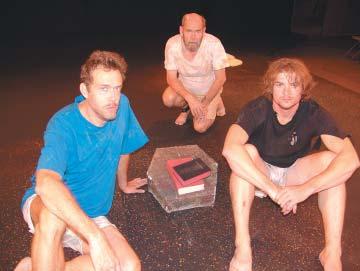
What happens to three strangers who are captured, imprisoned in a single room together and chained to the floor so that they only have one square meter in which to move about? Emotions run high.
Based on conversations between playwright Frank McGuinness and former hostage Brian Keenan, Someone Who’ll Watch Over Me at Interplayers Theatre was an exercise in mind games and circular conversations that slowly revealed three political prisoners’ innermost feelings, filtered through suppressed anger, despair and longing for freedom.
The sanity of these prisoners is dependent upon their ability to adjust to the constant dialog and lack of privacy. Adding to the psychological torture, there is no window in their cell. They have no way to tell whether it is day or night.
Each man has only rudimentary clothing, no shoes, a threadbare blanket, a daily ration of water, if they please their captors, and the chains that fasten them to the floor. Except for simple, minimal lighting, their surrounding can only be viewed as grim and their prospects more so.
All three actors submitted strong performances. In one or two instances the transitions leading from one train of
thought to another seemed inorganic, but all in all they were often mesmerizing, and the ensemble presentation deservedly garnered the rapt attention of the audience.
How many colors make us Queer?
The Seventh Annual Gay/Lesbian Film Festival is staying true to its history, bringing us the best of the best, revealing our diversity in many genres. Love stories, weddings, triumphs, losses, parenting, hustlers, drugs, poetry, orientation confusion and family foibles will make the two days fly by.
Expect to laugh, cry, steam and identify with many of the 14 shows. Admission for one evening is $8, $5 for students; two showings are $12/$10; the matinee alone is $5. See everything for the bargain price of $16/$12 for students.
Friday Evening, Nov. 4, 7 p.m.
Bikini, 7 minutes
An animated musical, Bikini , stars a young man, dolled up in his mother’s yellow swim suit.
Documentary of a 17-year-old soccerplaying Latina making a video, “How to Start a Gay-Straight Alliance in Your High School,” who runs smack into her principal.
Proteus Point, 16 minutes
Michael Maher played Edward, the Irishman, with a strong and convincing brogue and a sense of darkly humorous irony. He rose to the occasion with power,
Jason is torn between his girlfriend and his flirtatious closeted roommate. Which one will go camping with him?
Hi, Maya, 12 minutes
the portrayal seasoned with just enough despondency to convince us of the prisoner’s anguished humanity and pride.
Charles Gift brought us Adam, the American, complete with the arrogance for which we are known worldwide, and the tenderness of a man who was at once noble, tender and thoughtful. His singing voice was sweet and moving, not delicate. His physical prowess was very much folded into a charismatic sensibility.
Bill Caisley, in the part of Michael, the Englishman, was crisp, intelligent and awash in the unfamiliar and threatening environ, but came quickly to the game of emotional and mental survival, which depended on each man’s ability to sustain the “You can’t break me” intention held by the captive trio. Reciting poetry, singing songs with, and for, each other, shooting imaginary movies and playing games became the instruments of their pact to keep themselves and each other from breaking.
This acerbically amusing and life-affirming play was nominated for an Olivier Award after its original staging in 1992, and Niké Omuru, director, earns another feather in her hat.
The Mystery of Irma Vep, Interplayers’ next production, Oct. 20 through Nov. 12, is a raging supernatural comedy that will take on vampirism and werewolves in a quick-change marathon. Ah … be still my heart.
outfits and her adoring hag fag [a fag who has a hag] who films her over nine years, is as short and spirited as its four-foot-tall titular heroine.
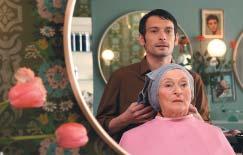
Two elderly ladies meet unexpectedly at a hairdressing salon and reawaken youthful memories of their shared past.
In My Father’s Church, 49 minutes
A documentary about Charissa, a lesbian who wants a church wedding, but her father is the pastor.
Saturday Matinee, Nov. 5, 3 p.m.
Irene Williams, Queen of Lincoln Road, 23 minutes
Eric Smith’s gem concerning a colorful old bird in homemade gauche-couture
Small Town Secrets, 7 minutes
A 1980s documentation of a woman’s childhood raised by closeted gay parents in a small, Midwestern town.
Medo de que? (Afraid of What?), 8 minutes
From Brazil, this wordless film demonstrates that storytelling needs no words to portray our young protagonist, Marcelo, as he begins to perceive “strange” desires. Animated Journey Of Love, 45 minutes
Local, aspiring filmmaker Frank Hays’ second film; documents the relationship of locals Christopher and his partner Kevin Anthony who died of AIDS.
Saturday Evening, Nov. 5, 7 p.m.
Me, Myself, I, 3 minutes
A fascinating exploration of gender through imagery.
Continued on next page
photo by Pat Devine
From left, Michael Maher as Edward (Irishman), Bill Caisley as Michael (Englishman) and Charles Gift as Adam (American).
A Fish Almost Eaten By A Shark, 17 minutes
A scene from the film Hi, Maya
A scene from the film A Fish Almost Eaten By A Shark
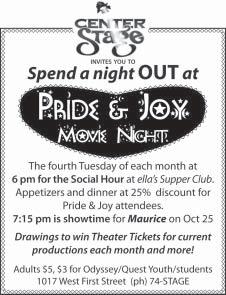
Maurice achieves Pride and Joy
by Christopher Lawrence
CenterStage has requested that I begin hosting the Pride & Joy Movie Night on the fourth Tuesday of each month. The social hour will begin at 6 p.m. and the movie will begin at 7:15 p.m. sharp, so that early risers can get home at a time appropriate for a good night’s sleep. The rest of us can enjoy each other’s company with a little informal movie chat for anyone interested.
October’s offering is the classic film Maurice. It had been years since I saw this charming, sensual and provocative story. I must admit that I had forgotten how beautiful the cinematography and direction were. James Ivory, the director, began his career as an art director, which may explain why every scene is perfectly framed. He utilizes, perfectly, the lush scenery and the incredible architecture of the countryside homes and Cambridge University, where Maurice and Clive first meet.
James Wilby (Maurice) and Hugh Grant (Clive) were still very youthful stars when this film was made. That adorable ruffian, Rupert Graves (Alec), in his first professional role, adds an earthy and delightful foil for the haughty sensibilities so common to the gentry in Edwardian England. Grant and Wilby, then new actors barely out of Oxford and Durham Universities, captured Best Actor Category for their performances at the Venice Film festival, and for good reason. Handling E. M. Forster’s stunning and wonderfully precise dialog is, in itself, quite an accomplishment, but these words, given life by this fantastic cast, do tremendous justice to the original novel.
Ben Kingsley is typically exacting in his speech, mannerisms and controlled
portrayal of the psychologist/hypnotist, whom Maurice visits while trying to come to grips with his sexual orientation.
The process of coming out in the early 1900s was further complicated by the distinctions and separation of the classes, so prevalent during this era. Maurice’s character undergoes a powerful evolution. He begins to comprehend and then sheds himself of his crimes of misogyny and class prejudice, choosing instead to live a life of honesty.
Unlike so many GLBTQ love stories, this one has a deliriously happy ending. I should add that there is frontal nudity and deliciously sensual love scenes, which are sweet and satisfying to the romantic soul.
General admission is $5, $2 for Odyssey and Quest youths. Ella’s Supper Club offers a 25 percent discount on all drinks and food.
We are inviting requests for movies to be shown in the future, so let us know what you might be interested in seeing. Please mark your calendars, invite several friends and spend a night OUT with “family,” enjoying a great film in a remarkable and gay-friendly venue.
A&E
ARTS & ENTERTAINMENT
Madame says, “I’M BAAAACK!” at Northern Quest Casino
by Christopher Lawrence
Be afraid. Be VERY afraid. Madame, the ultimate grand dame of caustic humor, has come out of retirement. With a hot new act and a new partner, Madame will be making her comeback debut in Divas Gone Wild at the Northern Quest Casino on Friday, Oct. 7.
Renowned puppeteer Jerry Halliday has added the indomitable wisecracking star of late-night television and casino showrooms to his already popular show. No one is safe from the bite of Madame’s razor-sharp tongue and less than subtle innuendo, certainly not current luminaries like Paris Hilton, Martha Stewart, Ashton Kutchner and Jennifer Lopez, to name a few.
In the 1980s Madame and her longtime companion, Wayland Flowers, were known for their appearances on “Hollywood Squares” and “Solid Gold” and Madame starred in her own sit-com, “Madam’s Place,” and the Showtime Special, “Madame In Manhattan.”
FILM FESTIVAL
Continued from previous page
Ahmed’s tranquil life is thrown into a tailspin when his meddling mother from Egypt comes for a visit.
My Hustler Boyfriend , 4 minutes
Not for the prudish. A tale based on a poem by Ben McCoy of a transsexual and her pimp as they sell drugs, do sex work, and look fabulous. Presented entirely in stills.
Inclinations , 13 minutes
Aspiring young writer Mia struggles to find the perfect plot for an erotic short story while a diverse group of unexpected characters encourage her to try some exotic explorations of her own.
We Are Dad , 68 minutes
Heartfelt documentary about two gay men in Florida who are foster parents to children with HIV/AIDS and other life-threatening illnesses, detailing their day-to-day struggles raising these special-needs children, as well as the issues they face in dealing with Florida’s adoption laws and anti-gay bias.
Come Out, Come Out wherever you are in
October in Spokane
“Spokane. Near nature. Near perfect.”
Saturday the 8th – Learn what’s on the political horizon at United We Win – A Power Summit today from 8 a.m. to 5:30 p.m. and Sunday from 8 am to 12:30 p.m. at Itron in the Spokane Valley.
Tuesday the 11th – Hoist your rainbow flags –it’s National Coming Out Day
Her new partner has performed nationally for years and has been dubbed “the world’s foremost puppeteer-impressionist.” The audience can expect a strong, polished act with rapid-fire repartee. The man belonging to the hand that makes Madame twitch is, without a doubt, the perfect successor to Wayland. His energy, verve and comedic genius unleash our irreverent friend Madame back to the world of entertainment.
The Boston Globe crowned Halliday as “the bawdily funny heir-apparent to the late Wayland Flowers. Not to be missed!”
Broadway legend Carol Channing saw his puppet of her and loved it. During a TV interview Channing said she was very flattered by his portrayal of her and that he is a “marvelous’ performer.” He appeared with his Joan Rivers puppet on her TV show and with his Rip Taylor puppet on “Lifestyles of the Rich and Famous.”
Madame is back, and she never looked – or sounded – better! Be there to watch her DO that damage that she DOES so well. You may want to be dressed in black ... and hide in the back.
Wednesday the 12th – Support your local Rainbow Center at a benefit performance of My Fair Lady at the Spokane Civic Theatre Reception starts at 7:30 p.m.
Friday the 14th – Enjoy a free flick at Rainbow Center’s Movie Night tonight and the next two Friday nights this month starting at 6 p.m. Tonight’s film is All Over the Guy.
Tuesday the 25th – Join friends and family at CenterStage’s presentation of the classic film Maurice. Social at 6 p.m., film at 7:15 p.m.
Saturday the 29th – Wear your favorite costume at the Rainbow Center’s Halloween Party from 6 to 9 p.m.
Cairo Calling, 8 minutes
This message is presented as a Community Service by
photo by Pat Devine
A scene from the film We Are Dad
REVIEW S & PR EVIEWS BOOKS
& VIDEOS
Money Without Matrimony: The Unmarried Couple’s Guide to Financial Security
This book asks a question that may soon be timely: “Is it worth getting married if you and your partner have the legal right and the opportunity to do so?” The answer or answers to that question may be found in these 10 information-packed chapters that lead you through the maze of financial planning for couples whose relationships have no legal standing.
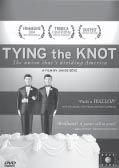
Tying the Knot: The union that’s dividing America
Jim De Sêve, Director Roadside Attractions / 1,049 Films
This 83-minute docudrama opens in 1971 San Francisco, when a brave group of gay activists invaded the Bureau of Marriage wielding a huge wedding cake and demanding the right to marry. They commandeered the phones and denied heterosexual callers any information or access. Then they staged the nation’s first mass gay wedding.
Until it is possible for our committed relationships to be recognized by all 50 states and the federal government, there are truths we should acknowledge: Wedded partners enjoy more than 1,040 basic official rights that are not available to their unwed counterparts. Functioning partially as a workbook and partially a treatise on how and why to create legal documents to protect your assets and your ability to function as couple, this book offers well documented advice on insurance, inheritance, ownership of property, rights of survivorship, hospital visitation, children’s issues and many other often overlooked needs.
Although this book is not written specifically or exclusively for the GLBTQ community, it is a handbook that could be invaluable to those of us who cohabit. The authors have thoroughly researched pertinent state and federal laws and have laid them out in such a way that the appropriate path is easier to see and follow.
Book and video reviews by Christopher Lawrence
We will, one day, have the freedom to CHOOSE whether or not we want to be married – because of these heroes.
The DVD “extras” Q & A with the director, following its debut at the Tribeca Film Festival, deliver nearly 20 minutes of insightful commentary about the direction and contents of this first-rate endeavor. The depth and breadth of this docudrama examining equal marriage rights is definitely worth viewing. –
C.L.
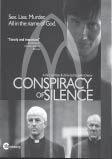
Conspiracy of Silence
Written/Directed
by
John Deery
TLA Releasing, 87 min.
Today, 34 years later, many GLBTQ people infer that marriage is an issue only for Caucasian, middle-to-upper class individuals and couples, or that gays need not embrace a failing institution that emulates a heterosexual “lifestyle.” Minutes into this film those dissident voices in my head faded as I watched this observant investigation into the truth about real equality and the historical evolution of marriage.
The director includes actual footage of a dark part of our history when it was unlawful for people of different races to marry. If caught, they had to choose between being sent to prison or banished from their home state (or states, for many states had the same discriminatory laws). Dissenters and judges alike heralded this marital mix of races as “the downfall and destruction of the institution of marriage and the family.” Sound familiar?
Each of the first nine chapters finish with a section called “The Bottom Lines” so that you have a summarized reference of the important points. A Financial Advisor Interview Questionnaire outlines what to ask when you are ready for professional help.
Navigating relationships is rarely easy, but this book will definitely aid your journey. Must reading for any committed, cohabitating couple. (Cue music: “Protect Yourself!”) – C.L.
Watching right-wingers spewing their vitriol in the name of God and sowing the seeds of hatred, prejudice and bigotry cannot stop us from being inspired by our brothers and sisters as they demand recognition and respect for their love and commitment.
We follow the stories of couples that found they had no visiting rights in the hospital and surviving partners who struggled against losing everything after many years of committed partnership. Their shattered lives and hearts are a testament to the changes we still need to institute in the U.S.
celibacy. Cleansing of the church would bring deception into the light, after all, and the subsequent healing could follow.
The intrigue verges on sinister and the actors are passionately connected to the roles they play. Much of the language is harsh, with anti-gay references peppered liberally throughout the dialog.
Tension builds toward a remarkably satisfying finish that demonstrates how the closet creates dishonesty, which, in turn, can lead to a devastating public breakdown and exposure of the corruption.
Celibacy. Once again, right now in 2005, the Catholic Church is starting a witch-hunt for homosexuals. This movie reflects headlines we have been seeing for some time. Although little is said here of child molestation, the hypocrisy and secrecy regarding the goings-on within the institution clearly involve clergy at all levels.
AIDS in the church is used as the gateway to this dark and threatening exposé of priests who must conceal their sexuality at all costs. The opening scenes are a vivid and heart-wrenching image of the desolation of living within such a constricted atmosphere.
The suicide of a priest leads to investigation by a very handsome young seminarian who sought to understand how this could happen with no warning. While visiting another young seminarian, he rejects sexual overtures. Following this incident, he is seen exiting the room, and is unjustly accused of homosexuality. After being dismissed from school, this complication leads him to speak to a journalist about the unfairness of the action on merely prejudicial grounds with no supporting evidence.
Thumbs up on all counts. – C.L.
Maurice and Alec in America
by Fred Carrier
AuthorHouse, 280 pp
Many of you are familiar with Maurice, the classic gay film (see CenterStage article on page 11), and may have wondered what happens to the characters after the end of E.M. Forster’s tale.
Delightfully, this sequel transports them on a ship to America in order to escape the homophobia and strict class structures of England, which would have doomed their relationship.
In the U.S. where the industrial revolution is in full swing, Maurice and Alec find they face many of the same prejudices. Their commitment to the love they share bears them through undreamed hardships. Facing these challenges individually and as a couple compels the ongoing self-exploration and personal transformation within them.
Although Carrier shows exquisite and perceptive loyalty to Forster’s style of writing, he manages to flesh out these two remarkable men with such personal integrity and solid depth of character that they become even more the kind of heroes we would do well to emulate.
The attempt by church officials to end the investigation intensifies the reporter’s interest. The effort to silence him eventually threatens the safety of his young family.
The dishonesty unravels even as the priests, who want everything to remain unchanged, battle bitterly behind closed doors against their more progressive members, who believe in changing the rule of
Some of Alec’s background was changed to suit the storyline in this new world and it works extremely well. As the volume concluded, I yearned to observe more of their lives and see how they would fare as a gay family. To my satisfaction, the last page was labeled the “End of Part I.” This novel is not mere feminine romantic fluff, but contains the gritty stuff of which our pioneers were composed. A great read! – C.L.
REVIEW S & PR EVIEWS MUSIC
Music reviews by Graham Ames
Love Life & Be Happy
Georgie Porgie
Musicplant Group / Live!
It has taken a few listens, but Georgie’s first full-length album is finally starting to sink in. On first listen, I had dismissed it as musically prosaic, happy, nearly bubblegum ditties for listening and singing to myself. But, after another couple of listens, the 15 tracks on this album have taken on surprising depth.
Love Life & Be Happy is assembled from Georgie’s long string of club hit singles, including: “Life Goes On,” “Be Happy,” and “Sunshine,” plus new material. Dance anthems, burning torch numbers, disco, even an Isaac Hayes tune fall under the Georgie treatment. The slower tunes echo classic George Michael, while the upbeat tunes are truly upbeat.
“And it doesn’t matter what they say / And it doesn’t matter how they feel / All that matters what’s in your heart / As long as you love what you do.” The poetry is not very deep, or even very poetic, but the message comes though. Just being reminded that the world would be a better place, if people loved one another more, is good for the soul. Perhaps if everyone listened to Georgie’s album, the world might truly change. – G.A.
2
Junior Vasquez
Pagoda Entertainment
For true believers, there is dance music, and then there is Junior. His remixes for everyone and anyone always enlighten and transform even dull source material into wonderful sonic journeys. His live club appearances are legendary, and you have never heard a DJ until you’ve heard Junior. Released in 1998, 2 is premium stuff: a live five-hour set condensed to nearly two and one half hours and spread across two CDs and 33 tracks. The first
GLBT Book Group
Spokane’s Gay, Lesbian, Bisexual and Transgendered Book Group meets the first Wednesday monthly in the second floor conference room of Auntie’s Bookstore. Facilitator Julie Smith says review sessions begin at 7 p.m. and visitors are welcome.
Upcoming reviews include:
Oct. 5 : Almost Like Being in Love by Steve Kluger.
Nov. 2 : Seahorse Year by Stacey D'Erasmo
disc is a set that would make any dance floor fly, but it is Disc B that draws me back, repeatedly.
Opening with a remake of The Beatles’ “Come Together,” this non-stop ride passes through some amazing and surprising sonic territory. Funky Green Dogs’ “Until The Day,” Club 69’s “Drama,” even Duncan Sheik’s “Reason For Living” appear along the way. But then a restful moment in the music suddenly echoes with Dolly Parton singing Cat Stevens’ “Peace Train,” followed by Cher’s “The Sun Ain’t Gonna Shine Anymore.” I was left breathless, enlightened and amazed by the disc, and remain so. 2 is a document of a genius at work, doing what he does best. Find a copy for yourself and I am sure you will agree. – G.A.
Cheapness and Beauty
Boy George
Virgin Records
In 1995, I dropped into an Albuquerque gay/lesbian bookstore and began browsing. Not too long after I arrived, I asked about the music playing over the store’s sound system. This is how I discovered Boy George’s (then) new album, Cheapness And Beauty.
Over the years, this has become one of those albums I return to again and again. I am always surprised with the immediate
presence of the songs. These 13 tracks are a queer iconoclast manifesto, angry and loud. Much of the album is punk-grunge, with distorted guitars and driving bass lines. In them, George dissects the bitterness around him with vicious wit. “Mother hold your breath / cause I will never be / any of the things you had planned for me,” begins “God Don’t Hold A Grudge,” an anthem for standing your ground in the face of family homophobia. The acoustic portions of the album are surprising after the heavy opening, but the songs are amazing. “Same Thing In Reverse” is the track I heard in the bookstore. “Your brother doesn’t understand / how you could love another man / and your poor father thinks we’re cursed / it’s the same thing in reverse.”
This is an album to crawl around in, filled with hard-won, well-expressed lessons from the life of a Global Queer Icon. If the rockin’ stuff doesn’t grab you, the mellow half of the album alone is worth the purchase price. It’s a great musical gem worth seeking out. –
G.A.
sempre libera
Anna Netrebko
Deutche Grammaphone
My housemate Jeff listens to more opera than I do, so I asked him for his review.
Opera isn’t something everyone enjoys, in part, I suspect, because it takes some
listening to appreciate the finer points. This disk would be a good first step for someone interested in understanding the operatic voice – in particular that peculiarly operatic phenomenon, the “coloratura” – a singer (usually soprano) who not just sings but decorates a melody. Better yet, it will likely bring a listener who knows opera the kind of satisfaction that only comes from the best performances. sempre libera is a showcase of 16 arias from several operas – prime among these being Verdi’s “La Traviata” and Donizetti’s “Lucia de Lammermoor.” Extracting arias from their operatic context risks making a CD one of those cheesy and trite things you see on TV commercials – but in this case each opera is represented by several works and so, while the complete dramatic and musical framework is not present, there is enough to make it more than just a kind of soprano “greatest hits.”
Netrebko’s voice is masterful and beautiful with rare range, precision, depth and control. Claudio Abbado and the Mahler Chamber Orchestra back her up and the disk demonstrates the kind of excellent production values that Deutsche Grammophone is known for. – G.A.
Those Were The Days
Dolly Parton Sugar Hill Records
Only Dolly could pull this off with so much class. She’s selected a bunch of, well, hippie songs from the late ’60s and early ’70s, invited a whole cast of talented friends to join her, and recorded what may be the ultimate mixtape to the world. The 12 tracks on Those Were The Days range from Dylan’s “Blowin’ In The Wind” to Janis’ “Me And Bobby McGee” to Lennon’s “Imagine.” Her guests include Judy Collins, Norah Jones, Nickel Creek and even the artist formerly known as Cat Stevens, Yusef Islam.
There’s a lot to like on this album. The lush strings and three-part harmonies on “Where Have All The Flowers Gone” are breathtaking. Kris Kristofferson’s duet on “Bobby McGee” is playful and sexy, as it should be. The guests mix up Dolly’s trademark “Newgrass” sound enough to keep everything fresh, and everyone seems to be having a really good time. The moments that struck me as too sappy will be huge favorites for those less cynical than I. In fact, the simple sincerity of this project is refreshing. Halfway through the first decade of this new century, perhaps some earnest hippie music is exactly what we all need. Those Were The Days will be released Oct. 11. –
G.A.
the Middle of Nowhere
Accidental sex therapist?
by Tim Anderson
Earlier this year a composer friend of mine flew out from Chicago for a visit. World-traveled and exposed to a multitude of influences, he’d never experienced the Cabinets, the Bitterroots, and the Selkirk Ranges. Or any place for that matter that is quite as remote as the rugged territory that runs along the 49th parallel. Offering the standard tour of my version of Northern Exposure, we laid down the miles on his rental car between Washington and Montana. He sharing his Buddhist philosophies while I tried to counter the impressions the national media had left on him that the Inland Empire was unsafe, racist, homophobic, rigidly conservative, and very, very straight.
On his first evening in the northwest, we took a break from the touring, eating a leisurely dinner at the local pizza joint. As we entered the restaurant, I vaguely recalled hearing a woman yelling at someone from the street, but I ignored the shrieking as just another excess of summer and the invasion of tourists that happens each year up here.
As it turned out, the woman was yelling at me. She was an acquaintance.
She appeared breathless a few seconds later at our table, but before I could introduce her to the composer sitting with me, our heroine sat down across from me. Confessing like automatic gunfire that she’d just caught her husband in an affair, she was launching a sexual offensive to out do the competition. She was going all-out to keep her man.
In other words, everything in their bedroom was up for negotiation, and in explicit detail she described that
hemorrhoids aside, she was going where she’d never ventured before. She also acknowledged that her love for her man was based on the perfect proportions of his little head and then proceeded to describe it in glowing detail. Incredulous, I didn’t know what to say. In the space of a few seconds I had way too much information.
Most of the other patrons – ok, make that the entire pizza joint – heard her every word. Meanwhile I reconsidered my choice. In light of what I’d just heard did I really want to order the meat lovers pizza? The composer, equally stunned, turned to me red-faced when the wild woman got up to use the rest room, noting that up until that moment, he’d thought only gay men were obsessed with size over substance.
And so the summer has gone.
On occasion after occasion, in awkward social situation after awkward social situation, I’ve heard things I’m not expecting. Things I’m completely unprepared and ill equipped to process. Straight folk, both men and women, regardless of the health of their relationships, seem to want to talk about their sex lives. With me.
For some reason the local gay boy seems the only person they think bad enough to share their dirty laundry with. Maybe it’s because by their thinking I’m so far gone already, I’m the only one who won’t judge or mock all the dimensions of their sexuality. Assuming I am going straight to hell anyway, they talk. Surely I won’t mind hearing about that little slice of heaven they discovered courtesy of Castle Superstore. Whether it’s the badge-happy, rural cop whose wife just discovered his butt or that fun little foxy number who gave me a blowby-blow account of how she conceived in the Veterans Hall ladies room, I guess they confess assured they couldn’t ever do anything as horrible as being a friend of the Village People.
Which for the record, I’m so not.
Being pro-life, pro-my-life that is, I know that were any of these disclosures
Continued on page 17
by Paul A. Gilmore
October 11 is National Coming Out Day. This date commemorates the 1987 march on Washington, D.C., to support gay and lesbian rights. This is also a day to encourage gays and lesbians to step out with pride.
Paul A. Gilmore
Ideally, coming out of your closet is a deeply personal process marked with little successes spread out over time. Not so ideally, the process may be embarrassing, painful and mired in emotional tumult. My coming out has been much the latter. Although I remember always being gay oriented, I was raised in an era and environment that was very anti-gay. Anita Bryant was making headlines daily. Harvey Milk was murdered in San Francisco City Hall. There was no such thing as Odyssey Youth Center or Quest Youth Group. Essentially, all gay people were alone fending for their own survival.
In 1977, just short of my 18th birthday, I was excommunicated from the Church of Jesus Christ of Latter-day Saints (the Mormon church) for “deviancy.” Within weeks, my mother came to mock me, disowned me and kicked me out on the street. She proceeded to notify everybody we knew of my “disgusting and deviant behavior” and advised they ignore me too until I came to my senses.
The next two years were fairly carefree, as I had entered into a relationship with a pretty good man – until I found him with another young man. Now 20 years old and feeling lost and betrayed, I left Laguna Beach, Calif., for the Pacific Northwest and some fresh air.
Living in the Seattle area with my fundamentalist Christian stepsister and brother-in-law, I was introduced to a
new religion and a spry young woman. I came to accept their dogmatic religion in exchange for their love and acceptance. And with everyone acknowledging my “bad past history” as past – including me! – I married the young woman. In time, as recently as 2002, we were active in the fundamentalist Christian ex-gay ministry. I have since come to learn that the “ex-gay” ministry is in reality a huge dating service for closeted and married gay people.
The Spokesman Review ran the article, “Gays In The Church,” in 2001, and I was the token “ex-gay” in a piece that featured four other local gay singles and couples active in their churches.
After 22 years of marriage and five beautiful children, my wife decided she was better off without me and filed for divorce in 2002. I don’t really blame her; I can only imagine how hard it may have been for her to live with me when I was (still) not attracted to her. I was devastated for the loss yet felt incredibly freed to discover myself as a person, a gay person.
I returned to my gay origins and attempted once again to come out of the closet, to myself, my extended family and especially to my children. I am 46 years old now, single, out and loving the person I am. In discussing this column with my eldest daughter she offered her perspective.
“I am proud that my father can be the person he is, open to the world and without secrets. Living openly takes a lot of courage for any person. My husband Ben and I hold my father in high regard, calling him frequently for perspective to work with the bumps and potholes of living. In many ways, it is easiest to talk to my father about certain subjects than to talk with others. He is sensitive, insightful and experienced. Coming to accept my father for who he is has been one of the best experiences of my life,” writes Becky.
It has been quite a process to get out of my closet. I have made mistakes but I have learned so much throughout the
Continued on page 17
Tim Anderson
No Rest for the Wicked
Maiden, man or crone?
by Joan Opyr
What’s the difference between menopause and road rage? The road.
I’m not quite menopausal. I’m not even perimenopausal. What I am is 38 years old and posthysterectomy.
I have one functioning ovary and no uterus. To put this in perspective, I’m halfway to a sex change. If I had a double mastectomy and added a penis, not only would I make more money but I’d never again have to wait 45 minutes to take a whiz at a Mariners game. Seems almost worth the $20,000 investment.
If I were a man – no, if I were a really big man, about 6-foot-4, 275 pounds, with a black belt in some particularly violent martial art – I’m sure I’d be in the same perpetual state of annoyance I’m in right now, but it would all be so much more fun. I could flip people off in traffic, or at the grocery store, or the food co-op, or the public library, or at church, the police station, or the U. S. Congress, and folk would think twice about answering me in kind. No one, but no one, would call me a bitch. Well, a few gay men might, but gay men call one another “bitch” with the same frequency and roughly the same degree of sincerity as they call one another “darling.”
If I were a man, I could be really, truly crabby. I could be as crabby as I am right now, but with a wild and carefree abandon. As a woman, I have to
BODY WORK
SENSUOUS, AROUND-the-world massage by 6-ft., 175-lb., 48, handsome, clean, muscular, willing to please, blue-eyed bottom masseur using latest technique and essential oils. Call Gary: (509) 889-9294.
wait another 40 years before I’m actually free to be me, meaning free to be hell on wheels without any dangerous recriminations. The natural progression, we’re told, is maiden, mother, crone, but the choice before me is maiden, man or crone. Man costs too much, and crone takes too long, so I’m obliged to settle for bitch. It’s not that I care – what’s a bitch but a woman who won’t back down? I find, however, that I’m beginning to look forward to being an old lady. I won’t back off and I won’t back down. I speak my mind, let the chips fall where they may, and I accept the consequences of my actions. As I do all of this without a penis, a blue rinse or a concealed weapons permit, I think I’m entitled to some sort of award. Maybe the Charlton Heston “Cold Dead Hands” Memorial Plaque.
People ask me from time to time what makes me so cross. Why, they wonder, am I always on the verge of kicking someone’s ass up between his ears? That’s easy – it’s because everyone’s an idiot save me and thee, and I’m not so sure about thee. People do incredibly stupid things, and if they’re rich, white and (sorry, boys) male, chances are good that they’ll not only get away with it, they’ll get a big fat reward. Spend the first 40 years of your life flunking out, boozing up and running assorted businesses into the ground? Congratulations! You’re the President of the United States of America.
“Boy, I say, boy – what’s that you say? A Category 5 hurricane is heading straight for New Orleans, and a fifth of the city’s residents don’t own cars? Go away, boy; you bother me. Let’s play some baseball. Keep your eye on the ball, son. Eye. Ball. Eyeball. Get it? It’s a joke, son. A yuck, a funny, a ha-ha. Now, hush your mouth. I’m off to San Diego to meet with some campaign donors and a country music yahoo who’s going to give me an autographed guitar. I like country music. It’s patriotic. Except for them Dixie Chicks. They’re bitches. Or maybe they’re menopausal. If they’re really from Texas, I’ll eat my
… I’ll eat this … I’ll eat this thick, juicy steak, that’s what I’ll do. Now where is my bicycle? Prissy keeps hiding it from me, but I’ll find it. It’s probably someplace she thought I wouldn’t look, like under that large print copy of the Constitution. A-ha!”
Slow drivers annoy me. Fast drivers annoy me. Politics annoy me. I don’t like Republicans, Democrats, the Green Party or Libertarians, and as for Independents, who the hell do they think they’re kidding? Independent of what?
Garden Clippings
It’s
Thinking? Voting? Making a commitment? Go ahead, sit on the fence; I hope you get a splinter in your ass. Oh, yeah – I’m ready to be an old lady. Or to buy a penis. What’s the number for Smiling Bob at Enzyte?
Joan Opyr is a writer and editor who lives in Moscow, Idaho. Her first novel, “Idaho Code,” will be published in March 2006 by Bywater Books. She welcomes your questions and comments at joanopyr@earthlink.net and invites you to visit her web site: www.auntieestablishment.com.
fall: water like crazy!
by Michael Loundagin
Well! Guess what just happened! Fall! I thought we did that last year.
A co-worker likes to say “Time’s fun when you’re having flies!” That’s so true. But this year, things seem to have accelerated, especially the development of fall color. Maybe that’s just how it seems. It’s harder to pinpoint a date for leaf color development than it is for, say, the first crocus.
There is still much to do out there, like planting (especially bulbs and perennials), lawn winterizing and general cleanup, but if you don’t do anything else, at least WATER LIKE CRAZY! I’m still enlarging the beds in front of the house, and while digging compost in I was shocked to find the soil was dry as dust about a foot down. I can see people’s lawns are already turning brown; that’s a bad sign. Trees and shrubs must have a good store of moisture available to the roots if they are going to survive the winter. If you have to have the sprinkler system drained, go ahead, but then drag the hoses out!
I want to tell you about three plants that I’m just mad about right now. The first is a heuchera (coral bells) called ‘Peach Flambé.’ It’s a new introduction this year and is already a hit. The leaves are an in-
credible color, sort of a rosy orange, with dark veining. When the sun shines through them the color becomes indescribable. Plus, being evergreen, the plant will be there for you all winter. I can’t wait to see how it looks in the snow. SNOW? I take that back.
The second is an echinacea (coneflower) called ‘Sundown.’ Up until recently, coneflowers came in two colors –pink and white. A yellow species was brought into breeding and suddenly we have yellow and orange coneflowers, and they are very nice indeed, but ‘Sundown’ is awesome. The colors are of the sunset, with orange, pink, red and violet tones, and the colors change as the flower ages. Add in the most fantastic fragrance, like a clove and cinnamon-dusted orange slice, and you have magic. Plus, the flowers come almost all summer. This is an expensive plant, running between $15 and $20, but it is worth twice that.
The third is a shrub, a sumac actually called ‘Tiger Eye.’ This sumac has the most beautiful, feathery gold foliage all summer, and isn’t supposed to run at the root like other sumacs. Still, I planted mine in a large container with a few other foliage plants, and you should see how gorgeous it is. Right now, the yellow of the leaf is taking on neon pink tints. I have never seen this combination in a hardy plant before. You’ve gotta get this thing!
Resident garden guru Michael Loundagin works as a nursery specialist on Spokane’s South Hill. He can be reached at mlaua1034@aol.com.
Joan Opyr
OUT! IN THE MIDDLE OF NOWHERE
to ever see publication, I’d be confronting a serious reckoning. My own replay of “dances with shotguns” mirroring the sacred western ranching tradition of unofficial, unsanctioned, endangered species “wildlife mitigation.” In other words, the three s’: Shoot, shovel, and shut up. I’d be the one shot, they’d be shoveling, and by default, I’d be permanently shutting up.
Having no desire to star in my own season finale of Six Feet Under, I’ve accepted my new duty as a silent community sex therapist, while internally wrestling with why so many straight folks, people who don’t get bashed and who don’t have bosses trying to fire them for what happens behind their closed doors, are feeling so ashamed about what comes most natural to them. Even here – in the most nonchurched, remote part of the nation – our libertarian, independent, and staunchly western landscape remains suffocating and restrictive.
Yet if this summer is any indication –what’s happening under our big skies demonstrates that a whole lot of people are finally stepping out, trying different flavors, and having a great deal of fun.
And that I should be buying a whole lot of stock in Castle Superstores.
A writer, horseman, truck driver, and graduate of Seattle Pacific University and Lutheran Bible Institute of Seattle, Tim has been published in Guide, Frontier, Second Essence and Bend, Don’t Shatter. He is also the president of the Gay Truckers Association. For more in-depth information about his bio, visit www.highmountainranch.com which won Website of the Year from www.roadstaronline.com.
Continued from page 14 IT’S YOUR LIFE
Continued from page 14
journey. There have been regrets, loss and pain; there has been triumph too. The greatest triumph has been my overcoming my own ingrained fears of being myself.
If you are struggling with your closet door, look at the Resource Directory in the back of the Stonewall. Today there are so many resources to assist all of us. Today those of us who call ourselves gay are not alone. Happy National Coming Out Day! Fly your flag proudly.
Paul Gilmore is a certified phlebotomist and lab assistant with the nation’s largest reference laboratory. He makes his home in Spokane, Wash. You may reach him in care of Stonewall News Northwest.
Should your lover know ALL your fetishes?
Dear Trinity,
I am 27, male and have fetishes for women’s panties. My girlfriend lets me wear hers and I also own other women’s panties I call “mystery panties” because I don’t know who they belonged to. How can I get my girlfriend to let me wear my mystery panties and not just hers?
Hide The Panties Brooklyn, NY
Dear Hide The Panties, Sleeping with, flirting with and/or wearing other women’s panties equal three things, being disrespectful, unfaithful and CHEATING. Once you’re dating someone it’s time to hide the porn, the pictures of your exes AND the mystery panties. Yes, maybe if they’re clean, they may only remind you of womanhood and don’t make you desire other woman, then you could gently hint about the mystery panties. But why not keep it quiet? Honey, would you want her wearing other men’s underwear and getting all excited about it?
importantly love themselves it does become less work, I promise – sort of. Kisses, Trin.
Dating Dilemma No. 136
Dear Trinity, I caught my girlfriend cheating. Is it me?
Why Me Key West, FL
meet some future dates but I need advice.
Thanks, Internet Explorer Santa Monica, CA
Dearest Explorer, The internet can be addictive, expensive, time consuming and dangerous. So be careful, light hearted and be sure to read:
Trinity Smart Tips For What To Look For In The First Ten Emails With A New (CP) Chatting Partner
1. If you don’t read “LOL” (laugh out loud) at least three times by the tenth email then your CP may be a bore, a brain or a mortician!
2. If your CP writes with a RIGHTEOUS, serious or know-it-all tone then get ready to chat with The Christian Rights who are never wrong!
3 . If your CP writes, “I HATE,” “I’m totally over,” or “I hope you’re not that (or this stereotype)” prepare to meet Mister or Miss Miserable!
4. If your CP only posts nude pictures he or she may only want a bang with you or your whole gang!
5. If you see MISSPELLED or incomprehensible phrases like, “Wil yu pley wit me” then prepare to meet a young, unintelligent and/or non-English speaking CP!
6. If your CP only writes SHORT MESSAGES once in a while then prepare to meet the workaholic or the partier!
7. If your CP writes long messages every day then prepare to meet the computer geek or the unemployed!
8. If your CP writes, “I’m on ANTIDEPRESSANTS and have low self-esteem” then get a psychology degree before meeting this person!
9. If your CP talks about GENITAL SIZE, sexual desires and/or rendezvous locations then you may not be chatting with the Virgin Mary/Manny!
Night, night Sweetie
Hello Trinity, Relationships are so much work. Does it ever get easier?
The Work Schedule Vancouver, BC
Hello Work Schedule, Relationships should get easier but it will always be a balancing act that tortures you, I mean teaches you about life and yourself. So stick with it, Pumpkin. As time passes and couples learn to love each other and more
Dear Why Me, Someone cheats not because of you but because of something within themselves emotional or hereditary. In a Zen tale, a frog needs to cross the lake and the nearby scorpion says, “I’ll take you and won’t sting you.” The frog replies, “promise,” and the scorpion says, “yes.” So the frog gets on his back. Halfway across the scorpion stings the frog. And when the frog asks, “Why’d you do it, you promised?” the scorpion replies, “It’s my nature!” And there lies the truest reason why someone cheats.
XOXO Trinity
Dearest Trinity, I started chatting on line and have met many different people. I’d like to
10. Lastly, if you’re denied a head shot, an email address, a cell phone number or relevant information then this CP may be ugly, in “the closet” or even worse – married!
Community Service Announcements
Wo rkshops starting in November at Center
Emmanuel MCC will present a variety of workshops for the GLBTQ community over the next several months at the Rainbow Regional Center beginning in November. The first series will be “Homosexuality: Not a Sin, Not a Sickness.”
Future workshops will include Domestic Partner Wills and Power of Attorney and other topics of interest to the community. Watch the community calendar for specific dates and times.
SPOKANE AREA
BiNet Spokane
A social support group for bisexual men and women.
Call: (509) 217-1271
Eastern Washington University SAFE Students’ Alliance for Equality Weekly meetings for students, faculty and staff.
Call: Kat Olson: (509) 359-4253
http://iceberg.ewu.edu/safe/safe.htm
EMCC –
Emmanuel Metropolitan Community Church
Christian church with an outreach to the GLBT community.
Call: (509) 838-0085
Web site: www.emmanuelmcc.com
Friends of SAN Fundraising organization for people living with HIV/AIDS to improve the quality of their lives.
Write: 1212 E. Front Ave. Spokane, WA 99202
Gay/Lesbian Info Line
Call: (509) 489-2266
Immediate Crisis: (509) 838-4428
GLBT Book Group
Discusses selected works at Auntie’s Bookstore at 7 p.m. the first Wednesday each month.
Call: Julie Smith: (509) 838-0206
Gonzaga University
GLBT Resource Center
For information and to contact resource organizations on the GU campus, September-May.
SODA (Sexual Orientation Diversity Alliance) law school support group. Direct line: Bryce: 323-5847
Hospice of Spokane
Physical, emotional and spiritual care for the terminally ill and loved ones; bereavement support and HIV/AIDS counseling services.
Call: (509) 456-0438
ISCS –Imperial Sovereign Court of Spokane Call: (509) 251-1242.
Web site: www.iscspokane.com
INBA –
Inland Northwest Business Alliance
A Professional GLBTQ/Allied Business Alliance. Guests are welcome to our monthly luncheon meetings, nonmembers are welcome to advertise in our annual community resource directory. Visit our website for information.
Write: PO Box 20163, Spokane, WA 99204
Voice mail: 509-455-3699
E-mail: info@inbaspokane.org
Web site: www.inbaspokane.org
Inland Northwest Equality A coalition of local individuals and organizations committed to progressing GLBT equality and justice.
Call: Brooke Powers: 838-7870
Web site: www.icehouse.net/pjals/ issues/inwe.html
Look alike contest to benefit GLBT caucus
All Madonna, All Night. Costume Contest for best Madonna look alike. It will be held at Dempseys from 10 p.m. to 1:30 a.m. on Thursday, Oct. 20. There is a $10 cover.
All proceeds from the cover and raffles will benefit the GBLT Affairs Caucus of the Washington State Young Democrats, led by Adam Cogswell. For more information, contact Adam at (509) 217-6347 or cogseyboy@hotmail.com.
You can help survivors of Katrina and Rita
The Rainbow Fund (RWF) has established a fund for donations to help the survivors, as part of the GLBT community’s response to the loss and devastation caused by Hurricane Katrina and Rita.
Hurricane Katrina blazed a trail of destruction throughout Louisiana, Mississippi and Alabama. The RFW fund will also be used to respond to Hurricane Rita which struck Texas and added to the devastation in Louisiana.
Resource Directory
Integrity
Gay and lesbian Episcopalians meet monthly for communion and simple meal.
Call: Chuck: (509) 326-7707 or Ann: (509) 624-6671
Landlord Tenant
Information Hotline
Volunteers provide information and referrals to landlords and tenants. Free resource materials. Does not provide legal advice, but may refer.
Call: (509) 325-3037
MPowerment
For gay and bisexual men 25 and up; a frank and open forum about sex, self, safety and socializing. For more information about upcoming meetings and events:
E-mail: mpower@san-nw.org
Northwest Fair Housing Alliance
Private, nonprofit organization provides education, outreach and enforcement assistance for those who have experienced discrimination and the general public.
Call: (509) 325-2665 or (800)-200-3247
Odyssey Youth Center
Discussion/support group and social drop-in center for GLBT and questioning youth.
Call: Laurel: (509) 325-3637
Outreach Center
Condoms, needle exchange, AIDS information. Open M-F, 3-5 p.m. at 1103 W. First Ave.
Call: (509) 838-6859
OutSpokane
Committee organizes annual Pride march and celebration and other community events.
Web site: www.OutSpokane.com
Papillon
A social support group for the transgendered community.
Call: (509) 292-8852
PFLAG - Spokane –Parents, Families & Friends of Lesbians and Gays
Support group for parents, family, friends and members of the GLBT community.
Call: (509): 624-6671
Web site: www.pflagspokane.org
PJALS –
Peace and Justice Action
League of Spokane
Independent, membership organization building foundations for a just and nonviolent world.
Call: (509) 838-7870
Planned Parenthood of Spokane & Whitman Counties
HIV antibody testing and counseling.
Call: Clinic for Appt.: (509) 326-2142
Administration: (509) 326-6292
Quest Youth Group To “inspire, encourage and support” gay and bisexual guys, 18-25, in the Inland Northwest through free monthly recreational activities, discussions, service projects and movie nights.
Call: Ryan: (509) 290-3519
Web site: www.QuestYouthGroup.org
Spokane-Kootenai Pride
A program of the Pride Foundation to involve Washingtonians outside of King County in activities beneficial to the GLBT community.
Call: Spokane office: (509) 327-8377
Rainbow Regional Community Center
Support services for GLBT community and individuals exploring their sexual orientation and/or gender identity.
Call: (509) 489-1914
Web site: www.spokanerainbowcenter.org
SAN –
Spokane AIDS Network
Call: (509) 455-8993 or 1-888-353-2130
Web site: www.spokaneAIDSnetwork.org
Spokane County Domestic Violence Consortium
A private, nonprofit organization with members from a variety of professions who have come together to end intimate partner violence.
Call: (509) 487-6783
Spokane Falls Community College
- The Alliance
GLBT and allies group to provide a safe space; to educate our community.
Call: (509) 533-4507
Spokane Human Rights Commission
Call: Equity Office: (509) 625-6263
Spokane Regional Health District
Providing health services and referrals for the public. HIV testing.
Call: (509) 324-1542 or 1-800-456-3236
Web site: www.spokanecounty.org.health
Stonewall News Northwest
Flagship publication for the gay and lesbian community and the Inland Northwest.
Call: (509) 456-8011
Fax: (509) 455-7013
Web site: www.stonewallnews.net
Spokane Gender Center
Resources and support for transgendered people.
Web site: www.gendercenter.com
Unitarian Universalist Church
Gay, lesbian resource committee.
Call: (509) 325-6383
Web site: www.uuchurchofspokane.org
Vanessa Behan Crisis Nursery
Call: 535-3155
Web site: www.vanessabehan.org
Women and Friends
Women-only activities and events in the Spokane area. Call: (509) 458-4709
Women’s Cultural Exchange
Promoting arts and entertainment events by women, for women.
Write: P.O. Box 4795, Spokane, WA 99202
IDAHO
Idaho for Basic Rights Citizen action group to work for civil and legal equality on basis of sexual orientation.
Call: (208) 343-7402
NIAC –
North Idaho AIDS Coalition HIV/AIDS prevention, education and assistance for people infected/affected with HIV.
Call: (208) 665-1448
Web site: www.nicon.org/niac North Idaho College Gay-Straight Alliance
Email: BCHARDISON@icehouse.net
Panhandle Health District
STD/HIV testing, condoms, and other methods of birth control, physical exams, shots, cancer screening, resource nurse voucher program, referrals to area resources and education. All services are confidential.
• Kootenai County Call: (208) 667-3481
• Boundary County Call: (208) 267-5558
• Shoshone County Call: (208) 786-7474
• Bonner County Call: (208) 263-5159
• Benewah County Call: (208) 245-4556
Web site: www2.stateid.us/phd1
PFLAG - Sandpoint –Parents, Families & Friends of Lesbians and Gays
Support, education and advocacy group for Sandpoint gay people, parents, family and friends. Call: (208) 263-6699
LEWISTON/CLARKSTON
PFLAG - Lewis-Clark –Parents, Families & Friends of Lesbians and Gays
Support, education and advocacy group for Lewis-Clark gay people, parents, family and friends. Meets in Lewiston.
Call: (509) 758-6437
MOSES LAKE
AACW –Alternative Alliance of Central Washington A social and support group to help bring together people in the GLBT community.
Write: P.O. Box 1282, Moses Lake, WA 98837
Food aid and donations through RWF will go to America’s Second Harvest (ASH), the nation’s food bank network. Your donations will be used to provide meals and groceries, transport food to survivors, and secure additional warehouse space for food banks to resume and maintain operations.
Donate by check or credit card by visiting www.rainbowfund.org and clicking the “Donate Today” button. Specify “Hurricane” when asked where you would like your donation to go.
100 percent of the funds you donate to the RWF Hurricane Relief Fund will go toward helping the survivors recover. RWF has already raised over $300K for hurricane relief.
PULLMAN / MOSCOW
Washington State University GLBA Program
Fun, fellowship and socializing.
Call: (509) 335-6428
Web site: http://cubwsu.edu/GLBAP
Out There
Safer-sex information and supportive programs for young men who have sex with men.
Call: Melinda: (509) 335-6428
University of Idaho Gay-Straight Alliance
Promoting a fabulous, positive and inclusive environment for all people on campus and encouraging individual growth and understanding by developing outreach programs, improving visibility and recognition of queer issues and history.
Call: (208) 885-2691
TRI-CITIES
Benton-Franklin
District Health Department
Confidential and anonymous HIV testing, case management, educational and referral services.
Call: (Pasco) (509) 547-9737, ext. 234 Confidential voice mail also.
River of Life
Metropolitan Community Church Christian church celebrating diversity and affirming GLBT people. Sunday services at 11:30 a.m.
Call: (509) 542-8860
Tri-Cities Chaplaincy / Tri-Cities CARES
Columbia AIDS relief, education and support. Survivor support group and HIV/PWA support group.
Call: (509) 783-7416
WALLA WALLA
Blue Mountain Heart to Heart AIDS prevention education, support and services.
Call: (509) 529-4744
Toll Free: (888) 875-2233 (pin #4744)
Spanish: (509) 529-2174
PFLAG – Walla Walla
Parents, Families & Friends of Lesbians and Gays
Support, education and advocacy group for parents, family, friends and members of the GLBT community. Promoting the health and well-being of GLBT individuals, their families and friends.
Statewide lesbigaytrans civil rights advocacy group. Call: (406) 442-9322 or, in Montana: (800) 610-9322
PRIDE Celebration Group in charge of annual Montana June PRIDE celebrations. Call: (406) 442-9322
WASHINGTON
Bi MEN Group Bi and bi-curious men and gay men who enjoy and support bisexual men. Web site: www.egroups.com/group/bimen-west
Legal Marriage Alliance Working to achieve the right of samesex couples to marry legally in Washington. Web site: www.lmaw.org
Lesbian Resource Center Resources and referrals, groups and events. Monthly newspaper. Call: (206)
Weekly Calendar of Events
SUNDAYS
9 and 11 am: Worship services at UNITY CHURCH at 29th and Bernard.
Noon-1 pm: Counter Crisis meets at RAINBOW REGIONAL COMMUNITY CENTER
1-2 pm: Radical Cheerleaders meets at RAINBOW REGIONAL COMMUNITY CENTER
2-6 pm: RAINBOW REGIONAL COMMUNITY CENTER
5 pm: EMMANUEL METROPOLITAN COMMUNITY CHURCH worship service in sanctuary of Bethany Presbyterian Church, 301 S. Freya.
WEDNESDAYS
6-8:30 pm: RAINBOW REGIONAL COMMUNITY CENTER
7 pm: GLBT AA meets at Emmanuel MCC/ Bethany Presbyterian Church, 301 S. Freya.
THURSDAYS
5:30-8 pm: RAINBOW REGIONAL COMMUNITY CENTER
5:30 pm: PEER TO PEER SUPPORT GROUP meets at Rainbow Center
FRIDAYS
2-8 pm: RAINBOW REGIONAL COMMUNITY CENTER
(When known, the price of admission for one adult is shown. S/s indicates discounted ticket prices are available for Seniors and for students with ID.)
Saturday
▼ 1
The Imperial Sovereign Court of Spokane presents Coronation 2005 at the Mirabeau Park Hotel Hospitality from noon to 3 pm; Protocol from noon to 2 pm; Coronation at 6:30 pm; doors open at 5:30 pm. $30
2
Sunday
The Imperial Sovereign Court of Spokane will hold a Victory Brunch at the Mirabeau Park Hotel at noon. $15
T uesday
INWE (Inland Northwest Equality) meets at the Rainbow Center at 5:30 pm. All are welcome to attend. ▼ 5
Wednesday
The Gay and Lesbian Book Group meets at Auntie’s Bookstore at 7 pm.
T hursday
National Depression Screening Day Anonymous depression and mental health screenings at St. Joseph Family Center from 10 am to 6 pm. Free ▼ 7
Friday
Power Summit Reception at the Community Building from 5:30–7:30 pm. Free
Birthstone: Opal
Flower: Calendula
Astrological Guide: Libra to the 22nd; Scorpio from Oct. 23 National Coming Out Month
The Rainbow Center features the works of Marie Green at its First Fridays reception at 5 pm. Free
Friday Night OUT at ella’s Supper Club from 6-7:30 pm.
Quest Youth Group meets at River Park Square for Food & Flicks! at 6 pm. Open to all GLBTQ youth 18-25 and their allied friends.
The Legal Marriage Alliance meets at the Rainbow Center at 7 pm.
9
Sunday
“United We Win,” An Organizing Power Summit at Itron from 8 am to 12:30 pm. For more information visit www.icehouse.net/ pjals/issues/inwe.html. Free
11
T uesday
National Coming Out Day
Overlapping Male and Female With Organic Lines by artist Marie Green is one of the works on display for her show Dichotomy at the Rainbow Center in October.
Northern Quest Casino presents Divas Gone Wild with a tribute to “Madame,” at 8. $25
8
Saturday
The Rainbow Center will host a reception for Marie Green from 11 am to 3 pm. Free
“United We Win,” An Organizing Power Summit at Itron from 8 am to 5:30 pm. For more information visit www.icehouse.net/ pjals/issues/inwe.html. Free
Integrity, an association of gay and lesbian Christians meets at St. Johns Cathedral at noon.
Rock ’n Roll with Kansas at Northern Quest Casino in Airway Heights at 8 pm.
Wednesday
▼ 12
The Inland Northwest Business Alliance’s monthly luncheon will feature guest speakers from Spokane Gender Center at Europa Pizzeria & Bakery at 11:30 am. $15 and $18 My Fair Lady Fundraiser to benefit the Rainbow Center at Spokane Civic Theatre with a reception at 7:30 pm and performance to follow. For tickets call the Rainbow Center at (509) 489-1914 or stop by during open hours. $25
Friday
▼ 14
The Rainbow Center presents All Over the Guy for its Movie Night at 6:00 pm. Free
Saturday
15
OWLS (Older Wiser Lesbians) meets at Old Country Buffet on N. Division from 10:30 am to 12:30 pm.
16
Sunday
The Spokane Lesbian Association meets at the Rainbow Center at 11 am for games, movies, activities and social time. Public is invited.
17
Monday
PFLAG-Spokane (Parents, Families and Friends of Lesbians and Gays) will hold its monthly meeting at Unitarian Universalist Church of Spokane at 7 pm.