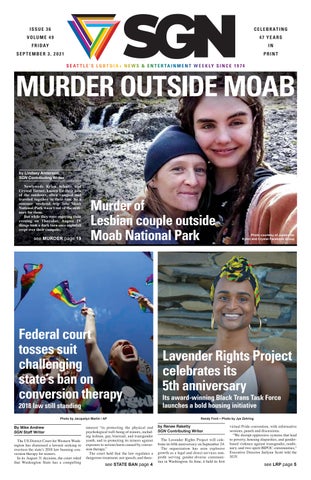
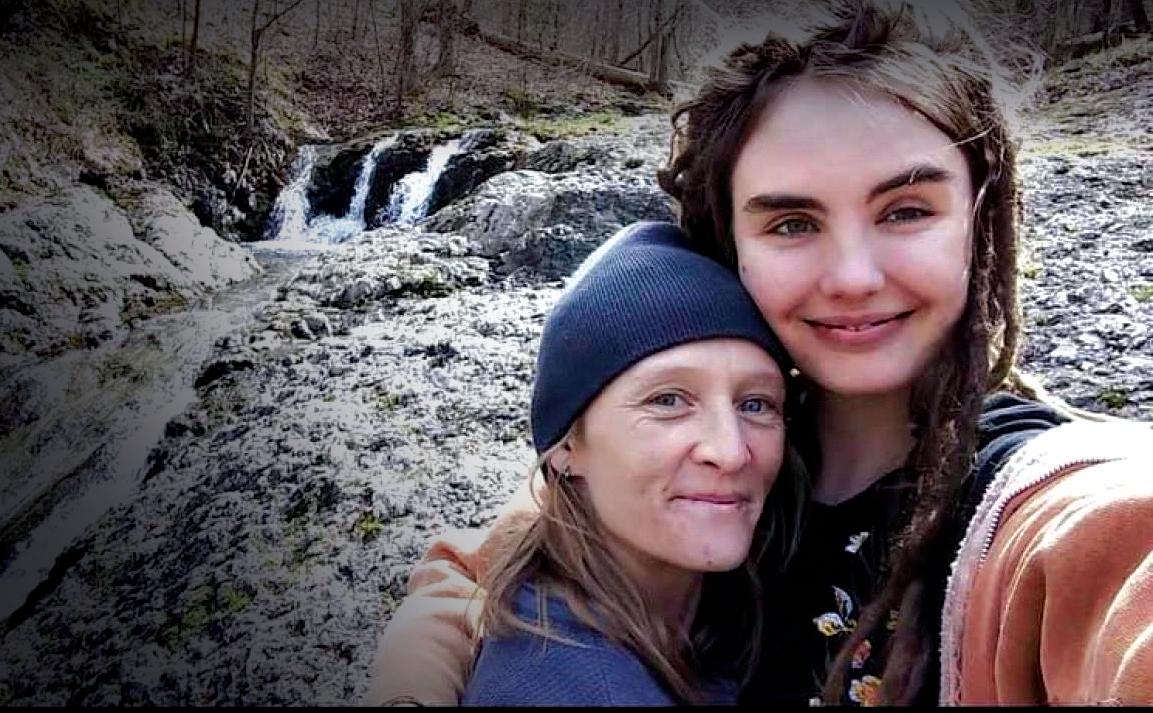
Newlyweds Kylen Schulte and Crystal Turner, known for their love of the outdoors, often camped and traveled together in their van. So a summer weekend trip into Moab National Park wasn’t out of the ordinary for them.
But while they were enjoying their evening on Thursday, August 19, things took a dark turn once nightfall crept over their campsite.
Murder of Lesbian
couple outside
Moab National Park
Federal court tosses suit challenging state’s ban on conversion therapy 2018 law still standing
by
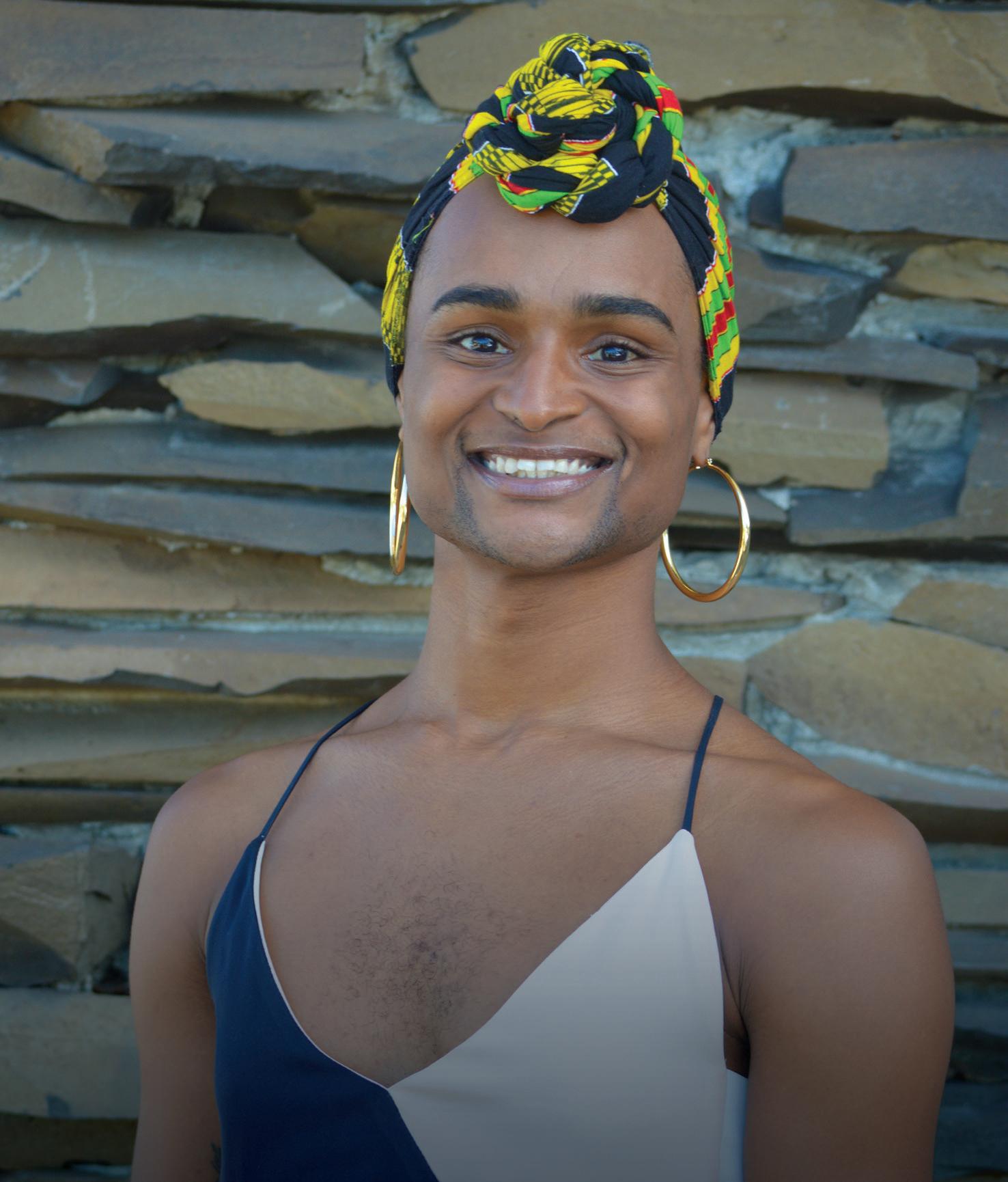
Rights Project celebrates its 5th anniversary Its award-winning Black Trans Task Force launches a bold housing initiative
By Mike Andrew SGN Staff Writer
The US District Court for Western Washington has dismissed a lawsuit seeking to overturn the state’s 2018 law banning conversion therapy for minors.
In its August 31 decision, the court ruled that Washington State has a compelling interest “in protecting the physical and psychological well-being of minors, including lesbian, gay, bisexual, and transgender youth, and in protecting its minors against exposure to serious harm caused by conversion therapy.”
virtual Pride convention, with informative sessions, panels and discussions.
The court held that the law regulates a dangerous treatment, not speech, and there-
The Lavender Rights Project will celebrate its fifth anniversary on September 24. The organization has seen explosive growth as a legal and direct-services nonprofit serving gender-diverse communities in Washington. In June, it held its first
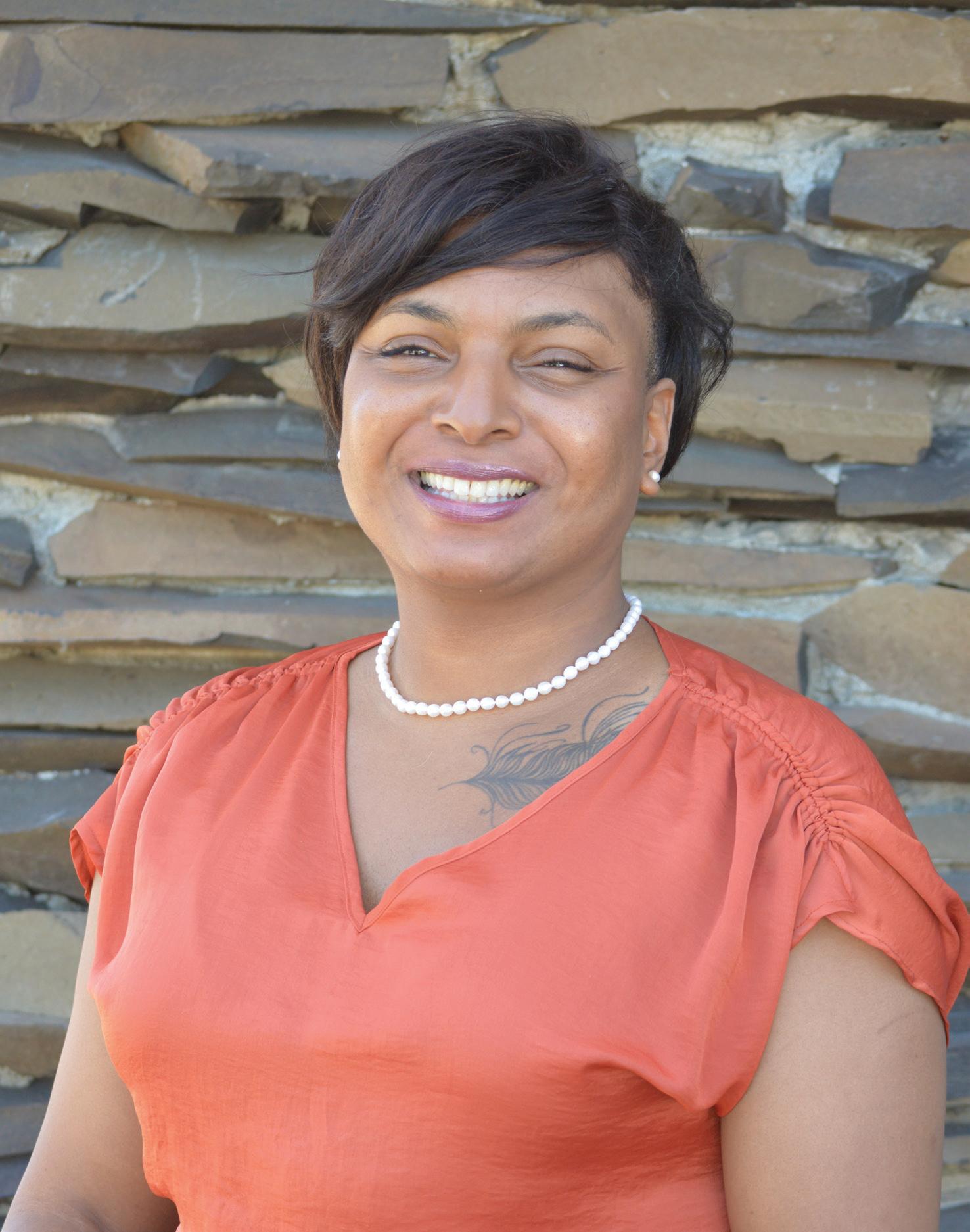
“We disrupt oppressive systems that lead to poverty, housing disparities, and genderbased violence against transgender, nonbinary, and two-spirit BIPOC communities,” Executive Director Jaelynn Scott told the SGN
Renee Raketty SGN Contributing Writer
Photo by Jacquelyn Martin / AP Randy Ford – Photo by Jye Zehring
Photo courtesy of Justice for Kylen and Crystal Facebook Group see MURDER page 19
Local News
STATE BAN
continued from cover
fore does not violate the First Amendment right to free speech.
The court also rejected the religious liberty claim, ruling that state governments may require licensed health care providers to follow professional standards and that the law applies equally to all providers, regardless of their religious beliefs.
“We are grateful yet another court has recognized that states can regulate licensed therapists to ensure that they do not subject LGBTQ minors to this deadly practice,” said Mathew Shurka, co-founder of Born Perfect, the survivor-led campaign to end conversion therapy.
“Twenty states and more than 100 localities have enacted similar laws, and professional mental health organizations are stepping up their efforts to warn parents about the serious harms caused by these fraudulent and unethical therapists, who often take advantage of parents’ lack of information about LGBTQ issues to convince them that they can prevent a child from growing up to be LGBTQ. In fact, there is not a shred of scientific evidence that any therapy
In one recent study, more than 60% of children subjected to conversion programs attempted suicide.
can change a person’s sexual orientation or gender identity, and attempts by therapists to do so are extremely dangerous.”
The lawsuit was filed by conversion therapist Brian Tingley, who argued that the law violated the free speech and religious liberty rights of therapists who wish to perform conversion therapy on minors.
Tingley was represented by Alliance Defending Freedom, which has advocated for criminalizing homosexuality in the United States and has provided free legal support to foreign groups seeking the same in their own countries.
In one recent study, published by Taylor & Francis Online, more than 60% of children subjected to conversion programs attempted suicide.
Brian Tingley – Photo courtesy of Family Foundations Counseling
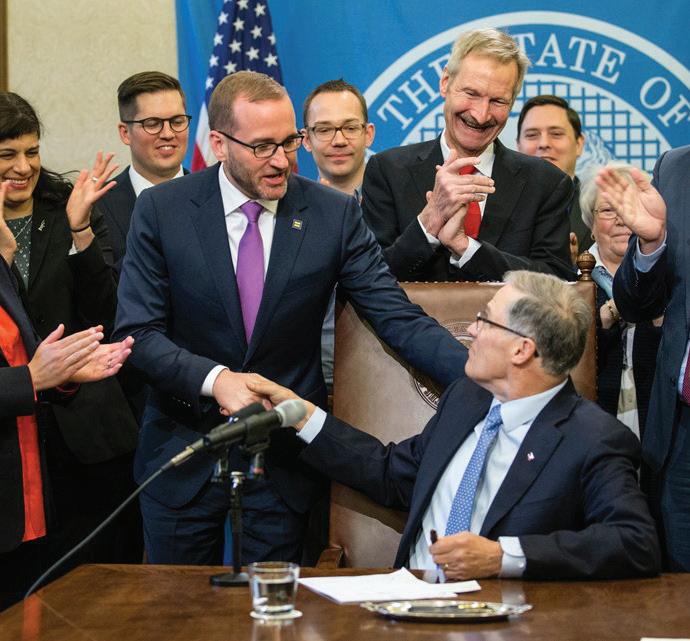
Gov. Jay Inslee shakes hands with then Human Rights Campaign president Chad Griffin after signing a ban on conversion therapy at the State Capitol on Wednesday, March 28, 2018
– Photo by Stephen Brashear / AP
The predominantly Trans- and Black-led organization has also emerged as a leader on racial and social justice issues. It is home to the Black Trans Task Force (BTTF), an intersectional, multigenerational project of community building, research, and political action addressing the “crisis of violence” against Black Trans people in King and Pierce Counties. Due to the George Floyd protest, the former CHAZ space, and the community donating and raising funds on its behalf, the BTTF has redistributed $100,000 to Black Trans and nonbinary people struggling with life resources, including housing. This dedication to prioritizing the Black and gender-diverse community led to it receiving the Community Organizing Award from the Gender Justice League.
“This year has been a record-breaking year of murders, violence, and anti-Transgender legislation,” said Randy Ford, development associate at the LRP and member of the BTTF. “Every year we see more and more reports of Black Trans women being murdered, not only in the United States but globally. Due to COVID-19 and the pandemic closure, this community is even more vulnerable to violence, due to scarcity in employment, housing, and health care.
“Redistribution of wealth and aid is one of the best ways we can protect Black Trans women and femmes. Homelessness and houselessness is a public health crisis, period. And when we invest in the physical, mental, and emotional safety of Black Trans women, we are ultimately investing in ourselves and the greater community.”
The organization also provided four of its direct-service clients with rent for six months through a grant from All-In-WA and is expanding its services to prioritize safe housing for Black Trans women and femmes through a new housing initiative, “Everyone Deserves a Home.” The LRP, along with Queer the Land and the Trans Women of Color Solidary Network, are the “only organizations in the state advocating for Black- and Trans-specific housing.”
“Shelters are not appropriately serving gender-diverse individuals in King County and, even further, are not prepared to analyze the intersections of race, class, disabil-
“Redistribution of wealth and aid is one of the best ways we can protect Black Trans women and femmes. Homelessness and houselessness is a public health crisis, period. And when we invest in the physical, mental, and emotional safety of Black Trans women, we are ultimately investing in ourselves and the greater community.”
ity, and gender expression,” explained Ebo Barton, the LRP’s director of housing services. “Gender-diverse individuals experience mistreatment, harassment, and violence due to their gender identity or expression in shelters, which inevitably leads our community members to avoid shelters and institutions or incorrectly identify on forms and surveys for their personal survival.”
The nonprofit hopes to provide both short-
and long-term housing through the acquisition of a former multiunit property. At this facility, the BTTF aims to invest in Black Trans femmes and the nonbinary community by providing services for physical, mental, and spiritual wellness and offering a safe space for rest, work, and meetings. The LRP envisions single-occupancy long-term stays, rooms with common areas, and communityled safety teams — so their residents find
security and stability. With all of this support, the residents will be able to preserve their dignity and self-respect and see their own full potential in their lifetimes, according to the LRP’s Housing Charter document provided to the SGN Ford explained that the LRP has undergone a lot of reorganization and reimagining to prepare for its new initiative. “We are reintroducing ourselves to the community now that housing and direct services have become a big part of the makeup of the LRP,” she said. “From 2017 to now, our organization has had a huge makeover inside and out, and we want to share that evolution with you. All September we will share with the community how this organization has transformed, how we’re navigating the pandemic, and where we are headed in the years to come.
“We actually have an extensive community survey that we will be releasing soon, that will gauge what resources the community is in need of. With the help of BTTF member Ganesha Gold Buffalo and Policy and Programming Manager Bryan Duncan, there are questions around living situations, health needs, medical needs, etc. Our direct services form has questions asking what support is needed from us, whether it be rent assistance, clothes, food, or social service referrals.
“September 24th is our birthday and we’d appreciate your support as we raise money and awareness to our causes.”
The LRP created a Target registry where the community can purchase items to furnish a future home for Black Trans women and femmes. A review of the registry showed that there are gifts as low as $5, so anyone can help bring their housing initiative into fruition. Those seeking to donate items can also drop them off at Gay City or the East Olive Starbucks location.
For those residing in Pierce County, LRP is utilizing its new Tacoma office in the Hilltop neighborhood to accept donations. Due to the pandemic, only new, boxed, or packaged items will be accepted.
“We aspire to be a step toward liberation. We aspire for a world where the genderdiverse are protected,” said Natasha Lane, the director of development at LRP. “We aspire to be connected to the community in ways we haven’t seen before... and continue to press forward an agenda and advocacy that prioritizes our communities.”
LRP
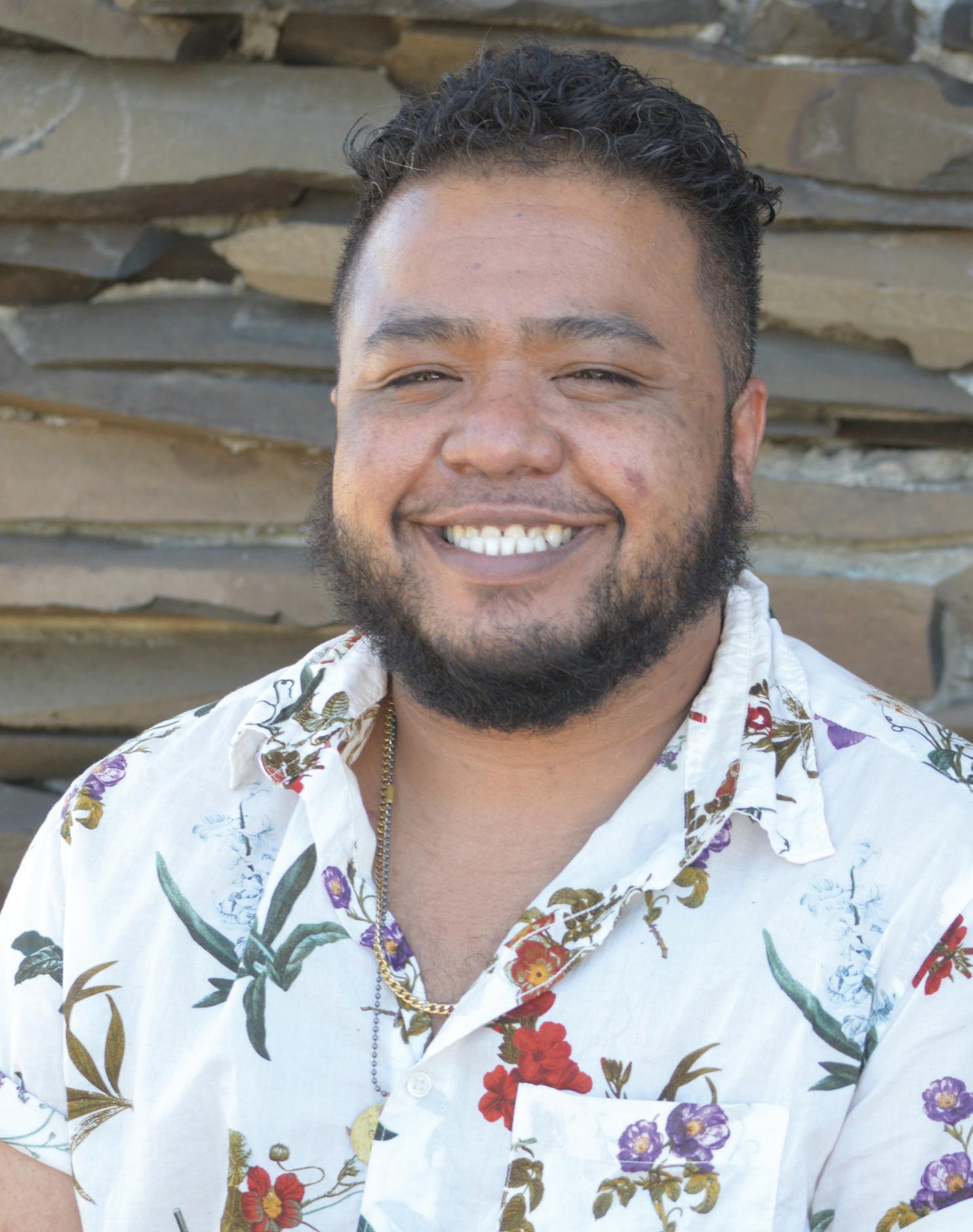
Ebo Barton – Photo by Jye Zehring Jaelynn Scott – Photo by Jye Zehring
1,001 great films (part 7)
From Orlando to Perks of Being a Wallflower, the journey to self-acceptance remains a pretty wild ride
by Sara Michelle Fetters SGN Staff Writer
The summer before I started seventh grade, I decided to switch from cross-country to football. There were reasons for this, chief amongst them being how I’d noticed how many kids were getting belittled for participating in such a “sissy” sport.
To be honest, this was not my experience. By the time I reached sixth grade, I was 6’2” and a star basketball and baseball player. Heck, I was already attending summer basketball camp at one of the local high schools, even though technically I was too young. Not to toot my own horn, but from an athletic standpoint, I had a lot of credibility with my peers, and there weren’t many classmates who were going to make fun of me.
But I knew things they didn’t. This was the summer during which I started to grapple with my gender identity. I knew something was up; I just wasn’t entirely certain entirely what that was. I’m not saying I “borrowed” a dress or two from one of my friends who lived down the street. I will say is that if she ever wondered what happened to them and had looked through a box hidden in the recesses of my closet, I would have been in serious trouble.
Football was the perfect way to prove to myself — and hopefully to others — that there wasn’t a single thing feminine about me. It was a way to hide in plain sight, showcasing my abilities in what was considered the most masculine of sports. No one could make fun of or question me if I were a star on the gridiron, right?
Wrong.
Roughly three weeks into practice and on the eve of our first game, while I had solidified a starting spot at tight end, there were still certain things about my personality and the way I comported myself I hadn’t learned to conceal. We were standing in a huddle and the coach was giving this big speech about how we were all men now, that by being a part of this team, we’d left our boyhood behind, when all of a sudden, a longtime friend piped up out of the blue, “Well, that’s great, coach, but if that’s the case, someone needs to tell Fetters to stop standing in the huddle like a girl.”
That was it. Just a tossed-off statement meant to elicit laughs, a joke I chortled right along with. But inside? Inside I was ruined, and from that point forward, I made it a mission to eradicate every last ounce of femininity I may have however inadvertently been displaying. How I walked. How I talked. How I held my books. My haircut. All of it. It had to be erased.
By 1991 I was writing reviews for The Spokesman-Review as part of its “Our Generation” teen section. I’d spent the summer waxing poetic about all of the big Hollywood releases, including Robin Hood: Prince of Thieves, Terminator 2: Judgment Day, Point Break, City Slickers, and The Rocketeer, while also peppering in smaller art house fare whenever I could.
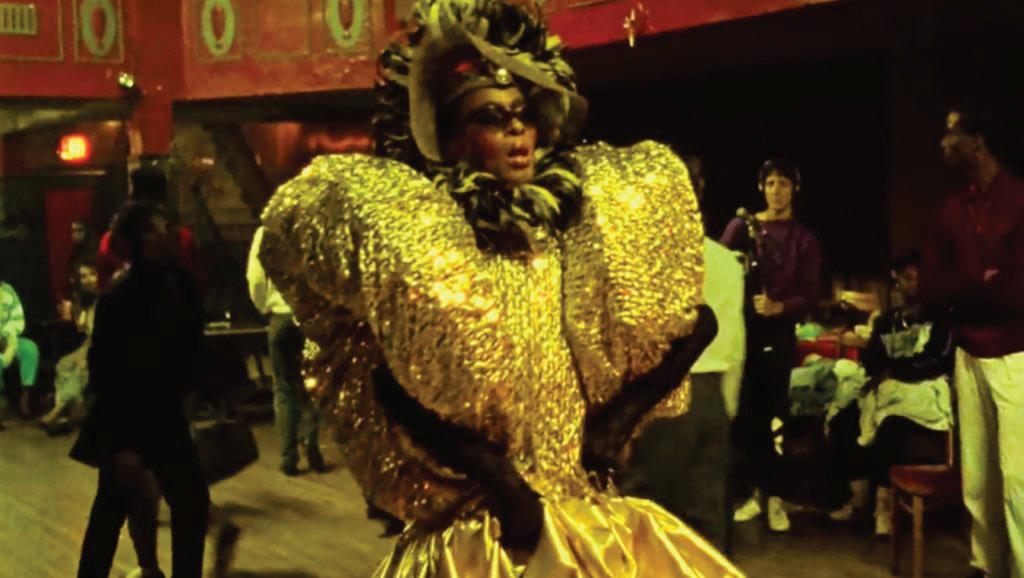
One film I did not review was Jennie Livingston’s now-classic documentary Paris Is Burning. It was the first time I watched something and immediately knew I could not talk about it. I was too close to the material, and I worried that if I’d written anything about the film, people would immediately know everything I was suppressing.
Not that I felt like I was a part of the world Livingston so lovingly and intimately documented. I knew I wasn’t a drag queen. I knew I didn’t want to parade myself around in that manner, strutting across the stage like a supermodel in total control of my environment. But I felt these stories so
personally; these internalized struggles for acceptance and authenticity were all ones I held instant kinship with. It was too much for me, and other than placing the film on my year-end top ten list, I stayed mum on why I felt they were magnificent.
A couple of years later, I was a student at the University of Washington. I was no lon-
ger a top athlete. I wasn’t a big fish in a small pond. It was just me and my studies and not too much more than that. Then I stopped going to class. I found every excuse not to study. I was self-sabotaging in just about every way I could, and if not for the friendships I’d made — ones that have lasted until today — I somewhat doubt I’d still be here.
Tilda Swinton’s performance in Orlando blew my mind, and the director Sally Potter found ways to make the material come alive in so many imaginative ways took me entirely by surprise.
During this time, I went to the Varsity Theater to watch Sally Potter’s exquisite Orlando. Virginia Woolf is one of my favorite writers, so I was already familiar with this story of a young nobleman commanded by Queen Elizabeth I to never grow old, who finds himself transforming into a woman as the centuries quietly pass. But I never felt as connected to the tale as I did sitting in that darkened auditorium. Tilda Swinton’s performance blew my mind, and the way Potter found ways to make the material come alive in so many imaginative ways took me entirely by surprise. The inner truths residing inside the subtext of the narrative shook me to my core, forcing a look back at my recent history that was as necessary as it was difficult.
Paris is Burning – Photo courtesy of Janus Films
Tilda Swinton in Orlando – Photo courtesy of Sony Pictures Classics
Stephen Chbosky’s 2012 adaptation of his best-selling novel The Perks of Being a Wallflower wrecked me for several reasons, chief among them how it allowed all of those seventh-grade memories to come flooding back. Set in the 1990s — when I was in high school — the story revolves around an introspective freshman named Charlie (Logan Lerman), who aspires to be a writer. He makes friends with a pair of free-spirited seniors, Patrick (Ezra Miller) and Sam (Emma Watson), who take the youngster under their wing and impart some of what they’ve learned during the past four years of school.
This is a rare instance where I’d say book and film come astonishingly close to being equal. Chbosky taps into what it is like to live under a constant shadow, understanding how kids can conceal important aspects of themselves to fit in with their peers. Or, if that’s not possible, to fly under the radar just well enough that it’s unlikely they’ll get picked on, as those interested in bullying would be likely to go after more obvious targets instead.
It’s not altogether shocking that I could relate to a lot of this. While I never consid-
ered myself Gay, I still understood Patrick’s zeal to be true to himself, yet not so much that he could end up ostracized, beaten up, or worse. I could come up with valid reasons for shaving my legs — e.g., skin conditions, muscle injuries, etc. — but I wasn’t about to push things further than that. It was about hiding in plain sight, and in that way Patrick and I had a great deal in common.
I could see myself in so many characters, though, and not just Charlie, Patrick and Sam. Most notably was Mary Elizabeth, so beautifully portrayed by Mae Whitman. Her reckless fearlessness masked a needy timidity that she refused to let others see. I admired the way she said what she thought and was so open with her feelings, yet at the same time held back, so as to maintain an aura of mystery she hoped others would both want to see through yet still be unable to pierce. I related to all of that, and I sort of felt like Chbosky had secretly videotaped my own high school years and based this character implicitly on what he filmed.
Paris Is Burning, Orlando, and The Perks of Being a Wallflower were not the
only times I felt like I could see facets of who I am up on the screen. This list is littered with such experiences, some of which I’ve already spoken about in detail in previous chapters of this ongoing expedition.
What connects this trio, though, is how each looks at how all of us, whoever we are, conceal parts of ourselves from the world, and the reasons why we do so. They analyze the degrees of fear and insecurity that lead so many to make drastic, often detrimental decisions that have lasting implications on the rest of their lives. They do so with empathy and grace, ultimately showcasing a powerful resilience to boldly be ourselves, no matter what the cost, that every viewer should hopefully want to aspire to.
While I wish I could have had that realization back in seventh grade, it’s clear my saga of self-discovery would not have led me here had that been the case. Regret is natural. So is wondering aloud about shouldas, wouldas, and couldas. But the experiences of my life are uniquely mine, and I’m happy I’ve learned to embrace them. The journey to self-acceptance is a pretty wild ride, and I
wouldn’t have had it any other way.
The oldest movie on the list this month is 1921’s surrealistic New Year’s Eve marvel The Phantom Carriage. This impressionistic stunner from Swedish director Victor Sjöström might be one of the most influential silent films ever made, so it’s a pity that far too few know anything about it.
The newest title is the 2020 release I mentioned back in the first entry of this series, Chloé Zhao’s Academy Award winner for Best Picture, Nomadland. Having now watched this one a couple more times over the past year, I’ve come to love it even more. I get lost inside this drama’s windswept magnificence that’s impossible to resist, this haunting aria of dreams dreamt and loners making lasting connections on a not-so-lonely highway.
And what are the films about childhood or transformative friendships that rest nearest your heart? My list of favorites is a long and glorious one, and I’m certain yours are as well.
see 1,001 FILMS page 8
Logan Lerman, Ezra Miller, and Emma Watson in The Perks of Being a Wallflower – Photo courtesy of Summit Entertainment
1,001 FILMS
continued from cover
My Twentieth Century (Ildikó Enyedi) (1989)
Naked (Mike Leigh) (1993)
The Naked Kiss (Samuel Fuller) (1964)
The Naked Spur (Anthony Mann) (1953)
The Narrow Margin (Richard Fleischer) (1952)
Nashville (Robert Altman) (1975)
Nausicaä of the Valley of the Wind (Hayao Miyazaki) (1984)
Near Dark (Kathryn Bigelow) (1987)
Network (Sidney Lumet) (1976)
Never Cry Wolf (Carroll Ballard) (1983)
A New Leaf (Elaine May) (1971)
Night and the City (Jules Dassin) (1950)
A Night at the Opera (Sam Wood) (1935)
Night Moves (Arthur Penn) (1975)
Night of the Demon (Jacques Tourneur) (1957)
The Night of the Hunter (Charles Laughton) (1955)
Night of the Living Dead (George Romero) (1968)
The Night Porter (Liliana Cavani) (1974)
A Night to Remember (Roy Ward Baker) (1958)
The Nightingale (Jennifer Kent) (2018)
A Nightmare on Elm Street (Wes Craven) (1984)
Nights of Cabiria (Federico Fellini) (1957)
Ninotchka (Ernst Lubitsch) (1939)
Nomadland (Chloé Zhao) (2020)
North by Northwest (Alfred Hitchcock) (1959)
Nosferatu (F.W. Murnau) (1922)
Notorious (Alfred Hitchcock) (1946)
Now, Voyager (Irving Rapper) (1942)
The Official Story (Luis Puenzo) (1985)
Old Acquaintance (Vincent Sherman) (1943)
The Old Dark House (James Whale) (1932)
Old Yeller (Robert Stevenson) (1957)
On Her Majesty’s Secret Service (Peter Hunt) (1969)
On the Waterfront (Elia Kazan) (1954)
Once (John Carney) (2007)
Once Upon a Time in America (Sergio Leone) (1984)
Once Upon a Time in China (Tsui Hark) (1991)
Once Upon a Time in the West (Sergio Leone) (1968)
One False Move (Carl Franklin) (1992)
One Flew Over the Cuckoo’s Nest (Milos Forman) (1975)
One Sings, the Other Doesn’t (Agnès Varda) (1977)
Onibaba (Kaneto Shindô) (1964) Only Angels Have Wings (Howard Hawks) (1939)
Operation Petticoat (Blake Edwards) (1959)
Ordet (Carl Theodor Dreyer) (1955) Orlando (Sally Potter) (1992)
Our Man in Havana (Carol Reed) (1959) Out of Sight (Steven Soderbergh) (1998) Out of the Past (Jacques Tourneur) (1947)
The Ox-Bow Incident (William A. Wellman) (1942)
Paddington 2 (Paul King) (2017)
The Palm Beach Story (Preston Sturges) (1942)
Panic in the Streets (Elia Kazan) (1950) Pan’s Labyrinth (Guillermo del Toro) (2006)
Paradise Lost: The Child Murders at Robin Hood Hills (Joe Berlinger, Bruce Sinofsky) (1996)
The Parallax View (Alan J. Pakula) (1974)
Parasite (Bong Joon Ho) (2019)
Pariah (Dee Reese) (2011)
Paris Is Burning (Jennie Livingston) (1990)
Paris, Texas (Wim Wenders) (1984)
The Passion of Joan of Arc (Carl Theodor Dreyer) (1928)
Pather Panchali (Satyajit Ray) (1955)
Pathfinder (Nils Gaup) (1987)
Paths of Glory (Stanley Kubrick) (1957)
Patton (Franklin J. Schaffner) (1970)
Pauline at the Beach (Éric Rohmer) (1983)
Peeping Tom (Michael Powell) (1960)
Pelle the Conqueror (Bille August) (1987)
People on Sunday (Robert Siodmak, Edgar G. Ulmer) (1930)
The Perks of Being a Wallflower (Stephen Chbosky) (2012)
Persona (Ingmar Bergman) (1966)
The Phantom Carriage (Victor Sjöström) (1921)
The Philadelphia Story (George Cukor) (1940)
Phoenix (Christian Petzold) (2014)
The Piano (Jane Campion) (1993)
Pickpocket (Robert Bresson) (1959)
Pickup on South Street (Samuel Fuller) (1953)
Picnic at Hanging Rock (Peter Weir) (1975)
Pierrot le Fou (Jean-Luc Godard) (1965)
Pillow Talk (Michael Gordon) (1959)
Pink Flamingos (John Waters) (1972)
Pinocchio (multiple directors) (1940)
Piranha (Joe Dante) (1978)
The Pirate (Vincente Minnelli) (1948)
Pixotte (Hector Babenco) (1981)
Planet of the Apes (Franklin J. Schaffner) (1968)
Planet of the Vampires (Mario Bava) (1965)
Platoon (Oliver Stone) (1986)
The Player (Robert Altman) (1992)
PlayTime (Jacques Tati) (1967)
Point Blank (John Boorman) (1967)
Police Story 3: Supercop (Stanley Tong) (1992)
Poltergeist (Tobe Hooper) (1982)
Portrait of a Lady on Fire (Céline Sciamma) (2019)
The Postman Always Rings Twice (Tay Garnett) (1946)
The Prestige (Christopher Nolan) (2006)
Pretty Baby (Louis Malle) (1978)
Prick Up Your Ears (Stephen Frears) (1987)
The Prime of Miss Jean Brodie (Ronald Neame) (1969)
Prince of Darkness (John Carpenter) (1987)
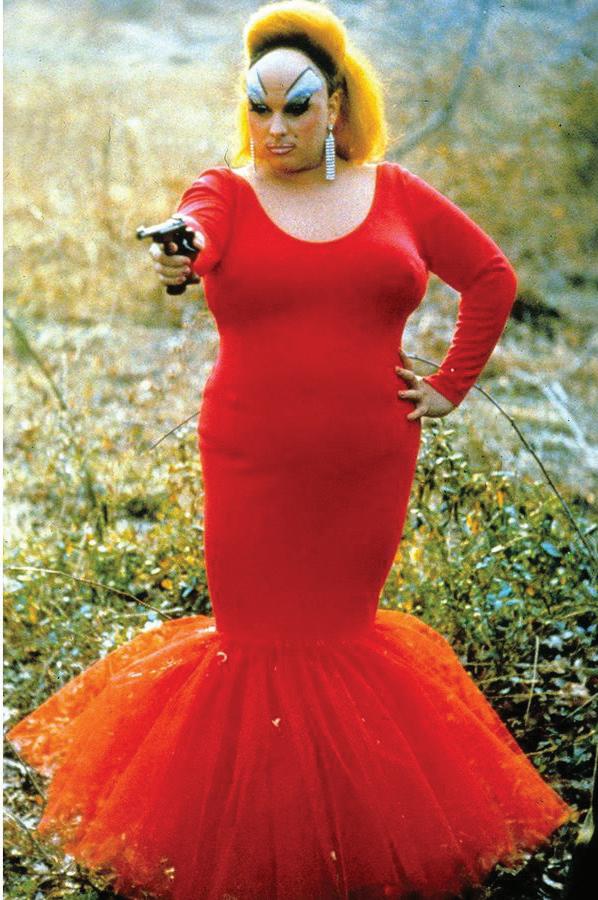
Divine in Pink Flamingos – Photo courtesy of New Line Cinema
Marvel’s Shang-Chi kicks butt, just not enough of it
by Sara Michelle Fetters SGN Staff Writer
SHANG-CHI
Theaters
There’s plenty to love about Marvel’s latest superhero epic Shang-Chi and the Legend of the Ten Rings. Directed by Destin Daniel Cretton (Short Term 12, Just Mercy), this is one of the studio’s better origin stories. It has a sturdy, charismatic lead in Simu Liu and spotlights the multitalented Awkwafina at her most goofily endearing. The film also showcases a mad flurry of superb action sequences that pay deft homage to the likes of Jackie Chan, Sammo Hung, and Jet Li with furious panache.
Most of all, there is the presence of Tony Leung Chiu-wai. This titan of Asian cinema has worked with everyone from John Woo, Wong Kar-Wai, and Andrew Lau to Hou Hsiao-Hsien, Tran Anh Hung, Zhang Yimou, and Ang Lee. He has been compared to the likes of Cary Grant and Clark Gable, while a guy in one of my UW film classes once passingly referred to him as the “Chinese Harrison Ford.”
While I’m not so sure about that last one, the actor remains a bona fide international superstar for good reason. Here, he is morally conflicted villain Xu Wenwu,
a centuries-old warlord grieving over his deceased wife and obsessing about bringing her back from the afterlife. Leung gives the type of irresistibly enthralling performance the MCU has rarely — if ever — displayed in such richly complex detail. Nearly every scene with the actor is a revelation, and his radiantly intoxicating magnetism alone makes this comic book adaptation essential.
So what’s the problem? The issue is that, right about the midpoint, maybe a wee bit later, the rudimentary mechanics of a standard Marvel tale burst into the forefront and make things increasingly less interesting. While Cretton teases the viewer with the idea that something different or unique is about to transpire, frustratingly, that never happens. While always entertaining, the aspects that make the film great slowly recede, and as good as it all might be — and it is good — that still does not mean I didn’t walk out of the theater somewhat disappointed.
When a band of muscular and highly trained assassins comes calling, happygo-lucky San Francisco valet Shaun (Liu) is forced to reveal his true identity to best friend Katy (Awkwafina): his name is actually Shang-Chi, and he is the estranged son of the powerful Xu Wenwu. Subsequently, the pair are thrust into an adventure that whisks them to Hong Kong to find ShangChi’s long-lost younger sister Xialing
(Meng’er Zhang), so as to warn her that their father has decided to violently reinsert himself back into their lives.
The primary opening set piece on an out-of-control city bus is outstanding. Cretton doesn’t overedit the action, while the luscious widescreen cinematography by William Pope (The Matrix) allows events to play out with sustained electricity, even when the spaces Shang-Chi is fighting in become increasingly confined. It’s a wonderful introduction to both the hero’s skills and the level of determined violent opposition he’s up against.
What’s nice is that Cretton rarely allows his foray into Marvel’s ever-expanding universe to fall into the more rudimentary superhero-origin-story traps. There is an undeniable freshness to Shang-Chi’s journey, and it’s very easy to get caught up in the bouncy rhythms the director is trying to maintain. Comedy, drama, and action walk hand in hand with casual ebullient buoyancy, and the joy oozing off the screen during the first hour is infectious.
There is a point where, unfortunately, a few cracks begin to show. Not even the introduction of Michelle Yeoh in all her Crouching Tiger, Hidden Dragon glory or large-eyed battle cats straight out of a Hayao Miyazaki animated masterpiece can do much to enliven the proceedings. Cret-
ton drops hints at a massive battle between dueling armies, only for that to fall boringly flat. He sets the stage for an aerial fight between mystical dragons, just for that to become visually unappealing CGI noise. Most of all, everything has been building to a confrontation between father and son where bitter truths will be revealed and a greater understanding of the magnificent peculiarities of time and space will be debated via spectacular kung fu fisticuffs. It is an opportunity to do something different, to allow a Marvel story to go in a new and vitally human direction. There is the chance to ground things in honest emotional nuances amidst all the fantastical creatures and supernatural abilities. And while I got a distinct feeling that was what Cretton wanted to do, the powers at be holding the purse strings likely felt otherwise.
This is still grandly entertaining stuff, especially that opening act. It’s a strong debut for a new hero, injecting diverse blood into the MCU in a way that does not feel forced or hollow. I just think the overall film is still less than the sum of its more outstanding parts, and that the magic hinted at early on is never allowed to materialize during the climax.
All of which means that Shang-Chi kicks butt, just not enough of it to fully satisfy.
Simu Liu in Shang-Chi – Photo courtesy of Marvel
Books
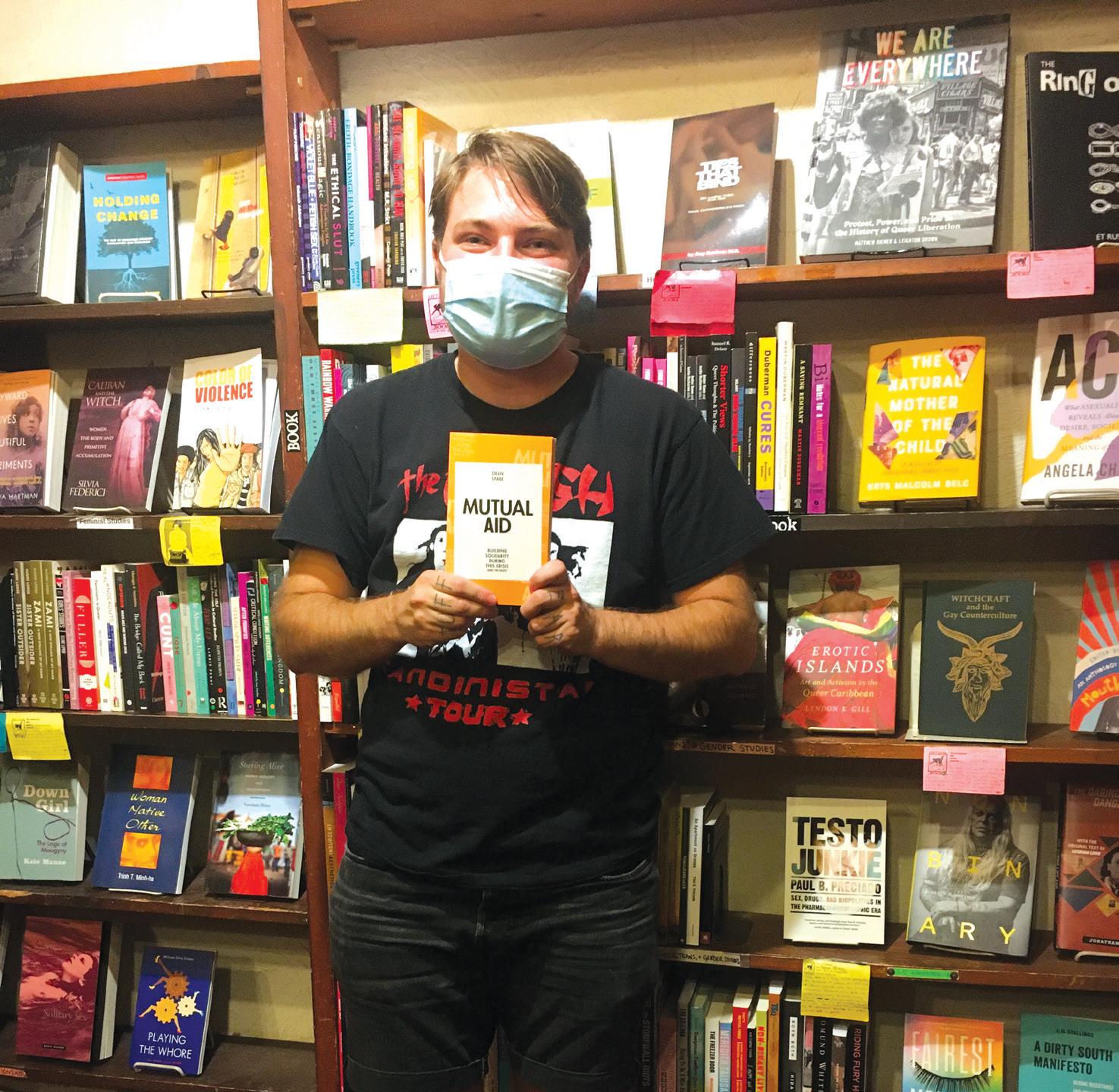
Left Bank Books: Literary anarchy
by Lindsey Anderson SGN Contributing Writer
It can be hard not to feel the vibrations of anarchy coursing through the underbelly of the city when walking the streets of Pike Place Market. Along with the crowds, the noise, and the ever-present smell of fresh fish, a surge of energy and excitement rises into the air, and radical ideas seem a little more attainable.
This is the appeal of Left Bank Books, a collectively owned bookstore situated in the very center of the action of Pike Place. The store promotes an anticapitalist agenda while simultaneously existing in one of the most bustling commercial sites in the Pacific Northwest.
“There isn’t, like, ‘an owner,’ so there is a smaller collective of us who kind of manage the ordering and business aspects of it,” explained Quinn, a member of the collective, who helps run the store. He, along with several others, orders new items, manages used books coming in, and helps to make financial decisions.
As the books on the shelves reflect the unique minds of the collective that runs Left Bank, the store has become known for its Queer influences. “A large portion of the collective of Left Bank is Queer and Trans,” said Quinn as he showed me to the Queer, Trans, and gender studies section. “It’s been cool, because there’s been more and more… we can order. A lot more books on Queer and Trans people of color. A lot more Trans fiction... I feel like having a lot more of that stuff, and being visibly Queer ourselves and posting stuff on our Instagram brings in a lot more people who are excited about those books.”
While the store does have a Queer and Trans section, fiction featuring LGBTQ+ characters and themes can be found on just about any shelf and have also been some of the best sellers of the summer.
“It’s been a very busy summer for us,” said Quinn. “There’s this book that’s been very popular called The House on the Cerulean Sea, [as well as] The Seven Husbands of Evelyne Hugo Mutual Aid by Dean Spade has been flying off the shelves for the last few months…”
Still, he added “we tend to carry a lot more literary fiction, which isn’t everyone’s thing,”
Anarchist elements
Despite Left Bank’s location and dedication to shelving LGBTQ+ titles, what makes the store most unique is its anarchist elements.
“To me the thing that’s most explicitly anarchist about Left Bank is the fact that we are worker owned, we don’t have a boss, and we make decisions collectively, on our own,” said Quinn. “We are trying to actualize our political values and see how that works.”
Left Bank has a unique history in Seattle, having opened in 1973 as an offshoot of another collectively owned bookstore in Capitol Hill, Red and Black Books. “People wanted a bookstore that was more explicitly anarchist, so it’s been a varying cast of people over the years,” said Quinn. The store has lived up to those desires, giving the people the anarchy they wanted.
“We’re a bookstore [that has] an anarchism section, [whereas] most stores don’t,” he added. “A lot of times people think we’re a communist bookstore or a liberal bookstore or something else. We do carry political books that aren’t specifically anarchist, because we do think it’s good to carry other stuff as well, but authoritative-state stuff we don’t carry. We don’t carry Lenin, we don’t carry Stalin, we don’t carry Mao. Marx we do actually carry, because… it is influential, and I think it’s good to know.
Left Bank Books has been inclusive of the LGBTQ+ community since its opening, another stance that was once seen as “radical” to the public.
It’s influenced a lot of left and radical circles for a long time…
“We [also] have our ‘Nobody for President’ T-shirts that we print every election year.”
Left Bank shows that anarchy can work in practice, sharing books and theories that the store has based its successful model on for decades. While some may see that as radical, the members of the collective at Left Bank are quick to remind people that “radical” doesn’t mean bad; it simply means different.
The store has been inclusive of the LGBTQ+ community since its opening, another stance that was once seen as “radical” to the public. “There’s been a number of Queer and Trans people that have worked here over the years,” said Quinn.
“I’ve only been here for the last ten years, but there’s pictures from the nineties of Left Bank taking part in Pride back before it was so corporate. I think it in a lot of ways has been a space that has… valued people with those identities for a long time.”
“It’s a space with a lot of history and it has a lot of intentionality,” he added.
“Something that has always been [important to] Left Bank is to be a place to have
conversations, either in their heads or with other people, so they come in and they find something, and it makes them think. So, I think that is definitely what we’re about. You come in here and you find something you might not find somewhere else.
“Yeah, we have a lot of mainstream stuff, but we also have things that are very niche that you might not find somewhere else. Also, it’s a small space, it’s kind of cozy, eclectic, and odd.”
For anyone who is interested in literature that promotes different theories and new ways of thinking about society and politics, head on down to Left Bank Book Collective. It’s worth braving the crowds for.
Left Bank Books Collective is located at 92 Pike Street #B and is open from 10 a.m. to 7 p.m. Monday-Saturday and 10 a.m. to 6 p.m. on Sundays.
Photos by Lindsey Anderson
National
Federal unemployment benefits end this week:
Here’s what you need to know
by Hannah Saunders SGN Contributing Writer
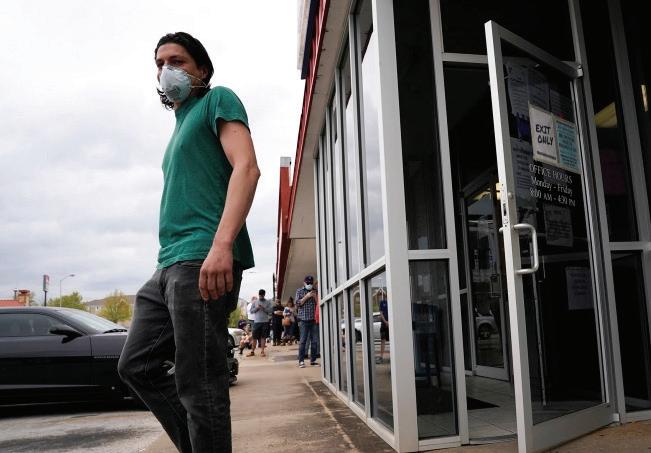
On September 4, 2021, the federal unemployment stimulus, which provides qualifying Washingtonians with an extra $300 per week for pandemic assistance, is set to run out, with no plans of renewal. Those receiving Pandemic Unemployment Assistance (PUA) and Pandemic Emergency Unemployment Compensation (PEUC) benefits will be affected, although out of the two, the PUA is more frequently used.
Both the PUA and PEUC programs were designed to financially assist those who lost a job as a result of the pandemic. Both assist individuals who do not qualify for regular unemployment assistance through the state; beneficiaries include independent contractors and freelancers, small business owners, and gig workers.
Job search requirements for those receiving unemployment benefits were halted but went back into effect for the week beginning July 4, 2021. For that month there were 35,721 initial claims filed (and 83,366 continued claims), while for the previous month (June), there were 27,340 claims filed. Although the number of initial claims filed seems to have increased from June to July of this year, back at the start of the pandemic, there were 306,544 initial claims and 175,853 continued claims — so overall, the number of Washingtonians filing for unemployment assistance has drastically decreased since March of 2020.
Originally, federal pandemic unemployment assistance was set to expire on March 13, 2021, but it was extended until Septem-
ber 4. Unlike other states that have cut the assistance off early, Gov. Inslee has allowed for the program to run until its expiration, although some still struggling to get back on their feet due to the pandemic may be wondering, “I still don’t have a job, what am I going to do now?”
Don’t fret, I’ve got you covered.
Keep filing your claims
First and foremost, it is important to continue to file your weekly unemployment claims for the weeks you would like to receive benefits. Even if the week has passed, the Employment Security Department (ESD) will continue to pay you until the week ending on September 4, 2021, if you are eligible. If you have any pending claims prior to September 4 and you are eligible, you will also be paid.
In case the ESD reaches out to you via telephone, email, or physical correspondence, get in touch with them, even if you are not actively filing claims. The department has been receiving on average 20,000 calls per day and suggests visiting the COVID-19 Q&A Page on its website for all general questions.
In addition, once your claim runs out, you can attempt to reapply for regular unemployment benefits.
Get familiar with WorkSource
WorkSource provides education and training for those seeking employment — and for employers, too. In-person WorkSource services are closed due to COVID19; however, you should reach out to your local office or go to its website to live-chat
with a representative in order to go over the structure of your résumé (which can be a major limiting factor when applying for jobs), practice job interviewing skills, and more.
On WorkSource, you can explore both job and training opportunities, as well as work with a representative, who will assist with refining your job-landing skills. On the website, you can see what types of job opportunities are in high demand and even receive information on different occupations if you are interested in switching career paths.
WorkSource has specific occupationassistance resources for those who are disabled, farmworkers, or military veterans (and their spouses). One thing WorkSource highly recommends is attending a workshop or hiring event in your area, which can also be found on the website.
Good old cover letters
We aren’t necessarily fond of writing them, but we must get them done in order to be more successful at landing a job. When applying for jobs, whether through WorkSource or LinkedIn or GlassDoor, it is important to send in a cover letter in order to highlight your personality, relevant work experience, and skill set that would make you a great fit for the position.
Cover letters also show employers looking to hire that you have done your research on the company and are eager about the position. While researching this piece, I’ve seen several companies ask for applicants to submit cover letters, specifically to weed out those who are only applying due to the
ESD’s job search requirements. When applying for jobs, you should be thorough — try not to send in as many applications to as many places as possible but instead focus on sending in fewer yet stronger applications. Take the time to write a cover letter and market the shit out of yourself. Don’t. Hold. Back.
Exhaust all your options
Alas, even with all these unemployment resources and cover letter tips, finding a job still takes time, and you might be worried about not having cash flow for a few weeks. Believe me when I say, I understand.
Just like many Washingtonians, the pandemic hit me, too. Washington state’s SNAP (Supplemental Nutrition Assistance Program), or food benefits (EBT, or whatever you want to call it), helped me not have to choose between food and rent or medical bills. The program is for low-income individuals and families, and the benefit amount is dependent on family size and income. They also take into account how much you pay for monthly rent. Give them a call: I promise, they’re really nice.
Not only does the Washington State Department of Social and Health Services (DSHS) provide SNAP, but they also offer a variety of other services for low-income individuals and families, including healthcare, housing, and essential needs assistance, which includes locating affordable housing, utility assistance, and transportation assistance.
Keep your head held high, don’t give up and visit www.dshs.wa.gov to learn more about how the DSHS can serve you.
Photo by Nick Oxford / Reuters
National American Academy of Pediatrics report shows COVID cases among US children are rising
by Hannah Saunders SGN Contributing Writer
On August 26, 2021, the American Academy of Pediatrics (AAP) released its “Children and COVID-19: State-Level Data Report,” which summarized publicly reported data on children and the coronavirus in 49 states — Washington being one of them. The AAP is an organization of about 67,000 pediatricians who are dedicated to the health and well-being of all children in the United States.
The data for the report was taken by most states and included responses from New York City, the District of Columbia, Puerto Rico, and Guam. The age range for the reports on child COVID cases varied from state to state: some ranges were 0-14 while others were 0-17, 0-18, 0-19, or 0-20 years. The age range for Washington was 0-19 years.
According to the report, as of August 26, 2021, over 4.8 million children living in the United States have tested positive for COVID-19 since the beginning of the pandemic. For the week ending on July 22, 2021, officials saw 38,000 new reported coronavirus cases in children. That jumped to 204,000 new cases during the week
ending on August 26, 2021 — 22.4% of reported weekly COVID-19 cases.
Although hospitalization and death from the coronavirus is uncommon in children, there’s no doubt that the youth are contracting the virus at greater rates than previously. The report acknowledges how severe COVID in children is uncommon; however, it also mentions how long-term data on the physical health, emotional well-being, and mental health of youth still needs to be collected and examined.
Out of 24 states (including NYC), 0.1–1.9% of COVID-19 cases in children resulted in hospitalization, and among 44 states (including NYC, Puerto Rico, and Guam) 0.00–0.03% of all COVID-19 cases in children resulted in death. There were seven states that reported zero child mortality from the virus.
Child vaccination rates in the United States
There are 72.8 million children living in the United States, about 22% of the population. Those who are under the age of 12 (about 14.5% of the population) are not yet authorized to receive a COVID-19 vaccine — which remains the most effective tool
for protection against the virus, specifically from having severe COVID-19-related health outcomes.
During the pandemic, the AAP has been tracking the rates of vaccination in children under the age of 18 in the US. As of August 25, 2021, the Centers for Disease Control and Prevention (CDC) reported that 11.7 million youth have received at least one dose of a coronavirus vaccine, out of which 8.8 million are fully vaccinated.
For those who have received at least one dose of a vaccine, 56% are aged 16–17, while 48% are aged 12–15. Out of those who are fully vaccinated, 45% are 16–17 years old, while 35% are 12–15 years old.
Child vaccination rates in the US remain inconsistent across states. According to the AAP, there are nine states where over 60% of 12–17-year-olds have received at least one dose of the coronavirus vaccine; on the other hand, there are 14 states where 40% or fewer have received one vaccination dose.
A closer look at Washington
For the past year, over 90% of coronavirus cases, hospitalizations, and deaths occurred in those who were not fully vaccinated. As of August 25, 2021, the Washing-
ton Department of Health (DOH) reported that 39% of 12–17-year-olds were fully vaccinated, while 61% are not yet fully vaccinated.
For Washingtonians aged 12 to 17 years, 0.7% of COVID-19 cases occurred in those who were fully vaccinated from February to July of 2021, whereas 99.3% of cases occurred in those who were not fully vaccinated.
Regarding hospitalizations within this age group, 1.1% of fully vaccinated children were hospitalized from February to July of 2021, while 98.9% of hospitalizations were reported in those not fully vaccinated.
Long story short: get your children fully vaccinated as soon as they become eligible and as soon as possible. We’re not out of the woods yet, and the bell has been ringing for months now: vaccines save lives, and they may very well prevent your child from getting rushed to an emergency room.
Until then, keep masking yourself and your little ones while in indoor public settings, and sing a happy song while you vigorously wash those germs off your hands!
Photo by Rick Bowmer / AP
Tracking anti-Transgender legislation through data visualization
Introducing project Inflection Point
by Josephine Baird SGN Contributing Writer
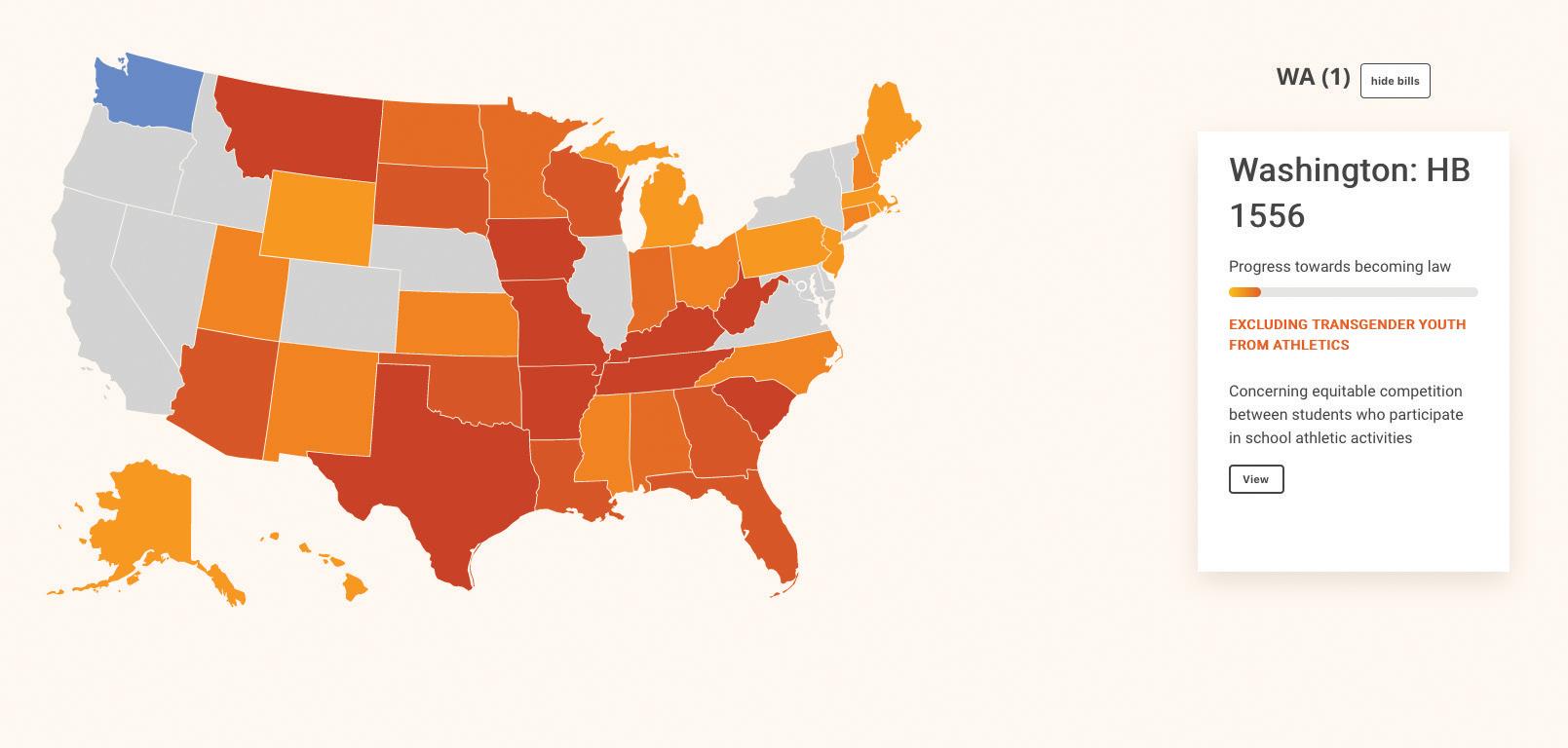
With everything going on the world, it can often be hard to keep track of the issues you care about. The company Substantial, an industry-leading digital build and innovation studio, has created a project to help solve this issue, called Inflection Point, aimed at keeping track of the ongoing legal battles facing the Transgender community.
According to a press release from the studio Substantial, the project, created by Substantial developer Andrew Bales, is a “data visualization story focused on the record-breaking amount of anti-trans legislation in 2021.”
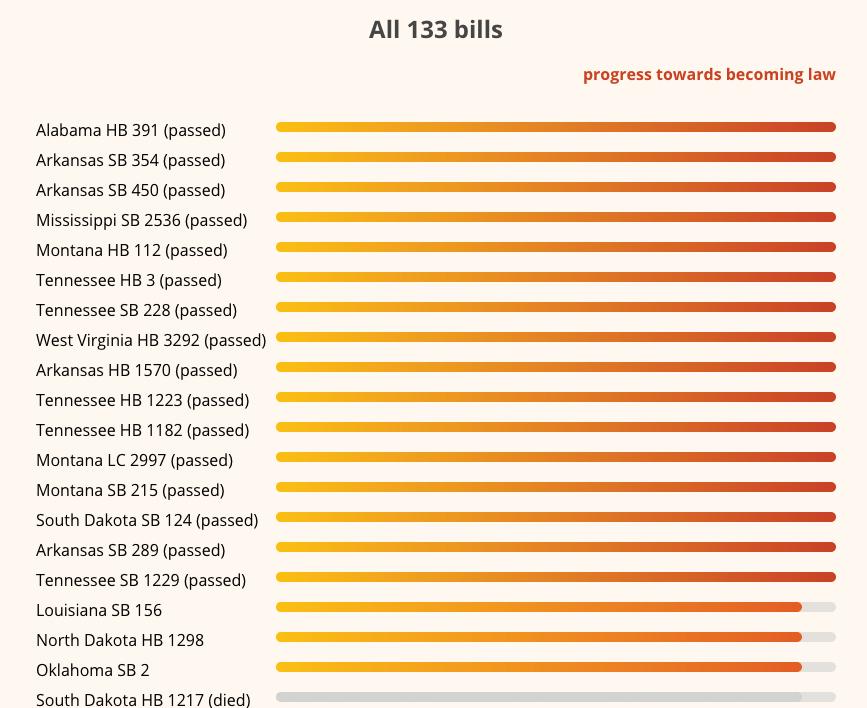
The project aims to shed light on the rapid increase of anti-Transgender bills throughout the US — currently 131 measures across the country. In 2021, twice as many bills were introduced than the year before and six times more than in 2015, the year that “bathroom bills” began to be introduced.
Inflection Point isn’t just a boring legislation timeline but rather an “interactive and accessible” resource. Bales told the SGN that they were inspired because “it’s tough to watch legislators vote away basic rights for their constituents. It has real impacts for people. It shapes their access to healthcare, government documents, adoption, sports, sex education, and many other facets of life.”
Bales said in the press release, “I wanted to build a tool that visualizes this critical moment. Readers can interact with the state bills, learn about anti-trans history, better understand the strategies of the anti-trans coalition, and take action against efforts to attack trans rights.”
The project took months to launch and included many steps, including data gathering, data visualization, research, and design. The data visualization was created with anti-Transgender-legislation information from the ACLU, which includes a list of state bills impacting Transgender rights; and an overview of anti-Transgender bills spanning from 2015 to 2021, from the Human Rights Campaign.
Bales also interviewed Heron Greensmith, senior research analyst at Political Research Associates, who gave expert insight into the shift from opposition to same-sex marriage
to the anti-Transgender legislation seen today. In the press release, Greensmith called this an “entrenchment,” and said that religious-right organizations such as the Alliance Defending Freedom, the Heritage Foundation, the Family Policy Alliance, and the Family Research Council have pivoted to “the latest generation of what’s catching people’s eyes and pocketbooks.”
Inflection Point is meant to highlight compelling data points and bring to light the history of discriminatory legal measures, culminating in today’s misleadingly titled bills, which are designed to keep
Transgender people out public life. The final component of this project is a call to action, encouraging viewers to write their senators in support of the Equality Act, which would provide federal protections for sexual orientation and gender identity.
It also urges users to contact their state representatives who have signed on with Promise to America’s Children, a pledge that commits to protection and preservation, all while outlining “regressive policies that hurt trans children,” according to the press release. The team at Substantial, including Bales, support the Transgender
community and use their talents to effect change through education, visualization, and action.
Bales hopes that users will “come away from this project with a better understanding of how we got to this year’s wave of anti-trans bills, what groups are behind them, and what it means for the lives of trans people,” according to the press release.
To stay tuned on the ongoing fight for Transgender rights and learn how to be a part of the solution, go to trans-legislation. substantial.com for more information.
Image courtesy of Inflection Point
Images courtesy of Inflection Point
National News
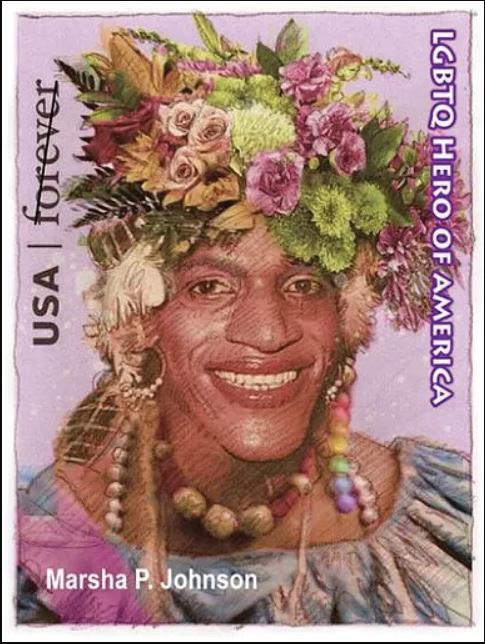
Stamps celebrate the Legacy of Marsha P. Johnson
by Lindsey Anderson SGN Contributing Writer
Taking its cue from the British (who have issued LGBT-related stamps), the LGBTQ+ Heroes Stamp Campaign believes queens should be honored on American stamps. The organization has put forward three nominees: José Julio Sarria, Sylvia Rivera, and Marsha P. Johnson.
August 24, 2021, would have been Johnson’s 76th birthday. In order to celebrate — and bring attention to its campaign — the LGBTQ Heroes hosted a livestream extravaganza to honor the life and legacy of one of America’s most important activists.
Johnson was one of the most important figures of the historic Stonewall Riots and an early icon for Trans rights. Along with queen and a fellow hero nominated by the campaign, Sylvia Rivera, she co-founded STAR, the Street Transvestite Action Revolutionaries, a groundbreaking organization that sought to house and support displaced Trans youth. Johnson also co-founded the Gay Liberation Front in 1969 in response to the Stonewall Riots.
While many may recognize her for her role in the riots, LGBTQueen Stamps wants the public to know just how important and fabulous she was by sharing less com-
monly known information. For instance, the “P” in her name stands for “Pay It No Mind,” which is what she would commonly respond to anyone who asked questions about her gender.
Johnson was found dead in 1992 in the Hudson River. Her mysterious death was never solved, as authorities failed to take the case as seriously as they should have.
The LGBTQ+ Heroes Stamp Campaign noted that Johnson’s legacy lives on, even beyond her passing. The Marsha P. Johnson Institute now helps to protect and celebrate Black Trans women.
Johnson’s birthday celebration was one for the books, or rather the stamps. The Heroes Stamp Campaign believes that one of the best ways to preserve the legacies of prominent American heroes is to memorialize them on US stamps, so it will continue to campaign for ones featuring Johnson, Rivera, and Sarria. Featuring Johnson’s face on a US stamp would be a great way to finally honor an amazing but underappreciated and mistreated woman, activist, and leader.
The LGBTQ community would not be where it is today if it weren’t for the amazing work and dedication of Johnson and so many other Trans women in the 1960s and 70s.
20 states sue Biden administration to halt LGBTQ rights directives
by Mike Andrew SGN Staff Writer
Twenty Republican-controlled states are suing the Biden administration to halt its LGBTQ rights directives.
Tennessee’s attorney general, Herbert Slattery, filed the suit on behalf of all 20 states on August 30, in the US District Court in Knoxville.
Joining Tennessee in the lawsuit are Alabama, Alaska, Arizona, Arkansas, Georgia, Idaho, Indiana, Kansas, Kentucky, Louisiana, Mississippi, Missouri, Montana, Nebraska, Ohio, Oklahoma, South Carolina, South Dakota, and West Virginia.
The lawsuit argues that directives from the US Department of Education (DOE) and the Equal Opportunity Employment Commission (EEOC) are based on an incorrect interpretation of existing case law.
Specifically, the lawsuit asks the federal court to make several declarations about LGBTQ legal protections:
• that schools and employers are not prohibited from having showers, locker rooms, bathrooms, and other living facilities separated by “biological sex”;
• that employers, school employees, or students are not required to use a Transgender person’s preferred pronouns;
• that sports teams are not prohibited from separating players by “biological sex”; and
• that workplace dress codes are not barred from requiring different attire based on “biological sex.”
In June 2020, the US Supreme Court ruled in three separate cases that the federal civil rights law known as Title VII protects LGBTQ people from discrimination in employment. The high court’s key finding was that language barring discrimination on the basis of “sex” necessarily protects sexual orientation and gender identity.
The ruling was not extended to directives binding federal departments during the waning days of the Trump administration, but with the new Biden administra-
tion, the legal reasoning was applied more broadly.
This June, the DOE said that discrimination based on a student’s sexual orientation or gender identity will be treated as a violation of Title IX, the 1972 federal law that protects against sex discrimination in education.
An analysis by DOE lawyers concluded there is “no persuasive or well-founded basis” to treat education differently than employment.
The DOE directive carries the possibil-
ity of federal sanctions against schools and colleges that fail to protect LGBTQ students.
Also in June, the EEOC released guidance about what could constitute discrimination against LGBTQ people and advised the public about how to file a complaint.
In the same month, the Department of Justice filed statements of interest in lawsuits that seek to overturn anti-LGBTQ legislation in two states. In West Virginia, a law prohibits Transgender athletes from competing in female sports. Arkansas
became the first state to ban gender-confirming treatments or surgery for Transgender youth.
With these directives, the Biden administration positioned itself in opposition to proposed laws in a growing number of states that aim to forbid Transgender girls from participating on female sports teams.
The states suing the administration contend that authority over such policies “properly belongs to Congress, the States, and the people,” not to the executive branch.
Image courtesy of LGBTQ+ Stamp Campaign
Official White House Photo by Adam Schultz
MURDER
continued from cover
As the sun went down, the women began to take note of a “weirdo” camping in the next site over. He had reportedly been observing and following them throughout the day, and as dusk neared, they started to worry about their safety. Friends reported getting texts and calls from the couple, informing them that they would be moving from their campsite to another location due to the strange nature of their neighbor. This was the last anyone heard from them.
The police were alerted the following Monday, when Turner failed to show up to work. The couple’s families began searching for them, and an official missing-person report was filed. The last anyone had seen of Schulte and Turner was when they had visited a bar outside of Moab on Thursday evening, but the haunting messages they had sent to friends later that night didn’t sit right, and foul play was soon suspected.
The bodies of two women were discovered not far from Moab on Wednesday morning, in the South Mesa of La Sal Loop Road. Medical examiners later confirmed the identities of the women to be Schulte and Turner, the cause of death for both being gunshot wounds.
The investigation remains open, as police have not as of yet made any arrests in response to their deaths, nor have any suspects been identified, and so the killer is still on the loose. Furthermore, the Grand County sheriff’s office issued a statement that it believes the crime to be “an isolated incident” with no “current danger to the public.”
The lack of a more serious investigation points to flaws in the justice system when it comes to protecting women, and particularly LGBTQ+ women.
What would motivate a stranger to murder?
For anyone who listens to crime podcasts or grew up with parents who were eerily into The Forensic Files, there is one unnerving fact when it comes to violent crimes that police have failed to publicly address in the case of Schulte and Turner: perpetrators always have a motive.
According to a classic study out of the US Department of Justice, violent crimes
Women are also far more likely to experience sexual assault and rape, with one in five women reporting that they have been the victim of attempted rape. While these numbers are reported at much higher rates for women in opposite-sex relationships, Lesbian, Queer, and Bisexual women still face the realities of violence against women.
are most likely to be committed by someone the victim knows, largely because of the role motives play in crime. When broken down by demographics, women are most likely to be victims of violent crimes conducted by a known perpetrator; of those, homicide is the least likely to be committed by a stranger.
With this background knowledge in criminology applied to Schulte and Turner’s case, the crime becomes much more unusual. What would motivate an unknown stranger to kill these two women?
It’s the elephant in the room, the factor police are hesitant to talk about. Schulte and Turner were Lesbians, and so their mere existence as a couple may very well have been the motivating factor that led an unidentified stranger to kill them. And it may also be why police are quick to dismiss the case as an “isolated incident.”
If this murder is in fact the result of a hate crime, then the minimization of the case indicates a much more deeply rooted issue in the Grand County community. The assumption that someone so motivated by bigotry is not a “threat to the community” indicates exactly who the police see as members of the community worth protecting. While this killer remains at large, no member of the LGBTQ+ community is safe in Grand County, and with the precedent publicly set that the murder of Queer people is not to be thoroughly prosecuted, more bigots could be inspired to attack.
The dangers of being a Lesbian Statistically, women and female-identifying people are much more likely to be
the victims of violent crimes in their life. Nearly one in four women have experienced violence by a current or former intimate partner.
Women are also far more likely to experience sexual assault and rape, with one in five women reporting that they have been the victim of attempted rape. While these numbers are reported at much higher rates for women in opposite-sex relationships, Lesbian, Queer, and Bisexual women still face the realities of violence against women.
Due to the culture of compulsory heterosexuality and a patriarchal idea of gender norms, women are more likely to come out later in life, meaning that many Lesbian women have had intimate relationships with men in the past. Coming out to a former intimate partner or other male friends and family members can cause confusion and anger, sometimes leading men to lash out in retaliation.
This confusion and anger can sometimes be directed at women in Queer-presenting relationships by strangers as well. Patriarchy is dependent on the idea that women exist to be commodified and objectified by men. A woman who is completely uninterested in male attention and no longer subject to the male gaze removes a societal power men have been given. When Lesbians are not being fetishized by men, they can often become resented, falling victim to violence for no reason other than existing.
The fear of being a woman in America can become magnetized at the intersection of Queer identities. Simple actions people in heterosexual relationships can take without turning heads, like holding hands
in public or talking about their significant other, when done by homosexual couples, can be enough to incite rage, invite a challenge, or even provoke violence.
As a country, we have accepted same-sex marriage as legal. LGBTQ+ people should be free to be themselves without the fear of violence or bigotry. But when a newlywed couple is murdered without justice, we have to ask ourselves: How safe is it, really, to be a Lesbian?
Remembering Kylen and Crystal While investigators continue to look into the case and public speculation grows on what would have motivated such a coldhearted murder, the families of Schulte and Turner remain in shock. Bridget Calvert, Schulte’s aunt, spoke to the SGN about her niece, saying, “Kylen was pure and kind. She shined love everywhere she went. She also carried Christ in her heart. She would reflect on her relationship with God and knew she could always trust in her faith.” Schulte and Turner were adventure lovers at heart. The two loved to travel and see the world, and spending time in nature was a favorite pastime for them.
It was also clear to everyone who met them that Schulte and Turner were soulmates. Calvert reflected on their special bond: “I never knew Crystal as an individual. I only knew her as a couple with Kylen, and boy, were they one from the start. My uncle put it best when he said they were a When Harry Met Sally kind of love. If you’re around them you’d say, ‘I want one of what they’re having.’ Happiness, joy, love, laughter, strength through each other, compassion, a true bond.”
Schulte and Turner lived for their love, and ultimately may have died for it as well. They were cherished by their family and friends, but most importantly by each other. They were kind, loving, and full of joy, and they deserved to have a long life together to spend in that joy.
What happened to them was not an isolated incident; it was an attack on anyone who has dared to love differently and been brave enough to share that love with the world. May Kylen Schulte and Crystal Turner rest in peace, love, and power with each other, and may their families find comfort and justice in these days to come.