ISSUE 39
VOLUME 5 0
F R I D AY, S E P T E M B E R 3 0 , 2 0 2 2
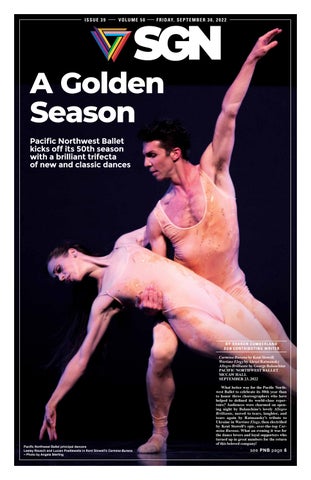
A Golden Season Pacific Northwest Ballet kicks off its 50th season with a brilliant trifecta of new and classic dances \
BY SHARON CUMBERLAND SGN CONTRIBUTING WRITER Carmina Burana by Kent Stowell Wartime Elegy by Alexei Ratmansky Allegro Brilliante by George Balanchine PACIFIC NORTHWEST BALLET MCCAW HALL SEPTEMBER 23, 2022
Pacific Northwest Ballet principal dancers Lesley Rausch and Lucien Postlewaite in Kent Stowell’s Carmina Burana – Photo by Angela Sterling
What better way for the Pacific Northwest Ballet to celebrate its 50th year than to honor three choreographers who have helped to defined its world-class repertoire? Audiences were charmed on opening night by Balanchine’s lovely Allegro Brilliante, moved to tears, laughter, and tears again by Ratmansky’s tribute to Ukraine in Wartime Elegy, then electrified by Kent Stowell’s epic, over-the-top Carmina Burana. What an evening it was for the dance lovers and loyal supporters who turned up in great numbers for the return of this beloved company!
see PNB page 6
2
SGN
SEP TEMBER 30, 202 2
C E L E B R AT I N G 4 8 Y E A R S!
ORIGINALLY SEATTLE GAY NEWS FOUNDED 1974 MEMBER 509 10th Ave E Seattle, WA 98102 (206) 324-4297 info@sgn.org sgn.org
SUPPORT INDEPENDENT JOURNALISM
DONATE TO SGN TODAY!
Publisher Angela Cragin Managing Editor / Acting Editor-in-Chief A.V. Eichenbaum Copy Editor SGN Staff • Richard Isaac Advertising Maggie Bloodstone, Advertising Manager National Advertising Rep. Rivendell Media (212) 242-6863 Staff Writers Lindsey Anderson • Mike Andrew Sara Michelle Fetters • Daniel Lindsley Contributing Writers Alice Bloch • Maggie Bloodstone Kylin Brown • Sharon Cumberland Carter Hemion • Eve Kucharski Benny Loy • Isabel Mata Paige McGlauflin • Gaysha Starr Social Media Manager SGN Staff Photographers Juliana Adams • Nate Gowdy • SGN Staff Production Mike Pham SGN is published by Angela Cragin. © 2022. All Rights Reserved. Reprints by permission. Publication of names, photographs, or likeness of any person, organization, event or business in this publication cannot be taken as any indication of the sexual orientation of the person, organization, event or business. Opinions expressed in bylined articles, columns, and letters are those of the authors only and do not necessarily reflect the views of the staff or management of this paper. SGN welcomes unsolicited material, including letters to the editor, but reserves the right to edit or reject material. All rights revert to authors upon publication. We assume no liability for loss or damage of materials, solicited or not. We invite feedback, please write. And please play safe. It is our policy that no money shall be refunded if you choose to cancel your ad. Credit will be given for the balance owed. No exceptions.
In Loving Memory Of George Bakan
Scott Roger Alpert Cookie Andrews-Hunt James Arnold Ken Campbell Steve Foiles Shaun Knittel James Leland Moore Don Paulson Randy Peters Lee Richeson Shaun Shelton Jim Tully
Follow SGN
VISIT US ONLINE SGN.ORG
In this Issue
LOCAL NEWS 4 A&E 5 FILM 8 BOOKS 17 ASK IZZY 19 NATIONAL / INTERNATIONAL NEWS 20 SEP TEMBER 30, 202 2
SGN
3
Local News
Ilona Lohrey officially takes the helm at GSBA by Georgia Skerritt SGN Intern On September 12, the Greater Seattle Business Association (GSBA) released a statement announcing Ilona Lohrey as its new president and CEO. Lohrey’s journey with the GSBA began in 2002, when she volunteered as an interviewer for the association’s Scholarship and Education Fund. Having moved back and forth between the US and Germany, where she was born and raised, she took a permanent position with the GSBA when she settled in the Seattle area in 2015. In a recent interview with the SGN, Lohrey recalled her decision to join the organization: “I wanted to do something that was good for my heart, for my soul, and that’s really what brought me to joining the GSBA. It combines my passions for small business and our [Queer] community.” Her role as president and CEO marks a new beginning not only for the organization but for the greater Seattle community as a whole. What is the GSBA? Founded in 1981, the GSBA began as a Seattle-based community network for Queer-owned businesses and has since evolved to be Washington state’s leading LGBTQ+ chamber of commerce. According to its most recent public impact report from 2020, the association serves over 1,400 enterprises across 16 counties and has awarded over $4.5 million to the community through its Scholarship and Education Fund — established in 1991, it’s now the oldest LGBTQ+ scholarship fund in the US. Since its inception, the GSBA has focused on community-building and mutual support, offering small LGBTQ+-owned businesses
Ilona Lohrey – Photo courtesy of GSBA
educational and networking opportunities across the state. One resource that Lohrey is particularly passionate about is the GSBA Business Academy, which offers courses, certifications, and even one-to-one consulting to young professionals, freelancers, and business owners free of charge. The Academy focuses on serving companies that are LGBTQ+-, BIPOC-, or women-owned. The GSBA team, like everyone else, has had to find ways to cope with the ongoing COVID-19 pandemic while also aiding members who looked to it for support. While the last two years have presented several challenges, Lohrey explained that they’ve also represented a period of growth for the organization. “We had to ask ourselves, ‘Who do we want to be? What is the core essence of this organization?’” she recalled. She also explained that the lockdown offered the team some much-needed time to better develop the Business Academy, which was created in 2020 and still in its early stages.
The future of the GSBA With the operations that are currently in place, as well as her previous experiences and the support of the Seattle community, Lohrey imagines a bright future for the GSBA. With a solid foundation built for supporting newer businesses, she hopes to shift focus and develop a roundtable to aid enterprises that are more established and/ or generate higher annual revenues. As businesses expand their operations, new questions arise and different types of support are needed; these are the nuances that Lohrey hopes to address. In addition, she also pictures the roundtable as functioning as a community-building event, adding, “Being a business owner can be very lonely sometimes, so it will provide a platform for businesses to get together and network.” Lohrey also aims to expand and deepen the existing Leadership Academy (which is part of the broader Business Academy) to include scholarship applicants who might not have been awarded any funding. In upholding the GSBA’s mission of accessibil-
ity and community support, she’s eager to find alternate ways to connect people with the aid and networks they need to succeed. “We don’t have enough scholarships to give to every applicant, but we also don’t want them to fall through the cracks,” she said. Other plans include developing internship opportunities for applicants, as well as fostering deeper connections with trades for an alternative to traditional postsecondary education. “Not everybody may want to go to a four-year college, and there are a lot of great opportunities in the trades world,” Lohrey explained. “I really just want to be a hub for anyone who’s in the middle of making career choices or making choices about whether or not they want to be in higher education.” On a more personal note, Lohrey discussed her intentions for leading and working collaboratively with the rest of the GSBA team to make sure they can best serve the entire community. She has created a leadership council and meets with them every other week to review upcoming decisions and events. “I don’t know my own blind spots,” she said. “I want to be really particular about hearing different perspectives on important decisions that I’m making for the organization.” With several years of experience under her belt and a humble, collaborative approach to leadership, it seems that Lohrey will make an effective voice for the community. On November 19, 2022, at 5 p.m. at the Westin Hotel (1900 Fifth Ave.), the GSBA will host its annual EQUALUX fundraiser, the largest LGBTQ+ event in the Pacific Northwest. All proceeds will benefit the association’s Scholarship and Education Fund. Visit https://thegsba.org for more information about EQUALUX, as well other GSBA events and resources.
South Park puppy sprayer assaults two dogs by Lindsey Anderson SGN Staff Writer On September 2, two dog owners in the South Park neighborhood witnessed a woman passing by their home and spraying their two small dogs in the face with an unknown liquid. The couple immediately tracked down the woman, who has been identified as former Seattle math tutor Lauren Bonvini, at an intersection a few blocks away. “Yes, I sprayed water at your dogs, because they were barking at mine,” Bonvini told them. The couple, who primarily speak Spanish, asked the woman to show them the “water” she had sprayed on their dogs. She refused. “I can do that [spray them],” she continued. “They were barking and agitating my dogs, so I sprayed water on them. Water is harmless. I can spray water wherever I want.” “My dogs were on my property; you were on the street,” one of the owners said as Bonvini walked away. Aftermath and responses Despite her claims that the substance sprayed on the dogs was “harmless,” the owners said they first noticed something was wrong when their pets appeared to be agitated. After reviewing their security camera footage and catching up with Bonvini, the owners washed their dogs’ eyes out with milk but noted that they still experienced vomiting, swelling of the eyes, tear stains on the fur surrounding their eyes, and breathing issues. Later reports from NextDoor allege that one of the dogs may have lost an eye following the incident. The video of the incident has since gone viral, with animal behaviorists from around
4
SGN
Image courtesy of Tiktok
the country examining the footage. Other community members have come forward with similar stories, accusing Bonvini of various objectional actions and behaviors. “I’m a part of the dog community,” wrote one anonymous South Park resident. “She did not use water, that WAS mace. She’s known among us to cause problems, be extremely hostile, and mistreat both animals and humans. She will also steal animals if she believes their owner isn’t good enough.” Another resident wrote, “Man, this really pisses me off. We had a run-in with her a few months ago. She decided to kick my gate open because my dogs were barking at her dogs (through a privacy fence). Because she felt threatened lol. She didn’t know we were standing in the doorway watching. Caught up with her at the coffee shop and gave her a few not-so-nice words.”
SEP TEMBER 30, 202 2
“Fence aggression” Just a week before the incident, Bonvini had posted to Facebook complaining about neighborhood dogs with “fence aggression.” She wrote “Gawd, the number of dogs in this neighborhood that are fence aggressive and held in by flimsy fences freaks me out, especially because they’re often left unattended all hours of the day. I recommend getting pepper gel (instead of the spray, which can blow back at your dog) for situations like that. Much easier than trying to break up a dog fight.” For the last two years, Bonvini has been a product ambassador for the company Modern Icon, which on Instagram claims to “hand craft high end, made in America products for the Icons of this Modern age. Police Officers, Military Personnel and Discerning Citizens” [sic]. These products include collars, harnesses, and leashes for the most part. Following the incident and release of the viral video, Modern Icon has cut ties with Bonvini and released a statement regarding her actions. “While we are not responsible for the actions of our customers, we will say that we do not approve of anyone doing anything to a dog on someone else’s property, including petting, without the permission of the owner. As such, we do not approve of the actions seen in this video.” Ties to SPD? While the South Park family has contacted Seattle police to report Bonvini, other community members say they have already reported her for previous incidents with no repercussions. “The thing that isn’t being said here is that Lauren Bonvini has active ties to POLICE dog training, and the family she did this to is
Hispanic and barely speaks English. So, how much do you think the police are gonna do?” said one community member who wished to remain anonymous. “I’m not holding my breath. I think this is part of the reason the neighborhood is so up in arms. We all know this kind of family and their little dogs, and it’s horrendous that this happened to them. And it’s not a surprise that the police aren’t doing [anything].” Bonvini has since deleted all social media accounts, but prior to doing so was reportedly involved in Seattle’s punitive dog training community through Facebook. Often used as a way to train larger breed dogs, punitive dog training involves harsh discipline to correct unwanted behavior, but at best is seen as unsuccessful, and at worst considered abuse, by professional animal handlers. “A study published in the Journal of Applied Animal Behavior concluded that confrontational training methods such as hitting dogs, intimidating them with punitive force, and using techniques of restraint like the ‘alpha roll’ actually do very little to correct dogs’ behavior and in fact increase the likelihood that they will be fearful and aggressive,” said animal behaviorist Victoria Stillwell regarding the practice. While public outcry has certainly brought attention to “the South Park Dog Sprayer” and whipped her social media off the internet, pet lovers are still concerned that Bonvini has faced no legal consequences. Many are now calling for Seattle Animal Control to get involved and take away her dogs. We reached out to SAC for comment, but they were unable to say whether or not they have gotten involved in the case. Bonvini has also refused to speak with us, or any other media.
C E L E B R AT I N G 4 8 Y E A R S!
Arts & Entertainment
Dollars & Dragons: The rise of a professional game master by Daniel Lindsley SGN Staff Writer Spurred on by podcasts of voice actors and other celebrities playing Dungeons & Dragons (D&D) and games like it, the popularity of tabletop role-playing games (TTRPGs) is growing by the year, leading to professionals being paid by players to plan and facilitate these experiences. I spoke to one such professional “game master” (GM) to get her perspective on this burgeoning market. Friday (she/they), who asked to go by her online handle, is a Seattle local who started indulging in her role-playing hobby in online multiuser dungeons (also known as MUDs). She moved from other tactical games to D&D, 5th edition, in 2020, but her online profile says she has been playing TTRPGs for 14 years. To understand what it means to be a GM, it’s important to know at least the gist of what a tabletop role-playing game is. I’ve heard such games described as make-believe mixed with gambling, and as collaborative storytelling with an element of chance. Friday’s style, as a game master, meshes more with the latter description. She has a flair for collaborative storytelling, she said, and for project management. Though she only started her GMing business in January, she already considers it her day job, and it has more than paid the bills so far. She moonlights as a writer and game designer for even more tabletop content. Why a GM might be needed Some might see the word “tabletop” and think of board games, like Settlers of Catan or Monopoly. One might wonder, then, why a GM would be necessary, much less a professional one. Games like D&D have huge rule books already, so with all that structure, why have a referee? What complicates TTRPGs is that they don’t often have an inherent goal. In Catan, you win by earning enough points. In Monopoly, you win by attrition, and eventual forfeit when a relative’s thimble lands on Marvin Gardens again. But in both of those cases, narrative isn’t the focus. One doesn’t generally sit down at a game of Catan eager to inhabit the mind of their game pieces’ leader, with complex motivations and a rich history that explains why the leader’s people built their first town in a particular region, or paint everything they build red. So with a narrative focus and no firm goal,
Friday – Courtesy photo
things can get messy. Each player will arrive at the table with different desires and expectations. And some TTRPGs, as Friday put it, have problematic elements to navigate. Setting expectations and creating a safe environment is a big part of Friday’s job. Over half of her clients are Queer, she said, and even though TTRPGs are ever more prominent among Queer youth, the market remains dominated by straight, white, cisgender men and boys. That makes walking into a local game store and sitting down for D&D with strangers a risky move. “For the most part,” Friday said, “I’m a facilitator for safety and for fun,” who guides the players through the stories they want to experience. Many players, newbies especially, might find it hard to decide or express what kind of story they want. To address that, Friday interviews each player before their first gaming session — usually about their favorite media, their experiences so far, and the like. Mind you, there are Queer-oriented
TTRPGs, like the sapphic swashbuckling Thirsty Sword Lesbians and the modern gothic Vampire: The Masquerade. The latter is one of Friday’s favorites, for its even deeper focus on narrative and its horror elements. “The table’s more important than the system,” though, Friday said, meaning it’s not so much what you’re playing as who you’re playing with that matters. Finding a GM Friday uses StartPlaying, a relatively new website built specifically for freelance GMs, to help players find her service. And while, according to her, the platform’s GMs were guarded about their methods early on, its two founders have since worked to foster an environment where “shopping around” for the right GM and group is easy. Most of the people who do drop out of a game do so after one session, Friday said, and that’s one advantage of hiring a professional GM; players are free to take their business elsewhere if they don’t feel like a
You can find Friday and other game masters at https://startplaying.games/gm/ isfriday. She posts updates on the Vineyard Project, and tips, commentary, and guides on professional GMing on Twitter @ isfridayTV.
A preview page from the Vineyard project – Image courtesy of Friday
VISIT US ONLINE SGN.ORG
good fit, or if life simply happens, as it often does. Because it’s a professional transaction, there are no hard feelings. People who play TTRPGs with groups of friends likely know from experience how tough it is to nail down a consistent schedule, and even then, one’s friends might not all want the same thing from a game. The friend who just wants to goof around will arrive with Bozo the Murderclown, while the one who wants a gritty tone will bring Ebonshadow Backstab of Neverwinter. On StartPlaying, there are GMs and groups who will accept Bozo or Ebonshadow with open arms, or even both if the characters’ tones don’t end up clashing after all. For those who haven’t had this experience, imagine that you and a group of friends are trying to decide where to eat. That’s already a lengthy process on a good day; one friend might have allergies, another might be a vegetarian, and yet another could just be sick of pizza. Now imagine that you and that group of friends will be eating at that same restaurant at the same time each week for a year. A game of Catan lasts for two hours at most. A game of D&D can last for as long as a group wants. It would be easier, in the end, to just find separate restaurants. StartPlaying might make parts of tabletop role-playing and professional GMing easier, but it seems it’s far from an easy gig, part- or full-time. Currently, Friday is running six different groups through the Curse of Strahd module for D&D, and a few more through custom Vampire: The Masquerade campaigns. Between prep time and the games themselves, she estimated that her workweek is around 60 hours. But for a storyteller with a long-term game plan, it seems that such a labor of love is worth it. On the side, Friday has been working with a team of 15 to kickstart and eventually publish the Vineyard Project, a custom module for D&D. After a year or two more of professional GMing and tabletop publishing, she wants to use the resulting portfolio to pivot into full-time game development.
SEP TEMBER 30, 202 2
SGN
5
Arts & Entertainment
Newly-promoted Pacific Northwest Ballet principal dancer James Kirby Rogers (left) with company dancers in the world premiere of Alexei Ratmansky’s Wartime Elegy – Photo by Angela Sterling
(l-r) Pacific Northwest Ballet principal dancers Angelica Generosa, Elizabeth Murphy, and Cecilia Iliesiu in the world premiere of Alexei Ratmansky’s Wartime Elegy – Photo by Angela Sterling
6
SGN
SEP TEMBER 30, 202 2
C E L E B R AT I N G 4 8 Y E A R S!
Newly-promoted Pacific Northwest Ballet principal dancer Jonathan Batista (center) with company dancers in Allegro Brillante, choreography by George Balanchine © The George Balanchine Trust– Photo by Angela Sterling
PNB
continued from cover The evening began with the luminous Angelica Generosa and elegant newcomer Jonathan Batista leading four couples through the flowering geometry that characterizes Balanchine’s most beautiful dances. This was the perfect selection to showcase the choreographer’s iconic ideas that revolutionized ballet: non-narrative narratives, intricate interweavings, angular shapes, dazzling dexterity. Moments that stood out for me in the flow of spectacular precision to Tchaikovsky’s Piano Concerto No. 3 (kudos to PNB pianist Christina Siemens!) were passages where the five men leaped in short intervals like fabulous popcorn; when Batista performed his lightning-fast entrechats; and the perfect unison of all eight dancers when the couples performed their diagonals, lifts, twirls — it was as if one perfect couple had miraculously divided into four couples to amplify each brilliant movement. This great opening was followed by the world premiere of Alexei Ratmansky’s extremely moving Wartime Elegy, performed by eight dancers — four men, four women — in front of haunting images by scenic designer Wendall K. Harrington and artists Matvei Vaisberg and Maria Prymachenko. The dances representing conflict and loss — wavelike movements of heaped and falling bodies — were backed by large
paintings of single figures draped in robes, suggesting ancient sculpture (the long history of war). The images had broken limbs or missing features like fallen statues — a vivid summation of death. The dances of ancestral village life, however, had backdrops of colorful folk art and flowers. Ratmansky’s slow, devastated movements in the war sections only had their full impact when time was reversed, and we saw the humor and delights of peacetime in the form of Ukrainian folk music and social dancing. Couples danced together with polite exuberance in familiar folk patterns of squares and circles, followed by the young men performing rowdy, drunken, hilarious show-off dances before the women returned with their own flirtatious display. To the plucky tunes of the balalaika, as we laughed at and cheered the charm and inventiveness of these young dancers, the audience began to realize that these beautiful people, full of fun and optimism, are the innocent fodder of war that we saw in the first section, whose deaths return in the final section. Ratmansky, together with composer Valentin Silvestrov’s original music and the use of Ukrainian village music, shows us a culture’s charm, history, and devastation. At the curtain call, Ratmansky (whose family is from Ukraine) came out waving the Ukrainian flag to the standing ovation of the audience. What a tremendous premiere, and how proud PNB must be to have made it happen! It’s a gift to ballet companies
everywhere, especially — we can hope, someday — in a free Ukraine. An audible gasp went up from the audience when McCaw Hall’s sparkling red curtain rose to reveal the set of the final dance of the evening: a black-cowled chorus of 50 singers (the Pacific Lutheran University Choral Union) suspended in a loft behind a monstrous golden wheel of fortune — three wheels-within-wheels on a central axle — rotating to the magisterial chorus “O Fortuna”: O Fortune like the moon you are changeable ever waxing and waning first oppresses and then sooths as fancy takes it… The lyrics continue in that vein — dark and scary — as the theme of mankind’s fragility and helplessness in the face of blind fate is developed: Fate — monstrous and empty, you whirling wheel, you are malevolent, well-being is vain and always fades to nothing, Far from being depressing, this weighty message is delivered in Latin without supertitles, so the audience has to sort out for themselves the meaning of the ancient poems. But since the dancers represent groups of naked Adams and Eves
(in “skins”) together with country bumpkins, a femme fatale, and common folk dancing in hopeful circles, it’s not too hard to guess that we’re seeing the evolution of human life and longing. I was especially impressed with the dramatic entanglements of the Adams and Eves, who reappear periodically to remind each episodic group of the fundamental search and necessity of love. The full company of dancers provided wonderful rhythmic movement as the wheel of fortune lifted into a horizontal position and the pantomime of dancers from the “cavemen” to nudes to the country dancers enacted a full range of human feelings and emotions. Of all story ballets Kent Stowell has choreographed, I think this dance is his finest, the one that will remain in the repertoire for many years. It’s a great combination of mystery, vocal and orchestral music, intriguing dances, and the poetry of love and longing common to all humans. It’s a wonder and a joy to behold, and a great finale for an evening of celebration. Congratulations, PNB, on 50 years of encouraging dancers, musicians, choreographers, artists, students, and audiences to love ballet in all its forms. Kudos from a grateful audience! Carmina Burana will be performed at McCaw Hall through October 2. More information is at https://www.pnb.org/ season/carmina-burana.
Pacific Northwest Ballet company dancers with the PLU Choral Union in Kent Stowell’s Carmina Burana – Photo by Angela Sterling
VISIT US ONLINE SGN.ORG
SEP TEMBER 30, 202 2
SGN
7
Film
Unforgettables: Cinematic milestones with Sara Michelle The Last of the Mohicans: Heading back into the American wilderness with Hawkeye and Chingachgook by Sara Michelle Fetters SGN Staff Writer The first film I watched at Seattle’s landmark Cinerama Theatre was Michael Mann’s The Last of the Mohicans. I’d just arrived at the University of Washington, and as introductions to one of the great motion picture houses in the world go, this was a memorable one. Mann’s adaptation of James Fenimore Cooper’s 1826 novel — which owes more to director George B. Seitz’s 1936 feature than it does to the source material — is a visually dynamic, larger-than-life romantic epic that has gloriously stood the test of time. Three decades after its original release, the film has become a bona fide classic. Set during the height of the French and Indian War, the plot follows Mohican Chingachgook (Russell Means); his eldest, Uncas (Eric Schweig); and his adopted son, Hawkeye (Daniel Day-Lewis) as they make their way up the Hudson River. They stumble upon a Huron war party ambushing a British column heading to Fort William Henry, putting themselves in the middle of a fracas they’d have rather stayed out of. The trio rescue Maj. Duncan Heyward (Steven Waddington) and sisters Cora (Madeleine Stowe) and Alice Munro (Jodhi May), the daughters of Fort William Henry’s stern commander, Col. Edmund Munro (Maurice Roëves). Huron war chief Magua (West Studi) has sworn revenge against the colonel and his kin for an unspeakable wrong done to him and his family. He will stop at nothing to put all three under his knife, so Chingachgook, Uncas, and Hawkeye decide to protect Cora and Alice from harm no matter what the cost. Mann has always been considered something of a visceral, aloof filmmaker. Masterworks like Thief, Manhunter, The Insider, Collateral, and Heat aren’t particularly well known for their nuanced love stories, and female characters drift in and out of each in support of their male co-stars, frequently without any agency of their own. There are exceptions, of course, and actors like Joan Allen, Ashley Judd, Diane Venora, Jada Pinkett Smith, Gong Li, and Tuesday Weld all make significant impressions even if the films they are in keep them at arm’s length. This makes The Last of Mohicans a bit of an anomaly in Mann’s filmography. While the focus is centered on Hawkeye, Cora is presented as nearly an equal (at least for the time period). There’s a reason they are inextricably drawn to one another, and it’s because they are kindred spirits who have similarly fiery personalities. They augment one another’s strengths and smooth over their internal weaknesses. They mesh physically, intellectually, and spiritually, and even though the worlds they come from could not be more different, the purity of their union is undeniable from the first second they engage in confrontational conversation. The other essential element is how Mann and co-writer Christopher Crowe make an attempt to play down the “white savior” aspects of Cooper’s source material (as well as Seitz’s emotionally stunted — if well shot — adaptation) and give more complexity to Chingachgook and Uncas. The latter gets his own love story with the younger Munro daughter, Alice, their affair all hushed glances across smoke-filled battlefields and brief embraces as they escape one danger only to land in the muck and mire of a new one. But it is Chingachgook whom Mann rightfully puts in the spotlight during many of the picture’s most critical sequences, most notably during the thrillingly gutwrenching climax. The first national director of the American Indian Movement made his acting debut in the film, and his commanding presence is subtly dominating. The showdown atop a massive cliff
8
SGN
Russell Means as Chingachgook and Daniel Day-Lewis as Hawkeye in Last of the Mohicans – Photo courtesy of 20th Century Studios
between Chingachgook and Magua is an intense, tearfully heartbreaking act of ragefueled heroism that’s extraordinary. There is a technical precision to all of this that’s seldom seen anymore: Thousands of extras (including an estimated 900 Native Americans). Massive sets built to scale in the North Carolina wilderness. Costumes meticulously crafted to be as historically accurate as possible. Large-scale battle scenes, including the awesome siege of Fort William Henry. It’s the type of filmmaking largesse that CGI trickery has all but made obsolete. Nothing has a digital sheen reminiscent of a video game. It’s all practical, giving the film a tactile texture that’s so naturalistically lived-in that a viewer could be forgiven if they felt the need to wipe the
sweat away from their brow or dried-on mud off their arm while watching events unfold. Yet, in the end, it is the human element that matters most, and that’s exactly as it should be. The love story between Hawkeye and Cora is a sensuous spectacle of human entanglement that’s lasting and pure. The tragedy fueling Magua’s fury has grit and bite, making him a compelling villain whose everlasting pain has transformed him into a bloodthirsty monster worthy of our empathy but undeserving of forgiveness. A father’s love leads to unimaginable feats of strength that border on superhuman. The inhumanity of war blurs the line between sanity and insanity, while making the ultimate sacrifice for love has disastrous consequences impossible to foresee.
But life goes on. Chingachgook gets the final word, his eyes having borne witness to a world in chaos, knowing that for all his people have lost, this is only the beginning of the volatile uncertainty still to come. Mann gives The Last of the Mohicans to him, and even as Hawkeye and Cora embrace, Chingachgook’s observations remain chilling in their haunting majesty, unforgettable in their cathartic sadness, and prescient in their disquieting certainty. Also, save the Cinerama. Don’t let it disappear. Now celebrating its 30th anniversary, The Last of the Mohicans is available on DVD and Blu-ray, and to purchase digitally on multiple platforms.
Russell Means and Wes Studi in The Last of the Mohicans in Last of the Mohicans – Photo courtesy of 20th Century Studios
SEP TEMBER 30, 202 2
C E L E B R AT I N G 4 8 Y E A R S!
DIMITRIOU’S
Michael Lington & Paul Taylor Through Oct 2
2033 6TH Avenue / 206.441.9729
www.jazzalley.com
Top contemporary soul-jazz saxophonists unite!
John Cleary ~ Solo
Grace Kelly
Arturo Sandoval
Oct 3
Oct 4 – 5
Oct 6 – 9
The torch bearer of genuine New Orleans funk - pianist, guitarist, vocalist and composer
A CD pre-release event with the award-winning singer and saxophonist for her new album “All That I Need”
This Grammy-winning, Cuban-American jazz trumpeter is one of the most dynamic live performers of our time!
Dave Weckl / Tom Kennedy Project
The Ohio Players
Oct 11 – 12
Oct 13 – 16
Featuring Stu Mindeman with special guest Eric Marienthal. Virtuosic high-energy, electric jazz/fusion at its finest!
10-piece American funk smash hit makers including “Fire” and “Love Rollercoaster”
Gift Certificates Available All Ages / Free Parking
FULL CALENDAR at jazzalley.com
VISIT US ONLINE SGN.ORG
SEP TEMBER 30, 202 2
SGN
9
Film
Groundbreaking and funny Bros still hews to Hollywood rom-com convention
Billy Eichner and Luke Macfarlane in Bros – Photo courtesy of Universal Pictures
by Sara Michelle Fetters SGN Staff Writer BROS Theaters As pleasantly charming and laughout-loud funny as it may be, if not for the impressively diverse makeup of its talented cast — all long overdue for a spotlight from a major Hollywood production company (in this case Universal Studios) — the romantic comedy Bros would be instantly forgettable. Nicely helmed by veteran filmmaker Nicholas Stoller (The Five-Year Engagement, Neighbors) and anchored with charismatic panache by stars Billy Eichner and Luke Macfarlane, this is nonetheless a strangely rudimentary genre effort. Lifelong New Yorker Bobby Leiber (Eichner) is the 40-year-old host of a popular podcast and the director of the soon-to-beopening (if they can raise the final $5 million needed to complete construction) National Museum of LGBTQ+ History & Culture. He does not believe in monogamous relationships, having seen too few of his Queer brethren make lasting connections. Bobby will stick to hooking up with random men via Grindr and the like, stating to all his close friends and co-workers that he’s perfectly content and none of them should worry. At a late-night party, Bobby runs into preternaturally hot Aaron Shepard (Macfarlane) — who has the physique of a comic book superhero — who is also an exceedingly empathetic lawyer specializing in helping wealthy clients put their wills in order. The two hit it off, engaging in random conversations that seem to be leading somewhere, only to mysteriously have it all end mid-sentence, right when things were getting interesting. But Bobby and Aaron keep seeing one another, and neither knows exactly why. As the days rapidly transition into months, each wonders if there’s something more going on between them than they surmised. While taking pages out of Annie Hall, When Harry Met Sally…, and The 40-YearOld Virgin, the only thing that Stoller and Eichner’s script does that is even remotely unexpected is to center its romance on two Gay men and fill the entire supporting cast with LGBTQ actors off all shapes, sizes, ethnicities, and backgrounds. This is noth-
10
SGN
ing to scoff at or minimize. Representation on this scale makes an impression, and I sat in my seat dumbstruck by the sheer volume of talent given the freedom to be themselves, make characters their own, and cinematically exist outside of being “Gay” or “Lesbian” or “Trans” or “Bi” or anything else that makes up the colorful pageantry of Queer expression and exceptionalism. What makes it so frustrating is that none of these individuals — portrayed by the likes of Eve Lindley, Dot-Marie Jones, Miss Lawrence, Ts Madison, Jim Rash, Guy Branum, Jai Rodriguez, and the great Amanda Bearse — never register much further beyond how they fill up the world Bobby and Aaron inhabit. As glorious as it is to see them, as wondrous as certain moments may be, they barely leave an imprint on the central narrative, frequently disappearing into
the background entirely at the most inopportune times. It does not help that, at almost two hours, Bros come perilously close to wearing out its welcome, especially during a tedious stretch right before the film enters its final act. Stoller lets things play out at a languidly obnoxious pace. Expositional beats are repeated when they do not need to be, while the requisite roadblocks that will keep Bobby and Aaron from happily losing themselves in one another’s arms are eyerolling in their bombastic, heavy-handed didacticism. Yet Eichner and Macfarlane are wonderful together, and it’s sublime to see male sexual attraction and displays of affection presented with such raw bluntness in a largescale, major-studio production. There should be nothing shocking about the images
Stoller fastidiously composes for the audience to take in. But because it’s two guys ripping one another’s clothes off or quietly snuggling in the afterglow of their energetic bedroom acrobatics, it’s a foregone conclusion there will be those who find it so — and that’s too bad. The film is genuinely sexy, and there is authentic heat whenever Eichner and Macfarlane lustfully embrace. Bros deserves credit for all of this and more. The film does entertain, and my laughs were loud and hearty on multiple occasions. I just wish Stoller and Eichner had made an attempt to dig a little deeper and create a world for their two lovesick characters that did as much to shatter genre clichés as it does to showcase a sex-positive LGBTQ world that mainstream Hollywood has done its best to stereotype, minimize, or flat-out ignore for far too long.
Bros – Photo courtesy of Universal Pictures
SEP TEMBER 30, 202 2
C E L E B R AT I N G 4 8 Y E A R S!
VISIT US ONLINE SGN.ORG
SEP TEMBER 30, 202 2
SGN
11
12
SGN
SEP TEMBER 30, 202 2
C E L E B R AT I N G 4 8 Y E A R S!
VISIT US ONLINE SGN.ORG
SEP TEMBER 30, 202 2
SGN
13
CSM 1987852© 2022 Chateau Ste. Michelle, Woodinville, WA
14
SGN
SEP TEMBER 30, 202 2
C E L E B R AT I N G 4 8 Y E A R S!
Film
Hocus Pocus 2 fails to cast a memorable spell
Sarah Jessica Parker, Bette Midler, and Kathy Najimy in Hocus Pocus 2 – Photo courtesy of Disney
by Sara Michelle Fetters SGN Staff Writer HOCUS POCUS 2 Disney+ It is Halloween night in Salem, and 16-year-old birthday girl Becca (Whitney Peak) and her best friend Izzy (Belissa Escobedo) head to the local woods to try and cast a few harmless spells and light a mysterious black candle given to them by friendly occult shop owner Gilbert (Sam Richardson). They inadvertently awaken the Sanderson sisters Winifred (Bette Midler), Sarah (Sarah Jessica Parker), and Mary (Kathy Najimy), and while the child-eating witches would love to consume the souls of their teenage benefactors, they have bigger plans for their latest resurrection. And what are those? There’s a spell in their sentient, one-eyed book that will give a witch “ultimate power,” and all it takes to cast it are a few gruesomely random ingredients and the blood of their enemy. Lo and behold, the
new mayor of Salem (Tony Hale) is an actual, bona fide direct descendent of the imperious Puritan minister who hanged them back in the 17th century. It’s up to Becca and Izzy to save the mayor and his only daughter Cassie (Lilia Buckingham) from the Sanderson sisters’ malevolent machinations, and it will take actual magic to set things right and put all three back in their graves, this time for good. Can’t say I’m a fan of 1993’s Hocus Pocus. Other than the sublime casting of Midler, Parker, and Najimy as the Sandersons, it’s never done much for me. I find there to be few laughs and minimal, child-friendly scares. I rarely cared about anything that was going on, and while director Kenny Ortega does stage a couple of energetically creative sequences, overall the narrative concocted by writers David Kirschner, Mick Garris, and Neil Cuthbert is a ponderous waste of time. But time has proven kind to this supernatural comedy. It’s built quite the cult fan base. As such, there’s been talk of a second feature for at least a decade. The moment Disney
unleashed its streaming service Disney+, it’s been pretty much a foregone conclusion that the studio would find a way to bring Midler, Parker, and Najimy back to these characters. All of which is a roundabout way of saying that, for reasons I will never truly grasp or understand, Hocus Pocus 2 is one of the more eagerly anticipated sequels of 2022, and I imagine many are cackling with glee over the rebirth of the Sanderson sisters. The good news? I did enjoy this new motion picture far more than its predecessor. Director Anne Fletcher (Step Up, The Proposal) brings a musically lyrical touch that’s rather nice, and Peak, Escobedo, and Buckingham don’t get lost in the massive shadows cast by their three superstar castmates, making far more of an impression than the kid actors in the original ever did. There’s also a stupidly goofy gag involving the mayor’s attempts to acquire a caramel apple only available to Salem’s residents on Halloween night that brought a silly grin to my face. Hale’s handling of this running joke is jovially sublime.
Belissa Escobedo, Whitney Peak, and Lilia Buckingham in Hocus Pocus 2 – Photo courtesy of Disney
VISIT US ONLINE SGN.ORG
SEP TEMBER 30, 202 2
The bad news? None of that means I can in good conscience recommend the sequel. While I’m moderately certain fans will enjoy it, and while there’s little here that’s egregiously awful (unlike the 1993 picture), there’s also not much that made me sit up straight and pay close attention, either. While there’s thankfully a more feminine bent to the proceedings this time (likely courtesy of Fletcher and screenwriter Jen D’Angelo), this is still paint-by-numbers comedic nonsense and little more. I do think one of the chief missteps that kept me from fully engaging with the material is the inclusion of a backstory that fleshes out the tragic history of the Sanderson sisters in a bit more detail. This prologue, while well executed, is also strange. There is an attempt to mitigate and minimize the heinous activities of the witches, and sadly it does not work. While what was done to them as teenagers was unforgivable, so are roughly three centuries of murder, mayhem, and running gleefully amok. They kill children, for goodness’ sake, so forgive me if I have trouble engaging empathy for any of them, at least based on the information that’s been provided in either film. The other item I didn’t care for was — and I can’t believe I’m saying this — Midler. Not her performance: it’s as good as ever. No, what annoyed me was how much Fletcher centralized Winifred Sanderson, forcing Sarah and Mary even further into the background than they were in the 1993 production. While it’s always a treat to watch the two-time Academy Award nominee strut her stuff with such euphoric aplomb, I do wish the sequel had afforded Parker and Najimy the same courtesy. They’re wasted, and other than redoing some of what they did 29 years ago, Sarah and Mary are mostly nonentities who only serve to move Winifred’s story forward and not their own. I admit that part of that is the point of all the supernatural baloney. Winifred is the key to what ultimately happens, so I do understand why she is so prominently showcased. But it still irritated me, and, as I didn’t feel a strong emotional attachment between the Sandersons, the climax didn’t work as far as I was concerned. Hocus Pocus 2 has more magic than its predecessor, but that does not mean it casts a memorable or lasting spell.
SGN
15
16
SGN
SEP TEMBER 30, 202 2
C E L E B R AT I N G 4 8 Y E A R S!
Books
Courageous Discomfort lays solid ground for conversations in equality by Terri Schlichenmeyer Special to the SGN COURAGEOUS DISCOMFORT: HOW TO HAVE IMPORTANT, BRAVE, LIFE-CHANGING CONVERSATIONS ABOUT RACE AND RACISM SHANTERRA MCBRIDE AND ROSALIND WISEMAN © 2022 Chronicle Books $24.95 208 pages You want to have the right conversation about race. You strive to be respectful. Courageous Discomfort by Shanterra McBride and Rosalind Wiseman can help. McBride and Wiseman say that discomfort is necessary for (eventually) doing good in order to make change. Recognizing that everyone has a right to dignity and acknowledging their worth is the first step. The next is reading the series of “questions” or mighthappen scenarios that the authors present, and
Image courtesy of Chronicle Books
getting some ideas on how to be a good ally. For example: Should you speak up, for instance, if a teacher says something racist in class, even if it might mean trouble for you? What if it’s a friend or a family member who
says something offensive? Should you apologize for what others have done, even it was a long time ago — and if so, how? You say you don’t “see color,” but when do you actually need to see it? Everyone has biases, the authors say, but curiosity is natural for learning, so take care that microaggressions don’t get in the way. The authors also acknowledge that being curious is tricky, but that you should never be afraid of it. Other advice: Don’t be offended if someone doesn’t trust you; there’s a reason for it, and it goes way back. Likewise, don’t be mad if they don’t always include you in every event. Be willing to listen if someone has a gripe with you, whether in a post or a statement, or mentions something you did that hurt them. Also: Be patient. Figure out what being an ally means to you. Leave a Black person’s hair alone. And finally, remember that taking ownership isn’t about shame but about growth. A step in the right direction is a step in the right direction.
In its first few pages, Courageous Discomfort is a perky explanation of the friendship of McBride (who is Black) and Wiseman (who is white and Jewish). It doesn’t linger, though; the book then takes a scolding tone before it settles in to the help it promises. When the authors advise readers to use caution, they mean it, though. There’s a little bit of talking-in-a-circle in this book, and enough repetition that you’d notice. There’s some confusion about how readers should act when meeting new people — do you ask them about themselves, or don’t you dare? — and prompts to speak up when one sees injustices, but no good help on that for the quietest of readers. Conversely, and to be sure, the advice the authors give lays a great foundation for equality work, but nuances in the narrative mean that this is probably a book for older teens and young adults. If day-to-day activism is your goal, Courageous Discomfort helps you put your money where your mouth is.
Lana Popovic Harper brings “cozy Halloween vibes” to her witchy rom-com series by Lindsey Anderson SGN Staff Writer September is coming to a close and the sweet autumn vibes are officially here. All across Seattle, fall girlies are busting out their bulky sweaters and infinity scarves, chugging down pumpkin spice lattes, and searching for just the right spooky book to bring along on all the season’s best adventures. The search can now end, though, thanks to Lana Popovic Harper, who is dedicated to bringing all the fun fall vibes to her readers. The witches of Thistle Grove Harper is an experienced author who already had four YA novels under her belt when she decided to make the jump to adult fantasy. Despite now writing for a more mature fan base, Harper said she still makes it a point to include witches in all her work. “I can’t not do witches, even with these books,” she said. Her latest series, The Witches of Thistle Grove, follows the adventures of several young adult witches living in a fun fantasy world where magic and mayhem abound. “It’s just straight-up sparkly fun magic. I think at this point it’s just wish fulfillment. I love that stuff. I’m on #witchesofinstagram all the time. I just really like kind of using that as a foil for deeper exploration. Everything is just more fun when there’s magic.” The Witches of Thistle Grove romcom series functions as separate stories (the first in the series follows four magical girls seeking revenge on a cheating ex-boyfriend), each following side characters from the other books; they can be read as standalone novels for those unable to commit to a multi-book relationship. “They can all be read on their own,” Harper said, “but each of them, chronologically follows the one previous to it. So, you know, it’s a fun, easy read if you want a standalone, but if you want a deeper story in terms of context, you should read them in order.” Writing for adults The first book, Payback’s a Witch, was also Harper’s first time publishing an adult novel. “This was an unusual novel in that it was more engineered than most of the things that I’ve done so far,” she explained.
see HARPER page 18
Photo courtesy of the author
VISIT US ONLINE SGN.ORG
SEP TEMBER 30, 202 2
SGN
17
Books
Images courtesy of Berkley Books
HARPER
continued from page 17 “So, my agent knew that I was looking to make the leap into adult [literature], so she had been having meetings with editors, and a bunch of them were talking about how they were looking for a witchy rom-com… This happens sometimes — I remember it from my time as an agent. It’s like there’s something in the water, and everybody wants the same stuff, and it’s like, ‘Are you all talking to each other?’ How does this happen? And so she floated the idea of me writing a witchy rom-com.” Writing a “witchy rom-com” was right up Harper’s alley. “Witches are my brand. I have no books that don’t contain witches, and so we were talking about what would be the most interesting angle for me to approach that, and both of us felt like it would be — for me anyway — most fun and most authentic to have it be a Queer book. We had been trading ideas back and forth, and one of them was John Tucker Must Die, except everyone’s witches and two of the women fall in love with each other. So that was the very kernel of the idea.” Harper began writing the book in March 2020. By the end of the year, she had the first hundred pages and a detailed synopsis done and ready to present to publishers. “Then some really cool stuff happened that I’d never seen happen for any of my other books,” she said. “There was an auction, and seven publishers were involved. It was wonderful. it was the kind of attention I didn’t think a book like that was going to get. Overall, it was a four- or five-month process, and then it was published in October of 2021, so it was a very quick timeline. Normally books take about two years to hit shelves, but in this case, the writing itself wasn’t very time-consuming, and I knew they wanted it in time for Halloween the following year, and so we all worked super hard to make that happen.” Before publishing Payback’s a Witch, Harper already knew the ins and outs of the publishing world. “I had been in YA for quite a while by the time I published Payback. I had been an agent for seven years, and then I transitioned into writing full-time in 2018.” Initially, she decided to write YA books. “While I was agenting, the majority of my represented works were young adults as well. That’s why I started writing in that space. I was very familiar with it at the time, but four books in, I was starting to get the feeling that the types of subject matter that I really wanted to explore were not suited to that audience.
18
SGN
“There are always constraints when you’re writing [for] a slightly younger audience, and the issues and the obstacles that younger people face are completely valid and very emotional, but they’re very different from what slightly older young adults and older adults face, so I wanted to have the freedom to kind of explore things that were more relevant to my current life experience or my recent life experiences.” She also wanted to spice up her writing a bit. “I just wanted to be allowed to freely write sex scenes. You can’t do that in young adult literature, for obvious reasons, and I like sexy books. I enjoy incorporating that type of romance as well, so it just made sense for me to try to transition fully to that.” Writing adult literature gave Harper the space to create an authentically Queer series as well. While her YA books also included LGBTQ+ representation and storylines, her newer work is able to explore the sexual dynamics of such relationships as well as the interpersonal. “I have been writing Queer books since I started writing, basically, including my very first unpublished novel. It’s just kind of the space that I live in,” she said. A magical Bisexual romance For Payback’s a Witch Harper wanted to explore facets of LGBT+ identities that are often excluded from literary romances. “In this case, it’s specifically a Bisexual romance… I wanted it to be a Bi romance because you don’t see a lot of those,” she said. “I have been looking for those types of books basically since I started reading the genre, and you just see that so rarely.” While there are definitely Bi romance novels out there, Harper explicitly wanted to make sure her story was free from tired tropes that often see Bisexual characters experiencing unnecessary trauma, or depicted as villainous. “So, I knew I wanted it to be a Bisexual romance, and I also knew that I wanted it to be as angst-free as possible. I didn’t want it to be a painful coming-out story. As valid and obvious as that struggle is, I wanted it to be a happy place where the problems arose from other interpersonal or external events, as opposed to …being Bisexual being the issue. I didn’t want that. I wanted it to feel that that was a completely normal and accepted part of the world and something that nobody was going to think twice about. So that was kind of the goal, and I think that’s what people have responded to most positively in the book. It’s just happy; there are no problems. That was the driving force in shaping this art form.”
SEP TEMBER 30, 202 2
Writing adult literature gave Harper the space to create an authentically Queer series... While her YA books also included LGBTQ+ representation and storylines, her newer work is able to explore the sexual dynamics of such relationships. What to expect from Harper next Fans of Harper can expect to see much more magic in the near future. The second Thistle Grove novel, From Bad to Cursed, came out earlier this year. “The third one will be out in January of next year. As of right now, there will definitely be four, and hopefully five,” she explained. While each story follows a different character, Harper says the fun, magical vibes remain the same throughout the series. “Thistle Grove is always prominent,” she said. “The biggest draw in writing these books for me was creating this kind of perfect Halloween town that was just a lovely place to live and inherently magical, and… mapping out all of the cool places there. “I think each of the books revolves around a different holiday. It’s also just an exploration of how this town revolves around the …different magical seasons. Anyone who is looking for that witchy, cozy, sparkly feel will definitely get more of that in the following books. “I am hoping that we get into closer perspectives of all four of the magical families, so if anyone is like, oh, I wish that the Abermoths got more screen time in book one, book two is from their point of view. So everyone should have their moment.” Harper’s future projects will all feature LGBTQ+ characters as well as fantastical settings. “I could not tell you [what draws me to fantasy], but that’s the only thing I’ve ever wanted to write. I can’t imagine writing straight contemporary; it’s just not what I do. I don’t even know what would happen. My ideas for more sort of strictly contemporary books still include a speculative twist of some sort; it’s just what I’m drawn toward and just what I like to read myself.” Harper’s novels are always packed with the kind of cozy vibes that make her readers feel as though they are on a vacation in their own imaginations. “I just hope that [readers] find the same kind of enjoyment in it — the easy, safe, fun Halloween enjoyment — that I found in writing it,” she said. “I really intended it to be just a book
for fans of both a certain type of slightly campy magic and really cozy Halloween vibes, and interesting visual depictions of spells being cast, family dynamics, best friendships… I guess a very emotional, millennial coming-of-age story, wrapped up in the fall vibes. That’s my particular speed. I don’t know what everyone else will take away from it, but that’s what I most love about it.” The Queen of Halloween If anyone knows how to write cozy fall vibes, it’s Harper. She loves the season so much, she is spending it in one of the most authentically autumnal places in the United States. “I get to spend Halloween in Salem this fall, which is awesome, and is something I try to do every year,” she said. “Two of my best friends live there, and I used to live about fifteen minutes away. It’s a little intense around Halloween, because the tourists are really at the next level, but it’s so fun and has a gorgeous vibe, and just a really… cool place to be for the season, so I’m very excited I get to be there again this year.” As for her characters, Harper knows they would also love to spend Halloween surrounded by fall fun, and certainly would dress up, too! “Talia is this very badass necromancer witch but also loves baking stuff, so I think it would be hilarious if she just went as Martha Stewart or something like that,” she explained of her Payback’s a Witch protagonist. “For Emmy, I don’t know. I think given that she loves books, and she really enjoys reading the same kind of books I do — which was on purpose — maybe she would be a character from one of my personal favorites, maybe someone from the Gideon the Ninth stories, maybe even Gideon the Ninth?” For anyone looking to indulge in a fun fall fantasy novel, Payback’s a Witch is full of delightful magic, a cunning revenge plot, and Queer romance. Who knows, it may just be a gateway book into the fantastical world of Thistle Grove.
C E L E B R AT I N G 4 8 Y E A R S!
Setting up healthy communication in a neurodiverse relationship
by Isabel Mata SGN Staff Writer Ask Izzy is a biweekly advice column about relationships, mental health, and sexuality. Written by a Seattle-based lifestyle writer, podcast host, and mental health advocate, it offers tangible expert advice so all readers can have stronger relationships, better sex, and healthier mindsets. Looking for some more guidance? Submit your question to info@sgn.org with the subject line: Ask Izzy Submission.
Photo by Alex Quetzali @grainy.girl
Dear Izzy, My girlfriend and I are both Queer and on the autism spectrum, and sometimes it’s very hard to communicate what we want from each other. How can I set up better communication with her so neither of us feels overwhelmed? — Spectrum Gal in SoDo Spectrum Gal: For any couple, communication is key to having a healthy relationship. For neurodiverse couples, this is no exception. But for people with autism spectrum disorder, discrepancies in social communication can make this extremely difficult, as you clearly already know. It affects how we understand others and how we understand ourselves. When you are neurodivergent, setting up better communication with your partner starts with understanding your own needs, values, and emotions. And to do this, you must look within. As a multiple neurodivergent myself — meaning I am an anxious ADHDer living with borderline personality disorder and OCD — my therapist recently recommended The Neurodivergent Friendly Workbook of DBT Skills by Sonny Jane Wise (available on Amazon), and I think it may be helpful for you in this scenario. Developed by Dr. Marsha Lineham, dialectical behavioral therapy (DBT) is focused on four components: mindfulness, interpersonal effectiveness, distress tolerance, and emotional regulation. But because standard DBT skills don’t always meet the needs of autistic people, in this workbook, interpersonal effectiveness is replaced with a section on sensory needs and managing meltdowns. If you are looking for a long-term solution, this workbook can help you develop the skills to identify and regulate your emotions while giving you the tools to fulfill and advocate for your own needs. Since meaningful change doesn’t happen overnight, here are a few strategies that can help you and your partner communicate more effectively in the meantime: 1. Make space for processing: A lot of communication challenges stem from misunderstandings that come from a difference in perception. To work through this, consider journaling out your thoughts before starting a conversation with your partner, or letting them know the topic ahead of time. Giving yourselves more time to process and break things down will help to assess the matter and respond appropriately and sensitively. 2. Ditch the eye contact: I know, I know, this goes against everything Western culture has taught us about communicating effectively but remember, “normal” communication was not made for people who
VISIT US ONLINE SGN.ORG
Photo by Anna Shvets / Pexels
are neurodivergent. Hopefully, I am not the first one to tell you this, but it’s okay to do things differently. Our brains are different! Breaking eye contact or looking directly above the eyes to the middle of the eyebrows is a simple way to ease stress, tension, and sometimes even pain, so you can better communicate your needs. Remember, your comfort comes first. 3. Work with your alexithymia, not against it: Alexithymia is a common personality trait in autistic and ADHD people, wherein we have trouble identifying, describing, and expressing emotions. A few common ways around this are to use alternative descriptions when talking about your feelings. For example, if you are angry or anxious, you might describe the physi-
cal sensation in your body like “tightness in the chest” or “stomach soreness.” Another option is to use an emotion wheel (you can find a bunch of them if you Google it) or song lyrics to describe how you are feeling. 4. Say — or text — how you really feel: Sometimes, a conversation is just simply too intimidating to have IRL. While verbal communication is always the goal, that doesn’t mean that other forms of communication are invalid. Whatever way you choose to communicate, whether it’s through a letter, a text, or even a picture, make sure you say exactly what you mean and what you are looking for from the conversation. Do you want feedback and a solution to your problem? Or do you simply just want to be heard and supported?
SEP TEMBER 30, 202 2
Problem-solving in neurodiverse relationships succeeds best when there is a very clear, open expression of needs and wants between both people. Doing so will avoid assumptions being made and feelings getting hurt. The big picture Finding a communication pattern that works for you and your relationship takes time and patience. If you are having trouble communicating, the best course of action is to take a step back, take inventory of what you are trying to say, and find a way to say it clearly, while maybe even using some of the tools above. Just remember, neurodivergence is a superpower and you are worthy of love and good things.
SGN
19
National News
New documentary explores the impacts of AIDS on the Black community
Images courtesy of National AIDS Memorial
by Makayla Baker-Curtis SGN Intern In mid-September, the National AIDS Memorial released its newest mini documentary, titled The Black Community & AIDS. The film explores the disproportionate impact of the HIV/AIDS epidemic on the Black community through the 21st century so far, as told by the lived experiences of nearly two dozen Black AIDS survivors and advocates. “Black people have been villainized and stigmatized around not just having an HIV diagnosis but as being pushers of the virus,” said Tori Cooper, HIV advocate and director of community engagement for the Transgender Justice Initiative at the Human Rights Campaign. “That stigma that was perpetuated 40 years ago and still exists and still impacts the way society thinks about people who are living with HIV.” In an interview featured in the documentary, Phill Wilson, founder of the Black AIDS Institute, explains how the fight against the HIV/AIDS epidemic has historically ignored race to the detriment of the Black community. “The face of AIDS didn’t change. White people in the media [recently] finally got the memo; people started to look at the data.” It was only later they realized, he said, that “we were always there. [Black people] were always disproportionately impacted by the pandemic, and for the
most part, we were always there in the fight against the pandemic.” According to the Centers for Disease Control and Prevention, the rate of HIV and AIDS is estimated to be nearly eight times higher in the Black community than in white people. This is largely attributed to “racism, HIV stigma, homophobia, poverty, and barriers to health care.” Diversifying the narrative about AIDS “A vast majority of people tended to think of it [HIV/AIDS] as a Gay white disease,” said Jörg Fockele, director and producer of The Black Community & AIDS. “[And] what tends to be forgotten is that HIV and AIDS are not over — it’s still happening now… We still see it particularly impacting certain communities that we often don’t hear about.” Wilson added, “One of the misconceptions around HIV and AIDS is that its one size fits all, and nothing could be further from the truth. AIDS is specific for every community, and that’s particularly true in the Black community.” The Black Community & AIDS is the seventh chapter of the National AIDS Memorial’s Surviving Voices oral history series, which was started in 2015. The series aims to capture the intersectional “stories and lessons of the epidemic” to ensure that they are “retained for future generations.” Surviving Voices’ other focuses include
women, Asians and Pacific Islanders, and the Transgender community’s specific activism and struggle against AIDS. Jevon Martin, founder and executive director of Princess Janae Place (which helps homeless Trans people with independent living), first got involved with the project in 2019 as the co-producer and community liaison for the fifth chapter, The Transgender Community & AIDS (the same roles he holds for The Black Community & AIDS). Martin sees the docuseries as an opportunity “change the narrative of the stigma that’s behind HIV and AIDS… It’s really important for us to tell the story from a Black perspective, because it’s very different, [and] very different in other cultures.” Throughout the film, many of the interviewees reference the stigma of having HIV or AIDS, both four decades ago and today. Jada Harris, Call My Name program manager at the National AIDS Memorial, explained: “It’s not as if HIV or AIDS is seen as a health crisis, it’s seen as something you should feel shame about.”
ful,” he said. “It’s just like, we’re all just regular people. And just because someone has AIDS or HIV, it doesn’t mean they’re less than a person. It doesn’t mean that they don’t deserve health care, [that] they don’t deserve the same as everyone.” While the original intention of the film was as a public service announcement and educational tool at conferences and schools and in classrooms, Fockele hopes to continue reaching wider audiences to spread further awareness about AIDS beyond the direct advocacy community. Since the documentary’s completion, The Black Community & AIDS has already been featured at several educational events and film festivals, including Frameline and New York City Black Pride, and most recently received the Jury Award at the SF Queer Film Fest. And as for the next chapter, Fockele tells the SGN that he and the National AIDS Memorial will be dedicating screen time in 2023 to the AIDS Memorial quilters, a tribute to the 35th anniversary of the NAMES Project Foundation.
Using film to broaden perspectives However, Martin says he sees film as a medium “to open the eyes of a lot of people” through storytelling. “These short documentaries are powerful. To tell 18 people’s stories in less than 20 minutes is amazing, and it’s so impact-
The Surviving Voices mini-documentary series, including The Black Community & AIDS, is available to stream for free on the National AIDS Memorial website and YouTube channel. In addition, extended versions of each interview can be found on the same streaming platforms.
National news highlights by Daniel Lindsley SGN Staff Writer Maine religious schools slow to apply for state funding Jesuit prep institution Cheverus High School in Portland, Maine, is the only religious school in the state to apply for its tuition reimbursement plan. Now, with the state’s approval, it will become the first religious school to receive government funding since the Supreme Court ordered Maine to treat religious and private schools the same way regarding reimbursement. The executive director of the Christian Civic League of Maine, Carroll Conley, lauded the development. “We’re hopeful and encouraged that [other schools] might be able to find a path to participate next year,” he said. Other religious schools have been cautious in applying for the new benefits on account of the warnings of Maine Attorney
20
SGN
General Aaron Frey. All schools accepting public funds, Frey said, would have to abide by the Maine Human Rights Act, which bans discrimination on the basis of race, gender, sexual orientation, ethnicity, or disability. Kansas governor shores up voters after Trans ban veto After Democratic Kansas Gov. Laura Kelly vetoed two bans on Trans athletes from girls’ and women’s sports, her administration has been rushing to quell a Republican backlash during a close race for reelection. Her campaign has since said that Kelly believes decisions around Trans athletes should be made at a local and personal level, not through “unnecessary new government mandates.” “Men aren’t playing girls’ sports,” said Tom Witt, executive director of Equality Kansas. “This is the scare-tactic framing of the far right. What we’re talking about
SEP TEMBER 30, 202 2
Kansas Gov. Laura Kelly – Photo by John Hanna / AP
in this situation is schoolkids in competitive games with their peers at school, and our position is, Trans girls are girls; Trans boys are boys.”
Kelly’s Republican opponent, Dereck Schmidt, has said that Kelly is pushing “the Transgender agenda” and pointed to her progressive voting record.
C E L E B R AT I N G 4 8 Y E A R S!
International News
Cuba passes new Family Code, including marriage equality
Cuban President Miguel Díaz Canel after casting his vote – Photo by Ramon Espinosa / AP
by Mike Andrew SGN Staff Writer In a national referendum on September 25, Cuba adopted a new Family Code that completely redefines family relations. Among other things, the new law legalizes same-sex marriages and allows same-sex married couples to adopt children. According to Cuban authorities, twothirds of the population voted to approve the new legal code. The law had the enthusiastic support of Cuban President Miguel Díaz-Canel and the Communist Party but faced significant opposition from religious groups and social conservatives. Speaking as he voted on Sunday, DíazCanel, said that the new code reflected Cuba’s diversity of people, families, and beliefs, and he expected most of the voters to approve the law. By September 26, preliminary vote counts indicated an “irreversible trend”
toward passage of the new code, with 66% voting in favor of the reform, according to Electoral Council President Alina Balseiro. Cuba’s new Family Code will do the following: • guarantee the right of all people to form a family without discrimination, legalizing same-sex marriage and allowing same-sex couples to adopt children • allow for parental rights to be shared among extended and nontraditional family structures, which could include grandparents, step-parents, and surrogate mothers • add novelties such as prenuptial agreements and assisted reproduction • boost women’s rights, promoting equal sharing of domestic responsibilities and extending labor rights to those who care full-time for children, the elderly, or people with disabilities • establish the right to a family life free from violence, that “values love, affection, solidarity, and responsibility”
• codify domestic violence penalties, and outlaw corporal punishment of children • state that parents will have “responsibility” instead of “custody” of children and are required to be “respectful of the dignity and physical and mental integrity of children and adolescents” • assert that parents should grant maturing offspring more say over their lives The reforms were the culmination of efforts by LGBTQ rights activists in Cuba, supported by Mariela Castro, daughter of retired Cuban President Raul Castro, and niece of Fidel. In the early days of the Cuban revolution, the new government associated the LGBTQ community with the Mafia-run sex clubs that flourished in prerevolutionary Havana. LGBTQ Cubans were often sent to “reeducation camps” similar to “reparative therapy” centers in the US. Official hostility to Cuba’s LGBTQ communities began to lighten up in the 1980s,
and 1989 the government founded the National Center for Sex Education led by Mariela Castro. In a historic 2010 interview, Fidel Castro told the Mexican newspaper Jornada that he’d been wrong to allow the detention of LGBTQ people. In spite of official support for the new Family Code and LGBTQ equality, many Cubans opposed the reform, including evangelical churches and nonreligious social conservatives. The conservative opposition forced the Cuban government to remove an article explicitly guaranteeing marriage equality from the new Cuban constitution, approved in 2019. Instead, the government inserted gender-neutral language that would allow same-sex marriages, and postponed explicit legalization until the referendum on the projected new Family Code, set for 2022.
International news highlights by Daniel Lindsley SGN Staff Writer Homophobic march in Istanbul Turkish translator and Trans drag performer Willie Ray and their mother watched with horror last Sunday as thousands of demonstrators marched in an anti-LGBTQ demonstration titled “The Big Family Gathering.” Turkey’s media supported the event, and ran a homophobic ad among a series of public service announcements. Ray’s and their mother’s horror is warranted. The European branch of the International LGBTQI Association has ranked Turkey second to last in a recent legal equality index, citing the country’s “countless hate crimes” against the community. “I feel like I can be publicly lynched,” Ray said. On New Year’s Eve this year, they were harassed while leaving a nightclub in their makeup, and the demonstrations signal an alarming shift in Turkey’s
VISIT US ONLINE SGN.ORG
discourse — especially considering President Erdogan’s pro-LGBTQ statements earlier in his career. “And now, 20 years into [Erdogan’s administration],” said Mine Eder, a political science professor at Bogazici University, “you have an entirely different president that seems to be mobilizing based on these dehumanizing, criminal approaches to the LGBTQ movement itself.” Fear in Italy’s LGBTQ+ community after far-right election win Following the election of the most right-wing government in Rome since Mussolini, Italian LGBTQ+ activists and political leaders are voicing their concerns. “Unfortunately, there are very real fears,” said Fabrizio Marrazzo, a member of the Gay Party, after the nationalist group Brothers of Italy swept the ballot. The Brothers of Italy’s leader, Giorgia Meloni, presents herself as a champion of
Giorgia Meloni – Photo by Guglielmo Mangiapane / Reuters
traditional Christian values and crusader against what she calls “gender ideology” and the “LGBT lobby,” though she has
SEP TEMBER 30, 202 2
denied that she would abolish existing Italian legislation on same-sex partnerships or abortion rights.
SGN
21
22
SGN
SEP TEMBER 30, 202 2
C E L E B R AT I N G 4 8 Y E A R S!
VISIT US ONLINE SGN.ORG
SEP TEMBER 30, 202 2
SGN
23