ISSUE 35
C E L E B R AT I N G
VOLUME 50
48 YEARS
F R I D AY
IN
SEP TEMBER 2, 202 2
PRINT S E AT T L E ’ S L G B T Q I A + N E W S & E N T E R TA I N M E N T W E E K LY S I N C E 19 74
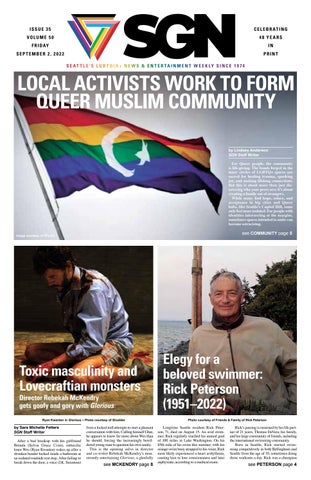
LOCAL ACTIVISTS WORK TO FORM QUEER MUSLIM COMMUNITY by Lindsey Anderson SGN Staff Writer For Queer people, the community is life-giving. The bonds forged in the inner circles of LGBTQ+ spaces are sacred for healing trauma, sparking joy, and making lifelong connections. But this is about more than just discovering who your peers are; it’s about creating a family out of strangers. While many find hope, solace, and acceptance in big cities and Queer hubs, like Seattle’s Capitol Hill, some only feel more isolated. For people with identities intersecting at the margins, sometimes spaces intended to unite can become ostracizing.
see COMMUNITY page 5
Image courtesy of PFLAG
Toxic masculinity and Lovecraftian monsters
Director Rebekah McKendry gets goofy and gory with Glorious
Ryan Kwanten in Glorious – Photo courtesy of Shudder
by Sara Michelle Fetters SGN Staff Writer After a bad breakup with his girlfriend Brenda (Sylvia Grace Crim), imbecilic loner Wes (Ryan Kwanten) wakes up after a drunken bender locked inside a bathroom at an isolated roadside rest stop. After failing to break down the door, a voice (J.K. Simmons)
from a locked stall attempts to start a pleasant conversation with him. Calling himself Ghat, he appears to know far more about Wes than he should, forcing the increasingly bewildered young man to question his own sanity. This is the opening salvo in director and co-writer Rebekah McKendry’s monstrously entertaining Glorious, a gleefully
see MCKENDRY page 8
Elegy for a beloved swimmer: Rick Peterson (1951–2022) Photo courtesy of Friends & Family of Rick Peterson
Longtime Seattle resident Rick Peterson, 71, died on August 15. An avid swimmer, Rick regularly reached his annual goal of 100 miles in Lake Washington. On his 85th mile of his swim this summer, with his orange swim buoy strapped to his waist, Rick most likely experienced a heart arrhythmia, causing him to lose consciousness and later asphyxiate, according to a medical exam.
Rick’s passing is mourned by his life partner of 21 years, Thomas DeVera, his family, and his large community of friends, including the international swimming community. Born in Seattle, Rick started swimming competitively in both Bellingham and Seattle from the age of 10, sometimes doing three workouts a day. Rick was a champion
see PETERSON page 4
2
SGN
SEP TEMBER 2, 202 2
C E L E B R AT I N G 4 8 Y E A R S!
ORIGINALLY SEATTLE GAY NEWS FOUNDED 1974 MEMBER 509 10th Ave E Seattle, WA 98102 (206) 324-4297 info@sgn.org sgn.org
SUPPORT INDEPENDENT JOURNALISM
DONATE TO SGN TODAY!
Publisher Angela Cragin Managing Editor / Acting Editor-in-Chief A.V. Eichenbaum Copy Editor SGN Staff • Richard Isaac Advertising Maggie Bloodstone, Advertising Manager National Advertising Rep. Rivendell Media (212) 242-6863 Staff Writers Lindsey Anderson • Mike Andrew Sara Michelle Fetters • Daniel Lindsley Contributing Writers Alice Bloch • Maggie Bloodstone Kylin Brown • Sharon Cumberland Carter Hemion • Eve Kucharski Benny Loy • Isabel Mata Paige McGlauflin • Gaysha Starr
SHOW YOUR PRIDE! seattlegaynews.redbubble.com
Merch Store!
Social Media Manager SGN Staff Photographers Juliana Adams • Nate Gowdy • SGN Staff Production Mike Pham SGN is published by Angela Cragin. © 2022. All Rights Reserved. Reprints by permission. Publication of names, photographs, or likeness of any person, organization, event or business in this publication cannot be taken as any indication of the sexual orientation of the person, organization, event or business. Opinions expressed in bylined articles, columns, and letters are those of the authors only and do not necessarily reflect the views of the staff or management of this paper. SGN welcomes unsolicited material, including letters to the editor, but reserves the right to edit or reject material. All rights revert to authors upon publication. We assume no liability for loss or damage of materials, solicited or not. We invite feedback, please write. And please play safe. It is our policy that no money shall be refunded if you choose to cancel your ad. Credit will be given for the balance owed. No exceptions.
In Loving Memory Of George Bakan
Scott Roger Alpert Cookie Andrews-Hunt James Arnold Ken Campbell Steve Foiles Shaun Knittel James Leland Moore Don Paulson Randy Peters Lee Richeson Shaun Shelton Jim Tully
Follow SGN
VISIT US ONLINE SGN.ORG
In this Issue
LOCAL NEWS 4 A&E 7 FILM 8 BOOKS 13 TRAVEL 14 NATIONAL / INTERNATIONAL NEWS 18 SEP TEMBER 2, 202 2
SGN
3
Obituary
PETERSON
continued from cover swimmer for Sehome High School, and swam for Washington State University on a NCAA Division I scholarship. Rick moved to San Francisco after graduation in 1973. He came out, and enjoyed young adulthood in what he called “an epicenter of emerging Gay liberation.” By the early ’80s, Rick was back in the Northwest, living in Seattle, when he learned about a Queen Anne pool lap-swim group who put on “Gay Swim Night.” Through this group, Rick rediscovered his love for swimming, and made new fitness-oriented friends. Among them was Dana Cox, who had been the sole swimmer in a contingent of 35 Seattle athletes at the inaugural Gay Games in San Francisco in 1982. Having brought home three gold medals, and jubilant at having been part of a groundswell of LGBTQ+ athletics, Dana urged Rick to participate in Gay Games II in 1986. Rick and Dana, along with others, began to dream of a Seattle Gay swim team that would train for the upcoming games. In 1984, they formed the Emerald City Orca Swim Club (later renamed the Orca Swim Club), with Allison Beezer and Rick as cocaptains. Excitement for the Gay Games II extended well beyond the swimming community. Rick would later write that “a real movement was beginning — a whole new form of ‘gay liberation’ centered on the health, fitness, and camaraderie unique to participatory sport.” Rick and leaders of other emerging Gay sports teams began meeting. Dana recalls Rick’s intelligence, diplomacy, and masterful team-building skills, noting that Rick ran an Orcas Island retreat to refine their vision and mission. Their efforts resulted in an umbrella LGBTQ+ sports organization: in 1986, Rick co-founded Team Seattle, which would send 153 athletes to compete in 17 sports at Gay Games II in San Francisco. That year, Rick also helped start International Gay and Lesbian Aquatics (IGLA).
4
SGN
Rick worked to obtain the necessities for the Orca Swim Club: coaching, pool space, and competition in United States Master’s Swimming (USMS) meets. But in the 1980s, homophobia was everywhere. In 1987, when the Orcas approached the regional USMS body, the Pacific Northwest Association of Masters Swimmers (PNA), for meet sanctioning, they were initially rebuffed with hostility. Some in the PNA said a Gay swim team would taint its reputation, and would bring infectious disease to the pools. In response, Rick led a three-month advocacy effort, bringing together city and state representatives and the president of USMS for negotiations. The late state Sen. Cal Anderson, the first openly Gay member of the Washington state legislature, lent instrumental support. The effort succeeded: the PNA capitulated, giving the Orca Swim Club the ability to host official meets at which swimmers’ performances, rankings, and records could be recognized by USMS and World Masters organizations. The Orca Swim Club would
Rick’s passing is mourned by his life partner of 21 years, Thomas DeVera, his family, and his large community of friends, including the international swimming community. also become one of the most popular USMS swim-meet hosts in Western Washington. “Stroke by stroke, we began changing the swimming world in our little neck of the woods,” Rick remarked. By 1989, the Gay Games had grown significantly; the Federation of Gay Games (FGG) was formed that year, with Rick serving as inaugural co-president. He said to the Seattle Times, “There’s been a history of homophobia in the sports world, and a lot of people who’ve been identified as gay have never felt that sports were part of what their culture offered them… the Gay Games makes a giant statement that we
Photos courtesy of Friends & Family of Rick Peterson
SEP TEMBER 2, 202 2
are athletic and we like to compete, too.” Whereas the Gay Games II in San Francisco in 1986 had 3,500 total participants, the 1990 Gay Games III in Vancouver, BC, had 7,400 from 29 nations, in 30 sports. In 1993, Rick helped lobby the US Department of Health and Human Services to allow HIV-positive athletes to enter the US to participate in the 1994 Gay Games IV in New York City, in which more than 10,000 athletes from 41 countries competed. Rick also advocated for Gay rights outside of organized sport. When the anti-Gay Initiative 490 happened in 1986, Rick and fellow Orca swimmer Rene Oldrich swam across Lake Washington to raise awareness and funds to help fight it. Rick knew how to make meets fun, as well. With the Orca Swim Club, he introduced the Pink Flamingo Relay, a way to end each meet with a noncompetitive fun event to, as he said, “make it gay.” Since then, the Pink Flamingo Relay has become an established and entertaining hallmark of both Gay Games and IGLA aquatics competitions internationally, with participating teams performing celebratory, joyous, and often comedic routines in the pool with music, costumes, and choreography. Rick was warm and encouraging to swimmers of all abilities. He said, “For me, the competition represents only 10 percent of my interest. The rest is being part of the team.” Rick also modeled the joy and benefits of swimming throughout one’s life to all and deeply loved the beauty of swimming in the open water. The swimming community will greatly miss Rick, and we extend our deepest condolences to his family and loved ones.
C E L E B R AT I N G 4 8 Y E A R S!
Local News
COMMUNITY continued from cover
A community along the intersections After acknowledging these shortcomings, two Seattle residents have decided to do something about it. Mikhailo Mohamad and Omar Hamed are creating an intersectional, all-inclusive social media community where LGBTQ+ Muslims can celebrate their religion, culture, and pride. “It’s called ‘Queer Muslim Community,’” Hamed said of the online group they helped co-create. “We’re both in the process of starting this group and this page on Instagram and TikTok. So, we’re going to be the moderators behind the page,” Mohamad added. They are still in the beginning stages of launching but are excited as anticipation for the group grows. “We’ve had a couple of people say yes to working with us, so… it won’t be the both of us only,” Mohamad continued. The accounts will focus on sharing stories of Queer Muslims from around the world in a positive light to help spread awareness of and visibility for those who identify as both LGBTQ+ and Muslim. “The goal of creating this page, in general, was that we saw that Queer Muslims are very underrepresented in society, especially when looking at both the Queer… and the Muslim [communities],” Hamed said. “So, we wanted to create this as a hub for Queer Muslims to be able to come on and to talk about their experiences, how being a Queer Muslim intersects with race, identity, sexuality, gender identity, age, even ethnicity.” Hamed and Mohamad are not the first Queer Muslims to attempt to create safe spaces online, but they have taken notes from those before them so their accounts run smoothly and encompass the many different experiences their followers may share. “We wanted to make sure everybody can get a chance to have their voices heard. Mikhailo and I noticed on social media that there isn’t a collaborative approach to talking about the Queer Muslim experience. It’s more individuals talking about their experience, especially on TikTok,” Hamed continued. Giving hope to Queer Muslims They hope to structure their accounts around the kind of content they wished they had seen when they first came out. “[When you realize you’re Queer], the first emotion you go through is, ‘Oh my gosh, I’m alone. There isn’t anyone else like me,’ because you don’t see people like that, Queer Muslims, that look like you. You don’t see them, except for the gruesome violence. So, we want people to be like, ‘Oh my gosh, there is someone who looks like me and is Queer. I must not be so much of an anomaly,’” Mohamad said. “We wanted to find a space just for us Queer Muslims. Like Omar explained, all we’ve found on social media is just [people] sharing their side of the story, and we’re never able to see people who look like us who are from the same religion as we represented,” they continued. “So that’s why we wanted to start this page, just to have different people with different backgrounds come on, so that way the younger generation or other people in general, once they go on social media, they can see people that look like them on there.” For Mohamad, being Queer and Muslim has meant feeling a little different in both communities. “My experience [with being Queer and Muslim] is not so great because… in [both] the Muslim and Queer [communities], we’re considered abnormal. The Queer community is like, ‘Oh my gosh, follow a religion that hates you for who you are?’ and then the Muslim [one] is like, ‘You’re Gay?! That’s a sin.’ Of course, both… are wrong. That’s their opinion.” While Hamed said their experiences were different, they also struggled with aspects of their identities coming together. “My experience was also not great. I can talk about it from more of a familial aspect. My
VISIT US ONLINE SGN.ORG
Omar Hamed and Mikhailo Mohamad – Courtesy photos
parents ingrained in me the idea that queerness is against Islam, and you’d be burning in hell just for being Queer. I noticed whenever I approach spaces, even messages, that even our religious leaders would have these views and impose them on us. It was frustrating. It made me feel lost about where I fit in the religion.” Hamed, like many Queer Muslims, felt these teachings were not accurate to the religion they had grown up with but struggled to vocalize their beliefs or find a positive representation of Queer Muslims. “Being Queer is such a big part of my identity, and seeing that you would be ostracized for being Queer really kind of made me suppress myself,” they said. While they struggled with being accepted for who they were by some in the Muslim community, Hamed also realized that the often very white Queer spaces in Seattle were slow to welcome them because of their cultural and religious background. “Seeing the Queer community and how they view Muslims was also frustrating. There isn’t a win in any situation. That’s why we want to be able to foster a community in between those two… to help any Queer Muslim that feels lost and needs to feel heard and represented.” For Mohamad, coming out to Seattle Queers as Muslims can be just as difficult as coming out to straight Muslims as Queer. “I don’t tell people I’m Muslim a lot of times. I’m still getting used to telling people, ‘Hey, I’m Muslim, but I’m also Queer.’ Unfortunately, the Seattle Queer community is a lot of white people. Everybody has religious trauma, and a lot of them come from Christianity and denounced their religion, which is why, often, I get this question: ‘You follow such a religion? Why do you follow a religion?’ Things like that… “I want people to [know] that just because you denounce your religion does not mean that everybody who’s Queer is immediately going to denounce their religion.” Educating their peers The space Hamed and Mohamad are creating isn’t just for Queer Muslims. “It’s also a page to educate straight Muslims as well,” Mohamad said, “because a lot of them grow up with this idea that queerness is such a humongous sin, and a
lot of that comes from their cultural background and not their religious background. It was just something ingrained in them growing up. It’s to educate the straight Muslims, so they can find out, okay, Queer Muslims exist, and it’s normal. It is not a sin in the religion. It’s this cultural influence in them to think that it’s a sin.” “We would like people to amplify our message,” Hamed added. “Say they have Queer-friendly Muslims, not even just Queer Muslims, to send that message to them, so that even the greater Muslim community can contribute to this, because we’re going to need the support of everybody to be able to do this. We need people to trust the process and trust that we are going to be creating something so needed for Queer Muslims and so needed for awareness about Queer Muslims.” They’re also hoping to reach more people than just those in the Seattle area. “The page isn’t just for Seattle. It’s on social media, so it will be accessible for anyone around the world,” Mohamad said. While they’re just starting, they hope the page could eventually lead to in-person events or even a new organization. “We’d love to see where this page could take us. Eventually, I want to be able to turn it into a nonprofit, especially to help young Queer Muslims. A lot of parents, unfortunately, don’t react well to it, a lot of kids get thrown out, things like that, so yeah, of course, if we get to a platform big enough that we can create something where we could help people in person, we’d love to do that,” Mohamed said. Their whole goal is to help people by showing other Queer Muslims that they are not alone. “I want people, especially kids, [to see this], because this isn’t something we had for ourselves,” Mohamad added. Focusing on mental health “So obviously, when you realize, okay, I’m Queer, I’m not straight, you go online and want to find other people like that,” Mohamad said. “Unfortunately, if you look up ‘Queer Muslims’ on the internet, you’re going to find a lot of very graphic, violent things. We’re trying to change that image of just like, ‘Queer Muslims, you get killed,’ all of that aggressiveness…
SEP TEMBER 2, 202 2
“We’re just trying to get a page where anybody, any kid, grown-up, anybody who is having those questions, we want to be one of the first things that pop up. We’re trying to use the hashtags and stuff like that, so as soon as you look up the words ‘Queer Muslim’ …we want you to see other Queer Muslims.” Changing the way Queer Muslims are perceived on the internet can be lifechanging. “It’s an unfortunate reality that most Queer Muslims become very suicidal because of their identity,” Hamed said. “That’s another reason why we’re trying to get a Queer Muslim therapist, we’re trying to get people who are interested in talking about their mental health… A lot of us have struggled with our mental health,” Mohamad said. “That’s important to us. When I first knew I was Queer, I was terrified to talk about it out of fear of being disowned,” Hamed said. “It’s just a harsh reality for a lot of us. Either we live in countries that [have a] Muslim majority, that have problems with …being Queer, or we live in countries like the US, for example, where if you talk about being Queer but you’re Muslim, then literally anyone around you is going to be questioning you and think you’re literally, as Mikhailo said, an anomaly or a juxtaposition, but not someone who can exist in reality. It’s very dehumanizing.” “We want to normalize that Queer Muslims exist,” Mohamad added, “and once you go on Instagram or TikTok, we want one of our videos to pop up and be like, oh, look at that, I just learned something new today! So, yeah, we want to normalize some things, educate some people, and share some stories on this page. We want to do a lot with it.” Q u eer M u sli m Co m m u n it y is on Instagram and TikTok at @queermuslimcommunity. If you are interested in contributing, Hamed and Mohamad encourage sending stories either via video or script, to aqueermuslimcommunity@gmail.com. For those for whom safety is a concern, they are willing to post content anonymously or crop faces out of videos.
SGN
5
Local News
Social Housing Initiative qualifies for 2023 ballot I-135 would create new renter-governed housing developments by Mike Andrew SGN Staff Writer Initiative 135, the Seattle Social Housing Initiative, will appear on the ballot, according to King County Elections. The agency confirmed on August 29 that activists had gotten enough signatures to qualify for the ballot. The measure will not be on the November ballot, however. Instead, it will be voted on in a special election early in 2023. On August 29, the measure had 27,220 verified signatures, 700 more than what was needed to go on the ballot, King County Elections said. Initiative organizers submitted 29,000 signatures in June, hoping to qualify for the November ballot. However, King County Elections staff ultimately tossed several thousand signatures of people not registered to vote or not Seattle residents, leaving the initiative short 5,033 names. Under Seattle’s charter, the initiative was allotted an additional 20 days for signature collection. Within that time, organizers were able to turn in more than 9,500 to get the initiative on the ballot. By that time, however, it was too late to go on the November ballot. Before it goes to the voters, the initiative will go before the Seattle City Council. Councilmembers could decide to skip the public vote altogether and pass the initiative, making it a city ordinance. But if that doesn’t happen, then it will advance to a special election. If the measure passes — in the City Council or in an election — it will estab-
Photo courtesy of House Our Neighbors!
lish a public development authority (PDA), that would be authorized to use public and private funding to build new housing or buy existing property. Once developed, the properties would be governed by boards of renters rather than property managers hired by developers, and they would seek to maintain affordable rents by taking the units out of the commercial rental market. This social housing model is popular in Europe and Asia, and is being tried in some
parts of the US, including California and Hawaii. “We need to implement [social housing] here if we are truly serious about having this be a city that is affordable to everyone, not just folks that have generational wealth, or middle-to-high-six-figure incomes,” said Tiffani McCoy, who is advocacy director at Seattle’s street newspaper Real Change, and one of the organizers of I-135. According to the National Low-Income Housing Coalition, a worker in the Seattle-
Bellevue area would need to make about $39 an hour to afford a two-bedroom apartment. Oddly enough, the initiative is opposed by the Housing Development Consortium, a lobbying group whose members include King County’s major nonprofit housing developers, local housing authorities, and financial institutions. They argue that the new PDA would compete with them for already insufficient resources.
Episode 32: Mike Johnson & Kyle Getz BI-WEEKLY! FIND US WHEREVER YOU LISTEN TO PODCASTS! 6
SGN
SEP TEMBER 2, 202 2
This week Ash and Lindsey bring back the bleak to talk about MPV, Tucker Carlson, and milk! We also discuss Lindsey's dog being famous now and how sea glass is beautiful trash. Special guests this week are Kyle Getz & Mike Johnson, hosts of the Gayish Podcast! Find them at www.gayishpodcast.com C E L E B R AT I N G 4 8 Y E A R S!
Arts & Entertainment
The Sandman, season 1: Amazingly Queer but led by straight white guys
by Daniel Lindsley SGN Staff Writer Netflix’s latest fantasy drama smash hit, The Sandman, has been making ripples since its release in early August, receiving critical acclaim and holding a place in the platform’s top five ever since. In particular, fans have celebrated its diverse representation. Critics and fans alike have also discussed how far the show has progressed from its source material. English superstar author Neil Gaiman’s comic book series by the same name was published by DC Comics in 1989, and despite all its flaws, had much broader and nuanced minority representation than its mainstream contemporaries. The adaptation has gone even further, casting BIPOC actors in the roles of characters once depicted as white. A majority of the characters are Queer, at least in some fashion, and necessarily that means their Queerness isn’t their defining characteristic. Notably, the character Desire — who could shapeshift in the original comic — is played by nonbinary actor Mason Alexander Park. In fact, the cast is all-star in general. In one scene, Gwendoline Christie towers over Tom Sturridge as Patton Oswalt’s voice issues from a sentient raven. Even secondary characters bear familiar faces. Meanwhile the visuals, while toned down in places compared to the comics, are outstanding. The phantasmagorical landscapes of otherworlds like Hell, the Dream Realm, and other domains are both fun and fitting, and the raven characters are an especially clever mix of real birds and CGI, even if one can usually tell the difference. Yet as multimedia critic Jesse Earl pointed out in a review, there are some potential problems with Sandman’s Queer representation. Two of the main antagonists, she pointed out, fall into the old trope of “Queer-coded villainy.” Think of Scar in The Lion King, with his fruity gestures and sass, or Ursula in The Little Mermaid, who was inspired by a drag queen.
VISIT US ONLINE SGN.ORG
Tom Sturridge, Mason Alexander Park, and Gwendoline Christie in The Sandman – Photos courtesy of Netflix
Queer fans are no strangers to this trope, and often embrace it — hence, perhaps, the adage “be Gay, do crimes.” And the impact of criticism along these lines is somewhat cushioned by how casually the show treats queerness, and how many other Queer characters aren’t villainous at all. What the show can’t seem to shake, though, despite all its progress, is the main character (Dream) being an angsty white guy — one written by white guys (Neil Gaiman, Sam Keith, and David S. Goyer) and played relatively straight, despite him having a centuries-spanning friendship with an immortal human man. Mind you, Tom Sturridge’s Dream is no blatant archetype of hegemonic masculinity. He’s depicted as gaunt and spindly, and is made quite vulnerable in the first episode. His brand of violence, in the rare moments when it surfaces, is a gentle one; the worst
he inflicts upon humans is a comatose state of sleep. It’s also worth mentioning that, canonically, Dream appears differently to different people (and different species, like cats), depending on their cultural background. But this ability is shown only once this season, and briefly, potentially implying that his white appearance is “default.” This may be more elaborated upon in later storylines. Perhaps the strongest indication of angsty-straight-white-guyness is Dream’s inability to seek help from the people who care about him, as if he’s the center of the universe (which, as a member of the Endless, he nearly is). Other characters do criticize him for this quality, and he does grow away from it somewhat by the season’s end. But it’s hardly a novel internal conflict for a straight-white-guy protagonist. I write all this at the risk of seeming ungrate-
SEP TEMBER 2, 202 2
ful for the good work the writers and actors have done. I thoroughly enjoyed season 1 of The Sandman, from start to finish, and I think it’s safe to say that it’s in another class entirely compared to the shallow queerbaiting of the likes of CW’s Riverdale. Now that the series has Queer fans’ attention, it has the chance to do even better. For one thing, a storyline yet to be explored could feature Dream’s past romantic relationship with Nada, a queen of an African city, or indeed any number of other canon love interests. All of them were women in the original comics, but that could easily change. The writers could even depict Dream as Asexual and Panromantic without sacrificing or contradicting much. The Sandman has a lot to offer so far, and even more to tackle moving forward. I await season 2 with keen interest.
SGN
7
Film
Goofily gory Glorious is a monstrously gluttonous treat by Sara Michelle Fetters SGN Staff Writer GLORIOUS Shudder Rebekah McKendry’s monstrously entertaining Glorious is one of the more innovative and original horror comedies I’ve seen in quite some time. A heady mixture of science fiction, social commentary, and gory Lovecraftian weirdness, this two-character slice of existential insanity is like an episode of The Twilight Zone mixed with EC Comics’ Tales from the Crypt as filtered through the perversely perceptive sensibilities of filmmakers like Larry Cohen or Frank Henenlotter. This film is terrific. Wes (Ryan Kwanten) has just broken up with his girlfriend Brenda (Sylvia Grace Crim), and he’s falling to pieces over what happened between them. Having hit the road, he spends the night at a secluded rest stop, waking up the next morning covered in his own vomit and nursing a hangover. Making matter worse, the door is jammed, and he’s locked in with no way to call for help. Then there is the authoritatively friendly voice (J.K. Simmons) attempting to chat with Ryan from one of the bathroom’s two stalls. Calling himself “Ghat,” this individual appears to know so much about him that the young man begins to question his own sanity. Even more bizarre, Ghat proclaims he isn’t a man, that he isn’t even human, but rather a glutinous god who will consume all of humanity once he has fully materialized into his hideous corporeal form, and it is up to Ryan — and Ryan alone — to stop him. What follows is an increasingly perverse conversation between the two, in which they discuss nothing less than — to quote Douglas Adams — life, the universe, and everything. They must understand the nature of sin and the power of goodness, each trying to fathom what has led them both to this one place at this one time. Was it fate? A higher power? Or just a surreal coincidence? Whatever the reason, they need one another, and if Ryan is unwilling to make an unfathomable sacrifice, they will each be responsible for unleashing a terrible apocalypse upon the earth. Kwanten is outstanding. He hasn’t had a role this good since the first few seasons of
Ryan Kwanten in Glorious – Photo courtesy of Shudder
HBO’s True Blood, in which he routinely stole scenes from his well-known co-stars. Wes is a complicated lost soul, one whose misdeeds and mistakes have convinced him that he is beyond redemption. Kwanten brings self-effacing humor to his portrayal, which isn’t exactly surprising, but also adds a layer of introspective pathos, anger, and pain that somewhat is. Simmons’ vocal performance is equally superb. Ghat knows what it is and, more importantly, what it will become if its growth into a being of unimaginable destruction is allowed to proceed unabated. It understands it’s evil. But Simmons digs into the sorrow of an existence built only on destruction. Still, while Ghat can be authoritative and commanding, it can also be empathetic and
nurturing. The Oscar-winning Simmons makes all of these facets of the god’s personality come alive with endearingly goofy conviction and such effortless panache that his performance borders on spectacular. It’s clear the budget was rather minimal , but that doesn’t stop McKendry from dreaming big and at least making a valiant attempt to get her completed vision up on the screen. While some of the effects can’t help but fall a little flat, others are so well realized that they are nearly extraordinary. The director also does not skimp on the gore, and the practical makeup effects and CG visual enhancements have a retro quality that reminded me of Rob Bottin’s work on The Thing or Tom Savini’s iconic designs for Dawn of the Dead.
MCKENDRY continued from cover
gory science fiction horror-comedy hybrid that feels like an especially ingenious episode of The Twilight Zone crossed with EC Comics’ Tales from the Crypt. It’s a Lovecraftian nightmare scenario where the line between good and evil barely exists, and toxic men with serious daddy issues must come to a mutual understanding or else humanity may cease to exist. I sat down over Zoom with McKendry to talk about her splendid new film. Here are the edited transcripts of what she had to say: Sara Michelle Fetters: Now that we’re two weeks past the film debuting on Shudder, the response appears to have been exceedingly positive. People really seem to like it. What’s that been like for you, seeing those responses? Rebekah McKendry: That has been awesome. We knew when we were making it, we kept saying, “This film’s not going to be for everybody.” Even in my first round of interviews, I’m very much like, this film’s not going to be for everyone. I was anticipating a lot of people who were like, “What the hell is this? This is garbage.” [laughs] We have had a few of those responses, but not for the most part, especially from horror fans, which are who we kept saying we made the film for. It’s been incredibly well received, which has been absolutely amazing.
But some of my favorite comments are the “What the F was this?” ones... I saw one that I even reposted on Twitter. It was like, “Anyone who likes this clearly has something wrong with them.” I was like, “You sound like my family.” That’s wonderful. [laughs] SMF: Glorious was born out of the pandemic isolation that you and your collaborators were feeling. It feels almost like the perfect COVID movie, even
8
SEP TEMBER 2, 202 2
SGN
Actor Ryan Kwanten and director Rebekah McKendry on the set of Glorious – Photo courtesy of Shudder
though it’s not about COVID, which makes me happy, because I do think movies should talk and be about what is happening in the current world, but there are creative ways to do just that where you don’t have to be explicit about it. Your film, both subtly and unsubtly, manages to do this. Was that by design, or was this something you found you’d lucked into as you were there giving the story its life?
The conclusion isn’t going to sit well with everyone. McKendry keeps things moderately ephemeral, letting the audience answer most of the big questions on their own, without too much in the way of concrete input from either of the main characters. But this worked just fine for me. I like that the question Wes asks near the end and the answer Ghat responds with are hard, somewhat bleak, and entirely genuine in their depressive certainty. As gruesomely hysterical as much of Glorious may be, the foundation it’s built upon is anything but silly, toxic masculinity, which is given the brutally grisly evisceration it deserves.
RM: That was definitely kind of what drew me to the project to begin with. When the original draft of the script came to me, we were deep in the pandemic. It was the bleak parts of the pandemic where everybody was just miserable. My husband kept talking about getting his realty license. We were just miserable. [laughs] We were still barely scraping by, our kids were home, and it was just a bad time. But I had received the script and immediately, I was like, there is something so charming here. I knew you could dig further into this story about this guy having a discussion with God in a confined space — or this thing that claims to be God. I was like, there’s a movie here that I need to make. When we optioned the script and took it forward, the very first thing that we said we needed to do was to build in our own existential crisis. It was exactly what everybody was going through, this “what the fuck am I even doing with my life?” moment that we were all experiencing. But we never said, “Let’s make it about COVID.” Instead we said to ourselves, “Let’s make the story about an existential crisis.” That was part of our design… the idea Wes was being forced to look back on his life and faced with the biggest question there is. How do you move forward now that you’ve seen everything and you’ve been forced to look at all that you’ve done? How do you move forward from that? Can you?
see MCKENDRY page 12
C E L E B R AT I N G 4 8 Y E A R S!
VISIT US ONLINE SGN.ORG
SEP TEMBER 2, 202 2
SGN
9
10
SGN
SEP TEMBER 2, 202 2
C E L E B R AT I N G 4 8 Y E A R S!
VISIT US ONLINE SGN.ORG
SEP TEMBER 2, 202 2
SGN
11
Film
MCKENDRY
continued from page 8 Then we got to even heavier, which is our ending, which I won’t give away. But we had different versions: some where Wes lives, and some where he dies. It all came down to these big discussions about if you make a huge sacrifice and you’re now aware of all of your sins, but you’ve done something to try to right them, can you still be punished for those sins? Should you still pay for them? SMF: Not to jump forward, but I do have to say, one of my favorite moments in the film is the introduction of Gary, and that’s because of Wes’s reaction to Gary. It’s a similar reaction that all of us have been having as we’ve sort of tried to come out of this pandemic, how we’ve sort of forgotten how to communicate with people. Wes is so excited to see a person that he doesn’t actually know how to verbalize what is going on and why he’s trapped in the bathroom in the first place. RM: So, the exact direction that I gave Ryan on set was I wanted him to act like a dog whose owner had just gotten home from work. You can see that, where it’s just this moment of sheer joy. Just this moment of “I don’t even know what to do.” From there, I liked that Wes knows he’s not wearing pants, that he’s an absolute mess, and he probably smells like vomit. But at that point he’s still going to turn the formal on with Gary. Everything’s like, “Sir, yes, sir.” Ryan’s delivery, it’s just beautiful through that entire scene. SMF: When you knew you were going to make the film, what were the challenges that you and your team had to tackle? How much was [Ryan] involved as a partner in tackling those challenges? RM: We always knew the film was very small. We knew that the god is never actually there, so it would be a chamber piece. Once we were able to get it funded and get moving forward with the production, that was always the intro to all of our meetings, that we knew what we were and what our focus was going to be on. The problem was always figuring out how we overcome the one setting. How do we overcome this as easily and efficiently as possible without going outside that space? So the very first thing was always limiting the time. I love that a lot of people have been like, “79 minutes, that’s awesome!” I feel the same way. I always say you have exactly one bladder’s length to show me your film. [laughs] But we also knew that if you’re going to spend 80 minutes in one bathroom that there constantly has to be something happening. The story has to be moving forward. We tried to make sure that if there were any moments where it got super chatty, where it is just Wes and Ghat, we had to have those, of course, because that’s how we have our emotional revelations. But those scenes always had to be working simultaneously or right before some other big thing that was about to happen. I wanted to keep the audience guessing. Additionally, every version of this film, even going back to the original short story, has been gory as hell. It’s part of the reason I love it. I love gory, sick movies. When we were designing the character of Ghat, instead of having him be this fully fleshedout monster in the stall, we wanted it to be that he’s going through these transformations. I wanted to keep checking back in with him and see each level of what he was going through. SMF: Which totally fits in with the Lovecraftian influences on the film. RM: Yes! We loved the idea that he’s slowly becoming corporeal. That he exists on this different plane and he’s slowly changing into a being of our world. SMF: Going back to Ryan. I feel like, post-True Blood, for whatever reason, filmmakers don’t know how to use him. He’s so talented, and he never gets these opportunities to show all he’s capable of. In a project like this, you force him to
show what he can do when challenged. He’s really the only person that we see for 95% of the film. RM: I’ve been watching Ryan for years. When we started having conversations about how to cast Wes — by that time J.K. Simmons was already attached — we had a production date that we were aiming for and needed to find someone. We started coming up with traits and throwing out names, and the biggest thing was that they had to be really likable, they had to be fun to watch on screen for an entire movie, and at the same time they had to have a sinister bent to their personality. They had to be able to go really, really dark. Somebody was like, what about Ryan Kwanten? At the time I had just seen Ryan in Joe Lynch’s episode of Creepshow and I was immediately excited. [I’m texting] Barbara Crampton, who was in the episode with him and is one of our executive producers, saying, “What about Ryan?” She was like, “I’m going to text him right now, and I’ll get you guys on a Zoom tomorrow.” The next day we were Zooming, and it was clear from the start that Ryan got the script. He understood the humor. He understood that it was supposed to be this sharp mix of humor that then goes dark, then goes gory, and the goes back and forth and back and forth over and over again. It’s all kind of meshed in together. But he understood that all of the humor, much of which is delivered by his character’s dialogue, comes from a really dark place. It is his defense mechanism whenever he gets freaked out or feels like somebody’s getting too close. Wes turns on this kind of sarcastic snark. Ryan was really excited to work with that. He literally threw himself into things. [laughs] Physically throwing himself into the role. On our first day of shooting, Ryan was actually throwing himself into the set walls. It was this scene where he plows into the bathroom door to try and knock it down. The whole day it was just him beating up against the walls. He was doing
12
SEP TEMBER 2, 202 2
SGN
Sylvia Grace Crim and Ryan Kwanten in Glorious – Photo courtesy of Shudder
everything with such force and such emotion, that evening the crew had to go back through and reinforce and re-stud all of the set walls [or else] he was going to knock them down within a week. But Ryan’s tremendous. He was amazing to work with. SMF: How did the relationship between him and J.K. Simmons work? RM: Their conversations are all very planned. We had a lot of rehearsals. The thing we had during the pandemic was time. Everybody was just at home. So we started Zoom rehearsals, and this was three months before we ever even got to set. We had these rehearsals between Ryan, J.K., and myself, and we would have these big, heavy philosophical conversations about all of the mythology and stuff in the script. Then we would just run the lines over and over and over. Joining us in these rehearsals was the producer, Morgan Peter Brown, who then read J.K.’s lines on the set. By the time we were shooting, we had listened to J.K. do the script so many times that Ryan knew his pace, knew how he was going to say every line, and where he was going to be snarky. Additionally Morgan had memorized J.K.’s normal delivery, and would mimic his recording as best he could. We had recordings of J.K., and Morgan would literally copy them whenever he could. It was like we had pseudo J.K. on set. By the time we got to record J.K.’s dialogue, the world had opened up a little. We got to do that in person here in LA. We already had Ryan’s dialogue, so for J.K. it became something of a natural conversation. But it was a whole lot of rehearsal to make it that natural. They all worked really, really hard. SMF: How perfect as the voice of a god? A maybe malevolent god who doesn’t want to be a malevolent god? What was it like just to be able to work with him and have his insight on the character? RM: J.K. was amazing. I almost threw up
in my mouth the first time I gave him direction. I thought, this is crazy! I’m giving direction to J.K. Simmons! But he was great. We knew that …whoever was reading Ghat, it had to be somebody who could be incredibly cordial, like somebody who would just be in a bathroom sitting next to you. At the same time, they had to be able to get very authoritative, bordering on commanding. J.K. was one of the first names we threw out. And then when we found out how much he loved the script, and that was the other time I thought I was going to vomit. [laughs] But he has been so supportive of the film this summer and was absolutely fantastic to work with. SMF: Now that audiences are watching the film on Shudder, what do you hope they are taking away from the experience? RM: Audience takeaways: I never know how to respond to that. I think that one of the biggest things that I wanted to bring in with this film was a mix of lowbrow and highbrow that we don’t see a lot now. I am a child of the ‘80s and ‘90s. I grew up on Frank Henenlotter. That’s my jam. So many of those films that I remember from the ‘80s that were some of my faves, they were sort of lowbrow, but they all had some messaging. Like Brain Damage, it’s about drug addiction. The Killer Condom. I still proselytize The Killer Condom, as it’s an amazing movie… very much about STDs and the Gay community. It does not get enough attention. I don’t think this is something that we see a lot in cinema anymore. The feeling of “I am willing to get dirty and then be knocked over by something deep and maybe even poignant.” That’s one of the things that we wanted to bring to Glorious. I love that we tackle these patriarchal issues, the idea that the toxic masculinity is spread from father to son as represented in both cases by Ghat and Ryan. That’s where I find the most meaning, and I hope the audience does as well.
C E L E B R AT I N G 4 8 Y E A R S!
Books
The Disney Revolt: No Mickey Mouse operation by Terri Schlichenmeyer Special to the SGN THE DISNEY REVOLT: THE GREAT LABOR WAR OF ANIMATION’S GOLDEN AGE JAKE S. FRIEDMAN © 2022 Chicago Review Press $30.00 320 pages
Image courtesy of Chicago Review Press
When you look back at the life of Walter Elias Disney, you can see how an idyllic early life, his mercurial father, poverty, and loss shaped him. These things spurred young Walt to focus on a new-fangled way to make a living: drawing, which he loved. His father, however, thought his son was “wasting his time” and that cartoons wouldn’t pay the bills, so the senior Disney insisted that he go to work at the failing family business. Instead, Walt, who’d fallen in love with the new medium of animation and had landed a job as an illustrator at an
art studio, began thinking about owning his own animation studio. He went into debt several times to do it, which was another harbinger of things to come: as an adult, once Disney had an idea, he’d move mountains to ensure that it became reality. Meanwhile, you could almost say that Arthur Babbitt’s mother was an activist. She taught her sons to knit for soldiers in World War I, gathered food for the poor, and celebrated the armistice with a onewoman parade. Her “all-for-one” attitude shaped Art, but he also realized that he had to make his own success. As a young man, he learned the animation biz at a small studio, clawing for everything he got; when he landed at Disney Productions , he clawed even harder and climbed to the top to become someone Walt Disney was willing to pay very, very well. But Disney had made a few stumbles in the pre–World War II years, and there were grumbles within its ranks. Rumors flew of bonuses rescinded and layoffs to come —
and then Art heard whispers of unionization at the studio. When you think about Disney World or Disneyland, it can be hard to separate the happy from thoughts of those behind-thescenes people who make it so. But that’s okay — The Disney Revolt does it for you. It takes a (pleasant) while to get there, though, and you won’t mind. Author Jake S. Friedman begins his story with a deep overview, making readers hungry to watch the growth of both protagonists, while the twin subjects of labor and unions lurk in the background with a tinge of 1940s true-crime sinisterness. You’ll then see how everything went awry and how trouble arrived concurrent with the making of beloved childhood movies. The Disney Revolt is an easy read, with its business aspect and its trip down Memory Lane. If you’re interested in labor relations or if you’ve always been a fan of The Mouse, this book will have you trapped.
Anyone can cook at Book Larder By Lindsey Anderson SGN Staff Writer Nestled in the small neighborhood of Fremont sits one of Seattle’s most specific bookstores. For the last 11 years, Lara Hamilton has been running Book Larder, which specializes in cookbooks, foodrelated memoirs, and any other titles that have to do with the art of the delicious and nutritious. “I’ve always been a big fan of cookbooks and thought Seattle would be an excellent place for a store like this, because it is a big book town and a big food town,” said Hamilton. “We’re all cookbooks and food writing. Yeah, once in a while, there will be a foodthemed piece of fiction that we carry, but it is almost entirely nonfiction.” Hamilton was inspired to open the store due to her love of cookbooks. “When I travel, I go to bookstores in whatever city I visit, and immediately go to the cookbook section. I wanted something like that in Seattle, but also a place where people could really engage with the books, meet the authors, …and really foster a community of people who have a joy of cooking. Bookstores are some of the only places where people can gather without paying for an expensive ticket for something like that.” A full calendar Book Larder has gained a reputation in the Fremont neighborhood as the place for aspiring chefs to go. Before the pandemic, the store hosted many interactive community events, including cooking classes and author signings. The worldwide pandemic didn’t stop Hamilton from sharing the art of cooking with her neighbors, however. “We’ve been doing events in person and virtually. During COVID, we were all virtual. The in-person [events have] started to pick up, but we are still doing some virtual events as well. Our events calendar is pretty full,” she said. For those interested in joining in on the fun, Book Larder has a full schedule, with classes starting in September. “Next week we have a virtual event, on Tuesday, September 6, with Tara Jensen, who wrote a sourdough bread book called
Inside Book Larder, and their picks their favorite LGBTQ+ authors for Pride Month – Photos courtesy of Book Larder
Flour Power . On the 8th, we have an inperson talk with Marnie Hanel and Jen Stevenson about their book Lunchbox, which is about putting together creative lunchboxes for kids, really kicking off ‘back to school.’ We also have a lot of events going on through the fall,” Hamilton said. While people tend to flock to the store for the classes and interactive events, they stay for the books. “Our most popular book this year is J. Kenji Lopez-Alt’s The Wok. … He’s a local author [with] a very loyal following and has been very gracious about encouraging people to buy the book from us. It’s a great book. “[Also] super popular this summer is Salad Freak [by Jess Damuk]. It’s about eating lighter, which has been quite popular this summer.”
Giving back While Book Larder isn’t set up like a typical bookstore, meaning it doesn’t have an LGBTQ+ section, “we carry many LGBTQ authors,” Hamilton said. “The books are organized by subject and region but carry and host a lot of LGBTQ authors. We celebrate Pride month. I know that’s become a little bit of a token, but we hope we are a place where LGBTQ authors are celebrated. That’s very important to us,” Hamilton added. Book Larder loves to give back to the community that supports it, and beyond. “Earlier this year, we raised about $14,000 for UNICEF, focused on helping children in Ukraine,” Hamilton explained. “We also just participated in Bakers against Racism [and supported] Planned Parenthood, …and every year during the holidays we
Poetry writing workshop for Queer women Private room; space to write; time to think; great food; well-stocked library; great live performance of our writing on Friday night; chapbook of our week’s work.
charge $3 for gift wrapping and …match it and donate [all of that] to a variety of organizations, like United Indians for All Tribes and Solid Ground. “On our birthday, we always donate a percentage of our profits …to so many organizations that we’re passionate about. We usually pick them at the last minute. We’ll be doing that again on Oct. 11, although we haven’t quite decided who the beneficiaries are yet,” she said with a smile. Whether you’re a first-time cook, an experienced chef, or someone just looking to pick up a new hobby, Book Larder is definitely a place to explore. Book Larder is located at 4252 Fremont Ave N, Seattle, WA 98103 and online at http://www.booklarder.com.
October 10 - 15, 2022
ROSLYN, WA 98941 $100.00 FOR THE WEEK SPACE LIMITED TO SIX WOMEN
Send a short bio of 200 or less words and two (2) poems to: karenheiken@gmail.com Karen Heiken has taught for 45+ years in a variety of capacities. Until 2020, the last ten years were at IAIA (Institute of American Indian Arts, Santa Fe NM) and at Santa Fe Community College.”
VISIT US ONLINE SGN.ORG
SEP TEMBER 2, 202 2
SGN
13
Travel
Pride Journey: Orlando by Joey Amato Special to the SGN Orlando has always been a place close to my heart. Back in 2002, I attended graduate school there as well as worked in the music industry for a company that launched the careers of Backstreet Boys, *NSYNC, O-Town and other stars. I even managed a boy band of my own around that time. Needless to say, I really enjoyed living in Orlando. It was also the place where I finally admitted to myself that I was gay, although I didn’t officially come out to my family until a few years later. When I heard U.S. Travel’s IPW convention was going to take place in Orlando this year, I knew I had to go. I stayed at the Hyatt Regency Grand Cypress, which is perfectly situated within minutes of Walt Disney World parks and just a short drive from Universal Studios. The property is massive and contains a separate fitness building, resort-style pool with bar and live music as well as a convention area. Epcot was always my favorite park to visit as a child, so I was excited to learn that one of the main events for the conference would take place there. We got to experience the park without the crowds, which was quite pleasant, especially when it came to the newer rides Frozen Ever After and Guardians of the Galaxy: Cosmic Rewind. Seeing the iconic globe lit up at night is as magical now as it was when I was a younger. Ironically, the conference coincided with One Magical Weekend, so I also had the opportunity to visit two LGBTQ parties while there, the first being the annual Red party at House of Blues and the second being OMW’s Therapy pool party at Sheraton Lake Buena Vista Resort. People from around the country travel to Orlando for this event, so I ran into many friends during that weekend, some of which I hadn’t seen in years. My visit wasn’t all fun and games though. I think we all remember where we were when we heard the news of the Pulse massacre back on June 12, 2016. A few years ago, the owner of the club opened an interim memorial with a goal of raising the funds to open a permanent space which would pay homage to the forty-nine beautiful souls lost that day. Located at the site of the original club, the current memorial contains an offering wall where visitors can leave flowers or mementos. There are three viewing areas of the building. Visitors will be able to see the waterfall at the entrance of the club, a wall of the building where the forty-nine names are inscribed, as well as the area where people were rescued by from the restrooms by first responders. The memorial also has a Ribbon Wall of Photographs, filled with pictures of the community and the world’s response of love and support and artifacts collected from the Orange County History Center. It’s a very emotional experience but one you need to do if you’re ever in the area. A few miles away is the new Hall at the Yard development, an upscale food hall venue. One of the highlights is a restaurant called The Chef & I, which is owned by my friends Erica and Chris Rains from Nashville. Every time I visited their restaurant, I knew I was about to experience something special. The Chef & I is one of my favorite restaurants in Nashville and I’m sure it will be a hit with the Orlando community. The restaurant throws a delicious brunch, featuring menu items like Duck and Waffles, Brined and Smoked Salmon Benedict as well as their Hot Salt Chicken. People often forget that Orlando isn’t just theme parks. There are many beautiful towns in the metro area that are worth visiting. Antique collectors will really enjoy the charm of Mount Dora, while Dr. Phillips has emerged as a culinary epicenter boasting a variety of fine dining restaurants.
However, my favorite neighborhood to visit is Winter Park and more specifically, Park Avenue. The cobblestone street is lined with wonderful boutiques, outdoor cafes and is adjacent to Rollins College, my alma matter. Located in Winter Park, The Charles Hosmer Morse Museum of American Art is home to the world’s most comprehensive collection of works by Louis Comfort Tiffany. The Museum’s Tiffany collection includes jewelry, pottery, paintings, art glass, leaded-glass windows and lamps, and the chapel interior the artist designed for the 1893 World’s Columbian Exposition in Chicago.
14
SEP TEMBER 2, 202 2
SGN
Photos courtesy of Joey Amato
Orlando is known for having a wonderful LGBTQ scene. One of my preferred low-key places to enjoy a cocktail is Savoy, located just north of downtown. Every time I visit, I usually end up there with friends. Some other popular spots include Stonewall Bar Orlando and Southern Nights. Orlando Pride is also one of the largest pride events in the state. This October, Coming Out With Pride will take place on Saturday, October 15 at Lake Eola Park in downtown, and will be surrounded by a host of other events throughout the week leading up to the festival. While down-
town, try to catch a show at the Dr. Phillips Center for the Performing Arts. The sparkly new building hosts a variety of touring Broadway shows as well as performances from major artists in addition to Orlando’s many local performing arts organizations. The next time you visit Orlando, I would encourage you to venture outside of the amusement park areas to get to experience the city. I met so many wonderful people when I lived there, so I would love for you to get to know the locals the way I did. Enjoy the Journey!
C E L E B R AT I N G 4 8 Y E A R S!
Beaches and peaches
Fall fun in Saugatuck-Douglas, the art coast of Michigan by Bill Malcolm Special to the SGN You cannot beat a weekend in SaugatuckDouglas, the Midwest’s only Gay resort area. The “art coast of Michigan,” an area of rolling sand dunes and fruit farms along Lake Michigan, is full of fun things to do in the fall. The local peaches and apples are ripe (and a few blueberries may be found), and the weather is still good. Both Saugatuck and Douglas are very walkable. The area beaches cannot be beat, since the lake is still warm — my favorite is the WauKe-Na Preserve near Fennville, which you hike through a forest to get to. Glenn Beach and Pier Cove, as well as County Park, is excellent, as is the world-famous Oval Beach (look for the gang at the north end). Or just hang out at the pool at the Dunes Resort in Douglas and enjoy a cocktail from the bar. The people-watching is nice, and they have cabanas to rent for shade lovers. Saugatuck-Douglas has been a Queerfriendly destination since the late 1800s. It transformed from a lumber and fruit shipping port into an arts colony and tourist destination after that, when steam ships delivered tourists from Chicago. The Ox-Bow School of Art is still in existence today. Unlike cookie-cutter, often bland, lookalike Midwest cities, you will find few chain stores or motels in this charming, unique area. What to do • Rent a bike at In the Elements Rentals, across from the post office in downtown Saugatuck, and enjoy the lakeshore on the new Beach to Bayou Trail. They also rent beach gear, kayaks, and paddleboards. • Bring your swimsuit for a hike and swim at Saugatuck Dunes State Park. A half-mile hike through old-growth maple and hemlock forests takes you to a beautiful beach area, which is great for swimming. • Enjoy the exhibit “A Century of Progress: 100 Years of LGBTQ History” at the Saugatuck-Douglas History Center in Douglas, across the street from the Pride Celebration Garden, honoring Larry Gammons and Carl Jennings, the founders of the Dunes Resort. The center also features another great exhibit, “History Book: LBTQ Portraits” upstairs. Details can be found at www.mySDHistory. org. Also: Don’t miss the shipwreck museum and gardens behind the center. • Rent a kayak at Third Coast Paddling in Douglas and enjoy the Kalamazoo River and Wade’s Bayou. • Take a walk or go for lunch in the very walkable downtown Douglas. • Hike to the top of Mt. Baldy. • Watch the sunset at Oval Beach. Hike the trails of the nearby Saugatuck Harbor Natural Area after that. • Work out at the Community Gym. Arrive by noon to get in, although it is open 24/7. • Go wine tasting at Fenn Valley Vineyards or Modales Wines, which is also close to a new cider distillery, Virtue Cider (details of the latter are at virtuecider.com) • The Saugatuck Center for the Arts has plays as well as beautiful gardens and a farmers’ market. Where to stay The Dunes Resort (333 Blue Star Highway in Douglas) is my favorite. It has great midweek specials, regular rooms, and cabins. You can enjoy the indoor and outdoor bars, dance the night away, or stop by for karaoke. Don’t miss the Sunday tea dances and barbecues. Upcoming events include the following: • End of Summer Blues Weekend: ◦August ◦ 25: Karaoke ◦August ◦ 26: DJ Keller Shaw, Perfect 10 Men ◦August ◦ 27: Pool DJ Keller Shaw, PM DJ Keller Shaw, Cabaret Dunes Divas ◦August ◦ 28: Pool DJ Keller Shaw, High Heel Tea Dance, Cabaret Dunes Divas ◦August ◦ 30: Cookout and Drag Queen Bingo of the summer, 5:30-8 p.m.
VISIT US ONLINE SGN.ORG
Photos courtesy of Bill Malcolm
• Labor Day Weekend: ◦September ◦ 1: Karaoke ◦September ◦ 2: DJ Keller, Perfect 10 Men, Cabaret Dunes Divas ◦September ◦ 3: Pool DJ, PM DJ Alaine Jackinsky, Cabaret Sutton Lee Seymour ◦September ◦ 4: Pool DJ, Early Tea DJ Keller Shaw, Main Tea DJ Ralphi Rosario, Cabaret Sutton Lee Seymour ◦September ◦ 5: Tea Dance DJ Keller Shaw • Lambda Car Club Weekend: September 15–18 • Mr. Michigan Leather Weekend: September 23–25 • Hoedown at the Dunes: September 30– October 2 Email Info@DunesResort.com for more information or go to www.duneresort.com. Phone 269-857-1401. The Campit Outdoor Resort south of Fennville at 118th Street is my other favorite and perfect for value travelers. Tent sites are available from just $10; a bunkhouse and cabins are also among the options. It has a nice pool, as well as a food truck and dance floor. Special upcoming events include the following: • September 15-18: Fire and Arts Weekend • September 30–October 2: LeatherBear weekend More event information can be found at www.campitresort.com. The AmericInn by Wyndham just down the road from the Dunes is another option.
Where to eat • The What Not Inn in Fennville has a great Friday fish fry. The perch basket is also very good. Lots of “family” there. • The Pennyroyal Café and Provisions (which does take reservations) is the hottest new restaurant in the area. Food is prepared the old-fashioned way, with local ingredients that highlight the bounty of West Michigan farms. • The Farmhouse Deli has great salmon and sandwiches, and fresh juices. Try the Zinger with fresh carrot. • Isabel’s Market and Eatery across from the Dunes has great coffee and Italian treats. • Grab a slice of tasty homemade pizza or a sandwich at the Lakeshore Party Store just north of the Dunes. • The Guardian Brewing Company has 22 beer taps and 14 wine taps at the Old Red Barn. Very LBGTQ friendly. • Have coffee at Uncommon Coffee Roasters Grounds in downtown Saugatuck. The LGBTQ-friendly spot roasts its own coffee and also has pressed juices. • For dessert, try a homemade chocolate chip cookie (five varieties) at Cookies on Call inside the Butler Pantry in Saugatuck.
Other helpful information • The Lake Vista Supervalu supermarket (in Douglas) has everything you need. • Saugatuck.com has all the information you need to plan your trip, as well as a listing of the week’s happenings. Stop by the Saugatuck-Douglas Welcome Center in Douglas can help you plan your day. • Michiganders have a distinct nasal twang. They also speak their own slang. A convenience store in Michigan is a “party store.” • Cans have a 10-cent deposit. • There are lots of local microbrews, wines, and ciders to partake of. Or enjoy a Vernors, a ginger-ale type of beverage popular with Michiganders. • Ask someone where they live in Michigan and they will point to it on their hand (aka the Mitt). • Don’t plan on turning left, as Michigan has its own unique way of handling a left turn. • The Commercial Record is the weekly Saugatuck-area paper. Between the Lines, OutPost, and Metra Magazine are the three LBTQ publications.
Getting there and getting around Amtrak serves nearby Holland as well as Kalamazoo. The Gerald Ford Grand Rapids Airport is 50 miles north, while Chicago is just 140 miles away. Most folks drive to Saugatuck; it’s an easy trek from Chicago, Detroit, and Indianapolis. While in the area, take the Interurban Transit Authority for just a $1.
Bill Malcolm is North America’s only syndicated LGBTQ+ value travel columnist. He is a former resident of Royal Oak, Michigan, and has been coming to the Saugatuck-Douglas-Fennville area for 20 years. His column now appears in publications in Toronto, Seattle, Los Angeles, Washington, DC, Chicago, and other cities, as well as on the travel blog section of IGLTA.org.
SEP TEMBER 2, 202 2
You won’t run out of things to do in the art coast of Michigan. Plan a trip today!
SGN
15
Travel
I’m a Black Lesbian, and I deliberately traveled to one of the most homophobic countries in the world Let me tell you: I cannot wait to go back by Jasmyne Cannick Special to the SGN Like millions of Americans, Jamaica is my top destination in the Caribbean. But unlike millions of Americans, as a Black Lesbian, I don’t just go there to vacation and soak up the sun. For the past year, I have traveled throughout the country, bearing witness to a modern-day underground railroad, while speaking to LGBTQ people about what it’s like living in a country that seemingly encourages their murder. Beyond Jamaica’s carefully designed and monitored tourism corridor lies a much different place that is seldom talked about in America: a country filled with people who advocate for and then ignore the murders of Lesbian, Gay, Bisexual, and Transgender people. I believe that Americans and our government choose to overlook Jamaica’s state-enabled violence against LGBTQ people because, unlike in Russia and Iran, the only ones being harmed are Black, and to acknowledge what’s happening could mean having to vacation in one of the other 12, less popular countries that make up the Caribbean. Guess who’s coming to dinner I am always asked if, as a Black Lesbian, I am scared to go to Jamaica. Yes, but not for the reasons most would think. Away from the beaches, outside of the tourist zone, catcalling by men is seemingly expected and accepted as a way of life by women there. No one knows that I am a Lesbian unless I disclose that information — and I usually don’t. In Jamaica, like in the US, people first notice that I am Black and female — and if I open up my mouth and speak, American. It doesn’t escape me either that I am somewhat more protected being a cisgender Black woman. As long as I keep my sexual orientation to myself, no one is the wiser. What scares me the most are the stories I have been told by women who I have interviewed in Jamaica about being raped and a victim of gender-based violence, which is oftentimes accompanied by gaslighting by the perpetrator, police, and even the victim’s own family and community. So the American in you is probably asking yourself, if it’s that bad, why does she risk her life traveling back and forth to Jamaica? Murder, she wrote The 2013 murder of Dwayne Jones, a 16-year-old Jamaican boy killed by a violent mob in Montego Bay after he attended a dance party dressed in women’s clothing, changed everything for a Jamaican friend of mine living in the US. As a Black Gay man, Nevin Powell was inspired by Jones’ murder to leave Los Angeles and move to Florida to be closer to Jamaica. I watched Nevin start off by feeding homeless Queer youth living in the gutters of Kingston, referred to as The Gully Queens, out of his own pocket. He then rented a house to help hide and shelter Queer Jamaicans who had been the victims of physical violence and faced persecution based on their sexual orientation, gender identity, or sex characteristics. The safe house has helped over a dozen LGBTQ individuals find safety through emergency relocation and other forms of assistance. Nevin did all of this with the help of a small but dedicated team of people in the US and Jamaica and mostly on his own dime. I can tell you that Nevin is never more passionate than when he is talking about what is happening to LGBTQ people in Jamaica. This inspired me to go and see for myself.
While there, I met with the safe house residents as well as other Queer Jamaicans. Hearing their stories and seeing the physical scars of what they survived really put my struggles in America into perspective. Rape, torture, rape, hangings, stabbings, rape, stonings, shootings — did I mention rape? After my first visit, the journalist in me came back to the US resolved to share the work that Nevin was doing and help find more support. I decided to produce a special podcast entitled “Ring the Alarm,” featuring the stories and voices of the men and women I met in Jamaica. On each subsequent trip, I was introduced to more and more people. Eventually, I had men and women there reaching out to me to tell me their stories. Many of those I interviewed have been able to escape
16
SEP TEMBER 2, 202 2
SGN
Photo courtesy of Jasmyne Cannick
Jamaica to seek asylum elsewhere, but most have not. Those waiting on emergency relocation or for their country to change its laws and views on LGBTQ people are subjected to being taunted, threatened, fired from their jobs, thrown out of their homes, beaten, stoned, raped, and even killed. So much trouble in the world I have watched this modern-day underground railroad up close and personal for the past year. It isn’t easy to relocate Queer Jamaicans to countries accepting of Black people, let alone Black LGBTQ people. And while America has rolled out the red carpet to welcome those from other countries, Jamaica hasn’t been one of them. Fact: If Jamaica treated the US the way we treat Jamaicans who want to visit here, we’d never be able to vacation in Jamaica.
Given there’s a Wikipedia page dedicated to discussing LGBT rights in Jamaica, one could argue that Queer Jamaicans seeking asylum in the US could easily prove both credible and reasonable fear for their lives. Let’s be clear. WNBA player Brittney Griner was not detained in Russia for being a Black Lesbian. She was detained for being an American and is being used as a pawn. Griner, unlike Queer Jamaicans, at least has the attention of the American government and media, and there are people actively fighting to bring her back home to America. You may be wondering why I am so focused on Jamaica. Of course, there are human rights abuses against Queer people taking place in other countries around the world, but not where over four million Americans come to vacay each year. That’s only happening in Jamaica.
C E L E B R AT I N G 4 8 Y E A R S!
Sadly, celebrity vacation photos in Jamaica are more likely to trend on social media than the murders of LGBTQ people there. And it’s hypocritical of people from “the land of the free and the home of the brave” to turn a blind eye to what’s happening to LGBTQ people in Jamaica and have the audacity to call out other countries for similar atrocities. Calling attention As one of the founders of the National Black Justice Coalition, America’s first Black LGBTQ civil rights organization, and more recently, someone who helped escort Democratic donor Ed Buck into a prison cell for his role in the deaths of two Black Gay men, I have put in work locally and nationally on behalf of Black Queer folks. Last October, I committed myself to spend one year working with LGBTQ people in Jamaica and using my platform to help call attention in the US to what is happening
to Queer folks there. From my podcast to my support of the safe house, I’m proud to say that I made good on that promise. It was very important to me that, as an American, I didn’t come to Jamaica with the sense of entitlement that Americans are known to bring with them wherever they go. I came, I listened, and followed the lead of Queer Jamaicans. When I post on social media about my trips to Jamaica, I get a lot of comments decrying my visits. My favorite comments are the ones from people telling me all about Jamaica’s LGBTQ rights abuses — because clearly, I don’t know about them. And even though I don’t usually respond to comments, the ones where someone is telling me about how they’re never visiting Jamaica are my favorite. I expect that attitude from white LGBTQ men and women. But when it’s my own people, members of the Black LGBTQ community, I push back on them and challenge them to come to Jamaica and step out-
side of the tourist zone and meet with their Jamaican counterparts instead of writing the country off as a whole. Welcome to Jamrock It is very easy to look at the situation and blame Jamaicans for the discrimination faced by LGBTQ people. Fact: Jamaica holds the record for the most churches per square mile than any other place in the world. It is a former British colony and, like most of Black Africa, was heavily influenced by established, white, conservative Christian churches, particularly the Pentecostalists and Seventh-Day Adventists. Where their antiLGBTQ rhetoric and policies have failed in America, these same churches have succeeded in underdeveloped Black countries. Jamaica still punishes the “abominable crime of buggery” and acts of “gross indecency” between males with up to ten years in prison with hard labor.
Similarly, Rastafarism, a religion as homophobic as fundamentalist Christianity, which is followed by a large number of Jamaicans, including many reggae artists, believes in a strict interpretation of the Old Testament when it comes to anything Queer. None of this pardons Jamaica today for its egregious human rights abuses and stateenabled murders of LGBTQ people. What it does, though, is put things into perspective and provide context, a context that many white-led Queer civil rights groups failed to comprehend when blanketly villainizing Black countries’ treatment of LGBTQ people. (Which, by the way, usually causes more harm to the Queer people living in those countries than actually helps them.) I look at it as the Jamaican version of “post-traumatic slave syndrome,” and the continuation of the mental slavery of Christianity brought to Jamaica by the British colonizers and continued by white American Christian evangelicals. Weaponizing religion is not a new concept. So knowing and understanding this, the answer for me was not to boycott or villainize Jamaica but the opposite. I chose to visit as much as I could, and in doing so, this past year has been one of the most fulfilling of my life. The friendships I’ve made, the stories I’ve shared, the people who have been helped, and the support I’ve been able to give to my friend Nevin have made it worth it. Get up, stand up My trips to Jamaica are by no means all play. It’s never easy for me to listen to stories of rape, abuse, discrimination, and physical violence. I have developed my own self-care routine to help me cope with the triggering effects these interviews have on me. That said, I look forward to continuing my work in Jamaica and supporting Nevin. Thanks to my podcast, I’ve even heard from Queer people in several African countries interested in having me come and amplify their struggle. So for now, it’s work, save, travel, repeat. My passport will have to be pried from my cold dead hands to get this Black Lesbian to stop visiting homophobic Black countries. Jasmyne Cannick is an award-winning journalist based in Los Angeles. Her Ring the Alarm podcast is available on Apple, Spotify, and Amazon Music. For more information on the podcast and the LGBTQ safe house in Jamaica, visit iamjasmyne.com/ringthealarm. Follow her travels on Instagram @hellojasmyne and Twitter @jasmyne.
Photos courtesy of Jasmyne Cannick
VISIT US ONLINE SGN.ORG
SEP TEMBER 2, 202 2
SGN
17
National & International News
National news highlights by Daniel Lindsley SGN Staff Writer
Photo by Rich Pedroncelli / AP
California bill creates legal sanctuary for Trans youth The California State Assembly has advanced a bill to the Senate that would provide legal refuge to Trans families from other states. Namely, it would protect parents who risk having their Trans children taken away or being criminally prosecuted for supporting their children’s access to gender-affirming care. The bill was approved without debate, 48-16. Democratic Sen. Scott Wiener pushed the measure as a response to the string of anti-Trans laws in Republican-dominated states, and said 19 other states have since introduced “Trans refuge state” bills. “Trans kids and their parents are being criminalized and used as political punching bags by right-wing zealots,” he stated. “No one should ever have to worry about being separated from their child simply for allowing that child to be who they are.” The bill would also block out-of-state subpoenas for medical information about people who travel to California for gender-affirming care. The president of the conservative nonprofit Pacific Justice Institute, Brad Dacus, said it would allow parents to bring their children to California “under the guise of securing genital surgeries,” which he equated to “kidnapping children from conservative states.” Tami Martin, legislative director at Equality California, said, “We will not allow other states to hunt our community within California’s borders.” Federal court blocks Arkansas ban on gender-affirming care A panel of three judges in the 8th US Circuit Court of Appeals has affirmed a judge’s ruling that temporarily blocked Arkansas from enforcing a ban on Trans children receiving gender-affirming medical care. A trial to decide on a permanent block is scheduled for October. “Because the minor’s sex at birth determines whether or not the minor can receive certain types of medical care under the law,” the court’s ruling said, “Act 626 discriminates on the basis of sex.” The American Civil Liberties Union challenged Arkansas’s ban on behalf of four Trans youth, the youths’ families, and two doctors who provide genderaffirming care. Chase Strangio, deputy director for Transgender justice at the ACLU, reaffirmed the court’s decision. “The 8th Circuit was abundantly clear that the state’s ban on care does not advance any important governmental interest and the state’s defense of the law is lacking in legal or evidentiary support,” he said. “The state has no business categorically singling out this care for prohibition.” Republican Attorney General Leslie Rutlidge will ask the court to review the ruling, said spokeswoman Amanda Priest. She added that Rutledge was “extremely disappointed in today’s dangerously wrong decision.”
18
SGN
Last surviving Monkee sues FBI Mickey Dolenz wants feds to disclose records by Mike Andrew SGN Staff Writer Mickey Dolenz, the last surviving member of the ’60s pop band The Monkees, is suing the FBI. Dolenz, now 77, wants the federal law enforcement agency to release information it collected on the band and its members. According to Rolling Stone magazine, Dolenz originally filed a Freedom of Information Act request for the FBI documents, and filed suit when no information was forthcoming. Dolenz’s lawyer, Mark Zaid, said the suit aims to force the FBI to disclose the records it collected on the group, including “a 1967 Los Angeles Field Office memorandum on anti–Vietnam War activities and a second document redacted entirely.” The Monkees rose to fame as the eponymous band on the NBC sitcom The Monkees, which centered on the fictional antics of a rock ‘n’ roll band. Their television debut in 1966 turned the group into overnight rock stars, with charttopping albums and #1 hits, including “Last Train to Clarksville,” “I’m a Believer,” and “Daydream Believer.” The band was made up of Dolenz, Davy Jones, Peter Tork, and Michael Nesmith. Since Nesmith’s death in December 2021, Dolenz is the last living member. With the success of the show, the band embarked on a lengthy concert tour on which members sang many of their own songs and played their own instruments before crowds of adoring fans. Jimi Hendrix was sometimes their opening act. The group broke up in 1970. According to Dolenz’s lawsuit, the FBI “maintains responsive records regarding the Monkees, including information that continues to be withheld.” FBI records online show seven highly redacted pages on The Monkees, including
The Monkees (from l) Michael Nesmith, Mickey Dolenz, Davy Jones and Peter Tork – Photo courtesy of Everett Collection
reports from an FBI agent who apparently attended a 1967 concert. “’The Monkees’ concert was using a device in the form of a screen set up behind the performers, who played certain instruments and sang as a ‘combo,’” the agent wrote. “During the concert, subliminal messages were depicted on the screen which in the opinion of [agent’s name redacted], constituted ‘left-wing innovations of a political nature,’” the file reads. “These messages and pictures were flashes of riots in Berkeley, anti-US messages on the war in Vietnam, racial riots in Selma, Alabama, and similar messages which had received unfavorable response from the audience.” Zaid provided a statement to USA Today, saying he came to the case as “as a lifelong fan of the Monkees for half a century.” He is an expert in Freedom of Information/Pri-
vacy Acts, according to his firm’s website. Zaid was part of the legal team representing the whistleblower at the center of the impeachment inquiry against former president Donald Trump in 2019. Zaid says the Monkees’ lawsuit “seeks to expose why the FBI was monitoring the Monkees and/or its individual members.” “We know the mid-to-late 1960s saw the FBI surveil Hollywood anti-war advocates and those who represented the counterculture of the flower/hippie/drug use movement,” Zaid’s statement reads. “And the Monkees were in the thick of things, spending time with musicians such as Jimi Hendrix and John Lennon, both of whom were in the sights of J. Edgar Hoover.” He added that he wants the FBI “to reveal its secret Monkees files and help the public learn more about an important era of American history.”
International news highlights by Daniel Lindsley SGN Staff Writer Peruvians demand justice for Trans activist’s death in Indonesia Peruvian LGBTQ activists held a protest on August 26 to demand justice for Rodrigo Ventosilla, a Peruvian graduate student at Harvard University and Trans rights activist who died in Bali of “body failure” after being detained for cannabis possession. Ventosilla was visiting the tourist island to celebrate his honeymoon. The government’s handling of Ventosilla’s death is especially in question. In a statement, Peru’s foreign ministry called his alleged drug possession a serious crime in Indonesia, and said that transphobia had not influenced his arrest. “We reject and condemn the foreign ministry’s statement,” said Luz Manriquez, an LGBTQ activist at a protest in Lima. She added that the government’s statement was biased for adopting Indonesia’s position without demanding an investigation. “It lacks empathy, because it does not recognize that a Peruvian has died in the hands of police from another country,” she said. Ventosilla family lawyer Brenda Alvarez told reporters that the foreign ministry has agreed to apologize for the statements made, and launch an investigation.
SEP TEMBER 2, 202 2
A demonstrator holds a sign reading “Justice for Seb and Rodri” in Lima, Peru – Photo by Angela Ponce / Reuters
“Even if you are detained in another country, it is unreal and painful that [the Peruvian government] can leave you like this,” said Arturo Davila, a member of Trans rights group Diversidades Trans Masculinas, which Ventosilla founded. EuroPride faces cancellation in Serbia over fears of “instability” Pointing to threats from right-wing extremists and potential clashes, Serbian President Aleksandar Vucic has announced the cancellation of Belgrade’s EuroPride event in mid-September. “It’s not the question of whether they [extremists] are stronger,” Vucic said, “but you just can’t do it all at the same moment, and that’s it. I am not happy about it, but we can’t manage.” Vucic also blamed a crisis with neighboring country Kosovo and economic problems. “This is a violation of minority rights,” he said, “but at this moment the
state is pressured by numerous problems.” EuroPride organizer Kristine Garina called on Serbian Prime Minister Ana Brnabic to make good on a promise to support the event. “President Vucic cannot cancel someone else’s event,” Garina said. “The right to hold Pride has been ruled by the European Court of Human Rights to be a fundamental human right.” Goran Miletic, another organizer in Serbia, said that stopping the march would take a formal police ban, to which organizers would respond with a court complaint. Indoor portions of Pride, Miletic insisted, couldn’t be banned. The government said later that “there are no conditions to hold the EuroPride 2022 safely,” and that “certain extremist groups could use and abuse the event and Serbia’s will to host it, to increase tensions and lead Serbia into instability.”
C E L E B R AT I N G 4 8 Y E A R S!
VISIT US ONLINE SGN.ORG
SEP TEMBER 2, 202 2
SGN
19