ISSUE 39
C E L E B R AT I N G
VOLUME 49
47 YEARS
F R I D AY
IN
SEP TEMBER 24, 2021
PRINT S E AT T L E ’ S L G B T Q I A + N E W S & E N T E R TA I N M E N T W E E K LY S I N C E 19 74
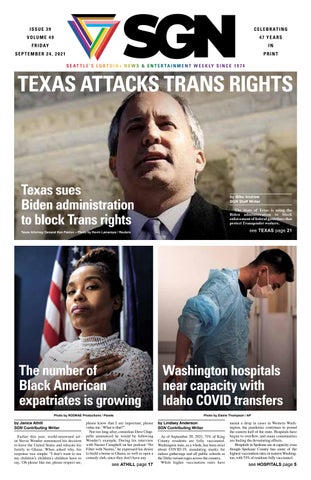
TEXAS ATTACKS TRANS RIGHTS
Texas sues Biden administration to block Trans rights
by Mike Andrew SGN Staff Writer The State of Texas is suing the Biden administration to block enforcement of federal guidelines that protect Transgender workers.
see TEXAS page 21
Texas Attorney General Ken Paxton – Photo by Kevin Lamarque / Reuters
The number of Black American expatriates is growing
Washington hospitals near capacity with Idaho COVID transfers
Photo by RODNAE Productions / Pexels
by Janice Athill SGN Contributing Writer Earlier this year, world-renowned artist Stevie Wonder announced his decision to leave the United States and relocate his family to Ghana. When asked why, his response was simple: “I don’t want to see my children’s children’s children have to say, ‘Oh please like me, please respect me,
please know that I am important, please value me.’ What is that?” Not too long after, comedian Dave Chappelle announced he would be following Wonder’s example. During his interview with Naomi Campbell on her podcast “No Filter with Naomi,” he expressed his desire to build a home in Ghana, as well as open a comedy club, since they don’t have any.
see ATHILL page 17
Photo by Elaine Thompson / AP
by Lindsey Anderson SGN Contributing Writer As of September 20, 2021, 71% of King County residents are fully vaccinated. Washington state, as a whole, has been strict about COVID-19, mandating masks for indoor gatherings and all public schools as the Delta variant rages across the country. While higher vaccination rates have
meant a drop in cases in Western Washington, the pandemic continues to pound the eastern half of the state. Hospitals have begun to overflow, and many communities are feeling the devastating effects. Hospitals in Spokane are at capacity, even though Spokane County has some of the highest vaccination rates in eastern Washington, with 53% of residents fully vaccinated.
see HOSPITALS page 5
WE’RE HIRING!
SGN SALES ASSOCIATE SGN (Seattle Gay News) is seeking a highly motivated experienced Sales Associate to sell advertising for our independently owned LGBTQIA+ newspaper. SGN is well established as the third oldest LGBTQIA+ publication in the nation. It is a well known resource and has a rich history throughout the community. The SGN is looking to expand and thrive in the Seattle area and beyond. This position will require a knowledge base of the product and how it benefits the advertisers. Candidates must have the confidence to seek and identify prospective customers, generate new leads, prepare sales agreements and the ability to close the sale. Qualifications: • 2-5 years experience in Seattle area sales interfacing with decision makers via phone, email and in person • Strong organizational, verbal and interpersonal skills • Candidate will possess a flexible, independent schedule • Self motivation is a necessity
Compensation and Benefits: • Compensation begins with an hourly training at $18/hour. Following training, the candidate is compensated based on a generous sales commission. This position provides versatility. The Sales Associate can set their own hours; merging home based work with outside sales calls. COVID-19 precautions • Remote interview process • Personal protective equipment required (masks) • Social distancing guidelines in place • Virtual meetings To apply please email your resume to ajcraginsgn@yahoo.com or mail to: SGN 3019 Duportail St. #106 Richland, WA 99352
GREEN CARDS • VISAS • ASYLUM • CITIZENSHIP 1836 Westlake Ave N, Suite 302 Seattle, WA 98109
(206) 724-1940 olivielaw.com
THIS AD SPACE HAS BEEN GENEROUSLY DONATED BY KRISTIN COSTELLO IN MEMORY OF SGN PUBLISHER GEORGE BAKAN
2
SGN
SEP TEMBER 24, 2021
C E L E B R AT I N G 4 7 Y E A R S!
In this Issue
LOCAL NEWS 5 A&E • FILM • BOOKS 7 OP-ED 17 NATIONAL NEWS 19 INTERNATIONAL NEWS 21
VISIT US ONLINE SGN.ORG
SEP TEMBER 24, 2021
SGN
3
Obituary
Remembering Dr. Esteban Ryciak 1943–2021 Dr. Esteban Ryciak was a dedicated practitioner of naturopathic medicine at his office in Pike Place Market for 39 years. It was his life’s mission. Dr. Ryciak treated anyone and everyone that came to his door, with means or without, as if they were a member of his own family — with kindness and compassion. He put his heart and soul into his practice, his patients, his students, his family, and everyone whom he encountered. His devotion to caring for others was remarkable. He was a dedicated single dad when there were few single dads. He was a doctor who made house calls when few others did. He fought tirelessly to help improve the health not only of his patients but of all those in need, especially those mistreated or marginalized by mainstream society. Fluent in Spanish, Dr. Ryciak took great pride and care in treating Seattle’s Latino community. He was a passionate doctor known to push the envelope and was quoted many times as saying, “If we’re all thinking the same, nobody is thinking!” In the 1970s he founded the Latin American Clinic in Costa Rica, and started his own line of herbal medicines. As a graduate of the first class of John Bastyr College of Naturopathic Medicine, now Bastyr University, he stayed on as faculty during its early years. He was integral in gaining reimbursable naturopathic care
for patients in Washington State in 1996, and in 1998, he was named “Physician of the Year” by the Washington Association of Naturopathic Physicians. He also helped to found and co-direct the Sombrero Club, a community medicine clinical training program for naturopathic medical students. Dr. Ryciak was an influential and appreciated medical voice through his regular HIV/AIDS column in the Seattle Gay News during the ACT-UP era. During the AIDS crisis in the 1980s, he was one of the first doctors to care for and touch his patients with AIDS, demonstrating both his knowledge and his compassion. Dr. Ryciak showed the same rare level of care during the COVID-19 pandemic, and it ultimately cost him his life. He was a strong proponent of receiving the COVID vaccine. Dr. Ryciak was an extraordinary individual who forged his own path with such force that it is hard to believe that he is gone. He will be deeply missed. He is survived by his daughter Maritza Ryciak, whom he lovingly raised as a single father, and his grandson Wylie Benjamin.
4
SEP TEMBER 24, 2021
SGN
A memorial in his honor will be hled from 6 to 7:30 p.m. on September 29, 2021 in Pike Place Market, at the foot of Stewart St., near his long-standing naturopathic medical practice. RSVP at https://bit. ly/3lJT0aq.
Photo courtesy of the family of Esteban Ryciak
C E L E B R AT I N G 4 7 Y E A R S!
Local News
A patient in Idaho – Photo by Kyle Green / AP
HOSPITALS
continued from cover Its proximity to Idaho is one of the main culprits. With northern Idaho just a 15-minute drive from Spokane, many Washingtonians had been crossing the state border to escape strict COVID guidelines and socialize mask-free. Now, it’s Idahoans turn to cross the border, as hospitals in the state have begun outsourcing patients to already overcrowded hospitals in eastern Washington, exhausting what little supplies and treatments they already had. Hospital floors previously used for other patients are now being turned into makeshift COVID wards at Sacred Heart Hospital after the original floor filled up.
Despite the county averaging above a 50% vaccination rate, many vaccinated patients have contracted the virus as a result of rampant exposure throughout the community. The effects of this new surge are devastating. Hospitals are reserving the limited treatments and life-saving resources they have for the direst of situations. For many, this treatment comes too late. Politicization and delayed treatments The pandemic has been heavily politicized, and nowhere is this more evident than in Eastern Washington and Northern Idaho. Eastern Washington politicians like Sen. Cathy McMorris Rodger and Spokane Mayor Nadine Woodward have voiced their dissents with state and federal mandates but have reluctantly obliged.
With the arrival of the Delta variant and the possible Mu strain, Eastern Washington is on the verge of a crisis. How Idahoans handle the virus will mean life or death for many residents of Spokane. Idaho, on the other hand, has fought tooth and nail against mandates. It refuses to enforce mask-wearing, lockdowns, or social distancing and is now going so far as to challenge President Biden’s “Path Out of the Pandemic” action plan. On Tuesday, September 14, Idaho Gov. Brad Little
Crisis in Idaho may spark one in Washington Idaho has now entered a crisis standard of care, which means there are no longer enough resources to care for everyone with serious medical needs. Washington hospitals have started being more selective in the Idaho transfer patients they accept, going from an acceptance rate of 90% to just over 50% to prevent hospitals in eastern Washington from descending into the crisis standard. Washington hospitals cannot refuse service to patients from Idaho, however. Federal law forces all hospitals to accept transfers until they reach maximum capacity. COVID patients from Idaho will continue to fill up Spokane’s hospitals for the foreseeable future until, ultimately, eastern Washington succumbs to the same fate as Idaho. With the arrival of the Delta variant and the possible Mu strain, Eastern Washington is on the verge of a crisis. How Idahoans handle the virus will mean life or death for many residents of Spokane. Nurses like Thompson are becoming increasingly worried for the future of the region.
Photo courtesy of St. Luke’s Health System in Idaho
VISIT US ONLINE SGN.ORG
announced that his state is now “committed to taking legal action to stop President Biden’s unprecedented government overreach into the private sector with his new COVID-19 plan.” The announcement came as more Idaho patients fill beds in Spokane hospitals. Now, Washington doctors are having to push aside locals facing other ailments. Providence Sacred Heart, another hospital in Spokane, has begun delaying procedures, such as brain tumor extraction and surgery for orthopedic patients, to provide care to the many COVID-19 patients coming in each day. “We are delaying care for people who are in misery,” Sacred Heart doctor Daniel Getz told the New York Times. “It’s agonizing for those patients. This has real impacts on these people who are waiting.”
SEP TEMBER 24, 2021
SGN
5
Arts & Entertainment
Intiman Theatre and BECU announce recipients of “Angels in Seattle” awards by Hannah Saunders SGN Contributing Writer Last weekend Intiman Theatre hosted its Homecoming Performing Arts Festival in Capitol Hill, during which the credit union company BECU and Intiman teamed up for the “Angels in Seattle: Arts Advocates Awards,” which highlighted five Seattle-based artists for their extraordinary community-based work during the pandemic. The recipients were picked by Intiman Theatre, Velocity Dance Center, BeautyBoiz, Red Eagle Soaring, and Langston. They were also given $1,000 checks each for their work. The Angels in Seattle Awards were distributed on the first day of the festival, September 18. According to Intiman, their focus was to “honor the unsung heroes of the industry: arts administrators, arts educators, and artists working behind the scenes.” The following are the recipients: Alyza DelPan-Monley Alyza DelPan-Monley (she/they) is a Seattle-based dancer and choreographer who believes that dance can transform “awkwardness into awesomeness.” Velocity Dance Center chose DelPan-Monley for making dance more acceptable, innovative, and equitable. “Alyza is super active in the Seattle dance community, and they show up in a lot of ways — teacher, collaborator, director, choreographer, dancer, volunteer, sounding board, to name a few,” said Velocity Dance Center in a statement. “In all of these roles, they are a caring, curious, and imaginative being who is also a fierce advocate for open and equitable frameworks of art-making. We see them shaping processes that are making the Seattle dance community more innovative, more accessible, more fun (!!), and more loving. Thanks for your work Alyza — we love you.” DelPan-Monley teaches movement workshops for all experience levels and age groups and choreographs musicals and flash mobs. DelPan-Monley focuses on forming processes that allow every individual to become their fullest selves through expression. She has choreographed the musical The Last World Octopus Wrestling Champion and co-directed a theatre ensemble production called Into the Deeps, which investigated socioeconomic and political constructs to create a funny yet riveting performance. Ana María Campoy Ana María Campoy (she) is a Mexican American educator, theatre artist, and advocate. Campoy currently works at the Arts Impacts’ Voices from the Field program as a theatre mentor. She also collaborates with public school teachers in migrant school districts across the state to highlight Latinx artists and cultural ways of learning and teaching. She also serves on the board for Sound Theatre and has developed numerous bilingual scripts for the Seattle Shakespeare Company, for which she has recently become an associate artist; her adaptation of Romeo and Juliet (Romeo y Julieta) premiered in the spring of 2021. A major community-based project that Campoy founded during the coronavirus pandemic is the volunteer-run group called “WashMasks,” which provides personal protection equipment, support, and advocacy for seasonal and migrant farm workers and their families, who are consistently exposed to high-risk situations due to the lack of safety gear.
6
SGN
(Clockwise from top) Ana María Campoy, Jess Chrivoli, Sefina Vailoa Aulei, Michael B. Maine – Photos courtesy of the artists
As WashMasks puts it: “Every meal we eat is made possible by farm workers who work regardless of heat, cold, rain, snow, and now a pandemic.” The website provides sample patterns for those interested in volunteering and creating face masks. Intiman Theatre picked Campoy as its “Angels in Seattle” recipient because “Ana María used her art-making space to create mutual-aid community hubs during the pandemic. Because of her dexterous thinking and bold heart, many mothers were able to celebrate Mother’s Day in abundance, and her mask distribution kept hundreds of WA farm workers safe. Thank you for all you do to keep our community safe!” Jess Chrivoli Jess Chrivoli is a visual performing artist, community organizer, activist, and advocate who recently received her master’s of social work from the University of Washington. Chrivoli is passionate about working with the Indigenous, 2SLGBTQ+, and disabled communities, and utilizes art to engage with and support healing, social and racial change, and community and cultural connections. “Red Eagle Soaring is pleased to honor Jess Chrivoli for her volunteer work at our Seattle Indigenous Youth Art & Performance Summer Workshop 2021! Jess helped with several things over the two weeks, including photography, set-up and cleanup, and more! She is a talented, reli-
SEP TEMBER 24, 2021
able asset to us and our youth!” said a statement from Red Eagle Soaring, a Seattle nonprofit serving at-risk Native youth through traditional and contemporary performance art. Michael B. Maine Michael B. Maine (he) is a Seattle-based artist who is troubled by how the media is assisting with the development of perceptions and behaviors of certain individuals. Maine uses photography, audio, and videography to address social injustice issues, with the hopes of creating media that’s better representative of human expressions and identities. Maine invests much of his time into the community by mentoring and volunteering — he even served as president on both the board of Reel Grrls, a youth media organization; and Business Ending Slavery and Trafficking, an organization dedicated to reducing sex trafficking. His current project is titled “We [Are] Out Here: Blacks Making History,” a photo series that celebrates Black people who are actively involved in their communities. Langston, a nonprofit organization for Black arts/artists and culture in Seattle, chose Maine as their awards recipient because “Michael is an artist, curator, photographer, web designer, videographer, advocate, and all-around good person. His work to uplift underrepresented voices and equip local artists — especially Black and
QTPOC artists — has made a huge impact on our communities. He’s the last person to highlight the many good works he does, so we’d like to show him some love.” Sefina Vailoa Aulei Sefina Vailoa Aulei is a 27-year-old Polynesian Transgender woman who grew up in the foster care system, and whose natural instinct is to nurture and support others. Aulei works for the grassroots nonprofit organization UTOPIA Washington as the program coordinator for the Sex Worker Empowerment Initiative (SWEI). UTOPIA Washington is a safe and supportive space for members of the Pacific Islander and LGBTQIA+ communities. The SWEI department is pro–sex work, offering PREP and HIV/STI testing in addition to case managers to assist with legal documentation. “Vai works tirelessly to support the LGBTQIA+ community by being a mentor to young queer people, with priority to young trans women of color, all over Seattle,” said a statement by BeautyBoiz, a project of Forward Flux Productions, a 501(c) (3) nonprofit live-arts production company. “Vai opens her heart and her home to our most vulnerable community members and shows up constantly, providing guidance and resources to people who need it. We want to say THANK YOU to Mother Essence for everything she does for BeautyBoiz and for the community at large.”
C E L E B R AT I N G 4 7 Y E A R S!
Alyza DelPan-Monley – Photo courtesy of the artist
VISIT US ONLINE SGN.ORG
SEP TEMBER 24, 2021
SGN
7
Arts & Entertainment
Vaccine or evolution? That is the question by Miryam Gordon SGN Contributing Writer VAXED Theatre9/12 Trinity Church Through October 3, 2021 A geneticist and an immunologist walk into a bar… and sit down and discuss the nature of humanity — Shakespeare and all! Charles Waxberg’s new play, Vaxed, is not shy about tackling a huge question. The 90-minute play takes a kind of scifi leap into a near-future where an immunologist, Ted (Tyler Scowcroft), thinks he’s discovered an essence that could change humanity forever. He’s called his sister Natalie (Cynthia Geary) to an “emergency” at 3 a.m., at which he plans to disclose this possible scientific result. After finding out that Ted has acted in incredibly illegal and potentially careerending way by stealing the remains of a failed vaccination subject, Natalie quickly dispenses with that horror and sits ready to find out why. This is one of a few leaps of theatrical writing in the play that might cause some to do a bit of eye-rolling. The dialogue makes it clear that his improprieties could even cause her to lose her career as a top geneticist with international credentials, yet oh well. They then debate the whole nature of humanity and whether it’s ethical or even necessary to change human behavior through vaccination, as opposed to “evolution.” Finally, Ted’s discovery is revealed as the reason for the 3 a.m. visit. It’s another device that ends up weakly justified to amp up drama. Our mental health and social well-being are completely disconnected to biological research, and, as yet, there are no DNA markers for anything connected to cultural behaviors. Is this an area ripe for scientific study beyond social psychology? What if we can find actual biological markers for pedophilia or depression, and eliminate them with an injection of the proper DNAcorrecting molecules the way we’re working on sickle cell anemia or cancer? Can we “eliminate” our way to a better humanity more quickly? Would a vaccine or
Our mental health and social well-being are completely disconnected to biological research, and, as yet, there are no DNA markers for anything connected to cultural behaviors. Is this an area ripe for scientific study beyond social psychology? Cynthia Geary and Tyler Scowcroft in Vaxed – Photo by Michael Brunk
injected biologic change-agent advance our collective health better than waiting for us to continue to stumble forward at the current glacial rate? Is a vaccination for social ills the same as a vaccination against smallpox or polio? It’s an intriguing idea to play with. The two actors do a fine job with their characters and are believable as brother and sister. Their dialogue is suitably intellectual for scientists, though for the sake of humor, I guess, there are some odd cultural refer-
ences thrown in, particularly by Natalie, that tend to derail the conversation and end up seeming completely out of character. Though short, the play still needs a significant trimming because its arguments are circular and repetitive. The “thought experiment” gets a bit tiresome once all the arguments are laid out. But it is “real” theater again — and it’s ready for you to sit and enjoy. And it could provide a fruitful argument on the way home.
8
SEP TEMBER 24, 2021
SGN
Note: Vaxed is being performed, indoors, at Trinity Church, the “home” of Theatre9/12. Presume COVID restrictions. I won’t refer to them in future, because we will have to take them as a given, that people will need to show their vaccination record or a negative test and be required to wear masks. We’ll be watching plays indoors, masked, for the foreseeable future. Theatre9/12 does all of that and includes very spaced-out seating to support distancing.
For more information, go to www.theatre912.com or call 206-332-7908. Discuss your opinions with SGNCritic@ gmail.com or go to www.facebook.com/ SeattleTheaterWriters. More such articles can be found at MiryamsTheaterMusings. blogspot.com.
C E L E B R AT I N G 4 7 Y E A R S!
Film
Vulgarly violent Copshop hits its pulp fiction targets
Gerard Butler in Copshop – Photo courtesy of Open Road Films
by Sara Michelle Fetters SGN Staff Writer COPSHOP Theaters Police officer Valerie Young (Alexis Louder) knew there was something strange going on when she arrested Theodore “Teddy” Murretto (Frank Grillo) for hitting her in the face. First off, it wasn’t a very good punch. Second, he was far too eager to be put behind bars. It’s a fishy situation, and Valerie is going to figure out what he’s up to. Things get even more bizarre when a drunken John Doe (Gerard Butler) sideswipes a pair of state patrol officers investigating a bullet-riddled abandoned vehicle in the middle of the Nevada nowhere. He’s now in the holding cell directly across from Teddy’s, and by the way he’s pacing across the
concrete, one gets the feeling he’s nowhere near as inebriated as he initially appeared. In the stupendously entertaining 1990s-style crime thriller throwback from director Joe Carnahan (The Grey, Narc), it’s no surprise whatsoever that Valerie’s suspicions about Teddy are spot-on. He’s stolen a great deal of money and doubledealt a wide variety of the wrong sorts of people, most of whom would be happy to see the man dead. As for the John Doe, he has a name, and it’s a lethal one: Bob Viddick, a grizzled killer who’s purposefully put himself in jail just so he can get his paws on Teddy’s throat. This is only the tip of the iceberg, however, because at a certain point, long after Valerie has started assembling all the pieces into a finished puzzle, she finds herself trapped next to Teddy and Bob on the cellblock, behind a locked, bulletproof
Gerard Butler, Frank Grillo, Alexis Louder, and Toby Huss star in director Joe Carnahan's action thriller Copshop door. It becomes a night of chaos as violence erupts throughout the police station, transforming this unlikely trio into uneasy bedfellows as they ponder joining forces in order to survive until dawn. It’s down-and-dirty stuff, overflowing in colorfully vulgar dialogue and kinetically bloody action sequences staged with stripped-down aplomb. Grillo and Butler chew the scenery with anarchic gusto, while newcomer Louder makes the sort of explosively memorable debut actors often dream of yet seldom achieve. While there
are few surprises, it’s still safe to say Carnahan’s handling of his and co-writer Kurt McLeod’s script, based on an original story by Mark Williams, is borderline perfect. As terrific as Butler, Grillo, and Louder are, it’s veteran character actor Toby Huss who steals the show. He plays fellow assassin Anthony Lamb, and his whack-a-doo, larger-than-life performance is nothing less than sensational. Huss is a cartoonish ball of manic energy, bouncing here and there like a gun-toting combination of Speedy Gonzales and the Road Runner. His level of evil is gloriously unclassifiable, all of which makes Lamb a memorably hissable villain one almost wants to root for no matter how heinously awful his actions frequently are. I love the crisp clarity of Carnahan’s action sequences. The director isn’t afraid of color, giving the cool blues and the dark, steam-filled depths of a locker room shootout more punch and pop than we typically see nowadays with all the desaturated digital tinkering too often seen in bigger-budgeted productions. Cinematographer Juanmi Azpiroz (Boss Level) lends his images a tactile solidity that’s refreshing, while editor Kevin Hale (Stretch) cuts things in a way that adds to each scene’s intensity and never subtracts from them by calling too much attention to his handiwork. The final throwdown is well worth the wait, as are the goofily, inventive final moments of toe-tapping creativity that happily end things on a positive note, even if the climactic fade-to-black purposefully keeps what happens next a delicious unknown. Copshop shoots up the screen with jovially pitch-black bravado, and considering how many pulp fiction targets Carnahan hits, I’m not going to spend a single second ruminating on the small handful he misses even while shooting at them at point-blank range.
Toby Huss in Copshop – Photo courtesy of Open Road Films
VISIT US ONLINE SGN.ORG
SEP TEMBER 24, 2021
SGN
9
Film
Breathtaking Wife of a Spy is a thrilling WWII marital melodrama
Issey Takahashi, Yû Aoi, and Masahiro Higashide in Wife of a Spy – Photo courtesy of Kino Lorber
by Sara Michelle Fetters SGN Staff Writer WIFE OF A SPY Theaters
Yû Aoi, Issey Takahashi, and Masahiro Higashide star in director Kiyoshi Kurosawa's period melodrama Wife of a Spy
Satoko Fukuhara (Yû Aoi) is the bubbly, carefree wife of successful Japanese businessman and amateur filmmaker Yusaku (Issey Takahashi). As an import-export merchant, he makes frequent trips outside the country. But on the eve of Japan entering WWII, after Yusaku returns from what was supposed to be a quick jaunt to Manchuria, it is clear to Satoko that her husband has come back a changed man. He’s secretive and tight-lipped, and while he says all the right loving things, he’s also suddenly keeping his wife at a certain distance. After being called into the local police precinct by her childhood friend Taiji (Masahiro Higashide), who is investigating the murder of a Manchurian immigrant woman, Satoko begins to put the pieces together regarding her husband’s suspicious behavior. There is a reason for Yusaku’s subterfuge. But even she is aghast when she learns the truth, though the secret Yusaku is concealing is so unimaginably heinous that his potential acts of treason against the military authorities begin to feel justified. It’s easy to call Wife of a Spy a Hitchcockian WWII thriller. You have a clueless heroine learning a devastating truth. A corrupt authority attempting to conceal an unfathomable crime. A beloved friend who may be a devious, unmerciful enemy. And, maybe most of all, a potentially duplicitous husband whose high-minded ideals may be more important to him than his own loving wife’s life. But while the parallels are all there, I think there’s a scene in acclaimed director Kiyoshi Kurosawa’s latest that’s a little more telling as to where his influences for this suspense-filled melodrama actually lie: Not knowing Taiji called his wife into the police station for questioning, an indifferent Yusaku asks her if she “enjoyed the latest Mizoguchi,” a reference to either The Story of the Last Chrysanthemum or the lit-
tle seen Naniwa onna, two of Japanese titan Kenji Mizoguchi’s masterworks released about the time Wife of a Spy is set. This is an important moment, not just for Satoko and Yusaku, but also because I think it’s a tip of the hat from Kurosawa as to where things are headed. Mizoguchi was
10
SEP TEMBER 24, 2021
SGN
Yû Aoi in Wife of a Spy – Photo courtesy of Kino Lorber
a subtly cutthroat filmmaker, utilizing the relatively benign auspices of melodramatic convention to cut to some extreme, deeply unsettling truths. It is here where Kurosawa lays his cards on the table, and even if most viewers are likely not going to notice, all of the wild twists and turns during the climax
are cleverly hinted at during this ostensibly innocuous conversation. Aoi is magnificent. Flippant and girly early on, her transformation into a defiant warrior with a backbone of steel happens so naturally, with such authentic grace, that I almost didn’t even notice. All of it — the flashes of fear, the looks of anger, the way her physicality changes when Satoko becomes increasingly resolute in the righteousness of the cause she will eventually bet her life on, even a finale where madness, grit, and not-so-bashful ingenuity seductively intermingle — is beautiful. Aoi delivers a performance worthy of celebration. For Kurosawa, this motion picture is proof the director renowned in the late 1990s and throughout the 2000s as a modern master of horror hasn’t lost an ounce of his creative acumen. While Wife of a Spy is about as far away from Pulse or Cure as you could get, the gifted filmmaker still creates a wickedly upsetting aura of tension and suspense whenever he sets his mind to it. When the secret of what happened in Manchuria is revealed, the heartrending terror of what Yusaku uncovered is undeniable. It’s nasty, distressingly chilling stuff. Taiji ends up being a little too onedimensional. Although there’s a wonderful scene between the officer and Satoko as they discuss Western influences on Japanese society over glasses of American whiskey, there was never any doubt how this guy was going to behave when push came to shove. This makes the final confrontations between Taiji and Satoko fall slightly flat, and if not for Aoi’s magnificence, I’m not sure their climactic interactions would have resonated with me at all. Not that I’m complaining. The last scenes have an ethereally haunting texture that is stunning, as all the themes residing at the center of the script written by the director and Ryusuke Hamaguchi (Happy Hour) merge into one in the same moment Allied bombs rain down upon a soon-tobe-defeated Japan. Kurosawa’s Wife of a Spy took my breath away.
C E L E B R AT I N G 4 7 Y E A R S!
VISIT US ONLINE SGN.ORG
SEP TEMBER 24, 2021
SGN
11
12
SGN
SEP TEMBER 24, 2021
C E L E B R AT I N G 4 7 Y E A R S!
VISIT US ONLINE SGN.ORG
SEP TEMBER 24, 2021
SGN
13
14
SGN
SEP TEMBER 24, 2021
C E L E B R AT I N G 4 7 Y E A R S!
Books
SGN Book Club: Carmilla, vampires, and the monstrosity of queerness by Lindsey Anderson SGN Contributing Writer As a child, I was always afraid of monsters. The mere notion of the paranormal would send shivers down my spine and leave me stiff. I feared ghosts, zombies, and werewolves, but worst of all, I feared vampires. A hemophiliac, I grew up in the wake of the Twilight boom. Babysitters and older cousins formed obsessions around sexy vampires, obsessions I never understood. I feared the sight of blood, especially my own. Just picturing a vampire sitting over my bed was enough to scare me into a paralyzed state of sleep for hours. So when the suggestion to read Carmilla, the original vampire novel, came to the SGN’s book club, I took it as a challenge, a fun way to revisit childhood fears and reassure my adult self that monsters are not real. I picked up my copy, edited by Carmen Maria Machado, from Elliott Bay Book Co. and immediately began reading. After two pages, I made a chilling discovery: Carmilla may not have been entirely fiction. What started as a fun vampire novel full of dark fantasy soon gave way to the reality that perhaps monsters do exist after all. With monsters just as tangible as when I was six, I began to wonder what we fear most about them. The answer seems obvious: vampires are so terrifying because they manipulate others with their charm, only to drain the blood out of their victims, leaving them to suffer the same miserable fate of immortality. It is the fear of the other: the fear that getting too close to them may also otherize us, and take away what makes us human. We fear vampires because they will turn us into monsters — but what makes us so sure we weren’t born monsters? We believe that the only way to become a vampire is to through a bite, but what if that isn’t true? What if some of us have always been vampires just trying to repress our monstrosity? Carmilla and monsters, then and today In the foreword, Machado reveals that Joseph Sheridan Le Fanu stole content from correspondence between an unnamed doctor and a woman who only marked her name as “V.” Historians believe “V” was Veronika Hausle, a well-off Englishwoman and suffragette. The titular Carmilla’s real-life identity was that of Marcia Marén, a SpanishCuban aristocrat. Hausle’s letters were said to be in the estate of author Le Fanu, who depicted the love V shared with Marén not as something sinister but as something beautiful, thus creating a story of self-discovery guided by an unlikely lover. Despite his possible plagiarism, Le Fanu includes much of the women’s love and romance in his final manuscript, giving readers a glimpse of intimate moments of affection between them. However, most of the novel derives its Gothic style from the idea that Laura’s suffering is due to her inability to resist a perverse and unholy temptation. Simply, Carmilla is a fairytale, warning readers not to give in to desires. While the novel leads readers to see Carmilla as a monster and root for her brutal demise to save the innocent Laura, the historical context yields a different, clear, and heartbreaking story. Marén was not a monster but rather a victim. Sodomy in England was punishable by death until 1861, and according to Machado, this was Marén’s fate. The mob of men with pitchforks and torches hunting down a “vampire” justified their real-life counterparts, bigots hunting down a woman who refused to comply with heterosexuality. The ending scenes of the novel drive home the message: the real monsters that exist — and continue to exist today — may not be vampires but rather those possessed by intolerance.
VISIT US ONLINE SGN.ORG
Illustration in Carmilla, vampire story by Joseph Sheridan Le Fanu (1872)
Carmilla may not have been entirely fiction. What started as a fun vampire novel full of dark fantasy soon gave way to the reality that perhaps monsters do exist after all.
Photo by Lindsey Anderson
SEP TEMBER 24, 2021
Carmilla was one of the first novels to open the doors to the Lesbian pulp fiction genre. Gaining popularity after WWII, these cheaply made novels were the first to depict women in same-sex relationships. However, due to government censorship, publishers had to make sure all characters “became heterosexual” by the end of the novel, went insane, or had a tragic death. These Lesbian pulp novels, like Carmilla, villainized homosexuality. They depicted Lesbians — but only with the message that such behavior would lead to moral decay and tragedy. These works solidified the fear of monsters. Humans had learned to fear monsters; then they learned to fear themselves, hiding who they were in an attempt to live a human life and escape the mob. We’ve come a long way from the days when an angry mob would chase down and murder a Lesbian with a stake, but the monster hunters from Carmilla do still exist, and modern adaptations only show how relevant they still are. In 2009, comedian James Corden starred in a loose film adaptation, Lesbian Vampire Killers, directed by Philip Claydon. The movie manages to simultaneously fetishize and demonize Lesbians, with Carmilla as the main antagonist. The vampire kills men and seduces women before turning them into members of her undead Lesbian army. The film unintentionally manages to make the same point as the novel: that queerness is synonymous with monstrosity and that Queer folks, like vampires, will turn others into monsters if they get the chance. The 21st-century adaptation of Carmilla also shows that patriarchal “monster hunters” remain just as powerful in institutions today. A reimagined feature film could have given her and Laura a happy ending or depicted queerness as natural. But in this world dominated by men, Lesbians remain as mysterious, scary, and misunderstood as vampires. The possible true subtext behind Carmilla gives the story a much deeper message and leaves the reader with an understanding that monsters have always existed. However, the question we must ask next is: if queerness and monstrosity are inherently linked, who conditioned us to fear monsters? Who are the monsters?
SGN
15
Books
Things We Couldn’t Say: A pleasantly surprising high school romance with heart
Things We Couldn't Say author Jay Coles – Photo by Victoria Ruth Photography
by Terri Schlichenmeyer Special to the SGN THINGS WE COULDN’T SAY JAY COLES © 2021 Scholastic $18.99 / higher in Canada 320 pages Sometimes, mostly when he didn’t need it to happen, Giovanni Zucker’s birth mother took over his thoughts. It wasn’t as though she was the only thing he had to think about. Gio was an important part of the basketball team at Ben Davis High School; in fact, he was hoping for a college basketball scholarship. He also had classes to study for, two best friends he wanted to hang out with, a little brother who was his reason to get up in the morning, and a father who was always pushing for help at the church he ran. As for his romantic life, there wasn’t much to report: Gio dated girls and he’d dated guys, and he was kinda feeling like he liked guys more.
16
SGN
Image courtesy of Scholastic
SEP TEMBER 24, 2021
So no, he didn’t want to think about his birth mother. The woman who walked out on the family when Gio was a little kid didn’t deserve his consideration at all. There was just no time for the first woman who broke his heart. It was nice to have distractions. Gio’s best friends had his back. He knew pretty much everybody in his Indianapolis neighborhood. And the guy who moved across the street, a fellow b-baller named David, was becoming a good friend. A very good friend. David was bisexual, too. But just as their relationship was beginning, the unthinkable happened: Gio’s birth mother reached out, emailed him, wanted to meet with him. She said she’d had “reasons” for abandoning him all those years ago, and her truth was not what he’d imagined... He was torn. There are a lot of pleasant surprises inside Things We Couldn’t Say. From the start, author Jay Coles gives his main character a great support system, and that’s a
uniquely good thing. Gio enjoys the company of people who want the best for him, and it’s refreshing that even the villains do heroic things. Everyone in this book, in fact, has heart, and that softens the drama that Coles adds — which leads to another nice surprise: there’s no overload of screeching drama here. Overwrought teen conflict is all but absent; even potential causes of angst that Gio might notice in his urban neighborhood are mentioned but not belabored. This helps keep readers focused on a fine, relatable, and very realistic coming-of-age story line. This book is aimed at readers aged 12 and up, but beware that there are a few gently explicit, but responsibly written, pages that might not be appropriate for kids in the lower target range. For older kids and adults, though, Things We Couldn’t Say offers plenty of reasons to love it.
C E L E B R AT I N G 4 7 Y E A R S!
Op-Ed
Photo by nappy / Pexels
ATHILL
continued from cover These two legends are following in the footsteps of other great Black artists (such as Billie Holiday, Richard Wright, Josephine Baker, and James Baldwin), intellectuals, and activists who left the US looking to escape the country’s crushing, oppressive nature. While this has come as a shock to a lot of people, these are not isolated incidents or exclusive to the rich and famous. American citizens leave the country for a number of reasons, including travel, adventure, and exciting careers, but in recent years the number of Black American expatriates of all kinds has surged. Why would anyone want to leave the land of the free and the home of the brave? Considering America’s unhealthy obsession with race, which contributes to Black communities’ negative image of themselves, it’s actually harder to find compelling reasons to stay. Black expats permanently living abroad all have their own reasons. Most have been driven away by discrimination and police brutality, but all of them with children agree that their lives aren’t something they are willing to gamble with. And unfortunately, raising Black children in America to adulthood is a gamble.
VISIT US ONLINE SGN.ORG
Why would anyone want to leave the land of the free and the home of the brave? Considering America’s unhealthy obsession with race, which contributes to Black communities’ negative image of themselves, it’s actually harder to find compelling reasons to stay. While there aren’t official statistics covering international transplants, the programs that have been developed to aid Black Americans who wish to relocate have seen a dramatic increase in their audience. Leaders in Ghana plan to implement policy frameworks on visa acquisition, as well as develop programs for citizenship, education, work exchanges, and residence and work permits for descendants of the African diaspora. New York native Sienna Brown founded a company in 2014 that helps Black American women emigrate to Spain. She says that it wasn’t until she had left the US to experience that country that she really got a sense of what freedom looks like. Brown’s company, Las Morenas de
España (“The Brown Girls of Spain”), has become one of the leaders in providing resources, training, and inspiration for women of color looking to relocate outside of the United States. From its start to 2020, it has worked with around 450 women in person and has built an engaged online audience of around 20,000. Black in Tulum, the first online community where Black travelers can come together for exclusive events and experiences, has grown from 25 members to 3,000 since last summer and is no longer the only Facebook group providing resources and information to help assist Black travelers wanting to emigrate from America. Blaxit Tribe, co-founded by Black in Tulum founder Nubia Younge, is
SEP TEMBER 24, 2021
specifically for Black Americans who want to move abroad; it currently has more than 7,000 members. It can be said that being an expat implies having left a nation that eventually wants you back. However, an expat’s sense of belonging becomes more complicated when you take into consideration America’s emphasis on race. Racism is not exclusive to America, but it is where its lethality is most prominent. Black Americans who have emigrated have done so out of necessity and self-preservation, and for the safety of their families, rather than pleasure or adventure. Those who did venture out were able to experience the freedom of simply being a person, without being Black occupying the foremost position — an experience liberating enough to prompt them to stay away. Some may ask, “Why move? Why not fight for equality here?” But they wouldn’t ask the same of another race fleeing tyranny in their home country. Racism is a 400-year pandemic that has plagued the Black American community. They have fought for, protested for, and demanded change to little or no avail. Now, slowly but surely, they are seeking the fruition of their American-born dreams — elsewhere.
SGN
17
Op-Ed
Poetry = Life Audre Lorde, 1934–1992 “Who Said It Was Simple” There are so many roots to the tree of anger that sometimes the branches shatter before they bear. Sitting in Nedicks the women rally before they march discussing the problematic girls they hire to make them free. An almost white counterman passes a waiting brother to serve them first and the ladies neither notice nor reject the slighter pleasures of their slavery. But I who am bound by my mirror as well as my bed see causes in colour as well as sex and sit here wondering which me will survive all these liberations. From From a Land Where Other People Live, ©1973 by Audre Lorde. Reprinted with the permission of the Charlotte Sheedy Literary Agency. Audre Lord – Photo by Robert Alexander
by Sharon Cumberland SGN Contributing Writer Audre Lord was a poet who described herself as “black, lesbian, mother, warrior, poet.” All of these are categories that suffer prejudice and fight battles. We all know that
race and sexual identity are social battlefields. But motherhood? Ask any working mom whose kid is sick. Warrior? Ask any demonstrator or union worker who speaks truth to power. But poet? That may not seem like a very contentious category. Do nature poets sit
on mossy banks throwing flowers at each other? Do spoken-word poets drink beers in bars, snapping fingers at each other? Ask the Yiddish poets in Nazi Germany, or the samizdat poets in Soviet Russia. Poets are word warriors, and Audre Lorde is one of the best. (Poets live forever — we
always speak of them in the present, unless recounting their histories.) Sharon Cumberland is professor emerita of English and creative writing at Seattle University.
Search for the soul of Seattle: Autumn in the Emerald City by A.V. Eichenbaum SGN Managing Editor There’s a part of me — maybe the same part that revels in gritty dime-store pulps — that clings to sadness like it’s a warm raincoat in a storm. I often find myself ruminating on the isolation of living in a city whose culture is so different from my home’s, a city where I have very few close friends, a city where the sky closes in on you in the dead of night and doesn’t let you up for air for months at a time. I’ve found comfort and protection deep in my own low-level misery. It’s not a proud realization. But all of that is for winter. It’s the dawn of autumn. And I love autumn in Seattle. The way sun shines unabashed, hanging like golden thread in the crisp morning air, brings a smile to my face. Walking out to the lake with a cup of coffee and feeling the world come alive in a season of change and death, I’m reminded of the impermanence of everything. Why am I so intent on making myself miserable? The thought crosses my mind in that slow, still-waking-up sort of way. We all end up worm food one day. Laughing out loud in public because of a bleak joke you made in your head is a fantastic way to reassure your neighbors of your sanity. I wave and smile at a concerned middle-aged couple in their puffy jackets eyeing me suspiciously.
18
SGN
“I’m a writer, it’s alright, I’m just like this,” is something I do not say. Instead, I move closer to the water. When I smoked, I spent many nights out here in this same spot, calming my nerves by destroying my lungs and looking at the clouds as they passed by the moon. It never gets too cold at night in September or October, something patrons of the dive down the street also recognize. I’ve crashed more Halloween-themed wedding parties than I care to admit, just by being in the right place with a cigarette. In autumn, Seattle sparks to life. Mystery and romance dance in the heart of every Seattleite as the days grow shorter. The old, haunted buildings playfully remind us of their ghost stories with every creak in the wind. It’s the only time of year the locals don’t complain about the weather. On top of that, it’s soup season. Who doesn’t like soup? I adjust my coat and stare into the sun on my way back up the hill. My hope is, by the time the gray starts to creep back into the skyline near December, I’ll have soaked up enough gold to last me through to spring. I go out of my way to step on a leaf. As the pieces of the leaf crumble, I smile to myself. Acceptance of impermanence. Nothing stays the same for long. I hope I remember this when night starts to fall at 4 p.m. There’s no point in holding onto misery for misery’s sake. The rain will stop eventually. Photo by Cole Keister / Pexels
SEP TEMBER 24, 2021
C E L E B R AT I N G 4 7 Y E A R S!
National News
HRC report: Increase in LGBTQ+ inclusivity in child welfare agencies across the US
Photo courtesy of HRC
by Hannah Saunders SGN Contributing Writer On August 26, 2021, the Human Rights Campaign (HRC) Foundation released a new report titled “2021 Change-Makers,” which details how child welfare agencies across the country have been increasing LGBTQ+ inclusivity. The report highlights the HRC’s “All Children, All Families” (ACAF) program, which partnered with 119 organizations this past year — a 19% increase from the year prior. The partnered organizations serve more than one million clients yearly and operate in 35 states. “The third edition of our Change-Makers report shows that, despite the many hardships of the last year, more organizations than ever before are working alongside the Human Rights Campaign Foundation to make impactful change for the LGBTQ+ youth and families they serve,” stated Alison Delpercio of the ACAF program. “This year’s participants also demonstrated a growing commitment to intersectionality and ensuring [that] organizational policies and practices do not reinforce the same systems of oppression that put youth and families at risk in the first place. By taking on these challenges, the change-makers featured in our 2021 report are models for youth-serving professionals everywhere.”. According to the report, LGBTQ+ youth — who are already at increased risk of negative experiences — are overrepresented in the US foster care system: approximately one in three. Additionally, LGBTQ+ youth in foster care systems report mistreatment, frequent placement disruptions, and being sent congregate care settings at greater rates. Tiers of recognition There were 32 new participating organizations this year, and the program expanded to Alabama, Connecticut, Mississippi, Montana, New Mexico, North Carolina, and the District of Columbia. Ninety-two percent of participating organizations met a tier of recognition, while 14 returning organizations advanced to a greater tier of recognition. There were 10 participating organizations that did not meet a tier of recognition. The “2021 Change-Makers” report features three tiers of recognition that highlight the progress organizations have made toward becoming more LGBTQ+ inclusive:
VISIT US ONLINE SGN.ORG
• For the “Building Foundation for Inclusion” tier, 25 participating organizations met the three benchmarks in place for their foundational criteria and for including nondiscrimination protections: nondiscrimination, staff training, and rolling out the welcome mat. • The “Solid Foundation for Inclusion” tier was met by 40 organizations that hit all six benchmarks for policy and practice regarding LGBTQ+ inclusion: nondiscrimination, staff training, rolling out the welcome mat, parent/CASA/exchange best practices, youth best practices, and sustainability and capacity building The organizations within this tier are generally developing long-term LGBTQ+ inclusivity practices. • For the “Innovative Inclusion” tier, 44 organizations met all six benchmarks mentioned above, in addition to providing at least one example of innovation in policy in practice. Organizations in this tier were recognized for going beyond to innovate the services provided to LGBTQ+ youth and their families. The organizations conducted internal self-assessments, which included participants reporting over 22,000 hours of professional development on LGBTQ+ inclusion, as well as over 7,000 hours regarding LGBTQ+ policies and practices. Out of the participating organizations: • 82 (69%) are in the private child welfare sector • 18 (15%) are part of CASA (CourtAppointed Special Advocates) • 12 (10%) are in the public child welfare sector • 7 (6%) are in the adoption exchange sector Out of the LGBTQ+ adults surveyed, 84% would consider adoption or foster care in the future, yet only 14% of those surveyed knew of an LGBTQ+-inclusive agency in their location. COVID-19 considerations “Social distancing requires new strategies for client engagement and creates new opportunities to ensure [that] clients [can] access services without encountering challenges related to their sexual orientation, gender identity, or gender expression,” according to a statement by ACAF describing key considerations regarding LGBTQ+ inclusivity in child welfare agencies and COVID-19. One priority of ACAF was to understand how COVID-19 affects LGBTQ+
LGBTQ+ youth — who are already at increased risk of negative experiences — are overrepresented in the US foster care system: approximately one in three. communities across the nation. Studies show that LGBTQ+ people have greater rates of COVID-related health complications, they are more likely to live in poverty, and had less access to sufficient medical care, paid medical leave, and basic necessities throughout the pandemic. Part of what ACAF did this past year was anticipate challenges that are unique to the LGBTQ+ community and develop an understanding of how to proceed. One example was how virtual meetings and discussions could pose some risk to a youth if they were still not open about their gender identity or sexuality to members of their household. Washington’s participating organizations and what they do In total there were six organizations from Washington that participated in ACAF’s LGBTQ+ inclusivity report: • Your Adoptive Family is a licensed adoption agency in Seattle that received a “Solid Foundation for Inclusion” tier of recognition. The organization supports adoption experiences from start to finish: preadoption support, home study, post-placement visits, and post-adoption support. The organization also offers therapy support for individuals and families, with specialties in attachment and bonding, trauma, and transracial adoption. • Amara is another foster care service in Seattle; it received an “Innovative Inclusion” tier of recognition. It is a nonprofit organization that partners with people and communities that are most affected by the child welfare system. Part of what Amara does is address trauma, build connections, and ensure that all families and their children feel safe and supported. Amara offers programs and services not only to families involved with foster care and adoption but also to adoptees and their families following the adoption. • Northwest Resource Associates is a Seattle-based foster care and adoption service that gained a “Solid Foundation for Inclu-
SEP TEMBER 24, 2021
sion” tier of recognition. The organization provides orientation, training, and support to current and prospective foster parents, as well as welfare, adoption, foster care, and victim services, and homelessness assistance. It also manages the national adoption photo listing website AdoptUSKids. • Community Youth Services (Foster Care) received a “Solid Foundation for Inclusion” tier of recognition by empowering at-risk youth and families to meet goals for stability, safety, belonging, and success through providing services and advocacy. Through CYS, one can become an adoptive or foster parent. The organization makes sure the adoptive or foster family can meet the child before placement, which creates better stability, longer placements, and youth success. The organization’s foster care serves those ages 6 to 21 years who are referred by Washington state’s Division of Children & Family Services. It also provides case management services, behavioral management support, case aide services, 24/7 crisis support, one-on-one training for foster parents, and other services. • Snohomish County Court-Appointed Special Advocates (CASA) is a volunteer program run through the county; it received a “Building Foundation for Inclusion” tier of recognition. The court appoints these special advocates for children in the foster care system, who then gather information and facts about the children, speak to people in the their lives, attend all court hearings for the child, and follow the case through until the end. As a child’s advocate, they will speak on behalf of the child and assist with making decisions that are in the child’s best interest. CASA volunteers must pass a criminal background check, engage in an in-person interview, and participate in over 30 hours of pre-service training. Snohomish County CASA is actively looking for volunteers. • The Chelan-Douglas CASA program received a “Building Foundation for Inclusion” tier of recognition. In 2020, they served 220 children with 88 active volunteers.
SGN
19
National & International News
Texas solicitor general to Supreme Court: Nix Roe v. Wade, LGBTQ rights while you’re at it
Photo by Tom Brenner / Reuters
by Mike Andrew SGN Staff Writer Texas Solicitor General Jonathan Mitchell has urged the US Supreme Court to overturn the landmark Roe v. Wade decision, which legalized reproductive choice, and to take the opportunity to also reverse key LGBTQ rights decisions – notably Obergefell v. Hodges and Lawrence v. Texas. Mitchell filed the brief in connection with a case now pending before the high court, a challenge to Mississippi’s restrictive new anti-abortion law. While plaintiffs in that case argue that the state law violates the Roe v. Wade ruling, Mitchell and other anti-choice activists want the court to toss the Roe decision altogether. Mitchell is known as the legal mastermind behind Texas’s own anti-choice law. “Women can ‘control their reproductive lives’ without access to abortion; they can do so by refraining from sexual intercourse,” Mitchell wrote in the brief. “One can imagine a scenario in which a woman has chosen to engage in unprotected (or insufficiently protected) sexual intercourse on the assumption that an abortion will be available to her later. But when
Mitchell suggests a decision to reverse Roe v. Wade could be used by the high court’s conservative majority to undo other precedents such as the right to have Gay sex and the right to same-sex marriage.
Jonathan Mitchell – Photo courtesy of The Federalist Society
this court announces the overruling of Roe, that individual can simply change their behavior in response to the court’s decision if she no longer wants to take the risk of an unwanted pregnancy.” In the same brief, Mitchell and co-counsel Adam Mortara, an anti-abortion activist and lawyer who clerked for the supreme court justice Clarence Thomas, said that
a decision to reverse Roe v. Wade could be used by the high court’s conservative majority to undo other precedents. Among these other prior rulings, which Mitchell characterized as “lawless,” he explicitly noted the right to have Gay sex and the right to same-sex marriage. Mitchell’s brief argues that although it’s not necessary for the high court to immediately overrule the legal cases that enshrine those rights, “neither should the court hesitate to write an opinion that leaves those decisions hanging by a thread.” Those cases — Lawrence, which outlawed criminal sanctions against people who engaged in Gay sex; and Obergefell, which legalized same-sex marriage — were “far less hazardous to human life,” Mitchell said but just “as lawless as Roe.”
National news highlights by Daniel Lindsley SGN Contributing Writer
Jared Polis (l) Marlon Reis (r) and Rabbi Tirzah Firestone Photo by Jocelyn Augustino / AP
20
SGN
SEP TEMBER 24, 2021
The abortion case the Supreme Court will hear this term centers on the legality of a Mississippi law that can ban abortion at 15 weeks’ gestation. Roe gives pregnant women the right to an abortion up to roughly 24 weeks, or the point at which a fetus can live outside the womb. The court’s decision to hear the case has alarmed reproductive rights advocates because it blatantly violates the standard set by Roe. Now, in the wake of Texas’s near-total abortion ban, the possibility that the court could overturn the constitutional right to abortion has come into sharp focus. Such a ruling could come in spite of polls that show most Americans believe abortion should be legal in most circumstances.
Boulder: First same-sex marriage for a sitting governor NBC reported on September 16 that Colorado Gov. Jared Polis has married his same-sex partner of 18 years, in the United States’ first same-sex marrirage for a sitting governor. “We are both excited for this new chapter in our lives together,” Polis said in a Facebook post, “and our hearts are full with the blessings of health, love, and family.” Polis is also the first Gay man elected governor in the US, but NBC noted that he isn’t the first LGBT governor. That title goes to Oregon Gov. Kate Brown, who identifies as bisexual and was elected in 2016.
Washington, DC: DOJ reviewing policies on Trans inmates The Associated Press reported on September 17 that the Justice Department is reviewing its policies on Transgender inmates, in the wake of the sentencing of Emily Claire Hari for the bombing of the Dar Al-Farooq Islamic Center in Bloomington, Minnesota. Hari identifies as a Trans woman. Trump-era DOJ policies, which are still in effect, would have the prison system “use biological sex as the initial determination” for placement in federal prisons, and only use gender identity “in rare cases.”
C E L E B R AT I N G 4 7 Y E A R S!
International news highlights by Daniel Lindsley SGN Contributing Writer
Salvadoran President Nayib Bukele – Photo by Jose Cabezas / Reuters Texas Attorney General Ken Paxton – Photo by Eric Gay / AP
TEXAS
continued from cover In a lawsuit filed September 20, Texas Attorney General Ken Paxton claims that the Equal Employment Opportunity Commission (EEOC) violated Title VII of the 1964 Civil Rights Act in outlining protections for Trans workers. The EEOC guidance, released June 15, says that employers must not prohibit Transgender employees from dressing in correspondence with their gender identity or using bathrooms, locker rooms, or showers that are consistent with their gender identity. In a statement, Paxton called the guidance “illegal” and an “unacceptable” attempt “to force businesses, including the State of Texas, to align with their beliefs.” “If the Biden administration thinks they can force states to comply with their political agenda, my office will fight against their radical attempt at social change,” Paxton said. Paxton also charges that the EEOC violated the First and Eleventh Amendments, as well as the Administrative Procedure Act, which specifies how government agencies issue regulations.
Defendants in the lawsuit include the EEOC, commission Chair Charlotte A. Burrows, and US Attorney General Merrick Garland. The EEOC declined to comment on pending litigation but said it will be represented by the Department of Justice, which also declined to comment. The EEOC guidelines were issued in June last year, following the US Supreme Court’s landmark decision in Bostock vs. Clayton County. In that case, the high court ruled that Title VII’s prohibition on discrimination based on “sex” covered sexual orientation and gender identity as well as biological sex. In a statement released with the new guidelines, the EEOC said the new rules “will make it easier for people to understand their rights and responsibilities related to discrimination based on sexual orientation and gender identity.” “All people, regardless of sexual orientation and gender identity, deserve an opportunity to work in an environment free from harassment or other discrimination,” Burrows said in a statement. “The Supreme Court’s decision in Bostock v. Clayton County is a historic milestone that resulted from the struggle, sac-
rifice, and vision of many brave LGBTQ+ individuals and allies who had championed civil rights for the LGBTQ+ communities.” Transgender Texans have long been a target of Republican state officials. In 2017, the state legislature attempted to pass Senate Bill 6, a “bathroom bill,” that would have required Transgender people to use bathrooms in public schools, government buildings, and public universities based on their gender assigned at birth. However, the bill failed to pass even during a subsequent special session. During this year’s regular legislative session, lawmakers introduced several bills targeting Transgender Texans, including legislation that would restrict Transgender student athletes’ participation in school sports and prohibit doctors from offering gender-affirming medical care. But neither of those measures made it to Gov. Greg Abbott’s desk. In all three special sessions he’s called since May, Abbott has made limiting Transgender student athletes’ sports participation a priority. No such measure passed during the first two special sessions. This year’s third special session started September 20.
El Salvador: President sticks to “original design” with recent bills Reuters reported on September 17 that the Salvadoran President Nayib Bukele has confirmed that a number of constitutional reforms sent to Congress will not include legalization of same-sex marriage, citing “original design” as justification. Bukele said he also excluded legalization of abortion. Reuters noted that El Salvador has some of the Americas’ strictest anti-abortion laws. Jose Miguel Vivanco, executive director of the Americas division of Human Rights Watch, responded on Twitter: “Just in case any dupe still thought Bukele was a modern leader.”
Photo by Kim Hon-Ji / Reuters
South Korea: Activists, report show systemic discrimination Reuters reported on September 14 that activists in South Korea believe the country’s lack of anti-discrimination laws is harming many citizens, especially LGBT youth. A report by Human Rights Watch said that public views of LGBT people in the country have been improving, but also that the South Korean government had not made any “real” progress in LGBT rights, “citing intense conservative and religious opposition to justify inaction.” Most notably, the report said that many schools have anti-LGBT policies, such as avoiding the topic of LGBT people in sex education, and funding mental health programs with counselors that discouraged students from being LGBT. Anti-discrimination legislation is pending in the National Assembly, and leaders of the ruling party have expressed their support. Official White House Photo by Adam Schultz
VISIT US ONLINE SGN.ORG
SEP TEMBER 24, 2021
SGN
21
It’s time to start healing. Open for general spa admission starting July 6!
Therapeutic massage ~ Acupuncture ~ Hydrotherapy Outdoor spa pool, sauna, sundeck and locker room are open for private rentals by appointment.
- Household pod of one to five persons 90 minutes for $150
- Solo Soak One person - 60 minutes (Tues/Wed only) for $50
Open Mon. - Sat., 10am-8pm
Sacred Rain Healing Center
1100 NW 50th St. Seattle ~ 206.789.6288 ~ sacredrainhealing.com ~ info@sacredrainhealing.com
22
SGN
SEP TEMBER 24, 2021
C E L E B R AT I N G 4 7 Y E A R S!
VISIT US ONLINE SGN.ORG
SEP TEMBER 24, 2021
SGN
23