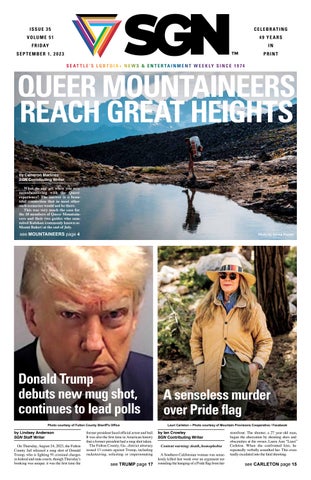
What do you get when you mix mountaineering with the Queer experience? The answer is a beautiful connection that in most other such scenarios would not be there.
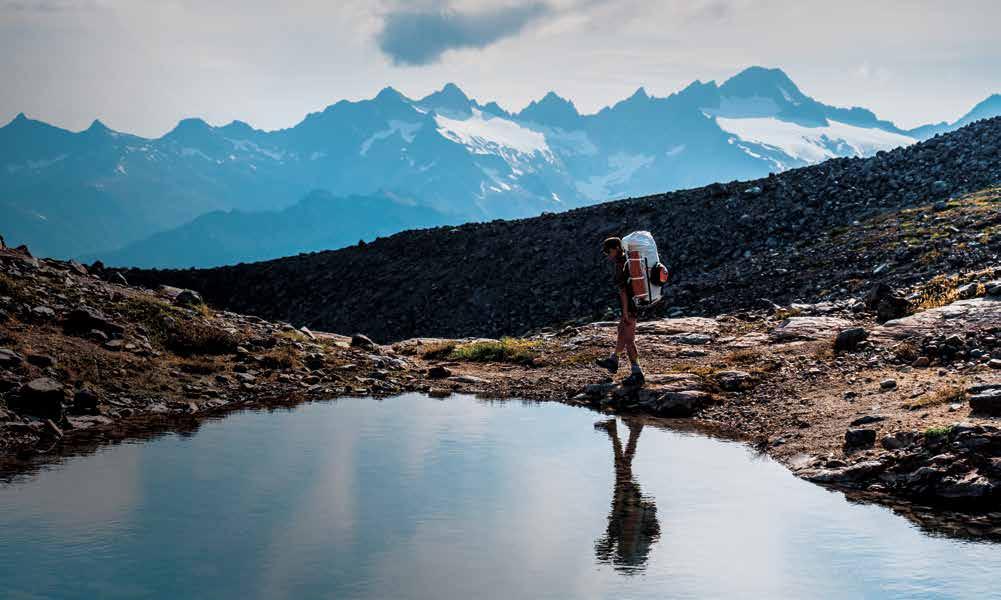
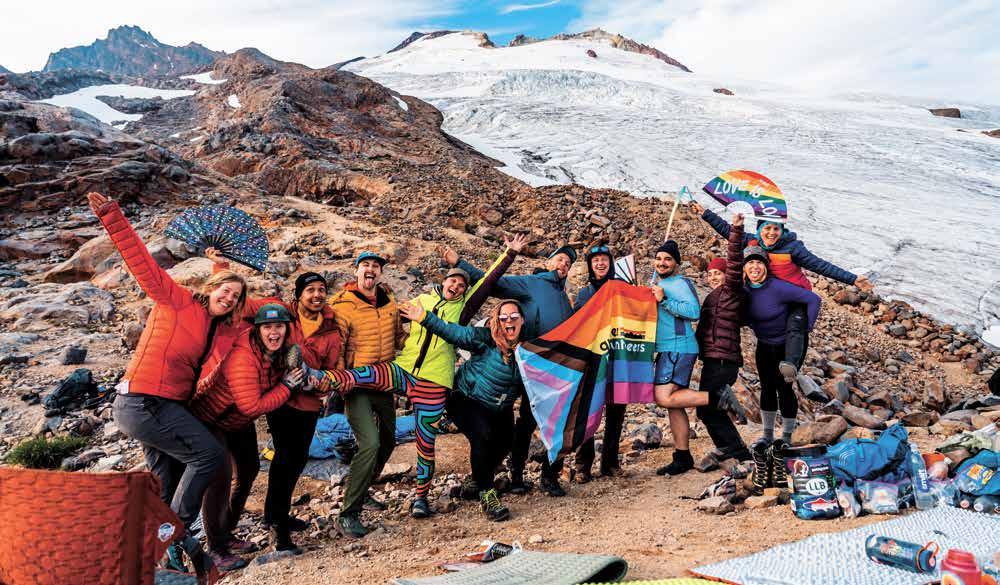
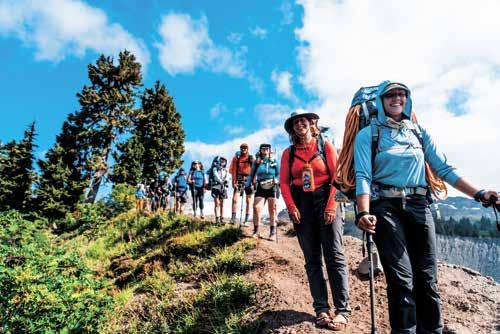
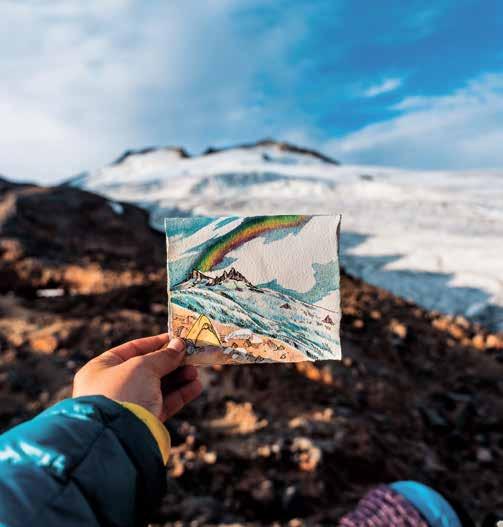
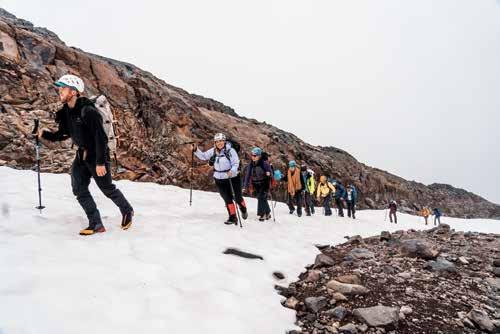
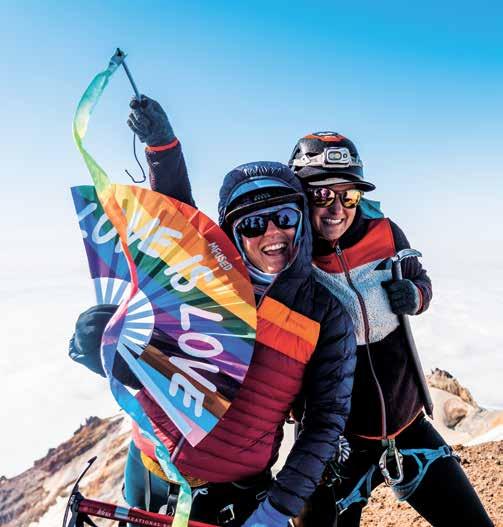
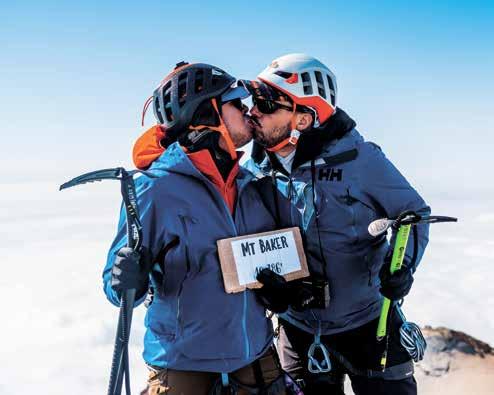
This was very much the case for the 10 members of Queer Mountaineers and their two guides who summited Kulshan (commonly known as Mount Baker) at the end of July.
see MOUNTAINEERS page 4
by Lindsey Anderson
SGN Staff Writer
On Thursday, August 24, 2023, the Fulton County Jail released a mug shot of Donald Trump, who is fighting 91 criminal charges in federal and state courts, though Thursday’s booking was unique: it was the first time the
bail.
by Ian Crowley SGN Contributing Writer
Content warning: death, homophobia
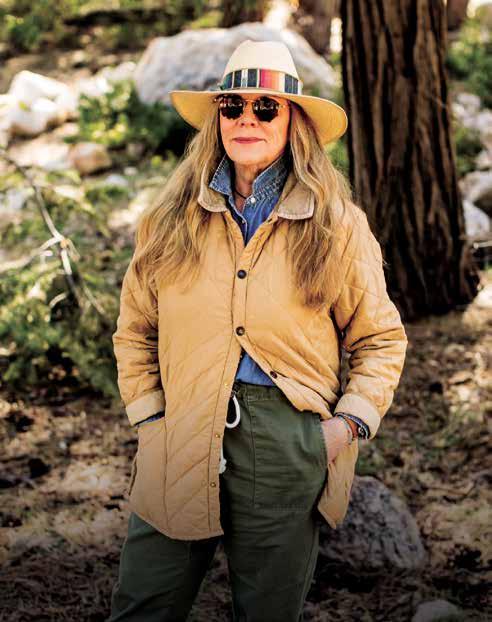
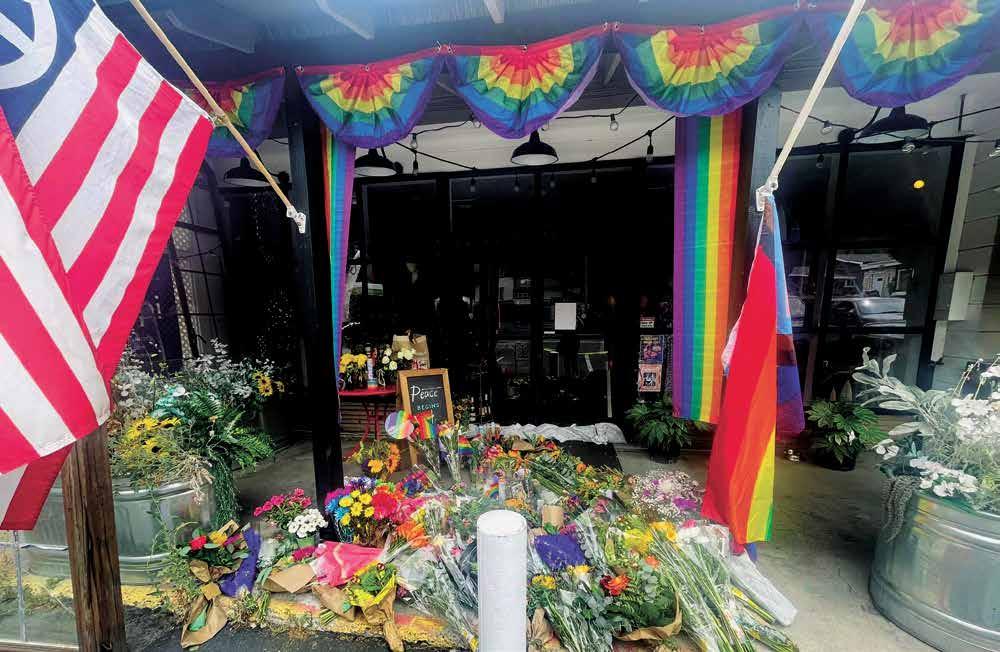
A Southern Californian woman was senselessly killed last week over an argument surrounding the hanging of a Pride flag from her
storefront. The shooter, a 27 year-old man, began the altercation by shouting slurs and obscenities at the owner, Laura Ann “Lauri” Carleton. When she confronted him, he repeatedly verbally assaulted her. This eventually escalated into the fatal shooting.
Photo courtesy of Fulton County Sheriff's Office
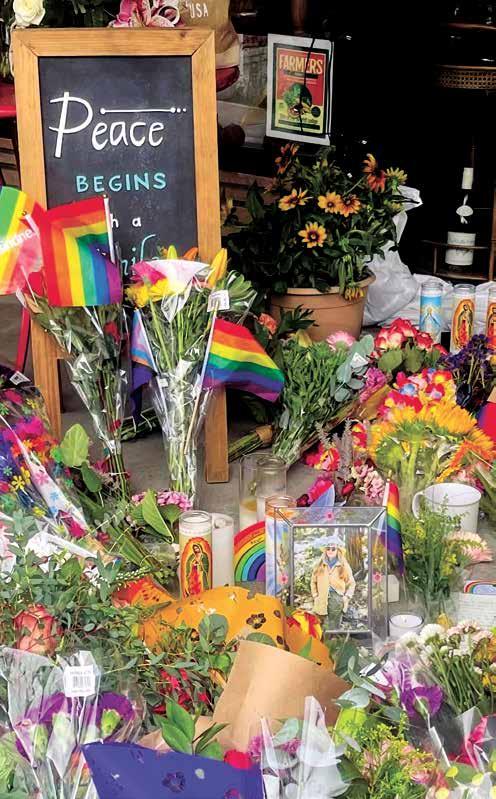
Lauri Carleton – Photo courtesy of Mountain Provisions Cooperative / Facebook
Photo by Sarina Pizzala
Local News
MOUNTAINEERS
“A lot of us [were] strangers and then became a team on the mountain,” said Queer Mountaineering co-founder Sarina Pizzala when asked about the Kulshan climb. “I think having that affinity space helps build a lot of trust from the beginning and make people more comfortable and more vulnerable and [creates] a better space for learning and [being willing] to do something hard to get there.”
Preparation
The planning process for the climb lasted around nine months. In that time, Pizzala and Jude Glenn, the other cofounder, created a scholarship program for those who would not usually be able to afford to climb a mountain. According to Pizzala, these courses typically run $2,000-4,000 per person, plus a couple thousand dollars for gear.
While the experience was marketed for beginners, this did not mean that anyone who hikes would feel comfortable participating. The Queer Mountaineers website recommends doing a hike a week on which you work up to carrying a 20-30-lb. bag for one to two months before the Kulshan climb.
During the preparation time, Pizzala and Glenn also completed the process of finding a guide who also finds Queer affinity groups important.
“[Our main guide Jack] reached out to 600 guys to try and find another guide for this course and got one response,” Glenn said. “Outdoor leadership is very much in need of representation and… through having courses like this, we can provide the training and accessibility... people need to [get] these skills to help teach other’s leadership. Hopefully, everyone who went on this course is inspired to pass along those skills or do more climbs.”
Photos by Sarina Pizzala
Episode 75: Sid Seedy
It's time for SGN's annual special issue on finance! Co-hosts Lindsey and Benny talk about the nuances of the wealth gap between Queer people and their straight counterparts, and about the veterinary technician shortage, Seattle's overloaded animal shelters, and the many resources out there for struggling pet owners.
Lindsey interviews local "dragabond" king Sid Seedy.
NEW EPISODES WEEKLY! FIND US WHEREVER YOU LISTEN TO PODCASTS!
MOUNTAINEERS
continued from page 4
A tough but warm experience
“[The day] we started climbing to the summit…every second, [there were] just happy tears …because for me, it’s just an emotional experience,” said William, one of the scholarship recipients. “I come from a small town in Texas, and just having a desire to climb mountains for years and finally seeing that come to fruition… was amazing. Definitely to Jude and Sarina, I owe so much thanks for the experience.”
William, like Pizzala and Glenn, felt that the outdoor affinity group was important because unfortunately, a lot of areas with outdoor opportunities also have people with anti-Queer mindsets. And climbing a mountain isn’t something you can do with people you don’t feel safe around.
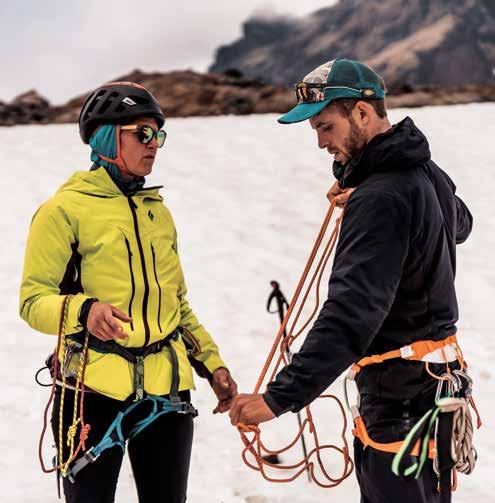
The entire experience lasted four days. Two were dedicated to waking up at 2 a.m. to climb up 10,718 feet almost entirely uphill while tied up to other teammates and passing deadly crevasses in the fields of glaciers. The other two days were spent learning how to use ice axes and bonding with team members.
“Some of [the crevasses are] big enough to eat up a house,” Pizzala said. “We have
to trust that the people we’re with have our best interest in mind, and our life is literally in their hands… Truly trusting your teammates in this scenario is really important. We’ve been very careful to cultivate within our community the teamwork aspect of everyone lifting everyone up and making sure that everyone [getting] safely off that mountain is the true objective, whether or not you make it to the summit. And so, I think that’s also what makes it such a [warm] experience for everyone.”
“I felt like we just developed like a nice little community out there on the mountains and [we] enjoyed that experience,” William added.
Joining the Queer Mountaineers Besides summiting volcanoes, the Queer Mountaineers also put on a variety of other events, including climbing nights; running, hiking, and ski events; social meetups; mountaineering workshops; and fundraisers.
The group has chapters in Seattle, Tacoma, and Portland with plans to also create one in Bellingham.
Those interested in joining the Queer Mountaineers should go to QueerMountaineers.com or check out its Instagram account @Queer.Mountaineers.
Photos by Sarina Pizzala
Seattle Rep opens the stage to the public in musical adaptation of The Tempest Arts & Entertainment
by Teddy MacQuarrie SGN Staff Writer
Staging a production of any of William Shakespeare’s plays is an undertaking best described as, well, Shakespearean. Aside from the practical considerations of scale and magnitude are the many layers of history, culture, and — let’s be real — pretense that have built up since the Bard last put quill to parchment.
When it comes to handling Elizabethanera verse with a 21st-century mindset, one is forced to say, in the words of the playwright, “Lord, what fools these mortals be!”
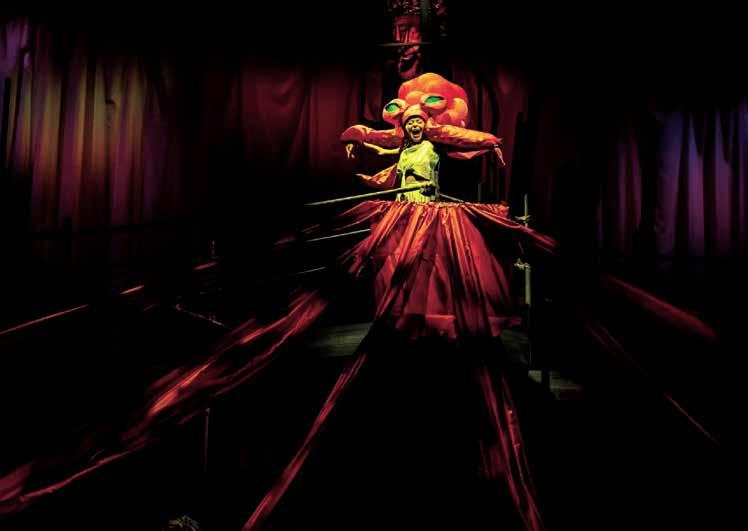
Thankfully, in light of the Seattle Rep’s The Tempest, its first live Public Works production since COVID-19 struck, the answer to that question is: very talented and passionate ones. It takes a lot of work, vision, and boldness to take a play steeped in all those layers of history and culture and revamp it to be not merely accessible, nor merely relevant, but a whole lot of fun.
Between the acting, costuming, and musical production, the Rep succeeded in doing just that.
Directed by Hattie Claire Andres, The Tempest tells the story of the wizard Prospero, whose sibling Antonio usurped his position as the duke of Milan and banished him to sea. Prospero and his daughter Miranda have found refuge on an enchanted island full of magical spirits, where Prospero plots his revenge by conjuring a storm to shipwreck Antonio on that very island.
Assisting Prospero is the indentured spirit Ariel, and working against Prospero is the half-human, half-monster Caliban. The play ends on a joyful note as Prospero not only fulfills his promise to grant freedom to Ariel but also forgives and pardons both Antonio and Caliban.
Isaiah Johnson led the production as Prospero. With a charismatic dynamism, Johnson animated the sorcerer as a force of
nature, the words of Shakespeare’s monologues flowing nimbly and with life. The subtlety and force with which Johnson delivers the line “These our actors, / As I foretold you, were all spirits, and / Are melted into air, into thin air” was electrifying. That Prospero’s magnificent costuming didn’t upstage Johnson’s performance is saying something.
Rachel Guyer-Mafune playfully channeled the trickster characteristics of Ariel,
at times having fun with the audience in fourth-wall-breaking interactions intended to provide useful exposition, which allowed the play to run a pleasant 90 minutes (a more standard, straightforward adaptation would easily run at least an hour longer). GuyerMafune’s performance invoked certain qualities of Stephanie Hsu from Everything Everywhere All at Once while succeeding in infusing a unique, fresh life all its own.
But for me, it was Alexandra Tavares’s
turn as Caliban that exemplified the ways this production brought fun and freshness to a play that deals with heavier themes, such as imperialism, colonization, and forced subservience. Tavares captured the physicality of Caliban with an uneven stagger, halfwalking and half-crawling at times. Tavares breathed speech into Caliban with an homage to Jack Sparrow, but also a more grizzled energy that still never failed to be comical when the time came for it.
Photos by Lindsay Thomas
At a surface level, I would be tempted to describe Caliban’s appearance as a mix between a homeless shiphand and the cat lady from The Simpsons, but after just a few moments, it became clear to me that everything about the portrayal was meant to encapsulate the spirit of the play itself — complete with a healthy dose of Pacific Northwest charm.
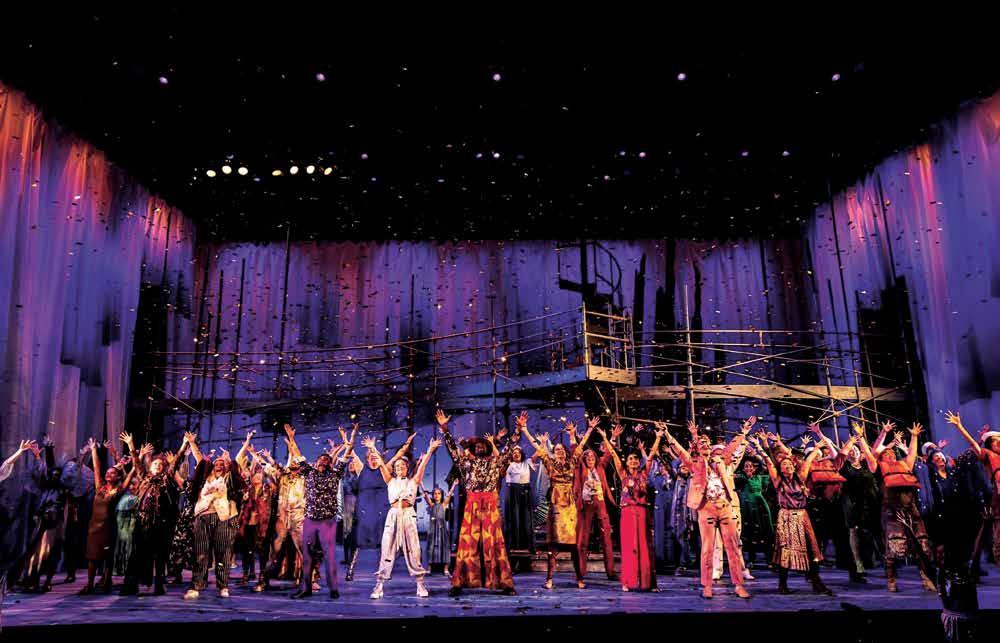
To watch all 60-plus cast members on stage during the larger musical numbers was a delight. The visual spectacle was a success largely due to costume designer An-lin Dauber’s Pacific Northwest–inspired pieces, which provided the set with color, life, and energy. The designs themselves were eclectic, some of which derived from imagery of the Hoh Rainforest, the San Juan Islands, and the Washington coast. Performers from Morning Star Korean Cultural Center added to the musical and visual beauty, helping to bring to life elements of magic and the storm.
Looking back on the Rep’s production of The Tempest, I’ll remember most the way that the vision of public theater brings together disparate elements and weaves them into something special. Talented actors, inspired direction, and beautiful costuming all converge to conjure a “tempest” of delight within a Pacific Northwest locale — complete with cameos from hockey mascot Buoy the Sea Troll, local singer Shaina Shepherd, and even, believe it or not, your favorite chicken, pizza, and coffee joints.
Bring it to the (drag brunch at) Runway
by Nemesis SGN Contributing Writer
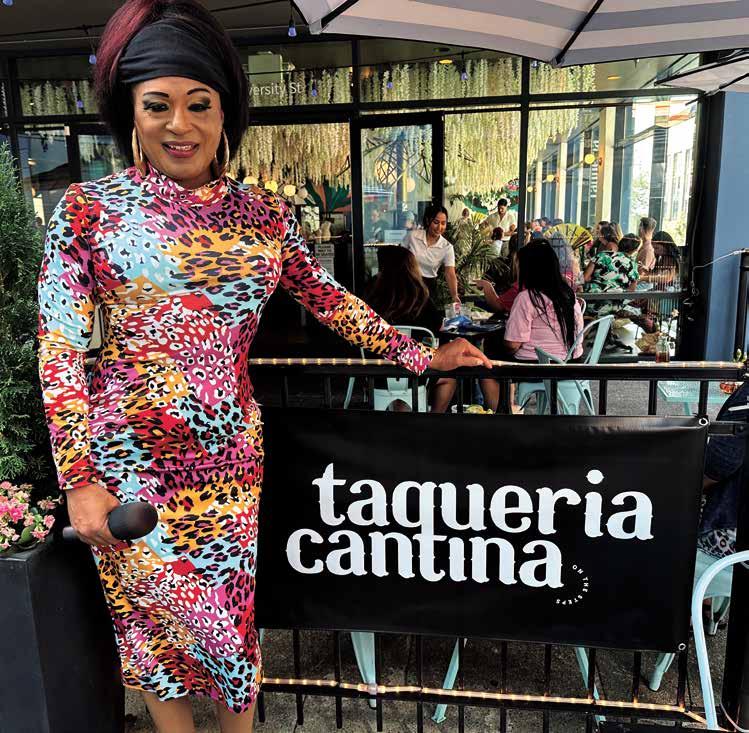
If you’re seeking a stellar weekend-afternoon activity, look no further than Seattle’s Runway drag brunch at Taqueria Cantina. Featuring DJ Vince Urban, a rotating guest list of entertainers, great Mexican food with a modern twist, and a delicious cocktail menu with over a hundred varieties of tequila, it’s an absolute treat to experience.
Taqueria Cantina’s downtown location is very accessible. Located by Pier 57, the building offers a paid parking garage with an elevator that takes you right up to the cantina. If you happen to be walking to brunch, there is an elevator on First Street that will take you directly down to the venue.
Daniel Ceballos, Brian Brandell, and Salvador Amezquita are the owners of this lovely establishment. They started this allages drag brunch over two years ago to “create a safe environment where everyone can experience what drag is, regardless of identity and age.”
It definitely delivers. The diverse set of entertainers, with different styles of drag, means there is something for everyone to enjoy.
The owners of the restaurant all agree that they are incredibly grateful for the support they have received, not only from the LGBTQIA+ community but from “everyone else that has an open mind to appreciate the art that drag queens bring” to their establishments.
Every facet of Seattle drag
The drag brunch, which originated at Taqueria Cantina’s downtown location — and is hosted and produced every Sunday by the seasoned legend herself, Ladie Chablis — later expanded to the Belltown location, where every Saturday, Belltown Babes is hosted by Drew and Jessica Paradisco.
The brunch truly showcases every facet of Seattle drag. Drag queens, kings, and things are all celebrated and welcome to perform. This Sunday’s lineup featured Moltyn Decadence, Londyn Bradshaw, Dion Dior Black (Seattle’s top bearded queen, carrying the title of National Bearded Empress Renaissance), Jayla Foxx, and Reign Ferrah James.
Diversity is not always present at drag shows, but Chablis makes a point of it: five out of the six (counting Ladie Chablis) are queens of color
Moreover, Chablis has been an integral part of Seattle drag and the community at large for decades, nurturing and fostering talent in all of its stages and forms. The brunch is another prime example of her love for the Seattle Queer scene, providing opportunities for entertainers who far outumber the chances to perform. Ladie Chablis truly embodies what it means to be an icon.
I would like to include a few very important guidelines. Tipping is mandatory: it takes a lot of money to make quality drag possible, and most drag entertainers are extremely underpaid. Tip the staff too — they work very hard to make every brunch run smoothly. And most importantly, consent is mandatory. Drag entertainers are like exotic birds: look but don’t touch unless explicitly stated otherwise.
You can catch the Runway drag brunch with Ladie Chablis every Sunday at 89 University St., Seattle, WA 98101 at 12:30 p.m. Drew and Jessica Paradisco’s fabulous Belltown Babes brunch takes place every Saturday at 12:30 p.m. at 2630 First Ave., Seattle, WA 98121. You can make reservations online at https://rsvp. taqueriacantina.com.
Film Racing drama Gran Turismo takes one wrong turn after another
by Sara Michelle Fetters SGN Staff Writer
GRAN TURISMO
Theaters
Gran Turismo is not based on the influential and incredibly successful PlayStation video game series of the same name. Does the game play a part? Of course it does. But this “based on a true story” sports melodrama owes more to The Rookie or to Bend It Like Beckham than to Tomb Raider or Resident Evil, making it a grounded character study with flashes of realistic racing action and not an over-the-top, plotless piece of kinetic nothingness.
If only said plot was worth a darn. While what happened to Jann Mardenborough is undeniably astonishing, that does not mean his story deserved such a blasé, rudimentarily straightforward cinematic retelling. Director Neill Blomkamp (District 9) and writers Jason Hall (American Sniper), Zach Baylin (King Richard ), and Alex Tse (Watchmen) do precious little to shake up genre conventions. In fact, they follow the Rocky template so closely that this could almost be considered a second or third-tier knockoff, which is honestly a shame.
Ambitious Nissan marketing executive Danny Moore (Orlando Bloom) comes up with the novel idea of launching a global competition to find the next great race car driver. The catch? These potential contenders are all going to be Gran Turismo gamers. Launched in 1997, the game is the most authentic racing simulator on the market, and Moore believes he can find a youngster with the skills, determination, and athleticism to sit in the driver’s seat of a real car and win real races out on the international circuit.
Enter Jann Mardenborough (Archie Madekwe). He’s a 19-year-old Brit from a working-class family who loves Gran Turismo and dreams of becoming a champion racer. While his former soccer star father Steve (Djimon Hounsou), now working at an industrial railyard, urges his oldest son to set his sights on something more practical, Jann knows he has the stuff to win this competition.
But sitting behind the wheel of a real car is far different than playing a video game, and this kid has a lot to learn before he has
any hope of ever setting a single step atop a championship podium.
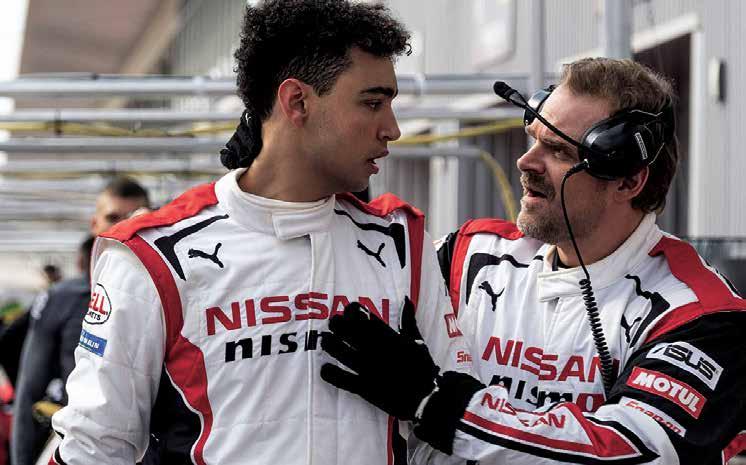
I have no idea how closely the writers follow Mardenborough’s actual path to superstardom (from what I understand, plenty of liberties were taken), but even if this film was note-by-note and beat-by-beat authentic, that would not lessen how unsurprising everything turns out to be. Even the picture’s best character, the totally fictional former racer Jack Salter (David Harbour), is manufactured from a mountain of ripe clichés, and this sadly means that much of his speechifying, on-track antics and well-intentioned mentorship falls frustratingly flat.
What does work, however, is Harbour’s performance. Every scene he’s involved with has energy. It has pizazz. There is a spark of uncertainty that rumbles underneath the surface every time his character is around, and considering that much of the film’s second half rests squarely on Salter and Mardenborough’s relationship, that
means most of the film’s 134-minute running time. Harbour takes the clichéd role of the grizzled, disillusioned former-proturned-cantankerous-mentor and makes it sing, and in the process almost makes this humdrum piece of half-baked pabulum worthwhile all by himself.
The truly annoying thing? The primary reason the reasonably strong performances don’t elevate the picture is that, other than for a couple of noteworthy sequences (including one stunning crash), the racing ones are not very good. For an innovative visualist like Blomkamp, this isn’t just shocking, it’s borderline inexcusable. I’m not asking for the action to rise to full-on Cinerama 70mm awesomeness — John Frankenheimer’s 1966 melodrama Grand Prix already has that covered — but could we at least get something as good as, say, Tony Scott’s Days of Thunder or James Mangold’s Ford v Ferrari? That’s all I’m asking for.
But unfathomably, Blomkamp drops the
ball. All of the racing either is over much too quickly, showcases no sense of drama or pace, or is completely devoid of anything approaching viscerally kinetic energy. The drone shots have no rhythm. Most of the remaining visuals are no more exciting than what you’ll see during a random Formula 1 broadcast on ESPN — sometimes even less interesting than that.
I’m also mad that the film wastes Hounsou. While I’m not going to come down too hard on the script for pushing the father-son story into the deep recesses of the background, I will say that having an actor of this caliber vaguely stalking around the periphery is a massive missed opportunity. Hounsou delivers one magnificent monologue right at the end, but instead of being this rousing, cheer-worthy moment between Jann and Steve, it’s instead only another in a long list of wrong turns Gran Turismo irritatingly takes, one right after another.
Gran Turismo – Photos courtesy of Columbia Pictures
Eunnie to debut new Sapphic graphic novel Books
by Lindsey Anderson SGN Staff Writer
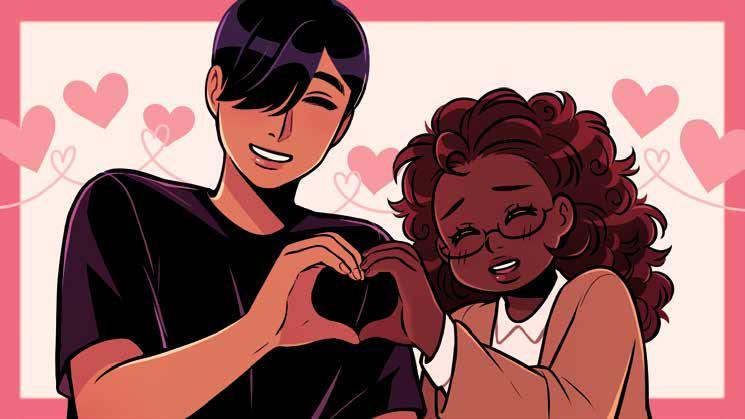
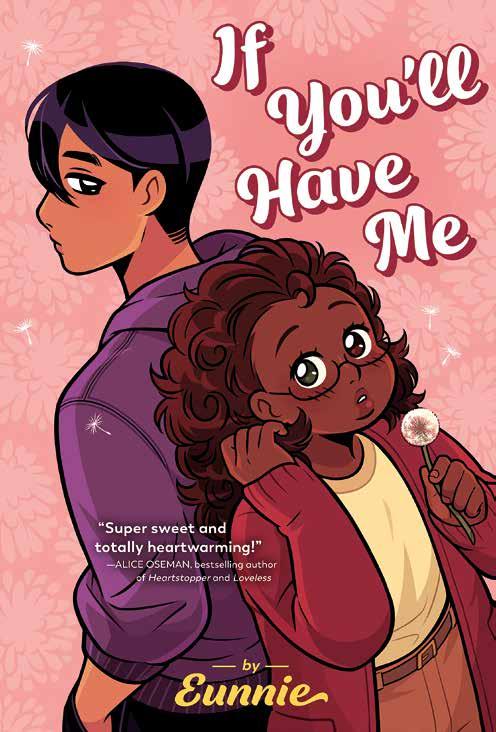
Though readers can devour a graphic novel in just a day or two, creating these artistic works can be daunting and often takes years. That was the case for debut author Eunnie, who wrote, drew, colored, and inked her first graphic novel, If You’ll Have Me.
The idea for the plot, a soft romance between two young women, came to her when she was in college. At first, the characters were just doodles she enjoyed. “Drawing is my first love, and I love drawing people and character interactions,” she said. “The more I drew these girls in particular, the more I started thinking about their personalities and backstories.”
As Eunnie (who goes by one name) continued to draw her original characters, she developed their personalities more. Soon, it became clear that they had a story she wanted to tell.
“At the time, when I made these characters, I just really wanted to draw two girls in love, with the dynamic of one being a bit shy and introverted and the other being more cool and laid back,” she said. “I know I wanted it to be a love story. At the time, I had these things on my mind, like communication, friendship, and intimacy, and I wanted to put all these things I was thinking about and all the things that I love into the story, the things that are important to me.”
A long process
At first, Eunnie thought she might make it a web comic, but as a busy college student, she didn’t have the time or energy to sit down and draw. “It turns out I need someone to hold me accountable, because I kept saying, ‘Yeah, I’ll make a comic, I’ll make a comic with them,’ but I never did until I got my agent,” she said with a laugh. “She was the one who encouraged me to follow the story.
“It was going to be much shorter, like five chapters, but after thinking about it more and talking about it with my editor, I expanded it a lot. I think it’s in a good place now for their story.”
By the time Eunnie found her editor, she had already tried to start the comic several times. She even took an independent study semester to focus on it. After her editor suggested a Sapphic romance, she was ready to start writing.
“By the time I got to make it a reality, I already had some material,” Eunnie said. Because she already had the characters and plot developed, she was able to make a lot of progress on the graphic novel in a short amount of time.
Eunnie spent over a year and a half writing. “I did have to cut back a lot. The original script was 475 pages,” she revealed. Had the novel been as long as she originally planned, Eunnie would still be working on it today! Per her editor’s suggestion, she decided to cut it down.
“That was for the [best], because I would have died if it was that long,” she said.
Once she finished the script, she started sketching the story, which took about three more months. The character designs are inspired by popular anime styles, with soft, round features and cute, exaggerated eyes. “I am very inspired by [Korean] manhwa and [Japanese] manga and that sort of thing,” Eunnie said. “I like shoujo manga [Japanese comics for young adult women] and anime, so I always like drawing rounded shapes. That translates to the characters that I gravitate towards. Honestly, it’s vibes only. That’s my philosophy for all of it: color, style, and everything.”
She spent the next six months coloring, inking, and adding final artistic touches to the project. “From sketching to inking to coloring, it took about nine months,” she said. “Yeah, the time it takes to carry a baby — this was my baby. It was a long-form project, and this was my first time working on something of this length and scope.”
Actually creating a graphic novel was much harder than the web comics Eunnie is used to making. “When I’m working on an illustration, I can just do whatever I want in whatever order I want. But now, having to do one thing at a time, it was rough,” she admitted. “I like doing things out of order in an illustration. I have to do this before I lose interest. If I get bored with this one thing, I will move on from it and never come back, but I couldn’t do that for this one. That was a little bit of a challenge, but I did it somehow.”
Queer joy and coming out
For Eunnie, writing a Queer love story was essential. She wanted to write such that the characters could fall in love without questioning their sexuality or coming out. “I think those kinds of stories are still beautiful and meaningful, and we’ll always need them, but I remember at the time wanting [one] where it wasn’t an issue at all, especially in contemporary romance,” she said.
“This came about as a desire to see more Queer joy and Queer romance [that’s] not tragic… [with] a happy ending. I think it would be less meaningful if they weren’t Queer, especially on a personal level, [in terms] of what I want to portray with these characters and the idea of representation.”
Writing a Queer romance gave Eunnie the space to contemplate her identity. With the help of her characters, she was able to come out.
“Throughout making this book, I realized that I was also a Lesbian,” she said. “I remember laying in bed awake at night, constantly thinking about this story, how much it meant to me that they were girls in love, and how much I wanted to show my love for girls in this book.
“At one point, I sat back. I was rethinking everything I had done in my life and all the art I’d made. I was like, ‘I think this means a lot more to me than I thought.’”
Writing characters with confidence in their identities helped Eunnie build confidence in herself. “Looking back on it now, I wonder if that’s why I wanted to see characters who are confident in their sexuality, characters who never had to state it outright for other people to understand. They just are who they are. Maybe that’s the kind of existence I was yearning for too?”
She hopes readers can take away the same sense of confidence and Queer joy she got from creating the characters in her book.
“Queer people are pretty familiar with this angst that comes from being who you are,” she said. “I think they are already familiar with the struggle of being Queer, not only your internal struggle but also external with family and your loved ones — and then there’s the level of the government and all of this, which is just the reality we live in.
“I think having reminders that you can still have happiness even in these circumstances gives us a reason to live. It’s something you can hope for, to stay hopeful for, because if you’re in a dark place, how else can you keep moving forward if not with reminders that this kind of hope and love exists?”
Can’t get enough Eunnie?
Eunnie is already working on her next book. “If people are a fan of my one comic called Pink in the Night, which was a lyric comic to one of Mitski’s songs, and also a piece titled Another Life, which is two women staring at their past selves in a painting,” she
said, “then I think they will like what I’m working on right now. That’s the best way I can explain it. It is another Sapphic story, and I’m always excited about that.”
However, fans may have to wait a while before it hits shelves. Those who don’t want to wait nine more months for her next literary baby can explore some of Eunnie’s work online: she releases original art and web comics on her social media accounts @eunnieboo on Instagram and Tumblr.
If You’ll Have Me will be available on October 15 in bookstores across America.
Images courtesy of Penguin Random House
Small Town Sins an emotional workout
Useful and informative books on fires and wildfires Books
If a wildfire happens in your area, what do you do? How do you keep your family safe? Reach for these great books and start learning...
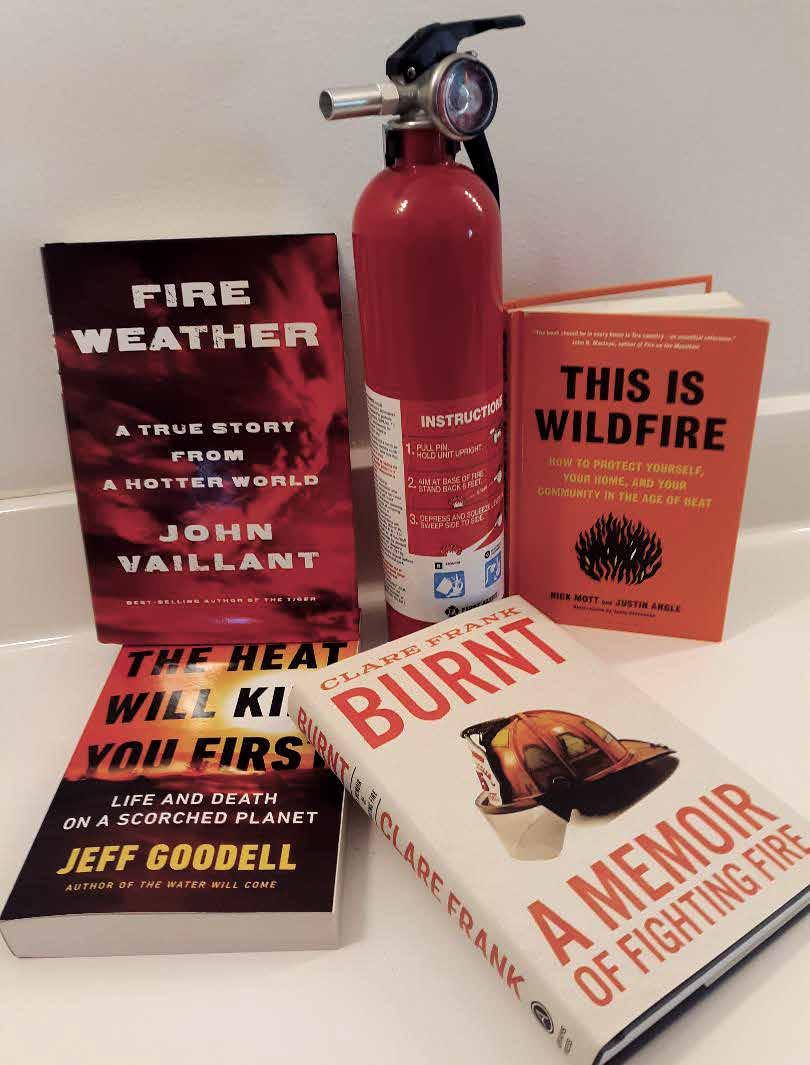
Humans wouldn’t be where we are without harnessing fire millennia ago. We need fire — but not like this. In Fire Weather: A True Story from a Hotter World (Knopf, $32,50), author John Vaillant tells the tale of a 2018 wildfire in the center of Canada’s oil industry, and how nearly 90,000 people had to run for their lives in that ultra-flammable area. But that’s only part of the story he tells: the other part is that it could happen again...
Indeed, says Jeff Goodell in The Heat Will Kill You First (Little, Brown, $29.00), we live in a world that’s different now than it was even just a few decades ago. The seasons are skewed, he says, temperatures are higher, crops are affected, pests seem to be taking advantage of it, and it’s only going to get worse. Think you need more air conditioning? Read this fascinating book first. What is it like to be someone who battles a fire? In Burnt: A Memoir of Fighting Fire by Clare Frank (Abrams Press, $27.00), you’ll read about being a female firefighter in what was traditionally a man’s world. She lives in Northern California and has been battling blazes since she was 17 years old; this book will take you from a spark of idea to a passion and a job she loves. It’s a story of risk and responsibility and of enormous courage, and you’ll love it.
Finally, how can you be sure that you, your family, and your home are safe from fire?
This Is Wildfire: How to Protect Yourself, Your Home, and Your Community in the Age of Heat by Nick Mott and Justin Angle, illustrated by Jessy Stevenson (Bloomsbury, $27.99), is a great way to begin, with solid ideas you can implement now and explanations for things you may not quite understand. Learn the history of fighting wildfires, what happens when one is spotted, how to lower their risks and keep your home safe, and how to understand the jargon used by professionals. What happens when you need to leave quickly, and what might you face when you’re allowed to go back to your home again? No matter where you live — country or city, dry area or one that’s green — this book is a great, and almost absolutely mandatory, reference source.
And if you need even more, head for your local bookstore or library and ask for help from the knowledgeable person there. Your librarian or bookseller will figure out what you need, and they’ll put the right book directly in your hands, so you know what to do this fire season.
Nathan Stoltz was the kind of guy that other people rarely noticed.
An only child, he’d always lived on the edge of life: though people in Locksburg, Pennsylvania, knew him, they didn’t see him, and that was fine. It gave Nathan a lot of leeway, and he got away with things like stealing and hocking his mother’s wedding ring to pay for an abortion for a girl he slept with exactly once.
He lived with guilt for that for a long time. When he met and married Paula, he still felt bad, but he never told her about it, because they had enough problems. When he found a bag of money in a burning house while he was saving a man’s life, he wanted
to keep that quiet, too. He just figured the cosmos had finally forgiven him.
Callie, a co-worker of Paula’s at the local hospital, knew Paula had something on her mind — but then, so did Callie. A teenage girl came to the hospital one evening with advanced cancer, and her fundamentalist parents were ignoring what their daughter wanted. The girl told Callie that she hoped to see the ocean before she died.
Callie had many medical issues as a child, and it literally scarred her. She knew what it was like to have dreams unfulfilled. And so she devised an audacious scheme...
Not long before the teenager was admitted, around the time a badly burned man came to the hospital, Andy lost his daughter to a Down syndrome–related disease, and his wife to an overdose. Everything he ever loved was gone, and he wanted to join them in death — until he found a purpose that almost killed him.
How would your life change if a couple million bucks landed in your lap? That’s the stuff of dreams — or nightmares, or stories like Small Town Sins
You can just imagine a tiny community like Locksburg; you might even know one, although author Ken Jaworowski doesn’t dwell on the town itself. Just know it’s the dying kind of place people move to but not from. It’s the kind of a place where dreams go to lie down before they die — which might sound dreadfully depressing, but it’s really not.
Happily, Jaworowski’s characters keep this tale from becoming a drudge; they’re genuinely likable people who do surprising, sometimes funny, sometimes stupid, sometimes heartbreaking things, and your emotions will get a workout. If your book club can handle a bit of profanity, this is a novel that will really spark discussion.
Image courtesy of Henry Holt
Courtesy photo
Carleton was described by many close to her, including her daughter, as a defender of LGBTQ people, despite not being Queer herself. The Pride flag she flew in front of her store served as a symbol of that support.
According to coworkers of Carleton, she was adamant on never taking the flag down.
“She would say…this is the hill I’m going to die on. No one is going to make me take down that flag,” the wife of a coworker told the Associated Press. In addition, her daughter told CNN that “[Carelton] was so fearless, and any negative reaction she just powered through.”
This mindset was displayed the night she died, as she actively pushed back against senseless hatred.
Anti-LGBTQ+ violence
Carleton’s murder is undoubtedly connected to a wider epidemic of violence against LGBTQ+ people and those who support them.
Carleton wasn’t attacked over a disagreement, but for showing solidarity with a group that is excessively targeted and misunderstood. Simply supporting the Queer community was enough for the shooter to move beyond speech and commit real-world violence.
This wasn’t the only incident of deadly violence waged against Queer people this summer, either. Recently, O’Shae Sibley, a 28-year-old professional dancer and Black, Gay man, was killed while voguing — a style of dance invented by Queers of color in the Harlem ballroom scene — in the parking lot of a gas station. A group of men began shouting racist and homophobic insults at the man and his friends before stabbing Sibley, killing him. The only “offense” committed by Sibley and his friends was the mere existence of Queer joy expressed authentically, unafraid of judgment or (God forbid) retaliation.
These and other incidents are reflections of a general trend of fast and slow violence directed toward LGBTQ+ people, part of what the Human Rights Campaign calls a national state of emergency for LGBTQ+ Americans (https://www.hrc.org/campaigns/ national-state-of-emergency-for-lgbtqamericans).
Violence enforced with legislation
It isn’t hard to see why violence of this type would be spiking, considering the political landscape of Queer issues today. There is no shortage of legislation targeting LGBTQ people being proposed and passed. Bills proposed by the Christian right are attempting to make it increasingly difficult and illegal to be Queer. This is especially true for Trans people, who have been targeted in particular the past 5-10 years.
All of this reinforces a mentality of disregard and dehumanization. Not to mention, without proper legal protections, isolated incidents of violence become legitimized. Plus, since there currently isn’t a consensus on comprehensive, necessary protections for the community, it is easier for nonQueer people to become complacent and ambivalent about violence.
Only when clear stances are taken to protect vulnerable communities do the general public’s attitudes shift to outrage about obvious injustices. As unfortunate as it is, these changes are necessary for those who aren’t exposed to Queer people’s lives and tragedies to understand why legal protections are necessary. While Lauri Carleton understood the need for these protections, those unaffected and unbothered to change their minds often require a larger legislative narrative for them to ostracize antisocial behaviors, like bigotry.
An exemplary ally
However, in the wake of all of this bad news and heartbreak, there are some good takeaways from this story. LGBTQ people online expressed love, gratitude, and support for Carleton and her family. Carleton was an exemplary ally, someone who despite not facing oppression directly, was clued in enough to express support in ways many turn a blind eye to. The Queer community at large is lucky to have been graced with her courage. We can only hope her bravery and kindness can send the message that we aren’t alone. Additionally, we can hope that the message that supporting Queer people is righteous will be received.
Photos courtesy of Mountain Provisions Cooperative / Facebook
CARLETON continued from cover
National News
Here’s what you missed in the first Republican debate
by Lindsey Anderson SGN Staff Writer
The first Republican debate was on Wednesday, August 23, 2023, in Milwaukee, Wisconsin. Eight candidates took to the stage to discuss their policy agendas and exchange a few barbs. The party’s frontrunner, former President Donald Trump, did not attend. Instead, he aired a previously recorded interview with disgraced former Fox News personality Tucker Carlson on X (formerly known as Twitter) and prepared for his latest indictment.
Meet the Republicans
Many of the candidates who did show up have been causing quite a stir. The most well-known was former Vice President Mike Pence, whose approval rating in his party dropped when he moved ahead with the vote to certify Joe Biden as the next president of the United States on January 6, 2021. Despite his vocal disapproval of Trump, Pence is running for more than just a chance to prevent the former president from taking office again. Inspired by his Christian faith, Pence hopes to restore a sense of morality many in the party believe is lacking in the United States.
Gov. Ron DeSantis of Florida, however, is considered the de facto front-runner. He has campaigned on promises to use the same tactics employed in his home state to run the country, a new brand of Republicanism that focuses less on small government and more on expanding executive power, which he has used to pass more regulations on education, LGBTQ+ rights, and immigration.
Nikki Haley, former United Nations ambassador under the Trump administration, claims to be a “political underdog” and was the only woman on stage. With previous experience as the governor of South Carolina, Haley is no stranger to politics. She is known for her positions on economic policy and intention to cut spending and boost profits for American businesses. Haley was also one of the few Republicans on stage who were vocal about leaving social and hotbutton issues, like abortion and LGBTQ+ rights, up to state governments.
Boasting over ten years in politics, Sen. Tim Scott, also of South Carolina, worked his way up from local positions to becoming a US senator in 2013. He is the only Black Republican in the Senate, though he does not center his race or discussion about race in his campaign. The cornerstone of his campaign rhetoric is the idea of the “American dream,” and he uses himself as an example of what any American can achieve if they are willing to “work hard enough” and “pull themselves up by their bootstraps.”
Former New Jersey Gov. Chris Christie was also present. His campaign is unique in that a desire to derail Trump’s has emboldened him to throw his hat in the ring. Like Haley, Christie is a pro-life Republican but believes the best strategy for stronger abortion regulation is to leave the matter up to the states. He also holds traditional conservative views on gender-affirming care and the war in Ukraine, supporting more legislative hoops for Trans people to go through and continuing to spend US money on foreign policy.
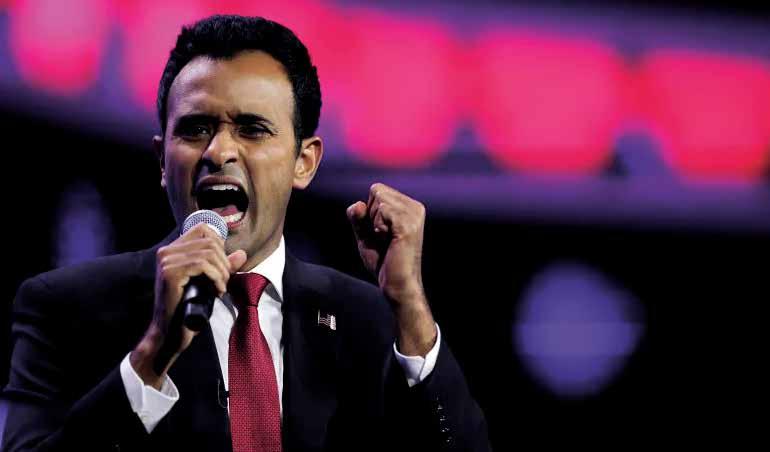
One face that may not be as familiar to the Republican Party was Vivek Ramaswamy. A political outsider and businessman, Ramaswamy initially made a fortune investing in faulty Alzheimer’s medication. At 37 years old, he is the youngest candidate; if elected, he would be the youngest president in US history. Like Trump, Ramaswamy uses his “political outsider” identity as a selling point, which conservative voters seem to glom onto. He has also positioned himself as a very far-right option and tended to stand with Trump whenever questioned about the legitimacy of his campaign.
For anyone wondering if Doug Burgum was even at the debate, the answer is yes,
he was. The tech entrepreneur turned North Dakota governor held to a low profile as louder candidates often overshadowed him. He raised his hand at one point to say he would still support Trump as the party’s nominee, even if Trump is convicted of multiple crimes (as did all the other candidates other than Christie and former Arkansas Gov. Asa Hutchison). Burgum is polling at less than 1% currently.
In fact, Hutchinson barely made it into the debate, due to low polling numbers. Like Christie, Hutchinson has vocally expressed disdain for Trump and was the only candidate to stand firmly against supporting Trump if he gets the nomination.
Candidates debate a national abortion ban
Many viewers noted that Wednesday’s debate felt akin to the pre-Trump Republican Party. Without the populist candidate on the stage, other Presidential hopefuls discussed policy issues such as abortion, climate change, and the economy without devolving into name-calling games and ad hominem attacks. In fact, for the first hour, hardly anyone even mentioned the former president.
A heated moment occurred between Haley and Pence when the latter suggested a federal ban at 15 weeks and pressed other nominees to agree to prioritize such as well. Haley, on the other hand, approached the issue with caution.
“I am unapologetically pro-life. Not because the Republican Party tells me to
be, but because my husband was adopted and I had trouble having all my children, so I am surrounded by blessings,” Haley began. “When it comes to a federal ban, let’s be honest with the American people — it will take 60 Senate votes and a majority of the House. Let’s find consensus.”
However, Pence stood firm on his antiabortion policy. “To be honest with you, Nikki, you’re my friend, but consensus is the opposite of leadership,” he jabbed.
“When the Supreme Court returned this decision to the people, they didn’t just send it to the states only. It’s not a states-only issue. It’s a moral issue.”
While Haley’s plea for a national consensus confused many viewers and outraged those on the far right, her stance also was a tactic to place herself closer to the middle of the political spectrum, suggesting that she could be a viable candidate if she were to make it to the general election. Pence’s strong stance for a national abortion ban, though likely unachievable, as Haley noted, may have also been a tactic to woo Iowa caucus voters, who tend to be evangelical Christians.
Ramaswamy calls for end to Ukrainian aid
Candidates also talked about where they stand on the war in Ukraine.
The shining star of the debate, Ramaswamy, made the bold claim that America should stop supporting the war effort altogether.
“I find it offensive that we have professional politicians on this stage that will make a
pilgrimage to Kyiv to help Zelenskyy without doing the same thing to help people in Maui or outside of Chicago or Kensington. I think we have to put the interest of Americans first,” he said.
Pence wasn’t afraid to spar with Ramaswamy and questioned why he would support Vladimir Putin by reducing aid to Ukraine. “[Putin] is a dictator and a murderer, and the United States of America needs to stand against authoritarianism,” Pence said to much applause.
Aside from Ramaswamy, most candidates were united in their foreign policy of “peace through strength abroad” approach.
DeSantis has previously spoken about the war in Ukraine not being in the best interest of the people of the United States, but he was not vocal about it in the debate. One of the reasons may be that DeSantis’ campaign has promoted him as the “reasonable” alternative to Trump. He is hoping to gain the support of the college-educated base that is less likely to support Trump and happens to have more money to give to campaigns. While he didn’t entirely condemn US support, he said that Europe should be pressured to give more to Ukraine, which the audience seemed to agree with. He also mentioned that US funds should be spent defending the southern border.
While Ramaswamy stood alone with his desire to pull aid from Ukraine, he isn’t alone in the Republican Party. Many conservatives share his view that aid to Ukraine is a waste of money and resources.
Photo by Jonathan Ernst / Reuters
Vivek Ramaswamy – Photo by Marco Bello / Reuters
Raise your hand if you believe in climate change
In one of the most dystopian moments of the debate, moderators Bret Baier and Martha MacCallum asked the candidates to raise their hands if they believe climate change is “manmade.” They responded with cagey answers, dodging the question left and right. DeSantis argued that prompting them to raise their hands was akin to a classroom (though most of the questions asked would be illegal to bring up in a Florida classroom).
No candidate would answer the question until Ramaswamy broke the ice. “Let me be clear,” he started. “I am the only person on this stage who is not bought and paid for, so I can say this — the climate change agenda is a hoax, and we have to disclose it immediately.” The crowd erupted in a chorus of boos and jeers at Ramaswamy’s assertion, but he continued. He also claimed that more Americans have died of “bad climate change policies” than climate change and that the “anti-carbon agenda is the wet blanket of our economy.”
Raise your hand if you’d roll over and let Trump scratch your belly
Halfway through the debate, the moderators asked candidates to raise their hands if they would support Trump if he won the nomination and were convicted. Nearly everyone did. Ramaswamy was the first
TRUMP
continued from cover
a public officer, and making false statements. The judge gave Trump and his 18 co-defendants until Friday, August 25, to turn themselves in or face arrest.
Trump’s high-profile co-defendants include attorneys Rudy Giuliani, John Eastman, Sidney Powell, Kenneth Chesbro, Jenna Ellis, and Ray Smith, and former White House Chief of Staff Mark Meadows. Trump wrote online that many of them “don’t have a lot of money, and some of them have almost nothing,” arguing that the charges and bail are unfair.
Despite claiming to be a billionaire, Trump has not offered to contribute to the legal defense costs of anyone charged alongside him.
On Thursday afternoon, he announced on his social media platform, Truth Social, that he would head to Georgia for his arrest. “I have to start getting ready to head down to Atlanta, Georgia [to] get ARRESTED by a Radical Left, Lowlife District Attorney, Fani Willis,” he wrote.
Before his arrest, a bomb threat was made at the Atlanta courthouse where he will later stand trial. The Fulton County sheriff responded to the threat immediately with a bomb squad and K-9 units. They did not detect any explosive devices.
Trump flew from his home in New Jersey on a private jet to Georgia, where a presidential-style motorcade escorted him to the Fulton County Jail around 7:30 p.m. ET. As he disembarked, he waved to onlookers, gave a thumbs up, and mouthed, “Thank you,” like a star walking the red carpet.
Booking and mug shot
The booking process only took about 30 minutes. He was fingerprinted and photographed for the now infamous mug shot.
The booking records officially listed Trump’s height as 6’3” and his weight as 215 lbs., which the internet quickly made fun of. Trump reposted an article mocking his alleged height and weight, seemingly unaware it was trolling him. The former president’s recorded weight Thursday was 29 pounds lighter than after his last recorded White House physical in 2020, which listed his weight at 254 lbs. The information was released online even before Trump arrived at the jail, leading many to assume that he, or a source close to him, submitted the numbers.
Following the events in Georgia on Thursday, Trump officially returned to X (formerly known as Twitter), whose owner, Elon Musk, had reversed the previous ban last November. His first post since January 8, 2021, was an image of his mug shot — the infamous orange snarl — with the captions “ELECTION INTERFERENCE” and
to shoot his hand into the air confidently. Next was Haley, Scott, and then Burgum. DeSantis looked over and then put his hand up as well. The crowd was cheering loudly. Pence also raised his hand. Christie and Hutchinson were the only two who did not say they would support Trump, though the former momentarily put his hand in the air.
Christie retracted his gesture a moment later, stating, “Whether or not you believe the criminal charges are right or wrong, the conduct is beneath the office of President of the United States,” to which many applauded. “Donald Trump said it’s okay to suspend the Constitution,” he continued. “Now, the oath you take is to protect and defend, not suspend. I will always stand up for our constitution regardless of the political pressure.”
Pence also took a moment to defend his actions on January 6. “I chose the Constitution of the United States, and I always will. I had no right to overturn the election, and Kamala Harris will have no right to overturn the election when we beat them in 2024,” he said.
Candidates danced around Trump, avoiding bringing him up whenever possible. As one pundit put it, “Trump was the ‘elephant not in the room.’” While they all hoped to woo Republican swing voters who opted for Biden over Trump in the last election, nobody, it seemed, wanted to alienate the Trump base, given the possibility that the
“NEVER SURRENDER!” Trump has also started using his mug shot to raise funds for his campaign.
Of trials and pardons
Trump’s attorney has said he will fight Fani Willis, the district attorney overseeing the case, over the trial date and is pushing for all his criminal trials to be postponed until after the 2024 election. If Trump is elected president, he could potentially grant himself a pardon.
Since no such action has ever happened, political experts debate whether or not the president could pardon himself. In 1866, the Supreme Court ruled that the presidential pardon “extends to every offense known to the law, and may be exercised at any time after its commission, either before legal proceedings are taken or during their pendency, or after conviction and judgment.”
While no former president has ever used a “self-pardon,” the Nixon administration did consider it. The acting attorney general at the time, Mary Lawton, concluded that the president could not pardon himself. “Under the fundamental rule that no one may be a judge in his case, it would seem that the question should be answered in the negative,” she wrote in 1974.
In 2020, Trump mentioned granting a “preemptive pardon” to himself and his family members due to concerns that charges would be filed against him after he left office.
“A very sad day for America”
Following his afternoon in Georgia, Trump boarded his plane again and returned to New Jersey. Before leaving the state, he gave a speech to reporters. “This is a very sad day for America. This should never happen,” he began. “If you challenge an election, you should be able to challenge an election.”
Trump insisted that he believed the 2020 presidential election was rigged and that he was not the first to attempt to overturn election results. “Many people that you’ve been watching over the years do the same thing, whether it’s Hilary Clinton or Stacey Abrams or many others,” he claimed. He also asserted that challenging election results is a fundamental cornerstone of the democratic process, though of course not in those words.
“What’s taken place here is a great travesty of justice. We did nothing wrong. I did nothing wrong, and everyone knows it,” he continued before flipping the script and claiming that those charging him are attempting to interfere with the 2024 election.
Other charges
Trump faces numerous other charges, both at the state and federal levels. The first were handed down in April 2023: 34 counts of falsifying Trump Organization business records, allegedly to reimburse Michael Cohen after his former lawyer paid porn
former president and potential felon may still win the nomination. The crowd seemed on Trump’s side, booing Christie and Hutchinson when they walked onto the stage.
“This election is not about January 6th of 2021. It is about January 21, 2025. When the next president takes office,” DeSantis said after one moderator asked him whether or not he supported Pence’s actions. “I’ve answered this before,” DeSantis continued hesitantly. “Mike did his duty. I’ve got no beef with him. But here’s the thing: Is this what we’re going to be focused on going forward? The Democrats would love that.”
The one candidate who wasn’t shy to voice support for Trump was Ramaswamy, potentially because, as a political outsider, he has no other elections to win. “President Trump, I believe, was the best president of the 21st century,” he said. “If people at home want to see a bunch of people blindly bashing Donald Trump without an iota of vision for this country, they can just change the channel to MSNBC right now.”
Ramaswamy walks away with more clout
Despite coming in as a political outsider, a person of color, and a position far lower than Trump and DeSantis in the polls, Ramaswamy carried himself as if he were leading the debate. His firm stances put him to the right of many other can-
didates on all issues and gained several rounds of applause from those attending. He also earned criticism from some who felt threatened by his presence.
“I’ve had enough already tonight of a guy who sounds like ChatGPT standing up here,” Christie said to Ramaswamy amid boos and jeers from the audience. “The last person in one of these debates who stood in the middle of the stage and said, ‘What’s a skinny guy with an odd last name doing up here?’ was Barack Obama, and I’m afraid we’re dealing with the same type of amateur.”
While the night certainly would have gone differently had Trump made an appearance, his absence gave the candidates a rare opportunity to focus on issues. Ramaswamy walked away with much more air time than anticipated and a slight jump in polls. DeSantis underperformed and came across as wishy-washy on issues he had already voiced strong opinions on. Haley also appeared as a serious candidate, with her sights set on the general election, though her politics may seem a bit too 2006 for Republican voters of today.
Despite his absence, Trump remains the front-runner, with an average of 50.3% in polls as of August 30. DeSantis has 14.8%, Ramaswamy 9.2%, Haley 5.6%, and Pence 4.4%.
star Stormy Daniels to keep quiet about an alleged affair. The judge scheduled this trial for March 25, 2024, in New York.
In June 2023, a federal grand jury charged Trump with 37 criminal counts regarding the mishandling of sensitive government documents he took with him when he left office. These charges included willful retention of national security secrets and obstruction of efforts by the government to retrieve the files, as well as making fals statements. On July 27, three more charges were added. The trial date is set for May 20, 2024, in Florida.
On August 1, 2023, Trump was indicted on four federal charges involving the Jan. 6, 2021, attack on the Capitol. These include conspiracy to violate civil rights, of conspiracy to defraud the government, obstructing an official proceeding, and conspiring to obstruct an official proceeding. The trial date is set for March 4, 2024.
Possible repercussions
Trump is expected to face at least four trials before the 2024 Republican National Convention. If he is convicted, he can still run for office. There are no federal laws prohibiting felons from running for office. As of August 29, 2023, he is polling at 49.9%.
However, the 14th Amendment does include a section that bars anyone who has “engaged in insurrection or rebellion” from holding public office. Theoretically, states could refuse to list Trump on the ballot, but this would likely lead to a lawsuit to be settled by the Supreme Court, where three
of Trump’s judicial appointees currently sit, and conservatives hold a majority. Conspiracy to violate civil rights used to include a penalty that would disqualify a person convicted of that charge from running for office. However, that penalty has not been in effect for decades.
Trump is currently registered to vote in Florida. If found guilty, he could still run for office but would be barred from voting, as felons do not have this right in his state. Trump could apply for the restoration of his voting right, but that would need to be approved by Florida’s governor and Trump’s current political adversary, Ron DeSantis. Trump also owns property in New York, so he could switch his residency to that state, where felons are allowed to vote while on parole, though if he goes to prison, he would still not be permitted to cast a ballot.
If Trump is elected before his two federal cases can go to trial, he could appoint a new attorney general, who could drop the charges against him. However, the attorney general does not have the power to dismiss state charges, so he could still face legal repercussions in Georgia and New York.
In 1997, the Supreme Court set a precedent regarding a filed lawsuit against a sitting president, when Bill Clinton faced civil charges. The court could overturn this ruling, but as it stands now, Trump would still face trial. While nobody knows how these cases against a presidential nominee may turn out, we know it will be the wildest election season yet.
Photo by Octavio Jones / Reuters
National news highlights National/ International News
by Teddy MacQuarrie SGN Contributing Writer
Campus Pride releases list of most Queer-friendly colleges and universities in the US
In August, Campus Pride, a nonprofit organization dedicated to creating safer campus environments for the Queer community, released its list of the most Queerfriendly colleges and universities in the US.
The list, “2023 Best of the Best LGBTQ+-Friendly Campuses,” names 30 institutions that Campus Pride identifies as exemplary in their service to and inclusion of Queer students. The annual online list ranks institutions of higher education based on their performance on benchmarks in policies, programs, and practices, and the top 30 earned five-star rankings (90%+) on its online Campus Pride Index.
The Campus Pride Index is a publicly searchable database of 240+ institutions of higher learning that assesses each campus on metrics relevant to Queer safety and inclusion.
San Diego State University, the University of Southern Oregon, and the University of Colorado at Boulder were the three institutions named in the West region. Though it was not on the “Best of the Best” list, the University of Washington holds a five-star rating on the Campus Pride Index.
Following highly visible tensions related to its anti-Queer employment policies, Seattle Pacific University carries the distinction of being on Campus Pride’s 2022 “Worst of the Worst” list.
Campus Pride has compiled and released its lists for 17 years. “LGBTQ youth and families want to know what
campuses are doing when it comes to inclusive policies, programs, and practices,” said Shane Windmeyer, executive director of Campus Pride and creator of the Campus Pride Index. “The ‘Best of the Best’ highlights the Top 30 this year across various regions throughout the country. Campus Pride applauds the growing number of campuses that are ‘coming out’ and wanting to be the ‘Best of the Best’ each year.”
The “Best of the Best’’ list this year notably excludes campuses in Texas and Florida.
On its site, Campus Pride writes, “Due to the recent passage of state laws in Florida and Texas that effectively ban LGBTQ+inclusive policies, programs, and practices on college and university campuses, this year Campus Pride has decided to exclude Florida and Texas campuses from the 2023 Best of the Best LGBTQ-Friendly list.”
This exclusion comes in light of reports of Queer student centers being shuttered in all public colleges and universities in Texas and Florida as diversity, equity, and inclusion programs have been impeded by recently enacted legislation.
According to the Campus Pride Index, however, both of these states contain bright spots among their institutions of higher learning, such as five-star holders University of North Florida and the University of Texas at both Arlington and Dallas.
Regardless of the rankings of any individual institution, Campus Pride urges students and their families to be proactive in selecting their campus environment.
The site reads, “Campus Pride encourages prospective students and families to research current state laws for any college or university being considered.”
HRC report shows anti-Queer laws taking toll on mental health
The spate of anti-Queer legislation across the US has taken a toll on the mental health of Queer people across the country, according to a report published by the Human Rights Campaign.
Released August 17, “Impact of Gender-Affirming Care Bans on LGBTQ+ Adults,” which surveyed over 14,000 Queer adults in all 50 states and the District of Columbia, concludes its analysis with troubling findings:
• 4 in 10 Queer adults (42.9%) report that gender-affirming care bans adversely impact either their own sense of physical or mental health, or that of a loved one;
• 8 in 10 Transgender and Nonbinary adults (80.1%) report the same;
• 8 in 10 Queer adults (79.1%) report that such bans make them feel less safe; the number for Transgender and Nonbinary adults was over 9 in 10 (94%); and
• 8 in 10 Queer adults (80.5%) report that gender-affirming care bans worsen harmful stereotypes, discrimination, hate, and stigma against the Queer community, with 9 in 10 Transgender and Nonbinary adults (89.7%) reporting the same.
In the wake of more than 500 bills introduced in 43 states, most of which focused on restricting the rights of Transgender youth, the report points to the lived reality of Queer people and demonstrates that the bills being advanced hurt Queer people of all types. Calling the results “striking,” the report explains that “these bans are impacting the health and well-being of LGBTQ+ adults, and are driving people and families to make difficult choices over where to live, work, travel, and spend their money.”
The report comes out just two months after the HRC issued a “national state of emergency” for Queer people in the US. In a press release, HRC President Kelley Robinson wrote, “This survey reveals that the current climate of hostility and fear is only growing worse, and that genderaffirming care bans are taking a detrimental toll on the physical and mental health of LGBTQ+ Americans.”
These impacts are not due simply to the policy outcomes of these bills, which are steep in themselves, but also the hate and stigma that they engender. Pointing to “misinformation” and “fearmongering” employed by “extremist, anti-LGBTQ politicians and their allies’’ who push these bills, Robinson warned that “[this] rhetoric and misinformation is having a virtually universal impact on LGBTQ+ people, and further plunging us into a state of emergency that’s threatening the health and safety of every LGBTQ+ person.”
The report specifically spotlights Florida, where, in the last two years, legislators and Gov. Ron DeSantis have passed an extremely anti-Queer agenda, citing the impact such legislation has had on DeSantis’s own constituents as he runs for president.
Executive Director Nadine Smith of Equality Florida, an organization that partnered with HRC in its emergency declaration, summed up the impact: “The results of this survey make clear that we Floridians will be repairing that damage of anti-LGBTQ laws passed in this state for years to come.”
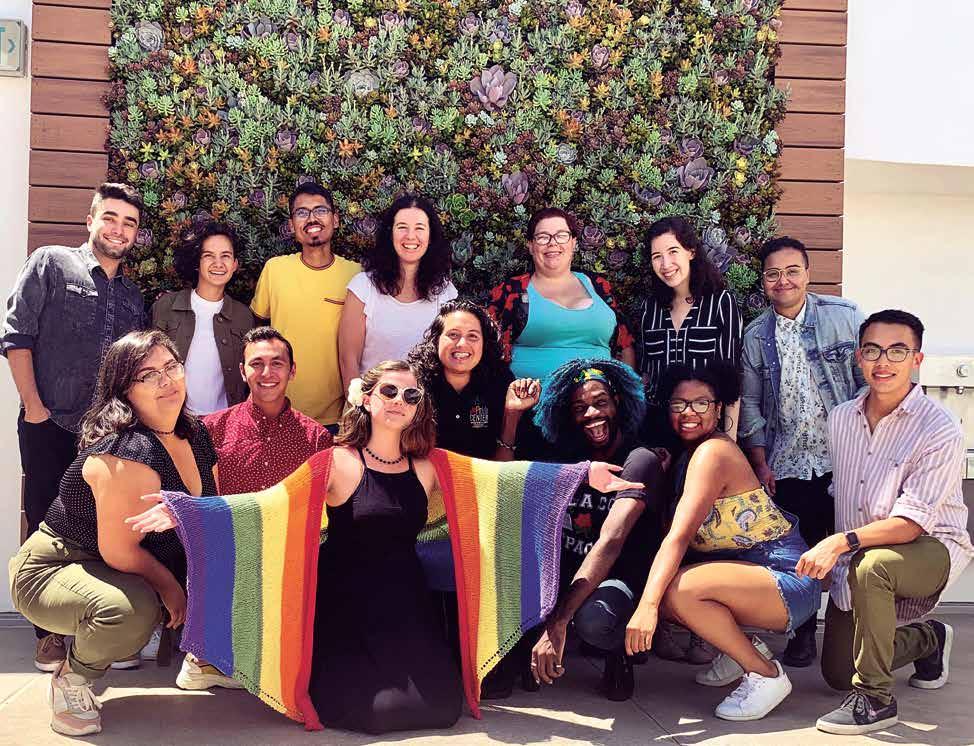
Photo courtesy of SDSU Pride Center
International news highlights
by Teddy MacQuarrie SGN Contributing Writer
Canadian government issues travel advisory to US for Queer community
On Tuesday, government officials in Ottawa advised Queer travelers to the United States to look into the laws of the states they might visit.
The travel advisory comes in the wake of a 30-fold increase since 2017 in legislation to restrict the rights of Queer people in several US states. “Some states have enacted laws and policies that may affect 2SLGBTQI+ persons,” the advisory says.
“Check relevant state and local laws.”
(The acronym “2SLGBTQI+” stands for “Two-Spirit, Lesbian, Gay, Bisexual, Transgender, Queer, Intersex+,” with “Two-Spirit” referring to North American Indigenous people who fill a third-gender ceremonial or social role in their cultures.)
According to Deputy Prime Minister Chrystia Freeland, speaking to reporters from Atlantic Canada, the Canadian government employed experts “to look carefully around the world and to monitor whether there are particular dangers to particular groups of Canadians.”
She added, “Every Canadian government... needs to put at the center of everything we do the interest and the safety of every single Canadian and every single group of Canadians. That’s what we’re doing now.”
Freeland did not disclose if the Canadian government had held any talks with the Biden administration. Canada’s risk profile for the United States remains at green, indicating ordinary security precautions.
For its part, the US State Department said the United States was committed to “promoting tolerance, inclusion, justice, and dignity” while advancing the rights of the Queer community.
The United States is the top travel destination for Canadians. According to official data released last year, at least one million Canadians aged 15 or older are Queer, making the safety of Queer travelers from Canada an important consideration for US-Canadian relations.
Canada’s travel advisory coincides with the Human Right Campaign’s “national state of emergency” declaration issued back in June, which raised the alarm over the proliferation of legislation aimed at regulating and restricting the lives of Queer people.
Two arrested, may face death penalty under Ugandan anti-homosexuality law
Two men have been arrested and charged with “aggravated homosexuality,” punishable by death, after a controversial new law went into effect in May.
Both men are involved in separate incidents. One was charged in July with “aggravated homosexuality” in the Jinja district in eastern Uganda for allegedly performing “a sexual act with a child aged 12 of the same sex.
According to Jacqueline Okui, spokesperson for the office of the Director of Public Prosecutions, the second is a 20-year-old man in the district of Soroti in eastern Uganda. He was charged on August 18 after he allegedly “performed unlawful sexual intercourse with one [man] aged 41 with a disability.”
The hotly criticized law defines “aggravated homosexuality” as any sexual act between two persons of the same sex that involves incest or sex with children, people with disabilities, or the elderly. The law also outlaws same-sex marriage in Uganda and punishes other same-sex acts with life imprisonment.
The lawyer for the unnamed 20-year old man, Justine Balya, told CNN that the penalties associated with the law are entirely out of proportion. “Of course the fact that the law is being enforced in this way is entirely unconstitutional, because it seeks to criminalize what is often consensual conduct between adults,” she said.
Balya expects her client to undergo a lengthy period of being remanded into custody and a long delay until trial.
Global outrage has erupted since the law was signed in May. President Joe Biden has condemned it as “a tragic violation of human rights” and has directed an evaluation of aid contributions sent to Uganda. The US has also announced visa restrictions for some Ugandan officials.
In August, the World Bank announced that its International Development Fund program will cease considering new loan requests from Uganda; the bank’s decision came mere days after the United Nations announced it would be closing its human rights office in Uganda.
A similar bill was passed and signed into law in 2014, but the Ugandan courts struck it down, citing procedural irregularities in its passage.