Seattle Gay News
Issue 38, Volume 42, September 19, 2014
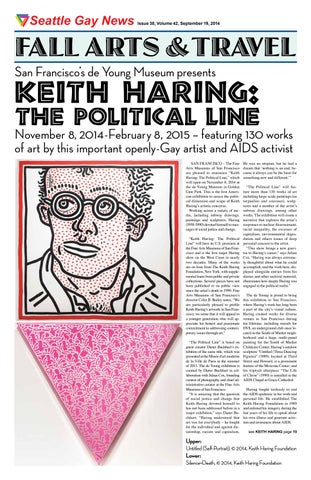
SAN FRANCISCO – The Fine Arts Museums of San Francisco are pleased to announce “Keith Haring: The Political Line,” which will open on November 8, 2014 at the de Young Museum in Golden Gate Park. This is the first American exhibition to assess the political dimension and scope of Keith Haring’s artistic concerns. Working across a variety of media, including subway drawings, paintings and sculptures, Haring (1958-1990) devoted himself to messages of social justice and change. “Keith Haring: The Political Line” will have its U.S. premiere at the Fine Arts Museums of San Francisco and is the first major Haring show on the West Coast in nearly two decades. Many of the works are on loan from The Keith Haring Foundation, New York, with supplemental loans from public and private collections. Several pieces have not been published or on public view since the artist’s death in 1990. Fine Arts Museums of San Francisco’s director Colin B. Bailey notes, “We are particularly pleased to profile Keith Haring’s artwork in San Francisco; we sense that it will appeal to a younger generation who will appreciate his honest and passionate commitment to addressing contemporary issues through art.” “The Political Line” is based on guest curator Dieter Buchhart’s exhibition of the same title, which was presented at the Musée d’art moderne de la Ville de Paris in the summer of 2013. The de Young exhibition is curated by Dieter Buchhart in collaboration with Julian Cox, founding curator of photography and chief administrative curator at the Fine Arts Museums of San Francisco. “It is amazing that the question of social justice and change that Keith Haring devoted himself to has not been addressed before in a major exhibition,” says Dieter Buchhart. “Haring understood that art was for everybody – he fought for the individual and against dictatorship, racism and capitalism.
He was no utopian, but he had a dream that ‘nothing is an end, because it always can be the basis for something new and different.’” “The Political Line” will feature more than 130 works of art including large-scale paintings (on tarpaulins and canvases), sculptures and a number of the artist’s subway drawings, among other works. The exhibition will create a narrative that explores the artist’s responses to nuclear disarmament, racial inequality, the excesses of capitalism, environmental degradation and others issues of deep personal concern to the artist. “This show brings a new gravitas to Haring’s career,” says Julian Cox. “Haring was always extremely thoughtful about what he could accomplish, and the work here, displayed alongside entries from his diaries and other archival material, illuminates how deeply Haring was engaged in the political realm.” The de Young is proud to bring this exhibition to San Francisco, where Haring’s work has long been a part of the city’s visual culture. Haring created works for diverse venues in San Francisco during his lifetime, including murals for DV8, an underground club once located in the South of Market neighborhood and a huge, multi-panel painting for the South of Market Childcare Center. Haring’s outdoor sculpture “Untitled (Three Dancing Figures)” (1989), located at Third Street and Howard, is a prominent feature of the Moscone Center; and his triptych altarpiece “The Life of Christ” (1990) is installed in the AIDS Chapel at Grace Cathedral. Haring fought tirelessly to end the AIDS epidemic in his work and personal life. He established The Keith Haring Foundation in 1989 and enlisted his imagery during the last years of his life to speak about his own illness and generate activism and awareness about AIDS. see Keith Haring page 10
2 Seattle Gay News
September 19, 2014
Celebrating 41 Years!
Visit us online www.sgn.org
September 19, 2014
Seattle Gay News 3
Nearby destination: Getting to and discovering San Juan Island is easy, begging to be visited www.visitsanjuans.com
The San Juan Islands
allowing both vehicles and walk-ons, to Friday Harbor. Meanwhile, Kenmore Air flies regularly from Lake Union (seaIf whistling is an indicator of happiness, plane) and Boeing Field (wheeled aircraft)
by Albert Rodriguez SGN A&E Writer
fridayharborhouse.com
View from Friday Harbor House
to the island. For WSDOT ferry schedule, log onto www.wsdot.wa.gov/ferries, and for flight service, check out www.kenmoreair.com. Information on the Victoria Clipper, also offering whale-watching adventures around the San Juan Islands, is available at www.clippervacations.com.
GETTING THERE The Victoria Clipper runs a seasonal passenger-only ferry between Seattle and Friday Harbor, the epicenter of San Juan Island, from May through September (ends September 28, 2014). But yearround service is provided by Washington State Ferries (WSDOT) from Anacortes,
ACCOMMODATIONS A literal skip from the ferry dock is Friday Harbor House, a wonderful 23-room property on a small hill overlooking the harbor. This is a place that wants you to unwind, noted by its cozy gas fireplaces in each room with rolled up soft throw blankets within reach to snuggle up to at morning, night, or a dim-lit summer evening. Padded wooden armchairs with footrests and wooden coffee tables are perfect for lounging around with a good book, or to socialize with companions over a favorite beverage. In-room amenities include waffle-weave robes, Keurig brewing systems with Tully’s Coffee k-pods, mini refrigerators, Therapy bath products, flatscreen HDTVs, and free WiFi. Also complimentary are the fabulous continental breakfasts, served in The Bluff Restaurant-Bar-Terrace with casual outdoor seating – frittatas, bacon, sausages, granola, whole grain breads, preserves, fresh fruit, coffee, and orange juice were some of the items offered when I visited. My stay at Friday Harbor House was really comfortable and the staff was super friendly; I would
4 Seattle Gay News
September 19, 2014
DINING Many of the eateries in Friday Harbor, and scattered throughout San Juan Island, are casual and moderately priced, if not downright inexpensive. Whether or not your a c c o m m o d a t io n s are at Friday Harbor House, dinner at The Bluff Restaurant-BarTerrace (www.fridayharborhouse.com/ dining) is certainly recommended. This upscale, award-winning restaurant utilizes many ingredients, from produce to seafood, that are grown in Northwest gardens or fished directly from Washington waters, including halibut, beets, salad greens, beef, and clams. Chef Aaron Rock really does rock, taking basic, fresh components and combining them with a sophisticated palate and innovative skills that result in well-executed, sumptuous dishes. Salish Sea Halibut, Wild Rice Stuffed Chicken Breast, Steak Frites and Dungeness Crab Cakes are among the current menu options. Should you want a laid back ambiance, try Cask and Schooner (www. caskandschooner.com), a busy pub with a polished interior serving burgers, sandwiches, fish, steaks, and a shortlist of English favorites, like fish and chips, bangers and mash, and meat pies. It’s a popular spot to wine and dine with friendly, efficient service and just footsteps from the ferry terminal. www.sjclandbank.org/sanjuan.html
then residents of San Juan Island are quite content. On a weekend getaway this summer, I encountered locals who whistled as they walked into a hardware store, pumped air into their bicycle tires, shopped for homemade goods at the farmers market, and looked for bargains at a yard sale – all whistling as they went about their business. They all seemed polite, approachable, and unworried. San Juan Island is the most populous of the San Juan Islands, an archipelago located between the mainland of Washington state and Vancouver Island, British Columbia, Canada, and accessible from Seattle year-round by air, seasonally by passenger ferry, and year-round by ferry from Anacortes. Once there, neighboring islands, such as Orcas and Lopez, are conveniently reachable. The daily metro grind can take its toll on us locals, which is why a nearby destination like San Juan Island begs to be visited. Allow me to provide you with more information about this island, and to begin planning your trip, go to www. VisitSanJuans.com.
go back there in a heartbeat, and I likely will. For reservations, go to www.fr idayha rborhouse.com. Half a block away is another great property to base your San Juan Island stay, the Bird Rock Hotel. Simple, yet stylish, its 15 rooms are decorated with contemporary furnishings and amenities, from flatscreen satellite HDTVs to iPod docking radios to in-room espresso makers and oversized whirlpool tubs. For eco-friendly travelers and those with allergy sensitivities, Bird Rock’s custom king beds are covered with clean, organic, fair-trade linens, and for visitors wanting a workout, the hotel provides courtesy beach cruiser bikes to take out for a spin. Anyone desiring additional wellness and exercise can access an offsite heated pool, fitness studio, Jacuzzi and sauna as a guest of the hotel. Breakfast, from pastries to yogurt to bagels and hard-boiled eggs, is included
with your stay, but you’ll have to walk a few minutes to delis and restaurants for lunch and dinner. The Bird Rock Hotel is located on a busy intersection, so it was slightly noisy on the Friday evening I stayed, but it quieted down around 11 p.m. For reservations and more information, go to www.birdrockhotel.com.
San Juan Island
Celebrating 41 Years!
ATTRACTIONS Friday Harbor can easily be explored on foot with consignment shops, artisan boutiques, bookstores, a movie theater, and a year-round farmers market in the center of town. The San Juan Island Farmers Market is great for picking up everything from homemade pies to freshly-picked vegetables to locallyroasted coffee, but it is limited to certain weekends during the fall-winter months, so log onto www.sjifarmersmarket.com for exact dates and times. Many visitors stop first at The Whale Museum (www.whalemuseum.org), where you’ll encounter skeletons, life-size models, and resource materials that educate the public about these enormous mammals that have long been a part of Northwest wildlife. Located inside an historic 122year old two-storey house, a current exhibit is dedicated to Sooke, a young whale who was found dead near Long Beach, Washington in 2012. To venture just outside of Friday Harbor, rent a bicycle at Discovery
Sea Kayaks (www.discoveryseakayak. com) on the main street (Spring St.), right up from the ferry terminal and pedal down to beautiful Jackson Beach, or zigzag through some of the residential roads. Or, ask the very helpful and polite rental shop staff for an island map to plan your trek. You can also hop on the San Juan Island Transit (www.sanjuantransit.com), a shuttle service that circles the island and stops at many of its top sites, including Roche Harbor, Alpaca Ranch, San Juan Vineyards, and Sculpture Park. The shuttle is a five-minute walk from your Friday Harbor ferry disembarkment, and costs $15 for an all-day pass ($10 for children 12 & under). If you’d prefer sightseeing on a set of motorized wheels, rent a “scootcar” at Susie’s Mopeds (www.susiesmopeds.com), a bumper-car-meets-dune-buggy, and have fun checking out the island’s major landmarks, such as Lime Kiln Point State Park, English Camp National Historical Park, Pelindaba Lavender Farm, Smuggler’s Cove, and American Camp National Historical Park. On the Northwestern tip of the island is Roche Harbor (www.rocheharbor.com), a resort area and community that attracts visitors and locals, and once wooed Hollywood cowboy John Wayne, who slept soundly at the nostalgic Hotel de Haro (www.rocheharbor.com/lodging/hotel-deharo). With restaurants, shops, spa, boardwalk, and outdoor bocce court, Roche Harbor is a perfect destination for travelers wanting seclusion and minimal interaction with other tourists. It’s also a gorgeous locale for spring-to-fall weddings.
Visit us online www.sgn.org
Albert Rodriguez
On the very casual side, Friday’s Crabhouse (www.fridayscrabhouse.com) is sought out for its excellent harbor views on its multi-level outdoor deck and for its burgers, fish and chips, sandwiches and similar no-frills grub. For coffee and light bites, The Bean Cafe (www.thebeancafe.com) is a cool place to recline with indoor and outdoor seating, plus complimentary Wi-Fi, as you sip a latte and nibble on a salad, wrap, muffin, cinnamon roll, or cookie.
Lime Kiln Lighthouse
September 19, 2014
Seattle Gay News 5
6 Seattle Gay News
September 19, 2014
Celebrating 41 Years!
Sleeping overnight at a South Korean temple is a unique, inspiring, and rewarding experience courtesy of Korea Tourism Organization
Woljeongsa Temple
by Albert Rodriguez SGN A&E Writer It was a privilege, and somewhat of a challenge, to stay overnight at a Buddhist temple in South Korea. Offered in several Asian countries, these accommodations are recommended for travelers desiring a cultural experience and not for those used to modern lodging with the expected amenities. “Temple Stays,” as they’re commonly referred to, provide basic sleeping areas and impose strict rules (curfews, set meal times, etc.) that could prove difficult for some tourists. But for those willing to be taken out of their comfort zone, the adventure is very rewarding. I stayed at Woljeongsa Temple, nestled in the lush forest of Odaesan Mountain about an hour from Pyeongchang. It’s roughly a two-and-a-half hour trek from Seoul by automobile, though traffic delays and a stop for food pushed our journey to four hours. The Buddhist religion does not discriminate against sexual orientation, so LGBT visitors will be welcomed as any other tourist would. Here are details about my temple stay in South Korea. CHECK-IN/ROOMS The young woman at the reception office was quite friendly and spoke reasonably good English. After assigning myself and fellow travel companions our rooms and giving us printed itineraries, we had about an hour to change into temple clothes (mandatory) and settle in before orientation. Our group of three was assigned individual rooms, right next to each other, in a detached co-ed section of the temple that held about 10 rooms total. We were booked for the “Relaxation-Based” experience, suitable for overnight guests (vs. weekend or longterm stay) and those wanting more free time instead of obligatory temple activities. Shoes were not allowed inside the sleeping area, so we left them by the main sliding door. Each room was divided by a second set of sliding doors, and inside was a thin mattress, cover and pillow stacked neatly on the smooth wooden floor. Our temple attire, orange-colored pants and robes, were already hanging on a coat rack. Although I’m not opposed to sharing a lavatory, I was grateful for a private restroom that was stocked with bath tissue, bar soap and toothpaste. Not provided were hand or bath towels, so remember to bring your own.
There was a closet to put our belongings, as well as power outlets to charge our electronics, and self-adjustable heating systems to battle the chilly night and morning. I can’t say that I slept comfortably; however, my cubicle-sized room was snug and warm, and it was extremely peaceful. ORIENTATION/MAKING PRAYER BEADS Guests were required to attend a 10-minute “Learning Temple Etiquette” session, where we watched an animated video outlining the dos and don’ts of our stay, plus learning how to properly bow to fellow temple stay guests and staff. Then, the same young woman who received us at the office during the check-in process helped us make prayer beads that were ours to take home. MEALS Evening and morning meals were included with our stay and were served promptly in a lower level cafeteria-style facility. We were guided into the dining area in single file and allowed to have our shoes on. Guests and staff members ate their meals at the same time, so we were able to meet fellow temple stay guests, although all of them were Asian tourists who spoke little English. These meals were strictly vegetarian and most of them at room temperature, but a few dishes were warm. Rice, steamed vegetables, cooked potatoes, tofu and a broth-like soup were some of the items available for dinner, while leftovers from the night before, as well as porridge, sliced bananas and a new assortment of vegetables were prepared for breakfast. A nearby bakery also donated plasticwrapped, cream-filled danishes in the morning that went down well with hot green tea. Meals were self-serve and laid out on a counter in bowls, rice cookers, baskets, or big plates. You’re asked only to take what you think you can eat because the temple wants nothing being thrown away. Much of the food was unseasoned (garlic is a no-no), so I didn’t really enjoy it, but in respecting the Buddhist diet, I ate what was offered and served myself only what I could eat. Outside food isn’t permitted. Plates and metal chopsticks were provided, but Western utensils (forks, knives, spoons) were nowhere to be found. Guests are asked to wash their own dishes following each meal service and to place them back near the coun-
Visit us online www.sgn.org
ter. Also, there is no coffee, which can be torture for us caffeine addicts. Our accommodations included a third meal, lunch, but we had to depart early the next day because we had flights to catch in Seoul later that afternoon. SOUNDING OF THE DHARMA INSTRUMENTS Temple stay guests are privileged to watch and participate in the “Sounding of the Dharma Instruments,” a nightly ritual consisting of striking a giant ancient bell. First, you watch it being done and then you’re invited to go up into a small tower and strike it yourself with assistance from one of the monks. I’m not sure about the history or symbolism behind this ritual, but I really loved hearing this huge bell being struck in the middle of a forest in pure darkness. The Sounding of the Dharma Instruments takes place around the time the temple closes to the public, so only those staying the night can witness this event.
asked to limit our visitation with fellow guests, so there wasn’t much else to do except sleep. We were also required to be awake at 4 a.m. to wash up for Morning Service, which made for a long day because my return flight to Seattle departed that afternoon.
FIR FOREST WALK/TIDY UP ROOM/WRITE REVIEWS Aside from participating in authentic Buddhist rituals, another reason for choosing this particular temple stay was to absorb its immediate scenery – fog-covered mountains, fir trees, creeks, hiking trails – and I did this with one of my travel companions, because otherwise I’d have gotten lost. These leisurely strolls are also meant to free the mind and provide a daily (minimal, but regular) exercise routine. Each guest must tidy up his/her room before departing – fold your mattress, hang your robe and pants, clean the restroom – and after doing this, the only thing left is to check out and write a review of your experience. We each received EVENING AND MORNING a small gift, a pair of handmade wooden chopBUDDHIST SERVICES sticks and a spoon, as we bid farewell to our The highlight of this entire experience is host and thanked her for a magnificent stay. attending actual temple services with real Buddhist monks; the Evening Service beCONTACT INFORMATION/ gins at 6:30 p.m. and the Morning Service at PUBLIC TRANSPORTATION/TIPS 4:20 a.m. For each service, we were led into the temple and asked to quietly situate ourFor general information on temple stays in selves on mats neatly sprawled out inside the Korea, go to www.english.visitkorea.or.kr/enu. Buddhist Hall; the monks were already there For information specific to Woljeongsa and silently kneeling on mats of their own. Temple, including address and phone numGuests are not permitted to photograph or ber, go to www.woljeongsa.org. videotape any portion of either service, lastYou can visit Woljeongsa Temple from ing roughly a half hour. There is a lot of stand- Seoul without renting a car. Take an intering, kneeling and more standing – seriously, city bus (Line 2) from Dong Seoul Bus Terit was a workout – and there is a lot of chant- minal to Jinbu Intercity Bus Terminal, then ing, which is mind-blowing to listen to inside transfer to the Woljeongsa local bus line. this immaculate hall. We were supplied with You’ll have to inquire about bus fare and English-translated programs, so that we could schedule once you’re in Seoul. chant alongside the monks – male and female, If traveling by car, note that once you leave young and old – although, I mostly closed my Seoul there are limited places to refuel and eat. eyes and listened to the sounds of everyone Look for the rest areas, which are actually mini else chanting. When the service was over, the shopping malls with food courts, retail stores, monks left the temple silently and quickly, and souvenir stalls and public restrooms. Consider then temple stay guests were allowed to leave potential traffic delays along the way to Pyand return to their rooms. At no time were we eongchang, host of the 2018 Winter Olympics, permitted to interact directly with the monks. and give yourself time to arrive promptly to the temple. A late arrival could result in a canceled CURFEW/WAKE-UP TIME reservation, as the temple does close to the genGuests are required to be in bed at 9 p.m. eral public at a designated time. On the return, with lights out. WiFi was not available, nei- you may want to consider spending a night in ther was cell phone roaming, and we were Seoul before flying back home.
September 19, 2014
Seattle Gay News 7
Philadelphia’s Mural Arts Program restored Keith Haring’s mural, “We the Youth,” in 2013
Steve Weinik for Mural Arts Program © 2013, Keith Haring Foundation
“We The Youth” mural by Keith Haring
In concert with the mural’s restoration, the Pennsylvania Horticultural Society, in partnership with the Neighborhood Gardens Trust, has renovated the adjacent garden space at 22nd & Ellsworth. Local landscape architect Michael LoFurno, of Composite Inc., redesigned the garden space to be more accessible and to better showcase the mu-
8 Seattle Gay News
September 19, 2014
performers, and musicians whose work responded to urban street culture of the 1980s. When he arrived in New York City at the age of 19 to enroll in the School of Visual Arts, Haring found an alternative art world thriving outside the gallery and museum system, in the downtown streets, the subways, and clubs. Inspired by the graffiti artists whose Photograph by Stefano de Martino. © Keith Haring Foundation
PHILADELPHIA – Last year (in late October 2013) the City of Philadelphia Mural Arts Program completed restoration of a mural created by iconic pop artist Keith Haring. “We the Youth,” originally created in 1987, is the only Keith Haring collaborative public mural remaining intact and on its original site. After months of wall repair and painstaking mural restoration, “We the Youth” was returned to Haring’s original intent for the public to enjoy. “We the Youth” has been an iconic part of the South Philadelphia streetscape for more than a quarter of a century. Damage to the wall, however, prompted Mural Arts, with generous funding and support from the Keith Haring Foundation, to engage in intensive restoration of this contemporary work of art. With a new owner buying the home in South Philadelphia, the Mural Arts Program agreed to adopt the mural as part of its Restoration Program to maintain important pieces of public art. The public was invited to celebrate the restored mural at a dedication on Saturday, November 2, 2013, the concluding event of Mural Arts Month and part of an ongoing series of events celebrating the 30th Anniversary of the City of Philadelphia’s Mural Arts Program, which continues through October 2014. Located at 22nd & Ellsworth Streets, “We the Youth” was created in collaboration with CityKids of New York and Brandywine Workshop in Philadelphia. With its limned, primary-colored beauty, lyrical characters, and childlike innocence, “We the Youth” is quintessential Keith Haring. In the work and on the wall, Haring’s artistic vision – his energy, life, and spirit – serves as his testimony. A video of Keith Haring creating the original mural can be viewed at: http://www.youtube. com/watch?v=Aeg0xiceHeM.
Keith Haring working on his “We the Youth” mural
marks covered the city’s subway cars, Haring began to draw in white chalk over the black paper used to cover vacant advertising panels in the subway stations. Not only was Haring able to reach a large and diverse audience with his subway drawings, but, eventually, the subway became, as Haring said, a “laboratory” for working out his ideas. There, he developed the series of images that would About Keith Haring Pennsylvania-born Keith Haring (1958- become his signature: the radiant baby, the 90) was preeminent among the young artists, barking dog, and the running figure. ral. New landscaping and site furniture was implemented to complement the mural’s colors and design aesthetic. Together, these improvements have transformed the space into a vibrant, inviting environment for the neighborhood to enjoy. Both projects were sponsored by the Keith Haring Foundation.
As early as 1982, Haring began exhibiting in galleries and museums around the world, but continued to participate in public projects, including literacy campaigns and anti-AIDS initiatives. Building on earlier impulses to draw on everything from refrigerator doors to vinyl tarpaulins, Haring continued to use a variety of media in order to communicate to a massive audience, essential themes such as birth, death, love, and war. In February 1990, at age 31, Keith Haring died of AIDS-related illnesses. Since his death, he has been the subject of several international retrospectives. His work is in major private and public collections, including those of the Museum of Modern Art; the Whitney Museum of American Art; Los Angeles County Museum of Art; Art Institute of Chicago; the Bass Museum in Miami; Centre Georges Pompidou, Paris; Ludwig Museum, Cologne; and Stedelijk Museum, Amsterdam. Although Keith Haring’s career was brief, his imagery has become a universally recognized visual language of the 20th century. For further information, see www.haring.com. Keith Haring Foundation In the wake of Keith Haring’s death from AIDS-related illnesses in 1990, the board of the Keith Haring Foundation (established by the artist in 1989) has remained committed to the preservation of existing Haring murals. Over the past two decades, the Haring Foundation, with the full cooperation of the cities or institutions where Haring murals still exist, has offered support and advice on the restoration of over 16 murals in the U.S. and abroad. “Keith’s philosophy of art espoused accessibility and his public murals perfectly embody this credo. All of his public murals speak to and seek to engage with the specific communities in which they were created,”
Celebrating 41 Years!
said Julia Gruen, Executive Director, The Keith Haring Foundation. “Having watched Keith paint several murals myself, I can attest to the joy their creation and the finished results brought to their communities. Having observed the restoration of many more, I also know how valued they are and how powerfully these works continue to resonate.”
New Relationships In 2012, a new owner moved into the home in South Philadelphia, and, aware that the house was decorated with a Haring mural when purchasing the property, reached out to the Haring Foundation in New York City to inquire about the mural’s status. The Haring Foundation then contacted the Mural Arts Program about how Mural Arts might assist in the mural restoration based on the decades of experience Mural Arts has with mural painting and restoration work. After meetings in the summer of 2012, a restoration plan was confirmed, with the Mural Arts Program receiving a generous grant from the Haring Foundation to do the work. As part of this project, the Mural Arts Program agreed to adopt the mural as part of its Restoration Program to maintain important public art. Mural Arts Program Restoration Program Haring believed that art should be accessi-
nings as an anti-graffiti program, it has evolved into an internationally-recognized leader in community-based public art and a leading expert in mural-making and art education, having served over 30,000 young people and created 3,600 works of public art. From October 2013 through October 2014, the Mural Arts Program is celebrating 30 years. Mural Arts Month kicked off the celebration in October 2013 with a varied array of events. The celebration continued last November, when the Pennsylvania Photo by Steve Weinik for Mural Arts Program
ble to everyone, a core tenet of the Mural Arts Program’s philosophy. “The Mural Arts Program is honored to become the godparent of Keith Haring’s mural since we share so many similar views of public art,” said Mural Arts Program Executive Director Jane Golden. “This restoration is part of our larger vision to restore, revitalize, and keep murals up to date in addition to creating new works each year.” Restoration Artist “We the Youth” is part of the Mural Arts The Mural Arts Program hired artist Kim Program’s Restoration Program, committed Alsbrooks to restore “We the Youth.” “I am very grateful to be able to restore this beautiful, important work of Keith Haring, an artist I have admired for almost 30 years and one who means so much to so many people,” said Alsbrooks. In the early ‘90s, Alsbrooks attended a workshop fashioned after Haring’s workshops with youth. After learning Haring’s techniques, Alsbrooks employed them in workshops she did with children. The restoration is being led by Alsbrooks with a full team of Jennifer Procacci, Charles Newman, Laura Velez, and Malachi Floyd.
Kim Alsbrooks restoring Keith Haring’s “We the Youth” mural
to maintaining and restoring murals with minor touch-ups or major face-lifts. Mural Arts Program has made it a priority to restore 3040 murals per year so existing work can continue to transform Philadelphia’s communities for generations to come. Some examples include master muralist Meg Saligman’s recently restored Philadelphia Muses at 13th & Locust Streets and the iconic Common Threads mural at Broad and Spring Garden, which was the initial restoration project in 2011. In addition to funding from the Haring Foundation, “We the Youth” has also received support from the City of Philadelphia.
Visit us online www.sgn.org
Academy of the Fine Arts launched “Beyond the Paint: Philadelphia’s Mural Arts,” a retrospective exhibition that ran through April 2014. Other highlights of the anniversary year included the launch of their book, “Mural Arts at 30,” which reflects upon the impact of their communitybased practice; a regional convening about Art and Restorative Justice; an ambitious gateway rail project with Berlin-based artist Katharina Grosse; and a Street Art Festival taking Mural Arts back to our roots in October 2014.
The Mural Arts Program is the nation’s largest public art program, dedicated to the proposition that art ignites change. For nearly 30 years, the Mural Arts Program has united About the 30th Anniversary Celebration and the Mural Arts Program artists and communities through a collaboraThirty years after Mural Arts’ humble begin- tive process, rooted in the traditions of mural-
September 19, 2014
making, to create art that transforms public spaces and individual lives. Mural Arts engages communities in 50 to 100 mural and public art projects each year, including a restoration program that maintains the collection. The murals also create unique project-based learning opportunities for thousands of youth and adults in the Art Education for Youth, Restorative Justice, and Behavioral Health programs. The Mural Arts Program has created over 3,600 murals and works of public art, earning Philadelphia international recognition as the “City of Murals.” Each year, 14,000 residents and visitors tour the Mural Arts Program’s outdoor art gallery, which has become part of Philadelphia’s civic landscape and a source of pride and inspiration. For further information, call (215) 685-0750 or visit www.muralarts. org. Follow along on social media at: twitter. com/muralarts, youtube.com/phillymuralarts, or on Facebook at: http://on.fb.me/y4Vo9E. About the Mural Arts Program WE BELIEVE ART IGNITES CHANGE. We create art with others to transform places, individuals, communities and institutions. Through this work, we establish new standards of excellence in the practice of public and contemporary art. Our process empowers artists to be change agents, stimulates dialogue about critical issues, and builds bridges of connection and understanding. Our work is created in service of a larger movement that values equity, fairness and progress across all of society. We listen with empathetic ears to understand the aspirations of our partners and participants. And through beautiful collaborative art, we provide people with the inspiration and tools to seize their own future. Courtesy of the City of Philadelphia Mural Arts Program
Seattle Gay News 9
Untitled (Apartheid ), 1984 © 2014, Keith Haring Foundation
Keith Haring
Untitled, 1982
continued from cover
© 2014, Keith Haring Foundation
By the time of his death, at age 31, he had achieved international fame. His influence on his own generation and those that have followed is a testament to his enduring vision. About Keith Haring Keith Haring (1958-1990) was preeminent among the downtown New York City community of young artists, performers, and musicians whose work responded to urban street culture. During a brief but intense career that spanned the 1980s, Haring’s work was featured in over 100 solo and group exhibitions. In 1986 alone, he was the subject of more than 40 newspaper and magazine articles. Haring also devoted much of his time to public works. He produced more than 50 public artworks between 1982 and 1989, in dozens of cities around the world, many of which were created for charities, hospitals, children’s day care centers and orphanages. Keith Haring died in New York in February 1990 of AIDS-related illnesses. Although his career was brief, his imagery remains a universally recognized visual language of the 20th and 21st century.
Untitled, 1980 © 2014, Keith Haring Foundation
About The Keith Haring Foundation Established by the artist in 1989, The Keith Haring Foundation makes grants to not-for-profit groups that engage in charitable and educational activities. In accordance with Haring’s wishes, the Foundation concentrates its giving in two areas: The support of organizations that provide educational opportunities to disadvantaged children and those that engage in education, prevention and care with respect to AIDS and HIV infection. Exhibition Organization This exhibition is organized by the Fine Arts Museums of San Francisco and is presented at the de Young Museum located in Golden Gate Park, 50 Hagiwara Tea Garden Drive, San Francisco, CA 94118. The museum is open Tuesdays-Sundays and select holidays 9:30 a.m.-5:15 p.m.; CLOSED most Mondays. Tickets are on sale now. For more information on “Keith Haring: The Political Line” please visit www.deyoungmuseum.org/haring. Courtesy of the Fine Arts Museums of San Francisco
courtesy of
John Doe
Untitled, 1982
Untitled, 1981
© 2014, Keith Haring Foundation
© 2014, Keith Haring Foundation
10
Seattle Gay News
September 19, 2014
Celebrating 41 Years!
Untitled, February 3, 1981 © 2014, Keith Haring Foundation
Untitled (Apartheid ), 1984 © 2014, Keith Haring Foundation
Untitled, 1988 A Pile of Crowns for Jean-Michel Basquiat, 1988 © 2014, Keith Haring Foundation © 2014, Keith Haring Foundation
Andy Mouse, 1985
Untitled, 1982
© 2014, Keith Haring Foundation
© 2014, Keith Haring Foundation
Visit us online www.sgn.org
September 19, 2014
Seattle Gay News 11
BEYOND BANGKOK: Exploring more of Thailand outside the big city Albert Rodriguez
to the Big Island of Hawaii, though smaller Buddha”), easily visible on many inbound geographically. and outbound flights to the island. The golden statue was erected about 40 years STAY: I can’t think of a better place to ago and is perched on a hill, sitting in the call home while on vacation than the W traditional Mara position. Also worthRetreat Koh Samui (www.whotels.com/ while is Lamai Beach, famous for a pair kohsamui), a beachside resort with 74-pri- of intriguing landmarks named Hin Ta vate pool villas that exemplifies modern and Hin Yai, or commonly known as luxury at every turn, from its open-air lob- Grandpa and Grandma rocks, male and by looking out to the Gulf of Thailand to female genitalia-shaped rocks that allow first class, contemporary, in-room ameni- tourists to pose in interesting positions ties. I stayed in a 223-square foot Tropical for selfies. The beach itself is great for Oasis villa that included a king size signa- sunbathing, and footsteps from the atture W bed, outdoor and indoor rainshow- traction is a mini outdoor market with er stalls, 46-inch flatscreen TV, Yamaha clothing, accessories, keepsakes, and ice sound system, loveseat, work desk with cream. Shopping is high on my list of Western power outlets, refrigerator, sliding must-dos when traveling, not just for soudoor closets, waffle-weave slippers with venirs, but for anything, really. And when resort logo, Bliss bath products, and, of you’re vacationing under scorching temcourse, a private pool with artificial turf- peratures, a refreshing escape is into an covered deck, daybeds, sunbathing chairs, air-conditioned shopping mall. Central and patio table. It was the royal treatment, Festival is Koh Samui’s largest shopping for sure. Daily breakfasts featuring mul- complex with over 200 Thai and internatiple tables of pastries, fresh fruit and veg- tional stores, restaurants, bars, night baetables, French toast, cereals and granolas, zaar, and upscale grocery market. Uniqlo, omelet station, and Thai favorites were Timberland and Rip Curl are among the Patara Elephant Farm served in The Kitchen Table, an on-prem- many retail outlets, while Power Buy ited snacks in its all-passengers-inclusive ise restaurant with impeccable panoramic might come in handy, if you have a malby Albert Rodriguez airport lounge and then fed us a tray meal scenery. Transportation within the resort is functioning electronic device. For everySGN A&E Writer provided by on-demand, courtesy golf cart thing listed above, get additional details on the short flight to Bangkok. at www.kosamui.com. You shouldn’t go to Thailand and not visit Bangkok. But once you’ve been KOH PHANGAN there and done that, it’s worth the time Forty minutes by ferry (Lomprayah Cataand money exploring beyond the big city. maran, www.lomprayah.com) from Koh Away from the skyscrapers, massive hoSamui is Koh Phangan, a smaller island tels, crowded trains, congested sidewalks, that effortlessly showcases a more rustic and bumper-to-bumper traffic are beachThai lifestyle – quiet, one-street towns, unifront bungalows, open-air massage huts, formed schoolkids walking to their classes, jungle forests, palm-fortressed resorts, residents scurrying through winding roads bright green-capped mountains and a on mopeds, chunks of vacant land. But that rustic laid back lifestyle that makes Hadoesn’t mean it’s a tourist-free zone; on the waii feel uptight. Even with its endless contrary, Koh Phangan has earned a wild options of things to see and do, Bangkok reputation for throwing the world’s craziis just a sliver of this Southeast Asian est all-nighter, the Full Moon Party (www. destination, and many would say that the fullmoonparty-thailand.com). This monthly real Thailand is beyond its perimeter. The bash attracts up to 30,000 party animals on LGBT lifestyle is welcomed throughout, the crescent-shaped beach Haad Rin, loand same-sex newlyweds will be treated cated down at the tail of Koh Phangan. It’s equally to straight couples who choose to an enormous fusion of techo music, cheap honeymoon here. Fresh from a recent visbooze, young and rowdy multi-national it, allow me to introduce you to a pair of tourists, and horseplay that goes on until tropical spots in the South, Koh Samui and View at Koh Samui sunset, but it does lean heavily straight. Koh Phangan, and Chiangmai in Northservice, and for an in-between or late night ern Thailand. For planning information, KOH SAMUI STAY: A half-hour away is the coolest, go to www.tourismthailand.org/US; and A 45-minute flight from Bangkok deliv- snack, the W Retreat has “Sweet Spot” staGay travelers can also get specific ideas at ers you to Koh Samui, the second largest tions positioned throughout the property most adorable hotel to anchor your Koh www.gothaibefree.com. island in Thailand surrounded by spar- with 24-hour self serve ice cream, soda, Phangan visit, the Haad Son Resort (www. haadsonresort.com). With just 28 rooms tokling turquoise water. Portions of the is- bottled water, and other goodies. tal on a secluded strip of soft sand beach, it GETTING TO THAILAND/ land are developed with resorts, shopping SEE/DO: Besides soaking up the sun, affords guests privacy that they’ll unlikely DOMESTIC AIR TRAVEL malls, and upscale eateries, but other parts Thai Airways (www.thaiairways.com) is are unspoiled, thus drawing comparisons you want to visit Wat Phra Yai (aka “Big get at other accommodations. Rooms are an excellent airline and has received many industry awards to prove it, but American travelers are limited to one international flight into Thailand four to five days a week. Still, the journey from Los Angeles to Bangkok, via Seoul, provides travelers with a chance to step foot in South Korea, if only for an hour, for a brief layover. You will have to disembark the plane and go through a quick immigration inspection, but you will not switch planes or gates. The meals, in-flight entertainment, and hospitality on Thai Airways were some of the best I’ve experienced in Economy Class. Domestically, the airline serves all major points within Thailand and will regularly utilize large aircraft for short flights, such as Boeing 787s between Bangkok and Chiangmai. Its partner airline, Bangkok Airways (www.bangkokair.com), covers lots of territory in Thailand and Asia, and it earned personal kudos from me for superior hospitality during a three-hour delay in Koh Samui due to bad weather. In response to the situation the airline provided unlimChangMai Full Moon Party awesomeplacesonearth.com
www.rumahtips.com
12
Seattle Gay News
September 19, 2014
Celebrating 41 Years!
www.inspire-emagazine.com
minimal in decor and amenities, but very clean, and somewhat colorful, with spacious balconies looking out to the water and beach just below. Haad Son’s outdoor restaurant offers a marvelous menu of Thai standards, including three dishes I’m still reliving: cashew chicken, roasted duck curry, and a silky smooth massaman curry that was to die for. The adjacent bar literally rests on a short cliff, providing cocktailers with an unbeatable, unobstructed view of the water. Morning breakfasts are served on the second floor of the main building, above the reception area, with equally dazzling scenery to enjoy with your toast, eggs, cereal, fruit, and coffee. I loved Haad Son’s layered, square-shaped outdoor pools tucked away in a remote corner of the resort, and its library with a variety of books to thumb through in a lovely setting with multiple windows and lots of sunlight.
Albert Rodriguez
DO: If you’ve ever wondered what it’s like to be a Thai boxer, and have the time, Muay Thai Chinnarach Thai Boxing Gym (www.muaythaichinnarch.com) invites you to try it out at their training facility on Kho Phangan. Tourists from six to Temple at Chiang Mai sixty years old have come here to experience intense workouts, boxing techniques, items as eggs benedict, spinach and feta furnished rooms that feature contempoand friendly bouts in an outdoor camp run salad, raspberry cheescake, and limited rary amenities in a really cozy ambiance; by Chinnarach, a former world champion. vegan selections. and worth noting are window-side daybeds, ball-shaped resting pillows, wooden work desks, and complimentary little gifts left inside a see-through orange box. Pastries, eggs, meats, fruits, stir-fries, steamed fish, rice and mini smoothies were some of the choices laid out during breakfast at the main floor restaurant each morning. The ample lobby with bar-lounge and cushioned seats with pop music playing overhead made for a good social spot before heading out to dinner. EAT: Speaking of food, I definitely suggest trying the local curry noodles “khao soi,” found at most eateries and also sold at concession stands parked on various streets. The color and texture of this dish is similar to massaman curry, yet relies more on cumin or turmeric, and it’s made with chicken, traditionally. It’s best described as a thick, hearty curry pho with chicken, yet complex in flavor. Suan Paak Thai Cuisine (61 Moo 3, Airport Road), a Chiangmai restaurant beautifully set up inside a traditional Thai stilt house, is a top recommendation for these noodles. DO: Though animal retreats have been hit with negative reviews in recent years, in regards to reported abuse at some of the facilities, an exception is Patara Elephant Farm (www.pataraelephantfarm. com). Nestled amongst the lush jungle in
the hills overlooking Chiangmai, this retreat offers visitors the opportunity to be a caretaker for a day, instead of putting on shows or forcing its residents to draw paintings with their trunks. Guests will help staff with feeding, walking, bathing, and inspecting their daily health. It’s a wonderful life lesson for children, and allows everyone to bond with elephants in their natural habitat. Patara Elephant Farm has a very reputable history; no animals have ever died in its 24-year operation and three females were pregnant when I visited in late July, plus seven have been released back into the wild. This is an all-day activity, morning to evening, that includes hotel pick-up and drop-off, picnic lunch, keepsake photo and video, and an unbelievable experience that helps protect a species rapidly becoming extinct. SHOP: A morning or afternoon spent at Warorot Market (Mueang Chiang Mai District, ask concierge for directions) is a local market in Chiangmai that sells fresh flowers and produce, but it’s also great for grabbing authenthic packaged snacks (roasted nuts, spicy chips, insects, etc.) and prepared food (sauce mixes, curry powders, etc.) and other mementos at dirt cheap prices. Or, watch natives keep the tradition of bamboo umbrella-making alive by visiting the Umbrella Making Centre (111/2 Bosang Sankamphaeng) and purchase some of their handcrafted products to bring home. Albert Rodriguez
Muay Thai Chinnarach Thai Boxing Gym
CHIANGMAI Chiangmai is the largest city in Northern Thailand, one hour by plane from Bangkok. Surrounded by green hills, where terraced rice fields are harvested by villagers and where local coffee beans are grown and picked, Chiangmai is popular for its cultural offerings, such as ancient temples and historical museums, but also for nearSEE: For sightseeing, take a taxi ride by animal retreats that permit tourists to up north to the peaceful Chaloklum Vil- come face-to-face with elephants, tigers, lage (refer to tourism website), or Fish- monkeys, and king cobras. erman’s Village, where life almost feels like it completely stands still. Chaloklum STAY: Recently opened, the 130-room Road, the village’s main artery, is dotted dusitD2 (www.dusitd2chiangmai.dusit. with an assortment of family-owned bar- com) is a boutique hotel nestled in the becue/grill restaurants, petite beachfront city’s most happening district, where resorts, diving gear shops, refreshment street vendors sell-off inexpensive merstands, and a foreigner-owned casual eat- chandise nightly and where an hour-long ery called The World’s End Cafe and Bar foot massage (foot, head, shoulders, back) (www.facebook.com/pages/The-Worlds- costs just $6 USD. The rather trendy End-Cafe-and-Bar) that dishes up such dusitD2 provides guests with stylishly It’s a perfect excursion for anyone requiring a fitness regimen when traveling, or something that would give active teenagers, boys and girls, something to do. Visitors are welcome to sign up for one week of workout/training sessions minimum, and for those wanting a bit more, there are packages that include accommodations.
Visit us online www.sgn.org
Umbrella Making Center
September 19, 2014
Seattle Gay News 13
14
Seattle Gay News
September 19, 2014
Celebrating 41 Years!
At The Beach Family Vacation Rentals provide excellent and affordable accommodations at Ocean Shores for a weekend getaway to remember by Viktor Bogatko SGN Contributing Writer
Visit us online www.sgn.org
fers home-style baked pastries, pies, cakes, and donuts that taste so fresh and wholesome, you will find yourself coming back for more. Adding a warm touch to a cozy town, local residents are both friendly and relaxed, giving you the best advice on where to have lunch or what beach to visit. Nights are devoted to bonfires along the beach, moonlit walks, and on chilly nights, hot tub soaks underneath the starry skies. In a peculiar way, the town’s appeal
comes more from what it doesn’t have rather than what it does. Ocean Shores is simple, modest, and remote, allowing visitors to slow down and forget their busy city lives. So if you need to take a break, head to Ocean Shores, where you can relax and recharge, where time seems to stand still. At The Beach Family Vacation Rentals, 360-289-4297; 659 Ocean Shores Blvd. NW, Ocean Shores, WA 98569; https:// ricksbeachhouses.com
September 19, 2014
Seattle Gay News 15
www.redfin.com
If you want to trade in the hustle and bustle of Seattle for a relaxing weekend getaway, head to Ocean Shores. Located just a few driving hours away from Seattle, Ocean Shores offers stunning views of Washington’s coast, a peaceful setting, and comfortable accommodations at an affordable price. At The Beach Family Vacation Rentals’ houses, chalets, and condos give you the most bang for your buck. Fully furnished with everything you will need, each rental feels more like a home and less like a hotel room, making your family’s stay more comfortable and relaxing. Most of the houses have a hot tub, a full ocean view, and a fireplace, with pet options available, if you want to bring your furry friends along. Ocean Shores’ beaches are accessible to everyone, with horseback and moped rentals available for those who desire a little more beach adventure. While few are brave enough to swim in the frigid Pacific Ocean, most visitors are happy enough to get their feet wet walking barefoot up and down beaches that stretch in both directions as far as the eye can see. Swarms of seagulls, migratory birds, and an occasional dolphin can be seen along the shore, while deer can be seen foraging in the grassy fields right outside your balcony in the mornings – perhaps the most enjoyable time of day at Ocean Shores. There’s something magical about
waking up and seeing the deep blue of the ocean outside your window, with an endless horizon providing you with a sense of soothing peace and a fresh sea breeze that fills your mornings with a delightful misty effervescence. The town features a number of great local eateries, with my personal favorite, Bennett’s Fish Shack, offering a number of delicious meals, with a mouthwatering prime rib dinner special on Friday nights at half the Seattle price. Another personal favorite, the Ocean Shores Bakery, of-
16
Seattle Gay News
September 19, 2014
Celebrating 41 Years!
Car Sick will make you choke – on laughter by Eric Andrews-Katz SGN A&E Writer
Visit us online www.sgn.org
while even “The Real Thing” (100% true or not) has moments that make the readers’ eyebrows rise with a “really?”, it is the words of Susan, Mr. Waters’ assistant, that summarizes the question everyone mentally thinks:
“…If it was [your] unknown ass, [you’d] still be hitchhiking in West Virginia.” Recognized or not, the stories that evolved from the adventure are all worthwhile reading and absolutely hilarious.
September 19, 2014
Seattle Gay News 17
Macmillan Publishers
I sat down to start reading Car Sick with a little hesitation. John Waters (aka The Prince of Puke or The King of Trash Cinema) is much better known for his directing movies than as author of books. Once committed, I started giggling quite easily. Then I chuckled and guffawed. Soon my raucous laughter could be heard down the hallway; that’s with my office door shut. I hadn’t had this kind of reaction – from reading a book – in a very long time. I was only on page 29. The idea for Car Sick came to The Lord of Shock-Schlock Film as a result of his love for hitchhiking. “I still hitchhike in Provincetown to Longnook … and usually ask someone to go on a thumbing date with me,” the author relates in the Prologue. And then proceeds to tell of experiences with Philip Hoare, Kembra Pfahler, Dolin de Land, Henny Garfunkel, and even one incident when he and Patricia Hearst set up by the side of the road and stuck their thumbs out on unsuspecting drivers. So the idea of writing a book based on the firsthand experiences of hitchhiking “from my Baltimore house to the door of my San Francisco apartment building” was only second nature. The rules were simple. John Waters would not exploit his own celebrity. Not denying recognition was acceptable, but leaving it up to fate would be preferred. Armed with a fauxalligator bag stuffed with clothes, a GPS locator (he’s not a stupid man!), a Blackberry (again for emergency usage), a stack of “Thank You for Picking Me Up” cards, markers (for new signage) and several hand-drawn, cardboard signs including ones that read: “End of 70 West” and “I’m Not a Psycho.” Starting off in the early morning he leaves his home and sticks out his thumb, letting adventure unfold as it may! What happens next are three very different versions of highly entertaining cross-country travels. The first is written as pure fantasy: “The Best That Could Happen.” In this section Mr. Waters’ ride is such a delight, it’s as if a fairy godfather was looking over his shoulder the entire way. All his rides are fantastical, with pure characters, all recognizing the God of
Degenerate Cinema and celebrating his fame. The list includes: drug dealers who hand him cash to finance his next film, a Demolition Derby rider with a kinky fetish that lets John come along on a crunch mission, a Grandmother on the run, and several of the most polite Officers of the Law that seemed to leap off the pages of a Tom of Finland calendar. The second part is titled “The Worst That Could Happen” and is just that. From starting in the pouring rain to John’s first pick up being a former alcoholic, the journey is pure hysterical nightmare. He gets a ride from two sets of devoted fans. The first only quotes lines from his films. The second fan base is loyal to the infamous true-life, serial killer Gertrude Baniszewski and they are not happy with some of John’s publicized mockery on the notorious case. Other people met along the pathway to Hell are heavy chain smokers, an all-naturalist who takes going organic to an extreme, and a set of extremely ignorant Police Officers in Middle America. The last section – “The Real Thing” – is almost a let down when compared to its predecessors. It is amusing and interesting, but due to the reality of every-day-Americans, lacks the hysterical extremes of the previous two chapters. It does show how even in Middle America, people are still willing to help strangers (and admit it, do you get stranger than John Waters?) who appear down on their luck. In more chapters than not, people assume John is homeless and offer him money, not believing that he is indeed a film director. But even in this section, the everyday people seem to be characters as well. He meets the “Here We Go Magic” bus tour, an open-minded wife of a Southern minister, two Mansonesque (in appearance) hippies traveling in another van, and The Corvette Kid, a very young, heterosexual Republican male who seems overly anxious to help Mr. Waters out with his journey across the country. The book is highly entertaining – there’s no doubt of that! It’s a fun read and very enjoyable. It’s easy to visualize Mr. Waters alongside the Interstate with a faux alligator bag, his thumb sticking way out, and a cardboard sign that says, “I’m not Psycho.” And
18
Seattle Gay News
September 19, 2014
Celebrating 41 Years!
Visit us online www.sgn.org
September 19, 2014
Seattle Gay News 19