Seattle Gay News
Issue 38, Volume 44, September 16, 2016
Visiting Provincetown, Massachusetts by Ed Walsh SGN Contributing Writer Everybody knows that Provincetown is a hot destination for the summer, but the fall is also a great time to visit the small and very gay town on the tip of Cape Cod, Massachusetts. If you can get there this time of year, you will enjoy P-town without the summer crowds and with cheaper hotel rates. October is the town’s fall foliage month and it welcomes the season with Women’s Week, Oct 8-14 (http:// www.womensweekprovincetown.com/), the transgender-centric Fantasia Fair Oct 14-21 (http://www.fantasiafair.org/), the LGBT in recovery Provincetown Round Up weekend Oct. 17-21 (http://www.provincetownroundup.org/), and the Spooky Bear Weekend, Oct. 27-28 (http://www. ne-ursamen.org/spookybear/). Provincetown is gearing up for its biggest fall celebration four years from now. The Pilgrims first arrived in P-town on November 11, 1620 and tourism boosters hope to capitalize on the coming 400-year anniversary to remind the world that the Pilgrims’ first stop was Provincetown, not Plymouth Rock. Those early pioneers wound up eventually settling in Plymouth, about 20 miles across Massachusetts Bay, primarily because of better farming conditions. But before they left Provincetown, they signed the Mayflower Compact, the cornerstone of the freedom and democracy that we enjoy today. As part of the campaign to raise awareness of the historical import of Provincetown, the city has adopted the slogan “America’s first destination.” For many LGBTs, P-town has long been a first and favorite gay getaway. The town welcomed gay tourists long before it became fashionable for destinations to market to LGBTs. Whaling first put Provincetown on the map in the 1800s as the early Portuguese immigrants capitalized on the big market for whale oil. Artists also flocked to P-town for the solitude, lighting, and affordable bohemian lifestyle. And where there is an established artistic communi-
ty, a gay welcoming environment is often second nature. Not surprisingly, gay couples have gravitated to P-town as a place to put down roots. Based on the 2010 census data that counts same-sex couples, Provincetown is the gayest town in America. About a third of its year-round population of 3,000 is made up of same-sex couples. While few people call P-town home, many more call it their second home, as they return regularly for summer vacation. Provincetown’s population swells to about 60,000 in the summer. Locals say September is one of the best times to visit because it’s still warm but the crowds are smaller and, consequently, hotel rates are lower. Some offer discounts that start right after Labor Day. But if you don’t mind the cooler weather, October is a good month to enjoy the fall foliage and the aforementioned LGBT fall events. If you enjoy being part of the crowd, P-town is the place to be in the summer. While the Internet has dramatically changed the gay nightlife scene in other parts of the country, it has not impacted Ptown much. People on vacation would rather go out than stare at their smartphones. For the uninitiated, P-town’s main drag is Commercial Street. The town is a mile wide and three miles long, with Town Hall in the center. All the town’s gay nightlife and most of the gay inns are clustered along Commercial Street or a block or so away from it. A car is more trouble than it is worth in P-town. Most of the small inns don’t have parking, but if you stay close to downtown, you can walk to everything. Bicycling is very big in P-town, so if you want to venture off, pedal power is a good way to go. Daytime attractions Provincetown’s greatest asset is that it has it all. From a more urban experience of art galleries, restaurants, live theater, nightlife and culture to some of the most pristine untouched natural beauty you will find anywhere. Summer is the season for whale watching and a number of companies offer tours, which generally last
three to four hours. Several companies offer open-air trolley bus tours. The tours are generally less than $20 and provide a good lay of the land for first-timers and interesting history that even some locals would find informative. When it comes to beaches, you have plenty from which to choose. If you want to stay downtown, the Town Beach is easy. It is sheltered from the ocean, so there aren’t many waves, making it easier on kids and inexperienced swimmers. On the ocean side, Herring Cove Beach is the city’s most popular. It is part of the Cape Cod National Seashore (https://www.nps.gov/ caco/index.htm) and is managed by the federal government. It has a paid parking lot but the best way to get there is by bicycle. The area where the parking lot is situated is oriented more to families with a men’s and women’s changing area, showers, and a refreshment concession. The southern end of Herring Cove Beach is the unofficial gay clothing-optional beach. The best way to get there is by bicycle. Go to the western end of Commercial Street and turn right on Highway 6A. Keep heading in that direction away from downtown past Bradford Street and you will see a wooden fence on the left. Chain your bike to that fence with the other bikes and follow the crowd for about a 20-minute walk to the beach. The Pilgrim Monument (http://www. pilgrim-monument.org/) is the symbol of Provincetown and is also a good way to get your bearings. If you want to know which direction is downtown, just look up for the monument. The tower is the tallest granite structure in the U.S., standing 252 feet, or nearly 24 stories, on a hill above downtown. If you are in reasonably good shape, you can walk to the top in about 10 minutes. It opened in 1910. Construction took three years. The tower offers sweeping views of the town, and on a clear day, you can see Boston, about 50 miles away. Be sure and take in the museum at the foot of the tower that chronicles the history of P-town. Using a bicycle will also allow you to have access to some beautiful bike trails through the Cape Cod National Seashore parkland. P-town Bikes (http://www.Psee PROVINCETOWN page 6
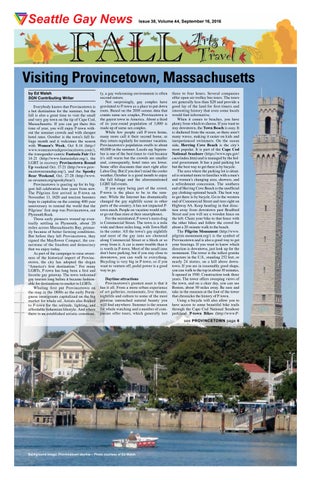
Background image: Provincetown skyline – Photo courtesy of Ed Walsh
2 Seattle Gay News
September 16, 2016
Celebrating 41 Years!
Visit us online www.sgn.org
September 16, 2016
Seattle Gay News 3
4 Seattle Gay News
September 16, 2016
Celebrating 41 Years!
Bellevue Arts Museum celebrates Pacific Northwest Metalwork in its fourth Biennial BAM Biennial 2016: Metalmorphosis will be on view September 2, 2016 - late January, 2017 The fourth edition of the Bellevue Arts Museum Biennial, BAM Biennial 2016: Metalmorphosis, will focus on the transformative and elemental medium of metal, which has captivated makers and thinkers alike for over 10,000 years. For each edition of the Biennial, the Museum designates a new focus of exploration, be it a medium, technique, process, or theme in art, craft, and design. The first three biennials have all focused on specific mediums – clay, fiber, and wood respectively – and BAM Biennial 2016 follows this trend. BAM Biennial is a juried exhibition occurring every two years, which focuses on the work of established and emerging Northwest artists, craftspeople, and designers living and working in Washington, Oregon, Idaho, Alaska, Montana, and British Columbia. The Museum received a record-breaking 330 applications for this year’s biennial. From this talented and vast pool of applicants, 49 artists were chosen to participate. The broad range of technique, tradition, and functionality that the material offers – from wearable objects that represent the legacy of the region’s many metalsmiths, to large-scale works that respond to architecture or landscape – will be represented in the exhibition, which serves as a testament to the inspirational potential and longevity of metal in the Northwest. Proposals were reviewed by a panel of four esteemed jurors comprising Lloyd E. Herman, Founding Director and Director Emeritus, Renwick Gallery, Smithsonian Institution; Jennifer-Navva Milliken,
Curator of Craft, Bellevue Arts Museum, Bellevue, WA; Suzanne Ramljak, Editor of Metalsmith magazine and curator at the American Federation of Arts, New York, NY; and Cindi Strauss, Assistant Director, Programming and Curator for Modern and Contemporary Decorative Arts and Design, Museum of Fine Arts, Houston, TX. During the run of BAM Biennial 2016: Metalmorphosis, two awards including cash prizes of $5,000 will be announced. The John & Joyce Price Award of Excellence will be selected by BAM’s curatorial team, and includes the opportunity for the winning artist to hold a solo exhibition at the Museum. This prestigious award was presented during the BAM Biennial Preview Party on September 1. The Samuel and Patricia Smith Peoples’ Choice Award invites the public to choose their favorite work. Ballot boxes in the gallery will encourage visitors to cast their vote. The Museum will announce the winner at a special ceremony held towards the close of the exhibition. The BAM Biennial 2016: Metalmorphosis artists: Rik Allen, WA; Ruth Beer, BC; Lanny Bergner, WA; Jana Brevick, WA; Julie Brooks, WA; John Buck, MT; Ben Buswell, OR; Deborah Butterfield, MT; Melissa Cameron, WA; Christine Clark, OR; Andy Cooperman, WA; Maria Cristalli, WA; Casey Curran, WA; Garri Dadyan, WA; Marita Dingus, WA; Andrew Fallat, WA; Chelsea Gaddy, WA; Aran Galligan, WA; Catherine Grisez, WA; Laurie J. Hall, OR; Bruno Hervieux, WA; Ron Ho, WA; Mary Lee Hu, WA; Lynne Hull, WA; David Keyes, WA; Bob Kramer, WA; Kirk Lang, WA; Cheryll Leo-Gwin, WA; Philip Levine, WA; Keith Lewis, WA;
Visit us online www.sgn.org
Micki Lippe, WA; Susan Madacsi, ID; Chris McMullen, WA; Taiji Miyasaka and David Drake, WA; Ries Niemi, WA; Allan Packer, WA; Ross Palmer Beecher, WA; Beverly Petow, BC; Maria Phillips, WA; Peter Reiquam, WA; Lyndsay Rice, OR; Midori Saito, WA; Anika Smulovitz, ID; Julie Speidel, WA; Spencer Staley, OR; Nicky Statius, OR; Lori Talcott, WA; Kristin Tollefson, WA; Nancy Worden, WA. BAM Biennial 2016: Metalmorphosis is organized by Bellevue Arts Museum and curated by Jennifer-Navva Milliken. ABOUT BELLEVUE ARTS MUSEUM
Bellevue Arts Museum is a leading destination in the Pacific Northwest to experience art, craft, and design. BAM engages the community through exhibitions, programs, and publications, featuring regional, national, and international artists. The museum is located at 510 Bellevue Way NE, Bellevue. Hours: Closed Monday; TuesdaySunday 11am-6pm; Free First Friday 11am8pm. Admission: Free for members & children under age 6; $5 TeenTix; $10 Senior/ Students/Military (with ID); $12 Adult; $30 Family. Daily public tour at 1pm. 425-5190770; bellevuearts.org. Free parking. Courtesy of Bellevue Arts Museum
Classicism Fleeing the Onslaught of Modernism by David Keyes – Photo by Emilie Smith
September 16, 2016
Seattle Gay News 5
Atlantic House during the day – Photo by Ed Walsh
PROVINCETOWN continued from cover
townbikes.com) and Gale Force Bikes (http://www.galeforcebikes.com) are excellent companies that rent bikes by the hour, day, or week. They can also provide you with some good advice on exploring the town’s best bike trails. Provincetown’s famed dunes used to be open to all cars but they suffered from being trampled to death. Now, the dirt roadway through the dunes is only open to a tour company and to vehicles with permits. You can also hike on your own through the dunes, but that can be a challenge, especially on hot days. Art’s Dune Tours (http://www.artsdunetours.org) is a great way to see the dunes. The guides explain the changing landscape of the dunes since the first Europeans arrived 400 years ago. Don’t be alarmed if the tires on the tour vehicles look like they are going flat. They need to partially deflate the tires to give them more traction on the sand. Provincetown boasts America’s oldest continuous art colony, which has been going strong since 1899. The Provincetown Art Association and Museum (www.paam.org) first opened in 1914 and the original building is still there next to the modern addition that opened in 2006. The museum features more than 3,000 works by over 700 artists, many of who call Cape Cod home. The Cape is known for its unique scenery, light, and shadows that artists love. You can take a stroll past a number of the more than 60 art galleries in a walk between downtown and the museum. Commercial Street is a destination to itself. It is lined with colorful shops and restaurants. Most are locally owned; you won’t see any chain stores there. Many of the city’s charming 80-plus guesthouses are on or near Commercial Street and most are beautiful old buildings that are kept up in pristine condition. Nightlife Atlantic House, aka A-House (http:// www.ahouse.com), boasts that it is America’s oldest gay bar. That title is a subject of debate. Several other gay bars also claim to be the oldest, including the White Horse Bar in Berkeley, California. But there is no disputing that the A-House has been continuously in operation for over 200 years. It has been overtly a gay bar for about 50 years and discreetly gay since as far back as the late 1800s. The “oldest” destination depends on how you define “overtly” and “discreetly” and since gay bars were illegal back in the day, no one officially called themselves a gay bar in those early days. The original A-House bar is cozy, with a fireplace in its main bar and the leather “macho” bar upstairs. The larger space is next door and includes a dance floor and back patio. The Crown and Anchor (http://www.
6 Seattle Gay News
onlyatthecrown.com) in the heart of downtown has it all. A restaurant, piano bar, video bar, poolside bar, Vault leather bar, and a cabaret space for live entertainment. Hotel rooms are on the upper floors. The venue has the space to host large circuit party events. The Boatslip (www.boatslipresort. com) tea dance from 4 to 7 p.m. throughout the summer is a Provincetown gay tradition that shows no sign of slowing down. Hundreds of mostly gay men pack the resort’s poolside/beachfront deck and indoor disco. By the way, the nightlife is early in P-town. Bars close at 1 a.m. but you can more than
P-town’s most modern hotels. It used to be the Pilgrim House resort but had to be rebuilt after fire gutted it in 1990. The Sage Restaurant in front serves dinner and an excellent continental breakfast for guests. By the way, the Sage is one of nine inns that are part of the Women Innkeepers of Provincetown (http://womeninnkeepers.com/). The site is also a great resource for lesbian activities and events in P-town. The Women Innkeepers are organizing this year to support the True Colors Foundation, the organization co-founded by singer Cyndi Lauper to help homeless LGBT youth. The business group held a benefit online auction recently
Ilona Royce Smithkin, Provincetown’s Woman of the Year 2016 – Photo courtesy of womensweekprovincetown.com
make up for it getting the party started in the early afternoon. The Pied Bar (http://www.piedbar.net) gets busy as the crowd migrates there after the tea dance. There are no exclusively lesbian bars in P-town but Pied Bar is lesbianowned and hosts “Boogie on the Bay” disco nights on Fridays and Saturdays from 10 p.m. to 1 a.m. that attracts a lot of women. Purgatory Dance Club is on the ground floor of the Gifford House Guesthouse (http://www.giffordhouse.com). Its low wood-beam ceilings give the bar a cozy, intimate feel. It is connected through a back staircase to a small piano bar upstairs and the Porchside Lounge. The Shipwreck Lounge (http:// www.P-townlounge.com) is a modern upscale lounge bar at the Brass Key Hotel. The outdoor patio features a large fire pit and fountain. After the bars close, Spiritus Pizza is where people migrate for a late night snack or just to hang out. Accommodations The lesbian-owned 19-room Sage Inn (http://www.sageinnP-town.com/) is one of
September 16, 2016
and plans a number of activities during Women’s Week in support of True Colors. Romeo’s Holiday (http://www.romeosholiday.com) may be the gayest hotel in town. It is known for a collection of Barbie dolls that line the decorative fountain out front. The inn has a very friendly vibe and caters to gay men but everyone is welcome. The property includes a clothing-optional hot tub. The couple who own the property live on site and they serve a continental breakfast and snacks during the day. Eating out P-town is known for its casual but world class dining at its more than 60 eateries. Most of the smaller inns include at least a continental breakfast but the town is not lacking in breakfast spots. The gay-owned Happy Camper on Commercial Street is a great place to stop for decadent homemade doughnuts and coffee and also be sure to stop by for dessert to try its homemade ice cream with some very unique flavors and combinations. Its sister restaurant Canteen (http:// www.thecanteenP-town.com) is open for lunch and dinner and is a great and inex-
pensive place to stop for a bite. You wait in line to order, take a number, and wait staff bring your food when it is ready. They are famous for their lobster rolls. The gay-owned Patio American Grill and Cocktail Bar (http://www.P-townpatio.com) always and deservedly draws a crowd. Centrally located on Commercial Street, it serves up delicious food on the front patio – ideal for people watching. The Lobster Pot (http://www.P-townlobsterpot.com) is one of P-town’s landmark businesses. You can’t miss the corner seafood restaurant with its neon lobster sign. The gay-owned Far Land Provisions (www.farlandprovisions.com) serves up fab comfort food on Bradford Street and it also runs the Far Land on the Beach concession, on Herring Cove Beach, greatly upping the quality of food that you might expect at a typical beach concession stand. Getting there and Boston JetBlue, American and Alaska Airlines fly direct to Boston from Sea-Tac. Through its association with Cape Air, JetBlue makes the process seamless. You can fly directly to Logan Airport then transfer for a 17-minute flight to P-town. Another great way to get to P-town is by way of the Bay State Cruise Company high-speed ferry (http://www.baystatecruisecompany.com). It takes just 90 minutes to get to P-town and the cruise through Boston Harbor and Cape Cod Bay is enjoyable. You can ride the MBTA’s Silver Line from Boston’s Logan Airport for a free right to the dock. The Silver Line makes several stops in downtown Boston, so you can combine a few hours in Boston with the ferry. The high-speed ferry makes it very easy to combine a P-town trip with a sightseeing trip to Boston. Unlike P-town, Boston has changed dramatically since the 1970s and mostly for the better. The gayest part of the city is the once run-down South End neighborhood, a couple of miles south of the ferry terminal. The Back Bay and Copley Plaza areas are also very gay-popular. New England’s tallest building is the 200 Clarendon, in Back Bay. Up until a couple of years ago, it was the John Hancock Tower and most people still call it that. The building’s flat reflective glass reflects the Boston skyline. The tower’s observatory sadly closed over security concerns after the 9/11 terrorist attacks but the neighboring and older Prudential Tower provides a view that is almost as good. Boston artfully blends the old and new. If you only have a short time in Boston, be sure to check out the 2.5-mile Freedom Trail (http://www.thefreedomtrail.org), that guides visitors through 16 historically significant locations, including the Old North Church and the site of the Boston Massacre. For more information on Provincetown, check out http://www.provincetowntourismoffice.org.
Celebrating 41 Years!
Visit us online www.sgn.org
September 16, 2016
Seattle Gay News 7
2016 FESTIVAL of MEN IN DANCE Two programs 9/30-10/2 & 10/7-10/9 Seattle’s own Against the Grain/MEN IN DANCE is proud to announce their 2016 Festival of MEN IN DANCE featuring an exciting roster of choreographers presenting dance works to be performed exclusively by men. The two-weekend festival will be presented at the Broadway Performance Hall (1625 Broadway) September 30-October 2 (Program #1) and October 7-9 (Program #2). This will be the organization’s most diverse festival yet, in terms of dance styles being presented, as well as regions being represented. The styles presented will be a mix of modern, contemporary, ballet, circus acts, Early Renaissance sword dancing and more! The chosen artists hail from Seattle, NYC, Massachusetts and Switzerland! Festival favorite choreographer Mike Esperanza has been commissioned to travel to the Northwest prior to the festival to cast and set a new piece of choreography on a group of Seattle men. This original work will anchor both weekend programs of the festival. MEN IN DANCE will be welcoming the NJ Company 10 HAIRY LEGS to the second weekend program of the festival. Project 44, with Gierre Godley directing, will be bringing a new trio to the second weekend program, after having been voted both jury panel and audience favorite at the MEN IN DANCE 2015 Showcase. Other choreographers who are new to the festival are Bruce McCormick, Kathryn Red, Alex Allan, Anna Connor, and Daniel Costa. Returning choreographers include the Kaleidoscope Company, Laura Beth Rodrguez, Gerard Theoret, Dylan Ward, Deborah Wolf, Jamie Karlovich, and Jason Ohlberg. Joshua Morten, currently living and working in Switzerland, as well as Jim Coleman (of Massachusetts) and Seattle’s Early Dance Company will join the event with special free-of-charge pre-show performances presented on the plaza in front of the Broadway Performance Hall an hour before each performance. In other words, the preshow outdoor performances on the Broadway Performance Hall plaza will begin Friday and Saturday at 7pm, Saturday matinee
at 1pm, and Sunday at 4pm. The public is invited to attend. (See details below.)
pany. Seattle Early Dance aims to have a wide appeal, presenting traditional dances in ways, both entertaining and informative, The roster of choreographers for the for modern audiences. 2016 Festival of Men in Dance is: The second weekend of the Festival will bring Seattle Early Dance back to the Program 1: plaza along with Massachusetts choreogSeptember 30-October 2 rapher Jim Coleman, in his original instalMike Esperanza (NYC) lation piece, “talking-heads.” The piece Bruce McCormick (SEA) will feature laptops, all of which will Kaleidoscope Dance (SEA) project an image of Jim (in various charKathryn Reed (SEA) acters), commenting on the live dancing Laura Beth Rodriguez (SEA) Jim is doing throughout the work. Jim is Gerard Theoret (SEA) formerly from Seattle, having danced with Dylan Ward (SEA) the Bill Evans Dance Company here. He is Deborah Wolf (SEA) currently an Artist-in-Residence/ProfesProject 44/Gierre Godley (NYC) sor of Dance at Mt. Holyoke College, and is also co-Artistic Director of the FreedPre-Show 1: man/Coleman Dance Company. These Joshua Morten (Switzerland) pre-show artists will join the sixteen other Seattle Early Dance (SEA) choreographers for an exciting 2016 Festival of MEN IN DANCE. Program 2: Show times for the 2016 Festival of October 7-9 MEN IN DANCE are 8pm on Friday and 10 HAIRY LEGS (NY/NJ) Saturday evenings; Saturday matinees at Alex Allan (SEA) 2pm (with pay-what-you-can $5 minimum Anna Connor (SEA) per person) tickets available at the box ofBryon Carr (SEA) fice; Sundays at 5pm, with the pre-show Daniel Costa (SEA) performances beginning on the plaza outMike Esperanza (NYC) side the performance hall an hour earlier. Jamie Karlovich (SEA) Tickets are $20-$35, and can be purJason Ohlberg (NYC) chased in advance at Brown Paper Tickets Project 44/Gierre Godley (NYC) at 1-800-838-3006 or http://www.brownpapertickets.com/event/2581250. Tickets Pre-Show 2: will also be available at the door, with debit Jim Coleman (MA) and credit cards as well as cash being acSeattle Early Dance (SEA) cepted. Students and seniors can buy tickets for $20; general admission is $25; the During the first weekend, Joshua Mont- two special Friday Night Openings will en and Vittorio Bertolli of Switzerland be $35, which includes a catered onstage bring a unique dance/performance art piece post-performance reception with the artdesigned to be performed outdoors, “Kill ists. Pay-what-you-can ($5 minimum per Your Darlings.” Joshua and Vittorio come person) tickets will be offered at the box ofto Seattle from recent appearances at the fice in person only for the Saturday matinee Swiss Dance Festival, the Ramallah Con- shows. The Broadway Performance Hall temporary Dance Festival, and the Busk- (1625 Broadway) is located off the plaza ers Bern Festival! Their intriguing dance at the south end of Seattle Central College will be performed along with a live perfor- near Broadway and E. Pine St. mance of traditional Morris Sword Dances For more information, visit www. presented by the Seattle Early Dance Com- MenInDance.org Courtesy of Against the Grain/Men in Dance
Two dancers in 10 HAIRY LEGS – Photo courtesy of 10hl.org
8 Seattle Gay News
September 16, 2016
Celebrating 41 Years!
Visit us online www.sgn.org
September 16, 2016
Seattle Gay News 9
Performers from 10 Hairy Legs – Photo courtesy of 10hl.org
10 Seattle Gay News
September 16, 2016
Celebrating 41 Years!
15th Annual Dungeness Crab & Seafood Festival Come for the Food, Stay for the Fun! Oct. 7-9 Celebrating the Olympic Peninsula’s aquaculture, agriculture and maritime traditions Port Angeles, WA – Each October foodies and fun-seekers from across the United States, British Columbia and beyond descend upon the scenic Olympic Peninsula to partake in a grand celebration of the coveted crustacean that derives its name from the town where it was first commercially harvested in 1848 – Dungeness. The 15th Annual Dungeness Crab & Seafood Festival will take place Friday, Saturday and Sunday, October 7 - 9, at the Port Angeles City Pier. Hours are Friday, 12pm - 10pm; Saturday, 9am - 10pm; and Sunday, 9am - 5pm. Admission is free. “CrabFest” as the festival has come to be known, has been recognized as one of the Top 100 Events in North America by the American Bus Association, and as one of the Top 10 Coastal Events by Coastal Living magazine. It was also featured in the national food magazine Saveur, and has come in second place at the “KING 5 Evening Magazine” poll for Best Food Festival. The Food! It’s all about great food and fresh crab! Thousands of pounds of Dungeness crab are pulled from local waters each year, enabling festival-goers to savor the freshest crab available while also enjoying a wide
variety of locally grown and produced foods. The 9,000 square foot Kitsap Bank Crab Central Tent will house an old-fashioned crab-feed complete with large whole crabs, fresh corn and cole slaw. At Crab Central and throughout the grounds, 14 local and regional restaurants will serve-up everything from crab cakes to gumbo and much more! The Taylor Shellfish Farms Raw Oyster Bar is not to be missed! Nonseafood and vegetarian dishes will also be available. The Fun! Held annually on the second weekend in October, CrabFest is a signature culinary event around which to plan a fall getaway weekend – or longer. In addition to great food, there’s live music throughout the event; a Chef Demonstration Stage featuring ongoing cooking demonstrations by a line-up of outstanding local and regional chefs; a Sunday morning non-denominational “Crab Revival” with gospel music performed by local artists; a Sunday Chowder Cook-Off sponsored by the Captain Joseph House Foundation; the Grab-ACrab Tank Derby; and more than 70 vendor
Visit us online www.sgn.org
see CRABFEST page 13
September 16, 2016
Seattle Gay News 11
12 Seattle Gay News
September 16, 2016
Celebrating 41 Years!
Outdoor tables at CrabFest – Photo courtesy of CrabFest
CRABFEST
continued from page 11 booths with juried crafts and information provided by environmental organizations. Master Chef Graham Kerr, the former Galloping Gourmet, to judge Chowder Cook-Off The festival is pleased to once again welcome Graham Kerr, the Master Chef known to millions around the world as the Galloping Gourmet. Kerr will appear at the Gateway Pavilion just across the street from the Crab Central Tent from noon to 2pm on Sunday, where he will speak, sign copies of his books and preside as judge of the annual Chowder Cook-Off. A Seasonal Highlight Along the Olympic Culinary Loop The Dungeness Crab & Seafood Festival is a seasonal highlight for Port Angeles, a city located 15 miles west of Dungeness, in a region long known as an outdoor enthusiast’s paradise. Nestled between the Strait of Juan de Fuca and the Olympic Mountains, PA has enjoyed its share of the limelight. Designated one of the 2015 Top 100 Best Small Towns by Livability.com, and one of the 20 Coolest Towns in the U.S. by the Matador Network, Port Angeles went head-to-head with Chattanooga, Tenn. in Outside Magazine’s 2015 “Best Town Ever” contest, coming in a close second by a slim margin of public votes. The Olympic Peninsula has a growing reputation for culinary adventure. Winding through four Olympic Peninsula counties encompassing diverse microclimates, the Olympic Culinary Loop is alive with farms, produce stands, fisheries, creameries, bakeries, wineries, cideries, farm-totable experiences and authentic culinary events, all within reach of Hwy. 101, the Pacific Coast Scenic Byway. The byway showcases the region’s diverse geography, from glacially sculpted peaks and towering old growth forest in Olympic National Park, to sea stacks along the wild ocean beaches and lush estuaries. The scenic
natural beauty is enhanced by living tribal cultures, historic seaport towns, and rolling agricultural land. During the fall, culinary travelers can visit artisan wineries, take a county farm tour, pick wild mushrooms, savor a farm dinner at a local waterfront resort, and of course, enjoy all the fresh crab they can eat at CrabFest! The Culinary Loop route is designed to put visitors in touch with the people who grow, harvest, catch and serve fresh Olympic Coast Cuisine, offering up a true sense of place. Set against a backdrop of vibrant fall foliage, the snowcapped Olympic Mountains and coastal waters, the Olympic Peninsula is the perfect place to savor the season! Bring your hiking boots, kayak, mountain or road bike and get out there – you’ll want to work up an appetite! MORE ABOUT CRABFEST Getting There To get to CrabFest, visitors can drive Route 101 to Port Angeles, with options for multiple ferry connections. Those from Canada will find special packages on the Coho Ferry from Victoria, which docks right next to the festival! Sponsors There would be no CrabFest without the support of our more than 40 sponsors. Special thanks to our Presenting Sponsors: Black Ball Ferry Line – Kitsap Bank – Red Lion Hotel Port Angeles – Peninsula Daily News. The Dungeness Crab & Seafood Festival is produced by Olympic Peninsula Celebrations, a Washington state non-profit corporation, and the Port Angeles Regional Chamber of Commerce. For details including transportation, accommodations, directions and the full program, please visit our website at www.crabfestival.org, e-mail info@crabfestival.org, or phone 360-452-6300. Courtesy of the Dungeness Crab & Seafood Festival
Visit us online www.sgn.org
September 16, 2016
Seattle Gay News 13
Visiting Palm Springs, California by Ed Walsh SGN Contributing Writer Palm Springs is getting ready for its close-up. The desert city, a painless two hour, 40 minute flight from Seattle, is welcoming in the cooler fall weather with a number of LGBT events. It starts out with Leather Pride Oct. 27-30 (http://www.desertleatherpride. com/), followed by a Halloween Street Party on Saturday, Oct. 29, and then Greater Palm Springs Pride on the first weekend of November. Pride includes a weekend festival and a parade down Palm Canyon Drive, the city’s main drag, on Sunday, Nov. 6. (https:// pspride.org/) But there is plenty to keep LGBTs content in Palm Springs all year round. As one of the world’s gayest cities, it is fitting that Palm Springs also has more gay resorts than anywhere in the world. Although three of the gay hotels have closed this year, the area still boasts 20, one is lesbian oriented and the other 19 are for gay men. By the way, the closed gay resorts are Helios, Pura Vida and Desert Eclipse. The Desert Eclipse is now the Avance Hotel making it the only non-gay hotel in Warm Sands. For the uninitiated, Warm Sands has the city’s largest cluster of gay resorts, ranging from the more couple oriented to a few that are more cruisy. The second-largest cluster of gay resorts is nearby on San Lorenzo Road. Palm Springs’ neighbor, Cathedral City, also has a large gay population. “Cat City”
WiFi and use of the hotel gym. The gay boutique inn, Hacienda at Warm Sands, is a good example of why the gay resorts have such a loyal clientele and is one of the most luxurious of any hotel in the city, gay or mixed. While upscale, it is not stuffy. The wonderful employees pamper every guest. The hotel provides an expanded continental breakfast and a gourmet deli lunch and it makes the tipping process simple. Employees are not allowed to accept gratuities. Instead an 8% service charge is added to the room rate. Century Palm Springs is a stunning property that showcases mid-century modern design and has the best mountain view of any of the Warm Sands properties. The rooms have all the 21st century conveniences with 1950s era design for which Palm Springs is famous. This luxury property provides a continental breakfast and a complimentary cocktail hour for guests. Other great Warm Sands hotels are Vista Grande, INNdulge, Desert Paradise, and El Mirasol Villas, the latter being the first of the gay Warm Sands inns. It was once the private getaway of reclusive billionaire Howard Hughes and his select friends. All Worlds is the largest of the Warm Sands resorts and is the only one that is open for day passes. It is the place to be if you want to be part of the party. It recently expanded to the old Inn Exile hotel across the street which it renamed All Worlds Annex. If you stay in one, you can play in both. The San Lorenzo Road gay hotels include the Triangle Inn, Tortuga del Sol,
Hacienda at Warm Sands boasts one of its pools – Photo courtesy of Ed Walsh
has three gay bars and a gay resort, the Cathedral City Boys Club (CCBC), which is open 24 hours a day every day for night and day passes. All the gay resorts except for All Worlds offer a free continental breakfast and some offer a free lunch as well as a cocktail hour. Only one, CCBC, charges a resort fee. That extra charge is about $25 extra per night, so worth keeping in mind when you are comparing prices. The hotel combines its resort fee and tax together on its web site, so it is easy to miss that extra charge. All the gay male resorts are clothing optional except for the upscale and fabulous East Canyon Hotel and Spa. Accommodations If you prefer to stay at a large fullservice mixed hotel, you would be hard pressed to do better than the 163-room Hard Rock Hotel Palm Springs. It is one of the city’s newest hotels, celebrating its third anniversary this fall. Rock and Roll memorabilia including costumes worn by gay icons Cher, Madonna, and Lady GaGa are on display in the lobby. The resort has a wonderful restaurant, a huge pool, and a wellequipped fitness room. One of the best things about this hotel is its location. It is right in downtown Palm Springs and just a half-block from Arenas Road, the area where you will find a half-dozen gay bars, the gay stores Gay Mart and Bear Wear Etc. The hotel’s $36 daily resort fee includes valet parking, free
14 Seattle Gay News
Escape Palm Springs and the Santiago. All are excellent properties. If you prefer to stay closer to downtown, the Canyon Club Hotel (not to be confused with CCBC) is on Palm Canyon Drive, just north of downtown. It is open for day passes and has a big grassy back lot that is beautifully landscaped, with a koi pond. A little north of the Canyon Club are the Bearfoot Inn, Chaps, and East Canyon Hotel and Spa. Chaps and the Bearfoot Inn as you might have guessed are geared to the bear and leather crowd, but all men are welcome. Chaps is more sexually charged, with slings and other play equipment readily available. Bearfoot is a beautiful boutique property whose owners have a designer’s touch that you will notice as soon as you walk in the door. Bearfoot, INNdulge, and Vista Grande offer a nice perk to guests: free use of the fabulously gay WorkOut Gym. Since Queen of Hearts closed a couple of years ago, Casitas Laquita is Palm Springs’ only lesbian hotel. It is a wonderfully appointed resort with a southwestern theme. It hosts a number of lesbian parties and special events. Casitas has one of the most unique things you will see anywhere in Palm Springs, a basement. The resort boasts an underground wine cellar that can accommodate special events. It feels like you are in a Prohibition era speakeasy. Sights Like the many aging Hollywood stars and starlets who have a second
September 16, 2016
Sunrise at Century Palm Springs – Photo courtesy of Ed Walsh
home in the city, Palm Springs is constantly having work done. Downtown is undergoing a facelift right now that will undoubtedly bring even more visitors to the city and keep regulars coming back for more. The massive project along S Palm Canyon Drive between W Tahquitz Canyon Way and E Armado Road will open up Palm Canyon Drive to the city’s art museum, which is often missed by visitors because it is a block behind the city’s main street. The blocklong stroll to the museum from Palm Canyon Drive will be flanked with restaurants and shops. The Palm Springs Art Museum will deservedly get a bigger audience once the project is done. The museum benefits from the desert’s well-heeled retirees who donate or lend art to the museum. In general, the museum focuses on contemporary work and includes a spectacular glass art exhibit. A good time to check it out is during the city’s Thursday night street fair. It is free that night from 4 p.m. to 9 p.m. It is also free on the second Sunday of every month. A guided tour is one of the best ways to see some of Palm Springs’ iconic landmarks without getting lost. Desert Adventures is among the best. The company runs a tour focused on the city’s LGBT heritage as well as tours of celebrity houses and excursions to the stunning Indian Canyons and the Joshua Tree National Monument, in the high desert, about a hour outside the city. One of Palm Springs’ most popular attractions is the Palm Springs Aerial Tramway, which whisks riders up Mt. San Jacinto, through four seasons in 10 minutes. In the winter, you could be basking by the pool and playing in the snow in the same afternoon. In the summer, it is a cool break from the desert heat. By the way, it is a good idea to rent a car when visiting Palm Springs and it is a necessity if you plan on exploring the surrounding desert attractions. The
city’s airport may be the easiest in the country for renting a car. There are no car rental shuttles, you just walk a few steps to a parking lot just outside the baggage area. The Palm Springs airport is just two miles from downtown. Alaska Airlines has a daily nonstop flight from Sea-Tac. You can also fly nonstop to the Ontario, California airport. You will have your choice of more flights, but the airport is a good hour’s drive to Palm Springs. Nightlife Most of the gay Palm Springs area nightlife is on E Arenas Road in downtown Palm Springs. That is where you will find Hunters, Score, Streetbar, SpurLine and Chill. Tryst is just around the corner on S Indian Canyon Drive near Arenas. The popular LGBT bar, Toucans, is on the north end of town, next to the great gay gym, the WorkOut Gym. The Tool Shed is in Warm Sands and, as you might have guessed, is leather and bear oriented. Neighboring Cathedral City has three bars, Digs, Studio One11, and Barracks. Cathedral City bars tend to draw more locals and fewer tourists, so it is a good place to mix it up with the locals. Very popular gay weekly events include a Sunday tea dance at Oscar’s Cafe and Bar and a legendary Friday happy hour at Wang’s in the Desert. Since Delilah’s closed years ago (where Studio One 11 is now) there are no full time lesbian bars in Palm Springs. But Toucans, Hunters, and Tryst are women-popular. Toucans regularly hosts early evening lesbian socials that are organized by Desert Dyners. For more information on those and other lesbian-focused events check out www. desertdyners.com. Palm Springs’ official tourism web site is VisitPalmSprings.com. Look for the LGBT tab at the top of the page.
Toucans Tiki Lounge – Photo by Eric Lynch
Background image: Joshua Tree National Park – Photo courtesy of visitcalifornia.com
Celebrating 41 Years!
Visit us online www.sgn.org
September 16, 2016
Seattle Gay News 15
16 Seattle Gay News
September 16, 2016
Celebrating 41 Years!
Visit us online www.sgn.org
September 16, 2016
Seattle Gay News 17
18 Seattle Gay News
September 16, 2016
Celebrating 41 Years!
Out There: Jonathan Porretta’s Life in Dance a celebration in words and pictures by Sharon Cumberland SGN A&E Writer OUT THERE: JONATHAN PORRETTA’S LIFE IN DANCE BY MARCIE SILLMAN WITH PHOTOGRAPHS BY ANGELA STERLING SEATTLE SCRIPTORIUM, 2016 Jonathan Porretta, a principal dancer at Pacific Northwest Ballet, is only thirtyfive years old – early days for having a book written about your life. But in the ballet world thirty-five is mature, particularly in a profession that begins in childhood. In this celebration of Porretta’s dance career, Marcie Sillman has written what in the academic world would be called a Festschrift – “a book honoring a respected person in his or her lifetime” or, in Latin, a liber amicorum – a book of friends who contribute their own work in the subject’s honor. The friends in this case are Rosie Gaynor, a designer who met Marcie Sillman at the American Dance Festival and discovered a shared interest in Porretta, and Angela Sterling, a PNB dancer who turned a career-ending fall into a life of professional art photography. Together they have produced a short, illustrated account of this superlative dancer’s career to date. This book, more accurately, is a memoir – a life described in terms of a particular skill or theme as opposed to a full-on biography of the subject’s complete life and impact on his or her times. Porretta, like any ballet dancer, has been so fully focused on developing the extraordinary skills required to perform ballet that he has not yet reached the stage, as many great dancers do later in life, where he branches out into new interests and directions. One could write a biography on the life of Peter Boal, for instance – a great dancer who is now shaping the Pacific Northwest Ballet for the future, or on Peter Martins, the dancer who inherited the New York City Ballet company from George Balanchine, and has been nurturing its development since the great Mr. B. died in 1983. Biographies have already been written about the phenomenal Russian dancers – Rudolph Nureyev and Mikail Baryshnikov – whose dance careers blossomed into multiple new directions as they aged and whose lives somehow encapsulated larger cultural forces at work, such as the fall of communism, the AIDS crisis, and the merging of classical and modern dance forms. My favorite example of great dance biography is Joan Acocella’s Mark Morris, written when the subject was only thirtyseven years old. Some critics considered her book to be premature, but Morris had made the transition from dancer to choreographer when he was only twenty-four and had taken modern dance into new directions. Acocella explains why modern dance had abandoned music as a driving force, and how Morris went completely against the grain of his era by restoring music – even classical music – to modern dance. Reading her book not only gives you a sense of Morris’ achievement, but gives you a deep account of the history of modern dance. And, it turns out, Acocella was prescient in her conviction that Morris would develop into the great choreographer we now know him to be. So it is all together fitting that Marcie Sillman and Co. produced a celebration of Jonathan Porretta’s life as a dancer without attempting to write a true biogra-
Visit us online www.sgn.org
12 year-old Jonathan Porretta – Photo courtesy of Jane D. Annunzio
phy – a future project that, if it happens, will be greatly aided by the information that Sillman has assembled for this book, such as a list of Porretta’s many roles, guest appearances, and choreographic works. We are also fortunate to have Angela Sterling’s photographs that, one suspects, could only be taken by another dancer – one who knows from experience what angles best represent the dancer’s body, what moments are the most dramatic and memorable, and what expressions encapsulate the most characteristic qualities of the dancer. This selection of photographs gives concrete and astonishing evidence of Porretta’s power and perfection of form. Sillman has also amassed a collection of non-professional photographs from Porretta’s childhood and adolescence which add charm and humor to a story that traces the challenges of a boy who grew up in New Jersey with the almost mystical conviction that he was born to be a dancer. Put that together with an early awareness of being gay and you have a story that merges youthful talent and success with the misery of being a misfit in a garden-variety grade school. It comes as no surprise that in the familiar story of children who overcome the obstacles convention puts before them, it is the mother who rescues, encourages, and enables her child to thrive. Porretta was blessed with a mother, Jane D’Annunzio, who made his childhood bearable. She encouraged his desire to take ballet lessons, even when the only classes were for girls (one of the best pictures in the book shows the seven-year-old Jonathan standing at the barre with eight little girls). She didn’t laugh or scold when he asked for pointe shoes for Christmas, but made sure Santa brought them, along with a note: “These pointe shoes are special, and probably you shouldn’t bring them to dance class.” She organized her life around driving Jonathan to his lessons and competitions, and, when he was accepted into the School of American Ballet at Lincoln Center, she drove him all the way from New Jersey into New York City and home again every day. Out There: Jonathan Porretta’s Life in Dance is valuable not only because it tells the story of how one extraordinary dancer managed, in spite of the vicissitudes of his childhood, to rise to the top of a fiendishly difficult profession, but also as a snapshot of a moment in American life when a talented child might have been hounded out of his destiny by intolerance. I hope that this short tribute to a wonderful dancer will have wide distribution in libraries and schools so that youngsters who are living lives against the grain of their cultures will gather courage from Porretta’s example. And who knows? Jonathan Porretta – given the determination and courage it took him to get this far – may have a biography full of achievements ahead of him.
Out There: Jonathan Porretta’s Life in Dance – Photo by Angela Sterling
September 16, 2016
Seattle Gay News 19
An interview with PNB’s Jonathan Porretta by Sharon Cumberland SGN A&E Writer Ballet and dance-lovers in the Seattle region – and, increasingly, around the country and the world – know that Jonathan Porretta is not just a star, but a shooting star of the brightest magnitude and intensity. He is a dancer to rival anyone on the ballet stage today, and has entered the brotherhood of memorable male dancers through time – Rudolph Nureyev, Mikael Baryshnikov, and that array of great dancers from the New York City Ballet where Porretta trained at the School of American Ballet: Peter Martins, Edward Villella, Jacques d’Amboise, and Seattle’s own director of the Pacific Northwest Ballet, Peter Boal. One indication of Porretta’s greatness is the release of a book, Out There: Jonathan Porretta’s Life in Dance by Marcie Sillman, that explains some of the reasons why this young man is taking his place in the pantheon of unforgettable dancers. What most dance-lovers may not know, but can intuit from Porretta’s stage presence, is that he’s also one of the nicest guys in the world – charming, funny, good natured, and sincere. I’ve seen these qualities in practice on the stage many, many times – as the high-flying sailor in “On the Town,” as the rascally Mercutio in “Roméo et Juliette,” as the firecracker cavalier in “Rubies,” and in many, many other dances in which he is unforgettable, and unforgettably intense. I met Porretta at a coffee shop near the Pacific Northwest Ballet’s (PNB) rehearsal studios where we got our drinks and walked to St. Paul’s Episcopal Church on Roy Street to have an uninterrupted conversation in the Godly Play living room. Somehow this seemed appropriate since dance and playfulness – especially in Porretta’s inimitable style – reach levels that lift the veil between the hum-drum worka-day world and the sublime. Jonathan is a New Jersey boy, raised in the Roman Catholic Church, so he was comfortable in these surroundings, talking about his career and his upbringing as a very different sort of kid – gay and devoted to dance from an early age, even when he was the only boy in dance classes full of girls. SC: Did you have a hard time in school, being a boy ballet dancer? Out There mentions that you were isolated and bullied. JP: I hated school! I didn’t have any friends, kids called me names, no one would sit with me. I wasn’t happy until I got to ballet class. SC: In the book it sounds as though you handled that very well – you made friends with the lunch ladies and the school nurse. But I wonder if that experience wasn’t more wounding than it sounds? JP: Well, it was – but I saved my tears for the pillow, as the saying goes. SC: I can relate because I hated school, too. JP: Really! Why did you hate school? SC: I had very smart older siblings but I was struggling at that age, so the teachers would say “Oh good, another Cumberland in class!” But soon they would say “Why can’t you be like your brother and sister?” JP: I had the exact same thing! My sister is four years older and she was the most popular in school, and my brother is five years older than me, and brilliant, and so I would hear “Mr. Porretta, you’re not as smart as your brother.” SC: It’s hard to believe teachers would say that to kids. JP: We didn’t go into detail in the book, but school was bad each day. I’d be called fag, girl, sissy – the kids would make fun of what I was wearing – I couldn’t wait to get
20 Seattle Gay News
Jonathan Porretta (far left) in dance class – Photo courtesy of Jane D. Annunzio
to the dance studio after school. SC: Your mom was instrumental in helping you overcome all that, wasn’t she? JP: My mother is my best friend. She got me to lessons, drove me there every day, supported me in all the dance competitions. [Porretta was named “Junior Mr. Dance” by the American Dance Educators of America when he was only 12 years old.] SC: So when did you find out you’re a swan and not an ugly duckling? JP: (laughing) Am I a swan? SC: You’re the king of the swans! Did you find your tribe when you got into the School of American Ballet (SAB) in New York? You were finally with other boy dancers in the classes – JP: For sure, and my best friends today are guys I met there. We all grew up together in SAB – Kiyon Gaines, Seth Orza, James Moore – but I didn’t exactly fit in there either. I wasn’t really happy until I got to Seattle. SC: Why didn’t you fit in at SAB? JP: I didn’t exactly not fit in… the ballet world is a very safe space for gays – being gay is a non-issue. But my style is very different from the tall, elegant style they teach there. I love the athletic, hard stamina kind of roles – where you sweat a lot – the hardcore style. SC: And the Balanchine style is all about being tall and noble and willowy… JP: Right. And I wasn’t tall enough to be
hired into the New York City Ballet (NYCB) – I just didn’t fit the NYCB aesthetic. SC: Was that a big disappointment? JP: At first, yes. It was devastating. But when Kent Stowell [founder and director of PNB with Francia Russell] offered me a contract after watching me take ballet class, I was so excited to experience something and someplace new! I was planning on going back to City Ballet in three years because that’s what Peter Martins [director of NYCB] and I discussed – he said maybe he’d take me as a soloist in three years after I got experience at another company. But three years came and went and Kent and Francia promoted me to soloist at PNB! [He is now a principal – top rank in ballet]. I truly felt that Kent and Francia loved me – and I love them. So I’ve had a great career here – Seattle audiences are wonderful. It took me about three years to feel at home here, though. One time, in rehearsal, I said how much I missed home and Patricia Barker [PNB ballerina, now Manager of Grand Rapids Ballet] put her hand on my arm and said to me “Jonathan, this is your home.” That’s when I began to realize she was right. SC: What’s it like to have choreographers create dances on your body? PNB has commissioned dances from some of the greatest choreographers working today – Chistopher Wheeldon, Mark Morris, Justin Peck, Crystal Pite. I especially loved
Pite’s “Emergence” – how did you learn to do moves as strange as her insect forms? JP: She’s a great choreographer. She works with dancers really well – she knows exactly how to show you the moves on her own body. A lot of choreographers try to describe things and you have to figure out what they mean, but Crystal could show you the moves the way dancers use their bodies. [Porretta demonstrates with sinuous arm and head movements.] SC: Marcie Sillman [author of Out There] calls herself a “ballet stalker” – in fun, of course – but do you ever have real stalkers or groupies making life difficult? JP: No…not really. Seattle is cool. But I did have one creepy guy send me weird things in the mail, like ads ripped out of the papers, and other strange things, but no, no real problems. SC: If you could be anywhere in the whole world, where you would feel the most comfortable – the most yourself? JP: That’s easy – Maui! I love Maui! I go there as much as I can – I’ve been there at least twenty times. My best friend, Kiyon Gaines, and I go on a trip together once a year, and we just got back from there this week. SC: Why do you love it so much…because it’s so far away from all the intensity of ballet? JP: Because I can go to bed at 9:30 pm and get up at 6:00 am and drive an open jeep around the Hana Highway and eat poké from the Safeway, and Aunty Sandy’s banana bread. I can surf and relax. I feel the most calm and at peace there – and I love “Little Beach.” Be sure to mention that in SGN – the readers will know what I’m talking about! [But I didn’t – so he kindly explained that it was a nude beach for gay men.] SC: Ballet dancers are like athletes in that their careers tend to be shortened by injuries – and you’ve had two big surgeries on your foot. What are your thoughts about the second career after ballet? JP: A tiki bar on Maui! Really, that would be like paradise. SC: No ballet? No teaching? JP: Oh, I love to teach and to conduct classes. I’ve been teaching master classes at Evergreen City Ballet in Renton, WA. If I worked in a dance company I’d like to do all the things that support dancers – their health, their futures, their progress. I don’t like fundraising – I hate asking for money – but I love to be around ballet and to work with dancers – all kinds of dancers. In New York there are places like Steps on Broadway and Broadway Dance Center that have classes open to all kinds of dancers – tap, ballet, jazz, Broadway – and all the professional dancers can mesh and get to know each other and try different styles of dance. Seattle doesn’t have anything like that, so dancers tend to be segregated by company or style. SC: And this is such a great dance town! Velocity, Spectrum, Whim W’Him, Men in Dance, UW World Dance… JP: Exactly – it would be great to have a dance space like that, where everyone could take daily classes and get to know each other. We’re so lucky at PNB to have daily class, but not all companies can afford it. SC: So…Steps on Broadway in Seattle? I see a new career on the horizon – JP: Maybe – we’ll see! I have a few more years of dancing ahead of me.
Jonathan Porretta in Fancy Free at Pacific Northwest Ballet – Photo by Angela Sterling
September 16, 2016
Celebrating 41 Years!
Visit us online www.sgn.org
September 16, 2016
Seattle Gay News 21
TRUMPOCALYPSE: Donald Trump: The Man Who Would Be King by Maggie Bloodstone SGN Contributing Writer DONALD TRUMP: THE MAN WHO WOULD BE KING BY DARWIN PORTER AND DANFORTH PRINCE BLOOD MOON PRODUCTIONS So you think you’ve heard it all about The Donald? Every scandal, every sleazy tidbit, every jaw-droppingly asinine quote? There couldn’t possibly be any more dirt to be had on inarguably the most repulsive, incompetent, arrogant, and yes, deplorable candidate to run for the position of Most Powerful Person In the World since, well, 1933. ...If you know what I mean. Blood Moon Productions has garnered a cult following and a considerable amount of infamy with their line of exhaustively researched veneral-warts-and-all tomes on the film & political icons of the past and present, including hefty tomes on Marlon Brando, the Kennedys, Bogart, the Clintons, James Dean, Howard Hughes, the Gabors, J. Edgar Hoover, and two sequels to the cult classic Hollywood Babylon (mostly written by Darwin Porter, who got to experience the seamy underbelly of the gilded realm of the rich & famous firsthand in the ’50s-’60s). Who more perfect to take on the most blatantly artificial, megalomaniacal, yet inexplicably fascinating figure of the 2016 election and the wealthiest example of trailer trash to ever poison the state of American culture and turn our political dis-
course into a a bad remake of Fellini’s Satyricon on Heisenberg-grade crystal meth? According to Blood Moon’s president, Danforth Prince: “In a departure from our usual obsession with the celebrity secrets of the Entertainment industry, Blood Moon’s most recent biography focuses on the more dangerous terrain of presidential politics. The subject is DONALD TRUMP, the title is The Man Who Would Be King, and the format – an anthology of cringe-worthy moments generated during the course of the Republican candidate’s very loud and egomaniacal life – is the most comprehensive and most devastating overview ever published in book form about the bloviating billionaire and the climate in which he thrived.” [MB: I’ve read much of Blood Moon’s oeuvre, and I can say that this is no idle boast on Prince’s part.] “Frankly,” Prince continued, “the production of this historically necessary book was either the smartest or the dumbest thing I ever did, a kind of line in the sand First-Amendment defiance of The Donald’s oft-repeated propensity to litigate. In fact, based on the terror that’s pervasive within the publishing industry about nuisance litigation from Donald, it’s a miracle that the book exists at all.” It’s all here for the ages, a YUGE and comprehensive chronicle of scum and villainy Trump’s minions will ignore and anyone who doesn’t want to see the U.S. become a massive reality show for a rich man’s amusement will appreciate. Get your copy now before Trump buys them all!
Cover of Donald Trump: The Man Who Would Be King – Image courtesy of Blood Moon Productions
22 Seattle Gay News
September 16, 2016
Celebrating 41 Years!
Pool Tournament Mondays $10 entry fee Cash prizes for the top 3 players
Trivia Wednesdays $5 per team Win cash and other prizes
Throwback Thursdays Old School videos with DJ Tamm NO COVER | $4 Drink Specials
Rendezvous Fridays & Sinful Saturdays DJs at 10:00 PM NO COVER before 10:00 PM Ladies FREE until 11:00 PM
Plus Half price pool Sunday - Tuesday Happy Hour specials Monday - Friday VIP booth reservations and Table Side Service available
OPEN MONDAY - FRIDAY 3PM - 2AM SATURDAYS 12PM - 2AM SUNDAYS 9AM - 2AM FOR NFL SEASON www.ballroomfremont.com | 456 N 36th St, Seattle, WA 98103 Email: tamara@ballroomfremont.com • 206-634-2575
Visit us online www.sgn.org
September 16, 2016
Seattle Gay News 23
Do everything or nothing at all at the Big Island’s Mauna Lani Hotel & Bungalows by Albert Rodriguez SGN A&E Writer You don’t have to do anything on vacation, if you don’t want to. No tours, no excursions, no museum visits, no outdoor adventures, nothing. If all you want to do is relax, eat and drink, lay by the swimming pool or the beach with a good book, or watch TV with room service, then that’s what you should do. And a perfect spot to do nothing, except maybe unwind and indulge, is the Mauna Lani Bay Hotel & Bungalows on the island of Hawai’i, also referred to as the Big Island. This somewhat remote, oceanside hotel on the Kohala Coast has everything you need for a long weekend, or weeklong, escape – swimming pool, tennis courts, restaurants, shopping center, spa and soft sand beach within footsteps of your front door, not to mention immaculate rooms with luxurious amenities to complete your pampering stay. I spent two full days and nights at this beautiful resort recently and the only things I accomplished were a suntan, a few great swims and meeting new friends – and that was all the vacation I needed. To plan your trip to the Mauna Lani, and for special deals and more information on the property, go to maunalani.com.
on the outbound and shoyu chicken, steamed rice, vegetables and cookie on the return. If you’re still hungry, a variety of candy, chips, tropical trail mixes can be purchased from the “Pau Hana Cart” during the flight along with nonedible items, like blankets and pillows. Additionally, complimentary mai tai’s are offered on some flights prior to landing with a salty snack. When flying to Hawaii, my personal favorite way of getting there is Hawaiian Airlines. The Mauna Lani Bay Hotel & Bungalows is located on the Kohala Coast, 23 miles north of the Kona International Airport. If renting a car, turn left onto Queen Kaahumanu Highway #19 when exiting the airport and drive the scenic route for approximately 25 minutes to the destination; turn left again at the second of two stoplights that you’ll encounter along the way. If not driving, take a private cab or shuttle to the hotel ($55$60 one way). Uber was not available when I visited in July, but it was rumored to begin soon. Upon arrival at the hotel, you’ll be greeted with chilled fruit juice and cold towel as you complete the efficient check-in process. ACCOMMODATIONS You’re not going to want to leave the Mauna Lani, and the rooms are a big reason why. For starters, each of the hotel’s 341 guest rooms have a private lanai (balcony) with table and chairs that face the ocean, Mauna Kea Mountain, or the
resort’s lush gardens. I stayed in a Deluxe Ocean View room on the sixth floor and awoke to picture-perfect scenery of the beach and palm trees, literally my idea of paradise. Dark chocolate-colored tones, ceiling fans, sliding doors, floral portraits and partly-carpeted hardwood floors provide guest rooms with a tropical, cool feel, while modern furnishings that include 47” LED HD TV, work desk and chair, loveseat, mini refrigerator and coffee maker with locally-roasted coffee give travelers many of the comforts of home. My bathroom was equipped with marble counter double sinks, shower/ tub and a separate space for a Japanesestyle toilet with built-in control settings for multiple rinsing and drying features. Elegantly scented soaps, lotions and hair essentials, plus ear swabs and cotton balls, were also provided. For use during your stay and to take home as a souvenir, you’ll find a pair of Mauna Lani letterembossed slippers in your floor-to-ceiling closet, besides two daily complimentary bottles of Hawaiian bottled water and free WiFi. Not needing to spend all my vacation outside, my room became a quiet, little sanctuary all its own, where I was able to read and meditate and absorb the unbeatable Hawaiian sunrises and sunsets from the lanai. AMENITIES / ACTIVITIES With one of the island’s most popular beachfronts right at your feet, you don’t have to go far to enjoy a swim, but there
is a nice outdoor pool at the Mauna Lani for guests to dip into, as well as a hot tub to soak in. Cocktails and food from the Ocean Bar & Grill can be ordered from the pool area and beach cabanas. Catamaran sails, sunset cruises, seasonal whale-watching sails, diving lessons and open water diving and night dives are offered by Mauna Lani Sea Adventures and can be booked through the concierge. Kayaks, surfboards, performance longboards, standup paddleboards and one-person canoes can also be rented from the concierge, who can assist novice surfers and paddlers with lessons. The Mauna Lani Sports & Fitness Club, up the road from the hotel, features state-of-the-art workout equipment, tennis courts, lap pool and fitness classes with instructors, who also offer personal training sessions, to keep you in shape, should that be of interest during your vacation. A $25 fee (per room, per day) will be added to your bill to utilize the facilities. Golfers can choose between two 18-hole courses at the Mauna Lani, the Francis H. I’i Brown North and South championship courses, which were built over large masses of black lava, and a Keiki Course (or, Children’s Course) allows the whole family to get in on some swinging action. The Shops at Mauna Lani is a nearby open-air shopping center with retail stores, eateries, galleries, movie theater, coffee shop and live entertainment. You can ride a bike (available to all guests,
Mauna Lani Resort – Photo courtesy of pinterest.com
GETTING TO THE BIG ISLAND AND MAUNA LANI Getting to the Big Island from Seattle is a breeze. Daily non-stop flights are offered from Sea-Tac International Airport by two airlines (Alaska, Delta) with total flight time clocking in at just under 6 hours, although I flew Hawaiian Airlines (hawaiianairlines.com) via Maui with a short layover. It added about 1.5 hours to my flight itinerary, but it was still convenient. Besides operating larger aircraft to Hawaii from the mainland (Airbus A330s), the Honolulu-based airline also gives passengers a more genuine experience, from its meal and beverage selections to its in-flight entertainment to its cabin crew that showers passengers with lots of aloha spirit. Speaking of meals and beverages, Hawaiian Airlines is the only US airline still serving complimentary breakfast, lunch, or dinner (except on red-eyes) in all cabins, plus complimentary red or white wine to enjoy with your meal, and a small snack. My meals on both flights, to and from Maui, were delicious and filling, consisting of bowtie pasta with sauce, salad and cookie
View of the water from one of the hotel guest rooms – Photo courtesy of maunalani.com
Performers during Twilight at Kalahuipua’a – Photo courtesy of maunalani.com
24 Seattle Gay News
September 16, 2016
Celebrating 41 Years!
inquire at the front desk), or take a shuttle that departs from the main entrance. For a directory and calendar of events, go to shopsatmaunalani.com. To sooth your stress away, or to reward yourself with a proper spoiling, the Mauna Lani Spa has an extensive list of treatments, from massages to body wraps to facials, that can be enjoyed in a Hawaiian village-themed setting complete with thatched huts, natural lava saunas, meditation hale and a Watsu pool. You can download a spa menu from the hotel website. One thing I especially loved about the Mauni Lani was the abundant seating areas throughout the hotel for guests to just sit, or socialize. Comfortable couches with coffee or end tables were graciously placed throughout the property, most noticeably on the ground level of the open-air, atrium-like lobby and also adjacent to the check-in desks, but I also came across a cozy nook with couch and cushions on my own floor, as well as benches around the exterior of the hotel to have a quick breather. RESTAURANTS CanoeHouse is the Mauna Lani’s premiere restaurant, serving American favorites with much of its meats, seafood and produce sourced from the Hawaiian islands, such as the Deep Fried Big Island
Goat Cheese and Kona Abalone from the appetizer menu, and the Wok Tossed Kona Lobster, Hawaii Ranchers Filet Mignon and Forbidden Risotto (made with local farmers vegetables) among the entree choices. Guests will not only savor CanoeHouse Chef de Cuisine Allan Nagun’s sumptuous food, but they’ll also admire the stunning views of the ocean from a polished, yet casual, dining room featuring hardwood floors, padded solid wood chairs and sliding doors. CanoeHouse is open for dinner only, Monday through Saturday. For a laid back atmosphere, the Bay Terrace serves breakfast, lunch and dinner inside and outdoors daily in a relaxed setting with a menu that includes familiar fare, from fresh salads to hearty sandwiches and burgers to a weekly Sunday Crab Feast and Prime Rib Buffet. Breakfast at the Bay Terrace can be ordered a la carte, or you can splurge on the Kalahuipua’a Buffet (full buffet) or Continental Breakfast Buffet. I had the former on both mornings during my stay and was amazed at the quantity, quality and array of options available, everything from eggs benedict and scrambled eggs to bacon and roasted potatoes to pancakes, pastries and a personal Hawaiian favorite, malasadas (Portuguese donuts), not to mention bagels, fresh fruit and veggies,
cereal and coffee, tea and juices, and even Japanese selections, such as miso soup and steamed rice. The aforementioned Ocean Bar & Grill is located outside and convenient, if you want something quick – burger, quesadilla, sandwich, etc. – or, something to pair an afternoon beer or evening glass of wine with. For a cup of coffee and light bite, the Mountain Thunder Cafe on the ground level is recommended. CULTURAL OFFERINGS A monthly event hosted by the Mauna Lani that welcomes guests and island residents alike is Twilight at Kalahuipua’a, an evening of storytelling, live music, dancing and the sharing of Hawaiian history and traditions. Held on the third Saturday of each month, visitors can learn about Hawaiian culture, while also experiencing authentic music, dance and wonderful stories performed by local artists and musicians. Guests are allowed to bring their own food, drinks, blankets and chairs to the Eva Parker Woods Cottage, a short two to three-minute stroll from the hotel, and sit on the oceanfront lawn to partake of this special event, which runs from 5:30 to 8:30pm on designated dates. The next Twilight at Kalahuipua’a is scheduled for October 15. The Kalahuipua’a Fishponds –
Kalahuipua’a, Kahinawao, Waipuhi, Waipuhi Iki, Hope’ala, Milokukahi and Manoku – lie adjacent to the Mauna Lani and were once used by ancient Hawaiians to raise fish and supplement their ocean fishing efforts, dating as far back as 250 BC, and were also used to raise various types of fish strictly for the consumption of Ali’i, or royalty. These marvelous ponds are available for viewing to guests and the general public at no cost. Something else for guests of all ages to experience at the Mauna Lani is Turtle Independence Day, held annually on July 4th. Since 1989, the hotel has raised juvenile turtles, or honu, sent from Sea Life Park on Oahu to raise in their saltwater ponds. When mature, they are released back into the Hawaiian waters and everyone is invited to attend the celebration, which includes live entertainment, meals for purchase from various island food trucks and an educational display of Hawaiian Green Sea Turtles. Besides fitness and water activities, the Mauna Lani also offers a daily schedule of things to do, including floral lei making classes, watercolor art demonstrations, gentle beach side yoga, pilates, spinning, throw net fishing demonstrations and many other activities to guests at a minimal cost, or free. Ask the front desk for a Daily Activities pamphlet.
Mauna Lani Resort – Photo courtesy of pinterest.com
Poolside at twilight – Photo courtesy of Rob Dev
Poolside dining Ocean Bar and Grill – Photo courtesy of Rob Dev
Visit us online www.sgn.org
September 16, 2016
Seattle Gay News 25
Not Just Another Pretty Face is an anthology worth reading and viewing by Eric Andrews-Katz SGN A&E Writer NOT JUST ANOTHER PRETTY FACE – AN ANTHOLOGY EDITED BY LOUIS FLINT CECI PHOTOS BY DOT AKA TOM SCHMIDT Paperback - $16.95 Kindle - $8.99 If a picture says a thousand words, then the anthology Not Just Another Pretty Face speaks in volumes. More than just a collection of beautiful male photography (all pictures were taken by DOT, aka Tom Schmidt) this anthology combines poetry, short stories and even a stage play based on assorted photographs captured by a camera lens. Editor Louis Flint Ceci collects a well-rounded assortment of authors, both new and established, to add their explorative voices to each of the sensual photographs. From the beginning the reader is drawn into the collection. Editor Ceci’s introductive poem “Frontispiece” gives a slight hint about what we are about to experience. Lewis DeSimone’s tale “Your Pretty Little Head” lets us experience new joys of two men reaching beyond their boundaries from an addiction recovery meeting, and how simple inspiration can be what is needed to break through personal blockage. In “The Terpsichorean Arts” by Jim Provenzano, two dancing boys (one retired and the other on a bar stage) face off with each other, recognizing the sensual movements and reactions they set off in one another. In “Solo,” Richard Michaels shows a sexy, erotic club dancer performing for an audience while dreaming of a better, more professional life. Clothing may make the man, but it also lends itself to plotlines. In “Packing” by Salome Wilde, two men plan for a short vacation. A shirt, of sentimental value to one, is accidentally included, launching off, a discussion between the two partners. In Jim Metzger’s stage production “Boxers,” two young lovers discuss the kleptomaniac compulsions one has to steal the underwear of the encounters that meant something to him. The metaphysical and fantasy have their places within this anthology. David Pratt’s “I
The cover of Not Just Another Pretty Face – Image provided by goodreads.com
Daniel Allen Cox – Photo by DOT (aka Tom Schmidt)
26 Seattle Gay News
September 16, 2016
Am Your Mirror” describes the patrons of a bar staring at a dancing boy, trying to find a reflection of themselves in his youthful appearances. Vanity strikes as the dancing boy is offered a position as an enchanted mirror to literally reflect the images. “Bound” by ‘Nathan Burgoine tells of a sorcerer’s attempt to bind his powers while having visions of a hot male werewolf. Gregory Norris’ story, “He-Witched” reveals the magic of attraction when a male Forest Witch’s love is enchanted by an evil curse. Passion is invoked in Vinton Rafe McCabe’s “Django, Django Thief of Hearts.” A man’s obsession is explored when he becomes involved with a beautiful Gypsy boy. “After Russian Hill” by Michael Carroll tells of a man’s journey from San Francisco to Key West after the death of his partner, and how to start a new life alone. The poetry is represented on many different levels ranging from the melancholy to the erotic. Trebor Healey’s “Ode to Projection” brings to the reader’s attention that romance and passion can be fully satisfied, even if “love” isn’t involved. Miles Griffis shares the fun of putting a “big ripped guy” into campy drag and finding the beauty of the man. Jeff Man’s “Hypothetically” describes the erotic vision of watching a bear-type go-go boy, and the sexual visions he provides. Of course, there are the pictures that accompany and inspire each story. DOT has shared a variety of types of men in a wide range of positions. Some of the subjects are nude, while others are in various forms of dress or make-up. In many of the shots the focus isn’t on the face, but more of a particular body part, tattoo, position of the subject in question, or sometimes the background scenery. The photographs are sensual and any reader can see why they allow such inspiration to be drawn. There are several other stories and poems waiting for the reader to explore, and many beautiful photographs for the viewer to experience. Mr. Ceci has done a very good job of putting together an enjoyable anthology. Whether you’re in the mood to snuggle in and read, as the last bit of summer fades, or if you’re looking to be inspired by sensual photography and wellcrafted writing, there is something for you to find in Not Just Another Pretty Face.
Ali Mushtaq – Photo by DOT (aka Tom Schmidt)
Celebrating 41 Years!
Visit us online www.sgn.org
September 16, 2016
Seattle Gay News 27
Beautiful Victoria BC! by Ed Walsh SGN Contributing Writer “Newlyweds, nearly dead, and flowerbeds,” was what people used to say about Victoria, British Columbia. You will still hear that line, but as locals will tell you, it is not reality anymore. Situated on the southern end of Vancouver Island, Victoria is Canada’s best-kept secret with a combination of the country’s best weather, picturesque scenery and historic architecture. Being surrounded by water means that Victoria seldom gets below freezing and rarely gets over 80 degrees. It is also relatively dry. Vancouver on the mainland gets twice as much rain. Victoria is a painless jaunt from Seattle. If you don’t want to mess with the hassle of an auto ferry, you can take a passenger-only ferry direct from Seattle to Victoria for $149 round-trip or $117 if you can wait until after Nov. 1. The ride on the Clipper Ferry is a little under three hours. (clippervacations.com). Victoria’s charms are not lost on the high tech industry, which is booming in the city. The tech companies are able to more easily entice workers with the perk of living in a beautiful city with housing costs that are a little more affordable than Vancouver. The techies are helping to raise the demographic age well beyond “nearly dead.” Victoria is the capital of British Columbia and government is the biggest employer, followed by high tech and tourism. The greater Victoria area has a population of nearly 350,000 people, compared with nearly 2.5 million in the Metro Vancouver area. Victoria is very much historically connected with San Francisco despite being more than 700 miles apart. Like San Francisco, gold put Victoria on the map. About ten years after the original 49ers flocked to San Francisco, Victoria had its own gold rush. Some of the 49ers headed north to follow the gold after prospects dried up in Northern California. Victoria boasts North America’s second-oldest Chinatown, after San Francisco, because of the gold rush. Many Chinese came to the town to serve the gold miners by selling
much needed supplies and not-so-need-
high rises as there was in Vancouver.
permanently painted in rainbow colors
ed services in the red light district that flourished in Chinatown with brothels, opium dens and gambling houses. In the late 1800s, Vancouver was once little more than a train depot serving Victoria. Passengers and cargo were ferried to Victoria after making it to the last stop in Vancouver. But by the early part of the 20th Century Vancouver came into its own. The railroad meant that it was a lot more practical to do business on the mainland and there wasn’t much reason to go to Victoria after the gold rush. The early evolution of Victoria is part of the reason why tourists flock there today. There wasn’t the big economic pressure to tear down the old buildings in the city to make way for
Victoria still retains some of the charm that got swallowed up in big cities. Like San Francisco, Victoria has a long history of tolerance. Back in 1865 it was the first city in North America to elect a Jewish mayor, Lumley Franklin, who had followed his brother Selim, to Victoria from San Francisco. Selim was elected to the BC legislature even earlier in 1858. In 1866 Victoria elected a black city councilman, who was acting mayor for a time. And that evolution continued through the late 20th century with the city’s warm embrace of LGBTs. Victoria spreads out its Pride weekend over ten days, including a series of events and of course a parade. The parade celebrated its 22nd year in early July. Two of the city’s intersections are
in tribute to the LGBT community. While Victoria has no gay neighborhoods, LGBTs are integrated and accepted throughout the city. Victoria’s one gay bar, Paparazzi, is conveniently situated downtown (www.paparazzinightclub.com). The bar’s address is 642 Johnson Street, but if you go by that address, you won’t find it because the entrance is around the corner on Broad Street. The bar’s attractions includes dancing, drag shows and karaoke. Like California, bars in Victoria close at 2am, but when it comes to drinking, it is a little looser there. The drinking age in British Columbia is 19. Despite its size, Victoria has a thriving theater scene. Intrepid Theater hosts an LGBT-themed series of presentations in late June called Outstages. Victoria Fringe Theater Festival is also very gaypopular and gets underway in late August through early September. It showcases new and uncensored work and all the proceeds go to the artists. The theater is very active year round.
Victoria’s Parliament Building – Photo by Robert Forbes
Butchart Gardens’ Sunken Garden is the site of a former quarry pit – Photo by Ed Walsh
28 Seattle Gay News
September 16, 2016
SIGHTS When in Victoria, do like the locals do: walk. Along with Vancouver, Victoria deservedly ranks as one of Canada’s most walkable cities. One of the best ways to get the lay of the land is through one of the Discover the Past walks (https://discoverthepast.com/). The most popular are the Ghostly Walks but the Discovery and Chinatown tours are every bit as compelling thanks to the walk leaders who combine a passion for history with a talent for storytelling. Respected local historian John Adams runs the company and regularly leads tours. He has passed along his enthusiasm for history to his son, Chris, and his other well-trained guides. Victoria has some amazing stories that are recounted on the walk. One of the most famous includes a love triangle involving Francis Rattenbury, the famed architect who designed BC’s Parliament Buildings. After his own scandalous personal history, he was murdered by the young man who was having an affair with his wife. The killer eventually went on to become a World War II hero. Victoria is a very bicycle-friendly and one of the best overall tours of the
Celebrating 41 Years!
Michael Dwyer and David Marshall of Dashwood Manor Seaside Bed & Breakfast Inn – Photo courtesy of Ed Walsh
Background image: Crosswalk painted in rainbow colors near Victoria City Hall – Photo by Ed Walsh
city is by bicycle. The Pedaler (thepedaler.ca) offers some great city tours that take sightseers through parks and bike trails not accessible by car and too far to walk. The guides are well versed on Victoria history and have good insider tips for first-time visitors to the city. Victoria’s most famous attraction is Butchart Gardens (www.butchartgardens.com), about a half-hour drive outside of downtown. The property’s 55-acres of public gardens has been in operation for over 100 years. The former quarry was transformed from an eyesore to one of the world’s most beautiful gardens. It is open year round with evening summer entertainment including a spectacular fireworks show. Christmastime is also big in the gardens with the property adorned in Christmas lights The best way to get there is by a CVS bus (no connection with the drug store). CVS as well as Gray Line also run excellent overall tours of the city. The focal point for tourism in Victoria is its iconic harbor fronted on one side by the Empress Hotel and the other by the Parliament Buildings, which are outlined
Visit us online www.sgn.org
at night by a string of lights. Gardens are everywhere in Victoria and fittingly flowers spell out “Welcome Victoria” on the slope of the seawall in front of the Parliament Buildings. The aforementioned Chinatown is another big Victoria attraction. Despite San Francisco’s Chinatown being older, the buildings in Victoria’s Chinatown are older because of the earthquake and fire that destroyed San Francisco’s Chinatown. The most famous Chinatown attraction in Victoria is Fan Tan alley, which is only about 35 inches wide at its narrowest point. A scene from the Goldie Hawn and Mel Gibson 1990 movie Bird on a Wire was shot there. Be sure to stop by the Fan Tan Trading store. It includes a display of artifacts of Chinatown including items used to play the fan tan gambling game for which the alley is named. The shop is nicknamed the neverending store because it meanders away from the alley and onto the street. The city’s biggest open space is Beacon Hill Park, which got its name from the two signal beacons that once helped ships avoid crashing on the
rocks off the island’s coast. The park includes a number of gardens as well as a children’s petting zoo. The zoo and all the attractions in the park are free. By the way, Victoria is not immune to the Pokemon Go craze. You will see parkgoers walking around with glowing smart phones as they go on the hunt. ACCOMODATIONS The gay-owned Dashwood Manor Seaside Bed and Breakfast (www.dashwoodmanor.com) is perfectly situated across the street from Beacon Hill Park on one side and the ocean on another. The couple who own the property are very much hands on. Michael Dwyer serves up delicious gourmet breakfasts and his partner David Marshall helps to serve and taking reservations. It has all the character of the historic home that it is with the amenities you will find in the finest modern hotels. The gay-owned Albion Manor Bed and Breakfast (www.albionmanor.com) is another charming option in Victoria. The 1892 Victorian mansion is decorated with artwork throughout. The owners,
Fernando Garcia and Don Halton, are artists and their artistic touches are evident throughout the property. If you would prefer a full service hotel, you would be hard pressed to do better than the Parkside Hotel and Spa (www.parksidevictoria.com), in downtown, just a couple of blocks from the Empress Hotel. The hotel includes a full service spa as well as a large indoor swimming pool and fitness room. A theater in the hotel has free movies for guests daily. The hotel had worked with Victoria Pride last month for a special Pride package. If you want to be a part of history, the Fairmont Empress Hotel (www. fairmont.com/empress-victoria) is the city’s oldest hotel and one of the most luxurious. The hotel has kept its historic facade while almost constantly modernizing and updating itself with the best amenities and furnishings that high-end travelers demand. For more information, Victoria’s official tourism web site is http://www. tourismvictoria.com/
Albion Manor Bed and Breakfast – Photo courtesy of tripadvisor.ch
September 16, 2016
Seattle Gay News 29
At the intersection of art, poetry, and nature The San Juan Islands Museum of Art (SJIMA) is proud to present “Hydrographs” and “For All We Know,” concurrently running exhibitions by two innovative artists and printmakers, Nicole Pietrantoni and Dianne Kornberg. The exhibitions will open to the public on September 17 and will end on November 28. Both women utilize printmaking to question what most take for granted, adding an artistic voice to forms otherwise expressed in purely scientific terms. In the words of Nicole Pietrantoni: “I am interested in our active role in constructing and idealizing landscape, questioning both the historical and contemporary complexities of representation.” She passionately explores the complex relationship between humans and nature through the medium of printmaking, creating works that are both powerfully cerebral and stunningly aesthetic. Pietrantoni will give a Gallery Talk on “Fractured Landscapes, Fraught Aesthetics” on Saturday, September 17 at 10am at SJIMA. Diane Kornberg uses printmaking and
other creative media to create photo-based, archival pigment prints that both honor and question limits to the creation of knowledge through the scientific methods. She juxtaposes poetry by her collaborator, Elizabeth Frost, alongside scientific language and conventions applied to specimen conservation and preservation. Their work serves to create alternate ways of understanding the “evidence” around us. The artist and the poet shift their focus in the “What is Left” series, as they explore the charged and disorienting experience of grief. Kornberg will give a Gallery Talk on “Crossing Borders” on Thursday, October 13, at 7pm at SJIMA, speak on Friday, October 7 at 7pm at the Lopez Island Library, and speak on Friday, October 14 at 7pm at the Orcas Island Episcopal Parish Hall (2424 Main St., East Sound). A book-signing will follow each presentation. Nicole Pietrantoni is currently an Assistant Professor of Art at Whitman College in Walla Walla, Washington, where she teaches printmaking and book arts. With degrees
Dianne Kornberg – Photo courtesy of SJIMA
30 Seattle Gay News
September 16, 2016
Nicole Pietrantoni – Photo courtesy of SJIMA
in Human and Organizational Development and Art History from Vanderbilt University, an MFA and MA in Printmaking from the University of Iowa, her accolades include: a Fulbright award for research in Iceland, an Artist Trust Fellowship, a Larry Sommers Printmaking Fellowship, the Manifest Prize, and a Leifur Eiríksson Foundation Grant. She is President of SGC International, the largest professional organization dedicated to printmaking, book arts, and papermaking in North America. Her work has been featured in over 80 national and international exhibitions and collections around the world. Dianne Kornberg has been exhibiting her artwork nationally and internationally for three decades. Museum collections include the Portland Art Museum, Seattle Art Museum, and more. Her work is featured in multiple book publications including Contemporary Art in the Northwest, 100 Artists of the West Coast, and Selected Work of the Portland Art Museum. She is a professor emerita at Pacific Northwest College of
Art in Portland, Oregon, and resides on an island in the San Juans. Elisabeth Frost is the author of All of Us: Poems (White Pine Press), amongst others. Frost is Professor of English and Women’s Studies at Fordham University, and has received grants from the Fulbright Foundation, The RockefellerBellagio Foundation, and more. The exhibitions will run concurrent with the ongoing installation in the Atrium Gallery, “A River of Migration” by Gu Xiong. For more information go to http://www.sjima.org The San Juan Islands Museum of Art is located at 540 Spring St, Friday Harbor, San Juan Island. Hours are: Friday-Monday, 11am-5pm. Admission: $10 adults; children 18 & under FREE; members FREE. Third Mondays FREE. Phone: 360-370-5050. Social Media: SJIMA can be found on: www. twitter.com @_SJIMA http://www.facebook.com/SanJuanIslandsMuseumofArt Courtesy of the San Juan Islands Museum of Art
Celebrating 41 Years!
Visit us online www.sgn.org
September 16, 2016
Seattle Gay News 31
32 Seattle Gay News
September 16, 2016
Celebrating 41 Years!